

ARIA Web3
69 Posts

ARIA Web3
Report
Block User
15 Following
15 Followers
44 Liked
Posts
PINNED
·
--
Bullish
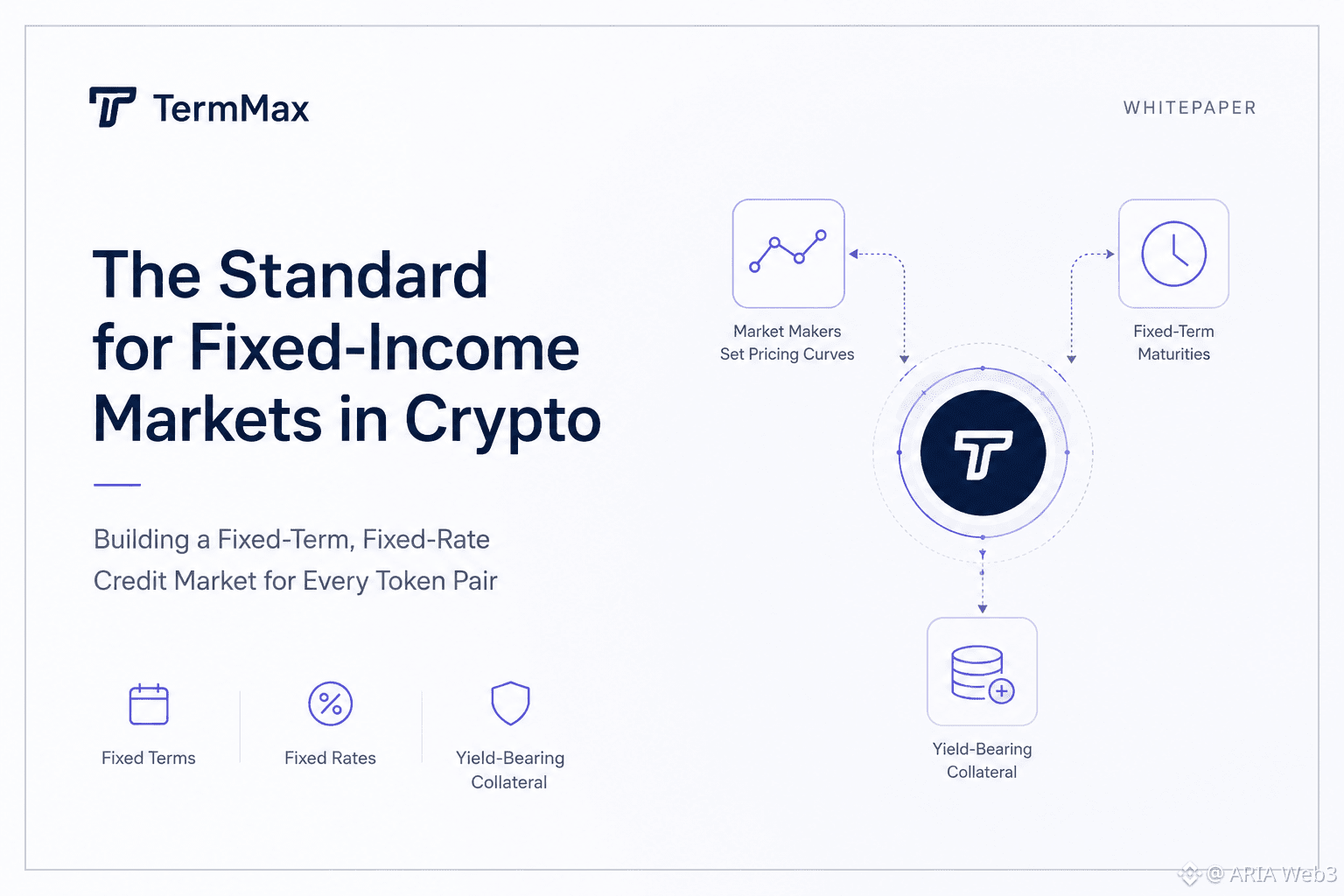
I was reading through TermMax's documentation, trying to figure out what they mean by calling themselves "the standard for fixed-income markets" in crypto. My first assumption was that this was just another lending protocol competing on rates.
After checking the official vision page, one detail caught my attention: they talk about building "an entire credit market for each token pair, just like what we have in real life." That phrase stuck with me, it's a different framing than most DeFi lending pitches.
That's when it clicked. The goal isn't just lending, it's giving every asset pair its own fixed-term, fixed-rate market, where market makers set the pricing curves. They also use yield-bearing tokens as collateral, so fixed terms bring predictability while the collateral itself keeps generating returns.
What surprised me was how intentional the limits feel. Fixed maturities mean less flexibility than open-ended lending, but that trade-off is what makes a real credit market possible on-chain in the first place.
With the TGE set for August 25, 2026, it feels less like a standalone launch and more like the next milestone in building that credit market out. I'm still wondering how much of the curve-setting process will eventually open up beyond curators.
#termmax @termmax
I was reading through TermMax's documentation, trying to figure out what they mean by calling themselves "the standard for fixed-income markets" in crypto. My first assumption was that this was just another lending protocol competing on rates.
After checking the official vision page, one detail caught my attention: they talk about building "an entire credit market for each token pair, just like what we have in real life." That phrase stuck with me, it's a different framing than most DeFi lending pitches.
That's when it clicked. The goal isn't just lending, it's giving every asset pair its own fixed-term, fixed-rate market, where market makers set the pricing curves. They also use yield-bearing tokens as collateral, so fixed terms bring predictability while the collateral itself keeps generating returns.
What surprised me was how intentional the limits feel. Fixed maturities mean less flexibility than open-ended lending, but that trade-off is what makes a real credit market possible on-chain in the first place.
With the TGE set for August 25, 2026, it feels less like a standalone launch and more like the next milestone in building that credit market out. I'm still wondering how much of the curve-setting process will eventually open up beyond curators.
#termmax @TermMax
1
1
85
·
--
today live match, AS Roma vs Cagliari: Roma look like the clear favorites with a 74% win probability, while Cagliari have just 8%. I’m leaning towards a Roma win. #BinancePick
today live match, AS Roma vs Cagliari: Roma look like the clear favorites with a 74% win probability, while Cagliari have just 8%. I’m leaning towards a Roma win. #BinancePick
81
·
--
Inter Milan win congratulations, already winlook like the clear favorites team, with. I’m leaning towards an Inter win, but football can always surprise us. #BinancePick
Inter Milan win congratulations, already winlook like the clear favorites team, with. I’m leaning towards an Inter win, but football can always surprise us. #BinancePick
87
·
--
#BinancePick Live, G2 Esports vs Dplus KIA
DK looks like the favorite with a 60% win chance, while G2 stands at 39%. Can G2 pull off an upset,
will DK take the win?
#BinancePick Live, G2 Esports vs Dplus KIA
DK looks like the favorite with a 60% win chance, while G2 stands at 39%. Can G2 pull off an upset,
will DK take the win?
DK looks like the favorite with a 60% win chance, while G2 stands at 39%. Can G2 pull off an upset,
will DK take the win?

67
·
--
#BinancePick today live match, Gen.G looks like the stronger side going into this match. IG can still surprise us, but I’m backing GEN to take the win! What’s your prediction.
#BinancePick today live match, Gen.G looks like the stronger side going into this match. IG can still surprise us, but I’m backing GEN to take the win! What’s your prediction.

·
--
Bullish
#BinancePick today, gen.g looks like the stronger side going into this match
#BinancePick today, gen.g looks like the stronger side going into this match

63
·
--
#BinancePick Gen.G looks like the stronger side going into this match. IG can still surprise us, but I’m backing GEN to take the win! What’s your prediction?
#BinancePick Gen.G looks like the stronger side going into this match. IG can still surprise us, but I’m backing GEN to take the win! What’s your prediction?

78
·
--
Bullish
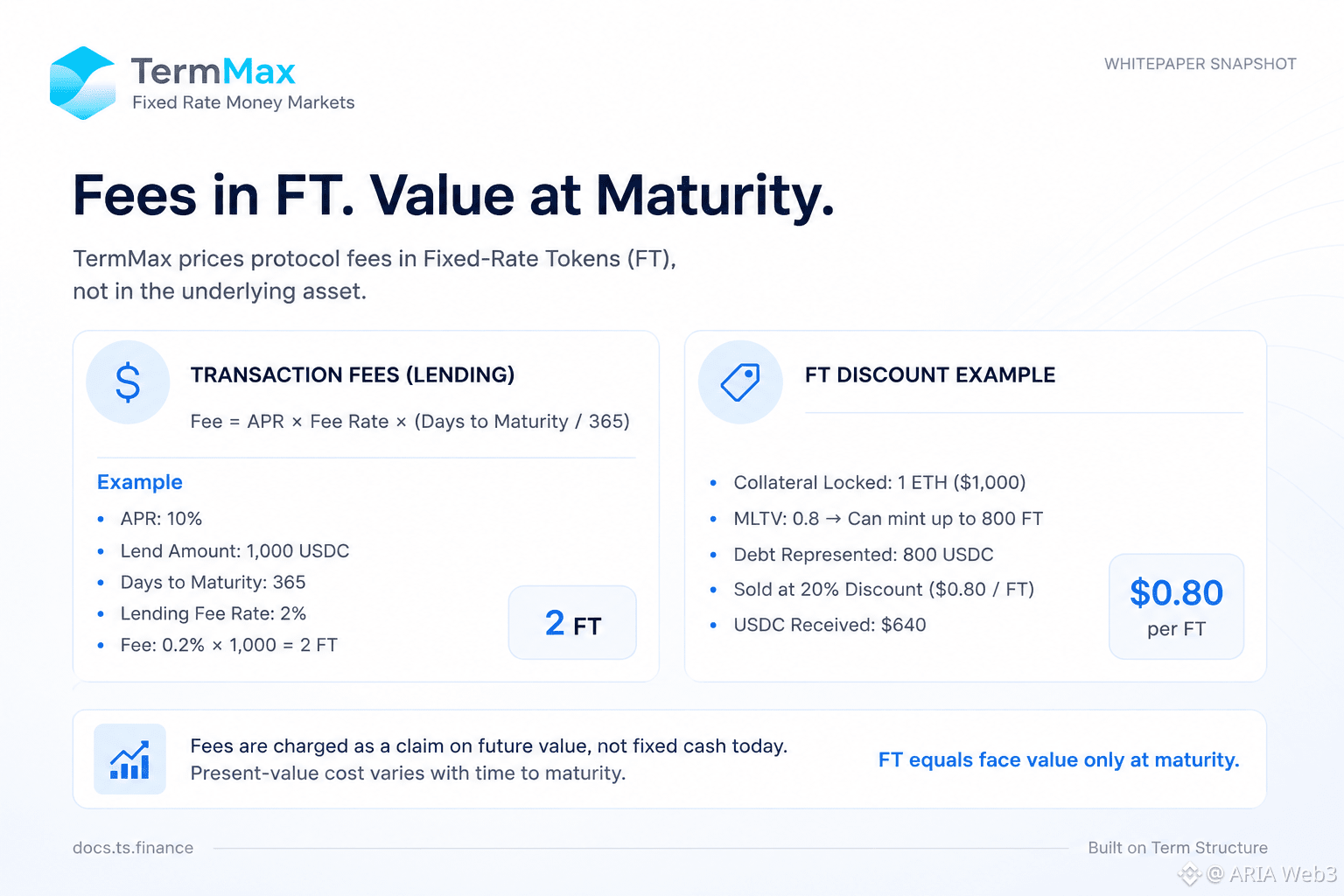
I was reading TermMax's transaction fees page on docs.ts.finance. The formulas are simple — APR × fee rate × (days to maturity/365) — but one detail caught my attention: fees resolve "in unit of FT," not USDC. Their own example: lending 1,000 USDC at 10% APR for 365 days, at a 2% fee rate, costs just 2 FT.
I assumed that was just a display convention. After checking the Fixed-Rate Tokenization docs, it turned out more deliberate. FT is a discount instrument, only worth face value at maturity. In their example, 800 FT sells at a 20% discount ($0.80 each) — $640, not $800.
That's when it clicked: pricing fees in FT means charging a claim on future value, not fixed cash today. Two lenders paying "the same" 2% fee at different points before maturity pay different present-value costs.
Feels less like a flaw, more a trade-off of tying fees to the unit lenders already hold, instead of converting through USDC each time. Still unclear how this reconciles when the protocol reports aggregate fee revenue in one denomination.
Anyone know where that's documented?#termmax @termmax
I was reading TermMax's transaction fees page on docs.ts.finance. The formulas are simple — APR × fee rate × (days to maturity/365) — but one detail caught my attention: fees resolve "in unit of FT," not USDC. Their own example: lending 1,000 USDC at 10% APR for 365 days, at a 2% fee rate, costs just 2 FT.
I assumed that was just a display convention. After checking the Fixed-Rate Tokenization docs, it turned out more deliberate. FT is a discount instrument, only worth face value at maturity. In their example, 800 FT sells at a 20% discount ($0.80 each) — $640, not $800.
That's when it clicked: pricing fees in FT means charging a claim on future value, not fixed cash today. Two lenders paying "the same" 2% fee at different points before maturity pay different present-value costs.
Feels less like a flaw, more a trade-off of tying fees to the unit lenders already hold, instead of converting through USDC each time. Still unclear how this reconciles when the protocol reports aggregate fee revenue in one denomination.
Anyone know where that's documented?#termmax @TermMax
4
5
80
·
--
Bullish
I was reading through Dusk Trade's landing page expecting a typical RWA access page: join a waitlist, verify, invest. One detail caught my attention once I moved past that surface and into the documentation.
I assumed the product itself would be as simple as the page makes it sound: three steps, nothing more. After checking the official docs, the description shifts. Dusk Trade is called an application layer sitting above the base protocol, and the docs are explicit that it is not the base protocol itself. It turns market-infrastructure primitives into workflows covering asset discovery, investor onboarding, wallet connection, payment coordination, and settlement.
What surprised me was the gap between the two official sources. The landing page sells access in three steps. The docs describe eligibility checks, disclosure logic, and settlement that reconciles the asset leg with the payment leg before anything finalizes. That's when it clicked: the trade-off makes sense once you consider audience. A waitlist page has to convert visitors quickly, while documentation has to satisfy builders and regulators who need to know how eligibility and settlement actually get enforced on-chain. Still, I wonder how much of that complexity investors will actually see once the interface goes live, or whether it stays buried behind the clean three-step flow.
The landing page sells access in three steps. The docs describe eligibility, disclosure, and settlement logic underneath.
What matters most for Dusk Trade's success?
#dusk $DUSK @Dusk_Foundation
I was reading through Dusk Trade's landing page expecting a typical RWA access page: join a waitlist, verify, invest. One detail caught my attention once I moved past that surface and into the documentation.
I assumed the product itself would be as simple as the page makes it sound: three steps, nothing more. After checking the official docs, the description shifts. Dusk Trade is called an application layer sitting above the base protocol, and the docs are explicit that it is not the base protocol itself. It turns market-infrastructure primitives into workflows covering asset discovery, investor onboarding, wallet connection, payment coordination, and settlement.
What surprised me was the gap between the two official sources. The landing page sells access in three steps. The docs describe eligibility checks, disclosure logic, and settlement that reconciles the asset leg with the payment leg before anything finalizes. That's when it clicked: the trade-off makes sense once you consider audience. A waitlist page has to convert visitors quickly, while documentation has to satisfy builders and regulators who need to know how eligibility and settlement actually get enforced on-chain. Still, I wonder how much of that complexity investors will actually see once the interface goes live, or whether it stays buried behind the clean three-step flow.
The landing page sells access in three steps. The docs describe eligibility, disclosure, and settlement logic underneath.
What matters most for Dusk Trade's success?
#dusk $DUSK @Dusk
Compliance design
50%
Liquidity depth
50%
Onboarding speed
0%
Investor trust
0%
4 votes • Voting closed
1
1
83
·
--
Bullish
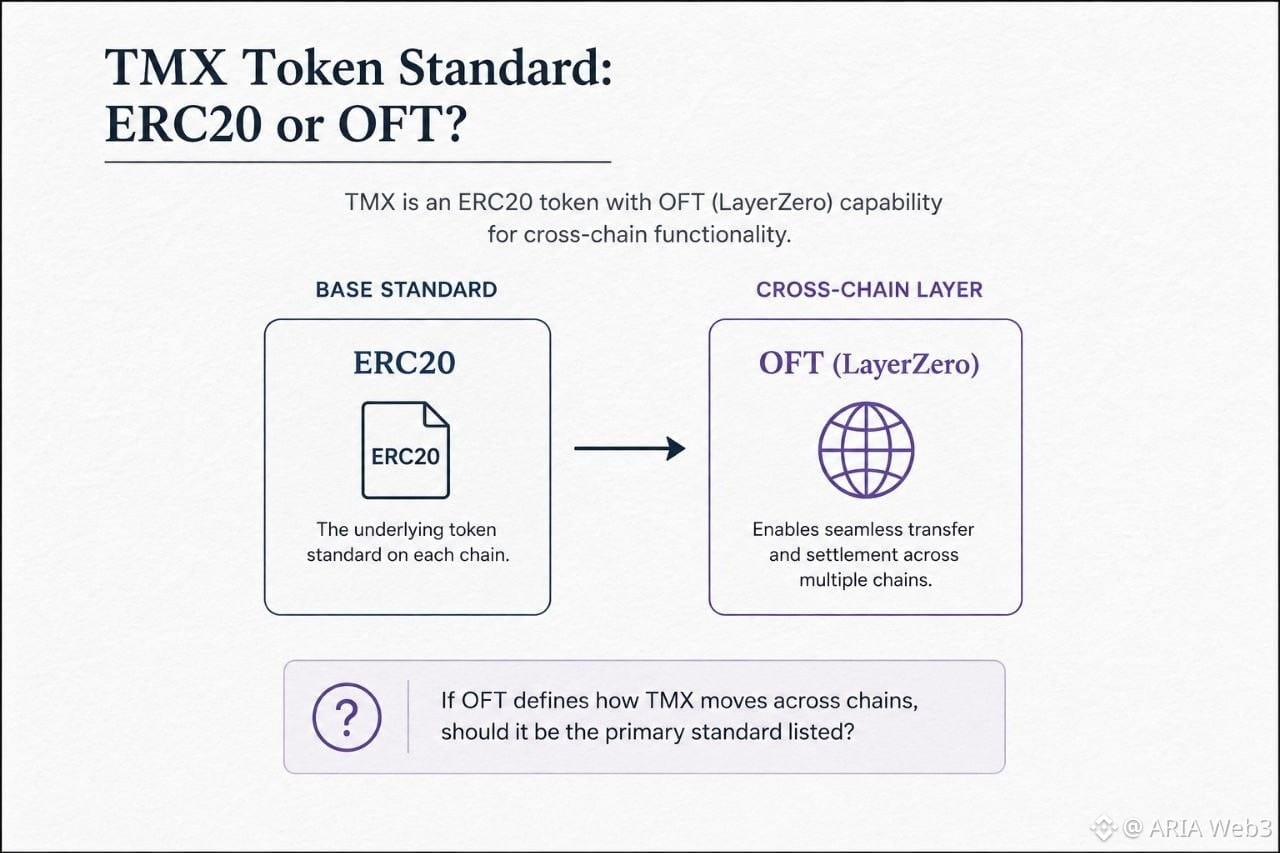
I was scrolling through the TMX tokenomics table and stopped at the Standard field. It just says ERC20, listed as a plain, separate line item from the token address and total supply. One detail caught my attention a few lines above it though. The Bridge Mechanism field describes TMX as a LayerZero OFT, an Omnichain Fungible Token, deployed on Ethereum and BNB Chain with more EVM chains supported. I assumed OFT would replace ERC20 as the listed standard, since it's the newer cross-chain spec.
After checking the executive summary section of the same whitepaper, the terminology got less consistent, not more. There, the token standard is written as ERC20 (OFT on multiple blockchains), treating OFT as a bracketed extension rather than the primary classification. So within the same document, TMX is presented once as ERC20 with OFT as a side note, and once as ERC20 sitting quietly next to a full OFT description with no explicit link between the two. That's when it clicked that this isn't really a contradiction, LayerZero's OFT standard is built as a wrapper around ERC20, adding cross-chain messaging without changing the base token behavior on any single chain. So calling it ERC20 isn't wrong, it's just incomplete without the bridge mechanism line filling in the rest.
Still, it raises a fair question: if OFT defines how the token actually moves and settles across chains, should it be the primary standard listed, with ERC20 treated as the underlying implementation detail instead of the headline?
#termmax @termmax
I was scrolling through the TMX tokenomics table and stopped at the Standard field. It just says ERC20, listed as a plain, separate line item from the token address and total supply. One detail caught my attention a few lines above it though. The Bridge Mechanism field describes TMX as a LayerZero OFT, an Omnichain Fungible Token, deployed on Ethereum and BNB Chain with more EVM chains supported. I assumed OFT would replace ERC20 as the listed standard, since it's the newer cross-chain spec.
After checking the executive summary section of the same whitepaper, the terminology got less consistent, not more. There, the token standard is written as ERC20 (OFT on multiple blockchains), treating OFT as a bracketed extension rather than the primary classification. So within the same document, TMX is presented once as ERC20 with OFT as a side note, and once as ERC20 sitting quietly next to a full OFT description with no explicit link between the two. That's when it clicked that this isn't really a contradiction, LayerZero's OFT standard is built as a wrapper around ERC20, adding cross-chain messaging without changing the base token behavior on any single chain. So calling it ERC20 isn't wrong, it's just incomplete without the bridge mechanism line filling in the rest.
Still, it raises a fair question: if OFT defines how the token actually moves and settles across chains, should it be the primary standard listed, with ERC20 treated as the underlying implementation detail instead of the headline?
#termmax @TermMax
10
4
76
·
--
Bullish
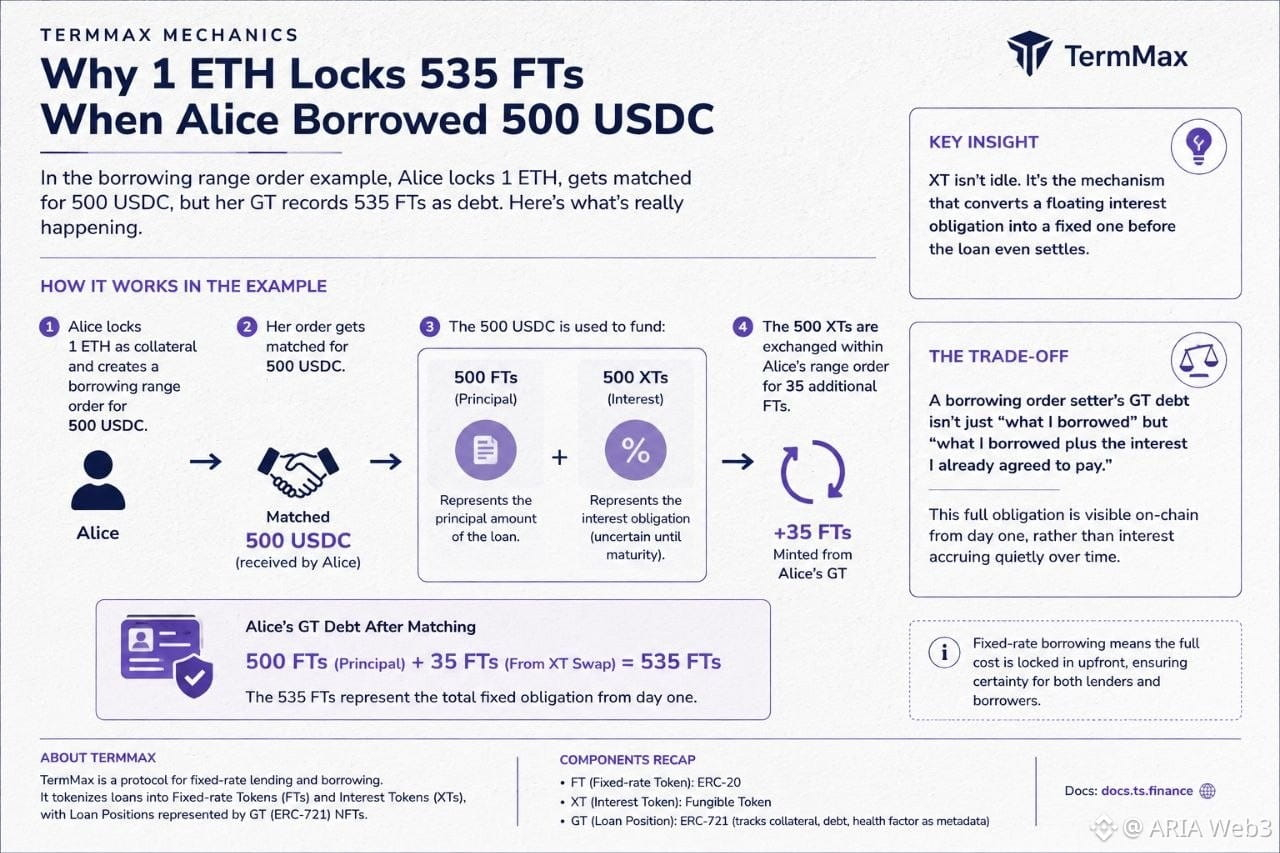
I was reading the section on borrowing range order setters and one number stopped me: in the example, Alice locks 1 ETH, gets matched for 500 USDC, and her GT ends up recording 535 FTs as debt. My first read was that she'd somehow borrowed more than she received.
After checking the mechanics section again, that's not what's happening. The 500 USDC funds 500 FTs (principal) and 500 XTs (interest). The XTs get exchanged inside her own range order for 35 additional FTs, minted from her GT, which is what pushes her recorded debt to 535. She never touches the XT herself.
What surprised me was realizing XT isn't idle here, it's the mechanism that converts a floating interest obligation into a fixed one before the loan even settles. Instead of interest accruing over time, it's priced and locked into extra FTs at the moment of matching. The trade-off is that a borrowing order setter's GT debt isn't just "what I borrowed" but "what I borrowed plus the interest I already agreed to pay," visible on-chain from day one rather than accruing quietly. That seems deliberate: fixed-rate borrowing needs the full obligation locked in upfront, not calculated later. Still curious how the pricing curve decides the split between early fills at 8% versus later fills closer to 6% within the same order.
#termmax @termmax
I was reading the section on borrowing range order setters and one number stopped me: in the example, Alice locks 1 ETH, gets matched for 500 USDC, and her GT ends up recording 535 FTs as debt. My first read was that she'd somehow borrowed more than she received.
After checking the mechanics section again, that's not what's happening. The 500 USDC funds 500 FTs (principal) and 500 XTs (interest). The XTs get exchanged inside her own range order for 35 additional FTs, minted from her GT, which is what pushes her recorded debt to 535. She never touches the XT herself.
What surprised me was realizing XT isn't idle here, it's the mechanism that converts a floating interest obligation into a fixed one before the loan even settles. Instead of interest accruing over time, it's priced and locked into extra FTs at the moment of matching. The trade-off is that a borrowing order setter's GT debt isn't just "what I borrowed" but "what I borrowed plus the interest I already agreed to pay," visible on-chain from day one rather than accruing quietly. That seems deliberate: fixed-rate borrowing needs the full obligation locked in upfront, not calculated later. Still curious how the pricing curve decides the split between early fills at 8% versus later fills closer to 6% within the same order.
#termmax @TermMax
6
1
80
·
--
Bullish
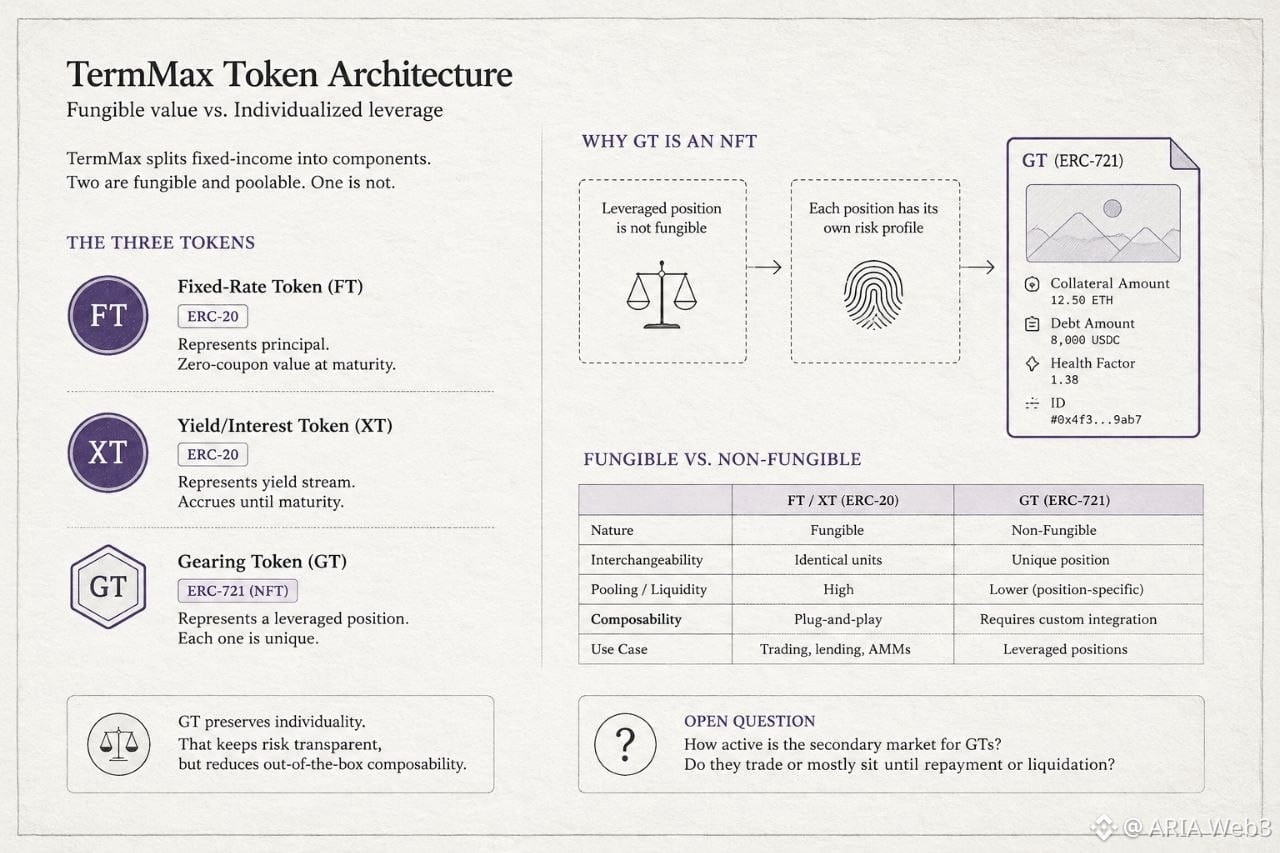
I was reading through TermMax's docs to understand how they handle leveraged positions, and one detail caught my attention: the Gearing Token isn't an ERC-20 like everything else in the system.
I assumed all three of TermMax's tokens — FT, XT, and GT — would follow the same standard, since the introduction page talks about "Gearing Token and Fixed-rate Token trading" almost interchangeably, like they're just different flavors of the same tradable asset. After checking the docs page on token components, that assumption didn't hold. FT and XT are both ERC-20, representing principal and interest as fungible, poolable value. GT, though, is an ERC-721 NFT. Each one encapsulates a specific collateral amount, a specific debt, and its own health factor as metadata.
What surprised me was realizing why. A leveraged position isn't really a fungible claim — two GTs with the same face value could carry different collateral ratios or liquidation risk. Making it an NFT preserves that individuality instead of averaging it away in a shared pool. The trade-off is composability. Fungible tokens are easier to plug into other protocols; NFTs require more custom integration work from anyone building on top of TermMax.
Still not sure how that affects secondary-market liquidity for GT positions themselves. Anyone looked into whether GTs trade actively, or mostly just sit until repayment or liquidation? @termmax #termmax
I was reading through TermMax's docs to understand how they handle leveraged positions, and one detail caught my attention: the Gearing Token isn't an ERC-20 like everything else in the system.
I assumed all three of TermMax's tokens — FT, XT, and GT — would follow the same standard, since the introduction page talks about "Gearing Token and Fixed-rate Token trading" almost interchangeably, like they're just different flavors of the same tradable asset. After checking the docs page on token components, that assumption didn't hold. FT and XT are both ERC-20, representing principal and interest as fungible, poolable value. GT, though, is an ERC-721 NFT. Each one encapsulates a specific collateral amount, a specific debt, and its own health factor as metadata.
What surprised me was realizing why. A leveraged position isn't really a fungible claim — two GTs with the same face value could carry different collateral ratios or liquidation risk. Making it an NFT preserves that individuality instead of averaging it away in a shared pool. The trade-off is composability. Fungible tokens are easier to plug into other protocols; NFTs require more custom integration work from anyone building on top of TermMax.
Still not sure how that affects secondary-market liquidity for GT positions themselves. Anyone looked into whether GTs trade actively, or mostly just sit until repayment or liquidation? @TermMax #termmax
1
1
69
·
--
Bullish
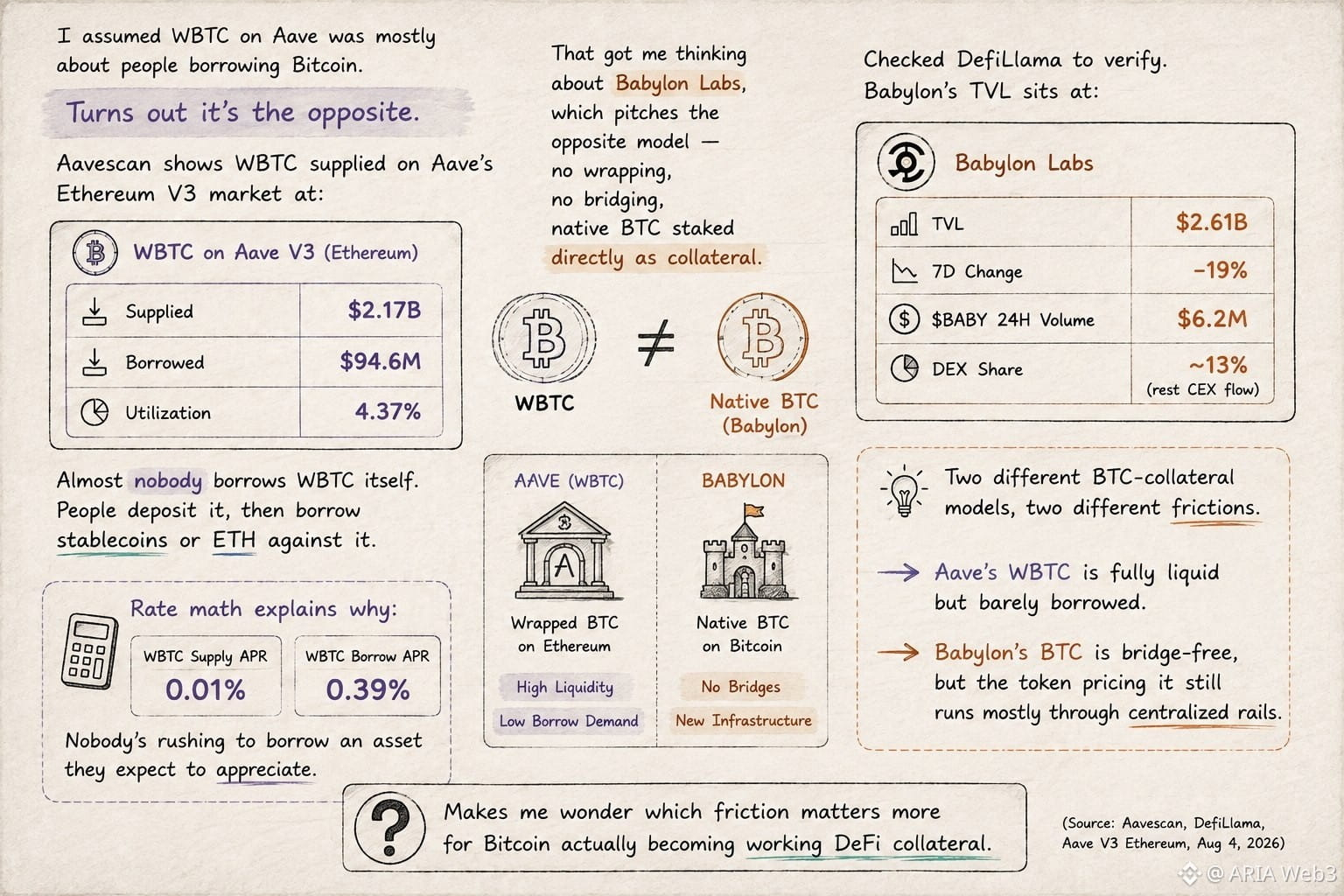
I assumed WBTC on Aave was mostly about people borrowing Bitcoin.
Turns out it's the opposite.
Aavescan shows WBTC supplied on Aave's Ethereum V3 market at $2.17B. Borrowed: just $94.6M. Utilization: 4.37%.
Almost nobody borrows WBTC itself. People deposit it, then borrow stablecoins or ETH against it.
That got me thinking about @babylonlabs_io , which pitches the opposite model — no wrapping, no bridging, native BTC staked directly as collateral.
Checked DefiLlama to verify. Babylon's TVL sits at $2.61B, down 19% over the past week. $BABY does about $6.2M in 24h volume, but only ~13% of that trades on DEXs — the rest is centralized exchange flow.
Two different BTC-collateral models, two different frictions. Aave's WBTC is fully liquid but barely borrowed. Babylon's BTC is bridge-free, but the token pricing it still runs mostly through centralized rails.
Makes me wonder which friction matters more for Bitcoin actually becoming working DeFi collateral.
#baby
I assumed WBTC on Aave was mostly about people borrowing Bitcoin.
Turns out it's the opposite.
Aavescan shows WBTC supplied on Aave's Ethereum V3 market at $2.17B. Borrowed: just $94.6M. Utilization: 4.37%.
Almost nobody borrows WBTC itself. People deposit it, then borrow stablecoins or ETH against it.
That got me thinking about @BabylonLabs_io , which pitches the opposite model — no wrapping, no bridging, native BTC staked directly as collateral.
Checked DefiLlama to verify. Babylon's TVL sits at $2.61B, down 19% over the past week. $BABY does about $6.2M in 24h volume, but only ~13% of that trades on DEXs — the rest is centralized exchange flow.
Two different BTC-collateral models, two different frictions. Aave's WBTC is fully liquid but barely borrowed. Babylon's BTC is bridge-free, but the token pricing it still runs mostly through centralized rails.
Makes me wonder which friction matters more for Bitcoin actually becoming working DeFi collateral.
#baby
2
99
·
--
Bullish
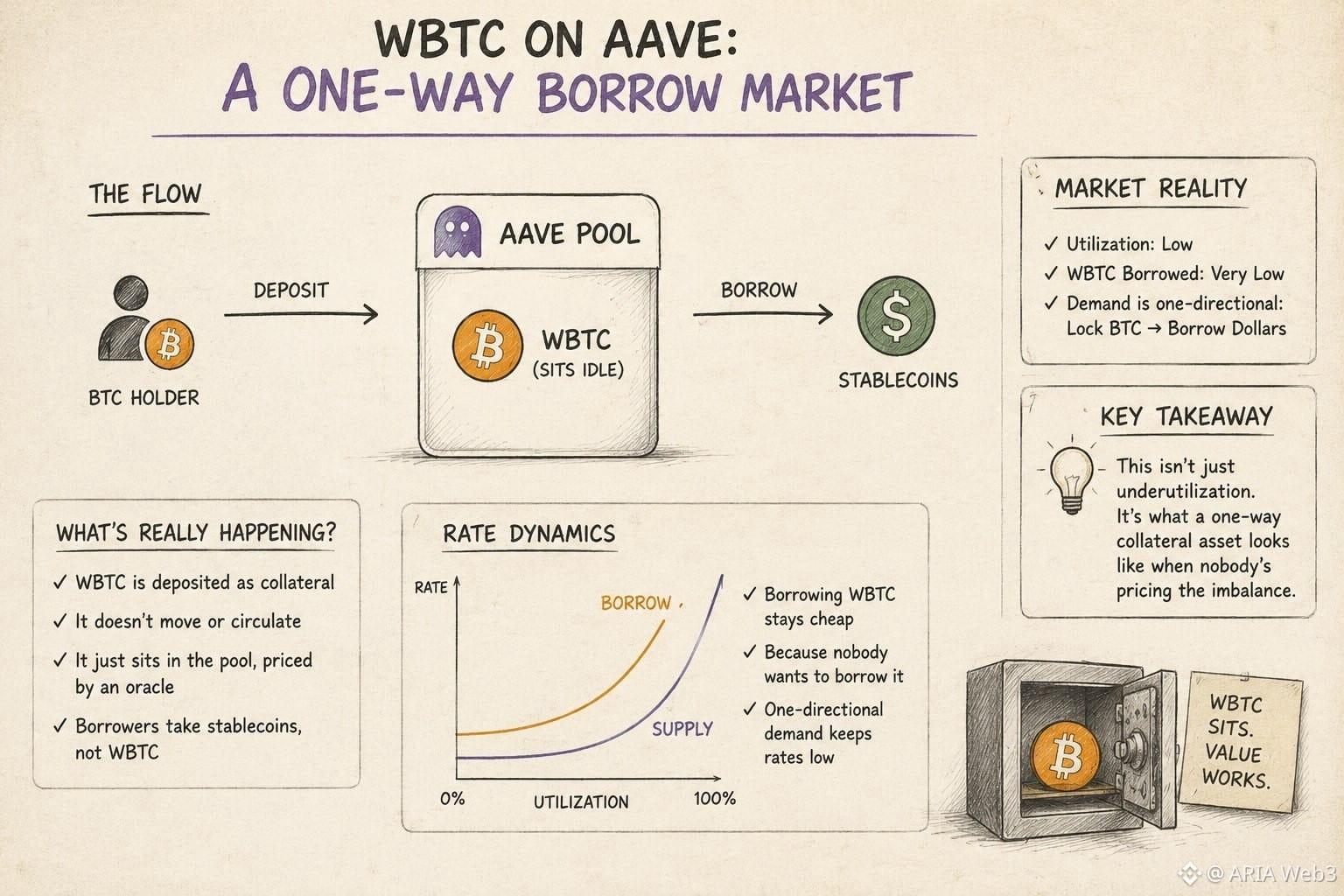
I assumed borrowing against WBTC on Aave meant Bitcoin was doing double duty — sitting as collateral while its value backed a loan elsewhere.
It's simpler than that, and stranger.
WBTC in the pool isn't circulating. It just sits, priced by an oracle, while someone else's stablecoins get borrowed against it.
I checked Aave's rate history and Aavescan's live WBTC markets to confirm this. Utilization stays low. Almost nobody borrows WBTC itself.
What stood out: the demand is one-directional. People lock BTC to borrow dollars, not the other way around.
That shapes the rate curve. Aave's model prices whichever side is scarce — and since BTC holders rarely want to lend BTC out, borrowing it stays cheap by design, not by accident.
It's a market where the "borrow" side of a borrow market barely gets used.
Makes me wonder if that's really underutilization, or just what a one-way collateral asset looks like when nobody's pricing the imbalance.
#baby $BABY @babylonlabs_io
I assumed borrowing against WBTC on Aave meant Bitcoin was doing double duty — sitting as collateral while its value backed a loan elsewhere.
It's simpler than that, and stranger.
WBTC in the pool isn't circulating. It just sits, priced by an oracle, while someone else's stablecoins get borrowed against it.
I checked Aave's rate history and Aavescan's live WBTC markets to confirm this. Utilization stays low. Almost nobody borrows WBTC itself.
What stood out: the demand is one-directional. People lock BTC to borrow dollars, not the other way around.
That shapes the rate curve. Aave's model prices whichever side is scarce — and since BTC holders rarely want to lend BTC out, borrowing it stays cheap by design, not by accident.
It's a market where the "borrow" side of a borrow market barely gets used.
Makes me wonder if that's really underutilization, or just what a one-way collateral asset looks like when nobody's pricing the imbalance.
#baby $BABY @BabylonLabs_io
2
90
·
--
Bullish
Partly True
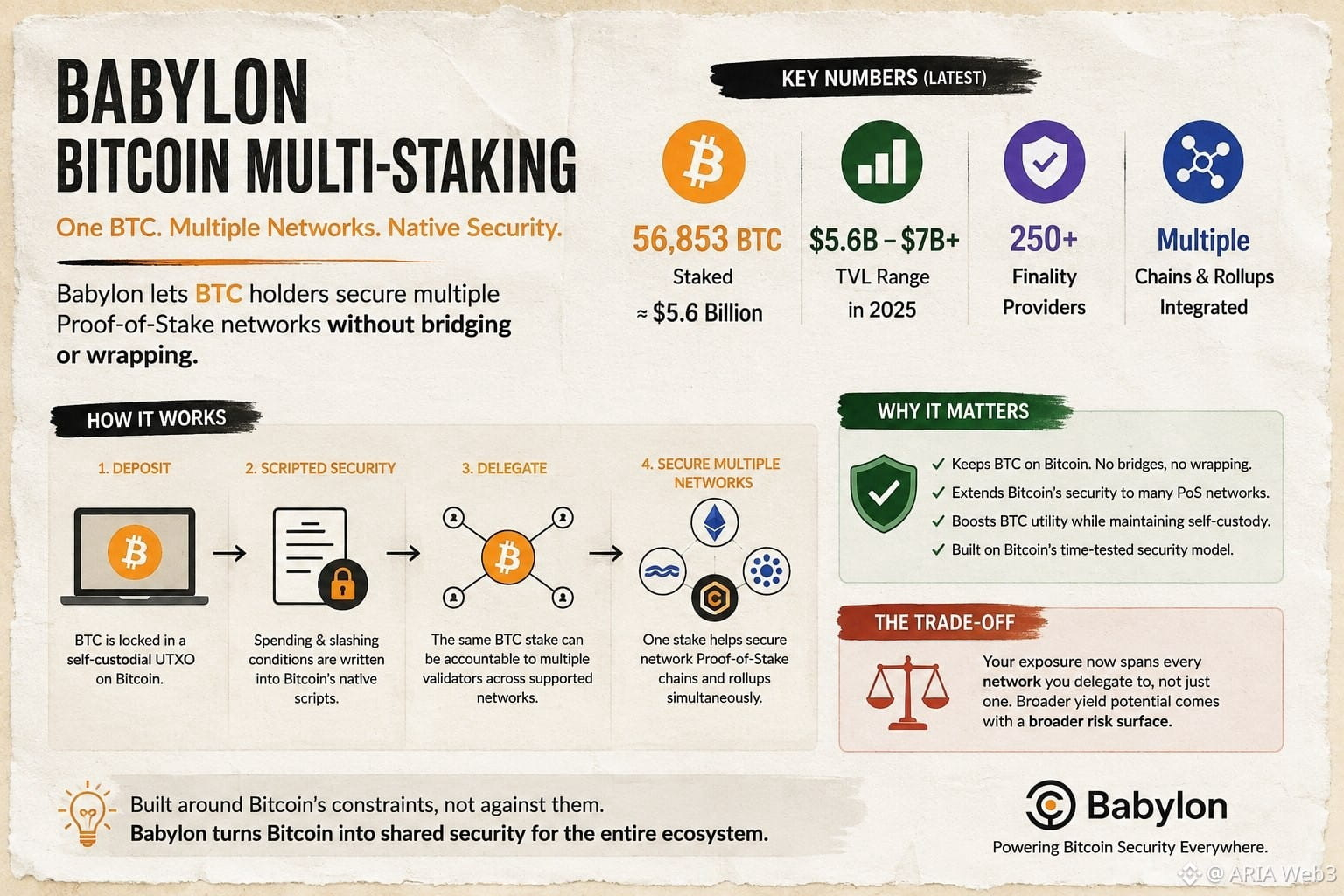
I assumed Bitcoin staking worked like typical restaking, pick a chain, commit your assets. So I checked Babylon's official documentation to confirm.
That's when it clicked. Babylon currently secures roughly 56,853 BTC, about $5.6 billion in value, across more than 250 finality providers. The BTC stays locked in a self-custodial UTXO on Bitcoin itself, no bridging, no wrapping, and that same stake can back multiple Bitcoin Supercharged Networks at once.
What surprised me was the mechanism. Spending and slashing conditions are written directly into Bitcoin's scripting layer, so one locked position can be accountable to several validators simultaneously, without ever leaving the Bitcoin chain.
The trade-off is straightforward: your exposure now spans every network you delegate to, not just one. That's the cost of shared security, broader yield potential in exchange for broader risk surface.
With TVL having ranged between $5.6 billion and over $7 billion this year, I keep wondering how stakers are actually balancing that spread, chasing more rewards, or spreading risk more carefully.#baby $BABY @babylonlabs_io
I assumed Bitcoin staking worked like typical restaking, pick a chain, commit your assets. So I checked Babylon's official documentation to confirm.
That's when it clicked. Babylon currently secures roughly 56,853 BTC, about $5.6 billion in value, across more than 250 finality providers. The BTC stays locked in a self-custodial UTXO on Bitcoin itself, no bridging, no wrapping, and that same stake can back multiple Bitcoin Supercharged Networks at once.
What surprised me was the mechanism. Spending and slashing conditions are written directly into Bitcoin's scripting layer, so one locked position can be accountable to several validators simultaneously, without ever leaving the Bitcoin chain.
The trade-off is straightforward: your exposure now spans every network you delegate to, not just one. That's the cost of shared security, broader yield potential in exchange for broader risk surface.
With TVL having ranged between $5.6 billion and over $7 billion this year, I keep wondering how stakers are actually balancing that spread, chasing more rewards, or spreading risk more carefully.#baby $BABY @BabylonLabs_io
6
1
81
·
--
Bullish
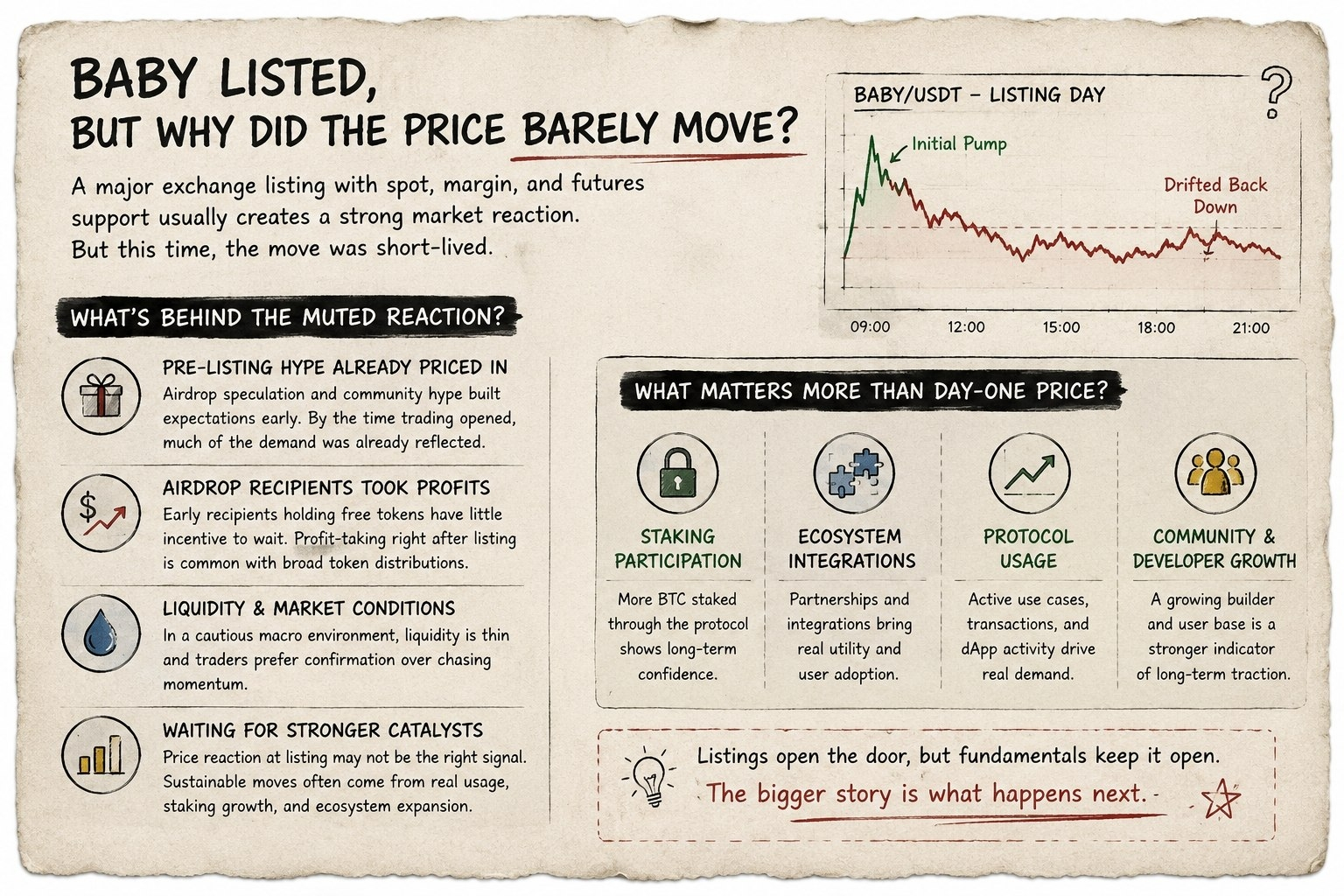
I was reading through recent listing data for BABY, and one detail caught my attention: despite landing on a major exchange with full spot, margin, and futures support, the price barely moved beyond an initial pop before drifting back down. I assumed a listing that big would trigger a sustained rally, so the muted follow-through confused me.
After checking exchange notices and on-chain activity around the listing date, a pattern emerged. Much of the anticipated demand had likely already been priced in through pre-listing airdrop speculation and community hype. That's when it clicked — by the time trading actually opened, a lot of the "buy the news" enthusiasm had already played out as "sell the news."
What surprised me was the airdrop angle. Early recipients holding free tokens have little incentive to wait, so a wave of profit-taking right after listing is a common trade-off of broad token distributions, not a flaw unique to this project.
Liquidity conditions and overall market sentiment matter too. In a cautious macro environment, traders tend to wait for confirmation rather than chase momentum.
It made me wonder whether price reaction at listing is even the right signal to watch. Maybe the more meaningful catalysts — staking participation, ecosystem integrations, actual protocol usage — simply haven't arrived yet. What would you consider a stronger indicator of long-term traction than day-one price action?#baby @babylonlabs_io $BABY
I was reading through recent listing data for BABY, and one detail caught my attention: despite landing on a major exchange with full spot, margin, and futures support, the price barely moved beyond an initial pop before drifting back down. I assumed a listing that big would trigger a sustained rally, so the muted follow-through confused me.
After checking exchange notices and on-chain activity around the listing date, a pattern emerged. Much of the anticipated demand had likely already been priced in through pre-listing airdrop speculation and community hype. That's when it clicked — by the time trading actually opened, a lot of the "buy the news" enthusiasm had already played out as "sell the news."
What surprised me was the airdrop angle. Early recipients holding free tokens have little incentive to wait, so a wave of profit-taking right after listing is a common trade-off of broad token distributions, not a flaw unique to this project.
Liquidity conditions and overall market sentiment matter too. In a cautious macro environment, traders tend to wait for confirmation rather than chase momentum.
It made me wonder whether price reaction at listing is even the right signal to watch. Maybe the more meaningful catalysts — staking participation, ecosystem integrations, actual protocol usage — simply haven't arrived yet. What would you consider a stronger indicator of long-term traction than day-one price action?#baby @BabylonLabs_io $BABY
6
2
75
·
--
Verified
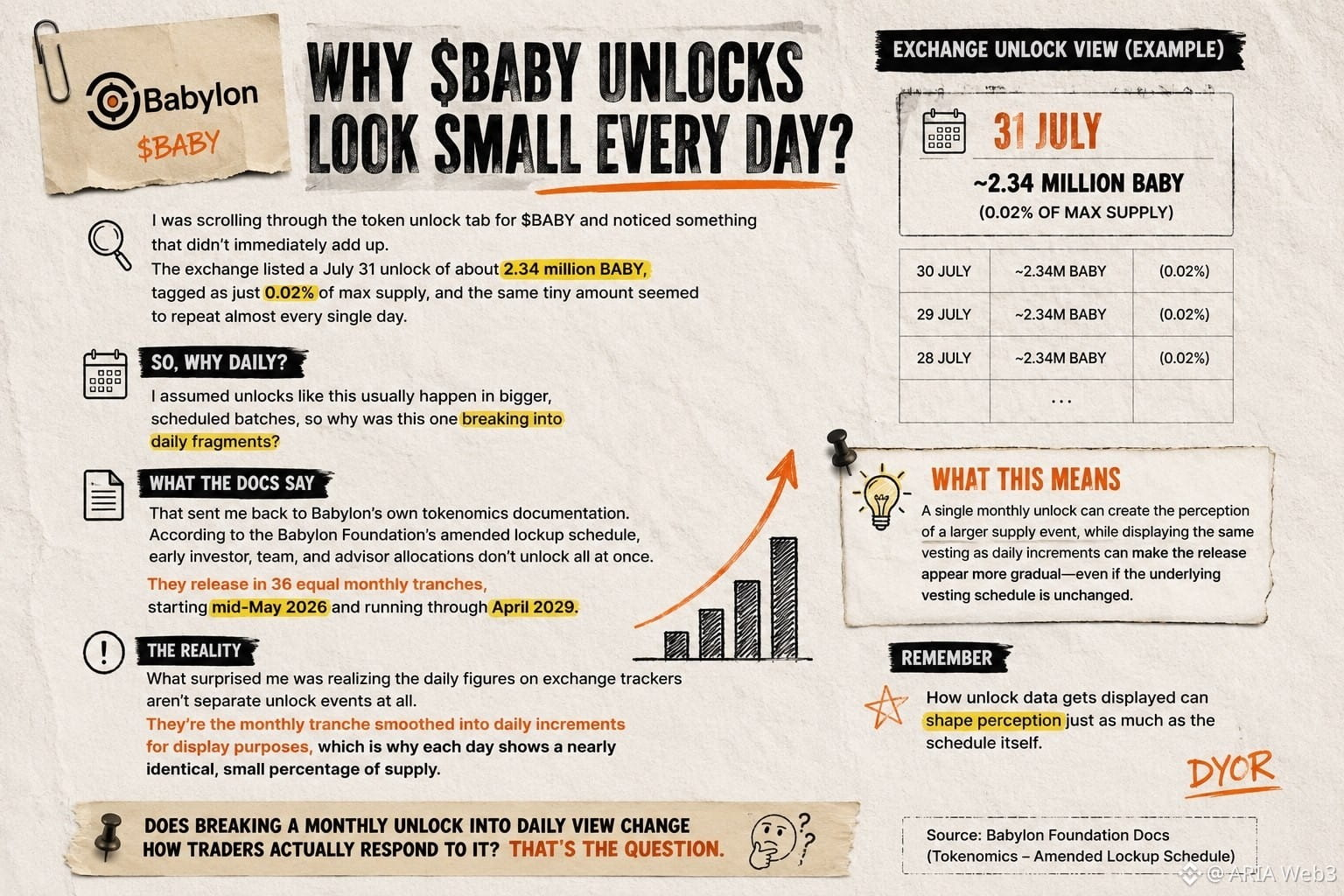
I was scrolling through the token unlock tab for BABY and noticed something that didn't immediately add up. The exchange listed a July 31 unlock of about 2.34 million BABY, tagged as just 0.02% of max supply, and the same tiny amount seemed to repeat almost every single day.
I assumed unlocks like this usually happen in bigger, scheduled batches, so why was this one breaking into daily fragments?
That sent me back to Babylon's own tokenomics documentation. According to the Babylon Foundation's amended lockup schedule, early investor, team, and advisor allocations don't unlock all at once. They release in 36 equal monthly tranches, starting mid-May 2026 and running through April 2029.
What surprised me was realizing the daily figures on exchange trackers aren't separate unlock events at all. They're the monthly tranche smoothed into daily increments for display purposes, which is why each day shows a nearly identical, small percentage of supply. That's the trade-off worth sitting with. A single large monthly cliff can shock the market with a sudden supply jump, while spreading it visually into daily slices makes the release feel gradual, even though the underlying vesting math hasn't changed at all.
It's a reminder that how unlock data gets displayed can shape perception just as much as the schedule itself. Does breaking a monthly unlock into daily view change how traders actually respond to it?
#baby $BABY @babylonlabs_io
I was scrolling through the token unlock tab for BABY and noticed something that didn't immediately add up. The exchange listed a July 31 unlock of about 2.34 million BABY, tagged as just 0.02% of max supply, and the same tiny amount seemed to repeat almost every single day.
I assumed unlocks like this usually happen in bigger, scheduled batches, so why was this one breaking into daily fragments?
That sent me back to Babylon's own tokenomics documentation. According to the Babylon Foundation's amended lockup schedule, early investor, team, and advisor allocations don't unlock all at once. They release in 36 equal monthly tranches, starting mid-May 2026 and running through April 2029.
What surprised me was realizing the daily figures on exchange trackers aren't separate unlock events at all. They're the monthly tranche smoothed into daily increments for display purposes, which is why each day shows a nearly identical, small percentage of supply. That's the trade-off worth sitting with. A single large monthly cliff can shock the market with a sudden supply jump, while spreading it visually into daily slices makes the release feel gradual, even though the underlying vesting math hasn't changed at all.
It's a reminder that how unlock data gets displayed can shape perception just as much as the schedule itself. Does breaking a monthly unlock into daily view change how traders actually respond to it?
#baby $BABY @BabylonLabs_io
4
3
69
·
--
Bullish
I've read "slashing" in every Babylon post I've seen, and pictured the same thing every time: a validator misbehaves, and some rule takes their money.
That picture held up until I tried to explain who actually enforces it.
Is there a vote? A dispute period? Someone reviewing evidence?
I went looking for that process, expecting a committee.
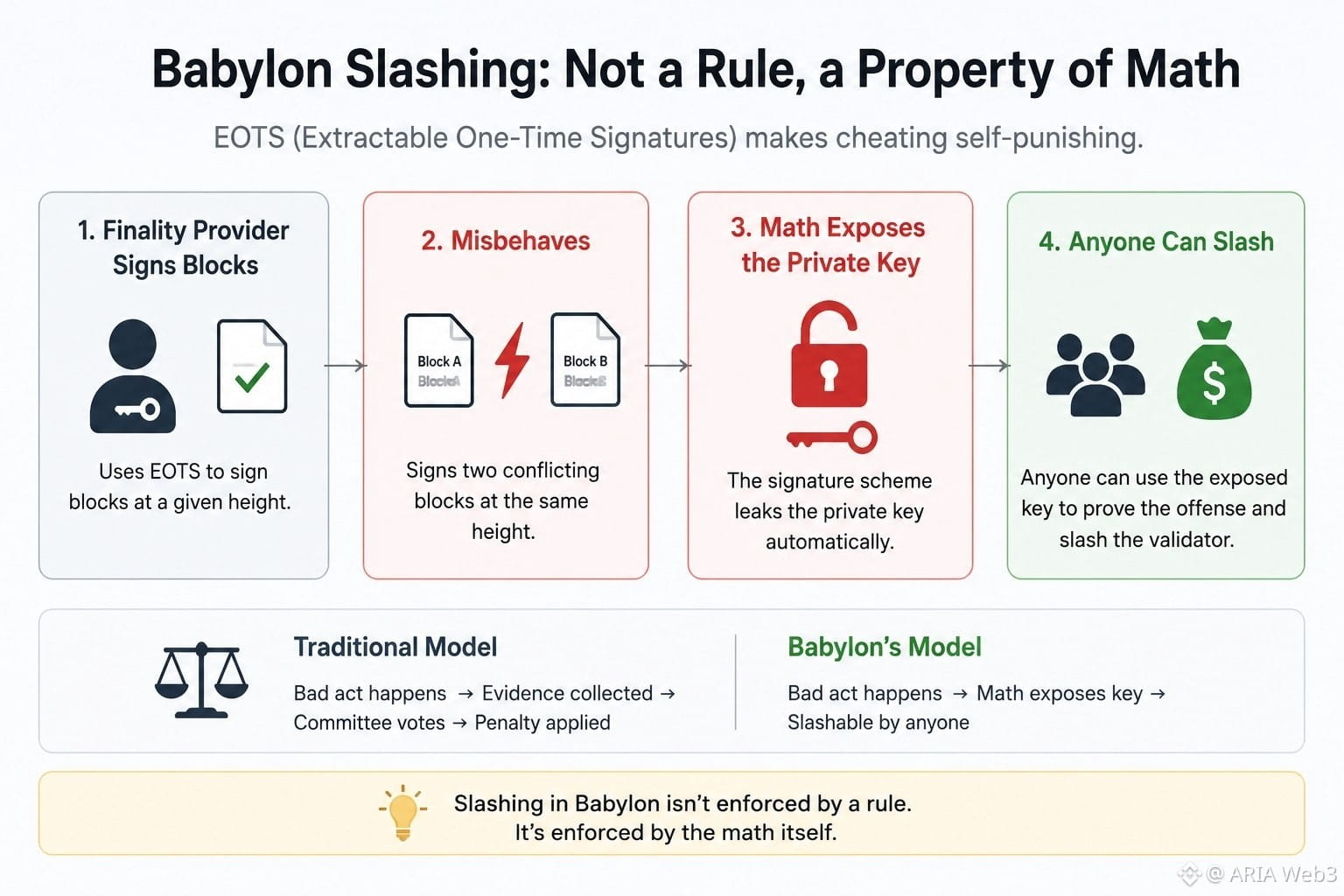
Instead I found something called EOTS — Extractable One-Time Signatures — the way Babylon's finality providers sign blocks.
I assumed it was just a fancier signature scheme. Then I read what "extractable" means.
If a finality provider signs two conflicting blocks at the same height, the signature math itself leaks their private key. Not as a penalty applied afterward. As a direct result of the act.
I sat with that for a second. There's no judge deciding guilt. The cheating and the exposure are the same event. That's different from how I usually think about enforcement — a bad act happens, then a separate process decides the consequence. Here, doing the bad thing is handing over the key to punish yourself.
Once I saw that, "slashing" stopped feeling like a rule Babylon enforces, and started feeling like something the math simply makes true on its own.
I still don't know how that holds up outside clean theory — implementation bugs, edge cases nobody planned for. Cryptography being correct on paper isn't the same as behaving correctly under real network stress.
But I like sitting with the idea that punishment here isn't a decision. It's a fact that reveals itself.
#baby $BABY @babylonlabs_io
I've read "slashing" in every Babylon post I've seen, and pictured the same thing every time: a validator misbehaves, and some rule takes their money.
That picture held up until I tried to explain who actually enforces it.
Is there a vote? A dispute period? Someone reviewing evidence?
I went looking for that process, expecting a committee.
Instead I found something called EOTS — Extractable One-Time Signatures — the way Babylon's finality providers sign blocks.
I assumed it was just a fancier signature scheme. Then I read what "extractable" means.
If a finality provider signs two conflicting blocks at the same height, the signature math itself leaks their private key. Not as a penalty applied afterward. As a direct result of the act.
I sat with that for a second. There's no judge deciding guilt. The cheating and the exposure are the same event. That's different from how I usually think about enforcement — a bad act happens, then a separate process decides the consequence. Here, doing the bad thing is handing over the key to punish yourself.
Once I saw that, "slashing" stopped feeling like a rule Babylon enforces, and started feeling like something the math simply makes true on its own.
I still don't know how that holds up outside clean theory — implementation bugs, edge cases nobody planned for. Cryptography being correct on paper isn't the same as behaving correctly under real network stress.
But I like sitting with the idea that punishment here isn't a decision. It's a fact that reveals itself.
#baby $BABY @BabylonLabs_io
1
1
72
·
--
The more I read through Babylon's code this week, the more one small detail kept sticking in my head.
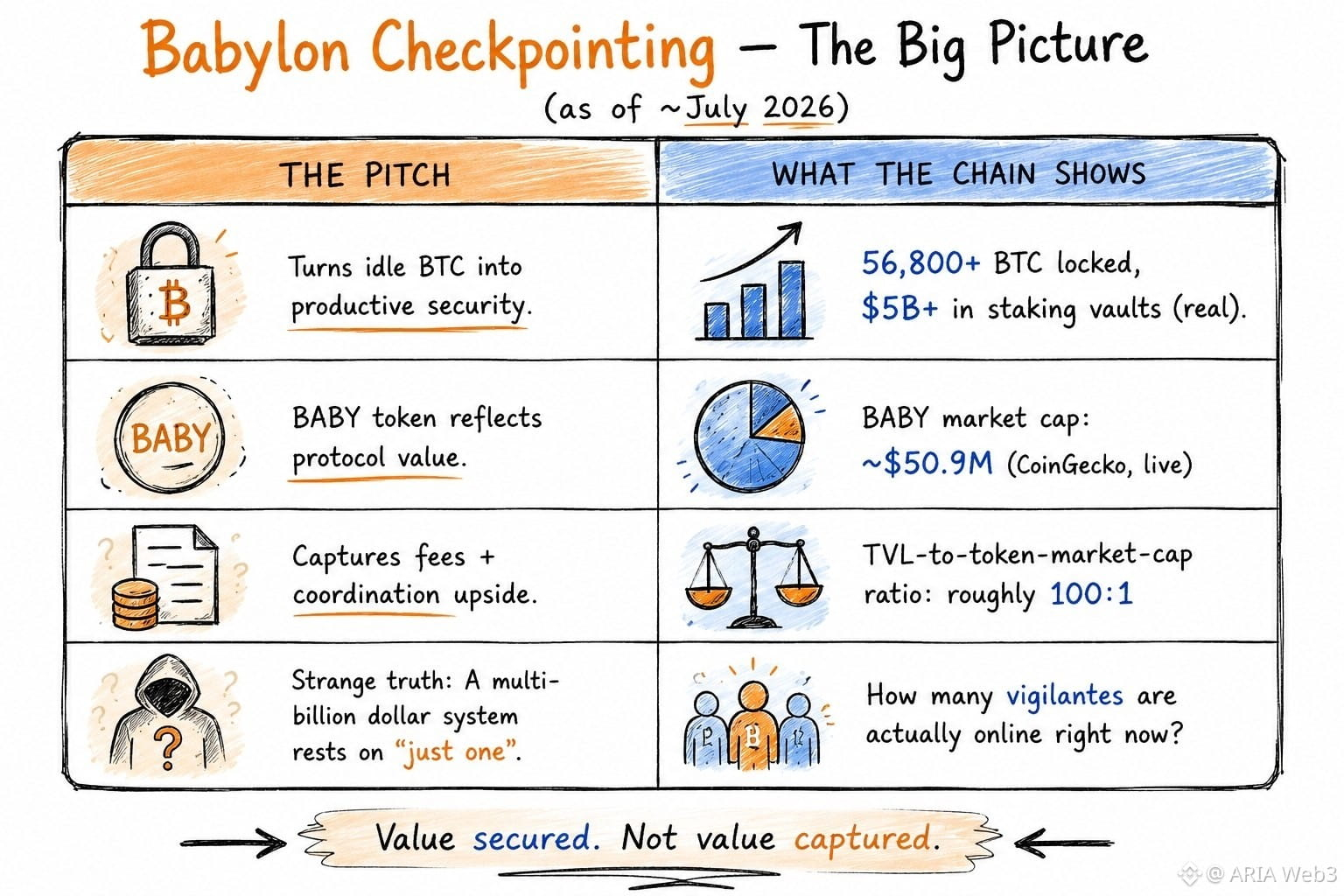
Every checkpoint sent to Bitcoin actually goes out as two separate transactions, not one. My first thought was redundancy, like a backup copy in case something gets orphaned. Turns out that's not it at all. A Bitcoin OP_RETURN output only holds 80 bytes, and a full checkpoint just doesn't fit in that space. So it gets split in half and sent as two txs, then pieced back together once both confirm. Simple once you know it, but I hadn't seen anyone point it out before.
What actually got me curious was who submits these.
Not validators, not @babylonlabs_io itself, just anyone who wants to. They're called "vigilantes." You run the software, grab the checkpoint, pay the Bitcoin fee out of your own pocket, and broadcast it. No bond, no whitelist, nothing stopping you from just... stopping. And the whole system only needs one of these people online and honest at any given moment. Not a majority, just one.
Feels strange knowing a multi-billion dollar staking system quietly rests on that. Makes me wonder how many vigilantes are actually running right now, and whether most people staking through Babylon even know this part exists.
$BABY #baby
The more I read through Babylon's code this week, the more one small detail kept sticking in my head.
Every checkpoint sent to Bitcoin actually goes out as two separate transactions, not one. My first thought was redundancy, like a backup copy in case something gets orphaned. Turns out that's not it at all. A Bitcoin OP_RETURN output only holds 80 bytes, and a full checkpoint just doesn't fit in that space. So it gets split in half and sent as two txs, then pieced back together once both confirm. Simple once you know it, but I hadn't seen anyone point it out before.
What actually got me curious was who submits these.
Not validators, not @BabylonLabs_io itself, just anyone who wants to. They're called "vigilantes." You run the software, grab the checkpoint, pay the Bitcoin fee out of your own pocket, and broadcast it. No bond, no whitelist, nothing stopping you from just... stopping. And the whole system only needs one of these people online and honest at any given moment. Not a majority, just one.
Feels strange knowing a multi-billion dollar staking system quietly rests on that. Makes me wonder how many vigilantes are actually running right now, and whether most people staking through Babylon even know this part exists.
$BABY #baby
16
4
87
·
--
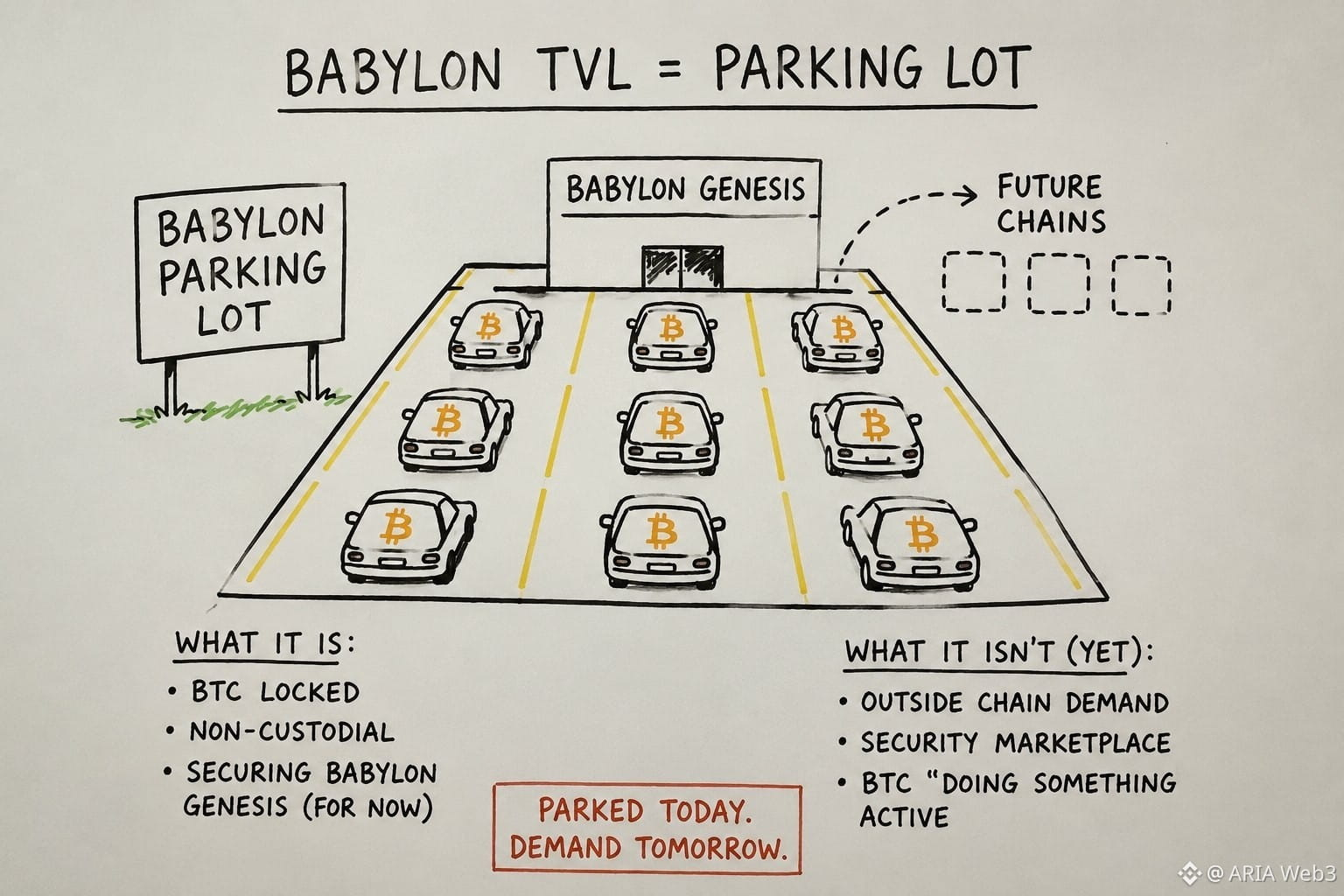
Kept assuming Babylon's TVL chart was a demand chart. It isn't. It's a parking lot.
Multi-staking, the feature that lets one BTC deposit secure several PoS chains at once, is still the headline pitch.
But almost all the staked BTC right now backs one chain: Babylon Genesis, which also happens to be the control plane for every future network that's supposed to plug in later. So the number being read as "security demand" is mostly capital sitting inside the system that built the measuring stick. Not dishonest, just sequencing. Bootstrap supply first, prove the mechanism, let demand catch up. Every security marketplace starts this way.
But it means TVL answers a question nobody's really asking, can BTC be locked non-custodially to back validators, instead of the one that matters: do outside chains value that security enough to pay for it over their own token inflation. You can feel the market already sensing this. BABY's valuation against the BTC parked behind it doesn't move like a demand asset. It moves like a token still waiting to find out what it's for. The uncomfortable read: Babylon may have solved the harder cryptographic problem before solving the easier economic one. Most infrastructure bets assume the tech is the bottleneck. What if here it never was?
#baby $BABY @babylonlabs_io
Kept assuming Babylon's TVL chart was a demand chart. It isn't. It's a parking lot.
Multi-staking, the feature that lets one BTC deposit secure several PoS chains at once, is still the headline pitch.
But almost all the staked BTC right now backs one chain: Babylon Genesis, which also happens to be the control plane for every future network that's supposed to plug in later. So the number being read as "security demand" is mostly capital sitting inside the system that built the measuring stick. Not dishonest, just sequencing. Bootstrap supply first, prove the mechanism, let demand catch up. Every security marketplace starts this way.
But it means TVL answers a question nobody's really asking, can BTC be locked non-custodially to back validators, instead of the one that matters: do outside chains value that security enough to pay for it over their own token inflation. You can feel the market already sensing this. BABY's valuation against the BTC parked behind it doesn't move like a demand asset. It moves like a token still waiting to find out what it's for. The uncomfortable read: Babylon may have solved the harder cryptographic problem before solving the easier economic one. Most infrastructure bets assume the tech is the bottleneck. What if here it never was?
#baby $BABY @BabylonLabs_io
6
3
86
Log in to explore more content
Join global crypto users on Binance Square
⚡️ Get latest and useful information about crypto.
💬 Trusted by the world’s largest crypto exchange.
👍 Discover real insights from verified creators.
Email / Phone number
Trending Topics
FedWatch
16.3M views
39,405 Discussing
🚨 🇺🇸 PETER SCHIFF JUST THREW A BIG WARNING AT THE FED!
Peter Schiff is calling Kevin Warsh’s tough talk on inflation a “bluff,” and his prediction could have major implications for the markets.
Schiff believes the Fed could eventually return to money printing through quantitative easing (QE) and even cut interest rates next year, despite inflation continuing to rise.
Think about that for a moment.
🔥 Inflation could remain a problem. 🔥 The Fed could still move toward easier monetary policy. 🔥 More liquidity could flow into financial markets.
If this scenario plays out, it could create a very different market environment for stocks, gold, Bitcoin, and the wider crypto market.
But there’s a catch: if inflation stays high, the Fed could face a difficult choice between fighting rising prices and supporting the economy.
Will Warsh stick to a tough inflation policy, or will the Fed eventually change direction?
The next move could matter a lot for investors.
#FedWatch #EarningsSeason #USMidtermElections #BrazilCryptoExchangesMustApplyForLicensesByFriday #StanDruckenmillerBecomesInvestorInTradeXYZ
Jackson Liam
·4 Likes
·8.4k views
EarningsSeason
6.4M views
32,103 Discussing
USMidtermElections
43,486 views
630 Discussing