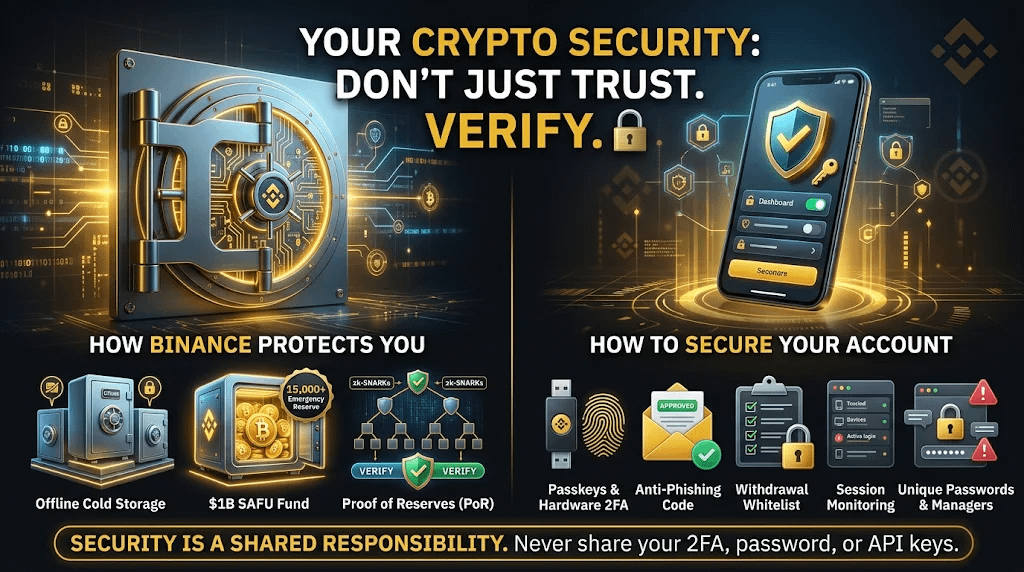

When it comes to Binance security, understanding how your assets are protected and how to secure your own account matters just as much.
Here’s what every crypto user should know:
🛡️ How Binance protects user assets
• Most user funds are kept in offline cold storage, while a limited amount stays in hot wallets for withdrawals.
• Multi-signature and MPC security require multiple approvals to move funds, reducing the risk of a single compromised key.
• SAFU, established in 2018, is an emergency reserve for extreme platform-level situations. It is now held in Bitcoin, with around 15,000 BTC as described in the brief. If its value falls below $800M, Binance tops it back up to $1B.
• Withdrawal limits, monitoring and manual reviews help manage unusual or large transactions.
🔎 Proof of Reserves: Verify for yourself
Binance publishes Proof of Reserves snapshots that use Merkle trees and zk-SNARK proofs.
Users can check whether their account is included and verify that reserves cover liabilities, without revealing individual account balances. The system covers 40+ tokens, and verification tools are available for users to check the data independently.
🔑 5 security settings worth enabling today
Use a passkey or hardware security key as your primary 2FA. Keep an authenticator app as backup; SMS is the weaker option.
Enable your anti-phishing code to help identify genuine Binance emails.
Turn on the withdrawal whitelist so funds can only go to approved addresses. New addresses may have a cooling-off period.
Review your devices and active sessions regularly. Remove anything you don't recognize.
Use a unique password, a password manager, login alerts and withdrawal alerts. Restrict API keys to specific IPs and trade-only permissions, or delete unused keys.
Binance also uses risk monitoring to flag unusual logins, devices and withdrawals, with additional verification or temporary holds when needed. Its security and compliance measures include 24/7 monitoring, incident response, bug bounty reporting, KYC, AML and sanctions screening, Travel Rule checks, and data encryption.
But security is a shared responsibility.
Never share your password, 2FA codes, API keys or seed phrase. Binance will never ask you to transfer crypto to a “safe wallet,” send funds to verify your account, or join a trading group to protect your assets.
My personal takeaway: A strong platform matters, but your own security habits can make a real difference. Take a few minutes today to review your account settings.
Don't just trust. Verify. Stay informed. Stay SAFU.
#Binance #STAYSAFU #CryptoSecurity #ProofOfReserves #SAFU
Is Binance safe? No platform can promise 100% safety, but learning how Binance security works and taking responsibility for your account is a smart step.
Digital asset prices are subject to high market risk and volatility. The value of your investment may go down or up, and you may not get back the amount invested. You are solely responsible for your investment decisions. Binance is not liable for losses you may incur. Not financial advice.
This is a general announcement. Products and services mentioned may not be available in your region. Please review Binance's Terms of Use.
Binance Proof of Resereves Link