
#IsAnthropic’s$1.5TMarketCapJustified?
🧠 The market isn't just pricing an AI company anymore. It's pricing the possibility that intelligence itself becomes the world's next economic infrastructure. 🚀
Anthropic's November 19 Nasdaq debut has created a defining question for global investors:
Are we witnessing the birth of a generational technology giant, or are markets paying tomorrow's profits at today's most expensive prices?👀
Let's look beyond the IPO headlines. 👇
🏦 1. THE VALUATION: GROWTH IS REAL, BUT EXPECTATIONS ARE EXTREME
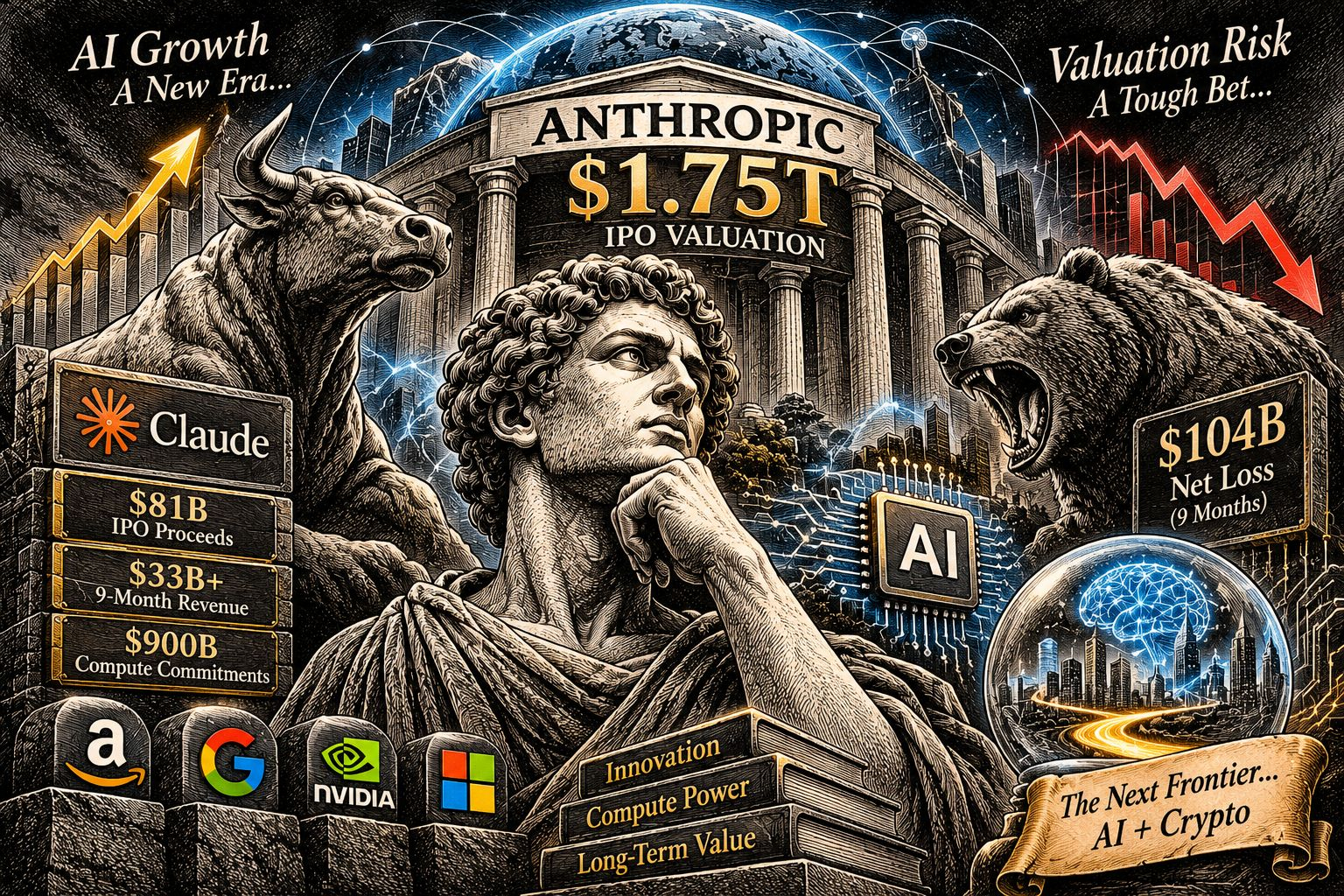
Anthropic entered public markets at approximately $1.5 trillion and finished its first trading session at approximately $1.75 trillion on a fully diluted basis.
Its reported financial picture is extraordinary:
💰 IPO proceeds: approximately $81.3 billion.
📈 Nine-month 2026 revenue: approximately $33.24 billion.
🔥 October annualized revenue run rate: approximately $81 billion.
⚠️ Nine-month reported net loss: approximately $104 billion.
🖥️ Future compute and infrastructure commitments: approximately $900.9 billion.
But here is the valuation trap:
Using nine-month revenue annualized to approximately $44.3 billion, the $1.5 trillion IPO valuation represents roughly 34x annualized sales. At $1.75 trillion, that rises to approximately 39.5x.
Using the later $81 billion October revenue run rate, the multiples fall to approximately 18.5x and 21.6x, respectively.
These are different revenue measurement periods, not contradictory calculations.
The market is therefore making a massive bet that today's extraordinary growth will become tomorrow's sustainable cash flow.
🧾 2. THE $104 BILLION LOSS: CASH BURN OR ACCOUNTING DISTORTION?
One of the most misunderstood aspects of Anthropic's financial statements is its reported loss.
Its SEC filing attributes approximately $94.3 billion of the nine-month loss to changes in the fair value of convertible notes, derivative liabilities and SAFEs.
This is largely a non-cash accounting revaluation, not an equivalent amount of operating cash disappearing from the business.
However, investors should not confuse accounting adjustments with economic profitability.
The real questions are:
Can Anthropic generate positive operating cash flow?
Can inference costs decline faster than revenue per token?
Can future training expenses be absorbed without repeated massive capital raises?
Can its enterprise customers support durable pricing power?
A paper loss can disappear through accounting. An inefficient business model cannot disappear through accounting.
⚡ 3. THE REAL BATTLE: WHO CONTROLS THE COST OF INTELLIGENCE?
AI's competitive advantage will not be determined by model intelligence alone.
It will depend on the cost of producing, delivering and scaling that intelligence.
Anthropic's infrastructure commitments create a double-edged sword:
🚀 Bullish scenario: Dedicated compute capacity, better hardware utilization, custom silicon and inference optimization lower the cost per task. Margins expand and enterprise adoption accelerates.
📉 Bearish scenario: Infrastructure becomes underutilized, demand slows, pricing declines and long-term minimum-purchase commitments turn into a financial burden.
An important distinction: approximately $900.9 billion represents commitments spread across multiple years, not an immediately payable debt balance. Nevertheless, these obligations create real execution and liquidity risks.
The market must monitor actual utilization, payment schedules, contract flexibility and return on invested capital.
🔄 4. THE HIDDEN RISK: THE AI CAPITAL CIRCULAR ECONOMY
There is another important development.
Cloud providers, semiconductor companies and infrastructure partners are increasingly becoming both AI ecosystem investors and suppliers.
Anthropic's disclosed $26 billion concurrent private placement includes strategic technology participants such as Google, Microsoft, NVIDIA, AMD, Broadcom, Micron and TSMC Partners.
This creates a powerful infrastructure ecosystem, but also raises an important question:
Is AI demand being driven by independent customer economics, or is some of the industry's apparent momentum being amplified by capital flowing between interconnected suppliers and customers?
Strategic investment is not proof of artificial demand.
But investors should distinguish genuine end-user revenue from vendor financing, strategic capital and infrastructure commitments.
🧬 5. QUANTUM COMPUTING: THE NEXT THREAT OR THE NEXT OPPORTUNITY?
Quantum computing is not about replacing GPUs in mainstream LLM training tomorrow.
The nearer-term competitive shift is more likely to come from:
Custom AI accelerators.
Amazon Trainium and Google TPU.
Advanced networking and optical interconnects.
Better model architectures and inference algorithms.
More efficient energy and cooling infrastructure.
Over a longer horizon, quantum computing could unlock specialized optimization, molecular simulation and scientific research applications.
Anthropic's Model Hardware Standard research preview is particularly interesting: its collaboration with QuEra demonstrated an AI agent helping stabilize a quantum-computer laser system, recovering its lock 99.3% of the time without human intervention.
This is not evidence that quantum computers can replace GPUs. It demonstrates a potentially valuable relationship between AI agents and advanced scientific hardware.
The bigger opportunity could be AI controlling, optimizing and accelerating the development of technologies that make future AI more powerful.
That is a potentially important feedback loop. 🧠
🌍 6. THE CRYPTO CONNECTION: WHERE DOES THE MONEY FLOW NEXT?
Anthropic's valuation does not automatically create value for cryptocurrency tokens.
However, its expansion reinforces several investment narratives worth monitoring.
Potential beneficiaries and sectors:
🔹 AI infrastructure: Compute marketplaces, decentralized GPU networks and AI cloud infrastructure.
🔹 Decentralized AI: AI agent coordination, verifiable computation and decentralized model services.
🔹 Data infrastructure: Data availability, decentralized storage and data provenance.
🔹 DePIN: Physical infrastructure networks supporting compute, connectivity and energy.
🔹 AI agent ecosystems: Autonomous agents, machine-to-machine payments and blockchain-based settlement.
Examples of crypto projects investors may research include:
RNDR — decentralized GPU rendering and compute ecosystem.
AKT — decentralized cloud computing.
TAO — decentralized machine intelligence.
FET — autonomous AI agent ecosystem.
FIL — decentralized storage infrastructure.
NEAR — blockchain infrastructure with an AI ecosystem narrative.
⚠️ These are thematic exposures, not confirmed Anthropic beneficiaries. Their token economics, adoption, revenue capture, supply schedules and actual utility must be evaluated independently.
A growing AI industry does not guarantee rising AI-token prices.
📊 7. THE THREE SCENARIOS THAT WILL DETERMINE THE FUTURE
🟢 BULL CASE — INTELLIGENCE BECOMES INFRASTRUCTURE
Enterprise AI becomes indispensable. Revenue expands, inference becomes cheaper, margins improve and AI agents create entirely new markets.
Anthropic evolves from a model developer into an essential global intelligence platform.
🟡 BASE CASE — GROWTH WITH VALUATION COMPRESSION
AI adoption remains strong, but competitors reduce pricing power. Revenue continues growing while infrastructure spending absorbs a significant portion of the economics.
Anthropic becomes a major technology company, but its shares struggle to justify the initial valuation multiple.
🔴 BEAR CASE — THE COMPUTE ECONOMICS BREAK
Open-weight models, cheaper inference, aggressive competition or slower enterprise adoption weaken pricing power.
Long-term infrastructure commitments become less attractive, capital efficiency deteriorates and valuation multiples contract sharply.
🎯 8. WHAT SMART INVESTORS SHOULD WATCH
Forget the daily excitement around AI headlines. Monitor these indicators:
Revenue growth versus compute-cost growth.
Gross-margin improvement and inference cost per token.
Operating cash flow and capital expenditure.
Enterprise customer retention and recurring revenue.
Infrastructure utilization and contractual payment obligations.
Competitive model performance and pricing.
AI-related token adoption, real network revenue and token value capture.
These indicators will reveal whether AI's economic opportunity is translating into sustainable shareholder and token-holder value.
🧠 THE FINAL VERDICT: THE NEXT MONOPOLY OR THE NEXT VALUATION WARNING?
Anthropic's IPO is bigger than one company's stock-market debut.
It represents a fundamental shift in how capital markets value intelligence, computing capacity, software productivity and future economic output.
But there is a critical distinction:
AI adoption can be exponential while investment returns remain highly selective.
The winners will not necessarily be the companies with the largest models, the biggest funding rounds or the loudest valuations.
They will be the businesses that convert intelligence into recurring revenue, sustainable margins and measurable economic productivity.
For crypto investors, the opportunity is not blindly buying every AI-labelled token.
It is identifying which decentralized networks can capture actual economic activity from the expansion of AI infrastructure.
🔥 THE BIGGER TRADE IS NOT AI VERSUS CRYPTO. IT IS THE RACE TO OWN THE INFRASTRUCTURE, COMPUTE, DATA AND SETTLEMENT LAYERS OF THE NEXT DIGITAL ECONOMY.
The question isn't whether intelligence will become more valuable.
The question is who will capture that value — and who will simply pay for it.