

#succinctlabs
succinctlabs
5.4M views
25,173 Discussing
Hot
Latest

·
--
🤖 🔐 Criptografía Clave: Pruebas de Conocimiento Cero (ZKP) para Verificar Agentes de IA
Brian Trunzo, director de desarrollo en Succinct Labs, sostuvo que las pruebas de conocimiento cero (Zero-Knowledge Proofs) son indispensables para verificar el comportamiento de los agentes autónomos de IA en internet.
Según CoinDesk, el ejecutivo afirmó que las herramientas de detección actuales no bastan, y que las ZKP permiten demostrar criptográficamente la autoría, los datos de entrenamiento y los límites operativos del agente sin exponer datos propietarios.
💬 ¿Crees que la criptografía ZKP será el estándar definitivo para confiar en las decisiones de la IA? ¡Opina abajo! 👇🔥
$ZKP
{spot}(ZKPUSDT)
$BTC
{spot}(BTCUSDT)
$BNB
{spot}(BNBUSDT)
#SuccinctLabs #ZeroKnowledge #ArtificialIntelligence #CryptoSecurity #AIAgents
🤖 🔐 Criptografía Clave: Pruebas de Conocimiento Cero (ZKP) para Verificar Agentes de IA
Brian Trunzo, director de desarrollo en Succinct Labs, sostuvo que las pruebas de conocimiento cero (Zero-Knowledge Proofs) son indispensables para verificar el comportamiento de los agentes autónomos de IA en internet.
Según CoinDesk, el ejecutivo afirmó que las herramientas de detección actuales no bastan, y que las ZKP permiten demostrar criptográficamente la autoría, los datos de entrenamiento y los límites operativos del agente sin exponer datos propietarios.
💬 ¿Crees que la criptografía ZKP será el estándar definitivo para confiar en las decisiones de la IA? ¡Opina abajo! 👇🔥
$ZKP
$BTC
$BNB
#SuccinctLabs #ZeroKnowledge #ArtificialIntelligence #CryptoSecurity #AIAgents
Brian Trunzo, director de desarrollo en Succinct Labs, sostuvo que las pruebas de conocimiento cero (Zero-Knowledge Proofs) son indispensables para verificar el comportamiento de los agentes autónomos de IA en internet.
Según CoinDesk, el ejecutivo afirmó que las herramientas de detección actuales no bastan, y que las ZKP permiten demostrar criptográficamente la autoría, los datos de entrenamiento y los límites operativos del agente sin exponer datos propietarios.
💬 ¿Crees que la criptografía ZKP será el estándar definitivo para confiar en las decisiones de la IA? ¡Opina abajo! 👇🔥
$ZKP
$BTC
$BNB
#SuccinctLabs #ZeroKnowledge #ArtificialIntelligence #CryptoSecurity #AIAgents

61

💎🔹A era da escalabilidade e da interoperabilidade está ganhando um novo protagonista: @SuccinctLabs . O projeto vem se destacando por trazer a tecnologia de zero-knowledge proofs (ZKPs) para o centro da adoção em larga escala, com soluções que permitem blockchains comunicarem-se de forma eficiente, segura e descentralizada.
O token PROVE é o motor da rede e representa o compromisso da Succinct em democratizar o acesso a provas criptográficas verificáveis. Em um mundo onde cada vez mais dados e transações precisam ser validados sem abrir mão da privacidade, a proposta da #SuccinctLabs se torna essencial para o futuro da Web3.
Além disso, o ecossistema já se posiciona como um dos mais promissores quando falamos de validity proofs, criando pontes universais entre diferentes blockchains e oferecendo uma alternativa real ao excesso de confiança em intermediários centralizados. Isso abre espaço não apenas para maior segurança, mas também para uma nova onda de DeFi, gaming e aplicações cross-chain com baixo custo e alta velocidade.
A presença do $PROVE como token nativo reforça a base econômica e incentiva a comunidade a participar ativamente do crescimento do protocolo. Enquanto outros projetos ainda falam sobre escalabilidade, @SuccinctLabs mostra que é possível provar, integrar e escalar de forma simples, sem comprometer a descentralização.
A narrativa está apenas começando. Com uma comunidade cada vez mais engajada e um roadmap robusto, a Succinct desponta como peça-chave no avanço da próxima geração de infraestrutura blockchain. O futuro é #Succinct to $PROVE e está acontecendo agora.
$PROVE
{spot}(PROVEUSDT)
#BinanceSquareFamily #BinanceAlphaAlert
💎🔹A era da escalabilidade e da interoperabilidade está ganhando um novo protagonista: @Succinct . O projeto vem se destacando por trazer a tecnologia de zero-knowledge proofs (ZKPs) para o centro da adoção em larga escala, com soluções que permitem blockchains comunicarem-se de forma eficiente, segura e descentralizada.
O token PROVE é o motor da rede e representa o compromisso da Succinct em democratizar o acesso a provas criptográficas verificáveis. Em um mundo onde cada vez mais dados e transações precisam ser validados sem abrir mão da privacidade, a proposta da #SuccinctLabs se torna essencial para o futuro da Web3.
Além disso, o ecossistema já se posiciona como um dos mais promissores quando falamos de validity proofs, criando pontes universais entre diferentes blockchains e oferecendo uma alternativa real ao excesso de confiança em intermediários centralizados. Isso abre espaço não apenas para maior segurança, mas também para uma nova onda de DeFi, gaming e aplicações cross-chain com baixo custo e alta velocidade.
A presença do $PROVE como token nativo reforça a base econômica e incentiva a comunidade a participar ativamente do crescimento do protocolo. Enquanto outros projetos ainda falam sobre escalabilidade, @Succinct mostra que é possível provar, integrar e escalar de forma simples, sem comprometer a descentralização.
A narrativa está apenas começando. Com uma comunidade cada vez mais engajada e um roadmap robusto, a Succinct desponta como peça-chave no avanço da próxima geração de infraestrutura blockchain. O futuro é #Succinct to $PROVE e está acontecendo agora.
$PROVE
#BinanceSquareFamily #BinanceAlphaAlert
O token PROVE é o motor da rede e representa o compromisso da Succinct em democratizar o acesso a provas criptográficas verificáveis. Em um mundo onde cada vez mais dados e transações precisam ser validados sem abrir mão da privacidade, a proposta da #SuccinctLabs se torna essencial para o futuro da Web3.
Além disso, o ecossistema já se posiciona como um dos mais promissores quando falamos de validity proofs, criando pontes universais entre diferentes blockchains e oferecendo uma alternativa real ao excesso de confiança em intermediários centralizados. Isso abre espaço não apenas para maior segurança, mas também para uma nova onda de DeFi, gaming e aplicações cross-chain com baixo custo e alta velocidade.
A presença do $PROVE como token nativo reforça a base econômica e incentiva a comunidade a participar ativamente do crescimento do protocolo. Enquanto outros projetos ainda falam sobre escalabilidade, @Succinct mostra que é possível provar, integrar e escalar de forma simples, sem comprometer a descentralização.
A narrativa está apenas começando. Com uma comunidade cada vez mais engajada e um roadmap robusto, a Succinct desponta como peça-chave no avanço da próxima geração de infraestrutura blockchain. O futuro é #Succinct to $PROVE e está acontecendo agora.
$PROVE
#BinanceSquareFamily #BinanceAlphaAlert
9
8
142
3.1k


·
--
Zero knowledge technology is no longer out of reach. Developed by @SuccinctLabs , the decentralized Prover Network and SP1 are making general-purpose ZK performant and easily deployable for everyone. SP1, the world’s fastest RISC-V zkVM, allows developers to write programs in Rust and generate proofs for any platform from blockchains like Ethereum and Solana to web and mobile apps.
This powerful infrastructure is built to support a "proving economy," where a decentralized network of provers provides the necessary compute power. This approach removes the complexity of building and maintaining your own infrastructure, while benefiting from the security and performance of a shared, trust-minimized network. Succinct has already generated millions of proofs and secured billions in value, demonstrating its reliability and impact.
#SuccinctLabs
Trade $PROVE here 👇
{future}(PROVEUSDT)
Zero knowledge technology is no longer out of reach. Developed by @Succinct , the decentralized Prover Network and SP1 are making general-purpose ZK performant and easily deployable for everyone. SP1, the world’s fastest RISC-V zkVM, allows developers to write programs in Rust and generate proofs for any platform from blockchains like Ethereum and Solana to web and mobile apps.
This powerful infrastructure is built to support a "proving economy," where a decentralized network of provers provides the necessary compute power. This approach removes the complexity of building and maintaining your own infrastructure, while benefiting from the security and performance of a shared, trust-minimized network. Succinct has already generated millions of proofs and secured billions in value, demonstrating its reliability and impact.
#SuccinctLabs
Trade $PROVE here 👇
This powerful infrastructure is built to support a "proving economy," where a decentralized network of provers provides the necessary compute power. This approach removes the complexity of building and maintaining your own infrastructure, while benefiting from the security and performance of a shared, trust-minimized network. Succinct has already generated millions of proofs and secured billions in value, demonstrating its reliability and impact.
#SuccinctLabs
Trade $PROVE here 👇
1
161

$PROVE #Succinct @SuccinctLabs #SuccinctLabs #succinct_labs
# PROVE Price Analysis: Monitoring Key Technical Levels
The PROVE/USDT pair has recently demonstrated a notable bounce from the $0.844–$0.846 support zone, a critical area that has held against selling pressure. This price action has shifted short-term momentum, with the token now testing levels around $0.857. The primary focus for traders is whether this level can consolidate as a new support base.
For the bullish momentum to be sustained, holding above the $0.855 level is crucial. A consistent hold here could open a path toward higher resistance zones, initially targeting the $0.874–$0.880 range. Conversely, a break back below the initial support zone could signal a resumption of the prior trend and would be a significant development for the short-term outlook.
This movement should be viewed within the broader context of the project's recent developments, including new exchange listings and partnerships, which can influence market sentiment and trading volume. It is essential to monitor trading volume alongside price to gauge the strength of any move.
Closing Insight: Always pair technical levels with fundamental developments. A key support hold is more significant when it coincides with positive project news, but always manage risk accordingly.
#Write2Earn
A look at PROVE's recent price action and the key technical levels defining its short-term trend.]
Disclaimer: Not Financial Advice. This content is for informational purposes only and is not intended as investment advice.
$PROVE #Succinct @Succinct #SuccinctLabs #succinct_labs
# PROVE Price Analysis: Monitoring Key Technical Levels
The PROVE/USDT pair has recently demonstrated a notable bounce from the $0.844–$0.846 support zone, a critical area that has held against selling pressure. This price action has shifted short-term momentum, with the token now testing levels around $0.857. The primary focus for traders is whether this level can consolidate as a new support base.
For the bullish momentum to be sustained, holding above the $0.855 level is crucial. A consistent hold here could open a path toward higher resistance zones, initially targeting the $0.874–$0.880 range. Conversely, a break back below the initial support zone could signal a resumption of the prior trend and would be a significant development for the short-term outlook.
This movement should be viewed within the broader context of the project's recent developments, including new exchange listings and partnerships, which can influence market sentiment and trading volume. It is essential to monitor trading volume alongside price to gauge the strength of any move.
Closing Insight: Always pair technical levels with fundamental developments. A key support hold is more significant when it coincides with positive project news, but always manage risk accordingly.
#Write2Earn
A look at PROVE's recent price action and the key technical levels defining its short-term trend.]
Disclaimer: Not Financial Advice. This content is for informational purposes only and is not intended as investment advice.
# PROVE Price Analysis: Monitoring Key Technical Levels
The PROVE/USDT pair has recently demonstrated a notable bounce from the $0.844–$0.846 support zone, a critical area that has held against selling pressure. This price action has shifted short-term momentum, with the token now testing levels around $0.857. The primary focus for traders is whether this level can consolidate as a new support base.
For the bullish momentum to be sustained, holding above the $0.855 level is crucial. A consistent hold here could open a path toward higher resistance zones, initially targeting the $0.874–$0.880 range. Conversely, a break back below the initial support zone could signal a resumption of the prior trend and would be a significant development for the short-term outlook.
This movement should be viewed within the broader context of the project's recent developments, including new exchange listings and partnerships, which can influence market sentiment and trading volume. It is essential to monitor trading volume alongside price to gauge the strength of any move.
Closing Insight: Always pair technical levels with fundamental developments. A key support hold is more significant when it coincides with positive project news, but always manage risk accordingly.
#Write2Earn
A look at PROVE's recent price action and the key technical levels defining its short-term trend.]
Disclaimer: Not Financial Advice. This content is for informational purposes only and is not intended as investment advice.

2
2.7k

·
--
Bullish
@SuccinctLabs is redefining the future of onchain trust with zk proofs made easy and efficient. Developers can now integrate fast, verifiable computation with just a few lines of code. $PROVE is the fuel powering this zk revolution! #SuccinctLabs
@Succinct is redefining the future of onchain trust with zk proofs made easy and efficient. Developers can now integrate fast, verifiable computation with just a few lines of code. $PROVE is the fuel powering this zk revolution! #SuccinctLabs
50

·
--
Bearish
Zero-knowledge is simplified with $PROVE
What do you think about this position ? 🤔
@SuccinctLabs is breaking barriers with its decentralized Prover Network & SP1, delivering general-purpose ZK that’s fast, efficient, and easy to deploy—no heavy infra needed.
From devs to enterprises, anyone can plug in and prove at scale.
#SuccinctLabs
$PROVE
Zero-knowledge is simplified with $PROVE
What do you think about this position ? 🤔
@Succinct is breaking barriers with its decentralized Prover Network & SP1, delivering general-purpose ZK that’s fast, efficient, and easy to deploy—no heavy infra needed.
From devs to enterprises, anyone can plug in and prove at scale.
#SuccinctLabs
$PROVE
What do you think about this position ? 🤔
@Succinct is breaking barriers with its decentralized Prover Network & SP1, delivering general-purpose ZK that’s fast, efficient, and easy to deploy—no heavy infra needed.
From devs to enterprises, anyone can plug in and prove at scale.
#SuccinctLabs
$PROVE

3
586
·
--
Article
PROVE by Succinct: The Start of Ethereum's Verifiable ComputingThe blockchain revolution isn't only about sending money or creating tokens. It's now about telling the truth in a world that isn't centralized. This happens because of the $PROVE token from @SuccinctLabs . It's a novel technology that lets the first decentralized prover network function. This makes it simpler, faster, and cheaper than ever to obtain ZKPs.
How to Use Zero-Knowledge Proofs 🌐#SuccinctLabs
For a long time, people have said that zero-knowledge technology is the greatest method to keep things secret and flourish. But many developers have had a difficult time getting started due of the high costs, complicated encryption, and lack of infrastructure. Changes that don't last long.
With the open-source SP1 zkVM, developers may now use Rust to generate proofs without needing to know a lot about how encryption works. This new notion makes things a lot easier. People who are working on zkEVMs, rollups, or on-chain coprocessors may assist with proofs without having to spend weeks on specialized work. In summary, SP1 makes ZK simpler to use by turning something that was formerly hard into a tool that anybody with an imagination can use.
How PROVE Gives the Network Strength 🔋
The PROVE currency is the most significant thing in this marketplace for decentralized provers. It is based on Ethereum and has a cap of 1 billion. It was designed to be helpful and reliable for a long period in three primary ways: • Payments: Developers use PROVE to ask for proofs, which makes sure that demand is directly tied to how the proofs are used in real life. • Security and Staking: To join the network, Provers have to put up PROVE. This makes sure that everyone is truthful and wants the same thing. • Governance: People who hold tokens may vote on how to improve things, change the rules, and set up rewards.
Provers could compete to produce proof via staking. People who do tasks swiftly and inexpensively obtain rewards, whereas those who don't finish them are penalized. This dynamic keeps the network becoming better at being stable and growing.
How to do successfully in a market that isn't centralized ⚙️
Succinct is unusual since it matches individuals based on auctions. Providers with certain hardware must check with developers. This is helpful for the market since competition and size generally lower prices. At the same time, developers gain infrastructure that no one company can halt or control.
There are big effects: an evidence market that is decentralized, can run on its own, and becomes stronger as more people use it.
Uses in the real world that don't cost money 🌍
ZKPs are commonly used to make blockchains bigger, but PROVE does a lot more than that: • Private Voting: Client-side proving lets people vote in secret and have their votes checked. • Autonomous Onchain Bots: ZK makes sure that bots can function without needing to trust anybody. • Offchain Data That Can Be Verified: You can honestly check and fix computations in the actual world onchain.
This is a new technique to accomplish verifiable computing. Math is the most essential thing, and proof is the only thing that matters.
Why PROVE Matters 🔑
Adding another cryptocurrency to the market isn't enough for PROVE. It also has to change how blockchains and even conventional systems function. Succinct is making proofs operate better so that math can establish confidence in the future instead of institutions making promises.
Developers get a reliable foundation that can expand. People that make sure the system is safe win awards. And individuals with tokens get to govern one of the most important pieces of technology that isn't centralized.
Last Thoughts ✨
In a world of cryptocurrency where everything is speculation and short-lived pleasures, PROVE by Succinct offers infrastructure real value. It offers developers the tools they need to work faster, lowers costs by promoting competition in a decentralized way, and keeps blockchain systems operating by only utilizing what is known to be genuine.
PROVE is a huge step forward as the world comes closer to a day where we can't simply believe that data is real. This is more than just a utility token; it's the beginning of a new era of verified computing on Ethereum and other platforms.
There won't be any guarantees made during the revolution. There will be proof of it. And PROVE is making that future possible. 🚀
PROVE by Succinct: The Start of Ethereum's Verifiable Computing
The blockchain revolution isn't only about sending money or creating tokens. It's now about telling the truth in a world that isn't centralized. This happens because of the $PROVE token from @Succinct . It's a novel technology that lets the first decentralized prover network function. This makes it simpler, faster, and cheaper than ever to obtain ZKPs.
How to Use Zero-Knowledge Proofs 🌐#SuccinctLabs
For a long time, people have said that zero-knowledge technology is the greatest method to keep things secret and flourish. But many developers have had a difficult time getting started due of the high costs, complicated encryption, and lack of infrastructure. Changes that don't last long.
With the open-source SP1 zkVM, developers may now use Rust to generate proofs without needing to know a lot about how encryption works. This new notion makes things a lot easier. People who are working on zkEVMs, rollups, or on-chain coprocessors may assist with proofs without having to spend weeks on specialized work. In summary, SP1 makes ZK simpler to use by turning something that was formerly hard into a tool that anybody with an imagination can use.
How PROVE Gives the Network Strength 🔋
The PROVE currency is the most significant thing in this marketplace for decentralized provers. It is based on Ethereum and has a cap of 1 billion. It was designed to be helpful and reliable for a long period in three primary ways: • Payments: Developers use PROVE to ask for proofs, which makes sure that demand is directly tied to how the proofs are used in real life. • Security and Staking: To join the network, Provers have to put up PROVE. This makes sure that everyone is truthful and wants the same thing. • Governance: People who hold tokens may vote on how to improve things, change the rules, and set up rewards.
Provers could compete to produce proof via staking. People who do tasks swiftly and inexpensively obtain rewards, whereas those who don't finish them are penalized. This dynamic keeps the network becoming better at being stable and growing.
How to do successfully in a market that isn't centralized ⚙️
Succinct is unusual since it matches individuals based on auctions. Providers with certain hardware must check with developers. This is helpful for the market since competition and size generally lower prices. At the same time, developers gain infrastructure that no one company can halt or control.
There are big effects: an evidence market that is decentralized, can run on its own, and becomes stronger as more people use it.
Uses in the real world that don't cost money 🌍
ZKPs are commonly used to make blockchains bigger, but PROVE does a lot more than that: • Private Voting: Client-side proving lets people vote in secret and have their votes checked. • Autonomous Onchain Bots: ZK makes sure that bots can function without needing to trust anybody. • Offchain Data That Can Be Verified: You can honestly check and fix computations in the actual world onchain.
This is a new technique to accomplish verifiable computing. Math is the most essential thing, and proof is the only thing that matters.
Why PROVE Matters 🔑
Adding another cryptocurrency to the market isn't enough for PROVE. It also has to change how blockchains and even conventional systems function. Succinct is making proofs operate better so that math can establish confidence in the future instead of institutions making promises.
Developers get a reliable foundation that can expand. People that make sure the system is safe win awards. And individuals with tokens get to govern one of the most important pieces of technology that isn't centralized.
Last Thoughts ✨
In a world of cryptocurrency where everything is speculation and short-lived pleasures, PROVE by Succinct offers infrastructure real value. It offers developers the tools they need to work faster, lowers costs by promoting competition in a decentralized way, and keeps blockchain systems operating by only utilizing what is known to be genuine.
PROVE is a huge step forward as the world comes closer to a day where we can't simply believe that data is real. This is more than just a utility token; it's the beginning of a new era of verified computing on Ethereum and other platforms.
There won't be any guarantees made during the revolution. There will be proof of it. And PROVE is making that future possible. 🚀
How to Use Zero-Knowledge Proofs 🌐#SuccinctLabs
For a long time, people have said that zero-knowledge technology is the greatest method to keep things secret and flourish. But many developers have had a difficult time getting started due of the high costs, complicated encryption, and lack of infrastructure. Changes that don't last long.
With the open-source SP1 zkVM, developers may now use Rust to generate proofs without needing to know a lot about how encryption works. This new notion makes things a lot easier. People who are working on zkEVMs, rollups, or on-chain coprocessors may assist with proofs without having to spend weeks on specialized work. In summary, SP1 makes ZK simpler to use by turning something that was formerly hard into a tool that anybody with an imagination can use.
How PROVE Gives the Network Strength 🔋
The PROVE currency is the most significant thing in this marketplace for decentralized provers. It is based on Ethereum and has a cap of 1 billion. It was designed to be helpful and reliable for a long period in three primary ways: • Payments: Developers use PROVE to ask for proofs, which makes sure that demand is directly tied to how the proofs are used in real life. • Security and Staking: To join the network, Provers have to put up PROVE. This makes sure that everyone is truthful and wants the same thing. • Governance: People who hold tokens may vote on how to improve things, change the rules, and set up rewards.
Provers could compete to produce proof via staking. People who do tasks swiftly and inexpensively obtain rewards, whereas those who don't finish them are penalized. This dynamic keeps the network becoming better at being stable and growing.
How to do successfully in a market that isn't centralized ⚙️
Succinct is unusual since it matches individuals based on auctions. Providers with certain hardware must check with developers. This is helpful for the market since competition and size generally lower prices. At the same time, developers gain infrastructure that no one company can halt or control.
There are big effects: an evidence market that is decentralized, can run on its own, and becomes stronger as more people use it.
Uses in the real world that don't cost money 🌍
ZKPs are commonly used to make blockchains bigger, but PROVE does a lot more than that: • Private Voting: Client-side proving lets people vote in secret and have their votes checked. • Autonomous Onchain Bots: ZK makes sure that bots can function without needing to trust anybody. • Offchain Data That Can Be Verified: You can honestly check and fix computations in the actual world onchain.
This is a new technique to accomplish verifiable computing. Math is the most essential thing, and proof is the only thing that matters.
Why PROVE Matters 🔑
Adding another cryptocurrency to the market isn't enough for PROVE. It also has to change how blockchains and even conventional systems function. Succinct is making proofs operate better so that math can establish confidence in the future instead of institutions making promises.
Developers get a reliable foundation that can expand. People that make sure the system is safe win awards. And individuals with tokens get to govern one of the most important pieces of technology that isn't centralized.
Last Thoughts ✨
In a world of cryptocurrency where everything is speculation and short-lived pleasures, PROVE by Succinct offers infrastructure real value. It offers developers the tools they need to work faster, lowers costs by promoting competition in a decentralized way, and keeps blockchain systems operating by only utilizing what is known to be genuine.
PROVE is a huge step forward as the world comes closer to a day where we can't simply believe that data is real. This is more than just a utility token; it's the beginning of a new era of verified computing on Ethereum and other platforms.
There won't be any guarantees made during the revolution. There will be proof of it. And PROVE is making that future possible. 🚀
5
6
33
73.5k

Article
𝐒𝐮𝐜𝐜𝐢𝐧𝐜𝐭 (𝐏𝐑𝐎𝐕𝐄) 𝐃𝐞𝐜𝐞𝐧𝐭𝐫𝐚𝐥𝐢𝐳𝐞𝐝 𝐏𝐫𝐨𝐯𝐞𝐫 𝐍𝐞𝐭𝐰𝐨𝐫𝐤 𝐋𝐢𝐯𝐞Succinct has officially launched its mainnet, introducing the first-ever decentralized prover network that’s already supporting 35+ major protocols, processing over 5 million zero-knowledge proofs, and securing $4 billion+ in value.
At its core, Succinct operates as a two-sided marketplace applications submit proof requests while independent provers compete in off-chain auctions, with transparent settlement on-chain. Developers can build using SP1, a general-purpose zkVM, enabling proofs in familiar languages like Rust or C++ without deep cryptography expertise.
The PROVE token powers this ecosystem, serving for prover payments, staking collateral, and governance.
• 𝐓𝐨𝐭𝐚𝐥 𝐒𝐮𝐩𝐩𝐥𝐲: 𝟏 𝐁𝐢𝐥𝐥𝐢𝐨𝐧
Initial Circulating: 195 Million
Binance HODLer Airdrop: 15 Million PROVE distributed (1.5% of supply.
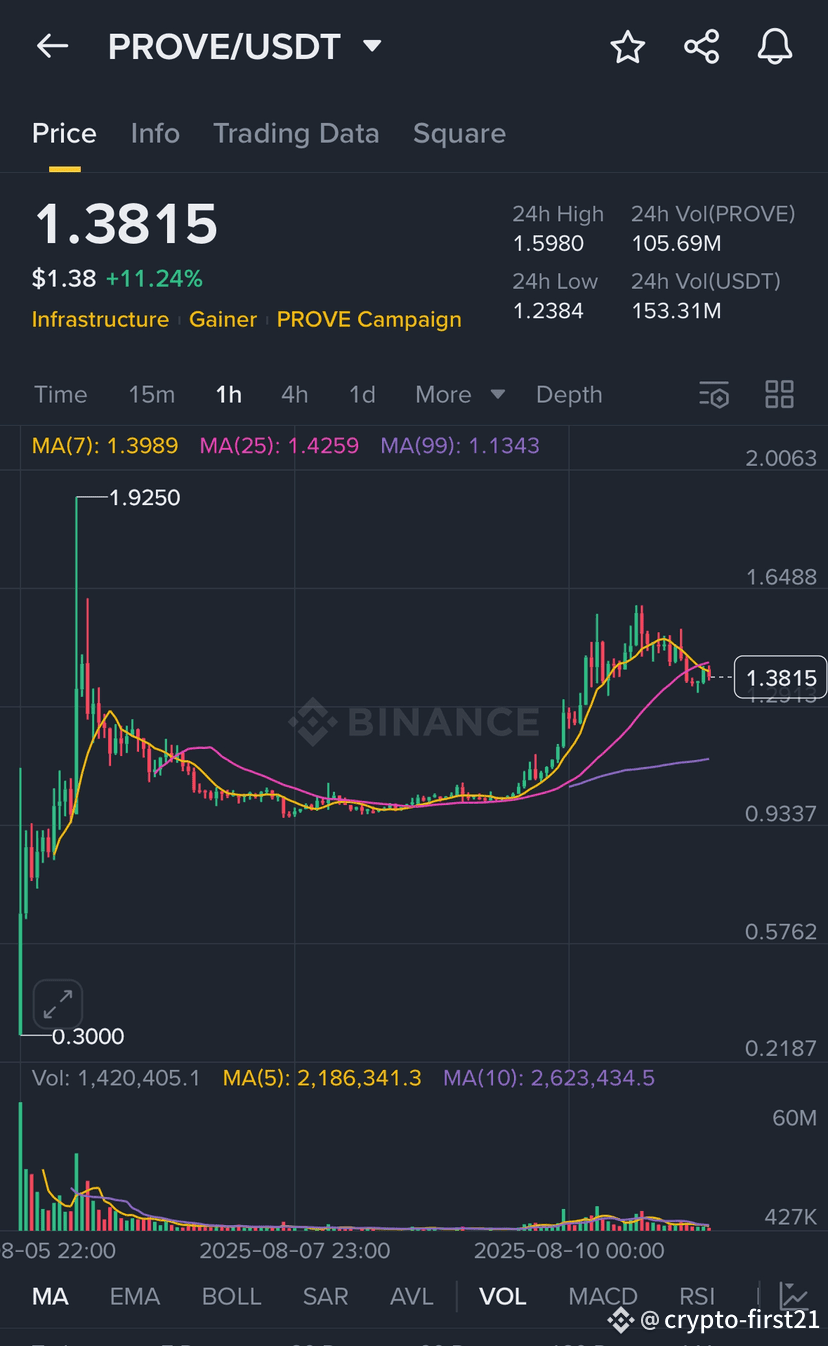
These moves triggered a +50% price surge, with PROVE hitting $1.50 and over $715M in 24-hour trading volume. After initial volatility, the token is consolidating near $1.20 with strong technical support.
• 𝐖𝐡𝐲 𝐈𝐭 𝐌𝐚𝐭𝐭𝐞𝐫𝐬
Succinct is more than a token it’s critical ZK infrastructure designed for scale. By making proof generation fast, decentralized, and developer-friendly, it has the potential to become a foundational layer for the next generation of blockchain applications.
@SuccinctLabs #SuccinctLabs
$PROVE
#CryptoTrading
#BlockchainInfrastructure
#ZeroKnowledgeProof
𝐒𝐮𝐜𝐜𝐢𝐧𝐜𝐭 (𝐏𝐑𝐎𝐕𝐄) 𝐃𝐞𝐜𝐞𝐧𝐭𝐫𝐚𝐥𝐢𝐳𝐞𝐝 𝐏𝐫𝐨𝐯𝐞𝐫 𝐍𝐞𝐭𝐰𝐨𝐫𝐤 𝐋𝐢𝐯𝐞
Succinct has officially launched its mainnet, introducing the first-ever decentralized prover network that’s already supporting 35+ major protocols, processing over 5 million zero-knowledge proofs, and securing $4 billion+ in value.
At its core, Succinct operates as a two-sided marketplace applications submit proof requests while independent provers compete in off-chain auctions, with transparent settlement on-chain. Developers can build using SP1, a general-purpose zkVM, enabling proofs in familiar languages like Rust or C++ without deep cryptography expertise.
The PROVE token powers this ecosystem, serving for prover payments, staking collateral, and governance.
• 𝐓𝐨𝐭𝐚𝐥 𝐒𝐮𝐩𝐩𝐥𝐲: 𝟏 𝐁𝐢𝐥𝐥𝐢𝐨𝐧
Initial Circulating: 195 Million
Binance HODLer Airdrop: 15 Million PROVE distributed (1.5% of supply.
These moves triggered a +50% price surge, with PROVE hitting $1.50 and over $715M in 24-hour trading volume. After initial volatility, the token is consolidating near $1.20 with strong technical support.
• 𝐖𝐡𝐲 𝐈𝐭 𝐌𝐚𝐭𝐭𝐞𝐫𝐬
Succinct is more than a token it’s critical ZK infrastructure designed for scale. By making proof generation fast, decentralized, and developer-friendly, it has the potential to become a foundational layer for the next generation of blockchain applications.
@SuccinctLabs #SuccinctLabs
$PROVE
#CryptoTrading
#BlockchainInfrastructure
#ZeroKnowledgeProof
At its core, Succinct operates as a two-sided marketplace applications submit proof requests while independent provers compete in off-chain auctions, with transparent settlement on-chain. Developers can build using SP1, a general-purpose zkVM, enabling proofs in familiar languages like Rust or C++ without deep cryptography expertise.
The PROVE token powers this ecosystem, serving for prover payments, staking collateral, and governance.
• 𝐓𝐨𝐭𝐚𝐥 𝐒𝐮𝐩𝐩𝐥𝐲: 𝟏 𝐁𝐢𝐥𝐥𝐢𝐨𝐧
Initial Circulating: 195 Million
Binance HODLer Airdrop: 15 Million PROVE distributed (1.5% of supply.
These moves triggered a +50% price surge, with PROVE hitting $1.50 and over $715M in 24-hour trading volume. After initial volatility, the token is consolidating near $1.20 with strong technical support.
• 𝐖𝐡𝐲 𝐈𝐭 𝐌𝐚𝐭𝐭𝐞𝐫𝐬
Succinct is more than a token it’s critical ZK infrastructure designed for scale. By making proof generation fast, decentralized, and developer-friendly, it has the potential to become a foundational layer for the next generation of blockchain applications.
@SuccinctLabs #SuccinctLabs
$PROVE
#CryptoTrading
#BlockchainInfrastructure
#ZeroKnowledgeProof
1
3
364

·
--
Article
Succinct Prove: Unlocking the Next Chapter of Trustless InnovationIn the world of decentralized systems, the race is no longer just about who can build the fastest blockchain. It’s about who can prove, beyond doubt, that what’s happening on-chain is accurate, secure, and scalable. Succinct Labs’ Prove answers this challenge by offering a universal proving layer that is as efficient as it is resilient.
1. What makes Prove’s security guarantees unique?
Security has always been the bedrock of blockchain—but most solutions either lean on centralization for speed or compromise usability for safety. Prove takes a different path.
Its foundation is cryptographic certainty, not trust. By distributing verification across a decentralized network of provers, no single actor can manipulate results. Each proof is compact yet irrefutable, leaving no room for tampering.
In short, Prove replaces fragile assurances with mathematical inevitability. Security isn’t just a layer; it’s baked into every transaction, every message, and every interaction.
2. How does Prove enhance interoperability between blockchains?
Web3 today is more like a collection of islands than a connected ecosystem. Bridges tried to link these chains, but they’ve repeatedly been exploited.
Prove offers a cleaner solution: verifiable proofs that can confirm activity across chains without relying on trusted intermediaries. This allows data to move safely and seamlessly between Ethereum, Solana, Cosmos, and beyond.
By turning interoperability into a matter of proof instead of trust, Prove transforms siloed ecosystems into a cohesive digital economy—something previous approaches failed to achieve.
3. What does Prove offer developers in terms of tooling and accessibility?
For developers, building with zero-knowledge systems used to mean hiring cryptographers or spending months grappling with highly technical frameworks. That barrier kept innovation gated.
Prove dismantles this by providing developer-friendly tooling—simple APIs and modular infrastructure that abstract away the complexity of cryptography. Developers can integrate powerful proof systems with minimal friction, freeing them to focus on innovation, not integration headaches.
This democratization of advanced cryptography means Prove isn’t just empowering experts—it’s opening doors for every builder in Web3.
4. How does Prove tackle scalability hurdles?
Scalability is blockchain’s most stubborn roadblock. Traditional verification requires re-executing computations on-chain, which bottlenecks performance.
Prove sidesteps this by outsourcing heavy computation to a decentralized network of provers. These nodes generate a succinct proof that is tiny yet verifiable in milliseconds on-chain.
This model is like compressing a movie file without losing resolution—you get the same truth, but in a fraction of the space and time. The outcome: blockchains scale without compromising security or decentralization.
5. What role does Prove’s economic design play in its ecosystem?
Technology alone isn’t enough—it must also incentivize participation. Prove’s economic design turns verification into a marketplace. Provers are rewarded for their computational contributions, while developers and users benefit from lower costs and faster performance.
This creates a self-sustaining ecosystem:
Developers save time and resources.
Users enjoy cheaper, smoother interactions.
Provers earn incentives by powering the network.
It’s a win-win cycle where efficiency breeds adoption, and adoption fuels economic sustainability.
Final Thoughts
Succinct’s Prove is not just solving technical problems—it’s reframing the very foundations of digital trust. By guaranteeing security, enabling seamless interoperability, democratizing developer tools, solving scalability, and building an economically sustainable ecosystem, Prove positions itself as the invisible engine of Web3’s growth.
In a digital era where trust must be earned at every interaction, Prove doesn’t just ask you to believe—it gives you the proof.
@SuccinctLabs
#SuccinctLabs
$PROVE
{alpha}(560x7ddf164cecfddd0f992299d033b5a11279a15929)
{future}(PROVEUSDT)
Succinct Prove: Unlocking the Next Chapter of Trustless Innovation
In the world of decentralized systems, the race is no longer just about who can build the fastest blockchain. It’s about who can prove, beyond doubt, that what’s happening on-chain is accurate, secure, and scalable. Succinct Labs’ Prove answers this challenge by offering a universal proving layer that is as efficient as it is resilient.
1. What makes Prove’s security guarantees unique?
Security has always been the bedrock of blockchain—but most solutions either lean on centralization for speed or compromise usability for safety. Prove takes a different path.
Its foundation is cryptographic certainty, not trust. By distributing verification across a decentralized network of provers, no single actor can manipulate results. Each proof is compact yet irrefutable, leaving no room for tampering.
In short, Prove replaces fragile assurances with mathematical inevitability. Security isn’t just a layer; it’s baked into every transaction, every message, and every interaction.
2. How does Prove enhance interoperability between blockchains?
Web3 today is more like a collection of islands than a connected ecosystem. Bridges tried to link these chains, but they’ve repeatedly been exploited.
Prove offers a cleaner solution: verifiable proofs that can confirm activity across chains without relying on trusted intermediaries. This allows data to move safely and seamlessly between Ethereum, Solana, Cosmos, and beyond.
By turning interoperability into a matter of proof instead of trust, Prove transforms siloed ecosystems into a cohesive digital economy—something previous approaches failed to achieve.
3. What does Prove offer developers in terms of tooling and accessibility?
For developers, building with zero-knowledge systems used to mean hiring cryptographers or spending months grappling with highly technical frameworks. That barrier kept innovation gated.
Prove dismantles this by providing developer-friendly tooling—simple APIs and modular infrastructure that abstract away the complexity of cryptography. Developers can integrate powerful proof systems with minimal friction, freeing them to focus on innovation, not integration headaches.
This democratization of advanced cryptography means Prove isn’t just empowering experts—it’s opening doors for every builder in Web3.
4. How does Prove tackle scalability hurdles?
Scalability is blockchain’s most stubborn roadblock. Traditional verification requires re-executing computations on-chain, which bottlenecks performance.
Prove sidesteps this by outsourcing heavy computation to a decentralized network of provers. These nodes generate a succinct proof that is tiny yet verifiable in milliseconds on-chain.
This model is like compressing a movie file without losing resolution—you get the same truth, but in a fraction of the space and time. The outcome: blockchains scale without compromising security or decentralization.
5. What role does Prove’s economic design play in its ecosystem?
Technology alone isn’t enough—it must also incentivize participation. Prove’s economic design turns verification into a marketplace. Provers are rewarded for their computational contributions, while developers and users benefit from lower costs and faster performance.
This creates a self-sustaining ecosystem:
Developers save time and resources.
Users enjoy cheaper, smoother interactions.
Provers earn incentives by powering the network.
It’s a win-win cycle where efficiency breeds adoption, and adoption fuels economic sustainability.
Final Thoughts
Succinct’s Prove is not just solving technical problems—it’s reframing the very foundations of digital trust. By guaranteeing security, enabling seamless interoperability, democratizing developer tools, solving scalability, and building an economically sustainable ecosystem, Prove positions itself as the invisible engine of Web3’s growth.
In a digital era where trust must be earned at every interaction, Prove doesn’t just ask you to believe—it gives you the proof.
@Succinct
#SuccinctLabs
$PROVE
1. What makes Prove’s security guarantees unique?
Security has always been the bedrock of blockchain—but most solutions either lean on centralization for speed or compromise usability for safety. Prove takes a different path.
Its foundation is cryptographic certainty, not trust. By distributing verification across a decentralized network of provers, no single actor can manipulate results. Each proof is compact yet irrefutable, leaving no room for tampering.
In short, Prove replaces fragile assurances with mathematical inevitability. Security isn’t just a layer; it’s baked into every transaction, every message, and every interaction.
2. How does Prove enhance interoperability between blockchains?
Web3 today is more like a collection of islands than a connected ecosystem. Bridges tried to link these chains, but they’ve repeatedly been exploited.
Prove offers a cleaner solution: verifiable proofs that can confirm activity across chains without relying on trusted intermediaries. This allows data to move safely and seamlessly between Ethereum, Solana, Cosmos, and beyond.
By turning interoperability into a matter of proof instead of trust, Prove transforms siloed ecosystems into a cohesive digital economy—something previous approaches failed to achieve.
3. What does Prove offer developers in terms of tooling and accessibility?
For developers, building with zero-knowledge systems used to mean hiring cryptographers or spending months grappling with highly technical frameworks. That barrier kept innovation gated.
Prove dismantles this by providing developer-friendly tooling—simple APIs and modular infrastructure that abstract away the complexity of cryptography. Developers can integrate powerful proof systems with minimal friction, freeing them to focus on innovation, not integration headaches.
This democratization of advanced cryptography means Prove isn’t just empowering experts—it’s opening doors for every builder in Web3.
4. How does Prove tackle scalability hurdles?
Scalability is blockchain’s most stubborn roadblock. Traditional verification requires re-executing computations on-chain, which bottlenecks performance.
Prove sidesteps this by outsourcing heavy computation to a decentralized network of provers. These nodes generate a succinct proof that is tiny yet verifiable in milliseconds on-chain.
This model is like compressing a movie file without losing resolution—you get the same truth, but in a fraction of the space and time. The outcome: blockchains scale without compromising security or decentralization.
5. What role does Prove’s economic design play in its ecosystem?
Technology alone isn’t enough—it must also incentivize participation. Prove’s economic design turns verification into a marketplace. Provers are rewarded for their computational contributions, while developers and users benefit from lower costs and faster performance.
This creates a self-sustaining ecosystem:
Developers save time and resources.
Users enjoy cheaper, smoother interactions.
Provers earn incentives by powering the network.
It’s a win-win cycle where efficiency breeds adoption, and adoption fuels economic sustainability.
Final Thoughts
Succinct’s Prove is not just solving technical problems—it’s reframing the very foundations of digital trust. By guaranteeing security, enabling seamless interoperability, democratizing developer tools, solving scalability, and building an economically sustainable ecosystem, Prove positions itself as the invisible engine of Web3’s growth.
In a digital era where trust must be earned at every interaction, Prove doesn’t just ask you to believe—it gives you the proof.
@Succinct
#SuccinctLabs
$PROVE
3
257

·
--
Article
POWERING DECENTRALIZED PROOF GENERATION$PROVE
Solving the ZK Proof Bottleneck
Generating Zero-Knowledge (ZK) proofs is extremely resource-heavy, requiring costly specialized hardware. Most projects face a choice: build expensive infrastructure themselves or depend on centralized providers, which introduces risk and a single point of failure.
A Global, Permissionless Prover Network
@SuccinctLabs offers a decentralized Prover Network—a worldwide system where anyone can contribute computing power to generate proofs. Developers submit proof tasks, and Provers compete to complete them efficiently, creating a competitive and scalable marketplace.
Secured by the $PROVE token, this network delivers a reliable, censorship-resistant solution for ZK proof generation—freeing projects from managing their own hardware while ensuring speed, security, and cost-efficiency.
#SuccinctLabs
POWERING DECENTRALIZED PROOF GENERATION
$PROVE
Solving the ZK Proof Bottleneck
Generating Zero-Knowledge (ZK) proofs is extremely resource-heavy, requiring costly specialized hardware. Most projects face a choice: build expensive infrastructure themselves or depend on centralized providers, which introduces risk and a single point of failure.
A Global, Permissionless Prover Network
@Succinct offers a decentralized Prover Network—a worldwide system where anyone can contribute computing power to generate proofs. Developers submit proof tasks, and Provers compete to complete them efficiently, creating a competitive and scalable marketplace.
Secured by the $PROVE token, this network delivers a reliable, censorship-resistant solution for ZK proof generation—freeing projects from managing their own hardware while ensuring speed, security, and cost-efficiency.
#SuccinctLabs
Solving the ZK Proof Bottleneck
Generating Zero-Knowledge (ZK) proofs is extremely resource-heavy, requiring costly specialized hardware. Most projects face a choice: build expensive infrastructure themselves or depend on centralized providers, which introduces risk and a single point of failure.
A Global, Permissionless Prover Network
@Succinct offers a decentralized Prover Network—a worldwide system where anyone can contribute computing power to generate proofs. Developers submit proof tasks, and Provers compete to complete them efficiently, creating a competitive and scalable marketplace.
Secured by the $PROVE token, this network delivers a reliable, censorship-resistant solution for ZK proof generation—freeing projects from managing their own hardware while ensuring speed, security, and cost-efficiency.
#SuccinctLabs
1
1
6
5.3k

·
--
Bullish
Sure! Here's an original post that meets all the requirements:
Excited to see what @SuccinctLabs bs is building with zero-knowledge proofs to enhance on-chain data verification. 🚀 Their work is a huge leap for decentralized trust! #SuccinctLabs $PROVE
Let me know if you'd like a version that's more technical, casual, or targeted to a specific audience!
Sure! Here's an original post that meets all the requirements:
Excited to see what @Succinct bs is building with zero-knowledge proofs to enhance on-chain data verification. 🚀 Their work is a huge leap for decentralized trust! #SuccinctLabs $PROVE
Let me know if you'd like a version that's more technical, casual, or targeted to a specific audience!
Excited to see what @Succinct bs is building with zero-knowledge proofs to enhance on-chain data verification. 🚀 Their work is a huge leap for decentralized trust! #SuccinctLabs $PROVE
Let me know if you'd like a version that's more technical, casual, or targeted to a specific audience!
63

·
--
PROVE token impulsado por SUCCINT servir como motor económico, de seguridad y gobernanza dentro de una infraestructura descentralizada para verificación criptográfica confiable y escalable, cosas increíbles vienen en camino🔥
@SuccinctLabs #SuccinctLabs $PROVE
PROVE token impulsado por SUCCINT servir como motor económico, de seguridad y gobernanza dentro de una infraestructura descentralizada para verificación criptográfica confiable y escalable, cosas increíbles vienen en camino🔥
@Succinct #SuccinctLabs $PROVE
@Succinct #SuccinctLabs $PROVE
210

$PROVE
#succinctlabs
@SuccinctLabs
PROVE is the native token of the Succinct Prover Network, a decentralised protocol for outsourcing zero-knowledge proof generation to a global network of provers.
It is used to pay for proofs, with all transactions settled on-chain via the SuccinctVApp contract. Provers must stake PROVE to access auctions for proof requests, and token holders can delegate stake to earn rewards and incentives.
The network employs a nested vault system for staking, providing liquidity and governance participation through iPROVE and stPROVE tokens. Governance initially relies on a security council but transitions to full on-chain voting based on staked PROVE.
Slashing mechanisms enforce accountability for provers who fail to deliver. PROVE supports scalable, trust-minimised proving infrastructure for applications such as rollups, bridges, oracles, and AI agents by aligning incentives across users, provers, and stakers in an open, permissionless marketplace.
{spot}(PROVEUSDT)
$PROVE
#succinctlabs
@Succinct
PROVE is the native token of the Succinct Prover Network, a decentralised protocol for outsourcing zero-knowledge proof generation to a global network of provers.
It is used to pay for proofs, with all transactions settled on-chain via the SuccinctVApp contract. Provers must stake PROVE to access auctions for proof requests, and token holders can delegate stake to earn rewards and incentives.
The network employs a nested vault system for staking, providing liquidity and governance participation through iPROVE and stPROVE tokens. Governance initially relies on a security council but transitions to full on-chain voting based on staked PROVE.
Slashing mechanisms enforce accountability for provers who fail to deliver. PROVE supports scalable, trust-minimised proving infrastructure for applications such as rollups, bridges, oracles, and AI agents by aligning incentives across users, provers, and stakers in an open, permissionless marketplace.
#succinctlabs
@Succinct
PROVE is the native token of the Succinct Prover Network, a decentralised protocol for outsourcing zero-knowledge proof generation to a global network of provers.
It is used to pay for proofs, with all transactions settled on-chain via the SuccinctVApp contract. Provers must stake PROVE to access auctions for proof requests, and token holders can delegate stake to earn rewards and incentives.
The network employs a nested vault system for staking, providing liquidity and governance participation through iPROVE and stPROVE tokens. Governance initially relies on a security council but transitions to full on-chain voting based on staked PROVE.
Slashing mechanisms enforce accountability for provers who fail to deliver. PROVE supports scalable, trust-minimised proving infrastructure for applications such as rollups, bridges, oracles, and AI agents by aligning incentives across users, provers, and stakers in an open, permissionless marketplace.
120
66
14
558

·
--
@SuccinctLabs is a decentralized prover network that creates and verifies zero-knowledge proofs. Its native token is $PROVE , which serves as the economic foundation and backbone of the network. The positive aspect is that it makes ZK technology accessible for developers and supports major projects like Polygon and Lido. It has recently been listed on major exchanges.
Currently, the $PROVE token market is experiencing high volatility. However, due to its strong technological foundation and the growing demand for ZK technology, the long-term prospects are quite bright. It is essential to carefully monitor market movements before investing.
#SuccinctLabs
{spot}(PROVEUSDT)
@Succinct is a decentralized prover network that creates and verifies zero-knowledge proofs. Its native token is $PROVE , which serves as the economic foundation and backbone of the network. The positive aspect is that it makes ZK technology accessible for developers and supports major projects like Polygon and Lido. It has recently been listed on major exchanges.
Currently, the $PROVE token market is experiencing high volatility. However, due to its strong technological foundation and the growing demand for ZK technology, the long-term prospects are quite bright. It is essential to carefully monitor market movements before investing.
#SuccinctLabs
Currently, the $PROVE token market is experiencing high volatility. However, due to its strong technological foundation and the growing demand for ZK technology, the long-term prospects are quite bright. It is essential to carefully monitor market movements before investing.
#SuccinctLabs
870
551
62
870

·
--
Initial Market Response and Trading Surge
Following its launch, the PROVE token received an extraordinary market reaction. Within hours of being listed on Bitget, its price surged by more than 50%, and its trading volume exceeded $715 million within the first 24 hours. Reports suggest that during its first week, PROVE experienced a 200% spike in volume, highlighting overwhelming demand from traders.
Binance also distributed 15 million PROVE through a HODLer airdrop, equal to 1.5% of the total supply, encouraging long-term holding. Analysts described this as one of the hottest token launches of the year, noting that such rapid adoption demonstrated the project’s strong fundamentals. The token’s rise not only impressed investors but also drew attention from media outlets and researchers, who called it a potential game-changer for the ZK ecosystem.
@SuccinctLabs #SuccinctLabs $PROVE
{spot}(PROVEUSDT)
Initial Market Response and Trading Surge
Following its launch, the PROVE token received an extraordinary market reaction. Within hours of being listed on Bitget, its price surged by more than 50%, and its trading volume exceeded $715 million within the first 24 hours. Reports suggest that during its first week, PROVE experienced a 200% spike in volume, highlighting overwhelming demand from traders.
Binance also distributed 15 million PROVE through a HODLer airdrop, equal to 1.5% of the total supply, encouraging long-term holding. Analysts described this as one of the hottest token launches of the year, noting that such rapid adoption demonstrated the project’s strong fundamentals. The token’s rise not only impressed investors but also drew attention from media outlets and researchers, who called it a potential game-changer for the ZK ecosystem.
@Succinct #SuccinctLabs $PROVE
Following its launch, the PROVE token received an extraordinary market reaction. Within hours of being listed on Bitget, its price surged by more than 50%, and its trading volume exceeded $715 million within the first 24 hours. Reports suggest that during its first week, PROVE experienced a 200% spike in volume, highlighting overwhelming demand from traders.
Binance also distributed 15 million PROVE through a HODLer airdrop, equal to 1.5% of the total supply, encouraging long-term holding. Analysts described this as one of the hottest token launches of the year, noting that such rapid adoption demonstrated the project’s strong fundamentals. The token’s rise not only impressed investors but also drew attention from media outlets and researchers, who called it a potential game-changer for the ZK ecosystem.
@Succinct #SuccinctLabs $PROVE
2.2k
1.1k
154
2.2k

·
--
$PROVE的价值不是炒出来的,是“用出来的”
现在很多人盯着$PROVE的价格涨涨跌跌,却没搞懂它的价值在哪:它不是靠炒作,是靠“被使用”来增值的。
每笔跨链交易要付PROVE当手续费,用的人越多,需求越旺;开发者用Succinct做应用,要质押PROVE,锁仓量跟着生态扩大而增加;社区治理要$PROVE 投票,持币人能决定协议走向,币的话语权越来越重。
简单说,$PROVE的价值=跨链交易量+生态应用数+社区话语权。随着ZK跨链的普及,这些都会涨,币的价值自然跟着涨。这不是短期投机,是长期跟着生态成长的投资。
@SuccinctLabs #SuccinctLabs
{spot}(PROVEUSDT)
$PROVE 的价值不是炒出来的,是“用出来的”
现在很多人盯着$PROVE 的价格涨涨跌跌,却没搞懂它的价值在哪:它不是靠炒作,是靠“被使用”来增值的。
每笔跨链交易要付PROVE当手续费,用的人越多,需求越旺;开发者用Succinct做应用,要质押PROVE,锁仓量跟着生态扩大而增加;社区治理要$PROVE 投票,持币人能决定协议走向,币的话语权越来越重。
简单说,$PROVE 的价值=跨链交易量+生态应用数+社区话语权。随着ZK跨链的普及,这些都会涨,币的价值自然跟着涨。这不是短期投机,是长期跟着生态成长的投资。
@Succinct #SuccinctLabs
现在很多人盯着$PROVE 的价格涨涨跌跌,却没搞懂它的价值在哪:它不是靠炒作,是靠“被使用”来增值的。
每笔跨链交易要付PROVE当手续费,用的人越多,需求越旺;开发者用Succinct做应用,要质押PROVE,锁仓量跟着生态扩大而增加;社区治理要$PROVE 投票,持币人能决定协议走向,币的话语权越来越重。
简单说,$PROVE 的价值=跨链交易量+生态应用数+社区话语权。随着ZK跨链的普及,这些都会涨,币的价值自然跟着涨。这不是短期投机,是长期跟着生态成长的投资。
@Succinct #SuccinctLabs
260

·
--
Meet Succinct: A Project With GREAT FundamentalsI. Introduction: The Hidden Commodity of Web3
If you’ve been around crypto long enough, you know the big themes. Bitcoin gave us digital money. Ethereum gave us programmable contracts. Rollups promised scalability. Bridges promised interconnection. Yet, beneath all of these innovations lies a quieter, less talked-about foundation: proofs.
Proofs are what make trustless systems work. They are the mathematical receipts that confirm a transaction is valid, that a rollup state is correct, or that a bridge transfer really happened. Without proofs, you are relying on committees, oracles, or blind trust — exactly the things blockchains were supposed to move us away from.
This is where Succinct comes in. Succinct is a project dedicated to making proofs abundant, fast, and easy to use. Instead of being the privilege of elite cryptography teams, proofs become a service anyone can request, pay for, and verify. In other words, Succinct is building a marketplace for trust.
Think about it this way: the internet became mainstream when bandwidth stopped being scarce. AI took off when compute became available on demand. Blockchains will hit their full stride when proofs become cheap, fast, and everywhere. Succinct’s mission is to make that possible.
II. Why Proofs Matter More Than We Realize
On paper, blockchains already solve trust. Transactions are public. Consensus ensures agreement. But scale introduced new problems. Rollups execute transactions cheaply off-chain, but still need to prove correctness back to Ethereum. Bridges connect ecosystems, but need to prove that assets really moved. Off-chain applications like AI inference or large computations need to prove results to on-chain contracts.
Here’s the problem: verification lags execution.
• Optimistic rollups force users to wait a week for withdrawals, in case of fraud challenges.
• Bridges rely on small committees of signers — essentially trusted middlemen.
• Applications avoid heavy computation because proof systems are too slow or expensive.
These aren’t just technical inconveniences. They are adoption blockers. No institution wants to wait seven days for liquidity. No enterprise will trust a cross-chain bridge managed by a handful of people. No developer will risk building apps that break user expectations because the infrastructure isn’t ready.
That’s why Succinct’s work is so important. By making proofs abundant and near-instant, it collapses waiting times, removes committees, and opens new design spaces for developers. Proofs stop being a bottleneck — they become a backbone.
III. The SP1 zkVM: Simplifying the Impossible
Zero-knowledge technology has always had a catch: it’s powerful, but brutally difficult to use. Developers had to design cryptographic circuits by hand, a process requiring years of expertise. Only a handful of teams in the world could do it.
Succinct flipped this model with SP1, its zero-knowledge virtual machine. SP1 lets developers write in familiar languages like Rust and RISC-V. The system then compiles that code into proof-ready form automatically.
The difference is night and day. With SP1, building zk applications feels like writing normal software. Developers don’t have to be cryptographers — they just code, compile, and deploy. It’s the same kind of simplification that cloud computing brought to servers. You don’t set up physical racks anymore; you just click a button and run.
Other zkVMs exist — RISC Zero, StarkWare — but SP1’s strength lies in accessibility and integration with the broader Succinct marketplace. It’s not just a tool. It’s a gateway into a proving economy.
IV. Hypercube: Closing the Latency Gap
Performance has always been the Achilles’ heel of proofs. Traditional zk systems could take minutes, even hours, to generate a single proof. That was fine for academic demos, but useless for real-world finance.
Succinct addressed this with SP1 Hypercube, a re-architected system for speed. Benchmarks show Ethereum blocks can be proven in near real-time.
In fact, 93% of blocks are proven in under 12 seconds, with averages around 10.3 seconds. That means proofs keep pace with Ethereum’s own block cadence.
Why does this matter? Because latency defines experience. If you’re a user withdrawing from a rollup, the difference between one hour and seven days is the difference between usable and unusable. If you’re a developer building cross-chain apps, instant proofs mean you can design systems that feel like native transfers.
Of course, averages aren’t everything. The “tail latency” — those few outlier proofs that take longer — still matters. Succinct knows this and is working to compress tails as well as means. But even so, Hypercube sets a new baseline: proofs no longer drag behind execution. They move in step.
V. SP1-CC: Proofs as a Co-Processor
Succinct didn’t stop at block-level proofs. With SP1-CC, it introduced something entirely new: proofs as a co-processor for the EVM.
Here’s how it works. Normally, Ethereum contracts are limited by gas costs. If you want to do heavy computation — say, verifying thousands of transactions, or running a machine learning model — it’s either too expensive or outright impossible.
SP1-CC changes that. Contracts can request a computation off-chain, get the result, and only accept it if it comes with a proof. The proof shows that the computation was run correctly, without the contract itself needing to do the work.
Think of it as plugging a math accelerator into Ethereum. Suddenly, contracts can reference historical state, run AI inference, or verify complex datasets. For developers, this is a new design space. For users, it means applications that were unthinkable before now become possible.
VI. The Explorer: Transparency as Culture
Most infrastructure is invisible by design. But in crypto, invisibility can breed mistrust. If you can’t see how proofs are being generated, you’re forced to take someone’s word for it — which undermines the entire point of decentralization.
Succinct solved this with the Explorer, a real-time dashboard for the proving marketplace. Anyone can see proof requests coming in, which prover picked them up, how long it took, and whether it succeeded.
This isn’t just a nice feature. It’s a cultural statement. Succinct is saying: proofs shouldn’t happen in the dark. They should be observable, verifiable, and accountable. For developers, it’s a debugging tool. For users, it’s assurance. For token holders, it’s adoption you can literally watch unfold.
The parallel with Etherscan is intentional. Just as Etherscan turned Ethereum transactions into a public interface, the Explorer turns proofs into a public commodity. Transparency is no longer optional — it’s baked in.
VII. Integrations That Prove the Model
Theories don’t matter without practice. Succinct’s integrations show the architecture working in the wild.
• Mantle rollups: The headline win. Withdrawals shrank from seven days to about one hour. That changes the game for users and liquidity providers.
• Cosmos IBC Eureka: Instead of verifying hundreds of validator signatures on Ethereum, Succinct compresses them into a single proof. Cheaper, safer, and cryptographically enforced.
• Arbitrum Tandem: In August 2025, Arbitrum’s venture arm signed a one-year exclusivity deal with Succinct. For one of the largest L2 ecosystems to anchor its zk roadmap in Succinct’s marketplace is a massive endorsement.
• Polygon, Celestia, Avail, Lido, Galxe: From rollup aggregation to data availability to raffles, SP1 has been adopted across diverse verticals.
Each integration is a proof point in itself. Succinct isn’t just running demos. It’s embedded in some of the most important systems in Web3.
VIII. Hardware Diversity and Neutrality
Every infrastructure layer in history has faced the same question: who controls supply? For cloud computing, it was Amazon, Google, Microsoft. For bandwidth, it was telecom giants. When power consolidates, neutrality weakens.
Succinct has taken that lesson to heart.
Its proving marketplace isn’t built around one operator or one type of hardware. It’s intentionally diverse.
• ZAN joined as one of the earliest independent operators, bringing FPGA accelerators online. Reports suggest up to 20× performance gains compared to CPU-based proving. That kind of efficiency doesn’t just lower costs — it makes low-latency guarantees possible.
• Cysic deployed large GPU clusters and is already developing ASIC pipelines for the future. GPUs provide the raw parallelism needed for high-throughput proofs, while ASICs could eventually push performance to levels unattainable with general-purpose chips.
This diversity matters for two reasons. First, it ensures neutrality. If one supplier falters, the system keeps running. Second, it drives competition. Just as cloud providers competed to lower prices and improve uptime, prover operators will compete to deliver faster, cheaper proofs.
Proofs are on track to be commoditized like kilowatts or gigabytes. Hardware diversity ensures no one owns the grid.
IX. Tokenomics: PROVE as the Meter of Trust
All of this activity — the marketplace, the jobs, the competition — needs a unit of account. That’s where PROVE, Succinct’s native token, comes in.
Supply and circulation
• Total supply: 1 billion PROVE.
• At launch, ~195 million were unlocked, about 11% of supply.
• The rest is scheduled to unlock gradually, aligning with adoption.
Utility
• Payment: Developers pay provers in PROVE to fulfill jobs.
• Staking: Provers must stake PROVE as collateral, subject to slashing for misbehavior.
• Collateral: Ensures integrity of computation.
• Governance: PROVE holders will eventually govern parameters like staking ratios, auction rules, and reward distribution.
Structural demand
Unlike many tokens, PROVE isn’t just decorative. Every proof consumes it. That means demand is tied directly to usage. The more apps and rollups integrate Succinct, the more PROVE circulates.
The flywheel
1. More apps adopt Succinct → more proof jobs.
2. More jobs consume PROVE → demand rises.
3. Higher demand attracts more provers → more competition, lower latency.
4. Lower latency and costs attract more apps → cycle repeats.
This is not theoretical. In the first two weeks of mainnet:
• Over 42,200 proofs were processed.
• More than $4B in value was secured.
• 35+ protocols integrated.
Those aren’t speculative numbers. They’re visible in the Explorer. For token holders, this visibility is critical. You don’t have to take anyone’s word for it — you can watch adoption in real time.
X. Achievements and Backing
Succinct’s progress hasn’t gone unnoticed.
• In March 2024, it raised $43 million in a Paradigm-led round, one of the most respected VCs in crypto.
• In August 2025, mainnet launch processed tens of thousands of proofs within days.
• Binance ran a 15M PROVE airdrop to BNB stakers, ensuring wide community distribution.
• Major exchanges like Binance, HTX, and Bitget listed PROVE almost immediately. Coinbase is rumored to be next.
• Market cap briefly touched $4B after the Arbitrum Tandem exclusivity deal.
Even more important than capital or listings is ecosystem validation. Cosmos, Mantle, Arbitrum, Polygon, Celestia, Avail, and Lido — leaders across multiple verticals — are already using SP1 proofs in production. That credibility speaks louder than hype.
XI. Macro Context: Why Now Is Different
Succinct isn’t just riding its own innovation. It’s also perfectly timed to larger macro currents.
Liquidity cycles
The U.S. Federal Reserve is preparing to cut rates after years of tightening. When traditional yields fall, capital flows back into risk assets like crypto. Historically, infrastructure tokens — those tied to real usage — benefit disproportionately in these cycles.
Institutional legitimacy
With BTC and ETH ETFs live, institutions now see crypto as an asset class. The next question they ask: what infrastructure supports these assets? Succinct’s narrative — commoditizing proofs — is easy for institutions to understand. It’s not a meme.
It’s infrastructure.
Regulatory tailwinds
In 2025, NIST began formal work on standardizing zero-knowledge proofs. That’s a signal to enterprises and regulators: ZKPs aren’t fringe — they’re foundational. Succinct, already proving production systems, is well-positioned to benefit from this legitimization.
AI and DePIN convergence
AI pipelines are asking how to verify results. DePIN networks are asking how to prove physical data processing. Succinct’s SP1-CC offers a direct solution. Proofs aren’t just for blockchains anymore — they’re the glue for trust across industries.
When liquidity, legitimacy, regulation, and cross-industry demand line up, you don’t just have a project. You have a wave.
XII. Risks and Challenges
Every serious project faces headwinds. Succinct is no exception.
Latency tails
While averages are excellent, occasional long proofs could hurt user experience. Reducing variance is as important as reducing averages.
Prover concentration
If a handful of operators dominate the market, neutrality weakens. Succinct must continue to diversify supply and incentivize new entrants.
Token volatility
Because proofs are priced in PROVE, swings in token price can stress both buyers and suppliers. Over time, hedging tools and stable settlement layers may be necessary.
Execution scope
Succinct is scaling fast: zkVM, Hypercube, SP1-CC, Explorer, auctions, hardware. Each is ambitious on its own. Managing them all simultaneously is a challenge.
Competition
StarkWare, RISC Zero, Gensyn — each brings a different model of proving. Succinct’s advantage is transparency and marketplace design, but competition is healthy and constant.
Risks don’t diminish the vision. They define the roadmap.
XIII. A Holder’s Perspective: Owning the Meter
For holders, the question is always: what am I really owning? With PROVE, the answer is clear: you own the meter of trust.
Every time a proof is generated, PROVE circulates. Adoption isn’t hidden — it’s visible on the Explorer. That visibility is rare in crypto, where metrics are often vague or delayed.
From my perspective as a holder:
• What excites me: adoption by major protocols, transparent proof counts, hardware diversity, and macro alignment.
• What I want improved: more independent provers, better tail latency, and hedging mechanisms for token volatility.
Owning PROVE isn’t about betting on a narrative. It’s about being exposed to structural demand for proofs — the silent commodity of Web3.
XIV. Philosophical Closing: The World We Can Prove
Humanity has always built architectures of trust. Temples for divine authority. Courts for justice. Banks for finance. Blockchains for consensus. Each era had its own answer to the question: how do we know this is real?
Succinct is building the next answer. A world where we don’t just hope, assume, or trust — we prove.
The implications are vast. Rollups finalize instantly. Bridges don’t rely on committees. AI results come with verifiable receipts. DePIN data is cryptographically certified. Users don’t think about any of it. They just interact with apps that work.
That’s the destiny of infrastructure: to become invisible but indispensable. Electricity, bandwidth, compute — all once scarce, now assumed. Proofs are on the same trajectory.
For PROVE holders, that’s the long-term bet. Not hype, not speculation, but exposure to the commodity of trust itself.
The world ahead won’t be built on belief. It will be built on what we can prove. And Succinct is making sure proofs are always there — fast, transparent, and abundant.
#SuccinctLabs @SuccinctLabs
$PROVE
Meet Succinct: A Project With GREAT Fundamentals
I. Introduction: The Hidden Commodity of Web3
If you’ve been around crypto long enough, you know the big themes. Bitcoin gave us digital money. Ethereum gave us programmable contracts. Rollups promised scalability. Bridges promised interconnection. Yet, beneath all of these innovations lies a quieter, less talked-about foundation: proofs.
Proofs are what make trustless systems work. They are the mathematical receipts that confirm a transaction is valid, that a rollup state is correct, or that a bridge transfer really happened. Without proofs, you are relying on committees, oracles, or blind trust — exactly the things blockchains were supposed to move us away from.
This is where Succinct comes in. Succinct is a project dedicated to making proofs abundant, fast, and easy to use. Instead of being the privilege of elite cryptography teams, proofs become a service anyone can request, pay for, and verify. In other words, Succinct is building a marketplace for trust.
Think about it this way: the internet became mainstream when bandwidth stopped being scarce. AI took off when compute became available on demand. Blockchains will hit their full stride when proofs become cheap, fast, and everywhere. Succinct’s mission is to make that possible.
II. Why Proofs Matter More Than We Realize
On paper, blockchains already solve trust. Transactions are public. Consensus ensures agreement. But scale introduced new problems. Rollups execute transactions cheaply off-chain, but still need to prove correctness back to Ethereum. Bridges connect ecosystems, but need to prove that assets really moved. Off-chain applications like AI inference or large computations need to prove results to on-chain contracts.
Here’s the problem: verification lags execution.
• Optimistic rollups force users to wait a week for withdrawals, in case of fraud challenges.
• Bridges rely on small committees of signers — essentially trusted middlemen.
• Applications avoid heavy computation because proof systems are too slow or expensive.
These aren’t just technical inconveniences. They are adoption blockers. No institution wants to wait seven days for liquidity. No enterprise will trust a cross-chain bridge managed by a handful of people. No developer will risk building apps that break user expectations because the infrastructure isn’t ready.
That’s why Succinct’s work is so important. By making proofs abundant and near-instant, it collapses waiting times, removes committees, and opens new design spaces for developers. Proofs stop being a bottleneck — they become a backbone.
III. The SP1 zkVM: Simplifying the Impossible
Zero-knowledge technology has always had a catch: it’s powerful, but brutally difficult to use. Developers had to design cryptographic circuits by hand, a process requiring years of expertise. Only a handful of teams in the world could do it.
Succinct flipped this model with SP1, its zero-knowledge virtual machine. SP1 lets developers write in familiar languages like Rust and RISC-V. The system then compiles that code into proof-ready form automatically.
The difference is night and day. With SP1, building zk applications feels like writing normal software. Developers don’t have to be cryptographers — they just code, compile, and deploy. It’s the same kind of simplification that cloud computing brought to servers. You don’t set up physical racks anymore; you just click a button and run.
Other zkVMs exist — RISC Zero, StarkWare — but SP1’s strength lies in accessibility and integration with the broader Succinct marketplace. It’s not just a tool. It’s a gateway into a proving economy.
IV. Hypercube: Closing the Latency Gap
Performance has always been the Achilles’ heel of proofs. Traditional zk systems could take minutes, even hours, to generate a single proof. That was fine for academic demos, but useless for real-world finance.
Succinct addressed this with SP1 Hypercube, a re-architected system for speed. Benchmarks show Ethereum blocks can be proven in near real-time.
In fact, 93% of blocks are proven in under 12 seconds, with averages around 10.3 seconds. That means proofs keep pace with Ethereum’s own block cadence.
Why does this matter? Because latency defines experience. If you’re a user withdrawing from a rollup, the difference between one hour and seven days is the difference between usable and unusable. If you’re a developer building cross-chain apps, instant proofs mean you can design systems that feel like native transfers.
Of course, averages aren’t everything. The “tail latency” — those few outlier proofs that take longer — still matters. Succinct knows this and is working to compress tails as well as means. But even so, Hypercube sets a new baseline: proofs no longer drag behind execution. They move in step.
V. SP1-CC: Proofs as a Co-Processor
Succinct didn’t stop at block-level proofs. With SP1-CC, it introduced something entirely new: proofs as a co-processor for the EVM.
Here’s how it works. Normally, Ethereum contracts are limited by gas costs. If you want to do heavy computation — say, verifying thousands of transactions, or running a machine learning model — it’s either too expensive or outright impossible.
SP1-CC changes that. Contracts can request a computation off-chain, get the result, and only accept it if it comes with a proof. The proof shows that the computation was run correctly, without the contract itself needing to do the work.
Think of it as plugging a math accelerator into Ethereum. Suddenly, contracts can reference historical state, run AI inference, or verify complex datasets. For developers, this is a new design space. For users, it means applications that were unthinkable before now become possible.
VI. The Explorer: Transparency as Culture
Most infrastructure is invisible by design. But in crypto, invisibility can breed mistrust. If you can’t see how proofs are being generated, you’re forced to take someone’s word for it — which undermines the entire point of decentralization.
Succinct solved this with the Explorer, a real-time dashboard for the proving marketplace. Anyone can see proof requests coming in, which prover picked them up, how long it took, and whether it succeeded.
This isn’t just a nice feature. It’s a cultural statement. Succinct is saying: proofs shouldn’t happen in the dark. They should be observable, verifiable, and accountable. For developers, it’s a debugging tool. For users, it’s assurance. For token holders, it’s adoption you can literally watch unfold.
The parallel with Etherscan is intentional. Just as Etherscan turned Ethereum transactions into a public interface, the Explorer turns proofs into a public commodity. Transparency is no longer optional — it’s baked in.
VII. Integrations That Prove the Model
Theories don’t matter without practice. Succinct’s integrations show the architecture working in the wild.
• Mantle rollups: The headline win. Withdrawals shrank from seven days to about one hour. That changes the game for users and liquidity providers.
• Cosmos IBC Eureka: Instead of verifying hundreds of validator signatures on Ethereum, Succinct compresses them into a single proof. Cheaper, safer, and cryptographically enforced.
• Arbitrum Tandem: In August 2025, Arbitrum’s venture arm signed a one-year exclusivity deal with Succinct. For one of the largest L2 ecosystems to anchor its zk roadmap in Succinct’s marketplace is a massive endorsement.
• Polygon, Celestia, Avail, Lido, Galxe: From rollup aggregation to data availability to raffles, SP1 has been adopted across diverse verticals.
Each integration is a proof point in itself. Succinct isn’t just running demos. It’s embedded in some of the most important systems in Web3.
VIII. Hardware Diversity and Neutrality
Every infrastructure layer in history has faced the same question: who controls supply? For cloud computing, it was Amazon, Google, Microsoft. For bandwidth, it was telecom giants. When power consolidates, neutrality weakens.
Succinct has taken that lesson to heart.
Its proving marketplace isn’t built around one operator or one type of hardware. It’s intentionally diverse.
• ZAN joined as one of the earliest independent operators, bringing FPGA accelerators online. Reports suggest up to 20× performance gains compared to CPU-based proving. That kind of efficiency doesn’t just lower costs — it makes low-latency guarantees possible.
• Cysic deployed large GPU clusters and is already developing ASIC pipelines for the future. GPUs provide the raw parallelism needed for high-throughput proofs, while ASICs could eventually push performance to levels unattainable with general-purpose chips.
This diversity matters for two reasons. First, it ensures neutrality. If one supplier falters, the system keeps running. Second, it drives competition. Just as cloud providers competed to lower prices and improve uptime, prover operators will compete to deliver faster, cheaper proofs.
Proofs are on track to be commoditized like kilowatts or gigabytes. Hardware diversity ensures no one owns the grid.
IX. Tokenomics: PROVE as the Meter of Trust
All of this activity — the marketplace, the jobs, the competition — needs a unit of account. That’s where PROVE, Succinct’s native token, comes in.
Supply and circulation
• Total supply: 1 billion PROVE.
• At launch, ~195 million were unlocked, about 11% of supply.
• The rest is scheduled to unlock gradually, aligning with adoption.
Utility
• Payment: Developers pay provers in PROVE to fulfill jobs.
• Staking: Provers must stake PROVE as collateral, subject to slashing for misbehavior.
• Collateral: Ensures integrity of computation.
• Governance: PROVE holders will eventually govern parameters like staking ratios, auction rules, and reward distribution.
Structural demand
Unlike many tokens, PROVE isn’t just decorative. Every proof consumes it. That means demand is tied directly to usage. The more apps and rollups integrate Succinct, the more PROVE circulates.
The flywheel
1. More apps adopt Succinct → more proof jobs.
2. More jobs consume PROVE → demand rises.
3. Higher demand attracts more provers → more competition, lower latency.
4. Lower latency and costs attract more apps → cycle repeats.
This is not theoretical. In the first two weeks of mainnet:
• Over 42,200 proofs were processed.
• More than $4B in value was secured.
• 35+ protocols integrated.
Those aren’t speculative numbers. They’re visible in the Explorer. For token holders, this visibility is critical. You don’t have to take anyone’s word for it — you can watch adoption in real time.
X. Achievements and Backing
Succinct’s progress hasn’t gone unnoticed.
• In March 2024, it raised $43 million in a Paradigm-led round, one of the most respected VCs in crypto.
• In August 2025, mainnet launch processed tens of thousands of proofs within days.
• Binance ran a 15M PROVE airdrop to BNB stakers, ensuring wide community distribution.
• Major exchanges like Binance, HTX, and Bitget listed PROVE almost immediately. Coinbase is rumored to be next.
• Market cap briefly touched $4B after the Arbitrum Tandem exclusivity deal.
Even more important than capital or listings is ecosystem validation. Cosmos, Mantle, Arbitrum, Polygon, Celestia, Avail, and Lido — leaders across multiple verticals — are already using SP1 proofs in production. That credibility speaks louder than hype.
XI. Macro Context: Why Now Is Different
Succinct isn’t just riding its own innovation. It’s also perfectly timed to larger macro currents.
Liquidity cycles
The U.S. Federal Reserve is preparing to cut rates after years of tightening. When traditional yields fall, capital flows back into risk assets like crypto. Historically, infrastructure tokens — those tied to real usage — benefit disproportionately in these cycles.
Institutional legitimacy
With BTC and ETH ETFs live, institutions now see crypto as an asset class. The next question they ask: what infrastructure supports these assets? Succinct’s narrative — commoditizing proofs — is easy for institutions to understand. It’s not a meme.
It’s infrastructure.
Regulatory tailwinds
In 2025, NIST began formal work on standardizing zero-knowledge proofs. That’s a signal to enterprises and regulators: ZKPs aren’t fringe — they’re foundational. Succinct, already proving production systems, is well-positioned to benefit from this legitimization.
AI and DePIN convergence
AI pipelines are asking how to verify results. DePIN networks are asking how to prove physical data processing. Succinct’s SP1-CC offers a direct solution. Proofs aren’t just for blockchains anymore — they’re the glue for trust across industries.
When liquidity, legitimacy, regulation, and cross-industry demand line up, you don’t just have a project. You have a wave.
XII. Risks and Challenges
Every serious project faces headwinds. Succinct is no exception.
Latency tails
While averages are excellent, occasional long proofs could hurt user experience. Reducing variance is as important as reducing averages.
Prover concentration
If a handful of operators dominate the market, neutrality weakens. Succinct must continue to diversify supply and incentivize new entrants.
Token volatility
Because proofs are priced in PROVE, swings in token price can stress both buyers and suppliers. Over time, hedging tools and stable settlement layers may be necessary.
Execution scope
Succinct is scaling fast: zkVM, Hypercube, SP1-CC, Explorer, auctions, hardware. Each is ambitious on its own. Managing them all simultaneously is a challenge.
Competition
StarkWare, RISC Zero, Gensyn — each brings a different model of proving. Succinct’s advantage is transparency and marketplace design, but competition is healthy and constant.
Risks don’t diminish the vision. They define the roadmap.
XIII. A Holder’s Perspective: Owning the Meter
For holders, the question is always: what am I really owning? With PROVE, the answer is clear: you own the meter of trust.
Every time a proof is generated, PROVE circulates. Adoption isn’t hidden — it’s visible on the Explorer. That visibility is rare in crypto, where metrics are often vague or delayed.
From my perspective as a holder:
• What excites me: adoption by major protocols, transparent proof counts, hardware diversity, and macro alignment.
• What I want improved: more independent provers, better tail latency, and hedging mechanisms for token volatility.
Owning PROVE isn’t about betting on a narrative. It’s about being exposed to structural demand for proofs — the silent commodity of Web3.
XIV. Philosophical Closing: The World We Can Prove
Humanity has always built architectures of trust. Temples for divine authority. Courts for justice. Banks for finance. Blockchains for consensus. Each era had its own answer to the question: how do we know this is real?
Succinct is building the next answer. A world where we don’t just hope, assume, or trust — we prove.
The implications are vast. Rollups finalize instantly. Bridges don’t rely on committees. AI results come with verifiable receipts. DePIN data is cryptographically certified. Users don’t think about any of it. They just interact with apps that work.
That’s the destiny of infrastructure: to become invisible but indispensable. Electricity, bandwidth, compute — all once scarce, now assumed. Proofs are on the same trajectory.
For PROVE holders, that’s the long-term bet. Not hype, not speculation, but exposure to the commodity of trust itself.
The world ahead won’t be built on belief. It will be built on what we can prove. And Succinct is making sure proofs are always there — fast, transparent, and abundant.
#SuccinctLabs @Succinct
$PROVE
If you’ve been around crypto long enough, you know the big themes. Bitcoin gave us digital money. Ethereum gave us programmable contracts. Rollups promised scalability. Bridges promised interconnection. Yet, beneath all of these innovations lies a quieter, less talked-about foundation: proofs.
Proofs are what make trustless systems work. They are the mathematical receipts that confirm a transaction is valid, that a rollup state is correct, or that a bridge transfer really happened. Without proofs, you are relying on committees, oracles, or blind trust — exactly the things blockchains were supposed to move us away from.
This is where Succinct comes in. Succinct is a project dedicated to making proofs abundant, fast, and easy to use. Instead of being the privilege of elite cryptography teams, proofs become a service anyone can request, pay for, and verify. In other words, Succinct is building a marketplace for trust.
Think about it this way: the internet became mainstream when bandwidth stopped being scarce. AI took off when compute became available on demand. Blockchains will hit their full stride when proofs become cheap, fast, and everywhere. Succinct’s mission is to make that possible.
II. Why Proofs Matter More Than We Realize
On paper, blockchains already solve trust. Transactions are public. Consensus ensures agreement. But scale introduced new problems. Rollups execute transactions cheaply off-chain, but still need to prove correctness back to Ethereum. Bridges connect ecosystems, but need to prove that assets really moved. Off-chain applications like AI inference or large computations need to prove results to on-chain contracts.
Here’s the problem: verification lags execution.
• Optimistic rollups force users to wait a week for withdrawals, in case of fraud challenges.
• Bridges rely on small committees of signers — essentially trusted middlemen.
• Applications avoid heavy computation because proof systems are too slow or expensive.
These aren’t just technical inconveniences. They are adoption blockers. No institution wants to wait seven days for liquidity. No enterprise will trust a cross-chain bridge managed by a handful of people. No developer will risk building apps that break user expectations because the infrastructure isn’t ready.
That’s why Succinct’s work is so important. By making proofs abundant and near-instant, it collapses waiting times, removes committees, and opens new design spaces for developers. Proofs stop being a bottleneck — they become a backbone.
III. The SP1 zkVM: Simplifying the Impossible
Zero-knowledge technology has always had a catch: it’s powerful, but brutally difficult to use. Developers had to design cryptographic circuits by hand, a process requiring years of expertise. Only a handful of teams in the world could do it.
Succinct flipped this model with SP1, its zero-knowledge virtual machine. SP1 lets developers write in familiar languages like Rust and RISC-V. The system then compiles that code into proof-ready form automatically.
The difference is night and day. With SP1, building zk applications feels like writing normal software. Developers don’t have to be cryptographers — they just code, compile, and deploy. It’s the same kind of simplification that cloud computing brought to servers. You don’t set up physical racks anymore; you just click a button and run.
Other zkVMs exist — RISC Zero, StarkWare — but SP1’s strength lies in accessibility and integration with the broader Succinct marketplace. It’s not just a tool. It’s a gateway into a proving economy.
IV. Hypercube: Closing the Latency Gap
Performance has always been the Achilles’ heel of proofs. Traditional zk systems could take minutes, even hours, to generate a single proof. That was fine for academic demos, but useless for real-world finance.
Succinct addressed this with SP1 Hypercube, a re-architected system for speed. Benchmarks show Ethereum blocks can be proven in near real-time.
In fact, 93% of blocks are proven in under 12 seconds, with averages around 10.3 seconds. That means proofs keep pace with Ethereum’s own block cadence.
Why does this matter? Because latency defines experience. If you’re a user withdrawing from a rollup, the difference between one hour and seven days is the difference between usable and unusable. If you’re a developer building cross-chain apps, instant proofs mean you can design systems that feel like native transfers.
Of course, averages aren’t everything. The “tail latency” — those few outlier proofs that take longer — still matters. Succinct knows this and is working to compress tails as well as means. But even so, Hypercube sets a new baseline: proofs no longer drag behind execution. They move in step.
V. SP1-CC: Proofs as a Co-Processor
Succinct didn’t stop at block-level proofs. With SP1-CC, it introduced something entirely new: proofs as a co-processor for the EVM.
Here’s how it works. Normally, Ethereum contracts are limited by gas costs. If you want to do heavy computation — say, verifying thousands of transactions, or running a machine learning model — it’s either too expensive or outright impossible.
SP1-CC changes that. Contracts can request a computation off-chain, get the result, and only accept it if it comes with a proof. The proof shows that the computation was run correctly, without the contract itself needing to do the work.
Think of it as plugging a math accelerator into Ethereum. Suddenly, contracts can reference historical state, run AI inference, or verify complex datasets. For developers, this is a new design space. For users, it means applications that were unthinkable before now become possible.
VI. The Explorer: Transparency as Culture
Most infrastructure is invisible by design. But in crypto, invisibility can breed mistrust. If you can’t see how proofs are being generated, you’re forced to take someone’s word for it — which undermines the entire point of decentralization.
Succinct solved this with the Explorer, a real-time dashboard for the proving marketplace. Anyone can see proof requests coming in, which prover picked them up, how long it took, and whether it succeeded.
This isn’t just a nice feature. It’s a cultural statement. Succinct is saying: proofs shouldn’t happen in the dark. They should be observable, verifiable, and accountable. For developers, it’s a debugging tool. For users, it’s assurance. For token holders, it’s adoption you can literally watch unfold.
The parallel with Etherscan is intentional. Just as Etherscan turned Ethereum transactions into a public interface, the Explorer turns proofs into a public commodity. Transparency is no longer optional — it’s baked in.
VII. Integrations That Prove the Model
Theories don’t matter without practice. Succinct’s integrations show the architecture working in the wild.
• Mantle rollups: The headline win. Withdrawals shrank from seven days to about one hour. That changes the game for users and liquidity providers.
• Cosmos IBC Eureka: Instead of verifying hundreds of validator signatures on Ethereum, Succinct compresses them into a single proof. Cheaper, safer, and cryptographically enforced.
• Arbitrum Tandem: In August 2025, Arbitrum’s venture arm signed a one-year exclusivity deal with Succinct. For one of the largest L2 ecosystems to anchor its zk roadmap in Succinct’s marketplace is a massive endorsement.
• Polygon, Celestia, Avail, Lido, Galxe: From rollup aggregation to data availability to raffles, SP1 has been adopted across diverse verticals.
Each integration is a proof point in itself. Succinct isn’t just running demos. It’s embedded in some of the most important systems in Web3.
VIII. Hardware Diversity and Neutrality
Every infrastructure layer in history has faced the same question: who controls supply? For cloud computing, it was Amazon, Google, Microsoft. For bandwidth, it was telecom giants. When power consolidates, neutrality weakens.
Succinct has taken that lesson to heart.
Its proving marketplace isn’t built around one operator or one type of hardware. It’s intentionally diverse.
• ZAN joined as one of the earliest independent operators, bringing FPGA accelerators online. Reports suggest up to 20× performance gains compared to CPU-based proving. That kind of efficiency doesn’t just lower costs — it makes low-latency guarantees possible.
• Cysic deployed large GPU clusters and is already developing ASIC pipelines for the future. GPUs provide the raw parallelism needed for high-throughput proofs, while ASICs could eventually push performance to levels unattainable with general-purpose chips.
This diversity matters for two reasons. First, it ensures neutrality. If one supplier falters, the system keeps running. Second, it drives competition. Just as cloud providers competed to lower prices and improve uptime, prover operators will compete to deliver faster, cheaper proofs.
Proofs are on track to be commoditized like kilowatts or gigabytes. Hardware diversity ensures no one owns the grid.
IX. Tokenomics: PROVE as the Meter of Trust
All of this activity — the marketplace, the jobs, the competition — needs a unit of account. That’s where PROVE, Succinct’s native token, comes in.
Supply and circulation
• Total supply: 1 billion PROVE.
• At launch, ~195 million were unlocked, about 11% of supply.
• The rest is scheduled to unlock gradually, aligning with adoption.
Utility
• Payment: Developers pay provers in PROVE to fulfill jobs.
• Staking: Provers must stake PROVE as collateral, subject to slashing for misbehavior.
• Collateral: Ensures integrity of computation.
• Governance: PROVE holders will eventually govern parameters like staking ratios, auction rules, and reward distribution.
Structural demand
Unlike many tokens, PROVE isn’t just decorative. Every proof consumes it. That means demand is tied directly to usage. The more apps and rollups integrate Succinct, the more PROVE circulates.
The flywheel
1. More apps adopt Succinct → more proof jobs.
2. More jobs consume PROVE → demand rises.
3. Higher demand attracts more provers → more competition, lower latency.
4. Lower latency and costs attract more apps → cycle repeats.
This is not theoretical. In the first two weeks of mainnet:
• Over 42,200 proofs were processed.
• More than $4B in value was secured.
• 35+ protocols integrated.
Those aren’t speculative numbers. They’re visible in the Explorer. For token holders, this visibility is critical. You don’t have to take anyone’s word for it — you can watch adoption in real time.
X. Achievements and Backing
Succinct’s progress hasn’t gone unnoticed.
• In March 2024, it raised $43 million in a Paradigm-led round, one of the most respected VCs in crypto.
• In August 2025, mainnet launch processed tens of thousands of proofs within days.
• Binance ran a 15M PROVE airdrop to BNB stakers, ensuring wide community distribution.
• Major exchanges like Binance, HTX, and Bitget listed PROVE almost immediately. Coinbase is rumored to be next.
• Market cap briefly touched $4B after the Arbitrum Tandem exclusivity deal.
Even more important than capital or listings is ecosystem validation. Cosmos, Mantle, Arbitrum, Polygon, Celestia, Avail, and Lido — leaders across multiple verticals — are already using SP1 proofs in production. That credibility speaks louder than hype.
XI. Macro Context: Why Now Is Different
Succinct isn’t just riding its own innovation. It’s also perfectly timed to larger macro currents.
Liquidity cycles
The U.S. Federal Reserve is preparing to cut rates after years of tightening. When traditional yields fall, capital flows back into risk assets like crypto. Historically, infrastructure tokens — those tied to real usage — benefit disproportionately in these cycles.
Institutional legitimacy
With BTC and ETH ETFs live, institutions now see crypto as an asset class. The next question they ask: what infrastructure supports these assets? Succinct’s narrative — commoditizing proofs — is easy for institutions to understand. It’s not a meme.
It’s infrastructure.
Regulatory tailwinds
In 2025, NIST began formal work on standardizing zero-knowledge proofs. That’s a signal to enterprises and regulators: ZKPs aren’t fringe — they’re foundational. Succinct, already proving production systems, is well-positioned to benefit from this legitimization.
AI and DePIN convergence
AI pipelines are asking how to verify results. DePIN networks are asking how to prove physical data processing. Succinct’s SP1-CC offers a direct solution. Proofs aren’t just for blockchains anymore — they’re the glue for trust across industries.
When liquidity, legitimacy, regulation, and cross-industry demand line up, you don’t just have a project. You have a wave.
XII. Risks and Challenges
Every serious project faces headwinds. Succinct is no exception.
Latency tails
While averages are excellent, occasional long proofs could hurt user experience. Reducing variance is as important as reducing averages.
Prover concentration
If a handful of operators dominate the market, neutrality weakens. Succinct must continue to diversify supply and incentivize new entrants.
Token volatility
Because proofs are priced in PROVE, swings in token price can stress both buyers and suppliers. Over time, hedging tools and stable settlement layers may be necessary.
Execution scope
Succinct is scaling fast: zkVM, Hypercube, SP1-CC, Explorer, auctions, hardware. Each is ambitious on its own. Managing them all simultaneously is a challenge.
Competition
StarkWare, RISC Zero, Gensyn — each brings a different model of proving. Succinct’s advantage is transparency and marketplace design, but competition is healthy and constant.
Risks don’t diminish the vision. They define the roadmap.
XIII. A Holder’s Perspective: Owning the Meter
For holders, the question is always: what am I really owning? With PROVE, the answer is clear: you own the meter of trust.
Every time a proof is generated, PROVE circulates. Adoption isn’t hidden — it’s visible on the Explorer. That visibility is rare in crypto, where metrics are often vague or delayed.
From my perspective as a holder:
• What excites me: adoption by major protocols, transparent proof counts, hardware diversity, and macro alignment.
• What I want improved: more independent provers, better tail latency, and hedging mechanisms for token volatility.
Owning PROVE isn’t about betting on a narrative. It’s about being exposed to structural demand for proofs — the silent commodity of Web3.
XIV. Philosophical Closing: The World We Can Prove
Humanity has always built architectures of trust. Temples for divine authority. Courts for justice. Banks for finance. Blockchains for consensus. Each era had its own answer to the question: how do we know this is real?
Succinct is building the next answer. A world where we don’t just hope, assume, or trust — we prove.
The implications are vast. Rollups finalize instantly. Bridges don’t rely on committees. AI results come with verifiable receipts. DePIN data is cryptographically certified. Users don’t think about any of it. They just interact with apps that work.
That’s the destiny of infrastructure: to become invisible but indispensable. Electricity, bandwidth, compute — all once scarce, now assumed. Proofs are on the same trajectory.
For PROVE holders, that’s the long-term bet. Not hype, not speculation, but exposure to the commodity of trust itself.
The world ahead won’t be built on belief. It will be built on what we can prove. And Succinct is making sure proofs are always there — fast, transparent, and abundant.
#SuccinctLabs @Succinct
$PROVE
3
1
19
13.1k

·
--
Prove 作为新一代模块化验证网络,其愿景远不止提供跨链 ZK 证明。它希望建立一个“去中心化验证市场”,通过轻节点与 ZK 技术相结合,为任意区块链系统或 DApp 提供可信任的状态验证。这意味着未来不仅链对链之间可以无信任通信,DApp 与链之间、模块与模块之间也能实现低延迟、高安全的状态调用。
相比传统的多签桥或验证者委员会,Prove 的 ZK 方案不依赖中介信任,真正实现验证去中心化。在安全性上,ZK 证明是数学级别的保证,不可篡改;在效率上,Prove 优化了证明生成和验证路径,大幅降低了开发和运行成本,适合集成至 L2 和 Rollup 生态。
目前,Prove 已成为 Celestia 的核心 ZK 验证层组件之一,并与 Rollkit、Lagrange、Polygon 等多个模块化基础设施展开深度合作。它提供的 zkDSL 与 Prove SDK 也成为开发者构建跨链 DApp 的标配工具。
随着模块化区块链趋势愈演愈烈,Prove 的地位愈发重要。它正在构建的不仅是跨链桥,而是一个由可组合验证服务组成的底层网络,承接整个 Web3 的互通梦想。#SuccinctLabs @SuccinctLabs $PROVE
{future}(PROVEUSDT)
Prove 作为新一代模块化验证网络,其愿景远不止提供跨链 ZK 证明。它希望建立一个“去中心化验证市场”,通过轻节点与 ZK 技术相结合,为任意区块链系统或 DApp 提供可信任的状态验证。这意味着未来不仅链对链之间可以无信任通信,DApp 与链之间、模块与模块之间也能实现低延迟、高安全的状态调用。
相比传统的多签桥或验证者委员会,Prove 的 ZK 方案不依赖中介信任,真正实现验证去中心化。在安全性上,ZK 证明是数学级别的保证,不可篡改;在效率上,Prove 优化了证明生成和验证路径,大幅降低了开发和运行成本,适合集成至 L2 和 Rollup 生态。
目前,Prove 已成为 Celestia 的核心 ZK 验证层组件之一,并与 Rollkit、Lagrange、Polygon 等多个模块化基础设施展开深度合作。它提供的 zkDSL 与 Prove SDK 也成为开发者构建跨链 DApp 的标配工具。
随着模块化区块链趋势愈演愈烈,Prove 的地位愈发重要。它正在构建的不仅是跨链桥,而是一个由可组合验证服务组成的底层网络,承接整个 Web3 的互通梦想。#SuccinctLabs @Succinct $PROVE
相比传统的多签桥或验证者委员会,Prove 的 ZK 方案不依赖中介信任,真正实现验证去中心化。在安全性上,ZK 证明是数学级别的保证,不可篡改;在效率上,Prove 优化了证明生成和验证路径,大幅降低了开发和运行成本,适合集成至 L2 和 Rollup 生态。
目前,Prove 已成为 Celestia 的核心 ZK 验证层组件之一,并与 Rollkit、Lagrange、Polygon 等多个模块化基础设施展开深度合作。它提供的 zkDSL 与 Prove SDK 也成为开发者构建跨链 DApp 的标配工具。
随着模块化区块链趋势愈演愈烈,Prove 的地位愈发重要。它正在构建的不仅是跨链桥,而是一个由可组合验证服务组成的底层网络,承接整个 Web3 的互通梦想。#SuccinctLabs @Succinct $PROVE
1
5
395

·
--
Article
Succinct – Đơn Giản Hóa, Mở Rộng và Đưa Zero-Knowledge Proofs Đến Gần Hơn Với Web3Trong thế giới blockchain, Zero-Knowledge Proofs (ZKP) từ lâu đã được coi là công nghệ mang tính cách mạng: cho phép xác minh một thông tin là đúng mà không cần tiết lộ toàn bộ dữ liệu. Điều này mở ra các ứng dụng mạnh mẽ về bảo mật, riêng tư và khả năng mở rộng. Tuy nhiên, vấn đề lớn nhất là ZKP quá phức tạp, đòi hỏi đội ngũ kỹ thuật chuyên sâu và hạ tầng tốn kém. Đây chính là rào cản mà Succinct đang phá vỡ.
@SuccinctLabs #SuccinctLabs $PROVE
Giải pháp của Succinct: Prover Network & SP1
🔹 Prover Network – Mạng lưới Prover phi tập trung
Thay vì để một công ty hay máy chủ đơn lẻ xử lý, Succinct phân phối việc tính toán tạo bằng chứng ZK qua một mạng lưới các prover.
Các prover sẽ cạnh tranh và hợp tác để tạo ra bằng chứng nhanh hơn, chi phí rẻ hơn.Cơ chế phi tập trung đảm bảo công bằng, minh bạch và an toàn.Nhờ vậy, bất kỳ ai – từ startup nhỏ đến tập đoàn lớn – đều có thể tiếp cận công nghệ ZK mà không cần tự xây dựng hạ tầng nặng nề.
🔹 SP1 – Máy ảo ZK đa năng
Khác với nhiều hệ thống ZK trước đây chỉ phục vụ một số mục đích hẹp, SP1 cho phép lập trình và chứng minh trên mọi loại tính toán.
Có thể áp dụng từ xác minh blockchain, DeFi, đến AI verifiable inference.SP1 mang lại tính linh hoạt và khả năng mở rộng vượt trội.
Sự kết hợp giữa Prover Network và SP1 biến ZK thành công cụ đơn giản như một API call, thay vì công nghệ khó tiếp cận.
Ứng dụng rộng rãi: Từ DeFi đến AI
DeFi & Tài chính: Prove giao dịch, số dư hay thay đổi trạng thái mà không tiết lộ dữ liệu nhạy cảm → tăng niềm tin, giảm rủi ro.Cross-chain: Giải quyết vấn đề an toàn khi chuyển tài sản/liên kết chuỗi. Nhờ ZK, một blockchain có thể xác minh trạng thái của chain khác mà không cần tin tưởng bridge trung gian.AI: Trong thời đại AI, niềm tin vào kết quả mô hình là yếu tố sống còn. Succinct giúp tạo bằng chứng AI inference, đảm bảo mô hình chạy đúng và không bị can thiệp → đặc biệt quan trọng trong y tế, tài chính, chính phủ.
Tokenomics: PROVE – Trái tim của hệ sinh thái
Token gốc $PROVE đóng vai trò then chốt trong mạng lưới:
Người tham gia stake PROVE để trở thành prover.Prover đấu thầu nhiệm vụ tạo proof, nhận phí và phần thưởng.Cơ chế stake bảo đảm prover phải hành xử trung thực, nếu gian lận sẽ mất stake.
Giá trị của PROVE tăng theo mức độ ứng dụng ZK trong Web3. Khi nhiều dự án cần proof → nhiều nhiệm vụ hơn → nhu cầu stake PROVE cao hơn → tăng giá trị hệ sinh thái.
Lợi thế cạnh tranh của Succinct
Đơn giản hóa: Ai cũng có thể dùng ZK như một dịch vụ sẵn có.Khả năng mở rộng: Prover Network xử lý khối lượng tính toán lớn với chi phí tối ưu.Đa ngành: Từ blockchain, DeFi, cross-chain cho đến AI và quản trị dữ liệu.Cộng đồng hóa: Hệ thống không bị kiểm soát bởi một tổ chức, mà phân tán rộng rãi.
Tầm nhìn dài hạn
Succinct không chỉ xây dựng một sản phẩm, mà là một lớp hạ tầng cơ bản cho Web3. Trong tương lai, giống như blockchain không thể thiếu cơ chế đồng thuận, thế giới phi tập trung cũng sẽ không thể thiếu verifiable computation. Succinct đang định hình vai trò là động cơ của kỷ nguyên zero-knowledge.
Kết luận
Succinct mang đến một bước tiến lớn:
Biến ZK từ công nghệ phức tạp thành công cụ dễ dùng, nhanh, rẻ.Giúp Web3 an toàn hơn, riêng tư hơn và liên thông hơn.Đặt nền móng để AI và blockchain hội tụ trong môi trường minh bạch và tin cậy.
Với tầm nhìn rõ ràng, cộng đồng mạnh mẽ và tokenomics bền vững, Succinct ($PROVE) xứng đáng là một trong những dự án hạ tầng quan trọng và tiềm năng nhất của Web3 trong giai đoạn tới.
Succinct – Đơn Giản Hóa, Mở Rộng và Đưa Zero-Knowledge Proofs Đến Gần Hơn Với Web3
Trong thế giới blockchain, Zero-Knowledge Proofs (ZKP) từ lâu đã được coi là công nghệ mang tính cách mạng: cho phép xác minh một thông tin là đúng mà không cần tiết lộ toàn bộ dữ liệu. Điều này mở ra các ứng dụng mạnh mẽ về bảo mật, riêng tư và khả năng mở rộng. Tuy nhiên, vấn đề lớn nhất là ZKP quá phức tạp, đòi hỏi đội ngũ kỹ thuật chuyên sâu và hạ tầng tốn kém. Đây chính là rào cản mà Succinct đang phá vỡ.
@Succinct #SuccinctLabs $PROVE
Giải pháp của Succinct: Prover Network & SP1
🔹 Prover Network – Mạng lưới Prover phi tập trung
Thay vì để một công ty hay máy chủ đơn lẻ xử lý, Succinct phân phối việc tính toán tạo bằng chứng ZK qua một mạng lưới các prover.
Các prover sẽ cạnh tranh và hợp tác để tạo ra bằng chứng nhanh hơn, chi phí rẻ hơn.Cơ chế phi tập trung đảm bảo công bằng, minh bạch và an toàn.Nhờ vậy, bất kỳ ai – từ startup nhỏ đến tập đoàn lớn – đều có thể tiếp cận công nghệ ZK mà không cần tự xây dựng hạ tầng nặng nề.
🔹 SP1 – Máy ảo ZK đa năng
Khác với nhiều hệ thống ZK trước đây chỉ phục vụ một số mục đích hẹp, SP1 cho phép lập trình và chứng minh trên mọi loại tính toán.
Có thể áp dụng từ xác minh blockchain, DeFi, đến AI verifiable inference.SP1 mang lại tính linh hoạt và khả năng mở rộng vượt trội.
Sự kết hợp giữa Prover Network và SP1 biến ZK thành công cụ đơn giản như một API call, thay vì công nghệ khó tiếp cận.
Ứng dụng rộng rãi: Từ DeFi đến AI
DeFi & Tài chính: Prove giao dịch, số dư hay thay đổi trạng thái mà không tiết lộ dữ liệu nhạy cảm → tăng niềm tin, giảm rủi ro.Cross-chain: Giải quyết vấn đề an toàn khi chuyển tài sản/liên kết chuỗi. Nhờ ZK, một blockchain có thể xác minh trạng thái của chain khác mà không cần tin tưởng bridge trung gian.AI: Trong thời đại AI, niềm tin vào kết quả mô hình là yếu tố sống còn. Succinct giúp tạo bằng chứng AI inference, đảm bảo mô hình chạy đúng và không bị can thiệp → đặc biệt quan trọng trong y tế, tài chính, chính phủ.
Tokenomics: PROVE – Trái tim của hệ sinh thái
Token gốc $PROVE đóng vai trò then chốt trong mạng lưới:
Người tham gia stake PROVE để trở thành prover.Prover đấu thầu nhiệm vụ tạo proof, nhận phí và phần thưởng.Cơ chế stake bảo đảm prover phải hành xử trung thực, nếu gian lận sẽ mất stake.
Giá trị của PROVE tăng theo mức độ ứng dụng ZK trong Web3. Khi nhiều dự án cần proof → nhiều nhiệm vụ hơn → nhu cầu stake PROVE cao hơn → tăng giá trị hệ sinh thái.
Lợi thế cạnh tranh của Succinct
Đơn giản hóa: Ai cũng có thể dùng ZK như một dịch vụ sẵn có.Khả năng mở rộng: Prover Network xử lý khối lượng tính toán lớn với chi phí tối ưu.Đa ngành: Từ blockchain, DeFi, cross-chain cho đến AI và quản trị dữ liệu.Cộng đồng hóa: Hệ thống không bị kiểm soát bởi một tổ chức, mà phân tán rộng rãi.
Tầm nhìn dài hạn
Succinct không chỉ xây dựng một sản phẩm, mà là một lớp hạ tầng cơ bản cho Web3. Trong tương lai, giống như blockchain không thể thiếu cơ chế đồng thuận, thế giới phi tập trung cũng sẽ không thể thiếu verifiable computation. Succinct đang định hình vai trò là động cơ của kỷ nguyên zero-knowledge.
Kết luận
Succinct mang đến một bước tiến lớn:
Biến ZK từ công nghệ phức tạp thành công cụ dễ dùng, nhanh, rẻ.Giúp Web3 an toàn hơn, riêng tư hơn và liên thông hơn.Đặt nền móng để AI và blockchain hội tụ trong môi trường minh bạch và tin cậy.
Với tầm nhìn rõ ràng, cộng đồng mạnh mẽ và tokenomics bền vững, Succinct ($PROVE ) xứng đáng là một trong những dự án hạ tầng quan trọng và tiềm năng nhất của Web3 trong giai đoạn tới.
@Succinct #SuccinctLabs $PROVE
Giải pháp của Succinct: Prover Network & SP1
🔹 Prover Network – Mạng lưới Prover phi tập trung
Thay vì để một công ty hay máy chủ đơn lẻ xử lý, Succinct phân phối việc tính toán tạo bằng chứng ZK qua một mạng lưới các prover.
Các prover sẽ cạnh tranh và hợp tác để tạo ra bằng chứng nhanh hơn, chi phí rẻ hơn.Cơ chế phi tập trung đảm bảo công bằng, minh bạch và an toàn.Nhờ vậy, bất kỳ ai – từ startup nhỏ đến tập đoàn lớn – đều có thể tiếp cận công nghệ ZK mà không cần tự xây dựng hạ tầng nặng nề.
🔹 SP1 – Máy ảo ZK đa năng
Khác với nhiều hệ thống ZK trước đây chỉ phục vụ một số mục đích hẹp, SP1 cho phép lập trình và chứng minh trên mọi loại tính toán.
Có thể áp dụng từ xác minh blockchain, DeFi, đến AI verifiable inference.SP1 mang lại tính linh hoạt và khả năng mở rộng vượt trội.
Sự kết hợp giữa Prover Network và SP1 biến ZK thành công cụ đơn giản như một API call, thay vì công nghệ khó tiếp cận.
Ứng dụng rộng rãi: Từ DeFi đến AI
DeFi & Tài chính: Prove giao dịch, số dư hay thay đổi trạng thái mà không tiết lộ dữ liệu nhạy cảm → tăng niềm tin, giảm rủi ro.Cross-chain: Giải quyết vấn đề an toàn khi chuyển tài sản/liên kết chuỗi. Nhờ ZK, một blockchain có thể xác minh trạng thái của chain khác mà không cần tin tưởng bridge trung gian.AI: Trong thời đại AI, niềm tin vào kết quả mô hình là yếu tố sống còn. Succinct giúp tạo bằng chứng AI inference, đảm bảo mô hình chạy đúng và không bị can thiệp → đặc biệt quan trọng trong y tế, tài chính, chính phủ.
Tokenomics: PROVE – Trái tim của hệ sinh thái
Token gốc $PROVE đóng vai trò then chốt trong mạng lưới:
Người tham gia stake PROVE để trở thành prover.Prover đấu thầu nhiệm vụ tạo proof, nhận phí và phần thưởng.Cơ chế stake bảo đảm prover phải hành xử trung thực, nếu gian lận sẽ mất stake.
Giá trị của PROVE tăng theo mức độ ứng dụng ZK trong Web3. Khi nhiều dự án cần proof → nhiều nhiệm vụ hơn → nhu cầu stake PROVE cao hơn → tăng giá trị hệ sinh thái.
Lợi thế cạnh tranh của Succinct
Đơn giản hóa: Ai cũng có thể dùng ZK như một dịch vụ sẵn có.Khả năng mở rộng: Prover Network xử lý khối lượng tính toán lớn với chi phí tối ưu.Đa ngành: Từ blockchain, DeFi, cross-chain cho đến AI và quản trị dữ liệu.Cộng đồng hóa: Hệ thống không bị kiểm soát bởi một tổ chức, mà phân tán rộng rãi.
Tầm nhìn dài hạn
Succinct không chỉ xây dựng một sản phẩm, mà là một lớp hạ tầng cơ bản cho Web3. Trong tương lai, giống như blockchain không thể thiếu cơ chế đồng thuận, thế giới phi tập trung cũng sẽ không thể thiếu verifiable computation. Succinct đang định hình vai trò là động cơ của kỷ nguyên zero-knowledge.
Kết luận
Succinct mang đến một bước tiến lớn:
Biến ZK từ công nghệ phức tạp thành công cụ dễ dùng, nhanh, rẻ.Giúp Web3 an toàn hơn, riêng tư hơn và liên thông hơn.Đặt nền móng để AI và blockchain hội tụ trong môi trường minh bạch và tin cậy.
Với tầm nhìn rõ ràng, cộng đồng mạnh mẽ và tokenomics bền vững, Succinct ($PROVE ) xứng đáng là một trong những dự án hạ tầng quan trọng và tiềm năng nhất của Web3 trong giai đoạn tới.
371

Article
Exploring PROVE Coin on Binance: A Deep Dive into Succinct’s Decentralized Zero-Knowledge Proof NetwIn the rapidly evolving landscape of blockchain technology, zero-knowledge proofs (ZKPs) have emerged as a cornerstone for enhancing privacy, scalability, and trustless computation. Among the innovative projects harnessing this technology, Succinct’s PROVE coin stands out as a pivotal development, particularly with its listing on Binance, one of the world’s leading cryptocurrency exchanges. Launched on August 5, 2025, PROVE is the native token of the Succinct protocol, a decentralized network designed to make ZKP generation accessible, efficient, and scalable. This article provides a comprehensive exploration of PROVE coin, its underlying technology, its role in the blockchain ecosystem, and its significance on Binance, weaving together technical depth, creative insight, and industry relevance.
What is PROVE Coin?
PROVE is an ERC-20 token issued on the Ethereum blockchain, serving as the lifeblood of the Succinct protocol—a decentralized marketplace for zero-knowledge proof generation. Succinct addresses a critical challenge in the blockchain space: generating ZKPs typically requires specialized hardware and deep cryptographic expertise, which can be a barrier for developers and applications. Succinct’s solution is a decentralized prover network that allows developers to request ZK proofs effortlessly, with independent provers competing to deliver these proofs quickly and cost-effectively. The PROVE token is the economic backbone of this network, facilitating payments, staking, governance, and security.
The Succinct protocol, backed by a $55 million Series A funding round in 2024, has already demonstrated significant traction. It supports over 35 protocols, including major players, and has processed more than 5 million proofs, securing over $4 billion in transaction value. With its listing on Binance, PROVE has gained significant visibility, liquidity, and accessibility, positioning it as a compelling asset for traders, developers, and blockchain enthusiasts alike.
The Technology Behind PROVE: Succinct’s Decentralized Prover Network
At the heart of the Succinct protocol lies its innovative approach to ZKP generation. Zero-knowledge proofs allow one party to prove the validity of a statement without revealing the underlying data, making them essential for applications like privacy-focused cryptocurrencies, Ethereum Layer-2 scaling solutions, and trustless cross-chain bridges. However, the computational intensity of ZKPs has historically limited their accessibility.
Succinct’s solution is a two-sided marketplace that connects requesters (developers or applications needing ZK proofs) with provers (independent participants who generate these proofs). This marketplace operates with remarkable efficiency, leveraging the SP1 zkVM (Zero-Knowledge Virtual Machine), which allows developers to write provable programs in familiar languages like Rust and C++ without needing to master complex ZK circuits. This abstraction reduces integration time from months to days, making ZKPs more practical for real-world applications.
The network’s architecture is designed for speed and transparency:
Off-chain Matching via Auctioneer: Proof requests are matched with provers off-chain using an Auctioneer system, ensuring real-time responsiveness akin to web applications. Provers compete based on speed and pricing, driving efficiency.
On-chain Settlement on Ethereum: While matching occurs off-chain, settlements and verifications are finalized on Ethereum, ensuring security and trustlessness. Funds are held in Ethereum smart contracts, and provers stake PROVE tokens to participate, with slashing mechanisms to penalize faulty or late work.
Transparency and Verifiability: The Auctioneer logs all transactions with Merkle proofs, which are periodically submitted to Ethereum for validation, ensuring the system remains fully verifiable without relying on centralized trust.
This architecture not only democratizes access to ZKPs but also positions Succinct as a foundational layer for scalable, secure, and privacy-preserving blockchain infrastructure.
PROVE Token Utility: Powering the ZK Economy
The PROVE token is integral to the Succinct ecosystem, serving multiple functions that incentivize participation and ensure network security:
Payments: Developers and applications pay provers in PROVE for generating ZK proofs, creating a dynamic economy where computational work is rewarded.
Staking: Provers must stake PROVE to participate in proof auctions, with higher stakes increasing their chances of securing jobs. Staked tokens are subject to slashing for poor performance, ensuring accountability.
Delegation: Token holders can delegate PROVE to provers, earning a share of their rewards, which encourages broader participation in the network.
Governance: Initially overseen by a security council, the protocol plans to transition governance to PROVE holders, who will vote on upgrades, funding allocations, and network parameters.
With a maximum supply of 1 billion PROVE tokens and a circulating supply of 195 million at launch, the token’s distribution is structured to balance ecosystem growth and long-term sustainability:
Contributors: 29.5%
Ecosystem & R&D: 25%
Public Allocation & Future Incentives: 25%
Investors: 10.5%
Succinct Foundation: 10%
This tokenomics model supports both immediate network operations and future development, aligning incentives for all stakeholders.
PROVE on Binance: Listing Details and Market Impact
Binance’s listing of PROVE on August 5, 2025, marked a significant milestone for the token and the Succinct protocol. The listing included trading pairs such as PROVE/USDT, PROVE/USDC, PROVE/BNB, PROVE/FDUSD, and PROVE/TRY, with trading commencing at 17:00 UTC. Binance also launched a 15 million PROVE token airdrop for BNB holders who staked in Simple Earn or On-Chain Yields between July 9–12, 2025, distributing 1.5% of the total supply. An additional 5 million PROVE tokens were allocated for future marketing campaigns.
The listing was accompanied by a PROVE Trading Challenge, offering a 2 million PROVE token voucher prize pool across three promotions:
New Users Exclusive: New Binance users depositing at least 100 in USDT or PROVE could earn 4–20 PROVE vouchers.
Trade to Share: All verified users trading 200 equivalent in PROVE could earn similar rewards.
Trading Volume Tournament: Users trading at least 500 equivalent in PROVE competed for a share of up to 1.4 million PROVE, with rewards based on trading volume.
The token debuted with strong market performance, reaching a high of 1.73 on August 11, 2025, and stabilizing around 1.12–1.16 by August 24, 2025, with a market cap of approximately 218–225 million and a 24-hour trading volume of 115–712 million. Despite a 7–8% daily price dip and a 14% weekly decline, PROVE’s integration into Binance’s ecosystem—through Simple Earn staking, margin trading, and USDⓈ-M perpetual contracts with up to 75x leverage—has bolstered its liquidity and appeal.
However, PROVE carries a “Seed Tag” on Binance, indicating higher volatility and risk due to its early-stage status. Traders are advised to exercise caution, given the token’s susceptibility to sharp price swings, as seen with its all-time low of 0.5843 on August 5, 2025, and subsequent 98% recovery.
Real-World Applications and Industry Relevance
Succinct’s PROVE token is not just a speculative asset; it underpins a protocol with tangible applications across the blockchain ecosystem and beyond:
Cross-Chain Bridges: Succinct enables trustless verification of data and messages between blockchains, enhancing interoperability.
ZK-Rollups: By outsourcing proof generation to its decentralized network, Succinct improves the scalability of Layer-2 solutions.
Verifiable Computation: The protocol supports off-chain computations, such as AI models or financial simulations, with verifiable results.
Light Clients: Succinct allows lightweight blockchain nodes to validate on-chain data using compact ZK proofs, reducing resource requirements.
These use cases align with the growing demand for ZKPs in decentralized finance, Layer-2 scaling, and privacy-preserving systems. Succinct’s partnerships with major protocols, combined with its backing from top-tier investors, signal strong industry confidence in its potential to become a foundational layer for Web3 infrastructure.
Market Dynamics and Trading Considerations
The PROVE token’s market performance is influenced by several factors:
Technological Innovation: Succinct’s use of GPUs for proof generation and its SP1 zkVM provide a competitive edge, reducing costs and improving efficiency compared to peers.
Adoption Metrics: With over 1.3 million proofs generated and 4 billion secured, Succinct’s real-world adoption drives investor interest.
Regulatory Environment: Evolving global crypto regulations could impact PROVE’s market sentiment, though its focus on decentralized infrastructure positions it favorably.
Market Sentiment: Broader cryptocurrency market trends, particularly in Ethereum and DeFi, influence PROVE’s price movements.
For traders, technical analysis suggests short-term resistance at 1.39, with support at 1.28. A breakout above 1.39, driven by high trading volume or whale activity, could signal further upside, while a drop below 1.28 may indicate a correction.
Risks include technological complexity, regulatory uncertainties, and potential scalability challenges. Traders should also be wary of scams or fake tokens mimicking PROVE, verifying the official contract address before trading.
Community Reception and Challenges
The launch of PROVE was met with enthusiasm but also criticism. While some airdrop recipients secured significant payouts, early testnet participants expressed frustration over exclusion from the airdrop, with unclaimed tokens redirected to staking incentives rather than testnet contributors. This sparked debates about fairness, though Binance’s HODLer Airdrop program, rewarding BNB stakers, has been praised for its low-friction, retroactive rewards model.
Despite these tensions, the Succinct community remains bullish, with posts on social platforms highlighting the token’s real-world traction and potential to lead the ZK revolution. The protocol’s open-source documentation and developer-friendly tools further foster community engagement.
Why PROVE Matters on Binance
PROVE’s listing on Binance is more than a market event; it’s a testament to the growing importance of zero-knowledge proofs in blockchain’s future. By providing a decentralized, scalable, and accessible platform for ZKP generation, Succinct addresses a critical need in Web3 infrastructure. Its integration with Binance’s ecosystem—offering staking, trading, and derivatives—enhances its reach, while the protocol’s real-world adoption and strong backing position it for long-term growth.
For traders, PROVE offers both opportunity and risk. Its innovative technology and market traction suggest significant upside, but its early-stage status and volatility require careful consideration. For developers, Succinct’s prover network and SP1 zkVM open new possibilities for building secure, scalable applications. As blockchain adoption accelerates, PROVE stands poised to play a pivotal role in shaping a trustless, privacy-preserving digital future.
$PROVE @SuccinctLabs #succinctlabs
{spot}(PROVEUSDT)
{future}(PROVEUSDT)
Exploring PROVE Coin on Binance: A Deep Dive into Succinct’s Decentralized Zero-Knowledge Proof Netw
In the rapidly evolving landscape of blockchain technology, zero-knowledge proofs (ZKPs) have emerged as a cornerstone for enhancing privacy, scalability, and trustless computation. Among the innovative projects harnessing this technology, Succinct’s PROVE coin stands out as a pivotal development, particularly with its listing on Binance, one of the world’s leading cryptocurrency exchanges. Launched on August 5, 2025, PROVE is the native token of the Succinct protocol, a decentralized network designed to make ZKP generation accessible, efficient, and scalable. This article provides a comprehensive exploration of PROVE coin, its underlying technology, its role in the blockchain ecosystem, and its significance on Binance, weaving together technical depth, creative insight, and industry relevance.
What is PROVE Coin?
PROVE is an ERC-20 token issued on the Ethereum blockchain, serving as the lifeblood of the Succinct protocol—a decentralized marketplace for zero-knowledge proof generation. Succinct addresses a critical challenge in the blockchain space: generating ZKPs typically requires specialized hardware and deep cryptographic expertise, which can be a barrier for developers and applications. Succinct’s solution is a decentralized prover network that allows developers to request ZK proofs effortlessly, with independent provers competing to deliver these proofs quickly and cost-effectively. The PROVE token is the economic backbone of this network, facilitating payments, staking, governance, and security.
The Succinct protocol, backed by a $55 million Series A funding round in 2024, has already demonstrated significant traction. It supports over 35 protocols, including major players, and has processed more than 5 million proofs, securing over $4 billion in transaction value. With its listing on Binance, PROVE has gained significant visibility, liquidity, and accessibility, positioning it as a compelling asset for traders, developers, and blockchain enthusiasts alike.
The Technology Behind PROVE: Succinct’s Decentralized Prover Network
At the heart of the Succinct protocol lies its innovative approach to ZKP generation. Zero-knowledge proofs allow one party to prove the validity of a statement without revealing the underlying data, making them essential for applications like privacy-focused cryptocurrencies, Ethereum Layer-2 scaling solutions, and trustless cross-chain bridges. However, the computational intensity of ZKPs has historically limited their accessibility.
Succinct’s solution is a two-sided marketplace that connects requesters (developers or applications needing ZK proofs) with provers (independent participants who generate these proofs). This marketplace operates with remarkable efficiency, leveraging the SP1 zkVM (Zero-Knowledge Virtual Machine), which allows developers to write provable programs in familiar languages like Rust and C++ without needing to master complex ZK circuits. This abstraction reduces integration time from months to days, making ZKPs more practical for real-world applications.
The network’s architecture is designed for speed and transparency:
Off-chain Matching via Auctioneer: Proof requests are matched with provers off-chain using an Auctioneer system, ensuring real-time responsiveness akin to web applications. Provers compete based on speed and pricing, driving efficiency.
On-chain Settlement on Ethereum: While matching occurs off-chain, settlements and verifications are finalized on Ethereum, ensuring security and trustlessness. Funds are held in Ethereum smart contracts, and provers stake PROVE tokens to participate, with slashing mechanisms to penalize faulty or late work.
Transparency and Verifiability: The Auctioneer logs all transactions with Merkle proofs, which are periodically submitted to Ethereum for validation, ensuring the system remains fully verifiable without relying on centralized trust.
This architecture not only democratizes access to ZKPs but also positions Succinct as a foundational layer for scalable, secure, and privacy-preserving blockchain infrastructure.
PROVE Token Utility: Powering the ZK Economy
The PROVE token is integral to the Succinct ecosystem, serving multiple functions that incentivize participation and ensure network security:
Payments: Developers and applications pay provers in PROVE for generating ZK proofs, creating a dynamic economy where computational work is rewarded.
Staking: Provers must stake PROVE to participate in proof auctions, with higher stakes increasing their chances of securing jobs. Staked tokens are subject to slashing for poor performance, ensuring accountability.
Delegation: Token holders can delegate PROVE to provers, earning a share of their rewards, which encourages broader participation in the network.
Governance: Initially overseen by a security council, the protocol plans to transition governance to PROVE holders, who will vote on upgrades, funding allocations, and network parameters.
With a maximum supply of 1 billion PROVE tokens and a circulating supply of 195 million at launch, the token’s distribution is structured to balance ecosystem growth and long-term sustainability:
Contributors: 29.5%
Ecosystem & R&D: 25%
Public Allocation & Future Incentives: 25%
Investors: 10.5%
Succinct Foundation: 10%
This tokenomics model supports both immediate network operations and future development, aligning incentives for all stakeholders.
PROVE on Binance: Listing Details and Market Impact
Binance’s listing of PROVE on August 5, 2025, marked a significant milestone for the token and the Succinct protocol. The listing included trading pairs such as PROVE/USDT, PROVE/USDC, PROVE/BNB, PROVE/FDUSD, and PROVE/TRY, with trading commencing at 17:00 UTC. Binance also launched a 15 million PROVE token airdrop for BNB holders who staked in Simple Earn or On-Chain Yields between July 9–12, 2025, distributing 1.5% of the total supply. An additional 5 million PROVE tokens were allocated for future marketing campaigns.
The listing was accompanied by a PROVE Trading Challenge, offering a 2 million PROVE token voucher prize pool across three promotions:
New Users Exclusive: New Binance users depositing at least 100 in USDT or PROVE could earn 4–20 PROVE vouchers.
Trade to Share: All verified users trading 200 equivalent in PROVE could earn similar rewards.
Trading Volume Tournament: Users trading at least 500 equivalent in PROVE competed for a share of up to 1.4 million PROVE, with rewards based on trading volume.
The token debuted with strong market performance, reaching a high of 1.73 on August 11, 2025, and stabilizing around 1.12–1.16 by August 24, 2025, with a market cap of approximately 218–225 million and a 24-hour trading volume of 115–712 million. Despite a 7–8% daily price dip and a 14% weekly decline, PROVE’s integration into Binance’s ecosystem—through Simple Earn staking, margin trading, and USDⓈ-M perpetual contracts with up to 75x leverage—has bolstered its liquidity and appeal.
However, PROVE carries a “Seed Tag” on Binance, indicating higher volatility and risk due to its early-stage status. Traders are advised to exercise caution, given the token’s susceptibility to sharp price swings, as seen with its all-time low of 0.5843 on August 5, 2025, and subsequent 98% recovery.
Real-World Applications and Industry Relevance
Succinct’s PROVE token is not just a speculative asset; it underpins a protocol with tangible applications across the blockchain ecosystem and beyond:
Cross-Chain Bridges: Succinct enables trustless verification of data and messages between blockchains, enhancing interoperability.
ZK-Rollups: By outsourcing proof generation to its decentralized network, Succinct improves the scalability of Layer-2 solutions.
Verifiable Computation: The protocol supports off-chain computations, such as AI models or financial simulations, with verifiable results.
Light Clients: Succinct allows lightweight blockchain nodes to validate on-chain data using compact ZK proofs, reducing resource requirements.
These use cases align with the growing demand for ZKPs in decentralized finance, Layer-2 scaling, and privacy-preserving systems. Succinct’s partnerships with major protocols, combined with its backing from top-tier investors, signal strong industry confidence in its potential to become a foundational layer for Web3 infrastructure.
Market Dynamics and Trading Considerations
The PROVE token’s market performance is influenced by several factors:
Technological Innovation: Succinct’s use of GPUs for proof generation and its SP1 zkVM provide a competitive edge, reducing costs and improving efficiency compared to peers.
Adoption Metrics: With over 1.3 million proofs generated and 4 billion secured, Succinct’s real-world adoption drives investor interest.
Regulatory Environment: Evolving global crypto regulations could impact PROVE’s market sentiment, though its focus on decentralized infrastructure positions it favorably.
Market Sentiment: Broader cryptocurrency market trends, particularly in Ethereum and DeFi, influence PROVE’s price movements.
For traders, technical analysis suggests short-term resistance at 1.39, with support at 1.28. A breakout above 1.39, driven by high trading volume or whale activity, could signal further upside, while a drop below 1.28 may indicate a correction.
Risks include technological complexity, regulatory uncertainties, and potential scalability challenges. Traders should also be wary of scams or fake tokens mimicking PROVE, verifying the official contract address before trading.
Community Reception and Challenges
The launch of PROVE was met with enthusiasm but also criticism. While some airdrop recipients secured significant payouts, early testnet participants expressed frustration over exclusion from the airdrop, with unclaimed tokens redirected to staking incentives rather than testnet contributors. This sparked debates about fairness, though Binance’s HODLer Airdrop program, rewarding BNB stakers, has been praised for its low-friction, retroactive rewards model.
Despite these tensions, the Succinct community remains bullish, with posts on social platforms highlighting the token’s real-world traction and potential to lead the ZK revolution. The protocol’s open-source documentation and developer-friendly tools further foster community engagement.
Why PROVE Matters on Binance
PROVE’s listing on Binance is more than a market event; it’s a testament to the growing importance of zero-knowledge proofs in blockchain’s future. By providing a decentralized, scalable, and accessible platform for ZKP generation, Succinct addresses a critical need in Web3 infrastructure. Its integration with Binance’s ecosystem—offering staking, trading, and derivatives—enhances its reach, while the protocol’s real-world adoption and strong backing position it for long-term growth.
For traders, PROVE offers both opportunity and risk. Its innovative technology and market traction suggest significant upside, but its early-stage status and volatility require careful consideration. For developers, Succinct’s prover network and SP1 zkVM open new possibilities for building secure, scalable applications. As blockchain adoption accelerates, PROVE stands poised to play a pivotal role in shaping a trustless, privacy-preserving digital future.
$PROVE @Succinct #succinctlabs
What is PROVE Coin?
PROVE is an ERC-20 token issued on the Ethereum blockchain, serving as the lifeblood of the Succinct protocol—a decentralized marketplace for zero-knowledge proof generation. Succinct addresses a critical challenge in the blockchain space: generating ZKPs typically requires specialized hardware and deep cryptographic expertise, which can be a barrier for developers and applications. Succinct’s solution is a decentralized prover network that allows developers to request ZK proofs effortlessly, with independent provers competing to deliver these proofs quickly and cost-effectively. The PROVE token is the economic backbone of this network, facilitating payments, staking, governance, and security.
The Succinct protocol, backed by a $55 million Series A funding round in 2024, has already demonstrated significant traction. It supports over 35 protocols, including major players, and has processed more than 5 million proofs, securing over $4 billion in transaction value. With its listing on Binance, PROVE has gained significant visibility, liquidity, and accessibility, positioning it as a compelling asset for traders, developers, and blockchain enthusiasts alike.
The Technology Behind PROVE: Succinct’s Decentralized Prover Network
At the heart of the Succinct protocol lies its innovative approach to ZKP generation. Zero-knowledge proofs allow one party to prove the validity of a statement without revealing the underlying data, making them essential for applications like privacy-focused cryptocurrencies, Ethereum Layer-2 scaling solutions, and trustless cross-chain bridges. However, the computational intensity of ZKPs has historically limited their accessibility.
Succinct’s solution is a two-sided marketplace that connects requesters (developers or applications needing ZK proofs) with provers (independent participants who generate these proofs). This marketplace operates with remarkable efficiency, leveraging the SP1 zkVM (Zero-Knowledge Virtual Machine), which allows developers to write provable programs in familiar languages like Rust and C++ without needing to master complex ZK circuits. This abstraction reduces integration time from months to days, making ZKPs more practical for real-world applications.
The network’s architecture is designed for speed and transparency:
Off-chain Matching via Auctioneer: Proof requests are matched with provers off-chain using an Auctioneer system, ensuring real-time responsiveness akin to web applications. Provers compete based on speed and pricing, driving efficiency.
On-chain Settlement on Ethereum: While matching occurs off-chain, settlements and verifications are finalized on Ethereum, ensuring security and trustlessness. Funds are held in Ethereum smart contracts, and provers stake PROVE tokens to participate, with slashing mechanisms to penalize faulty or late work.
Transparency and Verifiability: The Auctioneer logs all transactions with Merkle proofs, which are periodically submitted to Ethereum for validation, ensuring the system remains fully verifiable without relying on centralized trust.
This architecture not only democratizes access to ZKPs but also positions Succinct as a foundational layer for scalable, secure, and privacy-preserving blockchain infrastructure.
PROVE Token Utility: Powering the ZK Economy
The PROVE token is integral to the Succinct ecosystem, serving multiple functions that incentivize participation and ensure network security:
Payments: Developers and applications pay provers in PROVE for generating ZK proofs, creating a dynamic economy where computational work is rewarded.
Staking: Provers must stake PROVE to participate in proof auctions, with higher stakes increasing their chances of securing jobs. Staked tokens are subject to slashing for poor performance, ensuring accountability.
Delegation: Token holders can delegate PROVE to provers, earning a share of their rewards, which encourages broader participation in the network.
Governance: Initially overseen by a security council, the protocol plans to transition governance to PROVE holders, who will vote on upgrades, funding allocations, and network parameters.
With a maximum supply of 1 billion PROVE tokens and a circulating supply of 195 million at launch, the token’s distribution is structured to balance ecosystem growth and long-term sustainability:
Contributors: 29.5%
Ecosystem & R&D: 25%
Public Allocation & Future Incentives: 25%
Investors: 10.5%
Succinct Foundation: 10%
This tokenomics model supports both immediate network operations and future development, aligning incentives for all stakeholders.
PROVE on Binance: Listing Details and Market Impact
Binance’s listing of PROVE on August 5, 2025, marked a significant milestone for the token and the Succinct protocol. The listing included trading pairs such as PROVE/USDT, PROVE/USDC, PROVE/BNB, PROVE/FDUSD, and PROVE/TRY, with trading commencing at 17:00 UTC. Binance also launched a 15 million PROVE token airdrop for BNB holders who staked in Simple Earn or On-Chain Yields between July 9–12, 2025, distributing 1.5% of the total supply. An additional 5 million PROVE tokens were allocated for future marketing campaigns.
The listing was accompanied by a PROVE Trading Challenge, offering a 2 million PROVE token voucher prize pool across three promotions:
New Users Exclusive: New Binance users depositing at least 100 in USDT or PROVE could earn 4–20 PROVE vouchers.
Trade to Share: All verified users trading 200 equivalent in PROVE could earn similar rewards.
Trading Volume Tournament: Users trading at least 500 equivalent in PROVE competed for a share of up to 1.4 million PROVE, with rewards based on trading volume.
The token debuted with strong market performance, reaching a high of 1.73 on August 11, 2025, and stabilizing around 1.12–1.16 by August 24, 2025, with a market cap of approximately 218–225 million and a 24-hour trading volume of 115–712 million. Despite a 7–8% daily price dip and a 14% weekly decline, PROVE’s integration into Binance’s ecosystem—through Simple Earn staking, margin trading, and USDⓈ-M perpetual contracts with up to 75x leverage—has bolstered its liquidity and appeal.
However, PROVE carries a “Seed Tag” on Binance, indicating higher volatility and risk due to its early-stage status. Traders are advised to exercise caution, given the token’s susceptibility to sharp price swings, as seen with its all-time low of 0.5843 on August 5, 2025, and subsequent 98% recovery.
Real-World Applications and Industry Relevance
Succinct’s PROVE token is not just a speculative asset; it underpins a protocol with tangible applications across the blockchain ecosystem and beyond:
Cross-Chain Bridges: Succinct enables trustless verification of data and messages between blockchains, enhancing interoperability.
ZK-Rollups: By outsourcing proof generation to its decentralized network, Succinct improves the scalability of Layer-2 solutions.
Verifiable Computation: The protocol supports off-chain computations, such as AI models or financial simulations, with verifiable results.
Light Clients: Succinct allows lightweight blockchain nodes to validate on-chain data using compact ZK proofs, reducing resource requirements.
These use cases align with the growing demand for ZKPs in decentralized finance, Layer-2 scaling, and privacy-preserving systems. Succinct’s partnerships with major protocols, combined with its backing from top-tier investors, signal strong industry confidence in its potential to become a foundational layer for Web3 infrastructure.
Market Dynamics and Trading Considerations
The PROVE token’s market performance is influenced by several factors:
Technological Innovation: Succinct’s use of GPUs for proof generation and its SP1 zkVM provide a competitive edge, reducing costs and improving efficiency compared to peers.
Adoption Metrics: With over 1.3 million proofs generated and 4 billion secured, Succinct’s real-world adoption drives investor interest.
Regulatory Environment: Evolving global crypto regulations could impact PROVE’s market sentiment, though its focus on decentralized infrastructure positions it favorably.
Market Sentiment: Broader cryptocurrency market trends, particularly in Ethereum and DeFi, influence PROVE’s price movements.
For traders, technical analysis suggests short-term resistance at 1.39, with support at 1.28. A breakout above 1.39, driven by high trading volume or whale activity, could signal further upside, while a drop below 1.28 may indicate a correction.
Risks include technological complexity, regulatory uncertainties, and potential scalability challenges. Traders should also be wary of scams or fake tokens mimicking PROVE, verifying the official contract address before trading.
Community Reception and Challenges
The launch of PROVE was met with enthusiasm but also criticism. While some airdrop recipients secured significant payouts, early testnet participants expressed frustration over exclusion from the airdrop, with unclaimed tokens redirected to staking incentives rather than testnet contributors. This sparked debates about fairness, though Binance’s HODLer Airdrop program, rewarding BNB stakers, has been praised for its low-friction, retroactive rewards model.
Despite these tensions, the Succinct community remains bullish, with posts on social platforms highlighting the token’s real-world traction and potential to lead the ZK revolution. The protocol’s open-source documentation and developer-friendly tools further foster community engagement.
Why PROVE Matters on Binance
PROVE’s listing on Binance is more than a market event; it’s a testament to the growing importance of zero-knowledge proofs in blockchain’s future. By providing a decentralized, scalable, and accessible platform for ZKP generation, Succinct addresses a critical need in Web3 infrastructure. Its integration with Binance’s ecosystem—offering staking, trading, and derivatives—enhances its reach, while the protocol’s real-world adoption and strong backing position it for long-term growth.
For traders, PROVE offers both opportunity and risk. Its innovative technology and market traction suggest significant upside, but its early-stage status and volatility require careful consideration. For developers, Succinct’s prover network and SP1 zkVM open new possibilities for building secure, scalable applications. As blockchain adoption accelerates, PROVE stands poised to play a pivotal role in shaping a trustless, privacy-preserving digital future.
$PROVE @Succinct #succinctlabs
1
1
6
497
Log in to explore more content
Join global crypto users on Binance Square
⚡️ Get latest and useful information about crypto.
💬 Trusted by the world’s largest crypto exchange.
👍 Discover real insights from verified creators.
Email / Phone number
Trending Topics
1
#UKFCAWinsCourtOrderToRecover851400Pounds
1,225 views
187 Discussing
2
#ChainlinkLaunchesCCIP2WithEnterpriseVerification
10,578 views
497 Discussing
3
#GoldFallsTo$4144
5,124 views
105 Discussing
4
#QNTFallsOver40%FromMorningHigh
38,850 views
896 Discussing
5
#USDTAdds845900HoldersInPast7Days
2,064 views
163 Discussing
6
#KospiFalls2.7%SamsungSKHynixDropOver5%
8,511 views
401 Discussing
7
#BitgetCEOConfirms$388MStolenInHack
3,294 views
38 Discussing
8
#BTCFallsBelow$83000
18,508 views
143 Discussing
9
#BitgetDetailsSecurityIncidentTimeline
22,764 views
553 Discussing
10
#BitcoinSpotETFs$2.39BWeeklyNetInflow
7,744 views
36 Discussing