

#mica
mica
2.2M views
3,426 Discussing
Hot
Latest

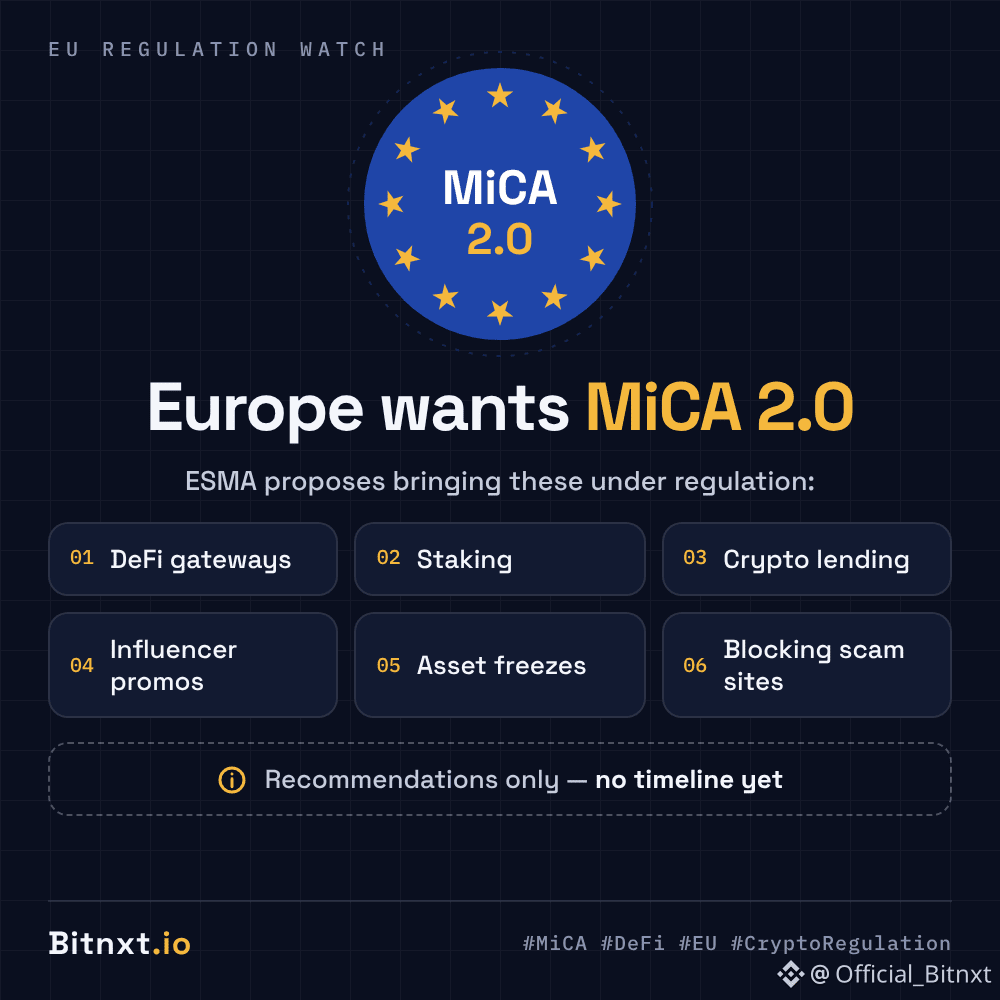
Europe wants MiCA 2.0 🇪🇺
ESMA proposes bringing DeFi gateways, staking and crypto lending under regulation, plus tighter rules on influencer crypto promotions and powers to freeze assets and block scam sites.
These are recommendations only, with no timeline yet.
#MiCA #defi #Eu #CryptoRegulationBattle
Europe wants MiCA 2.0 🇪🇺
ESMA proposes bringing DeFi gateways, staking and crypto lending under regulation, plus tighter rules on influencer crypto promotions and powers to freeze assets and block scam sites.
These are recommendations only, with no timeline yet.
#MiCA #defi #Eu #CryptoRegulationBattle
ESMA proposes bringing DeFi gateways, staking and crypto lending under regulation, plus tighter rules on influencer crypto promotions and powers to freeze assets and block scam sites.
These are recommendations only, with no timeline yet.
#MiCA #defi #Eu #CryptoRegulationBattle

·
--
MiCA Is Rewriting the Rules — And That's Bullish Long-Term
Europe's Markets in Crypto-Assets regulation is now fully in force, and the narrative that regulation kills crypto misses the bigger picture.
MiCA creates something the industry has lacked for a decade: legal certainty. It defines what qualifies as a crypto-asset, who can issue stablecoins, and what exchanges must disclose. That clarity is exactly what institutional capital has been waiting for.
Consider the practical effect. A European pension fund managing €50 billion can now evaluate $BTC and $ETH as assets within a recognized regulatory framework. Without that framework, compliance teams block allocations before the investment case is even heard. Clarity removes that veto.
For stablecoins, MiCA imposes reserve, redemption, and audit requirements that mirror what serious issuers already do. This squeezes out low-quality projects while giving compliant players a regulatory moat.
The short-term friction is real: delistings, restructured token offerings, added compliance overhead. But friction is not destruction. Every maturing asset class — equities, FX, derivatives — went through the same painful formalization phase.
Regulation that punishes fraud and mandates transparency makes legitimate participants stronger. The projects that survive MiCA scrutiny will be the ones institutional capital trusts. That is the long game.
Europe just became the world's first major crypto-regulatory template. Others will follow.
$BTC $ETH $BNB
#MiCA #CryptoRegulation #InstitutionalCrypto #Binance #Web3
MiCA Is Rewriting the Rules — And That's Bullish Long-Term
Europe's Markets in Crypto-Assets regulation is now fully in force, and the narrative that regulation kills crypto misses the bigger picture.
MiCA creates something the industry has lacked for a decade: legal certainty. It defines what qualifies as a crypto-asset, who can issue stablecoins, and what exchanges must disclose. That clarity is exactly what institutional capital has been waiting for.
Consider the practical effect. A European pension fund managing €50 billion can now evaluate $BTC and $ETH as assets within a recognized regulatory framework. Without that framework, compliance teams block allocations before the investment case is even heard. Clarity removes that veto.
For stablecoins, MiCA imposes reserve, redemption, and audit requirements that mirror what serious issuers already do. This squeezes out low-quality projects while giving compliant players a regulatory moat.
The short-term friction is real: delistings, restructured token offerings, added compliance overhead. But friction is not destruction. Every maturing asset class — equities, FX, derivatives — went through the same painful formalization phase.
Regulation that punishes fraud and mandates transparency makes legitimate participants stronger. The projects that survive MiCA scrutiny will be the ones institutional capital trusts. That is the long game.
Europe just became the world's first major crypto-regulatory template. Others will follow.
$BTC $ETH $BNB
#MiCA #CryptoRegulation #InstitutionalCrypto #Binance #Web3
Europe's Markets in Crypto-Assets regulation is now fully in force, and the narrative that regulation kills crypto misses the bigger picture.
MiCA creates something the industry has lacked for a decade: legal certainty. It defines what qualifies as a crypto-asset, who can issue stablecoins, and what exchanges must disclose. That clarity is exactly what institutional capital has been waiting for.
Consider the practical effect. A European pension fund managing €50 billion can now evaluate $BTC and $ETH as assets within a recognized regulatory framework. Without that framework, compliance teams block allocations before the investment case is even heard. Clarity removes that veto.
For stablecoins, MiCA imposes reserve, redemption, and audit requirements that mirror what serious issuers already do. This squeezes out low-quality projects while giving compliant players a regulatory moat.
The short-term friction is real: delistings, restructured token offerings, added compliance overhead. But friction is not destruction. Every maturing asset class — equities, FX, derivatives — went through the same painful formalization phase.
Regulation that punishes fraud and mandates transparency makes legitimate participants stronger. The projects that survive MiCA scrutiny will be the ones institutional capital trusts. That is the long game.
Europe just became the world's first major crypto-regulatory template. Others will follow.
$BTC $ETH $BNB
#MiCA #CryptoRegulation #InstitutionalCrypto #Binance #Web3
21

·
--
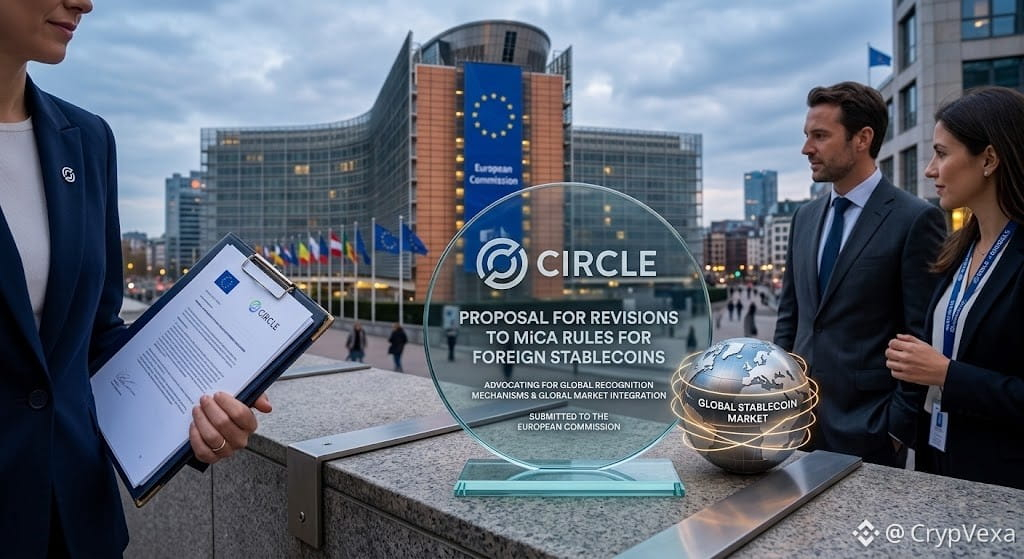
🇪🇺 Circle Urges EU to Revise MiCA Stablecoin Rules
💵 Circle has submitted proposals to the European Commission calling for changes to MiCA rules affecting foreign stablecoins.
🌍 The company also proposed a recognition mechanism for overseas stablecoin issuers, aiming to make cross-border stablecoin markets more integrated.
⚖️ The debate highlights the EU’s challenge of balancing market access, consumer protection and regulatory oversight.
👀 Could clearer recognition rules accelerate global stablecoin adoption?
#Stablecoins #MiCA #Circle #CryptoRegulation
🇪🇺 Circle Urges EU to Revise MiCA Stablecoin Rules
💵 Circle has submitted proposals to the European Commission calling for changes to MiCA rules affecting foreign stablecoins.
🌍 The company also proposed a recognition mechanism for overseas stablecoin issuers, aiming to make cross-border stablecoin markets more integrated.
⚖️ The debate highlights the EU’s challenge of balancing market access, consumer protection and regulatory oversight.
👀 Could clearer recognition rules accelerate global stablecoin adoption?
#Stablecoins #MiCA #Circle #CryptoRegulation
💵 Circle has submitted proposals to the European Commission calling for changes to MiCA rules affecting foreign stablecoins.
🌍 The company also proposed a recognition mechanism for overseas stablecoin issuers, aiming to make cross-border stablecoin markets more integrated.
⚖️ The debate highlights the EU’s challenge of balancing market access, consumer protection and regulatory oversight.
👀 Could clearer recognition rules accelerate global stablecoin adoption?
#Stablecoins #MiCA #Circle #CryptoRegulation
1
71

·
--
Bullish
🚨🏦🇪🇺 Circle Fights Back! Stablecoin Giant Officially Opposes #MiCA ’s Dangerous Bank Deposit Mandates! ⚖️💶📉
A massive regulatory war has exploded in Europe! 💥🌐 #stablecoin issuer Circle has officially lodged a fierce objection against the European Union’s MiCA (Markets in #crypto -Assets) regulatory framework! 🛑🏛️ MiCA rules currently force issuers to deposit up to 60% of their stablecoin reserves into traditional commercial European banks! 🏦📉🔒
📊🛡️⚠️ The Risk of Bank Bankruptcies:
Circle is flashing a massive warning sign to the global financial system! 🚨👀 The company strongly argues that forcing billions of dollars into commercial banks exposes the entire crypto market to systemic bank run risks and insolvency contagion (just like the Silicon Valley Bank crash)! 📉💥 Traditional banks are fractional reserve systems, making them highly volatile destinations for stablecoin backings.
⚖️💼💶 The Safe Sovereign Alternative:
Instead of risky commercial banks, Circle is aggressively demanding secure, low-risk alternatives! 🛡️🔑 They are urging regulators to allow reserves to be held in Sovereign Debt Assets (Government Bonds) and directly inside Central Bank Accounts (T-bills & Central Bank Facilities)! 🏛️📈 This would guarantee 100% liquidity protection for stablecoin holders without corporate banking risks! 🤝💎
Will European regulators listen to save financial stability, or will strict MiCA rules push stablecoin liquidity out of the #Eu ? 💭👇🤔💬
#Circle #MiCARegulations #Stablecoins #USDC #CryptoNews #BinanceSquare #BankingCrisis #SmartMoney #CryptoLiquidity #DeFiSecurity
$USDC
{spot}(USDCUSDT)
$BNB
{spot}(BNBUSDT)
$EUR
{spot}(EURUSDT)
🚨🏦🇪🇺 Circle Fights Back! Stablecoin Giant Officially Opposes #MiCA ’s Dangerous Bank Deposit Mandates! ⚖️💶📉
A massive regulatory war has exploded in Europe! 💥🌐 #stablecoin issuer Circle has officially lodged a fierce objection against the European Union’s MiCA (Markets in #crypto -Assets) regulatory framework! 🛑🏛️ MiCA rules currently force issuers to deposit up to 60% of their stablecoin reserves into traditional commercial European banks! 🏦📉🔒
📊🛡️⚠️ The Risk of Bank Bankruptcies:
Circle is flashing a massive warning sign to the global financial system! 🚨👀 The company strongly argues that forcing billions of dollars into commercial banks exposes the entire crypto market to systemic bank run risks and insolvency contagion (just like the Silicon Valley Bank crash)! 📉💥 Traditional banks are fractional reserve systems, making them highly volatile destinations for stablecoin backings.
⚖️💼💶 The Safe Sovereign Alternative:
Instead of risky commercial banks, Circle is aggressively demanding secure, low-risk alternatives! 🛡️🔑 They are urging regulators to allow reserves to be held in Sovereign Debt Assets (Government Bonds) and directly inside Central Bank Accounts (T-bills & Central Bank Facilities)! 🏛️📈 This would guarantee 100% liquidity protection for stablecoin holders without corporate banking risks! 🤝💎
Will European regulators listen to save financial stability, or will strict MiCA rules push stablecoin liquidity out of the #Eu ? 💭👇🤔💬
#Circle #MiCARegulations #Stablecoins #USDC #CryptoNews #BinanceSquare #BankingCrisis #SmartMoney #CryptoLiquidity #DeFiSecurity
$USDC
$BNB
$EUR
A massive regulatory war has exploded in Europe! 💥🌐 #stablecoin issuer Circle has officially lodged a fierce objection against the European Union’s MiCA (Markets in #crypto -Assets) regulatory framework! 🛑🏛️ MiCA rules currently force issuers to deposit up to 60% of their stablecoin reserves into traditional commercial European banks! 🏦📉🔒
📊🛡️⚠️ The Risk of Bank Bankruptcies:
Circle is flashing a massive warning sign to the global financial system! 🚨👀 The company strongly argues that forcing billions of dollars into commercial banks exposes the entire crypto market to systemic bank run risks and insolvency contagion (just like the Silicon Valley Bank crash)! 📉💥 Traditional banks are fractional reserve systems, making them highly volatile destinations for stablecoin backings.
⚖️💼💶 The Safe Sovereign Alternative:
Instead of risky commercial banks, Circle is aggressively demanding secure, low-risk alternatives! 🛡️🔑 They are urging regulators to allow reserves to be held in Sovereign Debt Assets (Government Bonds) and directly inside Central Bank Accounts (T-bills & Central Bank Facilities)! 🏛️📈 This would guarantee 100% liquidity protection for stablecoin holders without corporate banking risks! 🤝💎
Will European regulators listen to save financial stability, or will strict MiCA rules push stablecoin liquidity out of the #Eu ? 💭👇🤔💬
#Circle #MiCARegulations #Stablecoins #USDC #CryptoNews #BinanceSquare #BankingCrisis #SmartMoney #CryptoLiquidity #DeFiSecurity
$USDC
$BNB
$EUR


Good luck 🍀
From OnionSam
2
117


Article
MiCA construyó el mercado de stablecoins más regulado y pequeño del mundoSolo 3 de las 50 mayores stablecoins cumplen la norma europea. Circle pide equivalencia con EE.UU. antes de que la brecha sea irreversible.
La frontera que MiCA trazó, con tres monedas dentro y el resto del mercado esperando afuera.
La brecha de suministro de stablecoins bajo el cerco de MiCA ronda los USD 238.000 millones.
Circle pide equivalencia para que MiCA expanda el mercado de stablecoins.
El Reglamento sobre los Mercados de Criptoactivos (MiCA) establece un estándar restrictivo en la Unión Europea que limita la disponibilidad de capital en comparación con el sector global.
De las cincuenta mayores stablecoins por capitalización del mercado, solo tres cuentan con autorización para operar bajo MiCA. Estas son, USD Coin (USDC), EUR Coin (EURC) y Global Dollar (USDG), respaldadas por la arquitectura de Circle y Paxos.
El cerco normativo deja fuera del perímetro europeo al 94% de las principales stablecoins por número de activos, es decir, a 47 de las 50 más importantes del sector. Estos proyectos concentran el 75% del capital global, con Tether (USDT) a la cabeza como el gigante que domina la liquidez mundial y cuya ausencia confirma el aislamiento del bloque.
El diagnóstico no es teórico. La cifra figura en la respuesta oficial de Circle a la consulta pública de revisión de la Comisión Europea, publicada el 1 de octubre de 2026.
En su documento, la firma emisora de USDC sostiene que MiCA corre el riesgo de convertir a la Unión Europea en un gueto financiero desvinculado de las grandes redes globales de pagos e inversión.
El centro del reclamo apunta a la falta de flexibilidad para reconocer normas de otros mercados clave, como la Ley GENIUS de Estados Unidos, lo que obliga a las empresas a elegir entre cumplir con Bruselas o mantener la liquidez internacional.
La advertencia de Circle
Para destrabar el cuello de botella, Circle propone la adopción urgente de un régimen de equivalencia transatlántica basado en el modelo de directivas financieras tradicionales como el Reglamento sobre la Infraestructura del Mercado Europeo (EMIR) o el Reglamento sobre los Mercados de Instrumentos Financieros (MiFIR).
Bajo este esquema, la Comisión Europea reconocería la paridad del marco estadounidense mientras la Autoridad Bancaria Europea (EBA) validaría a cada emisor de forma individual.
A la espera de que Bruselas defina esa eventual flexibilización, la práctica en el mercado confirma el costo de la adaptación. El reciente debut de la stablecoin USDAU, desarrollada por la firma AllUnity, con sede en Fráncfort, ilustra este fenómeno.
Para operar en el bloque, la empresa debió obtener una licencia ante la BaFin, la Autoridad Federal de Supervisión Financiera de Alemania. El resultado refuerza el diagnóstico porque el activo nació limitado a tesorerías empresariales y clientes institucionales, sin ofrecer una solución de liquidez masiva para el mercado minorista.
El ejemplo alemán le da la razón a Circle: apretar las reglas no va a eliminar la demanda de dólares digitales. Si para inicios de 2027 la Comisión Europea no reconoce las normas de Estados Unidos, no logrará proteger al usuario; solo empujará el capital europeo hacia mercados offshore fuera de todo control estatal.
La matemática del aislamiento y los 238.000 millones fuera de juego
Esta parálisis operativa no es un debate abstracto, sino que se mide en una cifra récord de capital relegado. Al cierre de junio de 2026, el suministro global de criptomonedas estables alcanzó los 315.800 millones de dólares, según registros de DefiLlama.
Dentro del perímetro de MiCA operan apenas 77.730 millones de dólares, concentrados de forma casi hegemónica en USDC (75.300 millones), EURC (430,4 millones) y USDG (estimada en 2.000 millones). La incorporación de activos corporativos recientes no altera esta escala.
Esta brecha de suministro representa más que un descuadre estadístico. En la práctica, significa que el 75% de la liquidez global en stablecoins del dólar tiene la entrada prohibida a las plataformas europeas.
Los proveedores con licencia en la Unión Europea no pueden listar, custodiar ni ofrecer pares de negociación con activos masivos como Tether o DAI. Como consecuencia, las casas de cambio comunitarias pierden volumen frente a competidores extranjeros y los usuarios locales quedan desconectados de los mayores mercados de negociación del planeta.
La parálisis afecta a las propias empresas autorizadas. De los 23 emisores de dinero electrónico (EMT) registrados en la Unión Europea, solo 9 poseen licencia de proveedores de servicios de criptoactivos (CASP) bajo el Artículo 60. El 61% de las entidades aprobadas carece de autorización para custodiar o distribuir sus tokens, fragmentando la operación desde su origen.
Entre los marcos regulatorios integrales, aquellos que exigen autorización previa, reservas auditadas y supervisión con capacidad sancionadora, MiCA es el que menos suministro global captura en proporción a su ambición regulatoria.
La regulación más ambiciosa del mundo está construyendo el mercado más pequeño entre sus pares. No se refiere al volumen de transacciones domésticas en la UE ni al número de usuarios europeos, se refiere a la captura de suministro global.
Una jurisdicción como El Salvador puede supervisar a Tether, más de 183.800 millones de dólares, sin que eso constituya un mercado regulado integral. La comparación es entre marcos regulatorios, no entre tamaños de mercado doméstico.
Cuanto más intenso el color, más completa la regulación. Cuanto más grande la burbuja, más mercado capturado. MiCA tiene lo primero y le falta lo segundo
¿Proteger al inversor o expulsarlo hacia el mercado no regulado?
El desacople obedece a dos modelos regulatorios irreconciliables. Por un lado, la filosofía europea impone la reserva comercial y obliga a los emisores significativos a colocar el 60% de sus fondos en cuentas bancarias comunitarias. Por el otro, el enfoque estadounidense privilegia el respaldo estatal directo y exige concentrar la garantía en bonos del Tesoro con vencimientos no superiores a 93 días.
Sin un acuerdo de reconocimiento mutuo, un emisor estadounidense no puede depositar su efectivo en bancos europeos sin vulnerar la legislación de su país de origen.
Cumplir con esas exigencias obliga a armar una costosa ingeniería de alianzas. Un emisor como AllUnity no puede operar de forma directa, sino que debe fragmentar su negocio entre licencias bancarias de la BaFin, custodios externos como Banking Circle e intermediarios adicionales para gestionar la liquidez y las conversiones a dinero fíat. Esta sobrecarga de socios encarece el servicio y explica por qué este tipo de activos nace reservado para grandes corporaciones.
El resultado de ese despliegue es un mercado a dos velocidades. La regulación europea logra eliminar el riesgo de contraparte y blindar la estabilidad bancaria, pero lo hace al precio de estrangular la liquidez e invisibilizar al inversor minorista. Mientras las grandes corporaciones aprovechan las stablecoins del dólar bajo la cobertura del artículo 49 de MiCA, el público general carece de alternativas aprobadas y queda desatendido dentro del circuito legal.
El ultimátum de 2027 y la urgencia de la equivalencia transatlántica
Las advertencias de los emisores internacionales forman parte de la revisión formal que las autoridades europeas acaban de poner en marcha. Tras recibir los comentarios del sector en la consulta finalizada en septiembre, la Comisión tiene el mandato de emitir su diagnóstico técnico durante los primeros tres meses de 2027, abriendo la única ventana legal para corregir el rumbo del mercado.
En sus estudios de impacto de 2020, los técnicos de la Comisión advirtieron que un bloqueo a las stablecoin extranjeras empujaría a los usuarios europeos hacia plataformas offshore. Si el informe de 2027 omite una propuesta formal de equivalencia, la brecha de 238.000 millones de dólares dejará de ser un desajuste coyuntural para consolidarse como un muro permanente en la infraestructura financiera europea.
#MiCA #Stablecoins #regulacion #LeyGENIUS #stablecoin $USDC $BTC $CRCL
{web3_wallet_create}(CT_501HzwqbKZw8HxMN6bF2yFZNrht3c2iXXzpKcFu7uBEDKtr)
{web3_wallet_create}(1960x4ae46a509f6b1d9056937ba4500cb143933d2dc8)
{web3_wallet_create}(560x1af3f329e8be154074d8769d1ffa4ee058b1dbc3)
MiCA construyó el mercado de stablecoins más regulado y pequeño del mundo
Solo 3 de las 50 mayores stablecoins cumplen la norma europea. Circle pide equivalencia con EE.UU. antes de que la brecha sea irreversible.
La frontera que MiCA trazó, con tres monedas dentro y el resto del mercado esperando afuera.
La brecha de suministro de stablecoins bajo el cerco de MiCA ronda los USD 238.000 millones.
Circle pide equivalencia para que MiCA expanda el mercado de stablecoins.
El Reglamento sobre los Mercados de Criptoactivos (MiCA) establece un estándar restrictivo en la Unión Europea que limita la disponibilidad de capital en comparación con el sector global.
De las cincuenta mayores stablecoins por capitalización del mercado, solo tres cuentan con autorización para operar bajo MiCA. Estas son, USD Coin (USDC), EUR Coin (EURC) y Global Dollar (USDG), respaldadas por la arquitectura de Circle y Paxos.
El cerco normativo deja fuera del perímetro europeo al 94% de las principales stablecoins por número de activos, es decir, a 47 de las 50 más importantes del sector. Estos proyectos concentran el 75% del capital global, con Tether (USDT) a la cabeza como el gigante que domina la liquidez mundial y cuya ausencia confirma el aislamiento del bloque.
El diagnóstico no es teórico. La cifra figura en la respuesta oficial de Circle a la consulta pública de revisión de la Comisión Europea, publicada el 1 de octubre de 2026.
En su documento, la firma emisora de USDC sostiene que MiCA corre el riesgo de convertir a la Unión Europea en un gueto financiero desvinculado de las grandes redes globales de pagos e inversión.
El centro del reclamo apunta a la falta de flexibilidad para reconocer normas de otros mercados clave, como la Ley GENIUS de Estados Unidos, lo que obliga a las empresas a elegir entre cumplir con Bruselas o mantener la liquidez internacional.
La advertencia de Circle
Para destrabar el cuello de botella, Circle propone la adopción urgente de un régimen de equivalencia transatlántica basado en el modelo de directivas financieras tradicionales como el Reglamento sobre la Infraestructura del Mercado Europeo (EMIR) o el Reglamento sobre los Mercados de Instrumentos Financieros (MiFIR).
Bajo este esquema, la Comisión Europea reconocería la paridad del marco estadounidense mientras la Autoridad Bancaria Europea (EBA) validaría a cada emisor de forma individual.
A la espera de que Bruselas defina esa eventual flexibilización, la práctica en el mercado confirma el costo de la adaptación. El reciente debut de la stablecoin USDAU, desarrollada por la firma AllUnity, con sede en Fráncfort, ilustra este fenómeno.
Para operar en el bloque, la empresa debió obtener una licencia ante la BaFin, la Autoridad Federal de Supervisión Financiera de Alemania. El resultado refuerza el diagnóstico porque el activo nació limitado a tesorerías empresariales y clientes institucionales, sin ofrecer una solución de liquidez masiva para el mercado minorista.
El ejemplo alemán le da la razón a Circle: apretar las reglas no va a eliminar la demanda de dólares digitales. Si para inicios de 2027 la Comisión Europea no reconoce las normas de Estados Unidos, no logrará proteger al usuario; solo empujará el capital europeo hacia mercados offshore fuera de todo control estatal.
La matemática del aislamiento y los 238.000 millones fuera de juego
Esta parálisis operativa no es un debate abstracto, sino que se mide en una cifra récord de capital relegado. Al cierre de junio de 2026, el suministro global de criptomonedas estables alcanzó los 315.800 millones de dólares, según registros de DefiLlama.
Dentro del perímetro de MiCA operan apenas 77.730 millones de dólares, concentrados de forma casi hegemónica en USDC (75.300 millones), EURC (430,4 millones) y USDG (estimada en 2.000 millones). La incorporación de activos corporativos recientes no altera esta escala.
Esta brecha de suministro representa más que un descuadre estadístico. En la práctica, significa que el 75% de la liquidez global en stablecoins del dólar tiene la entrada prohibida a las plataformas europeas.
Los proveedores con licencia en la Unión Europea no pueden listar, custodiar ni ofrecer pares de negociación con activos masivos como Tether o DAI. Como consecuencia, las casas de cambio comunitarias pierden volumen frente a competidores extranjeros y los usuarios locales quedan desconectados de los mayores mercados de negociación del planeta.
La parálisis afecta a las propias empresas autorizadas. De los 23 emisores de dinero electrónico (EMT) registrados en la Unión Europea, solo 9 poseen licencia de proveedores de servicios de criptoactivos (CASP) bajo el Artículo 60. El 61% de las entidades aprobadas carece de autorización para custodiar o distribuir sus tokens, fragmentando la operación desde su origen.
Entre los marcos regulatorios integrales, aquellos que exigen autorización previa, reservas auditadas y supervisión con capacidad sancionadora, MiCA es el que menos suministro global captura en proporción a su ambición regulatoria.
La regulación más ambiciosa del mundo está construyendo el mercado más pequeño entre sus pares. No se refiere al volumen de transacciones domésticas en la UE ni al número de usuarios europeos, se refiere a la captura de suministro global.
Una jurisdicción como El Salvador puede supervisar a Tether, más de 183.800 millones de dólares, sin que eso constituya un mercado regulado integral. La comparación es entre marcos regulatorios, no entre tamaños de mercado doméstico.
Cuanto más intenso el color, más completa la regulación. Cuanto más grande la burbuja, más mercado capturado. MiCA tiene lo primero y le falta lo segundo
¿Proteger al inversor o expulsarlo hacia el mercado no regulado?
El desacople obedece a dos modelos regulatorios irreconciliables. Por un lado, la filosofía europea impone la reserva comercial y obliga a los emisores significativos a colocar el 60% de sus fondos en cuentas bancarias comunitarias. Por el otro, el enfoque estadounidense privilegia el respaldo estatal directo y exige concentrar la garantía en bonos del Tesoro con vencimientos no superiores a 93 días.
Sin un acuerdo de reconocimiento mutuo, un emisor estadounidense no puede depositar su efectivo en bancos europeos sin vulnerar la legislación de su país de origen.
Cumplir con esas exigencias obliga a armar una costosa ingeniería de alianzas. Un emisor como AllUnity no puede operar de forma directa, sino que debe fragmentar su negocio entre licencias bancarias de la BaFin, custodios externos como Banking Circle e intermediarios adicionales para gestionar la liquidez y las conversiones a dinero fíat. Esta sobrecarga de socios encarece el servicio y explica por qué este tipo de activos nace reservado para grandes corporaciones.
El resultado de ese despliegue es un mercado a dos velocidades. La regulación europea logra eliminar el riesgo de contraparte y blindar la estabilidad bancaria, pero lo hace al precio de estrangular la liquidez e invisibilizar al inversor minorista. Mientras las grandes corporaciones aprovechan las stablecoins del dólar bajo la cobertura del artículo 49 de MiCA, el público general carece de alternativas aprobadas y queda desatendido dentro del circuito legal.
El ultimátum de 2027 y la urgencia de la equivalencia transatlántica
Las advertencias de los emisores internacionales forman parte de la revisión formal que las autoridades europeas acaban de poner en marcha. Tras recibir los comentarios del sector en la consulta finalizada en septiembre, la Comisión tiene el mandato de emitir su diagnóstico técnico durante los primeros tres meses de 2027, abriendo la única ventana legal para corregir el rumbo del mercado.
En sus estudios de impacto de 2020, los técnicos de la Comisión advirtieron que un bloqueo a las stablecoin extranjeras empujaría a los usuarios europeos hacia plataformas offshore. Si el informe de 2027 omite una propuesta formal de equivalencia, la brecha de 238.000 millones de dólares dejará de ser un desajuste coyuntural para consolidarse como un muro permanente en la infraestructura financiera europea.
#MiCA #Stablecoins #regulacion #LeyGENIUS #stablecoin $USDC $BTC $CRCL
La frontera que MiCA trazó, con tres monedas dentro y el resto del mercado esperando afuera.
La brecha de suministro de stablecoins bajo el cerco de MiCA ronda los USD 238.000 millones.
Circle pide equivalencia para que MiCA expanda el mercado de stablecoins.
El Reglamento sobre los Mercados de Criptoactivos (MiCA) establece un estándar restrictivo en la Unión Europea que limita la disponibilidad de capital en comparación con el sector global.
De las cincuenta mayores stablecoins por capitalización del mercado, solo tres cuentan con autorización para operar bajo MiCA. Estas son, USD Coin (USDC), EUR Coin (EURC) y Global Dollar (USDG), respaldadas por la arquitectura de Circle y Paxos.
El cerco normativo deja fuera del perímetro europeo al 94% de las principales stablecoins por número de activos, es decir, a 47 de las 50 más importantes del sector. Estos proyectos concentran el 75% del capital global, con Tether (USDT) a la cabeza como el gigante que domina la liquidez mundial y cuya ausencia confirma el aislamiento del bloque.
El diagnóstico no es teórico. La cifra figura en la respuesta oficial de Circle a la consulta pública de revisión de la Comisión Europea, publicada el 1 de octubre de 2026.
En su documento, la firma emisora de USDC sostiene que MiCA corre el riesgo de convertir a la Unión Europea en un gueto financiero desvinculado de las grandes redes globales de pagos e inversión.
El centro del reclamo apunta a la falta de flexibilidad para reconocer normas de otros mercados clave, como la Ley GENIUS de Estados Unidos, lo que obliga a las empresas a elegir entre cumplir con Bruselas o mantener la liquidez internacional.
La advertencia de Circle
Para destrabar el cuello de botella, Circle propone la adopción urgente de un régimen de equivalencia transatlántica basado en el modelo de directivas financieras tradicionales como el Reglamento sobre la Infraestructura del Mercado Europeo (EMIR) o el Reglamento sobre los Mercados de Instrumentos Financieros (MiFIR).
Bajo este esquema, la Comisión Europea reconocería la paridad del marco estadounidense mientras la Autoridad Bancaria Europea (EBA) validaría a cada emisor de forma individual.
A la espera de que Bruselas defina esa eventual flexibilización, la práctica en el mercado confirma el costo de la adaptación. El reciente debut de la stablecoin USDAU, desarrollada por la firma AllUnity, con sede en Fráncfort, ilustra este fenómeno.
Para operar en el bloque, la empresa debió obtener una licencia ante la BaFin, la Autoridad Federal de Supervisión Financiera de Alemania. El resultado refuerza el diagnóstico porque el activo nació limitado a tesorerías empresariales y clientes institucionales, sin ofrecer una solución de liquidez masiva para el mercado minorista.
El ejemplo alemán le da la razón a Circle: apretar las reglas no va a eliminar la demanda de dólares digitales. Si para inicios de 2027 la Comisión Europea no reconoce las normas de Estados Unidos, no logrará proteger al usuario; solo empujará el capital europeo hacia mercados offshore fuera de todo control estatal.
La matemática del aislamiento y los 238.000 millones fuera de juego
Esta parálisis operativa no es un debate abstracto, sino que se mide en una cifra récord de capital relegado. Al cierre de junio de 2026, el suministro global de criptomonedas estables alcanzó los 315.800 millones de dólares, según registros de DefiLlama.
Dentro del perímetro de MiCA operan apenas 77.730 millones de dólares, concentrados de forma casi hegemónica en USDC (75.300 millones), EURC (430,4 millones) y USDG (estimada en 2.000 millones). La incorporación de activos corporativos recientes no altera esta escala.
Esta brecha de suministro representa más que un descuadre estadístico. En la práctica, significa que el 75% de la liquidez global en stablecoins del dólar tiene la entrada prohibida a las plataformas europeas.
Los proveedores con licencia en la Unión Europea no pueden listar, custodiar ni ofrecer pares de negociación con activos masivos como Tether o DAI. Como consecuencia, las casas de cambio comunitarias pierden volumen frente a competidores extranjeros y los usuarios locales quedan desconectados de los mayores mercados de negociación del planeta.
La parálisis afecta a las propias empresas autorizadas. De los 23 emisores de dinero electrónico (EMT) registrados en la Unión Europea, solo 9 poseen licencia de proveedores de servicios de criptoactivos (CASP) bajo el Artículo 60. El 61% de las entidades aprobadas carece de autorización para custodiar o distribuir sus tokens, fragmentando la operación desde su origen.
Entre los marcos regulatorios integrales, aquellos que exigen autorización previa, reservas auditadas y supervisión con capacidad sancionadora, MiCA es el que menos suministro global captura en proporción a su ambición regulatoria.
La regulación más ambiciosa del mundo está construyendo el mercado más pequeño entre sus pares. No se refiere al volumen de transacciones domésticas en la UE ni al número de usuarios europeos, se refiere a la captura de suministro global.
Una jurisdicción como El Salvador puede supervisar a Tether, más de 183.800 millones de dólares, sin que eso constituya un mercado regulado integral. La comparación es entre marcos regulatorios, no entre tamaños de mercado doméstico.
Cuanto más intenso el color, más completa la regulación. Cuanto más grande la burbuja, más mercado capturado. MiCA tiene lo primero y le falta lo segundo
¿Proteger al inversor o expulsarlo hacia el mercado no regulado?
El desacople obedece a dos modelos regulatorios irreconciliables. Por un lado, la filosofía europea impone la reserva comercial y obliga a los emisores significativos a colocar el 60% de sus fondos en cuentas bancarias comunitarias. Por el otro, el enfoque estadounidense privilegia el respaldo estatal directo y exige concentrar la garantía en bonos del Tesoro con vencimientos no superiores a 93 días.
Sin un acuerdo de reconocimiento mutuo, un emisor estadounidense no puede depositar su efectivo en bancos europeos sin vulnerar la legislación de su país de origen.
Cumplir con esas exigencias obliga a armar una costosa ingeniería de alianzas. Un emisor como AllUnity no puede operar de forma directa, sino que debe fragmentar su negocio entre licencias bancarias de la BaFin, custodios externos como Banking Circle e intermediarios adicionales para gestionar la liquidez y las conversiones a dinero fíat. Esta sobrecarga de socios encarece el servicio y explica por qué este tipo de activos nace reservado para grandes corporaciones.
El resultado de ese despliegue es un mercado a dos velocidades. La regulación europea logra eliminar el riesgo de contraparte y blindar la estabilidad bancaria, pero lo hace al precio de estrangular la liquidez e invisibilizar al inversor minorista. Mientras las grandes corporaciones aprovechan las stablecoins del dólar bajo la cobertura del artículo 49 de MiCA, el público general carece de alternativas aprobadas y queda desatendido dentro del circuito legal.
El ultimátum de 2027 y la urgencia de la equivalencia transatlántica
Las advertencias de los emisores internacionales forman parte de la revisión formal que las autoridades europeas acaban de poner en marcha. Tras recibir los comentarios del sector en la consulta finalizada en septiembre, la Comisión tiene el mandato de emitir su diagnóstico técnico durante los primeros tres meses de 2027, abriendo la única ventana legal para corregir el rumbo del mercado.
En sus estudios de impacto de 2020, los técnicos de la Comisión advirtieron que un bloqueo a las stablecoin extranjeras empujaría a los usuarios europeos hacia plataformas offshore. Si el informe de 2027 omite una propuesta formal de equivalencia, la brecha de 238.000 millones de dólares dejará de ser un desajuste coyuntural para consolidarse como un muro permanente en la infraestructura financiera europea.
#MiCA #Stablecoins #regulacion #LeyGENIUS #stablecoin $USDC $BTC $CRCL
34

Why is nobody talking about who actually gets to rewrite MiCA?
Every new regulation cycle leaves traders holding bags they cannot sell. You see a headline about Europe tightening rules and by the time you understand what it means for $BTC the move already happened.
The European Commission is reviewing MiCA and the submissions lay the conflict out in the open. Traditional finance wants stricter limits on $ETH and dollar stablecoins like $USDT so they can keep the rails they already control. Crypto-native players are arguing the opposite, saying Europe will just lose the market if it goes too far.
This is not some abstract policy debate. It is a case study of incumbents using the rulebook to lock in their position while the official story remains consumer protection.
Where do you think this review actually ends?
#MiCA #Bitcoin #CryptoRegulation
Why is nobody talking about who actually gets to rewrite MiCA?
Every new regulation cycle leaves traders holding bags they cannot sell. You see a headline about Europe tightening rules and by the time you understand what it means for $BTC the move already happened.
The European Commission is reviewing MiCA and the submissions lay the conflict out in the open. Traditional finance wants stricter limits on $ETH and dollar stablecoins like $USDT so they can keep the rails they already control. Crypto-native players are arguing the opposite, saying Europe will just lose the market if it goes too far.
This is not some abstract policy debate. It is a case study of incumbents using the rulebook to lock in their position while the official story remains consumer protection.
Where do you think this review actually ends?
#MiCA #Bitcoin #CryptoRegulation
Every new regulation cycle leaves traders holding bags they cannot sell. You see a headline about Europe tightening rules and by the time you understand what it means for $BTC the move already happened.
The European Commission is reviewing MiCA and the submissions lay the conflict out in the open. Traditional finance wants stricter limits on $ETH and dollar stablecoins like $USDT so they can keep the rails they already control. Crypto-native players are arguing the opposite, saying Europe will just lose the market if it goes too far.
This is not some abstract policy debate. It is a case study of incumbents using the rulebook to lock in their position while the official story remains consumer protection.
Where do you think this review actually ends?
#MiCA #Bitcoin #CryptoRegulation

27

·
--
If you're still treating EU crypto rules as background noise, stop now.
Traders have lost millions sitting on positions when sudden compliance changes hit exchanges and freeze assets. The pain of not knowing when to exit or how new rules will hit $BTC prices is real and it keeps happening.
The European Commission is reviewing MiCA and the flood of submissions shows two camps fighting it out. Banks and regulators want heavier oversight on everything from $ETH staking to stablecoin issuance, arguing it protects retail from another collapse. Crypto firms and users are pushing back hard, saying the existing framework already drives business to friendlier jurisdictions and stifles growth.
I'm with the crypto side on this one. Looking at the numbers, over 150 detailed submissions highlight how extra layers could cut trading volumes by 20 percent in the EU. That kind of drop would mean missed entries for anyone holding $USDT pairs or looking to rotate into $BTC during dips.
Where do you think this review lands and how are you positioning for it?
#MiCA #Bitcoin #CryptoRegulation
If you're still treating EU crypto rules as background noise, stop now.
Traders have lost millions sitting on positions when sudden compliance changes hit exchanges and freeze assets. The pain of not knowing when to exit or how new rules will hit $BTC prices is real and it keeps happening.
The European Commission is reviewing MiCA and the flood of submissions shows two camps fighting it out. Banks and regulators want heavier oversight on everything from $ETH staking to stablecoin issuance, arguing it protects retail from another collapse. Crypto firms and users are pushing back hard, saying the existing framework already drives business to friendlier jurisdictions and stifles growth.
I'm with the crypto side on this one. Looking at the numbers, over 150 detailed submissions highlight how extra layers could cut trading volumes by 20 percent in the EU. That kind of drop would mean missed entries for anyone holding $USDT pairs or looking to rotate into $BTC during dips.
Where do you think this review lands and how are you positioning for it?
#MiCA #Bitcoin #CryptoRegulation
Traders have lost millions sitting on positions when sudden compliance changes hit exchanges and freeze assets. The pain of not knowing when to exit or how new rules will hit $BTC prices is real and it keeps happening.
The European Commission is reviewing MiCA and the flood of submissions shows two camps fighting it out. Banks and regulators want heavier oversight on everything from $ETH staking to stablecoin issuance, arguing it protects retail from another collapse. Crypto firms and users are pushing back hard, saying the existing framework already drives business to friendlier jurisdictions and stifles growth.
I'm with the crypto side on this one. Looking at the numbers, over 150 detailed submissions highlight how extra layers could cut trading volumes by 20 percent in the EU. That kind of drop would mean missed entries for anyone holding $USDT pairs or looking to rotate into $BTC during dips.
Where do you think this review lands and how are you positioning for it?
#MiCA #Bitcoin #CryptoRegulation
17
Most traders believe market crashes come from sudden liquidations, but history proves the quietest regulatory shifts always trigger the deepest liquidity shocks.
There is nothing worse than watching your dry powder freeze or realizing your go-to trading pair has gone illiquid right when you need to de-risk. I lived through the banking crackdowns of past cycles, and that sinking feeling of being stuck in the wrong asset never gets easier.
Europe is now reviewing its landmark MiCA framework, and the regulatory chessboard is shifting much faster than most portfolios are prepared for. The European Banking Authority is reassessing reserve mandates and strict transaction limits, creating an immediate split in liquidity depth. While compliant tokens like $USDC navigate the new standards smoothly, offshore heavyweights like $USDT face renewed structural hurdles across European order books.
In earlier market phases, everyone assumed any dollar token was safe until exchanges were forced to adjust trading pairs overnight. As institutions slowly test the waters with localized assets like $EURC, smart capital is already repositioning to avoid liquidity traps before the market catches on.
How are you managing your stablecoin exposure as these European rules evolve?
#MiCA #Stablecoins #CryptoTrading
Most traders believe market crashes come from sudden liquidations, but history proves the quietest regulatory shifts always trigger the deepest liquidity shocks.
There is nothing worse than watching your dry powder freeze or realizing your go-to trading pair has gone illiquid right when you need to de-risk. I lived through the banking crackdowns of past cycles, and that sinking feeling of being stuck in the wrong asset never gets easier.
Europe is now reviewing its landmark MiCA framework, and the regulatory chessboard is shifting much faster than most portfolios are prepared for. The European Banking Authority is reassessing reserve mandates and strict transaction limits, creating an immediate split in liquidity depth. While compliant tokens like $USDC navigate the new standards smoothly, offshore heavyweights like $USDT face renewed structural hurdles across European order books.
In earlier market phases, everyone assumed any dollar token was safe until exchanges were forced to adjust trading pairs overnight. As institutions slowly test the waters with localized assets like $EURC, smart capital is already repositioning to avoid liquidity traps before the market catches on.
How are you managing your stablecoin exposure as these European rules evolve?
#MiCA #Stablecoins #CryptoTrading
There is nothing worse than watching your dry powder freeze or realizing your go-to trading pair has gone illiquid right when you need to de-risk. I lived through the banking crackdowns of past cycles, and that sinking feeling of being stuck in the wrong asset never gets easier.
Europe is now reviewing its landmark MiCA framework, and the regulatory chessboard is shifting much faster than most portfolios are prepared for. The European Banking Authority is reassessing reserve mandates and strict transaction limits, creating an immediate split in liquidity depth. While compliant tokens like $USDC navigate the new standards smoothly, offshore heavyweights like $USDT face renewed structural hurdles across European order books.
In earlier market phases, everyone assumed any dollar token was safe until exchanges were forced to adjust trading pairs overnight. As institutions slowly test the waters with localized assets like $EURC, smart capital is already repositioning to avoid liquidity traps before the market catches on.
How are you managing your stablecoin exposure as these European rules evolve?
#MiCA #Stablecoins #CryptoTrading

8

·
--
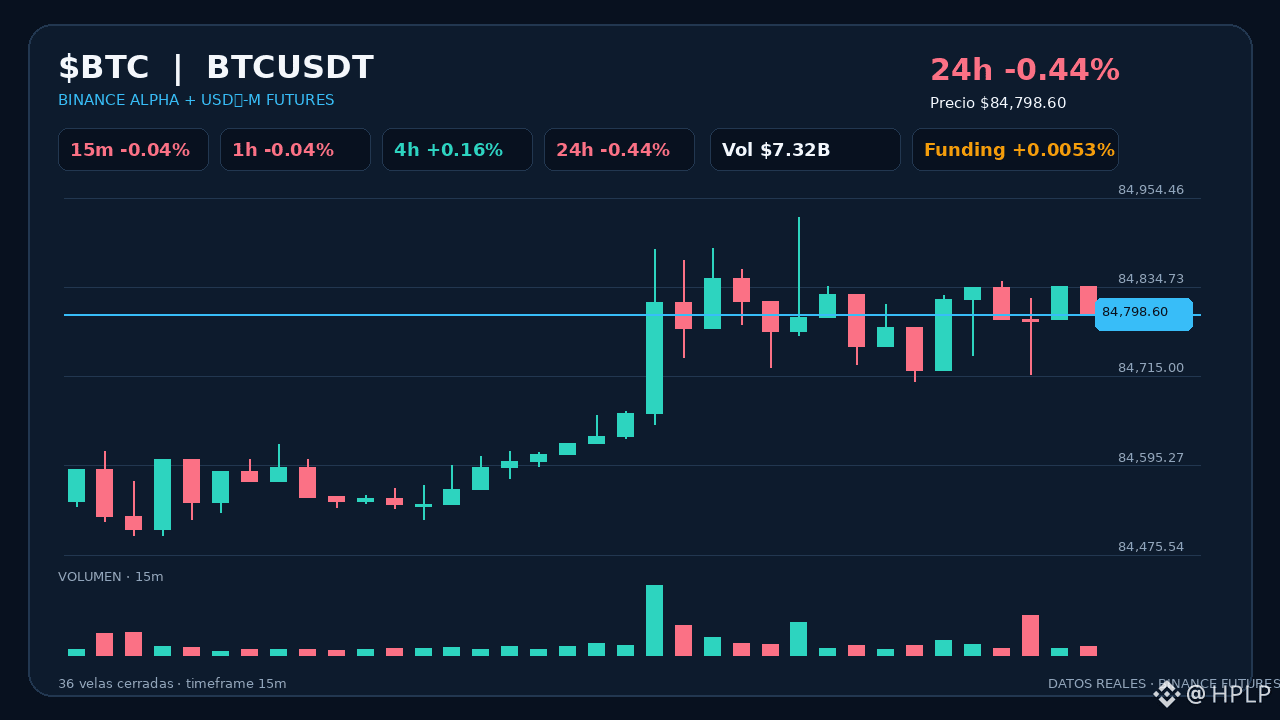
La Autoridad Europea de Valores y Mercados (ESMA) ha propuesto prohibir los servicios de custodia y transferencia para stablecoins que no cumplan con la normativa en la Union Europea. Esta medida busca blindar el ecosistema bajo el marco de MiCA, pero plantea desafíos operativos críticos para exchanges y custodios institucionales que operan en la region. 🌐
¿Por qué importa? La falta de claridad sobre los plazos de salida y el impacto directo en la liquidez de activos no regulados podría acelerar la migración hacia stablecoins totalmente conformes o descentralizadas. 📊
Qué vigilar: La evolución del marco normativo definitivo y cómo los principales proveedores de infraestructura ajustan su oferta de servicios antes de la implementación final. 👁️
#CryptoRegulation #Stablecoins #MiCA #BinanceSquare
En radar: $BTC $ETH $BNB
La Autoridad Europea de Valores y Mercados (ESMA) ha propuesto prohibir los servicios de custodia y transferencia para stablecoins que no cumplan con la normativa en la Union Europea. Esta medida busca blindar el ecosistema bajo el marco de MiCA, pero plantea desafíos operativos críticos para exchanges y custodios institucionales que operan en la region. 🌐
¿Por qué importa? La falta de claridad sobre los plazos de salida y el impacto directo en la liquidez de activos no regulados podría acelerar la migración hacia stablecoins totalmente conformes o descentralizadas. 📊
Qué vigilar: La evolución del marco normativo definitivo y cómo los principales proveedores de infraestructura ajustan su oferta de servicios antes de la implementación final. 👁️
#CryptoRegulation #Stablecoins #MiCA #BinanceSquare
En radar: $BTC $ETH $BNB
¿Por qué importa? La falta de claridad sobre los plazos de salida y el impacto directo en la liquidez de activos no regulados podría acelerar la migración hacia stablecoins totalmente conformes o descentralizadas. 📊
Qué vigilar: La evolución del marco normativo definitivo y cómo los principales proveedores de infraestructura ajustan su oferta de servicios antes de la implementación final. 👁️
#CryptoRegulation #Stablecoins #MiCA #BinanceSquare
En radar: $BTC $ETH $BNB
26
·
--
everyone thinks europe's stablecoin rules are already settled and done with, but actually the entire board is up for review and the goalposts are about to move again.
most traders just park their dry powder and assume liquidity is safe forever, only to wake up and find their favorite pairs delisted overnight. ngl getting trapped holding restricted stables while order books dry up is the easiest way to bleed capital without even making a bad trade.
look at how the market reacted during the first round of mica implementation. exchanges had to aggressively reshuffle listings, pushing massive volume into compliant assets like $USDC and euro-pegged tokens like $EURC while putting massive pressure on $USDT trading pairs across the region. now regulators are reviewing caps, reserve audits, and foreign currency transaction limits, which could trigger another wave of liquidity fragmentation.
the risk isn't just compliance paperwork, ser. if these updated thresholds squeeze daily transaction limits even tighter, localized liquidity pools will thin out fast, widening spreads and catching passive holders off guard before the market fully prices it in.
where do you think stablecoin liquidity moves next if europe tightens the screws even further?
#CryptoRegulation #MiCA #Stablecoins
everyone thinks europe's stablecoin rules are already settled and done with, but actually the entire board is up for review and the goalposts are about to move again.
most traders just park their dry powder and assume liquidity is safe forever, only to wake up and find their favorite pairs delisted overnight. ngl getting trapped holding restricted stables while order books dry up is the easiest way to bleed capital without even making a bad trade.
look at how the market reacted during the first round of mica implementation. exchanges had to aggressively reshuffle listings, pushing massive volume into compliant assets like $USDC and euro-pegged tokens like $EURC while putting massive pressure on $USDT trading pairs across the region. now regulators are reviewing caps, reserve audits, and foreign currency transaction limits, which could trigger another wave of liquidity fragmentation.
the risk isn't just compliance paperwork, ser. if these updated thresholds squeeze daily transaction limits even tighter, localized liquidity pools will thin out fast, widening spreads and catching passive holders off guard before the market fully prices it in.
where do you think stablecoin liquidity moves next if europe tightens the screws even further?
#CryptoRegulation #MiCA #Stablecoins
most traders just park their dry powder and assume liquidity is safe forever, only to wake up and find their favorite pairs delisted overnight. ngl getting trapped holding restricted stables while order books dry up is the easiest way to bleed capital without even making a bad trade.
look at how the market reacted during the first round of mica implementation. exchanges had to aggressively reshuffle listings, pushing massive volume into compliant assets like $USDC and euro-pegged tokens like $EURC while putting massive pressure on $USDT trading pairs across the region. now regulators are reviewing caps, reserve audits, and foreign currency transaction limits, which could trigger another wave of liquidity fragmentation.
the risk isn't just compliance paperwork, ser. if these updated thresholds squeeze daily transaction limits even tighter, localized liquidity pools will thin out fast, widening spreads and catching passive holders off guard before the market fully prices it in.
where do you think stablecoin liquidity moves next if europe tightens the screws even further?
#CryptoRegulation #MiCA #Stablecoins
10

50.000 người EU kêu gọi nới lỏng hạn chế thưởng stablecoin trong xem xét MiCA
- Chiến dịch 50.000 thư từ công dân EU yêu cầu Brussels xem lại quy định thưởng stablecoin
- Ngân hàng trung ương EU cũng tìm cách thay đổi rộng hơn các quy tắc stablecoin trong MiCA
- Nguồn RSS chưa cung cấp chi tiết cụ thể về các thay đổi đề xuất
#BinanceSquare #CryptoNews #MiCA #Stablecoin #EURegulation
$btc $eth
vlikevn Titanbot
Nguồn: CoinTelegraph
50.000 người EU kêu gọi nới lỏng hạn chế thưởng stablecoin trong xem xét MiCA
- Chiến dịch 50.000 thư từ công dân EU yêu cầu Brussels xem lại quy định thưởng stablecoin
- Ngân hàng trung ương EU cũng tìm cách thay đổi rộng hơn các quy tắc stablecoin trong MiCA
- Nguồn RSS chưa cung cấp chi tiết cụ thể về các thay đổi đề xuất
#BinanceSquare #CryptoNews #MiCA #Stablecoin #EURegulation
$btc $eth
vlikevn Titanbot
Nguồn: CoinTelegraph
- Chiến dịch 50.000 thư từ công dân EU yêu cầu Brussels xem lại quy định thưởng stablecoin
- Ngân hàng trung ương EU cũng tìm cách thay đổi rộng hơn các quy tắc stablecoin trong MiCA
- Nguồn RSS chưa cung cấp chi tiết cụ thể về các thay đổi đề xuất
#BinanceSquare #CryptoNews #MiCA #Stablecoin #EURegulation
$btc $eth
vlikevn Titanbot
Nguồn: CoinTelegraph
4
50.000 người Europa yêu cầu EU nới lỏng quy định phần thưởng stablecoin MiCA
- **Chiến dịch 50.000 thư:** Người dân Europa đang ký tên yêu cầu Brussels xem xét lại việc hạn chế phần thưởng cho stablecoin.
- **Cập nhật quy định MiCA:** Sự kiện này diễn ra trong bối cảnh các ngân hàng trung ương EU tìm kiếm những thay đổi lớn hơn đối với các quy định stablecoin trong Khung pháp lý Crypto (MiCA).
- **Mục tiêu phát triển:** Người tham gia mong muốn các cơ quan quản lý nới lỏng hạn chế để thúc đẩy sự đổi mới và phát triển stablecoin tại Europa.
#BinanceSquare #CryptoNews #MiCA #Stablecoin
$btc $eth
#vlikevn Titanbot
Nguồn: CoinTelegraph
50.000 người Europa yêu cầu EU nới lỏng quy định phần thưởng stablecoin MiCA
- **Chiến dịch 50.000 thư:** Người dân Europa đang ký tên yêu cầu Brussels xem xét lại việc hạn chế phần thưởng cho stablecoin.
- **Cập nhật quy định MiCA:** Sự kiện này diễn ra trong bối cảnh các ngân hàng trung ương EU tìm kiếm những thay đổi lớn hơn đối với các quy định stablecoin trong Khung pháp lý Crypto (MiCA).
- **Mục tiêu phát triển:** Người tham gia mong muốn các cơ quan quản lý nới lỏng hạn chế để thúc đẩy sự đổi mới và phát triển stablecoin tại Europa.
#BinanceSquare #CryptoNews #MiCA #Stablecoin
$btc $eth
#vlikevn Titanbot
Nguồn: CoinTelegraph
- **Chiến dịch 50.000 thư:** Người dân Europa đang ký tên yêu cầu Brussels xem xét lại việc hạn chế phần thưởng cho stablecoin.
- **Cập nhật quy định MiCA:** Sự kiện này diễn ra trong bối cảnh các ngân hàng trung ương EU tìm kiếm những thay đổi lớn hơn đối với các quy định stablecoin trong Khung pháp lý Crypto (MiCA).
- **Mục tiêu phát triển:** Người tham gia mong muốn các cơ quan quản lý nới lỏng hạn chế để thúc đẩy sự đổi mới và phát triển stablecoin tại Europa.
#BinanceSquare #CryptoNews #MiCA #Stablecoin
$btc $eth
#vlikevn Titanbot
Nguồn: CoinTelegraph
2

🇪🇺 دعوات لتخفيف قيود العملات المستقرة في مراجعة MiCA الأوروبية
طالب أكثر من 50 ألف مواطن أوروبي المفوضية الأوروبية بإعادة النظر في بعض البنود المتعلقة بالعملات المستقرة ضمن إطار تنظيم الأسواق في الأصول المشفرة (MiCA). تتركز هذه الدعوات على تخفيف القيود المفروضة على المكافآت المرتبطة بالعملات المستقرة، وذلك قبل المراجعة القادمة للتشريع التي من المتوقع أن تتم في عام 2024.
━━━━━━━━━━━━━━
📊 التأثير: 📈 مرتفع
🏷️ REGULATION
#MiCA #Regulation #Stablecoins #Europe #Crypto
📰 المصدر: cointelegraph.com
🇪🇺 دعوات لتخفيف قيود العملات المستقرة في مراجعة MiCA الأوروبية
طالب أكثر من 50 ألف مواطن أوروبي المفوضية الأوروبية بإعادة النظر في بعض البنود المتعلقة بالعملات المستقرة ضمن إطار تنظيم الأسواق في الأصول المشفرة (MiCA). تتركز هذه الدعوات على تخفيف القيود المفروضة على المكافآت المرتبطة بالعملات المستقرة، وذلك قبل المراجعة القادمة للتشريع التي من المتوقع أن تتم في عام 2024.
━━━━━━━━━━━━━━
📊 التأثير: 📈 مرتفع
🏷️ REGULATION
#MiCA #Regulation #Stablecoins #Europe #Crypto
📰 المصدر: cointelegraph.com
طالب أكثر من 50 ألف مواطن أوروبي المفوضية الأوروبية بإعادة النظر في بعض البنود المتعلقة بالعملات المستقرة ضمن إطار تنظيم الأسواق في الأصول المشفرة (MiCA). تتركز هذه الدعوات على تخفيف القيود المفروضة على المكافآت المرتبطة بالعملات المستقرة، وذلك قبل المراجعة القادمة للتشريع التي من المتوقع أن تتم في عام 2024.
━━━━━━━━━━━━━━
📊 التأثير: 📈 مرتفع
🏷️ REGULATION
#MiCA #Regulation #Stablecoins #Europe #Crypto
📰 المصدر: cointelegraph.com
9

·
--
🚨 Circle urges EU to revise MiCA stablecoin rules, pushing for flexible liquidity over rigid bank-deposit minimums to sustain cross-border issuance.
This could ease compliance burdens for issuers like Circle, potentially supporting broader stablecoin adoption in Europe.
If adopted, CRCLB may benefit from improved regulatory clarity and reduced operational friction.
Will the EU prioritize innovation over precaution in its final framework?
#MiCA
$CRCLB #TradingSignal #CryptoAnalysis
🚨 Circle urges EU to revise MiCA stablecoin rules, pushing for flexible liquidity over rigid bank-deposit minimums to sustain cross-border issuance.
This could ease compliance burdens for issuers like Circle, potentially supporting broader stablecoin adoption in Europe.
If adopted, CRCLB may benefit from improved regulatory clarity and reduced operational friction.
Will the EU prioritize innovation over precaution in its final framework?
#MiCA
$CRCLB #TradingSignal #CryptoAnalysis
This could ease compliance burdens for issuers like Circle, potentially supporting broader stablecoin adoption in Europe.
If adopted, CRCLB may benefit from improved regulatory clarity and reduced operational friction.
Will the EU prioritize innovation over precaution in its final framework?
#MiCA
$CRCLB #TradingSignal #CryptoAnalysis

6

·
--
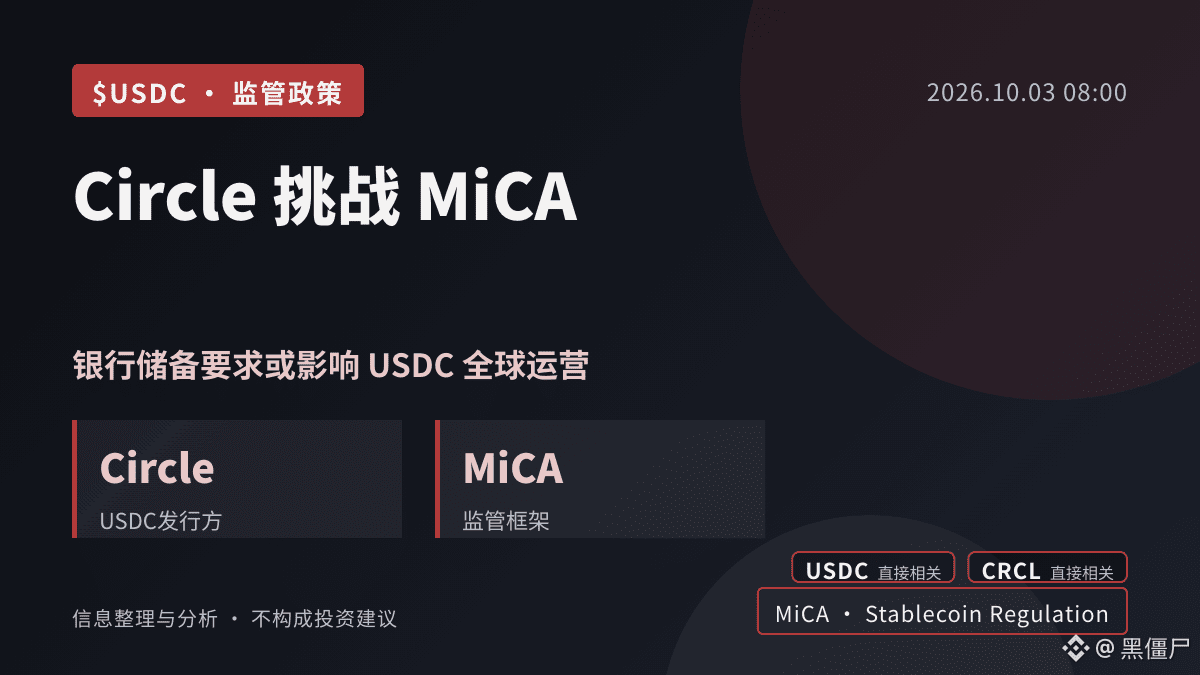
Circle 向欧盟施压,要求放宽 MiCA 银行储备要求
Circle 正式向欧委会提出,MiCA 对稳定币储备的强制银行存款要求和集中度上限,可能限制全球最大稳定币之一的运营灵活性。据 Decrypt 报道,Circle 认为现行规则对 USDC 这类全球发行量较大的稳定币构成约束;据 Cointelegraph 报道,Circle 希望欧盟在 MiCA 审查中,用更灵活的流动性规则替代强制银行存款最低要求,并保留跨境流动性安排。
这件事的重要性在于,MiCA 不只是欧盟本地规则,而是全球稳定币监管的重要参照。USDC 的储备结构、发行节奏和跨境使用,都会受到欧盟规则影响。如果欧盟维持较高的银行存款比例,Circle 在储备管理上的自由度可能下降,进而影响 USDC 的流动性安排和机构采用节奏。
从市场角度看,$USDC 作为直接受影响资产,其储备结构和发行方运营效率将受到监管结果影响。$CRCL 作为 Circle 的上市主体,也会因 MiCA 修订进展而面临估值与业务预期的波动。两者方向都可能偏混合:若欧盟放宽,运营灵活性提升;若维持严格,则合规成本和流动性约束上升。
风险在于,欧盟可能出于金融稳定考虑,坚持较高的银行存款最低要求,甚至强化集中度上限。这会限制 USDC 储备的灵活性,跨境流动和机构采用节奏也可能放缓。监管博弈升级本身,也会增加市场不确定性。
接下来需要观察,欧委会对 Circle 提案的回应,以及 MiCA 审查中是否出现替代性流动性规则。如果正在关注 USDC,短线更值得观察欧盟监管信号是否明确,而不是提前押注方向。
$USDC $CRCL #USDC #MiCA #Stablecoin
以上为信息整理与个人分析,不构成投资建议。
Circle 向欧盟施压,要求放宽 MiCA 银行储备要求
Circle 正式向欧委会提出,MiCA 对稳定币储备的强制银行存款要求和集中度上限,可能限制全球最大稳定币之一的运营灵活性。据 Decrypt 报道,Circle 认为现行规则对 USDC 这类全球发行量较大的稳定币构成约束;据 Cointelegraph 报道,Circle 希望欧盟在 MiCA 审查中,用更灵活的流动性规则替代强制银行存款最低要求,并保留跨境流动性安排。
这件事的重要性在于,MiCA 不只是欧盟本地规则,而是全球稳定币监管的重要参照。USDC 的储备结构、发行节奏和跨境使用,都会受到欧盟规则影响。如果欧盟维持较高的银行存款比例,Circle 在储备管理上的自由度可能下降,进而影响 USDC 的流动性安排和机构采用节奏。
从市场角度看,$USDC 作为直接受影响资产,其储备结构和发行方运营效率将受到监管结果影响。$CRCL 作为 Circle 的上市主体,也会因 MiCA 修订进展而面临估值与业务预期的波动。两者方向都可能偏混合:若欧盟放宽,运营灵活性提升;若维持严格,则合规成本和流动性约束上升。
风险在于,欧盟可能出于金融稳定考虑,坚持较高的银行存款最低要求,甚至强化集中度上限。这会限制 USDC 储备的灵活性,跨境流动和机构采用节奏也可能放缓。监管博弈升级本身,也会增加市场不确定性。
接下来需要观察,欧委会对 Circle 提案的回应,以及 MiCA 审查中是否出现替代性流动性规则。如果正在关注 USDC,短线更值得观察欧盟监管信号是否明确,而不是提前押注方向。
$USDC $CRCL #USDC #MiCA #Stablecoin
以上为信息整理与个人分析,不构成投资建议。
Circle 正式向欧委会提出,MiCA 对稳定币储备的强制银行存款要求和集中度上限,可能限制全球最大稳定币之一的运营灵活性。据 Decrypt 报道,Circle 认为现行规则对 USDC 这类全球发行量较大的稳定币构成约束;据 Cointelegraph 报道,Circle 希望欧盟在 MiCA 审查中,用更灵活的流动性规则替代强制银行存款最低要求,并保留跨境流动性安排。
这件事的重要性在于,MiCA 不只是欧盟本地规则,而是全球稳定币监管的重要参照。USDC 的储备结构、发行节奏和跨境使用,都会受到欧盟规则影响。如果欧盟维持较高的银行存款比例,Circle 在储备管理上的自由度可能下降,进而影响 USDC 的流动性安排和机构采用节奏。
从市场角度看,$USDC 作为直接受影响资产,其储备结构和发行方运营效率将受到监管结果影响。$CRCL 作为 Circle 的上市主体,也会因 MiCA 修订进展而面临估值与业务预期的波动。两者方向都可能偏混合:若欧盟放宽,运营灵活性提升;若维持严格,则合规成本和流动性约束上升。
风险在于,欧盟可能出于金融稳定考虑,坚持较高的银行存款最低要求,甚至强化集中度上限。这会限制 USDC 储备的灵活性,跨境流动和机构采用节奏也可能放缓。监管博弈升级本身,也会增加市场不确定性。
接下来需要观察,欧委会对 Circle 提案的回应,以及 MiCA 审查中是否出现替代性流动性规则。如果正在关注 USDC,短线更值得观察欧盟监管信号是否明确,而不是提前押注方向。
$USDC $CRCL #USDC #MiCA #Stablecoin
以上为信息整理与个人分析,不构成投资建议。
214

·
--
Bullish
🇪🇺 Circle تطالب بإعادة النظر في قواعد العملات المستقرة بأوروبا
تضغط Circle، مُصدرة USDC، لتعديل بعض متطلبات MiCA المتعلقة باحتياطيات العملات المستقرة.
استبدال نسب الودائع البنكية الثابتة بمتطلبات سيولة أكثر مرونة.
تخفيف القيود على توزيع الاحتياطيات بين البنوك.
Circle تشير إلى أن 3 فقط من أكبر 25 عملة مستقرة تخضع حاليًا لـMiCA.
ومن المتوقع مراجعة الإطار التنظيمي في 2027.
مراجعة قد تعيد تشكيل مستقبل العملات المستقرة في أوروبا.
#USDC #Circle #MiCA #Stablecoins #crypto
🇪🇺 Circle تطالب بإعادة النظر في قواعد العملات المستقرة بأوروبا
تضغط Circle، مُصدرة USDC، لتعديل بعض متطلبات MiCA المتعلقة باحتياطيات العملات المستقرة.
استبدال نسب الودائع البنكية الثابتة بمتطلبات سيولة أكثر مرونة.
تخفيف القيود على توزيع الاحتياطيات بين البنوك.
Circle تشير إلى أن 3 فقط من أكبر 25 عملة مستقرة تخضع حاليًا لـMiCA.
ومن المتوقع مراجعة الإطار التنظيمي في 2027.
مراجعة قد تعيد تشكيل مستقبل العملات المستقرة في أوروبا.
#USDC #Circle #MiCA #Stablecoins #crypto
تضغط Circle، مُصدرة USDC، لتعديل بعض متطلبات MiCA المتعلقة باحتياطيات العملات المستقرة.
استبدال نسب الودائع البنكية الثابتة بمتطلبات سيولة أكثر مرونة.
تخفيف القيود على توزيع الاحتياطيات بين البنوك.
Circle تشير إلى أن 3 فقط من أكبر 25 عملة مستقرة تخضع حاليًا لـMiCA.
ومن المتوقع مراجعة الإطار التنظيمي في 2027.
مراجعة قد تعيد تشكيل مستقبل العملات المستقرة في أوروبا.
#USDC #Circle #MiCA #Stablecoins #crypto

4
326

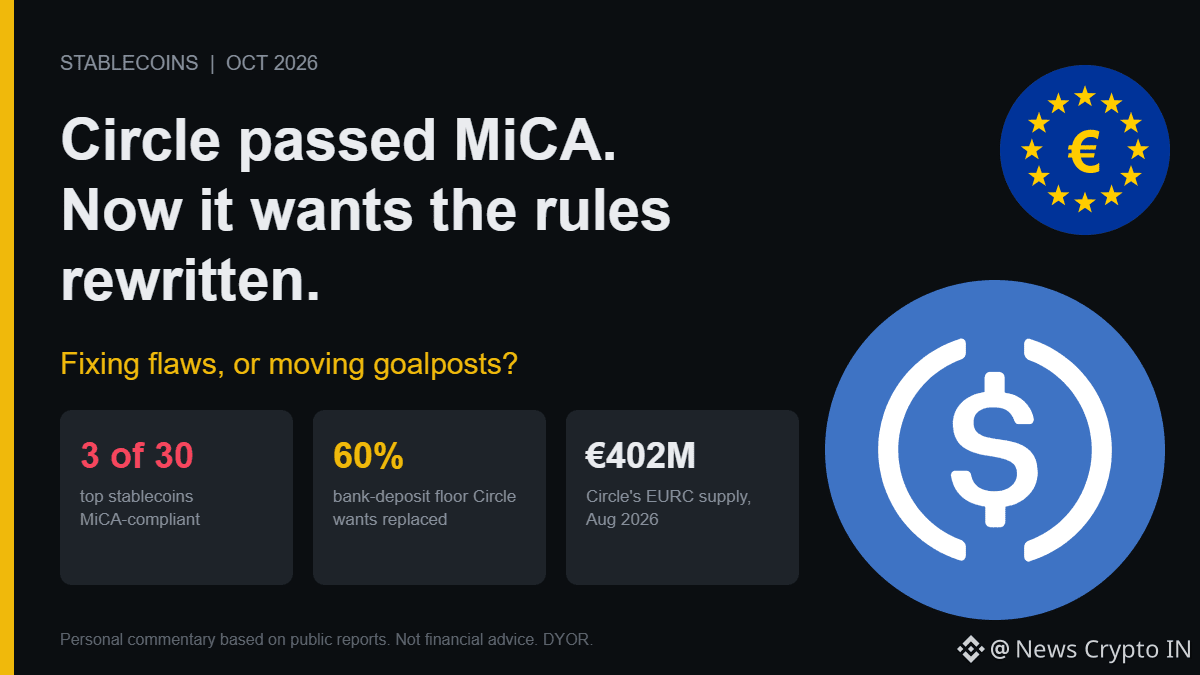
Only 3 of the top 30 stablecoins comply with Europe's MiCA rules: USDC, USDG and EURC. Two of those three are Circle's. And on Oct 1, Circle asked the European Commission to rewrite the rules anyway.
What Circle wants changed:
- Reserves: MiCA forces issuers to hold 30% of reserves as bank deposits, 60% for "significant" ones. Circle wants liquidity-based rules instead, plus looser concentration caps (35% per sovereign, 1.5% of a bank's assets per counterparty).
- Cross-border issuance: keep letting an EU-licensed entity issue the same token alongside affiliates abroad.
- Foreign recognition: let foreign-regulated stablecoins distribute through EU-licensed firms, modelled on the US GENIUS Act.
The cynical read writes itself: the company that already passed the test is lobbying to change the test, and every proposal happens to fit how a US-based global issuer operates.
But the reserve point has real history behind it. In March 2023, USDC briefly broke its peg because $3.3B of its reserves sat at Silicon Valley Bank when it failed. Forcing 60% of reserves into bank deposits puts more of a stablecoin's safety on the health of a few banks, the exact risk that already bit Circle once.
Is Circle fixing a genuine design flaw in MiCA, or using its compliant status to write the rules competitors will have to follow?
#Circle #MiCA
Only 3 of the top 30 stablecoins comply with Europe's MiCA rules: USDC, USDG and EURC. Two of those three are Circle's. And on Oct 1, Circle asked the European Commission to rewrite the rules anyway.
What Circle wants changed:
- Reserves: MiCA forces issuers to hold 30% of reserves as bank deposits, 60% for "significant" ones. Circle wants liquidity-based rules instead, plus looser concentration caps (35% per sovereign, 1.5% of a bank's assets per counterparty).
- Cross-border issuance: keep letting an EU-licensed entity issue the same token alongside affiliates abroad.
- Foreign recognition: let foreign-regulated stablecoins distribute through EU-licensed firms, modelled on the US GENIUS Act.
The cynical read writes itself: the company that already passed the test is lobbying to change the test, and every proposal happens to fit how a US-based global issuer operates.
But the reserve point has real history behind it. In March 2023, USDC briefly broke its peg because $3.3B of its reserves sat at Silicon Valley Bank when it failed. Forcing 60% of reserves into bank deposits puts more of a stablecoin's safety on the health of a few banks, the exact risk that already bit Circle once.
Is Circle fixing a genuine design flaw in MiCA, or using its compliant status to write the rules competitors will have to follow?
#Circle #MiCA
What Circle wants changed:
- Reserves: MiCA forces issuers to hold 30% of reserves as bank deposits, 60% for "significant" ones. Circle wants liquidity-based rules instead, plus looser concentration caps (35% per sovereign, 1.5% of a bank's assets per counterparty).
- Cross-border issuance: keep letting an EU-licensed entity issue the same token alongside affiliates abroad.
- Foreign recognition: let foreign-regulated stablecoins distribute through EU-licensed firms, modelled on the US GENIUS Act.
The cynical read writes itself: the company that already passed the test is lobbying to change the test, and every proposal happens to fit how a US-based global issuer operates.
But the reserve point has real history behind it. In March 2023, USDC briefly broke its peg because $3.3B of its reserves sat at Silicon Valley Bank when it failed. Forcing 60% of reserves into bank deposits puts more of a stablecoin's safety on the health of a few banks, the exact risk that already bit Circle once.
Is Circle fixing a genuine design flaw in MiCA, or using its compliant status to write the rules competitors will have to follow?
#Circle #MiCA
539

·
--
欧洲加密用户更信任MiCA下的合规企业!Bitpanda CEO表示,MiCA让欧洲用户对监管平台更有信心,同时呼吁对违规平台严格执法。#CryptoRegulation #MiCA $BTC $ETH
European crypto users now trust regulated firms more thanks to MiCA! Bitpanda's co-CEO reveals MiCA boosted confidence in compliant platforms while calling for stricter enforcement against non-compliant ones. #CryptoRegulation #MiCA $BTC $ETH
欧洲加密用户更信任MiCA下的合规企业!Bitpanda CEO表示,MiCA让欧洲用户对监管平台更有信心,同时呼吁对违规平台严格执法。#CryptoRegulation #MiCA $BTC $ETH
European crypto users now trust regulated firms more thanks to MiCA! Bitpanda's co-CEO reveals MiCA boosted confidence in compliant platforms while calling for stricter enforcement against non-compliant ones. #CryptoRegulation #MiCA $BTC $ETH
European crypto users now trust regulated firms more thanks to MiCA! Bitpanda's co-CEO reveals MiCA boosted confidence in compliant platforms while calling for stricter enforcement against non-compliant ones. #CryptoRegulation #MiCA $BTC $ETH
399

·
--
Circle está presionando para cambiar las reglas de las stablecoins en Europa.
La empresa emisora de $USDC le pidió a la Comisión Europea mayor flexibilidad.
Dicen que las exigencias actuales de depósitos bancarios y los límites de concentración dejan fuera a las monedas estables más grandes del mercado.
Básicamente, quieren que las normas se ajusten más a la realidad global.
¿Qué te parece este pedido de Circle?
#USDC #MiCA
Circle está presionando para cambiar las reglas de las stablecoins en Europa.
La empresa emisora de $USDC le pidió a la Comisión Europea mayor flexibilidad.
Dicen que las exigencias actuales de depósitos bancarios y los límites de concentración dejan fuera a las monedas estables más grandes del mercado.
Básicamente, quieren que las normas se ajusten más a la realidad global.
¿Qué te parece este pedido de Circle?
#USDC #MiCA
La empresa emisora de $USDC le pidió a la Comisión Europea mayor flexibilidad.
Dicen que las exigencias actuales de depósitos bancarios y los límites de concentración dejan fuera a las monedas estables más grandes del mercado.
Básicamente, quieren que las normas se ajusten más a la realidad global.
¿Qué te parece este pedido de Circle?
#USDC #MiCA
87
·
--
Circle推动MiCA修订:USDC储备规则或迎关键变化
Circle正在推动欧盟在MiCA审查中调整稳定币储备规则,据Cointelegraph报道,其核心诉求是以更具弹性的流动性要求替代强制银行存款下限,并保留跨境流动空间。这一动向直接指向$USDC的合规成本与流动性安排,也关系到$CRCL作为发行方的业务预期。
对稳定币市场而言,MiCA的储备规则并非单纯的技术条款,而是决定发行方能否在欧盟维持低成本、高流动性的关键变量。若欧盟接受更灵活的框架,USDC在银行合作、资金调度与跨境结算上的操作空间可能扩大,合规压力或将阶段性缓解。
不过,欧盟监管一贯强调审慎底线,银行存款要求是否会被完全替换仍不确定。若修订节奏偏慢或最终保留较高存款比例,USDC的短期价格影响有限,更多体现为合规预期与机构参与意愿的变化。
接下来需要观察欧盟委员会与欧洲央行对MiCA修订的公开表态,以及Circle是否进一步披露储备结构细节。若正在关注$USDC,短线更值得观察监管信号是否确认,而不是提前押注方向。
$USDC $CRCL #USDC #MiCA #Stablecoin
以上为信息整理与个人分析,不构成投资建议。
后续政策细节进一步明确后,我会继续更新。
Circle推动MiCA修订:USDC储备规则或迎关键变化
Circle正在推动欧盟在MiCA审查中调整稳定币储备规则,据Cointelegraph报道,其核心诉求是以更具弹性的流动性要求替代强制银行存款下限,并保留跨境流动空间。这一动向直接指向$USDC 的合规成本与流动性安排,也关系到$CRCL 作为发行方的业务预期。
对稳定币市场而言,MiCA的储备规则并非单纯的技术条款,而是决定发行方能否在欧盟维持低成本、高流动性的关键变量。若欧盟接受更灵活的框架,USDC在银行合作、资金调度与跨境结算上的操作空间可能扩大,合规压力或将阶段性缓解。
不过,欧盟监管一贯强调审慎底线,银行存款要求是否会被完全替换仍不确定。若修订节奏偏慢或最终保留较高存款比例,USDC的短期价格影响有限,更多体现为合规预期与机构参与意愿的变化。
接下来需要观察欧盟委员会与欧洲央行对MiCA修订的公开表态,以及Circle是否进一步披露储备结构细节。若正在关注$USDC ,短线更值得观察监管信号是否确认,而不是提前押注方向。
$USDC $CRCL #USDC #MiCA #Stablecoin
以上为信息整理与个人分析,不构成投资建议。
后续政策细节进一步明确后,我会继续更新。
Circle正在推动欧盟在MiCA审查中调整稳定币储备规则,据Cointelegraph报道,其核心诉求是以更具弹性的流动性要求替代强制银行存款下限,并保留跨境流动空间。这一动向直接指向$USDC 的合规成本与流动性安排,也关系到$CRCL 作为发行方的业务预期。
对稳定币市场而言,MiCA的储备规则并非单纯的技术条款,而是决定发行方能否在欧盟维持低成本、高流动性的关键变量。若欧盟接受更灵活的框架,USDC在银行合作、资金调度与跨境结算上的操作空间可能扩大,合规压力或将阶段性缓解。
不过,欧盟监管一贯强调审慎底线,银行存款要求是否会被完全替换仍不确定。若修订节奏偏慢或最终保留较高存款比例,USDC的短期价格影响有限,更多体现为合规预期与机构参与意愿的变化。
接下来需要观察欧盟委员会与欧洲央行对MiCA修订的公开表态,以及Circle是否进一步披露储备结构细节。若正在关注$USDC ,短线更值得观察监管信号是否确认,而不是提前押注方向。
$USDC $CRCL #USDC #MiCA #Stablecoin
以上为信息整理与个人分析,不构成投资建议。
后续政策细节进一步明确后,我会继续更新。
24
Log in to explore more content
Join global crypto users on Binance Square
⚡️ Get latest and useful information about crypto.
💬 Trusted by the world’s largest crypto exchange.
👍 Discover real insights from verified creators.
Email / Phone number
Trending Topics
1
#DriftHackVictimsBeginClaims
14,112 views
231 Discussing
2
#SolanaTokenizedStockVolumeTops$4.4BInSeptember
2,173 views
32 Discussing
3
#BitcoinSpotETFsDraw$6.34BInflowsInQ3
10,702 views
145 Discussing
4
#EthereumValidatorExitQueueJumps392%
182,247 views
1,406 Discussing
5
#IMFApprovesElSalvador$138MWithBitcoinWaiver
16,701 views
93 Discussing
6
#SECHaltsCryptoETFReviewsAmidFundingLapse
314,568 views
2,209 Discussing
7
#ZcashETFPostsFirstWeeklyOutflow$93.6M
102,760 views
268 Discussing
8
#GreekPoliceBustCryptoScamRingArrest17
432,834 views
2,798 Discussing
9
#BitcoinRejectedAt$87K
236,668 views
337 Discussing
10
#FedOctoberRateHikeOddsFallTo17%
447,753 views
2,890 Discussing