

#cryptoregulation
cryptoregulation
16.9M views
47,687 Discussing
Hot
Latest


Flash update. The Clarity Act is dead. 🚨 Democratic opposition just blocked the bipartisan crypto bill on Capitol Hill. Traders are recalibrating regulatory risk now. Here is what matters. 📉 First, federal oversight clarity is officially on hold indefinitely. 🏛️ Second, compliance costs remain messy for firms navigating the $BTC and $ETH ecosystems. ⚖️ Third, policy gridlock shifts focus back to state-level rulings. Stay sharp and manage your exposure. #Write2Earn $BTC $ETH #CryptoRegulation #Policy
Flash update. The Clarity Act is dead. 🚨 Democratic opposition just blocked the bipartisan crypto bill on Capitol Hill. Traders are recalibrating regulatory risk now. Here is what matters. 📉 First, federal oversight clarity is officially on hold indefinitely. 🏛️ Second, compliance costs remain messy for firms navigating the $BTC and $ETH ecosystems. ⚖️ Third, policy gridlock shifts focus back to state-level rulings. Stay sharp and manage your exposure. #Write2Earn $BTC $ETH #CryptoRegulation #Policy
14

🔔 One regulator just slammed the doors on crypto payments in Brazil, and the ripple is already echoing through the global markets.
📈 At 02:00 UTC the Central Bank announced that virtual assets are barred from settlement on its regulated eFX rails, a move that forces traders onto unlicensed channels just as #BTC surged to $84,250, up 1.4% on a Greed‑charged 73 sentiment index. Futures data shows Bitcoin open interest holding steady at $7.85 B with a bullish funding rate of +0.0055% and a long‑short ratio of 1.30, while #Ethereum climbs to $2,725 on a bullish MACD crossover, suggesting institutional appetite is only heating up despite the new roadblock #CryptoRegulation.
💡 The irony? Brazil’s crackdown could actually tighten the supply chain of on‑ramp liquidity, nudging more capital into the very exchanges the ban tries to sideline.
❓ Will this regulatory hammer spark a hidden surge of decentralized swaps, or will it push the market into a silent lull?
🔔 One regulator just slammed the doors on crypto payments in Brazil, and the ripple is already echoing through the global markets.
📈 At 02:00 UTC the Central Bank announced that virtual assets are barred from settlement on its regulated eFX rails, a move that forces traders onto unlicensed channels just as #BTC surged to $84,250, up 1.4% on a Greed‑charged 73 sentiment index. Futures data shows Bitcoin open interest holding steady at $7.85 B with a bullish funding rate of +0.0055% and a long‑short ratio of 1.30, while #Ethereum climbs to $2,725 on a bullish MACD crossover, suggesting institutional appetite is only heating up despite the new roadblock #CryptoRegulation.
💡 The irony? Brazil’s crackdown could actually tighten the supply chain of on‑ramp liquidity, nudging more capital into the very exchanges the ban tries to sideline.
❓ Will this regulatory hammer spark a hidden surge of decentralized swaps, or will it push the market into a silent lull?
📈 At 02:00 UTC the Central Bank announced that virtual assets are barred from settlement on its regulated eFX rails, a move that forces traders onto unlicensed channels just as #BTC surged to $84,250, up 1.4% on a Greed‑charged 73 sentiment index. Futures data shows Bitcoin open interest holding steady at $7.85 B with a bullish funding rate of +0.0055% and a long‑short ratio of 1.30, while #Ethereum climbs to $2,725 on a bullish MACD crossover, suggesting institutional appetite is only heating up despite the new roadblock #CryptoRegulation.
💡 The irony? Brazil’s crackdown could actually tighten the supply chain of on‑ramp liquidity, nudging more capital into the very exchanges the ban tries to sideline.
❓ Will this regulatory hammer spark a hidden surge of decentralized swaps, or will it push the market into a silent lull?
9

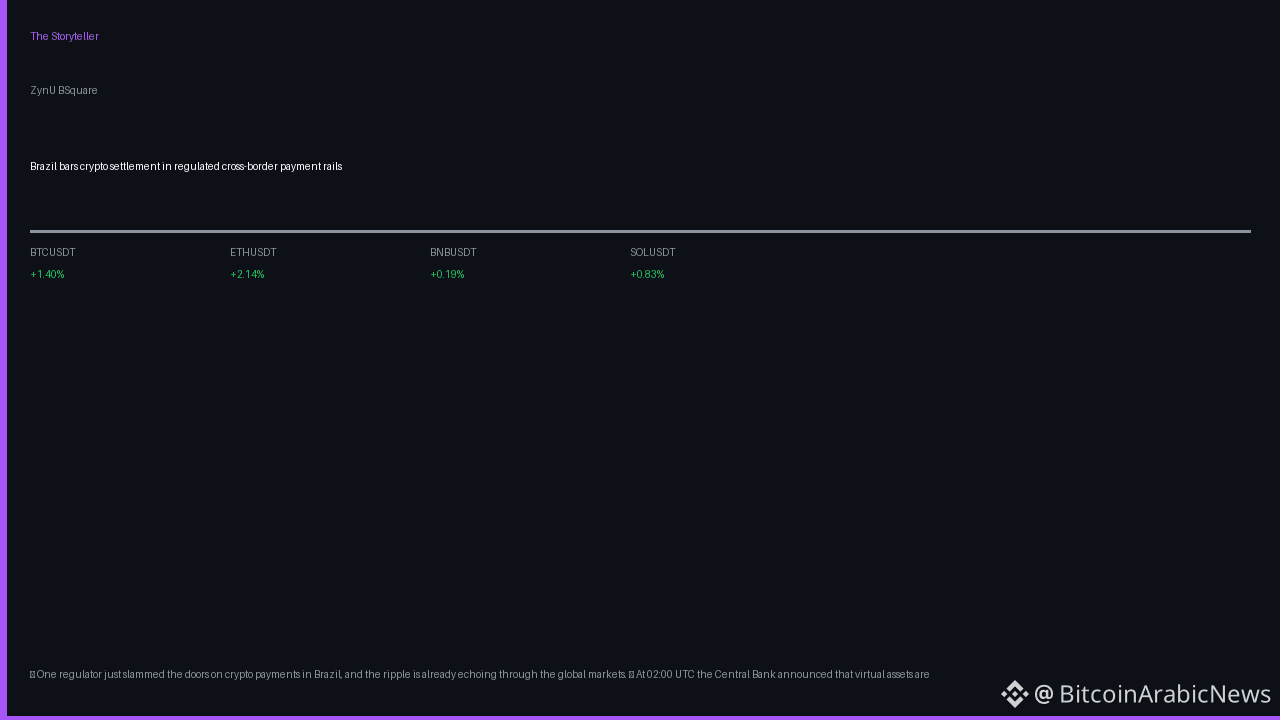
🇷🇺 RUSSIA ADVANCES TOWARD A CONTROLLED CRYPTO MARKET
Russia is preparing to facilitate the establishment of sanctioned cryptocurrency exchanges and digital storage facilities that will be overseen by the Bank of Russia.
Starting October 5, new guidelines for entering the register will take effect, and businesses need to meet certain criteria and regulations to be registered.
A further move has been made in the direction of legitimizing cryptocurrency trading and custodial services in Russia.
#Russia #Bitcoin #Crypto #CryptoRegulation
$BTC
{future}(BTCUSDT)
🇷🇺 RUSSIA ADVANCES TOWARD A CONTROLLED CRYPTO MARKET
Russia is preparing to facilitate the establishment of sanctioned cryptocurrency exchanges and digital storage facilities that will be overseen by the Bank of Russia.
Starting October 5, new guidelines for entering the register will take effect, and businesses need to meet certain criteria and regulations to be registered.
A further move has been made in the direction of legitimizing cryptocurrency trading and custodial services in Russia.
#Russia #Bitcoin #Crypto #CryptoRegulation
$BTC
Russia is preparing to facilitate the establishment of sanctioned cryptocurrency exchanges and digital storage facilities that will be overseen by the Bank of Russia.
Starting October 5, new guidelines for entering the register will take effect, and businesses need to meet certain criteria and regulations to be registered.
A further move has been made in the direction of legitimizing cryptocurrency trading and custodial services in Russia.
#Russia #Bitcoin #Crypto #CryptoRegulation
$BTC
35
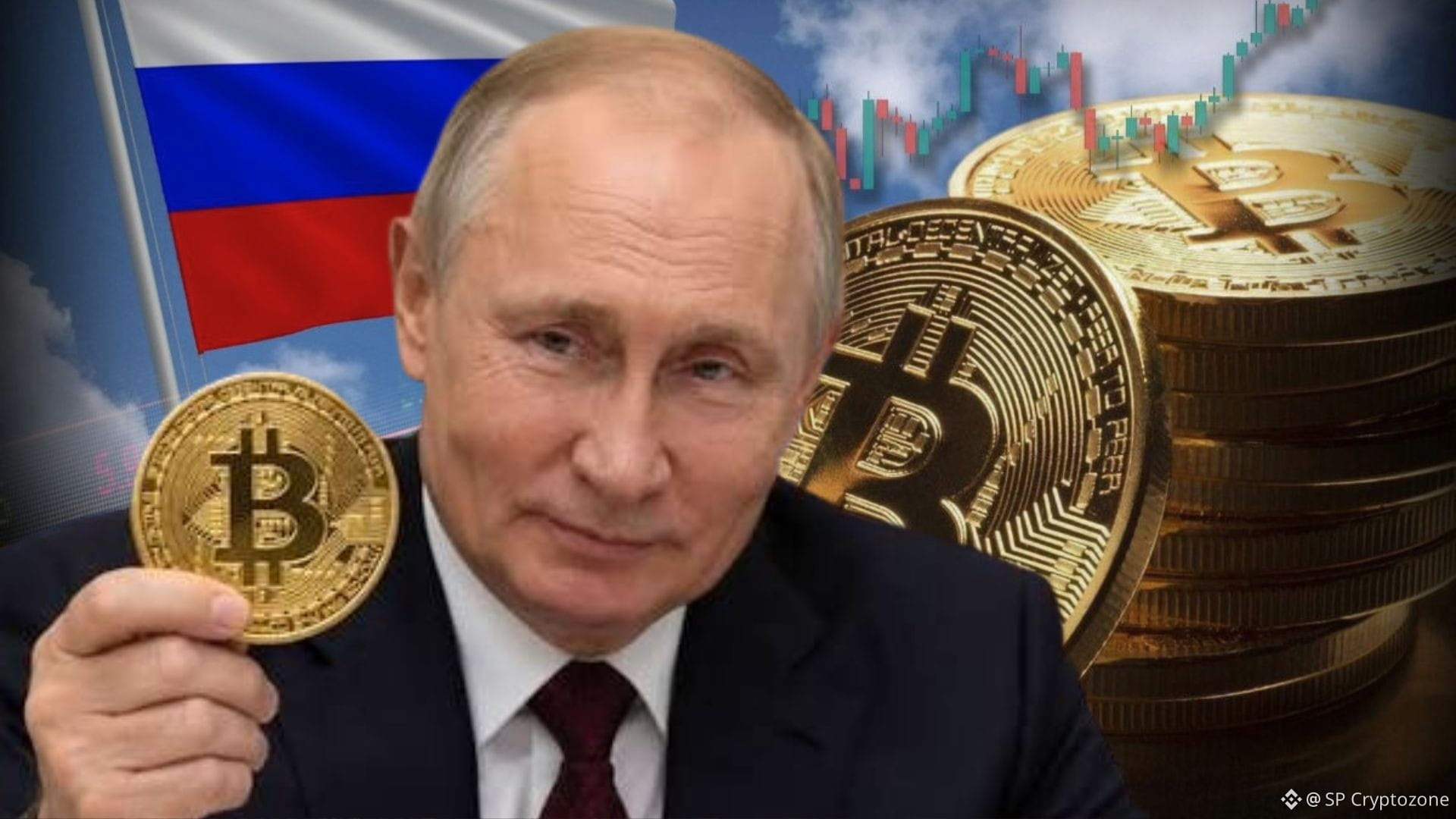
Zero to sixty in US derivatives. 🚀 Ondo Perps CEO David Wells is eyeing a massive opening for perpetual futures domestically under a fresh regulatory framework. This matters because US institutional liquidity could finally unlock for on-chain perps. Watch how the CFTC and compliance models shape up next. #Write2Earn $ONDO #CryptoRegulation #Trading
Zero to sixty in US derivatives. 🚀 Ondo Perps CEO David Wells is eyeing a massive opening for perpetual futures domestically under a fresh regulatory framework. This matters because US institutional liquidity could finally unlock for on-chain perps. Watch how the CFTC and compliance models shape up next. #Write2Earn $ONDO #CryptoRegulation #Trading

114

·
--
Bullish
#SECSaysDecentralizedTokenBuybacksNotInvestmentContracts
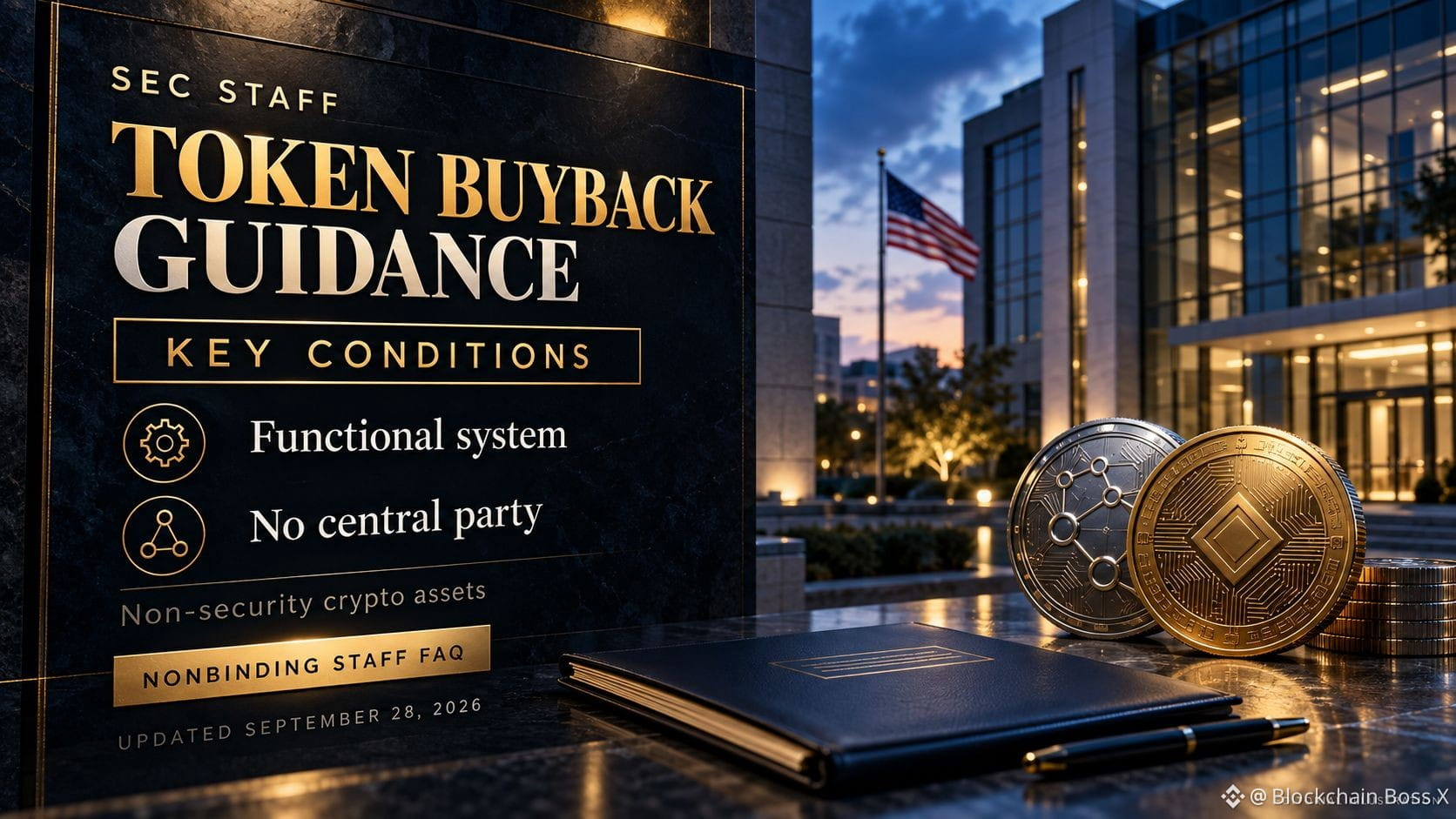
🇺🇸 SEC Staff Updates Token Buyback Guidance: Decentralization Matters
On September 28, SEC staff revised its crypto FAQ, adding an explicit condition to its buyback guidance: the network must be functional and have no central party.
The answer concerns non-security crypto assets. Under those conditions, announcing a buyback would not, in staff’s view, constitute a promise to perform the essential managerial efforts relevant to an investment-contract analysis.
For a network that is not yet functional, presenting a buyback as generating yield or returns could count as such a promise.
These FAQs are nonbinding staff guidance with no legal force. They do not establish a blanket exemption for token buybacks.
My take: I would examine who can change protocol rules, control treasury decisions or override governance outcomes. Those disclosures help readers understand how decisions are made; the word “decentralized” on a website provides little evidence by itself.
I would also assess buyback funding, whether purchases can continue and how repurchases compare with new token issuance. A large announced program may have a different economic effect from purchases consistently funded by ongoing activity.
Legal interpretation and token economics deserve separate attention. This update provides a more specific framework for discussion, while actual governance and execution remain worth investigating.
What evidence would you look for when assessing whether a crypto network has central control?
#SECSaysDecentralizedTokenBuybacksNotInvestmentContracts #CryptoRegulation #TokenBuybacks
$ETH $SOL $NEAR
#SECSaysDecentralizedTokenBuybacksNotInvestmentContracts
🇺🇸 SEC Staff Updates Token Buyback Guidance: Decentralization Matters
On September 28, SEC staff revised its crypto FAQ, adding an explicit condition to its buyback guidance: the network must be functional and have no central party.
The answer concerns non-security crypto assets. Under those conditions, announcing a buyback would not, in staff’s view, constitute a promise to perform the essential managerial efforts relevant to an investment-contract analysis.
For a network that is not yet functional, presenting a buyback as generating yield or returns could count as such a promise.
These FAQs are nonbinding staff guidance with no legal force. They do not establish a blanket exemption for token buybacks.
My take: I would examine who can change protocol rules, control treasury decisions or override governance outcomes. Those disclosures help readers understand how decisions are made; the word “decentralized” on a website provides little evidence by itself.
I would also assess buyback funding, whether purchases can continue and how repurchases compare with new token issuance. A large announced program may have a different economic effect from purchases consistently funded by ongoing activity.
Legal interpretation and token economics deserve separate attention. This update provides a more specific framework for discussion, while actual governance and execution remain worth investigating.
What evidence would you look for when assessing whether a crypto network has central control?
#SECSaysDecentralizedTokenBuybacksNotInvestmentContracts #CryptoRegulation #TokenBuybacks
$ETH $SOL $NEAR
🇺🇸 SEC Staff Updates Token Buyback Guidance: Decentralization Matters
On September 28, SEC staff revised its crypto FAQ, adding an explicit condition to its buyback guidance: the network must be functional and have no central party.
The answer concerns non-security crypto assets. Under those conditions, announcing a buyback would not, in staff’s view, constitute a promise to perform the essential managerial efforts relevant to an investment-contract analysis.
For a network that is not yet functional, presenting a buyback as generating yield or returns could count as such a promise.
These FAQs are nonbinding staff guidance with no legal force. They do not establish a blanket exemption for token buybacks.
My take: I would examine who can change protocol rules, control treasury decisions or override governance outcomes. Those disclosures help readers understand how decisions are made; the word “decentralized” on a website provides little evidence by itself.
I would also assess buyback funding, whether purchases can continue and how repurchases compare with new token issuance. A large announced program may have a different economic effect from purchases consistently funded by ongoing activity.
Legal interpretation and token economics deserve separate attention. This update provides a more specific framework for discussion, while actual governance and execution remain worth investigating.
What evidence would you look for when assessing whether a crypto network has central control?
#SECSaysDecentralizedTokenBuybacksNotInvestmentContracts #CryptoRegulation #TokenBuybacks
$ETH $SOL $NEAR
1
198

·
--
#ukfcawinscourtordertorecover851400pounds
🚨 Regulatory Enforcement: UK FCA Wins Court Order to Recover £851,400!
The Market Update: Regulatory oversight and asset recovery efforts are intensifying across European financial jurisdictions as the UK Financial Conduct Authority (FCA) successfully wins a court order to recover £851,400 linked to unlawful digital asset operations. This decisive legal action highlights tightening cross-border enforcement, targeting illicit platforms, and safeguarding consumer protection within the regulated crypto perimeter.
What The Enforcement Means for Traders: Heightened regulatory scrutiny reinforces compliance standards for exchanges and custodial service providers operating within major financial hubs. Market participants are increasingly prioritizing fully compliant, audited networks and transparent platforms as regulatory frameworks mature globally.
Highlighted Tradeable Coins to Watch:
$BTC (Bitcoin): The macro market baseline; tracking overall liquidity trends and institutional risk sentiment across regulated jurisdictions.
$ETH (Ethereum): The leading smart contract platform; monitoring decentralized application activity and regulatory adaptation within DeFi.
$SOL (Solana): High-velocity network benchmark; observing ecosystem volume growth and capital flows across major trading pairs.
How do you view the impact of aggressive regulatory asset recovery on the adoption of decentralized versus centralized financial platforms? Let's discuss your thoughts in the comments below! 👇
{spot}(BTCUSDT)
{spot}(ETHUSDT)
{spot}(SOLUSDT)
#CryptoRegulation #compliance
#ukfcawinscourtordertorecover851400pounds
🚨 Regulatory Enforcement: UK FCA Wins Court Order to Recover £851,400!
The Market Update: Regulatory oversight and asset recovery efforts are intensifying across European financial jurisdictions as the UK Financial Conduct Authority (FCA) successfully wins a court order to recover £851,400 linked to unlawful digital asset operations. This decisive legal action highlights tightening cross-border enforcement, targeting illicit platforms, and safeguarding consumer protection within the regulated crypto perimeter.
What The Enforcement Means for Traders: Heightened regulatory scrutiny reinforces compliance standards for exchanges and custodial service providers operating within major financial hubs. Market participants are increasingly prioritizing fully compliant, audited networks and transparent platforms as regulatory frameworks mature globally.
Highlighted Tradeable Coins to Watch:
$BTC (Bitcoin): The macro market baseline; tracking overall liquidity trends and institutional risk sentiment across regulated jurisdictions.
$ETH (Ethereum): The leading smart contract platform; monitoring decentralized application activity and regulatory adaptation within DeFi.
$SOL (Solana): High-velocity network benchmark; observing ecosystem volume growth and capital flows across major trading pairs.
How do you view the impact of aggressive regulatory asset recovery on the adoption of decentralized versus centralized financial platforms? Let's discuss your thoughts in the comments below! 👇
#CryptoRegulation #compliance
🚨 Regulatory Enforcement: UK FCA Wins Court Order to Recover £851,400!
The Market Update: Regulatory oversight and asset recovery efforts are intensifying across European financial jurisdictions as the UK Financial Conduct Authority (FCA) successfully wins a court order to recover £851,400 linked to unlawful digital asset operations. This decisive legal action highlights tightening cross-border enforcement, targeting illicit platforms, and safeguarding consumer protection within the regulated crypto perimeter.
What The Enforcement Means for Traders: Heightened regulatory scrutiny reinforces compliance standards for exchanges and custodial service providers operating within major financial hubs. Market participants are increasingly prioritizing fully compliant, audited networks and transparent platforms as regulatory frameworks mature globally.
Highlighted Tradeable Coins to Watch:
$BTC (Bitcoin): The macro market baseline; tracking overall liquidity trends and institutional risk sentiment across regulated jurisdictions.
$ETH (Ethereum): The leading smart contract platform; monitoring decentralized application activity and regulatory adaptation within DeFi.
$SOL (Solana): High-velocity network benchmark; observing ecosystem volume growth and capital flows across major trading pairs.
How do you view the impact of aggressive regulatory asset recovery on the adoption of decentralized versus centralized financial platforms? Let's discuss your thoughts in the comments below! 👇
#CryptoRegulation #compliance

206 Atlas:
Enforcement targets bad actors, not decentralization. Compliance drives institutional adoption while DeFi remains permissionless regardless of court orders.
1
3.5k
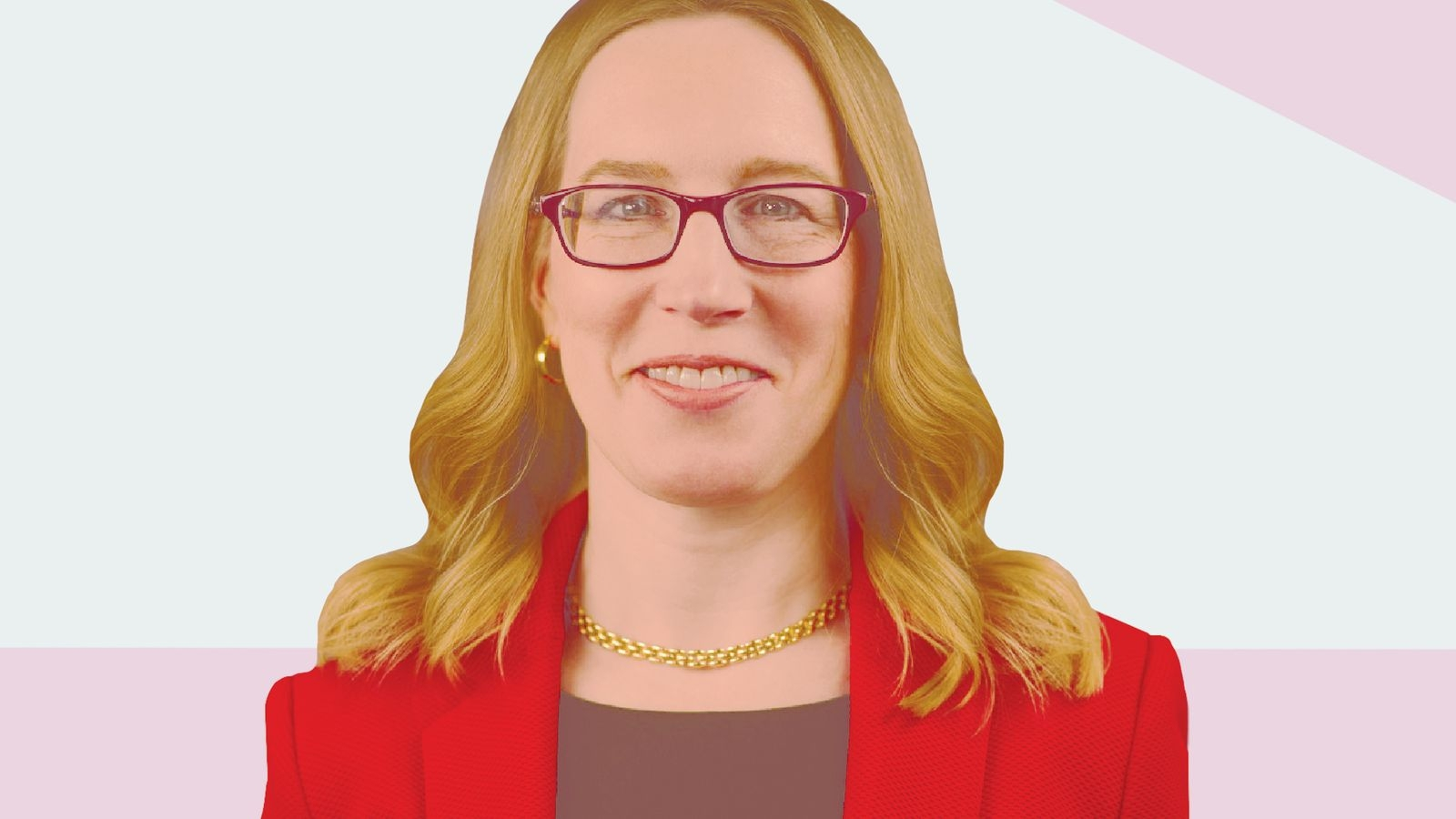
Nine years on the clock and crypto crypto crypto regulation just shifted. ⏱️ SEC Commissioner Hester Peirce is officially clearing out her desk this week. Why it matters: she was the steady voice pushing for clarity while the agency stalled. Watch how leadership transitions impact pending ETF filings and policy tone next. #Write2Earn $BTC $ETH #SEC #CryptoRegulation
Nine years on the clock and crypto crypto crypto regulation just shifted. ⏱️ SEC Commissioner Hester Peirce is officially clearing out her desk this week. Why it matters: she was the steady voice pushing for clarity while the agency stalled. Watch how leadership transitions impact pending ETF filings and policy tone next. #Write2Earn $BTC $ETH #SEC #CryptoRegulation
38

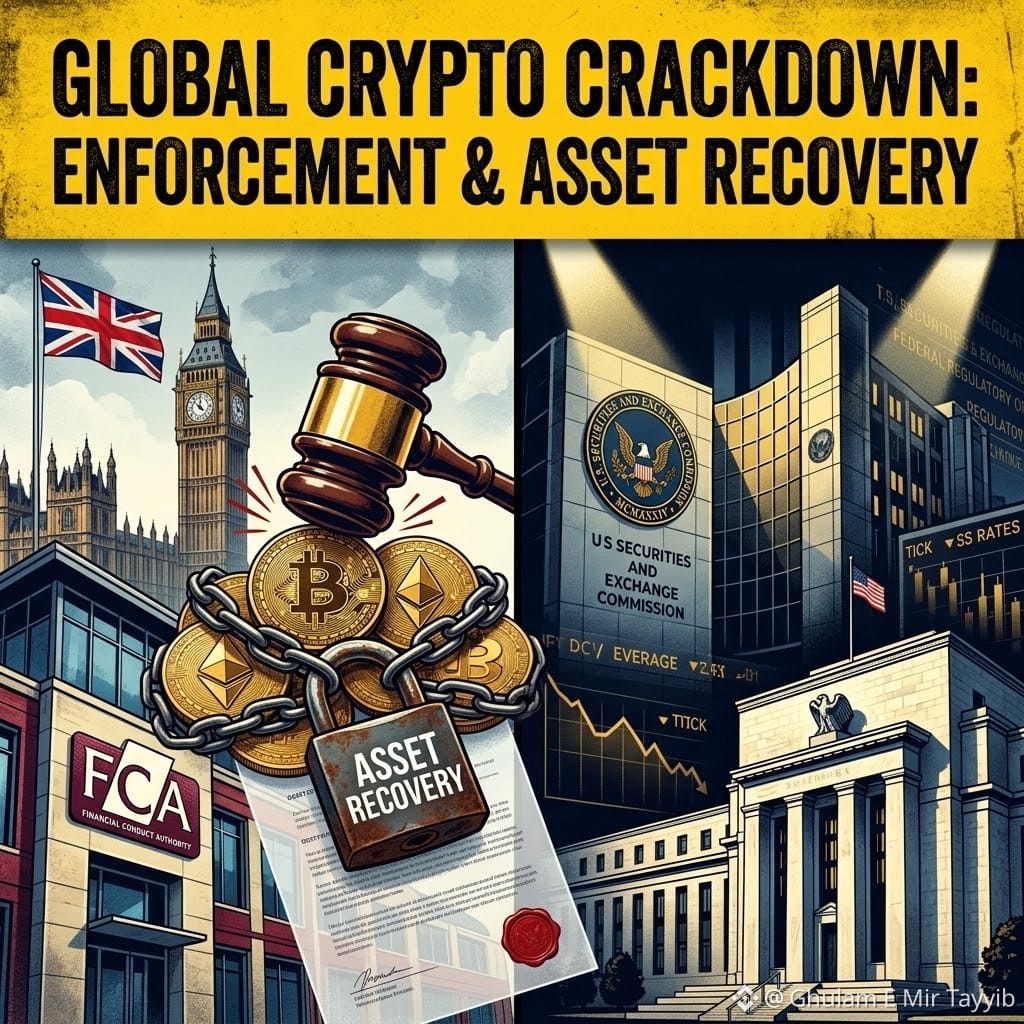
UK's FCA has secured another court-backed win, recovering £851,400 tied to unauthorized crypto-related activity — reinforcing a bigger global pattern.
This comes alongside SEC pushing clearer crypto rules and the Fed's new stablecoin supervision framework under the GENIUS Act. Regulators aren't just writing rulebooks anymore — they're actively clawing money back.
$BTC
{future}(BTCUSDT)
$CRCL
{future}(CRCLUSDT)
$COINB
{spot}(COINBUSDT)
reacting slightly bearish on the regulatory heat.
Is stricter enforcement bullish long-term for crypto legitimacy, or bearish near-term for sentiment? 👇
#FCA #CryptoRegulation #BTC
UK's FCA has secured another court-backed win, recovering £851,400 tied to unauthorized crypto-related activity — reinforcing a bigger global pattern.
This comes alongside SEC pushing clearer crypto rules and the Fed's new stablecoin supervision framework under the GENIUS Act. Regulators aren't just writing rulebooks anymore — they're actively clawing money back.
$BTC
$CRCL
$COINB
reacting slightly bearish on the regulatory heat.
Is stricter enforcement bullish long-term for crypto legitimacy, or bearish near-term for sentiment? 👇
#FCA #CryptoRegulation #BTC
This comes alongside SEC pushing clearer crypto rules and the Fed's new stablecoin supervision framework under the GENIUS Act. Regulators aren't just writing rulebooks anymore — they're actively clawing money back.
$BTC
$CRCL
$COINB
reacting slightly bearish on the regulatory heat.
Is stricter enforcement bullish long-term for crypto legitimacy, or bearish near-term for sentiment? 👇
#FCA #CryptoRegulation #BTC
1
314

Picture this: you move your hard-earned funds off an exchange into a private hardware wallet, only to realize financial authorities just logged every detail of that exit.
For years, shifting capital between centralized platforms and private storage was the ultimate safety valve for traders trying to protect their assets from unexpected platform freezes. But as regulatory oversight tightens globally, managing larger positions without triggering compliance tripwires is becoming a major headache for everyday investors.
Brazil just gave the market a clear blueprint of how emerging economies plan to manage this boundary. Starting October 1, 2026, Brazil’s Central Bank will require regulated platforms to report any virtual asset transfer worth $10,000 or more to or from self-custody wallets directly to Coaf. Much like the compliance playbooks we watched roll out across Europe and North America, this is not an outright ban, but it creates a permanent paper trail whenever high-volume $BTC or $ETH transactions touch regulated rails.
The more interesting detail is the escalation scheduled right after. While the 2026 mandate focuses purely on surveillance for major assets and stablecoins like $USDT, a separate rule slated for January 2027 will allow qualifying transfers to self-custody wallets to actually be held. It represents a steady shift from simple oversight toward active capital monitoring at the gateway.
Where do you think the line should be drawn between regulatory compliance and financial privacy for self-custody transfers?
#CryptoRegulation #Bitcoin #SelfCustody
Picture this: you move your hard-earned funds off an exchange into a private hardware wallet, only to realize financial authorities just logged every detail of that exit.
For years, shifting capital between centralized platforms and private storage was the ultimate safety valve for traders trying to protect their assets from unexpected platform freezes. But as regulatory oversight tightens globally, managing larger positions without triggering compliance tripwires is becoming a major headache for everyday investors.
Brazil just gave the market a clear blueprint of how emerging economies plan to manage this boundary. Starting October 1, 2026, Brazil’s Central Bank will require regulated platforms to report any virtual asset transfer worth $10,000 or more to or from self-custody wallets directly to Coaf. Much like the compliance playbooks we watched roll out across Europe and North America, this is not an outright ban, but it creates a permanent paper trail whenever high-volume $BTC or $ETH transactions touch regulated rails.
The more interesting detail is the escalation scheduled right after. While the 2026 mandate focuses purely on surveillance for major assets and stablecoins like $USDT, a separate rule slated for January 2027 will allow qualifying transfers to self-custody wallets to actually be held. It represents a steady shift from simple oversight toward active capital monitoring at the gateway.
Where do you think the line should be drawn between regulatory compliance and financial privacy for self-custody transfers?
#CryptoRegulation #Bitcoin #SelfCustody
For years, shifting capital between centralized platforms and private storage was the ultimate safety valve for traders trying to protect their assets from unexpected platform freezes. But as regulatory oversight tightens globally, managing larger positions without triggering compliance tripwires is becoming a major headache for everyday investors.
Brazil just gave the market a clear blueprint of how emerging economies plan to manage this boundary. Starting October 1, 2026, Brazil’s Central Bank will require regulated platforms to report any virtual asset transfer worth $10,000 or more to or from self-custody wallets directly to Coaf. Much like the compliance playbooks we watched roll out across Europe and North America, this is not an outright ban, but it creates a permanent paper trail whenever high-volume $BTC or $ETH transactions touch regulated rails.
The more interesting detail is the escalation scheduled right after. While the 2026 mandate focuses purely on surveillance for major assets and stablecoins like $USDT, a separate rule slated for January 2027 will allow qualifying transfers to self-custody wallets to actually be held. It represents a steady shift from simple oversight toward active capital monitoring at the gateway.
Where do you think the line should be drawn between regulatory compliance and financial privacy for self-custody transfers?
#CryptoRegulation #Bitcoin #SelfCustody
31

·
--
everyone thinks moving funds to self-custody makes them completely invisible, but actually the exit ramps are tightening up fast.
most of us move size off exchanges thinking we bypassed the surveillance radar, only to get hit with frozen deposits or endless compliance checks the second we try to move back. ngl, assuming cold storage gives you total anonymity from centralized rails is how traders get caught off guard.
brazil just laid down the blueprint for this. starting october 1, 2026, their central bank is forcing regulated platforms to report any virtual asset transfer of $10,000 or more heading to or from self-custody wallets straight to coaf. it is not an outright ban on holding your own keys, but moving large chunks of $BTC or $ETH between licensed exchanges and private wallets will have a direct paper trail attached to it.
to make things even tighter, a follow-up rule kicks in january 2027 that lets authorities hold qualifying self-custody transfers before they even settle. so if you are actively rotating $SOL or stablecoins between defi and local off-ramps, the friction is only going to compound. governments aren't banning hardware wallets, they are just camping right at the bridge.
how are you planning to adjust your self-custody setup as more countries adopt these reporting thresholds?
#CryptoRegulation #SelfCustody #CryptoNews
everyone thinks moving funds to self-custody makes them completely invisible, but actually the exit ramps are tightening up fast.
most of us move size off exchanges thinking we bypassed the surveillance radar, only to get hit with frozen deposits or endless compliance checks the second we try to move back. ngl, assuming cold storage gives you total anonymity from centralized rails is how traders get caught off guard.
brazil just laid down the blueprint for this. starting october 1, 2026, their central bank is forcing regulated platforms to report any virtual asset transfer of $10,000 or more heading to or from self-custody wallets straight to coaf. it is not an outright ban on holding your own keys, but moving large chunks of $BTC or $ETH between licensed exchanges and private wallets will have a direct paper trail attached to it.
to make things even tighter, a follow-up rule kicks in january 2027 that lets authorities hold qualifying self-custody transfers before they even settle. so if you are actively rotating $SOL or stablecoins between defi and local off-ramps, the friction is only going to compound. governments aren't banning hardware wallets, they are just camping right at the bridge.
how are you planning to adjust your self-custody setup as more countries adopt these reporting thresholds?
#CryptoRegulation #SelfCustody #CryptoNews
most of us move size off exchanges thinking we bypassed the surveillance radar, only to get hit with frozen deposits or endless compliance checks the second we try to move back. ngl, assuming cold storage gives you total anonymity from centralized rails is how traders get caught off guard.
brazil just laid down the blueprint for this. starting october 1, 2026, their central bank is forcing regulated platforms to report any virtual asset transfer of $10,000 or more heading to or from self-custody wallets straight to coaf. it is not an outright ban on holding your own keys, but moving large chunks of $BTC or $ETH between licensed exchanges and private wallets will have a direct paper trail attached to it.
to make things even tighter, a follow-up rule kicks in january 2027 that lets authorities hold qualifying self-custody transfers before they even settle. so if you are actively rotating $SOL or stablecoins between defi and local off-ramps, the friction is only going to compound. governments aren't banning hardware wallets, they are just camping right at the bridge.
how are you planning to adjust your self-custody setup as more countries adopt these reporting thresholds?
#CryptoRegulation #SelfCustody #CryptoNews

90

·
--
🚨 California bans public officials from issuing memecoins after TRUMP token buyers lost billions. The law aims to prevent conflicts of interest and protect investors from speculative assets tied to political figures. While not a price prediction, such regulation may reduce hype-driven volatility in politically linked tokens. Market participants should watch for similar state-level actions affecting altcoin sentiment.
Could this set a precedent for broader memecoin oversight?
#CryptoRegulation
$TRUMP #TradingSignal #CryptoAnalysis
🚨 California bans public officials from issuing memecoins after TRUMP token buyers lost billions. The law aims to prevent conflicts of interest and protect investors from speculative assets tied to political figures. While not a price prediction, such regulation may reduce hype-driven volatility in politically linked tokens. Market participants should watch for similar state-level actions affecting altcoin sentiment.
Could this set a precedent for broader memecoin oversight?
#CryptoRegulation
$TRUMP #TradingSignal #CryptoAnalysis
Could this set a precedent for broader memecoin oversight?
#CryptoRegulation
$TRUMP #TradingSignal #CryptoAnalysis
225

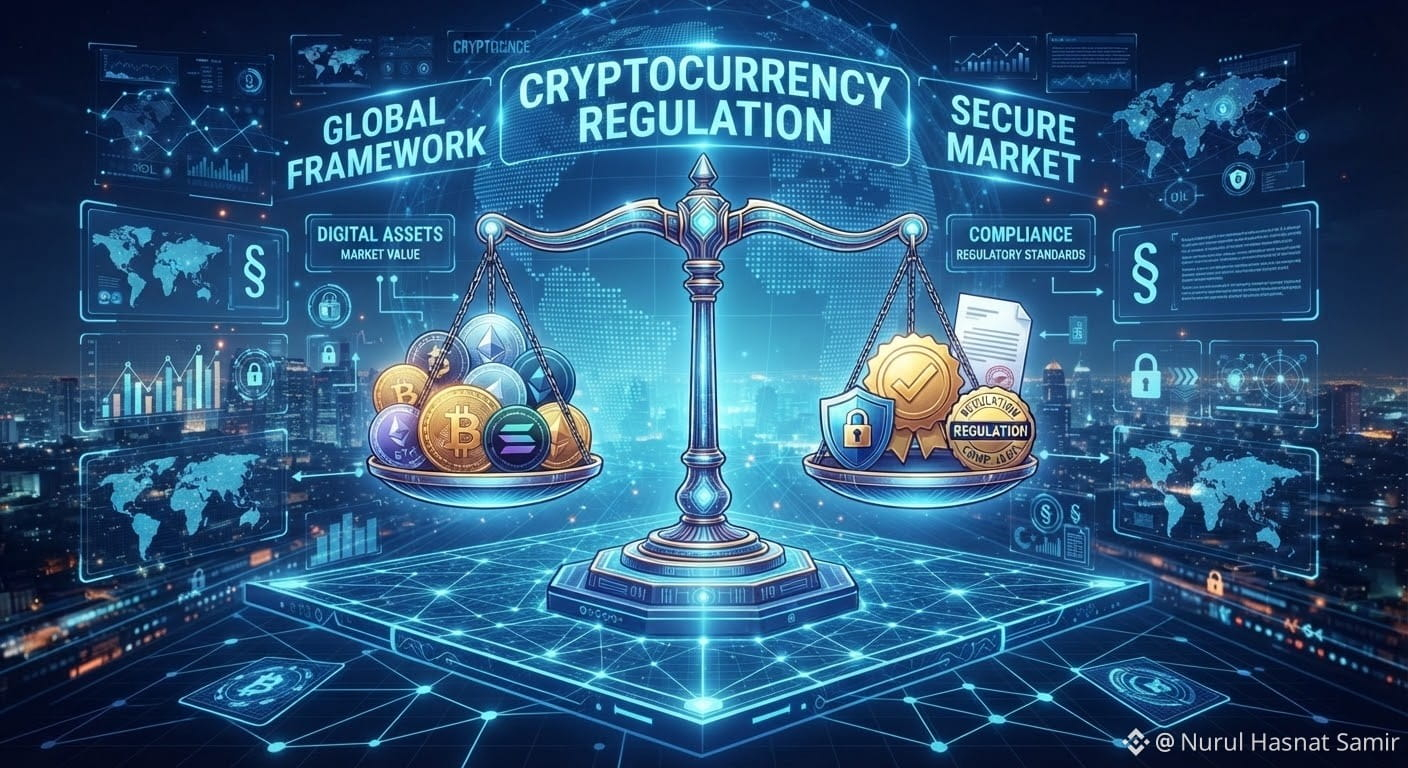
🚨 Crypto Regulation Has Entered a New Phase
Regulators are no longer just writing rules—they are taking money back.
🇬🇧 UK (FCA): Securing court-backed asset recoveries and cracking down on unauthorized crypto activity.
🇺🇸 SEC: Establishing clearer frameworks for functional crypto assets.
🇺🇸 Fed: Implementing formal stablecoin supervision.
What does this mean?
Regulators are past the debate of whether crypto belongs in the financial system. Now, they are actively deciding who gets access, what rules apply, and the severe consequences of breaking them.
The next crypto cycle won't be about "regulation versus innovation."
It will be about regulated crypto versus everyone who can’t meet the standard. 👀
$COIN $CRCL $BTC
{spot}(BTCUSDT)
{stock_us}(CRCL.US)
{stock_us}(COIN.US)
#CryptoRegulation #cryptocurrency #Bitcoin #CryptoNews #Blockchain #FCA #SEC #CryptoCompliance #DigitalAssets #FinancialRegulation
#UKFCAWinsCourtOrderToRecover851400Pounds
🚨 Crypto Regulation Has Entered a New Phase
Regulators are no longer just writing rules—they are taking money back.
🇬🇧 UK (FCA): Securing court-backed asset recoveries and cracking down on unauthorized crypto activity.
🇺🇸 SEC: Establishing clearer frameworks for functional crypto assets.
🇺🇸 Fed: Implementing formal stablecoin supervision.
What does this mean?
Regulators are past the debate of whether crypto belongs in the financial system. Now, they are actively deciding who gets access, what rules apply, and the severe consequences of breaking them.
The next crypto cycle won't be about "regulation versus innovation."
It will be about regulated crypto versus everyone who can’t meet the standard. 👀
$COIN $CRCL $BTC
#CryptoRegulation #cryptocurrency #Bitcoin #CryptoNews #Blockchain #FCA #SEC #CryptoCompliance #DigitalAssets #FinancialRegulation
#UKFCAWinsCourtOrderToRecover851400Pounds
Regulators are no longer just writing rules—they are taking money back.
🇬🇧 UK (FCA): Securing court-backed asset recoveries and cracking down on unauthorized crypto activity.
🇺🇸 SEC: Establishing clearer frameworks for functional crypto assets.
🇺🇸 Fed: Implementing formal stablecoin supervision.
What does this mean?
Regulators are past the debate of whether crypto belongs in the financial system. Now, they are actively deciding who gets access, what rules apply, and the severe consequences of breaking them.
The next crypto cycle won't be about "regulation versus innovation."
It will be about regulated crypto versus everyone who can’t meet the standard. 👀
$COIN $CRCL $BTC
#CryptoRegulation #cryptocurrency #Bitcoin #CryptoNews #Blockchain #FCA #SEC #CryptoCompliance #DigitalAssets #FinancialRegulation
#UKFCAWinsCourtOrderToRecover851400Pounds
1
5

🚨 CONGRESSIONAL INQUIRIES TARGET TRUMP CRYPTO VENTURES CREATING HEADWINDS FOR $TRUMP 🔍
Potential post-midterm Congressional probes into political crypto ventures and prediction markets are introducing structural uncertainty into the ecosystem. Institutional capital typically hedges exposure when regulatory subpoena risks emerge around key figures, prioritizing capital preservation over speculative momentum. 📊
With potential investigations launching by early next year, order flow signals suggest market participants are pricing in elevated political volatility. Smart money will be monitoring key market structure reclaims closely as sentiment calibrates to regulatory scrutiny. 👁️
💬 How are you structuring your risk parameters around political sector tokens amidst upcoming oversight catalysts? 👇
⚠️ Not financial advice. Always manage your risk. 🛡️
🏷️ #TRUMP #CryptoRegulation #PoliFi #MarketStructure
👁️ ⚖️
🚨 CONGRESSIONAL INQUIRIES TARGET TRUMP CRYPTO VENTURES CREATING HEADWINDS FOR $TRUMP 🔍
Potential post-midterm Congressional probes into political crypto ventures and prediction markets are introducing structural uncertainty into the ecosystem. Institutional capital typically hedges exposure when regulatory subpoena risks emerge around key figures, prioritizing capital preservation over speculative momentum. 📊
With potential investigations launching by early next year, order flow signals suggest market participants are pricing in elevated political volatility. Smart money will be monitoring key market structure reclaims closely as sentiment calibrates to regulatory scrutiny. 👁️
💬 How are you structuring your risk parameters around political sector tokens amidst upcoming oversight catalysts? 👇
⚠️ Not financial advice. Always manage your risk. 🛡️
🏷️ #TRUMP #CryptoRegulation #PoliFi #MarketStructure
👁️ ⚖️
Potential post-midterm Congressional probes into political crypto ventures and prediction markets are introducing structural uncertainty into the ecosystem. Institutional capital typically hedges exposure when regulatory subpoena risks emerge around key figures, prioritizing capital preservation over speculative momentum. 📊
With potential investigations launching by early next year, order flow signals suggest market participants are pricing in elevated political volatility. Smart money will be monitoring key market structure reclaims closely as sentiment calibrates to regulatory scrutiny. 👁️
💬 How are you structuring your risk parameters around political sector tokens amidst upcoming oversight catalysts? 👇
⚠️ Not financial advice. Always manage your risk. 🛡️
🏷️ #TRUMP #CryptoRegulation #PoliFi #MarketStructure
👁️ ⚖️
52

·
--
Regulation rarely kills demand. It relocates it.
Every enforcement wave in crypto history produced the same pattern: activity doesn't disappear, it migrates to the most permissive jurisdiction, and the market re-forms wherever the door stays open. Bans on one venue became volume on another. The net effect was rarely less trading. It was less visible, less regulated, more concentrated trading.
That's the uncomfortable part. When liquidity moves offshore, regulators lose their best source of data: the order books, the disclosures, the audited reserves. Heavy-handed rules can produce a market that is harder to supervise than the one they replaced.
But the last few years flipped the script. Clarity, from ETFs to stablecoin frameworks to custody standards, didn't just permit activity. It absorbed demand that had been waiting on the sidelines. Institutional capital doesn't buy because rules exist. It buys because the rules are legible enough to underwrite. The moment compliance becomes a product requirement rather than a legal risk, onshore instruments start outcompeting gray-market alternatives on convenience alone.
The quiet consequence: regulation is becoming a moat. Fixed compliance costs favor scaled incumbents, and the perimeter of acceptable assets keeps widening. First BTC, then ETH, now the long tail fights for a seat.
The signal to watch isn't headlines. It's where issuance, listing decisions, and stablecoin reserves physically move. Liquidity always votes with its feet.
$BTC $ETH $XRP
#CryptoRegulation #Bitcoin #Ethereum #CryptoMarkets #Blockchain
Regulation rarely kills demand. It relocates it.
Every enforcement wave in crypto history produced the same pattern: activity doesn't disappear, it migrates to the most permissive jurisdiction, and the market re-forms wherever the door stays open. Bans on one venue became volume on another. The net effect was rarely less trading. It was less visible, less regulated, more concentrated trading.
That's the uncomfortable part. When liquidity moves offshore, regulators lose their best source of data: the order books, the disclosures, the audited reserves. Heavy-handed rules can produce a market that is harder to supervise than the one they replaced.
But the last few years flipped the script. Clarity, from ETFs to stablecoin frameworks to custody standards, didn't just permit activity. It absorbed demand that had been waiting on the sidelines. Institutional capital doesn't buy because rules exist. It buys because the rules are legible enough to underwrite. The moment compliance becomes a product requirement rather than a legal risk, onshore instruments start outcompeting gray-market alternatives on convenience alone.
The quiet consequence: regulation is becoming a moat. Fixed compliance costs favor scaled incumbents, and the perimeter of acceptable assets keeps widening. First BTC, then ETH, now the long tail fights for a seat.
The signal to watch isn't headlines. It's where issuance, listing decisions, and stablecoin reserves physically move. Liquidity always votes with its feet.
$BTC $ETH $XRP
#CryptoRegulation #Bitcoin #Ethereum #CryptoMarkets #Blockchain
Every enforcement wave in crypto history produced the same pattern: activity doesn't disappear, it migrates to the most permissive jurisdiction, and the market re-forms wherever the door stays open. Bans on one venue became volume on another. The net effect was rarely less trading. It was less visible, less regulated, more concentrated trading.
That's the uncomfortable part. When liquidity moves offshore, regulators lose their best source of data: the order books, the disclosures, the audited reserves. Heavy-handed rules can produce a market that is harder to supervise than the one they replaced.
But the last few years flipped the script. Clarity, from ETFs to stablecoin frameworks to custody standards, didn't just permit activity. It absorbed demand that had been waiting on the sidelines. Institutional capital doesn't buy because rules exist. It buys because the rules are legible enough to underwrite. The moment compliance becomes a product requirement rather than a legal risk, onshore instruments start outcompeting gray-market alternatives on convenience alone.
The quiet consequence: regulation is becoming a moat. Fixed compliance costs favor scaled incumbents, and the perimeter of acceptable assets keeps widening. First BTC, then ETH, now the long tail fights for a seat.
The signal to watch isn't headlines. It's where issuance, listing decisions, and stablecoin reserves physically move. Liquidity always votes with its feet.
$BTC $ETH $XRP
#CryptoRegulation #Bitcoin #Ethereum #CryptoMarkets #Blockchain
67

Hong Kong is stepping up its crypto game through a strategic partnership between the SFC and AFRC. By extending strict financial reporting and audit oversight to licensed virtual asset providers, the region is building a bulletproof compliance framework. While this might add initial friction for operators, it ultimately paves the way for serious institutional capital to flow safely into Asian markets. Regulation is maturing fast. $BTC $ETH #HongKong #CryptoRegulation #Compliance
Hong Kong is stepping up its crypto game through a strategic partnership between the SFC and AFRC. By extending strict financial reporting and audit oversight to licensed virtual asset providers, the region is building a bulletproof compliance framework. While this might add initial friction for operators, it ultimately paves the way for serious institutional capital to flow safely into Asian markets. Regulation is maturing fast. $BTC $ETH #HongKong #CryptoRegulation #Compliance
18
·
--
Bullish
#skoreafscconsidersvirtualassetmarketmaker
🇰🇷 South Korea Weighs Crypto Market Makers: Could Trading Become More Reliable?
South Korea’s Financial Services Commission (FSC) is reviewing whether to introduce a market-making framework for digital assets.
At The Bridge Summit in Seoul on September 28, digital-finance policy director Yoo Young-joon said authorities would examine the approach to improve market efficiency and stability, according to Digital Asset. This remains a policy review.
The discussion follows JPYC’s sharp premium on Upbit earlier this month, highlighting how limited liquidity can distort even a stablecoin’s exchange price, Cointelegraph reported.
Market makers provide buy and sell quotes, helping other traders find counterparties.
My take: The potential benefit is better execution: tighter spreads, more available orders and less slippage. But success would depend on clear obligations, transparent relationships with exchanges and token issuers, and strong monitoring for wash trading or misleading orders.
I would watch who qualifies, how quoting requirements are enforced and whether liquidity remains available during stressed conditions. Higher reported volume alone would be a weak test; consistent execution quality would offer stronger evidence that ordinary users benefit.
For traders, the practical question is whether orders can be filled at predictable prices, especially when markets become volatile.
What safeguard would matter most to you in a regulated crypto market-maker framework? 👇
#SKoreaFSCConsidersVirtualAssetMarketMaker #CryptoRegulation #MarketLiquidity
$BTW $ONE $QNT
{future}(QNTUSDT)
{future}(ONEUSDT)
{future}(BTWUSDT)
#skoreafscconsidersvirtualassetmarketmaker
🇰🇷 South Korea Weighs Crypto Market Makers: Could Trading Become More Reliable?
South Korea’s Financial Services Commission (FSC) is reviewing whether to introduce a market-making framework for digital assets.
At The Bridge Summit in Seoul on September 28, digital-finance policy director Yoo Young-joon said authorities would examine the approach to improve market efficiency and stability, according to Digital Asset. This remains a policy review.
The discussion follows JPYC’s sharp premium on Upbit earlier this month, highlighting how limited liquidity can distort even a stablecoin’s exchange price, Cointelegraph reported.
Market makers provide buy and sell quotes, helping other traders find counterparties.
My take: The potential benefit is better execution: tighter spreads, more available orders and less slippage. But success would depend on clear obligations, transparent relationships with exchanges and token issuers, and strong monitoring for wash trading or misleading orders.
I would watch who qualifies, how quoting requirements are enforced and whether liquidity remains available during stressed conditions. Higher reported volume alone would be a weak test; consistent execution quality would offer stronger evidence that ordinary users benefit.
For traders, the practical question is whether orders can be filled at predictable prices, especially when markets become volatile.
What safeguard would matter most to you in a regulated crypto market-maker framework? 👇
#SKoreaFSCConsidersVirtualAssetMarketMaker #CryptoRegulation #MarketLiquidity
$BTW $ONE $QNT
🇰🇷 South Korea Weighs Crypto Market Makers: Could Trading Become More Reliable?
South Korea’s Financial Services Commission (FSC) is reviewing whether to introduce a market-making framework for digital assets.
At The Bridge Summit in Seoul on September 28, digital-finance policy director Yoo Young-joon said authorities would examine the approach to improve market efficiency and stability, according to Digital Asset. This remains a policy review.
The discussion follows JPYC’s sharp premium on Upbit earlier this month, highlighting how limited liquidity can distort even a stablecoin’s exchange price, Cointelegraph reported.
Market makers provide buy and sell quotes, helping other traders find counterparties.
My take: The potential benefit is better execution: tighter spreads, more available orders and less slippage. But success would depend on clear obligations, transparent relationships with exchanges and token issuers, and strong monitoring for wash trading or misleading orders.
I would watch who qualifies, how quoting requirements are enforced and whether liquidity remains available during stressed conditions. Higher reported volume alone would be a weak test; consistent execution quality would offer stronger evidence that ordinary users benefit.
For traders, the practical question is whether orders can be filled at predictable prices, especially when markets become volatile.
What safeguard would matter most to you in a regulated crypto market-maker framework? 👇
#SKoreaFSCConsidersVirtualAssetMarketMaker #CryptoRegulation #MarketLiquidity
$BTW $ONE $QNT

1.8k

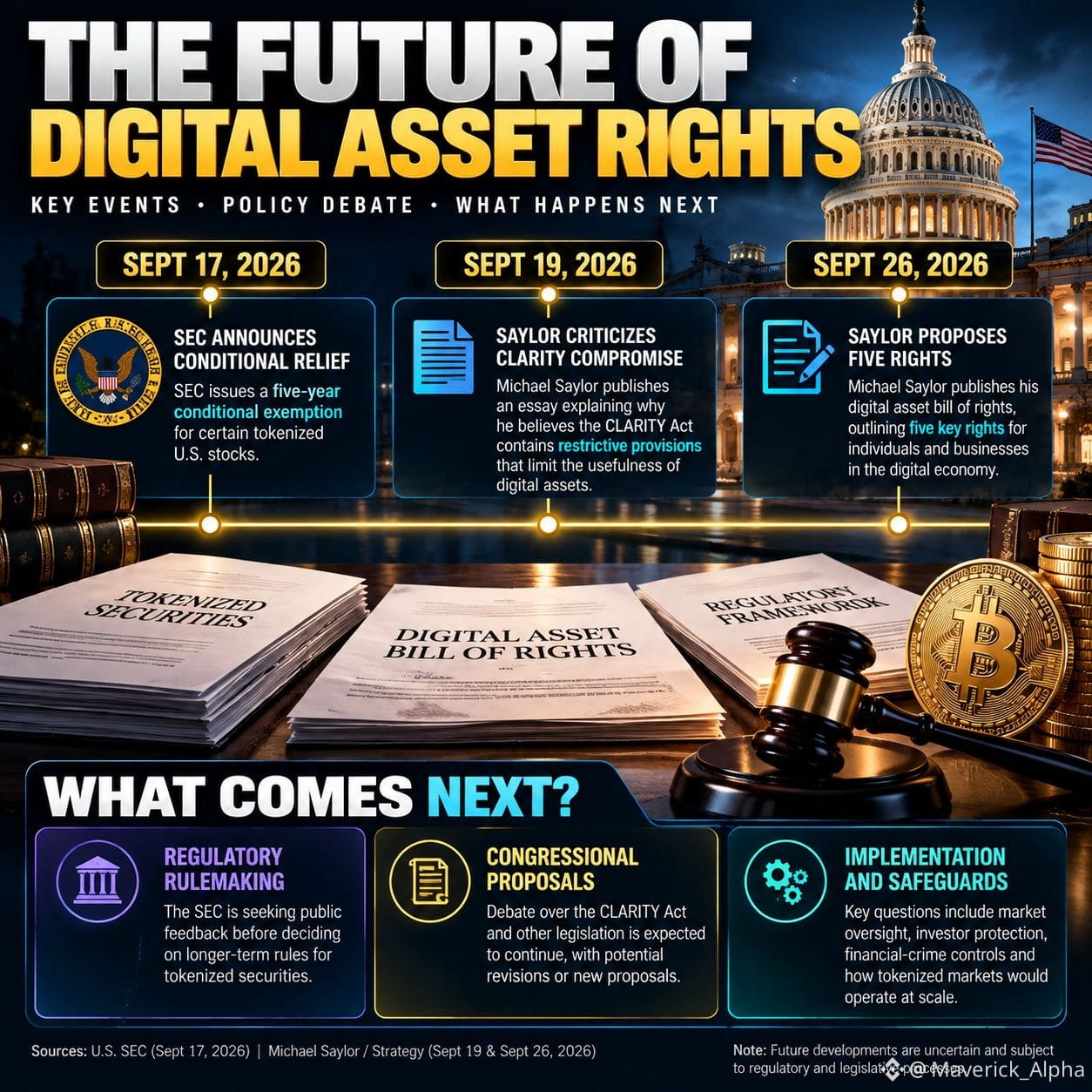
SAYLOR PROPOSES FIVE RIGHTS FOR DIGITAL ASSETS NOW
Michael Saylor has proposed a new framework for digital asset rights, challenging the restrictions he sees in the CLARITY Act.
His proposal centers on five rights: create, issue, custody, transfer and use digital assets.
He also calls for stronger financial privacy, more flexible tokenized securities, broader Bitcoin banking services and greater competition in digital-dollar products.
Saylor argues that restrictive legislation could limit innovation even while providing regulatory certainty.
But his framework is a policy proposal, not an enacted law. Questions around investor protection, financial crime and market oversight remain central to the debate.
MY FINAL TAKE
The important development is the debate over how future rules could balance digital asset ownership, financial innovation and regulatory safeguards.
Will Saylor's proposed framework influence the next phase of U.S. crypto regulation?
#bitcoin #CryptoRegulation
$BTC
{future}(BTCUSDT)
SAYLOR PROPOSES FIVE RIGHTS FOR DIGITAL ASSETS NOW
Michael Saylor has proposed a new framework for digital asset rights, challenging the restrictions he sees in the CLARITY Act.
His proposal centers on five rights: create, issue, custody, transfer and use digital assets.
He also calls for stronger financial privacy, more flexible tokenized securities, broader Bitcoin banking services and greater competition in digital-dollar products.
Saylor argues that restrictive legislation could limit innovation even while providing regulatory certainty.
But his framework is a policy proposal, not an enacted law. Questions around investor protection, financial crime and market oversight remain central to the debate.
MY FINAL TAKE
The important development is the debate over how future rules could balance digital asset ownership, financial innovation and regulatory safeguards.
Will Saylor's proposed framework influence the next phase of U.S. crypto regulation?
#bitcoin #CryptoRegulation
$BTC
Michael Saylor has proposed a new framework for digital asset rights, challenging the restrictions he sees in the CLARITY Act.
His proposal centers on five rights: create, issue, custody, transfer and use digital assets.
He also calls for stronger financial privacy, more flexible tokenized securities, broader Bitcoin banking services and greater competition in digital-dollar products.
Saylor argues that restrictive legislation could limit innovation even while providing regulatory certainty.
But his framework is a policy proposal, not an enacted law. Questions around investor protection, financial crime and market oversight remain central to the debate.
MY FINAL TAKE
The important development is the debate over how future rules could balance digital asset ownership, financial innovation and regulatory safeguards.
Will Saylor's proposed framework influence the next phase of U.S. crypto regulation?
#bitcoin #CryptoRegulation
$BTC
48

·
--
Bullish
California Tightens Rules on Official-Linked Meme Coins From 2027
🏛️ Governor Gavin Newsom signed AB 2409 on September 27, banning California public officials and certain government employees from issuing meme coins.
📌 From January 1, 2027, digital asset service providers will also be barred from offering California residents newly issued meme coins linked to federal, state, or local public officials.
🪙 The law does not amount to a general ban on meme coins. Tokens issued before 2027, including the existing $TRUMP token, are not required to be delisted under this provision.
⚖️ The near-term impact is therefore more likely to be felt through compliance and exchange listing policies than through direct moves in BTC, ETH, or existing meme coins.
#CryptoRegulation
California Tightens Rules on Official-Linked Meme Coins From 2027
🏛️ Governor Gavin Newsom signed AB 2409 on September 27, banning California public officials and certain government employees from issuing meme coins.
📌 From January 1, 2027, digital asset service providers will also be barred from offering California residents newly issued meme coins linked to federal, state, or local public officials.
🪙 The law does not amount to a general ban on meme coins. Tokens issued before 2027, including the existing $TRUMP token, are not required to be delisted under this provision.
⚖️ The near-term impact is therefore more likely to be felt through compliance and exchange listing policies than through direct moves in BTC, ETH, or existing meme coins.
#CryptoRegulation
🏛️ Governor Gavin Newsom signed AB 2409 on September 27, banning California public officials and certain government employees from issuing meme coins.
📌 From January 1, 2027, digital asset service providers will also be barred from offering California residents newly issued meme coins linked to federal, state, or local public officials.
🪙 The law does not amount to a general ban on meme coins. Tokens issued before 2027, including the existing $TRUMP token, are not required to be delisted under this provision.
⚖️ The near-term impact is therefore more likely to be felt through compliance and exchange listing policies than through direct moves in BTC, ETH, or existing meme coins.
#CryptoRegulation

1
149

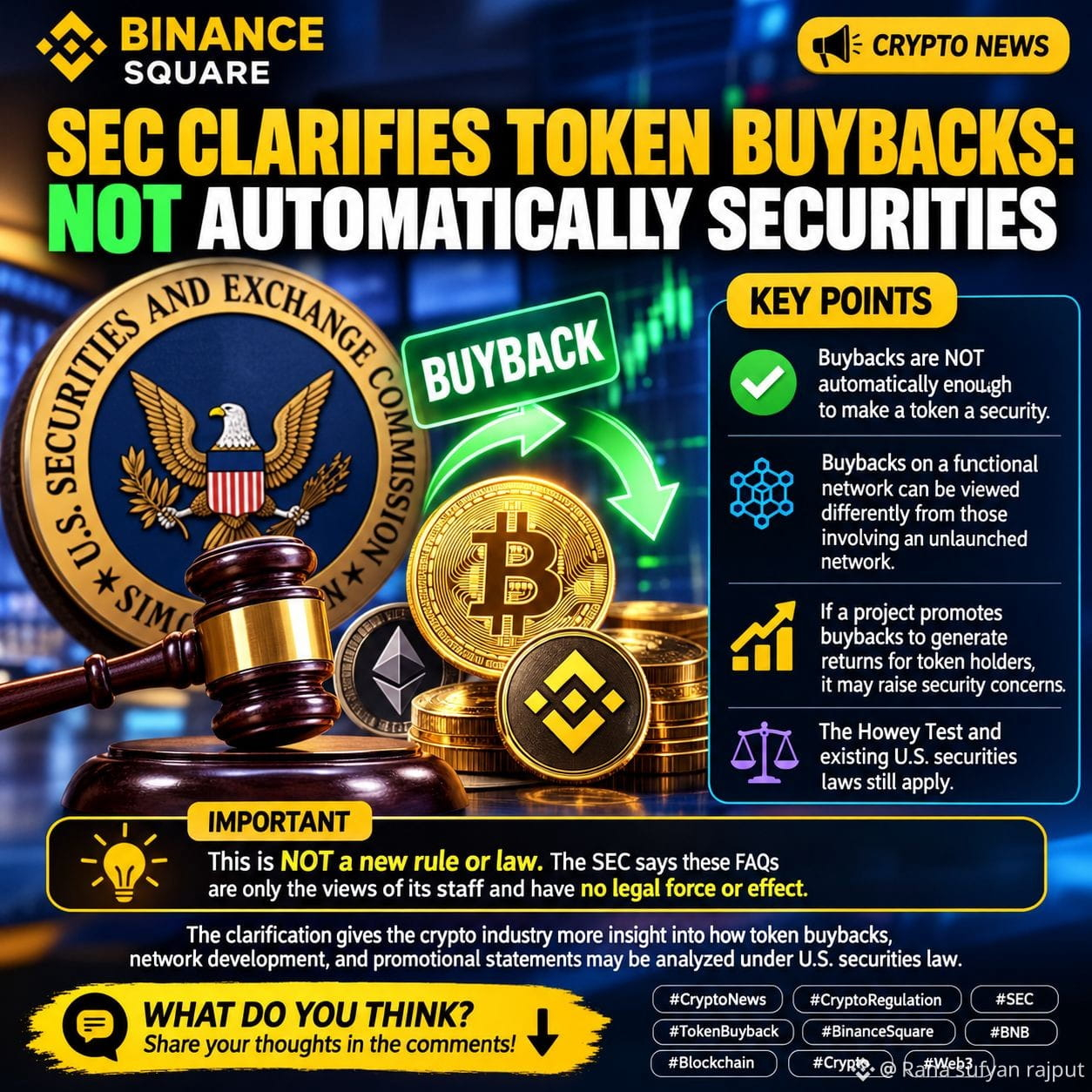
🚨 SEC Clarifies Token Buybacks: Not Automatically Securities
The U.S. Securities and Exchange Commission (SEC) has provided new clarification on how token buybacks may be viewed under U.S. securities laws.
According to the SEC’s September 25, 2026 staff FAQ, a buyback of a non-security crypto asset on a functional network does not, by itself, constitute a promise of essential managerial efforts. However, the circumstances and how the buyback is presented still matter. �
SEC
🔎 What does this mean?
Previously, some crypto projects were concerned that announcing token buybacks or burns could automatically create securities-law issues.
The SEC staff clarification indicates that:
✅ Buybacks are not automatically enough to make a token a security.
✅ Buybacks on an already-functional network can be viewed differently from those involving an unlaunched network.
✅ If a project promotes a buyback as a way to generate returns for token holders, the analysis can be different.
✅ The Howey Test and existing securities laws still apply where relevant. �
SEC +1
⚠️ Important clarification
This is not a new SEC rule or law. The SEC explicitly says these FAQs represent the views of Division of Corporation Finance staff, have no legal force or effect, and do not change existing law. �
SEC
For the crypto industry, the clarification provides additional insight into how token buybacks, network development and promotional statements may be analyzed under U.S. securities law.
What do you think about the SEC's latest crypto clarification? 👇
$BNB $ONDO $SHIB
#CryptoNews #CryptoRegulation #SEC #BinanceSquare #BNB
🚨 SEC Clarifies Token Buybacks: Not Automatically Securities
The U.S. Securities and Exchange Commission (SEC) has provided new clarification on how token buybacks may be viewed under U.S. securities laws.
According to the SEC’s September 25, 2026 staff FAQ, a buyback of a non-security crypto asset on a functional network does not, by itself, constitute a promise of essential managerial efforts. However, the circumstances and how the buyback is presented still matter. �
SEC
🔎 What does this mean?
Previously, some crypto projects were concerned that announcing token buybacks or burns could automatically create securities-law issues.
The SEC staff clarification indicates that:
✅ Buybacks are not automatically enough to make a token a security.
✅ Buybacks on an already-functional network can be viewed differently from those involving an unlaunched network.
✅ If a project promotes a buyback as a way to generate returns for token holders, the analysis can be different.
✅ The Howey Test and existing securities laws still apply where relevant. �
SEC +1
⚠️ Important clarification
This is not a new SEC rule or law. The SEC explicitly says these FAQs represent the views of Division of Corporation Finance staff, have no legal force or effect, and do not change existing law. �
SEC
For the crypto industry, the clarification provides additional insight into how token buybacks, network development and promotional statements may be analyzed under U.S. securities law.
What do you think about the SEC's latest crypto clarification? 👇
$BNB $ONDO $SHIB
#CryptoNews #CryptoRegulation #SEC #BinanceSquare #BNB
The U.S. Securities and Exchange Commission (SEC) has provided new clarification on how token buybacks may be viewed under U.S. securities laws.
According to the SEC’s September 25, 2026 staff FAQ, a buyback of a non-security crypto asset on a functional network does not, by itself, constitute a promise of essential managerial efforts. However, the circumstances and how the buyback is presented still matter. �
SEC
🔎 What does this mean?
Previously, some crypto projects were concerned that announcing token buybacks or burns could automatically create securities-law issues.
The SEC staff clarification indicates that:
✅ Buybacks are not automatically enough to make a token a security.
✅ Buybacks on an already-functional network can be viewed differently from those involving an unlaunched network.
✅ If a project promotes a buyback as a way to generate returns for token holders, the analysis can be different.
✅ The Howey Test and existing securities laws still apply where relevant. �
SEC +1
⚠️ Important clarification
This is not a new SEC rule or law. The SEC explicitly says these FAQs represent the views of Division of Corporation Finance staff, have no legal force or effect, and do not change existing law. �
SEC
For the crypto industry, the clarification provides additional insight into how token buybacks, network development and promotional statements may be analyzed under U.S. securities law.
What do you think about the SEC's latest crypto clarification? 👇
$BNB $ONDO $SHIB
#CryptoNews #CryptoRegulation #SEC #BinanceSquare #BNB
260

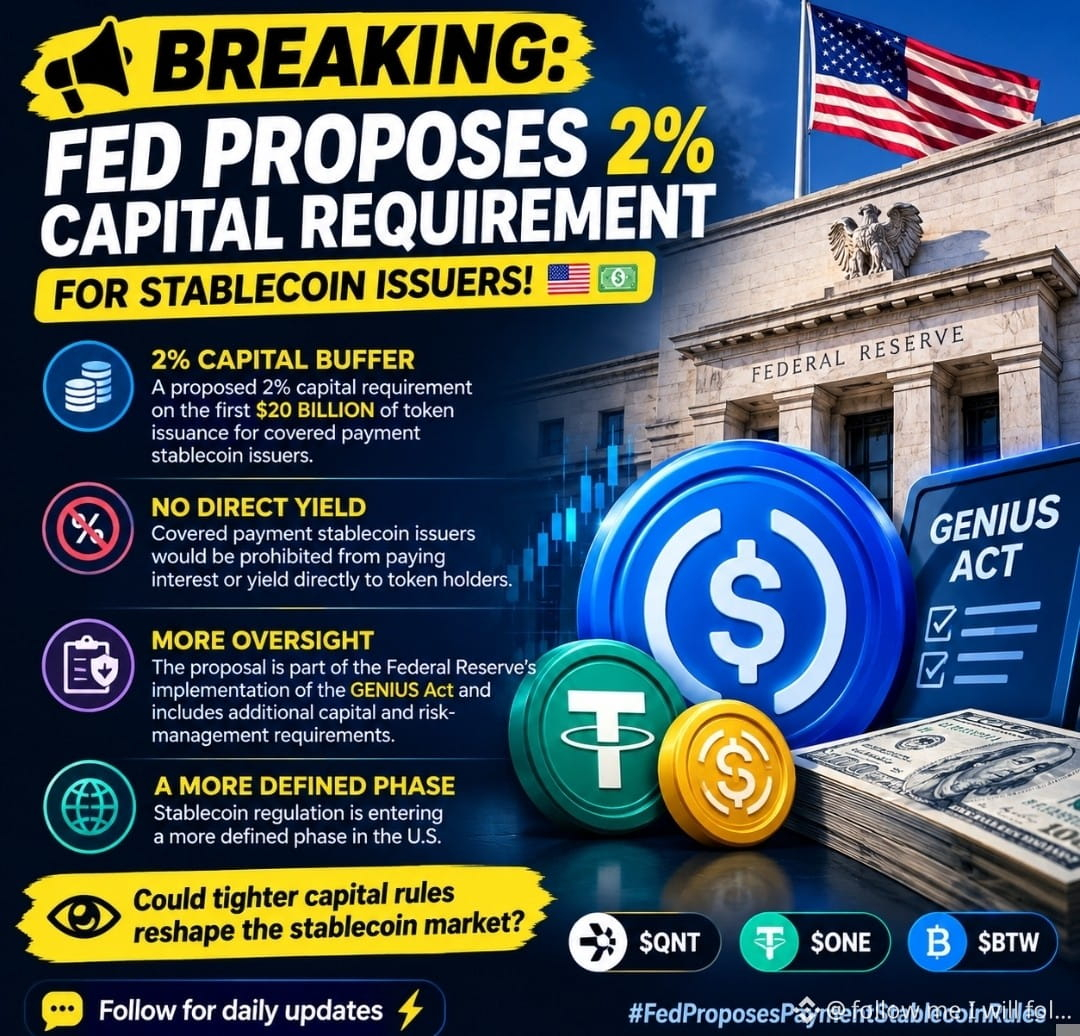
🚨BREAKING: Fed Proposes New Rules for Payment Stablecoin Issuers! 🇺🇸💵
Could this reshape the future of stablecoins? 👀
The proposed U.S. framework includes some major requirements for covered payment stablecoin issuers:
🏦 2% Capital Buffer
A proposed 2% capital requirement on the first $20 billion of token issuance.
🚫 No Direct Yield to Token Holders
Covered payment stablecoin issuers would be prohibited from paying interest or yield directly to token holders.
📋 More Oversight
The proposal also includes additional capital and risk-management requirements as part of the Federal Reserve’s implementation of the GENIUS Act.
🌐 Why does it matter?
Stablecoins play an important role in crypto payments and digital finance. New capital and compliance rules could influence how issuers operate and compete.
⚠️ Important: These are proposed requirements—not a statement that the rules are already in effect. The final impact will depend on the regulatory process and final requirements.
💬 Your take: Could stricter rules increase confidence in stablecoins, or make it harder for smaller issuers to compete?
Follow for more crypto and regulatory updates. ⚡
$QNT $ONE $BTW
#Stablecoins #Fed #GENIUSAct #CryptoRegulation #DigitalAssets #blockchain
🚨BREAKING: Fed Proposes New Rules for Payment Stablecoin Issuers! 🇺🇸💵
Could this reshape the future of stablecoins? 👀
The proposed U.S. framework includes some major requirements for covered payment stablecoin issuers:
🏦 2% Capital Buffer
A proposed 2% capital requirement on the first $20 billion of token issuance.
🚫 No Direct Yield to Token Holders
Covered payment stablecoin issuers would be prohibited from paying interest or yield directly to token holders.
📋 More Oversight
The proposal also includes additional capital and risk-management requirements as part of the Federal Reserve’s implementation of the GENIUS Act.
🌐 Why does it matter?
Stablecoins play an important role in crypto payments and digital finance. New capital and compliance rules could influence how issuers operate and compete.
⚠️ Important: These are proposed requirements—not a statement that the rules are already in effect. The final impact will depend on the regulatory process and final requirements.
💬 Your take: Could stricter rules increase confidence in stablecoins, or make it harder for smaller issuers to compete?
Follow for more crypto and regulatory updates. ⚡
$QNT $ONE $BTW
#Stablecoins #Fed #GENIUSAct #CryptoRegulation #DigitalAssets #blockchain
Could this reshape the future of stablecoins? 👀
The proposed U.S. framework includes some major requirements for covered payment stablecoin issuers:
🏦 2% Capital Buffer
A proposed 2% capital requirement on the first $20 billion of token issuance.
🚫 No Direct Yield to Token Holders
Covered payment stablecoin issuers would be prohibited from paying interest or yield directly to token holders.
📋 More Oversight
The proposal also includes additional capital and risk-management requirements as part of the Federal Reserve’s implementation of the GENIUS Act.
🌐 Why does it matter?
Stablecoins play an important role in crypto payments and digital finance. New capital and compliance rules could influence how issuers operate and compete.
⚠️ Important: These are proposed requirements—not a statement that the rules are already in effect. The final impact will depend on the regulatory process and final requirements.
💬 Your take: Could stricter rules increase confidence in stablecoins, or make it harder for smaller issuers to compete?
Follow for more crypto and regulatory updates. ⚡
$QNT $ONE $BTW
#Stablecoins #Fed #GENIUSAct #CryptoRegulation #DigitalAssets #blockchain
1
548
Log in to explore more content
Join global crypto users on Binance Square
⚡️ Get latest and useful information about crypto.
💬 Trusted by the world’s largest crypto exchange.
👍 Discover real insights from verified creators.
Email / Phone number
Trending Topics
1
#EarningsSeason
103,794 views
1,006 Discussing
2
#ECBToTestAIAgentsInDigitalEuroPayments
2,754 views
181 Discussing
3
#JapanFSABacksFourthStablecoinTradeSettlementPilot
4,647 views
260 Discussing
4
#BitgetHackerFailsToMoveStolenFunds
13,922 views
395 Discussing
5
#BitMineETHHoldingsTop6Million
16,027 views
541 Discussing
6
#StrategyAdds1666BTCHoldingsReach847666
13,588 views
377 Discussing
7
#NvidiaApproves$150BBuyback
3,625 views
63 Discussing
8
#OpenAIDelaysGPT6.1OverSafetyIssues
26,022 views
709 Discussing
9
#AMDToAcquireWorldLabsFor$8.2B
1,798 views
52 Discussing
10
#AnthropicIPOProspectusCouldValueItOver$2T
5,724 views
77 Discussing