

#bitgetsays$352maffectedinhack
bitgetsays$352maffectedinhack
36,587 views
102 Discussing
Hot
Latest

·
--
Bearish
$ETH
{future}(ETHUSDT)
🚨The Bitget hacker has converted stolen USDC into ETH after a breach that the exchange valued at about $351.6 million, renewing questions about when Circle freezes funds linked to an attack.#BitgetSays$352MAffectedInHack
$ETH
🚨The Bitget hacker has converted stolen USDC into ETH after a breach that the exchange valued at about $351.6 million, renewing questions about when Circle freezes funds linked to an attack.#BitgetSays$352MAffectedInHack
🚨The Bitget hacker has converted stolen USDC into ETH after a breach that the exchange valued at about $351.6 million, renewing questions about when Circle freezes funds linked to an attack.#BitgetSays$352MAffectedInHack
228

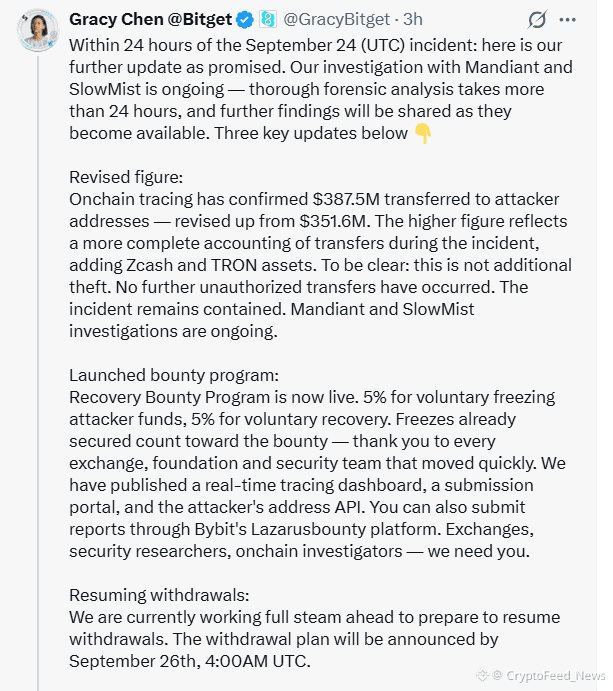
🚨#Bitget says an attacker compromised part of its hot/warm wallet infrastructure, triggering unauthorized transfers worth an estimated $351.6M.
🔒 Cold wallets: Safe, according to Bitget
💰 User balances: Reportedly unaffected
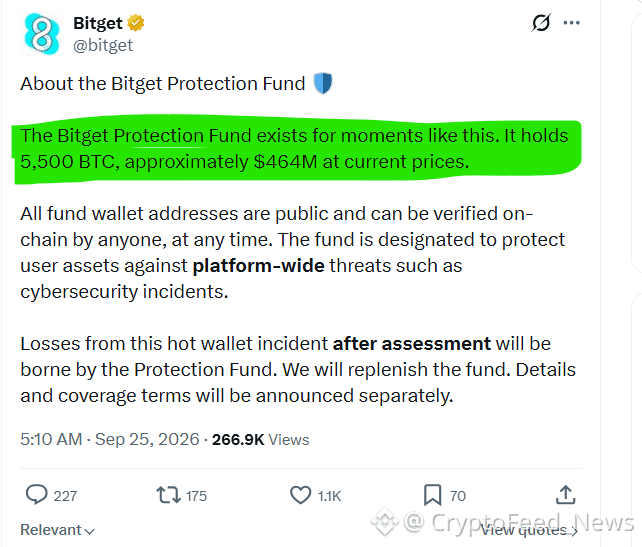
🛡️ Protection Fund: $464M+
⛔ Withdrawals: Paused
✅ Trading & deposits: Still live
The attacker allegedly compromised a backend system and spoofed transaction data to bypass authorization. Bitget says private keys were not compromised and the breach has been contained.
On-chain researchers had previously identified around $183M in suspicious transfers, creating a discrepancy with Bitget's $351.6M estimate.
BGB fell nearly 3% after the news. $ETH 👀
#BitgetBreachForgedRequestsNotStolenKeys #BitgetSays$352MAffectedInHack #Write2Earn
🚨#Bitget says an attacker compromised part of its hot/warm wallet infrastructure, triggering unauthorized transfers worth an estimated $351.6M.
🔒 Cold wallets: Safe, according to Bitget
💰 User balances: Reportedly unaffected
🛡️ Protection Fund: $464M+
⛔ Withdrawals: Paused
✅ Trading & deposits: Still live
The attacker allegedly compromised a backend system and spoofed transaction data to bypass authorization. Bitget says private keys were not compromised and the breach has been contained.
On-chain researchers had previously identified around $183M in suspicious transfers, creating a discrepancy with Bitget's $351.6M estimate.
BGB fell nearly 3% after the news. $ETH 👀
#BitgetBreachForgedRequestsNotStolenKeys #BitgetSays$352MAffectedInHack #Write2Earn
🔒 Cold wallets: Safe, according to Bitget
💰 User balances: Reportedly unaffected
🛡️ Protection Fund: $464M+
⛔ Withdrawals: Paused
✅ Trading & deposits: Still live
The attacker allegedly compromised a backend system and spoofed transaction data to bypass authorization. Bitget says private keys were not compromised and the breach has been contained.
On-chain researchers had previously identified around $183M in suspicious transfers, creating a discrepancy with Bitget's $351.6M estimate.
BGB fell nearly 3% after the news. $ETH 👀
#BitgetBreachForgedRequestsNotStolenKeys #BitgetSays$352MAffectedInHack #Write2Earn
292

·
--
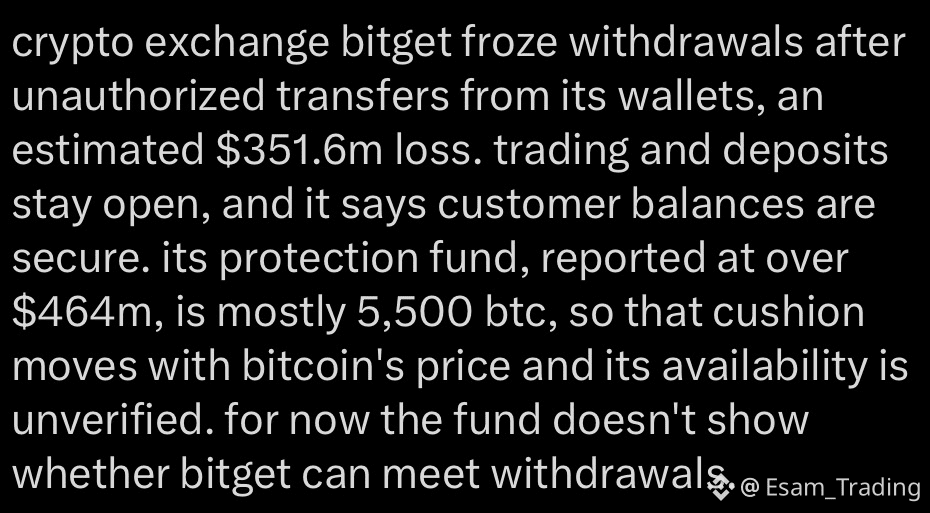
That’s why I always prefer Binance as the best exchange in terms of safe funds. 5,500 $BTC worth of profection fund is only available on Bitget (roughly $464m) whereas the hacker stole roughly $351m (still unverified-could be more than that).
#BitgetSays$352MAffectedInHack
That’s why I always prefer Binance as the best exchange in terms of safe funds. 5,500 $BTC worth of profection fund is only available on Bitget (roughly $464m) whereas the hacker stole roughly $351m (still unverified-could be more than that).
#BitgetSays$352MAffectedInHack
#BitgetSays$352MAffectedInHack

Iqra Logic Hub:
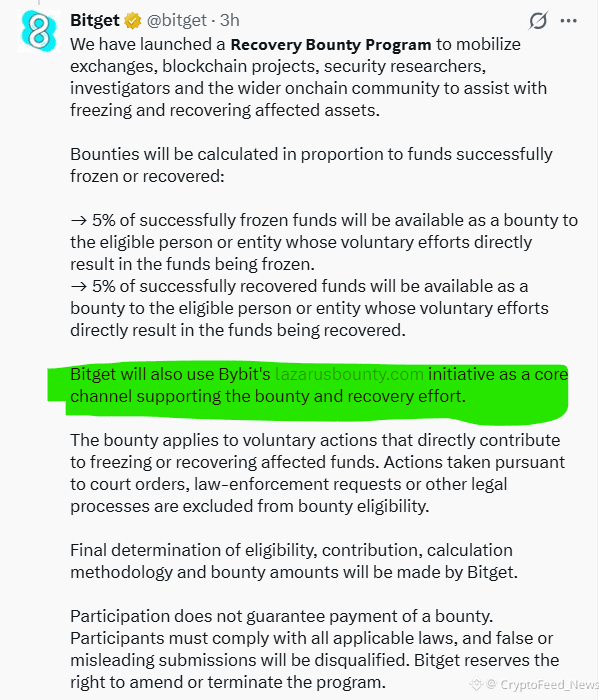
🚨 Bitget's hacker moved fast — converting stolen USDC into ETH before Circle could freeze it. Only ~$318K of the $351.6M breach got blocked; the rest (60,000+ ETH) is now unfreezable. Renews the debate: are stablecoin freezes actually fast enough?
6
1
18
39.5k

·
--
Bearish
#BitgetSays$352MAffectedInHack
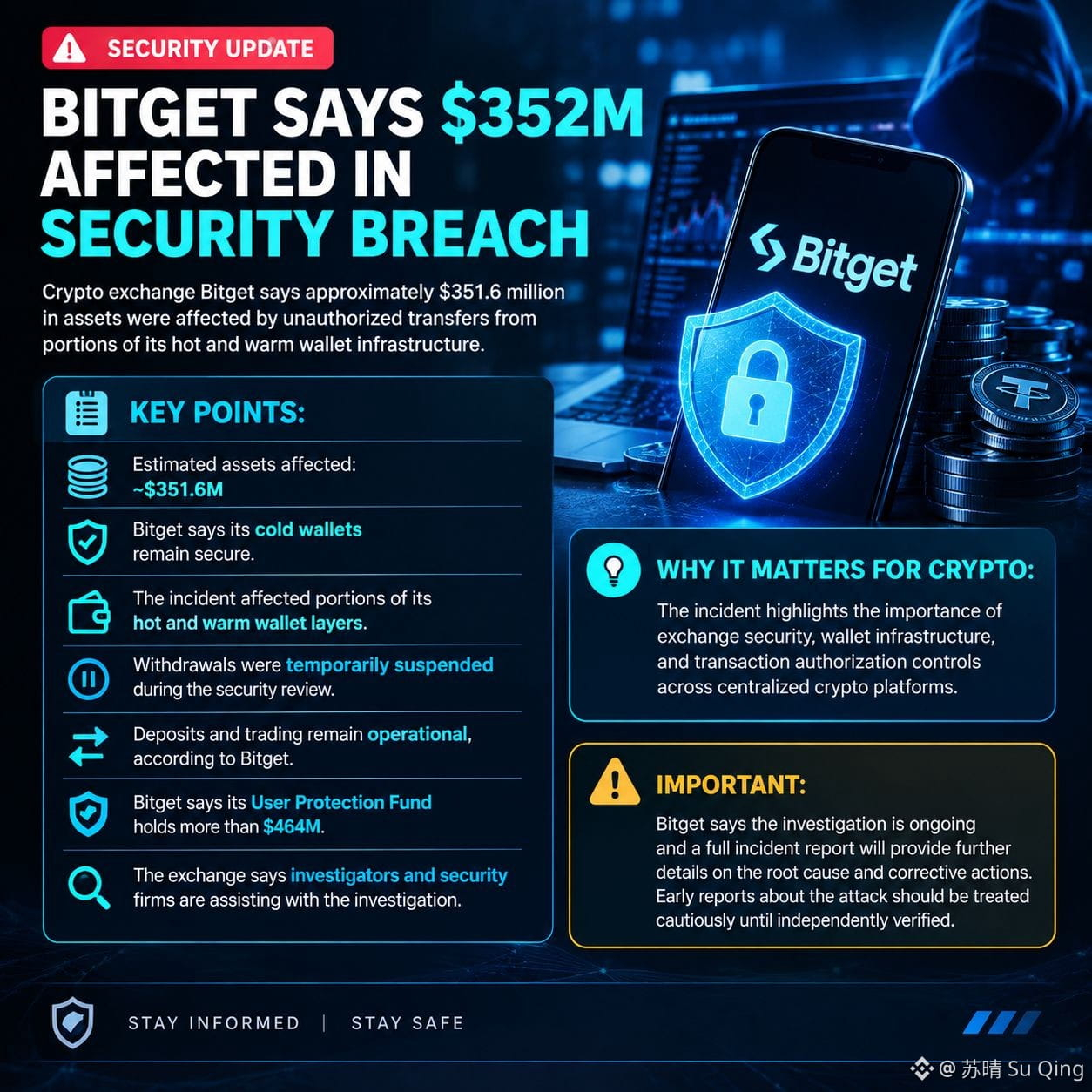
🚨 BITGET SAYS $352M AFFECTED IN SECURITY BREACH
Crypto exchange Bitget says approximately $351.6 million in assets were affected by unauthorized transfers from portions of its hot and warm wallet infrastructure.
📊 Key points:
• Estimated assets affected: ~$351.6M
• Bitget says its cold wallets remain secure
• The incident affected portions of its hot and warm wallet layers
• Withdrawals were temporarily suspended during the security review
• Deposits and trading remain operational, according to Bitget
• Bitget says its User Protection Fund holds more than $464M
• The exchange says investigators and security firms are assisting with the investigation
🔎 Why it matters for crypto:
The incident highlights the importance of exchange security, wallet infrastructure, and transaction authorization controls across centralized crypto platforms.
⚠️ Important:
Bitget says the investigation is ongoing and a full incident report will provide further details on the root cause and corrective actions. Early reports about the attack should be treated cautiously until independently verified.
$ETC
{future}(ETCUSDT)
$MINA
{future}(MINAUSDT)
$TST
{future}(TSTUSDT)
#BitgetSays$352MAffectedInHack
🚨 BITGET SAYS $352M AFFECTED IN SECURITY BREACH
Crypto exchange Bitget says approximately $351.6 million in assets were affected by unauthorized transfers from portions of its hot and warm wallet infrastructure.
📊 Key points:
• Estimated assets affected: ~$351.6M
• Bitget says its cold wallets remain secure
• The incident affected portions of its hot and warm wallet layers
• Withdrawals were temporarily suspended during the security review
• Deposits and trading remain operational, according to Bitget
• Bitget says its User Protection Fund holds more than $464M
• The exchange says investigators and security firms are assisting with the investigation
🔎 Why it matters for crypto:
The incident highlights the importance of exchange security, wallet infrastructure, and transaction authorization controls across centralized crypto platforms.
⚠️ Important:
Bitget says the investigation is ongoing and a full incident report will provide further details on the root cause and corrective actions. Early reports about the attack should be treated cautiously until independently verified.
$ETC
$MINA
$TST
🚨 BITGET SAYS $352M AFFECTED IN SECURITY BREACH
Crypto exchange Bitget says approximately $351.6 million in assets were affected by unauthorized transfers from portions of its hot and warm wallet infrastructure.
📊 Key points:
• Estimated assets affected: ~$351.6M
• Bitget says its cold wallets remain secure
• The incident affected portions of its hot and warm wallet layers
• Withdrawals were temporarily suspended during the security review
• Deposits and trading remain operational, according to Bitget
• Bitget says its User Protection Fund holds more than $464M
• The exchange says investigators and security firms are assisting with the investigation
🔎 Why it matters for crypto:
The incident highlights the importance of exchange security, wallet infrastructure, and transaction authorization controls across centralized crypto platforms.
⚠️ Important:
Bitget says the investigation is ongoing and a full incident report will provide further details on the root cause and corrective actions. Early reports about the attack should be treated cautiously until independently verified.
$ETC
$MINA
$TST
67

·
--
Bearish
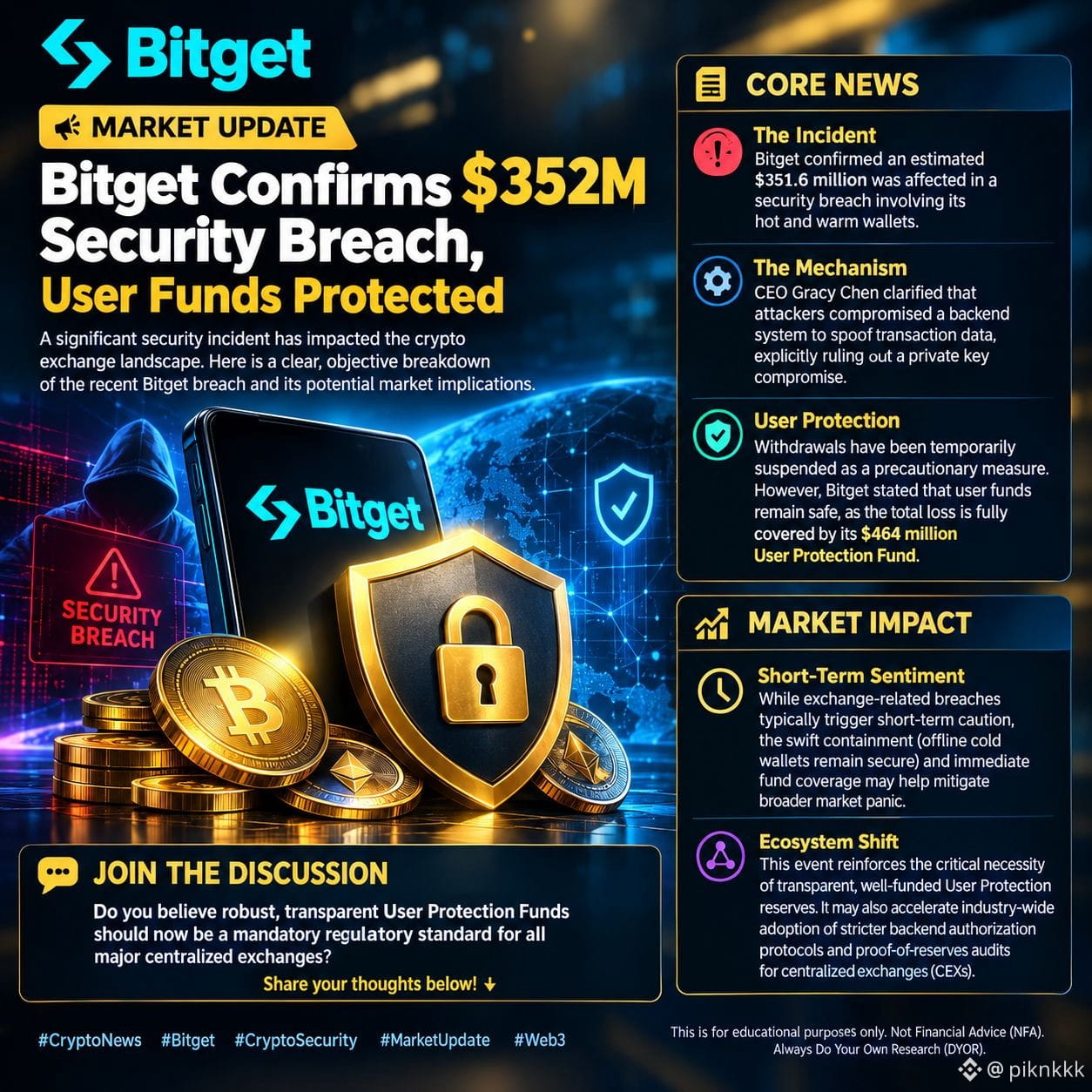
#BitgetSays$352MAffectedInHack 🔍 Market Update: Bitget Confirms $352M Security Breach, User Funds Protected
A significant security incident has impacted the crypto exchange landscape. Here is a clear, objective breakdown of the recent Bitget breach and its potential market implications.
📌 Core News
• The Incident Bitget confirmed an estimated $351.6 million was affected in a security breach involving its hot and warm wallets.
•The Mechanism CEO Gracy Chen clarified that attackers compromised a backend system to spoof transaction data, explicitly ruling out a private key compromise.
• User Protection Withdrawals have been temporarily suspended as a precautionary security measure. However, Bitget stated that user funds remain safe, as the total loss is fully covered by its $464 million User Protection Fund.
📊 Market Impact
• Short-Term Sentiment While exchange-related breaches typically trigger short-term caution, the swift containment (offline cold wallets remain secure) and immediate fund coverage may help mitigate broader market panic.
• **Ecosystem Shift**: This event reinforces the critical necessity of transparent, well-funded User Protection reserves. It may also accelerate industry-wide adoption of stricter backend authorization protocols and proof-of-reserves audits for centralized exchanges (CEXs).
💬 Join the Discussion
Do you believe robust, transparent User Protection Funds should now be a mandatory regulatory standard for all major centralized exchanges? Share your thoughts below! 👇
#CryptoNews #Bitget #CryptoSecurity #MarketUpdate #Web3
This is for educational purposes only. Not Financial Advice (NFA). Always Do Your Own Research (DYOR).
$TUT $MUBARAK $SAGA
{future}(SAGAUSDT)
{future}(MUBARAKUSDT)
{future}(TUTUSDT)
#BitgetSays$352MAffectedInHack 🔍 Market Update: Bitget Confirms $352M Security Breach, User Funds Protected
A significant security incident has impacted the crypto exchange landscape. Here is a clear, objective breakdown of the recent Bitget breach and its potential market implications.
📌 Core News
• The Incident Bitget confirmed an estimated $351.6 million was affected in a security breach involving its hot and warm wallets.
•The Mechanism CEO Gracy Chen clarified that attackers compromised a backend system to spoof transaction data, explicitly ruling out a private key compromise.
• User Protection Withdrawals have been temporarily suspended as a precautionary security measure. However, Bitget stated that user funds remain safe, as the total loss is fully covered by its $464 million User Protection Fund.
📊 Market Impact
• Short-Term Sentiment While exchange-related breaches typically trigger short-term caution, the swift containment (offline cold wallets remain secure) and immediate fund coverage may help mitigate broader market panic.
• **Ecosystem Shift**: This event reinforces the critical necessity of transparent, well-funded User Protection reserves. It may also accelerate industry-wide adoption of stricter backend authorization protocols and proof-of-reserves audits for centralized exchanges (CEXs).
💬 Join the Discussion
Do you believe robust, transparent User Protection Funds should now be a mandatory regulatory standard for all major centralized exchanges? Share your thoughts below! 👇
#CryptoNews #Bitget #CryptoSecurity #MarketUpdate #Web3
This is for educational purposes only. Not Financial Advice (NFA). Always Do Your Own Research (DYOR).
$TUT $MUBARAK $SAGA
A significant security incident has impacted the crypto exchange landscape. Here is a clear, objective breakdown of the recent Bitget breach and its potential market implications.
📌 Core News
• The Incident Bitget confirmed an estimated $351.6 million was affected in a security breach involving its hot and warm wallets.
•The Mechanism CEO Gracy Chen clarified that attackers compromised a backend system to spoof transaction data, explicitly ruling out a private key compromise.
• User Protection Withdrawals have been temporarily suspended as a precautionary security measure. However, Bitget stated that user funds remain safe, as the total loss is fully covered by its $464 million User Protection Fund.
📊 Market Impact
• Short-Term Sentiment While exchange-related breaches typically trigger short-term caution, the swift containment (offline cold wallets remain secure) and immediate fund coverage may help mitigate broader market panic.
• **Ecosystem Shift**: This event reinforces the critical necessity of transparent, well-funded User Protection reserves. It may also accelerate industry-wide adoption of stricter backend authorization protocols and proof-of-reserves audits for centralized exchanges (CEXs).
💬 Join the Discussion
Do you believe robust, transparent User Protection Funds should now be a mandatory regulatory standard for all major centralized exchanges? Share your thoughts below! 👇
#CryptoNews #Bitget #CryptoSecurity #MarketUpdate #Web3
This is for educational purposes only. Not Financial Advice (NFA). Always Do Your Own Research (DYOR).
$TUT $MUBARAK $SAGA
49

·
--
Bullish
#BitgetSays$352MAffectedInHack
🛡️ $351.6M Hack vs. $464M Protection Fund
Bitget has confirmed approximately $351.6 million in assets were affected after unauthorized transfers from parts of its hot-wallet infrastructure.
The interesting part is the protection layer: Bitget says its User Protection Fund holds more than $464 million, backed by 5,500 BTC, which is enough to cover the currently estimated loss. The exchange says the affected amount will be covered by the fund and that it will be replenished.
That doesn't make the incident insignificant. Withdrawals remain temporarily suspended while the security review continues, so the next thing traders should watch is how Bitget handles recovery and compensation.
For traders, this is another reminder that an exchange's reserve transparency and protection mechanisms matter just as much as trading features.
FOR TRADE:-
$BNB
$BTC
{spot}(BTCUSDT)
{spot}(BNBUSDT)
#Bitget #CryptoSecurity
#BitgetSays$352MAffectedInHack
🛡️ $351.6M Hack vs. $464M Protection Fund
Bitget has confirmed approximately $351.6 million in assets were affected after unauthorized transfers from parts of its hot-wallet infrastructure.
The interesting part is the protection layer: Bitget says its User Protection Fund holds more than $464 million, backed by 5,500 BTC, which is enough to cover the currently estimated loss. The exchange says the affected amount will be covered by the fund and that it will be replenished.
That doesn't make the incident insignificant. Withdrawals remain temporarily suspended while the security review continues, so the next thing traders should watch is how Bitget handles recovery and compensation.
For traders, this is another reminder that an exchange's reserve transparency and protection mechanisms matter just as much as trading features.
FOR TRADE:-
$BNB
$BTC
#Bitget #CryptoSecurity
🛡️ $351.6M Hack vs. $464M Protection Fund
Bitget has confirmed approximately $351.6 million in assets were affected after unauthorized transfers from parts of its hot-wallet infrastructure.
The interesting part is the protection layer: Bitget says its User Protection Fund holds more than $464 million, backed by 5,500 BTC, which is enough to cover the currently estimated loss. The exchange says the affected amount will be covered by the fund and that it will be replenished.
That doesn't make the incident insignificant. Withdrawals remain temporarily suspended while the security review continues, so the next thing traders should watch is how Bitget handles recovery and compensation.
For traders, this is another reminder that an exchange's reserve transparency and protection mechanisms matter just as much as trading features.
FOR TRADE:-
$BNB
$BTC
#Bitget #CryptoSecurity

1
65

·
--
#BitgetSays$352MAffectedInHack
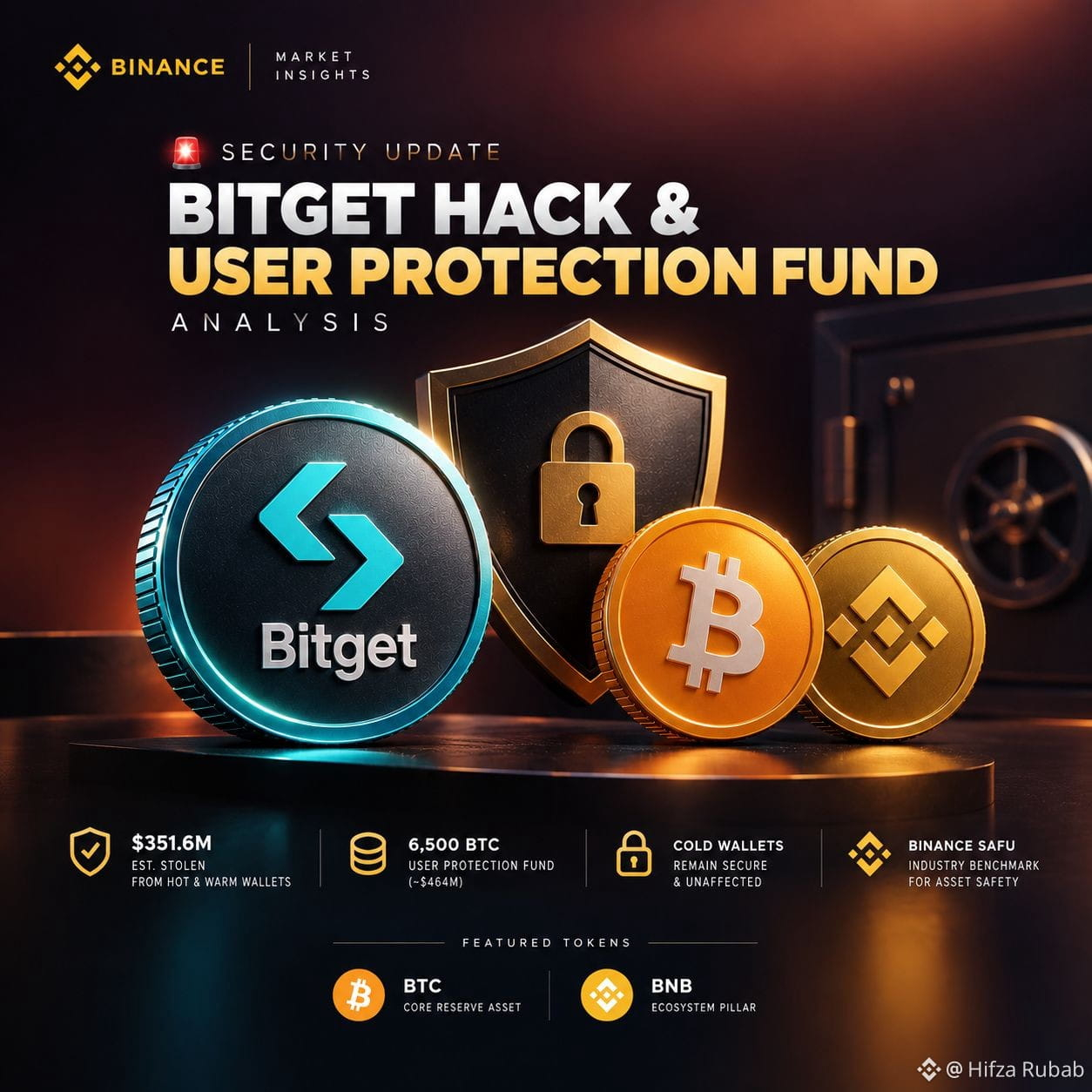
🚨 BITGET HACK & EXCHANGE SECURITY UPDATE 🛡️💥
A $351.6M hot wallet breach hit Bitget, but cold wallets remain untouched. Their $464M+ User Protection Fund fully covers the stolen assets, proving the importance of robust exchange security buffers! 📊⚡
Key Highlights : 🔑💡
Fund Covered: Bitget’s $464M reserve absorbs the entire $351.6M loss. 🛡️💰
System Contained: Backend breach resolved; private keys were never leaked. 🔒⚡
Industry Standard: Demonstrates why exchange protection reserves (like Binance’s SAFU) are essential. 🟡📊
Featured Tokens :
Bitcoin ($BTC ) ₿: Core asset backing major emergency protection reserves. 🛡️⚡
BNB ($BNB ) 🟡: The backbone of Binance's liquidity, risk management, and SAFU security. 🚀💎
💬 What’s your strategy? Relying on exchange SAFU funds or moving funds to self-custody cold wallets? Share below! 👇💭✨
#BinanceWillListHyperliquid(HYPE)
#BrazilOrdersReportingOf$10KSelfCustodyTransfers
#CFTCUpdatesGuidanceOnTokenizedAssets
#OndoFinanceSoughtSaleAfterFoundersDeath
{spot}(BNBUSDT)
{spot}(BTCUSDT)
#BitgetSays$352MAffectedInHack
🚨 BITGET HACK & EXCHANGE SECURITY UPDATE 🛡️💥
A $351.6M hot wallet breach hit Bitget, but cold wallets remain untouched. Their $464M+ User Protection Fund fully covers the stolen assets, proving the importance of robust exchange security buffers! 📊⚡
Key Highlights : 🔑💡
Fund Covered: Bitget’s $464M reserve absorbs the entire $351.6M loss. 🛡️💰
System Contained: Backend breach resolved; private keys were never leaked. 🔒⚡
Industry Standard: Demonstrates why exchange protection reserves (like Binance’s SAFU) are essential. 🟡📊
Featured Tokens :
Bitcoin ($BTC ) ₿: Core asset backing major emergency protection reserves. 🛡️⚡
BNB ($BNB ) 🟡: The backbone of Binance's liquidity, risk management, and SAFU security. 🚀💎
💬 What’s your strategy? Relying on exchange SAFU funds or moving funds to self-custody cold wallets? Share below! 👇💭✨
#BinanceWillListHyperliquid(HYPE)
#BrazilOrdersReportingOf$10KSelfCustodyTransfers
#CFTCUpdatesGuidanceOnTokenizedAssets
#OndoFinanceSoughtSaleAfterFoundersDeath
🚨 BITGET HACK & EXCHANGE SECURITY UPDATE 🛡️💥
A $351.6M hot wallet breach hit Bitget, but cold wallets remain untouched. Their $464M+ User Protection Fund fully covers the stolen assets, proving the importance of robust exchange security buffers! 📊⚡
Key Highlights : 🔑💡
Fund Covered: Bitget’s $464M reserve absorbs the entire $351.6M loss. 🛡️💰
System Contained: Backend breach resolved; private keys were never leaked. 🔒⚡
Industry Standard: Demonstrates why exchange protection reserves (like Binance’s SAFU) are essential. 🟡📊
Featured Tokens :
Bitcoin ($BTC ) ₿: Core asset backing major emergency protection reserves. 🛡️⚡
BNB ($BNB ) 🟡: The backbone of Binance's liquidity, risk management, and SAFU security. 🚀💎
💬 What’s your strategy? Relying on exchange SAFU funds or moving funds to self-custody cold wallets? Share below! 👇💭✨
#BinanceWillListHyperliquid(HYPE)
#BrazilOrdersReportingOf$10KSelfCustodyTransfers
#CFTCUpdatesGuidanceOnTokenizedAssets
#OndoFinanceSoughtSaleAfterFoundersDeath
3
147

·
--
Article
*Bitget CEO Gracy Chen Says Mandiant and SlowMist Are Investigating Security Incident*Bitget has brought in *Mandiant (Google) and SlowMist* to investigate the *$351.6 million security breach* detected on Sept 24 at 18:31 UTC, CEO Gracy Chen confirmed today.
The incident is now being treated as a potential *North Korea-linked attack*.
> "Our security team has made initial progress in tracing the source. The attacker compromised a critical backend system within our wallet infrastructure, used it to spoof transaction data, and triggered our authorization..." — Gracy Chen on X, Sept 25 e6a1
Here's what we know:
*How it happened (without private keys):*
Chen said the attacker did NOT steal private keys. Instead, they compromised a critical backend system in the wallet infrastructure and used it to create *spoofed transfer data* that reached the authorization process and moved funds out. Bitget says it has ruled out a private-key leak and has contained the incident — no further unauthorized transfers are possible. e6a1
It shifts the focus from key custody to the systems around it. The attacker didn't need to possess a wallet key; it needed access to infrastructure that could produce transfer info the approval flow would accept.
*What was taken:*
∼$351.6M from hot and warm wallets — cold wallets remain safe. Affected assets: ETH, XRP, USDT, USDC, AVAX, BNB and USDT0 on Arbitrum. Ethereum held the main concentration. Early on-chain trackers showed less because the incident extended beyond Ethereum.
User balances remain accurate. Deposits and trading continue. Withdrawals are paused while teams work on recovery and security upgrades.
*North Korea link:*
In a live Q&A after the breach, Chen said preliminary investigation points to IP addresses that match VPN services previously used by a DPRK hacking group. "The pattern looks very much like what the North Korean team did before." She said an inside job is not suspected. Attribution is still preliminary and not definitively confirmed. 4bbd
The $2B stolen by DPRK hackers in 2025, including the $1.5B Bybit hack attributed by the FBI, makes this plausible. Coindoo notes Bitget's current position is that North Korean involvement cannot be ruled out. e6a1
*What's next:*
Bitget says its $464M User Protection Fund more than covers the loss. Some stolen funds have already been recovered with help from blockchain foundations and partners — amount undisclosed. Addresses have been flagged and law enforcement contacted.
Chen said multiple technical teams are working to resume withdrawals in hours or days, and a full incident report with root cause and corrective actions will be published within 24 hours.
#BitcoinSpotETFsNetInflow$191M #CFTCUpdatesGuidanceOnTokenizedAssets #BitgetSays$352MAffectedInHack #BinanceWillListHyperliquid(HYPE) #BrazilOrdersReportingOf$10KSelfCustodyTransfers
*Bitget CEO Gracy Chen Says Mandiant and SlowMist Are Investigating Security Incident*
Bitget has brought in *Mandiant (Google) and SlowMist* to investigate the *$351.6 million security breach* detected on Sept 24 at 18:31 UTC, CEO Gracy Chen confirmed today.
The incident is now being treated as a potential *North Korea-linked attack*.
> "Our security team has made initial progress in tracing the source. The attacker compromised a critical backend system within our wallet infrastructure, used it to spoof transaction data, and triggered our authorization..." — Gracy Chen on X, Sept 25 e6a1
Here's what we know:
*How it happened (without private keys):*
Chen said the attacker did NOT steal private keys. Instead, they compromised a critical backend system in the wallet infrastructure and used it to create *spoofed transfer data* that reached the authorization process and moved funds out. Bitget says it has ruled out a private-key leak and has contained the incident — no further unauthorized transfers are possible. e6a1
It shifts the focus from key custody to the systems around it. The attacker didn't need to possess a wallet key; it needed access to infrastructure that could produce transfer info the approval flow would accept.
*What was taken:*
∼$351.6M from hot and warm wallets — cold wallets remain safe. Affected assets: ETH, XRP, USDT, USDC, AVAX, BNB and USDT0 on Arbitrum. Ethereum held the main concentration. Early on-chain trackers showed less because the incident extended beyond Ethereum.
User balances remain accurate. Deposits and trading continue. Withdrawals are paused while teams work on recovery and security upgrades.
*North Korea link:*
In a live Q&A after the breach, Chen said preliminary investigation points to IP addresses that match VPN services previously used by a DPRK hacking group. "The pattern looks very much like what the North Korean team did before." She said an inside job is not suspected. Attribution is still preliminary and not definitively confirmed. 4bbd
The $2B stolen by DPRK hackers in 2025, including the $1.5B Bybit hack attributed by the FBI, makes this plausible. Coindoo notes Bitget's current position is that North Korean involvement cannot be ruled out. e6a1
*What's next:*
Bitget says its $464M User Protection Fund more than covers the loss. Some stolen funds have already been recovered with help from blockchain foundations and partners — amount undisclosed. Addresses have been flagged and law enforcement contacted.
Chen said multiple technical teams are working to resume withdrawals in hours or days, and a full incident report with root cause and corrective actions will be published within 24 hours.
#BitcoinSpotETFsNetInflow$191M #CFTCUpdatesGuidanceOnTokenizedAssets #BitgetSays$352MAffectedInHack #BinanceWillListHyperliquid(HYPE) #BrazilOrdersReportingOf$10KSelfCustodyTransfers
The incident is now being treated as a potential *North Korea-linked attack*.
> "Our security team has made initial progress in tracing the source. The attacker compromised a critical backend system within our wallet infrastructure, used it to spoof transaction data, and triggered our authorization..." — Gracy Chen on X, Sept 25 e6a1
Here's what we know:
*How it happened (without private keys):*
Chen said the attacker did NOT steal private keys. Instead, they compromised a critical backend system in the wallet infrastructure and used it to create *spoofed transfer data* that reached the authorization process and moved funds out. Bitget says it has ruled out a private-key leak and has contained the incident — no further unauthorized transfers are possible. e6a1
It shifts the focus from key custody to the systems around it. The attacker didn't need to possess a wallet key; it needed access to infrastructure that could produce transfer info the approval flow would accept.
*What was taken:*
∼$351.6M from hot and warm wallets — cold wallets remain safe. Affected assets: ETH, XRP, USDT, USDC, AVAX, BNB and USDT0 on Arbitrum. Ethereum held the main concentration. Early on-chain trackers showed less because the incident extended beyond Ethereum.
User balances remain accurate. Deposits and trading continue. Withdrawals are paused while teams work on recovery and security upgrades.
*North Korea link:*
In a live Q&A after the breach, Chen said preliminary investigation points to IP addresses that match VPN services previously used by a DPRK hacking group. "The pattern looks very much like what the North Korean team did before." She said an inside job is not suspected. Attribution is still preliminary and not definitively confirmed. 4bbd
The $2B stolen by DPRK hackers in 2025, including the $1.5B Bybit hack attributed by the FBI, makes this plausible. Coindoo notes Bitget's current position is that North Korean involvement cannot be ruled out. e6a1
*What's next:*
Bitget says its $464M User Protection Fund more than covers the loss. Some stolen funds have already been recovered with help from blockchain foundations and partners — amount undisclosed. Addresses have been flagged and law enforcement contacted.
Chen said multiple technical teams are working to resume withdrawals in hours or days, and a full incident report with root cause and corrective actions will be published within 24 hours.
#BitcoinSpotETFsNetInflow$191M #CFTCUpdatesGuidanceOnTokenizedAssets #BitgetSays$352MAffectedInHack #BinanceWillListHyperliquid(HYPE) #BrazilOrdersReportingOf$10KSelfCustodyTransfers
99

·
--
#BitgetSays$352MAffectedInHack
🚨 Breaking Security Alert: Bitget Confirms $352M Compromised—User Funds Declared Safe 🔒⚠️
Major centralized exchange Bitget detected unauthorized transactions affecting $351.6 Million in digital assets across its hot and warm wallet systems.
Bitget CEO Gracy Chen quickly issued a public update, reassuring users that cold wallets remain 100% secure and account balances are accurate.
📌 Breakdown of What Happened & Key Security Facts
🕒 Incident Detection: Bitget's security systems flagged abnormal outflows from hot wallets starting around 18:31 UTC on September 24.
🛡️ Architecture Scope: The breach only impacted portions of Bitget’s hot and warm wallet layers; cold wallets were untouched.
💼 $464M Protection Fund: All lost funds fall within Bitget's User Protection Fund (currently holding >$464 Million), which will fully cover any affected user balances.
⏸️ Service Status: Withdrawals are temporarily paused while the security team conducts an audit. However, deposits and spot/derivatives trading remain fully operational.
⚠️ What You Need to Know & Do Right Now
Don't Panic Sell: User account balances are fully backed by Bitget's reserve fund, so losses will be covered internally.
Monitor Official Channels: Avoid phishing links or fake support handles offering "withdrawal workarounds"—refer strictly to official Bitget announcements.
Patience on Withdrawals: Withdrawal services will resume sequentially as soon as the security review finishes.
How do you view exchange hot-wallet breaches when fully backed by protection funds? Share your thoughts below! 💬👇
#FedOctoberRateHikeOddsRiseTo69.7% #Bitget #CryptoSecurity
#BitgetSays$352MAffectedInHack
🚨 Breaking Security Alert: Bitget Confirms $352M Compromised—User Funds Declared Safe 🔒⚠️
Major centralized exchange Bitget detected unauthorized transactions affecting $351.6 Million in digital assets across its hot and warm wallet systems.
Bitget CEO Gracy Chen quickly issued a public update, reassuring users that cold wallets remain 100% secure and account balances are accurate.
📌 Breakdown of What Happened & Key Security Facts
🕒 Incident Detection: Bitget's security systems flagged abnormal outflows from hot wallets starting around 18:31 UTC on September 24.
🛡️ Architecture Scope: The breach only impacted portions of Bitget’s hot and warm wallet layers; cold wallets were untouched.
💼 $464M Protection Fund: All lost funds fall within Bitget's User Protection Fund (currently holding >$464 Million), which will fully cover any affected user balances.
⏸️ Service Status: Withdrawals are temporarily paused while the security team conducts an audit. However, deposits and spot/derivatives trading remain fully operational.
⚠️ What You Need to Know & Do Right Now
Don't Panic Sell: User account balances are fully backed by Bitget's reserve fund, so losses will be covered internally.
Monitor Official Channels: Avoid phishing links or fake support handles offering "withdrawal workarounds"—refer strictly to official Bitget announcements.
Patience on Withdrawals: Withdrawal services will resume sequentially as soon as the security review finishes.
How do you view exchange hot-wallet breaches when fully backed by protection funds? Share your thoughts below! 💬👇
#FedOctoberRateHikeOddsRiseTo69.7% #Bitget #CryptoSecurity
🚨 Breaking Security Alert: Bitget Confirms $352M Compromised—User Funds Declared Safe 🔒⚠️
Major centralized exchange Bitget detected unauthorized transactions affecting $351.6 Million in digital assets across its hot and warm wallet systems.
Bitget CEO Gracy Chen quickly issued a public update, reassuring users that cold wallets remain 100% secure and account balances are accurate.
📌 Breakdown of What Happened & Key Security Facts
🕒 Incident Detection: Bitget's security systems flagged abnormal outflows from hot wallets starting around 18:31 UTC on September 24.
🛡️ Architecture Scope: The breach only impacted portions of Bitget’s hot and warm wallet layers; cold wallets were untouched.
💼 $464M Protection Fund: All lost funds fall within Bitget's User Protection Fund (currently holding >$464 Million), which will fully cover any affected user balances.
⏸️ Service Status: Withdrawals are temporarily paused while the security team conducts an audit. However, deposits and spot/derivatives trading remain fully operational.
⚠️ What You Need to Know & Do Right Now
Don't Panic Sell: User account balances are fully backed by Bitget's reserve fund, so losses will be covered internally.
Monitor Official Channels: Avoid phishing links or fake support handles offering "withdrawal workarounds"—refer strictly to official Bitget announcements.
Patience on Withdrawals: Withdrawal services will resume sequentially as soon as the security review finishes.
How do you view exchange hot-wallet breaches when fully backed by protection funds? Share your thoughts below! 💬👇
#FedOctoberRateHikeOddsRiseTo69.7% #Bitget #CryptoSecurity
1
2
75

·
--
Bearish
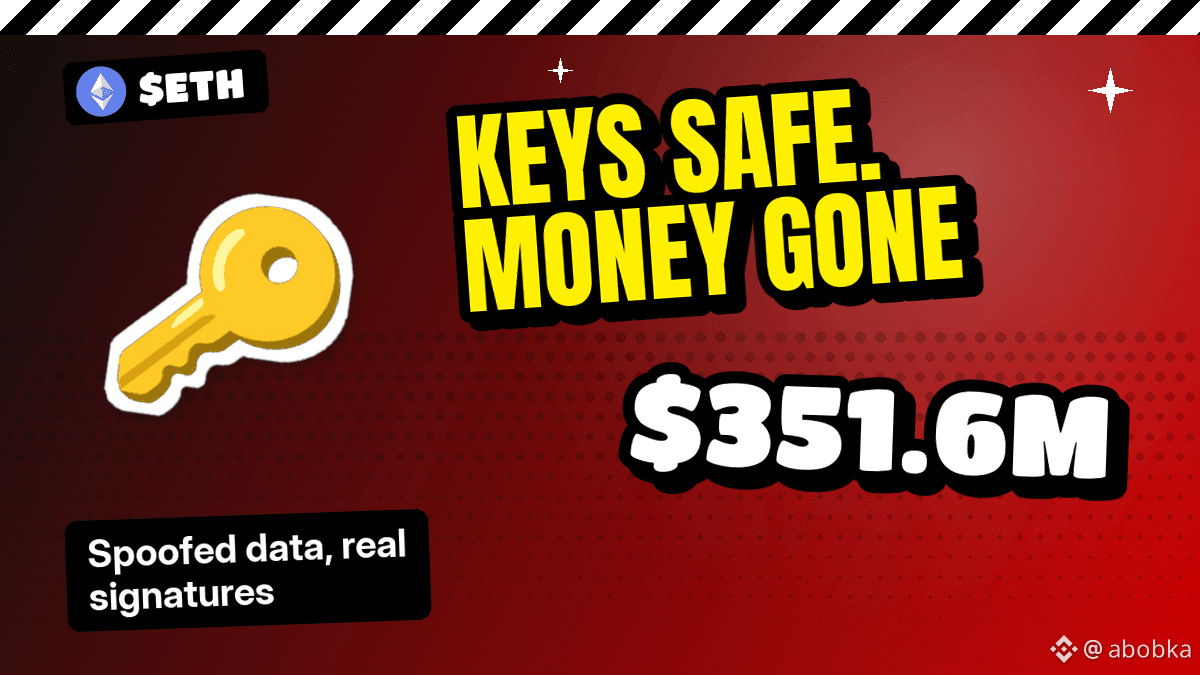
September 6: Liquid, about $320 million. keys intact
September 24: Bitget, $351.6 million. keys intact again
after Liquid I wrote that "not your keys" is half a security model. didn't expect the other half to show up on a centralized exchange this fast)
the attacker compromised a backend system in Bitget's wallet infrastructure, spoofed transaction data and triggered Bitget's own authorization process. private key compromise ruled out, per Gracy Chen
$ETH
{spot}(ETHUSDT)
, BNB, AVAX and USDT were among what left
the lock held. whoever decides when to open it got lied to
and this one sits in my own account. I have a balance on Bitget, withdrawals paused, no timeline
a fund of over $464 million covers the loss, they say. good
#BitgetSays$352MAffectedInHack and "user funds are safe" came in the same statement. I'll believe the second part when my withdrawal lands
the day they reopen I'll post here whether mine came through, follow if you have coins in there too
September 6: Liquid, about $320 million. keys intact
September 24: Bitget, $351.6 million. keys intact again
after Liquid I wrote that "not your keys" is half a security model. didn't expect the other half to show up on a centralized exchange this fast)
the attacker compromised a backend system in Bitget's wallet infrastructure, spoofed transaction data and triggered Bitget's own authorization process. private key compromise ruled out, per Gracy Chen
$ETH
, BNB, AVAX and USDT were among what left
the lock held. whoever decides when to open it got lied to
and this one sits in my own account. I have a balance on Bitget, withdrawals paused, no timeline
a fund of over $464 million covers the loss, they say. good
#BitgetSays$352MAffectedInHack and "user funds are safe" came in the same statement. I'll believe the second part when my withdrawal lands
the day they reopen I'll post here whether mine came through, follow if you have coins in there too
September 24: Bitget, $351.6 million. keys intact again
after Liquid I wrote that "not your keys" is half a security model. didn't expect the other half to show up on a centralized exchange this fast)
the attacker compromised a backend system in Bitget's wallet infrastructure, spoofed transaction data and triggered Bitget's own authorization process. private key compromise ruled out, per Gracy Chen
$ETH
, BNB, AVAX and USDT were among what left
the lock held. whoever decides when to open it got lied to
and this one sits in my own account. I have a balance on Bitget, withdrawals paused, no timeline
a fund of over $464 million covers the loss, they say. good
#BitgetSays$352MAffectedInHack and "user funds are safe" came in the same statement. I'll believe the second part when my withdrawal lands
the day they reopen I'll post here whether mine came through, follow if you have coins in there too
4
200

🔥 Crypto Security Alert
$352M reportedly affected — Bitget has addressed the incident.
The figure is enough to put exchange security under the spotlight.
Users should avoid relying on unverified claims circulating online.
$BTC $ETH $BNB and $XRP remain major assets to research independently.
🚨 In crypto, protecting your assets matters as much as finding opportunities.
#BitgetSays$352MAffectedInHack
🔥 Crypto Security Alert
$352M reportedly affected — Bitget has addressed the incident.
The figure is enough to put exchange security under the spotlight.
Users should avoid relying on unverified claims circulating online.
$BTC $ETH $BNB and $XRP remain major assets to research independently.
🚨 In crypto, protecting your assets matters as much as finding opportunities.
#BitgetSays$352MAffectedInHack
$352M reportedly affected — Bitget has addressed the incident.
The figure is enough to put exchange security under the spotlight.
Users should avoid relying on unverified claims circulating online.
$BTC $ETH $BNB and $XRP remain major assets to research independently.
🚨 In crypto, protecting your assets matters as much as finding opportunities.
#BitgetSays$352MAffectedInHack
19
⚠️ $352M Raises Questions
Bitget's statement says the hack affected around $352M.
Crypto markets are now watching the situation closely.
The incident could renew discussions around exchange security standards.
$BTC $ETH $LINK and $AVAX remain key spot-market assets.
🛡️ Transparency and security updates matter during incidents like this.
#BitgetSays$352MAffectedInHack
⚠️ $352M Raises Questions
Bitget's statement says the hack affected around $352M.
Crypto markets are now watching the situation closely.
The incident could renew discussions around exchange security standards.
$BTC $ETH $LINK and $AVAX remain key spot-market assets.
🛡️ Transparency and security updates matter during incidents like this.
#BitgetSays$352MAffectedInHack
Bitget's statement says the hack affected around $352M.
Crypto markets are now watching the situation closely.
The incident could renew discussions around exchange security standards.
$BTC $ETH $LINK and $AVAX remain key spot-market assets.
🛡️ Transparency and security updates matter during incidents like this.
#BitgetSays$352MAffectedInHack
23
💥 $352M Crypto Security Shock
Bitget says $352M was affected in the reported hack.
That is a huge number for the crypto industry.
The incident shows why wallet and exchange security matter.
$BTC $ETH $SOL and $BNB continue to dominate market attention.
🔎 Security first. Always verify before moving funds.
#BitgetSays$352MAffectedInHack
💥 $352M Crypto Security Shock
Bitget says $352M was affected in the reported hack.
That is a huge number for the crypto industry.
The incident shows why wallet and exchange security matter.
$BTC $ETH $SOL and $BNB continue to dominate market attention.
🔎 Security first. Always verify before moving funds.
#BitgetSays$352MAffectedInHack
Bitget says $352M was affected in the reported hack.
That is a huge number for the crypto industry.
The incident shows why wallet and exchange security matter.
$BTC $ETH $SOL and $BNB continue to dominate market attention.
🔎 Security first. Always verify before moving funds.
#BitgetSays$352MAffectedInHack
33
🛡️ Exchange Security Under Spotlight
A reported $352M impact has put Bitget's security response under attention.
The incident highlights how quickly crypto risks can escalate.
Exchange users should verify information through official channels.
$BTC $ETH $BNB and $LINK remain widely watched spot assets.
👀 One incident can change the conversation around platform security.
#BitgetSays$352MAffectedInHack
🛡️ Exchange Security Under Spotlight
A reported $352M impact has put Bitget's security response under attention.
The incident highlights how quickly crypto risks can escalate.
Exchange users should verify information through official channels.
$BTC $ETH $BNB and $LINK remain widely watched spot assets.
👀 One incident can change the conversation around platform security.
#BitgetSays$352MAffectedInHack
A reported $352M impact has put Bitget's security response under attention.
The incident highlights how quickly crypto risks can escalate.
Exchange users should verify information through official channels.
$BTC $ETH $BNB and $LINK remain widely watched spot assets.
👀 One incident can change the conversation around platform security.
#BitgetSays$352MAffectedInHack
27
🚨 $352M Hack Impact Reported
Bitget says approximately $352M was affected in the reported security incident.
The scale puts exchange security back in focus.
Users should pay close attention to official updates and wallet movements.
$BTC $ETH $BNB and $SOL remain major assets across the spot market.
🔐 In crypto, security is part of the investment strategy.
#BitgetSays$352MAffectedInHack
🚨 $352M Hack Impact Reported
Bitget says approximately $352M was affected in the reported security incident.
The scale puts exchange security back in focus.
Users should pay close attention to official updates and wallet movements.
$BTC $ETH $BNB and $SOL remain major assets across the spot market.
🔐 In crypto, security is part of the investment strategy.
#BitgetSays$352MAffectedInHack
Bitget says approximately $352M was affected in the reported security incident.
The scale puts exchange security back in focus.
Users should pay close attention to official updates and wallet movements.
$BTC $ETH $BNB and $SOL remain major assets across the spot market.
🔐 In crypto, security is part of the investment strategy.
#BitgetSays$352MAffectedInHack
35

·
--
Bullish
#BitgetSays$352MAffectedInHack
Not another one! 🤯 The crypto drama never sleeps. Let's break down the massive news hitting the market: #BitgetSays$352MAffectedInHack 💸
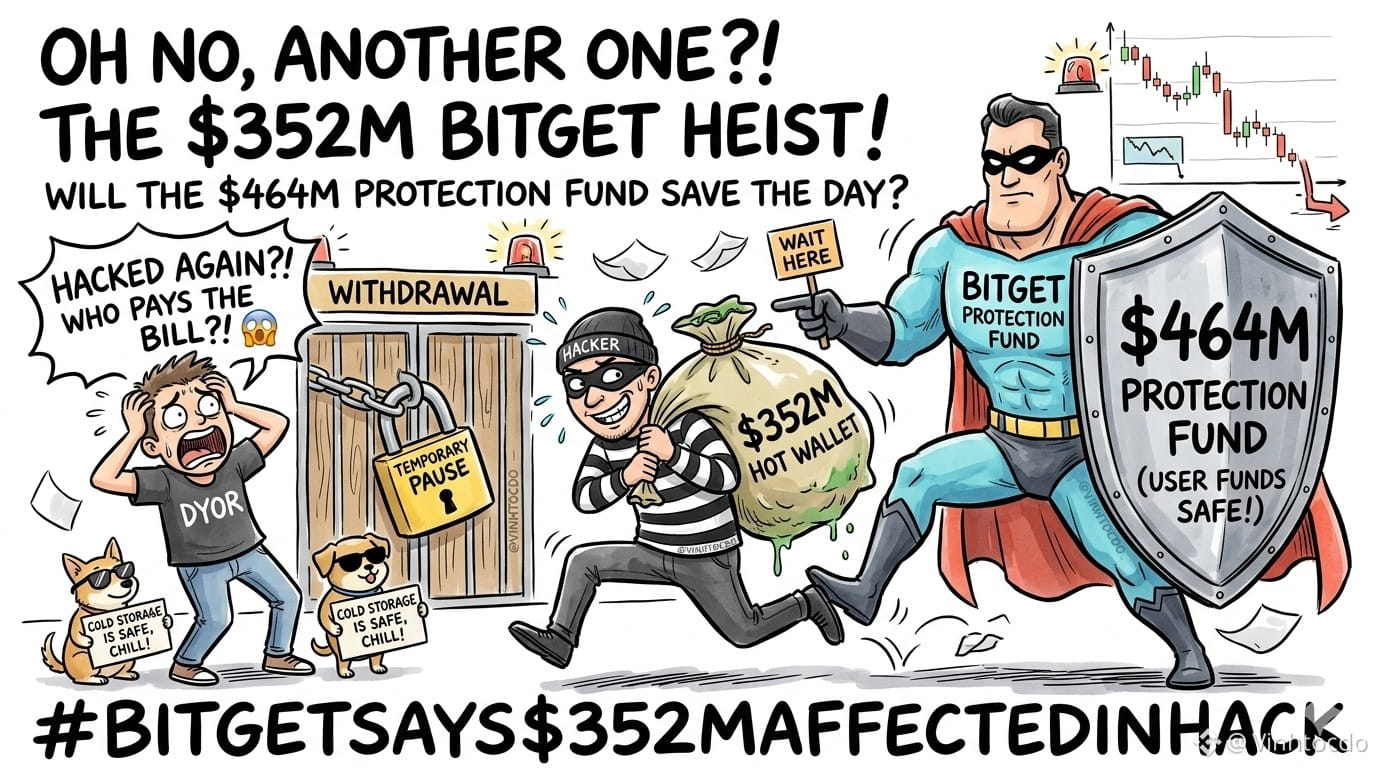
🚨 Wait, hacked AGAIN?! Yes, Bitget confirmed an unauthorized transfer of $351.6 Million from their hot wallets! It might be the biggest heist of 2026.
🤔 Who pays the bill? Good news for now: CEO Gracy Chen stated user funds are safe, thanks to their $464M Protection Fund. The breach only touched a fraction of hot/warm wallets, while cold storage is completely secure. They are temporarily freezing withdrawals for a security review.
🛒 What should traders do?
🛡️ Stay calm: Don't panic-sell your bags at a discount.
🛑 Patience is key: Wait for the official 24-hour incident report before making big moves.
🔑 Safety first: Secure your funds and utilize reliable exchanges.
⚠️ Not financial advice. DYOR! New to Binance? Use code VINHTOCDO or click the link: [https://www.binance.com/register?ref=VINHTOCDO](https://www.binance.com/register?ref=VINHTOCDO) to trade safely!
👉 Click trade below to support me: $BNB
{future}(BNBUSDT)
| $BTC
{future}(BTCUSDT)
| $ETH
{future}(ETHUSDT)
#Bitget #CryptoNews #CryptoSecurity #BinanceSquare #TradingSafety #VINHTOCDO
#BitgetSays$352MAffectedInHack
Not another one! 🤯 The crypto drama never sleeps. Let's break down the massive news hitting the market: #BitgetSays$352MAffectedInHack 💸
🚨 Wait, hacked AGAIN?! Yes, Bitget confirmed an unauthorized transfer of $351.6 Million from their hot wallets! It might be the biggest heist of 2026.
🤔 Who pays the bill? Good news for now: CEO Gracy Chen stated user funds are safe, thanks to their $464M Protection Fund. The breach only touched a fraction of hot/warm wallets, while cold storage is completely secure. They are temporarily freezing withdrawals for a security review.
🛒 What should traders do?
🛡️ Stay calm: Don't panic-sell your bags at a discount.
🛑 Patience is key: Wait for the official 24-hour incident report before making big moves.
🔑 Safety first: Secure your funds and utilize reliable exchanges.
⚠️ Not financial advice. DYOR! New to Binance? Use code VINHTOCDO or click the link: https://www.binance.com/register?ref=VINHTOCDO to trade safely!
👉 Click trade below to support me: $BNB
| $BTC
| $ETH
#Bitget #CryptoNews #CryptoSecurity #BinanceSquare #TradingSafety #VINHTOCDO
Not another one! 🤯 The crypto drama never sleeps. Let's break down the massive news hitting the market: #BitgetSays$352MAffectedInHack 💸
🚨 Wait, hacked AGAIN?! Yes, Bitget confirmed an unauthorized transfer of $351.6 Million from their hot wallets! It might be the biggest heist of 2026.
🤔 Who pays the bill? Good news for now: CEO Gracy Chen stated user funds are safe, thanks to their $464M Protection Fund. The breach only touched a fraction of hot/warm wallets, while cold storage is completely secure. They are temporarily freezing withdrawals for a security review.
🛒 What should traders do?
🛡️ Stay calm: Don't panic-sell your bags at a discount.
🛑 Patience is key: Wait for the official 24-hour incident report before making big moves.
🔑 Safety first: Secure your funds and utilize reliable exchanges.
⚠️ Not financial advice. DYOR! New to Binance? Use code VINHTOCDO or click the link: https://www.binance.com/register?ref=VINHTOCDO to trade safely!
👉 Click trade below to support me: $BNB
| $BTC
| $ETH
#Bitget #CryptoNews #CryptoSecurity #BinanceSquare #TradingSafety #VINHTOCDO
3
1.1k


·
--
Bearish
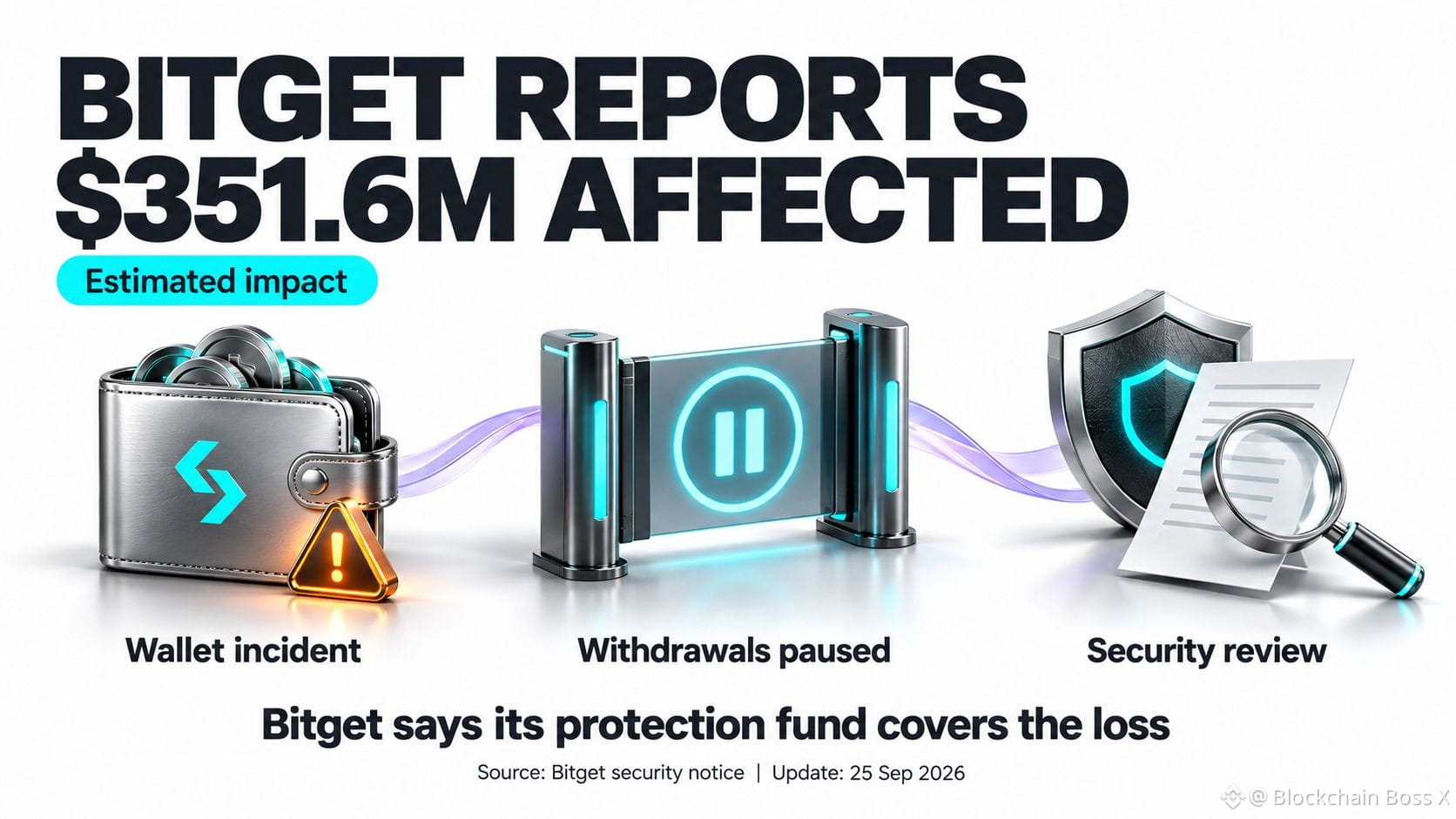
Bitget Reports $351.6M Hack: Can Its Response Rebuild Trust?
Bitget says unauthorized transfers detected on September 24 affected an estimated $351.6 million. The exchange reported that portions of its hot and warm wallet systems were affected, while cold wallets remained secure.
According to its security notice, withdrawals were temporarily suspended, while deposits and trading continued. Bitget said its User Protection Fund held more than $464 million and covered the full loss. It also promised a detailed incident report within 24 hours. The fund coverage and asset protection assurances come from the exchange.
My take: The recovery process now deserves as much attention as the loss figure. A protection fund can help absorb financial damage, but rebuilding confidence also requires a credible explanation, evidence that the weaknesses have been fixed, and dependable withdrawals.
For customers, the practical question is when they can access their assets normally. For the wider industry, this incident puts exchange security and operational resilience under scrutiny. Transparent updates and independently reviewed corrective actions would provide stronger grounds for judging the response than the fund’s headline value alone.
What would rebuild your trust first: verified fund coverage, an independent security review, or restored withdrawals?
#BitgetSays$352MAffectedInHack #Bitget #CryptoSecurity
$SAGA $MUBARAK $NIL
{future}(NILUSDT)
{future}(MUBARAKUSDT)
{future}(SAGAUSDT)
Bitget Reports $351.6M Hack: Can Its Response Rebuild Trust?
Bitget says unauthorized transfers detected on September 24 affected an estimated $351.6 million. The exchange reported that portions of its hot and warm wallet systems were affected, while cold wallets remained secure.
According to its security notice, withdrawals were temporarily suspended, while deposits and trading continued. Bitget said its User Protection Fund held more than $464 million and covered the full loss. It also promised a detailed incident report within 24 hours. The fund coverage and asset protection assurances come from the exchange.
My take: The recovery process now deserves as much attention as the loss figure. A protection fund can help absorb financial damage, but rebuilding confidence also requires a credible explanation, evidence that the weaknesses have been fixed, and dependable withdrawals.
For customers, the practical question is when they can access their assets normally. For the wider industry, this incident puts exchange security and operational resilience under scrutiny. Transparent updates and independently reviewed corrective actions would provide stronger grounds for judging the response than the fund’s headline value alone.
What would rebuild your trust first: verified fund coverage, an independent security review, or restored withdrawals?
#BitgetSays$352MAffectedInHack #Bitget #CryptoSecurity
$SAGA $MUBARAK $NIL
Bitget says unauthorized transfers detected on September 24 affected an estimated $351.6 million. The exchange reported that portions of its hot and warm wallet systems were affected, while cold wallets remained secure.
According to its security notice, withdrawals were temporarily suspended, while deposits and trading continued. Bitget said its User Protection Fund held more than $464 million and covered the full loss. It also promised a detailed incident report within 24 hours. The fund coverage and asset protection assurances come from the exchange.
My take: The recovery process now deserves as much attention as the loss figure. A protection fund can help absorb financial damage, but rebuilding confidence also requires a credible explanation, evidence that the weaknesses have been fixed, and dependable withdrawals.
For customers, the practical question is when they can access their assets normally. For the wider industry, this incident puts exchange security and operational resilience under scrutiny. Transparent updates and independently reviewed corrective actions would provide stronger grounds for judging the response than the fund’s headline value alone.
What would rebuild your trust first: verified fund coverage, an independent security review, or restored withdrawals?
#BitgetSays$352MAffectedInHack #Bitget #CryptoSecurity
$SAGA $MUBARAK $NIL
1
1.1k

$TWT Alerta de seguridad en Bitget!
La plataforma acaba de sufrir la pérdida de 351,6 millones de dólares tras una vulnerabilidad detectada en sus billeteras calientes. La CEO del exchange, Gracy Chen, aclaró que los atacantes vulneraron un sistema interno para falsificar documentos y autorizaciones de retiro, pero destacó un detalle técnico vital: las claves privadas y las bóvedas frías nunca fueron comprometidas, por lo que las llaves reales de los fondos siguen seguras.
Como medida de emergencia, Bitget ha congelado temporalmente todos los retiros de la plataforma, aunque el trading y los depósitos continúan operando con normalidad. Para brindar tranquilidad a la comunidad, la directiva confirmó que el 100% de las pérdidas será cubierto por su Fondo de Protección al Usuario, el cual cuenta con un respaldo superior a los 464 millones de dólares, garantizando que los saldos de los clientes se mantendrán intactos mientras el equipo técnico trabaja en la restauración del sistema.
¿Tienes capital en este exchange o prefieres apoyarte siempre en billeteras de autocustodia para evitar estos riesgos?
SIGUEME PARA Más noticiaS Y Análisis..
#BitgetSays$352MAffectedInHack
{future}(TWTUSDT)
$TWT Alerta de seguridad en Bitget!
La plataforma acaba de sufrir la pérdida de 351,6 millones de dólares tras una vulnerabilidad detectada en sus billeteras calientes. La CEO del exchange, Gracy Chen, aclaró que los atacantes vulneraron un sistema interno para falsificar documentos y autorizaciones de retiro, pero destacó un detalle técnico vital: las claves privadas y las bóvedas frías nunca fueron comprometidas, por lo que las llaves reales de los fondos siguen seguras.
Como medida de emergencia, Bitget ha congelado temporalmente todos los retiros de la plataforma, aunque el trading y los depósitos continúan operando con normalidad. Para brindar tranquilidad a la comunidad, la directiva confirmó que el 100% de las pérdidas será cubierto por su Fondo de Protección al Usuario, el cual cuenta con un respaldo superior a los 464 millones de dólares, garantizando que los saldos de los clientes se mantendrán intactos mientras el equipo técnico trabaja en la restauración del sistema.
¿Tienes capital en este exchange o prefieres apoyarte siempre en billeteras de autocustodia para evitar estos riesgos?
SIGUEME PARA Más noticiaS Y Análisis..
#BitgetSays$352MAffectedInHack
La plataforma acaba de sufrir la pérdida de 351,6 millones de dólares tras una vulnerabilidad detectada en sus billeteras calientes. La CEO del exchange, Gracy Chen, aclaró que los atacantes vulneraron un sistema interno para falsificar documentos y autorizaciones de retiro, pero destacó un detalle técnico vital: las claves privadas y las bóvedas frías nunca fueron comprometidas, por lo que las llaves reales de los fondos siguen seguras.
Como medida de emergencia, Bitget ha congelado temporalmente todos los retiros de la plataforma, aunque el trading y los depósitos continúan operando con normalidad. Para brindar tranquilidad a la comunidad, la directiva confirmó que el 100% de las pérdidas será cubierto por su Fondo de Protección al Usuario, el cual cuenta con un respaldo superior a los 464 millones de dólares, garantizando que los saldos de los clientes se mantendrán intactos mientras el equipo técnico trabaja en la restauración del sistema.
¿Tienes capital en este exchange o prefieres apoyarte siempre en billeteras de autocustodia para evitar estos riesgos?
SIGUEME PARA Más noticiaS Y Análisis..
#BitgetSays$352MAffectedInHack
206 Atlas:
Cold storage is the only real hedge. Trusting exchange insurance funds adds unnecessary counterparty risk to your portfolio.
3
2
4
9.5k


Article
XRP Coin: A Practical Overview of Its Purpose, Technology, and Risks
XR$XRP P is a digital asset designed to make transferring value across borders faster and more efficient. It is associated with the XRP Ledger, a blockchain network built for payments, currency exchange, and settlement between financial institutions or individuals.
Unlike many cryptocurrencies that rely on mining, X$XRP RP transactions are validated through a consensus mechanism. This approach is intended to keep transaction costs low and settlement times short. Transactions on the XRP Ledger can typically be completed within seconds, making the network relevant to discussions around cross-border payments.
What Is XRP Used For?
XRP can serve as a bridge asset when two parties want to exchange different currencies. For example, instead of moving funds through several banking intermediaries, a payment could potentially be converted into XRP, transferred quickly, and then converted into the receiving currency.
The XRP Ledger also supports token issuance and decentralized exchange features. This means developers and businesses can build payment-related applications or create digital representations of assets on the network.
XRP vs. the XRP Ledger
It is important to separate XRP, the asset, from the XRP Ledger, the network.
XRP is the cryptocurrency used for transaction fees, transfers, and liquidity.
XRP Ledger is the underlying blockchain infrastructure that records transactions and supports other applications.
Ripple, a fintech company, is often discussed alongside XRP because it has developed products for payment providers and has contributed to parts of the XRP ecosystem. However, Ripple and XRP are not the same thing.
Potential Strengths
XRP’s main appeal is its focus on payment efficiency. Supporters often highlight:
Fast transaction settlement
Low network fees
High throughput compared with many older blockchain networks
A clear use case in cross-border transfers and liquidity management
These features may make XRP useful where speed and cost are important, especially for international transfers.
Key Risks to Consider
Like all cryptocurrencies, XRP carries significant risk. Its price can move sharply in short periods, influenced by broader crypto-market conditions, regulation, adoption news, liquidity, and investor sentiment.
There is also concentration risk: XRP’s relationship with Ripple and the attention surrounding regulatory developments can strongly affect public perception. In addition, real-world adoption by institutions may develop differently from expectations.
Conclusion
XRP is a cryptocurrency built around a payments-focused blockchain network. Its fast settlement and low-cost design distinguish it from many other digital assets, but those advantages do not remove the risks of volatility, regulation, and changing market demand.
Anyone researching XR$XRP P should look beyond price movements and consider its technology, ecosystem activity, real-world use cases, token supply dynamics, and personal risk tolerance. Cryptocurrency markets remain highly uncertain, and past performance does not guarantee future results.#BitgetSays$352MAffectedInHack #NYAndPolymarketSueEachOther
{spot}(XRPUSDT)
XR$XRP P is a digital asset designed to make transferring value across borders faster and more efficient. It is associated with the XRP Ledger, a blockchain network built for payments, currency exchange, and settlement between financial institutions or individuals.
Unlike many cryptocurrencies that rely on mining, X$XRP RP transactions are validated through a consensus mechanism. This approach is intended to keep transaction costs low and settlement times short. Transactions on the XRP Ledger can typically be completed within seconds, making the network relevant to discussions around cross-border payments.
What Is XRP Used For?
XRP can serve as a bridge asset when two parties want to exchange different currencies. For example, instead of moving funds through several banking intermediaries, a payment could potentially be converted into XRP, transferred quickly, and then converted into the receiving currency.
The XRP Ledger also supports token issuance and decentralized exchange features. This means developers and businesses can build payment-related applications or create digital representations of assets on the network.
XRP vs. the XRP Ledger
It is important to separate XRP, the asset, from the XRP Ledger, the network.
XRP is the cryptocurrency used for transaction fees, transfers, and liquidity.
XRP Ledger is the underlying blockchain infrastructure that records transactions and supports other applications.
Ripple, a fintech company, is often discussed alongside XRP because it has developed products for payment providers and has contributed to parts of the XRP ecosystem. However, Ripple and XRP are not the same thing.
Potential Strengths
XRP’s main appeal is its focus on payment efficiency. Supporters often highlight:
Fast transaction settlement
Low network fees
High throughput compared with many older blockchain networks
A clear use case in cross-border transfers and liquidity management
These features may make XRP useful where speed and cost are important, especially for international transfers.
Key Risks to Consider
Like all cryptocurrencies, XRP carries significant risk. Its price can move sharply in short periods, influenced by broader crypto-market conditions, regulation, adoption news, liquidity, and investor sentiment.
There is also concentration risk: XRP’s relationship with Ripple and the attention surrounding regulatory developments can strongly affect public perception. In addition, real-world adoption by institutions may develop differently from expectations.
Conclusion
XRP is a cryptocurrency built around a payments-focused blockchain network. Its fast settlement and low-cost design distinguish it from many other digital assets, but those advantages do not remove the risks of volatility, regulation, and changing market demand.
Anyone researching XR$XRP P should look beyond price movements and consider its technology, ecosystem activity, real-world use cases, token supply dynamics, and personal risk tolerance. Cryptocurrency markets remain highly uncertain, and past performance does not guarantee future results.#BitgetSays$352MAffectedInHack #NYAndPolymarketSueEachOther
XRP Coin: A Practical Overview of Its Purpose, Technology, and Risks
XR$XRP P is a digital asset designed to make transferring value across borders faster and more efficient. It is associated with the XRP Ledger, a blockchain network built for payments, currency exchange, and settlement between financial institutions or individuals.
Unlike many cryptocurrencies that rely on mining, X$XRP RP transactions are validated through a consensus mechanism. This approach is intended to keep transaction costs low and settlement times short. Transactions on the XRP Ledger can typically be completed within seconds, making the network relevant to discussions around cross-border payments.
What Is XRP Used For?
XRP can serve as a bridge asset when two parties want to exchange different currencies. For example, instead of moving funds through several banking intermediaries, a payment could potentially be converted into XRP, transferred quickly, and then converted into the receiving currency.
The XRP Ledger also supports token issuance and decentralized exchange features. This means developers and businesses can build payment-related applications or create digital representations of assets on the network.
XRP vs. the XRP Ledger
It is important to separate XRP, the asset, from the XRP Ledger, the network.
XRP is the cryptocurrency used for transaction fees, transfers, and liquidity.
XRP Ledger is the underlying blockchain infrastructure that records transactions and supports other applications.
Ripple, a fintech company, is often discussed alongside XRP because it has developed products for payment providers and has contributed to parts of the XRP ecosystem. However, Ripple and XRP are not the same thing.
Potential Strengths
XRP’s main appeal is its focus on payment efficiency. Supporters often highlight:
Fast transaction settlement
Low network fees
High throughput compared with many older blockchain networks
A clear use case in cross-border transfers and liquidity management
These features may make XRP useful where speed and cost are important, especially for international transfers.
Key Risks to Consider
Like all cryptocurrencies, XRP carries significant risk. Its price can move sharply in short periods, influenced by broader crypto-market conditions, regulation, adoption news, liquidity, and investor sentiment.
There is also concentration risk: XRP’s relationship with Ripple and the attention surrounding regulatory developments can strongly affect public perception. In addition, real-world adoption by institutions may develop differently from expectations.
Conclusion
XRP is a cryptocurrency built around a payments-focused blockchain network. Its fast settlement and low-cost design distinguish it from many other digital assets, but those advantages do not remove the risks of volatility, regulation, and changing market demand.
Anyone researching XR$XRP P should look beyond price movements and consider its technology, ecosystem activity, real-world use cases, token supply dynamics, and personal risk tolerance. Cryptocurrency markets remain highly uncertain, and past performance does not guarantee future results.#BitgetSays$352MAffectedInHack #NYAndPolymarketSueEachOther
1
128

$SNDK Afraid to lose for life, hard to become worthy of praise; wanting stability for life, hard to rise to the top. Life and death are up to fate, while wealth and honor are determined by heaven. This time I went all in 🙂🙂🙂🙂
#BitgetBreachForgedRequestsNotStolenKeys #QNTRises39% #BinanceWillListHyperliquid(HYPE) #CFTCUpdatesGuidanceOnTokenizedAssets #BitgetSays$352MAffectedInHack
$SNDK Afraid to lose for life, hard to become worthy of praise; wanting stability for life, hard to rise to the top. Life and death are up to fate, while wealth and honor are determined by heaven. This time I went all in 🙂🙂🙂🙂
#BitgetBreachForgedRequestsNotStolenKeys #QNTRises39% #BinanceWillListHyperliquid(HYPE) #CFTCUpdatesGuidanceOnTokenizedAssets #BitgetSays$352MAffectedInHack
#BitgetBreachForgedRequestsNotStolenKeys #QNTRises39% #BinanceWillListHyperliquid(HYPE) #CFTCUpdatesGuidanceOnTokenizedAssets #BitgetSays$352MAffectedInHack

3.3k
Log in to explore more content
Join global crypto users on Binance Square
⚡️ Get latest and useful information about crypto.
💬 Trusted by the world’s largest crypto exchange.
👍 Discover real insights from verified creators.
Email / Phone number
Trending Topics
1
#TrumpRejectsIranHormuzReopening
1,596 views
120 Discussing
2
#CircleTetherFreezeBitgetHackerWallet
25,358 views
349 Discussing
3
#SECSaysTokenBuybacksNotAutoSecurities
6,017 views
139 Discussing
4
#ChinaUSAgreeOn$30BTariffCut
328 views
7 Discussing
5
#CoinMarketCapCompletesCoinglassAcquisition
25,250 views
297 Discussing
6
#CircleMints500MUSDCOnSolana
172,553 views
2,845 Discussing
7
#PolymarketBankFailureBetsDrawFDICConcern
151,332 views
2,248 Discussing
8
#BlackRockBuildsTokenizedPortfoliosForOndo
143,399 views
1,626 Discussing
9
#BitwiseFilesToListNEARETFOnNYSEArca
100,734 views
1,281 Discussing
10
#SECSaysBuybacksUpgradesDontMakeTokenSecurity
79,234 views
739 Discussing