

Esam_Trading
1.2k Posts

Esam_Trading
Report
Block User
Crypto and TradeFi | Quant AI | ex IA | ACCA | No Financial Advice |
Frequent Trader
5.6 Years
4 Following
1.7K+ Followers
3.2K+ Liked
Posts
All
Quotes
·
--
Bullish
Verified
🚨 $NEAR just added Robinhood Chain to NEAR.com.
This makes it easier to swap ETH and USDG for 180+ assets across 30+ chains, while moving funds to and from Robinhood Chain without needing a bridge.
Developers can also connect their apps to NEAR Intents, with support for private execution.
Pretty solid step for cross-chain liquidity and interoperability.
{future}(NEARUSDT)
🚨 $NEAR just added Robinhood Chain to NEAR.com.
This makes it easier to swap ETH and USDG for 180+ assets across 30+ chains, while moving funds to and from Robinhood Chain without needing a bridge.
Developers can also connect their apps to NEAR Intents, with support for private execution.
Pretty solid step for cross-chain liquidity and interoperability.
This makes it easier to swap ETH and USDG for 180+ assets across 30+ chains, while moving funds to and from Robinhood Chain without needing a bridge.
Developers can also connect their apps to NEAR Intents, with support for private execution.
Pretty solid step for cross-chain liquidity and interoperability.

7
578
·
--
Bullish
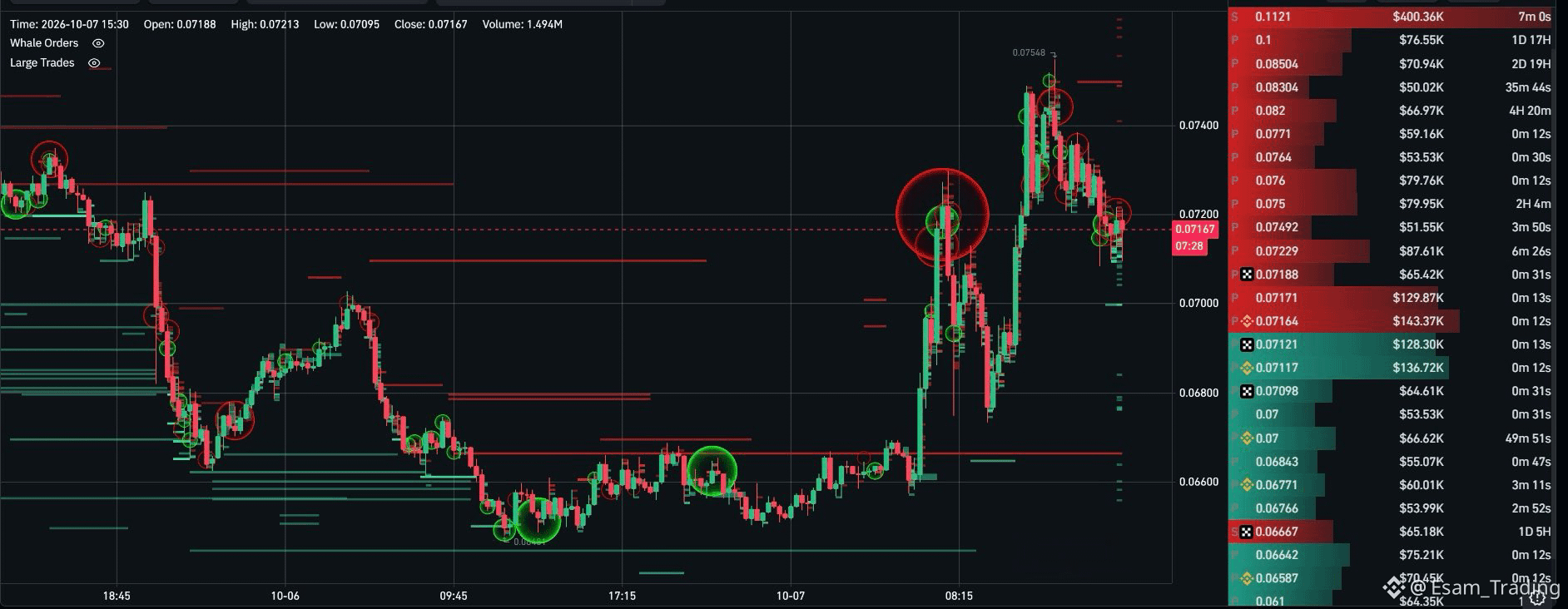
⚠️ $SAND ORDER BOOK LOOKS A LITTLE SUSPICIOUS.
We’re seeing some very large buy and sell orders sitting on the $SAND order book, with millions of dollars in liquidity appearing around the same time. 👀
But here’s the important part:
Don’t assume those walls are real support or resistance.
Large buy walls can make traders think:
🟢 “There’s strong support here.”
While large sell walls can create the opposite impression:
🔴 “Price is going to get rejected.”
That can potentially influence trader behavior and create fear, FOMO, or confusion.
And the problem?
Order-book walls can disappear just as quickly as they appeared.
They can be canceled, moved, or repositioned before price ever reaches them.
So for $SAND , I’d rather focus on actual executed volume and price reaction than blindly trusting large resting orders.
Big orders on the book ≠ guaranteed support or resistance. 👀📊
{future}(SANDUSDT)
⚠️ $SAND ORDER BOOK LOOKS A LITTLE SUSPICIOUS.
We’re seeing some very large buy and sell orders sitting on the $SAND order book, with millions of dollars in liquidity appearing around the same time. 👀
But here’s the important part:
Don’t assume those walls are real support or resistance.
Large buy walls can make traders think:
🟢 “There’s strong support here.”
While large sell walls can create the opposite impression:
🔴 “Price is going to get rejected.”
That can potentially influence trader behavior and create fear, FOMO, or confusion.
And the problem?
Order-book walls can disappear just as quickly as they appeared.
They can be canceled, moved, or repositioned before price ever reaches them.
So for $SAND , I’d rather focus on actual executed volume and price reaction than blindly trusting large resting orders.
Big orders on the book ≠ guaranteed support or resistance. 👀📊
We’re seeing some very large buy and sell orders sitting on the $SAND order book, with millions of dollars in liquidity appearing around the same time. 👀
But here’s the important part:
Don’t assume those walls are real support or resistance.
Large buy walls can make traders think:
🟢 “There’s strong support here.”
While large sell walls can create the opposite impression:
🔴 “Price is going to get rejected.”
That can potentially influence trader behavior and create fear, FOMO, or confusion.
And the problem?
Order-book walls can disappear just as quickly as they appeared.
They can be canceled, moved, or repositioned before price ever reaches them.
So for $SAND , I’d rather focus on actual executed volume and price reaction than blindly trusting large resting orders.
Big orders on the book ≠ guaranteed support or resistance. 👀📊
2
2.1k
·
--
Bullish
Verified
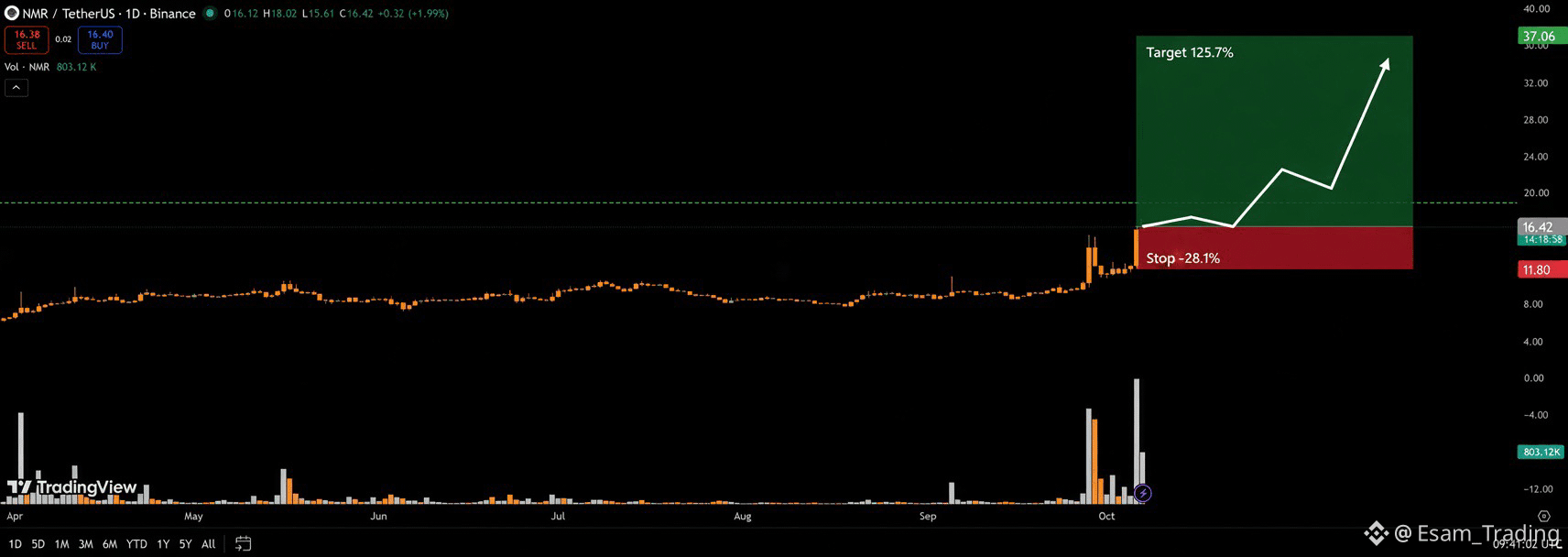
🚨 $NMR IS GOING CRAZY RIGHT NOW.
$NMR is up around 39% today after Upbit announced a Korean listing. 🇰🇷🔥
Listings like this can bring a serious wave of new attention and liquidity, so the move could get even more volatile from here.
The level I’m watching is simple:
🚀 Break $18.99 → $37.06 target
That would be roughly +123% from the current area if momentum really kicks in.
But after a 39% one-day move, I wouldn’t be surprised to see a pullback first.
Key levels:
🎯 $18.99 → breakout trigger
🚀 $37.06 → upside target
🛑 $11.80 → invalidation
I’m not chasing the pump here.
If $NMR breaks $18.99 with strong momentum, the upside could get very interesting.
Big move already. Now we see if buyers can keep it going. 👀📈
{future}(NMRUSDT)
🚨 $NMR IS GOING CRAZY RIGHT NOW.
$NMR is up around 39% today after Upbit announced a Korean listing. 🇰🇷🔥
Listings like this can bring a serious wave of new attention and liquidity, so the move could get even more volatile from here.
The level I’m watching is simple:
🚀 Break $18.99 → $37.06 target
That would be roughly +123% from the current area if momentum really kicks in.
But after a 39% one-day move, I wouldn’t be surprised to see a pullback first.
Key levels:
🎯 $18.99 → breakout trigger
🚀 $37.06 → upside target
🛑 $11.80 → invalidation
I’m not chasing the pump here.
If $NMR breaks $18.99 with strong momentum, the upside could get very interesting.
Big move already. Now we see if buyers can keep it going. 👀📈
$NMR is up around 39% today after Upbit announced a Korean listing. 🇰🇷🔥
Listings like this can bring a serious wave of new attention and liquidity, so the move could get even more volatile from here.
The level I’m watching is simple:
🚀 Break $18.99 → $37.06 target
That would be roughly +123% from the current area if momentum really kicks in.
But after a 39% one-day move, I wouldn’t be surprised to see a pullback first.
Key levels:
🎯 $18.99 → breakout trigger
🚀 $37.06 → upside target
🛑 $11.80 → invalidation
I’m not chasing the pump here.
If $NMR breaks $18.99 with strong momentum, the upside could get very interesting.
Big move already. Now we see if buyers can keep it going. 👀📈
3
799
·
--
Bullish
Partly True
🔥 $HYPE HAS A ECOSYSTEM WHERE NUMBERS DO THE TALKING!
What gets my attention isn’t just trading volume or market hype.
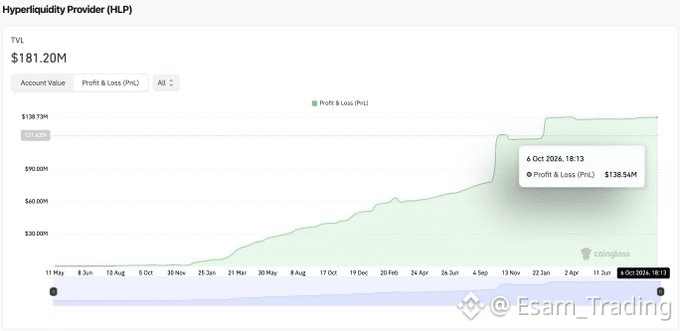
It’s the fact that the HLP vault has generated around $138.54M since launch. 👀
That points to something more important:
A product creating meaningful returns through real trading activity and protocol usage, not just speculation.
And that feeds into the broader Hyperliquid flywheel:
🔄 Trading activity → protocol revenue → ecosystem growth
💰 Buybacks + staking → reduced liquid supply
🌐 More products and markets → broader demand
The market will decide how much of that is already priced in.
But when an ecosystem keeps producing strong numbers, it’s hard to ignore.
$HYPE remains one of the projects I’m watching closely this cycle. 📈
{future}(HYPEUSDT)
🔥 $HYPE HAS A ECOSYSTEM WHERE NUMBERS DO THE TALKING!
What gets my attention isn’t just trading volume or market hype.
It’s the fact that the HLP vault has generated around $138.54M since launch. 👀
That points to something more important:
A product creating meaningful returns through real trading activity and protocol usage, not just speculation.
And that feeds into the broader Hyperliquid flywheel:
🔄 Trading activity → protocol revenue → ecosystem growth
💰 Buybacks + staking → reduced liquid supply
🌐 More products and markets → broader demand
The market will decide how much of that is already priced in.
But when an ecosystem keeps producing strong numbers, it’s hard to ignore.
$HYPE remains one of the projects I’m watching closely this cycle. 📈
What gets my attention isn’t just trading volume or market hype.
It’s the fact that the HLP vault has generated around $138.54M since launch. 👀
That points to something more important:
A product creating meaningful returns through real trading activity and protocol usage, not just speculation.
And that feeds into the broader Hyperliquid flywheel:
🔄 Trading activity → protocol revenue → ecosystem growth
💰 Buybacks + staking → reduced liquid supply
🌐 More products and markets → broader demand
The market will decide how much of that is already priced in.
But when an ecosystem keeps producing strong numbers, it’s hard to ignore.
$HYPE remains one of the projects I’m watching closely this cycle. 📈
2
687
·
--
Bullish
🔥 THE $NEAR BULL CASE IS GETTING INTERESTING.
The bigger thesis isn’t just about price.
It’s about $NEAR Intents potentially becoming the default cross-chain execution layer for assets and AI agents. 👀
The numbers are starting to get attention too:
📊 Intents reportedly processing around $5B/month
🏦 Bitwise’s $NEAR ETF reportedly pulled roughly $50M in its first 2 days
🚀 Backpack just added NEAR spot + perps
But there’s an obvious counterweight:
⚠️ The Intents exploit.
Around $3.8M was drained, but the funds were reportedly recovered and affected users were refunded.
That makes the next few weeks especially important.
The real question now is:
Does Intents volume keep growing after the hack?
And on the ETF side:
Do the inflows continue after the launch-week hype fades?
If both hold up, the bull thesis gets considerably stronger.
{future}(NEARUSDT)
🔥 THE $NEAR BULL CASE IS GETTING INTERESTING.
The bigger thesis isn’t just about price.
It’s about $NEAR Intents potentially becoming the default cross-chain execution layer for assets and AI agents. 👀
The numbers are starting to get attention too:
📊 Intents reportedly processing around $5B/month
🏦 Bitwise’s $NEAR ETF reportedly pulled roughly $50M in its first 2 days
🚀 Backpack just added NEAR spot + perps
But there’s an obvious counterweight:
⚠️ The Intents exploit.
Around $3.8M was drained, but the funds were reportedly recovered and affected users were refunded.
That makes the next few weeks especially important.
The real question now is:
Does Intents volume keep growing after the hack?
And on the ETF side:
Do the inflows continue after the launch-week hype fades?
If both hold up, the bull thesis gets considerably stronger.
The bigger thesis isn’t just about price.
It’s about $NEAR Intents potentially becoming the default cross-chain execution layer for assets and AI agents. 👀
The numbers are starting to get attention too:
📊 Intents reportedly processing around $5B/month
🏦 Bitwise’s $NEAR ETF reportedly pulled roughly $50M in its first 2 days
🚀 Backpack just added NEAR spot + perps
But there’s an obvious counterweight:
⚠️ The Intents exploit.
Around $3.8M was drained, but the funds were reportedly recovered and affected users were refunded.
That makes the next few weeks especially important.
The real question now is:
Does Intents volume keep growing after the hack?
And on the ETF side:
Do the inflows continue after the launch-week hype fades?
If both hold up, the bull thesis gets considerably stronger.

6
2.7k
·
--
Bullish
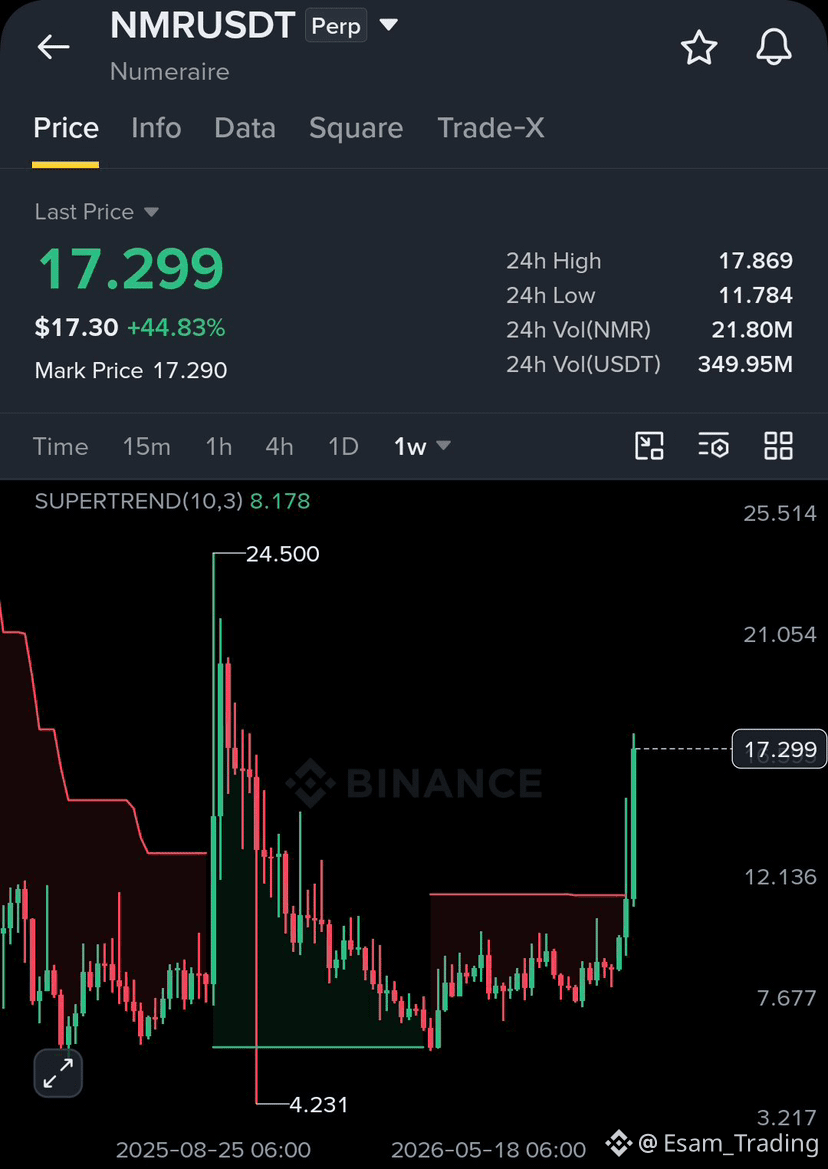
Is $NMR the next $RIVER ? 👀
Will $NMR going to follow $RIVER’s path and push past $50? 🚀
{future}(RIVERUSDT)
{future}(NMRUSDT)
Is $NMR the next $RIVER ? 👀
Will $NMR going to follow $RIVER ’s path and push past $50? 🚀
Will $NMR going to follow $RIVER ’s path and push past $50? 🚀
2
2.9k
·
--
Bullish
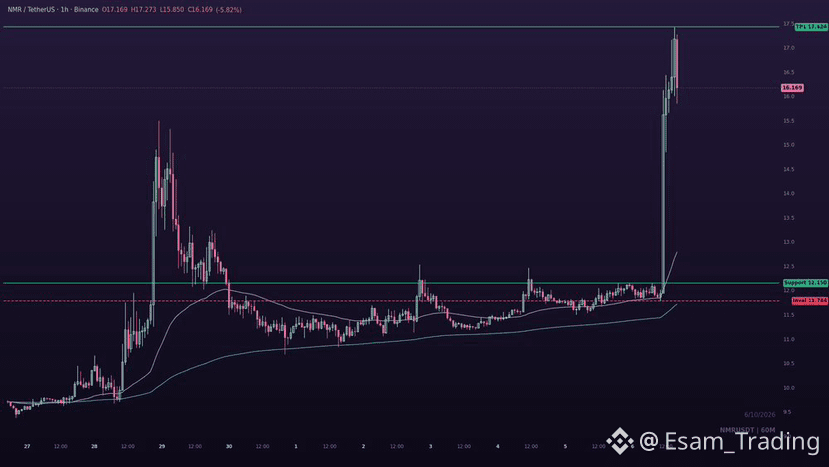
🚨 $NMR IS MOVING.
$NMR is up 39.1% today, with 3.4x volume showing that traders are definitely paying attention. 👀
The big question now isn’t whether momentum exists, it’s what happens on the pullback.
Price pushed as high as $17.42.
Now I’m watching whether the retracement:
🔹 Holds and starts building again
🔻 Or turns into a deeper test of $12.15
$12.15 is the key level I’m watching.
If buyers defend it, the current momentum could have another leg higher.
If it breaks, the breakout starts looking a lot less convincing.
Either way, $NMR is one to keep on the radar right now. 👀📈
{future}(NMRUSDT)
🚨 $NMR IS MOVING.
$NMR is up 39.1% today, with 3.4x volume showing that traders are definitely paying attention. 👀
The big question now isn’t whether momentum exists, it’s what happens on the pullback.
Price pushed as high as $17.42.
Now I’m watching whether the retracement:
🔹 Holds and starts building again
🔻 Or turns into a deeper test of $12.15
$12.15 is the key level I’m watching.
If buyers defend it, the current momentum could have another leg higher.
If it breaks, the breakout starts looking a lot less convincing.
Either way, $NMR is one to keep on the radar right now. 👀📈
$NMR is up 39.1% today, with 3.4x volume showing that traders are definitely paying attention. 👀
The big question now isn’t whether momentum exists, it’s what happens on the pullback.
Price pushed as high as $17.42.
Now I’m watching whether the retracement:
🔹 Holds and starts building again
🔻 Or turns into a deeper test of $12.15
$12.15 is the key level I’m watching.
If buyers defend it, the current momentum could have another leg higher.
If it breaks, the breakout starts looking a lot less convincing.
Either way, $NMR is one to keep on the radar right now. 👀📈
1
4
2.7k
·
--
Bearish
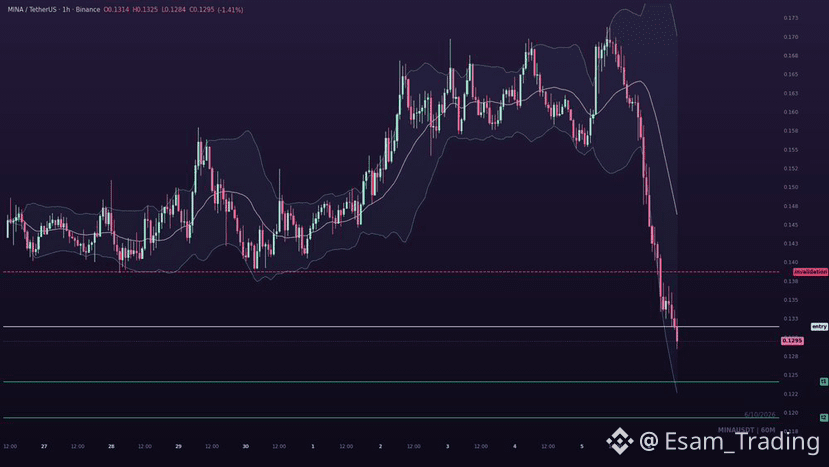
🚨 $MINA IS STILL LOOKING WEAK.
$MINA is down 23.3% in 24H, with 1.6x volume behind the move.
But the interesting part is that shorts are still opening around $0.1314.
Someone is still willing to pay to stay short here. 👀
That gives me a clear setup:
🔴 $0.1387 → invalidation / level where shorts are wrong
🎯 $0.1241 → first downside target
🎯 $0.1193 → main target
I’d look to hold through $0.1241 if momentum stays bearish, because $0.1193 is where I think the move really starts to make sense.
The key is not chasing the dump.
If $MINA keeps rejecting below $0.1387 while short positioning continues building, the downside could extend toward $0.1193. 📉
Below $0.1387, I’m watching $0.1241 → $0.1193.
{future}(MINAUSDT)
🚨 $MINA IS STILL LOOKING WEAK.
$MINA is down 23.3% in 24H, with 1.6x volume behind the move.
But the interesting part is that shorts are still opening around $0.1314.
Someone is still willing to pay to stay short here. 👀
That gives me a clear setup:
🔴 $0.1387 → invalidation / level where shorts are wrong
🎯 $0.1241 → first downside target
🎯 $0.1193 → main target
I’d look to hold through $0.1241 if momentum stays bearish, because $0.1193 is where I think the move really starts to make sense.
The key is not chasing the dump.
If $MINA keeps rejecting below $0.1387 while short positioning continues building, the downside could extend toward $0.1193. 📉
Below $0.1387, I’m watching $0.1241 → $0.1193.
$MINA is down 23.3% in 24H, with 1.6x volume behind the move.
But the interesting part is that shorts are still opening around $0.1314.
Someone is still willing to pay to stay short here. 👀
That gives me a clear setup:
🔴 $0.1387 → invalidation / level where shorts are wrong
🎯 $0.1241 → first downside target
🎯 $0.1193 → main target
I’d look to hold through $0.1241 if momentum stays bearish, because $0.1193 is where I think the move really starts to make sense.
The key is not chasing the dump.
If $MINA keeps rejecting below $0.1387 while short positioning continues building, the downside could extend toward $0.1193. 📉
Below $0.1387, I’m watching $0.1241 → $0.1193.
1
898
·
--
Bearish
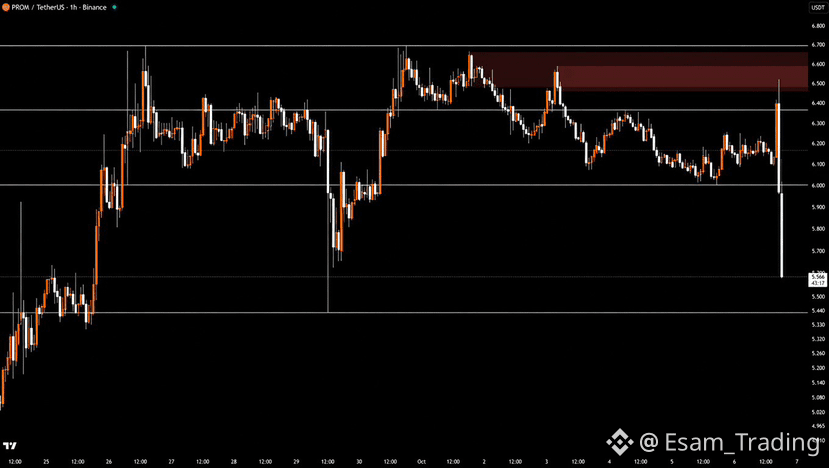
🚨 $PROM STILL LOOKS BEARISH TO ME.
The 1H structure remains firmly bearish, with clear lower highs + lower lows.
The latest -3.7% dump on 4.6x+ volume is also worth watching. That kind of volume spike looks more like distribution or a liquidation cascade than simple retail panic. 👀
I don’t think the bottom is necessarily in yet.
Price is still well below the last swing high at $6.234, while the liquidity below $6.004 and especially around $5.43 remains largely untested.
For a short, I’d rather wait for a bounce into:
🔴 $5.90–$6.07 → short zone
🎯 $6.004 → TP1
🎯 $5.733 → TP2
🎯 $5.43 → major liquidity target
🛑 $6.234 → invalidation
The ideal entry for me would be a weak bounce/retest followed by bearish confirmation on the 5m/15m — rejection wick, bearish engulfing, or a lower-timeframe structure break.
I’m not chasing the dump here.
RSI is oversold and volume is elevated, but I’m not seeing enough evidence of true capitulation yet. Positioning also remains relatively long, which could leave more room for a reset.
⚠️ If $PROM reclaims $6.234 with strong buying, the bearish thesis is invalid and I’d step aside. That could signal a structure flip and potential short squeeze.
For now:
Bearish below $6.234 → looking for a weak retest → downside toward $5.43. 👀📉
{future}(PROMUSDT)
🚨 $PROM STILL LOOKS BEARISH TO ME.
The 1H structure remains firmly bearish, with clear lower highs + lower lows.
The latest -3.7% dump on 4.6x+ volume is also worth watching. That kind of volume spike looks more like distribution or a liquidation cascade than simple retail panic. 👀
I don’t think the bottom is necessarily in yet.
Price is still well below the last swing high at $6.234, while the liquidity below $6.004 and especially around $5.43 remains largely untested.
For a short, I’d rather wait for a bounce into:
🔴 $5.90–$6.07 → short zone
🎯 $6.004 → TP1
🎯 $5.733 → TP2
🎯 $5.43 → major liquidity target
🛑 $6.234 → invalidation
The ideal entry for me would be a weak bounce/retest followed by bearish confirmation on the 5m/15m — rejection wick, bearish engulfing, or a lower-timeframe structure break.
I’m not chasing the dump here.
RSI is oversold and volume is elevated, but I’m not seeing enough evidence of true capitulation yet. Positioning also remains relatively long, which could leave more room for a reset.
⚠️ If $PROM reclaims $6.234 with strong buying, the bearish thesis is invalid and I’d step aside. That could signal a structure flip and potential short squeeze.
For now:
Bearish below $6.234 → looking for a weak retest → downside toward $5.43. 👀📉
The 1H structure remains firmly bearish, with clear lower highs + lower lows.
The latest -3.7% dump on 4.6x+ volume is also worth watching. That kind of volume spike looks more like distribution or a liquidation cascade than simple retail panic. 👀
I don’t think the bottom is necessarily in yet.
Price is still well below the last swing high at $6.234, while the liquidity below $6.004 and especially around $5.43 remains largely untested.
For a short, I’d rather wait for a bounce into:
🔴 $5.90–$6.07 → short zone
🎯 $6.004 → TP1
🎯 $5.733 → TP2
🎯 $5.43 → major liquidity target
🛑 $6.234 → invalidation
The ideal entry for me would be a weak bounce/retest followed by bearish confirmation on the 5m/15m — rejection wick, bearish engulfing, or a lower-timeframe structure break.
I’m not chasing the dump here.
RSI is oversold and volume is elevated, but I’m not seeing enough evidence of true capitulation yet. Positioning also remains relatively long, which could leave more room for a reset.
⚠️ If $PROM reclaims $6.234 with strong buying, the bearish thesis is invalid and I’d step aside. That could signal a structure flip and potential short squeeze.
For now:
Bearish below $6.234 → looking for a weak retest → downside toward $5.43. 👀📉
1
1.2k
·
--
Bullish
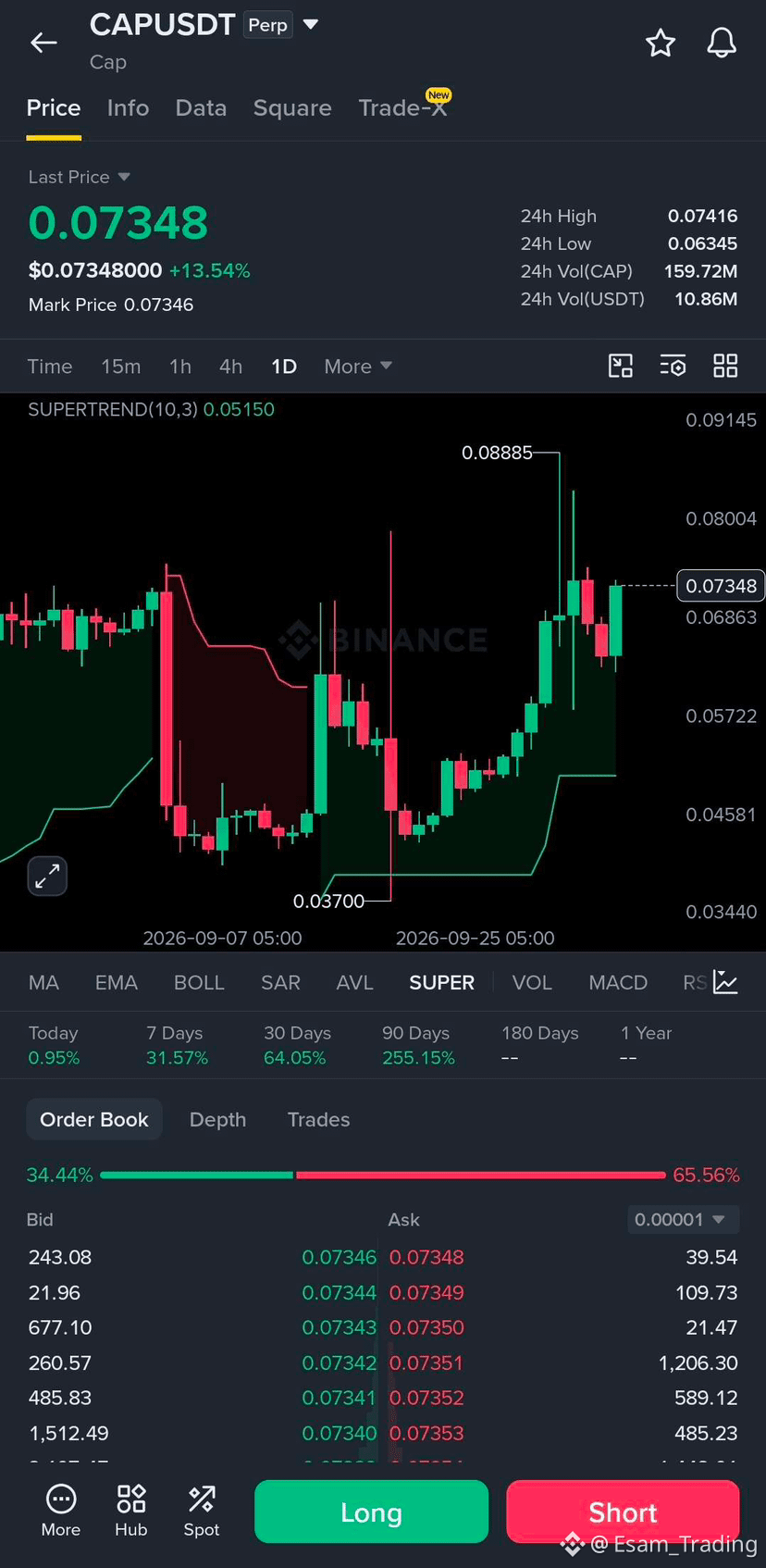
🚨 $CAP IS HOLDING THE BREAKOUT ZONE WELL.
Price is around $0.0735, up strongly from the $0.0370 low, and the daily structure has clearly shifted in buyers’ favor. 📈
The daily Supertrend flipped bullish at $0.0515, and price is still comfortably above it.
What I like most is the recovery structure:
Breakout → pullback → buyers step back in.
Instead of losing the move, $CAP is holding the breakout zone. 👀
My levels:
🟢 $0.068–$0.070 → support
🟢 $0.060–$0.063 → major support
🔴 $0.074–$0.075 → resistance
🎯 $0.080 → TP1
🎯 $0.0888 → TP2
🚀 $0.095+ → TP3
The level I’m watching most is $0.075.
A clean daily close above $0.075 would bring the previous $0.08885 high back into play.
One thing I’m keeping in mind: the order book currently shows heavier sell-side liquidity, so I’d rather see $CAP absorb that supply than chase the move.
Hold $0.068–$0.070 + reclaim $0.075 = much cleaner setup. 👀📊
{future}(CAPUSDT)
🚨 $CAP IS HOLDING THE BREAKOUT ZONE WELL.
Price is around $0.0735, up strongly from the $0.0370 low, and the daily structure has clearly shifted in buyers’ favor. 📈
The daily Supertrend flipped bullish at $0.0515, and price is still comfortably above it.
What I like most is the recovery structure:
Breakout → pullback → buyers step back in.
Instead of losing the move, $CAP is holding the breakout zone. 👀
My levels:
🟢 $0.068–$0.070 → support
🟢 $0.060–$0.063 → major support
🔴 $0.074–$0.075 → resistance
🎯 $0.080 → TP1
🎯 $0.0888 → TP2
🚀 $0.095+ → TP3
The level I’m watching most is $0.075.
A clean daily close above $0.075 would bring the previous $0.08885 high back into play.
One thing I’m keeping in mind: the order book currently shows heavier sell-side liquidity, so I’d rather see $CAP absorb that supply than chase the move.
Hold $0.068–$0.070 + reclaim $0.075 = much cleaner setup. 👀📊
Price is around $0.0735, up strongly from the $0.0370 low, and the daily structure has clearly shifted in buyers’ favor. 📈
The daily Supertrend flipped bullish at $0.0515, and price is still comfortably above it.
What I like most is the recovery structure:
Breakout → pullback → buyers step back in.
Instead of losing the move, $CAP is holding the breakout zone. 👀
My levels:
🟢 $0.068–$0.070 → support
🟢 $0.060–$0.063 → major support
🔴 $0.074–$0.075 → resistance
🎯 $0.080 → TP1
🎯 $0.0888 → TP2
🚀 $0.095+ → TP3
The level I’m watching most is $0.075.
A clean daily close above $0.075 would bring the previous $0.08885 high back into play.
One thing I’m keeping in mind: the order book currently shows heavier sell-side liquidity, so I’d rather see $CAP absorb that supply than chase the move.
Hold $0.068–$0.070 + reclaim $0.075 = much cleaner setup. 👀📊
3
501
·
--
Bullish
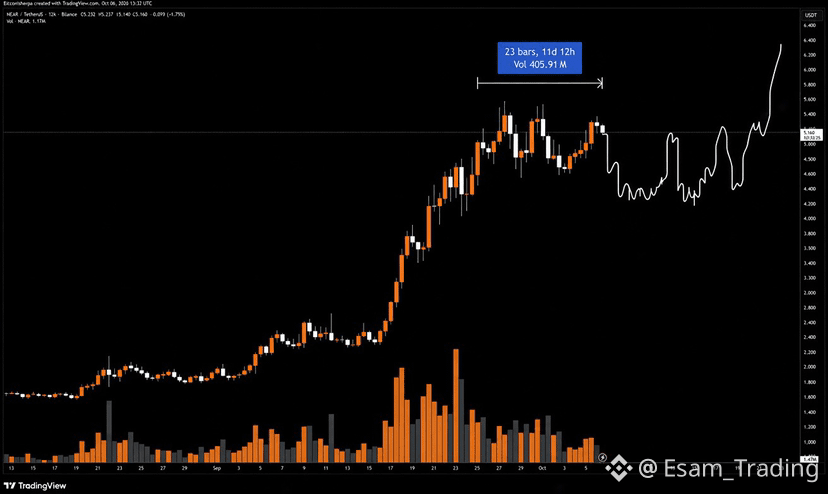
$NEAR 👀
Honestly, I’d love to see another 1–2 weeks of chop and consolidation here.
Let the market cool down, build a stronger base, and then hopefully get a clean leg higher. 🚀
Of course, the bigger move will probably depend heavily on what $BTC does.
But even with that uncertainty, I still think $NEAR is one of the better coins to watch this cycle.
Patience now → expansion later. 📈
{future}(BTCUSDT)
{future}(NEARUSDT)
$NEAR 👀
Honestly, I’d love to see another 1–2 weeks of chop and consolidation here.
Let the market cool down, build a stronger base, and then hopefully get a clean leg higher. 🚀
Of course, the bigger move will probably depend heavily on what $BTC does.
But even with that uncertainty, I still think $NEAR is one of the better coins to watch this cycle.
Patience now → expansion later. 📈
Honestly, I’d love to see another 1–2 weeks of chop and consolidation here.
Let the market cool down, build a stronger base, and then hopefully get a clean leg higher. 🚀
Of course, the bigger move will probably depend heavily on what $BTC does.
But even with that uncertainty, I still think $NEAR is one of the better coins to watch this cycle.
Patience now → expansion later. 📈
4
874
·
--
Bullish
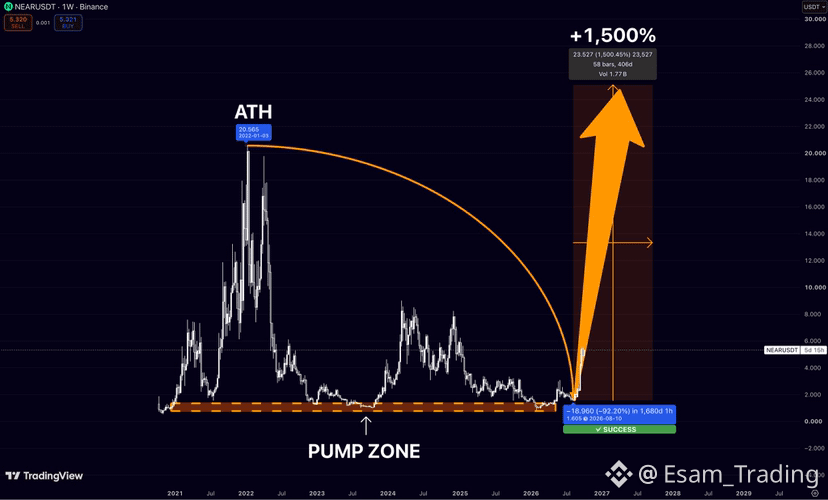
🔥 $NEAR JUST WOKE UP FROM THE ZONE EVERYONE IGNORED.
For almost 2 years, every move into the $1–$2 range was treated like another chance to sell.
Now look at the reaction. 👀
That’s exactly why I love charts like this.
The best opportunities rarely look exciting at the start.
They look boring. Dead. Forgotten.
Then the expansion begins.
$NEAR has already traded above $20 once.
If this current zone really was the macro bottom, I’m watching for:
🎯 ATH retest first
🚀 $25+ as a potential extension
That would be roughly +1,500% from the bottom.
Most people will become bullish when $NEAR reaches $15.
I’d rather be paying attention around $5.
The opportunity is usually hiding before the narrative becomes obvious. 👀📈
{future}(NEARUSDT)
🔥 $NEAR JUST WOKE UP FROM THE ZONE EVERYONE IGNORED.
For almost 2 years, every move into the $1–$2 range was treated like another chance to sell.
Now look at the reaction. 👀
That’s exactly why I love charts like this.
The best opportunities rarely look exciting at the start.
They look boring. Dead. Forgotten.
Then the expansion begins.
$NEAR has already traded above $20 once.
If this current zone really was the macro bottom, I’m watching for:
🎯 ATH retest first
🚀 $25+ as a potential extension
That would be roughly +1,500% from the bottom.
Most people will become bullish when $NEAR reaches $15.
I’d rather be paying attention around $5.
The opportunity is usually hiding before the narrative becomes obvious. 👀📈
For almost 2 years, every move into the $1–$2 range was treated like another chance to sell.
Now look at the reaction. 👀
That’s exactly why I love charts like this.
The best opportunities rarely look exciting at the start.
They look boring. Dead. Forgotten.
Then the expansion begins.
$NEAR has already traded above $20 once.
If this current zone really was the macro bottom, I’m watching for:
🎯 ATH retest first
🚀 $25+ as a potential extension
That would be roughly +1,500% from the bottom.
Most people will become bullish when $NEAR reaches $15.
I’d rather be paying attention around $5.
The opportunity is usually hiding before the narrative becomes obvious. 👀📈
2
588
·
--
Bullish
Partly True
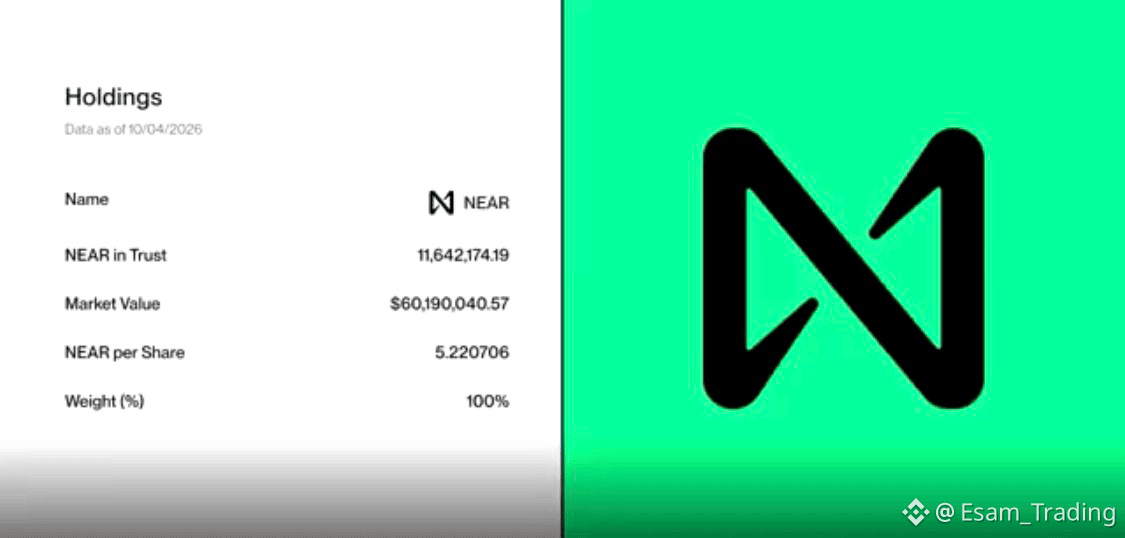
🚨BITWISE $NEAR ETF HITS $60M IN WEEK ONE!
Bitwise NRR holds 11.64 million $NEAR , worth $60.2 million.
The fund started trading on September 29.
This is the real demand for $NEAR in an ETF wrapper 🚀
{future}(NEARUSDT)
🚨BITWISE $NEAR ETF HITS $60M IN WEEK ONE!
Bitwise NRR holds 11.64 million $NEAR , worth $60.2 million.
The fund started trading on September 29.
This is the real demand for $NEAR in an ETF wrapper 🚀
Bitwise NRR holds 11.64 million $NEAR , worth $60.2 million.
The fund started trading on September 29.
This is the real demand for $NEAR in an ETF wrapper 🚀
1
8
3.2k
·
--
Bullish
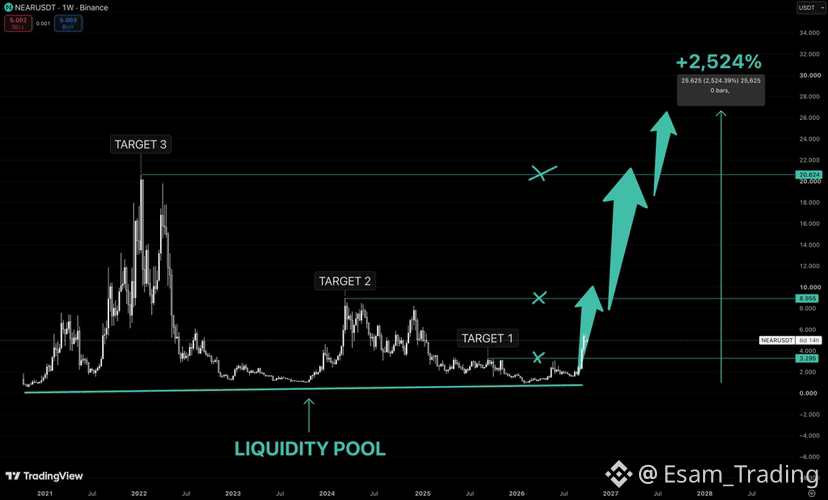
🔥 $NEAR IS WAKING UP AGAIN.
For nearly 5 years, some of $NEAR biggest moves have started from the same major liquidity zone.
Now price is pushing away from that area with momentum. 👀
My levels are simple:
🎯 $3.29 → first target
🎯 $8.95 → second target
🚀 $20.62 → major target
If the historical structure repeats, the full move from the bottom could potentially reach around +2,500%.
And that’s usually how markets work:
At $5, almost nobody cares.
Above $10, everyone starts talking about $NEAR again.
The opportunity is usually before the narrative becomes obvious. 👀
Let’s see if history repeats. 📈
{future}(NEARUSDT)
🔥 $NEAR IS WAKING UP AGAIN.
For nearly 5 years, some of $NEAR biggest moves have started from the same major liquidity zone.
Now price is pushing away from that area with momentum. 👀
My levels are simple:
🎯 $3.29 → first target
🎯 $8.95 → second target
🚀 $20.62 → major target
If the historical structure repeats, the full move from the bottom could potentially reach around +2,500%.
And that’s usually how markets work:
At $5, almost nobody cares.
Above $10, everyone starts talking about $NEAR again.
The opportunity is usually before the narrative becomes obvious. 👀
Let’s see if history repeats. 📈
For nearly 5 years, some of $NEAR biggest moves have started from the same major liquidity zone.
Now price is pushing away from that area with momentum. 👀
My levels are simple:
🎯 $3.29 → first target
🎯 $8.95 → second target
🚀 $20.62 → major target
If the historical structure repeats, the full move from the bottom could potentially reach around +2,500%.
And that’s usually how markets work:
At $5, almost nobody cares.
Above $10, everyone starts talking about $NEAR again.
The opportunity is usually before the narrative becomes obvious. 👀
Let’s see if history repeats. 📈
2
18
10.1k
·
--
Bullish
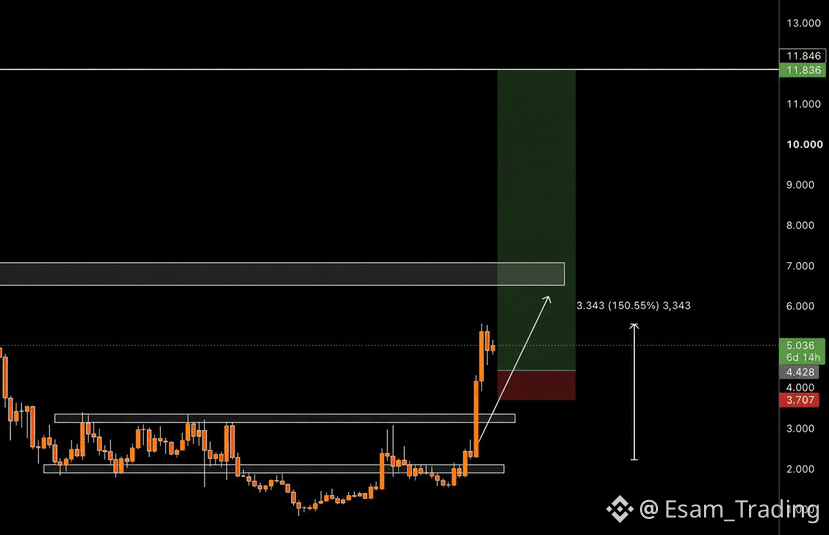
🚨 $NEAR MISSED THE MOVE FROM $2.20?
Don’t chase the pump.
If $NEAR keeps building momentum, $11 could be the next major target. 🎯
For those who missed the rally from $2.20, there may still be another opportunity ahead.
Patience > FOMO. 👀🔥
{future}(NEARUSDT)
🚨 $NEAR MISSED THE MOVE FROM $2.20?
Don’t chase the pump.
If $NEAR keeps building momentum, $11 could be the next major target. 🎯
For those who missed the rally from $2.20, there may still be another opportunity ahead.
Patience > FOMO. 👀🔥
Don’t chase the pump.
If $NEAR keeps building momentum, $11 could be the next major target. 🎯
For those who missed the rally from $2.20, there may still be another opportunity ahead.
Patience > FOMO. 👀🔥
3
1
33
53.1k
·
--
Bullish
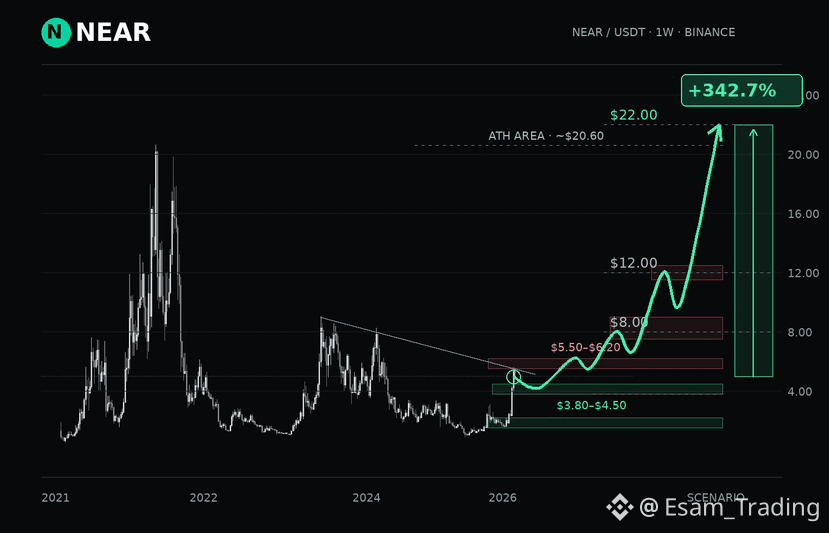
🔥 $NEAR COULD BE APPROACHING A MAJOR WEEKLY BREAKOUT
$NEAR has rallied back toward its descending resistance, and now the key question is simple:
Can buyers reclaim $5.50–$6.20 and actually hold it on the retest? 👀
That’s the zone I’m watching for a potential shift in the weekly structure.
For the bullish setup to stay valid:
🟢 $3.80–$4.50 → needs to become support
🚀 $5.50–$6.20 → major resistance / breakout zone
🎯 $8 → first major upside test
🎯 $12 → next target
🔥 $20.60 → historical high
🚀 $22 → potential cycle extension
From around $4.969, a move to $22 would represent roughly 343% upside.
But I’m not assuming it happens.
⚠️ A weekly close below $3.80 would significantly weaken the bullish structure.
For now, $5.50–$6.20 is the zone that could change the entire weekly picture. 👀📈
{future}(NEARUSDT)
🔥 $NEAR COULD BE APPROACHING A MAJOR WEEKLY BREAKOUT
$NEAR has rallied back toward its descending resistance, and now the key question is simple:
Can buyers reclaim $5.50–$6.20 and actually hold it on the retest? 👀
That’s the zone I’m watching for a potential shift in the weekly structure.
For the bullish setup to stay valid:
🟢 $3.80–$4.50 → needs to become support
🚀 $5.50–$6.20 → major resistance / breakout zone
🎯 $8 → first major upside test
🎯 $12 → next target
🔥 $20.60 → historical high
🚀 $22 → potential cycle extension
From around $4.969, a move to $22 would represent roughly 343% upside.
But I’m not assuming it happens.
⚠️ A weekly close below $3.80 would significantly weaken the bullish structure.
For now, $5.50–$6.20 is the zone that could change the entire weekly picture. 👀📈
$NEAR has rallied back toward its descending resistance, and now the key question is simple:
Can buyers reclaim $5.50–$6.20 and actually hold it on the retest? 👀
That’s the zone I’m watching for a potential shift in the weekly structure.
For the bullish setup to stay valid:
🟢 $3.80–$4.50 → needs to become support
🚀 $5.50–$6.20 → major resistance / breakout zone
🎯 $8 → first major upside test
🎯 $12 → next target
🔥 $20.60 → historical high
🚀 $22 → potential cycle extension
From around $4.969, a move to $22 would represent roughly 343% upside.
But I’m not assuming it happens.
⚠️ A weekly close below $3.80 would significantly weaken the bullish structure.
For now, $5.50–$6.20 is the zone that could change the entire weekly picture. 👀📈
9
6.3k
·
--
Bullish
Verified
🚨 IS ICE THE MYSTERY BUYER OF $HYPE ? 👀
Hyperliquid Labs is reportedly unstaking around 3.75M $HYPE , worth roughly $320M, for a private sale to a single institution on October 7.
That represents around 1.5% of the total supply from the October team unlock.
But there’s one big question:
Who’s buying?
The buyer hasn’t been publicly named.
And now the speculation is pointing toward ICE, the parent company of the NYSE.
Why?
ICE CEO Jeffrey Sprecher previously called Hyperliquid bigger than Nasdaq and said he had met with the team.
If ICE really is the buyer, that would be a massive validation for Hyperliquid.
Instead of a huge team unlock potentially hitting the market, you’d have one of the world’s biggest financial institutions potentially taking the tokens privately.
⚠️ Nothing is confirmed yet.
But October 7 could be a very interesting day for $HYPE . 👀
{future}(HYPEUSDT)
🚨 IS ICE THE MYSTERY BUYER OF $HYPE ? 👀
Hyperliquid Labs is reportedly unstaking around 3.75M $HYPE , worth roughly $320M, for a private sale to a single institution on October 7.
That represents around 1.5% of the total supply from the October team unlock.
But there’s one big question:
Who’s buying?
The buyer hasn’t been publicly named.
And now the speculation is pointing toward ICE, the parent company of the NYSE.
Why?
ICE CEO Jeffrey Sprecher previously called Hyperliquid bigger than Nasdaq and said he had met with the team.
If ICE really is the buyer, that would be a massive validation for Hyperliquid.
Instead of a huge team unlock potentially hitting the market, you’d have one of the world’s biggest financial institutions potentially taking the tokens privately.
⚠️ Nothing is confirmed yet.
But October 7 could be a very interesting day for $HYPE . 👀
Hyperliquid Labs is reportedly unstaking around 3.75M $HYPE , worth roughly $320M, for a private sale to a single institution on October 7.
That represents around 1.5% of the total supply from the October team unlock.
But there’s one big question:
Who’s buying?
The buyer hasn’t been publicly named.
And now the speculation is pointing toward ICE, the parent company of the NYSE.
Why?
ICE CEO Jeffrey Sprecher previously called Hyperliquid bigger than Nasdaq and said he had met with the team.
If ICE really is the buyer, that would be a massive validation for Hyperliquid.
Instead of a huge team unlock potentially hitting the market, you’d have one of the world’s biggest financial institutions potentially taking the tokens privately.
⚠️ Nothing is confirmed yet.
But October 7 could be a very interesting day for $HYPE . 👀

3
4.9k
·
--
Bullish
Verified
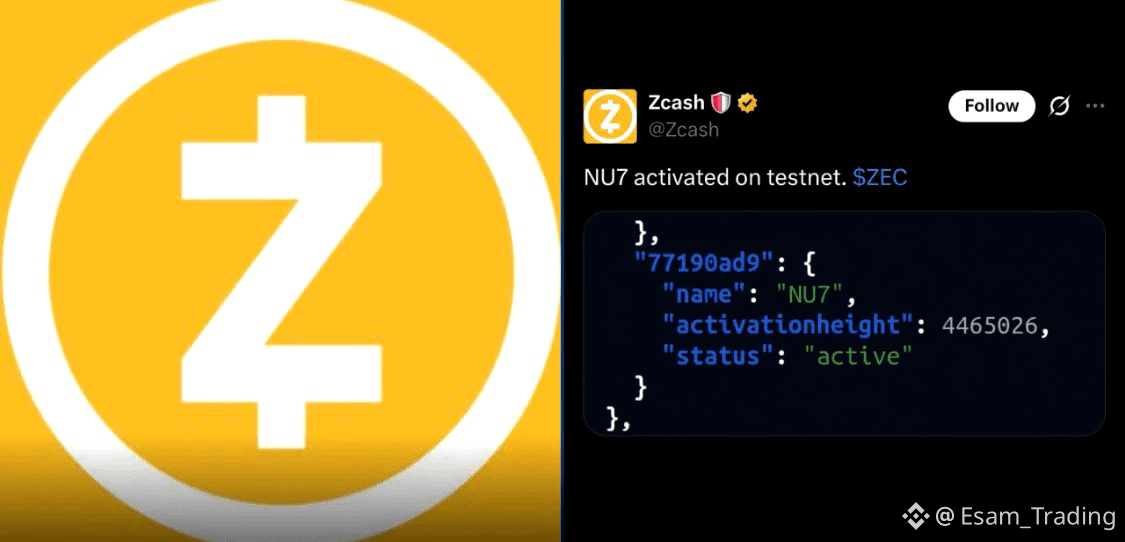
🚨 $ZEC IS ABOUT TO GET A LOT FASTER.
A major upgrade is now getting closer.
Zcash just activated NU7 on testnet, with mainnet currently targeted for November 5.
The final go/no-go decision is expected on October 20, after the teams monitor how the testnet performs.
The biggest change? ⚡
⏱️ Block time: 75s → 25s
That means shielded transactions could confirm roughly 3x faster once NU7 reaches mainnet.
Faster blocks + faster shielded transactions = a meaningful upgrade for the Zcash user experience.
$ZEC is definitely one to watch heading into November. 👀
{future}(ZECUSDT)
🚨 $ZEC IS ABOUT TO GET A LOT FASTER.
A major upgrade is now getting closer.
Zcash just activated NU7 on testnet, with mainnet currently targeted for November 5.
The final go/no-go decision is expected on October 20, after the teams monitor how the testnet performs.
The biggest change? ⚡
⏱️ Block time: 75s → 25s
That means shielded transactions could confirm roughly 3x faster once NU7 reaches mainnet.
Faster blocks + faster shielded transactions = a meaningful upgrade for the Zcash user experience.
$ZEC is definitely one to watch heading into November. 👀
A major upgrade is now getting closer.
Zcash just activated NU7 on testnet, with mainnet currently targeted for November 5.
The final go/no-go decision is expected on October 20, after the teams monitor how the testnet performs.
The biggest change? ⚡
⏱️ Block time: 75s → 25s
That means shielded transactions could confirm roughly 3x faster once NU7 reaches mainnet.
Faster blocks + faster shielded transactions = a meaningful upgrade for the Zcash user experience.
$ZEC is definitely one to watch heading into November. 👀
2
4
1k
·
--
Bullish
Verified
🚨 A QUANTUM-SECURE CASH CHAIN IS COMING TO $NEAR
Quantus is building a proof-of-work chain focused on private digital cash that’s designed to remain secure even in a future with quantum computers.
Instead of relying on the elliptic-curve signatures used by Bitcoin and Ethereum today, Quantus uses post-quantum cryptography.
And now the big part:
🔗 Quantus is integrating with $NEAR Protocol
💧 Liquidity is expected to start moving from Quantus into $NEAR soon.
There’s no confirmed launch time yet, but if the integration goes live as planned, it could add another interesting piece to NEAR’s growing ecosystem.
Quantum-secure infrastructure + private cash + NEAR liquidity.
Definitely one to keep on the radar. 👀
{future}(NEARUSDT)
🚨 A QUANTUM-SECURE CASH CHAIN IS COMING TO $NEAR
Quantus is building a proof-of-work chain focused on private digital cash that’s designed to remain secure even in a future with quantum computers.
Instead of relying on the elliptic-curve signatures used by Bitcoin and Ethereum today, Quantus uses post-quantum cryptography.
And now the big part:
🔗 Quantus is integrating with $NEAR Protocol
💧 Liquidity is expected to start moving from Quantus into $NEAR soon.
There’s no confirmed launch time yet, but if the integration goes live as planned, it could add another interesting piece to NEAR’s growing ecosystem.
Quantum-secure infrastructure + private cash + NEAR liquidity.
Definitely one to keep on the radar. 👀
Quantus is building a proof-of-work chain focused on private digital cash that’s designed to remain secure even in a future with quantum computers.
Instead of relying on the elliptic-curve signatures used by Bitcoin and Ethereum today, Quantus uses post-quantum cryptography.
And now the big part:
🔗 Quantus is integrating with $NEAR Protocol
💧 Liquidity is expected to start moving from Quantus into $NEAR soon.
There’s no confirmed launch time yet, but if the integration goes live as planned, it could add another interesting piece to NEAR’s growing ecosystem.
Quantum-secure infrastructure + private cash + NEAR liquidity.
Definitely one to keep on the radar. 👀

1
2
13
5.1k
·
--
Bullish
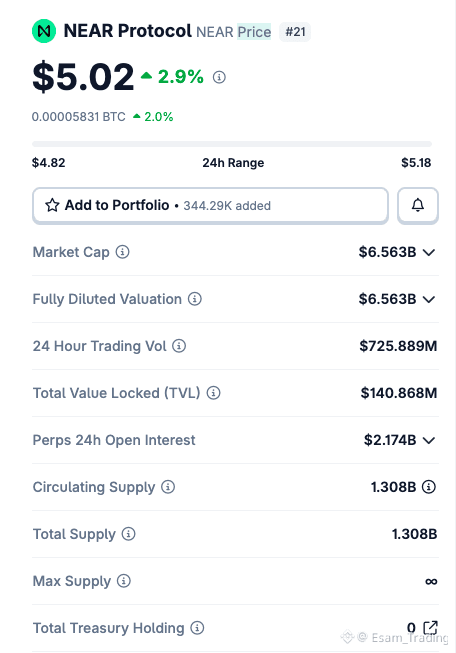
🚨 $NEAR BACK ABOVE $5 AFTER INTENTS HACK!
The $3.8M drained from the NEAR Intents USDT vault was reportedly returned in full within roughly 48 hours.
The team identified the attacker in under 24H, gave them a 48-hour deadline, and the funds came back with an on-chain message admitting they were in the wrong.
Case closed. 👀
And the bigger picture is still getting stronger:
📈 $32.79B all-time Intents volume — 23.8x YoY
💰 $6.36M fees in the last 30D
💵 $1.71M net revenue in 30D
🔥 ~$14.43M cumulative protocol revenue/burn
📊 Confidential TVL: $156M, up 2.9x MoM
Then there are several potential catalysts ahead:
🏦 Grayscale NEAR ETF — still pending
🚀 Bitwise spot ETF (NRR) — already live, with roughly $53M AUM in its first 3 days
🗳️ House of Stake vote — proposed issuance reduction from 2.5% → 1.6% over 24 months, potentially cutting **66M $NEAR ($330M)** if approved
🤖 Q4 roadmap — agent layer, AI portfolio tools, more yield and RWA rails built on top of Intents
The hack was obviously a negative event.
But the response matters.
Funds recovered. The vulnerability was addressed. And the underlying network metrics continue to grow.
If anything, my conviction is even stronger now.
What doesn’t kill you makes you stronger. 💪🔥
{future}(NEARUSDT)
🚨 $NEAR BACK ABOVE $5 AFTER INTENTS HACK!
The $3.8M drained from the NEAR Intents USDT vault was reportedly returned in full within roughly 48 hours.
The team identified the attacker in under 24H, gave them a 48-hour deadline, and the funds came back with an on-chain message admitting they were in the wrong.
Case closed. 👀
And the bigger picture is still getting stronger:
📈 $32.79B all-time Intents volume — 23.8x YoY
💰 $6.36M fees in the last 30D
💵 $1.71M net revenue in 30D
🔥 ~$14.43M cumulative protocol revenue/burn
📊 Confidential TVL: $156M, up 2.9x MoM
Then there are several potential catalysts ahead:
🏦 Grayscale NEAR ETF — still pending
🚀 Bitwise spot ETF (NRR) — already live, with roughly $53M AUM in its first 3 days
🗳️ House of Stake vote — proposed issuance reduction from 2.5% → 1.6% over 24 months, potentially cutting **66M $NEAR ($330M)** if approved
🤖 Q4 roadmap — agent layer, AI portfolio tools, more yield and RWA rails built on top of Intents
The hack was obviously a negative event.
But the response matters.
Funds recovered. The vulnerability was addressed. And the underlying network metrics continue to grow.
If anything, my conviction is even stronger now.
What doesn’t kill you makes you stronger. 💪🔥
The $3.8M drained from the NEAR Intents USDT vault was reportedly returned in full within roughly 48 hours.
The team identified the attacker in under 24H, gave them a 48-hour deadline, and the funds came back with an on-chain message admitting they were in the wrong.
Case closed. 👀
And the bigger picture is still getting stronger:
📈 $32.79B all-time Intents volume — 23.8x YoY
💰 $6.36M fees in the last 30D
💵 $1.71M net revenue in 30D
🔥 ~$14.43M cumulative protocol revenue/burn
📊 Confidential TVL: $156M, up 2.9x MoM
Then there are several potential catalysts ahead:
🏦 Grayscale NEAR ETF — still pending
🚀 Bitwise spot ETF (NRR) — already live, with roughly $53M AUM in its first 3 days
🗳️ House of Stake vote — proposed issuance reduction from 2.5% → 1.6% over 24 months, potentially cutting **66M $NEAR ($330M)** if approved
🤖 Q4 roadmap — agent layer, AI portfolio tools, more yield and RWA rails built on top of Intents
The hack was obviously a negative event.
But the response matters.
Funds recovered. The vulnerability was addressed. And the underlying network metrics continue to grow.
If anything, my conviction is even stronger now.
What doesn’t kill you makes you stronger. 💪🔥
13
7.7k
Log in to explore more content
Join global crypto users on Binance Square
⚡️ Get latest and useful information about crypto.
💬 Trusted by the world’s largest crypto exchange.
👍 Discover real insights from verified creators.
Email / Phone number
Trending Topics
FedMinutesFocusOnOctoberPause
102,463 views
1,046 Discussing
🚨 HIGH ALERT ‼️ PLEASE DON’T TRADE BLINDLY FOR THE NEXT HOUR 🚨
Guys, we have FOMC Minutes coming in less than 1 hour.
And after the kind of volatility we already saw today, I really don’t want anyone opening random high-leverage positions just before this release.
The biggest reaction I’m watching will be in Gold (XAU), Silver (XAG), BTC and ETH. Then coins like SOL and other highly leveraged mid/low-cap alts can exaggerate whatever move BTC makes.
Gold and Silver are especially sensitive tonight because the market is already reacting to the US dollar + Treasury yields, and both metals have been under heavy pressure ahead of the Fed minutes.
Briefly speaking
📉Hawkish Fed Minutes → Dollar/yields can push higher → pressure on BTC, crypto, Gold & silver
📈Dovish Fed Minutes → Dollar/yields can cool → BTC, Gold, Silver and risk assets can bounce hard.
And please remember the first candle can be a trap. We can get a pump, immediate dump, liquidations on both sides, and then the real direction.
So for now, protect your positions, reduce unnecessary leverage and don’t FOMO into the first move.
Tonight I’m watching $XAU , $XAG and $BTC first. These will tell us very quickly how the market is reading the Fed.
I will Update you guys on time
Follow @Panda Traders and Turn on Your notifications right now
#FedMinutesFocusOnOctoberPause
Panda Traders
·16 Likes
·3.1k views
BinanceLaunchesBinanceIntelligence
1.1M views
6,277 Discussing
EvernorthDelaysNasdaqDebutToOct12
6,348 views
199 Discussing