
#asic
asic
73,398 views
166 Discussing
Hot
Latest

·
--
Is ASIC's 2:1 Crypto CFD Leverage Cap Permanent, or Does It Expire in 2027?$BTC | Traders treat ASIC's 2:1 leverage cap on crypto CFDs as permanent. It is not. The product intervention order behind it took effect on 29 March 2021 and expires on 23 May 2027 unless remade, and ASIC only moved in October 2026 to propose extending it to 2037, which makes the cap a renewable instrument, not settled law.
On the desk, the first thing a new crypto CFD client assumes is that 2:1 is fixed forever. It never was. ASIC regulates retail leverage through time-limited product intervention orders, not permanent rules, and that distinction matters more than most traders realise when they size a position against it.
## Why does a leverage cap need renewing at all?
ASIC's product intervention powers under Part 7.9A of the Corporations Act are not open-ended bans. They are orders with a shelf life, reviewed and either remade, revised or allowed to lapse. The crypto CFD order is no exception. SatoshiMacro's review of Pepperstone's crypto CFD product notes the same order governs every ASIC-regulated broker offering the product to retail clients, Pepperstone included under AFSL 414530, and that the 23 May 2027 expiry date is written into the order itself, not a theoretical sunset clause nobody expects to matter.
That is the part most leverage explainers skip. They quote the ratio and move on. The expiry date is the more useful number, because it tells you the cap is a policy position ASIC has to keep actively defending, not a fact of nature.
## What does the October 2026 proposal actually change?
Nothing yet. A proposal to extend an order to 2037 is a consultation step, not a remade order. ASIC has signalled intent to keep the 2:1 cap in force for roughly another decade past the current expiry, which is itself informative: a regulator proposing a ten-year extension rather than a short-term renewal is telling the market it does not expect retail crypto CFD risk to look materially different any time soon.
My read is that the extension proposal is close to a formality. ASIC has shown no appetite to loosen retail leverage on any CFD asset class since the original 2021 intervention, and crypto CFDs sit at the bottom of its leverage ladder specifically because the underlying asset's own volatility does most of the work a higher multiple would otherwise do. A regulator that tightened before is not about to hand back room it already took.
## How does the 2:1 cap actually bite on a position?
Take a trader opening a crypto CFD with AUD 5,000 of margin. At 2:1, that controls AUD 10,000 of notional exposure, not the AUD 50,000 or AUD 100,000 a 10:1 or 20:1 ratio would allow on a forex pair. Bitcoin can move 5 to 10 percent in a session on its own. Layer even a modest multiple on top of that and the margin math turns violent fast. Strip the multiple down to 2:1 and the same move only costs 10 to 20 percent of posted margin instead of 50 to 100 percent. That gap is the entire point of the order, and it is why ASIC is proposing to keep it rather than let it expire.
Pepperstone's own crypto CFD product runs spread-based pricing with no separate commission, and overnight financing applies on any position held past the daily rollover, typically paid by the long side and sometimes received by the short side. None of that changes the leverage math above. It just adds a running cost on top of it, which matters more the longer a position sits open under a capped ratio.
## Is there a route around the cap?
Yes, two, and both carry a cost the 2:1 cap does not. The wholesale client route requires meeting ASIC's wholesale investor test, typically AUD 500,000 or more in net assets or AUD 250,000 or more in income, and even then higher leverage is only available at the broker's discretion, not as of right. The offshore route is simpler to access and harder to walk back from: platforms like Bybit or Binance Global sit outside ASIC's retail leverage framework entirely and advertise up to 100x on perpetual futures, but that exposure comes with no negative balance protection, no AFCA dispute access, and an offshore jurisdiction risk profile an ASIC-regulated account does not carry.
Negative balance protection is the detail most traders forget to weigh against that trade-off. On a retail account at a broker like Pepperstone, a position cannot lose more than the deposited balance, a guarantee the intervention order also underwrites. Give that up for more leverage and the downside stops being capped at your deposit.
## What's the honest limitation here?
Neither Pepperstone's page nor ASIC's public consultation material discloses what the extended order would actually say if finalised. It could keep the ratio at 2:1 unchanged, which is the base case given ASIC's track record, or it could revise the mechanics slightly. Nobody outside the regulator's own process knows yet, so the only thing a retail trader can plan around today is the cap as it currently stands, not the version that might exist after 2027.
Pepperstone's crypto CFD line-up covers 31 pairs as of a 12 March 2025 count against USD, and SatoshiMacro's review rates the product 4.5 out of 5, a half point below the 4.8 on the broker's main forex and CFD review, reflecting the narrower product class rather than a different regulatory standard. The AUD 0 minimum deposit removes one barrier to testing the mechanics on a small position before trusting it with anything larger. None of that changes the leverage conversation above. It just means there is no cost excuse for not understanding the cap before trading against it.
The 2:1 figure is not going anywhere soon. But it is a renewed decision every few years, not a fixed law, and traders who treat it as permanent are one ASIC consultation document away from being wrong about something they assumed was settled.
https://satoshimacro.com/reviews/crypto/pepperstone-crypto-review/?utm_source=binance_square&utm_medium=social&utm_campaign=autopilot_article
#SatoshiMacro #ASIC #CryptoCFD #Bitcoin
Is ASIC's 2:1 Crypto CFD Leverage Cap Permanent, or Does It Expire in 2027?
$BTC | Traders treat ASIC's 2:1 leverage cap on crypto CFDs as permanent. It is not. The product intervention order behind it took effect on 29 March 2021 and expires on 23 May 2027 unless remade, and ASIC only moved in October 2026 to propose extending it to 2037, which makes the cap a renewable instrument, not settled law.
On the desk, the first thing a new crypto CFD client assumes is that 2:1 is fixed forever. It never was. ASIC regulates retail leverage through time-limited product intervention orders, not permanent rules, and that distinction matters more than most traders realise when they size a position against it.
## Why does a leverage cap need renewing at all?
ASIC's product intervention powers under Part 7.9A of the Corporations Act are not open-ended bans. They are orders with a shelf life, reviewed and either remade, revised or allowed to lapse. The crypto CFD order is no exception. SatoshiMacro's review of Pepperstone's crypto CFD product notes the same order governs every ASIC-regulated broker offering the product to retail clients, Pepperstone included under AFSL 414530, and that the 23 May 2027 expiry date is written into the order itself, not a theoretical sunset clause nobody expects to matter.
That is the part most leverage explainers skip. They quote the ratio and move on. The expiry date is the more useful number, because it tells you the cap is a policy position ASIC has to keep actively defending, not a fact of nature.
## What does the October 2026 proposal actually change?
Nothing yet. A proposal to extend an order to 2037 is a consultation step, not a remade order. ASIC has signalled intent to keep the 2:1 cap in force for roughly another decade past the current expiry, which is itself informative: a regulator proposing a ten-year extension rather than a short-term renewal is telling the market it does not expect retail crypto CFD risk to look materially different any time soon.
My read is that the extension proposal is close to a formality. ASIC has shown no appetite to loosen retail leverage on any CFD asset class since the original 2021 intervention, and crypto CFDs sit at the bottom of its leverage ladder specifically because the underlying asset's own volatility does most of the work a higher multiple would otherwise do. A regulator that tightened before is not about to hand back room it already took.
## How does the 2:1 cap actually bite on a position?
Take a trader opening a crypto CFD with AUD 5,000 of margin. At 2:1, that controls AUD 10,000 of notional exposure, not the AUD 50,000 or AUD 100,000 a 10:1 or 20:1 ratio would allow on a forex pair. Bitcoin can move 5 to 10 percent in a session on its own. Layer even a modest multiple on top of that and the margin math turns violent fast. Strip the multiple down to 2:1 and the same move only costs 10 to 20 percent of posted margin instead of 50 to 100 percent. That gap is the entire point of the order, and it is why ASIC is proposing to keep it rather than let it expire.
Pepperstone's own crypto CFD product runs spread-based pricing with no separate commission, and overnight financing applies on any position held past the daily rollover, typically paid by the long side and sometimes received by the short side. None of that changes the leverage math above. It just adds a running cost on top of it, which matters more the longer a position sits open under a capped ratio.
## Is there a route around the cap?
Yes, two, and both carry a cost the 2:1 cap does not. The wholesale client route requires meeting ASIC's wholesale investor test, typically AUD 500,000 or more in net assets or AUD 250,000 or more in income, and even then higher leverage is only available at the broker's discretion, not as of right. The offshore route is simpler to access and harder to walk back from: platforms like Bybit or Binance Global sit outside ASIC's retail leverage framework entirely and advertise up to 100x on perpetual futures, but that exposure comes with no negative balance protection, no AFCA dispute access, and an offshore jurisdiction risk profile an ASIC-regulated account does not carry.
Negative balance protection is the detail most traders forget to weigh against that trade-off. On a retail account at a broker like Pepperstone, a position cannot lose more than the deposited balance, a guarantee the intervention order also underwrites. Give that up for more leverage and the downside stops being capped at your deposit.
## What's the honest limitation here?
Neither Pepperstone's page nor ASIC's public consultation material discloses what the extended order would actually say if finalised. It could keep the ratio at 2:1 unchanged, which is the base case given ASIC's track record, or it could revise the mechanics slightly. Nobody outside the regulator's own process knows yet, so the only thing a retail trader can plan around today is the cap as it currently stands, not the version that might exist after 2027.
Pepperstone's crypto CFD line-up covers 31 pairs as of a 12 March 2025 count against USD, and SatoshiMacro's review rates the product 4.5 out of 5, a half point below the 4.8 on the broker's main forex and CFD review, reflecting the narrower product class rather than a different regulatory standard. The AUD 0 minimum deposit removes one barrier to testing the mechanics on a small position before trusting it with anything larger. None of that changes the leverage conversation above. It just means there is no cost excuse for not understanding the cap before trading against it.
The 2:1 figure is not going anywhere soon. But it is a renewed decision every few years, not a fixed law, and traders who treat it as permanent are one ASIC consultation document away from being wrong about something they assumed was settled.
https://satoshimacro.com/reviews/crypto/pepperstone-crypto-review/?utm_source=binance_square&utm_medium=social&utm_campaign=autopilot_article
#SatoshiMacro #ASIC #CryptoCFD #Bitcoin
38

·
--
Article
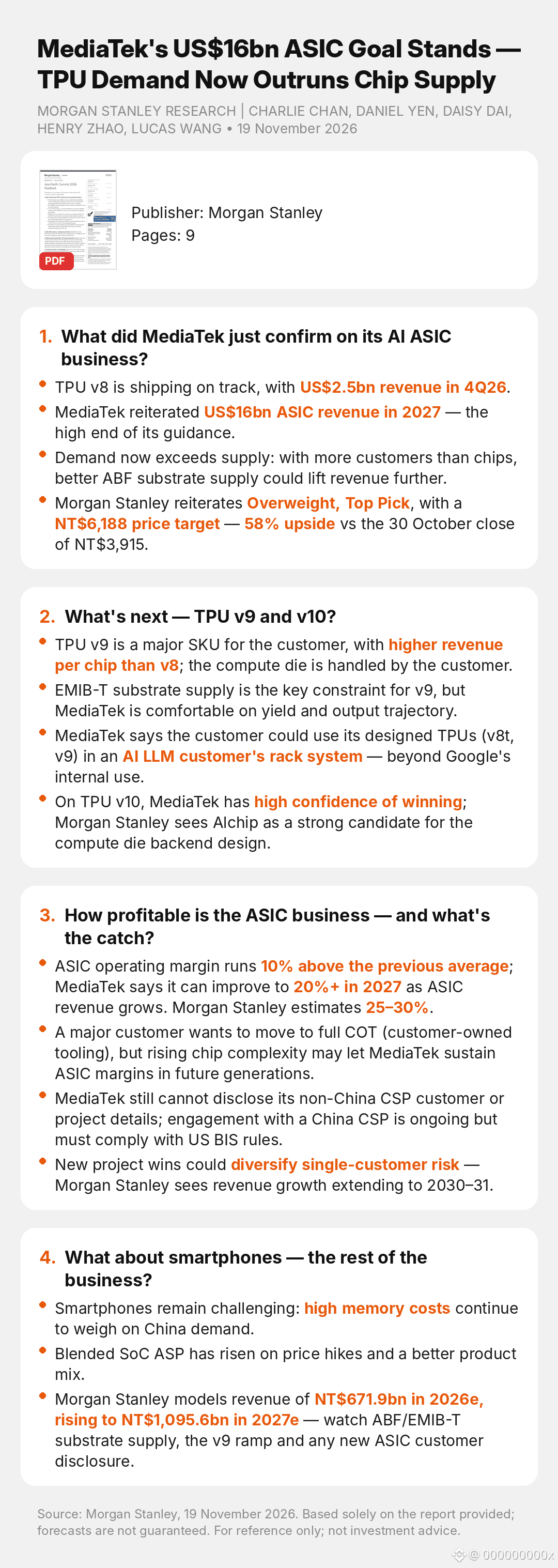
MediaTek's US$16bn ASIC Goal Stands — TPU Demand Now Outruns Chip SupplyMediaTek's US$16bn ASIC Goal Stands — TPU Demand Now Outruns Chip Supply
$2454.TW $3661.TW
Morgan Stanley · Asia Pacific Summit 2026 Feedback · 19 November 2026
1. What did MediaTek just confirm on its AI ASIC business?
• TPU v8 is shipping on track, with US$2.5bn revenue in 4Q26.
• MediaTek reiterated US$16bn ASIC revenue in 2027 — the high end of its guidance.
• Demand now exceeds supply: with more customers than chips, better ABF substrate supply could lift revenue further.
• Morgan Stanley reiterates Overweight, Top Pick, with a NT$6,188 price target — 58% upside vs the 30 October close of NT$3,915.
2. What's next — TPU v9 and v10?
• TPU v9 is a major SKU for the customer, with higher revenue per chip than v8; the compute die is handled by the customer.
• EMIB-T substrate supply is the key constraint for v9, but MediaTek is comfortable on yield and output trajectory.
• MediaTek says the customer could use its designed TPUs (v8t, v9) in an AI LLM customer's rack system — beyond Google's internal use.
• On TPU v10, MediaTek has high confidence of winning; Morgan Stanley sees Alchip as a strong candidate for the compute die backend design.
3. How profitable is the ASIC business — and what's the catch?
• ASIC operating margin runs 10% above the previous average; MediaTek says it can improve to 20%+ in 2027 as ASIC revenue grows. Morgan Stanley estimates 25–30%.
• A major customer wants to move to full COT (customer-owned tooling), but rising chip complexity may let MediaTek sustain ASIC margins in future generations.
• MediaTek still cannot disclose its non-China CSP customer or project details; engagement with a China CSP is ongoing but must comply with US BIS rules.
• New project wins could diversify single-customer risk — Morgan Stanley sees revenue growth extending to 2030–31.
4. What about smartphones — the rest of the business?
• Smartphones remain challenging: high memory costs continue to weigh on China demand.
• Blended SoC ASP has risen on price hikes and a better product mix.
• Morgan Stanley models revenue of NT$671.9bn in 2026e, rising to NT$1,095.6bn in 2027e — watch ABF/EMIB-T substrate supply, the v9 ramp and any new ASIC customer disclosure.
#ASIC #TPU #AI #Semiconductors #MediaTek
Source: Morgan Stanley, 19 November 2026. For reference only; not investment advice.
Read the full breakdown on Unhidea: https://unhidea.com/en/articles/research-49a63552f86b4c0ab0fddfa864cbd2e3-en
Visit unhidea.com for more of the latest sell-side research interpretations.
MediaTek's US$16bn ASIC Goal Stands — TPU Demand Now Outruns Chip Supply
MediaTek's US$16bn ASIC Goal Stands — TPU Demand Now Outruns Chip Supply
$2454.TW $3661.TW
Morgan Stanley · Asia Pacific Summit 2026 Feedback · 19 November 2026
1. What did MediaTek just confirm on its AI ASIC business?
• TPU v8 is shipping on track, with US$2.5bn revenue in 4Q26.
• MediaTek reiterated US$16bn ASIC revenue in 2027 — the high end of its guidance.
• Demand now exceeds supply: with more customers than chips, better ABF substrate supply could lift revenue further.
• Morgan Stanley reiterates Overweight, Top Pick, with a NT$6,188 price target — 58% upside vs the 30 October close of NT$3,915.
2. What's next — TPU v9 and v10?
• TPU v9 is a major SKU for the customer, with higher revenue per chip than v8; the compute die is handled by the customer.
• EMIB-T substrate supply is the key constraint for v9, but MediaTek is comfortable on yield and output trajectory.
• MediaTek says the customer could use its designed TPUs (v8t, v9) in an AI LLM customer's rack system — beyond Google's internal use.
• On TPU v10, MediaTek has high confidence of winning; Morgan Stanley sees Alchip as a strong candidate for the compute die backend design.
3. How profitable is the ASIC business — and what's the catch?
• ASIC operating margin runs 10% above the previous average; MediaTek says it can improve to 20%+ in 2027 as ASIC revenue grows. Morgan Stanley estimates 25–30%.
• A major customer wants to move to full COT (customer-owned tooling), but rising chip complexity may let MediaTek sustain ASIC margins in future generations.
• MediaTek still cannot disclose its non-China CSP customer or project details; engagement with a China CSP is ongoing but must comply with US BIS rules.
• New project wins could diversify single-customer risk — Morgan Stanley sees revenue growth extending to 2030–31.
4. What about smartphones — the rest of the business?
• Smartphones remain challenging: high memory costs continue to weigh on China demand.
• Blended SoC ASP has risen on price hikes and a better product mix.
• Morgan Stanley models revenue of NT$671.9bn in 2026e, rising to NT$1,095.6bn in 2027e — watch ABF/EMIB-T substrate supply, the v9 ramp and any new ASIC customer disclosure.
#ASIC #TPU #AI #Semiconductors #MediaTek
Source: Morgan Stanley, 19 November 2026. For reference only; not investment advice.
Read the full breakdown on Unhidea: https://unhidea.com/en/articles/research-49a63552f86b4c0ab0fddfa864cbd2e3-en
Visit unhidea.com for more of the latest sell-side research interpretations.
GOOGUS-0.84%

·
--
Do Most People Who Trade Crypto CFDs in Australia Actually Lose Money?$BTC | Do most people who trade crypto CFDs in Australia actually lose money? Yes, by a wide margin, and that is precisely why ASIC caps crypto CFD leverage at 2:1, the lowest of any asset class it regulates, while major forex pairs still carry 30:1. SatoshiMacro's guide to trading crypto in Australia treats that gap as the organising fact of the whole page, not a footnote, and the four step sequence it recommends is built around it rather than around picking the next coin.
## Why Does Crypto Get A Lower Cap Than Forex?
The short version is that regulators size leverage caps to loss rates, not to volatility alone. A crypto CFD lets you trade Bitcoin's price without owning the coin, settled in cash, with no wallet involved. That structure makes shorting simple and leverage easy to apply, which is also exactly why it is easy to misuse. ASIC's answer was to cut crypto to 2:1 across every provider, a fifteen fold gap against the 30:1 ceiling on majors like AUD/USD. On the desk, the lesson was never that leverage is the enemy. It is that the cap only protects you from the position size you would otherwise take, not from the decision to take it at all.
Spot ownership sits on the other side of the same regulatory split. Exchanges that let you actually hold the coin are AUSTRAC registered for anti money laundering purposes, not ASIC licensed for consumer protection, so there is no leverage cap to discuss because there is no leverage. Crypto CFD brokers, by contrast, need an Australian Financial Services Licence, and that licence is what brings negative balance protection and segregated client funds into the picture. Two different regulators, protecting against two different failure modes.
## Why Put A Demo Account Before A Live One?
This is the part beginners skip, and it is the part that matters most given the loss rate. The guide's own four steps run: learn the mechanics of CFDs, leverage and stop losses; practise on a demo account; choose an ASIC regulated broker; then start small with a fixed percentage of capital per trade. Three of those four steps happen before a single dollar is at risk. My read is that sequencing is not caution for its own sake, it is a direct response to the fact that most retail CFD accounts lose money, a figure the guide states plainly rather than burying in a footnote. A demo account strips out the one variable a beginner cannot simulate on paper, which is what leverage does to your judgement once real money and real drawdown are involved.
## What Does Risking 1 To 2 Percent Actually Look Like?
The guide suggests risking 1 to 2 percent of capital per trade, and says plainly that this means a beginner wants at least a few hundred dollars to work with, a figure it is careful to flag as its own guidance rather than a verified statistic. Run the arithmetic on a account right at that floor. A trader starting with AUD 600 and risking 1 percent per trade is putting AUD 6 on the line before the position even moves, scaling up toward AUD 12 at the 2 percent end of the range. That is not much room against spread and overnight financing on a leveraged crypto CFD, which is exactly the point: the position sizing rule is less about the percentage and more about forcing a trader to ask whether their starting capital can absorb that cost structure at all before they place a live trade.
## Spot Or CFD: Which Route Even Applies Here?
None of this applies if you are simply buying and holding. Spot ownership on an AUSTRAC registered exchange carries no leverage cap, no negative balance exposure and a materially different tax outcome, profits held over 12 months qualify for the 50 percent capital gains discount, where CFD profits are taxed as ordinary income regardless of how long the position sits open. The loss rate conversation belongs squarely to the CFD side of the guide. If you never intend to short or use leverage, the 2:1 cap and the demo-first sequence are simply not your problem.
## The Honest Limitation
The 1 to 2 percent guideline and the few hundred dollar starting figure are the page's own house rule, not an independently audited statistic, and they will not fit every account size or every broker's minimum. CFD trading carries a high risk of rapid loss, and nothing here is financial advice. Read the full sequence, including the broker shortlist and the spot versus CFD comparison, at the link below.
https://satoshimacro.com/guides/forex/how-to-trade-crypto/?utm_source=binance_square&utm_medium=social&utm_campaign=autopilot_article
#SatoshiMacro #BitcoinCFD #ASIC #Bitcoin
Do Most People Who Trade Crypto CFDs in Australia Actually Lose Money?
$BTC | Do most people who trade crypto CFDs in Australia actually lose money? Yes, by a wide margin, and that is precisely why ASIC caps crypto CFD leverage at 2:1, the lowest of any asset class it regulates, while major forex pairs still carry 30:1. SatoshiMacro's guide to trading crypto in Australia treats that gap as the organising fact of the whole page, not a footnote, and the four step sequence it recommends is built around it rather than around picking the next coin.
## Why Does Crypto Get A Lower Cap Than Forex?
The short version is that regulators size leverage caps to loss rates, not to volatility alone. A crypto CFD lets you trade Bitcoin's price without owning the coin, settled in cash, with no wallet involved. That structure makes shorting simple and leverage easy to apply, which is also exactly why it is easy to misuse. ASIC's answer was to cut crypto to 2:1 across every provider, a fifteen fold gap against the 30:1 ceiling on majors like AUD/USD. On the desk, the lesson was never that leverage is the enemy. It is that the cap only protects you from the position size you would otherwise take, not from the decision to take it at all.
Spot ownership sits on the other side of the same regulatory split. Exchanges that let you actually hold the coin are AUSTRAC registered for anti money laundering purposes, not ASIC licensed for consumer protection, so there is no leverage cap to discuss because there is no leverage. Crypto CFD brokers, by contrast, need an Australian Financial Services Licence, and that licence is what brings negative balance protection and segregated client funds into the picture. Two different regulators, protecting against two different failure modes.
## Why Put A Demo Account Before A Live One?
This is the part beginners skip, and it is the part that matters most given the loss rate. The guide's own four steps run: learn the mechanics of CFDs, leverage and stop losses; practise on a demo account; choose an ASIC regulated broker; then start small with a fixed percentage of capital per trade. Three of those four steps happen before a single dollar is at risk. My read is that sequencing is not caution for its own sake, it is a direct response to the fact that most retail CFD accounts lose money, a figure the guide states plainly rather than burying in a footnote. A demo account strips out the one variable a beginner cannot simulate on paper, which is what leverage does to your judgement once real money and real drawdown are involved.
## What Does Risking 1 To 2 Percent Actually Look Like?
The guide suggests risking 1 to 2 percent of capital per trade, and says plainly that this means a beginner wants at least a few hundred dollars to work with, a figure it is careful to flag as its own guidance rather than a verified statistic. Run the arithmetic on a account right at that floor. A trader starting with AUD 600 and risking 1 percent per trade is putting AUD 6 on the line before the position even moves, scaling up toward AUD 12 at the 2 percent end of the range. That is not much room against spread and overnight financing on a leveraged crypto CFD, which is exactly the point: the position sizing rule is less about the percentage and more about forcing a trader to ask whether their starting capital can absorb that cost structure at all before they place a live trade.
## Spot Or CFD: Which Route Even Applies Here?
None of this applies if you are simply buying and holding. Spot ownership on an AUSTRAC registered exchange carries no leverage cap, no negative balance exposure and a materially different tax outcome, profits held over 12 months qualify for the 50 percent capital gains discount, where CFD profits are taxed as ordinary income regardless of how long the position sits open. The loss rate conversation belongs squarely to the CFD side of the guide. If you never intend to short or use leverage, the 2:1 cap and the demo-first sequence are simply not your problem.
## The Honest Limitation
The 1 to 2 percent guideline and the few hundred dollar starting figure are the page's own house rule, not an independently audited statistic, and they will not fit every account size or every broker's minimum. CFD trading carries a high risk of rapid loss, and nothing here is financial advice. Read the full sequence, including the broker shortlist and the spot versus CFD comparison, at the link below.
https://satoshimacro.com/guides/forex/how-to-trade-crypto/?utm_source=binance_square&utm_medium=social&utm_campaign=autopilot_article
#SatoshiMacro #BitcoinCFD #ASIC #Bitcoin
112
·
--
$BTC | Retail traders ask the desk the same thing about the ASIC 2:1 cap on crypto CFDs: how do I get more leverage. Plus500's crypto CFD review on SatoshiMacro spells out the real path. Wholesale-client status needs AUD 2.5 million net assets or AUD 250,000 gross income for two straight years, then higher leverage opens up on broker terms. Most accounts never clear that bar. The other option, moving to an offshore venue for up to 100x, sits outside ASIC entirely: no negative balance protection, no AFCA access. My read: the wholesale test is the only honest upgrade, offshore leverage is a different risk, not a shortcut. The review doesn't disclose each broker's own sign-off process. CFDs carry real loss risk.
https://satoshimacro.com/reviews/crypto/plus500-crypto-review/?utm_source=binance_square&utm_medium=social&utm_campaign=autopilot_short-2
#SatoshiMacro #CryptoCFD #ASIC #Bitcoin
https://satoshimacro.com/reviews/crypto/plus500-crypto-review/?utm_source=binance_square&utm_medium=social&utm_campaign=autopilot_short-2
#SatoshiMacro #CryptoCFD #ASIC #Bitcoin
64
·
--
Does ASIC's Negative Balance Protection Really Cap an Unlimited Bitcoin Short Loss?$BTC | If ASIC caps crypto CFD leverage at 2:1 and guarantees negative balance protection, how can shorting Bitcoin still carry an unlimited loss? Negative balance protection guarantees your account cannot finish below zero. It does not guarantee the price at which a losing short actually closes, and that gap between guarantee and execution is where the real risk sits.
## What does negative balance protection actually promise?
ASIC requires every Australian crypto CFD broker to offer negative balance protection, and SatoshiMacro's guide to shorting Bitcoin treats it as one of two things that make a short survivable, alongside a stop loss placed above your entry. NBP is a balance-sheet guarantee from the broker: whatever happens to the market, your account cannot finish below zero. It says nothing about where your position actually gets closed on the way there. That distinction gets lost in most explainers, and it is the whole answer to why a loss that is technically "capped" can still feel unlimited while the trade is live.
## How is a short's loss profile really different from a long's?
Go long and the floor is zero, because Bitcoin cannot trade below nothing, so the most you can lose is your stake. Go short and there is no equivalent ceiling. In theory, losses on a short grow as the price climbs, and crypto can rally hard enough, fast enough, to outrun a normal order. That asymmetry is real, and it is why ASIC set the retail crypto CFD cap at 2:1, the lowest leverage ceiling ASIC applies to any asset class. A 500 dollar deposit controls a 1,000 dollar short at that cap. Half the leverage most other instruments get, and you still hold a position that can move against you faster than most new traders expect.
## So where does "unlimited" still apply if NBP exists?
Here is the mechanism most retail explainers skip. A stop loss is an instruction, not a guarantee of price. In a calm market it fills close to where you set it. In a short squeeze or a weekend gap, price can jump straight through a stop level without trading at it, and the position closes wherever liquidity actually exists next, not where you wanted out. If that fill is bad enough to blow past your account balance, NBP is the thing that absorbs the difference, not you. The broker eats that tail risk, which is exactly why it is mandated rather than offered voluntarily. My read is that NBP is not protection against a short losing badly. It is protection against a short losing so badly, so fast, that the stop loss itself fails to do its job.
## A worked example on the 500 dollar, 1,000 dollar short
Take the account from SatoshiMacro's own figures: 500 dollars margin, a 1,000 dollar short at 2:1. Say you decide upfront to risk 1 percent of that account, 5 dollars, and place your stop accordingly. In an ordinary session the stop triggers near that level and the loss stays close to 5 dollars. In a genuine squeeze, where price gaps past every resting order, the position might not close until it is 40 or 50 dollars underwater, 8 to 10 percent of the account, well past your intended 5 dollar risk. NBP's only job at that point is making sure the loss stops at the 500 dollars you funded, not that it protects the plan you actually sized. The stop loss was built to hold the 5 dollar line. It is also the part most likely to fail in exactly the conditions a short is most exposed to.
## What I would actually do before opening a short
Treat the 2:1 cap and negative balance protection as the floor under the building, not the building itself. Size every short so the stop loss, not the regulatory backstop, is doing the real work, and accept that Bitcoin's thinner weekend liquidity means a stop can gap. On the desk the rule was simple: never carry leveraged short size through a window where you cannot react to a gap, because the regulation only promises where the pain stops, not where your exit actually prices.
That window matters more for Australian traders than it looks. Crypto trades 24 hours a day, but you do not. A short opened before an AEDT evening and left unattended through a US data print or an Asian session squeeze is exactly the scenario where a stop gaps past its level and NBP, not your plan, decides how the loss ends. If you cannot watch the position, size it smaller, not larger, and accept a worse entry rather than no stop at all. None of this is a reason to avoid shorting Bitcoin in Australia. It is a reason to treat ASIC's two safeguards as what they are: a backstop for the broker's balance sheet and yours, not a substitute for your own risk control.
The honest limitation here is that SatoshiMacro's guide does not quantify how often Bitcoin shorts actually gap through a stop during a squeeze, and neither broker disclosures nor ASIC's rules publish that rate anywhere I have found. Treat the mechanism as real and the frequency as unknown, and size the trade on that basis rather than assuming negative balance protection makes the tail risk someone else's problem entirely.
https://satoshimacro.com/guides/forex/how-to-short-bitcoin/?utm_source=binance_square&utm_medium=social&utm_campaign=autopilot_article
#SatoshiMacro #BitcoinShort #ASIC #Bitcoin
Does ASIC's Negative Balance Protection Really Cap an Unlimited Bitcoin Short Loss?
$BTC | If ASIC caps crypto CFD leverage at 2:1 and guarantees negative balance protection, how can shorting Bitcoin still carry an unlimited loss? Negative balance protection guarantees your account cannot finish below zero. It does not guarantee the price at which a losing short actually closes, and that gap between guarantee and execution is where the real risk sits.
## What does negative balance protection actually promise?
ASIC requires every Australian crypto CFD broker to offer negative balance protection, and SatoshiMacro's guide to shorting Bitcoin treats it as one of two things that make a short survivable, alongside a stop loss placed above your entry. NBP is a balance-sheet guarantee from the broker: whatever happens to the market, your account cannot finish below zero. It says nothing about where your position actually gets closed on the way there. That distinction gets lost in most explainers, and it is the whole answer to why a loss that is technically "capped" can still feel unlimited while the trade is live.
## How is a short's loss profile really different from a long's?
Go long and the floor is zero, because Bitcoin cannot trade below nothing, so the most you can lose is your stake. Go short and there is no equivalent ceiling. In theory, losses on a short grow as the price climbs, and crypto can rally hard enough, fast enough, to outrun a normal order. That asymmetry is real, and it is why ASIC set the retail crypto CFD cap at 2:1, the lowest leverage ceiling ASIC applies to any asset class. A 500 dollar deposit controls a 1,000 dollar short at that cap. Half the leverage most other instruments get, and you still hold a position that can move against you faster than most new traders expect.
## So where does "unlimited" still apply if NBP exists?
Here is the mechanism most retail explainers skip. A stop loss is an instruction, not a guarantee of price. In a calm market it fills close to where you set it. In a short squeeze or a weekend gap, price can jump straight through a stop level without trading at it, and the position closes wherever liquidity actually exists next, not where you wanted out. If that fill is bad enough to blow past your account balance, NBP is the thing that absorbs the difference, not you. The broker eats that tail risk, which is exactly why it is mandated rather than offered voluntarily. My read is that NBP is not protection against a short losing badly. It is protection against a short losing so badly, so fast, that the stop loss itself fails to do its job.
## A worked example on the 500 dollar, 1,000 dollar short
Take the account from SatoshiMacro's own figures: 500 dollars margin, a 1,000 dollar short at 2:1. Say you decide upfront to risk 1 percent of that account, 5 dollars, and place your stop accordingly. In an ordinary session the stop triggers near that level and the loss stays close to 5 dollars. In a genuine squeeze, where price gaps past every resting order, the position might not close until it is 40 or 50 dollars underwater, 8 to 10 percent of the account, well past your intended 5 dollar risk. NBP's only job at that point is making sure the loss stops at the 500 dollars you funded, not that it protects the plan you actually sized. The stop loss was built to hold the 5 dollar line. It is also the part most likely to fail in exactly the conditions a short is most exposed to.
## What I would actually do before opening a short
Treat the 2:1 cap and negative balance protection as the floor under the building, not the building itself. Size every short so the stop loss, not the regulatory backstop, is doing the real work, and accept that Bitcoin's thinner weekend liquidity means a stop can gap. On the desk the rule was simple: never carry leveraged short size through a window where you cannot react to a gap, because the regulation only promises where the pain stops, not where your exit actually prices.
That window matters more for Australian traders than it looks. Crypto trades 24 hours a day, but you do not. A short opened before an AEDT evening and left unattended through a US data print or an Asian session squeeze is exactly the scenario where a stop gaps past its level and NBP, not your plan, decides how the loss ends. If you cannot watch the position, size it smaller, not larger, and accept a worse entry rather than no stop at all. None of this is a reason to avoid shorting Bitcoin in Australia. It is a reason to treat ASIC's two safeguards as what they are: a backstop for the broker's balance sheet and yours, not a substitute for your own risk control.
The honest limitation here is that SatoshiMacro's guide does not quantify how often Bitcoin shorts actually gap through a stop during a squeeze, and neither broker disclosures nor ASIC's rules publish that rate anywhere I have found. Treat the mechanism as real and the frequency as unknown, and size the trade on that basis rather than assuming negative balance protection makes the tail risk someone else's problem entirely.
https://satoshimacro.com/guides/forex/how-to-short-bitcoin/?utm_source=binance_square&utm_medium=social&utm_campaign=autopilot_article
#SatoshiMacro #BitcoinShort #ASIC #Bitcoin
88
·
--
$BTC | On the desk beginners treat ASIC's 2:1 crypto CFD cap as a safety net. It is not. SatoshiMacro's guide to trading crypto in Australia sizes risk at 1 to 2 percent per trade, and that rule, not leverage, caps the loss. An AUD 850 account risking 1.5 percent is AUD 12.75 on the trade, even though 2:1 lets you open AUD 1,700. Skip the stop and size off full margin, and one swing erases far more than 1.5 percent. Forex pairs get 30:1; crypto sits at 2:1 because it moves harder. My read: the cap limits what the broker lends you, not what you can lose. Spot gets the 50 percent CGT discount past 12 months; CFD profit is ordinary income instead. These are the AU rules, not advice on your account.
https://satoshimacro.com/guides/forex/how-to-trade-crypto/?utm_source=binance_square&utm_medium=social&utm_campaign=autopilot_short-2
#SatoshiMacro #CryptoCFD #ASIC #Bitcoin
https://satoshimacro.com/guides/forex/how-to-trade-crypto/?utm_source=binance_square&utm_medium=social&utm_campaign=autopilot_short-2
#SatoshiMacro #CryptoCFD #ASIC #Bitcoin
63
·
--
Does ASIC's 2:1 Crypto CFD Cap Actually Protect Retail Traders?$BTC | Does ASIC's 2:1 leverage cap on crypto CFDs actually stop Australians from blowing up an account, or does it just slow the bleed? My read after years of sizing leveraged positions on an institutional desk: the cap limits how violently one bad day can hurt you, but it does not change who ends up losing. Severity goes down. The base rate stays roughly where it always was.
## Why Is Crypto Leverage Capped at 2:1 When Forex Gets 30:1?
ASIC does not treat all CFDs the same. Major forex pairs are capped at 30:1 and gold at 20:1, but crypto sits in its own bracket at 2:1, a 50 percent margin requirement, the lowest cap of any asset class ASIC regulates. SatoshiMacro's crypto CFD guide traces this back to ASIC's Product Intervention Order, published as CP 322 on 14 April 2021: regulators looked at how fast crypto moves and decided retail clients needed a different ceiling entirely. A broker offering an Australian client higher crypto leverage than that is operating outside the ASIC framework, full stop.
## How Much Can a 2:1 Position Actually Swing in a Day?
Here is the part traders underweight. Bitcoin regularly moves 5 to 10 percent in a single day. At 2:1, that ordinary daily range translates to a 10 to 20 percent swing against your margin, not your position value. On a sharp day it is worse. Work the numbers plainly: an AUD 1,000 margin deposit controls an AUD 2,000 crypto position under the cap. A 10 percent adverse move in the coin is a 20 percent move against that margin before any swap charge gets deducted. The cap halves what a forex trader on 30:1 would be exposed to on the same dollar move, but it does not make crypto a low-volatility product. It just makes a reckless account harder to zero out in one candle.
## If the Cap Protects Traders, Why Do Most Still Lose?
This is the uncomfortable number. ASIC-mandated retail disclosures show 70 to 85 percent of retail CFD accounts lose money, and crypto is where SatoshiMacro's guide notes that tends to happen fastest, cap or no cap. On the desk, the lesson was never that a lower leverage ceiling fixes trader behaviour. It slows the clock. A trader who oversizes at 2:1 instead of overnight 5:1 or 10:1 on an unregulated venue still finds a way to erode an account, just over more sessions instead of one. The cap is a circuit breaker on magnitude, not a cure for poor position sizing, and I have watched disciplined traders lose slower and undisciplined traders lose anyway.
## What a 2:1 Cap Actually Buys You
Three honest things. First, it removes the single worst outcome, a total account wipeout from one leveraged candle, which is common on offshore venues running 50:1 or 100:1 crypto leverage. Second, it forces a trader to hold real skin in the game: a 50 percent margin requirement means half your exposure is actual deposited capital, not borrowed, so the maths of ruin are slower. Third, it buys time to react, since a position moving 10 to 20 percent of margin on a normal day still leaves room to adjust a stop before a margin call, where a higher cap would not.
What it does not buy you is competence. The cap says nothing about entry timing, position size relative to account equity, or whether a trade should exist at all. A trader risking the full margin allowance on every position is still one bad week away from the same outcome a 30:1 forex trader on half the position size would reach. Crypto's extra volatility and the overnight swap charge on any multi-day leveraged hold both still apply regardless of the cap.
## The Honest Limitation Here
Those 70 to 85 percent loss-rate figures come from each broker's own ASIC-mandated disclosure pages, not from an independent audit SatoshiMacro ran itself, and the exact number moves broker to broker and quarter to quarter. Treat it as a real range, not a precise forecast of what happens to your account specifically. It is also worth saying plainly that a crypto CFD is a cash-settled derivative, not ownership: no wallet, no coin, nothing to self-custody, and profits sit under ordinary income tax rather than the 50 percent CGT discount that applies to crypto held 12 months or more on an exchange. The cap governs the leverage question. It does not touch the tax question, and it does not touch whether a CFD was even the right product for the goal.
My actual read, having sat on both sides of leveraged risk limits: a 2:1 cap on a genuinely volatile asset is sound regulatory design, not box-ticking. It is simply a limit on how fast you can lose, sized to how fast the underlying moves. Position sizing, stop discipline and knowing when a weekend gap can run against you before the market reopens all still sit entirely on the trader. Nothing about a leverage cap, at 2:1 or otherwise, removes the job of managing risk yourself. Crypto CFDs are not financial advice and carry real loss risk; size accordingly.
https://satoshimacro.com/guides/forex/crypto-cfd-trading-australia/?utm_source=binance_square&utm_medium=social&utm_campaign=autopilot_article
#SatoshiMacro #Bitcoin #CryptoCFD #ASIC
Does ASIC's 2:1 Crypto CFD Cap Actually Protect Retail Traders?
$BTC | Does ASIC's 2:1 leverage cap on crypto CFDs actually stop Australians from blowing up an account, or does it just slow the bleed? My read after years of sizing leveraged positions on an institutional desk: the cap limits how violently one bad day can hurt you, but it does not change who ends up losing. Severity goes down. The base rate stays roughly where it always was.
## Why Is Crypto Leverage Capped at 2:1 When Forex Gets 30:1?
ASIC does not treat all CFDs the same. Major forex pairs are capped at 30:1 and gold at 20:1, but crypto sits in its own bracket at 2:1, a 50 percent margin requirement, the lowest cap of any asset class ASIC regulates. SatoshiMacro's crypto CFD guide traces this back to ASIC's Product Intervention Order, published as CP 322 on 14 April 2021: regulators looked at how fast crypto moves and decided retail clients needed a different ceiling entirely. A broker offering an Australian client higher crypto leverage than that is operating outside the ASIC framework, full stop.
## How Much Can a 2:1 Position Actually Swing in a Day?
Here is the part traders underweight. Bitcoin regularly moves 5 to 10 percent in a single day. At 2:1, that ordinary daily range translates to a 10 to 20 percent swing against your margin, not your position value. On a sharp day it is worse. Work the numbers plainly: an AUD 1,000 margin deposit controls an AUD 2,000 crypto position under the cap. A 10 percent adverse move in the coin is a 20 percent move against that margin before any swap charge gets deducted. The cap halves what a forex trader on 30:1 would be exposed to on the same dollar move, but it does not make crypto a low-volatility product. It just makes a reckless account harder to zero out in one candle.
## If the Cap Protects Traders, Why Do Most Still Lose?
This is the uncomfortable number. ASIC-mandated retail disclosures show 70 to 85 percent of retail CFD accounts lose money, and crypto is where SatoshiMacro's guide notes that tends to happen fastest, cap or no cap. On the desk, the lesson was never that a lower leverage ceiling fixes trader behaviour. It slows the clock. A trader who oversizes at 2:1 instead of overnight 5:1 or 10:1 on an unregulated venue still finds a way to erode an account, just over more sessions instead of one. The cap is a circuit breaker on magnitude, not a cure for poor position sizing, and I have watched disciplined traders lose slower and undisciplined traders lose anyway.
## What a 2:1 Cap Actually Buys You
Three honest things. First, it removes the single worst outcome, a total account wipeout from one leveraged candle, which is common on offshore venues running 50:1 or 100:1 crypto leverage. Second, it forces a trader to hold real skin in the game: a 50 percent margin requirement means half your exposure is actual deposited capital, not borrowed, so the maths of ruin are slower. Third, it buys time to react, since a position moving 10 to 20 percent of margin on a normal day still leaves room to adjust a stop before a margin call, where a higher cap would not.
What it does not buy you is competence. The cap says nothing about entry timing, position size relative to account equity, or whether a trade should exist at all. A trader risking the full margin allowance on every position is still one bad week away from the same outcome a 30:1 forex trader on half the position size would reach. Crypto's extra volatility and the overnight swap charge on any multi-day leveraged hold both still apply regardless of the cap.
## The Honest Limitation Here
Those 70 to 85 percent loss-rate figures come from each broker's own ASIC-mandated disclosure pages, not from an independent audit SatoshiMacro ran itself, and the exact number moves broker to broker and quarter to quarter. Treat it as a real range, not a precise forecast of what happens to your account specifically. It is also worth saying plainly that a crypto CFD is a cash-settled derivative, not ownership: no wallet, no coin, nothing to self-custody, and profits sit under ordinary income tax rather than the 50 percent CGT discount that applies to crypto held 12 months or more on an exchange. The cap governs the leverage question. It does not touch the tax question, and it does not touch whether a CFD was even the right product for the goal.
My actual read, having sat on both sides of leveraged risk limits: a 2:1 cap on a genuinely volatile asset is sound regulatory design, not box-ticking. It is simply a limit on how fast you can lose, sized to how fast the underlying moves. Position sizing, stop discipline and knowing when a weekend gap can run against you before the market reopens all still sit entirely on the trader. Nothing about a leverage cap, at 2:1 or otherwise, removes the job of managing risk yourself. Crypto CFDs are not financial advice and carry real loss risk; size accordingly.
https://satoshimacro.com/guides/forex/crypto-cfd-trading-australia/?utm_source=binance_square&utm_medium=social&utm_campaign=autopilot_article
#SatoshiMacro #Bitcoin #CryptoCFD #ASIC
100
·
--
Is Bitcoin's Five-Week Losing Streak Actually a Signal to Short It?$BTC | Bitcoin's run of weekly red candles is trending on Square, and the question traders keep asking is whether a losing streak like that is actually shortable through a regulated AU crypto CFD account. It is, but the ASIC 2:1 leverage cap, the account's negative balance protection, and the tax treatment of a CFD short all change the math more than a five-week slide alone does.
## What Does Shorting Bitcoin Through Plus500 Crypto Actually Involve?
A crypto CFD is a synthetic position. You never touch the underlying coin. Plus500 Crypto's own product page says the same thing for longs and shorts: you take a position whose profit and loss tracks the BTC price, you cannot withdraw the coin, stake it, or move it on-chain. Going short works the same mechanically as going long, just pointed the other way. Plus500AU Pty Ltd holds ASIC AFSL 417727, the Australian arm of an LSE-listed, FTSE 250 parent, and the page explicitly lists short-selling or hedging crypto exposure within an ASIC-regulated retail account as one of the use cases the product is built for. That is the honest answer to why a losing streak draws CFD traffic: shorting spot crypto outright is awkward in Australia without a derivatives wrapper, so the CFD is the mechanism, not a side door.
## How Does the 2:1 Cap Change the Sizing Math After a Losing Streak?
This is where the trend gets less exciting than the hashtag. Every ASIC-regulated crypto CFD broker, Plus500 included, caps retail leverage at 2:1 under the product intervention order that took effect 29 March 2021 and was made permanent the following year. On the AUD 200 minimum deposit the page quotes, that is AUD 400 of notional exposure, not the 20x or 50x an offshore perpetual venue would wave at the same account. On the desk, the losing streaks that actually hurt people were never the first short. They were the third or fourth, sized up specifically to make back the first two. The streak was never the real risk. The sizing was. The 2:1 cap does not stop that behaviour, but it puts a hard ceiling on how fast it can compound: to double your notional you have to double your deposited capital, not just click a bigger multiplier.
## What Happens if the Short Gets Squeezed?
A five-week slide ending in a sharp relief rally is the textbook short-squeeze setup, and it is the scenario the CFD structure is actually built to survive, not avoid. Retail accounts carry mandatory negative balance protection under the same 2021 ASIC order, so if a reversal gaps hard against an open short overnight, the most that account can lose is the funded balance. Plus500, not the trader, eats anything beyond zero. That protection is worth more on a losing-streak short than on a long, because a short's theoretical downside has no natural floor the way a long's does at zero.
## Does Shorting Through a CFD Dodge the Tax Question?
No. This is the part a losing-streak short gets wrong most often. The ATO treats CFD trading profits and losses as ordinary income for traders running it as a business, or as Section 70-25 trading-stock income for casual users, not as a capital gain. SatoshiMacro's Plus500 Crypto review flags that distinction specifically because people assume a short is tax-neutral in a way that selling spot coin is not; it is not. Spot crypto held as an investment still gets the 50 percent CGT discount past 12 months. A CFD short never qualifies for that discount regardless of how long the position runs, because it is not the asset class the discount applies to. If the point of shorting is to protect an existing long-term spot holding through a slide rather than sell it and trigger a disposal, that is a legitimate hedge. If the point is to speculate on five more red weeks, it is ordinary trading income from day one.
## Where the Page's Own Numbers Fall Short
The review does not break out whether Plus500 charges or pays overnight financing differently on a short position versus a long one, only that financing applies to leveraged positions generally and that pricing is spread-based with no separate commission. That is a real gap if the plan is to run a short across several weeks rather than close it the same session, since financing direction and cost compound daily and the published review simply does not have the number. Check the live platform's financing schedule before assuming a short either costs or pays the same as a long would.
My read is a five-week slide is a reason to check your setup and your sizing, not a reason to lever into it chasing the bounce. The 2:1 cap means the account grows a short the same slow way it grows a long. The negative balance protection is the backstop if the squeeze comes. The tax line is ordinary income either way, with no CGT discount shortcut for ducking out of a long position through a derivative.
Full review: https://satoshimacro.com/reviews/crypto/plus500-crypto-review/?utm_source=binance_square&utm_medium=social&utm_campaign=autopilot_article
#SatoshiMacro #Bitcoin #CryptoCFD #ASIC
Is Bitcoin's Five-Week Losing Streak Actually a Signal to Short It?
$BTC | Bitcoin's run of weekly red candles is trending on Square, and the question traders keep asking is whether a losing streak like that is actually shortable through a regulated AU crypto CFD account. It is, but the ASIC 2:1 leverage cap, the account's negative balance protection, and the tax treatment of a CFD short all change the math more than a five-week slide alone does.
## What Does Shorting Bitcoin Through Plus500 Crypto Actually Involve?
A crypto CFD is a synthetic position. You never touch the underlying coin. Plus500 Crypto's own product page says the same thing for longs and shorts: you take a position whose profit and loss tracks the BTC price, you cannot withdraw the coin, stake it, or move it on-chain. Going short works the same mechanically as going long, just pointed the other way. Plus500AU Pty Ltd holds ASIC AFSL 417727, the Australian arm of an LSE-listed, FTSE 250 parent, and the page explicitly lists short-selling or hedging crypto exposure within an ASIC-regulated retail account as one of the use cases the product is built for. That is the honest answer to why a losing streak draws CFD traffic: shorting spot crypto outright is awkward in Australia without a derivatives wrapper, so the CFD is the mechanism, not a side door.
## How Does the 2:1 Cap Change the Sizing Math After a Losing Streak?
This is where the trend gets less exciting than the hashtag. Every ASIC-regulated crypto CFD broker, Plus500 included, caps retail leverage at 2:1 under the product intervention order that took effect 29 March 2021 and was made permanent the following year. On the AUD 200 minimum deposit the page quotes, that is AUD 400 of notional exposure, not the 20x or 50x an offshore perpetual venue would wave at the same account. On the desk, the losing streaks that actually hurt people were never the first short. They were the third or fourth, sized up specifically to make back the first two. The streak was never the real risk. The sizing was. The 2:1 cap does not stop that behaviour, but it puts a hard ceiling on how fast it can compound: to double your notional you have to double your deposited capital, not just click a bigger multiplier.
## What Happens if the Short Gets Squeezed?
A five-week slide ending in a sharp relief rally is the textbook short-squeeze setup, and it is the scenario the CFD structure is actually built to survive, not avoid. Retail accounts carry mandatory negative balance protection under the same 2021 ASIC order, so if a reversal gaps hard against an open short overnight, the most that account can lose is the funded balance. Plus500, not the trader, eats anything beyond zero. That protection is worth more on a losing-streak short than on a long, because a short's theoretical downside has no natural floor the way a long's does at zero.
## Does Shorting Through a CFD Dodge the Tax Question?
No. This is the part a losing-streak short gets wrong most often. The ATO treats CFD trading profits and losses as ordinary income for traders running it as a business, or as Section 70-25 trading-stock income for casual users, not as a capital gain. SatoshiMacro's Plus500 Crypto review flags that distinction specifically because people assume a short is tax-neutral in a way that selling spot coin is not; it is not. Spot crypto held as an investment still gets the 50 percent CGT discount past 12 months. A CFD short never qualifies for that discount regardless of how long the position runs, because it is not the asset class the discount applies to. If the point of shorting is to protect an existing long-term spot holding through a slide rather than sell it and trigger a disposal, that is a legitimate hedge. If the point is to speculate on five more red weeks, it is ordinary trading income from day one.
## Where the Page's Own Numbers Fall Short
The review does not break out whether Plus500 charges or pays overnight financing differently on a short position versus a long one, only that financing applies to leveraged positions generally and that pricing is spread-based with no separate commission. That is a real gap if the plan is to run a short across several weeks rather than close it the same session, since financing direction and cost compound daily and the published review simply does not have the number. Check the live platform's financing schedule before assuming a short either costs or pays the same as a long would.
My read is a five-week slide is a reason to check your setup and your sizing, not a reason to lever into it chasing the bounce. The 2:1 cap means the account grows a short the same slow way it grows a long. The negative balance protection is the backstop if the squeeze comes. The tax line is ordinary income either way, with no CGT discount shortcut for ducking out of a long position through a derivative.
Full review: https://satoshimacro.com/reviews/crypto/plus500-crypto-review/?utm_source=binance_square&utm_medium=social&utm_campaign=autopilot_article
#SatoshiMacro #Bitcoin #CryptoCFD #ASIC
89

AUSTRALIA'S REGULATOR SAYS ZERO PREDICTION MARKET APPLICATIONS — POLYMARKET FACES A MAJOR ROADBLOCK🇦🇺 Australia's financial watchdog has delivered a tough message to the prediction-market industry.
The Australian Securities and Investments Commission (ASIC) has reportedly received ZERO applications from prediction-market operators seeking approval to operate in the country.
During a parliamentary hearing on October 29, 2026, ASIC Chair Sarah Court indicated that any future application would face strict scrutiny, with prediction markets assessed in a similar way to binary options.
📊 The Key Regulatory Developments
Zero applications: No prediction-market operator has applied for an Australian market licence, according to reports of the hearing.No licensed operators: No prediction-market platform currently holds an Australian financial market licence.Binary options comparison: ASIC sees similarities between prediction contracts and binary options because both can involve all-or-nothing outcomes.October 1, 2031: Australia's retail binary-options ban has been extended until this date.August 2026 warning: ASIC's Moneysmart guidance warned Australians about the risks of using unlicensed offshore prediction markets.
⚠️ Why Is ASIC Concerned?
Prediction markets allow users to trade YES-or-NO contracts on future events, including elections, economic developments, sports and global news.
But ASIC says these contracts can create serious risks:
Potential misuse of confidential or insider information.Market manipulation.Disputes over how event outcomes are determined.Retail users losing their entire stake.Limited legal protections when using offshore platforms.
ASIC has also stated that it is not currently convinced prediction markets for retail clients are in the public interest.
🪙 Crypto Tokens to Watch
$UMA — An oracle and dispute-resolution protocol associated with Polymarket's optimistic oracle system.$GNO — The Gnosis ecosystem is connected to decentralized prediction-market infrastructure.$LINK — Chainlink provides oracle infrastructure used across blockchain applications and data-driven markets.
These tokens have different roles in the wider prediction-market ecosystem. Australia's regulatory position does not automatically mean their networks or tokens are banned.
🎯 What Could Happen Next?
Australia's regulatory stance could create a significant obstacle for prediction-market platforms seeking access to its retail market.
However, this does not mean every prediction-market model is permanently prohibited. Any future application would need to satisfy Australia's licensing requirements and ASIC's public-interest assessment.
The big question: Will Australia eventually approve a regulated prediction-market platform, or will strict oversight keep these markets away from retail investors?
👇 Is ASIC protecting investors or slowing down financial innovation? Share your opinion!
Related tokens: $UMA $GNO $LINK
#ASIC #Australia #Polymarket #Regulation #asichasreceivednopredictionmarketapplications
{spot}(LINKUSDT)
{spot}(GNOUSDT)
{spot}(UMAUSDT)
AUSTRALIA'S REGULATOR SAYS ZERO PREDICTION MARKET APPLICATIONS — POLYMARKET FACES A MAJOR ROADBLOCK
🇦🇺 Australia's financial watchdog has delivered a tough message to the prediction-market industry.
The Australian Securities and Investments Commission (ASIC) has reportedly received ZERO applications from prediction-market operators seeking approval to operate in the country.
During a parliamentary hearing on October 29, 2026, ASIC Chair Sarah Court indicated that any future application would face strict scrutiny, with prediction markets assessed in a similar way to binary options.
📊 The Key Regulatory Developments
Zero applications: No prediction-market operator has applied for an Australian market licence, according to reports of the hearing.No licensed operators: No prediction-market platform currently holds an Australian financial market licence.Binary options comparison: ASIC sees similarities between prediction contracts and binary options because both can involve all-or-nothing outcomes.October 1, 2031: Australia's retail binary-options ban has been extended until this date.August 2026 warning: ASIC's Moneysmart guidance warned Australians about the risks of using unlicensed offshore prediction markets.
⚠️ Why Is ASIC Concerned?
Prediction markets allow users to trade YES-or-NO contracts on future events, including elections, economic developments, sports and global news.
But ASIC says these contracts can create serious risks:
Potential misuse of confidential or insider information.Market manipulation.Disputes over how event outcomes are determined.Retail users losing their entire stake.Limited legal protections when using offshore platforms.
ASIC has also stated that it is not currently convinced prediction markets for retail clients are in the public interest.
🪙 Crypto Tokens to Watch
$UMA — An oracle and dispute-resolution protocol associated with Polymarket's optimistic oracle system.$GNO — The Gnosis ecosystem is connected to decentralized prediction-market infrastructure.$LINK — Chainlink provides oracle infrastructure used across blockchain applications and data-driven markets.
These tokens have different roles in the wider prediction-market ecosystem. Australia's regulatory position does not automatically mean their networks or tokens are banned.
🎯 What Could Happen Next?
Australia's regulatory stance could create a significant obstacle for prediction-market platforms seeking access to its retail market.
However, this does not mean every prediction-market model is permanently prohibited. Any future application would need to satisfy Australia's licensing requirements and ASIC's public-interest assessment.
The big question: Will Australia eventually approve a regulated prediction-market platform, or will strict oversight keep these markets away from retail investors?
👇 Is ASIC protecting investors or slowing down financial innovation? Share your opinion!
Related tokens: $UMA $GNO $LINK
#ASIC #Australia #Polymarket #Regulation #asichasreceivednopredictionmarketapplications
1
505
#ASICHasReceivedNoPredictionMarketApplications 🚨 ASIC RECEIVES ZERO PREDICTION MARKET APPLICATIONS! 🇦🇺
Australia's financial regulator is raising serious concerns about prediction markets!
ASIC Chair Sarah Court confirmed on October 29 that no prediction market operator has applied for approval to operate in Australia.
🔥 KEY DEVELOPMENTS:
🔹 ASIC says any future application will face strict regulatory scrutiny.
🔹 The regulator questions whether prediction markets serve the public interest.
🔹 Concerns include market manipulation, insider information and all-or-nothing outcomes.
🔹 ASIC compares these contracts to binary options, which are banned for Australian retail clients.
📊 THE BIG PICTURE:
Australia is taking a cautious approach as prediction markets face increasing regulatory pressure.
Will stricter regulation reshape the global prediction market industry?
💬 What is your take?
#ASICHasReceivedNoPredictionMarketApplications #ASIC #CryptoRegulation #PredictionMarkets
2
153

#asichasreceivednopredictionmarketapplications
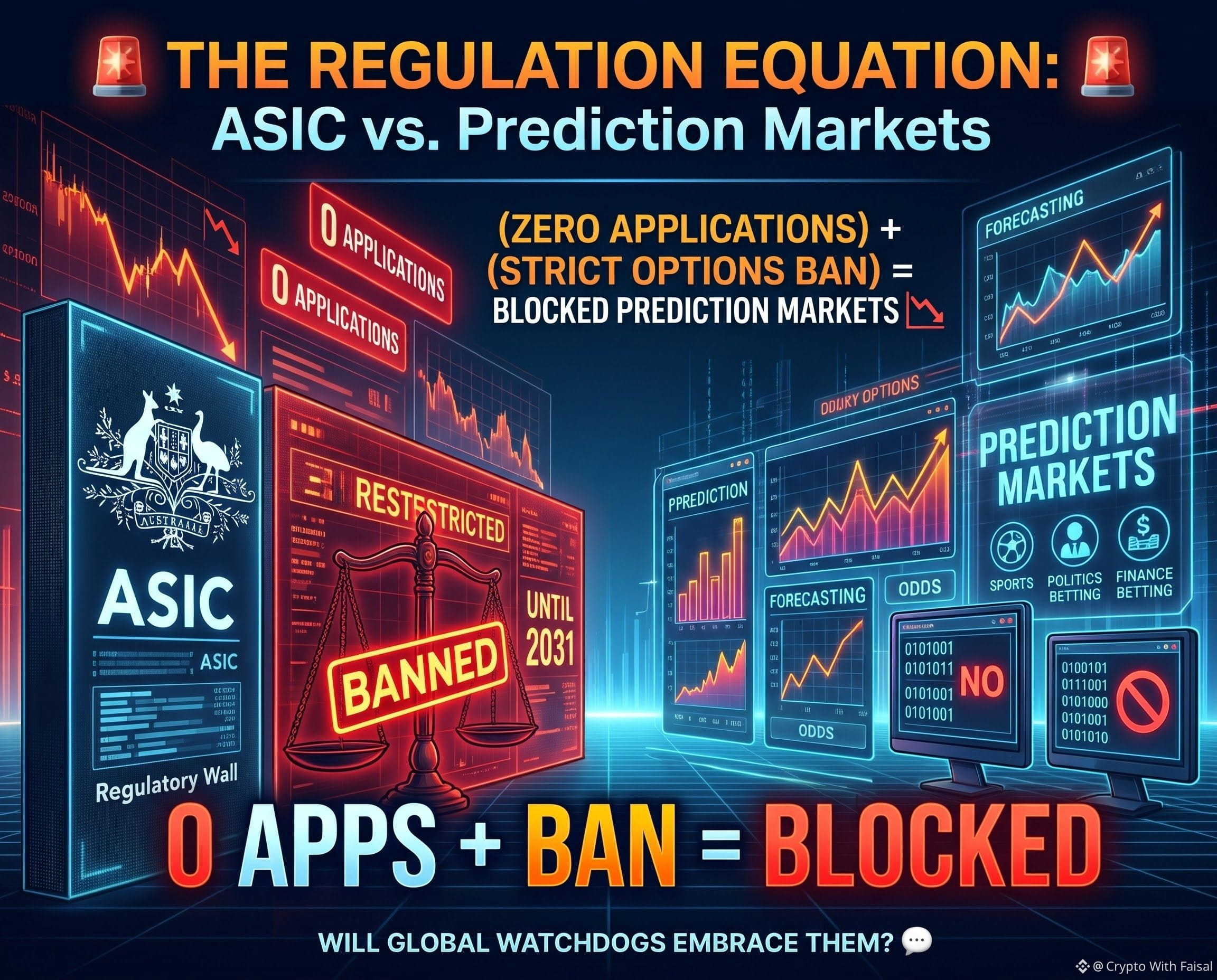
🚨 THE REGULATION EQUATION: ASIC vs. Prediction Markets 🚨
Australia is taking a hard stance. Let's break down the math 🧮👇
(Zero Applications) + (Strict Options Ban) = Blocked Prediction Markets 📉
The Asset Input:
(The Catalyst) = ASIC Chair Sarah Court confirmed to parliament that the regulator currently has zero applications from prediction market operators. Any future filings will face severe scrutiny.
The Key Deliverable:
(The Stance) ➔ ASIC officially classifies prediction platforms in the same high-risk bucket as binary options. Since binary options are strictly banned for retail clients in Australia until October 2031, prediction markets face a massive regulatory wall.
The Breakdown:
Local regulators are refusing to play ball. With zero local licenses, Australian users trading offshore have no financial protection if things go wrong.
Will global watchdogs eventually embrace prediction markets? 👇💬
$BTC
{future}(BTCUSDT)
$POL
{future}(POLUSDT)
$BNB
{future}(BNBUSDT)
#ASIC #Polymarket #predictionmarket
#asichasreceivednopredictionmarketapplications
🚨 THE REGULATION EQUATION: ASIC vs. Prediction Markets 🚨
Australia is taking a hard stance. Let's break down the math 🧮👇
(Zero Applications) + (Strict Options Ban) = Blocked Prediction Markets 📉
The Asset Input:
(The Catalyst) = ASIC Chair Sarah Court confirmed to parliament that the regulator currently has zero applications from prediction market operators. Any future filings will face severe scrutiny.
The Key Deliverable:
(The Stance) ➔ ASIC officially classifies prediction platforms in the same high-risk bucket as binary options. Since binary options are strictly banned for retail clients in Australia until October 2031, prediction markets face a massive regulatory wall.
The Breakdown:
Local regulators are refusing to play ball. With zero local licenses, Australian users trading offshore have no financial protection if things go wrong.
Will global watchdogs eventually embrace prediction markets? 👇💬
$BTC
$POL
$BNB
#ASIC #Polymarket #predictionmarket
1
192
·
--
Can You Run an Algorithmic Bitcoin CFD Strategy in Australia Under ASIC's Cap?$BTC | Can you run an EA or cAlgo strategy on Bitcoin CFDs in Australia and stay inside ASIC's retail rules? Yes. Pepperstone's crypto CFD desk runs on MT4, MT5 and cTrader with Expert Advisor and cAlgo scripting supported, but the mandatory 2:1 leverage cap means a strategy coded for an offshore account needs its position sizing rebuilt from the ground up, not just its API keys swapped over.
## Why does platform support matter more than the coin list here?
On the desk we never separated "is this broker any good" from "can my process actually run on it." A spot exchange like CoinSpot or Binance Australia gives you hundreds of coins and an API, but no charting platform built for running a strategy on the position itself. SatoshiMacro's review of Pepperstone's crypto CFD desk lists about 10 USD-denominated pairs, BTC through to MATIC, running across MT4, MT5, cTrader, TradingView integration and the native web and mobile apps, with EA and cAlgo scripting available on top of all of them. Narrower coin list, wider platform stack. That trade-off is the actual decision, not the headline rating.
## What does the 2:1 cap do to a strategy built elsewhere?
This is where most traders get it wrong. ASIC's leverage cap on retail crypto CFDs has sat at 2:1 since 29 March 2021 and was made permanent in 2022, under AFSL 414530. Take a strategy built on an offshore account running 50x. At 50x, a $1,000 margin unit opens roughly $50,000 of exposure. Drop the same logic onto a 2:1 Pepperstone account and that same $1,000 opens about $2,000, a position 25 times smaller than the backtest assumed. The strategy does not fail on the first signal. It fails three or four trades in, once a sizing error has quietly compounded.
## Where does an AUD 0 minimum deposit actually help?
It is the one number on the page that genuinely helps here. Pepperstone lists an AUD 0 minimum deposit, which means a trader can run a strategy through live execution, real spreads and overnight financing on genuinely small size before scaling up, instead of backtesting in isolation and meeting the real cost structure for the first time at full size. My read is that this does more for a trader porting a system than the leverage cap gets blamed for.
## Does running a bot change how the ATO treats the profit?
No. CFD profits and losses are generally assessed as ordinary income, not a capital gain, whether a human clicks the button or an EA does. The 50 percent CGT discount that applies to crypto held on a spot exchange past 12 months does not apply here, regardless of who or what places the trade. That is a tax outcome, not a technology one.
## What's the honest limitation?
Segregated client funds in Australian Tier-1 banks and negative balance protection stop the account from owing more than it holds. Neither one stops a strategy that is simply wrong. A systematic approach amplifies discipline when the logic holds and losses when it does not, at the same speed either way. This is not a strategy endorsement. A backtest run on offshore leverage and liquidity conditions is not evidence of anything once it is sitting at 2:1 on an ASIC-regulated book.
## My take
What I would actually do before porting anything across is run it on paper at the real 2:1 sizing first, then on the smallest live size the AUD 0 minimum allows, and only then compare the equity curve to the original backtest. If the two do not resemble each other, the leverage assumption was doing more of the work than the edge was.
https://satoshimacro.com/reviews/crypto/pepperstone-crypto-review/?utm_source=binance_square&utm_medium=social&utm_campaign=autopilot_article
#SatoshiMacro #Bitcoin #CryptoCFD #ASIC
Can You Run an Algorithmic Bitcoin CFD Strategy in Australia Under ASIC's Cap?
$BTC | Can you run an EA or cAlgo strategy on Bitcoin CFDs in Australia and stay inside ASIC's retail rules? Yes. Pepperstone's crypto CFD desk runs on MT4, MT5 and cTrader with Expert Advisor and cAlgo scripting supported, but the mandatory 2:1 leverage cap means a strategy coded for an offshore account needs its position sizing rebuilt from the ground up, not just its API keys swapped over.
## Why does platform support matter more than the coin list here?
On the desk we never separated "is this broker any good" from "can my process actually run on it." A spot exchange like CoinSpot or Binance Australia gives you hundreds of coins and an API, but no charting platform built for running a strategy on the position itself. SatoshiMacro's review of Pepperstone's crypto CFD desk lists about 10 USD-denominated pairs, BTC through to MATIC, running across MT4, MT5, cTrader, TradingView integration and the native web and mobile apps, with EA and cAlgo scripting available on top of all of them. Narrower coin list, wider platform stack. That trade-off is the actual decision, not the headline rating.
## What does the 2:1 cap do to a strategy built elsewhere?
This is where most traders get it wrong. ASIC's leverage cap on retail crypto CFDs has sat at 2:1 since 29 March 2021 and was made permanent in 2022, under AFSL 414530. Take a strategy built on an offshore account running 50x. At 50x, a $1,000 margin unit opens roughly $50,000 of exposure. Drop the same logic onto a 2:1 Pepperstone account and that same $1,000 opens about $2,000, a position 25 times smaller than the backtest assumed. The strategy does not fail on the first signal. It fails three or four trades in, once a sizing error has quietly compounded.
## Where does an AUD 0 minimum deposit actually help?
It is the one number on the page that genuinely helps here. Pepperstone lists an AUD 0 minimum deposit, which means a trader can run a strategy through live execution, real spreads and overnight financing on genuinely small size before scaling up, instead of backtesting in isolation and meeting the real cost structure for the first time at full size. My read is that this does more for a trader porting a system than the leverage cap gets blamed for.
## Does running a bot change how the ATO treats the profit?
No. CFD profits and losses are generally assessed as ordinary income, not a capital gain, whether a human clicks the button or an EA does. The 50 percent CGT discount that applies to crypto held on a spot exchange past 12 months does not apply here, regardless of who or what places the trade. That is a tax outcome, not a technology one.
## What's the honest limitation?
Segregated client funds in Australian Tier-1 banks and negative balance protection stop the account from owing more than it holds. Neither one stops a strategy that is simply wrong. A systematic approach amplifies discipline when the logic holds and losses when it does not, at the same speed either way. This is not a strategy endorsement. A backtest run on offshore leverage and liquidity conditions is not evidence of anything once it is sitting at 2:1 on an ASIC-regulated book.
## My take
What I would actually do before porting anything across is run it on paper at the real 2:1 sizing first, then on the smallest live size the AUD 0 minimum allows, and only then compare the equity curve to the original backtest. If the two do not resemble each other, the leverage assumption was doing more of the work than the edge was.
https://satoshimacro.com/reviews/crypto/pepperstone-crypto-review/?utm_source=binance_square&utm_medium=social&utm_campaign=autopilot_article
#SatoshiMacro #Bitcoin #CryptoCFD #ASIC
129

·
--
刷到澳洲 ASIC 这条:昆士兰州的 Brian Jacques Creigh,因无牌做加密投资基金被刑事起诉了。
硬点:墨尔本裁判法院 2026 年 10 月 19 日立案。检方指他 2021 年 4 月至 2022 年 6 月,通过 Panacea Capital 推销「Panacea Capital Cryptocurrency Investment Fund」,当时既无 AFS 牌照也非授权代表;另涉处理百万美元以上犯罪所得,对应未持牌业务吸纳的约 440 万美元投资款。联邦检方按 ASIC 刑事卷宗起诉,法院已批有条件保释。无牌从事金融服务最高 5 年;处理百万以上犯罪所得最高 25 年。此前他已于 2024 年 3 月因同一基金被永久禁业。
行政禁业之后又走到刑事指控,这条量级还是挺硬的。
#ASIC #加密监管 #澳大利亚

14


·
--
Silicon for ZK: The Rise of Zero-Knowledge ASICs 🔌⚙️
Generating ZK proofs requires heavy computing. Companies are building specialized hardware chips (ASICs) purely to speed up ZK cryptography, making Web3 hyper-fast.
#ZKHardware #ASIC #CryptoInfrastructure #TechTrends .
Silicon for ZK: The Rise of Zero-Knowledge ASICs 🔌⚙️
Generating ZK proofs requires heavy computing. Companies are building specialized hardware chips (ASICs) purely to speed up ZK cryptography, making Web3 hyper-fast.
#ZKHardware #ASIC #CryptoInfrastructure #TechTrends .
Generating ZK proofs requires heavy computing. Companies are building specialized hardware chips (ASICs) purely to speed up ZK cryptography, making Web3 hyper-fast.
#ZKHardware #ASIC #CryptoInfrastructure #TechTrends .
1
83

$NVDA IS PLAYING KINGMAKER IN THE ASIC WAR AGAINST $AVGO 🔥
The narrative here is that NVIDIA is quietly backing ASIC challengers like Marvell and MediaTek to eat into Broadcom’s market share. Serenity calls it a "conspiracy theory" but points to history with cloud providers — last year’s emerging players became extensions of NVIDIA’s ecosystem to break the moat.
This isn’t overnight speculation. He sees a two-year trading window before Google potentially pulls design work in-house post-2030. The market already repriced Marvell toward a trillion-dollar valuation after NVIDIA’s touch — same pattern could play out for others in this arena.
Are you watching the ASIC space for the next repricing play?
Not financial advice. Always manage your risk.
#AVGO #NVDA #ASIC #Semiconductors
⚡
83

ASIC vừa gia hạn thời gian miễn trừ thực thi cho doanh nghiệp crypto đến ngày 30/9/2025 – một tín hiệu tích cực, nhưng không phải giấy thông hành để trì hoãn.
Động thái này cho thấy cơ quan quản lý Úc đang chơi bài an toàn: cho các sàn giao dịch và nhà cung cấp dịch vụ thêm thời gian chuyển đổi sang hệ thống cấp phép chính thức, thay vì đột ngột siết chặt gây hỗn loạn. Về bản chất, đây là sự linh hoạt có kiểm soát – họ không muốn giết chết ngành non trẻ trước khi kịp hoàn thiện luật.
Với trader, tin này mang sắc thái tích cực ngắn hạn: giảm bớt rủi ro pháp lý bất ngờ, tạo hành lang ổn định tạm thời cho dòng tiền. Dù vậy, điểm cần theo dõi là khung pháp lý hoàn chỉnh sau tháng 10. Nếu quá chặt, chi phí tuân thủ có thể siết lại các startup nhỏ.
Quan điểm cá nhân: đừng vội mừng quá sớm. ASIC đang kéo dài thời gian đệm, không phải nới lỏng tiêu chuẩn. Các doanh nghiệp nên tận dụng giai đoạn này để chuẩn bị thực sự, còn trader hãy coi đây là tín hiệu tích cực có điều kiện.
Tự nghiên cứu và quản trị rủi ro – thị trường vẫn luôn biến động khó lường.
#Pháplý #Úc #CryptoRegulation #ASIC
27

Australia is finally turning up the heat on crypto. The September 30 deadline for firms to enter the ASIC licensing process has passed, meaning the period of regulatory leniency is officially over.
#ASIC #AustralianRegulation
Australia is finally turning up the heat on crypto. The September 30 deadline for firms to enter the ASIC licensing process has passed, meaning the period of regulatory leniency is officially over.
#ASIC #AustralianRegulation
#ASIC #AustralianRegulation
67

·
--
ASIC拟对加密结算衍生品设杠杆上限,合规收紧信号明确
据Cointelegraph,ASIC提出将杠杆限制与负余额保护扩展至部分以加密资产结算的衍生品。这一动向值得注意,因为它意味着澳洲监管框架正从传统证券衍生品向加密结算工具延伸。
ASIC此举的核心在于把加密结算衍生品纳入更明确的投资者保护体系。过去部分衍生品因结算方式特殊,杠杆与负余额风险披露并不统一。若新规落地,相关产品的杠杆空间与风险结构可能被重新界定,交易所与做市商需要调整产品设计与风控参数。
从市场影响看,这属于区域性合规收紧,而非全球性杠杆压缩。对澳洲本地参与者而言,高杠杆加密衍生品交易成本与风险边界可能变化;对跨境平台而言,则需评估是否调整面向澳洲用户的杠杆设置。由于事实包未给出具体杠杆倍数、生效时间与适用范围,影响幅度仍需等待细则。
反方因素在于,监管收紧未必直接压制市场活跃度。部分投资者可能转向杠杆更透明、规则更清晰的产品,反而提升合规平台的相对吸引力。同时,若细则执行留有余地,市场调整幅度可能有限。
接下来值得观察ASIC是否公布具体杠杆上限、负余额保护机制以及适用产品范围。若细则明确且执行严格,澳洲加密衍生品结构或将出现阶段性调整。
#CryptoRegulation #ASIC
以上为信息整理与个人分析,不构成投资建议。
后续政策细节进一步明确后,我会继续更新。
15
Australia's regulator ASIC is proposing new leverage caps and negative balance protections for derivatives settled using digital assets. This move signals a tighter regulatory environment for high risk trading in the region.
#ASIC #LeverageCaps
Australia's regulator ASIC is proposing new leverage caps and negative balance protections for derivatives settled using digital assets. This move signals a tighter regulatory environment for high risk trading in the region.
#ASIC #LeverageCaps
#ASIC #LeverageCaps
21
Log in to explore more content
Join global crypto users on Binance Square
⚡️ Get latest and useful information about crypto.
💬 Trusted by the world’s largest crypto exchange.
👍 Discover real insights from verified creators.
Email / Phone number
Trending Topics
1
#WillMarketsStageAThanksgivingReliefRally?
86 views
9 Discussing
2
#Bessent Softens Stance on Huang’s Nvidia Return
0 views
20 Discussing
3
#BTCReboundsAbove$60KAmidWhaleDipBuying
105,535 views
421 Discussing
4
#SolanaSets2027RoadmapToDoubleComputeCapacity
89,541 views
1,213 Discussing
5
#CaliforniaNvidiaProbeExaminesPotentialCriminalViolations
25,240 views
182 Discussing
6
#BlackRockLaunchesHKDollarDigitalLiquidityFund
76,557 views
883 Discussing
7
#NvidiaLoses$2.7TrillionInMonthAndAHalf
90,158 views
344 Discussing
8
#GlobalStocksFaceLongestLosingStreakSince2023
622,411 views
3,612 Discussing
9
#BlackRockIBITPostsRecord$541MSingleDayOutflow
106,357 views
188 Discussing
10
#TwentyOneCapitalAdds172.25BTC
192,740 views
1,737 Discussing