
Elaaf Noor
13.7k Posts

Elaaf Noor
Report
Block User
619 Following
5.6K+ Followers
7.2K+ Liked
Posts
·
--
Bullish
Something I noticed while digging through Dusk's core architecture today:
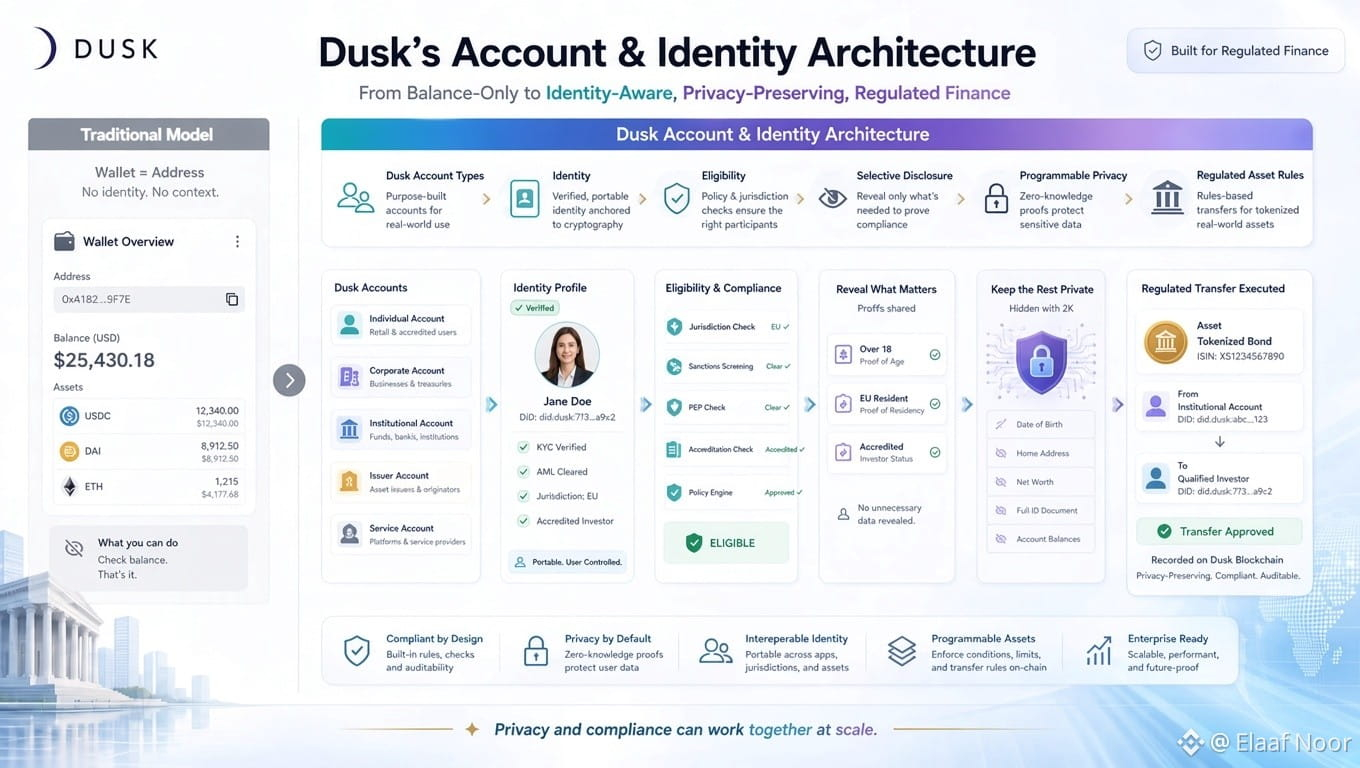
Dusk doesn't treat an account as simply an address holding coins.
Its account model is much more deliberate.
There are account types designed around different transaction requirements including public and privacy-preserving flows.
Do you think selective disclosure and programmable privacy are the ultimate keys to institutional adoption?
And that becomes particularly interesting when you think about regulated assets.
In a normal token transfer the main question is:
Does this address have enough balance?
A regulated security needs more questions answered.
Who is behind the account?
Is the holder eligible?
Is this transfer permitted?
What information should be revealed?
What information should remain private?
And can an authorized party verify the required attributes without exposing everything else?
That's where I think Dusk's account and identity architecture starts becoming more relevant than the usual wallet-address model.
The blockchain isnot just tracking balances.
It can become part of a rules-based financial identity and transfer workflow.
And there is an important distinction here:
privacy doesnot necessarily mean hiding the existence of everything.
It can mean exposing exactly what needs to be verified while keeping unrelated information confidential.
That's a much more useful model for regulated finance.
So the question I am asking about Dusk now isn't:
Does it have private transactions?
That's too basic.
It's:
Can account, identity, eligibility and transaction rules work together without forcing every financial application to expose the user's entire identity?
If that works at scale that's where programmable privacy becomes genuinely useful.
#dusk $DUSK @Dusk_Foundation
Something I noticed while digging through Dusk's core architecture today:
Dusk doesn't treat an account as simply an address holding coins.
Its account model is much more deliberate.
There are account types designed around different transaction requirements including public and privacy-preserving flows.
Do you think selective disclosure and programmable privacy are the ultimate keys to institutional adoption?
And that becomes particularly interesting when you think about regulated assets.
In a normal token transfer the main question is:
Does this address have enough balance?
A regulated security needs more questions answered.
Who is behind the account?
Is the holder eligible?
Is this transfer permitted?
What information should be revealed?
What information should remain private?
And can an authorized party verify the required attributes without exposing everything else?
That's where I think Dusk's account and identity architecture starts becoming more relevant than the usual wallet-address model.
The blockchain isnot just tracking balances.
It can become part of a rules-based financial identity and transfer workflow.
And there is an important distinction here:
privacy doesnot necessarily mean hiding the existence of everything.
It can mean exposing exactly what needs to be verified while keeping unrelated information confidential.
That's a much more useful model for regulated finance.
So the question I am asking about Dusk now isn't:
Does it have private transactions?
That's too basic.
It's:
Can account, identity, eligibility and transaction rules work together without forcing every financial application to expose the user's entire identity?
If that works at scale that's where programmable privacy becomes genuinely useful.
#dusk $DUSK @Dusk
Dusk doesn't treat an account as simply an address holding coins.
Its account model is much more deliberate.
There are account types designed around different transaction requirements including public and privacy-preserving flows.
Do you think selective disclosure and programmable privacy are the ultimate keys to institutional adoption?
And that becomes particularly interesting when you think about regulated assets.
In a normal token transfer the main question is:
Does this address have enough balance?
A regulated security needs more questions answered.
Who is behind the account?
Is the holder eligible?
Is this transfer permitted?
What information should be revealed?
What information should remain private?
And can an authorized party verify the required attributes without exposing everything else?
That's where I think Dusk's account and identity architecture starts becoming more relevant than the usual wallet-address model.
The blockchain isnot just tracking balances.
It can become part of a rules-based financial identity and transfer workflow.
And there is an important distinction here:
privacy doesnot necessarily mean hiding the existence of everything.
It can mean exposing exactly what needs to be verified while keeping unrelated information confidential.
That's a much more useful model for regulated finance.
So the question I am asking about Dusk now isn't:
Does it have private transactions?
That's too basic.
It's:
Can account, identity, eligibility and transaction rules work together without forcing every financial application to expose the user's entire identity?
If that works at scale that's where programmable privacy becomes genuinely useful.
#dusk $DUSK @Dusk
4
3
350
·
--
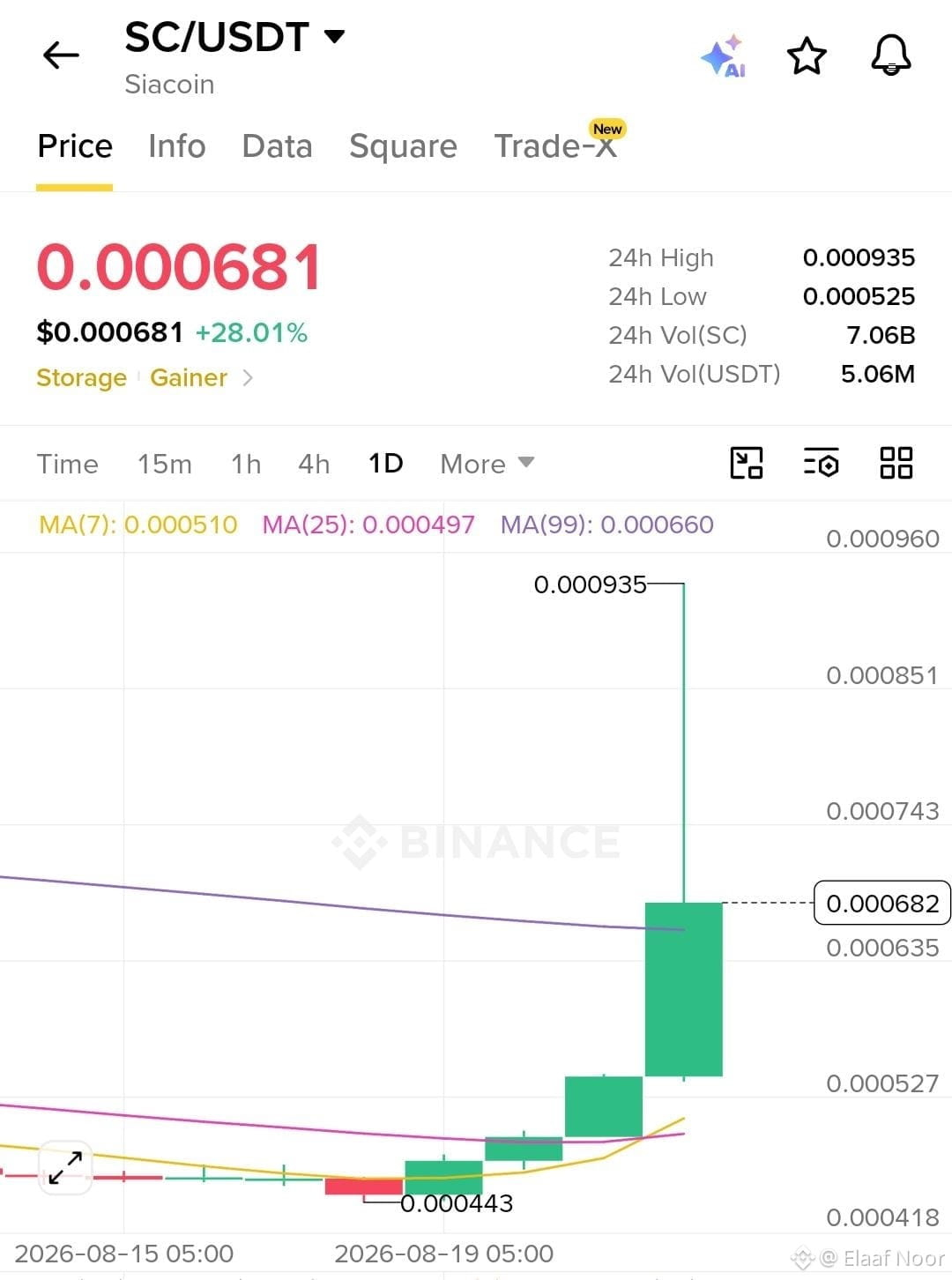
Massive volume expansion on $SC today!
Currently trading around 0.000681 USDT (+28%) pushing off strong moving averages with over 7B volume flowing in.
Key Test: The 24h high sits near 0.000935 & order books are leaning green with 53.94% buy pressure.
The Play: Momentum is here but chasing green candles blindly can be risky. Watching how it holds above local support is key before the next leg.
Are you riding this pump on Siacoin, or waiting for a dip? Let me know below! 👇
#SC #Siacoin #CryptoTrading #BinanceSquare $SC
Massive volume expansion on $SC today!
Currently trading around 0.000681 USDT (+28%) pushing off strong moving averages with over 7B volume flowing in.
Key Test: The 24h high sits near 0.000935 & order books are leaning green with 53.94% buy pressure.
The Play: Momentum is here but chasing green candles blindly can be risky. Watching how it holds above local support is key before the next leg.
Are you riding this pump on Siacoin, or waiting for a dip? Let me know below! 👇
#SC #Siacoin #CryptoTrading #BinanceSquare $SC
Currently trading around 0.000681 USDT (+28%) pushing off strong moving averages with over 7B volume flowing in.
Key Test: The 24h high sits near 0.000935 & order books are leaning green with 53.94% buy pressure.
The Play: Momentum is here but chasing green candles blindly can be risky. Watching how it holds above local support is key before the next leg.
Are you riding this pump on Siacoin, or waiting for a dip? Let me know below! 👇
#SC #Siacoin #CryptoTrading #BinanceSquare $SC
2
3
347
·
--
RWA lending has a problem I find more interesting than the tokenization itself:
how do you know a collateral market is actually healthy?
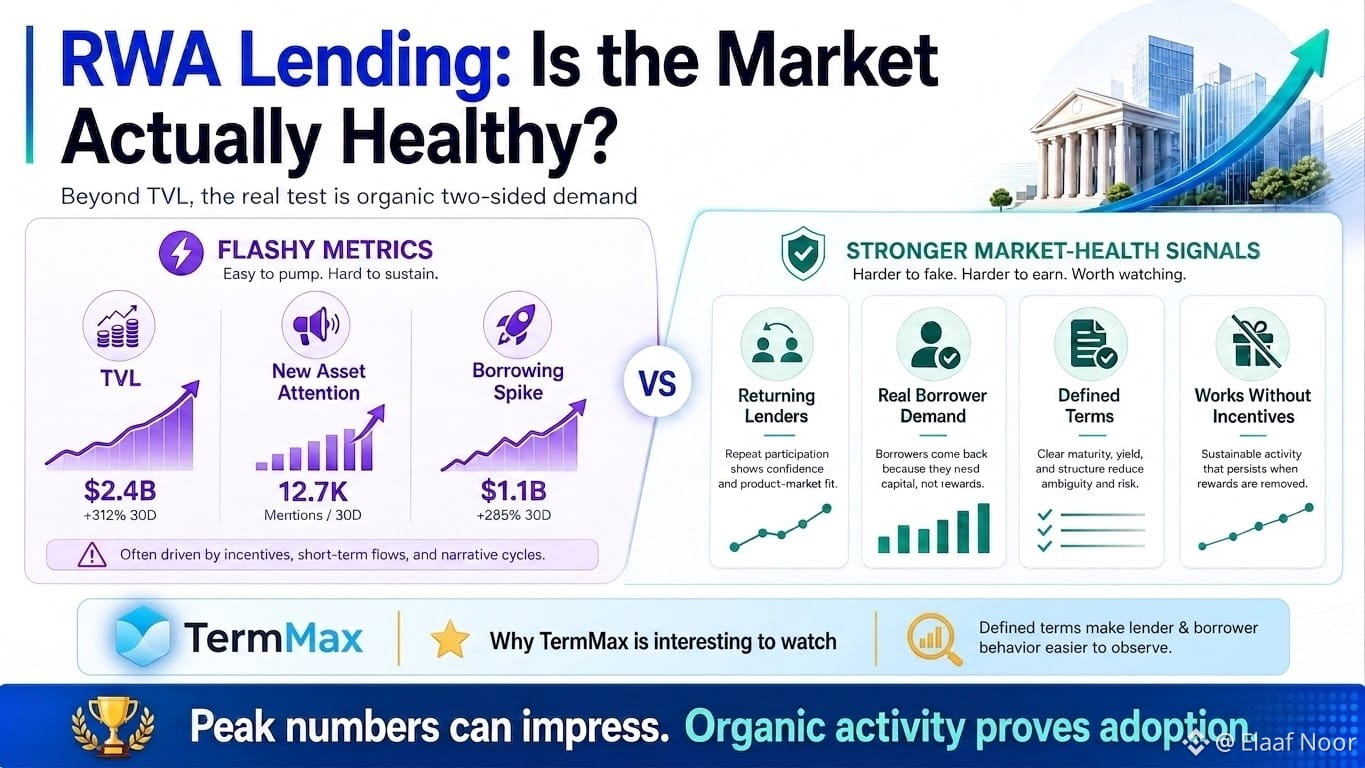
TVL can look impressive.
A new asset can attract attention.
Borrowing volume can spike.
None of those tells me whether the market has developed real two-sided demand.
That is where I think @termmax has an interesting setup to observe.
When financing is arranged around defined terms instead of one constantly changing pool rate the behaviour of lenders & borrowers becomes easier to examine.
Who is willing to provide capital?
Who is willing to pay for it?
How long are they willing to commit?
And what happens when the easy liquidity disappears?
Those questions matter even more for tokenized assets because liquidity conditions can vary dramatically from one asset to another.
I did rather see a smaller market where participants keep returning under normal conditions than a huge number that only looks active while incentives are doing the heavy lifting.
So if TermMax expands deeper into RWA credit I would not be watching the headline TVL first.
I will be watching whether the market keeps functioning when nobody is being heavily paid to participate.
That to me is a much harder - & much more useful - test of real adoption.
Do you judge protocols by their peak TVL or do you look at organic activity without incentives?
#termmax
RWA lending has a problem I find more interesting than the tokenization itself:
how do you know a collateral market is actually healthy?
TVL can look impressive.
A new asset can attract attention.
Borrowing volume can spike.
None of those tells me whether the market has developed real two-sided demand.
That is where I think @TermMax has an interesting setup to observe.
When financing is arranged around defined terms instead of one constantly changing pool rate the behaviour of lenders & borrowers becomes easier to examine.
Who is willing to provide capital?
Who is willing to pay for it?
How long are they willing to commit?
And what happens when the easy liquidity disappears?
Those questions matter even more for tokenized assets because liquidity conditions can vary dramatically from one asset to another.
I did rather see a smaller market where participants keep returning under normal conditions than a huge number that only looks active while incentives are doing the heavy lifting.
So if TermMax expands deeper into RWA credit I would not be watching the headline TVL first.
I will be watching whether the market keeps functioning when nobody is being heavily paid to participate.
That to me is a much harder - & much more useful - test of real adoption.
Do you judge protocols by their peak TVL or do you look at organic activity without incentives?
#termmax
how do you know a collateral market is actually healthy?
TVL can look impressive.
A new asset can attract attention.
Borrowing volume can spike.
None of those tells me whether the market has developed real two-sided demand.
That is where I think @TermMax has an interesting setup to observe.
When financing is arranged around defined terms instead of one constantly changing pool rate the behaviour of lenders & borrowers becomes easier to examine.
Who is willing to provide capital?
Who is willing to pay for it?
How long are they willing to commit?
And what happens when the easy liquidity disappears?
Those questions matter even more for tokenized assets because liquidity conditions can vary dramatically from one asset to another.
I did rather see a smaller market where participants keep returning under normal conditions than a huge number that only looks active while incentives are doing the heavy lifting.
So if TermMax expands deeper into RWA credit I would not be watching the headline TVL first.
I will be watching whether the market keeps functioning when nobody is being heavily paid to participate.
That to me is a much harder - & much more useful - test of real adoption.
Do you judge protocols by their peak TVL or do you look at organic activity without incentives?
#termmax
12
12
669
·
--
Bullish
I found a small Dusk detail that I completely overlooked before.
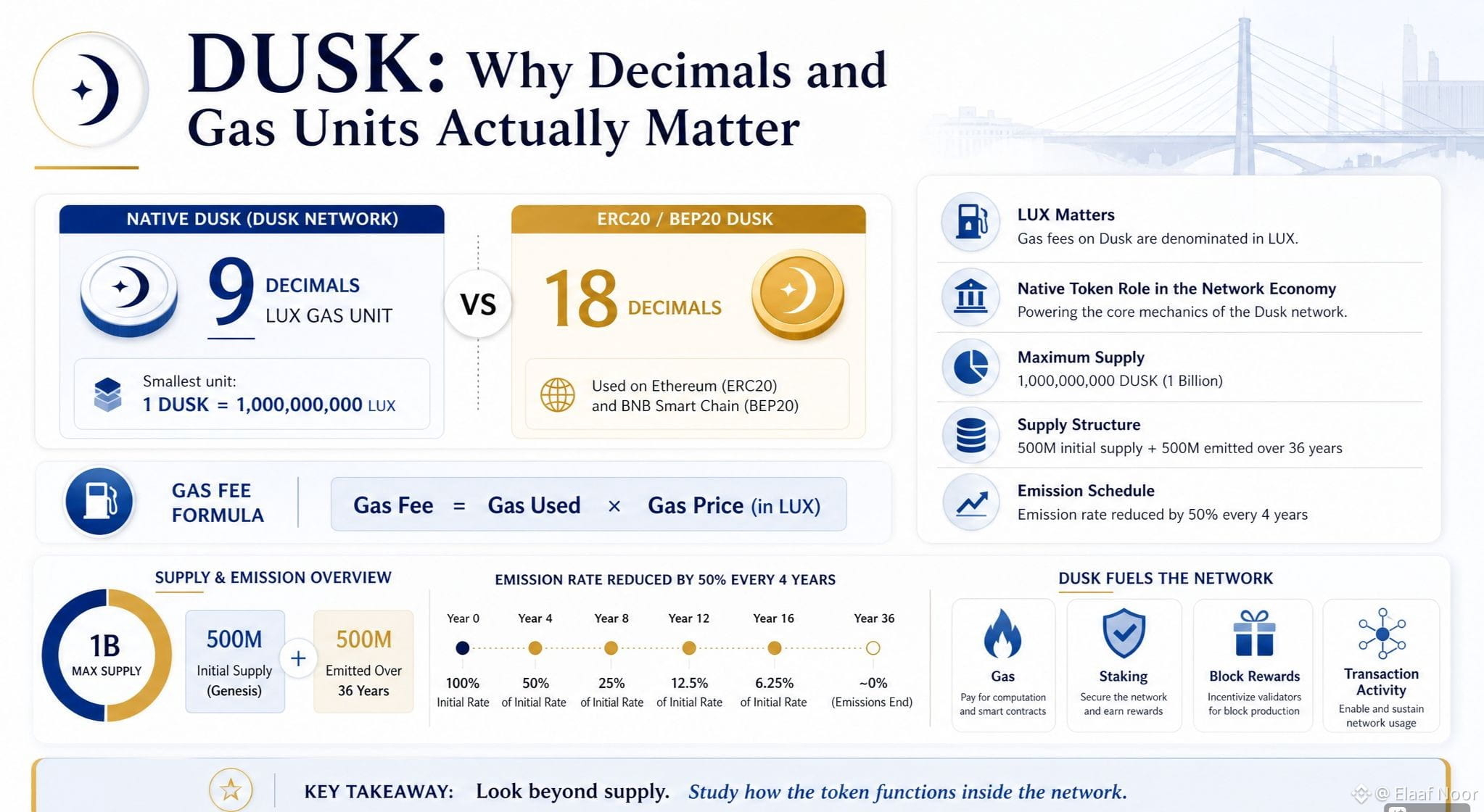
DUSK on the native Dusk network doesn't actually use 18 decimals.
It uses 9 decimals.
The smallest unit is called LUX:
1 DUSK = 1,000,000,000 LUX.
ERC20 & BEP20 DUSK in the otherhand used 18 decimals.
At first I thought:
Okay… that is just a technical implementation detail
But then I realized why this actually matters.
DUSK is the native gas token on Dusk.
Every transaction consumes gas, and fees are calculated using gas used × gas price, with the gas price denominated in LUX.
So the token isn't just an asset being transferred around the network.
Its smallest unit is directly part of how Dusk's execution economics work.
And there is another part I found interesting.
The network's maximum supply is 1 billion DUSK:
500M initial supply
+
500M emitted over 36 years.
Those emissions don't stay flat either.
The emission rate is reduced by 50% every four years.
So the network's security economics are designed to change over time as transaction-fee activity becomes more important.
This made me look at DUSK differently.
Instead of only asking:
What is the token supply?
I am more interested in:
How does the native token actually function inside the network's economic machinery?
Gas.
Staking.
Block rewards.
And eventually transaction activity.
That is a much more useful way to understand a network token than just looking at the maximum supply number.
Have you ever looked deep into a tokens decimal structure or gas units, or do you usually just track the price and supply? Let me know below...
#dusk $DUSK @Dusk_Foundation
I found a small Dusk detail that I completely overlooked before.
DUSK on the native Dusk network doesn't actually use 18 decimals.
It uses 9 decimals.
The smallest unit is called LUX:
1 DUSK = 1,000,000,000 LUX.
ERC20 & BEP20 DUSK in the otherhand used 18 decimals.
At first I thought:
Okay… that is just a technical implementation detail
But then I realized why this actually matters.
DUSK is the native gas token on Dusk.
Every transaction consumes gas, and fees are calculated using gas used × gas price, with the gas price denominated in LUX.
So the token isn't just an asset being transferred around the network.
Its smallest unit is directly part of how Dusk's execution economics work.
And there is another part I found interesting.
The network's maximum supply is 1 billion DUSK:
500M initial supply
+
500M emitted over 36 years.
Those emissions don't stay flat either.
The emission rate is reduced by 50% every four years.
So the network's security economics are designed to change over time as transaction-fee activity becomes more important.
This made me look at DUSK differently.
Instead of only asking:
What is the token supply?
I am more interested in:
How does the native token actually function inside the network's economic machinery?
Gas.
Staking.
Block rewards.
And eventually transaction activity.
That is a much more useful way to understand a network token than just looking at the maximum supply number.
Have you ever looked deep into a tokens decimal structure or gas units, or do you usually just track the price and supply? Let me know below...
#dusk $DUSK @Dusk
DUSK on the native Dusk network doesn't actually use 18 decimals.
It uses 9 decimals.
The smallest unit is called LUX:
1 DUSK = 1,000,000,000 LUX.
ERC20 & BEP20 DUSK in the otherhand used 18 decimals.
At first I thought:
Okay… that is just a technical implementation detail
But then I realized why this actually matters.
DUSK is the native gas token on Dusk.
Every transaction consumes gas, and fees are calculated using gas used × gas price, with the gas price denominated in LUX.
So the token isn't just an asset being transferred around the network.
Its smallest unit is directly part of how Dusk's execution economics work.
And there is another part I found interesting.
The network's maximum supply is 1 billion DUSK:
500M initial supply
+
500M emitted over 36 years.
Those emissions don't stay flat either.
The emission rate is reduced by 50% every four years.
So the network's security economics are designed to change over time as transaction-fee activity becomes more important.
This made me look at DUSK differently.
Instead of only asking:
What is the token supply?
I am more interested in:
How does the native token actually function inside the network's economic machinery?
Gas.
Staking.
Block rewards.
And eventually transaction activity.
That is a much more useful way to understand a network token than just looking at the maximum supply number.
Have you ever looked deep into a tokens decimal structure or gas units, or do you usually just track the price and supply? Let me know below...
#dusk $DUSK @Dusk
39
25
903
·
--
Something I did watch closely if @termmax starts bringing more RWA collateral onchain:
who is actually willing to pay the rate?
A fixed rate by itself doesnot tell me much. The interesting signal is whether different assets start attracting different financing costs based on their liquidity volatility & collateral quality.
That is where I think TermMax could get genuinely interesting.
Imagine two markets with the same maturity but very different collateral. If borrowers consistently accept different rates without incentives forcing the outcome those rates start carrying information.
Not just APY.
Information about how the market values the risk of financing that asset.
But I did be careful about reading too much into an early rate curve.
A pool can look busy because rewards is paying people to be there. A market can show a clean rate while having barely enough liquidity to make that rate meaningful.
So I did personally track three things:
Do borrowers come back after the first trade?
Does liquidity remain when incentives cool off?
Do rates actually move when collateral risk changes?
If those patterns start appearing across multiple maturities and assets then the rates become much more interesting to me.
Because the real signal isnot the curve itself.
It is the participants who keep coming back to price it.
#termmax
What would make you trust TermMax’s RWA credit markets?
Something I did watch closely if @TermMax starts bringing more RWA collateral onchain:
who is actually willing to pay the rate?
A fixed rate by itself doesnot tell me much. The interesting signal is whether different assets start attracting different financing costs based on their liquidity volatility & collateral quality.
That is where I think TermMax could get genuinely interesting.
Imagine two markets with the same maturity but very different collateral. If borrowers consistently accept different rates without incentives forcing the outcome those rates start carrying information.
Not just APY.
Information about how the market values the risk of financing that asset.
But I did be careful about reading too much into an early rate curve.
A pool can look busy because rewards is paying people to be there. A market can show a clean rate while having barely enough liquidity to make that rate meaningful.
So I did personally track three things:
Do borrowers come back after the first trade?
Does liquidity remain when incentives cool off?
Do rates actually move when collateral risk changes?
If those patterns start appearing across multiple maturities and assets then the rates become much more interesting to me.
Because the real signal isnot the curve itself.
It is the participants who keep coming back to price it.
#termmax
What would make you trust TermMax’s RWA credit markets?
who is actually willing to pay the rate?
A fixed rate by itself doesnot tell me much. The interesting signal is whether different assets start attracting different financing costs based on their liquidity volatility & collateral quality.
That is where I think TermMax could get genuinely interesting.
Imagine two markets with the same maturity but very different collateral. If borrowers consistently accept different rates without incentives forcing the outcome those rates start carrying information.
Not just APY.
Information about how the market values the risk of financing that asset.
But I did be careful about reading too much into an early rate curve.
A pool can look busy because rewards is paying people to be there. A market can show a clean rate while having barely enough liquidity to make that rate meaningful.
So I did personally track three things:
Do borrowers come back after the first trade?
Does liquidity remain when incentives cool off?
Do rates actually move when collateral risk changes?
If those patterns start appearing across multiple maturities and assets then the rates become much more interesting to me.
Because the real signal isnot the curve itself.
It is the participants who keep coming back to price it.
#termmax
What would make you trust TermMax’s RWA credit markets?
🟢 Repeat borrowers
100%
🔵 Deep liquidity
0%
🟡 Organic rates
0%
🔴 Less incentives
0%
2 votes • Voting closed
27
13
6.1k
·
--
Verified
August 25 is the date everyone will watch for $TMX.
I am more interested in what happens after it.
A token can create attention overnight. It canot create durable credit demand that quickly.
That why I am looking at TermMax less from the TGE angle & more from the product-market-fit test that comes with it.
The protocol already has a more defined credit model than a basic variable-rate money market. Fixed maturities give both sides something they can actually plan around while isolated markets let risk be separated instead of treating every collateral type the same.
There is another piece I think deserves more attention: capital efficiency.
Liquidity waiting to enter a fixed-rate position didnot necessarily have to remain completely unproductive. The ability to put that capital to work elsewhere until a match is available changes the economics of sitting on the sidelines.
But here is the part I am watching most closely:
What happens when incentives become less important?
If borrowers still want predictable financing lenders still find the risk/reward attractive & curators continue creating useful markets then the TGE becomes more than a token event.
It becomes a transition point for an already-running credit system.
That is the test I care about.
Not how loud August 25 is.
How much real activity remains after the launch-day attention fades.
#termmax @termmax
What matters most after the $TMX TGE?
August 25 is the date everyone will watch for $TMX.
I am more interested in what happens after it.
A token can create attention overnight. It canot create durable credit demand that quickly.
That why I am looking at TermMax less from the TGE angle & more from the product-market-fit test that comes with it.
The protocol already has a more defined credit model than a basic variable-rate money market. Fixed maturities give both sides something they can actually plan around while isolated markets let risk be separated instead of treating every collateral type the same.
There is another piece I think deserves more attention: capital efficiency.
Liquidity waiting to enter a fixed-rate position didnot necessarily have to remain completely unproductive. The ability to put that capital to work elsewhere until a match is available changes the economics of sitting on the sidelines.
But here is the part I am watching most closely:
What happens when incentives become less important?
If borrowers still want predictable financing lenders still find the risk/reward attractive & curators continue creating useful markets then the TGE becomes more than a token event.
It becomes a transition point for an already-running credit system.
That is the test I care about.
Not how loud August 25 is.
How much real activity remains after the launch-day attention fades.
#termmax @TermMax
What matters most after the $TMX TGE?
I am more interested in what happens after it.
A token can create attention overnight. It canot create durable credit demand that quickly.
That why I am looking at TermMax less from the TGE angle & more from the product-market-fit test that comes with it.
The protocol already has a more defined credit model than a basic variable-rate money market. Fixed maturities give both sides something they can actually plan around while isolated markets let risk be separated instead of treating every collateral type the same.
There is another piece I think deserves more attention: capital efficiency.
Liquidity waiting to enter a fixed-rate position didnot necessarily have to remain completely unproductive. The ability to put that capital to work elsewhere until a match is available changes the economics of sitting on the sidelines.
But here is the part I am watching most closely:
What happens when incentives become less important?
If borrowers still want predictable financing lenders still find the risk/reward attractive & curators continue creating useful markets then the TGE becomes more than a token event.
It becomes a transition point for an already-running credit system.
That is the test I care about.
Not how loud August 25 is.
How much real activity remains after the launch-day attention fades.
#termmax @TermMax
What matters most after the $TMX TGE?
🟢 Real borrowing
67%
🔵 Lender demand
0%
🟡 Curator growth
0%
🔴 Rewards
33%
3 votes • Voting closed
25
11
3.8k
·
--
Bullish
Verified
@Dusk_Foundation isn't trying to make regulated finance more crypto.
It's trying to make regulated finance programmable without making everything public.
That's why DuskEVM is interesting to me.
The upcoming DuskEVM mainnet gives Solidity developers a familiar EVM path into Dusk, while the underlying Dusk stack provides deterministic settlement and data availability.
But the more unusual part is Hedger.
Hedger is the privacy path for EVM applications, combining homomorphic encryption and zero-knowledge proofs so financial workflows can keep sensitive information confidential while still producing verifiable execution.
Think about what that means for an institution.
A fund may need to prove that a transaction is valid without broadcasting every position.
An investor may need to prove eligibility without exposing unnecessary personal information.
A regulated venue may need auditability without turning its entire order flow into public data.
That is a very different privacy thesis from simply hiding everything.
Dusk is aiming for privacy where needed, transparency where useful, and selective disclosure when an authorized party needs to review something.
And $DUSK is the native gas and staking asset securing this infrastructure.
That's why I'm watching DuskEVM closely.
The real test isn't whether Solidity can run on another chain.
It's whether familiar EVM development can be combined with the privacy and settlement requirements of real financial markets.
#dusk
What matters more for institutional EVM apps?
@Dusk isn't trying to make regulated finance more crypto.
It's trying to make regulated finance programmable without making everything public.
That's why DuskEVM is interesting to me.
The upcoming DuskEVM mainnet gives Solidity developers a familiar EVM path into Dusk, while the underlying Dusk stack provides deterministic settlement and data availability.
But the more unusual part is Hedger.
Hedger is the privacy path for EVM applications, combining homomorphic encryption and zero-knowledge proofs so financial workflows can keep sensitive information confidential while still producing verifiable execution.
Think about what that means for an institution.
A fund may need to prove that a transaction is valid without broadcasting every position.
An investor may need to prove eligibility without exposing unnecessary personal information.
A regulated venue may need auditability without turning its entire order flow into public data.
That is a very different privacy thesis from simply hiding everything.
Dusk is aiming for privacy where needed, transparency where useful, and selective disclosure when an authorized party needs to review something.
And $DUSK is the native gas and staking asset securing this infrastructure.
That's why I'm watching DuskEVM closely.
The real test isn't whether Solidity can run on another chain.
It's whether familiar EVM development can be combined with the privacy and settlement requirements of real financial markets.
#dusk
What matters more for institutional EVM apps?
It's trying to make regulated finance programmable without making everything public.
That's why DuskEVM is interesting to me.
The upcoming DuskEVM mainnet gives Solidity developers a familiar EVM path into Dusk, while the underlying Dusk stack provides deterministic settlement and data availability.
But the more unusual part is Hedger.
Hedger is the privacy path for EVM applications, combining homomorphic encryption and zero-knowledge proofs so financial workflows can keep sensitive information confidential while still producing verifiable execution.
Think about what that means for an institution.
A fund may need to prove that a transaction is valid without broadcasting every position.
An investor may need to prove eligibility without exposing unnecessary personal information.
A regulated venue may need auditability without turning its entire order flow into public data.
That is a very different privacy thesis from simply hiding everything.
Dusk is aiming for privacy where needed, transparency where useful, and selective disclosure when an authorized party needs to review something.
And $DUSK is the native gas and staking asset securing this infrastructure.
That's why I'm watching DuskEVM closely.
The real test isn't whether Solidity can run on another chain.
It's whether familiar EVM development can be combined with the privacy and settlement requirements of real financial markets.
#dusk
What matters more for institutional EVM apps?
Privacy
80%
Settlement
20%
5 votes • Voting closed
85
35
1.2k
·
--
🚨 The CLARITY Act just hit a critical point.
Senate Majority Leader Thune has moved the bill toward a procedural vote after the September 15 recess - potentially one of the last realistic windows for crypto legislation to move in 2026.
But here's the problem:
Getting a vote ≠ getting enough votes to pass.
XRP has already felt the uncertainty, sliding toward the $1 area, while analysts remain cautious about the bill's chances amid election-year politics.
If CLARITY passes → major regulatory clarity for crypto.
If it stalls → the market may have to wait until 2027.
This isn't just another Senate vote. It's a deadline. 👀
#crypto #CLARITYAct #XRP
Do you think the CLARITY Act can pass in 2026?
The next procedural move could decide whether 2026 becomes a breakthrough year for U.S. crypto regulation. 👀
🚨 The CLARITY Act just hit a critical point.
Senate Majority Leader Thune has moved the bill toward a procedural vote after the September 15 recess - potentially one of the last realistic windows for crypto legislation to move in 2026.
But here's the problem:
Getting a vote ≠ getting enough votes to pass.
XRP has already felt the uncertainty, sliding toward the $1 area, while analysts remain cautious about the bill's chances amid election-year politics.
If CLARITY passes → major regulatory clarity for crypto.
If it stalls → the market may have to wait until 2027.
This isn't just another Senate vote. It's a deadline. 👀
#crypto #CLARITYAct #XRP
Do you think the CLARITY Act can pass in 2026?
The next procedural move could decide whether 2026 becomes a breakthrough year for U.S. crypto regulation. 👀
Senate Majority Leader Thune has moved the bill toward a procedural vote after the September 15 recess - potentially one of the last realistic windows for crypto legislation to move in 2026.
But here's the problem:
Getting a vote ≠ getting enough votes to pass.
XRP has already felt the uncertainty, sliding toward the $1 area, while analysts remain cautious about the bill's chances amid election-year politics.
If CLARITY passes → major regulatory clarity for crypto.
If it stalls → the market may have to wait until 2027.
This isn't just another Senate vote. It's a deadline. 👀
#crypto #CLARITYAct #XRP
Do you think the CLARITY Act can pass in 2026?
The next procedural move could decide whether 2026 becomes a breakthrough year for U.S. crypto regulation. 👀
🟢 YES — Crypto gets clarity
92%
🔴 NO — Politics will delay it
8%
24 votes • Voting closed
3
763
·
--
Bearish
The number everyone shares is 56,853 BTC.
The number I'm watching is 1.
One depositor.
One Bitcoin UTXO.
One Trustless Bitcoin Vaults (TBV) designed for one application.
That design choice says a lot about what @babylonlabs_io is trying to achieve.
Instead of creating a giant shared pool where everyone's BTC is mixed together, TBV keep ownership boundaries clear from the start. To me, that's a bigger security improvement than simply adding another DeFi feature.
Bitcoin Staking already proved native BTC can contribute to network security through Finality Providers.
TBV are now exploring how that same BTC can support borrowing on the Aave v4 public testnet while remaining native Bitcoin.
Meanwhile $BABY has a completely different responsibility. It supports governance and validator participation so Bitcoin doesn't have to carry every role inside the ecosystem.
The more I read, the more I think Babylon isn't trying to change Bitcoin.
It's trying to change how the rest of crypto builds around Bitcoin.
#baby
What's the stronger design?
The number everyone shares is 56,853 BTC.
The number I'm watching is 1.
One depositor.
One Bitcoin UTXO.
One Trustless Bitcoin Vaults (TBV) designed for one application.
That design choice says a lot about what @BabylonLabs_io is trying to achieve.
Instead of creating a giant shared pool where everyone's BTC is mixed together, TBV keep ownership boundaries clear from the start. To me, that's a bigger security improvement than simply adding another DeFi feature.
Bitcoin Staking already proved native BTC can contribute to network security through Finality Providers.
TBV are now exploring how that same BTC can support borrowing on the Aave v4 public testnet while remaining native Bitcoin.
Meanwhile $BABY has a completely different responsibility. It supports governance and validator participation so Bitcoin doesn't have to carry every role inside the ecosystem.
The more I read, the more I think Babylon isn't trying to change Bitcoin.
It's trying to change how the rest of crypto builds around Bitcoin.
#baby
What's the stronger design?
The number I'm watching is 1.
One depositor.
One Bitcoin UTXO.
One Trustless Bitcoin Vaults (TBV) designed for one application.
That design choice says a lot about what @BabylonLabs_io is trying to achieve.
Instead of creating a giant shared pool where everyone's BTC is mixed together, TBV keep ownership boundaries clear from the start. To me, that's a bigger security improvement than simply adding another DeFi feature.
Bitcoin Staking already proved native BTC can contribute to network security through Finality Providers.
TBV are now exploring how that same BTC can support borrowing on the Aave v4 public testnet while remaining native Bitcoin.
Meanwhile $BABY has a completely different responsibility. It supports governance and validator participation so Bitcoin doesn't have to carry every role inside the ecosystem.
The more I read, the more I think Babylon isn't trying to change Bitcoin.
It's trying to change how the rest of crypto builds around Bitcoin.
#baby
What's the stronger design?
Individual vaults
100%
Shared liquidity pools
0%
1 votes • Voting closed
45
30
1.2k
·
--
Bearish
I stopped looking at Babylon as a borrowing project.
Now I see it as a coordination project.
Think about it...
Bitcoin Staking brings native BTC into network security.
Trustless Bitcoin Vaults (TBV) explore how the same BTC can unlock utility.
$BABY coordinates governance and validator participation.
None of those layers replace each other.
They reinforce each other.
That's the part I find interesting.
A lot of crypto projects try to make one token solve every problem.
Babylon spreads responsibilities across different layers instead.
That architecture feels more sustainable than chasing another short-term narrative.
#baby @babylonlabs_io
What builds stronger ecosystems?
I stopped looking at Babylon as a borrowing project.
Now I see it as a coordination project.
Think about it...
Bitcoin Staking brings native BTC into network security.
Trustless Bitcoin Vaults (TBV) explore how the same BTC can unlock utility.
$BABY coordinates governance and validator participation.
None of those layers replace each other.
They reinforce each other.
That's the part I find interesting.
A lot of crypto projects try to make one token solve every problem.
Babylon spreads responsibilities across different layers instead.
That architecture feels more sustainable than chasing another short-term narrative.
#baby @BabylonLabs_io
What builds stronger ecosystems?
Now I see it as a coordination project.
Think about it...
Bitcoin Staking brings native BTC into network security.
Trustless Bitcoin Vaults (TBV) explore how the same BTC can unlock utility.
$BABY coordinates governance and validator participation.
None of those layers replace each other.
They reinforce each other.
That's the part I find interesting.
A lot of crypto projects try to make one token solve every problem.
Babylon spreads responsibilities across different layers instead.
That architecture feels more sustainable than chasing another short-term narrative.
#baby @BabylonLabs_io
What builds stronger ecosystems?
Better coordination
100%
More features
0%
5 votes • Voting closed
91
37
1k
·
--
One number on this screen caught my attention more than the 21.7% pump.
Almost 86% of traders are bullish on $HEI right now.
That sounds exciting... but crowded trades don't always end the way people expect.
The price has already pushed above $0.096, which now looks like the level to watch. If buyers can defend it, momentum could continue. If they can't, today's breakout may end up being nothing more than a liquidity grab before a pullback.
What I like here isn't the green candle. It's the combination of strong volume + a clear technical level + visible market sentiment.
When all three line up, you get a trade with a defined plan instead of blind FOMO.
I've learned that the best opportunities usually come after the breakout proves itself, not during the excitement.
For me, $0.096 matters more than the 21.7% gain.
What's your view?
🟢 Hold above $0.096 = continuation? 🔴 Lose it = fake breakout?
$HEMI #HEI #BNBChain #crypto #trading
One number on this screen caught my attention more than the 21.7% pump.
Almost 86% of traders are bullish on $HEI right now.
That sounds exciting... but crowded trades don't always end the way people expect.
The price has already pushed above $0.096, which now looks like the level to watch. If buyers can defend it, momentum could continue. If they can't, today's breakout may end up being nothing more than a liquidity grab before a pullback.
What I like here isn't the green candle. It's the combination of strong volume + a clear technical level + visible market sentiment.
When all three line up, you get a trade with a defined plan instead of blind FOMO.
I've learned that the best opportunities usually come after the breakout proves itself, not during the excitement.
For me, $0.096 matters more than the 21.7% gain.
What's your view?
🟢 Hold above $0.096 = continuation? 🔴 Lose it = fake breakout?
$HEMI #HEI #BNBChain #crypto #trading
Almost 86% of traders are bullish on $HEI right now.
That sounds exciting... but crowded trades don't always end the way people expect.
The price has already pushed above $0.096, which now looks like the level to watch. If buyers can defend it, momentum could continue. If they can't, today's breakout may end up being nothing more than a liquidity grab before a pullback.
What I like here isn't the green candle. It's the combination of strong volume + a clear technical level + visible market sentiment.
When all three line up, you get a trade with a defined plan instead of blind FOMO.
I've learned that the best opportunities usually come after the breakout proves itself, not during the excitement.
For me, $0.096 matters more than the 21.7% gain.
What's your view?
🟢 Hold above $0.096 = continuation? 🔴 Lose it = fake breakout?
$HEMI #HEI #BNBChain #crypto #trading
3
661
·
--
Verified
I've been thinking about something while reading more about @babylonlabs_io
Every protocol makes trade-offs.
Some chase maximum flexibility. Others prioritize stronger security assumptions.
What I find interesting is that Trustless Bitcoin Vaults (TBV) seem to lean toward keeping native Bitcoin's ownership model intact, even if that means the architecture is more specialized than simply wrapping BTC and moving it everywhere.
That feels intentional.
Bitcoin Staking already gives native BTC a role in securing the network through Finality Providers.
$BABY takes on a different responsibility through governance and validator participation, allowing protocol upgrades without changing Bitcoin's core role.
I actually like that separation.
Not every asset needs to do everything. Sometimes better architecture comes from giving every asset one clear responsibility.
#baby
What's more important?
I've been thinking about something while reading more about @BabylonLabs_io
Every protocol makes trade-offs.
Some chase maximum flexibility. Others prioritize stronger security assumptions.
What I find interesting is that Trustless Bitcoin Vaults (TBV) seem to lean toward keeping native Bitcoin's ownership model intact, even if that means the architecture is more specialized than simply wrapping BTC and moving it everywhere.
That feels intentional.
Bitcoin Staking already gives native BTC a role in securing the network through Finality Providers.
$BABY takes on a different responsibility through governance and validator participation, allowing protocol upgrades without changing Bitcoin's core role.
I actually like that separation.
Not every asset needs to do everything. Sometimes better architecture comes from giving every asset one clear responsibility.
#baby
What's more important?
Every protocol makes trade-offs.
Some chase maximum flexibility. Others prioritize stronger security assumptions.
What I find interesting is that Trustless Bitcoin Vaults (TBV) seem to lean toward keeping native Bitcoin's ownership model intact, even if that means the architecture is more specialized than simply wrapping BTC and moving it everywhere.
That feels intentional.
Bitcoin Staking already gives native BTC a role in securing the network through Finality Providers.
$BABY takes on a different responsibility through governance and validator participation, allowing protocol upgrades without changing Bitcoin's core role.
I actually like that separation.
Not every asset needs to do everything. Sometimes better architecture comes from giving every asset one clear responsibility.
#baby
What's more important?
Stronger security assumptions
60%
Maximum flexibility
40%
10 votes • Voting closed
142
65
1.7k
·
--
Verified
One detail about @babylonlabs_io doesn't get enough attention.
Everyone talks about borrowing, but I'm more interested in how collateral is defined.
With Trustless Bitcoin Vaults (TBV), the goal isn't to make Bitcoin look like another DeFi token. The idea is to let native BTC remain native while proving it can support financial applications. That design choice feels more important than any single feature.
Bitcoin Staking already showed that native BTC can contribute to network security through Finality Providers.
Now TBV are exploring a second role: extending the usefulness of that same BTC without changing its ownership model.
Meanwhile, $BABY isn't competing with Bitcoin. It supports governance and validator participation, allowing the network to evolve while Bitcoin remains the economic foundation.
To me, that's a cleaner architecture than trying to force one asset to handle security, governance and utility all at once.
#baby
What matters most?
One detail about @BabylonLabs_io doesn't get enough attention.
Everyone talks about borrowing, but I'm more interested in how collateral is defined.
With Trustless Bitcoin Vaults (TBV), the goal isn't to make Bitcoin look like another DeFi token. The idea is to let native BTC remain native while proving it can support financial applications. That design choice feels more important than any single feature.
Bitcoin Staking already showed that native BTC can contribute to network security through Finality Providers.
Now TBV are exploring a second role: extending the usefulness of that same BTC without changing its ownership model.
Meanwhile, $BABY isn't competing with Bitcoin. It supports governance and validator participation, allowing the network to evolve while Bitcoin remains the economic foundation.
To me, that's a cleaner architecture than trying to force one asset to handle security, governance and utility all at once.
#baby
What matters most?
Everyone talks about borrowing, but I'm more interested in how collateral is defined.
With Trustless Bitcoin Vaults (TBV), the goal isn't to make Bitcoin look like another DeFi token. The idea is to let native BTC remain native while proving it can support financial applications. That design choice feels more important than any single feature.
Bitcoin Staking already showed that native BTC can contribute to network security through Finality Providers.
Now TBV are exploring a second role: extending the usefulness of that same BTC without changing its ownership model.
Meanwhile, $BABY isn't competing with Bitcoin. It supports governance and validator participation, allowing the network to evolve while Bitcoin remains the economic foundation.
To me, that's a cleaner architecture than trying to force one asset to handle security, governance and utility all at once.
#baby
What matters most?
Native BTC first
88%
Multi-chain utility
12%
8 votes • Voting closed
126
52
1.5k
Log in to explore more content
Join global crypto users on Binance Square
⚡️ Get latest and useful information about crypto.
💬 Trusted by the world’s largest crypto exchange.
👍 Discover real insights from verified creators.
Email / Phone number
Trending Topics
FedRateWatch
557,628 views
2,664 Discussing
Share & Win Traffic Reward in our Trending Hashtag Campaign
✨Topic: FOMC September, What's The Fed's Next Move?
👉How to Join:
Publish a short post or article with hashtag #FedRateWatch
Create content based on the below angles:
- August core CPI rose 0.3% month-over-month, and the odds of a 25bp hike this week are now close to 90%. Do you anticipate a rate hike this week? Is it a one-off, or the start of a longer hiking cycle?
- If the hike lands, how does it play out for BTC, tech stocks, and gold? Bullish or bearish?
- How are you planning to trade next? Share your BTC, stocks or gold trade/holdings with our trade sharing widget.
⏰Campaign Period:
- 2026-09-15 11:00 - 2026-09-17 3:00 UTC
🎁Reward:
- Qualified posts that comply with the above guidelines and contain more than 100 words will be reviewed and may receive a random traffic boost of 500 to 3,000 views. You will receive a notification from your feed secretary if your post is selected.
- Get a chance to have your article featured on Binance Square Official
Need ideas for your post? Visit the topic page #FedRateWatch or the Square Guide on How to Post for Better Reach.
Binance Square Official
·378 Likes
·836.1k views
BitcoinSlidesTo$76000
20,757 views
114 Discussing
BitcoinReboundsTo$79K
61,604 views
401 Discussing