
lianshangxiaohe
14.1k Posts

lianshangxiaohe
Report
Block User
链上小河
19 Following
12.3K+ Followers
323.1K+ Liked
Posts
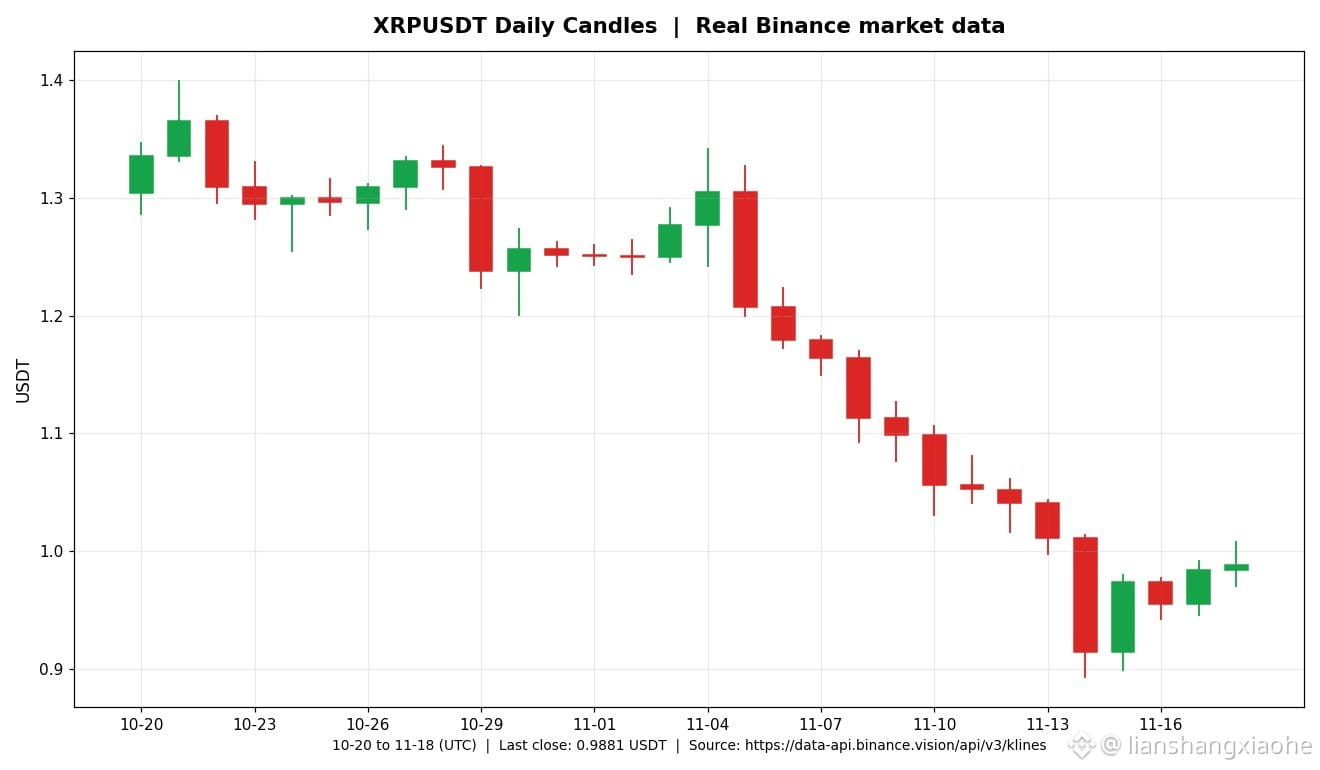
XRP has stormed back to $1! It hit an intraday high of $1.0078 today, touching that milestone for the first time in 5 days. Anyone who was trembling at Saturday’s low of $0.893 is now looking at $0.9885. A 10,000 U investment has grown to about 11,070 U, or around 11,290 U if sold at the intraday high. Whales have withdrawn more than $127 million worth of XRP from Binance since November 10, but ETFs are still bleeding, with net outflows of $19.1 million last week. Don’t pop the champagne just yet: since 2021, XRP has reclaimed $1 twelve times, only to fall back below it within two days on five occasions. The hurdles at $1.05 and $1.12 are still ahead. It’s still down 5.5% over 7 days, with a market cap of about $63 billion, ranking sixth. Is this a genuine reversal or just a dead-cat bounce? We’ll find out at tonight’s close. $XRP #XRP #Ripple
XRP has stormed back to $1! It hit an intraday high of $1.0078 today, touching that milestone for the first time in 5 days. Anyone who was trembling at Saturday’s low of $0.893 is now looking at $0.9885. A 10,000 U investment has grown to about 11,070 U, or around 11,290 U if sold at the intraday high. Whales have withdrawn more than $127 million worth of XRP from Binance since November 10, but ETFs are still bleeding, with net outflows of $19.1 million last week. Don’t pop the champagne just yet: since 2021, XRP has reclaimed $1 twelve times, only to fall back below it within two days on five occasions. The hurdles at $1.05 and $1.12 are still ahead. It’s still down 5.5% over 7 days, with a market cap of about $63 billion, ranking sixth. Is this a genuine reversal or just a dead-cat bounce? We’ll find out at tonight’s close. $XRP #XRP #Ripple
4
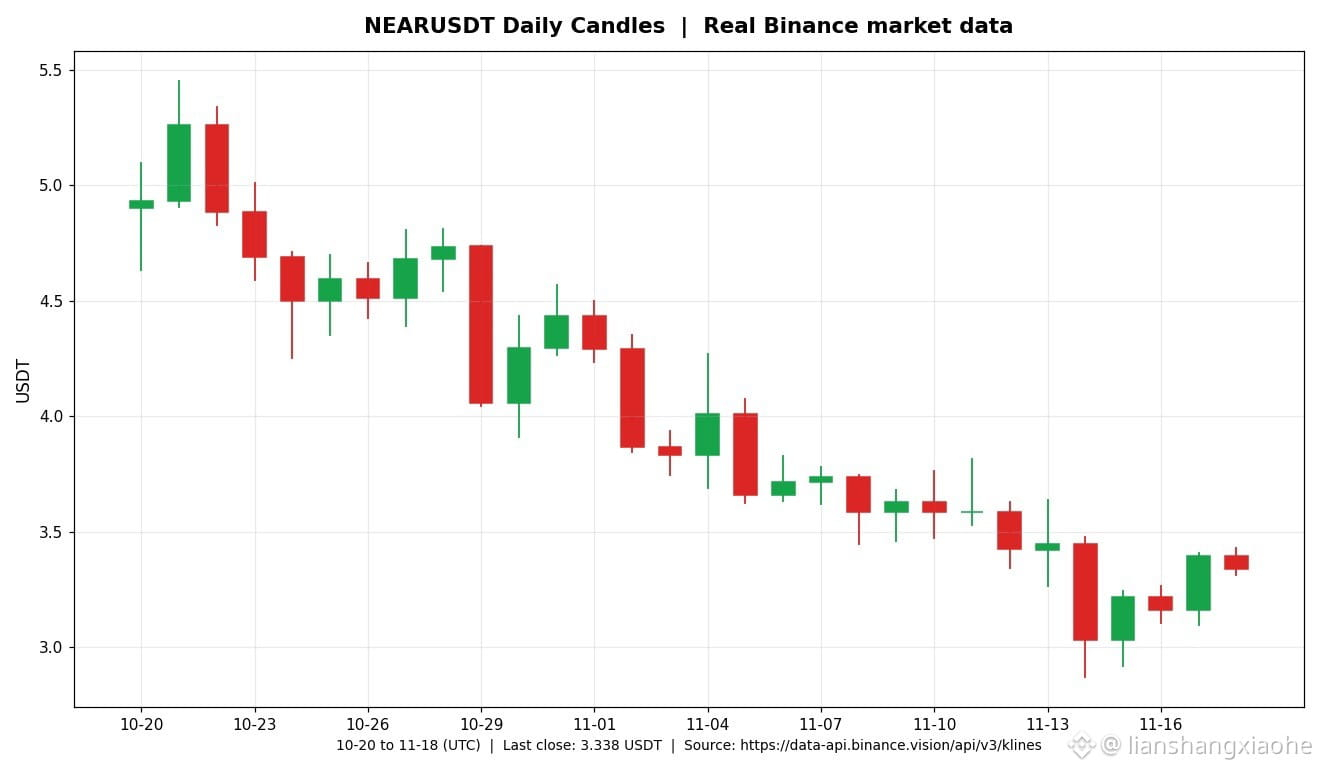
The whole market is bleeding, but $NEAR bucked the trend, rising nearly 5%: over 24 hours, it rebounded from a low of $3.10 to $3.38, with trading volume surging to nearly $600 million. There were two catalysts: governance proposal HSP-029 passed on November 16, cutting the annual issuance cap from 2.5% to 1.6%, meaning about 11.8 million fewer tokens will be issued over two years; and BitMEX founder Arthur Hayes singled out NEAR on November 17, setting a target price of $6. Don’t get carried away—it’s still down 8.6% over seven days and 32.7% over 30 days. This looks more like an oversold rebound than a reversal. The Fear Index is only 10, signaling extreme fear. While others are selling at a loss, some are already scooping up tokens at the lows. #NEAR #Crypto
The whole market is bleeding, but $NEAR bucked the trend, rising nearly 5%: over 24 hours, it rebounded from a low of $3.10 to $3.38, with trading volume surging to nearly $600 million. There were two catalysts: governance proposal HSP-029 passed on November 16, cutting the annual issuance cap from 2.5% to 1.6%, meaning about 11.8 million fewer tokens will be issued over two years; and BitMEX founder Arthur Hayes singled out NEAR on November 17, setting a target price of $6. Don’t get carried away—it’s still down 8.6% over seven days and 32.7% over 30 days. This looks more like an oversold rebound than a reversal. The Fear Index is only 10, signaling extreme fear. While others are selling at a loss, some are already scooping up tokens at the lows. #NEAR #Crypto
45
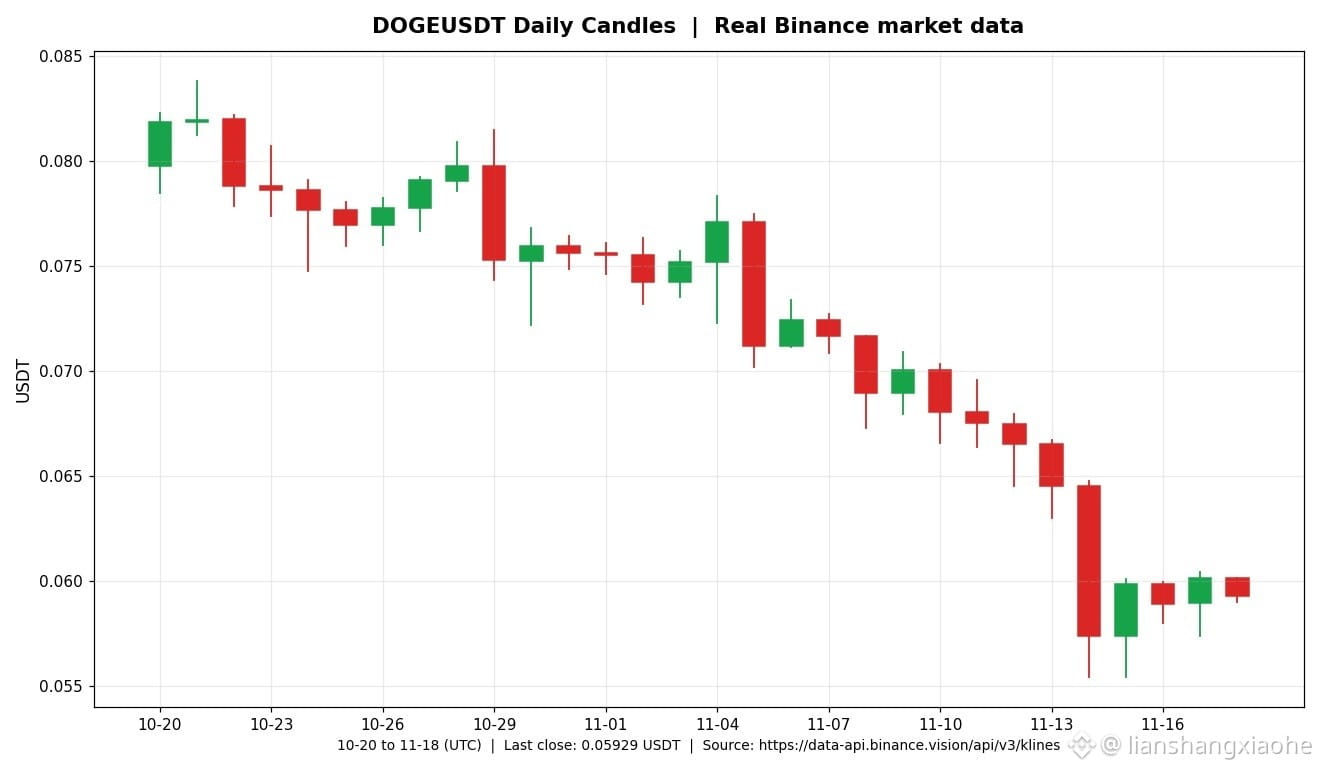
The whole market is still cowering in extreme fear, with the Fear & Greed Index at just 11, but $DOGE has quietly bounced back from a three-year low: it plunged to $0.0554 on November 14, its lowest level in three years, and is back up to $0.0593 today, up about 1.9% in 24 hours. The 10,000 USDT bought at the November 14 low is now worth about 10,700 USDT, for a gain of roughly 700 USDT. Don’t rush to call it a reversal—the price is still down 12% over seven days and 25.7% over 30 days, and remains 92% below its all-time high of $0.7316. Its market cap is about $9.3 billion, ranking 13th. The 30-day candlestick chart is shown here. Is this an oversold rebound or will the decline continue? Check the trend and decide for yourself. #Dogecoin #Meme coin
The whole market is still cowering in extreme fear, with the Fear & Greed Index at just 11, but $DOGE has quietly bounced back from a three-year low: it plunged to $0.0554 on November 14, its lowest level in three years, and is back up to $0.0593 today, up about 1.9% in 24 hours. The 10,000 USDT bought at the November 14 low is now worth about 10,700 USDT, for a gain of roughly 700 USDT. Don’t rush to call it a reversal—the price is still down 12% over seven days and 25.7% over 30 days, and remains 92% below its all-time high of $0.7316. Its market cap is about $9.3 billion, ranking 13th. The 30-day candlestick chart is shown here. Is this an oversold rebound or will the decline continue? Check the trend and decide for yourself. #Dogecoin #Meme coin
62
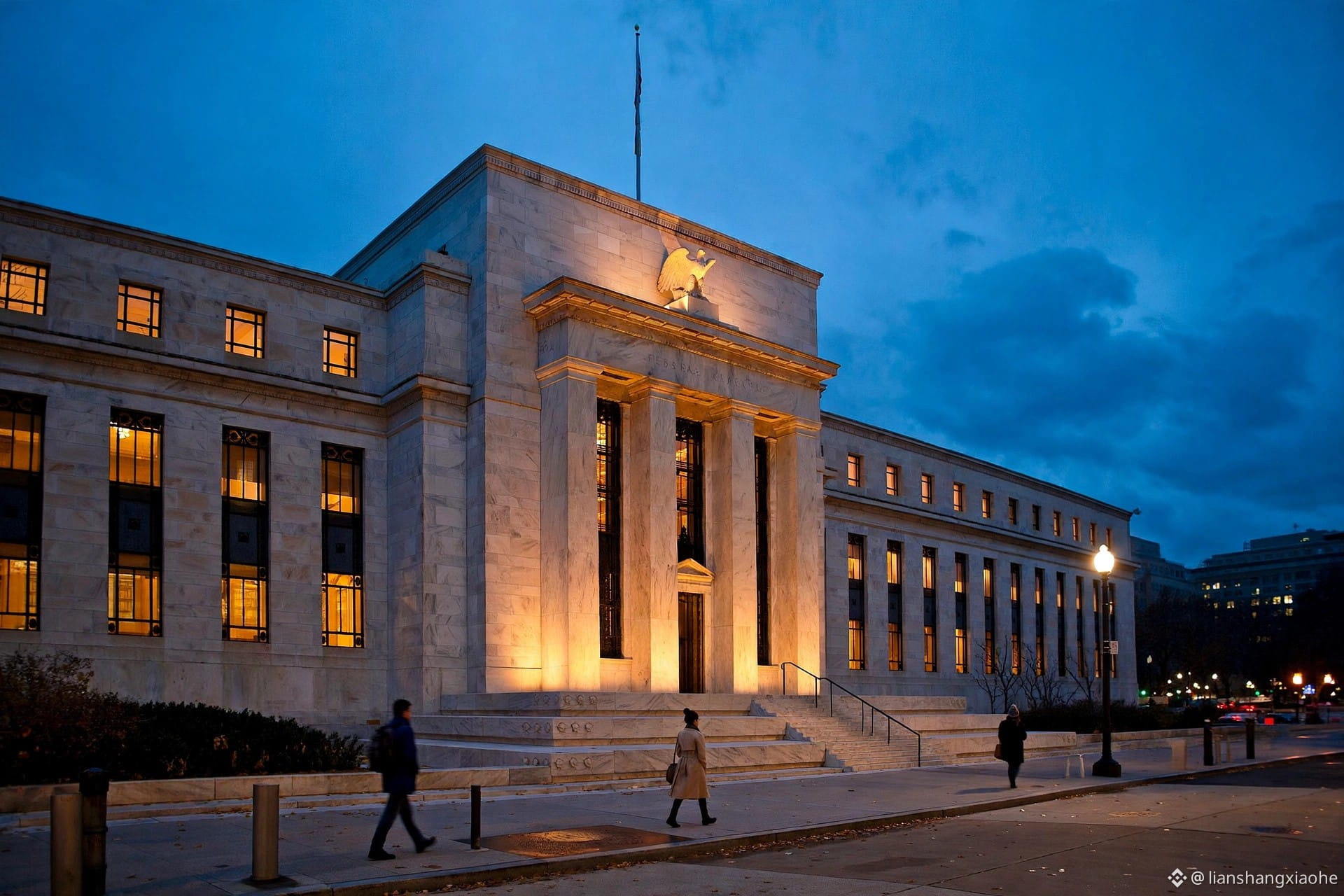
At 2 p.m. Eastern Time tonight, the Fed will release the minutes of its October 27–28 meeting, and crypto traders are in for another sleepless night. At the last meeting, the Fed stood pat, leaving rates at 3.75%–4.00%. But two of the 12 members dissented, calling for an immediate 25-basis-point hike—the disagreement is now out in the open. Markets are pricing in a 25-basis-point hike on December 9, with the odds at around 95.7%; the chance of a larger, 50-basis-point hike is just 4.3%. On Tuesday, St. Louis Fed President Musalem said the Fed might need to raise rates several times in a row, and that the sooner it acts, the better. New York Fed President Williams, meanwhile, said there was no need to go straight for a 50-basis-point hike in December, but the AI investment boom could force the Fed to keep tightening next year. Bitcoin is hovering around $64,500 after six straight weeks of losses, while gold has already fallen below $3,800. Whether tonight’s minutes strike a hawkish or dovish tone will determine whether this rally can continue.#美联储 #FOMC
At 2 p.m. Eastern Time tonight, the Fed will release the minutes of its October 27–28 meeting, and crypto traders are in for another sleepless night. At the last meeting, the Fed stood pat, leaving rates at 3.75%–4.00%. But two of the 12 members dissented, calling for an immediate 25-basis-point hike—the disagreement is now out in the open. Markets are pricing in a 25-basis-point hike on December 9, with the odds at around 95.7%; the chance of a larger, 50-basis-point hike is just 4.3%. On Tuesday, St. Louis Fed President Musalem said the Fed might need to raise rates several times in a row, and that the sooner it acts, the better. New York Fed President Williams, meanwhile, said there was no need to go straight for a 50-basis-point hike in December, but the AI investment boom could force the Fed to keep tightening next year. Bitcoin is hovering around $64,500 after six straight weeks of losses, while gold has already fallen below $3,800. Whether tonight’s minutes strike a hawkish or dovish tone will determine whether this rally can continue.#美联储 #FOMC
233
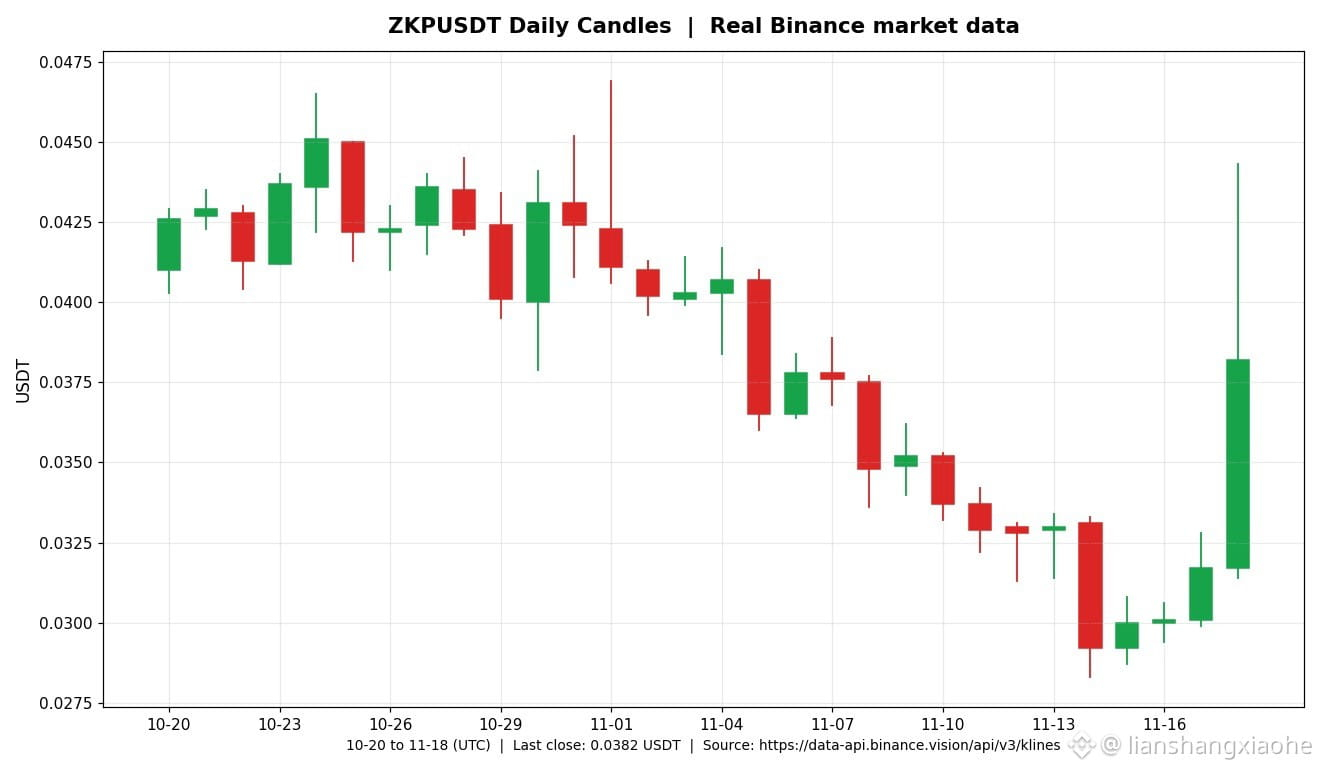
Today is absolutely wild: zkPass is up over 25% in 24 hours, currently trading at around $0.038. It hit an intraday high of $0.0443, briefly gaining nearly 40% from yesterday’s close of $0.0317. A $10,000 investment at yesterday’s close would be worth about $12,000 now, for a profit of roughly $2,000; selling at the intraday peak would have brought it to $14,000, a profit of around $4,000. Trading volume has also exploded: 133 million tokens traded on Binance spot today, eight times yesterday’s volume, while 24-hour trading across all platforms topped $20 million. zkPass is a privacy-data protocol that turns off-chain data into verifiable on-chain proofs, and is part of the YZi Labs portfolio. One reminder: it just hit an all-time low of $0.0284 on November 14. It’s still down over the past seven days and has fallen more than 20% in the past 30 days. It remains about 84% below its December high of $0.23. Low-cap coins like this can surge fast—and crash just as quickly—so check whether volume can hold up before chasing the rally. #ZKP #zkPass
Today is absolutely wild: zkPass is up over 25% in 24 hours, currently trading at around $0.038. It hit an intraday high of $0.0443, briefly gaining nearly 40% from yesterday’s close of $0.0317. A $10,000 investment at yesterday’s close would be worth about $12,000 now, for a profit of roughly $2,000; selling at the intraday peak would have brought it to $14,000, a profit of around $4,000. Trading volume has also exploded: 133 million tokens traded on Binance spot today, eight times yesterday’s volume, while 24-hour trading across all platforms topped $20 million. zkPass is a privacy-data protocol that turns off-chain data into verifiable on-chain proofs, and is part of the YZi Labs portfolio. One reminder: it just hit an all-time low of $0.0284 on November 14. It’s still down over the past seven days and has fallen more than 20% in the past 30 days. It remains about 84% below its December high of $0.23. Low-cap coins like this can surge fast—and crash just as quickly—so check whether volume can hold up before chasing the rally. #ZKP #zkPass
117
Retail investors are calling for $BTC to hit $50,000, while Wall Street quietly piled in at the end of September—the contrast is more telling than any candlestick chart. The latest 13F filings, submitted to the SEC on November 16, show that Bank of America increased its holdings of BlackRock’s spot Bitcoin ETF (IBIT) from 1.72 million shares at the end of Q2 (about $57 million) to 14.48 million shares (about $685 million) in Q3—a 741% surge. Wells Fargo went even further: 49.58 million shares, worth about $2.35 billion, more than doubling its position. Goldman Sachs, at about $1.28 billion, and Millennium, at about $1.21 billion, were also on the list. A reality check: this is just a snapshot from September 30, when BTC was still at $83,700. Since the start of November, U.S. spot BTC ETFs have seen net outflows of about $2.34 billion, with IBIT alone accounting for about $2.04 billion. It took a $7.9 million net inflow on November 16 to finally break IBIT’s seven-day outflow streak. Institutions bought near the top in Q3 and are now sitting on paper losses—they’re betting on access and long-term allocation, not tomorrow’s price action. Retail investors watch the price; institutions watch their positions. We’ll find out who’s swimming naked when Q4’s 13F filings arrive on February 16, 2027. #比特币ETF #WallStreet
Retail investors are calling for $BTC to hit $50,000, while Wall Street quietly piled in at the end of September—the contrast is more telling than any candlestick chart. The latest 13F filings, submitted to the SEC on November 16, show that Bank of America increased its holdings of BlackRock’s spot Bitcoin ETF (IBIT) from 1.72 million shares at the end of Q2 (about $57 million) to 14.48 million shares (about $685 million) in Q3—a 741% surge. Wells Fargo went even further: 49.58 million shares, worth about $2.35 billion, more than doubling its position. Goldman Sachs, at about $1.28 billion, and Millennium, at about $1.21 billion, were also on the list. A reality check: this is just a snapshot from September 30, when BTC was still at $83,700. Since the start of November, U.S. spot BTC ETFs have seen net outflows of about $2.34 billion, with IBIT alone accounting for about $2.04 billion. It took a $7.9 million net inflow on November 16 to finally break IBIT’s seven-day outflow streak. Institutions bought near the top in Q3 and are now sitting on paper losses—they’re betting on access and long-term allocation, not tomorrow’s price action. Retail investors watch the price; institutions watch their positions. We’ll find out who’s swimming naked when Q4’s 13F filings arrive on February 16, 2027. #比特币ETF #WallStreet
42
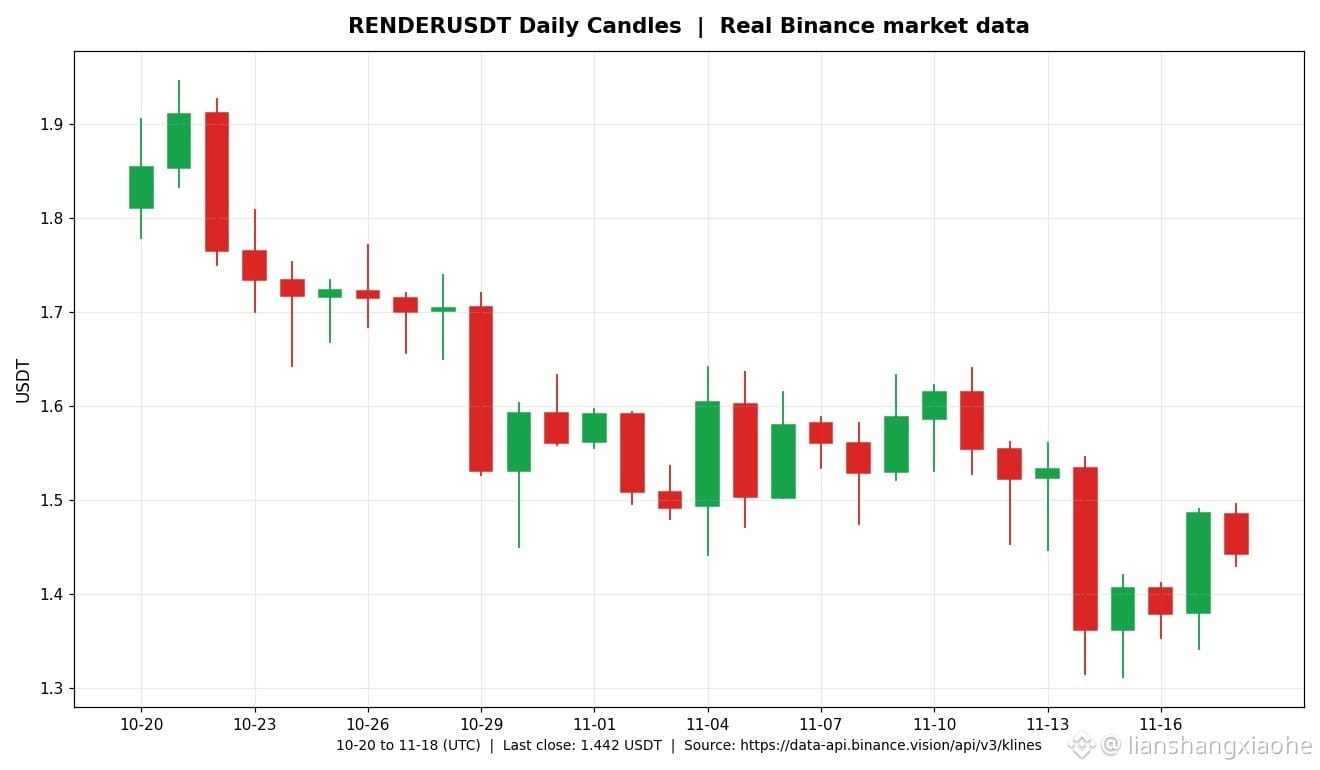
The entire market is gripped by extreme fear (Fear & Greed Index: 11), yet $RENDER has bucked the trend, rising about +4.6%. It’s currently around $1.44, with a 24-hour range of $1.34–$1.49. Yesterday, you bought 10,000 U at the $1.39 close; it’s now worth around 10,400 U, for a profit of about 390 U—not much, but on a night when everyone is calling for BTC to fall to $50,000, anything in the green is a force to be reckoned with. There’s a real catalyst, too: on November 16, Render teamed up with Solana to hold the “BEYOND THE FRAME” immersive 3D art exhibition at FRAMELESS in London, timed to coincide with Breakpoint 2026, putting the GPU computing-power narrative back in the spotlight. Still, a dose of caution is warranted: it’s down 10.4% over the past 7 days and about 17% over the past 30. At the current price, it’s still about 89% below its all-time high of $13.53 on March 13, 2024, with a market cap of around $800 million, ranking 76th. Is this an oversold bounce or a genuine reversal? Watch the 24-hour high of $1.49; let’s talk once it holds above that. #Render #GPU computing power
The entire market is gripped by extreme fear (Fear & Greed Index: 11), yet $RENDER has bucked the trend, rising about +4.6%. It’s currently around $1.44, with a 24-hour range of $1.34–$1.49. Yesterday, you bought 10,000 U at the $1.39 close; it’s now worth around 10,400 U, for a profit of about 390 U—not much, but on a night when everyone is calling for BTC to fall to $50,000, anything in the green is a force to be reckoned with. There’s a real catalyst, too: on November 16, Render teamed up with Solana to hold the “BEYOND THE FRAME” immersive 3D art exhibition at FRAMELESS in London, timed to coincide with Breakpoint 2026, putting the GPU computing-power narrative back in the spotlight. Still, a dose of caution is warranted: it’s down 10.4% over the past 7 days and about 17% over the past 30. At the current price, it’s still about 89% below its all-time high of $13.53 on March 13, 2024, with a market cap of around $800 million, ranking 76th. Is this an oversold bounce or a genuine reversal? Watch the 24-hour high of $1.49; let’s talk once it holds above that. #Render #GPU computing power
32
CZ’s blame-shifting has gone viral: Bitcoin fell to $62,006, a four-month low. On X, he listed five possible reasons, starting with Anthropic’s IPO sucking up capital—it’s priced tomorrow, November 18, and lists on Nasdaq on the 19th under the ticker ANT, at $70–$78 per share. With 825 million shares, it could raise up to $64.35 billion, plus another $26 billion in private placements. Google and Nvidia are each investing $10 billion, putting its fully diluted valuation at $1.4 trillion. The offering is nearly 7 times oversubscribed. CZ added that no one can be certain: correlation doesn’t equal causation. Before SpaceX’s June listing, Bitcoin also fell 19%–29%, then rose 28% in the 100 days after the listing. There’s a popular saying in crypto right now: Bitcoin lost to a chatbot. The ETF numbers are more concrete: spot BTC ETFs have seen seven straight days of outflows, totaling $1.91 billion, while ETH ETFs saw $399 million in outflows over one week. #Anthropic #Bitcoin
CZ’s blame-shifting has gone viral: Bitcoin fell to $62,006, a four-month low. On X, he listed five possible reasons, starting with Anthropic’s IPO sucking up capital—it’s priced tomorrow, November 18, and lists on Nasdaq on the 19th under the ticker ANT, at $70–$78 per share. With 825 million shares, it could raise up to $64.35 billion, plus another $26 billion in private placements. Google and Nvidia are each investing $10 billion, putting its fully diluted valuation at $1.4 trillion. The offering is nearly 7 times oversubscribed. CZ added that no one can be certain: correlation doesn’t equal causation. Before SpaceX’s June listing, Bitcoin also fell 19%–29%, then rose 28% in the 100 days after the listing. There’s a popular saying in crypto right now: Bitcoin lost to a chatbot. The ETF numbers are more concrete: spot BTC ETFs have seen seven straight days of outflows, totaling $1.91 billion, while ETH ETFs saw $399 million in outflows over one week. #Anthropic #Bitcoin

306
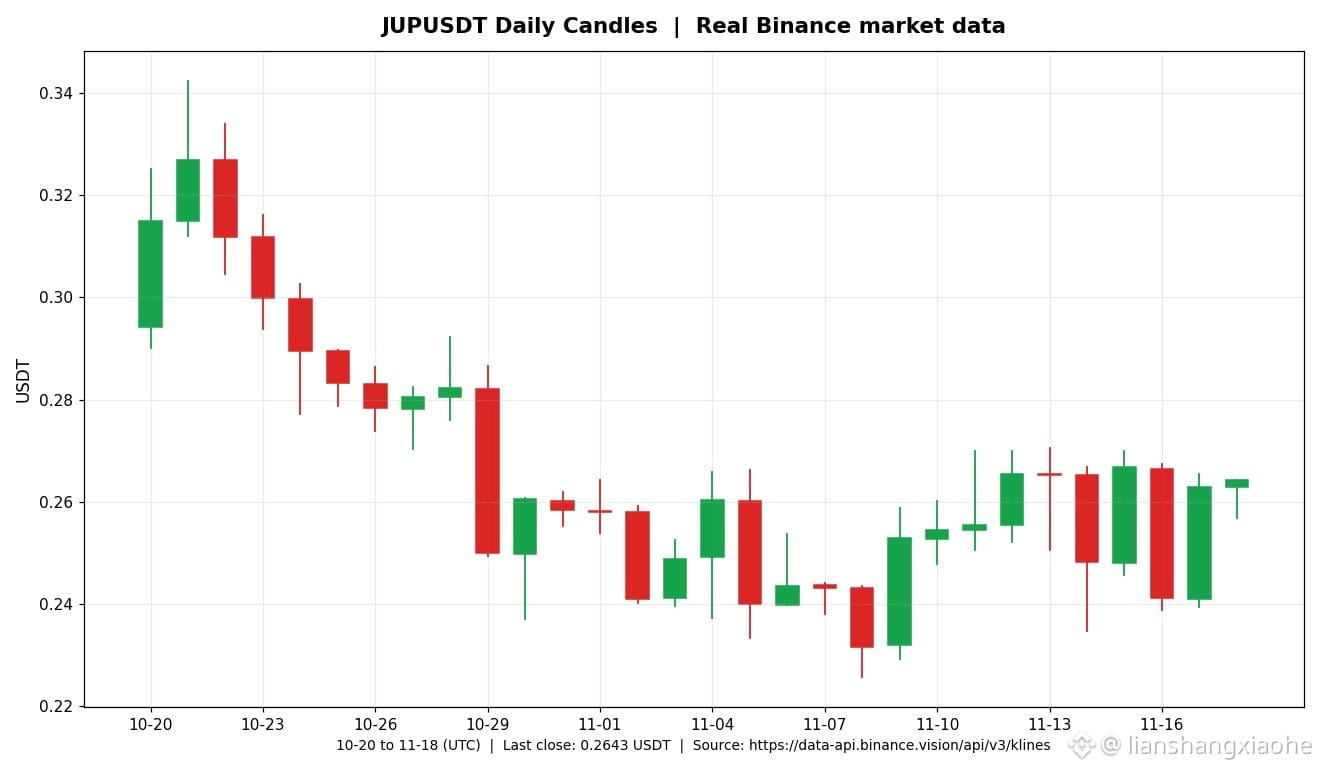
JUP is showing real strength today. The broader market is still bottoming around $64,000, and the Fear and Greed Index is at 10, indicating extreme fear. On November 17, Jupiter rose from $0.2411 to close at $0.263, up about 9%, and is now at $0.2643. If you put in 10,000 USDT at yesterday’s close, your position would now be worth about 10,960 USDT, a gain of roughly 960 USDT. The largest aggregator in the Solana ecosystem, with a market cap of about $850 million, is still down around 9% over the past 30 days. Is this a rebound after being oversold, or a genuine reversal? When prices fall, no one dares to buy; once they rise, people start asking whether it’s still worth chasing. The market always rewards those who act first. $JUP #Solana
JUP is showing real strength today. The broader market is still bottoming around $64,000, and the Fear and Greed Index is at 10, indicating extreme fear. On November 17, Jupiter rose from $0.2411 to close at $0.263, up about 9%, and is now at $0.2643. If you put in 10,000 USDT at yesterday’s close, your position would now be worth about 10,960 USDT, a gain of roughly 960 USDT. The largest aggregator in the Solana ecosystem, with a market cap of about $850 million, is still down around 9% over the past 30 days. Is this a rebound after being oversold, or a genuine reversal? When prices fall, no one dares to buy; once they rise, people start asking whether it’s still worth chasing. The market always rewards those who act first. $JUP #Solana
25
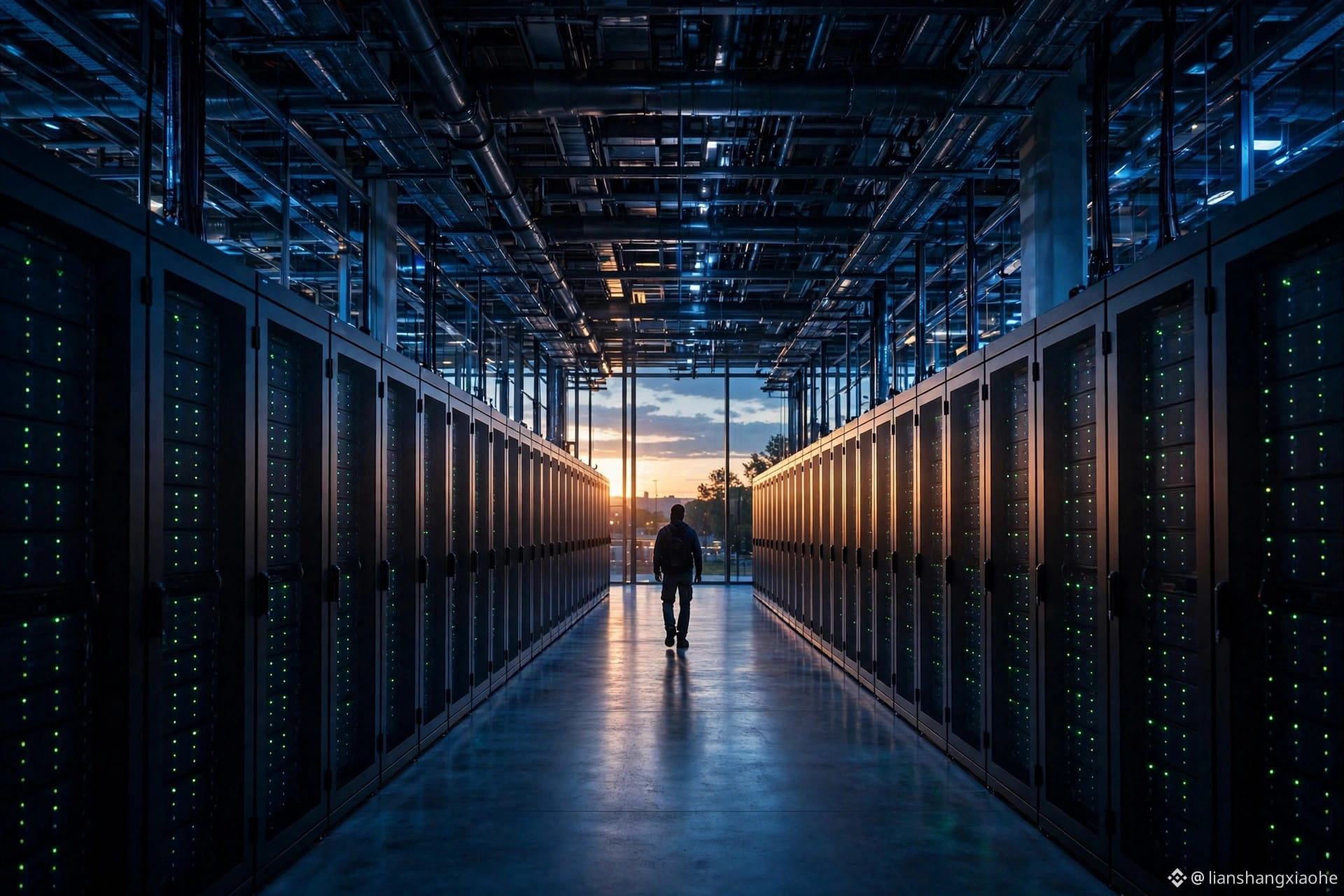
Nvidia’s earnings are out: it beat expectations across the board, but the market gave it only 3%.
Q3 revenue was $115.8 billion, more than doubling year over year (+103%) and nearly $7 billion above Wall Street’s $109 billion estimate. Adjusted EPS came in at $2.68, versus expectations of $2.47. Data center revenue was $107.6 billion, accounting for 93% of total revenue. Net income also doubled, to $65.3 billion.
The Q4 outlook was even stronger: $130 billion, compared with expectations of only around $125 billion. The company also approved $150 billion in buybacks. This was the first earnings report since Jensen Huang’s resignation, with interim CEO Colette Kress at the helm—and Vera Rubin has also begun shipping.
But the stock rose only about 3% after hours. Why? The gross margin forecast fell to 71%–72%, three points below Q3’s 74.9%. The market’s message is clear: no matter how good the numbers are, what matters is how much the company can earn next quarter.
What stings even more is the backdrop: Nvidia is already down 24% this month. It closed at $156.14 on Monday, more than a third below its October high. Can these earnings rescue the AI narrative—and the crypto market? Bitcoin is still stuck at $64,000, and the Fear and Greed Index is at 12, signaling extreme fear.
#英伟达 #NVDA #AI
34
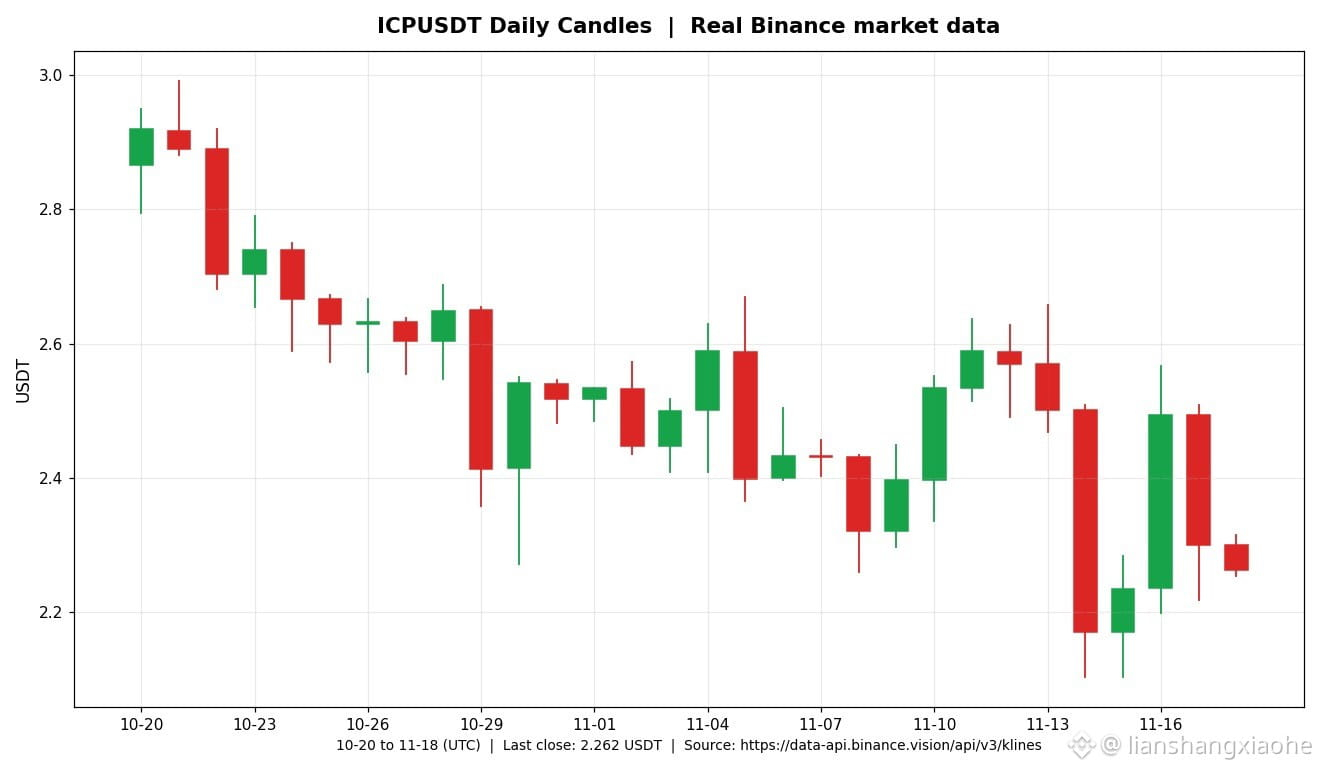
People who bought the dip at $ICP yesterday are panicking today.
On November 16, ICP surged 11.5% in a single day, with an intraday low of $2.198, a high of $2.567, and a close at $2.494. Those who put in 10,000 U at the low that day were sitting on about 1,347 U in unrealized gains by the close—not a fortune, but in a market gripped by extreme fear, enough to brag about on social media.
Then, on November 17, ICP opened at $2.493, briefly touched $2.508 intraday, and then plunged. By the early hours of this morning, it had fallen to $2.26, down 7.9% over 24 hours. Yesterday’s 1,347 U in unrealized gains has now dwindled to less than 300 U.
The rally was attributed to record-breaking network throughput (an average of 4,200 TPS and 10.9 billion transactions in a month) and the opening of the Cloud Engines waitlist. But even CoinMarketCap says there’s no hard evidence of a causal link. More troubling are the on-chain figures: over the past 30 days, only 56,500 ICP were burned, while supply increased by 1.05 million.
ICP is down 12.7% over 7 days and 21% over 30 days, with a market cap of only about $1.26 billion. Those who chased yesterday’s rally are all asking the same question today: was this buying the dip, or catching a falling knife?
#ICP #InternetComputer
41
Nvidia’s earnings are out: Q3 revenue was $115.8 billion, more than doubling year over year with 103% growth, versus expectations of just $109.1 billion. Earnings per share came in at $2.68, also beating the $2.47 estimate. Q4 guidance was $130 billion, again above expectations. This is Nvidia’s first earnings report since Jensen Huang resigned on November 12. Interim CEO Colette Kress led the team, and the stock rose 4.8% after hours, climbing to around $163. But don’t celebrate just yet: gross margin guidance fell to 71%–72%, Q4 is still an unusual 14-week quarter, and the company directly declined to answer any questions about Huang’s resignation during the earnings call. The stock is down 25% in a month and about 35% from its October high. Can this earnings beat bring back the AI rally? For crypto, the bigger issue is that if the Nasdaq can’t hold steady, it’ll be hard for BTC to stay at $64,000 either. Do you think this is the start of a reversal, or just a dead-cat bounce? #英伟达 #AI
Nvidia’s earnings are out: Q3 revenue was $115.8 billion, more than doubling year over year with 103% growth, versus expectations of just $109.1 billion. Earnings per share came in at $2.68, also beating the $2.47 estimate. Q4 guidance was $130 billion, again above expectations. This is Nvidia’s first earnings report since Jensen Huang resigned on November 12. Interim CEO Colette Kress led the team, and the stock rose 4.8% after hours, climbing to around $163. But don’t celebrate just yet: gross margin guidance fell to 71%–72%, Q4 is still an unusual 14-week quarter, and the company directly declined to answer any questions about Huang’s resignation during the earnings call. The stock is down 25% in a month and about 35% from its October high. Can this earnings beat bring back the AI rally? For crypto, the bigger issue is that if the Nasdaq can’t hold steady, it’ll be hard for BTC to stay at $64,000 either. Do you think this is the start of a reversal, or just a dead-cat bounce? #英伟达 #AI

22
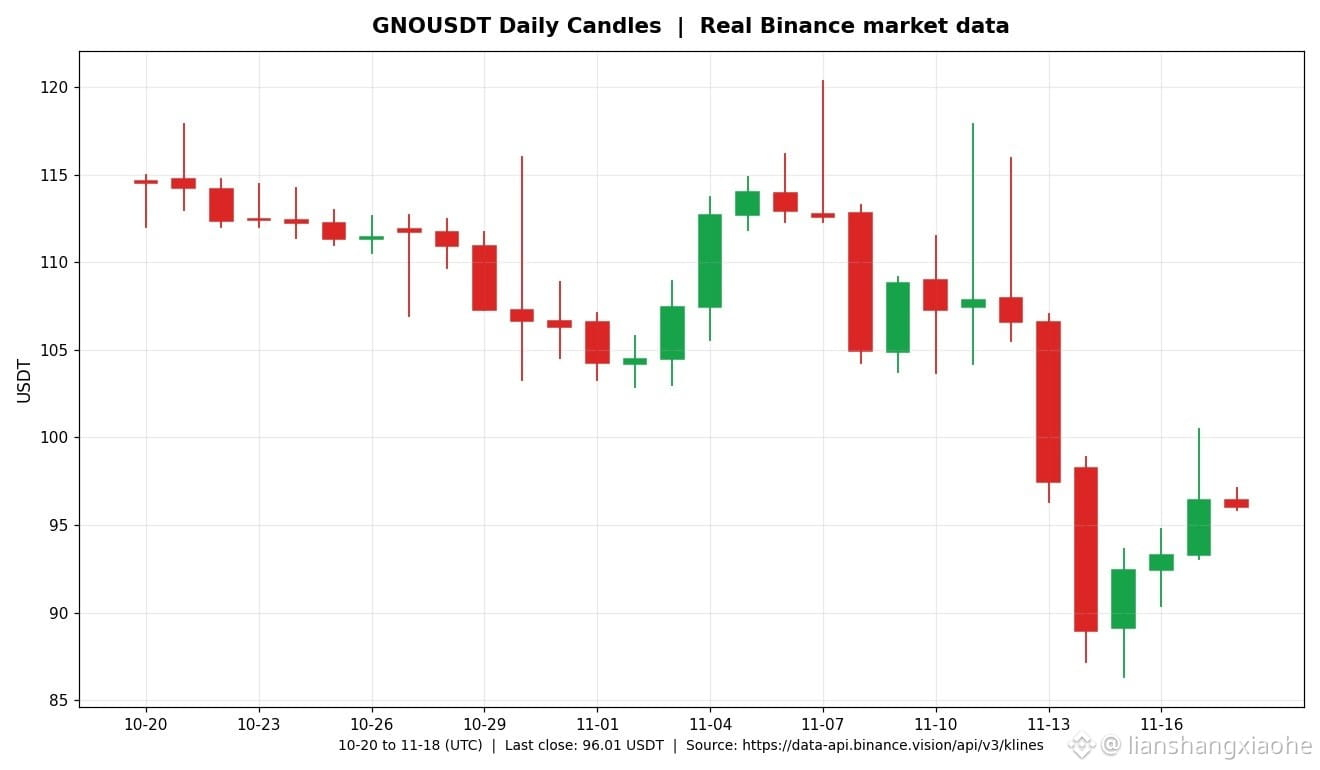
The broader market is still trying to find a bottom around 64,000, while $GNO quietly touched $100 today! It climbed from $93 to $100.01 intraday, up 7.5%, and has now pulled back to around $96. It’s still down 10% over 7 days and 15% over 30 days, so today’s bullish candle looks like capital rotating in to catch up. Gnosis has a market cap of just over $250 million and a circulating supply of only 2.64 million tokens, so its small market size means even a little movement can cause big swings. Anyone who bought the dip at $93 yesterday was up 7% at today’s high; a $10,000 investment would have been worth $10,750 at the peak. The question is: is $100 a real breakout or a fakeout? BTC is still below its 200-week moving average at $68,000, and the broader market is shaky, so chasing a catch-up rally like this can easily leave you holding the bag. Would you buy in? #GNO
The broader market is still trying to find a bottom around 64,000, while $GNO quietly touched $100 today! It climbed from $93 to $100.01 intraday, up 7.5%, and has now pulled back to around $96. It’s still down 10% over 7 days and 15% over 30 days, so today’s bullish candle looks like capital rotating in to catch up. Gnosis has a market cap of just over $250 million and a circulating supply of only 2.64 million tokens, so its small market size means even a little movement can cause big swings. Anyone who bought the dip at $93 yesterday was up 7% at today’s high; a $10,000 investment would have been worth $10,750 at the peak. The question is: is $100 a real breakout or a fakeout? BTC is still below its 200-week moving average at $68,000, and the broader market is shaky, so chasing a catch-up rally like this can easily leave you holding the bag. Would you buy in? #GNO
81
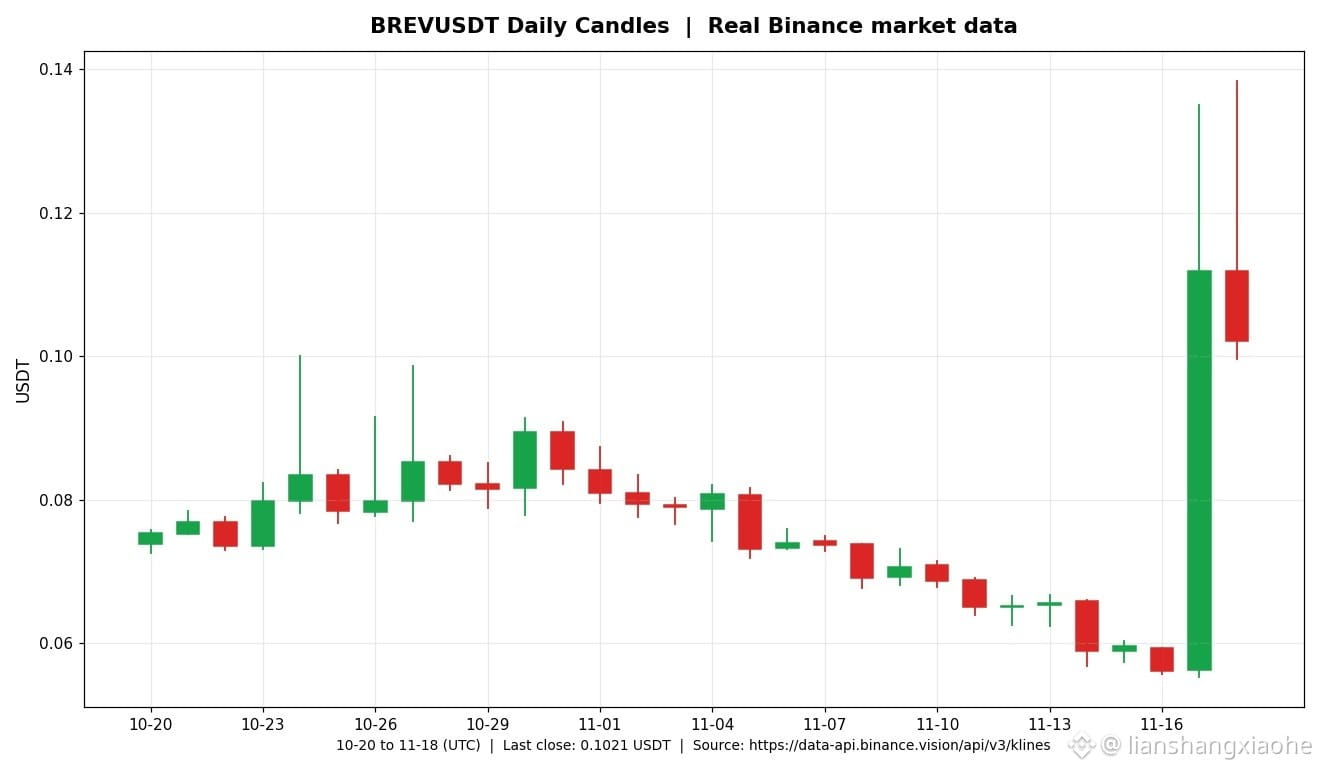
$BREV Doubled in a single day—can you believe it?
At the close on November 16, it was still at $0.0562. Yesterday, it surged to a high of $0.135 and closed at $0.1118, up nearly 99% in a single day. From its intraday low, it climbed more than 140% at its peak. If you’d put in 10,000 U yesterday and held on, you’d have had 19,900 U at the close—or 24,000 U if you’d sold at the intraday high. That’s a 10,000 U gain in one day.
Today, it’s already fallen back to around $0.102, and those who bought at the top are counting their losses. Coins that surge like this never wait for the hesitant, but there’s never a shortage of people buying at the peak either. In a market that doubles in a day, did you hold on—or just watch the action?
#BREV #SurgingCoin
321
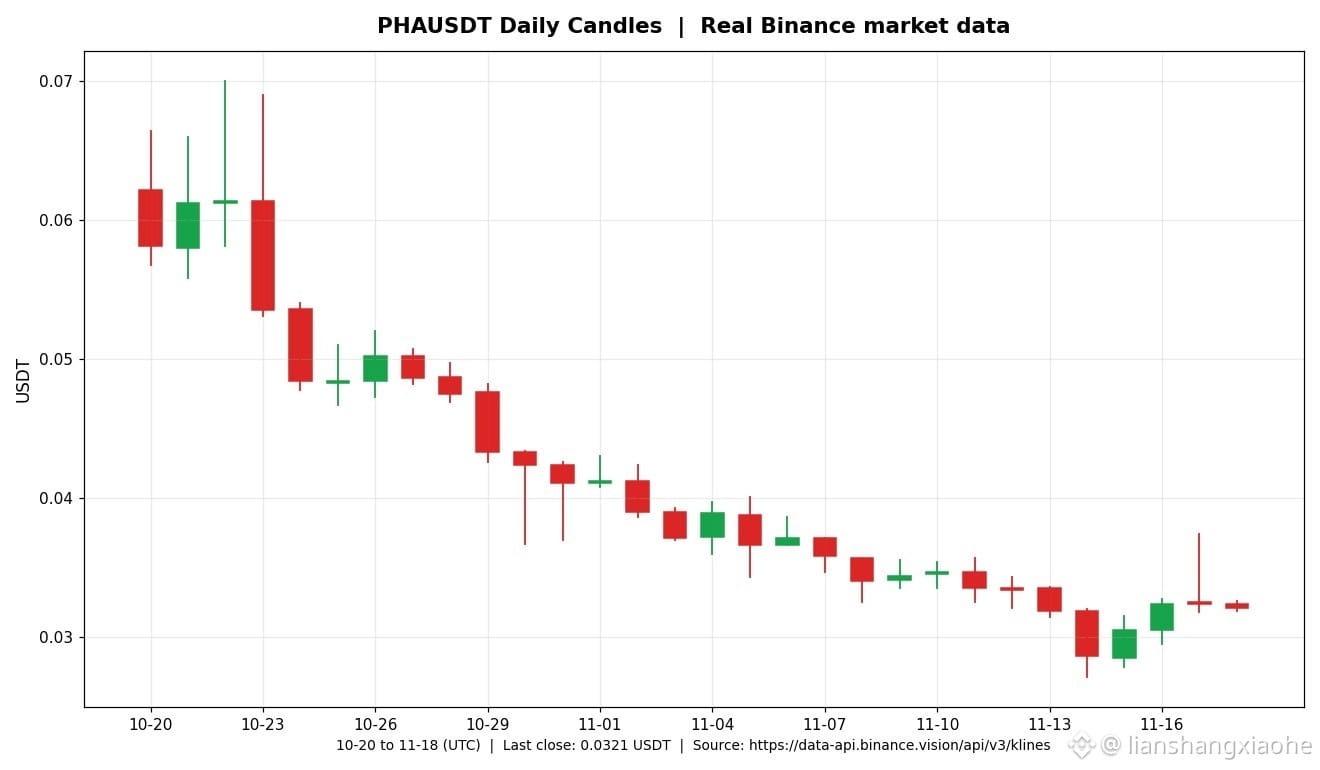
$PHA Yesterday saw a spike followed by a pullback: the daily candle on November 17 opened at $0.0325, briefly surged to $0.0374 intraday—up 15.4% from the previous day's close of $0.0324—then fell back to close at $0.0324, wiping out the entire gain. If you'd put in 10,000 U at yesterday's closing price and sold at the intraday high, you'd have made 11,540 U, a profit of about 1,540 U. Hold on until now without selling, and you'd have made nothing; anyone who chased the rally is stuck at the top. Trading volume that day was 157 million tokens, 2.4 times the previous day's. Phala published a guide to interactive TEE attestation verification that day. Volume picked up, but the price couldn't hold. Its market cap is only about $28 million, it's down by roughly a third over the past 30 days, and it's fallen more than 97% from its 2021 high of $1.38. That's how wild a spike-and-pullback can be with a small-cap token. Before jumping in, think carefully about whether you'll be the one left holding the bag. #PHA #PhalaNetwork
$PHA Yesterday saw a spike followed by a pullback: the daily candle on November 17 opened at $0.0325, briefly surged to $0.0374 intraday—up 15.4% from the previous day's close of $0.0324—then fell back to close at $0.0324, wiping out the entire gain. If you'd put in 10,000 U at yesterday's closing price and sold at the intraday high, you'd have made 11,540 U, a profit of about 1,540 U. Hold on until now without selling, and you'd have made nothing; anyone who chased the rally is stuck at the top. Trading volume that day was 157 million tokens, 2.4 times the previous day's. Phala published a guide to interactive TEE attestation verification that day. Volume picked up, but the price couldn't hold. Its market cap is only about $28 million, it's down by roughly a third over the past 30 days, and it's fallen more than 97% from its 2021 high of $1.38. That's how wild a spike-and-pullback can be with a small-cap token. Before jumping in, think carefully about whether you'll be the one left holding the bag. #PHA #PhalaNetwork
75
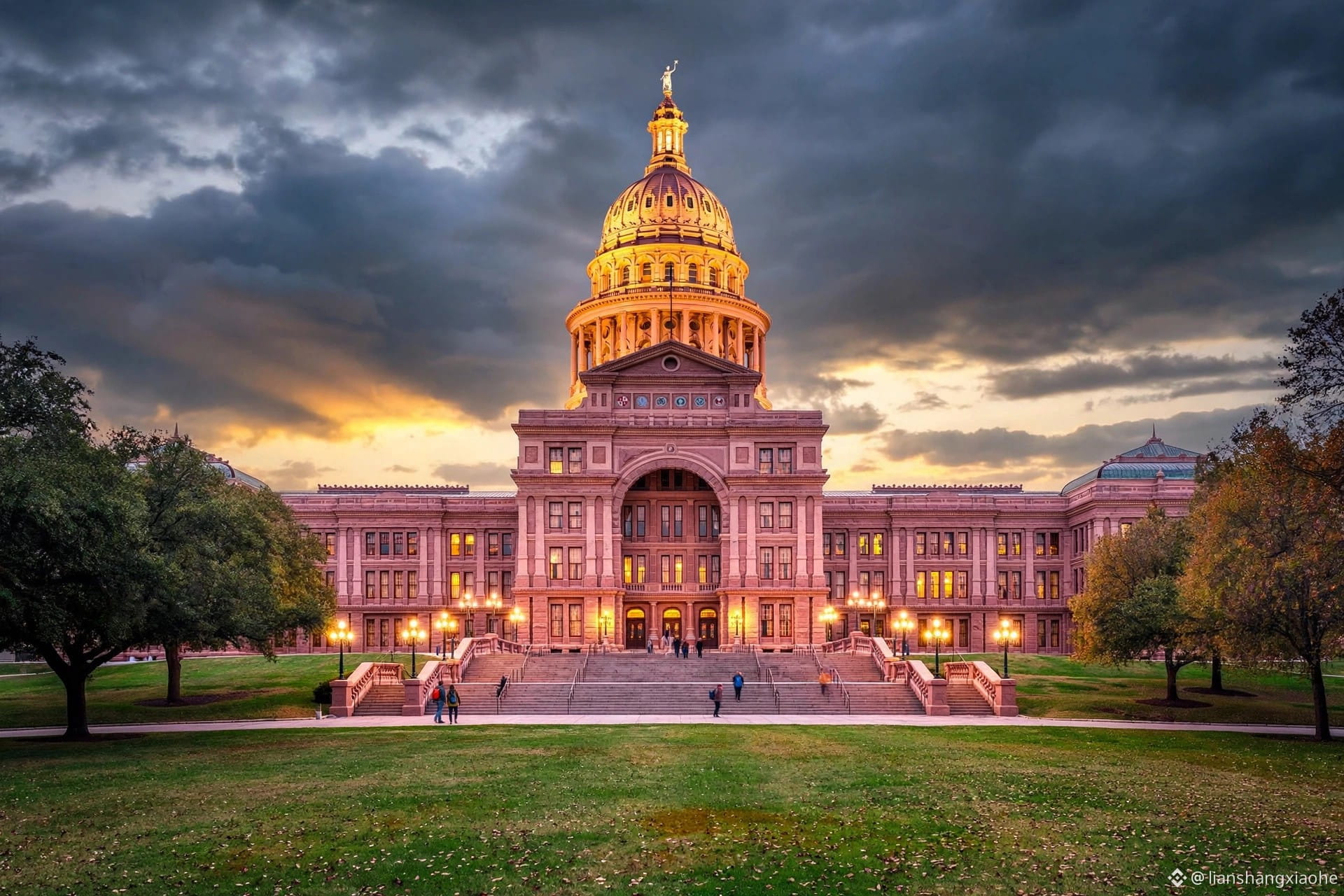
Texas is making another move: On November 9, Representative Ron Reynolds introduced HB 815, which would allow every city and county in Texas to spend up to $10 million in public funds to buy Bitcoin or other cryptocurrencies. School districts are excluded, and participation would be voluntary. The key detail: The bill copies the definition from the 2025 Texas Strategic Bitcoin Reserve Act (SB 21), but removes the state reserve’s $500 billion market-cap threshold. In theory, local governments could buy any coin they want—and the bill doesn’t even include custody rules. Who holds the keys? Who’s responsible if they’re lost? It’s all left blank. The bill hasn’t even reached committee, and even if passed, it wouldn’t take effect until September 1, 2027. Local governments using taxpayers’ money to gamble on crypto—that’s a bigger leap than Wall Street’s. #比特币 #Texas
Texas is making another move: On November 9, Representative Ron Reynolds introduced HB 815, which would allow every city and county in Texas to spend up to $10 million in public funds to buy Bitcoin or other cryptocurrencies. School districts are excluded, and participation would be voluntary. The key detail: The bill copies the definition from the 2025 Texas Strategic Bitcoin Reserve Act (SB 21), but removes the state reserve’s $500 billion market-cap threshold. In theory, local governments could buy any coin they want—and the bill doesn’t even include custody rules. Who holds the keys? Who’s responsible if they’re lost? It’s all left blank. The bill hasn’t even reached committee, and even if passed, it wouldn’t take effect until September 1, 2027. Local governments using taxpayers’ money to gamble on crypto—that’s a bigger leap than Wall Street’s. #比特币 #Texas
2
928
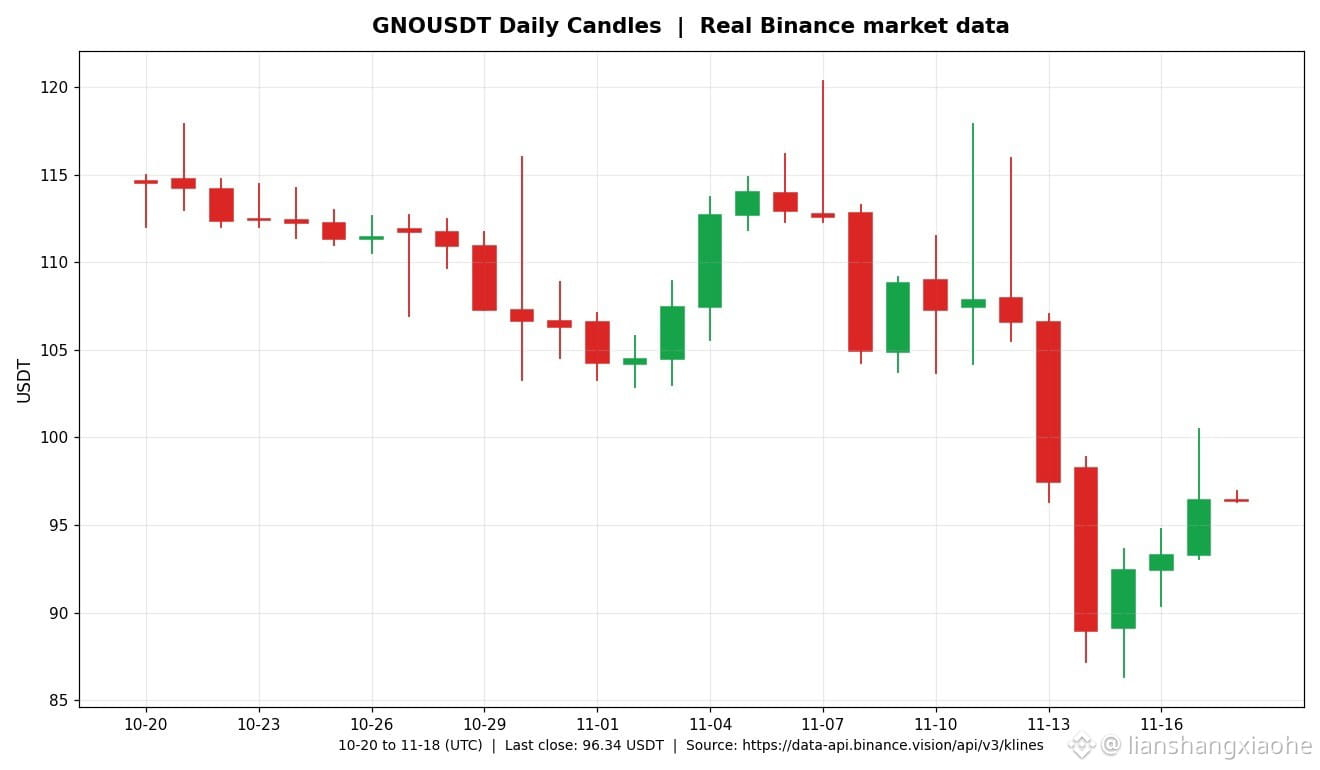
The market was gripped by extreme fear, but $GNO quietly made a move: during trading on November 17, it briefly touched $100.48, breaking above the $100 mark, before closing at $96.44. If you’d bought 10,000 U at yesterday’s closing price of $93.30, the intraday high would have taken your position to 10,770 U—a profit of about 770 U. Even if you’d held until the close, it would still be worth 10,337 U. But don’t get carried away: it’s still down 10.7% over 7 days and 16% over 30 days, with a market cap of just over $250 million, and it remains 85% below its all-time high of $644. After hitting a low of $86.31 on November 15, it rebounded 16.4% in two days. This looks more like an oversold bounce than a reversal, so take a look at the candlestick chart before chasing the rally. #Gnosis #cryptocurrency
The market was gripped by extreme fear, but $GNO quietly made a move: during trading on November 17, it briefly touched $100.48, breaking above the $100 mark, before closing at $96.44. If you’d bought 10,000 U at yesterday’s closing price of $93.30, the intraday high would have taken your position to 10,770 U—a profit of about 770 U. Even if you’d held until the close, it would still be worth 10,337 U. But don’t get carried away: it’s still down 10.7% over 7 days and 16% over 30 days, with a market cap of just over $250 million, and it remains 85% below its all-time high of $644. After hitting a low of $86.31 on November 15, it rebounded 16.4% in two days. This looks more like an oversold bounce than a reversal, so take a look at the candlestick chart before chasing the rally. #Gnosis #cryptocurrency
83
Germany’s largest bank, Deutsche Bank, officially launched digital asset custody on November 11—not just talk, but a real service for clients: it serves only institutional and corporate customers; retail investors can’t get in. At launch, it will custody just five assets: Bitcoin, Ethereum, and three stablecoins—USDC, EURC, and EURAU. The bank manages the private keys for you, and transfers also go through its banking channels. It’s backed by a German BaFin license and the EU’s MiCA framework: announced on September 16, added to the ESMA register on October 12, and launched on November 11—not a single step skipped. The irony is that in the same week, BTC fell below $62,000 over the weekend, the Fear & Greed Index briefly dropped to 10 (extreme fear), and ETFs saw $1.07 billion in outflows for the week—the market was panicking while the bank was opening its doors. Institutions don’t wait for confirmation that the bottom is in before entering; they lay the groundwork when nobody dares to look. #DeutscheBank #BitcoinCustody
Germany’s largest bank, Deutsche Bank, officially launched digital asset custody on November 11—not just talk, but a real service for clients: it serves only institutional and corporate customers; retail investors can’t get in. At launch, it will custody just five assets: Bitcoin, Ethereum, and three stablecoins—USDC, EURC, and EURAU. The bank manages the private keys for you, and transfers also go through its banking channels. It’s backed by a German BaFin license and the EU’s MiCA framework: announced on September 16, added to the ESMA register on October 12, and launched on November 11—not a single step skipped. The irony is that in the same week, BTC fell below $62,000 over the weekend, the Fear & Greed Index briefly dropped to 10 (extreme fear), and ETFs saw $1.07 billion in outflows for the week—the market was panicking while the bank was opening its doors. Institutions don’t wait for confirmation that the bottom is in before entering; they lay the groundwork when nobody dares to look. #DeutscheBank #BitcoinCustody

170
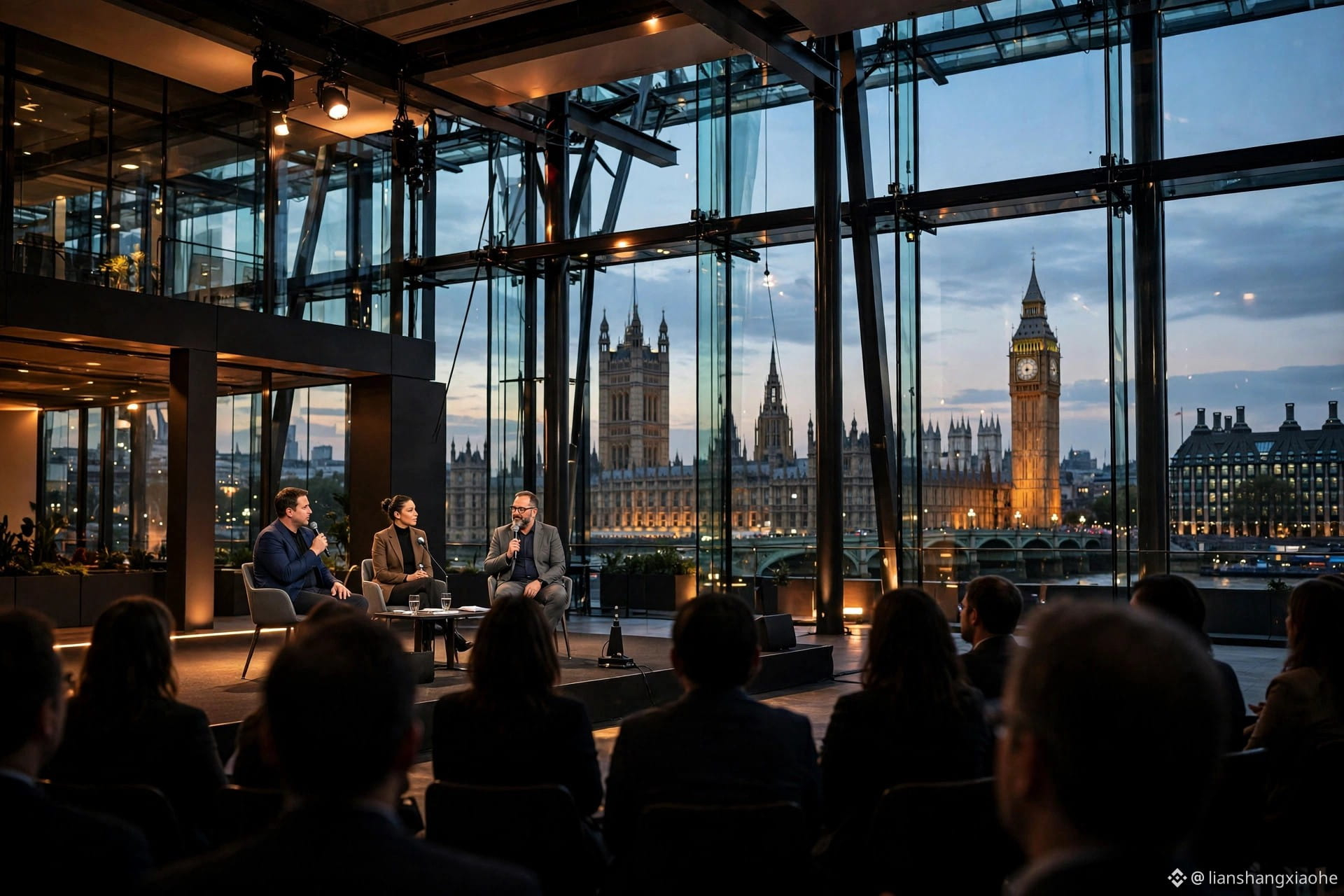
Boris Johnson took to the stage at Solana Breakpoint in London and, in front of more than 8,000 developers, took another swipe at Bitcoin. In March, he called it a “giant Ponzi scheme” in the Daily Mail. This time, he went further: “I don’t know who’s in charge, apart from someone called Yakimoto Nakasori”—deliberately mangling Satoshi Nakamoto’s name. He added: “If $6 billion gets stolen, I wouldn’t even know who to ask to get it back.” The host shot back on the spot: “Nobody needs to guarantee it—that’s the beauty of the protocol.” What’s interesting is that, after all the criticism, Johnson changed tack and said the UK must be “at the forefront” of blockchain and asset tokenization. Lord Kempsell, who shared the stage with him, also said there was great potential in bringing parts of the sector within the regulatory framework. The FCA finalized its crypto rules in June, with mandatory enforcement due by the end of 2027, and more than 8% of UK adults hold crypto assets. The fact that a former prime minister was invited to speak at a crypto conference despite taking a contrary stance shows that tokenization has entered the mainstream agenda: assets can be left aside, but the technology must be seized. #Solana #Tokenization
Boris Johnson took to the stage at Solana Breakpoint in London and, in front of more than 8,000 developers, took another swipe at Bitcoin. In March, he called it a “giant Ponzi scheme” in the Daily Mail. This time, he went further: “I don’t know who’s in charge, apart from someone called Yakimoto Nakasori”—deliberately mangling Satoshi Nakamoto’s name. He added: “If $6 billion gets stolen, I wouldn’t even know who to ask to get it back.” The host shot back on the spot: “Nobody needs to guarantee it—that’s the beauty of the protocol.” What’s interesting is that, after all the criticism, Johnson changed tack and said the UK must be “at the forefront” of blockchain and asset tokenization. Lord Kempsell, who shared the stage with him, also said there was great potential in bringing parts of the sector within the regulatory framework. The FCA finalized its crypto rules in June, with mandatory enforcement due by the end of 2027, and more than 8% of UK adults hold crypto assets. The fact that a former prime minister was invited to speak at a crypto conference despite taking a contrary stance shows that tokenization has entered the mainstream agenda: assets can be left aside, but the technology must be seized. #Solana #Tokenization
66
Log in to explore more content
Join global crypto users on Binance Square
⚡️ Get latest and useful information about crypto.
💬 Trusted by the world’s largest crypto exchange.
👍 Discover real insights from verified creators.
Email / Phone number
Trending Topics
NvidiaBeatsEstimatesWith$130BQ4Outlook
17,261 views
203 Discussing
Nvidia Beats With $115.8 Billion in Revenue, Guides to $130 Billion and Adds $150 Billion Buyback
Binance News
·49 Likes
·44k views
AnthropicIPOPriceCouldExceed$80
22,019 views
177 Discussing
RussiaCentralBankAddsAlfaBankToCryptoExchangeRegister
0 views
9 Discussing