
Pushpendra Singh Digital
3.3k Posts

Pushpendra Singh Digital
 Square Verified
Report
Block User
11 years of finance content. 2 Millions Community Founder of SmartViewAI. No. 1 at Binance Blockchain Awards 2025. Crypto, stocks, money habits. Not advice.

マクロ経済KOL

2025年ブロックチェーン100 — 業界提唱者
21 Following
17.5K+ Followers
12.8K+ Liked
2 Badges
Posts
All
Quotes
Videos
PINNED
Vote for Pushpendra Singh Digital for the Blockchain 100 Awards! [Vote now](https://app.binance.com/uni-qr/cact26user/131)
Vote for Pushpendra Singh Digital for the Blockchain 100 Awards! Vote now
81
9
96
2.4k
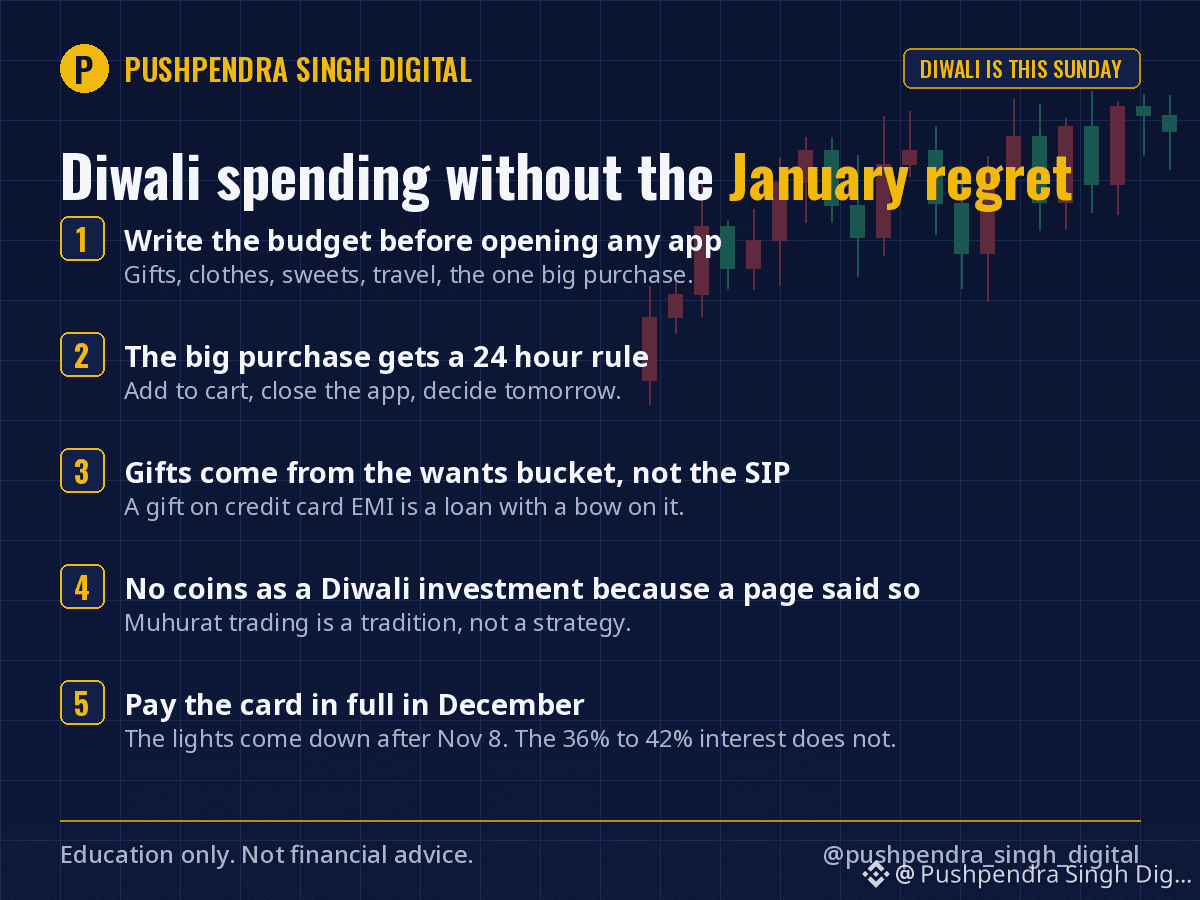
Diwali is on Sunday. The sales have been running for weeks. Here is how I spend on the festival without the January regret.
1. Write the Diwali budget before opening any app. Gifts, clothes, sweets, travel, the one big purchase. A number on paper beats a cart full of "it was on sale."
2. The one big purchase gets a 24 hour rule. Phone, TV, gold jewellery, anything over a month of savings. Add to cart, close the app, decide tomorrow.
3. Gifts come from the wants bucket, not the SIP. If a gift needs a credit card EMI, it is a loan with a bow on it.
4. No new coins as a "Diwali investment" because a page said so. Muhurat trading is a tradition, not a strategy. If you buy something that day, buy what you would have bought anyway.
5. Pay the card in full in December. The lights come down after Nov 8. The 36% to 42% interest on an unpaid card does not.
My own Diwali rule: one meaningful gift per person instead of five small ones, and the difference goes into bucket 3 from Saturday's post. Nobody has complained yet.
What is your biggest Diwali expense this year?
Education only, not financial advice.
$BTC #Diwali #PersonalFinance #Budgeting
Diwali is on Sunday. The sales have been running for weeks. Here is how I spend on the festival without the January regret.
1. Write the Diwali budget before opening any app. Gifts, clothes, sweets, travel, the one big purchase. A number on paper beats a cart full of "it was on sale."
2. The one big purchase gets a 24 hour rule. Phone, TV, gold jewellery, anything over a month of savings. Add to cart, close the app, decide tomorrow.
3. Gifts come from the wants bucket, not the SIP. If a gift needs a credit card EMI, it is a loan with a bow on it.
4. No new coins as a "Diwali investment" because a page said so. Muhurat trading is a tradition, not a strategy. If you buy something that day, buy what you would have bought anyway.
5. Pay the card in full in December. The lights come down after Nov 8. The 36% to 42% interest on an unpaid card does not.
My own Diwali rule: one meaningful gift per person instead of five small ones, and the difference goes into bucket 3 from Saturday's post. Nobody has complained yet.
What is your biggest Diwali expense this year?
Education only, not financial advice.
$BTC #Diwali #PersonalFinance #Budgeting
1. Write the Diwali budget before opening any app. Gifts, clothes, sweets, travel, the one big purchase. A number on paper beats a cart full of "it was on sale."
2. The one big purchase gets a 24 hour rule. Phone, TV, gold jewellery, anything over a month of savings. Add to cart, close the app, decide tomorrow.
3. Gifts come from the wants bucket, not the SIP. If a gift needs a credit card EMI, it is a loan with a bow on it.
4. No new coins as a "Diwali investment" because a page said so. Muhurat trading is a tradition, not a strategy. If you buy something that day, buy what you would have bought anyway.
5. Pay the card in full in December. The lights come down after Nov 8. The 36% to 42% interest on an unpaid card does not.
My own Diwali rule: one meaningful gift per person instead of five small ones, and the difference goes into bucket 3 from Saturday's post. Nobody has complained yet.
What is your biggest Diwali expense this year?
Education only, not financial advice.
$BTC #Diwali #PersonalFinance #Budgeting
2
803
The Diwali bonus is the easiest money of the year to waste, because it arrives with a reason to spend it attached.
The one rule that works: decide the split before the money lands. Once it is in the account, every shop has a plan for it. Before that, you do.
The split I use for any lump sum, bonus or not:
A third to the cushion. Emergency fund if it is below six months. If the fund is full, the most expensive loan, usually the credit card or a personal loan. Paying off 18% debt is an 18% return, guaranteed, tax free. No fund offers that.
A third to the long bucket. Index fund, PPF top up, a one time Bitcoin buy sized like a month of SIP, not like a lottery ticket. Money that you will not see again until it has doubled.
A third to Diwali. Gifts, the trip, the one thing you wanted all year. Spent without guilt, because the other two thirds already did their job.
The mistake I made for years: spending the whole bonus and telling myself the SIP covers the investing. The SIP covers the salary. The bonus was the only money that could have moved the needle, and it went into a phone I replaced eighteen months later.
Bonus coming this week? Write the three numbers now, before it arrives.
What is your bonus split this year? Thirds, or something else?
Education only, not financial advice.
$BTC #Diwali #PersonalFinance #MoneyHabits
The Diwali bonus is the easiest money of the year to waste, because it arrives with a reason to spend it attached.
The one rule that works: decide the split before the money lands. Once it is in the account, every shop has a plan for it. Before that, you do.
The split I use for any lump sum, bonus or not:
A third to the cushion. Emergency fund if it is below six months. If the fund is full, the most expensive loan, usually the credit card or a personal loan. Paying off 18% debt is an 18% return, guaranteed, tax free. No fund offers that.
A third to the long bucket. Index fund, PPF top up, a one time Bitcoin buy sized like a month of SIP, not like a lottery ticket. Money that you will not see again until it has doubled.
A third to Diwali. Gifts, the trip, the one thing you wanted all year. Spent without guilt, because the other two thirds already did their job.
The mistake I made for years: spending the whole bonus and telling myself the SIP covers the investing. The SIP covers the salary. The bonus was the only money that could have moved the needle, and it went into a phone I replaced eighteen months later.
Bonus coming this week? Write the three numbers now, before it arrives.
What is your bonus split this year? Thirds, or something else?
Education only, not financial advice.
$BTC #Diwali #PersonalFinance #MoneyHabits
The one rule that works: decide the split before the money lands. Once it is in the account, every shop has a plan for it. Before that, you do.
The split I use for any lump sum, bonus or not:
A third to the cushion. Emergency fund if it is below six months. If the fund is full, the most expensive loan, usually the credit card or a personal loan. Paying off 18% debt is an 18% return, guaranteed, tax free. No fund offers that.
A third to the long bucket. Index fund, PPF top up, a one time Bitcoin buy sized like a month of SIP, not like a lottery ticket. Money that you will not see again until it has doubled.
A third to Diwali. Gifts, the trip, the one thing you wanted all year. Spent without guilt, because the other two thirds already did their job.
The mistake I made for years: spending the whole bonus and telling myself the SIP covers the investing. The SIP covers the salary. The bonus was the only money that could have moved the needle, and it went into a phone I replaced eighteen months later.
Bonus coming this week? Write the three numbers now, before it arrives.
What is your bonus split this year? Thirds, or something else?
Education only, not financial advice.
$BTC #Diwali #PersonalFinance #MoneyHabits
2
458
Every red week, the comments fill with the same three words: buy the dip.
The phrase is missing two words: of what.
A dip in Bitcoin, which has recovered from every drawdown of 50% or more in its history, is one thing. A dip in a token where 70% of the supply is still locked with the team is a different thing with the same chart shape. One is a sale. The other is a slow motion exit by people who got their coins for free.
And after "of what" comes a second pair: with what.
Dip money is money you will not need for years. Rent money, the Diwali budget, the emergency fund: none of that is dip money, no matter how green the candle looks the next morning. The best dip buyers I know are boring. They buy the same amount of the same asset every month, and a dip only means that month's amount buys a bit more.
A checklist before buying any dip:
Would I hold this through another 50% drop? If no, it is a trade, size it like one.
Do I know who is selling to me? Unlocks, insiders, ETF outflows.
Is this money free for the next five years?
Three yes answers and the dip is yours. Anything less and the dip is buying you.
What did you buy on the last dip, honestly: Bitcoin, alts, or nothing?
Education only, not financial advice.
$BTC #BuyTheDip #Investing #CryptoEducation
Every red week, the comments fill with the same three words: buy the dip.
The phrase is missing two words: of what.
A dip in Bitcoin, which has recovered from every drawdown of 50% or more in its history, is one thing. A dip in a token where 70% of the supply is still locked with the team is a different thing with the same chart shape. One is a sale. The other is a slow motion exit by people who got their coins for free.
And after "of what" comes a second pair: with what.
Dip money is money you will not need for years. Rent money, the Diwali budget, the emergency fund: none of that is dip money, no matter how green the candle looks the next morning. The best dip buyers I know are boring. They buy the same amount of the same asset every month, and a dip only means that month's amount buys a bit more.
A checklist before buying any dip:
Would I hold this through another 50% drop? If no, it is a trade, size it like one.
Do I know who is selling to me? Unlocks, insiders, ETF outflows.
Is this money free for the next five years?
Three yes answers and the dip is yours. Anything less and the dip is buying you.
What did you buy on the last dip, honestly: Bitcoin, alts, or nothing?
Education only, not financial advice.
$BTC #BuyTheDip #Investing #CryptoEducation
The phrase is missing two words: of what.
A dip in Bitcoin, which has recovered from every drawdown of 50% or more in its history, is one thing. A dip in a token where 70% of the supply is still locked with the team is a different thing with the same chart shape. One is a sale. The other is a slow motion exit by people who got their coins for free.
And after "of what" comes a second pair: with what.
Dip money is money you will not need for years. Rent money, the Diwali budget, the emergency fund: none of that is dip money, no matter how green the candle looks the next morning. The best dip buyers I know are boring. They buy the same amount of the same asset every month, and a dip only means that month's amount buys a bit more.
A checklist before buying any dip:
Would I hold this through another 50% drop? If no, it is a trade, size it like one.
Do I know who is selling to me? Unlocks, insiders, ETF outflows.
Is this money free for the next five years?
Three yes answers and the dip is yours. Anything less and the dip is buying you.
What did you buy on the last dip, honestly: Bitcoin, alts, or nothing?
Education only, not financial advice.
$BTC #BuyTheDip #Investing #CryptoEducation
2
874
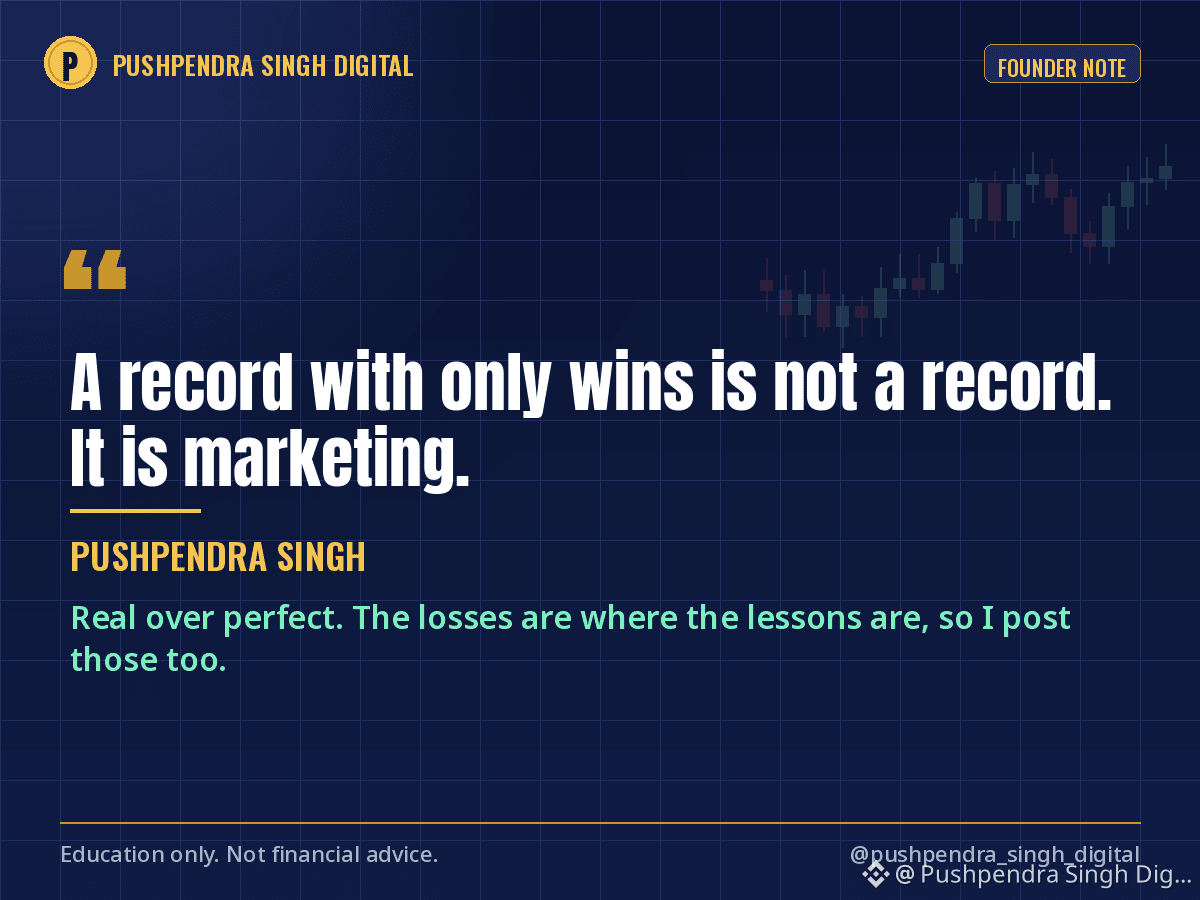
Someone asked me last week why I post my losing trades. The honest answer: because a record with only wins is not a record, it is marketing.
Three reasons I keep sharing the red ones.
One, it keeps me honest with myself. If I know a trade will be posted, I take it only if I can explain it in two lines. That filter alone removed half of my bad trades.
Two, losses are where the lessons are. Nobody learned anything from my trades that worked. People still message me about the QNT round trip, because they recognised themselves in it.
Three, it sets the right expectation. Every trader who has lasted ten years has a long list of losses. If all you see online are wins, you will think something is wrong with you when the first loss comes. Nothing is wrong with you. That is the job.
I am also building a competition feature for SmartViewAI where the results come from the engine, not from screenshots. Wins and losses, both verified. Because the point was never to look perfect. The point was to be real.
Do you share your losses, or only the wins?
Education only, not financial advice.
$BTC #TradingPsychology #RealTalk #Trading
Someone asked me last week why I post my losing trades. The honest answer: because a record with only wins is not a record, it is marketing.
Three reasons I keep sharing the red ones.
One, it keeps me honest with myself. If I know a trade will be posted, I take it only if I can explain it in two lines. That filter alone removed half of my bad trades.
Two, losses are where the lessons are. Nobody learned anything from my trades that worked. People still message me about the QNT round trip, because they recognised themselves in it.
Three, it sets the right expectation. Every trader who has lasted ten years has a long list of losses. If all you see online are wins, you will think something is wrong with you when the first loss comes. Nothing is wrong with you. That is the job.
I am also building a competition feature for SmartViewAI where the results come from the engine, not from screenshots. Wins and losses, both verified. Because the point was never to look perfect. The point was to be real.
Do you share your losses, or only the wins?
Education only, not financial advice.
$BTC #TradingPsychology #RealTalk #Trading
Three reasons I keep sharing the red ones.
One, it keeps me honest with myself. If I know a trade will be posted, I take it only if I can explain it in two lines. That filter alone removed half of my bad trades.
Two, losses are where the lessons are. Nobody learned anything from my trades that worked. People still message me about the QNT round trip, because they recognised themselves in it.
Three, it sets the right expectation. Every trader who has lasted ten years has a long list of losses. If all you see online are wins, you will think something is wrong with you when the first loss comes. Nothing is wrong with you. That is the job.
I am also building a competition feature for SmartViewAI where the results come from the engine, not from screenshots. Wins and losses, both verified. Because the point was never to look perfect. The point was to be real.
Do you share your losses, or only the wins?
Education only, not financial advice.
$BTC #TradingPsychology #RealTalk #Trading
3
585
I have spent more on indicators and courses than on books. The books worked better. Three that changed how I handle money, each for a different reason.
1. The Psychology of Money, Morgan Housel. The book that explained why smart people make dumb money decisions. The line that stuck: "Wealth is what you don't see." It changed what I bought with my first big profit, which was nothing.
2. Let's Talk Money, Monika Halan. The most practical Indian personal finance book I know. The three account system, term insurance before investing, why most ULIPs are a bad deal. If you earn in rupees, start here, before any crypto book.
3. Trading in the Zone, Mark Douglas. For anyone who trades. The idea that each trade is one of a series, and that the outcome of a single trade means nothing, cured half of my revenge trading. The other half took a journal.
What none of them taught me: which coin to buy. What all of them taught me: how to behave when I am wrong, which is the only skill that compounds.
One rule I follow: for every course or indicator I consider buying, I read one book first. The book is usually enough.
Which book changed your money habits? I am building my Diwali reading list, so drop one below.
Education only, not financial advice.
$BTC #Books #PersonalFinance #TradingPsychology
I have spent more on indicators and courses than on books. The books worked better. Three that changed how I handle money, each for a different reason.
1. The Psychology of Money, Morgan Housel. The book that explained why smart people make dumb money decisions. The line that stuck: "Wealth is what you don't see." It changed what I bought with my first big profit, which was nothing.
2. Let's Talk Money, Monika Halan. The most practical Indian personal finance book I know. The three account system, term insurance before investing, why most ULIPs are a bad deal. If you earn in rupees, start here, before any crypto book.
3. Trading in the Zone, Mark Douglas. For anyone who trades. The idea that each trade is one of a series, and that the outcome of a single trade means nothing, cured half of my revenge trading. The other half took a journal.
What none of them taught me: which coin to buy. What all of them taught me: how to behave when I am wrong, which is the only skill that compounds.
One rule I follow: for every course or indicator I consider buying, I read one book first. The book is usually enough.
Which book changed your money habits? I am building my Diwali reading list, so drop one below.
Education only, not financial advice.
$BTC #Books #PersonalFinance #TradingPsychology
1. The Psychology of Money, Morgan Housel. The book that explained why smart people make dumb money decisions. The line that stuck: "Wealth is what you don't see." It changed what I bought with my first big profit, which was nothing.
2. Let's Talk Money, Monika Halan. The most practical Indian personal finance book I know. The three account system, term insurance before investing, why most ULIPs are a bad deal. If you earn in rupees, start here, before any crypto book.
3. Trading in the Zone, Mark Douglas. For anyone who trades. The idea that each trade is one of a series, and that the outcome of a single trade means nothing, cured half of my revenge trading. The other half took a journal.
What none of them taught me: which coin to buy. What all of them taught me: how to behave when I am wrong, which is the only skill that compounds.
One rule I follow: for every course or indicator I consider buying, I read one book first. The book is usually enough.
Which book changed your money habits? I am building my Diwali reading list, so drop one below.
Education only, not financial advice.
$BTC #Books #PersonalFinance #TradingPsychology
2
597
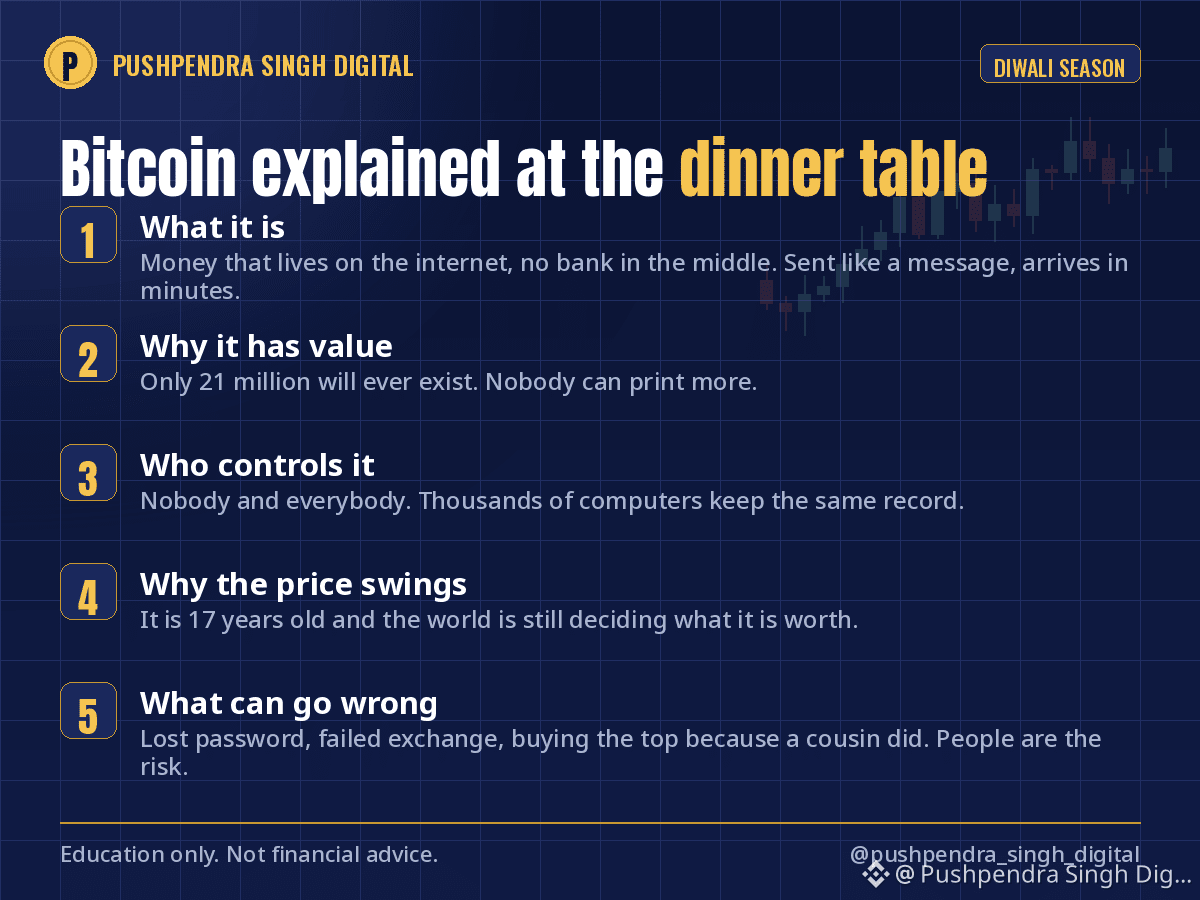
Diwali is this Sunday, and someone at the family table will ask about Bitcoin. Here is how I explain it in five lines, without a single technical word.
1. What it is: money that lives on the internet, with no bank or government in the middle. You send it like a WhatsApp message, and it arrives in minutes anywhere in the world.
2. Why it has value: there will only ever be 21 million. Nobody can print more. Compare that with rupees or dollars, where more are printed every year.
3. Who controls it: nobody and everybody. Thousands of computers around the world keep the same record, so no single person can change it or switch it off.
4. Why the price moves so much: it is not even 18 years old and the whole world is still deciding what it is worth. Gold took thousands of years. This is the loud part of that process.
5. What can go wrong: you lose your password and the coins are gone forever. You keep them on an exchange and the exchange fails. Or you buy at the top because your cousin did. The technology is safe. People are the risk.
Then the question that always follows: should I buy? My answer at every dinner: only an amount you can forget about for five years, after the emergency fund and the insurance are done.
Save this for Sunday. How do you explain Bitcoin at home? Or do you avoid the topic?
Education only, not financial advice.
$BTC #Bitcoin #CryptoEducation #Diwali
Diwali is this Sunday, and someone at the family table will ask about Bitcoin. Here is how I explain it in five lines, without a single technical word.
1. What it is: money that lives on the internet, with no bank or government in the middle. You send it like a WhatsApp message, and it arrives in minutes anywhere in the world.
2. Why it has value: there will only ever be 21 million. Nobody can print more. Compare that with rupees or dollars, where more are printed every year.
3. Who controls it: nobody and everybody. Thousands of computers around the world keep the same record, so no single person can change it or switch it off.
4. Why the price moves so much: it is not even 18 years old and the whole world is still deciding what it is worth. Gold took thousands of years. This is the loud part of that process.
5. What can go wrong: you lose your password and the coins are gone forever. You keep them on an exchange and the exchange fails. Or you buy at the top because your cousin did. The technology is safe. People are the risk.
Then the question that always follows: should I buy? My answer at every dinner: only an amount you can forget about for five years, after the emergency fund and the insurance are done.
Save this for Sunday. How do you explain Bitcoin at home? Or do you avoid the topic?
Education only, not financial advice.
$BTC #Bitcoin #CryptoEducation #Diwali
1. What it is: money that lives on the internet, with no bank or government in the middle. You send it like a WhatsApp message, and it arrives in minutes anywhere in the world.
2. Why it has value: there will only ever be 21 million. Nobody can print more. Compare that with rupees or dollars, where more are printed every year.
3. Who controls it: nobody and everybody. Thousands of computers around the world keep the same record, so no single person can change it or switch it off.
4. Why the price moves so much: it is not even 18 years old and the whole world is still deciding what it is worth. Gold took thousands of years. This is the loud part of that process.
5. What can go wrong: you lose your password and the coins are gone forever. You keep them on an exchange and the exchange fails. Or you buy at the top because your cousin did. The technology is safe. People are the risk.
Then the question that always follows: should I buy? My answer at every dinner: only an amount you can forget about for five years, after the emergency fund and the insurance are done.
Save this for Sunday. How do you explain Bitcoin at home? Or do you avoid the topic?
Education only, not financial advice.
$BTC #Bitcoin #CryptoEducation #Diwali
2
600
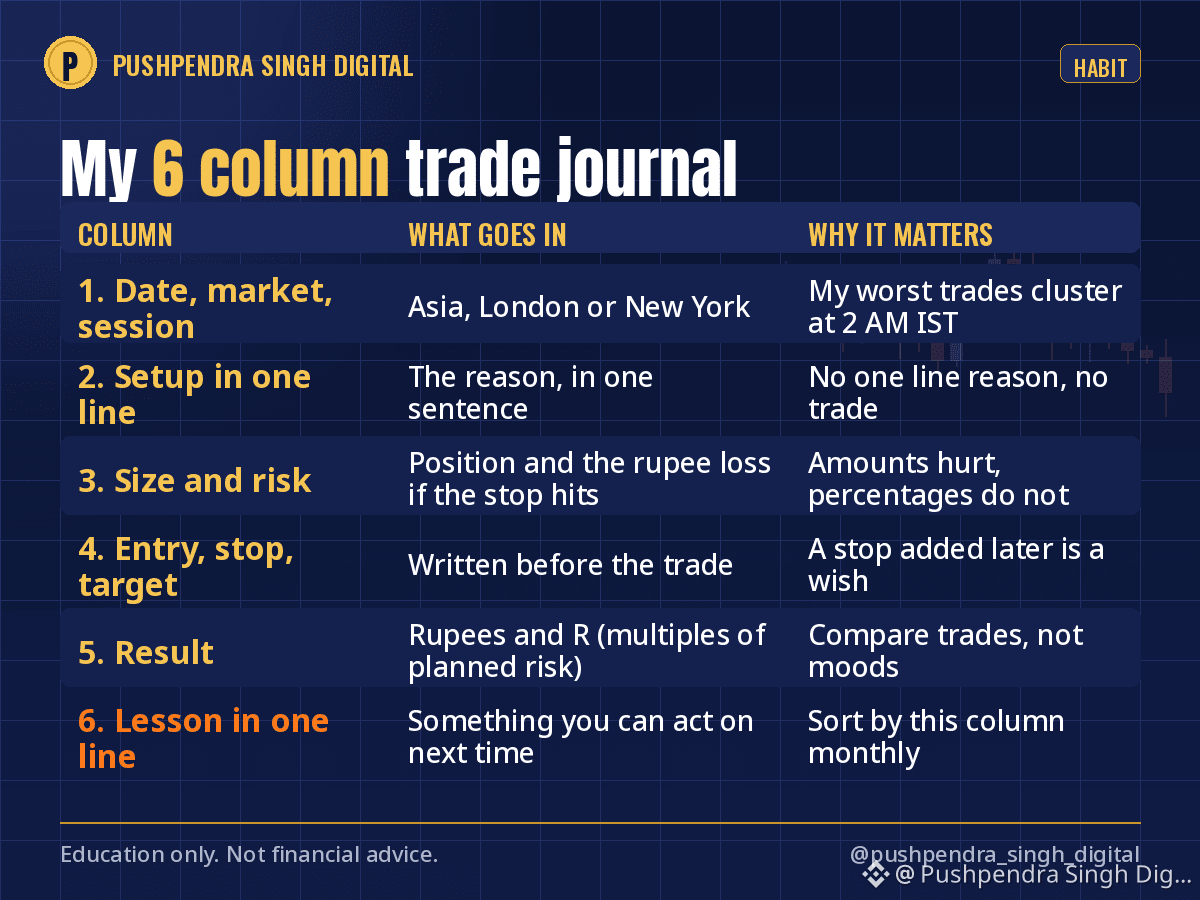
My trade journal has six columns. It took me three years of losses to arrive at the sixth one, which is the only one that made me money.
1. Date and market. Obvious, but also the session: Asia, London, New York. My worst trades cluster at 2 AM IST. The journal told me that, not my memory.
2. The setup, in one line. If I cannot write the reason in one line, there is no reason.
3. Size and risk. Position size and the rupee amount I lose if the stop hits. Not the percentage, the amount. Percentages do not hurt. Amounts do.
4. Entry, stop, target. Written before the trade, not after. A stop added after entry is a wish.
5. Result. Profit or loss in rupees and in R (how many times my planned risk).
6. The lesson, in one line. Not "should have held longer." Something I can act on: "No entries in the first 15 minutes after CPI."
Once a month I sort by column 6. The same three lessons show up every month. That is the real journal: the mistakes I keep repeating, in my own handwriting.
A spreadsheet is enough. The app does not matter. The habit does. Sunday night is a good time to set it up for the week.
Do you keep a journal, or do you keep a memory that is kind to you?
Education only, not financial advice.
$BTC #TradingJournal #TradingPsychology #RiskManagement
My trade journal has six columns. It took me three years of losses to arrive at the sixth one, which is the only one that made me money.
1. Date and market. Obvious, but also the session: Asia, London, New York. My worst trades cluster at 2 AM IST. The journal told me that, not my memory.
2. The setup, in one line. If I cannot write the reason in one line, there is no reason.
3. Size and risk. Position size and the rupee amount I lose if the stop hits. Not the percentage, the amount. Percentages do not hurt. Amounts do.
4. Entry, stop, target. Written before the trade, not after. A stop added after entry is a wish.
5. Result. Profit or loss in rupees and in R (how many times my planned risk).
6. The lesson, in one line. Not "should have held longer." Something I can act on: "No entries in the first 15 minutes after CPI."
Once a month I sort by column 6. The same three lessons show up every month. That is the real journal: the mistakes I keep repeating, in my own handwriting.
A spreadsheet is enough. The app does not matter. The habit does. Sunday night is a good time to set it up for the week.
Do you keep a journal, or do you keep a memory that is kind to you?
Education only, not financial advice.
$BTC #TradingJournal #TradingPsychology #RiskManagement
1. Date and market. Obvious, but also the session: Asia, London, New York. My worst trades cluster at 2 AM IST. The journal told me that, not my memory.
2. The setup, in one line. If I cannot write the reason in one line, there is no reason.
3. Size and risk. Position size and the rupee amount I lose if the stop hits. Not the percentage, the amount. Percentages do not hurt. Amounts do.
4. Entry, stop, target. Written before the trade, not after. A stop added after entry is a wish.
5. Result. Profit or loss in rupees and in R (how many times my planned risk).
6. The lesson, in one line. Not "should have held longer." Something I can act on: "No entries in the first 15 minutes after CPI."
Once a month I sort by column 6. The same three lessons show up every month. That is the real journal: the mistakes I keep repeating, in my own handwriting.
A spreadsheet is enough. The app does not matter. The habit does. Sunday night is a good time to set it up for the week.
Do you keep a journal, or do you keep a memory that is kind to you?
Education only, not financial advice.
$BTC #TradingJournal #TradingPsychology #RiskManagement
8
824
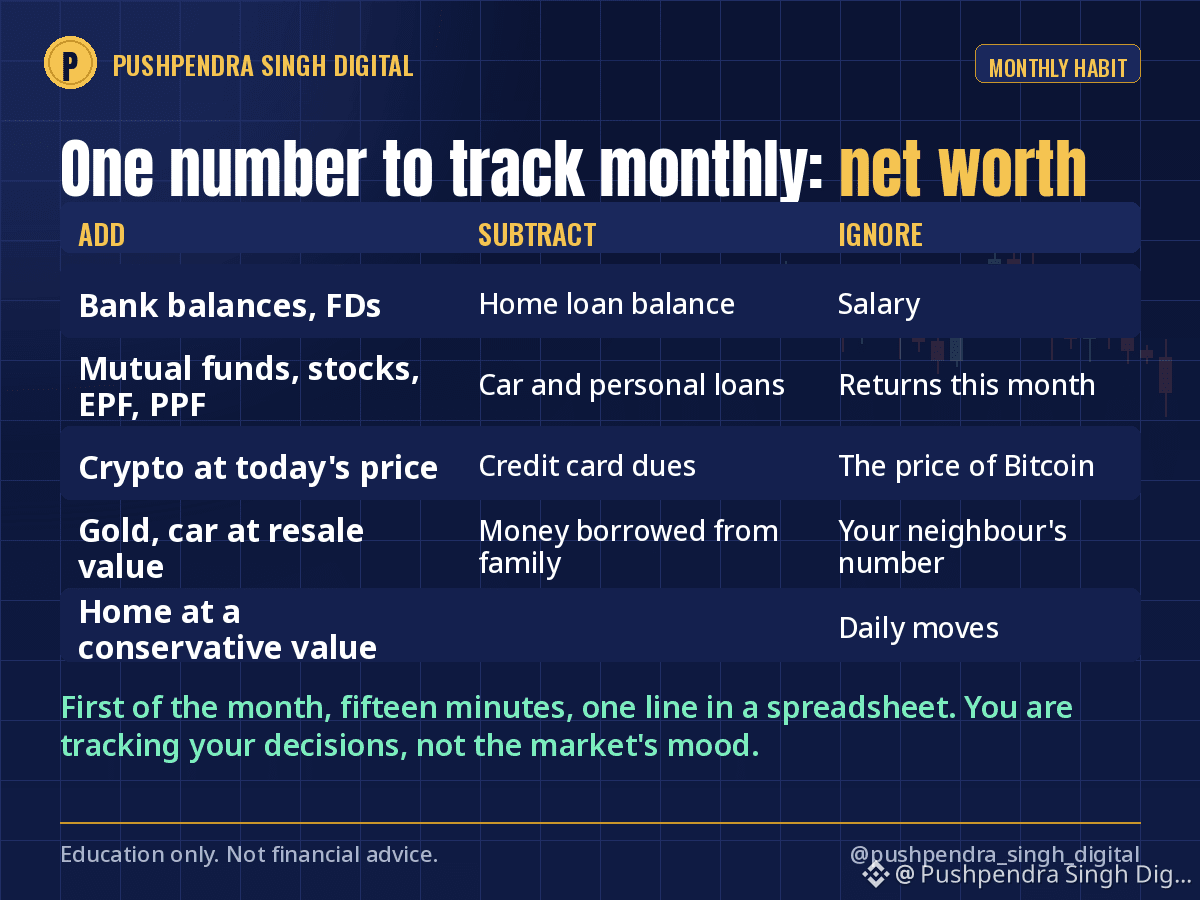
It is the first of the month. If you track one number about your money, make it net worth. Everything you own minus everything you owe. Once a month, same date, one line in a spreadsheet.
What goes in:
Assets: bank balances, fixed deposits, mutual funds, stocks, EPF and PPF, crypto at today's price, gold, the car at resale value, the home at a conservative value.
Liabilities: home loan balance, car loan, personal loans, credit card dues, money borrowed from family.
What stays out: salary, returns, and the price of Bitcoin. Income is not wealth. A 20% return on 5% of your money is a rounding error.
Why monthly and not daily: daily is noise. Monthly shows the direction, and after a year you will see what actually moved the number. In my case it was never a trade. It was the savings rate and one loan I finished early.
The honest part: including crypto at today's price means the number will swing. Mine fell for three months after last October's top and I kept recording it. That is the point. You are tracking your decisions, not the market's mood.
First of the month, fifteen minutes, one number. It is the quietest habit with the loudest result. Today is a good day to start.
Do you know your net worth today, within 10%?
Education only, not financial advice.
$BTC #NetWorth #PersonalFinance #MoneyHabits
It is the first of the month. If you track one number about your money, make it net worth. Everything you own minus everything you owe. Once a month, same date, one line in a spreadsheet.
What goes in:
Assets: bank balances, fixed deposits, mutual funds, stocks, EPF and PPF, crypto at today's price, gold, the car at resale value, the home at a conservative value.
Liabilities: home loan balance, car loan, personal loans, credit card dues, money borrowed from family.
What stays out: salary, returns, and the price of Bitcoin. Income is not wealth. A 20% return on 5% of your money is a rounding error.
Why monthly and not daily: daily is noise. Monthly shows the direction, and after a year you will see what actually moved the number. In my case it was never a trade. It was the savings rate and one loan I finished early.
The honest part: including crypto at today's price means the number will swing. Mine fell for three months after last October's top and I kept recording it. That is the point. You are tracking your decisions, not the market's mood.
First of the month, fifteen minutes, one number. It is the quietest habit with the loudest result. Today is a good day to start.
Do you know your net worth today, within 10%?
Education only, not financial advice.
$BTC #NetWorth #PersonalFinance #MoneyHabits
What goes in:
Assets: bank balances, fixed deposits, mutual funds, stocks, EPF and PPF, crypto at today's price, gold, the car at resale value, the home at a conservative value.
Liabilities: home loan balance, car loan, personal loans, credit card dues, money borrowed from family.
What stays out: salary, returns, and the price of Bitcoin. Income is not wealth. A 20% return on 5% of your money is a rounding error.
Why monthly and not daily: daily is noise. Monthly shows the direction, and after a year you will see what actually moved the number. In my case it was never a trade. It was the savings rate and one loan I finished early.
The honest part: including crypto at today's price means the number will swing. Mine fell for three months after last October's top and I kept recording it. That is the point. You are tracking your decisions, not the market's mood.
First of the month, fifteen minutes, one number. It is the quietest habit with the loudest result. Today is a good day to start.
Do you know your net worth today, within 10%?
Education only, not financial advice.
$BTC #NetWorth #PersonalFinance #MoneyHabits
3
581
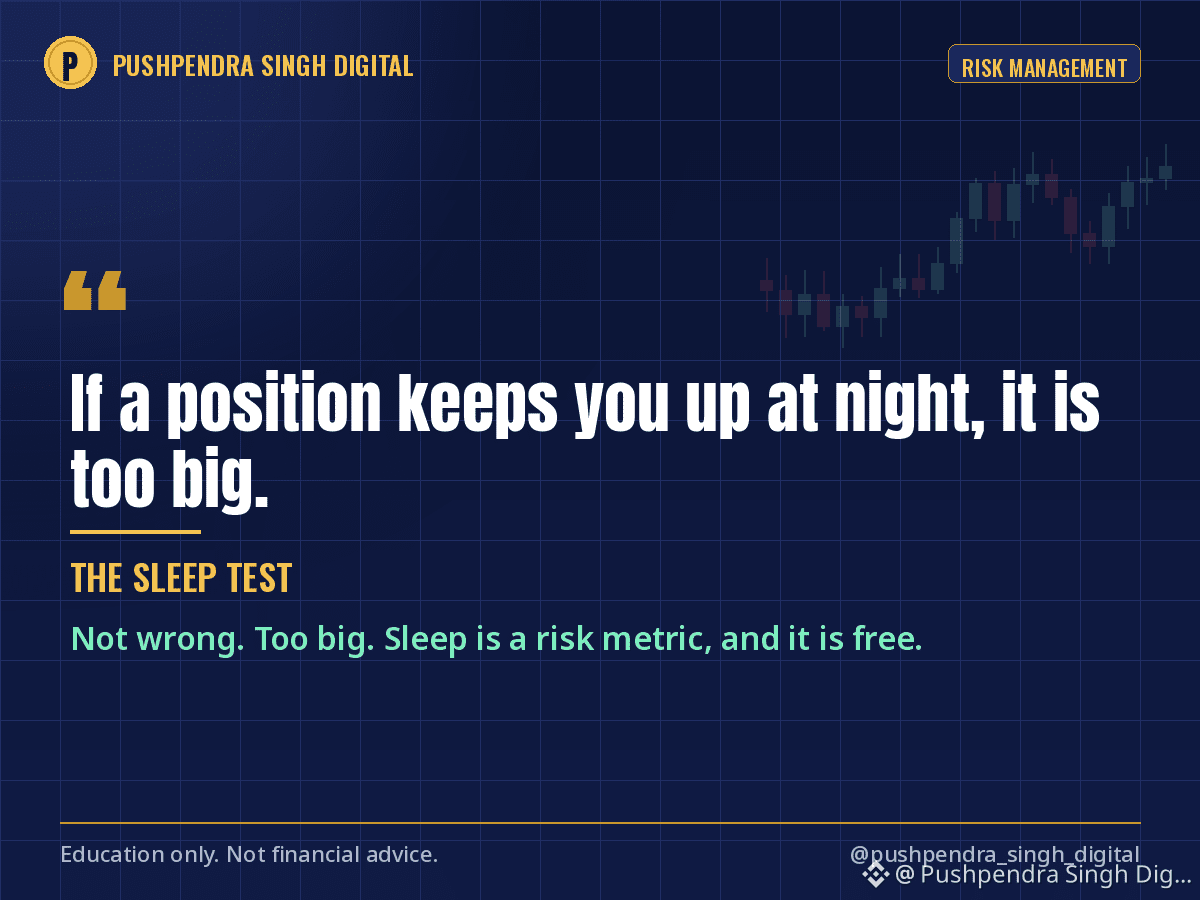
The sleep test is the only risk management rule I have never broken since I started using it.
If a position keeps me awake at night, it is too big. Not wrong, too big. The analysis can be perfect and the size still wrong.
How I apply it, three steps:
1. Before entering, I imagine the position down 30% by tomorrow morning. If my first thought is a plan, the size is fine. If my first thought is a feeling, cut the size in half and imagine again.
2. If I catch myself checking the price in bed, the size gets cut the next morning. No debate, no "but the setup is great." The body already voted.
3. Size for the night, not for the profit. Sleeping well through a weekend gap is worth more than the extra 2% a bigger position might have made.
It is Saturday night. Crypto does not close, and the thinnest order books of the week are the next 36 hours. If your open positions would keep you up tonight, you already have your answer about size.
Sleep is a risk metric. It is also free.
Do you pass the sleep test tonight?
Education only, not financial advice.
$BTC #RiskManagement #PositionSizing #TradingPsychology
The sleep test is the only risk management rule I have never broken since I started using it.
If a position keeps me awake at night, it is too big. Not wrong, too big. The analysis can be perfect and the size still wrong.
How I apply it, three steps:
1. Before entering, I imagine the position down 30% by tomorrow morning. If my first thought is a plan, the size is fine. If my first thought is a feeling, cut the size in half and imagine again.
2. If I catch myself checking the price in bed, the size gets cut the next morning. No debate, no "but the setup is great." The body already voted.
3. Size for the night, not for the profit. Sleeping well through a weekend gap is worth more than the extra 2% a bigger position might have made.
It is Saturday night. Crypto does not close, and the thinnest order books of the week are the next 36 hours. If your open positions would keep you up tonight, you already have your answer about size.
Sleep is a risk metric. It is also free.
Do you pass the sleep test tonight?
Education only, not financial advice.
$BTC #RiskManagement #PositionSizing #TradingPsychology
If a position keeps me awake at night, it is too big. Not wrong, too big. The analysis can be perfect and the size still wrong.
How I apply it, three steps:
1. Before entering, I imagine the position down 30% by tomorrow morning. If my first thought is a plan, the size is fine. If my first thought is a feeling, cut the size in half and imagine again.
2. If I catch myself checking the price in bed, the size gets cut the next morning. No debate, no "but the setup is great." The body already voted.
3. Size for the night, not for the profit. Sleeping well through a weekend gap is worth more than the extra 2% a bigger position might have made.
It is Saturday night. Crypto does not close, and the thinnest order books of the week are the next 36 hours. If your open positions would keep you up tonight, you already have your answer about size.
Sleep is a risk metric. It is also free.
Do you pass the sleep test tonight?
Education only, not financial advice.
$BTC #RiskManagement #PositionSizing #TradingPsychology
1
5
732
Tomorrow, Oct 31, the Bitcoin whitepaper turns 18. Nine pages, published in 2008 by someone called Satoshi Nakamoto, in the middle of the worst banking crisis in decades. Here is what those nine pages said, in plain language.
The problem: every online payment needs a bank in the middle. The bank can reverse it, block it, charge for it, or fail. 2008 showed what happens when the middle fails.
The idea: a public record that thousands of computers keep at the same time, so nobody has to trust a single company. Each new page of the record is locked to the one before it, which is why it is called a chain.
The rule: only 21 million coins, ever, released on a fixed schedule that nobody can change. About 95% of them have already been mined. Compare that with any currency, where the supply grows every year.
Eighteen years later: the first block came in January 2009. The first real purchase was two pizzas for 10,000 BTC in 2010. Today spot ETFs hold Bitcoin for pension funds, and the network has never been down for more than a few hours.
What has not changed: nine pages, 21 million, no middle man. Everything else, the price, the noise, the cycles, is the world deciding what that idea is worth.
Have you read the whitepaper? It takes twenty minutes and it is free. Save this if you plan to.
Education only, not financial advice.
$BTC #Bitcoin #CryptoEducation #BitcoinWhitepaper
Tomorrow, Oct 31, the Bitcoin whitepaper turns 18. Nine pages, published in 2008 by someone called Satoshi Nakamoto, in the middle of the worst banking crisis in decades. Here is what those nine pages said, in plain language.
The problem: every online payment needs a bank in the middle. The bank can reverse it, block it, charge for it, or fail. 2008 showed what happens when the middle fails.
The idea: a public record that thousands of computers keep at the same time, so nobody has to trust a single company. Each new page of the record is locked to the one before it, which is why it is called a chain.
The rule: only 21 million coins, ever, released on a fixed schedule that nobody can change. About 95% of them have already been mined. Compare that with any currency, where the supply grows every year.
Eighteen years later: the first block came in January 2009. The first real purchase was two pizzas for 10,000 BTC in 2010. Today spot ETFs hold Bitcoin for pension funds, and the network has never been down for more than a few hours.
What has not changed: nine pages, 21 million, no middle man. Everything else, the price, the noise, the cycles, is the world deciding what that idea is worth.
Have you read the whitepaper? It takes twenty minutes and it is free. Save this if you plan to.
Education only, not financial advice.
$BTC #Bitcoin #CryptoEducation #BitcoinWhitepaper
The problem: every online payment needs a bank in the middle. The bank can reverse it, block it, charge for it, or fail. 2008 showed what happens when the middle fails.
The idea: a public record that thousands of computers keep at the same time, so nobody has to trust a single company. Each new page of the record is locked to the one before it, which is why it is called a chain.
The rule: only 21 million coins, ever, released on a fixed schedule that nobody can change. About 95% of them have already been mined. Compare that with any currency, where the supply grows every year.
Eighteen years later: the first block came in January 2009. The first real purchase was two pizzas for 10,000 BTC in 2010. Today spot ETFs hold Bitcoin for pension funds, and the network has never been down for more than a few hours.
What has not changed: nine pages, 21 million, no middle man. Everything else, the price, the noise, the cycles, is the world deciding what that idea is worth.
Have you read the whitepaper? It takes twenty minutes and it is free. Save this if you plan to.
Education only, not financial advice.
$BTC #Bitcoin #CryptoEducation #BitcoinWhitepaper

5
1k
How much money is enough? There is a formula, and most people have never done the maths for their own life.
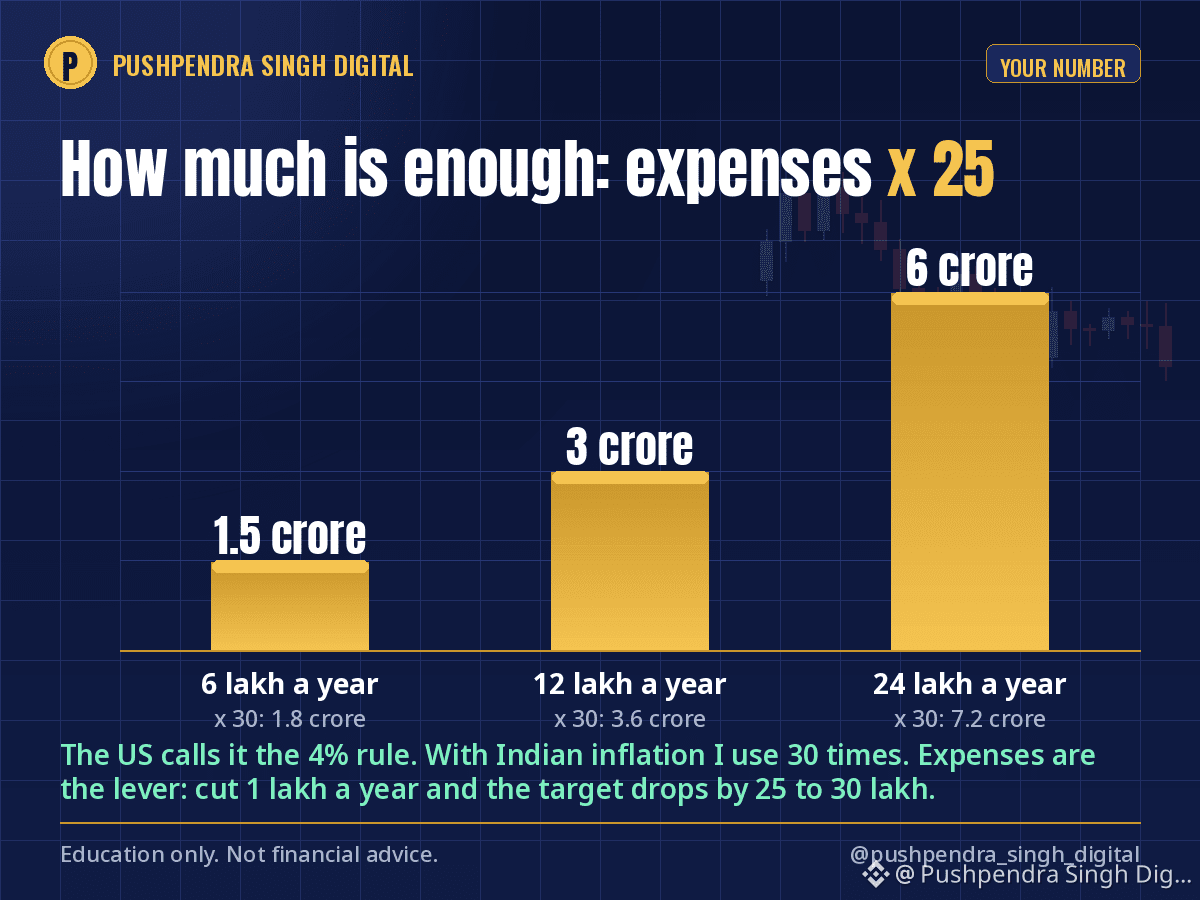
Yearly expenses times 25.
If your family spends 6 lakh a year, the number is 1.5 crore. 12 lakh a year, 3 crore. 24 lakh a year, 6 crore. Invested in a mix that beats inflation, that amount can pay your expenses from returns without eating the capital. In the US it is called the 4% rule.
The Indian adjustment: our inflation runs higher, so I use 30 times instead of 25 for my own number. 6 lakh a year becomes 1.8 crore. More conservative, better sleep.
Why the number matters even if you are nowhere near it:
It turns "I want to be rich" into a target with a date.
It shows you that expenses are the lever, not returns. Cutting yearly spend by 1 lakh removes 25 to 30 lakh from the target.
It tells you when you can stop taking risks you do not need. Most blown up accounts belong to people who already had enough and did not know it.
My own number is written on the first page of my journal. Every month the net worth line moves towards it or away from it, and that is the only score I keep.
Diwali weekend is a good time to do this sum once. Have you ever calculated your number? Share the multiple you use, not the amount.
Education only, not financial advice.
$BTC #FinancialFreedom #PersonalFinance #FIRE
How much money is enough? There is a formula, and most people have never done the maths for their own life.
Yearly expenses times 25.
If your family spends 6 lakh a year, the number is 1.5 crore. 12 lakh a year, 3 crore. 24 lakh a year, 6 crore. Invested in a mix that beats inflation, that amount can pay your expenses from returns without eating the capital. In the US it is called the 4% rule.
The Indian adjustment: our inflation runs higher, so I use 30 times instead of 25 for my own number. 6 lakh a year becomes 1.8 crore. More conservative, better sleep.
Why the number matters even if you are nowhere near it:
It turns "I want to be rich" into a target with a date.
It shows you that expenses are the lever, not returns. Cutting yearly spend by 1 lakh removes 25 to 30 lakh from the target.
It tells you when you can stop taking risks you do not need. Most blown up accounts belong to people who already had enough and did not know it.
My own number is written on the first page of my journal. Every month the net worth line moves towards it or away from it, and that is the only score I keep.
Diwali weekend is a good time to do this sum once. Have you ever calculated your number? Share the multiple you use, not the amount.
Education only, not financial advice.
$BTC #FinancialFreedom #PersonalFinance #FIRE
Yearly expenses times 25.
If your family spends 6 lakh a year, the number is 1.5 crore. 12 lakh a year, 3 crore. 24 lakh a year, 6 crore. Invested in a mix that beats inflation, that amount can pay your expenses from returns without eating the capital. In the US it is called the 4% rule.
The Indian adjustment: our inflation runs higher, so I use 30 times instead of 25 for my own number. 6 lakh a year becomes 1.8 crore. More conservative, better sleep.
Why the number matters even if you are nowhere near it:
It turns "I want to be rich" into a target with a date.
It shows you that expenses are the lever, not returns. Cutting yearly spend by 1 lakh removes 25 to 30 lakh from the target.
It tells you when you can stop taking risks you do not need. Most blown up accounts belong to people who already had enough and did not know it.
My own number is written on the first page of my journal. Every month the net worth line moves towards it or away from it, and that is the only score I keep.
Diwali weekend is a good time to do this sum once. Have you ever calculated your number? Share the multiple you use, not the amount.
Education only, not financial advice.
$BTC #FinancialFreedom #PersonalFinance #FIRE
2
2
592
Verified
On Sunday evening, Indian exchanges open for one hour on a closed day. Muhurat trading. If you are new to it, here is the plain version.
What it is: a one hour session on Diwali evening, held since 1957 on the BSE, timed to the auspicious hour of Lakshmi Puja. Traditionally families bought a few shares as a token, the way you buy gold on Dhanteras. Not for profit. For the gesture.
What it is not: a signal. The session is thin, the moves are small, and nothing about the hour changes what a company earns next quarter. Over the years the Muhurat session has closed green more often than not, but one hour of symbolic buying tells you nothing about the twelve months after it.
How I use it:
The one token buy is of something I already own and would buy anyway, an index fund or a share of a company I understand. Never a tip from a Diwali stock list.
The real work happens that afternoon: the yearly review. What did I buy this year and why, what would I not buy again, what is the savings rate, is the emergency fund full. One hour, one page.
Crypto has no Muhurat, it never closes. My symbolic buy there is the same monthly Bitcoin amount, on the same date. The ritual is the discipline, not the day.
The tradition is lovely. The strategy is the boring stuff you do the other 364 days.
Do you do a Muhurat buy? What is your one share this year?
Education only, not financial advice.
$BTC #MuhuratTrading #Diwali #StockMarket
On Sunday evening, Indian exchanges open for one hour on a closed day. Muhurat trading. If you are new to it, here is the plain version.
What it is: a one hour session on Diwali evening, held since 1957 on the BSE, timed to the auspicious hour of Lakshmi Puja. Traditionally families bought a few shares as a token, the way you buy gold on Dhanteras. Not for profit. For the gesture.
What it is not: a signal. The session is thin, the moves are small, and nothing about the hour changes what a company earns next quarter. Over the years the Muhurat session has closed green more often than not, but one hour of symbolic buying tells you nothing about the twelve months after it.
How I use it:
The one token buy is of something I already own and would buy anyway, an index fund or a share of a company I understand. Never a tip from a Diwali stock list.
The real work happens that afternoon: the yearly review. What did I buy this year and why, what would I not buy again, what is the savings rate, is the emergency fund full. One hour, one page.
Crypto has no Muhurat, it never closes. My symbolic buy there is the same monthly Bitcoin amount, on the same date. The ritual is the discipline, not the day.
The tradition is lovely. The strategy is the boring stuff you do the other 364 days.
Do you do a Muhurat buy? What is your one share this year?
Education only, not financial advice.
$BTC #MuhuratTrading #Diwali #StockMarket
What it is: a one hour session on Diwali evening, held since 1957 on the BSE, timed to the auspicious hour of Lakshmi Puja. Traditionally families bought a few shares as a token, the way you buy gold on Dhanteras. Not for profit. For the gesture.
What it is not: a signal. The session is thin, the moves are small, and nothing about the hour changes what a company earns next quarter. Over the years the Muhurat session has closed green more often than not, but one hour of symbolic buying tells you nothing about the twelve months after it.
How I use it:
The one token buy is of something I already own and would buy anyway, an index fund or a share of a company I understand. Never a tip from a Diwali stock list.
The real work happens that afternoon: the yearly review. What did I buy this year and why, what would I not buy again, what is the savings rate, is the emergency fund full. One hour, one page.
Crypto has no Muhurat, it never closes. My symbolic buy there is the same monthly Bitcoin amount, on the same date. The ritual is the discipline, not the day.
The tradition is lovely. The strategy is the boring stuff you do the other 364 days.
Do you do a Muhurat buy? What is your one share this year?
Education only, not financial advice.
$BTC #MuhuratTrading #Diwali #StockMarket
1
5
1.1k
Last 3 hours for Voting End,
[Last Day click here to Vote](https://app.binance.com/uni-qr/cact26user/131?uc=app_square_share_link&us=copylink)
Last 3 hours for Voting End,
Last Day click here to Vote
Last Day click here to Vote

Support
From Pushpendra Singh Digital
43
2
57
913
Final day of VOTING,
[ Click here to VOTE](https://app.binance.com/uni-qr/cact26user/131?uc=app_square_share_link&us=copylink) Now
Final day of VOTING,
[ Click here to VOTE](https://app.binance.com/uni-qr/cact26user/131?uc=app_square_share_link&us=copylink) Now
[ Click here to VOTE](https://app.binance.com/uni-qr/cact26user/131?uc=app_square_share_link&us=copylink) Now

Best Wishes!
From Pushpendra Singh Digital
47
4
132
1.4k
[Last day of the voting, Don’t forget to vote. click here to VOTE](https://app.binance.com/uni-qr/cact26user/131?uc=app_square_share_link&us=copylink)
Last day of the voting, Don’t forget to vote. click here to VOTE

13
1
17
1.4k
Thanks for support guys.
[Click here to vote now.](https://app.binance.com/uni-qr/cact26user/131?uc=app_square_share_link&us=copylink)
Thanks for support guys.
Click here to vote now.
Click here to vote now.

Thanks
From Pushpendra Singh Digital
35
76
838
Second Last day for Voting
If you have not done your votes, then please vote now - [Click here to Vote](https://app.binance.com/uni-qr/cact26user/131?uc=app_square_share_link&us=copylink)
Second Last day for Voting
If you have not done your votes, then please vote now - Click here to Vote
If you have not done your votes, then please vote now - Click here to Vote
Support 🙏
From Pushpendra Singh Digital
42
1
92
704
❤️ VOTING AGAIN REFRESHED, YOU CAN AGAIN VOTE 🗳️
[Click here to VOTE](https://app.binance.com/uni-qr/cact26user/131?uc=app_square_share_link&us=copylink)
❤️ VOTING AGAIN REFRESHED, YOU CAN AGAIN VOTE 🗳️
[Click here to VOTE](https://app.binance.com/uni-qr/cact26user/131?uc=app_square_share_link&us=copylink)
[Click here to VOTE](https://app.binance.com/uni-qr/cact26user/131?uc=app_square_share_link&us=copylink)
11
11
1.7k
Good News, Now we are Number 3 Globally. And no one can stop 🛑 us.
TODAY TARGET NUMBER 1 🏆
Voting link 🔗 [Click here to Vote Now](https://app.binance.com/uni-qr/cact26user/131?uc=app_square_share_link&us=copylink)
Good News, Now we are Number 3 Globally. And no one can stop 🛑 us.
TODAY TARGET NUMBER 1 🏆
Voting link 🔗 Click here to Vote Now
TODAY TARGET NUMBER 1 🏆
Voting link 🔗 Click here to Vote Now

Support Me
From Pushpendra Singh Digital
61
2
111
1.4k
Log in to explore more content
Join global crypto users on Binance Square
⚡️ Get latest and useful information about crypto.
💬 Trusted by the world’s largest crypto exchange.
👍 Discover real insights from verified creators.
Email / Phone number
Trending Topics
NvidiaBeatsEstimatesWith$130BQ4Outlook
36,811 views
244 Discussing
Nvidia Beats With $115.8 Billion in Revenue, Guides to $130 Billion and Adds $150 Billion Buyback
Binance News
·71 Likes
·48.1k views
AnthropicIPOPriceCouldExceed$80
41,087 views
213 Discussing
RussiaCentralBankAddsAlfaBankToCryptoExchangeRegister
1,381 views
27 Discussing