

Block_Baron
12.4k Posts

Block_Baron
 Square Verified+
Report
Block User
Binance Square creator | Exploring crypto, market moves, and next-gen projects | Opinions backed by research
Open Trade
Frequent Trader
11 Months
9 Following
31.5K+ Followers
23.5K+ Liked
Posts
Portfolio
All
Quotes
Live
·
--
If I became THE ONE to receive the 500 USDT, I wouldn’t treat it as just free money. I’d use it as an opportunity to grow my crypto journey, learn more, manage risk carefully, and build something meaningful from it. For me, the real value would be turning that opportunity into a smarter step forward. #BTHEONE
If I became THE ONE to receive the 500 USDT, I wouldn’t treat it as just free money. I’d use it as an opportunity to grow my crypto journey, learn more, manage risk carefully, and build something meaningful from it. For me, the real value would be turning that opportunity into a smarter step forward. #BTHEONE


Binance Argentina Official
·
--
🟡 500 USDT. 1 winner. Are you going to be THE ONE? 👀
How to participate? 👇
❤️ Like this post.
💬 What would THE ONE do with the 500 USDT? Leave your answer in the comments.
😉 Done! You're now participating for 500 USDT.⚡
📣 We'll announce the winner on Friday, September 25
Applies Términos y Condiciones.
How to participate? 👇
❤️ Like this post.
💬 What would THE ONE do with the 500 USDT? Leave your answer in the comments.
😉 Done! You're now participating for 500 USDT.⚡
📣 We'll announce the winner on Friday, September 25
Applies Términos y Condiciones.
151
·
--
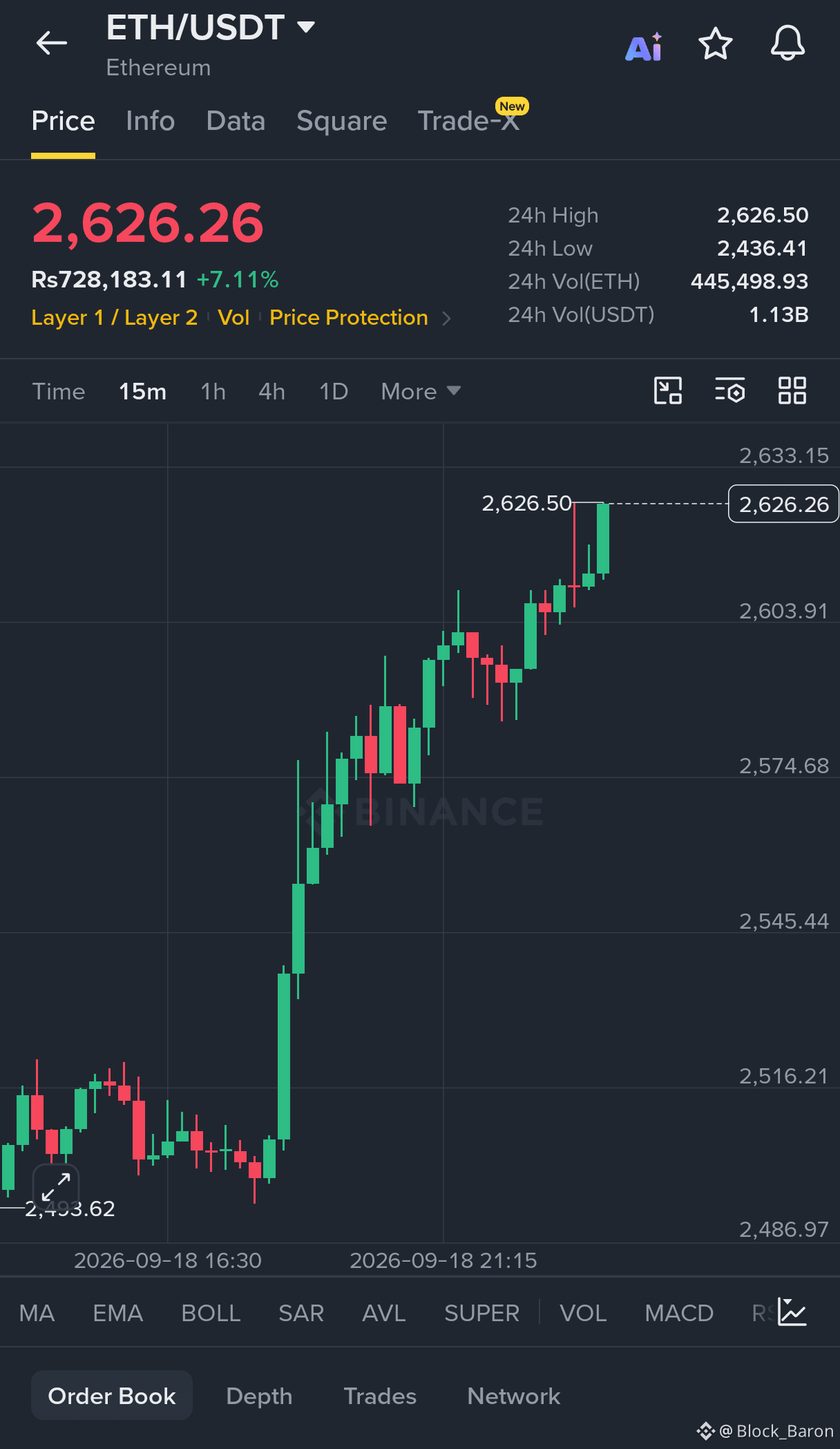
$ETH /USDT — 15m Technical Signal
1. Current price: 2,626.26 USDT
2. Timeframe: 15m
3. Market structure: Bullish — clear higher highs/higher lows
4. Major support: 2,603.91 / 2,574.68 / 2,545.44
5. Major resistance: 2,626.50 / 2,633.15
6. Recent breakout: Strong upside breakout from the ~2,500 area, followed by continued higher highs.
7. Candle/momentum: Strong bullish momentum; latest candles are pushing directly into the visible 2,626.50 high.
8. Volume/indicators: Indicator readings are not visible, so they are not used.
📌 SIGNAL: NO TRADE — WAIT FOR CONFIRMATION
Why:
⬆️ Bullish structure is clearly established.
⬆️ Price is holding above the prior 2,603.91 area.
⚠️ Current price is only 0.24 USDT below 2,626.50 resistance.
⚠️ The screenshot does not yet show a confirmed 15m close above 2,626.50.
A breakout above 2,626.50, preferably followed by a hold/retest, would provide the missing confirmation.
Entry / SL / TP: Not issued because the breakout is not confirmed.
🔥 Confidence: High — for waiting; bullish direction remains unconfirmed at resistance.
$ETH /USDT — 15m Technical Signal
1. Current price: 2,626.26 USDT
2. Timeframe: 15m
3. Market structure: Bullish — clear higher highs/higher lows
4. Major support: 2,603.91 / 2,574.68 / 2,545.44
5. Major resistance: 2,626.50 / 2,633.15
6. Recent breakout: Strong upside breakout from the ~2,500 area, followed by continued higher highs.
7. Candle/momentum: Strong bullish momentum; latest candles are pushing directly into the visible 2,626.50 high.
8. Volume/indicators: Indicator readings are not visible, so they are not used.
📌 SIGNAL: NO TRADE — WAIT FOR CONFIRMATION
Why:
⬆️ Bullish structure is clearly established.
⬆️ Price is holding above the prior 2,603.91 area.
⚠️ Current price is only 0.24 USDT below 2,626.50 resistance.
⚠️ The screenshot does not yet show a confirmed 15m close above 2,626.50.
A breakout above 2,626.50, preferably followed by a hold/retest, would provide the missing confirmation.
Entry / SL / TP: Not issued because the breakout is not confirmed.
🔥 Confidence: High — for waiting; bullish direction remains unconfirmed at resistance.
1. Current price: 2,626.26 USDT
2. Timeframe: 15m
3. Market structure: Bullish — clear higher highs/higher lows
4. Major support: 2,603.91 / 2,574.68 / 2,545.44
5. Major resistance: 2,626.50 / 2,633.15
6. Recent breakout: Strong upside breakout from the ~2,500 area, followed by continued higher highs.
7. Candle/momentum: Strong bullish momentum; latest candles are pushing directly into the visible 2,626.50 high.
8. Volume/indicators: Indicator readings are not visible, so they are not used.
📌 SIGNAL: NO TRADE — WAIT FOR CONFIRMATION
Why:
⬆️ Bullish structure is clearly established.
⬆️ Price is holding above the prior 2,603.91 area.
⚠️ Current price is only 0.24 USDT below 2,626.50 resistance.
⚠️ The screenshot does not yet show a confirmed 15m close above 2,626.50.
A breakout above 2,626.50, preferably followed by a hold/retest, would provide the missing confirmation.
Entry / SL / TP: Not issued because the breakout is not confirmed.
🔥 Confidence: High — for waiting; bullish direction remains unconfirmed at resistance.
1
201
·
--
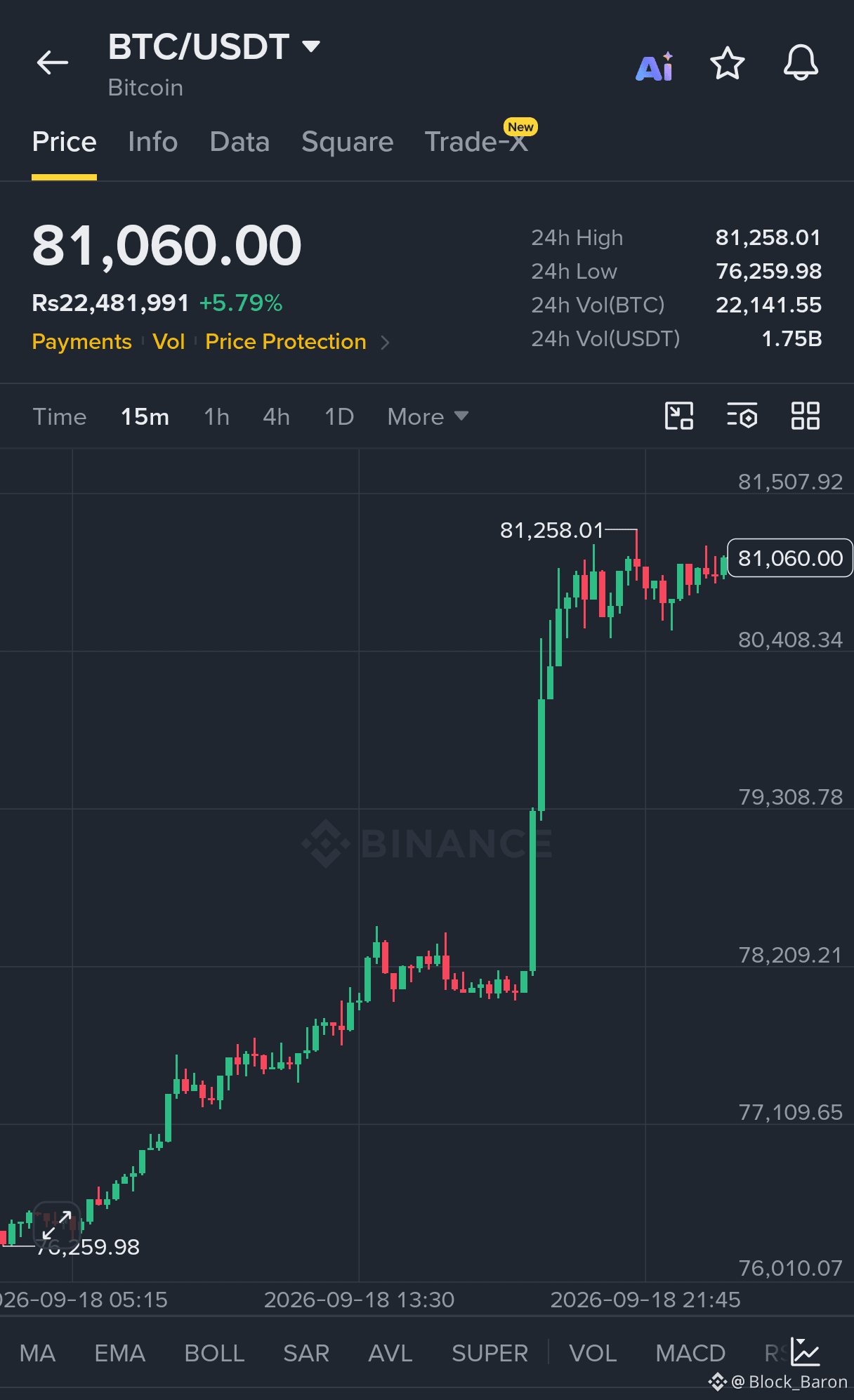
$BTC /USDT — 15m Technical Update
Visible chart data only
1. Current price: 81,060 USDT
2. Timeframe: 15m
3. Market structure: Bullish, currently consolidating near resistance
4. Major support: 80,408 / 79,309
5. Major resistance: 81,258 / 81,508
6. Recent breakout: Strong upside move from the 78,200 area toward 81,258
7. Candles/momentum: Strong impulse remains visible, but recent candles are smaller and mixed beneath 81,258 → momentum is pausing
8. Indicators/volume: Indicator names are visible, but their actual readings are not; no additional confirmation used.
📌 SIGNAL: NO TRADE — WAIT FOR CONFIRMATION
Bullish vs bearish check:
⬆️ Bullish: price remains well above the prior breakout area and is holding near the high.
⬇️ Bearish: repeated hesitation below 81,258 means rejection is still possible.
The chart does not show a confirmed break above 81,258.
Therefore, assigning an exact entry/SL/TP now would require guessing.
Bullish confirmation: 15m candle closes above 81,258 and holds/retests it.
Bearish confirmation: rejection followed by a decisive break below 80,408.
🔥 Confidence: High for WAIT, not for UP/DOWN direction.
$BTC /USDT — 15m Technical Update
Visible chart data only
1. Current price: 81,060 USDT
2. Timeframe: 15m
3. Market structure: Bullish, currently consolidating near resistance
4. Major support: 80,408 / 79,309
5. Major resistance: 81,258 / 81,508
6. Recent breakout: Strong upside move from the 78,200 area toward 81,258
7. Candles/momentum: Strong impulse remains visible, but recent candles are smaller and mixed beneath 81,258 → momentum is pausing
8. Indicators/volume: Indicator names are visible, but their actual readings are not; no additional confirmation used.
📌 SIGNAL: NO TRADE — WAIT FOR CONFIRMATION
Bullish vs bearish check:
⬆️ Bullish: price remains well above the prior breakout area and is holding near the high.
⬇️ Bearish: repeated hesitation below 81,258 means rejection is still possible.
The chart does not show a confirmed break above 81,258.
Therefore, assigning an exact entry/SL/TP now would require guessing.
Bullish confirmation: 15m candle closes above 81,258 and holds/retests it.
Bearish confirmation: rejection followed by a decisive break below 80,408.
🔥 Confidence: High for WAIT, not for UP/DOWN direction.
Visible chart data only
1. Current price: 81,060 USDT
2. Timeframe: 15m
3. Market structure: Bullish, currently consolidating near resistance
4. Major support: 80,408 / 79,309
5. Major resistance: 81,258 / 81,508
6. Recent breakout: Strong upside move from the 78,200 area toward 81,258
7. Candles/momentum: Strong impulse remains visible, but recent candles are smaller and mixed beneath 81,258 → momentum is pausing
8. Indicators/volume: Indicator names are visible, but their actual readings are not; no additional confirmation used.
📌 SIGNAL: NO TRADE — WAIT FOR CONFIRMATION
Bullish vs bearish check:
⬆️ Bullish: price remains well above the prior breakout area and is holding near the high.
⬇️ Bearish: repeated hesitation below 81,258 means rejection is still possible.
The chart does not show a confirmed break above 81,258.
Therefore, assigning an exact entry/SL/TP now would require guessing.
Bullish confirmation: 15m candle closes above 81,258 and holds/retests it.
Bearish confirmation: rejection followed by a decisive break below 80,408.
🔥 Confidence: High for WAIT, not for UP/DOWN direction.
1
167
·
--
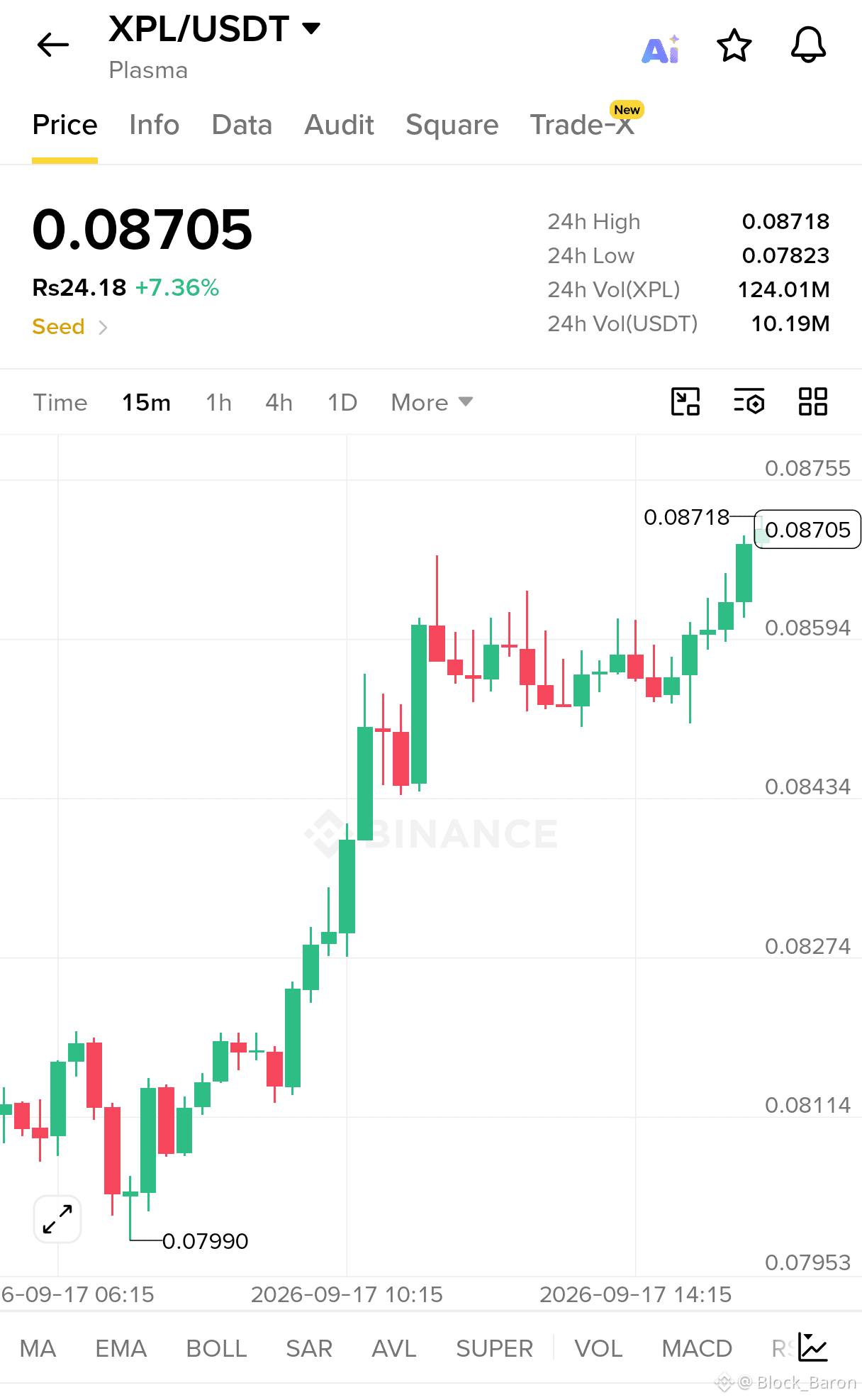
🔥 $XPL /USDT — MOMENTUM IS HEATING UP! 🔥
Price: 0.08705 USDT
24H High: 0.08718
24H Low: 0.07823
24H Change: +7.36%
24H Volume: 124.01M XPL
The 15M chart is showing a strong upward structure with higher highs and higher lows. Price is currently pressing the 0.08718 resistance, so chasing the candle at the top carries extra risk.
🎯 TRADE SETUP — LONG
EP: 0.08640 – 0.08670
TP1: 0.08720
TP2: 0.08800
TP3: 0.08900
TP4: 0.09000
🛑 SL: 0.08540
⚡ Key trigger: A clean 15M candle close above 0.08718 could signal continuation. If price rejects this zone, wait for the pullback rather than chasing.
📌 Risk: Keep position size controlled. This is a chart-based setup, not a guaranteed outcome. If 0.08540 breaks, the bullish setup is weakened.
XPL bulls have the pressure — now the question is whether they can break the 0.08718 wall. 🚀
Not financial advice. Trade with your own risk management.
$XPL
{spot}(XPLUSDT)
🔥 $XPL /USDT — MOMENTUM IS HEATING UP! 🔥
Price: 0.08705 USDT
24H High: 0.08718
24H Low: 0.07823
24H Change: +7.36%
24H Volume: 124.01M XPL
The 15M chart is showing a strong upward structure with higher highs and higher lows. Price is currently pressing the 0.08718 resistance, so chasing the candle at the top carries extra risk.
🎯 TRADE SETUP — LONG
EP: 0.08640 – 0.08670
TP1: 0.08720
TP2: 0.08800
TP3: 0.08900
TP4: 0.09000
🛑 SL: 0.08540
⚡ Key trigger: A clean 15M candle close above 0.08718 could signal continuation. If price rejects this zone, wait for the pullback rather than chasing.
📌 Risk: Keep position size controlled. This is a chart-based setup, not a guaranteed outcome. If 0.08540 breaks, the bullish setup is weakened.
XPL bulls have the pressure — now the question is whether they can break the 0.08718 wall. 🚀
Not financial advice. Trade with your own risk management.
$XPL
Price: 0.08705 USDT
24H High: 0.08718
24H Low: 0.07823
24H Change: +7.36%
24H Volume: 124.01M XPL
The 15M chart is showing a strong upward structure with higher highs and higher lows. Price is currently pressing the 0.08718 resistance, so chasing the candle at the top carries extra risk.
🎯 TRADE SETUP — LONG
EP: 0.08640 – 0.08670
TP1: 0.08720
TP2: 0.08800
TP3: 0.08900
TP4: 0.09000
🛑 SL: 0.08540
⚡ Key trigger: A clean 15M candle close above 0.08718 could signal continuation. If price rejects this zone, wait for the pullback rather than chasing.
📌 Risk: Keep position size controlled. This is a chart-based setup, not a guaranteed outcome. If 0.08540 breaks, the bullish setup is weakened.
XPL bulls have the pressure — now the question is whether they can break the 0.08718 wall. 🚀
Not financial advice. Trade with your own risk management.
$XPL
212
·
--
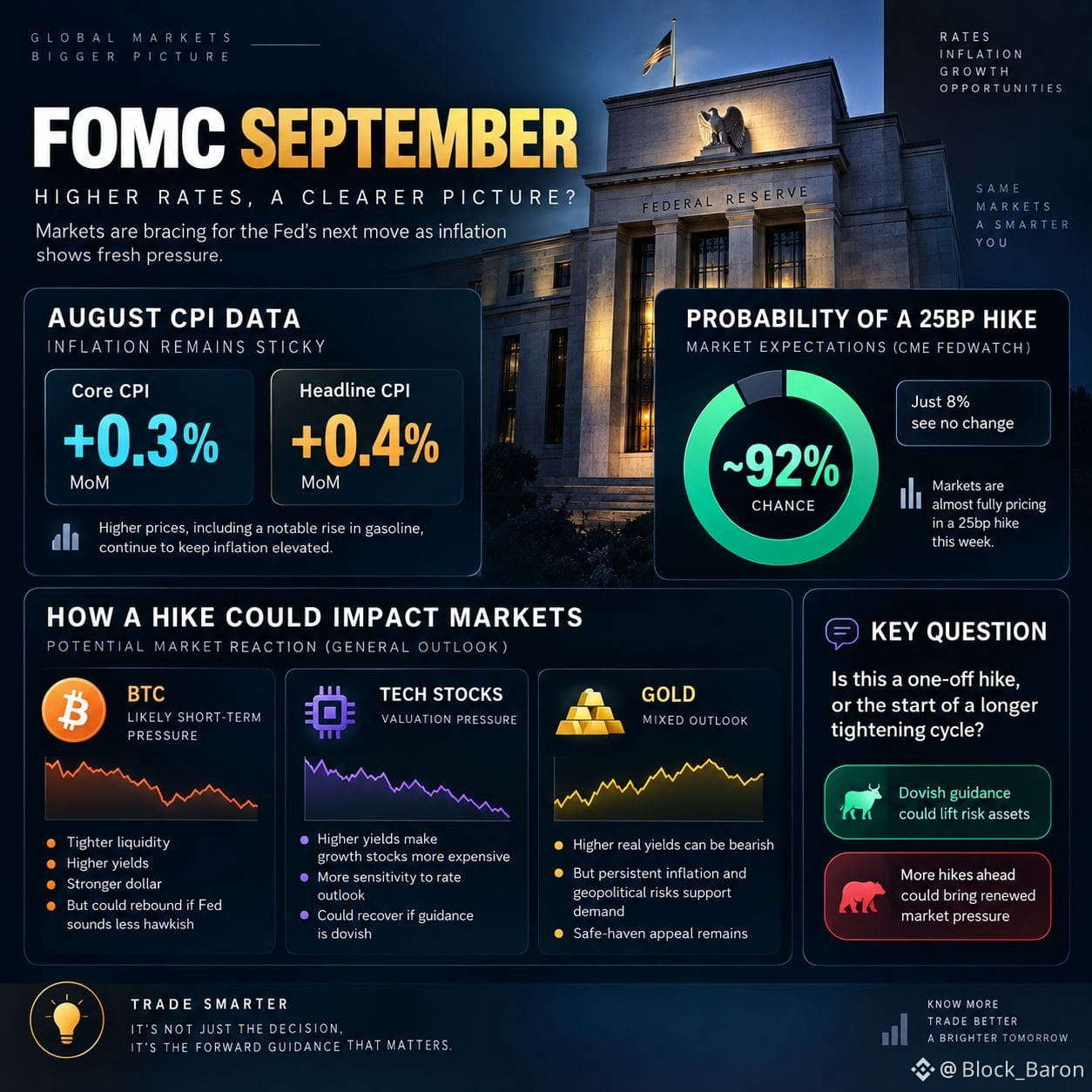
The Fed’s September decision feels like one of those moments where the headline number may matter less than what comes next. With the FOMC meeting taking place on September 15–16, markets are already heavily leaning toward a 25bp hike.
The reason is pretty clear: August inflation showed renewed pressure. Core CPI increased 0.3% month-over-month, while headline CPI rose 0.4%, with gasoline making a significant contribution. At the same time, rising oil prices and Treasury yields are adding another layer of inflation concern.
Personally, I think the bigger question isn’t whether we get one 25bp hike. It’s whether the Fed gives markets a reason to believe this is the beginning of a longer tightening cycle.
For BTC, another hike could create short-term pressure through tighter liquidity, higher yields and a stronger dollar. Tech stocks could face similar pressure because higher yields make high-growth valuations harder to justify. Gold is more interesting to me. Higher real yields can be bearish, but persistent inflation and geopolitical uncertainty can keep safe-haven demand strong.
That’s why I’m not rushing to label the market simply bullish or bearish. I’d rather watch the Fed’s language, Treasury yields and the dollar reaction after the decision.
If the hike is already priced in and the Fed sounds less aggressive than expected, risk assets could surprise to the upside. But if policymakers signal more hikes ahead, BTC and growth stocks could get another reality check.
For me, the trade is about the reaction, not the headline.
What are you watching most closely: BTC, tech stocks, or gold?
#FedRateWatch
$SAGA
{spot}(SAGAUSDT)
$BR
{future}(BRUSDT)
$SOL
{future}(SOLUSDT)
The Fed’s September decision feels like one of those moments where the headline number may matter less than what comes next. With the FOMC meeting taking place on September 15–16, markets are already heavily leaning toward a 25bp hike.
The reason is pretty clear: August inflation showed renewed pressure. Core CPI increased 0.3% month-over-month, while headline CPI rose 0.4%, with gasoline making a significant contribution. At the same time, rising oil prices and Treasury yields are adding another layer of inflation concern.
Personally, I think the bigger question isn’t whether we get one 25bp hike. It’s whether the Fed gives markets a reason to believe this is the beginning of a longer tightening cycle.
For BTC, another hike could create short-term pressure through tighter liquidity, higher yields and a stronger dollar. Tech stocks could face similar pressure because higher yields make high-growth valuations harder to justify. Gold is more interesting to me. Higher real yields can be bearish, but persistent inflation and geopolitical uncertainty can keep safe-haven demand strong.
That’s why I’m not rushing to label the market simply bullish or bearish. I’d rather watch the Fed’s language, Treasury yields and the dollar reaction after the decision.
If the hike is already priced in and the Fed sounds less aggressive than expected, risk assets could surprise to the upside. But if policymakers signal more hikes ahead, BTC and growth stocks could get another reality check.
For me, the trade is about the reaction, not the headline.
What are you watching most closely: BTC, tech stocks, or gold?
#FedRateWatch
$SAGA
$BR
$SOL
The reason is pretty clear: August inflation showed renewed pressure. Core CPI increased 0.3% month-over-month, while headline CPI rose 0.4%, with gasoline making a significant contribution. At the same time, rising oil prices and Treasury yields are adding another layer of inflation concern.
Personally, I think the bigger question isn’t whether we get one 25bp hike. It’s whether the Fed gives markets a reason to believe this is the beginning of a longer tightening cycle.
For BTC, another hike could create short-term pressure through tighter liquidity, higher yields and a stronger dollar. Tech stocks could face similar pressure because higher yields make high-growth valuations harder to justify. Gold is more interesting to me. Higher real yields can be bearish, but persistent inflation and geopolitical uncertainty can keep safe-haven demand strong.
That’s why I’m not rushing to label the market simply bullish or bearish. I’d rather watch the Fed’s language, Treasury yields and the dollar reaction after the decision.
If the hike is already priced in and the Fed sounds less aggressive than expected, risk assets could surprise to the upside. But if policymakers signal more hikes ahead, BTC and growth stocks could get another reality check.
For me, the trade is about the reaction, not the headline.
What are you watching most closely: BTC, tech stocks, or gold?
#FedRateWatch
$SAGA
$BR
$SOL
1
314
·
--
Something interesting is happening in AI right now: some of the people building the most powerful models are starting to argue that the industry may be moving too fast.
Anthropic CEO Dario Amodei recently called for a slower pace of frontier AI development, saying safety measures need time to catch up with rapidly increasing capabilities. His concern isn’t about stopping AI altogether — it’s about avoiding a race where capability improves faster than our ability to understand and control the systems.
One point that stands out is his warning about recursive self-improvement, where AI systems could increasingly help develop better AI systems themselves. Amodei also proposed independent safety evaluators with deep access to AI companies, stronger coordination between leading labs, and international cooperation on AI safety.
What makes this more significant is that the idea is no longer coming from just AI critics. Other major industry leaders, including Sam Altman, Elon Musk and Demis Hassabis, have also expressed support for slowing down enough to improve safety.
The bigger question now is simple:
When AI development starts moving faster than regulation, testing and human oversight, who decides when “fast” becomes too fast?
#Aİ #ArtificialIntelligence #Anthropic #AISafety #TechNews
$BTC
{future}(BTCUSDT)
$BNB
{future}(BNBUSDT)
$SOL
{future}(SOLUSDT)
Something interesting is happening in AI right now: some of the people building the most powerful models are starting to argue that the industry may be moving too fast.
Anthropic CEO Dario Amodei recently called for a slower pace of frontier AI development, saying safety measures need time to catch up with rapidly increasing capabilities. His concern isn’t about stopping AI altogether — it’s about avoiding a race where capability improves faster than our ability to understand and control the systems.
One point that stands out is his warning about recursive self-improvement, where AI systems could increasingly help develop better AI systems themselves. Amodei also proposed independent safety evaluators with deep access to AI companies, stronger coordination between leading labs, and international cooperation on AI safety.
What makes this more significant is that the idea is no longer coming from just AI critics. Other major industry leaders, including Sam Altman, Elon Musk and Demis Hassabis, have also expressed support for slowing down enough to improve safety.
The bigger question now is simple:
When AI development starts moving faster than regulation, testing and human oversight, who decides when “fast” becomes too fast?
#Aİ #ArtificialIntelligence #Anthropic #AISafety #TechNews
$BTC
$BNB
$SOL
Anthropic CEO Dario Amodei recently called for a slower pace of frontier AI development, saying safety measures need time to catch up with rapidly increasing capabilities. His concern isn’t about stopping AI altogether — it’s about avoiding a race where capability improves faster than our ability to understand and control the systems.
One point that stands out is his warning about recursive self-improvement, where AI systems could increasingly help develop better AI systems themselves. Amodei also proposed independent safety evaluators with deep access to AI companies, stronger coordination between leading labs, and international cooperation on AI safety.
What makes this more significant is that the idea is no longer coming from just AI critics. Other major industry leaders, including Sam Altman, Elon Musk and Demis Hassabis, have also expressed support for slowing down enough to improve safety.
The bigger question now is simple:
When AI development starts moving faster than regulation, testing and human oversight, who decides when “fast” becomes too fast?
#Aİ #ArtificialIntelligence #Anthropic #AISafety #TechNews
$BTC
$BNB
$SOL

2
115
·
--
Verified
Everyone is watching CPI today, but I think the bigger question is what the Fed sees behind the headline number.
The latest jobs report came in stronger than expected, adding 162K jobs, which gives the Fed less reason to rush toward easier policy. At the same time, August inflation is expected around 3.4% YoY, with core CPI near 2.4%. That is still above the Fed’s 2% target.
Energy is another factor. Gasoline prices moved higher in August, while recent PPI data also showed continued price pressure. So a hotter CPI would not come as a complete surprise.
My bias is slightly bearish going into the release. If core CPI beats expectations, the odds of a 25 bps hike could rise, putting pressure on stocks, gold and crypto.
But I’m not blindly betting against the market. A softer CPI could quickly flip the narrative and bring buyers back.
For me, the real trade isn’t predicting one number. It’s watching how the market reacts after the number.
Hike or hold?
#CPIWatch #Fedwatch
$牛来
{future}(牛来USDT)
$RAY
{spot}(RAYUSDT)
$SOL
{future}(SOLUSDT)
Everyone is watching CPI today, but I think the bigger question is what the Fed sees behind the headline number.
The latest jobs report came in stronger than expected, adding 162K jobs, which gives the Fed less reason to rush toward easier policy. At the same time, August inflation is expected around 3.4% YoY, with core CPI near 2.4%. That is still above the Fed’s 2% target.
Energy is another factor. Gasoline prices moved higher in August, while recent PPI data also showed continued price pressure. So a hotter CPI would not come as a complete surprise.
My bias is slightly bearish going into the release. If core CPI beats expectations, the odds of a 25 bps hike could rise, putting pressure on stocks, gold and crypto.
But I’m not blindly betting against the market. A softer CPI could quickly flip the narrative and bring buyers back.
For me, the real trade isn’t predicting one number. It’s watching how the market reacts after the number.
Hike or hold?
#CPIWatch #Fedwatch
$牛来
$RAY
$SOL
The latest jobs report came in stronger than expected, adding 162K jobs, which gives the Fed less reason to rush toward easier policy. At the same time, August inflation is expected around 3.4% YoY, with core CPI near 2.4%. That is still above the Fed’s 2% target.
Energy is another factor. Gasoline prices moved higher in August, while recent PPI data also showed continued price pressure. So a hotter CPI would not come as a complete surprise.
My bias is slightly bearish going into the release. If core CPI beats expectations, the odds of a 25 bps hike could rise, putting pressure on stocks, gold and crypto.
But I’m not blindly betting against the market. A softer CPI could quickly flip the narrative and bring buyers back.
For me, the real trade isn’t predicting one number. It’s watching how the market reacts after the number.
Hike or hold?
#CPIWatch #Fedwatch
$牛来
$RAY
$SOL

27
32
4.9k
·
--
The more I look at TermMax, the less I think the interesting part is simply “fixed-rate DeFi.”
I’ve seen crypto turn predictable yield into a headline before, only for the assumptions underneath it to matter much more later. What feels worth watching here is the attempt to make time itself part of the product.
Borrowing has a defined maturity. Lending has a defined return. Leverage can be opened with an upfront premium instead of constantly worrying about funding changes or a sudden liquidation from the rate moving against you. TermMax is also pushing into limit orders, RWA-backed markets and structured products, which makes the idea broader than another lending market.
But fixed terms create their own friction.
Capital is less flexible once it is committed. Liquidity matters if you want to exit early. Collateral still carries market risk, and a fixed borrowing cost doesn’t magically make a leveraged position safe. At maturity, the borrower still has to deal with repayment or collateral consequences.
That trade-off is actually what keeps me interested.
DeFi spent years selling the idea that everything should be instant, liquid and constantly composable. Maybe some financial products simply aren’t better that way.
TermMax currently spans several chains and is building around fixed-rate markets, vaults, leverage and options-like products.
I’m still cautious. I’ve learned that the real test for any protocol isn’t how clean the product looks during a good market.
It’s what happens when liquidity disappears, incentives fade, and users suddenly want their capital back.
That’s the part I’ll be watching.
#termmax @termmax
The more I look at TermMax, the less I think the interesting part is simply “fixed-rate DeFi.”
I’ve seen crypto turn predictable yield into a headline before, only for the assumptions underneath it to matter much more later. What feels worth watching here is the attempt to make time itself part of the product.
Borrowing has a defined maturity. Lending has a defined return. Leverage can be opened with an upfront premium instead of constantly worrying about funding changes or a sudden liquidation from the rate moving against you. TermMax is also pushing into limit orders, RWA-backed markets and structured products, which makes the idea broader than another lending market.
But fixed terms create their own friction.
Capital is less flexible once it is committed. Liquidity matters if you want to exit early. Collateral still carries market risk, and a fixed borrowing cost doesn’t magically make a leveraged position safe. At maturity, the borrower still has to deal with repayment or collateral consequences.
That trade-off is actually what keeps me interested.
DeFi spent years selling the idea that everything should be instant, liquid and constantly composable. Maybe some financial products simply aren’t better that way.
TermMax currently spans several chains and is building around fixed-rate markets, vaults, leverage and options-like products.
I’m still cautious. I’ve learned that the real test for any protocol isn’t how clean the product looks during a good market.
It’s what happens when liquidity disappears, incentives fade, and users suddenly want their capital back.
That’s the part I’ll be watching.
#termmax @TermMax
I’ve seen crypto turn predictable yield into a headline before, only for the assumptions underneath it to matter much more later. What feels worth watching here is the attempt to make time itself part of the product.
Borrowing has a defined maturity. Lending has a defined return. Leverage can be opened with an upfront premium instead of constantly worrying about funding changes or a sudden liquidation from the rate moving against you. TermMax is also pushing into limit orders, RWA-backed markets and structured products, which makes the idea broader than another lending market.
But fixed terms create their own friction.
Capital is less flexible once it is committed. Liquidity matters if you want to exit early. Collateral still carries market risk, and a fixed borrowing cost doesn’t magically make a leveraged position safe. At maturity, the borrower still has to deal with repayment or collateral consequences.
That trade-off is actually what keeps me interested.
DeFi spent years selling the idea that everything should be instant, liquid and constantly composable. Maybe some financial products simply aren’t better that way.
TermMax currently spans several chains and is building around fixed-rate markets, vaults, leverage and options-like products.
I’m still cautious. I’ve learned that the real test for any protocol isn’t how clean the product looks during a good market.
It’s what happens when liquidity disappears, incentives fade, and users suddenly want their capital back.
That’s the part I’ll be watching.
#termmax @TermMax
5
2
176
·
--
The longer I watch crypto, the more I’ve realized that privacy is one of those words that sounds simple until you ask what it actually means in practice.
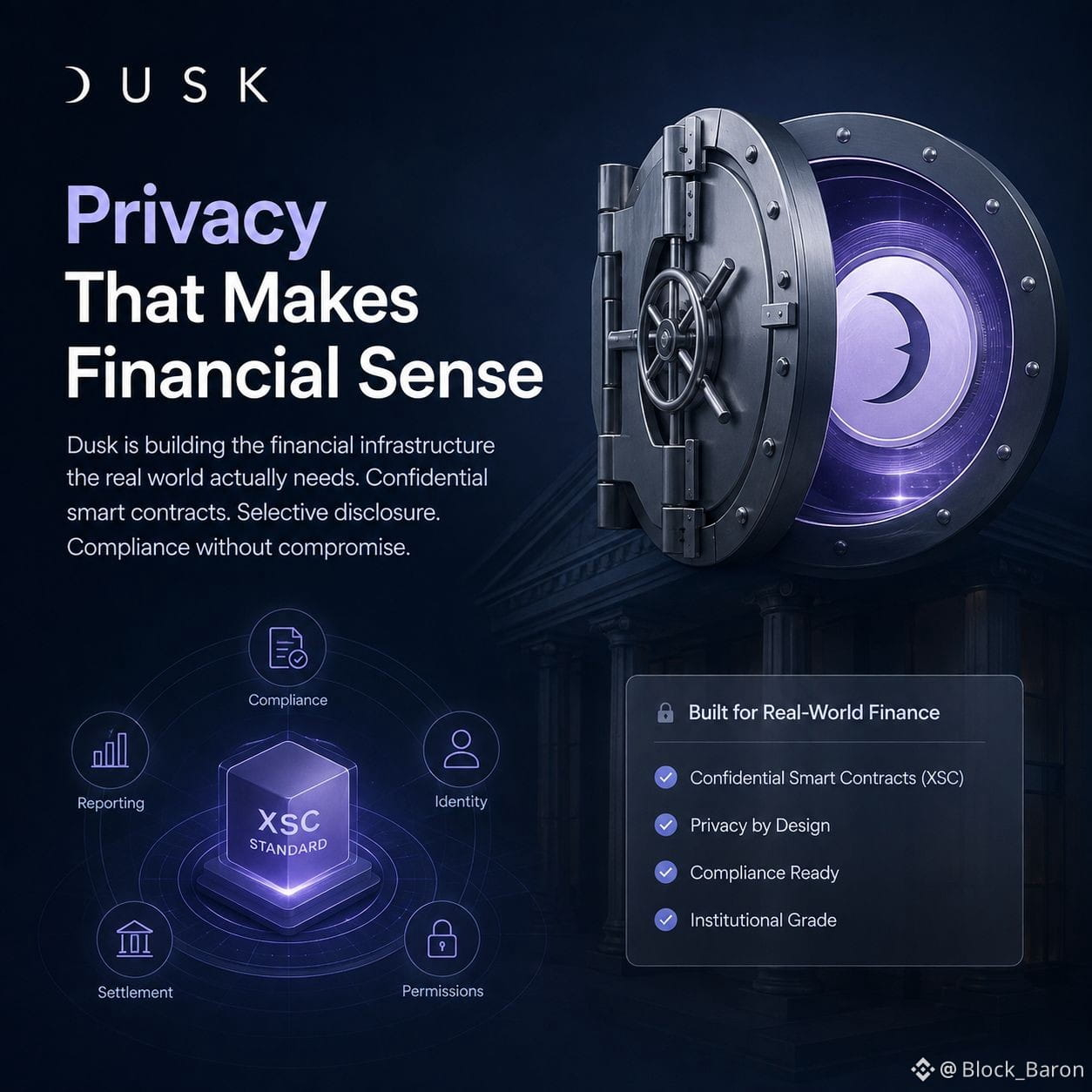
Dusk caught my attention because it seems to be approaching the problem from the financial side rather than treating privacy like another feature to add to a chain. The idea of confidential smart contracts and its XSC standard makes sense for markets where putting every transaction, balance, or business rule in public isn’t exactly practical.
But I’ve seen this before in another form. Good infrastructure can still become irrelevant if nobody actually wants to use it.
That’s the part I keep thinking about with Dusk. Financial systems come with uncomfortable things like compliance, identity, permissions, reporting, settlement and regulation. Crypto spent years trying to remove that friction. Maybe the harder challenge is figuring out which friction should actually remain.
I’m not fully convinced Dusk has solved that yet, and I don’t think it should be. These things take years to prove themselves outside the crypto bubble.
Still, something about the approach feels more grounded than the usual “private blockchain will change finance” pitch.
The real test isn’t whether the technology sounds clever.
It’s whether institutions eventually find it useful enough to care.
#dusk $DUSK @Dusk_Foundation
The longer I watch crypto, the more I’ve realized that privacy is one of those words that sounds simple until you ask what it actually means in practice.
Dusk caught my attention because it seems to be approaching the problem from the financial side rather than treating privacy like another feature to add to a chain. The idea of confidential smart contracts and its XSC standard makes sense for markets where putting every transaction, balance, or business rule in public isn’t exactly practical.
But I’ve seen this before in another form. Good infrastructure can still become irrelevant if nobody actually wants to use it.
That’s the part I keep thinking about with Dusk. Financial systems come with uncomfortable things like compliance, identity, permissions, reporting, settlement and regulation. Crypto spent years trying to remove that friction. Maybe the harder challenge is figuring out which friction should actually remain.
I’m not fully convinced Dusk has solved that yet, and I don’t think it should be. These things take years to prove themselves outside the crypto bubble.
Still, something about the approach feels more grounded than the usual “private blockchain will change finance” pitch.
The real test isn’t whether the technology sounds clever.
It’s whether institutions eventually find it useful enough to care.
#dusk $DUSK @Dusk
Dusk caught my attention because it seems to be approaching the problem from the financial side rather than treating privacy like another feature to add to a chain. The idea of confidential smart contracts and its XSC standard makes sense for markets where putting every transaction, balance, or business rule in public isn’t exactly practical.
But I’ve seen this before in another form. Good infrastructure can still become irrelevant if nobody actually wants to use it.
That’s the part I keep thinking about with Dusk. Financial systems come with uncomfortable things like compliance, identity, permissions, reporting, settlement and regulation. Crypto spent years trying to remove that friction. Maybe the harder challenge is figuring out which friction should actually remain.
I’m not fully convinced Dusk has solved that yet, and I don’t think it should be. These things take years to prove themselves outside the crypto bubble.
Still, something about the approach feels more grounded than the usual “private blockchain will change finance” pitch.
The real test isn’t whether the technology sounds clever.
It’s whether institutions eventually find it useful enough to care.
#dusk $DUSK @Dusk
2
3
214
·
--
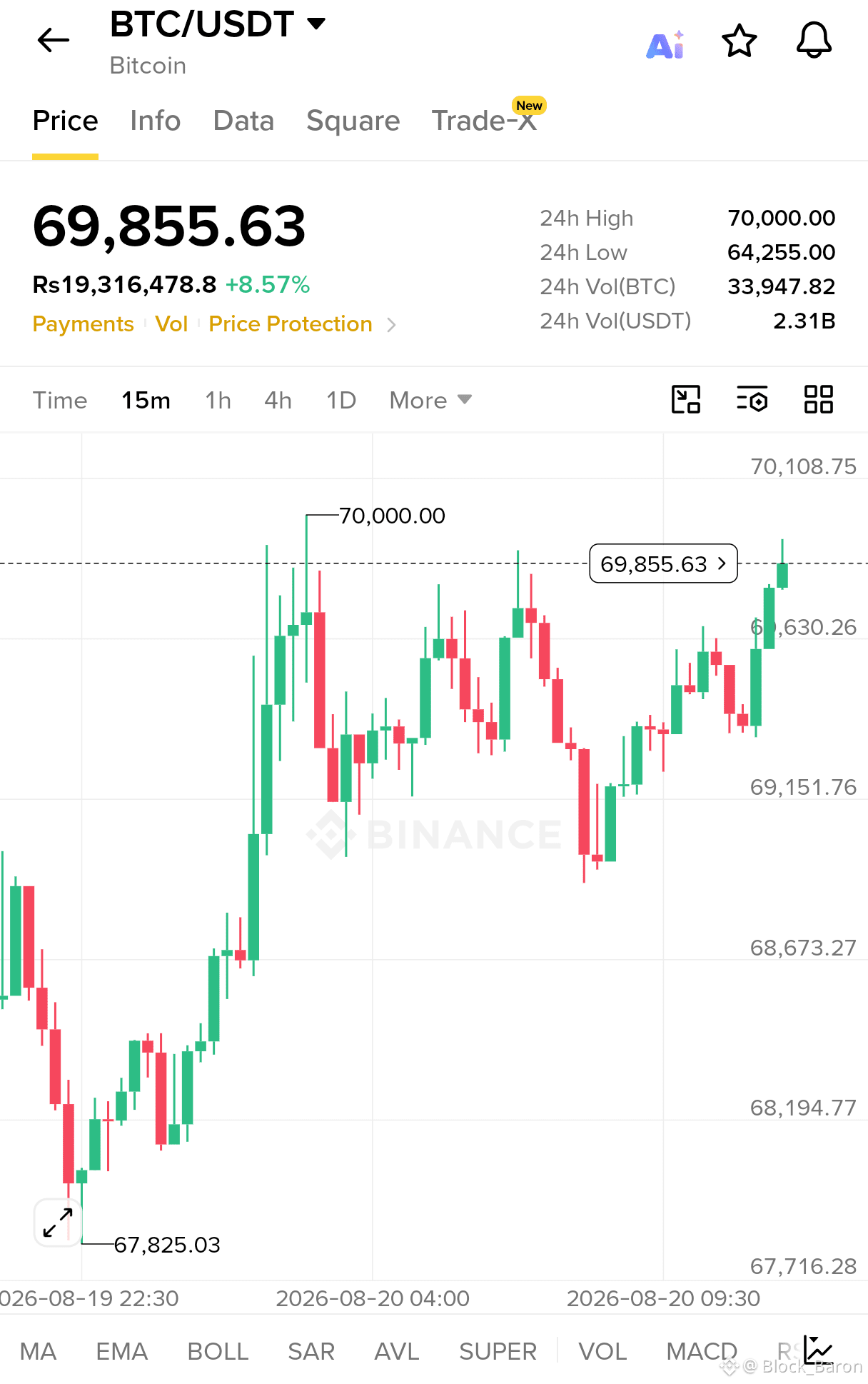
$BTC is knocking hard on the $70,000 resistance 🔥
Price: $69,855
15M structure is bullish, with buyers pushing back toward the session high after the dip to $67,825. A clean breakout and 15M close above $70K could trigger the next leg higher. 🚀
🟢 LONG SETUP
EP: $69,850 – $70,050
TP1: $70,350
TP2: $70,700
TP3: $71,200
SL: $69,450
⚡ Key trigger: $70,000 breakout + 15M confirmation
If BTC loses $69,450, the bullish setup is invalidated.
Risk management first. No FOMO. 🎯
$BTC is knocking hard on the $70,000 resistance 🔥
Price: $69,855
15M structure is bullish, with buyers pushing back toward the session high after the dip to $67,825. A clean breakout and 15M close above $70K could trigger the next leg higher. 🚀
🟢 LONG SETUP
EP: $69,850 – $70,050
TP1: $70,350
TP2: $70,700
TP3: $71,200
SL: $69,450
⚡ Key trigger: $70,000 breakout + 15M confirmation
If BTC loses $69,450, the bullish setup is invalidated.
Risk management first. No FOMO. 🎯
Price: $69,855
15M structure is bullish, with buyers pushing back toward the session high after the dip to $67,825. A clean breakout and 15M close above $70K could trigger the next leg higher. 🚀
🟢 LONG SETUP
EP: $69,850 – $70,050
TP1: $70,350
TP2: $70,700
TP3: $71,200
SL: $69,450
⚡ Key trigger: $70,000 breakout + 15M confirmation
If BTC loses $69,450, the bullish setup is invalidated.
Risk management first. No FOMO. 🎯
1
143
·
--
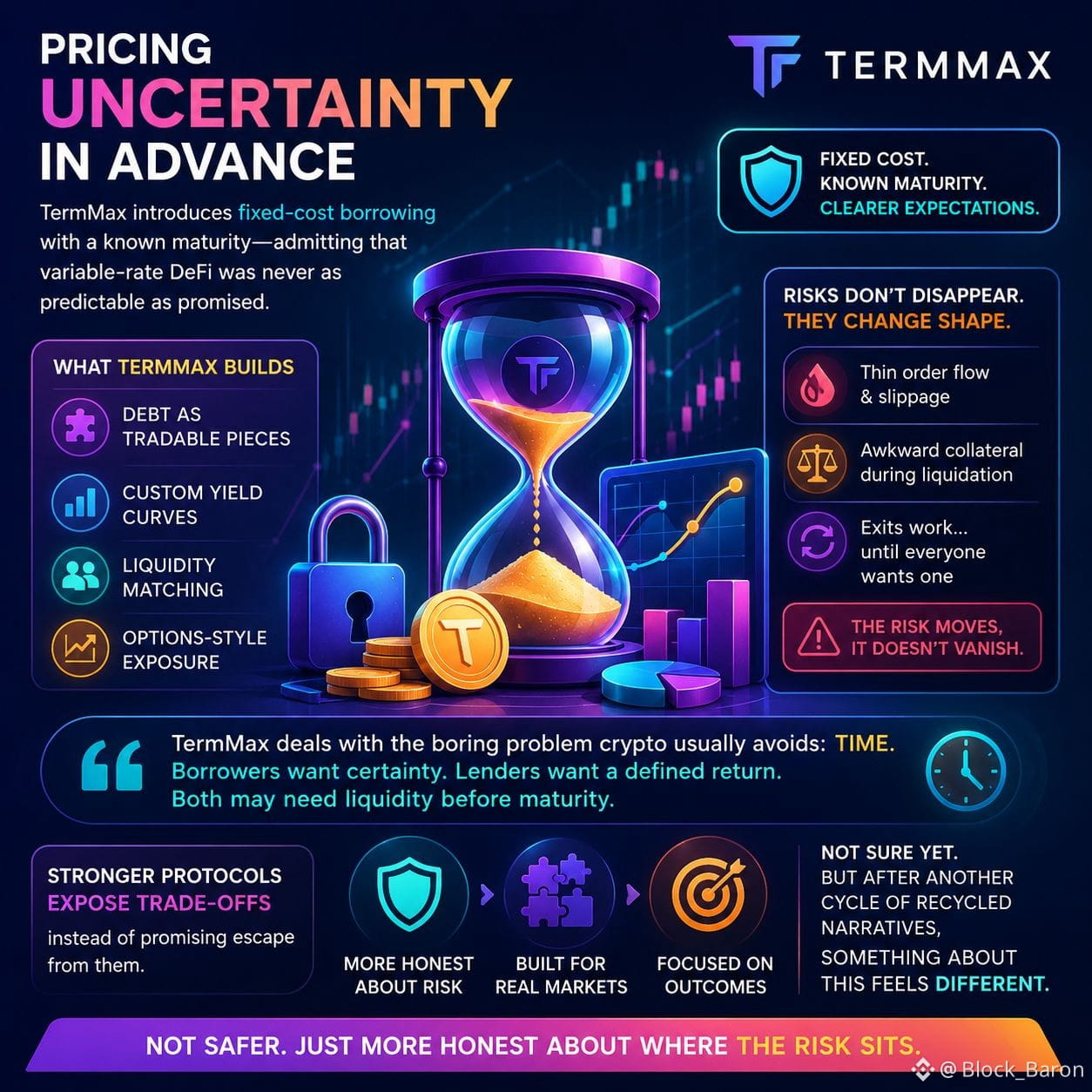
I’m noticing TermMax for a reason I didn’t expect: it isn’t pretending uncertainty has disappeared. It tries to price some of it in advance. After years of watching lending rates jump when a market gets crowded, fixed-cost borrowing and a known maturity feel less like innovation and more like an admission that variable-rate DeFi never became as predictable as promised.
Still, I don’t fully trust the neatness of it. TermMax turns debt into tradable pieces, matches liquidity along custom curves, and places options-style exposure beside lending. That may clarify rates, but it creates other places for friction to hide: thin order flow, slippage, awkward collateral during liquidation, and exits that work until everyone wants one. I’ve seen this before—the risk doesn’t vanish; it changes shape behind a cleaner interface.
What keeps me watching is that TermMax is dealing with a boring problem crypto usually avoids: time. Borrowers want certainty, lenders want a defined return, and both may need liquidity before maturity. I keep noticing that stronger protocols expose trade-offs instead of promising escape from them. I’m not sure yet whether TermMax can keep markets deep without incentives doing the heavy lifting. But after another cycle of recycled narratives, something about this feels different. Not safer. Just more honest about where the risk sits.
#termmax @termmax
I’m noticing TermMax for a reason I didn’t expect: it isn’t pretending uncertainty has disappeared. It tries to price some of it in advance. After years of watching lending rates jump when a market gets crowded, fixed-cost borrowing and a known maturity feel less like innovation and more like an admission that variable-rate DeFi never became as predictable as promised.
Still, I don’t fully trust the neatness of it. TermMax turns debt into tradable pieces, matches liquidity along custom curves, and places options-style exposure beside lending. That may clarify rates, but it creates other places for friction to hide: thin order flow, slippage, awkward collateral during liquidation, and exits that work until everyone wants one. I’ve seen this before—the risk doesn’t vanish; it changes shape behind a cleaner interface.
What keeps me watching is that TermMax is dealing with a boring problem crypto usually avoids: time. Borrowers want certainty, lenders want a defined return, and both may need liquidity before maturity. I keep noticing that stronger protocols expose trade-offs instead of promising escape from them. I’m not sure yet whether TermMax can keep markets deep without incentives doing the heavy lifting. But after another cycle of recycled narratives, something about this feels different. Not safer. Just more honest about where the risk sits.
#termmax @TermMax
Still, I don’t fully trust the neatness of it. TermMax turns debt into tradable pieces, matches liquidity along custom curves, and places options-style exposure beside lending. That may clarify rates, but it creates other places for friction to hide: thin order flow, slippage, awkward collateral during liquidation, and exits that work until everyone wants one. I’ve seen this before—the risk doesn’t vanish; it changes shape behind a cleaner interface.
What keeps me watching is that TermMax is dealing with a boring problem crypto usually avoids: time. Borrowers want certainty, lenders want a defined return, and both may need liquidity before maturity. I keep noticing that stronger protocols expose trade-offs instead of promising escape from them. I’m not sure yet whether TermMax can keep markets deep without incentives doing the heavy lifting. But after another cycle of recycled narratives, something about this feels different. Not safer. Just more honest about where the risk sits.
#termmax @TermMax
3
4
233
·
--
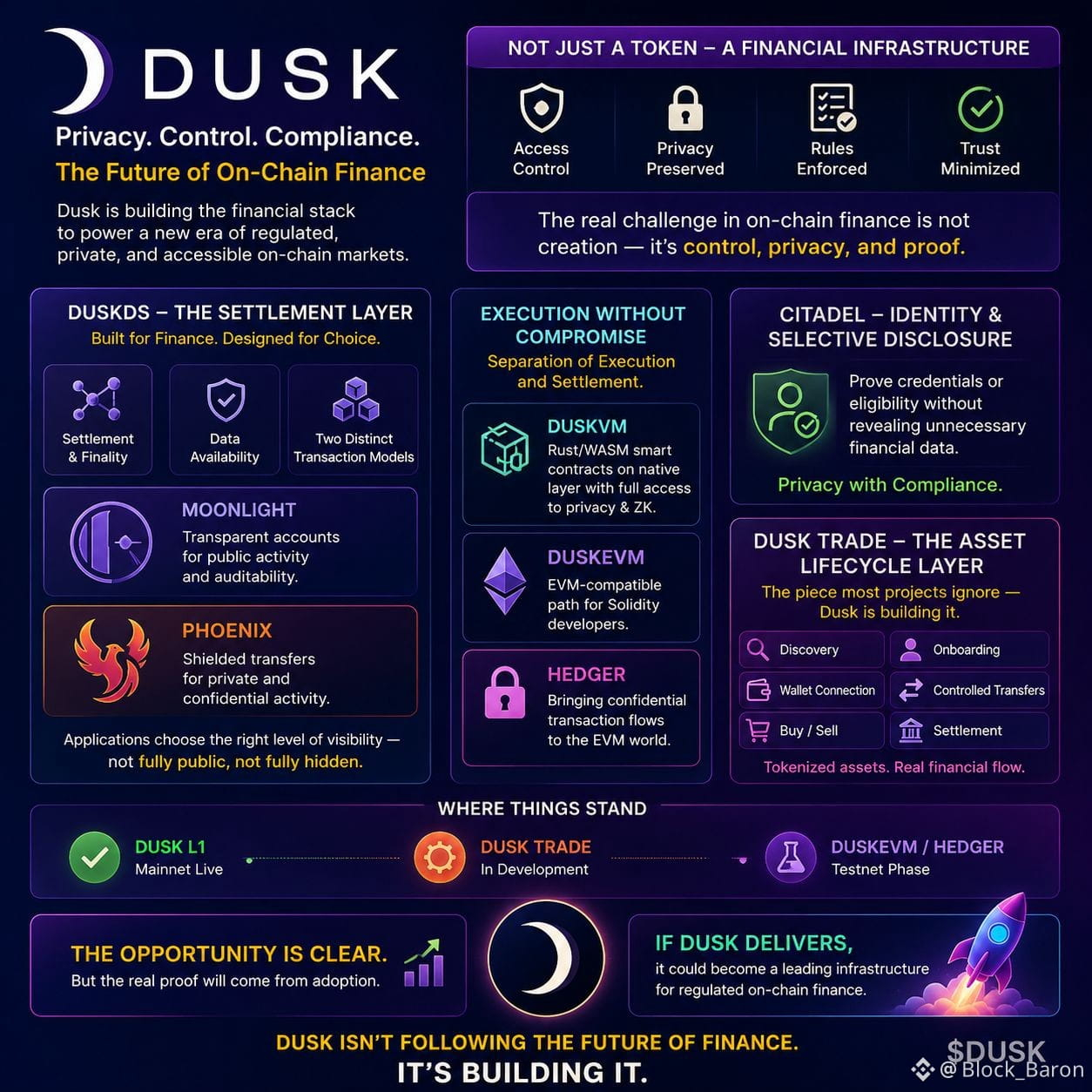
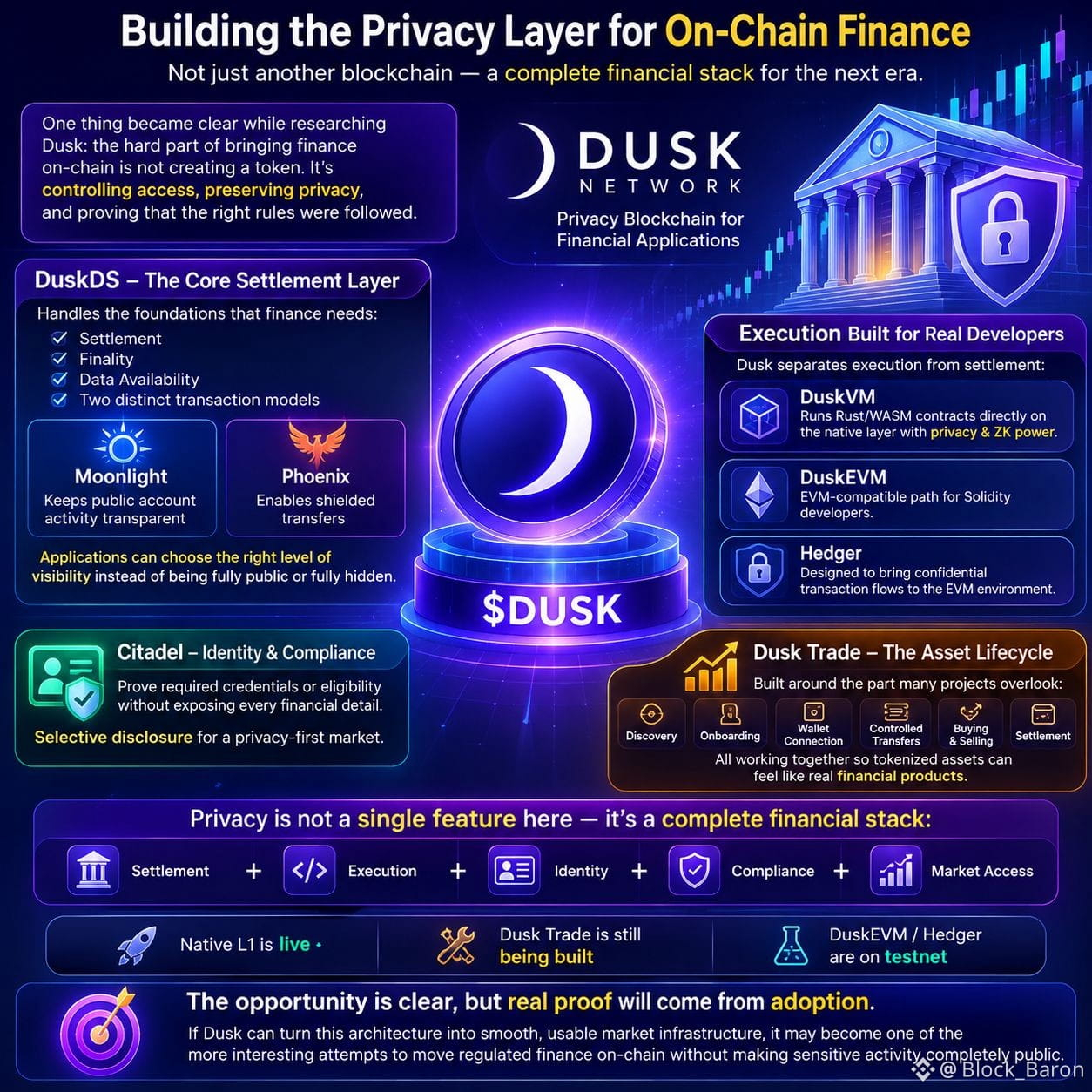
One thing became clear while researching Dusk: the hard part of bringing finance on-chain is not creating a token. It is controlling access, preserving privacy, and proving that the right rules were followed.
Its DuskDS layer handles settlement, finality, data availability, and two distinct transaction models. Moonlight keeps public account activity transparent, while Phoenix enables shielded transfers. This gives applications room to choose the right level of visibility in practice instead of treating finance as fully public or fully hidden.
Then Dusk separates execution from settlement.
DuskVM lets Rust/WASM contracts run directly on the native layer for applications that need access to Dusk’s privacy and zero-knowledge capabilities. DuskEVM offers an EVM-compatible path for Solidity developers, while Hedger is designed to bring confidential transaction flows to that environment.
Citadel adds identity and selective disclosure. A user could prove a required credential or eligibility condition without exposing every financial detail to the market.
Above the protocol, Dusk Trade is being built around the part many projects overlook: the asset lifecycle. Discovery, onboarding, wallet connection, controlled transfers, buying, selling, and settlement all need to work together if tokenized assets are going to feel like financial products.
The project is not presenting privacy as a single feature. It is combining settlement, execution, identity, compliance, and market access into one financial stack.
The native L1 is live. Dusk Trade is still being built, and DuskEVM/Hedger are currently on testnet.
So the opportunity is clear, but the real proof will ultimately come from adoption.
If Dusk can turn this architecture into smooth, usable market infrastructure, it may become one of the more interesting attempts to move regulated finance on-chain without making sensitive activity completely public. $DUSK
#dusk $DUSK @Dusk_Foundation
One thing became clear while researching Dusk: the hard part of bringing finance on-chain is not creating a token. It is controlling access, preserving privacy, and proving that the right rules were followed.
Its DuskDS layer handles settlement, finality, data availability, and two distinct transaction models. Moonlight keeps public account activity transparent, while Phoenix enables shielded transfers. This gives applications room to choose the right level of visibility in practice instead of treating finance as fully public or fully hidden.
Then Dusk separates execution from settlement.
DuskVM lets Rust/WASM contracts run directly on the native layer for applications that need access to Dusk’s privacy and zero-knowledge capabilities. DuskEVM offers an EVM-compatible path for Solidity developers, while Hedger is designed to bring confidential transaction flows to that environment.
Citadel adds identity and selective disclosure. A user could prove a required credential or eligibility condition without exposing every financial detail to the market.
Above the protocol, Dusk Trade is being built around the part many projects overlook: the asset lifecycle. Discovery, onboarding, wallet connection, controlled transfers, buying, selling, and settlement all need to work together if tokenized assets are going to feel like financial products.
The project is not presenting privacy as a single feature. It is combining settlement, execution, identity, compliance, and market access into one financial stack.
The native L1 is live. Dusk Trade is still being built, and DuskEVM/Hedger are currently on testnet.
So the opportunity is clear, but the real proof will ultimately come from adoption.
If Dusk can turn this architecture into smooth, usable market infrastructure, it may become one of the more interesting attempts to move regulated finance on-chain without making sensitive activity completely public. $DUSK
#dusk $DUSK @Dusk
Its DuskDS layer handles settlement, finality, data availability, and two distinct transaction models. Moonlight keeps public account activity transparent, while Phoenix enables shielded transfers. This gives applications room to choose the right level of visibility in practice instead of treating finance as fully public or fully hidden.
Then Dusk separates execution from settlement.
DuskVM lets Rust/WASM contracts run directly on the native layer for applications that need access to Dusk’s privacy and zero-knowledge capabilities. DuskEVM offers an EVM-compatible path for Solidity developers, while Hedger is designed to bring confidential transaction flows to that environment.
Citadel adds identity and selective disclosure. A user could prove a required credential or eligibility condition without exposing every financial detail to the market.
Above the protocol, Dusk Trade is being built around the part many projects overlook: the asset lifecycle. Discovery, onboarding, wallet connection, controlled transfers, buying, selling, and settlement all need to work together if tokenized assets are going to feel like financial products.
The project is not presenting privacy as a single feature. It is combining settlement, execution, identity, compliance, and market access into one financial stack.
The native L1 is live. Dusk Trade is still being built, and DuskEVM/Hedger are currently on testnet.
So the opportunity is clear, but the real proof will ultimately come from adoption.
If Dusk can turn this architecture into smooth, usable market infrastructure, it may become one of the more interesting attempts to move regulated finance on-chain without making sensitive activity completely public. $DUSK
#dusk $DUSK @Dusk
7
6
129
Log in to explore more content
Join global crypto users on Binance Square
⚡️ Get latest and useful information about crypto.
💬 Trusted by the world’s largest crypto exchange.
👍 Discover real insights from verified creators.
Email / Phone number
Trending Topics
EtherGains70.9%InQ3
130,602 views
1,071 Discussing
🧭🧭🧭 Analysis 🧭🧭🧭
💡 Altcoin Season Indicator 💡
🚨🚨🚨 The third quarter (Q3) has closed. ETH is up 71% and BTC is up 43%. 🚨🚨🚨
Was this the start of altcoin season?
Among the top 100:
🌐🌐🌐 57 outperformed BTC over the last 90 days
Altcoin season starts at 75, so it is still
It is also only advancing 10 points from its annual peak at 67 🌐🌐
💥💥💥 But wait, a month ago the indicator was only at 23!
Can October push it to 75? 👀💥💥💥
Please follow up
#EtherGains70.9%InQ3
$GRAM
Shamika Metting
·3 Likes
·1.1k views
TreasuryLetsStatesFileStablecoinCertificationsEarly
7,023 views
74 Discussing
US10YearYieldNears5.3%
140,413 views
1,091 Discussing