
KeyosS
569 Posts

KeyosS
Report
Block User
Passionate about technical analysis and a massive Michael Jordan fan. No FA, DYOR!
191 Following
65 Followers
128 Liked
Posts
All
Quotes
Videos
PINNED
·
--
MJ is the best!
MJ is the best!


Binance Wallet
·
--
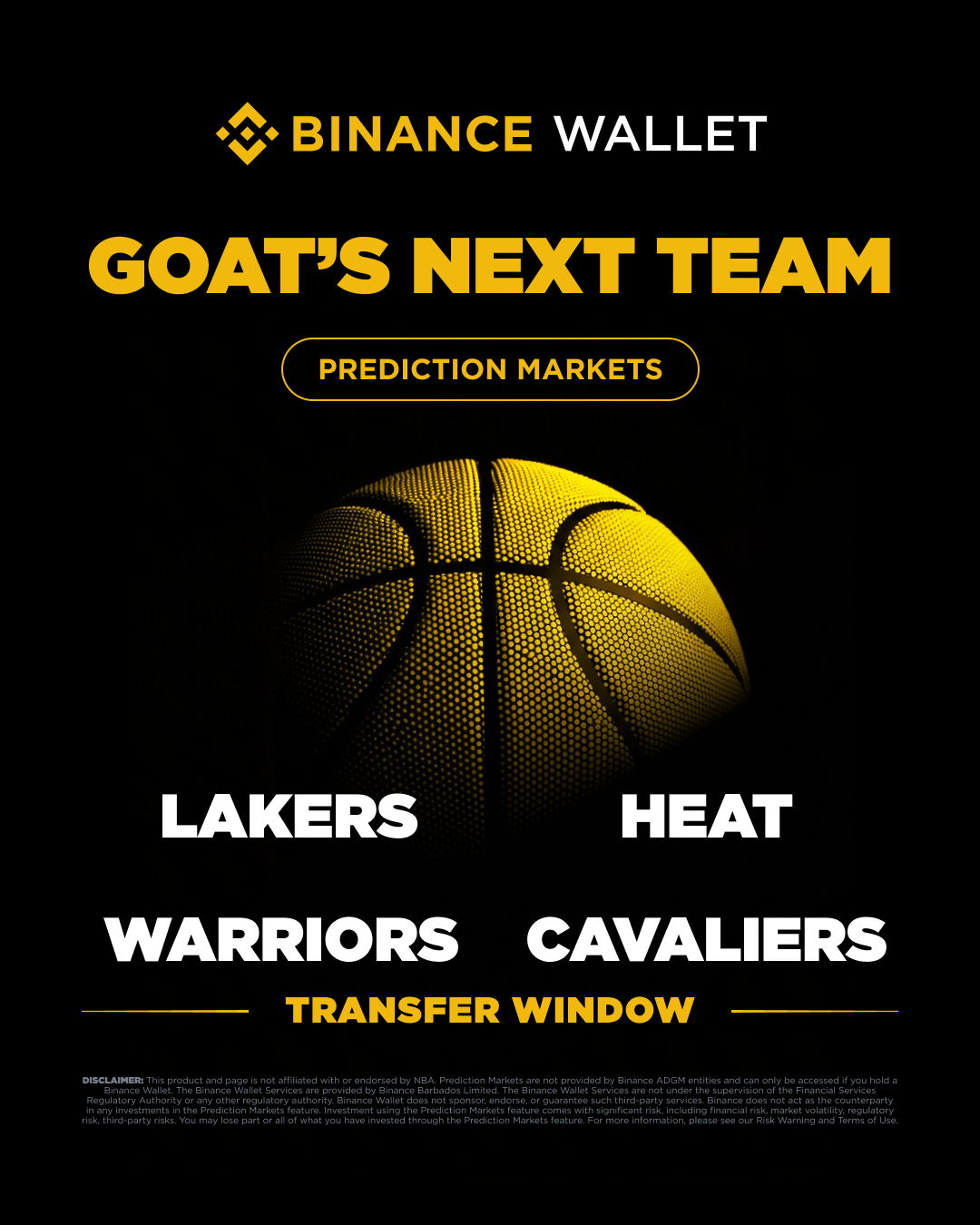
🐐 Where will the legend land next?
Will he carry on the legacy in purple and gold, write another chapter in South Beach, bring glory back to the Bay, or return to where it all began?
🏀 Lakers • Heat • Warriors • Cavaliers
Pick your side, back your call.
👉 Join now and be part of the biggest transfer story of the year
Will he carry on the legacy in purple and gold, write another chapter in South Beach, bring glory back to the Bay, or return to where it all began?
🏀 Lakers • Heat • Warriors • Cavaliers
Pick your side, back your call.
👉 Join now and be part of the biggest transfer story of the year
2
45
·
--

Article
Strategic Capital Deployment: Navigating Exchange Competitions on Small AccountsChasing top leaderboard positions in high-volume exchange competitions with a small bankroll is a structural losing game. During a previous tournament attempt, manual trading generated $55,000+ in total volume, yet resulted in a -$24.76 net loss. Churning small capital hundreds of times to compete against high-frequency institutional algorithms leads to capital erosion through spread slippage, execution latency, and cumulative transaction fees.
To protect capital while capturing campaign rewards, the execution model transitions to a fully automated dual-bot strategy across the HOLO and THE Binance Spot Altcoin Festivals.
Capital Allocation & Execution Framework
Instead of risking all capital on a single pair, the $150 balance is divided into two separate, automated trading environments:
Running these setups in independent terminal sessions prevents cross-pair capital drawdowns while allowing each algorithm to manage its own entry triggers, position scaling, and risk controls.
Execution Strategy: Minimum Volume & Capital Protection
Instead of burning fees trying to out-volume major market participants, the algorithms target low-friction participation rewards:
Qualification Target: Focus solely on reaching the $500 minimum trading volume on each pair to secure entry into the equal-share participation reward pools.Transaction Cost Minimization: On the $60 THE/USDT balance, the bot deploys a $20 initial buy followed by a $40 secondary layer on deeper price dips. Completing ~5 full buy-and-sell cycles ($120 volume per cycle) clears the $500 threshold while capping overall trading fees at roughly ~$0.50.Hard Risk Limits: Both bots enforce strict emergency stop-loss rules placed directly below major 4-hour support levels to prevent severe drawdowns if market structure breaks down.
Both scripts are running systematically in separate terminal windows, evaluating candle closes and executing without emotional interference.
💬 What is your strategy during exchange trading competitions? Do you chase top rankings or target low-risk base participation pools? Share your thoughts below! 👇
🔔 Follow for live progress updates, trade performance logs, and the full post-tournament performance breakdown!
#Binance #CryptoTrading #TradingBots $HOLO $THE #AlgorithmicTrading $SAGA
{spot}(SAGAUSDT)
{spot}(THEUSDT)
{spot}(HOLOUSDT)
Strategic Capital Deployment: Navigating Exchange Competitions on Small Accounts
Chasing top leaderboard positions in high-volume exchange competitions with a small bankroll is a structural losing game. During a previous tournament attempt, manual trading generated $55,000+ in total volume, yet resulted in a -$24.76 net loss. Churning small capital hundreds of times to compete against high-frequency institutional algorithms leads to capital erosion through spread slippage, execution latency, and cumulative transaction fees.
To protect capital while capturing campaign rewards, the execution model transitions to a fully automated dual-bot strategy across the HOLO and THE Binance Spot Altcoin Festivals.
Capital Allocation & Execution Framework
Instead of risking all capital on a single pair, the $150 balance is divided into two separate, automated trading environments:
Running these setups in independent terminal sessions prevents cross-pair capital drawdowns while allowing each algorithm to manage its own entry triggers, position scaling, and risk controls.
Execution Strategy: Minimum Volume & Capital Protection
Instead of burning fees trying to out-volume major market participants, the algorithms target low-friction participation rewards:
Qualification Target: Focus solely on reaching the $500 minimum trading volume on each pair to secure entry into the equal-share participation reward pools.Transaction Cost Minimization: On the $60 THE/USDT balance, the bot deploys a $20 initial buy followed by a $40 secondary layer on deeper price dips. Completing ~5 full buy-and-sell cycles ($120 volume per cycle) clears the $500 threshold while capping overall trading fees at roughly ~$0.50.Hard Risk Limits: Both bots enforce strict emergency stop-loss rules placed directly below major 4-hour support levels to prevent severe drawdowns if market structure breaks down.
Both scripts are running systematically in separate terminal windows, evaluating candle closes and executing without emotional interference.
💬 What is your strategy during exchange trading competitions? Do you chase top rankings or target low-risk base participation pools? Share your thoughts below! 👇
🔔 Follow for live progress updates, trade performance logs, and the full post-tournament performance breakdown!
#Binance #CryptoTrading #TradingBots $HOLO $THE #AlgorithmicTrading $SAGA
To protect capital while capturing campaign rewards, the execution model transitions to a fully automated dual-bot strategy across the HOLO and THE Binance Spot Altcoin Festivals.
Capital Allocation & Execution Framework
Instead of risking all capital on a single pair, the $150 balance is divided into two separate, automated trading environments:
Running these setups in independent terminal sessions prevents cross-pair capital drawdowns while allowing each algorithm to manage its own entry triggers, position scaling, and risk controls.
Execution Strategy: Minimum Volume & Capital Protection
Instead of burning fees trying to out-volume major market participants, the algorithms target low-friction participation rewards:
Qualification Target: Focus solely on reaching the $500 minimum trading volume on each pair to secure entry into the equal-share participation reward pools.Transaction Cost Minimization: On the $60 THE/USDT balance, the bot deploys a $20 initial buy followed by a $40 secondary layer on deeper price dips. Completing ~5 full buy-and-sell cycles ($120 volume per cycle) clears the $500 threshold while capping overall trading fees at roughly ~$0.50.Hard Risk Limits: Both bots enforce strict emergency stop-loss rules placed directly below major 4-hour support levels to prevent severe drawdowns if market structure breaks down.
Both scripts are running systematically in separate terminal windows, evaluating candle closes and executing without emotional interference.
💬 What is your strategy during exchange trading competitions? Do you chase top rankings or target low-risk base participation pools? Share your thoughts below! 👇
🔔 Follow for live progress updates, trade performance logs, and the full post-tournament performance breakdown!
#Binance #CryptoTrading #TradingBots $HOLO $THE #AlgorithmicTrading $SAGA
12
2
694
·
--
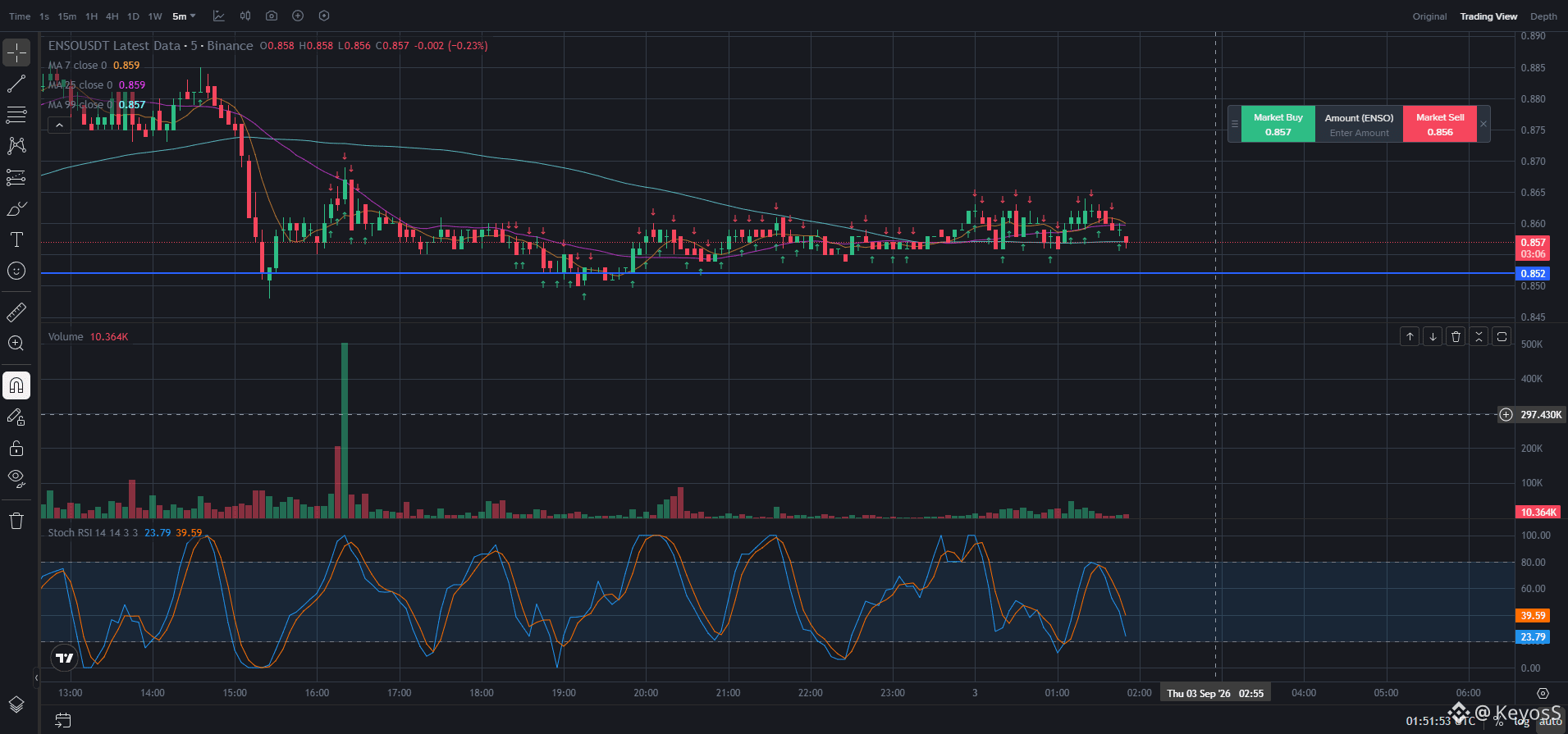
Join the [ENSO Trading Tournament](https://www.binance.com/en/activity/trading-competition/spot-altcoin-festival-wave-ENSO1/Main-Reward) ;) Easy money! Buy and sell... Not much time left. $ENSO $KITE $FIL
{spot}(FILUSDT)
{spot}(KITEUSDT)
{spot}(ENSOUSDT)
Join the ENSO Trading Tournament ;) Easy money! Buy and sell... Not much time left. $ENSO $KITE $FIL
1
1
524
·
--
"Keep rollin', rollin', rollin', rollin'!" 🎶🧢
$LA - join [LA](https://www.binance.com/en/square/post/362425615135326)👈🥺😁
{spot}(LAUSDT)
{spot}(ADAUSDT)
{spot}(TUSDT)
---
🎵 Audio Credits & Copyright:
Song: Rollin' (Air Raid Vehicle)
Artist: Limp Bizkit
Writers: Fred Durst, Wes Borland, Sam Rivers, John Otto
Producers: Terry Date, Limp Bizkit
Release Year: 2000
Rights / Label: ℗ Flip Records / Interscope Records
"Keep rollin', rollin', rollin', rollin'!" 🎶🧢
$LA - join LA👈🥺😁
---
🎵 Audio Credits & Copyright:
Song: Rollin' (Air Raid Vehicle)
Artist: Limp Bizkit
Writers: Fred Durst, Wes Borland, Sam Rivers, John Otto
Producers: Terry Date, Limp Bizkit
Release Year: 2000
Rights / Label: ℗ Flip Records / Interscope Records
$LA - join LA👈🥺😁
---
🎵 Audio Credits & Copyright:
Song: Rollin' (Air Raid Vehicle)
Artist: Limp Bizkit
Writers: Fred Durst, Wes Borland, Sam Rivers, John Otto
Producers: Terry Date, Limp Bizkit
Release Year: 2000
Rights / Label: ℗ Flip Records / Interscope Records
269
·
--
Executing an ultra-disciplined 5-minute cycle loop with a fixed $120 USDT allocation. Direct market/limit churn every 5 minutes—irrespective of short-term price fluctuations—to maximize total tournament volume before the deadline!
$ENSO
{spot}(ENSOUSDT)
Executing an ultra-disciplined 5-minute cycle loop with a fixed $120 USDT allocation. Direct market/limit churn every 5 minutes—irrespective of short-term price fluctuations—to maximize total tournament volume before the deadline!
$ENSO
$ENSO
84
2
1.3k
·
--
Years of experience building scalable platforms for 1M+ users taught me one thing: systems beat luck every single time.
Combining an MBA background with technical execution, I apply the exact same corporate frameworks to track daily Binance task execution, capital risk, and yield metrics.
If you build a reliable engine for {1}, scaling it up is pure execution.
How are you organizing your daily Web3 activities?
Post your setup or spreadsheet in the comments;
I’d love to trade templates! 💬👇
#Binance #SystemsDesign #CryptoTrackers #ProductStrategy #CryptoHumor
Years of experience building scalable platforms for 1M+ users taught me one thing: systems beat luck every single time.
Combining an MBA background with technical execution, I apply the exact same corporate frameworks to track daily Binance task execution, capital risk, and yield metrics.
If you build a reliable engine for {1}, scaling it up is pure execution.
How are you organizing your daily Web3 activities?
Post your setup or spreadsheet in the comments;
I’d love to trade templates! 💬👇
#Binance #SystemsDesign #CryptoTrackers #ProductStrategy #CryptoHumor
Combining an MBA background with technical execution, I apply the exact same corporate frameworks to track daily Binance task execution, capital risk, and yield metrics.
If you build a reliable engine for {1}, scaling it up is pure execution.
How are you organizing your daily Web3 activities?
Post your setup or spreadsheet in the comments;
I’d love to trade templates! 💬👇
#Binance #SystemsDesign #CryptoTrackers #ProductStrategy #CryptoHumor
74
·
--
$BTW Do you see any trading opportunities?
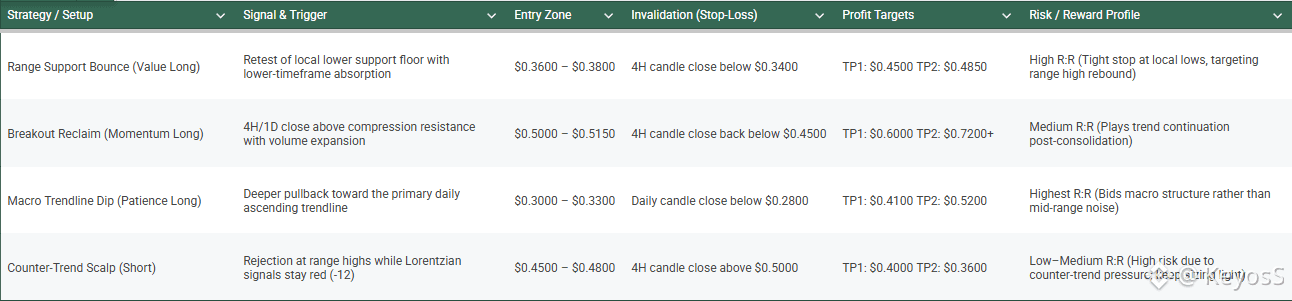
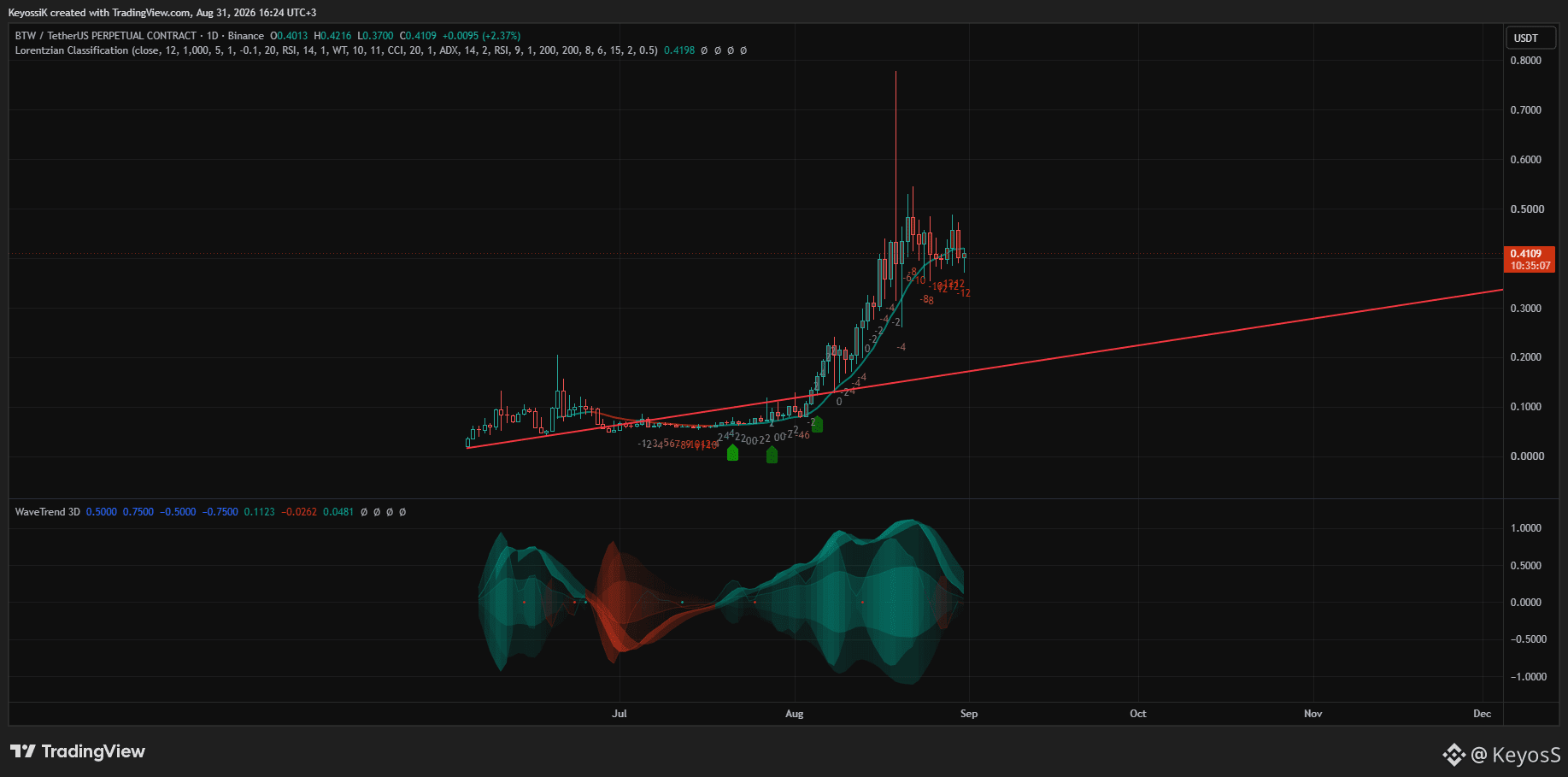
With BTW compressing around $0.4096 between range resistance ($0.50) and local support ($0.36), avoiding position-taking in the middle of the range is critical.
Check out the trade setup matrix above breakdown of entries, invalidation levels, and profit targets across momentum, value, and macro plays!
Are you bidding the $0.36 support sweep or waiting for the $0.50 breakout confirmation? Drop your thoughts loud below! 👇
{future}(BTWUSDT)
$BTW Do you see any trading opportunities?
With BTW compressing around $0.4096 between range resistance ($0.50) and local support ($0.36), avoiding position-taking in the middle of the range is critical.
Check out the trade setup matrix above breakdown of entries, invalidation levels, and profit targets across momentum, value, and macro plays!
Are you bidding the $0.36 support sweep or waiting for the $0.50 breakout confirmation? Drop your thoughts loud below! 👇
With BTW compressing around $0.4096 between range resistance ($0.50) and local support ($0.36), avoiding position-taking in the middle of the range is critical.
Check out the trade setup matrix above breakdown of entries, invalidation levels, and profit targets across momentum, value, and macro plays!
Are you bidding the $0.36 support sweep or waiting for the $0.50 breakout confirmation? Drop your thoughts loud below! 👇
310
·
--
Article
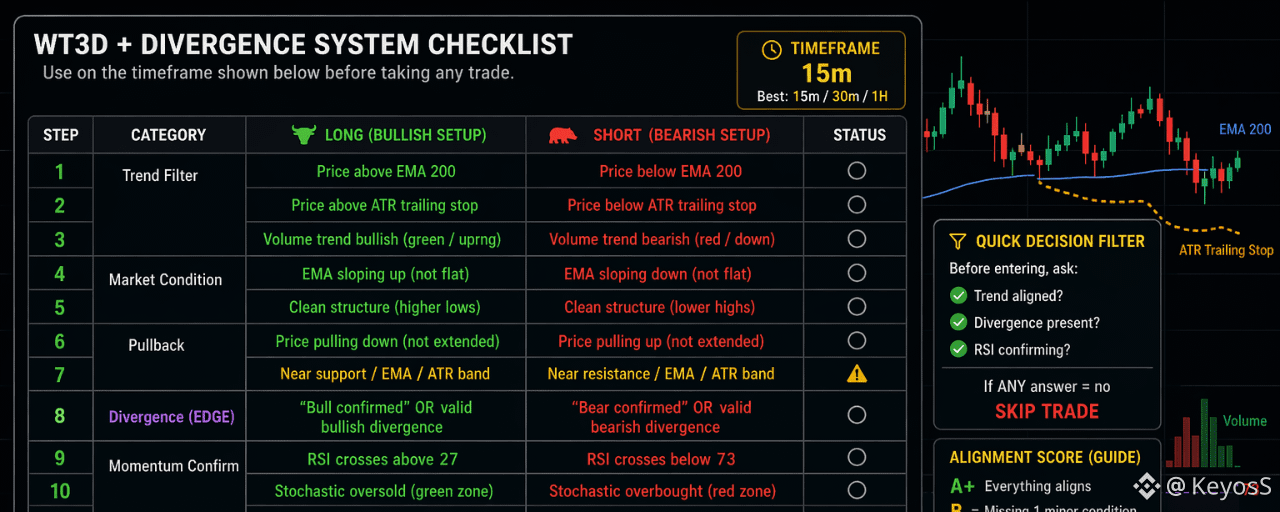
Mastering High-Probability Entries: My WT3D + Divergence ChecklistIf you are trading lower timeframes without a rigid checklist, you are essentially gambling with your equity. Market noise will catch you off guard every single time.
To keep my trade execution systematic, I use a simple confluence framework to filter out low-probability setups before taking a position. Here is how I structure my execution on the 15m to 1H charts:
1. Trend Alignment (Steps 1–5)
I never trade against the broader momentum. Before considering an entry trigger, I confirm directional bias:
Dynamic Filters: For longs, price must trade above the 200 EMA and the ATR trailing stop. The opposite applies to short positions.
EMA Slope Check: If the 200 EMA is flat, I stay out. Range-bound chop creates far too many false divergence signals.
Structure: I look for clean market structure—higher lows for bullish setups, lower highs for bearish ones.
2. Location & Divergence Edge (Steps 6–8)
Chasing extended green or red candles is a quick way to destroy your risk-to-reward ratio.
Pullback Zone: I wait patiently for price to pull back directly into the dynamic Support/Resistance area or the EMA/ATR band.
The Edge: I look for a confirmed regular bullish or bearish divergence between price action and my momentum oscillators.
3. Momentum & Execution Trigger (Steps 9–16)
Once trend and location align, momentum gives the final green light:
Oscillators: I wait for an RSI cross (>27 for long, <73 for short) combined with Stochastic confirmation in the oversold or overbought zones.
Strict Cancellation Rule: If market structure breaks before the signal candle closes, the trade is immediately invalidated and skipped.
4. Risk Parameters
Account Exposure: Never risk more than 1–2% of total capital per trade.
Stop Placement: Positioned strictly beyond the ATR band or recent divergence extreme.
The Filter Rule: If Trend, Divergence, OR RSI fails to line up → Skip the trade.
Consistency comes from executing a high-probability edge repeatedly with discipline. Wait for $A+$ setups and let the compound effect do the work.
What does your execution checklist look like? Drop your rules in the comments! 👇
$BTR $TAC $BMT
{future}(BMTUSDT)
{future}(TACUSDT)
{future}(BTRUSDT)
Mastering High-Probability Entries: My WT3D + Divergence Checklist
If you are trading lower timeframes without a rigid checklist, you are essentially gambling with your equity. Market noise will catch you off guard every single time.
To keep my trade execution systematic, I use a simple confluence framework to filter out low-probability setups before taking a position. Here is how I structure my execution on the 15m to 1H charts:
1. Trend Alignment (Steps 1–5)
I never trade against the broader momentum. Before considering an entry trigger, I confirm directional bias:
Dynamic Filters: For longs, price must trade above the 200 EMA and the ATR trailing stop. The opposite applies to short positions.
EMA Slope Check: If the 200 EMA is flat, I stay out. Range-bound chop creates far too many false divergence signals.
Structure: I look for clean market structure—higher lows for bullish setups, lower highs for bearish ones.
2. Location & Divergence Edge (Steps 6–8)
Chasing extended green or red candles is a quick way to destroy your risk-to-reward ratio.
Pullback Zone: I wait patiently for price to pull back directly into the dynamic Support/Resistance area or the EMA/ATR band.
The Edge: I look for a confirmed regular bullish or bearish divergence between price action and my momentum oscillators.
3. Momentum & Execution Trigger (Steps 9–16)
Once trend and location align, momentum gives the final green light:
Oscillators: I wait for an RSI cross (>27 for long, <73 for short) combined with Stochastic confirmation in the oversold or overbought zones.
Strict Cancellation Rule: If market structure breaks before the signal candle closes, the trade is immediately invalidated and skipped.
4. Risk Parameters
Account Exposure: Never risk more than 1–2% of total capital per trade.
Stop Placement: Positioned strictly beyond the ATR band or recent divergence extreme.
The Filter Rule: If Trend, Divergence, OR RSI fails to line up → Skip the trade.
Consistency comes from executing a high-probability edge repeatedly with discipline. Wait for $A+$ setups and let the compound effect do the work.
What does your execution checklist look like? Drop your rules in the comments! 👇
$BTR $TAC $BMT
To keep my trade execution systematic, I use a simple confluence framework to filter out low-probability setups before taking a position. Here is how I structure my execution on the 15m to 1H charts:
1. Trend Alignment (Steps 1–5)
I never trade against the broader momentum. Before considering an entry trigger, I confirm directional bias:
Dynamic Filters: For longs, price must trade above the 200 EMA and the ATR trailing stop. The opposite applies to short positions.
EMA Slope Check: If the 200 EMA is flat, I stay out. Range-bound chop creates far too many false divergence signals.
Structure: I look for clean market structure—higher lows for bullish setups, lower highs for bearish ones.
2. Location & Divergence Edge (Steps 6–8)
Chasing extended green or red candles is a quick way to destroy your risk-to-reward ratio.
Pullback Zone: I wait patiently for price to pull back directly into the dynamic Support/Resistance area or the EMA/ATR band.
The Edge: I look for a confirmed regular bullish or bearish divergence between price action and my momentum oscillators.
3. Momentum & Execution Trigger (Steps 9–16)
Once trend and location align, momentum gives the final green light:
Oscillators: I wait for an RSI cross (>27 for long, <73 for short) combined with Stochastic confirmation in the oversold or overbought zones.
Strict Cancellation Rule: If market structure breaks before the signal candle closes, the trade is immediately invalidated and skipped.
4. Risk Parameters
Account Exposure: Never risk more than 1–2% of total capital per trade.
Stop Placement: Positioned strictly beyond the ATR band or recent divergence extreme.
The Filter Rule: If Trend, Divergence, OR RSI fails to line up → Skip the trade.
Consistency comes from executing a high-probability edge repeatedly with discipline. Wait for $A+$ setups and let the compound effect do the work.
What does your execution checklist look like? Drop your rules in the comments! 👇
$BTR $TAC $BMT
1
292
·
--
Verified
@Dusk_Foundation #dusk
Why is pure transparency a major bottleneck for institutional real-world asset (RWA) tokenization?
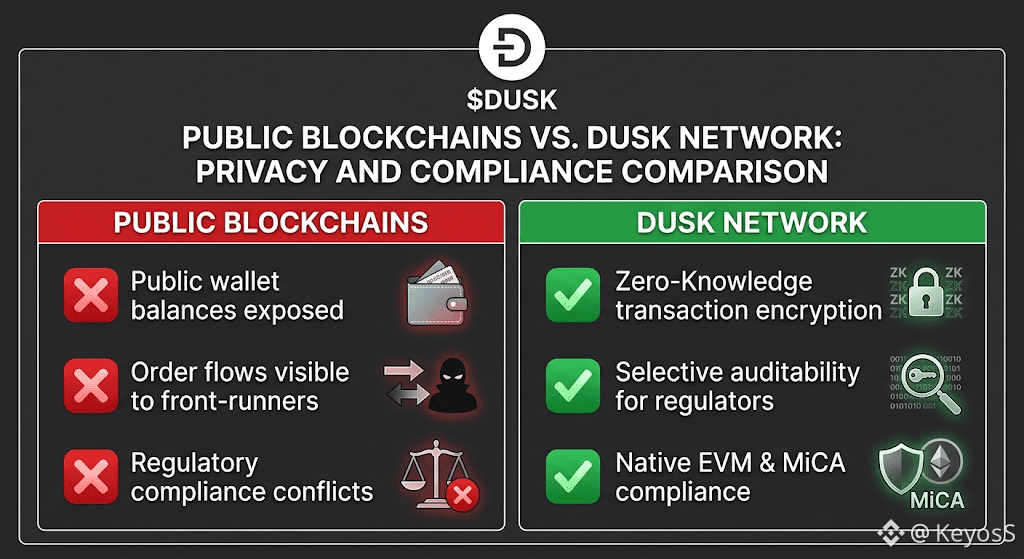
Public block explorers leak sensitive execution prices, order flows, and portfolio balances to front-runners. For regulated capital markets managing traditional financial instruments, this total visibility is a non-starter.
How @Dusk_Foundation resolves this infrastructure gap:
🛡️ Zero-Knowledge Privacy: Shields sensitive balance updates and trade amounts from public scrutiny via native primitives.
📑 Auditable Compliance: Generates zero-knowledge proofs allowing regulators to verify compliance without broadcasting underlying private data.
⚙️ Standard EVM Tooling: With the DuskEVM testnet live, Solidity developers can build compliant dApps using standard tools.
Combining protocol-level privacy with compliance is the key to onboarding modern capital markets to Web3.
$DUSK $STX $ONG
{future}(ONGUSDT)
{future}(STXUSDT)
{future}(DUSKUSDT)
@Dusk #dusk
Why is pure transparency a major bottleneck for institutional real-world asset (RWA) tokenization?
Public block explorers leak sensitive execution prices, order flows, and portfolio balances to front-runners. For regulated capital markets managing traditional financial instruments, this total visibility is a non-starter.
How @Dusk resolves this infrastructure gap:
🛡️ Zero-Knowledge Privacy: Shields sensitive balance updates and trade amounts from public scrutiny via native primitives.
📑 Auditable Compliance: Generates zero-knowledge proofs allowing regulators to verify compliance without broadcasting underlying private data.
⚙️ Standard EVM Tooling: With the DuskEVM testnet live, Solidity developers can build compliant dApps using standard tools.
Combining protocol-level privacy with compliance is the key to onboarding modern capital markets to Web3.
$DUSK $STX $ONG
Why is pure transparency a major bottleneck for institutional real-world asset (RWA) tokenization?
Public block explorers leak sensitive execution prices, order flows, and portfolio balances to front-runners. For regulated capital markets managing traditional financial instruments, this total visibility is a non-starter.
How @Dusk resolves this infrastructure gap:
🛡️ Zero-Knowledge Privacy: Shields sensitive balance updates and trade amounts from public scrutiny via native primitives.
📑 Auditable Compliance: Generates zero-knowledge proofs allowing regulators to verify compliance without broadcasting underlying private data.
⚙️ Standard EVM Tooling: With the DuskEVM testnet live, Solidity developers can build compliant dApps using standard tools.
Combining protocol-level privacy with compliance is the key to onboarding modern capital markets to Web3.
$DUSK $STX $ONG
🛡️ Zero-Knowledge Privacy
0%
📑 Auditable Compliance
50%
⚙️ Standard EVM
50%
2 votes • Voting closed
1
892
·
--
#dusk @Dusk_Foundation
For years, privacy-preserving blockchains struggled with developer friction because they forced builders to learn specialized, non-EVM languages.
DuskEVM changes the institutional deployment narrative:
⚙️ Standard EVM Tooling: Developers can write and deploy zero-knowledge smart contracts using standard Solidity workflows.
🛡️ Embedded Confidentiality: Native privacy primitives shield transaction amounts and balances at the smart contract level.
📑 Automated Compliance (XSC): Built-in token standards enforce investor eligibility and transfer rules directly onchain.
Removing developer friction while keeping zero-knowledge compliance at the core is how DUSK accelerates real-world asset adoption.
$PROM $TUT $DUSK
{future}(DUSKUSDT)
{spot}(TUTUSDT)
{future}(PROMUSDT)
#dusk @Dusk
For years, privacy-preserving blockchains struggled with developer friction because they forced builders to learn specialized, non-EVM languages.
DuskEVM changes the institutional deployment narrative:
⚙️ Standard EVM Tooling: Developers can write and deploy zero-knowledge smart contracts using standard Solidity workflows.
🛡️ Embedded Confidentiality: Native privacy primitives shield transaction amounts and balances at the smart contract level.
📑 Automated Compliance (XSC): Built-in token standards enforce investor eligibility and transfer rules directly onchain.
Removing developer friction while keeping zero-knowledge compliance at the core is how DUSK accelerates real-world asset adoption.
$PROM $TUT $DUSK
For years, privacy-preserving blockchains struggled with developer friction because they forced builders to learn specialized, non-EVM languages.
DuskEVM changes the institutional deployment narrative:
⚙️ Standard EVM Tooling: Developers can write and deploy zero-knowledge smart contracts using standard Solidity workflows.
🛡️ Embedded Confidentiality: Native privacy primitives shield transaction amounts and balances at the smart contract level.
📑 Automated Compliance (XSC): Built-in token standards enforce investor eligibility and transfer rules directly onchain.
Removing developer friction while keeping zero-knowledge compliance at the core is how DUSK accelerates real-world asset adoption.
$PROM $TUT $DUSK
2
213
·
--
#dusk $DUSK @Dusk_Foundation
Why are classic asset wrappers falling short for institutional adoption?
When traditional financial institutions look at Web3, public order flows and open wallet balances are dealbreakers. Broadcasting trading strategies to public block explorers creates massive front-running risks.
How Dusk handles institutional-grade RWAs:
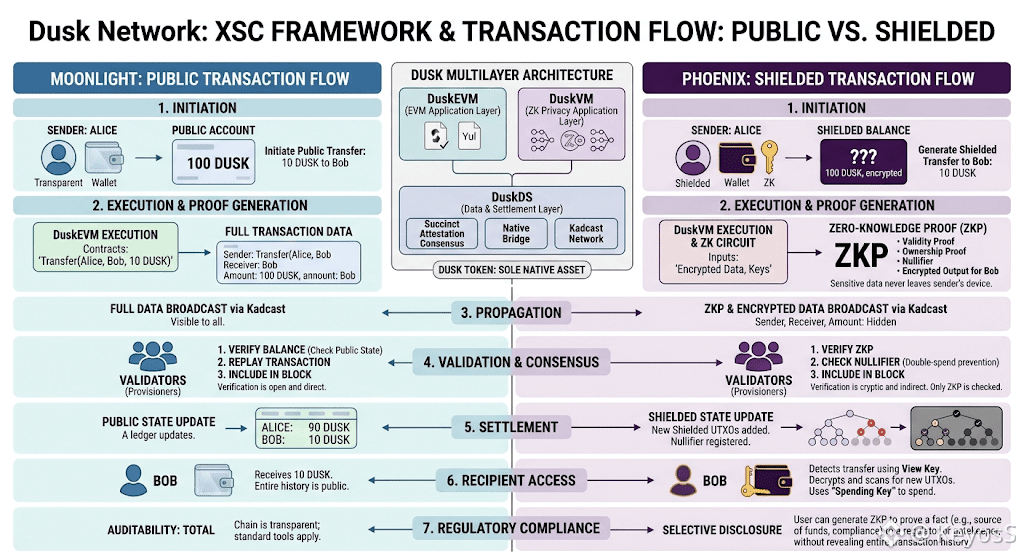
📊 Selective Disclosure: Zero-knowledge proofs (via Hedger) encrypt order books while giving regulators direct cryptographic proof of compliance.
📜 Native Legal Logic: The XSC standard executes corporate actions and transfer restrictions directly on-chain, rather than relying on off-chain legal wrappers.
⚡ Deterministic Settlement: Instant settlement finality eliminates counterparty clearing risks.
Selective privacy combined with compliance is the missing bridge for capital markets.
#dusk $DUSK @Dusk
Why are classic asset wrappers falling short for institutional adoption?
When traditional financial institutions look at Web3, public order flows and open wallet balances are dealbreakers. Broadcasting trading strategies to public block explorers creates massive front-running risks.
How Dusk handles institutional-grade RWAs:
📊 Selective Disclosure: Zero-knowledge proofs (via Hedger) encrypt order books while giving regulators direct cryptographic proof of compliance.
📜 Native Legal Logic: The XSC standard executes corporate actions and transfer restrictions directly on-chain, rather than relying on off-chain legal wrappers.
⚡ Deterministic Settlement: Instant settlement finality eliminates counterparty clearing risks.
Selective privacy combined with compliance is the missing bridge for capital markets.
Why are classic asset wrappers falling short for institutional adoption?
When traditional financial institutions look at Web3, public order flows and open wallet balances are dealbreakers. Broadcasting trading strategies to public block explorers creates massive front-running risks.
How Dusk handles institutional-grade RWAs:
📊 Selective Disclosure: Zero-knowledge proofs (via Hedger) encrypt order books while giving regulators direct cryptographic proof of compliance.
📜 Native Legal Logic: The XSC standard executes corporate actions and transfer restrictions directly on-chain, rather than relying on off-chain legal wrappers.
⚡ Deterministic Settlement: Instant settlement finality eliminates counterparty clearing risks.
Selective privacy combined with compliance is the missing bridge for capital markets.
88
·
--
#dusk $DUSK @Dusk_Foundation
Deploying confidential dApps used to require learning complex, non-EVM languages. DuskEVM strips away that friction.
Key advantages for builders:
🔹 Standard Solidity: Build using the tools, frameworks, and code bases you already know.
🔹 Embedded ZK Privacy: Protect user data automatically via native Hedger integration.
🔹 Deterministic Finality: Instant settlement required for regulated institutional trading.
Bringing zero-knowledge compliance to familiar Web3 development tools is how $DUSK powers institutional growth.
#dusk $DUSK @Dusk
Deploying confidential dApps used to require learning complex, non-EVM languages. DuskEVM strips away that friction.
Key advantages for builders:
🔹 Standard Solidity: Build using the tools, frameworks, and code bases you already know.
🔹 Embedded ZK Privacy: Protect user data automatically via native Hedger integration.
🔹 Deterministic Finality: Instant settlement required for regulated institutional trading.
Bringing zero-knowledge compliance to familiar Web3 development tools is how $DUSK powers institutional growth.
Deploying confidential dApps used to require learning complex, non-EVM languages. DuskEVM strips away that friction.
Key advantages for builders:
🔹 Standard Solidity: Build using the tools, frameworks, and code bases you already know.
🔹 Embedded ZK Privacy: Protect user data automatically via native Hedger integration.
🔹 Deterministic Finality: Instant settlement required for regulated institutional trading.
Bringing zero-knowledge compliance to familiar Web3 development tools is how $DUSK powers institutional growth.
75
·
--
Adore You
Song by Cedric Gervais and Miley Cyrus ‧ 2014
Ah, hey, ah oh
$BABY , baby yeah, are you listenin'?
Wondering, where you've been, all my life
I just started living
Oh, baby are you listenin' oh?
When you say you love me
Know I love you more
When you say you need me
Know I need you more
Boy I adore you
I adore you
Baby, can ya hear me?
When I'm crying out, for you
I'm scared oh, so scared
When you're near me
I feel like I'm standing with an army
Of men armed with weapons, hey oh
...
Song: Adore You by Miley Cyrus
Lyrics: Written by Stacy Barthe & Oren Yoel
© 2013 RCA Records
$BABY
{future}(BABYUSDT)
Adore You
Song by Cedric Gervais and Miley Cyrus ‧ 2014
Ah, hey, ah oh
$BABY , baby yeah, are you listenin'?
Wondering, where you've been, all my life
I just started living
Oh, baby are you listenin' oh?
When you say you love me
Know I love you more
When you say you need me
Know I need you more
Boy I adore you
I adore you
Baby, can ya hear me?
When I'm crying out, for you
I'm scared oh, so scared
When you're near me
I feel like I'm standing with an army
Of men armed with weapons, hey oh
...
Song: Adore You by Miley Cyrus
Lyrics: Written by Stacy Barthe & Oren Yoel
© 2013 RCA Records
$BABY
Song by Cedric Gervais and Miley Cyrus ‧ 2014
Ah, hey, ah oh
$BABY , baby yeah, are you listenin'?
Wondering, where you've been, all my life
I just started living
Oh, baby are you listenin' oh?
When you say you love me
Know I love you more
When you say you need me
Know I need you more
Boy I adore you
I adore you
Baby, can ya hear me?
When I'm crying out, for you
I'm scared oh, so scared
When you're near me
I feel like I'm standing with an army
Of men armed with weapons, hey oh
...
Song: Adore You by Miley Cyrus
Lyrics: Written by Stacy Barthe & Oren Yoel
© 2013 RCA Records
$BABY
127
·
--
Traditional finance relies heavily on fixed-income markets for stability, yet Web3 is still dominated by unpredictable variable rates. @termmax addresses this structural gap by combining decentralized fixed-rate borrowing/lending with options trading. Establishing deterministic yields is key for institutional-grade capital efficiency on-chain. #TermMax
Traditional finance relies heavily on fixed-income markets for stability, yet Web3 is still dominated by unpredictable variable rates. @TermMax addresses this structural gap by combining decentralized fixed-rate borrowing/lending with options trading. Establishing deterministic yields is key for institutional-grade capital efficiency on-chain. #TermMax
50
·
--
@Dusk_Foundation $DUSK #dusk
Tokenized asset "wrappers" leave real-world legal records and settlement offchain. Native issuance changes the game.
Through @dusk, modern capital markets get true onchain lifecycles:
Automated compliance via the XSC framework
Zero-Knowledge proofs for transaction confidentiality
Instant atomic settlement with zero counterparty risk
Building the compliant, confidential L1 infrastructure for real-world finance powered by $DUSK .
@Dusk $DUSK #dusk
Tokenized asset "wrappers" leave real-world legal records and settlement offchain. Native issuance changes the game.
Through @dusk, modern capital markets get true onchain lifecycles:
Automated compliance via the XSC framework
Zero-Knowledge proofs for transaction confidentiality
Instant atomic settlement with zero counterparty risk
Building the compliant, confidential L1 infrastructure for real-world finance powered by $DUSK .
Tokenized asset "wrappers" leave real-world legal records and settlement offchain. Native issuance changes the game.
Through @dusk, modern capital markets get true onchain lifecycles:
Automated compliance via the XSC framework
Zero-Knowledge proofs for transaction confidentiality
Instant atomic settlement with zero counterparty risk
Building the compliant, confidential L1 infrastructure for real-world finance powered by $DUSK .
64
·
--
@Dusk_Foundation $DUSK #dusk
Bridging institutional compliance with Web3 developer adoption has always been a tough engineering challenge.
Most privacy-focused protocols force developers to learn custom, non-EVM languages. DuskEVM shifts this dynamic by providing standard Solidity compatibility alongside protocol-level privacy.
Why this matters for builder adoption:
🔹 Standard Solidity Workflows: Ethereum developers can build and deploy dApps using familiar tooling.
🔹 Embedded ZK Encryption: Hedger allows dApps to encrypt asset amounts and balances directly onchain.
🔹 Deterministic Settlement Finality: Venues gain immediate finality required for institutional trading workflows.
By removing the friction for Solidity developers while maintaining zero-knowledge compliance, $DUSK makes institutional DeFi far more accessible.
@Dusk $DUSK #dusk
Bridging institutional compliance with Web3 developer adoption has always been a tough engineering challenge.
Most privacy-focused protocols force developers to learn custom, non-EVM languages. DuskEVM shifts this dynamic by providing standard Solidity compatibility alongside protocol-level privacy.
Why this matters for builder adoption:
🔹 Standard Solidity Workflows: Ethereum developers can build and deploy dApps using familiar tooling.
🔹 Embedded ZK Encryption: Hedger allows dApps to encrypt asset amounts and balances directly onchain.
🔹 Deterministic Settlement Finality: Venues gain immediate finality required for institutional trading workflows.
By removing the friction for Solidity developers while maintaining zero-knowledge compliance, $DUSK makes institutional DeFi far more accessible.
Bridging institutional compliance with Web3 developer adoption has always been a tough engineering challenge.
Most privacy-focused protocols force developers to learn custom, non-EVM languages. DuskEVM shifts this dynamic by providing standard Solidity compatibility alongside protocol-level privacy.
Why this matters for builder adoption:
🔹 Standard Solidity Workflows: Ethereum developers can build and deploy dApps using familiar tooling.
🔹 Embedded ZK Encryption: Hedger allows dApps to encrypt asset amounts and balances directly onchain.
🔹 Deterministic Settlement Finality: Venues gain immediate finality required for institutional trading workflows.
By removing the friction for Solidity developers while maintaining zero-knowledge compliance, $DUSK makes institutional DeFi far more accessible.
78
·
--
@Dusk_Foundation $DUSK #dusk
{spot}(DUSKUSDT)
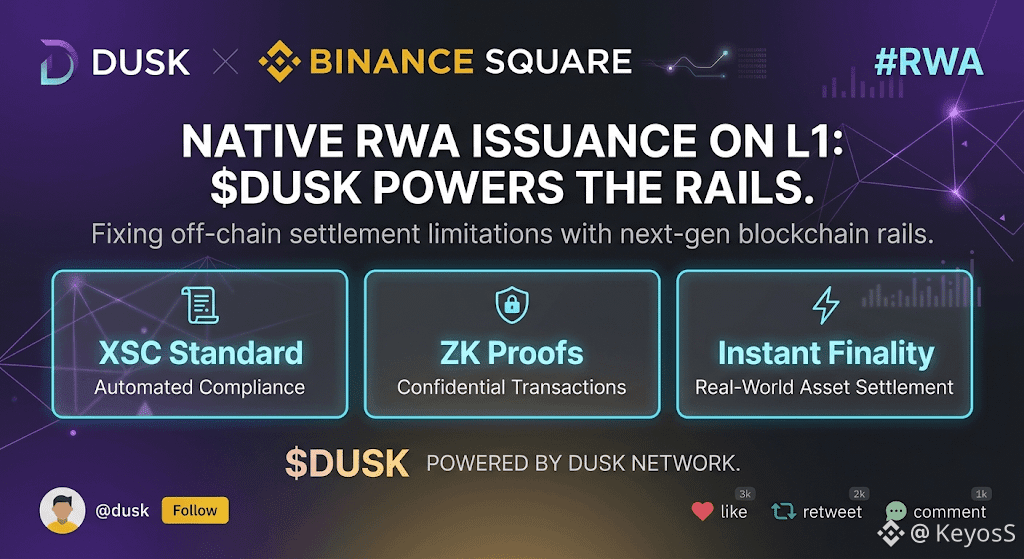
Asset tokenization wrappers leave actual legal settlement offchain. Native issuance fixes this.
Through @Dusk_Foundation financial assets run directly on modern L1 rails:
📜 XSC standard for automated compliance
🔒 ZK proofs for confidential transactions
⚡ Instant settlement finality
Building real-world asset rails powered by DUSK!
$TUT $ACE
{future}(ACEUSDT)
{future}(TUTUSDT)
@Dusk $DUSK #dusk
Asset tokenization wrappers leave actual legal settlement offchain. Native issuance fixes this.
Through @Dusk financial assets run directly on modern L1 rails:
📜 XSC standard for automated compliance
🔒 ZK proofs for confidential transactions
⚡ Instant settlement finality
Building real-world asset rails powered by DUSK!
$TUT $ACE
Asset tokenization wrappers leave actual legal settlement offchain. Native issuance fixes this.
Through @Dusk financial assets run directly on modern L1 rails:
📜 XSC standard for automated compliance
🔒 ZK proofs for confidential transactions
⚡ Instant settlement finality
Building real-world asset rails powered by DUSK!
$TUT $ACE
1
198
·
--
#dusk $DUSK @Dusk_Foundation
{future}(DUSKUSDT)
What actually happens when traditional capital markets try to move onchain?
For a long time, the common Web3 narrative was that maximum transparency leads to maximum trust. If everything is visible on a public explorer, nobody can cheat.
But looking closer at institutional finance, total transparency becomes an immediate bottleneck. An asset manager cannot broadcast their positions, trading strategies, or settlement details to the entire world without suffering front-running and competitive displacement.
This is where programmable privacy changes the equation.
Rather than choosing between complete exposure or absolute anonymity, Dusk’s approach with Hedger and XSC introduces selective disclosure. You prove compliance and eligibility mathematically through zero-knowledge proofs—without exposing the underlying proprietary data.
It shifts the goal from "hiding information" to "controlling exposure."
The real question now is execution: as regulated assets move onchain, will institutional venues prioritize selective privacy over pure public transparency?
What is the biggest hurdle for onchain RWAs?
#dusk $DUSK @Dusk
What actually happens when traditional capital markets try to move onchain?
For a long time, the common Web3 narrative was that maximum transparency leads to maximum trust. If everything is visible on a public explorer, nobody can cheat.
But looking closer at institutional finance, total transparency becomes an immediate bottleneck. An asset manager cannot broadcast their positions, trading strategies, or settlement details to the entire world without suffering front-running and competitive displacement.
This is where programmable privacy changes the equation.
Rather than choosing between complete exposure or absolute anonymity, Dusk’s approach with Hedger and XSC introduces selective disclosure. You prove compliance and eligibility mathematically through zero-knowledge proofs—without exposing the underlying proprietary data.
It shifts the goal from "hiding information" to "controlling exposure."
The real question now is execution: as regulated assets move onchain, will institutional venues prioritize selective privacy over pure public transparency?
What is the biggest hurdle for onchain RWAs?
What actually happens when traditional capital markets try to move onchain?
For a long time, the common Web3 narrative was that maximum transparency leads to maximum trust. If everything is visible on a public explorer, nobody can cheat.
But looking closer at institutional finance, total transparency becomes an immediate bottleneck. An asset manager cannot broadcast their positions, trading strategies, or settlement details to the entire world without suffering front-running and competitive displacement.
This is where programmable privacy changes the equation.
Rather than choosing between complete exposure or absolute anonymity, Dusk’s approach with Hedger and XSC introduces selective disclosure. You prove compliance and eligibility mathematically through zero-knowledge proofs—without exposing the underlying proprietary data.
It shifts the goal from "hiding information" to "controlling exposure."
The real question now is execution: as regulated assets move onchain, will institutional venues prioritize selective privacy over pure public transparency?
What is the biggest hurdle for onchain RWAs?
🗳️ Transaction Privacy
100%
🗳️ Regulatory Compliance
0%
🗳️ Settlement Speed
0%
1 votes • Voting closed
1
82
·
--
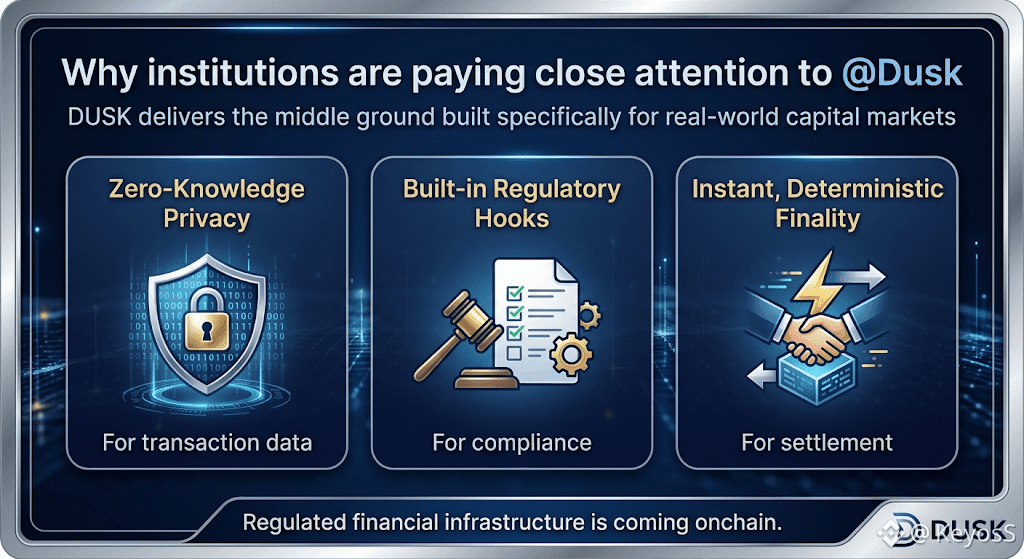
Why are institutions paying close attention to @Dusk_Foundation ?
Public blockchains lack data privacy, while private chains lack liquidity and open composability.
DUSK delivers the middle ground built specifically for real-world capital markets:
🔹 Zero-Knowledge privacy for transaction data
🔹 Built-in regulatory hooks for compliance
🔹 Instant, deterministic settlement finality
Regulated financial infrastructure is coming onchain.
#dusk $DUSK $HEMI $SNXXB
{spot}(SNXXBUSDT)
{future}(HEMIUSDT)
{future}(DUSKUSDT)
Why are institutions paying close attention to @Dusk ?
Public blockchains lack data privacy, while private chains lack liquidity and open composability.
DUSK delivers the middle ground built specifically for real-world capital markets:
🔹 Zero-Knowledge privacy for transaction data
🔹 Built-in regulatory hooks for compliance
🔹 Instant, deterministic settlement finality
Regulated financial infrastructure is coming onchain.
#dusk $DUSK $HEMI $SNXXB
Public blockchains lack data privacy, while private chains lack liquidity and open composability.
DUSK delivers the middle ground built specifically for real-world capital markets:
🔹 Zero-Knowledge privacy for transaction data
🔹 Built-in regulatory hooks for compliance
🔹 Instant, deterministic settlement finality
Regulated financial infrastructure is coming onchain.
#dusk $DUSK $HEMI $SNXXB
Zero-Knowledge
100%
Built-in regulatory
0%
Instant, deterministic
0%
1 votes • Voting closed
2
1
688
·
--
Verified
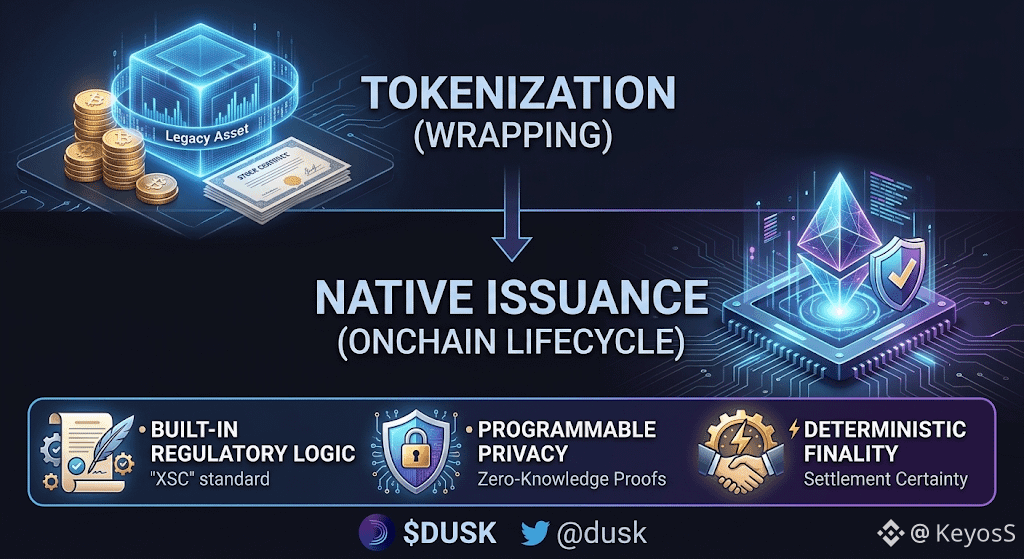
Tokenization wraps legacy assets, but native issuance moves the entire financial lifecycle directly onchain.
@Dusk_Foundation provides purpose-built Layer-1 infrastructure designed for the native issuance of regulated financial instruments and securities:
📜 Built-in Regulatory Logic: Incorporates compliance hooks directly into the token layer through standards like XSC.
🔒 Programmable Privacy: Confidential workflows powered by zero-knowledge proofs protect proprietary data without sacrificing compliance.
⚡ Deterministic Finality: Provides institutional venues with absolute settlement certainty required for capital markets.
Moving beyond tokenized wrappers to native onchain assets is key to building true Web3 capital markets. Powering the transition with $DUSK !
{future}(DUSKUSDT)
What type of real-world asset do you think benefits most from native onchain issuance? 👇
#dusk $COW $WAL
{future}(WALUSDT)
{future}(COWUSDT)
Tokenization wraps legacy assets, but native issuance moves the entire financial lifecycle directly onchain.
@Dusk provides purpose-built Layer-1 infrastructure designed for the native issuance of regulated financial instruments and securities:
📜 Built-in Regulatory Logic: Incorporates compliance hooks directly into the token layer through standards like XSC.
🔒 Programmable Privacy: Confidential workflows powered by zero-knowledge proofs protect proprietary data without sacrificing compliance.
⚡ Deterministic Finality: Provides institutional venues with absolute settlement certainty required for capital markets.
Moving beyond tokenized wrappers to native onchain assets is key to building true Web3 capital markets. Powering the transition with $DUSK !
What type of real-world asset do you think benefits most from native onchain issuance? 👇
#dusk $COW $WAL
@Dusk provides purpose-built Layer-1 infrastructure designed for the native issuance of regulated financial instruments and securities:
📜 Built-in Regulatory Logic: Incorporates compliance hooks directly into the token layer through standards like XSC.
🔒 Programmable Privacy: Confidential workflows powered by zero-knowledge proofs protect proprietary data without sacrificing compliance.
⚡ Deterministic Finality: Provides institutional venues with absolute settlement certainty required for capital markets.
Moving beyond tokenized wrappers to native onchain assets is key to building true Web3 capital markets. Powering the transition with $DUSK !
What type of real-world asset do you think benefits most from native onchain issuance? 👇
#dusk $COW $WAL
🗳️ Stocks & Securities
0%
🗳️ Government Bonds
0%
🗳️ Money Market Funds
0%
🗳️ Real Estate & PE
0%
0 votes • Voting closed
102
Log in to explore more content
Join global crypto users on Binance Square
⚡️ Get latest and useful information about crypto.
💬 Trusted by the world’s largest crypto exchange.
👍 Discover real insights from verified creators.
Email / Phone number
Trending Topics
FedRateWatch
681,368 views
3,229 Discussing
Share & Win Traffic Reward in our Trending Hashtag Campaign
✨Topic: FOMC September, What's The Fed's Next Move?
👉How to Join:
Publish a short post or article with hashtag #FedRateWatch
Create content based on the below angles:
- August core CPI rose 0.3% month-over-month, and the odds of a 25bp hike this week are now close to 90%. Do you anticipate a rate hike this week? Is it a one-off, or the start of a longer hiking cycle?
- If the hike lands, how does it play out for BTC, tech stocks, and gold? Bullish or bearish?
- How are you planning to trade next? Share your BTC, stocks or gold trade/holdings with our trade sharing widget.
⏰Campaign Period:
- 2026-09-15 11:00 - 2026-09-17 3:00 UTC
🎁Reward:
- Qualified posts that comply with the above guidelines and contain more than 100 words will be reviewed and may receive a random traffic boost of 500 to 3,000 views. You will receive a notification from your feed secretary if your post is selected.
- Get a chance to have your article featured on Binance Square Official
Need ideas for your post? Visit the topic page #FedRateWatch or the Square Guide on How to Post for Better Reach.
Binance Square Official
·424 Likes
·953.5k views
EthereumFallsBelow$2400
976 views
34 Discussing
USSenateBlocksClarityAct
3,878 views
159 Discussing