
good traider
27 Posts

good traider
Report
Block User
20 Following
17 Followers
31 Liked
Posts
·
--
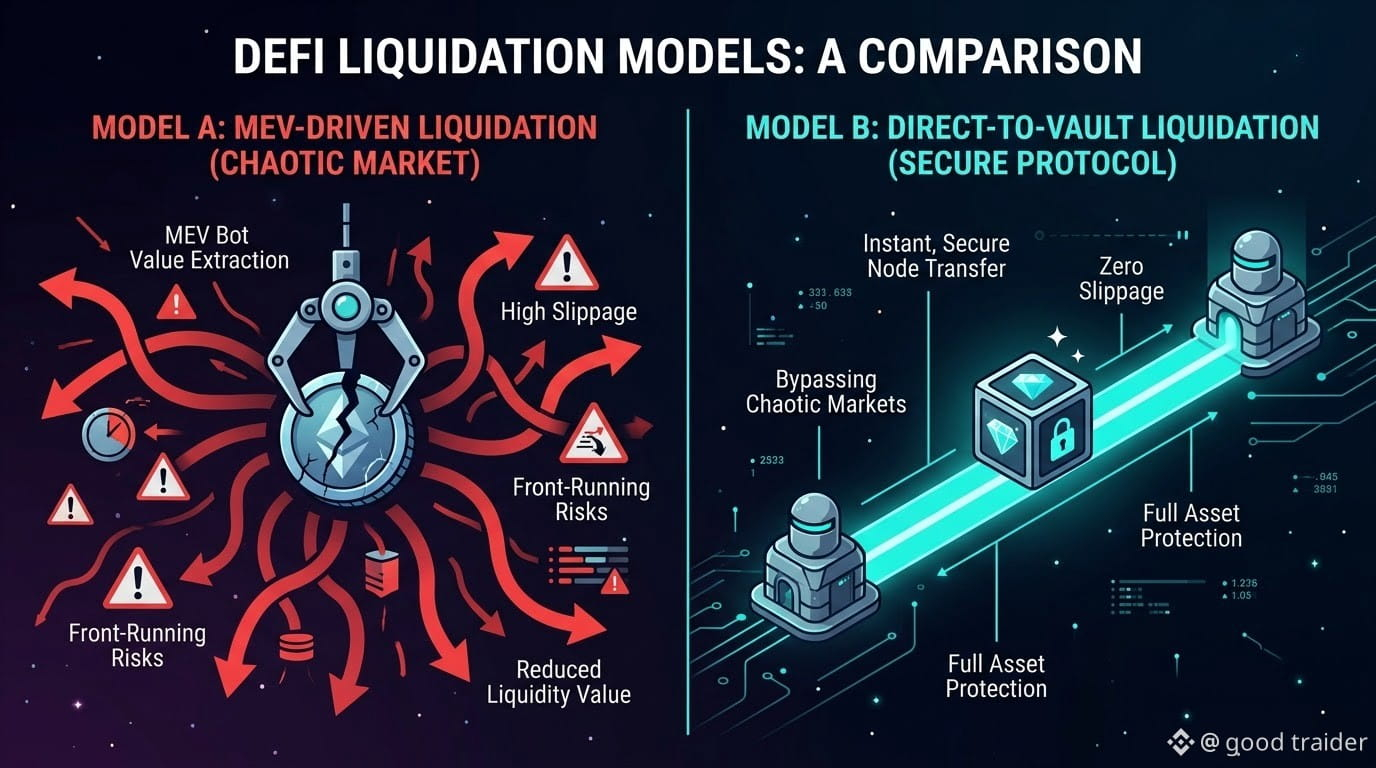
#termmax @termmax Liquidation Architecture: Physical Delivery in the TermMax Ecosystem
In classic DeFi protocols (such as Aave or Compound), liquidation relies on external liquidity pools and arbitrageurs. When a position's Health Factor drops below 1, the smart contract allows liquidators (MEV bots) to buy the collateral at a discount (Liquidation Penalty, usually between 5% and 10%) and instantly sell it on a DEX. This creates a severe "bad debt" problem for low-liquidity assets, such as tokenized RWAs.
The TermMax architecture solves this problem by implementing the Physical Delivery model. In the event of a default or a critical lack of liquidity on the Maturity Date, the protocol does not initiate a sale of the collateral on the open market. Instead, the underlying collateral asset is transferred directly to the lender's wallet at a fixed settlement rate.
Technical and economic implications of this solution:
* Elimination of slippage in the order book when liquidating large volumes.
* Complete exclusion of MEV bots from the value chain, which retains value within the protocol.
* The mechanism allows the protocol to safely accept illiquid tokens as collateral, as the system does not need to source counterparty liquidity in pools during market panic.
#termmax @TermMax Liquidation Architecture: Physical Delivery in the TermMax Ecosystem
In classic DeFi protocols (such as Aave or Compound), liquidation relies on external liquidity pools and arbitrageurs. When a position's Health Factor drops below 1, the smart contract allows liquidators (MEV bots) to buy the collateral at a discount (Liquidation Penalty, usually between 5% and 10%) and instantly sell it on a DEX. This creates a severe "bad debt" problem for low-liquidity assets, such as tokenized RWAs.
The TermMax architecture solves this problem by implementing the Physical Delivery model. In the event of a default or a critical lack of liquidity on the Maturity Date, the protocol does not initiate a sale of the collateral on the open market. Instead, the underlying collateral asset is transferred directly to the lender's wallet at a fixed settlement rate.
Technical and economic implications of this solution:
* Elimination of slippage in the order book when liquidating large volumes.
* Complete exclusion of MEV bots from the value chain, which retains value within the protocol.
* The mechanism allows the protocol to safely accept illiquid tokens as collateral, as the system does not need to source counterparty liquidity in pools during market panic.
In classic DeFi protocols (such as Aave or Compound), liquidation relies on external liquidity pools and arbitrageurs. When a position's Health Factor drops below 1, the smart contract allows liquidators (MEV bots) to buy the collateral at a discount (Liquidation Penalty, usually between 5% and 10%) and instantly sell it on a DEX. This creates a severe "bad debt" problem for low-liquidity assets, such as tokenized RWAs.
The TermMax architecture solves this problem by implementing the Physical Delivery model. In the event of a default or a critical lack of liquidity on the Maturity Date, the protocol does not initiate a sale of the collateral on the open market. Instead, the underlying collateral asset is transferred directly to the lender's wallet at a fixed settlement rate.
Technical and economic implications of this solution:
* Elimination of slippage in the order book when liquidating large volumes.
* Complete exclusion of MEV bots from the value chain, which retains value within the protocol.
* The mechanism allows the protocol to safely accept illiquid tokens as collateral, as the system does not need to source counterparty liquidity in pools during market panic.
72
·
--
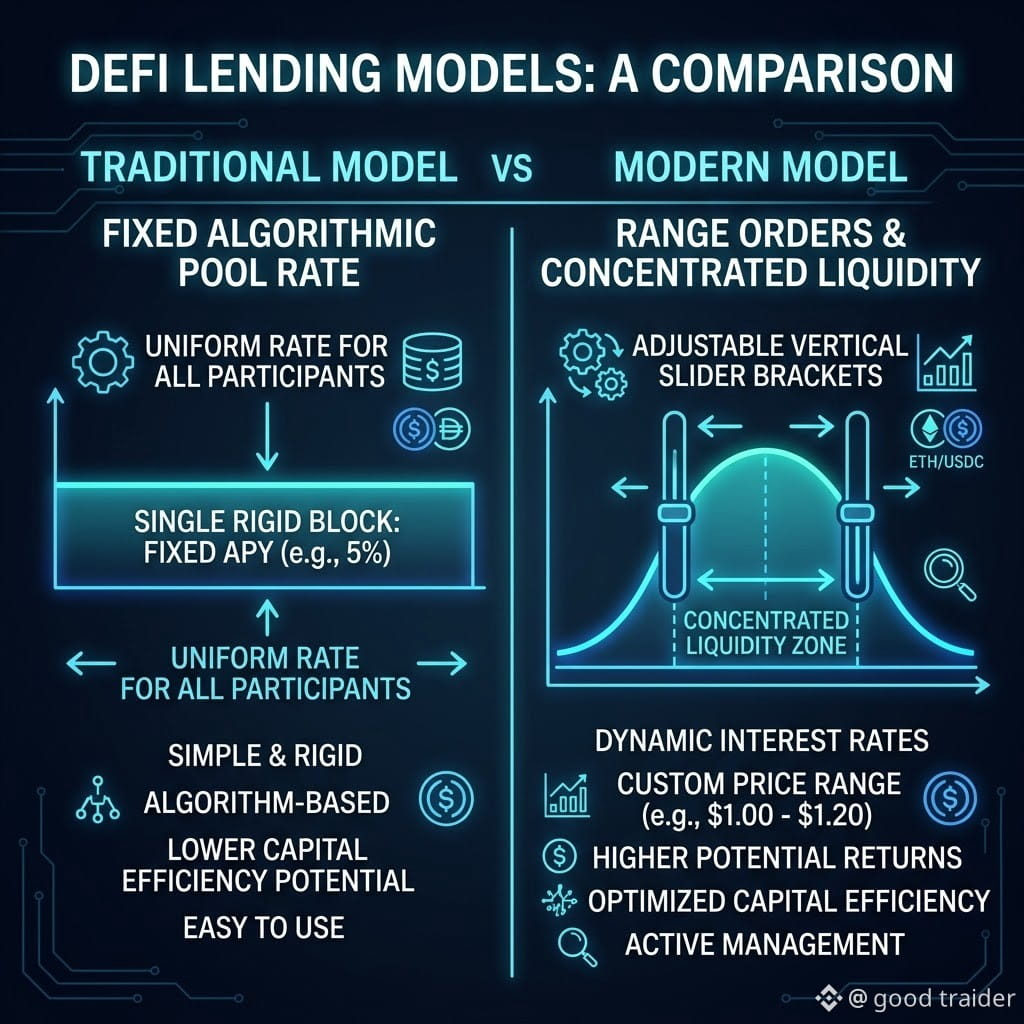
TermMax has brought the concentrated liquidity logic of Uniswap V3 to the lending market.
We are used to liquidity pools dictating our APY using "out-of-the-box" formulas. TermMax took a different approach by applying Uniswap V3’s concentrated liquidity mechanics to borrowing and lending.
They implemented Range Orders for interest rates. This means the rate isn’t decided by a rigid pool algorithm, but by the market makers themselves. You customize your own pricing curves and choose the exact rate at which you are willing to provide liquidity.
The market becomes vastly more efficient because the cost of capital is driven by real supply and demand within specific ranges, rather than being averaged out for everyone across the board.
#termmax @termmax
TermMax has brought the concentrated liquidity logic of Uniswap V3 to the lending market.
We are used to liquidity pools dictating our APY using "out-of-the-box" formulas. TermMax took a different approach by applying Uniswap V3’s concentrated liquidity mechanics to borrowing and lending.
They implemented Range Orders for interest rates. This means the rate isn’t decided by a rigid pool algorithm, but by the market makers themselves. You customize your own pricing curves and choose the exact rate at which you are willing to provide liquidity.
The market becomes vastly more efficient because the cost of capital is driven by real supply and demand within specific ranges, rather than being averaged out for everyone across the board.
#termmax @TermMax
We are used to liquidity pools dictating our APY using "out-of-the-box" formulas. TermMax took a different approach by applying Uniswap V3’s concentrated liquidity mechanics to borrowing and lending.
They implemented Range Orders for interest rates. This means the rate isn’t decided by a rigid pool algorithm, but by the market makers themselves. You customize your own pricing curves and choose the exact rate at which you are willing to provide liquidity.
The market becomes vastly more efficient because the cost of capital is driven by real supply and demand within specific ranges, rather than being averaged out for everyone across the board.
#termmax @TermMax
1
57
·
--
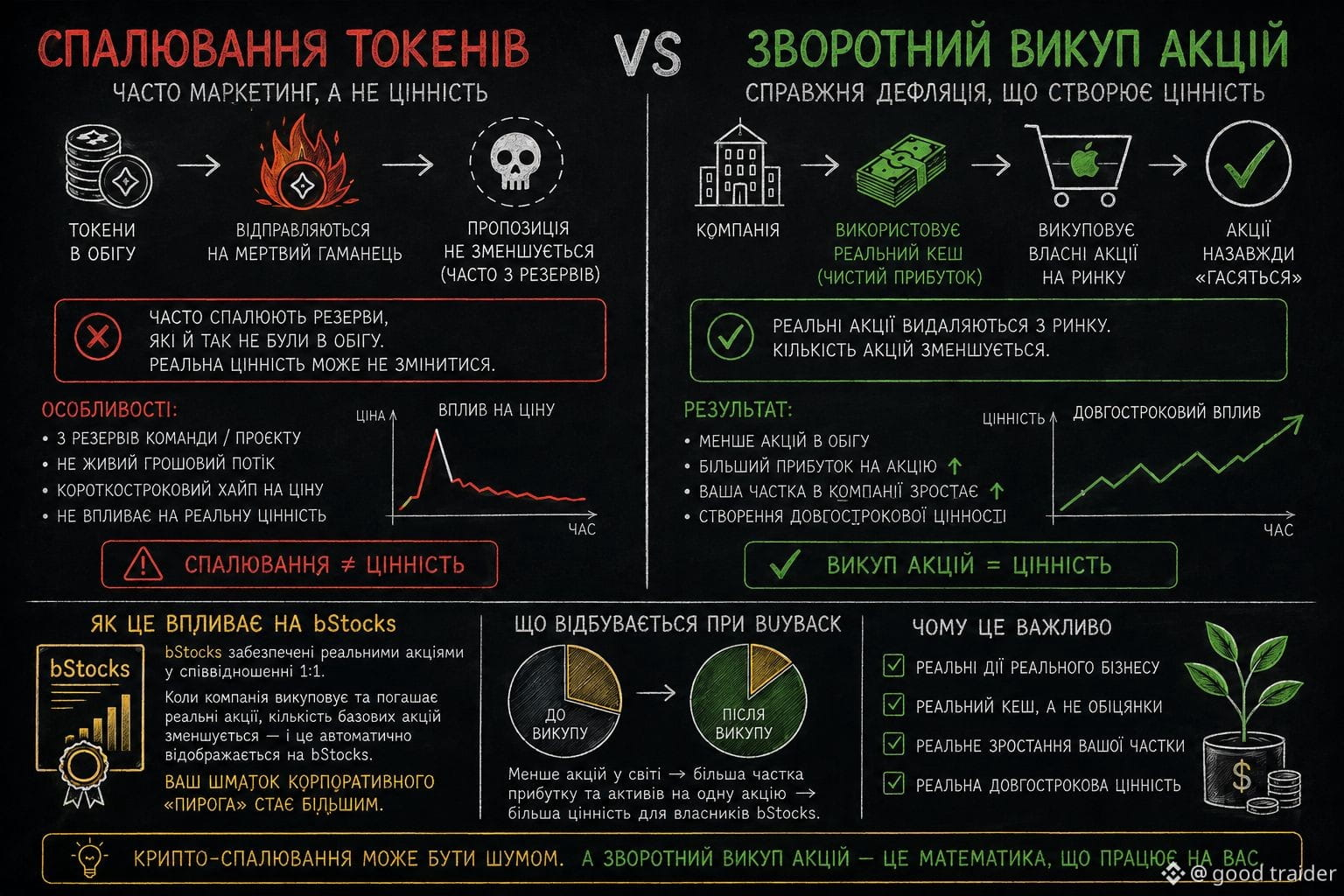
How Real “Asset Burning” Works
In crypto, everyone loves the news about token burns (Token Burn). When developers send millions of coins to a dead wallet, the audience expects an immediate price surge. But often it’s just marketing: reserves are burned that were never actually in circulation, and the asset’s real value doesn’t change.
On the traditional market, there’s a much more honest equivalent to deflation—Share Buybacks. And it directly affects your bStocks.
How it works:
A company (for example, Apple) uses its real, earned net profit in the billions of dollars. It goes into the open market, buys back its own shares from investors just like you, and “extinguishes” them forever.
As a result, the number of real shares in the world decreases, which automatically shows up in the bStocks tokenomics. Your slice of the corporate “pie” becomes bigger.
The difference is fundamental. Crypto burning is often done out of thin air just for hype. And a Buyback is when a real business spends real cash to mathematically increase your share in the company.
@BinanceCIS #bStocksCIS
How Real “Asset Burning” Works
In crypto, everyone loves the news about token burns (Token Burn). When developers send millions of coins to a dead wallet, the audience expects an immediate price surge. But often it’s just marketing: reserves are burned that were never actually in circulation, and the asset’s real value doesn’t change.
On the traditional market, there’s a much more honest equivalent to deflation—Share Buybacks. And it directly affects your bStocks.
How it works:
A company (for example, Apple) uses its real, earned net profit in the billions of dollars. It goes into the open market, buys back its own shares from investors just like you, and “extinguishes” them forever.
As a result, the number of real shares in the world decreases, which automatically shows up in the bStocks tokenomics. Your slice of the corporate “pie” becomes bigger.
The difference is fundamental. Crypto burning is often done out of thin air just for hype. And a Buyback is when a real business spends real cash to mathematically increase your share in the company.
@BinanceCIS #bStocksCIS
In crypto, everyone loves the news about token burns (Token Burn). When developers send millions of coins to a dead wallet, the audience expects an immediate price surge. But often it’s just marketing: reserves are burned that were never actually in circulation, and the asset’s real value doesn’t change.
On the traditional market, there’s a much more honest equivalent to deflation—Share Buybacks. And it directly affects your bStocks.
How it works:
A company (for example, Apple) uses its real, earned net profit in the billions of dollars. It goes into the open market, buys back its own shares from investors just like you, and “extinguishes” them forever.
As a result, the number of real shares in the world decreases, which automatically shows up in the bStocks tokenomics. Your slice of the corporate “pie” becomes bigger.
The difference is fundamental. Crypto burning is often done out of thin air just for hype. And a Buyback is when a real business spends real cash to mathematically increase your share in the company.
@BinanceCIS #bStocksCIS
1
1
82
·
--
#bstockscis @BinanceCIS
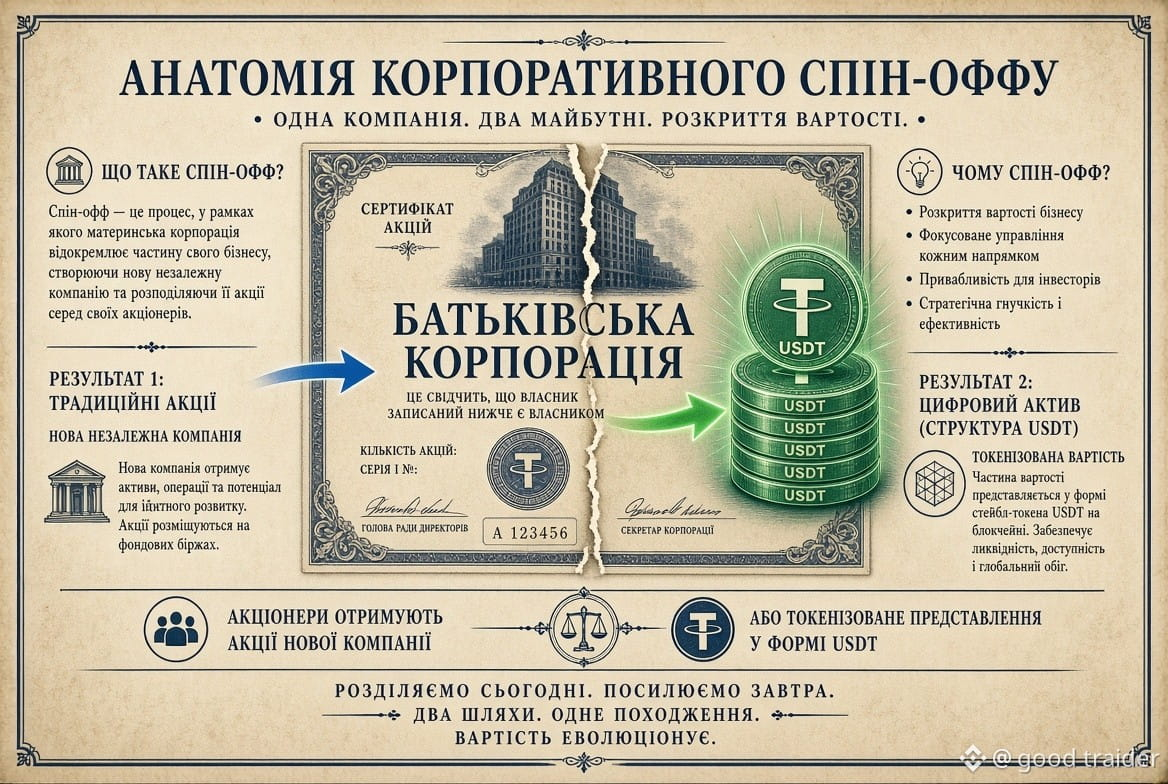
Corporate Airdrop. How bStocks handle spin-offs
A spin-off is the separation of part of a business into a new company. In the traditional market, investors automatically receive its shares. But bStock is a secured derivative, so corporate events here go through a special Corporate Action protocol.
How it works:
• bStock trading is paused to lock the balances.
• The custodian receives the actual shares of the new company.
• The exchange determines the distribution format of this value.
The key nuance: you don’t necessarily receive a new token. If the company doesn’t meet the platform’s listing criteria, a cash compensation is applied. The custodian simply sells the target shares, and you receive their equivalent in USDT in your spot wallet.
The tokenized asset preserves 100% of its value for you during the spin-off. But the format of how you receive it— a new ticker or pure cash—depends on the platform’s rules.
#bstockscis @BinanceCIS
Corporate Airdrop. How bStocks handle spin-offs
A spin-off is the separation of part of a business into a new company. In the traditional market, investors automatically receive its shares. But bStock is a secured derivative, so corporate events here go through a special Corporate Action protocol.
How it works:
• bStock trading is paused to lock the balances.
• The custodian receives the actual shares of the new company.
• The exchange determines the distribution format of this value.
The key nuance: you don’t necessarily receive a new token. If the company doesn’t meet the platform’s listing criteria, a cash compensation is applied. The custodian simply sells the target shares, and you receive their equivalent in USDT in your spot wallet.
The tokenized asset preserves 100% of its value for you during the spin-off. But the format of how you receive it— a new ticker or pure cash—depends on the platform’s rules.
Corporate Airdrop. How bStocks handle spin-offs
A spin-off is the separation of part of a business into a new company. In the traditional market, investors automatically receive its shares. But bStock is a secured derivative, so corporate events here go through a special Corporate Action protocol.
How it works:
• bStock trading is paused to lock the balances.
• The custodian receives the actual shares of the new company.
• The exchange determines the distribution format of this value.
The key nuance: you don’t necessarily receive a new token. If the company doesn’t meet the platform’s listing criteria, a cash compensation is applied. The custodian simply sells the target shares, and you receive their equivalent in USDT in your spot wallet.
The tokenized asset preserves 100% of its value for you during the spin-off. But the format of how you receive it— a new ticker or pure cash—depends on the platform’s rules.
62
·
--
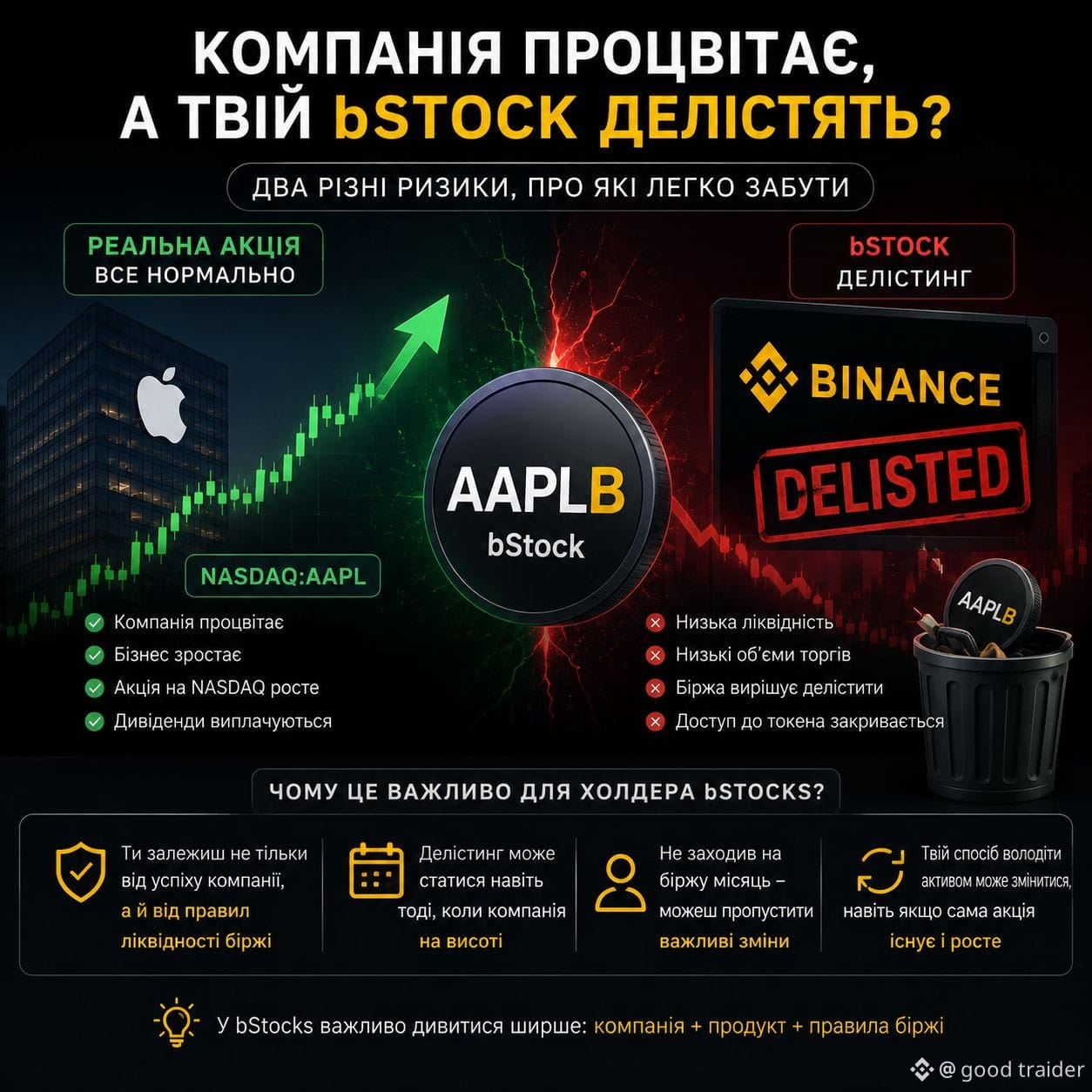
The company is thriving. Its stock is rising. And then your bStock might suddenly be delisted from Binance.
That sounds strange, but these are two different risks.
You can buy $ABC_B while the company itself is operating normally—its shares are trading on the stock exchange, and the business continues to grow.
But Binance may make a separate decision about the availability of that specific bStock.
So:
Real stock → all good 📈
bStock → delisting
And this is an important point.
Delisting a token doesn’t mean the company went bankrupt or that the real stock no longer exists.
It simply means that your way of getting exposure to it through that specific bStock may change.
That’s why bStocks have two different levels of risk:
→ the risk of the company itself
→ the risk that a specific tokenized product will be available
And it’s easy to miss that second one.
You can be completely confident in NVIDIA, Microsoft, or another company—but that doesn’t yet mean that a particular bStock will remain available on Binance forever.
I especially like these kinds of nuances in bStocks.
Because it’s not enough to just ask: “Is this company good?”
@BinanceCIS #bStocksCIS
The company is thriving. Its stock is rising. And then your bStock might suddenly be delisted from Binance.
That sounds strange, but these are two different risks.
You can buy $ABC_B while the company itself is operating normally—its shares are trading on the stock exchange, and the business continues to grow.
But Binance may make a separate decision about the availability of that specific bStock.
So:
Real stock → all good 📈
bStock → delisting
And this is an important point.
Delisting a token doesn’t mean the company went bankrupt or that the real stock no longer exists.
It simply means that your way of getting exposure to it through that specific bStock may change.
That’s why bStocks have two different levels of risk:
→ the risk of the company itself
→ the risk that a specific tokenized product will be available
And it’s easy to miss that second one.
You can be completely confident in NVIDIA, Microsoft, or another company—but that doesn’t yet mean that a particular bStock will remain available on Binance forever.
I especially like these kinds of nuances in bStocks.
Because it’s not enough to just ask: “Is this company good?”
@BinanceCIS #bStocksCIS
That sounds strange, but these are two different risks.
You can buy $ABC_B while the company itself is operating normally—its shares are trading on the stock exchange, and the business continues to grow.
But Binance may make a separate decision about the availability of that specific bStock.
So:
Real stock → all good 📈
bStock → delisting
And this is an important point.
Delisting a token doesn’t mean the company went bankrupt or that the real stock no longer exists.
It simply means that your way of getting exposure to it through that specific bStock may change.
That’s why bStocks have two different levels of risk:
→ the risk of the company itself
→ the risk that a specific tokenized product will be available
And it’s easy to miss that second one.
You can be completely confident in NVIDIA, Microsoft, or another company—but that doesn’t yet mean that a particular bStock will remain available on Binance forever.
I especially like these kinds of nuances in bStocks.
Because it’s not enough to just ask: “Is this company good?”
@BinanceCIS #bStocksCIS
132
·
--
Verified
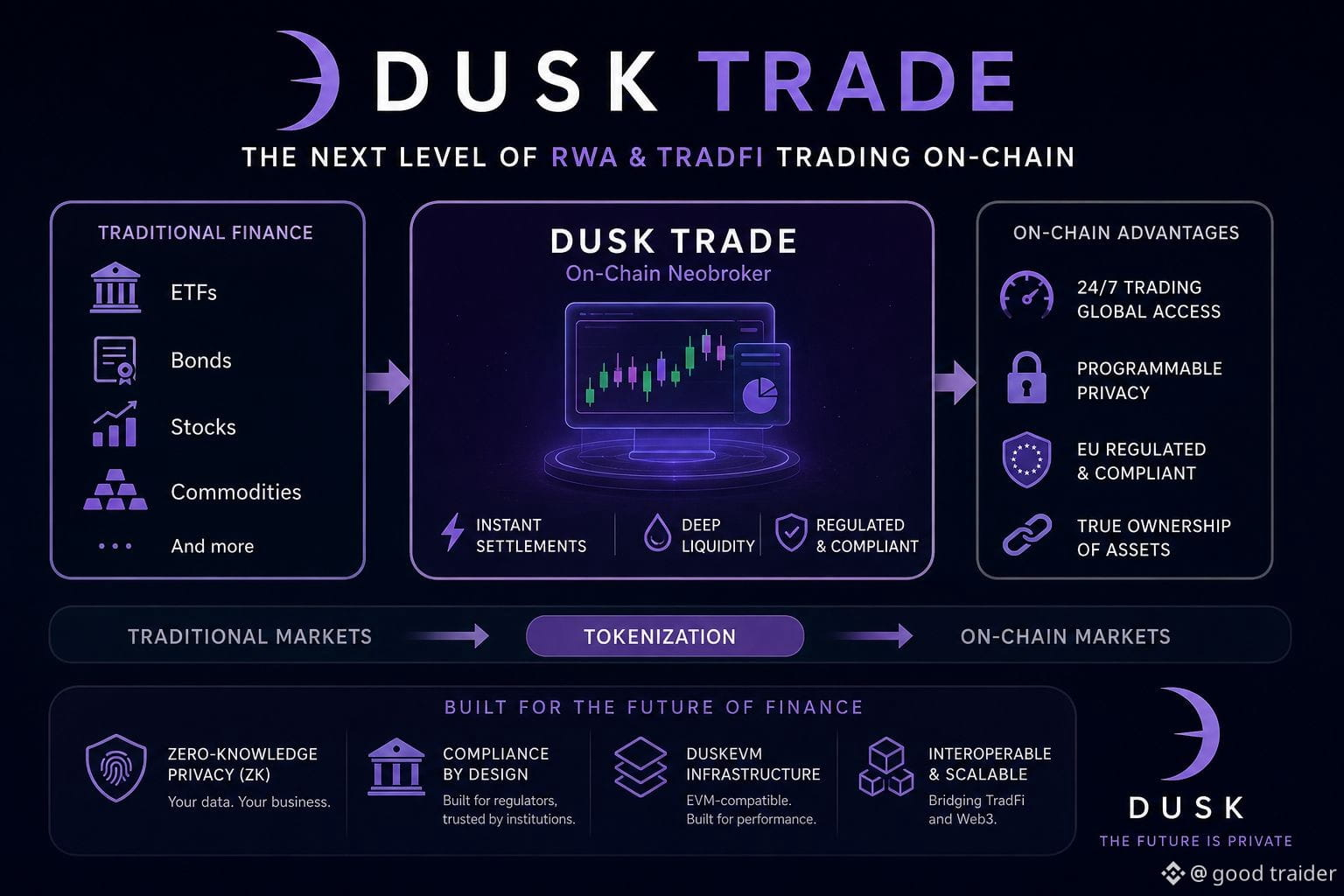
Dusk Trade: A new level of trading RWA and traditional assets on-chain
Everyone is talking about RWA tokenization, but most projects still remain at the stage of beautiful concepts. Observing how the infrastructure is developing, I’ve thoroughly analyzed the mechanics of Dusk Trade. This isn’t just another DEX—it’s a full-fledged on-chain broker for tokenized financial assets.
For me, as a practitioner, the most interesting part is the ability to trade tokenized ETFs, bonds, and other assets from the world of traditional finance, but with instant settlement on the blockchain. We’re used to fast and convenient crypto trading, and now Dusk brings that same speed and liquidity to traditional markets. And most importantly, the platform is being built in full compliance with strict EU regulations.
The combination of such a legal environment with programmable privacy is exactly the kind of architecture that can safely move trillions of dollars from TradFi into Web3. I’ll keep following the project’s progress, because tools like these change the rules of the game.
@Dusk_Foundation $DUSK #dusk
Dusk Trade: A new level of trading RWA and traditional assets on-chain
Everyone is talking about RWA tokenization, but most projects still remain at the stage of beautiful concepts. Observing how the infrastructure is developing, I’ve thoroughly analyzed the mechanics of Dusk Trade. This isn’t just another DEX—it’s a full-fledged on-chain broker for tokenized financial assets.
For me, as a practitioner, the most interesting part is the ability to trade tokenized ETFs, bonds, and other assets from the world of traditional finance, but with instant settlement on the blockchain. We’re used to fast and convenient crypto trading, and now Dusk brings that same speed and liquidity to traditional markets. And most importantly, the platform is being built in full compliance with strict EU regulations.
The combination of such a legal environment with programmable privacy is exactly the kind of architecture that can safely move trillions of dollars from TradFi into Web3. I’ll keep following the project’s progress, because tools like these change the rules of the game.
@Dusk $DUSK #dusk
Everyone is talking about RWA tokenization, but most projects still remain at the stage of beautiful concepts. Observing how the infrastructure is developing, I’ve thoroughly analyzed the mechanics of Dusk Trade. This isn’t just another DEX—it’s a full-fledged on-chain broker for tokenized financial assets.
For me, as a practitioner, the most interesting part is the ability to trade tokenized ETFs, bonds, and other assets from the world of traditional finance, but with instant settlement on the blockchain. We’re used to fast and convenient crypto trading, and now Dusk brings that same speed and liquidity to traditional markets. And most importantly, the platform is being built in full compliance with strict EU regulations.
The combination of such a legal environment with programmable privacy is exactly the kind of architecture that can safely move trillions of dollars from TradFi into Web3. I’ll keep following the project’s progress, because tools like these change the rules of the game.
@Dusk $DUSK #dusk
1
96
·
--
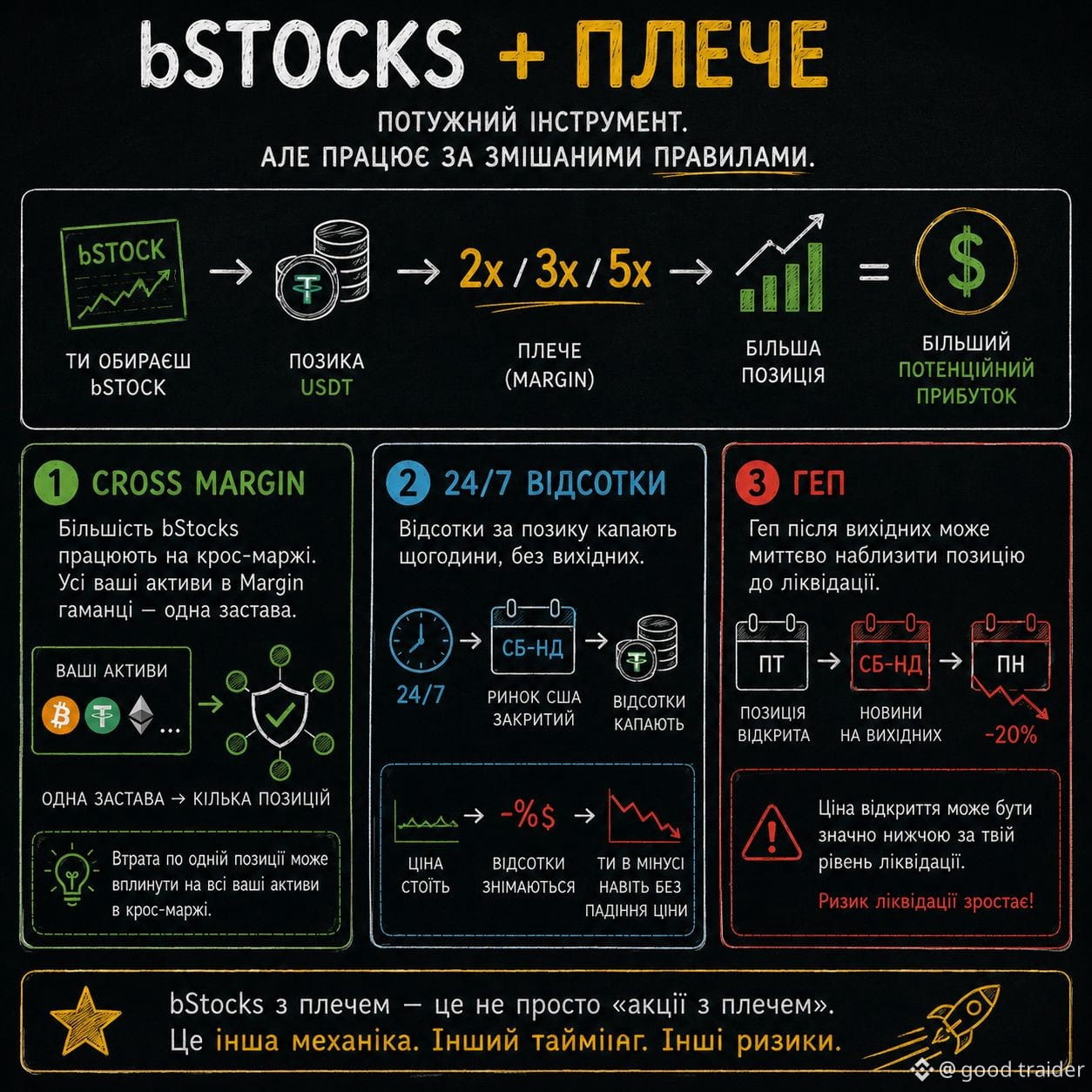
#bstockscis Trading bStocks with leverage. Sounds cool, but there are surprises 👀
At first glance — it’s just like crypto: you borrow USDT, increase your position, earn more.
But there’s a catch.
When you take assets on loan, interest accrues every hour.
🇺🇸 The US market is closed.
📈 The bStock keeps trading.
💸 The interest on the loan keeps dripping in.
That means a trading day off for the stock market doesn’t necessarily mean a “day off” for your margin loan.
And then it gets even more interesting.
I opened a leveraged position on Friday. During the weekend, a bad news shows up. And on Monday the real stock opens with a big gap down.
Your position can end up much closer to liquidation right away.
And this is entirely different math than Spot.
In bStocks + Margin, all of this works at the same time: → bStock price
→ liquidity
→ loan cost
→ Margin Level
→ the US market trading schedule
→ possible gaps.
Those are the mechanics I find interesting to explore in bStocks.
The “Margin” button looks simple.
But what happens after you press it is much more interesting.
Would you hold a leveraged bStock through the weekend?
@BinanceCIS #bStocksCIS
#bstockscis Trading bStocks with leverage. Sounds cool, but there are surprises 👀
At first glance — it’s just like crypto: you borrow USDT, increase your position, earn more.
But there’s a catch.
When you take assets on loan, interest accrues every hour.
🇺🇸 The US market is closed.
📈 The bStock keeps trading.
💸 The interest on the loan keeps dripping in.
That means a trading day off for the stock market doesn’t necessarily mean a “day off” for your margin loan.
And then it gets even more interesting.
I opened a leveraged position on Friday. During the weekend, a bad news shows up. And on Monday the real stock opens with a big gap down.
Your position can end up much closer to liquidation right away.
And this is entirely different math than Spot.
In bStocks + Margin, all of this works at the same time: → bStock price
→ liquidity
→ loan cost
→ Margin Level
→ the US market trading schedule
→ possible gaps.
Those are the mechanics I find interesting to explore in bStocks.
The “Margin” button looks simple.
But what happens after you press it is much more interesting.
Would you hold a leveraged bStock through the weekend?
@BinanceCIS #bStocksCIS
At first glance — it’s just like crypto: you borrow USDT, increase your position, earn more.
But there’s a catch.
When you take assets on loan, interest accrues every hour.
🇺🇸 The US market is closed.
📈 The bStock keeps trading.
💸 The interest on the loan keeps dripping in.
That means a trading day off for the stock market doesn’t necessarily mean a “day off” for your margin loan.
And then it gets even more interesting.
I opened a leveraged position on Friday. During the weekend, a bad news shows up. And on Monday the real stock opens with a big gap down.
Your position can end up much closer to liquidation right away.
And this is entirely different math than Spot.
In bStocks + Margin, all of this works at the same time: → bStock price
→ liquidity
→ loan cost
→ Margin Level
→ the US market trading schedule
→ possible gaps.
Those are the mechanics I find interesting to explore in bStocks.
The “Margin” button looks simple.
But what happens after you press it is much more interesting.
Would you hold a leveraged bStock through the weekend?
@BinanceCIS #bStocksCIS
1
73
·
--
Verified
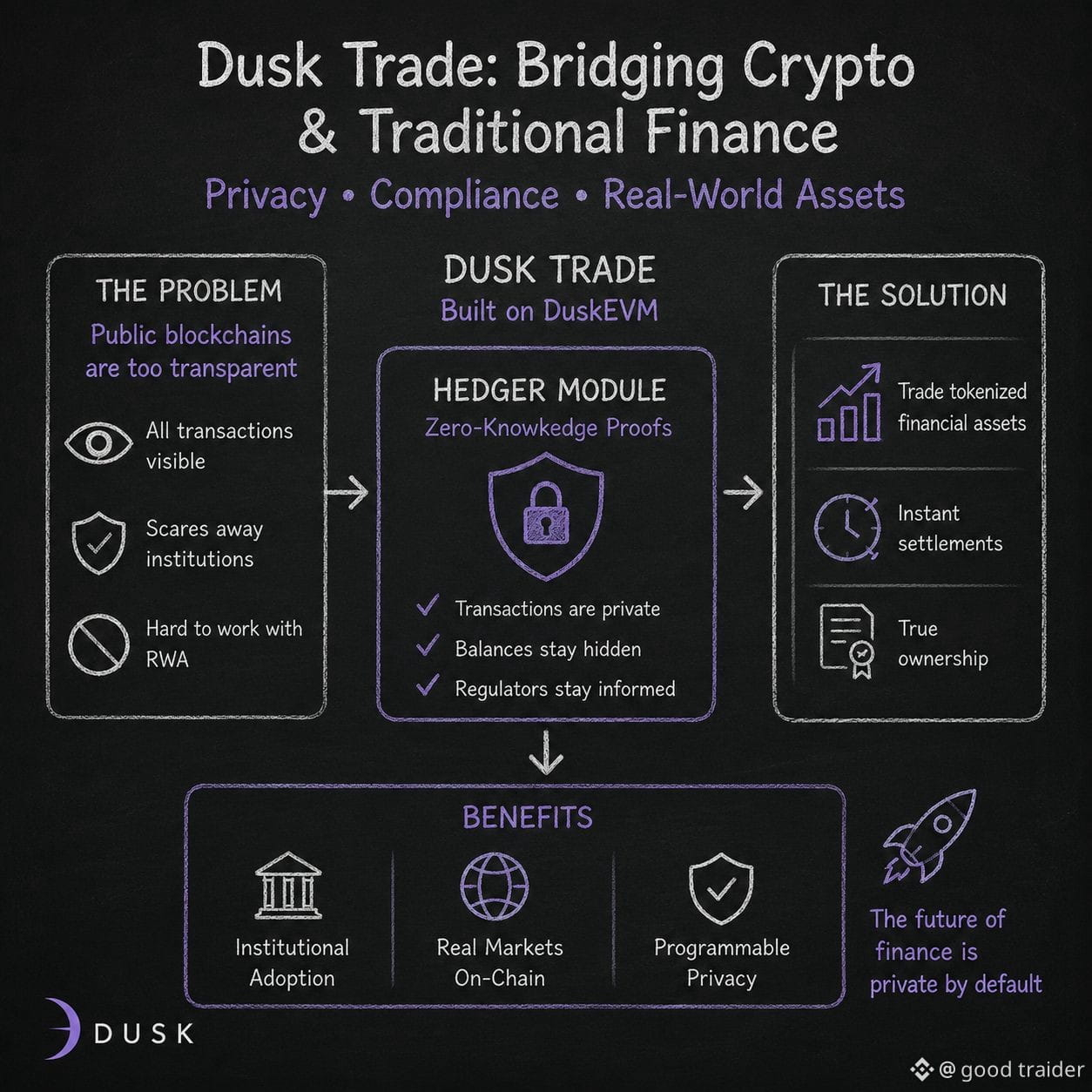
#dusk $DUSK Working every day with crypto and analyzing market mechanics, I often think about how to bridge the gap between our familiar exchanges and traditional finance. The main problem with open blockchains is absolute transparency, which scares off large capital and prevents proper handling of real-world assets (RWA).
While exploring new tools, I noticed the Dusk ecosystem—specifically, their upcoming Dusk Trade platform built on DuskEVM. As a user who regularly executes trading operations, there’s a very cool feature here: the ability to trade tokenized financial assets with instant settlement and true ownership rights.
They solve a fundamental market pain by using Zero-Knowledge Proofs technology in their Hedger module. This means you can interact with DeFi instruments completely legally and transparently for regulators, while still keeping full confidentiality of your trades and balances from prying eyes.
I believe that this kind of “programmable privacy” is the future, because it makes it possible to safely move real markets on-chain. I’m looking forward to the full mainnet launch to test these capabilities.
@Dusk_Foundation
#dusk $DUSK Working every day with crypto and analyzing market mechanics, I often think about how to bridge the gap between our familiar exchanges and traditional finance. The main problem with open blockchains is absolute transparency, which scares off large capital and prevents proper handling of real-world assets (RWA).
While exploring new tools, I noticed the Dusk ecosystem—specifically, their upcoming Dusk Trade platform built on DuskEVM. As a user who regularly executes trading operations, there’s a very cool feature here: the ability to trade tokenized financial assets with instant settlement and true ownership rights.
They solve a fundamental market pain by using Zero-Knowledge Proofs technology in their Hedger module. This means you can interact with DeFi instruments completely legally and transparently for regulators, while still keeping full confidentiality of your trades and balances from prying eyes.
I believe that this kind of “programmable privacy” is the future, because it makes it possible to safely move real markets on-chain. I’m looking forward to the full mainnet launch to test these capabilities.
@Dusk
While exploring new tools, I noticed the Dusk ecosystem—specifically, their upcoming Dusk Trade platform built on DuskEVM. As a user who regularly executes trading operations, there’s a very cool feature here: the ability to trade tokenized financial assets with instant settlement and true ownership rights.
They solve a fundamental market pain by using Zero-Knowledge Proofs technology in their Hedger module. This means you can interact with DeFi instruments completely legally and transparently for regulators, while still keeping full confidentiality of your trades and balances from prying eyes.
I believe that this kind of “programmable privacy” is the future, because it makes it possible to safely move real markets on-chain. I’m looking forward to the full mainnet launch to test these capabilities.
@Dusk
1
78
·
--
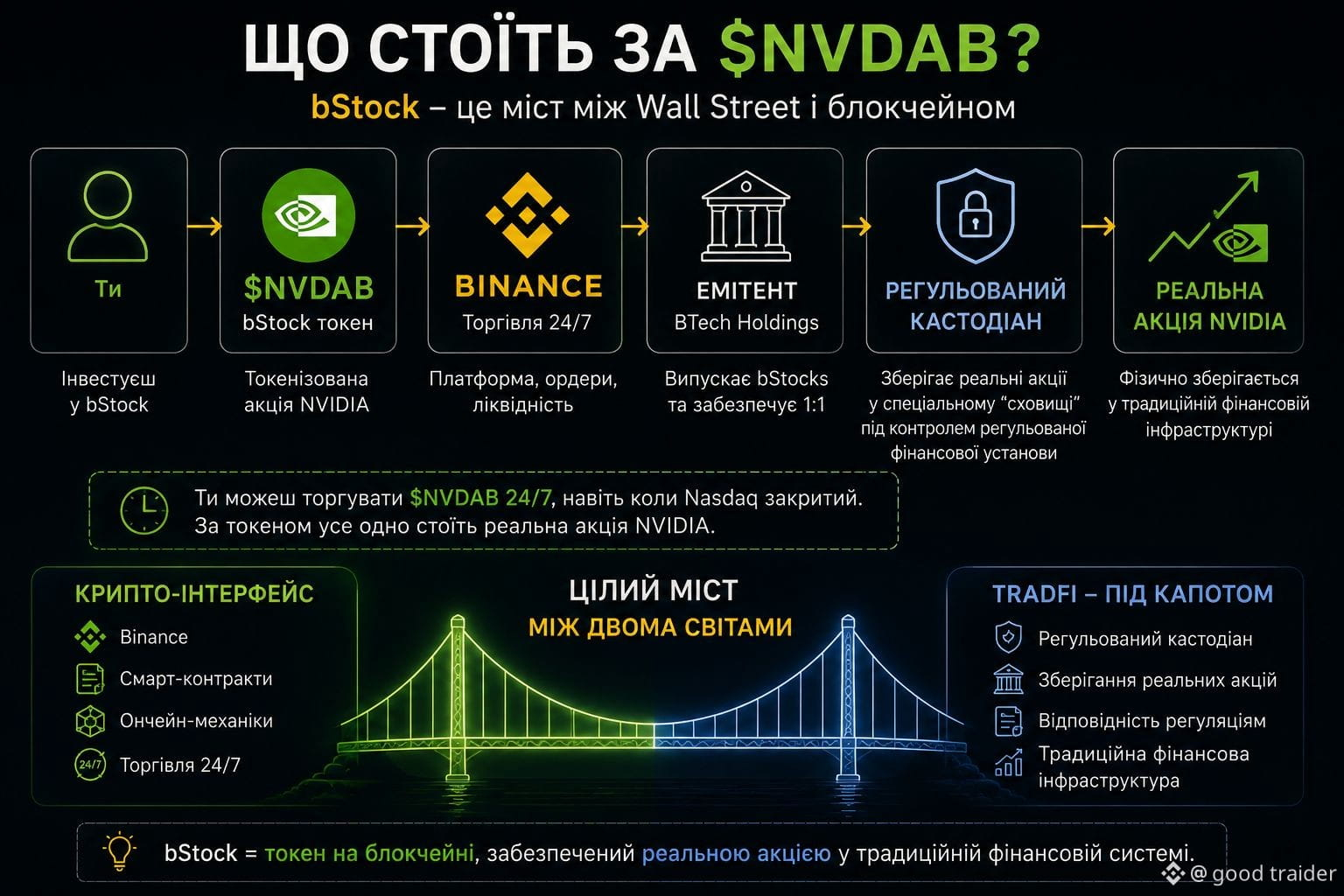
#bstockscis Can you see in bStocks just $NVDAB. But what stands behind this token?
In fact, there’s a whole infrastructure between your bStock and the real stock.
You → $NVDAB → Binance → issuer → regulated custodian → the real NVIDIA share.
It’s the custodian that holds the real shares that back bStocks.
In simple terms, it’s a “vault” of real shares under the control of a regulated financial institution.
And on top of that, Binance, smart contracts, and on-chain mechanics operate.
That means bStock isn’t just “a share wrapped into a token.”
It’s a whole bridge between Wall Street and the blockchain.
And the most interesting part: when you trade $NVDAB at 3 a.m. on Saturday, a real share still stands behind this token—physically located in the traditional financial infrastructure.
A crypto interface on top.
TradFi under the hood. 👀
That’s exactly the kind of details I like about bStocks 😅
@BinanceCIS #bStocksCIS
#bstockscis Can you see in bStocks just $NVDAB. But what stands behind this token?
In fact, there’s a whole infrastructure between your bStock and the real stock.
You → $NVDAB → Binance → issuer → regulated custodian → the real NVIDIA share.
It’s the custodian that holds the real shares that back bStocks.
In simple terms, it’s a “vault” of real shares under the control of a regulated financial institution.
And on top of that, Binance, smart contracts, and on-chain mechanics operate.
That means bStock isn’t just “a share wrapped into a token.”
It’s a whole bridge between Wall Street and the blockchain.
And the most interesting part: when you trade $NVDAB at 3 a.m. on Saturday, a real share still stands behind this token—physically located in the traditional financial infrastructure.
A crypto interface on top.
TradFi under the hood. 👀
That’s exactly the kind of details I like about bStocks 😅
@BinanceCIS #bStocksCIS
In fact, there’s a whole infrastructure between your bStock and the real stock.
You → $NVDAB → Binance → issuer → regulated custodian → the real NVIDIA share.
It’s the custodian that holds the real shares that back bStocks.
In simple terms, it’s a “vault” of real shares under the control of a regulated financial institution.
And on top of that, Binance, smart contracts, and on-chain mechanics operate.
That means bStock isn’t just “a share wrapped into a token.”
It’s a whole bridge between Wall Street and the blockchain.
And the most interesting part: when you trade $NVDAB at 3 a.m. on Saturday, a real share still stands behind this token—physically located in the traditional financial infrastructure.
A crypto interface on top.
TradFi under the hood. 👀
That’s exactly the kind of details I like about bStocks 😅
@BinanceCIS #bStocksCIS
1
86
·
--
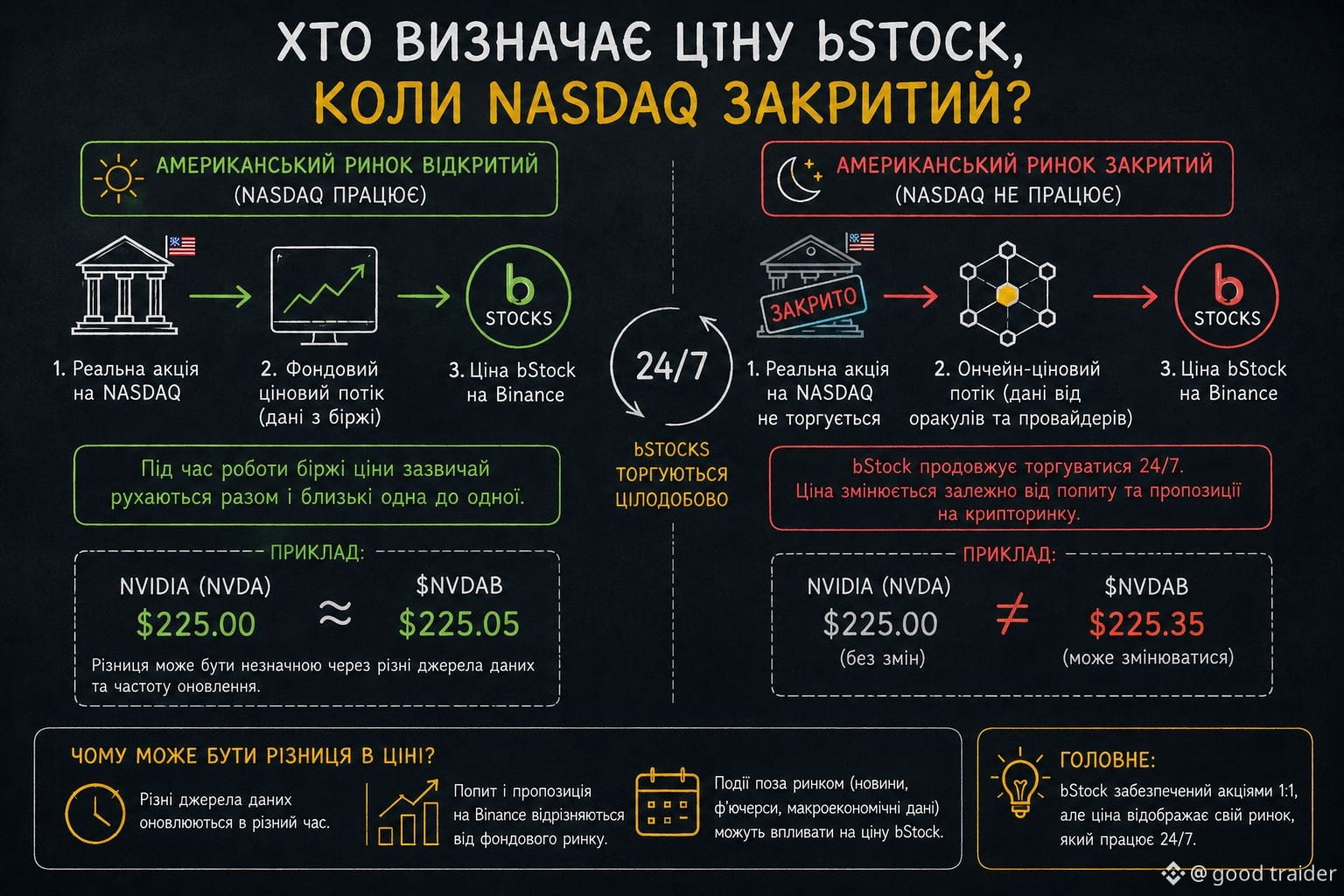
#bstockscis Who actually sets the price of bStock when Nasdaq is closed? 👀
Interesting detail: the bStock price and the real stock price are not taken from the same source.
For bStock, an on-chain price feed is used, while the stock itself uses a separate stock market feed.
And they update at different frequencies.
So even with a 1:1 backing, a small difference in price is a normal situation.
For example:
NVIDIA → $225,00
$NVDAB → $225,15
This doesn’t mean the token is “overvalued” or that something is broken.
It’s just that two data sources may not update in the very same second.
And now the most interesting part 👇
When the U.S. market is closed, bStock continues trading on Binance, while the price of the actual stock essentially doesn’t change on the main exchange.
That means bStocks are not just a copy of the stock chart.
Under the hood, there’s a separate pricing data system, oracles, and mechanisms that help keep the price close to the underlying asset.
I really like details like this.
Because on the screen you only see $NVDAB, and underneath, a whole TradFi + blockchain system is working. 😅
#bStocksCIS @BinanceCIS
#bstockscis Who actually sets the price of bStock when Nasdaq is closed? 👀
Interesting detail: the bStock price and the real stock price are not taken from the same source.
For bStock, an on-chain price feed is used, while the stock itself uses a separate stock market feed.
And they update at different frequencies.
So even with a 1:1 backing, a small difference in price is a normal situation.
For example:
NVIDIA → $225,00
$NVDAB → $225,15
This doesn’t mean the token is “overvalued” or that something is broken.
It’s just that two data sources may not update in the very same second.
And now the most interesting part 👇
When the U.S. market is closed, bStock continues trading on Binance, while the price of the actual stock essentially doesn’t change on the main exchange.
That means bStocks are not just a copy of the stock chart.
Under the hood, there’s a separate pricing data system, oracles, and mechanisms that help keep the price close to the underlying asset.
I really like details like this.
Because on the screen you only see $NVDAB, and underneath, a whole TradFi + blockchain system is working. 😅
#bStocksCIS @BinanceCIS
Interesting detail: the bStock price and the real stock price are not taken from the same source.
For bStock, an on-chain price feed is used, while the stock itself uses a separate stock market feed.
And they update at different frequencies.
So even with a 1:1 backing, a small difference in price is a normal situation.
For example:
NVIDIA → $225,00
$NVDAB → $225,15
This doesn’t mean the token is “overvalued” or that something is broken.
It’s just that two data sources may not update in the very same second.
And now the most interesting part 👇
When the U.S. market is closed, bStock continues trading on Binance, while the price of the actual stock essentially doesn’t change on the main exchange.
That means bStocks are not just a copy of the stock chart.
Under the hood, there’s a separate pricing data system, oracles, and mechanisms that help keep the price close to the underlying asset.
I really like details like this.
Because on the screen you only see $NVDAB, and underneath, a whole TradFi + blockchain system is working. 😅
#bStocksCIS @BinanceCIS
1
142
·
--
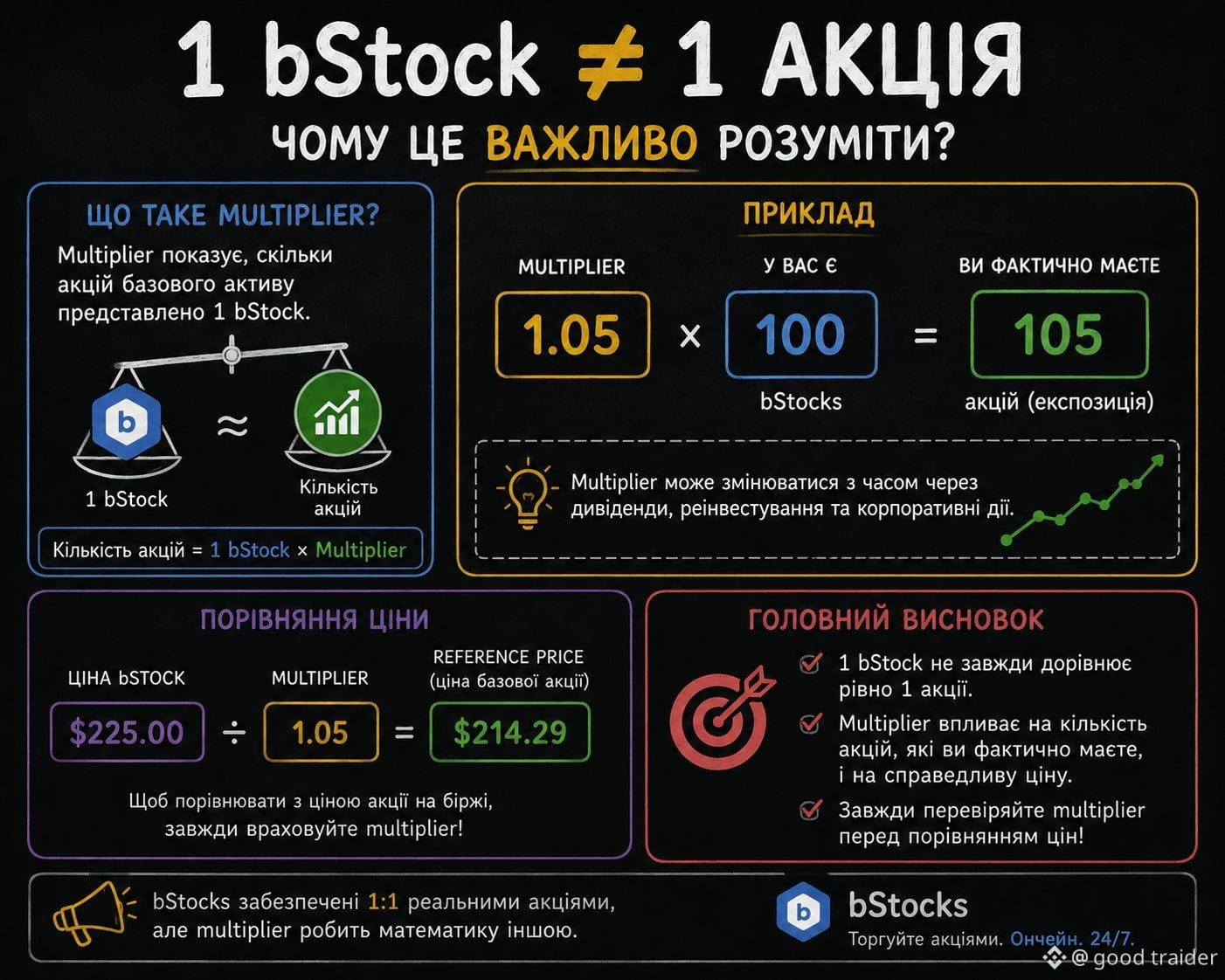
#bstockscis Do you think, 1 bStock = 1 share? Not always 👀
Here’s a small detail that’s easy to miss.
bStocks have a parameter called Multiplier.
For example, if Multiplier = 1.05, then 1 token actually corresponds to 1.05 shares of the underlying asset.
And because of that, simply looking at:
NVDAB = $225 and NVIDIA = $225 isn’t always correct.
You need to account for the Multiplier.
On Binance, there’s even a separate formula for this:
token price ÷ Multiplier = reference price
And the Multiplier itself can gradually change due to corporate events and dividend reinvestment.
So the token price may look almost the same, but the amount of the underlying asset it represents will be different already.
A small number in the documentation, but for understanding bStocks it’s quite important 😅
Because it turns out interesting:
**1 token ≠ necessarily 1 share forever.**
Did you ever check this Multiplier before? 👀
#bStocksCIS @BinanceCIS
#bstockscis Do you think, 1 bStock = 1 share? Not always 👀
Here’s a small detail that’s easy to miss.
bStocks have a parameter called Multiplier.
For example, if Multiplier = 1.05, then 1 token actually corresponds to 1.05 shares of the underlying asset.
And because of that, simply looking at:
NVDAB = $225 and NVIDIA = $225 isn’t always correct.
You need to account for the Multiplier.
On Binance, there’s even a separate formula for this:
token price ÷ Multiplier = reference price
And the Multiplier itself can gradually change due to corporate events and dividend reinvestment.
So the token price may look almost the same, but the amount of the underlying asset it represents will be different already.
A small number in the documentation, but for understanding bStocks it’s quite important 😅
Because it turns out interesting:
**1 token ≠ necessarily 1 share forever.**
Did you ever check this Multiplier before? 👀
#bStocksCIS @BinanceCIS
Here’s a small detail that’s easy to miss.
bStocks have a parameter called Multiplier.
For example, if Multiplier = 1.05, then 1 token actually corresponds to 1.05 shares of the underlying asset.
And because of that, simply looking at:
NVDAB = $225 and NVIDIA = $225 isn’t always correct.
You need to account for the Multiplier.
On Binance, there’s even a separate formula for this:
token price ÷ Multiplier = reference price
And the Multiplier itself can gradually change due to corporate events and dividend reinvestment.
So the token price may look almost the same, but the amount of the underlying asset it represents will be different already.
A small number in the documentation, but for understanding bStocks it’s quite important 😅
Because it turns out interesting:
**1 token ≠ necessarily 1 share forever.**
Did you ever check this Multiplier before? 👀
#bStocksCIS @BinanceCIS
1
80
·
--
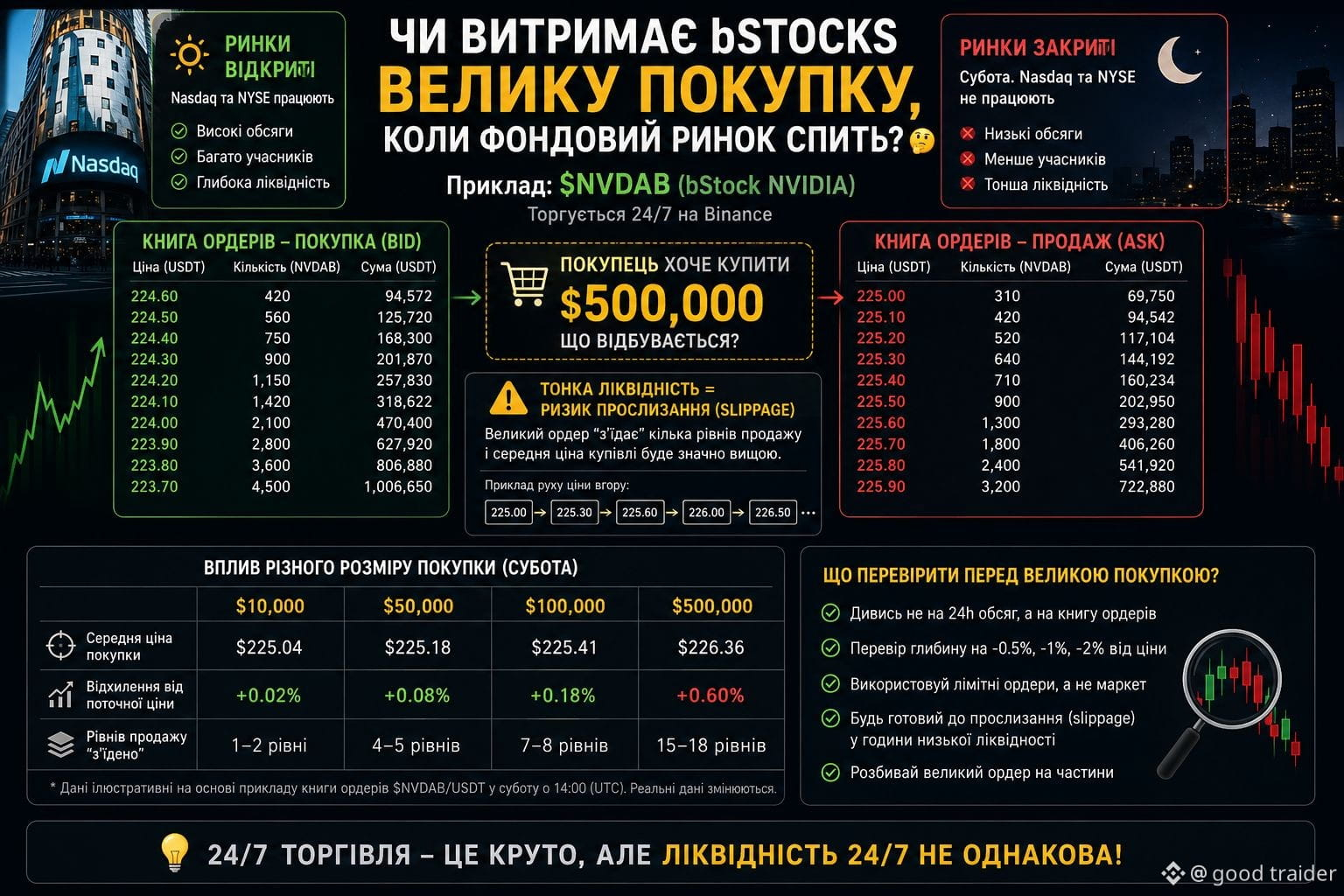
Can bStocks handle a big buy when the stock market is sleeping?
During the day, Nasdaq is open — huge volume and deep liquidity.
And now it’s Saturday. Nasdaq and NYSE are closed, but $NVDAB continues trading on Binance.
And then a buyer comes in with $500,000.
If the order book is thin, it will start “eating” through levels:
$226 → $226.5 → $227 → $228…
As a result, the average price will be significantly higher.
So the key point is:
Volume ≠ Liquidity.
You can trade $500K with hundreds of small trades, but still not have enough depth in the order book for one large order.
I’d look not at 24h volume, but at the actual orders in the book: how much liquidity there is within -0.5%, -1%, and -2%.
Because 24/7 trading is cool. But 24/7 liquidity ≠ the same liquidity. 👀
Would you enter with $100K+ in a bStock on Saturday?
#bStocksCIS @BinanceCIS
Can bStocks handle a big buy when the stock market is sleeping?
During the day, Nasdaq is open — huge volume and deep liquidity.
And now it’s Saturday. Nasdaq and NYSE are closed, but $NVDAB continues trading on Binance.
And then a buyer comes in with $500,000.
If the order book is thin, it will start “eating” through levels:
$226 → $226.5 → $227 → $228…
As a result, the average price will be significantly higher.
So the key point is:
Volume ≠ Liquidity.
You can trade $500K with hundreds of small trades, but still not have enough depth in the order book for one large order.
I’d look not at 24h volume, but at the actual orders in the book: how much liquidity there is within -0.5%, -1%, and -2%.
Because 24/7 trading is cool. But 24/7 liquidity ≠ the same liquidity. 👀
Would you enter with $100K+ in a bStock on Saturday?
#bStocksCIS @BinanceCIS
During the day, Nasdaq is open — huge volume and deep liquidity.
And now it’s Saturday. Nasdaq and NYSE are closed, but $NVDAB continues trading on Binance.
And then a buyer comes in with $500,000.
If the order book is thin, it will start “eating” through levels:
$226 → $226.5 → $227 → $228…
As a result, the average price will be significantly higher.
So the key point is:
Volume ≠ Liquidity.
You can trade $500K with hundreds of small trades, but still not have enough depth in the order book for one large order.
I’d look not at 24h volume, but at the actual orders in the book: how much liquidity there is within -0.5%, -1%, and -2%.
Because 24/7 trading is cool. But 24/7 liquidity ≠ the same liquidity. 👀
Would you enter with $100K+ in a bStock on Saturday?
#bStocksCIS @BinanceCIS
3
268
·
--
$GRVT — pump BEFORE or AFTER unlock?
I got in at $30 for about ~$0.29.
My bet is simple: I want to see a pump before the next Community Airdrop unlock and exit in profit.
But there’s one catch 🤔
What if everyone is waiting for a pump before the unlock, and the market makers do the opposite?
First — unlock → sell-side pressure → a dip.
And then — a pump once most weak hands are out.
🎯 My forecast: a pump before unlock.
What do you think?
Will $GRVT be above or below $0.29 before unlock?
Drop your price in the comments. Let’s see who guessed right 👇
$GRVT — pump BEFORE or AFTER unlock?
I got in at $30 for about ~$0.29.
My bet is simple: I want to see a pump before the next Community Airdrop unlock and exit in profit.
But there’s one catch 🤔
What if everyone is waiting for a pump before the unlock, and the market makers do the opposite?
First — unlock → sell-side pressure → a dip.
And then — a pump once most weak hands are out.
🎯 My forecast: a pump before unlock.
What do you think?
Will $GRVT be above or below $0.29 before unlock?
Drop your price in the comments. Let’s see who guessed right 👇
I got in at $30 for about ~$0.29.
My bet is simple: I want to see a pump before the next Community Airdrop unlock and exit in profit.
But there’s one catch 🤔
What if everyone is waiting for a pump before the unlock, and the market makers do the opposite?
First — unlock → sell-side pressure → a dip.
And then — a pump once most weak hands are out.
🎯 My forecast: a pump before unlock.
What do you think?
Will $GRVT be above or below $0.29 before unlock?
Drop your price in the comments. Let’s see who guessed right 👇
1
1.1k
·
--
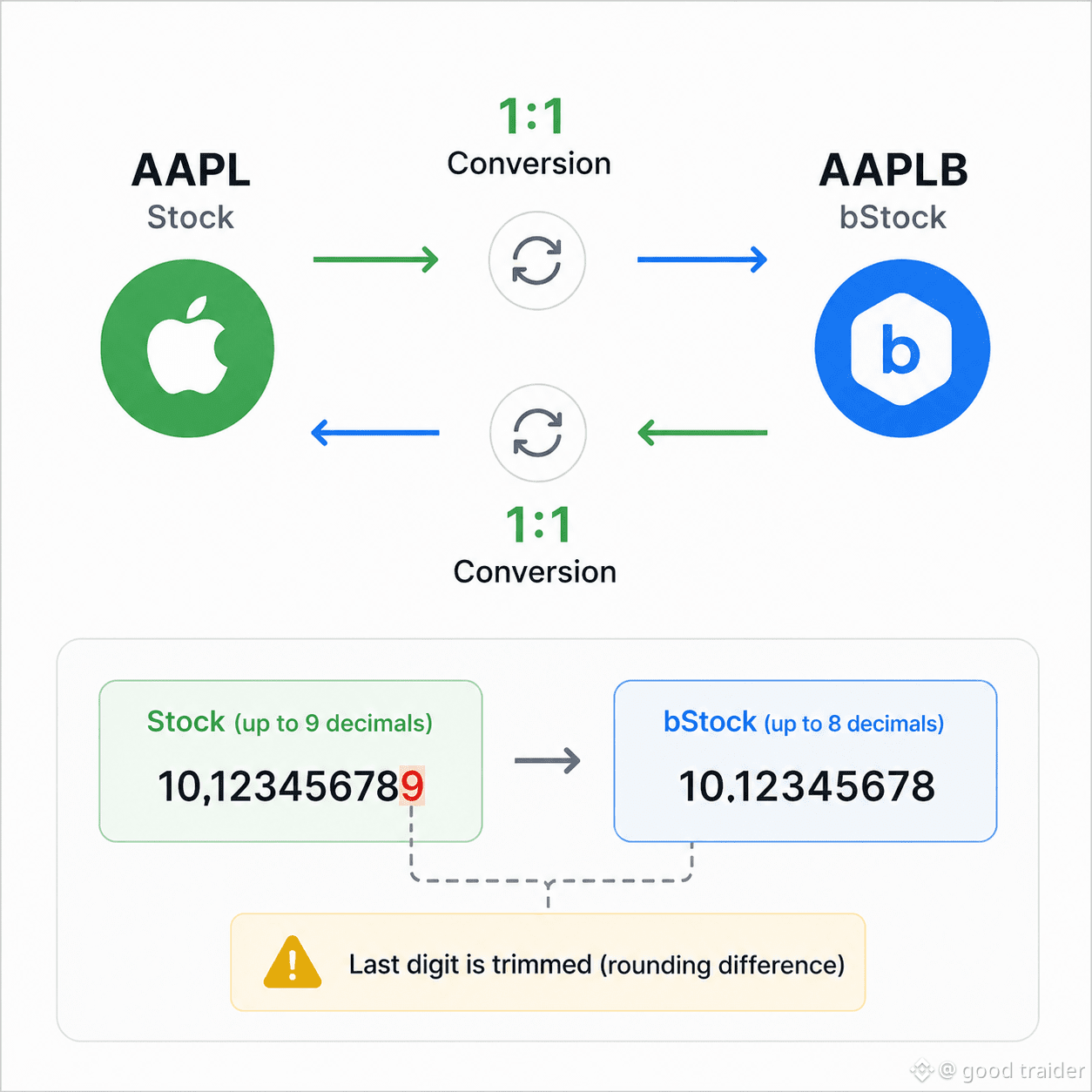
There’s a small detail in bStocks that’s easy to miss 👀
When converting a stock → bStock, it doesn’t always come out perfectly “to the last digit.”
Why?
Ordinary stocks in the system can be recorded with up to 9 digits after the decimal point, while bStocks support up to 8.
For example:
10,123456789 AAPL
↓
10,12345678 AAPLB
The last digit simply doesn’t carry over into the token.
It looks like pennies, but at large volumes these little differences start to matter.
But it’s not a hidden fee.
Binance documentation explicitly describes it as a rounding difference — the remainder caused by different accounting precision.
I like these kinds of details.
Because when you see “1:1 conversion,” it’s easy to assume there are no technical nuances at all.
And there are 😅
#bStocksCIS @BinanceCIS
There’s a small detail in bStocks that’s easy to miss 👀
When converting a stock → bStock, it doesn’t always come out perfectly “to the last digit.”
Why?
Ordinary stocks in the system can be recorded with up to 9 digits after the decimal point, while bStocks support up to 8.
For example:
10,123456789 AAPL
↓
10,12345678 AAPLB
The last digit simply doesn’t carry over into the token.
It looks like pennies, but at large volumes these little differences start to matter.
But it’s not a hidden fee.
Binance documentation explicitly describes it as a rounding difference — the remainder caused by different accounting precision.
I like these kinds of details.
Because when you see “1:1 conversion,” it’s easy to assume there are no technical nuances at all.
And there are 😅
#bStocksCIS @BinanceCIS
When converting a stock → bStock, it doesn’t always come out perfectly “to the last digit.”
Why?
Ordinary stocks in the system can be recorded with up to 9 digits after the decimal point, while bStocks support up to 8.
For example:
10,123456789 AAPL
↓
10,12345678 AAPLB
The last digit simply doesn’t carry over into the token.
It looks like pennies, but at large volumes these little differences start to matter.
But it’s not a hidden fee.
Binance documentation explicitly describes it as a rounding difference — the remainder caused by different accounting precision.
I like these kinds of details.
Because when you see “1:1 conversion,” it’s easy to assume there are no technical nuances at all.
And there are 😅
#bStocksCIS @BinanceCIS
57
·
--
Verified
#bStocksCIS
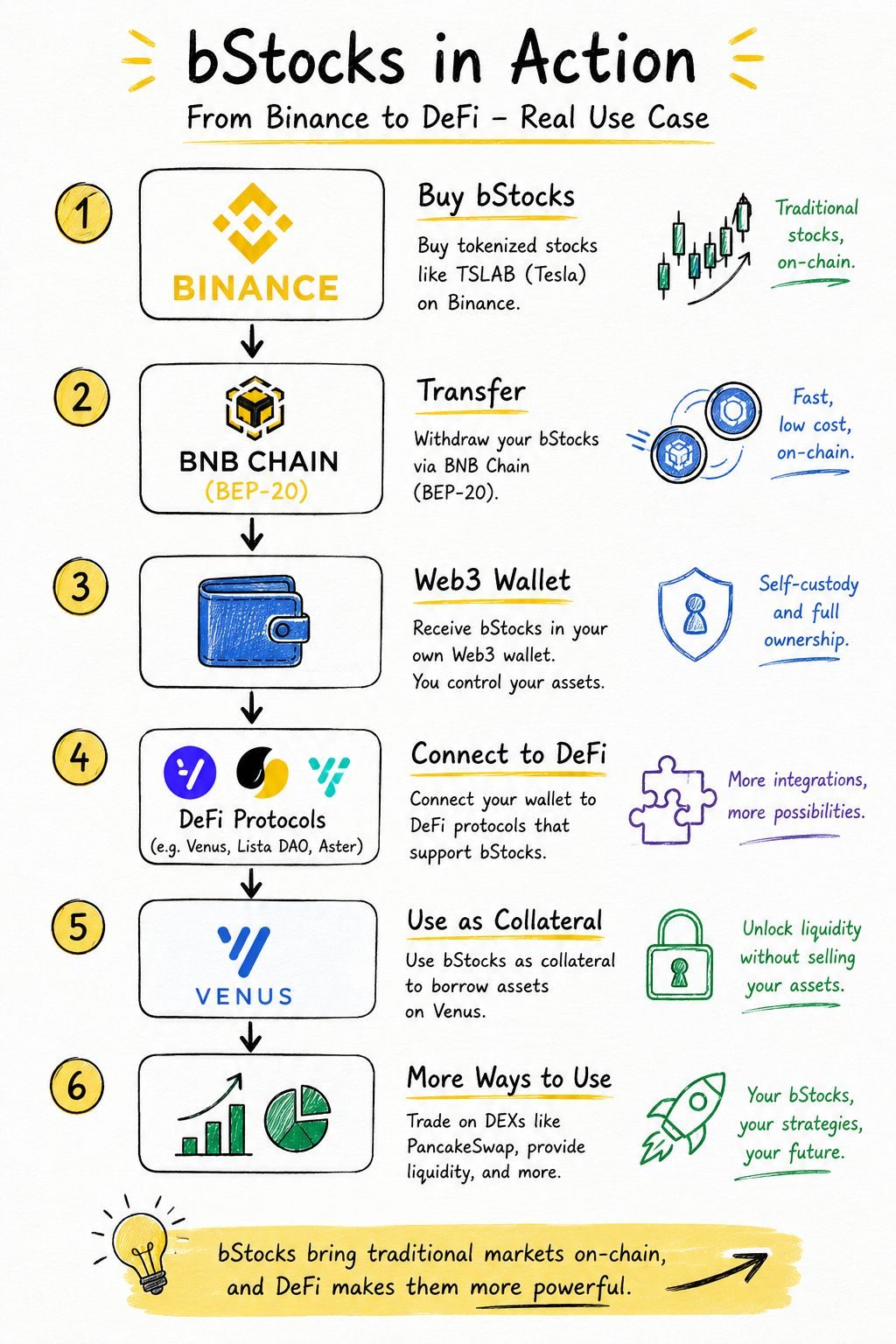
bStocks — it's not just about buying and holding
Most of us are used to the idea that after buying stocks, they simply stay in a brokerage account.
With bStocks, there may be more possibilities.
For example:
- I buy $TSLAB on Binance.
- I transfer the asset to my Web3 wallet or to Trust Wallet via the BNB Chain network (BEP-20).
- I connect the wallet to a DeFi protocol that supports bStocks, for example Venus, where tokenized shares can be used as collateral.
For me, this is an interesting example of how traditional financial instruments are gradually becoming part of the Web3 ecosystem.
In my opinion, it’s exactly these kinds of scenarios that highlight the main advantage of tokenized assets — they can not only be held in a portfolio, but also used in a blockchain ecosystem.
Would you use such an opportunity, or do you prefer classic holding?
@BinanceCIS
#bStocksCIS
bStocks — it's not just about buying and holding
Most of us are used to the idea that after buying stocks, they simply stay in a brokerage account.
With bStocks, there may be more possibilities.
For example:
- I buy $TSLAB on Binance.
- I transfer the asset to my Web3 wallet or to Trust Wallet via the BNB Chain network (BEP-20).
- I connect the wallet to a DeFi protocol that supports bStocks, for example Venus, where tokenized shares can be used as collateral.
For me, this is an interesting example of how traditional financial instruments are gradually becoming part of the Web3 ecosystem.
In my opinion, it’s exactly these kinds of scenarios that highlight the main advantage of tokenized assets — they can not only be held in a portfolio, but also used in a blockchain ecosystem.
Would you use such an opportunity, or do you prefer classic holding?
@BinanceCIS
bStocks — it's not just about buying and holding
Most of us are used to the idea that after buying stocks, they simply stay in a brokerage account.
With bStocks, there may be more possibilities.
For example:
- I buy $TSLAB on Binance.
- I transfer the asset to my Web3 wallet or to Trust Wallet via the BNB Chain network (BEP-20).
- I connect the wallet to a DeFi protocol that supports bStocks, for example Venus, where tokenized shares can be used as collateral.
For me, this is an interesting example of how traditional financial instruments are gradually becoming part of the Web3 ecosystem.
In my opinion, it’s exactly these kinds of scenarios that highlight the main advantage of tokenized assets — they can not only be held in a portfolio, but also used in a blockchain ecosystem.
Would you use such an opportunity, or do you prefer classic holding?
@BinanceCIS
96
·
--
How Is Investing in bStocks Similar to Traditional Investing?👇
While learning about bStocks, I came across one feature that really caught my attention.
The list of tokenized stocks continues to grow, with more than 30 trading pairs already available, including Tesla, Intel, Microsoft, Micron, and many others.
What surprised me the most was that bStocks holders can also receive dividends, provided the underlying company pays them.
For bStocks, dividends are distributed automatically through a multiplier mechanism. After applicable taxes are deducted, the remaining amount is reinvested, increasing your asset holdings.
This means the principle of earning dividends remains the same, but it is implemented through tokenized assets.
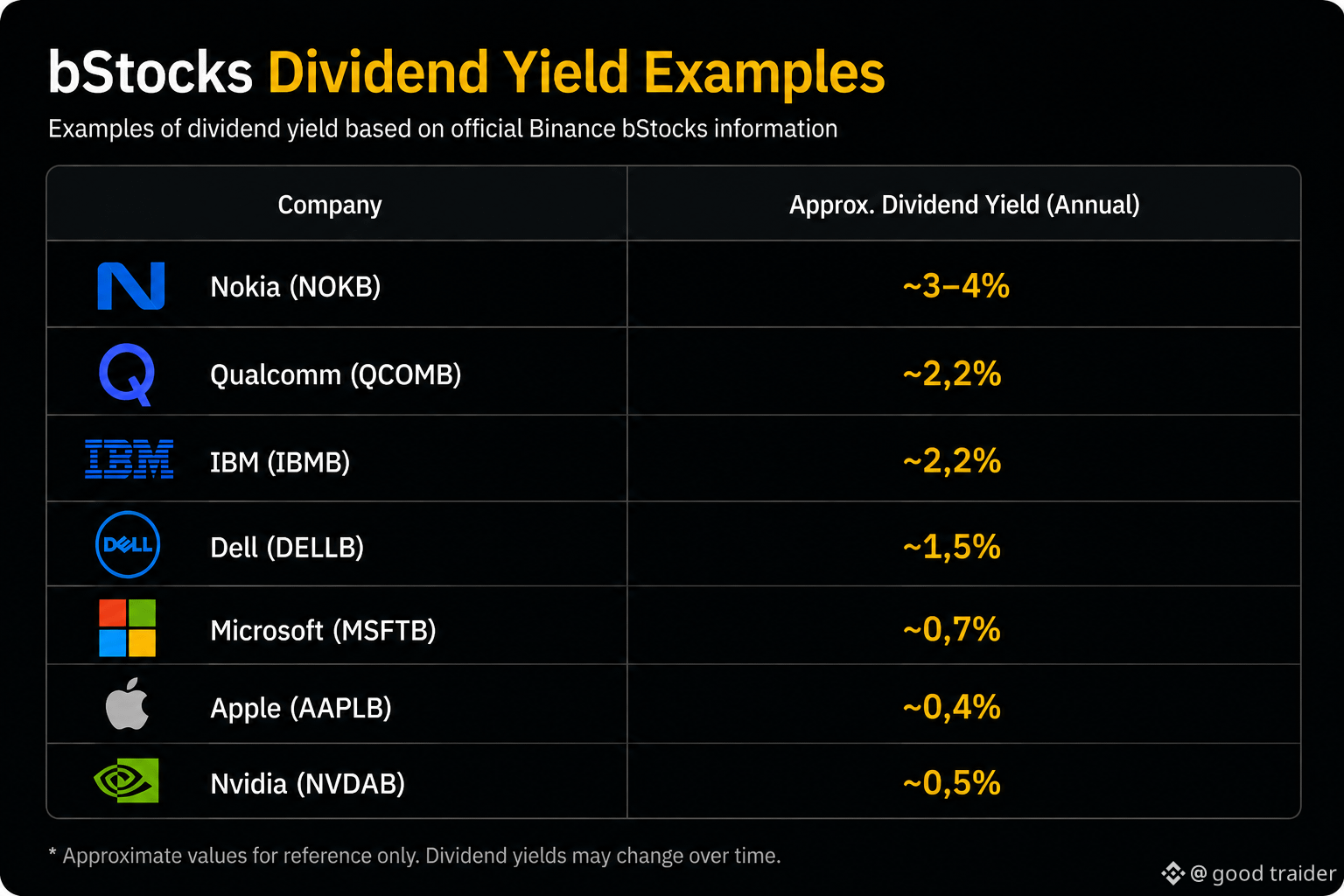
In the image below, I've included a few examples of approximate dividend yields for selected bStocks to help illustrate how this works in practice.
@BinanceCIS
#bStocksCIS
How Is Investing in bStocks Similar to Traditional Investing?👇
While learning about bStocks, I came across one feature that really caught my attention.
The list of tokenized stocks continues to grow, with more than 30 trading pairs already available, including Tesla, Intel, Microsoft, Micron, and many others.
What surprised me the most was that bStocks holders can also receive dividends, provided the underlying company pays them.
For bStocks, dividends are distributed automatically through a multiplier mechanism. After applicable taxes are deducted, the remaining amount is reinvested, increasing your asset holdings.
This means the principle of earning dividends remains the same, but it is implemented through tokenized assets.
In the image below, I've included a few examples of approximate dividend yields for selected bStocks to help illustrate how this works in practice.
@BinanceCIS
#bStocksCIS
While learning about bStocks, I came across one feature that really caught my attention.
The list of tokenized stocks continues to grow, with more than 30 trading pairs already available, including Tesla, Intel, Microsoft, Micron, and many others.
What surprised me the most was that bStocks holders can also receive dividends, provided the underlying company pays them.
For bStocks, dividends are distributed automatically through a multiplier mechanism. After applicable taxes are deducted, the remaining amount is reinvested, increasing your asset holdings.
This means the principle of earning dividends remains the same, but it is implemented through tokenized assets.
In the image below, I've included a few examples of approximate dividend yields for selected bStocks to help illustrate how this works in practice.
@BinanceCIS
#bStocksCIS
114
·
--
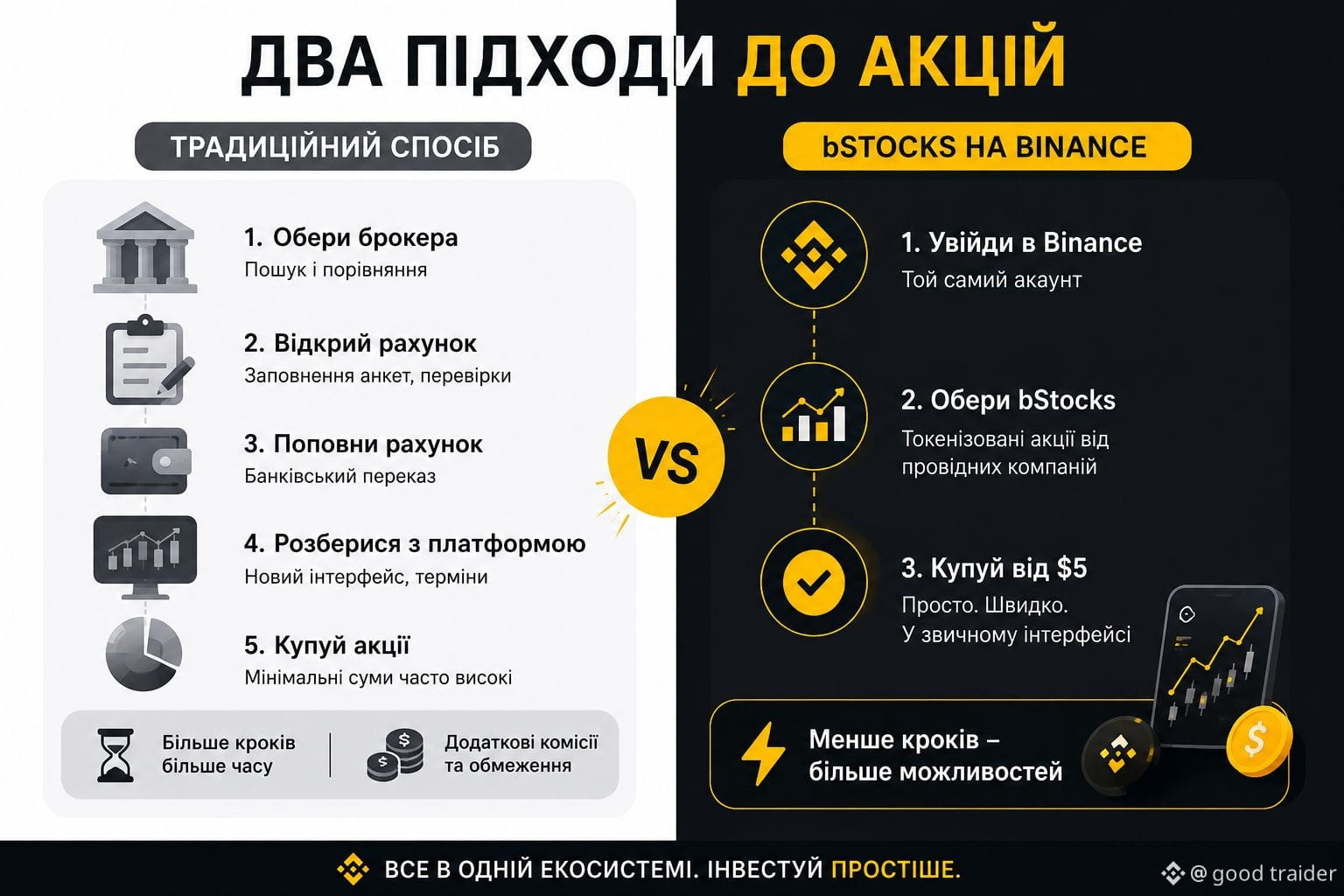
The biggest difference I noticed between the traditional way of buying stocks and bStocks is the process itself.
In the traditional setup, people often use a separate platform for investing.
In contrast, with bStocks, getting to know tokenized stocks happens directly within the Binance ecosystem.
For those who already use a crypto exchange, it can make taking the first step much easier.
It’s exactly this feature that caught my attention the most.
@BinanceCIS
#bStocksCIS
The biggest difference I noticed between the traditional way of buying stocks and bStocks is the process itself.
In the traditional setup, people often use a separate platform for investing.
In contrast, with bStocks, getting to know tokenized stocks happens directly within the Binance ecosystem.
For those who already use a crypto exchange, it can make taking the first step much easier.
It’s exactly this feature that caught my attention the most.
@BinanceCIS
#bStocksCIS
In the traditional setup, people often use a separate platform for investing.
In contrast, with bStocks, getting to know tokenized stocks happens directly within the Binance ecosystem.
For those who already use a crypto exchange, it can make taking the first step much easier.
It’s exactly this feature that caught my attention the most.
@BinanceCIS
#bStocksCIS
2
76
·
--
Holding $GRVT 31.6 USDT
🚀 $GRVT continues to grow rapidly after listing on Upbit.
The listing on one of the largest exchanges in South Korea attracted significant attention to the token and substantially increased trading volume.
⚠️ Be careful.
A large portion of the tokens is controlled by the team and early investors, so increased volatility and possible manipulation cannot be ruled out.
📌 Don’t give in to FOMO and always assess the risks.
DYOR. Not financial advice.
{future}(GRVTUSDT)
🚀 $GRVT continues to grow rapidly after listing on Upbit.
The listing on one of the largest exchanges in South Korea attracted significant attention to the token and substantially increased trading volume.
⚠️ Be careful.
A large portion of the tokens is controlled by the team and early investors, so increased volatility and possible manipulation cannot be ruled out.
📌 Don’t give in to FOMO and always assess the risks.
DYOR. Not financial advice.
The listing on one of the largest exchanges in South Korea attracted significant attention to the token and substantially increased trading volume.
⚠️ Be careful.
A large portion of the tokens is controlled by the team and early investors, so increased volatility and possible manipulation cannot be ruled out.
📌 Don’t give in to FOMO and always assess the risks.
DYOR. Not financial advice.
5
160
·
--
I never thought that it would be because of a crypto exchange that I’d start getting interested in stocks.
And the point isn’t even SpaceX.
What surprised me more was something else.
The first time I looked at stocks, I wasn’t thinking: “I need to find a broker.”
I just opened Binance, found bStocks, and started figuring out how it works.
And then I came across a detail that’s easy to miss.
bStocks are not direct ownership of shares. Their price is tied to the value of real stocks, but you don’t become the owner of those stocks. For example, voting rights in the company aren’t provided by such instruments.
It was exactly after that that everything started to make sense. I stopped seeing bStocks as just another novelty on Binance and began looking at them as a separate investment instrument.
Sometimes one detail changes your perception of the entire product. For me, it was precisely that one.
@BinanceCIS
#bStocksCIS
I never thought that it would be because of a crypto exchange that I’d start getting interested in stocks.
And the point isn’t even SpaceX.
What surprised me more was something else.
The first time I looked at stocks, I wasn’t thinking: “I need to find a broker.”
I just opened Binance, found bStocks, and started figuring out how it works.
And then I came across a detail that’s easy to miss.
bStocks are not direct ownership of shares. Their price is tied to the value of real stocks, but you don’t become the owner of those stocks. For example, voting rights in the company aren’t provided by such instruments.
It was exactly after that that everything started to make sense. I stopped seeing bStocks as just another novelty on Binance and began looking at them as a separate investment instrument.
Sometimes one detail changes your perception of the entire product. For me, it was precisely that one.
@BinanceCIS
#bStocksCIS
And the point isn’t even SpaceX.
What surprised me more was something else.
The first time I looked at stocks, I wasn’t thinking: “I need to find a broker.”
I just opened Binance, found bStocks, and started figuring out how it works.
And then I came across a detail that’s easy to miss.
bStocks are not direct ownership of shares. Their price is tied to the value of real stocks, but you don’t become the owner of those stocks. For example, voting rights in the company aren’t provided by such instruments.
It was exactly after that that everything started to make sense. I stopped seeing bStocks as just another novelty on Binance and began looking at them as a separate investment instrument.
Sometimes one detail changes your perception of the entire product. For me, it was precisely that one.
@BinanceCIS
#bStocksCIS
2
78
Log in to explore more content
Join global crypto users on Binance Square
⚡️ Get latest and useful information about crypto.
💬 Trusted by the world’s largest crypto exchange.
👍 Discover real insights from verified creators.
Email / Phone number
Trending Topics
FedRateWatch
719,842 views
3,397 Discussing
Share & Win Traffic Reward in our Trending Hashtag Campaign
✨Topic: FOMC September, What's The Fed's Next Move?
👉How to Join:
Publish a short post or article with hashtag #FedRateWatch
Create content based on the below angles:
- August core CPI rose 0.3% month-over-month, and the odds of a 25bp hike this week are now close to 90%. Do you anticipate a rate hike this week? Is it a one-off, or the start of a longer hiking cycle?
- If the hike lands, how does it play out for BTC, tech stocks, and gold? Bullish or bearish?
- How are you planning to trade next? Share your BTC, stocks or gold trade/holdings with our trade sharing widget.
⏰Campaign Period:
- 2026-09-15 11:00 - 2026-09-17 3:00 UTC
🎁Reward:
- Qualified posts that comply with the above guidelines and contain more than 100 words will be reviewed and may receive a random traffic boost of 500 to 3,000 views. You will receive a notification from your feed secretary if your post is selected.
- Get a chance to have your article featured on Binance Square Official
Need ideas for your post? Visit the topic page #FedRateWatch or the Square Guide on How to Post for Better Reach.
Binance Square Official
·432 Likes
·985.8k views
ArgentinaCommitsToOECDCryptoReportingBy2029
742 views
35 Discussing
EthereumFallsBelow$2400
1,343 views
43 Discussing