

SDY 1
113 Posts

SDY 1
Report
Block User
Educationist || Crypto trader || Web3 enthusiast || Community builder || content writer || Ambassador @Pawpower_invest @rentanetwork ||
0 Following
3 Followers
11 Liked
Posts
·
--
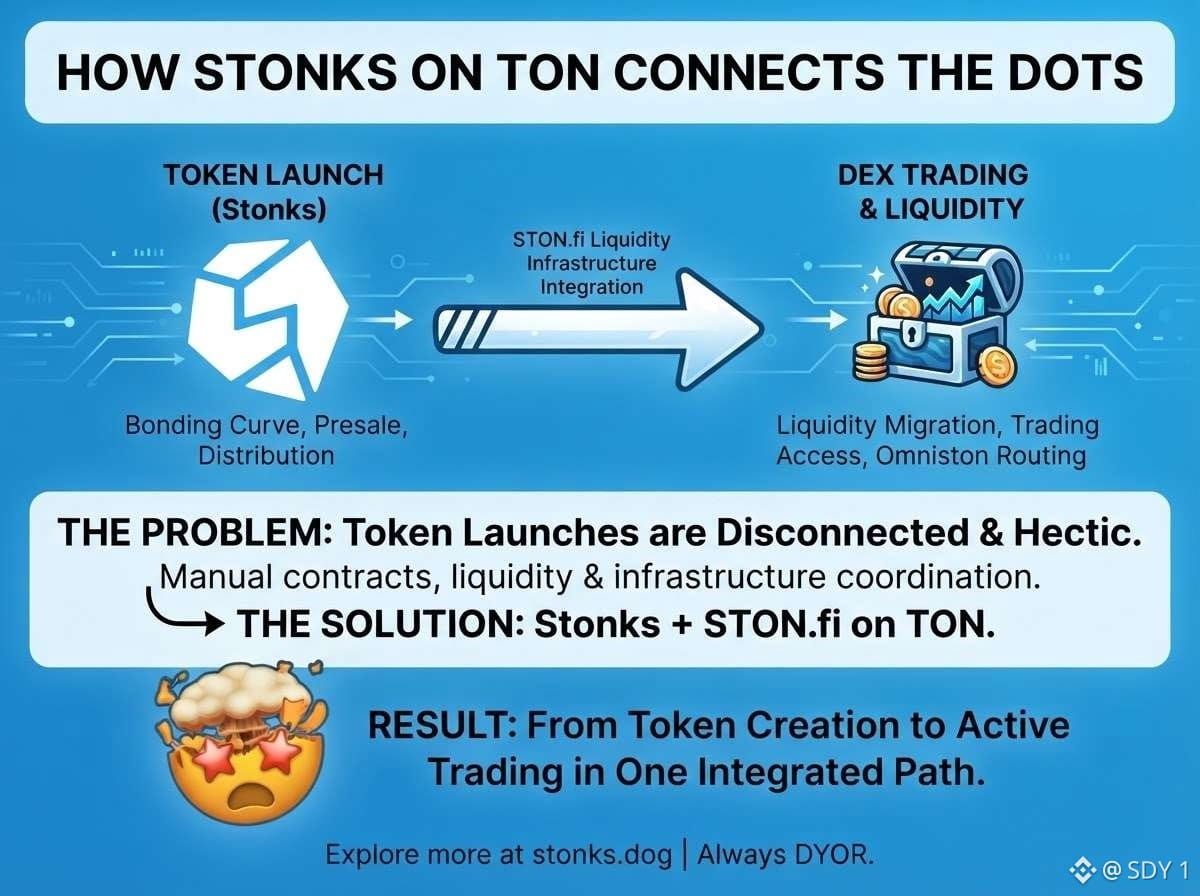
How Stonks Connects Token Launches to DEX Liquidity on TON.
Launching a token is only the first step. Projects also need liquidity, trading infrastructure and an easy way for users to access the asset.
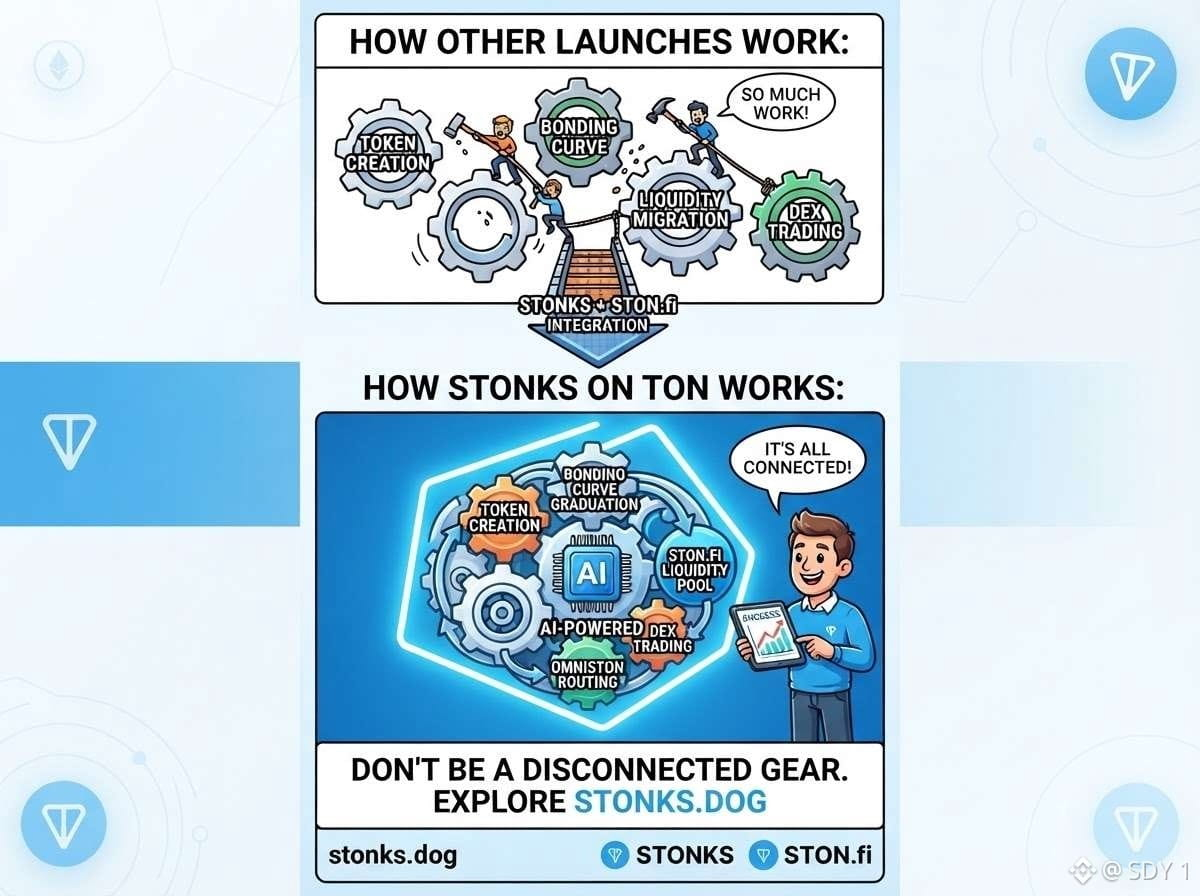
Stonks an AI-powered launch ecosystem on TON has integrated STON.fi infrastructure to connect these stages more seamlessly with the integration:
→ Tokens can graduate from bonding curves directly into STON.fi liquidity pools.
→ Projects can provision seed liquidity directly into STON.fi pools.
→ STON.fi tokens can be swapped through the Stonks terminal and Telegram bot.
→ Before migration users can access Omniston routes to seek efficient swap execution.
The result is a more connected path:
Launch → Bonding Curve → Liquidity → DEX Trading
this can reduce the complexity of coordinating launch and liquidity infrastructure.
it creates a simpler way to move from discovering a token to accessing its market liquidity.
Explore the Stonks ecosystem: stonks.dog/
Stonks is a third-party application.
Always DYOR before interacting with any project.
$BTC $XRP
#TON ecosystem, here to discover the latest projects# #STONfi
How Stonks Connects Token Launches to DEX Liquidity on TON.
Launching a token is only the first step. Projects also need liquidity, trading infrastructure and an easy way for users to access the asset.
Stonks an AI-powered launch ecosystem on TON has integrated STON.fi infrastructure to connect these stages more seamlessly with the integration:
→ Tokens can graduate from bonding curves directly into STON.fi liquidity pools.
→ Projects can provision seed liquidity directly into STON.fi pools.
→ STON.fi tokens can be swapped through the Stonks terminal and Telegram bot.
→ Before migration users can access Omniston routes to seek efficient swap execution.
The result is a more connected path:
Launch → Bonding Curve → Liquidity → DEX Trading
this can reduce the complexity of coordinating launch and liquidity infrastructure.
it creates a simpler way to move from discovering a token to accessing its market liquidity.
Explore the Stonks ecosystem: stonks.dog/
Stonks is a third-party application.
Always DYOR before interacting with any project.
$BTC $XRP
#TON ecosystem, here to discover the latest projects# #STONfi
Launching a token is only the first step. Projects also need liquidity, trading infrastructure and an easy way for users to access the asset.
Stonks an AI-powered launch ecosystem on TON has integrated STON.fi infrastructure to connect these stages more seamlessly with the integration:
→ Tokens can graduate from bonding curves directly into STON.fi liquidity pools.
→ Projects can provision seed liquidity directly into STON.fi pools.
→ STON.fi tokens can be swapped through the Stonks terminal and Telegram bot.
→ Before migration users can access Omniston routes to seek efficient swap execution.
The result is a more connected path:
Launch → Bonding Curve → Liquidity → DEX Trading
this can reduce the complexity of coordinating launch and liquidity infrastructure.
it creates a simpler way to move from discovering a token to accessing its market liquidity.
Explore the Stonks ecosystem: stonks.dog/
Stonks is a third-party application.
Always DYOR before interacting with any project.
$BTC $XRP
#TON ecosystem, here to discover the latest projects# #STONfi
67
·
--
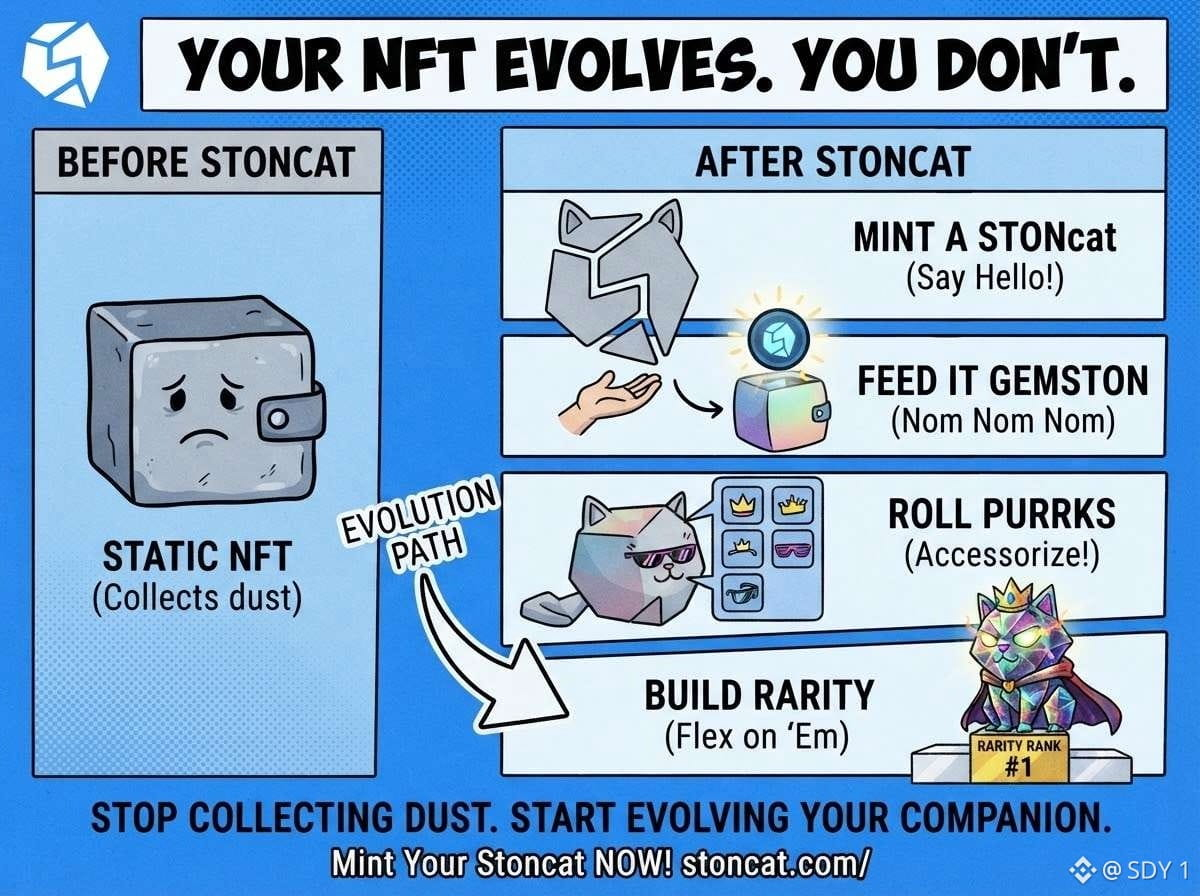
What is Stoncat and how does it work?
Stoncat is the NFT companion from STON.fi, powered by GEMSTON.
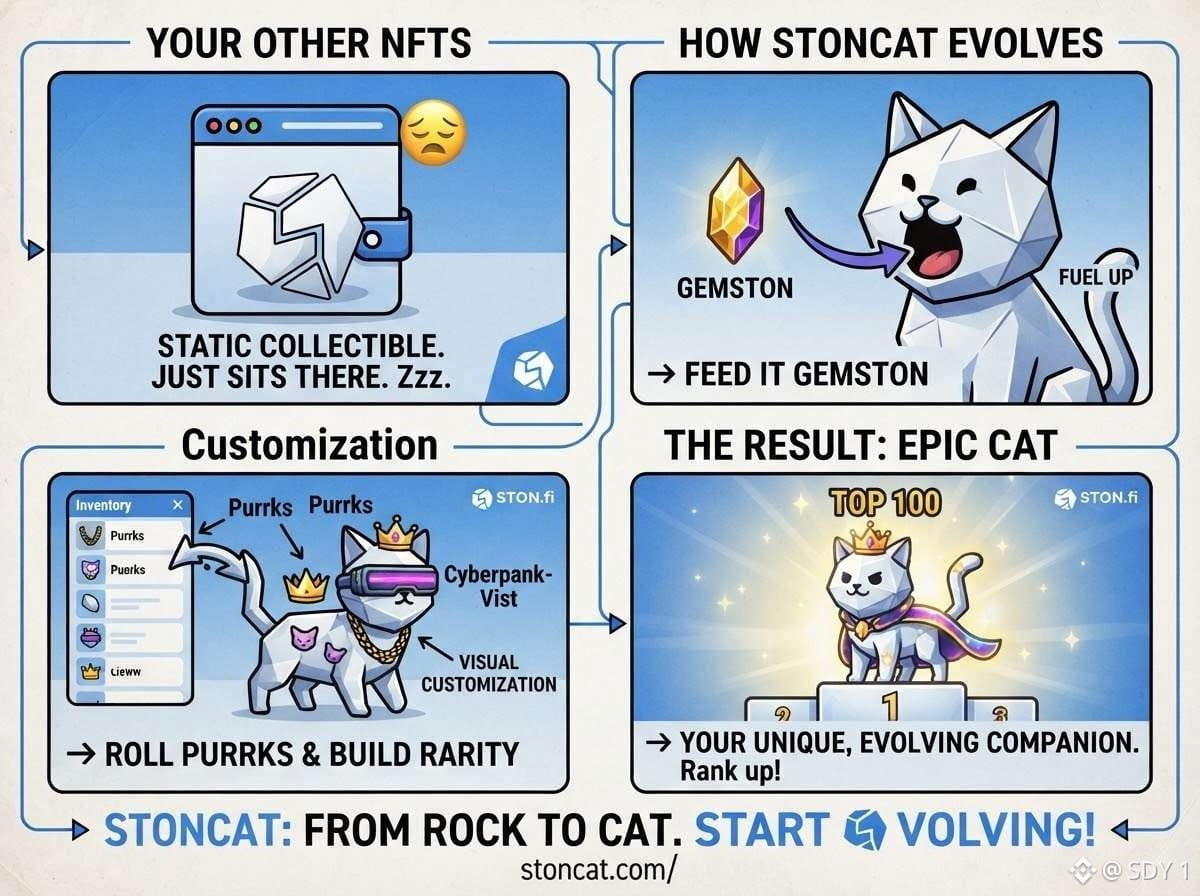
Instead of being a static NFT that simply sits in your wallet, Stoncat is designed to evolve through your interactions with it then here’s the basic process:
→ Mint a Stoncat
Start with your base Stoncat NFT.
→ Feed it GEMSTON
Use GEMSTON to help your Stoncat progress through its stages.
→ Roll Purrks
Purrks are visual traits that can be equipped to customize your Stoncat.
→ Build rarity
The rarity of the Purrks you equip contributes to the rarity of your Stoncat.
This means every Stoncat can develop its own combination of traits.
You can customize yours around a particular style, character or simply experiment with different combinations.
As your Stoncat progresses, additional traits can become available while its rarity position can change on the leaderboard.
That gives the NFT an evolving layer rather than leaving it as a fixed collectible.
It also gives GEMSTON another use within the STON.fi ecosystem beyond its existing staking utility.
So if you’re interested in TON NFTs STON.fi, GEMSTON or collectible NFTs with evolving traits Stoncat is worth exploring.
Connect your wallet mint your Stoncat and see how yours develops.
Mint your Stoncat: stoncat.com/
$BTC $XRP
#TON ecosystem, here to discover the latest projects#
What is Stoncat and how does it work?
Stoncat is the NFT companion from STON.fi, powered by GEMSTON.
Instead of being a static NFT that simply sits in your wallet, Stoncat is designed to evolve through your interactions with it then here’s the basic process:
→ Mint a Stoncat
Start with your base Stoncat NFT.
→ Feed it GEMSTON
Use GEMSTON to help your Stoncat progress through its stages.
→ Roll Purrks
Purrks are visual traits that can be equipped to customize your Stoncat.
→ Build rarity
The rarity of the Purrks you equip contributes to the rarity of your Stoncat.
This means every Stoncat can develop its own combination of traits.
You can customize yours around a particular style, character or simply experiment with different combinations.
As your Stoncat progresses, additional traits can become available while its rarity position can change on the leaderboard.
That gives the NFT an evolving layer rather than leaving it as a fixed collectible.
It also gives GEMSTON another use within the STON.fi ecosystem beyond its existing staking utility.
So if you’re interested in TON NFTs STON.fi, GEMSTON or collectible NFTs with evolving traits Stoncat is worth exploring.
Connect your wallet mint your Stoncat and see how yours develops.
Mint your Stoncat: stoncat.com/
$BTC $XRP
#TON ecosystem, here to discover the latest projects#
Stoncat is the NFT companion from STON.fi, powered by GEMSTON.
Instead of being a static NFT that simply sits in your wallet, Stoncat is designed to evolve through your interactions with it then here’s the basic process:
→ Mint a Stoncat
Start with your base Stoncat NFT.
→ Feed it GEMSTON
Use GEMSTON to help your Stoncat progress through its stages.
→ Roll Purrks
Purrks are visual traits that can be equipped to customize your Stoncat.
→ Build rarity
The rarity of the Purrks you equip contributes to the rarity of your Stoncat.
This means every Stoncat can develop its own combination of traits.
You can customize yours around a particular style, character or simply experiment with different combinations.
As your Stoncat progresses, additional traits can become available while its rarity position can change on the leaderboard.
That gives the NFT an evolving layer rather than leaving it as a fixed collectible.
It also gives GEMSTON another use within the STON.fi ecosystem beyond its existing staking utility.
So if you’re interested in TON NFTs STON.fi, GEMSTON or collectible NFTs with evolving traits Stoncat is worth exploring.
Connect your wallet mint your Stoncat and see how yours develops.
Mint your Stoncat: stoncat.com/
$BTC $XRP
#TON ecosystem, here to discover the latest projects#
55
·
--
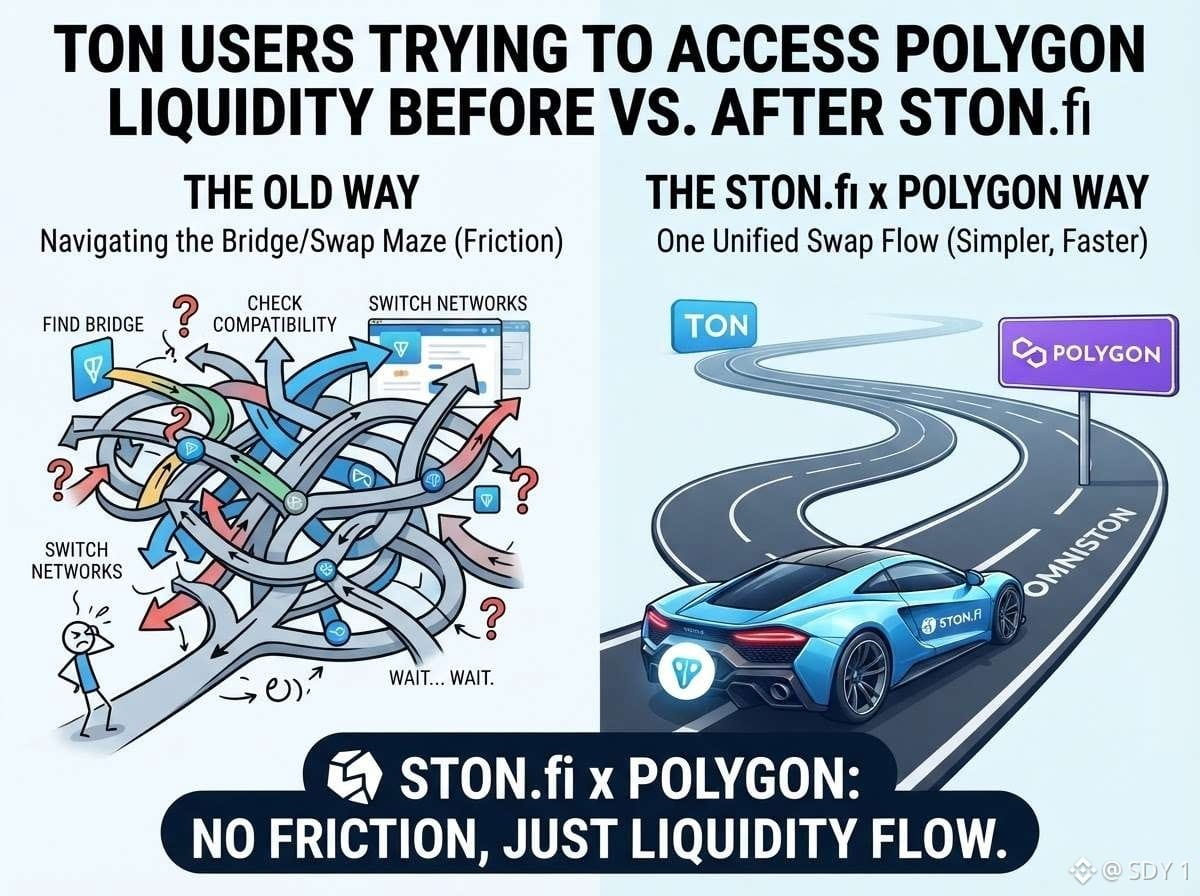
STON.fi Polygon Making Cross-Chain Swaps Simpler
TON users can now access supported Polygon assets through STON.fi’s cross-chain swap infrastructure.
Polygon is a major EVM ecosystem with activity across DeFi, stablecoins, payments, RWAs, DEXs, prediction markets and consumer applications.
But having assets on TON while needing liquidity or an application on Polygon can create unnecessary friction.
Normally moving between ecosystems may involve finding a bridge, checking token compatibility, switching interfaces, waiting for transactions and sometimes performing another swap after bridging.
Cross-chain infrastructure is designed to reduce those steps with STON.fi users can select a supported asset, choose the destination network, review the route and transaction details then confirm the swap.
Omniston works behind the scenes to coordinate cross-chain routing, liquidity and execution across supported networks.
That changes the user experience from managing multiple infrastructure pieces to completing the intended swap through a more unified flow.
The bigger opportunity is connectivity.
TON does not have to operate as an isolated ecosystem and Polygon does not have to remain disconnected from TON liquidity.
As more networks assets and applications become connected, cross-chain infrastructure can make liquidity more accessible and blockchain applications easier to reach.
The goal is simple fewer barriers between ecosystems and a smoother path for users to move where the liquidity and applications they need are.
STON.fi Polygon is another step toward that connected onchain experience.
$GRAM
#TON ecosystem, here to discover the latest projects#
STON.fi Polygon Making Cross-Chain Swaps Simpler
TON users can now access supported Polygon assets through STON.fi’s cross-chain swap infrastructure.
Polygon is a major EVM ecosystem with activity across DeFi, stablecoins, payments, RWAs, DEXs, prediction markets and consumer applications.
But having assets on TON while needing liquidity or an application on Polygon can create unnecessary friction.
Normally moving between ecosystems may involve finding a bridge, checking token compatibility, switching interfaces, waiting for transactions and sometimes performing another swap after bridging.
Cross-chain infrastructure is designed to reduce those steps with STON.fi users can select a supported asset, choose the destination network, review the route and transaction details then confirm the swap.
Omniston works behind the scenes to coordinate cross-chain routing, liquidity and execution across supported networks.
That changes the user experience from managing multiple infrastructure pieces to completing the intended swap through a more unified flow.
The bigger opportunity is connectivity.
TON does not have to operate as an isolated ecosystem and Polygon does not have to remain disconnected from TON liquidity.
As more networks assets and applications become connected, cross-chain infrastructure can make liquidity more accessible and blockchain applications easier to reach.
The goal is simple fewer barriers between ecosystems and a smoother path for users to move where the liquidity and applications they need are.
STON.fi Polygon is another step toward that connected onchain experience.
$GRAM
#TON ecosystem, here to discover the latest projects#
TON users can now access supported Polygon assets through STON.fi’s cross-chain swap infrastructure.
Polygon is a major EVM ecosystem with activity across DeFi, stablecoins, payments, RWAs, DEXs, prediction markets and consumer applications.
But having assets on TON while needing liquidity or an application on Polygon can create unnecessary friction.
Normally moving between ecosystems may involve finding a bridge, checking token compatibility, switching interfaces, waiting for transactions and sometimes performing another swap after bridging.
Cross-chain infrastructure is designed to reduce those steps with STON.fi users can select a supported asset, choose the destination network, review the route and transaction details then confirm the swap.
Omniston works behind the scenes to coordinate cross-chain routing, liquidity and execution across supported networks.
That changes the user experience from managing multiple infrastructure pieces to completing the intended swap through a more unified flow.
The bigger opportunity is connectivity.
TON does not have to operate as an isolated ecosystem and Polygon does not have to remain disconnected from TON liquidity.
As more networks assets and applications become connected, cross-chain infrastructure can make liquidity more accessible and blockchain applications easier to reach.
The goal is simple fewer barriers between ecosystems and a smoother path for users to move where the liquidity and applications they need are.
STON.fi Polygon is another step toward that connected onchain experience.
$GRAM
#TON ecosystem, here to discover the latest projects#

54
·
--
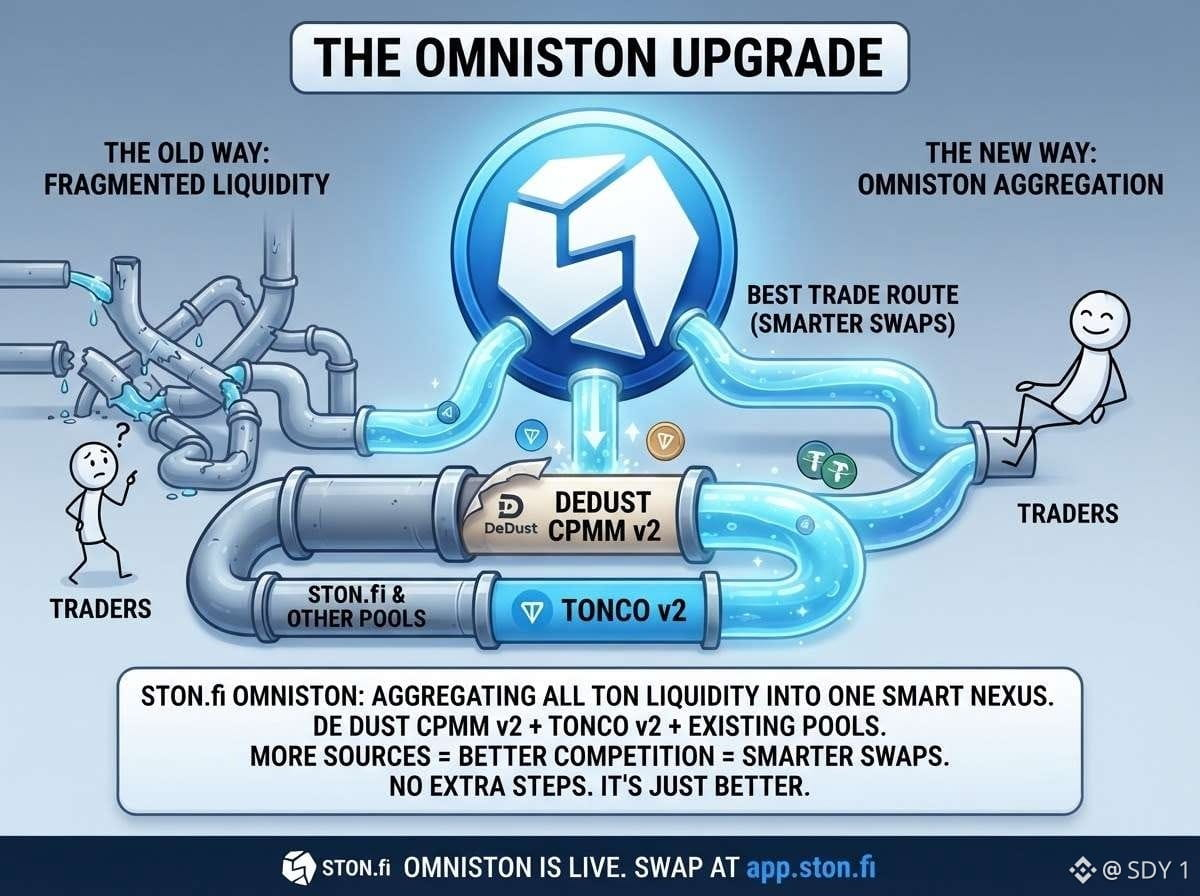
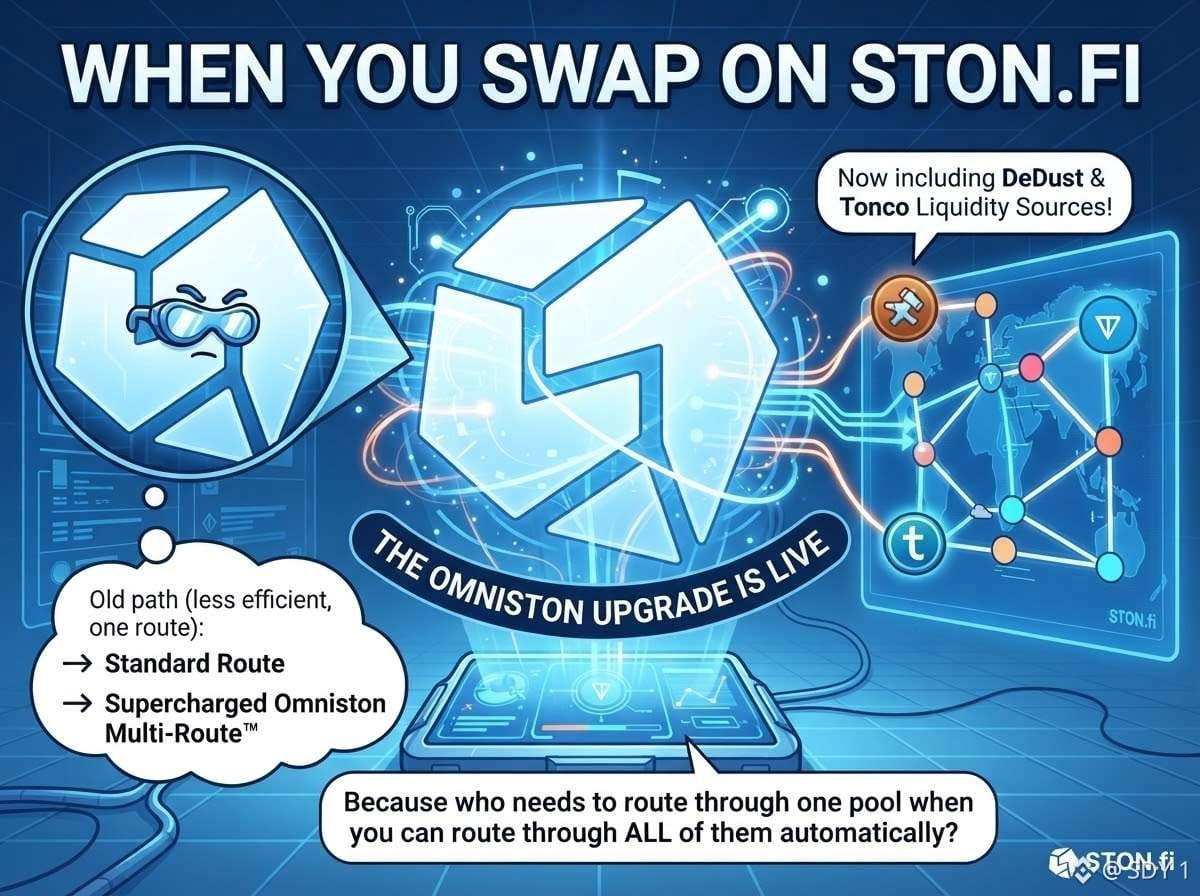
STON.fi just made TON swaps smarter.
Finding the best swap route on TON depends on how much liquidity is available across different pools with the latest Omniston upgrade two additional liquidity sources are now supported:
→ DeDust CPMM v2
→ Tonco v2
When you swap through STON.fi Omniston can now compare these pools alongside other available TON liquidity and select an efficient route in real time the benefit is simple:
More liquidity sources → more routing options → better competition for your trade.
You don’t need to change your usual workflow. There are no extra settings or additional steps.
Just connect your wallet, choose your tokens and swap.
The upgrade is already live.
Swap on STON.fi: app.ston.fi/swap
$GRAM
#TON ecosystem, here to discover the latest projects# #DeFi #STONfi
STON.fi just made TON swaps smarter.
Finding the best swap route on TON depends on how much liquidity is available across different pools with the latest Omniston upgrade two additional liquidity sources are now supported:
→ DeDust CPMM v2
→ Tonco v2
When you swap through STON.fi Omniston can now compare these pools alongside other available TON liquidity and select an efficient route in real time the benefit is simple:
More liquidity sources → more routing options → better competition for your trade.
You don’t need to change your usual workflow. There are no extra settings or additional steps.
Just connect your wallet, choose your tokens and swap.
The upgrade is already live.
Swap on STON.fi: app.ston.fi/swap
$GRAM
#TON ecosystem, here to discover the latest projects# #DeFi #STONfi
Finding the best swap route on TON depends on how much liquidity is available across different pools with the latest Omniston upgrade two additional liquidity sources are now supported:
→ DeDust CPMM v2
→ Tonco v2
When you swap through STON.fi Omniston can now compare these pools alongside other available TON liquidity and select an efficient route in real time the benefit is simple:
More liquidity sources → more routing options → better competition for your trade.
You don’t need to change your usual workflow. There are no extra settings or additional steps.
Just connect your wallet, choose your tokens and swap.
The upgrade is already live.
Swap on STON.fi: app.ston.fi/swap
$GRAM
#TON ecosystem, here to discover the latest projects# #DeFi #STONfi
2
405
·
--
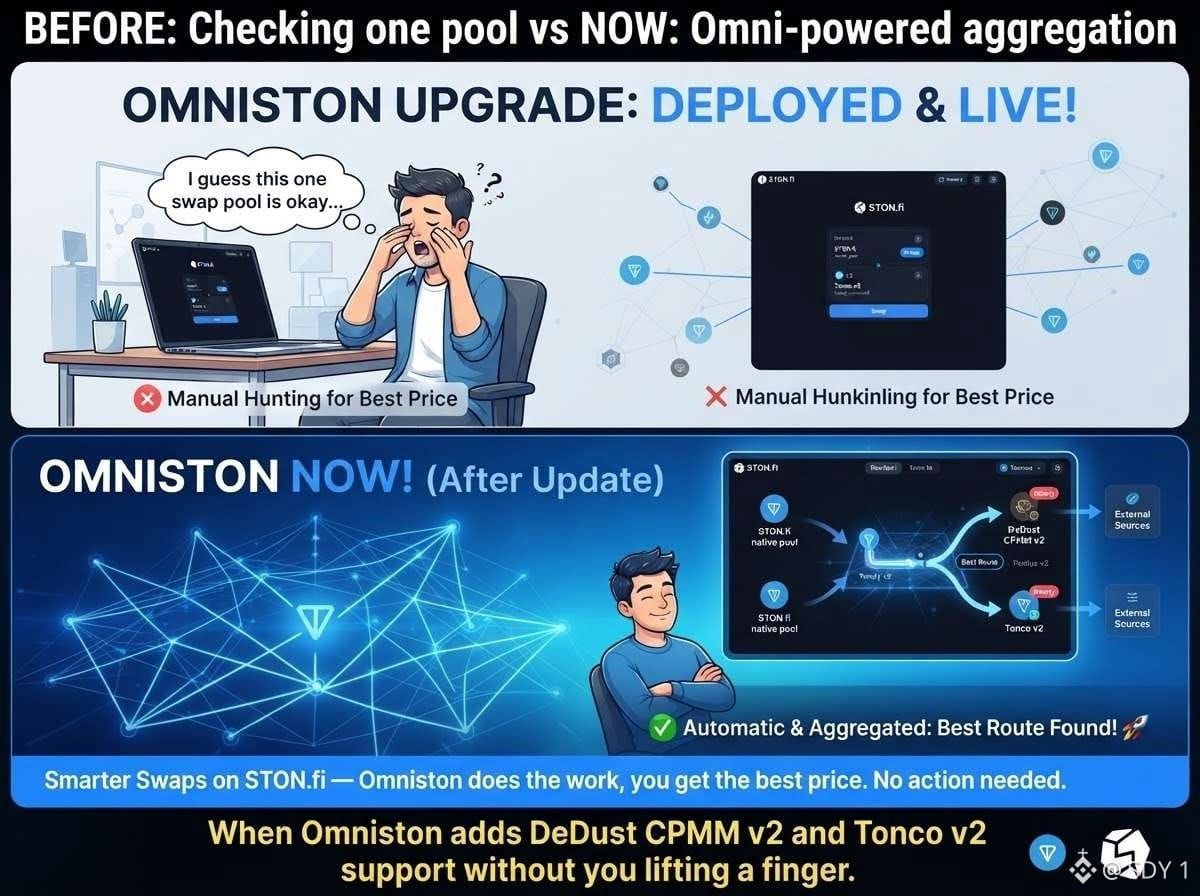
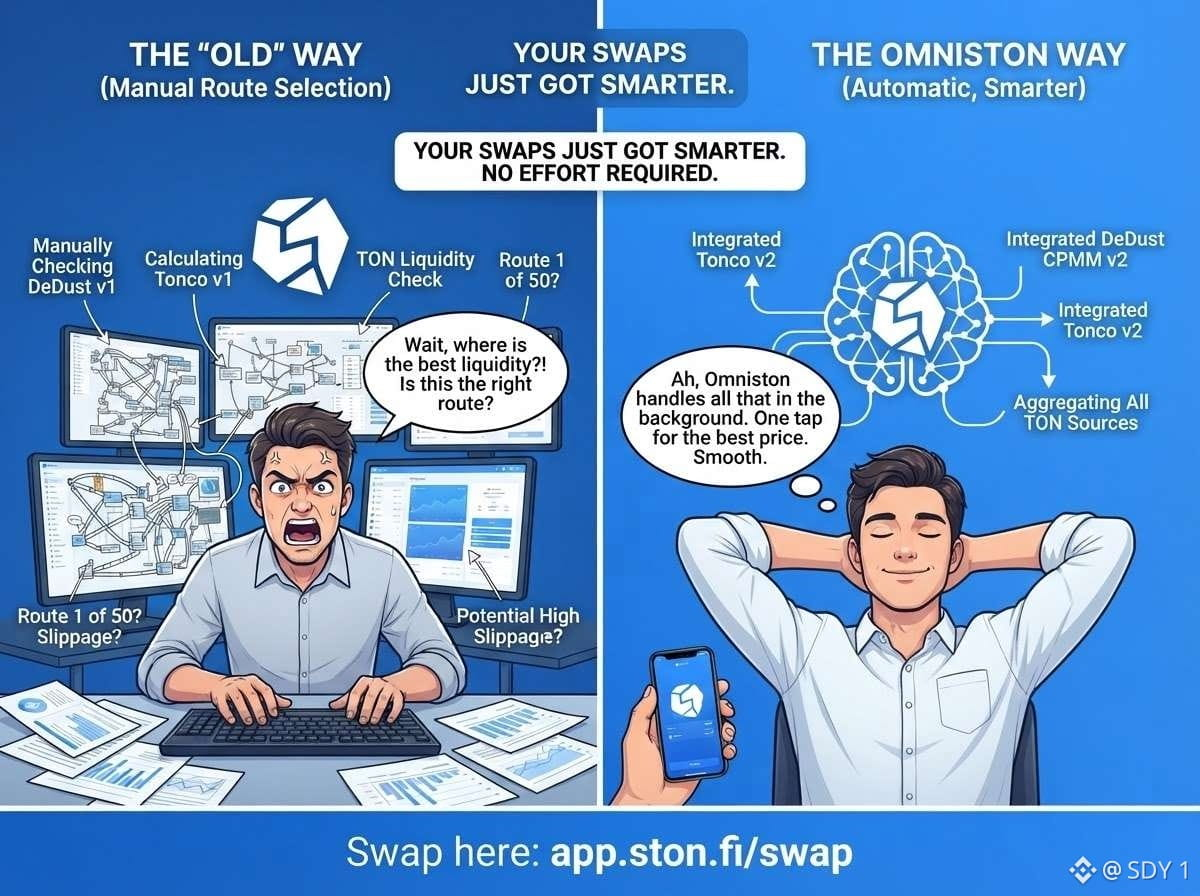
Your swaps on STON.fi just got smarter without you changing a thing.
Omniston now supports DeDust CPMM v2 and Tonco v2 pool contracts expanding the liquidity sources it can evaluate across TON.
Here’s why that matters:
→ More liquidity sources to compare
→ More routes available for each swap
→ Automatic route selection
→ Potentially better execution and lower slippage
→ Same simple one-tap swap experience
The best price on $GRAM can change depending on the token pair, liquidity pool and market conditions.
Instead of manually checking different pools Omniston aggregates available liquidity and searches for an efficient route automatically.
Although With DeDust v2 and Tonco v2 now supported Omniston has more liquidity to work with when finding routes for your swaps the upgrade is live.
Next time you swap on STON.fi Omniston is already doing the route comparison in the background.
Swap here: app.ston.fi/swap
$GRAM
#TON ecosystem, here to discover the latest projects# #STONfi
Your swaps on STON.fi just got smarter without you changing a thing.
Omniston now supports DeDust CPMM v2 and Tonco v2 pool contracts expanding the liquidity sources it can evaluate across TON.
Here’s why that matters:
→ More liquidity sources to compare
→ More routes available for each swap
→ Automatic route selection
→ Potentially better execution and lower slippage
→ Same simple one-tap swap experience
The best price on $GRAM can change depending on the token pair, liquidity pool and market conditions.
Instead of manually checking different pools Omniston aggregates available liquidity and searches for an efficient route automatically.
Although With DeDust v2 and Tonco v2 now supported Omniston has more liquidity to work with when finding routes for your swaps the upgrade is live.
Next time you swap on STON.fi Omniston is already doing the route comparison in the background.
Swap here: app.ston.fi/swap
$GRAM
#TON ecosystem, here to discover the latest projects# #STONfi
Omniston now supports DeDust CPMM v2 and Tonco v2 pool contracts expanding the liquidity sources it can evaluate across TON.
Here’s why that matters:
→ More liquidity sources to compare
→ More routes available for each swap
→ Automatic route selection
→ Potentially better execution and lower slippage
→ Same simple one-tap swap experience
The best price on $GRAM can change depending on the token pair, liquidity pool and market conditions.
Instead of manually checking different pools Omniston aggregates available liquidity and searches for an efficient route automatically.
Although With DeDust v2 and Tonco v2 now supported Omniston has more liquidity to work with when finding routes for your swaps the upgrade is live.
Next time you swap on STON.fi Omniston is already doing the route comparison in the background.
Swap here: app.ston.fi/swap
$GRAM
#TON ecosystem, here to discover the latest projects# #STONfi
66
·
--
Want to learn cross-chain swaps while earning rewards?
STON.fi just launched “One Swap Across Chains” a campaign built around learning cross-chain swapping through practical missions.
The waitlist is now open and the first 1,000 users to connect their TON wallet can unlock:
→ 1,000 bonus Miles
→ Priority Passenger Ticket
→ Priority status with more perks to come
Miles are the campaign’s reward points. You can earn them through waitlist tasks and upcoming interactive swap missions then use them for limited weekly Flight Deals.
The 1,000-mile joining bonus is only available during the waitlist stage.
Get started:
→ Connect your TON wallet
→ Pair the Telegram bot
→ Complete the early tasks
→ Start building your Miles
Only 1,000 Priority Passenger seats are available.
If you’ve been looking for a practical way to explore cross-chain DeFi and swaps this is a good campaign to keep on your radar.
Join the waitlist: cross-chain.ston.fi/
$GRAM
#TON ecosystem, here to discover the latest projects# #STONfi
Want to learn cross-chain swaps while earning rewards?
STON.fi just launched “One Swap Across Chains” a campaign built around learning cross-chain swapping through practical missions.
The waitlist is now open and the first 1,000 users to connect their TON wallet can unlock:
→ 1,000 bonus Miles
→ Priority Passenger Ticket
→ Priority status with more perks to come
Miles are the campaign’s reward points. You can earn them through waitlist tasks and upcoming interactive swap missions then use them for limited weekly Flight Deals.
The 1,000-mile joining bonus is only available during the waitlist stage.
Get started:
→ Connect your TON wallet
→ Pair the Telegram bot
→ Complete the early tasks
→ Start building your Miles
Only 1,000 Priority Passenger seats are available.
If you’ve been looking for a practical way to explore cross-chain DeFi and swaps this is a good campaign to keep on your radar.
Join the waitlist: cross-chain.ston.fi/
$GRAM
#TON ecosystem, here to discover the latest projects# #STONfi
STON.fi just launched “One Swap Across Chains” a campaign built around learning cross-chain swapping through practical missions.
The waitlist is now open and the first 1,000 users to connect their TON wallet can unlock:
→ 1,000 bonus Miles
→ Priority Passenger Ticket
→ Priority status with more perks to come
Miles are the campaign’s reward points. You can earn them through waitlist tasks and upcoming interactive swap missions then use them for limited weekly Flight Deals.
The 1,000-mile joining bonus is only available during the waitlist stage.
Get started:
→ Connect your TON wallet
→ Pair the Telegram bot
→ Complete the early tasks
→ Start building your Miles
Only 1,000 Priority Passenger seats are available.
If you’ve been looking for a practical way to explore cross-chain DeFi and swaps this is a good campaign to keep on your radar.
Join the waitlist: cross-chain.ston.fi/
$GRAM
#TON ecosystem, here to discover the latest projects# #STONfi


58
·
--
The next $1B token may not come from the chain with the loudest narrative.
It may come from the ecosystem that converts users, liquidity and culture into sustained demand.
That’s what makes the Solana vs. Robinhood Chain debate interesting.
Solana:
→ Deep onchain trading culture
→ Strong memecoin and community flywheel
→ Established liquidity and developer activity
Robinhood Chain:
→ Powerful retail distribution
→ Growing DEX activity
→ A bridge between mainstream users and onchain markets
The real question isn’t:
“Which chain is better?”
It’s: which ecosystem can turn distribution into liquidity, liquidity into activity and activity into durable token value?
That’s the metric worth watching.
Narratives attract attention.
Liquidity creates markets.
Users create staying power.
$SOL $HOOD
The next $1B token may not come from the chain with the loudest narrative.
It may come from the ecosystem that converts users, liquidity and culture into sustained demand.
That’s what makes the Solana vs. Robinhood Chain debate interesting.
Solana:
→ Deep onchain trading culture
→ Strong memecoin and community flywheel
→ Established liquidity and developer activity
Robinhood Chain:
→ Powerful retail distribution
→ Growing DEX activity
→ A bridge between mainstream users and onchain markets
The real question isn’t:
“Which chain is better?”
It’s: which ecosystem can turn distribution into liquidity, liquidity into activity and activity into durable token value?
That’s the metric worth watching.
Narratives attract attention.
Liquidity creates markets.
Users create staying power.
$SOL $HOOD
It may come from the ecosystem that converts users, liquidity and culture into sustained demand.
That’s what makes the Solana vs. Robinhood Chain debate interesting.
Solana:
→ Deep onchain trading culture
→ Strong memecoin and community flywheel
→ Established liquidity and developer activity
Robinhood Chain:
→ Powerful retail distribution
→ Growing DEX activity
→ A bridge between mainstream users and onchain markets
The real question isn’t:
“Which chain is better?”
It’s: which ecosystem can turn distribution into liquidity, liquidity into activity and activity into durable token value?
That’s the metric worth watching.
Narratives attract attention.
Liquidity creates markets.
Users create staying power.
$SOL $HOOD


56
·
--
Looks like BTC might've wrapped wave 4 wave 5 higher could be in motion now.
If this read holds we're still inside a larger ABC correction.
That means the aggressive final C-wave push is getting close to exhaustion before the bigger downtrend kicks back in.
Stay sharp as price climbs into the target zone it's where structure matters and discipline wins.
$BTC
Looks like BTC might've wrapped wave 4 wave 5 higher could be in motion now.
If this read holds we're still inside a larger ABC correction.
That means the aggressive final C-wave push is getting close to exhaustion before the bigger downtrend kicks back in.
Stay sharp as price climbs into the target zone it's where structure matters and discipline wins.
$BTC
If this read holds we're still inside a larger ABC correction.
That means the aggressive final C-wave push is getting close to exhaustion before the bigger downtrend kicks back in.
Stay sharp as price climbs into the target zone it's where structure matters and discipline wins.
$BTC
63
·
--
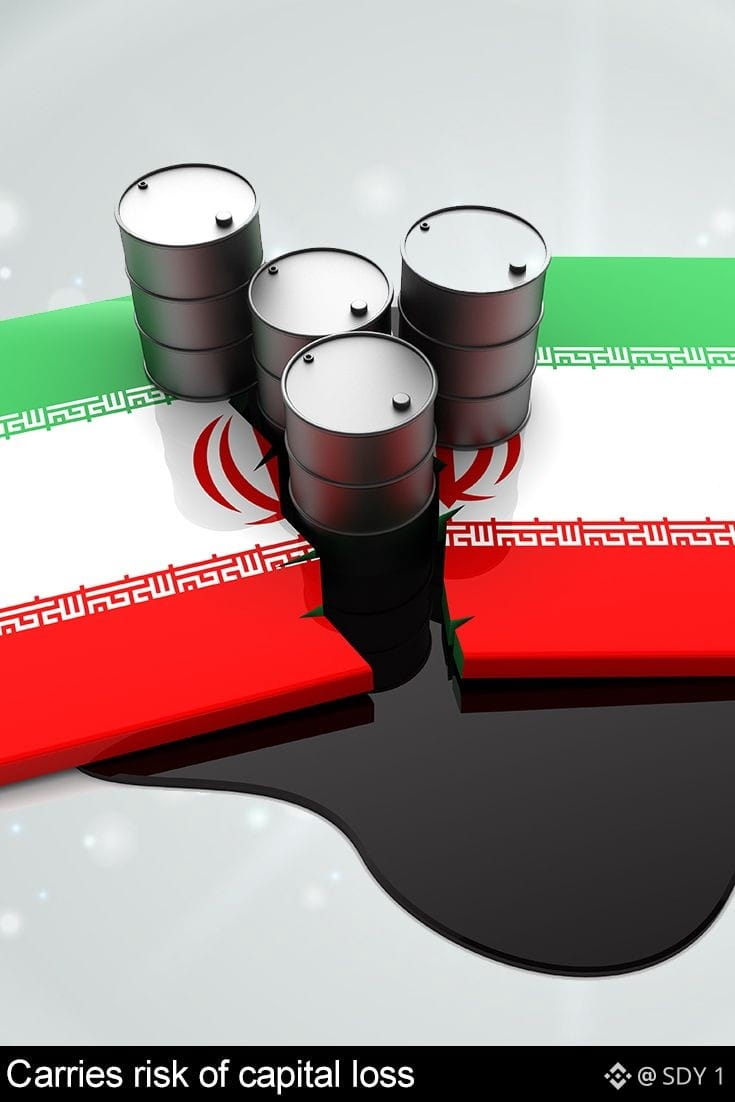
Bitcoin Falls Below $80K as US–Iran Tensions Hit Risk Appetite
Bitcoin slipped below $80,000 as renewed US–Iran military escalation triggered a fresh risk-off move across global markets.
BTC fell more than 2% to around $79,497 while ETH and XRP also declined. The move came after Bitcoin had recently reclaimed $81,000.
The immediate concern is oil.
Renewed US strikes on Iranian military targets and rising tensions around the Strait of Hormuz pushed oil prices higher as markets assessed the risk of supply disruptions.
That matters for Bitcoin because higher oil prices can increase inflation expectations, potentially reducing the Federal Reserve's room to ease policy.
The market is therefore pricing a chain reaction:
Iran escalation → higher oil → inflation pressure → tighter Fed expectations → stronger dollar/real yields → weaker risk assets.
Bitcoin is also still behaving more like a high-beta risk asset than a traditional safe haven during geopolitical shocks.
The key question now is whether this becomes another temporary selloff or a prolonged macro shock.
Watch $79K–$80K support, $81K resistance, oil prices, Hormuz developments, Fed communication and Bitcoin ETF flows.
If tensions ease and oil stabilizes BTC could rebound quickly.
If the conflict escalates, persistent inflation fears could keep Bitcoin below $81K.
The war created the headline.
Oil could determine Bitcoin's next move.
Bitcoin Falls Below $80K as US–Iran Tensions Hit Risk Appetite
Bitcoin slipped below $80,000 as renewed US–Iran military escalation triggered a fresh risk-off move across global markets.
BTC fell more than 2% to around $79,497 while ETH and XRP also declined. The move came after Bitcoin had recently reclaimed $81,000.
The immediate concern is oil.
Renewed US strikes on Iranian military targets and rising tensions around the Strait of Hormuz pushed oil prices higher as markets assessed the risk of supply disruptions.
That matters for Bitcoin because higher oil prices can increase inflation expectations, potentially reducing the Federal Reserve's room to ease policy.
The market is therefore pricing a chain reaction:
Iran escalation → higher oil → inflation pressure → tighter Fed expectations → stronger dollar/real yields → weaker risk assets.
Bitcoin is also still behaving more like a high-beta risk asset than a traditional safe haven during geopolitical shocks.
The key question now is whether this becomes another temporary selloff or a prolonged macro shock.
Watch $79K–$80K support, $81K resistance, oil prices, Hormuz developments, Fed communication and Bitcoin ETF flows.
If tensions ease and oil stabilizes BTC could rebound quickly.
If the conflict escalates, persistent inflation fears could keep Bitcoin below $81K.
The war created the headline.
Oil could determine Bitcoin's next move.
Bitcoin slipped below $80,000 as renewed US–Iran military escalation triggered a fresh risk-off move across global markets.
BTC fell more than 2% to around $79,497 while ETH and XRP also declined. The move came after Bitcoin had recently reclaimed $81,000.
The immediate concern is oil.
Renewed US strikes on Iranian military targets and rising tensions around the Strait of Hormuz pushed oil prices higher as markets assessed the risk of supply disruptions.
That matters for Bitcoin because higher oil prices can increase inflation expectations, potentially reducing the Federal Reserve's room to ease policy.
The market is therefore pricing a chain reaction:
Iran escalation → higher oil → inflation pressure → tighter Fed expectations → stronger dollar/real yields → weaker risk assets.
Bitcoin is also still behaving more like a high-beta risk asset than a traditional safe haven during geopolitical shocks.
The key question now is whether this becomes another temporary selloff or a prolonged macro shock.
Watch $79K–$80K support, $81K resistance, oil prices, Hormuz developments, Fed communication and Bitcoin ETF flows.
If tensions ease and oil stabilizes BTC could rebound quickly.
If the conflict escalates, persistent inflation fears could keep Bitcoin below $81K.
The war created the headline.
Oil could determine Bitcoin's next move.

71
·
--
THE MARKET ISN’T BEARISH YET IT’S WAITING FOR CONFIRMATION.
BTC is around $78K after pulling back from above $81K. ETH remains near the $2,400–$2,550 decision zone while SOL is holding around $105 after reclaiming $102–103.
The important signal isn’t the pullback itself. It’s whether buyers can defend the levels they just reclaimed Analysis:
→ BTC: Structure remains constructive but momentum has cooled.
→ ETH: Above $2,400 keeps the bullish bias alive. A break above $2,550 strengthens the setup rejection could target $2,400–$2,350.
→ SOL: The move toward $110 after breaking $102–103 remains a short-term bullish signal.
Lose the key support zones and the current bullish structure weakens quickly.
Don’t chase the candle. Watch the levels. The next confirmation matters more than the last move.
Market analysis not a guarantee of future price.
$BTC $ETH $SOL
THE MARKET ISN’T BEARISH YET IT’S WAITING FOR CONFIRMATION.
BTC is around $78K after pulling back from above $81K. ETH remains near the $2,400–$2,550 decision zone while SOL is holding around $105 after reclaiming $102–103.
The important signal isn’t the pullback itself. It’s whether buyers can defend the levels they just reclaimed Analysis:
→ BTC: Structure remains constructive but momentum has cooled.
→ ETH: Above $2,400 keeps the bullish bias alive. A break above $2,550 strengthens the setup rejection could target $2,400–$2,350.
→ SOL: The move toward $110 after breaking $102–103 remains a short-term bullish signal.
Lose the key support zones and the current bullish structure weakens quickly.
Don’t chase the candle. Watch the levels. The next confirmation matters more than the last move.
Market analysis not a guarantee of future price.
$BTC $ETH $SOL
BTC is around $78K after pulling back from above $81K. ETH remains near the $2,400–$2,550 decision zone while SOL is holding around $105 after reclaiming $102–103.
The important signal isn’t the pullback itself. It’s whether buyers can defend the levels they just reclaimed Analysis:
→ BTC: Structure remains constructive but momentum has cooled.
→ ETH: Above $2,400 keeps the bullish bias alive. A break above $2,550 strengthens the setup rejection could target $2,400–$2,350.
→ SOL: The move toward $110 after breaking $102–103 remains a short-term bullish signal.
Lose the key support zones and the current bullish structure weakens quickly.
Don’t chase the candle. Watch the levels. The next confirmation matters more than the last move.
Market analysis not a guarantee of future price.
$BTC $ETH $SOL
73
·
--
SOLANA JUST PASSED A CRITICAL INFLATION VOTE AND 18.9M SOL COULD STAY OUT OF CIRCULATION
Solana validators have approved a proposal to reduce the network’s future SOL issuance, potentially preventing nearly 18.9 million SOL from entering circulation.
The vote was unusually close.
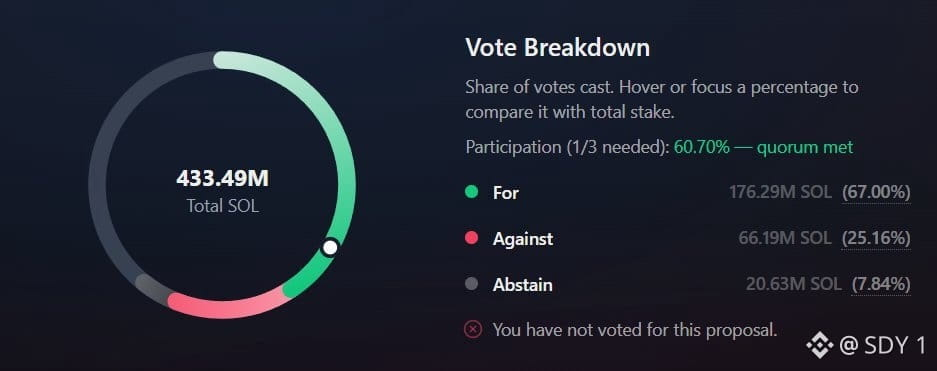
The proposal required 66.7% approval to pass and ultimately secured 67% crossing the threshold by a narrow margin.
The outcome reportedly came down to the final minutes when a validator linked to Kraken changed its position, helping push the proposal over the required threshold.
Why does this matter?
Reducing new SOL issuance means fewer tokens will be added to the circulating supply over time. If network demand remains strong, a slower rate of supply growth could improve SOL’s long-term supply dynamics.
But this does not automatically mean SOL’s price will rise.
The real impact depends on how the new issuance policy affects validator economics, staking incentives, network security and the balance between SOL supply and demand.
The bigger story is not simply 18.9M SOL won’t be issued.
It is that Solana’s validator community has chosen to prioritize a lower future inflation rate a decision that could shape the network’s token economics for years to come.
$SOL
SOLANA JUST PASSED A CRITICAL INFLATION VOTE AND 18.9M SOL COULD STAY OUT OF CIRCULATION
Solana validators have approved a proposal to reduce the network’s future SOL issuance, potentially preventing nearly 18.9 million SOL from entering circulation.
The vote was unusually close.
The proposal required 66.7% approval to pass and ultimately secured 67% crossing the threshold by a narrow margin.
The outcome reportedly came down to the final minutes when a validator linked to Kraken changed its position, helping push the proposal over the required threshold.
Why does this matter?
Reducing new SOL issuance means fewer tokens will be added to the circulating supply over time. If network demand remains strong, a slower rate of supply growth could improve SOL’s long-term supply dynamics.
But this does not automatically mean SOL’s price will rise.
The real impact depends on how the new issuance policy affects validator economics, staking incentives, network security and the balance between SOL supply and demand.
The bigger story is not simply 18.9M SOL won’t be issued.
It is that Solana’s validator community has chosen to prioritize a lower future inflation rate a decision that could shape the network’s token economics for years to come.
$SOL
Solana validators have approved a proposal to reduce the network’s future SOL issuance, potentially preventing nearly 18.9 million SOL from entering circulation.
The vote was unusually close.
The proposal required 66.7% approval to pass and ultimately secured 67% crossing the threshold by a narrow margin.
The outcome reportedly came down to the final minutes when a validator linked to Kraken changed its position, helping push the proposal over the required threshold.
Why does this matter?
Reducing new SOL issuance means fewer tokens will be added to the circulating supply over time. If network demand remains strong, a slower rate of supply growth could improve SOL’s long-term supply dynamics.
But this does not automatically mean SOL’s price will rise.
The real impact depends on how the new issuance policy affects validator economics, staking incentives, network security and the balance between SOL supply and demand.
The bigger story is not simply 18.9M SOL won’t be issued.
It is that Solana’s validator community has chosen to prioritize a lower future inflation rate a decision that could shape the network’s token economics for years to come.
$SOL
61
·
--
THE FED JUST SENT A WARNING SHOT TO RISK ASSETS.
Stocks and crypto came under pressure after Fed Chair Kevin Warsh delivered a more hawkish message at Jackson Hole.
Inflation is still not moving toward the Fed’s 2% target fast enough. Warsh said the Fed may need to take further action if underlying inflation fails to show clearer progress.
This changes the rate-cut narrative.
If inflation remains sticky the market has to price in the possibility of higher-for-longer rates or even renewed tightening that means:
→ Higher yields
→ Tighter financial conditions
→ Less liquidity chasing risk assets
→ More pressure on equities and crypto
And this is why Bitcoin reacts so aggressively to Fed rhetoric.
Crypto isn't falling simply because of one speech.
The market is repricing the liquidity environment.
The bigger question now isn't “When will the Fed cut?”
It's: “Will inflation give the Fed enough room to cut at all?”
Until that answer becomes clearer, volatility remains the trade.
$BTC $XRP
THE FED JUST SENT A WARNING SHOT TO RISK ASSETS.
Stocks and crypto came under pressure after Fed Chair Kevin Warsh delivered a more hawkish message at Jackson Hole.
Inflation is still not moving toward the Fed’s 2% target fast enough. Warsh said the Fed may need to take further action if underlying inflation fails to show clearer progress.
This changes the rate-cut narrative.
If inflation remains sticky the market has to price in the possibility of higher-for-longer rates or even renewed tightening that means:
→ Higher yields
→ Tighter financial conditions
→ Less liquidity chasing risk assets
→ More pressure on equities and crypto
And this is why Bitcoin reacts so aggressively to Fed rhetoric.
Crypto isn't falling simply because of one speech.
The market is repricing the liquidity environment.
The bigger question now isn't “When will the Fed cut?”
It's: “Will inflation give the Fed enough room to cut at all?”
Until that answer becomes clearer, volatility remains the trade.
$BTC $XRP
Stocks and crypto came under pressure after Fed Chair Kevin Warsh delivered a more hawkish message at Jackson Hole.
Inflation is still not moving toward the Fed’s 2% target fast enough. Warsh said the Fed may need to take further action if underlying inflation fails to show clearer progress.
This changes the rate-cut narrative.
If inflation remains sticky the market has to price in the possibility of higher-for-longer rates or even renewed tightening that means:
→ Higher yields
→ Tighter financial conditions
→ Less liquidity chasing risk assets
→ More pressure on equities and crypto
And this is why Bitcoin reacts so aggressively to Fed rhetoric.
Crypto isn't falling simply because of one speech.
The market is repricing the liquidity environment.
The bigger question now isn't “When will the Fed cut?”
It's: “Will inflation give the Fed enough room to cut at all?”
Until that answer becomes clearer, volatility remains the trade.
$BTC $XRP

53
·
--
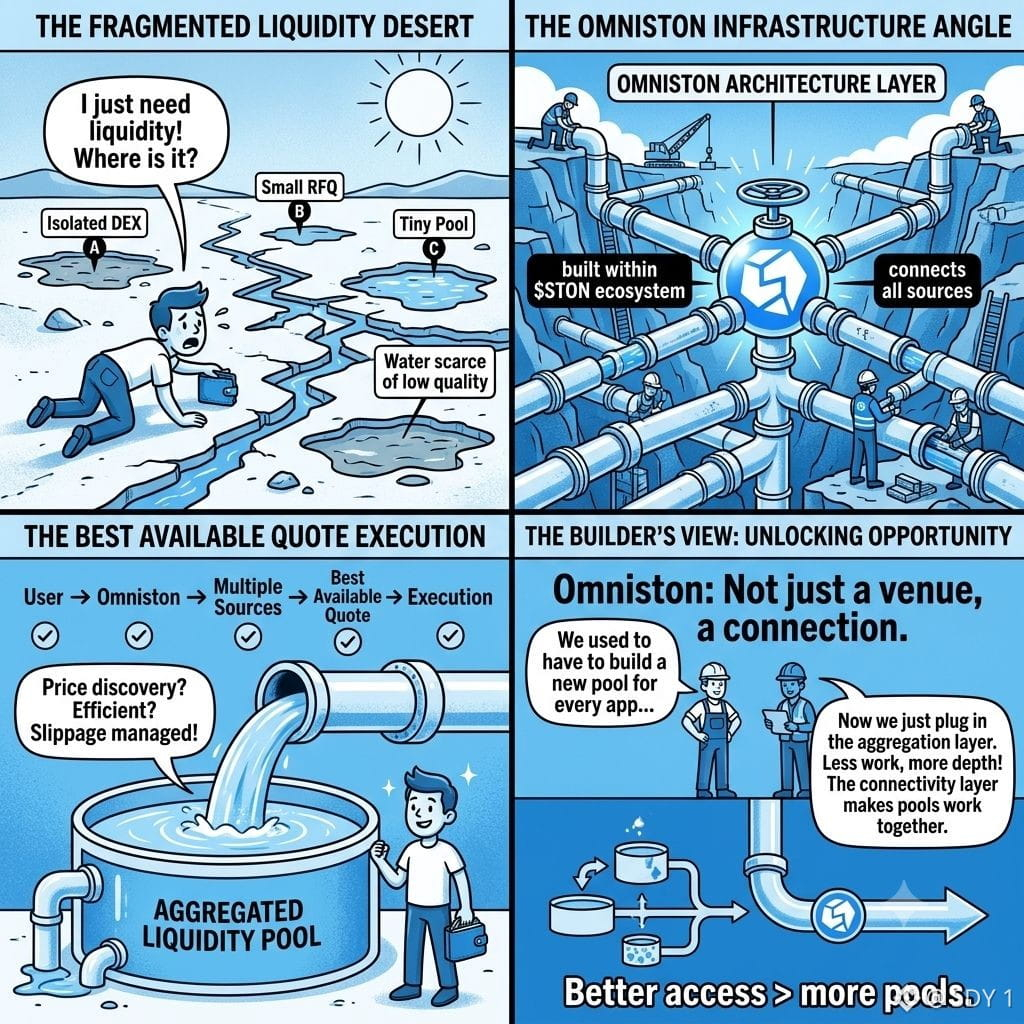
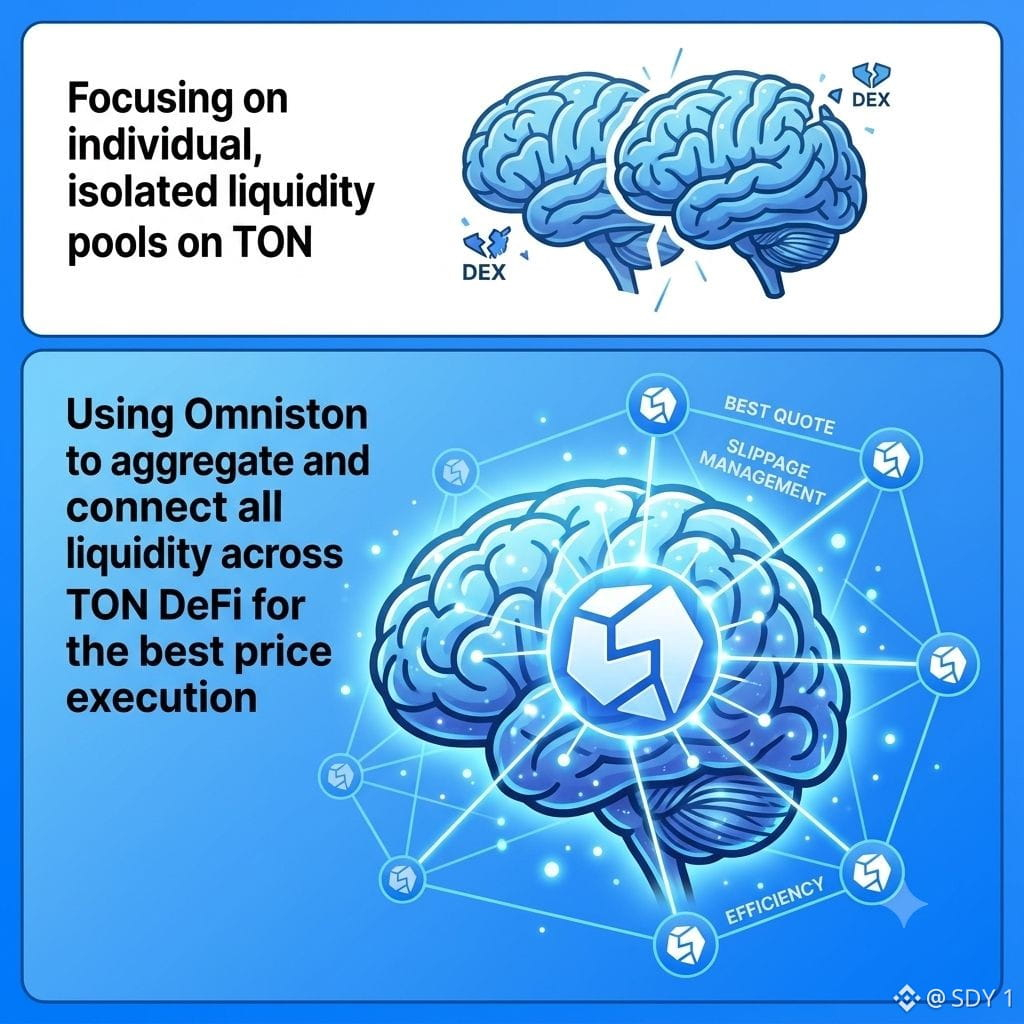
TON DeFi Doesn’t Just Need More Liquidity. It Needs Better Access to It. This is where Omniston gets interesting. Built within the $STON ecosystem, Omniston approaches one of DeFi’s biggest problems from an infrastructure angle liquidity fragmentation. Liquidity can sit across different DEXs and RFQ resolvers, with each source offering different prices, depth and execution conditions. Omniston connects these sources, compares available quotes and helps route a swap toward the selected quote. User → Omniston → Multiple Liquidity Sources → Best Available Quote → Execution That sounds simple. But the impact can be significant. Instead of an application being tied to one liquidity source, Omniston creates a pathway to access liquidity across multiple venues. For users, that can improve: → Price discovery → Execution efficiency → Liquidity access → Slippage management For builders, the value is different. They don't necessarily need to build isolated liquidity infrastructure for every application. They can leverage an aggregation layer designed to connect existing liquidity. And this is where I think the bigger opportunity sits. TON DeFi doesn't necessarily need dozens of disconnected liquidity pools. It needs infrastructure that makes those pools work together. As the ecosystem expands, aggregation and routing become increasingly important because having liquidity is only half the equation. The other half is being able to reach it efficiently. That's the role Omniston is positioning itself to play. Not another isolated liquidity venue. A connectivity layer for TON's growing liquidity landscape. And if $GRAM DeFi continues to scale, that infrastructure could become far more important than it looks today. $BMT $BTR $FARTCOIN #TON ecosystem, here to discover the latest projects# #BTC Price Analysis# #DeFi
TON DeFi Doesn’t Just Need More Liquidity. It Needs Better Access to It. This is where Omniston gets interesting. Built within the $STON ecosystem, Omniston approaches one of DeFi’s biggest problems from an infrastructure angle liquidity fragmentation. Liquidity can sit across different DEXs and RFQ resolvers, with each source offering different prices, depth and execution conditions. Omniston connects these sources, compares available quotes and helps route a swap toward the selected quote. User → Omniston → Multiple Liquidity Sources → Best Available Quote → Execution That sounds simple. But the impact can be significant. Instead of an application being tied to one liquidity source, Omniston creates a pathway to access liquidity across multiple venues. For users, that can improve: → Price discovery → Execution efficiency → Liquidity access → Slippage management For builders, the value is different. They don't necessarily need to build isolated liquidity infrastructure for every application. They can leverage an aggregation layer designed to connect existing liquidity. And this is where I think the bigger opportunity sits. TON DeFi doesn't necessarily need dozens of disconnected liquidity pools. It needs infrastructure that makes those pools work together. As the ecosystem expands, aggregation and routing become increasingly important because having liquidity is only half the equation. The other half is being able to reach it efficiently. That's the role Omniston is positioning itself to play. Not another isolated liquidity venue. A connectivity layer for TON's growing liquidity landscape. And if $GRAM DeFi continues to scale, that infrastructure could become far more important than it looks today. $BMT $BTR $FARTCOIN #TON ecosystem, here to discover the latest projects# #BTC Price Analysis# #DeFi
76
·
--
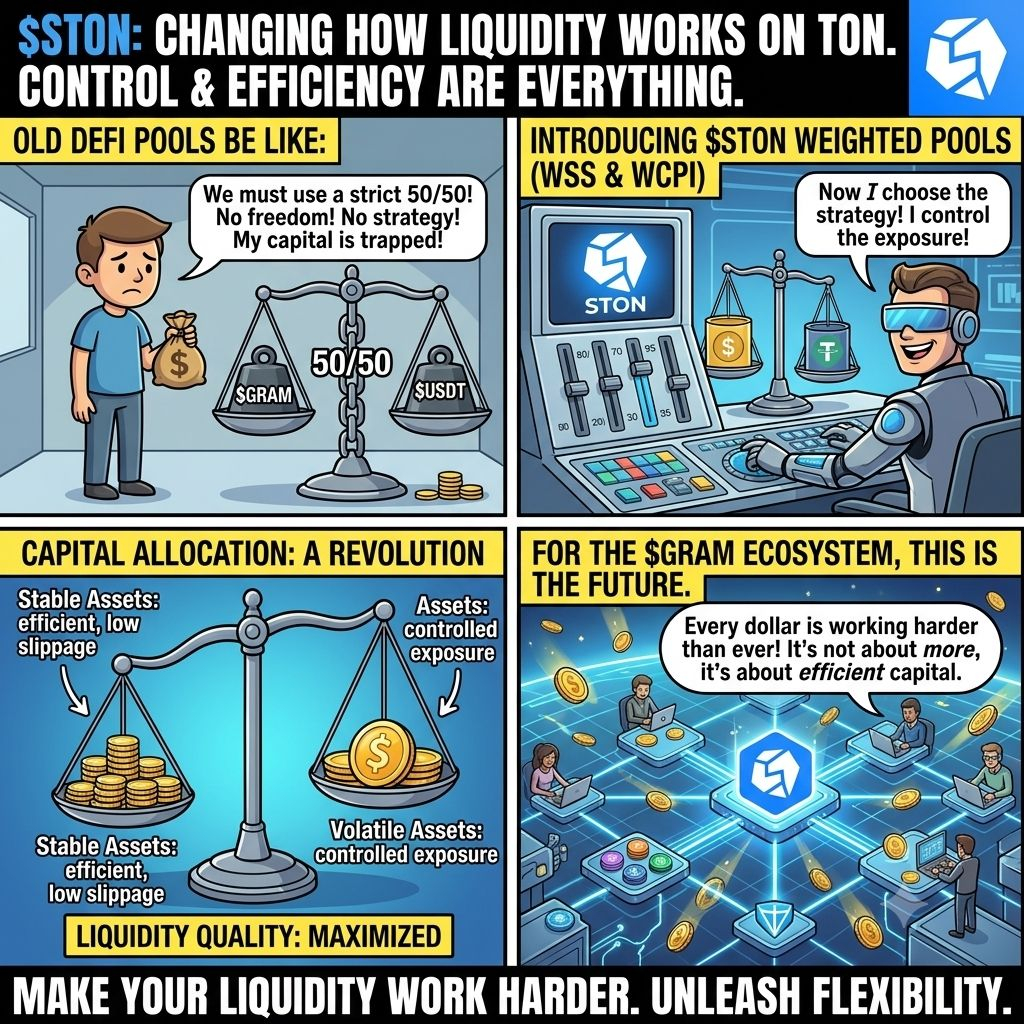
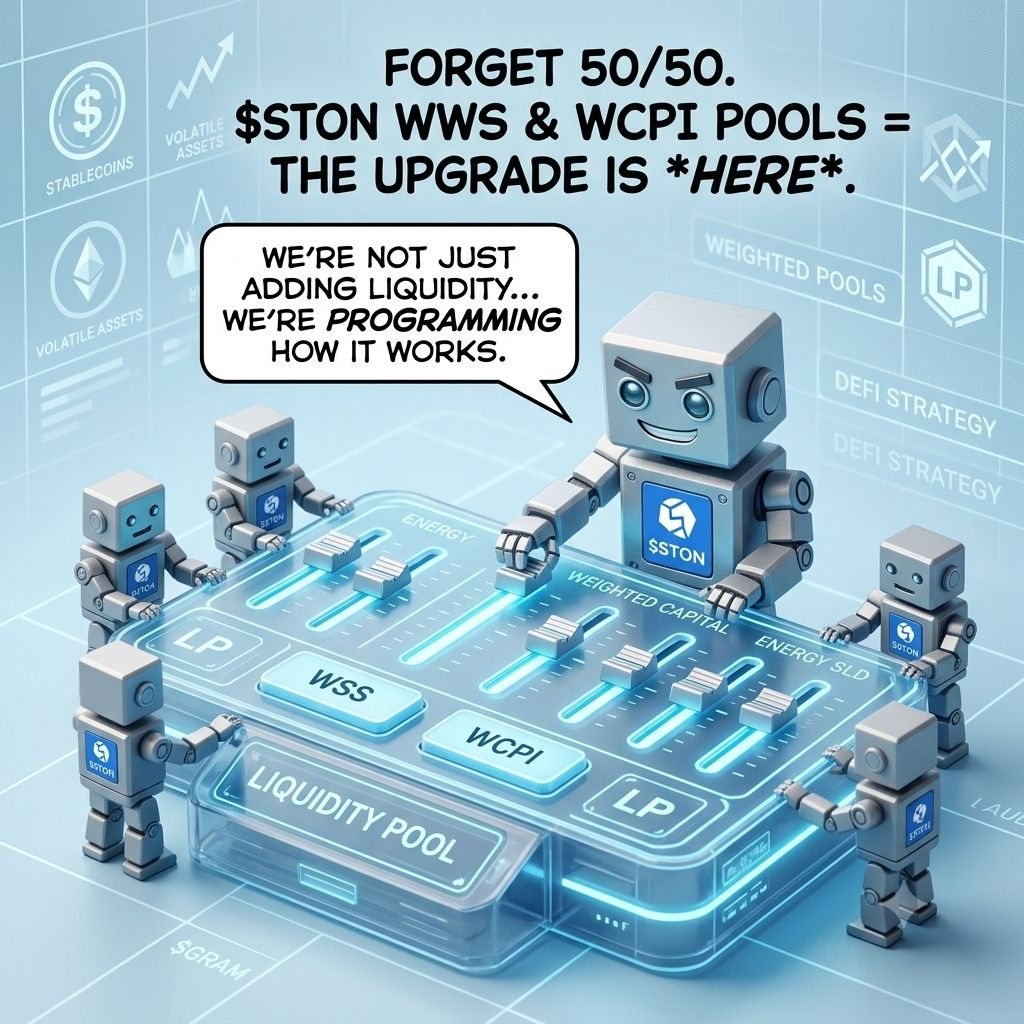
$STON ISN’T JUST ADDING LIQUIDITY IT’S CHANGING HOW LIQUIDITY WORKS. Most DeFi pools still force LPs into a simple 50/50 structure. $STON is taking a different approach with Weighted Stable Swap (WSS) and Weighted Constant Product Invariant (WCPI) pools on TON. The important part isn't simply the introduction of two new pool types. It’s the control they give liquidity providers. With weighted pools capital doesn't have to be distributed evenly between assets. LPs can design positions around the characteristics of the assets and the strategy they want to pursue. That can matter in several ways: → Stable assets: more efficient liquidity distribution and potentially lower slippage. → Volatile assets: greater control over asset exposure and capital allocation. → LP strategies: less dependence on rigid 50/50 positioning. → Market depth: liquidity can be structured around actual trading demand. This is where the upgrade becomes more interesting. DeFi liquidity isn't only about how much capital is deposited. It's about how efficiently that capital is positioned. If $STON can attract more sophisticated LP strategies, WSS and WCPI could help strengthen liquidity quality across TON while giving users more flexibility over their capital. For a growing $GRAM ecosystem, that infrastructure layer matters. The next phase of DeFi may not be about putting more money into pools. It may be about making every dollar of liquidity work harder. $BTC $SOL #Bitcoin Price Prediction: What is Bitcoins next move?# #Macro Insights#
$STON ISN’T JUST ADDING LIQUIDITY IT’S CHANGING HOW LIQUIDITY WORKS. Most DeFi pools still force LPs into a simple 50/50 structure. $STON is taking a different approach with Weighted Stable Swap (WSS) and Weighted Constant Product Invariant (WCPI) pools on TON. The important part isn't simply the introduction of two new pool types. It’s the control they give liquidity providers. With weighted pools capital doesn't have to be distributed evenly between assets. LPs can design positions around the characteristics of the assets and the strategy they want to pursue. That can matter in several ways: → Stable assets: more efficient liquidity distribution and potentially lower slippage. → Volatile assets: greater control over asset exposure and capital allocation. → LP strategies: less dependence on rigid 50/50 positioning. → Market depth: liquidity can be structured around actual trading demand. This is where the upgrade becomes more interesting. DeFi liquidity isn't only about how much capital is deposited. It's about how efficiently that capital is positioned. If $STON can attract more sophisticated LP strategies, WSS and WCPI could help strengthen liquidity quality across TON while giving users more flexibility over their capital. For a growing $GRAM ecosystem, that infrastructure layer matters. The next phase of DeFi may not be about putting more money into pools. It may be about making every dollar of liquidity work harder. $BTC $SOL #Bitcoin Price Prediction: What is Bitcoins next move?# #Macro Insights#
68
·
--
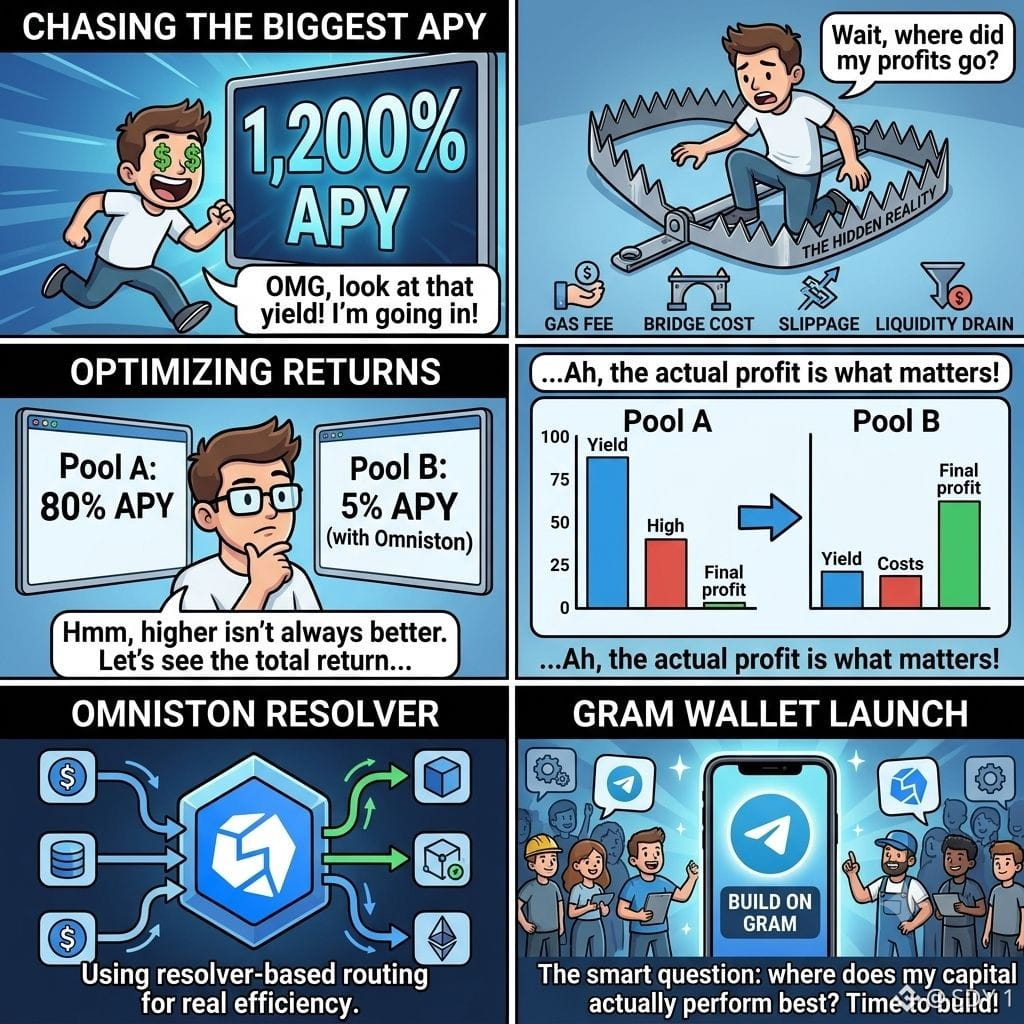
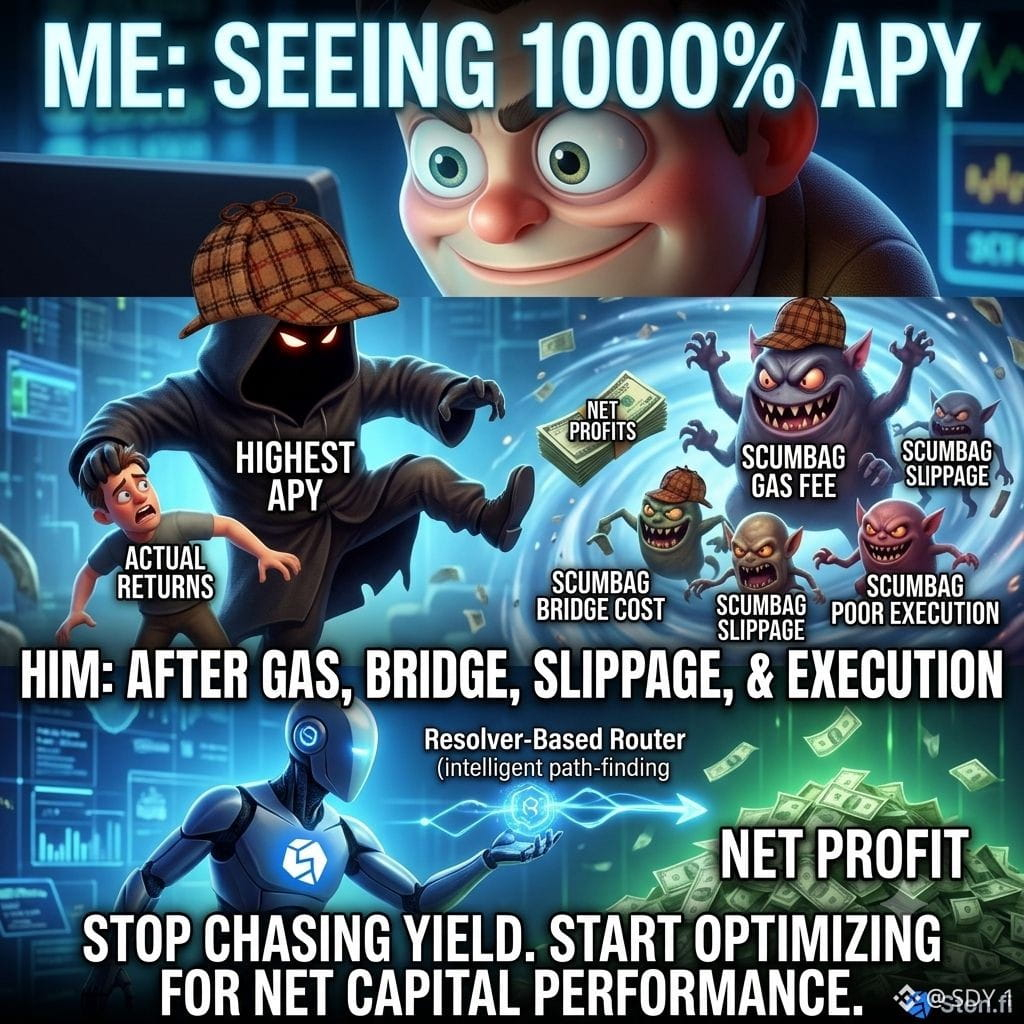
THE BIGGEST APY CAN BE A TRAP. A higher number on the screen doesn’t automatically mean higher returns. That became clear to me while going through $STON ’s latest insights. Two strategies can advertise completely different APYs, yet the one with the lower headline yield can leave you with more profit. Why? Because the real calculation starts after the APY. → Gas fees → Bridge costs → Slippage → Available liquidity → Execution efficiency Once these are included advertised APY becomes only one part of the equation. This is where Omniston caught my attention. Its resolver-based routing is designed around how efficiently a swap is executed, rather than simply treating cross-chain activity as an asset-transfer problem. That distinction matters. As DeFi expands across $GRAM and other ecosystems, capital will have more places to move but also more friction to navigate. So I think the smarter question is changing: Not: “Which pool offers the highest APY?” But: “After every cost, where does my capital actually perform best?” That is the difference between chasing yield and optimizing returns. And with $GRAM Wallet getting closer to its Telegram launch, the next opportunity may not just be for users. It could be for builders. Stonfiers we’re going live in a few moments to explore what Telegram-native crypto could look like and what the Gram Wallet ecosystem might unlock. Gram Wallet is coming to Telegram. What are you building? @ston_fi $BTC #BTC Price Analysis# #Bitcoin Price Prediction: What is Bitcoins next move?# #Macro Insights#
THE BIGGEST APY CAN BE A TRAP. A higher number on the screen doesn’t automatically mean higher returns. That became clear to me while going through $STON ’s latest insights. Two strategies can advertise completely different APYs, yet the one with the lower headline yield can leave you with more profit. Why? Because the real calculation starts after the APY. → Gas fees → Bridge costs → Slippage → Available liquidity → Execution efficiency Once these are included advertised APY becomes only one part of the equation. This is where Omniston caught my attention. Its resolver-based routing is designed around how efficiently a swap is executed, rather than simply treating cross-chain activity as an asset-transfer problem. That distinction matters. As DeFi expands across $GRAM and other ecosystems, capital will have more places to move but also more friction to navigate. So I think the smarter question is changing: Not: “Which pool offers the highest APY?” But: “After every cost, where does my capital actually perform best?” That is the difference between chasing yield and optimizing returns. And with $GRAM Wallet getting closer to its Telegram launch, the next opportunity may not just be for users. It could be for builders. Stonfiers we’re going live in a few moments to explore what Telegram-native crypto could look like and what the Gram Wallet ecosystem might unlock. Gram Wallet is coming to Telegram. What are you building? @ston_fi $BTC #BTC Price Analysis# #Bitcoin Price Prediction: What is Bitcoins next move?# #Macro Insights#
79
·
--
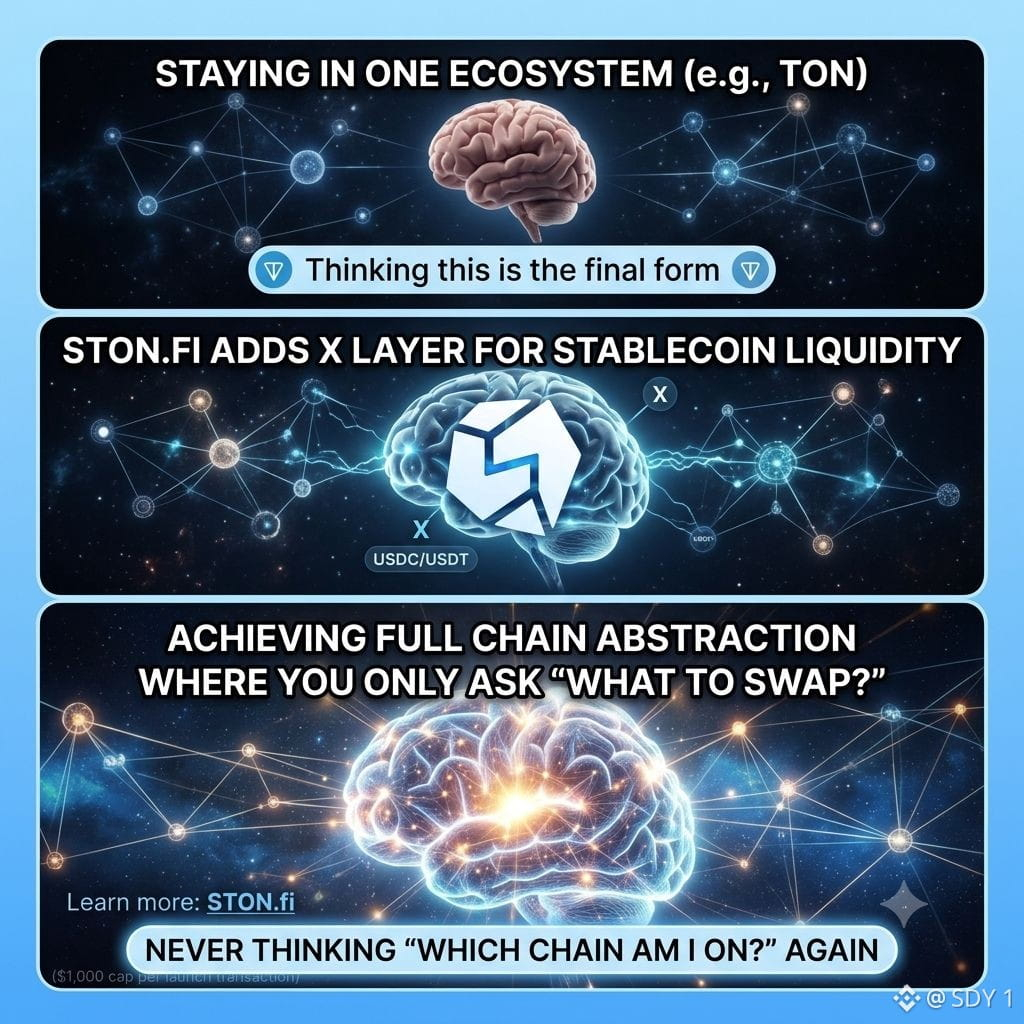
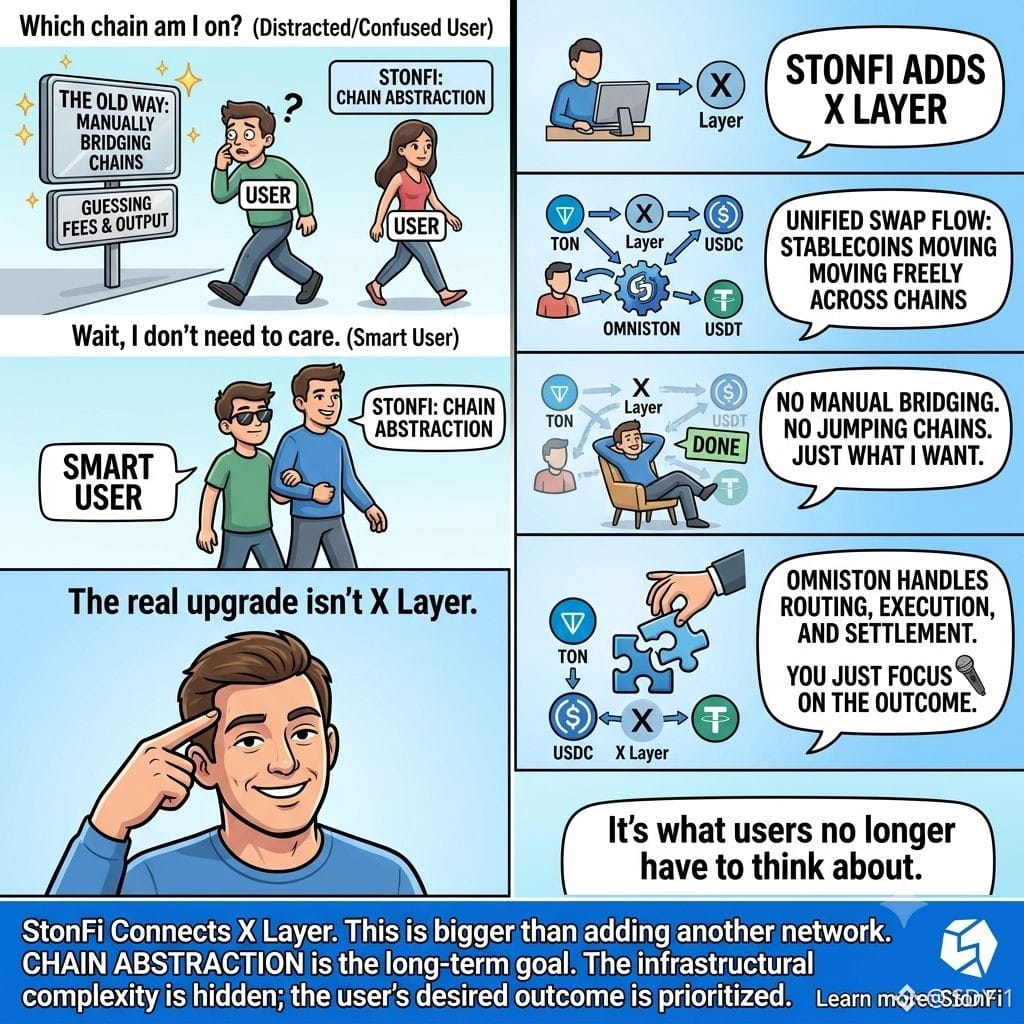
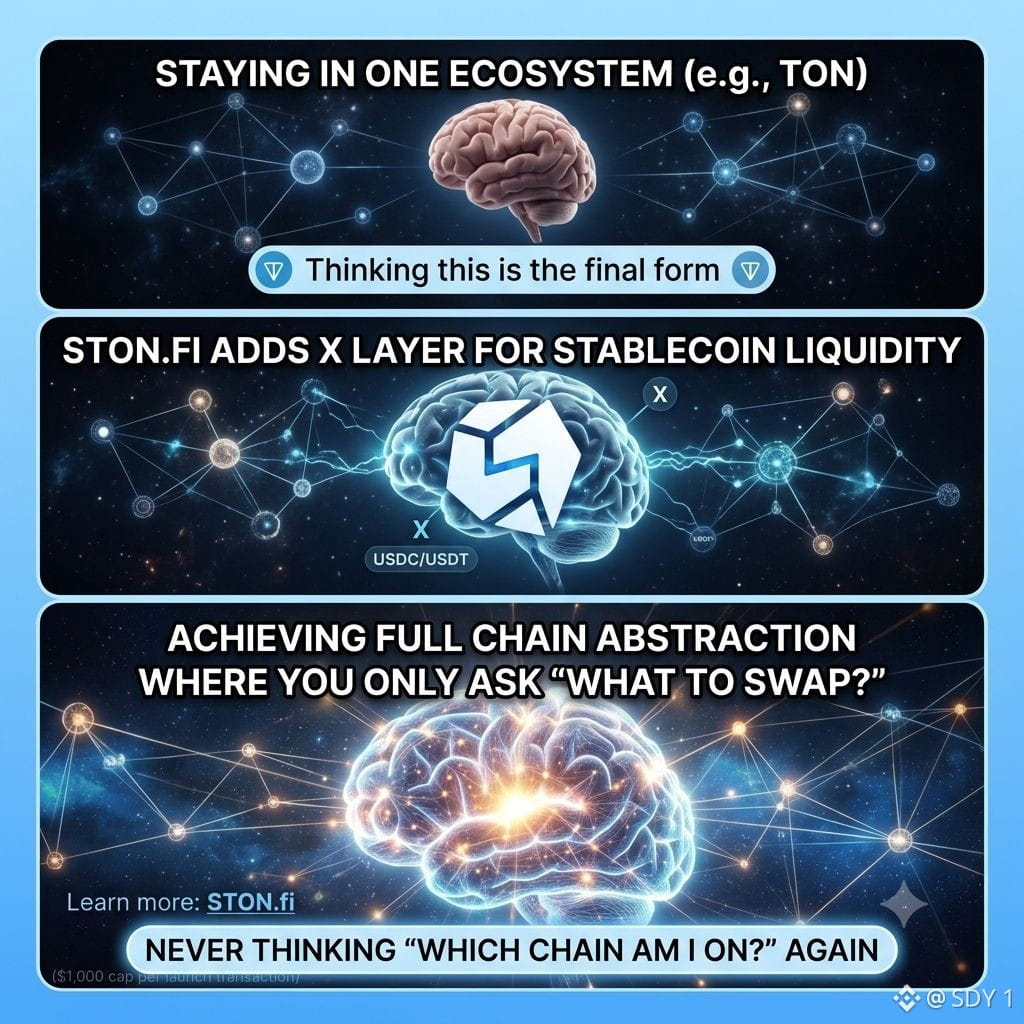
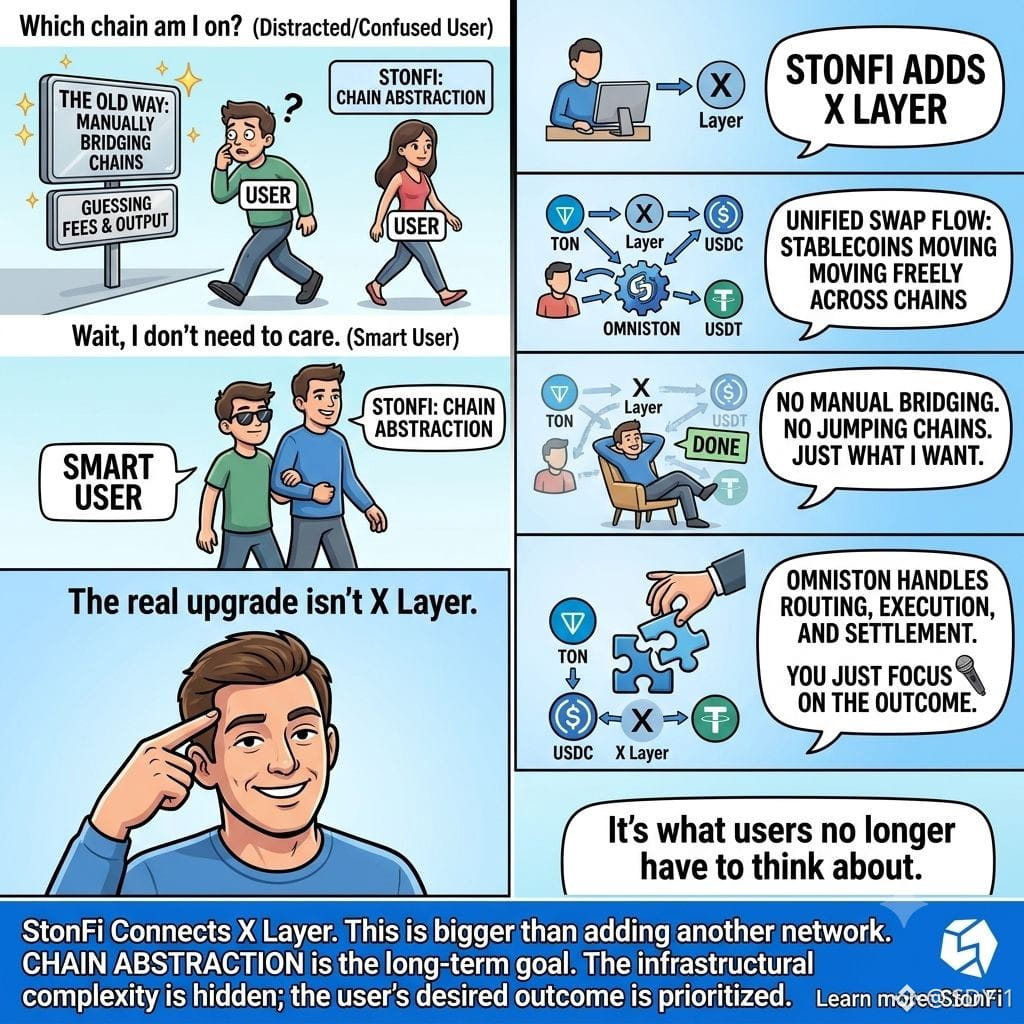
The real upgrade isn’t X Layer. It’s what users no longer have to think about. StonFi just connected X Layer to its expanding cross-chain ecosystem, bringing USDC and USDT0 into a unified swap flow across $GRAM and other supported networks. Omniston handles the complicated part routing, execution and settlement while users simply choose what they want to swap. No manual bridging. No jumping between chains. No guessing how much they’ll receive. Most swaps can complete in 15–40 seconds, with the expected output visible before confirmation. This is bigger than adding another network. Every new integration makes StonFi’s liquidity layer more useful. The long-term goal is clear chain abstraction where the infrastructure handles the complexity and users focus on the outcome. X Layer strengthens that direction by adding more stablecoin liquidity and another route into TON’s growing on-chain economy. At launch X Layer swaps are capped at $1000 per transaction. The more networks StonFi connects the less relevant the question “Which chain am I on?” becomes. That’s the real unlock. 🔗 Learn more: @ston_fi $BTC #Bitcoin Price Prediction: What is Bitcoins next move?# #Macro Insights# #STONfi
The real upgrade isn’t X Layer. It’s what users no longer have to think about. StonFi just connected X Layer to its expanding cross-chain ecosystem, bringing USDC and USDT0 into a unified swap flow across $GRAM and other supported networks. Omniston handles the complicated part routing, execution and settlement while users simply choose what they want to swap. No manual bridging. No jumping between chains. No guessing how much they’ll receive. Most swaps can complete in 15–40 seconds, with the expected output visible before confirmation. This is bigger than adding another network. Every new integration makes StonFi’s liquidity layer more useful. The long-term goal is clear chain abstraction where the infrastructure handles the complexity and users focus on the outcome. X Layer strengthens that direction by adding more stablecoin liquidity and another route into TON’s growing on-chain economy. At launch X Layer swaps are capped at $1000 per transaction. The more networks StonFi connects the less relevant the question “Which chain am I on?” becomes. That’s the real unlock. 🔗 Learn more: @ston_fi $BTC #Bitcoin Price Prediction: What is Bitcoins next move?# #Macro Insights# #STONfi
63
·
--
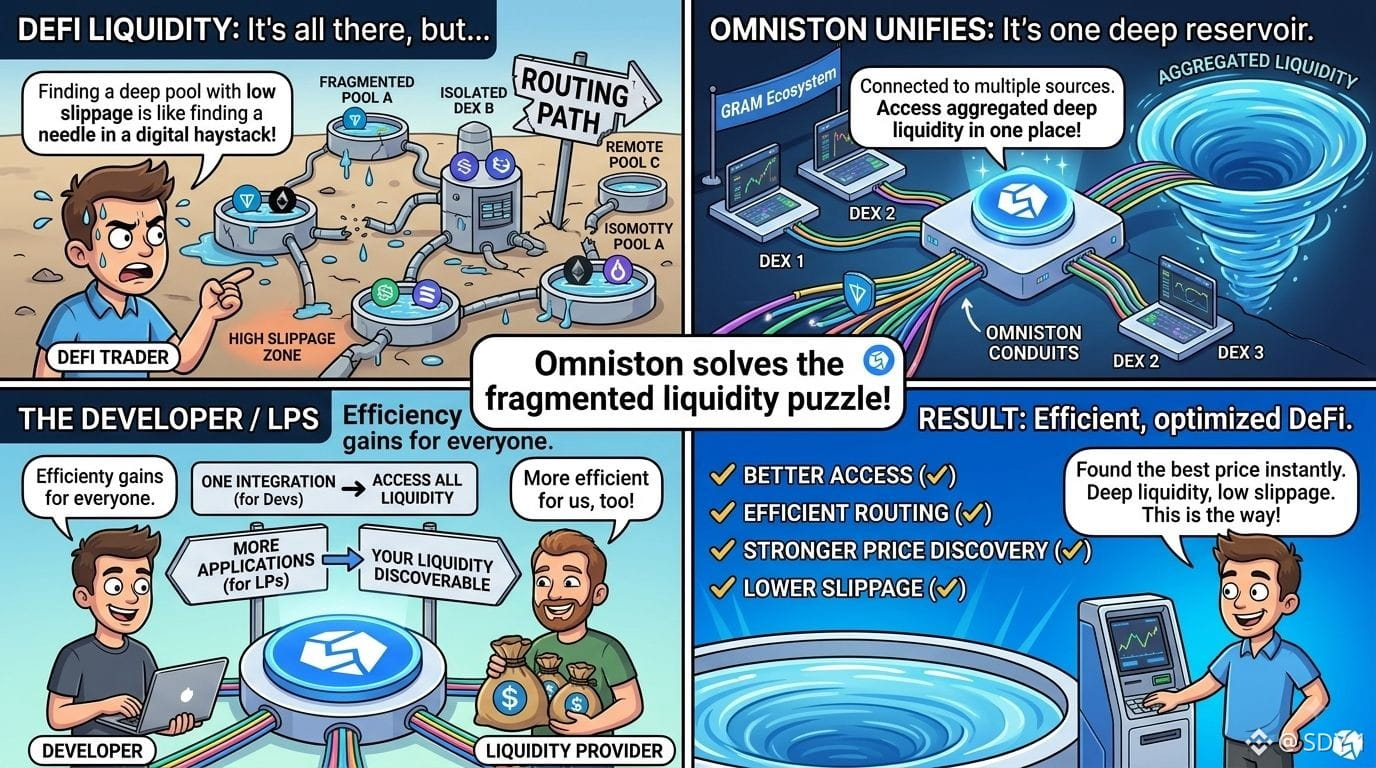
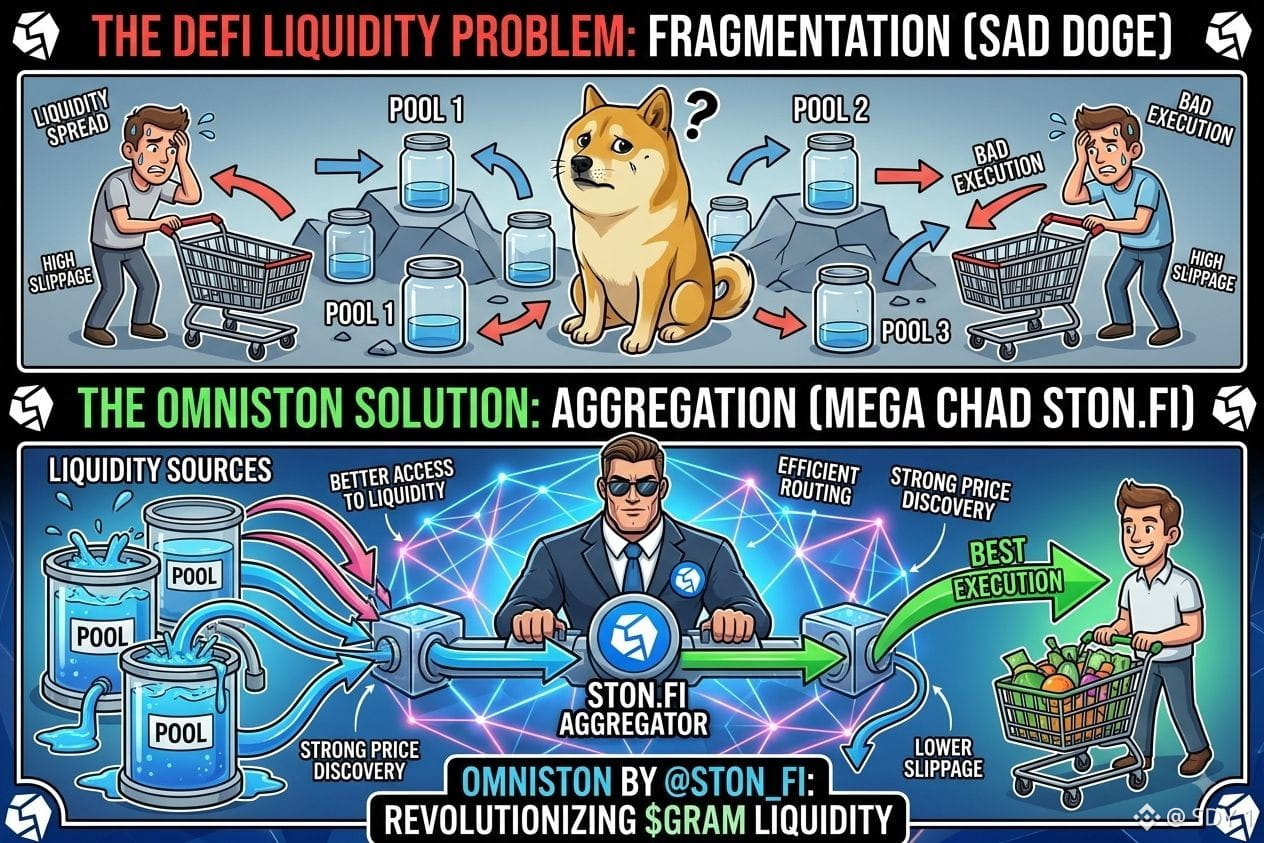
Liquidity fragmentation is one of the quiet inefficiencies holding DeFi back. The problem isn’t always a lack of liquidity. It’s that liquidity is often spread across different pools and sources, making it harder to find the best execution. That’s the problem @ston_fi is addressing with Omniston. Rather than creating another isolated DEX, Omniston connects liquidity from multiple sources and helps route trades more efficiently. The result can be: → Better access to liquidity → More efficient trade routing → Stronger price discovery → Lower potential slippage For developers Omniston provides a way to access aggregated liquidity through a single integration. For liquidity providers it expands the number of applications through which their liquidity can be accessed. And this is where the bigger picture becomes interesting. As the GRAM$GRAM ecosystem grows, liquidity infrastructure becomes increasingly important. Because having liquidity is one thing. Making that liquidity easy to discover, access and use efficiently is another. That’s the role Omniston is designed to play. $BTC #Bitcoin Price Prediction: What is Bitcoins next move?# #Macro Insights# #STONfi
Liquidity fragmentation is one of the quiet inefficiencies holding DeFi back. The problem isn’t always a lack of liquidity. It’s that liquidity is often spread across different pools and sources, making it harder to find the best execution. That’s the problem @ston_fi is addressing with Omniston. Rather than creating another isolated DEX, Omniston connects liquidity from multiple sources and helps route trades more efficiently. The result can be: → Better access to liquidity → More efficient trade routing → Stronger price discovery → Lower potential slippage For developers Omniston provides a way to access aggregated liquidity through a single integration. For liquidity providers it expands the number of applications through which their liquidity can be accessed. And this is where the bigger picture becomes interesting. As the GRAM$GRAM ecosystem grows, liquidity infrastructure becomes increasingly important. Because having liquidity is one thing. Making that liquidity easy to discover, access and use efficiently is another. That’s the role Omniston is designed to play. $BTC #Bitcoin Price Prediction: What is Bitcoins next move?# #Macro Insights# #STONfi
97
·
--
The real upgrade isn’t X Layer. It’s what users no longer have to think about. StonFi just connected X Layer to its expanding cross-chain ecosystem, bringing USDC and USDT0 into a unified swap flow across GRAM$GRAM and other supported networks. Omniston handles the complicated part routing, execution and settlement while users simply choose what they want to swap. No manual bridging. No jumping between chains. No guessing how much they’ll receive. Most swaps can complete in 15–40 seconds, with the expected output visible before confirmation. This is bigger than adding another network. Every new integration makes StonFi’s liquidity layer more useful. The long-term goal is clear chain abstraction where the infrastructure handles the complexity and users focus on the outcome. X Layer strengthens that direction by adding more stablecoin liquidity and another route into TON’s growing on-chain economy. At launch X Layer swaps are capped at $1000 per transaction. The more networks StonFi connects the less relevant the question “Which chain am I on?” becomes. That’s the real unlock. 🔗 Learn more: @ston_fi $BTC $XRP #Macro Insights# #TON ecosystem, here to discover the latest projects#
The real upgrade isn’t X Layer. It’s what users no longer have to think about. StonFi just connected X Layer to its expanding cross-chain ecosystem, bringing USDC and USDT0 into a unified swap flow across GRAM$GRAM and other supported networks. Omniston handles the complicated part routing, execution and settlement while users simply choose what they want to swap. No manual bridging. No jumping between chains. No guessing how much they’ll receive. Most swaps can complete in 15–40 seconds, with the expected output visible before confirmation. This is bigger than adding another network. Every new integration makes StonFi’s liquidity layer more useful. The long-term goal is clear chain abstraction where the infrastructure handles the complexity and users focus on the outcome. X Layer strengthens that direction by adding more stablecoin liquidity and another route into TON’s growing on-chain economy. At launch X Layer swaps are capped at $1000 per transaction. The more networks StonFi connects the less relevant the question “Which chain am I on?” becomes. That’s the real unlock. 🔗 Learn more: @ston_fi $BTC $XRP #Macro Insights# #TON ecosystem, here to discover the latest projects#
62
·
--
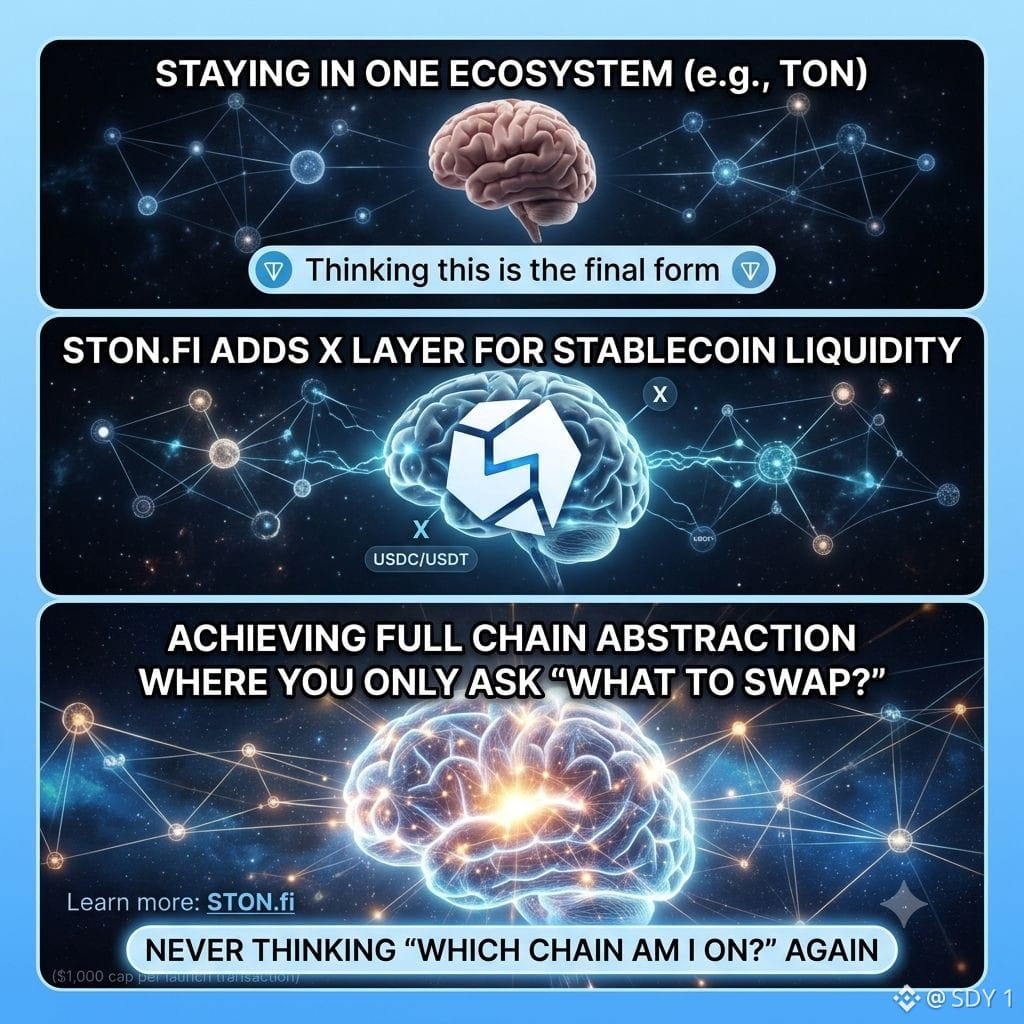
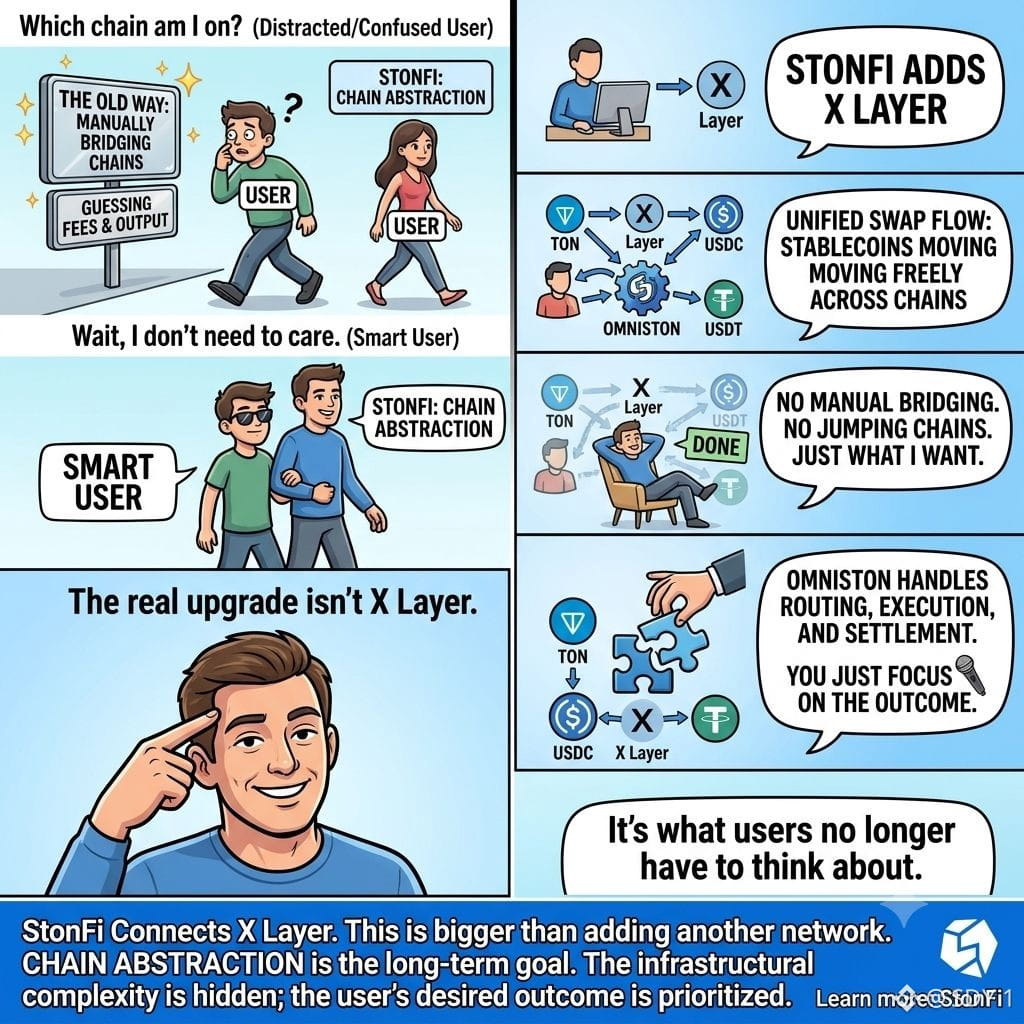
The real upgrade isn’t X Layer. It’s what users no longer have to think about. StonFi just connected X Layer to its expanding cross-chain ecosystem, bringing USDC and USDT0 into a unified swap flow across $GRAM and other supported networks. Omniston handles the complicated part routing, execution, and settlement while users simply choose what they want to swap. No manual bridging. No jumping between chains. No guessing how much they’ll receive. Most swaps can complete in 15–40 seconds, with the expected output visible before confirmation. This is bigger than adding another network. Every new integration makes StonFi’s liquidity layer more useful. The long-term goal is clear chain abstraction where the infrastructure handles the complexity and users focus on the outcome. X Layer strengthens that direction by adding more stablecoin liquidity and another route into TON’s growing onchain economy. At launch X Layer swaps are capped at $1,000 per transaction. The more networks StonFi connects the less relevant the question “Which chain am I on?” becomes. That’s the real unlock. 🔗 Learn more: @ston_fi $XL1 $XYO $APTM $HEMI #Macro Insights# #TON ecosystem, here to discover the latest projects#
The real upgrade isn’t X Layer. It’s what users no longer have to think about. StonFi just connected X Layer to its expanding cross-chain ecosystem, bringing USDC and USDT0 into a unified swap flow across $GRAM and other supported networks. Omniston handles the complicated part routing, execution, and settlement while users simply choose what they want to swap. No manual bridging. No jumping between chains. No guessing how much they’ll receive. Most swaps can complete in 15–40 seconds, with the expected output visible before confirmation. This is bigger than adding another network. Every new integration makes StonFi’s liquidity layer more useful. The long-term goal is clear chain abstraction where the infrastructure handles the complexity and users focus on the outcome. X Layer strengthens that direction by adding more stablecoin liquidity and another route into TON’s growing onchain economy. At launch X Layer swaps are capped at $1,000 per transaction. The more networks StonFi connects the less relevant the question “Which chain am I on?” becomes. That’s the real unlock. 🔗 Learn more: @ston_fi $XL1 $XYO $APTM $HEMI #Macro Insights# #TON ecosystem, here to discover the latest projects#
75
·
--
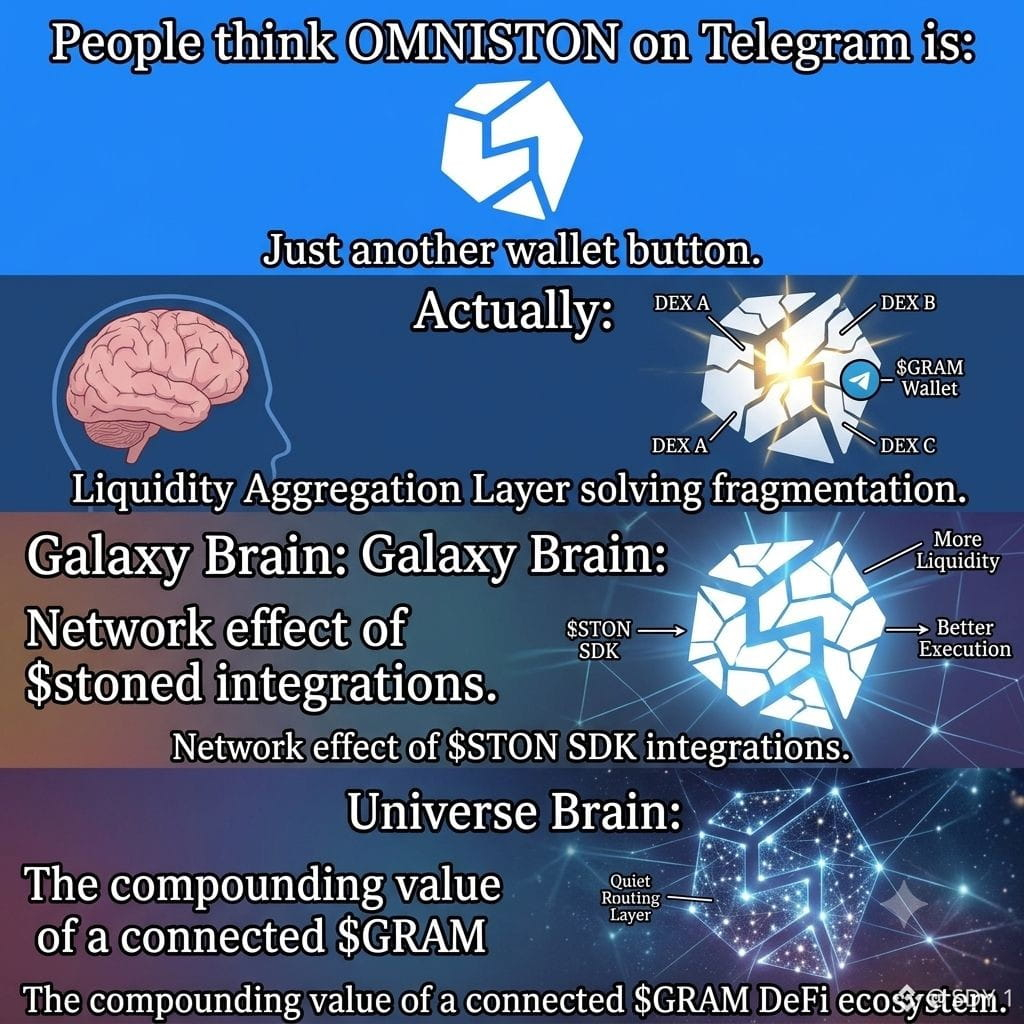
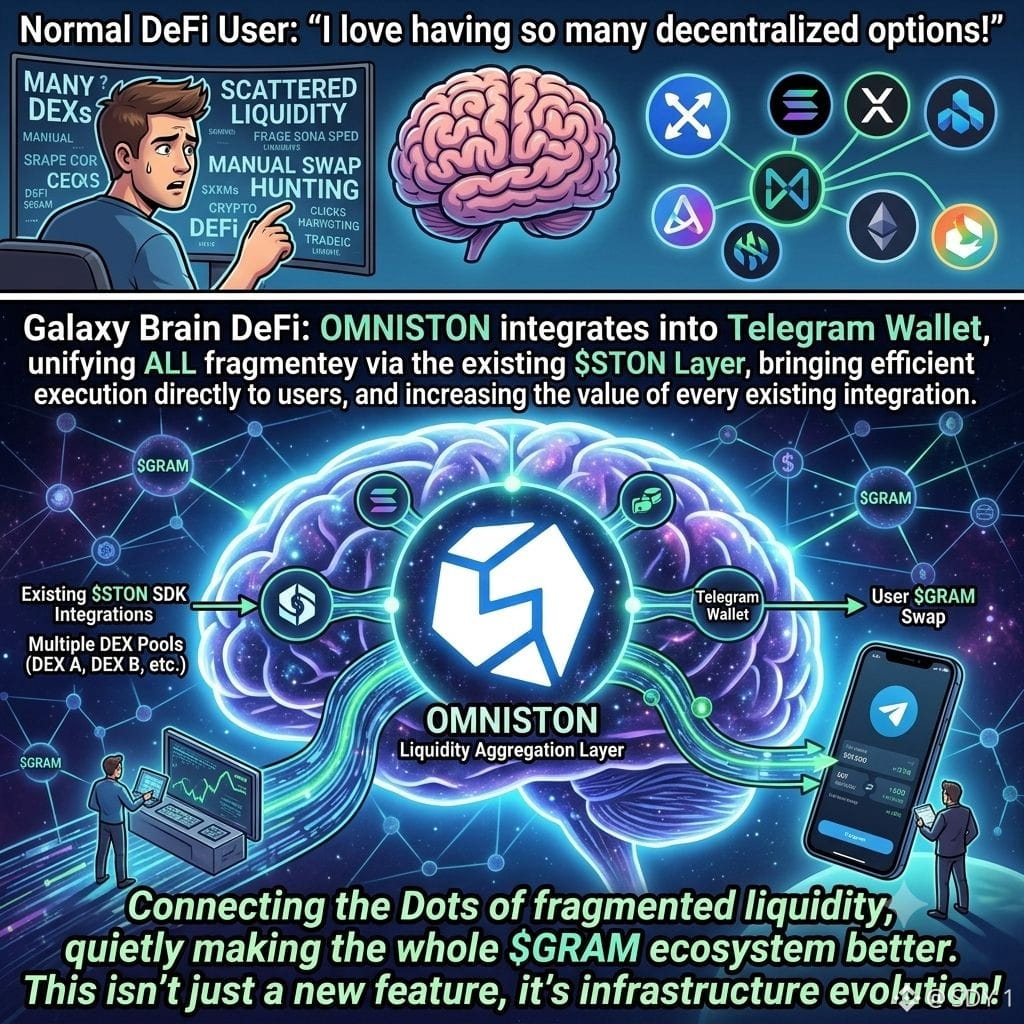
More DEXs don’t automatically mean better DeFi but Better liquidity access does. That’s why OMNISTON integrating with Telegram’s non-custodial $GRAM Wallet is worth watching. OMNISTON aggregates liquidity across the ecosystem, helping route swaps toward more efficient execution instead of relying on a single liquidity source. But the bigger story is $STON ’s infrastructure. Its SDK is already integrated across multiple $GRAM projects. As OMNISTON expands, those integrations can potentially tap into broader liquidity without rebuilding their swap infrastructure. That creates a simple flywheel: More integrations → better liquidity access → better execution → stronger DeFi infrastructure. Although this shows where $GRAM DeFi is heading not just more DEXs but better-connected liquidity. The infrastructure may be invisible to users, but its impact won't be. Explore the $GRAM ecosystem: $GRAM Community $BTW $LDO $H $ANTFUN #TON ecosystem, here to discover the latest projects# #Macro Insights# #DeFi #Web3 #Crypto#
More DEXs don’t automatically mean better DeFi but Better liquidity access does. That’s why OMNISTON integrating with Telegram’s non-custodial $GRAM Wallet is worth watching. OMNISTON aggregates liquidity across the ecosystem, helping route swaps toward more efficient execution instead of relying on a single liquidity source. But the bigger story is $STON ’s infrastructure. Its SDK is already integrated across multiple $GRAM projects. As OMNISTON expands, those integrations can potentially tap into broader liquidity without rebuilding their swap infrastructure. That creates a simple flywheel: More integrations → better liquidity access → better execution → stronger DeFi infrastructure. Although this shows where $GRAM DeFi is heading not just more DEXs but better-connected liquidity. The infrastructure may be invisible to users, but its impact won't be. Explore the $GRAM ecosystem: $GRAM Community $BTW $LDO $H $ANTFUN #TON ecosystem, here to discover the latest projects# #Macro Insights# #DeFi #Web3 #Crypto#
77
Log in to explore more content
Join global crypto users on Binance Square
⚡️ Get latest and useful information about crypto.
💬 Trusted by the world’s largest crypto exchange.
👍 Discover real insights from verified creators.
Email / Phone number