
分析师恒哥
199 Posts

分析师恒哥
Report
Block User
市场不相信眼泪,只相信数据。聚焦加密与美市科技巨头,抛弃散户思维,用硬逻辑丈量每一次清算与突破。
45 Following
128 Followers
234 Liked
Posts
All
Quotes
Live
PINNED
·
--
What should you do if cash withdrawals from a bank card are flagged for risk control? Professional answers for you—please save this
First, here’s my viewpoint:
Don’t try to bypass risk controls; instead, make your fund flows more compliant.
Many people find their withdrawals restricted—not because they’ve made money, but because of:
❌ Frequent large-amount incoming and outgoing payments
❌ Fund transfers with high-risk accounts
❌ Using a personal bank card for high-frequency trading over a long period
❌ Transaction flow clearly doesn’t match the account’s usual daily spending habits
All these behaviors may trigger the bank’s risk controls.
My advice:
✅ Choose compliant platforms for transactions whenever possible.
✅ Don’t withdraw large sums frequently within a short period—try to smooth out your fund plan.
✅ Keep transaction records and proof of fund sources; when necessary, explain the source of funds to the bank.
Many friends ask me:
Should I apply for a bank card in Hong Kong?
If you often participate in global asset allocation, many people do choose Hong Kong bank accounts as a long-term tool for managing funds.
The ones drawing more attention currently include:
HSBC (HSBC), Bank of China Hong Kong (BOCHK), Standard Chartered Hong Kong (Standard Chartered), ZA Bank (a digital bank)
The general process is roughly:
1️⃣ Make an online appointment in advance (some banks support this).
2️⃣ Bring valid identification, a Mainland Travel Permit to Hong Kong and Macau or a passport, and address proof required by the bank, among other materials.
3️⃣ Go to the Hong Kong branch for face-to-face verification; the bank will review your account opening based on your situation.
4️⃣ If approved, open the account and activate online banking and related services as required.
Please note:
Opening an account in Hong Kong isn’t a “guaranteed approval.” Requirements may change across different banks and different times, and the decision to open an account also depends on the customer’s circumstances.
My viewpoint:
A real trader, besides studying market trends, must also study the safety of funds.
Making money is only the first step.
Managing funds safely, stably, and compliantly is the key to staying in the market for the long term.
Follow me to safeguard your assets—an 8-year professional trader!
#出金被冻 #出金避坑指南 #出金注意事项
What should you do if cash withdrawals from a bank card are flagged for risk control? Professional answers for you—please save this
First, here’s my viewpoint:
Don’t try to bypass risk controls; instead, make your fund flows more compliant.
Many people find their withdrawals restricted—not because they’ve made money, but because of:
❌ Frequent large-amount incoming and outgoing payments
❌ Fund transfers with high-risk accounts
❌ Using a personal bank card for high-frequency trading over a long period
❌ Transaction flow clearly doesn’t match the account’s usual daily spending habits
All these behaviors may trigger the bank’s risk controls.
My advice:
✅ Choose compliant platforms for transactions whenever possible.
✅ Don’t withdraw large sums frequently within a short period—try to smooth out your fund plan.
✅ Keep transaction records and proof of fund sources; when necessary, explain the source of funds to the bank.
Many friends ask me:
Should I apply for a bank card in Hong Kong?
If you often participate in global asset allocation, many people do choose Hong Kong bank accounts as a long-term tool for managing funds.
The ones drawing more attention currently include:
HSBC (HSBC), Bank of China Hong Kong (BOCHK), Standard Chartered Hong Kong (Standard Chartered), ZA Bank (a digital bank)
The general process is roughly:
1️⃣ Make an online appointment in advance (some banks support this).
2️⃣ Bring valid identification, a Mainland Travel Permit to Hong Kong and Macau or a passport, and address proof required by the bank, among other materials.
3️⃣ Go to the Hong Kong branch for face-to-face verification; the bank will review your account opening based on your situation.
4️⃣ If approved, open the account and activate online banking and related services as required.
Please note:
Opening an account in Hong Kong isn’t a “guaranteed approval.” Requirements may change across different banks and different times, and the decision to open an account also depends on the customer’s circumstances.
My viewpoint:
A real trader, besides studying market trends, must also study the safety of funds.
Making money is only the first step.
Managing funds safely, stably, and compliantly is the key to staying in the market for the long term.
Follow me to safeguard your assets—an 8-year professional trader!
#出金被冻 #出金避坑指南 #出金注意事项
First, here’s my viewpoint:
Don’t try to bypass risk controls; instead, make your fund flows more compliant.
Many people find their withdrawals restricted—not because they’ve made money, but because of:
❌ Frequent large-amount incoming and outgoing payments
❌ Fund transfers with high-risk accounts
❌ Using a personal bank card for high-frequency trading over a long period
❌ Transaction flow clearly doesn’t match the account’s usual daily spending habits
All these behaviors may trigger the bank’s risk controls.
My advice:
✅ Choose compliant platforms for transactions whenever possible.
✅ Don’t withdraw large sums frequently within a short period—try to smooth out your fund plan.
✅ Keep transaction records and proof of fund sources; when necessary, explain the source of funds to the bank.
Many friends ask me:
Should I apply for a bank card in Hong Kong?
If you often participate in global asset allocation, many people do choose Hong Kong bank accounts as a long-term tool for managing funds.
The ones drawing more attention currently include:
HSBC (HSBC), Bank of China Hong Kong (BOCHK), Standard Chartered Hong Kong (Standard Chartered), ZA Bank (a digital bank)
The general process is roughly:
1️⃣ Make an online appointment in advance (some banks support this).
2️⃣ Bring valid identification, a Mainland Travel Permit to Hong Kong and Macau or a passport, and address proof required by the bank, among other materials.
3️⃣ Go to the Hong Kong branch for face-to-face verification; the bank will review your account opening based on your situation.
4️⃣ If approved, open the account and activate online banking and related services as required.
Please note:
Opening an account in Hong Kong isn’t a “guaranteed approval.” Requirements may change across different banks and different times, and the decision to open an account also depends on the customer’s circumstances.
My viewpoint:
A real trader, besides studying market trends, must also study the safety of funds.
Making money is only the first step.
Managing funds safely, stably, and compliantly is the key to staying in the market for the long term.
Follow me to safeguard your assets—an 8-year professional trader!
#出金被冻 #出金避坑指南 #出金注意事项

4
184
·
--
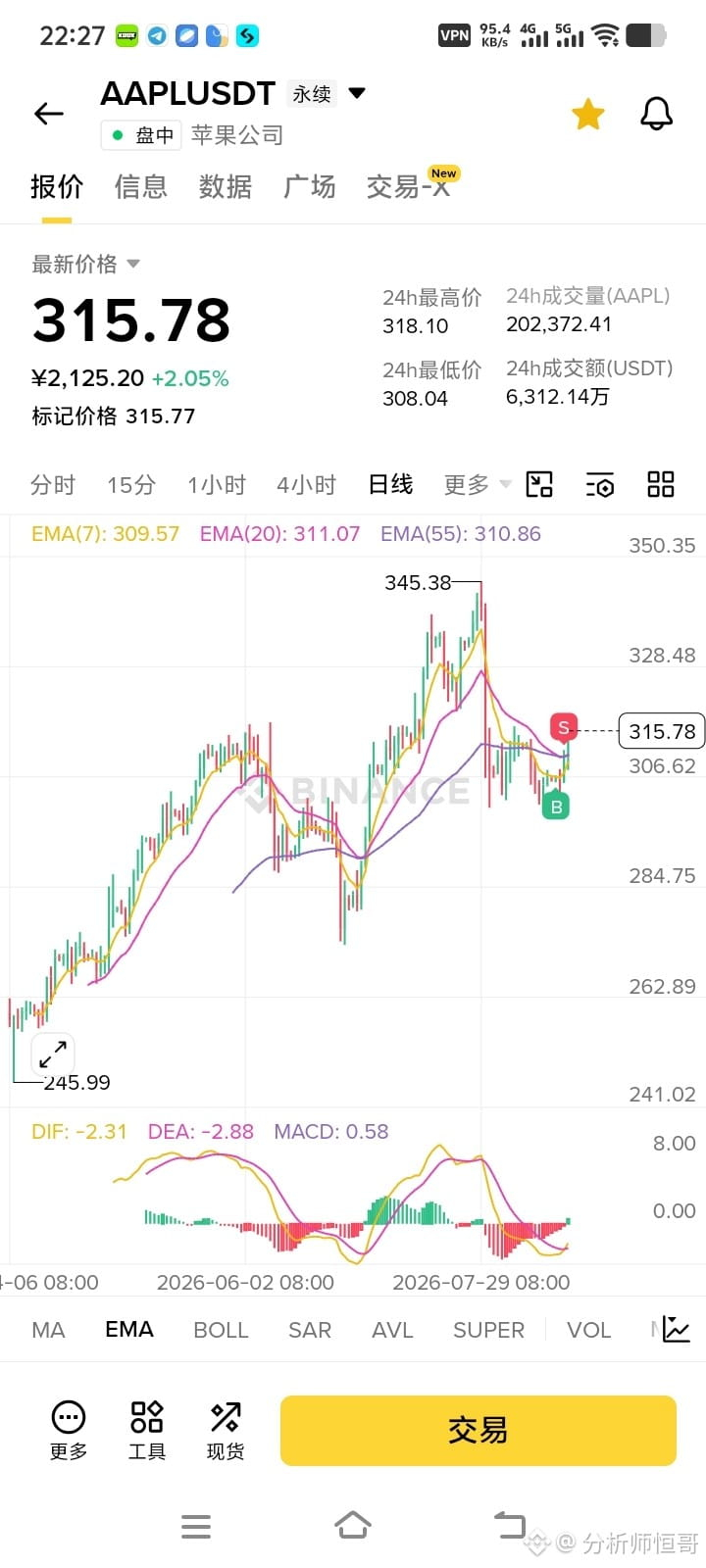
$AAPL $GOOGL $OPENAI You can arrange in batches; Apple and Google are companies that keep making profits. They continuously buy back shares every year, so they can be used as a long-term low-multiple long-term holding. Today, Apple has already risen from 305 to 316, and those friends who followed earlier should have already profited. Follow me, and let’s welcome the bull market #分析师恒哥 #AAPLE
$AAPL $GOOGL $OPENAI You can arrange in batches; Apple and Google are companies that keep making profits. They continuously buy back shares every year, so they can be used as a long-term low-multiple long-term holding. Today, Apple has already risen from 305 to 316, and those friends who followed earlier should have already profited. Follow me, and let’s welcome the bull market #分析师恒哥 #AAPLE

大吉大利!
From 分析师恒哥
3
296
·
--
Article
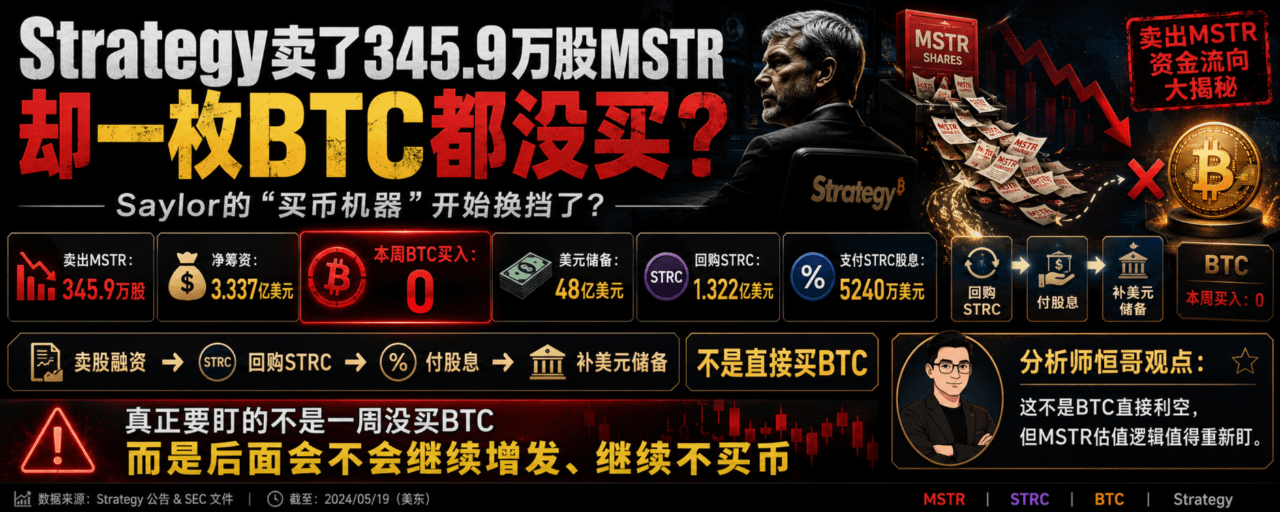
Strategy sold 3.459 million shares of MSTR, yet bought not a single BTC! Saylor’s “infinite coin-buying machine” is switching gears?For this message, I think many people misread the key point at first glance.
Everyone knows Strategy’s most classic play in the past:
Sell stocks ↓
Raise financing ↓
Buy BTC ↓
BTC price goes up ↓
MSTR premium continues to expand
But this time, the script has changed.
According to Strategy’s latest submitted SEC filing:
August 10—August 16
Strategy sold a total of:
3.459 million shares of MSTR
Net funding raised is approximately:
$333.7 million
But the most crucial point is—
This week’s BTC purchases: 0.
Not a single one was bought.
Where did the money go?
Very simple:
🔴 About $132.2 million
Use it to buy back STRC preferred shares.
🔴 About $52.4 million
Strategy sold 3.459 million shares of MSTR, yet bought not a single BTC! Saylor’s “infinite coin-buying machine” is switching gears?
For this message, I think many people misread the key point at first glance.
Everyone knows Strategy’s most classic play in the past:
Sell stocks ↓
Raise financing ↓
Buy BTC ↓
BTC price goes up ↓
MSTR premium continues to expand
But this time, the script has changed.
According to Strategy’s latest submitted SEC filing:
August 10—August 16
Strategy sold a total of:
3.459 million shares of MSTR
Net funding raised is approximately:
$333.7 million
But the most crucial point is—
This week’s BTC purchases: 0.
Not a single one was bought.
Where did the money go?
Very simple:
🔴 About $132.2 million
Use it to buy back STRC preferred shares.
🔴 About $52.4 million
Everyone knows Strategy’s most classic play in the past:
Sell stocks ↓
Raise financing ↓
Buy BTC ↓
BTC price goes up ↓
MSTR premium continues to expand
But this time, the script has changed.
According to Strategy’s latest submitted SEC filing:
August 10—August 16
Strategy sold a total of:
3.459 million shares of MSTR
Net funding raised is approximately:
$333.7 million
But the most crucial point is—
This week’s BTC purchases: 0.
Not a single one was bought.
Where did the money go?
Very simple:
🔴 About $132.2 million
Use it to buy back STRC preferred shares.
🔴 About $52.4 million
1
211
·
--
Verified
Article
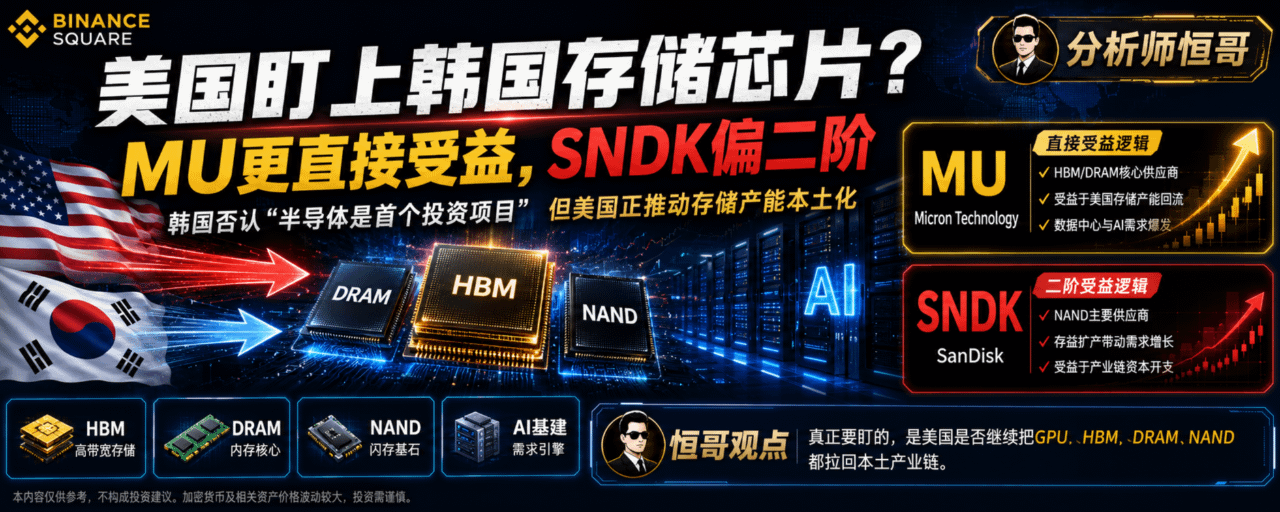
The U.S. sets its sights on South Korea’s storage chips—will MU and SNDK be about to catch a tailwind?The United States is pushing South Korea to expand its investment in the U.S., and the market’s latest focus has already shifted to:
Storage chips.
Earlier reports suggested that the U.S. wants South Korea to prioritize directing funds toward U.S.-based storage chip capacity.
But the South Korean government subsequently denied it:
At present, there is no confirmed plan to make semiconductors the first investment project.
However, one thing is already very clear:
The U.S. commerce secretary previously did publicly call on Samsung and SK Hynix to expand the production of storage chips in the United States.
Why is the United States suddenly putting so much emphasis on this?
Because what AI truly lacks is not just GPUs.
Also:
HBM, DRAM, NAND.
The U.S. sets its sights on South Korea’s storage chips—will MU and SNDK be about to catch a tailwind?
The United States is pushing South Korea to expand its investment in the U.S., and the market’s latest focus has already shifted to:
Storage chips.
Earlier reports suggested that the U.S. wants South Korea to prioritize directing funds toward U.S.-based storage chip capacity.
But the South Korean government subsequently denied it:
At present, there is no confirmed plan to make semiconductors the first investment project.
However, one thing is already very clear:
The U.S. commerce secretary previously did publicly call on Samsung and SK Hynix to expand the production of storage chips in the United States.
Why is the United States suddenly putting so much emphasis on this?
Because what AI truly lacks is not just GPUs.
Also:
HBM, DRAM, NAND.
Storage chips.
Earlier reports suggested that the U.S. wants South Korea to prioritize directing funds toward U.S.-based storage chip capacity.
But the South Korean government subsequently denied it:
At present, there is no confirmed plan to make semiconductors the first investment project.
However, one thing is already very clear:
The U.S. commerce secretary previously did publicly call on Samsung and SK Hynix to expand the production of storage chips in the United States.
Why is the United States suddenly putting so much emphasis on this?
Because what AI truly lacks is not just GPUs.
Also:
HBM, DRAM, NAND.
2
3.5k
·
--

Article
a16z exposed as being investigated by the U.S. Department of Justice! The real danger may not be a finethe U.S. Department of Justice is targeting this time,
Not BTC.
not some token.
and it's not even about what projects a16z invested in.
instead of something that is a token—it's a playbook that Silicon Valley VCs have used for many years:
an investment firm, while also holding board seats at companies that may compete with each other.
According to the latest reports,
The U.S. Department of Justice is investigating Andreessen Horowitz—very well known in the crypto world, the a16z—
The core issue is:
a16z's investment partner, whether they are improperly sitting on the boards of AI/data companies that have competing relationships at the same time.
What’s drawing the most attention right now are two companies:
Databricks
a16z exposed as being investigated by the U.S. Department of Justice! The real danger may not be a fine
the U.S. Department of Justice is targeting this time,
Not BTC.
not some token.
and it's not even about what projects a16z invested in.
instead of something that is a token—it's a playbook that Silicon Valley VCs have used for many years:
an investment firm, while also holding board seats at companies that may compete with each other.
According to the latest reports,
The U.S. Department of Justice is investigating Andreessen Horowitz—very well known in the crypto world, the a16z—
The core issue is:
a16z's investment partner, whether they are improperly sitting on the boards of AI/data companies that have competing relationships at the same time.
What’s drawing the most attention right now are two companies:
Databricks
Not BTC.
not some token.
and it's not even about what projects a16z invested in.
instead of something that is a token—it's a playbook that Silicon Valley VCs have used for many years:
an investment firm, while also holding board seats at companies that may compete with each other.
According to the latest reports,
The U.S. Department of Justice is investigating Andreessen Horowitz—very well known in the crypto world, the a16z—
The core issue is:
a16z's investment partner, whether they are improperly sitting on the boards of AI/data companies that have competing relationships at the same time.
What’s drawing the most attention right now are two companies:
Databricks
1
1.2k
·
--
Article
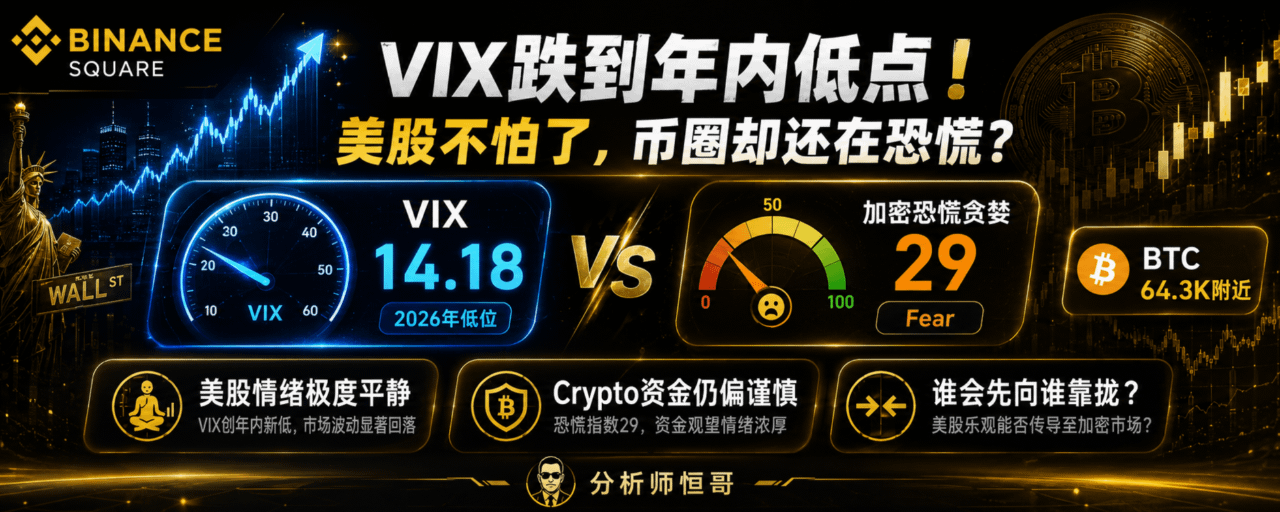
The U.S. stock fear index has fallen to 14.18, but Crypto is still in fear: is someone on one side definitely getting it wrong?Now the market has shown a very unusual signal.
VIX recently fell as low as:
14.18
setting a new low for 2026.
What is VIX?
Simply put, it’s Wall Street’s expectation for market volatility over the next ~30 days, based on S&P 500 options. The lower the number, the more U.S. stock investors think:
“Nothing big should happen next.”
But Crypto is a completely different story.
The latest Crypto Fear & Greed Index is only:
29—Fear.
That is to say:
U.S. stocks: staying calm.
Crypto: still afraid.
This is what I think is most worth trading.
Why?
The U.S. stock fear index has fallen to 14.18, but Crypto is still in fear: is someone on one side definitely getting it wrong?
Now the market has shown a very unusual signal.
VIX recently fell as low as:
14.18
setting a new low for 2026.
What is VIX?
Simply put, it’s Wall Street’s expectation for market volatility over the next ~30 days, based on S&P 500 options. The lower the number, the more U.S. stock investors think:
“Nothing big should happen next.”
But Crypto is a completely different story.
The latest Crypto Fear & Greed Index is only:
29—Fear.
That is to say:
U.S. stocks: staying calm.
Crypto: still afraid.
This is what I think is most worth trading.
Why?
VIX recently fell as low as:
14.18
setting a new low for 2026.
What is VIX?
Simply put, it’s Wall Street’s expectation for market volatility over the next ~30 days, based on S&P 500 options. The lower the number, the more U.S. stock investors think:
“Nothing big should happen next.”
But Crypto is a completely different story.
The latest Crypto Fear & Greed Index is only:
29—Fear.
That is to say:
U.S. stocks: staying calm.
Crypto: still afraid.
This is what I think is most worth trading.
Why?
2
236
·
--
Article
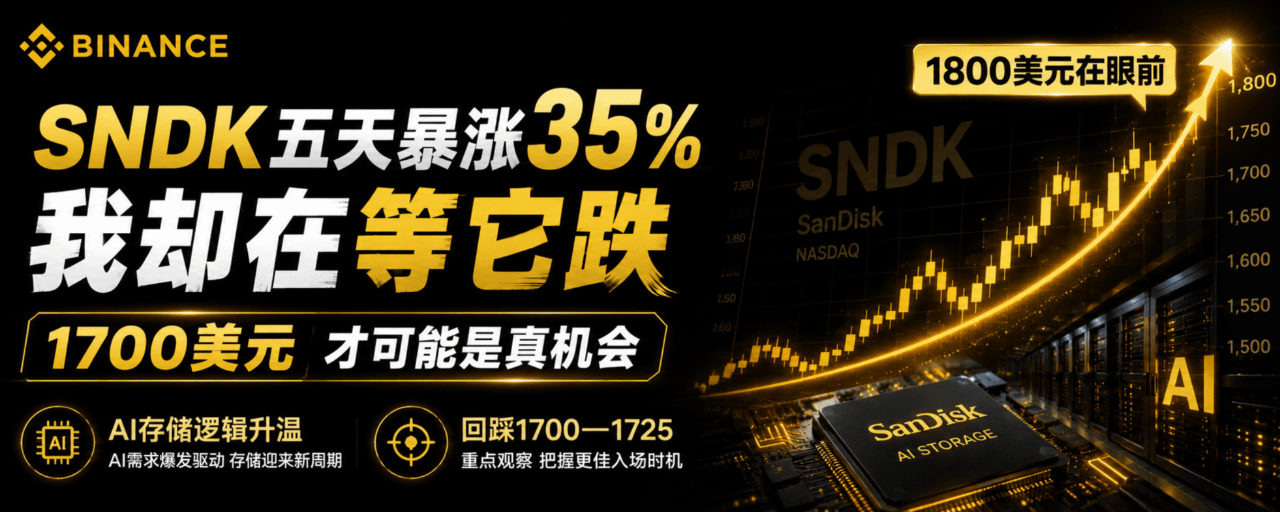
SNDK jumps 35% in five days—I’m still waiting for it to dip: $1,700 might be the real opportunitySanDisk has gone crazy again this time.
Earlier on the hot list people were still saying:
“Up nearly 14% in a single day.”
But in the latest round,
SNDK rose again by about 8.9% on Monday, closing at $1,786.85.
In the past five trading days, it has already gained about 35% in total.
Why is it suddenly being抢 by capital again?
the core is still two words:
AI storage.
SanDisk’s latest long-term targets are:
From 2028 to 2030, revenue will remain at high-double-digit growth,
and a large wave of demand for AI data centers is re-pricing NAND from a traditional cyclical commodity to “AI infrastructure.”
So this wave isn’t just pure emotion.
But here’s the problem too:
Good companies ≠ any price is worth chasing.
SNDK jumps 35% in five days—I’m still waiting for it to dip: $1,700 might be the real opportunity
SanDisk has gone crazy again this time.
Earlier on the hot list people were still saying:
“Up nearly 14% in a single day.”
But in the latest round,
SNDK rose again by about 8.9% on Monday, closing at $1,786.85.
In the past five trading days, it has already gained about 35% in total.
Why is it suddenly being抢 by capital again?
the core is still two words:
AI storage.
SanDisk’s latest long-term targets are:
From 2028 to 2030, revenue will remain at high-double-digit growth,
and a large wave of demand for AI data centers is re-pricing NAND from a traditional cyclical commodity to “AI infrastructure.”
So this wave isn’t just pure emotion.
But here’s the problem too:
Good companies ≠ any price is worth chasing.
Earlier on the hot list people were still saying:
“Up nearly 14% in a single day.”
But in the latest round,
SNDK rose again by about 8.9% on Monday, closing at $1,786.85.
In the past five trading days, it has already gained about 35% in total.
Why is it suddenly being抢 by capital again?
the core is still two words:
AI storage.
SanDisk’s latest long-term targets are:
From 2028 to 2030, revenue will remain at high-double-digit growth,
and a large wave of demand for AI data centers is re-pricing NAND from a traditional cyclical commodity to “AI infrastructure.”
So this wave isn’t just pure emotion.
But here’s the problem too:
Good companies ≠ any price is worth chasing.
1
4.6k
·
--
Article
After 2028, unlicensed stablecoins may not even be able to sell to U.S. users: USDT and USDC face their real big testThis time, stablecoins aren’t just “another round of regulatory news.”
The U.S. has started truly setting the rules.
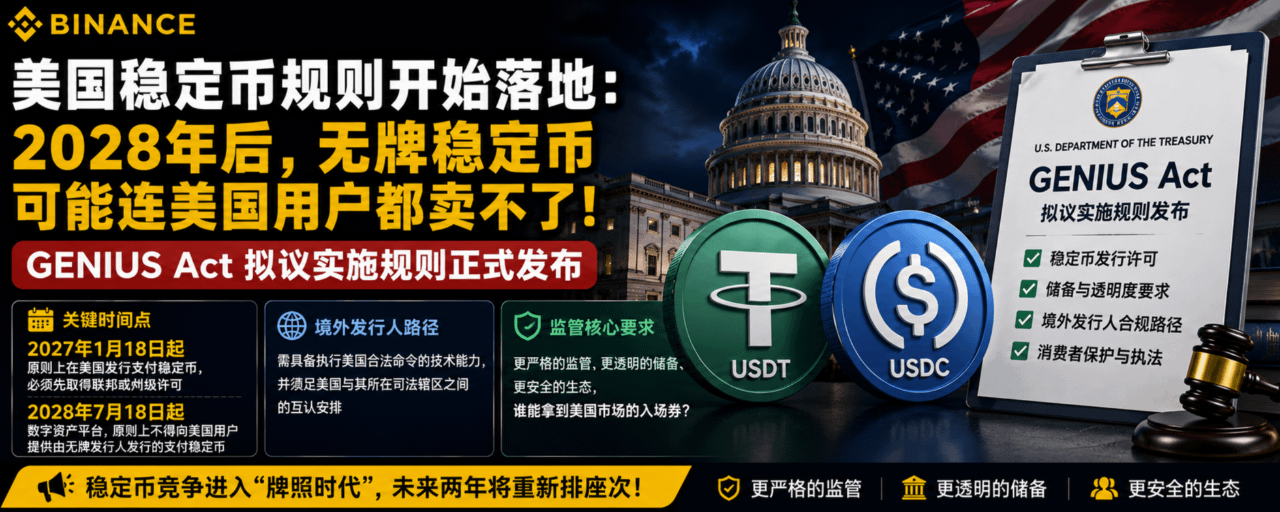
The Ministry of Finance has just released the proposed implementation rules for the GENIUS Act. Two key time points:
From January 18, 2027: If you want to issue payment stablecoins in the U.S., in principle you first need federal or state-level authorization.
From July 18, 2028: Digital asset platforms, in principle, also can no longer offer payment stablecoins to U.S. users that are issued by an “unlicensed issuer.”
Plain speech:
Previously, the market competed on—
Who issues more, and who has the best liquidity.
There’ll be more to compare:
Who has the license, whose reserves are more transparent, and who can actually get the entry ticket to the U.S. market.
After 2028, unlicensed stablecoins may not even be able to sell to U.S. users: USDT and USDC face their real big test
This time, stablecoins aren’t just “another round of regulatory news.”
The U.S. has started truly setting the rules.
The Ministry of Finance has just released the proposed implementation rules for the GENIUS Act. Two key time points:
From January 18, 2027: If you want to issue payment stablecoins in the U.S., in principle you first need federal or state-level authorization.
From July 18, 2028: Digital asset platforms, in principle, also can no longer offer payment stablecoins to U.S. users that are issued by an “unlicensed issuer.”
Plain speech:
Previously, the market competed on—
Who issues more, and who has the best liquidity.
There’ll be more to compare:
Who has the license, whose reserves are more transparent, and who can actually get the entry ticket to the U.S. market.
The U.S. has started truly setting the rules.
The Ministry of Finance has just released the proposed implementation rules for the GENIUS Act. Two key time points:
From January 18, 2027: If you want to issue payment stablecoins in the U.S., in principle you first need federal or state-level authorization.
From July 18, 2028: Digital asset platforms, in principle, also can no longer offer payment stablecoins to U.S. users that are issued by an “unlicensed issuer.”
Plain speech:
Previously, the market competed on—
Who issues more, and who has the best liquidity.
There’ll be more to compare:
Who has the license, whose reserves are more transparent, and who can actually get the entry ticket to the U.S. market.
1
1
1.1k
·
--
Article
The dollar falls to a 10-week low, and gold rises first: Why hasn’t BTC exploded yet? The real pressure is at the $91 oil priceThis time the dollar really is weaker, but I won’t just chase BTC because of that.
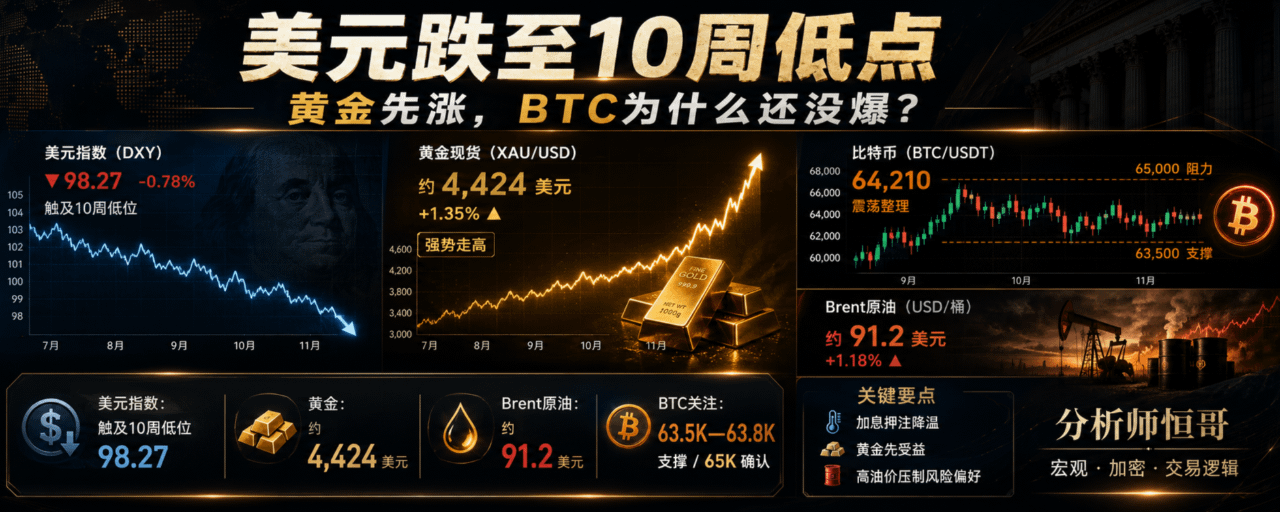
The US dollar index briefly dipped to about 99.3, touching a 10-week low. The logic behind it is very simple:
US employment weakens
Retail sales decline
Inflation has not worsened further for now
↓
The market has reduced expectations for further Fed rate hikes
↓
The US dollar is weakening.
Under normal circumstances, this should be comfortable for gold, tech stocks, and Crypto.
Gold has already reacted first; spot prices briefly rose to about $4,424.
So why hasn’t BTC surged in sync?
Because the market still has another storyline:
Brent crude oil is about $91.2
+
US 30-year yields are 5.321%
The dollar falls to a 10-week low, and gold rises first: Why hasn’t BTC exploded yet? The real pressure is at the $91 oil price
This time the dollar really is weaker, but I won’t just chase BTC because of that.
The US dollar index briefly dipped to about 99.3, touching a 10-week low. The logic behind it is very simple:
US employment weakens
Retail sales decline
Inflation has not worsened further for now
↓
The market has reduced expectations for further Fed rate hikes
↓
The US dollar is weakening.
Under normal circumstances, this should be comfortable for gold, tech stocks, and Crypto.
Gold has already reacted first; spot prices briefly rose to about $4,424.
So why hasn’t BTC surged in sync?
Because the market still has another storyline:
Brent crude oil is about $91.2
+
US 30-year yields are 5.321%
The US dollar index briefly dipped to about 99.3, touching a 10-week low. The logic behind it is very simple:
US employment weakens
Retail sales decline
Inflation has not worsened further for now
↓
The market has reduced expectations for further Fed rate hikes
↓
The US dollar is weakening.
Under normal circumstances, this should be comfortable for gold, tech stocks, and Crypto.
Gold has already reacted first; spot prices briefly rose to about $4,424.
So why hasn’t BTC surged in sync?
Because the market still has another storyline:
Brent crude oil is about $91.2
+
US 30-year yields are 5.321%
1
1
2.5k
·
--
Article
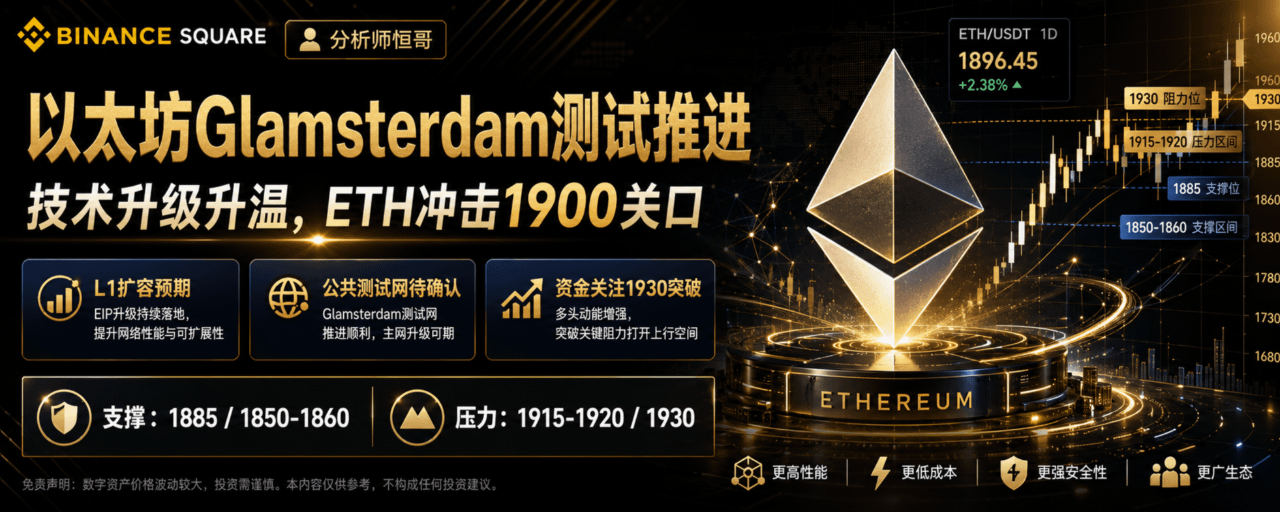
ETH upgrades are almost at the final testing stage, yet the price is still held below 1900: Can Glamsterdam really bring in funds this time?First, let’s correct a detail.
What the trending list says is:
“The Ethereum Foundation has launched the Glamsterdam testnet.”
But what the official side can currently confirm is:
The Glamsterdam multi-client devnet is already running. The public testnet has officially launched, and I haven't yet seen an official announcement.
This cannot be written wrong.
But what’s really worth looking at isn’t the words “testnet.”
Instead——
This time, Ethereum is preparing to truly expand the underlying L1 layer.
Speak human language,
Glamsterdam mainly does three things:
✅ Make block processing faster
✅ Pave the way for parallel execution
✅ Leave room for future increases to the Gas Limit
ETH upgrades are almost at the final testing stage, yet the price is still held below 1900: Can Glamsterdam really bring in funds this time?
First, let’s correct a detail.
What the trending list says is:
“The Ethereum Foundation has launched the Glamsterdam testnet.”
But what the official side can currently confirm is:
The Glamsterdam multi-client devnet is already running. The public testnet has officially launched, and I haven't yet seen an official announcement.
This cannot be written wrong.
But what’s really worth looking at isn’t the words “testnet.”
Instead——
This time, Ethereum is preparing to truly expand the underlying L1 layer.
Speak human language,
Glamsterdam mainly does three things:
✅ Make block processing faster
✅ Pave the way for parallel execution
✅ Leave room for future increases to the Gas Limit
What the trending list says is:
“The Ethereum Foundation has launched the Glamsterdam testnet.”
But what the official side can currently confirm is:
The Glamsterdam multi-client devnet is already running. The public testnet has officially launched, and I haven't yet seen an official announcement.
This cannot be written wrong.
But what’s really worth looking at isn’t the words “testnet.”
Instead——
This time, Ethereum is preparing to truly expand the underlying L1 layer.
Speak human language,
Glamsterdam mainly does three things:
✅ Make block processing faster
✅ Pave the way for parallel execution
✅ Leave room for future increases to the Gas Limit
1
195
·
--
Article
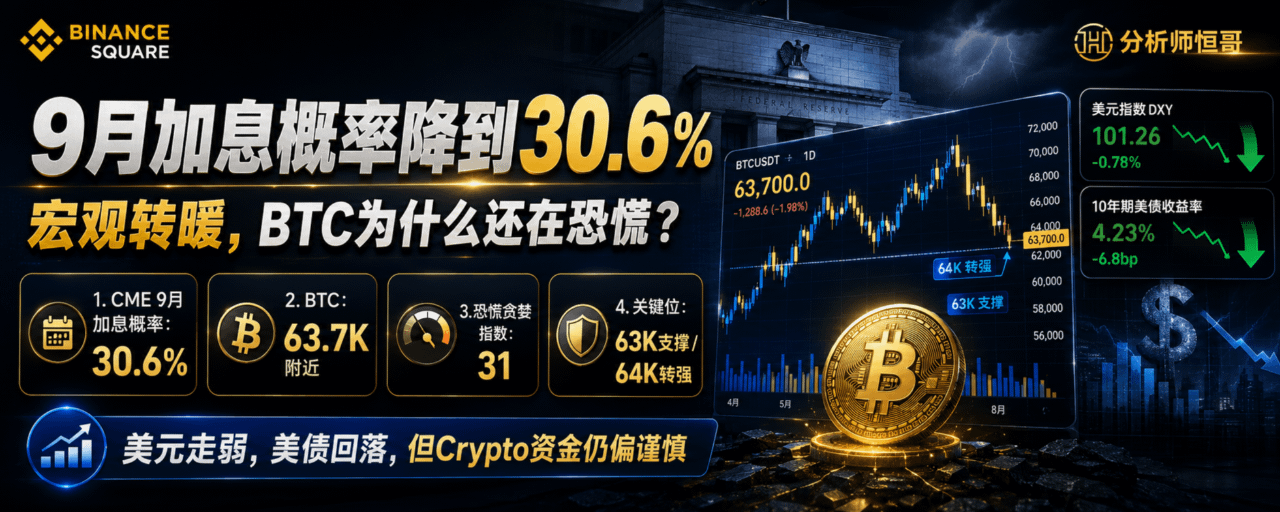
Rate-hike probability cut from 50% to 30%, and the dollar is also down: why is BTC still in the “panic zone”?The macro outlook is starting to warm up, but the crypto money hasn’t truly come back yet.
The latest CME pricing shows:
The probability of a Fed rate hike has already fallen to about 30%.
Just a week ago it was still close to 50%.
Why did it drop so fast all of a sudden?
The U.S. has recently seen a run of:
Jobs are weakening
+
July retail sales unexpectedly declined
+
CPI/PPI have not continued to deteriorate
The market starts to think:
The Fed doesn’t need to rush into more rate hikes.
The normal logic should be:
The rate-hike probability is declining
↓
U.S. Treasury yields are falling
↓
The U.S. dollar is weakening
↓
Gold, tech stocks, and BTC feel more comfortable
The dollar has indeed already weakened significantly, and gold has also risen to about $4,394.
Rate-hike probability cut from 50% to 30%, and the dollar is also down: why is BTC still in the “panic zone”?
The macro outlook is starting to warm up, but the crypto money hasn’t truly come back yet.
The latest CME pricing shows:
The probability of a Fed rate hike has already fallen to about 30%.
Just a week ago it was still close to 50%.
Why did it drop so fast all of a sudden?
The U.S. has recently seen a run of:
Jobs are weakening
+
July retail sales unexpectedly declined
+
CPI/PPI have not continued to deteriorate
The market starts to think:
The Fed doesn’t need to rush into more rate hikes.
The normal logic should be:
The rate-hike probability is declining
↓
U.S. Treasury yields are falling
↓
The U.S. dollar is weakening
↓
Gold, tech stocks, and BTC feel more comfortable
The dollar has indeed already weakened significantly, and gold has also risen to about $4,394.
The latest CME pricing shows:
The probability of a Fed rate hike has already fallen to about 30%.
Just a week ago it was still close to 50%.
Why did it drop so fast all of a sudden?
The U.S. has recently seen a run of:
Jobs are weakening
+
July retail sales unexpectedly declined
+
CPI/PPI have not continued to deteriorate
The market starts to think:
The Fed doesn’t need to rush into more rate hikes.
The normal logic should be:
The rate-hike probability is declining
↓
U.S. Treasury yields are falling
↓
The U.S. dollar is weakening
↓
Gold, tech stocks, and BTC feel more comfortable
The dollar has indeed already weakened significantly, and gold has also risen to about $4,394.
1
237
·
--
Article
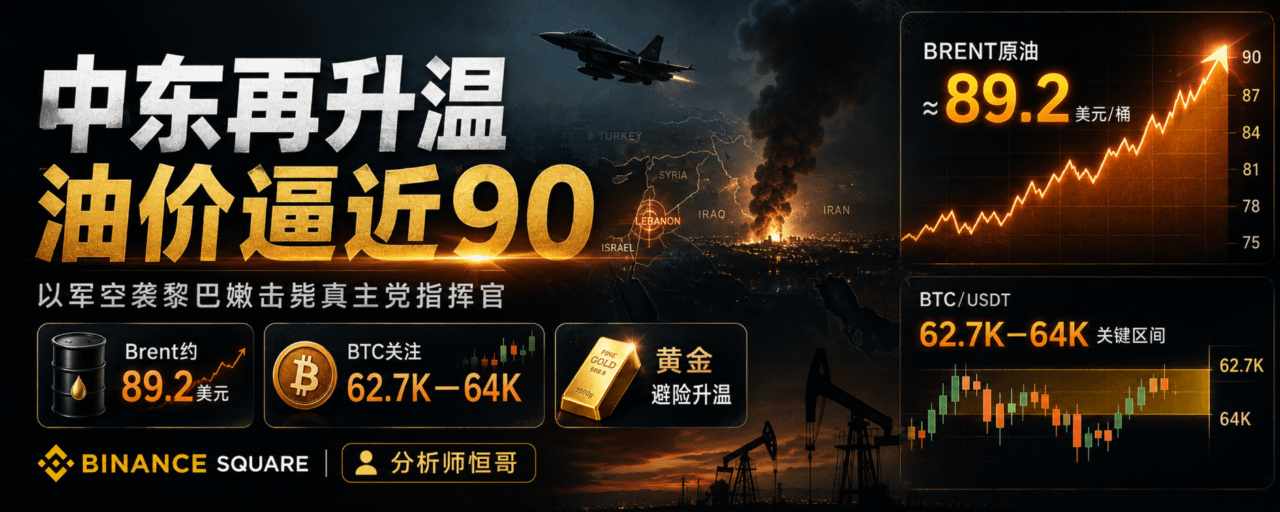
Israel strikes again and kills a Hezbollah commander; oil prices approach $90: the real danger is the Middle East heating up on multiple fronts at onceI won’t just treat this news as “Lebanon gets bombed again.”
In the latest round of Israeli airstrikes, at least 11 people were killed. Israel said the casualties included a commander from Hezbollah’s Radwan unit.
The issue is—
On the Lebanon side, tensions have just been heating up,
On the other side, shipping through the Strait of Hormuz is also clearly slowing down.
Brent is now at about $89.2, just one step away from $90.
So what the market is truly worried about is:
Lebanon + Iran + the Strait of Hormuz
Several lines worsen at the same time.
The most direct impact on ordinary investors:
✅ Energy stocks: Oil prices remain elevated, benefiting more
Israel strikes again and kills a Hezbollah commander; oil prices approach $90: the real danger is the Middle East heating up on multiple fronts at once
I won’t just treat this news as “Lebanon gets bombed again.”
In the latest round of Israeli airstrikes, at least 11 people were killed. Israel said the casualties included a commander from Hezbollah’s Radwan unit.
The issue is—
On the Lebanon side, tensions have just been heating up,
On the other side, shipping through the Strait of Hormuz is also clearly slowing down.
Brent is now at about $89.2, just one step away from $90.
So what the market is truly worried about is:
Lebanon + Iran + the Strait of Hormuz
Several lines worsen at the same time.
The most direct impact on ordinary investors:
✅ Energy stocks: Oil prices remain elevated, benefiting more
In the latest round of Israeli airstrikes, at least 11 people were killed. Israel said the casualties included a commander from Hezbollah’s Radwan unit.
The issue is—
On the Lebanon side, tensions have just been heating up,
On the other side, shipping through the Strait of Hormuz is also clearly slowing down.
Brent is now at about $89.2, just one step away from $90.
So what the market is truly worried about is:
Lebanon + Iran + the Strait of Hormuz
Several lines worsen at the same time.
The most direct impact on ordinary investors:
✅ Energy stocks: Oil prices remain elevated, benefiting more
1
1
447
·
--
Article
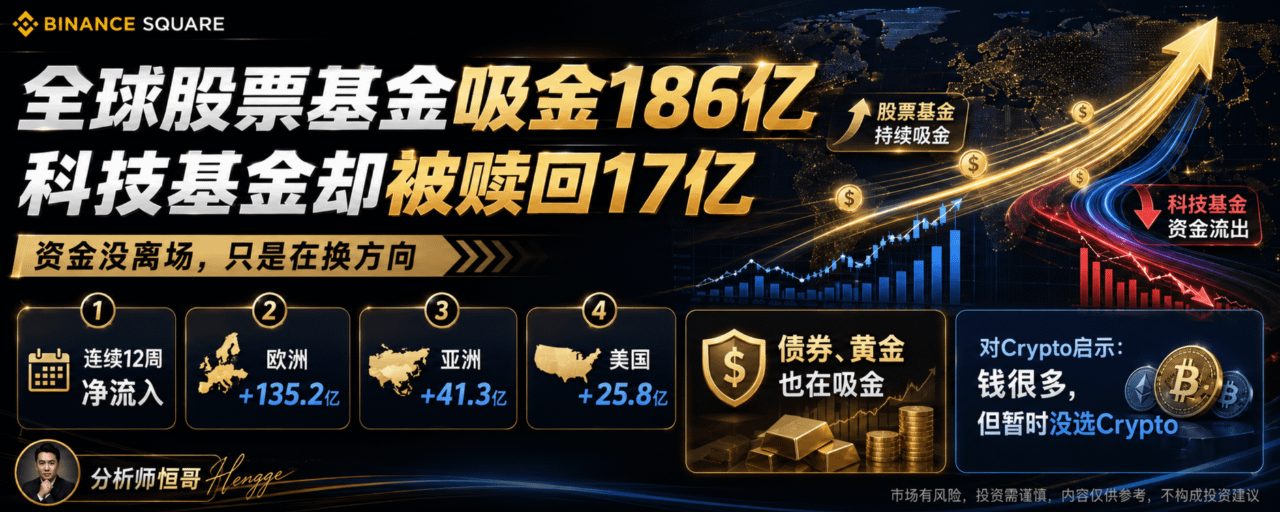
Global stock funds attract $18.6 billion, while tech funds are redeemed for $1.7 billion: is smart money starting to change direction?There’s a rather unusual signal in the global markets right now.
In the past week,
Net inflows into global stock funds:
$18.62 billion.
For 12 consecutive weeks, it has been pulling in money.
But at the same time,
Technology-sector funds, however, have seen net redemptions:
About $1.7 billion.
So now it’s not:
“Money is fleeing the stock market.”
Rather—
Money is still buying stocks, but it’s starting to be unwilling to crowd entirely into technology stocks.
Even more clearly, this is where the money went:
European stock funds: +$13.52 billion
Asian stock funds: +$4.13 billion
U.S. stock funds: only +$2.58 billion
At the same time,
bond fund inflows were about $18.0 billion, money market fund inflows were about $28.4 billion, and gold funds also continued to attract money.
Global stock funds attract $18.6 billion, while tech funds are redeemed for $1.7 billion: is smart money starting to change direction?
There’s a rather unusual signal in the global markets right now.
In the past week,
Net inflows into global stock funds:
$18.62 billion.
For 12 consecutive weeks, it has been pulling in money.
But at the same time,
Technology-sector funds, however, have seen net redemptions:
About $1.7 billion.
So now it’s not:
“Money is fleeing the stock market.”
Rather—
Money is still buying stocks, but it’s starting to be unwilling to crowd entirely into technology stocks.
Even more clearly, this is where the money went:
European stock funds: +$13.52 billion
Asian stock funds: +$4.13 billion
U.S. stock funds: only +$2.58 billion
At the same time,
bond fund inflows were about $18.0 billion, money market fund inflows were about $28.4 billion, and gold funds also continued to attract money.
In the past week,
Net inflows into global stock funds:
$18.62 billion.
For 12 consecutive weeks, it has been pulling in money.
But at the same time,
Technology-sector funds, however, have seen net redemptions:
About $1.7 billion.
So now it’s not:
“Money is fleeing the stock market.”
Rather—
Money is still buying stocks, but it’s starting to be unwilling to crowd entirely into technology stocks.
Even more clearly, this is where the money went:
European stock funds: +$13.52 billion
Asian stock funds: +$4.13 billion
U.S. stock funds: only +$2.58 billion
At the same time,
bond fund inflows were about $18.0 billion, money market fund inflows were about $28.4 billion, and gold funds also continued to attract money.
2
7
2.3k
·
--
Cardano is about to get a major upgrade, but ADA is stuck below $0.18: what exactly is Dijkstra changing this time?
Many people are seeing it trending:
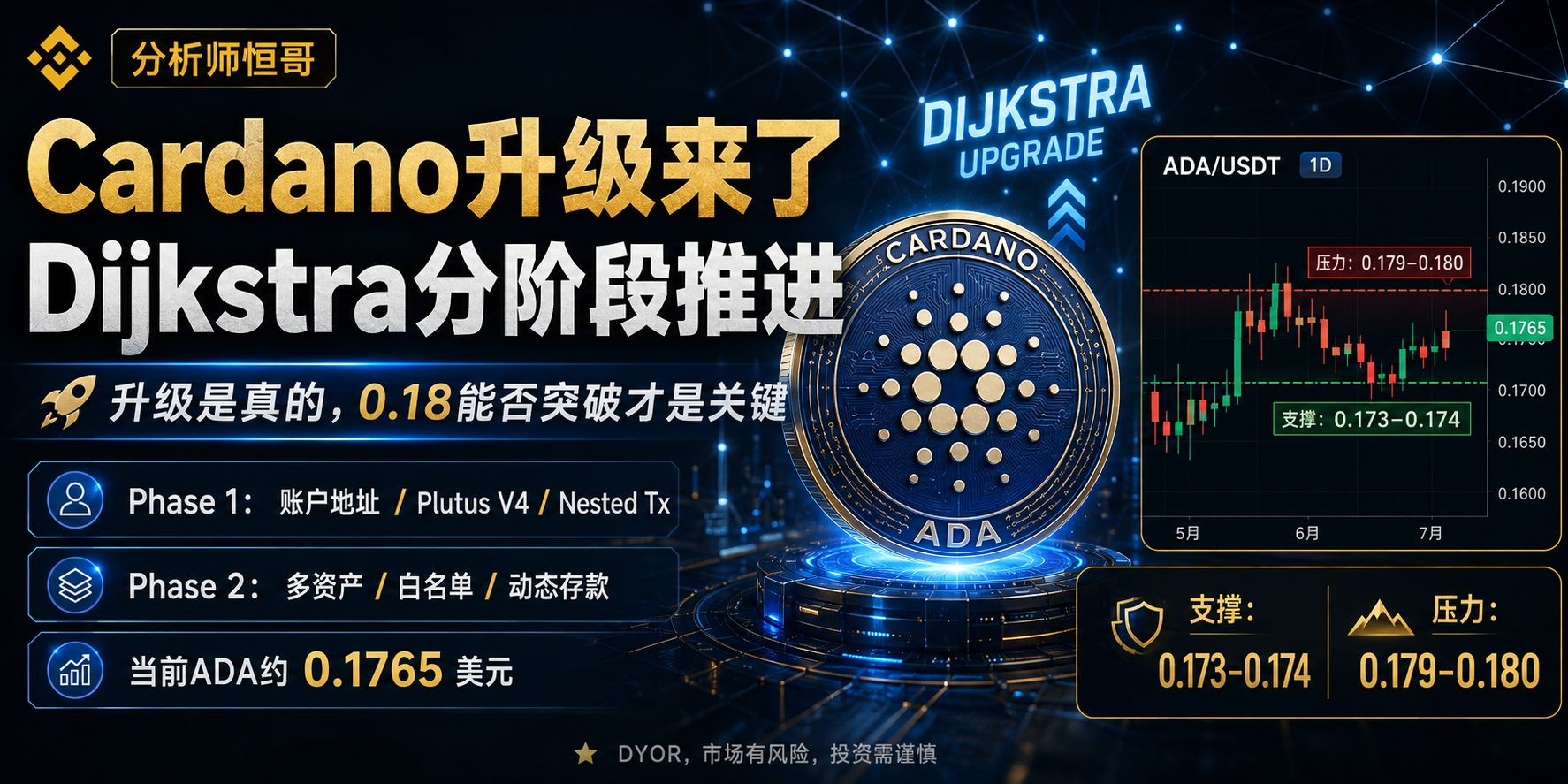
The Dijkstra upgrade is in two phases.
In plain language, what Cardano wants to solve this time is:
make accounts easier to use, make smart contracts more flexible, and pave the way for future high-performance scaling.
The first phase focuses on:
ADA goes directly into account addresses
Plutus V4 Nested Transactions
The second phase will further expand with:
multi-assets + whitelists + dynamic deposit mechanisms.
So this isn’t “issuing a new coin,” and it’s not guaranteed that ADA will surge on the upgrade day.
What’s really worth watching is whether Cardano can turn these underlying upgrades into:
more applications → more on-chain usage → more real capital.
📍ADA is currently around $0.1765.
I’m only watching two levels:
0.173—0.174: the first support
0.179—0.180: short-term resistance
Holding above 0.180 suggests that capital has started to truly trade the Dijkstra expectations;
if it breaks below 0.173, I won’t rush to buy.
Hengge’s view: technical upgrades are for telling the story, and only price breakouts are for confirmation.
After Dijkstra, I’ll keep tracking the next progress, and the next level after ADA breaks above $0.18.
Do you think ADA can use the Dijkstra breakout to get past $0.18, or is it going to be another “upgrade news pumps first, then cashes out” situation?
$ADA
#Cardano将Dijkstra升级分两阶段 #ADA #Cardano #defi
Cardano is about to get a major upgrade, but ADA is stuck below $0.18: what exactly is Dijkstra changing this time?
Many people are seeing it trending:
The Dijkstra upgrade is in two phases.
In plain language, what Cardano wants to solve this time is:
make accounts easier to use, make smart contracts more flexible, and pave the way for future high-performance scaling.
The first phase focuses on:
ADA goes directly into account addresses
Plutus V4 Nested Transactions
The second phase will further expand with:
multi-assets + whitelists + dynamic deposit mechanisms.
So this isn’t “issuing a new coin,” and it’s not guaranteed that ADA will surge on the upgrade day.
What’s really worth watching is whether Cardano can turn these underlying upgrades into:
more applications → more on-chain usage → more real capital.
📍ADA is currently around $0.1765.
I’m only watching two levels:
0.173—0.174: the first support
0.179—0.180: short-term resistance
Holding above 0.180 suggests that capital has started to truly trade the Dijkstra expectations;
if it breaks below 0.173, I won’t rush to buy.
Hengge’s view: technical upgrades are for telling the story, and only price breakouts are for confirmation.
After Dijkstra, I’ll keep tracking the next progress, and the next level after ADA breaks above $0.18.
Do you think ADA can use the Dijkstra breakout to get past $0.18, or is it going to be another “upgrade news pumps first, then cashes out” situation?
$ADA
#Cardano将Dijkstra升级分两阶段 #ADA #Cardano #defi
Many people are seeing it trending:
The Dijkstra upgrade is in two phases.
In plain language, what Cardano wants to solve this time is:
make accounts easier to use, make smart contracts more flexible, and pave the way for future high-performance scaling.
The first phase focuses on:
ADA goes directly into account addresses
Plutus V4 Nested Transactions
The second phase will further expand with:
multi-assets + whitelists + dynamic deposit mechanisms.
So this isn’t “issuing a new coin,” and it’s not guaranteed that ADA will surge on the upgrade day.
What’s really worth watching is whether Cardano can turn these underlying upgrades into:
more applications → more on-chain usage → more real capital.
📍ADA is currently around $0.1765.
I’m only watching two levels:
0.173—0.174: the first support
0.179—0.180: short-term resistance
Holding above 0.180 suggests that capital has started to truly trade the Dijkstra expectations;
if it breaks below 0.173, I won’t rush to buy.
Hengge’s view: technical upgrades are for telling the story, and only price breakouts are for confirmation.
After Dijkstra, I’ll keep tracking the next progress, and the next level after ADA breaks above $0.18.
Do you think ADA can use the Dijkstra breakout to get past $0.18, or is it going to be another “upgrade news pumps first, then cashes out” situation?
$ADA
#Cardano将Dijkstra升级分两阶段 #ADA #Cardano #defi
2
297
·
--
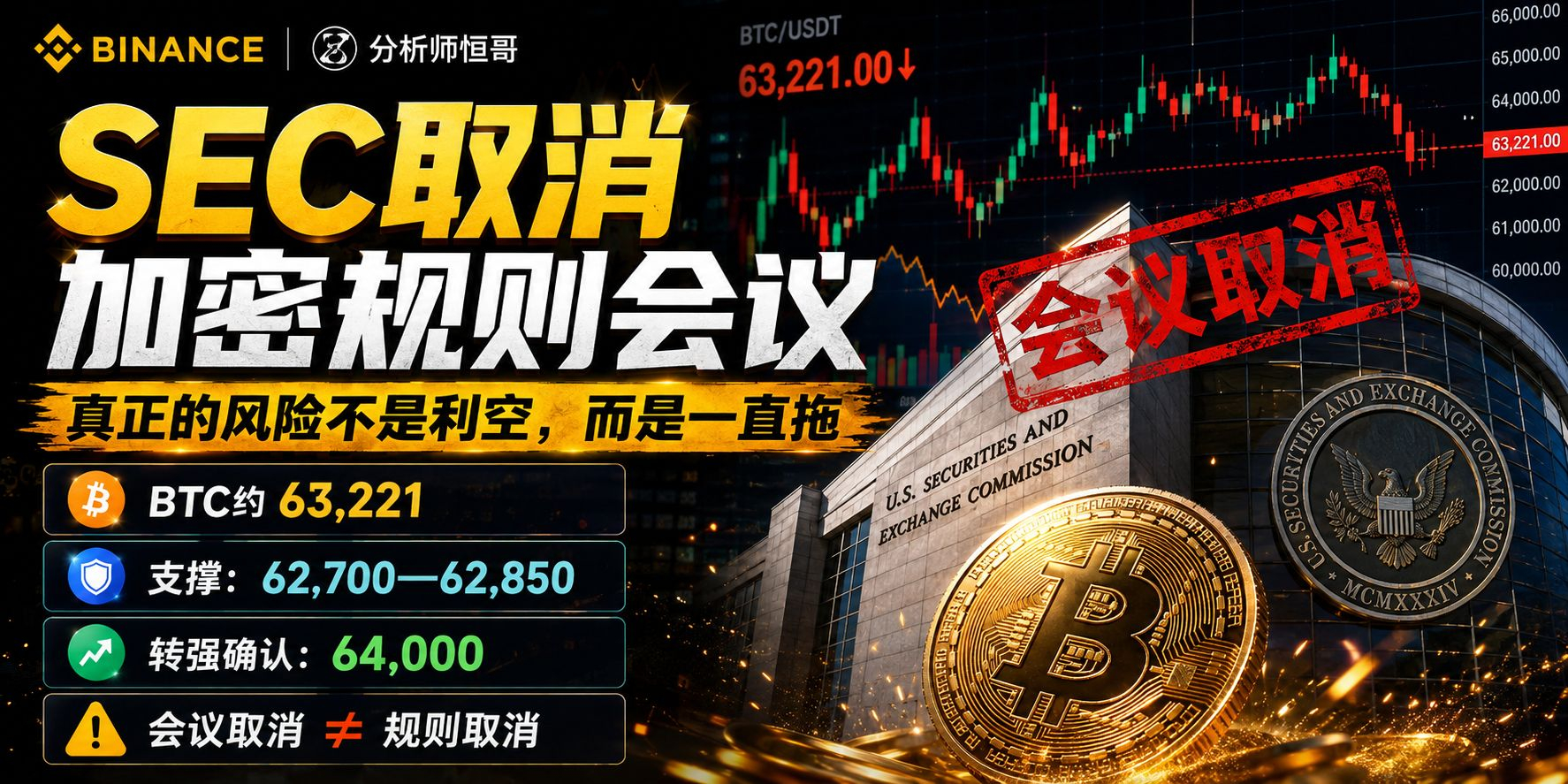
After the SEC meeting was canceled, no new date has been announced for a long time, and BTC is still holding at 63,000: what the market is truly afraid of isn’t the bad news itself, but the continual delay
Many people interpret this message as:
The SEC has turned back to crack down on Crypto again.
After I checked, here’s the conclusion first:
It’s not that policy is turning bearish—regulatory implementation is simply lagging by one beat.
The SEC had originally planned to discuss:
Crypto startup financing exemption
+
Token financing Safe Harbor
+
A regulatory path that’s more suitable for the crypto industry
But the meeting was temporarily canceled, and to this day no new time has been announced.
However, note this:
Cancellation of the meeting ≠ cancellation of the rules.
The SEC has already made it clear this year:
Most crypto assets themselves are not securities.
So what the market is really annoyed by right now is:
The direction is friendly
↓
But time keeps getting pushed back
↓
Capital is unwilling to place bets early
This also explains why BTC hasn’t been strong enough.
📍 BTC just quoted around $63,221
For now I only look at two areas:
62,700—62,850: key support
64K: confirm a renewed uptrend
Below 62,380,
this short-term rebound setup needs to be reassessed.
If all these regulatory-positive expectations are in place,
but BTC still can’t even reclaim $64K,
then the issue isn’t the news—
it’s that—
Crypto itself lacks fresh capital.
Analyst Hengge’s view:
The most important thing for the SEC this time isn’t the “cancellation.”
It’s this:
When the new meeting will be rescheduled.
As soon as the SEC announces a new date, I’ll keep following.
If BTC breaks below 62.7K,
or if it reclaims 64K,
I’ll update the next plan immediately.
Do you think this is just a normal delay,
or has US crypto regulation started entering a stage of “clear direction, but slow implementation”?
$BTC
#美SEC取消加密规则制定会议
#SEC
#Crypto
#加密监管
#BinanceSquare
After the SEC meeting was canceled, no new date has been announced for a long time, and BTC is still holding at 63,000: what the market is truly afraid of isn’t the bad news itself, but the continual delay
Many people interpret this message as:
The SEC has turned back to crack down on Crypto again.
After I checked, here’s the conclusion first:
It’s not that policy is turning bearish—regulatory implementation is simply lagging by one beat.
The SEC had originally planned to discuss:
Crypto startup financing exemption
+
Token financing Safe Harbor
+
A regulatory path that’s more suitable for the crypto industry
But the meeting was temporarily canceled, and to this day no new time has been announced.
However, note this:
Cancellation of the meeting ≠ cancellation of the rules.
The SEC has already made it clear this year:
Most crypto assets themselves are not securities.
So what the market is really annoyed by right now is:
The direction is friendly
↓
But time keeps getting pushed back
↓
Capital is unwilling to place bets early
This also explains why BTC hasn’t been strong enough.
📍 BTC just quoted around $63,221
For now I only look at two areas:
62,700—62,850: key support
64K: confirm a renewed uptrend
Below 62,380,
this short-term rebound setup needs to be reassessed.
If all these regulatory-positive expectations are in place,
but BTC still can’t even reclaim $64K,
then the issue isn’t the news—
it’s that—
Crypto itself lacks fresh capital.
Analyst Hengge’s view:
The most important thing for the SEC this time isn’t the “cancellation.”
It’s this:
When the new meeting will be rescheduled.
As soon as the SEC announces a new date, I’ll keep following.
If BTC breaks below 62.7K,
or if it reclaims 64K,
I’ll update the next plan immediately.
Do you think this is just a normal delay,
or has US crypto regulation started entering a stage of “clear direction, but slow implementation”?
$BTC
#美SEC取消加密规则制定会议
#SEC
#Crypto
#加密监管
#BinanceSquare
Many people interpret this message as:
The SEC has turned back to crack down on Crypto again.
After I checked, here’s the conclusion first:
It’s not that policy is turning bearish—regulatory implementation is simply lagging by one beat.
The SEC had originally planned to discuss:
Crypto startup financing exemption
+
Token financing Safe Harbor
+
A regulatory path that’s more suitable for the crypto industry
But the meeting was temporarily canceled, and to this day no new time has been announced.
However, note this:
Cancellation of the meeting ≠ cancellation of the rules.
The SEC has already made it clear this year:
Most crypto assets themselves are not securities.
So what the market is really annoyed by right now is:
The direction is friendly
↓
But time keeps getting pushed back
↓
Capital is unwilling to place bets early
This also explains why BTC hasn’t been strong enough.
📍 BTC just quoted around $63,221
For now I only look at two areas:
62,700—62,850: key support
64K: confirm a renewed uptrend
Below 62,380,
this short-term rebound setup needs to be reassessed.
If all these regulatory-positive expectations are in place,
but BTC still can’t even reclaim $64K,
then the issue isn’t the news—
it’s that—
Crypto itself lacks fresh capital.
Analyst Hengge’s view:
The most important thing for the SEC this time isn’t the “cancellation.”
It’s this:
When the new meeting will be rescheduled.
As soon as the SEC announces a new date, I’ll keep following.
If BTC breaks below 62.7K,
or if it reclaims 64K,
I’ll update the next plan immediately.
Do you think this is just a normal delay,
or has US crypto regulation started entering a stage of “clear direction, but slow implementation”?
$BTC
#美SEC取消加密规则制定会议
#SEC
#Crypto
#加密监管
#BinanceSquare
2
2
278
·
--
Article
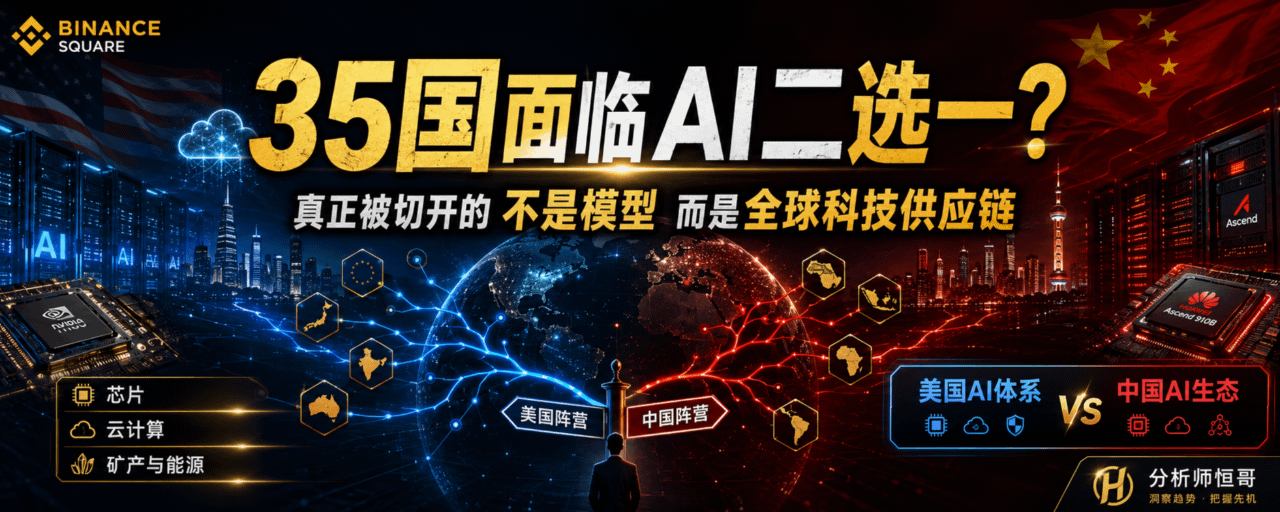
35 countries may be asked to choose AI “one of two”: what really needs to be cut is not the models, but the global technology supply chainI think this message is more important than a simple battle between AI models.
The U.S. is preparing to tell dozens of partner countries:
If it joins a U.S.-led AI system,
and also join China-led competitive AI frameworks,
in the future, it may be impossible to “stand with both sides.”
First, a clarification:
this is still an internal draft,
It is not 35 countries that have officially received a final warning.
But the direction it reveals is already very clear—
the AI race is shifting from:
Whose model is stronger
to:
who controls the entire AI industry supply chain.
What the U.S. wants to bind now is,
there isn’t only models like ChatGPT.
35 countries may be asked to choose AI “one of two”: what really needs to be cut is not the models, but the global technology supply chain
I think this message is more important than a simple battle between AI models.
The U.S. is preparing to tell dozens of partner countries:
If it joins a U.S.-led AI system,
and also join China-led competitive AI frameworks,
in the future, it may be impossible to “stand with both sides.”
First, a clarification:
this is still an internal draft,
It is not 35 countries that have officially received a final warning.
But the direction it reveals is already very clear—
the AI race is shifting from:
Whose model is stronger
to:
who controls the entire AI industry supply chain.
What the U.S. wants to bind now is,
there isn’t only models like ChatGPT.
The U.S. is preparing to tell dozens of partner countries:
If it joins a U.S.-led AI system,
and also join China-led competitive AI frameworks,
in the future, it may be impossible to “stand with both sides.”
First, a clarification:
this is still an internal draft,
It is not 35 countries that have officially received a final warning.
But the direction it reveals is already very clear—
the AI race is shifting from:
Whose model is stronger
to:
who controls the entire AI industry supply chain.
What the U.S. wants to bind now is,
there isn’t only models like ChatGPT.
1
118
·
--
Article
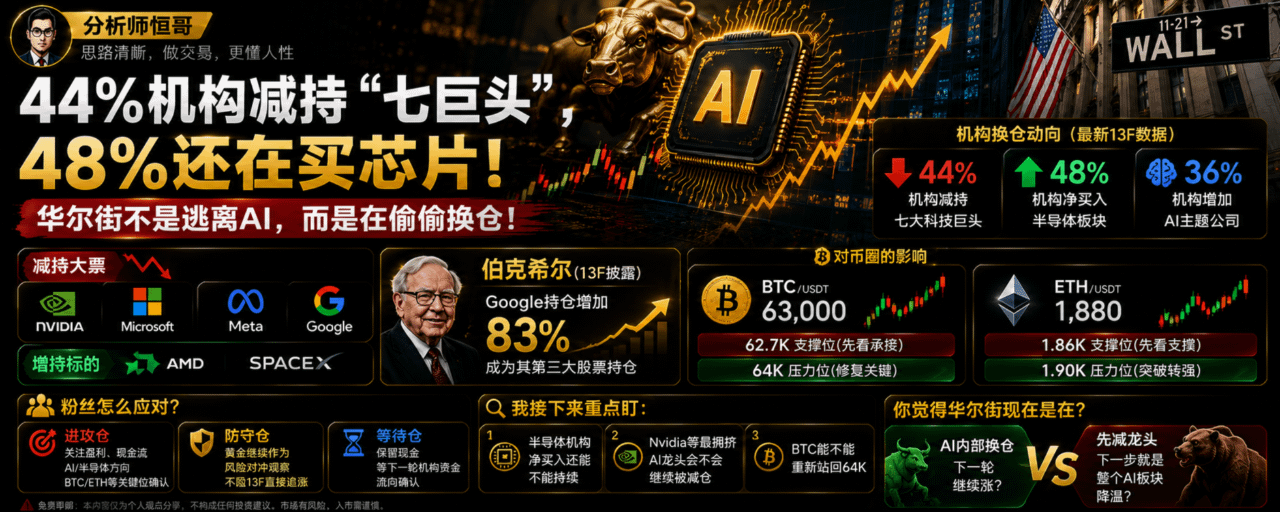
44% of institutions start cutting the “seven giants,” but 48% are still buying chips: Wall Street isn’t fleeing AI—it’s quietly rotating positions!This data is quite interesting.
The latest 13F shows:
About 44% of institutions reduced their holdings in the seven biggest tech giants.
At first glance, does it seem like the AI rally is ending?
But if you look further down:
48% of institutions are still net buyers of semiconductors.
36% of institutions are still adding stocks related to AI themes.
So what’s really happening isn’t:
Nobody wants AI.
Instead:
The most crowded large positions are starting to loosen, and capital is re-selecting the AI industry chain.
Tiger Global is reducing Nvidia, Microsoft, Meta, and Google, while starting to buy AMD and SpaceX.
But on the other side, Berkshire directly increased its Google position by 83%, making it the third-largest stock holding.
44% of institutions start cutting the “seven giants,” but 48% are still buying chips: Wall Street isn’t fleeing AI—it’s quietly rotating positions!
This data is quite interesting.
The latest 13F shows:
About 44% of institutions reduced their holdings in the seven biggest tech giants.
At first glance, does it seem like the AI rally is ending?
But if you look further down:
48% of institutions are still net buyers of semiconductors.
36% of institutions are still adding stocks related to AI themes.
So what’s really happening isn’t:
Nobody wants AI.
Instead:
The most crowded large positions are starting to loosen, and capital is re-selecting the AI industry chain.
Tiger Global is reducing Nvidia, Microsoft, Meta, and Google, while starting to buy AMD and SpaceX.
But on the other side, Berkshire directly increased its Google position by 83%, making it the third-largest stock holding.
The latest 13F shows:
About 44% of institutions reduced their holdings in the seven biggest tech giants.
At first glance, does it seem like the AI rally is ending?
But if you look further down:
48% of institutions are still net buyers of semiconductors.
36% of institutions are still adding stocks related to AI themes.
So what’s really happening isn’t:
Nobody wants AI.
Instead:
The most crowded large positions are starting to loosen, and capital is re-selecting the AI industry chain.
Tiger Global is reducing Nvidia, Microsoft, Meta, and Google, while starting to buy AMD and SpaceX.
But on the other side, Berkshire directly increased its Google position by 83%, making it the third-largest stock holding.
1
102
Log in to explore more content
Join global crypto users on Binance Square
⚡️ Get latest and useful information about crypto.
💬 Trusted by the world’s largest crypto exchange.
👍 Discover real insights from verified creators.
Email / Phone number
Trending Topics
AIStocksWhatNext
804,303 views
6,199 Discussing
Share & Win Traffic Reward in our Trending Hashtag Campaign
✨Topic: What Other Investment Opportunities Remain as AI Stocks Keep Rising?
👉How to Join:
Publish a short post or article with hashtag #AIStocksWhatNext
Share whether you’re bullish or bearish, and post your AI stock holdings or trade — using the trade widget may improve your eligibility.
You can also strengthen your post by sharing data or charts, and avoiding AI-generated images.
✍️Create content based on the below angles:
- Nvidia says chip sales will double next year, and top AI companies keep hitting record revenue, the compute spend behind it is just as staggering. Is AI demand really taking off? And how long can it last? AI stocks are up across the board. Is this a real breakout, or just a short-term bounce?
- Industry leaders are calling to slow down AI development, while Trump plans to build an “AI Force”, claiming AI could account for 25% of U.S. GDP in the future. Whose side are you on? Will state-level backing be a long-term win for AI stocks?
- Are you buying AI stocks? Share your AI-related trade/holdings with our trade sharing widget.
⏰Campaign Period:
- 2026-09-22 7:00 - 2026-09-24 4:00 UTC
🎁Reward:
- Qualified posts that comply with the above guidelines and contain more than 100 words will be reviewed and may receive a random traffic boost of 500 to 3,000 views. You will receive a notification from your feed secretary if your post is selected.
- Get a chance to have your article featured on Binance Square Official
Need ideas for your post? Visit the topic page #AIStocksWhatNext or the Square Guide on How to Post for Better Reach.
Binance Square Official
·568 Likes
·1.6M views
BitcoinRejectedAt$87,300Twice
0 views
0 Discussing
BCHJumps28%OnCMEFuturesListing
3,592 views
334 Discussing