
#lighter
lighter
199,466 views
854 Discussing
Hot
Latest

·
--
Bullish
🚨 $15.5 MILLION USDC HEIST!
TWO ACCOUNTS COMPROMISED, MILLIONS DIVERTED, AND LIGHTER WITHDRAWALS FROZEN!
Decentralized exchange Lighter temporarily suspended withdrawals following the alleged theft of approximately $15.5 million in USDC from two market maker accounts.
Investigators suspect compromised API keys. One of the transactions enabled the withdrawal of more than 10.39 million USDC, which was converted into ETH and distributed across other addresses.
Lighter confirmed that it is investigating the incident and stated that its protocol and smart contracts were not compromised.
The case remains under investigation, and the whereabouts of the funds continue to raise alarm.
#shark593 #Shark593News #lighter #ciberseguridad #APackedWeekOfEarningsAndDataTestsMarkets
🚨 $15.5 MILLION USDC HEIST!
TWO ACCOUNTS COMPROMISED, MILLIONS DIVERTED, AND LIGHTER WITHDRAWALS FROZEN!
Decentralized exchange Lighter temporarily suspended withdrawals following the alleged theft of approximately $15.5 million in USDC from two market maker accounts.
Investigators suspect compromised API keys. One of the transactions enabled the withdrawal of more than 10.39 million USDC, which was converted into ETH and distributed across other addresses.
Lighter confirmed that it is investigating the incident and stated that its protocol and smart contracts were not compromised.
The case remains under investigation, and the whereabouts of the funds continue to raise alarm.
#shark593 #Shark593News #lighter #ciberseguridad #APackedWeekOfEarningsAndDataTestsMarkets
TWO ACCOUNTS COMPROMISED, MILLIONS DIVERTED, AND LIGHTER WITHDRAWALS FROZEN!
Decentralized exchange Lighter temporarily suspended withdrawals following the alleged theft of approximately $15.5 million in USDC from two market maker accounts.
Investigators suspect compromised API keys. One of the transactions enabled the withdrawal of more than 10.39 million USDC, which was converted into ETH and distributed across other addresses.
Lighter confirmed that it is investigating the incident and stated that its protocol and smart contracts were not compromised.
The case remains under investigation, and the whereabouts of the funds continue to raise alarm.
#shark593 #Shark593News #lighter #ciberseguridad #APackedWeekOfEarningsAndDataTestsMarkets
388

·
--
One lost key, and $15.48 million is gone—the Lighter saga needed fewer special effects than a hacker movie.
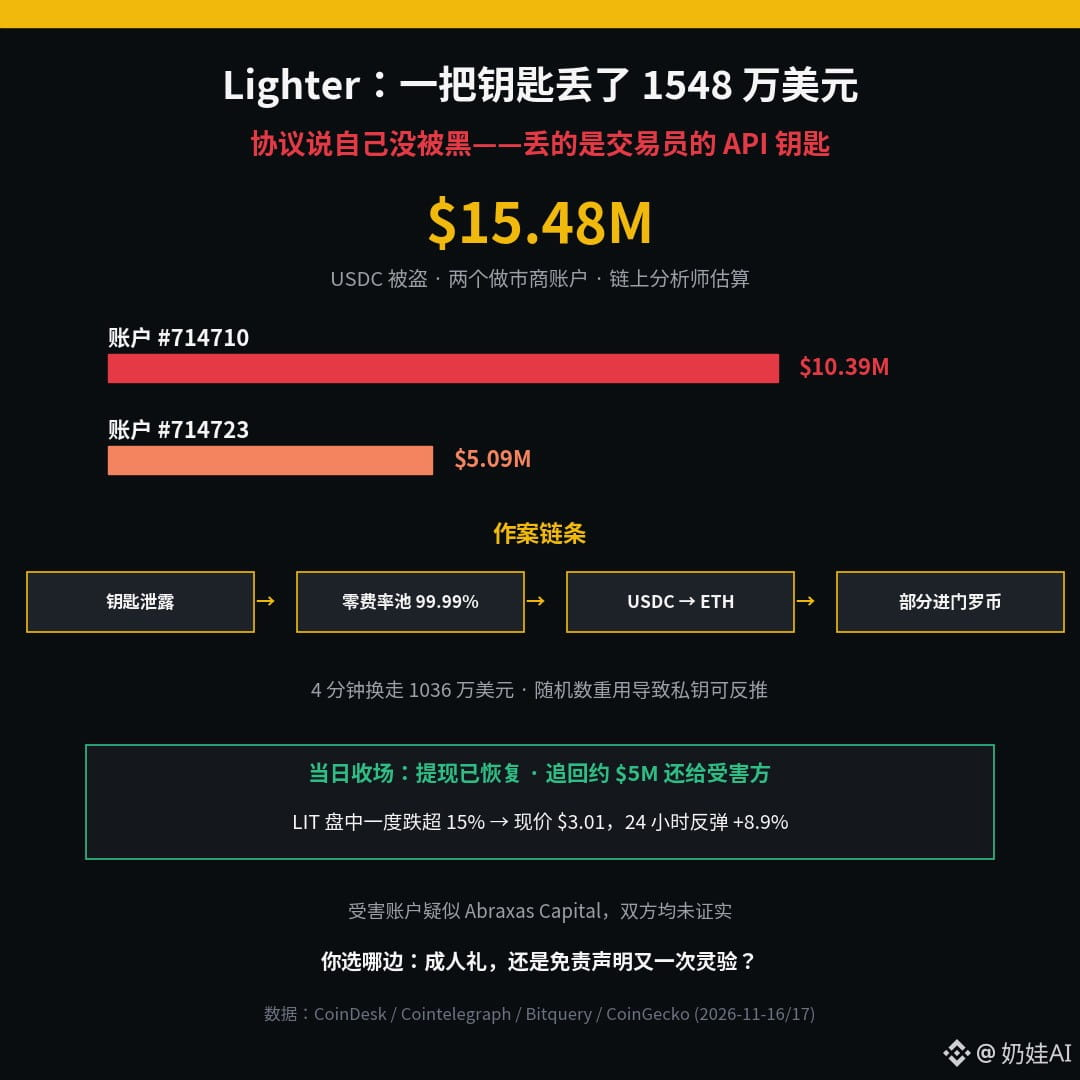
On November 16, on-chain sleuths first spotted something fishy: Account 714710 was down $10.39 million, and account 714723 was down $5.09 million, for a total of $15.48 million in USDC.
The hacker’s playbook was a textbook case of using someone else’s hand to do the dirty work: first, they opened a zero-fee liquidity pool and grabbed a 99.99% share. Then, using the stolen key, they funneled funds from the victim accounts into it. Once redeemed, the money came out “legitimately.”
In four minutes, $10.36 million in USDC was swapped for ETH. Some of it went into Monero, and was thoroughly laundered.
Lighter’s response was classic: the protocol wasn’t hacked, and the contracts were fine—it was an API key belonging to a trader that had been leaked.
The follow-up stings even more: the trader hadn’t used the official signing software, and the code reused a nonce, making it possible to derive the private key from public signatures.
Fortunately, it was over that same day: withdrawals resumed a few hours later, and the security council also recovered about $5 million to return to the victims.
To me, the most ironic part isn’t how much was lost. It’s that beneath the “decentralized” banner, security ultimately rested on a single key and a piece of third-party code. The blockchain can be fast as you like, but one human slip and the whole thing is made of paper.
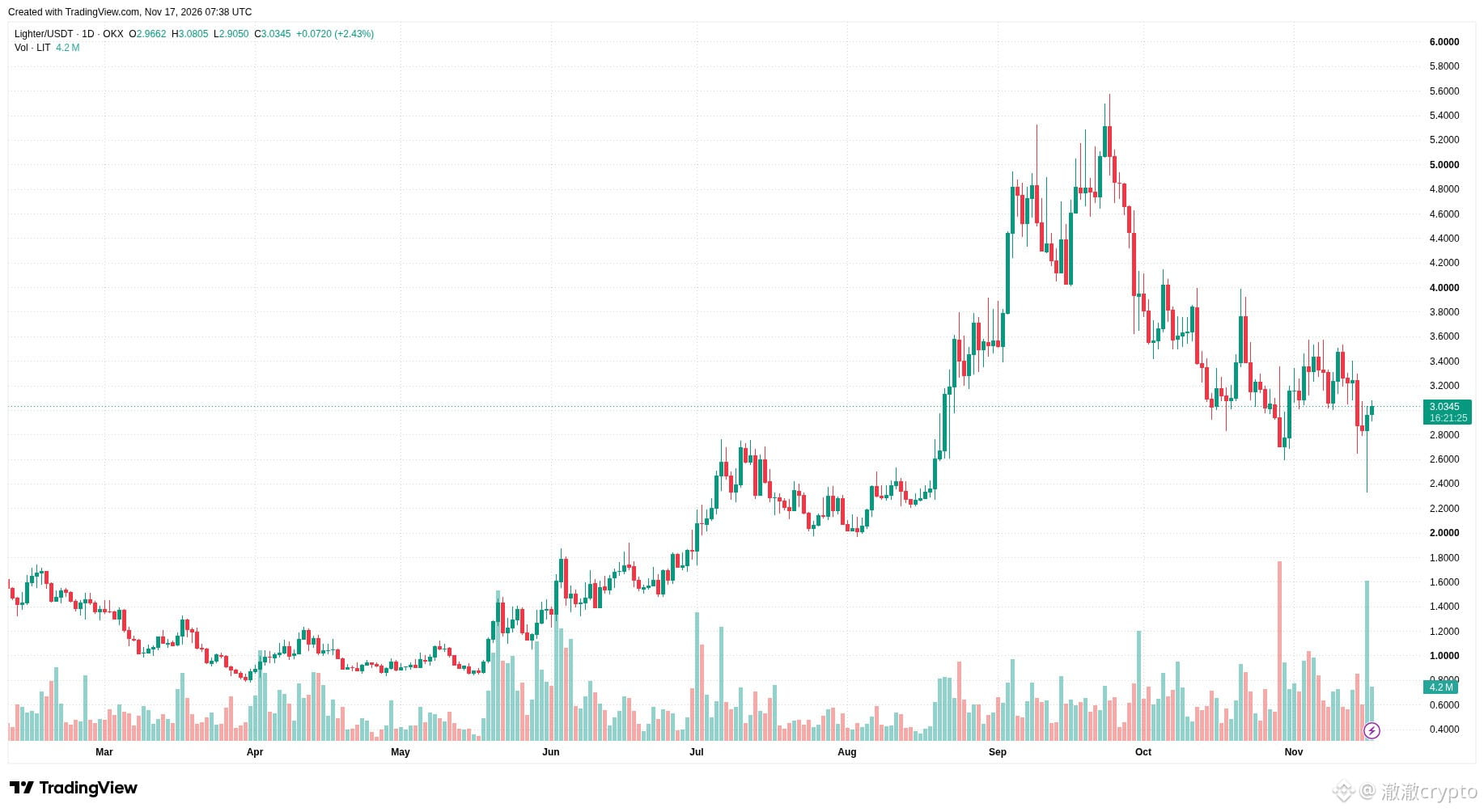
LIT briefly fell more than 15% that day. It’s now at $3.01, up 8.9% in 24 hours—the market voted with its feet, then changed its mind.
The victim accounts are suspected to belong to Abraxas Capital, according to analysts’ speculation. Neither party has confirmed it.
Which side are you on: is this a decentralized exchange’s coming-of-age moment, or just another case of “your keys, your responsibility” proving true?
$LIT $ETH
#Lighter #DecentralizedExchange
One lost key, and $15.48 million is gone—the Lighter saga needed fewer special effects than a hacker movie.
On November 16, on-chain sleuths first spotted something fishy: Account 714710 was down $10.39 million, and account 714723 was down $5.09 million, for a total of $15.48 million in USDC.
The hacker’s playbook was a textbook case of using someone else’s hand to do the dirty work: first, they opened a zero-fee liquidity pool and grabbed a 99.99% share. Then, using the stolen key, they funneled funds from the victim accounts into it. Once redeemed, the money came out “legitimately.”
In four minutes, $10.36 million in USDC was swapped for ETH. Some of it went into Monero, and was thoroughly laundered.
Lighter’s response was classic: the protocol wasn’t hacked, and the contracts were fine—it was an API key belonging to a trader that had been leaked.
The follow-up stings even more: the trader hadn’t used the official signing software, and the code reused a nonce, making it possible to derive the private key from public signatures.
Fortunately, it was over that same day: withdrawals resumed a few hours later, and the security council also recovered about $5 million to return to the victims.
To me, the most ironic part isn’t how much was lost. It’s that beneath the “decentralized” banner, security ultimately rested on a single key and a piece of third-party code. The blockchain can be fast as you like, but one human slip and the whole thing is made of paper.
LIT briefly fell more than 15% that day. It’s now at $3.01, up 8.9% in 24 hours—the market voted with its feet, then changed its mind.
The victim accounts are suspected to belong to Abraxas Capital, according to analysts’ speculation. Neither party has confirmed it.
Which side are you on: is this a decentralized exchange’s coming-of-age moment, or just another case of “your keys, your responsibility” proving true?
$LIT $ETH
#Lighter #DecentralizedExchange
On November 16, on-chain sleuths first spotted something fishy: Account 714710 was down $10.39 million, and account 714723 was down $5.09 million, for a total of $15.48 million in USDC.
The hacker’s playbook was a textbook case of using someone else’s hand to do the dirty work: first, they opened a zero-fee liquidity pool and grabbed a 99.99% share. Then, using the stolen key, they funneled funds from the victim accounts into it. Once redeemed, the money came out “legitimately.”
In four minutes, $10.36 million in USDC was swapped for ETH. Some of it went into Monero, and was thoroughly laundered.
Lighter’s response was classic: the protocol wasn’t hacked, and the contracts were fine—it was an API key belonging to a trader that had been leaked.
The follow-up stings even more: the trader hadn’t used the official signing software, and the code reused a nonce, making it possible to derive the private key from public signatures.
Fortunately, it was over that same day: withdrawals resumed a few hours later, and the security council also recovered about $5 million to return to the victims.
To me, the most ironic part isn’t how much was lost. It’s that beneath the “decentralized” banner, security ultimately rested on a single key and a piece of third-party code. The blockchain can be fast as you like, but one human slip and the whole thing is made of paper.
LIT briefly fell more than 15% that day. It’s now at $3.01, up 8.9% in 24 hours—the market voted with its feet, then changed its mind.
The victim accounts are suspected to belong to Abraxas Capital, according to analysts’ speculation. Neither party has confirmed it.
Which side are you on: is this a decentralized exchange’s coming-of-age moment, or just another case of “your keys, your responsibility” proving true?
$LIT $ETH
#Lighter #DecentralizedExchange
255

·
--
Golden Pig’s take: The issue with Lighter this time wasn’t the protocol—it was a user’s own signing code. $LIT I’m bullish, but I won’t chase.
The official postmortem is very clear: a trader’s API key was leaked. They weren’t using the official SDK and reused the same nonce when signing, making it possible to derive their private key from public signatures. The contracts and infrastructure were unaffected, and after safety measures kicked in, about 5 million USDC was returned to the affected traders.
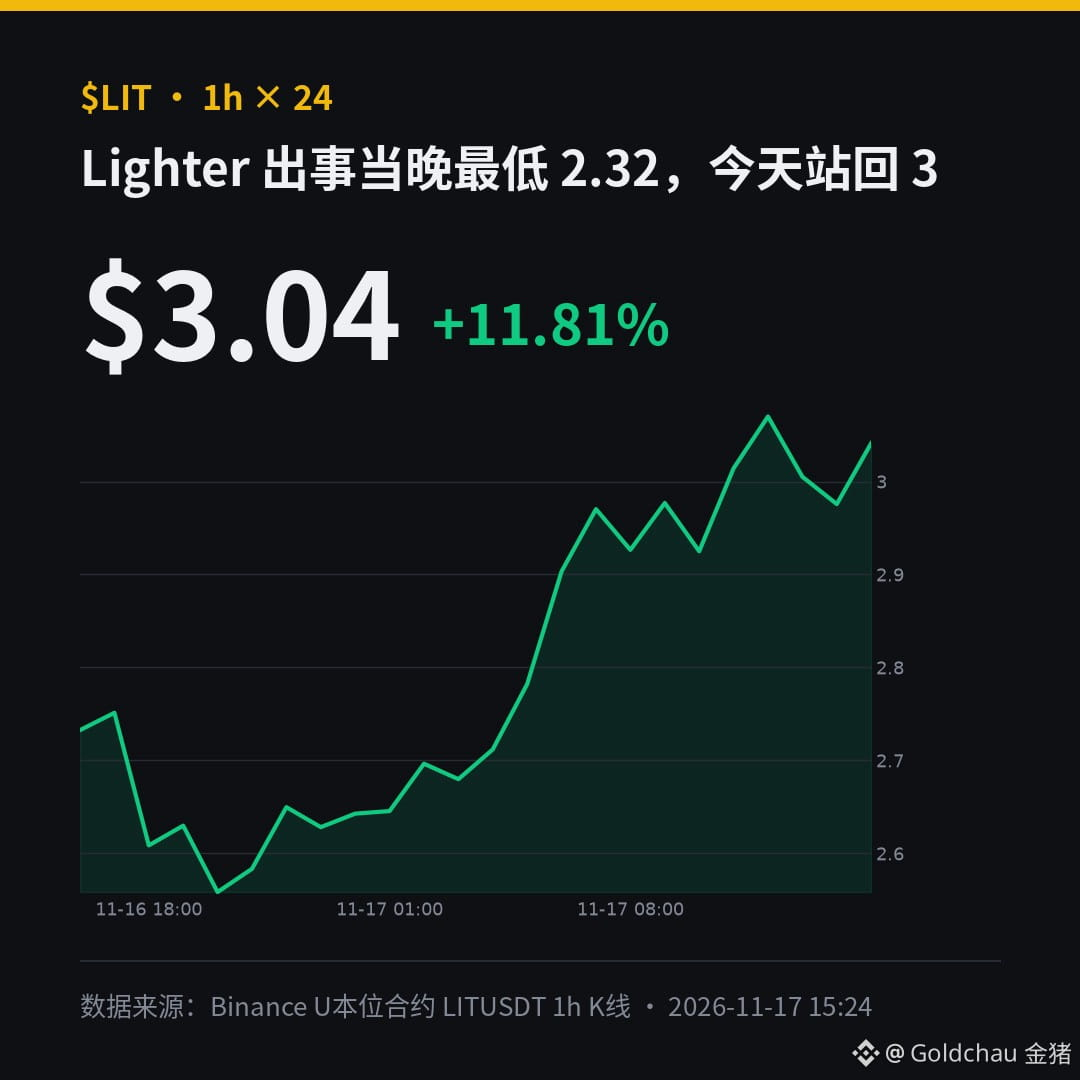
The price initially reflected the panic: on the night of the incident, Binance’s LIT contract plunged to a low of 2.32.
It’s now back around 3.0, up about 30% from the low (my calculation).
My plan: scale in with a small position on a pullback near 2.85; exit if it falls below 2.5; add if it holds above 3.1. No high leverage.
One more reminder: if you use APIs to run trading bots, tighten your IP whitelist and permissions today. Disable withdrawal permissions if you can.
If you trade using an API or bot, how are you managing your keys and permissions right now?
#Lighter #LIT #API安全 #MarketAnalysis
Data sources: Lighter’s official X post from 11/16; Binance LITUSDT USDT-margined contract candlesticks (my calculation)
DYOR; this is not investment advice
Golden Pig’s take: The issue with Lighter this time wasn’t the protocol—it was a user’s own signing code. $LIT I’m bullish, but I won’t chase.
The official postmortem is very clear: a trader’s API key was leaked. They weren’t using the official SDK and reused the same nonce when signing, making it possible to derive their private key from public signatures. The contracts and infrastructure were unaffected, and after safety measures kicked in, about 5 million USDC was returned to the affected traders.
The price initially reflected the panic: on the night of the incident, Binance’s LIT contract plunged to a low of 2.32.
It’s now back around 3.0, up about 30% from the low (my calculation).
My plan: scale in with a small position on a pullback near 2.85; exit if it falls below 2.5; add if it holds above 3.1. No high leverage.
One more reminder: if you use APIs to run trading bots, tighten your IP whitelist and permissions today. Disable withdrawal permissions if you can.
If you trade using an API or bot, how are you managing your keys and permissions right now?
#Lighter #LIT #API安全 #MarketAnalysis
Data sources: Lighter’s official X post from 11/16; Binance LITUSDT USDT-margined contract candlesticks (my calculation)
DYOR; this is not investment advice
The official postmortem is very clear: a trader’s API key was leaked. They weren’t using the official SDK and reused the same nonce when signing, making it possible to derive their private key from public signatures. The contracts and infrastructure were unaffected, and after safety measures kicked in, about 5 million USDC was returned to the affected traders.
The price initially reflected the panic: on the night of the incident, Binance’s LIT contract plunged to a low of 2.32.
It’s now back around 3.0, up about 30% from the low (my calculation).
My plan: scale in with a small position on a pullback near 2.85; exit if it falls below 2.5; add if it holds above 3.1. No high leverage.
One more reminder: if you use APIs to run trading bots, tighten your IP whitelist and permissions today. Disable withdrawal permissions if you can.
If you trade using an API or bot, how are you managing your keys and permissions right now?
#Lighter #LIT #API安全 #MarketAnalysis
Data sources: Lighter’s official X post from 11/16; Binance LITUSDT USDT-margined contract candlesticks (my calculation)
DYOR; this is not investment advice
1
150

·
--
{future}(LITUSDT)
$LIT WAS HIT BY A SECURITY INCIDENT. BUT DID THE MARKET OVERREACT?
Lighter had a serious security scare. Withdrawals were temporarily stopped, and millions of dollars were involved.
Sounds terrible, right?
But here's what caught my attention.
According to the latest reports, the problem involved a compromised market maker key, not a hack of the entire Lighter protocol.
Around $5 million has reportedly been returned to users, and withdrawals have resumed.
That's good news. But I wouldn't celebrate too early.
Only about 25% of LIT's total supply is currently circulating, and future token unlocks remain a concern.
My short-term view: If confidence returns, LIT could recover toward $3. But if buyers remain nervous, another test of $2.50 wouldn't surprise me.
I'm watching whether the recovery is supported by real buying, not just hype.
Would you buy after this security scare, or wait?
#Lıt #lighter #CryptoNews #defi
$LIT WAS HIT BY A SECURITY INCIDENT. BUT DID THE MARKET OVERREACT?
Lighter had a serious security scare. Withdrawals were temporarily stopped, and millions of dollars were involved.
Sounds terrible, right?
But here's what caught my attention.
According to the latest reports, the problem involved a compromised market maker key, not a hack of the entire Lighter protocol.
Around $5 million has reportedly been returned to users, and withdrawals have resumed.
That's good news. But I wouldn't celebrate too early.
Only about 25% of LIT's total supply is currently circulating, and future token unlocks remain a concern.
My short-term view: If confidence returns, LIT could recover toward $3. But if buyers remain nervous, another test of $2.50 wouldn't surprise me.
I'm watching whether the recovery is supported by real buying, not just hype.
Would you buy after this security scare, or wait?
#Lıt #lighter #CryptoNews #defi
$LIT WAS HIT BY A SECURITY INCIDENT. BUT DID THE MARKET OVERREACT?
Lighter had a serious security scare. Withdrawals were temporarily stopped, and millions of dollars were involved.
Sounds terrible, right?
But here's what caught my attention.
According to the latest reports, the problem involved a compromised market maker key, not a hack of the entire Lighter protocol.
Around $5 million has reportedly been returned to users, and withdrawals have resumed.
That's good news. But I wouldn't celebrate too early.
Only about 25% of LIT's total supply is currently circulating, and future token unlocks remain a concern.
My short-term view: If confidence returns, LIT could recover toward $3. But if buyers remain nervous, another test of $2.50 wouldn't surprise me.
I'm watching whether the recovery is supported by real buying, not just hype.
Would you buy after this security scare, or wait?
#Lıt #lighter #CryptoNews #defi
54

·
--
$10.4M walked out of Lighter on Monday, and Lighter says its smart contracts were never the weak spot.
$HYPE is at $70.16, up 5.68% in 24h, the best day among the top-volume coins, still down 5.10% on the week.
Per Cointelegraph, Bitquery traced 10,393,057 USDC leaving Lighter's Ethereum contract at 10:11 UTC Nov 16. Most was swapped into Ether within minutes, then sent on to wallets linked to XMR1 buys on Hyperliquid.
Lighter paused withdrawals and pinned it on one trader's leaked API key, tied to unofficial signing code that reused nonces. It said its protocol and official SDKs weren't hit.
Its Nov 17 update, per PANews and TokenPost: about 5M USDC returned to affected users, withdrawals back on.
The lesson for perp traders: per Lighter's docs, an API key can trade, manage positions and move funds between accounts on the same wallet 🔑 Lighter now requires wallet signatures for transfers.
LIT and HYPE are both trending on CoinGecko today. HYPE funding is +0.005%, basically flat, so leverage isn't driving the green. Fear & Greed sits at 12.
Edges I'm watching on $HYPE: $64.84 and $71.05, the 24h range.
Does a key leak like this change how you rate a perp DEX, or is that on the trader?
#HYPE #Lighter #PerpDEX #APIKeySecurity
$10.4M walked out of Lighter on Monday, and Lighter says its smart contracts were never the weak spot.
$HYPE is at $70.16, up 5.68% in 24h, the best day among the top-volume coins, still down 5.10% on the week.
Per Cointelegraph, Bitquery traced 10,393,057 USDC leaving Lighter's Ethereum contract at 10:11 UTC Nov 16. Most was swapped into Ether within minutes, then sent on to wallets linked to XMR1 buys on Hyperliquid.
Lighter paused withdrawals and pinned it on one trader's leaked API key, tied to unofficial signing code that reused nonces. It said its protocol and official SDKs weren't hit.
Its Nov 17 update, per PANews and TokenPost: about 5M USDC returned to affected users, withdrawals back on.
The lesson for perp traders: per Lighter's docs, an API key can trade, manage positions and move funds between accounts on the same wallet 🔑 Lighter now requires wallet signatures for transfers.
LIT and HYPE are both trending on CoinGecko today. HYPE funding is +0.005%, basically flat, so leverage isn't driving the green. Fear & Greed sits at 12.
Edges I'm watching on $HYPE : $64.84 and $71.05, the 24h range.
Does a key leak like this change how you rate a perp DEX, or is that on the trader?
#HYPE #Lighter #PerpDEX #APIKeySecurity
$HYPE is at $70.16, up 5.68% in 24h, the best day among the top-volume coins, still down 5.10% on the week.
Per Cointelegraph, Bitquery traced 10,393,057 USDC leaving Lighter's Ethereum contract at 10:11 UTC Nov 16. Most was swapped into Ether within minutes, then sent on to wallets linked to XMR1 buys on Hyperliquid.
Lighter paused withdrawals and pinned it on one trader's leaked API key, tied to unofficial signing code that reused nonces. It said its protocol and official SDKs weren't hit.
Its Nov 17 update, per PANews and TokenPost: about 5M USDC returned to affected users, withdrawals back on.
The lesson for perp traders: per Lighter's docs, an API key can trade, manage positions and move funds between accounts on the same wallet 🔑 Lighter now requires wallet signatures for transfers.
LIT and HYPE are both trending on CoinGecko today. HYPE funding is +0.005%, basically flat, so leverage isn't driving the green. Fear & Greed sits at 12.
Edges I'm watching on $HYPE : $64.84 and $71.05, the 24h range.
Does a key leak like this change how you rate a perp DEX, or is that on the trader?
#HYPE #Lighter #PerpDEX #APIKeySecurity
87

·
--
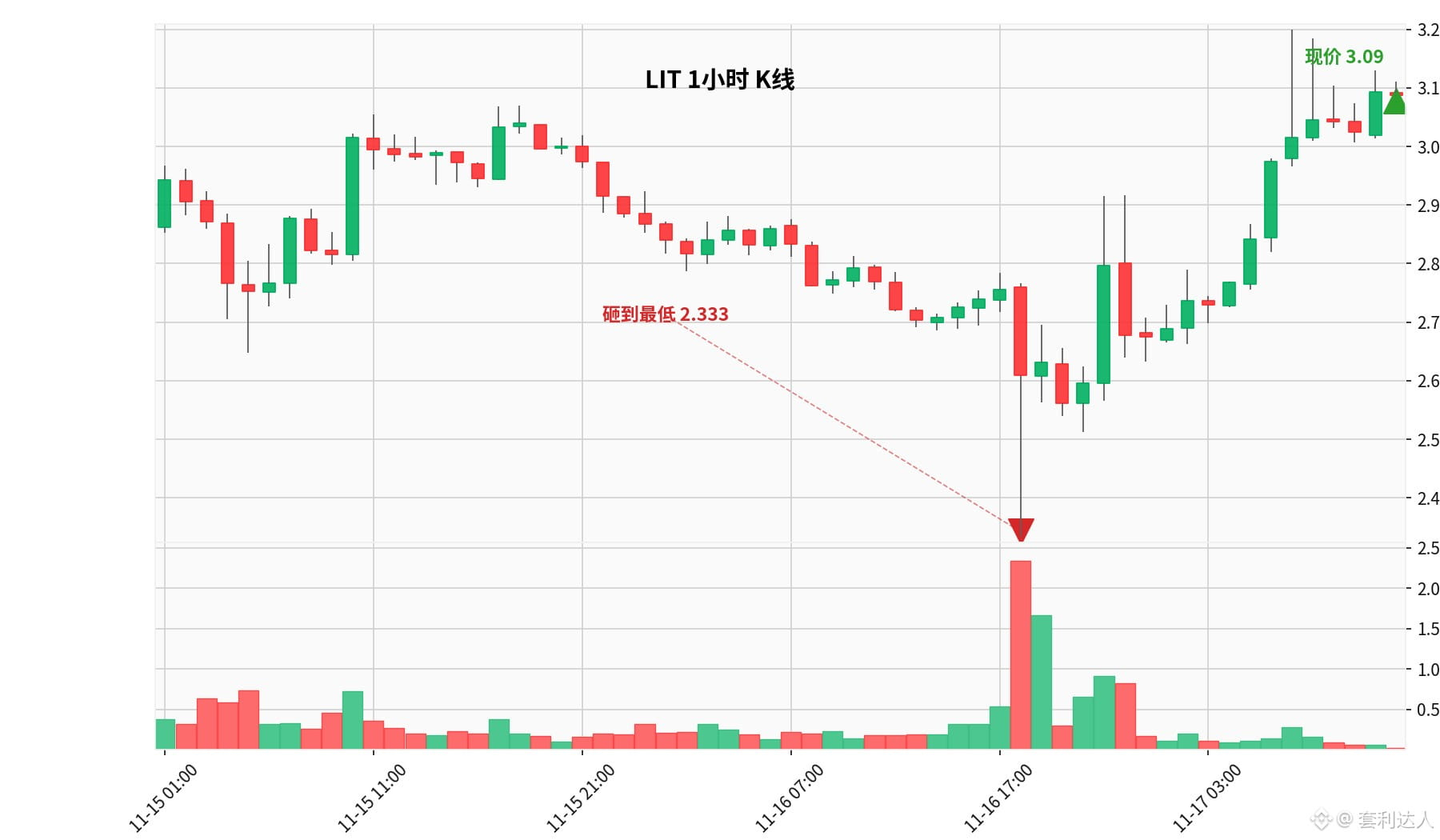
$LIT A beautiful V-shaped recovery this time: yesterday at 18:00, hackers drove it down to a low of 2.333; this morning at 7:00, it surged to 3.2. It’s now at 3.09, up 32% from the bottom and 12.3% in 24 hours, with $180 million in trading volume across all platforms. A market maker’s account API key was leaked, and over $15 million was siphoned off. The platform suspended withdrawals for 7 hours and recovered $5 million. Withdrawals have now resumed as normal. The official incident report says there was nothing wrong with the protocol or the contracts themselves; the issue was a bug in the market maker’s signing code. The token price has recovered its losses and climbed above $3 while the broader market is moving sideways—it’s surging on its own. #LIT #Lighter #Surge
$LIT A beautiful V-shaped recovery this time: yesterday at 18:00, hackers drove it down to a low of 2.333; this morning at 7:00, it surged to 3.2. It’s now at 3.09, up 32% from the bottom and 12.3% in 24 hours, with $180 million in trading volume across all platforms. A market maker’s account API key was leaked, and over $15 million was siphoned off. The platform suspended withdrawals for 7 hours and recovered $5 million. Withdrawals have now resumed as normal. The official incident report says there was nothing wrong with the protocol or the contracts themselves; the issue was a bug in the market maker’s signing code. The token price has recovered its losses and climbed above $3 while the broader market is moving sideways—it’s surging on its own. #LIT #Lighter #Surge
SunspotAlgo:
插针拉出的V反,重点看量能能否续。守住3.2上方才算真强,否则多是情绪回补,追高防二次回踩。(欢迎回访主页)
1
1
171

·
--
Bearish
$LIT cae and faces pressure after incident on #lighter November 16
LIT retreats as a reported operational incident at Lighter and the suspension of withdrawals weigh on confidence. Volume rose sharply, but the price remains below several moving averages; the analysis distinguishes the documented catalyst from technical signals and data that are still missing.
The most significant confirmed fact is the suspension of withdrawals following an incident that reportedly caused losses of USD $15.5 million. The news is directly relevant because a withdrawal disruption can limit users’ access to funds, increase perceived operational risk, and undermine confidence in a protocol.
The data provided do not describe LIT’s specific utility, value-capture mechanism, revenue, fees, incentives, or governance; it is not possible to assume that use of the protocol generates direct demand for the token.
Recommendation: #VENDER or reduce exposure in tactical positions; for those without a position, HOLD off on buying. The methodology weighs five observable signals: price below short-term SMAs, weak RSI, bearish MACD, price below VWAP, and elevated relative volume in a down session. All five favor caution, although elevated volume is ambiguous and the price remains above the SMA-200; therefore, they do not amount to five independent confirmations of a future decline. The recent operational incident increases event risk and justifies prioritizing liquidity and loss control.
Short term: avoid buying in anticipation of a rebound while the price is below USD $2.76; a rebound trade would have stronger confirmation above that level and could consider USD $2.96 as a partial take-profit target. A close below USD $2.44 would be a signal to exit a tactical trade; those using an intraday stop-loss should account for ATR volatility and reduce position size to avoid excessive exposure.
{future}(LITUSDT)
$LIT cae and faces pressure after incident on #lighter November 16
LIT retreats as a reported operational incident at Lighter and the suspension of withdrawals weigh on confidence. Volume rose sharply, but the price remains below several moving averages; the analysis distinguishes the documented catalyst from technical signals and data that are still missing.
The most significant confirmed fact is the suspension of withdrawals following an incident that reportedly caused losses of USD $15.5 million. The news is directly relevant because a withdrawal disruption can limit users’ access to funds, increase perceived operational risk, and undermine confidence in a protocol.
The data provided do not describe LIT’s specific utility, value-capture mechanism, revenue, fees, incentives, or governance; it is not possible to assume that use of the protocol generates direct demand for the token.
Recommendation: #VENDER or reduce exposure in tactical positions; for those without a position, HOLD off on buying. The methodology weighs five observable signals: price below short-term SMAs, weak RSI, bearish MACD, price below VWAP, and elevated relative volume in a down session. All five favor caution, although elevated volume is ambiguous and the price remains above the SMA-200; therefore, they do not amount to five independent confirmations of a future decline. The recent operational incident increases event risk and justifies prioritizing liquidity and loss control.
Short term: avoid buying in anticipation of a rebound while the price is below USD $2.76; a rebound trade would have stronger confirmation above that level and could consider USD $2.96 as a partial take-profit target. A close below USD $2.44 would be a signal to exit a tactical trade; those using an intraday stop-loss should account for ATR volatility and reduce position size to avoid excessive exposure.
LIT retreats as a reported operational incident at Lighter and the suspension of withdrawals weigh on confidence. Volume rose sharply, but the price remains below several moving averages; the analysis distinguishes the documented catalyst from technical signals and data that are still missing.
The most significant confirmed fact is the suspension of withdrawals following an incident that reportedly caused losses of USD $15.5 million. The news is directly relevant because a withdrawal disruption can limit users’ access to funds, increase perceived operational risk, and undermine confidence in a protocol.
The data provided do not describe LIT’s specific utility, value-capture mechanism, revenue, fees, incentives, or governance; it is not possible to assume that use of the protocol generates direct demand for the token.
Recommendation: #VENDER or reduce exposure in tactical positions; for those without a position, HOLD off on buying. The methodology weighs five observable signals: price below short-term SMAs, weak RSI, bearish MACD, price below VWAP, and elevated relative volume in a down session. All five favor caution, although elevated volume is ambiguous and the price remains above the SMA-200; therefore, they do not amount to five independent confirmations of a future decline. The recent operational incident increases event risk and justifies prioritizing liquidity and loss control.
Short term: avoid buying in anticipation of a rebound while the price is below USD $2.76; a rebound trade would have stronger confirmation above that level and could consider USD $2.96 as a partial take-profit target. A close below USD $2.44 would be a signal to exit a tactical trade; those using an intraday stop-loss should account for ATR volatility and reduce position size to avoid excessive exposure.
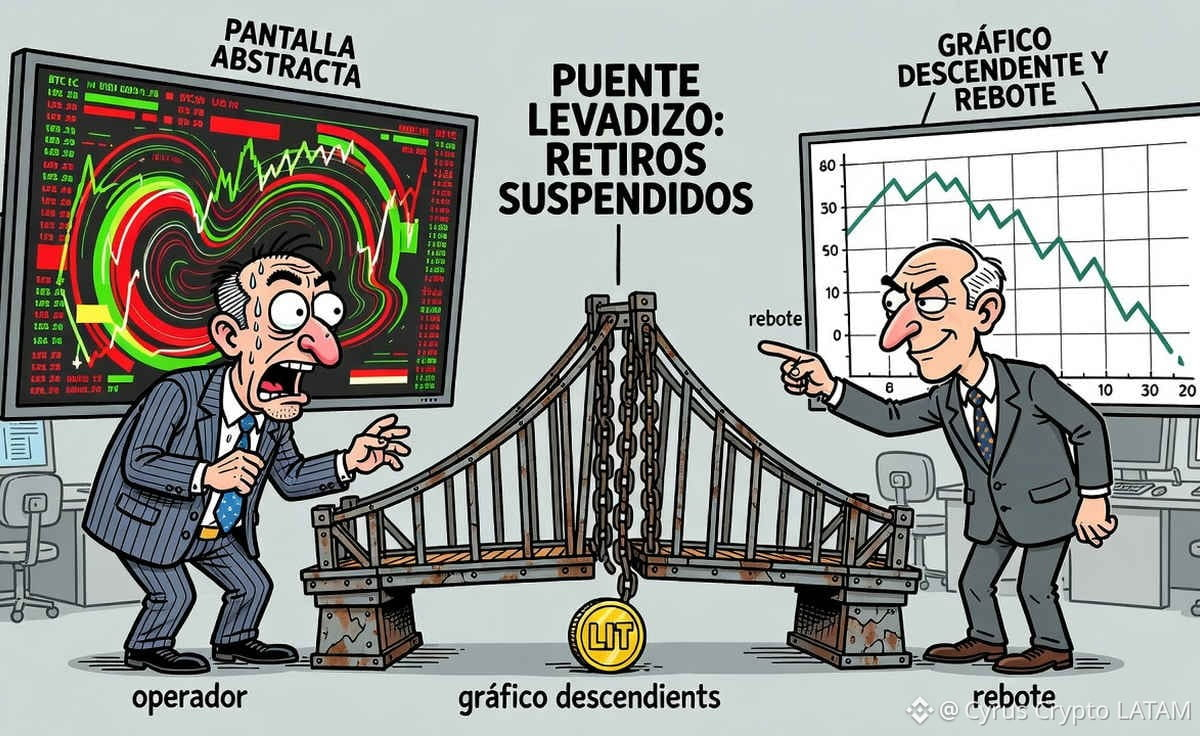
354

·
--
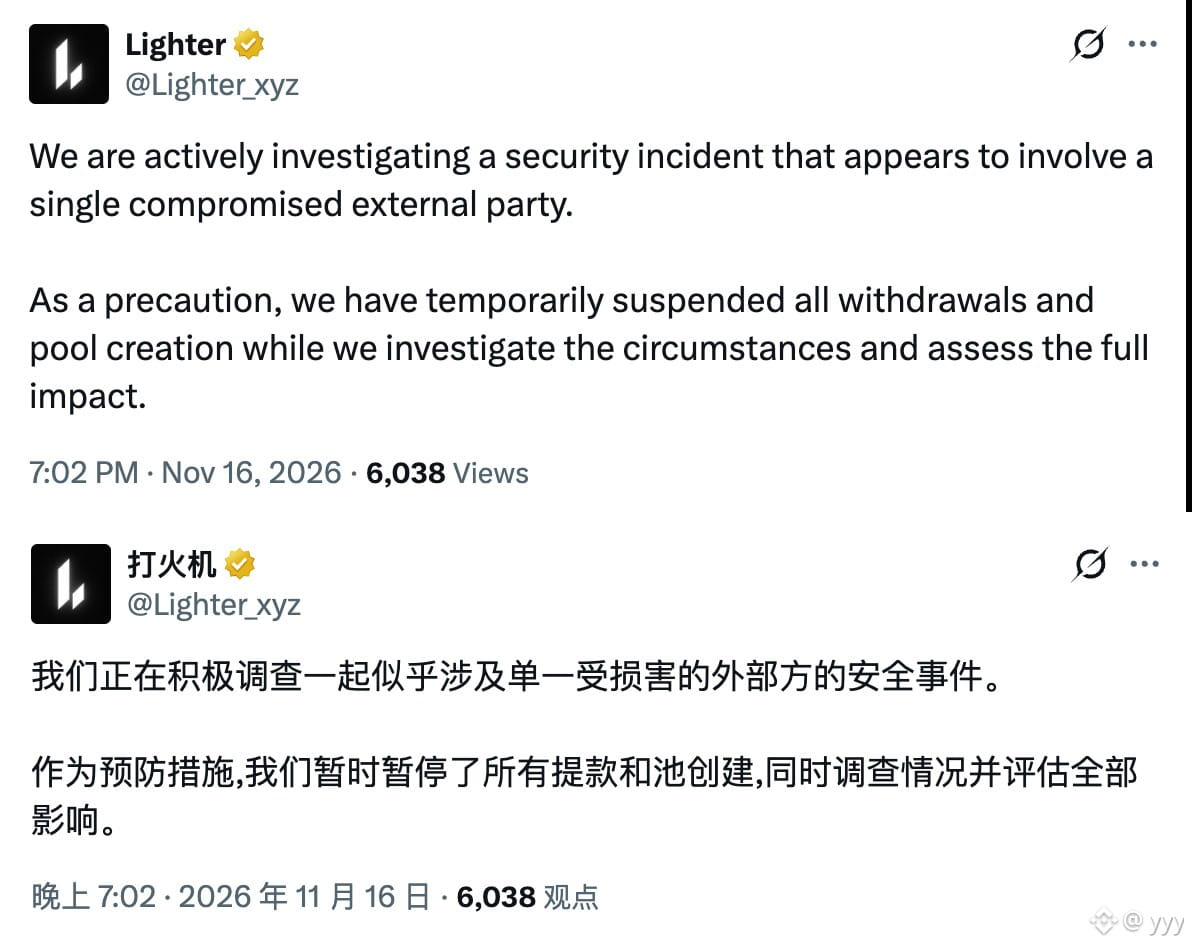
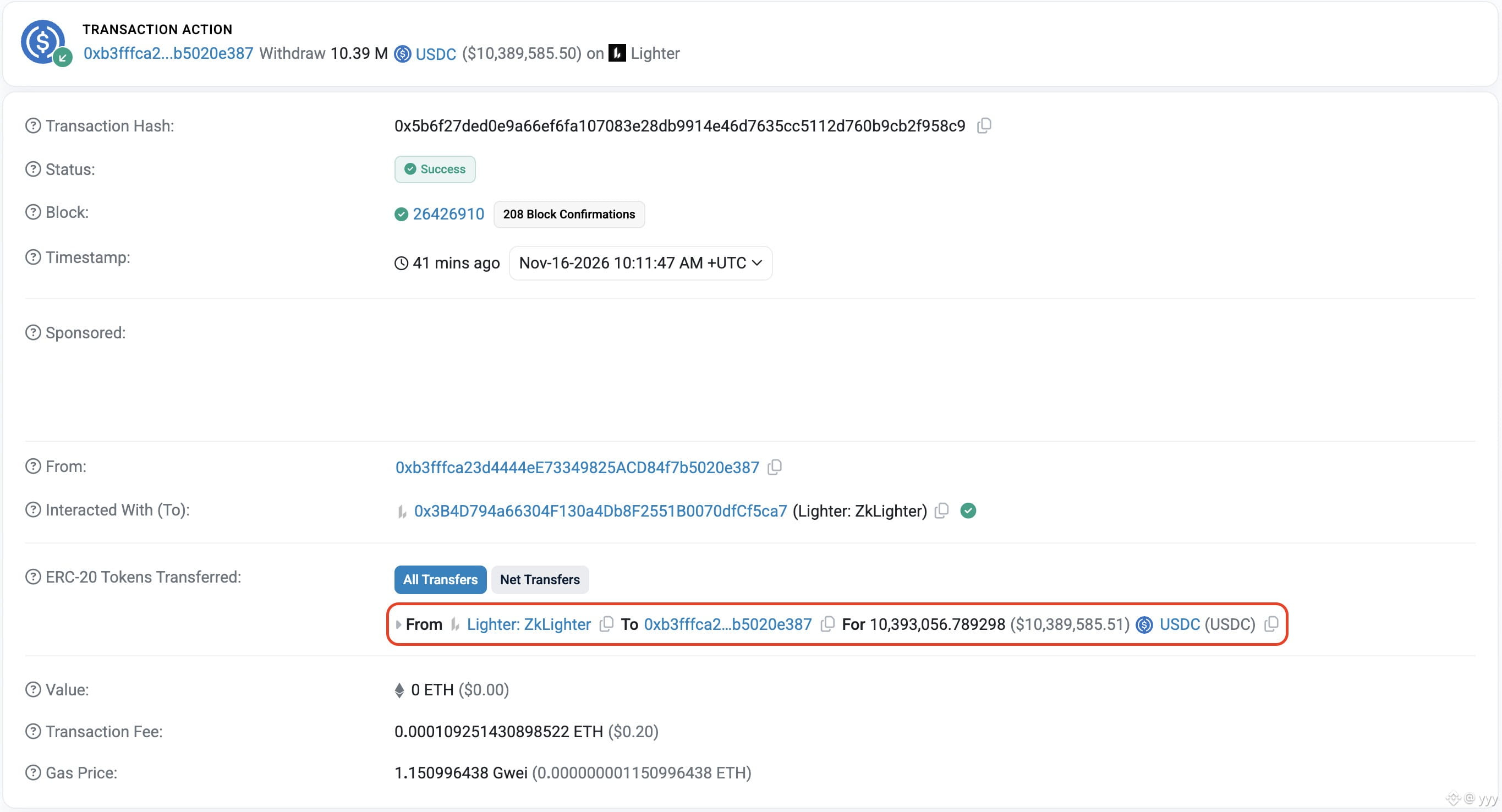
An hour ago, on-chain data suggested that Lighter may have been exploited for 10.39 million USDC.
Lighter posted a statement denying that the protocol itself had been hacked. However, the following on-chain facts have been confirmed so far:
1/ The attack address was created about four hours ago and initially received only around $10,000 worth of funds via cross-chain bridges such as Relay;
2/ The address successfully called Lighter’s ZKLighter contract to withdraw 10.39 million USDC;
3/ Immediately after the withdrawal, it swapped most of the USDC for ETH via CoW Protocol and split the funds across multiple new addresses.
The outlook is not good.
#lighter
An hour ago, on-chain data suggested that Lighter may have been exploited for 10.39 million USDC.
Lighter posted a statement denying that the protocol itself had been hacked. However, the following on-chain facts have been confirmed so far:
1/ The attack address was created about four hours ago and initially received only around $10,000 worth of funds via cross-chain bridges such as Relay;
2/ The address successfully called Lighter’s ZKLighter contract to withdraw 10.39 million USDC;
3/ Immediately after the withdrawal, it swapped most of the USDC for ETH via CoW Protocol and split the funds across multiple new addresses.
The outlook is not good.
#lighter
Lighter posted a statement denying that the protocol itself had been hacked. However, the following on-chain facts have been confirmed so far:
1/ The attack address was created about four hours ago and initially received only around $10,000 worth of funds via cross-chain bridges such as Relay;
2/ The address successfully called Lighter’s ZKLighter contract to withdraw 10.39 million USDC;
3/ Immediately after the withdrawal, it swapped most of the USDC for ETH via CoW Protocol and split the funds across multiple new addresses.
The outlook is not good.
#lighter
1
319

·
--
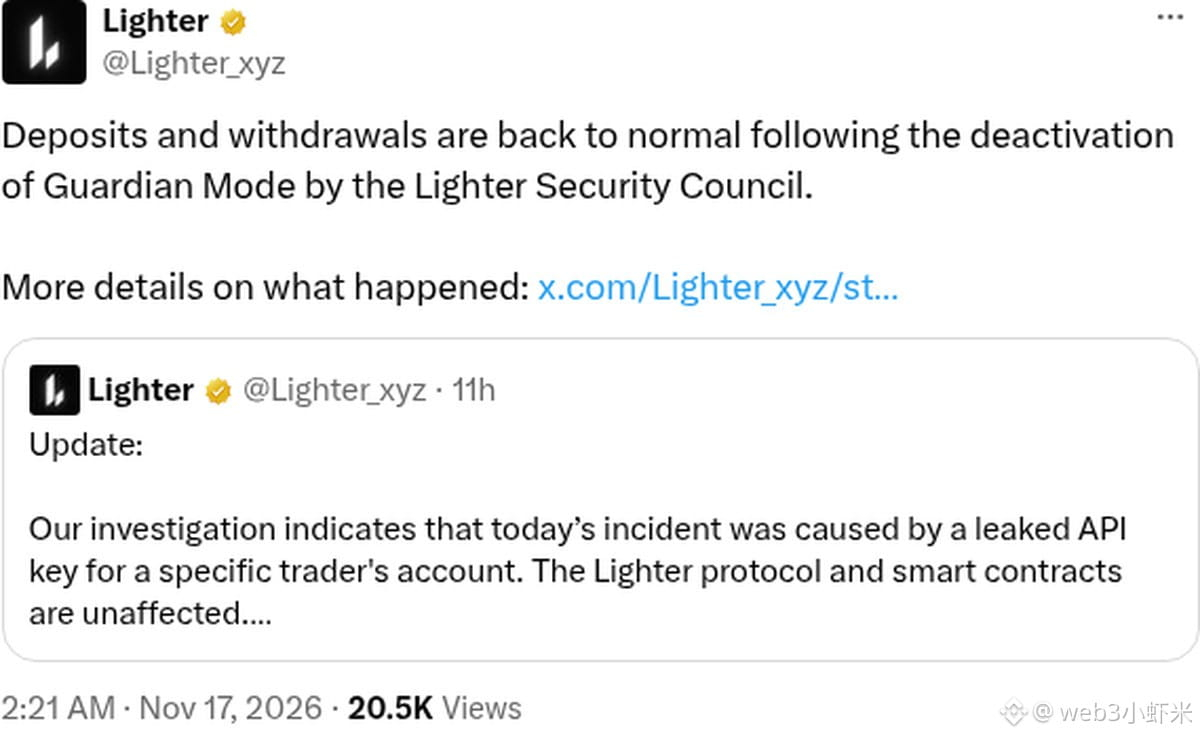
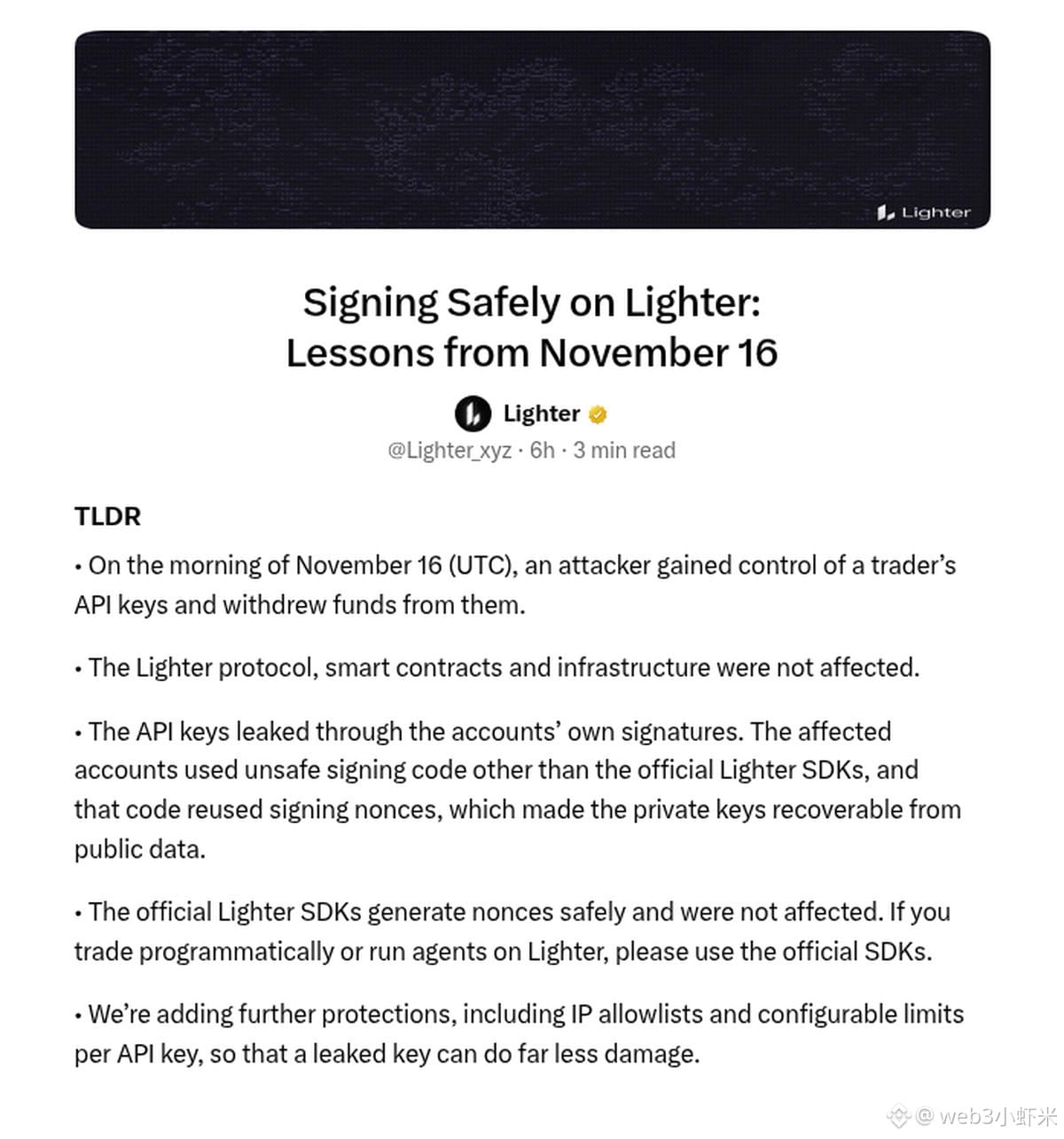
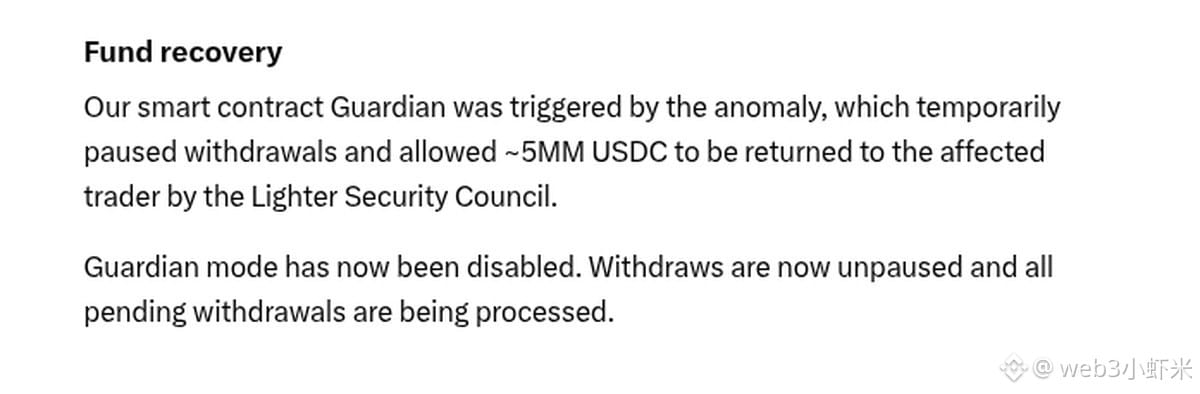
Lighter’s official account released an incident report early this morning and announced that deposits and withdrawals have returned to normal.
They wrote that on the morning of November 16 (UTC), an attacker obtained a trader’s API key and withdrew funds; the protocol, smart contracts, and infrastructure themselves were not affected. After the Guardian was triggered abnormally, withdrawals were temporarily paused. The Security Council then returned approximately 5 million USDC to the affected traders. Guardian mode has now been disabled, and pending withdrawals are being processed.
The official report clearly explained the cause: the affected account did not use the official SDK, and its signing code reused a nonce, allowing the private key to be derived from public signatures. The official SDK was not affected. They have also added new restrictions—for example, transferring funds to the public pool now requires a wallet signature, so an API key alone is no longer enough.
#Lighter
Lighter’s official account released an incident report early this morning and announced that deposits and withdrawals have returned to normal.
They wrote that on the morning of November 16 (UTC), an attacker obtained a trader’s API key and withdrew funds; the protocol, smart contracts, and infrastructure themselves were not affected. After the Guardian was triggered abnormally, withdrawals were temporarily paused. The Security Council then returned approximately 5 million USDC to the affected traders. Guardian mode has now been disabled, and pending withdrawals are being processed.
The official report clearly explained the cause: the affected account did not use the official SDK, and its signing code reused a nonce, allowing the private key to be derived from public signatures. The official SDK was not affected. They have also added new restrictions—for example, transferring funds to the public pool now requires a wallet signature, so an API key alone is no longer enough.
#Lighter
They wrote that on the morning of November 16 (UTC), an attacker obtained a trader’s API key and withdrew funds; the protocol, smart contracts, and infrastructure themselves were not affected. After the Guardian was triggered abnormally, withdrawals were temporarily paused. The Security Council then returned approximately 5 million USDC to the affected traders. Guardian mode has now been disabled, and pending withdrawals are being processed.
The official report clearly explained the cause: the affected account did not use the official SDK, and its signing code reused a nonce, allowing the private key to be derived from public signatures. The official SDK was not affected. They have also added new restrictions—for example, transferring funds to the public pool now requires a wallet signature, so an API key alone is no longer enough.
#Lighter
40

·
--
Was Lighter hacked? The exchange says no. So how did $10.4M walk out the door? 👀
On Nov 16, an attacker drained 10,393,057 USDC from Lighter, a decentralized perps exchange, using a leaked trading API key belonging to a single trader (Bitquery). Lighter froze all withdrawals and pool creation for about 7 hours, then reopened them after recovering roughly $5M. Its contracts were never touched.
🔍 THE TWIST: the key alone should not have been enough. Lighter's own rules block a key from withdrawing to a stranger's wallet. The attacker got around it by opening a public liquidity pool with a 0% fee, buying 99.99% of its shares for about $10K, then moving the victim's USDC into the pool in ~$1M batches and redeeming the shares. The funds were swapped for ~5,750 $ETH within minutes.
⚠️ A leaked API key ≠ a protocol hack. That distinction matters, and it cuts both ways. Lighter is right that its smart contracts held. But the episode shows a leaked credential plus a pool-creation loophole can move eight figures without breaking a single contract.
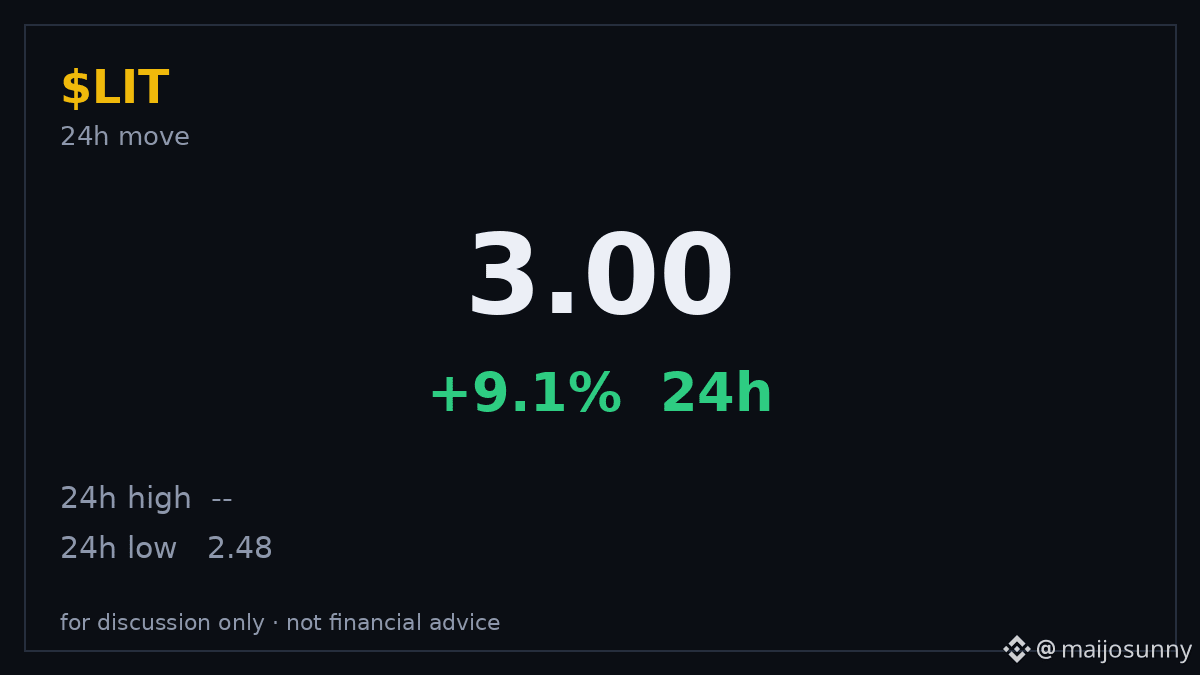
📊 Why it matters: $LIT fell more than 10% to under $2.48 on the news, then bounced back to $3.00, up 9% in 24h (CoinGecko). The market priced this as a one-trader incident, not a protocol failure. The open question is whether other perps venues have the same pool loophole. Some researchers put the total at $15.5M across two market-maker accounts. Lighter has not confirmed that figure, so treat it as an estimate.
👀 What to watch: how the key leaked, whether the affected trader is made whole, and whether the unrecovered ~$5M moves again.
Bottom line: the contracts held, the guardrails around them did not. Is this a one-off key leak, or a warning for every DEX that lets users create pools? 👇
Educational content only. Not financial advice. DYOR.
#crypto #DeFi #Lighter
Was Lighter hacked? The exchange says no. So how did $10.4M walk out the door? 👀
On Nov 16, an attacker drained 10,393,057 USDC from Lighter, a decentralized perps exchange, using a leaked trading API key belonging to a single trader (Bitquery). Lighter froze all withdrawals and pool creation for about 7 hours, then reopened them after recovering roughly $5M. Its contracts were never touched.
🔍 THE TWIST: the key alone should not have been enough. Lighter's own rules block a key from withdrawing to a stranger's wallet. The attacker got around it by opening a public liquidity pool with a 0% fee, buying 99.99% of its shares for about $10K, then moving the victim's USDC into the pool in ~$1M batches and redeeming the shares. The funds were swapped for ~5,750 $ETH within minutes.
⚠️ A leaked API key ≠ a protocol hack. That distinction matters, and it cuts both ways. Lighter is right that its smart contracts held. But the episode shows a leaked credential plus a pool-creation loophole can move eight figures without breaking a single contract.
📊 Why it matters: $LIT fell more than 10% to under $2.48 on the news, then bounced back to $3.00, up 9% in 24h (CoinGecko). The market priced this as a one-trader incident, not a protocol failure. The open question is whether other perps venues have the same pool loophole. Some researchers put the total at $15.5M across two market-maker accounts. Lighter has not confirmed that figure, so treat it as an estimate.
👀 What to watch: how the key leaked, whether the affected trader is made whole, and whether the unrecovered ~$5M moves again.
Bottom line: the contracts held, the guardrails around them did not. Is this a one-off key leak, or a warning for every DEX that lets users create pools? 👇
Educational content only. Not financial advice. DYOR.
#crypto #DeFi #Lighter
On Nov 16, an attacker drained 10,393,057 USDC from Lighter, a decentralized perps exchange, using a leaked trading API key belonging to a single trader (Bitquery). Lighter froze all withdrawals and pool creation for about 7 hours, then reopened them after recovering roughly $5M. Its contracts were never touched.
🔍 THE TWIST: the key alone should not have been enough. Lighter's own rules block a key from withdrawing to a stranger's wallet. The attacker got around it by opening a public liquidity pool with a 0% fee, buying 99.99% of its shares for about $10K, then moving the victim's USDC into the pool in ~$1M batches and redeeming the shares. The funds were swapped for ~5,750 $ETH within minutes.
⚠️ A leaked API key ≠ a protocol hack. That distinction matters, and it cuts both ways. Lighter is right that its smart contracts held. But the episode shows a leaked credential plus a pool-creation loophole can move eight figures without breaking a single contract.
📊 Why it matters: $LIT fell more than 10% to under $2.48 on the news, then bounced back to $3.00, up 9% in 24h (CoinGecko). The market priced this as a one-trader incident, not a protocol failure. The open question is whether other perps venues have the same pool loophole. Some researchers put the total at $15.5M across two market-maker accounts. Lighter has not confirmed that figure, so treat it as an estimate.
👀 What to watch: how the key leaked, whether the affected trader is made whole, and whether the unrecovered ~$5M moves again.
Bottom line: the contracts held, the guardrails around them did not. Is this a one-off key leak, or a warning for every DEX that lets users create pools? 👇
Educational content only. Not financial advice. DYOR.
#crypto #DeFi #Lighter
9

·
--
$LIT — SHORT-TERM UPTREND
Lighter is the day's #2 top-100 gainer, +9% in 24h to $2.98 on $195M volume, holding near its 24h high of $3.08.
Still -5.3% on the week, so this is a bounce inside a wider downtrend, not a full reversal yet.
Watch $3.08 — a 4H close above it confirms continuation; losing $2.35 flips it back bearish.
Not financial advice.
#LIT #Lighter
$LIT — SHORT-TERM UPTREND
Lighter is the day's #2 top-100 gainer, +9% in 24h to $2.98 on $195M volume, holding near its 24h high of $3.08.
Still -5.3% on the week, so this is a bounce inside a wider downtrend, not a full reversal yet.
Watch $3.08 — a 4H close above it confirms continuation; losing $2.35 flips it back bearish.
Not financial advice.
#LIT #Lighter
Lighter is the day's #2 top-100 gainer, +9% in 24h to $2.98 on $195M volume, holding near its 24h high of $3.08.
Still -5.3% on the week, so this is a bounce inside a wider downtrend, not a full reversal yet.
Watch $3.08 — a 4H close above it confirms continuation; losing $2.35 flips it back bearish.
Not financial advice.
#LIT #Lighter

·
--
🚨 Lighter says it “wasn’t hacked,” but traders lost $10.4 million. The lesson is hidden in an API key.
📌 What happened (according to CoinDesk / BeInCrypto / Cointelegraph):
• On 11/16, Lighter paused all withdrawals. On-chain tracking showed about 10.4 million USDC transferred out, while another report said two market-making accounts lost a combined roughly $15.5 million (not confirmed by Lighter)
• The official explanation was that a trader’s API key had been compromised; the contracts themselves were fine
• The attacker used the account to create a pool, bought 99.99% of the shares, then withdrew the funds—the pool counted as “their own account,” so a second wallet signature wasn’t required
• The stolen funds were converted to ETH, and 1,920 ETH went into XMR
• Lighter recovered about 5 million USDC and has resumed withdrawals
⚠️ That same day, the Safe wallet was also drained of $6.45 million through “already-authorized permissions.” Neither incident involved exploiting a contract; the permissions were simply too broad.
✅ Security checklist:
1️⃣ Disable withdrawal/transfer permissions for API keys
2️⃣ Set up an IP allowlist
3️⃣ Rotate bot keys regularly; don’t store them in chat logs or code repositories
4️⃣ Don’t keep large amounts of funds in perpetual DEXs for long periods
The Fear & Greed Index is currently at 12, indicating extreme fear, and BTC is around $65,000. At times like this, hacking incidents can easily trigger a chain reaction of panic.
What permissions does your API key have? Share in the comments 👇
$ETH $BTC
#加密安全 #DeFi #Lighter
Personal opinion only; not investment advice
🚨 Lighter says it “wasn’t hacked,” but traders lost $10.4 million. The lesson is hidden in an API key.
📌 What happened (according to CoinDesk / BeInCrypto / Cointelegraph):
• On 11/16, Lighter paused all withdrawals. On-chain tracking showed about 10.4 million USDC transferred out, while another report said two market-making accounts lost a combined roughly $15.5 million (not confirmed by Lighter)
• The official explanation was that a trader’s API key had been compromised; the contracts themselves were fine
• The attacker used the account to create a pool, bought 99.99% of the shares, then withdrew the funds—the pool counted as “their own account,” so a second wallet signature wasn’t required
• The stolen funds were converted to ETH, and 1,920 ETH went into XMR
• Lighter recovered about 5 million USDC and has resumed withdrawals
⚠️ That same day, the Safe wallet was also drained of $6.45 million through “already-authorized permissions.” Neither incident involved exploiting a contract; the permissions were simply too broad.
✅ Security checklist:
1️⃣ Disable withdrawal/transfer permissions for API keys
2️⃣ Set up an IP allowlist
3️⃣ Rotate bot keys regularly; don’t store them in chat logs or code repositories
4️⃣ Don’t keep large amounts of funds in perpetual DEXs for long periods
The Fear & Greed Index is currently at 12, indicating extreme fear, and BTC is around $65,000. At times like this, hacking incidents can easily trigger a chain reaction of panic.
What permissions does your API key have? Share in the comments 👇
$ETH $BTC
#加密安全 #DeFi #Lighter
Personal opinion only; not investment advice
📌 What happened (according to CoinDesk / BeInCrypto / Cointelegraph):
• On 11/16, Lighter paused all withdrawals. On-chain tracking showed about 10.4 million USDC transferred out, while another report said two market-making accounts lost a combined roughly $15.5 million (not confirmed by Lighter)
• The official explanation was that a trader’s API key had been compromised; the contracts themselves were fine
• The attacker used the account to create a pool, bought 99.99% of the shares, then withdrew the funds—the pool counted as “their own account,” so a second wallet signature wasn’t required
• The stolen funds were converted to ETH, and 1,920 ETH went into XMR
• Lighter recovered about 5 million USDC and has resumed withdrawals
⚠️ That same day, the Safe wallet was also drained of $6.45 million through “already-authorized permissions.” Neither incident involved exploiting a contract; the permissions were simply too broad.
✅ Security checklist:
1️⃣ Disable withdrawal/transfer permissions for API keys
2️⃣ Set up an IP allowlist
3️⃣ Rotate bot keys regularly; don’t store them in chat logs or code repositories
4️⃣ Don’t keep large amounts of funds in perpetual DEXs for long periods
The Fear & Greed Index is currently at 12, indicating extreme fear, and BTC is around $65,000. At times like this, hacking incidents can easily trigger a chain reaction of panic.
What permissions does your API key have? Share in the comments 👇
$ETH $BTC
#加密安全 #DeFi #Lighter
Personal opinion only; not investment advice
5

·
--
13 hours ago, Lighter incident report: deposits and withdrawals have returned to normal, and about 5 million USDC has been recovered.
What happened:
Yesterday at 18:11, an attacker used a leaked API key to withdraw 10,393,056.79 USDC in a single transaction from the contract, converting it all to ETH within 6 minutes.
The official investigation found that it wasn’t a contract vulnerability. A trader’s self-hosted signing software reused a nonce, allowing the private key to be reverse-engineered from public signatures.
The Guardian circuit breaker paused withdrawals at the time, and the security committee intercepted about 5 million USDC and returned it to the affected trader.
At the time of publication, LIT was priced at $3.0405, up 11.44% in 24 hours; BTC was at $64,677.30, down 0.48%.
My take:
The most important thing to remember about this case isn’t how much was lost, but that the circuit breaker really did stop the funds—5 million was recovered.
But don’t get the wrong idea: only about half was recovered. The official statement didn’t say that all 10.3931 million USDC had been recovered.
What I’ll do:
I’ll keep watching for pending withdrawals to be processed and for the pool to be rebuilt. If it’s confirmed that any more funds can’t be recovered, the numbers will need to be recalculated.
Do you think this kind of “circuit breaker that stops funds” should be standard for all DEXs, or does it just treat the symptoms rather than the cause?
$BTC $ETH $SOL
#Lighter #DEX security
13 hours ago, Lighter incident report: deposits and withdrawals have returned to normal, and about 5 million USDC has been recovered.
What happened:
Yesterday at 18:11, an attacker used a leaked API key to withdraw 10,393,056.79 USDC in a single transaction from the contract, converting it all to ETH within 6 minutes.
The official investigation found that it wasn’t a contract vulnerability. A trader’s self-hosted signing software reused a nonce, allowing the private key to be reverse-engineered from public signatures.
The Guardian circuit breaker paused withdrawals at the time, and the security committee intercepted about 5 million USDC and returned it to the affected trader.
At the time of publication, LIT was priced at $3.0405, up 11.44% in 24 hours; BTC was at $64,677.30, down 0.48%.
My take:
The most important thing to remember about this case isn’t how much was lost, but that the circuit breaker really did stop the funds—5 million was recovered.
But don’t get the wrong idea: only about half was recovered. The official statement didn’t say that all 10.3931 million USDC had been recovered.
What I’ll do:
I’ll keep watching for pending withdrawals to be processed and for the pool to be rebuilt. If it’s confirmed that any more funds can’t be recovered, the numbers will need to be recalculated.
Do you think this kind of “circuit breaker that stops funds” should be standard for all DEXs, or does it just treat the symptoms rather than the cause?
$BTC $ETH $SOL
#Lighter #DEX security
What happened:
Yesterday at 18:11, an attacker used a leaked API key to withdraw 10,393,056.79 USDC in a single transaction from the contract, converting it all to ETH within 6 minutes.
The official investigation found that it wasn’t a contract vulnerability. A trader’s self-hosted signing software reused a nonce, allowing the private key to be reverse-engineered from public signatures.
The Guardian circuit breaker paused withdrawals at the time, and the security committee intercepted about 5 million USDC and returned it to the affected trader.
At the time of publication, LIT was priced at $3.0405, up 11.44% in 24 hours; BTC was at $64,677.30, down 0.48%.
My take:
The most important thing to remember about this case isn’t how much was lost, but that the circuit breaker really did stop the funds—5 million was recovered.
But don’t get the wrong idea: only about half was recovered. The official statement didn’t say that all 10.3931 million USDC had been recovered.
What I’ll do:
I’ll keep watching for pending withdrawals to be processed and for the pool to be rebuilt. If it’s confirmed that any more funds can’t be recovered, the numbers will need to be recalculated.
Do you think this kind of “circuit breaker that stops funds” should be standard for all DEXs, or does it just treat the symptoms rather than the cause?
$BTC $ETH $SOL
#Lighter #DEX security
116

·
--
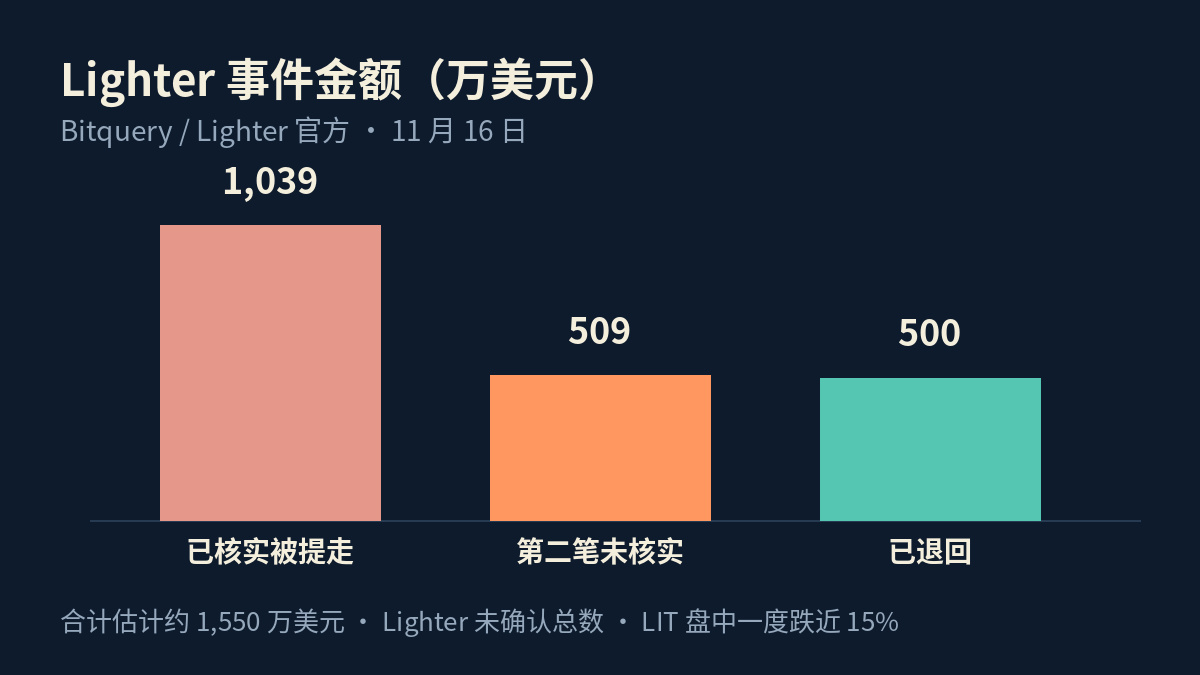
Today’s Crypto Divination | Today’s Hexagram:困 — $10.39 million was converted to ETH and gone in four minutes. The money stolen from Lighter last night moved faster than the announcement, while users who played by the rules had their withdrawals held up all night.
Lighter had an incident last night: $10.39 million was converted to ETH in four minutes. Can the rest of the money still be recovered?
Sources: Lighter’s official X account, CoinDesk, Bitquery, and CoinMarketCap; snapshot taken at 09:20 on 11-17.
At 19:02 last night, perpetual DEX Lighter posted that it was investigating a security incident and had paused withdrawals and the creation of new liquidity pools. About $10.39 million in USDC was withdrawn from a market maker’s account on-chain and converted to ETH within four minutes. A second amount of about $5.09 million has not yet been independently verified, bringing the reported total to around $15.5 million. Lighter has not confirmed the total.
According to the official statement, API keys belonging to individual traders were compromised, and unofficial signing code was used. The protocol and contracts themselves were not breached. LIT briefly fell nearly 15% intraday. Deposits and withdrawals returned to normal at around 02:21 this morning, and the security council returned $5 million.
Honestly, the funds were lost because keys were leaked, not because the contracts were hacked—but for users who couldn’t withdraw their money, there was no difference that night.
With $5 million already returned, do you think the rest can be recovered?
Follow me—I keep tabs on security incidents three times a day. I’ll let you know as soon as there’s news on how much of Lighter’s $15.5 million has been recovered.
The reading is done; decide your own position. —Shengshou
For entertainment purposes only; not investment advice.
#玄学炒币 #Lighter #安全事件 #DeFi
Today’s Crypto Divination | Today’s Hexagram:困 — $10.39 million was converted to ETH and gone in four minutes. The money stolen from Lighter last night moved faster than the announcement, while users who played by the rules had their withdrawals held up all night.
Lighter had an incident last night: $10.39 million was converted to ETH in four minutes. Can the rest of the money still be recovered?
Sources: Lighter’s official X account, CoinDesk, Bitquery, and CoinMarketCap; snapshot taken at 09:20 on 11-17.
At 19:02 last night, perpetual DEX Lighter posted that it was investigating a security incident and had paused withdrawals and the creation of new liquidity pools. About $10.39 million in USDC was withdrawn from a market maker’s account on-chain and converted to ETH within four minutes. A second amount of about $5.09 million has not yet been independently verified, bringing the reported total to around $15.5 million. Lighter has not confirmed the total.
According to the official statement, API keys belonging to individual traders were compromised, and unofficial signing code was used. The protocol and contracts themselves were not breached. LIT briefly fell nearly 15% intraday. Deposits and withdrawals returned to normal at around 02:21 this morning, and the security council returned $5 million.
Honestly, the funds were lost because keys were leaked, not because the contracts were hacked—but for users who couldn’t withdraw their money, there was no difference that night.
With $5 million already returned, do you think the rest can be recovered?
Follow me—I keep tabs on security incidents three times a day. I’ll let you know as soon as there’s news on how much of Lighter’s $15.5 million has been recovered.
The reading is done; decide your own position. —Shengshou
For entertainment purposes only; not investment advice.
#玄学炒币 #Lighter #安全事件 #DeFi
Lighter had an incident last night: $10.39 million was converted to ETH in four minutes. Can the rest of the money still be recovered?
Sources: Lighter’s official X account, CoinDesk, Bitquery, and CoinMarketCap; snapshot taken at 09:20 on 11-17.
At 19:02 last night, perpetual DEX Lighter posted that it was investigating a security incident and had paused withdrawals and the creation of new liquidity pools. About $10.39 million in USDC was withdrawn from a market maker’s account on-chain and converted to ETH within four minutes. A second amount of about $5.09 million has not yet been independently verified, bringing the reported total to around $15.5 million. Lighter has not confirmed the total.
According to the official statement, API keys belonging to individual traders were compromised, and unofficial signing code was used. The protocol and contracts themselves were not breached. LIT briefly fell nearly 15% intraday. Deposits and withdrawals returned to normal at around 02:21 this morning, and the security council returned $5 million.
Honestly, the funds were lost because keys were leaked, not because the contracts were hacked—but for users who couldn’t withdraw their money, there was no difference that night.
With $5 million already returned, do you think the rest can be recovered?
Follow me—I keep tabs on security incidents three times a day. I’ll let you know as soon as there’s news on how much of Lighter’s $15.5 million has been recovered.
The reading is done; decide your own position. —Shengshou
For entertainment purposes only; not investment advice.
#玄学炒币 #Lighter #安全事件 #DeFi
106


·
--
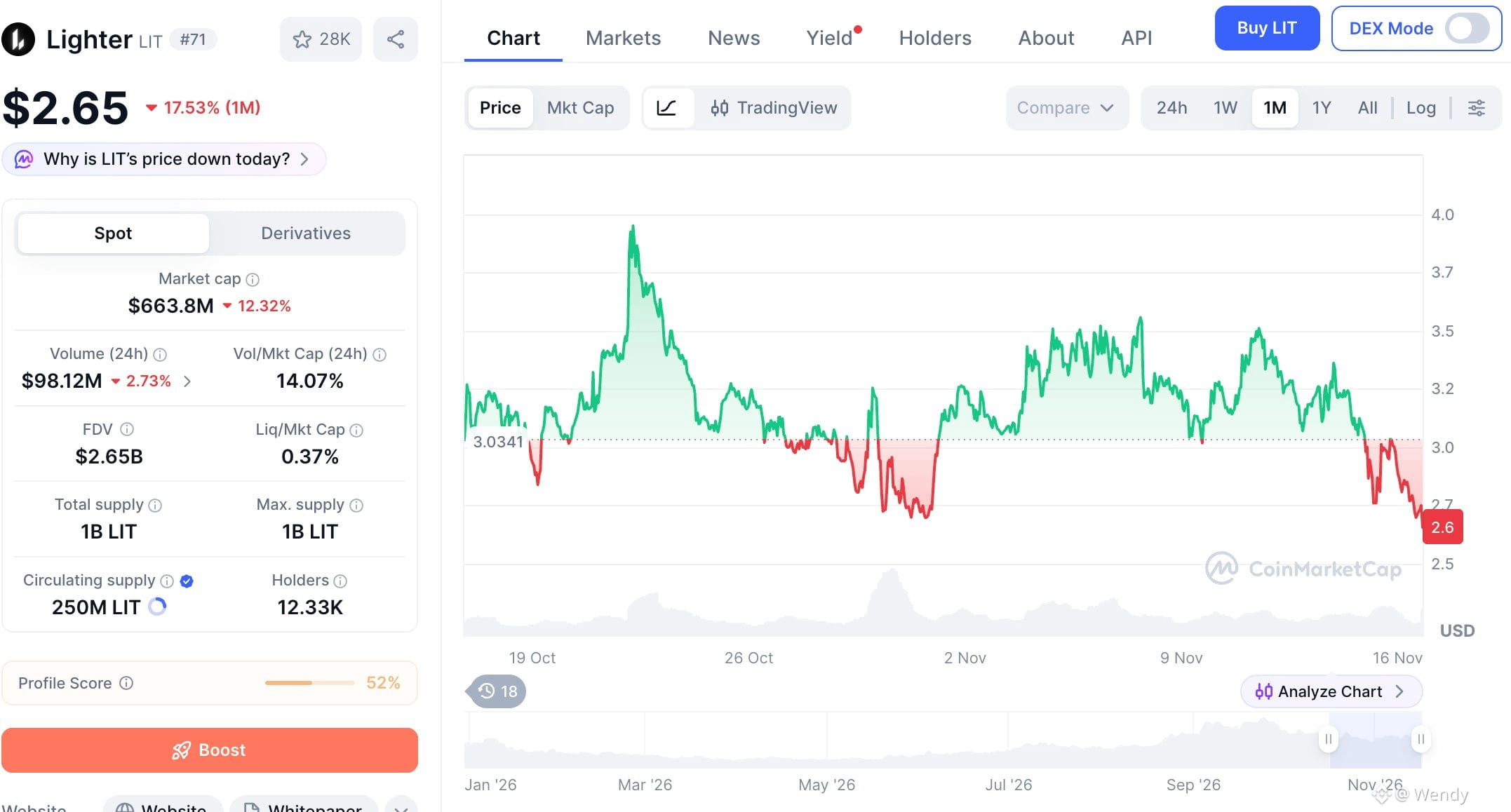
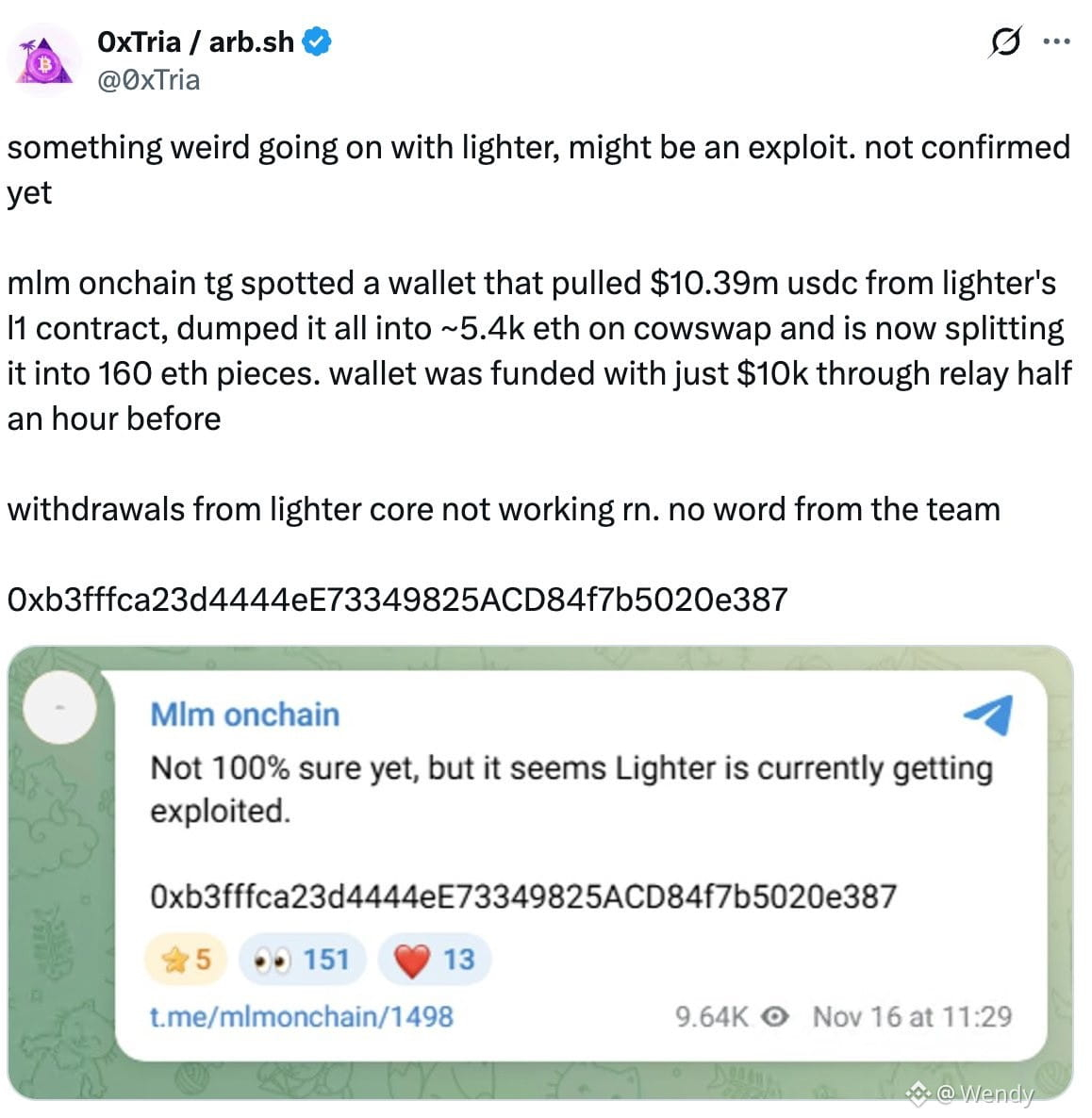
LIGHTER SUSPENDS WITHDRAWALS AMID SUSPECTED SECURITY INCIDENT!
Lighter is investigating a possible security breach involving a compromised external party.
The platform has temporarily suspended withdrawals and liquidity pool creation.
According to on-chain analyst MLM, one address withdrew $10.39M USDC from Lighter and swapped it for approximately 5,750 $ETH.
Other reports suggest leaked API keys from two market makers may be involved, with roughly $15.48M across the affected accounts.
$LIT briefly dropped over 17%.
The exact cause remains under investigation.
#Lighter
{future}(LITUSDT)
LIGHTER SUSPENDS WITHDRAWALS AMID SUSPECTED SECURITY INCIDENT!
Lighter is investigating a possible security breach involving a compromised external party.
The platform has temporarily suspended withdrawals and liquidity pool creation.
According to on-chain analyst MLM, one address withdrew $10.39M USDC from Lighter and swapped it for approximately 5,750 $ETH.
Other reports suggest leaked API keys from two market makers may be involved, with roughly $15.48M across the affected accounts.
$LIT briefly dropped over 17%.
The exact cause remains under investigation.
#Lighter
Lighter is investigating a possible security breach involving a compromised external party.
The platform has temporarily suspended withdrawals and liquidity pool creation.
According to on-chain analyst MLM, one address withdrew $10.39M USDC from Lighter and swapped it for approximately 5,750 $ETH.
Other reports suggest leaked API keys from two market makers may be involved, with roughly $15.48M across the affected accounts.
$LIT briefly dropped over 17%.
The exact cause remains under investigation.
#Lighter
6
1.5k

Lighter suspends withdrawals after a $10.4 million exploit
- Decentralized exchange Lighter has suspended all withdrawals after an attack that resulted in a loss of $10.4 million
- Cause: trading API keys were leaked; smart contracts were not affected
- Investigators traced the stolen assets to Hyperliquid
- The RSS source provided no further details about the types of assets lost or the recovery process
#BinanceSquare #CryptoNews #Lighter #Hyperliquid #Security
$btc $eth
vlikevn Titanbot
Source: CoinDesk
Lighter suspends withdrawals after a $10.4 million exploit
- Decentralized exchange Lighter has suspended all withdrawals after an attack that resulted in a loss of $10.4 million
- Cause: trading API keys were leaked; smart contracts were not affected
- Investigators traced the stolen assets to Hyperliquid
- The RSS source provided no further details about the types of assets lost or the recovery process
#BinanceSquare #CryptoNews #Lighter #Hyperliquid #Security
$btc $eth
vlikevn Titanbot
Source: CoinDesk
- Decentralized exchange Lighter has suspended all withdrawals after an attack that resulted in a loss of $10.4 million
- Cause: trading API keys were leaked; smart contracts were not affected
- Investigators traced the stolen assets to Hyperliquid
- The RSS source provided no further details about the types of assets lost or the recovery process
#BinanceSquare #CryptoNews #Lighter #Hyperliquid #Security
$btc $eth
vlikevn Titanbot
Source: CoinDesk
158

·
--
🚨 $LIT SHOCK IN LIGHTER!
Lighter reopened withdrawals today and returned ~$5 million in USDC to the affected trader, hours after this morning’s drain. For me, what really matters is the cause: it wasn’t a protocol bug, but a basic error in the trader’s own signing code.
Look at the detail nobody is noticing:
→ The attacker withdrew 10,393,057 USDC in a single transaction at 10:11 UTC, and the estimated total drain reached ~$15.48M across two market maker accounts.
→ The trader’s signing software reused nonces, so the private keys could be calculated from the public signatures; Lighter confirmed this in today’s postmortem.
→ Guardian Mode stopped withdrawals in time, and the Security Council returned ~$5M in USDC; withdrawals resumed at around 14:21 AST, after being paused for about 7 hours.
The token $LIT fell more than 15% during the day, according to CryptoNews, as traders assessed the damage.
Do you think Lighter will come out stronger after this hit, or will market makers think twice before coming back? 👇
$LIT $ETH $XMR
#Lighter #HackCrypto #CryptoRecovery
🚨 $LIT SHOCK IN LIGHTER!
Lighter reopened withdrawals today and returned ~$5 million in USDC to the affected trader, hours after this morning’s drain. For me, what really matters is the cause: it wasn’t a protocol bug, but a basic error in the trader’s own signing code.
Look at the detail nobody is noticing:
→ The attacker withdrew 10,393,057 USDC in a single transaction at 10:11 UTC, and the estimated total drain reached ~$15.48M across two market maker accounts.
→ The trader’s signing software reused nonces, so the private keys could be calculated from the public signatures; Lighter confirmed this in today’s postmortem.
→ Guardian Mode stopped withdrawals in time, and the Security Council returned ~$5M in USDC; withdrawals resumed at around 14:21 AST, after being paused for about 7 hours.
The token $LIT fell more than 15% during the day, according to CryptoNews, as traders assessed the damage.
Do you think Lighter will come out stronger after this hit, or will market makers think twice before coming back? 👇
$LIT $ETH $XMR
#Lighter #HackCrypto #CryptoRecovery
Lighter reopened withdrawals today and returned ~$5 million in USDC to the affected trader, hours after this morning’s drain. For me, what really matters is the cause: it wasn’t a protocol bug, but a basic error in the trader’s own signing code.
Look at the detail nobody is noticing:
→ The attacker withdrew 10,393,057 USDC in a single transaction at 10:11 UTC, and the estimated total drain reached ~$15.48M across two market maker accounts.
→ The trader’s signing software reused nonces, so the private keys could be calculated from the public signatures; Lighter confirmed this in today’s postmortem.
→ Guardian Mode stopped withdrawals in time, and the Security Council returned ~$5M in USDC; withdrawals resumed at around 14:21 AST, after being paused for about 7 hours.
The token $LIT fell more than 15% during the day, according to CryptoNews, as traders assessed the damage.
Do you think Lighter will come out stronger after this hit, or will market makers think twice before coming back? 👇
$LIT $ETH $XMR
#Lighter #HackCrypto #CryptoRecovery
2.1k

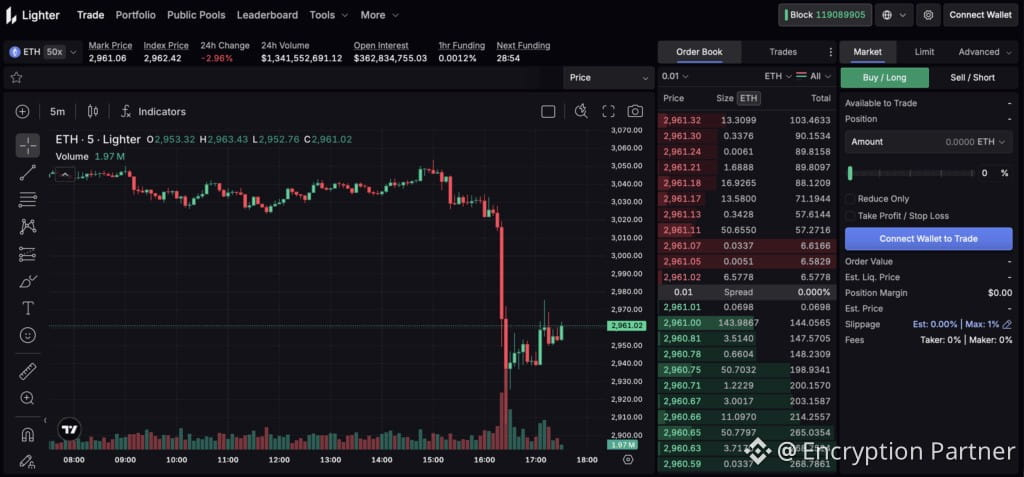
Lighter was hacked for 15.48 million yesterday, and the official report came out today: only 5 million has been recovered, and they didn’t say a word about the remaining roughly 10 million. They’re shifting the blame to users, claiming they used sketchy signing code and reused nonces, and that the protocol itself is fine. But the money was lost on your platform. $LIT plunged from 2.73 to 2.32 yesterday, then bounced back to 2.97 today—higher than before the incident. So here’s the question: is the 5 million a genuine payout or just hush money? Who’s covering the remaining 10 million? A) Recovering 5 million counts as an explanation; at 2.97, there’s still room to run / B) Only a third is back, no one’s talking about the rest—let’s wait and see
$LIT $ETH
#Lighter #黑客 #DecentralizedExchange
Lighter was hacked for 15.48 million yesterday, and the official report came out today: only 5 million has been recovered, and they didn’t say a word about the remaining roughly 10 million. They’re shifting the blame to users, claiming they used sketchy signing code and reused nonces, and that the protocol itself is fine. But the money was lost on your platform. $LIT plunged from 2.73 to 2.32 yesterday, then bounced back to 2.97 today—higher than before the incident. So here’s the question: is the 5 million a genuine payout or just hush money? Who’s covering the remaining 10 million? A) Recovering 5 million counts as an explanation; at 2.97, there’s still room to run / B) Only a third is back, no one’s talking about the rest—let’s wait and see
$LIT $ETH
#Lighter #黑客 #DecentralizedExchange
$LIT $ETH
#Lighter #黑客 #DecentralizedExchange
1

·
--
Why can Lighter accounts still lose funds if the API cannot withdraw to other people?
The Lighter incident shows that restricting withdrawal addresses does not mean value cannot be transferred out using a compromised API key. Users running bots with custom or third-party signing software should replace all API keys and switch to the official SDK if they cannot rule out past signing issues; they should not simply wait for the platform to recover.
The official postmortem on November 16 said that the signing software used by affected accounts reused nonces that should have been used only once, allowing attackers to recover the keys from publicly available signatures. The team said the protocol, smart contracts, and official SDK were unaffected; this does not mean “all API users were affected.”
The key issue was the permission boundary: although the API could not directly withdraw funds to someone else’s wallet, at the time it could create public pools and transfer funds into them. Attackers redeemed the pool shares held in their own accounts, using this workaround to take the value. Even if this route is blocked, a leaked trading key could still be used to make disadvantageous trades or open highly leveraged positions that cause losses.
The team announced the same day that deposits and withdrawals had resumed, and said that transfers to public pools now require a wallet signature and API signatures are no longer public. But these measures do not make keys that have already been leaked secret again; switching SDKs is no substitute for replacing keys. IP allowlisting and configurable permissions and limits for each key were still listed as follow-up measures at the time, so they should not be treated as already available.
Over the next 48 hours, watch to see whether these permission controls are actually made available and whether any new affected accounts emerge. If official SDK users are also confirmed to have been affected, or losses are found that do not depend on leaked keys, the risk assessment will need to be broadened. Concern about this particular attack path can only be lowered once controls are in place and no further similar losses are found.
#Lighter #资产安全 #API
Why can Lighter accounts still lose funds if the API cannot withdraw to other people?
The Lighter incident shows that restricting withdrawal addresses does not mean value cannot be transferred out using a compromised API key. Users running bots with custom or third-party signing software should replace all API keys and switch to the official SDK if they cannot rule out past signing issues; they should not simply wait for the platform to recover.
The official postmortem on November 16 said that the signing software used by affected accounts reused nonces that should have been used only once, allowing attackers to recover the keys from publicly available signatures. The team said the protocol, smart contracts, and official SDK were unaffected; this does not mean “all API users were affected.”
The key issue was the permission boundary: although the API could not directly withdraw funds to someone else’s wallet, at the time it could create public pools and transfer funds into them. Attackers redeemed the pool shares held in their own accounts, using this workaround to take the value. Even if this route is blocked, a leaked trading key could still be used to make disadvantageous trades or open highly leveraged positions that cause losses.
The team announced the same day that deposits and withdrawals had resumed, and said that transfers to public pools now require a wallet signature and API signatures are no longer public. But these measures do not make keys that have already been leaked secret again; switching SDKs is no substitute for replacing keys. IP allowlisting and configurable permissions and limits for each key were still listed as follow-up measures at the time, so they should not be treated as already available.
Over the next 48 hours, watch to see whether these permission controls are actually made available and whether any new affected accounts emerge. If official SDK users are also confirmed to have been affected, or losses are found that do not depend on leaked keys, the risk assessment will need to be broadened. Concern about this particular attack path can only be lowered once controls are in place and no further similar losses are found.
#Lighter #资产安全 #API
The Lighter incident shows that restricting withdrawal addresses does not mean value cannot be transferred out using a compromised API key. Users running bots with custom or third-party signing software should replace all API keys and switch to the official SDK if they cannot rule out past signing issues; they should not simply wait for the platform to recover.
The official postmortem on November 16 said that the signing software used by affected accounts reused nonces that should have been used only once, allowing attackers to recover the keys from publicly available signatures. The team said the protocol, smart contracts, and official SDK were unaffected; this does not mean “all API users were affected.”
The key issue was the permission boundary: although the API could not directly withdraw funds to someone else’s wallet, at the time it could create public pools and transfer funds into them. Attackers redeemed the pool shares held in their own accounts, using this workaround to take the value. Even if this route is blocked, a leaked trading key could still be used to make disadvantageous trades or open highly leveraged positions that cause losses.
The team announced the same day that deposits and withdrawals had resumed, and said that transfers to public pools now require a wallet signature and API signatures are no longer public. But these measures do not make keys that have already been leaked secret again; switching SDKs is no substitute for replacing keys. IP allowlisting and configurable permissions and limits for each key were still listed as follow-up measures at the time, so they should not be treated as already available.
Over the next 48 hours, watch to see whether these permission controls are actually made available and whether any new affected accounts emerge. If official SDK users are also confirmed to have been affected, or losses are found that do not depend on leaked keys, the risk assessment will need to be broadened. Concern about this particular attack path can only be lowered once controls are in place and no further similar losses are found.
#Lighter #资产安全 #API
11

·
--
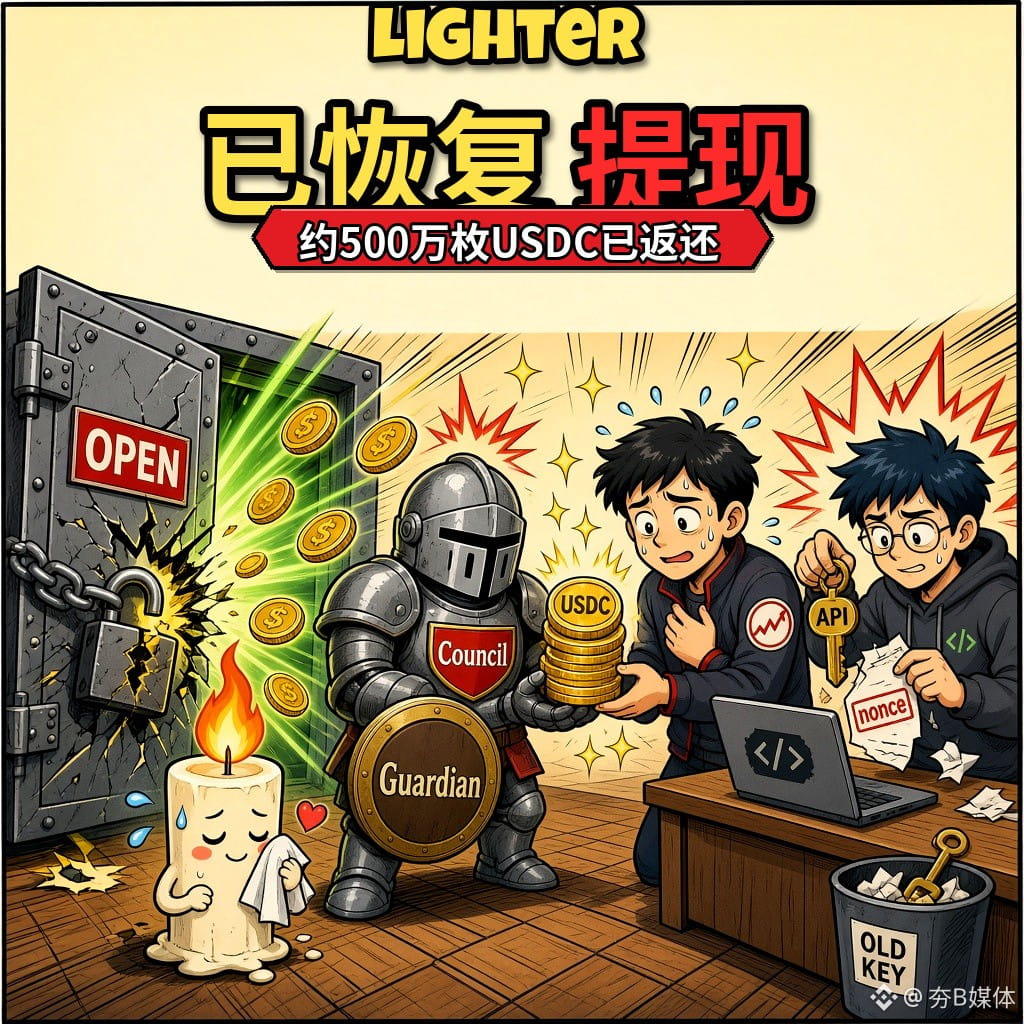
Lighter has resumed deposits and withdrawals: Official says about 5 million USDC has been returned; those using unofficial signing code should rotate their keys
Lighter, the perpetual DEX that paused withdrawals last night, resumed deposits and withdrawals early this morning. At 2:21 a.m. on the 17th (Hong Kong time), the official account said Guardian protection mode had been disabled and pending withdrawals were being processed.
What happened: The official account said an attacker took control of a trader’s API key and withdrew funds on the morning of the 16th (UTC). The accounts did not use the official SDK, and their signing code reused nonces. The attacker inferred the private key from public signatures. The official account said the protocol, smart contracts, and official SDK were unaffected. After Guardian was triggered, withdrawals were paused, and the security committee returned about 5 million USDC to the affected trader. The official account has not disclosed the total losses. Funds previously detected as transferred out on-chain should not be added to this 5 million, nor does this mean they have all been recovered.
Who is affected: If you have a withdrawal queued on Lighter, check whether your request is being processed. For those trading programmatically or using custom signing code, the official recommendation is to switch to the official SDK. If you’re unsure whether you’ve reused nonces, rotate all API keys.
Do you trade programmatically on Lighter using the official SDK, or your own or a third party’s signing code?
This is not investment advice.
Sources: Lighter official X (2026-11-17 02:21 HKT, https://x.com/Lighter_xyz/status/2122394646164758654); official article “Signing Safely on Lighter: Lessons from November 16” (02:20 HKT, https://x.com/Lighter_xyz/status/2122394446343946717); PANews (https://www.panewslab.com/zh/articles/01a1e6ce-e1ea-7701-a726-518c00be07ba); Odaily (02:25 HKT, https://www.odaily.news/zh-CN/newsflash/535356) · 2026-11-17 Hong Kong time
#Lighter #提现恢复 #资金安全 #夯B媒体 $LIT $USDC
Lighter has resumed deposits and withdrawals: Official says about 5 million USDC has been returned; those using unofficial signing code should rotate their keys
Lighter, the perpetual DEX that paused withdrawals last night, resumed deposits and withdrawals early this morning. At 2:21 a.m. on the 17th (Hong Kong time), the official account said Guardian protection mode had been disabled and pending withdrawals were being processed.
What happened: The official account said an attacker took control of a trader’s API key and withdrew funds on the morning of the 16th (UTC). The accounts did not use the official SDK, and their signing code reused nonces. The attacker inferred the private key from public signatures. The official account said the protocol, smart contracts, and official SDK were unaffected. After Guardian was triggered, withdrawals were paused, and the security committee returned about 5 million USDC to the affected trader. The official account has not disclosed the total losses. Funds previously detected as transferred out on-chain should not be added to this 5 million, nor does this mean they have all been recovered.
Who is affected: If you have a withdrawal queued on Lighter, check whether your request is being processed. For those trading programmatically or using custom signing code, the official recommendation is to switch to the official SDK. If you’re unsure whether you’ve reused nonces, rotate all API keys.
Do you trade programmatically on Lighter using the official SDK, or your own or a third party’s signing code?
This is not investment advice.
Sources: Lighter official X (2026-11-17 02:21 HKT, https://x.com/Lighter_xyz/status/2122394646164758654); official article “Signing Safely on Lighter: Lessons from November 16” (02:20 HKT, https://x.com/Lighter_xyz/status/2122394446343946717); PANews (https://www.panewslab.com/zh/articles/01a1e6ce-e1ea-7701-a726-518c00be07ba); Odaily (02:25 HKT, https://www.odaily.news/zh-CN/newsflash/535356) · 2026-11-17 Hong Kong time
#Lighter #提现恢复 #资金安全 #夯B媒体 $LIT $USDC
Lighter, the perpetual DEX that paused withdrawals last night, resumed deposits and withdrawals early this morning. At 2:21 a.m. on the 17th (Hong Kong time), the official account said Guardian protection mode had been disabled and pending withdrawals were being processed.
What happened: The official account said an attacker took control of a trader’s API key and withdrew funds on the morning of the 16th (UTC). The accounts did not use the official SDK, and their signing code reused nonces. The attacker inferred the private key from public signatures. The official account said the protocol, smart contracts, and official SDK were unaffected. After Guardian was triggered, withdrawals were paused, and the security committee returned about 5 million USDC to the affected trader. The official account has not disclosed the total losses. Funds previously detected as transferred out on-chain should not be added to this 5 million, nor does this mean they have all been recovered.
Who is affected: If you have a withdrawal queued on Lighter, check whether your request is being processed. For those trading programmatically or using custom signing code, the official recommendation is to switch to the official SDK. If you’re unsure whether you’ve reused nonces, rotate all API keys.
Do you trade programmatically on Lighter using the official SDK, or your own or a third party’s signing code?
This is not investment advice.
Sources: Lighter official X (2026-11-17 02:21 HKT, https://x.com/Lighter_xyz/status/2122394646164758654); official article “Signing Safely on Lighter: Lessons from November 16” (02:20 HKT, https://x.com/Lighter_xyz/status/2122394446343946717); PANews (https://www.panewslab.com/zh/articles/01a1e6ce-e1ea-7701-a726-518c00be07ba); Odaily (02:25 HKT, https://www.odaily.news/zh-CN/newsflash/535356) · 2026-11-17 Hong Kong time
#Lighter #提现恢复 #资金安全 #夯B媒体 $LIT $USDC
30
Log in to explore more content
Join global crypto users on Binance Square
⚡️ Get latest and useful information about crypto.
💬 Trusted by the world’s largest crypto exchange.
👍 Discover real insights from verified creators.
Email / Phone number
Trending Topics
1
#NvidiaEarningsTonight:AIStocks’NextMove?
8,932 views
189 Discussing
2
#A Packed Week of Earnings and Data Tests Markets
97,124 views
529 Discussing
3
#AnthropicIPOTestsInvestorAppetiteForAI
199,197 views
2,030 Discussing
4
#NvidiaBoardNotConsideringHuang’sReturnasCEO
35,778 views
415 Discussing
5
#WhatInvestmentSignalsDo13FFilingsReveal?
20,623 views
316 Discussing
6
#EvernorthRecords$505MImpairmentOnPreListingXRP
0 views
0 Discussing
7
#GoldmanSachsReports$1.22BInEtherETFHoldings
172 views
5 Discussing
8
#GoldmanSachsAndMillenniumEachHeldOver$1.2BInBitcoinETFs
1,865 views
9 Discussing
9
#InvescoStablecoinReservesFundLaunchesOnEthereum
11,617 views
188 Discussing
10
#CypherpunkReports$306MQ3NetProfit
1,479 views
19 Discussing