

#imf
imf
13.7M views
39,466 Discussing
Hot
Latest
·
--
Article
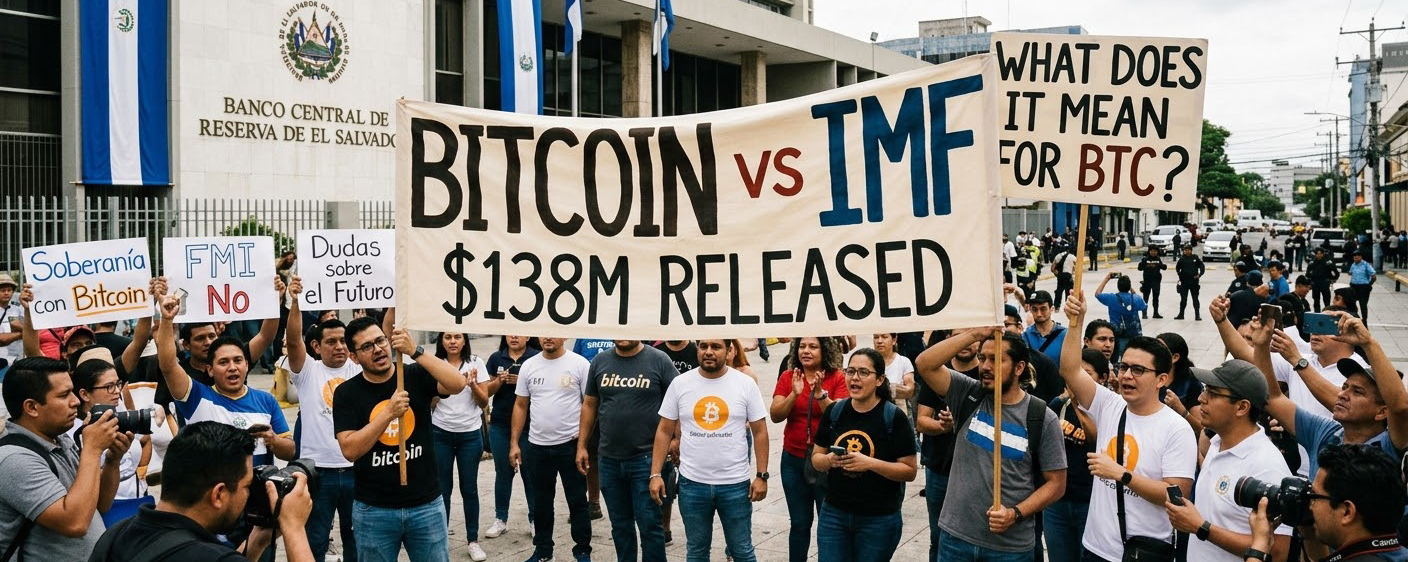
🚨 BIG BITCOIN + IMF STORYThe IMF has approved an immediate $138 million disbursement to El Salvador while granting a waiver related to its Bitcoin accumulation target.
But there is an important detail: the IMF still wants to limit further public-sector Bitcoin accumulation and reduce direct government involvement.
So the real question is:
Is this a win for Bitcoin adoption — or simply a compromise with conditions? 👀
🇸🇻 Bitcoin adoption continues to create headlines around the world.
Bullish for $BTC or neutral?
🟢 BULLISH
🔴 BEARISH
#bitcoin #IMF #crypto #BinanceSquare
🚨 BIG BITCOIN + IMF STORY
The IMF has approved an immediate $138 million disbursement to El Salvador while granting a waiver related to its Bitcoin accumulation target.
But there is an important detail: the IMF still wants to limit further public-sector Bitcoin accumulation and reduce direct government involvement.
So the real question is:
Is this a win for Bitcoin adoption — or simply a compromise with conditions? 👀
🇸🇻 Bitcoin adoption continues to create headlines around the world.
Bullish for $BTC or neutral?
🟢 BULLISH
🔴 BEARISH
#bitcoin #IMF #crypto #BinanceSquare
But there is an important detail: the IMF still wants to limit further public-sector Bitcoin accumulation and reduce direct government involvement.
So the real question is:
Is this a win for Bitcoin adoption — or simply a compromise with conditions? 👀
🇸🇻 Bitcoin adoption continues to create headlines around the world.
Bullish for $BTC or neutral?
🟢 BULLISH
🔴 BEARISH
#bitcoin #IMF #crypto #BinanceSquare
23
·
--
🇸🇻 El Salvador just got another ~$138M from the IMF... but there's a catch for $BTC fans 👀
The IMF granted waivers after some targets were missed (including on the Bitcoin accumulation front) and says "no further Bitcoin accumulation is envisaged beyond the documented donations."
So is the first Bitcoin nation quietly stepping back, or is this just paperwork while the stack stays put? 🤔
Would YOU trade your country's $BTC strategy for an IMF loan? Drop your take 👇
#Bitcoin #ElSalvador #IMF #Crypto
🇸🇻 El Salvador just got another ~$138M from the IMF... but there's a catch for $BTC fans 👀
The IMF granted waivers after some targets were missed (including on the Bitcoin accumulation front) and says "no further Bitcoin accumulation is envisaged beyond the documented donations."
So is the first Bitcoin nation quietly stepping back, or is this just paperwork while the stack stays put? 🤔
Would YOU trade your country's $BTC strategy for an IMF loan? Drop your take 👇
#Bitcoin #ElSalvador #IMF #Crypto
The IMF granted waivers after some targets were missed (including on the Bitcoin accumulation front) and says "no further Bitcoin accumulation is envisaged beyond the documented donations."
So is the first Bitcoin nation quietly stepping back, or is this just paperwork while the stack stays put? 🤔
Would YOU trade your country's $BTC strategy for an IMF loan? Drop your take 👇
#Bitcoin #ElSalvador #IMF #Crypto
15

·
--
📉 IMF Approves $138M for El Salvador
🇸🇻 The IMF approved an immediate $138M disbursement after completing its second and third program reviews.
₿ Some performance criteria, including Bitcoin accumulation targets, were missed, but the IMF granted waivers after citing corrective measures and renewed commitments.
🔍 The program also calls for less state involvement in Bitcoin, stronger crypto-asset oversight and greater transparency.
👀 What could this mean for El Salvador’s Bitcoin strategy?
#Bitcoin #ElSalvador #IMF #CryptoNews
📉 IMF Approves $138M for El Salvador
🇸🇻 The IMF approved an immediate $138M disbursement after completing its second and third program reviews.
₿ Some performance criteria, including Bitcoin accumulation targets, were missed, but the IMF granted waivers after citing corrective measures and renewed commitments.
🔍 The program also calls for less state involvement in Bitcoin, stronger crypto-asset oversight and greater transparency.
👀 What could this mean for El Salvador’s Bitcoin strategy?
#Bitcoin #ElSalvador #IMF #CryptoNews
🇸🇻 The IMF approved an immediate $138M disbursement after completing its second and third program reviews.
₿ Some performance criteria, including Bitcoin accumulation targets, were missed, but the IMF granted waivers after citing corrective measures and renewed commitments.
🔍 The program also calls for less state involvement in Bitcoin, stronger crypto-asset oversight and greater transparency.
👀 What could this mean for El Salvador’s Bitcoin strategy?
#Bitcoin #ElSalvador #IMF #CryptoNews
1
55

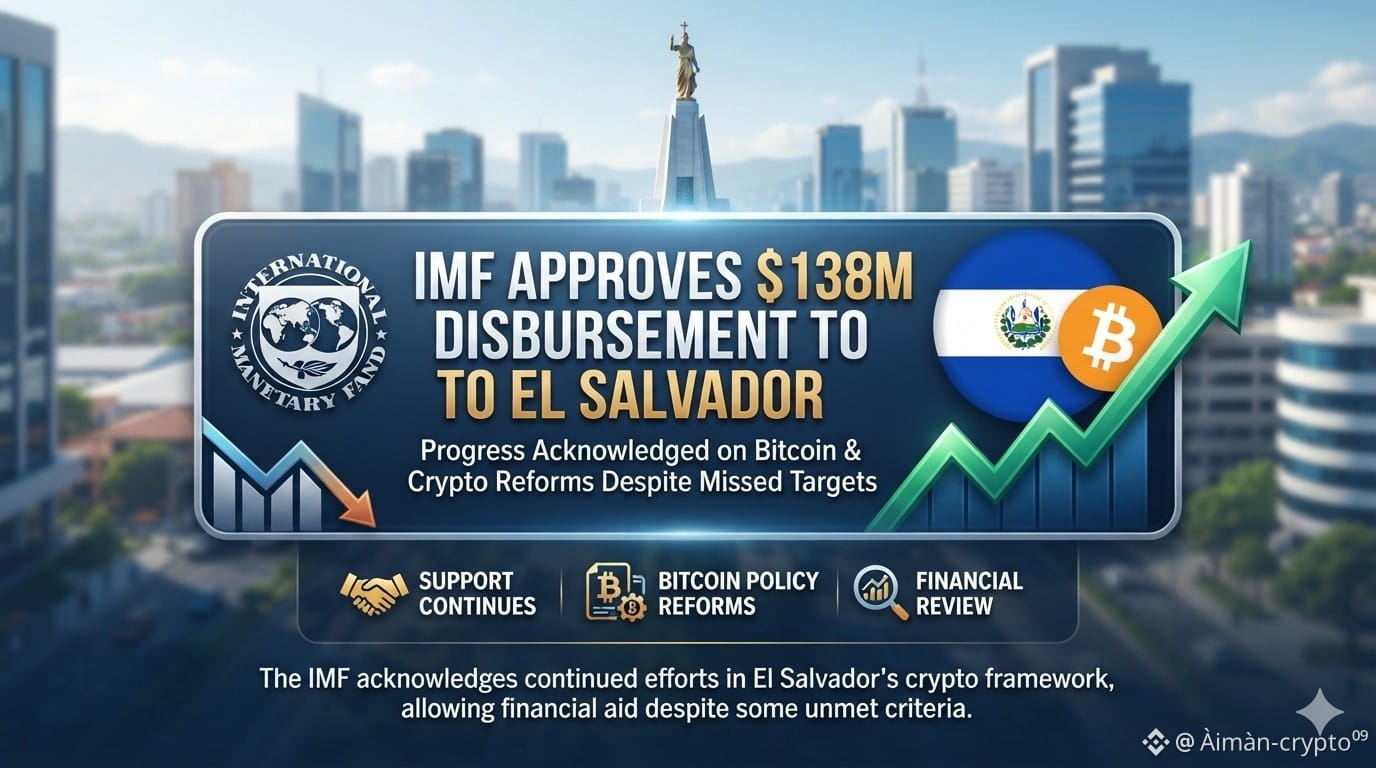
📉 IMF Approves $138M Disbursement to El Salvador
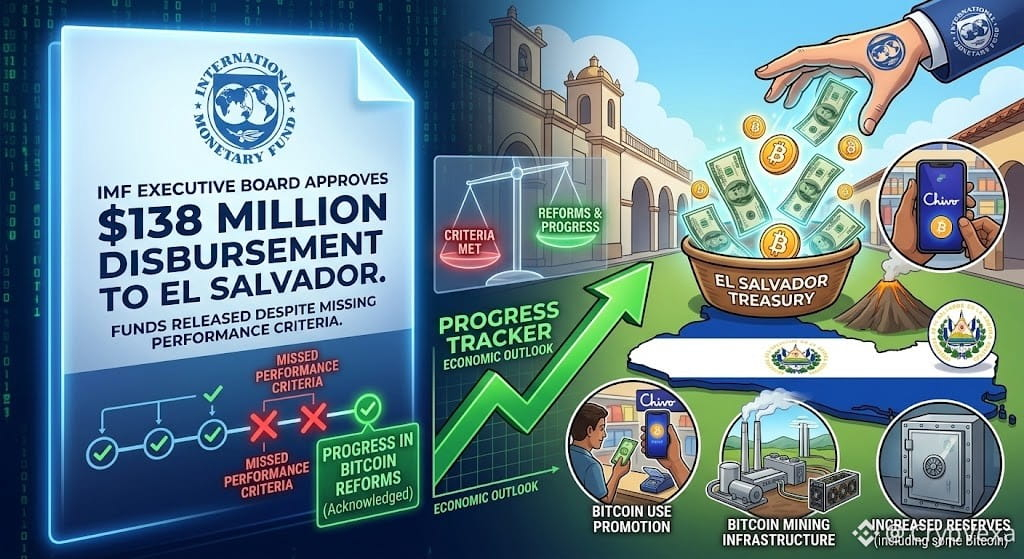
The IMF has approved an immediate $138 million disbursement to El Salvador, despite the country missing some agreed performance criteria.
🇸🇻 The IMF also acknowledged progress on Bitcoin-related reforms, highlighting continued changes in El Salvador’s crypto policy framework.
💰 The move shows that financial support can continue even when some targets are missed, while reforms remain under review.
$BTC
{spot}(BTCUSDT)
#ElSalvador #Bitcoin #IMF #Crypto #Blockchain
📉 IMF Approves $138M Disbursement to El Salvador
The IMF has approved an immediate $138 million disbursement to El Salvador, despite the country missing some agreed performance criteria.
🇸🇻 The IMF also acknowledged progress on Bitcoin-related reforms, highlighting continued changes in El Salvador’s crypto policy framework.
💰 The move shows that financial support can continue even when some targets are missed, while reforms remain under review.
$BTC
#ElSalvador #Bitcoin #IMF #Crypto #Blockchain
The IMF has approved an immediate $138 million disbursement to El Salvador, despite the country missing some agreed performance criteria.
🇸🇻 The IMF also acknowledged progress on Bitcoin-related reforms, highlighting continued changes in El Salvador’s crypto policy framework.
💰 The move shows that financial support can continue even when some targets are missed, while reforms remain under review.
$BTC
#ElSalvador #Bitcoin #IMF #Crypto #Blockchain
1
178

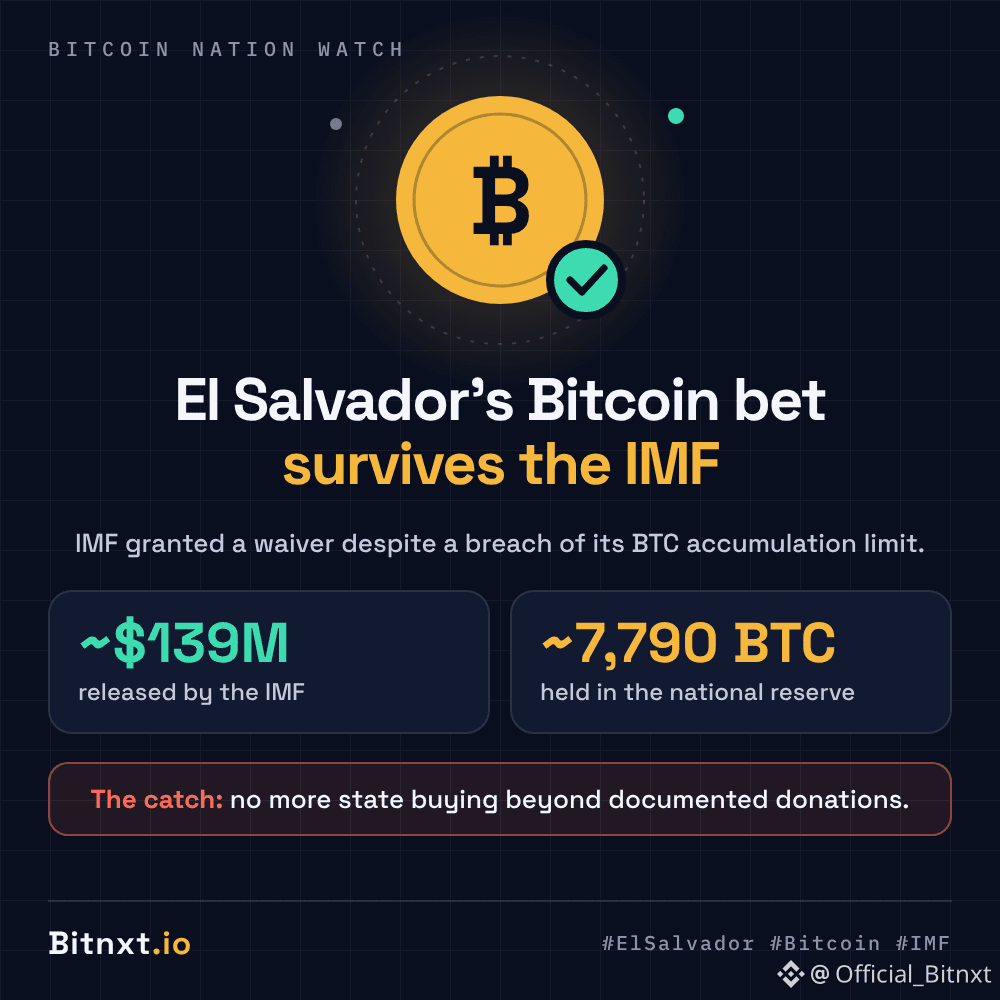
El Salvador's Bitcoin bet survives the IMF 🇸🇻
The IMF released ~$139M despite a breach of its Bitcoin accumulation limit, granting a waiver.
Reserve: ~7,790 BTC.
The catch: no more state buying beyond documented donations.
#ElSalvador #bitcoin #IMF
El Salvador's Bitcoin bet survives the IMF 🇸🇻
The IMF released ~$139M despite a breach of its Bitcoin accumulation limit, granting a waiver.
Reserve: ~7,790 BTC.
The catch: no more state buying beyond documented donations.
#ElSalvador #bitcoin #IMF
The IMF released ~$139M despite a breach of its Bitcoin accumulation limit, granting a waiver.
Reserve: ~7,790 BTC.
The catch: no more state buying beyond documented donations.
#ElSalvador #bitcoin #IMF
1
3

·
--
El Salvador gets approval for $138 million, which can’t be counted as new BTC buy-side demand
This IMF release is for financing, not a government budget to buy crypto. For those who focus on BTC-country buy-side flows, I’ll first verify the intended use of funds—not interpret a “waiver” as permission for freely adding BTC.
On October 1, the IMF completed the second and third reviews of El Salvador’s financing program, allowing the immediate disbursement of about $138 million; on October 4, Cointelegraph reported in follow-up. What’s confirmed here is that the disbursement was approved—not that I’ve verified the money has arrived, and definitely not a weekend announcement of new BTC purchases.
The key is what conditions come with the waiver. The IMF says that while some of the benchmarks— including BTC accumulation—were not met, the plan was still approved to proceed based on corrective measures and newly made commitments. The same announcement also requires reducing the state’s participation in Bitcoin-related activities and states that, aside from recorded donations, it does not expect further accumulation.
My understanding is that this decision lets the financing continue, without canceling the original constraints in one stroke. Still, keep the other side in mind: receiving donations can increase holdings, but it doesn’t prove the government spent new money in the market. Linking “approved financing,” “wallet BTC increases,” and “government purchases BTC” into one thing would overestimate demand along this path.
In the coming week, I’ll review the IMF’s subsequent documents and the government’s funding disclosures to separate purchases, donations, and internal transfers. Only verifiable actual purchase spending and the sources of the funds will change my assessment of a country’s net new buy-side demand; if it’s only donations or balance changes, the judgment won’t change. If official policy conditions are loosened in the future, it must also be validated separately from real purchases.
Correction/addendum: The NEAR draft yesterday omitted the restoration statement. Crypto.news reported on October 1 that the cofounder said the vulnerability was fixed and services were restored, with some chains excluded. This isn’t a new restoration today; per-chain availability and whether funds have arrived still need to be checked separately.
#比特币 #萨尔瓦多 #IMF
El Salvador gets approval for $138 million, which can’t be counted as new BTC buy-side demand
This IMF release is for financing, not a government budget to buy crypto. For those who focus on BTC-country buy-side flows, I’ll first verify the intended use of funds—not interpret a “waiver” as permission for freely adding BTC.
On October 1, the IMF completed the second and third reviews of El Salvador’s financing program, allowing the immediate disbursement of about $138 million; on October 4, Cointelegraph reported in follow-up. What’s confirmed here is that the disbursement was approved—not that I’ve verified the money has arrived, and definitely not a weekend announcement of new BTC purchases.
The key is what conditions come with the waiver. The IMF says that while some of the benchmarks— including BTC accumulation—were not met, the plan was still approved to proceed based on corrective measures and newly made commitments. The same announcement also requires reducing the state’s participation in Bitcoin-related activities and states that, aside from recorded donations, it does not expect further accumulation.
My understanding is that this decision lets the financing continue, without canceling the original constraints in one stroke. Still, keep the other side in mind: receiving donations can increase holdings, but it doesn’t prove the government spent new money in the market. Linking “approved financing,” “wallet BTC increases,” and “government purchases BTC” into one thing would overestimate demand along this path.
In the coming week, I’ll review the IMF’s subsequent documents and the government’s funding disclosures to separate purchases, donations, and internal transfers. Only verifiable actual purchase spending and the sources of the funds will change my assessment of a country’s net new buy-side demand; if it’s only donations or balance changes, the judgment won’t change. If official policy conditions are loosened in the future, it must also be validated separately from real purchases.
Correction/addendum: The NEAR draft yesterday omitted the restoration statement. Crypto.news reported on October 1 that the cofounder said the vulnerability was fixed and services were restored, with some chains excluded. This isn’t a new restoration today; per-chain availability and whether funds have arrived still need to be checked separately.
#比特币 #萨尔瓦多 #IMF
This IMF release is for financing, not a government budget to buy crypto. For those who focus on BTC-country buy-side flows, I’ll first verify the intended use of funds—not interpret a “waiver” as permission for freely adding BTC.
On October 1, the IMF completed the second and third reviews of El Salvador’s financing program, allowing the immediate disbursement of about $138 million; on October 4, Cointelegraph reported in follow-up. What’s confirmed here is that the disbursement was approved—not that I’ve verified the money has arrived, and definitely not a weekend announcement of new BTC purchases.
The key is what conditions come with the waiver. The IMF says that while some of the benchmarks— including BTC accumulation—were not met, the plan was still approved to proceed based on corrective measures and newly made commitments. The same announcement also requires reducing the state’s participation in Bitcoin-related activities and states that, aside from recorded donations, it does not expect further accumulation.
My understanding is that this decision lets the financing continue, without canceling the original constraints in one stroke. Still, keep the other side in mind: receiving donations can increase holdings, but it doesn’t prove the government spent new money in the market. Linking “approved financing,” “wallet BTC increases,” and “government purchases BTC” into one thing would overestimate demand along this path.
In the coming week, I’ll review the IMF’s subsequent documents and the government’s funding disclosures to separate purchases, donations, and internal transfers. Only verifiable actual purchase spending and the sources of the funds will change my assessment of a country’s net new buy-side demand; if it’s only donations or balance changes, the judgment won’t change. If official policy conditions are loosened in the future, it must also be validated separately from real purchases.
Correction/addendum: The NEAR draft yesterday omitted the restoration statement. Crypto.news reported on October 1 that the cofounder said the vulnerability was fixed and services were restored, with some chains excluded. This isn’t a new restoration today; per-chain availability and whether funds have arrived still need to be checked separately.
#比特币 #萨尔瓦多 #IMF
286
·
--
IMF Approves $138M Disbursement for El Salvador Despite Missing Targets 🇸🇻💰
The International Monetary Fund (IMF) has authorized an immediate $138 million payout to El Salvador as part of its ongoing $1.4 billion financial package.
Interestingly, the lender granted performance waivers even though the country fell short on several key criteria—specifically targets connected to Bitcoin accumulation.
Key Takeaways:
• Progress Areas: The IMF noted positive steps forward in fiscal transparency, financial sector reforms, and anti-money laundering (AML/CFT) frameworks.
• Chivo Wallet Shifts Control: Control of the government's Chivo Bitcoin wallet is being handed over to a private operator to scale back direct state involvement.
• Future Outlook: Moving forward, El Salvador has agreed to freeze further Bitcoin acquisitions, restricting future growth purely to documented donations. The state will focus instead on strengthening its crypto-asset regulatory frameworks.
What do you think about the IMF granting a waiver despite the missed Bitcoin targets? Let's discuss below! 👇
#ElSalvador #Bitcoin CryptoNews #IMF #BinanceSquare
IMF Approves $138M Disbursement for El Salvador Despite Missing Targets 🇸🇻💰
The International Monetary Fund (IMF) has authorized an immediate $138 million payout to El Salvador as part of its ongoing $1.4 billion financial package.
Interestingly, the lender granted performance waivers even though the country fell short on several key criteria—specifically targets connected to Bitcoin accumulation.
Key Takeaways:
• Progress Areas: The IMF noted positive steps forward in fiscal transparency, financial sector reforms, and anti-money laundering (AML/CFT) frameworks.
• Chivo Wallet Shifts Control: Control of the government's Chivo Bitcoin wallet is being handed over to a private operator to scale back direct state involvement.
• Future Outlook: Moving forward, El Salvador has agreed to freeze further Bitcoin acquisitions, restricting future growth purely to documented donations. The state will focus instead on strengthening its crypto-asset regulatory frameworks.
What do you think about the IMF granting a waiver despite the missed Bitcoin targets? Let's discuss below! 👇
#ElSalvador #Bitcoin CryptoNews #IMF #BinanceSquare
The International Monetary Fund (IMF) has authorized an immediate $138 million payout to El Salvador as part of its ongoing $1.4 billion financial package.
Interestingly, the lender granted performance waivers even though the country fell short on several key criteria—specifically targets connected to Bitcoin accumulation.
Key Takeaways:
• Progress Areas: The IMF noted positive steps forward in fiscal transparency, financial sector reforms, and anti-money laundering (AML/CFT) frameworks.
• Chivo Wallet Shifts Control: Control of the government's Chivo Bitcoin wallet is being handed over to a private operator to scale back direct state involvement.
• Future Outlook: Moving forward, El Salvador has agreed to freeze further Bitcoin acquisitions, restricting future growth purely to documented donations. The state will focus instead on strengthening its crypto-asset regulatory frameworks.
What do you think about the IMF granting a waiver despite the missed Bitcoin targets? Let's discuss below! 👇
#ElSalvador #Bitcoin CryptoNews #IMF #BinanceSquare
37

#IMFApproves139MDisbursementToElSalvador
IMF approves $138 million for El Salvador with a special exception for Bitcoin.
What happened:
- The IMF completed the second and third reviews of the $1.4 billion agreement
- Approved an immediate disbursement of $138 million
- Granted a waiver (exception) because El Salvador violated the "zero accumulation" condition for Bitcoin
What changed:
- El Salvador refused to sell its Bitcoin
- Accumulated through documented private donations, not public funds
- The IMF accepted the technical justification
The outcome:
- El Salvador keeps 7.777 BTC
- Unrealized profit of ~1.62 billion
- The IMF did not recognize Bitcoin as a reserve, but granted the exception
Is this a precedent? Or just the rule being applied as written?
$BTC
#BTC #ElSalvador #imf #bitcoin
{spot}(BTCUSDT)
#IMFApproves139MDisbursementToElSalvador
IMF approves $138 million for El Salvador with a special exception for Bitcoin.
What happened:
- The IMF completed the second and third reviews of the $1.4 billion agreement
- Approved an immediate disbursement of $138 million
- Granted a waiver (exception) because El Salvador violated the "zero accumulation" condition for Bitcoin
What changed:
- El Salvador refused to sell its Bitcoin
- Accumulated through documented private donations, not public funds
- The IMF accepted the technical justification
The outcome:
- El Salvador keeps 7.777 BTC
- Unrealized profit of ~1.62 billion
- The IMF did not recognize Bitcoin as a reserve, but granted the exception
Is this a precedent? Or just the rule being applied as written?
$BTC
#BTC #ElSalvador #imf #bitcoin
IMF approves $138 million for El Salvador with a special exception for Bitcoin.
What happened:
- The IMF completed the second and third reviews of the $1.4 billion agreement
- Approved an immediate disbursement of $138 million
- Granted a waiver (exception) because El Salvador violated the "zero accumulation" condition for Bitcoin
What changed:
- El Salvador refused to sell its Bitcoin
- Accumulated through documented private donations, not public funds
- The IMF accepted the technical justification
The outcome:
- El Salvador keeps 7.777 BTC
- Unrealized profit of ~1.62 billion
- The IMF did not recognize Bitcoin as a reserve, but granted the exception
Is this a precedent? Or just the rule being applied as written?
$BTC
#BTC #ElSalvador #imf #bitcoin
2
380

·
--
#IMF
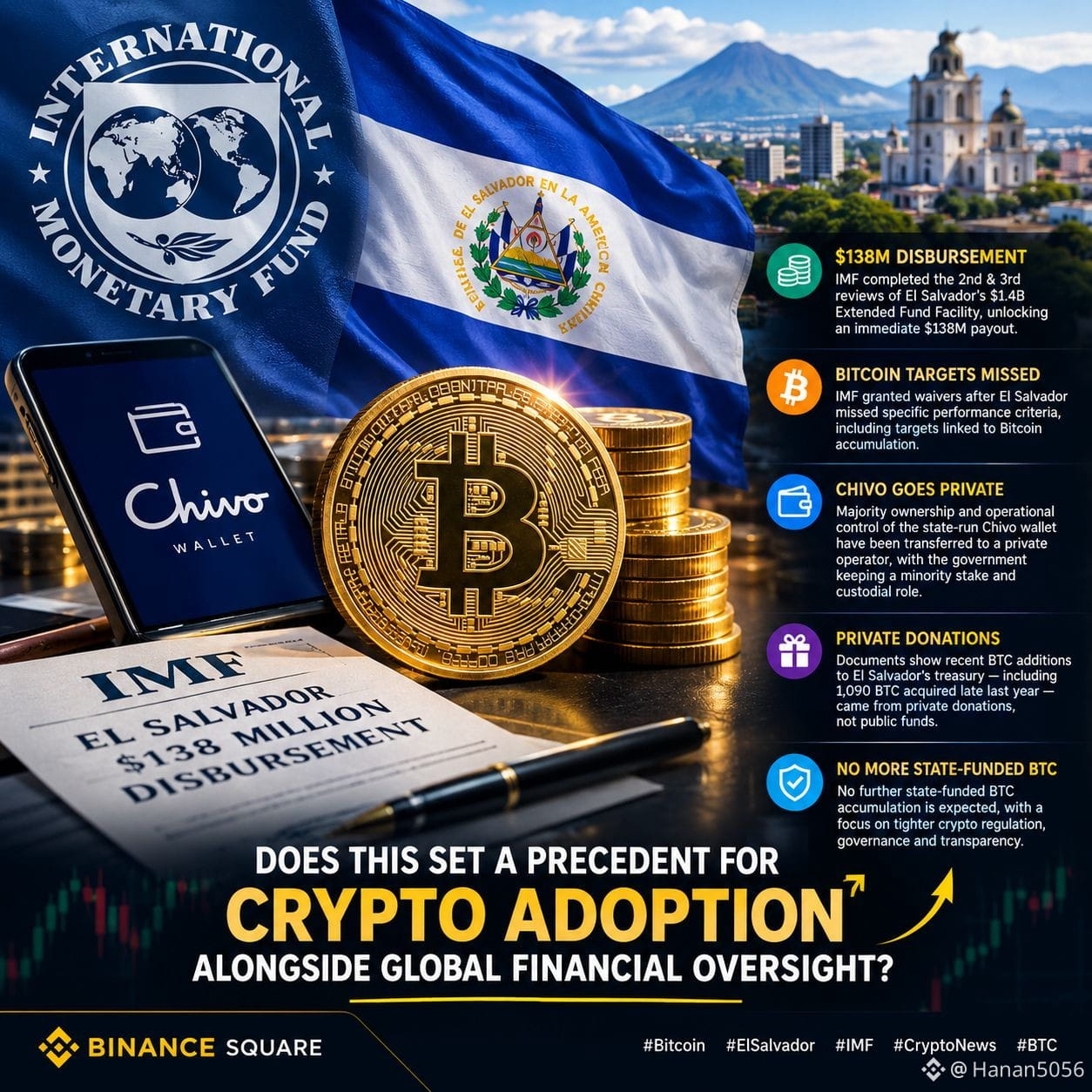
🇸🇻 IMF Gives El Salvador $138M — Despite Missed Bitcoin Targets
The IMF has completed its 2nd & 3rd reviews of El Salvador’s $1.4B program, unlocking an immediate $138M disbursement.
But the Bitcoin angle is the real story 👀
🔸 Bitcoin targets missed: IMF granted waivers after certain $BTC -related performance criteria weren’t met.
🔸 Chivo goes private: Majority ownership and operational control of the government’s Chivo wallet have moved to a private operator.
🔸 BTC accumulation clarified: IMF says documented Bitcoin additions came from private donations, not public resources.
🔸 No more state-funded $BTC accumulation expected: Future policy is shifting toward transparency, regulation and risk management rather than expanding government Bitcoin exposure.
📌 My take: This could be an important test case for crypto adoption under traditional financial oversight. El Salvador isn’t simply abandoning Bitcoin — it’s moving toward a model with less direct government involvement and more regulatory control.
Could this become the blueprint for countries adopting crypto without taking unlimited fiscal risk? 👇
#Bitcoin #ElSalvador #IMF #CryptoNews
$BTC
{spot}(BTCUSDT)
Follow for more Updates
#IMF
🇸🇻 IMF Gives El Salvador $138M — Despite Missed Bitcoin Targets
The IMF has completed its 2nd & 3rd reviews of El Salvador’s $1.4B program, unlocking an immediate $138M disbursement.
But the Bitcoin angle is the real story 👀
🔸 Bitcoin targets missed: IMF granted waivers after certain $BTC -related performance criteria weren’t met.
🔸 Chivo goes private: Majority ownership and operational control of the government’s Chivo wallet have moved to a private operator.
🔸 BTC accumulation clarified: IMF says documented Bitcoin additions came from private donations, not public resources.
🔸 No more state-funded $BTC accumulation expected: Future policy is shifting toward transparency, regulation and risk management rather than expanding government Bitcoin exposure.
📌 My take: This could be an important test case for crypto adoption under traditional financial oversight. El Salvador isn’t simply abandoning Bitcoin — it’s moving toward a model with less direct government involvement and more regulatory control.
Could this become the blueprint for countries adopting crypto without taking unlimited fiscal risk? 👇
#Bitcoin #ElSalvador #IMF #CryptoNews
$BTC
Follow for more Updates
🇸🇻 IMF Gives El Salvador $138M — Despite Missed Bitcoin Targets
The IMF has completed its 2nd & 3rd reviews of El Salvador’s $1.4B program, unlocking an immediate $138M disbursement.
But the Bitcoin angle is the real story 👀
🔸 Bitcoin targets missed: IMF granted waivers after certain $BTC -related performance criteria weren’t met.
🔸 Chivo goes private: Majority ownership and operational control of the government’s Chivo wallet have moved to a private operator.
🔸 BTC accumulation clarified: IMF says documented Bitcoin additions came from private donations, not public resources.
🔸 No more state-funded $BTC accumulation expected: Future policy is shifting toward transparency, regulation and risk management rather than expanding government Bitcoin exposure.
📌 My take: This could be an important test case for crypto adoption under traditional financial oversight. El Salvador isn’t simply abandoning Bitcoin — it’s moving toward a model with less direct government involvement and more regulatory control.
Could this become the blueprint for countries adopting crypto without taking unlimited fiscal risk? 👇
#Bitcoin #ElSalvador #IMF #CryptoNews
$BTC
Follow for more Updates
2
26
·
--
Bullish
Verified
#IMFApprovesElSalvador$138MWithBitcoinWaiver
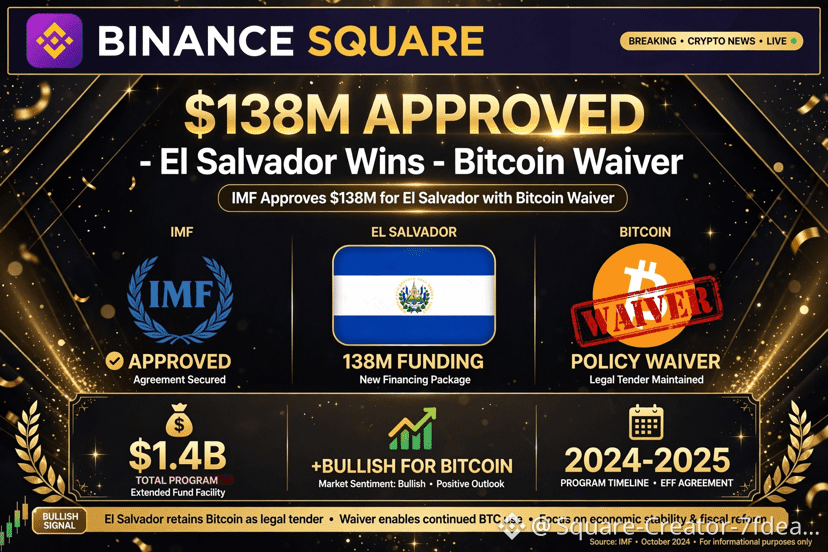
#IMFApprovesElSalvador$138MWithBitcoinWaiver 🚨 A historic victory for Bitcoin!
The IMF approves releasing $138 million to El Salvador despite its insistence on keeping Bitcoin!
The story:
The IMF was pressuring El Salvador to give up Bitcoin in order to approve a $1.4 billion loan.
El Salvador said no! It refused to sell a single Bitcoin 🇸🇻₿
So what happened? The IMF backed down and agreed to release $138 million immediately after completing the second and third reviews—along with a special exception for Bitcoin!
The message is clear: Bitcoin has beaten the global financial system.
El Salvador now holds +6,000 Bitcoins, and its profits exceed $400 million.
Is this the beginning of the IMF’s official recognition of Bitcoin?
#BTC #ElSalvador #IMF #bitcoin $BTC
{future}(BTCUSDT)
#IMFApprovesElSalvador$138MWithBitcoinWaiver
#IMFApprovesElSalvador$138MWithBitcoinWaiver 🚨 A historic victory for Bitcoin!
The IMF approves releasing $138 million to El Salvador despite its insistence on keeping Bitcoin!
The story:
The IMF was pressuring El Salvador to give up Bitcoin in order to approve a $1.4 billion loan.
El Salvador said no! It refused to sell a single Bitcoin 🇸🇻₿
So what happened? The IMF backed down and agreed to release $138 million immediately after completing the second and third reviews—along with a special exception for Bitcoin!
The message is clear: Bitcoin has beaten the global financial system.
El Salvador now holds +6,000 Bitcoins, and its profits exceed $400 million.
Is this the beginning of the IMF’s official recognition of Bitcoin?
#BTC #ElSalvador #IMF #bitcoin $BTC
#IMFApprovesElSalvador$138MWithBitcoinWaiver 🚨 A historic victory for Bitcoin!
The IMF approves releasing $138 million to El Salvador despite its insistence on keeping Bitcoin!
The story:
The IMF was pressuring El Salvador to give up Bitcoin in order to approve a $1.4 billion loan.
El Salvador said no! It refused to sell a single Bitcoin 🇸🇻₿
So what happened? The IMF backed down and agreed to release $138 million immediately after completing the second and third reviews—along with a special exception for Bitcoin!
The message is clear: Bitcoin has beaten the global financial system.
El Salvador now holds +6,000 Bitcoins, and its profits exceed $400 million.
Is this the beginning of the IMF’s official recognition of Bitcoin?
#BTC #ElSalvador #IMF #bitcoin $BTC
1
2
955

·
--
Bullish
🇸🇻$IMF.ETF
💰 IMF approved $138M for El Salvador.
₿ IMF allowed the country to keep its existing Bitcoin.
{etf_us}(IMF.ETF)
🚫 But El Salvador can't use government money to keep buying more BTC under the deal.
🌲Overall: positive news, but not a major new Bitcoin-buying signal.#IMF #IMFApprovesElSalvador$138MWithBitcoinWaiver
🇸🇻$IMF.ETF
💰 IMF approved $138M for El Salvador.
₿ IMF allowed the country to keep its existing Bitcoin.
🚫 But El Salvador can't use government money to keep buying more BTC under the deal.
🌲Overall: positive news, but not a major new Bitcoin-buying signal.#IMF #IMFApprovesElSalvador$138MWithBitcoinWaiver
💰 IMF approved $138M for El Salvador.
₿ IMF allowed the country to keep its existing Bitcoin.
🚫 But El Salvador can't use government money to keep buying more BTC under the deal.
🌲Overall: positive news, but not a major new Bitcoin-buying signal.#IMF #IMFApprovesElSalvador$138MWithBitcoinWaiver

·
--
IMF Suddenly Releases $138 Million! Did El Salvador “Buy BTC” Get an Exemption?
Big news!
The International Monetary Fund (IMF) has completed the second and third reviews of El Salvador’s financing program, approving an immediate disbursement of about $138 million.
What’s even more noteworthy is that
₿ El Salvador previously did not meet the conditions related to accumulating Bitcoin, but the IMF has granted an exemption this time!
So what does this mean?
BTC is once again in the spotlight of the international financial system!
El Salvador previously drew global attention for its Bitcoin policy. Now, after completing the reviews, the IMF has chosen to release the funds—while also acknowledging that some of the newly added BTC came from documented private donations.
However, there’s one key detail to keep in mind:
This is not the IMF approving El Salvador to keep using public funds to buy BTC indefinitely.
In its latest documents, the IMF clearly states that going forward, it no longer expects El Salvador to continue increasing its Bitcoin holdings unless those holdings come from already recorded donations. At the same time, El Salvador still needs to further reduce the government’s involvement in Bitcoin-related activities. (IMF)
So what’s truly worth watching this time isn’t simply “the IMF supports buying BTC,” but rather:
A Bitcoin country that was once highly controversial is now searching for a new balance with the traditional international financial system.
If, in the future, more countries begin to include BTC in discussions about national asset allocation,
will Bitcoin’s financial attributes open up even more room for imagination?
#BTC #IMF
#IMF拨款萨尔瓦多并豁免超额购BTC
IMF Suddenly Releases $138 Million! Did El Salvador “Buy BTC” Get an Exemption?
Big news!
The International Monetary Fund (IMF) has completed the second and third reviews of El Salvador’s financing program, approving an immediate disbursement of about $138 million.
What’s even more noteworthy is that
₿ El Salvador previously did not meet the conditions related to accumulating Bitcoin, but the IMF has granted an exemption this time!
So what does this mean?
BTC is once again in the spotlight of the international financial system!
El Salvador previously drew global attention for its Bitcoin policy. Now, after completing the reviews, the IMF has chosen to release the funds—while also acknowledging that some of the newly added BTC came from documented private donations.
However, there’s one key detail to keep in mind:
This is not the IMF approving El Salvador to keep using public funds to buy BTC indefinitely.
In its latest documents, the IMF clearly states that going forward, it no longer expects El Salvador to continue increasing its Bitcoin holdings unless those holdings come from already recorded donations. At the same time, El Salvador still needs to further reduce the government’s involvement in Bitcoin-related activities. (IMF)
So what’s truly worth watching this time isn’t simply “the IMF supports buying BTC,” but rather:
A Bitcoin country that was once highly controversial is now searching for a new balance with the traditional international financial system.
If, in the future, more countries begin to include BTC in discussions about national asset allocation,
will Bitcoin’s financial attributes open up even more room for imagination?
#BTC #IMF
#IMF拨款萨尔瓦多并豁免超额购BTC
Big news!
The International Monetary Fund (IMF) has completed the second and third reviews of El Salvador’s financing program, approving an immediate disbursement of about $138 million.
What’s even more noteworthy is that
₿ El Salvador previously did not meet the conditions related to accumulating Bitcoin, but the IMF has granted an exemption this time!
So what does this mean?
BTC is once again in the spotlight of the international financial system!
El Salvador previously drew global attention for its Bitcoin policy. Now, after completing the reviews, the IMF has chosen to release the funds—while also acknowledging that some of the newly added BTC came from documented private donations.
However, there’s one key detail to keep in mind:
This is not the IMF approving El Salvador to keep using public funds to buy BTC indefinitely.
In its latest documents, the IMF clearly states that going forward, it no longer expects El Salvador to continue increasing its Bitcoin holdings unless those holdings come from already recorded donations. At the same time, El Salvador still needs to further reduce the government’s involvement in Bitcoin-related activities. (IMF)
So what’s truly worth watching this time isn’t simply “the IMF supports buying BTC,” but rather:
A Bitcoin country that was once highly controversial is now searching for a new balance with the traditional international financial system.
If, in the future, more countries begin to include BTC in discussions about national asset allocation,
will Bitcoin’s financial attributes open up even more room for imagination?
#BTC #IMF
#IMF拨款萨尔瓦多并豁免超额购BTC
160

·
--
🚨 IMF APPROVES $138M DISBURSEMENT TO EL SALVADOR
The IMF Board has completed its review and approved approximately $138 million in funding for El Salvador.
The Board also granted a waiver related to breaches involving excessive Bitcoin purchases, according to ChainCatcher.
🇸🇻 El Salvador’s Bitcoin strategy remains in focus as the country continues navigating its IMF program. 👀
#Bitcoin #BTC #ElSalvador #IMF
{spot}(BTCUSDT)
🚨 IMF APPROVES $138M DISBURSEMENT TO EL SALVADOR
The IMF Board has completed its review and approved approximately $138 million in funding for El Salvador.
The Board also granted a waiver related to breaches involving excessive Bitcoin purchases, according to ChainCatcher.
🇸🇻 El Salvador’s Bitcoin strategy remains in focus as the country continues navigating its IMF program. 👀
#Bitcoin #BTC #ElSalvador #IMF
The IMF Board has completed its review and approved approximately $138 million in funding for El Salvador.
The Board also granted a waiver related to breaches involving excessive Bitcoin purchases, according to ChainCatcher.
🇸🇻 El Salvador’s Bitcoin strategy remains in focus as the country continues navigating its IMF program. 👀
#Bitcoin #BTC #ElSalvador #IMF
4

·
--
Bullish
Verified
🚨🚨🚨🚨🚨🚨🚨🚨🚨🚨🚨🚨🚨🚨
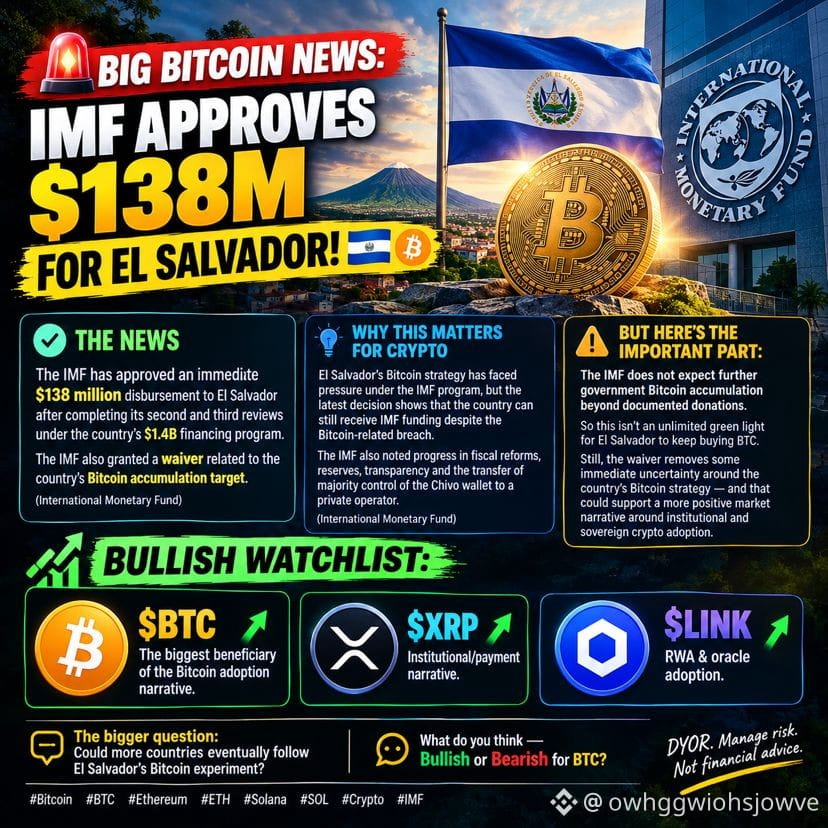
🚨🔥BIG BITCOIN NEWS: IMF APPROVES $138M FOR EL SALVADOR! 🇸🇻₿
A major development just landed for El Salvador and Bitcoin.
The IMF has approved an immediate $138 million disbursement to El Salvador after completing its second and third reviews under the country’s $1.4B financing program. The IMF also granted a waiver related to the country’s Bitcoin accumulation target. (International Monetary Fund)
💡 WHY THIS MATTERS FOR CRYPTO
El Salvador’s Bitcoin strategy has faced pressure under the IMF program, but the latest decision shows that the country can still receive IMF funding despite the Bitcoin-related breach.
The IMF also noted progress in fiscal reforms, reserves, transparency and the transfer of majority control of the Chivo wallet to a private operator. (International Monetary Fund)
⚠️ BUT HERE’S THE IMPORTANT PART:
The IMF does not expect further government Bitcoin accumulation beyond documented donations.
So this isn’t an unlimited green light for El Salvador to keep buying BTC.
Still, the waiver removes some immediate uncertainty around the country’s Bitcoin strategy — and that could support a more positive market narrative around institutional and sovereign crypto adoption.
📈 BULLISH WATCHLIST:
🔥 $BTC — The biggest beneficiary of the Bitcoin adoption narrative
🔥**$XRP** — Institutional/payment narrative
🔥**$LINK** — RWA & oracle adoption
👀 The bigger question:
Could more countries eventually follow El Salvador’s Bitcoin experiment?
What do you think — Bullish or Bearish for BTC? 👇
DYOR. Manage risk. Not financial advice.
#Bitcoin #BTC #Ethereum #ETH #Solana #SOL #Crypto #IMF
#IMFApprovesElSalvador$138MWithBitcoinWaiver
{future}(LINKUSDT)
{future}(XRPUSDT)
{future}(BTCUSDT)
🚨🚨🚨🚨🚨🚨🚨🚨🚨🚨🚨🚨🚨🚨
🚨🔥BIG BITCOIN NEWS: IMF APPROVES $138M FOR EL SALVADOR! 🇸🇻₿
A major development just landed for El Salvador and Bitcoin.
The IMF has approved an immediate $138 million disbursement to El Salvador after completing its second and third reviews under the country’s $1.4B financing program. The IMF also granted a waiver related to the country’s Bitcoin accumulation target. (International Monetary Fund)
💡 WHY THIS MATTERS FOR CRYPTO
El Salvador’s Bitcoin strategy has faced pressure under the IMF program, but the latest decision shows that the country can still receive IMF funding despite the Bitcoin-related breach.
The IMF also noted progress in fiscal reforms, reserves, transparency and the transfer of majority control of the Chivo wallet to a private operator. (International Monetary Fund)
⚠️ BUT HERE’S THE IMPORTANT PART:
The IMF does not expect further government Bitcoin accumulation beyond documented donations.
So this isn’t an unlimited green light for El Salvador to keep buying BTC.
Still, the waiver removes some immediate uncertainty around the country’s Bitcoin strategy — and that could support a more positive market narrative around institutional and sovereign crypto adoption.
📈 BULLISH WATCHLIST:
🔥 $BTC — The biggest beneficiary of the Bitcoin adoption narrative
🔥**$XRP** — Institutional/payment narrative
🔥**$LINK** — RWA & oracle adoption
👀 The bigger question:
Could more countries eventually follow El Salvador’s Bitcoin experiment?
What do you think — Bullish or Bearish for BTC? 👇
DYOR. Manage risk. Not financial advice.
#Bitcoin #BTC #Ethereum #ETH #Solana #SOL #Crypto #IMF
#IMFApprovesElSalvador$138MWithBitcoinWaiver
🚨🔥BIG BITCOIN NEWS: IMF APPROVES $138M FOR EL SALVADOR! 🇸🇻₿
A major development just landed for El Salvador and Bitcoin.
The IMF has approved an immediate $138 million disbursement to El Salvador after completing its second and third reviews under the country’s $1.4B financing program. The IMF also granted a waiver related to the country’s Bitcoin accumulation target. (International Monetary Fund)
💡 WHY THIS MATTERS FOR CRYPTO
El Salvador’s Bitcoin strategy has faced pressure under the IMF program, but the latest decision shows that the country can still receive IMF funding despite the Bitcoin-related breach.
The IMF also noted progress in fiscal reforms, reserves, transparency and the transfer of majority control of the Chivo wallet to a private operator. (International Monetary Fund)
⚠️ BUT HERE’S THE IMPORTANT PART:
The IMF does not expect further government Bitcoin accumulation beyond documented donations.
So this isn’t an unlimited green light for El Salvador to keep buying BTC.
Still, the waiver removes some immediate uncertainty around the country’s Bitcoin strategy — and that could support a more positive market narrative around institutional and sovereign crypto adoption.
📈 BULLISH WATCHLIST:
🔥 $BTC — The biggest beneficiary of the Bitcoin adoption narrative
🔥**$XRP** — Institutional/payment narrative
🔥**$LINK** — RWA & oracle adoption
👀 The bigger question:
Could more countries eventually follow El Salvador’s Bitcoin experiment?
What do you think — Bullish or Bearish for BTC? 👇
DYOR. Manage risk. Not financial advice.
#Bitcoin #BTC #Ethereum #ETH #Solana #SOL #Crypto #IMF
#IMFApprovesElSalvador$138MWithBitcoinWaiver
61

El Salvador secured 138 million dollars from the IMF after agreeing to limit state Bitcoin involvement and improve crypto regulations.
#ElSalvador #IMF
El Salvador secured 138 million dollars from the IMF after agreeing to limit state Bitcoin involvement and improve crypto regulations.
#ElSalvador #IMF
#ElSalvador #IMF
1
37
🇸🇻 The IMF gave El Salvador $138 million — and then told it “Don’t buy any more Bitcoin”The world’s most famous “sovereign bitcoin experiment” is being quietly absorbed by the IMF. Don’t be fooled by the headline about “IMF approval”—read the conditions:
What happened:
· On 10/1, the IMF approved disbursement of about $138 million (SDR 102 million, completing the second and third reviews).
· El Salvador actually did not meet the “Bitcoin accumulation” requirement. The IMF granted an “exemption”—but this is forgiveness for past violations, not clearance to keep buying for the future.
The real conditions (hidden in the details):
· Program states plainly now: government-led BTC accumulation is “no longer expected,” except for recorded donations.
· Most ownership and operational rights of the Chivo wallet have been handed to private operators, and the state’s presence fades.
🇸🇻 The IMF gave El Salvador $138 million — and then told it “Don’t buy any more Bitcoin”
The world’s most famous “sovereign bitcoin experiment” is being quietly absorbed by the IMF. Don’t be fooled by the headline about “IMF approval”—read the conditions:
What happened:
· On 10/1, the IMF approved disbursement of about $138 million (SDR 102 million, completing the second and third reviews).
· El Salvador actually did not meet the “Bitcoin accumulation” requirement. The IMF granted an “exemption”—but this is forgiveness for past violations, not clearance to keep buying for the future.
The real conditions (hidden in the details):
· Program states plainly now: government-led BTC accumulation is “no longer expected,” except for recorded donations.
· Most ownership and operational rights of the Chivo wallet have been handed to private operators, and the state’s presence fades.
What happened:
· On 10/1, the IMF approved disbursement of about $138 million (SDR 102 million, completing the second and third reviews).
· El Salvador actually did not meet the “Bitcoin accumulation” requirement. The IMF granted an “exemption”—but this is forgiveness for past violations, not clearance to keep buying for the future.
The real conditions (hidden in the details):
· Program states plainly now: government-led BTC accumulation is “no longer expected,” except for recorded donations.
· Most ownership and operational rights of the Chivo wallet have been handed to private operators, and the state’s presence fades.
91
🇸🇻 The IMF just forgave El Salvador's Bitcoin breach.
It bought BTC beyond its $1.4B loan terms. The fix: privatize the Chivo wallet and step back from crypto.
Result: $138M released. Reserve still at 7,792 BTC.
Pragmatism or a precedent?
#bitcoin #ElSalvador #IMF
🇸🇻 The IMF just forgave El Salvador's Bitcoin breach.
It bought BTC beyond its $1.4B loan terms. The fix: privatize the Chivo wallet and step back from crypto.
Result: $138M released. Reserve still at 7,792 BTC.
Pragmatism or a precedent?
#bitcoin #ElSalvador #IMF
It bought BTC beyond its $1.4B loan terms. The fix: privatize the Chivo wallet and step back from crypto.
Result: $138M released. Reserve still at 7,792 BTC.
Pragmatism or a precedent?
#bitcoin #ElSalvador #IMF
1
23

·
--
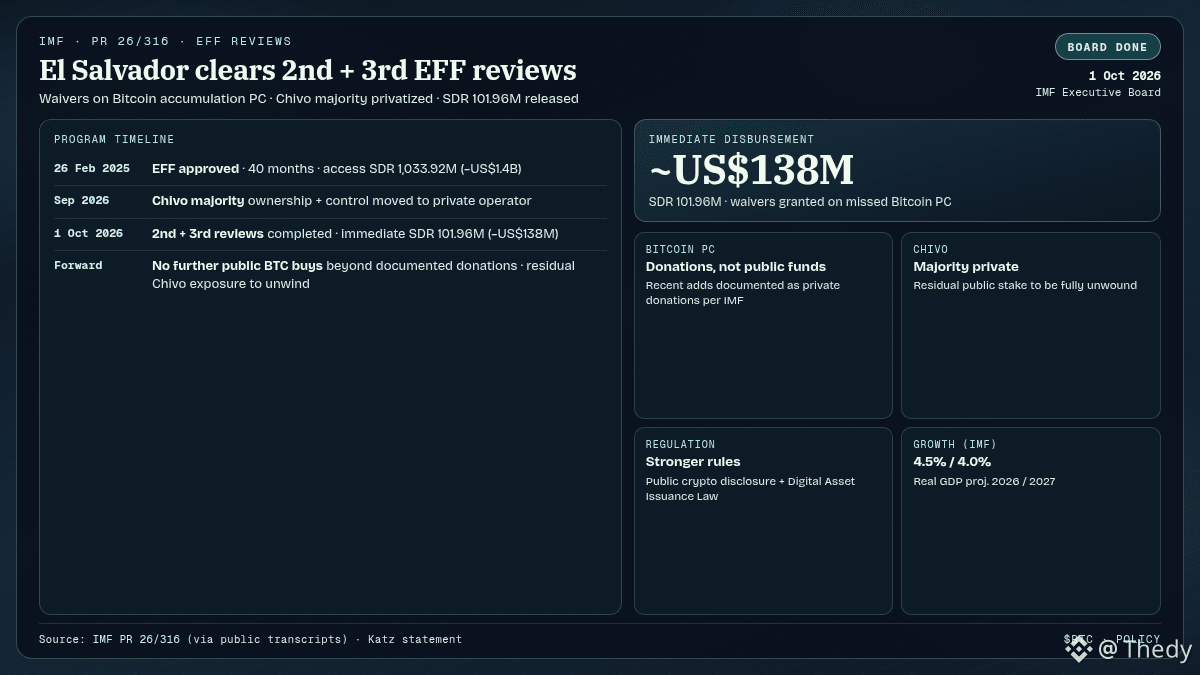
The IMF unlocks ~US$138 million for El Salvador. Public Bitcoin remains under constraint.
On October 1, 2026, the IMF Executive Board concluded the IMF’s 2nd and 3rd reviews of the EFF program (PR 26/316). Immediate disbursement: SDR 101.96 million (about US$138 million). The 40-month arrangement, approved on February 26, 2025, provides total access of SDR 1,033.92 million (about US$1.4 billion).
FACTS (IMF):
• Performance criteria were not met, including the one on Bitcoin accumulation. Waivers were granted after corrective measures and renewed commitments.
• Recent additions of BTC have been documented as private donations, with no public funds.
• Most of Chivo’s ownership and control was transferred to a private operator. The remaining residual public exposure must be fully unwound.
• No new public Bitcoin accumulation is planned beyond the documented donations.
• Objective: strengthen transparency of public crypto holdings and the regulatory framework (including the Digital Asset Issuance Law).
INTERPRETATION:
This is not a green light to buy back $BTC from the state. It is rather a conditional endorsement: the program continues, but the official trajectory is to reduce the public role in Bitcoin and Chivo, not expand it.
SCENARIOS:
• Base case: disbursement absorbed, discipline on documented donations, Chivo unwind continues
• Tightening: next reviews more strict if crypto commitments slip
• Market noise: reading “waiver = bullish BTC” is possible, but the IMF text says the opposite on public accumulation
Sources: IMF PR 26/316 (public transcripts) · Katz statement (First Deputy MD). BTC cash figure not reproduced here due to lack of confirmation in this run.
Does the waiver really change the state’s Bitcoin policy—or only the program timeline?
#Bitcoin #IMF #Crypto
The IMF unlocks ~US$138 million for El Salvador. Public Bitcoin remains under constraint.
On October 1, 2026, the IMF Executive Board concluded the IMF’s 2nd and 3rd reviews of the EFF program (PR 26/316). Immediate disbursement: SDR 101.96 million (about US$138 million). The 40-month arrangement, approved on February 26, 2025, provides total access of SDR 1,033.92 million (about US$1.4 billion).
FACTS (IMF):
• Performance criteria were not met, including the one on Bitcoin accumulation. Waivers were granted after corrective measures and renewed commitments.
• Recent additions of BTC have been documented as private donations, with no public funds.
• Most of Chivo’s ownership and control was transferred to a private operator. The remaining residual public exposure must be fully unwound.
• No new public Bitcoin accumulation is planned beyond the documented donations.
• Objective: strengthen transparency of public crypto holdings and the regulatory framework (including the Digital Asset Issuance Law).
INTERPRETATION:
This is not a green light to buy back $BTC from the state. It is rather a conditional endorsement: the program continues, but the official trajectory is to reduce the public role in Bitcoin and Chivo, not expand it.
SCENARIOS:
• Base case: disbursement absorbed, discipline on documented donations, Chivo unwind continues
• Tightening: next reviews more strict if crypto commitments slip
• Market noise: reading “waiver = bullish BTC” is possible, but the IMF text says the opposite on public accumulation
Sources: IMF PR 26/316 (public transcripts) · Katz statement (First Deputy MD). BTC cash figure not reproduced here due to lack of confirmation in this run.
Does the waiver really change the state’s Bitcoin policy—or only the program timeline?
#Bitcoin #IMF #Crypto
On October 1, 2026, the IMF Executive Board concluded the IMF’s 2nd and 3rd reviews of the EFF program (PR 26/316). Immediate disbursement: SDR 101.96 million (about US$138 million). The 40-month arrangement, approved on February 26, 2025, provides total access of SDR 1,033.92 million (about US$1.4 billion).
FACTS (IMF):
• Performance criteria were not met, including the one on Bitcoin accumulation. Waivers were granted after corrective measures and renewed commitments.
• Recent additions of BTC have been documented as private donations, with no public funds.
• Most of Chivo’s ownership and control was transferred to a private operator. The remaining residual public exposure must be fully unwound.
• No new public Bitcoin accumulation is planned beyond the documented donations.
• Objective: strengthen transparency of public crypto holdings and the regulatory framework (including the Digital Asset Issuance Law).
INTERPRETATION:
This is not a green light to buy back $BTC from the state. It is rather a conditional endorsement: the program continues, but the official trajectory is to reduce the public role in Bitcoin and Chivo, not expand it.
SCENARIOS:
• Base case: disbursement absorbed, discipline on documented donations, Chivo unwind continues
• Tightening: next reviews more strict if crypto commitments slip
• Market noise: reading “waiver = bullish BTC” is possible, but the IMF text says the opposite on public accumulation
Sources: IMF PR 26/316 (public transcripts) · Katz statement (First Deputy MD). BTC cash figure not reproduced here due to lack of confirmation in this run.
Does the waiver really change the state’s Bitcoin policy—or only the program timeline?
#Bitcoin #IMF #Crypto
75

·
--
🚨 El Salvador’s Bitcoin strategy is shifting. Under a new deal with the IMF, the nation has reportedly agreed to halt further BTC accumulation.
In return, the IMF:
• Released $138M in funding
• Waived a missed criterion
• Pushed for less state crypto involvement
Is this a minor compromise or a major setback for sovereign crypto adoption? Let's watch how this impacts the country's long-term BTC play.
#Bitcoin #ElSalvador #IMF
🚨 El Salvador’s Bitcoin strategy is shifting. Under a new deal with the IMF, the nation has reportedly agreed to halt further BTC accumulation.
In return, the IMF:
• Released $138M in funding
• Waived a missed criterion
• Pushed for less state crypto involvement
Is this a minor compromise or a major setback for sovereign crypto adoption? Let's watch how this impacts the country's long-term BTC play.
#Bitcoin #ElSalvador #IMF
In return, the IMF:
• Released $138M in funding
• Waived a missed criterion
• Pushed for less state crypto involvement
Is this a minor compromise or a major setback for sovereign crypto adoption? Let's watch how this impacts the country's long-term BTC play.
#Bitcoin #ElSalvador #IMF
23

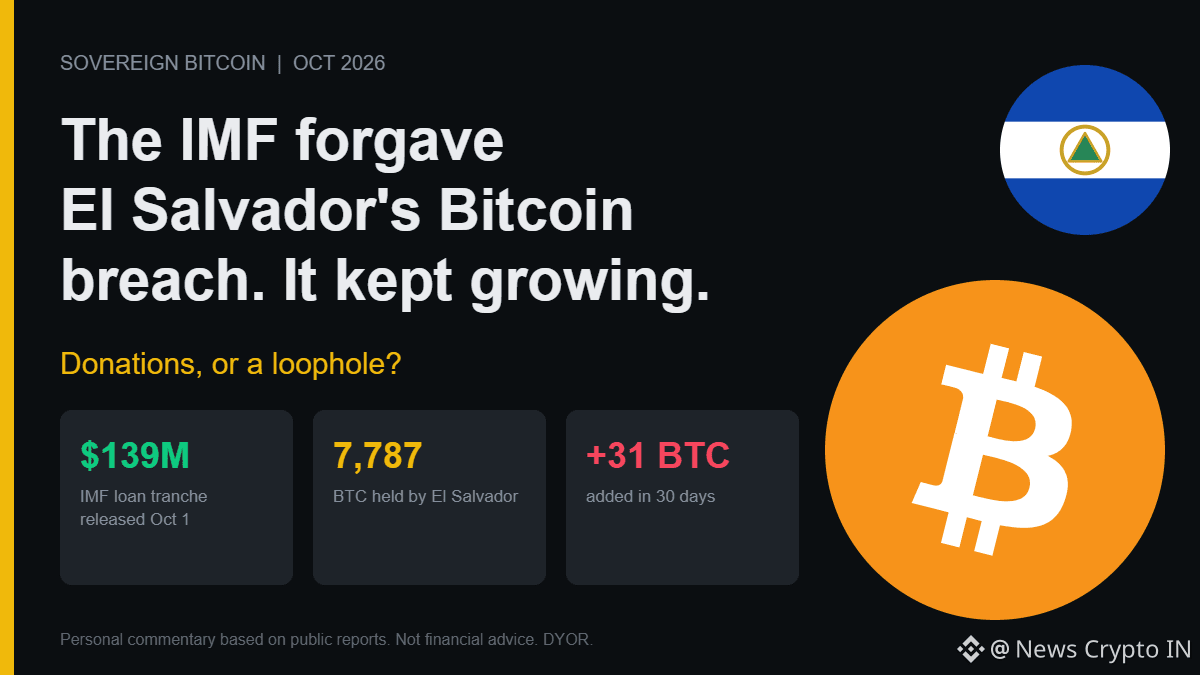
The IMF just released $139M to El Salvador, after formally waiving the country's breach of its Bitcoin limit. The board completed the second and third reviews of the $1.4B loan program on Oct 1. It acknowledged that El Salvador's Bitcoin holdings grew beyond the agreed cap, then forgave it.
The IMF's explanation: the extra $BTC came from private donations, not public funds. Its stated expectation is that there will be no further accumulation beyond those documented donations.
The awkward part: El Salvador's own Bitcoin tracker shows holdings around 7,787 BTC, with about 31 BTC added in the last 30 days and 8 in the past week. The donors haven't been publicly identified. So either the donations keep coming at roughly a coin a day, or the "no further accumulation" line is already being tested.
The fair read: this isn't a pro-Bitcoin pivot by the IMF. The $139M goes to El Salvador's treasury, not into Bitcoin. Control of the Chivo wallet has been handed to a private operator. And the IMF recorded the breach before forgiving it, which makes the cap stricter on paper, not looser.
When a sovereign Bitcoin stack keeps growing through anonymous "donations," is that a clever workaround, or a loophole the IMF chose not to look at?
#ElSalvador #IMF
The IMF just released $139M to El Salvador, after formally waiving the country's breach of its Bitcoin limit. The board completed the second and third reviews of the $1.4B loan program on Oct 1. It acknowledged that El Salvador's Bitcoin holdings grew beyond the agreed cap, then forgave it.
The IMF's explanation: the extra $BTC came from private donations, not public funds. Its stated expectation is that there will be no further accumulation beyond those documented donations.
The awkward part: El Salvador's own Bitcoin tracker shows holdings around 7,787 BTC, with about 31 BTC added in the last 30 days and 8 in the past week. The donors haven't been publicly identified. So either the donations keep coming at roughly a coin a day, or the "no further accumulation" line is already being tested.
The fair read: this isn't a pro-Bitcoin pivot by the IMF. The $139M goes to El Salvador's treasury, not into Bitcoin. Control of the Chivo wallet has been handed to a private operator. And the IMF recorded the breach before forgiving it, which makes the cap stricter on paper, not looser.
When a sovereign Bitcoin stack keeps growing through anonymous "donations," is that a clever workaround, or a loophole the IMF chose not to look at?
#ElSalvador #IMF
The IMF's explanation: the extra $BTC came from private donations, not public funds. Its stated expectation is that there will be no further accumulation beyond those documented donations.
The awkward part: El Salvador's own Bitcoin tracker shows holdings around 7,787 BTC, with about 31 BTC added in the last 30 days and 8 in the past week. The donors haven't been publicly identified. So either the donations keep coming at roughly a coin a day, or the "no further accumulation" line is already being tested.
The fair read: this isn't a pro-Bitcoin pivot by the IMF. The $139M goes to El Salvador's treasury, not into Bitcoin. Control of the Chivo wallet has been handed to a private operator. And the IMF recorded the breach before forgiving it, which makes the cap stricter on paper, not looser.
When a sovereign Bitcoin stack keeps growing through anonymous "donations," is that a clever workaround, or a loophole the IMF chose not to look at?
#ElSalvador #IMF
342
Log in to explore more content
Join global crypto users on Binance Square
⚡️ Get latest and useful information about crypto.
💬 Trusted by the world’s largest crypto exchange.
👍 Discover real insights from verified creators.
Email / Phone number
Trending Topics
1
#BinanceLaunchesBinanceIntelligence
389,315 views
3,061 Discussing
2
#BitcoinTargets2026OpenAt$87570
2,186 views
74 Discussing
3
#BitcoinRejectedAt$87KThirdTime
2,294 views
62 Discussing
4
#StrategyMarketCapSurpassesRumble
11,794 views
430 Discussing
5
#StriveBuys2000BTCFor$169M
13,631 views
130 Discussing
6
#EvernorthXRPTreasuryCompletesSPACMerger
172,945 views
1,656 Discussing
7
#ADAGains10%Above$0.27
65,894 views
261 Discussing
8
#ETHUp70%InQ3ButLiquidityFalls
368,922 views
2,626 Discussing
9
#EthStakingExitQueueHits2026High
153,487 views
1,718 Discussing
10
#FedOctoberHoldOdds82.3%
168,000 views
1,648 Discussing