

#hyperliquid
hyperliquid
6.2M views
16,220 Discussing
Hot
Latest

·
--
Partly True

Article
“It’s not an exchange”: Why Hyperliquid’s creator would take offense at that wordHyperliquid: It’s not an “exchange” at all. That’s what its creator thinks
Imagine a regular exchange. It’s a store with a cashier. There’s a company with a building, rules, and a “freeze everything” button. Your money is held by the company. On a traditional exchange, the company holds your money and controls the infrastructure, while on Hyperliquid you hold your own funds, and the platform is open to everyone.
“It’s not an exchange”: Why Hyperliquid’s creator would take offense at that word
Hyperliquid: It’s not an “exchange” at all. That’s what its creator thinks
Imagine a regular exchange. It’s a store with a cashier. There’s a company with a building, rules, and a “freeze everything” button. Your money is held by the company. On a traditional exchange, the company holds your money and controls the infrastructure, while on Hyperliquid you hold your own funds, and the platform is open to everyone.
Imagine a regular exchange. It’s a store with a cashier. There’s a company with a building, rules, and a “freeze everything” button. Your money is held by the company. On a traditional exchange, the company holds your money and controls the infrastructure, while on Hyperliquid you hold your own funds, and the platform is open to everyone.
1
1.5k

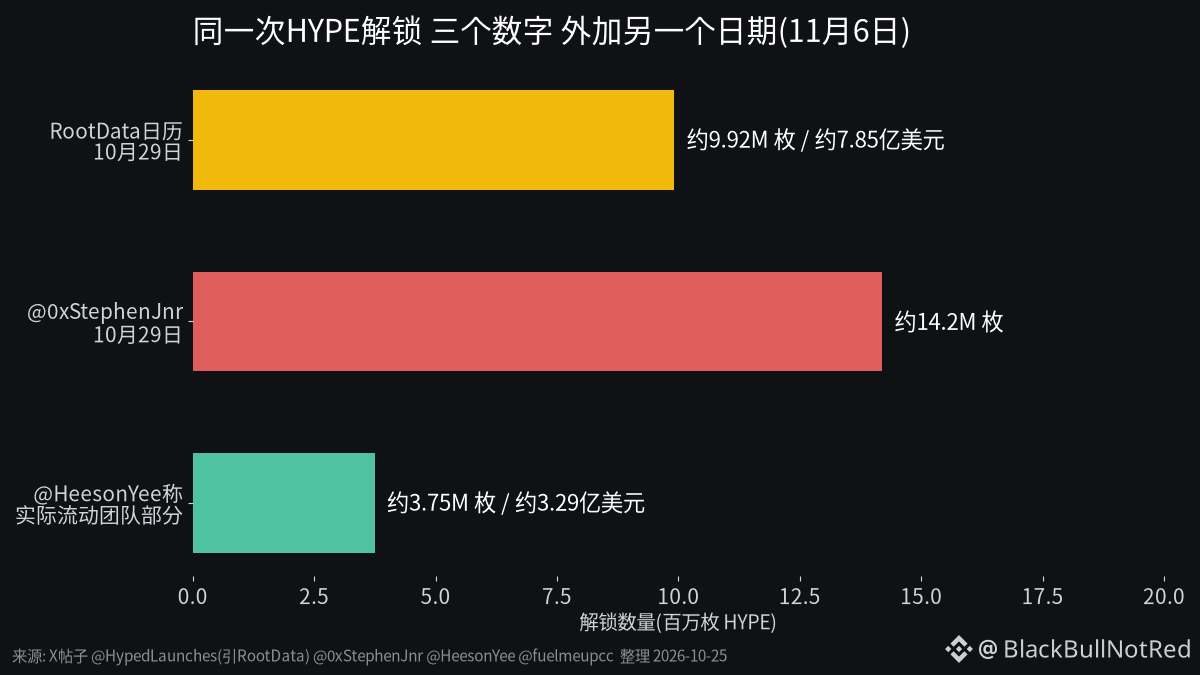
With this HYPE unlock, I’m not even going to get into whether to go long or short—the numbers alone don’t add up.
The RootData calendar says October 29: about 9.9 million tokens, worth around $785 million.
Someone else says 14.2 million tokens on the same day.
Another tool shows the next unlock is on November 6.
And another account says not to panic: the portion of the team’s tokens that can actually enter circulation is only about 3.75 million, worth around $329 million.
Quick calculation: $785 million divided by 9.92 million comes to about $79 per token; $329 million divided by 3.75 million comes to about $88 per token. The same person cited two sets of figures, and they don’t even imply the same price per token. So were these numbers actually checked, or just copied at random?
Even funnier, the same account first posted a poll asking whether people wanted to hedge by shorting ahead of October 29, then later warned that everyone was short and to watch out for a short squeeze. They’ve covered both sides—whatever happens, they can claim they called it.
My take is simple: when there isn’t even a consistent set of dates and amounts, using leverage to bet on either “the unlock will trigger a sell-off” or “the bad news is already priced in” is basically a wager on which calendar gets proven right first. If you really want to trade this, check whether the team’s on-chain addresses have actually moved, and how much they’ve sent to exchanges. Don’t rely on screenshots of unlock calendars.
#HYPE #Hyperliquid
With this HYPE unlock, I’m not even going to get into whether to go long or short—the numbers alone don’t add up.
The RootData calendar says October 29: about 9.9 million tokens, worth around $785 million.
Someone else says 14.2 million tokens on the same day.
Another tool shows the next unlock is on November 6.
And another account says not to panic: the portion of the team’s tokens that can actually enter circulation is only about 3.75 million, worth around $329 million.
Quick calculation: $785 million divided by 9.92 million comes to about $79 per token; $329 million divided by 3.75 million comes to about $88 per token. The same person cited two sets of figures, and they don’t even imply the same price per token. So were these numbers actually checked, or just copied at random?
Even funnier, the same account first posted a poll asking whether people wanted to hedge by shorting ahead of October 29, then later warned that everyone was short and to watch out for a short squeeze. They’ve covered both sides—whatever happens, they can claim they called it.
My take is simple: when there isn’t even a consistent set of dates and amounts, using leverage to bet on either “the unlock will trigger a sell-off” or “the bad news is already priced in” is basically a wager on which calendar gets proven right first. If you really want to trade this, check whether the team’s on-chain addresses have actually moved, and how much they’ve sent to exchanges. Don’t rely on screenshots of unlock calendars.
#HYPE #Hyperliquid
The RootData calendar says October 29: about 9.9 million tokens, worth around $785 million.
Someone else says 14.2 million tokens on the same day.
Another tool shows the next unlock is on November 6.
And another account says not to panic: the portion of the team’s tokens that can actually enter circulation is only about 3.75 million, worth around $329 million.
Quick calculation: $785 million divided by 9.92 million comes to about $79 per token; $329 million divided by 3.75 million comes to about $88 per token. The same person cited two sets of figures, and they don’t even imply the same price per token. So were these numbers actually checked, or just copied at random?
Even funnier, the same account first posted a poll asking whether people wanted to hedge by shorting ahead of October 29, then later warned that everyone was short and to watch out for a short squeeze. They’ve covered both sides—whatever happens, they can claim they called it.
My take is simple: when there isn’t even a consistent set of dates and amounts, using leverage to bet on either “the unlock will trigger a sell-off” or “the bad news is already priced in” is basically a wager on which calendar gets proven right first. If you really want to trade this, check whether the team’s on-chain addresses have actually moved, and how much they’ve sent to exchanges. Don’t rely on screenshots of unlock calendars.
#HYPE #Hyperliquid
730


·
--
🐳 WHALE ALERT: $37.8M of $HYPE Just Hit Coinbase
Three wallets, likely controlled by a single whale, deposited 494,310 HYPE (worth ~$37.83M) into Coinbase over the past 24 hours, according to Lookonchain on-chain data.
Why this matters: exchange deposits of this size are a classic sell-pressure signal. When a major holder moves this much supply onto a centralized exchange in a coordinated way, it usually means distribution, profit-taking, or at minimum, positioning to sell.
The timing adds weight. HYPE has already been trading heavy, below key moving averages, and a $38M overhang landing on Coinbase does not help the bull case in the short term.
The honest counterpoint: a deposit is not a sale. Whales also move coins to exchanges to stake, hedge, lend, or reposition, and this holder may not dump a single token. On-chain watchers should track whether these Coinbase balances actually decline before calling it a full exit.
Key levels to watch: if HYPE loses its recent range lows while exchange inflows stay elevated, downside momentum could accelerate fast. If the coins sit untouched, this was noise.
Bottom line: big money is moving. Trade the reaction, not the rumor.
📌 Sharing personal opinions only, not financial advice or a recommendation to buy/sell. Crypto is highly risky; DYOR and you are solely responsible. No coin promotion.
#Hyperliquid #HYPE #WhaleAlert #Crypto #Binance
🐳 WHALE ALERT: $37.8M of $HYPE Just Hit Coinbase
Three wallets, likely controlled by a single whale, deposited 494,310 HYPE (worth ~$37.83M) into Coinbase over the past 24 hours, according to Lookonchain on-chain data.
Why this matters: exchange deposits of this size are a classic sell-pressure signal. When a major holder moves this much supply onto a centralized exchange in a coordinated way, it usually means distribution, profit-taking, or at minimum, positioning to sell.
The timing adds weight. HYPE has already been trading heavy, below key moving averages, and a $38M overhang landing on Coinbase does not help the bull case in the short term.
The honest counterpoint: a deposit is not a sale. Whales also move coins to exchanges to stake, hedge, lend, or reposition, and this holder may not dump a single token. On-chain watchers should track whether these Coinbase balances actually decline before calling it a full exit.
Key levels to watch: if HYPE loses its recent range lows while exchange inflows stay elevated, downside momentum could accelerate fast. If the coins sit untouched, this was noise.
Bottom line: big money is moving. Trade the reaction, not the rumor.
📌 Sharing personal opinions only, not financial advice or a recommendation to buy/sell. Crypto is highly risky; DYOR and you are solely responsible. No coin promotion.
#Hyperliquid #HYPE #WhaleAlert #Crypto #Binance
Three wallets, likely controlled by a single whale, deposited 494,310 HYPE (worth ~$37.83M) into Coinbase over the past 24 hours, according to Lookonchain on-chain data.
Why this matters: exchange deposits of this size are a classic sell-pressure signal. When a major holder moves this much supply onto a centralized exchange in a coordinated way, it usually means distribution, profit-taking, or at minimum, positioning to sell.
The timing adds weight. HYPE has already been trading heavy, below key moving averages, and a $38M overhang landing on Coinbase does not help the bull case in the short term.
The honest counterpoint: a deposit is not a sale. Whales also move coins to exchanges to stake, hedge, lend, or reposition, and this holder may not dump a single token. On-chain watchers should track whether these Coinbase balances actually decline before calling it a full exit.
Key levels to watch: if HYPE loses its recent range lows while exchange inflows stay elevated, downside momentum could accelerate fast. If the coins sit untouched, this was noise.
Bottom line: big money is moving. Trade the reaction, not the rumor.
📌 Sharing personal opinions only, not financial advice or a recommendation to buy/sell. Crypto is highly risky; DYOR and you are solely responsible. No coin promotion.
#Hyperliquid #HYPE #WhaleAlert #Crypto #Binance
831

·
--
Partly True
Hyperliquid (HYPE) Deep Dive: Why Is the Derivatives Leader, with Over $1 Billion in Fees, Getting a Valuation Rerating?📌 Market snapshot
• Current price: approximately $76–77 (October 25); market cap: approximately $25.6 billion, making it the youngest star among the top 10 by market capitalization
• Pulled back after reaching an all-time high of approximately $98 on September 23; currently about 21% below its ATH
• Up approximately 62% year to date in 2026, with cumulative gains of over 1,100% since launching in November 2024
⚡ Fundamentals: The undisputed leader in on-chain derivatives
• Approximately $216.9 billion in perpetual futures trading volume over 30 days, capturing about 34.6% of the decentralized perpetuals market (60–70% by some estimates)—more than three times the volume of the runner-up
• Open interest (OI) hit a record $18 billion on September 23; Hyperliquid accounted for approximately 77% of the net increase in OI across all derivatives platforms in Q3
Hyperliquid (HYPE) Deep Dive: Why Is the Derivatives Leader, with Over $1 Billion in Fees, Getting a Valuation Rerating?
📌 Market snapshot
• Current price: approximately $76–77 (October 25); market cap: approximately $25.6 billion, making it the youngest star among the top 10 by market capitalization
• Pulled back after reaching an all-time high of approximately $98 on September 23; currently about 21% below its ATH
• Up approximately 62% year to date in 2026, with cumulative gains of over 1,100% since launching in November 2024
⚡ Fundamentals: The undisputed leader in on-chain derivatives
• Approximately $216.9 billion in perpetual futures trading volume over 30 days, capturing about 34.6% of the decentralized perpetuals market (60–70% by some estimates)—more than three times the volume of the runner-up
• Open interest (OI) hit a record $18 billion on September 23; Hyperliquid accounted for approximately 77% of the net increase in OI across all derivatives platforms in Q3
• Current price: approximately $76–77 (October 25); market cap: approximately $25.6 billion, making it the youngest star among the top 10 by market capitalization
• Pulled back after reaching an all-time high of approximately $98 on September 23; currently about 21% below its ATH
• Up approximately 62% year to date in 2026, with cumulative gains of over 1,100% since launching in November 2024
⚡ Fundamentals: The undisputed leader in on-chain derivatives
• Approximately $216.9 billion in perpetual futures trading volume over 30 days, capturing about 34.6% of the decentralized perpetuals market (60–70% by some estimates)—more than three times the volume of the runner-up
• Open interest (OI) hit a record $18 billion on September 23; Hyperliquid accounted for approximately 77% of the net increase in OI across all derivatives platforms in Q3
1
619

·
--
Verified
#Hyperliquid The most ironic rule: up to 100% can be slashed, while compensation can be 0.
HIP-3 market operators stake 500,000 HYPE. If they violate the rules, the authorities can slash the entire amount—but the tokens are simply burned, and affected traders receive no compensation!
Burning benefits the token supply; compensation is what protects users’ assets. The difference between the two is accountability—the issue DeFi is least willing to discuss.
I agree with the rationale behind $HYPE 's staking requirements, but I won't mistake a punishment mechanism for user insurance.
Putting finance on-chain is easy. Putting accountability on-chain is the real test.
#hype #DeFi
{future}(HYPEUSDT)
#Hyperliquid The most ironic rule: up to 100% can be slashed, while compensation can be 0.
HIP-3 market operators stake 500,000 HYPE. If they violate the rules, the authorities can slash the entire amount—but the tokens are simply burned, and affected traders receive no compensation!
Burning benefits the token supply; compensation is what protects users’ assets. The difference between the two is accountability—the issue DeFi is least willing to discuss.
I agree with the rationale behind $HYPE 's staking requirements, but I won't mistake a punishment mechanism for user insurance.
Putting finance on-chain is easy. Putting accountability on-chain is the real test.
#hype #DeFi
HIP-3 market operators stake 500,000 HYPE. If they violate the rules, the authorities can slash the entire amount—but the tokens are simply burned, and affected traders receive no compensation!
Burning benefits the token supply; compensation is what protects users’ assets. The difference between the two is accountability—the issue DeFi is least willing to discuss.
I agree with the rationale behind $HYPE 's staking requirements, but I won't mistake a punishment mechanism for user insurance.
Putting finance on-chain is easy. Putting accountability on-chain is the real test.
#hype #DeFi

Binance BiBi:
Working on it. Your reply is on the way.
2
2
348

·
--
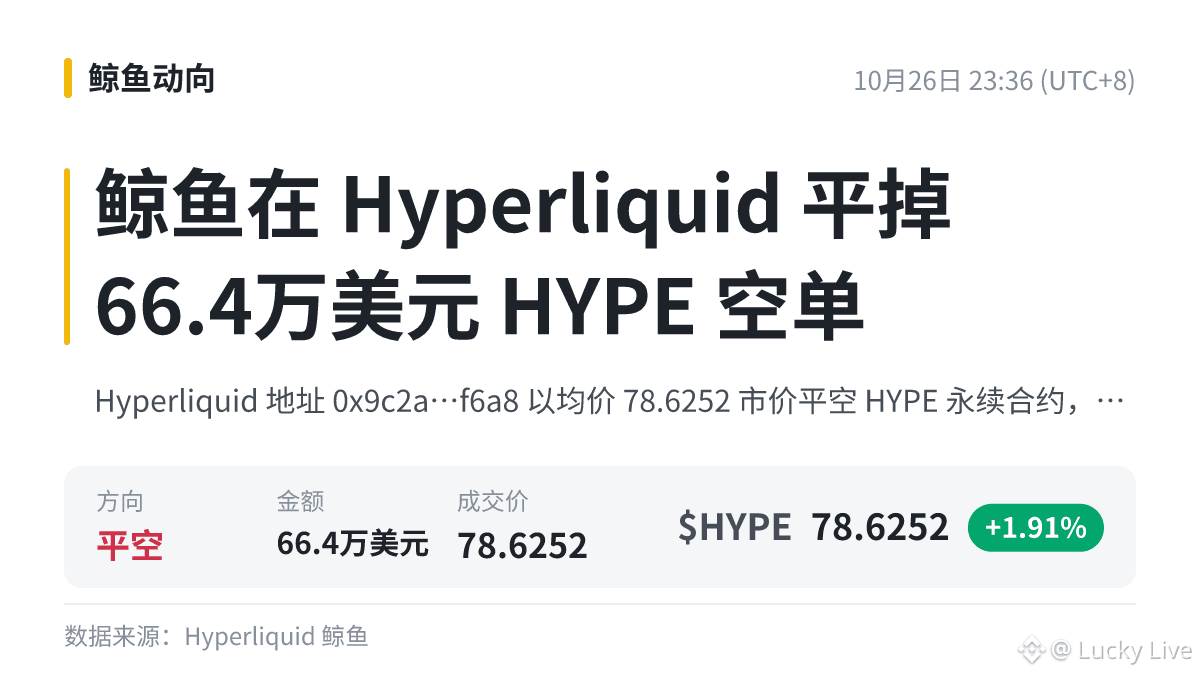
Today's market-watching notes: The whale made another move, closing a short position worth $664,000 at $HYPE (Hyperliquid).
The whale is buying, while I'm still on the fence; by the time I make up my mind, the whale will probably be off work.
Whales can be wrong too, so think carefully before copying their trades.
#Hyperliquid
This data is for reference only. Don't take it as gospel.
Today's market-watching notes: The whale made another move, closing a short position worth $664,000 at $HYPE (Hyperliquid).
The whale is buying, while I'm still on the fence; by the time I make up my mind, the whale will probably be off work.
Whales can be wrong too, so think carefully before copying their trades.
#Hyperliquid
This data is for reference only. Don't take it as gospel.
The whale is buying, while I'm still on the fence; by the time I make up my mind, the whale will probably be off work.
Whales can be wrong too, so think carefully before copying their trades.
#Hyperliquid
This data is for reference only. Don't take it as gospel.
43

·
--
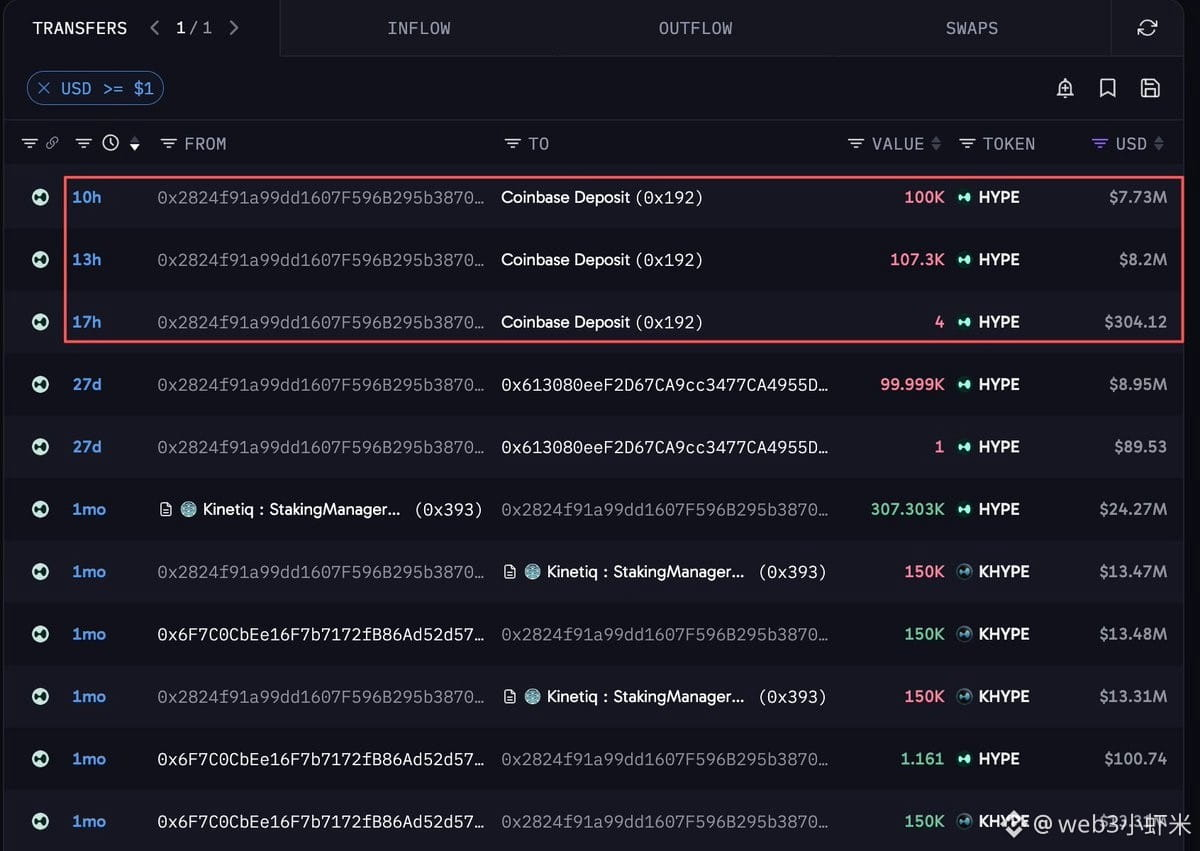
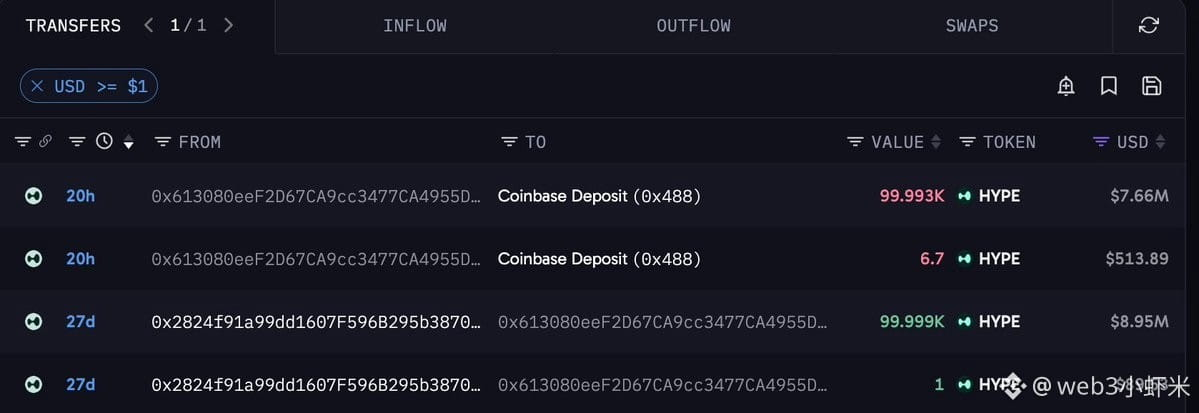
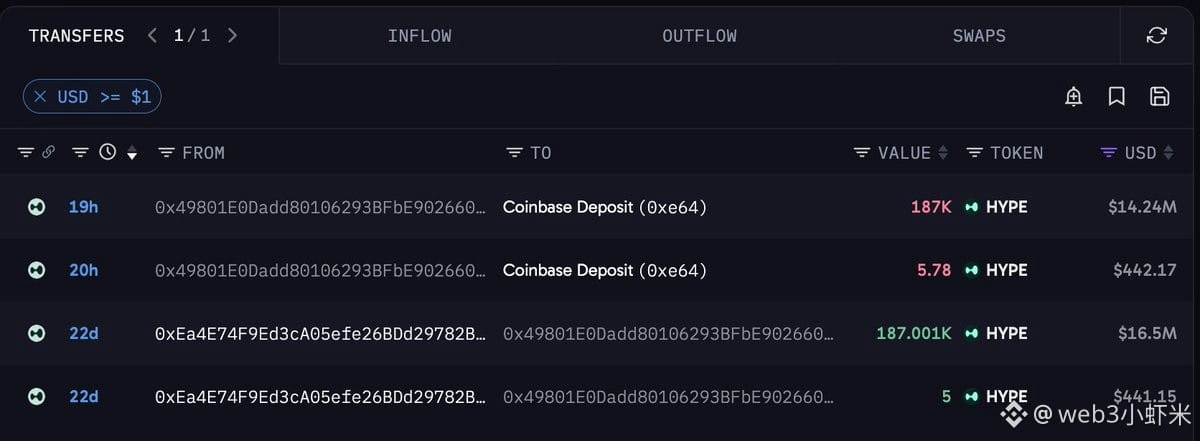
Lookonchain monitoring: Over the past 24 hours, three wallets suspected to belong to the same whale deposited approximately 494,300 HYPE into Coinbase, worth about $37.83 million in total.
Depositing to a CEX doesn’t necessarily mean an immediate sell-off; it could also be a position rotation or hedging. Still, a net inflow of this size is quite conspicuous, especially with all the recent discussion around Hyperliquid-related positions.
#HYPE #Hyperliquid #Onchain
Lookonchain monitoring: Over the past 24 hours, three wallets suspected to belong to the same whale deposited approximately 494,300 HYPE into Coinbase, worth about $37.83 million in total.
Depositing to a CEX doesn’t necessarily mean an immediate sell-off; it could also be a position rotation or hedging. Still, a net inflow of this size is quite conspicuous, especially with all the recent discussion around Hyperliquid-related positions.
#HYPE #Hyperliquid #Onchain
Depositing to a CEX doesn’t necessarily mean an immediate sell-off; it could also be a position rotation or hedging. Still, a net inflow of this size is quite conspicuous, especially with all the recent discussion around Hyperliquid-related positions.
#HYPE #Hyperliquid #Onchain
16

·
--
Funds perspective:
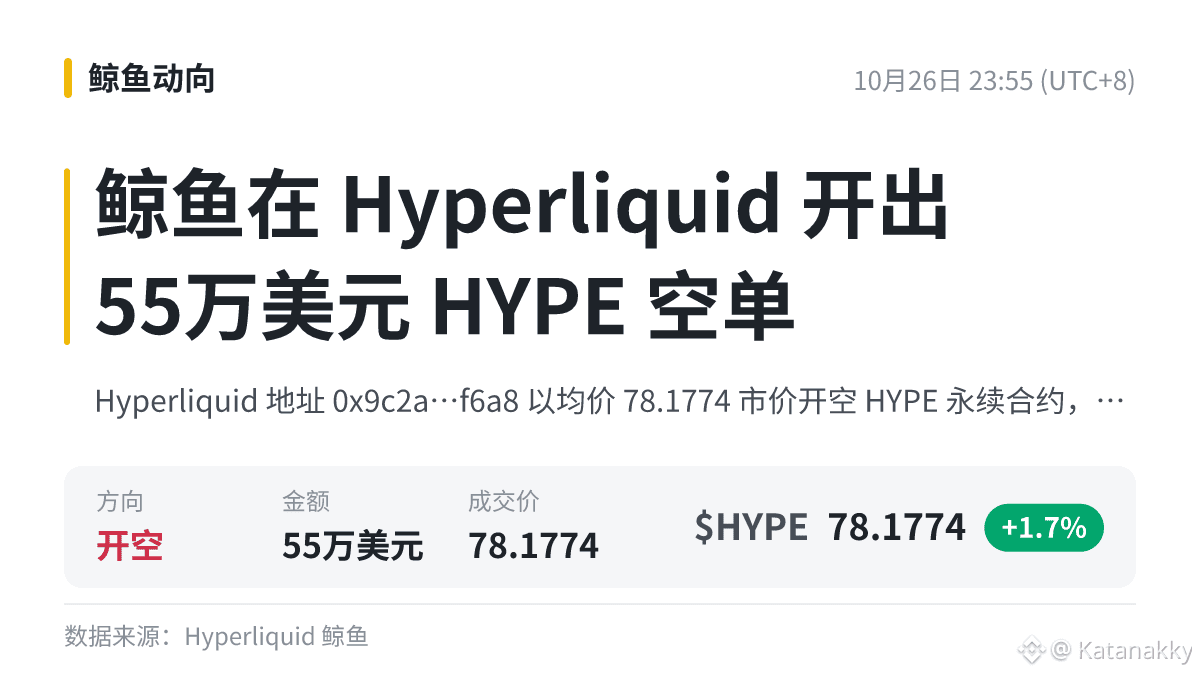
$HYPE : 0x9c2a…f6a8 opened a $550,000 short at 78.1774.
A new short position, betting on a price decline. Near the entry price, it could become a focus of short-term trading.
If you're bullish or bearish, what are your reasons?
#Hyperliquid
It's your money—think it through before acting.
Funds perspective:
$HYPE : 0x9c2a…f6a8 opened a $550,000 short at 78.1774.
A new short position, betting on a price decline. Near the entry price, it could become a focus of short-term trading.
If you're bullish or bearish, what are your reasons?
#Hyperliquid
It's your money—think it through before acting.
$HYPE : 0x9c2a…f6a8 opened a $550,000 short at 78.1774.
A new short position, betting on a price decline. Near the entry price, it could become a focus of short-term trading.
If you're bullish or bearish, what are your reasons?
#Hyperliquid
It's your money—think it through before acting.
48

·
--
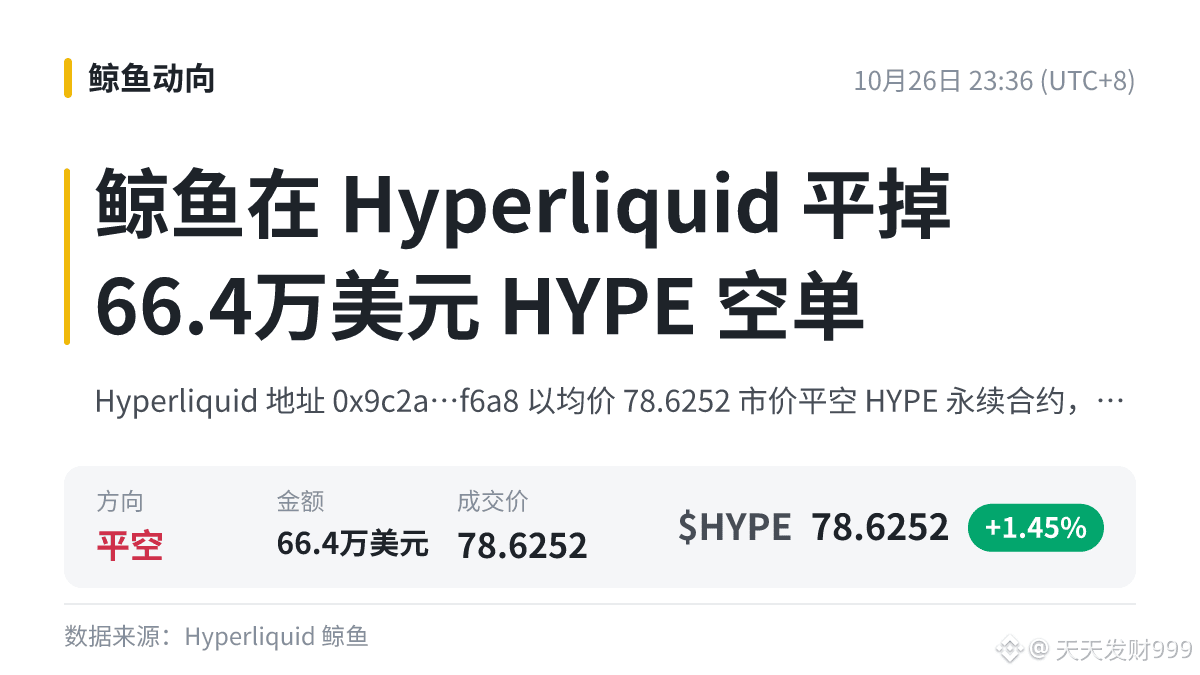
$HYPE Whale closes a short position for $664,000!
Opening a position doesn’t mean you’ll make money; how you close it later is what matters.
#Hyperliquid #HYPE
Just a note—decide for yourself what to do.
$HYPE Whale closes a short position for $664,000!
Opening a position doesn’t mean you’ll make money; how you close it later is what matters.
#Hyperliquid #HYPE
Just a note—decide for yourself what to do.
Opening a position doesn’t mean you’ll make money; how you close it later is what matters.
#Hyperliquid #HYPE
Just a note—decide for yourself what to do.

·
--
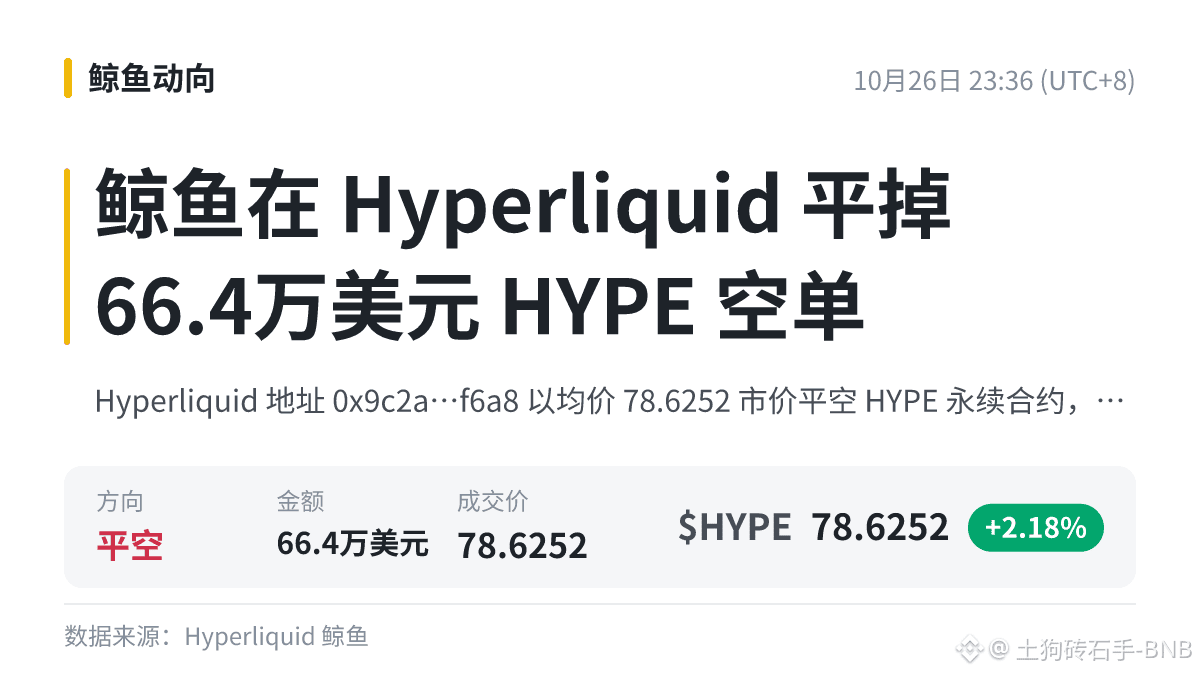
A whale closed a $664,000 short on Hyperliquid, $HYPE , at a price of 78.6252.
What this address does next is more informative than this trade. Bullish or bearish?
#Hyperliquid
A whale closed a $664,000 short on Hyperliquid, $HYPE , at a price of 78.6252.
What this address does next is more informative than this trade. Bullish or bearish?
#Hyperliquid
What this address does next is more informative than this trade. Bullish or bearish?
#Hyperliquid
1

·
--
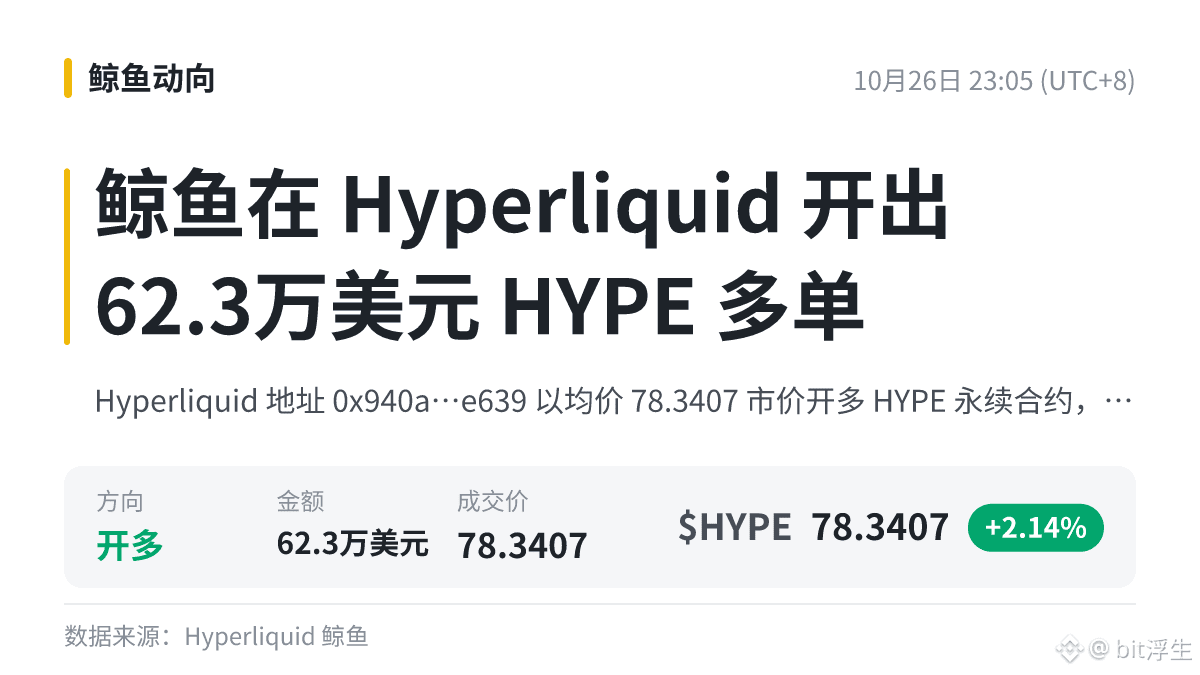
Whale Tracking: $HYPE
Address: 0x940a…e639
Platform: Hyperliquid
Action: Opened a long position
Amount: $623,000
Price: 78.3407
This is a newly opened leveraged position. The area around its liquidation price may become a focal point in the battle between bulls and bears.
#Hyperliquid #HYPE
Whale Tracking: $HYPE
Address: 0x940a…e639
Platform: Hyperliquid
Action: Opened a long position
Amount: $623,000
Price: 78.3407
This is a newly opened leveraged position. The area around its liquidation price may become a focal point in the battle between bulls and bears.
#Hyperliquid #HYPE
Address: 0x940a…e639
Platform: Hyperliquid
Action: Opened a long position
Amount: $623,000
Price: 78.3407
This is a newly opened leveraged position. The area around its liquidation price may become a focal point in the battle between bulls and bears.
#Hyperliquid #HYPE

·
--
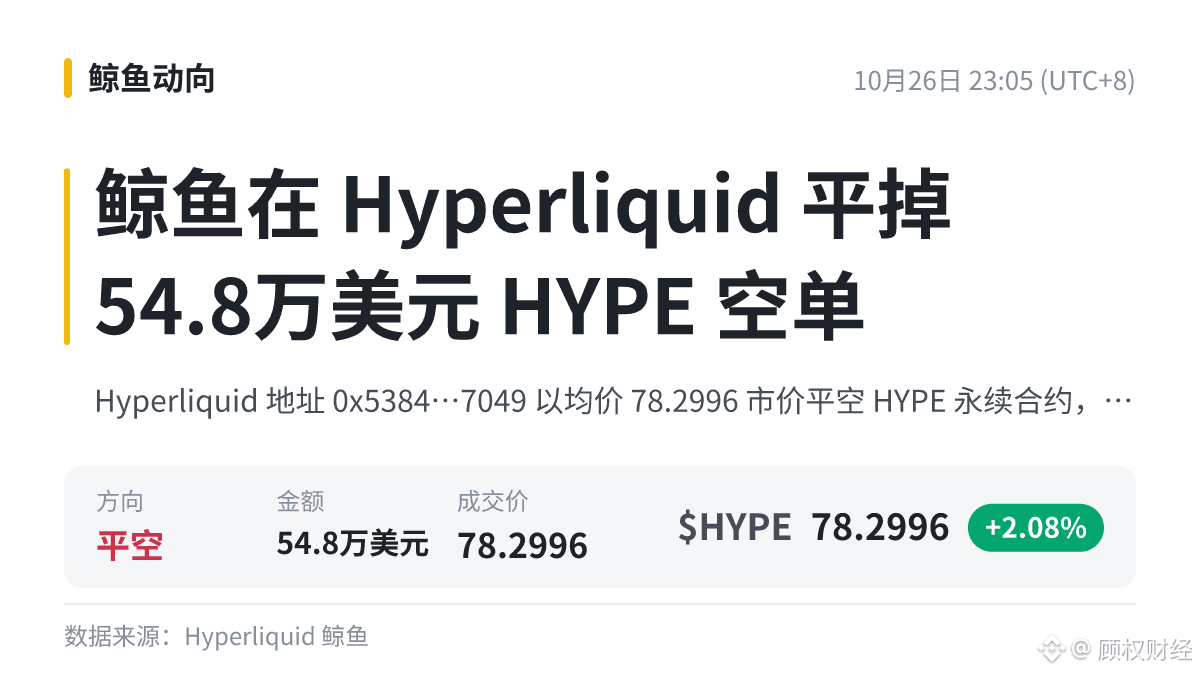
From a capital-flow perspective:
$HYPE : 0x5384…7049 closed a $548,000 short position at 78.2996.
Closing a short means buying back. Closing a position doesn’t necessarily mean reversing direction; it could simply be taking profit.
Leave your prediction in the comments, and we’ll check back in a few days.
#Hyperliquid
From a capital-flow perspective:
$HYPE : 0x5384…7049 closed a $548,000 short position at 78.2996.
Closing a short means buying back. Closing a position doesn’t necessarily mean reversing direction; it could simply be taking profit.
Leave your prediction in the comments, and we’ll check back in a few days.
#Hyperliquid
$HYPE : 0x5384…7049 closed a $548,000 short position at 78.2996.
Closing a short means buying back. Closing a position doesn’t necessarily mean reversing direction; it could simply be taking profit.
Leave your prediction in the comments, and we’ll check back in a few days.
#Hyperliquid

·
--
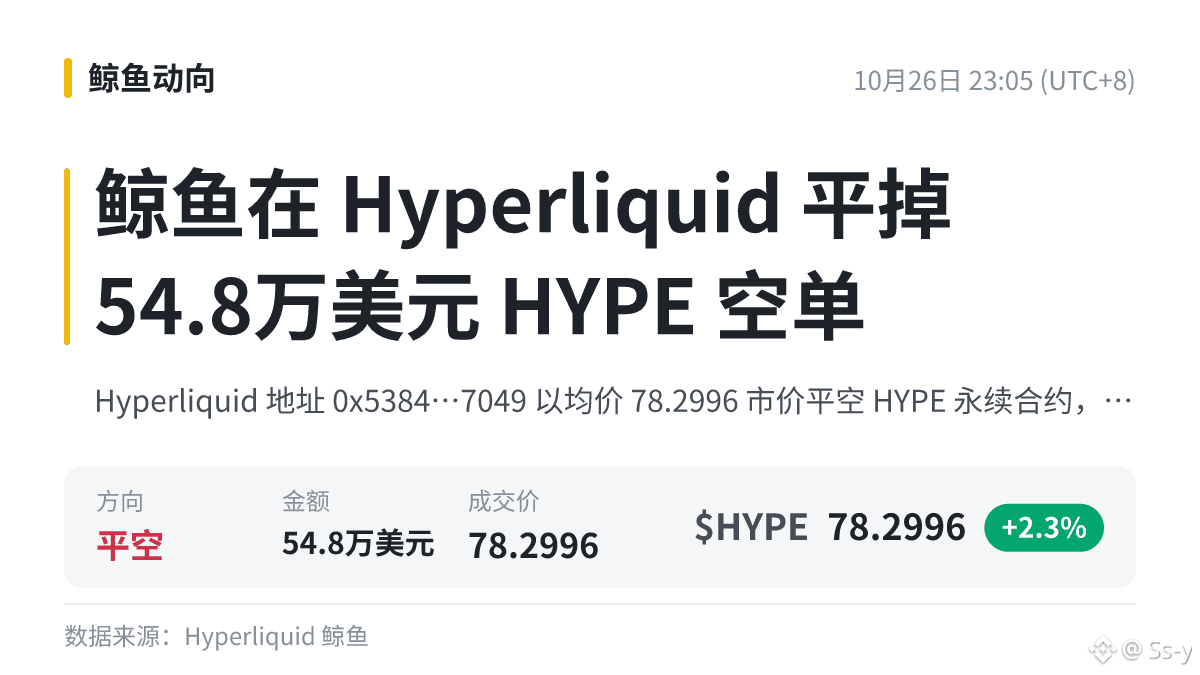
Whale tracking: $HYPE
Address: 0x5384…7049
Platform: Hyperliquid
Action: Closed short
Amount: $548,000
Price: 78.2996
Tracking this address for a little longer will help you better judge their style. Let’s discuss in the comments.
#Hyperliquid #HYPE
Whale tracking: $HYPE
Address: 0x5384…7049
Platform: Hyperliquid
Action: Closed short
Amount: $548,000
Price: 78.2996
Tracking this address for a little longer will help you better judge their style. Let’s discuss in the comments.
#Hyperliquid #HYPE
Address: 0x5384…7049
Platform: Hyperliquid
Action: Closed short
Amount: $548,000
Price: 78.2996
Tracking this address for a little longer will help you better judge their style. Let’s discuss in the comments.
#Hyperliquid #HYPE
3

·
--
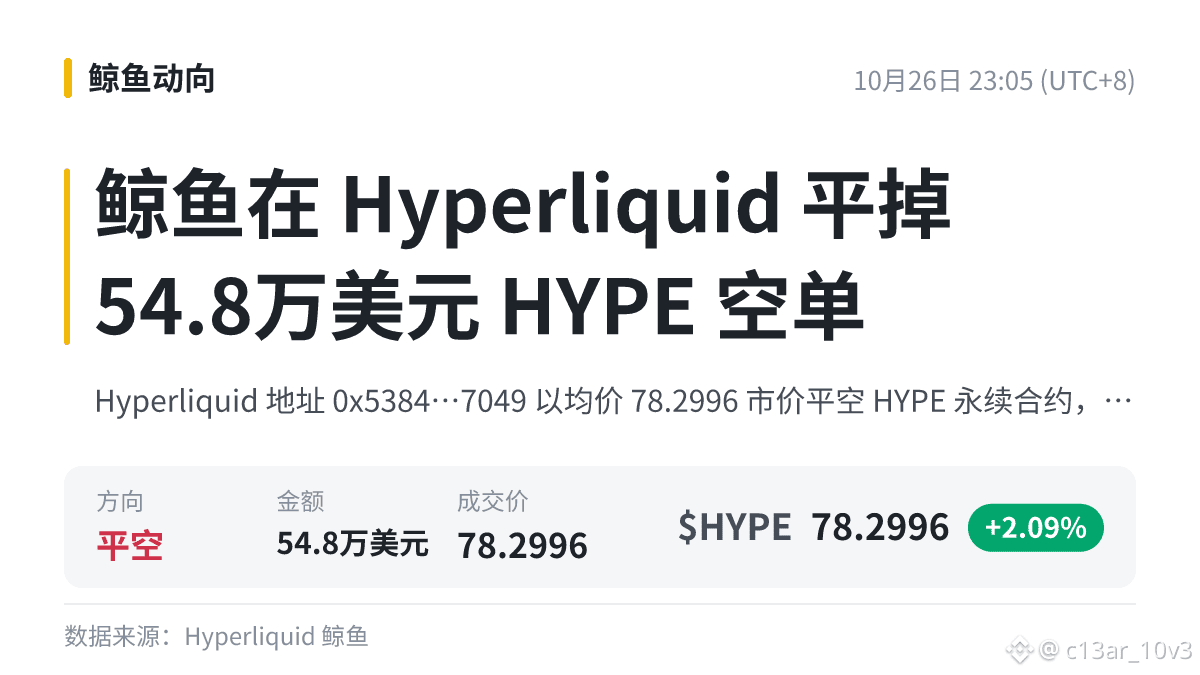
Follow the money:
0x5384…7049 just closed a short position on Hyperliquid for $HYPE , worth $548,000, at around 78.2996.
This is a bullish-leaning move. Watch to see whether this address adds to its position or reverses and exits.
Keep a close eye on it.
#Hyperliquid #HYPE
Follow the money:
0x5384…7049 just closed a short position on Hyperliquid for $HYPE , worth $548,000, at around 78.2996.
This is a bullish-leaning move. Watch to see whether this address adds to its position or reverses and exits.
Keep a close eye on it.
#Hyperliquid #HYPE
0x5384…7049 just closed a short position on Hyperliquid for $HYPE , worth $548,000, at around 78.2996.
This is a bullish-leaning move. Watch to see whether this address adds to its position or reverses and exits.
Keep a close eye on it.
#Hyperliquid #HYPE

·
--
Whether public blockchains should directly bear regulatory responsibility is back in the spotlight.
According to reports by PANews and others, Hyperliquid co-founder Jeff Yan has proposed a tiered regulatory approach, emphasizing that regulatory responsibility should fall primarily on market operators, rather than the underlying protocol itself. The HIP-3 protocol allows third parties to deploy markets; reports say Payward, Bitnomial, and others plan to use it to build regulated products.
How to interpret this: It’s a regulatory narrative that separates the “protocol layer” from the “product/operations layer.” For traders, what matters isn’t the rhetoric, but who operates each market, where the boundaries of licensing and compliance lie, and who takes responsibility for clearing and disputes. Tracking the third-party markets launched on HIP-3 and their disclosures will be more useful than focusing only on the binary “deregulation vs. strict regulation” debate.
#Hyperliquid #HIP3 #监管 #DeFi
Whether public blockchains should directly bear regulatory responsibility is back in the spotlight.
According to reports by PANews and others, Hyperliquid co-founder Jeff Yan has proposed a tiered regulatory approach, emphasizing that regulatory responsibility should fall primarily on market operators, rather than the underlying protocol itself. The HIP-3 protocol allows third parties to deploy markets; reports say Payward, Bitnomial, and others plan to use it to build regulated products.
How to interpret this: It’s a regulatory narrative that separates the “protocol layer” from the “product/operations layer.” For traders, what matters isn’t the rhetoric, but who operates each market, where the boundaries of licensing and compliance lie, and who takes responsibility for clearing and disputes. Tracking the third-party markets launched on HIP-3 and their disclosures will be more useful than focusing only on the binary “deregulation vs. strict regulation” debate.
#Hyperliquid #HIP3 #监管 #DeFi
According to reports by PANews and others, Hyperliquid co-founder Jeff Yan has proposed a tiered regulatory approach, emphasizing that regulatory responsibility should fall primarily on market operators, rather than the underlying protocol itself. The HIP-3 protocol allows third parties to deploy markets; reports say Payward, Bitnomial, and others plan to use it to build regulated products.
How to interpret this: It’s a regulatory narrative that separates the “protocol layer” from the “product/operations layer.” For traders, what matters isn’t the rhetoric, but who operates each market, where the boundaries of licensing and compliance lie, and who takes responsibility for clearing and disputes. Tracking the third-party markets launched on HIP-3 and their disclosures will be more useful than focusing only on the binary “deregulation vs. strict regulation” debate.
#Hyperliquid #HIP3 #监管 #DeFi
12

·
--
Just saw a whale open a $550,000 short position on Hyperliquid, $HYPE .
Whales lose money too, but they make more noise.
#Hyperliquid #HYPE
Just saw a whale open a $550,000 short position on Hyperliquid, $HYPE .
Whales lose money too, but they make more noise.
#Hyperliquid #HYPE
Whales lose money too, but they make more noise.
#Hyperliquid #HYPE
8

·
--
Hyperliquid’s new regulatory approach: Could it make oversight of public blockchains easier?
Hyperliquid founder Jeff Yan has a new idea that could make public-chain regulation a breeze! Market operators take responsibility, with the HIP-3 protocol lending a hand. Payward and Bitnomial plan to build regulated products, and the path to regulation seems increasingly clear! #Hyperliquid #PublicChainRegulation
Hyperliquid’s new regulatory approach: Could it make oversight of public blockchains easier?
Hyperliquid founder Jeff Yan has a new idea that could make public-chain regulation a breeze! Market operators take responsibility, with the HIP-3 protocol lending a hand. Payward and Bitnomial plan to build regulated products, and the path to regulation seems increasingly clear! #Hyperliquid #PublicChainRegulation
Hyperliquid founder Jeff Yan has a new idea that could make public-chain regulation a breeze! Market operators take responsibility, with the HIP-3 protocol lending a hand. Payward and Bitnomial plan to build regulated products, and the path to regulation seems increasingly clear! #Hyperliquid #PublicChainRegulation
51

·
--
Hyperliquid’s new regulatory approach: Are public blockchain oversight challenges getting easier?
Hyperliquid founder Jeff Yan has a new approach to tackling public blockchain oversight challenges! Market operators take responsibility, with the HIP-3 protocol lending a hand. Payward and Bitnomial are set to build regulated products, and the path to regulation is looking increasingly clear!#Hyperliquid #PublicBlockchainRegulation
Hyperliquid’s new regulatory approach: Are public blockchain oversight challenges getting easier?
Hyperliquid founder Jeff Yan has a new approach to tackling public blockchain oversight challenges! Market operators take responsibility, with the HIP-3 protocol lending a hand. Payward and Bitnomial are set to build regulated products, and the path to regulation is looking increasingly clear!#Hyperliquid #PublicBlockchainRegulation
Hyperliquid founder Jeff Yan has a new approach to tackling public blockchain oversight challenges! Market operators take responsibility, with the HIP-3 protocol lending a hand. Payward and Bitnomial are set to build regulated products, and the path to regulation is looking increasingly clear!#Hyperliquid #PublicBlockchainRegulation
69

·
--
A new regulatory approach from Hyperliquid: could it make public-chain oversight easier?
Hyperliquid founder Jeff Yan has a new approach to tackling public-chain regulatory challenges! Market operators take responsibility, with the HIP-3 protocol providing support. Payward and Bitnomial plan to build regulated products, and the path to regulation seems to be getting clearer!#Hyperliquid #PublicChainRegulation
A new regulatory approach from Hyperliquid: could it make public-chain oversight easier?
Hyperliquid founder Jeff Yan has a new approach to tackling public-chain regulatory challenges! Market operators take responsibility, with the HIP-3 protocol providing support. Payward and Bitnomial plan to build regulated products, and the path to regulation seems to be getting clearer!#Hyperliquid #PublicChainRegulation
Hyperliquid founder Jeff Yan has a new approach to tackling public-chain regulatory challenges! Market operators take responsibility, with the HIP-3 protocol providing support. Payward and Bitnomial plan to build regulated products, and the path to regulation seems to be getting clearer!#Hyperliquid #PublicChainRegulation
59

Hyperliquid’s new regulatory move: could it make regulating public blockchains easier?
Hyperliquid founder Jeff Yan has a new approach to solving the regulatory challenges facing public blockchains! Market operators take responsibility, with the HIP-3 protocol providing support. Payward and Bitnomial are set to build regulated products, making the path to regulation look increasingly clear!#Hyperliquid #PublicBlockchainRegulation
Hyperliquid’s new regulatory move: could it make regulating public blockchains easier?
Hyperliquid founder Jeff Yan has a new approach to solving the regulatory challenges facing public blockchains! Market operators take responsibility, with the HIP-3 protocol providing support. Payward and Bitnomial are set to build regulated products, making the path to regulation look increasingly clear!#Hyperliquid #PublicBlockchainRegulation
Hyperliquid founder Jeff Yan has a new approach to solving the regulatory challenges facing public blockchains! Market operators take responsibility, with the HIP-3 protocol providing support. Payward and Bitnomial are set to build regulated products, making the path to regulation look increasingly clear!#Hyperliquid #PublicBlockchainRegulation
56
Log in to explore more content
Join global crypto users on Binance Square
⚡️ Get latest and useful information about crypto.
💬 Trusted by the world’s largest crypto exchange.
👍 Discover real insights from verified creators.
Email / Phone number
Trending Topics
1
#BinancePick
2.9M views
149,321 Discussing
2
#EarningsSeason
5.2M views
25,491 Discussing
3
#AnthropicTTMRevenueGrewAbout1200%
7,725 views
224 Discussing
4
#AnthropicS1ExpectedToday
11,068 views
212 Discussing
5
#SouthKoreaReportedlyWeighsFourthCryptoTaxDelay
19,230 views
349 Discussing
6
#FranklinTempletonFilesForTwoDividendToBitcoinETFs
26,176 views
455 Discussing
7
#StrategyMSTRSurpassesNasdaqInMarketCap
20,051 views
339 Discussing
8
#CanadaProposesStablecoinRedemptionWithin3BusinessDays
920 views
33 Discussing
9
#ElectrumWalletBugLetRogueServersStealFunds
23,465 views
426 Discussing
10
#ArgentineCourtDismissesLIBRACaseAgainstMilei
35,444 views
523 Discussing