
#vaneck
vaneck
630,541 views
977 Discussing
Hot
Latest

·
--
VanEck’s diversified ETF allocates just 2% to Bitcoin, signaling a cautious pace of institutional entry
While pure spot Bitcoin ETFs are seeing substantial inflows, a newly launched diversified ETF from VanEck allocates just 2% to Bitcoin. This contrast warrants a closer look at the underlying capital flows.
According to Cointelegraph, VanEck has launched a diversified ETF combining exposure to stocks, bonds, and Bitcoin. Its target Bitcoin allocation is just 2%, with a permitted range of 1% to 5%. Under normal operating conditions, this means Bitcoin carries far less weight in the fund than it would in a pure BTC ETF—and even less than the allocation to risk assets in most traditional multi-asset portfolios.
The significance of this arrangement lies not in the size of the 2% allocation itself, but in the pace of entry it signals. In recent months, spot Bitcoin ETFs have become an important source of crypto liquidity, thanks to sustained, large-scale net inflows, while institutional capital has taken a relatively aggressive approach to allocation. By contrast, VanEck’s diversified product caps Bitcoin at 2%, suggesting a tactical, defensive exposure rather than a signal of a trend toward increasing allocations.
From a capital-flow perspective, it is important to distinguish between two types of investors. One consists of investors who are specifically bullish on crypto and willing to accept high volatility; they tend to pour money into pure BTC ETFs. The other consists of allocation-focused institutions with limited risk budgets, which are more likely to test the waters through diversified ETFs, using small allocations to spread their exposure. VanEck’s latest product is clearly aimed more at the latter group.
However, the allocation in a single product cannot be taken as a direct indication of institutional sentiment overall. VanEck’s Bitcoin ETFs have performed strongly in the past, showing that the firm is capable of attracting BTC investment. The low allocation this time is more likely to reflect the positioning and risk constraints of this particular product than a rejection of crypto exposure as a whole. The 2% target sits at the midpoint of the range, and the final allocation could still vary between 1% and 5%, leaving the product’s actual contribution to capital flows uncertain.
The market’s reaction may not show up directly in prices in the short term. More telling signals will be the scale of inflows into diversified ETFs, the pace at which capital actually reaches Bitcoin, and whether similar products with low Bitcoin allocations follow suit. If such products become a mainstream vehicle for institutional crypto allocation, the sources of capital flowing into crypto markets could become more diversified and stable.
The key things to watch next are the ETF’s actual inflows, whether its real Bitcoin allocation moves toward the upper end of the range, and whether similar diversified products adopt the same conservative framework.
#VanEck #ETF #Bitcoin
The above is an aggregation of information and personal analysis, and does not constitute investment advice.
39


·
--
Hey guys!! VanEck has come up with something new!!!
They just launched a Wealth Builder ETF (ticker: WBMO)—an actively managed “basket” of stocks, bonds, physical assets, plus a little Bitcoin exposure. The official target is around 2% in Bitcoin-related ETPs (roughly a 1%–5% range). It doesn’t hold Bitcoin directly, and the net expense ratio is about 0.26%.
Honestly, while everyone’s still waiting for the Fed statement on Fed day, big asset managers are already slipping BTC into ordinary portfolios, haha. It’s only a small position, but this is how Bitcoin is gradually going from a “risky bet” to a “side dish” in a portfolio.
Do you think a 2% allocation like this could bring more everyday investors in, or is it just a nice-looking concept?
$BTC
#VanEck #Crypto
184

·
--
On October 27, VanEck launched the Wealth Builder ETF (NYSE: WBMO), combining exposure to global stocks, bonds, real assets, and bitcoin in a single actively managed fund. According to the issuer, the target bitcoin allocation is approximately 2%, with an allowed range of approximately 1%–5%. The fund holds bitcoin indirectly through spot bitcoin ETPs and does not hold bitcoin directly. Its gross expense ratio is approximately 0.33%, and its net expense ratio is approximately 0.26%. Sample holdings include underlying products such as $HODL. The fund has launched and is trading. #比特币 #ETF #VanEck $BTC
On October 27, VanEck launched the Wealth Builder ETF (NYSE: WBMO), combining exposure to global stocks, bonds, real assets, and bitcoin in a single actively managed fund. According to the issuer, the target bitcoin allocation is approximately 2%, with an allowed range of approximately 1%–5%. The fund holds bitcoin indirectly through spot bitcoin ETPs and does not hold bitcoin directly. Its gross expense ratio is approximately 0.33%, and its net expense ratio is approximately 0.26%. Sample holdings include underlying products such as $HODL. The fund has launched and is trading. #比特币 #ETF #VanEck $BTC
1
40
·
--
VanEck’s multi-asset ETF sets a bitcoin target allocation of just 2%, signaling a cautious pace of institutional entry
Market attention often focuses on net inflows into spot bitcoin ETFs, but VanEck’s newly launched Wealth Builder ETF offers a different perspective: bitcoin has a target allocation of just 2% in this multi-asset ETF.
According to Cointelegraph, VanEck’s newly launched Wealth Builder ETF allows bitcoin exposure to range from 1% to 5%, with a target midpoint of 2%. It is the first ETF on the market to combine exposure to stocks, bonds, and bitcoin.
This structure is worth examining from a capital-flow perspective. It means institutional capital has more than one route into bitcoin; it need not rely solely on the single-asset, “all-in” approach of spot ETFs. Within a stocks + bonds + BTC framework, bitcoin is more like a “satellite allocation”—providing some risk exposure within the overall portfolio rather than serving as a core holding. This differs significantly from the logic of spot ETF investors, who make BTC their primary investment theme.
In terms of scale and pace, a 2% target allocation means that even if the ETF attracts substantial assets, the share actually flowing into BTC will be relatively limited. Given the 1%–5% range, even an allocation at the 5% upper limit would have only a marginal impact on capital flowing into BTC, and would be unlikely to constitute a directional signal.
This may reflect the current “cautiously progressive” stance of institutional capital: institutions want to establish bitcoin exposure through regulated products while using a multi-asset structure to manage overall volatility. The pace is clearly slower than the frenzied inflows seen earlier in spot ETFs.
What remains to be seen is the actual size of this new product and how its inflows develop over time. The low 2% allocation means its near-term impact on BTC is limited. Its significance lies more in marking the diversification of institutional entry routes than in directly expanding the amount of capital invested.
What to watch next: At the trading level, the more important thing is to wait for confirmation from the market—watch for sustained net inflows into the ETF and whether the 2% allocation moves toward the upper end of its range in practice, rather than drawing conclusions based solely on the product launch.
#VanEck #Bitcoin #ETF
The above is a compilation of information and personal analysis, and does not constitute investment advice.
68
·
--
VanEck Launches a Multi-Asset ETF: The Institutional Capital Signal Behind a 2% Bitcoin Allocation
The world’s second-largest ETF issuer, VanEck, has for the first time combined stocks, bonds, and Bitcoin in a single portfolio. The significance of this move may lie less in its size than in a shift in how capital is allocated.
According to Cointelegraph, VanEck’s Wealth Builder ETF targets a 2% Bitcoin allocation, with a permitted range of 1% to 5%. This means institutional investors can use a product built within a traditional framework to include Bitcoin as a small but formal component of their portfolios.
Why is this worth watching from a capital-flow perspective? In recent years, the central narrative around crypto ETFs has been “crypto only”—capital either flows in or out, and net inflows and outflows from BTC ETFs directly affect prices. This multi-asset ETF points to a new possibility: institutions no longer need to allocate to Bitcoin separately. Instead, they can incorporate it into an overall portfolio with a 1% to 5% weighting, much like they would allocate a portion to bonds or stocks. This marks a transition from “crypto-specific capital” to “traditional and crypto assets combined in one allocation”—a structural turning point in the capital-flow narrative.
Still, the impact on capital flows should be viewed cautiously. A 2% target allocation, within a range of 1% to 5%, means that even if the ETF raises substantial assets, the amount of capital actually flowing into BTC will be relatively limited. It is more of an allocation tool than a speculative gateway, and its contribution to actual capital inflows into BTC may be more symbolic than a meaningful source of new demand.
In terms of market reaction, products like this are more a signal of sentiment and narrative: institutional allocation frameworks are beginning to “normalize” Bitcoin, rather than triggering sudden, large-scale buying. Prices may not move decisively in the short term. What really matters is whether similar multi-asset products follow and whether capital continues to flow into them.
One counterpoint is that a 2% allocation is indeed relatively low, and the appeal of a multi-asset ETF depends heavily on its traditional asset components. Bitcoin itself is just an ancillary exposure. If the market interprets this as “major bullish news” and chases prices higher, investors may have to contend with a gap between expectations and the actual scale of investment.
What to watch next: From a capital-flow perspective, the more important questions are whether these multi-asset ETFs can attract sustained inflows and whether more institutions will treat them as a standard portfolio allocation option, rather than a one-off event-driven trade.
#VanEck #BitcoinETF #ETFFlows
The above is a summary of information and personal analysis, and does not constitute investment advice.
Follow me for ongoing coverage of key market developments and data.
1
161

·
--
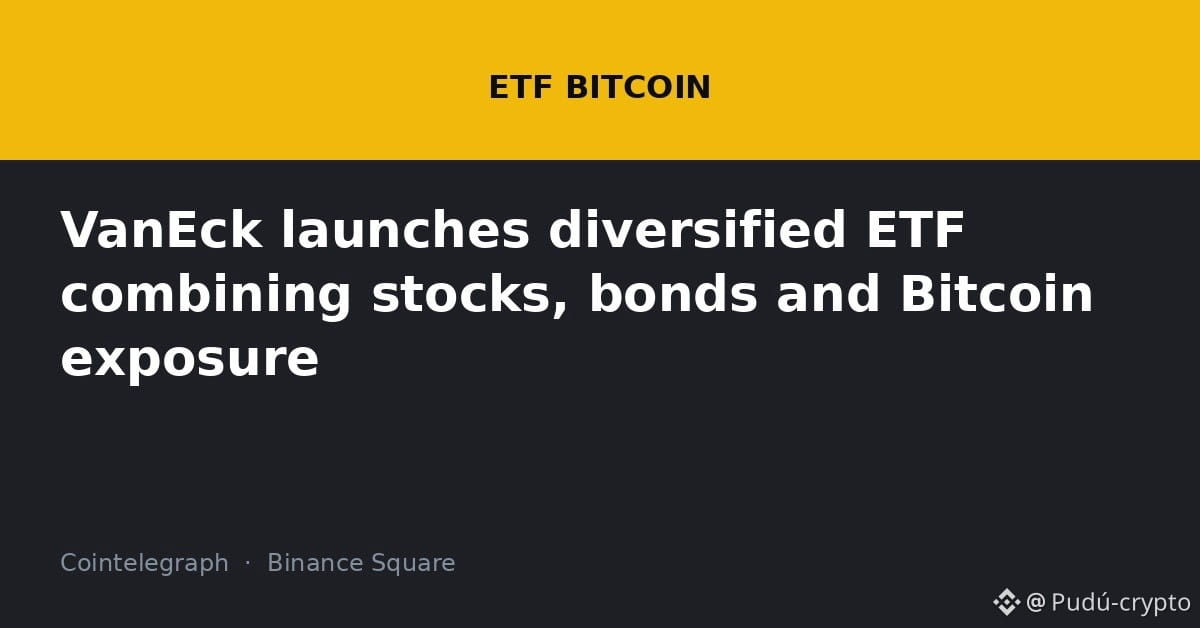
VanEck just made a very interesting move in the ETF space.
They launched a fund that combines stocks, bonds, and $BTC in a single package.
What stands out is the weight they give to crypto.
The fund targets a fixed 2% allocation to Bitcoin.
They can adjust that percentage between 1% and 5%, depending on how they see the market.
It’s a way to combine traditional assets with direct exposure through an ETP.
Basically, they want users to have a little bit of everything in one place.
What do you think of this mixed approach?
#Bitcoin #VanEck #ETF

34

·
--
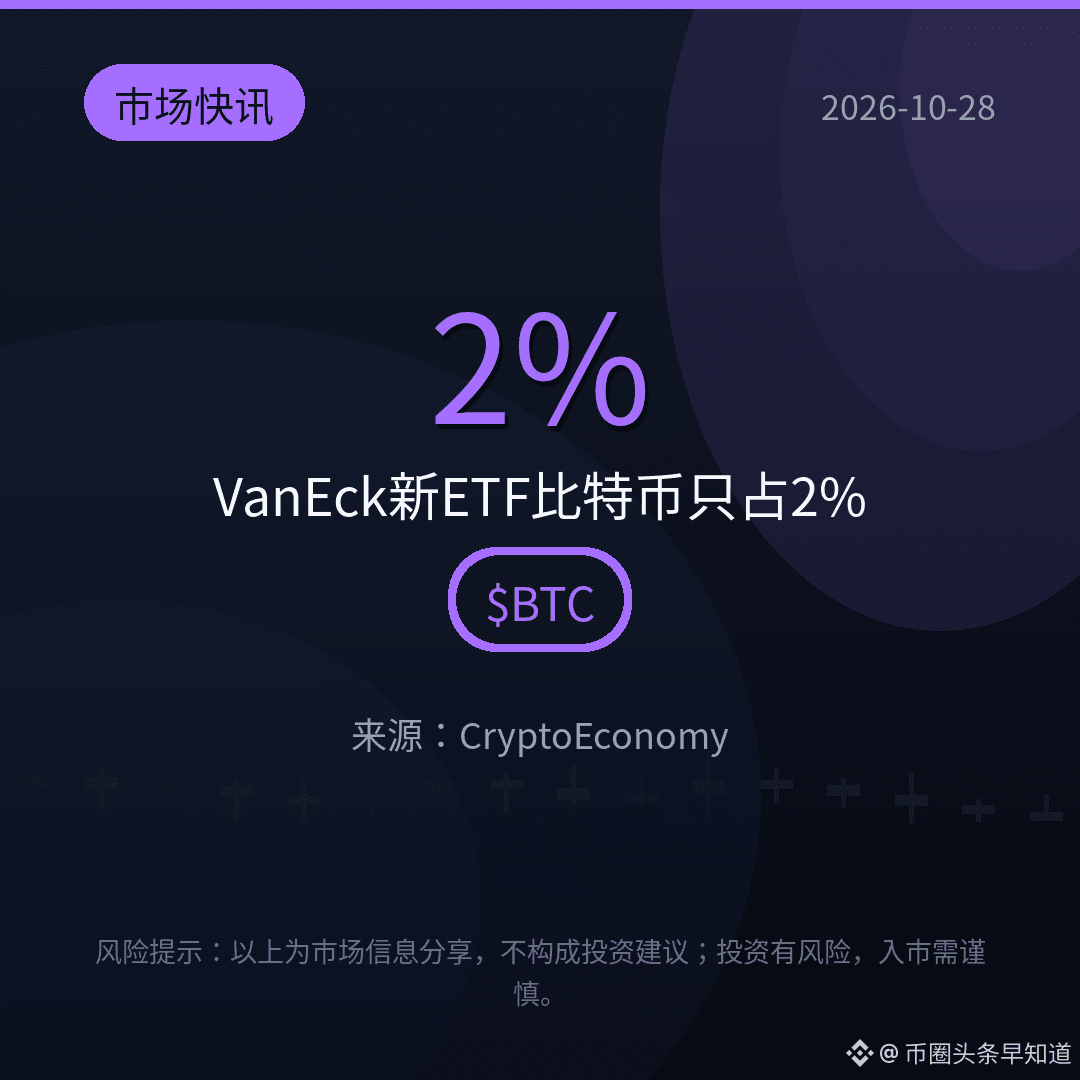
【Market Flash】VanEck has just added Bitcoin to its “everything-but-the-kitchen-sink” fund: its newly launched WBMO multi-asset ETF includes stocks, bonds, gold, and infrastructure, with Bitcoin-related products targeted at just 2% and a range of 1%–5%. It won’t hold Bitcoin directly, investing only in Bitcoin ETF products. The fee is 0.33%, with rebalancing once per quarter. Is 2% a sign of acceptance, or just a cautious toe-dip? Is this bullish or bearish for $BTC ? Reply 1 for bullish, 2 for bearish.
$BTC $ETH $SOL
#比特币 #ETF #VanEck
(Source: CryptoEconomy)
⚠️Risk warning: The above is shared for informational purposes only and does not constitute investment advice. Investing involves risk; please exercise caution.
$BTC $ETH $SOL
#比特币 #ETF #VanEck
(Source: CryptoEconomy)
⚠️Risk warning: The above is shared for informational purposes only and does not constitute investment advice. Investing involves risk; please exercise caution.
106
·
--
VanEck backtracked on its plan for a $ETH staking ETF.
The asset manager formally requested to withdraw the application it had originally submitted in October last year.
It’s striking to see this move after the long regulatory journey these financial products have been through.
What do you make of this change of decision?
#Crypto #Ethereum #VanEck
The asset manager formally requested to withdraw the application it had originally submitted in October last year.
It’s striking to see this move after the long regulatory journey these financial products have been through.
What do you make of this change of decision?
#Crypto #Ethereum #VanEck

120


·
--
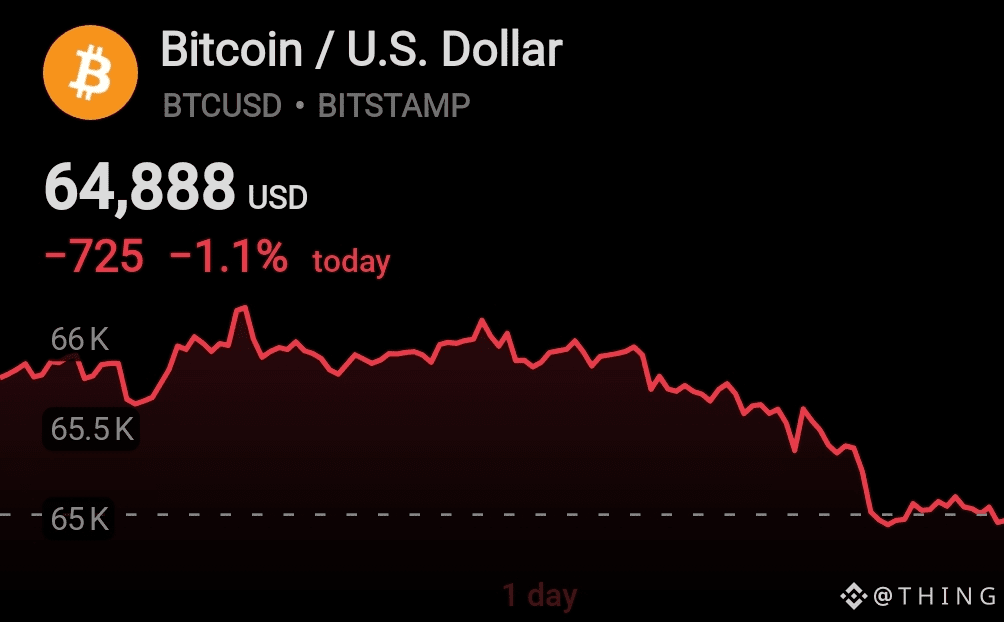
Bitcoin Miners Face $50 Billion Funding Gap in AI Race, Says VanEck
As miners aggressively pivot from BTC mining to AI infrastructure, VanEck warns they’re staring at a massive $50 Billion funding shortfall.
The shift to high-power AI data centers is capital intensive, and many companies may struggle to secure enough money.
Will only the strongest miners survive the AI pivot?
Big opportunity or big risk for mining stocks? 👀
{future}(BTCUSDT)
#BitcoinMining #AI #VanEck #Crypto
Bitcoin Miners Face $50 Billion Funding Gap in AI Race, Says VanEck
As miners aggressively pivot from BTC mining to AI infrastructure, VanEck warns they’re staring at a massive $50 Billion funding shortfall.
The shift to high-power AI data centers is capital intensive, and many companies may struggle to secure enough money.
Will only the strongest miners survive the AI pivot?
Big opportunity or big risk for mining stocks? 👀
#BitcoinMining #AI #VanEck #Crypto
20
284

·
--
⚠️ VanEck Disputes MARA Bitcoin Purchase Claims
VanEck’s Matthew Sigel says reports of MARA Holdings acquiring 1,000 BTC are likely misinterpretations of collateral movements rather than new purchases.
Key Highlights:
✅ BTC movement likely loan collateral return
✅ No confirmed spot buying activity
✅ Highlights complexity of on-chain flows
✅ Mining firms use advanced financial structures
The clarification underscores the importance of context when interpreting large blockchain transactions.
Read more:
https://cointopsecret.com
#Bitcoin #BTC #MARA #VanEck #CryptoNews #Finance #Blockchain #BinanceSquare #cointopsecret

35

·
--
Bullish
🚨 $BNB just got its #etf era. This changes everything.
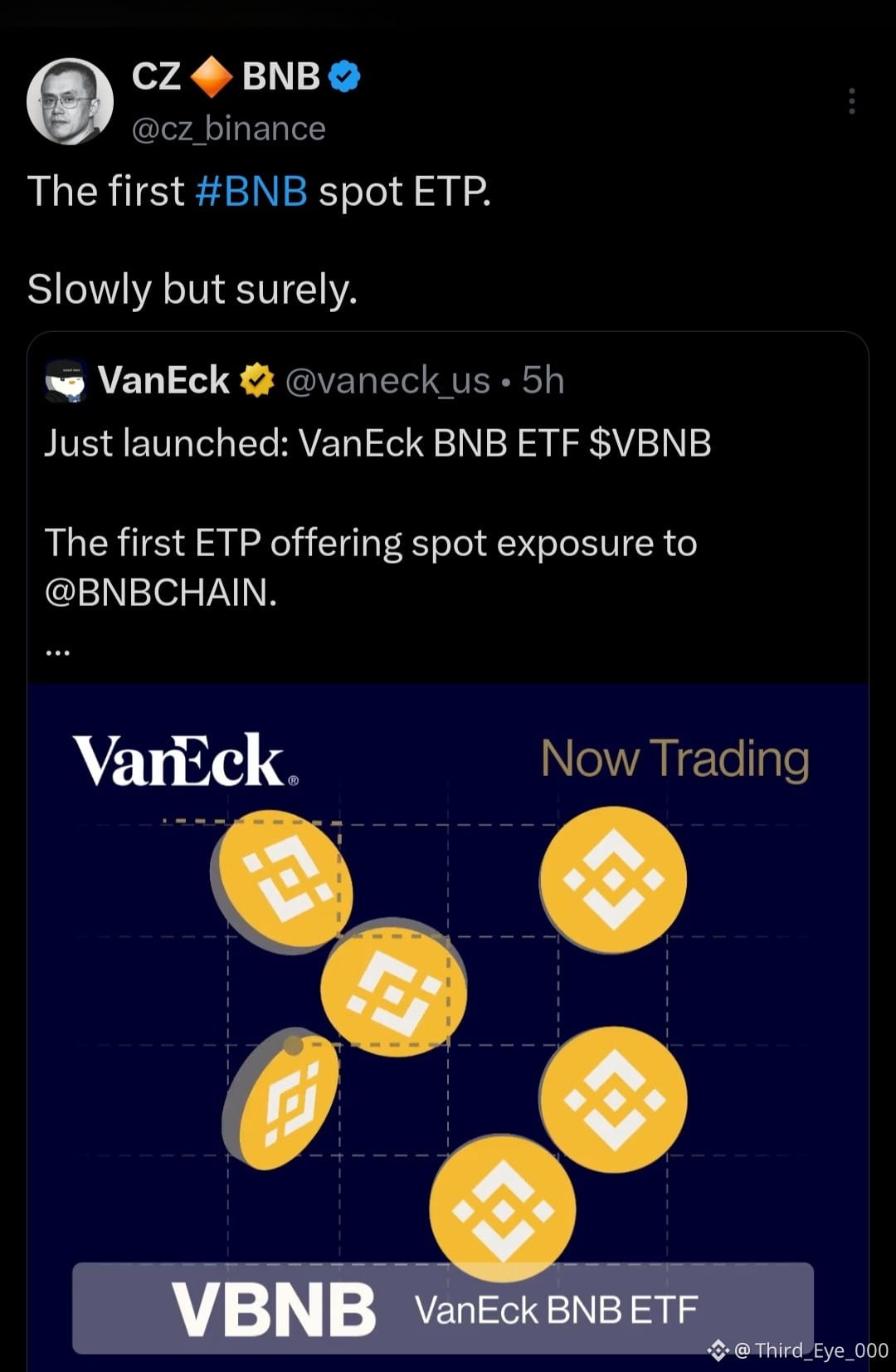
VanEck's $VBNB is now live on Nasdaq — the first U.S.-listed BNB spot ETF. Physical #bnb . Real custody. Traditional brokerage access. The 4th largest crypto by market cap ($88B) just walked through Wall Street's front door.
@CZ said it best: "Slowly but surely."
Now look at this chart and tell me this isn't a generational asset 👇
📊 #BNB Year-by-Year Growth :
• 2017 Launch: $0.10 → EOY $8.90 🟢 +7,800%
• 2018: $8.90 → bear market floor 🔴
• 2019: $10.84 → +21% recovery 🟡
• 2020: $21.97 → +102% 🟢
• 2021: $267.51 → +1,117% 🚀🚀🚀
• 2022: $374.31 → macro pain 🔴
• 2023: $312.86 → +16% grind 🟡
• 2024: $376.96 → +20% 🟢
• 2025: $647.79 → ATH $1,370 🔥
From $0.10 → $650+ in 8 years. No hype needed, the chart speaks.
An ETF doesn't just bring liquidity — it brings legitimacy. Institutions don't FOMO in fast, but when they do, they don't leave either.
$BNB isn't just an exchange token anymore. It's infrastructure.
Slowly but surely. 🧡
#VanEck
{spot}(BNBUSDT)
🚨 $BNB just got its #etf era. This changes everything.
VanEck's $VBNB is now live on Nasdaq — the first U.S.-listed BNB spot ETF. Physical #bnb . Real custody. Traditional brokerage access. The 4th largest crypto by market cap ($88B) just walked through Wall Street's front door.
@CZ said it best: "Slowly but surely."
Now look at this chart and tell me this isn't a generational asset 👇
📊 #BNB Year-by-Year Growth :
• 2017 Launch: $0.10 → EOY $8.90 🟢 +7,800%
• 2018: $8.90 → bear market floor 🔴
• 2019: $10.84 → +21% recovery 🟡
• 2020: $21.97 → +102% 🟢
• 2021: $267.51 → +1,117% 🚀🚀🚀
• 2022: $374.31 → macro pain 🔴
• 2023: $312.86 → +16% grind 🟡
• 2024: $376.96 → +20% 🟢
• 2025: $647.79 → ATH $1,370 🔥
From $0.10 → $650+ in 8 years. No hype needed, the chart speaks.
An ETF doesn't just bring liquidity — it brings legitimacy. Institutions don't FOMO in fast, but when they do, they don't leave either.
$BNB isn't just an exchange token anymore. It's infrastructure.
Slowly but surely. 🧡
#VanEck
1
320

·
--
Bullish
Verified
🔥 JUST IN: VanEck launches the first U.S. spot BNB ETF $VBNB.
#VanEck #vbnb #VanEck_SOL_ETFS #VanEck提交首个SolanaETF #AnfeliaInvestment
🔥 JUST IN: VanEck launches the first U.S. spot BNB ETF $VBNB.
#VanEck #vbnb #VanEck_SOL_ETFS #VanEck提交首个SolanaETF #AnfeliaInvestment
#VanEck #vbnb #VanEck_SOL_ETFS #VanEck提交首个SolanaETF #AnfeliaInvestment


9
1
4
3.8k

·
--
🚨 VanEck CEO Jan van Eck remains EXTREMELY bullish on Bitcoin long-term 🔥
BUT he warns: 2026 could mark a historic downturn phase in the 4-year halving cycle.
Long-term optimism… short-term caution. 👀$ALLO $XLM $BAT
{spot}(XLMUSDT)
{spot}(BATUSDT)
{spot}(ALLOUSDT)
#bitcoin #VanEck #CEO #CryptoNewss
🚨 VanEck CEO Jan van Eck remains EXTREMELY bullish on Bitcoin long-term 🔥
BUT he warns: 2026 could mark a historic downturn phase in the 4-year halving cycle.
Long-term optimism… short-term caution. 👀$ALLO $XLM $BAT
#bitcoin #VanEck #CEO #CryptoNewss
BUT he warns: 2026 could mark a historic downturn phase in the 4-year halving cycle.
Long-term optimism… short-term caution. 👀$ALLO $XLM $BAT
#bitcoin #VanEck #CEO #CryptoNewss


2
45

·
--
My trader friend sent me a message last night: "BNB ETF passed, did you buy in?"
I said no, and she said she didn't either. 😭
VanEck's VBNB officially launched today, and with physical custody, Americans can directly buy exposure through their brokerage accounts at $BNB .
This is a big deal—after BTC and ETH, BNB is the first exchange platform coin to get a US spot ETF.
What's the significance? The entry barrier for traditional funds just got lower. No need to open an exchange account, no need to manage private keys, just buy it directly in Fidelity or Schwab. These folks aren't from the same crowd as us; they won't be checking on-chain data, but they have the money.
However, I checked the charts today, and $BNB is now at $637, down 1.5% over the last 24 hours.
With such good news, the price actually dropped, which I find a bit hard to understand—or rather, I do understand; it's the classic case of "buy the rumor, sell the news."
Contract volume is more than 4 times that of spot, with a funding rate of +0.0106%, which isn't extreme, but the bulls are holding strong.
I'm not chasing this price.
The ETF channel opening is a long-term positive, but with the short-term sentiment so chaotic, jumping in now could easily get me shaken out. I prefer to wait until it digests this wave of emotion and stabilizes before making a move.
It's late, DouDou is already asleep, and I'm still staring at the candlesticks in a daze.
The market is changing; today might not be the same as tomorrow.
$BNB #BNB #BNBSpotETF #VanEck
175

📈 VanEck says Bitcoin’s bear market may already be over.
According to Bitcoin Archive, VanEck says all 12 quantitative signals it tracks are now pointing to the end of Bitcoin’s bear market.
VanEck also noted that Strategy’s selling looks like a classic “headline bottom.”
Personally, this is the part I find more interesting than the headline itself.
If 12 different quantitative signals are flashing bullish at the same time, the bigger question isn't whether BTC can bounce.
It's whether we're already looking at the early stages of the next cycle while everyone is still waiting for confirmation.
The market loves doing this:
Bottom forms → everyone waits → BTC pumps → everyone suddenly becomes a macro expert. 😂
Do you think Bitcoin has truly ended its bear market, or is this just a rebound to lure in more liquidity before the market continues lower?
#bitcoin $BTC
{spot}(BTCUSDT)
#VanEck #crypto #BrainrotCrypto
📈 VanEck says Bitcoin’s bear market may already be over.
According to Bitcoin Archive, VanEck says all 12 quantitative signals it tracks are now pointing to the end of Bitcoin’s bear market.
VanEck also noted that Strategy’s selling looks like a classic “headline bottom.”
Personally, this is the part I find more interesting than the headline itself.
If 12 different quantitative signals are flashing bullish at the same time, the bigger question isn't whether BTC can bounce.
It's whether we're already looking at the early stages of the next cycle while everyone is still waiting for confirmation.
The market loves doing this:
Bottom forms → everyone waits → BTC pumps → everyone suddenly becomes a macro expert. 😂
Do you think Bitcoin has truly ended its bear market, or is this just a rebound to lure in more liquidity before the market continues lower?
#bitcoin $BTC
#VanEck #crypto #BrainrotCrypto
112

·
--
VanEck has slapped a $500,000 price target on BTC, based on comparing its market cap to gold’s. There’s still more than a tenfold gap.
The macro logic checks out: gold is worth over $20 trillion, while BTC is barely above $2 trillion. Even a tiny shift in institutional allocations could send BTC up several multiples.
But a word of caution: treat targets like this as food for thought, not as a signal to buy. The people making big promises last cycle have long since gone quiet. If BTC really hits $500,000, gold would have to be worth less than copper first. 🎯
$BTC #VanEck #Bitcoin

195

#VanEck #etf #Ethereum
📊 Fee War: VanEck Adds Fuel to Ethereum-ETF Race
The question of whether spot Ethereum-ETFs will be approved is finally settled. Now issuers have moved on to a much tougher phase of the fight — the battle for investor capital, where tariffs have become the main weapon.
VanEck has amended its SEC filing to include a fee waiver structure for its upcoming fund. This is a classic move to aggressively attract the first large liquidity flows.
🔑 Why is this important for the market?
➡️ Price dumping as a strategy: Since all ETFs offer access to the same asset ($ETH ), the net cost of ownership becomes a key factor in the choice for professional investors and institutional allocators.
➡️ The beginning of the tariff war: VanEck’s move puts enormous pressure on other issuers. Competitors will have to either lower their own fees or offer even more advantageous temporary benefits.
➡️ Real capital instead of hype: Instead of loud slogans on social networks, the market is starting to focus on dry numbers from SEC reports and tables of real money inflow/outflow.
⚠️ Important context: You should not take this news as a guaranteed market reversal. This is not an instant trigger for price growth, but an important marker of where the industry is heading. Those projects and funds that optimize processes and remain useful even when the overall market cycle becomes too "noisy" win.
{future}(ETHUSDT)
#VanEck #etf #Ethereum
📊 Fee War: VanEck Adds Fuel to Ethereum-ETF Race
The question of whether spot Ethereum-ETFs will be approved is finally settled. Now issuers have moved on to a much tougher phase of the fight — the battle for investor capital, where tariffs have become the main weapon.
VanEck has amended its SEC filing to include a fee waiver structure for its upcoming fund. This is a classic move to aggressively attract the first large liquidity flows.
🔑 Why is this important for the market?
➡️ Price dumping as a strategy: Since all ETFs offer access to the same asset ($ETH ), the net cost of ownership becomes a key factor in the choice for professional investors and institutional allocators.
➡️ The beginning of the tariff war: VanEck’s move puts enormous pressure on other issuers. Competitors will have to either lower their own fees or offer even more advantageous temporary benefits.
➡️ Real capital instead of hype: Instead of loud slogans on social networks, the market is starting to focus on dry numbers from SEC reports and tables of real money inflow/outflow.
⚠️ Important context: You should not take this news as a guaranteed market reversal. This is not an instant trigger for price growth, but an important marker of where the industry is heading. Those projects and funds that optimize processes and remain useful even when the overall market cycle becomes too "noisy" win.

2
84

VanEck CEO: Sticking to a bullish outlook on Bitcoin long-term, but 2026 might be a pullback year in the halving cycle
According to the latest X post from Cointelegraph, VanEck CEO Jan van Eck has maintained his long-term bullish stance on Bitcoin, but he also issued a clear mid-term risk warning for the market.
Van Eck cautioned that historically, in the third year of Bitcoin's four-year halving cycle (i.e., 2026), the market tends to be a down year.
He believes that this year lacks the catalysts needed for a significant market rally, especially since institutional adoption has remained relatively flat, with no signs of explosive growth.
Despite his cautious view on Bitcoin's performance in 2026, Van Eck has not changed his long-term bull market outlook.
He still sees Bitcoin as a valuable long-term investment, advising investors to stay patient and be ready to navigate market volatility at any moment.
#比特币 #VanEck

401
·
--
THE INSTITUTIONAL FLOODGATES JUST OPENED FOR BNB—THE SUPPLY SHOCK STARTS NOW! 🚨
VanEck has officially launched the first U.S. spot BNB ETF ($VBNB), changing the macro game forever.
This isn't just another financial product; it's massive institutional validation forcing Wall Street to systematically buy and lock up native spot supply.
When you pair this massive new institutional demand with BNB's aggressive deflationary burn mechanisms, an unprecedented supply crunch is practically guaranteed.
The smart money is accumulating rapidly while retail is still asleep—the macro market structure has permanently flipped.
Are you front-running Wall Street, or watching from the sidelines? Drop your new BNB price targets below! 👇
$BNB | $ZEC | $TAKE
{spot}(BNBUSDT)
{spot}(ZECUSDT)
#BNB #VanEck #VBNB #CryptoNews
THE INSTITUTIONAL FLOODGATES JUST OPENED FOR BNB—THE SUPPLY SHOCK STARTS NOW! 🚨
VanEck has officially launched the first U.S. spot BNB ETF ($VBNB), changing the macro game forever.
This isn't just another financial product; it's massive institutional validation forcing Wall Street to systematically buy and lock up native spot supply.
When you pair this massive new institutional demand with BNB's aggressive deflationary burn mechanisms, an unprecedented supply crunch is practically guaranteed.
The smart money is accumulating rapidly while retail is still asleep—the macro market structure has permanently flipped.
Are you front-running Wall Street, or watching from the sidelines? Drop your new BNB price targets below! 👇
$BNB | $ZEC | $TAKE
#BNB #VanEck #VBNB #CryptoNews


2
1
3
471
Log in to explore more content
Join global crypto users on Binance Square
⚡️ Get latest and useful information about crypto.
💬 Trusted by the world’s largest crypto exchange.
👍 Discover real insights from verified creators.
Email / Phone number
Trending Topics
1
#CryptoSelloffTriggersMultipleWhaleLiquidations
21,450 views
392 Discussing
2
#USSpotXRPETFsSeeLargestWeeklyOutflowIn8Months
58,063 views
719 Discussing
3
#WillFOMCMinutesReinforceRateHikeExpectations?
5,298 views
143 Discussing
4
#BitcoinActiveSupplyInProfitDropsBelow45%
122,431 views
1,082 Discussing
5
#TONStrategyReports$23.97MQ3NetLoss
13,809 views
83 Discussing
6
#KavaSaysAbnormalActivityLimitedToKavaLend
79,852 views
611 Discussing
7
#WORPTLetsTouristsConvertCryptoToThaiBaht
18,157 views
196 Discussing
8
#WhoWillSucceedJensenHuangatNvidia?
243,571 views
1,921 Discussing
9
#WhatWillDriveCryptoandStocks’NextRebound?
698,137 views
3,725 Discussing
10
#TradFiForBeginners
776,503 views
4,708 Discussing