
#nvda
nvda
1.5M views
7,700 Discussing
Hot
Latest

·
--
Verified
The board has finally made a move—but can you believe who they’re looking at?
Bloomberg and The Wall Street Journal have both reported it: Heidrick & Struggles, the headhunter hired by Nvidia, has approached Arm CEO Rene Haas. He’s 64. He spent seven years at Nvidia, from 2006 to 2013, as general manager of computing products, then went to Arm in 2013 and became CEO in 2022. After all that searching, they’ve found one of their own.
There’s no formal offer yet, and Haas hasn’t said yes. But on Kalshi, a contract on Haas taking over is already at 24 cents, while Jensen Huang returning is just 12 cents—the market has voted with its money: that comeback story is basically dead.
The question is: can Haas handle the job? Nvidia isn’t short on orders right now: Q3 revenue was $115.8 billion, Q4 guidance is $130 billion, and its order backlog is $2.5 trillion. The numbers are dazzling. What it needs is someone who can convince Wall Street that “the post-Jensen Huang era” can run just as smoothly. Haas knows chips and Nvidia, but he’s run Arm’s licensing business—not Nvidia’s model of selling hundreds of billions of dollars’ worth of hardware a year.
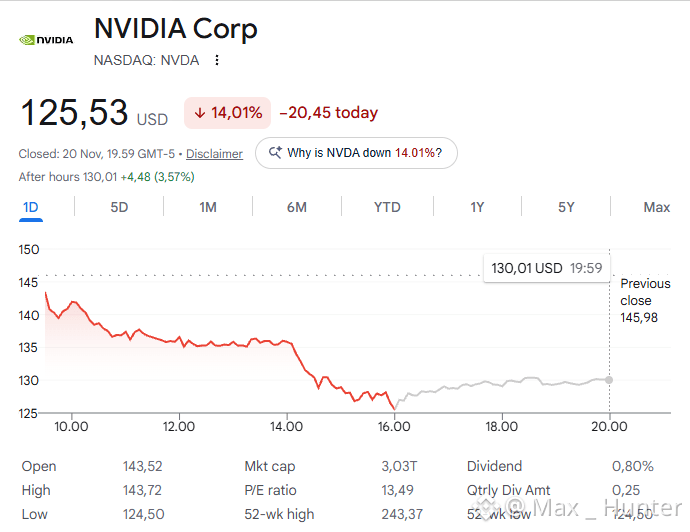
The stock price has already done the math for you: it closed Friday at $125.53, down 14% in a day and 23% for the week, cut in half from its $239 high. Eight straight losing sessions, and the bodies of the dip-buyers aren’t even cold yet.
My view hasn’t changed: cautious to bearish; no dip-buying. A headhunter reaching out doesn’t mean an appointment. Until the name is confirmed, any rebound is just handing the bears more ammunition.
What would change my mind: if the board officially announces Haas as the successor and the stock closes back above $148.80, I’ll admit I was wrong and turn cautiously bullish. If this drags on, or Jensen Huang’s congressional testimony on December 1 brings fresh revelations, even $125 may not be the bottom.
Are you betting on Haas taking the top job, or that the board will have to bring Jensen Huang back after all?
$NVDA
#NVDA #美股 #Chips
Not investment advice.
812

·
--
Verified
Nvidia scandal escalates again: FT/NYT reported Saturday that Megaspeed, the company involved, imported about $4.6 billion worth of server chips from U.S. companies in one year, with many suspected of ending up in China.
California’s attorney general has subpoenaed the company to investigate whether it misled investors. The market is concerned that this could escalate from a “CEO’s personal affairs” into dual charges of export-control violations and securities fraud.
Binance $NVDA perpetual is currently around 131, nearly half off its October peak of 243; it traded in a narrow 127.5–131.6 range over the weekend, with no panic selling so far.
Forecast: If it holds above 125 when U.S. markets open Monday at 22:30, an oversold rebound to 138–140 is possible; a break below 125 would put 115–118 in view.
#合约 #币安 #NVDA
820

·
--
Verified
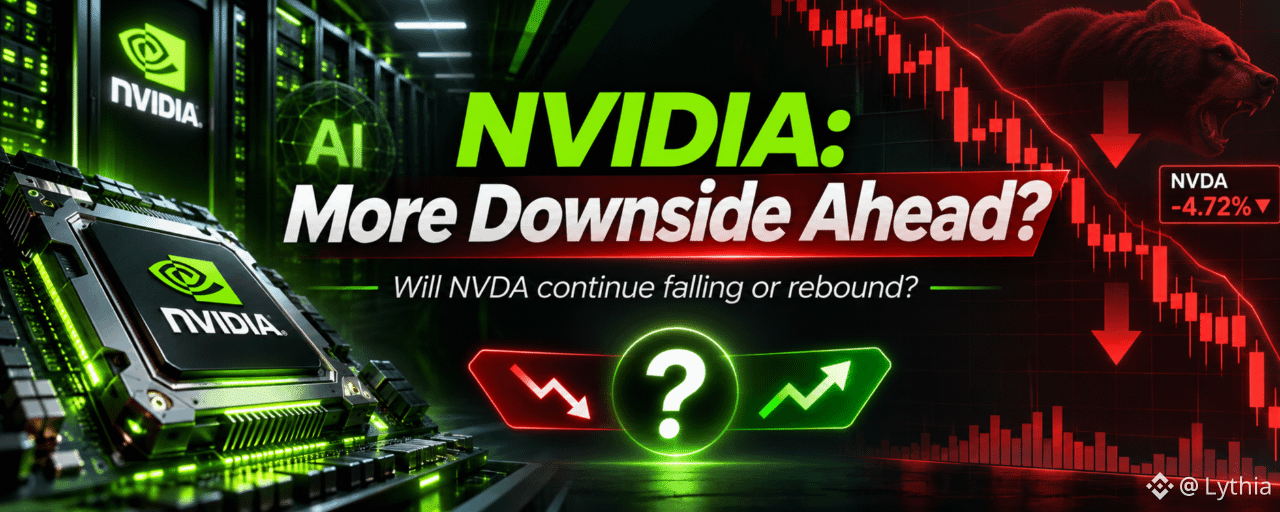
Article
NVIDIA Crashes 14% in One Day: Will NVDA Continue Falling, or Is This the Biggest Buying OpportunityNovember 22, 2026 | Stock Market Analysis | NASDAQ: NVDA
NVIDIA was once considered one of the safest ways to benefit from the artificial intelligence revolution. Now, investors are asking a very different question:
How much further can NVDA fall?
On November 20, NVIDIA shares plunged 14.01% in a single trading session, closing at $125.53. The stock has lost approximately 22.9% in just one week, despite reporting extraordinary revenue growth.
This raises a critical question: Are investors witnessing a temporary market overreaction, or the beginning of a much deeper correction?
My current outlook is BEARISH in the short term, but cautiously optimistic about NVIDIA's long-term business fundamentals.
Here is why.
1. NVIDIA's Latest Crash: What Actually Happened?
NVIDIA's recent decline is not simply the result of disappointing earnings.
In fact, its latest financial results were exceptionally strong.
Instead, several major uncertainties have emerged simultaneously.
Leadership uncertainty
On November 12, NVIDIA announced that co-founder Jensen Huang had resigned as CEO. Chief Financial Officer Colette Kress assumed the position of interim CEO.
The unexpected transition introduced uncertainty surrounding the company's future leadership and strategic direction.
Regulatory concerns
On November 20, Reuters reported that the US Securities and Exchange Commission was examining potential accounting issues at NVIDIA, citing people familiar with the matter.
Importantly, an investigation does not establish wrongdoing, and the exact matters under examination have not been publicly confirmed.
Nevertheless, the report intensified selling pressure.
Concerns about the AI investment boom
Investors are also questioning whether enormous spending on artificial intelligence infrastructure can continue indefinitely.
The major concern is whether technology companies will generate sufficient returns from their AI investments to justify their accelerating expenditures.
When uncertainty increases, investors often become less willing to pay premium valuations, even for businesses reporting strong growth.
2. NVIDIA's Earnings Are Still Remarkably Strong
Here is where the situation becomes particularly interesting.
According to NVIDIA's fiscal Q3 2027 earnings announcement on November 17:
Financial metricReported resultQuarterly revenue$115.8 billionYear-over-year revenue growth+103%Data Center revenue$107.6 billionGAAP net income$65.3 billionGAAP gross margin74.8%Q4 revenue guidance$130 billion ±3%
These are not the financial results of a business experiencing collapsing demand.
NVIDIA has more than doubled its quarterly revenue compared with the same period last year.
Its data center business continues to benefit from demand for AI computing infrastructure.
However, there is a significant distinction investors must understand:
A company's financial performance can improve while its share price continues to decline.
Stock prices reflect expectations about future earnings, risk and valuation, not simply what a company earned last quarter.
If investors become concerned about governance, accounting transparency or the sustainability of future spending, even exceptional earnings might not prevent a selloff.
3. Technical Analysis: Is NVIDIA's Downtrend Over?
Let's examine the actual price movement.
On Friday, November 20:
Opening price: $143.52Intraday high: $143.73Intraday low: $124.50Closing price: $125.53Daily change: -14.01%
NVIDIA closed remarkably close to its intraday low.
That is a bearish observation because sellers maintained pressure into the end of the session.
It does not guarantee another decline, but it provides little evidence of a confirmed reversal.
Key price levels to watch
Price zoneTechnical significance$145–$146Major recovery resistance$135–$140Initial rebound resistance zone$125–$126Immediate price reaction zone$124.50November 20 session low$120Psychological downside level$115Possible lower downside scenario
The $124.50 level is particularly important because it represents Friday's observed intraday low.
If NVIDIA breaks below $124.50 and fails to reclaim it, the probability of another downward extension could increase.
A potential next area to monitor would be $120.
Conversely, reclaiming $135–$140 with stronger buying participation would be an early indication that selling pressure is easing.
A sustained recovery above $145–$146 would provide more meaningful evidence of a potential trend improvement.
These are scenario levels, not guaranteed support or resistance.
4. Could NVIDIA Fall Below $120?
Yes, it is possible.
There are three scenarios worth considering.
Scenario A: Bearish continuation
NVIDIA breaks below $124.50, and buyers fail to regain the level.
Under this scenario, the market may begin testing $120 or lower.
Continued regulatory uncertainty, weak technology-sector sentiment and additional selling pressure could reinforce the decline.
This is the scenario I currently consider more likely in the immediate term, unless price action improves.
Scenario B: Temporary technical rebound
Following such a sharp decline, NVIDIA could experience a relief rally.
Short sellers taking profits and bargain hunters entering the market may temporarily push the price upward.
A rebound toward $135–$140 would not necessarily confirm a bullish reversal.
Investors should distinguish between a temporary bounce and a sustained recovery.
Scenario C: Genuine bullish recovery
A stronger recovery could develop if regulatory uncertainty begins to ease, investors regain confidence in NVIDIA's leadership, and institutional demand returns.
A recovery above $145–$146 would be an encouraging first step.
However, rebuilding a sustained uptrend would require further confirmation.
5. Is NVIDIA Now Undervalued?
This is perhaps the most important question for long-term investors.
NVIDIA's share price has declined dramatically, while the company's revenue and earnings have continued expanding.
That divergence makes its valuation worth examining.
But there is a catch.
A stock becoming cheaper does not automatically mean it has become safe.
As an accountant, I believe investors should pay particular attention to financial transparency, cash generation, revenue quality and the assumptions underlying future earnings.
The reported SEC investigation creates an additional uncertainty that cannot be resolved simply by looking at NVIDIA's revenue growth.
If the concerns prove less serious than investors currently fear, NVIDIA could eventually experience a meaningful valuation recovery.
If they lead to material financial or regulatory consequences, the downside risks could become more significant.
Both possibilities deserve consideration.
6. My Outlook: BUY, SELL or WAIT?
For the next several trading sessions, my directional bias remains:
🔴 BEARISH — I would not assume NVIDIA has reached its bottom.
The reasons are straightforward:
The stock experienced an unusually large selloff.The latest session closed near its low.Leadership and regulatory uncertainty remain unresolved.AI-related equities are experiencing broader selling pressure.There is not yet convincing price-based evidence of a sustained recovery.
However, bearish does not necessarily mean shorting immediately.
After a 14% daily decline, a sharp temporary rebound is entirely possible, making aggressive short positions risky.
For investors considering buying the dip, waiting for stabilization may offer a clearer assessment of the risk.
For long-term investors, NVIDIA's underlying AI business remains compelling, but its governance and regulatory risks deserve careful attention.
Final Verdict: NVIDIA's Business Is Growing, but Investor Confidence Is Falling
NVIDIA presents an unusual contradiction.
Its financial results show extraordinary growth, yet its share price has been collapsing.
That tells us the current selloff is about more than quarterly revenue.
It is about investor confidence, future expectations and uncertainty.
My conclusion: Further downside remains a meaningful near-term risk. A durable recovery is possible, but it has not yet been confirmed.
The next major test will be whether buyers can defend the $124.50 area or whether sellers push NVIDIA toward $120.
For now, I would rather see evidence of stabilization than attempt to predict the exact bottom.
What do you think?
📉 Will NVIDIA break below $120?
📈 Or is this the biggest buying opportunity of the year?
Share your opinion in the comments.
Sources & References
NVIDIA Investor Relations — Q3 Fiscal 2027 Financial Results, November 17, 2026.NVIDIA Newsroom — NVIDIA Announces CEO Transition, November 12, 2026.Reuters — Nvidia's Accounting Is a Focus of US SEC Investigation, November 20, 2026.Yahoo Finance — NVIDIA (NVDA) Historical Stock Prices, November 20, 2026.
Market data and financial information are based on publicly available company disclosures and financial reporting. Analysis and price projections represent personal opinions, not financial advice.
#NVDA #Nasdaq #Investing #MarketAnalysis #WallStreet
NVIDIA Crashes 14% in One Day: Will NVDA Continue Falling, or Is This the Biggest Buying Opportunity
November 22, 2026 | Stock Market Analysis | NASDAQ: NVDA
NVIDIA was once considered one of the safest ways to benefit from the artificial intelligence revolution. Now, investors are asking a very different question:
How much further can NVDA fall?
On November 20, NVIDIA shares plunged 14.01% in a single trading session, closing at $125.53. The stock has lost approximately 22.9% in just one week, despite reporting extraordinary revenue growth.
This raises a critical question: Are investors witnessing a temporary market overreaction, or the beginning of a much deeper correction?
My current outlook is BEARISH in the short term, but cautiously optimistic about NVIDIA's long-term business fundamentals.
Here is why.
1. NVIDIA's Latest Crash: What Actually Happened?
NVIDIA's recent decline is not simply the result of disappointing earnings.
In fact, its latest financial results were exceptionally strong.
Instead, several major uncertainties have emerged simultaneously.
Leadership uncertainty
On November 12, NVIDIA announced that co-founder Jensen Huang had resigned as CEO. Chief Financial Officer Colette Kress assumed the position of interim CEO.
The unexpected transition introduced uncertainty surrounding the company's future leadership and strategic direction.
Regulatory concerns
On November 20, Reuters reported that the US Securities and Exchange Commission was examining potential accounting issues at NVIDIA, citing people familiar with the matter.
Importantly, an investigation does not establish wrongdoing, and the exact matters under examination have not been publicly confirmed.
Nevertheless, the report intensified selling pressure.
Concerns about the AI investment boom
Investors are also questioning whether enormous spending on artificial intelligence infrastructure can continue indefinitely.
The major concern is whether technology companies will generate sufficient returns from their AI investments to justify their accelerating expenditures.
When uncertainty increases, investors often become less willing to pay premium valuations, even for businesses reporting strong growth.
2. NVIDIA's Earnings Are Still Remarkably Strong
Here is where the situation becomes particularly interesting.
According to NVIDIA's fiscal Q3 2027 earnings announcement on November 17:
Financial metricReported resultQuarterly revenue$115.8 billionYear-over-year revenue growth+103%Data Center revenue$107.6 billionGAAP net income$65.3 billionGAAP gross margin74.8%Q4 revenue guidance$130 billion ±3%
These are not the financial results of a business experiencing collapsing demand.
NVIDIA has more than doubled its quarterly revenue compared with the same period last year.
Its data center business continues to benefit from demand for AI computing infrastructure.
However, there is a significant distinction investors must understand:
A company's financial performance can improve while its share price continues to decline.
Stock prices reflect expectations about future earnings, risk and valuation, not simply what a company earned last quarter.
If investors become concerned about governance, accounting transparency or the sustainability of future spending, even exceptional earnings might not prevent a selloff.
3. Technical Analysis: Is NVIDIA's Downtrend Over?
Let's examine the actual price movement.
On Friday, November 20:
Opening price: $143.52Intraday high: $143.73Intraday low: $124.50Closing price: $125.53Daily change: -14.01%
NVIDIA closed remarkably close to its intraday low.
That is a bearish observation because sellers maintained pressure into the end of the session.
It does not guarantee another decline, but it provides little evidence of a confirmed reversal.
Key price levels to watch
Price zoneTechnical significance$145–$146Major recovery resistance$135–$140Initial rebound resistance zone$125–$126Immediate price reaction zone$124.50November 20 session low$120Psychological downside level$115Possible lower downside scenario
The $124.50 level is particularly important because it represents Friday's observed intraday low.
If NVIDIA breaks below $124.50 and fails to reclaim it, the probability of another downward extension could increase.
A potential next area to monitor would be $120.
Conversely, reclaiming $135–$140 with stronger buying participation would be an early indication that selling pressure is easing.
A sustained recovery above $145–$146 would provide more meaningful evidence of a potential trend improvement.
These are scenario levels, not guaranteed support or resistance.
4. Could NVIDIA Fall Below $120?
Yes, it is possible.
There are three scenarios worth considering.
Scenario A: Bearish continuation
NVIDIA breaks below $124.50, and buyers fail to regain the level.
Under this scenario, the market may begin testing $120 or lower.
Continued regulatory uncertainty, weak technology-sector sentiment and additional selling pressure could reinforce the decline.
This is the scenario I currently consider more likely in the immediate term, unless price action improves.
Scenario B: Temporary technical rebound
Following such a sharp decline, NVIDIA could experience a relief rally.
Short sellers taking profits and bargain hunters entering the market may temporarily push the price upward.
A rebound toward $135–$140 would not necessarily confirm a bullish reversal.
Investors should distinguish between a temporary bounce and a sustained recovery.
Scenario C: Genuine bullish recovery
A stronger recovery could develop if regulatory uncertainty begins to ease, investors regain confidence in NVIDIA's leadership, and institutional demand returns.
A recovery above $145–$146 would be an encouraging first step.
However, rebuilding a sustained uptrend would require further confirmation.
5. Is NVIDIA Now Undervalued?
This is perhaps the most important question for long-term investors.
NVIDIA's share price has declined dramatically, while the company's revenue and earnings have continued expanding.
That divergence makes its valuation worth examining.
But there is a catch.
A stock becoming cheaper does not automatically mean it has become safe.
As an accountant, I believe investors should pay particular attention to financial transparency, cash generation, revenue quality and the assumptions underlying future earnings.
The reported SEC investigation creates an additional uncertainty that cannot be resolved simply by looking at NVIDIA's revenue growth.
If the concerns prove less serious than investors currently fear, NVIDIA could eventually experience a meaningful valuation recovery.
If they lead to material financial or regulatory consequences, the downside risks could become more significant.
Both possibilities deserve consideration.
6. My Outlook: BUY, SELL or WAIT?
For the next several trading sessions, my directional bias remains:
🔴 BEARISH — I would not assume NVIDIA has reached its bottom.
The reasons are straightforward:
The stock experienced an unusually large selloff.The latest session closed near its low.Leadership and regulatory uncertainty remain unresolved.AI-related equities are experiencing broader selling pressure.There is not yet convincing price-based evidence of a sustained recovery.
However, bearish does not necessarily mean shorting immediately.
After a 14% daily decline, a sharp temporary rebound is entirely possible, making aggressive short positions risky.
For investors considering buying the dip, waiting for stabilization may offer a clearer assessment of the risk.
For long-term investors, NVIDIA's underlying AI business remains compelling, but its governance and regulatory risks deserve careful attention.
Final Verdict: NVIDIA's Business Is Growing, but Investor Confidence Is Falling
NVIDIA presents an unusual contradiction.
Its financial results show extraordinary growth, yet its share price has been collapsing.
That tells us the current selloff is about more than quarterly revenue.
It is about investor confidence, future expectations and uncertainty.
My conclusion: Further downside remains a meaningful near-term risk. A durable recovery is possible, but it has not yet been confirmed.
The next major test will be whether buyers can defend the $124.50 area or whether sellers push NVIDIA toward $120.
For now, I would rather see evidence of stabilization than attempt to predict the exact bottom.
What do you think?
📉 Will NVIDIA break below $120?
📈 Or is this the biggest buying opportunity of the year?
Share your opinion in the comments.
Sources & References
NVIDIA Investor Relations — Q3 Fiscal 2027 Financial Results, November 17, 2026.NVIDIA Newsroom — NVIDIA Announces CEO Transition, November 12, 2026.Reuters — Nvidia's Accounting Is a Focus of US SEC Investigation, November 20, 2026.Yahoo Finance — NVIDIA (NVDA) Historical Stock Prices, November 20, 2026.
Market data and financial information are based on publicly available company disclosures and financial reporting. Analysis and price projections represent personal opinions, not financial advice.
#NVDA #Nasdaq #Investing #MarketAnalysis #WallStreet
401


·
--
🚨 REKT: NVIDIA ($NVDA ) SUFFERS A MASSIVE 14% DROP! 📉
Nvidia shares reportedly plunged **14% on Friday, marking a painful week for one of the world's biggest technology companies.
Even more concerning, the decline ended Nvidia's longest weekly losing streak since 2008.
The company that once dominated the AI stock rally is now facing renewed pressure as investors reassess technology valuations and future AI spending.
The bigger question is whether this is temporary selling pressure or a deeper shift in sentiment toward the AI sector.
Even the biggest names in the market aren't immune to a major sell-off. 👀
#BreakingNews #CryptoNews #CryptoMarketUpdate #NVIDIA #NVDA
{future}(NVDAUSDT)
🚨 REKT: NVIDIA ($NVDA ) SUFFERS A MASSIVE 14% DROP! 📉
Nvidia shares reportedly plunged **14% on Friday, marking a painful week for one of the world's biggest technology companies.
Even more concerning, the decline ended Nvidia's longest weekly losing streak since 2008.
The company that once dominated the AI stock rally is now facing renewed pressure as investors reassess technology valuations and future AI spending.
The bigger question is whether this is temporary selling pressure or a deeper shift in sentiment toward the AI sector.
Even the biggest names in the market aren't immune to a major sell-off. 👀
#BreakingNews #CryptoNews #CryptoMarketUpdate #NVIDIA #NVDA
243

·
--
Verified
Nvidia has already been cut in half! I have a question I'm pretty curious about. How much of a drop does it take to count as a financial crisis? One founder has an affair and it's cut in half? Sigh. What a surreal world. Hope everyone's positions are still doing okay... 🙏 #NVDA $NVDA
{future}(NVDAUSDT)
Nvidia has already been cut in half! I have a question I'm pretty curious about. How much of a drop does it take to count as a financial crisis? One founder has an affair and it's cut in half? Sigh. What a surreal world. Hope everyone's positions are still doing okay... 🙏 #NVDA $NVDA
SOL链主任:
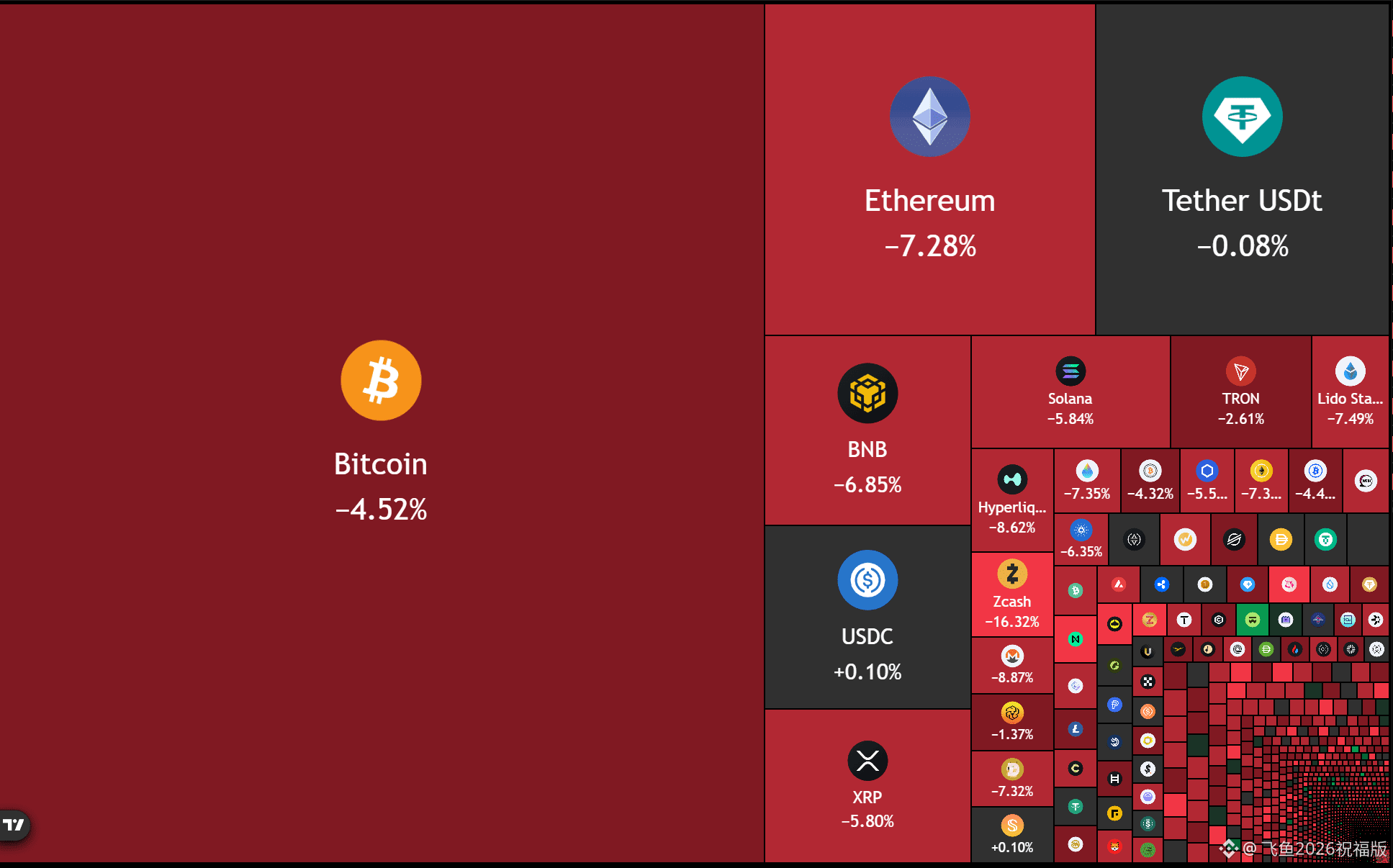
跌到全球央行一起降息,多去股吧看看吧,币圈这些什么博主大V什么一点屁用都没,上次CPI加重十二月加息预期我直接空黄金,前几天失业金年率,我直接空特斯拉,都是股吧看老人讲的自己在参考
7
1
6.4k

·
--
$NVDA Perpetual price: 132.93; 24-hour range: 129.42–133.56, more than 30% below the 30-day high of 220.61.
The prior highs are 133.38 and 133.56; the prior lows are 132.16 and 130.52. Price is now hugging the upper end of the range.
Do you think it will hold above 133.56 first, or pull back to 132? Pick one in the comments.
Perpetual contracts are volatile.
#美股代币 #NVDA
The prior highs are 133.38 and 133.56; the prior lows are 132.16 and 130.52. Price is now hugging the upper end of the range.
Do you think it will hold above 133.56 first, or pull back to 132? Pick one in the comments.
Perpetual contracts are volatile.
#美股代币 #NVDA
1
4

·
--
Bullish
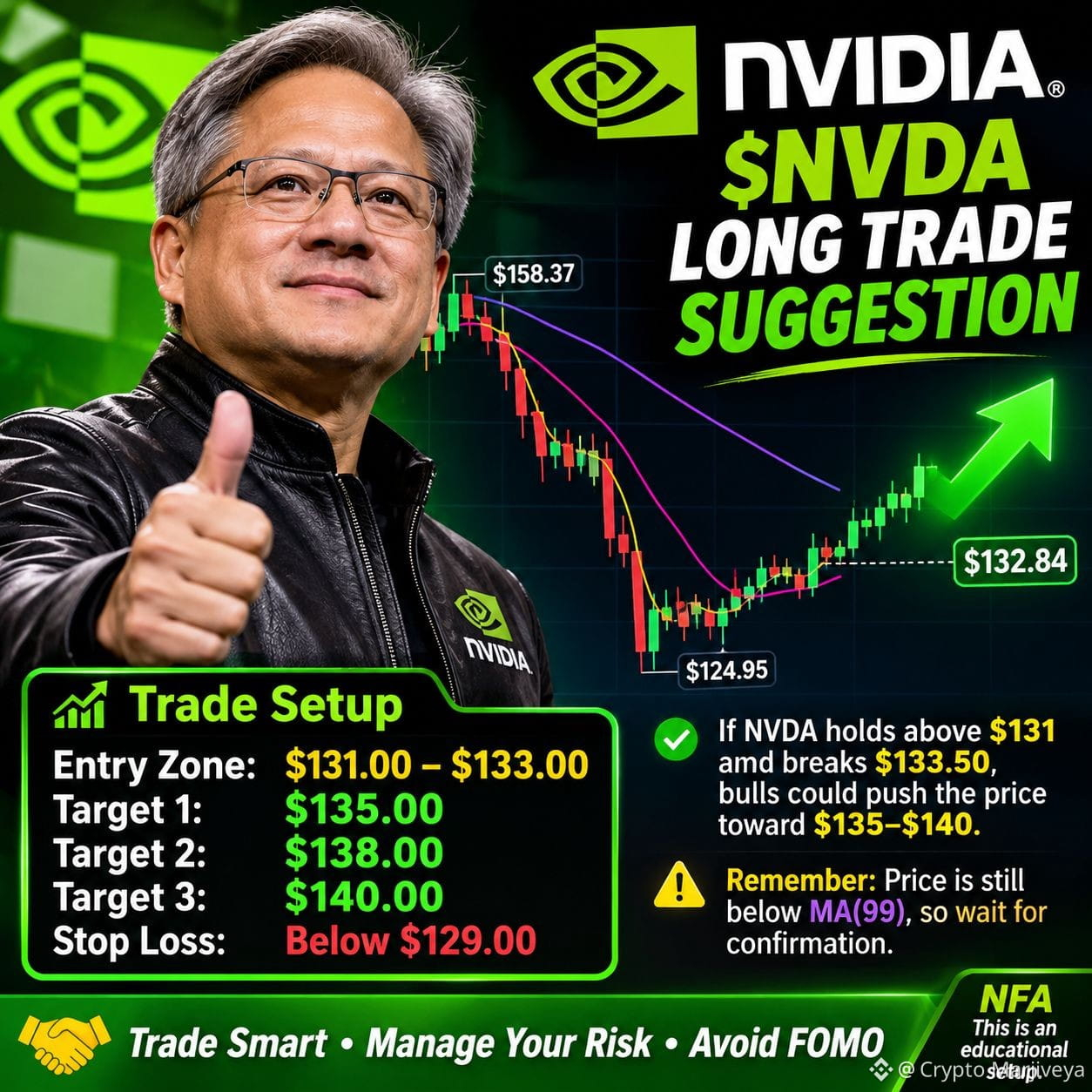
🚀 $NVDA LONG TRADE SETUP – Bulls Preparing for a Recovery?
$NVDA.US is showing signs of short-term recovery after a sharp sell-off from $158.37 to $124.95.
📊 Technical Analysis (1H Chart):
- Current Price: $132.84
- MA(7): $132.92
- MA(25): $131.38
- MA(99): $139.94
🎯 Key Levels:
- Entry Zone: $131.00–$133.00
- Target 1: $135.00
- Target 2: $138.00
- Target 3: $140.00
- Stop Loss: Below $129.00
📈 Bullish Scenario:
If NVDA holds above $131 and breaks through $133.50 with strong volume, buyers could push the price toward $135–$140.
⚠️ Important: The broader trend remains bearish because price is still below MA(99). Wait for confirmation before entering.
Trade smart. Manage your risk. Avoid FOMO.
#NVDA #longtrade #cryptotrading #Binance #GlobalStocksFaceLongestLosingStreakSince2023
{future}(NVDAUSDT)
NFA – This is an educational setup, not a guaranteed trade.
🚀 $NVDA LONG TRADE SETUP – Bulls Preparing for a Recovery?
$NVDA .US is showing signs of short-term recovery after a sharp sell-off from $158.37 to $124.95.
📊 Technical Analysis (1H Chart):
- Current Price: $132.84
- MA(7): $132.92
- MA(25): $131.38
- MA(99): $139.94
🎯 Key Levels:
- Entry Zone: $131.00–$133.00
- Target 1: $135.00
- Target 2: $138.00
- Target 3: $140.00
- Stop Loss: Below $129.00
📈 Bullish Scenario:
If NVDA holds above $131 and breaks through $133.50 with strong volume, buyers could push the price toward $135–$140.
⚠️ Important: The broader trend remains bearish because price is still below MA(99). Wait for confirmation before entering.
Trade smart. Manage your risk. Avoid FOMO.
#NVDA #longtrade #cryptotrading #Binance #GlobalStocksFaceLongestLosingStreakSince2023
NFA – This is an educational setup, not a guaranteed trade.
1
1
44

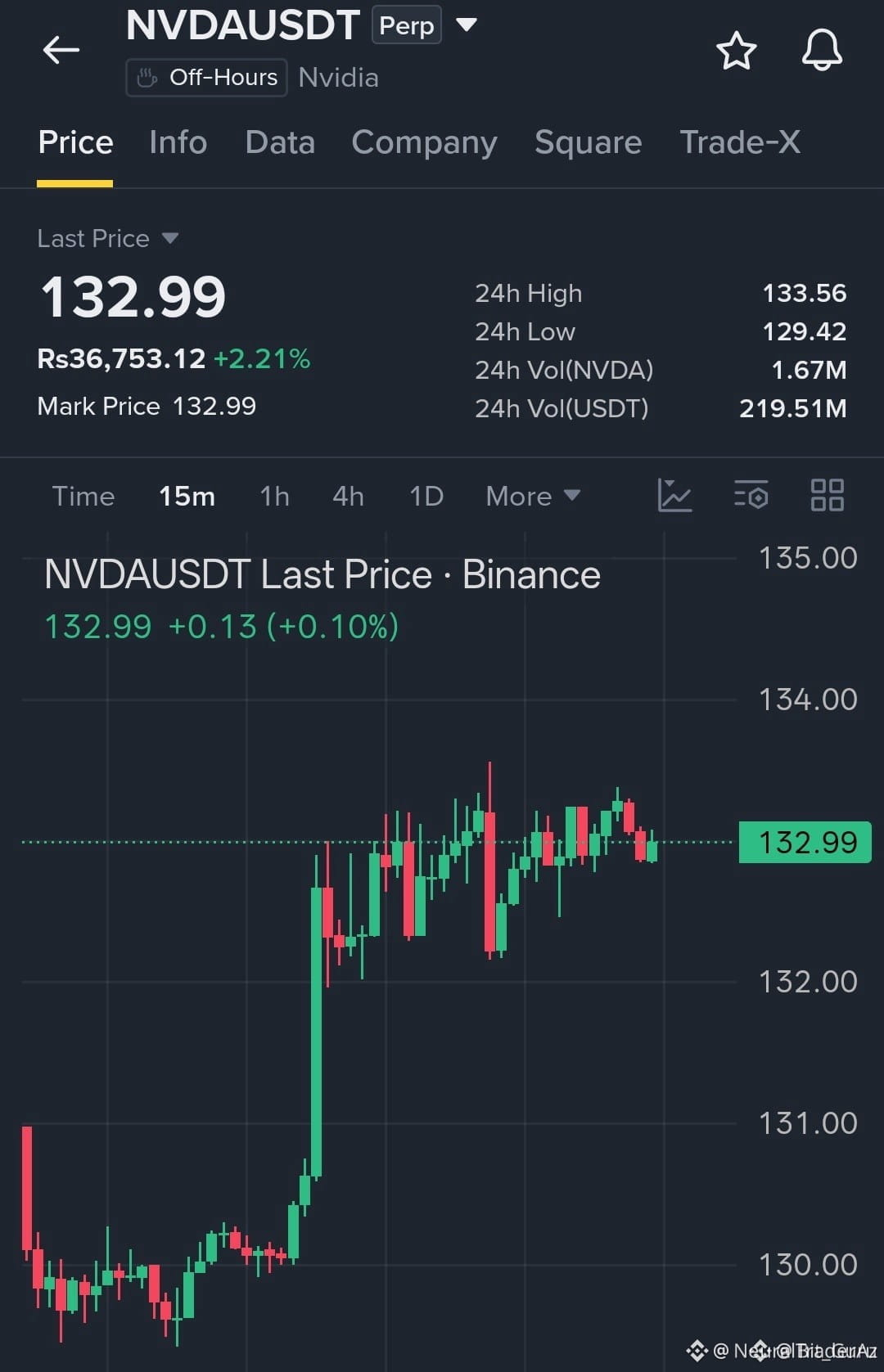
🚨 $NVDA BUYERS DEFEND INSTITUTIONAL SUPPORT WHILE CONSOLIDATING FOR THE NEXT LEG UP! 📈
Entry: $132.60 ⚡
Target: $135.00 🚀
Stop Loss: $131.90 ⚠️
Price action is compressing tightly right above the $132 demand zone, absorbing floating supply after an aggressive structural impulse. Smart money is quietly reloading inventory while retail hesitation leaves an inefficiency gap waiting to be priced in above $133.50. 📊
Momentum indicators suggest accumulation is reaching critical mass as sellers fail to breach structural floors. 💡 Are you positioned for the continuation breakout or waiting for a deeper liquidity test? 🤔
⚠️ Not financial advice. Always manage your risk. 🛡️
🏷️ #NVDA #Breakout #SmartMoney #TradingSetup
🔥 💎
2

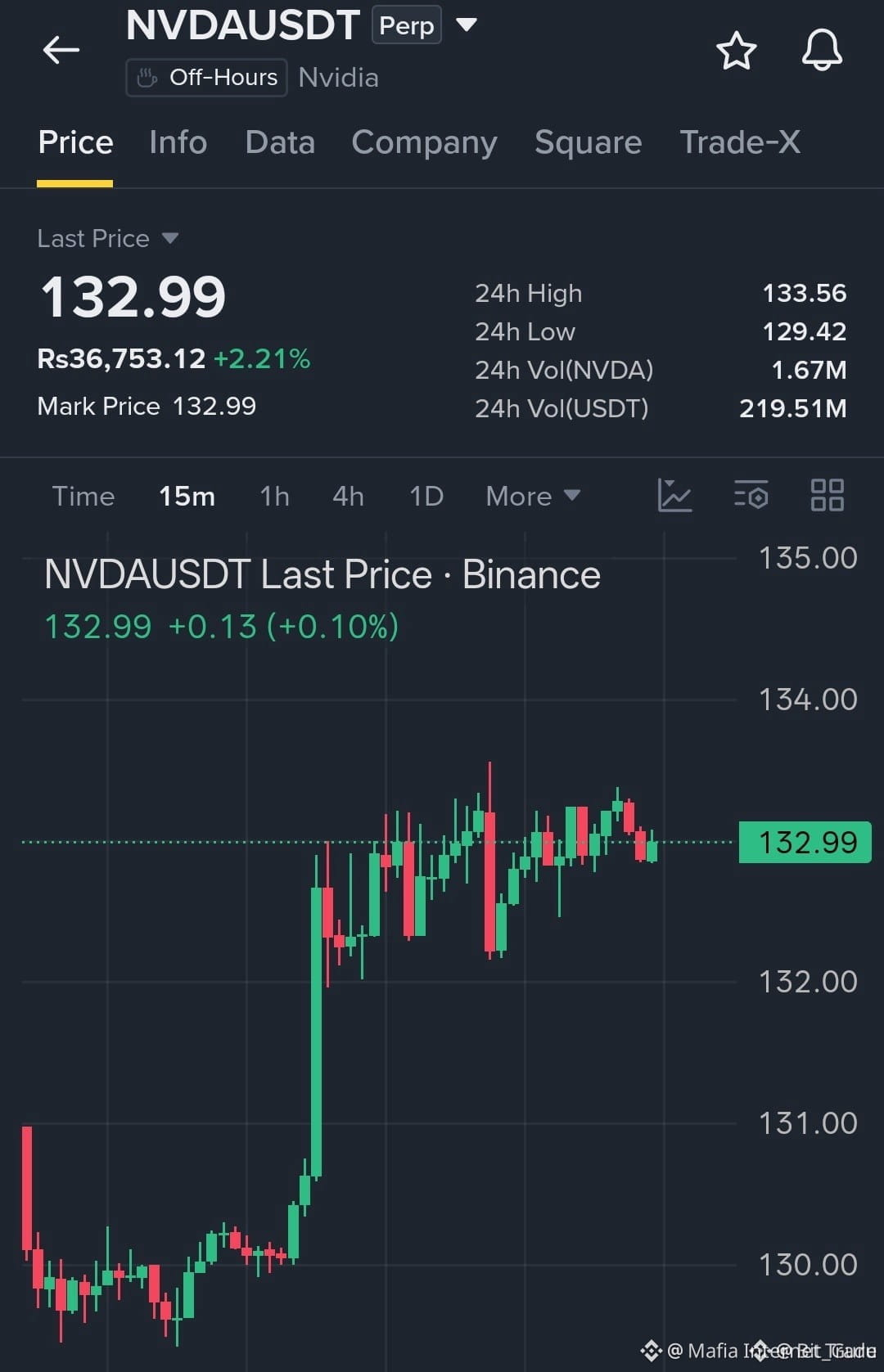
🚨 $NVDA BULLS DEFEND KEY SUPPORT AS CONSOLIDATION TIGHTENS FOR THE NEXT BREAKOUT 💥
Entry: $132.60–$133.00 ⚡
Target: $135.00 🚀
Stop Loss: $131.90 ⚠️
Sellers tried to dent the momentum here, but buyers firmly planted their flag right at the 132 support level. Price is coiling tightly in a classic consolidation pattern, soaking up residual supply after that impulsive push upward. 📊
Order flow shows aggressive bids stacking up right below current levels, waiting for that decisive flip over 133.50 to ignite the next leg toward higher targets. Momentum indicators are cooling off perfectly while holding structural integrity. ⚡
Are you positioning for the breakout confirmation or waiting for a deeper retest of the demand zone? 🤔
⚠️ Not financial advice. Always manage your risk. 🛡️
🏷️ #NVDA #Breakout #Crypto #StockSetup #Trading
🔥 💎
11

·
--
📉 WALL STREET UNDER PRESSURE — AI STOCKS TAKE A HIT!
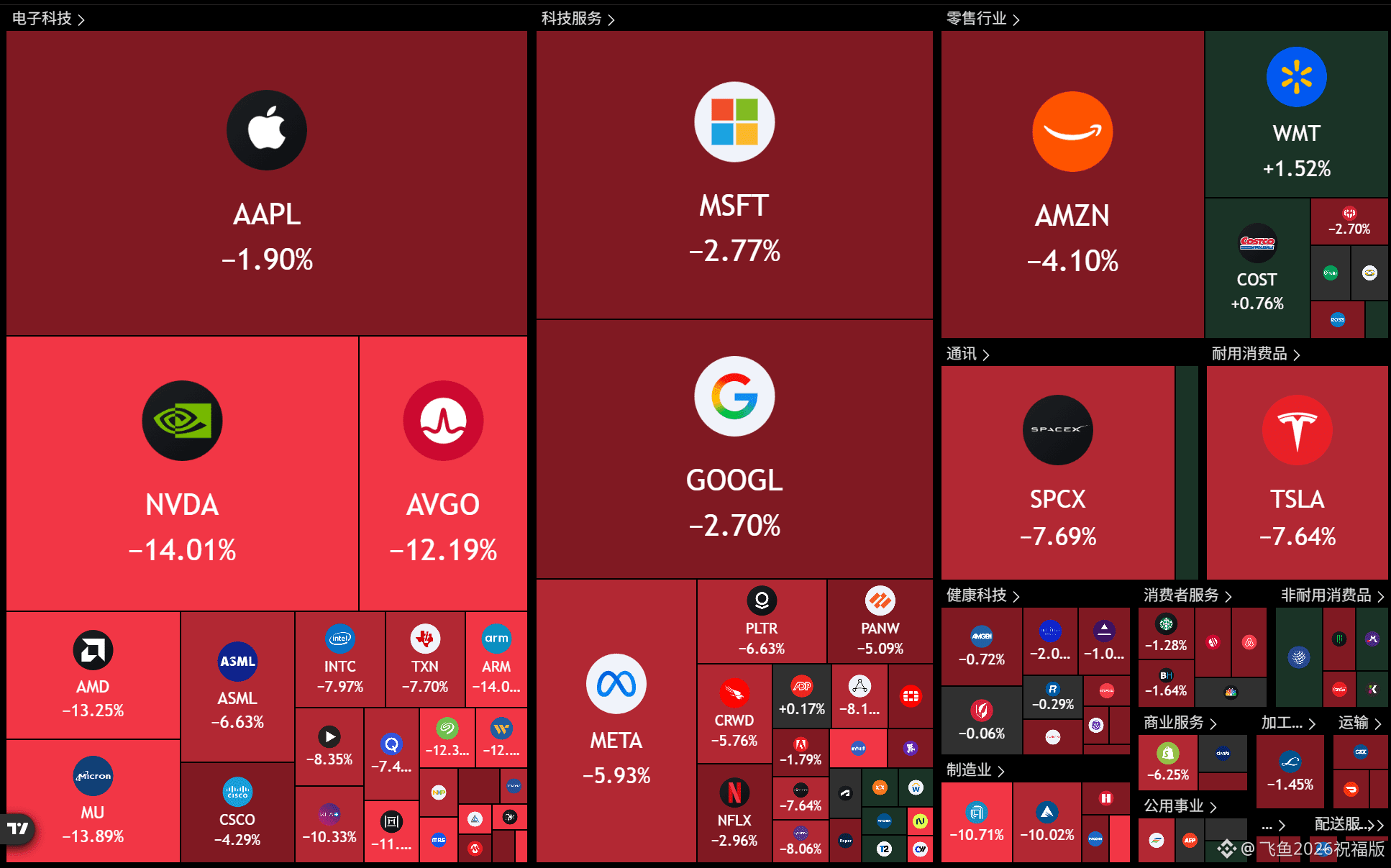
The Nasdaq has erased all its gains this year, dropping 1,261 points (-5.28%) in Friday’s session. Meanwhile, the S&P 500 extended its losing streak to 7 days, falling 3.7% and entering correction territory.
🔻 Tech Selloff:
- $NVDA plunged 14% to $125.53.
- Nvidia lost 22.9% this week, its worst weekly performance since 2008.
- VIX surged 41% to 40, signaling rising market fear.
🤖 Meanwhile, AI is still attracting huge capital. Anthropic reportedly reached an $81.3B valuation.
👀 The big question: Is money flowing into major AI IPOs by exiting existing tech stocks?
📊 Investors are becoming more cautious as market volatility rises.
#NASDAQ #SP500 #NVDA #Nvidia #AI #Anthropic #CryptoMarket
7

·
--
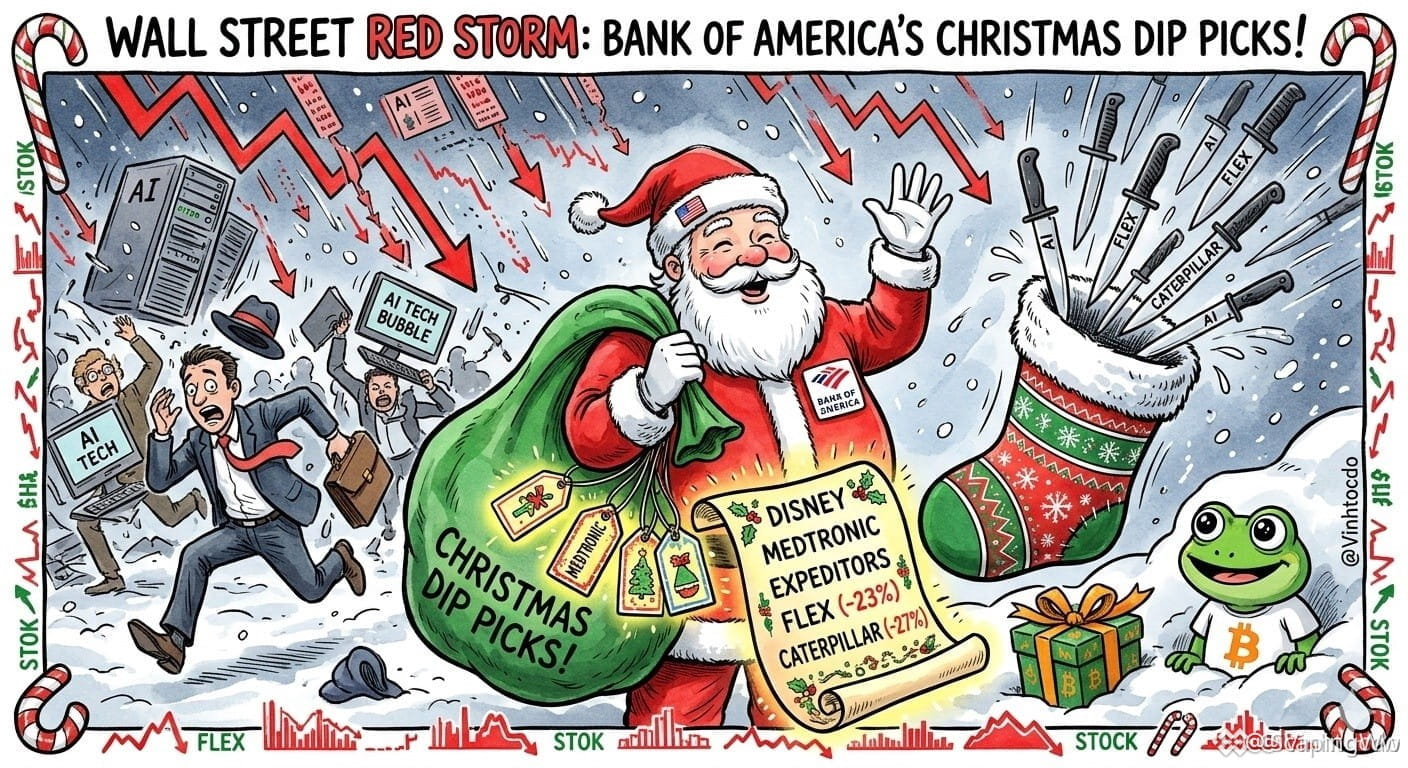
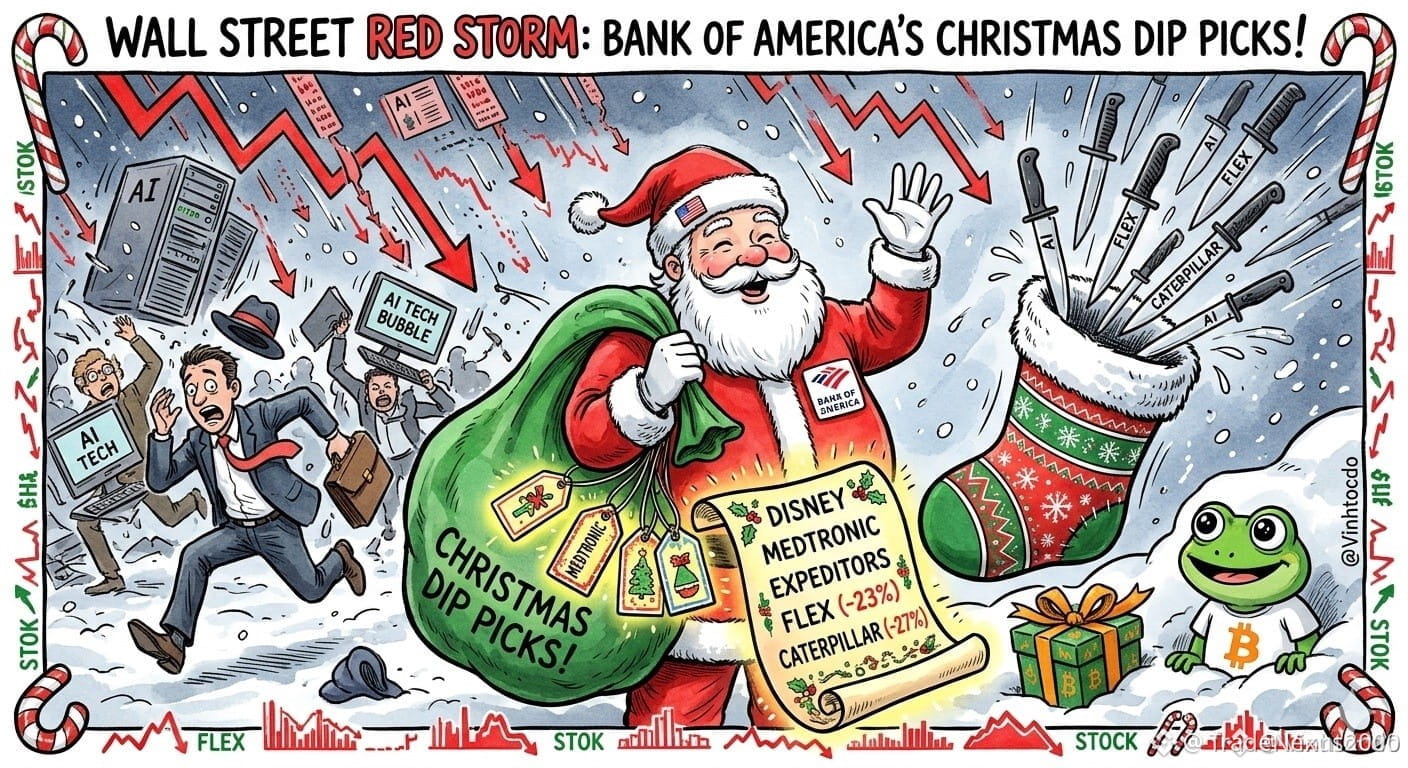
🚨 WALL STREET RED STORM UNLEASHES A MASSIVE DIP ON $NVDA FOR SMART MONEY! 🦈
Traditional tech sectors are bleeding under a heavy wave of profit-taking, but institutional desks are quietly eyeing the wreckage. While weak hands panic-sell their AI leaders, smart money is methodically scaling into the blood during these holiday sweeps. 📊
Patience is the ultimate edge here while the broader order flow stabilizes. Split your capital into structured tranches rather than committing everything to a single falling knife. 💡
Are you accumulating these tech dips or waiting for a complete flush below macro support? 👇
⚠️ Not financial advice. Always manage your risk. 🛡️
🏷️ #NVDA #MarketUpdate #TradingTips #Investing
🔥 💎
30
🦈 SMART MONEY IS ACCUMULATING INSTITUTIONAL DIP BUYS AMID THE TECH FLUSH ON $NVDA 📉
While retail sentiment capitulates under macro tech headwinds, institutional desks are quietly establishing long-term inventory in discounted market leaders like $NVDA and correlated infrastructure plays. Smart money doesn't chase momentum; it systematically absorbs forced liquidations during sector-wide rotation phases. 📊
Defensive equities are showing relative strength while high-beta tech absorbs heavy supply. Rather than blind execution, structured accumulation across validated demand zones remains the optimal tactical playbook. 💡
Are you scaling into these institutional accumulation phases or waiting for a deeper structural sweep? 👇
⚠️ Not financial advice. Always manage your risk. 🛡️
🏷️ #NVDA #SmartMoney #MarketStructure #Investing
🦈 ⚖️
16

·
--
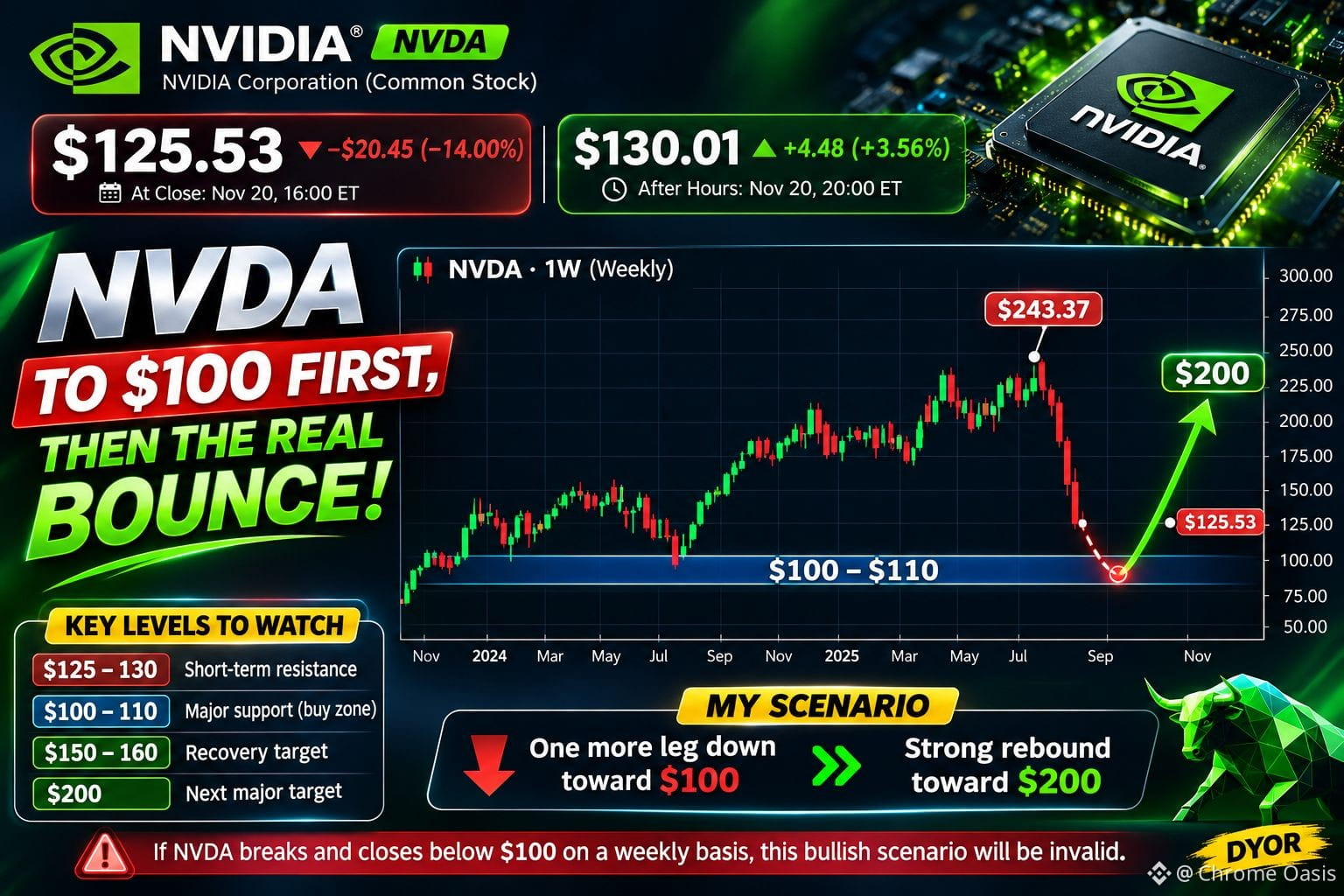
🚨 $NVDA : COULD $100 BE THE ULTIMATE BUYING ZONE BEFORE A MAJOR COMEBACK? 📉🚀
🔥 NVIDIA IS AT A CRITICAL CROSSROADS!
The bearish scenario is gaining attention as traders watch whether Nvidia could experience another sharp correction before its next major recovery.
📊 KEY PRICE LEVELS TO WATCH:
🔴 $125–130: Potential short-term resistance zone
📉 $100–110: Major historical support area
🟢 $150–160: Possible recovery target
🚀 $200: Longer-term bullish target if momentum returns
💡 MY MARKET OUTLOOK:
A temporary bounce doesn't necessarily mean the correction is over. If selling pressure continues, $NVDA could revisit the psychologically important $100 level.
But here's where things get interesting! 👀
A strong bullish reversal near $100, supported by rising trading volume, could open the door for a significant recovery toward $150 and potentially $200.
⚠️ THE CRITICAL WARNING:
If Nvidia breaks below $100 and closes the week beneath that level, the bullish recovery scenario would weaken considerably.
🎯 THE BIG QUESTION:
Will $NVDA find its bottom near $100, or will buyers step in much earlier?
👇 DROP YOUR TARGET: $100 OR $200 FIRST?
🔔 Follow for more market analysis, technical setups, and trading insights!
DYOR | Not Financial Advice
#NVDA #Nvidia #NASDAQ #MarketAnalysis #BinanceSquare
1
76

·
--
#CaliforniaNvidiaProbeExaminesPotentialCriminalViolations
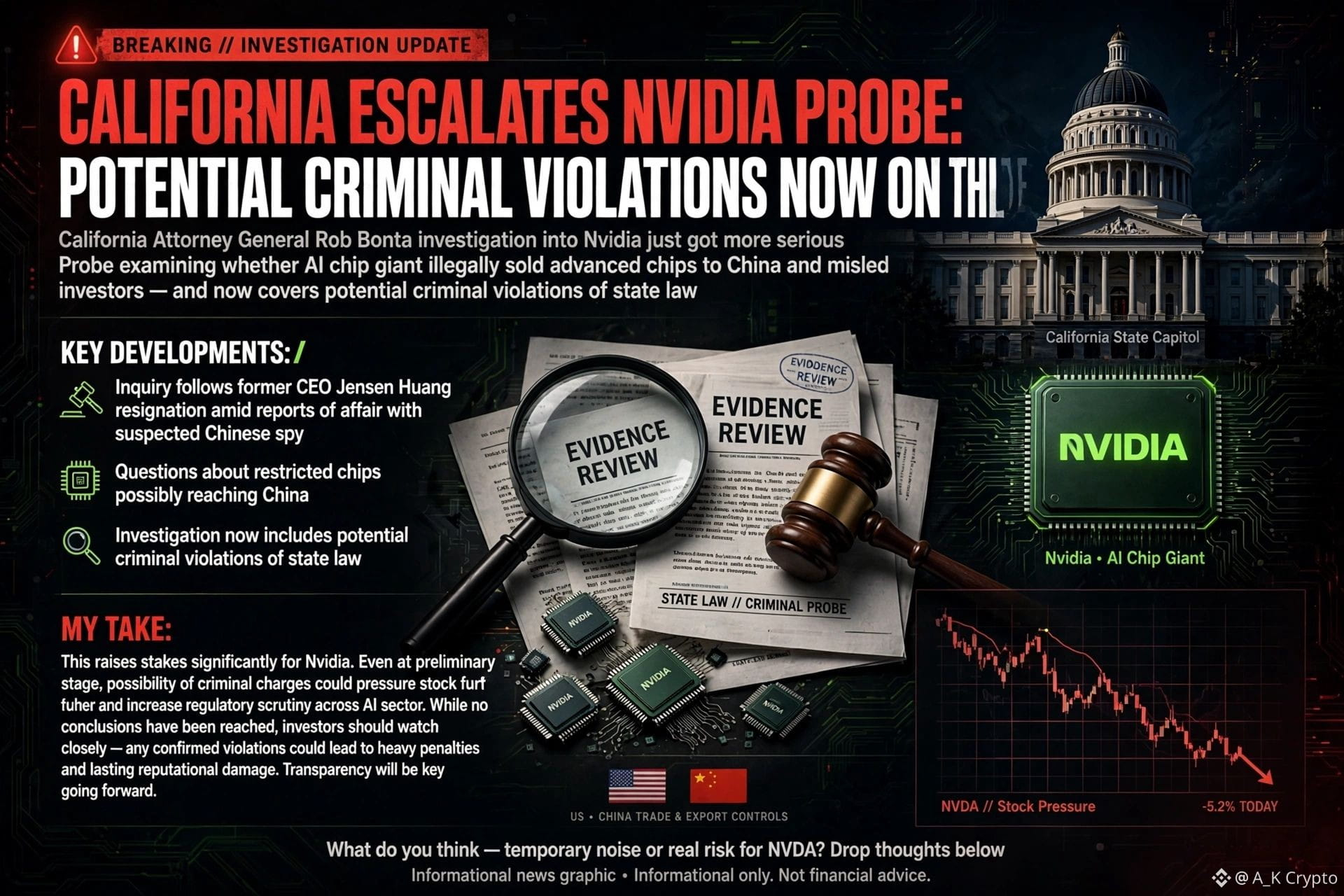
🚨 California Escalates Nvidia Probe: Potential Criminal Violations Now on the Table
California Attorney General Rob Bonta’s investigation into Nvidia just got more serious. The probe is examining whether the AI chip giant illegally sold advanced chips to China and misled investors — and it now covers potential criminal violations of state law.
The inquiry follows former CEO Jensen Huang’s resignation amid reports of an affair with a suspected Chinese spy and questions about restricted chips possibly reaching China.
This raises the stakes significantly for Nvidia. Even at a preliminary stage, the possibility of criminal charges could pressure the stock further and increase regulatory scrutiny across the AI sector. While no conclusions have been reached, investors should watch closely — any confirmed violations could lead to heavy penalties and lasting reputational damage. Transparency will be key going forward.
$NVDA
What do you think — temporary noise or a real risk for $NVDA ?
Drop your thoughts below 👇
#NVDA #AI #TechNews #BinanceSquare
125

$NVDA
{future}(NVDAUSDT)
— NVIDIA
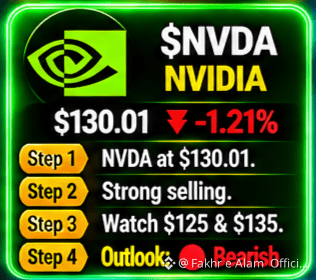
Step 1: NVDA is around $130.01 in the latest tokenized stock reference.
Step 2: AI-chip demand remains a long-term catalyst, but recent selling is intense.
Step 3: Watch $125 support and $135 resistance.
Step 4: Outlook: 🔴 Short-term bearish; wait for stabilization. #NVDA #SolanaSets2027RoadmapToDoubleComputeCapacity #BlackRockLaunchesHKDollarDigitalLiquidityFund #GlobalStocksFaceLongestLosingStreakSince2023 #AnthropicPlungesTowardIPOPriceonDay2
$NVDA
— NVIDIA
Step 1: NVDA is around $130.01 in the latest tokenized stock reference.
Step 2: AI-chip demand remains a long-term catalyst, but recent selling is intense.
Step 3: Watch $125 support and $135 resistance.
Step 4: Outlook: 🔴 Short-term bearish; wait for stabilization. #NVDA #SolanaSets2027RoadmapToDoubleComputeCapacity #BlackRockLaunchesHKDollarDigitalLiquidityFund #GlobalStocksFaceLongestLosingStreakSince2023 #AnthropicPlungesTowardIPOPriceonDay2
96
·
--
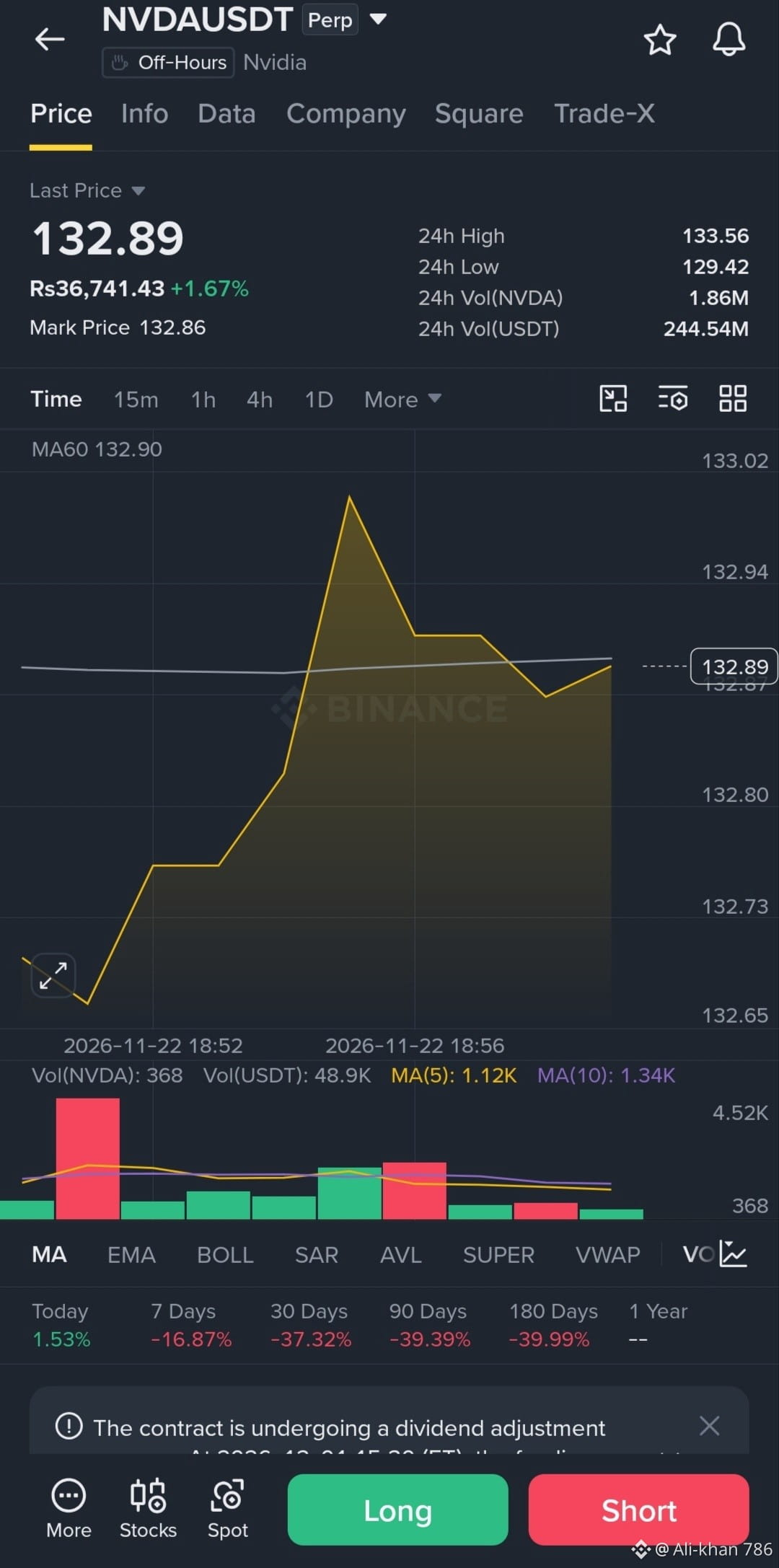
🚨🔥 $NVDAB : NVIDIA'S AI EMPIRE — BUY THE DIP OR WAIT FOR RECOVERY?
NVIDIA is at the center of the global AI revolution, but recent market volatility has put investors on alert.
📊 THE LATEST MARKET PICTURE
💰 Underlying NVIDIA Share Price: ~$130.06
📉 Recent Weekly Performance: Significant correction
⚡ Sector: Artificial Intelligence & Semiconductors
🤖 Main Growth Driver: AI chips and data-center infrastructure
🔥 WHY NVIDIA STILL MATTERS
1️⃣ AI DOMINANCE: NVIDIA GPUs remain essential infrastructure for training and running advanced AI models.
2️⃣ DATA CENTER DEMAND: AI companies continue competing for computing power and advanced processors.
3️⃣ CRYPTO CONNECTION: AI infrastructure, GPU computing, and decentralized computing are creating new opportunities across the technology and crypto industries.
🎯 WHAT SHOULD TRADERS WATCH?
🟢 Bullish Scenario: Stabilization followed by renewed buying pressure could support a recovery.
🔴 Bearish Scenario: Continued weakness in technology stocks could put further pressure on NVDA.
💎 MY TAKE:
The long-term AI story remains important, but even the strongest companies can experience major corrections.
Smart investors watch fundamentals, valuation, market sentiment, and risk management instead of blindly chasing rallies.
🔥 THE BIG QUESTION:
Can NVIDIA recover and lead the next AI market rally, or is more downside coming?
👇 Comment your prediction!
#NVDA #SolanaSets2027RoadmapToDoubleComputeCapacity #BlackRockLaunchesHKDollarDigitalLiquidityFund #GlobalStocksFaceLongestLosingStreakSince2023 #AnthropicPlungesTowardIPOPriceonDay2
⚠️ Note: NVDA is NVIDIA's stock ticker. Tokenized NVDA products are separate financial instruments and are not an official NVIDIA-issued cryptocurrency. DYOR.
{future}(NVDAUSDT)
🚨🔥 $NVDAB : NVIDIA'S AI EMPIRE — BUY THE DIP OR WAIT FOR RECOVERY?
NVIDIA is at the center of the global AI revolution, but recent market volatility has put investors on alert.
📊 THE LATEST MARKET PICTURE
💰 Underlying NVIDIA Share Price: ~$130.06
📉 Recent Weekly Performance: Significant correction
⚡ Sector: Artificial Intelligence & Semiconductors
🤖 Main Growth Driver: AI chips and data-center infrastructure
🔥 WHY NVIDIA STILL MATTERS
1️⃣ AI DOMINANCE: NVIDIA GPUs remain essential infrastructure for training and running advanced AI models.
2️⃣ DATA CENTER DEMAND: AI companies continue competing for computing power and advanced processors.
3️⃣ CRYPTO CONNECTION: AI infrastructure, GPU computing, and decentralized computing are creating new opportunities across the technology and crypto industries.
🎯 WHAT SHOULD TRADERS WATCH?
🟢 Bullish Scenario: Stabilization followed by renewed buying pressure could support a recovery.
🔴 Bearish Scenario: Continued weakness in technology stocks could put further pressure on NVDA.
💎 MY TAKE:
The long-term AI story remains important, but even the strongest companies can experience major corrections.
Smart investors watch fundamentals, valuation, market sentiment, and risk management instead of blindly chasing rallies.
🔥 THE BIG QUESTION:
Can NVIDIA recover and lead the next AI market rally, or is more downside coming?
👇 Comment your prediction!
#NVDA #SolanaSets2027RoadmapToDoubleComputeCapacity #BlackRockLaunchesHKDollarDigitalLiquidityFund #GlobalStocksFaceLongestLosingStreakSince2023 #AnthropicPlungesTowardIPOPriceonDay2
⚠️ Note: NVDA is NVIDIA's stock ticker. Tokenized NVDA products are separate financial instruments and are not an official NVIDIA-issued cryptocurrency. DYOR.
71

·
--
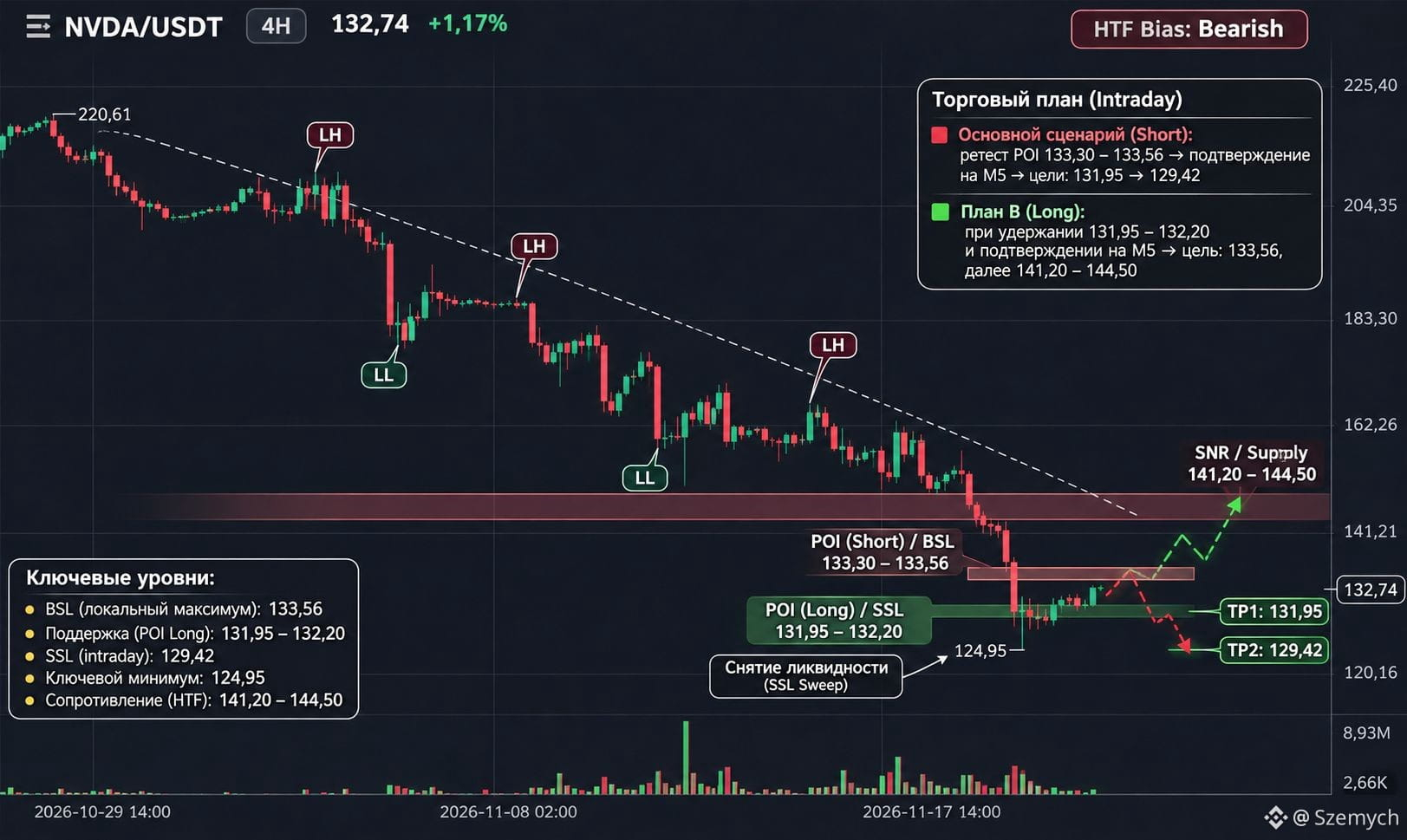
#NVDA $NVDA/USDT: 48% drop — is a recovery beginning, or is the market preparing a new downward impulse?
NVDA is trading around $132.80 after a massive decline from $243.57 to $124.95.
But a local bounce does not yet mean a reversal!
🔎 MARKET STRUCTURE
D1/H4: the global structure remains BEARISH.
H1: after taking Sell-Side Liquidity at $124.95, an upward correction began.
M15/M5: buyers pushed the price to $133.56, where the first notable seller reaction appeared.
📍 KEY LEVELS
BSL: $133.56
Resistance POI: $133.30–133.56
Support POI: $131.95–132.20
SSL: $129.42
Major SSL: $124.95
🎯 MAIN SCENARIO — SHORT
We expect a move to $133.30–133.56.
If the market takes BSL and forms on M5:
Liquidity Sweep → Bearish MSS → Displacement → FVG/IFVG Retest,
we consider SHORT.
Targets: $131.95 → $129.42.
PLAN B — LONG
If the local SSL around $131.95–132.20 is taken and a confirmed bullish structure appears on M5, we consider a move toward $133.56.
⚠️ EXECUTION
POI ≠ Entry.
At the current price, entry is not confirmed. We do not fix Entry, SL, or RR until a full trigger appears.
Do not chase price. First liquidity, then structure confirmation.
Which scenario will happen first — continuation of the upward correction or the sellers' return? Watch $133.56.
$NVDA
{future}(NVDAUSDT)
#NVDA $NVDA /USDT: 48% drop — is a recovery beginning, or is the market preparing a new downward impulse?
NVDA is trading around $132.80 after a massive decline from $243.57 to $124.95.
But a local bounce does not yet mean a reversal!
🔎 MARKET STRUCTURE
D1/H4: the global structure remains BEARISH.
H1: after taking Sell-Side Liquidity at $124.95, an upward correction began.
M15/M5: buyers pushed the price to $133.56, where the first notable seller reaction appeared.
📍 KEY LEVELS
BSL: $133.56
Resistance POI: $133.30–133.56
Support POI: $131.95–132.20
SSL: $129.42
Major SSL: $124.95
🎯 MAIN SCENARIO — SHORT
We expect a move to $133.30–133.56.
If the market takes BSL and forms on M5:
Liquidity Sweep → Bearish MSS → Displacement → FVG/IFVG Retest,
we consider SHORT.
Targets: $131.95 → $129.42.
PLAN B — LONG
If the local SSL around $131.95–132.20 is taken and a confirmed bullish structure appears on M5, we consider a move toward $133.56.
⚠️ EXECUTION
POI ≠ Entry.
At the current price, entry is not confirmed. We do not fix Entry, SL, or RR until a full trigger appears.
Do not chase price. First liquidity, then structure confirmation.
Which scenario will happen first — continuation of the upward correction or the sellers' return? Watch $133.56.
$NVDA
57

·
--
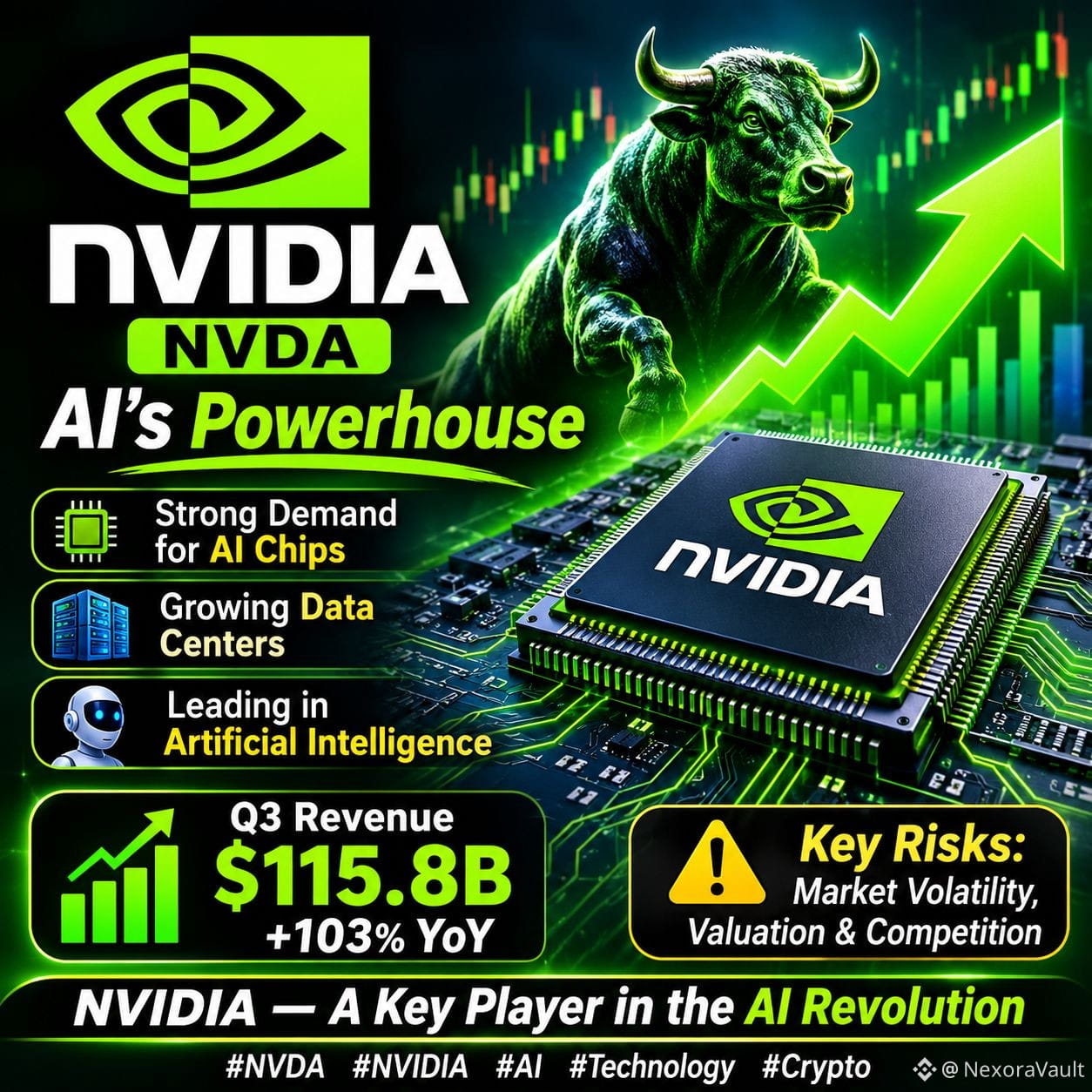
🚀 $NVDA ($NVIDIA): AI’s Powerhouse
NVIDIA continues to lead the AI revolution with strong demand for GPUs, data-center infrastructure, and next-generation computing.
Its latest quarterly revenue reached $115.8 billion, up 103% year-over-year, showing the huge demand for AI infrastructure.
AI remains a major growth story, but market volatility and valuation risks are important to watch.
#NVDA #NVIDIA #AI #Technology #crypto
123

·
--
#CaliforniaNvidiaProbeExaminesPotentialCriminalViolations
This is no longer a scandal. This is a legal war.
California Attorney General Rob Bonta has moved the Nvidia probe to criminal law. On November 19, he served Nvidia a subpoena. On November 21, Bloomberg confirmed the probe now covers potential criminal violations.
The core question is brutal. Did Nvidia unlawfully sell advanced AI chips to China, and did it mislead investors about that risk.
Bonta said the framework covers civil and criminal bans on misleading investors. If violations are proven, California could seek a court order, claw back profits, and pursue a criminal case. The call will depend on who knew what and when.
Bonta also made one thing clear. The affair and the chip sales could be connected, or separate. The investigation will decide.
Nvidia has not been found guilty. The probe is preliminary. Civil cases cost money. Criminal cases cost trust.
Meanwhile, the SEC is also examining Nvidia's accounting. Congress will hear Jensen Huang on December 1.
Is this a real criminal risk for Nvidia, or a political show that ends with a fine?
Comment below 👇🏻
$NVDA $AMD $BTC
#Nvidia #NVDA #AI
1
122

·
--
The civil investigation has escalated into a criminal one, and Nvidia is in much bigger trouble this time.
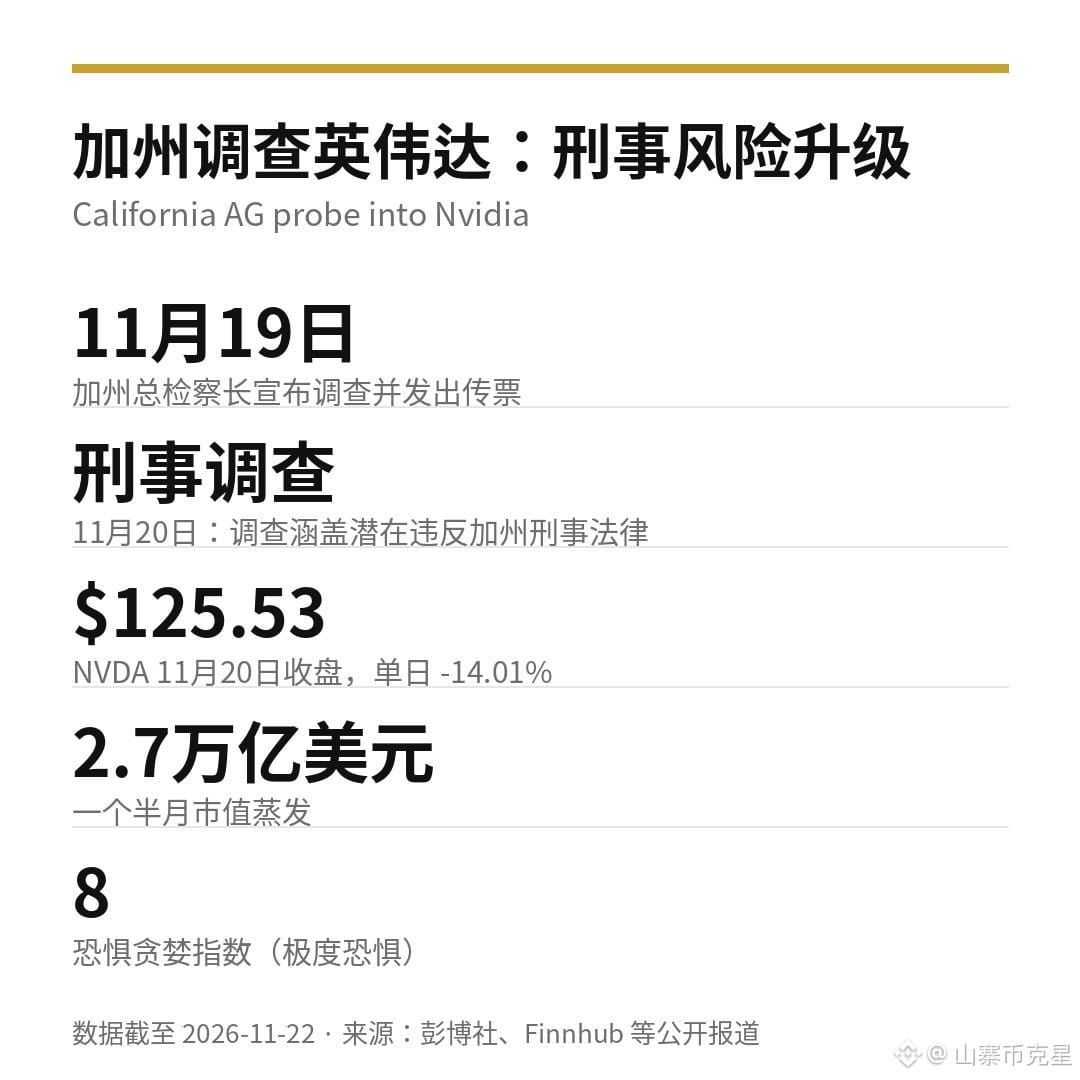
1️⃣ California Attorney General Rob Bonta announced an investigation and issued subpoenas on November 19. On November 20, he added that the investigation covers potential violations of California criminal law—whether Nvidia illegally sold advanced chips to China and whether it misled investors about it.
2️⃣ The investigation is still in its early stages, and there are no conclusions yet. Nvidia has also not responded. But the market has already voted: NVDA closed at $125.53 on November 20, plunging 14.01% in a single day and hitting an intraday low of $124.50. Its market value has shed $2.7 trillion in a month and a half.
3️⃣ The Fear & Greed Index is down to just 8: extreme fear. With the AI leader under criminal investigation, risk appetite across the entire AI sector and risk assets is likely to come under pressure.
In plain English: this isn't a routine inquiry. It could end up in court and require the company to disgorge profits. Don't rush to buy the dip in AI leaders in the short term.
My take: The criminal investigation is still unresolved, so NVDA and AI stocks are unlikely to fare well in the short term, and the crypto market will also be dragged down. I'll sit on the sidelines for now and avoid catching a falling knife. I'll wait for the investigation's findings or for the share price to stabilize.
Do you think NVDA has fallen enough this time? Let's talk in the comments~
#加州英伟达调查涉潜在刑事违法
#NVDA $NVDA
64
Log in to explore more content
Join global crypto users on Binance Square
⚡️ Get latest and useful information about crypto.
💬 Trusted by the world’s largest crypto exchange.
👍 Discover real insights from verified creators.
Email / Phone number
Trending Topics
1
#BTCReboundsAbove$60KAmidWhaleDipBuying
67,243 views
319 Discussing
2
#SolanaSets2027RoadmapToDoubleComputeCapacity
51,435 views
933 Discussing
3
#CaliforniaNvidiaProbeExaminesPotentialCriminalViolations
13,783 views
126 Discussing
4
#BlackRockLaunchesHKDollarDigitalLiquidityFund
42,588 views
717 Discussing
5
#NvidiaLoses$2.7TrillionInMonthAndAHalf
74,944 views
306 Discussing
6
#GlobalStocksFaceLongestLosingStreakSince2023
556,670 views
3,451 Discussing
7
#BlackRockIBITPostsRecord$541MSingleDayOutflow
91,903 views
183 Discussing
8
#AnthropicPlungesTowardIPOPriceonDay2
307,812 views
2,311 Discussing
9
#TwentyOneCapitalAdds172.25BTC
161,933 views
1,631 Discussing
10
#HKBillWouldExcludeTokenizedDepositsFromVirtualAssets
17,717 views
105 Discussing