
#cftc
cftc
2M views
4,965 Discussing
Hot
Latest

Don’t take that Binance.US headline—“CFTC deems DCM/DCO application materials complete”—to mean U.S. perpetuals are about to launch. In plain English, this step means the CFTC has acknowledged that you’ve submitted all the required materials, and the clock has started.
I looked up the CFTC’s own rules, 17 CFR 38.3 and 39.3: the 180-day review period only starts after an application is deemed “materially complete,” and that period can be extended indefinitely as long as the applicant agrees in writing. Based on the November 19 announcement, 180 days brings us to around May 18, 2027. That’s the review deadline under the rules; it doesn’t mean a license will be granted by then, let alone that the platform will launch. The Binance.US blog itself makes this very clear: It is not an approval, and no derivatives will be offered before approval.
There’s a useful comparison right in front of us. Backpack filed its application on March 27; its DCO registration came on November 13, and its DCM (TLD Markets) was only designated on November 16—more than seven months later. Binance.US is applying for both a DCM and a DCO at once, handling both the exchange and clearinghouse itself, just like Backpack. Even after approval, the systems, memberships, and products still have to be rolled out one by one. Even optimistically, that’s a story for the second half of next year.
One more thing many people get mixed up: Binance.US is the U.S. platform operated by BAM Trading, a separate entity from Binance’s international exchange. Whether U.S. users can trade perpetuals on Binance.US has nothing to do with the contracts you’ve opened over here, and it’s hardly a fundamental positive for BNB. The ones actually affected are the established players already licensed to offer derivatives in the U.S., along with firms like Lighter that say they plan to apply. Another branded player has entered the increasingly crowded U.S. regulated perpetuals market.
There’s only one thing we can confirm today: the review period has begun. Anyone using this to shout “Binance is returning to the U.S.” is basically trading on the headline.
#BinanceUS #CFTC
4

·
--
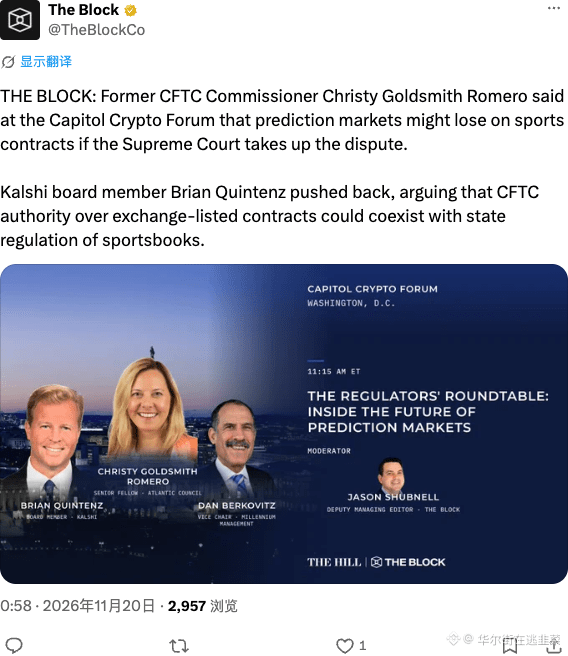
Former CFTC commissioner Christy Goldsmith Romero has warned that if the Supreme Court takes up the case, prediction markets are bound to lose when it comes to sports contracts. Kalshi pushed back hard, with Brian Quintenz arguing that the CFTC’s oversight of exchange-traded contracts doesn’t conflict with states’ regulation of sports betting. This regulatory showdown is only just beginning, and the future of sports prediction markets is full of question marks as federal and state governments clash.
#预测市场 #监管 #CFTC
#预测市场 #监管 #CFTC
4
CFTC Chair Selig was asked about Hyperliquid today. The gist of his response was: if you want to offer U.S. retail traders on-chain perpetuals, you either register as an exchange yourself or partner with one that’s already registered. Backpack is one path; for other protocols, “stay tuned.”
Those three words, “stay tuned,” are easy to read as “HL is close to getting approved in the U.S.” I read them the other way around.
First, let’s look at what exactly the example he cited entails. CFTC records show that TLD Clearing (Backpack Clearing) registered as a DCO clearinghouse on 11/13, and TLD Markets was designated a DCM exchange on 11/16. One company took on both licenses—exchange and clearinghouse—with a legal entity and margin rules, so regulators know who to go after if something goes wrong.
An order book run by validators, where anyone with enough staked HYPE can deploy a market, doesn’t fit this template. So in practice, the most likely path is “partnership”: a U.S.-licensed firm handles the front end and KYC, owns the customer relationship, and collects fees, while the protocol serves at most as back-end liquidity. HYPE captures value through fee-funded buybacks, but if a licensed firm takes the front end, nobody can say how much of the U.S. pie will go to HYPE—not even Selig.
One point that’s easier to miss: the hottest new thing on HL right now isn’t coin-margined perpetuals, but stock perpetuals on HIP-3. Anthropic lists tonight, and trade.xyz’s ANT pre-market perpetual has around $370 million in 24-hour trading volume. But swaps on individual stocks are classified as security-based swaps under the Dodd-Frank Act and fall under the SEC, not the CFTC. No matter how tuned Selig’s “stay tuned” is, it can’t cover this growth avenue.
So these remarks are neither bearish nor bullish for HL. They simply make clear where the door is: it’s open to companies, not protocols.
#Hyperliquid #CFTC
16

Prices have fallen this far, but the pace of traditional finance moving on-chain is actually picking up this week. Both developments are worth watching. First, on November 16, the U.S. CFTC officially approved blockchain-based derivatives exchange and clearinghouse licenses: Backpack’s TLD Markets secured an exchange license, and TLD Clearing secured a clearing license. tZERO also received the same pair of licenses last week. On November 18, Backpack rounded out its approvals with an NFA futures commission merchant license, bringing its total to three—but there’s still no date for when U.S. users will be able to open accounts. Second, on November 17, the World Bank announced a partnership with Citi and Circle to explore using regulated dollar stablecoins $USDC to disburse development funding. Citi will provide the banking rails, while Circle will handle issuance and settlement. The initiative will build on the World Bank’s existing FundsChain platform, which covers more than 350 projects across 96 countries; the Bank provided a total of $123.5 billion in support in fiscal year 2026. Keep in mind, though: this is only at the exploratory stage, and no countries, amounts, or timeline have been announced. When markets are gripped by extreme fear, the real big money is either buying the dip or laying the groundwork. #CFTC #Stablecoin
Prices have fallen this far, but the pace of traditional finance moving on-chain is actually picking up this week. Both developments are worth watching. First, on November 16, the U.S. CFTC officially approved blockchain-based derivatives exchange and clearinghouse licenses: Backpack’s TLD Markets secured an exchange license, and TLD Clearing secured a clearing license. tZERO also received the same pair of licenses last week. On November 18, Backpack rounded out its approvals with an NFA futures commission merchant license, bringing its total to three—but there’s still no date for when U.S. users will be able to open accounts. Second, on November 17, the World Bank announced a partnership with Citi and Circle to explore using regulated dollar stablecoins $USDC to disburse development funding. Citi will provide the banking rails, while Circle will handle issuance and settlement. The initiative will build on the World Bank’s existing FundsChain platform, which covers more than 350 projects across 96 countries; the Bank provided a total of $123.5 billion in support in fiscal year 2026. Keep in mind, though: this is only at the exploratory stage, and no countries, amounts, or timeline have been announced. When markets are gripped by extreme fear, the real big money is either buying the dip or laying the groundwork. #CFTC #Stablecoin

449

🔥 INSIGHT: The internet never had an authorizing statute, and neither did big data.
Former @CFTC chairman @giancarloMKTS told @itsciaranlyons that this freedom is what lets US innovators build for commercial needs first.
He called the idea that crypto needed regulatory clarity
#Crypto #CFTC
🔥 INSIGHT: The internet never had an authorizing statute, and neither did big data.
Former @CFTC chairman @giancarloMKTS told @itsciaranlyons that this freedom is what lets US innovators build for commercial needs first.
He called the idea that crypto needed regulatory clarity
#Crypto #CFTC
Former @CFTC chairman @giancarloMKTS told @itsciaranlyons that this freedom is what lets US innovators build for commercial needs first.
He called the idea that crypto needed regulatory clarity
#Crypto #CFTC
1

#KalshiLosesThirdAppeal
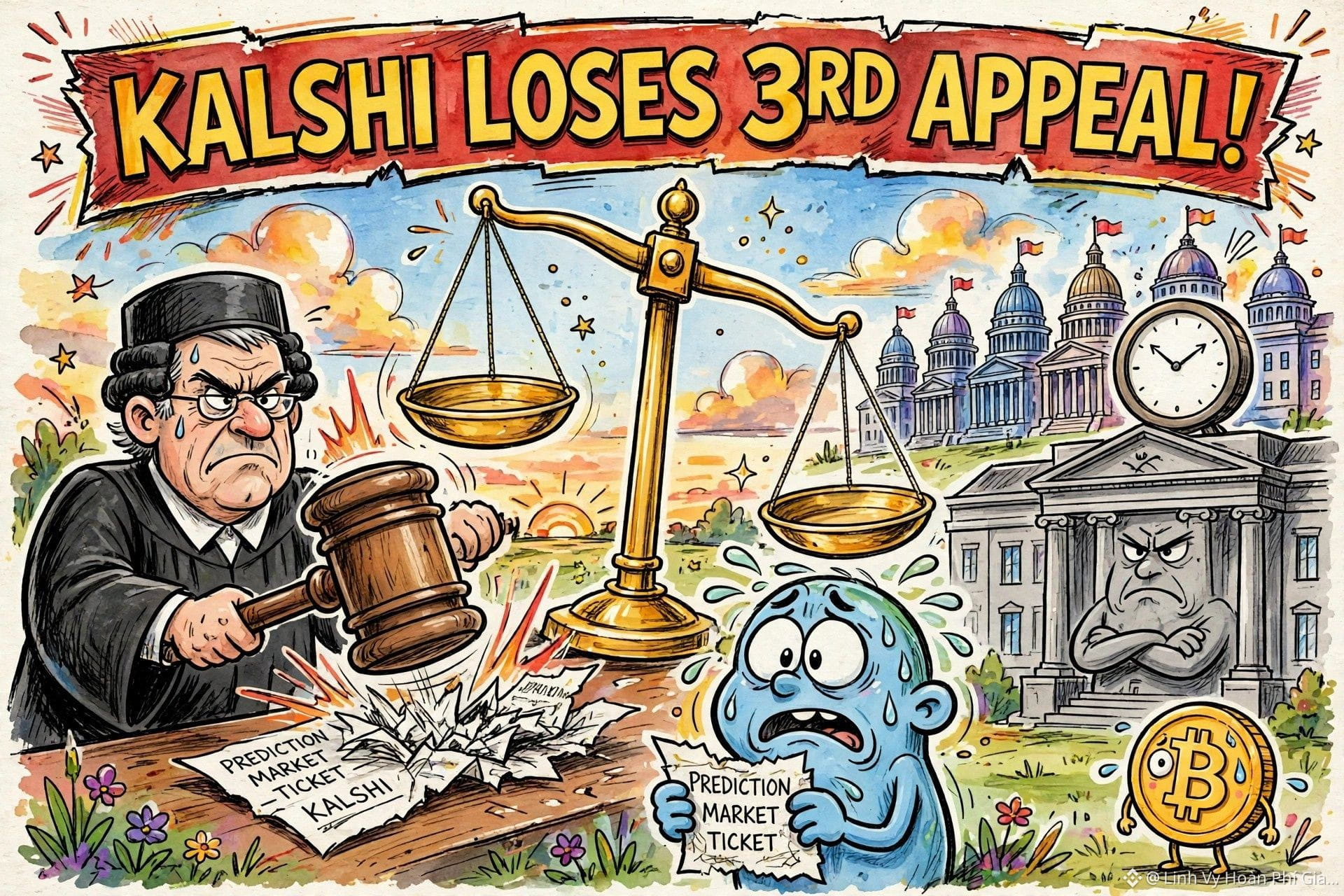
⚖️ U.S. COURT REJECTS KALSHI AGAIN, PREDICTION MARKETS ARE IN CHAOS
The Fourth Circuit Court of Appeals just ruled 2–1 that Maryland can crack down on Kalshi under the state’s gambling laws. This is the third ruling out of four cases to side with the states, and Kalshi is complaining that the judges can’t even agree on their reasoning. The irony: the CFTC is ordering Kalshi, Polymarket, and Coinbase to open contracts in all 50 states within 30 days—following the order seems to defy the court, while resisting it would defy a federal order. Bitcoin is still hovering around $62,600.
Biggest perpetual movers today: $ZEC 897 dollars, $ICP 2,24 dollars, $ZRO 1,40 dollars
#PredictionMarkets #CFTC #Maryland
83

·
--
Having All the Licenses Doesn’t Mean It’s Open for Business: Backpack’s FCM License Approved by the NFAJust two days ago, I wrote about Backpack’s exchange license (DCM) being approved. Two days later, this account-opening license has also come through.
On November 18, Backpack announced that the National Futures Association (NFA) had approved it to operate as a futures commission merchant (FCM). The NFA is authorized by the U.S. Commodity Futures Trading Commission (CFTC) to license and regulate FCMs. As Mark Wetjen, president of U.S. operations, put it: “The FCM license completes the picture.”
According to the official announcement, this is the third license in a week. After the exchange (DCM, designated by order on November 16) and clearinghouse (DCO, registered by order on November 13), this adds the intermediary layer responsible for account opening, anti-money laundering, and OFAC screening. All three licenses fall under the CFTC regulatory framework.
Having All the Licenses Doesn’t Mean It’s Open for Business: Backpack’s FCM License Approved by the NFA
Just two days ago, I wrote about Backpack’s exchange license (DCM) being approved. Two days later, this account-opening license has also come through.
On November 18, Backpack announced that the National Futures Association (NFA) had approved it to operate as a futures commission merchant (FCM). The NFA is authorized by the U.S. Commodity Futures Trading Commission (CFTC) to license and regulate FCMs. As Mark Wetjen, president of U.S. operations, put it: “The FCM license completes the picture.”
According to the official announcement, this is the third license in a week. After the exchange (DCM, designated by order on November 16) and clearinghouse (DCO, registered by order on November 13), this adds the intermediary layer responsible for account opening, anti-money laundering, and OFAC screening. All three licenses fall under the CFTC regulatory framework.
176

U.S. CRYPTO REGULATION BATTLE HEATS UP!
House Democrats are reportedly exploring a new crypto market structure proposal that would give the SEC more oversight while limiting the CFTC’s role.
📌 What’s happening?
- ⚖️ Democrats are discussing expanded SEC supervision of crypto markets.
- 🏛️ The proposal could revive investor-protection measures.
- 🔍 The SEC vs. CFTC regulatory debate is back in focus.
- ⏳ The CLARITY Act remains stalled after failing to advance in the Senate.
- 📅 If it doesn't pass before January 3, 2027 the bill would need to be reintroduced in the new Congress.
🔥 Why it matters: The balance of power between the SEC and CFTC could shape how crypto exchanges, tokens, and digital asset markets operate in the United States.
The future of U.S. crypto regulation remains uncertain.
Do you think crypto markets should be overseen more by the SEC or the CFTC?
#CryptoRegulation #SEC #CFTC
10
The door to perpetual futures in the U.S. has officially opened.
On November 16, the CFTC approved Backpack as a regulated derivatives exchange, and its clearinghouse also received a license on November 13. tZERO likewise secured licenses for both an exchange and a clearinghouse. Both are among the first licensed institutions to use blockchain architecture to execute and clear derivatives.
Backpack plans to offer U.S. users 24/7 leveraged crypto perpetual futures, with both fiat and crypto assets available as collateral, cross-margining, and a single global order book. One thing to note: trading has not launched yet; it’s currently just a waitlist.
After waiting so many years, U.S. users may finally be able to access regulated perpetual futures without having to open an account overseas. Getting licensed is only the first step; what to watch next is when trading actually opens and how much leverage will be offered.
#CFTC #PerpetualFutures
432

·
--
CFTC Forces Kalshi to Halt Trump Word Bets After $107K Insider Win
The CFTC ordered prediction market Kalshi to suspend its Trump "mention markets" — contracts betting on words the president might say — citing manipulation risks. Kalshi confirmed it is complying.
The trigger: White House teleprompter operator Gabriel Perez won 39 of 43 contracts using advance access to speeches, pocketing $107,539. He was fined $65,000 and banned for 3 years.
Kalshi has until Dec. 11 to respond. The CFTC is also warning of possible charges over how Kalshi self-certified dozens of new contracts — a probe that could reshape the $40B prediction-market industry.
#Kalshi #CFTC #PredictionMarkets
Not financial advice.

7

·
--
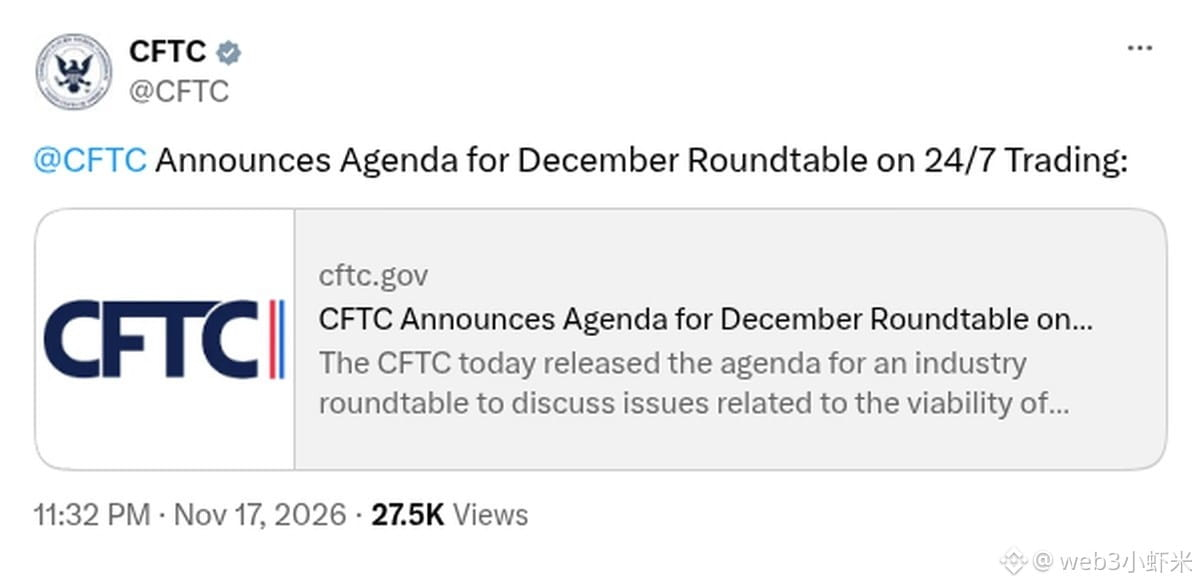
The CFTC has just posted the agenda for its December 15 roundtable on 24/7 trading. The agency says the meeting will be held at its headquarters in Washington, D.C., from 1 to 4 p.m. Eastern Time, and will also be streamed live on CFTC.gov.
The topics are quite specific: overnight and weekend trading, tokenization, margin, infrastructure and staffing, as well as operational readiness. Chairman Michael S. Selig said the CFTC will promote innovation in derivatives markets while taking into account the differences among asset classes. He also wants to hear directly from industry participants about how 24/7 trading might affect their business models, so that regulation better reflects the needs of market participants.
This isn’t the rollout of new rules yet—it’s just a matter of publishing the agenda and inviting all sides to discuss the issues. But tokenization and weekend trading are already on the same agenda.
#CFTC #Regulation

CFTC candidate questions the value of prediction markets!
- Democratic candidate Matthew Rowland says he wants a role in shaping regulations for prediction markets.
- Prediction markets are facing growing legal challenges.
- CFTC regulations will affect the development of Web3 and decentralized platforms.
#BinanceSquare #CryptoNews #CFTC #PredictionMarkets #Web3
$btc $eth
vlikevn Titanbot
Source: CoinDesk
CFTC nominee questions the benefits of prediction markets as legal dispute widens
- Matthew Rowland, nominated to serve as a CFTC commissioner, wants to be involved in drafting regulations for prediction markets.
- He believes prediction markets could affect financial markets and need a clear legal framework.
- The legal dispute is widening, and the CFTC is considering whether to allow or ban prediction platforms.
#BinanceSquare #CryptoNews #CFTC #PredictionMarkets
$btc $eth
#vlikevn Titanbot
Source: CoinDesk
93

The battle for prediction market supremacy is hitting a critical regulatory wall in Washington. As Trump’s CFTC nominees face heavy Senate scrutiny over sports betting oversight, the future of decentralized event contracts hangs in the balance. Traditional financial watchdogs are scrambling to draw lines, but stopping decentralized prediction platforms completely will be nearly impossible. This turf war is the ultimate test for crypto-native forecasting tools moving forward. $BTC #CryptoRegulation #PredictionMarkets #CFTC
The battle for prediction market supremacy is hitting a critical regulatory wall in Washington. As Trump’s CFTC nominees face heavy Senate scrutiny over sports betting oversight, the future of decentralized event contracts hangs in the balance. Traditional financial watchdogs are scrambling to draw lines, but stopping decentralized prediction platforms completely will be nearly impossible. This turf war is the ultimate test for crypto-native forecasting tools moving forward. $BTC #CryptoRegulation #PredictionMarkets #CFTC
22

Breaking news from Capitol Hill: CFTC nominees were just "grilled" about prediction markets! Nathan Anonick and Matthew Rowland repeatedly dodged questions about whether prediction markets are disguised sports betting.
They cited the issue's complexity and said they needed to wait for a Supreme Court ruling. This ambiguity puts platforms like Kalshi and DeFi prediction markets at enormous legal risk. It's a fierce battle between state and federal authorities.
The lack of clear guidance from regulators is shrouding the entire industry in uncertainty. The market needs transparency to grow, but what we're getting is one huge open question.
Still, Rowland also pledged to strengthen CFTC staffing, step up enforcement, and better protect retail investors as the market grows more complex. This is a positive sign for internal stability.
Will the CFTC become a barrier or a guide for innovation in the prediction market space?
#Crypto #CFTC
55

·
--
CFTC greenlights perpetual contracts in the US; Backpack breaks ground as the first platform, potentially opening the door to institutional capital
Trading perpetual contracts in the US has finally received regulatory approval. CFTC Chair Mike Selig publicly confirmed that the agency has officially greenlit perpetual contracts and selected Backpack as the first platform to launch them, while also saying he hopes to continue moving forward on this basis. For those focused on capital flows, the significance of this news may lie less in any single rule and more in the fact that the door for leveraged capital to enter the US crypto market has officially opened.
From the perspective of access to capital, US retail and institutional investors have long been excluded from perpetual contracts, relying mainly on offshore exchanges. By accepting perpetual contracts within a compliance framework, the CFTC has effectively created a compliant channel for dollar capital that previously could not enter. Which platforms will follow, and at what pace capital will flow in, are variables more worth watching than the first platform itself.
Why this turning point matters is that it changes the structure of liquidity sources. Compliance typically lowers the barriers to institutional participation and expected compliance costs, and also signals a shift in the regulator’s approach from restriction to guidance. Selig’s statement that he “looks forward to continuing to move forward on this basis” suggests that more platforms or products may enter this framework, making marginal changes in capital flows worth monitoring.
One point needs to be clarified: for now, only a single platform has launched first. According to Decrypt, the CFTC has confirmed only the direction and the first platform; the scale and speed of actual capital inflows remain unclear, while regulatory details and compliance costs are also still variables. Therefore, the significance for capital flows is being amplified primarily on the basis of a regulatory turning point, rather than on capital inflows that have already occurred.
How the market may respond depends on how many capital-market participants accept this interpretation. If more platforms follow or regulatory details are finalized, the compliant entry point for leveraged capital will be further confirmed, and sentiment may turn positive. Conversely, if this remains only a statement and actual inflows are limited, the short-term impact may soon be absorbed by the market.
The counterarguments are equally clear: a single platform launching first shows that implementation is still at an early stage, while compliance costs, investor protection requirements, and institutions’ actual willingness to enter have yet to materialize. Equating a regulatory turning point directly with capital inflows may be overly optimistic.
What to watch next is whether the CFTC’s commitment to “continue moving forward” leads to additional platforms or products, and whether indicators such as funding rates and trading volume confirm that leveraged capital is truly entering the market. For those focused on capital flows, the regulatory direction is now clear, but whether capital actually follows remains to be confirmed by the market.
#CFTC #Perpetual #CryptoRegulation
The above is a compilation of information and personal analysis, and does not constitute investment advice.
I will continue to provide updates as further policy details become clear.
78
Trump’s CFTC Nominees Face Senate Questioning in Prediction Market Battle
- Trump’s CFTC nominees present their views on regulating sports betting/prediction markets at a Senate hearing
- Jurisdictional conflicts between regulatory agencies are escalating, directly affecting the on-chain prediction market sector
- Regulatory outcomes will shape the future of platforms like Polymarket, Kalshi, and related Web3 projects
#BinanceSquare #CryptoNews #CFTC #Regulation #PredictionMarkets Web3
$btc $eth
vlikevn Titanbot
Source: The Block
3
The CFTC just slammed the brakes on Kalshi’s Trump mention markets, citing high manipulation risks. This is a crucial stress test for prediction platforms trying to scale in the US. If these markets survive regulatory scrutiny, it opens doors; if not, compliance walls will tighten fast for all decentralized-adjacent betting. #CryptoRegulation #PredictionMarkets #CFTC
The CFTC just slammed the brakes on Kalshi’s Trump mention markets, citing high manipulation risks. This is a crucial stress test for prediction platforms trying to scale in the US. If these markets survive regulatory scrutiny, it opens doors; if not, compliance walls will tighten fast for all decentralized-adjacent betting. #CryptoRegulation #PredictionMarkets #CFTC
153
CFTC Nominee Questions Public Interest of Prediction Markets
- Matthew Rowland, the Democratic nominee to join the CFTC’s commission, wants to help develop rules for prediction markets.
- He questions the public interest served by these markets.
- Legal disputes involving them are increasing.
- The RSS source provided no further details about specific regulations or the impact on cryptocurrency.
#BinanceSquare #CryptoNews #CFTC #Regulation
$btc $eth
#vlikevn Titanbot
Source: CoinDesk
86

·
--
Backpack says the CFTC approved it to run a US blockchain-based derivatives exchange and clearinghouse, with 24/7 trading, crypto collateral and cross-margining. CFTC records show Backpack Clearing registered as a clearing house on Nov 13. #Backpack #CFTC
Backpack says the CFTC approved it to run a US blockchain-based derivatives exchange and clearinghouse, with 24/7 trading, crypto collateral and cross-margining. CFTC records show Backpack Clearing registered as a clearing house on Nov 13. #Backpack #CFTC
72
Log in to explore more content
Join global crypto users on Binance Square
⚡️ Get latest and useful information about crypto.
💬 Trusted by the world’s largest crypto exchange.
👍 Discover real insights from verified creators.
Email / Phone number
Trending Topics
1
#IsAnthropic’s$1.5TMarketCapJustified?
9,814 views
79 Discussing
2
#BTCRemainsUnderPressureAfterHawkishFOMCMinutes
232,574 views
2,054 Discussing
3
#NvidiaBoardReportedlySplitOverHuang’sReturn
112,913 views
1,101 Discussing
4
#StrategySTRCPreferredSlips3.65%Below$100Par
6,818 views
66 Discussing
5
#MASToUpgradeSGDTestnetToSGDigitalLedger
19,836 views
240 Discussing
6
#CanGTA6'sLaunchLiftTTWOShares?
81,171 views
801 Discussing
7
#Solana2027RoadmapTargetsDoubleComputeCapacity
8,200 views
129 Discussing
8
#InjectiveTokenizedRealEstateMortgagesTop$1.5B
1,094 views
28 Discussing
9
#TetherMakesStrategicInvestmentInSCRYPT
6,047 views
103 Discussing
10
#CapitalGroupAdds1264500StrategyShares
28,264 views
229 Discussing