
NANCY813
490 Posts

NANCY813
 Square Verified
Report
Block User
空投撸毛|AI|MeMe|不拉人头|Youtube频道: #遇见Nancy |#fomo:nancy_c813
54 Following
2.9K+ Followers
4.1K+ Liked
Posts
All
Quotes
Videos
PINNED
·
--
This video was lucky enough to be quote-reposted by CZ Big Cousin. Let’s all take a look: “Binance Life” in Taiwanese.
This video was lucky enough to be quote-reposted by CZ Big Cousin. Let’s all take a look: “Binance Life” in Taiwanese.
1
11
2.3k
·
--
Veteran mining company Bit Digital dumped 29,825 $ETH in one go, just to repay the $50 million it owed Galaxy.
Under the dual pressure of capital markets and industry upheaval, this veteran company chose to sell off decisively. On one hand, it is repaying debt and going all-in on a transition to AI computing; on the other, its stock price and crypto asset values are being squeezed by a double whammy in the capital markets. When even a mining giant that once had unwaveringly bullish views on Ethereum moves to cut leverage ahead of time, choosing to forcibly convert its spot assets into cash to repay debt, the signal is unmistakable: liquidity on the institutional side has tightened to a critical point.
With macro liquidity continuing to tighten, deleveraging has evolved from an individual company’s act of self-preservation into a chain reaction. If even a well-known Nasdaq-listed mining company has to sell off core assets just to stay afloat, the on-chain selling pressure may be difficult for the market to fully absorb in the near term.
Nancy thinks that if even publicly listed companies are dumping assets and deleveraging to survive, ordinary investors should not blindly mistake a sharp decline for a buying opportunity. Until institutional selling pressure has been absorbed, protecting cash flow is far more important than trying to catch a falling knife. Managing liquidity risk is the top priority at this stage.
See the image for today’s other highlights 👆
Do you think this wave of miners selling off assets to repay debt means the bad news is fully priced in, or is the liquidity crisis only just beginning?
⚠️ Not investment advice · DYOR
#CryptoEveningBrief #ETH #Ethereum #Cryptocurrency

1
1.5k
·
--
Verified
Oh my god, hackers stole the money, and after finally managing to freeze it, you still have to pay 20% to get it back?
When handling stolen funds that have been frozen, Tether has asked victims to pay a return fee more than once. The most notable case involved Bittok, a small Singaporean exchange. Hackers stole $50 million from it in June 2020, and Tether froze some of the funds. The company that took over Bittok then received an email from Tether's lawyers mentioning a 20% reissuance fee.
What’s even more troubling is that reports say Tether has no consistent policy: sometimes it lets stolen funds slip away, sometimes it freezes them and never returns them, and when it does return them, it charges a fee. The timing of this story’s exposure is especially sensitive. Last month, after Binance was hacked, Tether froze more than $1.5 billion in USDT within 30 minutes. Tether says it has frozen more than $7 billion in total and helped return about $1.2 billion.
Here’s the question: if the same 20% fee applied to that $1.5 billion, that would mean a $300 million “service fee.”
My take: being able to freeze funds is a good thing, but when one company holds both the “power to freeze” and the “power to charge,” users have no real room to negotiate. That’s the reality of centralized stablecoins.
Do you think charging a fee after freezing funds is a reasonable cost—or taking advantage of people in their time of need?
#Tether #USDT #稳定币 #黑客 #Crypto

1
4
9.4k
·
--
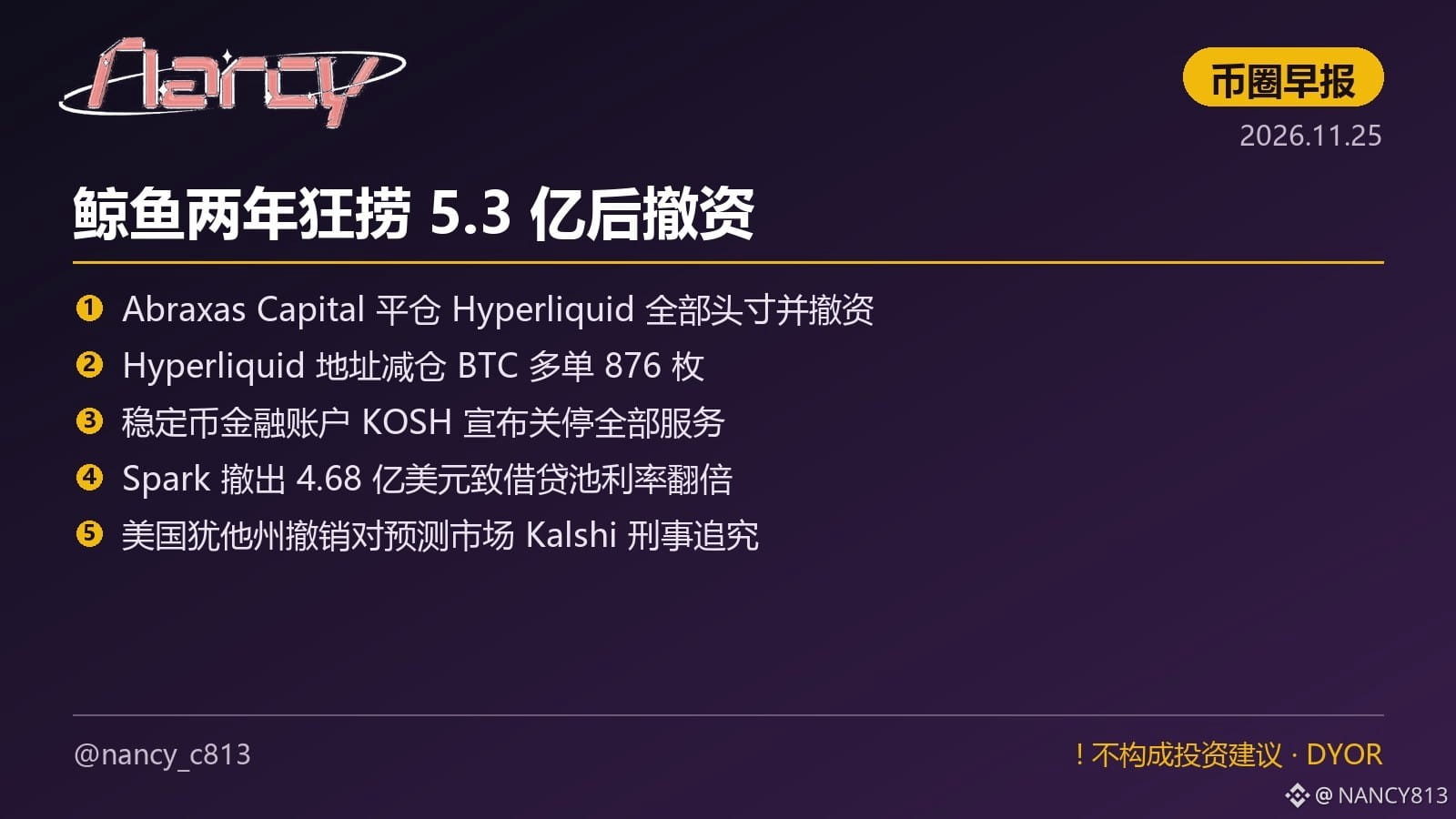
After raking in around $530 million over two years, well-known firm Abraxas Capital recently chose to close out all of its positions on Hyperliquid and withdraw all its funds. The crypto market has been volatile lately, with an uncertain outlook. Looking back at on-chain data from the past few months, frequent shifts in whale holdings have often foreshadowed sharp changes in market sentiment. Whales taking profits decisively during a market downturn, alongside another address on Hyperliquid reducing a BTC long position by 876.788 BTC in a single trade, suggests that leveraged funds on-chain are increasingly seeking safety. When smart money chooses to cash out, retail traders need to keep an even closer eye on their positions and avoid blindly buying the dip as liquidity tightens. In this complex market environment, risk management always comes first. Do you think this whale outflow signals a market bottom—or is it a precursor to a sell-off?
⚠️ Not investment advice · DYOR
#CryptoMorningBrief #Hyperliquid #BTC
⚠️ Not investment advice · DYOR
#CryptoMorningBrief #Hyperliquid #BTC
1
420
·
--
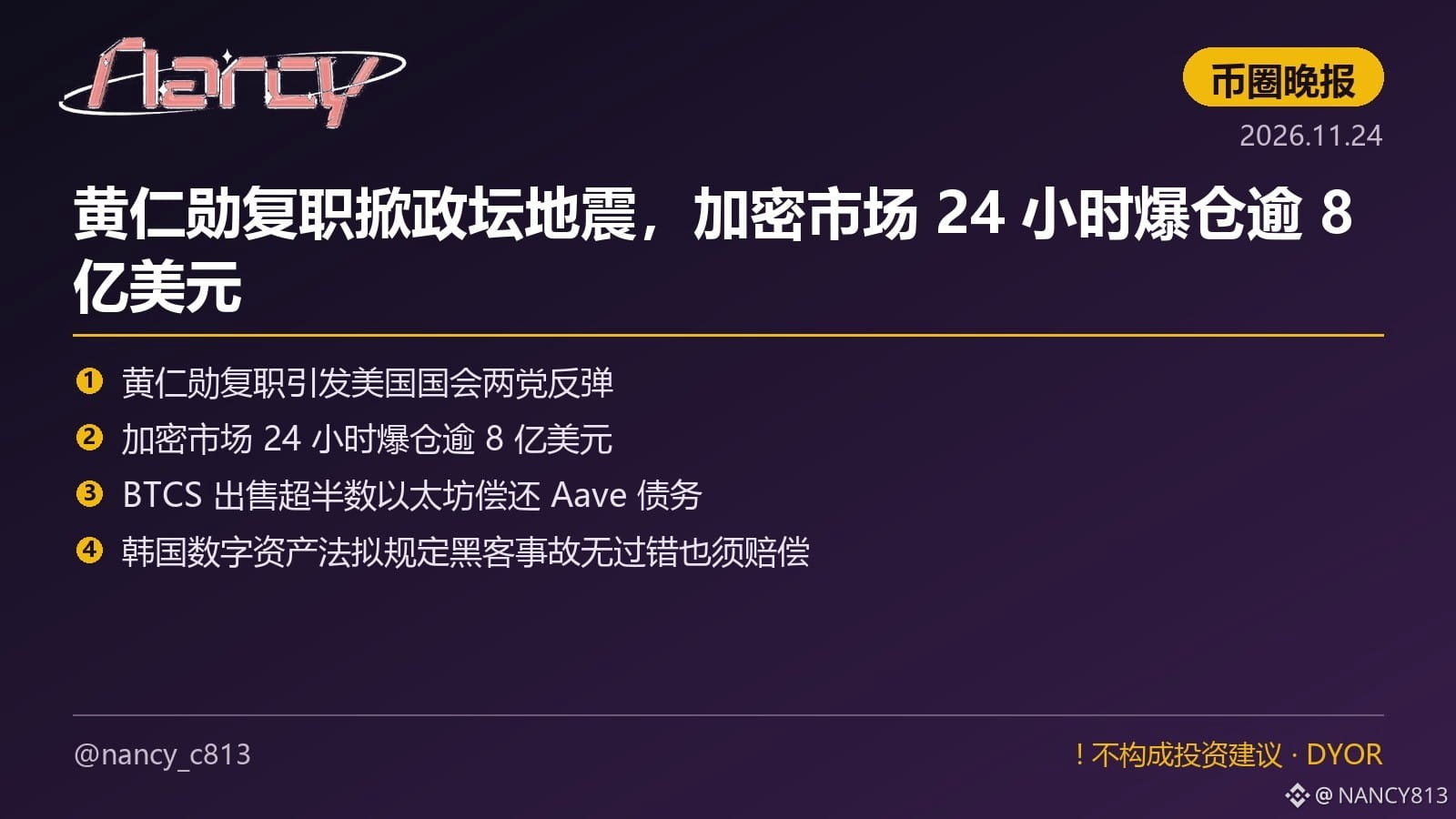
Trump claims he personally helped get Jensen Huang reinstated, but the result not only drew vows from Democrats to investigate, it also sent the crypto market tumbling! As all the gains driven by Nvidia news were wiped out, more than $800 million in positions were liquidated across the market over the past 24 hours, and $BTC once again fell below the $60,000 level.
Market sentiment plunged from euphoria to despair in an instant. Looking back to the start of this week, the macro outlook was already on edge, with Goldman Sachs repeatedly warning that the market was entering a period of liquidity contraction. Add this sudden political and tech-sector storm, and the bulls’ defenses collapsed across the board. Leveraged traders suddenly found their room to maneuver severely squeezed as the market suffered multiple waves of liquidations.
The on-chain data was even more grim. Glassnode’s figures show that the current loss-making supply of $BTC has surpassed 11.6 million coins, setting a new all-time high. Meanwhile, BTCS had to sell more than half of its Ethereum in one go to repay $43.8 million in debt to Aave. Heavy selling pressure and panic have compounded the damage to an already fragile market.
In this sudden liquidity crisis, every sell-off by major players is testing investors’ psychological limits. Have you managed to hold on through this latest storm of extreme volatility? Feel free to leave a comment below and tell us whether your positions are still safe.
See the image 👆 for today’s other key stories
⚠️ Not investment advice · DYOR
#CryptoEveningBrief #BTC #Liquidations
368
·
--
Robin Cat Radar v2.0.5 is now available, with this update focused entirely on speed and accuracy
Solana “new listings” are now live in real time. New tokens appear in the list within seconds of launching. During a full review, we found they could be delayed by more than ten minutes because the new client wasn’t connected to the real-time new-token feed. That’s now fixed.
Trade timestamps on the Robinhood chain now match on-chain block times. Previously, the older the trade, the bigger the discrepancy—up to twenty minutes. Now they’re in sync. The new-token section also won’t move older tokens to the top anymore; everything is sorted by creation time.
This is an important update. It installs automatically when you open Radar, and all your settings are preserved—you don’t have to press a thing. To prepare for this release, we tested all 11 chains, 741 numeric fields, and more than 500 buttons, then compared them item by item against the major platforms. We’re designing features that other platforms have but we don’t yet. More are coming in the next release.
Free, no commissions, and no access to your wallet. Search for robincat-radar on GitHub to download it.
#罗宾猫雷达 #Solana #Robinhood #BNBChain #MEME
1
1.3k
·
--
Who would have thought that South Korea, long known for cracking down hard on crypto, would proactively open the door to ICOs? For the past few years, South Korea’s crypto regulations have been among the strictest in the world. Getting a new coin listed on an exchange was like having your skin peeled off, while real-name accounts and all sorts of hurdles left retail investors watching the kimchi premium from the sidelines.
But the South Korean government has just officially announced its Digital Asset Basic Act. Not only has it directly given ICOs the green light, but exchange market-making—previously a red-line activity—now has a legal basis too. From an all-out crackdown to opening the floodgates, South Korea’s regulatory U-turn has been remarkably decisive.
A large number of domestic projects will no longer have to secretly issue tokens under offshore aliases. Compliant funds and teams can raise capital openly, and legalizing market-making by exchanges is a much-needed shot in the arm for liquidity. But compliance doesn’t mean rushing in blindly.
While the policy shift may attract a flood of compliant capital, it will inevitably bring stricter disclosure requirements and higher barriers to entry. The kimchi market has always been one of the most emotionally charged and aggressively capitalized corners of the global crypto market. Once the door to compliance is fully open, the way institutions and old money enter the market is sure to change dramatically.
#韩国 #ICO #监管 #加密法规 #Exchanges

1.2k
·
--
Verified
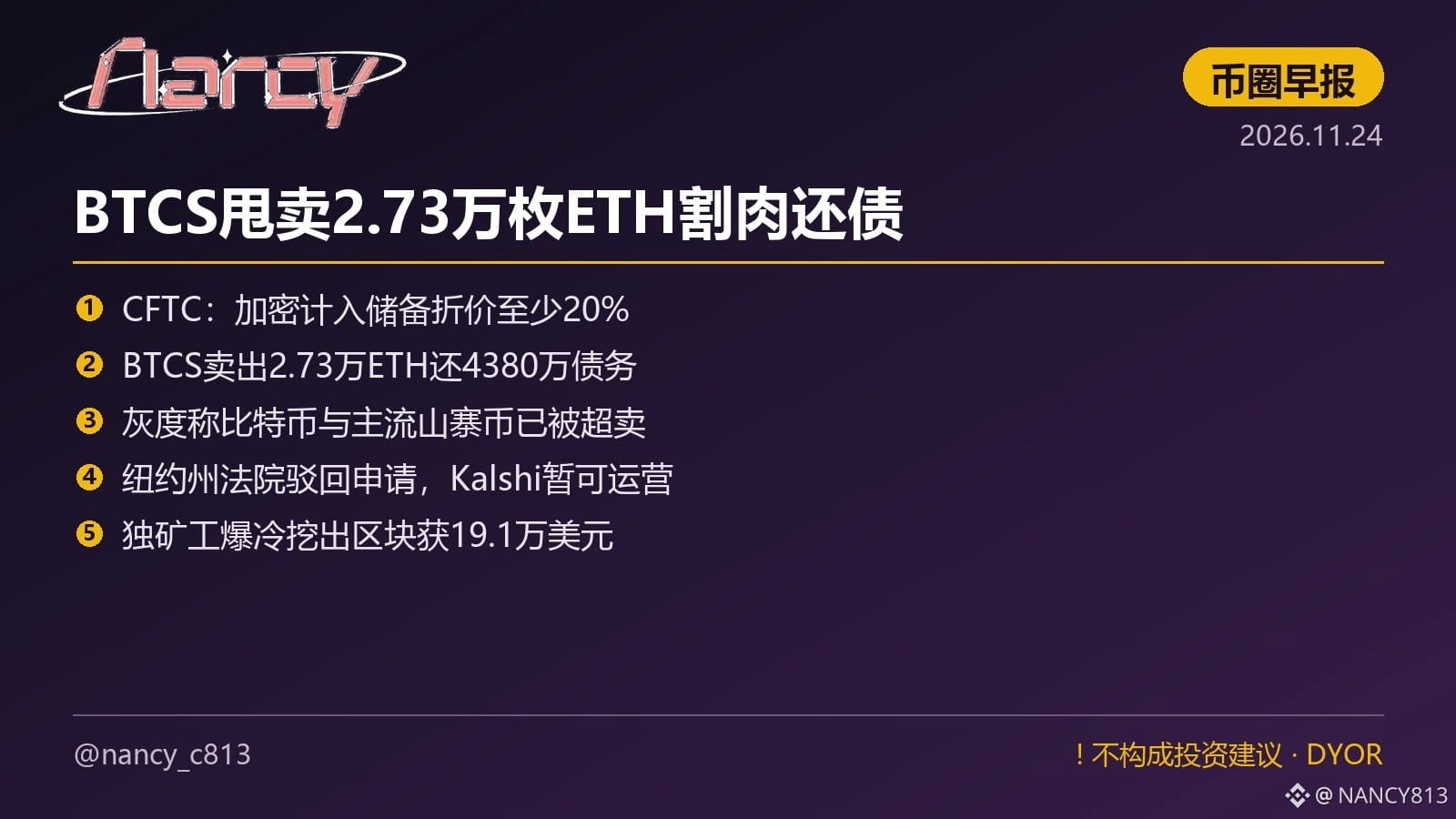
To avoid being forcibly liquidated by Aave, publicly traded company BTCS dumped approximately 27,300 $ETH , raising $43.8 million to repay its DeFi debt.
During this highly stressful market downturn, liquidation alerts on on-chain lending protocols have been sounding frequently. Even with massive Ethereum reserves, institutions can hardly remain calm when their borrowing health metrics are under pressure. BTCS CEO then spoke out personally to clarify that the company’s large one-off sale was purely a defensive move, intended to eliminate the potential risk of being liquidated by Aave and safeguard the company’s ability to meet its obligations and maintain financial stability.
A closer look at the dump shows that BTCS’s sale of 27,300 $ETH for $43.8 million not only cut off the chain reaction from its massive DeFi debt in the short term, but also cleared high-risk leverage from its books. It also starkly reflects the extreme resolve of institutional holders to dump assets, close out positions at a loss, and fight for survival when faced with the dual pressures of huge unrealized losses and approaching liquidation thresholds.
When even major players such as publicly traded companies start proactively dumping assets to repay debt and eliminate the scourge of leverage, retail investors who blindly rush in to buy the dip can easily be swallowed by fragile liquidity. Until market leverage risk has been fully flushed out, any leveraged position too close to its liquidation threshold could become the trigger for the next cascade of forced selling.
With institutions dumping assets to repay debt, do you think Ethereum’s bottoming process is over?
See the image 👆 for today’s other highlights.
⚠️ Not investment advice · DYOR
#CryptoMorningBrief #Ethereum #DeFi #BTCS
ETH-0.11%
BTCSUS-1.07%
1
1.7k
·
--
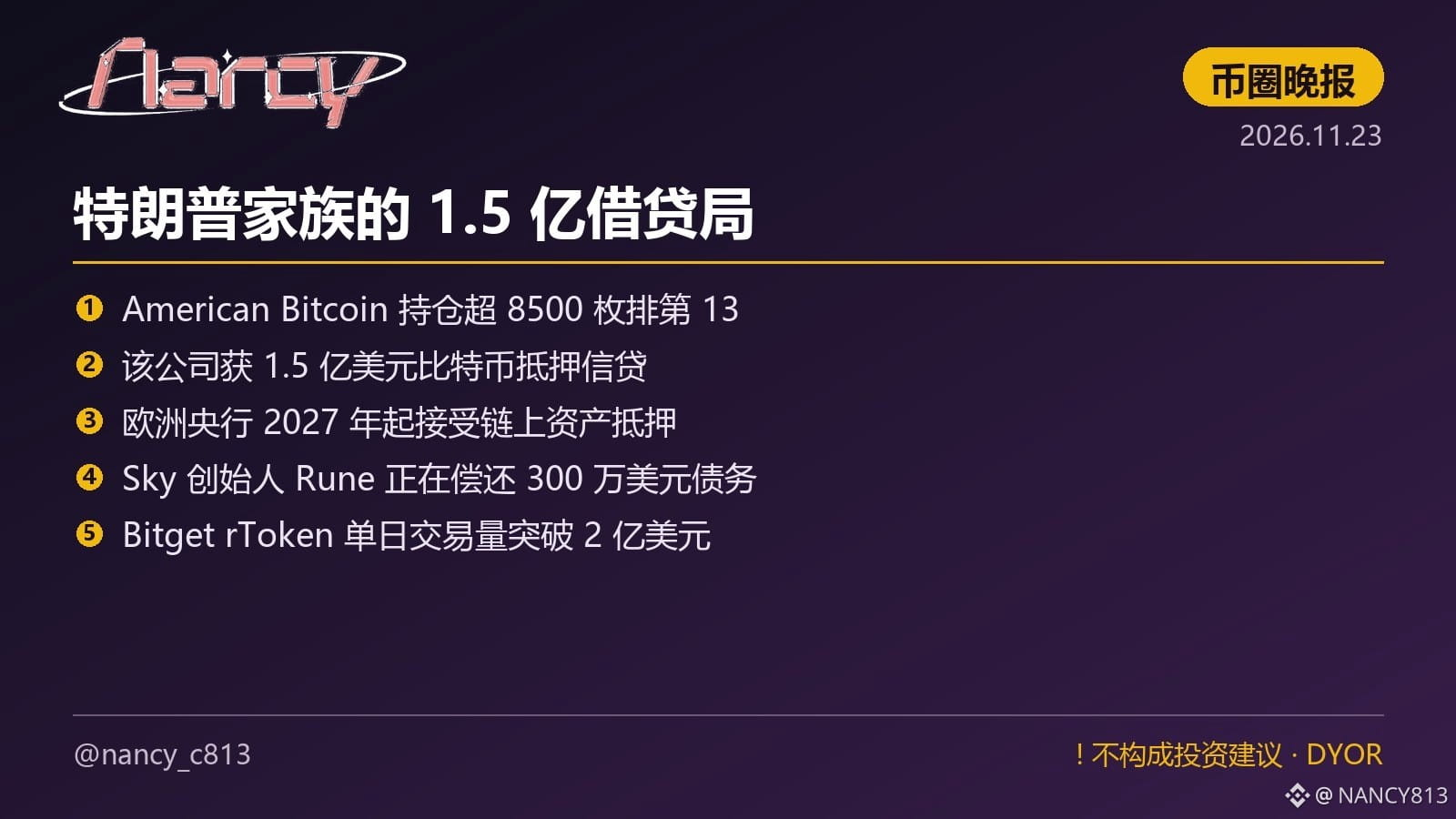
American Bitcoin has quietly amassed more than 8,500 $BTC. This Trump-family-backed “new whale” has already climbed to No. 13 on the global holdings leaderboard. Even more striking, they just used those coins to secure a $150 million revolving credit line from FalconX.
This is the classic “buy, collateralize, borrow” playbook. The ultra-wealthy have no intention of selling their coins to cash out; they’re treating Bitcoin like digital land that never loses value. Meanwhile, the European Central Bank has also softened its stance, announcing that it will accept on-chain tokenized securities as collateral starting in June 2027. Global elites are working together to move traditional finance on-chain.
I think everyone should recognize this signal: big money is turning Bitcoin into a “privileged form of collateral.” As this lending model goes mainstream, holdings will become even more concentrated at the top. In the future, $BTC may not be for trading, but for borrowing against.
If you had a $150 million credit line, would you keep adding to your holdings or use it to improve your life?
See today’s other highlights in the image 👆
⚠️ Not investment advice · DYOR
#CryptoEveningBrief #Bitcoin #Trump
American Bitcoin has quietly amassed more than 8,500 $BTC . This Trump-family-backed “new whale” has already climbed to No. 13 on the global holdings leaderboard. Even more striking, they just used those coins to secure a $150 million revolving credit line from FalconX.
This is the classic “buy, collateralize, borrow” playbook. The ultra-wealthy have no intention of selling their coins to cash out; they’re treating Bitcoin like digital land that never loses value. Meanwhile, the European Central Bank has also softened its stance, announcing that it will accept on-chain tokenized securities as collateral starting in June 2027. Global elites are working together to move traditional finance on-chain.
I think everyone should recognize this signal: big money is turning Bitcoin into a “privileged form of collateral.” As this lending model goes mainstream, holdings will become even more concentrated at the top. In the future, $BTC may not be for trading, but for borrowing against.
If you had a $150 million credit line, would you keep adding to your holdings or use it to improve your life?
See today’s other highlights in the image 👆
⚠️ Not investment advice · DYOR
#CryptoEveningBrief #Bitcoin #Trump
1.2k
·
--
Bullish
I’ve been hanging out these past few days with some friends from Washington, D.C., and I asked them what they think about the crypto world.
These people never mess with meme coins. They always use #coinbase because they’re not legally allowed to use other exchanges. They’re almost all long-term holders, and they seem not to care at all about these ups and downs. They just carry on with their lives, because they invest money they can afford to spare rather than going all in on crypto. So if you choose to go all in, they’d think you’re a degenerate gambler—you’re gambling 😂😂😂
They have a level-headed view of this downturn because they understand American politics. But they all mock Trump, thinking he’s the worst president in history.
So here’s the question: since they understand the situation, aren’t worried about spot holdings, and remain optimistic, what exactly are we afraid of?
#BTC #Coinbase #ETH
1
1.1k
·
--
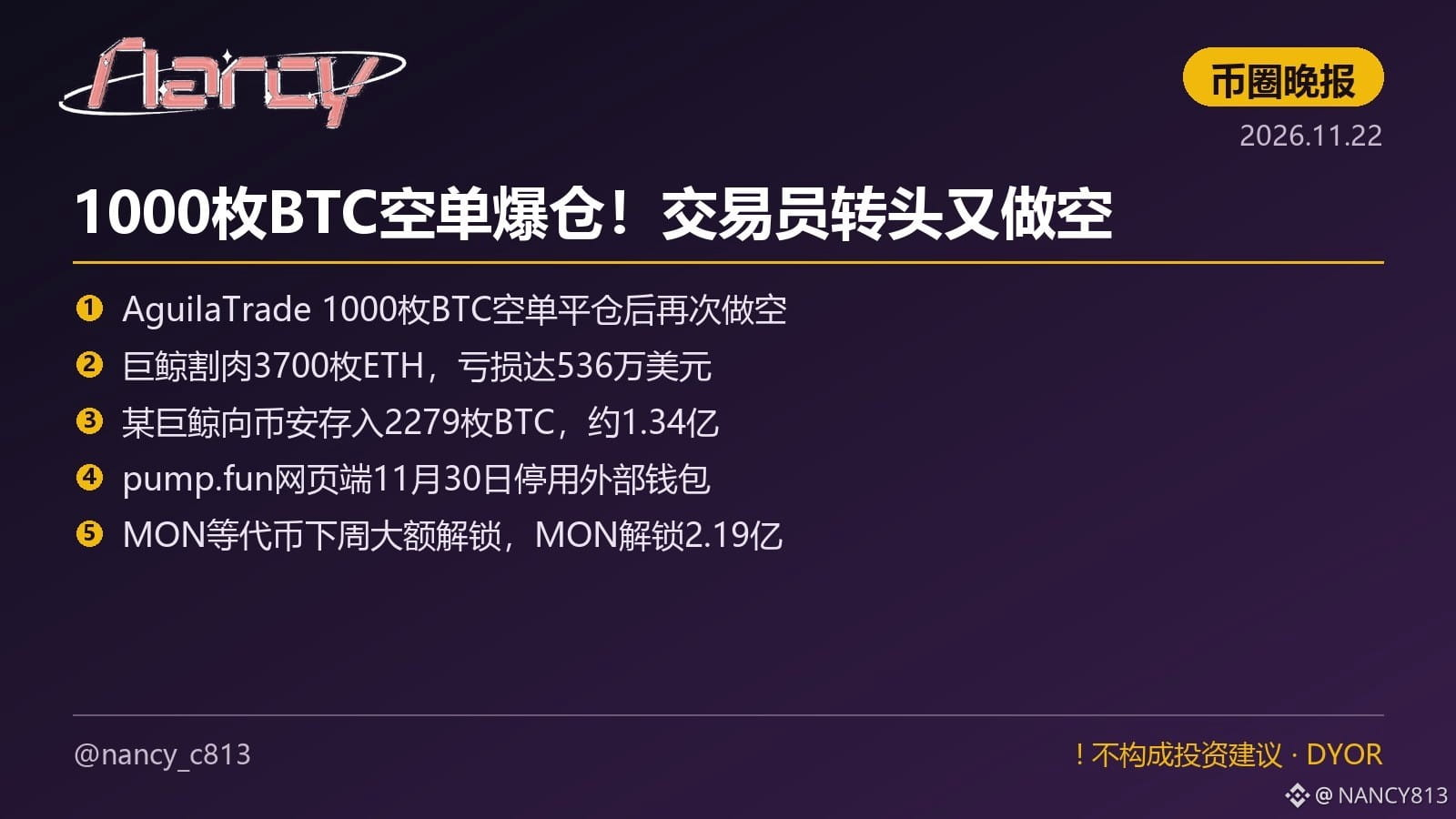
Compounding trader AguilaTrade just got taught a lesson by the market: his short position of 1,000 coins of $BTC was completely liquidated, but he promptly threw more money into the market and went short again!
With Bitcoin surging past $61,000, his stubbornly bearish stance is a striking contrast. His position of over a thousand Bitcoin vanished in an instant, but he clearly wasn’t beaten—he quickly opened a new position right after being liquidated.
In trading, one of the biggest mistakes is opening emotional “revenge trades” after getting liquidated. Market sentiment is warming up right now. If he keeps blindly doubling down against the trend, he may just become fuel for the bulls. The essence of compounding is to magnify gains by following the trend—not to throw real money at a trend and fight it.
What do you think of this move—going short again after being liquidated? Can he turn things around against the odds, or will he get rekt again?
See the image for today’s other highlights 👆
⚠️ Not investment advice · DYOR
#CryptoDaily #BTC #FuturesTrading
1
485
·
--
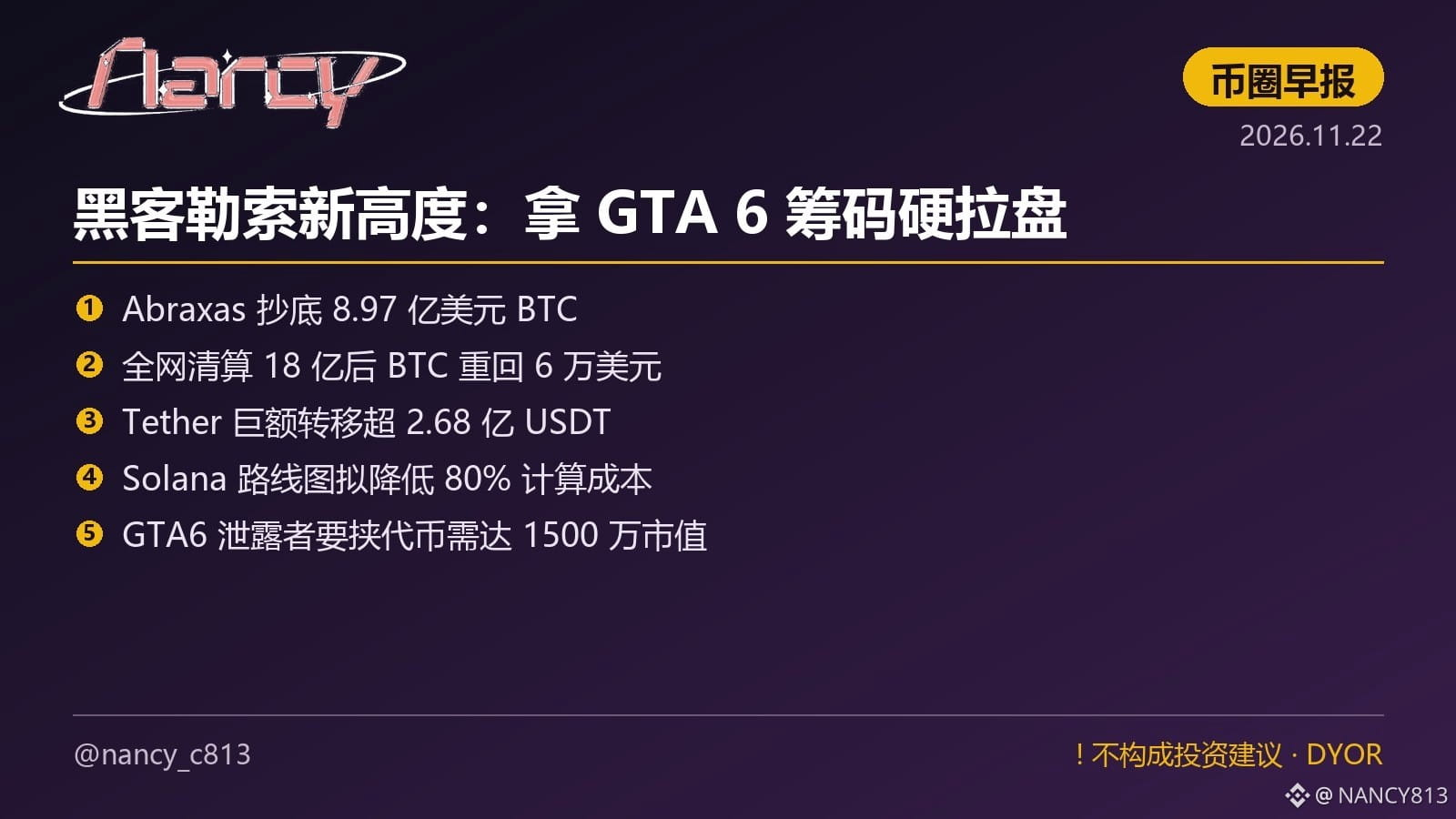
Hackers are getting into crypto pumping, taking traditional extortion to a whole new level. A leaker holding the executable files for 《GTA 6》 has made a shocking move: they refuse to release the game files directly, insisting that a certain crypto token must first reach a market cap of $15 million before they hand them over.
Using a top-tier game as leverage to artificially hype up a token is a ridiculous new high in absurd speculation. But with $BTC having just gone through a massive wave of liquidations worth $1.8 billion, and the market already extremely fragile, this kind of forced pumping by market manipulators could turn into a liquidity squeeze at any moment.
In my view, a market cap propped up by criminal extortion and emotional speculation is nothing but a house of cards. The moment those tokens are cashed out will be the moment it crashes. Please don’t chase the hype just for a thrill—you might miss the show and end up as someone else’s exit liquidity. In this unpredictable market, staying rational should always come first.
If it were you, would you buy this token just to play the game?
See the image for today’s other highlights 👆
⚠️ Not investment advice · DYOR
#CryptoMorningBrief #GTA6 #MemeCoin
1
3
7.7k
·
--
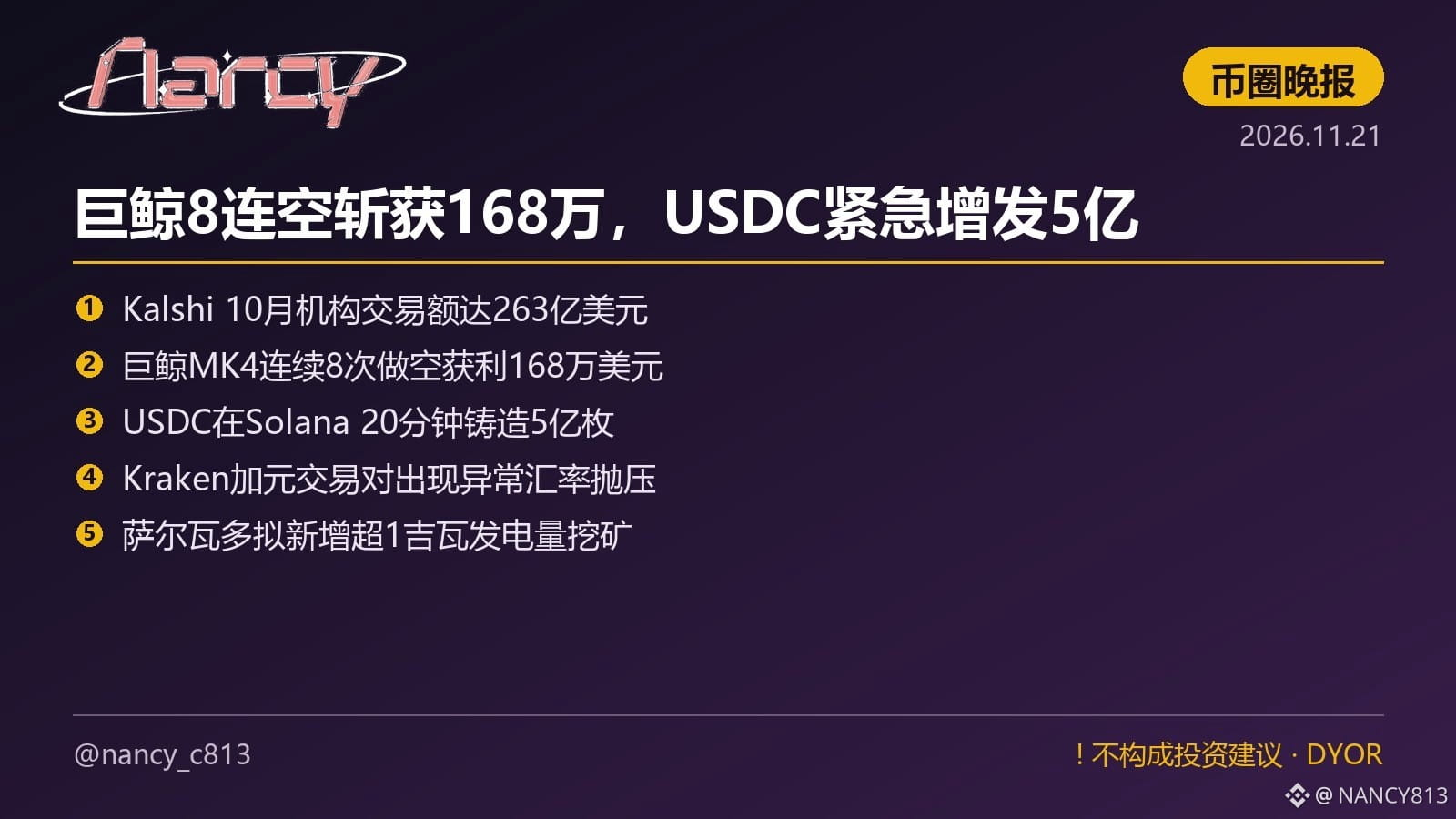
Eight consecutive winning short trades in 24 hours, netting $1.68 million in arbitrage—Hyperliquid whale MK4 turned perpetual futures into an ATM during this pullback.
Let’s break down this textbook operation: As major cryptocurrencies ran into key resistance levels, market sentiment shifted rapidly from extreme greed to fear. During the sharp volatility of the past 24 hours, long positions across the market were liquidated in waves, with leveraged liquidations triggering several rapid sell-offs. MK4 spotted signs of drying liquidity and, with precise short-term timing, entered short positions near the highs eight times in a row—each time taking profit right at support after a sharp drop. The $1.68 million in net profit was more than just a number going up; it was a masterful ride on the market’s deleveraging momentum.
The turning point came when bearish sentiment reached its peak. On-chain data showed that the USDC treasury on Solana suddenly minted 500 million tokens in just 20 minutes: $USDC . This massive injection of funds was a powerful signal, and its timing almost exactly coincided with MK4 and other major bears closing profitable positions. The $500 million issuance not only provides potential liquidity support for the market, but also suggests that large players are preparing to buy into a potential bottom. The sudden surge in stablecoin supply means that one-sided short positions are beginning to face a subtle shift in the balance of power.
In my view, whales cashing out after huge gains often signals peak market sentiment, while crowded short positions are effectively loading the spring for a rebound. Before the newly issued on-chain funds officially step in to buy the dip, blindly following the shorts could easily land you in the path of a sharp oversold bounce.
Facing a whale with eight straight winning short trades, would you follow and short, or buy the dip and wait for a rebound?
See the image for today’s other highlights 👆
⚠️ Not investment advice · DYOR
#CryptoEveningBrief #Hyperliquid #US
2
2.2k
·
--
Bullish
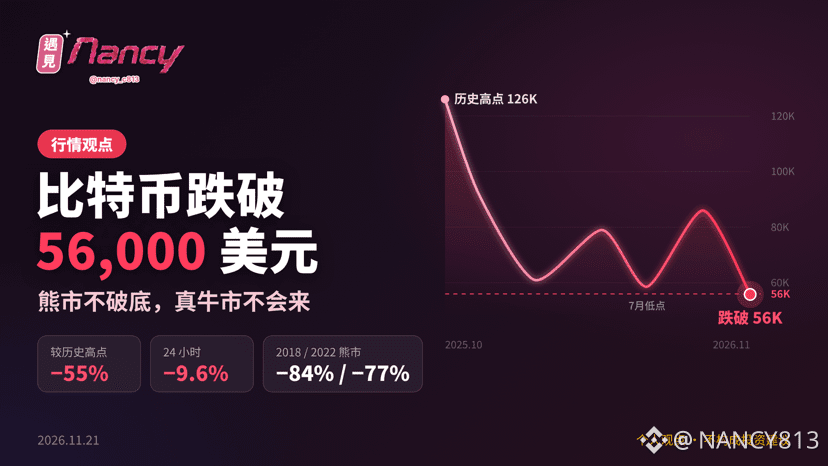
Bitcoin just fell below 56,000, down nearly 10% in 24 hours, breaking straight through its year-to-date low from July. X is full of despair. I want to say something that might not be very pleasant to hear: maybe this is normal, even necessary 😓😓
Since last October’s peak of 126,000, it’s now down more than 55%. That sounds scary, but the 2018 bear market saw an 84% drop, and in 2022 it fell 77%. This cycle has actually been relatively mild.
Meanwhile, AI tech stocks are being sold off, rate-hike expectations are heating up, and ETF funds keep flowing out. Since November, ETF outflows have topped $3 billion. It’s not that Bitcoin is broken—the world’s risk assets are all deleveraging together.
Why does it have to break below the bottom? Because after the rebound from July’s low, too many people thought “the bottom is in,” and piled back into leverage. Sentiment hadn’t really cooled off. Unless the bottom is truly broken once, weak hands won’t be shaken out, and the market won’t attract new buyers.
Historically, every true bull market has started when “everyone says Bitcoin is finished.” In 2018, nobody dared to buy at $3,000; in 2022, nobody dared to buy at $15,000. And after the previous two bear markets bottomed, Bitcoin took roughly 15 months to two years to reach a new high.
So my mindset right now is simple: no leverage, no going all in, keep some cash on hand, and take things slowly in batches. Panic is a gift the bear market leaves for those who are patient.
#Bitcoin #BTC #BearMarket #Cryptocurrency #BullMarket
$BTC $ETH
Bitcoin just fell below 56,000, down nearly 10% in 24 hours, breaking straight through its year-to-date low from July. X is full of despair. I want to say something that might not be very pleasant to hear: maybe this is normal, even necessary 😓😓
Since last October’s peak of 126,000, it’s now down more than 55%. That sounds scary, but the 2018 bear market saw an 84% drop, and in 2022 it fell 77%. This cycle has actually been relatively mild.
Meanwhile, AI tech stocks are being sold off, rate-hike expectations are heating up, and ETF funds keep flowing out. Since November, ETF outflows have topped $3 billion. It’s not that Bitcoin is broken—the world’s risk assets are all deleveraging together.
Why does it have to break below the bottom? Because after the rebound from July’s low, too many people thought “the bottom is in,” and piled back into leverage. Sentiment hadn’t really cooled off. Unless the bottom is truly broken once, weak hands won’t be shaken out, and the market won’t attract new buyers.
Historically, every true bull market has started when “everyone says Bitcoin is finished.” In 2018, nobody dared to buy at $3,000; in 2022, nobody dared to buy at $15,000. And after the previous two bear markets bottomed, Bitcoin took roughly 15 months to two years to reach a new high.
So my mindset right now is simple: no leverage, no going all in, keep some cash on hand, and take things slowly in batches. Panic is a gift the bear market leaves for those who are patient.
#Bitcoin #BTC #BearMarket #Cryptocurrency #BullMarket $BTC $ETH
3
12
21.9k
·
--
In just one hour, bulls across the crypto market were crushed, with $469 million liquidated. Bitcoin fell below the $57,000 mark. This was definitely no ordinary intraday pullback: the Nasdaq plunged 5.28% overnight, wiping out its year-to-date gains, while Nvidia tumbled 14%. The crypto market followed suit, with $BTC plunging 8.14% in a single day to $56,994, $107 million in Ethereum positions liquidated, and legacy privacy coin $ZEC down more than 20% on the day.
The battle for survival among on-chain whales is truly nerve-racking. Over the past nine hours, two wallets deposited 4,069 BTC worth approximately $239 million into Binance. Meanwhile, a whale was holding a roughly $81.23 million long position in $HYPE and transferred in 5 million USDC, with a liquidation price of $54.55. The leveraged position cleanup is only just beginning, amid the combined impact of large spot deposits and a stock market crash.
#BTC #ZEC #HYPE

1
8.5k
·
--
Cathie Wood has thrown $91 million behind AI giant Anthropic ahead of its IPO, while accelerating cuts to her crypto holdings. The institutional investor, once one of crypto’s most steadfast bulls, chose to pull substantial funds out of the crypto market and redirect them into AI as $BTC fell below $59,000.
As Tether burned 4 billion USDT on the Ethereum mainnet, a Hyperliquid whale opened a $31.75 million short position. Institutions and whales alike are pulling back, with market capital visibly moving into safe havens.
In my view, Wood’s portfolio shift sends a very clear signal: during a macro deleveraging cycle, big money is prioritizing a collective move into AI assets. When even the most committed bulls start retreating, retail investors should not rush to blindly buy the dip and try to weather this sell-off.
Even Cathie Wood is trimming crypto and shifting into AI. Are you choosing to follow big money into safe havens, or to buy the dip against the trend?
See image 👆 for today’s other highlights
⚠️ Not investment advice · DYOR
#CryptoMorningBrief #BTC #AI

1
1.7k
·
--
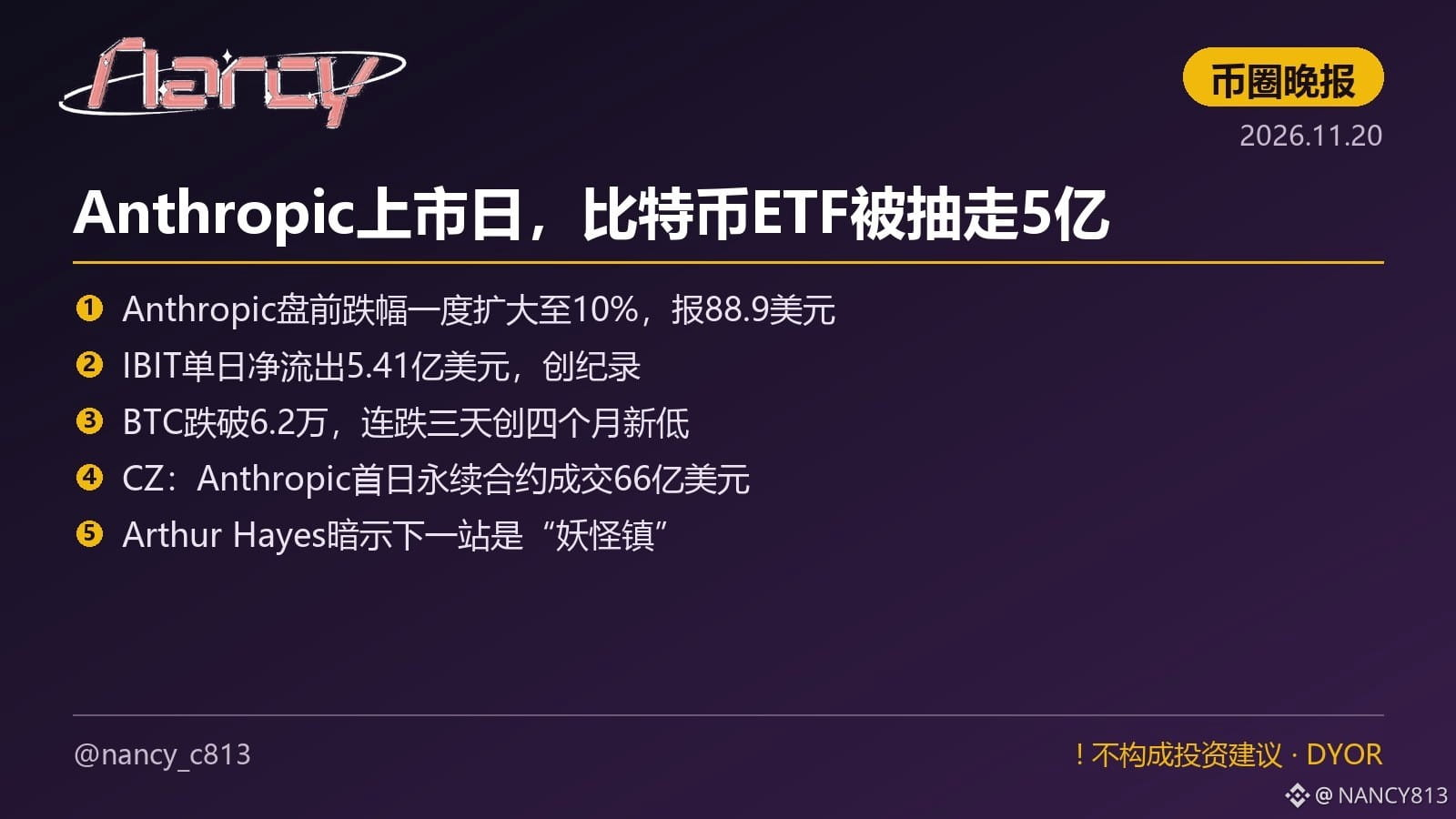
Cathie Wood’s Ark bought $90 million of Anthropic’s IPO, while BlackRock’s IBIT saw record net outflows of $541 million on the same day. Those buying into the new story are adding to their positions, while those buying Bitcoin are pulling out. The two figures landed on the same day: on one side, institutions are willing to put money into a new story; on the other, funds are flowing out of Bitcoin.
$BTC fell below $62,000, marking its third consecutive day of losses, while Bitcoin ETFs saw $582 million in outflows in a single day. Anthropic itself wasn’t faring much better: its premarket drop briefly widened to 10%, bringing the price to $88.90. The new story took a hit on its very first day, while the old story has bled for three days straight. Neither side is having an easy time.
Here’s the twist: the hype hasn’t disappeared—it’s just moved elsewhere. CZ said price discovery happens on-chain first, and Anthropic’s perpetual futures saw $6.6 billion in trading volume on its first day. My take: it’s not that the crypto crowd has vanished; the same people have simply switched arenas. Glassnode data shows that overall holdings are close to breakeven. In other words, most people’s positions are neither in profit nor at a loss, and if prices dip a little further, sentiment could crack first. If the decline continues, those holding losing positions will be the next to panic.
Do you think this is capital switching to a different arena, or is risk appetite genuinely fading?
See the image 👆 for today’s other top stories.
⚠️ Not investment advice · DYOR
#CryptoDailyBrief #BitcoinETF #Anthropic
BTC+0.06%
IBITETF-0.22%
526
·
--
Verified
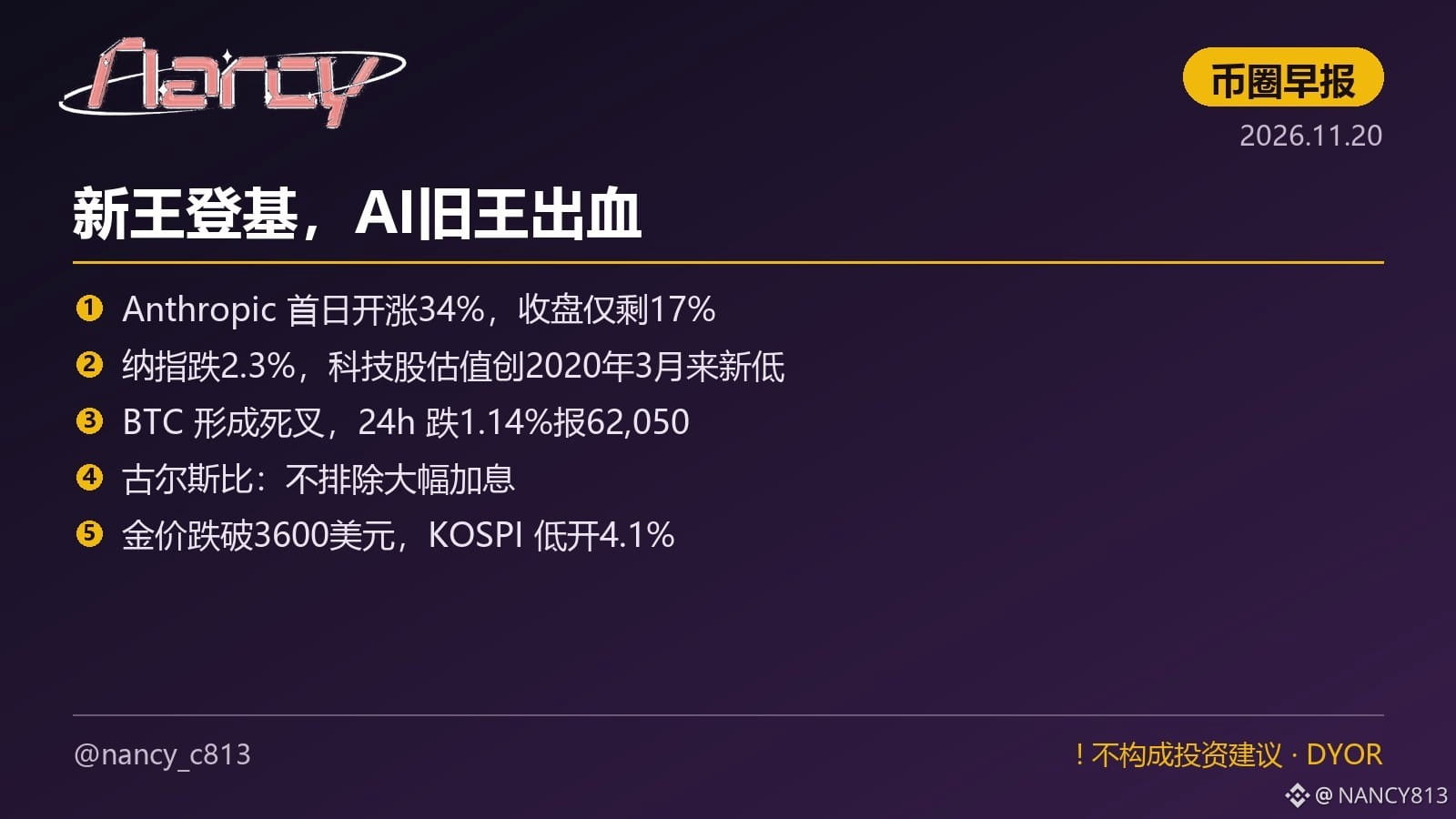
Up 34.3% at the open, but up just 17% at the close: Anthropic turned its first day on the market from a celebration into a downhill slide.
Priced at $83, shares opened at $111.50, then briefly fell below $100. Nvidia, AMD, and Micron all declined the same day, while the Nasdaq Composite closed down 2.3%. U.S. tech stock valuations fell to their lowest level since March 2020.
The crypto market had already priced it in: Anthropic futures on Hyperliquid were less than 1% off the Nasdaq’s opening price. But $BTC wasn’t buying it at all—down 1.14% over 24 hours to $62,050, and a death cross has formed.
My take: it’s not that nobody wants AI; there’s only so much capital to go around. When a new king takes the stage, money gets pulled out of the old king’s chips. And with Fed official Goolsbee saying a steep rate hike hasn’t been ruled out, don’t rush to buy the dip in risk assets.
Do you think Anthropic marks the start of a new cycle, or is this the last hurrah for the AI rally?
See the image for today’s other key stories 👆
⚠️ Not investment advice · DYOR
#CryptoMorningBrief #Anthropic #Bitcoin
2
2.9k
·
--
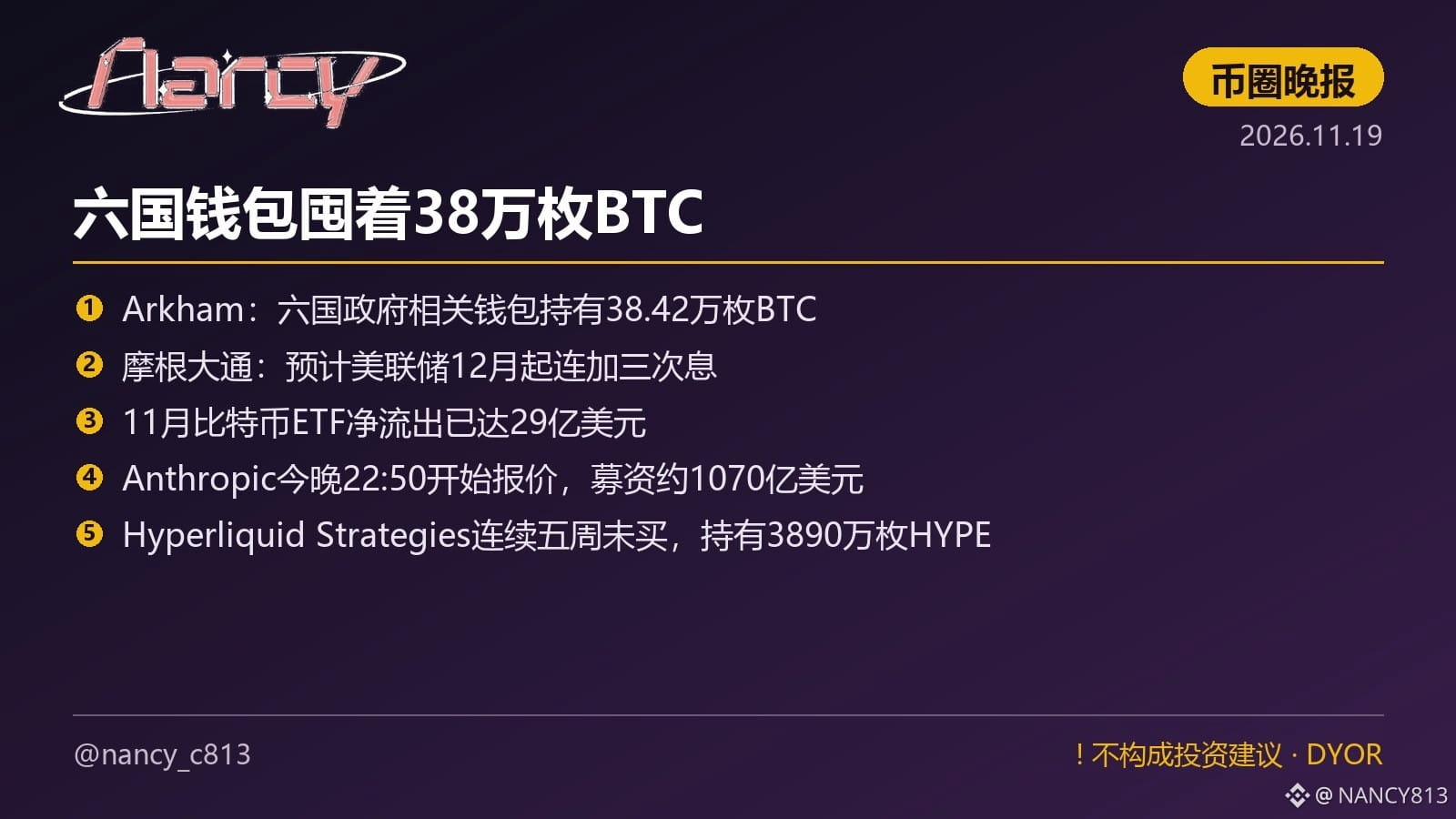
The wallets of six countries—the United States, the United Kingdom, El Salvador, the UAE, Russia, and Bhutan—hold a combined 384,200 $BTC, according to Arkham. At current prices, that’s roughly $24.5 billion.
The most interesting thing about this list: major powers with very different positions, plus the small country of Bhutan, are all stockpiling the same asset. Yet at the same time, net outflows from Bitcoin ETFs have reached $2.9 billion in November, and ETF assets have fallen to a three-month low. Government holders are sitting tight, while ETF money is heading for the exits.
Now let’s look at the macro picture: JPMorgan expects the Fed to hike rates three times in a row—in December, January, and March—taking rates to 4.5%–4.75%. BTC is currently hovering between $63,000 and $64,000, with rate hike expectations weighing on it.
My take: the list only says they’re “holding”—it doesn’t say they’re “buying.” Don’t take this as a sign that they’re stepping in to catch the falling knife. In the short term, it’s still all about interest rates and ETF flows. Those 380,000 coins held by governments look more like a floor that’s unlikely to be dumped anytime soon than an engine for a rally.
What do you think: are these 380,000 coins a source of support for the price, or a sword hanging over its head?
See the image for today’s other highlights 👆
⚠️ Not investment advice · DYOR
#CryptoEveningBrief #Bitcoin #Arkham
1
1.2k
Log in to explore more content
Join global crypto users on Binance Square
⚡️ Get latest and useful information about crypto.
💬 Trusted by the world’s largest crypto exchange.
👍 Discover real insights from verified creators.
Email / Phone number
Trending Topics
CorePCEBeatLiftsFedHikeOdds
98,663 views
922 Discussing
U.S. October PCE Price Index at 0.3% Month Over Month, Versus 0.30% Expected and 0.50% Prior
Binance News
·13 Likes
·29k views
BitcoinAndStocksSlipAgainAmidTrump’sTariffPlans
168,876 views
1,815 Discussing
JensenHuangSaysNvidiaDoesn’tNeedASuccessionPlan
83,235 views
1,092 Discussing