
Adeel Sanwal
25 Posts

Adeel Sanwal
Report
Block User
Crypto enthusiast | Airdrop hunter | Web3 explorer | DeFi believer | Always learning, trading, and growing in the blockchain space.
Open Trade
Frequent Trader
5 Years
11 Following
14 Followers
11 Liked
Posts
Portfolio
·
--
Article
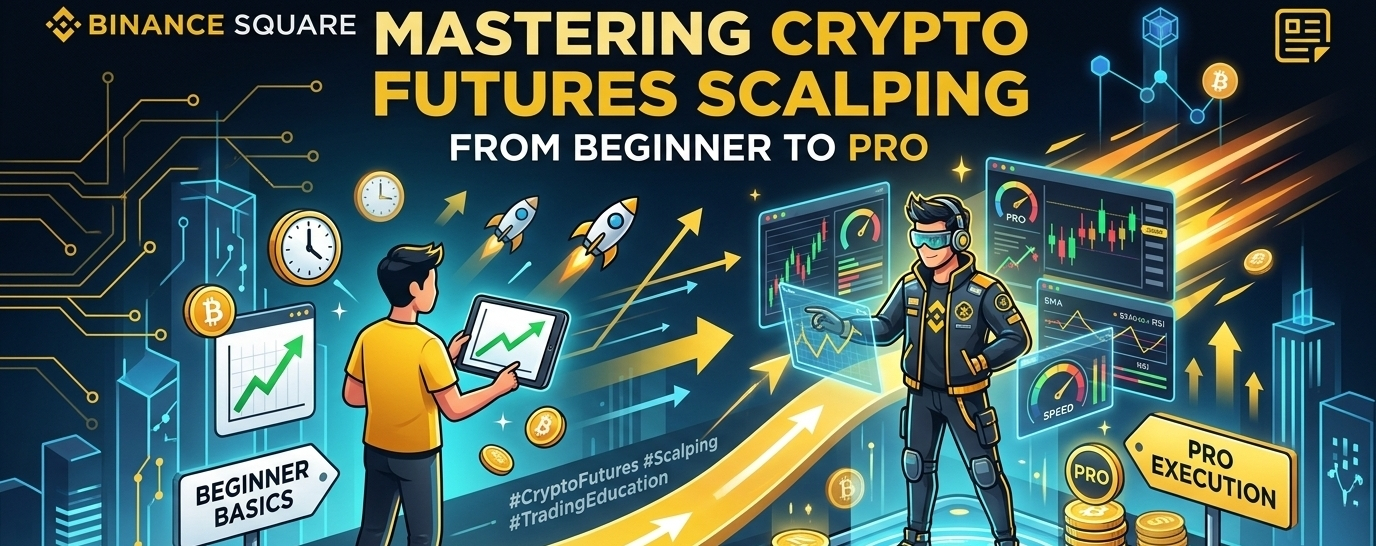
Mastering Crypto Futures Scalping: From Beginner Basics to Pro ExecutionCrypto markets move fast, but scalpers move faster. In a market known for sudden volatility, scalping offers a structured way to capitalize on short-term price movements rather than waiting days or weeks for a trend to play out.
Whether you are scrolling through educational guides on Binance Square or actively placing your first short-term orders, mastering a scalping strategy in crypto futures trading requires speed, technical clarity, and ironclad discipline. Here is a comprehensive roadmap to take your scalping skills from beginner basics to professional execution.
What is Scalping in Futures Trading?
Scalping is a high-frequency trading method where traders open and close positions within minutes—sometimes seconds—to extract small profits from micro price fluctuations.
Unlike swing trading, where positions remain open over longer horizons, scalpers aim for frequent, small wins. When trading futures, you gain the ability to profit in both rising (Long) and falling (Short) markets, while utilizing high liquidity on major pairs like $BTC /$USDT and $ETH /$USDT
Phase 1
The Beginner Setup
If you are new to high-speed trading, keep your system clean and avoid unnecessary complexity:
* Choose High-Volume Pairs: Stick to top-market-cap assets with tight spreads and deep order books to minimize slippage.
* Work on Low Timeframes: Focus on 1-minute (M1) or 5-minute (M5) charts to spot immediate price patterns.
* Use Essential Technical Indicators: Combine 2-3 reliable tools, such as:
* Exponential Moving Averages (EMA 20 & EMA 50): Identify dynamic support, resistance, and short-term directional bias.
* Relative Strength Index (RSI): Spot overbought (>70) or oversold (<30) conditions for quick momentum reversals.
* Volume Weighted Average Price (VWAP): Measure average price weighted by volume to identify institutional value zones.
* Keep Leverage Low: While leverage trading amplifies gains, it equally amplifies losses. Beginners should cap leverage between 3x and 5x while learning.
Phase 2: The Pro Playbook
As you gain experience, transition from basic indicator signals to advanced market mechanics:
* Order Flow & Market Depth: Pro scalpers monitor real-time buy and sell walls in the order book to anticipate immediate price reactions before they show on the candle chart.
* Breakout & Range Sniper Entries: Identify tight consolidation zones. Enter long at tested support bounce zones or short at resistance rejections, setting automated stop orders outside the consolidation range.
* Strict Risk Management: Professional scalping is defined by loss prevention, not win rate. Never risk more than 1%–2% of total account capital on a single trade, and aim for a risk-to-reward ratio of at least 1:1.5 or 1:2.
* Flawless Execution: Emotion has no place in scalping. When a trade hits your stop-loss, accept the exit immediately. When your profit target is hit, take your gain without chasing greed.
Summary
Scalping is not a shortcut to guaranteed wealth—it is an intricate skill set built on technical proficiency, quick reaction time, and relentless risk management. Start small, test your setups on low leverage, and refine your edge consistently.
KEY TAKEAWAYS:
• Scalping relies on high-speed execution across 1-minute to 5-minute timeframes to capture minor price changes.
• Strict risk management—including fixed stop-loss orders and moderate leverage (3x–5x for beginners)—is essential to preserve capital.
• Success comes from mastering key technical indicators (EMAs, RSI, VWAP) and maintaining disciplined, emotionless trade execution.
ENGAGEMENT QUESTION:
Which timeframe and technical indicators do you rely on most when scalping futures? Share your strategy in the comments below!
#Binance #BinanceSquareTalks #FutureTarding
Mastering Crypto Futures Scalping: From Beginner Basics to Pro Execution
Crypto markets move fast, but scalpers move faster. In a market known for sudden volatility, scalping offers a structured way to capitalize on short-term price movements rather than waiting days or weeks for a trend to play out.
Whether you are scrolling through educational guides on Binance Square or actively placing your first short-term orders, mastering a scalping strategy in crypto futures trading requires speed, technical clarity, and ironclad discipline. Here is a comprehensive roadmap to take your scalping skills from beginner basics to professional execution.
What is Scalping in Futures Trading?
Scalping is a high-frequency trading method where traders open and close positions within minutes—sometimes seconds—to extract small profits from micro price fluctuations.
Unlike swing trading, where positions remain open over longer horizons, scalpers aim for frequent, small wins. When trading futures, you gain the ability to profit in both rising (Long) and falling (Short) markets, while utilizing high liquidity on major pairs like $BTC /$USDT and $ETH /$USDT
Phase 1
The Beginner Setup
If you are new to high-speed trading, keep your system clean and avoid unnecessary complexity:
* Choose High-Volume Pairs: Stick to top-market-cap assets with tight spreads and deep order books to minimize slippage.
* Work on Low Timeframes: Focus on 1-minute (M1) or 5-minute (M5) charts to spot immediate price patterns.
* Use Essential Technical Indicators: Combine 2-3 reliable tools, such as:
* Exponential Moving Averages (EMA 20 & EMA 50): Identify dynamic support, resistance, and short-term directional bias.
* Relative Strength Index (RSI): Spot overbought (>70) or oversold (<30) conditions for quick momentum reversals.
* Volume Weighted Average Price (VWAP): Measure average price weighted by volume to identify institutional value zones.
* Keep Leverage Low: While leverage trading amplifies gains, it equally amplifies losses. Beginners should cap leverage between 3x and 5x while learning.
Phase 2: The Pro Playbook
As you gain experience, transition from basic indicator signals to advanced market mechanics:
* Order Flow & Market Depth: Pro scalpers monitor real-time buy and sell walls in the order book to anticipate immediate price reactions before they show on the candle chart.
* Breakout & Range Sniper Entries: Identify tight consolidation zones. Enter long at tested support bounce zones or short at resistance rejections, setting automated stop orders outside the consolidation range.
* Strict Risk Management: Professional scalping is defined by loss prevention, not win rate. Never risk more than 1%–2% of total account capital on a single trade, and aim for a risk-to-reward ratio of at least 1:1.5 or 1:2.
* Flawless Execution: Emotion has no place in scalping. When a trade hits your stop-loss, accept the exit immediately. When your profit target is hit, take your gain without chasing greed.
Summary
Scalping is not a shortcut to guaranteed wealth—it is an intricate skill set built on technical proficiency, quick reaction time, and relentless risk management. Start small, test your setups on low leverage, and refine your edge consistently.
KEY TAKEAWAYS:
• Scalping relies on high-speed execution across 1-minute to 5-minute timeframes to capture minor price changes.
• Strict risk management—including fixed stop-loss orders and moderate leverage (3x–5x for beginners)—is essential to preserve capital.
• Success comes from mastering key technical indicators (EMAs, RSI, VWAP) and maintaining disciplined, emotionless trade execution.
ENGAGEMENT QUESTION:
Which timeframe and technical indicators do you rely on most when scalping futures? Share your strategy in the comments below!
#Binance #BinanceSquareTalks #FutureTarding
Whether you are scrolling through educational guides on Binance Square or actively placing your first short-term orders, mastering a scalping strategy in crypto futures trading requires speed, technical clarity, and ironclad discipline. Here is a comprehensive roadmap to take your scalping skills from beginner basics to professional execution.
What is Scalping in Futures Trading?
Scalping is a high-frequency trading method where traders open and close positions within minutes—sometimes seconds—to extract small profits from micro price fluctuations.
Unlike swing trading, where positions remain open over longer horizons, scalpers aim for frequent, small wins. When trading futures, you gain the ability to profit in both rising (Long) and falling (Short) markets, while utilizing high liquidity on major pairs like $BTC /$USDT and $ETH /$USDT
Phase 1
The Beginner Setup
If you are new to high-speed trading, keep your system clean and avoid unnecessary complexity:
* Choose High-Volume Pairs: Stick to top-market-cap assets with tight spreads and deep order books to minimize slippage.
* Work on Low Timeframes: Focus on 1-minute (M1) or 5-minute (M5) charts to spot immediate price patterns.
* Use Essential Technical Indicators: Combine 2-3 reliable tools, such as:
* Exponential Moving Averages (EMA 20 & EMA 50): Identify dynamic support, resistance, and short-term directional bias.
* Relative Strength Index (RSI): Spot overbought (>70) or oversold (<30) conditions for quick momentum reversals.
* Volume Weighted Average Price (VWAP): Measure average price weighted by volume to identify institutional value zones.
* Keep Leverage Low: While leverage trading amplifies gains, it equally amplifies losses. Beginners should cap leverage between 3x and 5x while learning.
Phase 2: The Pro Playbook
As you gain experience, transition from basic indicator signals to advanced market mechanics:
* Order Flow & Market Depth: Pro scalpers monitor real-time buy and sell walls in the order book to anticipate immediate price reactions before they show on the candle chart.
* Breakout & Range Sniper Entries: Identify tight consolidation zones. Enter long at tested support bounce zones or short at resistance rejections, setting automated stop orders outside the consolidation range.
* Strict Risk Management: Professional scalping is defined by loss prevention, not win rate. Never risk more than 1%–2% of total account capital on a single trade, and aim for a risk-to-reward ratio of at least 1:1.5 or 1:2.
* Flawless Execution: Emotion has no place in scalping. When a trade hits your stop-loss, accept the exit immediately. When your profit target is hit, take your gain without chasing greed.
Summary
Scalping is not a shortcut to guaranteed wealth—it is an intricate skill set built on technical proficiency, quick reaction time, and relentless risk management. Start small, test your setups on low leverage, and refine your edge consistently.
KEY TAKEAWAYS:
• Scalping relies on high-speed execution across 1-minute to 5-minute timeframes to capture minor price changes.
• Strict risk management—including fixed stop-loss orders and moderate leverage (3x–5x for beginners)—is essential to preserve capital.
• Success comes from mastering key technical indicators (EMAs, RSI, VWAP) and maintaining disciplined, emotionless trade execution.
ENGAGEMENT QUESTION:
Which timeframe and technical indicators do you rely on most when scalping futures? Share your strategy in the comments below!
#Binance #BinanceSquareTalks #FutureTarding
60
·
--

Article
Everything You Need to Know About Risk Management in CryptoCapital preservation is the single most important rule in crypto trading. While catching a breakout feels rewarding, long-term survival in volatile markets like Bitcoin ($BTC) and Ethereum ($ETH) depends entirely on how effectively you limit losses when setups fail.
1. The 1%–2% Position Sizing Rule
Never risk more than 1% to 2% of your total portfolio value on a single position. If your account balance is $5,000, your maximum acceptable loss per trade should not exceed $50 to $100. Your position size must be calculated based on your stop-loss distance, rather than entering arbitrary trade amounts.
Position Size Formula: \text{Position Size} = \frac{\text{Account Risk Amount}}{\text{Entry Price} - \text{Stop Loss Price}}
Example: On a $5,000 balance risking 1% ($50), if your stop-loss distance is 5% below your entry price, your total position value should be $1,000.
2. Non-Negotiable Stop-Loss Execution
An unexecuted trading plan is just a gamble. Always place a hard stop-loss or automated trailing stop order immediately after your entry order fills. Placing stop-loss triggers below key technical support levels removes emotional hesitation during sudden market liquidations.
3. Maintaining a Positive Risk-to-Reward Ratio (RRR)
To build a sustainable trading edge, aim for a minimum Risk-to-Reward Ratio of 1:2
Trading MetricLow Edge Strategy (1:0.5)High Edge Strategy (1:2)
Risk Amount$100$100
Profit Target$50$200
Required Win Rate for Breakeven67%33%
With a 1:2 RRR, you can lose 60% of your total trades and still maintain a net-positive trading account over time.
4. Managing Leverage Limits
Leverage amplifies both gains and downside risks. Excessive leverage (20x–100x) drastically reduces your liquidation buffer, exposing your position to market volatility wicks. Maintain low leverage (2x–5x) or trade Spot assets while building consistency.
What is your primary rule for managing downside risk when trading BTC orSOL? Share your strategies below and pass this along to help other traders protect their portfolio capital.
$BTC $ETH $BNB
#BinanceSquare #Write2Earn #RiskManagement #CryptoTrading #CryptoEducation #TechnicalAnalysis #CryptoCommunity
Everything You Need to Know About Risk Management in Crypto
Capital preservation is the single most important rule in crypto trading. While catching a breakout feels rewarding, long-term survival in volatile markets like Bitcoin ($BTC ) and Ethereum ($ETH ) depends entirely on how effectively you limit losses when setups fail.
1. The 1%–2% Position Sizing Rule
Never risk more than 1% to 2% of your total portfolio value on a single position. If your account balance is $5,000, your maximum acceptable loss per trade should not exceed $50 to $100. Your position size must be calculated based on your stop-loss distance, rather than entering arbitrary trade amounts.
Position Size Formula: \text{Position Size} = \frac{\text{Account Risk Amount}}{\text{Entry Price} - \text{Stop Loss Price}}
Example: On a $5,000 balance risking 1% ($50), if your stop-loss distance is 5% below your entry price, your total position value should be $1,000.
2. Non-Negotiable Stop-Loss Execution
An unexecuted trading plan is just a gamble. Always place a hard stop-loss or automated trailing stop order immediately after your entry order fills. Placing stop-loss triggers below key technical support levels removes emotional hesitation during sudden market liquidations.
3. Maintaining a Positive Risk-to-Reward Ratio (RRR)
To build a sustainable trading edge, aim for a minimum Risk-to-Reward Ratio of 1:2
Trading MetricLow Edge Strategy (1:0.5)High Edge Strategy (1:2)
Risk Amount$100$100
Profit Target$50$200
Required Win Rate for Breakeven67%33%
With a 1:2 RRR, you can lose 60% of your total trades and still maintain a net-positive trading account over time.
4. Managing Leverage Limits
Leverage amplifies both gains and downside risks. Excessive leverage (20x–100x) drastically reduces your liquidation buffer, exposing your position to market volatility wicks. Maintain low leverage (2x–5x) or trade Spot assets while building consistency.
What is your primary rule for managing downside risk when trading BTC orSOL? Share your strategies below and pass this along to help other traders protect their portfolio capital.
$BTC $ETH $BNB
#BinanceSquare #Write2Earn #RiskManagement #CryptoTrading #CryptoEducation #TechnicalAnalysis #CryptoCommunity
1. The 1%–2% Position Sizing Rule
Never risk more than 1% to 2% of your total portfolio value on a single position. If your account balance is $5,000, your maximum acceptable loss per trade should not exceed $50 to $100. Your position size must be calculated based on your stop-loss distance, rather than entering arbitrary trade amounts.
Position Size Formula: \text{Position Size} = \frac{\text{Account Risk Amount}}{\text{Entry Price} - \text{Stop Loss Price}}
Example: On a $5,000 balance risking 1% ($50), if your stop-loss distance is 5% below your entry price, your total position value should be $1,000.
2. Non-Negotiable Stop-Loss Execution
An unexecuted trading plan is just a gamble. Always place a hard stop-loss or automated trailing stop order immediately after your entry order fills. Placing stop-loss triggers below key technical support levels removes emotional hesitation during sudden market liquidations.
3. Maintaining a Positive Risk-to-Reward Ratio (RRR)
To build a sustainable trading edge, aim for a minimum Risk-to-Reward Ratio of 1:2
Trading MetricLow Edge Strategy (1:0.5)High Edge Strategy (1:2)
Risk Amount$100$100
Profit Target$50$200
Required Win Rate for Breakeven67%33%
With a 1:2 RRR, you can lose 60% of your total trades and still maintain a net-positive trading account over time.
4. Managing Leverage Limits
Leverage amplifies both gains and downside risks. Excessive leverage (20x–100x) drastically reduces your liquidation buffer, exposing your position to market volatility wicks. Maintain low leverage (2x–5x) or trade Spot assets while building consistency.
What is your primary rule for managing downside risk when trading BTC orSOL? Share your strategies below and pass this along to help other traders protect their portfolio capital.
$BTC $ETH $BNB
#BinanceSquare #Write2Earn #RiskManagement #CryptoTrading #CryptoEducation #TechnicalAnalysis #CryptoCommunity
96
·
--
Everything Starts With Risk Management
Never enter a trade without defining your maximum acceptable loss. Use strict stop-loss rules or automated trailing stops to protect your downside. What is your golden rule for position sizing? $BTC
Everything Starts With Risk Management
Never enter a trade without defining your maximum acceptable loss. Use strict stop-loss rules or automated trailing stops to protect your downside. What is your golden rule for position sizing? $BTC
Never enter a trade without defining your maximum acceptable loss. Use strict stop-loss rules or automated trailing stops to protect your downside. What is your golden rule for position sizing? $BTC
78
·
--
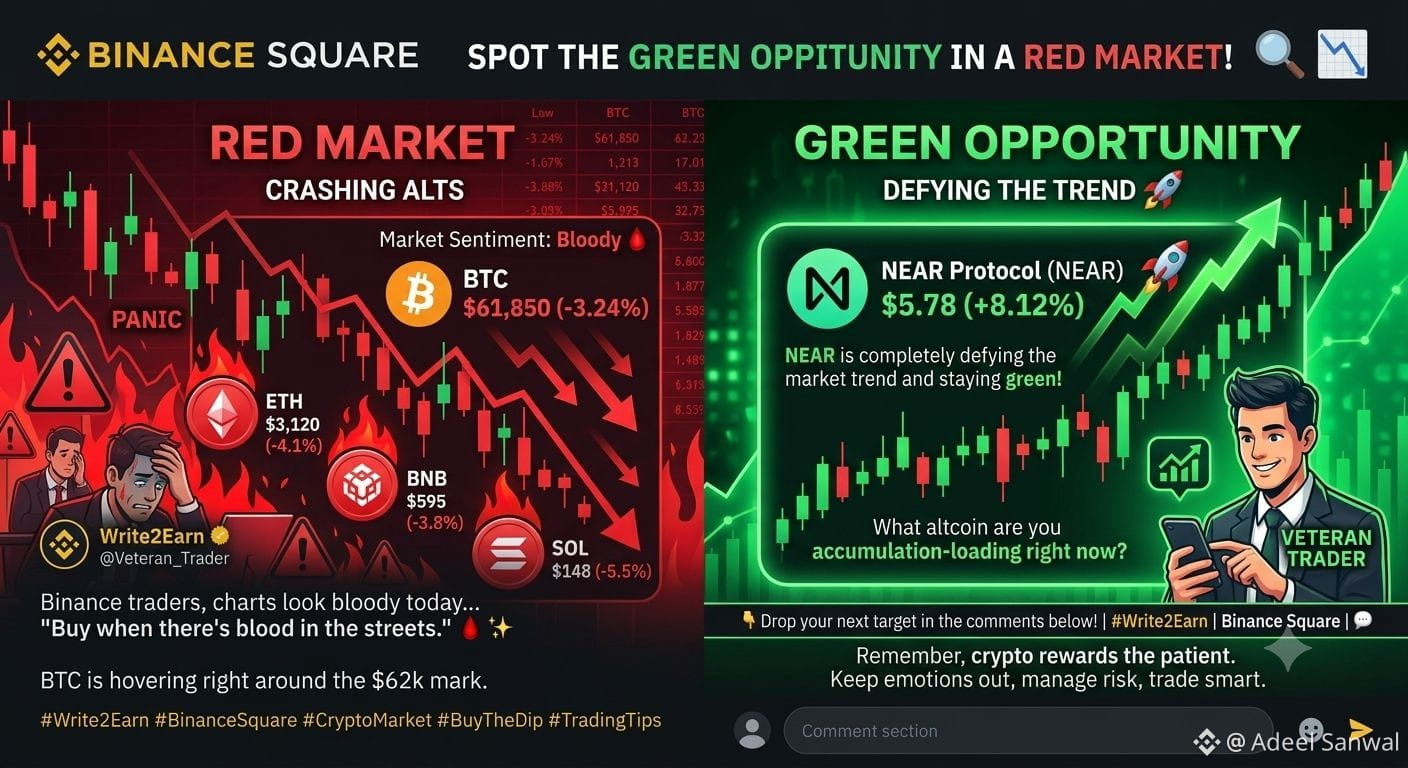
Spot the Green Opportunity in a Red Market! 🔍📉
Binance traders, the charts are looking bloody today, but veteran players know the old saying: "The best time to buy is when there's blood in the streets." 🩸✨
BTC is hovering right around the $62k mark.
NEAR is completely defying the market trend and staying green.
What altcoin are you accumulation-loading right now?
Remember, crypto rewards the patient. Keep your emotions out of the charts, manage your risk, and trade smart.
👇 Drop your next target in the comments below!
#Write2Earn #BinanceSquare #CryptoMarket #BuyTheDip #TradingTips
Spot the Green Opportunity in a Red Market! 🔍📉
Binance traders, the charts are looking bloody today, but veteran players know the old saying: "The best time to buy is when there's blood in the streets." 🩸✨
BTC is hovering right around the $62k mark.
NEAR is completely defying the market trend and staying green.
What altcoin are you accumulation-loading right now?
Remember, crypto rewards the patient. Keep your emotions out of the charts, manage your risk, and trade smart.
👇 Drop your next target in the comments below!
#Write2Earn #BinanceSquare #CryptoMarket #BuyTheDip #TradingTips
Binance traders, the charts are looking bloody today, but veteran players know the old saying: "The best time to buy is when there's blood in the streets." 🩸✨
BTC is hovering right around the $62k mark.
NEAR is completely defying the market trend and staying green.
What altcoin are you accumulation-loading right now?
Remember, crypto rewards the patient. Keep your emotions out of the charts, manage your risk, and trade smart.
👇 Drop your next target in the comments below!
#Write2Earn #BinanceSquare #CryptoMarket #BuyTheDip #TradingTips
2
·
--
Bearish
Red Market: Time to Panic or the Perfect Buying Opportunity? 🔴👇
Hey Binance Family! 👋
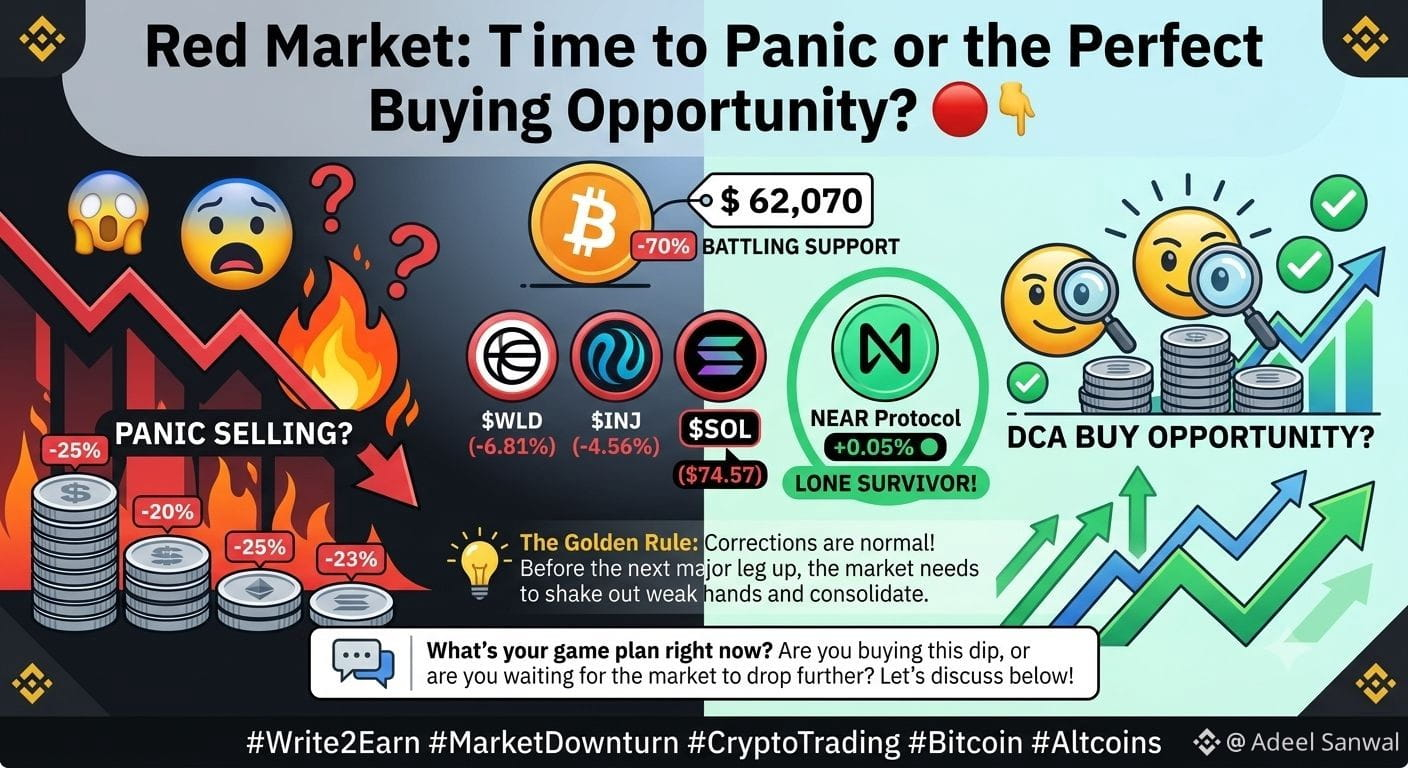
As you can see in the screenshot, the market is undergoing a standard correction, and most coins are swimming in the red right now.
Bitcoin ($62,070): Currently battling to hold its crucial support level.
Alts Under Pressure: $WLD (-6.81%) and $INJ (-4.56%) are taking noticeable hits, while $SOL ($74.57) has also pulled back.
The Lone Survivor: Even in this sea of red, NEAR Protocol is showing serious strength, holding up in the green at +0.05%! 🟢
💡 The Golden Rule:
Market corrections are completely normal. Before the next major leg up, the market needs to shake out weak hands and consolidate. Instead of panic selling, smart traders look at these moments to DCA (Dollar-Cost Average) into fundamentally strong projects.
💬 What’s your game plan right now?
Are you buying this dip, or are you waiting for the market to drop further? Let’s discuss in the comments!
#Write2Earn #MarketDownturn #CryptoTrading #Bitcoin #Altcoins
Red Market: Time to Panic or the Perfect Buying Opportunity? 🔴👇
Hey Binance Family! 👋
As you can see in the screenshot, the market is undergoing a standard correction, and most coins are swimming in the red right now.
Bitcoin ($62,070): Currently battling to hold its crucial support level.
Alts Under Pressure: $WLD (-6.81%) and $INJ (-4.56%) are taking noticeable hits, while $SOL ($74.57) has also pulled back.
The Lone Survivor: Even in this sea of red, NEAR Protocol is showing serious strength, holding up in the green at +0.05%! 🟢
💡 The Golden Rule:
Market corrections are completely normal. Before the next major leg up, the market needs to shake out weak hands and consolidate. Instead of panic selling, smart traders look at these moments to DCA (Dollar-Cost Average) into fundamentally strong projects.
💬 What’s your game plan right now?
Are you buying this dip, or are you waiting for the market to drop further? Let’s discuss in the comments!
#Write2Earn #MarketDownturn #CryptoTrading #Bitcoin #Altcoins
Hey Binance Family! 👋
As you can see in the screenshot, the market is undergoing a standard correction, and most coins are swimming in the red right now.
Bitcoin ($62,070): Currently battling to hold its crucial support level.
Alts Under Pressure: $WLD (-6.81%) and $INJ (-4.56%) are taking noticeable hits, while $SOL ($74.57) has also pulled back.
The Lone Survivor: Even in this sea of red, NEAR Protocol is showing serious strength, holding up in the green at +0.05%! 🟢
💡 The Golden Rule:
Market corrections are completely normal. Before the next major leg up, the market needs to shake out weak hands and consolidate. Instead of panic selling, smart traders look at these moments to DCA (Dollar-Cost Average) into fundamentally strong projects.
💬 What’s your game plan right now?
Are you buying this dip, or are you waiting for the market to drop further? Let’s discuss in the comments!
#Write2Earn #MarketDownturn #CryptoTrading #Bitcoin #Altcoins
135
·
--
The Tactical Trader (Market Psychology)
Best for building authority and encouraging discussion.
[📊 THE MARKET DOESN'T CARE ABOUT YOUR FEELINGS, IT CARES ABOUT YOUR DISCIPLINE]
In crypto, the distance between a winning trade and a blown account isn't market direction—it’s risk management.
Most traders spend 90% of their time looking for the perfect entry, and 0% planning their exit. True profitability isn't about being right every time; it’s about extracting maximum value when you are right, and cutting ties instantly when you are wrong.
My golden rules for the current market structure:
Never chase the green candle: If you missed the breakout, wait for the retest. The market always gives second chances to the patient.
Take partial profits: Capital preservation is a form of profit.
Treat P2P with precision: Secure your liquidity flawlessly so you're always ready for the next dip.
👇 What’s your current go-to strategy for managing risk right now? Drop your thoughts below!
#CryptoTrading #BinanceSquare #RiskManagement #TradingPsychology
The Tactical Trader (Market Psychology)
Best for building authority and encouraging discussion.
[📊 THE MARKET DOESN'T CARE ABOUT YOUR FEELINGS, IT CARES ABOUT YOUR DISCIPLINE]
In crypto, the distance between a winning trade and a blown account isn't market direction—it’s risk management.
Most traders spend 90% of their time looking for the perfect entry, and 0% planning their exit. True profitability isn't about being right every time; it’s about extracting maximum value when you are right, and cutting ties instantly when you are wrong.
My golden rules for the current market structure:
Never chase the green candle: If you missed the breakout, wait for the retest. The market always gives second chances to the patient.
Take partial profits: Capital preservation is a form of profit.
Treat P2P with precision: Secure your liquidity flawlessly so you're always ready for the next dip.
👇 What’s your current go-to strategy for managing risk right now? Drop your thoughts below!
#CryptoTrading #BinanceSquare #RiskManagement #TradingPsychology
Best for building authority and encouraging discussion.
[📊 THE MARKET DOESN'T CARE ABOUT YOUR FEELINGS, IT CARES ABOUT YOUR DISCIPLINE]
In crypto, the distance between a winning trade and a blown account isn't market direction—it’s risk management.
Most traders spend 90% of their time looking for the perfect entry, and 0% planning their exit. True profitability isn't about being right every time; it’s about extracting maximum value when you are right, and cutting ties instantly when you are wrong.
My golden rules for the current market structure:
Never chase the green candle: If you missed the breakout, wait for the retest. The market always gives second chances to the patient.
Take partial profits: Capital preservation is a form of profit.
Treat P2P with precision: Secure your liquidity flawlessly so you're always ready for the next dip.
👇 What’s your current go-to strategy for managing risk right now? Drop your thoughts below!
#CryptoTrading #BinanceSquare #RiskManagement #TradingPsychology

1
69
·
--
Bullish
🚨 Crypto for Absolute Beginners: Navigating the US-Iran War Like a Pro 🚨
Famous Trading Quote to Live By:
"Be fearful when others are greedy, and greedy when others are fearful." – Warren Buffett
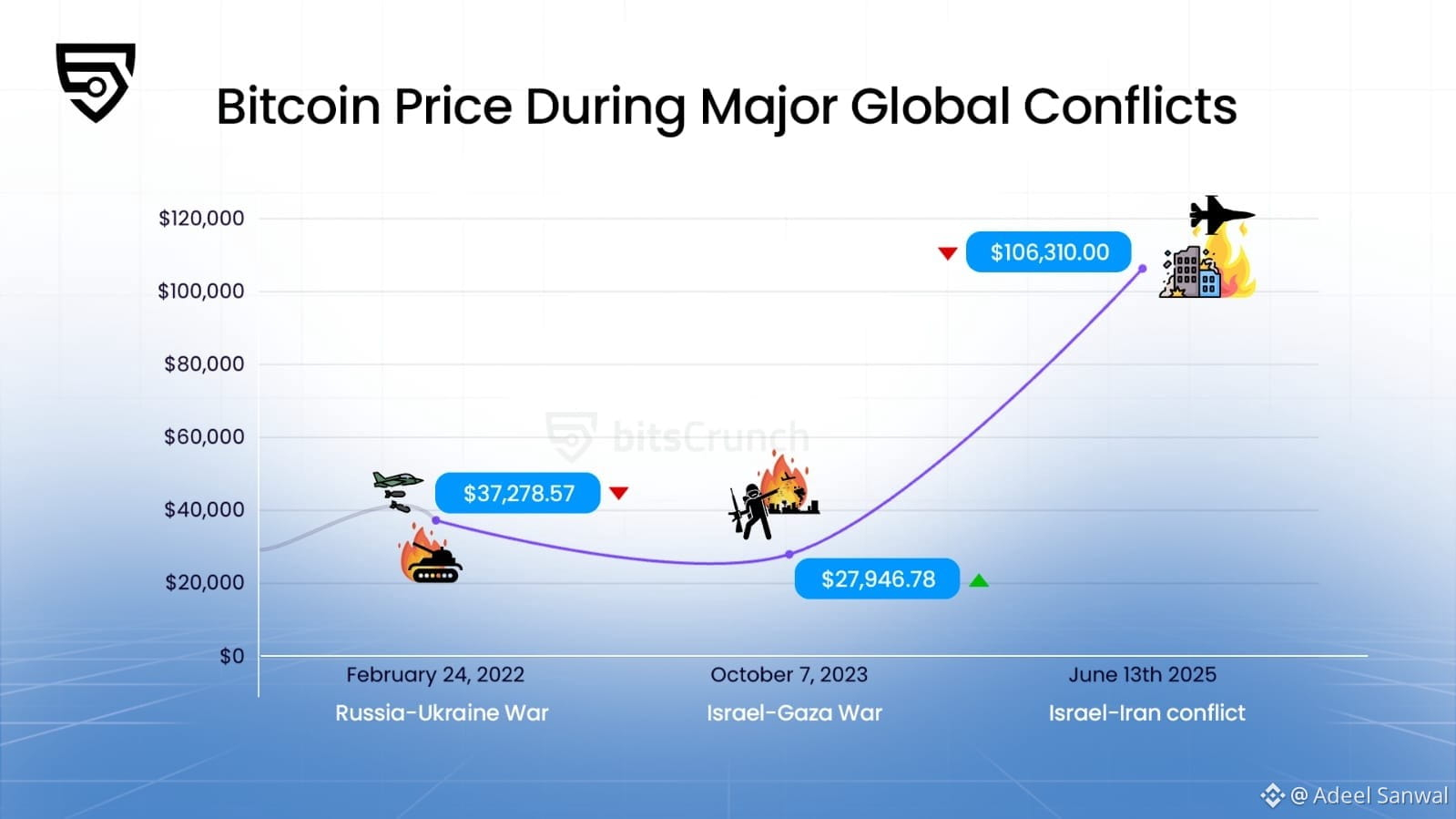
Right now, the world is fearful. The US-Iran war is in its 33rd day. Oil prices are spiking because of tension in the Strait of Hormuz. Stocks are shaky. But guess what? $BTC is holding strong near $68,000 (it even dipped to $63K early on and bounced back). $ETH is rebounding toward $2,130. Crypto is acting like digital gold – strong when everything else panics!
What is Crypto? (Super Simple Explanation for Beginners)
Crypto is digital money that lives on the internet. No banks needed. You can send it anywhere in the world, 24/7. The two biggest are:
$BTC (Bitcoin): Like "digital gold". Limited supply (only 21 million will ever exist). People buy it to protect wealth during wars or inflation.
$ETH (Ethereum): The "smart" crypto. Powers apps, DeFi (decentralized finance), NFTs, and staking (earn interest by holding).
Why the US-Iran War Matters for New Crypto Traders
Short-term fear = volatility (prices go up and down fast). War news caused quick dips – perfect for beginners to learn "buy the dip".
Long-term future (2026 and beyond): Wars don't last forever. Once it ends (Trump hinted 2-3 weeks possible), fear turns to excitement. Oil stabilizes → more money flows into crypto. Analysts see $BTC heading to $80K–$100K+ and $ETH to $3,000–$4,000+ as institutions (big companies) pile in.
Other Important Coins for Beginners to Watch:
$SOL (Solana): Super-fast and cheap for everyday use.
$BNB (Binance Coin): Powers the Binance ecosystem – great if you trade here.
00).
DYOR = Do Your Own Research. Read Binance Academy (free!).
Use dollar-cost averaging: Buy a litStablecoins like USDT: Safe parking spot during war volatility.
Beginner Tips to Start Smart (Don't Lose Money!)
Only invest what you can afford to lose – Start small ($50–$1tle every week instead of all at once.
HODL (Hold On for Dear Life): Patience wins. The impatient lose money to the patient
🚨 Crypto for Absolute Beginners: Navigating the US-Iran War Like a Pro 🚨
Famous Trading Quote to Live By:
"Be fearful when others are greedy, and greedy when others are fearful." – Warren Buffett
Right now, the world is fearful. The US-Iran war is in its 33rd day. Oil prices are spiking because of tension in the Strait of Hormuz. Stocks are shaky. But guess what? $BTC is holding strong near $68,000 (it even dipped to $63K early on and bounced back). $ETH is rebounding toward $2,130. Crypto is acting like digital gold – strong when everything else panics!
What is Crypto? (Super Simple Explanation for Beginners)
Crypto is digital money that lives on the internet. No banks needed. You can send it anywhere in the world, 24/7. The two biggest are:
$BTC (Bitcoin): Like "digital gold". Limited supply (only 21 million will ever exist). People buy it to protect wealth during wars or inflation.
$ETH (Ethereum): The "smart" crypto. Powers apps, DeFi (decentralized finance), NFTs, and staking (earn interest by holding).
Why the US-Iran War Matters for New Crypto Traders
Short-term fear = volatility (prices go up and down fast). War news caused quick dips – perfect for beginners to learn "buy the dip".
Long-term future (2026 and beyond): Wars don't last forever. Once it ends (Trump hinted 2-3 weeks possible), fear turns to excitement. Oil stabilizes → more money flows into crypto. Analysts see $BTC heading to $80K–$100K+ and $ETH to $3,000–$4,000+ as institutions (big companies) pile in.
Other Important Coins for Beginners to Watch:
$SOL (Solana): Super-fast and cheap for everyday use.
$BNB (Binance Coin): Powers the Binance ecosystem – great if you trade here.
00).
DYOR = Do Your Own Research. Read Binance Academy (free!).
Use dollar-cost averaging: Buy a litStablecoins like USDT: Safe parking spot during war volatility.
Beginner Tips to Start Smart (Don't Lose Money!)
Only invest what you can afford to lose – Start small ($50–$1tle every week instead of all at once.
HODL (Hold On for Dear Life): Patience wins. The impatient lose money to the patient
Famous Trading Quote to Live By:
"Be fearful when others are greedy, and greedy when others are fearful." – Warren Buffett
Right now, the world is fearful. The US-Iran war is in its 33rd day. Oil prices are spiking because of tension in the Strait of Hormuz. Stocks are shaky. But guess what? $BTC is holding strong near $68,000 (it even dipped to $63K early on and bounced back). $ETH is rebounding toward $2,130. Crypto is acting like digital gold – strong when everything else panics!
What is Crypto? (Super Simple Explanation for Beginners)
Crypto is digital money that lives on the internet. No banks needed. You can send it anywhere in the world, 24/7. The two biggest are:
$BTC (Bitcoin): Like "digital gold". Limited supply (only 21 million will ever exist). People buy it to protect wealth during wars or inflation.
$ETH (Ethereum): The "smart" crypto. Powers apps, DeFi (decentralized finance), NFTs, and staking (earn interest by holding).
Why the US-Iran War Matters for New Crypto Traders
Short-term fear = volatility (prices go up and down fast). War news caused quick dips – perfect for beginners to learn "buy the dip".
Long-term future (2026 and beyond): Wars don't last forever. Once it ends (Trump hinted 2-3 weeks possible), fear turns to excitement. Oil stabilizes → more money flows into crypto. Analysts see $BTC heading to $80K–$100K+ and $ETH to $3,000–$4,000+ as institutions (big companies) pile in.
Other Important Coins for Beginners to Watch:
$SOL (Solana): Super-fast and cheap for everyday use.
$BNB (Binance Coin): Powers the Binance ecosystem – great if you trade here.
00).
DYOR = Do Your Own Research. Read Binance Academy (free!).
Use dollar-cost averaging: Buy a litStablecoins like USDT: Safe parking spot during war volatility.
Beginner Tips to Start Smart (Don't Lose Money!)
Only invest what you can afford to lose – Start small ($50–$1tle every week instead of all at once.
HODL (Hold On for Dear Life): Patience wins. The impatient lose money to the patient
27
·
--
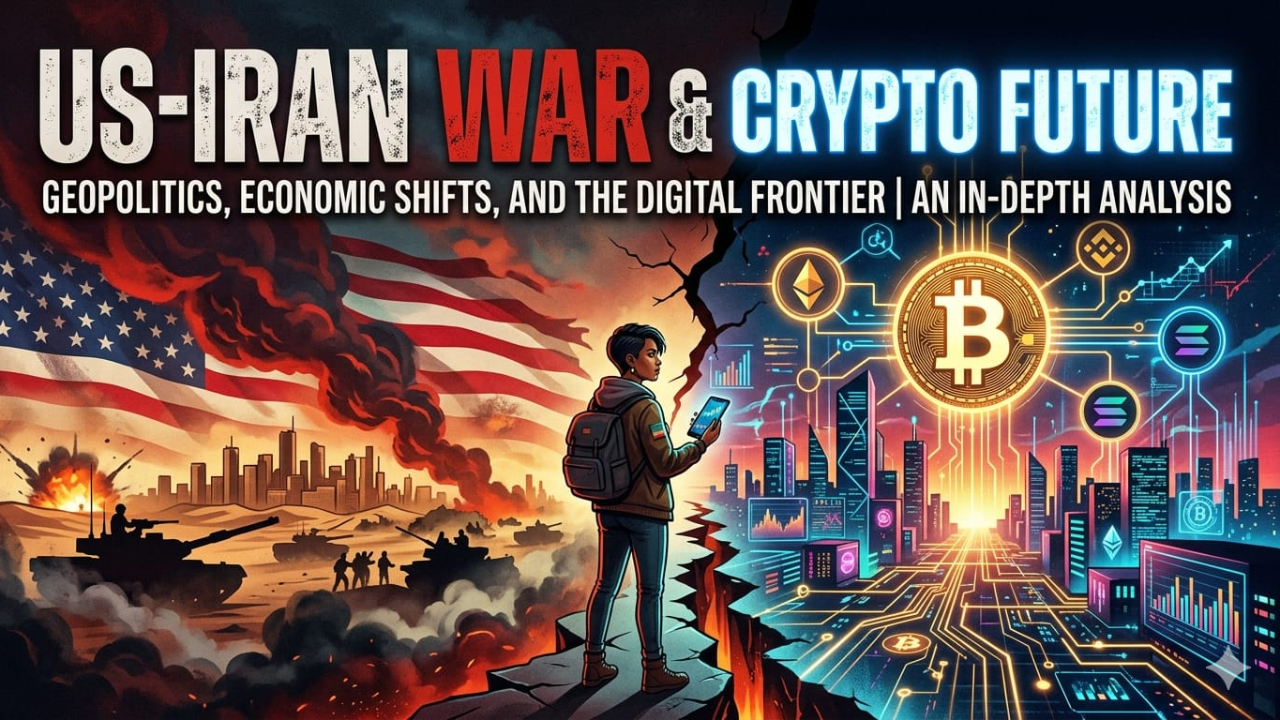
Article
BREAKING MARKET ANALYSISBREAKING MARKET ANALYSIS
WAR, OIL & CRYPTO
How the US–Iran War Is Reshaping the Future of Bitcoin, Ethereum & the Entire Crypto Market
Binance Square • April 1, 2026 • By M. Adeel Sanwal | Follow for daily market intelligence
LIVE MARKET SNAPSHOT — April 1, 2026
Asset Price 24h Change Key Level
Bitcoin (BTC) $68,456 +3.29% Resistance: $72,500
Ethereum (ETH) $1,998 +1.8% Support: $2,000
Solana (SOL) $80.00 -2.1% Watch: $92 reclaim
Total Mkt Cap $2.36T +1.29% BTC Dom: 58.16%
Brent Crude ~$95/bbl +60% since war Highest shock in history
n SECTION 1: THE WAR — WHAT IS ACTUALLY HAPPENING RIGHT
NOW
The world changed on February 28, 2026. In a stunning overnight operation, the United States and Israel
launched coordinated surprise airstrikes across Iran, assassinating Supreme Leader Ali Khamenei and
triggering what analysts now call the most significant geopolitical shock since 9/11. Thirty-three days later,
the war is still raging — and its shockwaves are hitting every financial market on Earth, including crypto.
The Key Facts — Day 33:
• US and Israeli airstrikes have now hit over 10,000 Iranian targets, destroying the Iranian navy, most of
its air defenses, and missile/drone manufacturing facilities.
• Iran has retaliated with 87+ waves of missile and drone attacks against Israel, US bases, and Gulf
allies — including Kuwait, Saudi Arabia, and Bahrain.
• The Strait of Hormuz, the world's most critical oil chokepoint, remains effectively closed. The IEA calls
it the biggest oil shock in history — 20 million barrels per day removed from global supply.
• Brent crude has surged over 60% since the war began, now trading near $95/bbl.
• Supreme Leader Khamenei, Iranian Defense Minister Nasirzadeh, IRGC Commander Pakpour, and
seven top security leaders have been killed.
• NATO allies Spain, France, and Italy have restricted US military operations, closing airspace and
denying base access.
• Trump says the war could end in 2–3 weeks — with or without a deal. Iran's FM says he has zero trust
in US negotiations.
"We are on or ahead of schedule on each of those four objectives and we can see the
finish line." — US Secretary of State Marco Rubio, April 1, 2026
n SECTION 2: HOW THE WAR IS HITTING CRYPTO — THE BRUTAL
TRUTH
If you thought crypto was decoupled from geopolitics — this war proved otherwise. Since February 28,
Bitcoin has been on a violent rollercoaster, swinging between panic selloffs and sharp relief rallies with
every headline. Here is exactly what has happened and why:
Phase 1 — The Crash (Feb 28 – March 10)
When the first airstrikes hit, BTC was trading near $100,000. The shock of a full-scale Middle East war
triggered a massive risk-off selloff. Within days, Bitcoin crashed below $66,000. Ethereum fell under
$2,000. Solana dropped from above $130 to below $90. Over $1 trillion was wiped from total crypto market
cap.
Phase 2 — The Grind (March 10 – March 28)
As the war dragged on, oil prices kept climbing and inflation fears mounted. Analysts began repricing rate
expectations — instead of Fed cuts, they started pricing in potential rate hikes. ETF inflows, which had
been a key pillar supporting BTC, turned negative. Daily net outflows ranged from 200 to 500 BTC.
Institutional demand dried up outside of Strategy (formerly MicroStrategy). BTC was trapped between
$60,000 support and $72,500 resistance.
Phase 3 — The Relief Rally (March 29 – April 1, Present)
Trump hinted at ending the war in weeks. Reports emerged that Iranian President Pezeshkian was
prepared to negotiate. Oil prices swung sharply. Risk assets, including crypto, bounced hard. Bitcoin
reclaimed $68,000, posting its best 24-hour gain (+3.29%) in weeks. ETF inflows turned green again —
$118 million net inflow on March 31 alone. Ethereum spot ETFs also recorded $31.17 million in net inflows
on April 1.
CRITICAL INSIGHT: Crypto proved it is now a 24/7 global market. When traditional
markets closed on the weekend the war began, crypto was the ONLY market trading.
Bitcoin served as a real-time fear gauge for the entire global financial system.
n SECTION 3: BITCOIN — THE FULL PICTURE
Where BTC Stands Today:
Bitcoin's all-time high was $126,198 on October 6, 2025. From that peak, BTC has corrected over 45% in
the face of geopolitical chaos, tightening macro conditions, and war-driven inflation fears. Today it sits near
$68,456 — recovering but far from certain.
Key Technical Levels:
Level Price Significance
All-Time High $126,198 Oct 6, 2025 — the peak
Current Price $68,456 As of April 1, 2026
Resistance $72,500 Must close above to confirm recovery
Support $60,000 Break below = bearish structure
Bull Target $75,000+ If war ends + macro improves
Bear Target $49,000 Analysts' downside if war escalates
Why Bitcoin Still Has a Long-Term Bull Case:
• Trump's Strategic Bitcoin Reserve: The US government is not just holding BTC — it is potentially
adding to it. This is a structural demand floor unlike anything in Bitcoin's history.
• ETF Demand: Spot Bitcoin ETFs recorded $118M inflows on March 31, reversing a week of outflows.
Institutional interest remains intact.
• War as an inflation accelerant: If oil stays elevated, inflation stays high. Hard assets like Bitcoin
benefit from inflation over the medium-to-long term.
• 24/7 market proof: The Iran war weekend proved crypto is a permanent, critical piece of global
financial infrastructure.
• Post-war recovery: Every major geopolitical crisis historically leads to a sharp risk-asset recovery
once resolved. BTC will likely lead that recovery.
n SECTION 4: ETHEREUM — BEATEN DOWN BUT NOT OUT
Ethereum has been the market's biggest disappointment in this crisis. ETH has fallen below $2,000 — a
level that marks serious structural weakness. The coin that once commanded $4,000+ is now struggling to
hold psychological support. But that may be exactly why it is interesting.
ETH Current Situation:
• Price: ~$1,998 (hovering at critical $2,000 support).
• ETF inflows returned: $31.17M net inflow into Ethereum spot ETFs on April 1 — a positive sign.
• Binance Research notes: ETH is likely to outperform other assets if risk appetite improves after war
de-escalation.
• Technical target: ETH needs a pattern of higher lows to rebuild buyer confidence. A sustained close
above $2,200 would be the first real signal.
• Macro risk: If inflation stays high due to oil, the Fed may hike rather than cut. That is the biggest risk to
ETH's recovery timeline.
BOTTOM LINE ON ETH: At $2,000, ETH is pricing in significant fear. For long-term
holders, this zone has historically been an accumulation opportunity. But patience is
required — do not try to catch the exact bottom.
n SECTION 5: SOLANA, ALTCOINS & THE ROTATION PLAY
Solana was the star performer of 2025. But the war hit SOL particularly hard — from $130+ at its peak
down to $80 today, a drop of nearly 40% in recent weeks alone. With $92 acting as major resistance and
momentum fading, SOL needs a macro tailwind to reverse course.
The Altcoin Picture:
• XRP: Benefitting from regulatory clarity as the US Senate moves toward the CLARITY Act markup in
April. Watch for breakout.
• Cardano (ADA): Trading in sympathy with BTC. Needs BTC to break $72,500 before meaningful ADA
rally.
• LINK (Chainlink): Showing 3–5% surge on war de-escalation signals. Oracle networks benefit from
DeFi activity recovery.
• NKN: The surprise war winner — surged +38% in 24 hours, +210% in one week. Decentralized
internet protocols are having their moment as Iran's internet was blacked out.
• Stablecoins: USDT and USDC transaction volumes hit record highs as Iranians and others in conflict
zones used crypto to preserve value and bypass capital controls.
n SECTION 6: THREE SCENARIOS — WHAT HAPPENS NEXT
Scenario Trigger BTC Target Market Outlook
n BULL
War Ends in 3 Weeks
Ceasefire + Hormuz reopens $75,000 – $85,000 Full risk-on rally. ETH leads altcoins. Oil crashes. Inflation cools. n BASE
War Drags 2–3 Months
Partial deal, slow wind-down $60,000 – $72,000 Choppy sideways. BTC range-bound. ETH struggles. Oil stays n BEAR
Escalation / Ground War
US invades, Iran counters hard$45,000 – $55,000 Risk-off crash. Oil spikes to $120+. Fed forced to hike. Crypto nn SECTION 7: YOUR WAR-TIME CRYPTO STRATEGY
What Smart Money Is Doing Right Now:
1. DO NOT PANIC SELL if you are a long-term holder. Wars end. Markets recover. Panic selling at the
bottom locks in losses permanently.
2. DCA (Dollar-Cost Average) into BTC and ETH at these levels. Every major crisis has been a buying
opportunity in hindsight for those with patience.
3. WATCH THE STRAIT OF HORMUZ. The single most important indicator for crypto right now is not a
chart — it is whether Hormuz reopens. Reopening = oil crash = risk-on = crypto rally.
4. HOLD STABLECOINS as 20–30% of your portfolio as dry powder. If escalation hits, you want cash
ready to deploy at lower prices.
5. MONITOR ETF FLOWS DAILY. Institutional money is the marginal buyer/seller. Green ETF days =
accumulation. Red = distribution.
6. DO NOT OVER-LEVERAGE. War creates gap-risk. A single headline can move BTC 10% in
minutes. High leverage means liquidation risk.
7. WATCH XRP AND LINK as potential outperformers in a recovery scenario — regulatory clarity +
DeFi activity returning.
The market that panics together recovers together. Those who accumulate during fear are
those who profit during greed.
n SECTION 8: KEY EVENTS TO WATCH THIS WEEK
• April 1 (Tonight): Trump national address — expected to reiterate 3-week war end timeline. MAJOR
market mover.
• April 2: Britain hosts 35-nation virtual summit on Strait of Hormuz diplomatic options.
• April 6: Trump's extended deadline expires on strikes against Iranian energy infrastructure (Kharg
Island decision).
• Ongoing: Pakistan-mediated US-Iran indirect negotiations — any breakthrough will trigger massive
crypto rally.
• Ongoing: US Senate CLARITY Act markup in April — potential structural positive for XRP and
broader altcoins.
• Q2 Seasonality: Historically, April has shown positive crypto returns. But macro context must
cooperate.
n HASHTAGS — Copy & Paste for Binance Square
#Bitcoin #BTC #Ethereum #ETH #Solana #SOL #Crypto #CryptoMarket #BinanceSquare #USIranWar
#GeopoliticsAndCrypto #MiddleEastCrisis #BTCAnalysis #CryptoNews #OilAndCrypto #StraitOfHormuz
#CryptoTrading #AltcoinSeason #Write2Earn #BinanceWrite2Earn #MarketAnalysis #CryptoCommunity
#BlockchainNews #HODL #DCA #ETHAnalysis #CryptoInvesting #WarAndMarkets #TrumpIran #BTCPrice
#CryptoAlert #XRP #Cardano #ADA #Chainlink #LINK #CryptoStrategy #DigitalAssets #MacroAndCrypto
#GlobalMarkets #CryptoUpdate #BitcoinPrice #Web3
DISCLAIMER: This article is for informational and educational purposes only. It does not constitute financial or investment
advice. Cryptocurrency markets are highly volatile. Never invest more than you can afford to lose. Always do your own research
(DYOR). Past performance does not guarantee future results. The author holds no responsibility for investment decisions made based on this content.
© 2026 M. Adeel Sanwal — Binance Square | All rights reserved
BREAKING MARKET ANALYSIS
BREAKING MARKET ANALYSIS
WAR, OIL & CRYPTO
How the US–Iran War Is Reshaping the Future of Bitcoin, Ethereum & the Entire Crypto Market
Binance Square • April 1, 2026 • By M. Adeel Sanwal | Follow for daily market intelligence
LIVE MARKET SNAPSHOT — April 1, 2026
Asset Price 24h Change Key Level
Bitcoin (BTC) $68,456 +3.29% Resistance: $72,500
Ethereum (ETH) $1,998 +1.8% Support: $2,000
Solana (SOL) $80.00 -2.1% Watch: $92 reclaim
Total Mkt Cap $2.36T +1.29% BTC Dom: 58.16%
Brent Crude ~$95/bbl +60% since war Highest shock in history
n SECTION 1: THE WAR — WHAT IS ACTUALLY HAPPENING RIGHT
NOW
The world changed on February 28, 2026. In a stunning overnight operation, the United States and Israel
launched coordinated surprise airstrikes across Iran, assassinating Supreme Leader Ali Khamenei and
triggering what analysts now call the most significant geopolitical shock since 9/11. Thirty-three days later,
the war is still raging — and its shockwaves are hitting every financial market on Earth, including crypto.
The Key Facts — Day 33:
• US and Israeli airstrikes have now hit over 10,000 Iranian targets, destroying the Iranian navy, most of
its air defenses, and missile/drone manufacturing facilities.
• Iran has retaliated with 87+ waves of missile and drone attacks against Israel, US bases, and Gulf
allies — including Kuwait, Saudi Arabia, and Bahrain.
• The Strait of Hormuz, the world's most critical oil chokepoint, remains effectively closed. The IEA calls
it the biggest oil shock in history — 20 million barrels per day removed from global supply.
• Brent crude has surged over 60% since the war began, now trading near $95/bbl.
• Supreme Leader Khamenei, Iranian Defense Minister Nasirzadeh, IRGC Commander Pakpour, and
seven top security leaders have been killed.
• NATO allies Spain, France, and Italy have restricted US military operations, closing airspace and
denying base access.
• Trump says the war could end in 2–3 weeks — with or without a deal. Iran's FM says he has zero trust
in US negotiations.
"We are on or ahead of schedule on each of those four objectives and we can see the
finish line." — US Secretary of State Marco Rubio, April 1, 2026
n SECTION 2: HOW THE WAR IS HITTING CRYPTO — THE BRUTAL
TRUTH
If you thought crypto was decoupled from geopolitics — this war proved otherwise. Since February 28,
Bitcoin has been on a violent rollercoaster, swinging between panic selloffs and sharp relief rallies with
every headline. Here is exactly what has happened and why:
Phase 1 — The Crash (Feb 28 – March 10)
When the first airstrikes hit, BTC was trading near $100,000. The shock of a full-scale Middle East war
triggered a massive risk-off selloff. Within days, Bitcoin crashed below $66,000. Ethereum fell under
$2,000. Solana dropped from above $130 to below $90. Over $1 trillion was wiped from total crypto market
cap.
Phase 2 — The Grind (March 10 – March 28)
As the war dragged on, oil prices kept climbing and inflation fears mounted. Analysts began repricing rate
expectations — instead of Fed cuts, they started pricing in potential rate hikes. ETF inflows, which had
been a key pillar supporting BTC, turned negative. Daily net outflows ranged from 200 to 500 BTC.
Institutional demand dried up outside of Strategy (formerly MicroStrategy). BTC was trapped between
$60,000 support and $72,500 resistance.
Phase 3 — The Relief Rally (March 29 – April 1, Present)
Trump hinted at ending the war in weeks. Reports emerged that Iranian President Pezeshkian was
prepared to negotiate. Oil prices swung sharply. Risk assets, including crypto, bounced hard. Bitcoin
reclaimed $68,000, posting its best 24-hour gain (+3.29%) in weeks. ETF inflows turned green again —
$118 million net inflow on March 31 alone. Ethereum spot ETFs also recorded $31.17 million in net inflows
on April 1.
CRITICAL INSIGHT: Crypto proved it is now a 24/7 global market. When traditional
markets closed on the weekend the war began, crypto was the ONLY market trading.
Bitcoin served as a real-time fear gauge for the entire global financial system.
n SECTION 3: BITCOIN — THE FULL PICTURE
Where BTC Stands Today:
Bitcoin's all-time high was $126,198 on October 6, 2025. From that peak, BTC has corrected over 45% in
the face of geopolitical chaos, tightening macro conditions, and war-driven inflation fears. Today it sits near
$68,456 — recovering but far from certain.
Key Technical Levels:
Level Price Significance
All-Time High $126,198 Oct 6, 2025 — the peak
Current Price $68,456 As of April 1, 2026
Resistance $72,500 Must close above to confirm recovery
Support $60,000 Break below = bearish structure
Bull Target $75,000+ If war ends + macro improves
Bear Target $49,000 Analysts' downside if war escalates
Why Bitcoin Still Has a Long-Term Bull Case:
• Trump's Strategic Bitcoin Reserve: The US government is not just holding BTC — it is potentially
adding to it. This is a structural demand floor unlike anything in Bitcoin's history.
• ETF Demand: Spot Bitcoin ETFs recorded $118M inflows on March 31, reversing a week of outflows.
Institutional interest remains intact.
• War as an inflation accelerant: If oil stays elevated, inflation stays high. Hard assets like Bitcoin
benefit from inflation over the medium-to-long term.
• 24/7 market proof: The Iran war weekend proved crypto is a permanent, critical piece of global
financial infrastructure.
• Post-war recovery: Every major geopolitical crisis historically leads to a sharp risk-asset recovery
once resolved. BTC will likely lead that recovery.
n SECTION 4: ETHEREUM — BEATEN DOWN BUT NOT OUT
Ethereum has been the market's biggest disappointment in this crisis. ETH has fallen below $2,000 — a
level that marks serious structural weakness. The coin that once commanded $4,000+ is now struggling to
hold psychological support. But that may be exactly why it is interesting.
ETH Current Situation:
• Price: ~$1,998 (hovering at critical $2,000 support).
• ETF inflows returned: $31.17M net inflow into Ethereum spot ETFs on April 1 — a positive sign.
• Binance Research notes: ETH is likely to outperform other assets if risk appetite improves after war
de-escalation.
• Technical target: ETH needs a pattern of higher lows to rebuild buyer confidence. A sustained close
above $2,200 would be the first real signal.
• Macro risk: If inflation stays high due to oil, the Fed may hike rather than cut. That is the biggest risk to
ETH's recovery timeline.
BOTTOM LINE ON ETH: At $2,000, ETH is pricing in significant fear. For long-term
holders, this zone has historically been an accumulation opportunity. But patience is
required — do not try to catch the exact bottom.
n SECTION 5: SOLANA, ALTCOINS & THE ROTATION PLAY
Solana was the star performer of 2025. But the war hit SOL particularly hard — from $130+ at its peak
down to $80 today, a drop of nearly 40% in recent weeks alone. With $92 acting as major resistance and
momentum fading, SOL needs a macro tailwind to reverse course.
The Altcoin Picture:
• XRP: Benefitting from regulatory clarity as the US Senate moves toward the CLARITY Act markup in
April. Watch for breakout.
• Cardano (ADA): Trading in sympathy with BTC. Needs BTC to break $72,500 before meaningful ADA
rally.
• LINK (Chainlink): Showing 3–5% surge on war de-escalation signals. Oracle networks benefit from
DeFi activity recovery.
• NKN: The surprise war winner — surged +38% in 24 hours, +210% in one week. Decentralized
internet protocols are having their moment as Iran's internet was blacked out.
• Stablecoins: USDT and USDC transaction volumes hit record highs as Iranians and others in conflict
zones used crypto to preserve value and bypass capital controls.
n SECTION 6: THREE SCENARIOS — WHAT HAPPENS NEXT
Scenario Trigger BTC Target Market Outlook
n BULL
War Ends in 3 Weeks
Ceasefire + Hormuz reopens $75,000 – $85,000 Full risk-on rally. ETH leads altcoins. Oil crashes. Inflation cools. n BASE
War Drags 2–3 Months
Partial deal, slow wind-down $60,000 – $72,000 Choppy sideways. BTC range-bound. ETH struggles. Oil stays n BEAR
Escalation / Ground War
US invades, Iran counters hard$45,000 – $55,000 Risk-off crash. Oil spikes to $120+. Fed forced to hike. Crypto nn SECTION 7: YOUR WAR-TIME CRYPTO STRATEGY
What Smart Money Is Doing Right Now:
1. DO NOT PANIC SELL if you are a long-term holder. Wars end. Markets recover. Panic selling at the
bottom locks in losses permanently.
2. DCA (Dollar-Cost Average) into BTC and ETH at these levels. Every major crisis has been a buying
opportunity in hindsight for those with patience.
3. WATCH THE STRAIT OF HORMUZ. The single most important indicator for crypto right now is not a
chart — it is whether Hormuz reopens. Reopening = oil crash = risk-on = crypto rally.
4. HOLD STABLECOINS as 20–30% of your portfolio as dry powder. If escalation hits, you want cash
ready to deploy at lower prices.
5. MONITOR ETF FLOWS DAILY. Institutional money is the marginal buyer/seller. Green ETF days =
accumulation. Red = distribution.
6. DO NOT OVER-LEVERAGE. War creates gap-risk. A single headline can move BTC 10% in
minutes. High leverage means liquidation risk.
7. WATCH XRP AND LINK as potential outperformers in a recovery scenario — regulatory clarity +
DeFi activity returning.
The market that panics together recovers together. Those who accumulate during fear are
those who profit during greed.
n SECTION 8: KEY EVENTS TO WATCH THIS WEEK
• April 1 (Tonight): Trump national address — expected to reiterate 3-week war end timeline. MAJOR
market mover.
• April 2: Britain hosts 35-nation virtual summit on Strait of Hormuz diplomatic options.
• April 6: Trump's extended deadline expires on strikes against Iranian energy infrastructure (Kharg
Island decision).
• Ongoing: Pakistan-mediated US-Iran indirect negotiations — any breakthrough will trigger massive
crypto rally.
• Ongoing: US Senate CLARITY Act markup in April — potential structural positive for XRP and
broader altcoins.
• Q2 Seasonality: Historically, April has shown positive crypto returns. But macro context must
cooperate.
n HASHTAGS — Copy & Paste for Binance Square
#Bitcoin #BTC #Ethereum #ETH #Solana #SOL #Crypto #CryptoMarket #BinanceSquare #USIranWar
#GeopoliticsAndCrypto #MiddleEastCrisis #BTCAnalysis #CryptoNews #OilAndCrypto #StraitOfHormuz
#CryptoTrading #AltcoinSeason #Write2Earn #BinanceWrite2Earn #MarketAnalysis #CryptoCommunity
#BlockchainNews #HODL #DCA #ETHAnalysis #CryptoInvesting #WarAndMarkets #TrumpIran #BTCPrice
#CryptoAlert #XRP #Cardano #ADA #Chainlink #LINK #CryptoStrategy #DigitalAssets #MacroAndCrypto
#GlobalMarkets #CryptoUpdate #BitcoinPrice #Web3
DISCLAIMER: This article is for informational and educational purposes only. It does not constitute financial or investment
advice. Cryptocurrency markets are highly volatile. Never invest more than you can afford to lose. Always do your own research
(DYOR). Past performance does not guarantee future results. The author holds no responsibility for investment decisions made based on this content.
© 2026 M. Adeel Sanwal — Binance Square | All rights reserved
WAR, OIL & CRYPTO
How the US–Iran War Is Reshaping the Future of Bitcoin, Ethereum & the Entire Crypto Market
Binance Square • April 1, 2026 • By M. Adeel Sanwal | Follow for daily market intelligence
LIVE MARKET SNAPSHOT — April 1, 2026
Asset Price 24h Change Key Level
Bitcoin (BTC) $68,456 +3.29% Resistance: $72,500
Ethereum (ETH) $1,998 +1.8% Support: $2,000
Solana (SOL) $80.00 -2.1% Watch: $92 reclaim
Total Mkt Cap $2.36T +1.29% BTC Dom: 58.16%
Brent Crude ~$95/bbl +60% since war Highest shock in history
n SECTION 1: THE WAR — WHAT IS ACTUALLY HAPPENING RIGHT
NOW
The world changed on February 28, 2026. In a stunning overnight operation, the United States and Israel
launched coordinated surprise airstrikes across Iran, assassinating Supreme Leader Ali Khamenei and
triggering what analysts now call the most significant geopolitical shock since 9/11. Thirty-three days later,
the war is still raging — and its shockwaves are hitting every financial market on Earth, including crypto.
The Key Facts — Day 33:
• US and Israeli airstrikes have now hit over 10,000 Iranian targets, destroying the Iranian navy, most of
its air defenses, and missile/drone manufacturing facilities.
• Iran has retaliated with 87+ waves of missile and drone attacks against Israel, US bases, and Gulf
allies — including Kuwait, Saudi Arabia, and Bahrain.
• The Strait of Hormuz, the world's most critical oil chokepoint, remains effectively closed. The IEA calls
it the biggest oil shock in history — 20 million barrels per day removed from global supply.
• Brent crude has surged over 60% since the war began, now trading near $95/bbl.
• Supreme Leader Khamenei, Iranian Defense Minister Nasirzadeh, IRGC Commander Pakpour, and
seven top security leaders have been killed.
• NATO allies Spain, France, and Italy have restricted US military operations, closing airspace and
denying base access.
• Trump says the war could end in 2–3 weeks — with or without a deal. Iran's FM says he has zero trust
in US negotiations.
"We are on or ahead of schedule on each of those four objectives and we can see the
finish line." — US Secretary of State Marco Rubio, April 1, 2026
n SECTION 2: HOW THE WAR IS HITTING CRYPTO — THE BRUTAL
TRUTH
If you thought crypto was decoupled from geopolitics — this war proved otherwise. Since February 28,
Bitcoin has been on a violent rollercoaster, swinging between panic selloffs and sharp relief rallies with
every headline. Here is exactly what has happened and why:
Phase 1 — The Crash (Feb 28 – March 10)
When the first airstrikes hit, BTC was trading near $100,000. The shock of a full-scale Middle East war
triggered a massive risk-off selloff. Within days, Bitcoin crashed below $66,000. Ethereum fell under
$2,000. Solana dropped from above $130 to below $90. Over $1 trillion was wiped from total crypto market
cap.
Phase 2 — The Grind (March 10 – March 28)
As the war dragged on, oil prices kept climbing and inflation fears mounted. Analysts began repricing rate
expectations — instead of Fed cuts, they started pricing in potential rate hikes. ETF inflows, which had
been a key pillar supporting BTC, turned negative. Daily net outflows ranged from 200 to 500 BTC.
Institutional demand dried up outside of Strategy (formerly MicroStrategy). BTC was trapped between
$60,000 support and $72,500 resistance.
Phase 3 — The Relief Rally (March 29 – April 1, Present)
Trump hinted at ending the war in weeks. Reports emerged that Iranian President Pezeshkian was
prepared to negotiate. Oil prices swung sharply. Risk assets, including crypto, bounced hard. Bitcoin
reclaimed $68,000, posting its best 24-hour gain (+3.29%) in weeks. ETF inflows turned green again —
$118 million net inflow on March 31 alone. Ethereum spot ETFs also recorded $31.17 million in net inflows
on April 1.
CRITICAL INSIGHT: Crypto proved it is now a 24/7 global market. When traditional
markets closed on the weekend the war began, crypto was the ONLY market trading.
Bitcoin served as a real-time fear gauge for the entire global financial system.
n SECTION 3: BITCOIN — THE FULL PICTURE
Where BTC Stands Today:
Bitcoin's all-time high was $126,198 on October 6, 2025. From that peak, BTC has corrected over 45% in
the face of geopolitical chaos, tightening macro conditions, and war-driven inflation fears. Today it sits near
$68,456 — recovering but far from certain.
Key Technical Levels:
Level Price Significance
All-Time High $126,198 Oct 6, 2025 — the peak
Current Price $68,456 As of April 1, 2026
Resistance $72,500 Must close above to confirm recovery
Support $60,000 Break below = bearish structure
Bull Target $75,000+ If war ends + macro improves
Bear Target $49,000 Analysts' downside if war escalates
Why Bitcoin Still Has a Long-Term Bull Case:
• Trump's Strategic Bitcoin Reserve: The US government is not just holding BTC — it is potentially
adding to it. This is a structural demand floor unlike anything in Bitcoin's history.
• ETF Demand: Spot Bitcoin ETFs recorded $118M inflows on March 31, reversing a week of outflows.
Institutional interest remains intact.
• War as an inflation accelerant: If oil stays elevated, inflation stays high. Hard assets like Bitcoin
benefit from inflation over the medium-to-long term.
• 24/7 market proof: The Iran war weekend proved crypto is a permanent, critical piece of global
financial infrastructure.
• Post-war recovery: Every major geopolitical crisis historically leads to a sharp risk-asset recovery
once resolved. BTC will likely lead that recovery.
n SECTION 4: ETHEREUM — BEATEN DOWN BUT NOT OUT
Ethereum has been the market's biggest disappointment in this crisis. ETH has fallen below $2,000 — a
level that marks serious structural weakness. The coin that once commanded $4,000+ is now struggling to
hold psychological support. But that may be exactly why it is interesting.
ETH Current Situation:
• Price: ~$1,998 (hovering at critical $2,000 support).
• ETF inflows returned: $31.17M net inflow into Ethereum spot ETFs on April 1 — a positive sign.
• Binance Research notes: ETH is likely to outperform other assets if risk appetite improves after war
de-escalation.
• Technical target: ETH needs a pattern of higher lows to rebuild buyer confidence. A sustained close
above $2,200 would be the first real signal.
• Macro risk: If inflation stays high due to oil, the Fed may hike rather than cut. That is the biggest risk to
ETH's recovery timeline.
BOTTOM LINE ON ETH: At $2,000, ETH is pricing in significant fear. For long-term
holders, this zone has historically been an accumulation opportunity. But patience is
required — do not try to catch the exact bottom.
n SECTION 5: SOLANA, ALTCOINS & THE ROTATION PLAY
Solana was the star performer of 2025. But the war hit SOL particularly hard — from $130+ at its peak
down to $80 today, a drop of nearly 40% in recent weeks alone. With $92 acting as major resistance and
momentum fading, SOL needs a macro tailwind to reverse course.
The Altcoin Picture:
• XRP: Benefitting from regulatory clarity as the US Senate moves toward the CLARITY Act markup in
April. Watch for breakout.
• Cardano (ADA): Trading in sympathy with BTC. Needs BTC to break $72,500 before meaningful ADA
rally.
• LINK (Chainlink): Showing 3–5% surge on war de-escalation signals. Oracle networks benefit from
DeFi activity recovery.
• NKN: The surprise war winner — surged +38% in 24 hours, +210% in one week. Decentralized
internet protocols are having their moment as Iran's internet was blacked out.
• Stablecoins: USDT and USDC transaction volumes hit record highs as Iranians and others in conflict
zones used crypto to preserve value and bypass capital controls.
n SECTION 6: THREE SCENARIOS — WHAT HAPPENS NEXT
Scenario Trigger BTC Target Market Outlook
n BULL
War Ends in 3 Weeks
Ceasefire + Hormuz reopens $75,000 – $85,000 Full risk-on rally. ETH leads altcoins. Oil crashes. Inflation cools. n BASE
War Drags 2–3 Months
Partial deal, slow wind-down $60,000 – $72,000 Choppy sideways. BTC range-bound. ETH struggles. Oil stays n BEAR
Escalation / Ground War
US invades, Iran counters hard$45,000 – $55,000 Risk-off crash. Oil spikes to $120+. Fed forced to hike. Crypto nn SECTION 7: YOUR WAR-TIME CRYPTO STRATEGY
What Smart Money Is Doing Right Now:
1. DO NOT PANIC SELL if you are a long-term holder. Wars end. Markets recover. Panic selling at the
bottom locks in losses permanently.
2. DCA (Dollar-Cost Average) into BTC and ETH at these levels. Every major crisis has been a buying
opportunity in hindsight for those with patience.
3. WATCH THE STRAIT OF HORMUZ. The single most important indicator for crypto right now is not a
chart — it is whether Hormuz reopens. Reopening = oil crash = risk-on = crypto rally.
4. HOLD STABLECOINS as 20–30% of your portfolio as dry powder. If escalation hits, you want cash
ready to deploy at lower prices.
5. MONITOR ETF FLOWS DAILY. Institutional money is the marginal buyer/seller. Green ETF days =
accumulation. Red = distribution.
6. DO NOT OVER-LEVERAGE. War creates gap-risk. A single headline can move BTC 10% in
minutes. High leverage means liquidation risk.
7. WATCH XRP AND LINK as potential outperformers in a recovery scenario — regulatory clarity +
DeFi activity returning.
The market that panics together recovers together. Those who accumulate during fear are
those who profit during greed.
n SECTION 8: KEY EVENTS TO WATCH THIS WEEK
• April 1 (Tonight): Trump national address — expected to reiterate 3-week war end timeline. MAJOR
market mover.
• April 2: Britain hosts 35-nation virtual summit on Strait of Hormuz diplomatic options.
• April 6: Trump's extended deadline expires on strikes against Iranian energy infrastructure (Kharg
Island decision).
• Ongoing: Pakistan-mediated US-Iran indirect negotiations — any breakthrough will trigger massive
crypto rally.
• Ongoing: US Senate CLARITY Act markup in April — potential structural positive for XRP and
broader altcoins.
• Q2 Seasonality: Historically, April has shown positive crypto returns. But macro context must
cooperate.
n HASHTAGS — Copy & Paste for Binance Square
#Bitcoin #BTC #Ethereum #ETH #Solana #SOL #Crypto #CryptoMarket #BinanceSquare #USIranWar
#GeopoliticsAndCrypto #MiddleEastCrisis #BTCAnalysis #CryptoNews #OilAndCrypto #StraitOfHormuz
#CryptoTrading #AltcoinSeason #Write2Earn #BinanceWrite2Earn #MarketAnalysis #CryptoCommunity
#BlockchainNews #HODL #DCA #ETHAnalysis #CryptoInvesting #WarAndMarkets #TrumpIran #BTCPrice
#CryptoAlert #XRP #Cardano #ADA #Chainlink #LINK #CryptoStrategy #DigitalAssets #MacroAndCrypto
#GlobalMarkets #CryptoUpdate #BitcoinPrice #Web3
DISCLAIMER: This article is for informational and educational purposes only. It does not constitute financial or investment
advice. Cryptocurrency markets are highly volatile. Never invest more than you can afford to lose. Always do your own research
(DYOR). Past performance does not guarantee future results. The author holds no responsibility for investment decisions made based on this content.
© 2026 M. Adeel Sanwal — Binance Square | All rights reserved
45
·
--
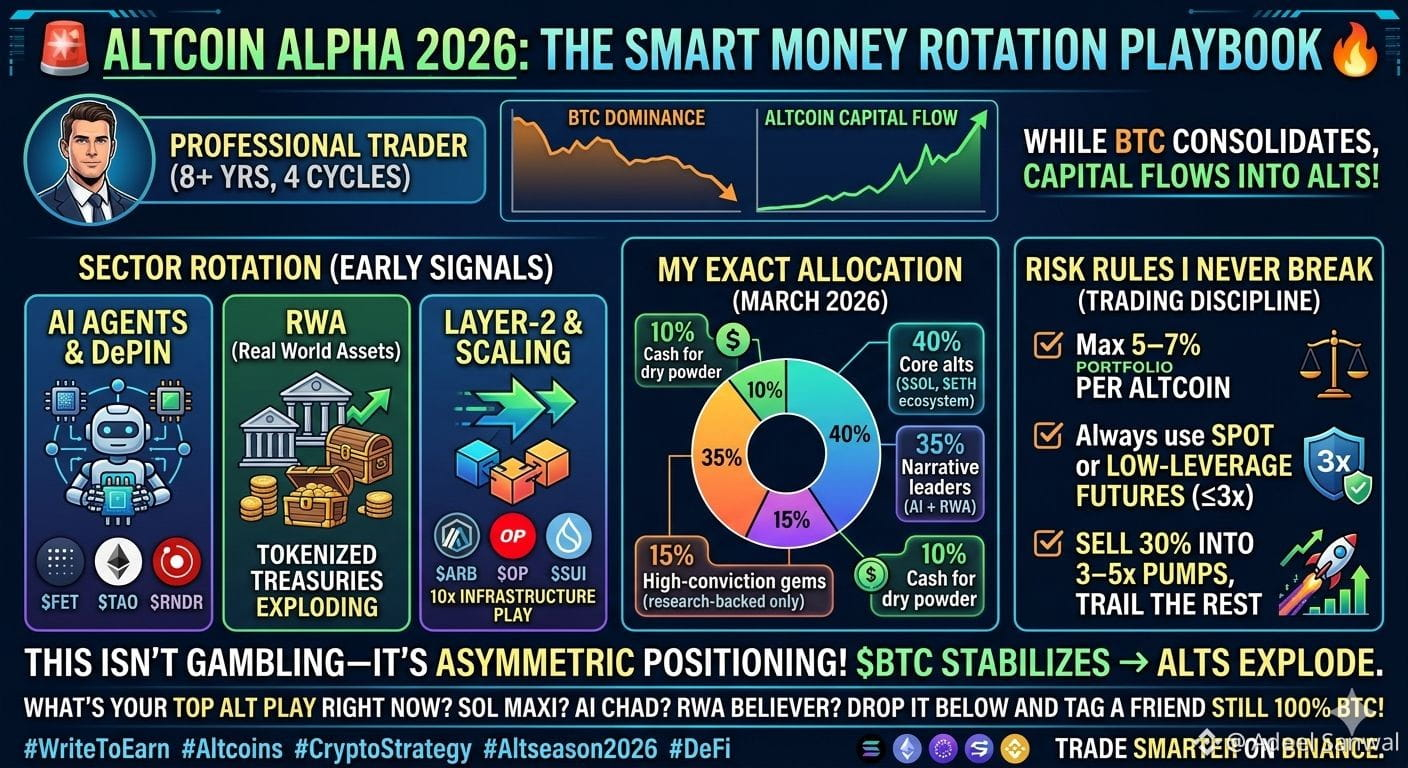
🚨 Altcoin Alpha 2026: The Smart Money Rotation Playbook 🔥
Professional trader here with 8+ years across 4 cycles. While $BTC consolidates below $70K, the real alpha is shifting hard into altcoins. We’re seeing early rotation signals: capital flowing from BTC dominance into high-utility narratives.
Here’s my battle-tested altcoin investment strategy right now:
1. Sector Rotation
AI Agents & DePIN: $FET, $TAO, $RNDR leading the charge
RWA (Real World Assets): Tokenized treasuries & real estate exploding on-chain
Layer-2 & Scaling: $ARB, $OP, $SUI delivering 10x infrastructure p
2. My Exact Allocation (March 2026)
40% Core alts ($SOL, $ETH ecosystem)
35% Narrative leaders (AI + RWA)
15% High-conviction gems (research-backed only)
10% Cash for
3. Risk Rules I Never Break
Max 5–7% portfolio per altcoin
Always use spot or low-leverage futures (≤3x)
Sell 30% into 3–5x pumps, trail the
This isn’t gambling — it’s asymmetric positioning ahead of the next altseason. $BTC stabilizes → alts explode. History doesn’t repeat, but it rhymes.
What’s your top alt play right now? $SOL maxi, AI chad, or RWA believer? Drop it below and tag a friend who’s still 100% BTC 👇
Trade smarter on Binance.
#WriteToEarn #Altcoins #CryptoStrategy #Altseason2026 #DeFi
🚨 Altcoin Alpha 2026: The Smart Money Rotation Playbook 🔥
Professional trader here with 8+ years across 4 cycles. While $BTC consolidates below $70K, the real alpha is shifting hard into altcoins. We’re seeing early rotation signals: capital flowing from BTC dominance into high-utility narratives.
Here’s my battle-tested altcoin investment strategy right now:
1. Sector Rotation
AI Agents & DePIN: $FET, $TAO, $RNDR leading the charge
RWA (Real World Assets): Tokenized treasuries & real estate exploding on-chain
Layer-2 & Scaling: $ARB, $OP, $SUI delivering 10x infrastructure p
2. My Exact Allocation (March 2026)
40% Core alts ($SOL, $ETH ecosystem)
35% Narrative leaders (AI + RWA)
15% High-conviction gems (research-backed only)
10% Cash for
3. Risk Rules I Never Break
Max 5–7% portfolio per altcoin
Always use spot or low-leverage futures (≤3x)
Sell 30% into 3–5x pumps, trail the
This isn’t gambling — it’s asymmetric positioning ahead of the next altseason. $BTC stabilizes → alts explode. History doesn’t repeat, but it rhymes.
What’s your top alt play right now? $SOL maxi, AI chad, or RWA believer? Drop it below and tag a friend who’s still 100% BTC 👇
Trade smarter on Binance.
#WriteToEarn #Altcoins #CryptoStrategy #Altseason2026 #DeFi
Professional trader here with 8+ years across 4 cycles. While $BTC consolidates below $70K, the real alpha is shifting hard into altcoins. We’re seeing early rotation signals: capital flowing from BTC dominance into high-utility narratives.
Here’s my battle-tested altcoin investment strategy right now:
1. Sector Rotation
AI Agents & DePIN: $FET, $TAO, $RNDR leading the charge
RWA (Real World Assets): Tokenized treasuries & real estate exploding on-chain
Layer-2 & Scaling: $ARB, $OP, $SUI delivering 10x infrastructure p
2. My Exact Allocation (March 2026)
40% Core alts ($SOL, $ETH ecosystem)
35% Narrative leaders (AI + RWA)
15% High-conviction gems (research-backed only)
10% Cash for
3. Risk Rules I Never Break
Max 5–7% portfolio per altcoin
Always use spot or low-leverage futures (≤3x)
Sell 30% into 3–5x pumps, trail the
This isn’t gambling — it’s asymmetric positioning ahead of the next altseason. $BTC stabilizes → alts explode. History doesn’t repeat, but it rhymes.
What’s your top alt play right now? $SOL maxi, AI chad, or RWA believer? Drop it below and tag a friend who’s still 100% BTC 👇
Trade smarter on Binance.
#WriteToEarn #Altcoins #CryptoStrategy #Altseason2026 #DeFi
1
50
·
--
Market Pulse: Why This $BTC Dip Is Your 2026 Accumulation Window 🔥
As a professional trader with over 8 years navigating crypto cycles, I’m seeing classic capitulation signals right now. Bitcoin has tested and broken $70K support, sitting around $66,800 as of March 28, with the Fear & Greed Index deep in extreme fear territory.
But here’s what the charts are really telling us:
• Whale accumulation is accelerating while retail panic sells.
• MVRV ratio remains deeply negative – historically the strongest long-term buy zone.
• Institutional yield strategies and AI-driven narratives are quietly rotating capital back in.
Short-term pain? Yes. Long-term setup? One of the best we’ve seen since the 2024 halving.
My current stance:
60% $BTC (core holding)
25% $ETH (ecosystem leader)
15% high-conviction alts with real utility
Key levels to watch:
Support: $64,000–$65,000
Breakout target: $85K+ by Q2 if we reclaim $70K with volume.
This isn’t financial advice – it’s pattern recognition from someone who’s traded through multiple cycles.
What’s your play right now? Are you buying the fear or waiting for confirmation? Drop your thoughts below 👇 and tag a trader who needs this.
Trade smart. Trade on Binance.
#WriteToEarn #Bitcoin #CryptoTrading #MarketAnalysis
Market Pulse: Why This $BTC Dip Is Your 2026 Accumulation Window 🔥
As a professional trader with over 8 years navigating crypto cycles, I’m seeing classic capitulation signals right now. Bitcoin has tested and broken $70K support, sitting around $66,800 as of March 28, with the Fear & Greed Index deep in extreme fear territory.
But here’s what the charts are really telling us:
• Whale accumulation is accelerating while retail panic sells.
• MVRV ratio remains deeply negative – historically the strongest long-term buy zone.
• Institutional yield strategies and AI-driven narratives are quietly rotating capital back in.
Short-term pain? Yes. Long-term setup? One of the best we’ve seen since the 2024 halving.
My current stance:
60% $BTC (core holding)
25% $ETH (ecosystem leader)
15% high-conviction alts with real utility
Key levels to watch:
Support: $64,000–$65,000
Breakout target: $85K+ by Q2 if we reclaim $70K with volume.
This isn’t financial advice – it’s pattern recognition from someone who’s traded through multiple cycles.
What’s your play right now? Are you buying the fear or waiting for confirmation? Drop your thoughts below 👇 and tag a trader who needs this.
Trade smart. Trade on Binance.
#WriteToEarn #Bitcoin #CryptoTrading #MarketAnalysis
As a professional trader with over 8 years navigating crypto cycles, I’m seeing classic capitulation signals right now. Bitcoin has tested and broken $70K support, sitting around $66,800 as of March 28, with the Fear & Greed Index deep in extreme fear territory.
But here’s what the charts are really telling us:
• Whale accumulation is accelerating while retail panic sells.
• MVRV ratio remains deeply negative – historically the strongest long-term buy zone.
• Institutional yield strategies and AI-driven narratives are quietly rotating capital back in.
Short-term pain? Yes. Long-term setup? One of the best we’ve seen since the 2024 halving.
My current stance:
60% $BTC (core holding)
25% $ETH (ecosystem leader)
15% high-conviction alts with real utility
Key levels to watch:
Support: $64,000–$65,000
Breakout target: $85K+ by Q2 if we reclaim $70K with volume.
This isn’t financial advice – it’s pattern recognition from someone who’s traded through multiple cycles.
What’s your play right now? Are you buying the fear or waiting for confirmation? Drop your thoughts below 👇 and tag a trader who needs this.
Trade smart. Trade on Binance.
#WriteToEarn #Bitcoin #CryptoTrading #MarketAnalysis
23
·
--
Article
Bullish Coins for 2025Based on recent forecasts, here are five cryptocurrencies showing strong bullish signals:
Bitcoin (BTC): Predicted to range from $80,440 to $151,200, with a stretched target of $185,000, driven by institutional adoption and ETF approvals.Ethereum (ETH): Expected to trade between $1,667 and $4,911, with a stretched target of $5,590, supported by DeFi and NFT growth.Solana (SOL): Forecasted at $121 to $515, with a stretched target of $590, thanks to its fast transactions and growing ecosystem.XRP: Projected at $1.80 to $4.41, with a stretched target of $5.25, boosted by its role in cross-border payments.Avalanche (AVAX): Anticipated to range from $17.50 to $91.10, with a stretched target of $113, due to its scalability and Ethereum compatibility.
Detailed Analysis of Each Coin
Bitcoin (BTC): As the largest cryptocurrency by market cap, Bitcoin’s bullish trend is supported by its finite supply and growing acceptance as a store of value. Recent developments, such as the approval of over 10 Bitcoin ETFs in 2024, have made it easier for institutional investors to participate, driving prices upward
. Forecasts suggest a range of $80,440 to $151,200, with a stretched target of $185,000, reflecting strong market confidence
.
Ethereum (ETH): Ethereum’s role in DeFi and NFTs continues to drive demand, with its transition to Ethereum 2.0 enhancing scalability. Price forecasts range from $1,667 to $4,911, with a stretched target of $5,590, supported by its extensive ecosystem and developer activity
.
Solana (SOL): Solana’s high-speed and low-cost transactions have positioned it as a competitor to Ethereum, with a growing ecosystem of decentralized applications. Its forecasted range is $121 to $515, with a stretched target of $590, reflecting its potential for significant growth
.
XRP: Ripple’s XRP is focused on enabling faster international money transfers, with potential for adoption in traditional finance. Its price is expected to range from $1.80 to $4.41, with a stretched target of $5.25, though regulatory clarity remains a key factor
.
Avalanche (AVAX): Avalanche’s compatibility with Ethereum and lower transaction fees make it attractive for developers and investors. Its forecasted range is $17.50 to $91.10, with a stretched target of $113, supported by its scalability and growi ng adoption
Bullish Coins for 2025
Based on recent forecasts, here are five cryptocurrencies showing strong bullish signals:
Bitcoin (BTC): Predicted to range from $80,440 to $151,200, with a stretched target of $185,000, driven by institutional adoption and ETF approvals.Ethereum (ETH): Expected to trade between $1,667 and $4,911, with a stretched target of $5,590, supported by DeFi and NFT growth.Solana (SOL): Forecasted at $121 to $515, with a stretched target of $590, thanks to its fast transactions and growing ecosystem.XRP: Projected at $1.80 to $4.41, with a stretched target of $5.25, boosted by its role in cross-border payments.Avalanche (AVAX): Anticipated to range from $17.50 to $91.10, with a stretched target of $113, due to its scalability and Ethereum compatibility.
Detailed Analysis of Each Coin
Bitcoin (BTC): As the largest cryptocurrency by market cap, Bitcoin’s bullish trend is supported by its finite supply and growing acceptance as a store of value. Recent developments, such as the approval of over 10 Bitcoin ETFs in 2024, have made it easier for institutional investors to participate, driving prices upward
. Forecasts suggest a range of $80,440 to $151,200, with a stretched target of $185,000, reflecting strong market confidence
.
Ethereum (ETH): Ethereum’s role in DeFi and NFTs continues to drive demand, with its transition to Ethereum 2.0 enhancing scalability. Price forecasts range from $1,667 to $4,911, with a stretched target of $5,590, supported by its extensive ecosystem and developer activity
.
Solana (SOL): Solana’s high-speed and low-cost transactions have positioned it as a competitor to Ethereum, with a growing ecosystem of decentralized applications. Its forecasted range is $121 to $515, with a stretched target of $590, reflecting its potential for significant growth
.
XRP: Ripple’s XRP is focused on enabling faster international money transfers, with potential for adoption in traditional finance. Its price is expected to range from $1.80 to $4.41, with a stretched target of $5.25, though regulatory clarity remains a key factor
.
Avalanche (AVAX): Avalanche’s compatibility with Ethereum and lower transaction fees make it attractive for developers and investors. Its forecasted range is $17.50 to $91.10, with a stretched target of $113, supported by its scalability and growi ng adoption
Bitcoin (BTC): Predicted to range from $80,440 to $151,200, with a stretched target of $185,000, driven by institutional adoption and ETF approvals.Ethereum (ETH): Expected to trade between $1,667 and $4,911, with a stretched target of $5,590, supported by DeFi and NFT growth.Solana (SOL): Forecasted at $121 to $515, with a stretched target of $590, thanks to its fast transactions and growing ecosystem.XRP: Projected at $1.80 to $4.41, with a stretched target of $5.25, boosted by its role in cross-border payments.Avalanche (AVAX): Anticipated to range from $17.50 to $91.10, with a stretched target of $113, due to its scalability and Ethereum compatibility.
Detailed Analysis of Each Coin
Bitcoin (BTC): As the largest cryptocurrency by market cap, Bitcoin’s bullish trend is supported by its finite supply and growing acceptance as a store of value. Recent developments, such as the approval of over 10 Bitcoin ETFs in 2024, have made it easier for institutional investors to participate, driving prices upward
. Forecasts suggest a range of $80,440 to $151,200, with a stretched target of $185,000, reflecting strong market confidence
.
Ethereum (ETH): Ethereum’s role in DeFi and NFTs continues to drive demand, with its transition to Ethereum 2.0 enhancing scalability. Price forecasts range from $1,667 to $4,911, with a stretched target of $5,590, supported by its extensive ecosystem and developer activity
.
Solana (SOL): Solana’s high-speed and low-cost transactions have positioned it as a competitor to Ethereum, with a growing ecosystem of decentralized applications. Its forecasted range is $121 to $515, with a stretched target of $590, reflecting its potential for significant growth
.
XRP: Ripple’s XRP is focused on enabling faster international money transfers, with potential for adoption in traditional finance. Its price is expected to range from $1.80 to $4.41, with a stretched target of $5.25, though regulatory clarity remains a key factor
.
Avalanche (AVAX): Avalanche’s compatibility with Ethereum and lower transaction fees make it attractive for developers and investors. Its forecasted range is $17.50 to $91.10, with a stretched target of $113, supported by its scalability and growi ng adoption
62
·
--
Quote of the Day for Spot and Futures Trading in Crypto:
"Trade the trend, not the noise. Stay disciplined, and let the market come to you.
#cryptotrading #TradeStories #qouteoftheday #bitcoin
Quote of the Day for Spot and Futures Trading in Crypto:
"Trade the trend, not the noise. Stay disciplined, and let the market come to you.
#cryptotrading #TradeStories #qouteoftheday #bitcoin
"Trade the trend, not the noise. Stay disciplined, and let the market come to you.
#cryptotrading #TradeStories #qouteoftheday #bitcoin
26
·
--
Quote Of The Day :
"Bitcoin is a tool for freeing humanity from oligarchs and tyrants, dressed up as a get-rich-quick scheme." — Naval Ravikant
Cryptocurrency #Bitcoin #CryptoQuote #Blockchain #CryptoGirl #DigitalCurrency #FutureOfFinance #CryptoInspiration #WomenInCrypto #HODL
Quote Of The Day :
"Bitcoin is a tool for freeing humanity from oligarchs and tyrants, dressed up as a get-rich-quick scheme." — Naval Ravikant
Cryptocurrency #Bitcoin #CryptoQuote #Blockchain #CryptoGirl #DigitalCurrency #FutureOfFinance #CryptoInspiration #WomenInCrypto #HODL
"Bitcoin is a tool for freeing humanity from oligarchs and tyrants, dressed up as a get-rich-quick scheme." — Naval Ravikant
Cryptocurrency #Bitcoin #CryptoQuote #Blockchain #CryptoGirl #DigitalCurrency #FutureOfFinance #CryptoInspiration #WomenInCrypto #HODL

46
·
--
Solana (SOL) Price: SOL Maintains Multi-Year Trendline as $450M Flows In | Solana saw over $450 million in bridged assets in April, primarily from Ethereum, signaling increased user confidence in its DeFi and dApp ecosystem. With over $88 million generated in revenue, it now commands 41% of total revenue among Layer 1 and Layer 2 chains. Currently trading at $147.50, SOL's price dynamics show a clustering of long positions near $143.50 which could create a "liquidation magnet." A move above $145 may trigger short liquidations, potentially pushing SOL toward $150. Technical analysis shows it above a long-term trendline and forming bullish patterns, including an ascending triangle and an inverse head and shoulders. Broader market factors, such as China injecting liquidity and the FOMC meeting outcomes, may also influence SOL's price trajectory. A recent transfer of over 120,000 SOL by a whale may indicate selling pressure. SOL has been consolidating between $143.50 and $154, with a breakout above $154 potentially leading to a 15% rally, while a drop below $143.50 may see it fall to $132 or $120 support.
#Solana #SOL #Crypto #Cryptocurrency #DeFi #Blockchain #Layer1 #Ethereum #CryptoMarket #TechnicalAnalysis #PriceAnalysis #Bullish #Investing #Finance #CryptoNews
Solana (SOL) Price: SOL Maintains Multi-Year Trendline as $450M Flows In | Solana saw over $450 million in bridged assets in April, primarily from Ethereum, signaling increased user confidence in its DeFi and dApp ecosystem. With over $88 million generated in revenue, it now commands 41% of total revenue among Layer 1 and Layer 2 chains. Currently trading at $147.50, SOL's price dynamics show a clustering of long positions near $143.50 which could create a "liquidation magnet." A move above $145 may trigger short liquidations, potentially pushing SOL toward $150. Technical analysis shows it above a long-term trendline and forming bullish patterns, including an ascending triangle and an inverse head and shoulders. Broader market factors, such as China injecting liquidity and the FOMC meeting outcomes, may also influence SOL's price trajectory. A recent transfer of over 120,000 SOL by a whale may indicate selling pressure. SOL has been consolidating between $143.50 and $154, with a breakout above $154 potentially leading to a 15% rally, while a drop below $143.50 may see it fall to $132 or $120 support.
#Solana #SOL #Crypto #Cryptocurrency #DeFi #Blockchain #Layer1 #Ethereum #CryptoMarket #TechnicalAnalysis #PriceAnalysis #Bullish #Investing #Finance #CryptoNews
#Solana #SOL #Crypto #Cryptocurrency #DeFi #Blockchain #Layer1 #Ethereum #CryptoMarket #TechnicalAnalysis #PriceAnalysis #Bullish #Investing #Finance #CryptoNews
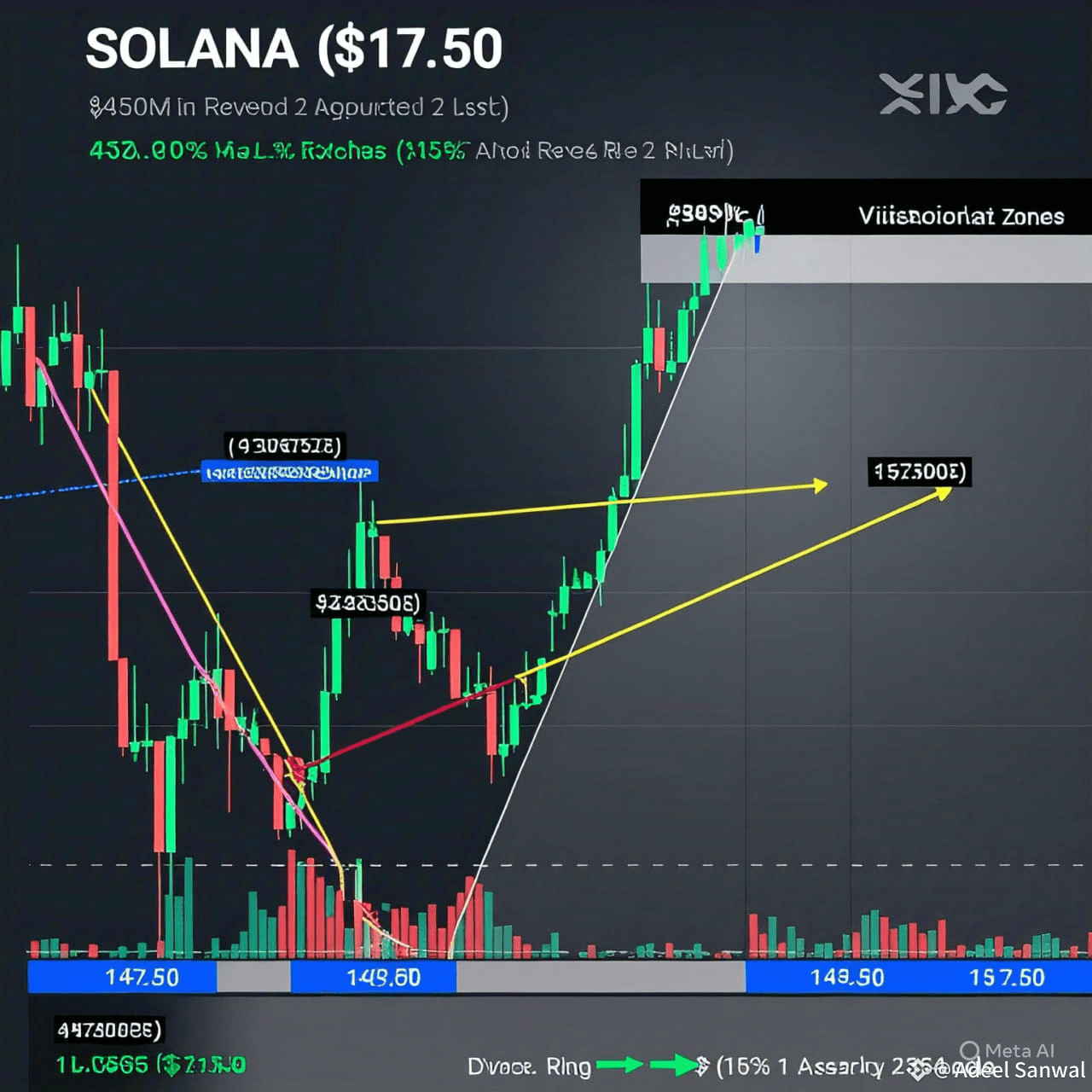
182
·
--
Quote of the Day:
"In crypto, volatility is the beat, risk is the dance, and lambo dreams are the afterparty. Just remember, every dip is a chance to either buy more or cry more. Choose wisely."
Quote of the Day:
"In crypto, volatility is the beat, risk is the dance, and lambo dreams are the afterparty. Just remember, every dip is a chance to either buy more or cry more. Choose wisely."
"In crypto, volatility is the beat, risk is the dance, and lambo dreams are the afterparty. Just remember, every dip is a chance to either buy more or cry more. Choose wisely."

176
·
--
Is $BTC ready for another bull run? With institutional adoption growing and halving cycles historically boosting prices, now’s the time to watch Bitcoin closely! Share your predictions below. #Crypto #Bitcoin #Investing $BTC
Is $BTC ready for another bull run? With institutional adoption growing and halving cycles historically boosting prices, now’s the time to watch Bitcoin closely! Share your predictions below. #Crypto #Bitcoin #Investing $BTC

29
·
--
TradFi Provides ‘Crystal Ball’ for DeFi Adoption Themes
Keyring Network’s blog post suggests that DeFi's development parallels TradFi's trajectory, particularly aligning with TradFi in the 1970s, characterized by compliance and liquidity. The growth of DeFi is driven by yield-bearing stablecoins, termed “DeFidollars,” similar to how the Eurodollar boom powered 1960s finance.
The 1970s saw the implementation of the Bank Secrecy Act to combat financial crime, paralleling DeFi's current challenges with smart contract exploits and high-profile crimes. Upcoming tax transparency measures like CARF, effective in 2026, will further pressure DeFi's compliance landscape. Keyring anticipates DeFi will soon venture into real-world assets, such as tokenized mortgage-backed securities, reflecting TradFi's innovations from the 1970s.
TradFi Provides ‘Crystal Ball’ for DeFi Adoption Themes
Keyring Network’s blog post suggests that DeFi's development parallels TradFi's trajectory, particularly aligning with TradFi in the 1970s, characterized by compliance and liquidity. The growth of DeFi is driven by yield-bearing stablecoins, termed “DeFidollars,” similar to how the Eurodollar boom powered 1960s finance.
The 1970s saw the implementation of the Bank Secrecy Act to combat financial crime, paralleling DeFi's current challenges with smart contract exploits and high-profile crimes. Upcoming tax transparency measures like CARF, effective in 2026, will further pressure DeFi's compliance landscape. Keyring anticipates DeFi will soon venture into real-world assets, such as tokenized mortgage-backed securities, reflecting TradFi's innovations from the 1970s.
Keyring Network’s blog post suggests that DeFi's development parallels TradFi's trajectory, particularly aligning with TradFi in the 1970s, characterized by compliance and liquidity. The growth of DeFi is driven by yield-bearing stablecoins, termed “DeFidollars,” similar to how the Eurodollar boom powered 1960s finance.
The 1970s saw the implementation of the Bank Secrecy Act to combat financial crime, paralleling DeFi's current challenges with smart contract exploits and high-profile crimes. Upcoming tax transparency measures like CARF, effective in 2026, will further pressure DeFi's compliance landscape. Keyring anticipates DeFi will soon venture into real-world assets, such as tokenized mortgage-backed securities, reflecting TradFi's innovations from the 1970s.

1
366
·
--
DEX's Trading Volume Declines by 30% Amid Market TurmoilIn this week's fluctuating cryptocurrency market, the trading volume of decentralized exchanges (DEX) has dropped by 30%. Meanwhile, the trading volume of competitive centralized exchanges (CEX) increased by 47.4%. From April 26 to May 2, the DEX trading volume was recorded at 688 million, showing a significant fall from 30.6% previously. The DEX showed a CEX trading volume share of 47.43%, with various problematic tokens being actively traded. Moreover, while the total value locked (TVL) for DEX has decreased by 48.99%, the situation for stablecoins is showing a reduction of 22.9%. As a consequence, the DEX's standing is witnessing adverse developments, while the correlation between CEX and DEX trading activities are tightening.
DEX's Trading Volume Declines by 30% Amid Market Turmoil
In this week's fluctuating cryptocurrency market, the trading volume of decentralized exchanges (DEX) has dropped by 30%. Meanwhile, the trading volume of competitive centralized exchanges (CEX) increased by 47.4%. From April 26 to May 2, the DEX trading volume was recorded at 688 million, showing a significant fall from 30.6% previously. The DEX showed a CEX trading volume share of 47.43%, with various problematic tokens being actively traded. Moreover, while the total value locked (TVL) for DEX has decreased by 48.99%, the situation for stablecoins is showing a reduction of 22.9%. As a consequence, the DEX's standing is witnessing adverse developments, while the correlation between CEX and DEX trading activities are tightening.
2
·
--

Article
Introduction to CryptocurrencyCryptocurrency is a digital or virtual currency that uses cryptography for security and is decentralized, meaning it's not controlled by any government or financial institution. The first cryptocurrency, Bitcoin, was created in 2009, and since then, the industry has grown exponentially, with thousands of cryptocurrencies now available.
How Cryptocurrency Works
Cryptocurrencies use blockchain technology, a public ledger that records all transactions made with a particular cryptocurrency. When a transaction is made, it's verified by nodes on the network and added to the blockchain, ensuring the integrity and security of the transaction.
Key Concepts
1. Blockchain: A public ledger that records all transactions.
2. Mining: The process of verifying transactions and adding them to the blockchain, often rewarded with cryptocurrency.
3. Wallets: Software or hardware used to store, send, and receive cryptocurrencies.
4. Private keys: Unique codes used to access and manage cryptocurrency funds.
Types of Cryptocurrencies
1. Bitcoin (BTC): The first and most widely recognized cryptocurrency.
2. Altcoins: Alternative cryptocurrencies, such as Ethereum (ETH), Litecoin (LTC), and Monero (XMR).
3. Tokens: Digital assets issued on top of another blockchain, often used for specific projects or applications.
Advantages of Cryptocurrency
1. Decentralization: Cryptocurrencies operate independently of central banks and governments.
2. Security: Cryptographic techniques secure transactions and control the creation of new units.
3. Accessibility: Cryptocurrencies can be accessed and traded globally, 24/7.
4. Low transaction fees: Compared to traditional payment systems.
Risks and Challenges
1. Volatility: Cryptocurrency prices can fluctuate rapidly.
2. Regulatory uncertainty: Governments and institutions are still figuring out how to regulate cryptocurrencies.
3. Security risks: Hackers and scams can compromise cryptocurrency funds.
4. Market manipulation: Cryptocurrency markets can be manipulated by large traders or whales.
Advanced Concepts
1. Smart contracts: Self-executing contracts with the terms of the agreement written directly into code.
2. Decentralized finance (DeFi): Financial applications built on blockchain technology, offering lending, borrowing, and trading services.
3. Non-fungible tokens (NFTs): Unique digital assets, often used for art, collectibles, and gaming.
4. Cryptocurrency trading strategies: Various approaches to buying and selling cryptocurrencies, such as day trading, swing trading, and long-term investing.
Getting Started with Cryptocurrency
1. Choose a reputable exchange: Select a well-established cryptocurrency exchange, such as Binance, Coinbase, or Kraken.
2. Set up a wallet: Create a secure wallet to store, send, and receive cryptocurrencies.
3. Educate yourself: Learn about cryptocurrency basics, blockchain technology, and market trends.
4. Start small: Begin with a small investment and gradually increase your exposure to cryptocurrencies.
#Cryptocurrency #Blockchain #Bitcoin #DigitalCurrency #DecentralizedFinance #CryptoTrading #CryptoNews
#FinancialGrowth #CryptoInvestin
#DigitalAssetBill #DeFi #NFTs #CryptocurrencyTrading #BlockchainSecurity
Introduction to Cryptocurrency
Cryptocurrency is a digital or virtual currency that uses cryptography for security and is decentralized, meaning it's not controlled by any government or financial institution. The first cryptocurrency, Bitcoin, was created in 2009, and since then, the industry has grown exponentially, with thousands of cryptocurrencies now available.
How Cryptocurrency Works
Cryptocurrencies use blockchain technology, a public ledger that records all transactions made with a particular cryptocurrency. When a transaction is made, it's verified by nodes on the network and added to the blockchain, ensuring the integrity and security of the transaction.
Key Concepts
1. Blockchain: A public ledger that records all transactions.
2. Mining: The process of verifying transactions and adding them to the blockchain, often rewarded with cryptocurrency.
3. Wallets: Software or hardware used to store, send, and receive cryptocurrencies.
4. Private keys: Unique codes used to access and manage cryptocurrency funds.
Types of Cryptocurrencies
1. Bitcoin (BTC): The first and most widely recognized cryptocurrency.
2. Altcoins: Alternative cryptocurrencies, such as Ethereum (ETH), Litecoin (LTC), and Monero (XMR).
3. Tokens: Digital assets issued on top of another blockchain, often used for specific projects or applications.
Advantages of Cryptocurrency
1. Decentralization: Cryptocurrencies operate independently of central banks and governments.
2. Security: Cryptographic techniques secure transactions and control the creation of new units.
3. Accessibility: Cryptocurrencies can be accessed and traded globally, 24/7.
4. Low transaction fees: Compared to traditional payment systems.
Risks and Challenges
1. Volatility: Cryptocurrency prices can fluctuate rapidly.
2. Regulatory uncertainty: Governments and institutions are still figuring out how to regulate cryptocurrencies.
3. Security risks: Hackers and scams can compromise cryptocurrency funds.
4. Market manipulation: Cryptocurrency markets can be manipulated by large traders or whales.
Advanced Concepts
1. Smart contracts: Self-executing contracts with the terms of the agreement written directly into code.
2. Decentralized finance (DeFi): Financial applications built on blockchain technology, offering lending, borrowing, and trading services.
3. Non-fungible tokens (NFTs): Unique digital assets, often used for art, collectibles, and gaming.
4. Cryptocurrency trading strategies: Various approaches to buying and selling cryptocurrencies, such as day trading, swing trading, and long-term investing.
Getting Started with Cryptocurrency
1. Choose a reputable exchange: Select a well-established cryptocurrency exchange, such as Binance, Coinbase, or Kraken.
2. Set up a wallet: Create a secure wallet to store, send, and receive cryptocurrencies.
3. Educate yourself: Learn about cryptocurrency basics, blockchain technology, and market trends.
4. Start small: Begin with a small investment and gradually increase your exposure to cryptocurrencies.
#Cryptocurrency #Blockchain #Bitcoin #DigitalCurrency #DecentralizedFinance #CryptoTrading #CryptoNews
#FinancialGrowth #CryptoInvestin
#DigitalAssetBill #DeFi #NFTs #CryptocurrencyTrading #BlockchainSecurity
How Cryptocurrency Works
Cryptocurrencies use blockchain technology, a public ledger that records all transactions made with a particular cryptocurrency. When a transaction is made, it's verified by nodes on the network and added to the blockchain, ensuring the integrity and security of the transaction.
Key Concepts
1. Blockchain: A public ledger that records all transactions.
2. Mining: The process of verifying transactions and adding them to the blockchain, often rewarded with cryptocurrency.
3. Wallets: Software or hardware used to store, send, and receive cryptocurrencies.
4. Private keys: Unique codes used to access and manage cryptocurrency funds.
Types of Cryptocurrencies
1. Bitcoin (BTC): The first and most widely recognized cryptocurrency.
2. Altcoins: Alternative cryptocurrencies, such as Ethereum (ETH), Litecoin (LTC), and Monero (XMR).
3. Tokens: Digital assets issued on top of another blockchain, often used for specific projects or applications.
Advantages of Cryptocurrency
1. Decentralization: Cryptocurrencies operate independently of central banks and governments.
2. Security: Cryptographic techniques secure transactions and control the creation of new units.
3. Accessibility: Cryptocurrencies can be accessed and traded globally, 24/7.
4. Low transaction fees: Compared to traditional payment systems.
Risks and Challenges
1. Volatility: Cryptocurrency prices can fluctuate rapidly.
2. Regulatory uncertainty: Governments and institutions are still figuring out how to regulate cryptocurrencies.
3. Security risks: Hackers and scams can compromise cryptocurrency funds.
4. Market manipulation: Cryptocurrency markets can be manipulated by large traders or whales.
Advanced Concepts
1. Smart contracts: Self-executing contracts with the terms of the agreement written directly into code.
2. Decentralized finance (DeFi): Financial applications built on blockchain technology, offering lending, borrowing, and trading services.
3. Non-fungible tokens (NFTs): Unique digital assets, often used for art, collectibles, and gaming.
4. Cryptocurrency trading strategies: Various approaches to buying and selling cryptocurrencies, such as day trading, swing trading, and long-term investing.
Getting Started with Cryptocurrency
1. Choose a reputable exchange: Select a well-established cryptocurrency exchange, such as Binance, Coinbase, or Kraken.
2. Set up a wallet: Create a secure wallet to store, send, and receive cryptocurrencies.
3. Educate yourself: Learn about cryptocurrency basics, blockchain technology, and market trends.
4. Start small: Begin with a small investment and gradually increase your exposure to cryptocurrencies.
#Cryptocurrency #Blockchain #Bitcoin #DigitalCurrency #DecentralizedFinance #CryptoTrading #CryptoNews
#FinancialGrowth #CryptoInvestin
#DigitalAssetBill #DeFi #NFTs #CryptocurrencyTrading #BlockchainSecurity
256
Log in to explore more content
Join global crypto users on Binance Square
⚡️ Get latest and useful information about crypto.
💬 Trusted by the world’s largest crypto exchange.
👍 Discover real insights from verified creators.
Email / Phone number
Trending Topics
USAugustPPIRisesLessThanExpected
49,386 views
808 Discussing
🚨 US AUG PPI: Rises LESS Than Expected! Bullish for Crypto? 🚀
PPI +0.4% MoM as expected, but CORE PPI only +0.2% vs +0.3% expected - cooling!
What it means:
• Wholesale inflation softer than feared
• Fed rate hike chance now 62% - but dovish signals coming
• Core PCE revisions expected downward - bullish
• BTC usually pumps on softer PPI
Fed meeting Sep 15-16 - Market now expects pause, not hike?
Is this the green light for Q4 rally?
#Bitcoin #PPI #Fed #CryptoNews #BTC#usaugustppiriseslessthanexpected
True News
·1 Likes
·1.4k views
SECApprovesNasdaqTexasCommodityTrustRule
27,327 views
587 Discussing
ECBRaisesRatesSecondTimeTo2.5%
24,904 views
423 Discussing