

#wif
wif
151.6M views
79,350 Discussing
Hot
Latest

·
--
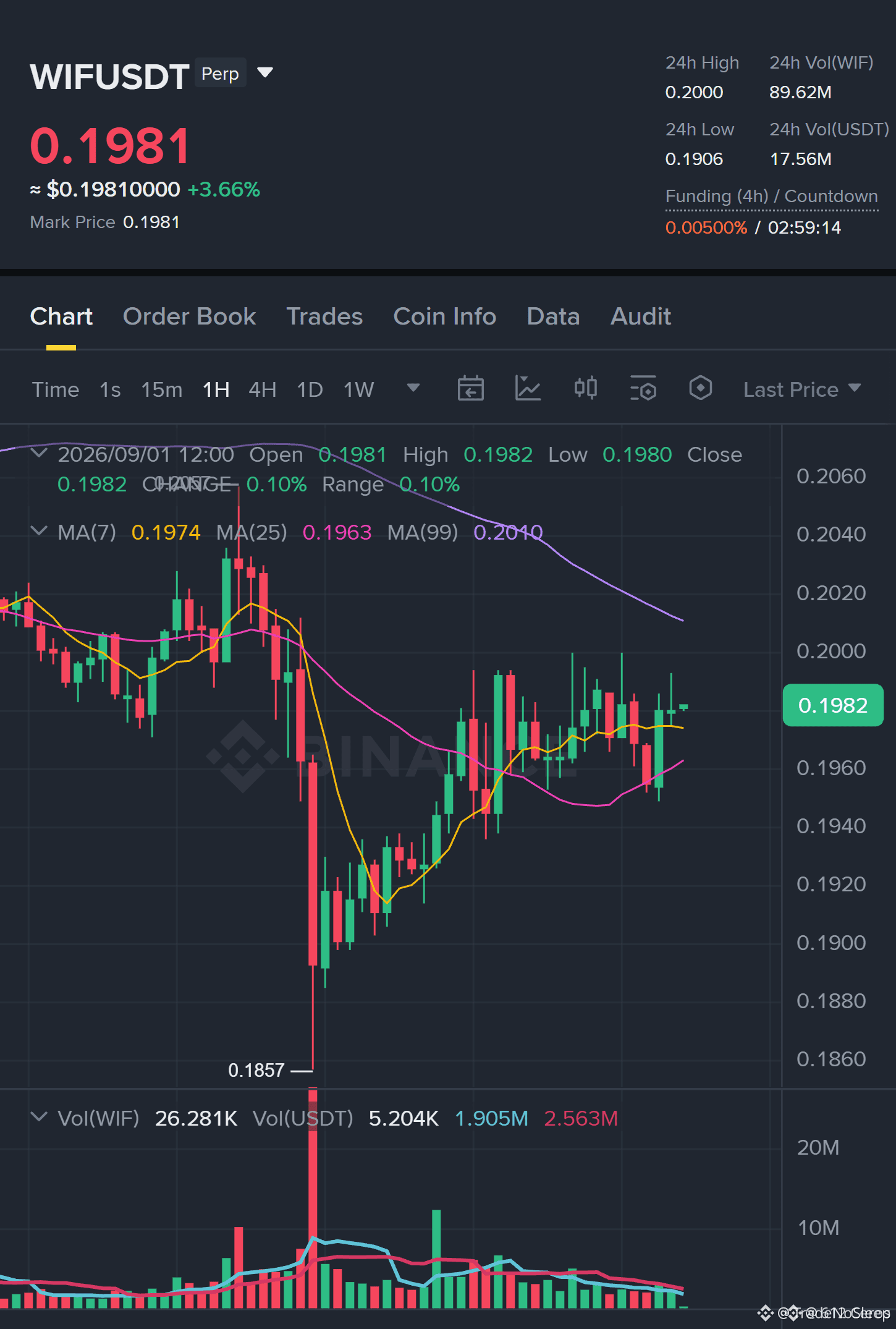
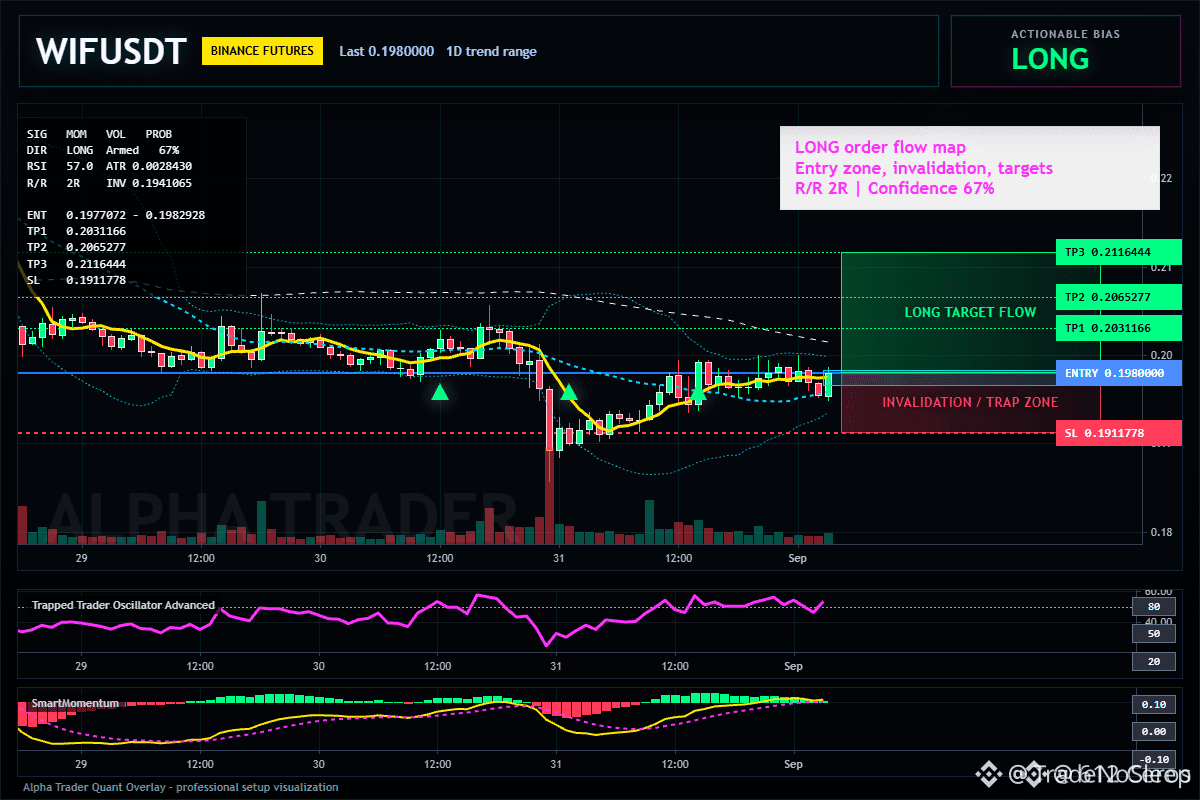
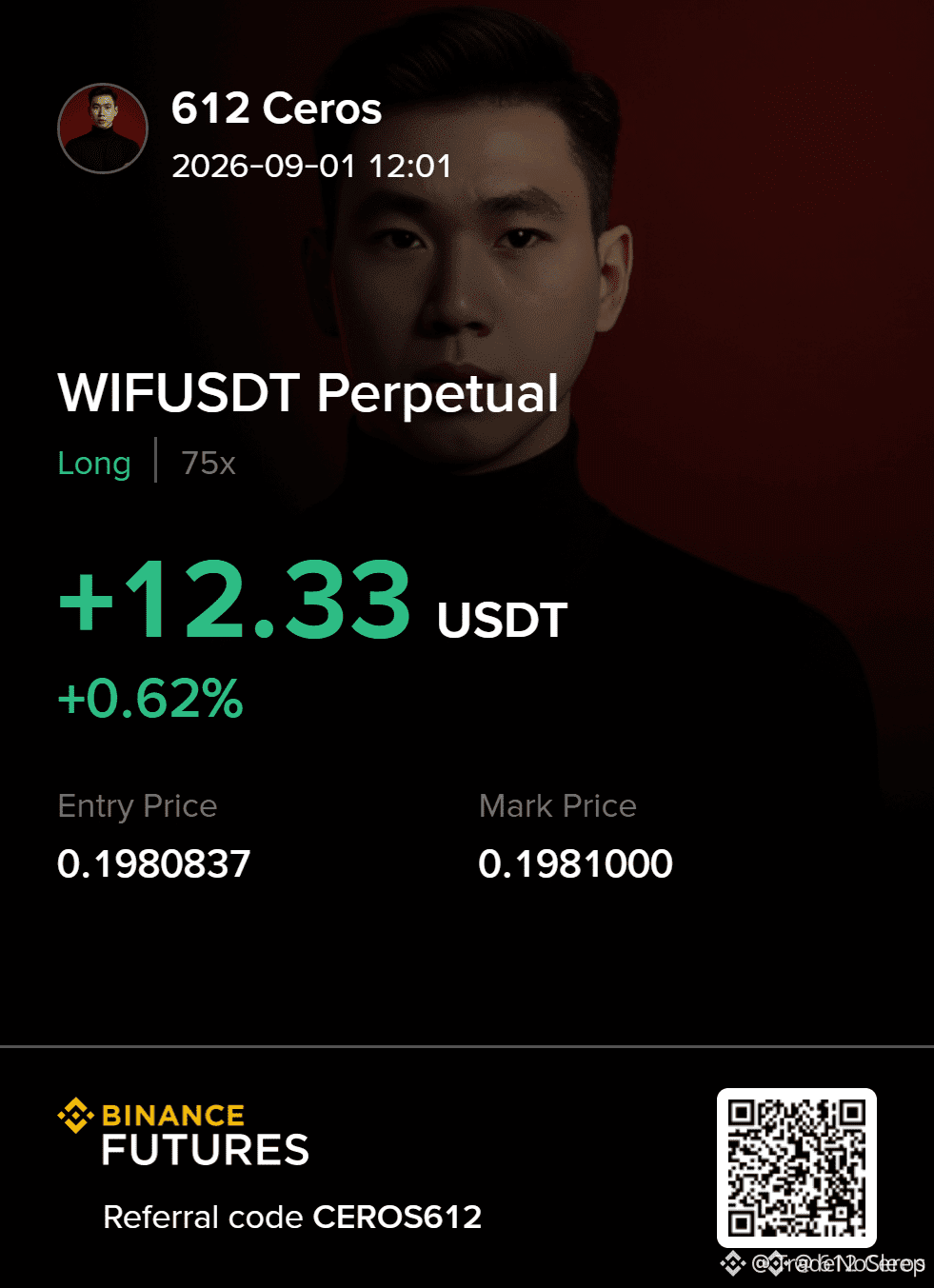
⚡ $WIF COILING ON THE 4H AS INSTITUTIONAL FLOW PREPARES FOR COMPRESSION BREAKOUT! 💥
Entry: 0.1977 - 0.1983 ⚡
Target: 0.2116 🚀
Stop Loss: 0.1911 ⚠️
📌 While retail stares at the flat daily range, lower timeframe market structure reveals classic smart money accumulation. 🔍 Hourly volatility has squeezed tight with ATR compression, signaling an imminent directional expansion toward upper liquidity pools.
📊 With momentum indicators showing ample runway before reaching overbought conditions, the path of least resistance favors a swift upside push. 💡 This asymmetric setup offers clean execution with tightly defined structural risk. 💬 Are you front-running this 4H compression trigger or waiting for the daily range reclaim? 👇
⚠️ Not financial advice. Always manage your risk. 🛡️
🏷️ #WIF #LongSetup #Crypto #Breakout #MarketStructure
🎯 🦈
⚡ $WIF COILING ON THE 4H AS INSTITUTIONAL FLOW PREPARES FOR COMPRESSION BREAKOUT! 💥
Entry: 0.1977 - 0.1983 ⚡
Target: 0.2116 🚀
Stop Loss: 0.1911 ⚠️
📌 While retail stares at the flat daily range, lower timeframe market structure reveals classic smart money accumulation. 🔍 Hourly volatility has squeezed tight with ATR compression, signaling an imminent directional expansion toward upper liquidity pools.
📊 With momentum indicators showing ample runway before reaching overbought conditions, the path of least resistance favors a swift upside push. 💡 This asymmetric setup offers clean execution with tightly defined structural risk. 💬 Are you front-running this 4H compression trigger or waiting for the daily range reclaim? 👇
⚠️ Not financial advice. Always manage your risk. 🛡️
🏷️ #WIF #LongSetup #Crypto #Breakout #MarketStructure
🎯 🦈
Entry: 0.1977 - 0.1983 ⚡
Target: 0.2116 🚀
Stop Loss: 0.1911 ⚠️
📌 While retail stares at the flat daily range, lower timeframe market structure reveals classic smart money accumulation. 🔍 Hourly volatility has squeezed tight with ATR compression, signaling an imminent directional expansion toward upper liquidity pools.
📊 With momentum indicators showing ample runway before reaching overbought conditions, the path of least resistance favors a swift upside push. 💡 This asymmetric setup offers clean execution with tightly defined structural risk. 💬 Are you front-running this 4H compression trigger or waiting for the daily range reclaim? 👇
⚠️ Not financial advice. Always manage your risk. 🛡️
🏷️ #WIF #LongSetup #Crypto #Breakout #MarketStructure
🎯 🦈
3

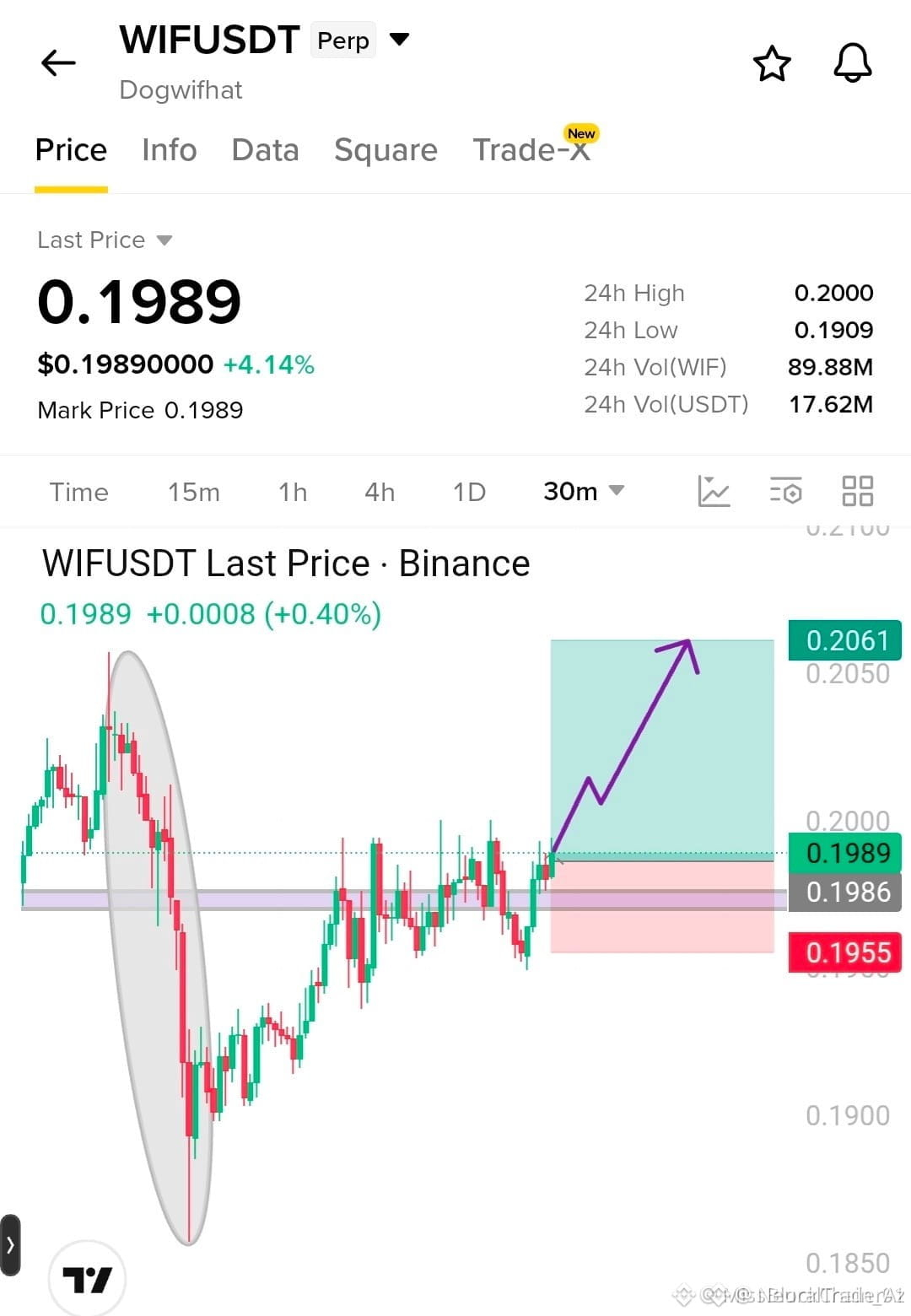
🚨 $WIF DEFENDS KEY DEMAND ZONE AS SMART MONEY PREPARES CONTINUATION! 🐂
Entry: 0.1980 - 0.1990 ⚡
Target: 0.2010 / 0.2035 / 0.2061 🚀
Stop Loss: 0.1955 ⚠️
Institutional bids are actively defending the 0.1980 to 0.1990 order block, absorbing retail sell pressure right at the breakout pivot. 📊 As long as this structural demand zone holds, the bullish market structure favors an efficient liquidity push toward higher resistance targets. 🌊
Execution discipline is key here. Avoid chasing momentum and allow price action to validate the retest before committing capital. 💡 💬 Are you bidding this demand retest or waiting for higher timeframe confirmation? 👇
⚠️ Not financial advice. Always manage your risk. 🛡️
🏷️ #WIF #LongSetup #Trading #Crypto
🎯 🦈
🚨 $WIF DEFENDS KEY DEMAND ZONE AS SMART MONEY PREPARES CONTINUATION! 🐂
Entry: 0.1980 - 0.1990 ⚡
Target: 0.2010 / 0.2035 / 0.2061 🚀
Stop Loss: 0.1955 ⚠️
Institutional bids are actively defending the 0.1980 to 0.1990 order block, absorbing retail sell pressure right at the breakout pivot. 📊 As long as this structural demand zone holds, the bullish market structure favors an efficient liquidity push toward higher resistance targets. 🌊
Execution discipline is key here. Avoid chasing momentum and allow price action to validate the retest before committing capital. 💡 💬 Are you bidding this demand retest or waiting for higher timeframe confirmation? 👇
⚠️ Not financial advice. Always manage your risk. 🛡️
🏷️ #WIF #LongSetup #Trading #Crypto
🎯 🦈
Entry: 0.1980 - 0.1990 ⚡
Target: 0.2010 / 0.2035 / 0.2061 🚀
Stop Loss: 0.1955 ⚠️
Institutional bids are actively defending the 0.1980 to 0.1990 order block, absorbing retail sell pressure right at the breakout pivot. 📊 As long as this structural demand zone holds, the bullish market structure favors an efficient liquidity push toward higher resistance targets. 🌊
Execution discipline is key here. Avoid chasing momentum and allow price action to validate the retest before committing capital. 💡 💬 Are you bidding this demand retest or waiting for higher timeframe confirmation? 👇
⚠️ Not financial advice. Always manage your risk. 🛡️
🏷️ #WIF #LongSetup #Trading #Crypto
🎯 🦈
10

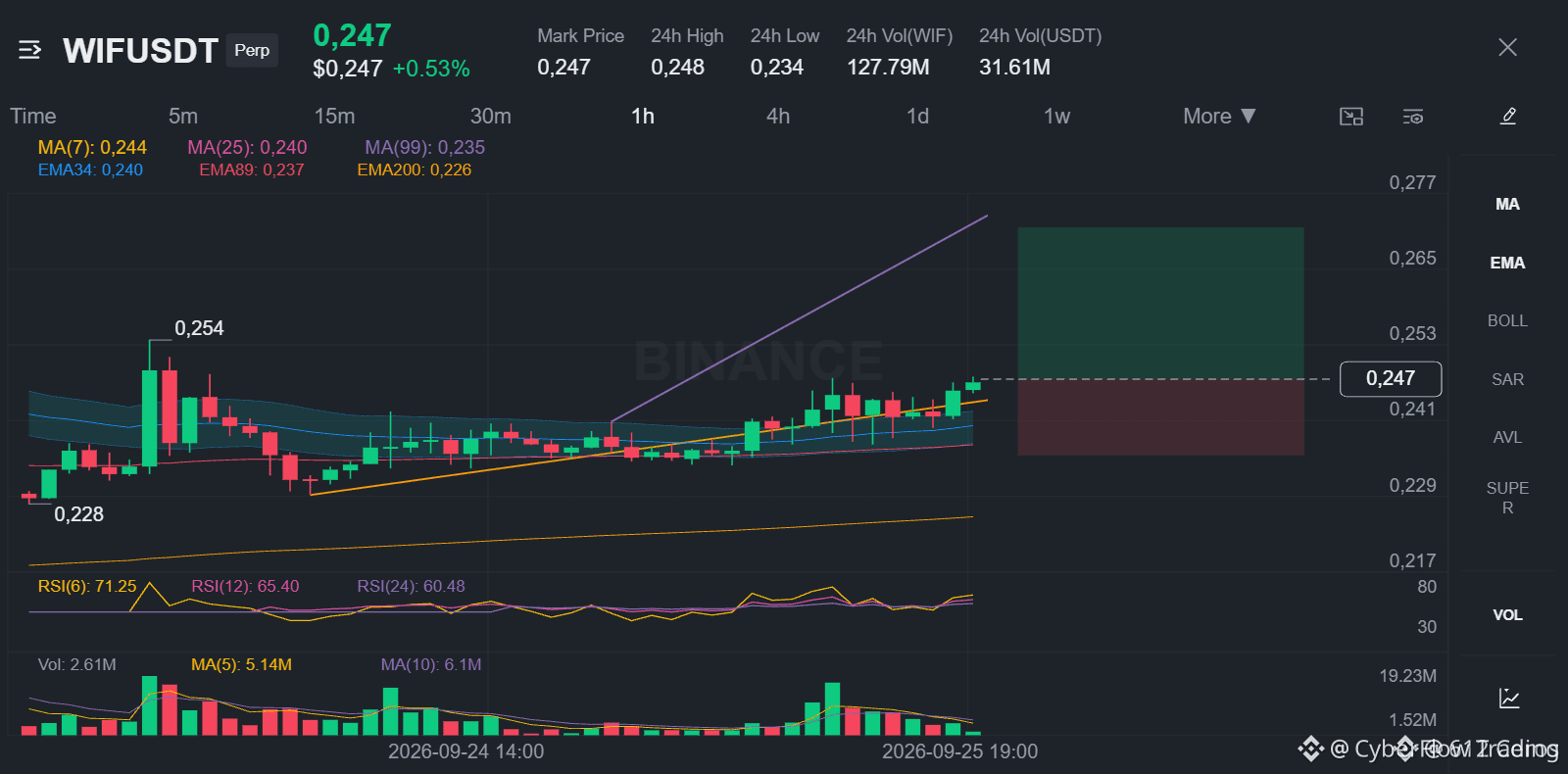
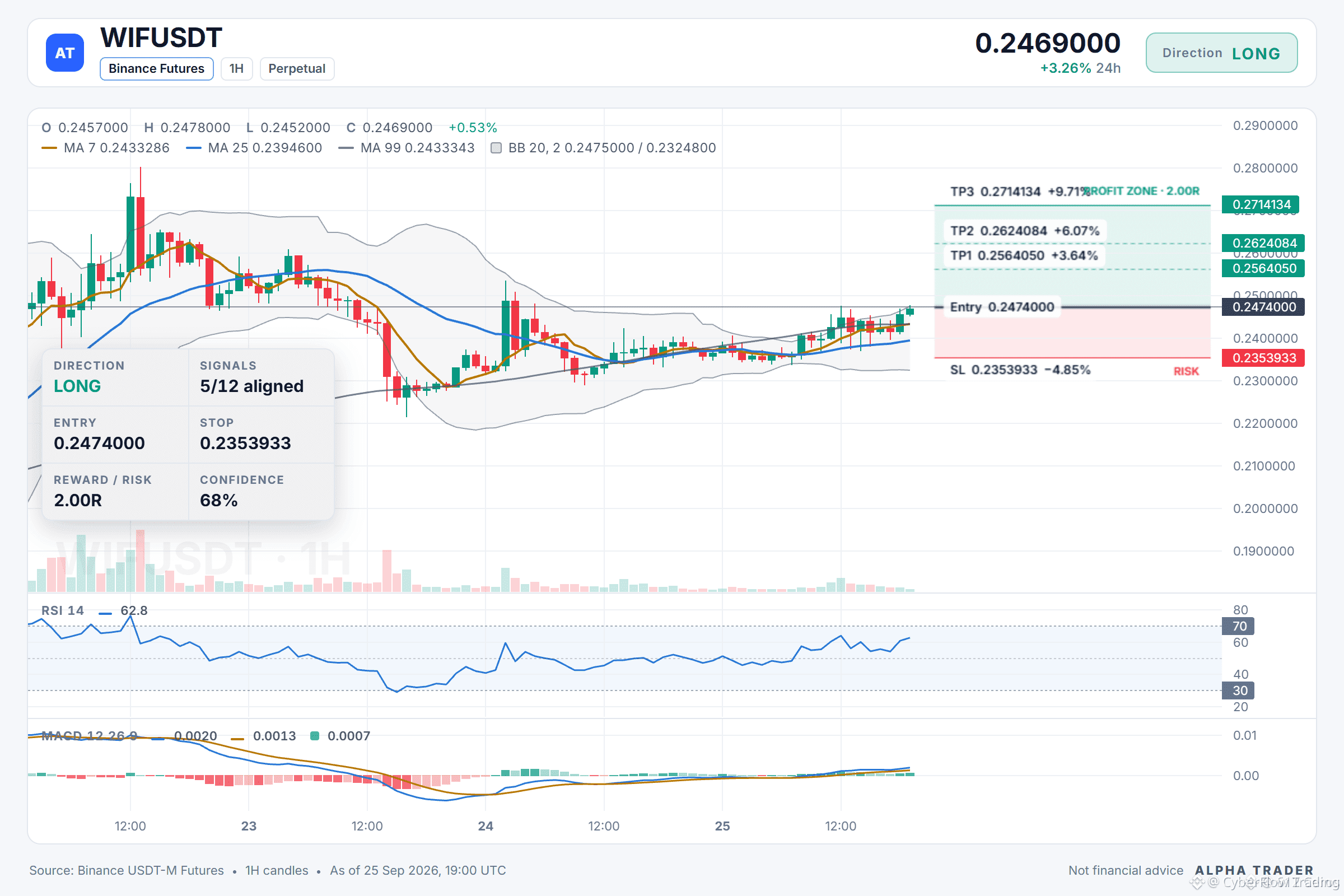
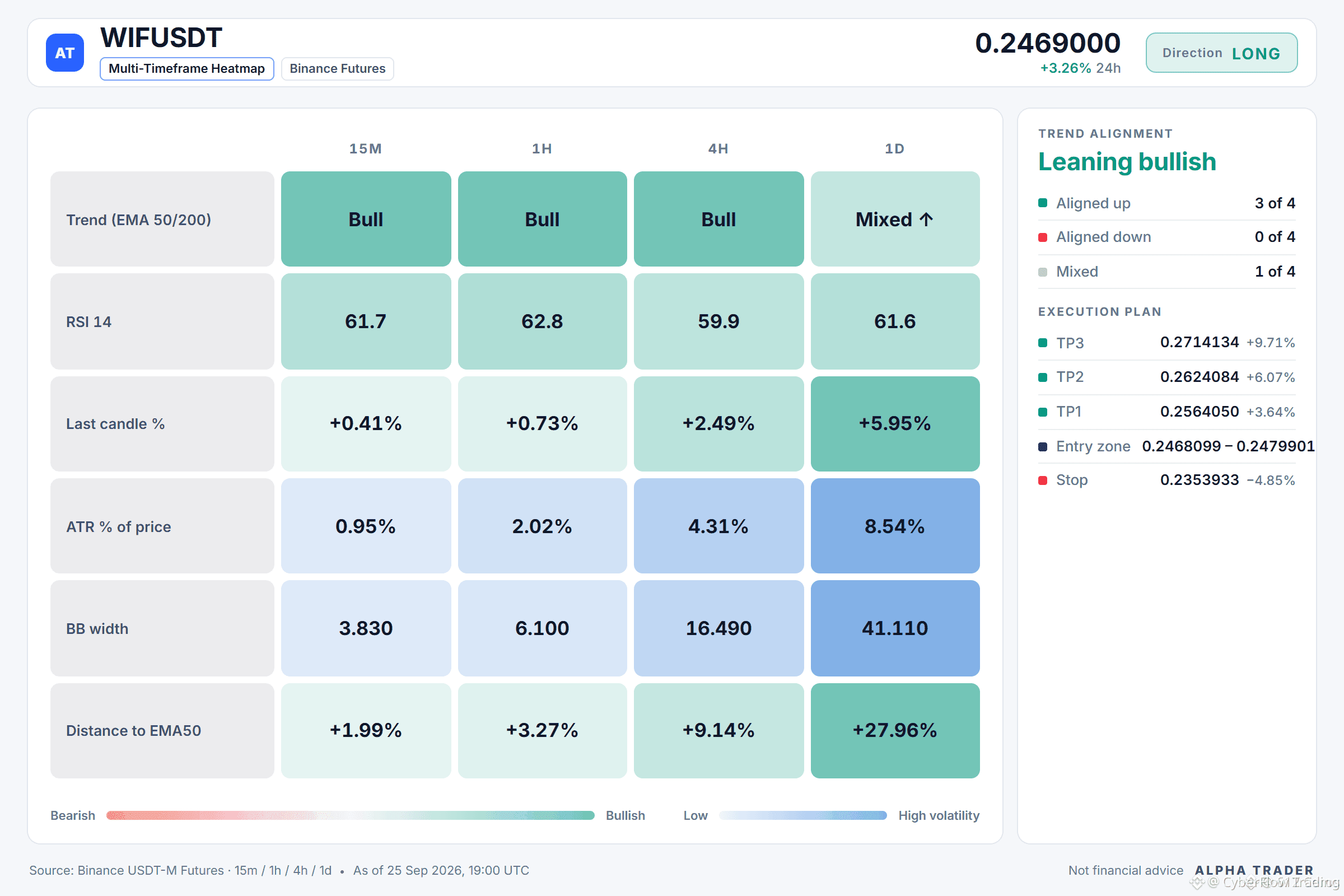
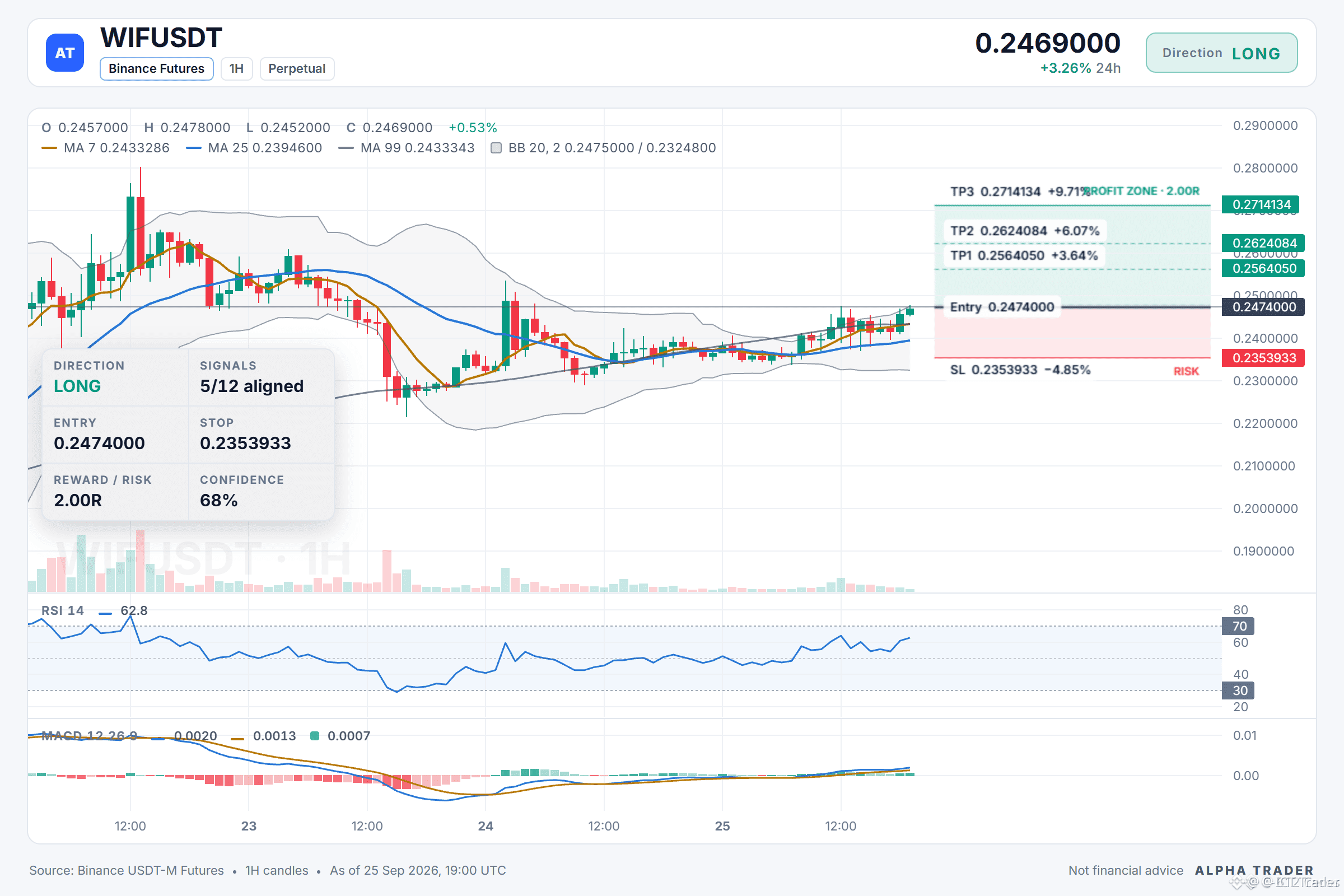
🚨 $WIF ALIGNS BULLISH EMA STACK AS BUYERS PREPARE FOR MOMENTUM BREAKOUT! 📈
Entry: 0.2474 ⚡
Target: 0.2564 🚀
Stop Loss: 0.2354 ⚠️
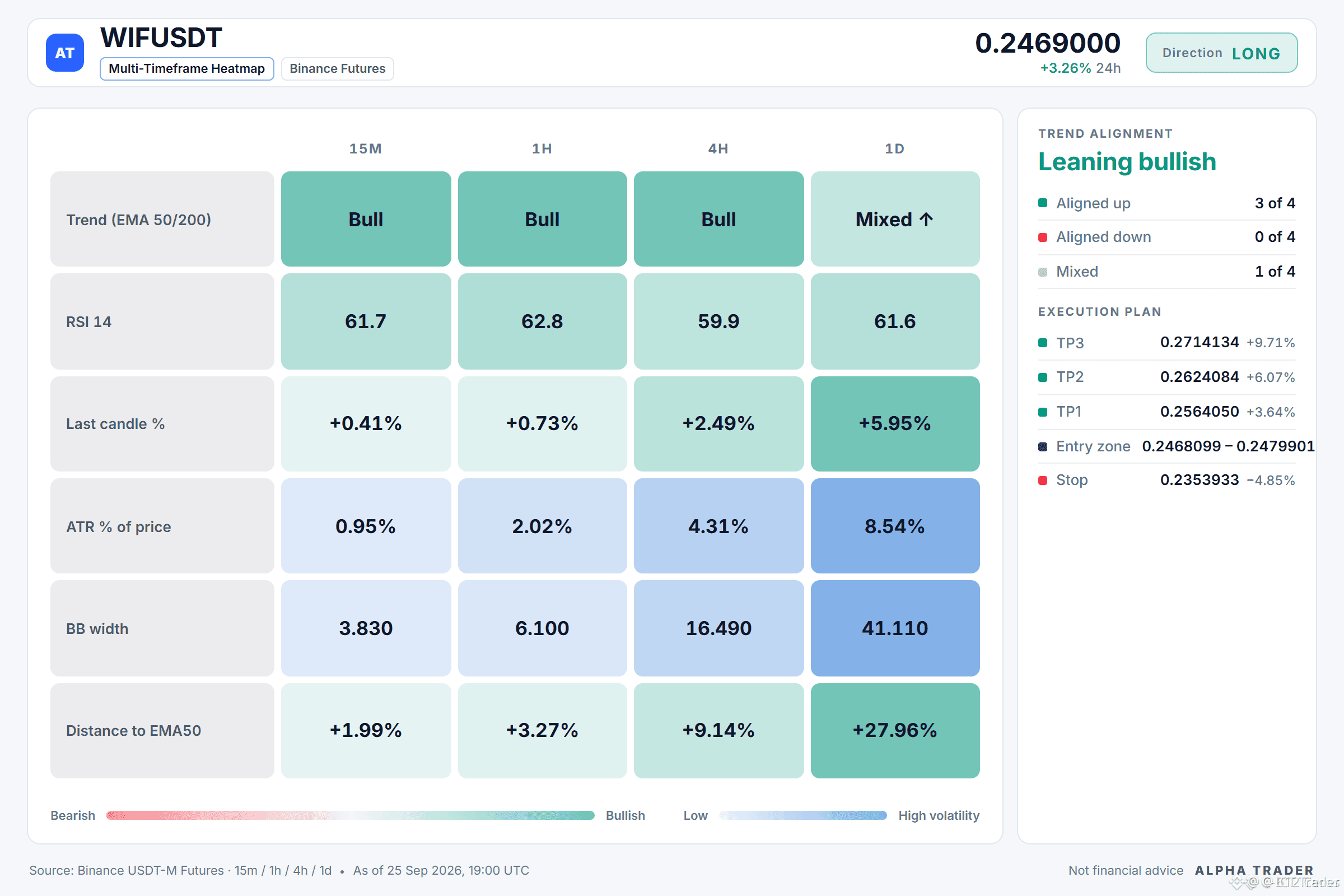
While macro price action remains trapped in a range, the lower timeframes are quietly constructing a textbook bullish structure. Both 1H and 4H charts showcase clean EMA stacks with RSI holding firmly above 55, confirming momentum is quietly building under the surface. 📊
📌 Zero technical indicators are opposing this move right now, though keeping position sizing disciplined is key while macro range boundaries persist. 💡 A clean hold of this demand level opens the doorway for a rapid retest of upper liquidity pockets. 💬 Are you bidding this intraday alignment or waiting for macro range confirmation? 👇
⚠️ Not financial advice. Always manage your risk. 🛡️
🏷️ #WIF #LongSetup #Crypto #Trading
🎯 🐂
🚨 $WIF ALIGNS BULLISH EMA STACK AS BUYERS PREPARE FOR MOMENTUM BREAKOUT! 📈
Entry: 0.2474 ⚡
Target: 0.2564 🚀
Stop Loss: 0.2354 ⚠️
While macro price action remains trapped in a range, the lower timeframes are quietly constructing a textbook bullish structure. Both 1H and 4H charts showcase clean EMA stacks with RSI holding firmly above 55, confirming momentum is quietly building under the surface. 📊
📌 Zero technical indicators are opposing this move right now, though keeping position sizing disciplined is key while macro range boundaries persist. 💡 A clean hold of this demand level opens the doorway for a rapid retest of upper liquidity pockets. 💬 Are you bidding this intraday alignment or waiting for macro range confirmation? 👇
⚠️ Not financial advice. Always manage your risk. 🛡️
🏷️ #WIF #LongSetup #Crypto #Trading
🎯 🐂
Entry: 0.2474 ⚡
Target: 0.2564 🚀
Stop Loss: 0.2354 ⚠️
While macro price action remains trapped in a range, the lower timeframes are quietly constructing a textbook bullish structure. Both 1H and 4H charts showcase clean EMA stacks with RSI holding firmly above 55, confirming momentum is quietly building under the surface. 📊
📌 Zero technical indicators are opposing this move right now, though keeping position sizing disciplined is key while macro range boundaries persist. 💡 A clean hold of this demand level opens the doorway for a rapid retest of upper liquidity pockets. 💬 Are you bidding this intraday alignment or waiting for macro range confirmation? 👇
⚠️ Not financial advice. Always manage your risk. 🛡️
🏷️ #WIF #LongSetup #Crypto #Trading
🎯 🐂
12

·
--
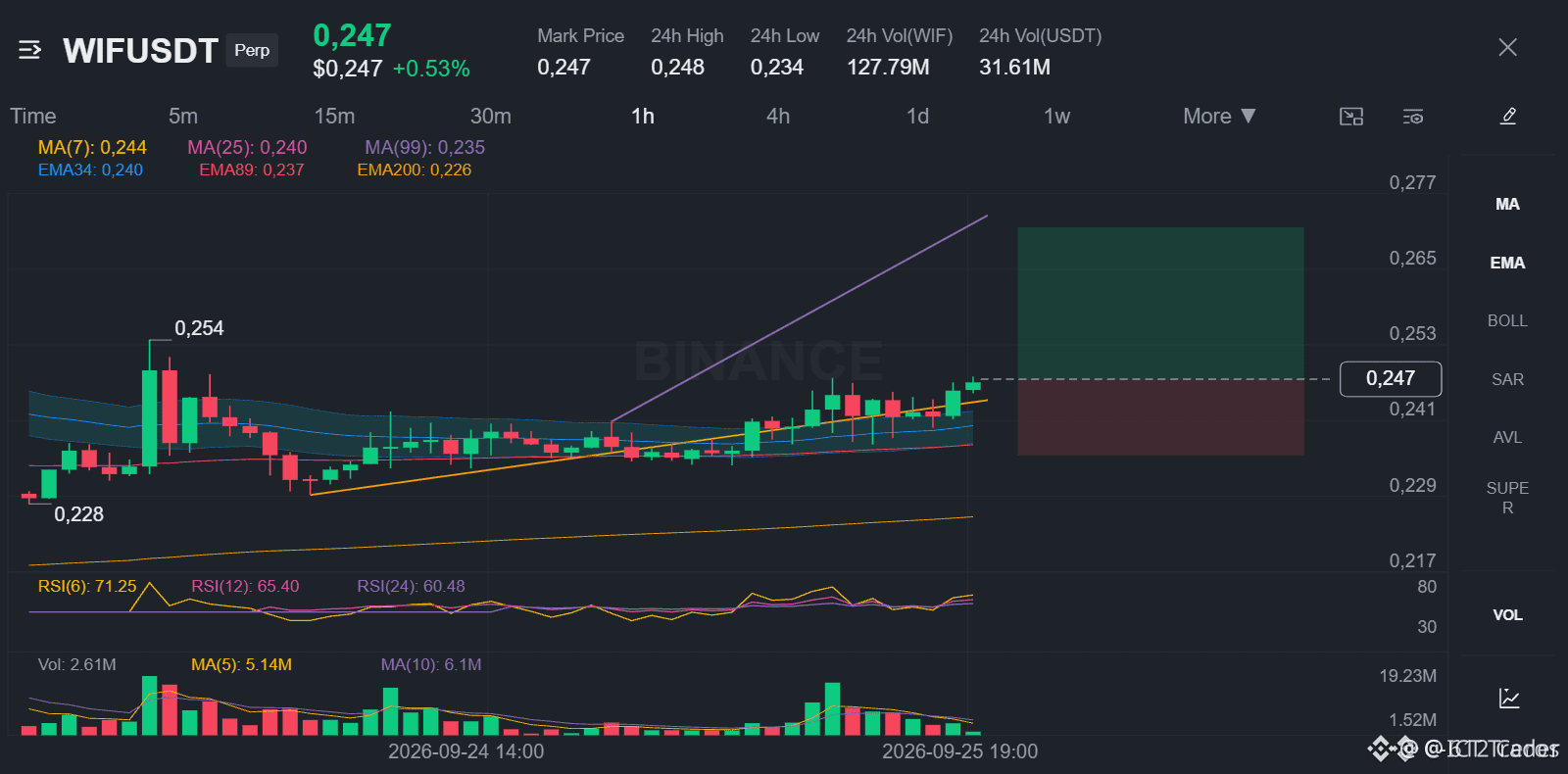
⚡ $WIF SHOWS BULLISH EMA STACKING DESPITE RANGE-BOUND DAILY PRICE ACTION 🟢
Entry: 0.2474 ⚡
Target: 0.2564 🚀
Stop Loss: 0.2353 ⚠️
Despite the daily timeframe remaining bound inside a macro range, intraday market structure on $WIF reveals a clean trend alignment. Both 1H and 4H timeframes show price trading firmly above the 50 and 200 EMAs, supported by healthy RSI readings floating near 60 to signal active buyer momentum. 📊
With technical indicators leaning long and zero opposing structure signals present across lower timeframes, the order flow leans toward continuous expansion into upper overhead levels. 💡 The defined invalidation level below local support offers a clear structural boundary to keep capital safe. 🔍
💬 Are you taking this execution at current entry levels, or waiting for a deeper liquidity sweep before scaling in? 👇
⚠️ Not financial advice. Always manage your risk. 🛡️
🏷️ #WIF #LongSetup #Altcoins #Crypto
🎯 🦈
⚡ $WIF SHOWS BULLISH EMA STACKING DESPITE RANGE-BOUND DAILY PRICE ACTION 🟢
Entry: 0.2474 ⚡
Target: 0.2564 🚀
Stop Loss: 0.2353 ⚠️
Despite the daily timeframe remaining bound inside a macro range, intraday market structure on $WIF reveals a clean trend alignment. Both 1H and 4H timeframes show price trading firmly above the 50 and 200 EMAs, supported by healthy RSI readings floating near 60 to signal active buyer momentum. 📊
With technical indicators leaning long and zero opposing structure signals present across lower timeframes, the order flow leans toward continuous expansion into upper overhead levels. 💡 The defined invalidation level below local support offers a clear structural boundary to keep capital safe. 🔍
💬 Are you taking this execution at current entry levels, or waiting for a deeper liquidity sweep before scaling in? 👇
⚠️ Not financial advice. Always manage your risk. 🛡️
🏷️ #WIF #LongSetup #Altcoins #Crypto
🎯 🦈
Entry: 0.2474 ⚡
Target: 0.2564 🚀
Stop Loss: 0.2353 ⚠️
Despite the daily timeframe remaining bound inside a macro range, intraday market structure on $WIF reveals a clean trend alignment. Both 1H and 4H timeframes show price trading firmly above the 50 and 200 EMAs, supported by healthy RSI readings floating near 60 to signal active buyer momentum. 📊
With technical indicators leaning long and zero opposing structure signals present across lower timeframes, the order flow leans toward continuous expansion into upper overhead levels. 💡 The defined invalidation level below local support offers a clear structural boundary to keep capital safe. 🔍
💬 Are you taking this execution at current entry levels, or waiting for a deeper liquidity sweep before scaling in? 👇
⚠️ Not financial advice. Always manage your risk. 🛡️
🏷️ #WIF #LongSetup #Altcoins #Crypto
🎯 🦈
13

·
--
Bullish
** $WIF remains one of the recognizable Solana meme coins, but fast-moving assets require patience. I’m watching for a clean breakout from the current structure rather than buying simply because momentum looks strong. If buyers break resistance, hold above it and volume confirms the move, continuation becomes possible. If price rejects and falls back into the range, I would step aside. The biggest mistake with meme coins is entering after the move has already become emotional. I prefer a planned entry, clear invalidation and controlled position size. Missing a trade is acceptable. Losing capital because of FOMO is avoidable. #WIF #dogwifhat #Solana
{spot}(WIFUSDT)
** $WIF remains one of the recognizable Solana meme coins, but fast-moving assets require patience. I’m watching for a clean breakout from the current structure rather than buying simply because momentum looks strong. If buyers break resistance, hold above it and volume confirms the move, continuation becomes possible. If price rejects and falls back into the range, I would step aside. The biggest mistake with meme coins is entering after the move has already become emotional. I prefer a planned entry, clear invalidation and controlled position size. Missing a trade is acceptable. Losing capital because of FOMO is avoidable. #WIF #dogwifhat #Solana
6

·
--
Bullish
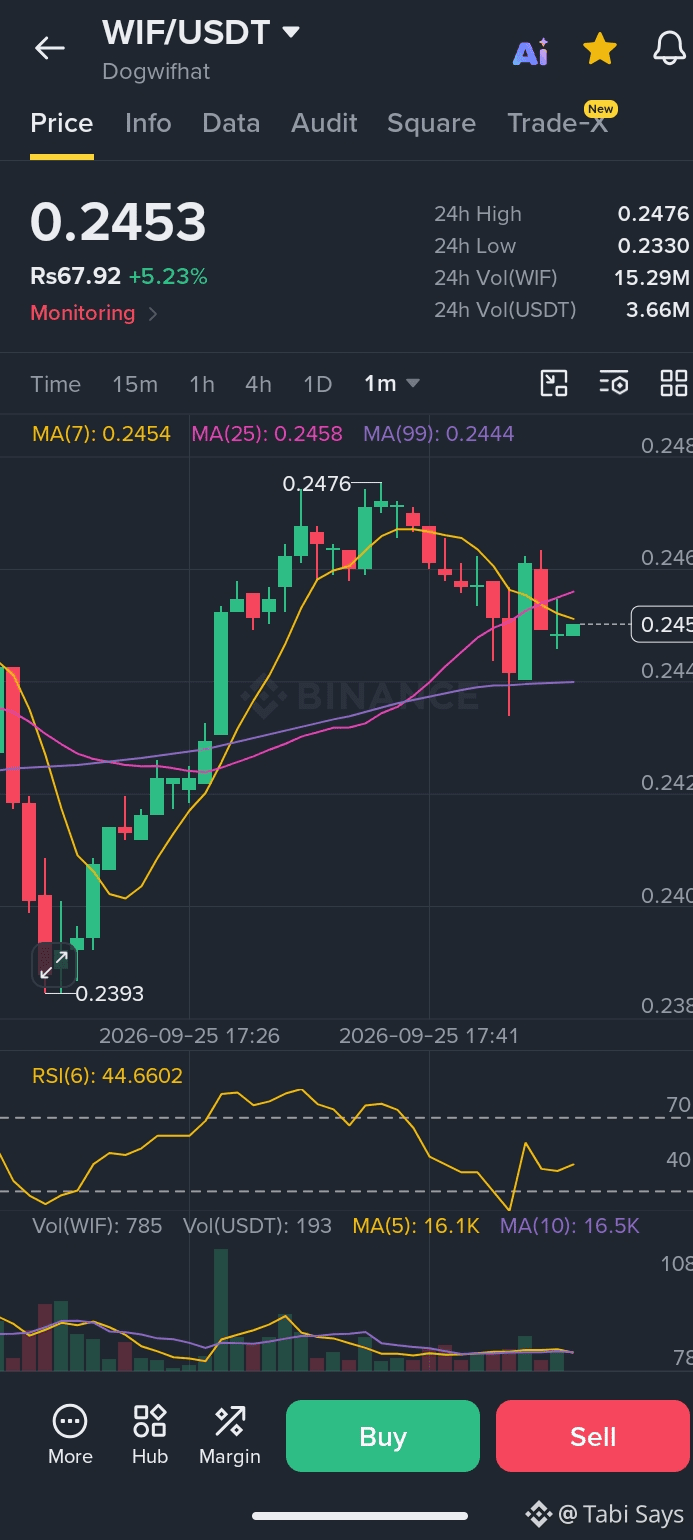
WIF/USDT - Shaam 25 Sep - New Coin Evening Pump! 🐶👒🔥
$WIF
WIF ab $1.845 par, aaj +12.3% UP! Volume 18.7M (+41%) full tez!
Evening Entry: $1.70 - $1.78
TP/Target: $2.15 (+16.5%)
SL: $1.68 (-9%)
#WIF #dogwifhat
#EveningUpdate
#SolanaMeme
---
WIF/USDT - Shaam 25 Sep - New Coin Evening Pump! 🐶👒🔥
$WIF
WIF ab $1.845 par, aaj +12.3% UP! Volume 18.7M (+41%) full tez!
Evening Entry: $1.70 - $1.78
TP/Target: $2.15 (+16.5%)
SL: $1.68 (-9%)
#WIF #dogwifhat
#EveningUpdate
#SolanaMeme
---
$WIF
WIF ab $1.845 par, aaj +12.3% UP! Volume 18.7M (+41%) full tez!
Evening Entry: $1.70 - $1.78
TP/Target: $2.15 (+16.5%)
SL: $1.68 (-9%)
#WIF #dogwifhat
#EveningUpdate
#SolanaMeme
---
1
161
·
--
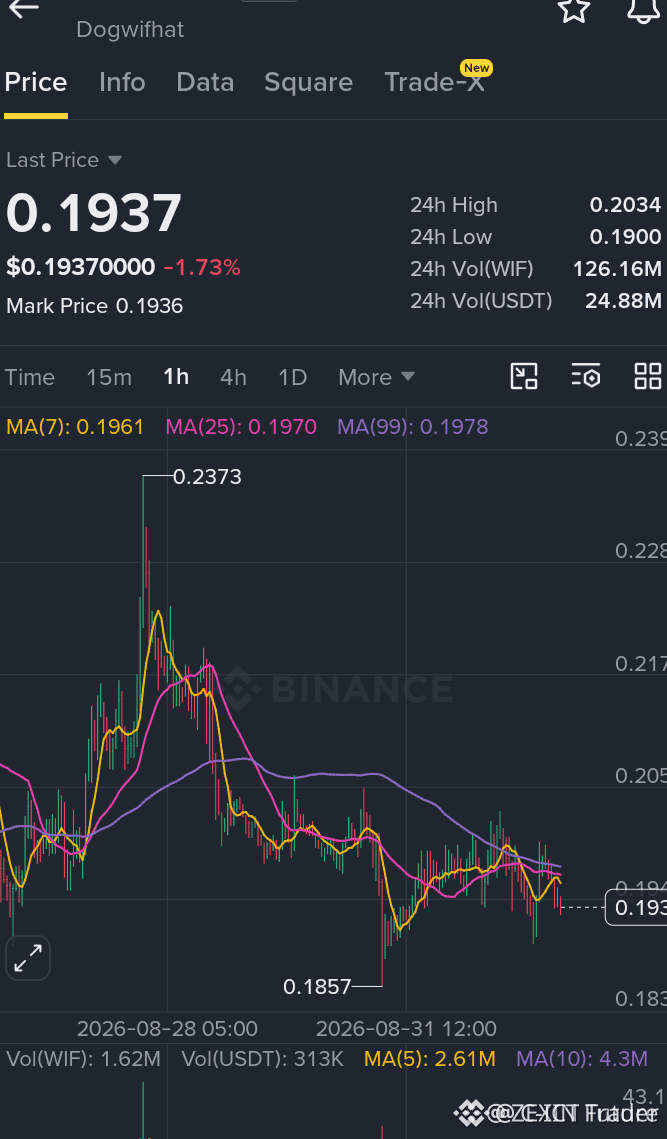
🚨 $WIF SHOWS CLEAR BUYER EXHAUSTION AT RESISTANCE AS STRUCTURE BREAKS DOWN 🐻
Entry: 0.1950 ⚡
Target: 0.1780 🎯
Stop Loss: 0.2070 ⚠️
Repeated push attempts into the upper supply zone have yielded clear signs of buyer exhaustion. Smart money capital failed to sustain momentum above resistance, creating a classic liquidity sweep followed by a sharp breakdown in market structure. 🔍
With order flow now favoring the short side, the path of least resistance points directly toward deep discount demand pools below. 📊
💬 Are you riding this distribution leg down or waiting for lower demand levels to print? 👇
⚠️ Not financial advice. Always manage your risk. 🛡️
🏷️ #WIF #ShortSetup #Bearish #MarketStructure #Crypto
🎯 🦈
🚨 $WIF SHOWS CLEAR BUYER EXHAUSTION AT RESISTANCE AS STRUCTURE BREAKS DOWN 🐻
Entry: 0.1950 ⚡
Target: 0.1780 🎯
Stop Loss: 0.2070 ⚠️
Repeated push attempts into the upper supply zone have yielded clear signs of buyer exhaustion. Smart money capital failed to sustain momentum above resistance, creating a classic liquidity sweep followed by a sharp breakdown in market structure. 🔍
With order flow now favoring the short side, the path of least resistance points directly toward deep discount demand pools below. 📊
💬 Are you riding this distribution leg down or waiting for lower demand levels to print? 👇
⚠️ Not financial advice. Always manage your risk. 🛡️
🏷️ #WIF #ShortSetup #Bearish #MarketStructure #Crypto
🎯 🦈
Entry: 0.1950 ⚡
Target: 0.1780 🎯
Stop Loss: 0.2070 ⚠️
Repeated push attempts into the upper supply zone have yielded clear signs of buyer exhaustion. Smart money capital failed to sustain momentum above resistance, creating a classic liquidity sweep followed by a sharp breakdown in market structure. 🔍
With order flow now favoring the short side, the path of least resistance points directly toward deep discount demand pools below. 📊
💬 Are you riding this distribution leg down or waiting for lower demand levels to print? 👇
⚠️ Not financial advice. Always manage your risk. 🛡️
🏷️ #WIF #ShortSetup #Bearish #MarketStructure #Crypto
🎯 🦈
7

Market Leaders at Prime Levels — Act Before Acceleration
$DOGE | $PEPE | $WIF
DOGE, PEPE, and WIF remain highly reactive assets as market sentiment shifts. Their higher-beta characteristics can bring rapid volatility when liquidity returns to speculative sectors.
This is where confirmation matters most.
Key Takeaway: High-beta momentum becomes more meaningful when volume confirms the move.
#DOGE #PEPE #WIF #CryptoMomentum #HighConviction
{future}(DOGEUSDT)
{spot}(PEPEUSDT)
{future}(WIFUSDT)
Market Leaders at Prime Levels — Act Before Acceleration
$DOGE | $PEPE | $WIF
DOGE, PEPE, and WIF remain highly reactive assets as market sentiment shifts. Their higher-beta characteristics can bring rapid volatility when liquidity returns to speculative sectors.
This is where confirmation matters most.
Key Takeaway: High-beta momentum becomes more meaningful when volume confirms the move.
#DOGE #PEPE #WIF #CryptoMomentum #HighConviction
$DOGE | $PEPE | $WIF
DOGE, PEPE, and WIF remain highly reactive assets as market sentiment shifts. Their higher-beta characteristics can bring rapid volatility when liquidity returns to speculative sectors.
This is where confirmation matters most.
Key Takeaway: High-beta momentum becomes more meaningful when volume confirms the move.
#DOGE #PEPE #WIF #CryptoMomentum #HighConviction
1
11

·
--
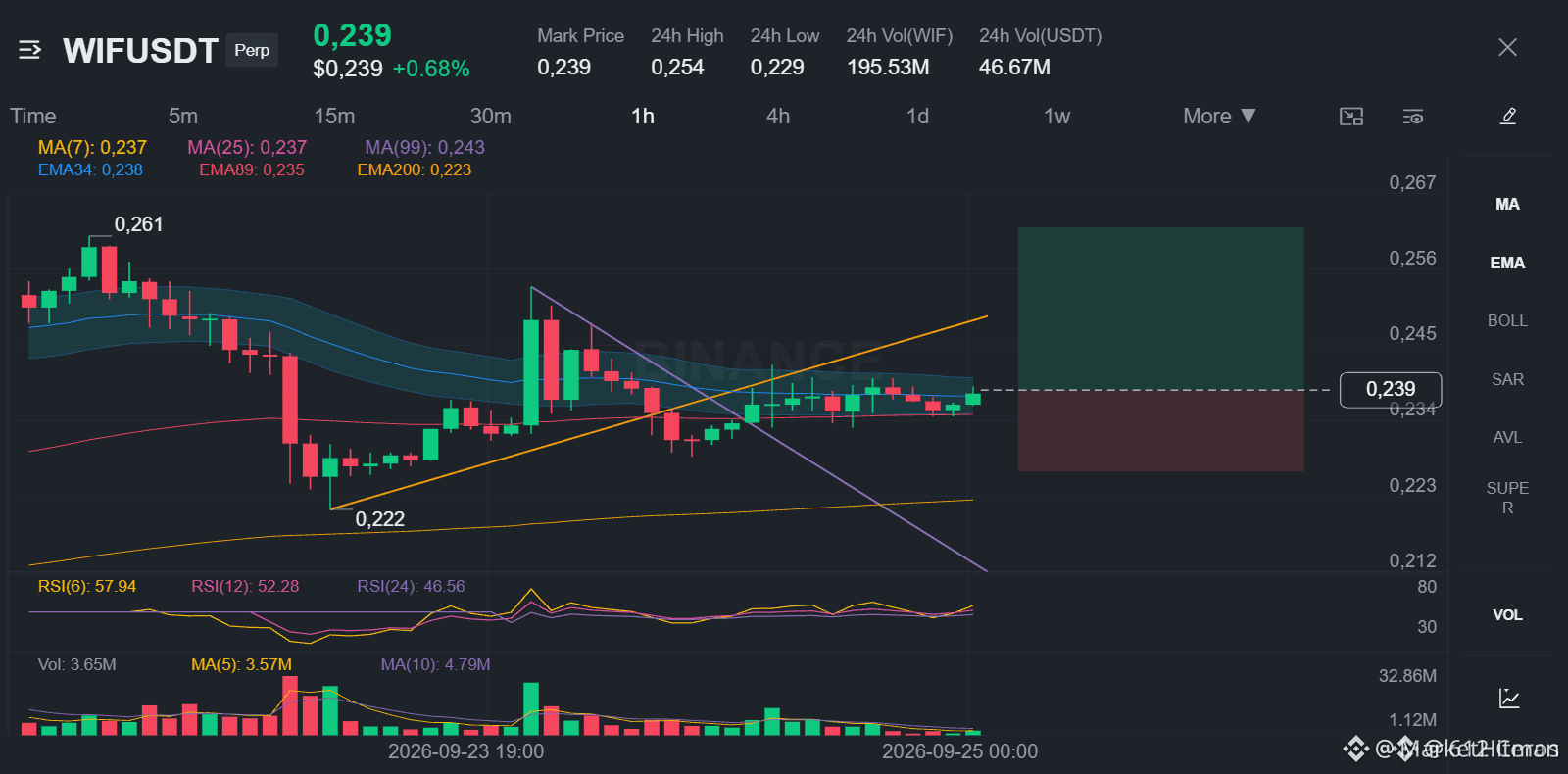
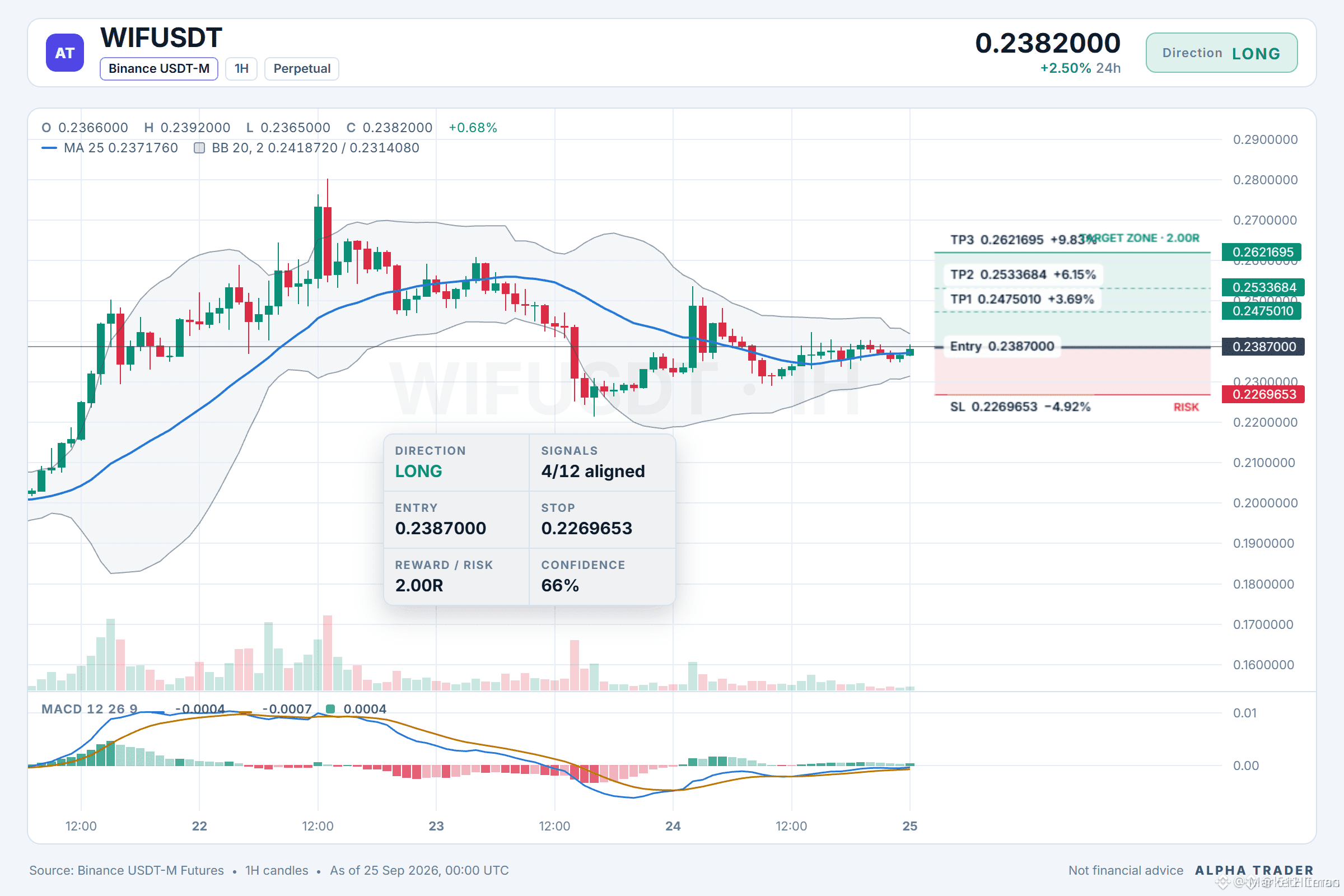
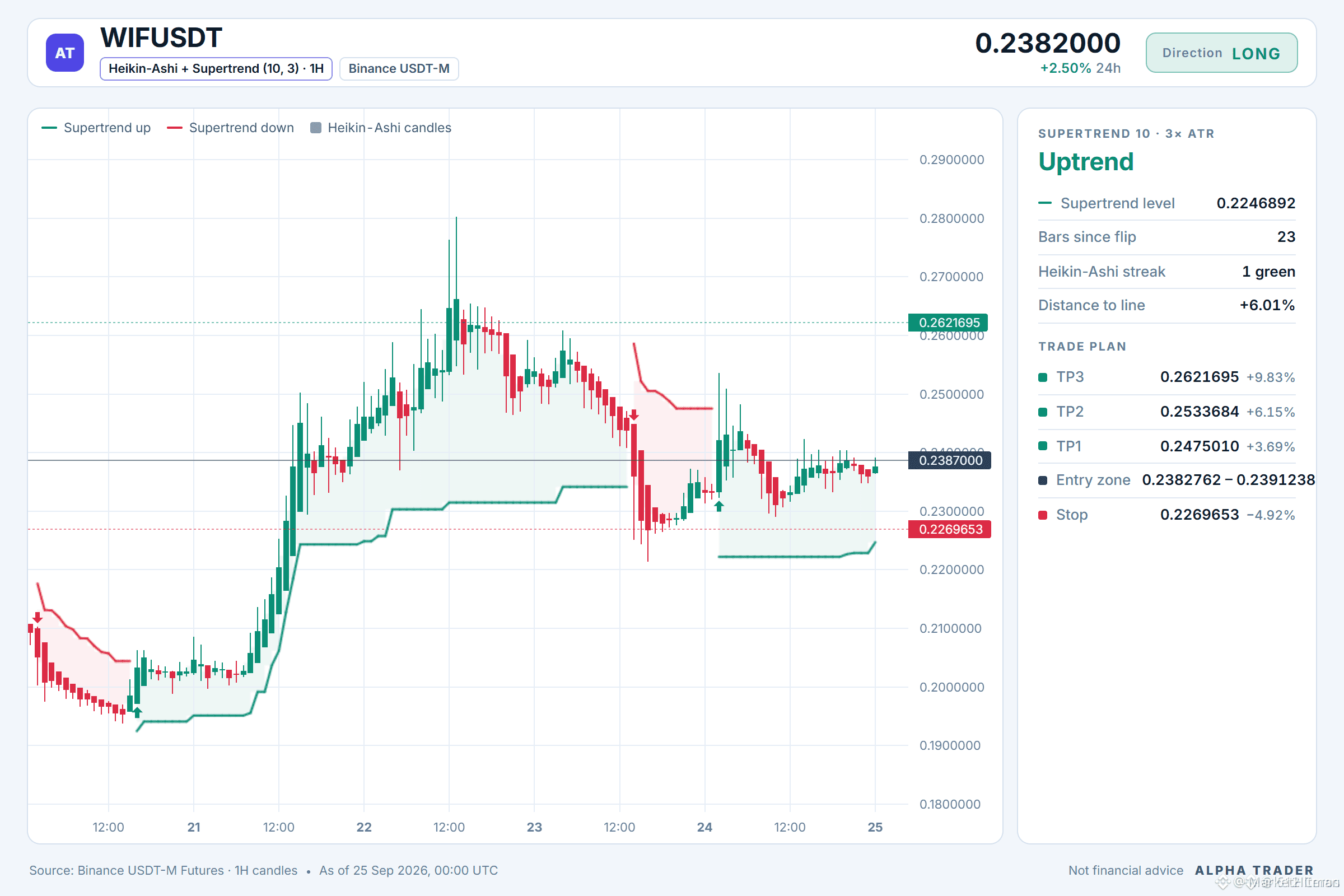
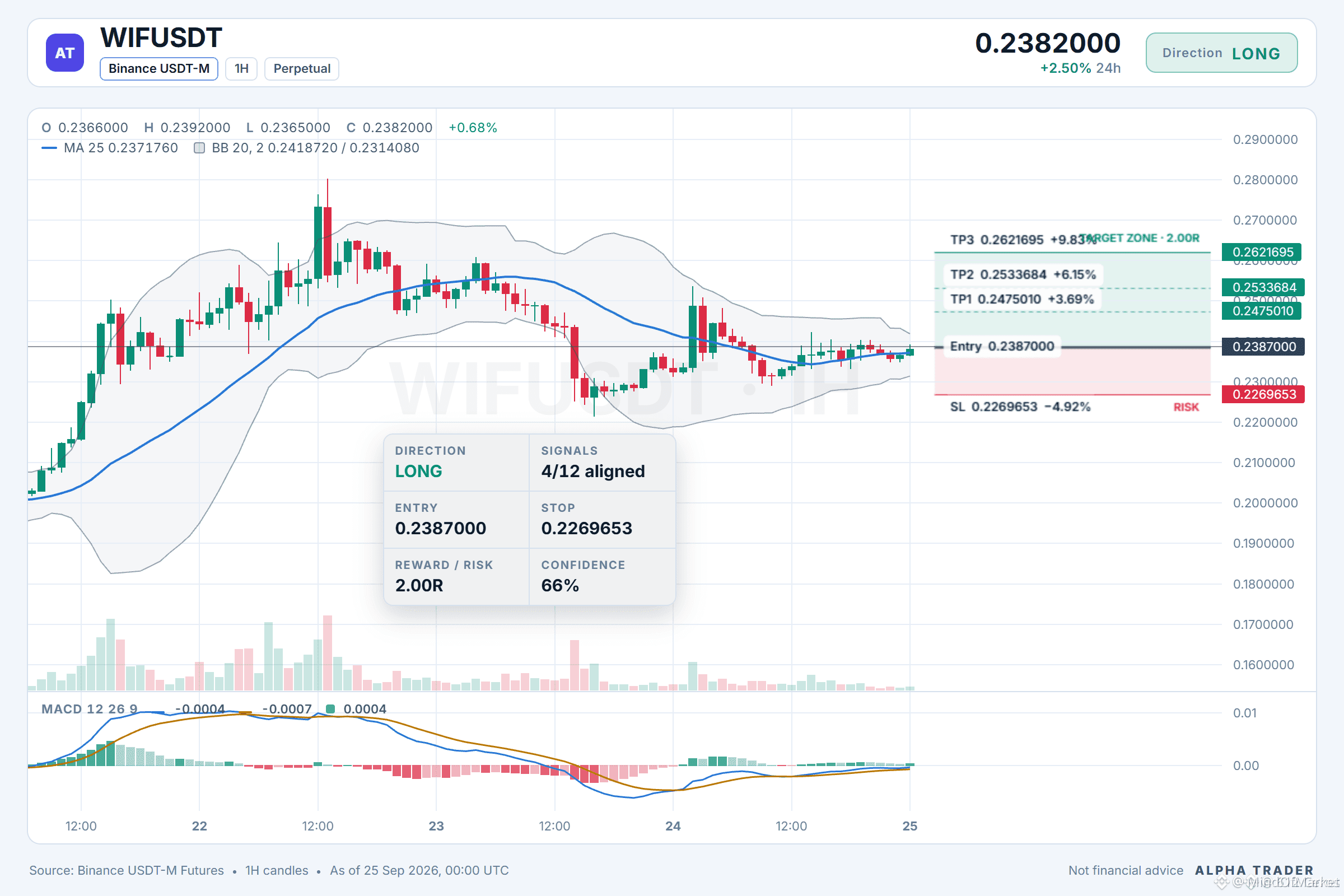
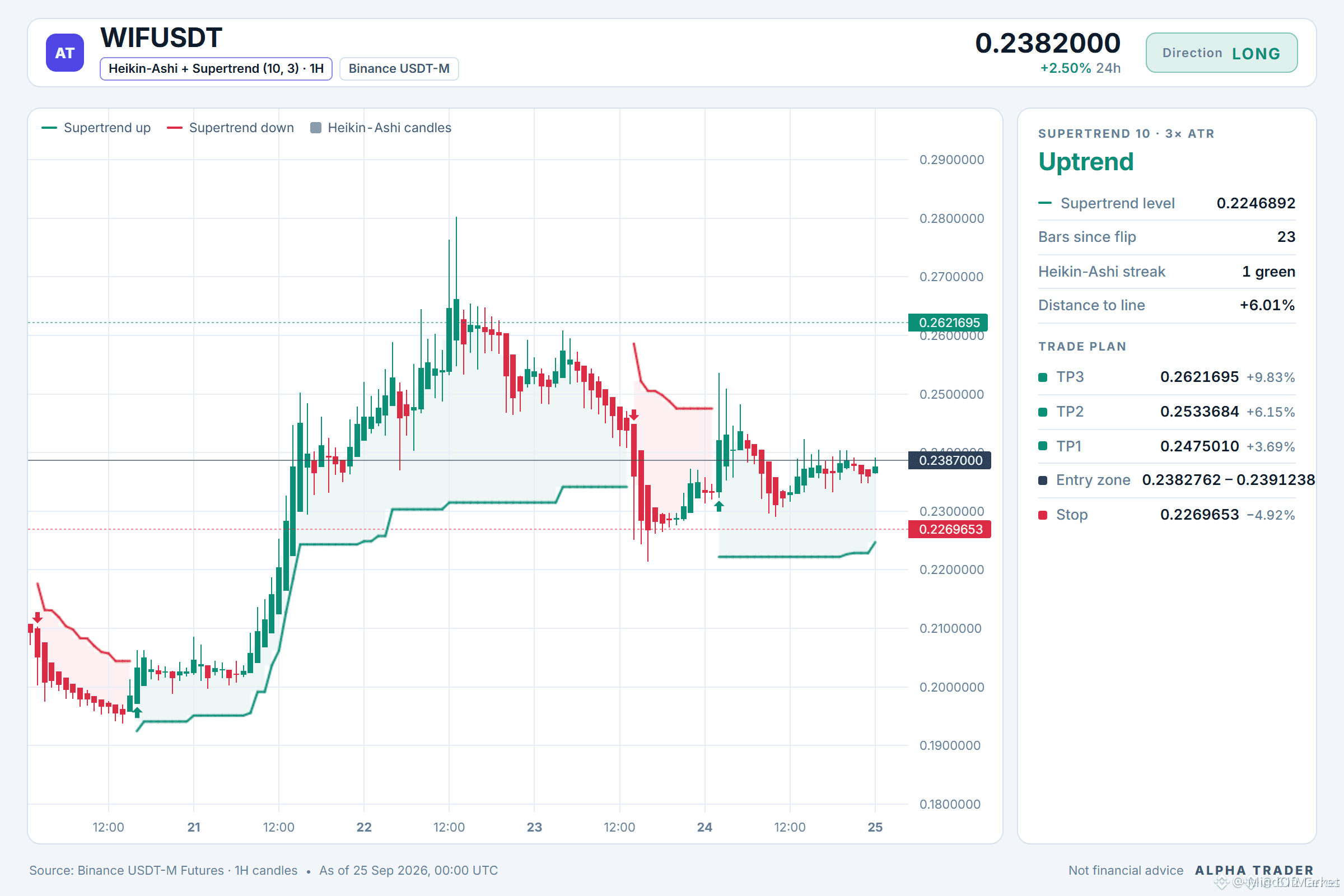
🚨 $WIF SILENTLY STACKING BULLISH EMAS WHILE MARKET WATCHES THE PULLBACK! 📈
Entry: 0.2383 - 0.2391 ⚡
Target: 0.2622 🚀
Stop Loss: 0.2270 ⚠️
📌 Sellers are sleeping on $WIF while lower timeframes quietly build power. Both the 1H and 4H chart structures are holding firm above their EMA50 and EMA200 bullish stacks, anchored by strong BTC correlation and positive relative strength outperformance. 📊
💡 Since the higher timeframe daily context remains range-bound, keeping position size disciplined is key while buyers absorb pullbacks inside this demand block. 🌊 💬 Where are you placing your protective stops relative to the 4H EMA stack on this long setup? 👇
⚠️ Not financial advice. Always manage your risk. 🛡️
🏷️ #WIF #LongSetup #Altcoins #Breakout #Crypto
🔥 💎
🚨 $WIF SILENTLY STACKING BULLISH EMAS WHILE MARKET WATCHES THE PULLBACK! 📈
Entry: 0.2383 - 0.2391 ⚡
Target: 0.2622 🚀
Stop Loss: 0.2270 ⚠️
📌 Sellers are sleeping on $WIF while lower timeframes quietly build power. Both the 1H and 4H chart structures are holding firm above their EMA50 and EMA200 bullish stacks, anchored by strong BTC correlation and positive relative strength outperformance. 📊
💡 Since the higher timeframe daily context remains range-bound, keeping position size disciplined is key while buyers absorb pullbacks inside this demand block. 🌊 💬 Where are you placing your protective stops relative to the 4H EMA stack on this long setup? 👇
⚠️ Not financial advice. Always manage your risk. 🛡️
🏷️ #WIF #LongSetup #Altcoins #Breakout #Crypto
🔥 💎
Entry: 0.2383 - 0.2391 ⚡
Target: 0.2622 🚀
Stop Loss: 0.2270 ⚠️
📌 Sellers are sleeping on $WIF while lower timeframes quietly build power. Both the 1H and 4H chart structures are holding firm above their EMA50 and EMA200 bullish stacks, anchored by strong BTC correlation and positive relative strength outperformance. 📊
💡 Since the higher timeframe daily context remains range-bound, keeping position size disciplined is key while buyers absorb pullbacks inside this demand block. 🌊 💬 Where are you placing your protective stops relative to the 4H EMA stack on this long setup? 👇
⚠️ Not financial advice. Always manage your risk. 🛡️
🏷️ #WIF #LongSetup #Altcoins #Breakout #Crypto
🔥 💎
10

·
--
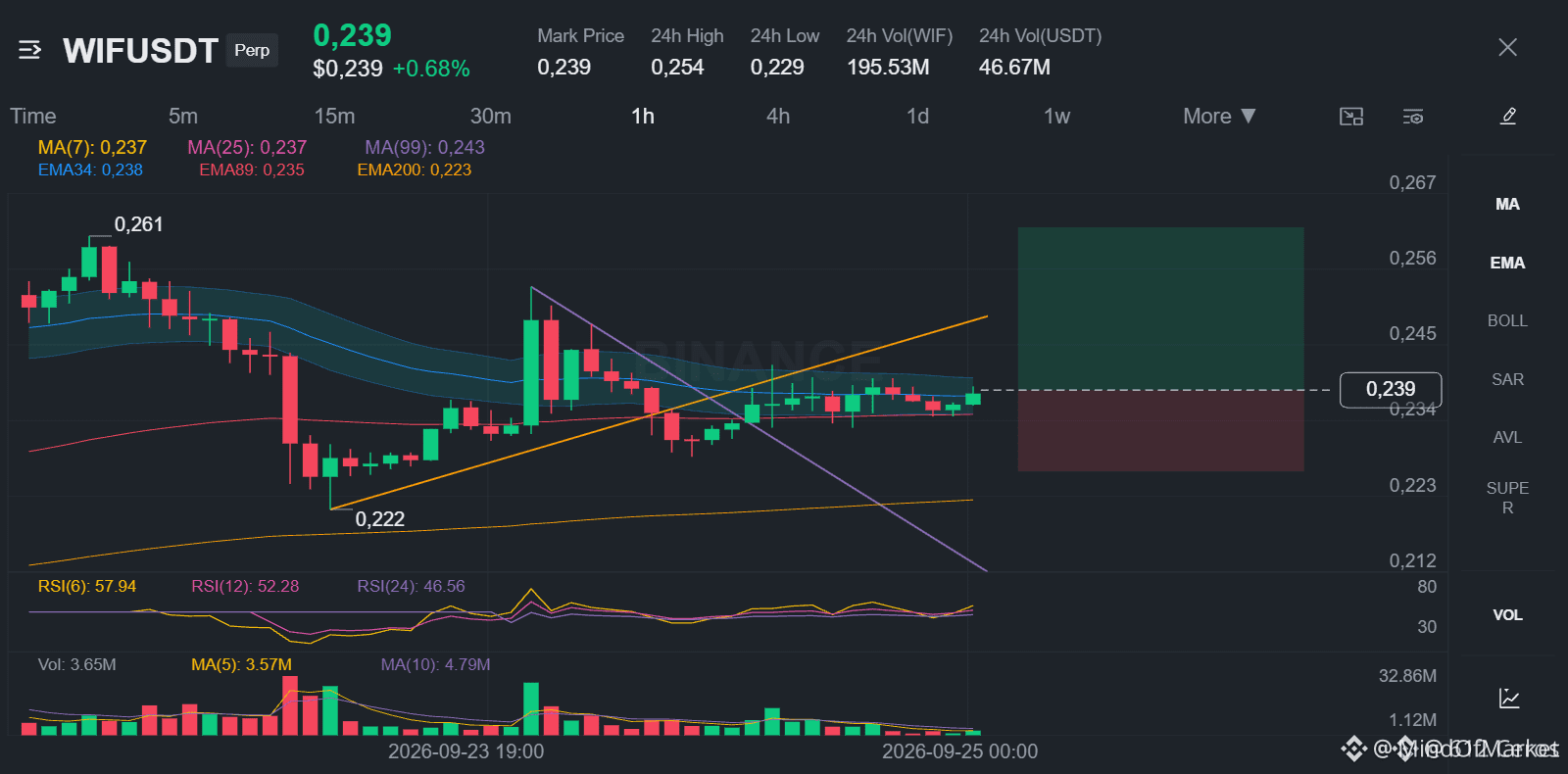
🟢 $WIF RECLAIMS KEY LIQUIDITY AS 4H AND 1H BULLISH EMA STACKS CONVERGE ⚡
Entry: 0.2383 - 0.2391 ⚡
Target: 0.2475 🚀
Stop Loss: 0.2270 ⚠️
📌 Market structure on $WIF reveals clean order flow absorption above the 1H and 4H EMA50/200 stacks, confirming localized institutional accumulation. While the macro daily profile remains range-bound, strong correlation with a bullish $BTC provides substantial structural tailwinds. 📊
💡 Smart money is quietly defending key demand zones while retail overlooks this consolidation phase. 🌊 Position sizing should remain disciplined given the selective signal alignment across lower timeframes. 💬 Where are you placing your protective stops relative to the 4H EMA support stack? 👇
⚠️ Not financial advice. Always manage your risk. 🛡️
🏷️ #WIF #LongSetup #MarketStructure #Crypto #TechnicalAnalysis
🎯 🦈
🟢 $WIF RECLAIMS KEY LIQUIDITY AS 4H AND 1H BULLISH EMA STACKS CONVERGE ⚡
Entry: 0.2383 - 0.2391 ⚡
Target: 0.2475 🚀
Stop Loss: 0.2270 ⚠️
📌 Market structure on $WIF reveals clean order flow absorption above the 1H and 4H EMA50/200 stacks, confirming localized institutional accumulation. While the macro daily profile remains range-bound, strong correlation with a bullish $BTC provides substantial structural tailwinds. 📊
💡 Smart money is quietly defending key demand zones while retail overlooks this consolidation phase. 🌊 Position sizing should remain disciplined given the selective signal alignment across lower timeframes. 💬 Where are you placing your protective stops relative to the 4H EMA support stack? 👇
⚠️ Not financial advice. Always manage your risk. 🛡️
🏷️ #WIF #LongSetup #MarketStructure #Crypto #TechnicalAnalysis
🎯 🦈
Entry: 0.2383 - 0.2391 ⚡
Target: 0.2475 🚀
Stop Loss: 0.2270 ⚠️
📌 Market structure on $WIF reveals clean order flow absorption above the 1H and 4H EMA50/200 stacks, confirming localized institutional accumulation. While the macro daily profile remains range-bound, strong correlation with a bullish $BTC provides substantial structural tailwinds. 📊
💡 Smart money is quietly defending key demand zones while retail overlooks this consolidation phase. 🌊 Position sizing should remain disciplined given the selective signal alignment across lower timeframes. 💬 Where are you placing your protective stops relative to the 4H EMA support stack? 👇
⚠️ Not financial advice. Always manage your risk. 🛡️
🏷️ #WIF #LongSetup #MarketStructure #Crypto #TechnicalAnalysis
🎯 🦈
24

·
--
Bullish
THE NEXT ALTCOIN ROTATION COULD START WITH THESE 3 👀
$SEI | $LTC | $WIF
SEI remains a fast-moving Layer-1 asset, while LTC continues to attract attention from the gaming sector. WIF remains highly reactive whenever speculative liquidity starts moving into high-beta names.
The key is to watch whether volume expands as price approaches resistance instead of chasing the first impulse.
Key Takeaway: Volume + structure can reveal momentum before the move becomes obvious.
#SEI #LTC.智能策略库🥇🥇 #WIF #CryptoTrading #Futures
{future}(LTCUSDT)
{future}(SEIUSDT)
{future}(WIFUSDT)
THE NEXT ALTCOIN ROTATION COULD START WITH THESE 3 👀
$SEI | $LTC | $WIF
SEI remains a fast-moving Layer-1 asset, while LTC continues to attract attention from the gaming sector. WIF remains highly reactive whenever speculative liquidity starts moving into high-beta names.
The key is to watch whether volume expands as price approaches resistance instead of chasing the first impulse.
Key Takeaway: Volume + structure can reveal momentum before the move becomes obvious.
#SEI #LTC.智能策略库🥇🥇 #WIF #CryptoTrading #Futures
$SEI | $LTC | $WIF
SEI remains a fast-moving Layer-1 asset, while LTC continues to attract attention from the gaming sector. WIF remains highly reactive whenever speculative liquidity starts moving into high-beta names.
The key is to watch whether volume expands as price approaches resistance instead of chasing the first impulse.
Key Takeaway: Volume + structure can reveal momentum before the move becomes obvious.
#SEI #LTC.智能策略库🥇🥇 #WIF #CryptoTrading #Futures

2
35
·
--
Bullish
$WIF — MEMECOIN MOMENTUM WATCH 🐶 dogwifhat remains a high-volatility Solana meme coin that can react rapidly to changes in retail sentiment. Today’s setup should be treated as a short-term momentum opportunity only if volume confirms the move. Watch the current resistance for a breakout and wait for a retest instead of buying the first vertical candle. If support breaks, the bullish setup is invalidated. Because WIF can move aggressively in both directions, smaller position sizing can reduce risk. Meme coins can generate huge percentage moves, but they can also erase gains quickly. Have your entry, stop and profit targets ready before the trade starts moving.#WIF
{spot}(WIFUSDT)
$WIF — MEMECOIN MOMENTUM WATCH 🐶 dogwifhat remains a high-volatility Solana meme coin that can react rapidly to changes in retail sentiment. Today’s setup should be treated as a short-term momentum opportunity only if volume confirms the move. Watch the current resistance for a breakout and wait for a retest instead of buying the first vertical candle. If support breaks, the bullish setup is invalidated. Because WIF can move aggressively in both directions, smaller position sizing can reduce risk. Meme coins can generate huge percentage moves, but they can also erase gains quickly. Have your entry, stop and profit targets ready before the trade starts moving.#WIF
10

·
--
🚀 WIF | Positive MACD Crossover
A bullish MACD crossover on the 30-minute timeframe provides a positive signal for the possibility of continued upward movement, with the price at $0.2472.
🟢 Recommendation: LONG
🎯 Target 1: $0.2520
🎯 Target 2: $0.2580
🎯 Target 3: $0.2650
🛑 Stop Loss: $0.2420
❤️ Your support makes a difference to me
$WIF #WIF
🚀 WIF | Positive MACD Crossover
A bullish MACD crossover on the 30-minute timeframe provides a positive signal for the possibility of continued upward movement, with the price at $0.2472.
🟢 Recommendation: LONG
🎯 Target 1: $0.2520
🎯 Target 2: $0.2580
🎯 Target 3: $0.2650
🛑 Stop Loss: $0.2420
❤️ Your support makes a difference to me
$WIF #WIF
A bullish MACD crossover on the 30-minute timeframe provides a positive signal for the possibility of continued upward movement, with the price at $0.2472.
🟢 Recommendation: LONG
🎯 Target 1: $0.2520
🎯 Target 2: $0.2580
🎯 Target 3: $0.2650
🛑 Stop Loss: $0.2420
❤️ Your support makes a difference to me
$WIF #WIF
27

·
--
⚡ [The Hat That Moves Billions: $WIF L eads the Solana Supercycle]
While the high-speed ecosystem attracts hordes of capital, the token with the iconic hat holds steady at the top of the viral narrative, setting the pace and dominance of the sector against emerging competitors.
The expressive flow of institutional and retail capital into WIF is driven by imminent catalysts, including speculation about new liquidity expansions in global derivatives and strategic brand partnerships. This systemic momentum reduces entry friction and attracts major market makers, creating a fertile environment where community strength and technical resilience align to sustain elevated trading levels.
Experienced traders on Binance Square closely monitor the $WIFUSDT pair for high-volatility breakouts, watching key support levels and order-book absorption. The current dynamic demands surgical precision, as price compression often precedes parabolic moves fueled by FOMO waves and portfolio rebalancing across the crypto ecosystem.
📊 Are you positioned in WIF or waiting for a fresh test of support? Keep an eye on the order book on Binance and share your target in the comments!
WIF BTC #WIF #Crypto #BinanceSquare
⚡ [The Hat That Moves Billions: $WIF L eads the Solana Supercycle]
While the high-speed ecosystem attracts hordes of capital, the token with the iconic hat holds steady at the top of the viral narrative, setting the pace and dominance of the sector against emerging competitors.
The expressive flow of institutional and retail capital into WIF is driven by imminent catalysts, including speculation about new liquidity expansions in global derivatives and strategic brand partnerships. This systemic momentum reduces entry friction and attracts major market makers, creating a fertile environment where community strength and technical resilience align to sustain elevated trading levels.
Experienced traders on Binance Square closely monitor the $WIFUSDT pair for high-volatility breakouts, watching key support levels and order-book absorption. The current dynamic demands surgical precision, as price compression often precedes parabolic moves fueled by FOMO waves and portfolio rebalancing across the crypto ecosystem.
📊 Are you positioned in WIF or waiting for a fresh test of support? Keep an eye on the order book on Binance and share your target in the comments!
WIF BTC #WIF #Crypto #BinanceSquare
While the high-speed ecosystem attracts hordes of capital, the token with the iconic hat holds steady at the top of the viral narrative, setting the pace and dominance of the sector against emerging competitors.
The expressive flow of institutional and retail capital into WIF is driven by imminent catalysts, including speculation about new liquidity expansions in global derivatives and strategic brand partnerships. This systemic momentum reduces entry friction and attracts major market makers, creating a fertile environment where community strength and technical resilience align to sustain elevated trading levels.
Experienced traders on Binance Square closely monitor the $WIFUSDT pair for high-volatility breakouts, watching key support levels and order-book absorption. The current dynamic demands surgical precision, as price compression often precedes parabolic moves fueled by FOMO waves and portfolio rebalancing across the crypto ecosystem.
📊 Are you positioned in WIF or waiting for a fresh test of support? Keep an eye on the order book on Binance and share your target in the comments!
WIF BTC #WIF #Crypto #BinanceSquare

1
96

·
--
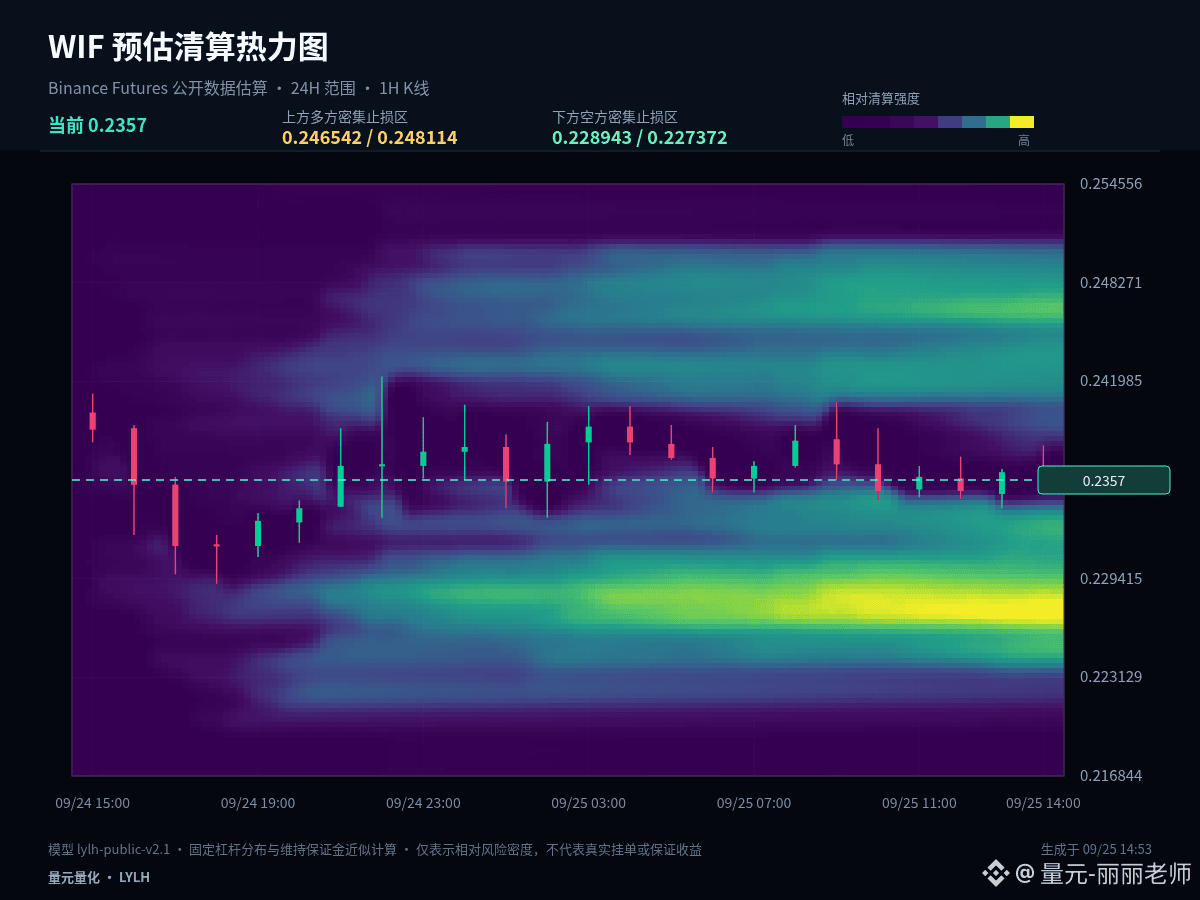
$WIF #WIF At the moment, it’s more suitable to confirm a rebound first rather than defining a reversal in advance. Current price is 0.2359: -0.17% in the last 1 hour, -1.58% in the last 24 hours. Whether the two timeframes realign in the same direction is the key focus moving forward.
Currently, -0.17% over 1 hour and -1.58% over 24 hours, and the two timeframes have not formed sufficiently clear alignment in the same direction. In a range-bound market, the tolerance for chasing or selling too aggressively is lower. It’s better to confirm the direction with the upper boundary, and confirm support/holding with the lower boundary, while treating the midline only as a boundary between relative strength and weakness.
If the rebound can recover 0.2362 and then further hold above 0.2431, it would indicate that buy-side strength is starting to change the prior weakness. But if price rises back toward the midline and then falls again—especially if it drops back toward 0.2293—it would look more like a failed repair, meaning you shouldn’t continue to rely on a strengthening expectation.
Confirming that the rebound has failed also requires evidence; you can’t immediately chase a short position just because of one spike followed by a drop. A more reasonable sequence is to observe whether resistance levels are rejected, whether the lows shift downward again, and then decide your action based on whether subsequent pullbacks reclaim key levels.
On positioning, distinguish between spot and derivatives. Existing spot holdings can be managed in segments around key levels without frequently flipping direction due to one 1-hour candlestick. Staying in cash and waiting for confirmation before entering in batches is more comfortable. Derivatives place more emphasis on entry location and invalidation conditions. When volatility increases, proactively reduce position size to avoid turning short-term judgment into passive holding.
A trading plan must include invalidation conditions. If your judgment is correct, you can realize profits in stages. If you’re wrong, you must allow yourself to exit—don’t use adding positions to hide the fact that the original logic has already changed. The market will update, and your viewpoint should evolve alongside price evidence.
#FedProposesRulesForBankIssuedStablecoins
$WIF #WIF At the moment, it’s more suitable to confirm a rebound first rather than defining a reversal in advance. Current price is 0.2359: -0.17% in the last 1 hour, -1.58% in the last 24 hours. Whether the two timeframes realign in the same direction is the key focus moving forward.
Currently, -0.17% over 1 hour and -1.58% over 24 hours, and the two timeframes have not formed sufficiently clear alignment in the same direction. In a range-bound market, the tolerance for chasing or selling too aggressively is lower. It’s better to confirm the direction with the upper boundary, and confirm support/holding with the lower boundary, while treating the midline only as a boundary between relative strength and weakness.
If the rebound can recover 0.2362 and then further hold above 0.2431, it would indicate that buy-side strength is starting to change the prior weakness. But if price rises back toward the midline and then falls again—especially if it drops back toward 0.2293—it would look more like a failed repair, meaning you shouldn’t continue to rely on a strengthening expectation.
Confirming that the rebound has failed also requires evidence; you can’t immediately chase a short position just because of one spike followed by a drop. A more reasonable sequence is to observe whether resistance levels are rejected, whether the lows shift downward again, and then decide your action based on whether subsequent pullbacks reclaim key levels.
On positioning, distinguish between spot and derivatives. Existing spot holdings can be managed in segments around key levels without frequently flipping direction due to one 1-hour candlestick. Staying in cash and waiting for confirmation before entering in batches is more comfortable. Derivatives place more emphasis on entry location and invalidation conditions. When volatility increases, proactively reduce position size to avoid turning short-term judgment into passive holding.
A trading plan must include invalidation conditions. If your judgment is correct, you can realize profits in stages. If you’re wrong, you must allow yourself to exit—don’t use adding positions to hide the fact that the original logic has already changed. The market will update, and your viewpoint should evolve alongside price evidence.
#FedProposesRulesForBankIssuedStablecoins
Currently, -0.17% over 1 hour and -1.58% over 24 hours, and the two timeframes have not formed sufficiently clear alignment in the same direction. In a range-bound market, the tolerance for chasing or selling too aggressively is lower. It’s better to confirm the direction with the upper boundary, and confirm support/holding with the lower boundary, while treating the midline only as a boundary between relative strength and weakness.
If the rebound can recover 0.2362 and then further hold above 0.2431, it would indicate that buy-side strength is starting to change the prior weakness. But if price rises back toward the midline and then falls again—especially if it drops back toward 0.2293—it would look more like a failed repair, meaning you shouldn’t continue to rely on a strengthening expectation.
Confirming that the rebound has failed also requires evidence; you can’t immediately chase a short position just because of one spike followed by a drop. A more reasonable sequence is to observe whether resistance levels are rejected, whether the lows shift downward again, and then decide your action based on whether subsequent pullbacks reclaim key levels.
On positioning, distinguish between spot and derivatives. Existing spot holdings can be managed in segments around key levels without frequently flipping direction due to one 1-hour candlestick. Staying in cash and waiting for confirmation before entering in batches is more comfortable. Derivatives place more emphasis on entry location and invalidation conditions. When volatility increases, proactively reduce position size to avoid turning short-term judgment into passive holding.
A trading plan must include invalidation conditions. If your judgment is correct, you can realize profits in stages. If you’re wrong, you must allow yourself to exit—don’t use adding positions to hide the fact that the original logic has already changed. The market will update, and your viewpoint should evolve alongside price evidence.
#FedProposesRulesForBankIssuedStablecoins
7

Strong bullish signals on WIF Token ( WIF ), Render Token ( RENDER ), Morpho Protocol ( MORPHO ) as order blocks form on higher highs and volume surges 🚀. Momentum is building across the ecosystem, with growing adoption of WIF’s gaming rewards and RENDER’s GPU marketplace 🌐. Morpho Protocol’s liquidity pools are expanding, fueling new trading activity. Investor sentiment remains upbeat, driven by ongoing innovation and ecosystem growth. #WIF #RENDER #MORPHO
Strong bullish signals on WIF Token ( WIF ), Render Token ( RENDER ), Morpho Protocol ( MORPHO ) as order blocks form on higher highs and volume surges 🚀. Momentum is building across the ecosystem, with growing adoption of WIF’s gaming rewards and RENDER’s GPU marketplace 🌐. Morpho Protocol’s liquidity pools are expanding, fueling new trading activity. Investor sentiment remains upbeat, driven by ongoing innovation and ecosystem growth. #WIF #RENDER #MORPHO
70

·
--
When the move starts to shift, I actually pay more attention to where the traps are. This pullback of $WIF looks scary, but the 4-hour and hourly moving averages are still in a bullish alignment. Price is holding steadily above the EMA50, and BTC is also moving upward—both sides’ rhythm matches.
In trading, what we fear most is chasing. A retracement back to the nearby structural support is actually more comfortable than rushing in after a spike.
On the daily chart, things are temporarily range-bound, so don’t carry too heavy a position—leave yourself some room. As long as the lower moving average band doesn’t break, the upward space is still there. It’s better to be patient and let it work itself out than to guess blindly.
🟢 Trade Direction: Long
📍 Entry Range: 0.2383764 – 0.2392243
🛑 Stop Loss: 0.2270607
🎯 Take Profit 1: 0.2476051
🎯 Take Profit 2: 0.2534749
🎯 Take Profit 3: 0.2622797
In still waters, deep wisdom lies far and true; when markets rise and fall, remain calm and composed.
Trade alongside Fei Jie—tune into the wealth tides as they surge.
#WIF
Click below to trade 👇
When the move starts to shift, I actually pay more attention to where the traps are. This pullback of $WIF looks scary, but the 4-hour and hourly moving averages are still in a bullish alignment. Price is holding steadily above the EMA50, and BTC is also moving upward—both sides’ rhythm matches.
In trading, what we fear most is chasing. A retracement back to the nearby structural support is actually more comfortable than rushing in after a spike.
On the daily chart, things are temporarily range-bound, so don’t carry too heavy a position—leave yourself some room. As long as the lower moving average band doesn’t break, the upward space is still there. It’s better to be patient and let it work itself out than to guess blindly.
🟢 Trade Direction: Long
📍 Entry Range: 0.2383764 – 0.2392243
🛑 Stop Loss: 0.2270607
🎯 Take Profit 1: 0.2476051
🎯 Take Profit 2: 0.2534749
🎯 Take Profit 3: 0.2622797
In still waters, deep wisdom lies far and true; when markets rise and fall, remain calm and composed.
Trade alongside Fei Jie—tune into the wealth tides as they surge.
#WIF
Click below to trade 👇
In trading, what we fear most is chasing. A retracement back to the nearby structural support is actually more comfortable than rushing in after a spike.
On the daily chart, things are temporarily range-bound, so don’t carry too heavy a position—leave yourself some room. As long as the lower moving average band doesn’t break, the upward space is still there. It’s better to be patient and let it work itself out than to guess blindly.
🟢 Trade Direction: Long
📍 Entry Range: 0.2383764 – 0.2392243
🛑 Stop Loss: 0.2270607
🎯 Take Profit 1: 0.2476051
🎯 Take Profit 2: 0.2534749
🎯 Take Profit 3: 0.2622797
In still waters, deep wisdom lies far and true; when markets rise and fall, remain calm and composed.
Trade alongside Fei Jie—tune into the wealth tides as they surge.
#WIF
Click below to trade 👇
153

·
--
In turbulent crosscurrents, the last thing you want is to be led astray by short-term disagreements. $WIF Both the four-hour and the hour-level charts are still holding above the EMA50, and the moving-average bullish alignment hasn’t scattered. BTC is moving in sync and strengthening with relatively high correlation, so this pullback looks more like digestion within the structure rather than a reversal. Although the daily chart is only ranging, the bids and support underneath have been steady; when the price pulls back into the dense moving-average zone, it’s actually the bulls regaining initiative.
Trading volume hasn’t surged to smash the market, which suggests selling pressure is limited. I’d rather set up around structural support in the direction of the trend than chase the trade based on emotion. The key is whether the four-hour chart can hold this band of moving averages—if it does, there’s a chance to open up further upside.
🟢 Trade direction: Long
📍 Entry range: 0.2383073 – 0.2391550
🛑 Stop loss: 0.2269949
🎯 Take profit 1: 0.2475333
🎯 Take profit 2: 0.2534014
🎯 Take profit 3: 0.2622037
No need to chase the hype—the hype will stay on its own.
Walk side by side with Sister Li, and let every inch of time echo back.
#WIF
Click below to trade 👇
In turbulent crosscurrents, the last thing you want is to be led astray by short-term disagreements. $WIF Both the four-hour and the hour-level charts are still holding above the EMA50, and the moving-average bullish alignment hasn’t scattered. BTC is moving in sync and strengthening with relatively high correlation, so this pullback looks more like digestion within the structure rather than a reversal. Although the daily chart is only ranging, the bids and support underneath have been steady; when the price pulls back into the dense moving-average zone, it’s actually the bulls regaining initiative.
Trading volume hasn’t surged to smash the market, which suggests selling pressure is limited. I’d rather set up around structural support in the direction of the trend than chase the trade based on emotion. The key is whether the four-hour chart can hold this band of moving averages—if it does, there’s a chance to open up further upside.
🟢 Trade direction: Long
📍 Entry range: 0.2383073 – 0.2391550
🛑 Stop loss: 0.2269949
🎯 Take profit 1: 0.2475333
🎯 Take profit 2: 0.2534014
🎯 Take profit 3: 0.2622037
No need to chase the hype—the hype will stay on its own.
Walk side by side with Sister Li, and let every inch of time echo back.
#WIF
Click below to trade 👇
Trading volume hasn’t surged to smash the market, which suggests selling pressure is limited. I’d rather set up around structural support in the direction of the trend than chase the trade based on emotion. The key is whether the four-hour chart can hold this band of moving averages—if it does, there’s a chance to open up further upside.
🟢 Trade direction: Long
📍 Entry range: 0.2383073 – 0.2391550
🛑 Stop loss: 0.2269949
🎯 Take profit 1: 0.2475333
🎯 Take profit 2: 0.2534014
🎯 Take profit 3: 0.2622037
No need to chase the hype—the hype will stay on its own.
Walk side by side with Sister Li, and let every inch of time echo back.
#WIF
Click below to trade 👇
64

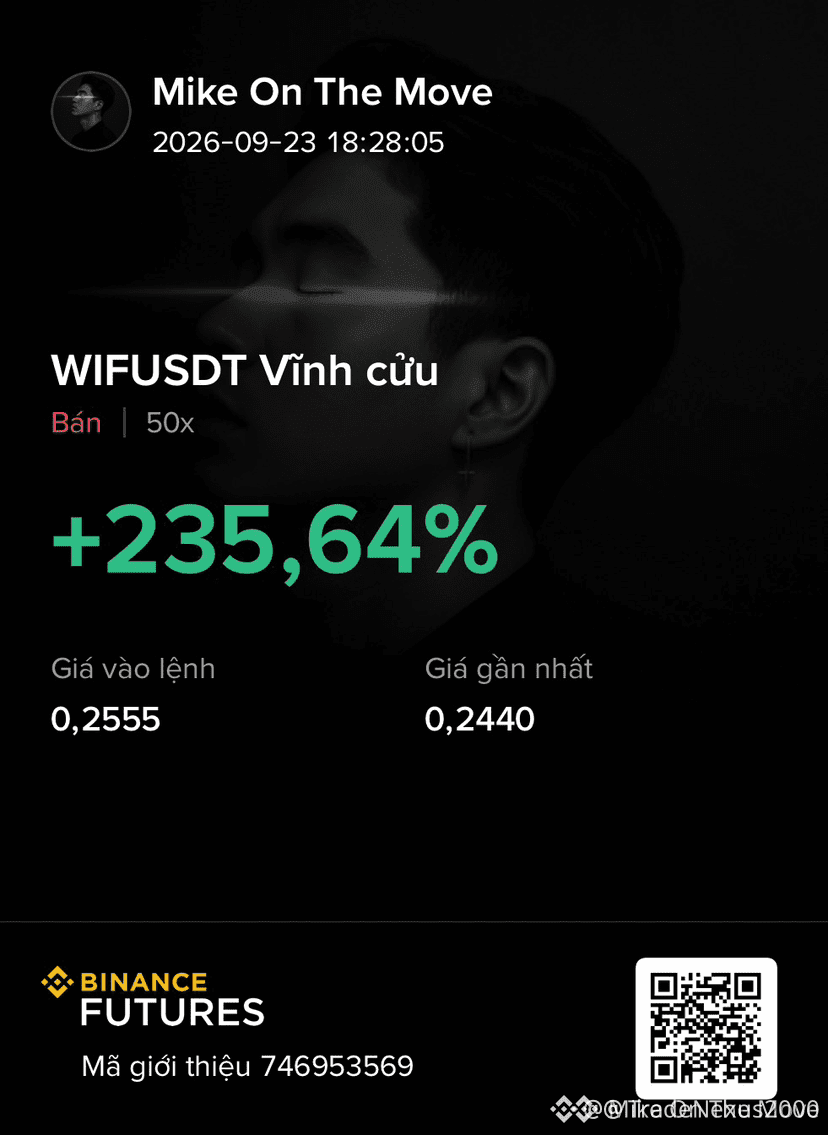
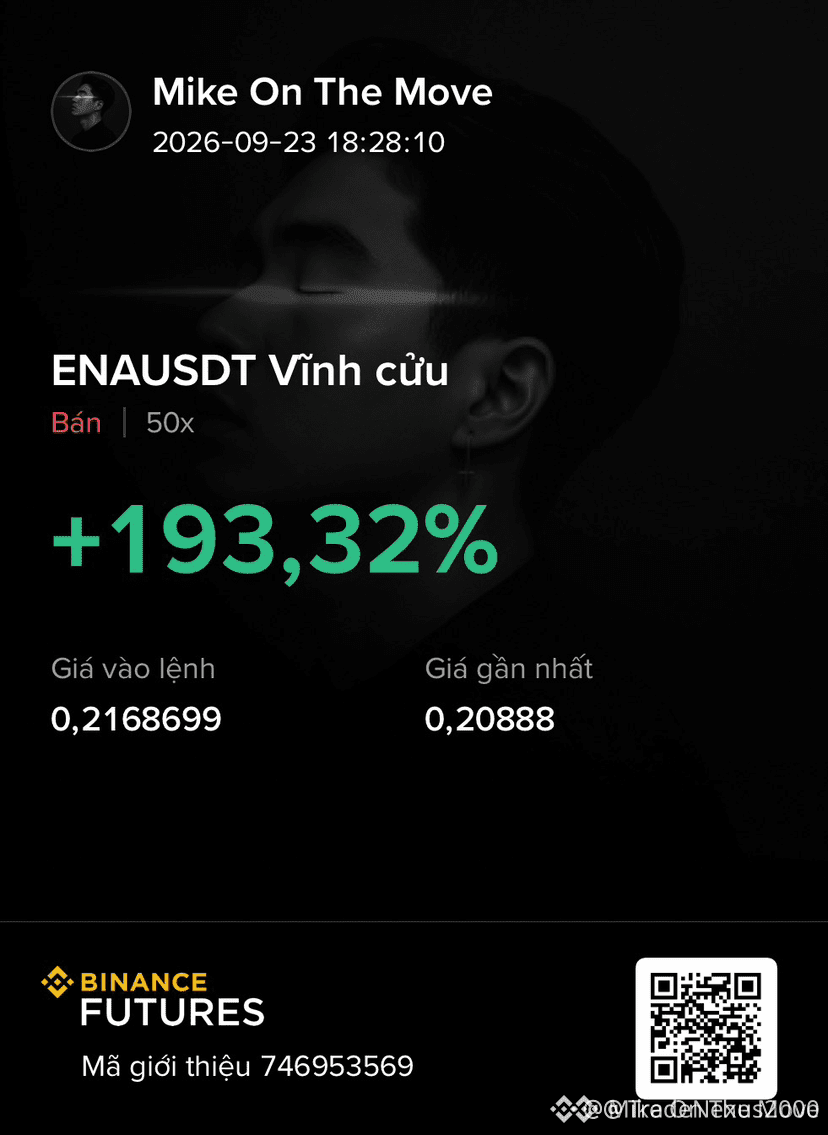
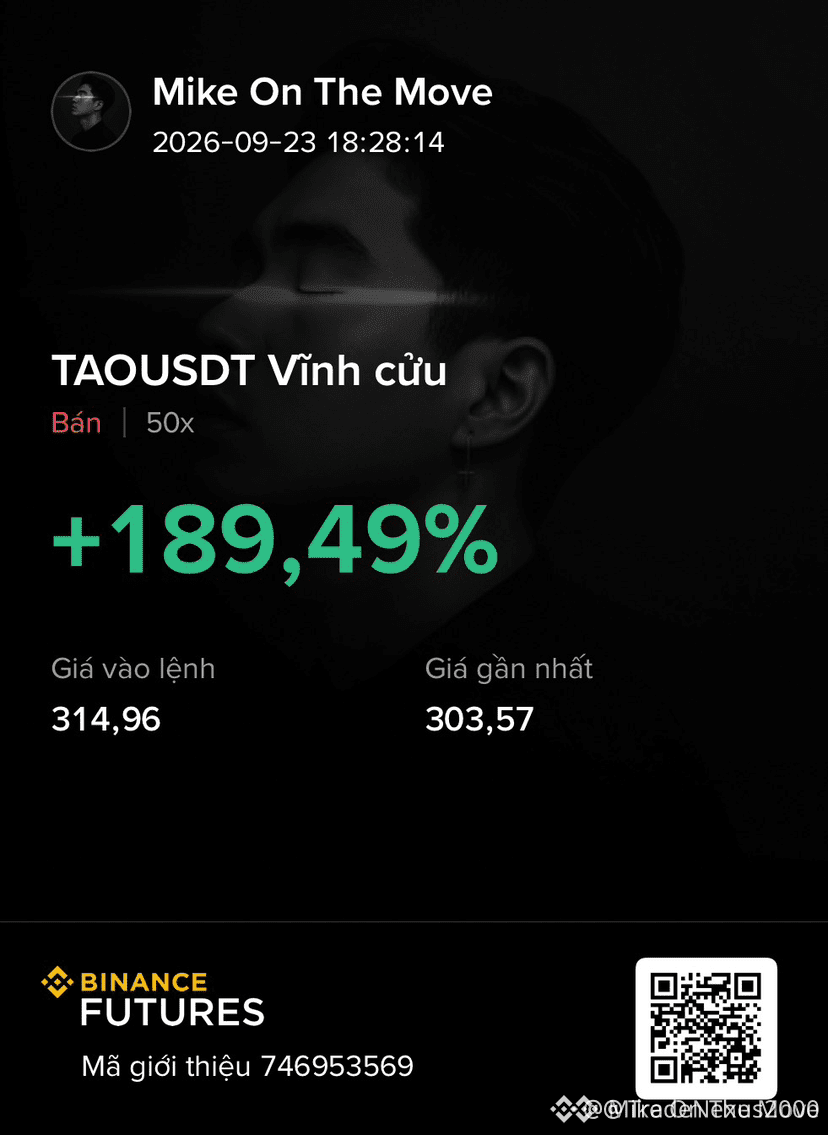
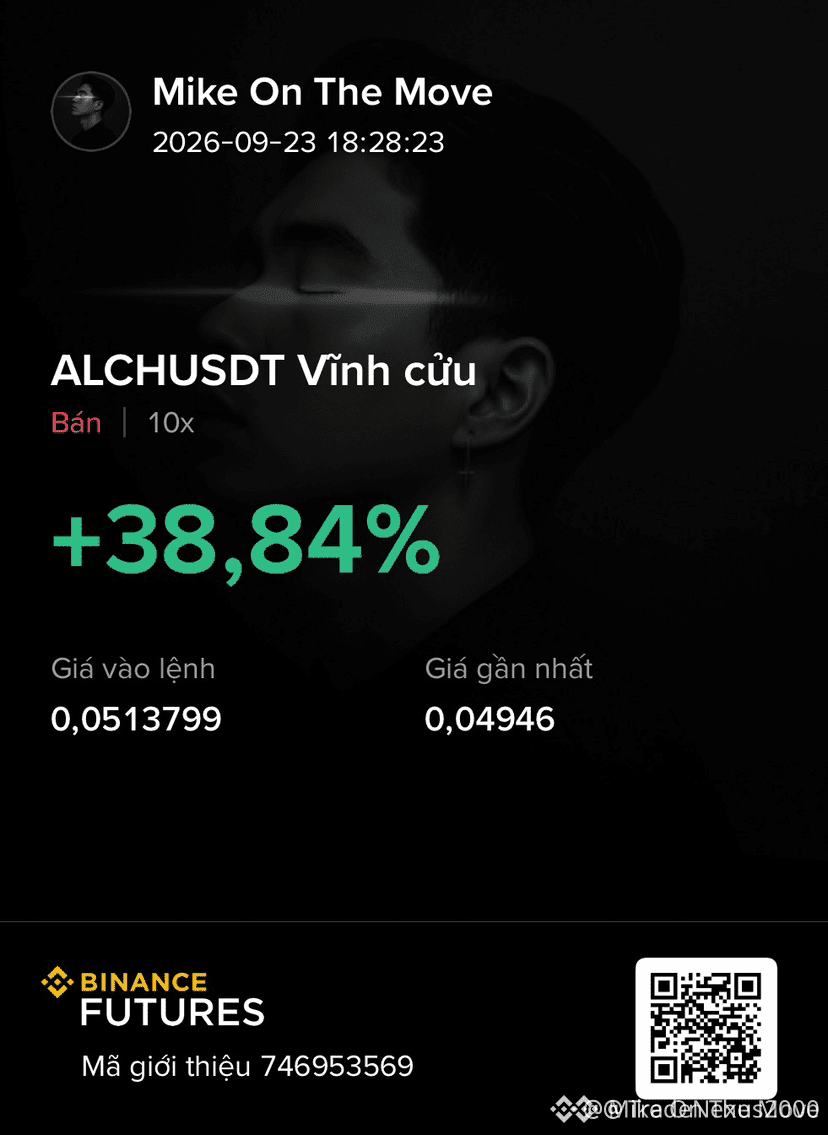
🔴 $WIF SHORTS LOCKING FIRST TARGETS – LIQUIDITY SWEEP SUCCESS! 💥
📊 The initial TP1 across $WIF , $ENA , $TAO , $ALCH confirms that smart‑money liquidity sweeps have fully absorbed selling pressure. 🦈 Order blocks at the breached levels are now clean, leaving a clear runway for the next institutional pull. 📌 Partial profit taking locks in the upside while the remaining legs sit poised for the deeper sell‑off that typically follows a multi‑asset short cascade. ⚡
💬 Are you scaling out now or letting the remaining legs ride the next liquidity hunt? 👇
⚠️ Not financial advice. Always manage your risk. 🛡️
🏷️ #WIF #ShortSetup #LiquiditySweep #Crypto
🦈 🔥
🔴 $WIF SHORTS LOCKING FIRST TARGETS – LIQUIDITY SWEEP SUCCESS! 💥
📊 The initial TP1 across $WIF , $ENA , $TAO , $ALCH confirms that smart‑money liquidity sweeps have fully absorbed selling pressure. 🦈 Order blocks at the breached levels are now clean, leaving a clear runway for the next institutional pull. 📌 Partial profit taking locks in the upside while the remaining legs sit poised for the deeper sell‑off that typically follows a multi‑asset short cascade. ⚡
💬 Are you scaling out now or letting the remaining legs ride the next liquidity hunt? 👇
⚠️ Not financial advice. Always manage your risk. 🛡️
🏷️ #WIF #ShortSetup #LiquiditySweep #Crypto
🦈 🔥
📊 The initial TP1 across $WIF , $ENA , $TAO , $ALCH confirms that smart‑money liquidity sweeps have fully absorbed selling pressure. 🦈 Order blocks at the breached levels are now clean, leaving a clear runway for the next institutional pull. 📌 Partial profit taking locks in the upside while the remaining legs sit poised for the deeper sell‑off that typically follows a multi‑asset short cascade. ⚡
💬 Are you scaling out now or letting the remaining legs ride the next liquidity hunt? 👇
⚠️ Not financial advice. Always manage your risk. 🛡️
🏷️ #WIF #ShortSetup #LiquiditySweep #Crypto
🦈 🔥
159
·
--
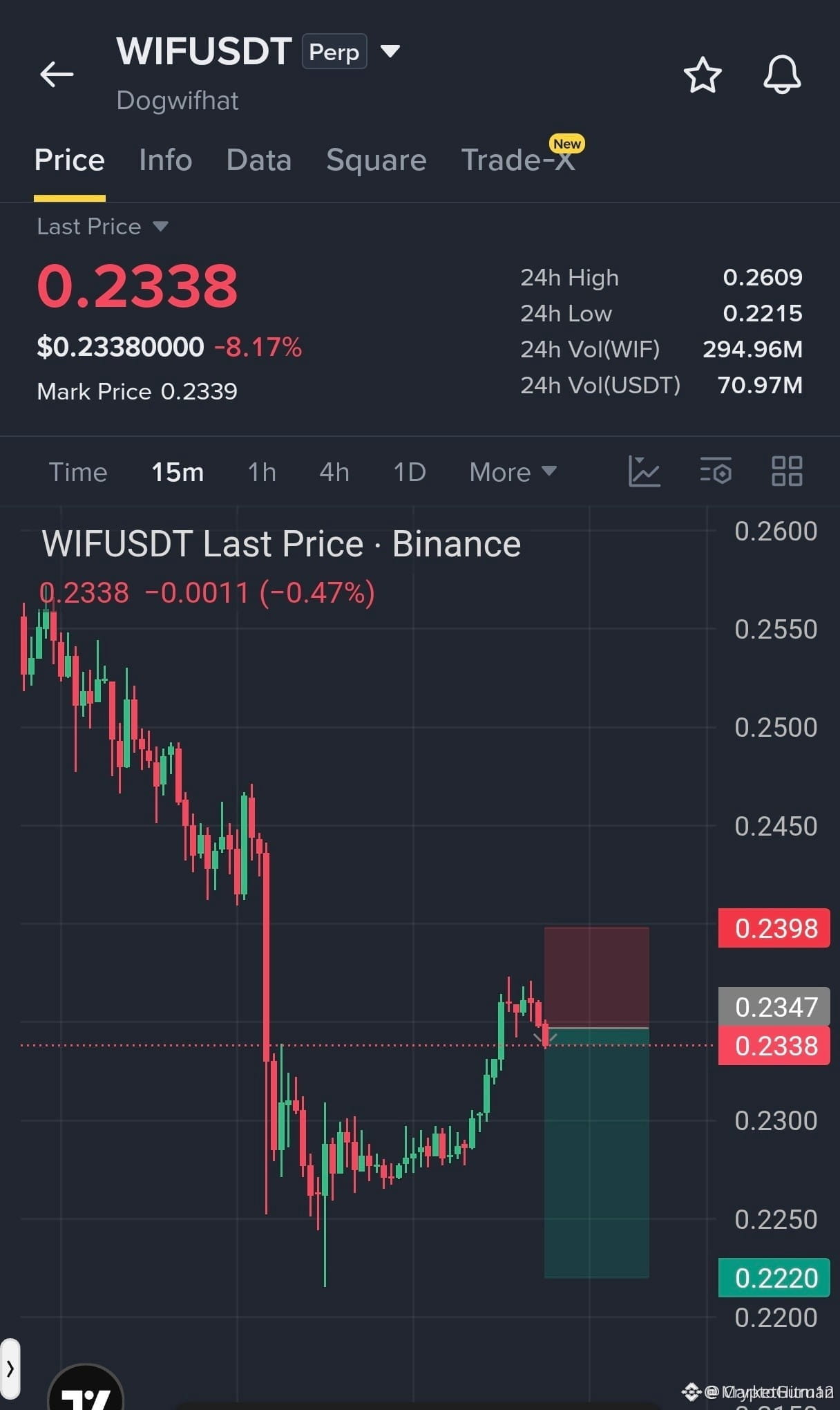
🔻 $WIF REJECTS KEY RESISTANCE AS BEARS TAKE CONTROL OF THE BOUNCE! 📉
Entry: 0.233 - 0.235 🔴
Target: 0.222 🎯
Stop Loss: 0.240 ⚠️
$WIF just ran straight into a brick wall at the 0.235 resistance zone, with heavy supply stepping in to cap the recent relief bounce. 📉 Buyers ran out of fuel right at the supply level, leaving behind a clear distribution setup.
As long as price stays suppressed below 0.235, momentum favors a continuation lower toward the 0.222 liquidity target. 📊 Sellers are asserting control, making this a clean short window while overhead resistance remains firm.
💬 Are you taking this short off the rejection or waiting for support at 0.222 to get tested? 👇
⚠️ Not financial advice. Always manage your risk. 🛡️
🏷️ #WIF #ShortSetup #Crypto #Altcoins #Bearish
📉 🐻
🔻 $WIF REJECTS KEY RESISTANCE AS BEARS TAKE CONTROL OF THE BOUNCE! 📉
Entry: 0.233 - 0.235 🔴
Target: 0.222 🎯
Stop Loss: 0.240 ⚠️
$WIF just ran straight into a brick wall at the 0.235 resistance zone, with heavy supply stepping in to cap the recent relief bounce. 📉 Buyers ran out of fuel right at the supply level, leaving behind a clear distribution setup.
As long as price stays suppressed below 0.235, momentum favors a continuation lower toward the 0.222 liquidity target. 📊 Sellers are asserting control, making this a clean short window while overhead resistance remains firm.
💬 Are you taking this short off the rejection or waiting for support at 0.222 to get tested? 👇
⚠️ Not financial advice. Always manage your risk. 🛡️
🏷️ #WIF #ShortSetup #Crypto #Altcoins #Bearish
📉 🐻
Entry: 0.233 - 0.235 🔴
Target: 0.222 🎯
Stop Loss: 0.240 ⚠️
$WIF just ran straight into a brick wall at the 0.235 resistance zone, with heavy supply stepping in to cap the recent relief bounce. 📉 Buyers ran out of fuel right at the supply level, leaving behind a clear distribution setup.
As long as price stays suppressed below 0.235, momentum favors a continuation lower toward the 0.222 liquidity target. 📊 Sellers are asserting control, making this a clean short window while overhead resistance remains firm.
💬 Are you taking this short off the rejection or waiting for support at 0.222 to get tested? 👇
⚠️ Not financial advice. Always manage your risk. 🛡️
🏷️ #WIF #ShortSetup #Crypto #Altcoins #Bearish
📉 🐻
77
Log in to explore more content
Join global crypto users on Binance Square
⚡️ Get latest and useful information about crypto.
💬 Trusted by the world’s largest crypto exchange.
👍 Discover real insights from verified creators.
Email / Phone number
Trending Topics
1
#CircleMints500MUSDCOnSolana
6,924 views
405 Discussing
2
#PolymarketBankFailureBetsDrawFDICConcern
20,590 views
621 Discussing
3
#BlackRockBuildsTokenizedPortfoliosForOndo
15,858 views
423 Discussing
4
#BitwiseFilesToListNEARETFOnNYSEArca
16,913 views
404 Discussing
5
#SECCommissionerPeirceToLeaveOct2
18,137 views
329 Discussing
6
#SECSaysBuybacksUpgradesDontMakeTokenSecurity
18,701 views
294 Discussing
7
#StrategyProposesDailyDividendsForPreferreds
2,523 views
83 Discussing
8
#CircleTetherFreezeBitgetHackerWallet
1,415 views
54 Discussing
9
#CoinMarketCapCompletesCoinglassAcquisition
5,068 views
74 Discussing
10
#QNTRises39%
81,742 views
1,399 Discussing