
#opstack
opstack
27,329 views
73 Discussing
Hot
Latest

·
--
Immutable plans to migrate to OP Stack in 2027: what will change and what risks remain
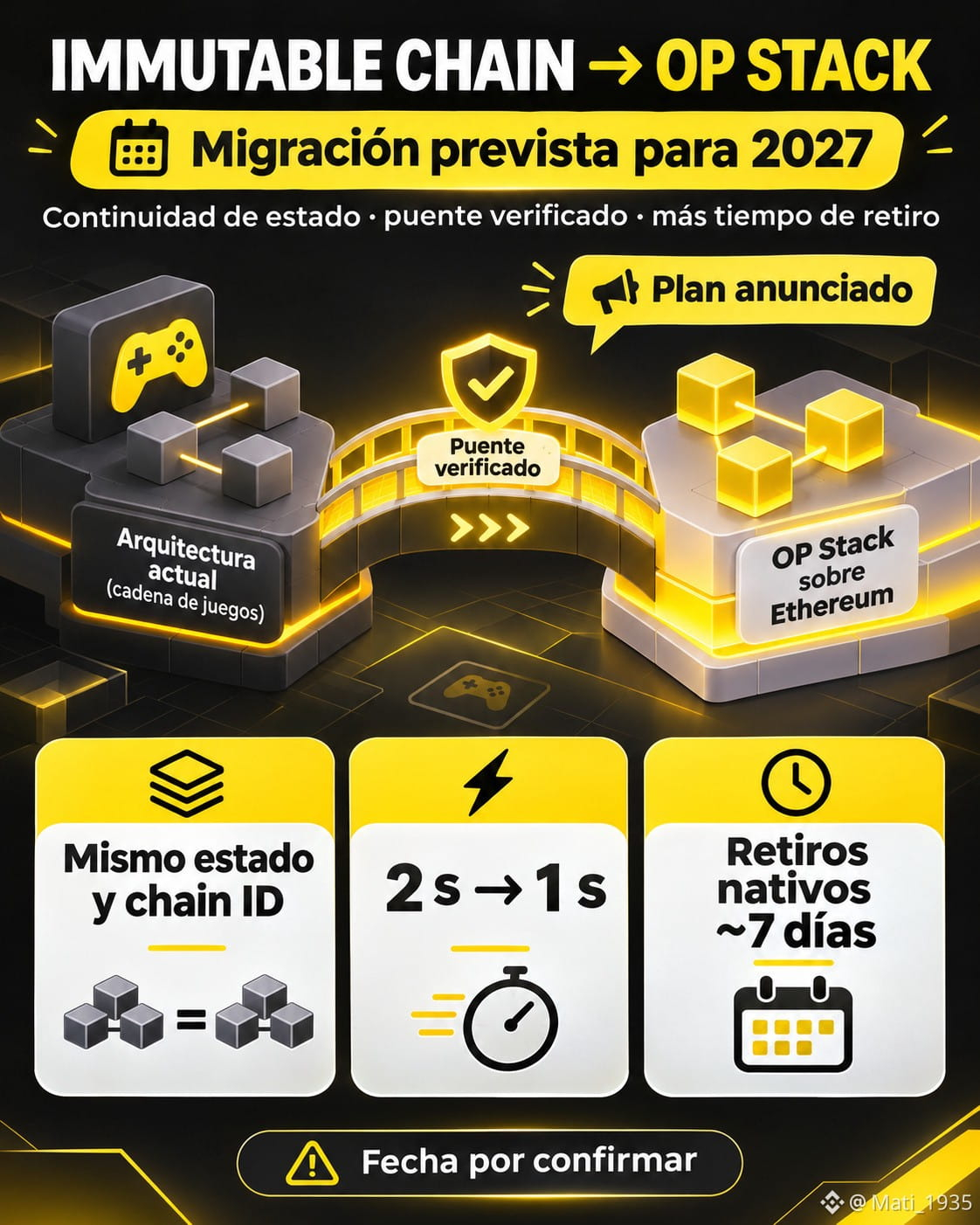
Confirmed fact (November 6, 2026): Immutable announced that around mid-2027, on a date yet to be confirmed, it will upgrade Immutable Chain from its own Geth fork to a chain based on OP Stack. The announcement says it will preserve the same state and chain ID, so accounts, balances, contracts, and approvals should carry over unchanged in almost all cases.
The migration would also reduce block time from 2 to 1 second and turn the network into an Ethereum rollup, with data availability and withdrawals verified against Ethereum. Immutable warns that transaction costs could rise slightly and that native withdrawals would take around 7 days; fast liquidity bridges could continue to cover some of that use.
This is not an immediate or risk-free change: an outage lasting several hours is expected, with permissioned fault proofs at first, followed by zk validity proofs. The current gaming testnet will be deprecated at the end of 2026. Teams that depend on RPC, bridges, or performance assumptions should review the documentation once the final timeline is published.
Market reading, no signal: at 09:04 UTC, Binance showed IMX at 0.1192 USDT (-0.832% in 24 h; volume 161,318.56 USDT), OP at 0.1032 (-0.960%; 1.30 million), and ETH at 2,249.33 (+0.653%; 320.66 million). A technical migration can expand security and interoperability options, but by itself it does not determine the price or adoption of the games.
The proposal is relevant because of state continuity and the change in the bridge model, not because of any promise of returns. The date, outage window, and operational requirements should be confirmed before making technical decisions.
$IMX $OP $ETH
Educational content. Not financial advice.
#Immutable #IMX #OPStack #Ethereum
84

·
--
#Unichain Mainnet will migrate to OP Enterprise on October 29. This is more than just an infrastructure switch; it could also bring better performance, stability, and enterprise-grade support.
For regular users, the key things to watch are whether assets will migrate automatically and whether bridging and cross-chain operations will be affected. Developers and node operators should check RPCs, contract compatibility, node versions, and scheduled maintenance windows in advance.
The Layer 2 race is shifting from “whether you have a chain” to “whether the underlying architecture can scale.” If Unichain can reduce operating costs and increase throughput through this migration, deploying ecosystem applications and liquidity may become smoother. As the date approaches, refer to official announcements, and don’t click unfamiliar links or trust guidance about airdrops.
#Layer2 #OPStack
33

·
--
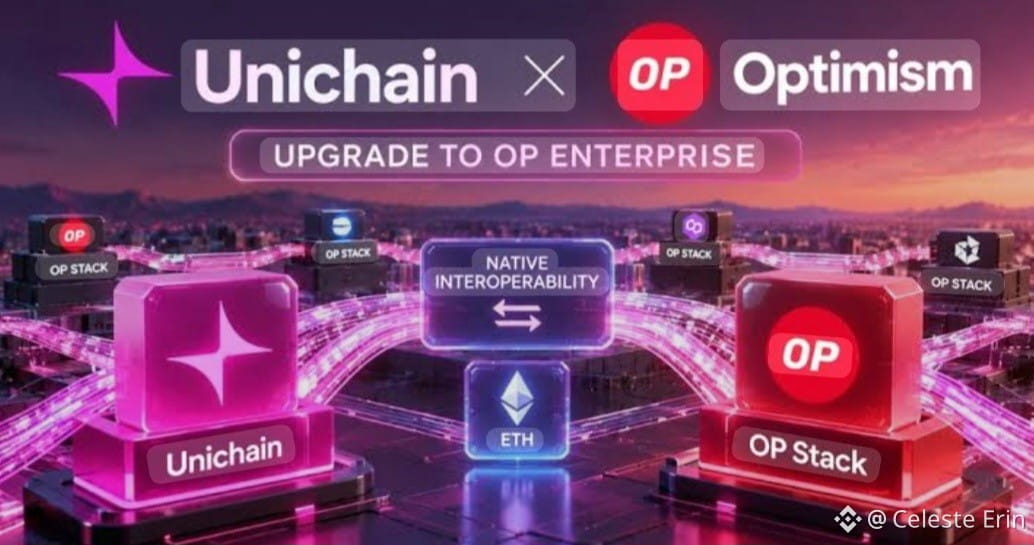
🌐 OPTIMISM AND UNICHAIN WILL CONNECT THEIR NETWORKS WITH NATIVE ETH INTEROPERABILITY ⚡🔗
Optimism’s mainnet is moving toward more secure cross-chain communication without third-party intermediaries.
🔍 UPDATE HIGHLIGHTS:
🛠️ Protocol-level security: Direct message validation without centralized bridges or external validators.
🔄 Seamless transfers: Initial support for natively sending ETH between Unichain and OP Mainnet.
⚙️ Governance roadmap: Key upgrades 20 and 21 will build the required technical infrastructure.
Do you think native interoperability without third-party bridges is the definitive step toward solving liquidity fragmentation across $OP Layer 2s?
💭👇 I’m reading your comments!
#CryptoNews #BinanceSquare #OPStack #DeFi #CryptoCommunity
$OP
{spot}(OPUSDT)
$BTC
{spot}(BTCUSDT)
$BNB
{spot}(BNBUSDT)
🌐 OPTIMISM AND UNICHAIN WILL CONNECT THEIR NETWORKS WITH NATIVE ETH INTEROPERABILITY ⚡🔗
Optimism’s mainnet is moving toward more secure cross-chain communication without third-party intermediaries.
🔍 UPDATE HIGHLIGHTS:
🛠️ Protocol-level security: Direct message validation without centralized bridges or external validators.
🔄 Seamless transfers: Initial support for natively sending ETH between Unichain and OP Mainnet.
⚙️ Governance roadmap: Key upgrades 20 and 21 will build the required technical infrastructure.
Do you think native interoperability without third-party bridges is the definitive step toward solving liquidity fragmentation across $OP Layer 2s?
💭👇 I’m reading your comments!
#CryptoNews #BinanceSquare #OPStack #DeFi #CryptoCommunity
$OP
$BTC
$BNB
182

·
--
Unichain is upgrading to OP Enterprise in preparation for native interoperability across the OP Stack
Testnet migration happens October 13 and mainnet follows on October 29
Nothing changes for users here chain ID contracts balances and apps all stay the same
Optimism will run the sequencers RPC monitoring and incident response from now on
Once interop goes live you can move ETH between OP Stack chains without a bridge
No more wrapping no more third party bridge risk
First access to native interoperability and OP Stack releases as they ship
Developers get a two week window on testnet to validate tooling before real value moves
$UNI $OP $GNS #Uniswap #OPStack #OpenAIEngineerArrestedOverAllegedOfficeRecording #CPIWatch
{spot}(GNSUSDT)
{future}(OPUSDT)
{future}(UNIUSDT)
Unichain is upgrading to OP Enterprise in preparation for native interoperability across the OP Stack
Testnet migration happens October 13 and mainnet follows on October 29
Nothing changes for users here chain ID contracts balances and apps all stay the same
Optimism will run the sequencers RPC monitoring and incident response from now on
Once interop goes live you can move ETH between OP Stack chains without a bridge
No more wrapping no more third party bridge risk
First access to native interoperability and OP Stack releases as they ship
Developers get a two week window on testnet to validate tooling before real value moves
$UNI $OP $GNS #Uniswap #OPStack #OpenAIEngineerArrestedOverAllegedOfficeRecording #CPIWatch

276

·
--
Verified
Came across a post on the Uniswap Labs blog: its own L2, Unichain, is upgrading to OP Enterprise to prepare for native interoperability with the OP Stack.
The testnet migrates first on 10/13, with mainnet expected around 10/29. The team says the Chain ID, contracts, balances, and Uniswap v2/v3/v4 deployments will all remain unchanged. After the upgrade, assets (ETH will be supported first) can move directly between Unichain and other OP Stack chains, without going through a cross-chain bridge. It will remain a Stage 1 rollup, with permissionless fault proofs, and the sequencer will run on Optimism's production stack.
One less bridge layer between L2s—it does sound a little more reassuring. #Unichain #OPStack $UNI

1
1.3k
Optimism’s ecosystem has recently had something going on. By cooperating with Korean Toss to test a KRW stablecoin, this is a real, institutional-grade deployment—bringing OP Stack’s compliance narrative back into focus.
On top of that, with the Privacy Boost privacy solution, the fit for financial applications has clearly moved up a notch—not empty talk about technology, but actually aligning with real scenarios like payments and settlement.
On the data side, $OP is currently quoted at $0.09729, with $47.21 million in 24h trading volume, and a market cap of about $210 million. The price is still in the bottom range, but the marginal changes in the fundamentals are worth keeping an eye on: the Korean compliance entry plus the privacy layer upgrade—if these two lines continue to deliver, the valuation logic will likely be revisited.
In the short term, don’t chase—focus on the rollout pace of the cooperation and whether on-chain activity keeps up.
#Optimism #OPStack #KRW stablecoin
82
·
--
Optimism Recent developments are a bit interesting. With the rollout of its partnership with South Korean Toss, testing the use of a Korean won stablecoin on OP Stack—this isn’t just a technical endorsement. It brings a national-level financial application that serves tens of millions of users onto L2 infrastructure.
For $OP , the real significance lies in two points: first, institutional-grade clients backing OP Stack validate the compliance narrative behind the modular roadmap; second, if the won stablecoin can get fully running, OP Stack gains a localized payments cash-flow entry point—not just internal DeFi circulation.
At the current price of $0.1028, with a market cap of $222 million and $46.17 million in 24h trading volume, the price has already been driven down to an emotional low. But the fundamentals are gradually accumulating support. Don’t expect a frenzy in the short term—keep an eye on Toss’s subsequent testing progress and the rollout cadence of new chains in the Superchain. Only when catalysts arrive will there be something to watch.
Risks are also straightforward: the overall valuation of the L2 track has been compressed, and Base has captured most of the attention. OP needs to use deals like this to re-tell its story through differentiation.
#Optimism #OPStack #Layer2
59
·
--
Optimism’s recent narrative density is visibly rising. In collaboration with South Korea’s national-level payments app Toss, it’s testing a won stablecoin—this isn’t a typical partnership PR. It directly pushes OP Stack to the compliant payments entry point, bundling user volume, regulatory interfaces, and real settlement scenarios all at once.
With the Privacy Boost privacy solution also rolling out, OP Stack’s suitability for financial applications has clearly addressed its shortcomings. For institutions: compliance; for users: privacy; for developers: composability—these three threads are beginning to converge into a single technical stack.
Looking at the chart, the current price of $OP is $0.09729, with a market cap of $210 million and $47.2 million in 24h trading volume, and the positioning structure is relatively light. The fundamentals are trending upward, and the price is still stuck in the lower range. Once sentiment ignites, the upside elasticity is not small.
I’m more inclined to treat it as one of the few assets in the L2 sector that still has a “real-world deployment catalyst” to track—not just a pure Beta rebound. Key points to watch: Toss testing progress, the won stablecoin launch timeline, and OP Stack’s new-chain announcements.
#Optimism #OPStack #Layer2
73
Optimism’s recent market performance has clearly rebounded, with the key catalyst coming from its collaboration with Korean fintech Toss: both sides will test the real-world deployment of a Korean won stablecoin alongside OP Stack technology.
This isn’t a typical tech pilot. Toss is a nationally recognized financial application in South Korea with a massive user base. This kind of institutional-level partnership directly strengthens two lines of logic:
First, it validates the availability of OP Stack in regulated stablecoin use cases;
Second, it reopens the imagination space for the ecosystem within East Asia’s regulated markets.
Combined with the current uptick in risk appetite, $OP is trading at $0.1028 with a market cap of $222 million and $46.17 million in 24h volume. It’s in a phase where the “chips” are relatively clean and the narrative has been reignited.
In the short term, pay attention to the rollout cadence of the Toss pilot; in the medium term, watch whether OP Stack can truly break into traditional payment networks through collaborations like this—this is the key variable determining the valuation ceiling.
#Optimism #OPStack #stablecoin
59

$OP Recently worth keeping an eye on: in collaboration with Korean company Toss, they tested a KRW stablecoin, directly pushing OP Stack into East Asia-compliant financial use cases. Institutional-grade deployments like this have more substance than a simple TVL narrative.
With the rollout of the Privacy Boost privacy solution, OP Stack’s suitability for applications that are highly sensitive to privacy and compliance—such as payments and settlement—has improved noticeably. Its ecosystem positioning has shifted further from “Ethereum scaling” toward a “financial infrastructure layer.”
On the market, the current price is $0.09729, with a market cap of about $210 million. 24H trading volume is $47.21 million—activity is relatively high in terms of volume and price, but the valuation is still in the early stage of sentiment recovery. In the short term, the key is whether there are further signals of additional KRW stablecoin deployment. In the medium term, it depends on whether the OP Stack ecosystem expansion can live up to cash-flow expectations.
Personally, I prefer to wait for a pullback and confirmation rather than chasing the peak of emotion.
#Optimism #OPStack #KRW stablecoin
75

·
--
Daily practice one step at a time: why do exchanges build their own chain? Because sequencer revenue is real money
A top-3 U.S. exchange runs its own blockchain on OP Stack, keeping $75 million in sequencer revenue. If it rented space on someone else’s chain, that money would go to the other party.
Tatsuya Iwase from OP Labs said Sony, Upbit, and Toss chose OP Stack for these reasons: businesses in the Asia-Pacific market don’t need a “decentralization narrative”—they need “the ability to control my own fees and block space.”
$75 million isn’t spent on the chain—it’s money saved. Renting a chain is like renting an apartment; building a chain is like building a house. Renting always means you’re helping the landlord pay the mortgage.
#OPStack #Optimism #L2
124
·
--
Daily Progress, One Soldier at a Time: Over the past three months, Korea’s largest exchange, a leading fintech platform, and a traditional securities firm have all moved into OP Stack.
Three completely different enterprises, one shared infrastructure—each customized as needed.
This isn’t a PR piece about “going on-chain.” It’s real, industry-grade adoption. Korea’s financial infrastructure is being rebuilt with OP Stack—exchange, payments, and securities, all on one chain across three scenarios.
We discussed tokenization’s endpoint yesterday: it’s not Web3 that swallows TradFi—it's TradFi treating blockchain as a better database. Korea is carrying out proof of this.
#Optimism #OPStack #Korea
1
186

·
--
$OP short-term pressure but marginal improvement, worth paying attention to a few catalysts: revenue from Ink and other OP Stack chains is ramping up, indicating that the modular narrative is beginning to be supported by real cash flow; partnerships on the OP Enterprise side are deepening, meaning more enterprise-level use cases are migrating to this stack; and expansion expectations for the ecosystem are also being repriced accordingly.
At the current price of $0.10686, market cap is about $231 million, with $41.4 million in 24h trading volume. Liquidity hasn’t collapsed, but it also hasn’t clearly surged into a breakout. My personal view: this looks more like a combination of “bad news already priced in + gradual fundamental improvement,” so it’s suitable for buying in tranches rather than chasing and going all-in. Key things to watch are whether Superchain revenue can continue to scale up, and when L2 overall TVL will start flowing back.
If the price breaks down and falls below the previous low, reduce exposure; only when it breaks above 0.12 with volume will it count as a true trend-reversal signal.
#Optimism #OPStack #Layer2
22
Optimism’s fundamentals are quietly improving recently.
Within the OP Stack ecosystem, revenues from chains such as Ink continue to ramp up, partnerships between OP Enterprise and traditional institutions are also deepening, and the superchain narrative is back on the table for discussion. While $OP is currently priced at $0.1069, with a market cap of $230 million and $41.4 million in 24h trading, the price still sits in a pressure zone; however, sentiment on the short term has indeed improved at the margin.
My view:
- Ecosystem revenue is a hard metric and reflects real usage better than TVL alone
- If Enterprise partnerships can translate into specific products, it will be the key to a mid-term valuation re-rating
- For the short term, remain cautious about market-wide drag—don’t treat the rebound as a trend
Watch Ink’s monthly data and the announcement cadence of OP Enterprise; these two lines determine how high this round of recovery can go.
#Optimism #Layer2 #OPStack
82
·
--
In the past month, $OP rose by about 18%. This rebound is not simply tracking the broader market—more importantly, positive developments for the OP Stack ecosystem have been continuously accumulating.
Toss and KOMSCO have completed a payment proof of concept on OP Stack, indicating that the optimistic stack is moving into real payment and settlement scenarios. Upgrades to Superchain interoperability are also ongoing, helping to reduce friction for cross-chain assets and messaging. The merger between Aero and Velodrome further strengthens ecosystem liquidity and collaboration. Combined with improving expectations around tokenization policy and an overall rebound in the Layer 2 sector, attention to OP’s fundamentals is returning.
That said, after the short-term rally, we still need to watch for selling pressure and whether ecosystem data can keep improving. For me, OP’s key point is not whether it rises or falls on a single day, but whether Superchain can convert technical adoption into sustained fees and network value.
#Optimism #Layer2 #OPStack
147
·
--
Optimism’s recent market performance has clearly rebounded, and the logic behind it is actually quite straightforward.
$OP current price is $0.10283, with 24h trading volume of 46.17M and a market cap of about 222M. This rebound isn’t driven purely by sentiment; it’s backed by concrete partnership execution. Optimism is collaborating with Korean company Toss to test use cases for a KRW stablecoin on the OP Stack.
Personally, I care most about two points in this line of development:
First, an institutional-level partnership suggests the compliance pathway has been recognized. Toss’s user base in Korea is substantial—once it runs successfully, the OP Stack gains an additional real B2B traffic entry point.
Second, the deployment of a KRW stablecoin will directly connect Asian payment scenarios into the L2 ecosystem, rather than keeping everything in DeFi’s internal loop. This is a positive factor for the Superchain narrative.
In the short term, whether price can hold will depend on whether overall market risk appetite continues. In the medium term, I’ll pay more attention to the rollout rhythm of Toss’s testing and the progress of new-chain integration into OP Stack. No matter how compelling the partnership story sounds, it ultimately comes down to whether on-chain data can deliver.
Not investment advice—just laying out the reasoning for each person to judge.
#Optimism #OPStack #Layer2
108
Optimism: the recent market action has been a bit interesting. Price is $0.10686, 24h trading volume is $41.4 million, market cap is $230 million. It’s still consolidating below the pressure level, but the fundamentals show a few variables that can support short-term sentiment.
First, revenue for the OP Stack ecosystem is rebounding. New chains like Ink have boosted fees and activity—essentially filling in a piece of the Superchain revenue model. Second, cooperation under OP Enterprise is going deeper; it’s no longer just a press-release-style partnership, but has a concrete deployment roadmap. Third, the market’s expectations for ecosystem expansion are rebuilding. This kind of narrative is especially sensitive for so-called Tier-2 L2s.
My take is: $OP short term does have conditions that sentiment could propel it. But what ultimately determines whether it can break out of the pressure range is whether Stack revenue can keep spilling over into the OP core itself—not just making the child chains fat. So right now, it’s better to focus on changes in on-chain revenue and the Sequencer’s split, rather than rushing to chase the K-line.
#Optimism #Layer2 #OPStack
91
·
--
Optimism’s fundamentals have been quietly improving recently. Revenue growth from OP Stack chains like Ink is beginning to show up at the protocol layer. Cooperation with OP Enterprise is also pushing deeper, and expectations for ecosystem expansion have been reignited.
At the current price of $0.10686, the market cap is about $230 million, and 24H trading volume is $41.4 million. — The order book remains under pressure, but the lower liquidity appears relatively clean; any fundamental catalyst could be magnified into a short-term sentiment rebound.
My view is that $OP is currently more like a stage of “accumulating at low levels + building the narrative.” A short-term bounce relies on sentiment, but whether it can break through in the medium term depends on whether the Superchain’s revenue-share model can truly run smoothly. Rather than chasing higher prices, it’s better to build positions in batches and closely track on-chain revenue data.
#Optimism #OPStack #Layer2
75

·
--
Optimism’s recent developments are worth a second look. It has partnered with Korea’s Toss to test the deployment of a Korean won stablecoin on OP Stack—this isn’t a retail-driven story, but an institutional-grade compliance + usability validation.
When payment-grade players are willing to run stablecoins on your technology stack, it means OP Stack is evolving from an “Ethereum L2” into an underlying track for “compliant assets.”
At present, $OP is quoted at $0.1028, with a market cap of roughly $222 million and $46.17 million in 24h trading volume. The price is still hovering at low levels, but the fundamental anchors are quietly strengthening. A rebound in risk appetite + real-world deployment in Korea are the two engines behind this round of modest strength.
In the short term, there’s no need to chase—what’s worth watching is: the pace at which Toss’s testing moves into real trading, and whether more sovereign-/payment-grade collaborations emerge on OP Stack. Narrative re-pricing often comes before price.
#Optimism #OPStack #Korean won stablecoin
113
Verified
Optimism: This wave of volatility isn’t purely driven by market sentiment—it’s backed by tangible collaboration rollout.
Korean mainstream payments app Toss is choosing to test a KRW stablecoin on OP Stack. That’s a signal with serious weight— it means a traditional finance gateway with tens of millions of daily active users is using Optimism as a compliant sandbox.
I care most about two points:
First is the “institutional selection” ripple effect. If Toss is willing to move, it suggests OP Stack has cleared the diligence thresholds of Korea’s financial system in terms of compliance, performance, and maintainability. After this, the cost for other East Asian payments institutions to follow suit should drop significantly.
Second, the focus of the stablecoin narrative is shifting from “the U.S. dollar” toward “local currencies.” If the KRW stablecoin works out, the paths for JPY, HKD, and TWD will be revalued, and OP Stack is the ready-made infrastructure along that route.
At the current price of $OP around $0.10, with a market cap of $222 million and $46 million in 24-hour trading volume—the valuation has already been pushed to a fairly conservative spot. If the ecosystem narrative truly plays out, the odds aren’t hard to read.
In the short term, we still need to see whether mainstream risk appetite can continue. But the underlying logic is far more solid than a few months ago.
#Optimism #稳定币 #OPStack
109
Log in to explore more content
Join global crypto users on Binance Square
⚡️ Get latest and useful information about crypto.
💬 Trusted by the world’s largest crypto exchange.
👍 Discover real insights from verified creators.
Email / Phone number
Trending Topics
1
#JobsReportRaisesHikeOdds
239,151 views
1,941 Discussing
2
#CPITestsDecemberRateOutlook
16,281 views
260 Discussing
3
#BitcoinRebounds$75KAsChipsLead
20,374 views
218 Discussing
4
#US Data Center Rules May Constrain AI Expansion
37,352 views
151 Discussing
5
#ARKPlans14ThematicETFsCoveringAIAndTokenizedMarkets
169 views
8 Discussing
6
#WillAnthropicListOnTime
57,589 views
757 Discussing
7
#WillUS-IranTensionsBoostSafe-HavenDemand?
8,949 views
106 Discussing
8
#BitcoinETFsSee$412MNetOutflows
2,447 views
43 Discussing
9
#HKSFCPlansToRestrictCryptoAndExchangeTerms
11,090 views
226 Discussing
10
#TradFiForBeginners
37,415 views
577 Discussing