

#onchainbehavior
onchainbehavior
173 views
5 Discussing
Hot
Latest

·
--
Liquidity looks deeper than it is. That gap costs traders every day.
Most people judge a market by its quoted spread. If the bid-ask on a $BTC perpetual is $2 wide, it feels liquid. But quoted depth and executable depth are two different things. The moment a mid-size market order hits, several layers of the book evaporate — either canceled by HFT firms reacting in microseconds, or absorbed by thin resting orders that disappear before your fill.
The same mismatch exists in DeFi, just wearing different clothes. A $ETH pool may show $50M in TVL, but concentrated liquidity means most of that capital sits far outside the active range. Real slippage on a $500K swap can be 3–5× what the UI preview suggests, especially around volatile opens.
Why does this matter for $SOL ecosystems too? Because thin native liquidity creates an amplification loop: a large sell causes outsized price impact, which triggers stop-losses, which causes more price impact. Slippage is not a fee — it is a volatility multiplier.
Practical edge: check real depth 1–2% around the mid price, not headline TVL or order book totals. Test with a small live order before sizing up. During high-volatility windows, assume 2–3× normal slippage and size accordingly.
The market you see is not the market you trade.
#CryptoTrading #DeFi #Liquidity #OnChainBehavior #BinanceSquare
Liquidity looks deeper than it is. That gap costs traders every day.
Most people judge a market by its quoted spread. If the bid-ask on a $BTC perpetual is $2 wide, it feels liquid. But quoted depth and executable depth are two different things. The moment a mid-size market order hits, several layers of the book evaporate — either canceled by HFT firms reacting in microseconds, or absorbed by thin resting orders that disappear before your fill.
The same mismatch exists in DeFi, just wearing different clothes. A $ETH pool may show $50M in TVL, but concentrated liquidity means most of that capital sits far outside the active range. Real slippage on a $500K swap can be 3–5× what the UI preview suggests, especially around volatile opens.
Why does this matter for $SOL ecosystems too? Because thin native liquidity creates an amplification loop: a large sell causes outsized price impact, which triggers stop-losses, which causes more price impact. Slippage is not a fee — it is a volatility multiplier.
Practical edge: check real depth 1–2% around the mid price, not headline TVL or order book totals. Test with a small live order before sizing up. During high-volatility windows, assume 2–3× normal slippage and size accordingly.
The market you see is not the market you trade.
#CryptoTrading #DeFi #Liquidity #OnChainBehavior #BinanceSquare
Most people judge a market by its quoted spread. If the bid-ask on a $BTC perpetual is $2 wide, it feels liquid. But quoted depth and executable depth are two different things. The moment a mid-size market order hits, several layers of the book evaporate — either canceled by HFT firms reacting in microseconds, or absorbed by thin resting orders that disappear before your fill.
The same mismatch exists in DeFi, just wearing different clothes. A $ETH pool may show $50M in TVL, but concentrated liquidity means most of that capital sits far outside the active range. Real slippage on a $500K swap can be 3–5× what the UI preview suggests, especially around volatile opens.
Why does this matter for $SOL ecosystems too? Because thin native liquidity creates an amplification loop: a large sell causes outsized price impact, which triggers stop-losses, which causes more price impact. Slippage is not a fee — it is a volatility multiplier.
Practical edge: check real depth 1–2% around the mid price, not headline TVL or order book totals. Test with a small live order before sizing up. During high-volatility windows, assume 2–3× normal slippage and size accordingly.
The market you see is not the market you trade.
#CryptoTrading #DeFi #Liquidity #OnChainBehavior #BinanceSquare
56

·
--
🧠 Latency Inside Pixels Feels Too Consistent to Be Random…
While running repeated sessions in Pixels 🎮📊, I noticed something subtle—not in what I was doing, but in how the system reacted.
$BTC
{future}(BTCUSDT)
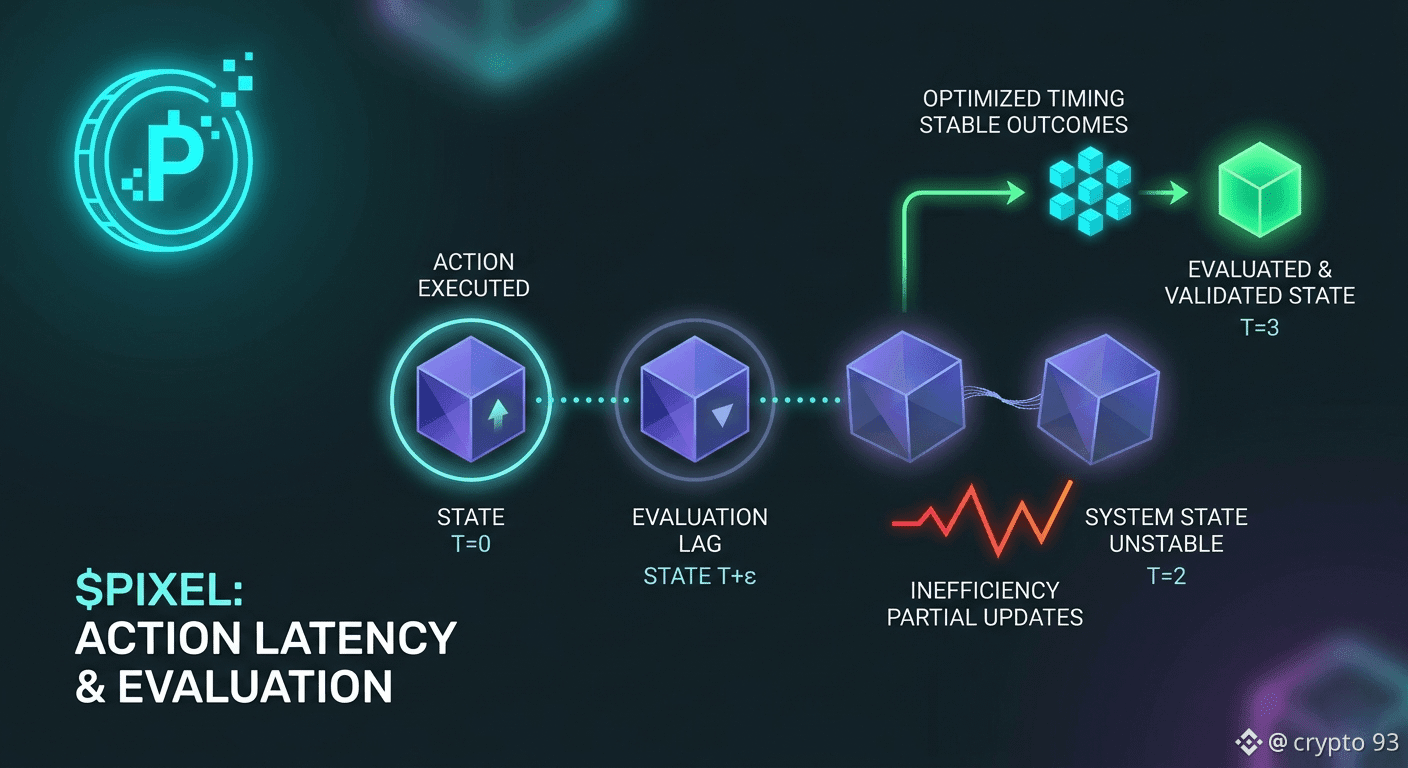
⚡ Actions were instant, but when I chained them too fast, the impact of the next steps seemed slightly reduced… even though nothing actually failed.
The loop continued normally, just with less “effect strength” behind it.
So I changed only one thing: timing ⏱️
Same sequence. Same workload. But I added small delays between actions to allow full state resolution.
📈 The difference didn’t appear immediately…
but later in the sequence, results became noticeably more stable instead of flattening out.
This suggests PIXEL may not be fully synchronous in execution.
At the surface level, actions appear instant ⚡
but deeper layers—like validation or behavioral processing—may resolve slightly later in time.
If new inputs arrive too quickly, they may interact with a partially updated system state, creating hidden inefficiencies 🧩
With stacked behavioral analysis over time 📡, this gap between execution and evaluation becomes important.
It’s not just recording actions… it may be interpreting them asynchronously.
After this, speed stopped being the edge.
🎯 Timing became the real advantage.
#PIXEL📈 #Crypto #Blockchain #Gaming #OnChainBehavior
🧠 Latency Inside Pixels Feels Too Consistent to Be Random…
While running repeated sessions in Pixels 🎮📊, I noticed something subtle—not in what I was doing, but in how the system reacted.
$BTC
⚡ Actions were instant, but when I chained them too fast, the impact of the next steps seemed slightly reduced… even though nothing actually failed.
The loop continued normally, just with less “effect strength” behind it.
So I changed only one thing: timing ⏱️
Same sequence. Same workload. But I added small delays between actions to allow full state resolution.
📈 The difference didn’t appear immediately…
but later in the sequence, results became noticeably more stable instead of flattening out.
This suggests PIXEL may not be fully synchronous in execution.
At the surface level, actions appear instant ⚡
but deeper layers—like validation or behavioral processing—may resolve slightly later in time.
If new inputs arrive too quickly, they may interact with a partially updated system state, creating hidden inefficiencies 🧩
With stacked behavioral analysis over time 📡, this gap between execution and evaluation becomes important.
It’s not just recording actions… it may be interpreting them asynchronously.
After this, speed stopped being the edge.
🎯 Timing became the real advantage.
#PIXEL📈 #Crypto #Blockchain #Gaming #OnChainBehavior
While running repeated sessions in Pixels 🎮📊, I noticed something subtle—not in what I was doing, but in how the system reacted.
$BTC
⚡ Actions were instant, but when I chained them too fast, the impact of the next steps seemed slightly reduced… even though nothing actually failed.
The loop continued normally, just with less “effect strength” behind it.
So I changed only one thing: timing ⏱️
Same sequence. Same workload. But I added small delays between actions to allow full state resolution.
📈 The difference didn’t appear immediately…
but later in the sequence, results became noticeably more stable instead of flattening out.
This suggests PIXEL may not be fully synchronous in execution.
At the surface level, actions appear instant ⚡
but deeper layers—like validation or behavioral processing—may resolve slightly later in time.
If new inputs arrive too quickly, they may interact with a partially updated system state, creating hidden inefficiencies 🧩
With stacked behavioral analysis over time 📡, this gap between execution and evaluation becomes important.
It’s not just recording actions… it may be interpreting them asynchronously.
After this, speed stopped being the edge.
🎯 Timing became the real advantage.
#PIXEL📈 #Crypto #Blockchain #Gaming #OnChainBehavior
1
5
Log in to explore more content
Join global crypto users on Binance Square
⚡️ Get latest and useful information about crypto.
💬 Trusted by the world’s largest crypto exchange.
👍 Discover real insights from verified creators.
Email / Phone number
Trending Topics
1
#SECProposesCryptoCustodyRules
4,579 views
95 Discussing
2
#SECApproves3xLongCryptoCommodityETPs
6,825 views
135 Discussing
3
#G7PlansToReleaseUpTo100MBarrelsOilDiesel
8,150 views
175 Discussing
4
#ICBASuesOCCOverCryptoBankCharters
6,734 views
117 Discussing
5
#USStocksCloseHigherOnWeakJobsData
6,303 views
97 Discussing
6
#AnchorageReportedlyCuts17%Workforce
237 views
32 Discussing
7
#NFPWatch
11M views
19,585 Discussing
8
#NEARIntentsRecovers$3.8MAfterAttack
0 views
0 Discussing
9
#BlastToGraduallyShutDownItsL2Network
531 views
37 Discussing
10
#BitcoinFundingRateTriplesTo10%
220,350 views
1,381 Discussing