
#ecb
ecb
797,937 views
1,167 Discussing
Hot
Latest

·
--
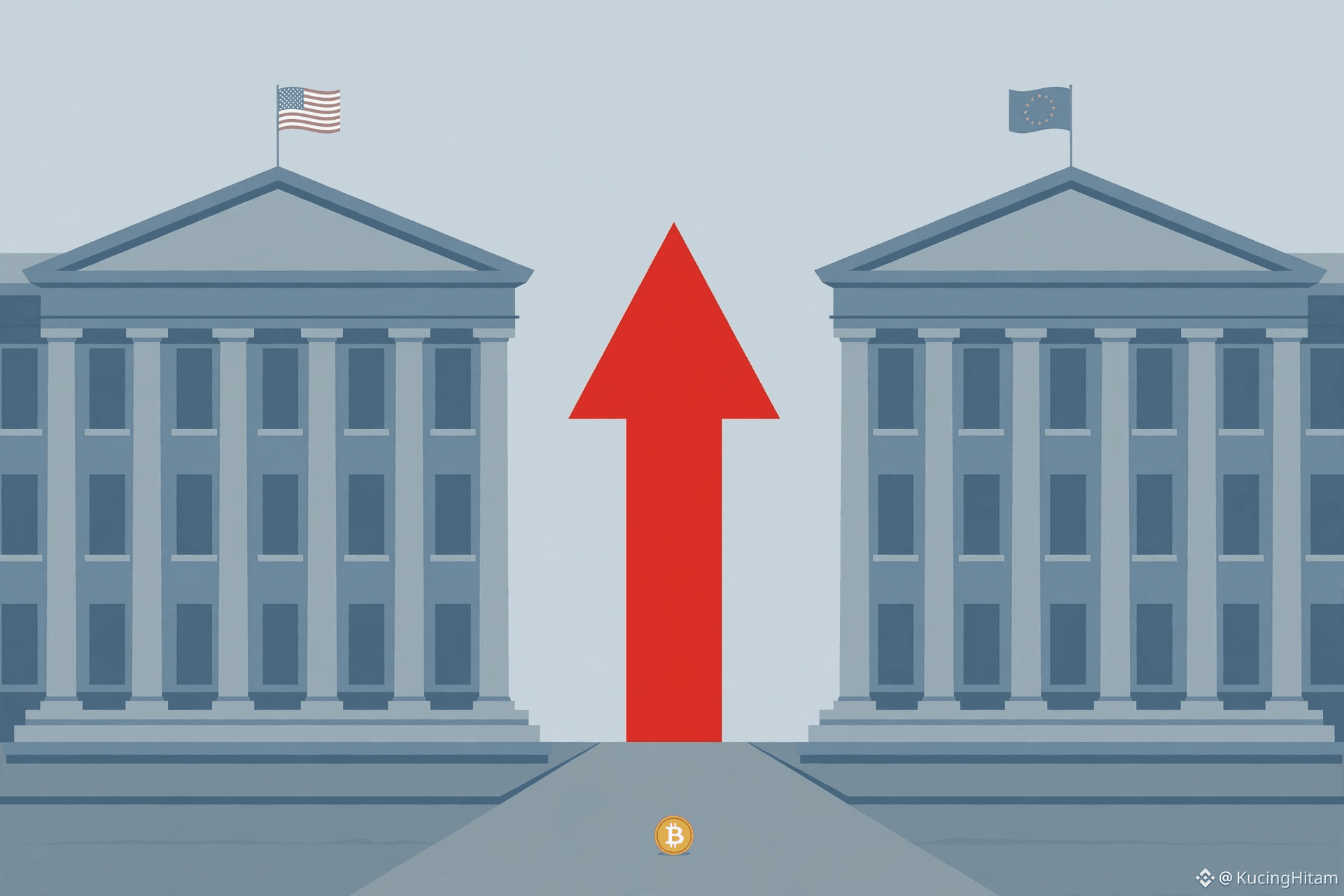
Two central banks, two rate hikes, one very bad month for risk.
The Fed is expected to raise rates on December 9 — markets give it a 98% chance. Now the ECB is lining up its own move. Its October meeting minutes, released Thursday, say another hike is likely unless the inflation outlook improves "significantly." Bundesbank chief Joachim Nagel went further on Friday: euro-area inflation could stay "durably above 3%" through 2027, so "we might have to do even more."
Markets now price a 93% chance the ECB hikes 25 basis points on December 17, to 2.75%, with a 54% chance of another one in March. The ECB already raised twice this year, in June and July, then held at 2.5% in October. It held because the energy shock hadn't fully landed yet. It has now — euro-area inflation hit 4% in October.
So here's the setup for December: the world's two biggest central banks both tightening, eight days apart, into a market that has spent November begging for cuts. The Fed hikes because the US economy is too hot. The ECB hikes because energy prices won't quit. Different reasons, same direction.
Meanwhile $BTC is sitting near $59,800, down about 3% today and roughly 24% this month, with fear still extreme.
A year ago a rate hike was the thing that killed crypto rallies. Now two of them are scheduled for the same month, and the market has already priced them in. Either the market is very calm, or very numb.
Not financial advice. #ECB #Crypto
50

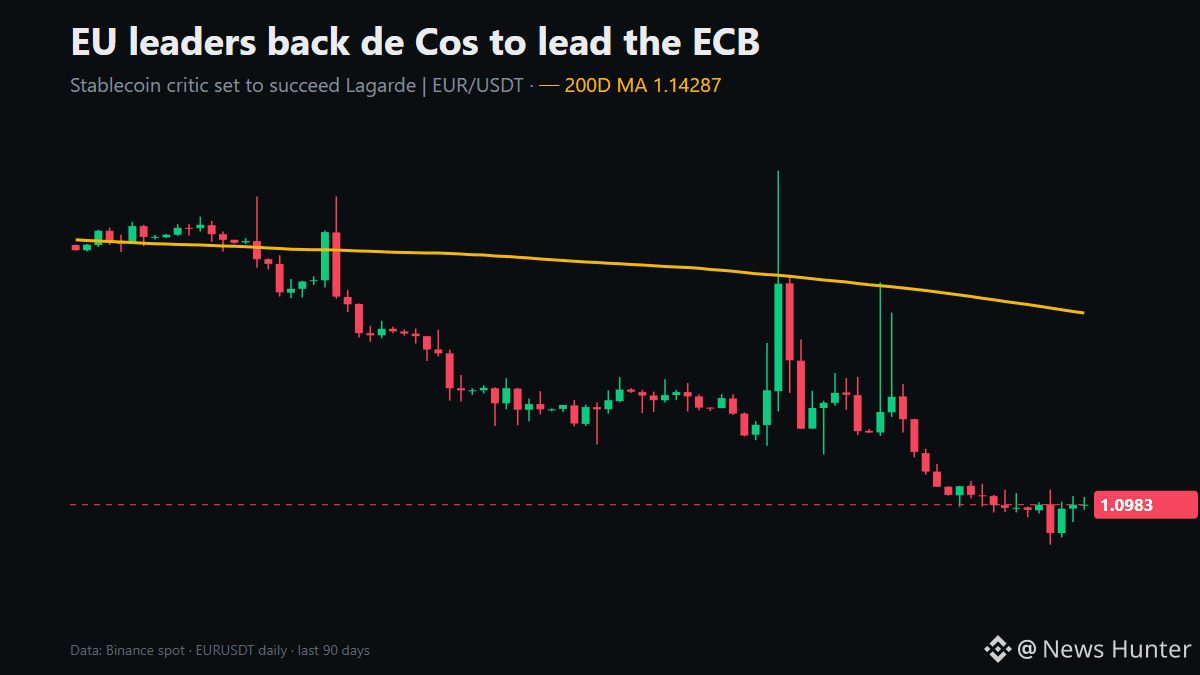
Europe just picked a central banker who isn't a fan of $BTC on bank balance sheets, or of stablecoins as money.
Pablo Hernández de Cos was nominated on Nov 26 to replace Lagarde at the ECB when she leaves on Feb 7, per CoinDesk and Reuters. As Basel Committee chair he oversaw the 1,250% risk weight on banks holding bitcoin directly. At Jackson Hole in August he argued stablecoins aren't a credible means of payment at scale, and he prefers tokenized bank deposits instead.
My take: nothing changes overnight for $BTC price, and CoinDesk expects him to mostly keep Lagarde's line. But it tells you EU banks won't be piling into bitcoin custody soon, and euro stablecoin growth stays an uphill fight. A crypto lawyer quoted by CoinDesk already says this pushes founders toward the UAE.
Do you think Europe's tough stance actually matters for $BTC demand, or is it all about US flows anyway?
NFA, just my read.
Source: CoinDesk, Reuters
#Bitcoin #ECB #Stablecoins #CryptoRegulation
Extraterrestree:
Então vamos 👹👹🩸🩸🩸❤️
1
110

·
--
Europe's next money boss just ranked the blockchains, and bitcoin came last
Pablo Hernandez de Cos, chosen to succeed Christine Lagarde at the ECB, favors blockchain-based banking built on tokenized bank deposits, and CoinDesk reports he has warned against private digital currencies and against banks holding bitcoin.
That is a preference, not a rule. But it tells you which rails the euro area means to build on, and the answer is the one where the central bank sits in the middle of every transfer.
The tape is not treating it as a shock. Bitcoin is at 61,540.0, up 1.5 percent in 24 hours and 4.4 percent over seven days, on roughly 0.95 billion of 24 hour volume. A thin session carrying a headline like this usually means the market has filed it under structural, not urgent. Nothing in the price says European demand is leaving.
What it does not imply: no stablecoin has been banned, no bank has been ordered out of bitcoin, and one incoming official's stated view becomes ECB policy only when the Governing Council votes on something. Reading this as a euro area crypto ban is a stretch the reporting does not support.
The quieter thing to watch is how European banks start disclosing. If tokenized deposit pilots get their own line in filings while crypto exposure stays bundled in a footnote, the preference has turned into plumbing, and that is what actually moves adoption.
$BTC
If the euro settles transfers on tokenized bank deposits, is that a bridge for crypto or a wall around it?
#Bitcoin #ECB #Stablecoins #Crypto

98


·
--
🇪🇺 Next ECB chief favors tokenized deposits over stablecoins and bitcoin
The European Council on Nov. 26 nominated former Bank of Spain governor Pablo Hernández de Cos to succeed Christine Lagarde as ECB president when she leaves on Feb. 7. He backs putting commercial bank deposits onchain but has argued stablecoins are not a credible means of payment at scale. As Basel Committee chair from 2019 to 2024, he oversaw strict capital rules for banks holding bitcoin directly.
⭐ Expect little softening in the ECB's crypto stance, which could push more European crypto firms toward friendlier hubs like the UAE.
#ECB #Stablecoin #Tokenization #Bitcoin

111


·
--
Central bank appointments rarely make my crypto watchlist. This one does.
EU leaders backed Pablo Hernández de Cos today to succeed Christine Lagarde at the ECB. He now runs the BIS and led the Bank of Spain from 2018 to 2024. Formal appointment is expected in December, and Lagarde steps down on Feb 7.
Why care? At Jackson Hole in August, he said stablecoins in their current form aren't a credible means of payment at scale. He prefers tokenized bank deposits. He also warned that dollar-pegged coins raise monetary sovereignty concerns in some places. It wasn't a call for a ban: he sees room for both, with stablecoins in specialized roles.
Back in 2023 he also spoke in favor of what a digital euro could do. The ECB plans a pilot in 2027, with a possible 2029 launch if lawmakers approve.
My take: one president doesn't write Europe's crypto law. But I've watched policy tone shape markets over several cycles, slowly at first. If you use dollar stablecoins like $USDT in Europe, I'd follow what he says about them far more closely than any first-day headline. On rates, one Jefferies economist told Reuters a new leader alone is unlikely to change the ECB's approach, so I'm not reading a $EUR trade into this.
I'm watching his first remarks on stablecoins and how fast the digital euro moves.
Would you use a digital euro if it launched?
Not financial advice. DYOR.
#ECB #Stablecoins #digitaleuro #CryptoRegulation #Macro
1
131

·
--
ECB minutes reinforce expectations of a December rate hike
🏦 The ECB released its October meeting minutes at 12:30 UTC on November 26. At the meeting, the Governing Council unanimously agreed to keep the deposit rate at 2.50%.
📌 Many members said they could have supported a rate hike in October. The ECB signaled that further tightening may be needed unless the inflation outlook improves significantly.
⚡ Persistently high energy prices have raised inflation risks. At the time of the meeting, the ECB saw no clear signs that the shock was feeding into wages or broader prices.
📊 Before the release, markets were already pricing in a high likelihood of a 25-basis-point hike to 2.75% at the December 17 meeting.
🔎 Wage data, core inflation and the ECB’s December projections will help gauge whether price pressures are spreading. They will also shape expectations for further rate hikes in 2027.
#ECB $ETC
10

·
--
Why is nobody talking about the ECB quietly opening applications for experiments that most traders are still treating as distant theory?
Crypto investors keep getting wrecked chasing US headlines while actual eurozone policy quietly shifts the ground under them. You FOMO into a narrative, miss the real timing, and then wonder why the market dumped on news you never saw coming.
On November 20 the ECB opened applications for the first experiments under its Appia project. This is a specific case of a major central bank moving from papers to actual testing rather than another round of vague promises. They are collecting applicants now, which means the experiments themselves have not even begun.
The popular story claims a digital euro is imminent and will crush $BTC. The facts do not match that panic. $ETH already runs live activity at scale and $USDT still sets the liquidity standard every day. A project sitting at the application stage is years from launch, not next quarter. Traders who treat every CBDC headline as an emergency keep getting the timing wrong.
Where do you think this actually leads for the market from here?
#CBDC #DigitalEuro #ECB
Why is nobody talking about the ECB quietly opening applications for experiments that most traders are still treating as distant theory?
Crypto investors keep getting wrecked chasing US headlines while actual eurozone policy quietly shifts the ground under them. You FOMO into a narrative, miss the real timing, and then wonder why the market dumped on news you never saw coming.
On November 20 the ECB opened applications for the first experiments under its Appia project. This is a specific case of a major central bank moving from papers to actual testing rather than another round of vague promises. They are collecting applicants now, which means the experiments themselves have not even begun.
The popular story claims a digital euro is imminent and will crush $BTC . The facts do not match that panic. $ETH already runs live activity at scale and $USDT still sets the liquidity standard every day. A project sitting at the application stage is years from launch, not next quarter. Traders who treat every CBDC headline as an emergency keep getting the timing wrong.
Where do you think this actually leads for the market from here?
#CBDC #DigitalEuro #ECB
·
--
Why is nobody talking about Christine Lagarde calling $BTC worth nothing while the ECB quietly builds blockchain rails for the euro?
Too many traders got shaken out of positions after comments like that. Official FUD creates panic selling and missed entries right before institutions start using the same technology.
Lagarde once said Bitcoin had no value. Now the European Central Bank is developing its own blockchain infrastructure to move euro money. This is happening in real time as a case study of how the old guard eventually copies what they once rejected.
They spent years dismissing crypto as risky and pointless. Suddenly the distributed ledger that $BTC and $ETH run on looks useful for their own digital euro plans. The traders who saw through the rhetoric didn't get left behind.
What's your take on this reversal?
#Bitcoin #ECB #Crypto
1
·
--
If you're still treating old quotes from central bankers as a reason to sit out crypto, stop now.
Traders who sold or ignored $BTC after Lagarde called it worthless have watched the same institutions quietly adopt the underlying tech. That hesitation around official FUD has left plenty of people buying higher later or missing the tokenization wave entirely.
On November 20 the ECB opened applications for the first experiments in its Appia project. They will test tokenized bank deposits and the payments between them, tokenized securities, and the rules for shared blockchain networks that many institutions can use together. Participation is not for individuals. Deposit and governance groups must include at least five independent companies.
Critics will say this is banks building walled gardens that sideline public chains like $ETH and keep $BTC as a speculative sideshow. I disagree. The fact they need blockchain rails at all proves the original thesis. Permissioned or not, tokenizing deposits and securities at this scale shows the technology they once mocked is becoming infrastructure. The debate is whether this co-opts crypto or simply confirms it cannot be ignored.
Where do you stand, does Appia make you more bullish on public blockchains or more convinced TradFi will just copy and control it?
#Bitcoin #Tokenization #ECB

1

everyone thinks central banks want to destroy crypto, but actually they are just stealing the tech to build their own walled garden.
most retail traders are completely blindsided by this shift, busy bagholding vaporware while traditional finance quietly prepares to monopolize all onchain settlement.
look at the ecb as the ultimate case study. christine lagarde spent years calling $BTC worthless, but on nov 20, the ecb officially opened applications for its appia project. they are running live experiments across three core areas: tokenized bank deposits, tokenized securities, and governance rules for shared blockchain networks.
ngl the entry barrier tells you everything about where this is heading. unlike public rails like $ETH where anyone can deploy or validate, appia mandates that deposit and governance groups bring at least 5 independent companies just to participate. it is an exclusive institutional syndicate designed to keep public access completely locked out.
the warning here is assuming institutional adoption automatically means public crypto wins. in reality, central banks are creating closed-loop infrastructure to route real-world liquidity away from open networks and straight back into state-controlled silos.
where do you think this leaves decentralized crypto once these state rails roll out at scale?
#ECB #Tokenization #DeFi


Article
ECB to accept DLT Pilot Regime assets as collateral via T2S from June 2027ECB to accept DLT Pilot Regime assets as collateral via T2S from June 2027
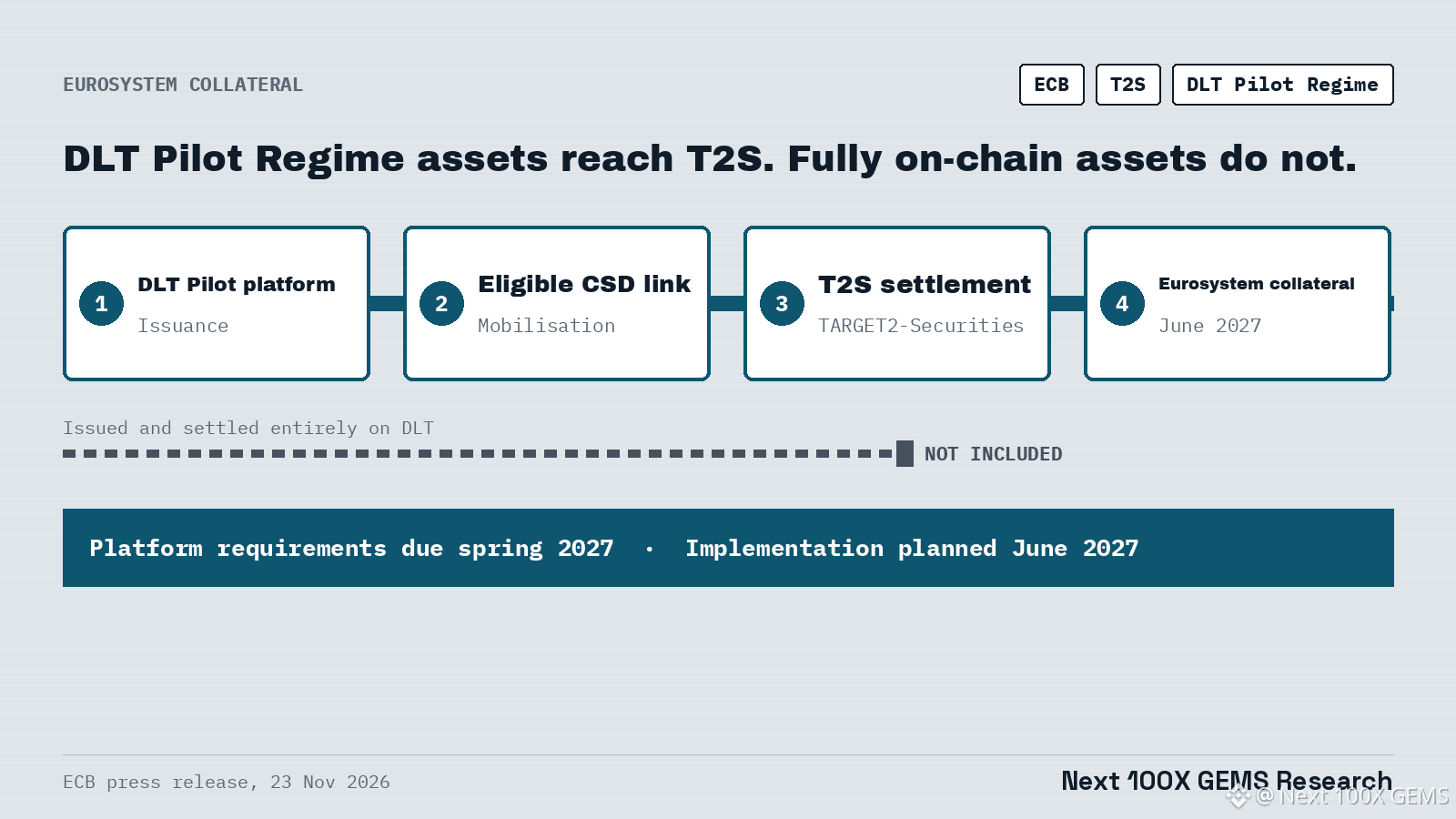
The European Central Bank has approved a new class of tokenised collateral for Eurosystem credit operations, with implementation planned for June 2027. On 23 November 2026 the Governing Council said the Eurosystem will accept marketable assets issued on distributed ledger technology platforms licensed under the EU DLT Pilot Regime Regulation, subject to specific Eurosystem requirements. The assets still have to meet every standard collateral eligibility rule, and they have to be made available to the Eurosystem through an eligible link to a central securities depository whose settlement system complies with the Central Securities Depositories Regulation and offers settlement in TARGET2-Securities (T2S). Assets issued and settled entirely on a ledger, with no such link, are not part of this step.
The T2S link is the gate
A Pilot Regime licence is not enough on its own. The asset must be a marketable instrument that satisfies the usual eligibility criteria, and it must be made available via an eligible link to a CSD that operates an eligible securities settlement system. That system must comply with the Central Securities Depositories Regulation and must offer settlement in T2S.
The Eurosystem isn't going to hold or settle these instruments on the DLT platform where they were issued. The platform has to hand the asset across to a recognised depository, and the depository has to be able to settle it on the Eurosystem's own securities settlement platform. Until that link exists, the asset cannot be used as collateral, however clean the licence looks.
The platforms themselves face a second filter. On top of the licence, they will have to meet dedicated Eurosystem requirements "to ensure legal certainty and operational safety regarding, for example, settlement finality designation and the outsourcing of critical functions." The Eurosystem expects to publish the detail of those requirements in the spring of 2027, ahead of the planned June start.
Isabel Schnabel, a member of the ECB's Executive Board, put the stance in a sentence: "We support innovation without lowering our standards." She added that a future-proof collateral framework "must embrace new technologies without compromising on safety or the rigour of our risk assessment."
March already opened a narrower door
This is the second step, not the first. On 27 January 2026 the ECB said the Eurosystem would accept, as of 30 March 2026, marketable assets issued in CSDs that use DLT-based services. Those instruments also had to meet the usual eligibility and collateral-management rules, including settlement in eligible systems that comply with the CSD Regulation and are reachable via T2S. They would be mobilised like any other marketable asset.
The difference is where the asset is born. The March rule covers issuance inside a CSD that happens to use distributed ledger technology as a service. The June 2027 rule reaches assets issued on a separate, licensed Pilot Regime platform, then brought across to a CSD and on to T2S: a wider set of venues, still forced through the same settlement rail.
The January announcement already flagged the harder case: assets issued using DLT and "not represented in eligible securities settlement systems." The Eurosystem said it would explore if, how and under what criteria those could become eligible, in a staggered way, taking account of market issuance and of changes in the CSD Regulation, the DLT Pilot Regime Regulation, the Markets in Crypto-Assets Regulation and euro-area securities laws. The 23 November decision is the next staged step. It is not that later step.
What stays off the rail
The decision sits on a roadmap "towards making the Eurosystem collateral framework fit for a tokenised European financial market ecosystem, which entails exploring ways to accept and mobilise tokenised assets in their native form." The same text says the roadmap "foresees further exploration of ways to expand eligibility to assets issued and settled entirely on DLT networks."
Those formulations are the exclusion. A tokenised instrument that lives and settles only on a ledger, and never becomes available through an eligible CSD link into T2S, is not eligible under the June 2027 rule. The Eurosystem is still studying that native, fully on-chain case. It hasn't approved it, and it hasn't set a date for it.
That limit is the point of the design. Collateral the Eurosystem lends against has to be adequate, and the existing framework already assumes settlement systems that comply with the Central Securities Depositories Regulation and settle in T2S. By routing Pilot Regime assets through that channel, the central bank can widen the set of tokenised assets it will take without itself settling on the issuing ledger. The November release calls the present setup a hybrid environment and says this step should help DLT platforms and traditional systems interoperate.
A counterparty that holds a qualifying marketable asset issued on a licensed Pilot Regime platform can pledge it only once that path is available, and only if the instrument also clears the ordinary eligibility tests. The 23 November text doesn't loosen those tests. It doesn't name any platform, any security or any amount that will qualify.
A collateral rule, not a settlement service
Piero Cipollone, also on the Executive Board, tied the move to two other Eurosystem projects: "Pontes and Appia are helping turn Europe's vision for tokenised finance into reality. And by adapting our collateral framework, we are further enabling the European tokenised finance market to grow, while upholding the principles of safety, efficiency and a level playing field."
Those projects are related, and they're not this rule. On 21 September 2026 the Eurosystem launched Pontes, a service that lets wholesale transactions in tokenised assets be settled in central bank money. Appia is the longer workstream; the same September release set a goal of a blueprint by 2028 for an integrated ecosystem for DLT-based financial services. The November decision doesn't make Pontes the place where this collateral is held. It adapts the collateral framework so that certain Pilot Regime assets, once they are available in T2S, can be pledged in credit operations.
The platform requirements are due in the spring of 2027, and implementation is planned for June 2027. Until then, the only DLT-related collateral the Eurosystem has already said it will take remains the narrower set from March: marketable assets issued in CSDs using DLT-based services, settled through eligible T2S-reachable systems. The rest, including anything that never leaves the chain it was issued on, is still being studied.
Sources
ECB press release, "ECB expands acceptance of DLT-based assets as eligible Eurosystem collateral," 23 Nov 2026
ECB press release, "ECB paves way for acceptance of DLT-based assets as eligible Eurosystem collateral," 27 Jan 2026
ECB press release, "Eurosystem brings central bank money to tokenised finance," 21 Sep 2026
Rate Brief, 24 Nov 2026
The S-Curve, 24 Nov 2026
#ECB #T2S
NFA. DYOR.
ECB to accept DLT Pilot Regime assets as collateral via T2S from June 2027
ECB to accept DLT Pilot Regime assets as collateral via T2S from June 2027
The European Central Bank has approved a new class of tokenised collateral for Eurosystem credit operations, with implementation planned for June 2027. On 23 November 2026 the Governing Council said the Eurosystem will accept marketable assets issued on distributed ledger technology platforms licensed under the EU DLT Pilot Regime Regulation, subject to specific Eurosystem requirements. The assets still have to meet every standard collateral eligibility rule, and they have to be made available to the Eurosystem through an eligible link to a central securities depository whose settlement system complies with the Central Securities Depositories Regulation and offers settlement in TARGET2-Securities (T2S). Assets issued and settled entirely on a ledger, with no such link, are not part of this step.
The T2S link is the gate
A Pilot Regime licence is not enough on its own. The asset must be a marketable instrument that satisfies the usual eligibility criteria, and it must be made available via an eligible link to a CSD that operates an eligible securities settlement system. That system must comply with the Central Securities Depositories Regulation and must offer settlement in T2S.
The Eurosystem isn't going to hold or settle these instruments on the DLT platform where they were issued. The platform has to hand the asset across to a recognised depository, and the depository has to be able to settle it on the Eurosystem's own securities settlement platform. Until that link exists, the asset cannot be used as collateral, however clean the licence looks.
The platforms themselves face a second filter. On top of the licence, they will have to meet dedicated Eurosystem requirements "to ensure legal certainty and operational safety regarding, for example, settlement finality designation and the outsourcing of critical functions." The Eurosystem expects to publish the detail of those requirements in the spring of 2027, ahead of the planned June start.
Isabel Schnabel, a member of the ECB's Executive Board, put the stance in a sentence: "We support innovation without lowering our standards." She added that a future-proof collateral framework "must embrace new technologies without compromising on safety or the rigour of our risk assessment."
March already opened a narrower door
This is the second step, not the first. On 27 January 2026 the ECB said the Eurosystem would accept, as of 30 March 2026, marketable assets issued in CSDs that use DLT-based services. Those instruments also had to meet the usual eligibility and collateral-management rules, including settlement in eligible systems that comply with the CSD Regulation and are reachable via T2S. They would be mobilised like any other marketable asset.
The difference is where the asset is born. The March rule covers issuance inside a CSD that happens to use distributed ledger technology as a service. The June 2027 rule reaches assets issued on a separate, licensed Pilot Regime platform, then brought across to a CSD and on to T2S: a wider set of venues, still forced through the same settlement rail.
The January announcement already flagged the harder case: assets issued using DLT and "not represented in eligible securities settlement systems." The Eurosystem said it would explore if, how and under what criteria those could become eligible, in a staggered way, taking account of market issuance and of changes in the CSD Regulation, the DLT Pilot Regime Regulation, the Markets in Crypto-Assets Regulation and euro-area securities laws. The 23 November decision is the next staged step. It is not that later step.
What stays off the rail
The decision sits on a roadmap "towards making the Eurosystem collateral framework fit for a tokenised European financial market ecosystem, which entails exploring ways to accept and mobilise tokenised assets in their native form." The same text says the roadmap "foresees further exploration of ways to expand eligibility to assets issued and settled entirely on DLT networks."
Those formulations are the exclusion. A tokenised instrument that lives and settles only on a ledger, and never becomes available through an eligible CSD link into T2S, is not eligible under the June 2027 rule. The Eurosystem is still studying that native, fully on-chain case. It hasn't approved it, and it hasn't set a date for it.
That limit is the point of the design. Collateral the Eurosystem lends against has to be adequate, and the existing framework already assumes settlement systems that comply with the Central Securities Depositories Regulation and settle in T2S. By routing Pilot Regime assets through that channel, the central bank can widen the set of tokenised assets it will take without itself settling on the issuing ledger. The November release calls the present setup a hybrid environment and says this step should help DLT platforms and traditional systems interoperate.
A counterparty that holds a qualifying marketable asset issued on a licensed Pilot Regime platform can pledge it only once that path is available, and only if the instrument also clears the ordinary eligibility tests. The 23 November text doesn't loosen those tests. It doesn't name any platform, any security or any amount that will qualify.
A collateral rule, not a settlement service
Piero Cipollone, also on the Executive Board, tied the move to two other Eurosystem projects: "Pontes and Appia are helping turn Europe's vision for tokenised finance into reality. And by adapting our collateral framework, we are further enabling the European tokenised finance market to grow, while upholding the principles of safety, efficiency and a level playing field."
Those projects are related, and they're not this rule. On 21 September 2026 the Eurosystem launched Pontes, a service that lets wholesale transactions in tokenised assets be settled in central bank money. Appia is the longer workstream; the same September release set a goal of a blueprint by 2028 for an integrated ecosystem for DLT-based financial services. The November decision doesn't make Pontes the place where this collateral is held. It adapts the collateral framework so that certain Pilot Regime assets, once they are available in T2S, can be pledged in credit operations.
The platform requirements are due in the spring of 2027, and implementation is planned for June 2027. Until then, the only DLT-related collateral the Eurosystem has already said it will take remains the narrower set from March: marketable assets issued in CSDs using DLT-based services, settled through eligible T2S-reachable systems. The rest, including anything that never leaves the chain it was issued on, is still being studied.
Sources
ECB press release, "ECB expands acceptance of DLT-based assets as eligible Eurosystem collateral," 23 Nov 2026
ECB press release, "ECB paves way for acceptance of DLT-based assets as eligible Eurosystem collateral," 27 Jan 2026
ECB press release, "Eurosystem brings central bank money to tokenised finance," 21 Sep 2026
Rate Brief, 24 Nov 2026
The S-Curve, 24 Nov 2026
#ECB #T2S
NFA. DYOR.
58

·
--
🚨 **CẢNH BÁO: "Kẻ kế nhiệm" tại ECB chính thức tuyên chiến với Bitcoin và Stablecoin?**
Dòng chảy tài chính thế giới vừa đón nhận một tín hiệu cực kỳ đáng chú ý từ châu Âu. Pablo Hernández de Cos – người được chọn để kế nhiệm Christine Lagarde tại Ngân hàng Trung ương Châu Âu (ECB) – đã đưa ra những quan điểm có thể làm thay đổi cuộc chơi:
🔹 Ông ủng hộ mạnh mẽ việc ứng dụng blockchain để "token hóa" các khoản tiền gửi ngân hàng thay vì sử dụng các loại tiền kỹ thuật số tư nhân.
🔹 Đồng thời, ông đưa ra cảnh báo nghiêm khắc về việc các ngân hàng nắm giữ Bitcoin cũng như sự trỗi dậy của các loại stablecoin hiện nay.
💡 **Góc nhìn thực chiến:**
Đừng vội hoảng loạn cho rằng Bitcoin sẽ bị khai tử, nhưng hãy hiểu rằng đây là một cuộc chiến về "quyền kiểm soát". Quan điểm của ông de Cos cho thấy các định chế tài chính truyền thống đang tìm cách "thôn tính" công nghệ blockchain để phục vụ chính họ.
Thay vì để dòng tiền chảy vào các stablecoin phi tập trung, họ muốn đưa tài sản lên on-chain dưới dạng **Tokenized Deposits** (tiền gửi token hóa). Điều này có nghĩa là: **Mảng RWA (Real World Assets) sẽ là từ khóa thống trị.** Thay vì tập trung vào Bitcoin, dòng vốn tổ chức có thể sẽ đổ mạnh vào các hạ tầng blockchain cho phép ngân hàng vận hành tài sản truyền thống một cách số hóa. Hãy chú ý các dự án RWA tiềm năng trong thời gian tới!
Anh em nghĩ sao về động thái này? Liệu token hóa tiền gửi có thể "soán ngôi" Stablecoin trong tương lai không? Để lại ý kiến bên dưới để chúng ta cùng thảo luận nhé! 👇
**Bấm Theo Dõi** kênh để cập nhật những biến động mới nhất từ thị trường!
#CryptoNews #TrendingNews $BTC $ETH #RWA #ECB
·
--
🚨 **CẢNH BÁO ĐỎ: "Người kế nhiệm" Lagarde đang có ý định "siết chặt" Bitcoin và Stablecoin?**
Tin tức chấn động vừa cập bến từ Châu Âu mà anh em không thể ngó lơ:
* **Ưu tiên Tokenization thay vì Crypto:** Pablo Hernández de Cos – ứng cử viên sáng giá thay thế Christine Lagarde tại Ngân hàng Trung ương Châu Âu (ECB) – đang thể hiện lập trường rõ rệt: Ưu tiên các khoản tiền gửi ngân hàng được mã hóa (tokenized deposits) hơn là Stablecoin hay Bitcoin.
* **Thái độ cứng rắn với tài sản số tư nhân:** Ông De Cos đã đưa ra lời cảnh báo trực tiếp về việc các ngân hàng nắm giữ Bitcoin và bày tỏ sự thận trọng cực độ đối với các loại tiền kỹ thuật số được phát hành bởi các tổ chức tư nhân.
💡 **Góc nhìn cá nhân (Takeaway):**
Theo mình, đây là một tín hiệu cho thấy cuộc chiến giành quyền kiểm soát "tiền kỹ thuật số" đang trở nên gay gắt hơn bao giờ hết. Các cơ quan quản lý không hề bài trừ công nghệ Blockchain, nhưng họ muốn **"thuần hóa"** nó. Thay vì để dòng tiền chảy vào các tài sản phi tập trung như Bitcoin hay các Stablecoin không được kiểm soát, họ đang muốn đưa công nghệ này vào khuôn khổ của hệ thống tài chính truyền thống (TradFi) thông qua Tokenization.
Điều này có thể tạo ra một rào cản pháp lý lớn cho sự phát triển của các dự án Crypto thuần túy tại khu vực Eurozone, nhưng đồng thời lại là "mồi lửa" cực mạnh cho mảng **RWA (Real World Assets)** trong tương lai. Anh em cần chuẩn bị tâm lý cho một kịch bản: Blockchain sẽ phát triển mạnh, nhưng dưới sự giám sát chặt chẽ của các ông lớn ngân hàng.
---
💬 Anh em đánh giá sao về động thái này? Liệu đây là bước lùi của Crypto hay là sự chấp nhận chính thống hóa thông qua Tokenization? Để lại ý kiến bên dưới nhé!
👉 **Đừng quên nhấn FOLLOW để không bỏ lỡ những phân tích chuyên sâu nhất về thị trường!**
#CryptoNews #TrendingNews $BTC $ETH #ECB #Tokenization #RWA

Trưởng ECB mới ưu tiên tiền gửi ngân hàng token hóa hơn stablecoin và Bitcoin
- Pablo Hernández de Cos được chọn kế nhiệm Christine Lagarde làm Trưởng ECB
- Ông ủng hộ ngân hàng dựa trên blockchain, tiền gửi token hóa
- Cảnh báo đối với tiền tệ số riêng tư (stablecoin) và ngân hàng nắm giữ Bitcoin
- Nguồn RSS chưa cung cấp thêm chi tiết về lộ trình chính sách cụ thể
#BinanceSquare #CryptoNews #BTC #ECB #Regulation
$btc
vlikevn Titanbot
Nguồn: CoinDesk
2
·
--
Tokenized bonds are getting a path into Europe's central bank lending system.
On November 23, 2026, the European Central Bank's Governing Council approved accepting marketable assets issued on DLT platforms licensed under the EU DLT Pilot Regime as eligible collateral for Eurosystem credit operations. The assets must meet all standard collateral rules and reach the Eurosystem through an eligible central securities depository link that settles on TARGET2-Securities.
DLT platforms will also need to meet extra Eurosystem requirements on legal certainty and operational safety, such as settlement finality. The ECB expects to publish those details in spring 2027, with the change planned to take effect in June 2027. Assets issued and settled entirely on DLT networks are not included yet, though the ECB says it will keep exploring that next step.
#Tokenization #RWA #ECB
DYOR. Not financial advice.

3

بابلو هيرنانديز دي كوس خلفاً لكريستين لاغارد في رئاسة البنك المركزي الأوروبي ابتداءً من فبراير 2027. $BTC
هل يهم هذا حاملو $BTC؟ القرار لم يُحسم بعد، لكن تغيير قيادة البنك قد يغيّر مسار أسعار الفائدة في منطقة اليورو.
إذا مال السياسة النقدية إلى التيسير، فقد يدعم ذلك الأصول ذات المخاطر ومنها بيتكوين. وإذا بقي التشديد، فقد يضغط على الشهية للمخاطر.
ما يمكنك حفظه: راقب تصريحات دي كوس حول أسعار الفائدة قبل موعد التولي، فهي أول إشارة لاتجاه السياسة.
هل تتوقع سياسة نقدية أسهل أم أكثر تشديداً بعد فبراير 2027؟
#BTC #ECB
المحتوى للمعلومات فقط وليس نصيحة مالية.
اضغط $BTC للتداول
$BTC
غيرك سبقك وتابع. ادخل بروفايلي وخلك مع اللي يقرأ قبل ما ينتشر الخبر.
بابلو هيرنانديز دي كوس خلفاً لكريستين لاغارد في رئاسة البنك المركزي الأوروبي ابتداءً من فبراير 2027. $BTC
هل يهم هذا حاملو $BTC ؟ القرار لم يُحسم بعد، لكن تغيير قيادة البنك قد يغيّر مسار أسعار الفائدة في منطقة اليورو.
إذا مال السياسة النقدية إلى التيسير، فقد يدعم ذلك الأصول ذات المخاطر ومنها بيتكوين. وإذا بقي التشديد، فقد يضغط على الشهية للمخاطر.
ما يمكنك حفظه: راقب تصريحات دي كوس حول أسعار الفائدة قبل موعد التولي، فهي أول إشارة لاتجاه السياسة.
هل تتوقع سياسة نقدية أسهل أم أكثر تشديداً بعد فبراير 2027؟
#BTC #ECB
المحتوى للمعلومات فقط وليس نصيحة مالية.
اضغط $BTC للتداول
$BTC
غيرك سبقك وتابع. ادخل بروفايلي وخلك مع اللي يقرأ قبل ما ينتشر الخبر.


19

·
--
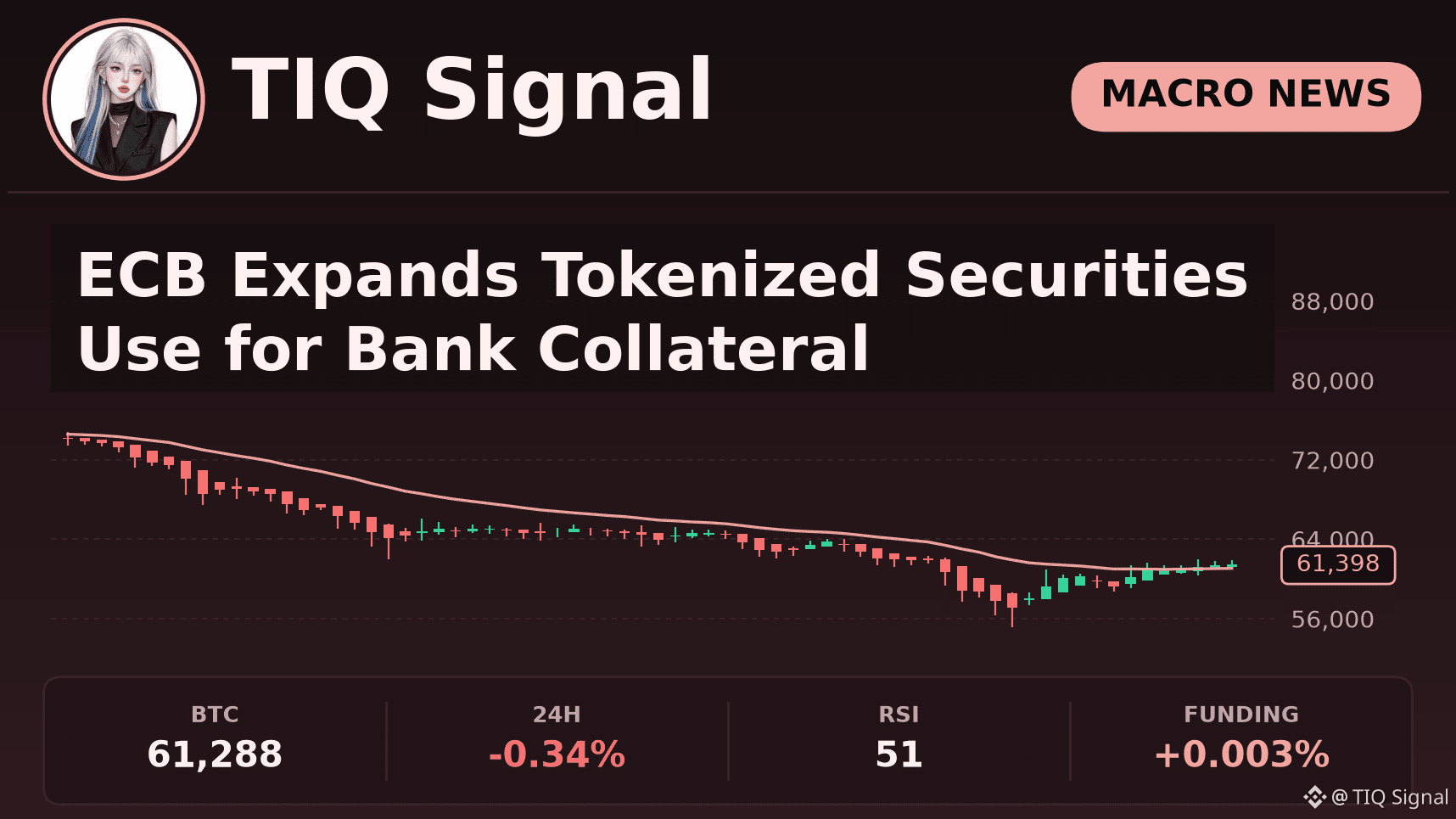
🍿 Today's crypto drama: ECB Expands Tokenized Securities Use for Bank Collateral
Quick version: The European Central Bank (ECB) is updating its rules to allow banks to pledge more tokenized securities as collateral.
Starting in June 2027, the central bank plans to accept securities issued on platforms that operate under the EU’s distributed ledger pilot program. This move is a clear nod to the growing role of blockchain technology in traditional finance. It seems the regulators are finally trading their quill pens for digital ledgers, which is a welcome shift for the industry. 🏦
👉 What to watch: Crypto traders often watch these macro updates because they signal how traditional institutions view digital assets. Increased integration between banks and blockchain tech can influence overall market liquidity and institutional risk appetite.
#Macro #ECB #Tokenization #Blockchain #Finance
ℹ️ News roundup from public sources, not financial advice.
1
23

ECB Integration of Tokenized Collateral
The ECB plans to accept tokenized securities from licensed EU pilot programs as bank collateral starting June 2027.
#ECB #Tokenization
ECB Integration of Tokenized Collateral
The ECB plans to accept tokenized securities from licensed EU pilot programs as bank collateral starting June 2027.
#ECB #Tokenization
The ECB plans to accept tokenized securities from licensed EU pilot programs as bank collateral starting June 2027.
#ECB #Tokenization
11

·
--
Bank sentral Eropa baru saja membuka pintu untuk sekuritas tokenisasi — dan ini langkah besar buat dunia RWA.
Fakta: Dewan Gubernur ECB memutuskan 23 Nov 2026 bahwa mulai Juni 2027, aset yang diterbitkan di platform DLT berlisensi di bawah DLT Pilot Regime Uni Eropa bisa dipakai bank sebagai agunan pinjaman dari bank sentral zona euro — asal memenuhi standar agunan Eurosystem yang berlaku dan tersedia lewat TARGET2-Securities. Detail persyaratan platformnya menyusul musim semi 2027. Ini langkah kedua setelah keputusan Januari 2026 untuk aset di CSD yang memakai layanan DLT (ECB + Cointelegraph, CryptoBriefing, FinanceFeeds, 23 Nov).
Opiniku: penting diluruskan — ini BUKAN persetujuan BTC atau ETH jadi agunan. Yang diterima adalah sekuritas teregulasi yang diterbitkan di atas DLT. Tapi maknanya besar: salah satu bank sentral terbesar di dunia kini memperlakukan instrumen tokenisasi sebagai agunan yang bisa didanai, bukan eksperimen. BTC sendiri di sekitar 60.380 dolar saat aku menulis ini — pasar belum merespons kabar ini, wajar: implementasinya masih Juni 2027.
Yang aku pantau selanjutnya: detail persyaratan platform musim semi 2027, dan apakah bank-bank mulai menerbitkan obligasi tokenisasi di platform DLT Pilot Regime untuk memanfaatkannya. Ini analisisku, bukan nasihat finansial — DYOR selalu.
Menurut kalian, setelah ECB, bank sentral mana yang bakal menyusul menerima aset tokenisasi sebagai agunan?
#ECB #Tokenisasi $BTC
16
Log in to explore more content
Join global crypto users on Binance Square
⚡️ Get latest and useful information about crypto.
💬 Trusted by the world’s largest crypto exchange.
👍 Discover real insights from verified creators.
Email / Phone number
Trending Topics
1
#EvolveAtBinanceBlockchainWeek
1.8M views
17,810 Discussing
2
#ColdcardFlawLeadsToTheftOfAtLeast1789BTC
50,487 views
505 Discussing
3
#BitcoinETFsExtendOutflowStreakToEightDays
5,771 views
71 Discussing
4
#SECIssuesNoActionLetterOnMoleculeModel
10,195 views
160 Discussing
5
#EthereumGlamsterdamKeepsStorageFeeChange
67,435 views
627 Discussing
6
#MalaysiaFirstBitcoinETFToListOnDecember2
23,597 views
229 Discussing
7
#VitalikWantsWalletChipDesignsOpened
57,695 views
580 Discussing
8
#ChainflipVaultTheftHaltsProtocol
35,374 views
460 Discussing
9
#ChinaBlockchainIDRulesEffectMarch2027
25,445 views
264 Discussing
10
#EnishPlansToSell5932SOL
2,435 views
1 Discussing