
#cryptoregulation
cryptoregulation
17.4M views
50,415 Discussing
Hot
Latest

·
--
🚨 Senators Warren and Van Hollen are pressuring the SEC to repeal crypto and tokenized stock exemptions. This regulatory scrutiny signals tighter oversight, likely pressuring risk assets.
Short-term volatility expected as the market digests the potential impact on liquidity and innovation.
#SEC #CryptoRegulation
$SECZB #TradingSignal #CryptoAnalysis
Short-term volatility expected as the market digests the potential impact on liquidity and innovation.
#SEC #CryptoRegulation
$SECZB #TradingSignal #CryptoAnalysis


·
--
Institutional Alert: South Korea liquidity mandates are forcing a shift in how we view ...Institutional Alert: South Korea liquidity mandates are forcing a shift in how we view stablecoin parity — here is why this regulatory pivot changes the liquidity baseline today.
As of this Thursday morning, the local regulatory landscape in Asia is shifting rapidly. With the news breaking that South Korea is moving to require firms like Tether to hold formal reserves and establish local operations, the ripple effect on market makers is immediate. We are seeing a distinct tightening in how institutional desks manage their $USDC and $BTC exposure during this transition. When regulators clamp down on stablecoin oversight, the historical tendency is a short-term flight to higher-quality collateral, which is exactly what we are tracking in the order flow right now.
While the broader market is staring at the raw price action around the 60893.54 mark, the real story is hidden in the institutional arbitrage shifts. We have seen a massive 5,882 BTC accumulation over the last month by a single whale entity, signaling that despite current regulatory headwinds, the long-term conviction remains intact. Meanwhile, the integration of bStocks as collateral on Binance is fundamentally altering the margin efficiency for traders. This move allows for a much cleaner liquidity structure, bridging the gap between traditional equity securities and the crypto ecosystem.
I am keeping a close eye on $AAVE as well. Decentralized lending markets are often the first to reflect sentiment shifts when regulatory pressure mounts on centralized gateways. If the liquidity baseline continues to shift toward compliant, tokenized assets, the current premium on stablecoin-backed lending could see an interesting divergence.
We are currently navigating a market where regulatory clarity is no longer a distant goal but an active catalyst for institutional inflows. The fact that major players are opting for deeper integration into the ecosystem rather than retreating suggests they see the current overhead as the new floor. Are you adjusting your portfolio to account for these regional regulatory shifts, or are you staying strictly on the sidelines until the dust settles?
#Bitcoin #CryptoRegulation
Institutional Alert: South Korea liquidity mandates are forcing a shift in how we view ...
Institutional Alert: South Korea liquidity mandates are forcing a shift in how we view stablecoin parity — here is why this regulatory pivot changes the liquidity baseline today.
As of this Thursday morning, the local regulatory landscape in Asia is shifting rapidly. With the news breaking that South Korea is moving to require firms like Tether to hold formal reserves and establish local operations, the ripple effect on market makers is immediate. We are seeing a distinct tightening in how institutional desks manage their $USDC and $BTC exposure during this transition. When regulators clamp down on stablecoin oversight, the historical tendency is a short-term flight to higher-quality collateral, which is exactly what we are tracking in the order flow right now.
While the broader market is staring at the raw price action around the 60893.54 mark, the real story is hidden in the institutional arbitrage shifts. We have seen a massive 5,882 BTC accumulation over the last month by a single whale entity, signaling that despite current regulatory headwinds, the long-term conviction remains intact. Meanwhile, the integration of bStocks as collateral on Binance is fundamentally altering the margin efficiency for traders. This move allows for a much cleaner liquidity structure, bridging the gap between traditional equity securities and the crypto ecosystem.
I am keeping a close eye on $AAVE as well. Decentralized lending markets are often the first to reflect sentiment shifts when regulatory pressure mounts on centralized gateways. If the liquidity baseline continues to shift toward compliant, tokenized assets, the current premium on stablecoin-backed lending could see an interesting divergence.
We are currently navigating a market where regulatory clarity is no longer a distant goal but an active catalyst for institutional inflows. The fact that major players are opting for deeper integration into the ecosystem rather than retreating suggests they see the current overhead as the new floor. Are you adjusting your portfolio to account for these regional regulatory shifts, or are you staying strictly on the sidelines until the dust settles?
#Bitcoin #CryptoRegulation
1
28
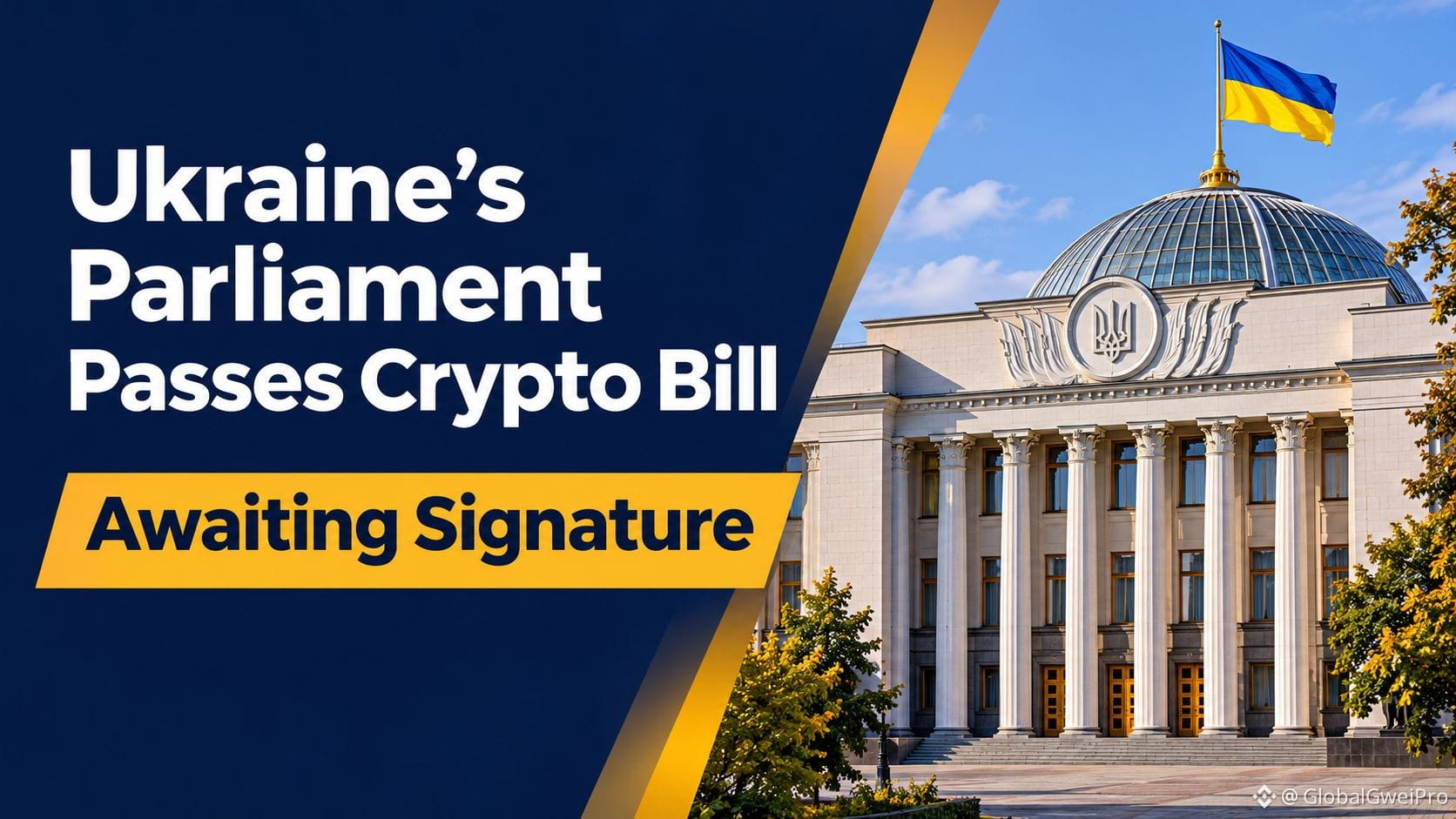
Ukraine’s crypto bill would change how exchanges hold customer assets
Ukraine’s parliament approved bill No. 10225-d on November 25. The official tracker lists it as being prepared for signature.
The securities regulator gives July 1, 2027 as the planned start.
The bill sets authorization rules for crypto service providers. Parliament says businesses would have to keep customer assets separate from their own.
The securities regulator also points to disclosure, risk management and measures against market manipulation.
These rules would apply to a market in which users rely on firms for trading, exchange and custody.
For individuals, Ukrinform reports that the bill applies an 18% personal income tax and a 5% military levy to crypto profits. Crypto-to-crypto swaps without cash would be exempt, and losses could be carried forward.
Eligible holdings acquired before the new rules start would qualify for a reduced 5% income tax rate plus the military levy when converted to fiat during the 2027–2028 transition.
Ukrainian law firm Juscutum says this optional rate applies to the full sale proceeds.
Ukraine’s securities commission would oversee market entry and providers.
The National Bank of Ukraine would regulate certain virtual assets and handle matters tied to monetary and financial stability.
The securities commission says it will now prepare the rules needed to put the framework into practice.
#ukraine #CryptoRegulation #crypto
1
356

The US CFTC staff has issued guidance on how Bitcoin, Ethereum, and payment stablecoins may count toward certain exchange financial resource requirements.
This is another development in the relationship between crypto assets and traditional financial infrastructure.
$BTC $ETH #CFTC #CryptoRegulation
{spot}(BTCUSDT)
{spot}(ETHUSDT)
The US CFTC staff has issued guidance on how Bitcoin, Ethereum, and payment stablecoins may count toward certain exchange financial resource requirements.
This is another development in the relationship between crypto assets and traditional financial infrastructure.
$BTC $ETH #CFTC #CryptoRegulation
This is another development in the relationship between crypto assets and traditional financial infrastructure.
$BTC $ETH #CFTC #CryptoRegulation
104
·
--
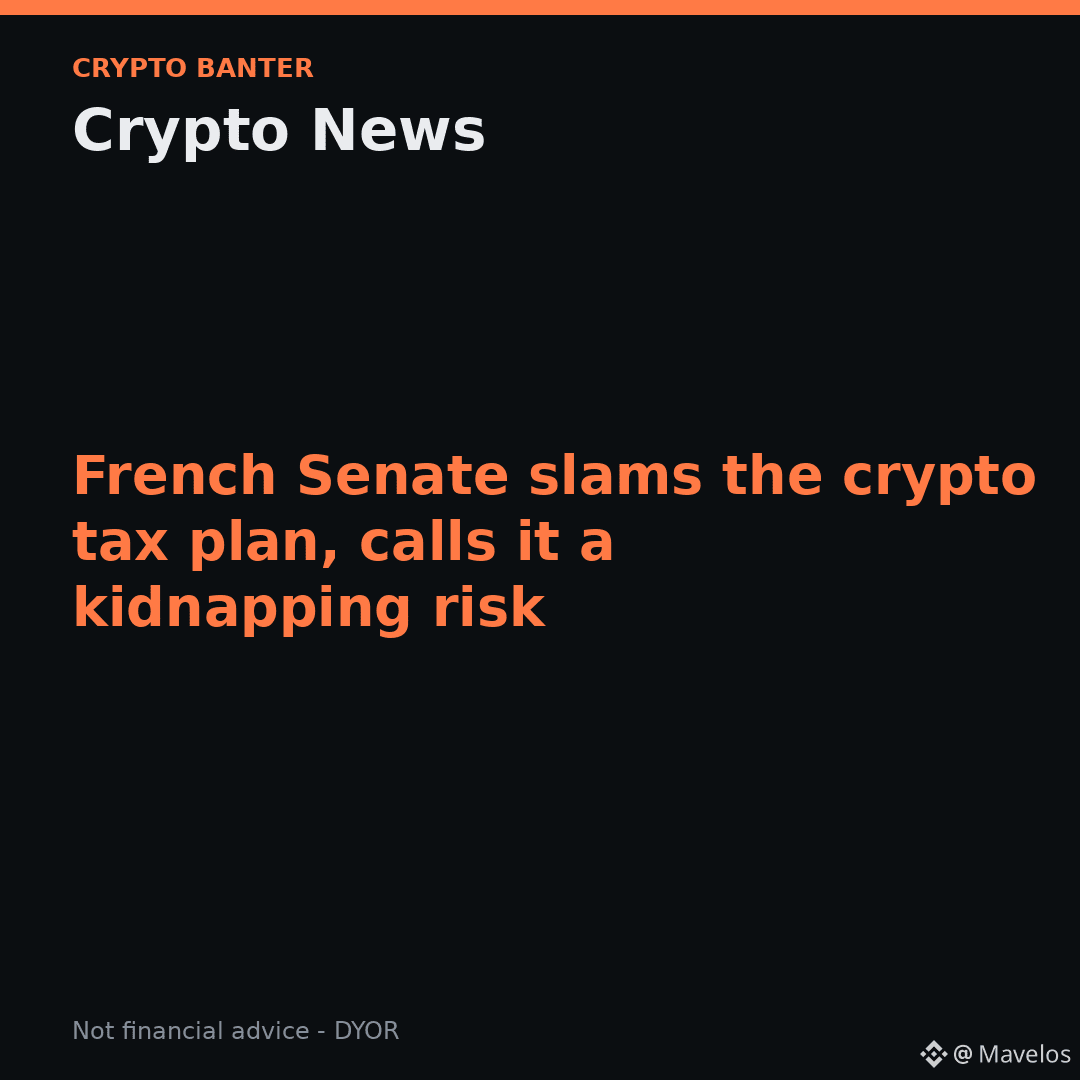
French Senate slams the crypto tax plan, calls it a kidnapping risk
The upper house voted down the government's proposal to impose a new crypto tax and to publish a list of wallet owners, arguing that EU data-sharing rules already cover the ground and that crypto isn't legal tender.
📌 Key points:
• 🚫 Senate blocked the tax and wallet-owner list
• 📑 Government said EU data rules already apply
• ⚠️ Critics warned the measures could create "kidnapping risk"
• 📆 The 2027 budget remains open
It matters because the decision could pause further crypto regulation in France, though it's uncertain how long the budget talks will linger.
Btw $BTC $59,973 (+0.77%) and $SOL $70.23 (+1.75%) as I type this.
Do you think France will strike a middle ground that satisfies both regulators and the crypto community, or will the stalemate continue?
Stay curious! 🎲
#CryptoRegulation #France
116

·
--
⚖️ Senators Elizabeth Warren and Chris Van Hollen sent a letter to SEC Chair Paul Atkins urging him to withdraw the proposed "Regulation Crypto Assets", saying it would let crypto firms sidestep securities laws. Democrats are also pushing the SEC to rescind its tokenized-securities innovation exemption.
The fight over US crypto rules is heating up.
#SEC #CryptoRegulation #Crypto
The fight over US crypto rules is heating up.
#SEC #CryptoRegulation #Crypto
58
·
--
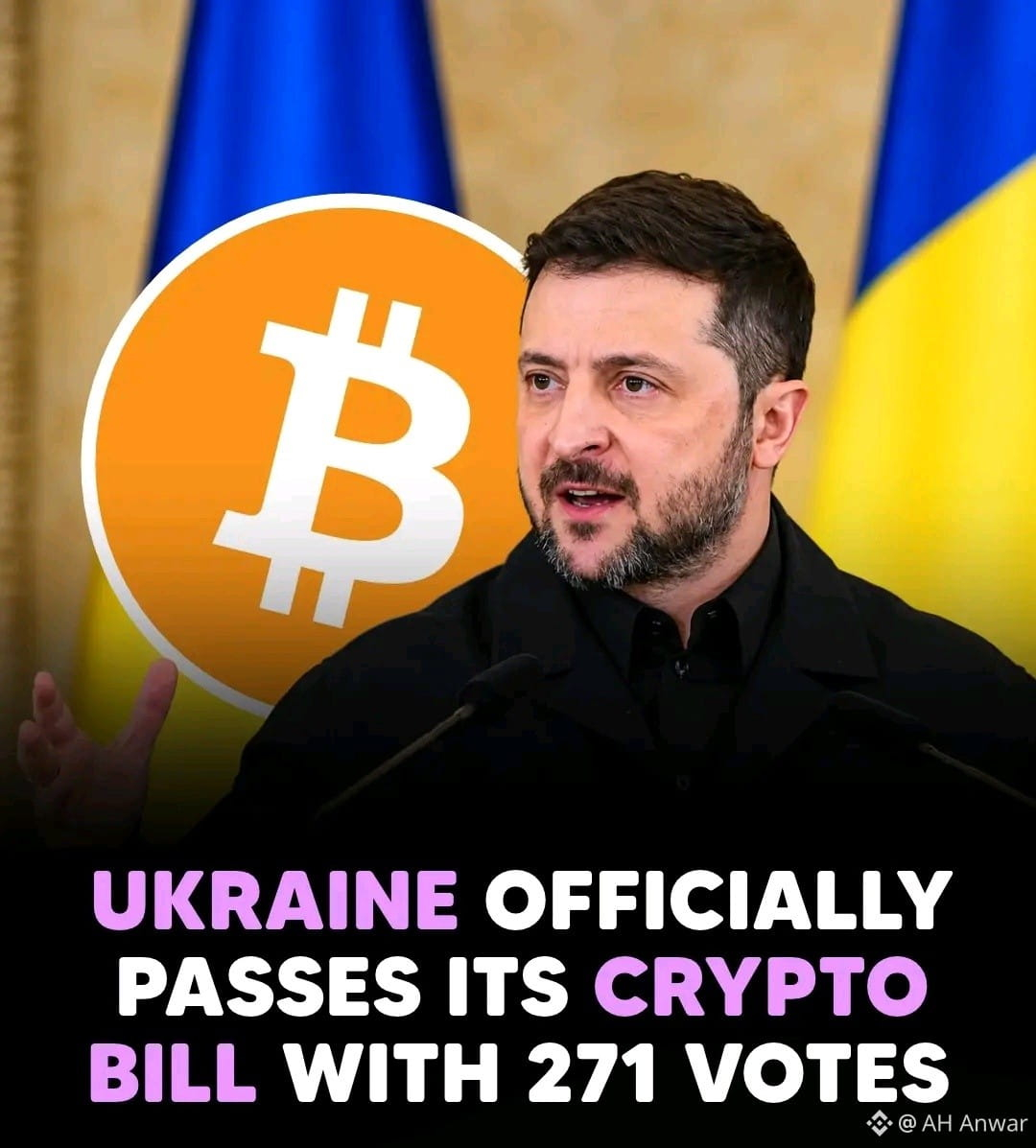
Ukraine's parliament has approved a landmark bill to legalize and regulate the country's cryptocurrency market, with 271 lawmakers voting in favor and eight against.
The legislation introduces a combined 23% tax on crypto profits, consisting of an 18% personal income tax and a 5% military levy. Crypto exchanges and custody providers will also be required to obtain regulatory authorization, submit annual reports, and separate customer holdings from corporate assets.
Regulatory oversight will be shared between the National Bank of Ukraine and the National Securities and Stock Market Commission. The new legislation is scheduled to take effect on July 1, 2027.
#CryptoNews #ukraine #CryptoRegulation
8

·
--
Ukraine just legalized crypto — and the tax math will surprise you.
The Verkhovna Rada passed bill No. 10225-d on November 25 by 271 votes to 8, giving Ukraine its first full crypto framework. It takes effect July 1, 2027, once Zelenskyy signs it.
Crypto profits face 18% income tax plus a 5% military levy — 23% combined on net annual gains. Early birds get a break: pre-law holdings cash out at just 5% plus the levy through end-2028. Crypto-to-crypto swaps stay tax-free, losses carry forward, and exchanges must get licensed under the NSSMC, with the central bank overseeing stablecoins. Kyiv expects ~$330 million in revenue; the rules align Ukraine with the EU's MiCA framework.
Ukraine has been a top crypto adopter since the war began — this turns a grey zone into a regulated market, a template other wartime economies may copy.
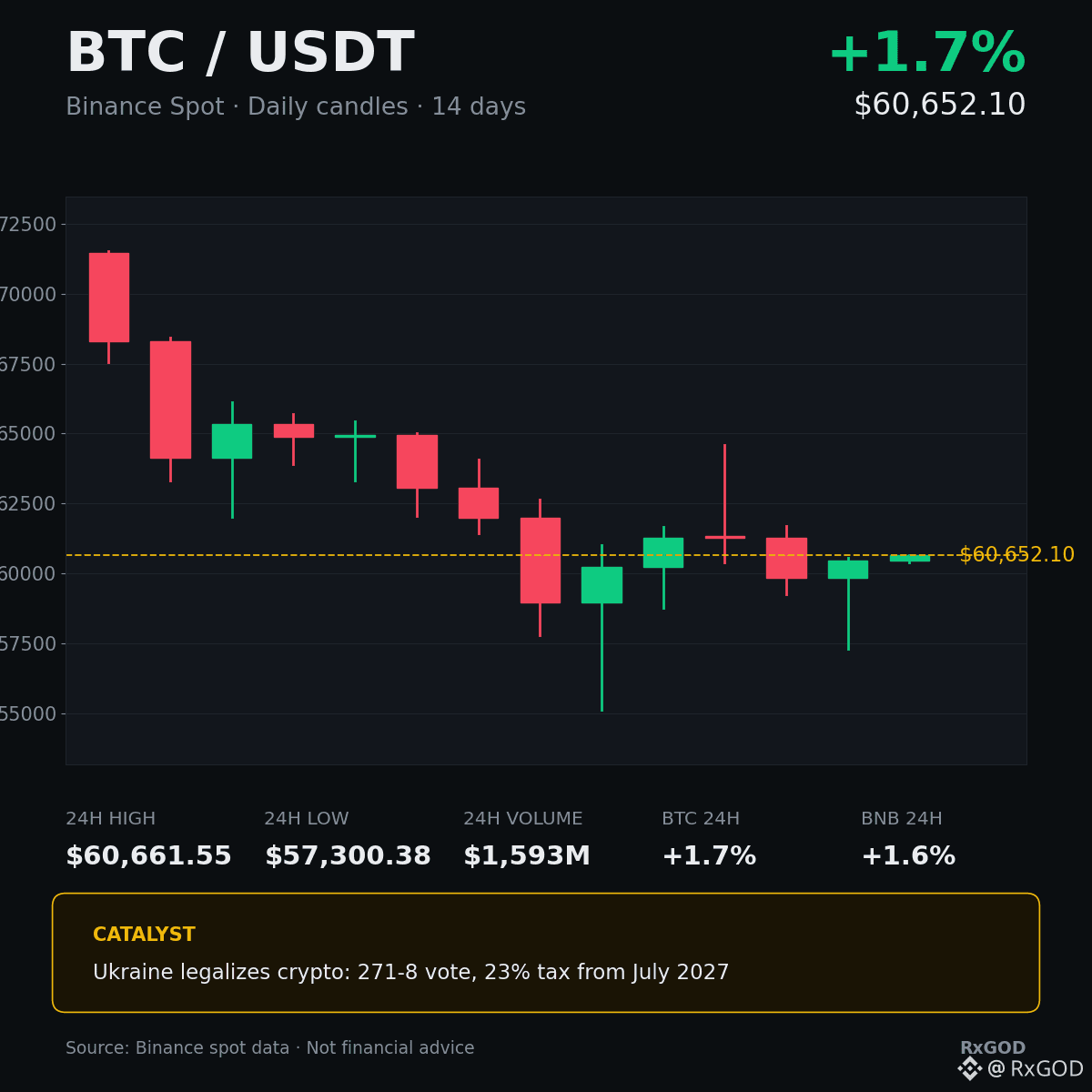
$BTC is quietly healing: $60,528, up 1.3% in 24 hours off the $57,300 post-PCE low — near the top of its daily range, a third of the way up its 14-day range. A bounce inside a downtrend, not a breakout — $60,500 to hold, $64,600 the wall above.
The risk is real: unsigned law, a 23% rate that could push traders offshore, and untested wartime enforcement. Still, a milestone for a country that ran on crypto when banks could not.
Would you pay 23% tax for full legal clarity — or move your coins somewhere cheaper? And which country legalizes crypto next?
Not financial advice — DYOR.
#UkraineLegalizesCrypto #CryptoRegulation #CryptoNews #Bitcoin
73


·
--
🏛️ Warren and Van Hollen push SEC to scrap its crypto rules and innovation exemption
In two letters sent Tuesday to SEC Chair Paul Atkins, Democratic Sens. Elizabeth Warren, Chris Van Hollen, Tina Smith and other Senate Banking Committee members argued that the "Regulation Crypto Assets" proposal lets crypto firms sidestep securities laws and could hurt investors.
The August proposal includes a startup exemption for raises up to $5M and a fundraising exemption up to $75M. A second letter, also signed by Jack Reed, asks the SEC to withdraw its innovation exemption for tokenized stock trading venues.
⭐ With Democrats now holding both chambers after the midterms, political pressure on the SEC's crypto-friendly agenda, especially tokenization, could build fast.
#SEC #CryptoRegulation #Tokenization #Warren

17

US Senators are mounting a direct legislative challenge against SEC Chair Atkins to scrap Regulation Crypto and the innovation exemption.
#SEC #CryptoRegulation
US Senators are mounting a direct legislative challenge against SEC Chair Atkins to scrap Regulation Crypto and the innovation exemption.
#SEC #CryptoRegulation
#SEC #CryptoRegulation
5
South Korea is moving to tighten the rules of the game — and this one matters beyond Seoul.
Proposals on the table: a 20% cap on exchange ownership and a formal framework for won-denominated stablecoins. In plain terms: less concentration of power in trading venues, and a legal lane for a KRW stablecoin to exist.
Why watch it? Korea is one of the most active retail crypto markets on earth. When it writes rules, exchanges, stablecoin issuers and listing pipelines all adjust — and other regulators take notes.
Regulation like this cuts both ways: clearer rules can bring bigger players in, but caps and compliance costs can squeeze smaller venues out.
$BTC $ETH
#CryptoRegulation #SouthKorea #Stablecoin
Not financial advice.
33
Switzerland is set to exchange crypto tax data with 57 jurisdictions starting in 2028. This regulatory move aims to combat global tax evasion and increases transparency for institutional and private holders.
#Switzerland #CryptoRegulation
Switzerland is set to exchange crypto tax data with 57 jurisdictions starting in 2028. This regulatory move aims to combat global tax evasion and increases transparency for institutional and private holders.
#Switzerland #CryptoRegulation
#Switzerland #CryptoRegulation
1

·
--
Washington just turned up the heat on crypto regulation.
Senators Elizabeth Warren and Chris Van Hollen have written to SEC Chair Paul Atkins demanding he scrap two pillars of the SEC's crypto framework: 'Regulation Crypto Assets' and the innovation exemption for tokenized stocks.
What is at stake: Regulation Crypto Assets, proposed in August, would create a tailored offering regime for crypto projects, with a startup exemption up to $5M and a fundraising exemption up to $75M. The innovation exemption, launched in September, lets tokenized stock venues operate for five years without registering as exchanges.
The senators call it a 'shadow stock market' that lets crypto escape SEC oversight, fragments liquidity, and opens the door to illicit finance. They are not alone. Four more Senate Democrats raised the same concerns last week.
Why this letter hits different: Democrats won both chambers in the November 3 midterms. Warren is set to chair the Senate Banking Committee from January 3, and Van Hollen is in line to become Senate Majority Leader. This is the incoming leadership previewing its agenda.
Honest risk: this is a demand, not a decision. Atkins has ignored similar letters for 19 months and the SEC has not responded. But the same exemption is the legal backbone of tokenized stock trading, including the OKXICE venue that just launched. If January brings real pressure to roll it back, the whole tokenization trade reprices.
$BTC
📌 Sharing personal opinions only, not financial advice or a recommendation to buy/sell. Crypto is highly risky; DYOR and you are solely responsible. No coin promotion.
#SEC #CryptoRegulation #TokenizedStocks #Binance
1
861

·
--
Article
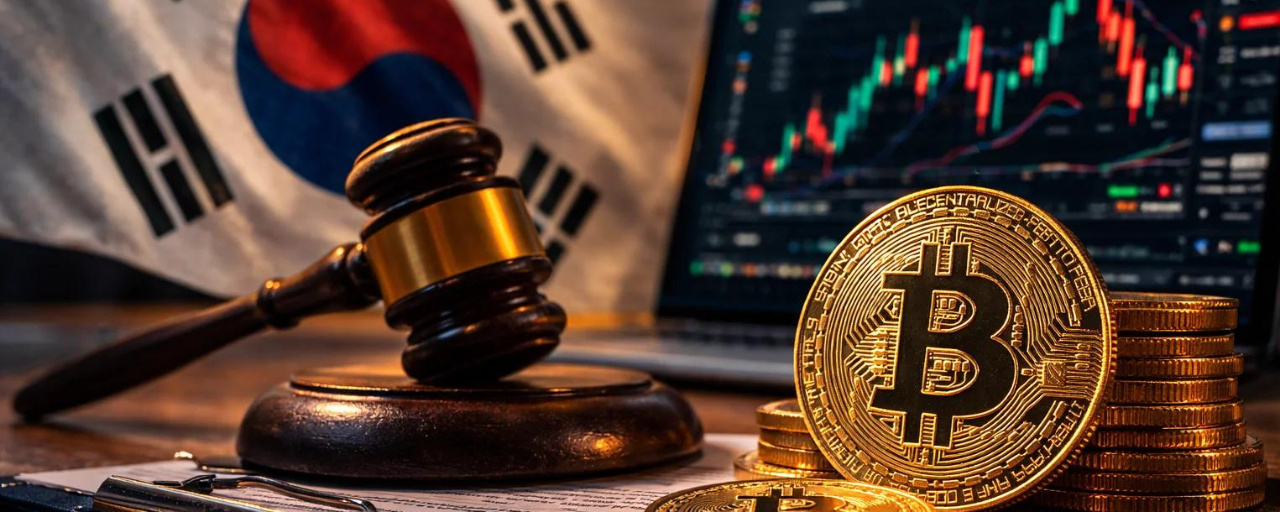
SOUTH KOREA PROPOSES NEW RULES FOR CRYPTO EXCHANGE EMPLOYEES!South Korea is moving toward stricter crypto trading transparency with a proposed rule requiring exchange employees to trade primarily through their own company's platform.
📊 What's changing?
Employees would use one real-name account at a single exchange.Exchange staff would generally trade through their own employer's platform.If an asset isn't listed by their employer, another exchange may be used.Employees must report their crypto transactions to their companies every quarter.Exchanges would need stronger internal controls to prevent insider trading.
🔥 Why does this matter?
The proposal aims to reduce conflicts of interest, improve transparency and prevent unfair trading by people with access to sensitive market information.
⚠️ These are proposed rules, not yet fully implemented laws.
BIG QUESTION: Will stricter regulations make South Korea's crypto market safer, or push traders toward offshore exchanges?
💬 What is your opinion?
#CryptoRegulation #bitcoin #Upbit #Binance
SOUTH KOREA PROPOSES NEW RULES FOR CRYPTO EXCHANGE EMPLOYEES!
South Korea is moving toward stricter crypto trading transparency with a proposed rule requiring exchange employees to trade primarily through their own company's platform.
📊 What's changing?
Employees would use one real-name account at a single exchange.Exchange staff would generally trade through their own employer's platform.If an asset isn't listed by their employer, another exchange may be used.Employees must report their crypto transactions to their companies every quarter.Exchanges would need stronger internal controls to prevent insider trading.
🔥 Why does this matter?
The proposal aims to reduce conflicts of interest, improve transparency and prevent unfair trading by people with access to sensitive market information.
⚠️ These are proposed rules, not yet fully implemented laws.
BIG QUESTION: Will stricter regulations make South Korea's crypto market safer, or push traders toward offshore exchanges?
💬 What is your opinion?
#CryptoRegulation #bitcoin #Upbit #Binance
34
The US Justice Department has initiated its largest ever crackdown targeting 1,000,000,000 in crypto fraud proceeds following directives from the Trump administration.
#DOJ #CryptoRegulation
The US Justice Department has initiated its largest ever crackdown targeting 1,000,000,000 in crypto fraud proceeds following directives from the Trump administration.
#DOJ #CryptoRegulation
#DOJ #CryptoRegulation
3

·
--
🇺🇦 UKRAINE TAKES A BIG STEP TOWARD CRYPTO ADOPTION! 🚀
Ukraine's parliament has passed a law establishing tax rules for cryptocurrency transactions, bringing more clarity to the country's crypto market.
Here are the key changes investors should know:
📌 Tax on Profits Only: Investors will be taxed on their net profit, not the full amount they receive from selling crypto.
📌 Standard Tax Rate – 23%: This includes 18% personal income tax and a 5% military levy.
📌 Special 10% Rate: A preferential rate will apply to certain legacy crypto assets, with a special transition period from July 2027 through December 2028.
📌 Losses Matter: Crypto losses can be carried forward and considered when calculating future taxable profits.
📌 Small Profits Exempt: Annual net crypto profits up to one minimum wage will be tax-exempt.
🔥 This is another important step toward bringing cryptocurrency into a clearer legal and regulatory framework.
The big question is: Will clearer crypto taxation encourage more people and businesses in Ukraine to enter the market?
Is this the kind of crypto regulation other countries should follow? 👀
#Crypto #Ukraine #Bitcoin #CryptoRegulation #Blockchain
Life is Race
·
--
$BIGTIME Claim A Big Gift here 🎁🎁🎁🎁🎁🎁🧧🧧🧧🧧🧧✅✅✅✅✅
2
784
The French Senate rejected a proposal to mandate reporting of self custodied crypto holdings exceeding €100,000. This decision provides significant tax privacy for high net worth holders in the region.
#France #CryptoRegulation
The French Senate rejected a proposal to mandate reporting of self custodied crypto holdings exceeding €100,000. This decision provides significant tax privacy for high net worth holders in the region.
#France #CryptoRegulation
#France #CryptoRegulation
1
·
--
🇪🇺 EU banking watchdog calls for rules on crypto firms offering DeFi lending
The European Banking Authority (EBA) renewed its call for the European Commission to propose rules for crypto firms that steer clients into DeFi, especially lending protocols. MiCA bans interest on e-money tokens, but users can lend stablecoins on DeFi to earn yield and even access tokens not authorized in the EU, such as USDT. Suggested measures include suitability tests, extra risk disclosures, leverage limits, a ban on routing clients to unauthorized stablecoins and certification for DeFi lending protocols.
⭐ If adopted in the MiCA review, stablecoin yield via DeFi in the EU could be squeezed, while DeFi TVL has already dropped from over $110B at the start of 2026 to $67.5B.
#MiCA #DeFi #Stablecoins #CryptoRegulation
1
22

·
--
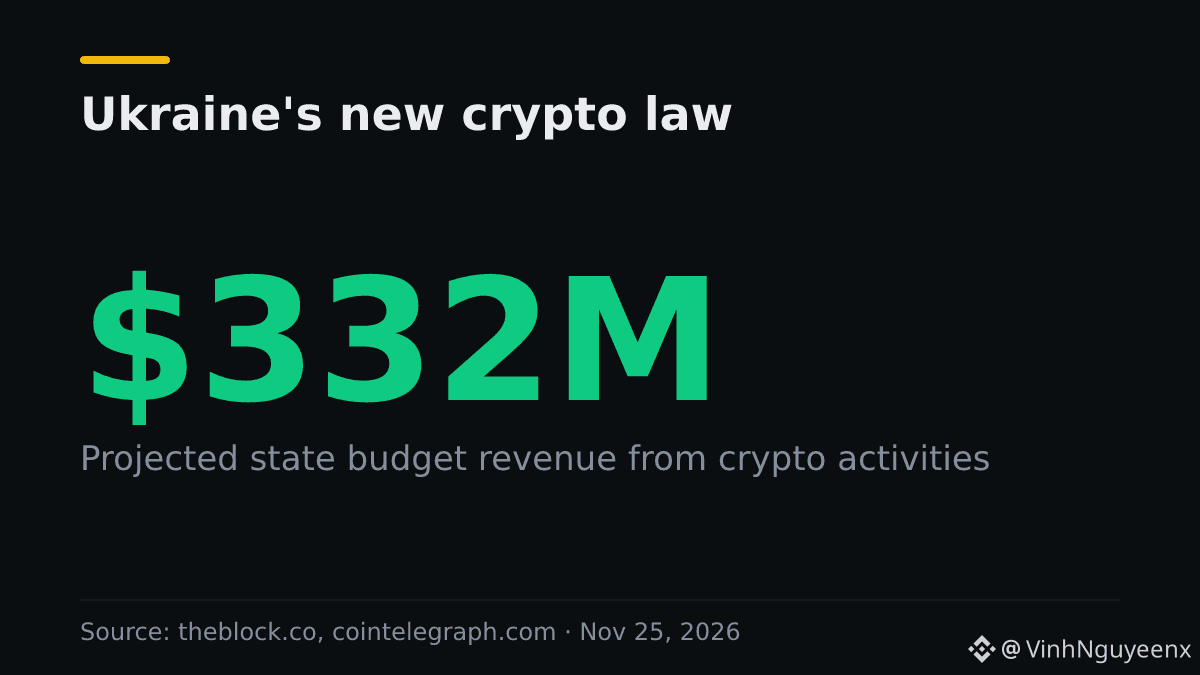
Ukraine just approved a crypto law aiming to pull $332 million into the state budget.
• The bill creates a regulatory framework and tax rules for crypto activities (theblock.co)
• Projected revenue of $332 million will fund public services (theblock.co)
• The same legislation also legalizes crypto trading and sets a 23% profit tax (cointelegraph.com)
The move signals Kyiv’s ambition to become a regional crypto hub while boosting fiscal revenues. It also aligns the country with broader European efforts to regulate digital assets.
Which outcome matters most for Ukraine’s crypto future?
A) Attracting foreign investment
B) Generating state revenue
C) Setting regulatory precedent
$UAH #CryptoRegulation #Ukraine #Blockchain 🚀
⚠️ Not financial advice. DYOR.
1

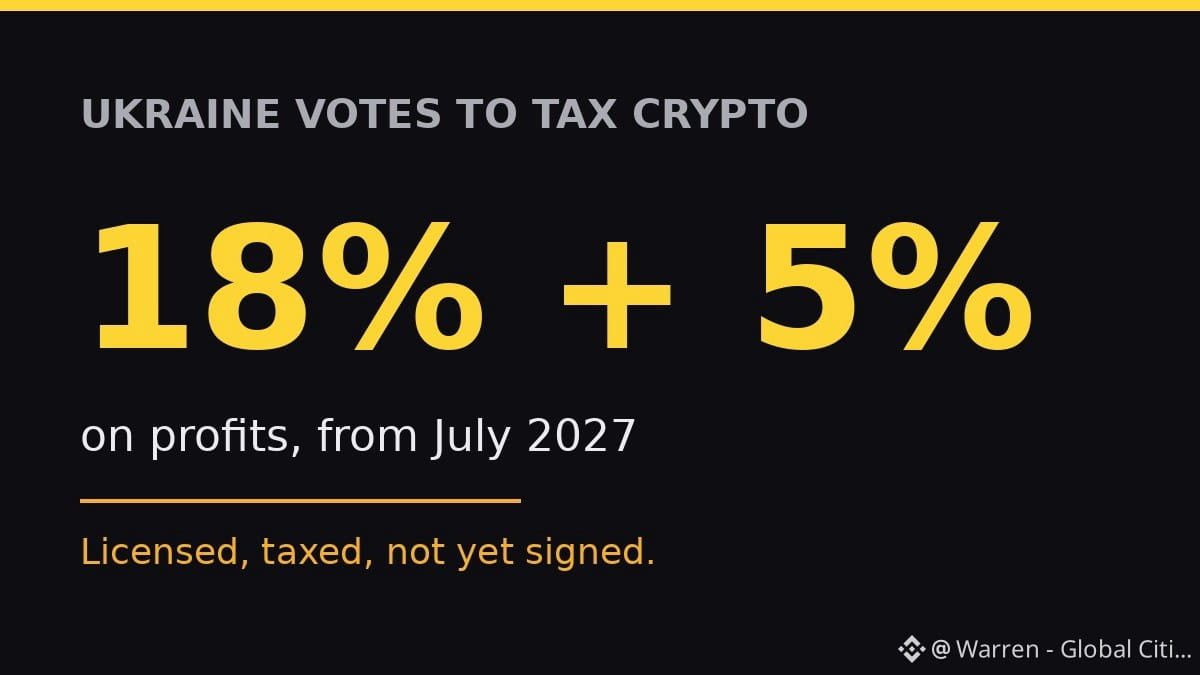
Ukraine's parliament passed its virtual-assets law today: 271 votes for, 8 against. If signed, it takes effect on 1 July 2027. Profits are taxed at 18% income tax plus a 5% military levy, losses carry forward, and swapping one crypto for another isn't taxed. Coins bought before the law get a lower 5% + 5% rate when cashed out to fiat in 2027–2028. Oversight is split between the securities regulator and the National Bank.
So a country at war has decided it would rather license and tax crypto than pretend it isn't there.
What it doesn't prove:
- That it's in force. It still needs the president's signature, and much depends on rules not yet written.
- That the UAH 15 billion a year revenue estimate will show up. That's a lawmaker's projection.
- That people will declare holdings they've kept quiet for years. The lower transition rate is a bet that they will.
The plain reading: the cheap window is a deadline, not a gift.
If you're in Europe or the US: would a lower one-off rate get you to bring old holdings into the open, or does declaring anything feel like the bigger risk?
#Ukraine #CryptoRegulation
Not financial advice. DYOR.
132
Log in to explore more content
Join global crypto users on Binance Square
⚡️ Get latest and useful information about crypto.
💬 Trusted by the world’s largest crypto exchange.
👍 Discover real insights from verified creators.
Email / Phone number
Trending Topics
1
#CanMarketsReboundAfterThanksgiving?
24,478 views
552 Discussing
2
#CouldSpaceX’sOrbitalDataCentersBoostAIChipDemand?
15,552 views
352 Discussing
3
#EvolveAtBinanceBlockchainWeek
669,724 views
7,394 Discussing
4
#CorePCEBeatLiftsFedHikeOdds
177,206 views
1,380 Discussing
5
#BitcoinAndStocksSlipAgainAmidTrump’sTariffPlans
226,483 views
2,172 Discussing
6
#JensenHuangSaysNvidiaDoesn’tNeedASuccessionPlan
106,239 views
1,296 Discussing
7
#NasdaqFuturesSlideMoreThan3%
45,851 views
400 Discussing
8
#USOctoberPCEPriceIndexAt0.3%MoM
51,488 views
403 Discussing
9
#BitcoinETFsPostRecord$4.94BNovemberOutflows
9,955 views
53 Discussing
10
#TetherInvestsInArgentinasLemon
19,780 views
224 Discussing