
#celo
celo
736,073 views
4,171 Discussing
Hot
Latest

·
--
Verified

Article
Celo’s Ethereum Transformation: Why I Believe It Could Shape the Future of Global Crypto PaymentsI believe the future of cryptocurrency will depend on more than technological innovation, market competition, or blockchain performance. Its real success will come from making digital finance faster, more affordable, secure, and accessible to people around the world. This is why I consider Celo’s transition from an independent Layer 1 blockchain to an Ethereum Layer 2 network an important development for the entire crypto industry.
Launched in 2020, Celo was built with a clear mission: bringing financial services to everyone through mobile technology. Unlike blockchain projects focused primarily on trading and speculation, Celo concentrated on financial inclusion, stablecoin payments, and affordable transactions. I believe this practical approach gives the network a unique position in the evolving digital economy.
As the blockchain industry developed, Celo faced challenges associated with operating an independent network, including security infrastructure, liquidity, scalability, and developer adoption. Rather than continuing to compete independently, the project chose to join the broader Ethereum ecosystem. On March 26, 2025, Celo officially completed its transition into an Ethereum Layer 2 network using the Optimism OP Stack, with EigenDA supporting data availability.
From my perspective, this was a strategic decision rather than simply a technical upgrade. It allows Celo to benefit from Ethereum's established infrastructure, developer community, and decentralized finance ecosystem while maintaining its own identity and long-term mission.
One of the developments I find particularly valuable is Celo's focus on affordable transactions and simplified user experiences. Its fee abstraction functionality allows users to pay transaction fees using supported tokens instead of always requiring a separate gas asset. This makes blockchain interactions easier for newcomers and reduces unnecessary complexity.
Celo's mobile-first strategy is another reason I believe its ecosystem deserves attention. Through its partnership with Opera, the network supports MiniPay, a mobile wallet designed to simplify stablecoin payments. Users can send and receive digital money through an accessible interface without needing extensive blockchain knowledge. In November 2026, Opera reported that MiniPay had surpassed 20 million activations across more than 70 countries. I see this as an encouraging sign of the growing demand for accessible digital payment solutions.
Stablecoins remain at the center of Celo's strategy. Assets such as USDT, USDC, and Mento-issued currencies create opportunities for international transfers, digital savings, and everyday payments. For people living in regions with expensive banking services or unstable local currencies, these solutions could provide additional financial flexibility.
I also see significant potential in Celo's expanding decentralized finance ecosystem. Integrations with established platforms such as Aave, Uniswap, Curve, Morpho, and Velodrome bring lending, borrowing, trading, and liquidity opportunities to the network. Its integration with Bridge, owned by Stripe, further strengthens its connection with mainstream stablecoin infrastructure.
Technological development continues to strengthen this vision. The December 2025 Jello hardfork introduced OP Succinct Lite and zero-knowledge-powered fault proofs, advancing transaction verification and the network's Layer 2 architecture.
Of course, I do not believe Celo's success is guaranteed. Competition among Ethereum Layer 2 networks remains intense. Security, liquidity, regulatory uncertainty, and sustainable token economics will all influence its long-term performance. I also believe investors should understand that increasing network adoption does not automatically translate into higher CELO token value.
Looking ahead, I believe Celo's greatest opportunity lies in connecting Ethereum infrastructure, mobile payments, stablecoins, and decentralized finance. If it continues attracting developers, businesses, and genuine users, it could establish a meaningful position in the global digital payments industry.
Ultimately, I see Celo's Ethereum transformation as a strategic bet on practical blockchain adoption. Its real opportunity is not simply processing more transactions but making digital money useful in everyday life. For me, that is what makes Celo's evolution one of the most interesting developments to watch in the future of cryptocurrency.
@celo $CELO #celo .$BTC
{spot}(BTCUSDT)
{future}(CELOUSDT)
Celo’s Ethereum Transformation: Why I Believe It Could Shape the Future of Global Crypto Payments
I believe the future of cryptocurrency will depend on more than technological innovation, market competition, or blockchain performance. Its real success will come from making digital finance faster, more affordable, secure, and accessible to people around the world. This is why I consider Celo’s transition from an independent Layer 1 blockchain to an Ethereum Layer 2 network an important development for the entire crypto industry.
Launched in 2020, Celo was built with a clear mission: bringing financial services to everyone through mobile technology. Unlike blockchain projects focused primarily on trading and speculation, Celo concentrated on financial inclusion, stablecoin payments, and affordable transactions. I believe this practical approach gives the network a unique position in the evolving digital economy.
As the blockchain industry developed, Celo faced challenges associated with operating an independent network, including security infrastructure, liquidity, scalability, and developer adoption. Rather than continuing to compete independently, the project chose to join the broader Ethereum ecosystem. On March 26, 2025, Celo officially completed its transition into an Ethereum Layer 2 network using the Optimism OP Stack, with EigenDA supporting data availability.
From my perspective, this was a strategic decision rather than simply a technical upgrade. It allows Celo to benefit from Ethereum's established infrastructure, developer community, and decentralized finance ecosystem while maintaining its own identity and long-term mission.
One of the developments I find particularly valuable is Celo's focus on affordable transactions and simplified user experiences. Its fee abstraction functionality allows users to pay transaction fees using supported tokens instead of always requiring a separate gas asset. This makes blockchain interactions easier for newcomers and reduces unnecessary complexity.
Celo's mobile-first strategy is another reason I believe its ecosystem deserves attention. Through its partnership with Opera, the network supports MiniPay, a mobile wallet designed to simplify stablecoin payments. Users can send and receive digital money through an accessible interface without needing extensive blockchain knowledge. In November 2026, Opera reported that MiniPay had surpassed 20 million activations across more than 70 countries. I see this as an encouraging sign of the growing demand for accessible digital payment solutions.
Stablecoins remain at the center of Celo's strategy. Assets such as USDT, USDC, and Mento-issued currencies create opportunities for international transfers, digital savings, and everyday payments. For people living in regions with expensive banking services or unstable local currencies, these solutions could provide additional financial flexibility.
I also see significant potential in Celo's expanding decentralized finance ecosystem. Integrations with established platforms such as Aave, Uniswap, Curve, Morpho, and Velodrome bring lending, borrowing, trading, and liquidity opportunities to the network. Its integration with Bridge, owned by Stripe, further strengthens its connection with mainstream stablecoin infrastructure.
Technological development continues to strengthen this vision. The December 2025 Jello hardfork introduced OP Succinct Lite and zero-knowledge-powered fault proofs, advancing transaction verification and the network's Layer 2 architecture.
Of course, I do not believe Celo's success is guaranteed. Competition among Ethereum Layer 2 networks remains intense. Security, liquidity, regulatory uncertainty, and sustainable token economics will all influence its long-term performance. I also believe investors should understand that increasing network adoption does not automatically translate into higher CELO token value.
Looking ahead, I believe Celo's greatest opportunity lies in connecting Ethereum infrastructure, mobile payments, stablecoins, and decentralized finance. If it continues attracting developers, businesses, and genuine users, it could establish a meaningful position in the global digital payments industry.
Ultimately, I see Celo's Ethereum transformation as a strategic bet on practical blockchain adoption. Its real opportunity is not simply processing more transactions but making digital money useful in everyday life. For me, that is what makes Celo's evolution one of the most interesting developments to watch in the future of cryptocurrency.
@celo $CELO #celo .$BTC
Evangeline_BTC:
Great analysis of Celo’s Ethereum transition and what it means for the future of crypto.
3
1
6
296


·
--
#Ad
🚨 WHAT IS CELO AND WHAT IS IT BUILT FOR?
@celo is an Ethereum Layer 2 built on the OP Stack. It is fully EVM-compatible, and its focus is stablecoins, local currencies and mobile users.
$CELO is the network's native currency. It also works as an ERC-20 token without wrapping, and holders can take part in governance.
I don't currently hold any CELO.
What #CELO offers?
✅ Fees usually under 1 cent
⚠️ Fees can change, and low fees don't protect you from price drops.
✅ 1-second blocks
⚠️ Fast doesn't mean reversible. A transfer to the wrong address is usually gone.
✅ Fees payable in several tokens
⚠️ Depends on which tokens and apps support it; smart contract risk stays.
✅ Native stablecoins like USDm, EURm, BRLm, KESm
⚠️ Stablecoins can lose their peg.
✅ Mobile reach through MiniPay
⚠️ Phone and wallet security is on you. Lose the keys, lose the funds.
✅ Governance with CELO
⚠️ Large holders can have more voting power, and votes can change network rules.
🎪 #CeloFestival TRADING Contest
Visit [https://www.binance.com/en/activity/trading-competition/ExCELOTradingFestival2026?ref=LONG2026](https://www.binance.com/en/activity/trading-competition/ExCELOTradingFestival2026?ref=LONG2026) to participate in the event. Through this event, existing users will receive a share of 75 BNB based on their trading volume.
New users can also register during the event period and, after signing up, deposit $CELO into the Binance Simple Earn section to receive a share of 70 BNB.
You can check your eligibility by visiting the event page. The deadline is December 20 Hurry up!
This content is marketing material. It does not constitute investment, financial or trading advice, and nothing in it is a recommendation to buy or sell any digital asset.
#Ad
🚨 WHAT IS CELO AND WHAT IS IT BUILT FOR?
@celo is an Ethereum Layer 2 built on the OP Stack. It is fully EVM-compatible, and its focus is stablecoins, local currencies and mobile users.
$CELO is the network's native currency. It also works as an ERC-20 token without wrapping, and holders can take part in governance.
I don't currently hold any CELO.
What #CELO offers?
✅ Fees usually under 1 cent
⚠️ Fees can change, and low fees don't protect you from price drops.
✅ 1-second blocks
⚠️ Fast doesn't mean reversible. A transfer to the wrong address is usually gone.
✅ Fees payable in several tokens
⚠️ Depends on which tokens and apps support it; smart contract risk stays.
✅ Native stablecoins like USDm, EURm, BRLm, KESm
⚠️ Stablecoins can lose their peg.
✅ Mobile reach through MiniPay
⚠️ Phone and wallet security is on you. Lose the keys, lose the funds.
✅ Governance with CELO
⚠️ Large holders can have more voting power, and votes can change network rules.
🎪 #CeloFestival TRADING Contest
Visit https://www.binance.com/en/activity/trading-competition/ExCELOTradingFestival2026?ref=LONG2026 to participate in the event. Through this event, existing users will receive a share of 75 BNB based on their trading volume.
New users can also register during the event period and, after signing up, deposit $CELO into the Binance Simple Earn section to receive a share of 70 BNB.
You can check your eligibility by visiting the event page. The deadline is December 20 Hurry up!
This content is marketing material. It does not constitute investment, financial or trading advice, and nothing in it is a recommendation to buy or sell any digital asset.

1
19
1.8k

·
--
Verified
Article
Celo at Six: When Blockchain Adoption Becomes Real-World UtilitySix years is a meaningful milestone for any blockchain, but what matters more is what has been built during that time.
Celo launched its mainnet on Earth Day with a clear focus: making blockchain technology more accessible and useful in everyday life. Today, its journey reflects how much the ecosystem has evolved, especially around stablecoin payments.
One thing that stands out to me is the network's growing transaction activity. Celo has processed more than 1.27 billion transactions, with peak daily active users reaching 840,000. These numbers suggest that blockchain adoption is not only about trading tokens. Payments, transfers and everyday financial activity are also important parts of the picture.
The transition to an Ethereum Layer 2 is another important step. It brings $CELO closer to Ethereum's ecosystem while maintaining its focus on fast, low-cost transactions. For stablecoin users, lower transaction costs can make a real difference, particularly when sending smaller amounts.
Another interesting development is the growing MiniPay ecosystem.
Opera is offering $1 million in $CELO grants to developers building on MiniPay, its self-custodial stablecoin wallet, which has reportedly surpassed 15 million users and 400 million transactions.
There is also a CELObratory campaign offering 16% cashback to eligible users who purchase $6 worth of CELO through their MiniPay wallets.
For me, the bigger story here is the connection between infrastructure and actual usage. A blockchain can have impressive technology, but its long-term value also depends on whether people find practical reasons to use it.
Celo's stablecoin growth, MiniPay expansion and developer incentives are all worth watching. The reported increase in network revenue and stablecoin activity following its Layer 2 transition adds another interesting dimension to that progress.
Of course, continued adoption, sustainable activity and developer growth will matter more than milestone numbers alone.
Celo's six-year journey raises an important question for the wider crypto industry: Can blockchain become part of everyday financial life rather than remaining something people only use for speculation?
That is the part of Celo's progress I find most interesting.
$CELO #CELO @celo
Celo at Six: When Blockchain Adoption Becomes Real-World Utility
Six years is a meaningful milestone for any blockchain, but what matters more is what has been built during that time.
Celo launched its mainnet on Earth Day with a clear focus: making blockchain technology more accessible and useful in everyday life. Today, its journey reflects how much the ecosystem has evolved, especially around stablecoin payments.
One thing that stands out to me is the network's growing transaction activity. Celo has processed more than 1.27 billion transactions, with peak daily active users reaching 840,000. These numbers suggest that blockchain adoption is not only about trading tokens. Payments, transfers and everyday financial activity are also important parts of the picture.
The transition to an Ethereum Layer 2 is another important step. It brings $CELO closer to Ethereum's ecosystem while maintaining its focus on fast, low-cost transactions. For stablecoin users, lower transaction costs can make a real difference, particularly when sending smaller amounts.
Another interesting development is the growing MiniPay ecosystem.
Opera is offering $1 million in $CELO grants to developers building on MiniPay, its self-custodial stablecoin wallet, which has reportedly surpassed 15 million users and 400 million transactions.
There is also a CELObratory campaign offering 16% cashback to eligible users who purchase $6 worth of CELO through their MiniPay wallets.
For me, the bigger story here is the connection between infrastructure and actual usage. A blockchain can have impressive technology, but its long-term value also depends on whether people find practical reasons to use it.
Celo's stablecoin growth, MiniPay expansion and developer incentives are all worth watching. The reported increase in network revenue and stablecoin activity following its Layer 2 transition adds another interesting dimension to that progress.
Of course, continued adoption, sustainable activity and developer growth will matter more than milestone numbers alone.
Celo's six-year journey raises an important question for the wider crypto industry: Can blockchain become part of everyday financial life rather than remaining something people only use for speculation?
That is the part of Celo's progress I find most interesting.
$CELO #CELO @celo
AloNe72:
very interesting and beautiful information about celo
2
1
10
1.5k

·
--
Verified

Article
Celo is delivering utilityWhilst many blockchains spend much time in the public eye analysing scalability, TPS and looking at a project’s ecosystem and development community, it seems that Celo has chosen to focus on solving a very different issue – how to enable easy access to digital money even for those who are not particularly interested in blockchain.
I think this is a fascinating area.
If an individual is paying someone, receiving payments or simply storing digital money on their phone then, usually, people will not be overly concerned by which underlying technology is being used. Rather, what is key is that the money is successfully sent (or received), and at a reasonable price. Ease of use is also key.
Celo has clearly made great strides in this area by developing a mobile focus, and creating a stablecoin offering.
Nevertheless, alongside analysing the extent to which Celo has been adopted, it is also crucial to consider the relationship between activity on the Celo blockchain and the value of its token $CELO.
MiniPay could be Celo’s key differentiator
As I analysed Celo’s offering, one of the initial areas I noticed was MiniPay.
MiniPay is a self-custody stablecoin wallet which is embedded within the Opera browser suite. It was initially targeted at mobile users in emerging markets.
On November 19, it was revealed that MiniPay has seen over 20 million wallets activated. It has executed in excess of 600 million transactions and cumulative transaction value has exceeded $2.3bn. This has occurred in 70+ countries.
Whilst these are impressive statistics, what is even more interesting is how this wide reaching user base has been reached.
Persuading people to download and use a crypto wallet, educate them about seed phrases and then encourage them to purchase and utilise tokens can be a non-trivial process.
MiniPay has sought to overcome various of these issues.
Recently, MiniPay transitioned to using Privy’s infrastructure (owned by Stripe). As a result, alongside email and social media logins, users can also log in to their MiniPay wallets using passkeys. Unlike traditional wallets, individuals therefore do not need to look after their own seed phrase. Crucially, MiniPay highlights that self-custody is still in place and so users maintain ownership of their money.
I believe that this is a key step in furthering crypto adoption.
It should not be necessary for people to become blockchain experts in order to engage with digital money.
It is also important to recognise that 20 million MiniPay wallet activations does not necessarily mean that 20 million people are continually using the service. User engagement and payment behaviour are much more important than activation numbers.
Celo’s Stablecoins Are More Important Than Its Promotion
I wanted to assess whether or not Celo’s adoption was further evidenced by metrics relating to network activity.
While reviewing Growthepie’s data from November 25, I discovered some interesting information.
Across the month, Celo executed around 19.41 million stablecoin transactions. This ranked it as the most active Ethereum L2 in this respect.
Further, Celo executed c.3.91 million stablecoin transactions per week.
Comparing this with Base, which was the most active in terms of daily and weekly stablecoin transactions, we can see that Celo’s stablecoin supply is much lower. It sits at around $4.6 billion in contrast to Celo’s c.$160 million.
Whilst I would not contend that Celo is the most active in all aspects of stablecoins, I do believe that it has established itself as a strong player in this area, particularly in the medium and long term.
Indeed, stablecoins are not just another type of crypto asset. They facilitate a variety of functions including payments, receiving payments, remittances, and currency conversion. Given that Celo has been designed for facilitating payments, these may be even more relevant than simply analysing the number of speculative tokens on the network.
Nevertheless, in addition to analysing transaction data, we also need to understand the economic value that is being generated.
The Ethereum L2 Transition Was Greater Than Just Infrastructure Related
I was also keen to analyse Celo’s decision to transition from being a standalone Layer 1 blockchain to an Ethereum Layer 2.
This was officially completed on March 26 2025.
Celo has adopted Optimism’s OP Stack and EigenDA for data availability. As a result, Celo is now more Ethereum compatible, and can benefit from Ethereum’s existing infrastructure and ecosystem.
Furthermore, block times have been shortened to approximately one second. Simultaneously, Celo continues to emphasise affordability in transactions.
I consider that this was a highly strategic move.
By more closely aligning itself with Ethereum, Celo has avoided seeking to establish and compete within its own standalone blockchain ecosystem. It has, however, still been able to maintain its original focus of providing mobile payment and financial inclusion functionality.
Consequently, developers can continue to utilise widely available EVM tools. At the same time, Celo can continue to hone in on its particular area of application.
Despite this, I do not think that automatically transitioning to being an Ethereum L2 is a guaranteed route to success.
There are already a number of well established L2 ecosystems which are also vying for developers, users and liquidity.
Celo must effectively demonstrate why payment related applications should utilise its blockchain in preference to simply seeing it as another Ethereum L2 option.
What Happens To The Money?
I believe that this is arguably the most important element of my analysis.
Celo utilises a process, CELOccelerate, to tie together network generated money and its token.
According to its money model, a proportion of sequencer generated money (after relevant business expenses and profit sharing) is used to buy CELO for the Community Fund.
Importantly, users can also pay for transactions using stablecoins. These can then themselves be exchanged for CELO.
I like this aspect of Celo as it ties together the actual usage of the network and the demand for its token.
Think about this.
Whilst an individual may send USDT on Celo, they are not necessarily required to own CELO in order to pay for their transaction. However, the network is still able to utilise sequencer money derived from stablecoins to buy CELO.
This is a fascinating interplay between money usage and the token economy.
Nevertheless, I would be careful not to overstate this impact.
Whilst the network does generate money, this is still relatively limited compared to the level of stablecoin usage on Celo.
According to Growthepie’s most recent data, the Celo chain earned c.$2,700 per day. Furthermore, DeFiLlama reported that Celo’s DeFi TVL was c.$12.74 million on November 25. So, once again, I consider it vital that Celo addresses this issue.
Although high levels of network transactions are a positive factor, this alone is not sufficient to generate large amounts of money or substantial value accrual for the token.
The Debate Around Token Burning
I was also interested to learn of another development.
CGP-257 is a governance proposal which suggests that 25% of future net L2 sequencer money will be permanently burned in the form of CELO. The remaining 75% will continue to go into the Community Fund.
This is an extremely interesting proposal. And as Celo continues to develop, it is increasingly pertinent to ask:
Should all the economic value that is generated by a network be re-invested back into the ecosystem? Or should some of it be utilised for permanently reducing the supply of a network’s token?
There are strong arguments for both of these approaches.
Re-investing money can be used to further develop a network, for example by supporting innovation (developers), liquidity and infrastructure. Supply reduction is also beneficial as it permanently decreases the quantity of tokens in circulation. However, the economic impact of this will be influenced by the level of money that a network is able to generate.
Importantly, as of November 26, the CGP-257 proposal is still shown as being in ‘draft form’ in its repository. Thus, the 25% permanent CELO burning should as yet not be considered to have been enacted.
Honestly, I would welcome greater transparency regarding this situation. At present, the use of the term ‘burning’ appears to be more for aesthetic purposes within the tokenomics narrative.
Frax Integration Offers Further Fascinating Potential
Recently, Celo has also added Frax to its ecosystem.
On November 24, Celo shared that Frax had launched its range of assets onto the Celo blockchain, which includes frxUSD, sfrxUSD, WFRAX, frxETH and sfrxETH.
There is also a pleasing mutual commitment between Celo and Frax.
Celo Core Co. intends to allocate up to $9 million of its reserves to generate yield on sfrxUSD. Additionally, Frax has indicated that it will acquire and hold native CELO.
I consider that this is a very positive development as it further diversifies the financial offerings within Celo’s ecosystem.
Alongside money payment functionality, a mature financial ecosystem also requires solutions for asset storage, and for accessing and utilising liquidity.
It will be interesting to see if these new integrations result in sustained engagement, and are not merely accompanied by a press release and a temporary spike in attention.
What I Think Celo Still Needs To Demonstrate
Despite the above, I feel that Celo still has further areas to address.
Primarily, it is crucial that MiniPay’s user base translates into actual engagement. Although activation numbers are a good indicator, in the longer term, it is user engagement and transaction behaviour which are of greater importance.
Secondly, Celo needs to further enhance the economic value that is generated by its network. Although millions of transactions are encouraging, the money generation element also needs to be developed.
Thirdly, there should be a firmer association between CELO and the development of Celo’s ecosystem. Although token buy-backs and potential burning are interesting elements, it will be important to analyse the extent to which these occur, alongside their governance and implementation.
Finally, I think that further diversification within Celo’s ecosystem is key. Although MiniPay and Opera offer a strong distribution pathway, Celo should continue to attract external apps, developers and payment services.
A network is significantly more robust if its development is not unduly dependent on one application or partner.
Conclusion
Aside from $CELO’s price, I am intrigued by Celo for a number of other reasons.
It is targeting a real world issue that many people already face – namely the ease with which money can be sent and stored.
Alongside MiniPay, Celo’s stablecoins and Ethereum L2 status, and new integrations, it is evident that Celo is building around a genuine application, and not just one based on speculative interest.
However, I do think it is important to recognise that a blockchain can gain utility without its token necessarily appreciating in value.
This is where I feel that Celo currently struggles.
Having already shown strong evidence of adoption, Celo now needs to effectively demonstrate that it can not only generate sustainable money, but also further develop its ecosystem. It must also ensure that tangible value is provided for CELO holders and engagers.
I am especially keen to see how MiniPay progresses in the coming year. Likewise, I am interested in observing whether Celo is able to develop its money generation in line with its growing stablecoin usage.
Can Celo successfully convert its real world stablecoin payment functionality into a lasting economic benefit for $CELO? Or will network adoption continue to outpace the token’s value capture capability?
I consider that it will be far more impactful for Celo to successfully address this than to simply achieve yet another impressive user activation figure.
$CELO #CELO
{future}(CELOUSDT)
Celo is delivering utility
Whilst many blockchains spend much time in the public eye analysing scalability, TPS and looking at a project’s ecosystem and development community, it seems that Celo has chosen to focus on solving a very different issue – how to enable easy access to digital money even for those who are not particularly interested in blockchain.
I think this is a fascinating area.
If an individual is paying someone, receiving payments or simply storing digital money on their phone then, usually, people will not be overly concerned by which underlying technology is being used. Rather, what is key is that the money is successfully sent (or received), and at a reasonable price. Ease of use is also key.
Celo has clearly made great strides in this area by developing a mobile focus, and creating a stablecoin offering.
Nevertheless, alongside analysing the extent to which Celo has been adopted, it is also crucial to consider the relationship between activity on the Celo blockchain and the value of its token $CELO .
MiniPay could be Celo’s key differentiator
As I analysed Celo’s offering, one of the initial areas I noticed was MiniPay.
MiniPay is a self-custody stablecoin wallet which is embedded within the Opera browser suite. It was initially targeted at mobile users in emerging markets.
On November 19, it was revealed that MiniPay has seen over 20 million wallets activated. It has executed in excess of 600 million transactions and cumulative transaction value has exceeded $2.3bn. This has occurred in 70+ countries.
Whilst these are impressive statistics, what is even more interesting is how this wide reaching user base has been reached.
Persuading people to download and use a crypto wallet, educate them about seed phrases and then encourage them to purchase and utilise tokens can be a non-trivial process.
MiniPay has sought to overcome various of these issues.
Recently, MiniPay transitioned to using Privy’s infrastructure (owned by Stripe). As a result, alongside email and social media logins, users can also log in to their MiniPay wallets using passkeys. Unlike traditional wallets, individuals therefore do not need to look after their own seed phrase. Crucially, MiniPay highlights that self-custody is still in place and so users maintain ownership of their money.
I believe that this is a key step in furthering crypto adoption.
It should not be necessary for people to become blockchain experts in order to engage with digital money.
It is also important to recognise that 20 million MiniPay wallet activations does not necessarily mean that 20 million people are continually using the service. User engagement and payment behaviour are much more important than activation numbers.
Celo’s Stablecoins Are More Important Than Its Promotion
I wanted to assess whether or not Celo’s adoption was further evidenced by metrics relating to network activity.
While reviewing Growthepie’s data from November 25, I discovered some interesting information.
Across the month, Celo executed around 19.41 million stablecoin transactions. This ranked it as the most active Ethereum L2 in this respect.
Further, Celo executed c.3.91 million stablecoin transactions per week.
Comparing this with Base, which was the most active in terms of daily and weekly stablecoin transactions, we can see that Celo’s stablecoin supply is much lower. It sits at around $4.6 billion in contrast to Celo’s c.$160 million.
Whilst I would not contend that Celo is the most active in all aspects of stablecoins, I do believe that it has established itself as a strong player in this area, particularly in the medium and long term.
Indeed, stablecoins are not just another type of crypto asset. They facilitate a variety of functions including payments, receiving payments, remittances, and currency conversion. Given that Celo has been designed for facilitating payments, these may be even more relevant than simply analysing the number of speculative tokens on the network.
Nevertheless, in addition to analysing transaction data, we also need to understand the economic value that is being generated.
The Ethereum L2 Transition Was Greater Than Just Infrastructure Related
I was also keen to analyse Celo’s decision to transition from being a standalone Layer 1 blockchain to an Ethereum Layer 2.
This was officially completed on March 26 2025.
Celo has adopted Optimism’s OP Stack and EigenDA for data availability. As a result, Celo is now more Ethereum compatible, and can benefit from Ethereum’s existing infrastructure and ecosystem.
Furthermore, block times have been shortened to approximately one second. Simultaneously, Celo continues to emphasise affordability in transactions.
I consider that this was a highly strategic move.
By more closely aligning itself with Ethereum, Celo has avoided seeking to establish and compete within its own standalone blockchain ecosystem. It has, however, still been able to maintain its original focus of providing mobile payment and financial inclusion functionality.
Consequently, developers can continue to utilise widely available EVM tools. At the same time, Celo can continue to hone in on its particular area of application.
Despite this, I do not think that automatically transitioning to being an Ethereum L2 is a guaranteed route to success.
There are already a number of well established L2 ecosystems which are also vying for developers, users and liquidity.
Celo must effectively demonstrate why payment related applications should utilise its blockchain in preference to simply seeing it as another Ethereum L2 option.
What Happens To The Money?
I believe that this is arguably the most important element of my analysis.
Celo utilises a process, CELOccelerate, to tie together network generated money and its token.
According to its money model, a proportion of sequencer generated money (after relevant business expenses and profit sharing) is used to buy CELO for the Community Fund.
Importantly, users can also pay for transactions using stablecoins. These can then themselves be exchanged for CELO.
I like this aspect of Celo as it ties together the actual usage of the network and the demand for its token.
Think about this.
Whilst an individual may send USDT on Celo, they are not necessarily required to own CELO in order to pay for their transaction. However, the network is still able to utilise sequencer money derived from stablecoins to buy CELO.
This is a fascinating interplay between money usage and the token economy.
Nevertheless, I would be careful not to overstate this impact.
Whilst the network does generate money, this is still relatively limited compared to the level of stablecoin usage on Celo.
According to Growthepie’s most recent data, the Celo chain earned c.$2,700 per day. Furthermore, DeFiLlama reported that Celo’s DeFi TVL was c.$12.74 million on November 25. So, once again, I consider it vital that Celo addresses this issue.
Although high levels of network transactions are a positive factor, this alone is not sufficient to generate large amounts of money or substantial value accrual for the token.
The Debate Around Token Burning
I was also interested to learn of another development.
CGP-257 is a governance proposal which suggests that 25% of future net L2 sequencer money will be permanently burned in the form of CELO. The remaining 75% will continue to go into the Community Fund.
This is an extremely interesting proposal. And as Celo continues to develop, it is increasingly pertinent to ask:
Should all the economic value that is generated by a network be re-invested back into the ecosystem? Or should some of it be utilised for permanently reducing the supply of a network’s token?
There are strong arguments for both of these approaches.
Re-investing money can be used to further develop a network, for example by supporting innovation (developers), liquidity and infrastructure. Supply reduction is also beneficial as it permanently decreases the quantity of tokens in circulation. However, the economic impact of this will be influenced by the level of money that a network is able to generate.
Importantly, as of November 26, the CGP-257 proposal is still shown as being in ‘draft form’ in its repository. Thus, the 25% permanent CELO burning should as yet not be considered to have been enacted.
Honestly, I would welcome greater transparency regarding this situation. At present, the use of the term ‘burning’ appears to be more for aesthetic purposes within the tokenomics narrative.
Frax Integration Offers Further Fascinating Potential
Recently, Celo has also added Frax to its ecosystem.
On November 24, Celo shared that Frax had launched its range of assets onto the Celo blockchain, which includes frxUSD, sfrxUSD, WFRAX, frxETH and sfrxETH.
There is also a pleasing mutual commitment between Celo and Frax.
Celo Core Co. intends to allocate up to $9 million of its reserves to generate yield on sfrxUSD. Additionally, Frax has indicated that it will acquire and hold native CELO.
I consider that this is a very positive development as it further diversifies the financial offerings within Celo’s ecosystem.
Alongside money payment functionality, a mature financial ecosystem also requires solutions for asset storage, and for accessing and utilising liquidity.
It will be interesting to see if these new integrations result in sustained engagement, and are not merely accompanied by a press release and a temporary spike in attention.
What I Think Celo Still Needs To Demonstrate
Despite the above, I feel that Celo still has further areas to address.
Primarily, it is crucial that MiniPay’s user base translates into actual engagement. Although activation numbers are a good indicator, in the longer term, it is user engagement and transaction behaviour which are of greater importance.
Secondly, Celo needs to further enhance the economic value that is generated by its network. Although millions of transactions are encouraging, the money generation element also needs to be developed.
Thirdly, there should be a firmer association between CELO and the development of Celo’s ecosystem. Although token buy-backs and potential burning are interesting elements, it will be important to analyse the extent to which these occur, alongside their governance and implementation.
Finally, I think that further diversification within Celo’s ecosystem is key. Although MiniPay and Opera offer a strong distribution pathway, Celo should continue to attract external apps, developers and payment services.
A network is significantly more robust if its development is not unduly dependent on one application or partner.
Conclusion
Aside from $CELO ’s price, I am intrigued by Celo for a number of other reasons.
It is targeting a real world issue that many people already face – namely the ease with which money can be sent and stored.
Alongside MiniPay, Celo’s stablecoins and Ethereum L2 status, and new integrations, it is evident that Celo is building around a genuine application, and not just one based on speculative interest.
However, I do think it is important to recognise that a blockchain can gain utility without its token necessarily appreciating in value.
This is where I feel that Celo currently struggles.
Having already shown strong evidence of adoption, Celo now needs to effectively demonstrate that it can not only generate sustainable money, but also further develop its ecosystem. It must also ensure that tangible value is provided for CELO holders and engagers.
I am especially keen to see how MiniPay progresses in the coming year. Likewise, I am interested in observing whether Celo is able to develop its money generation in line with its growing stablecoin usage.
Can Celo successfully convert its real world stablecoin payment functionality into a lasting economic benefit for $CELO ? Or will network adoption continue to outpace the token’s value capture capability?
I consider that it will be far more impactful for Celo to successfully address this than to simply achieve yet another impressive user activation figure.
$CELO #CELO
Brock BNB:
Celo has clearly made great strides in this area by developing a mobile focus, and creating a stablecoin offering.
4
2
11
1.2k

·
--
Article
Celo Is Moving to Ethereum L2, But I'm More Interested in What Happens NextI don't know about you, but crypto is getting exhausting sometimes.
Every day there's a new project, a new narrative, a new coin that people suddenly believe is going to change everything. A few months ago everyone was obsessed with AI. Before that, it was DeFi, NFTs, gaming and a hundred other things I probably don't even remember anymore.
The cycle just keeps repeating.
People get excited, influencers start posting threads, projects make big promises, and everyone suddenly becomes an expert. Then the market changes direction and most of those conversations disappear.
I've been around long enough to stop getting excited about every new announcement.
At this point, I don't really care how many partnerships a project announces or how impressive its technology sounds. I want to know something much simpler: are people actually using it? Does it solve a problem that exists outside crypto Twitter?
That's what made me look a little closer at Celo.
Its move from an independent Layer 1 to an Ethereum Layer 2 is obviously a big change. But honestly, the migration itself isn't what interests me the most. We've seen enough blockchain launches and upgrades to know that changing infrastructure doesn't automatically bring users.
What interests me is what Celo has been trying to do all along.
Payments. Stablecoins. Making it easier for people to move money without dealing with unnecessary costs and complications.
It might not sound like the most exciting narrative in crypto, but it's a real problem.
Think about someone who regularly sends or receives money across borders. Or someone who wants access to digital dollars without dealing with a complicated banking system. These aren't imaginary problems created to give another blockchain a reason to exist.
People actually need better ways to move money.
And I think crypto sometimes spends so much time chasing the next big thing that it forgets how useful something as simple as a cheap, reliable payment system could be.
Celo seems to understand that.
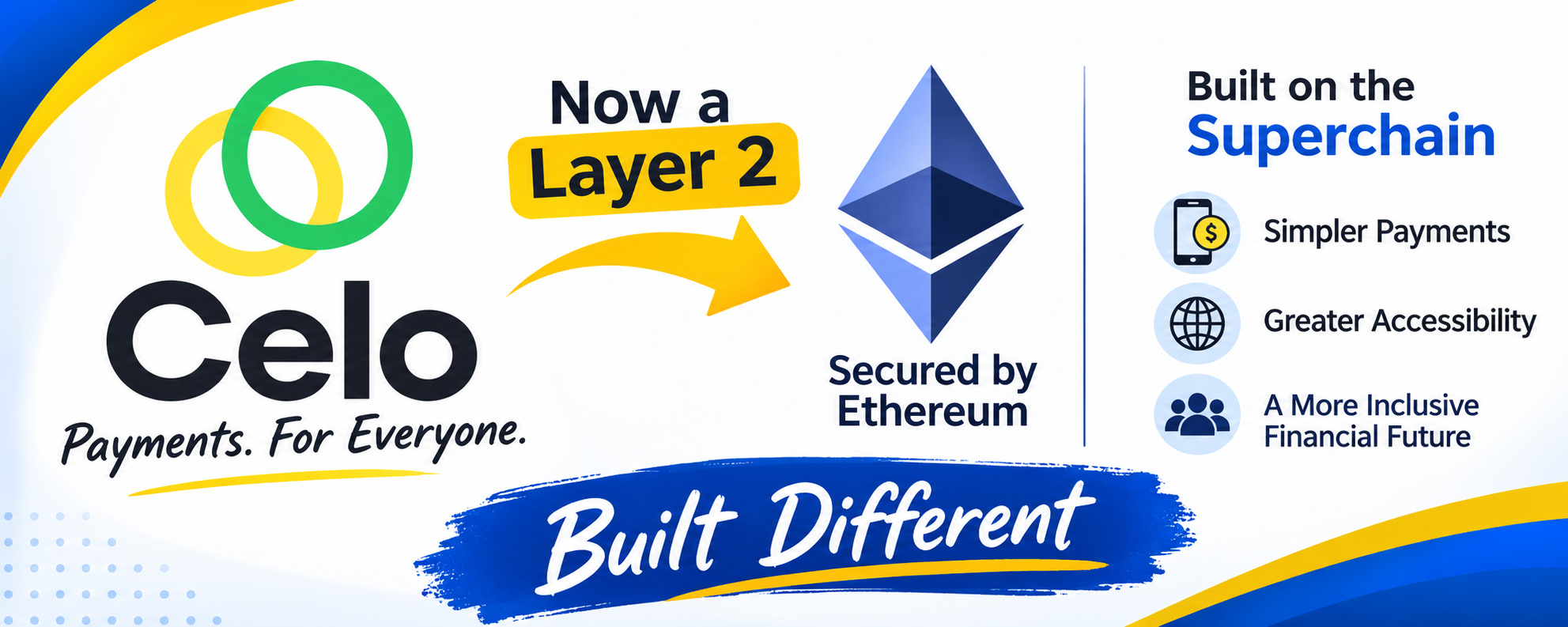
Now, the move to Ethereum L2 is an interesting decision. By moving to the OP Stack, Celo becomes part of the broader Superchain ecosystem and gets closer to Ethereum's existing developer and infrastructure community.
I can understand why the team went in this direction.
Building everything independently takes time, money and resources. Ethereum already has a strong ecosystem, so becoming part of that environment could make things easier in the long run.
But let's not get carried away.
Being an Ethereum Layer 2 doesn't suddenly make Celo special. There are already plenty of Layer 2 networks competing for attention, developers and liquidity. Everyone has a story about why their chain deserves to win.
The difficult part isn't launching another network. It's convincing people to actually use it.
That's where I think Celo needs to prove itself.
I would rather see someone using Celo to send money every week than see another announcement about how many transactions the network can process. Give me real users over impressive-looking statistics.
And this is also why MiniPay is worth keeping an eye on.
The idea of bringing stablecoin payments into a simple mobile experience makes sense. Most people don't want to learn how blockchains work. They don't want to worry about bridges, gas tokens or which network they're connected to.
They just want something that works.
If Celo can make that experience simple enough for someone who has never touched crypto before, that's where things could get interesting.
Of course, getting someone to download a wallet is one thing. Getting them to use it regularly is another.
We've seen projects attract thousands of users through rewards and incentives. Then the rewards disappear, and so do the users.
I don't want to see Celo become another example of that.
The real question is whether people will continue using its payment products when there's nothing to farm, no campaign running and no financial incentive to participate.
If the answer is yes, that's meaningful adoption.
If not, then we probably need to be more careful about how we interpret the numbers.
There's also something else I keep thinking about: CELO itself.
Because let's be honest, investors shouldn't automatically assume that a useful blockchain means a valuable token.
These are two different things.
CELO has governance and economic roles within the ecosystem, and the project has been working on connecting network activity and revenue more closely to the token's economics.
That's interesting, but I still have questions.
Where does sustainable demand come from? How much value does actual network usage create for the token? And does that value remain meaningful when the market isn't in a bullish mood?
I think these questions matter more than another exciting tokenomics announcement.
Crypto has a habit of making token models look incredibly attractive when the market is moving up. But when liquidity dries up, everyone suddenly starts asking where the real demand went.
I'd rather understand that part before getting too optimistic.
Another thing worth remembering is that Celo isn't operating in an empty market. Stablecoin payments are becoming increasingly competitive. Other networks and payment applications are trying to solve similar problems.
Having good technology isn't enough anymore.
Distribution matters. Trust matters. Local payment options matter. And probably more than anything, the experience has to be good enough that people don't even think about the blockchain behind it.
That's a much harder challenge than most crypto announcements make it sound.
I actually like that Celo is focusing on something practical instead of chasing every trend that comes along. But I also know that having the right idea doesn't guarantee success.
We've seen good projects struggle. We've seen technically impressive networks fail to attract meaningful activity. And we've seen plenty of promising ecosystems lose momentum once the initial excitement fades.
So I'm trying not to judge Celo based on the migration alone.
I want to see what happens next.
Does joining Ethereum's Layer 2 ecosystem actually help bring more developers and users? Does MiniPay continue growing? Do people start relying on Celo for everyday payments? Does the network create sustainable economic activity?
Those are the things that will tell me whether this direction is working.
For now, I think Celo is worth watching. Not because it has suddenly become the most exciting project in crypto, but because the problem it's trying to solve is worth solving.
And maybe that's enough reason to pay attention.
I've learned one thing after watching this market for years: announcements are easy, promises are cheap, and almost every project looks impressive during a bull market.
The real test comes when the excitement disappears.
Let's see what Celo looks like then.
#CELO $CELO @celo
$BABY $GRVT
{future}(BABYUSDT)
{future}(CELOUSDT)
{future}(GRVTUSDT)
Celo Is Moving to Ethereum L2, But I'm More Interested in What Happens Next
I don't know about you, but crypto is getting exhausting sometimes.
Every day there's a new project, a new narrative, a new coin that people suddenly believe is going to change everything. A few months ago everyone was obsessed with AI. Before that, it was DeFi, NFTs, gaming and a hundred other things I probably don't even remember anymore.
The cycle just keeps repeating.
People get excited, influencers start posting threads, projects make big promises, and everyone suddenly becomes an expert. Then the market changes direction and most of those conversations disappear.
I've been around long enough to stop getting excited about every new announcement.
At this point, I don't really care how many partnerships a project announces or how impressive its technology sounds. I want to know something much simpler: are people actually using it? Does it solve a problem that exists outside crypto Twitter?
That's what made me look a little closer at Celo.
Its move from an independent Layer 1 to an Ethereum Layer 2 is obviously a big change. But honestly, the migration itself isn't what interests me the most. We've seen enough blockchain launches and upgrades to know that changing infrastructure doesn't automatically bring users.
What interests me is what Celo has been trying to do all along.
Payments. Stablecoins. Making it easier for people to move money without dealing with unnecessary costs and complications.
It might not sound like the most exciting narrative in crypto, but it's a real problem.
Think about someone who regularly sends or receives money across borders. Or someone who wants access to digital dollars without dealing with a complicated banking system. These aren't imaginary problems created to give another blockchain a reason to exist.
People actually need better ways to move money.
And I think crypto sometimes spends so much time chasing the next big thing that it forgets how useful something as simple as a cheap, reliable payment system could be.
Celo seems to understand that.
Now, the move to Ethereum L2 is an interesting decision. By moving to the OP Stack, Celo becomes part of the broader Superchain ecosystem and gets closer to Ethereum's existing developer and infrastructure community.
I can understand why the team went in this direction.
Building everything independently takes time, money and resources. Ethereum already has a strong ecosystem, so becoming part of that environment could make things easier in the long run.
But let's not get carried away.
Being an Ethereum Layer 2 doesn't suddenly make Celo special. There are already plenty of Layer 2 networks competing for attention, developers and liquidity. Everyone has a story about why their chain deserves to win.
The difficult part isn't launching another network. It's convincing people to actually use it.
That's where I think Celo needs to prove itself.
I would rather see someone using Celo to send money every week than see another announcement about how many transactions the network can process. Give me real users over impressive-looking statistics.
And this is also why MiniPay is worth keeping an eye on.
The idea of bringing stablecoin payments into a simple mobile experience makes sense. Most people don't want to learn how blockchains work. They don't want to worry about bridges, gas tokens or which network they're connected to.
They just want something that works.
If Celo can make that experience simple enough for someone who has never touched crypto before, that's where things could get interesting.
Of course, getting someone to download a wallet is one thing. Getting them to use it regularly is another.
We've seen projects attract thousands of users through rewards and incentives. Then the rewards disappear, and so do the users.
I don't want to see Celo become another example of that.
The real question is whether people will continue using its payment products when there's nothing to farm, no campaign running and no financial incentive to participate.
If the answer is yes, that's meaningful adoption.
If not, then we probably need to be more careful about how we interpret the numbers.
There's also something else I keep thinking about: CELO itself.
Because let's be honest, investors shouldn't automatically assume that a useful blockchain means a valuable token.
These are two different things.
CELO has governance and economic roles within the ecosystem, and the project has been working on connecting network activity and revenue more closely to the token's economics.
That's interesting, but I still have questions.
Where does sustainable demand come from? How much value does actual network usage create for the token? And does that value remain meaningful when the market isn't in a bullish mood?
I think these questions matter more than another exciting tokenomics announcement.
Crypto has a habit of making token models look incredibly attractive when the market is moving up. But when liquidity dries up, everyone suddenly starts asking where the real demand went.
I'd rather understand that part before getting too optimistic.
Another thing worth remembering is that Celo isn't operating in an empty market. Stablecoin payments are becoming increasingly competitive. Other networks and payment applications are trying to solve similar problems.
Having good technology isn't enough anymore.
Distribution matters. Trust matters. Local payment options matter. And probably more than anything, the experience has to be good enough that people don't even think about the blockchain behind it.
That's a much harder challenge than most crypto announcements make it sound.
I actually like that Celo is focusing on something practical instead of chasing every trend that comes along. But I also know that having the right idea doesn't guarantee success.
We've seen good projects struggle. We've seen technically impressive networks fail to attract meaningful activity. And we've seen plenty of promising ecosystems lose momentum once the initial excitement fades.
So I'm trying not to judge Celo based on the migration alone.
I want to see what happens next.
Does joining Ethereum's Layer 2 ecosystem actually help bring more developers and users? Does MiniPay continue growing? Do people start relying on Celo for everyday payments? Does the network create sustainable economic activity?
Those are the things that will tell me whether this direction is working.
For now, I think Celo is worth watching. Not because it has suddenly become the most exciting project in crypto, but because the problem it's trying to solve is worth solving.
And maybe that's enough reason to pay attention.
I've learned one thing after watching this market for years: announcements are easy, promises are cheap, and almost every project looks impressive during a bull market.
The real test comes when the excitement disappears.
Let's see what Celo looks like then.
#CELO $CELO @celo
$BABY $GRVT
5
531

Verified
Article
Celo (CELO) is a mobile-first paymentCelo (CELO) is a mobile-first payment blockchain that has kept its original whitepaper
mission—making digital money easy and stable for everyday users—while evolving into an OP Stack Ethereum Layer-2 network.
What the Whitepaper Set Out to Do
Celo’s original whitepaper ("Celo: A Multi-Asset Cryptographic Protocol for Decentralized Social
Payments") focused on removing two major barriers to everyday crypto adoption: usability friction and price volatility.
Bullet Phone-Number-Linked Identity: Instead of forcing users to copy long cryptographic wallet addresses, the design links phone
numbers to public keys (using privacy-preserving hashing and validator verification) so sending funds feels closer to sending a message.
Bullet Lightweight Architecture & Stability: It proposed ultralight client sync for low-end phones and weaker connections, paired with a
reserve-backed stability model combining stablecoins and CELO to reduce day-to-day price swings.
What Celo Works on Today
Rather than chasing pure speculative trading, Celo’s core focus remains everyday payments, remittances, and stablecoin utility:
Bullet Stablecoin Payments & Gas: Users can transact and pay gas fees using supported
stablecoins (such as USDT, USDC, and Mento stablecoins) at low cost.
Bullet Mobile Wallet Reach: Wallets like Opera’s MiniPay bring low-cost stablecoin transfers and
mini-apps to mobile users across emerging markets.
Bullet Ethereum Layer-2 Foundation: Celo transitioned from a standalone Layer-1 to an OP
Stack Ethereum Layer-2, aligning with Ethereum security and broader Layer-2 tooling.
Current State: Strengths & Challenges (November 2026)
Celo’s on-chain utility story and its token’s market performance tell two different stories:
Bullet The Good: Celo continues shipping infrastructure and payment integrations—such as op-reth upgrades, MiniPay payment/onboarding
enhancements (including Stripe Link integration and Privy account infrastructure), and
experimental stablecoin payment rails like its x402 facilitator for AI agents. Real-world payment and stablecoin usage remains a clear differentiator.
Bullet The Bad: CELO remains far below its 2021 all-time high, reflecting steep historical
drawdowns, fierce competition across Ethereum Layer-2s, and ongoing questions around token value accrual relative to network activity.
(This overview is for informational purposes only and is not financial or investment advice.) 🤝
#CELO @celo $CELO #CELO/USDT
Celo (CELO) is a mobile-first payment
Celo (CELO) is a mobile-first payment blockchain that has kept its original whitepaper
mission—making digital money easy and stable for everyday users—while evolving into an OP Stack Ethereum Layer-2 network.
What the Whitepaper Set Out to Do
Celo’s original whitepaper ("Celo: A Multi-Asset Cryptographic Protocol for Decentralized Social
Payments") focused on removing two major barriers to everyday crypto adoption: usability friction and price volatility.
Bullet Phone-Number-Linked Identity: Instead of forcing users to copy long cryptographic wallet addresses, the design links phone
numbers to public keys (using privacy-preserving hashing and validator verification) so sending funds feels closer to sending a message.
Bullet Lightweight Architecture & Stability: It proposed ultralight client sync for low-end phones and weaker connections, paired with a
reserve-backed stability model combining stablecoins and CELO to reduce day-to-day price swings.
What Celo Works on Today
Rather than chasing pure speculative trading, Celo’s core focus remains everyday payments, remittances, and stablecoin utility:
Bullet Stablecoin Payments & Gas: Users can transact and pay gas fees using supported
stablecoins (such as USDT, USDC, and Mento stablecoins) at low cost.
Bullet Mobile Wallet Reach: Wallets like Opera’s MiniPay bring low-cost stablecoin transfers and
mini-apps to mobile users across emerging markets.
Bullet Ethereum Layer-2 Foundation: Celo transitioned from a standalone Layer-1 to an OP
Stack Ethereum Layer-2, aligning with Ethereum security and broader Layer-2 tooling.
Current State: Strengths & Challenges (November 2026)
Celo’s on-chain utility story and its token’s market performance tell two different stories:
Bullet The Good: Celo continues shipping infrastructure and payment integrations—such as op-reth upgrades, MiniPay payment/onboarding
enhancements (including Stripe Link integration and Privy account infrastructure), and
experimental stablecoin payment rails like its x402 facilitator for AI agents. Real-world payment and stablecoin usage remains a clear differentiator.
Bullet The Bad: CELO remains far below its 2021 all-time high, reflecting steep historical
drawdowns, fierce competition across Ethereum Layer-2s, and ongoing questions around token value accrual relative to network activity.
(This overview is for informational purposes only and is not financial or investment advice.) 🤝
#CELO @celo $CELO #CELO/USDT
Biplob_bd 99:
Would you like me to write a short comment for the post?
3
1
14
1k

·
--
Article
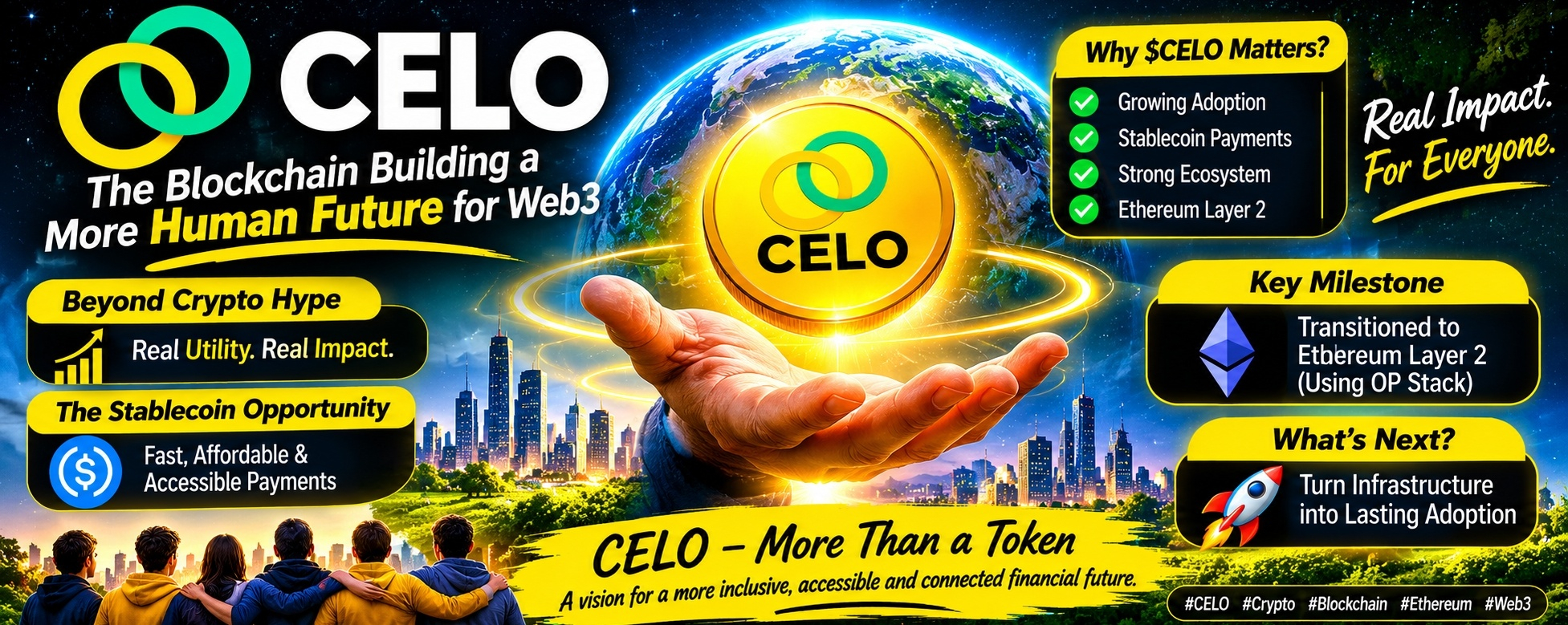
Beyond Crypto Hype: Why CELO Deserves AttentionReal Utility Is the Bigger Story
One of Celo's strongest ideas is accessibility. Its ecosystem focuses on fast, affordable blockchain transactions, stablecoin payments, and mobile-first financial services.
Celo completed its transition from a standalone Layer 1 blockchain to an Ethereum Layer 2 in March 2025, using the OP Stack. This move strengthened its connection with Ethereum while continuing its focus on practical payments.
Its ecosystem also includes MiniPay, a stablecoin wallet built by Opera, helping bring digital payments to users across different regions.
The Stablecoin Opportunity
Stablecoins could become one of blockchain's most important real-world use cases.
Think about someone who wants to send money across borders, receive payments, or access digital dollars without dealing with complicated financial systems.
This is where Celo's infrastructure becomes interesting. Low transaction costs, fast confirmations, and support for multiple stablecoins create opportunities for everyday financial activity.
Celo is not simply trying to attract crypto traders. Its broader ambition is to make digital finance more accessible.
Why $CELO Matters
The $CELO token is an important part of the network's economic and governance ecosystem. However, investors should understand that network adoption and token price performance are not automatically connected.
The long-term story depends on several factors:
- Growth in genuine network activity.- Stablecoin adoption and payment volume.- Developer participation and useful applications.- Ethereum Layer 2 security and infrastructure.- Sustainable token economics and ecosystem development.
These are the fundamentals worth watching instead of following every short-term market movement.
What Could Come Next?
The next chapter for Celo will depend on its ability to turn infrastructure into lasting adoption.
Competition among Ethereum Layer 2 networks is intense. Technology alone is not enough. Celo needs developers, users, strong applications, reliable infrastructure, and sustainable economic activity.
That challenge is also what makes the ecosystem worth following.
Final Thoughts
For me, the most interesting part of Celo is its direction: bringing blockchain closer to real human needs.
The future of crypto will not belong only to projects with impressive charts or loud marketing campaigns. It will also belong to networks that quietly solve real problems and earn people's trust through everyday usefulness.
CELO is a project worth watching—not because anyone can guarantee its next price move, but because its vision connects blockchain technology with something bigger than speculation: financial accessibility.
The real question is not simply how high $CELO can go.
The bigger question is how many people can benefit from what Celo is building.
$CELO #Ethereum #CELO
{spot}(CELOUSDT)
{spot}(ETHUSDT)
Beyond Crypto Hype: Why CELO Deserves Attention
Real Utility Is the Bigger Story
One of Celo's strongest ideas is accessibility. Its ecosystem focuses on fast, affordable blockchain transactions, stablecoin payments, and mobile-first financial services.
Celo completed its transition from a standalone Layer 1 blockchain to an Ethereum Layer 2 in March 2025, using the OP Stack. This move strengthened its connection with Ethereum while continuing its focus on practical payments.
Its ecosystem also includes MiniPay, a stablecoin wallet built by Opera, helping bring digital payments to users across different regions.
The Stablecoin Opportunity
Stablecoins could become one of blockchain's most important real-world use cases.
Think about someone who wants to send money across borders, receive payments, or access digital dollars without dealing with complicated financial systems.
This is where Celo's infrastructure becomes interesting. Low transaction costs, fast confirmations, and support for multiple stablecoins create opportunities for everyday financial activity.
Celo is not simply trying to attract crypto traders. Its broader ambition is to make digital finance more accessible.
Why $CELO Matters
The $CELO token is an important part of the network's economic and governance ecosystem. However, investors should understand that network adoption and token price performance are not automatically connected.
The long-term story depends on several factors:
- Growth in genuine network activity.- Stablecoin adoption and payment volume.- Developer participation and useful applications.- Ethereum Layer 2 security and infrastructure.- Sustainable token economics and ecosystem development.
These are the fundamentals worth watching instead of following every short-term market movement.
What Could Come Next?
The next chapter for Celo will depend on its ability to turn infrastructure into lasting adoption.
Competition among Ethereum Layer 2 networks is intense. Technology alone is not enough. Celo needs developers, users, strong applications, reliable infrastructure, and sustainable economic activity.
That challenge is also what makes the ecosystem worth following.
Final Thoughts
For me, the most interesting part of Celo is its direction: bringing blockchain closer to real human needs.
The future of crypto will not belong only to projects with impressive charts or loud marketing campaigns. It will also belong to networks that quietly solve real problems and earn people's trust through everyday usefulness.
CELO is a project worth watching—not because anyone can guarantee its next price move, but because its vision connects blockchain technology with something bigger than speculation: financial accessibility.
The real question is not simply how high $CELO can go.
The bigger question is how many people can benefit from what Celo is building.
$CELO #Ethereum #CELO
2
319

·
--
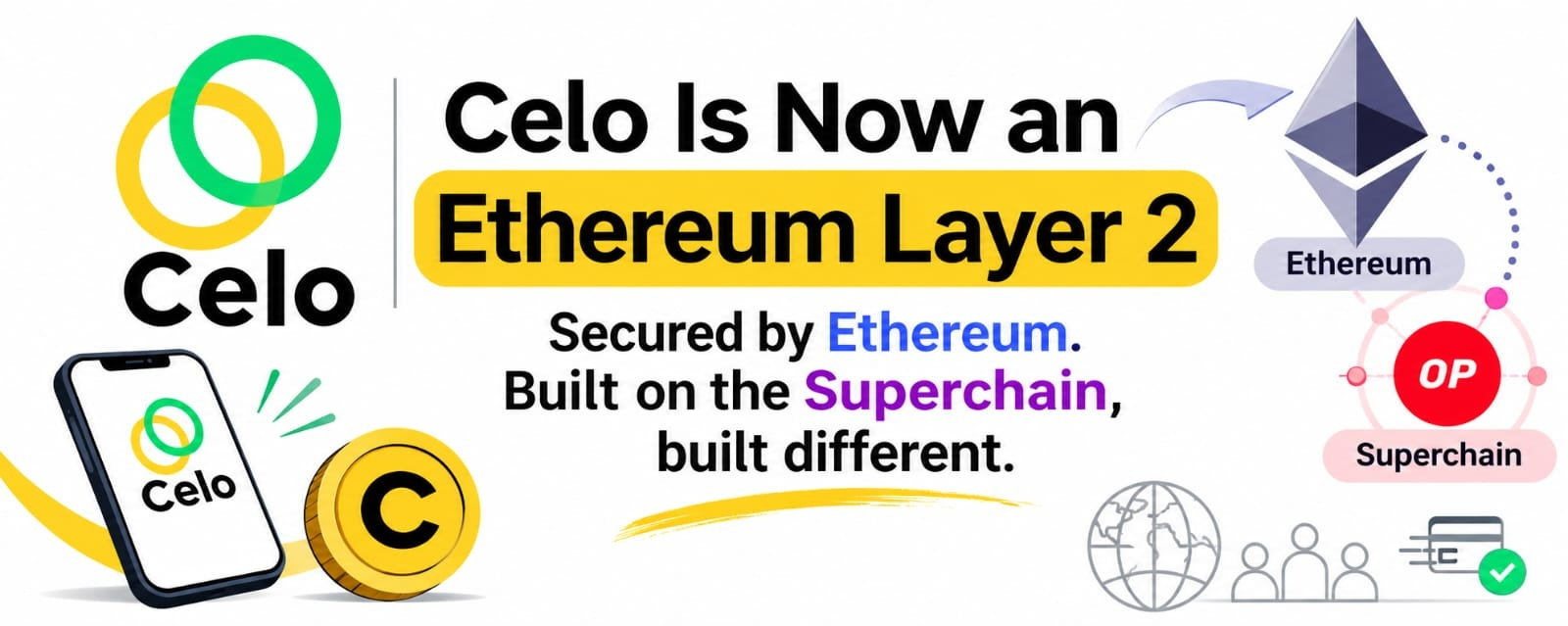
Article
Celo Is Now an Ethereum Layer 2. But Is That Enough?Honestly, sometimes I feel like crypto is just repeating itself.
Every day there's a new coin, another blockchain, another AI narrative, and another group of people on X telling everyone they've found the next big thing. Everyone is excited for a few days, influencers start posting, timelines get filled with predictions, and then something else comes along and takes all the attention.
We've seen this happen too many times.
I've been around long enough to know that a good announcement doesn't always mean a good project. Some projects look incredible during a bull market, but when things get quiet, you suddenly realize how little is actually happening.
That's why I don't get excited about every new upgrade anymore.
I'd rather look at what a project is trying to solve and whether people genuinely need it.
Recently, I've been thinking about Celo.
The project has made a pretty big change. It has moved from being an independent Layer 1 blockchain to becoming an Ethereum Layer 2.
Now, some people will look at that and immediately see it as a positive move. Others might wonder why a project that already had its own blockchain decided to change direction.
Personally, I think there's more to discuss here.
Celo has been around for a while. It isn't one of those projects that appeared yesterday with a nice website and a few influencers talking about it.
But being around for years doesn't automatically mean you've figured everything out.
The reality is that running an independent blockchain is difficult. You need developers, users, liquidity, applications, and enough activity to keep the ecosystem alive.
And we've watched many Layer 1 projects struggle with exactly that.
Launching a network is one thing. Getting people to actually use it when there are dozens of alternatives is something else.
Maybe Celo realized that competing independently wasn't the best way forward.
By moving to Ethereum as a Layer 2 in March 2025, it chose a different path. Instead of trying to build everything from scratch, it became part of the OP Stack and the wider Superchain ecosystem.
I can understand that decision.
Ethereum already has a huge developer community and an established ecosystem. There is infrastructure, liquidity, and years of work behind it.
Trying to compete with all of that independently can become exhausting.
But here's the thing: becoming an Ethereum L2 doesn't automatically bring users.
There are already plenty of Layer 2 networks. Some have funding, some have strong communities, and some are still trying to figure out what makes them different.
Celo needs more than a new technical identity.
It needs people to actually use it.
And this is where I find its focus on stablecoins and payments more interesting than the usual blockchain narrative.
Let's be real. Most ordinary people don't wake up thinking about which blockchain has better technology.
They want to send money. They want to receive payments without losing a ridiculous amount to fees. They want access to stable digital dollars without dealing with unnecessary complications.
These are real problems.
Especially in places where traditional financial services are expensive, slow, or difficult to access.
Stablecoins can help with some of these problems. That's one of the few crypto use cases I think has a clear practical purpose beyond speculation.
Celo seems to understand that.
Its focus on mobile payments and products like MiniPay gives it a direction that is easier to understand than another project simply promising faster transactions.
But I'm still cautious.
Because building a payment product and getting people to depend on it are two completely different things.
Someone might download a wallet, try it once, and never open it again.
That doesn't mean adoption.
Real adoption means people keep using it because it makes something in their daily lives easier.
And for that to happen, Celo needs more than cheap transactions. It needs reliable applications, useful payment options, local access, and enough trust for people to feel comfortable keeping their money there.
That's a much harder job than announcing a new partnership.
The technical side is also worth watching.
Celo now uses Ethereum for settlement, runs on the OP Stack, and uses EigenDA for data availability.
Being part of the Superchain could make it easier to connect with other networks and share infrastructure.
I like the idea of reducing fragmentation. Crypto already has too many separate ecosystems, and moving between them can be unnecessarily confusing.
But I wouldn't blindly assume that every Layer 2 has the same security guarantees just because it uses Ethereum.
Celo still has its own architecture and dependencies. Things like data availability, fault proofs, and upgrade controls matter.
These details aren't exciting, I know.
But they are exactly the things investors should pay attention to instead of just repeating whatever sounds good in a project announcement.
Another thing I can't ignore is the CELO token.
Whenever I look at a blockchain project, I try to separate the usefulness of the network from the usefulness of its token.
They're not always the same thing.
Celo can grow its payment ecosystem, attract users, and process more transactions. But what does that actually mean for CELO holders?
Where does the demand come from?
How much value does the token capture from the activity happening on the network?
These questions matter.
There are governance and revenue mechanisms in place, including the Community Fund receiving net sequencer revenue. That's worth paying attention to.
Still, I want to see how those mechanisms work over time.
A project announcing a revenue model is one thing. Building a sustainable business around real network usage is another.
I've seen too many tokens with impressive stories and very little economic substance behind them.
I don't want to confuse ecosystem growth with token value.
And then there's competition.
Celo isn't alone in the stablecoin payment space. Other blockchains are trying to make payments cheaper and easier too.
Even traditional financial companies are paying more attention to stablecoins.
So Celo has to answer a fairly simple question: why should people use its network instead of something else?
Being part of Ethereum is helpful. Being part of the Superchain is interesting.
But neither guarantees that developers will build there or that users will stay.
People usually don't care about the technical history behind a payment network. They care whether it works when they need it.
That's what Celo has to prove.
One thing I do appreciate is that payments aren't just another temporary crypto trend.
People will still need to send money when the market is down. They will still need affordable transfers when influencers have moved on to the next narrative.
That makes the problem worth solving.
But I also don't want to underestimate how difficult it is.
There are regulations, local payment systems, banking relationships, internet limitations, and trust issues to deal with.
You can't solve all of that by making transactions cheaper.
People need to feel comfortable using the product. They need to understand it without becoming blockchain experts.
And honestly, that's where crypto still has a lot of work to do.
Sometimes we make things complicated and then act surprised when ordinary people don't want to use them.
Celo has an opportunity to avoid some of that, but having an opportunity and actually delivering on it are two different things.
For me, the interesting part isn't simply that Celo is now an Ethereum Layer 2.
It's whether this move helps the project become more useful in the real world.
Can it bring more regular users into its payment ecosystem? Can MiniPay become something people genuinely use? Can the network attract developers without relying on short-term incentives? And can the CELO token maintain a meaningful role as the ecosystem grows?
I don't have clear answers to all of that.
And I don't think anyone should pretend they do.
I'm interested in the direction, but I'm not ready to call it a success just yet.
Crypto has taught me to be careful with that kind of excitement.
A lot of projects start with a good idea. The difficult part is surviving long enough to turn that idea into something people actually depend on.
Maybe Celo gets there. Maybe competition makes things harder than expected.
For now, I'd rather watch what happens than make big claims.
Show me real users. Show me consistent payment activity. Show me developers building things that people actually need.
That's more convincing to me than another announcement on X.
At this point, I'm less interested in what a project says it can become and more interested in what it manages to do.
And Celo still has something to prove.
#CELO $CELO @celo
$BTC $BNB
{future}(CELOUSDT)
Celo Is Now an Ethereum Layer 2. But Is That Enough?
Honestly, sometimes I feel like crypto is just repeating itself.
Every day there's a new coin, another blockchain, another AI narrative, and another group of people on X telling everyone they've found the next big thing. Everyone is excited for a few days, influencers start posting, timelines get filled with predictions, and then something else comes along and takes all the attention.
We've seen this happen too many times.
I've been around long enough to know that a good announcement doesn't always mean a good project. Some projects look incredible during a bull market, but when things get quiet, you suddenly realize how little is actually happening.
That's why I don't get excited about every new upgrade anymore.
I'd rather look at what a project is trying to solve and whether people genuinely need it.
Recently, I've been thinking about Celo.
The project has made a pretty big change. It has moved from being an independent Layer 1 blockchain to becoming an Ethereum Layer 2.
Now, some people will look at that and immediately see it as a positive move. Others might wonder why a project that already had its own blockchain decided to change direction.
Personally, I think there's more to discuss here.
Celo has been around for a while. It isn't one of those projects that appeared yesterday with a nice website and a few influencers talking about it.
But being around for years doesn't automatically mean you've figured everything out.
The reality is that running an independent blockchain is difficult. You need developers, users, liquidity, applications, and enough activity to keep the ecosystem alive.
And we've watched many Layer 1 projects struggle with exactly that.
Launching a network is one thing. Getting people to actually use it when there are dozens of alternatives is something else.
Maybe Celo realized that competing independently wasn't the best way forward.
By moving to Ethereum as a Layer 2 in March 2025, it chose a different path. Instead of trying to build everything from scratch, it became part of the OP Stack and the wider Superchain ecosystem.
I can understand that decision.
Ethereum already has a huge developer community and an established ecosystem. There is infrastructure, liquidity, and years of work behind it.
Trying to compete with all of that independently can become exhausting.
But here's the thing: becoming an Ethereum L2 doesn't automatically bring users.
There are already plenty of Layer 2 networks. Some have funding, some have strong communities, and some are still trying to figure out what makes them different.
Celo needs more than a new technical identity.
It needs people to actually use it.
And this is where I find its focus on stablecoins and payments more interesting than the usual blockchain narrative.
Let's be real. Most ordinary people don't wake up thinking about which blockchain has better technology.
They want to send money. They want to receive payments without losing a ridiculous amount to fees. They want access to stable digital dollars without dealing with unnecessary complications.
These are real problems.
Especially in places where traditional financial services are expensive, slow, or difficult to access.
Stablecoins can help with some of these problems. That's one of the few crypto use cases I think has a clear practical purpose beyond speculation.
Celo seems to understand that.
Its focus on mobile payments and products like MiniPay gives it a direction that is easier to understand than another project simply promising faster transactions.
But I'm still cautious.
Because building a payment product and getting people to depend on it are two completely different things.
Someone might download a wallet, try it once, and never open it again.
That doesn't mean adoption.
Real adoption means people keep using it because it makes something in their daily lives easier.
And for that to happen, Celo needs more than cheap transactions. It needs reliable applications, useful payment options, local access, and enough trust for people to feel comfortable keeping their money there.
That's a much harder job than announcing a new partnership.
The technical side is also worth watching.
Celo now uses Ethereum for settlement, runs on the OP Stack, and uses EigenDA for data availability.
Being part of the Superchain could make it easier to connect with other networks and share infrastructure.
I like the idea of reducing fragmentation. Crypto already has too many separate ecosystems, and moving between them can be unnecessarily confusing.
But I wouldn't blindly assume that every Layer 2 has the same security guarantees just because it uses Ethereum.
Celo still has its own architecture and dependencies. Things like data availability, fault proofs, and upgrade controls matter.
These details aren't exciting, I know.
But they are exactly the things investors should pay attention to instead of just repeating whatever sounds good in a project announcement.
Another thing I can't ignore is the CELO token.
Whenever I look at a blockchain project, I try to separate the usefulness of the network from the usefulness of its token.
They're not always the same thing.
Celo can grow its payment ecosystem, attract users, and process more transactions. But what does that actually mean for CELO holders?
Where does the demand come from?
How much value does the token capture from the activity happening on the network?
These questions matter.
There are governance and revenue mechanisms in place, including the Community Fund receiving net sequencer revenue. That's worth paying attention to.
Still, I want to see how those mechanisms work over time.
A project announcing a revenue model is one thing. Building a sustainable business around real network usage is another.
I've seen too many tokens with impressive stories and very little economic substance behind them.
I don't want to confuse ecosystem growth with token value.
And then there's competition.
Celo isn't alone in the stablecoin payment space. Other blockchains are trying to make payments cheaper and easier too.
Even traditional financial companies are paying more attention to stablecoins.
So Celo has to answer a fairly simple question: why should people use its network instead of something else?
Being part of Ethereum is helpful. Being part of the Superchain is interesting.
But neither guarantees that developers will build there or that users will stay.
People usually don't care about the technical history behind a payment network. They care whether it works when they need it.
That's what Celo has to prove.
One thing I do appreciate is that payments aren't just another temporary crypto trend.
People will still need to send money when the market is down. They will still need affordable transfers when influencers have moved on to the next narrative.
That makes the problem worth solving.
But I also don't want to underestimate how difficult it is.
There are regulations, local payment systems, banking relationships, internet limitations, and trust issues to deal with.
You can't solve all of that by making transactions cheaper.
People need to feel comfortable using the product. They need to understand it without becoming blockchain experts.
And honestly, that's where crypto still has a lot of work to do.
Sometimes we make things complicated and then act surprised when ordinary people don't want to use them.
Celo has an opportunity to avoid some of that, but having an opportunity and actually delivering on it are two different things.
For me, the interesting part isn't simply that Celo is now an Ethereum Layer 2.
It's whether this move helps the project become more useful in the real world.
Can it bring more regular users into its payment ecosystem? Can MiniPay become something people genuinely use? Can the network attract developers without relying on short-term incentives? And can the CELO token maintain a meaningful role as the ecosystem grows?
I don't have clear answers to all of that.
And I don't think anyone should pretend they do.
I'm interested in the direction, but I'm not ready to call it a success just yet.
Crypto has taught me to be careful with that kind of excitement.
A lot of projects start with a good idea. The difficult part is surviving long enough to turn that idea into something people actually depend on.
Maybe Celo gets there. Maybe competition makes things harder than expected.
For now, I'd rather watch what happens than make big claims.
Show me real users. Show me consistent payment activity. Show me developers building things that people actually need.
That's more convincing to me than another announcement on X.
At this point, I'm less interested in what a project says it can become and more interested in what it manages to do.
And Celo still has something to prove.
#CELO $CELO @celo
$BTC $BNB
4
159

·
--
Verified
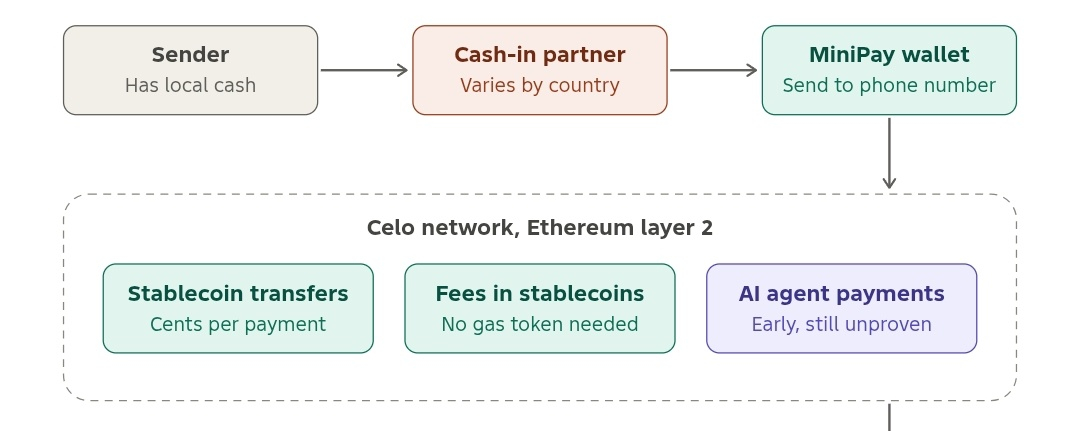
Article
**CELO, MINIPAY, AND THE LONG, BORING ROAD TO STABLECOIN PAYMENTS THAT ACTUALLY WORK**Let me start with the part nobody likes to say out loud. Crypto has been promising to fix payments for over a decade, and for most ordinary people it still hasn't. Not because the idea is stupid, but because the experience has been terrible. You need one token to move another token. You copy a forty-character address and pray you didn't mistype it. You get a fee quote that looks fine until the network gets busy and suddenly it isn't. Somebody's cousin tries to send twenty dollars, the fee eats a big chunk of it, and that's the end of their crypto journey. I've heard versions of that story so many times it barely registers anymore.
So when people ask me about Celo ($CELO), I don't start with the token. I start with the question of whether the thing solves any of that. And honestly, the answer is "more than most, but not all of it," which is about the most generous thing I say about any project.
Here's the short history, because it explains a lot. Celo launched as its own chain around 2020 with a pretty narrow obsession: mobile-first payments, stablecoins, people in countries where banking is slow or expensive or both. While the rest of the industry chased whatever was hot, Celo kept talking about phones and dollars. In 2025 it moved over to become a layer 2 on top of Ethereum, built on the OP Stack. That was a big shift on paper. In practice, the idea was to keep the cheap, fast experience while borrowing the security and the huge developer pool of Ethereum. Does that matter to someone sending money to their family? Not directly. Nobody at a market stall in Nairobi is thinking about rollups. But it matters for whether the network sticks around and stays compatible with the tools people already use. That's plumbing, and plumbing is the whole game here.
Then there's the fee thing, which I think is the most underrated design choice in the whole project. On most chains you need the native token to pay gas. That's a dumb requirement for a normal person. Imagine having to buy a specific type of postage stamp before you could mail a letter, and the stamp price changed every hour. Celo lets people pay fees in stablecoins, so if all you hold is digital dollars, you can still use the network. That sounds small. It isn't. It removes one of the most confusing steps a beginner hits, and it keeps tiny payments from becoming absurd. When the amount you're sending is five or ten dollars, the fee is the product. If it's too high, nothing else matters.
Now MiniPay, which is where the story gets real or falls apart depending on your mood that day. MiniPay is a stablecoin wallet from Opera, the browser company, and it's built to live inside a mobile browser experience rather than being yet another standalone app you have to hunt down, download, and learn. It launched in parts of Africa first, which makes sense, since that's a place where mobile money is already normal and people understand the idea of money living on a phone. The pitch is simple. You hold stablecoins like USDT or USDC. You can send them to someone using their phone number instead of a long address. Fees are very low. There's no big ceremony of writing down a recovery phrase before you're allowed to do anything. That last point is the one I keep returning to, because the seed phrase has been the great filter of crypto. We built a system that asks a first-time user to act like a bank's security department, and then we act surprised when ordinary people bounce off it.
Is it perfect? No, and I'd be annoyed with myself if I pretended otherwise. The weak spot is the edges, meaning the places where real money turns into digital money and back again. Cash-in and cash-out depend on local partners, mobile money providers, exchanges, agents. That layer is different in every country, and it changes over time. In some markets it's smooth. In others it's limited, slow, or just awkward. A stablecoin wallet is only as useful as your ability to get value in and get it out without a headache, and no amount of clever blockchain design makes that part disappear. It's a business and regulatory problem, not a technical one.
Adoption numbers are the other thing I'd handle carefully. You'll see big figures thrown around for MiniPay wallets and transactions, and some of them are impressive. But a wallet count is not the same as a person using money. Some wallets are opened once and forgotten. Some activity comes from incentives, campaigns, or automated behavior. I'm not saying the numbers are fake. I'm saying that "active user" is one of the most stretched phrases in this industry, and you should look for repeat behavior, not just sign-ups. Are people coming back every week? Are they paying for real things? That's the signal.
Let me talk about the real-world use case for a minute, because it's what gets me past the cynicism. Think about someone in a country where the local currency keeps losing value. Their savings shrink quietly month after month. A dollar-pegged stablecoin on a phone gives them something that holds its value better, without needing a foreign bank account that might be hard or impossible to open. Think about a worker sending money home, paying a cut to a remittance service that can take a real chunk. If the same transfer can go through for pennies in a few seconds, that's not a crypto flex, that's money back in someone's pocket. It's a boring benefit, and boring benefits are the ones that last.
Now the AI angle, which I have mixed feelings about. Over the last couple of years almost every project has attached AI to its messaging, often with nothing underneath. I rolled my eyes too. But there's a version of the idea that isn't total nonsense. If software agents are going to do things on our behalf, like booking, buying, subscribing, or paying for small services, they'll need a way to move money without a human approving every tiny step. Stablecoins on a cheap, fast network are a reasonable fit for that. No bank account needed, programmable, settled quickly. Celo has been positioning itself around that, with talk of agents and stablecoin payments working together. Whether that becomes something people genuinely use or remains a nice paragraph in a blog post, I can't tell you. My rule is simple. Show me someone doing something dull and useful with it, and I'll pay attention. Until then it's a maybe.
And then the token. $CELO is its own conversation, separate from whether MiniPay is a good product. A useful product doesn't guarantee a rising price, and a rising price doesn't prove the product works. Plenty of tokens have pumped on stories with nothing behind them, and plenty of solid projects have gone sideways for years. If you're thinking about buying it, treat it as a risky bet, do your own homework, and don't let a good app convince you the chart will cooperate. This isn't financial advice, and anyone who sounds certain about where the price is going should make you nervous.
I'll be honest about my own bias too. After years of watching hype burn out, I want something to hold up, and that wanting can make me too kind. So I try to keep my claim modest. Celo seems to be pointed at a real problem and has made some smart choices about fees and onboarding. It has not solved cash-out, it hasn't proven its numbers beyond doubt, and the AI story is still unproven. That's a pretty fair snapshot of where stablecoin payments are overall: early, uneven, promising in places, frustrating in others.
If you want to know whether it's any good, don't read another thread, including this one. Download MiniPay, put in a few dollars, send some to a friend, and see what happens. Notice whether it's easy. Notice what the fee was. Notice whether you'd do it again. If it works, great, you've learned something real. If it doesn't, you've lost a few minutes and a few bucks. Either way you'll know more than you did, and that's already better than most of what this industry hands out.
@celo #CELO $CELO
{spot}(CELOUSDT)
**CELO, MINIPAY, AND THE LONG, BORING ROAD TO STABLECOIN PAYMENTS THAT ACTUALLY WORK**
Let me start with the part nobody likes to say out loud. Crypto has been promising to fix payments for over a decade, and for most ordinary people it still hasn't. Not because the idea is stupid, but because the experience has been terrible. You need one token to move another token. You copy a forty-character address and pray you didn't mistype it. You get a fee quote that looks fine until the network gets busy and suddenly it isn't. Somebody's cousin tries to send twenty dollars, the fee eats a big chunk of it, and that's the end of their crypto journey. I've heard versions of that story so many times it barely registers anymore.
So when people ask me about Celo ($CELO ), I don't start with the token. I start with the question of whether the thing solves any of that. And honestly, the answer is "more than most, but not all of it," which is about the most generous thing I say about any project.
Here's the short history, because it explains a lot. Celo launched as its own chain around 2020 with a pretty narrow obsession: mobile-first payments, stablecoins, people in countries where banking is slow or expensive or both. While the rest of the industry chased whatever was hot, Celo kept talking about phones and dollars. In 2025 it moved over to become a layer 2 on top of Ethereum, built on the OP Stack. That was a big shift on paper. In practice, the idea was to keep the cheap, fast experience while borrowing the security and the huge developer pool of Ethereum. Does that matter to someone sending money to their family? Not directly. Nobody at a market stall in Nairobi is thinking about rollups. But it matters for whether the network sticks around and stays compatible with the tools people already use. That's plumbing, and plumbing is the whole game here.
Then there's the fee thing, which I think is the most underrated design choice in the whole project. On most chains you need the native token to pay gas. That's a dumb requirement for a normal person. Imagine having to buy a specific type of postage stamp before you could mail a letter, and the stamp price changed every hour. Celo lets people pay fees in stablecoins, so if all you hold is digital dollars, you can still use the network. That sounds small. It isn't. It removes one of the most confusing steps a beginner hits, and it keeps tiny payments from becoming absurd. When the amount you're sending is five or ten dollars, the fee is the product. If it's too high, nothing else matters.
Now MiniPay, which is where the story gets real or falls apart depending on your mood that day. MiniPay is a stablecoin wallet from Opera, the browser company, and it's built to live inside a mobile browser experience rather than being yet another standalone app you have to hunt down, download, and learn. It launched in parts of Africa first, which makes sense, since that's a place where mobile money is already normal and people understand the idea of money living on a phone. The pitch is simple. You hold stablecoins like USDT or USDC. You can send them to someone using their phone number instead of a long address. Fees are very low. There's no big ceremony of writing down a recovery phrase before you're allowed to do anything. That last point is the one I keep returning to, because the seed phrase has been the great filter of crypto. We built a system that asks a first-time user to act like a bank's security department, and then we act surprised when ordinary people bounce off it.
Is it perfect? No, and I'd be annoyed with myself if I pretended otherwise. The weak spot is the edges, meaning the places where real money turns into digital money and back again. Cash-in and cash-out depend on local partners, mobile money providers, exchanges, agents. That layer is different in every country, and it changes over time. In some markets it's smooth. In others it's limited, slow, or just awkward. A stablecoin wallet is only as useful as your ability to get value in and get it out without a headache, and no amount of clever blockchain design makes that part disappear. It's a business and regulatory problem, not a technical one.
Adoption numbers are the other thing I'd handle carefully. You'll see big figures thrown around for MiniPay wallets and transactions, and some of them are impressive. But a wallet count is not the same as a person using money. Some wallets are opened once and forgotten. Some activity comes from incentives, campaigns, or automated behavior. I'm not saying the numbers are fake. I'm saying that "active user" is one of the most stretched phrases in this industry, and you should look for repeat behavior, not just sign-ups. Are people coming back every week? Are they paying for real things? That's the signal.
Let me talk about the real-world use case for a minute, because it's what gets me past the cynicism. Think about someone in a country where the local currency keeps losing value. Their savings shrink quietly month after month. A dollar-pegged stablecoin on a phone gives them something that holds its value better, without needing a foreign bank account that might be hard or impossible to open. Think about a worker sending money home, paying a cut to a remittance service that can take a real chunk. If the same transfer can go through for pennies in a few seconds, that's not a crypto flex, that's money back in someone's pocket. It's a boring benefit, and boring benefits are the ones that last.
Now the AI angle, which I have mixed feelings about. Over the last couple of years almost every project has attached AI to its messaging, often with nothing underneath. I rolled my eyes too. But there's a version of the idea that isn't total nonsense. If software agents are going to do things on our behalf, like booking, buying, subscribing, or paying for small services, they'll need a way to move money without a human approving every tiny step. Stablecoins on a cheap, fast network are a reasonable fit for that. No bank account needed, programmable, settled quickly. Celo has been positioning itself around that, with talk of agents and stablecoin payments working together. Whether that becomes something people genuinely use or remains a nice paragraph in a blog post, I can't tell you. My rule is simple. Show me someone doing something dull and useful with it, and I'll pay attention. Until then it's a maybe.
And then the token. $CELO is its own conversation, separate from whether MiniPay is a good product. A useful product doesn't guarantee a rising price, and a rising price doesn't prove the product works. Plenty of tokens have pumped on stories with nothing behind them, and plenty of solid projects have gone sideways for years. If you're thinking about buying it, treat it as a risky bet, do your own homework, and don't let a good app convince you the chart will cooperate. This isn't financial advice, and anyone who sounds certain about where the price is going should make you nervous.
I'll be honest about my own bias too. After years of watching hype burn out, I want something to hold up, and that wanting can make me too kind. So I try to keep my claim modest. Celo seems to be pointed at a real problem and has made some smart choices about fees and onboarding. It has not solved cash-out, it hasn't proven its numbers beyond doubt, and the AI story is still unproven. That's a pretty fair snapshot of where stablecoin payments are overall: early, uneven, promising in places, frustrating in others.
If you want to know whether it's any good, don't read another thread, including this one. Download MiniPay, put in a few dollars, send some to a friend, and see what happens. Notice whether it's easy. Notice what the fee was. Notice whether you'd do it again. If it works, great, you've learned something real. If it doesn't, you've lost a few minutes and a few bucks. Either way you'll know more than you did, and that's already better than most of what this industry hands out.
@celo #CELO $CELO
Riven_Coin:
good work
4
5
720

·
--
Article
Celo’s Careful Pivot: Preserving History While Inheriting Ethereum’s SecurityI was looking through some of the older network notes the other day and found myself lingering on how Celo handled the shift from its original independent chain into an Ethereum L2 built on the OP Stack. What seems interesting is the decision to keep the entire history intact while changing the underlying security model. Looking from the outside, it feels like a careful attempt to inherit Ethereum’s guarantees without forcing users or applications to start over.
I’m not completely sure how seamless that inheritance actually feels for the people running infrastructure day to day. The question that comes to mind is whether the sequencer still sits in a place that creates subtle centralization pressure even while the settlement layer sits on Ethereum. It makes me think about the quiet trade-off between speed of iteration and the slower process of distributing control.
There is a certain tension in watching a network that once secured itself now lean on another chain’s consensus. The structure looks clean on paper, yet the practical experience of that dependence remains something only time and stress tests will clarify.
For now the architecture appears deliberate, but the real answer may only appear later — anyway, time will tell @celo $CELO #CELO
Celo’s Careful Pivot: Preserving History While Inheriting Ethereum’s Security
I was looking through some of the older network notes the other day and found myself lingering on how Celo handled the shift from its original independent chain into an Ethereum L2 built on the OP Stack. What seems interesting is the decision to keep the entire history intact while changing the underlying security model. Looking from the outside, it feels like a careful attempt to inherit Ethereum’s guarantees without forcing users or applications to start over.
I’m not completely sure how seamless that inheritance actually feels for the people running infrastructure day to day. The question that comes to mind is whether the sequencer still sits in a place that creates subtle centralization pressure even while the settlement layer sits on Ethereum. It makes me think about the quiet trade-off between speed of iteration and the slower process of distributing control.
There is a certain tension in watching a network that once secured itself now lean on another chain’s consensus. The structure looks clean on paper, yet the practical experience of that dependence remains something only time and stress tests will clarify.
For now the architecture appears deliberate, but the real answer may only appear later — anyway, time will tell @celo $CELO #CELO
MrRUHUL:
The structure looks clean on paper, yet the practical experience of that
2
2
199

🚀 $CELO IS QUIETLY REWIRING GLOBAL MOBILE PAYMENTS WITH MILLIONS OF ACTIVE USERS! 💥
Real-world adoption is where true momentum begins, and $CELO is bridging digital dollars to everyday retail shopping across emerging markets. 🌊 The network transitioned into an Ethereum layer-two powerhouse, fueling massive transaction volume through mobile-first applications like MiniPay. 📊
Beyond fast settlements and fee abstraction, utility drives sustainable network demand through active governance and staking mechanics. 💡 With a major exchange hosting a dedicated trading festival right now, liquidity and community focus are locking onto the ecosystem. 💬 Are you positioning for this mobile payment shift early or waiting for the crowd? 👇
⚠️ Not financial advice. Always manage your risk. 🛡️
🏷️ #CELO #Crypto #Layer2 #Altcoins
🔥 💎

·
--
Bullish
🕐 Time Frame: 4H | 🟢 Setup: Falling Channel Breakout Watch
$CELO has been grinding down inside a clean falling channel all month, dropping from $0.085 to bounce right off the $0.051–$0.052 support floor.
Now price is back at $0.05767 (+2.32%) and pressing straight into the upper trendline resistance. A confirmed 4H close above $0.058–$0.060 breaks the downtrend and opens up room toward $0.065 and $0.070. If sellers defend this trendline again, we likely stay trapped inside the channel for another retest of the lows.
Breakout finally happening, or another fakeout at resistance?
#CELO #cryptotrading @celo $BNB #TechnicalAnalysis #altcoins #InvestMal
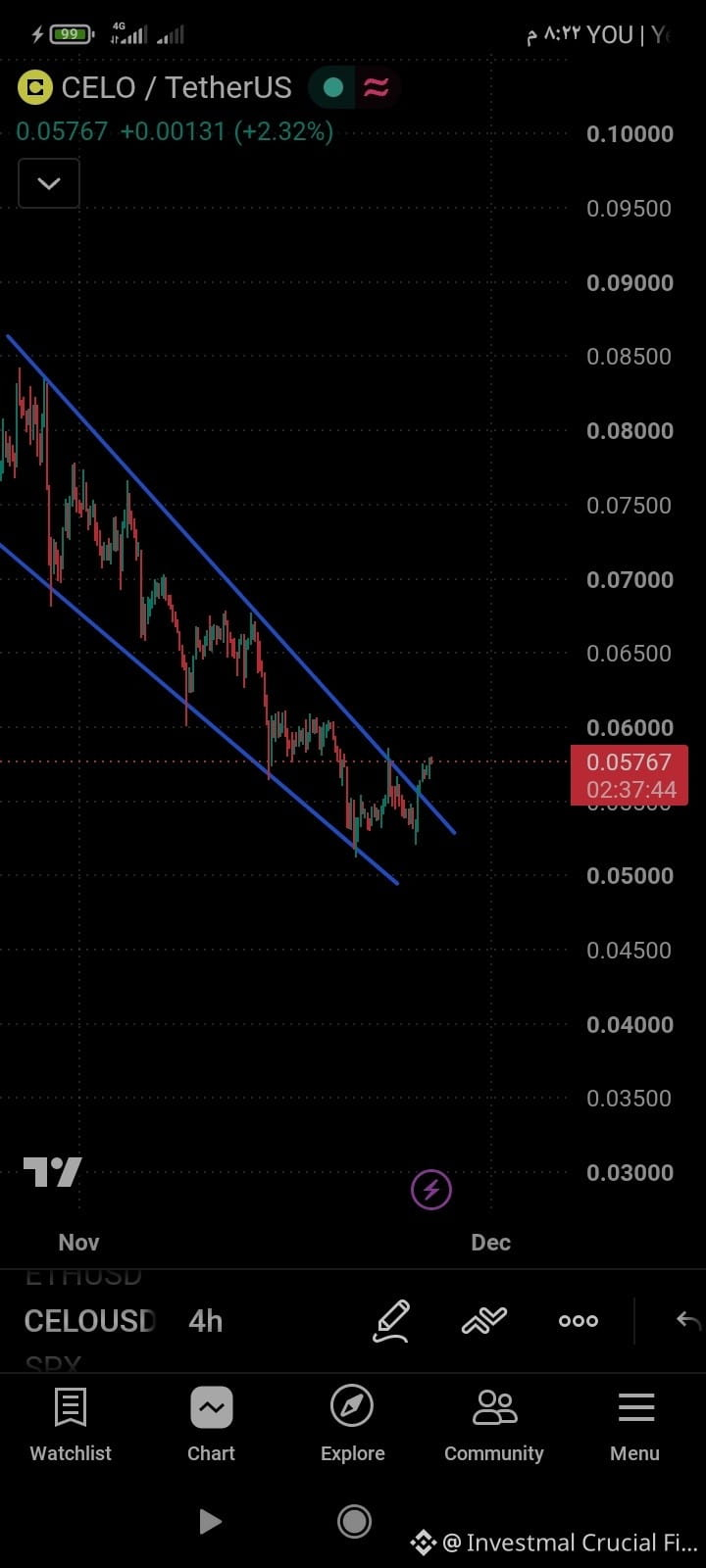
111

·
--
🦈 $CELO TRANSITIONS TO AN OP STACK LAYER 2 REDEFINING MOBILE LIQUIDITY! ⚡
The structural evolution of $CELO into an Ethereum Layer 2 powered by the OP Stack marks a massive leap in modular scalability. 📊 By anchoring security to Ethereum while delivering sub-cent execution and sub-second finality, the network is architected specifically for high-velocity stablecoin distribution and mobile-first economic activity. ⚡
Smart capital often follows infrastructural utility that solves real-world friction. With native multi-token gas mechanics and expanding regional stablecoin deployments, the underlying footprint is scaling efficiently across emerging markets. 💡 Are you positioning for this modular L2 expansion or waiting for clearer volume confirmation? 👇
⚠️ Not financial advice. Always manage your risk. 🛡️
🏷️ #CELO #Layer2 #Stablecoins #Crypto #Ethereum
🔥 💎

55

·
--
🚀 $CELO REBOOTS AS AN ETHEREUM LAYER 2 WITH BLISTERING 1-SECOND BLOCKS! ⚡
The network is completely leveling up its architecture by plugging into the OP Stack as a high-speed Ethereum Layer 2. ⚡ Sub-cent transaction fees and blazing-fast 1-second block times are unlocking serious mobile-first utility through real-world stablecoins and apps like MiniPay. 📊
Momentum is also heating up around the ecosystem with the active trading festival offering rewards up to December 20 on a major venue. 💬 Are you positioning for this infrastructure upgrade before the broader market catches on to the shift? 👇
⚠️ Not financial advice. Always manage your risk. 🛡️
🏷️ #CELO #Layer2 #Crypto #Altcoins #Trading
🔥 💎

2

·
--
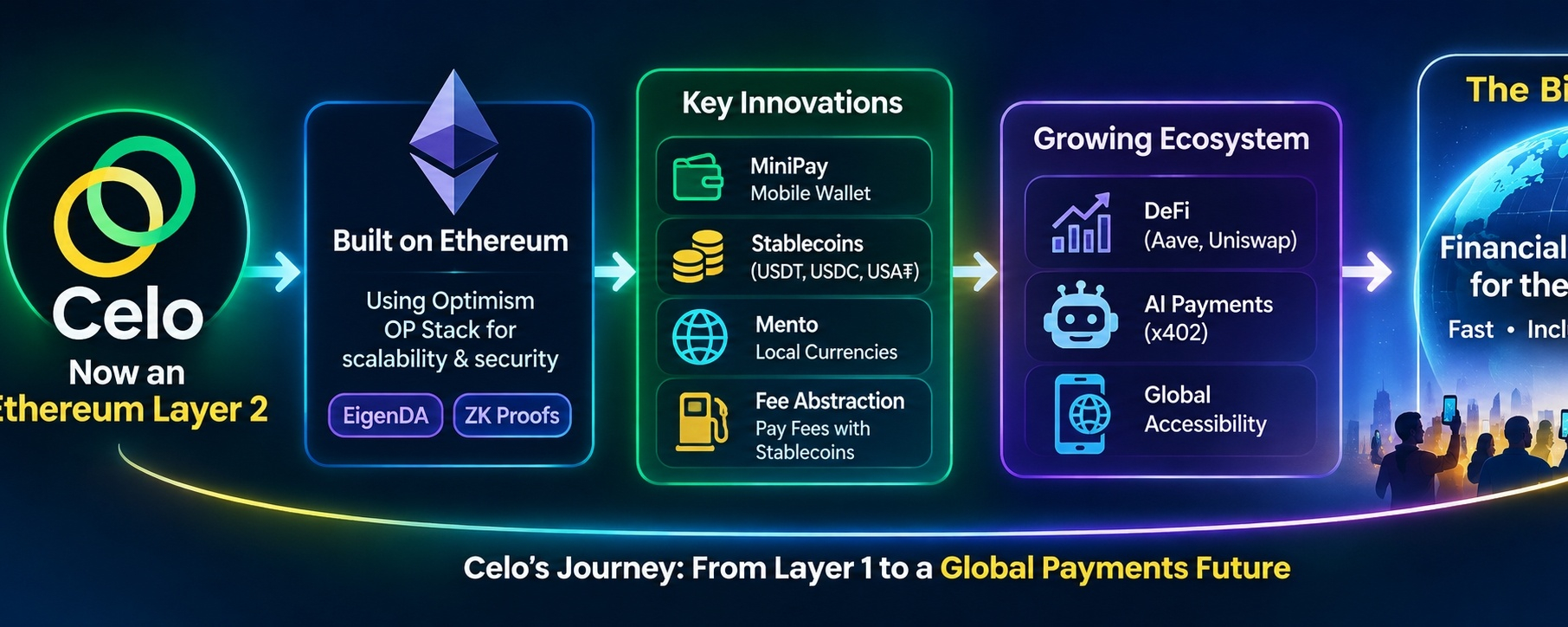
Article
Celo Is Now an Ethereum Layer2 But It Real Ambition Is Building the Future of Global Digital Payment@celo has officially moved from being an independent Layer 1 blockchain to an Ethereum Layer 2, and this transition could be much more important than it initially appears. While many blockchain networks are competing for attention through speed, scalability and lower transaction fees, Celo is taking a different approach by focusing on real-world financial use cases, stablecoin payments and mobile accessibility.
The transition to Ethereum Layer 2 was completed on March 26, 2025, following a proposal that began in 2023. Celo adopted the Optimism OP Stack, allowing it to become more closely connected to Ethereum's infrastructure while maintaining its focus on affordable and accessible blockchain transactions.
But the real story isn't just about the technology behind the migration. It is about what Celo is trying to build with that technology.
### Why Celo Chose Ethereum
Celo originally launched as a Layer 1 blockchain with a strong focus on mobile payments, stablecoins and financial inclusion. Its goal was to make digital financial services accessible to people who may not have easy access to traditional banking infrastructure.
However, maintaining an independent blockchain comes with challenges, including security infrastructure, liquidity, interoperability and long-term development costs.
Moving to Ethereum Layer 2 gives Celo access to a broader ecosystem while allowing it to continue developing its own applications and financial services. Through the OP Stack, Celo can process transactions on its Layer 2 infrastructure while relying on Ethereum's settlement framework.
The migration also makes it easier for developers familiar with Ethereum tools and smart contracts to build applications on Celo.
This was not simply a technical upgrade. It was a strategic decision to build within the Ethereum ecosystem rather than compete against it as an independent blockchain.
### The Technology Behind Celo's Layer 2
Celo's new architecture uses the Optimism OP Stack, which provides the infrastructure for operating an Ethereum Layer 2 network. It also uses EigenDA for data availability, helping the network support scalable and cost-efficient transaction processing.
In December 2025, Celo introduced the Jello Hardfork, activating OP Succinct Lite and ZK-powered fault proofs on mainnet. This development brought additional verification mechanisms into the network's rollup infrastructure.
These changes matter because a Layer 2 is not just about processing transactions cheaply. Its security, verification mechanisms, data availability and decentralization are equally important.
Celo is continuing to evolve its infrastructure with the goal of making its network more scalable while maintaining a closer relationship with Ethereum's security ecosystem.
### Stablecoins Are at the Center of Celo's Vision
One of Celo's biggest priorities is stablecoin adoption. Rather than focusing exclusively on speculative cryptocurrency trading, Celo is building infrastructure around digital money that can be used for everyday transactions.
Stablecoins such as USDT and USDC have become important components of its ecosystem, allowing users to transfer dollar-denominated value, make payments and interact with decentralized financial applications.
This strategy is particularly relevant in regions where people face expensive remittance services, currency volatility or limited access to traditional financial services.
Celo's vision goes beyond dollar stablecoins. Through the Mento ecosystem, it has also explored and supported local-currency stablecoin infrastructure, creating opportunities for financial applications that operate around currencies other than the US dollar.
The idea is to make blockchain-based financial services more practical for users who want to transact in familiar currencies instead of constantly converting between different assets.
### MiniPay Could Be One of Celo's Biggest Adoption Drivers
MiniPay is a self-custodial stablecoin wallet developed by Opera and built on Celo. It is designed to simplify digital payments, particularly for mobile users who may not be familiar with cryptocurrency.
Traditional crypto wallets can be complicated for beginners. Users often need to understand blockchain networks, transaction fees, wallet addresses and native tokens before they can make a simple transfer.
MiniPay attempts to remove much of that friction through a mobile-focused experience.
Opera reported in November 2026 that MiniPay had surpassed 20 million wallet activations, processed more than 600 million transactions and expanded to over 70 countries, with 77 Mini Apps reported within its ecosystem.
These figures are ecosystem-reported metrics, and wallet activations do not necessarily represent active users. Nevertheless, the scale of distribution highlights the potential of combining an established mobile platform with stablecoin infrastructure.
MiniPay could help Celo reach people who are interested in digital payments but are not necessarily traditional crypto traders.
### Fee Abstraction Makes Payments Easier
Another important feature of Celo is fee abstraction, which allows supported ERC-20 tokens to be used for transaction fees.
On many blockchain networks, users must hold the native token to pay gas. This creates unnecessary friction for someone who simply wants to send stablecoins.
Celo's fee abstraction approach can allow users to pay transaction fees using supported assets, including stablecoins, depending on the wallet and network configuration.
This makes the payment experience simpler and reduces the need for users to acquire CELO just to complete certain transactions.
The broader objective is to make blockchain infrastructure less visible to the end user. People should be able to send digital money without having to understand every technical detail behind the transaction.
### Celo Is Expanding Beyond Payments Into DeFi
Celo is also developing a broader decentralized finance ecosystem. Integrations involving protocols such as Aave, Uniswap and Morpho help expand the network's financial capabilities.
These applications can support lending, borrowing, decentralized trading and liquidity services, depending on the assets and markets available.
Stablecoin payments may provide the foundation, but DeFi creates additional opportunities for users to interact with their digital assets.
Celo's strategy is to combine payments and financial applications within one ecosystem, rather than positioning itself solely as a transaction network.
### The Next Opportunity Could Be AI Payments
One of the newer areas Celo is exploring is AI-driven payment infrastructure.
As AI agents become more capable of interacting with online services, they may eventually need to pay for APIs, data, computing resources and other digital services without relying on traditional payment processes for every transaction.
Blockchain-based stablecoins could provide a programmable payment mechanism for these activities.
Celo has been expanding its involvement with x402-based infrastructure, which is designed to support internet-native payment interactions. Its ecosystem has also explored support for multiple stablecoins and local-currency assets within agentic payment environments.
This is still an emerging market, and widespread adoption is not guaranteed. However, Celo's focus on low-cost transactions, stablecoins and programmable payments could make this area an interesting part of its long-term strategy.
### What This Means for CELO
The growth of Celo's ecosystem raises an important question about the CELO token and its long-term value.
CELO plays a role in governance and the network's economic structure. However, growing network activity does not automatically translate into token appreciation.
The relationship between transaction activity, sequencer revenue, token demand, issuance and value capture will be important to monitor.
In March 2026, the CELOccelerate tokenomics proposal outlined mechanisms intended to connect network usage with the ecosystem's economic structure, including directing net sequencer revenue toward the Community Fund in CELO.
Whether such mechanisms create meaningful long-term value will depend on implementation, governance decisions and actual network revenue.
For investors, the important question is not simply whether Celo is attracting users, but whether that growth creates sustainable economic value for the network and its token.
The Challenges Celo Still Faces
Celo is entering a competitive Layer 2 environment where many networks are fighting for developers, liquidity and users. Technology alone will not determine which networks succeed.
Security, decentralization, stablecoin regulations, user retention and sustainable revenue remain important challenges.
It is also important to distinguish between wallet activations, transaction counts and meaningful economic activity. High numbers can demonstrate growth, but they do not necessarily prove long-term adoption.
Celo will need to continue demonstrating that its infrastructure can support real financial activity while maintaining reliability, security and a sustainable economic model.
Final Thoughts
Celo's transition to Ethereum Layer 2 was more than a technological change. It was a strategic move toward building a financial ecosystem around stablecoins, mobile payments, local currencies, decentralized finance and programmable transactions.
MiniPay provides a distribution channel, stablecoins provide the payment foundation, Mento supports local-currency infrastructure, DeFi expands financial functionality and AI payment infrastructure represents a potential future opportunity.
The bigger story is that Celo is trying to make blockchain useful beyond the crypto trading environment.
If it can turn its growing ecosystem into sustainable real-world adoption, Celo could become an important part of the infrastructure supporting digital payments and programmable finance.
@Binance_Square_Official
The vision is ambitious, but the real test will be whether people continue using the network because it solves everyday financial problems, not simply because it is another blockchain.
#CELO #celo $MANTRA
{future}(MANTRAUSDT)
$SSV
{future}(SSVUSDT)
$CELO
{future}(CELOUSDT)
Celo Is Now an Ethereum Layer2 But It Real Ambition Is Building the Future of Global Digital Payment
@celo has officially moved from being an independent Layer 1 blockchain to an Ethereum Layer 2, and this transition could be much more important than it initially appears. While many blockchain networks are competing for attention through speed, scalability and lower transaction fees, Celo is taking a different approach by focusing on real-world financial use cases, stablecoin payments and mobile accessibility.
The transition to Ethereum Layer 2 was completed on March 26, 2025, following a proposal that began in 2023. Celo adopted the Optimism OP Stack, allowing it to become more closely connected to Ethereum's infrastructure while maintaining its focus on affordable and accessible blockchain transactions.
But the real story isn't just about the technology behind the migration. It is about what Celo is trying to build with that technology.
### Why Celo Chose Ethereum
Celo originally launched as a Layer 1 blockchain with a strong focus on mobile payments, stablecoins and financial inclusion. Its goal was to make digital financial services accessible to people who may not have easy access to traditional banking infrastructure.
However, maintaining an independent blockchain comes with challenges, including security infrastructure, liquidity, interoperability and long-term development costs.
Moving to Ethereum Layer 2 gives Celo access to a broader ecosystem while allowing it to continue developing its own applications and financial services. Through the OP Stack, Celo can process transactions on its Layer 2 infrastructure while relying on Ethereum's settlement framework.
The migration also makes it easier for developers familiar with Ethereum tools and smart contracts to build applications on Celo.
This was not simply a technical upgrade. It was a strategic decision to build within the Ethereum ecosystem rather than compete against it as an independent blockchain.
### The Technology Behind Celo's Layer 2
Celo's new architecture uses the Optimism OP Stack, which provides the infrastructure for operating an Ethereum Layer 2 network. It also uses EigenDA for data availability, helping the network support scalable and cost-efficient transaction processing.
In December 2025, Celo introduced the Jello Hardfork, activating OP Succinct Lite and ZK-powered fault proofs on mainnet. This development brought additional verification mechanisms into the network's rollup infrastructure.
These changes matter because a Layer 2 is not just about processing transactions cheaply. Its security, verification mechanisms, data availability and decentralization are equally important.
Celo is continuing to evolve its infrastructure with the goal of making its network more scalable while maintaining a closer relationship with Ethereum's security ecosystem.
### Stablecoins Are at the Center of Celo's Vision
One of Celo's biggest priorities is stablecoin adoption. Rather than focusing exclusively on speculative cryptocurrency trading, Celo is building infrastructure around digital money that can be used for everyday transactions.
Stablecoins such as USDT and USDC have become important components of its ecosystem, allowing users to transfer dollar-denominated value, make payments and interact with decentralized financial applications.
This strategy is particularly relevant in regions where people face expensive remittance services, currency volatility or limited access to traditional financial services.
Celo's vision goes beyond dollar stablecoins. Through the Mento ecosystem, it has also explored and supported local-currency stablecoin infrastructure, creating opportunities for financial applications that operate around currencies other than the US dollar.
The idea is to make blockchain-based financial services more practical for users who want to transact in familiar currencies instead of constantly converting between different assets.
### MiniPay Could Be One of Celo's Biggest Adoption Drivers
MiniPay is a self-custodial stablecoin wallet developed by Opera and built on Celo. It is designed to simplify digital payments, particularly for mobile users who may not be familiar with cryptocurrency.
Traditional crypto wallets can be complicated for beginners. Users often need to understand blockchain networks, transaction fees, wallet addresses and native tokens before they can make a simple transfer.
MiniPay attempts to remove much of that friction through a mobile-focused experience.
Opera reported in November 2026 that MiniPay had surpassed 20 million wallet activations, processed more than 600 million transactions and expanded to over 70 countries, with 77 Mini Apps reported within its ecosystem.
These figures are ecosystem-reported metrics, and wallet activations do not necessarily represent active users. Nevertheless, the scale of distribution highlights the potential of combining an established mobile platform with stablecoin infrastructure.
MiniPay could help Celo reach people who are interested in digital payments but are not necessarily traditional crypto traders.
### Fee Abstraction Makes Payments Easier
Another important feature of Celo is fee abstraction, which allows supported ERC-20 tokens to be used for transaction fees.
On many blockchain networks, users must hold the native token to pay gas. This creates unnecessary friction for someone who simply wants to send stablecoins.
Celo's fee abstraction approach can allow users to pay transaction fees using supported assets, including stablecoins, depending on the wallet and network configuration.
This makes the payment experience simpler and reduces the need for users to acquire CELO just to complete certain transactions.
The broader objective is to make blockchain infrastructure less visible to the end user. People should be able to send digital money without having to understand every technical detail behind the transaction.
### Celo Is Expanding Beyond Payments Into DeFi
Celo is also developing a broader decentralized finance ecosystem. Integrations involving protocols such as Aave, Uniswap and Morpho help expand the network's financial capabilities.
These applications can support lending, borrowing, decentralized trading and liquidity services, depending on the assets and markets available.
Stablecoin payments may provide the foundation, but DeFi creates additional opportunities for users to interact with their digital assets.
Celo's strategy is to combine payments and financial applications within one ecosystem, rather than positioning itself solely as a transaction network.
### The Next Opportunity Could Be AI Payments
One of the newer areas Celo is exploring is AI-driven payment infrastructure.
As AI agents become more capable of interacting with online services, they may eventually need to pay for APIs, data, computing resources and other digital services without relying on traditional payment processes for every transaction.
Blockchain-based stablecoins could provide a programmable payment mechanism for these activities.
Celo has been expanding its involvement with x402-based infrastructure, which is designed to support internet-native payment interactions. Its ecosystem has also explored support for multiple stablecoins and local-currency assets within agentic payment environments.
This is still an emerging market, and widespread adoption is not guaranteed. However, Celo's focus on low-cost transactions, stablecoins and programmable payments could make this area an interesting part of its long-term strategy.
### What This Means for CELO
The growth of Celo's ecosystem raises an important question about the CELO token and its long-term value.
CELO plays a role in governance and the network's economic structure. However, growing network activity does not automatically translate into token appreciation.
The relationship between transaction activity, sequencer revenue, token demand, issuance and value capture will be important to monitor.
In March 2026, the CELOccelerate tokenomics proposal outlined mechanisms intended to connect network usage with the ecosystem's economic structure, including directing net sequencer revenue toward the Community Fund in CELO.
Whether such mechanisms create meaningful long-term value will depend on implementation, governance decisions and actual network revenue.
For investors, the important question is not simply whether Celo is attracting users, but whether that growth creates sustainable economic value for the network and its token.
The Challenges Celo Still Faces
Celo is entering a competitive Layer 2 environment where many networks are fighting for developers, liquidity and users. Technology alone will not determine which networks succeed.
Security, decentralization, stablecoin regulations, user retention and sustainable revenue remain important challenges.
It is also important to distinguish between wallet activations, transaction counts and meaningful economic activity. High numbers can demonstrate growth, but they do not necessarily prove long-term adoption.
Celo will need to continue demonstrating that its infrastructure can support real financial activity while maintaining reliability, security and a sustainable economic model.
Final Thoughts
Celo's transition to Ethereum Layer 2 was more than a technological change. It was a strategic move toward building a financial ecosystem around stablecoins, mobile payments, local currencies, decentralized finance and programmable transactions.
MiniPay provides a distribution channel, stablecoins provide the payment foundation, Mento supports local-currency infrastructure, DeFi expands financial functionality and AI payment infrastructure represents a potential future opportunity.
The bigger story is that Celo is trying to make blockchain useful beyond the crypto trading environment.
If it can turn its growing ecosystem into sustainable real-world adoption, Celo could become an important part of the infrastructure supporting digital payments and programmable finance.
@Binance Square Official
The vision is ambitious, but the real test will be whether people continue using the network because it solves everyday financial problems, not simply because it is another blockchain.
#CELO #celo $MANTRA
$SSV
$CELO
1
308


Article
Why Is Everyone Suddenly Talking About CELO? 🔥Everyone on Square is suddenly talking about CELO. I got curious and spent some time reading about it.
Celo started with a simple idea from its whitepaper: digital money should be easy enough for anyone with a mobile phone. No complicated setup, just payments that work for everyday people. That mission is still the same, but the tech has moved on Celo is now an Ethereum Layer-2 built on the OP Stack, which means faster and cheaper transactions with Ethereum's security behind it.
And this week Celo is everywhere for a reason. It is the Title Sponsor of Binance Blockchain Week in Bangkok (Nov 28–29), and Binance is running the CELO Trading Festival until Dec 20 with up to 170 BNB in rewards across trading and creator pools.
CELO bounced from around $0.0526 yesterday and is trading near $0.057 now, with volume picking up. I am not rushing into anything in this market I am watching how it moves during the Bangkok event days. Sponsorship hype can fade fast, so I want to see if real usage follows.
What do you think is Celo's mobile-first payment idea still relevant in 2026, or is the L2 space already too crowded? Genuinely interested in your takes.
💬 Join my chatroom for daily updates and open discussion link in my profile. Let's learn together.
#CELO #CeloTradingFestival #BinanceBlockchainWeek @celo
Why Is Everyone Suddenly Talking About CELO? 🔥
Everyone on Square is suddenly talking about CELO. I got curious and spent some time reading about it.
Celo started with a simple idea from its whitepaper: digital money should be easy enough for anyone with a mobile phone. No complicated setup, just payments that work for everyday people. That mission is still the same, but the tech has moved on Celo is now an Ethereum Layer-2 built on the OP Stack, which means faster and cheaper transactions with Ethereum's security behind it.
And this week Celo is everywhere for a reason. It is the Title Sponsor of Binance Blockchain Week in Bangkok (Nov 28–29), and Binance is running the CELO Trading Festival until Dec 20 with up to 170 BNB in rewards across trading and creator pools.
CELO bounced from around $0.0526 yesterday and is trading near $0.057 now, with volume picking up. I am not rushing into anything in this market I am watching how it moves during the Bangkok event days. Sponsorship hype can fade fast, so I want to see if real usage follows.
What do you think is Celo's mobile-first payment idea still relevant in 2026, or is the L2 space already too crowded? Genuinely interested in your takes.
💬 Join my chatroom for daily updates and open discussion link in my profile. Let's learn together.
#CELO #CeloTradingFestival #BinanceBlockchainWeek @celo
3
231

·
--
Bullish
I've been watching Celo for months, and honestly, I'm still trying to figure out how much of its potential is real adoption and how much is simply another crypto narrative
I'm tired of hearing every project promise to bring the next billion people on-chain. We've heard that story too many times.
But çelo has something that genuinely interests me.
Its focus on stablecoin payments, low transaction fees and mobile accessibility feels more practical than most of the stuff getting attention in crypto. The MiniPay connection is particularly interesting because it puts the focus on something people already understand: sending and receiving money.
Wait actually, maybe I'm looking at this from the wrong angle. The technology isn't necessarily the biggest challenge. It's changing people's habits. Most users don't care whether something runs on Ethereum Layer-2 or has impressive technical specifications. They just want payments to work without unnecessary complications.
I still don't get it honestly: why does crypto keep producing better infrastructure while everyday adoption remains so difficult?
Celo's transition to an Ethereum Layer-2 and its growing stablecoin ecosystem are worth following, but I don't think technical progress automatically translates into value for CELO holders.
I've been keeping an eye on this project for months, and I'm particularly interested in how its 2026 token buyback mechanism develops. It's worth watching, although I'm not convinced buybacks alone can create sustainable demand.
Maybe I'm being too skeptical. But after spending enough time in crypto, you learn not to confuse activity with genuine progress.
Anyway, it's almost 2 AM, my chai is cold, and I'm still reading about another blockchain trying to solve payments.
Something about Celo keeps me curious, though I can't quite put my finger on whether it's the actual adoption potential or simply the possibility that this time the use case might finally catch on...
#CELO #BinanceSquare @celo

1
174

·
--
Article
Celo’s Ethereum Move: A Necessary Evolution or Just Another Crypto Narrative?Honestly, crypto is exhausting sometimes.
Every few months, there's a new narrative everyone suddenly wants to talk about. First, it was NFTs. Then DeFi, memecoins, AI, Layer 3s, modular blockchains, and now Superchains. Same cycle, different name. A project gets attention, influencers start talking about the next big revolution, everyone gets excited, and a few months later most people have moved on to something else.
We've seen this happen too many times.
So when I started looking into Celo and its decision to move from an independent Layer 1 to an Ethereum Layer 2, my first reaction wasn't excitement. It was more like, here we go again. Another blockchain changing its direction to stay relevant in an increasingly crowded market.
But after looking beyond the announcement, I think there's a more interesting story here.
Celo isn't simply chasing another trend. It's trying to solve a problem that has existed for years: making digital payments cheaper, faster, and more accessible to people who don't have reliable access to traditional banking.
And that's worth paying attention to.
From Layer 1 to Layer 2: Why Did Celo Make the Move?
Celo originally launched in 2020 with a pretty straightforward idea. Make crypto useful on mobile phones, especially for people in emerging markets where traditional financial services can be expensive or difficult to access.
Instead of competing purely on technology, Celo focused on payments, stablecoins, and accessibility.
That was actually an interesting direction.
But running an independent Layer 1 isn't easy. You have to maintain your own infrastructure, security, validators, developers, and liquidity. Eventually, the cost and complexity of doing all that can become a serious challenge.
That's where the Ethereum move comes in.
In March 2025, Celo officially transitioned into an Ethereum Layer 2 using the OP Stack.
The idea was to keep what already worked while improving the underlying infrastructure. Existing accounts, balances, and transaction history remained intact through the migration.
The network also maintained its focus on fast transactions and low fees, with block times around one second.
On paper, it makes sense.
Why spend so much energy maintaining an independent blockchain when you can build on top of an ecosystem that already has a massive developer community, established infrastructure, and deep liquidity?
Still, I don't think moving to Ethereum automatically makes everything better.
We've heard plenty of projects promise that a technical upgrade will change everything. Sometimes it helps. Sometimes the technology improves while actual adoption barely moves.
That's the difference between building something impressive and building something people genuinely need.
Ethereum Security Sounds Great, But There Are Still Questions
One phrase I keep seeing around Celo is Ethereum security.
And yes, that's an important advantage.
Being connected to Ethereum gives Celo access to a much stronger security and settlement ecosystem than maintaining an entirely independent network.
But I think people sometimes misunderstand what that actually means.
A Layer 2 doesn't magically inherit every security property of Ethereum without conditions.
Celo uses an optimistic rollup design, which relies on mechanisms that allow invalid transactions or state transitions to be challenged.
That system depends on functioning infrastructure, available data, and participants capable of identifying and challenging invalid activity.
There are also practical questions around sequencers, upgrades, emergency controls, and withdrawal processes.
And that's where I become a little cautious.
A blockchain can advertise Ethereum-level security, but users should still understand how its individual components work.
Who controls upgrades? What happens if the sequencer stops working? How reliable are the fraud-proof mechanisms? What happens when the data availability layer experiences problems?
These aren't exciting questions for marketing campaigns, but they're exactly the questions that matter when real money is involved.
I'm not saying Celo made the wrong decision. I just don't believe security should be judged by a headline.
The Superchain Narrative: Opportunity or More Marketing?
Then there's the Superchain.
Optimism wants to create an ecosystem where different OP Stack chains can eventually operate more like parts of one connected network.
The idea is attractive.
Imagine moving assets between different chains without constantly worrying about bridges, complicated transactions, and fragmented liquidity.
That's the kind of experience crypto actually needs.
But here's the thing: there's a difference between a vision and something that works smoothly today.
Joining the Superchain gives Celo access to shared infrastructure and the possibility of better interoperability with other OP Stack networks.
That's a positive development.
However, seamless cross-chain movement is still an evolving part of the ecosystem. Users shouldn't assume that joining the Superchain immediately makes every network feel like one chain.
I want to see actual products, real usage, and better experiences before calling it a major breakthrough.
Because honestly, we've already spent years listening to projects promise that different blockchains will eventually work together perfectly.
Maybe this time things improve. But I'll believe it when ordinary users can actually experience the difference.
Stablecoins and Mobile Payments Are What Make Celo Interesting
Now, this is where I think Celo deserves more attention.
Forget the fancy technical language for a moment.
Think about someone living in a country where opening a bank account is difficult, international transfers are expensive, and sending small amounts of money can be frustrating.
For that person, stablecoins aren't just another crypto investment.
They can be a practical financial tool.
That's the problem Celo has been trying to address since the beginning.
Its focus on mobile payments and stablecoins gives it a different identity compared with projects primarily competing for DeFi liquidity or speculative trading activity.
Apps like Valora and MiniPay have helped bring that vision closer to actual users.
And this matters.
Crypto doesn't necessarily need another complicated DeFi protocol. Sometimes the more interesting opportunity is making it easier for someone to send $5 across borders without paying unnecessary fees.
That's a real use case.
Of course, transaction numbers alone don't tell the whole story. Millions of transfers don't automatically mean millions of financially active users.
We need to understand how many people are using these applications regularly, whether they depend on stablecoins for everyday payments, and whether that activity can continue without constant incentives.
That's the part I'd like to see develop further.
Because adoption isn't about impressive dashboards. It's about people coming back because a product genuinely makes their lives easier.
CELO Token: The Question I Can't Ignore
Now let's talk about the token.
Because having an interesting blockchain doesn't automatically make its native token an interesting investment.
CELO has historically played an important role in network governance, staking, and the original Layer 1 validator system.
But the transition to Layer 2 changes the economic picture.
Users can pay transaction fees using stablecoins and other supported ERC-20 tokens. That makes the network more convenient, particularly for people who don't want to purchase a separate token just to send money.
From a user-experience perspective, I like that.
But from an investor's perspective, it raises another question.
If people can use the network without holding CELO, what creates consistent demand for the token?
Governance and network participation still matter, but I want to see a clearer connection between network growth and token value.
A blockchain can attract users, process transactions, and build useful applications while its native token struggles to capture that success.
We've seen this problem across the crypto market.
And I don't think CELO should get a free pass just because its technology and vision are interesting.
I'd rather see sustainable token utility develop naturally than rely on another cycle of speculation.
Competition Is Not Going Away
Another thing worth remembering is that Celo isn't entering an empty market.
Ethereum Layer 2s are everywhere.
Base, Arbitrum, Optimism, and numerous other networks are competing for developers, liquidity, users, and attention.
Simply becoming an Ethereum Layer 2 doesn't guarantee that developers will choose Celo.
Why would someone build on Celo instead of another established network?
That's a question the ecosystem needs to answer through actual advantages, not marketing language.
I think its mobile-payment focus gives it a distinct direction. Its stablecoin activity and emerging-market ambitions also provide a reason to pay attention.
But maintaining that identity will be important.
If Celo becomes just another general-purpose Layer 2 trying to compete with everyone, it risks losing the very thing that made it interesting in the first place.
Its strength should be solving a specific problem exceptionally well.
My Final Thoughts: I'm Interested, But Not Convinced Yet
After looking at everything, I don't think Celo's move to Ethereum is something we should dismiss.
It makes strategic sense.
The project is reducing the burden of maintaining its own Layer 1 infrastructure, connecting itself to a larger ecosystem, and continuing to focus on stablecoin payments and mobile accessibility.
That's a reasonable direction.
But I'm also not going to pretend that becoming an Ethereum Layer 2 suddenly solves every problem.
Security still needs to prove itself. Superchain interoperability needs to deliver real benefits. Stablecoin adoption needs to become sustainable, and CELO needs a stronger value proposition for long-term holders.
These things take time.
What interests me most about Celo isn't the Superchain announcement or another technical upgrade. It's the original idea of making digital money accessible to people who actually need better financial infrastructure.
That's a much more meaningful goal than chasing whatever narrative is trending this month.
Maybe Celo manages to turn that vision into something bigger. Maybe competition makes things harder than expected.
I genuinely don't know.
For now, I'll keep watching the development, paying attention to actual usage rather than announcements, and judging the project by what it delivers.
Because after watching enough crypto cycles, one thing becomes clear:
A better narrative can attract attention, but only real utility can give a project a reason to survive.
And that's exactly what I want to see from Celo.
$CELO @celo #CELO
$MORPHO $STAR
{future}(MORPHOUSDT)
{future}(CELOUSDT)
{future}(STARUSDT)
Celo’s Ethereum Move: A Necessary Evolution or Just Another Crypto Narrative?
Honestly, crypto is exhausting sometimes.
Every few months, there's a new narrative everyone suddenly wants to talk about. First, it was NFTs. Then DeFi, memecoins, AI, Layer 3s, modular blockchains, and now Superchains. Same cycle, different name. A project gets attention, influencers start talking about the next big revolution, everyone gets excited, and a few months later most people have moved on to something else.
We've seen this happen too many times.
So when I started looking into Celo and its decision to move from an independent Layer 1 to an Ethereum Layer 2, my first reaction wasn't excitement. It was more like, here we go again. Another blockchain changing its direction to stay relevant in an increasingly crowded market.
But after looking beyond the announcement, I think there's a more interesting story here.
Celo isn't simply chasing another trend. It's trying to solve a problem that has existed for years: making digital payments cheaper, faster, and more accessible to people who don't have reliable access to traditional banking.
And that's worth paying attention to.
From Layer 1 to Layer 2: Why Did Celo Make the Move?
Celo originally launched in 2020 with a pretty straightforward idea. Make crypto useful on mobile phones, especially for people in emerging markets where traditional financial services can be expensive or difficult to access.
Instead of competing purely on technology, Celo focused on payments, stablecoins, and accessibility.
That was actually an interesting direction.
But running an independent Layer 1 isn't easy. You have to maintain your own infrastructure, security, validators, developers, and liquidity. Eventually, the cost and complexity of doing all that can become a serious challenge.
That's where the Ethereum move comes in.
In March 2025, Celo officially transitioned into an Ethereum Layer 2 using the OP Stack.
The idea was to keep what already worked while improving the underlying infrastructure. Existing accounts, balances, and transaction history remained intact through the migration.
The network also maintained its focus on fast transactions and low fees, with block times around one second.
On paper, it makes sense.
Why spend so much energy maintaining an independent blockchain when you can build on top of an ecosystem that already has a massive developer community, established infrastructure, and deep liquidity?
Still, I don't think moving to Ethereum automatically makes everything better.
We've heard plenty of projects promise that a technical upgrade will change everything. Sometimes it helps. Sometimes the technology improves while actual adoption barely moves.
That's the difference between building something impressive and building something people genuinely need.
Ethereum Security Sounds Great, But There Are Still Questions
One phrase I keep seeing around Celo is Ethereum security.
And yes, that's an important advantage.
Being connected to Ethereum gives Celo access to a much stronger security and settlement ecosystem than maintaining an entirely independent network.
But I think people sometimes misunderstand what that actually means.
A Layer 2 doesn't magically inherit every security property of Ethereum without conditions.
Celo uses an optimistic rollup design, which relies on mechanisms that allow invalid transactions or state transitions to be challenged.
That system depends on functioning infrastructure, available data, and participants capable of identifying and challenging invalid activity.
There are also practical questions around sequencers, upgrades, emergency controls, and withdrawal processes.
And that's where I become a little cautious.
A blockchain can advertise Ethereum-level security, but users should still understand how its individual components work.
Who controls upgrades? What happens if the sequencer stops working? How reliable are the fraud-proof mechanisms? What happens when the data availability layer experiences problems?
These aren't exciting questions for marketing campaigns, but they're exactly the questions that matter when real money is involved.
I'm not saying Celo made the wrong decision. I just don't believe security should be judged by a headline.
The Superchain Narrative: Opportunity or More Marketing?
Then there's the Superchain.
Optimism wants to create an ecosystem where different OP Stack chains can eventually operate more like parts of one connected network.
The idea is attractive.
Imagine moving assets between different chains without constantly worrying about bridges, complicated transactions, and fragmented liquidity.
That's the kind of experience crypto actually needs.
But here's the thing: there's a difference between a vision and something that works smoothly today.
Joining the Superchain gives Celo access to shared infrastructure and the possibility of better interoperability with other OP Stack networks.
That's a positive development.
However, seamless cross-chain movement is still an evolving part of the ecosystem. Users shouldn't assume that joining the Superchain immediately makes every network feel like one chain.
I want to see actual products, real usage, and better experiences before calling it a major breakthrough.
Because honestly, we've already spent years listening to projects promise that different blockchains will eventually work together perfectly.
Maybe this time things improve. But I'll believe it when ordinary users can actually experience the difference.
Stablecoins and Mobile Payments Are What Make Celo Interesting
Now, this is where I think Celo deserves more attention.
Forget the fancy technical language for a moment.
Think about someone living in a country where opening a bank account is difficult, international transfers are expensive, and sending small amounts of money can be frustrating.
For that person, stablecoins aren't just another crypto investment.
They can be a practical financial tool.
That's the problem Celo has been trying to address since the beginning.
Its focus on mobile payments and stablecoins gives it a different identity compared with projects primarily competing for DeFi liquidity or speculative trading activity.
Apps like Valora and MiniPay have helped bring that vision closer to actual users.
And this matters.
Crypto doesn't necessarily need another complicated DeFi protocol. Sometimes the more interesting opportunity is making it easier for someone to send $5 across borders without paying unnecessary fees.
That's a real use case.
Of course, transaction numbers alone don't tell the whole story. Millions of transfers don't automatically mean millions of financially active users.
We need to understand how many people are using these applications regularly, whether they depend on stablecoins for everyday payments, and whether that activity can continue without constant incentives.
That's the part I'd like to see develop further.
Because adoption isn't about impressive dashboards. It's about people coming back because a product genuinely makes their lives easier.
CELO Token: The Question I Can't Ignore
Now let's talk about the token.
Because having an interesting blockchain doesn't automatically make its native token an interesting investment.
CELO has historically played an important role in network governance, staking, and the original Layer 1 validator system.
But the transition to Layer 2 changes the economic picture.
Users can pay transaction fees using stablecoins and other supported ERC-20 tokens. That makes the network more convenient, particularly for people who don't want to purchase a separate token just to send money.
From a user-experience perspective, I like that.
But from an investor's perspective, it raises another question.
If people can use the network without holding CELO, what creates consistent demand for the token?
Governance and network participation still matter, but I want to see a clearer connection between network growth and token value.
A blockchain can attract users, process transactions, and build useful applications while its native token struggles to capture that success.
We've seen this problem across the crypto market.
And I don't think CELO should get a free pass just because its technology and vision are interesting.
I'd rather see sustainable token utility develop naturally than rely on another cycle of speculation.
Competition Is Not Going Away
Another thing worth remembering is that Celo isn't entering an empty market.
Ethereum Layer 2s are everywhere.
Base, Arbitrum, Optimism, and numerous other networks are competing for developers, liquidity, users, and attention.
Simply becoming an Ethereum Layer 2 doesn't guarantee that developers will choose Celo.
Why would someone build on Celo instead of another established network?
That's a question the ecosystem needs to answer through actual advantages, not marketing language.
I think its mobile-payment focus gives it a distinct direction. Its stablecoin activity and emerging-market ambitions also provide a reason to pay attention.
But maintaining that identity will be important.
If Celo becomes just another general-purpose Layer 2 trying to compete with everyone, it risks losing the very thing that made it interesting in the first place.
Its strength should be solving a specific problem exceptionally well.
My Final Thoughts: I'm Interested, But Not Convinced Yet
After looking at everything, I don't think Celo's move to Ethereum is something we should dismiss.
It makes strategic sense.
The project is reducing the burden of maintaining its own Layer 1 infrastructure, connecting itself to a larger ecosystem, and continuing to focus on stablecoin payments and mobile accessibility.
That's a reasonable direction.
But I'm also not going to pretend that becoming an Ethereum Layer 2 suddenly solves every problem.
Security still needs to prove itself. Superchain interoperability needs to deliver real benefits. Stablecoin adoption needs to become sustainable, and CELO needs a stronger value proposition for long-term holders.
These things take time.
What interests me most about Celo isn't the Superchain announcement or another technical upgrade. It's the original idea of making digital money accessible to people who actually need better financial infrastructure.
That's a much more meaningful goal than chasing whatever narrative is trending this month.
Maybe Celo manages to turn that vision into something bigger. Maybe competition makes things harder than expected.
I genuinely don't know.
For now, I'll keep watching the development, paying attention to actual usage rather than announcements, and judging the project by what it delivers.
Because after watching enough crypto cycles, one thing becomes clear:
A better narrative can attract attention, but only real utility can give a project a reason to survive.
And that's exactly what I want to see from Celo.
$CELO @celo #CELO
$MORPHO $STAR
1
207

·
--
30D trade $CELO 53.4 USDT
Celo Is More Than Just Another Blockchain — Here's Why I'm Paying Attention 👀🌍
I've been exploring the Celo ecosystem, and honestly, what caught my attention isn't just its technology — it's the real-world problems it's trying to solve.
In my opinion, one of Celo's strongest advantages is its focus on making digital payments more accessible, especially in markets where traditional financial systems can be expensive or complicated.
A few things I find particularly interesting:
🔹 Stablecoin Payments: Supporting assets like USDC, USDT, and local stablecoins makes everyday digital payments more practical.
🔹 Low Transaction Fees: Fees below $0.01 for typical transactions can make blockchain payments more accessible.
🔹 MiniPay Ecosystem: Building apps for a wallet with over 20 million wallet activations shows the potential for real-world adoption.
🔹 AI & Blockchain: Celo's support for AI agents, onchain identities, and payment protocols opens interesting possibilities for the future.
What I personally like most is the direction: instead of focusing only on speculation, Celo is building infrastructure around payments, financial access, and practical use cases.
Of course, adoption and long-term execution will be what truly matter. Technology alone isn't enough; people need to use it.
My perspective: The future of blockchain will belong to ecosystems that make crypto useful in everyday life, not just those that generate hype.
I'm keeping an eye on Celo. 👀
What do you think? Can Celo become an important part of the global stablecoin payment ecosystem?
#Celo $CELO #CorePCEBeatLiftsFedHikeOdds #EvolveAtBinanceBlockchainWeek #CanMarketsReboundAfterThanksgiving?
2
109

Article
Celo: More Than Just Another Ethereum Layer 2Celo's move from an independent Layer 1 to an Ethereum Layer 2 is more than a technical upgrade. It's a strategic step toward making blockchain useful in everyday life.
Built with the OP Stack, Celo now benefits from Ethereum's settlement infrastructure while remaining focused on what it has been working toward: affordable payments, stablecoins, and financial accessibility.
What makes Celo interesting is its real-world approach. Instead of focusing only on DeFi speculation, it is building around practical financial use cases such as cross-border payments, digital dollars, and mobile-first applications.
One of its strongest advantages is MiniPay, a stablecoin wallet designed to make sending and receiving digital money easier. Its growing adoption shows how mobile applications can bring blockchain closer to everyday users.
Celo also supports local-currency stablecoins through Mento, opening opportunities beyond traditional dollar-based payments.
Its Superchain connection adds another important layer, giving Celo access to the wider OP Stack ecosystem and opportunities for greater interoperability.
Looking ahead, there's also an interesting possibility around AI agents. As autonomous applications begin making payments and purchasing services, low-cost stablecoin infrastructure could become increasingly useful.
Of course, competition among Ethereum L2 networks is intense, and adoption doesn't automatically translate into token value.
But Celo's direction is worth watching.
The bigger opportunity isn't simply becoming another Ethereum L2. It's becoming infrastructure that helps people move money more easily, wherever they are.
@celo #CELO $CELO
{future}(CELOUSDT)
Celo: More Than Just Another Ethereum Layer 2
Celo's move from an independent Layer 1 to an Ethereum Layer 2 is more than a technical upgrade. It's a strategic step toward making blockchain useful in everyday life.
Built with the OP Stack, Celo now benefits from Ethereum's settlement infrastructure while remaining focused on what it has been working toward: affordable payments, stablecoins, and financial accessibility.
What makes Celo interesting is its real-world approach. Instead of focusing only on DeFi speculation, it is building around practical financial use cases such as cross-border payments, digital dollars, and mobile-first applications.
One of its strongest advantages is MiniPay, a stablecoin wallet designed to make sending and receiving digital money easier. Its growing adoption shows how mobile applications can bring blockchain closer to everyday users.
Celo also supports local-currency stablecoins through Mento, opening opportunities beyond traditional dollar-based payments.
Its Superchain connection adds another important layer, giving Celo access to the wider OP Stack ecosystem and opportunities for greater interoperability.
Looking ahead, there's also an interesting possibility around AI agents. As autonomous applications begin making payments and purchasing services, low-cost stablecoin infrastructure could become increasingly useful.
Of course, competition among Ethereum L2 networks is intense, and adoption doesn't automatically translate into token value.
But Celo's direction is worth watching.
The bigger opportunity isn't simply becoming another Ethereum L2. It's becoming infrastructure that helps people move money more easily, wherever they are.
@celo #CELO $CELO
1
15
Log in to explore more content
Join global crypto users on Binance Square
⚡️ Get latest and useful information about crypto.
💬 Trusted by the world’s largest crypto exchange.
👍 Discover real insights from verified creators.
Email / Phone number
Trending Topics
1
#CanMarketsReboundAfterThanksgiving?
120,929 views
1,524 Discussing
2
#CouldSpaceX’sOrbitalDataCentersBoostAIChipDemand?
58,037 views
942 Discussing
3
#SouthKoreaProposesMandatoryDigitalAssetTransactionDisclosure
838 views
26 Discussing
4
#EvolveAtBinanceBlockchainWeek
765,794 views
9,453 Discussing
5
#KoreaFSCSeeksPowerToSuspendCryptoListings
11,238 views
202 Discussing
6
#SouthKoreaPlansToRequireTetherCircleLocalReserves
9,551 views
152 Discussing
7
#UKFCAReportedlyPlansDeFiAuthorizationRules
7,614 views
102 Discussing
8
#ZcashDevelopersUrgeZECMoveToIronwood
14,444 views
94 Discussing
9
#TetherGoldFaces$2.55BUnrealizedLoss
1,834 views
11 Discussing
10
#CorePCEBeatLiftsFedHikeOdds
261,584 views
1,743 Discussing