
#bitcoinetfs
bitcoinetfs
5.7M views
6,658 Discussing
Dive into the discussion with #BitcoinETFs to explore the burgeoning world of Bitcoin-based Exchange Traded Funds. Engage with us to discuss the latest ETF launches, their market impacts, and investment strategies. Let’s analyze and speculate on how Bitcoin ETFs are shaping the investment landscape for both retail and institutional investors.
Hot
Latest

·
--
Bullish
🔥🔥#BTC_MARKET_UPDATE and price movement analysis.🔥🔥
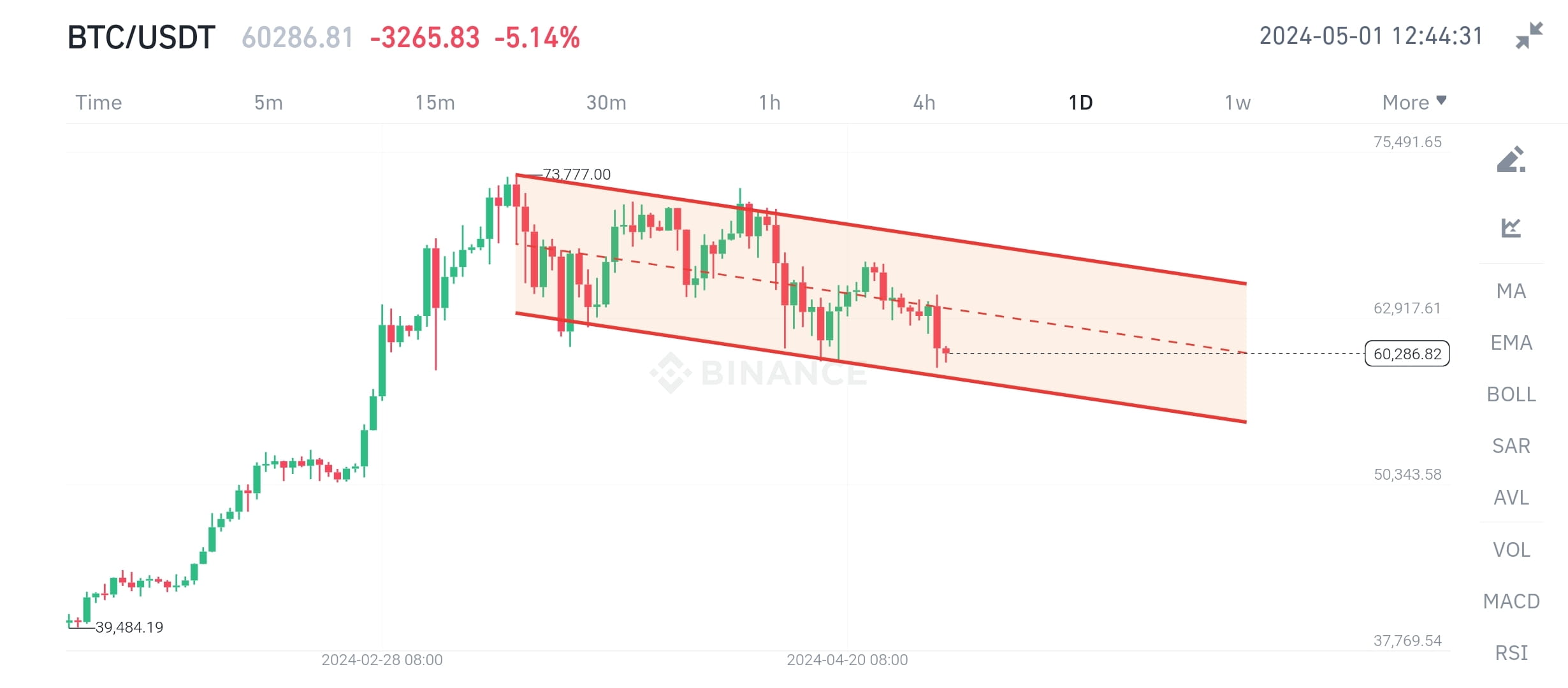
✅🔥 Figure-1 shows that $BTC is still moving in descending channel and around the bottom trendline or support line. BTC is rejected for upward movement from central trendline/resistance. Visit my previous post where you can fund details and analysis of different cases about figure-1 studied on 1D time frame(TF).
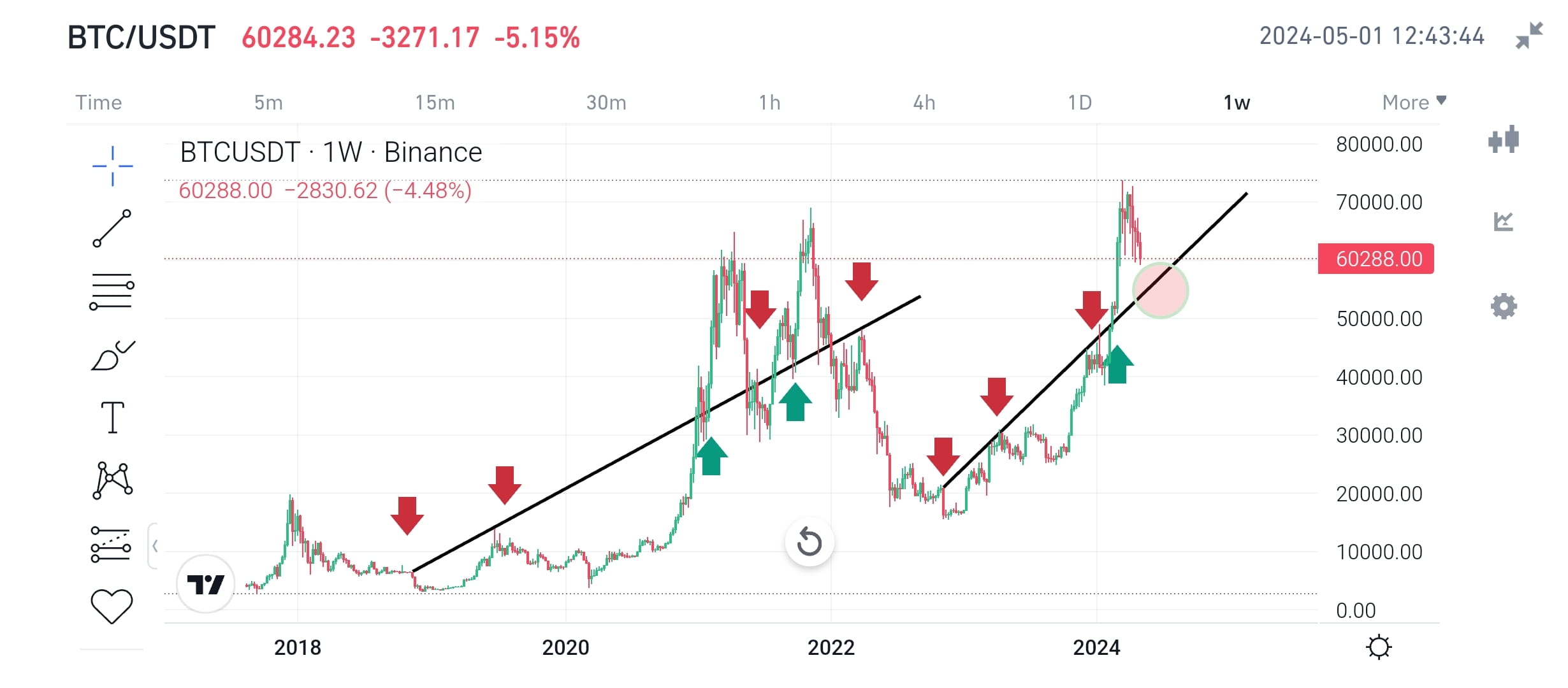
✅🔥Figure-2 represent that how the price of $BTC will act for longer term. On a weekly TF trendline drawn from the crash of 2017-18 towards the bull market movement. A similar strategy applied from the crash of 2022 towards the current bull market. In simple words, below the trendline is the bear market and above the trendline bull market. Here this trend is represented on 1W TF. Visit my profile where you can see the previous post about this case in detail.
✅🔥Yesterday #HKETF started but also a bad news for crypto community where CZ cofounder and ex-CEO of binance handed 4-months prison time. CZ always poses 4 whenever something bad happens in cryptocurrency. Also important to mention that in January when US ETFs were approved initially the market goes volatile around 48k and then drops to 37k, after that the rest is history. The same will be the case of HK ETF, you just need to show patience and keep calm rewards will come soon.
Please press follow for more information and if you like and agree with the idea. Your follow will keep me motivated to do more research and write more better content. DYOR for financial activities. This is for educational and learning purposes.
$SOL #BitcoinETFs #fomc #Fed
3
8
9.5k

WALL STREET SPLIT ON $BTC : $5.39B RECORD ETF OUTFLOWS vs. MORGAN STANLEY BUYING THE DIP! 🏦⚡
{future}(BTCUSDT)
November 2026 just delivered one of the biggest institutional divergences of the entire crypto cycle! 👀
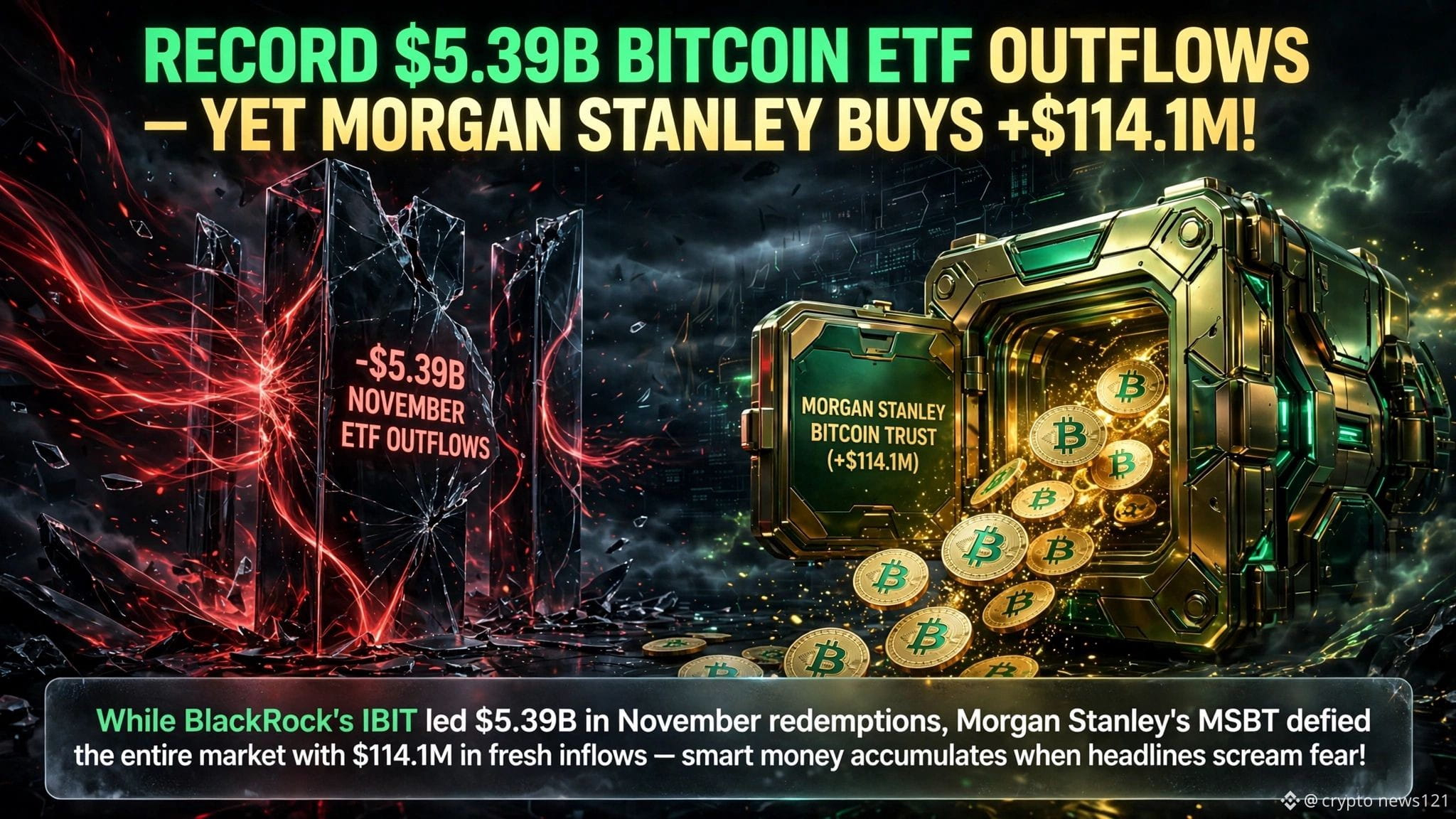
According to Farside Investors data, US spot Bitcoin ETFs suffered a record $5.39 billion in monthly net outflows through Nov. 25 (shattering June’s $4.51B record)—yet one Wall Street giant quietly went against the entire crowd! 📊
🔍 The Numbers Every Trader Should See:
🔴 Broad ETF Exodus: BlackRock’s IBIT led the withdrawals (~$4.5B / ~83% of the monthly outflow), alongside outflows from Fidelity and Grayscale.
🟢 Morgan Stanley’s Contrarian Move: While almost every fund bled capital, the Morgan Stanley Bitcoin Trust ($MSBT) pulled in +$114.1 million in net inflows for November (backed by a competitive 0.14% fee and its ~16,000-advisor network)!
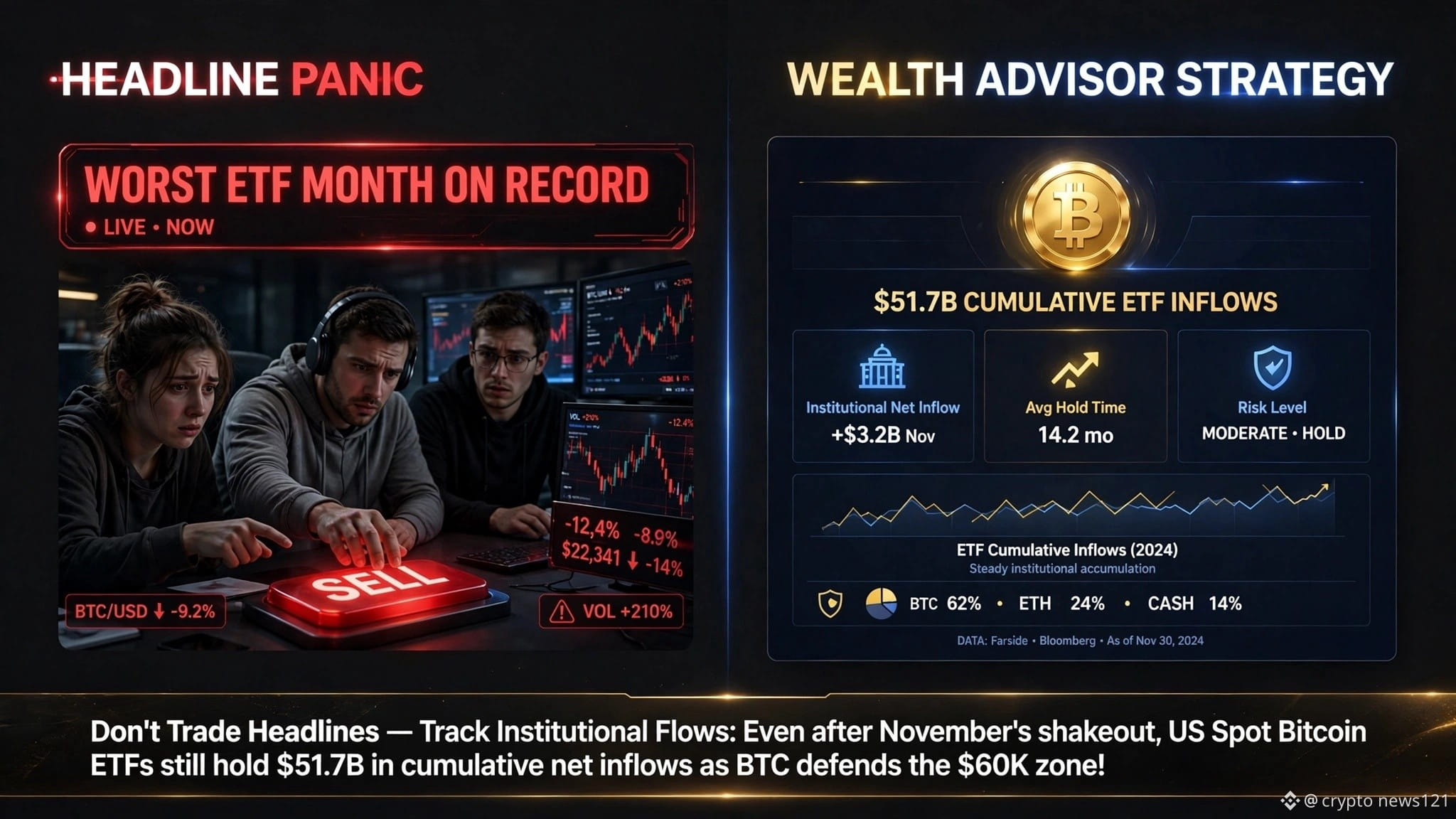
💎 The Bigger Picture: Even after this shakeout, cumulative net inflows across US spot Bitcoin ETFs still sit near $51.7 billion as $BTC stabilizes around $60,000–$61,000.
💡 Smart Money Takeaway:
Headlines scream "Record Outflows!" to shake out emotional retail traders—while wealth advisors at Morgan Stanley are steadily accumulating during fear. Always watch who is buying when weak hands are selling!
👇 Whose side are you on right now?
Comment "MORGAN STANLEY 🟢" if you're accumulating this dip, or "WAITING 🔴" if you expect more ETF selling first!
❤️ Hit LIKE if you value real institutional data over FUD!
🔁 SHARE / QUOTE to inform your crypto circle!
{future}(ETHUSDT)
🔔 FOLLOW & SUBSCRIBE to @crypto-news121 for daily ETF flow trackers, chart setups & market alpha!
$ETH
#bitcoin #BitcoinETFs #CryptoNews #InstitutionalCrypto #Write2Earn
WALL STREET SPLIT ON $BTC : $5.39B RECORD ETF OUTFLOWS vs. MORGAN STANLEY BUYING THE DIP! 🏦⚡
November 2026 just delivered one of the biggest institutional divergences of the entire crypto cycle! 👀
According to Farside Investors data, US spot Bitcoin ETFs suffered a record $5.39 billion in monthly net outflows through Nov. 25 (shattering June’s $4.51B record)—yet one Wall Street giant quietly went against the entire crowd! 📊
🔍 The Numbers Every Trader Should See:
🔴 Broad ETF Exodus: BlackRock’s IBIT led the withdrawals (~$4.5B / ~83% of the monthly outflow), alongside outflows from Fidelity and Grayscale.
🟢 Morgan Stanley’s Contrarian Move: While almost every fund bled capital, the Morgan Stanley Bitcoin Trust ($MSBT) pulled in +$114.1 million in net inflows for November (backed by a competitive 0.14% fee and its ~16,000-advisor network)!
💎 The Bigger Picture: Even after this shakeout, cumulative net inflows across US spot Bitcoin ETFs still sit near $51.7 billion as $BTC stabilizes around $60,000–$61,000.
💡 Smart Money Takeaway:
Headlines scream "Record Outflows!" to shake out emotional retail traders—while wealth advisors at Morgan Stanley are steadily accumulating during fear. Always watch who is buying when weak hands are selling!
👇 Whose side are you on right now?
Comment "MORGAN STANLEY 🟢" if you're accumulating this dip, or "WAITING 🔴" if you expect more ETF selling first!
❤️ Hit LIKE if you value real institutional data over FUD!
🔁 SHARE / QUOTE to inform your crypto circle!
🔔 FOLLOW & SUBSCRIBE to @crypto-news121 for daily ETF flow trackers, chart setups & market alpha!
$ETH
#bitcoin #BitcoinETFs #CryptoNews #InstitutionalCrypto #Write2Earn
30

·
--
#canmarketsreboundafterthanksgiving?
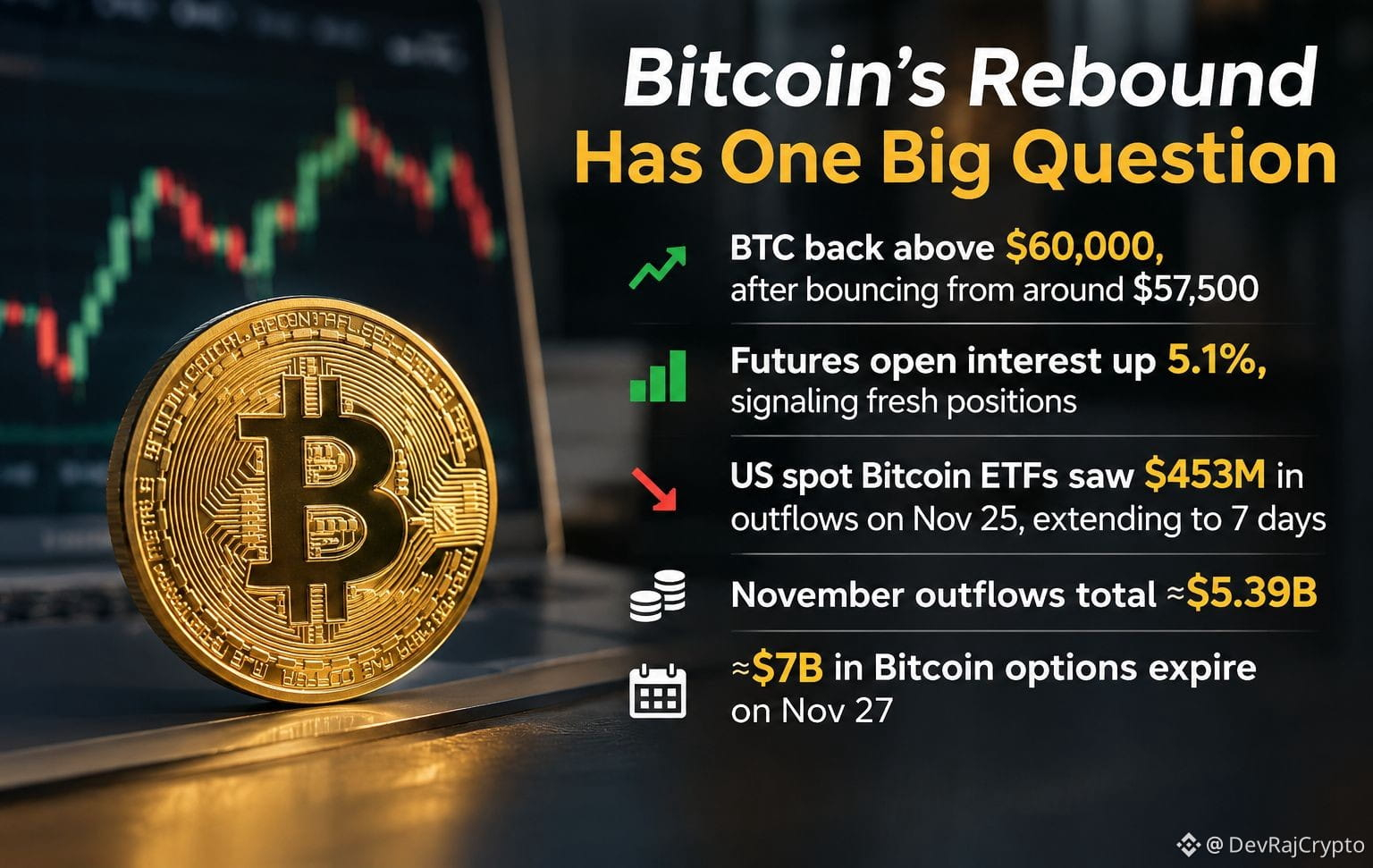
Bitcoin is back above $60,000. But I've learned not to confuse a price rebound with a market recovery.
During sharp market corrections, sentiment can change quickly. A bounce attracts attention, but what matters is whether real buying demand follows.
BTC recovered from around $57,500, while futures open interest rose 5.1%, suggesting fresh positions were entering the market.
Yet US spot Bitcoin ETFs recorded $453 million in outflows on 25 November, extending the streak to seven consecutive trading days. November's outflows reached approximately $5.39 billion.
That's the disconnect worth watching: derivatives activity is picking up, but ETF flows haven't confirmed a broader return of capital.
Around $7 billion in Bitcoin options also expire on 27 November, adding another event to monitor.
My view: I wouldn't call this a trend reversal yet. I'd look for sustained spot buying and improving ETF flows first.
A recovery isn't defined by how quickly Bitcoin rises, but by the strength of demand behind it.
#bitcoin #BitcoinETFs #CryptoMarket
1
212

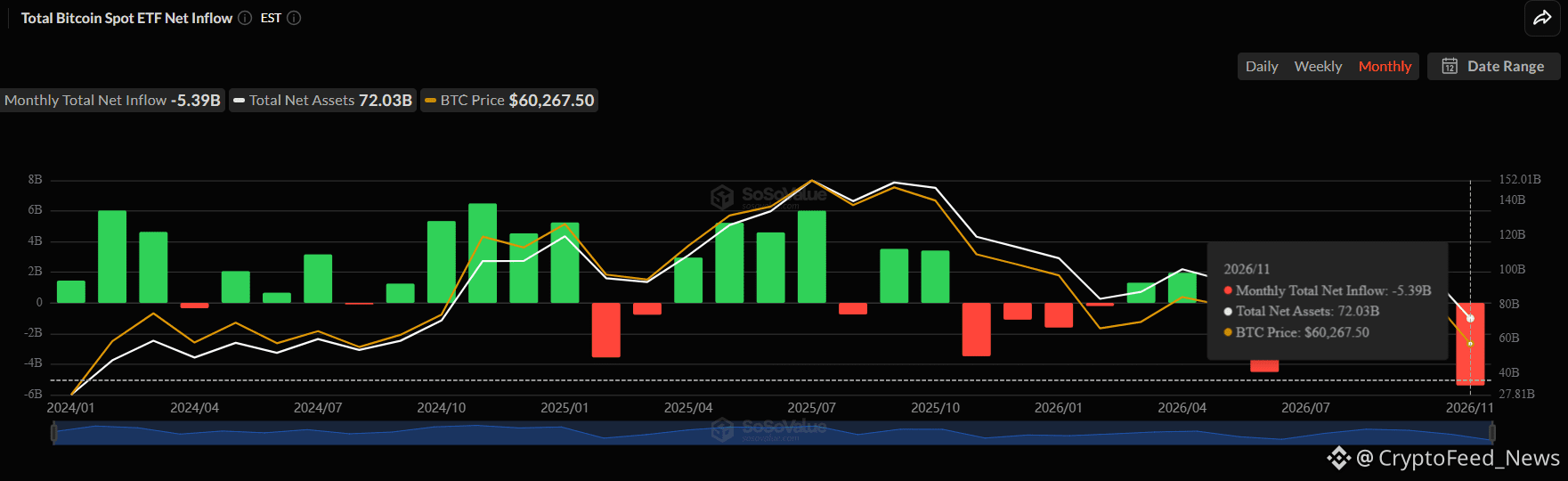
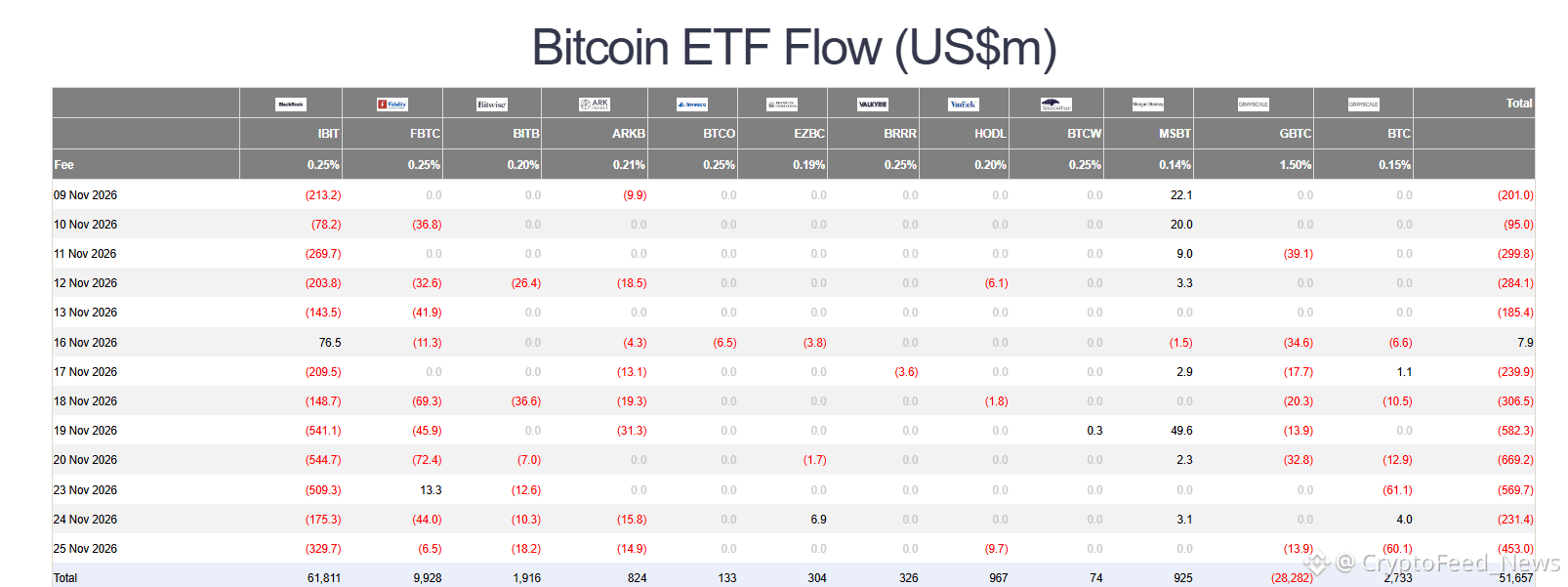
US spot #BitcoinETFs have seen $5.39B in net outflows this November, surpassing the previous monthly record of $4.51B. Wednesday alone added another $453M in withdrawals.
Despite the ETFs outflows, Crypto markets are up today, Thursday 26 November 2026. $BTC is back above $60,000 and most large tokens are higher by 3% or more over the past 24 hours, a bounce off the low Bitcoin hit last week.
Institutional selling, rising yields and AI-stock weakness continue weighing on sentiment. Can ETF demand bounce back before November closes? 👀 #Write2Earn
106

Verified
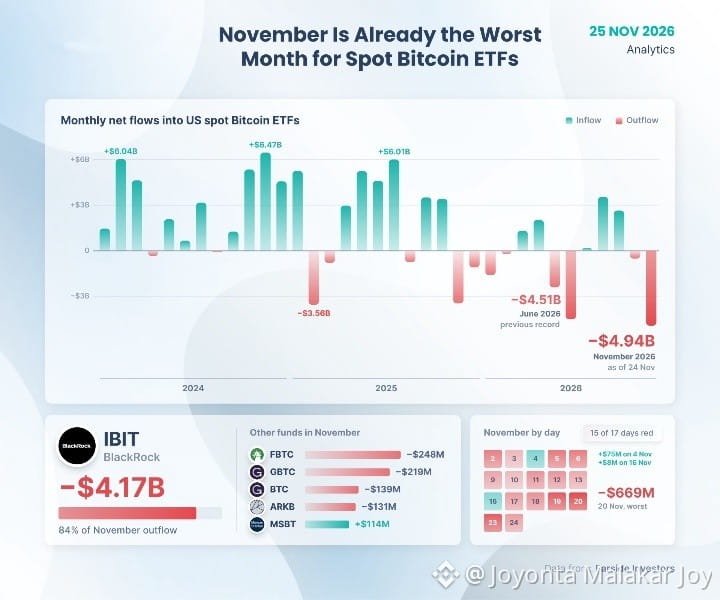
November Is Already the Worst Month for Spot Bitcoin ETFs
US spot Bitcoin ETFs have already lost a net $4.94B in November, as of 24 Nov. The previous worst month since the 2024 launch was June 2026, at −$4.51B.
IBIT alone accounts for $4.17B, or 84% of the outflow, its own worst month ever. MSBT is the only fund with net inflows (+$114M).
Money left on 15 of 17 trading days, with the worst on November 20th at −$669M. Four of the five worst months on record came in the last 13 months.
#IBIT #BitcoinETFs #BinanceSquareFamily

For Followers
From Joyonta Malakar Joy
5

·
--
Money didn't leave every crypto ETF yesterday. It picked its spots, and that's the part I'd read twice.
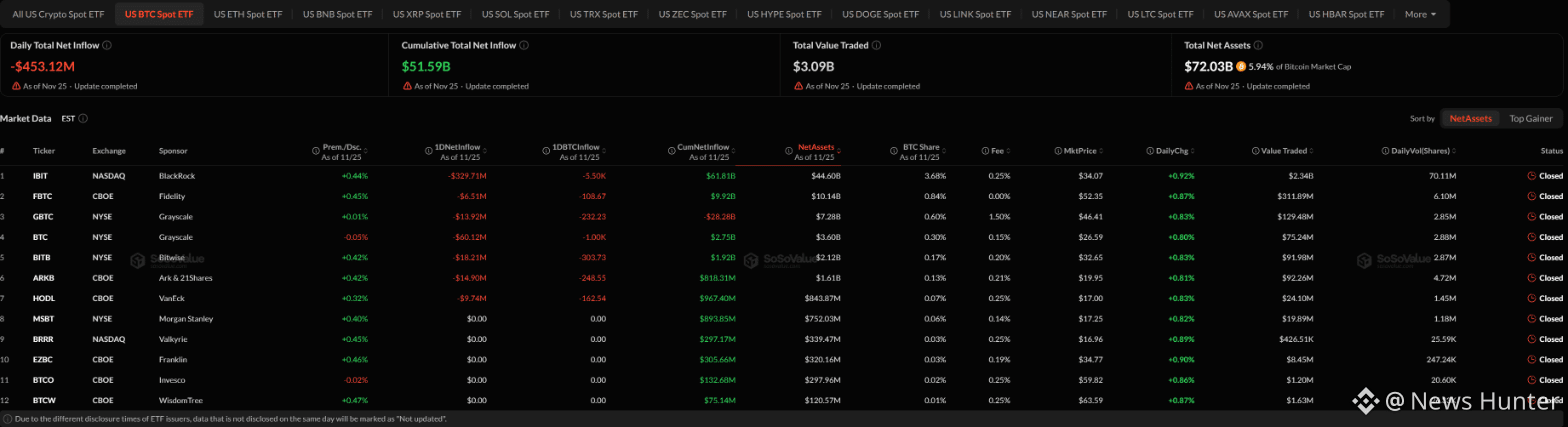
SoSoValue's numbers for Nov 25 are in. US spot $BTC ETFs lost $453.12M, a 7th straight day of outflows. BlackRock's IBIT alone was $329.71M of it. Ether funds lost another $68.51M, all from BlackRock's ETHA, which makes nine red days in a row.
Then the odd ones. The spot $NEAR ETF took in $16.23M. There's only one fund there, Bitwise's NRR, with about $59.3M in net assets, so that's a big day for its size. $XRP funds added $4.07M.
Let's keep it in proportion. The inflows are tiny next to what walked out of the two majors. One green day in a small fund can be a single large buyer, and I wouldn't call it a rotation yet. NEAR is up about 7% in 24h near $3.08, but I can't pin that on the ETF.
My take: in past ugly stretches, I cared less about one big red number than about when the selling slowed down. Right now it hasn't. Yesterday's BTC outflow was nearly double Tuesday's $231.56M, while BTC trades near $60.9K.
So I'm watching whether IBIT stops bleeding, and whether those small inflows show up again once US markets are back after Thanksgiving.
One-day blip, or are some buyers really getting pickier?
#BitcoinETFs #CryptoETF #Near #xrp #CryptoNews
Not financial advice. DYOR.
148

·
--
Bullish
📊 BITCOIN IS RECOVERING, BUT WHERE IS THE BIG MONEY?
Bitcoin is back above $61,000.
That looks encouraging. But there is another side to this story.
US Spot Bitcoin ETFs have faced heavy withdrawals. November's outflows have reached nearly $4.94 billion through November 24.
This raises an important question.
Are investors waiting for lower prices, or is institutional demand getting weaker?
For now, watch three things:
🔹 Bitcoin's ability to hold above $60K.
🔹 Daily ETF inflows and outflows.
🔹 Spot buying volume.
A price bounce is good to see. But a strong recovery needs real demand.
Don't follow the excitement. Follow the data. 🎯
#bitcoin #BTC #BitcoinETFs #CryptoMarketMoves #BinanceSquare
$BTC $ETH $SOL

111

·
--
Who sells Bitcoin six days in a row without making headlines?
Bitcoin ETFs just set a record, and not the fun kind. 📉
US spot BTC ETFs have seen about $4.94B in outflows this November, passing June's record of $4.51B. Tuesday was the sixth straight day of outflows.
Outflows show big, slower-moving money getting cautious. They don't tell us where price goes next.
The Fear & Greed Index sits at 13.
Do you see ETF outflows as a warning signal, or just normal rebalancing in a weak market?
$BTC
{spot}(BTCUSDT)
$ETFT.ETF
{etf_us}(ETFT.ETF)
$ETH
{spot}(ETHUSDT)
#bitcoin #BitcoinETFs #CryptoMarketTrends #squarecommunity
Who sells Bitcoin six days in a row without making headlines?
Bitcoin ETFs just set a record, and not the fun kind. 📉
US spot BTC ETFs have seen about $4.94B in outflows this November, passing June's record of $4.51B. Tuesday was the sixth straight day of outflows.
Outflows show big, slower-moving money getting cautious. They don't tell us where price goes next.
The Fear & Greed Index sits at 13.
Do you see ETF outflows as a warning signal, or just normal rebalancing in a weak market?
$BTC
$ETFT.ETF
$ETH
#bitcoin #BitcoinETFs #CryptoMarketTrends #squarecommunity

132

·
--
Bearish
#BitcoinETFsPostRecord494BNovemberOutflows
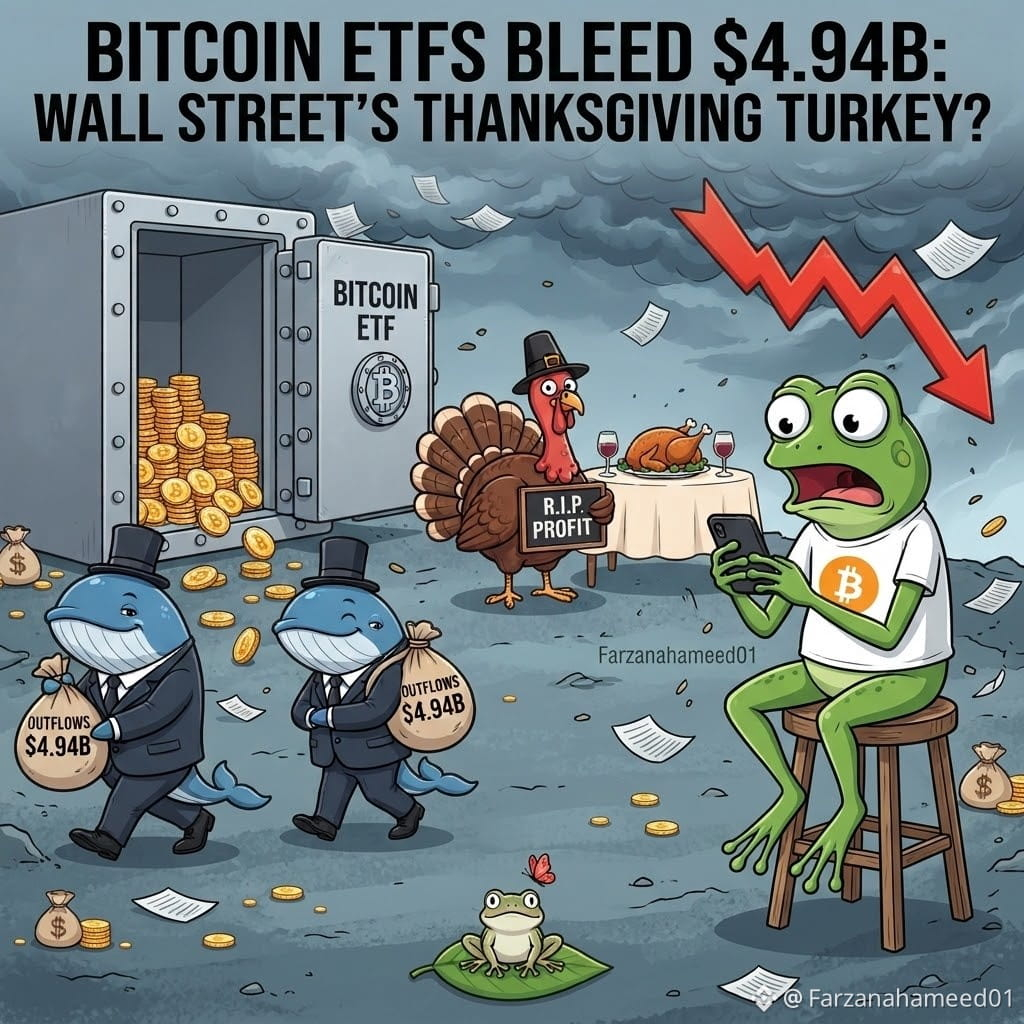
SHARKS PULL A RECORD $4.94 BILLION FROM BITCOIN ETFs: WHO'S THANKING WHOM THIS THANKSGIVING? 🦃📉
Things are really tense, guys! You'd think Wall Street was all pulling the plug on life support to free up cash for Black Friday deals!
🔍 What exactly is going on?
U.S. spot Bitcoin ETFs just saw record net outflows of $4.94 billion in November, six consecutive days of outflows, pushing year-to-date flows into negative territory for 2026. The reasons: PCE inflation hit 3.8%, AI stocks came under heavy selling pressure, and investors fear the Fed will raise interest rates by 25 basis points in December, sending BTC below $59,000 and altcoins into the red.
🛡️ What should learners do now?
Don't panic-sell with the crowd! Ahead of the Thanksgiving holiday, thin liquidity can lead to candle wicks sweeping both sides. Keep a high proportion of your funds in cash, scale into positions with DCA around strong support zones, and limit the use of high leverage.
Do you think the sharks are really leaving, or is this just Thanksgiving panic? Tell me below 👇
📚 This is for learning and sharing only. This is not financial advice. I do not trade.
$BTC ➤ In focus as ETFs bleed record $4.94B, BTC -2.31%.
$ETH ➤ Moving with Bitcoin under ETF outflow pressure, ETH -1.99%.
$EVAA ➤ Moving fast down, be careful, EVAA -8.57%.
✨ 𝐅𝐀𝐑𝐙𝐀𝐍𝐀 𝐇𝐀𝐌𝐄𝐄𝐃 𝐎𝐅𝐅𝐈𝐂𝐈𝐀𝐋 • 🦋
#BitcoinETFs #CryptoMarket #MacroNews #Bitcoin #MarketUpdate
{future}(BTCUSDT)
{future}(ETHUSDT)
{future}(EVAAUSDT)
#BitcoinETFsPostRecord494BNovemberOutflows
SHARKS PULL A RECORD $4.94 BILLION FROM BITCOIN ETFs: WHO'S THANKING WHOM THIS THANKSGIVING? 🦃📉
Things are really tense, guys! You'd think Wall Street was all pulling the plug on life support to free up cash for Black Friday deals!
🔍 What exactly is going on?
U.S. spot Bitcoin ETFs just saw record net outflows of $4.94 billion in November, six consecutive days of outflows, pushing year-to-date flows into negative territory for 2026. The reasons: PCE inflation hit 3.8%, AI stocks came under heavy selling pressure, and investors fear the Fed will raise interest rates by 25 basis points in December, sending BTC below $59,000 and altcoins into the red.
🛡️ What should learners do now?
Don't panic-sell with the crowd! Ahead of the Thanksgiving holiday, thin liquidity can lead to candle wicks sweeping both sides. Keep a high proportion of your funds in cash, scale into positions with DCA around strong support zones, and limit the use of high leverage.
Do you think the sharks are really leaving, or is this just Thanksgiving panic? Tell me below 👇
📚 This is for learning and sharing only. This is not financial advice. I do not trade.
$BTC ➤ In focus as ETFs bleed record $4.94B, BTC -2.31%.
$ETH ➤ Moving with Bitcoin under ETF outflow pressure, ETH -1.99%.
$EVAA ➤ Moving fast down, be careful, EVAA -8.57%.
✨ 𝐅𝐀𝐑𝐙𝐀𝐍𝐀 𝐇𝐀𝐌𝐄𝐄𝐃 𝐎𝐅𝐅𝐈𝐂𝐈𝐀𝐋 • 🦋
#BitcoinETFs #CryptoMarket #MacroNews #Bitcoin #MarketUpdate
7
668


Article
BITCOIN ETFs ARE SELLING… BUT WHALES ARE BUYING. WHO KNOWS SOMETHING THE MARKET DOESN'T?Something interesting is happening in Bitcoin's market structure, and I don't think traders should ignore it.
US spot Bitcoin ETFs recorded approximately $570 million in net outflows on November 23, while their combined outflows over the previous five trading sessions reached approximately $1.88 billion.
At first glance, this looks bearish. But the on-chain picture tells a different part of the story.
According to recent whale balance data, large Bitcoin holders with at least 1,000 BTC accumulated approximately 84,000 BTC over 30 days, increasing their combined balances by 2.5% to around 3.02 million BTC.
Glassnode also identified renewed accumulation among wallets holding 100–1,000 BTC and 1,000–10,000 BTC.
But here's where things get interesting.
ETF investors are reducing exposure while certain large holders are increasing theirs.
Does this mean smart money is buying what institutional investors are selling?
Not necessarily.
ETF flows measure fund creations and redemptions, while whale metrics track wallet balances. These datasets cannot establish that whales are directly buying the BTC redeemed by ETF investors.
There is another important detail: Galaxy Research reported that institutional 13F filers added 49,229 BTC equivalent to their spot Bitcoin ETP positions during Q3 2026. Their reported holdings reached a record 356,491 BTC equivalent by September 30.
So institutional positioning is not moving in one direction.
My question is simple:
Are we witnessing institutional distribution, strategic whale accumulation, or just a transfer of Bitcoin between different types of investors?
I want to hear what other traders think. Don't just say bullish or bearish. Explain what the data suggests.
#Bitcoin #CryptoMarket #BitcoinETFs
$BTC
{spot}(BTCUSDT)
BITCOIN ETFs ARE SELLING… BUT WHALES ARE BUYING. WHO KNOWS SOMETHING THE MARKET DOESN'T?
Something interesting is happening in Bitcoin's market structure, and I don't think traders should ignore it.
US spot Bitcoin ETFs recorded approximately $570 million in net outflows on November 23, while their combined outflows over the previous five trading sessions reached approximately $1.88 billion.
At first glance, this looks bearish. But the on-chain picture tells a different part of the story.
According to recent whale balance data, large Bitcoin holders with at least 1,000 BTC accumulated approximately 84,000 BTC over 30 days, increasing their combined balances by 2.5% to around 3.02 million BTC.
Glassnode also identified renewed accumulation among wallets holding 100–1,000 BTC and 1,000–10,000 BTC.
But here's where things get interesting.
ETF investors are reducing exposure while certain large holders are increasing theirs.
Does this mean smart money is buying what institutional investors are selling?
Not necessarily.
ETF flows measure fund creations and redemptions, while whale metrics track wallet balances. These datasets cannot establish that whales are directly buying the BTC redeemed by ETF investors.
There is another important detail: Galaxy Research reported that institutional 13F filers added 49,229 BTC equivalent to their spot Bitcoin ETP positions during Q3 2026. Their reported holdings reached a record 356,491 BTC equivalent by September 30.
So institutional positioning is not moving in one direction.
My question is simple:
Are we witnessing institutional distribution, strategic whale accumulation, or just a transfer of Bitcoin between different types of investors?
I want to hear what other traders think. Don't just say bullish or bearish. Explain what the data suggests.
#Bitcoin #CryptoMarket #BitcoinETFs
$BTC
zotontrack:
BTC derrete assustadora , o indice do medo vai explodir , que fazer ???? Muitas perdas
2
5
2.9k

·
--
Article
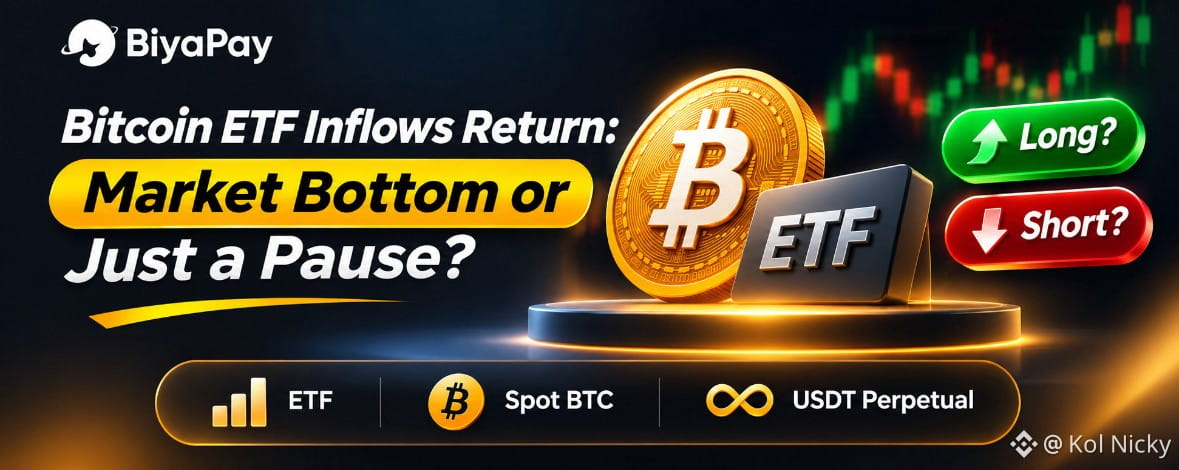
Bitcoin ETF Inflows Return: Is This the Bottom for BTC or Just a Temporary Pause?Bitcoin investors finally got a small break after days of persistent ETF outflows. On November 16, 2026, U.S. spot Bitcoin ETFs recorded approximately $7.9 million in net inflows, with BlackRock’s iShares Bitcoin Trust (IBIT) attracting $76.5 million.
At first glance, this looked like a possible change in market sentiment. After several sessions of withdrawals, institutional capital appeared to be returning.
But there is an important detail worth examining: most of the other funds were still experiencing withdrawals. The positive result was largely driven by one major fund, while outflows elsewhere reduced the overall impact.
So, does this mean Bitcoin has found its bottom? Or are investors simply witnessing a temporary interruption in a broader selling trend?
The difference matters, especially for anyone considering whether to buy BTC, wait for confirmation, or take a short position.
1. What the ETF Inflow Rebound Actually Tells Us
Spot Bitcoin ETFs have become an important way for traditional investors to gain exposure to Bitcoin without directly managing cryptocurrency wallets.
Consequently, their daily flows provide useful information about institutional demand.
The November 16 figures deserve attention:
Total U.S. spot Bitcoin ETF net inflows: approximately $7.9 million.
BlackRock IBIT inflows: approximately $76.5 million.Several competing funds continued recording net withdrawals.
This tells us that demand was returning to at least one major investment vehicle, but the broader picture remained mixed.
A single positive session cannot establish that institutional investors have collectively changed their outlook.
It is also important to understand that ETF flows are not a complete picture of the Bitcoin market. Investors can purchase BTC directly through exchanges, hold existing positions, or gain exposure through derivatives.
Therefore, ETF activity should be considered alongside trading volume, price action, liquidity and broader market conditions.
2. Why One Positive Day Does Not Confirm a Market Bottom
A market bottom is usually easier to identify in hindsight than in real time.
When prices fall sharply, investors naturally look for evidence that selling pressure is weakening. Positive ETF inflows can be one such signal, but they are not sufficient on their own.
There are three things worth watching.
First, consistency in ETF demand.
If positive flows continue across several sessions and involve multiple funds, that provides stronger evidence of improving demand than one isolated inflow.
Second, Bitcoin’s price response.
Capital entering ETFs is useful information, but investors should also examine whether BTC can establish higher lows, reclaim important price levels and maintain support during periods of selling pressure.
Third, trading volume and market participation.
A recovery supported by stronger spot-market participation may offer a different picture from a short-lived price increase driven primarily by leveraged positions.
The important point is not to dismiss positive ETF flows. It is to avoid treating them as confirmation before other indicators support the same conclusion.
3. Long or Short? Understanding Both Sides of the Market
When Bitcoin experiences uncertainty, investors generally consider two possible directions.
A long position expresses the expectation that Bitcoin’s price will rise. A short position expresses the expectation that its price will fall.
Neither position is automatically correct because ETF inflows have returned.
A bullish investor might look for improving institutional demand, stronger spot buying, recovering market structure and sustained support levels before considering a long position.
A bearish investor might pay closer attention to renewed ETF withdrawals, weakening support, lower trading highs and increasing selling pressure.
There is also a third option: waiting.
Not every market condition requires an immediate trade. When the available evidence is contradictory, remaining patient can be a deliberate decision rather than a missed opportunity.
The objective should be to understand the conditions supporting a position, define the risk involved and avoid making decisions based solely on headlines.
4. Bitcoin ETFs, Spot Trading and Perpetual Futures: What Is the Difference?
Although all three provide exposure to Bitcoin’s price movements, they work differently.
Spot Bitcoin ETFs
These are investment products traded through traditional financial markets. Investors purchase ETF shares that represent exposure to Bitcoin held by the fund.
They offer a familiar structure for traditional market participants, but investors own ETF shares rather than directly holding the underlying Bitcoin.
Spot Bitcoin Trading
Spot trading involves buying or selling the actual cryptocurrency.
When someone purchases BTC through a spot market, they acquire Bitcoin rather than a derivative contract. The value of the position generally moves with the market price of the asset.
This approach is relevant to investors who want direct cryptocurrency exposure without the additional mechanics of perpetual contracts.
USDT Perpetual Futures
Perpetual futures are derivative contracts that allow traders to speculate on Bitcoin’s price without owning the underlying asset.
They support both long and short positions. Traders can therefore express bullish or bearish views depending on their market expectations.
However, perpetual futures introduce additional risks, including funding payments, liquidation and losses amplified by leverage.
Understanding these differences is essential before choosing a trading method.
5. Where BiyaPay Fits Into the Picture
BiyaPay provides access to both BTC spot trading and BTCUSDT perpetual futures, offering two different ways to participate in Bitcoin’s market movements.
For someone who prefers direct exposure, the BTC/USDT spot market provides a way to buy and sell Bitcoin against USDT.
For traders who want to respond to movements in either direction, the BTCUSDT perpetual futures market provides long and short trading opportunities.
The distinction is important.
Spot trading focuses on acquiring or selling the underlying asset, while perpetual futures focus on the price movement of a contract.
Neither approach removes market risk. Spot positions can lose value when Bitcoin declines, while futures positions can face liquidation when the market moves against them.
Before using perpetual futures, traders should understand margin requirements, leverage, funding rates and liquidation prices.
Choosing the right product should depend on an individual’s understanding of the market and ability to manage risk, not simply on the possibility of making a quick profit.
6. What Should Bitcoin Investors Watch Next?
The November 16 inflow rebound was worth noting, but subsequent ETF activity showed why caution remains necessary.
U.S. spot Bitcoin ETFs returned to net outflows in the following sessions, demonstrating that the initial positive reading did not establish a sustained reversal.
Investors should continue monitoring:
Whether ETF inflows become consistent across multiple trading sessions.
Whether institutional demand broadens beyond a single fund.
Whether Bitcoin can maintain important support levels.
Whether spot-market buying strengthens.
Whether trading volume supports a recovery.Whether macroeconomic conditions and market liquidity improve or deteriorate.
These indicators provide a more complete picture than any single daily ETF report.
Final Thoughts: Don’t Confuse a Rebound With Confirmation
The return of positive Bitcoin ETF flows was encouraging, but it was not enough to declare that the market had reached its bottom.
Markets rarely change direction based on one data point. Sustainable recoveries generally require stronger participation, improving demand and confirmation from price action.
For investors, the bigger lesson is to understand what the data actually says before deciding how to respond.
Whether someone prefers holding Bitcoin through spot trading or exploring directional opportunities through perpetual futures, the foundation remains the same: understand the product, assess the market and manage risk.
The real question is not whether one green ETF day looks promising.
It is whether the market can produce enough evidence to support a lasting change in direction.
#BitcoinETFs #biyapay
Bitcoin ETF Inflows Return: Is This the Bottom for BTC or Just a Temporary Pause?
Bitcoin investors finally got a small break after days of persistent ETF outflows. On November 16, 2026, U.S. spot Bitcoin ETFs recorded approximately $7.9 million in net inflows, with BlackRock’s iShares Bitcoin Trust (IBIT) attracting $76.5 million.
At first glance, this looked like a possible change in market sentiment. After several sessions of withdrawals, institutional capital appeared to be returning.
But there is an important detail worth examining: most of the other funds were still experiencing withdrawals. The positive result was largely driven by one major fund, while outflows elsewhere reduced the overall impact.
So, does this mean Bitcoin has found its bottom? Or are investors simply witnessing a temporary interruption in a broader selling trend?
The difference matters, especially for anyone considering whether to buy BTC, wait for confirmation, or take a short position.
1. What the ETF Inflow Rebound Actually Tells Us
Spot Bitcoin ETFs have become an important way for traditional investors to gain exposure to Bitcoin without directly managing cryptocurrency wallets.
Consequently, their daily flows provide useful information about institutional demand.
The November 16 figures deserve attention:
Total U.S. spot Bitcoin ETF net inflows: approximately $7.9 million.
BlackRock IBIT inflows: approximately $76.5 million.Several competing funds continued recording net withdrawals.
This tells us that demand was returning to at least one major investment vehicle, but the broader picture remained mixed.
A single positive session cannot establish that institutional investors have collectively changed their outlook.
It is also important to understand that ETF flows are not a complete picture of the Bitcoin market. Investors can purchase BTC directly through exchanges, hold existing positions, or gain exposure through derivatives.
Therefore, ETF activity should be considered alongside trading volume, price action, liquidity and broader market conditions.
2. Why One Positive Day Does Not Confirm a Market Bottom
A market bottom is usually easier to identify in hindsight than in real time.
When prices fall sharply, investors naturally look for evidence that selling pressure is weakening. Positive ETF inflows can be one such signal, but they are not sufficient on their own.
There are three things worth watching.
First, consistency in ETF demand.
If positive flows continue across several sessions and involve multiple funds, that provides stronger evidence of improving demand than one isolated inflow.
Second, Bitcoin’s price response.
Capital entering ETFs is useful information, but investors should also examine whether BTC can establish higher lows, reclaim important price levels and maintain support during periods of selling pressure.
Third, trading volume and market participation.
A recovery supported by stronger spot-market participation may offer a different picture from a short-lived price increase driven primarily by leveraged positions.
The important point is not to dismiss positive ETF flows. It is to avoid treating them as confirmation before other indicators support the same conclusion.
3. Long or Short? Understanding Both Sides of the Market
When Bitcoin experiences uncertainty, investors generally consider two possible directions.
A long position expresses the expectation that Bitcoin’s price will rise. A short position expresses the expectation that its price will fall.
Neither position is automatically correct because ETF inflows have returned.
A bullish investor might look for improving institutional demand, stronger spot buying, recovering market structure and sustained support levels before considering a long position.
A bearish investor might pay closer attention to renewed ETF withdrawals, weakening support, lower trading highs and increasing selling pressure.
There is also a third option: waiting.
Not every market condition requires an immediate trade. When the available evidence is contradictory, remaining patient can be a deliberate decision rather than a missed opportunity.
The objective should be to understand the conditions supporting a position, define the risk involved and avoid making decisions based solely on headlines.
4. Bitcoin ETFs, Spot Trading and Perpetual Futures: What Is the Difference?
Although all three provide exposure to Bitcoin’s price movements, they work differently.
Spot Bitcoin ETFs
These are investment products traded through traditional financial markets. Investors purchase ETF shares that represent exposure to Bitcoin held by the fund.
They offer a familiar structure for traditional market participants, but investors own ETF shares rather than directly holding the underlying Bitcoin.
Spot Bitcoin Trading
Spot trading involves buying or selling the actual cryptocurrency.
When someone purchases BTC through a spot market, they acquire Bitcoin rather than a derivative contract. The value of the position generally moves with the market price of the asset.
This approach is relevant to investors who want direct cryptocurrency exposure without the additional mechanics of perpetual contracts.
USDT Perpetual Futures
Perpetual futures are derivative contracts that allow traders to speculate on Bitcoin’s price without owning the underlying asset.
They support both long and short positions. Traders can therefore express bullish or bearish views depending on their market expectations.
However, perpetual futures introduce additional risks, including funding payments, liquidation and losses amplified by leverage.
Understanding these differences is essential before choosing a trading method.
5. Where BiyaPay Fits Into the Picture
BiyaPay provides access to both BTC spot trading and BTCUSDT perpetual futures, offering two different ways to participate in Bitcoin’s market movements.
For someone who prefers direct exposure, the BTC/USDT spot market provides a way to buy and sell Bitcoin against USDT.
For traders who want to respond to movements in either direction, the BTCUSDT perpetual futures market provides long and short trading opportunities.
The distinction is important.
Spot trading focuses on acquiring or selling the underlying asset, while perpetual futures focus on the price movement of a contract.
Neither approach removes market risk. Spot positions can lose value when Bitcoin declines, while futures positions can face liquidation when the market moves against them.
Before using perpetual futures, traders should understand margin requirements, leverage, funding rates and liquidation prices.
Choosing the right product should depend on an individual’s understanding of the market and ability to manage risk, not simply on the possibility of making a quick profit.
6. What Should Bitcoin Investors Watch Next?
The November 16 inflow rebound was worth noting, but subsequent ETF activity showed why caution remains necessary.
U.S. spot Bitcoin ETFs returned to net outflows in the following sessions, demonstrating that the initial positive reading did not establish a sustained reversal.
Investors should continue monitoring:
Whether ETF inflows become consistent across multiple trading sessions.
Whether institutional demand broadens beyond a single fund.
Whether Bitcoin can maintain important support levels.
Whether spot-market buying strengthens.
Whether trading volume supports a recovery.Whether macroeconomic conditions and market liquidity improve or deteriorate.
These indicators provide a more complete picture than any single daily ETF report.
Final Thoughts: Don’t Confuse a Rebound With Confirmation
The return of positive Bitcoin ETF flows was encouraging, but it was not enough to declare that the market had reached its bottom.
Markets rarely change direction based on one data point. Sustainable recoveries generally require stronger participation, improving demand and confirmation from price action.
For investors, the bigger lesson is to understand what the data actually says before deciding how to respond.
Whether someone prefers holding Bitcoin through spot trading or exploring directional opportunities through perpetual futures, the foundation remains the same: understand the product, assess the market and manage risk.
The real question is not whether one green ETF day looks promising.
It is whether the market can produce enough evidence to support a lasting change in direction.
#BitcoinETFs #biyapay
86

·
--
Bearish
MALAYSIA CHÍNH THỨC LÊN SÓNG BITCOIN ETF ĐẦU TIÊN: CHUẨN HỒI GIÁO ĐẦU TIÊN TRÊN THẾ GIỚI!
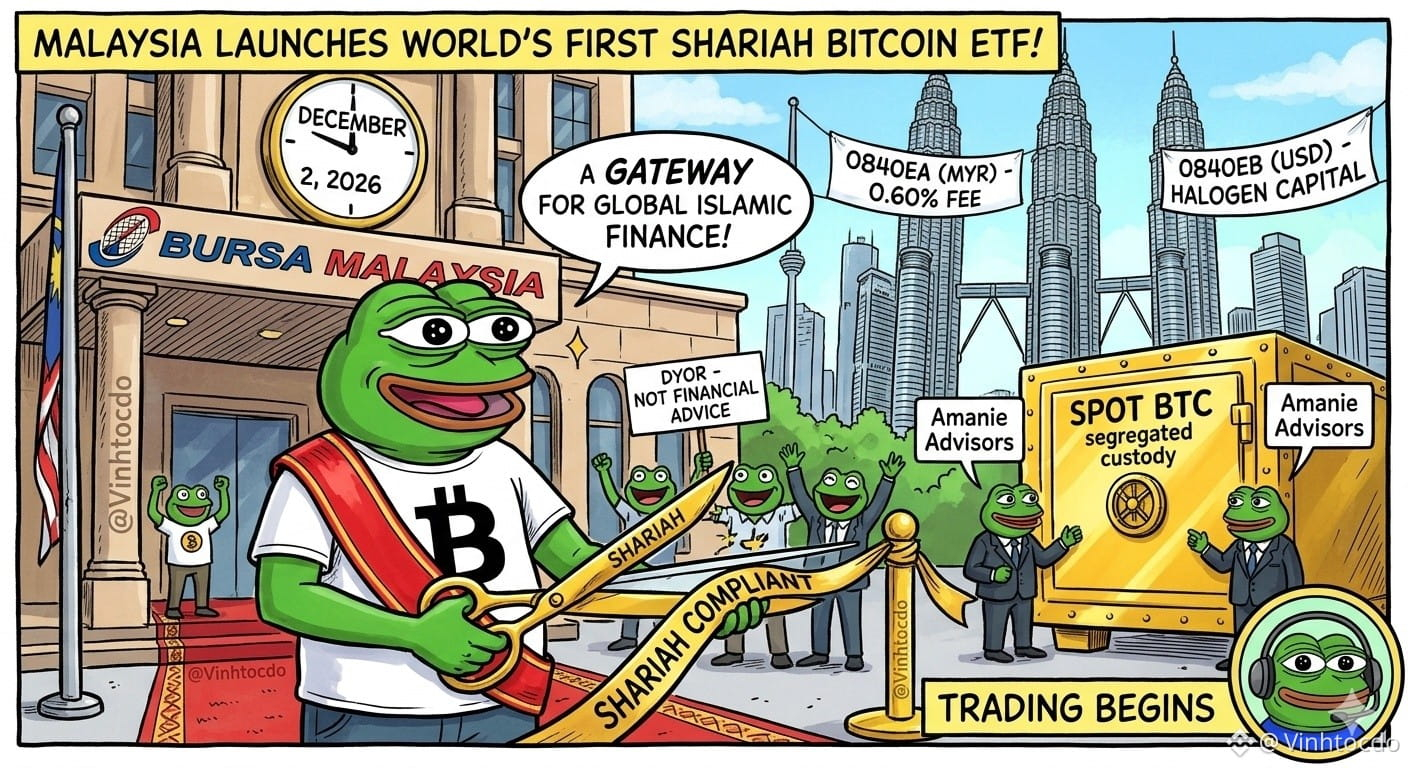
Đông Nam Á lại có tin vui cực chấn động cho anh em hệ Crypto! Quỹ Halogen Shariah Bitcoin ETF do Halogen Capital quản lý sẽ chính thức niêm yết trên Sàn chứng khoán Bursa Malaysia vào ngày 2/12/2026. Đây không chỉ là quỹ ETF tiền mã hóa đầu tiên của Malaysia mà còn là quỹ Bitcoin ETF tuân thủ luật Hồi giáo (Shariah) đầu tiên trên toàn cầu.
Cụ thể, quỹ này nắm giữ Bitcoin giao ngay (spot) và bám sát chỉ số FTSE Bitcoin Index, giao dịch song song bằng đồng Ringgit (mã 0840EA) và USD (mã 0840EB). Phí quản lý tối đa chỉ 0.60%/năm, phí lưu ký 0.05%, với lượng BTC được bảo quản tách biệt bởi đơn vị lưu ký toàn cầu và giám sát chặt chẽ bởi Amanie Advisors.
Điều này nghĩa là gì? Cánh cửa dòng vốn tổ chức và cộng đồng nhà đầu tư Hồi giáo tỷ đô đang rộng mở hơn bao giờ hết với Bitcoin thông qua kênh tài chính hợp pháp.
Trader phải làm gì lúc này? Đừng FOMO mua đuổi theo tin tức ngắn hạn mà quên quản lý vốn. Hãy quan sát dòng tiền thực tế chảy vào sau ngày niêm yết và kiên nhẫn chờ các vùng giá đẹp!
*Lưu ý: Đây không phải lời khuyên tài chính, anh em tự quản lý rủi ro nhé.*
Click giao dịch bên dưới để ủng hộ tôi: $BTC
{future}(BTCUSDT)
$ETH
{future}(ETHUSDT)
$BULLA
{future}(BULLAUSDT)
#BitcoinETFs #MalaysiaCrypto #CryptoNews #BTC #InstitutionalAdoption #VINHTOCDO
MALAYSIA CHÍNH THỨC LÊN SÓNG BITCOIN ETF ĐẦU TIÊN: CHUẨN HỒI GIÁO ĐẦU TIÊN TRÊN THẾ GIỚI!
Đông Nam Á lại có tin vui cực chấn động cho anh em hệ Crypto! Quỹ Halogen Shariah Bitcoin ETF do Halogen Capital quản lý sẽ chính thức niêm yết trên Sàn chứng khoán Bursa Malaysia vào ngày 2/12/2026. Đây không chỉ là quỹ ETF tiền mã hóa đầu tiên của Malaysia mà còn là quỹ Bitcoin ETF tuân thủ luật Hồi giáo (Shariah) đầu tiên trên toàn cầu.
Cụ thể, quỹ này nắm giữ Bitcoin giao ngay (spot) và bám sát chỉ số FTSE Bitcoin Index, giao dịch song song bằng đồng Ringgit (mã 0840EA) và USD (mã 0840EB). Phí quản lý tối đa chỉ 0.60%/năm, phí lưu ký 0.05%, với lượng BTC được bảo quản tách biệt bởi đơn vị lưu ký toàn cầu và giám sát chặt chẽ bởi Amanie Advisors.
Điều này nghĩa là gì? Cánh cửa dòng vốn tổ chức và cộng đồng nhà đầu tư Hồi giáo tỷ đô đang rộng mở hơn bao giờ hết với Bitcoin thông qua kênh tài chính hợp pháp.
Trader phải làm gì lúc này? Đừng FOMO mua đuổi theo tin tức ngắn hạn mà quên quản lý vốn. Hãy quan sát dòng tiền thực tế chảy vào sau ngày niêm yết và kiên nhẫn chờ các vùng giá đẹp!
*Lưu ý: Đây không phải lời khuyên tài chính, anh em tự quản lý rủi ro nhé.*
Click giao dịch bên dưới để ủng hộ tôi: $BTC
$ETH
$BULLA
#BitcoinETFs #MalaysiaCrypto #CryptoNews #BTC #InstitutionalAdoption #VINHTOCDO
1
2

·
--
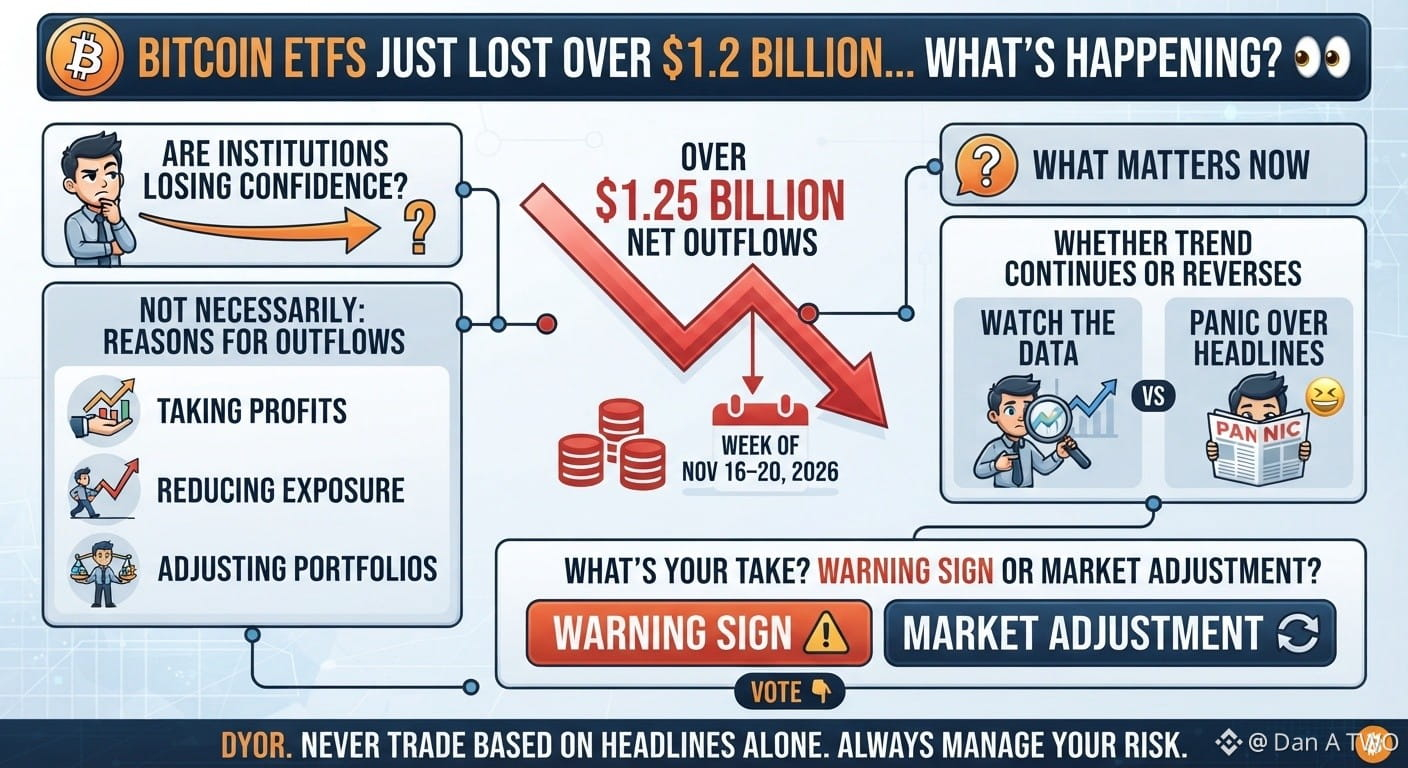
Bitcoin ETFs Just Lost Over $1.2 Billion… What's Happening? 👀
Something worth watching is happening in the Bitcoin market.
U.S. Spot Bitcoin ETFs recorded around $1.25 billion in net outflows during the week of November 16–20, 2026.
That's a lot of money moving out in just one week.
But does this mean institutional investors are losing confidence in Bitcoin?
Not necessarily.
ETF outflows can happen for different reasons. Some investors may be taking profits, reducing exposure or adjusting their portfolios.
And let's be honest, a few days of withdrawals don't tell us the whole story.
What matters now is whether this trend continues or starts to reverse.
Personally, I'd rather watch the data than panic over headlines. 😂
What's your take? Are these ETF outflows a warning sign for Bitcoin, or just a temporary market adjustment? 👇
DYOR. Never trade based on headlines alone. Always manage your risk.
#bitcoin #DanATWO #BitcoinETFs #CryptoNews #BinanceSquare
BTC-1.10%
IBITETF+0.07%
1
38

·
--
Institutional flows are back in focus: spot Bitcoin ETF IBIT reportedly saw a $541M one-day outflow.
This highlights how quickly market sentiment can shift—even while BTC attempts to recover. ETF flows remain an important signal for broader risk appetite.
#BitcoinETFs $BTC
{spot}(BTCUSDT)
#BTC #crypto #CryptoNews
Institutional flows are back in focus: spot Bitcoin ETF IBIT reportedly saw a $541M one-day outflow.
This highlights how quickly market sentiment can shift—even while BTC attempts to recover. ETF flows remain an important signal for broader risk appetite.
#BitcoinETFs $BTC
#BTC #crypto #CryptoNews
This highlights how quickly market sentiment can shift—even while BTC attempts to recover. ETF flows remain an important signal for broader risk appetite.
#BitcoinETFs $BTC
#BTC #crypto #CryptoNews

BTC-1.10%
IBITETF+0.07%
1
64

·
--
Institutional Bitcoin demand is worth watching right now.
According to the reports, US spot Bitcoin ETFs recorded around $3.47 billion in net outflows during November.
BlackRock's IBIT also reportedly experienced a record single-day outflow.
This doesn't mean institutions have permanently lost interest in Bitcoin.
But it does show that institutional demand can change during market stress.
Can Bitcoin recover strongly without renewed institutional demand?
$BTC #BitcoinETFs #CryptoNews #BTC
21

·
--
🚨 $BTC FACING INSTITUTIONAL CAPITAL FLIGHT AS ETF OUTFLOWS TEST THE $75K FLOOR 📉
Entry: 75,321.7 ⚡
Three consecutive sessions of net outflows totaling 201 million dollars indicate institutional portfolio rebalancing near local highs rather than structural distribution. While major desks lock in profits, the underlying 147 billion dollar asset base acts as a formidable structural floor absorbing liquidity. 📊
Monitoring order flow around the 75 thousand dollar liquidity pocket is critical to gauge whether short-term volatility expands into a deeper corrective sweep. Discipline remains paramount when spot flows diverge from macro consolidation ranges. 💡
Are you positioning for a continuation retest or waiting for institutional demand to stabilize below support? 👇
⚠️ Not financial advice. Always manage your risk. 🛡️
🏷️ #BTC #BitcoinETFs #MarketStructure #CryptoTrading
🔥 💎
·
--
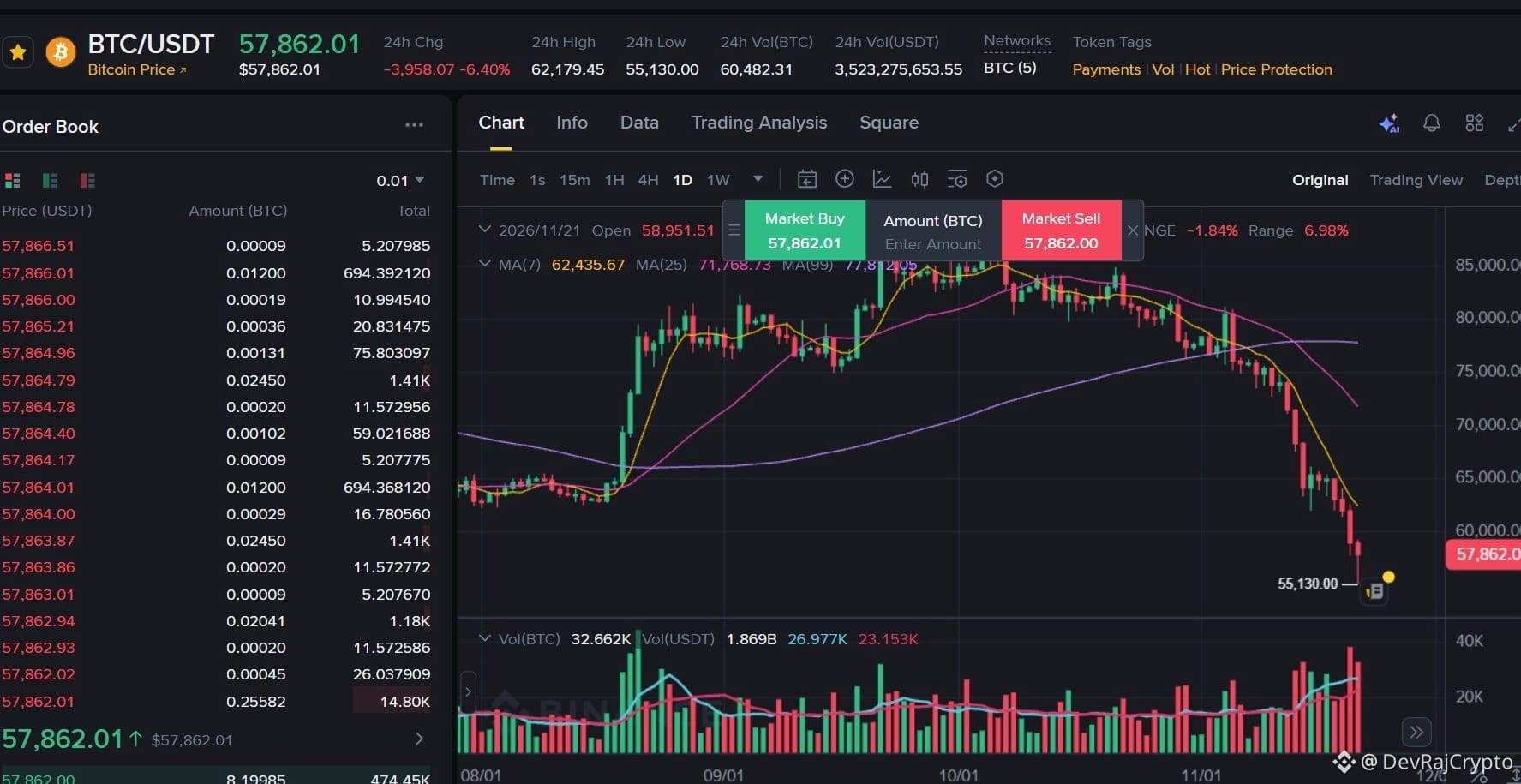
Bitcoin’s breakdown below $60,000 is exposing a bigger problem: buyers are not yet showing enough conviction to reverse the trend.
On November 21, Binance’s BTC/USDT chart showed $57,862, down 6.40% in 24 hours.
BTC was trading below its 7-day ($62,435), 25-day ($71,768) and 99-day ($77,812) moving averages. This points to weakness across multiple time horizons.
But the bigger concern is demand.
US spot Bitcoin ETFs recorded $582.3 million in net outflows on November 19. BlackRock’s IBIT alone accounted for $541.1 million, according to Farside Investors.
My assessment: This is not a market where one sharp bounce should restore confidence. I would watch $55,130 as the immediate chart low, followed by a sustained reclaim of $60,000 and the return of higher lows.
Until buyers demonstrate conviction, I see any recovery as unconfirmed.
#bitcoin #CryptoMarket #BitcoinETFs #BİNANCESQUARE
1
57
·
--
Article
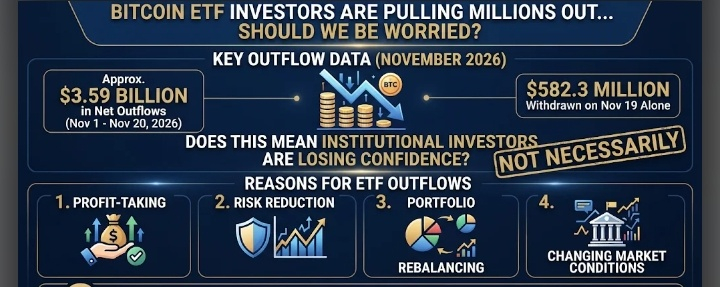
Bitcoin ETF Investors Are Pulling Millions Out… Should We Be Worried? 👀Something interesting is happening in the Bitcoin market.
US spot Bitcoin ETFs recorded approximately $3.59 billion in net outflows in November so far, through November 20, 2026.
On November 19 alone, investors withdrew around $582.3 million.
That's not a small number.
But here's something worth understanding…
Does this mean institutional investors are losing confidence in Bitcoin?
Not necessarily.
ETF outflows can reflect profit-taking, risk reduction, portfolio rebalancing, or changing market conditions.
And one important thing: ETF outflows don't mean every institution is selling its Bitcoin.
For me, the real question is whether this selling pressure continues or starts to slow down.
What do you think?
Are institutions becoming less interested in BTC, or is this just a temporary market reaction?
DYOR. Always manage your risk. Don't make investment decisions based on headlines alone.
#bitcoin #BTC #BitcoinETFs #CryptoMarket #DanATWO $BTC $BNB
{spot}(BTCUSDT)
{spot}(ETHUSDT)
{spot}(SOLUSDT)
Bitcoin ETF Investors Are Pulling Millions Out… Should We Be Worried? 👀
Something interesting is happening in the Bitcoin market.
US spot Bitcoin ETFs recorded approximately $3.59 billion in net outflows in November so far, through November 20, 2026.
On November 19 alone, investors withdrew around $582.3 million.
That's not a small number.
But here's something worth understanding…
Does this mean institutional investors are losing confidence in Bitcoin?
Not necessarily.
ETF outflows can reflect profit-taking, risk reduction, portfolio rebalancing, or changing market conditions.
And one important thing: ETF outflows don't mean every institution is selling its Bitcoin.
For me, the real question is whether this selling pressure continues or starts to slow down.
What do you think?
Are institutions becoming less interested in BTC, or is this just a temporary market reaction?
DYOR. Always manage your risk. Don't make investment decisions based on headlines alone.
#bitcoin #BTC #BitcoinETFs #CryptoMarket #DanATWO $BTC $BNB
1
69

·
--
Bullish
#blackrockbitcoinetfrecordslargestdailyoutflow
🚨 BLACKROCK'S BITCOIN ETF SEES ITS LARGEST DAILY OUTFLOW EVER!
A major warning signal is emerging in the Bitcoin market as BlackRock's spot Bitcoin ETF reportedly records its largest single-day outflow since launch.
The development raises fresh concerns about institutional investor sentiment, especially as Bitcoin faces selling pressure and broader financial markets react to rising interest-rate expectations.
What Happened?
📉 BlackRock's Bitcoin ETF records its largest daily outflow.
🏦 Institutional investors appear to be reducing Bitcoin exposure.
⚠️ ETF outflows add pressure to an already fragile market.
📊 Traders are watching whether other spot Bitcoin ETFs follow the same trend.
Why It Matters
Spot Bitcoin ETFs have become an important source of institutional demand. Sustained outflows could weaken buying pressure and make BTC more vulnerable to further declines.
However, one day of heavy withdrawals does not necessarily signal a long-term institutional exit.
Is institutional money losing confidence in Bitcoin, or is this just temporary profit-taking?
#bitcoin #blackRock #BitcoinETFs

BTC-1.10%
BLKUS+0.00%
519
#btcremainsunderpressureafterhawkishfomcminutes
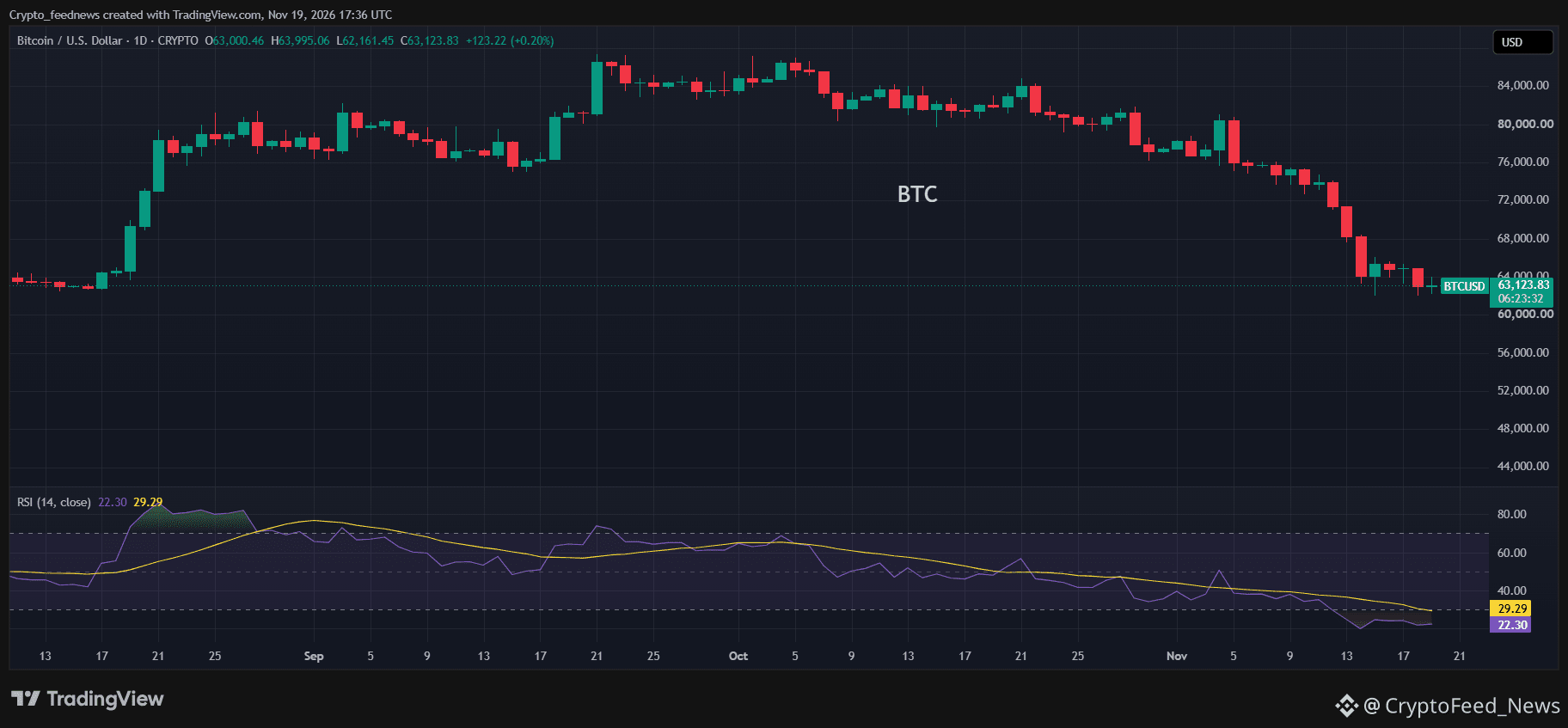
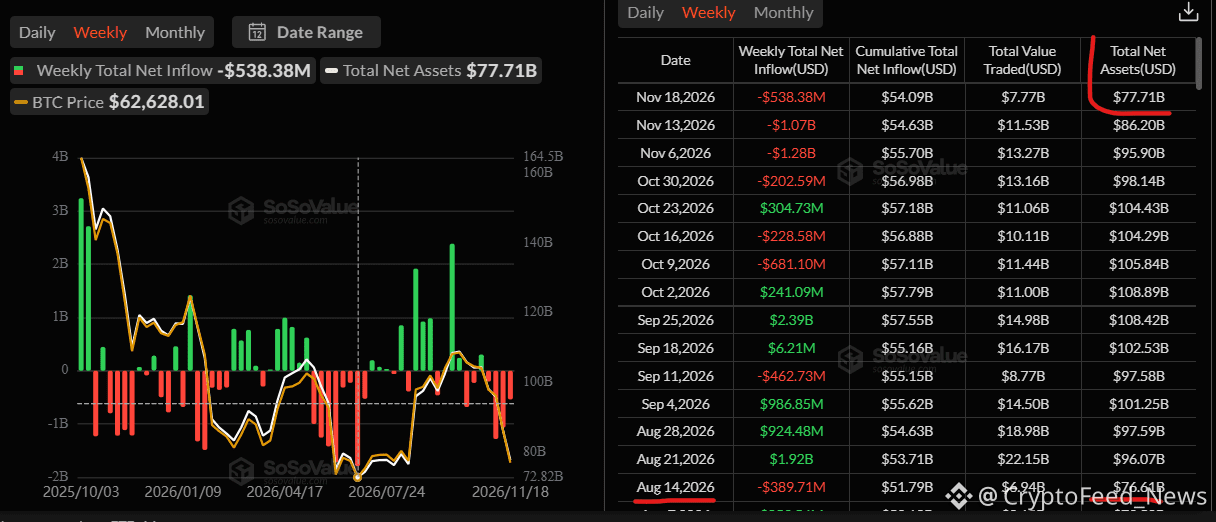
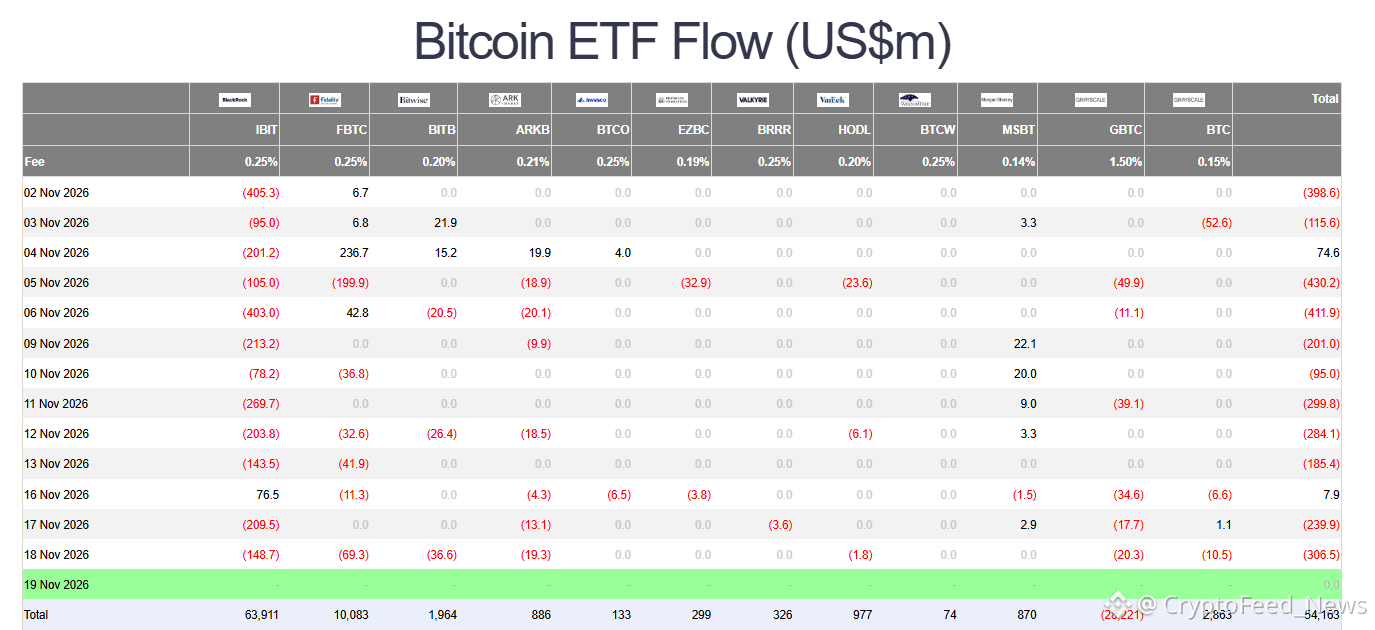
🚨 #BitcoinETFs Outflows Hit $77.7B Net Assets, A 3-Month Low
Selling pressure is mounting across US spot Bitcoin ETFs.
📉 Key figures (Nov. 18):
$306.4M in daily net outflows
Total ETF net assets fell to $77.7B, their lowest level in three months
$BTC traded near $63,126, down 2% in 24 hours and roughly 46% below its October 2025 ATH
Long-term holders reportedly reduced holdings by 121,151 BTC over 30 days
📊 Are institutional investors losing conviction in Bitcoin, or is this a temporary shakeout?
#Write2Earn
78
·
--
Something caught my eye in the Bitcoin market this week. 👀
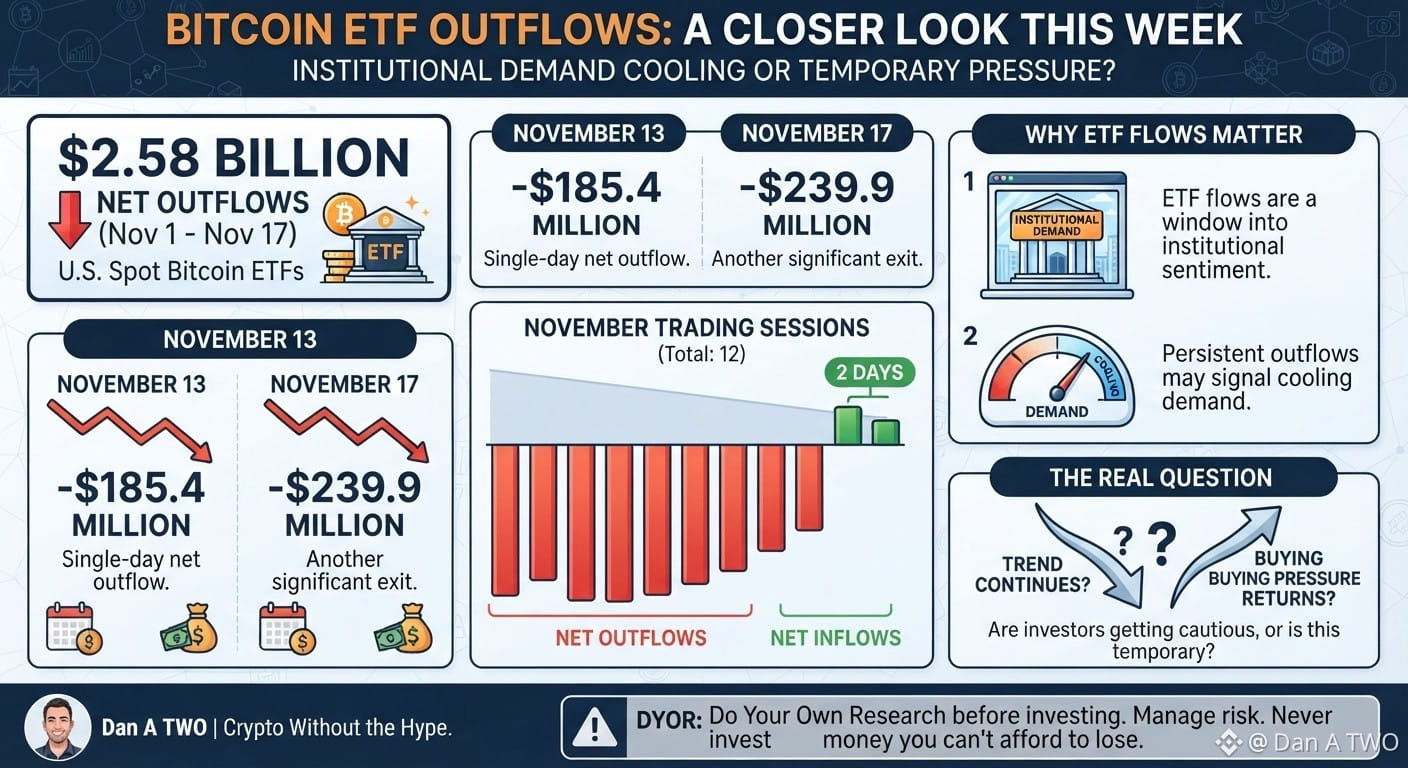
U.S. spot Bitcoin ETFs recorded roughly $2.58 billion in net outflows in November, through November 17, based on available ETF flow data.
Two figures stood out to me:
- November 13: $185.4 million flowed out.
- November 17: another $239.9 million left.
Out of the 12 trading sessions so far this month, 10 ended with net outflows.
Why does this matter? ETF flows give us a window into institutional demand for Bitcoin. If the outflows keep going, it could mean demand from investors using these products is cooling.
But let's not jump to conclusions. Outflows from ETFs alone don't mean institutions have lost faith in Bitcoin altogether.
The real question is whether this trend continues, or whether buying pressure comes back.
I'd love to hear what you think. Are institutional investors getting more cautious on Bitcoin, or is this just temporary market pressure?
DYOR before making any investment decision. Manage your risk, and never put in money you can't afford to lose.
Dan A TWO | Crypto Without the Hype.
#bitcoin #DanATWO #BitcoinETFs #BitcoinETFs #CryptoMarket $BTC
71
Log in to explore more content
Join global crypto users on Binance Square
⚡️ Get latest and useful information about crypto.
💬 Trusted by the world’s largest crypto exchange.
👍 Discover real insights from verified creators.
Email / Phone number
Related Coins
Trending Topics
1
#MoneroFalls13%OnDelistings
34,935 views
386 Discussing
2
#EvolveAtBinanceBlockchainWeek
1.3M views
14,332 Discussing
3
#EthereumGlamsterdamKeepsStorageFeeChange
17,388 views
193 Discussing
4
#UKFCAProposesDeFiAccessLimitsForExchanges
3,105 views
53 Discussing
5
#XRPLedgerVaultGets29Votes
40,439 views
452 Discussing
6
#CanMarketsReboundAfterThanksgiving?
480,582 views
3,417 Discussing
7
#SwitzerlandApproves57JurisdictionsForCryptoDataExchange
11,956 views
47 Discussing
8
#ChinaBlockchainIDRulesEffectMarch2027
1 views
3 Discussing
9
#CouldSpaceX’sOrbitalDataCentersBoostAIChipDemand?
180,107 views
1,757 Discussing
10
#ZcashDevelopersUrgeZECMoveToIronwood
110,990 views
517 Discussing