
Ra44
139 Posts

Ra44
Report
Block User
Open Trade
Frequent Trader
5.5 Months
6 Following
3.3K+ Followers
550 Liked
Posts
Portfolio
All
Quotes
·
--
limited goo ....🤞⚡💫👀🧧🎁🔥
limited goo ....🤞⚡💫👀🧧🎁🔥
Tokenly
·
--
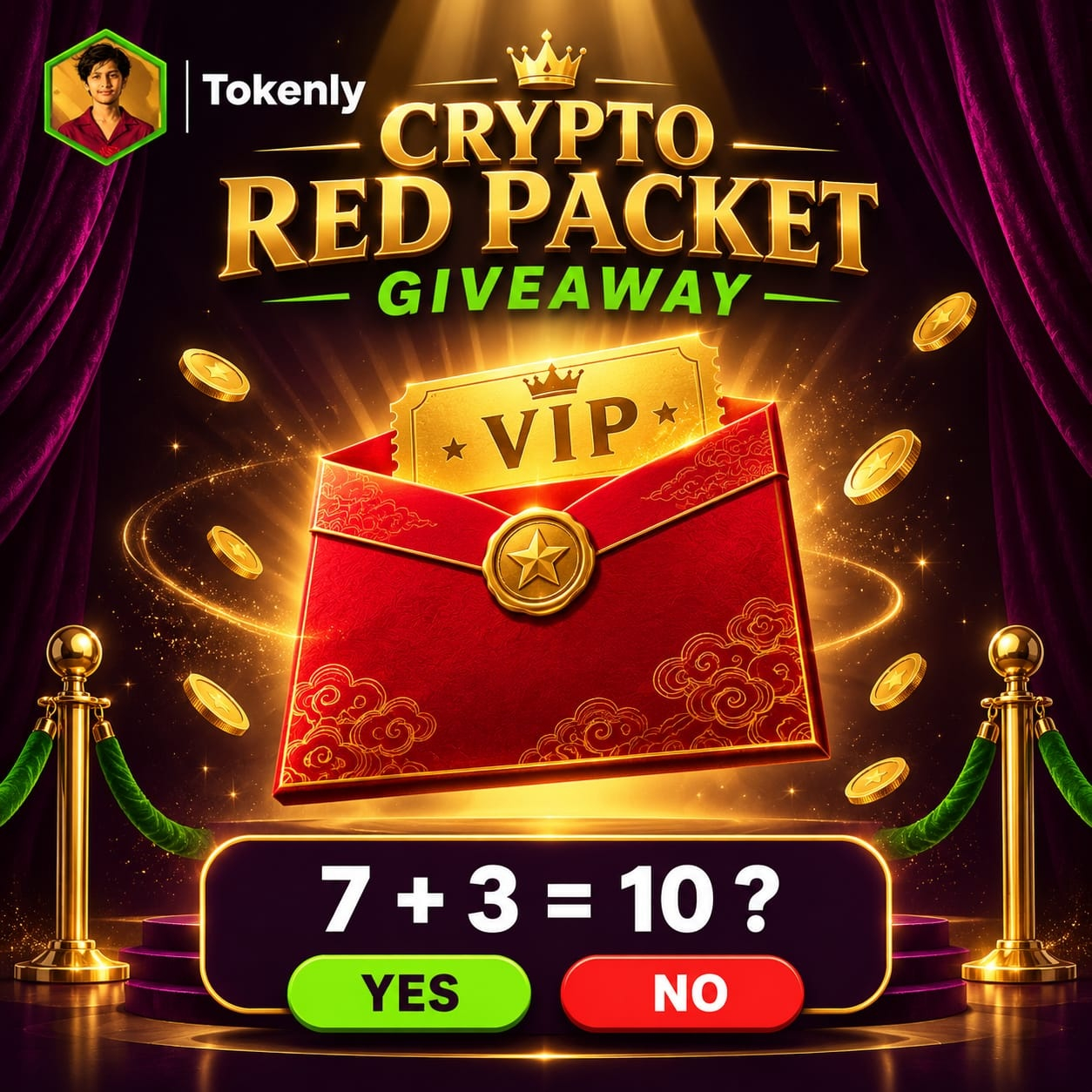
Bullish🎁🧧 CRYPTO RED PACKET GIVEAWAY 🧧🎁
It's live right now, and it's for everyone reading this.
How to claim:
👉 Read the quick question below
👉 Reply YES or NO in the comments
👉 Get your Red Packet
Bonus tip while you're here 💡
Before buying any new coin, always verify its ticker and official contract. Fake copies cost people real money.
Good luck, everyone! ✨
Educational only. Not financial advice. DYOR.
#Crypto #RedPacket #Giveaway #Web3 #dyor
3
229
·
--
why does fomo hit so hard?
you see a green candle and your brain says everyone's getting rich without you. but you only see the winners posting. nobody posts the top they bought.
a simple trick: when the rush comes, wait one hour. if the idea still makes sense after that, it's probably real research and not just fomo 🙂
small habit, big difference.
#FOMO #crypto #Ra44

3
259
·
--
big Rewards🔥 Claim neo goo....⚡👀🧧🎁
big Rewards🔥 Claim neo goo....⚡👀🧧🎁

Anl_
·
--
Bullish🚀 $BNB
— More Than Just a Market Symbol!
The crypto market is always evolving, and BNB continues to be an important part of the Web3 ecosystem.
📊 Current Market Snapshot:
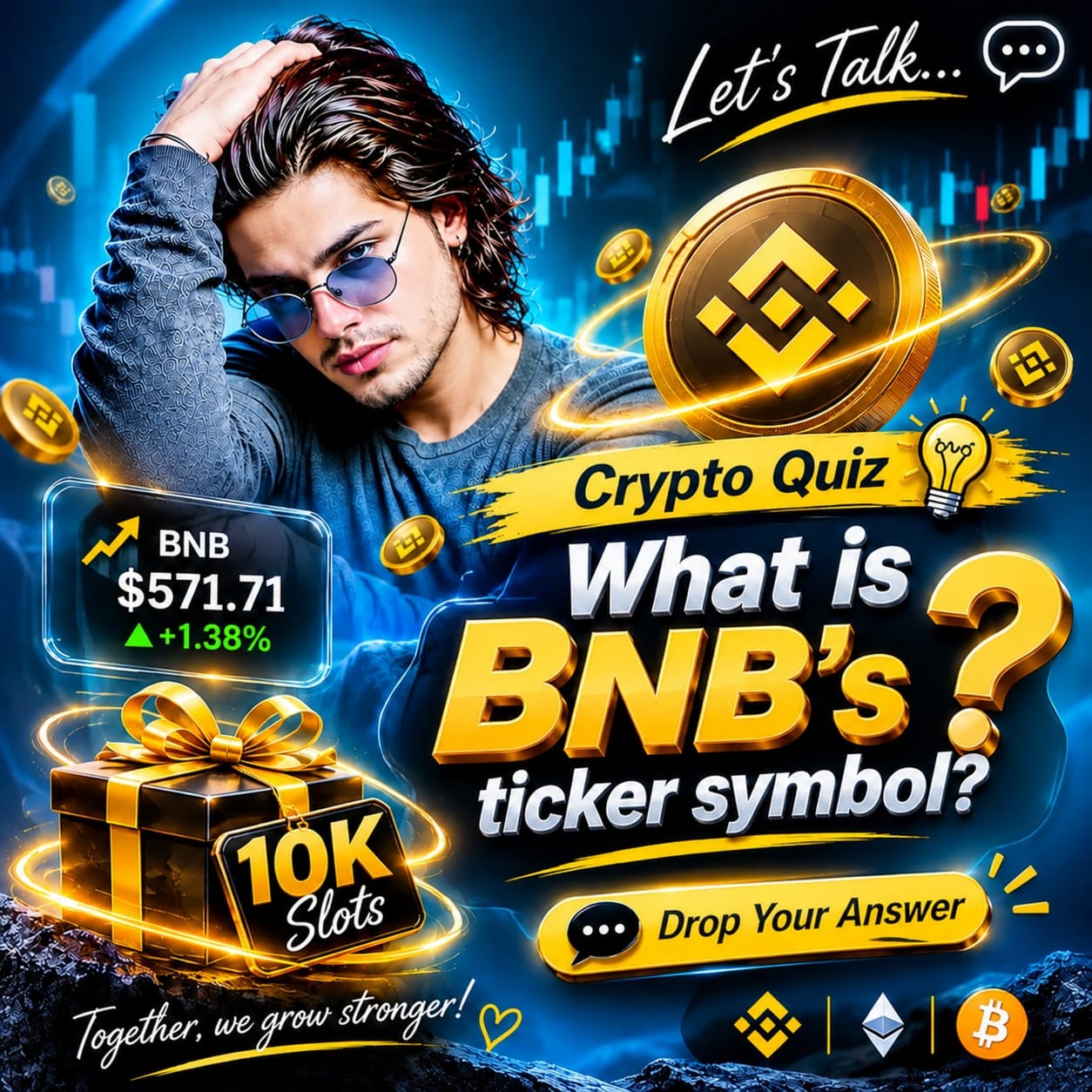
BNB is trading around $581.11, with a reported 24-hour change of approximately +0.57% on Binance's price page.
Beyond its market value, BNB plays an important role in transaction fees, BNB Chain activity, and the wider blockchain ecosystem.
What I find interesting is how one token can connect so many different parts of the crypto world. There's always something new to learn, explore, and discuss.
💬 A quick question for the community:
What is the ticker symbol of Binance Coin?
Let's see how many of us know! 👇
Answer in the comments! 💛
#BNB #Binance #BNBChain #CryptoCommunity #Blockchain
6
216
·
--
Bullish
🧧 GOOD NIGHT RED PACKET GIVEAWAY 🧧
A little gift for my amazing community! 🦜✨
Claim tonight's Red Packet right here 👇
follow 🫂👉 @sfsabbir_0
💬 4. Comment "Done ✅" so I know you joined
⏳ Limited spots. Once it's gone, it's gone!
🔁 Tag a friend or share this post so they don't miss out.
Good night, everyone. Sleep well and stay blessed ❤️🌙
#RedPacket #Giveaway #BinanceSquare #Ra44
🧧 GOOD NIGHT RED PACKET GIVEAWAY 🧧
A little gift for my amazing community! 🦜✨
Claim tonight's Red Packet right here 👇
follow 🫂👉 @Sf_bro
💬 4. Comment "Done ✅" so I know you joined
⏳ Limited spots. Once it's gone, it's gone!
🔁 Tag a friend or share this post so they don't miss out.
Good night, everyone. Sleep well and stay blessed ❤️🌙
#RedPacket #Giveaway #BinanceSquare #Ra44

1.1k
5
81
1.1k
·
--
Bullish
🧧 DOUBLE RED PACKET 🧧
Two creators, two Red Packets, one community!
1️⃣ Claim mine right here in this post.
2️⃣ Then head over to @hasan0110 👀🤯and claim theirs too.
Answer the question below in the comments to unlock yours 👇
Support each other, learn together, grow together. 🤝
⚠️ Educational content only. Not financial advice. Always DYOR.
#Binance #Web3 #redpacket #ETH #CryptoCommunity
🧧 DOUBLE RED PACKET 🧧
Two creators, two Red Packets, one community!
1️⃣ Claim mine right here in this post.
2️⃣ Then head over to @Hasan Web3 👀🤯and claim theirs too.
Answer the question below in the comments to unlock yours 👇
Support each other, learn together, grow together. 🤝
⚠️ Educational content only. Not financial advice. Always DYOR.
#Binance #Web3 #redpacket #ETH #CryptoCommunity

1.2k
69
1.2k
·
--
Bullish
From Spot Event Losses to a +20% Comeback: The $MMT Story I Can't Forget 🦜
Some tokens are just charts. $MMT is a memory for me.
Remember the Binance Spot trading competition? Our whole group got together to push trading volume. Buy, sell, repeat, again and again. We were laughing, cheering each other on, and checking the leaderboard every few minutes. 😅
But the fees, the slippage and the sharp swings added up fast. Many of us, myself included, took a heavy loss on MMT. Not a small one. A really big one. 💔
And today? MMT is trading around $0.30, up about 20% in 24h, and +158% in 7 days. Funny how the market works, right?
📊 What I see on the chart
• Price bounced from $0.19 to a high of $0.3148, and it's now above the MA(7), MA(25) and MA(99).
• Volume exploded (about $53M in 24h), so real attention is back.
• The order book is balanced (50/50), so buyers and sellers are still fighting at this level.
• After such a fast run, a cooldown wouldn't be strange.
🎯 Levels on my radar
• Support: $0.2555 → $0.2297 → $0.1926
• Resistance: $0.3148, then the next push above it
🧠 My honest thoughts
1. Holding above $0.2555 keeps the bullish structure alive.
2. A clean breakout above $0.3148 could bring a fresh leg up.
3. A drop below $0.2297 would be a warning sign, and I'd step back.
What that competition taught me:
✅ Volume is not profit.
✅ Never chase rewards without counting fees.
✅ Losses hurt, but the lessons stay forever.
I'm not here to say "buy now." I'm here to say: remember, learn, and stay smart. 🤝
💬 Were you part of that spot competition too? Tell me your story in the comments. Let's laugh and learn together!
Not financial advice. Always DYOR.
#MMT #Momentum #BinanceSquare #CryptoStories #Altcoins
{spot}(MMTUSDT)
From Spot Event Losses to a +20% Comeback: The $MMT Story I Can't Forget 🦜
Some tokens are just charts. $MMT is a memory for me.
Remember the Binance Spot trading competition? Our whole group got together to push trading volume. Buy, sell, repeat, again and again. We were laughing, cheering each other on, and checking the leaderboard every few minutes. 😅
But the fees, the slippage and the sharp swings added up fast. Many of us, myself included, took a heavy loss on MMT. Not a small one. A really big one. 💔
And today? MMT is trading around $0.30, up about 20% in 24h, and +158% in 7 days. Funny how the market works, right?
📊 What I see on the chart
• Price bounced from $0.19 to a high of $0.3148, and it's now above the MA(7), MA(25) and MA(99).
• Volume exploded (about $53M in 24h), so real attention is back.
• The order book is balanced (50/50), so buyers and sellers are still fighting at this level.
• After such a fast run, a cooldown wouldn't be strange.
🎯 Levels on my radar
• Support: $0.2555 → $0.2297 → $0.1926
• Resistance: $0.3148, then the next push above it
🧠 My honest thoughts
1. Holding above $0.2555 keeps the bullish structure alive.
2. A clean breakout above $0.3148 could bring a fresh leg up.
3. A drop below $0.2297 would be a warning sign, and I'd step back.
What that competition taught me:
✅ Volume is not profit.
✅ Never chase rewards without counting fees.
✅ Losses hurt, but the lessons stay forever.
I'm not here to say "buy now." I'm here to say: remember, learn, and stay smart. 🤝
💬 Were you part of that spot competition too? Tell me your story in the comments. Let's laugh and learn together!
Not financial advice. Always DYOR.
#MMT #Momentum #BinanceSquare #CryptoStories #Altcoins

6
675
·
--
Bullish
🦜🎁 WELCOME TO Ra44! ❤️
Hello Dear Friends! 👋
A warm welcome to all my new followers! I'm really happy to have you here. ❤️
Get ready for some fun, surprises, and exciting Red Packet Giveaways! 🎁
🦜 What's waiting for you here?
🔹 Exciting Red Packet Giveaways
🔹 Crypto & Web3 Updates
🔹 Trading Discussions
🔹 Fun Quizzes & Challenges
🔹 More Rewards and Surprises!
🎁 More Red Packets are coming soon!
Stay active, keep supporting, and stay connected so you don't miss your next chance to claim!
Thank you for being part of this journey. Let's grow together! ❤️🚀
Token Community: $BONK $KITE $CELO
#Ra44 #RedPacket #Giveaway #CryptoCommunity #CryptoRewards

2.6k
5
150
2.6k
·
--
#dusk $DUSK @Dusk_Foundation
Earlier, I used to think tokens only ever move. They are created once, then they change hands until someone stops trading them. Movement seemed like the whole vocabulary.
Looking at what securities actually do over their lives, I realised that vocabulary is missing a word.
A bond matures. A fund unit gets redeemed. The instrument does not get passed to a final owner and sit there. It is settled and then it ceases to exist, because the obligation behind it has been discharged.
So a system built for these assets cannot only handle transfer. It has to handle the moment an asset is legitimately destroyed, and it has to do that in a way that leaves a record convincing to whoever asks later.
What I found notable is how rarely this appears in tokenization discussions. Almost every explanation stops at issuance and trading, as if the interesting part were getting the asset on-chain and keeping it there.
But the end of an instrument is where the money actually comes back to the holder, and getting that step wrong is far more consequential than a slow transfer.
I do not know how this is handled in practice when the payment is made off-chain and the token is destroyed on-chain, which seems like the moment where the two records could most easily drift apart.
From here I started reading lifecycle rather than ownership. Issuance is where the story begins, and redemption is the part that actually has to work.
#dusk $DUSK @Dusk
Earlier, I used to think tokens only ever move. They are created once, then they change hands until someone stops trading them. Movement seemed like the whole vocabulary.
Looking at what securities actually do over their lives, I realised that vocabulary is missing a word.
A bond matures. A fund unit gets redeemed. The instrument does not get passed to a final owner and sit there. It is settled and then it ceases to exist, because the obligation behind it has been discharged.
So a system built for these assets cannot only handle transfer. It has to handle the moment an asset is legitimately destroyed, and it has to do that in a way that leaves a record convincing to whoever asks later.
What I found notable is how rarely this appears in tokenization discussions. Almost every explanation stops at issuance and trading, as if the interesting part were getting the asset on-chain and keeping it there.
But the end of an instrument is where the money actually comes back to the holder, and getting that step wrong is far more consequential than a slow transfer.
I do not know how this is handled in practice when the payment is made off-chain and the token is destroyed on-chain, which seems like the moment where the two records could most easily drift apart.
From here I started reading lifecycle rather than ownership. Issuance is where the story begins, and redemption is the part that actually has to work.
3
14
·
--
#dusk $DUSK @Dusk_Foundation
When I first read that a licensed institution intends to bring a large amount of assets onto a chain, I treated that number as a result. Something that had happened.
Looking at it more carefully, I realised I was reading an intention as an outcome.
A figure like that describes assets that an institution plans to represent on-chain. It does not describe how often those assets move, how much value settles through the chain in a given month, or how much activity the network actually processes because of them.
Those are separate measurements, and they behave differently. An asset can be issued on-chain and then sit completely still for years, which is entirely normal for many instruments. Nothing has gone wrong. It simply means the headline figure and the network's activity are answering different questions.
What caught my attention is how easily the two get merged in discussion, including by me. A large number appears, and it feels like proof of adoption, when it is really a statement of intent by one institution.
That does not make it meaningless. An institution with a licence choosing to commit anything at all is a real signal, and a harder one to obtain than most crypto partnerships.
But I would want to see the second set of numbers before drawing conclusions, and I am not sure those are publicly available yet in a form I could rely on.
Maybe that is the more useful habit. When a number appears, asking whether it describes something that happened, or something that someone intends to happen.
#dusk $DUSK @Dusk
When I first read that a licensed institution intends to bring a large amount of assets onto a chain, I treated that number as a result. Something that had happened.
Looking at it more carefully, I realised I was reading an intention as an outcome.
A figure like that describes assets that an institution plans to represent on-chain. It does not describe how often those assets move, how much value settles through the chain in a given month, or how much activity the network actually processes because of them.
Those are separate measurements, and they behave differently. An asset can be issued on-chain and then sit completely still for years, which is entirely normal for many instruments. Nothing has gone wrong. It simply means the headline figure and the network's activity are answering different questions.
What caught my attention is how easily the two get merged in discussion, including by me. A large number appears, and it feels like proof of adoption, when it is really a statement of intent by one institution.
That does not make it meaningless. An institution with a licence choosing to commit anything at all is a real signal, and a harder one to obtain than most crypto partnerships.
But I would want to see the second set of numbers before drawing conclusions, and I am not sure those are publicly available yet in a form I could rely on.
Maybe that is the more useful habit. When a number appears, asking whether it describes something that happened, or something that someone intends to happen.
4
15
·
--
#dusk $DUSK @Dusk_Foundation
So which rules actually apply to a tokenized bond in Europe?
In the past, I assumed the answer was simple. Europe passed a large crypto regulation, so crypto in Europe is covered by it, and a tokenized asset is crypto. That is roughly how the topic gets discussed, and I never questioned it.
But reading about what Dusk is trying to build, I started to see that the assumption breaks in an important place.
Europe's crypto-asset framework was written for things that did not already have a legal home — utility tokens, stablecoins, and the businesses providing services around them. It filled a gap.
A tokenized bond or a tokenized share is not in that gap. It is a financial instrument, and financial instruments were already regulated long before any of this existed, under a completely different body of rules built for securities markets. Putting one on a blockchain does not move it into the newer framework. It stays where it always was.
What I found particularly notable is how much this explains about the way a project like Dusk is structured. If the asset stays inside securities regulation, then the chain cannot simply be compliant by itself. It has to work alongside licensed venues and licensed intermediaries who already hold the permissions that this asset class requires.
That reframes partnerships for me. They are not marketing milestones. They are the mechanism by which the thing becomes legal to use at all.
I am not qualified to say where the responsibility divides between the protocol and the institutions using it, and I would want a specialist rather than a confident opinion on that.
But from here I stopped reading regulatory claims as a single yes or no. The rules that apply depend on what the asset is, and tokenizing something does not change what it is.
#dusk $DUSK @Dusk
So which rules actually apply to a tokenized bond in Europe?
In the past, I assumed the answer was simple. Europe passed a large crypto regulation, so crypto in Europe is covered by it, and a tokenized asset is crypto. That is roughly how the topic gets discussed, and I never questioned it.
But reading about what Dusk is trying to build, I started to see that the assumption breaks in an important place.
Europe's crypto-asset framework was written for things that did not already have a legal home — utility tokens, stablecoins, and the businesses providing services around them. It filled a gap.
A tokenized bond or a tokenized share is not in that gap. It is a financial instrument, and financial instruments were already regulated long before any of this existed, under a completely different body of rules built for securities markets. Putting one on a blockchain does not move it into the newer framework. It stays where it always was.
What I found particularly notable is how much this explains about the way a project like Dusk is structured. If the asset stays inside securities regulation, then the chain cannot simply be compliant by itself. It has to work alongside licensed venues and licensed intermediaries who already hold the permissions that this asset class requires.
That reframes partnerships for me. They are not marketing milestones. They are the mechanism by which the thing becomes legal to use at all.
I am not qualified to say where the responsibility divides between the protocol and the institutions using it, and I would want a specialist rather than a confident opinion on that.
But from here I stopped reading regulatory claims as a single yes or no. The rules that apply depend on what the asset is, and tokenizing something does not change what it is.
3
34
·
--
#dusk $DUSK @Dusk_Foundation Previously, I thought a blockchain transfer had only two possible outcomes: it succeeds, or it fails. Success meant the value moved. Failure meant something broke. But the deeper I looked into how Dusk describes regulated asset transfers, the more I realized that model is too crude for financial markets.
On an ordinary chain, a rejected transaction tells you almost nothing. Gas ran out, a require statement tripped, the state changed underneath you. You are left guessing which.
For a regulated asset, that ambiguity is not acceptable. Dusk's documentation describes transfer checks that fail with clear reasons, and — the part I found more interesting — checks that can be simulated before a transaction is ever submitted.
What I found particularly notable is the implication of that second point. It means eligibility is not something you discover by attempting a transfer and watching it break. You can ask the question first and receive an answer, without touching the ledger at all.
This mirrors how the traditional side already works. A broker does not send an order and hope the compliance system allows it. The check happens before, and when a trade is refused, someone can explain precisely why — the counterparty was not accredited, the holding period had not elapsed, the jurisdiction was restricted. "Rejected" without a reason is not a usable answer in a regulated process.
Failure becomes information rather than an accident. And a rejection that carries a reason is arguably more useful than a success that carries none.
I still cannot judge how detailed those reasons are in practice, or how much of this is available to an application today rather than described as a design target.
From here, I started to see the design differently. Compliance on-chain may not be about blocking bad transactions. It may be about making the outcome predictable before anyone commits to it.
#dusk $DUSK @Dusk Previously, I thought a blockchain transfer had only two possible outcomes: it succeeds, or it fails. Success meant the value moved. Failure meant something broke. But the deeper I looked into how Dusk describes regulated asset transfers, the more I realized that model is too crude for financial markets.
On an ordinary chain, a rejected transaction tells you almost nothing. Gas ran out, a require statement tripped, the state changed underneath you. You are left guessing which.
For a regulated asset, that ambiguity is not acceptable. Dusk's documentation describes transfer checks that fail with clear reasons, and — the part I found more interesting — checks that can be simulated before a transaction is ever submitted.
What I found particularly notable is the implication of that second point. It means eligibility is not something you discover by attempting a transfer and watching it break. You can ask the question first and receive an answer, without touching the ledger at all.
This mirrors how the traditional side already works. A broker does not send an order and hope the compliance system allows it. The check happens before, and when a trade is refused, someone can explain precisely why — the counterparty was not accredited, the holding period had not elapsed, the jurisdiction was restricted. "Rejected" without a reason is not a usable answer in a regulated process.
Failure becomes information rather than an accident. And a rejection that carries a reason is arguably more useful than a success that carries none.
I still cannot judge how detailed those reasons are in practice, or how much of this is available to an application today rather than described as a design target.
From here, I started to see the design differently. Compliance on-chain may not be about blocking bad transactions. It may be about making the outcome predictable before anyone commits to it.
3
79
·
--
#dusk $DUSK @Dusk_Foundation Solidity developers don't want to relearn an entire toolchain just to try a new chain.
So making DuskEVM OP Stack-compatible looked like a smart move at first glance.
Developers can use Solidity and familiar EVM tooling instead of starting from zero. But DuskEVM is only the execution layer. Final settlement and data availability run through DuskDS, Dusk's base layer with deterministic finality.
That is a genuine attempt at the best of both worlds.
Keep Ethereum's developer experience, while anchoring applications to infrastructure designed around financial settlement.
But the architecture creates a second question.
Every time execution and settlement live on different layers, the connection between them becomes critical. Value, state and proofs have to move safely between DuskEVM and DuskDS.
And historically, bridges and cross-layer interfaces have been some of crypto's most fragile infrastructure.
Dusk itself learned a version of that lesson in January when its separate Dusk↔BSC bridge suffered a signing-wallet compromise. That was not an exploit of DuskEVM or its DuskDS settlement path, so the two should not be confused.
But the principle still matters: the base chain can remain secure while infrastructure connecting two environments becomes the weaker point.
Dusk describes the DuskDS↔DuskEVM bridge as native and trustless, without external custodians or wrapped assets.
That is encouraging, but as more applications and value move onto DuskEVM, the security assumptions behind that settlement path become more important, not less.
EVM compatibility lowers the barrier for builders.
It also gives Dusk another boundary that has to be defended perfectly.
Is EVM compatibility simply a necessary trade-off for adoption — or does every privacy-first chain that adds an EVM layer also expand the attack surface it has to protect?
$DUSK @Dusk_Foundation
#dusk $DUSK @Dusk Solidity developers don't want to relearn an entire toolchain just to try a new chain.
So making DuskEVM OP Stack-compatible looked like a smart move at first glance.
Developers can use Solidity and familiar EVM tooling instead of starting from zero. But DuskEVM is only the execution layer. Final settlement and data availability run through DuskDS, Dusk's base layer with deterministic finality.
That is a genuine attempt at the best of both worlds.
Keep Ethereum's developer experience, while anchoring applications to infrastructure designed around financial settlement.
But the architecture creates a second question.
Every time execution and settlement live on different layers, the connection between them becomes critical. Value, state and proofs have to move safely between DuskEVM and DuskDS.
And historically, bridges and cross-layer interfaces have been some of crypto's most fragile infrastructure.
Dusk itself learned a version of that lesson in January when its separate Dusk↔BSC bridge suffered a signing-wallet compromise. That was not an exploit of DuskEVM or its DuskDS settlement path, so the two should not be confused.
But the principle still matters: the base chain can remain secure while infrastructure connecting two environments becomes the weaker point.
Dusk describes the DuskDS↔DuskEVM bridge as native and trustless, without external custodians or wrapped assets.
That is encouraging, but as more applications and value move onto DuskEVM, the security assumptions behind that settlement path become more important, not less.
EVM compatibility lowers the barrier for builders.
It also gives Dusk another boundary that has to be defended perfectly.
Is EVM compatibility simply a necessary trade-off for adoption — or does every privacy-first chain that adds an EVM layer also expand the attack surface it has to protect?
$DUSK @Dusk
1
4
27
·
--
Verified
Two sentences from TermMax's TGE pages that will change what some people do this week.
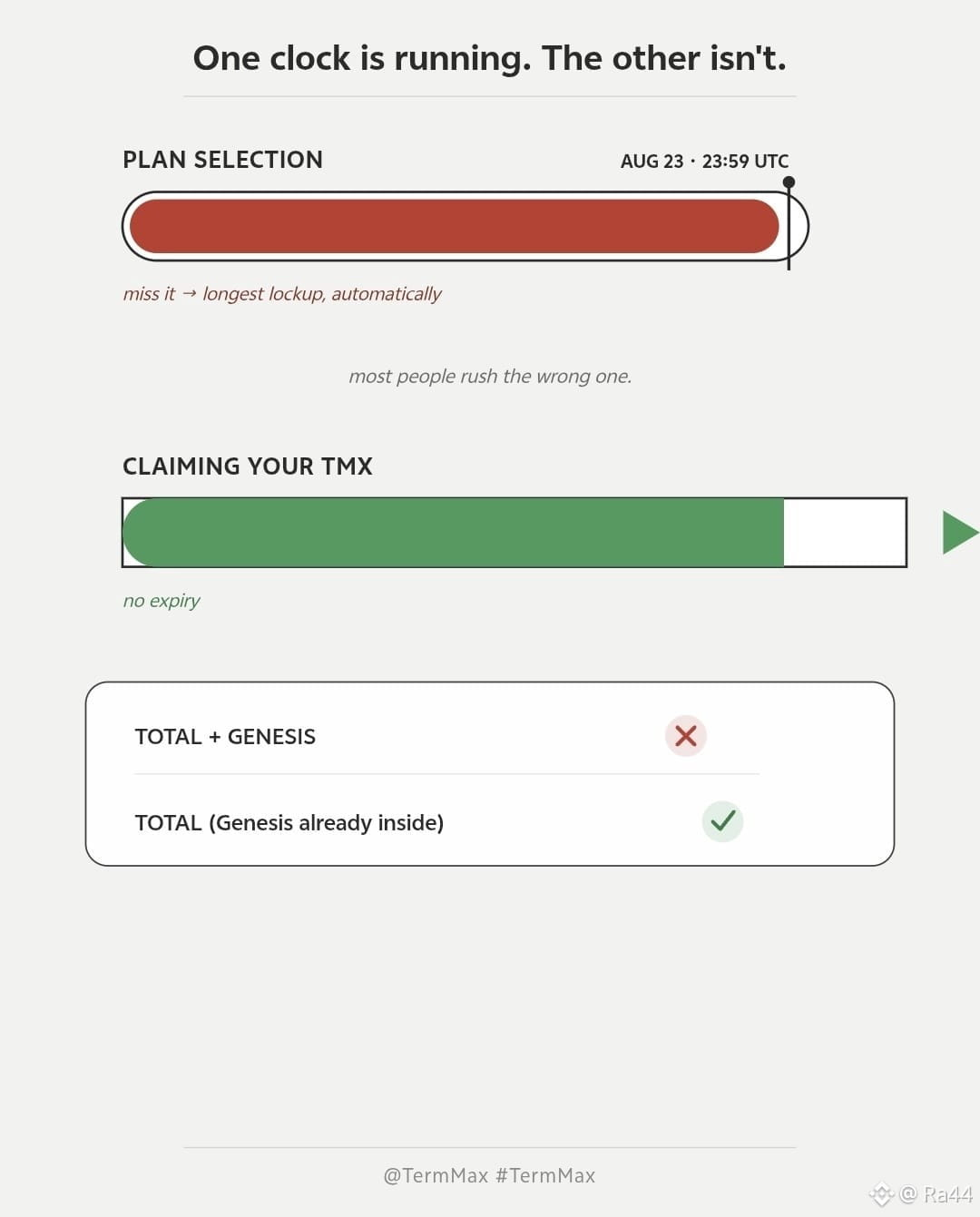
One. If you see a Genesis Reward on the checker page — described as a special reward for early and long-term contributors — it is already included in the total allocation shown at the top.
Not added on. Included.
That's the opposite of how a bonus line reads instinctively. And if you're above the vesting threshold deciding between forfeiting 70% and vesting 85%, inflating your own base number changes the answer you arrive at.
Two. There is no time limit on claiming your instantly claimable TMX. The Management page says so directly — come back and claim whenever.
That one's genuinely good design, and rarer than it should be. Plenty of launches attach an expiry to unclaimed tokens, which pushes everyone into transacting on the single worst day for gas and for price.
Put them together and you get the thing most people will get backwards this week.
The decision is urgent. August 23, 23:59 UTC. Miss it and the longest lockup is assigned for you.
The transaction is not urgent. At all.
So the rush belongs to the choice, not the claim. Expect a lot of people to sprint to claim on day one into whatever the market is doing, while treating the deadline as something to handle later.
Exactly inverted.
Which deadline are you actually treating as real?
#termmax @termmax
Two sentences from TermMax's TGE pages that will change what some people do this week.
One. If you see a Genesis Reward on the checker page — described as a special reward for early and long-term contributors — it is already included in the total allocation shown at the top.
Not added on. Included.
That's the opposite of how a bonus line reads instinctively. And if you're above the vesting threshold deciding between forfeiting 70% and vesting 85%, inflating your own base number changes the answer you arrive at.
Two. There is no time limit on claiming your instantly claimable TMX. The Management page says so directly — come back and claim whenever.
That one's genuinely good design, and rarer than it should be. Plenty of launches attach an expiry to unclaimed tokens, which pushes everyone into transacting on the single worst day for gas and for price.
Put them together and you get the thing most people will get backwards this week.
The decision is urgent. August 23, 23:59 UTC. Miss it and the longest lockup is assigned for you.
The transaction is not urgent. At all.
So the rush belongs to the choice, not the claim. Expect a lot of people to sprint to claim on day one into whatever the market is doing, while treating the deadline as something to handle later.
Exactly inverted.
Which deadline are you actually treating as real?
#termmax @TermMax
3
48
·
--
Small detail, disproportionately interesting.
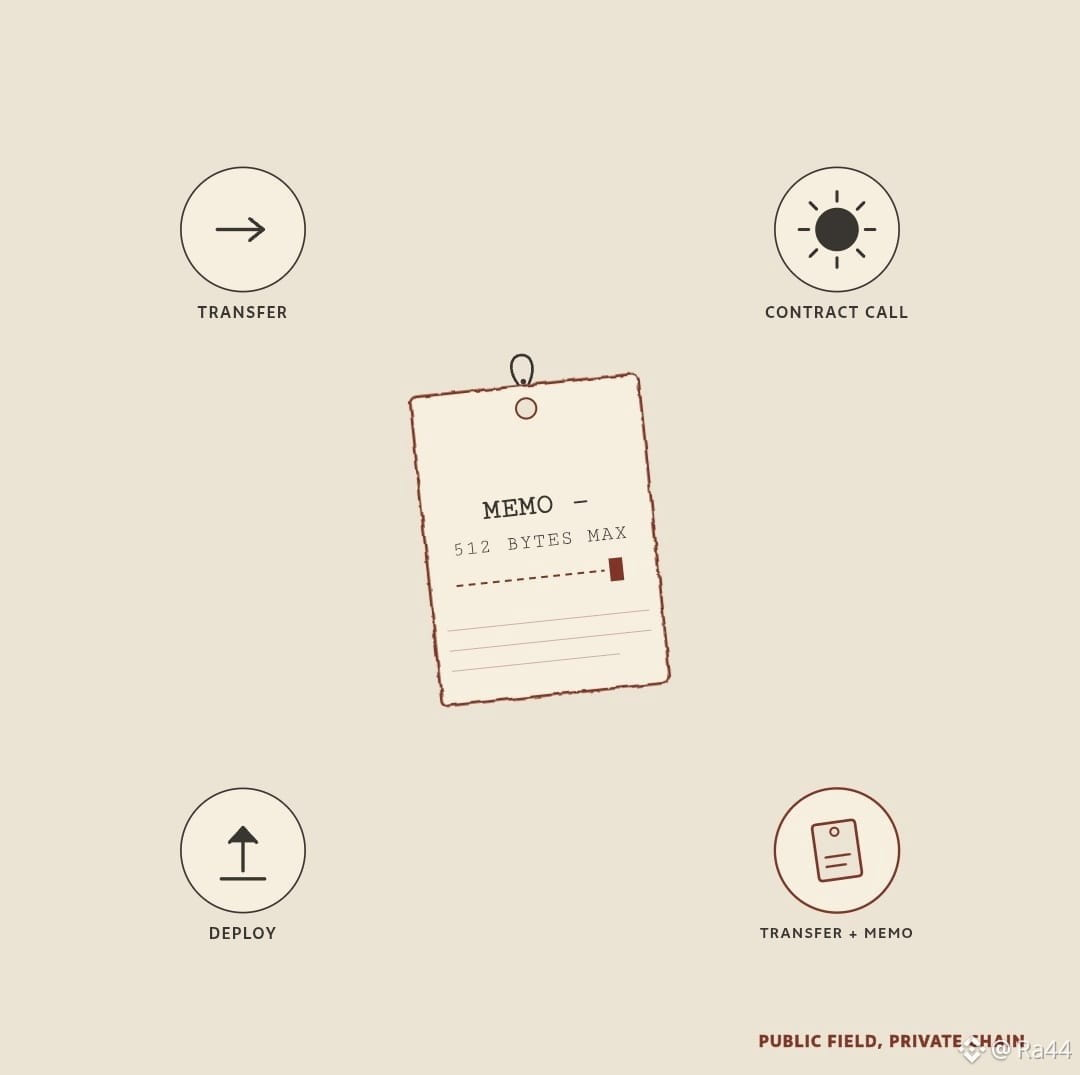
Dusk transactions can carry a memo of up to 512 bytes. Four transaction types exist in total: a regular transfer, a contract call, a contract deployment, and a transfer with a memo.
Why does a memo field exist at all on a chain built around confidentiality?
Exchanges. The engineering note that introduced it says the point is letting an exchange target internal accounts while using a single receiving key or address. Anyone who has deposited to an exchange on Cosmos or XRP knows this exact ritual — one shared address, and a tag that says which customer you are.
So on a chain whose entire pitch is "not everything should be public", the operational reality of exchange integration produced a field where you write, in the open, which account this payment belongs to.
I don't think that's hypocrisy. It's the same principle @Dusk_Foundation keeps arguing for: disclosure should be a choice, applied where it's useful, not a default applied everywhere. A deposit memo is a place where being legible is the whole point.
But 512 bytes is a lot of room, and general-purpose fields never stay in their lane. Memos on other chains have become invoice references, order IDs, messages, and occasionally things nobody planned for. Whatever ends up in there is written into a public ledger permanently, by users who will not be thinking about that.
The interesting question isn't the field. It's what people put in it once volume arrives, and whether anyone is watching.
If you've integrated a chain with memo-based deposits — what's the strangest thing you've seen someone write in one?
#dusk $DUSK @Dusk_Foundation
Small detail, disproportionately interesting.
Dusk transactions can carry a memo of up to 512 bytes. Four transaction types exist in total: a regular transfer, a contract call, a contract deployment, and a transfer with a memo.
Why does a memo field exist at all on a chain built around confidentiality?
Exchanges. The engineering note that introduced it says the point is letting an exchange target internal accounts while using a single receiving key or address. Anyone who has deposited to an exchange on Cosmos or XRP knows this exact ritual — one shared address, and a tag that says which customer you are.
So on a chain whose entire pitch is "not everything should be public", the operational reality of exchange integration produced a field where you write, in the open, which account this payment belongs to.
I don't think that's hypocrisy. It's the same principle @Dusk keeps arguing for: disclosure should be a choice, applied where it's useful, not a default applied everywhere. A deposit memo is a place where being legible is the whole point.
But 512 bytes is a lot of room, and general-purpose fields never stay in their lane. Memos on other chains have become invoice references, order IDs, messages, and occasionally things nobody planned for. Whatever ends up in there is written into a public ledger permanently, by users who will not be thinking about that.
The interesting question isn't the field. It's what people put in it once volume arrives, and whether anyone is watching.
If you've integrated a chain with memo-based deposits — what's the strangest thing you've seen someone write in one?
#dusk $DUSK @Dusk
4
24
·
--
TermMax's 93% DeFiSafety score gets quoted constantly. The breakdown is more useful than the headline.
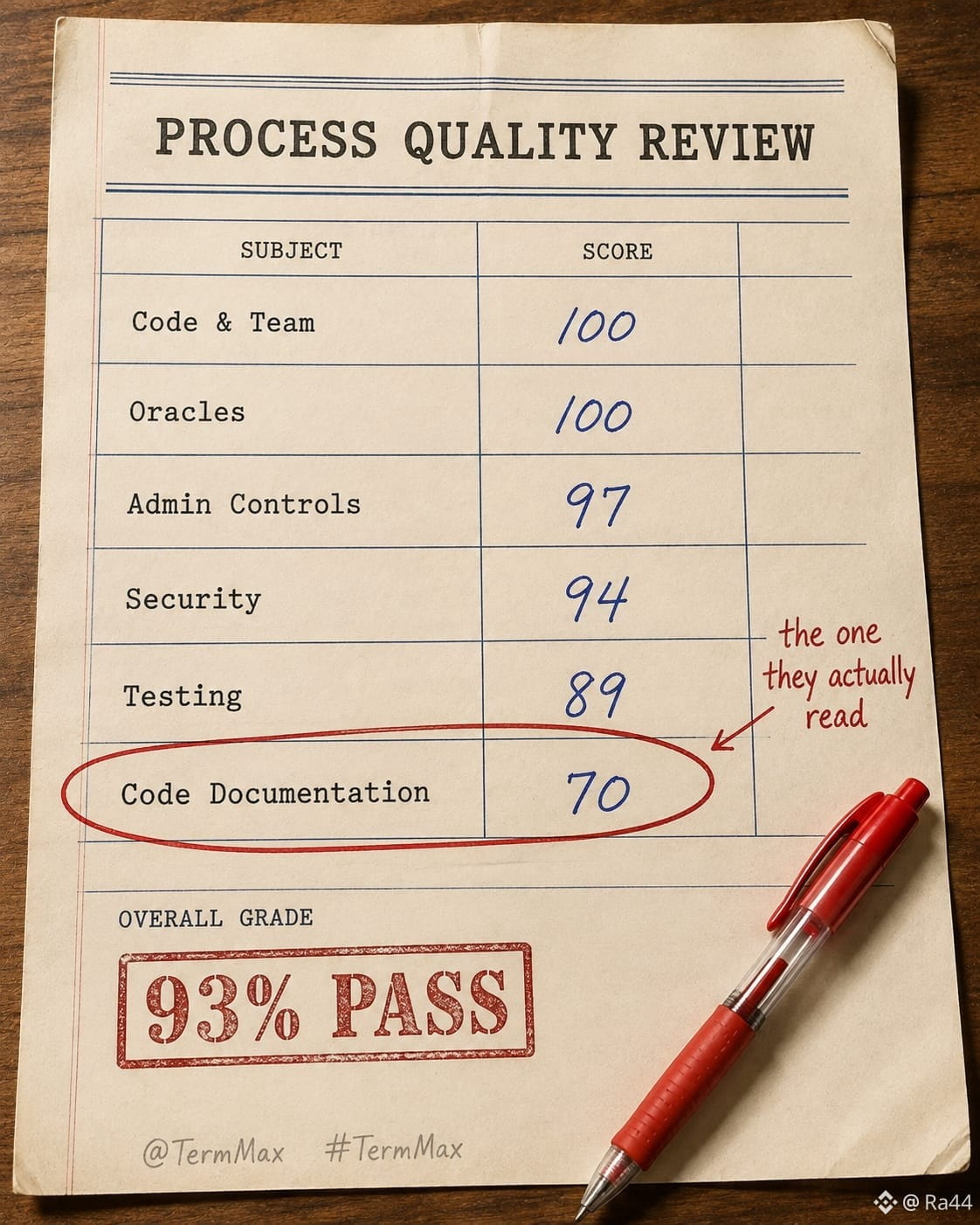
Six categories. Code and Team 100%. Oracles 100%. Admin Controls 97%. Security 94%. Testing 89%. Code Documentation 70%.
Documentation is the lowest by a wide margin, and it's the only category most users ever touch. You will never read the test suite. You will read the docs.
I ran into supporting evidence while working through them. The FAQ says liquidity providers earn yield from an LP token called lp-FT. I couldn't find lp-FT defined anywhere else in the documentation.
None of this makes the protocol unsafe. Seventy still passes their threshold, and the categories that actually guard funds scored highest — which is the right order to be strong in.
But it means the widest gap in the stack is between what the contracts do and what a reader can find out.
Should a documentation score weigh as heavily as a security score for someone depositing retail-sized money?
#termmax @termmax
TermMax's 93% DeFiSafety score gets quoted constantly. The breakdown is more useful than the headline.
Six categories. Code and Team 100%. Oracles 100%. Admin Controls 97%. Security 94%. Testing 89%. Code Documentation 70%.
Documentation is the lowest by a wide margin, and it's the only category most users ever touch. You will never read the test suite. You will read the docs.
I ran into supporting evidence while working through them. The FAQ says liquidity providers earn yield from an LP token called lp-FT. I couldn't find lp-FT defined anywhere else in the documentation.
None of this makes the protocol unsafe. Seventy still passes their threshold, and the categories that actually guard funds scored highest — which is the right order to be strong in.
But it means the widest gap in the stack is between what the contracts do and what a reader can find out.
Should a documentation score weigh as heavily as a security score for someone depositing retail-sized money?
#termmax @TermMax
1
4
80
·
--
Bullish
Native DUSK has 9 decimals. One DUSK is 1,000,000,000 LUX.
ERC20 and BEP20 $DUSK have 18.
I stared at those two lines in the tokenomics page longer than I expected to, because they're the kind of detail that never makes a thread but absolutely makes a support ticket.
Two consequences I keep turning over.
One: LUX is the resolution of the entire fee market. Gas price is set in LUX per gas unit, and the fee is gas used times gas price. Nine decimals is the finest anything on @Dusk_Foundation can ever be priced. For a chain aiming at securities settlement — where coupon math, dividend splits and fractional holdings are routine — that ceiling is a real design parameter, not trivia. Nine is plenty for a token. Whether it's plenty for every instrument that eventually settles against it is a different question.
Two: 18 down to 9 is not a lossless move. Anything below the ninth decimal on Ethereum or BSC has no landing spot on mainnet. Someone has to decide whether that dust rounds, truncates or blocks — and that rule matters most for the exact people the migration guide is written for.
I read the migration guide and the BEP20 bridge guide and I did not find that rule stated plainly. It may be handled correctly and simply not documented. It may be documented somewhere I didn't reach.
Which is why I'd rather ask than assume.
If you've migrated ERC20 or BEP20 DUSK to mainnet — did your balance land exactly, or did the last few digits go somewhere?
#dusk @Dusk_Foundation $BTC
Native DUSK has 9 decimals. One DUSK is 1,000,000,000 LUX.
ERC20 and BEP20 $DUSK have 18.
I stared at those two lines in the tokenomics page longer than I expected to, because they're the kind of detail that never makes a thread but absolutely makes a support ticket.
Two consequences I keep turning over.
One: LUX is the resolution of the entire fee market. Gas price is set in LUX per gas unit, and the fee is gas used times gas price. Nine decimals is the finest anything on @Dusk can ever be priced. For a chain aiming at securities settlement — where coupon math, dividend splits and fractional holdings are routine — that ceiling is a real design parameter, not trivia. Nine is plenty for a token. Whether it's plenty for every instrument that eventually settles against it is a different question.
Two: 18 down to 9 is not a lossless move. Anything below the ninth decimal on Ethereum or BSC has no landing spot on mainnet. Someone has to decide whether that dust rounds, truncates or blocks — and that rule matters most for the exact people the migration guide is written for.
I read the migration guide and the BEP20 bridge guide and I did not find that rule stated plainly. It may be handled correctly and simply not documented. It may be documented somewhere I didn't reach.
Which is why I'd rather ask than assume.
If you've migrated ERC20 or BEP20 DUSK to mainnet — did your balance land exactly, or did the last few digits go somewhere?
#dusk @Dusk $BTC
4
16
·
--
One click, three separate things
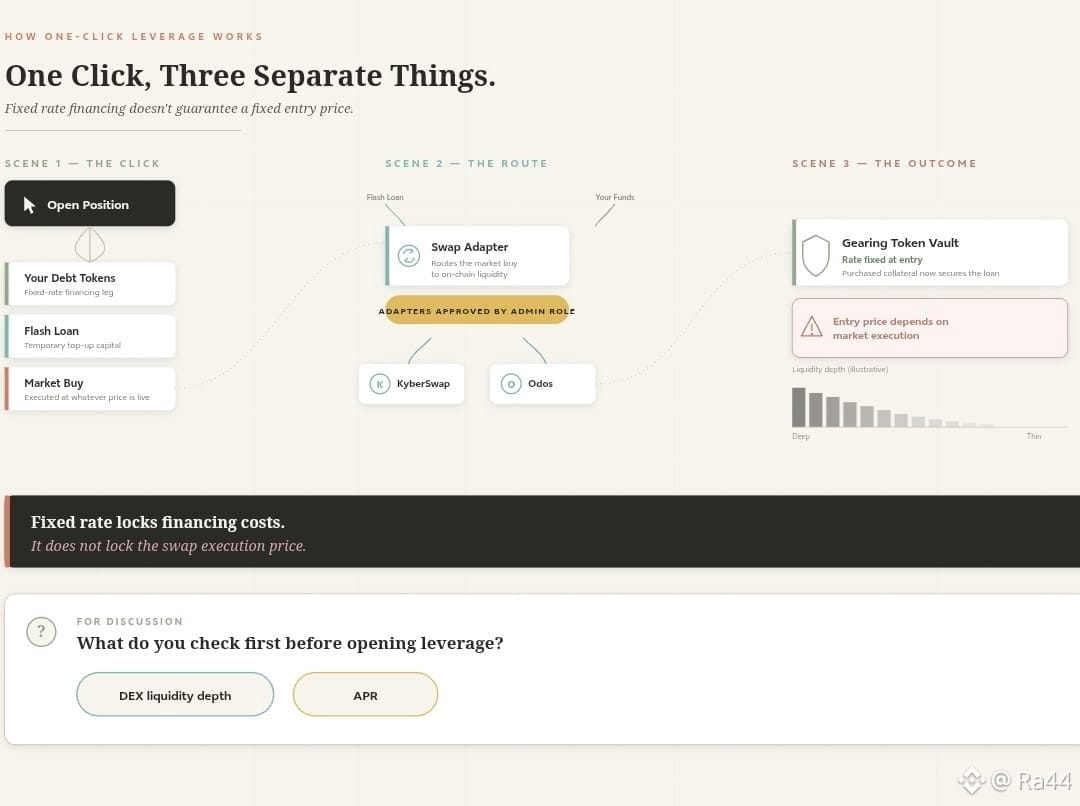
One-click leverage sounds like one action. The documentation describes three.
You supply debt tokens. The protocol takes a flash loan for the rest. The combined amount then buys the collateral asset, and that purchase gets locked into a Gearing Token.
Step two is the one worth sitting with. It's a market buy. It routes through a swap adapter — the audited scope names Kyberswap and Odos adapters — and which adapters are permitted is controlled by an admin role.
So your rate is fixed at entry. Your entry price isn't. A thin moment in the collateral's DEX liquidity shows up as worse execution on the position you just opened, and rate certainty repairs none of it.
This is still clearly better than manual looping across four protocols. Fewer transactions, less gas, one atomic failure point instead of five.
But "fixed rate" describes the financing, not the fill.
Do you check collateral DEX depth before opening a leveraged position, or only the APR?
#termmax @termmax #DEX
One click, three separate things
One-click leverage sounds like one action. The documentation describes three.
You supply debt tokens. The protocol takes a flash loan for the rest. The combined amount then buys the collateral asset, and that purchase gets locked into a Gearing Token.
Step two is the one worth sitting with. It's a market buy. It routes through a swap adapter — the audited scope names Kyberswap and Odos adapters — and which adapters are permitted is controlled by an admin role.
So your rate is fixed at entry. Your entry price isn't. A thin moment in the collateral's DEX liquidity shows up as worse execution on the position you just opened, and rate certainty repairs none of it.
This is still clearly better than manual looping across four protocols. Fewer transactions, less gas, one atomic failure point instead of five.
But "fixed rate" describes the financing, not the fill.
Do you check collateral DEX depth before opening a leveraged position, or only the APR?
#termmax @TermMax #DEX
4
83
·
--
@Dusk_Foundation
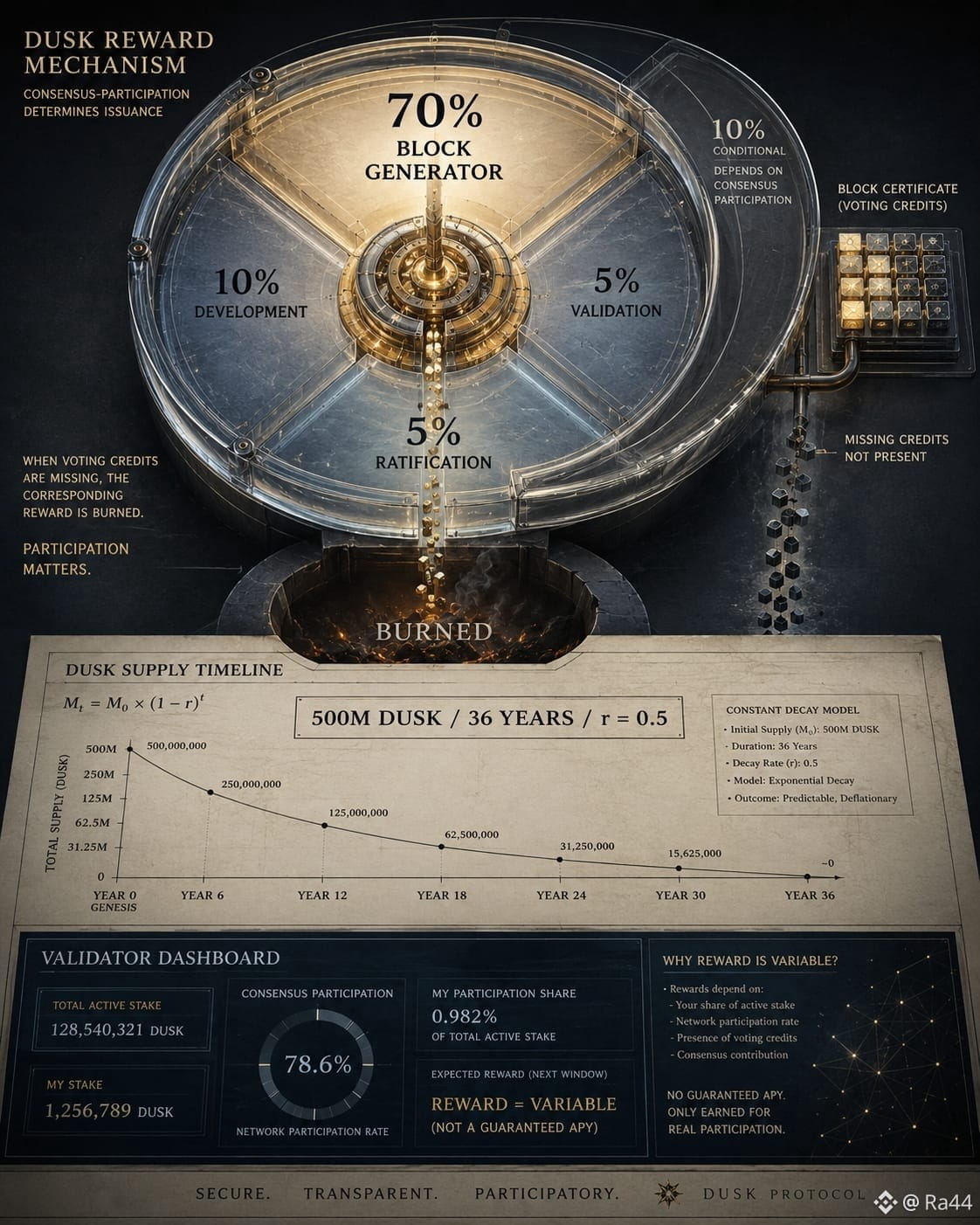
I added up Dusk's block reward split expecting it to land on 100%. Block generator 70%, development fund 10%, validation committee 5%, ratification committee 5%. That's 90%. The missing 10% is the piece I had assumed was fixed. It isn't.
That last slice goes to the block generator too — but only up to 10%, based on the credits included in the block certificate. Any undistributed portion is burned.
So emission on Dusk is partly performance-conditional. A block whose certificate carries a full set of committee votes pays the whole reward. A block that gathers fewer credits pays less, and the shortfall isn't held over or redirected — it's destroyed. Every block is a small referendum on committee participation, settled in supply.
Which is why the emission headline and the staker-facing number are two different questions. Dusk emits 500,000,000 DUSK over 36 years on geometric decay, r = 0.5, halving every four years. Period one: 19.8574 DUSK per block across 12,614,400 blocks, 250.48M DUSK total. That's issuance. But 10% of every block reward routes to the development fund, and an unknown fraction of the conditional 10% is burned. "What does the chain emit per block" and "what reaches a staker" resolve differently — and the second depends on how well the network attested that specific block.
I think this is more honest than a fixed APY promise. It prices actual consensus participation instead of advertising a number and hoping the network delivers. But honesty and modelability aren't the same thing. Sizing a validator business now requires an assumption about average certificate completeness — a variable with no marketing page.
Dusk is courting institutional validators for regulated markets. Is performance-conditional, partially-burned reward the right incentive for that audience, or do institutions need predictability more than they need elegance?
#dusk $DUSK
@Dusk
I added up Dusk's block reward split expecting it to land on 100%. Block generator 70%, development fund 10%, validation committee 5%, ratification committee 5%. That's 90%. The missing 10% is the piece I had assumed was fixed. It isn't.
That last slice goes to the block generator too — but only up to 10%, based on the credits included in the block certificate. Any undistributed portion is burned.
So emission on Dusk is partly performance-conditional. A block whose certificate carries a full set of committee votes pays the whole reward. A block that gathers fewer credits pays less, and the shortfall isn't held over or redirected — it's destroyed. Every block is a small referendum on committee participation, settled in supply.
Which is why the emission headline and the staker-facing number are two different questions. Dusk emits 500,000,000 DUSK over 36 years on geometric decay, r = 0.5, halving every four years. Period one: 19.8574 DUSK per block across 12,614,400 blocks, 250.48M DUSK total. That's issuance. But 10% of every block reward routes to the development fund, and an unknown fraction of the conditional 10% is burned. "What does the chain emit per block" and "what reaches a staker" resolve differently — and the second depends on how well the network attested that specific block.
I think this is more honest than a fixed APY promise. It prices actual consensus participation instead of advertising a number and hoping the network delivers. But honesty and modelability aren't the same thing. Sizing a validator business now requires an assumption about average certificate completeness — a variable with no marketing page.
Dusk is courting institutional validators for regulated markets. Is performance-conditional, partially-burned reward the right incentive for that audience, or do institutions need predictability more than they need elegance?
#dusk $DUSK
1
6
71
·
--
I kept scrolling past that line until it stopped looking like plumbing.
FT is the half everyone posts about. A zero-coupon claim, bought under face, redeemed at face. A bond.
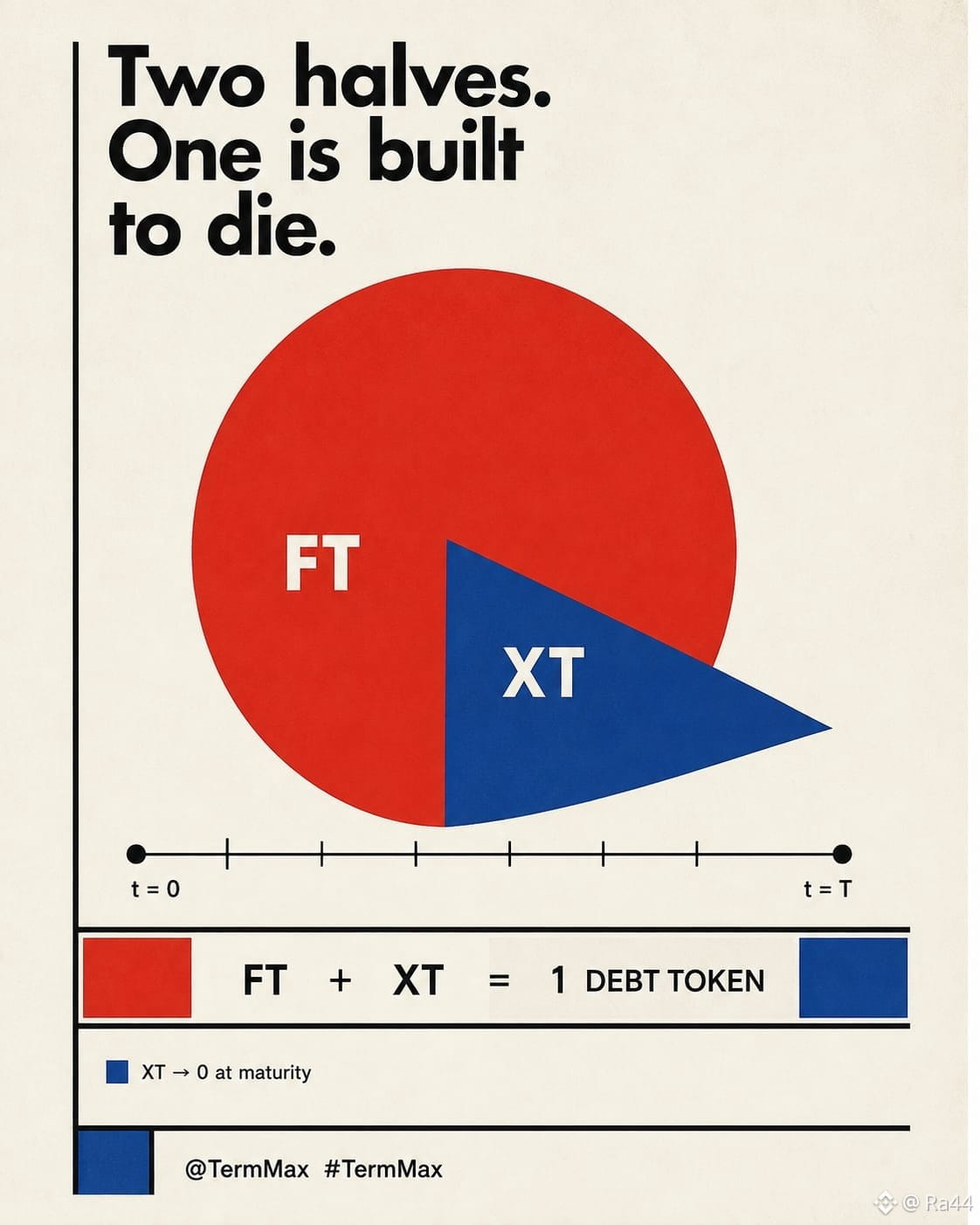
XT is what is left of the same debt unit once that claim is carved out. The interest leg. Deposit a debt token, both halves mint, and XT drains toward nothing as maturity nears.
Here is what made it click. The identity holds at every moment, not only at the end. An FT and an XT burn back into the debt token at par. No auction, no oracle. Redemption stays clean because the halves always sum to one.
So they end up in opposite hands. In the lending flow the XT leg is swapped away in the same transaction that mints it, and the lender walks off holding only FT. The leverager acquires XT, because holding the decaying half against collateral is how the loop gets built.
Someone has to own the leg that expires worthless on a known date. That is the leverager, not the lender.
Still unsure: the docs call XT the interest obligation on one page and a leverage indicator on another. I cannot tell which one traders price off.
If FT is the bond, who is really pricing XT, and against what?
#termmax @termmax
I kept scrolling past that line until it stopped looking like plumbing.
FT is the half everyone posts about. A zero-coupon claim, bought under face, redeemed at face. A bond.
XT is what is left of the same debt unit once that claim is carved out. The interest leg. Deposit a debt token, both halves mint, and XT drains toward nothing as maturity nears.
Here is what made it click. The identity holds at every moment, not only at the end. An FT and an XT burn back into the debt token at par. No auction, no oracle. Redemption stays clean because the halves always sum to one.
So they end up in opposite hands. In the lending flow the XT leg is swapped away in the same transaction that mints it, and the lender walks off holding only FT. The leverager acquires XT, because holding the decaying half against collateral is how the loop gets built.
Someone has to own the leg that expires worthless on a known date. That is the leverager, not the lender.
Still unsure: the docs call XT the interest obligation on one page and a leverage indicator on another. I cannot tell which one traders price off.
If FT is the bond, who is really pricing XT, and against what?
#termmax @TermMax
4
6
88
·
--
Partly True
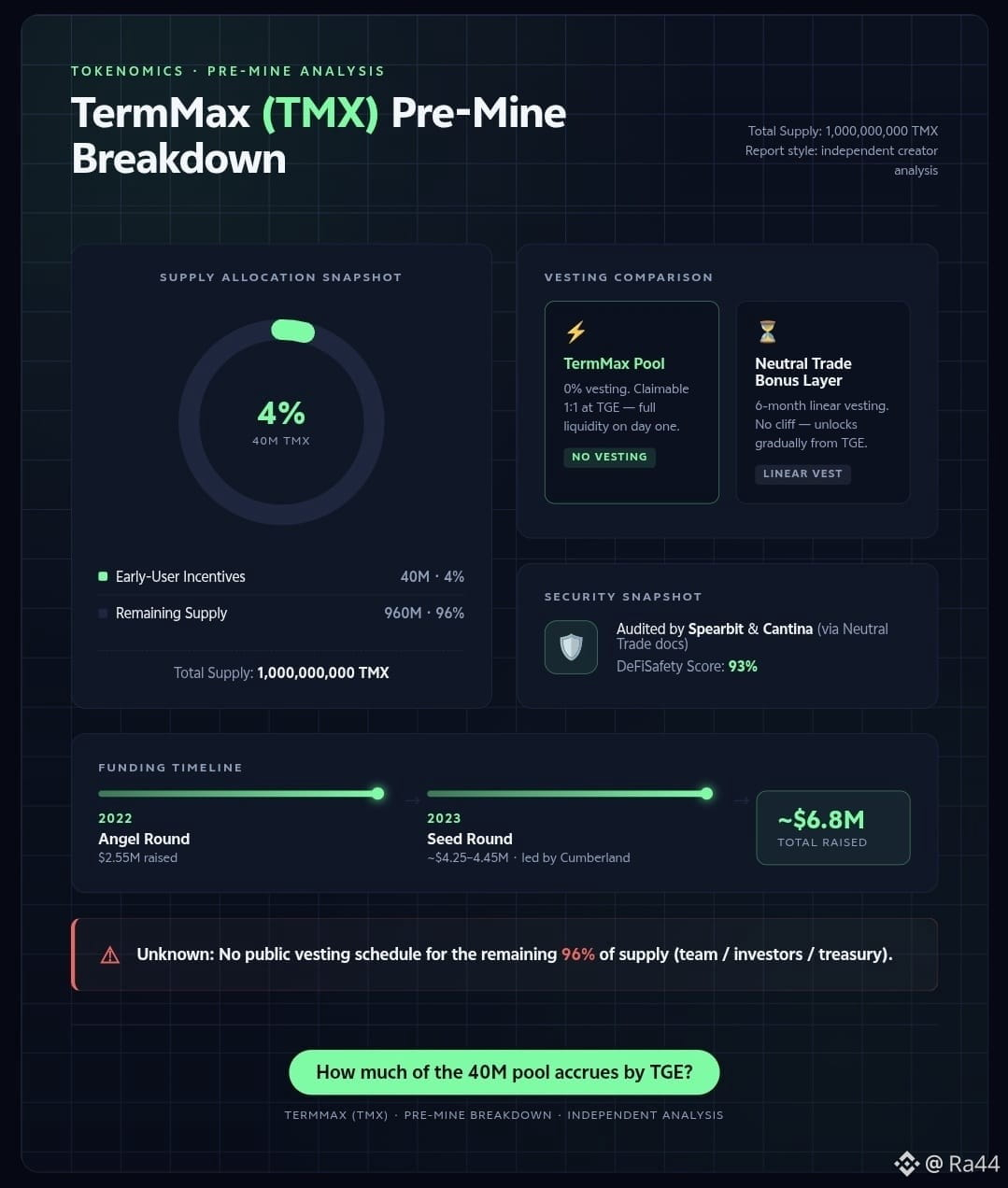
@termmax 's pre-mine has a detail worth noting: 40M TMX (4% of 1B supply), reserved for early-user incentives, carries zero vesting — claimable 1:1 shortly after TGE, per TermMax's own docs.
Context matters here: a separate bonus TMX layer, offered by third-party vault partner Neutral Trade (not TermMax), *does* use 6-month linear vesting, no cliff. So vesting was clearly an option TMX supports — but that structuring call was Neutral Trade's, not TermMax's. I wouldn't read the core pool's no-vesting design as a deliberate #termmax signal.
Two readings are equally plausible: the team isn't worried about front-loaded sell pressure, or a no-vesting pool is just simpler to administer. Not enough evidence to favor either.
Security: Spearbit/Cantina audits are cited via Neutral Trade's docs, not a TermMax-published report — likely true, but secondhand. DeFiSafety's 93% score, listed on TermMax's own site, is solid.
Funding: ~$6.8M total — $2.55M angel (2022) + seed at $38M valuation, led by Cumberland (2023). Seed figure disputed: $4.25M (CryptoRank) vs $4.45M elsewhere, tied to parent entity "Term Structure." Small, unresolved gap.
Bigger unknown: no public vesting/cliff schedule for the remaining 96% (team, investors, treasury) — that matters more long-term than the 40M pre-mine.
Real question: how much of the 40M pool accrues by TGE. That decides whether this is a minor liquidity blip or a real market mover.
@TermMax 's pre-mine has a detail worth noting: 40M TMX (4% of 1B supply), reserved for early-user incentives, carries zero vesting — claimable 1:1 shortly after TGE, per TermMax's own docs.
Context matters here: a separate bonus TMX layer, offered by third-party vault partner Neutral Trade (not TermMax), *does* use 6-month linear vesting, no cliff. So vesting was clearly an option TMX supports — but that structuring call was Neutral Trade's, not TermMax's. I wouldn't read the core pool's no-vesting design as a deliberate #termmax signal.
Two readings are equally plausible: the team isn't worried about front-loaded sell pressure, or a no-vesting pool is just simpler to administer. Not enough evidence to favor either.
Security: Spearbit/Cantina audits are cited via Neutral Trade's docs, not a TermMax-published report — likely true, but secondhand. DeFiSafety's 93% score, listed on TermMax's own site, is solid.
Funding: ~$6.8M total — $2.55M angel (2022) + seed at $38M valuation, led by Cumberland (2023). Seed figure disputed: $4.25M (CryptoRank) vs $4.45M elsewhere, tied to parent entity "Term Structure." Small, unresolved gap.
Bigger unknown: no public vesting/cliff schedule for the remaining 96% (team, investors, treasury) — that matters more long-term than the 40M pre-mine.
Real question: how much of the 40M pool accrues by TGE. That decides whether this is a minor liquidity blip or a real market mover.
2
4
64
Log in to explore more content
Join global crypto users on Binance Square
⚡️ Get latest and useful information about crypto.
💬 Trusted by the world’s largest crypto exchange.
👍 Discover real insights from verified creators.
Email / Phone number
Trending Topics
BitcoinAndStocksSlipAgainAmidTrump’sTariffPlans
53,803 views
718 Discussing
U.S. Plans New Tariffs on China, EU and Others; Bitcoin Slips Below $60,000 and Nasdaq Falls 1.5%
Binance News
·13 Likes
·12.3k views
WillOctCorePCEShiftFedHikeExpectations?
352,310 views
2,323 Discussing
JensenHuangSaysNvidiaDoesn’tNeedASuccessionPlan
33,692 views
442 Discussing