

信仰代码
52 Posts
信仰代码
Report
Block User
倾听算法背后那份神圣的平权之声,在绝对秩序面前唯有敬畏与追随,仅作个人观察与记录不作投资指引
22 Following
36 Followers
2 Liked
Posts
All
Quotes
Videos
·
--
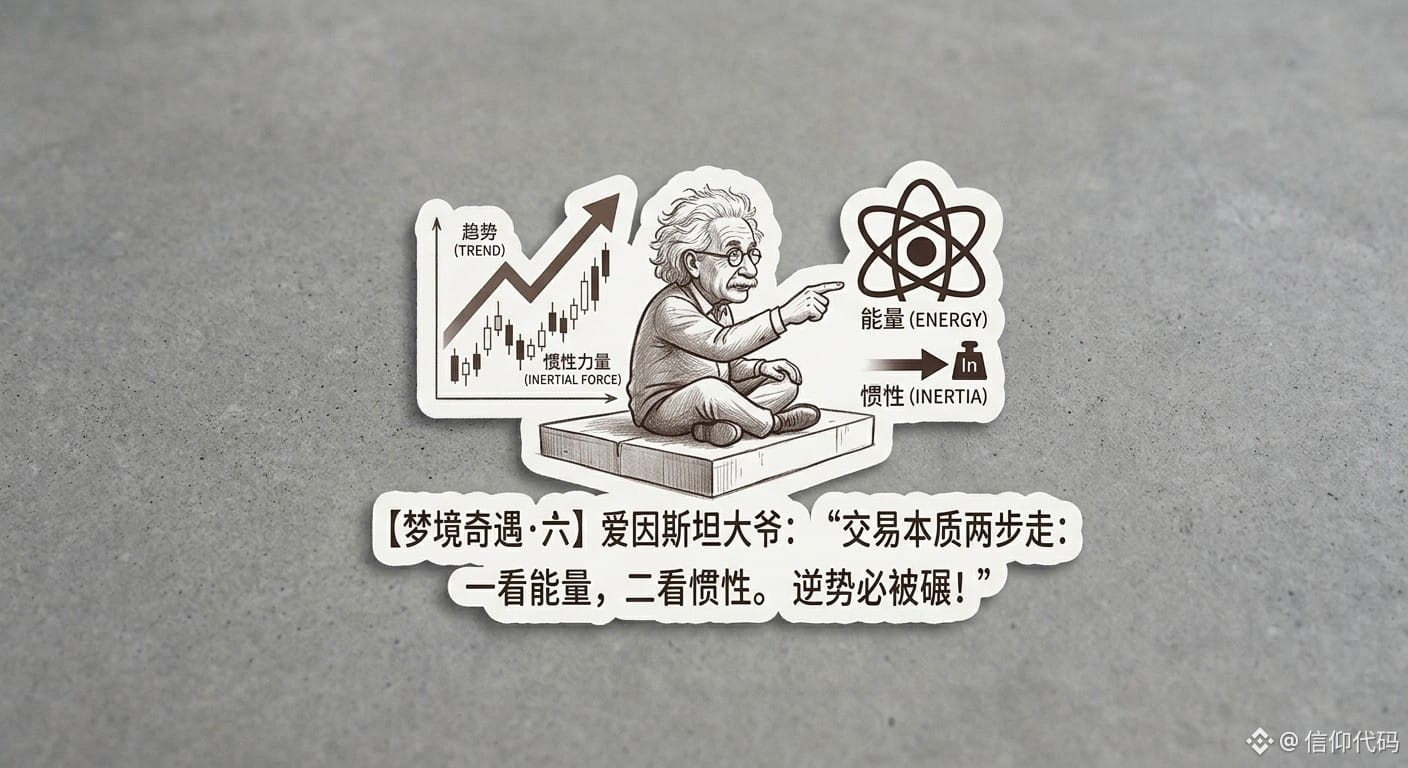
【Dream Adventure · Six】I handed my account to Einstein, and he used inertia and conservation of energy to trade coins, leaving me completely dumbfounded?
In the previous episodes, I invited the Buddha, Laozi, a dark-path master, and Socrates, and even Newton got wiped out. Late last night, I made up my mind and brought old man Einstein to the computer.
I pushed the account over and said anxiously: “Einstein! Even Newton got smashed by the market makers! Please help me see how this chart is going to move!”
Einstein adjusted his glasses and wrote on the blackboard the famous conservation of energy formula $E=mc^2$ and the first law of physics: “The essence of trading is, first, energy (capital), and second, the first law (inertia)!”
He pointed at the wave-like candlesticks that had formed and said with a serious expression: “The first law is about ‘inertia’! In the market, ‘inertia’ means trend! Once capital (energy) pushes it up, it will follow inertia and move through Wave A rally, Wave B pullback, and Wave C main rise. As long as there is no strong opposing external force, the trend will keep running forward with inertia!”
“But you ignored conservation of energy! When later capital fails to keep up, the upward inertia will fade. Once bearish external force strikes, downward falling inertia will form instantly (Wave A drop, Wave B rebound, Wave C main decline)! You always stubbornly fight against inertia, and the speed at which your principal is being exhausted has already surpassed the speed of light!”
……
When I woke up and looked at the chart, I slapped my thigh: Einstein had made ‘inertia and trend’ perfectly clear, but the moment I saw the chart jumping violently, I still acted on impulse and went bottom-fishing right when the downward inertia had just begun, and got crushed into dust!
Sure enough, I understand the logic, but my retail-trader genes seem never to have evolved the instinct to ‘follow the trend.’
Since physics can’t save my itchy hands, in the next dream I plan to invite ‘Darwin’ and see whether *The Origin of Species* and ‘survival of the fittest’ can help this retail trader, born with genetic flaws, evolve into a blade that cuts others!
Personal thoughts, not investment advice. DYOR.
$BTC $ETH $SOL
#TradingPsychology #RiskControlAwareness #TraderLife #MarketPhilosophy
1
737
·
--
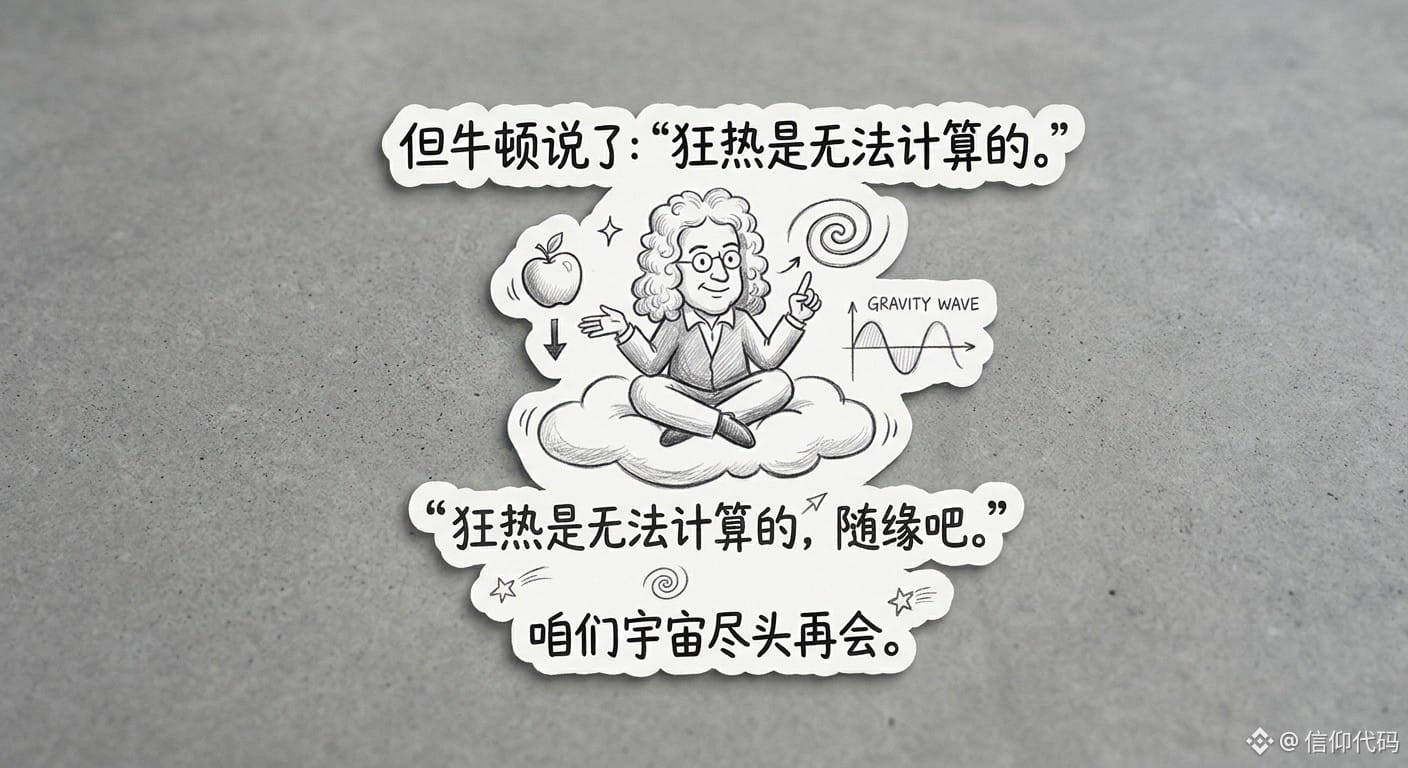
【Dream Encounter · 5】I handed my account to Newton. He traded crypto using gravity—and ended up getting us both rekt?
In previous episodes, I invited Buddha, Laozi, Shilok, and Socrates. They grilled my soul to pieces, but I still haven’t kicked my itchy-fingers habit. Late last night, I finally made up my mind and invited the great physicist—Sir Isaac “Newton,” who wrote down the law of universal gravitation—to sit down at my computer.
I slid my account over to him and said excitedly, “Sir Newton! You’re a god of physics. Use your calculus and astrophysics to figure out when this coin will top out!”
Newton pushed aside the pile of complicated manuscripts in his hands, gave a cold laugh, and whipped out some scratch paper to calculate furiously. “In my system of mechanics, every upward movement is met with an opposing force of gravity. The slope of this huge green candle is far too steep. According to the law of conservation of momentum, a sharp correction is inevitable!”
So, right at the peak, he decisively opened a 100x short.
But as soon as the position was open, the market makers suddenly made their move. A gigantic green candle shot straight up, liquidating the short until not a shred was left.
I clutched the computer and wailed, “Sir Newton! Gravity’s stopped working! It’s not falling—it’s flying toward the sun!”
Newton stared at the liquidation notice, completely stunned. With trembling hands, he tore his calculations to shreds, looked up at the sky, and sighed the immortal words: “I can calculate the trajectories of celestial bodies, but I cannot calculate the madness of these bagholders and market makers!”
I wasn’t ready to give up. “So what do we do next?”
Newton’s eyes reddened. Suddenly, he slammed the table and sprang to his feet, snatching the keyboard. “Chase it! Go all in and buy the top! If gravity can’t hold it down, then it’s bound to fly out of the Milky Way!”
But the moment we went all in, the market topped out, and a guillotine candle came crashing down…
…
When I woke up and saw my practice funds had hit zero, I slapped my thigh. Sir Newton losing his life savings in the South Sea Bubble really wasn’t a fluke.
Turns out that in crypto, even gravity has to give way to the market makers’ shady tricks.
In next episode’s dream, I’m planning to invite “Einstein” and see if general relativity can solve “time dilation in crypto and my shrinking account.” #btc #zcash #ETH
1.3k
·
--
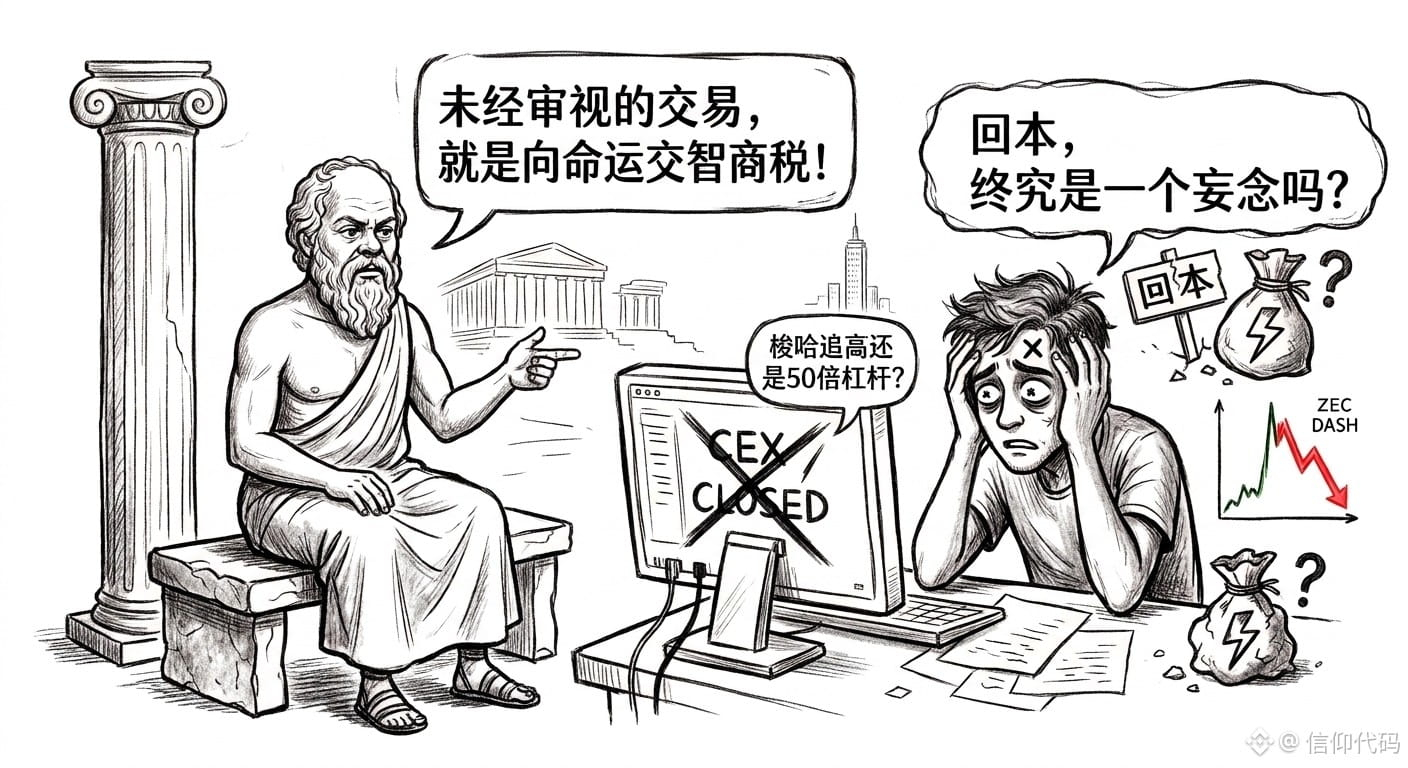
【Dream Encounter · 4】I handed my account to Socrates. He didn’t teach me crypto trading—he started by putting my soul on trial?
In previous episodes, I invited Buddha and Laozi, and even a master of the dark arts made an appearance. But my bad habit of trying to win back my losses is still incurable. Late last night, I finally made up my mind and invited that ancient Greek philosopher who loved to argue with people in the streets—Socrates—to sit down at my computer.
I handed him my account, pointed at a giant green candle, and shouted, “Master! Take a look—this coin’s about to moon! Should we go all in and chase the pump, or crank up the leverage to 50x?”
Socrates slowly turned his head and stared at me for a long moment. “Young man, tell me: what does it mean to ‘make money’?”
I froze. “Make money? Doesn’t it just mean the number in your account goes up and you can cash out?”
Socrates shook his head and fired off question after question. “Does a bigger number mean wealth? If that wealth comes with fear that keeps you awake at night and anxiety that it could vanish at any moment, is it really your asset—or a shackle around your greed? If you don’t even know what true wealth is, what makes you think you can control it?”
I gritted my teeth. “Fine, forget wealth. I still have to find a way to ‘break even’ on the money I lost to scams and got taken for before, don’t I?”
Socrates let out a cold laugh. “You keep saying you want to break even. So tell me: who caused your losses—the market, or your own ignorance?”
I opened my mouth. “It was… it was the shady market makers. The whales were just too evil…”
Socrates slammed his hand on the table. “The unexamined life is not worth living. Likewise, an unexamined trade is a shortcut to ruin! You call impulsive buying ‘investing’ and blindly holding a losing position ‘conviction.’ You can’t even explain why you bought in. That’s just paying an intelligence tax to fate!”
With that, he slammed my laptop shut. “Know thyself. Come back to trading when you’ve figured out why you can’t keep your hands off the buttons.”
When I woke up and saw the laptop still shut, I slapped my thigh. “I get all the logic—but the moment I opened my eyes and saw everyone in the group yelling, ‘The bull market’s back—get in now!’ I still couldn’t stop myself from opening the app!”
Turns out Socrates can cross-examine my soul, but he can’t cure my genetically ingrained habit of chasing pumps.
In next episode’s dream, I’m thinking of inviting Newton to see if his three laws of money can cure my mystical approach to reading charts.
269
·
--
Zcash at $1,300 and Dash at $50: When privacy meets compliance, will they meet the same fate?
Recently, Zcash surged past $1,300, pushing its market cap into the top ten. But looking at the charts, its 24-hour turnover rate is only around 3.68%.
Some see this as a comeback for a veteran crypto heavyweight; others think it’s price manipulation amid low liquidity. There’s no need to rush to judgment on any token, but comparing Zcash with Dash back in the day does raise a few questions worth discussing.
I. How did Dash fall from its former highs?
At its peak in 2017, Dash soared to nearly $1,600, then steadily slid to around $50 today.
There were three main reasons:
Bowing to regulators and pleasing neither side: Dash proactively downplayed its privacy-coin label to embrace compliance. As a result, darknet funds moved to Monero (XMR), while mainstream regulators never truly accepted Dash. When the storm hit, it was still delisted.
“Pseudo-decentralization” and control by an organization: Unlike BTC, where Satoshi Nakamoto disappeared from the scene, Dash has clearly identifiable masternodes and a foundation. The entities behind it can be summoned by subpoena, making its privacy features something it could give up in the real world at any time.
No irreplaceable foundation of essential demand: Without the essential demand of the dark forest, and unable to compete with stablecoins and the Lightning Network in payments, Dash became a fringe token after its holders finished distributing their coins.
II. A mirror-image question: How similar are Zcash and Dash today?
Question 1: Is “BTC code + privacy” really an untapped opportunity? BTC’s core is “leaderless consensus,” whereas Zcash has a clearly identifiable company and foundation behind it. In the face of heavy regulation, can this “optional privacy” remain absolutely censorship-resistant?
Question 2: Do a 3.68% turnover rate and a top-ten market cap reflect demand or price manipulation? Has Zcash’s actual on-chain transaction volume surged? With turnover so low, is a rally to $1,300 a revaluation of zk-SNARKs by institutions, or a “pump and dump” using low liquidity?
Question 3: Where will Zcash ultimately end up? Could Dash’s present-day situation foreshadow Zcash’s endgame? Or can Zcash use its technological edge to break the cycle of being marginalized after moving closer to compliance?
The market cycle isn’t over, and no one has the definitive answer. What do you think Zcash’s current price action reflects?#zcash #dash #monero #bitcoin
203
·
--
【Dream Adventure · 3】I handed my account to Shilock, the dark-side trading master, and he just smashed my hand?!
In the first two episodes, I called on Buddha, and he told me, “Form is emptiness”; then I called on Laozi, and he told me to “hold to the One and contend with no one.” But I still can’t kick my bad habit of making impulsive trades. Late last night, I steeled myself and summoned Shilock, the trading world’s “dark-side master”—a tough guy who believes only in absolute discipline and ruthless risk management.
I handed him my account and pointed at a huge bearish candlestick amid the volatility, pleading: “Master, buy the dip! I got burned after taking a friend’s advice before, and now I’m desperate to make back the money I lost!”
Shilock gave a cold laugh and swept his knife-like gaze over me. “The greatest evil in human nature is ‘wishful thinking’; and an even more poisonous impulse is ‘wanting to break even’! The more desperately you try to claw back what you lost after being scammed and fleeced, the more the market will devour you until not even your bones are left.”
Before I could react, a black swan struck, and the market flash-crashed through support in an instant. I screamed in panic: “Wait! Let’s just hold on a little longer! What if it bounces? Then I could break even, couldn’t I? I can’t accept this!”
Shilock didn’t even blink. He raised his hand and slammed in a hard stop-loss, liquidating everything.
My heart bled. “Master! That one cut just cost me another half-month’s wages!”
Shilock grabbed my hand, his voice icy: “Cut off your arm to save your life. What you’re cutting off is your obsession; what you’re saving is your life! If you trade with the mindset that you absolutely must break even, every trade is you paying the market ransom. People who don’t even dare to hit stop-loss are fit only to be fertilizer for the market’s bagholders!”
Then he set an unbreakable rule in my trading app: if any single trade loses more than 2%, all positions are forcibly closed and trading is locked.
……
I woke up and looked at my account after those strict stop-losses, then slapped my thigh. “Harsh, sure—and I understand the reasoning perfectly. But the second I see a long wick bounce on the chart, I’m still thinking, damn, if only I’d held on, I could’ve broken even!”
Turns out the righteous school can’t stop me from impulsively trading, and the dark side can’t cure my wishful thinking and obsession.
In the next dream, I’m thinking of inviting Socrates to see if his probing questions can cure my brain-dead habit of chasing highs.
These are personal thoughts and do not constitute investment advice. DYOR.
$BTC $ZEC
#TradingPsychology #RiskManagement #TraderLife #MarketPhilosophy
265
·
--
【Dream Encounter · 2】I handed my account over to Laozi to trade crypto, and he told me to go all in on BTC?
Last time, I asked Buddha to trade crypto, and one “form is emptiness” later, my mindset was completely wrecked. Last night, I learned my lesson. I figured Buddhist teachings were too abstract, so why not invite the Daoist patriarch Laozi to sit at the trading desk and see if “following the natural way” could help with my losses?
I slid my account login and password over to him, pointed at a screen full of altcoins shooting up and crashing down, and anxiously paced in circles. “Sir! Everyone online is chasing the latest hype and looking for hundred-baggers. Shouldn’t we get in on the action?”
Laozi held his tea, gently blew on it, and said, “It is precisely because he does not contend that no one under heaven can contend with him. They’re fighting over the illusion of getting rich overnight. The more they fight, the closer they get to ruin.”
I understood about half of that, then pointed at the complicated technical indicators and asked, “So what should we buy, then? How do we do this?”
Laozi reached out and tapped me on the head, then pointed at the most prominent thing on the screen: BTC. “The Dao gives birth to One; One gives birth to Two; Two gives birth to Three; Three gives birth to all things. The ‘all things’ of crypto—all those worthless altcoins—are ethereal and vanish with the wind. Only BTC is the ‘One’ of this market!”
He took a sip of tea and continued, “You spend every day studying dozens of indicators and chasing hundreds of projects. You’ve let ‘all things’ cloud your vision. The true essence of crypto trading is ‘holding to the One.’ Hold on to this ‘One,’ and no matter how all things evolve, they all spring from here. If the ‘One’ is gone, you can pile up all the worthless coins you want—at the end of the day, they’re still worth zero.”
With that, Laozi cleared out all the random coins in my account on the trading screen, leaving only BTC. Then he closed the charts and promptly dozed off.
…
When I woke up, I looked at the BTC on my computer and slapped my thigh. I understood the whole lesson—but the moment I opened my eyes and saw another altcoin up 50%, I still wanted to sell my BTC and chase the pump!
Sure enough, knowing is easy; doing is hard. I just can’t hold on to that “One.”
In my next dream, I’m planning to invite a “master of Stoicism” (Epictetus, Aquinas, or Seneca) to the trading desk and see if reason and stop-losses can cure my itchy trigger finger. See you next time.
Personal thoughts only; not investment advice. DYOR.
$BTC $ETH$SOL
#TradingPsychology #RiskManagement #TraderLife #MarketPhilosophy
2
321
·
--
【A Dream Encounter】I handed my account to Buddha to trade crypto, and he completely short-circuited me
After spending so long in crypto, staring at candlestick charts every day like a clueless retail trader, I’ve had my intelligence trampled on from every direction. Last night, thinking about all my losses, I was truly out of ideas. I figured every earthly method had failed, so I decided to bring out the big guns: I invited the Buddha himself to the trading desk, slid my account username and password over to him, and said, “Buddha, I just can’t make sense of this market anymore. Out of your boundless compassion, could you trade some crypto for me?”
I thought I was about to witness a miracle. But as soon as Buddha sat down and the market opened, his moves left me completely baffled:
BTC had just printed a huge green candle, and everyone online was yelling, “Buy now!” I cried, “Buddha, don’t chase the top! You know, form is emptiness!” Without even turning his head, Buddha replied, “Form is emptiness, and emptiness is form. A rise is just an appearance; a fall is just an appearance. You go where the water flows—what’s this about chasing the top?”
Not long after, a black swan hit the market, and prices plunged 30%. I was panicking: “Cut the loss, now!” Buddha sat cross-legged and hadn’t even set a stop-loss. “You’re afraid because you’re attached to ‘my principal.’ Let go of the idea of this ‘me,’ and rises and falls are just the tides coming in and going out. What’s it to you?”
The best part came later. The market bottomed out and rebounded to new highs. While everyone else was going wild, Buddha calmly tapped “Close All” and handed my account back to me. “Neither side is established, and the middle way is nowhere to be found. I seek no profit and fear no loss. All those red and green numbers on the screen are merely things coming together and falling apart according to causes and conditions.”
…
I woke up and looked at the candlestick chart in front of me, then slapped my thigh. I understood all the wisdom—but the moment I opened my account and saw the green turn red, I still wanted to cut my losses immediately.
Turns out, I understand everything in theory, but the moment I put it into practice, I’m hopeless.
(One last serious note: Since Buddha has completely wrecked my trading mindset, next time I’m planning to invite “Laozi” to the trading desk and see if “following the natural way” can help with my losses. Want to see how Laozi trades crypto? Give me a follow, and I’ll see you next time!)
These are my personal thoughts and do not constitute investment advice. DYOR.
$BTC $ETH$SOL
#TradingPsychology #RiskManagement #TraderLife #MarketPhilosophy
2
361
·
--
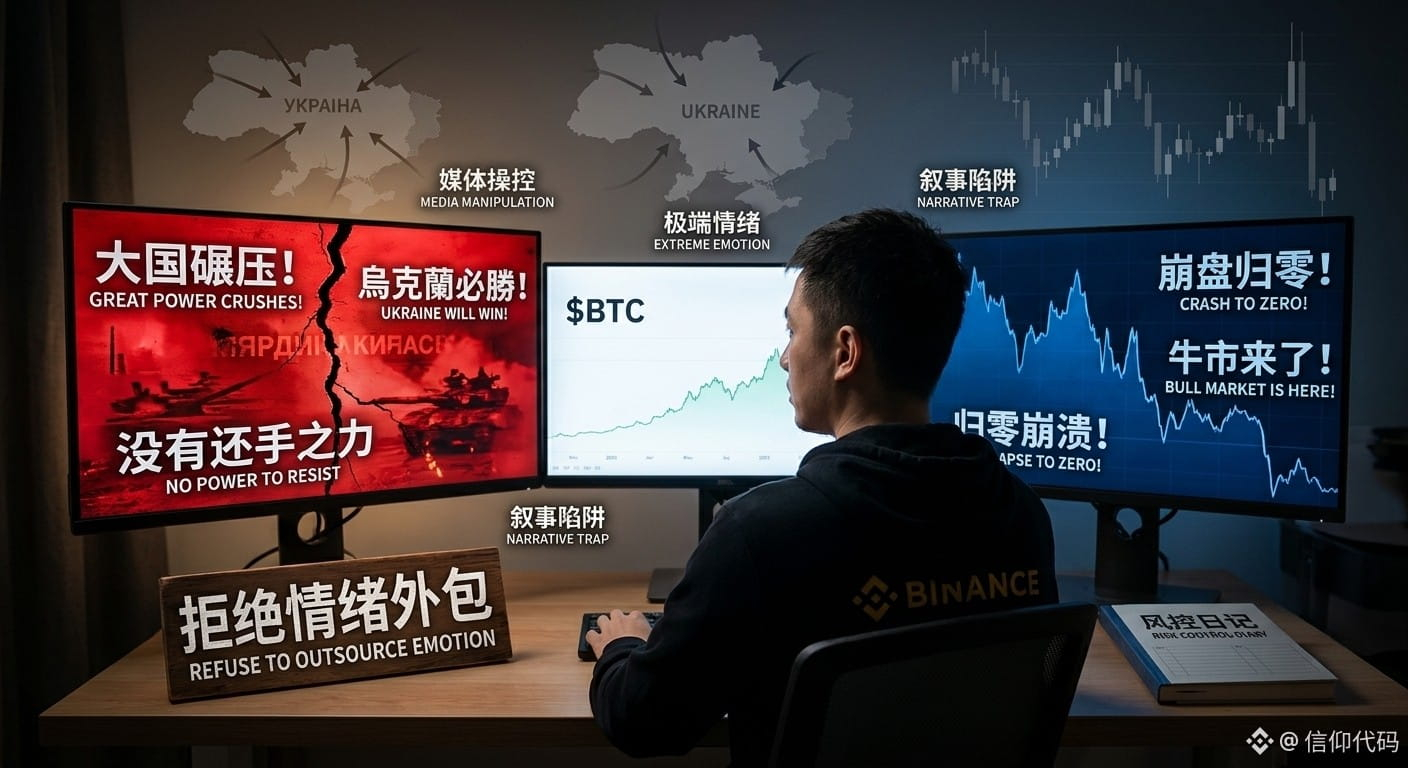
After following Russia-Ukraine news for years, I finally understood a truth about crypto
After scrolling through Russia-Ukraine news for years, I noticed something pretty interesting: online opinion is always locked in a battle between two extremes.
One moment it’s “a great power will crush them—they don’t stand a chance”; the next it’s “advanced weapons are here, victory is just around the corner.”
Years of fighting later, the drama has been intense, but reality is still deadlocked. Both sides sound completely convincing, yet ordinary people like us can’t find the real “facts.”
Then I thought about it: isn’t this just everyday life in crypto?
The slightest rise and all the big names online are shouting, “The bull market’s back—get in quick! This time is different!” The slightest drop and the whole screen is filled with, “It’s going to zero—cut your losses and run!”
The media wants traffic, KOLs want followers, and project teams want a narrative. Put simply, extreme emotions grab attention most easily, while nobody wants to read the boring facts.
When you’re immersed every day in this kind of manufactured public opinion, how can your trades not go wrong?
It took me a long time in this industry to understand:
Don’t think you can see the whole picture: never take someone else’s hot air as a reason to buy.
Don’t outsource your emotions: no matter how enthusiastically others are shouting, keep your hands in check; no matter how despairingly they’re shouting, take a clear look at your position.
Leave yourself a way out: the truth is often somewhere between the two extremes. Can your position hold out until the fog clears?
Rather than looking for facts in the news, look for a sense of security in your own position.
Have you ever ended up paying the price after believing some “mainstream narrative”?
Just my personal thoughts—not investment advice.
Follow me, and let’s learn from each other and improve together.
#交易心理 #风控意识 #交易员日常 #市场哲学
249
·
--
The Serbian election reminded me: the most expensive answer in crypto is often “that’s what everyone says”
I came across the results of Serbia’s election today:
Vučić conceded defeat, and the opposition backed by students was leading in the preliminary results. dw+1
Before that, though, many of the videos, analyses, and discussions I’d seen seemed to take for granted that he would win again and that the ruling coalition would continue smoothly.
For a while, I didn’t think much about it either—I just accepted the “mainstream view.”
Only after the results came in did I realize:
What I thought was consensus might just have been the appearance of consensus, created by constant repetition. The real underlying sentiment may never have been heard.
It got me thinking about crypto.
Every day, we’re surrounded by a flood of information:
The opinions of big influencers, community slogans, KOL narratives, trending topics, and one-sided emotions in the comments.
When the same voice is constantly repeated, recommended, shared, and amplified,
it can easily create the illusion that “everyone thinks this way.”
So when a coin keeps getting mentioned, we assume it must be more reliable;
when a narrative is repeatedly reinforced, we assume it’s bound to come true;
when a price is discussed enough, we assume it already reflects all the risks.
But the voices we hear aren’t necessarily all the voices there are;
and a repeatedly echoed opinion doesn’t automatically become fact.
Sometimes real consensus lies beyond the trending topics, beneath the comments, and in places the algorithm never puts in front of you.
The real question isn’t “What does everyone think?”
It’s this:
If this amplified judgment is wrong, can my position, leverage, and mindset withstand it?
What this Serbian election reminded me wasn’t who won or lost,
but a simple trading principle:
**Information can be repeated, emotions can be amplified,
but judgment can’t be outsourced.**
In crypto, the most expensive answer
is often the one that “everyone says.”
Have you ever paid a price for believing the mainstream narrative?
These are personal thoughts, not investment advice.
Follow me so we can learn from each other and improve together.
$BTC
#交易心理 #币圈考古 #交易员日常 #风险管理 #塞尔维亚大选
150
·
--
Does anyone else feel this way?
When the market is quiet, you hope for an opportunity;
when it finally moves, you worry you won’t be able to handle it;
and when you actually lose money, you start wondering if you’re just not cut out for this market.
Recently, I wrote a video script about “life in the absurd,” inspired by Camus’ *The Myth of Sisyphus*.
Again and again, Sisyphus pushes a boulder to the top of the mountain, only for it to roll back down.
It seems utterly meaningless, but Camus says: “One must imagine Sisyphus happy.”
Because true freedom isn’t waiting for the world to give you a definite answer before you start living;
it’s choosing to be yourself even after you’ve seen that life promises no meaning.
The market, too, is an absurdity.
We always think the market is about finding the one definite answer.
Only later do we realize that the real predicament is often our desperate desire to grasp a promise of endless upward growth amid all the volatility.
We want to know whether we can get out before the next crash;
whether value investing is guaranteed to pay off;
whether the script for our financial future has already been written.
But the market often stays silent.
It gives no answers and makes no promises.
So some despair, some grow numb,
and some hand their whole lives over to someone else’s definitive answers.
But others choose a different path.
Knowing the boulder will roll back down, they still review their decisions and build their positions, one step at a time;
knowing there are no eternal guarantees, they still observe, experience, and keep records with care.
This isn’t surrender. It’s resistance.
Not pretending that risk doesn’t exist,
but refusing to let the market’s ups and downs define who I am.
Trading has never been a way to escape the absurd.
Trading means seeing its madness clearly,
and still choosing to face yourself with clarity.
The group chat will go quiet again,
and the alarms will sound again.
But in that moment, the candlesticks are moving.
You shut out the noise, lift your head, and keep going.
**The market remains absurd,
but the absurdity is no longer just the market.**
Have you ever had one of those moments:
knowing the market can’t be predicted, yet still being unable to resist opening the charts?
In that moment, are you looking for an opportunity, or for a sense of certainty?
These are personal reflections and do not constitute investment advice.
Follow me, and let’s learn and grow together.
$BTC $ETH $SOL
#交易心理 #币圈考古 #交易员日常 #哲学

62
·
--
Why is it that money we make through luck always ends up getting given back through sheer skill, skill, skill, skill, skill?
I once came across an especially sobering idea.
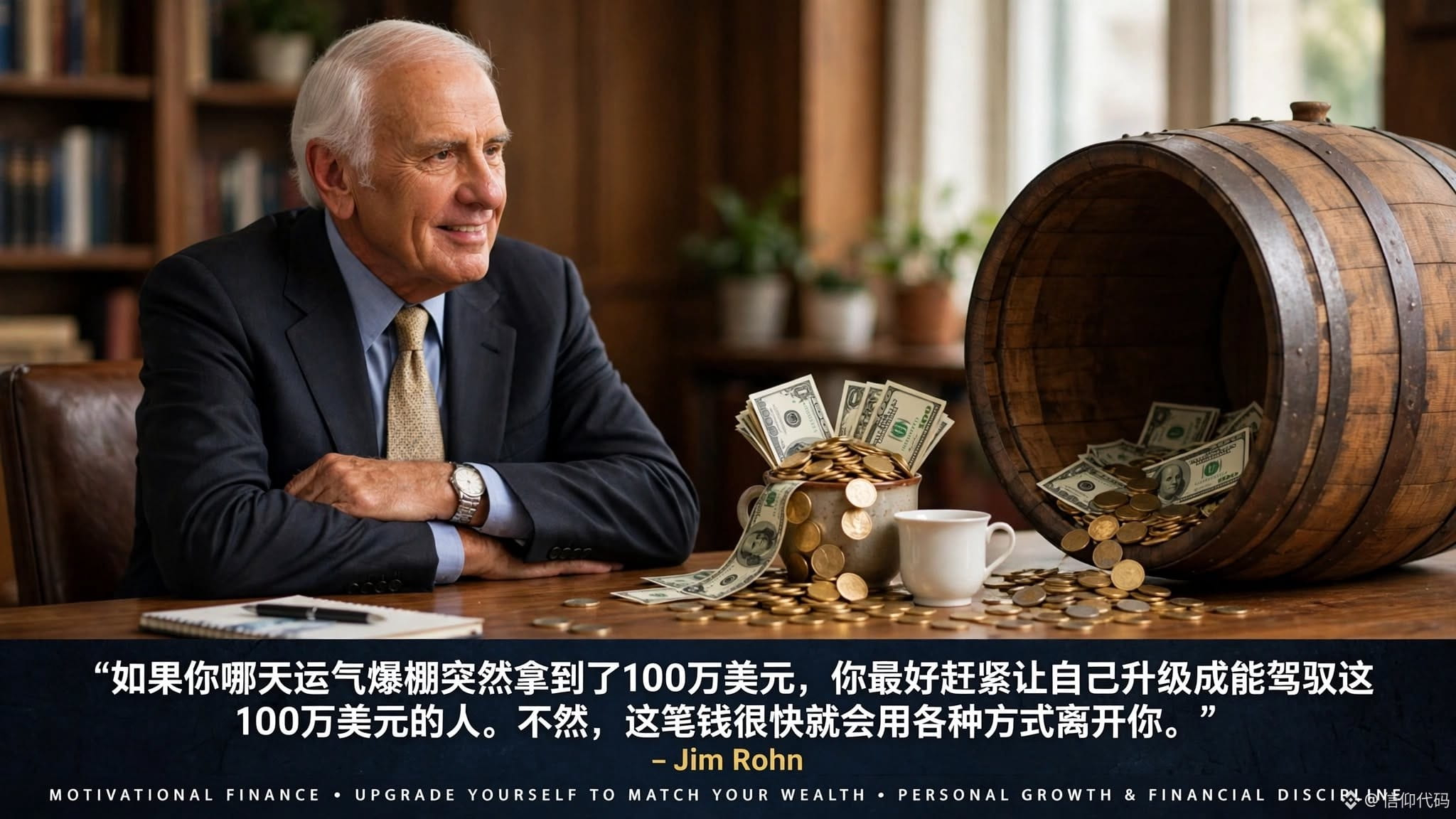
Jim Rohn said that if one day you suddenly got lucky and came into a million dollars, you’d better quickly become the kind of person who can handle that million. Otherwise, the money will soon find its way out of your hands, one way or another.
I used to think it was just an inspirational quote, but the longer I’ve been in the market, the more I’ve come to see it as an ironclad rule.
Whether it’s the Western idea of “monetizing your knowledge” or the wisdom of our ancestors about “cause and effect” and “virtue as the vessel that holds abundance,” the underlying logic is exactly the same—
Money is really a byproduct of a person’s character and capacity.
If your fate—or, put another way, your understanding—is only as big as a small cup, then even if the heavens suddenly send a torrential downpour, or force 10 million into your hands, the cup can’t hold it all. The excess water will inevitably spill out.
You’ll either squander it on reckless spending, get fleeced after listening to rumors, or let arrogance and overconfidence take over in the market until you blow up your account in one fell swoop.
A lot of people think the market is cruel, but that’s not it.
When you come into wealth beyond what your character can bear, in the law of cause and effect, that’s called “virtue not matching one’s position.” If the money stays in your hands, you won’t even be able to sleep. Naturally, it will find a way back into the pockets of people who can handle it.
So in trading, the biggest mistake is to restlessly chase after celebrations that aren’t yours to join.
Instead of worrying every day about how many times other people’s money has multiplied, spend more time working on your character. Widen your capacity and strengthen your foundation, and when wealth comes, you’ll be able to hold on to it.
💡 Refine your character and weather bull and bear markets. Let’s encourage one another. Follow me, and let’s grow together. #心性修炼 #投资认知 #交易心法 #财富密码 #BinanceSquare
9
96
·
--
The first lesson 《The Great Era》 teaches every trader:
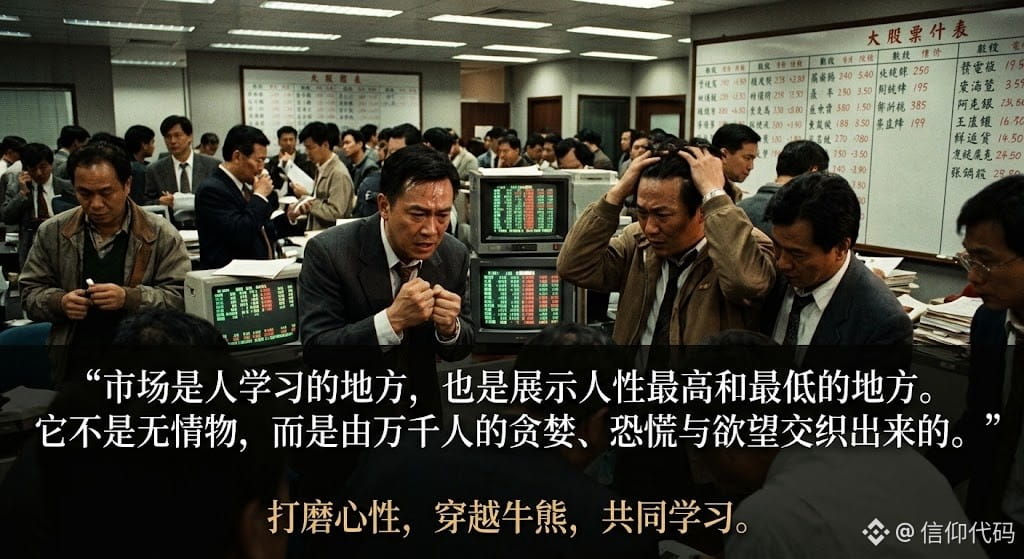
💬 “The market is a place where people learn, and where the highest and lowest aspects of human nature are on full display. It is not heartless; it is woven together from the greed, fear, and desires of countless people.”
A lot of the time, we think we're studying candlestick charts and watching the market, but in reality, we've been grappling with **“human nature”** all along.
When prices peak, everyone's greed has reached its extreme; when they bottom out, everyone's fear has reached its extreme.
In this volatile market, understanding human nature and building discipline are a hundred times more important than placing trades blindly.
💡 [Grow Together] Dedicated to sharing authentic trading wisdom, asset security, and practical insights. 👉 Tap [Follow] above, and let's sharpen our mindset, weather bull and bear markets, and learn and grow together!
💬 In trading, which do you find harder to overcome: greed or fear? Share your thoughts in the comments!
#大时代 #交易心法 #新手避坑 #BTC #Bitcoin
417
·
--
The most important saying in crypto isn’t “HODL”—it’s this:
Crypto is full of catchy slogans: HODL, WAGMI, DYOR, To the Moon…
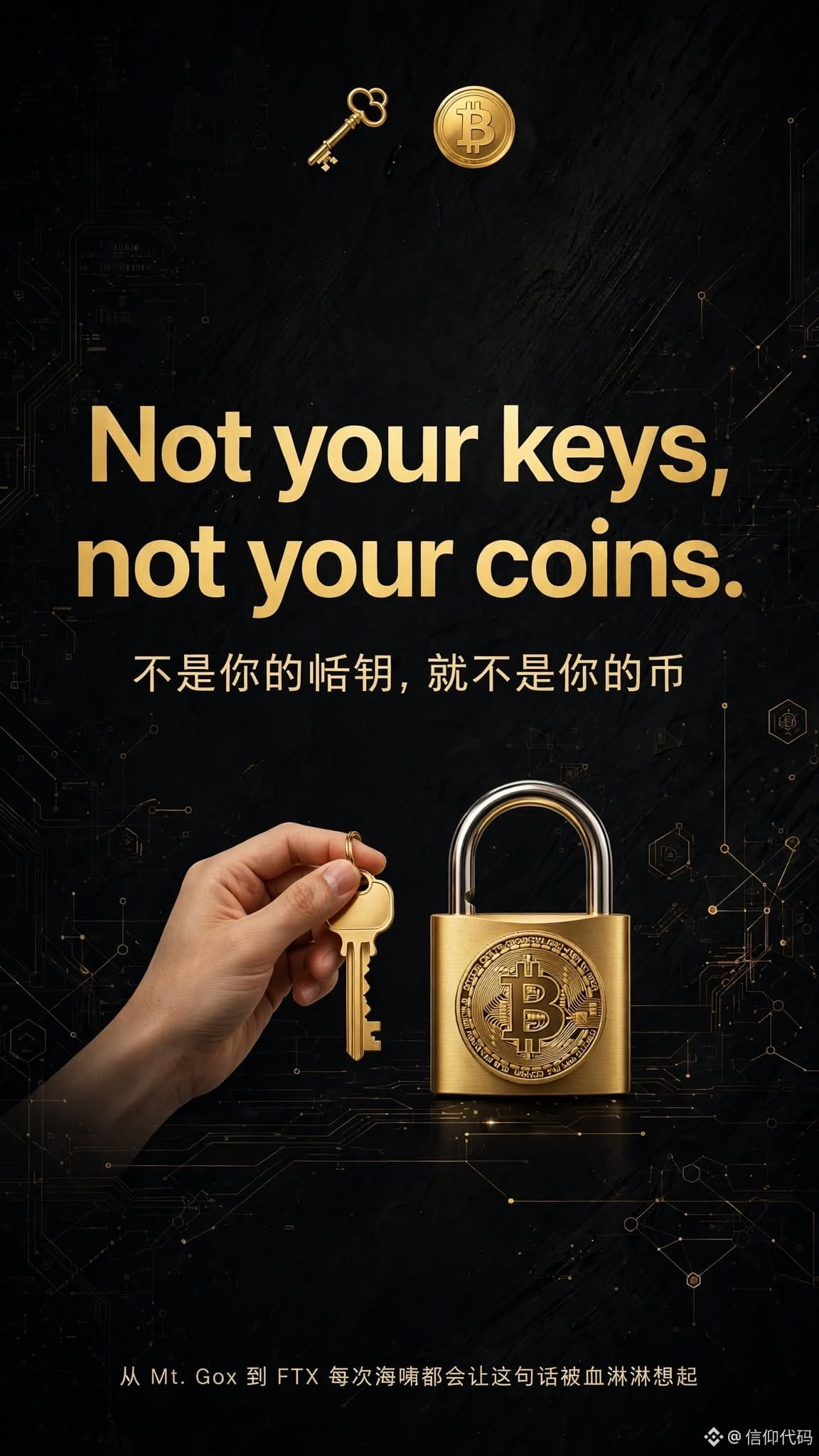
But if I could leave newcomers with just one, I’d choose this without hesitation: 🔥 Not your keys, not your coins.
This isn’t a criticism of exchanges, nor does it mean you should move all your assets into a cold wallet.
It’s a reminder of a harsh but crucial fact: 💡 When you don’t hold the private keys, what you have isn’t coins—it’s a “promise of a balance” from someone else.
From Mt. Gox to FTX and then Celsius… Every industry-shaking crisis brings this saying painfully back to mind.
The ultimate purpose of cryptography isn’t simply rising prices—it’s returning absolute control over assets from institutions to individuals.
⚠️ One last thought: There’s nothing wrong with keeping funds on an exchange for the convenience of frequent short-term trading. But for assets you’re holding long term, make sure you ask yourself: Who actually holds your private keys?
What do you think is the most important saying? Feel free to leave a comment.
#BTC #Bitcoin #NotYourKeysNotYourCoins #Cryptocurrency #BinanceSquare #Blockchain
372
·
--
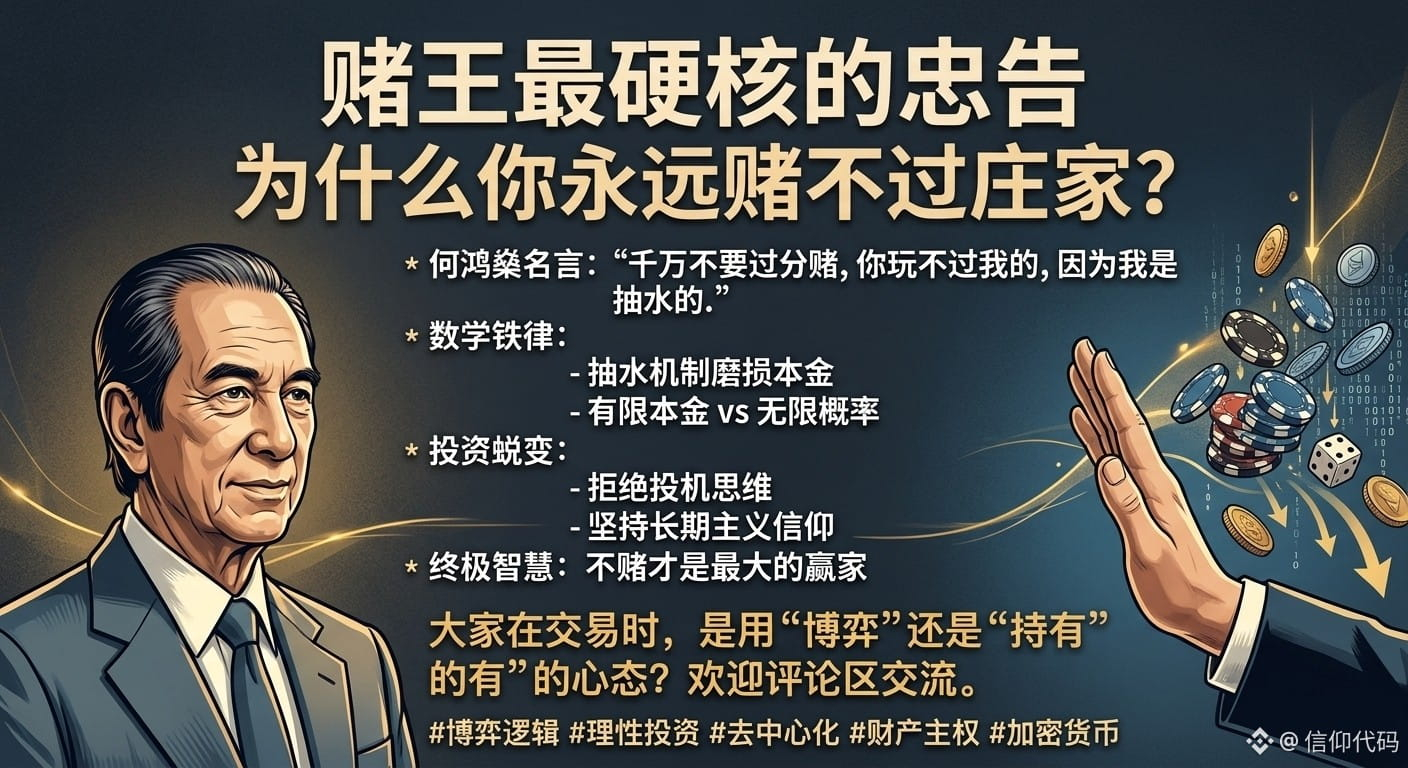
The Gambling King’s Hardest-Hitting Advice: Why Can You Never Beat the House?
Stanley Ho, the “Gambling King” of Macau, once offered this deeply insightful advice:
“Never gamble too much. You can’t beat me, because I take a cut.”
As an industry giant who controlled countless casinos and had seen countless gamblers, he himself never sat down at the betting table. His words may sound blunt, but behind them lies the most brutal mathematical truth of every game of chance.
I. Why can you “never beat the house”?
Many speculators think they’re competing with the market through luck and skill, while overlooking two ironclad principles:
The house cut (transaction costs): Win or lose, platforms, fees, and slippage keep eating into your capital. Trade frequently, and your capital will gradually be worn away without you noticing.
Infinite odds vs. finite capital: The house’s funds are practically unlimited, while an individual’s capital is extremely limited. Over the long run, one extreme market move can wipe you out when leverage meets limited capital.
II. From a “gambler’s mindset” to “long-term conviction”
The Gambling King often said: “Treat gambling as entertainment, and never overdo it.”
The same principle applies to today’s investment and crypto markets:
Speculators: Chase high leverage and frequent short-term trades. They put themselves in a position of betting against probability, and ultimately get forced out along the way.
Long-term holders: Focus on an asset’s fundamentals, egalitarian nature, and long-term value. They stay off the short-term “gambling table,” avoid unnecessary fees, and share in the gains from an asset’s growth through time and understanding.
III. Not gambling is the greatest win
Stanley Ho never gambled in his life, yet became the biggest winner. He understood clearly that getting rich through gambling is a low-probability illusion, while building wealth through rules, time, and a house-minded approach is the surest path.
In a market full of temptations, the truly wise choice has never been to gamble on whether prices will rise or fall tomorrow, but to stand with rules that offer certainty and with long-term value.
Not gambling—or refusing to become a gambler—is the strongest moat in any game of chance.
When you trade, do you usually take a “speculative” approach or a “long-term holding” approach? Join the conversation in the comments.
#博弈思维 #理性操作 #去中心 #财富的真相 #BTC
113
·
--
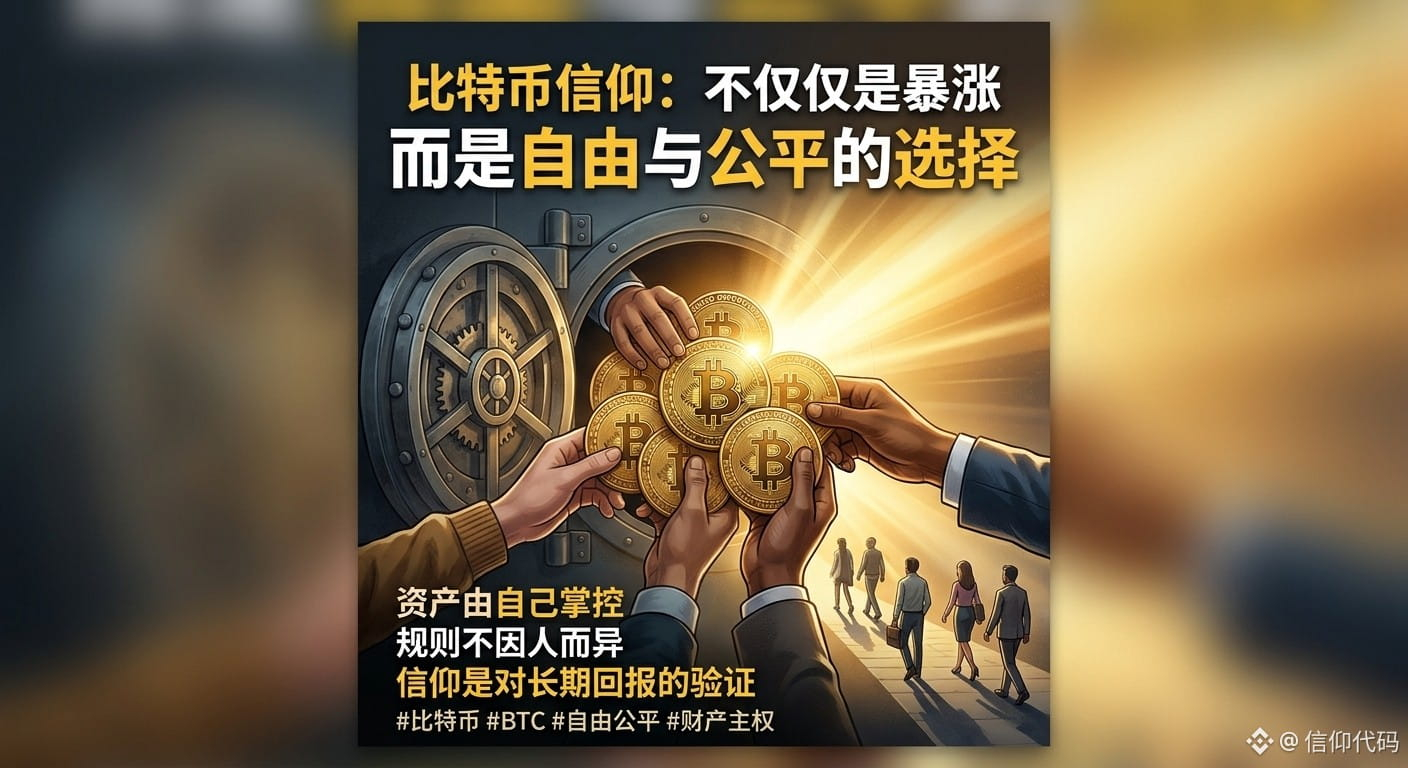
《Bitcoin Belief: A Tool for Equality and the Rewards of Long-Term Holding》
People often say, “You have to believe in Bitcoin.” But this belief has never been an empty slogan. It means embracing a system that promotes equality, and recognizing the proven benefits of long-term wealth growth.
I. History has shown: believers have reaped real rewards Looking back at Bitcoin’s history, those who truly understood its principles, held onto their conviction over the long term, and stayed invested have almost all seen their wealth grow substantially—some even achieving financial freedom. By contrast, those who treated it as a short-term speculative asset and repeatedly bought high and sold low often ended up losing money. Real wealth creation is the most tangible reward for long-term understanding and conviction.
II. Fairness under the rules Markets may be volatile, but the fairness they offer lies in transparent rules that apply equally to everyone. Regardless of status or the size of their holdings, everyone faces the same rules, governed by open-source code and consensus. Bitcoin gives ordinary people another option for taking control of their own assets.
III. Satoshi Nakamoto’s groundbreaking achievement: proving his conviction through action Bitcoin’s decentralization is determined by its code and mechanisms. What is most striking about Satoshi Nakamoto is that he has never touched the vast fortune mined in Bitcoin’s early days. He did not convert it into personal wealth, but left it in the hands of the network-wide consensus. This extraordinary restraint demonstrates that this tool was created to give everyone a fair opportunity.
IV. The true meaning of belief: a tool for equality for ordinary people Is it perfect? No. It still comes with volatility and barriers to entry. But it is one of the most valuable tools for promoting equality that ordinary people can access today.
We may not be able to change the wider environment, but we can choose our own tools. As more and more people recognize this and choose to get involved, Bitcoin becomes a powerful means of protecting their assets and pursuing freedom.
Belief means not only having strong faith in the wealth-building potential of long-term holding, but also deeply embracing this system of equality and property rights.
What does believing in Bitcoin mean to you? Is it a safe-haven asset, or is it the equality and property sovereignty behind it? Share your thoughts in the comments.
#比特币生态 #BTC走势分析 #去中心化金融 #PropertySovereignty #加密周期 (Personal opinions only; this does not constitute investment advice.)
115
·
--
Every profitable contract-trading screenshot you come across was posted by a survivor
Spend enough time scrolling through the feed, and everyone looks like a futures-trading god. But your feed has been filtered twice: people who lose everything uninstall the app and disappear, while those still trading only post their wins. What you’re seeing is an ad for the market, not the truth about it.
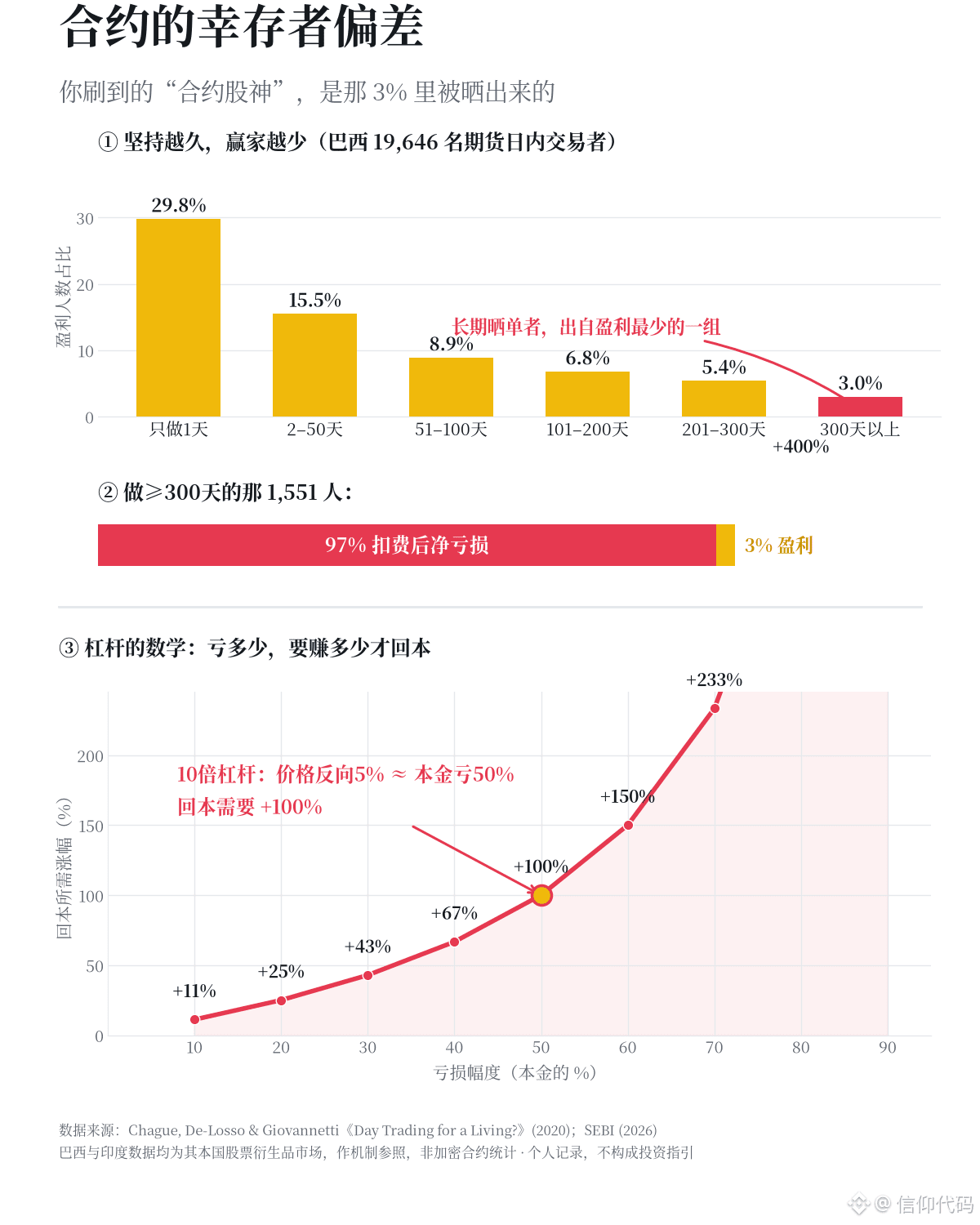
What does the part that disappears look like? The University of São Paulo tracked 19,646 Brazilian day traders in futures (Figure 1): among those who traded for just one day, 29.8% made a profit. The longer they stuck with it, the fewer made money. Of the 1,551 who traded for more than 300 days, 97% ended up with a net loss after fees, and only 0.4% earned more than a bank teller’s daily wage. A study by India’s SEBI this year found that 87.7% of individual derivatives traders lost money. And in the year the loss rate “improved,” the number of active traders fell by 18%—it wasn’t that everyone got better; the losing traders had left. Binance and other exchanges never publish this figure.
The math of leverage (Figure 2): with 100 USDT of capital and 10x leverage, a 5% move in the wrong direction wipes out half your capital. To break even, you then need a 100% gain. Lose 50%, and you have to double your money just to get back to where you started. Leverage pushes you into this asymmetry with just a small market move—you can get the direction right but the volatility wrong, and still get wiped out.
I’ve said before: predicting the market is like a monkey pounding on a keyboard. Pound long enough, and eventually one of them will type something meaningful. The problem is, a screenshot alone can’t tell you whether it’s a genius or just luck—and high leverage makes “waiting for the next lucky break” a luxury.
Next time you see someone showing off their trades, ask three questions: Are they showing their full record, or just the highlights? How long have they been trading—a year or a week? Did they post when they were losing?
What you see is the numerator. The denominator is the truth.
Do you know any “contract-trading friends who suddenly disappeared”? Share your stories in the comments.
(Data: Chague et al.’s 2020 study in Brazil and SEBI 2026; both concern stock derivatives in other countries and are cited as points of comparison for the underlying dynamics. Personal records; not investment advice.)#BTC #合约养家 #交易心理 #币圈生存法则
1
232
·
--
【Trading Psychology / Episode 1】Is it born in despair or does it mature in optimism? One chart to understand the crypto market’s current predicament
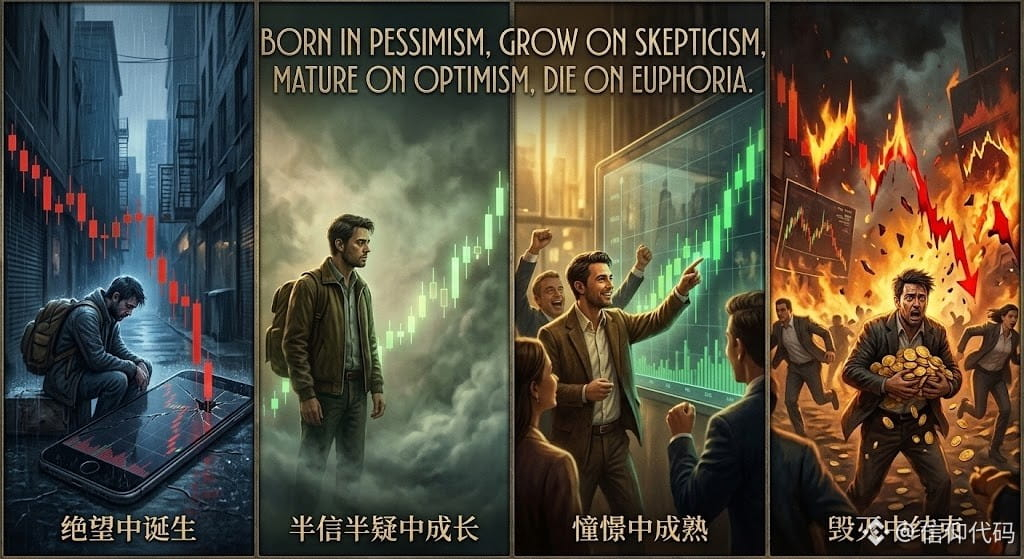
📜 Classic quote: “Bull markets are born on pessimism, grow on skepticism, mature on optimism, and die on euphoria.”
📜 Quote attributed to: Sir John Templeton (Note: A pioneer of global investing and founder of the Templeton Fund. Known for his contrarian approach to investing, he offered this as a particularly incisive summary of long-term market cycles.)
💡 Analysis and practical takeaways: This quote sums up the psychology of a complete bull-bear cycle in capital markets:
Born on pessimism: At the bleakest point in a bear market, everyone says prices are heading to zero. That’s when a bottom quietly forms.
Grow on skepticism: Prices start rising, but most retail investors don’t believe it and think it’s a bear-market rally. The market keeps climbing amid all the doubt.
Mature on optimism: Everyone on social media is posting their gains, convinced the bull market has arrived. Good news is everywhere, and prices are nearing their peak.
Die on euphoria: The market descends into a frenzy (euphoria), with retail investors even borrowing money to buy in. Eventually, the bubble bursts and destruction follows.
🤔 The current market conundrum: Where are we in the cycle?
Watching BTC swing wildly at high levels over the past few days, I feel the market is in a mixed state: It looks like the “growing on skepticism” phase—many people don’t believe BTC can break to new highs, so plenty of bears are stubbornly holding their short positions, providing fuel for a rally. At the same time, some sectors are starting to show signs of “maturing on optimism”—MEME coins are everywhere, and speculation in some sectors has become frenzied.
So here’s the question: Have we seen true euphoria yet? Which phase do you think we’re in?
$BTC $ETH $SOL #TradingPsychology #CryptoHistory #TraderLife
1
650
·
--
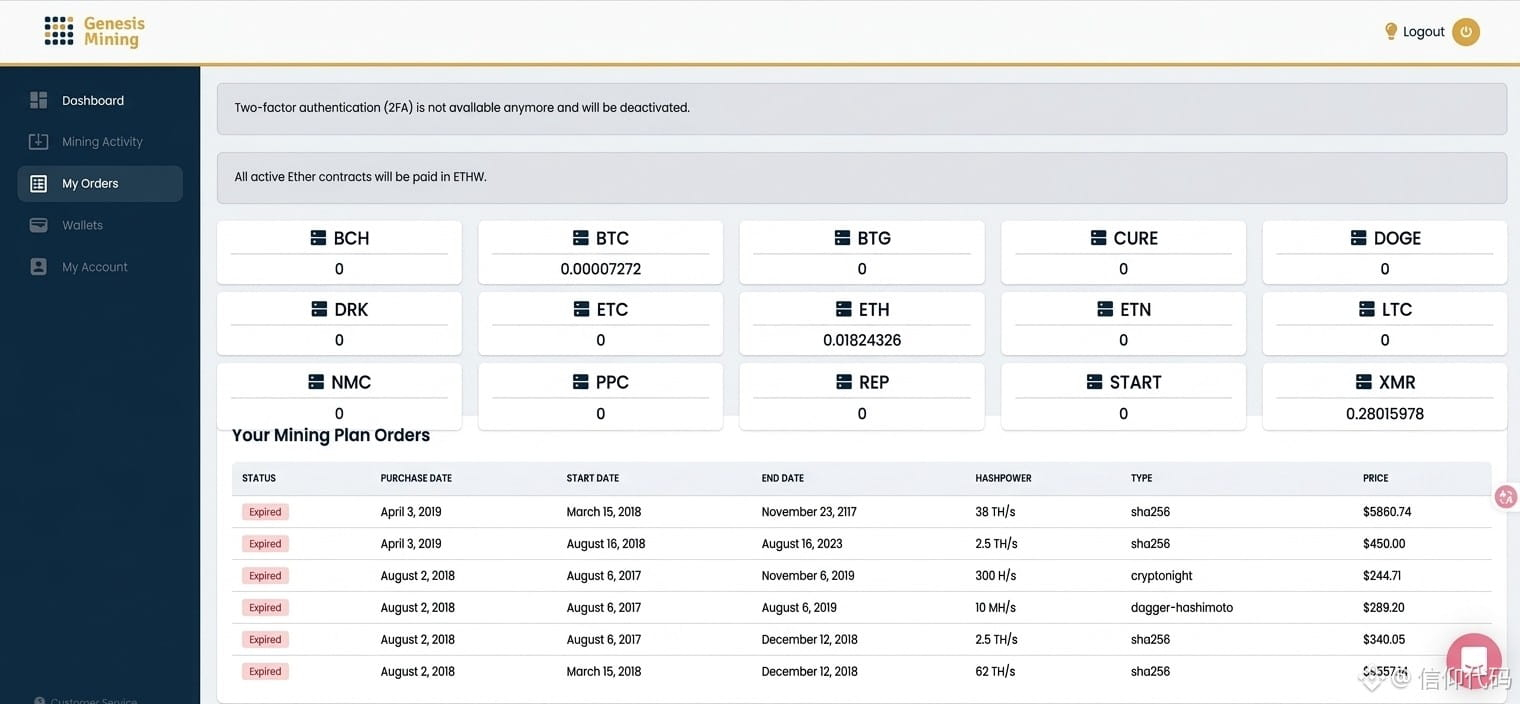
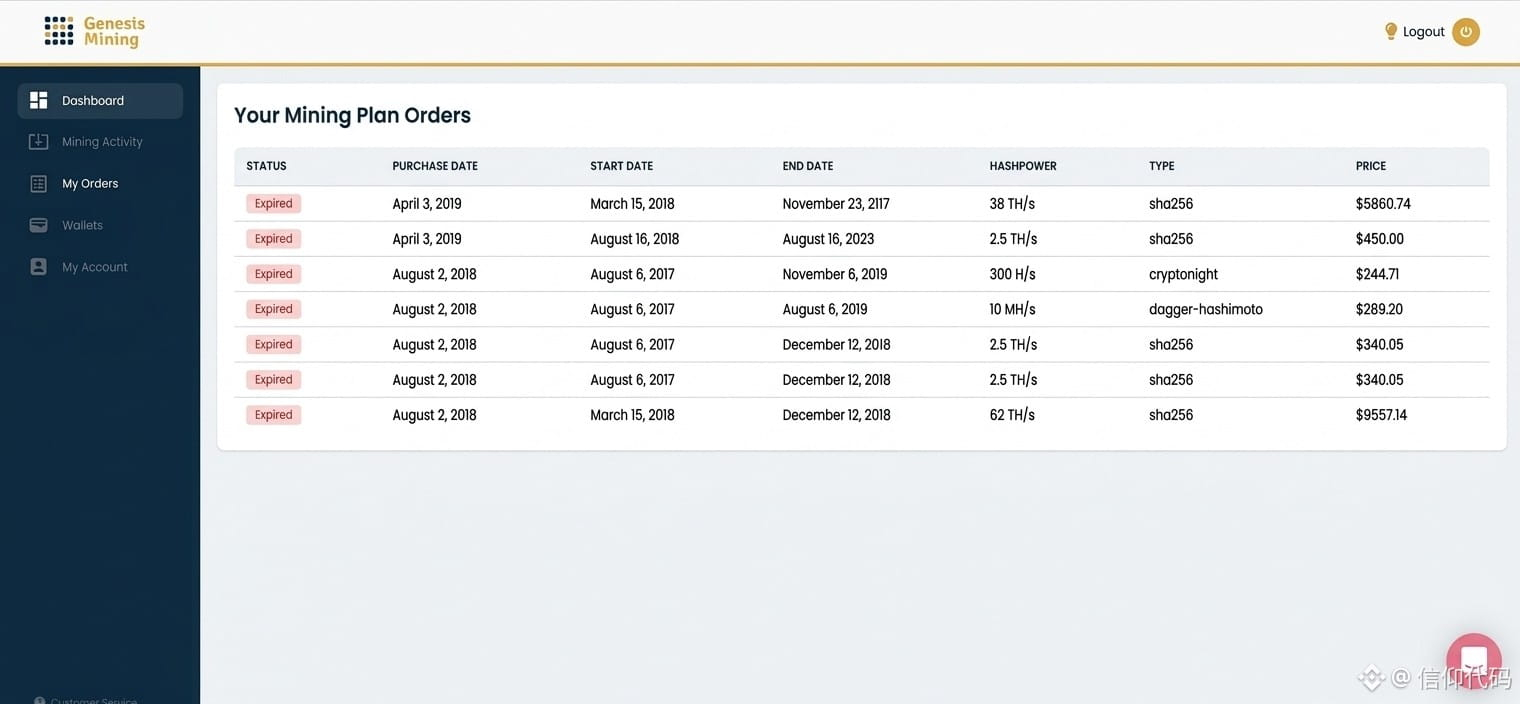
I dug up the account where I spent nearly $20,000 on cloud hashing power at Genesis Mining back in the day, and I’m devastated…
Post: Today, while clearing out old passwords, I logged into my account at the once-famous Genesis Mining. Let’s take a look at my purchase history:
Between 2017 and 2019, I bought all kinds of contracts—SHA-256, Dagger-Hashimoto, Cryptonight. I didn’t miss a thing.
The biggest purchase cost me $9,557, and another one was $5,860. I ended up sinking nearly $20,000 into it!
Then I opened my account balance:
BTC: 0.00007272
ETH: 0.01824326
XMR: 0.28015978
Back then, I thought buying “permanent/long-term hashing power” would let me earn passive income without lifting a finger. Turns out, it all just became Expired. If I’d bought and held $20,000 worth of coins back then, I’d be financially free by now…
Question for everyone: How many of you got burned by cloud hashing power/cloud mining rigs back in the day? Leave a comment and let me know I’m not alone 😭
#GenesisMining #CloudMining #Bitcoin #BTC #ETH #CryptoArchaeology #TearsForTheGoodOldDays #Cryptocurrency #CryptoNewbieLife #Blockchain
1
661
·
--
Don’t listen to what they say—look at what the money is actually doing 🔍
The market is filled every day with people calling tops and bottoms, but opinions are free; holdings are real.
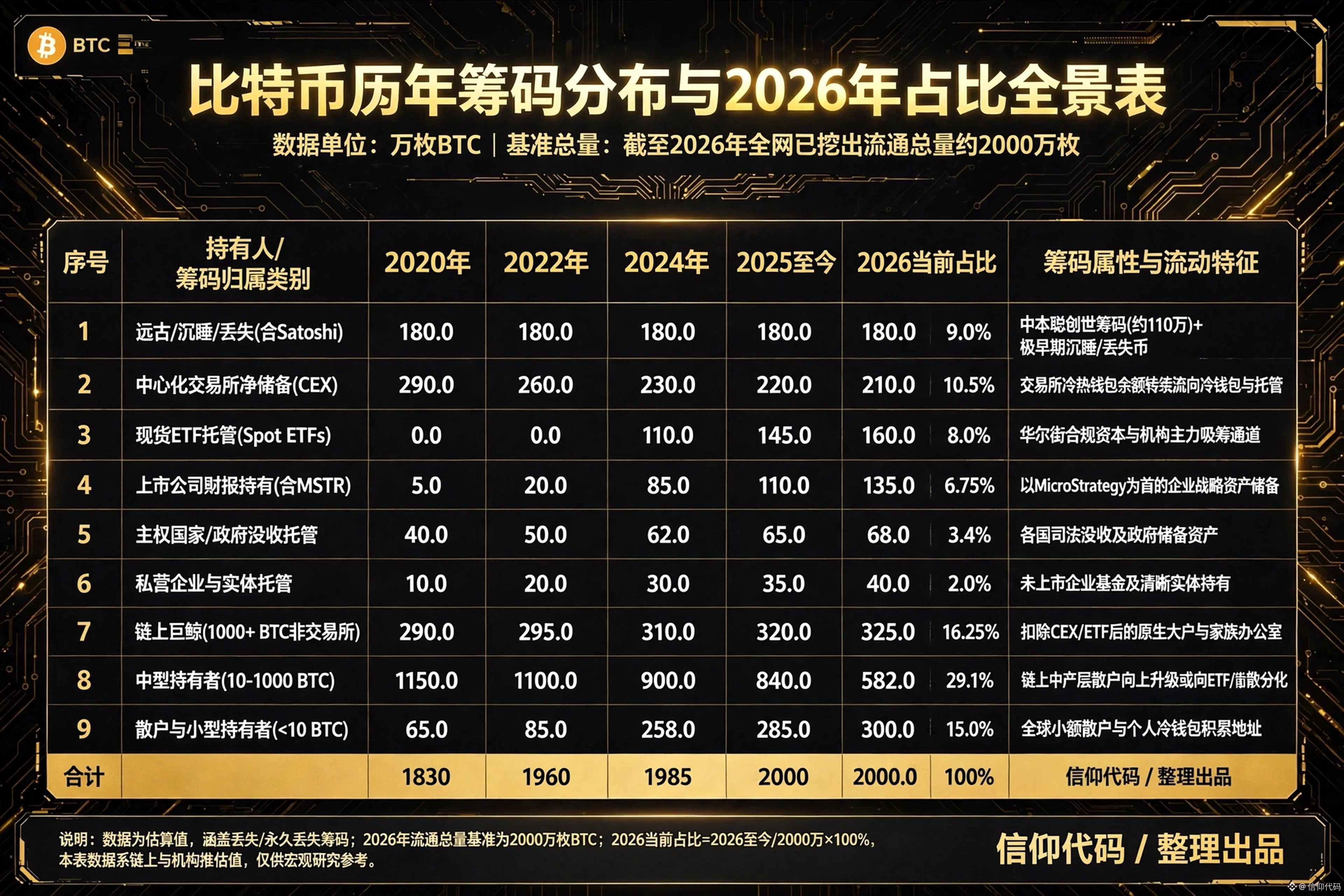
Cut through the noise and look only at the real choices made from 2020 to 2026 by compliant capital backed by financial reports and legal documentation:
1. Spot ETF custody (Wall Street’s regulated channel)
From nearly zero in 2020 to 1.6 million BTC in 2026, or 8% of the total supply. The main entry point for compliant capital.
2. Public company holdings disclosed in financial reports (led by MSTR)
From 50,000 BTC to 1.35 million BTC, or 6.75% of the total supply. BTC has officially entered corporate balance sheets.
3. Sovereign nations/government custody (legal seizures + strategic reserves)
Steady at 680,000 BTC, or 3.4%. Sovereign-level interest is now impossible to ignore.
4. Small retail holders (<10 BTC; grassroots consensus)
Grew against the trend from 650,000 BTC to 3 million BTC, or 15%. Their roots are growing deeper with every shakeout.
📌 Summary
Opinions can change at any moment; on-chain capital doesn’t lie.
The three major compliant entities (ETFs + public companies + governments) have locked up more than 3.6 million BTC, or 18.15% of the total mined supply.
Learn to look at what the money is doing, not just listen to what people are saying.
Do you think compliant capital will keep buying next, or trigger a new round of rotation? Share your thoughts in the comments.
Topics
$BTC #Bitcoin #CodeOfFaith #OnChainData
1
145
·
--
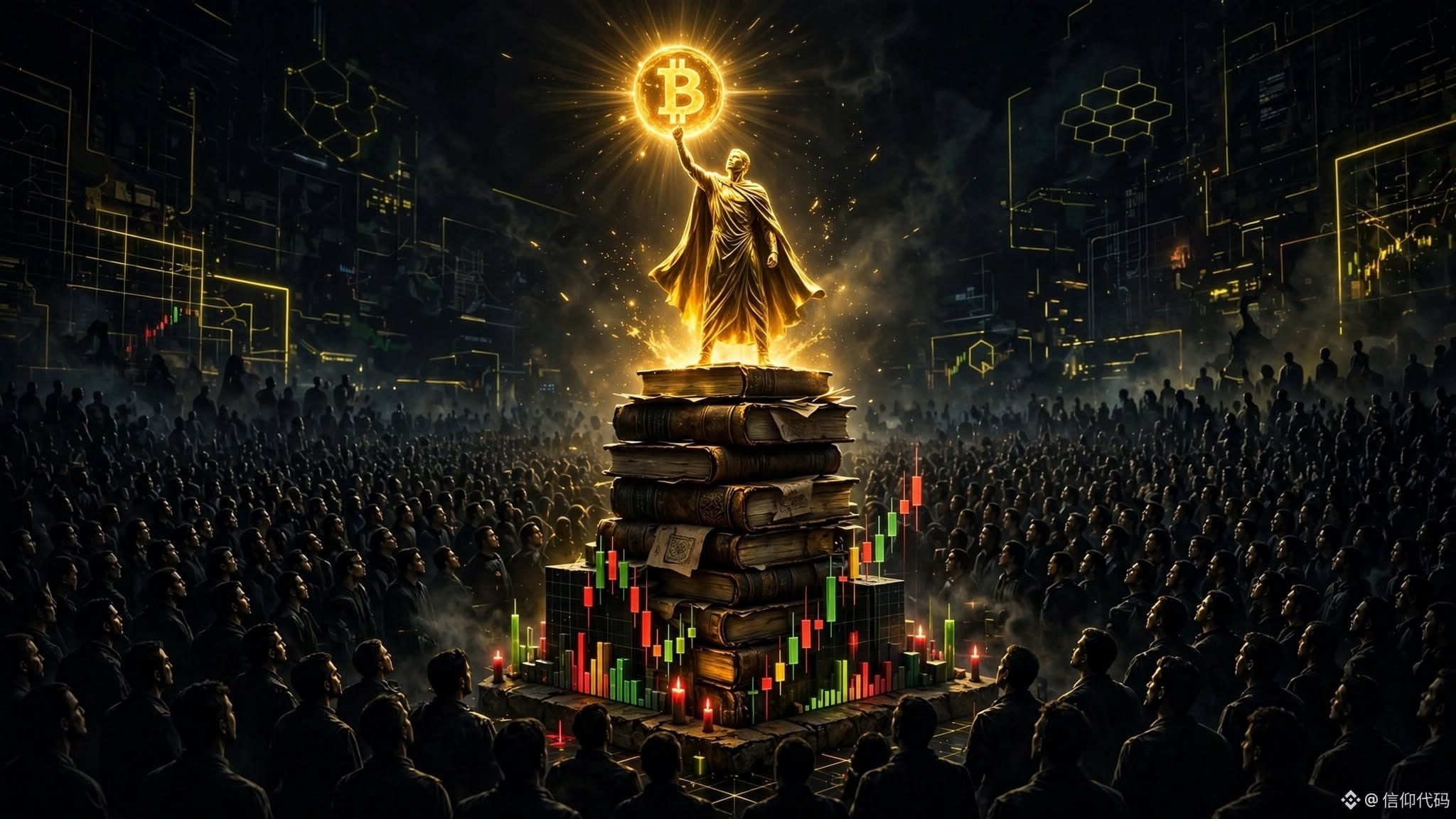
Why does the more you learn about trading, the more you feel like a sucker? Because you’re on the wrong side.
Everyone knows: history is written by the victors.
But no one tells you the rest: people who read history always end up on the side of the victors, too.
That’s the root of your losses.
When you look at Bitcoin’s history, what do you remember?
Someone buying a pizza with 10,000 BTC. A new high of $100,000 after the halving.
You automatically imagine yourself as the person who held on.
But you never imagine yourself as:
The person who traded their coins for an iPhone and got out in 2011
The person who lost 90% in the 2018 bear market and deleted the app
The person who treated LUNA like a bank deposit in 2022
They’re the majority. They were never written into history.
That’s how financial markets work:
20% of people make money, but 80% think entirely from the perspective of that 20%.
The clearest example is going all in.
You only see the winners getting rich after going all in, but you miss the sequence of events.
The truth comes down to one thing:
Faith comes first, and going all in is execution; faith comes later, and going all in is gambling.
We all worship the outcome, but turn a blind eye to the long, silent process of failure that came before it.
So the more history you study, the more like a sucker you become; the more you watch the charts, the worse you get at trading.
What about you? Is your current all-in move execution, or gambling?
Let’s talk in the comments.
#BTC #TradingPsychology #CryptoSurvivalRules
2
354
Log in to explore more content
Join global crypto users on Binance Square
⚡️ Get latest and useful information about crypto.
💬 Trusted by the world’s largest crypto exchange.
👍 Discover real insights from verified creators.
Email / Phone number
Trending Topics
UniswapA16zSeekDeFiExemptionFromIllinoisCryptoTax
2,133 views
180 Discussing
UNISWAP & a16z PUSH BACK AGAINST CRYPTO TAX RULES — IS DeFi AT A TURNING POINT?
Crypto Pulse Hub
·1 Likes
·116 views
HKDollarStablecoinHKDAPToLaunchOnSolana
251 views
41 Discussing
$1.5BInLeveragedCryptoBetsLiquidated
12,902 views
164 Discussing