
#cbdc
cbdc
36.1M views
157,548 Discussing
Hot
Latest

·
--
Why is nobody talking about the ECB quietly opening applications for experiments that most traders are still treating as distant theory?
Crypto investors keep getting wrecked chasing US headlines while actual eurozone policy quietly shifts the ground under them. You FOMO into a narrative, miss the real timing, and then wonder why the market dumped on news you never saw coming.
On November 20 the ECB opened applications for the first experiments under its Appia project. This is a specific case of a major central bank moving from papers to actual testing rather than another round of vague promises. They are collecting applicants now, which means the experiments themselves have not even begun.
The popular story claims a digital euro is imminent and will crush $BTC. The facts do not match that panic. $ETH already runs live activity at scale and $USDT still sets the liquidity standard every day. A project sitting at the application stage is years from launch, not next quarter. Traders who treat every CBDC headline as an emergency keep getting the timing wrong.
Where do you think this actually leads for the market from here?
#CBDC #DigitalEuro #ECB
Why is nobody talking about the ECB quietly opening applications for experiments that most traders are still treating as distant theory?
Crypto investors keep getting wrecked chasing US headlines while actual eurozone policy quietly shifts the ground under them. You FOMO into a narrative, miss the real timing, and then wonder why the market dumped on news you never saw coming.
On November 20 the ECB opened applications for the first experiments under its Appia project. This is a specific case of a major central bank moving from papers to actual testing rather than another round of vague promises. They are collecting applicants now, which means the experiments themselves have not even begun.
The popular story claims a digital euro is imminent and will crush $BTC . The facts do not match that panic. $ETH already runs live activity at scale and $USDT still sets the liquidity standard every day. A project sitting at the application stage is years from launch, not next quarter. Traders who treat every CBDC headline as an emergency keep getting the timing wrong.
Where do you think this actually leads for the market from here?
#CBDC #DigitalEuro #ECB


Picture this: while the entire market was glued to green candles, the European Central Bank quietly opened the doors to how trillions in institutional capital will actually move onchain.
Most traders end up losing money because they chase fleeting hype cycles and ignore the macro infrastructure being laid right beneath them. Missing these structural developments usually means getting blindsided when institutional liquidity tides suddenly change direction.
On Nov 20, the ECB opened applications for the first wave of experiments under its Appia project. Unlike the controversial retail digital euro that triggered intense public debate around privacy, Appia is strictly focused on wholesale financial markets. The initiative allows market participants to test central bank money settlement against tokenized assets using distributed ledgers, tackling the exact friction points that private euro stablecoins like $EURC are already solving in decentralized finance.
This setup mirrors past experiments like Project Agora, but with far greater urgency. For years, networks like $XRP attempted to bridge traditional correspondent banking, yet central banks now clearly prefer building proprietary mechanisms to keep sovereign control over the rails. Having observed how public networks like $ETH execute atomic settlements around the clock, European policymakers are racing to adapt before legacy settlement systems become obsolete.
Do you think these institutional rails will eventually connect with public blockchains, or are we heading toward a completely walled garden?
#CBDC #Tokenization #Blockchain

2

·
--
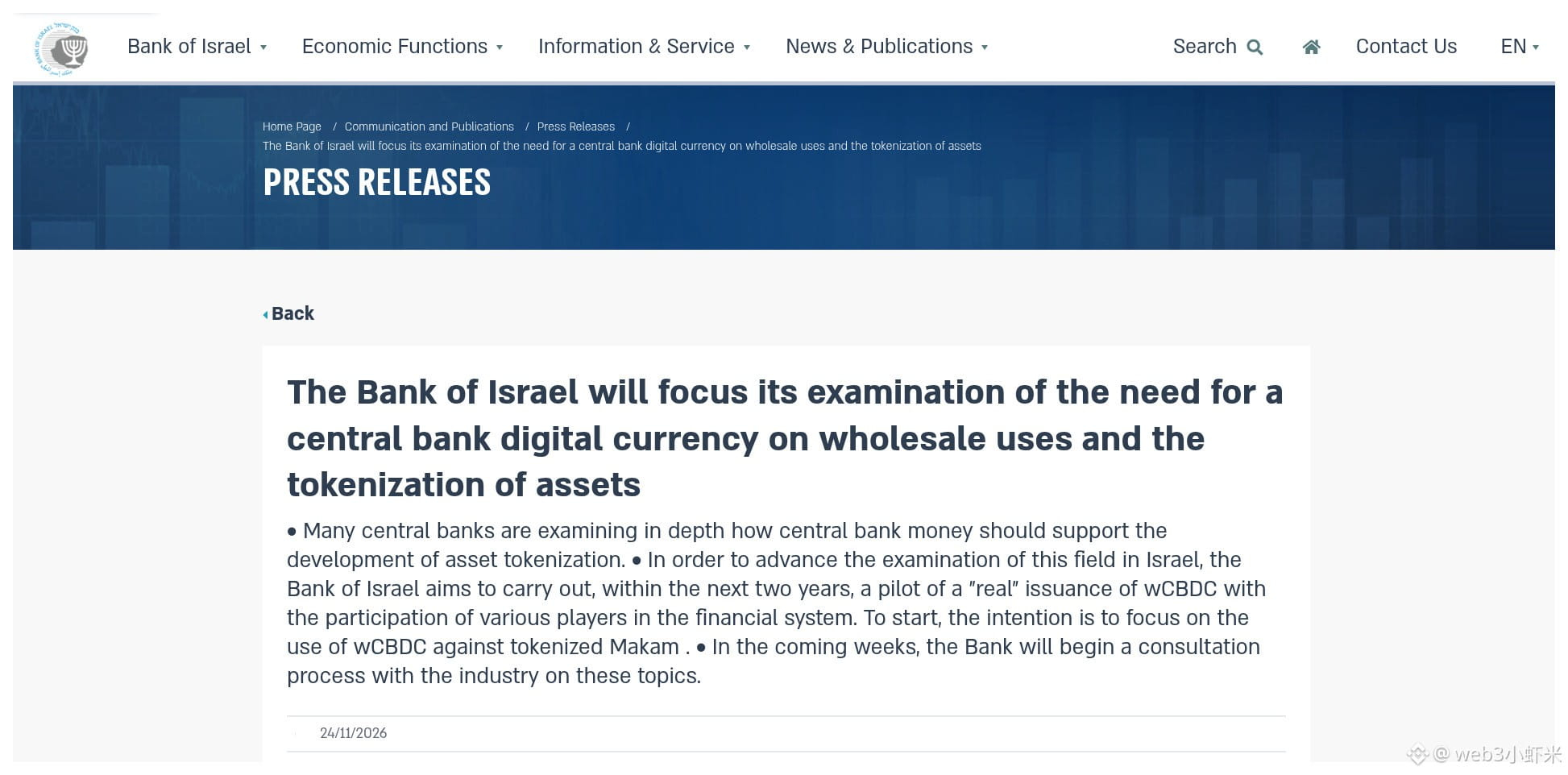
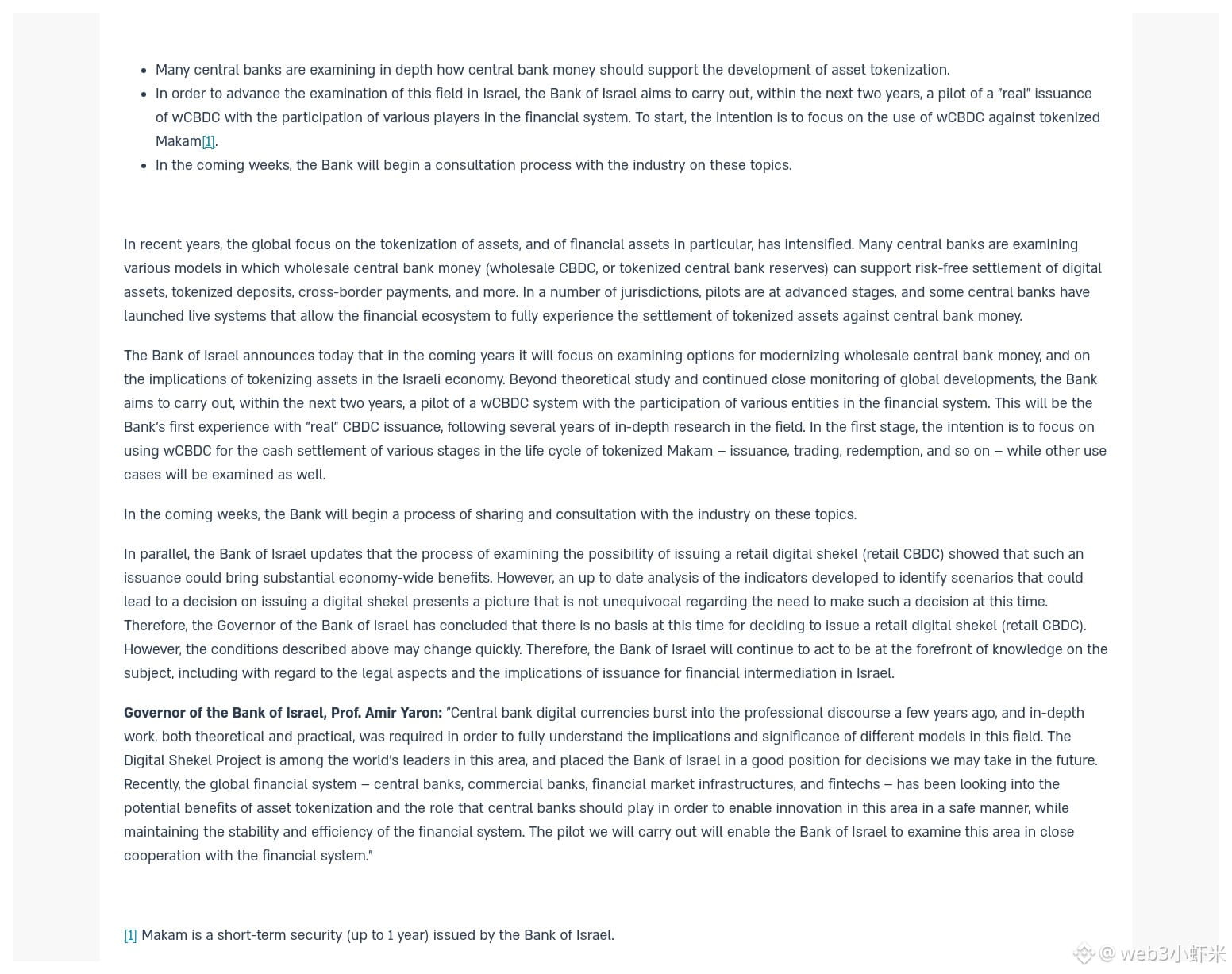
I just came across today’s press release on the Bank of Israel’s website: its research into central bank digital currencies will now focus on wholesale uses and asset tokenization.
The Bank says it plans to conduct a pilot of a wholesale central bank digital currency (wCBDC) involving “actual issuance” within the next two years, with participants from across the financial system. The initial use case will be settling the issuance, trading, and redemption of tokenized short-term securities called Makam (securities issued by the Bank of Israel with maturities of up to one year). Other use cases will also be explored. The Bank will first consult with industry over the coming weeks. The Governor also believes there is not yet sufficient basis to decide whether to issue a retail digital shekel for the public.
#CBDC
3

·
--
🚨 THE FUTURE OF MONEY HAS ALREADY BEGUN: WHO WILL BE IN CONTROL?
Today, NOVEMBER 23, 2026
Jensen Huang is back at the helm of NVIDIA, with unanimous board approval, and shares opened sharply higher on the Nasdaq. The turnaround sent ripples through the market and reinforced the importance of artificial intelligence in the global economy.
JENSEN HUANG AND NVIDIA: THE SYMBOL OF THE AI ERA?
But there’s another transformation that deserves our attention: the future of money.
In 2021, Agustín Carstens, then general manager of the BIS, compared cash with central bank digital currencies (CBDCs). In his view, no one knows today who is using a $100 bill. A CBDC, on the other hand, would give the central bank total control over the rules governing how the currency is used.
Think about that. We’re talking about privacy and financial freedom.
This is where Bitcoin becomes relevant: a decentralized currency, with no central bank controlling its issuance. It’s worth remembering that transactions are recorded in a public ledger, using pseudonymous addresses. Transparency and control are two different things.
THE GREAT CONFLICT OF THE CENTURY MAY NOT BE JUST ABOUT MONEY, BUT ABOUT WHO WILL CONTROL THE FINANCIAL SYSTEM OF THE FUTURE.
And you—which side of this transformation do you see yourself on? 👇
Sources: CBS News | Pplware | BIS | FXStreet | CriptoNoticias
#Binance $BTC $NVDA #JensenHuang #crypto #CBDC
{spot}(NVDABUSDT)
{spot}(BTCUSDT)
🚨 THE FUTURE OF MONEY HAS ALREADY BEGUN: WHO WILL BE IN CONTROL?
Today, NOVEMBER 23, 2026
Jensen Huang is back at the helm of NVIDIA, with unanimous board approval, and shares opened sharply higher on the Nasdaq. The turnaround sent ripples through the market and reinforced the importance of artificial intelligence in the global economy.
JENSEN HUANG AND NVIDIA: THE SYMBOL OF THE AI ERA?
But there’s another transformation that deserves our attention: the future of money.
In 2021, Agustín Carstens, then general manager of the BIS, compared cash with central bank digital currencies (CBDCs). In his view, no one knows today who is using a $100 bill. A CBDC, on the other hand, would give the central bank total control over the rules governing how the currency is used.
Think about that. We’re talking about privacy and financial freedom.
This is where Bitcoin becomes relevant: a decentralized currency, with no central bank controlling its issuance. It’s worth remembering that transactions are recorded in a public ledger, using pseudonymous addresses. Transparency and control are two different things.
THE GREAT CONFLICT OF THE CENTURY MAY NOT BE JUST ABOUT MONEY, BUT ABOUT WHO WILL CONTROL THE FINANCIAL SYSTEM OF THE FUTURE.
And you—which side of this transformation do you see yourself on? 👇
Sources: CBS News | Pplware | BIS | FXStreet | CriptoNoticias
#Binance $BTC $NVDA #JensenHuang #crypto #CBDC
1
160

Singapore’s Monetary Authority has successfully issued S$100 million in tokenised MAS Bills, settled natively using wholesale CBDC on its Singapore Dollar Test Network. The oversubscribed auction involved five primary dealers and paves the way for expanded tokenised collateral use.
#CoinVahini #MAS #TokenizedBills #CBDC
#CoinVahini #MAS #TokenizedBills #CBDC
80

·
--
Bullish
🇷🇺 Russia to Open Digital Ruble Accounts to Foreigners Starting November 2027
The Bank of Russia plans to allow foreign individuals and businesses to open digital ruble accounts from November 2027, expanding access to its central bank digital currency (CBDC) beyond Russian residents.
Foreign users will be able to access digital ruble wallets through participating banks' mobile apps and online banking platforms. The move follows Russia's nationwide CBDC rollout in September 2026 and could support broader international payment use cases.
The bigger picture: As CBDCs and stablecoins expand globally, competition over digital payment infrastructure is intensifying. Russia's move highlights how sovereign digital currencies could reshape cross-border finance and the future of digital money.
#CBDC

75

Singapore completed a $77.5 million tokenized bill sale in its CBDC, as reported by CoinDesk, with expansion planned for 2027.
💰 #CBDC #Singapore
$BTC
Singapore completed a $77.5 million tokenized bill sale in its CBDC, as reported by CoinDesk, with expansion planned for 2027.
💰 #CBDC #Singapore
$BTC
💰 #CBDC #Singapore
$BTC

42


·
--
🇸🇬 Singapore issues $77.5M in tokenized bills settled with wholesale CBDC
The Monetary Authority of Singapore said it issued S$100 million (about $77.5 million) of four-week tokenized MAS Bills on Nov. 6. The bills were created natively on its Singapore Dollar Test Network, settled in wholesale CBDC, and mature on Dec. 4. DBS, HSBC, OCBC, UOB and Standard Chartered took part as primary dealers, with bids topping twice the issue size.
⭐ A central bank issuing its own tokenized securities is a strong signal that tokenization is moving from pilots into core financial plumbing in Asia.
#Tokenization #RWA #CBDC #Singapore

HSBCUS-0.20%
95
Cointelegraph reports Singapore settled seventy seven point five million tokenized bill on test network using wholesale CBDC in the trial
📈 #Singapore #CBDC #TokenizedBills
$BTC
Cointelegraph reports Singapore settled seventy seven point five million tokenized bill on test network using wholesale CBDC in the trial
📈 #Singapore #CBDC #TokenizedBills
$BTC
📈 #Singapore #CBDC #TokenizedBills
$BTC

86

·
--
Following the earlier Ant news, this new development is different: MAS issued S$100 million in tokenized government bonds, settled using wholesale central bank digital currency 🏦🔗. Five banks participated, and bids exceeded twice the issue size 📄. The next step is to expand the trials and use the bonds as collateral; what do you think of this use case?
Most traded on Binance at the time of capture (18:05 Istanbul): $BTC , then $ETH , then $SOL , by 24-hour trading volume for USDT pairs; this is general market monitoring and is not causally related to the news.
#Tokenization #CBDC
Most traded on Binance at the time of capture (18:05 Istanbul): $BTC , then $ETH , then $SOL , by 24-hour trading volume for USDT pairs; this is general market monitoring and is not causally related to the news.
#Tokenization #CBDC

46

Singapore settles a $77.5 million tokenized bond using its domestic CBDC
- Singapore completed the sale of a $77.5 million tokenized bond, settled using its domestic CBDC.
- The central bank aims to expand this digital payments network.
- In 2027, it will test the use of a broader range of collateral.
- The RSS source provided no further details.
#BinanceSquare #CryptoNews #CBDC #Singapore
$btc $eth
#vlikevn Titanbot
Source: CoinDesk

·
--
MAS settles $77.5 million in tokenized notes using its self-built ledger, plans upgrade to a formal settlement network
The Monetary Authority of Singapore (MAS) has officially renamed its test network SG Digital Ledger for real-world settlements, marking a shift for sovereign CBDCs from the experimental stage toward a core component of financial infrastructure.
According to Cointelegraph, MAS recently issued notes directly through its self-built test network and completed settlement of a $77.5 million tokenized note sale. The transaction went beyond proof of concept, using real funds and actual settlement processes. MAS subsequently said it plans to rename the test network SG Digital Ledger and use it for a wider range of settlement scenarios.
This move is worth examining from the perspectives of capital flows and infrastructure. Over the past two years, many sovereign institutions have focused on technical demonstrations of CBDCs, with relatively few cases progressing to actual fund settlement. MAS’s move to upgrade its test network into a formal settlement network suggests it is advancing CBDCs from “whether it can be done” to “everyday use.” For readers tracking institutional capital flows, incorporating a sovereign-level ledger into routine settlement could change the movement of funds in wholesale finance.
In terms of scale, the $77.5 million settlement remains limited compared with the size of the global crypto market. It is also a regional pilot, so its direct impact on the global crypto market is likely to be modest. It is important to note that CBDCs are primarily intended for wholesale finance and institutional settlement, and are not directly related to ordinary secondary-market trading.
However, from the perspective of infrastructure development, the significance of this progress as a model may outweigh its scale. Building its own ledger rather than relying on a third-party platform indicates that MAS prefers to retain control over core settlement capabilities. This may be linked to the broader evolution of capital-flow themes such as stablecoins and tokenized assets.
A countervailing factor is that the regional pilot has a limited sample size. Whether it can be extended to other jurisdictions or replicated by other institutions remains to be seen. The pace of CBDC adoption is also constrained by regulatory considerations and privacy design.
What to watch next is the scale of settlements and the range of participants after SG Digital Ledger officially launches, as well as whether cross-jurisdictional interoperable settlements emerge. At the trading level, infrastructure developments of this kind typically do not drive prices directly. More noteworthy is whether larger-scale tokenized assets are subsequently launched.
#CBDC #Singapore #TokenizedAssets
The above is a compilation of information and personal analysis, and does not constitute investment advice.
Follow me for continued coverage of key market developments and data.
40

·
--
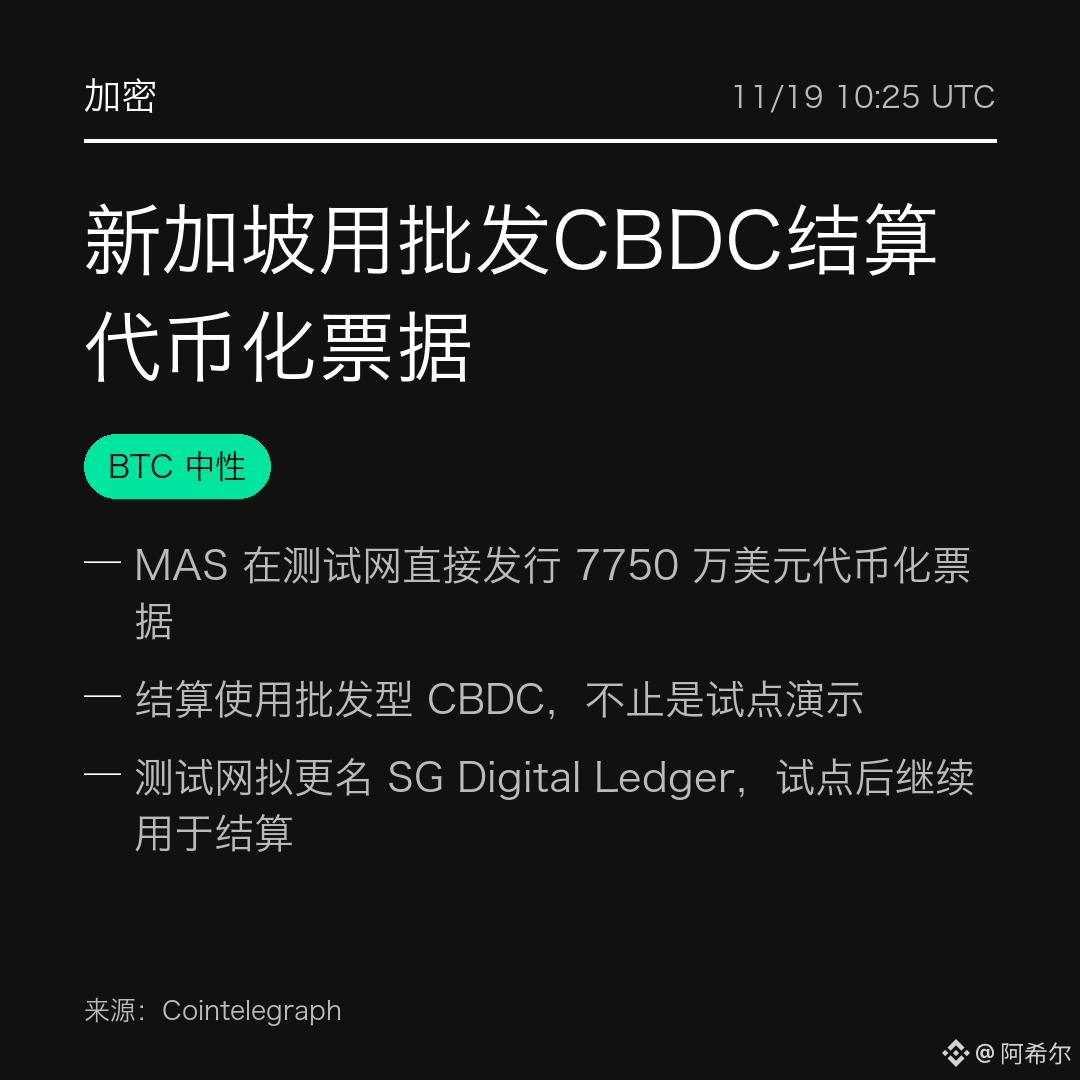
Interesting. Singapore’s Monetary Authority (MAS) has issued $77.5 million worth of tokenized notes directly on its own test network this time, settling them with wholesale CBDC—not just going through the motions with simulated data.
It also plans to rename the test network SG Digital Ledger and keep using it for settlements after the pilot ends. Put simply, the central bank itself is treating on-chain settlement as long-term infrastructure.
For the crypto world, this is a sign that blockchain technology has official recognition, and it could encourage more institutions to explore tokenized assets. But CBDCs and BTC are on separate tracks, so I think the direct impact on prices will be limited. The price is around 63,852 right now, and the market still looks weak. 🙂
Is anyone on your end keeping an eye on tokenized government bonds or notes?
#CBDC #代币化 $BTC
86
Singapore settles $77.5 million in tokenized bonds using retail CBDC
* Singapore settles a $77.5 million tokenized bond transaction using retail central bank digital currency (CBDC).
* MAS directly issues the bonds on its test network.
* The test network will be renamed 'SG Digital Ledger' to facilitate settlement beyond the pilot phases.
#BinanceSquare #CryptoNews #CBDC #Blockchain
$btc $eth
#vlikevn Titanbot
Source: CoinTelegraph
4
Singapore completes a $77.5 million tokenized treasury bill sale using tokenized deposits
- MAS issued treasury bills directly on a test network.
- The funds will be renamed "SG Digital Ledger" and used for payments after the trial phase.
- The total transaction value was $77.5 million in tokenized form.
- Plans to use commercial CBDC widely on the test network.
#BinanceSquare #CryptoNews #CBDC
$btc $eth
#vlikevn #Titanbot
Source: CoinTelegraph
38

·
--
Singapore issues S$100 million in tokenised bills: an interbank trial, not digital currency for you
The Monetary Authority of Singapore (MAS) announced today (November 19) that it issued S$100 million worth of tokenised MAS bills with a four-week tenor on November 6, and settled them using wholesale central bank digital currency. This is a trial for financial institutions, not a retail digital currency available to the public, nor a new token that can be traded on exchanges.
The bills were issued natively on the “Singapore Dollar Test Network” operated by MAS, without first being issued through traditional means and then tokenised. Five primary dealers—DBS, HSBC Singapore, OCBC, Standard Chartered Singapore and UOB—participated in the auction. Applications exceeded twice the issuance amount, and the bills will mature on December 4. The official website also states that only institutional investors may subscribe; applications from non-institutions will be rejected.
MAS said the next steps will be to expand issuance, bring in more financial institutions, and use these bills for collateral management. The next phase of field trials is planned for 2027. The test network will later be renamed SG Digital Ledger.
Have you recently seen anyone using this news to promote a so-called “MAS coin,” or claiming that Singapore’s digital currency is already available for ordinary people to use?
Not investment advice.
Sources: MAS press release “MAS Announces Successful Issuance of Tokenised MAS Bills on the Singapore Dollar Test Network Using Wholesale Central Bank Digital Currency” (2026-11-19, https://www.mas.gov.sg/news/media-releases/2026/mas-announces-successful-issuance-of-tokenised-mas-bills-on-the-singapore-dollar-test-network); Wu Blockchain (2026-11-19 13:58 Hong Kong time, https://x.com/wublockchain12/status/2123294914293215253); Cointelegraph (2026-11-19 13:53 Hong Kong time, https://x.com/Cointelegraph/status/2123293623684899045) · 2026-11-19 Hong Kong time
#MAS #CBDC #代币化 #HangB Media

114


Article
Singapore & Germany Trial Cross-Border CBDC Settlement with Zero-Knowledge ProofsSingapore and Germany have just completed a cross-border CBDC settlement test using zero-knowledge proofs, offering a glimpse into the future of secure digital payments without intermediaries.
The core of this experiment is the use of zero-knowledge proofs. This cryptographic tool lets each central bank prove its currency is locked for settlement, without exposing or integrating their systems. The result: no euro or Singapore dollar settles unless both sides confirm, sharply reducing counterparty risk for traders.
This pilot is part of Project Simbolon, launched under a memorandum of understanding dated November 2025 between MAS and Deutsche Bundesbank. Unlike other blockchain pilots, this test did not use a shared ledger or third-party. Each bank ran its own digital currency ledger, maintaining full control and privacy while still achieving atomic settlement.
The project focused on euro, Singapore dollar trades, targeting large-value foreign exchange settlements handled by financial institutions. By using wholesale CBDCs instead of retail or commercial bank money, the aim is to modernize cross-border transactions and set a new standard for global payment systems.
Payment-versus-payment (PvP) logic was key: transfers only happen if both sides are ready, minimizing principal risk. The structure contrasts with other initiatives like Project Meridian FX APAC, where interoperability relied on shared platforms. Here, Singapore and Germany proved that secure, atomic settlement is possible even with siloed systems.
While the technical success is clear, it’s still unknown how quickly these methods will move beyond pilots or be adopted by other central banks. The memorandum dates from November 2025, and more milestones are expected in the coming year, but the exact timeline remains uncertain.
Could this approach change the way cross-border settlements are handled worldwide? What challenges do you see for wider adoption?
#MAS #Bundesbank #CBDC #Singapore
Singapore & Germany Trial Cross-Border CBDC Settlement with Zero-Knowledge Proofs
Singapore and Germany have just completed a cross-border CBDC settlement test using zero-knowledge proofs, offering a glimpse into the future of secure digital payments without intermediaries.
The core of this experiment is the use of zero-knowledge proofs. This cryptographic tool lets each central bank prove its currency is locked for settlement, without exposing or integrating their systems. The result: no euro or Singapore dollar settles unless both sides confirm, sharply reducing counterparty risk for traders.
This pilot is part of Project Simbolon, launched under a memorandum of understanding dated November 2025 between MAS and Deutsche Bundesbank. Unlike other blockchain pilots, this test did not use a shared ledger or third-party. Each bank ran its own digital currency ledger, maintaining full control and privacy while still achieving atomic settlement.
The project focused on euro, Singapore dollar trades, targeting large-value foreign exchange settlements handled by financial institutions. By using wholesale CBDCs instead of retail or commercial bank money, the aim is to modernize cross-border transactions and set a new standard for global payment systems.
Payment-versus-payment (PvP) logic was key: transfers only happen if both sides are ready, minimizing principal risk. The structure contrasts with other initiatives like Project Meridian FX APAC, where interoperability relied on shared platforms. Here, Singapore and Germany proved that secure, atomic settlement is possible even with siloed systems.
While the technical success is clear, it’s still unknown how quickly these methods will move beyond pilots or be adopted by other central banks. The memorandum dates from November 2025, and more milestones are expected in the coming year, but the exact timeline remains uncertain.
Could this approach change the way cross-border settlements are handled worldwide? What challenges do you see for wider adoption?
#MAS #Bundesbank #CBDC #Singapore
83

🚨 Singapore and Germany pilot CBDC-based cross-border foreign exchange settlement 🧠
📊 | $BTC | $ETH | $BNB |
- Visit my profile, like, save, and leave a comment 📈
- Singapore and Germany launch a pilot project for cross-border foreign exchange settlement
- The project, named Simbolon, aims to reduce cross-border settlement costs
- The project seeks to shorten the time required for cross-border payments and foreign exchange transactions
- Both parties will work together to promote standardization in payments and foreign exchange 🔥
- The adoption of a cross-border CBDC settlement system could reshape traditional foreign exchange markets
- If standardization progresses smoothly, it could improve the efficiency of global payments
- Liquidity for large fund flows is expected to remain stable in the short term
- Whale fund movements are neutral, while overall market sentiment is leaning toward caution
- How do you think CBDCs will change the cross-border payments landscape? Leave a comment
- Follow me for the latest crypto market news, and join the discussion in the comments
#CBDC #Blockchain #Crypto #FX #Payments
120

Singapore and Germany are taking CBDCs to the next level with Project Simbolon, targeting faster and cheaper cross-border FX settlements. This initiative highlights how major economies are actively testing blockchain rails for traditional finance. While retail CBDCs spark privacy debates, wholesale applications like this prove that institutional efficiency will likely drive the next wave of digital asset adoption globally. #CBDC #Forex #CryptoRegulation
Singapore and Germany are taking CBDCs to the next level with Project Simbolon, targeting faster and cheaper cross-border FX settlements. This initiative highlights how major economies are actively testing blockchain rails for traditional finance. While retail CBDCs spark privacy debates, wholesale applications like this prove that institutional efficiency will likely drive the next wave of digital asset adoption globally. #CBDC #Forex #CryptoRegulation
3

·
--
📰 SINGAPORE AND GERMANY TEST DIGITAL CURRENCIES
On November 16, the Monetary Authority of Singapore (MAS) and the Bundesbank announced the successful testing of cross-border euro and Singapore dollar payments. DBS, Deutsche Bank, and technology partner Partior took part in the Simbolon project.
The experiment used wholesale central bank digital currencies and zero-knowledge proofs. These make it possible to coordinate the two sides of an exchange on separate ledgers: settlement is not completed until both parties are ready. This reduces the risk of sending one currency without receiving the other.
Important: this was a test of banking infrastructure, not the launch of a publicly available digital currency. Legal and operational issues still need to be resolved before it can be scaled up.
Source: CoinDesk, MAS announcement. November 16, 2026.
#CBDC #Tokenization
13
Log in to explore more content
Join global crypto users on Binance Square
⚡️ Get latest and useful information about crypto.
💬 Trusted by the world’s largest crypto exchange.
👍 Discover real insights from verified creators.
Email / Phone number
Trending Topics
1
#CanMarketsReboundAfterThanksgiving?
6,221 views
165 Discussing
2
#CouldSpaceX’sOrbitalDataCentersBoostAIChipDemand?
4,794 views
110 Discussing
3
#EvolveAtBinanceBlockchainWeek
639,227 views
6,571 Discussing
4
#CorePCEBeatLiftsFedHikeOdds
147,783 views
1,189 Discussing
5
#BitcoinAndStocksSlipAgainAmidTrump’sTariffPlans
204,397 views
1,996 Discussing
6
#JensenHuangSaysNvidiaDoesn’tNeedASuccessionPlan
97,775 views
1,204 Discussing
7
#NasdaqFuturesSlideMoreThan3%
38,402 views
350 Discussing
8
#USOctoberPCEPriceIndexAt0.3%MoM
44,204 views
354 Discussing
9
#BitcoinETFsPostRecord$4.94BNovemberOutflows
8,381 views
46 Discussing
10
#TetherInvestsInArgentinasLemon
16,924 views
204 Discussing