
#assetallocation
assetallocation
9,417 views
168 Discussing
Hot
Latest

🦈 $BTC AND MACRO GIANTS: HOW INSTITUTIONS ENGINEER DRAWDOWN RESILIENCE
Smart money builds cross-asset frameworks rather than chasing noise. By balancing uncorrelated equities, gold, and $BTC with a disciplined structural allocation, institutional capital absorbs brutal historical drawdowns while capturing generational compounding.
Retail capital bleeds out during deep corrections because high-volatility assets are held without a volatility mitigation framework. True longevity relies on systematic rebalancing and understanding the macro cycles driving capital flows.
💡 Are you engineering a multi-asset matrix, or are you exposed to single-asset drawdowns? 👇
⚠️ Not financial advice. Always manage your risk. 🛡️
🏷️ #BTC #AssetAllocation #Macro #Crypto
🔥 💎
1

·
--
Harvard and Dartmouth Earn 42% in Q3: Crypto ETFs and Staking Holdings Reveal a Shift in Institutional Allocations
U.S. Ivy League endowment funds delivered strong results in Q3, but what’s really worth noting is how they moved in crypto assets—their allocation priorities seem to be quietly shifting even as they turn a profit.
According to information reported by Cointelegraph, the endowment funds of Harvard and Dartmouth achieved combined returns of 42% in the third quarter. Harvard’s gold ETF holdings grew nearly 20-fold quarter over quarter, signaling a clear preference for safe-haven and inflation-resistant assets. Meanwhile, Dartmouth chose to maintain its existing positions in Solana and Ethereum staking, making no additions or reductions.
Why does this matter? In recent months, the market has repeatedly discussed the narrative of “institutional outflows,” and data on crypto ETF flows was once decidedly bearish. Endowment funds are typically long-term investors with a low risk appetite, so the stability of their holdings is often seen as a mild signal that risk appetite may be stabilizing. The 42% overall Q3 return shows that they are not conservative when it comes to risk assets, but their choices in crypto appear restrained—they have neither aggressively increased their positions nor cut their losses and exited.
Looking at the data, several key points are worth unpacking: first, the scale of the 42% overall return; second, the nearly 20-fold increase in gold ETF holdings; and third, Dartmouth’s decision to “stay put” on its staking positions. Holding staking positions suggests the rationale for long-term allocation remains in place, rather than reflecting short-term trading in and out.
How might the market react? If the behavior of these allocation-focused investors is interpreted as a sign that risk appetite is stabilizing, it could help soften the previously bearish institutional narrative. However, it’s worth noting that the disclosed holdings do not show new capital flowing in—they may reflect passive holding rather than active buying. And the sample represents only two Ivy League institutions, so it is not enough to indicate a shift across the entire institutional investor base.
The counterarguments are also clear: endowment funds typically make decisions more slowly than the market, so changes to their holdings may lag; and the sample is too small to infer a broad trend. The nearly 20-fold increase in gold holdings instead suggests that some capital is still shifting toward traditional safe-haven assets.
What should we watch next? More important is whether these allocation-focused investors make genuine net additions in subsequent quarters, and whether overall crypto ETF flows begin to move in sync with endowment fund behavior. Until the data confirms this, it is better to view the current signal as “mild” rather than a “turning point.”
{observation}
#BitcoinETF #InstitutionalAdoption #AssetAllocation
The above is a compilation of information and personal analysis, and does not constitute investment advice.
4


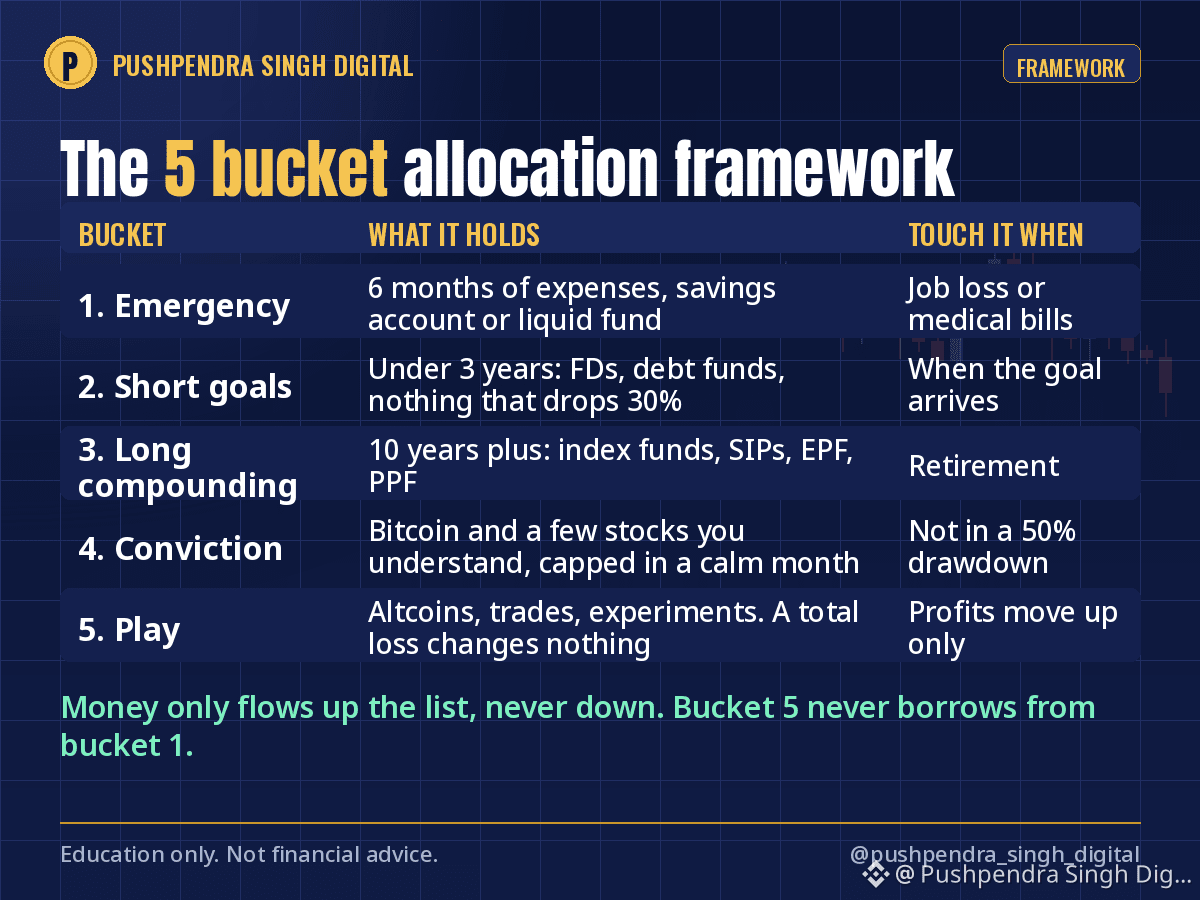
Most money problems come from one bucket doing five jobs. Here is the five bucket framework I use, in order of priority.
Bucket 1, Emergency: 6 months of expenses. Savings account or liquid fund. Touched only for job loss or medical bills. Not for a dip.
Bucket 2, Short goals (under 3 years): the car, the wedding, the Diwali trip. Fixed deposits, debt funds, nothing that can fall 30% in a bad month.
Bucket 3, Long compounding (10 years plus): index funds, SIPs, EPF, PPF. The boring core. It gets the biggest share and the least attention.
Bucket 4, Conviction: Bitcoin, a few stocks you understand, money you can hold through a 50% drawdown without selling. Capped at a percentage you decide in a calm month, not during a rally.
Bucket 5, Play: altcoins, trades, experiments. Sized so that losing 100% of it changes nothing about your life. If it grows, profits move up to bucket 3 or 4, not the other way.
The rule that makes it work: money only flows up the list, never down. Bucket 5 never borrows from bucket 1.
Save this one. Which bucket is doing too many jobs in your life right now?
Education only, not financial advice.
$BTC #PersonalFinance #AssetAllocation #Investing
5
655

·
--
Crypto is slowly, quietly breaking its addiction to macro correlation — and that shift matters more than most traders realize.
For years, $BTC moved in near-lockstep with NASDAQ: risk-on, prices rise; Fed hikes, prices fall. The assumption was that crypto was a high-beta tech play. That made sense when retail momentum traders dominated and their only other asset was growth stocks.
But the composition is changing.
Institutional allocators now hold $BTC and $ETH as distinct portfolio lines — modeled as digital commodities or uncorrelated alternatives. When they rebalance, the selling logic is different. When sovereign capital or pension mandates flow in, the holding period is different. The result: correlation to NASDAQ has been drifting lower across multi-month windows.
$SOL shows sharp divergence from equities during ecosystem-specific catalysts — developer growth, protocol upgrades, TVL inflections. That is not a macro story. It is a fundamental story.
What this means practically:
— Macro headlines matter less as a trading trigger
— Protocol-level catalysts matter more
— Diversification thesis becomes real, not theoretical
— Volatility compresses toward its own cycle logic
Crypto becoming a true independent asset class is a multi-year arc. But the trend lines are already bending.
#CryptoMarkets #BitcoinCycle #AssetAllocation #MarketStructure #CryptoInsights
1
130
·
--
📊 Weekly Portfolio Breakdown (09/14/2026 - 09/21/2026)Current Portfolio Value: $780.19Recent Performance: +$780 (+148,463.15%)Current Asset Allocation:• BTC: 98.58%• BNB: 0.32%• RWUSD: 0.28%• $USDT / $U U: ~0.54%As an occasional trader, keeping a Bitcoin-maximalist approach has provided massive stability and explosive growth during this recent window. Keeping an eye on the charts to see where the macro trend takes us next.#BTC #CryptoTrading #AssetAllocation #Binance
📊 Weekly Portfolio Breakdown (09/14/2026 - 09/21/2026)Current Portfolio Value: $780.19Recent Performance: +$780 (+148,463.15%)Current Asset Allocation:• BTC: 98.58%• BNB: 0.32%• RWUSD: 0.28%• $USDT / $U U: ~0.54%As an occasional trader, keeping a Bitcoin-maximalist approach has provided massive stability and explosive growth during this recent window. Keeping an eye on the charts to see where the macro trend takes us next.#BTC #CryptoTrading #AssetAllocation #Binance
1
131

·
--
Is your Crypto Portfolio well-balanced? 🎒
A safe and healthy portfolio should look something like this:
Core Coins (50%): Stable and strong coins like $BTC and $ETH.
Potential Altcoins (30%): Utility coins like $BNB or other promising projects.
Stablecoins (20%): Ready money like $USDC to buy the dip instantly when prices drop.
If you divide your portfolio like this, you can stay calm no matter what happens to the market.
#PortfolioManagement #CryptoTips #Diversification #AssetAllocation #BNB_Market_Update
90

·
--
Recently, an interesting cross-asset rotation phenomenon has emerged in the market:
A Q2 transparency report from Exchange Q shows that users’ asset allocation exhibits a clear time-preference pattern:
- For stock-class assets, the trading share is about 1% in April–May; in June, it breaks above 3% on multiple trading days, reaching a peak of 6.48%
- Precious metals account for 40%–55% of the share on active trading days
- Crypto assets return to dominate with over 90% of the share when the traditional markets are closed on weekends
This rhythm of “allocating to traditional assets on weekdays, and returning to crypto on weekends” reflects that capital is rotating efficiently between different markets.
#CryptoMarket #AssetAllocation
30

·
--
Bullish
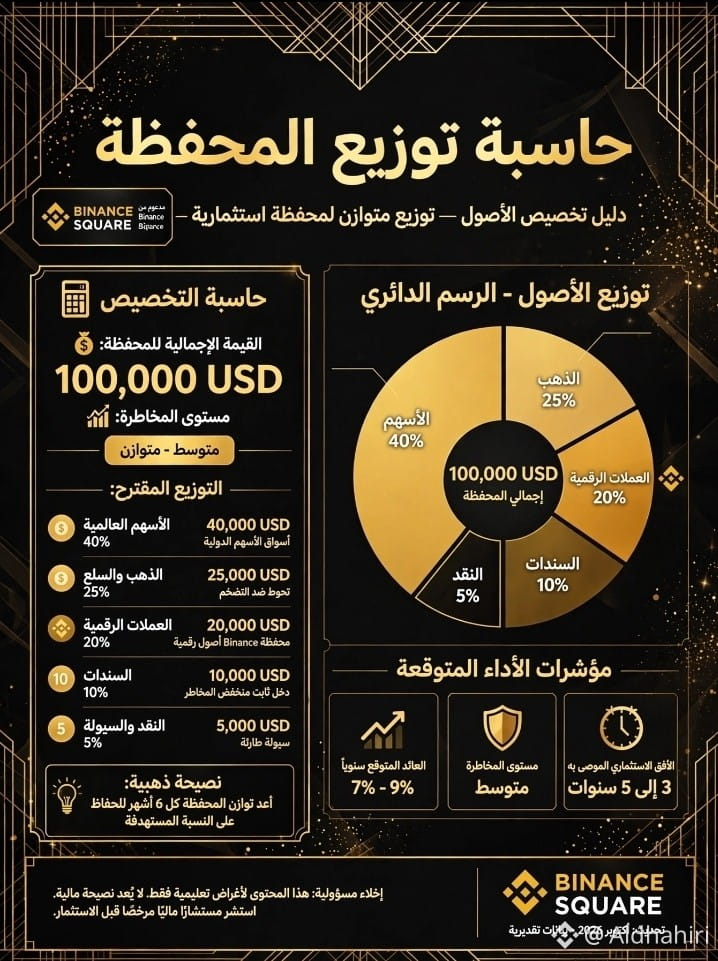
Portfolio Allocation Calculator
- Asset Allocation Guide
Balanced Investment Portfolio Allocation - Binance Square
Allocation Calculator:
- Total Portfolio Value: 100,000 USD
- Risk Level: Medium - Balanced
Suggested Allocation:
Asset Percentage Value Goal
Global stocks 40% 40,000 USD International stock markets Long-term growth
Gold and commodities 25% 25,000 USD Hedge against inflation Protection
Cryptocurrencies 20% 20,000 USD Binance portfolio of digital assets High growth
Bonds 10% 10,000 USD Low-risk fixed income Stability
Cash and liquidity 5% 5,000 USD Emergency liquidity Security
Asset Allocation - Pie Chart:
Gold 25% - Cryptocurrencies 20% - Bonds 10% - Cash 5% - Stocks 40%
Total Portfolio 100,000 USD
Expected Performance Indicators:
- Expected Annual Return: 7% - 9%
- Risk Level: Medium
- Recommended Investment Horizon: 3 to 5 years
Golden Tip: Rebalance your portfolio every 6 months to maintain the target allocation
Disclaimer: This content is for educational purposes only. It does not constitute financial advice. Consult a licensed financial advisor before investing.
Updated: October 2026 • Estimated data
$LUMIA
{future}(LUMIAUSDT)
$ERA
{spot}(ERAUSDT)
$CFX
{future}(CFXUSDT)
#Binance #CryptoNewss
#توزيع_المحفظة #AssetAllocation #BinanceSquare
Portfolio Allocation Calculator
- Asset Allocation Guide
Balanced Investment Portfolio Allocation - Binance Square
Allocation Calculator:
- Total Portfolio Value: 100,000 USD
- Risk Level: Medium - Balanced
Suggested Allocation:
Asset Percentage Value Goal
Global stocks 40% 40,000 USD International stock markets Long-term growth
Gold and commodities 25% 25,000 USD Hedge against inflation Protection
Cryptocurrencies 20% 20,000 USD Binance portfolio of digital assets High growth
Bonds 10% 10,000 USD Low-risk fixed income Stability
Cash and liquidity 5% 5,000 USD Emergency liquidity Security
Asset Allocation - Pie Chart:
Gold 25% - Cryptocurrencies 20% - Bonds 10% - Cash 5% - Stocks 40%
Total Portfolio 100,000 USD
Expected Performance Indicators:
- Expected Annual Return: 7% - 9%
- Risk Level: Medium
- Recommended Investment Horizon: 3 to 5 years
Golden Tip: Rebalance your portfolio every 6 months to maintain the target allocation
Disclaimer: This content is for educational purposes only. It does not constitute financial advice. Consult a licensed financial advisor before investing.
Updated: October 2026 • Estimated data
$LUMIA
$ERA
$CFX
#Binance #CryptoNewss
#توزيع_المحفظة #AssetAllocation #BinanceSquare
1
754

·
--
Sunshine Silver Mining boosts Idaho mineral rights by 60%! As largest holder in America's top silver district, they're dominating traditional silver market. 🥈 Traditional world: silver is a hard asset; crypto world: Bitcoin is digital gold. Both are inflation hedges! #矿业投资 #资产配置 $BTC
Sunshine Silver Mining boosted Idaho mineral rights by 60%! As largest holder in America's top silver district, they're dominating traditional silver market. 🥈 Traditional world: silver is hard asset. Crypto world: Bitcoin is digital gold. Both are inflation hedges! #MiningInvestment #AssetAllocation $BTC
Sunshine Silver Mining boosted Idaho mineral rights by 60%! As largest holder in America's top silver district, they're dominating traditional silver market. 🥈 Traditional world: silver is hard asset. Crypto world: Bitcoin is digital gold. Both are inflation hedges! #MiningInvestment #AssetAllocation $BTC
193

·
--
Someone calculated a sum: In 2021, a real estate developer invested 500 million yuan into a certain storage-chip company, taking 1.56% equity. In 2024, it sold for 2 billion yuan, earning 1.5 billion yuan on paper. After the deal completed by about a year and a half, that company pushed to IPO; at the expected valuation, that 1.56% stake was worth 30 billion+—while the developer’s own market cap had fallen short even of a fraction of that.
Timing and fate—it's the same story. This principle is just as sharp in the crypto space: choosing the right track matters far more than burying your head in hard work. The slope of BTC surviving bull and bear cycles has never been built by diligence from “making money by kneeling”; it’s been made by the Beta of “lying right” on the right tailwind. Many people aren’t not hardworking—they’re just on the wrong ship.
There is only the Beta of the times, no individual Alpha.
$BTC #Crypto #AssetAllocation #MarketCycle
1
90

🚨 WHY UNTRAINED TRADERS GET WRECKED ON $BTC AND HOW PROPER ALLOCATION SAVES YOU 📊
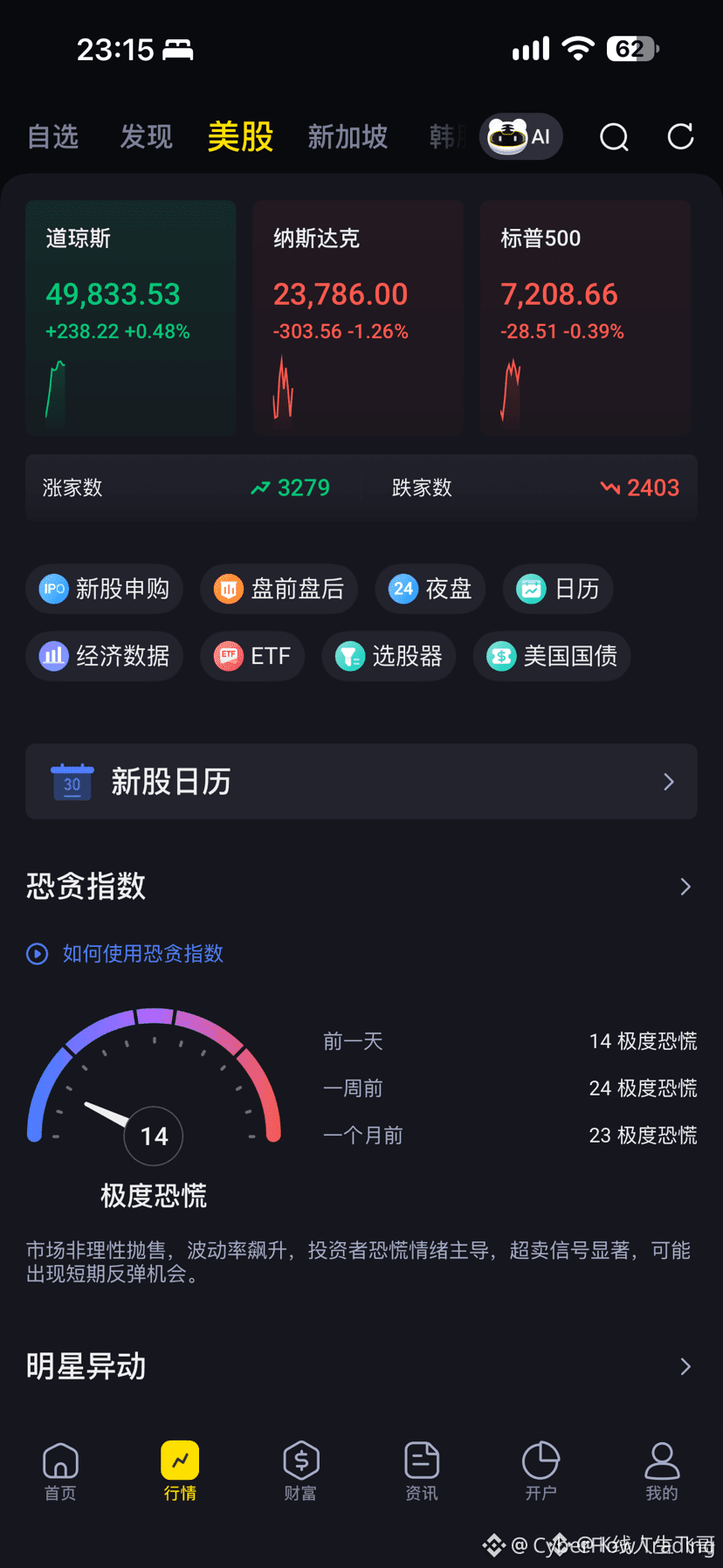
When drawdowns hit 87 percent on $BTC and 83 percent on tech indices, fear swallows the untrained whole. ⚡ The reason most market participants bleed out isn't bad asset choice, but brutal volatility management failure that forces panic exits at structural lows.
Smart capital survives macro cycles through surgical asset allocation instead of gambling on single-name lottery tickets. 💡 Structuring a balanced matrix across equities, precious metals, and digital assets cushions the blow, letting you compound gains without getting shaken out by local noise.
💬 How are you structuring your risk allocation to weather heavy market drawdowns without losing your edge? 👇
⚠️ Not financial advice. Always manage your risk. 🛡️
🏷️ #BTC #RiskManagement #Crypto #AssetAllocation #Macro
🔥 💎
7

·
--
💎 $BTC PORTFOLIO ALLOCATION: HOW MUCH IS TOO MUCH?
$BTC can be a meaningful part of an investment portfolio, but concentration increases exposure to its volatility. 📊
Your allocation should reflect your financial goals, time horizon, and ability to absorb losses.
A balanced strategy can matter more than chasing maximum returns.
👇 What percentage of a crypto portfolio would you allocate to $BTC?
#BTC #PortfolioManagement #AssetAllocation #CryptoWealth #InvestmentPlanning
💎 $BTC PORTFOLIO ALLOCATION: HOW MUCH IS TOO MUCH?
$BTC can be a meaningful part of an investment portfolio, but concentration increases exposure to its volatility. 📊
Your allocation should reflect your financial goals, time horizon, and ability to absorb losses.
A balanced strategy can matter more than chasing maximum returns.
👇 What percentage of a crypto portfolio would you allocate to $BTC ?
#BTC #PortfolioManagement #AssetAllocation #CryptoWealth #InvestmentPlanning
1
1

🧠 The millionaire's lesson: The secret of combining Bitcoin and $XAU 🏦🥊There is a myth in Web3 that says you have to choose a side: either you are a maximalist of "digital gold" (Bitcoin) or a traditional investor in "physical gold" ($XAU). The world's most successful fund managers know that that is a losing mentality.
True wealth is built by combining both forces:
• Bitcoin (BTC): It gives you asymmetric growth potential, technological innovation, and native decentralization.
• Gold ($XAU): It provides immutable fundamental floor, mathematical resistance to the passage of time, and institutional stability proven over more than 5,000 years.
🧠 The millionaire's lesson: The secret of combining Bitcoin and $XAU 🏦🥊
There is a myth in Web3 that says you have to choose a side: either you are a maximalist of "digital gold" (Bitcoin) or a traditional investor in "physical gold" ($XAU). The world's most successful fund managers know that that is a losing mentality.
True wealth is built by combining both forces:
• Bitcoin (BTC): It gives you asymmetric growth potential, technological innovation, and native decentralization.
• Gold ($XAU): It provides immutable fundamental floor, mathematical resistance to the passage of time, and institutional stability proven over more than 5,000 years.
1
57

·
--

Article
Corporate Treasuries: The Saylor Playbook🏦
Corporate balance sheets are undergoing a historic transformation led by MicroStrategy’s relentless execution. In their latest May 2026 financial updates, the pioneer firm added another 535 BTC for $43 million, pushing their total treasury holdings to a staggering 818,869 BTC. This immense position reflects a cumulative corporate investment of roughly $61.86 billion. $USDC
{spot}(USDCUSDT)
By consistently utilizing equity issuance and structured capital tools to acquire $BTC
{spot}(BTCUSDT)
, corporate players are building an ironclad shield against monetary debasement. This treasury model treats @Bitcoinworld as the ultimate institutional reserve asset, vastly outstripping traditional cash or short-term bonds. As public companies continue absorbing liquid spot supply, the standard for corporate wealth preservation is being completely rewritten in real-time. 📈 $BNB
{spot}(BNBUSDT)
#CorporateTreasury #MicroStrategy #MSTR #InstitutionalCrypto #AssetAllocation
Corporate Treasuries: The Saylor Playbook
🏦
Corporate balance sheets are undergoing a historic transformation led by MicroStrategy’s relentless execution. In their latest May 2026 financial updates, the pioneer firm added another 535 BTC for $43 million, pushing their total treasury holdings to a staggering 818,869 BTC. This immense position reflects a cumulative corporate investment of roughly $61.86 billion. $USDC
By consistently utilizing equity issuance and structured capital tools to acquire $BTC
, corporate players are building an ironclad shield against monetary debasement. This treasury model treats @Bitcoinworld as the ultimate institutional reserve asset, vastly outstripping traditional cash or short-term bonds. As public companies continue absorbing liquid spot supply, the standard for corporate wealth preservation is being completely rewritten in real-time. 📈 $BNB
#CorporateTreasury #MicroStrategy #MSTR #InstitutionalCrypto #AssetAllocation
37

·
--
Bullish
The Currency Cross-Infection: Understanding The Inverse Biological Symbiosis Between Gold And USDIn the "global financial anatomy," gold and the US Dollar share a "complex inverse circulatory system" where the strength of one often acts as a "suppressant" to the other. From a clinical perspective, gold frequently exhibits "negative correlation vitals"; when the USD suffers from "hyper-strength," gold’s price vitals may experience a temporary "hypotension" or downward pressure. This "systemic dependency" means that investors without a clear "diagnosis" of the global currency market risk a "miscalculated dosage"—buying at a peak when the USD is about to undergo a "rebound therapy." 🛡️⚖️
$POL
{future}(POLUSDT)
$PAXG
{future}(PAXGUSDT)
For the untrained eye, this "monetary infection" can lead to poor timing and "portfolio inflammation." Understanding this "biological tug-of-war" is essential; it requires monitoring the "macroeconomic pulse" of central banks and interest rate "prescriptions."
$SOL
{future}(SOLUSDT)
Without a proper "forensic analysis" of the Dollar Index ($DXY$), an investor might find their gold assets suffering from "value anemia" in the short term. Therefore, mastering the "USD-Gold interaction" is the primary "preventative medicine" needed to ensure you "inject" capital into the market at the most "biocompatible" time for maximum health! 🧬💰#AssetAllocation , #GoldMetabolism , #YieldComparison , #InvestmentMedicine , #WealthNutrition ,
The Currency Cross-Infection: Understanding The Inverse Biological Symbiosis Between Gold And USDIn the "global financial anatomy," gold and the US Dollar share a "complex inverse circulatory system" where the strength of one often acts as a "suppressant" to the other. From a clinical perspective, gold frequently exhibits "negative correlation vitals"; when the USD suffers from "hyper-strength," gold’s price vitals may experience a temporary "hypotension" or downward pressure. This "systemic dependency" means that investors without a clear "diagnosis" of the global currency market risk a "miscalculated dosage"—buying at a peak when the USD is about to undergo a "rebound therapy." 🛡️⚖️
$POL
$PAXG
For the untrained eye, this "monetary infection" can lead to poor timing and "portfolio inflammation." Understanding this "biological tug-of-war" is essential; it requires monitoring the "macroeconomic pulse" of central banks and interest rate "prescriptions."
$SOL
Without a proper "forensic analysis" of the Dollar Index ($DXY$), an investor might find their gold assets suffering from "value anemia" in the short term. Therefore, mastering the "USD-Gold interaction" is the primary "preventative medicine" needed to ensure you "inject" capital into the market at the most "biocompatible" time for maximum health! 🧬💰#AssetAllocation , #GoldMetabolism , #YieldComparison , #InvestmentMedicine , #WealthNutrition ,
295

·
--
⚡ TRADITIONAL CAPITAL ALLOCATION VS HARD ASSET APPRECIATION: $BTC PROVES LIQUIDITY ROI MATTERS 📈
📌 Selling prime real estate to fund traditional paths yields negative real inflation-adjusted returns when structural asset inflation outpaces wage growth. 📊 When hard assets appreciate 150% while income streams remain flat, capital efficiency breaks down entirely.
💡 Institutional smart money prioritizes asymmetric risk-to-reward and compounding liquid assets over illiquid, low-yield traditional returns. 🛡️ Navigating generational wealth requires allocating capital into scarce, high-velocity assets like $BTC rather than chasing stagnant yield curves.
💬 Are you allocating your capital into high-yield hard assets or watching inflation erode your purchasing power? 👇
⚠️ Not financial advice. Always manage your risk. 🛡️
🏷️ #BTC #Macro #AssetAllocation #Crypto #WealthManagement
🔥 💎

21

·
--
#组合拳 Macro Strategy: Crypto Asset Allocation Advice During Interest Rate Cuts
📊 The global macroeconomic environment is shifting, and crypto assets are entering a new allocation window.
🔍 Key Macro Factors:
• Global central banks have entered a rate-cutting cycle, leading to liquidity easing
• Inflation data is declining, shifting monetary policy towards easing
• Geopolitical risks are decreasing, and market risk appetite is recovering
• Crypto regulatory frameworks are being gradually improved, accelerating institutional entry
📈 Crypto Asset Allocation Strategy:
1. Core Holdings (60%): Mainstream coins like BTC and ETH
• BTC: Digital gold, hedging against inflation risks
• ETH: Benefiting from DeFi ecosystem development, long-term value growth
2. Growth Allocation (30%): High-potential altcoins
• SOL: High-performance blockchain, rapidly expanding ecosystem
• AVAX: Layer1 competitor with clear technical advantages
3. Risk Allocation (10%): Tokens from emerging sectors
• RNDR: Leader in the AI rendering space
• TIA: Layer2 infrastructure
⏰ Time Window:
• Short-term (1-3 months): Accumulate mainstream coins on dips
• Mid-term (3-6 months): Focus on altcoins with strong ecosystem expansion
• Long-term (6-12 months): Allocate to leaders in emerging sectors
💡 Risk Management:
• Build positions in batches to avoid lump sum investments
• Set stop-loss levels to control single trade losses
• Monitor changes in macro indicators and adjust strategies promptly
#CryptoStrategy #Macro #AssetAllocation #Investment
197
·
--
The Metabolic Rate Of Wealth: Why Gold Is Not A Fast-Acting Stimulant
In the "pharmacology" of the financial markets, gold functions as a "slow-release supplement" rather than a high-octane "adrenaline shot." From a clinical perspective, gold possesses a "stable metabolic rate," meaning its price vitals do not experience the "hyperactive fluctuations" seen in cryptocurrencies or speculative stocks.
$PAXG
{future}(PAXGUSDT)
For investors seeking "acute short-term gains," gold can often lead to "therapeutic disappointment" because its price movements are designed for long-term "systemic health" rather than "instant intoxication." 🛡️🐢
$DOT
{future}(DOTUSDT)
While the "digital pulse" of Crypto offers a high-risk "cardiovascular workout" for day traders, gold acts as a "sedative for volatility," requiring a long-term "treatment plan" to show its true efficacy.
$XRP
{future}(XRPUSDT)
Attempting to "surf the waves" with gold is like trying to use a "bone-density vitamin" to cure a 10-minute headache—it simply isn't the correct "clinical application." For those seeking a "surgical strike" on profit, gold's steady rhythm may feel like a "flatline," but for the "chronic wealth builder," it remains the ultimate "longevity therapy." 🧬💰#AssetAllocation , #GoldMetabolism , #YieldComparison , #InvestmentMedicine ,
The Metabolic Rate Of Wealth: Why Gold Is Not A Fast-Acting Stimulant
In the "pharmacology" of the financial markets, gold functions as a "slow-release supplement" rather than a high-octane "adrenaline shot." From a clinical perspective, gold possesses a "stable metabolic rate," meaning its price vitals do not experience the "hyperactive fluctuations" seen in cryptocurrencies or speculative stocks.
$PAXG
For investors seeking "acute short-term gains," gold can often lead to "therapeutic disappointment" because its price movements are designed for long-term "systemic health" rather than "instant intoxication." 🛡️🐢
$DOT
While the "digital pulse" of Crypto offers a high-risk "cardiovascular workout" for day traders, gold acts as a "sedative for volatility," requiring a long-term "treatment plan" to show its true efficacy.
$XRP
Attempting to "surf the waves" with gold is like trying to use a "bone-density vitamin" to cure a 10-minute headache—it simply isn't the correct "clinical application." For those seeking a "surgical strike" on profit, gold's steady rhythm may feel like a "flatline," but for the "chronic wealth builder," it remains the ultimate "longevity therapy." 🧬💰#AssetAllocation , #GoldMetabolism , #YieldComparison , #InvestmentMedicine ,
240
·
--
The Conservative Growth Metabolism: Why Gold Is A Stabilization Nutrient Rather Than A High-Yield Hormone
In the "nutritional science" of wealth management, gold acts as a "vital mineral" for systemic stability rather than a "growth hormone" for aggressive capital expansion. From a clinical perspective, gold possesses a "conservative metabolic rate"; while it reliably protects against "inflationary decay" over decades, its long-term yield often underperforms when compared to the "high-calorie returns" of equity markets or diversified stock indices. 🏥📈
Over-prescribing gold in a portfolio can lead to "yield-deficiency syndrome," where the overall "financial growth" of the investor remains stunted compared to those utilizing more "energetic" assets. Gold's primary "medical function" is "capital preservation" and "risk immunization," not the rapid "hypertrophy" of wealth. 🛡️⚖️ Relying solely on gold is akin to a "monodiet" that ensures survival but lacks the "dynamic enzymes" needed for significant wealth accumulation. For a truly "healthy financial organism," a practitioner must balance the "steady-state vitals" of gold with the "prolific growth" of other asset classes. Gold is the ultimate "emergency backup power," but it should be part of a "multi-vitamin protocol" to ensure your portfolio achieves maximum "evolutionary fitness" in the global market! 🧬💰#AssetAllocation , #GoldMetabolism , #YieldComparison , #InvestmentMedicine , #WealthNutrition ,
$BTC
$ETH
$POL
{future}(POLUSDT)
{future}(ETHUSDT)
{future}(BTCUSDT)
The Conservative Growth Metabolism: Why Gold Is A Stabilization Nutrient Rather Than A High-Yield Hormone
In the "nutritional science" of wealth management, gold acts as a "vital mineral" for systemic stability rather than a "growth hormone" for aggressive capital expansion. From a clinical perspective, gold possesses a "conservative metabolic rate"; while it reliably protects against "inflationary decay" over decades, its long-term yield often underperforms when compared to the "high-calorie returns" of equity markets or diversified stock indices. 🏥📈
Over-prescribing gold in a portfolio can lead to "yield-deficiency syndrome," where the overall "financial growth" of the investor remains stunted compared to those utilizing more "energetic" assets. Gold's primary "medical function" is "capital preservation" and "risk immunization," not the rapid "hypertrophy" of wealth. 🛡️⚖️ Relying solely on gold is akin to a "monodiet" that ensures survival but lacks the "dynamic enzymes" needed for significant wealth accumulation. For a truly "healthy financial organism," a practitioner must balance the "steady-state vitals" of gold with the "prolific growth" of other asset classes. Gold is the ultimate "emergency backup power," but it should be part of a "multi-vitamin protocol" to ensure your portfolio achieves maximum "evolutionary fitness" in the global market! 🧬💰#AssetAllocation , #GoldMetabolism , #YieldComparison , #InvestmentMedicine , #WealthNutrition ,
$BTC
$ETH
$POL
235
·
--
The Maintenance Costs Of Physical Safety: Managing Storage Fees And External Theft Contagions
In the "clinical management" of physical wealth, gold requires a dedicated "sanitized environment" to ensure its security vitals remain protected from "external pathogens" (theft).
$XRP
{future}(XRPUSDT)
From a clinical perspective, gold storage carries its own "procedural expenses"—whether you opt for a "hospitalized" solution (bank vaults and insurance premiums) or a "home-care" setup (private safes). 🏥
$BTC
{future}(BTCUSDT)
locked Using a bank vault is like paying for "permanent ICU monitoring" for your assets; it ensures maximum vitality but comes with recurring "service fees" that can impact your overall "financial nutrition." On the other hand, maintaining gold "at home" without professional security is equivalent to performing surgery in an unsterile environment, significantly increasing the risk of "acute asset loss" due to "invasive criminal infections." 🛡️🧤
$PAXG
{future}(PAXGUSDT)
This "maintenance pathology" is a critical factor for the long-term practitioner; you must weigh the "cost of protection" against the potential for "terminal loss." While gold doesn't require "digital patches," its physical presence demands a "secure habitat"—a fiscal "quarantine" that ensures your wealth doesn't become a victim of its own tangible success! 🧬💰#AssetAllocation , #GoldMetabolism , #YieldComparison , #InvestmentMedicine ,
The Maintenance Costs Of Physical Safety: Managing Storage Fees And External Theft Contagions
In the "clinical management" of physical wealth, gold requires a dedicated "sanitized environment" to ensure its security vitals remain protected from "external pathogens" (theft).
$XRP
From a clinical perspective, gold storage carries its own "procedural expenses"—whether you opt for a "hospitalized" solution (bank vaults and insurance premiums) or a "home-care" setup (private safes). 🏥
$BTC
locked Using a bank vault is like paying for "permanent ICU monitoring" for your assets; it ensures maximum vitality but comes with recurring "service fees" that can impact your overall "financial nutrition." On the other hand, maintaining gold "at home" without professional security is equivalent to performing surgery in an unsterile environment, significantly increasing the risk of "acute asset loss" due to "invasive criminal infections." 🛡️🧤
$PAXG
This "maintenance pathology" is a critical factor for the long-term practitioner; you must weigh the "cost of protection" against the potential for "terminal loss." While gold doesn't require "digital patches," its physical presence demands a "secure habitat"—a fiscal "quarantine" that ensures your wealth doesn't become a victim of its own tangible success! 🧬💰#AssetAllocation , #GoldMetabolism , #YieldComparison , #InvestmentMedicine ,
244
Log in to explore more content
Join global crypto users on Binance Square
⚡️ Get latest and useful information about crypto.
💬 Trusted by the world’s largest crypto exchange.
👍 Discover real insights from verified creators.
Email / Phone number
Trending Topics
1
#EvolveAtBinanceBlockchainWeek
1.5M views
16,535 Discussing
2
#ChainflipVaultTheftHaltsProtocol
15,264 views
261 Discussing
3
#ColdcardFlawLeadsToTheftOfAtLeast1789BTC
9,096 views
87 Discussing
4
#VitalikWantsWalletChipDesignsOpened
23,353 views
347 Discussing
5
#MalaysiaFirstBitcoinETFToListOnDecember2
7,996 views
101 Discussing
6
#ClaudeAccusedOfDroppingUserPreferences
7,416 views
84 Discussing
7
#DowJonesAdds591.99Points
10,835 views
70 Discussing
8
#SECIssuesNoActionLetterOnMoleculeModel
909 views
17 Discussing
9
#AnzaUrgesSolanaNodesUpgradeAgave
8,484 views
152 Discussing
10
#EthereumGlamsterdamKeepsStorageFeeChange
50,723 views
492 Discussing