
airdropbuzzdotcom
2.9k Posts

airdropbuzzdotcom
Report
Block User
Stay updated with the latest in crypto! Bringing you the best in crypto news, technical analysis, and airdrop updates.Visit airdropbuzz.com for more updates
Open Trade

BNB Holder
Frequent Trader
5.4 Years
32 Following
2.0K+ Followers
4.3K+ Liked
Posts
Portfolio
All
Quotes
Videos
Opened a small 5X LONG on $ONG around $0.0789 🚀
Watching for momentum to build from here. 👀
Let’s see how this one plays out.
#ONG #Crypto #Trading
Opened a small 5X LONG on $ONG around $0.0789 🚀
Watching for momentum to build from here. 👀
Let’s see how this one plays out.
#ONG #Crypto #Trading
Watching for momentum to build from here. 👀
Let’s see how this one plays out.
#ONG #Crypto #Trading
1
76
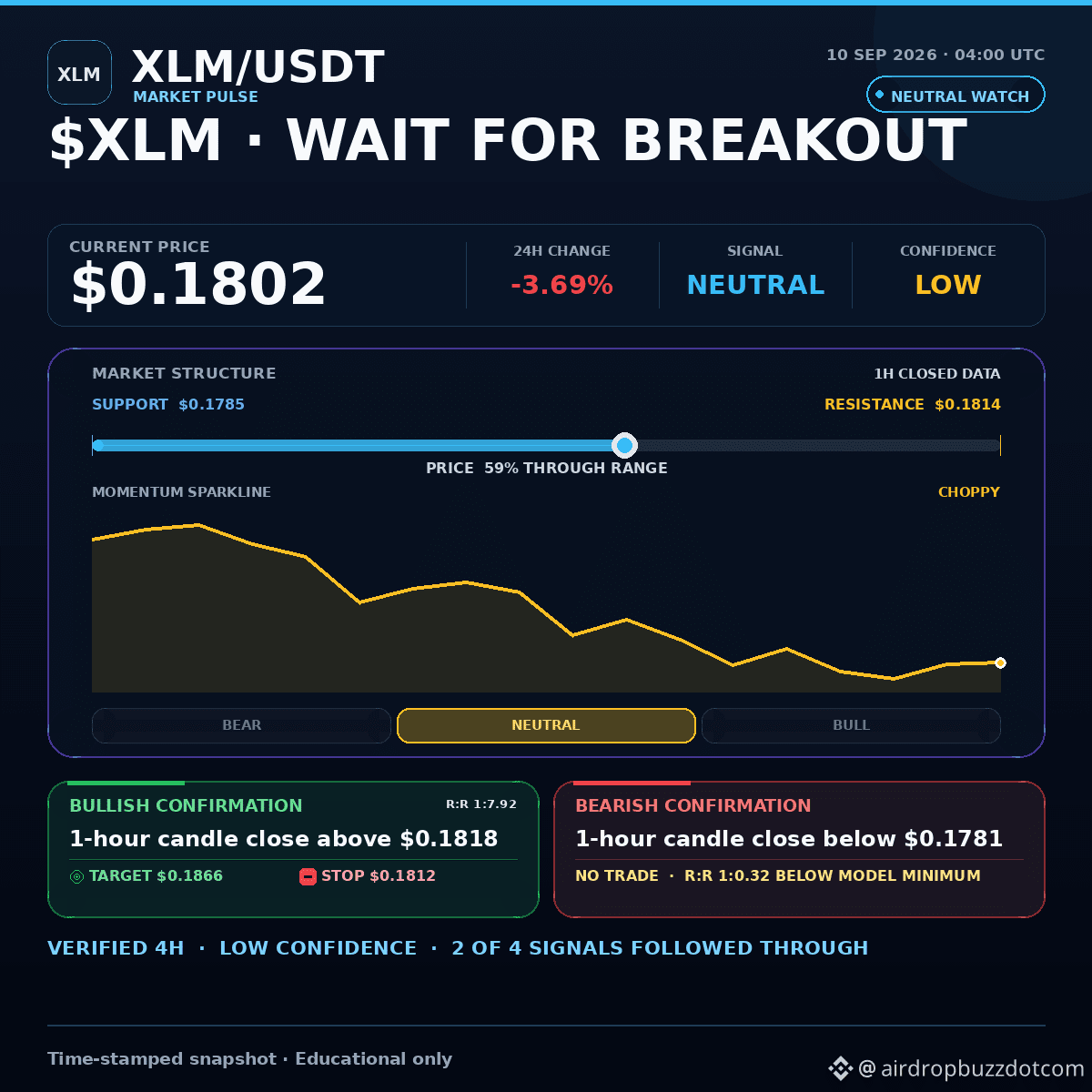
Is $XLM showing direction, or just noise before confirmation?
📊 Snapshot
• Price: $0.1802
• 24H: -3.69%
• Bias: Neutral
📈 Bull Trigger
1-hour close above $0.1818 with open interest confirmation
📉 Bear Trigger
1-hour close below $0.1781 with open interest confirmation
🎯 Signal Read
Conflicting evidence keeps this conditional, so the close matters more than predicting the direction early.
📌 Confidence
Low · Low historical confidence · 2 of 4 directional moves were favorable
Signal Quality
- OI: Flat (-0.19%)
- 4H: Bearish | 1D: Neutral (Mixed)
- ATR filter: 0.50 ATR ($0.0008071)
- Risk/reward: 1:0.32 - below minimum
Bear scenario risk plan
- Entry: $0.1781
- Stop: $0.1787
- Target: $0.1779
Trigger levels define confirmation; they do not guarantee where price will finish.
Front-run it or wait? Reply FRONT-RUN or WAIT.
#XLM #Stellar #CryptoTrading #MarketPulse
Educational only. Time-stamped market snapshot, not financial advice.
Is $XLM showing direction, or just noise before confirmation?
📊 Snapshot
• Price: $0.1802
• 24H: -3.69%
• Bias: Neutral
📈 Bull Trigger
1-hour close above $0.1818 with open interest confirmation
📉 Bear Trigger
1-hour close below $0.1781 with open interest confirmation
🎯 Signal Read
Conflicting evidence keeps this conditional, so the close matters more than predicting the direction early.
📌 Confidence
Low · Low historical confidence · 2 of 4 directional moves were favorable
Signal Quality
- OI: Flat (-0.19%)
- 4H: Bearish | 1D: Neutral (Mixed)
- ATR filter: 0.50 ATR ($0.0008071)
- Risk/reward: 1:0.32 - below minimum
Bear scenario risk plan
- Entry: $0.1781
- Stop: $0.1787
- Target: $0.1779
Trigger levels define confirmation; they do not guarantee where price will finish.
Front-run it or wait? Reply FRONT-RUN or WAIT.
#XLM #Stellar #CryptoTrading #MarketPulse
Educational only. Time-stamped market snapshot, not financial advice.
📊 Snapshot
• Price: $0.1802
• 24H: -3.69%
• Bias: Neutral
📈 Bull Trigger
1-hour close above $0.1818 with open interest confirmation
📉 Bear Trigger
1-hour close below $0.1781 with open interest confirmation
🎯 Signal Read
Conflicting evidence keeps this conditional, so the close matters more than predicting the direction early.
📌 Confidence
Low · Low historical confidence · 2 of 4 directional moves were favorable
Signal Quality
- OI: Flat (-0.19%)
- 4H: Bearish | 1D: Neutral (Mixed)
- ATR filter: 0.50 ATR ($0.0008071)
- Risk/reward: 1:0.32 - below minimum
Bear scenario risk plan
- Entry: $0.1781
- Stop: $0.1787
- Target: $0.1779
Trigger levels define confirmation; they do not guarantee where price will finish.
Front-run it or wait? Reply FRONT-RUN or WAIT.
#XLM #Stellar #CryptoTrading #MarketPulse
Educational only. Time-stamped market snapshot, not financial advice.
30
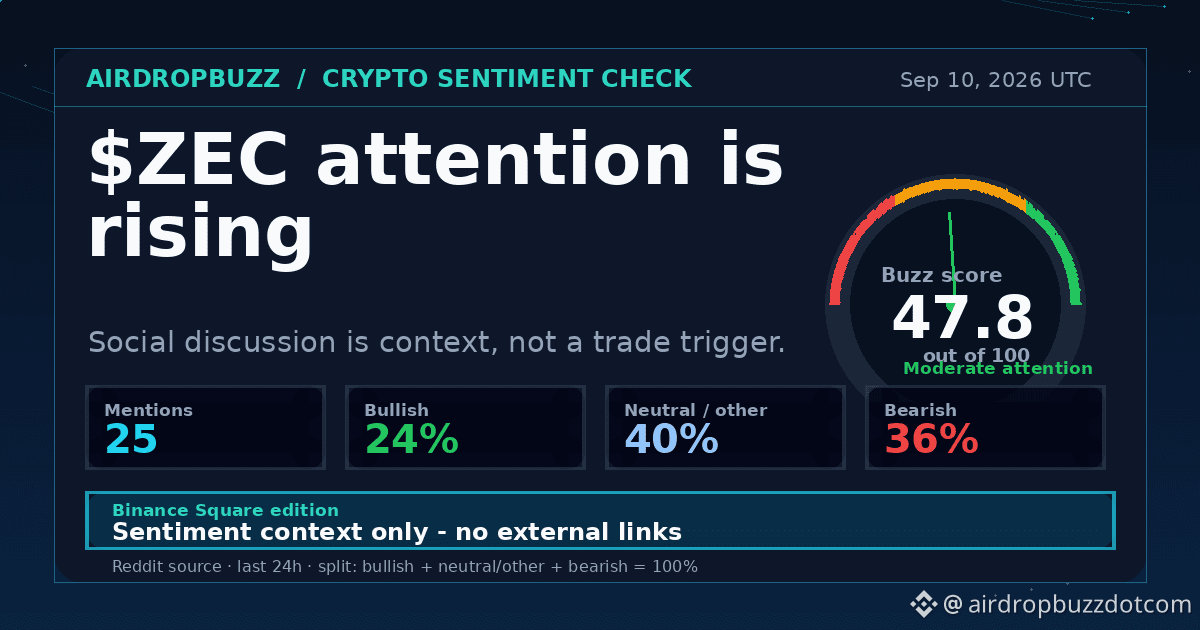
Crypto Sentiment Check: $ZEC attention is rising.
Social crypto discussion around $ZEC is active today, and discussion is leaning more cautious than constructive. The useful read is not to chase the noise, but to watch whether price, volume and funding start confirming the crowd's attention.
Treat this as market context, not a trade trigger. Wait for confirmation before acting.
Educational only, not financial advice.
Crypto Sentiment Check: $ZEC attention is rising.
Social crypto discussion around $ZEC is active today, and discussion is leaning more cautious than constructive. The useful read is not to chase the noise, but to watch whether price, volume and funding start confirming the crowd's attention.
Treat this as market context, not a trade trigger. Wait for confirmation before acting.
Educational only, not financial advice.
Social crypto discussion around $ZEC is active today, and discussion is leaning more cautious than constructive. The useful read is not to chase the noise, but to watch whether price, volume and funding start confirming the crowd's attention.
Treat this as market context, not a trade trigger. Wait for confirmation before acting.
Educational only, not financial advice.
116
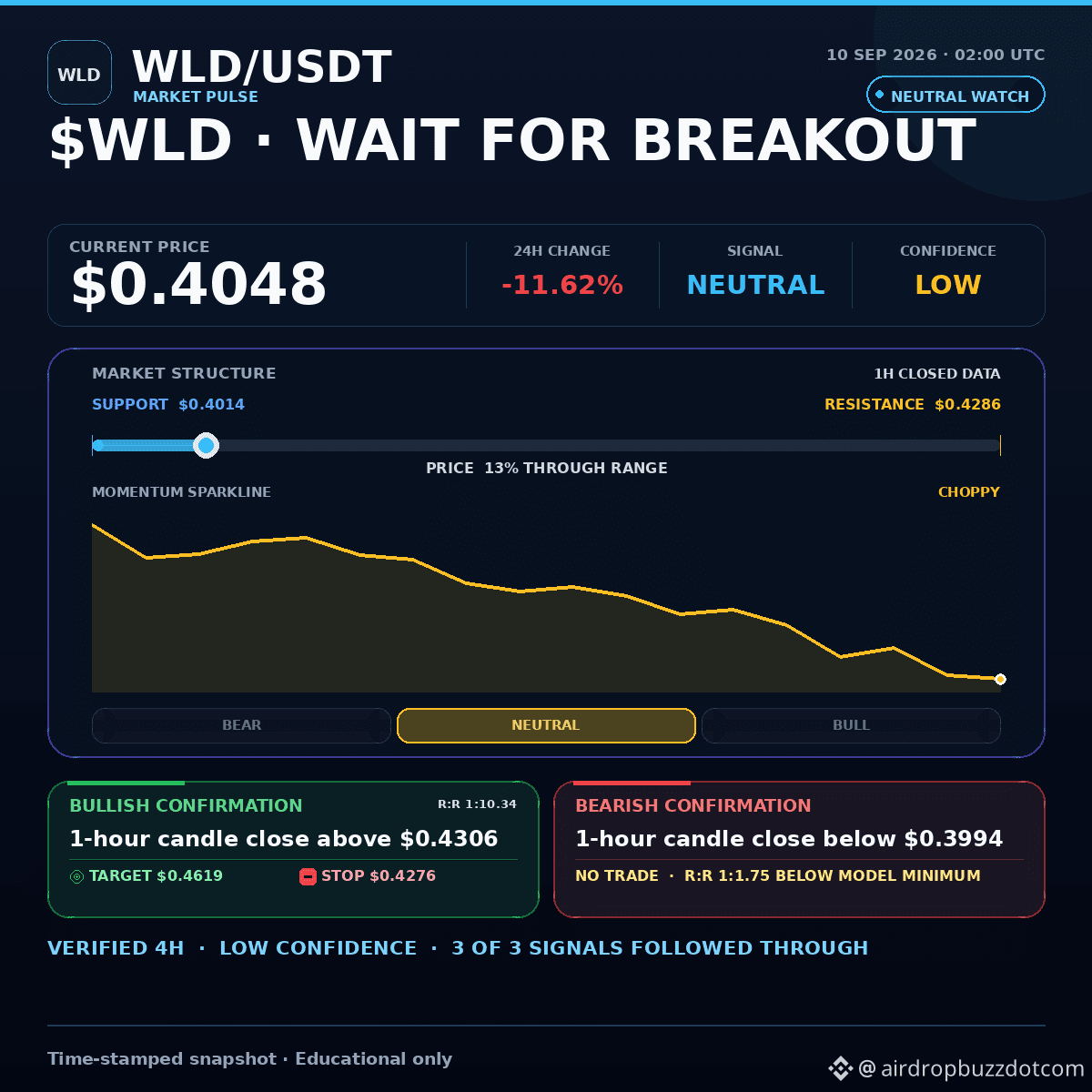
$WLD can move without producing a clean setup. This trigger still has to earn confirmation.
📊 Snapshot
• Price: $0.4048
• 24H: -11.62%
• Bias: Neutral
📈 Bull Trigger
1-hour close above $0.4306 with open interest confirmation
📉 Bear Trigger
1-hour close below $0.3994 with open interest confirmation
🎯 Signal Read
Both triggers remain possible, but only a confirmed break turns the current noise into a directional read.
📌 Confidence
Low · Low historical confidence · 3 of 3 directional moves were favorable
Signal Quality
- OI: Flat (+0.58%)
- 4H: Bearish | 1D: Bullish (Conflict)
- ATR filter: 0.50 ATR ($0.004036)
- Risk/reward: 1:1.75 - below minimum
Bear scenario risk plan
- Entry: $0.3994
- Stop: $0.4024
- Target: $0.3941
Trigger levels define confirmation; they do not guarantee where price will finish.
Break or fake? Reply BREAK or FAKE.
#WLD #Worldcoin #CryptoTrading #MarketPulse
Educational only. Time-stamped market snapshot, not financial advice.
$WLD can move without producing a clean setup. This trigger still has to earn confirmation.
📊 Snapshot
• Price: $0.4048
• 24H: -11.62%
• Bias: Neutral
📈 Bull Trigger
1-hour close above $0.4306 with open interest confirmation
📉 Bear Trigger
1-hour close below $0.3994 with open interest confirmation
🎯 Signal Read
Both triggers remain possible, but only a confirmed break turns the current noise into a directional read.
📌 Confidence
Low · Low historical confidence · 3 of 3 directional moves were favorable
Signal Quality
- OI: Flat (+0.58%)
- 4H: Bearish | 1D: Bullish (Conflict)
- ATR filter: 0.50 ATR ($0.004036)
- Risk/reward: 1:1.75 - below minimum
Bear scenario risk plan
- Entry: $0.3994
- Stop: $0.4024
- Target: $0.3941
Trigger levels define confirmation; they do not guarantee where price will finish.
Break or fake? Reply BREAK or FAKE.
#WLD #Worldcoin #CryptoTrading #MarketPulse
Educational only. Time-stamped market snapshot, not financial advice.
📊 Snapshot
• Price: $0.4048
• 24H: -11.62%
• Bias: Neutral
📈 Bull Trigger
1-hour close above $0.4306 with open interest confirmation
📉 Bear Trigger
1-hour close below $0.3994 with open interest confirmation
🎯 Signal Read
Both triggers remain possible, but only a confirmed break turns the current noise into a directional read.
📌 Confidence
Low · Low historical confidence · 3 of 3 directional moves were favorable
Signal Quality
- OI: Flat (+0.58%)
- 4H: Bearish | 1D: Bullish (Conflict)
- ATR filter: 0.50 ATR ($0.004036)
- Risk/reward: 1:1.75 - below minimum
Bear scenario risk plan
- Entry: $0.3994
- Stop: $0.4024
- Target: $0.3941
Trigger levels define confirmation; they do not guarantee where price will finish.
Break or fake? Reply BREAK or FAKE.
#WLD #Worldcoin #CryptoTrading #MarketPulse
Educational only. Time-stamped market snapshot, not financial advice.
105
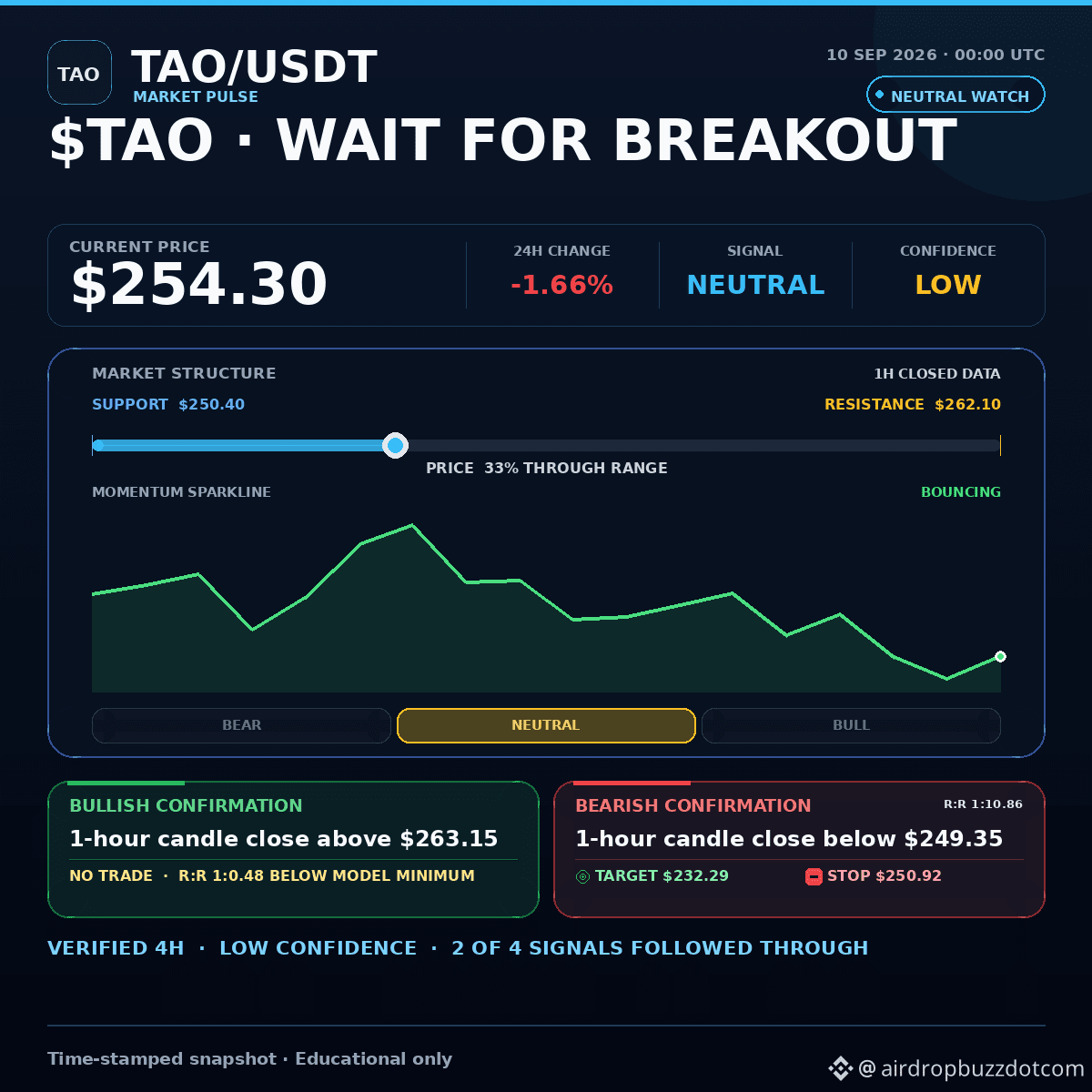
$TAO follow-through check: 2 of 4 recent directional moves were favorable.
📊 Snapshot
• Price: $254.30
• 24H: -1.66%
• Bias: Neutral
📈 Bull Trigger
1-hour close above $263.15 with open interest confirmation
📉 Bear Trigger
1-hour close below $249.35 with open interest confirmation
🎯 Signal Read
Conflicting evidence keeps this conditional, so the close matters more than predicting the direction early.
📌 Confidence
Low · Low historical confidence · 2 of 4 directional moves were favorable
Signal Quality
- OI: Flat (+0.44%)
- 4H: Bearish | 1D: Bullish (Conflict)
- ATR filter: 0.50 ATR ($2.09)
- Risk/reward: 1:10.86
Bear scenario risk plan
- Entry: $249.35
- Stop: $250.92
- Target: $232.29
Wait for a closed candle—trigger levels confirm conditions; they do not predict targets.
Break or fake? Reply BREAK or FAKE.
#TAO #Bittensor #CryptoTrading #MarketPulse
Educational only. Time-stamped market snapshot, not financial advice.
$TAO follow-through check: 2 of 4 recent directional moves were favorable.
📊 Snapshot
• Price: $254.30
• 24H: -1.66%
• Bias: Neutral
📈 Bull Trigger
1-hour close above $263.15 with open interest confirmation
📉 Bear Trigger
1-hour close below $249.35 with open interest confirmation
🎯 Signal Read
Conflicting evidence keeps this conditional, so the close matters more than predicting the direction early.
📌 Confidence
Low · Low historical confidence · 2 of 4 directional moves were favorable
Signal Quality
- OI: Flat (+0.44%)
- 4H: Bearish | 1D: Bullish (Conflict)
- ATR filter: 0.50 ATR ($2.09)
- Risk/reward: 1:10.86
Bear scenario risk plan
- Entry: $249.35
- Stop: $250.92
- Target: $232.29
Wait for a closed candle—trigger levels confirm conditions; they do not predict targets.
Break or fake? Reply BREAK or FAKE.
#TAO #Bittensor #CryptoTrading #MarketPulse
Educational only. Time-stamped market snapshot, not financial advice.
📊 Snapshot
• Price: $254.30
• 24H: -1.66%
• Bias: Neutral
📈 Bull Trigger
1-hour close above $263.15 with open interest confirmation
📉 Bear Trigger
1-hour close below $249.35 with open interest confirmation
🎯 Signal Read
Conflicting evidence keeps this conditional, so the close matters more than predicting the direction early.
📌 Confidence
Low · Low historical confidence · 2 of 4 directional moves were favorable
Signal Quality
- OI: Flat (+0.44%)
- 4H: Bearish | 1D: Bullish (Conflict)
- ATR filter: 0.50 ATR ($2.09)
- Risk/reward: 1:10.86
Bear scenario risk plan
- Entry: $249.35
- Stop: $250.92
- Target: $232.29
Wait for a closed candle—trigger levels confirm conditions; they do not predict targets.
Break or fake? Reply BREAK or FAKE.
#TAO #Bittensor #CryptoTrading #MarketPulse
Educational only. Time-stamped market snapshot, not financial advice.
57
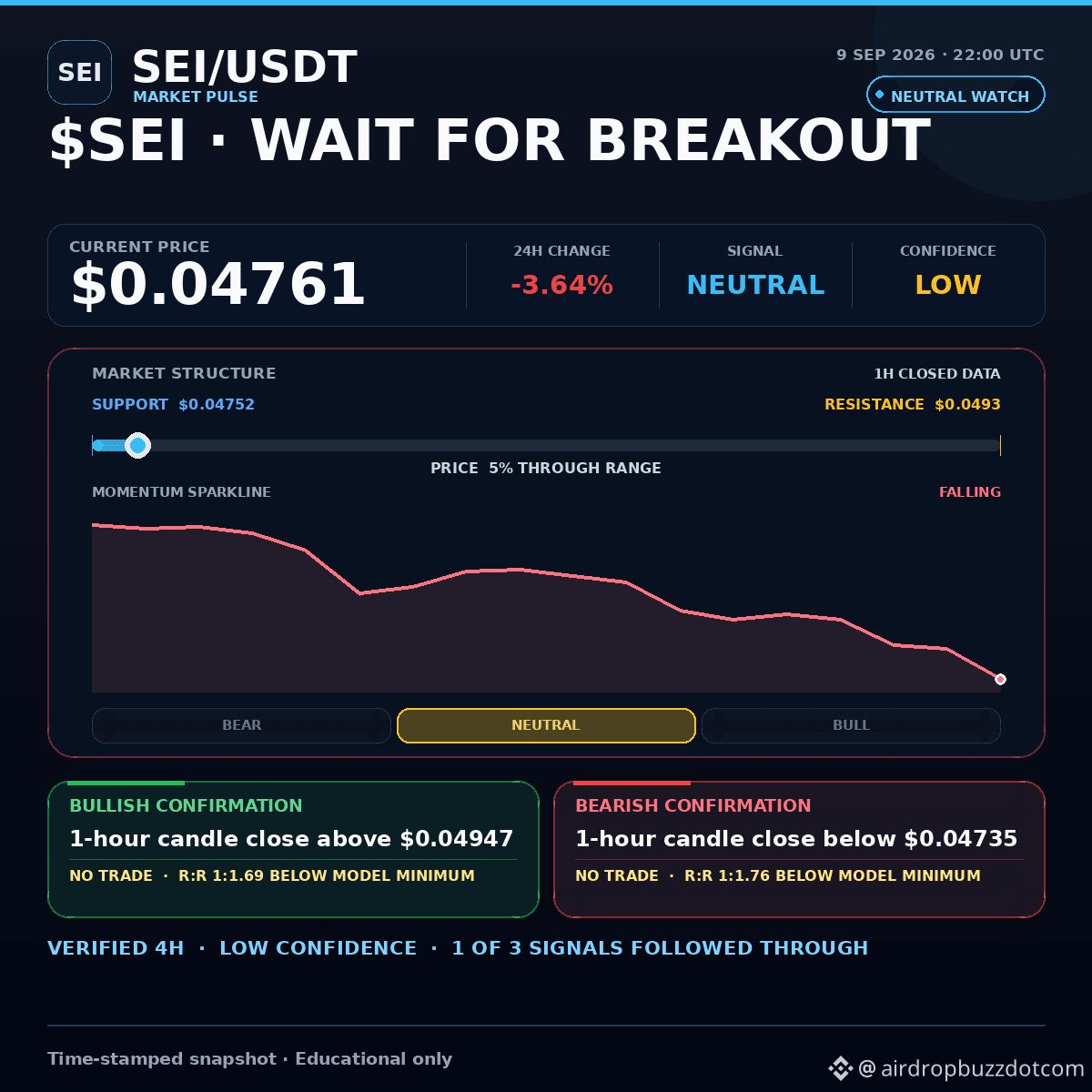
The next 1H close matters more than the current $SEI wick.
📊 Snapshot
• Price: $0.04761
• 24H: -3.64%
• Bias: Neutral
📈 Bull Trigger
1-hour close above $0.04947 with open interest confirmation
📉 Bear Trigger
1-hour close below $0.04735 with open interest confirmation
🎯 Signal Read
Neither scenario is actionable on movement alone; confirmation decides which side has earned the edge.
📌 Confidence
Low · Low historical confidence · 1 of 3 directional moves were favorable
Signal Quality
- OI: Falling (-2.51%)
- 4H: Bearish | 1D: Bullish (Conflict)
- ATR filter: 0.50 ATR ($0.0003457)
- Risk/reward: 1:1.76 - below minimum
Bear scenario risk plan
- Entry: $0.04735
- Stop: $0.04761
- Target: $0.04689
A trigger marks confirmation, not a guaranteed entry, outcome, or price destination.
Bull or bear first? Drop 🐂 or 🐻.
#SEI #Sei #CryptoTrading #MarketPulse
Educational only. Time-stamped market snapshot, not financial advice.
The next 1H close matters more than the current $SEI wick.
📊 Snapshot
• Price: $0.04761
• 24H: -3.64%
• Bias: Neutral
📈 Bull Trigger
1-hour close above $0.04947 with open interest confirmation
📉 Bear Trigger
1-hour close below $0.04735 with open interest confirmation
🎯 Signal Read
Neither scenario is actionable on movement alone; confirmation decides which side has earned the edge.
📌 Confidence
Low · Low historical confidence · 1 of 3 directional moves were favorable
Signal Quality
- OI: Falling (-2.51%)
- 4H: Bearish | 1D: Bullish (Conflict)
- ATR filter: 0.50 ATR ($0.0003457)
- Risk/reward: 1:1.76 - below minimum
Bear scenario risk plan
- Entry: $0.04735
- Stop: $0.04761
- Target: $0.04689
A trigger marks confirmation, not a guaranteed entry, outcome, or price destination.
Bull or bear first? Drop 🐂 or 🐻.
#SEI #Sei #CryptoTrading #MarketPulse
Educational only. Time-stamped market snapshot, not financial advice.
📊 Snapshot
• Price: $0.04761
• 24H: -3.64%
• Bias: Neutral
📈 Bull Trigger
1-hour close above $0.04947 with open interest confirmation
📉 Bear Trigger
1-hour close below $0.04735 with open interest confirmation
🎯 Signal Read
Neither scenario is actionable on movement alone; confirmation decides which side has earned the edge.
📌 Confidence
Low · Low historical confidence · 1 of 3 directional moves were favorable
Signal Quality
- OI: Falling (-2.51%)
- 4H: Bearish | 1D: Bullish (Conflict)
- ATR filter: 0.50 ATR ($0.0003457)
- Risk/reward: 1:1.76 - below minimum
Bear scenario risk plan
- Entry: $0.04735
- Stop: $0.04761
- Target: $0.04689
A trigger marks confirmation, not a guaranteed entry, outcome, or price destination.
Bull or bear first? Drop 🐂 or 🐻.
#SEI #Sei #CryptoTrading #MarketPulse
Educational only. Time-stamped market snapshot, not financial advice.
5
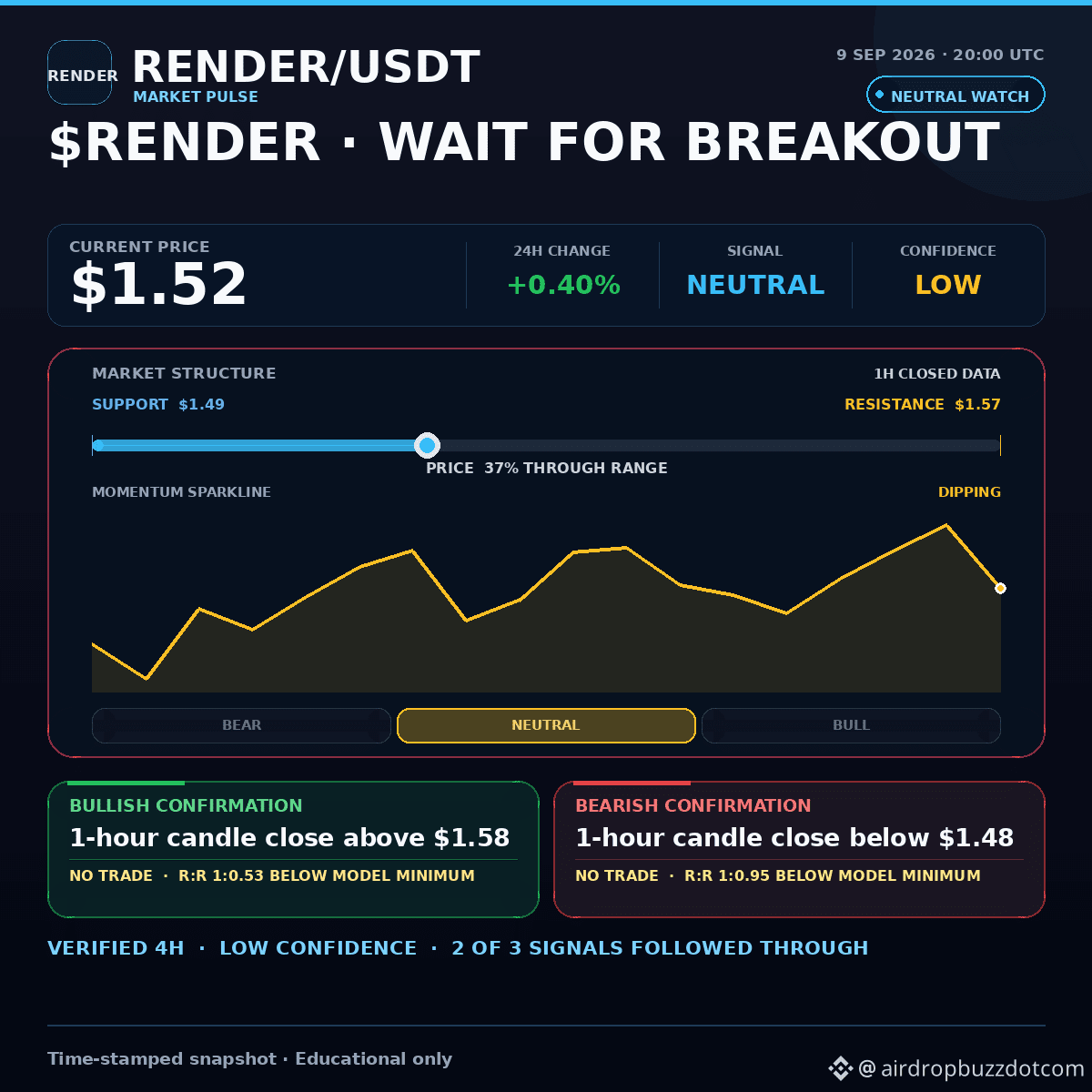
Forget the first $RENDER wick—the confirmed close carries more information.
📊 Snapshot
• Price: $1.52
• 24H: +0.40%
• Bias: Neutral
📈 Bull Trigger
1-hour close above $1.58 with open interest confirmation
📉 Bear Trigger
1-hour close below $1.48 with open interest confirmation
🎯 Signal Read
Neither scenario is actionable on movement alone; confirmation decides which side has earned the edge.
📌 Confidence
Low · Low historical confidence · 2 of 3 directional moves were favorable
Signal Quality
- OI: Falling (-1.53%)
- 4H: Bullish | 1D: Bullish (Aligned)
- ATR filter: 0.50 ATR ($0.02)
- Risk/reward: 1:0.95 - below minimum
Bear scenario risk plan
- Entry: $1.48
- Stop: $1.49
- Target: $1.46
Wait for a closed candle—trigger levels confirm conditions; they do not predict targets.
Break or fake? Reply BREAK or FAKE.
#RENDER #Render #CryptoTrading #MarketPulse
Educational only. Time-stamped market snapshot, not financial advice.
Forget the first $RENDER wick—the confirmed close carries more information.
📊 Snapshot
• Price: $1.52
• 24H: +0.40%
• Bias: Neutral
📈 Bull Trigger
1-hour close above $1.58 with open interest confirmation
📉 Bear Trigger
1-hour close below $1.48 with open interest confirmation
🎯 Signal Read
Neither scenario is actionable on movement alone; confirmation decides which side has earned the edge.
📌 Confidence
Low · Low historical confidence · 2 of 3 directional moves were favorable
Signal Quality
- OI: Falling (-1.53%)
- 4H: Bullish | 1D: Bullish (Aligned)
- ATR filter: 0.50 ATR ($0.02)
- Risk/reward: 1:0.95 - below minimum
Bear scenario risk plan
- Entry: $1.48
- Stop: $1.49
- Target: $1.46
Wait for a closed candle—trigger levels confirm conditions; they do not predict targets.
Break or fake? Reply BREAK or FAKE.
#RENDER #Render #CryptoTrading #MarketPulse
Educational only. Time-stamped market snapshot, not financial advice.
📊 Snapshot
• Price: $1.52
• 24H: +0.40%
• Bias: Neutral
📈 Bull Trigger
1-hour close above $1.58 with open interest confirmation
📉 Bear Trigger
1-hour close below $1.48 with open interest confirmation
🎯 Signal Read
Neither scenario is actionable on movement alone; confirmation decides which side has earned the edge.
📌 Confidence
Low · Low historical confidence · 2 of 3 directional moves were favorable
Signal Quality
- OI: Falling (-1.53%)
- 4H: Bullish | 1D: Bullish (Aligned)
- ATR filter: 0.50 ATR ($0.02)
- Risk/reward: 1:0.95 - below minimum
Bear scenario risk plan
- Entry: $1.48
- Stop: $1.49
- Target: $1.46
Wait for a closed candle—trigger levels confirm conditions; they do not predict targets.
Break or fake? Reply BREAK or FAKE.
#RENDER #Render #CryptoTrading #MarketPulse
Educational only. Time-stamped market snapshot, not financial advice.
14
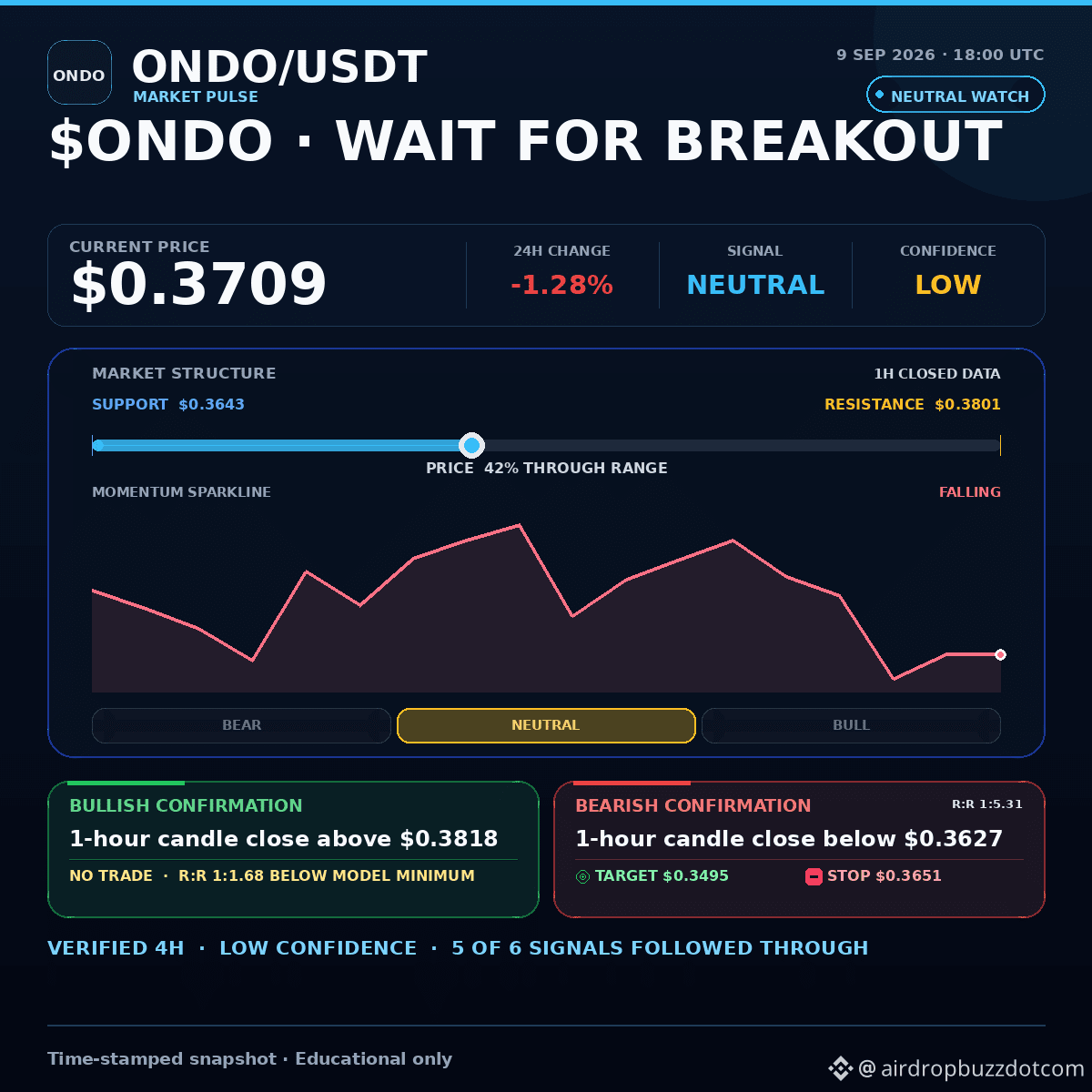
Price may grab attention, but the $ONDO sample says 5 of 6 recent directional moves were favorable.
📊 Snapshot
• Price: $0.3709
• 24H: -1.28%
• Bias: Neutral
📈 Bull Trigger
1-hour close above $0.3818 with open interest confirmation
📉 Bear Trigger
1-hour close below $0.3627 with open interest confirmation
🎯 Signal Read
Neither scenario is actionable on movement alone; confirmation decides which side has earned the edge.
📌 Confidence
Low · Low historical confidence · 5 of 6 directional moves were favorable
Signal Quality
- OI: Flat (-0.57%)
- 4H: Bearish | 1D: Bullish (Conflict)
- ATR filter: 0.50 ATR ($0.0033)
- Risk/reward: 1:5.31
Bear scenario risk plan
- Entry: $0.3627
- Stop: $0.3651
- Target: $0.3495
Trigger levels define confirmation; they do not guarantee where price will finish.
Break or fake? Reply BREAK or FAKE.
#ONDO #Ondo #CryptoTrading #MarketPulse
Educational only. Time-stamped market snapshot, not financial advice.
Price may grab attention, but the $ONDO sample says 5 of 6 recent directional moves were favorable.
📊 Snapshot
• Price: $0.3709
• 24H: -1.28%
• Bias: Neutral
📈 Bull Trigger
1-hour close above $0.3818 with open interest confirmation
📉 Bear Trigger
1-hour close below $0.3627 with open interest confirmation
🎯 Signal Read
Neither scenario is actionable on movement alone; confirmation decides which side has earned the edge.
📌 Confidence
Low · Low historical confidence · 5 of 6 directional moves were favorable
Signal Quality
- OI: Flat (-0.57%)
- 4H: Bearish | 1D: Bullish (Conflict)
- ATR filter: 0.50 ATR ($0.0033)
- Risk/reward: 1:5.31
Bear scenario risk plan
- Entry: $0.3627
- Stop: $0.3651
- Target: $0.3495
Trigger levels define confirmation; they do not guarantee where price will finish.
Break or fake? Reply BREAK or FAKE.
#ONDO #Ondo #CryptoTrading #MarketPulse
Educational only. Time-stamped market snapshot, not financial advice.
📊 Snapshot
• Price: $0.3709
• 24H: -1.28%
• Bias: Neutral
📈 Bull Trigger
1-hour close above $0.3818 with open interest confirmation
📉 Bear Trigger
1-hour close below $0.3627 with open interest confirmation
🎯 Signal Read
Neither scenario is actionable on movement alone; confirmation decides which side has earned the edge.
📌 Confidence
Low · Low historical confidence · 5 of 6 directional moves were favorable
Signal Quality
- OI: Flat (-0.57%)
- 4H: Bearish | 1D: Bullish (Conflict)
- ATR filter: 0.50 ATR ($0.0033)
- Risk/reward: 1:5.31
Bear scenario risk plan
- Entry: $0.3627
- Stop: $0.3651
- Target: $0.3495
Trigger levels define confirmation; they do not guarantee where price will finish.
Break or fake? Reply BREAK or FAKE.
#ONDO #Ondo #CryptoTrading #MarketPulse
Educational only. Time-stamped market snapshot, not financial advice.
5
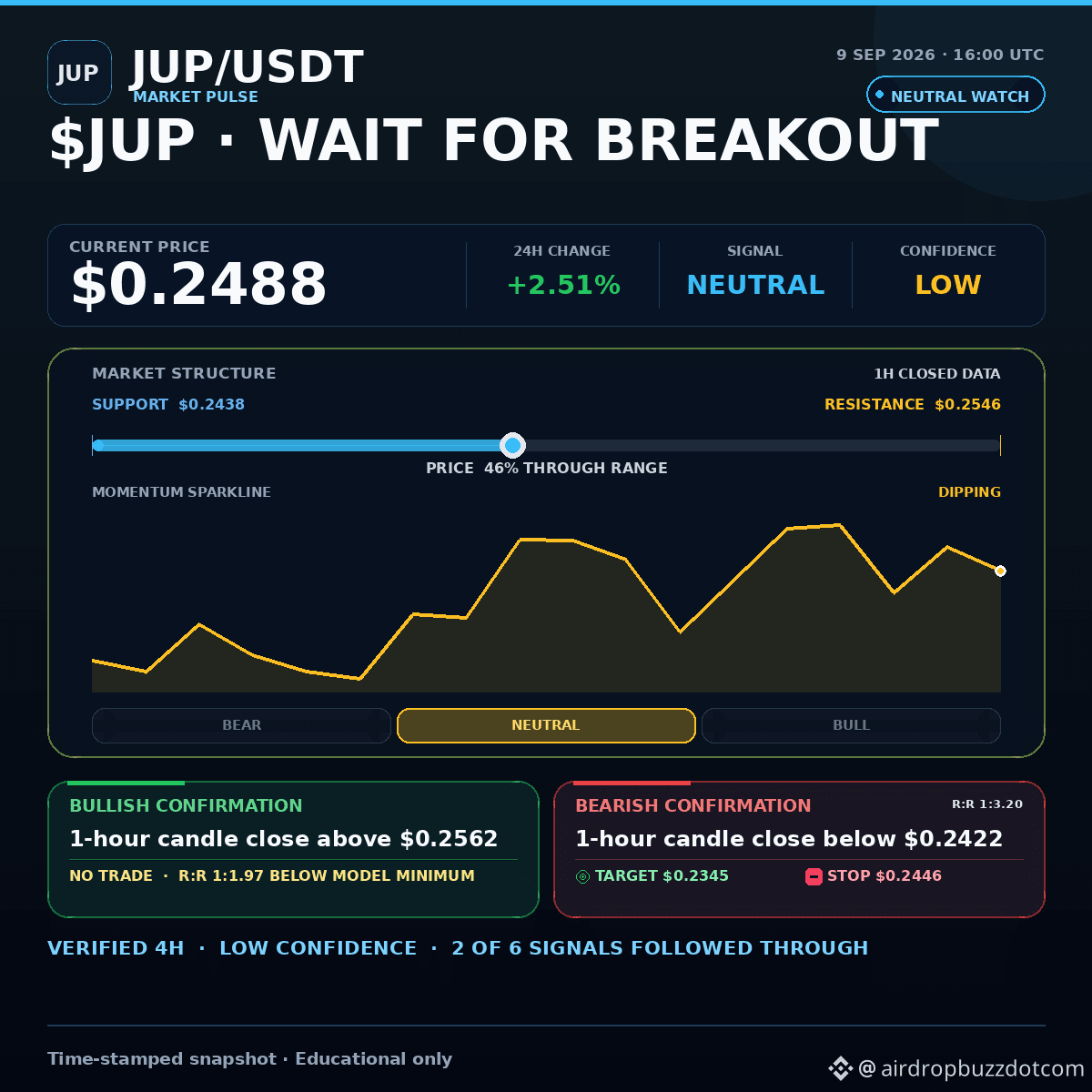
One 1H close can change the $JUP read. The wick alone cannot.
📊 Snapshot
• Price: $0.2488
• 24H: +2.51%
• Bias: Neutral
📈 Bull Trigger
1-hour close above $0.2562 with open interest confirmation
📉 Bear Trigger
1-hour close below $0.2422 with open interest confirmation
🎯 Signal Read
The useful signal is the first confirmed close that settles the current fight for control, not another intraday wick.
📌 Confidence
Low · Low historical confidence · 2 of 6 directional moves were favorable
Signal Quality
- OI: Flat (+0.94%)
- 4H: Bullish | 1D: Bullish (Aligned)
- ATR filter: 0.50 ATR ($0.003136)
- Risk/reward: 1:3.20
Bear scenario risk plan
- Entry: $0.2422
- Stop: $0.2446
- Target: $0.2345
Triggers confirm conditions rather than price targets, so always wait for the candle close.
Front-run it or wait? Reply FRONT-RUN or WAIT.
#JUP #Jupiter #CryptoTrading #MarketPulse
Educational only. Time-stamped market snapshot, not financial advice.
One 1H close can change the $JUP read. The wick alone cannot.
📊 Snapshot
• Price: $0.2488
• 24H: +2.51%
• Bias: Neutral
📈 Bull Trigger
1-hour close above $0.2562 with open interest confirmation
📉 Bear Trigger
1-hour close below $0.2422 with open interest confirmation
🎯 Signal Read
The useful signal is the first confirmed close that settles the current fight for control, not another intraday wick.
📌 Confidence
Low · Low historical confidence · 2 of 6 directional moves were favorable
Signal Quality
- OI: Flat (+0.94%)
- 4H: Bullish | 1D: Bullish (Aligned)
- ATR filter: 0.50 ATR ($0.003136)
- Risk/reward: 1:3.20
Bear scenario risk plan
- Entry: $0.2422
- Stop: $0.2446
- Target: $0.2345
Triggers confirm conditions rather than price targets, so always wait for the candle close.
Front-run it or wait? Reply FRONT-RUN or WAIT.
#JUP #Jupiter #CryptoTrading #MarketPulse
Educational only. Time-stamped market snapshot, not financial advice.
📊 Snapshot
• Price: $0.2488
• 24H: +2.51%
• Bias: Neutral
📈 Bull Trigger
1-hour close above $0.2562 with open interest confirmation
📉 Bear Trigger
1-hour close below $0.2422 with open interest confirmation
🎯 Signal Read
The useful signal is the first confirmed close that settles the current fight for control, not another intraday wick.
📌 Confidence
Low · Low historical confidence · 2 of 6 directional moves were favorable
Signal Quality
- OI: Flat (+0.94%)
- 4H: Bullish | 1D: Bullish (Aligned)
- ATR filter: 0.50 ATR ($0.003136)
- Risk/reward: 1:3.20
Bear scenario risk plan
- Entry: $0.2422
- Stop: $0.2446
- Target: $0.2345
Triggers confirm conditions rather than price targets, so always wait for the candle close.
Front-run it or wait? Reply FRONT-RUN or WAIT.
#JUP #Jupiter #CryptoTrading #MarketPulse
Educational only. Time-stamped market snapshot, not financial advice.
36
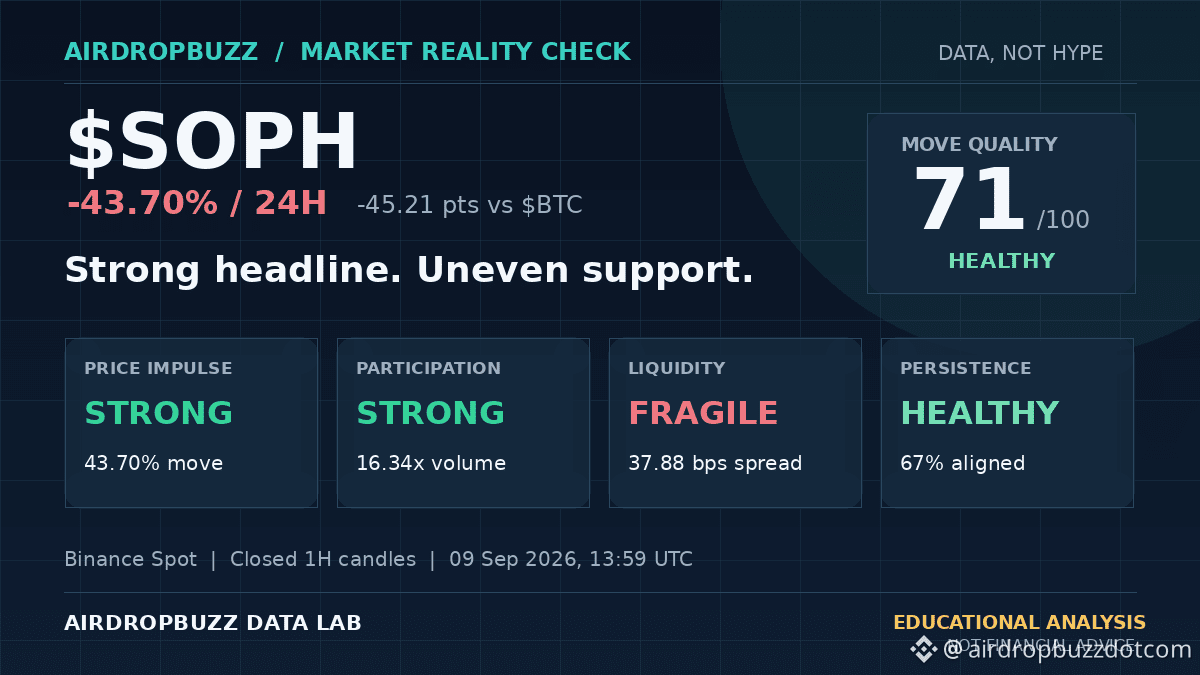
Article
$SOPH Moved -43.70% - But Liquidity Still Looks Fragile$SOPH fell 43.70% over the latest 24 closed hourly candles and lagged $BTC by 45.21 percentage points. The headline is easy to see. The more useful question is whether volume, flow, persistence and liquidity support it together.
THE QUICK READ
Strong headline. Uneven support. The Move Quality score is 71/100, classified as Healthy.
PARTICIPATION CHECK
Recent hourly quote volume is 16.34x its baseline, which is well above its recent hourly baseline. Trade count is 9.77x baseline, so participation is well above its recent hourly baseline. During the same six-hour sample, taker buys represented 49.4% of quote volume; aggressive order flow remained close to balanced.
MOVE QUALITY
The price impulse is stronger than the composite quality beneath it. Turnover can still be elevated, but weaker persistence, order-flow balance or book depth makes follow-through more dependent on fresh participation. Directional persistence was 67% across the six most recent closed hourly candles.
LIQUIDITY CHECK
The observed bid-ask spread was 37.88 basis points. Balanced visible depth within 0.5% of price was approximately $1.5K. The move deserves extra caution because available depth or spread quality was less convincing than the headline activity.
WHAT WOULD CHANGE THIS READING?
A stronger reading would require price activity, turnover and trade breadth to remain aligned across several closed candles. A weaker reading would appear if the headline move continues while volume, trade count or balanced depth deteriorates. This framework evaluates participation quality; it is not a prediction of the next candle.
BOTTOM LINE
Strong headline. Uneven support. Which would you need to see improve first here: volume, trade breadth or order-book depth?
$SOPH $BTC #MarketStructure #CryptoEducation
Method: AirdropBuzz Data Lab Reality Check v1.0.0 compares price impulse with volume, trade breadth, taker flow, persistence and visible liquidity using fixed rules.
Data: Binance Spot closed 1H candles, 24H ticker and order-book snapshot at 2026-09-09 13:59 UTC. Educational analysis only; not financial advice.
$SOPH Moved -43.70% - But Liquidity Still Looks Fragile
$SOPH fell 43.70% over the latest 24 closed hourly candles and lagged $BTC by 45.21 percentage points. The headline is easy to see. The more useful question is whether volume, flow, persistence and liquidity support it together.
THE QUICK READ
Strong headline. Uneven support. The Move Quality score is 71/100, classified as Healthy.
PARTICIPATION CHECK
Recent hourly quote volume is 16.34x its baseline, which is well above its recent hourly baseline. Trade count is 9.77x baseline, so participation is well above its recent hourly baseline. During the same six-hour sample, taker buys represented 49.4% of quote volume; aggressive order flow remained close to balanced.
MOVE QUALITY
The price impulse is stronger than the composite quality beneath it. Turnover can still be elevated, but weaker persistence, order-flow balance or book depth makes follow-through more dependent on fresh participation. Directional persistence was 67% across the six most recent closed hourly candles.
LIQUIDITY CHECK
The observed bid-ask spread was 37.88 basis points. Balanced visible depth within 0.5% of price was approximately $1.5K. The move deserves extra caution because available depth or spread quality was less convincing than the headline activity.
WHAT WOULD CHANGE THIS READING?
A stronger reading would require price activity, turnover and trade breadth to remain aligned across several closed candles. A weaker reading would appear if the headline move continues while volume, trade count or balanced depth deteriorates. This framework evaluates participation quality; it is not a prediction of the next candle.
BOTTOM LINE
Strong headline. Uneven support. Which would you need to see improve first here: volume, trade breadth or order-book depth?
$SOPH $BTC #MarketStructure #CryptoEducation
Method: AirdropBuzz Data Lab Reality Check v1.0.0 compares price impulse with volume, trade breadth, taker flow, persistence and visible liquidity using fixed rules.
Data: Binance Spot closed 1H candles, 24H ticker and order-book snapshot at 2026-09-09 13:59 UTC. Educational analysis only; not financial advice.
THE QUICK READ
Strong headline. Uneven support. The Move Quality score is 71/100, classified as Healthy.
PARTICIPATION CHECK
Recent hourly quote volume is 16.34x its baseline, which is well above its recent hourly baseline. Trade count is 9.77x baseline, so participation is well above its recent hourly baseline. During the same six-hour sample, taker buys represented 49.4% of quote volume; aggressive order flow remained close to balanced.
MOVE QUALITY
The price impulse is stronger than the composite quality beneath it. Turnover can still be elevated, but weaker persistence, order-flow balance or book depth makes follow-through more dependent on fresh participation. Directional persistence was 67% across the six most recent closed hourly candles.
LIQUIDITY CHECK
The observed bid-ask spread was 37.88 basis points. Balanced visible depth within 0.5% of price was approximately $1.5K. The move deserves extra caution because available depth or spread quality was less convincing than the headline activity.
WHAT WOULD CHANGE THIS READING?
A stronger reading would require price activity, turnover and trade breadth to remain aligned across several closed candles. A weaker reading would appear if the headline move continues while volume, trade count or balanced depth deteriorates. This framework evaluates participation quality; it is not a prediction of the next candle.
BOTTOM LINE
Strong headline. Uneven support. Which would you need to see improve first here: volume, trade breadth or order-book depth?
$SOPH $BTC #MarketStructure #CryptoEducation
Method: AirdropBuzz Data Lab Reality Check v1.0.0 compares price impulse with volume, trade breadth, taker flow, persistence and visible liquidity using fixed rules.
Data: Binance Spot closed 1H candles, 24H ticker and order-book snapshot at 2026-09-09 13:59 UTC. Educational analysis only; not financial advice.
16
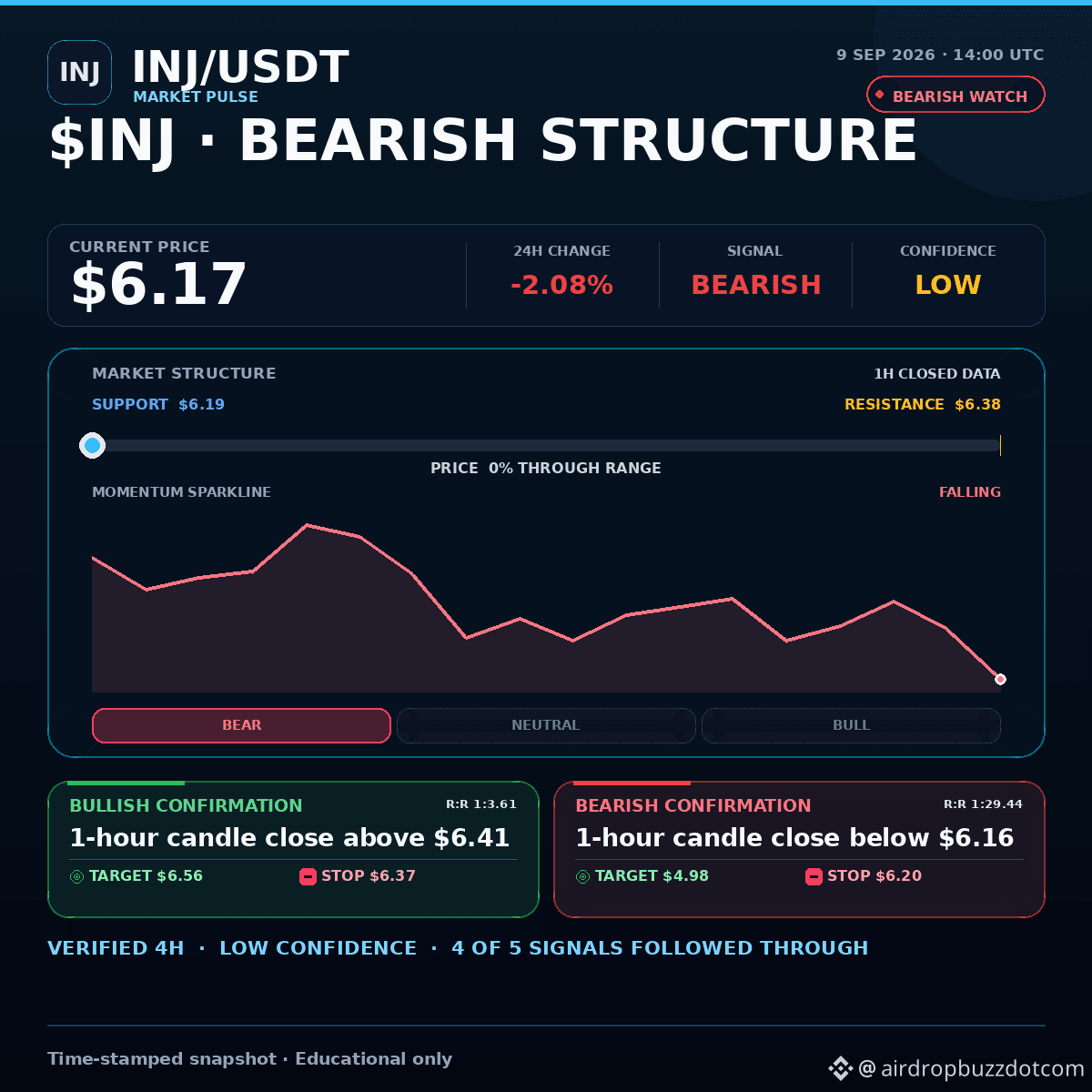
Nobody's talking about the harder $INJ question: does confirmation support the move?
📊 Snapshot
• Price: $6.17
• 24H: -2.08%
• Bias: Bearish
📈 Bull Trigger
1-hour reclaim above $6.41 with rising open interest
📉 Bear Trigger
1-hour close below $6.16 with rising open interest
🎯 Signal Read
Pressure is concentrated at support; a closed break would carry more information than another intraday probe.
📌 Confidence
Low · Low historical confidence · 4 of 5 directional moves were favorable
Signal Quality
- OI: Flat (-1.38%)
- 4H: Bullish | 1D: Bullish (Aligned)
- ATR filter: 0.50 ATR ($0.05)
- Risk/reward: 1:29.44
Bear scenario risk plan
- Entry: $6.16
- Stop: $6.20
- Target: $4.98
Trigger levels define confirmation; they do not guarantee where price will finish.
Bounce or breakdown? Reply BOUNCE or BREAK.
#INJ #Injective #CryptoTrading #MarketPulse
Educational only. Time-stamped market snapshot, not financial advice.
Nobody's talking about the harder $INJ question: does confirmation support the move?
📊 Snapshot
• Price: $6.17
• 24H: -2.08%
• Bias: Bearish
📈 Bull Trigger
1-hour reclaim above $6.41 with rising open interest
📉 Bear Trigger
1-hour close below $6.16 with rising open interest
🎯 Signal Read
Pressure is concentrated at support; a closed break would carry more information than another intraday probe.
📌 Confidence
Low · Low historical confidence · 4 of 5 directional moves were favorable
Signal Quality
- OI: Flat (-1.38%)
- 4H: Bullish | 1D: Bullish (Aligned)
- ATR filter: 0.50 ATR ($0.05)
- Risk/reward: 1:29.44
Bear scenario risk plan
- Entry: $6.16
- Stop: $6.20
- Target: $4.98
Trigger levels define confirmation; they do not guarantee where price will finish.
Bounce or breakdown? Reply BOUNCE or BREAK.
#INJ #Injective #CryptoTrading #MarketPulse
Educational only. Time-stamped market snapshot, not financial advice.
📊 Snapshot
• Price: $6.17
• 24H: -2.08%
• Bias: Bearish
📈 Bull Trigger
1-hour reclaim above $6.41 with rising open interest
📉 Bear Trigger
1-hour close below $6.16 with rising open interest
🎯 Signal Read
Pressure is concentrated at support; a closed break would carry more information than another intraday probe.
📌 Confidence
Low · Low historical confidence · 4 of 5 directional moves were favorable
Signal Quality
- OI: Flat (-1.38%)
- 4H: Bullish | 1D: Bullish (Aligned)
- ATR filter: 0.50 ATR ($0.05)
- Risk/reward: 1:29.44
Bear scenario risk plan
- Entry: $6.16
- Stop: $6.20
- Target: $4.98
Trigger levels define confirmation; they do not guarantee where price will finish.
Bounce or breakdown? Reply BOUNCE or BREAK.
#INJ #Injective #CryptoTrading #MarketPulse
Educational only. Time-stamped market snapshot, not financial advice.
176
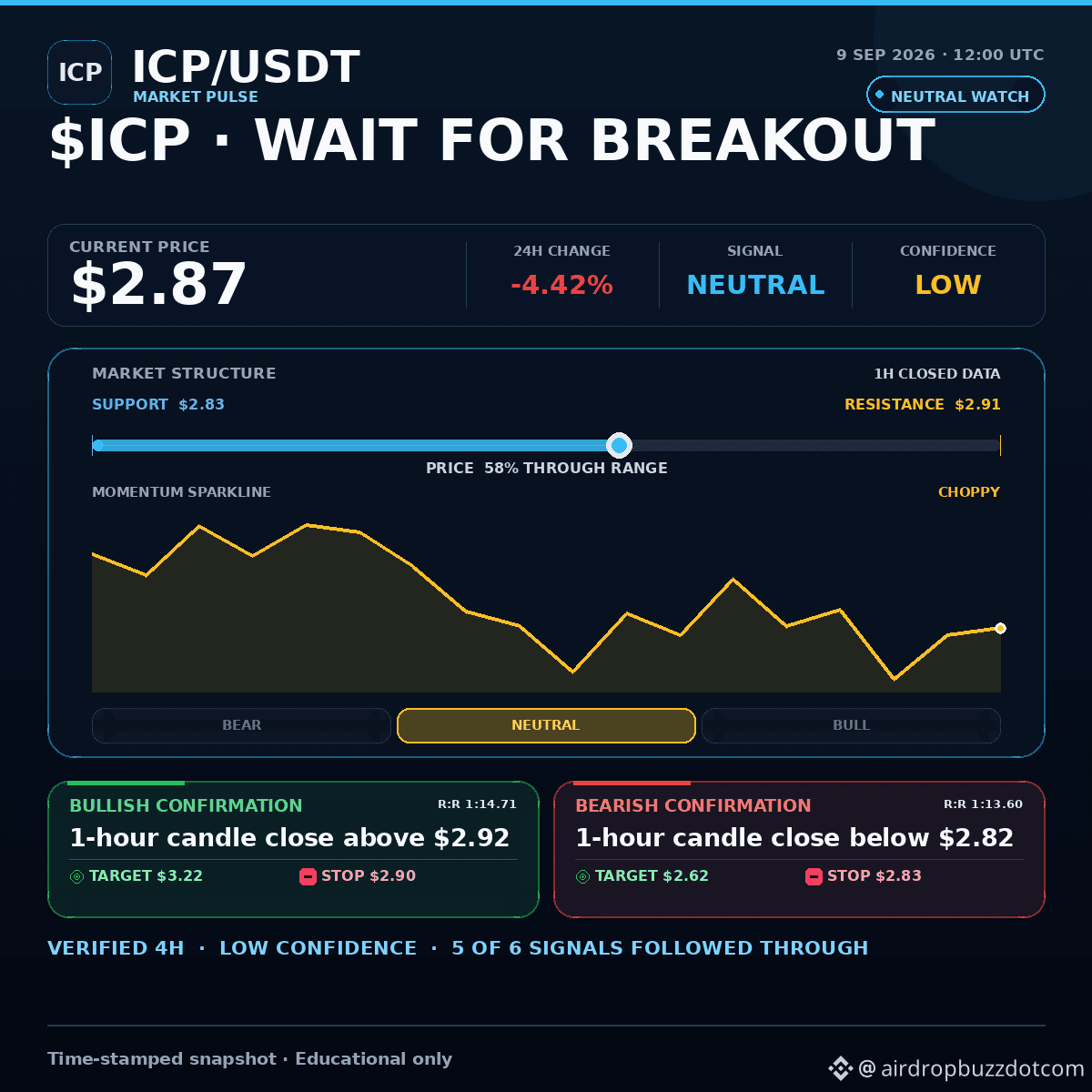
$ICP has a track record to beat: 5 of 6 recent directional moves were favorable.
📊 Snapshot
• Price: $2.87
• 24H: -4.42%
• Bias: Neutral
📈 Bull Trigger
1-hour close above $2.92 with open interest confirmation
📉 Bear Trigger
1-hour close below $2.82 with open interest confirmation
🎯 Signal Read
Both triggers remain possible, but only a confirmed break turns the current noise into a directional read.
📌 Confidence
Low · Low historical confidence · 5 of 6 directional moves were favorable
Signal Quality
- OI: Flat (+0.32%)
- 4H: Neutral | 1D: Bullish (Mixed)
- ATR filter: 0.50 ATR ($0.02)
- Risk/reward: 1:13.60
Bear scenario risk plan
- Entry: $2.82
- Stop: $2.83
- Target: $2.62
Use closed-candle confirmation because these levels define conditions, not future price forecasts.
Break or fake? Reply BREAK or FAKE.
#ICP #InternetComputer #CryptoTrading #MarketPulse
Educational only. Time-stamped market snapshot, not financial advice.
$ICP has a track record to beat: 5 of 6 recent directional moves were favorable.
📊 Snapshot
• Price: $2.87
• 24H: -4.42%
• Bias: Neutral
📈 Bull Trigger
1-hour close above $2.92 with open interest confirmation
📉 Bear Trigger
1-hour close below $2.82 with open interest confirmation
🎯 Signal Read
Both triggers remain possible, but only a confirmed break turns the current noise into a directional read.
📌 Confidence
Low · Low historical confidence · 5 of 6 directional moves were favorable
Signal Quality
- OI: Flat (+0.32%)
- 4H: Neutral | 1D: Bullish (Mixed)
- ATR filter: 0.50 ATR ($0.02)
- Risk/reward: 1:13.60
Bear scenario risk plan
- Entry: $2.82
- Stop: $2.83
- Target: $2.62
Use closed-candle confirmation because these levels define conditions, not future price forecasts.
Break or fake? Reply BREAK or FAKE.
#ICP #InternetComputer #CryptoTrading #MarketPulse
Educational only. Time-stamped market snapshot, not financial advice.
📊 Snapshot
• Price: $2.87
• 24H: -4.42%
• Bias: Neutral
📈 Bull Trigger
1-hour close above $2.92 with open interest confirmation
📉 Bear Trigger
1-hour close below $2.82 with open interest confirmation
🎯 Signal Read
Both triggers remain possible, but only a confirmed break turns the current noise into a directional read.
📌 Confidence
Low · Low historical confidence · 5 of 6 directional moves were favorable
Signal Quality
- OI: Flat (+0.32%)
- 4H: Neutral | 1D: Bullish (Mixed)
- ATR filter: 0.50 ATR ($0.02)
- Risk/reward: 1:13.60
Bear scenario risk plan
- Entry: $2.82
- Stop: $2.83
- Target: $2.62
Use closed-candle confirmation because these levels define conditions, not future price forecasts.
Break or fake? Reply BREAK or FAKE.
#ICP #InternetComputer #CryptoTrading #MarketPulse
Educational only. Time-stamped market snapshot, not financial advice.
9
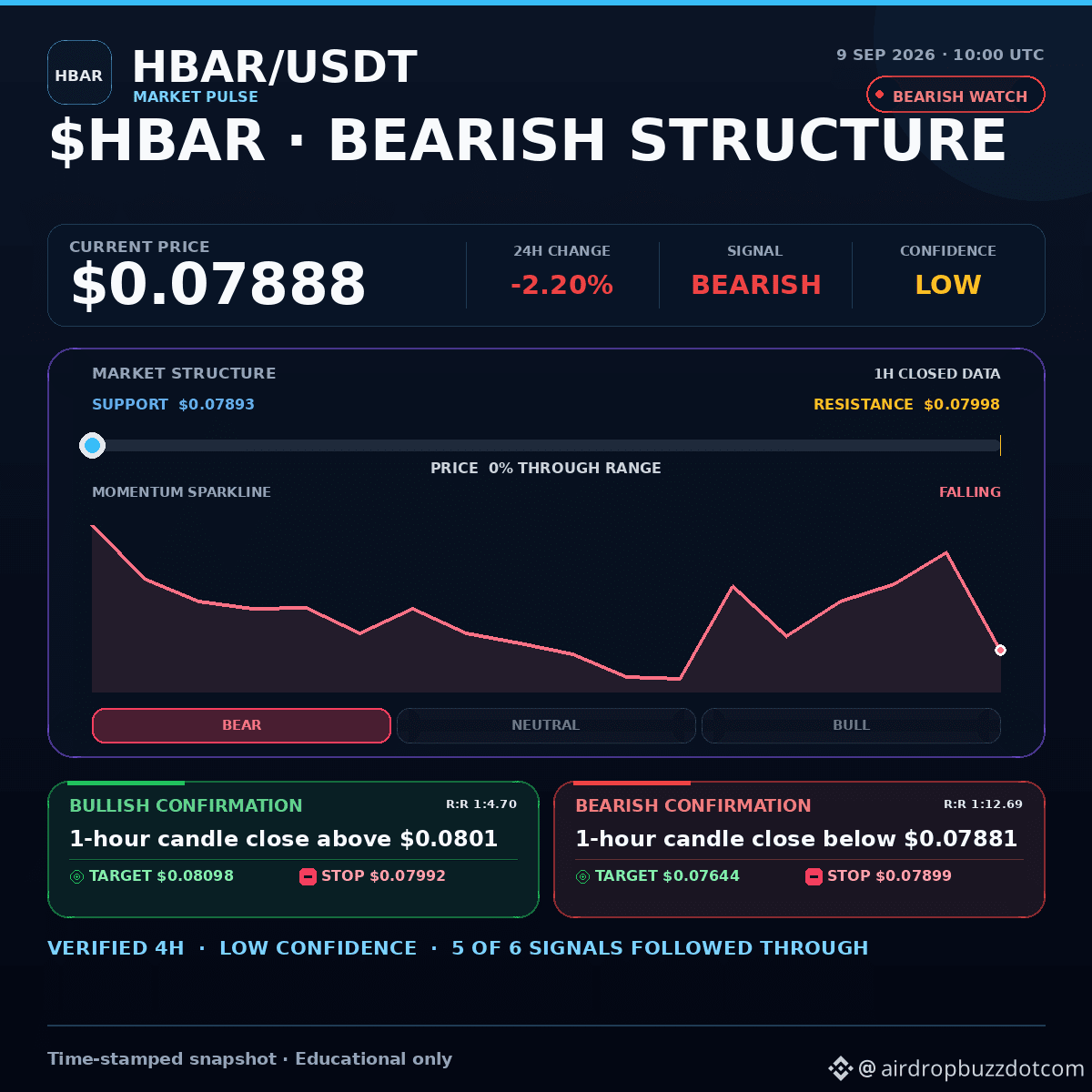
Bull trap or real $HBAR confirmation?
📊 Snapshot
• Price: $0.07888
• 24H: -2.20%
• Bias: Bearish
📈 Bull Trigger
1-hour reclaim above $0.0801 with rising open interest
📉 Bear Trigger
1-hour close below $0.07881 with rising open interest
🎯 Signal Read
Support is already being tested, so a confirmed close below it would strengthen downside risk rather than merely extend intraday noise.
📌 Confidence
Low · Low historical confidence · 5 of 6 directional moves were favorable
Signal Quality
- OI: Flat (-0.27%)
- 4H: Bearish | 1D: Bullish (Conflict)
- ATR filter: 0.50 ATR ($0.0002486)
- Risk/reward: 1:4.70
Bull scenario risk plan
- Entry: $0.0801
- Stop: $0.07992
- Target: $0.08098
A trigger marks confirmation, not a guaranteed entry, outcome, or price destination.
Wait or act? Reply WAIT or GO.
#HBAR #Hedera #CryptoTrading #MarketPulse
Educational only. Time-stamped market snapshot, not financial advice.
Bull trap or real $HBAR confirmation?
📊 Snapshot
• Price: $0.07888
• 24H: -2.20%
• Bias: Bearish
📈 Bull Trigger
1-hour reclaim above $0.0801 with rising open interest
📉 Bear Trigger
1-hour close below $0.07881 with rising open interest
🎯 Signal Read
Support is already being tested, so a confirmed close below it would strengthen downside risk rather than merely extend intraday noise.
📌 Confidence
Low · Low historical confidence · 5 of 6 directional moves were favorable
Signal Quality
- OI: Flat (-0.27%)
- 4H: Bearish | 1D: Bullish (Conflict)
- ATR filter: 0.50 ATR ($0.0002486)
- Risk/reward: 1:4.70
Bull scenario risk plan
- Entry: $0.0801
- Stop: $0.07992
- Target: $0.08098
A trigger marks confirmation, not a guaranteed entry, outcome, or price destination.
Wait or act? Reply WAIT or GO.
#HBAR #Hedera #CryptoTrading #MarketPulse
Educational only. Time-stamped market snapshot, not financial advice.
📊 Snapshot
• Price: $0.07888
• 24H: -2.20%
• Bias: Bearish
📈 Bull Trigger
1-hour reclaim above $0.0801 with rising open interest
📉 Bear Trigger
1-hour close below $0.07881 with rising open interest
🎯 Signal Read
Support is already being tested, so a confirmed close below it would strengthen downside risk rather than merely extend intraday noise.
📌 Confidence
Low · Low historical confidence · 5 of 6 directional moves were favorable
Signal Quality
- OI: Flat (-0.27%)
- 4H: Bearish | 1D: Bullish (Conflict)
- ATR filter: 0.50 ATR ($0.0002486)
- Risk/reward: 1:4.70
Bull scenario risk plan
- Entry: $0.0801
- Stop: $0.07992
- Target: $0.08098
A trigger marks confirmation, not a guaranteed entry, outcome, or price destination.
Wait or act? Reply WAIT or GO.
#HBAR #Hedera #CryptoTrading #MarketPulse
Educational only. Time-stamped market snapshot, not financial advice.
5
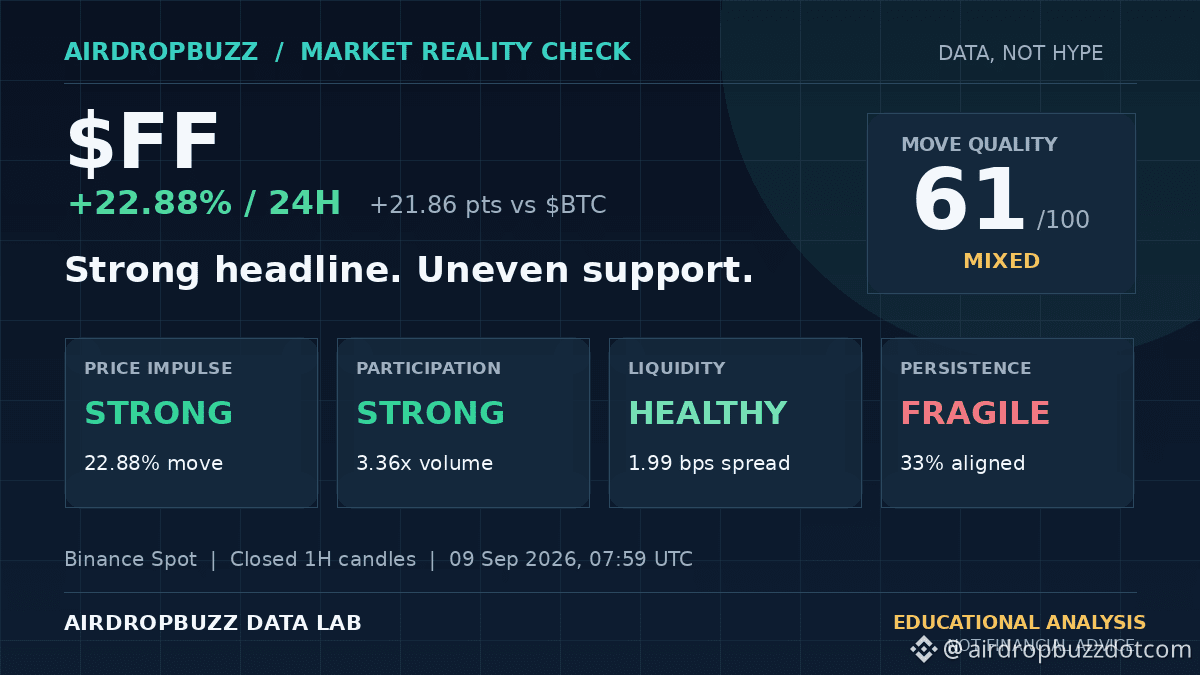
Article
$FF Moved +22.88% - But Persistence Has Not Confirmed$FF rose 22.88% over the latest 24 closed hourly candles and outperformed $BTC by 21.86 percentage points. The headline is easy to see. The more useful question is whether volume, flow, persistence and liquidity support it together.
THE QUICK READ
Strong headline. Uneven support. The Move Quality score is 61/100, classified as Mixed.
PARTICIPATION CHECK
Recent hourly quote volume is 3.36x its baseline, which is well above its recent hourly baseline. Trade count is 3.29x baseline, so participation is well above its recent hourly baseline. During the same six-hour sample, taker buys represented 38.5% of quote volume; sellers accounted for a clear majority of aggressive flow.
MOVE QUALITY
The price impulse is stronger than the composite quality beneath it. Turnover can still be elevated, but weaker persistence, order-flow balance or book depth makes follow-through more dependent on fresh participation. Directional persistence was 33% across the six most recent closed hourly candles.
LIQUIDITY CHECK
The observed bid-ask spread was 1.99 basis points. Balanced visible depth within 0.5% of price was approximately $12.1K. The move deserves extra caution because available depth or spread quality was less convincing than the headline activity.
WHAT WOULD CHANGE THIS READING?
A stronger reading would require price activity, turnover and trade breadth to remain aligned across several closed candles. A weaker reading would appear if the headline move continues while volume, trade count or balanced depth deteriorates. This framework evaluates participation quality; it is not a prediction of the next candle.
BOTTOM LINE
Strong headline. Uneven support. Which would you need to see improve first here: volume, trade breadth or order-book depth?
$FF $BTC #MarketStructure #CryptoEducation
Method: AirdropBuzz Data Lab Reality Check v1.0.0 compares price impulse with volume, trade breadth, taker flow, persistence and visible liquidity using fixed rules.
Data: Binance Spot closed 1H candles, 24H ticker and order-book snapshot at 2026-09-09 07:59 UTC. Educational analysis only; not financial advice.
$FF Moved +22.88% - But Persistence Has Not Confirmed
$FF rose 22.88% over the latest 24 closed hourly candles and outperformed $BTC by 21.86 percentage points. The headline is easy to see. The more useful question is whether volume, flow, persistence and liquidity support it together.
THE QUICK READ
Strong headline. Uneven support. The Move Quality score is 61/100, classified as Mixed.
PARTICIPATION CHECK
Recent hourly quote volume is 3.36x its baseline, which is well above its recent hourly baseline. Trade count is 3.29x baseline, so participation is well above its recent hourly baseline. During the same six-hour sample, taker buys represented 38.5% of quote volume; sellers accounted for a clear majority of aggressive flow.
MOVE QUALITY
The price impulse is stronger than the composite quality beneath it. Turnover can still be elevated, but weaker persistence, order-flow balance or book depth makes follow-through more dependent on fresh participation. Directional persistence was 33% across the six most recent closed hourly candles.
LIQUIDITY CHECK
The observed bid-ask spread was 1.99 basis points. Balanced visible depth within 0.5% of price was approximately $12.1K. The move deserves extra caution because available depth or spread quality was less convincing than the headline activity.
WHAT WOULD CHANGE THIS READING?
A stronger reading would require price activity, turnover and trade breadth to remain aligned across several closed candles. A weaker reading would appear if the headline move continues while volume, trade count or balanced depth deteriorates. This framework evaluates participation quality; it is not a prediction of the next candle.
BOTTOM LINE
Strong headline. Uneven support. Which would you need to see improve first here: volume, trade breadth or order-book depth?
$FF $BTC #MarketStructure #CryptoEducation
Method: AirdropBuzz Data Lab Reality Check v1.0.0 compares price impulse with volume, trade breadth, taker flow, persistence and visible liquidity using fixed rules.
Data: Binance Spot closed 1H candles, 24H ticker and order-book snapshot at 2026-09-09 07:59 UTC. Educational analysis only; not financial advice.
THE QUICK READ
Strong headline. Uneven support. The Move Quality score is 61/100, classified as Mixed.
PARTICIPATION CHECK
Recent hourly quote volume is 3.36x its baseline, which is well above its recent hourly baseline. Trade count is 3.29x baseline, so participation is well above its recent hourly baseline. During the same six-hour sample, taker buys represented 38.5% of quote volume; sellers accounted for a clear majority of aggressive flow.
MOVE QUALITY
The price impulse is stronger than the composite quality beneath it. Turnover can still be elevated, but weaker persistence, order-flow balance or book depth makes follow-through more dependent on fresh participation. Directional persistence was 33% across the six most recent closed hourly candles.
LIQUIDITY CHECK
The observed bid-ask spread was 1.99 basis points. Balanced visible depth within 0.5% of price was approximately $12.1K. The move deserves extra caution because available depth or spread quality was less convincing than the headline activity.
WHAT WOULD CHANGE THIS READING?
A stronger reading would require price activity, turnover and trade breadth to remain aligned across several closed candles. A weaker reading would appear if the headline move continues while volume, trade count or balanced depth deteriorates. This framework evaluates participation quality; it is not a prediction of the next candle.
BOTTOM LINE
Strong headline. Uneven support. Which would you need to see improve first here: volume, trade breadth or order-book depth?
$FF $BTC #MarketStructure #CryptoEducation
Method: AirdropBuzz Data Lab Reality Check v1.0.0 compares price impulse with volume, trade breadth, taker flow, persistence and visible liquidity using fixed rules.
Data: Binance Spot closed 1H candles, 24H ticker and order-book snapshot at 2026-09-09 07:59 UTC. Educational analysis only; not financial advice.
34
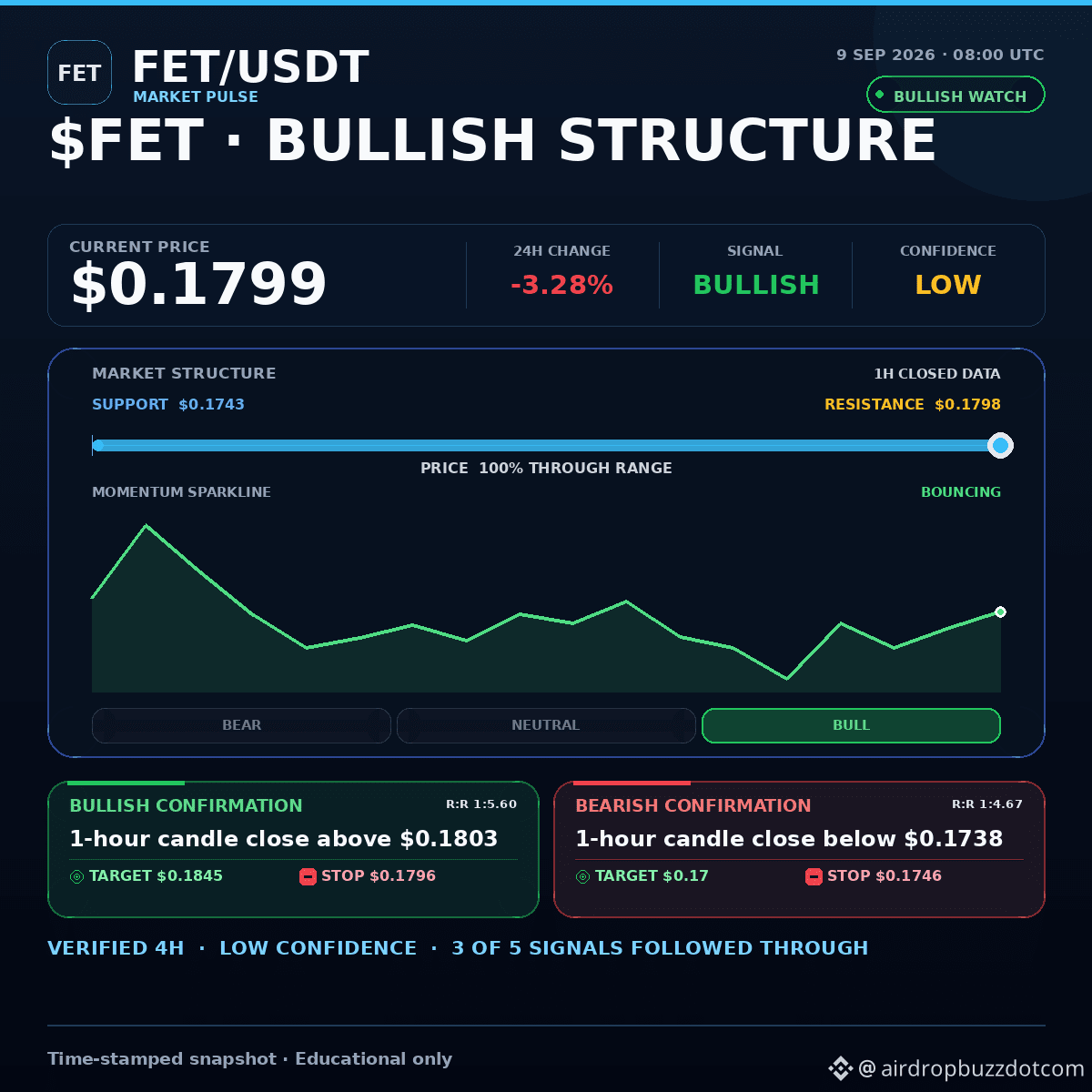
The $FET price move is obvious. Signal quality is the part worth watching.
📊 Snapshot
• Price: $0.1799
• 24H: -3.28%
• Bias: Bullish
📈 Bull Trigger
1-hour close above $0.1803 with rising open interest
📉 Bear Trigger
1-hour close below $0.1738 with rising open interest
🎯 Signal Read
The breakout attempt is visible, but the signal improves only if price gains acceptance instead of leaving a wick through resistance.
📌 Confidence
Low · Low historical confidence · 3 of 5 directional moves were favorable
Signal Quality
- OI: Flat (+0.21%)
- 4H: Bullish | 1D: Bullish (Aligned)
- ATR filter: 0.50 ATR ($0.001)
- Risk/reward: 1:4.67
Bear scenario risk plan
- Entry: $0.1738
- Stop: $0.1746
- Target: $0.17
Wait for a closed candle—trigger levels confirm conditions; they do not predict targets.
Bull or bear? Drop 🐂 or 🐻.
#FET #ArtificialSuperintelligenceAlliance #CryptoTrading #MarketPulse
Educational only. Time-stamped market snapshot, not financial advice.
The $FET price move is obvious. Signal quality is the part worth watching.
📊 Snapshot
• Price: $0.1799
• 24H: -3.28%
• Bias: Bullish
📈 Bull Trigger
1-hour close above $0.1803 with rising open interest
📉 Bear Trigger
1-hour close below $0.1738 with rising open interest
🎯 Signal Read
The breakout attempt is visible, but the signal improves only if price gains acceptance instead of leaving a wick through resistance.
📌 Confidence
Low · Low historical confidence · 3 of 5 directional moves were favorable
Signal Quality
- OI: Flat (+0.21%)
- 4H: Bullish | 1D: Bullish (Aligned)
- ATR filter: 0.50 ATR ($0.001)
- Risk/reward: 1:4.67
Bear scenario risk plan
- Entry: $0.1738
- Stop: $0.1746
- Target: $0.17
Wait for a closed candle—trigger levels confirm conditions; they do not predict targets.
Bull or bear? Drop 🐂 or 🐻.
#FET #ArtificialSuperintelligenceAlliance #CryptoTrading #MarketPulse
Educational only. Time-stamped market snapshot, not financial advice.
📊 Snapshot
• Price: $0.1799
• 24H: -3.28%
• Bias: Bullish
📈 Bull Trigger
1-hour close above $0.1803 with rising open interest
📉 Bear Trigger
1-hour close below $0.1738 with rising open interest
🎯 Signal Read
The breakout attempt is visible, but the signal improves only if price gains acceptance instead of leaving a wick through resistance.
📌 Confidence
Low · Low historical confidence · 3 of 5 directional moves were favorable
Signal Quality
- OI: Flat (+0.21%)
- 4H: Bullish | 1D: Bullish (Aligned)
- ATR filter: 0.50 ATR ($0.001)
- Risk/reward: 1:4.67
Bear scenario risk plan
- Entry: $0.1738
- Stop: $0.1746
- Target: $0.17
Wait for a closed candle—trigger levels confirm conditions; they do not predict targets.
Bull or bear? Drop 🐂 or 🐻.
#FET #ArtificialSuperintelligenceAlliance #CryptoTrading #MarketPulse
Educational only. Time-stamped market snapshot, not financial advice.
1
174
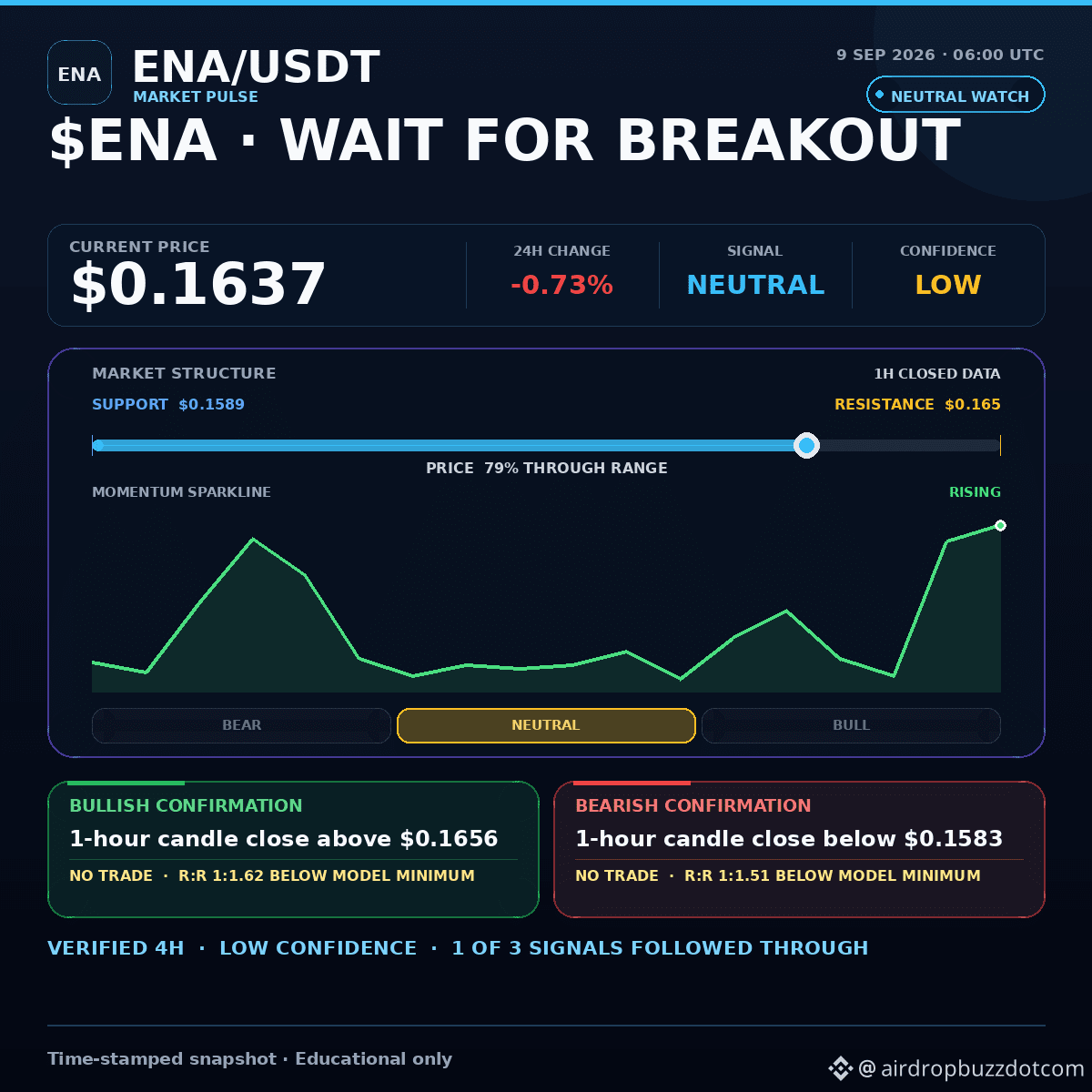
Before trusting the next $ENA break, note that 1 of 3 recent directional moves were favorable.
📊 Snapshot
• Price: $0.1637
• 24H: -0.73%
• Bias: Neutral
📈 Bull Trigger
1-hour close above $0.1656 with open interest confirmation
📉 Bear Trigger
1-hour close below $0.1583 with open interest confirmation
🎯 Signal Read
The useful signal is the first confirmed close that settles the current fight for control, not another intraday wick.
📌 Confidence
Low · Low historical confidence · 1 of 3 directional moves were favorable
Signal Quality
- OI: Flat (+0.40%)
- 4H: Bearish | 1D: Bullish (Conflict)
- ATR filter: 0.50 ATR ($0.001164)
- Risk/reward: 1:1.62 - below minimum
Bull scenario risk plan
- Entry: $0.1656
- Stop: $0.1647
- Target: $0.168
A trigger marks confirmation, not a guaranteed entry, outcome, or price destination.
Break or fake? Reply BREAK or FAKE.
#ENA #Ethena #CryptoTrading #MarketPulse
Educational only. Time-stamped market snapshot, not financial advice.
Before trusting the next $ENA break, note that 1 of 3 recent directional moves were favorable.
📊 Snapshot
• Price: $0.1637
• 24H: -0.73%
• Bias: Neutral
📈 Bull Trigger
1-hour close above $0.1656 with open interest confirmation
📉 Bear Trigger
1-hour close below $0.1583 with open interest confirmation
🎯 Signal Read
The useful signal is the first confirmed close that settles the current fight for control, not another intraday wick.
📌 Confidence
Low · Low historical confidence · 1 of 3 directional moves were favorable
Signal Quality
- OI: Flat (+0.40%)
- 4H: Bearish | 1D: Bullish (Conflict)
- ATR filter: 0.50 ATR ($0.001164)
- Risk/reward: 1:1.62 - below minimum
Bull scenario risk plan
- Entry: $0.1656
- Stop: $0.1647
- Target: $0.168
A trigger marks confirmation, not a guaranteed entry, outcome, or price destination.
Break or fake? Reply BREAK or FAKE.
#ENA #Ethena #CryptoTrading #MarketPulse
Educational only. Time-stamped market snapshot, not financial advice.
📊 Snapshot
• Price: $0.1637
• 24H: -0.73%
• Bias: Neutral
📈 Bull Trigger
1-hour close above $0.1656 with open interest confirmation
📉 Bear Trigger
1-hour close below $0.1583 with open interest confirmation
🎯 Signal Read
The useful signal is the first confirmed close that settles the current fight for control, not another intraday wick.
📌 Confidence
Low · Low historical confidence · 1 of 3 directional moves were favorable
Signal Quality
- OI: Flat (+0.40%)
- 4H: Bearish | 1D: Bullish (Conflict)
- ATR filter: 0.50 ATR ($0.001164)
- Risk/reward: 1:1.62 - below minimum
Bull scenario risk plan
- Entry: $0.1656
- Stop: $0.1647
- Target: $0.168
A trigger marks confirmation, not a guaranteed entry, outcome, or price destination.
Break or fake? Reply BREAK or FAKE.
#ENA #Ethena #CryptoTrading #MarketPulse
Educational only. Time-stamped market snapshot, not financial advice.
152
🚀 Opening a LONG on $ONG
📍 Entry: 0.09341
⚡ Leverage: 5X
📈 Position: ONGUSDT Perp
Watching momentum closely — looking for continuation from here. 👀
#ONG #Crypto #BinanceSquare #Trading
🚀 Opening a LONG on $ONG
📍 Entry: 0.09341
⚡ Leverage: 5X
📈 Position: ONGUSDT Perp
Watching momentum closely — looking for continuation from here. 👀
#ONG #Crypto #BinanceSquare #Trading
📍 Entry: 0.09341
⚡ Leverage: 5X
📈 Position: ONGUSDT Perp
Watching momentum closely — looking for continuation from here. 👀
#ONG #Crypto #BinanceSquare #Trading
1
1
358
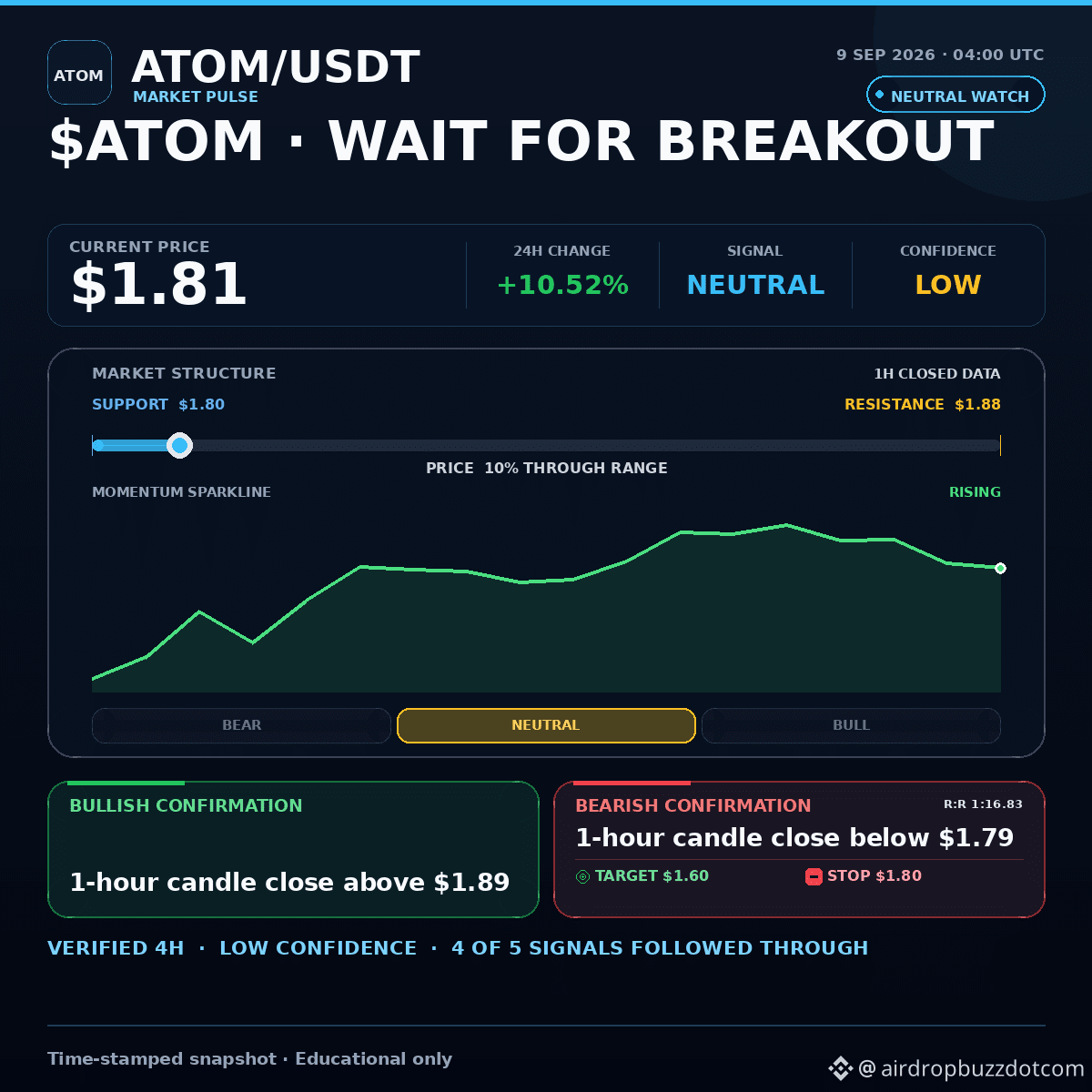
Would you trust the first $ATOM wick—or wait for the close?
📊 Snapshot
• Price: $1.81
• 24H: +10.52%
• Bias: Neutral
📈 Bull Trigger
1-hour close above $1.89 with open interest confirmation
📉 Bear Trigger
1-hour close below $1.79 with open interest confirmation
🎯 Signal Read
Conflicting evidence keeps this conditional, so the close matters more than predicting the direction early.
📌 Confidence
Low · Low historical confidence · 4 of 5 directional moves were favorable
Signal Quality
- OI: Flat (-0.02%)
- 4H: Bullish | 1D: Bullish (Aligned)
- ATR filter: 0.50 ATR ($0.01)
- Risk/reward: 1:16.83
Bear scenario risk plan
- Entry: $1.79
- Stop: $1.80
- Target: $1.60
Use closed-candle confirmation because these levels define conditions, not future price forecasts.
Bull or bear first? Drop 🐂 or 🐻.
#ATOM #Cosmos #CryptoTrading #MarketPulse
Educational only. Time-stamped market snapshot, not financial advice.
Would you trust the first $ATOM wick—or wait for the close?
📊 Snapshot
• Price: $1.81
• 24H: +10.52%
• Bias: Neutral
📈 Bull Trigger
1-hour close above $1.89 with open interest confirmation
📉 Bear Trigger
1-hour close below $1.79 with open interest confirmation
🎯 Signal Read
Conflicting evidence keeps this conditional, so the close matters more than predicting the direction early.
📌 Confidence
Low · Low historical confidence · 4 of 5 directional moves were favorable
Signal Quality
- OI: Flat (-0.02%)
- 4H: Bullish | 1D: Bullish (Aligned)
- ATR filter: 0.50 ATR ($0.01)
- Risk/reward: 1:16.83
Bear scenario risk plan
- Entry: $1.79
- Stop: $1.80
- Target: $1.60
Use closed-candle confirmation because these levels define conditions, not future price forecasts.
Bull or bear first? Drop 🐂 or 🐻.
#ATOM #Cosmos #CryptoTrading #MarketPulse
Educational only. Time-stamped market snapshot, not financial advice.
📊 Snapshot
• Price: $1.81
• 24H: +10.52%
• Bias: Neutral
📈 Bull Trigger
1-hour close above $1.89 with open interest confirmation
📉 Bear Trigger
1-hour close below $1.79 with open interest confirmation
🎯 Signal Read
Conflicting evidence keeps this conditional, so the close matters more than predicting the direction early.
📌 Confidence
Low · Low historical confidence · 4 of 5 directional moves were favorable
Signal Quality
- OI: Flat (-0.02%)
- 4H: Bullish | 1D: Bullish (Aligned)
- ATR filter: 0.50 ATR ($0.01)
- Risk/reward: 1:16.83
Bear scenario risk plan
- Entry: $1.79
- Stop: $1.80
- Target: $1.60
Use closed-candle confirmation because these levels define conditions, not future price forecasts.
Bull or bear first? Drop 🐂 or 🐻.
#ATOM #Cosmos #CryptoTrading #MarketPulse
Educational only. Time-stamped market snapshot, not financial advice.
30
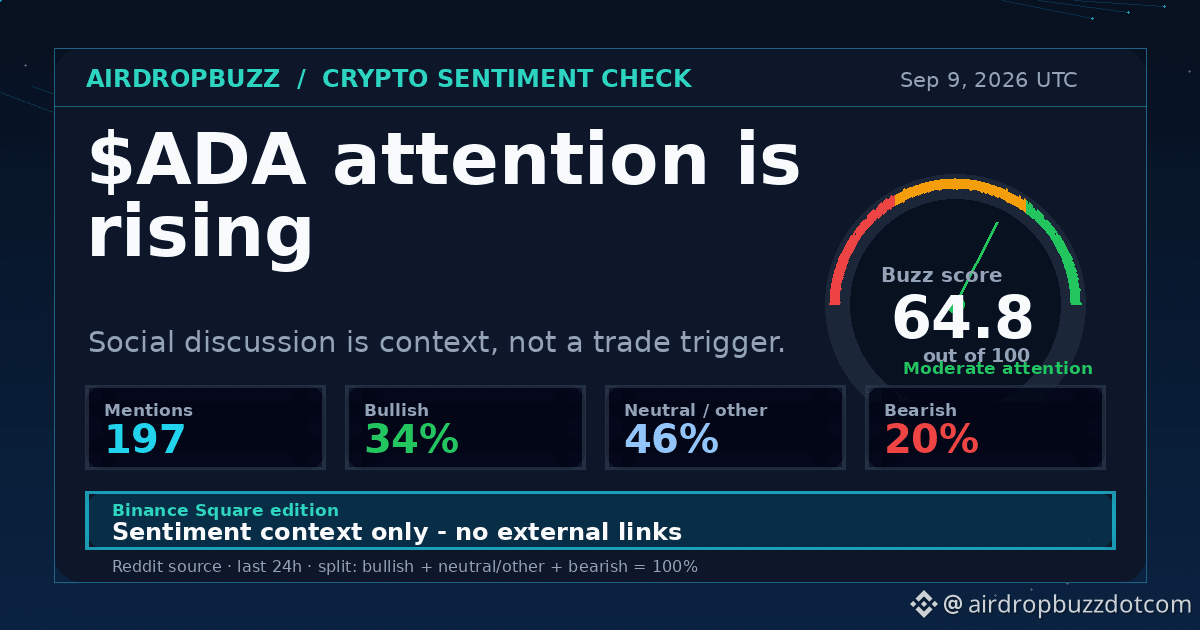
Crypto Sentiment Check: $ADA attention is rising.
Social crypto discussion around $ADA is active today, and discussion is leaning more constructive than cautious. The useful read is not to chase the noise, but to watch whether price, volume and funding start confirming the crowd's attention.
Treat this as market context, not a trade trigger. Wait for confirmation before acting.
Educational only, not financial advice.
Crypto Sentiment Check: $ADA attention is rising.
Social crypto discussion around $ADA is active today, and discussion is leaning more constructive than cautious. The useful read is not to chase the noise, but to watch whether price, volume and funding start confirming the crowd's attention.
Treat this as market context, not a trade trigger. Wait for confirmation before acting.
Educational only, not financial advice.
Social crypto discussion around $ADA is active today, and discussion is leaning more constructive than cautious. The useful read is not to chase the noise, but to watch whether price, volume and funding start confirming the crowd's attention.
Treat this as market context, not a trade trigger. Wait for confirmation before acting.
Educational only, not financial advice.
80
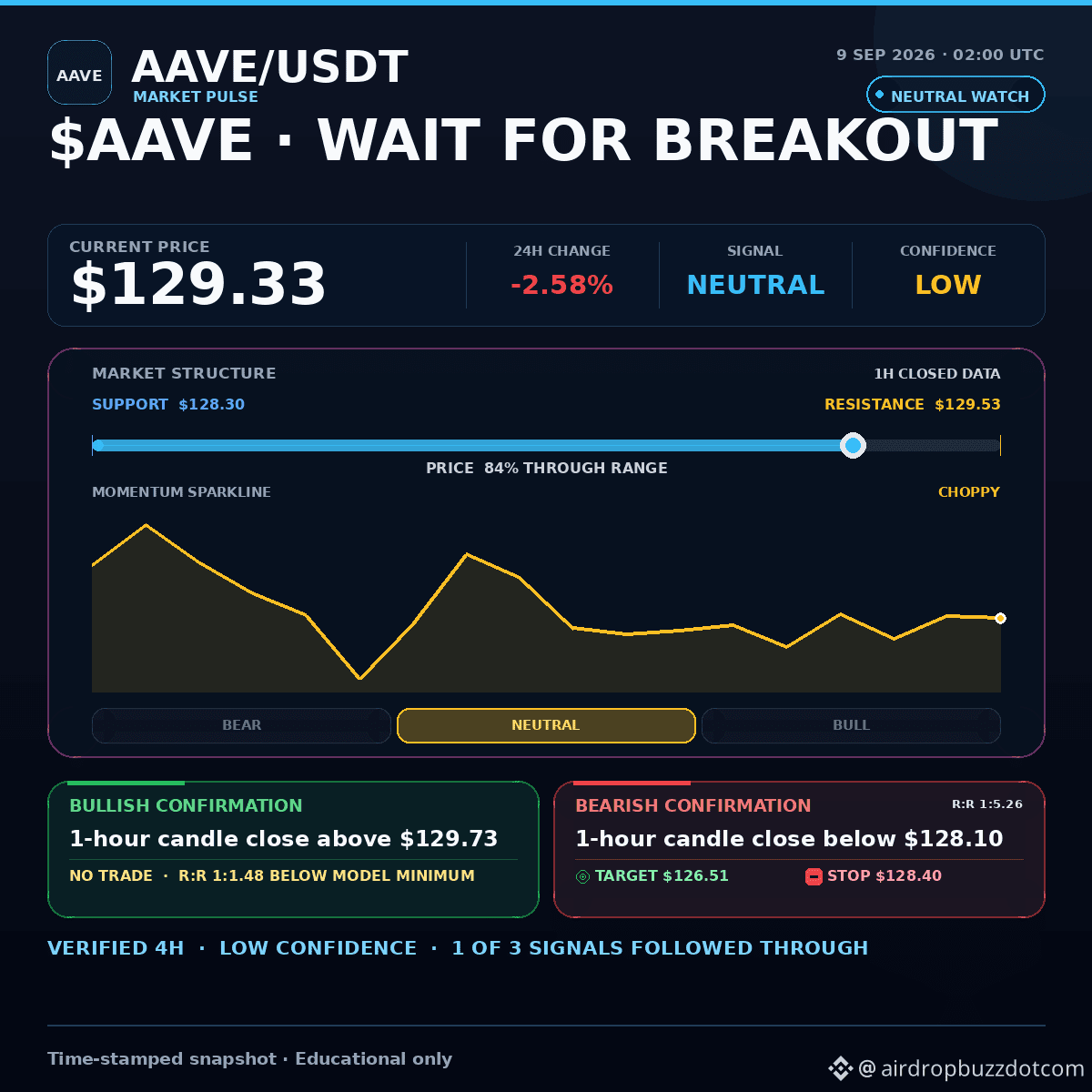
No need to guess early—the next 1H close is the $AAVE decision point.
📊 Snapshot
• Price: $129.33
• 24H: -2.58%
• Bias: Neutral
📈 Bull Trigger
1-hour close above $129.73 with open interest confirmation
📉 Bear Trigger
1-hour close below $128.10 with open interest confirmation
🎯 Signal Read
Conflicting evidence keeps this conditional, so the close matters more than predicting the direction early.
📌 Confidence
Low · Low historical confidence · 1 of 3 directional moves were favorable
Signal Quality
- OI: Flat (0.00%)
- 4H: Bearish | 1D: Bullish (Conflict)
- ATR filter: 0.50 ATR ($0.40)
- Risk/reward: 1:5.26
Bear scenario risk plan
- Entry: $128.10
- Stop: $128.40
- Target: $126.51
Trigger levels define confirmation; they do not guarantee where price will finish.
Up or down first? Reply UP or DOWN.
#AAVE #Aave #CryptoTrading #MarketPulse
Educational only. Time-stamped market snapshot, not financial advice.
No need to guess early—the next 1H close is the $AAVE decision point.
📊 Snapshot
• Price: $129.33
• 24H: -2.58%
• Bias: Neutral
📈 Bull Trigger
1-hour close above $129.73 with open interest confirmation
📉 Bear Trigger
1-hour close below $128.10 with open interest confirmation
🎯 Signal Read
Conflicting evidence keeps this conditional, so the close matters more than predicting the direction early.
📌 Confidence
Low · Low historical confidence · 1 of 3 directional moves were favorable
Signal Quality
- OI: Flat (0.00%)
- 4H: Bearish | 1D: Bullish (Conflict)
- ATR filter: 0.50 ATR ($0.40)
- Risk/reward: 1:5.26
Bear scenario risk plan
- Entry: $128.10
- Stop: $128.40
- Target: $126.51
Trigger levels define confirmation; they do not guarantee where price will finish.
Up or down first? Reply UP or DOWN.
#AAVE #Aave #CryptoTrading #MarketPulse
Educational only. Time-stamped market snapshot, not financial advice.
📊 Snapshot
• Price: $129.33
• 24H: -2.58%
• Bias: Neutral
📈 Bull Trigger
1-hour close above $129.73 with open interest confirmation
📉 Bear Trigger
1-hour close below $128.10 with open interest confirmation
🎯 Signal Read
Conflicting evidence keeps this conditional, so the close matters more than predicting the direction early.
📌 Confidence
Low · Low historical confidence · 1 of 3 directional moves were favorable
Signal Quality
- OI: Flat (0.00%)
- 4H: Bearish | 1D: Bullish (Conflict)
- ATR filter: 0.50 ATR ($0.40)
- Risk/reward: 1:5.26
Bear scenario risk plan
- Entry: $128.10
- Stop: $128.40
- Target: $126.51
Trigger levels define confirmation; they do not guarantee where price will finish.
Up or down first? Reply UP or DOWN.
#AAVE #Aave #CryptoTrading #MarketPulse
Educational only. Time-stamped market snapshot, not financial advice.
49
Log in to explore more content
Join global crypto users on Binance Square
⚡️ Get latest and useful information about crypto.
💬 Trusted by the world’s largest crypto exchange.
👍 Discover real insights from verified creators.
Email / Phone number
Trending Topics
AppleDebutsFoldablePhone
9,580 views
222 Discussing
#appledebutsfoldablephone I Got My Hands on the iPhone Duo, Apple’s First Foldable Phone. Here’s What Stands Out
The palm-size phone is Apple's boldest handset in years, with a 5.4-inch cover screen and a 7.6-inch main display. I spent some time with the Duo before its October launch.It’s finally here: Apple on Wednesday unveiled its first foldable iPhone, called the iPhone Duo.
iPhone Duo design and build
The iPhone Duo is compact, with a passport-size design. It has a 7.6-inch display on the inside and a 5.4-inch outer display. It fits squarely in my palm, with dimensions similar to Samsung’s Galaxy Z Fold 8, which has a 7.6-inch inner display and a 5.5-inch cover display.
Apple says the Duo is the thinnest iPhone ever when open, measuring 5.2mm. It’s 11.3mm thick when closed. A titanium frame keeps it lightweight at 254 grams.
One of the key differences in feel between Apple’s and Samsung’s phones is that the iPhone Duo has a matte, nano-textured finish on the inner display, which reduces the phone’s crease while also curbing reflections. It has a satisfying feel and really makes the crease virtually disappear when the screen is on. I find it even harder to notice than the Z Fold 8’s, which also has an anti-reflective display.$ONG $IMX $TAC
Isabella-I
·4 Likes
·929 views
EUExtendsCentralContactPointToCASPs
30 views
6 Discussing
US10YTreasuryYieldHitsHighestSinceNov2023
13,496 views
247 Discussing