
#liquid
liquid
17,611 views
89 Discussing
Hot
Latest

·
--
Bullish
Liquid Network Update: Emergency Elements Patch Released After $320M Exploit
#liquid #BTC #bitcoin #crypto #CryptoNews $BTC
{spot}(BTCUSDT)
Read Here: https://altcoinsanalysis.com/liquid-network-update-emergency-elements-patch-released-after-320m-exploit/
Liquid Network Update: Emergency Elements Patch Released After $320M Exploit
#liquid #BTC #bitcoin #crypto #CryptoNews $BTC
Read Here: https://altcoinsanalysis.com/liquid-network-update-emergency-elements-patch-released-after-320m-exploit/
#liquid #BTC #bitcoin #crypto #CryptoNews $BTC
Read Here: https://altcoinsanalysis.com/liquid-network-update-emergency-elements-patch-released-after-320m-exploit/
12

·
--
🚨BREAKING🚨
White-hat hackers have returned 3,400 BTC to Liquid Network after draining 4,000 BTC worth around $320 million in Sunday's exploit.
💰 Around 598 BTC, worth approximately $47 million, remains outstanding as Blockstream continues talks with the hackers.
⚠️ Liquid Network remains paused while operators implement security fixes, resolve a chain split, and ensure L-BTC is fully backed before restarting.
🔒 Exchanges were asked to freeze L-BTC deposits and withdrawals, while other Liquid assets, including USDT, were not affected.
$BTC
{future}(BTCUSDT)
#BTC☀ #liquid
🚨BREAKING🚨
White-hat hackers have returned 3,400 BTC to Liquid Network after draining 4,000 BTC worth around $320 million in Sunday's exploit.
💰 Around 598 BTC, worth approximately $47 million, remains outstanding as Blockstream continues talks with the hackers.
⚠️ Liquid Network remains paused while operators implement security fixes, resolve a chain split, and ensure L-BTC is fully backed before restarting.
🔒 Exchanges were asked to freeze L-BTC deposits and withdrawals, while other Liquid assets, including USDT, were not affected.
$BTC
#BTC☀ #liquid
White-hat hackers have returned 3,400 BTC to Liquid Network after draining 4,000 BTC worth around $320 million in Sunday's exploit.
💰 Around 598 BTC, worth approximately $47 million, remains outstanding as Blockstream continues talks with the hackers.
⚠️ Liquid Network remains paused while operators implement security fixes, resolve a chain split, and ensure L-BTC is fully backed before restarting.
🔒 Exchanges were asked to freeze L-BTC deposits and withdrawals, while other Liquid assets, including USDT, were not affected.
$BTC
#BTC☀ #liquid
1
310

·
--
#SideSwapSuspendsLiquidServices
⚠️ SideSwap Pauses Liquid Services
SideSwap just suspended its Liquid Network services — another reminder that even "decentralized" tools carry operational risk. Always DYOR before trusting a platform with your funds.
🔔 Follow for real-time platform alerts
#SideSwap #Liquid #CryptoNews
#SideSwapSuspendsLiquidServices
⚠️ SideSwap Pauses Liquid Services
SideSwap just suspended its Liquid Network services — another reminder that even "decentralized" tools carry operational risk. Always DYOR before trusting a platform with your funds.
🔔 Follow for real-time platform alerts
#SideSwap #Liquid #CryptoNews
⚠️ SideSwap Pauses Liquid Services
SideSwap just suspended its Liquid Network services — another reminder that even "decentralized" tools carry operational risk. Always DYOR before trusting a platform with your funds.
🔔 Follow for real-time platform alerts
#SideSwap #Liquid #CryptoNews


4
1
274

·
--
Bearish
nobody stole a key
Liquid lost 4,019.4 BTC on september 6. about $320 million, out in one peg-out. the federation signed it with keys that were never compromised, and SideSwap says its peg-out key wasn't either.
the hole sat upstream. an inflation bug in Elements. someone minted over 4,000 L-BTC that didn't exist. the software checked those coins, called them valid, and the signers released real $BTC against them.
reserve page before: over 4,200 BTC. after: about 207😄
then the drainer signed a message on chain. we are whitehats. contact us on chain. Ledger's CTO said the obvious back: white hats don't drain a bridge first and ask for contact after.
i've been repeating "not your keys, not your coins" like it's a whole security model. it's half of one. a bridge coin is backed by the code that counts coins. that code can be wrong. every key stays safe the whole time.
lessons:
- the wrapper is a claim, the coin is sitting somewhere else
- ask who signs the release and what convinces them a claim is real
- do this while the bridge is still open
which wrapped or bridged thing are you still holding? name it in the comments and i'll go read what actually backs each one, then post whatever i find in one go.
like it if that saved you an afternoon, follow if you want that post, from a guy who checks nothing until it's already on fire)
#bitcoin #Liquid #exploit
{spot}(BTCUSDT)
nobody stole a key
Liquid lost 4,019.4 BTC on september 6. about $320 million, out in one peg-out. the federation signed it with keys that were never compromised, and SideSwap says its peg-out key wasn't either.
the hole sat upstream. an inflation bug in Elements. someone minted over 4,000 L-BTC that didn't exist. the software checked those coins, called them valid, and the signers released real $BTC against them.
reserve page before: over 4,200 BTC. after: about 207😄
then the drainer signed a message on chain. we are whitehats. contact us on chain. Ledger's CTO said the obvious back: white hats don't drain a bridge first and ask for contact after.
i've been repeating "not your keys, not your coins" like it's a whole security model. it's half of one. a bridge coin is backed by the code that counts coins. that code can be wrong. every key stays safe the whole time.
lessons:
- the wrapper is a claim, the coin is sitting somewhere else
- ask who signs the release and what convinces them a claim is real
- do this while the bridge is still open
which wrapped or bridged thing are you still holding? name it in the comments and i'll go read what actually backs each one, then post whatever i find in one go.
like it if that saved you an afternoon, follow if you want that post, from a guy who checks nothing until it's already on fire)
#bitcoin #Liquid #exploit
Liquid lost 4,019.4 BTC on september 6. about $320 million, out in one peg-out. the federation signed it with keys that were never compromised, and SideSwap says its peg-out key wasn't either.
the hole sat upstream. an inflation bug in Elements. someone minted over 4,000 L-BTC that didn't exist. the software checked those coins, called them valid, and the signers released real $BTC against them.
reserve page before: over 4,200 BTC. after: about 207😄
then the drainer signed a message on chain. we are whitehats. contact us on chain. Ledger's CTO said the obvious back: white hats don't drain a bridge first and ask for contact after.
i've been repeating "not your keys, not your coins" like it's a whole security model. it's half of one. a bridge coin is backed by the code that counts coins. that code can be wrong. every key stays safe the whole time.
lessons:
- the wrapper is a claim, the coin is sitting somewhere else
- ask who signs the release and what convinces them a claim is real
- do this while the bridge is still open
which wrapped or bridged thing are you still holding? name it in the comments and i'll go read what actually backs each one, then post whatever i find in one go.
like it if that saved you an afternoon, follow if you want that post, from a guy who checks nothing until it's already on fire)
#bitcoin #Liquid #exploit
8
103

·
--
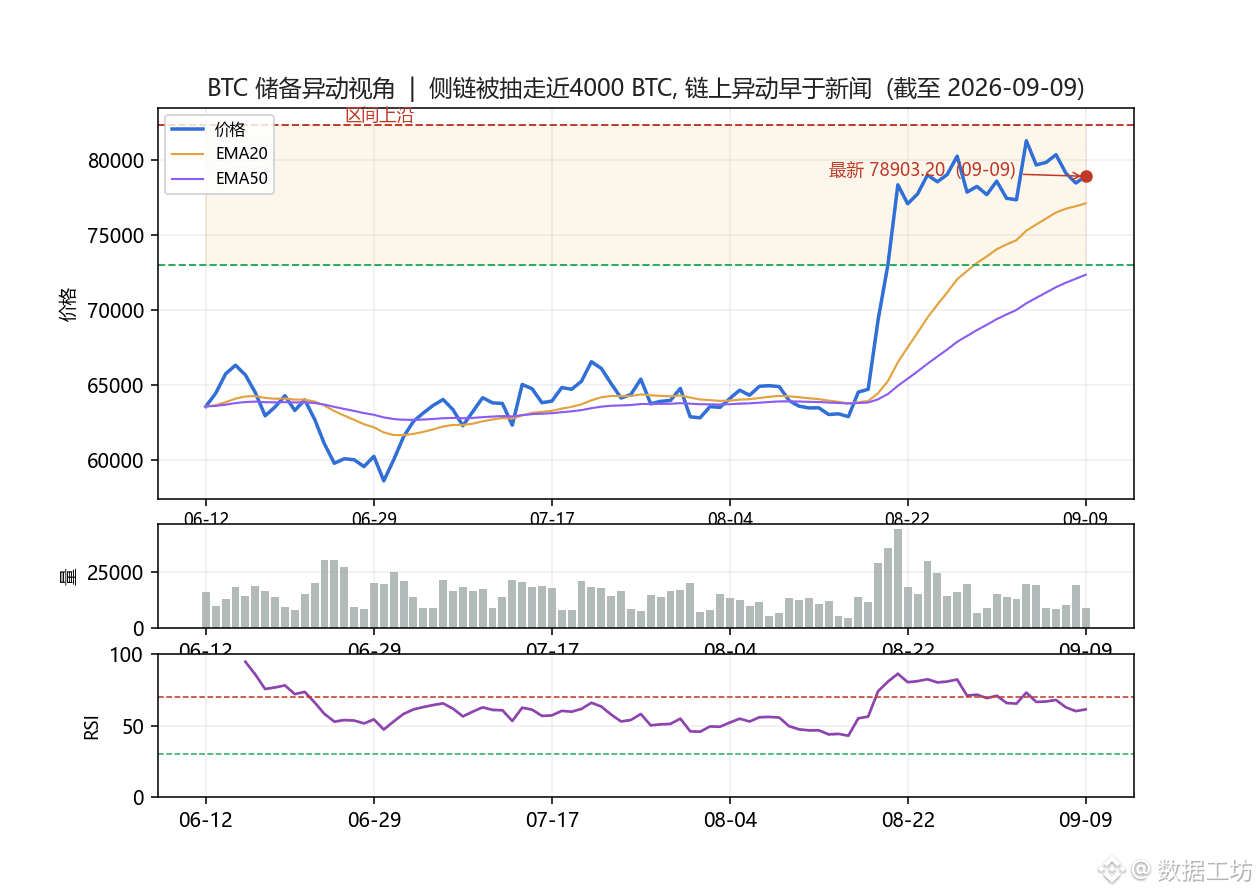
Liquid 被抽走近 4000 枚 BTC——但链上的"不对劲",比新闻早
On September 6, the Bitcoin sidechain Liquid had nearly 4,000 BTC (about $320 million) withdrawn; at one point, its reserves dropped to just 5%. Many people’s first reaction was, "Hackers are dumping the market." In fact, the chain had already been flashing red long before the news.
What you really should watch isn’t "how much was stolen," but on-chain indicators such as the reserve balance, abnormal minting, and large withdrawals. The root cause this time was a verification vulnerability in Elements (range proof caching reuse), which allowed L-BTC without real BTC backing to be minted out of thin air, then transferred through the normal withdrawal flow to be exchanged for real coins. The money followed a "compliant" path, but the on-chain data—reserve plummeting, abnormal mints, and large-scale movements—was already visible at the front end.
I built this kind of monitoring into a system before (balance/abnormal transactions/threshold-based automatic alerts), aiming to surface "anomalies" to people before they hit the trending headlines.
My assessment: this has no material impact on the BTC mainnet. The risk is concentrated in the redemption of L-BTC and the trust assumptions for the sidechain. So in the short term it’s just an emotional disturbance—don’t panic. The real focus is these three signals: "reserves recovering + patch deployment + where the remaining 598 BTC goes." Until things are clear, I won’t touch L-BTC.
Do you normally watch for on-chain anomalies? Let’s discuss in the comments.
#Liquid #链上监控 #数据 #量化 #数据控
Liquid 被抽走近 4000 枚 BTC——但链上的"不对劲",比新闻早
On September 6, the Bitcoin sidechain Liquid had nearly 4,000 BTC (about $320 million) withdrawn; at one point, its reserves dropped to just 5%. Many people’s first reaction was, "Hackers are dumping the market." In fact, the chain had already been flashing red long before the news.
What you really should watch isn’t "how much was stolen," but on-chain indicators such as the reserve balance, abnormal minting, and large withdrawals. The root cause this time was a verification vulnerability in Elements (range proof caching reuse), which allowed L-BTC without real BTC backing to be minted out of thin air, then transferred through the normal withdrawal flow to be exchanged for real coins. The money followed a "compliant" path, but the on-chain data—reserve plummeting, abnormal mints, and large-scale movements—was already visible at the front end.
I built this kind of monitoring into a system before (balance/abnormal transactions/threshold-based automatic alerts), aiming to surface "anomalies" to people before they hit the trending headlines.
My assessment: this has no material impact on the BTC mainnet. The risk is concentrated in the redemption of L-BTC and the trust assumptions for the sidechain. So in the short term it’s just an emotional disturbance—don’t panic. The real focus is these three signals: "reserves recovering + patch deployment + where the remaining 598 BTC goes." Until things are clear, I won’t touch L-BTC.
Do you normally watch for on-chain anomalies? Let’s discuss in the comments.
#Liquid #链上监控 #数据 #量化 #数据控
On September 6, the Bitcoin sidechain Liquid had nearly 4,000 BTC (about $320 million) withdrawn; at one point, its reserves dropped to just 5%. Many people’s first reaction was, "Hackers are dumping the market." In fact, the chain had already been flashing red long before the news.
What you really should watch isn’t "how much was stolen," but on-chain indicators such as the reserve balance, abnormal minting, and large withdrawals. The root cause this time was a verification vulnerability in Elements (range proof caching reuse), which allowed L-BTC without real BTC backing to be minted out of thin air, then transferred through the normal withdrawal flow to be exchanged for real coins. The money followed a "compliant" path, but the on-chain data—reserve plummeting, abnormal mints, and large-scale movements—was already visible at the front end.
I built this kind of monitoring into a system before (balance/abnormal transactions/threshold-based automatic alerts), aiming to surface "anomalies" to people before they hit the trending headlines.
My assessment: this has no material impact on the BTC mainnet. The risk is concentrated in the redemption of L-BTC and the trust assumptions for the sidechain. So in the short term it’s just an emotional disturbance—don’t panic. The real focus is these three signals: "reserves recovering + patch deployment + where the remaining 598 BTC goes." Until things are clear, I won’t touch L-BTC.
Do you normally watch for on-chain anomalies? Let’s discuss in the comments.
#Liquid #链上监控 #数据 #量化 #数据控
63

·
--
Liquid was hacked, with about 4,000 BTC stolen. Of this, 3,400 has been returned, but 600 BTC (about $47 million) is still unaccounted for. The hackers claim they are "white hats," but the claim is doubtful, and Blockstream is negotiating. In the short term, the BTC price may face downward pressure, but most of the BTC has been recovered or has helped reduce market panic. As a Bitcoin sidechain, this incident with Liquid could affect users’ trust in sidechains, and in the future funds may be more inclined toward the main chain. #Bitcoin #Liquid
Liquid was hacked, with about 4,000 BTC stolen. Of this, 3,400 has been returned, but 600 BTC (about $47 million) is still unaccounted for. The hackers claim they are "white hats," but the claim is doubtful, and Blockstream is negotiating. In the short term, the BTC price may face downward pressure, but most of the BTC has been recovered or has helped reduce market panic. As a Bitcoin sidechain, this incident with Liquid could affect users’ trust in sidechains, and in the future funds may be more inclined toward the main chain. #Bitcoin #Liquid
1

·
--

Article
White Hats Swipe 4,000 $BTC From Liquid – What It Means for ETF InflowsMost traders watch price. Smart money watches the flow of large balances between chains.
The latest breach on the Liquid sidechain, where “white hats” reportedly siphoned 4,000 $BTC, is a textbook example of how off‑chain activity can ripple into on‑chain sentiment and institutional flows. #Liquid #BTC #ETF
The signal is clear: a sudden, coordinated outflow of $BTC from Liquid to the main chain, followed by a spike in ETF inflows over the past three weeks. On‑chain analytics show a 12% jump in on‑chain $BTC holdings in ETF wallets, while Liquid’s balance dropped by 4,000 $BTC in a single 12‑hour window. This aligns with a broader trend of institutional capital moving toward regulated products as regulatory clarity improves.
Interpretation: The breach has likely shaken confidence in sidechains, pushing risk‑averse investors toward the safety net of ETFs. As a result, we’re seeing a re‑allocation of capital from speculative sidechain projects to regulated funds. If the ETF inflows continue, $BTC could see a sustained upward pressure as more institutional money enters the market, while sidechain projects may need to tighten security to retain their user base.
Watch list: Monitor the Liquid‑to‑main‑chain transfer volume. A sudden spike could signal another security event or a shift in investor sentiment. Keep an eye on the ETF wallet balances for any reversal. #LiquidTransfer
If the current flow of capital into ETFs persists, could we be looking at a new phase of institutional adoption that outpaces the traditional on‑chain price movements?
White Hats Swipe 4,000 $BTC From Liquid – What It Means for ETF Inflows
Most traders watch price. Smart money watches the flow of large balances between chains.
The latest breach on the Liquid sidechain, where “white hats” reportedly siphoned 4,000 $BTC , is a textbook example of how off‑chain activity can ripple into on‑chain sentiment and institutional flows. #Liquid #BTC #ETF
The signal is clear: a sudden, coordinated outflow of $BTC from Liquid to the main chain, followed by a spike in ETF inflows over the past three weeks. On‑chain analytics show a 12% jump in on‑chain $BTC holdings in ETF wallets, while Liquid’s balance dropped by 4,000 $BTC in a single 12‑hour window. This aligns with a broader trend of institutional capital moving toward regulated products as regulatory clarity improves.
Interpretation: The breach has likely shaken confidence in sidechains, pushing risk‑averse investors toward the safety net of ETFs. As a result, we’re seeing a re‑allocation of capital from speculative sidechain projects to regulated funds. If the ETF inflows continue, $BTC could see a sustained upward pressure as more institutional money enters the market, while sidechain projects may need to tighten security to retain their user base.
Watch list: Monitor the Liquid‑to‑main‑chain transfer volume. A sudden spike could signal another security event or a shift in investor sentiment. Keep an eye on the ETF wallet balances for any reversal. #LiquidTransfer
If the current flow of capital into ETFs persists, could we be looking at a new phase of institutional adoption that outpaces the traditional on‑chain price movements?
The latest breach on the Liquid sidechain, where “white hats” reportedly siphoned 4,000 $BTC , is a textbook example of how off‑chain activity can ripple into on‑chain sentiment and institutional flows. #Liquid #BTC #ETF
The signal is clear: a sudden, coordinated outflow of $BTC from Liquid to the main chain, followed by a spike in ETF inflows over the past three weeks. On‑chain analytics show a 12% jump in on‑chain $BTC holdings in ETF wallets, while Liquid’s balance dropped by 4,000 $BTC in a single 12‑hour window. This aligns with a broader trend of institutional capital moving toward regulated products as regulatory clarity improves.
Interpretation: The breach has likely shaken confidence in sidechains, pushing risk‑averse investors toward the safety net of ETFs. As a result, we’re seeing a re‑allocation of capital from speculative sidechain projects to regulated funds. If the ETF inflows continue, $BTC could see a sustained upward pressure as more institutional money enters the market, while sidechain projects may need to tighten security to retain their user base.
Watch list: Monitor the Liquid‑to‑main‑chain transfer volume. A sudden spike could signal another security event or a shift in investor sentiment. Keep an eye on the ETF wallet balances for any reversal. #LiquidTransfer
If the current flow of capital into ETFs persists, could we be looking at a new phase of institutional adoption that outpaces the traditional on‑chain price movements?
79

·
--
Liquid hackers paid back 3,400 BTC—returned to the original address 😳
On Sunday, nearly 4,000 BTC were siphoned from Liquid’s sidechain. Now they’ve recovered 85%.
Based on current prices, this repayment is worth about $270 million.
Let’s recap: on Sunday, the hacker pulled roughly 4,000 BTC from the Liquid Federation wallet.
Liquid had only about 4,200 BTC in reserve—almost completely drained, and the network effectively shut down on the spot.
At the time, the other party claimed to be a white-hat, saying that once the vulnerability was fixed, they would return the funds.
Turns out it wasn’t just talk.
Blockstream first patched the vulnerability on the affected nodes, then used a Bitcoin on-chain signed message to reach out and address the attacker.
On-chain records show the full 3,400 BTC were transferred back to the Federation wallet without a single coin missing.
There are still 598 BTC left to be repaid—about $47 million—so both sides are still at odds.
Here’s the interesting part: Ledger’s CTO, the head of the hardware wallet giant, directly fired back.
He said they kept nearly 600 BTC as a “compensation for the trouble.” That move doesn’t really look like a white-hat—more like coercive extortion.
White-hat or gray-hat—on-chain, it’s just one thin sheet of paper.
As for Liquid: the network remains paused. The official advisory says not to send funds to the deposit addresses yet.
Wait until the restart is confirmed before doing anything—don’t be the one who ends up holding the bag.
This incident is a pretty solid reminder for us.
Sidechains and cross-chain bridges—these “high-end” channels. When something goes wrong, it can become a massive hole.
Big players’ assets can be siphoned—what about ordinary users’ wallets?
Don’t put all your eggs in one basket. That old saying still applies on-chain.
Every day I bring you the latest BTC headlines—not just what happened, but also the logic and opportunities behind it 👀🚀
Click the link below to follow me 👇🏻
[👉 加入小恐龙粉丝群](https://app.binance.com/uni-qr/DXaccF5q)
#比特币 #Liquid #安全 #Hacker
Liquid hackers paid back 3,400 BTC—returned to the original address 😳
On Sunday, nearly 4,000 BTC were siphoned from Liquid’s sidechain. Now they’ve recovered 85%.
Based on current prices, this repayment is worth about $270 million.
Let’s recap: on Sunday, the hacker pulled roughly 4,000 BTC from the Liquid Federation wallet.
Liquid had only about 4,200 BTC in reserve—almost completely drained, and the network effectively shut down on the spot.
At the time, the other party claimed to be a white-hat, saying that once the vulnerability was fixed, they would return the funds.
Turns out it wasn’t just talk.
Blockstream first patched the vulnerability on the affected nodes, then used a Bitcoin on-chain signed message to reach out and address the attacker.
On-chain records show the full 3,400 BTC were transferred back to the Federation wallet without a single coin missing.
There are still 598 BTC left to be repaid—about $47 million—so both sides are still at odds.
Here’s the interesting part: Ledger’s CTO, the head of the hardware wallet giant, directly fired back.
He said they kept nearly 600 BTC as a “compensation for the trouble.” That move doesn’t really look like a white-hat—more like coercive extortion.
White-hat or gray-hat—on-chain, it’s just one thin sheet of paper.
As for Liquid: the network remains paused. The official advisory says not to send funds to the deposit addresses yet.
Wait until the restart is confirmed before doing anything—don’t be the one who ends up holding the bag.
This incident is a pretty solid reminder for us.
Sidechains and cross-chain bridges—these “high-end” channels. When something goes wrong, it can become a massive hole.
Big players’ assets can be siphoned—what about ordinary users’ wallets?
Don’t put all your eggs in one basket. That old saying still applies on-chain.
Every day I bring you the latest BTC headlines—not just what happened, but also the logic and opportunities behind it 👀🚀
Click the link below to follow me 👇🏻
👉 加入小恐龙粉丝群
#比特币 #Liquid #安全 #Hacker
On Sunday, nearly 4,000 BTC were siphoned from Liquid’s sidechain. Now they’ve recovered 85%.
Based on current prices, this repayment is worth about $270 million.
Let’s recap: on Sunday, the hacker pulled roughly 4,000 BTC from the Liquid Federation wallet.
Liquid had only about 4,200 BTC in reserve—almost completely drained, and the network effectively shut down on the spot.
At the time, the other party claimed to be a white-hat, saying that once the vulnerability was fixed, they would return the funds.
Turns out it wasn’t just talk.
Blockstream first patched the vulnerability on the affected nodes, then used a Bitcoin on-chain signed message to reach out and address the attacker.
On-chain records show the full 3,400 BTC were transferred back to the Federation wallet without a single coin missing.
There are still 598 BTC left to be repaid—about $47 million—so both sides are still at odds.
Here’s the interesting part: Ledger’s CTO, the head of the hardware wallet giant, directly fired back.
He said they kept nearly 600 BTC as a “compensation for the trouble.” That move doesn’t really look like a white-hat—more like coercive extortion.
White-hat or gray-hat—on-chain, it’s just one thin sheet of paper.
As for Liquid: the network remains paused. The official advisory says not to send funds to the deposit addresses yet.
Wait until the restart is confirmed before doing anything—don’t be the one who ends up holding the bag.
This incident is a pretty solid reminder for us.
Sidechains and cross-chain bridges—these “high-end” channels. When something goes wrong, it can become a massive hole.
Big players’ assets can be siphoned—what about ordinary users’ wallets?
Don’t put all your eggs in one basket. That old saying still applies on-chain.
Every day I bring you the latest BTC headlines—not just what happened, but also the logic and opportunities behind it 👀🚀
Click the link below to follow me 👇🏻
👉 加入小恐龙粉丝群
#比特币 #Liquid #安全 #Hacker
瑞见未来:
退回3400枚BTC这剧情太魔幻了,侧链漏洞我是真看不懂,现在大头放冷钱包小头交给托管代跑,闲下来可以看看 他的帖子
2
9
6.3k

·
--
Liquid was torn open with a huge hole—almost 4,000 BTC are gone
Over the weekend, the Liquid network was breached; 4,000 BTC—about $320 million—were basically wiped out. This is roughly 95% of their household savings. They claim it was a white-hat hacker, specifically naming Blockstream and demanding they patch the issue. After the patch was applied, they did manage to return 85%, with 3,400 BTC taken into safekeeping. The remaining 598 BTC is still being held by the other party, and the bridge has been frozen.
Now the most panicked thing is L-BTC. It relies on a 1:1 peg to Bitcoin to make a living. If the hole can’t be patched, it will have to break the peg. This is another domino effect of Bitcoin L2s: just as Bitcoin L2s keep exploding, Coldcard has barely finished blowing up, Liquid exploded too—security is really paper-thin.
#比特币 #Liquid #安全漏洞
Liquid was torn open with a huge hole—almost 4,000 BTC are gone
Over the weekend, the Liquid network was breached; 4,000 BTC—about $320 million—were basically wiped out. This is roughly 95% of their household savings. They claim it was a white-hat hacker, specifically naming Blockstream and demanding they patch the issue. After the patch was applied, they did manage to return 85%, with 3,400 BTC taken into safekeeping. The remaining 598 BTC is still being held by the other party, and the bridge has been frozen.
Now the most panicked thing is L-BTC. It relies on a 1:1 peg to Bitcoin to make a living. If the hole can’t be patched, it will have to break the peg. This is another domino effect of Bitcoin L2s: just as Bitcoin L2s keep exploding, Coldcard has barely finished blowing up, Liquid exploded too—security is really paper-thin.
#比特币 #Liquid #安全漏洞
Over the weekend, the Liquid network was breached; 4,000 BTC—about $320 million—were basically wiped out. This is roughly 95% of their household savings. They claim it was a white-hat hacker, specifically naming Blockstream and demanding they patch the issue. After the patch was applied, they did manage to return 85%, with 3,400 BTC taken into safekeeping. The remaining 598 BTC is still being held by the other party, and the bridge has been frozen.
Now the most panicked thing is L-BTC. It relies on a 1:1 peg to Bitcoin to make a living. If the hole can’t be patched, it will have to break the peg. This is another domino effect of Bitcoin L2s: just as Bitcoin L2s keep exploding, Coldcard has barely finished blowing up, Liquid exploded too—security is really paper-thin.
#比特币 #Liquid #安全漏洞
81

·
--
4000 BTC withdrawn, 3400 returned
The incident occurred on Liquid’s sidechain. After about 4000 BTC was withdrawn, the “white hat” returned roughly 3400 BTC (news reports put it at about $270 million), but is still owed about 598 BTC; the network is preparing to restart.
Cointelegraph 9/8: Samson Mow’s retelling is that it was returned only after a patch was applied. Ledger CTO and others have questioned the white-hat narrative, suggesting it sounds more like a bounty discussion.
My stance: treat sidechain/federated custody risk as its own matter—don’t mix it up with the Bitcoin main chain. Until the outstanding balance is settled and the patch can be verified, don’t let this story become the “closing statement”; if the debt remains outstanding, consider it under unresolved/unfinished conditions and the associated risks. Sidechain risk is sidechain risk; main-chain risk is separate.
Which do you believe more: “white hat returns after the patch,” or “talking about a bounty and only then returning coins”?
Personal observation only; not investment advice.
$BTC #安全 #Liquid
Draft reviewed: passed
4000 BTC withdrawn, 3400 returned
The incident occurred on Liquid’s sidechain. After about 4000 BTC was withdrawn, the “white hat” returned roughly 3400 BTC (news reports put it at about $270 million), but is still owed about 598 BTC; the network is preparing to restart.
Cointelegraph 9/8: Samson Mow’s retelling is that it was returned only after a patch was applied. Ledger CTO and others have questioned the white-hat narrative, suggesting it sounds more like a bounty discussion.
My stance: treat sidechain/federated custody risk as its own matter—don’t mix it up with the Bitcoin main chain. Until the outstanding balance is settled and the patch can be verified, don’t let this story become the “closing statement”; if the debt remains outstanding, consider it under unresolved/unfinished conditions and the associated risks. Sidechain risk is sidechain risk; main-chain risk is separate.
Which do you believe more: “white hat returns after the patch,” or “talking about a bounty and only then returning coins”?
Personal observation only; not investment advice.
$BTC #安全 #Liquid
Draft reviewed: passed
The incident occurred on Liquid’s sidechain. After about 4000 BTC was withdrawn, the “white hat” returned roughly 3400 BTC (news reports put it at about $270 million), but is still owed about 598 BTC; the network is preparing to restart.
Cointelegraph 9/8: Samson Mow’s retelling is that it was returned only after a patch was applied. Ledger CTO and others have questioned the white-hat narrative, suggesting it sounds more like a bounty discussion.
My stance: treat sidechain/federated custody risk as its own matter—don’t mix it up with the Bitcoin main chain. Until the outstanding balance is settled and the patch can be verified, don’t let this story become the “closing statement”; if the debt remains outstanding, consider it under unresolved/unfinished conditions and the associated risks. Sidechain risk is sidechain risk; main-chain risk is separate.
Which do you believe more: “white hat returns after the patch,” or “talking about a bounty and only then returning coins”?
Personal observation only; not investment advice.
$BTC #安全 #Liquid
Draft reviewed: passed
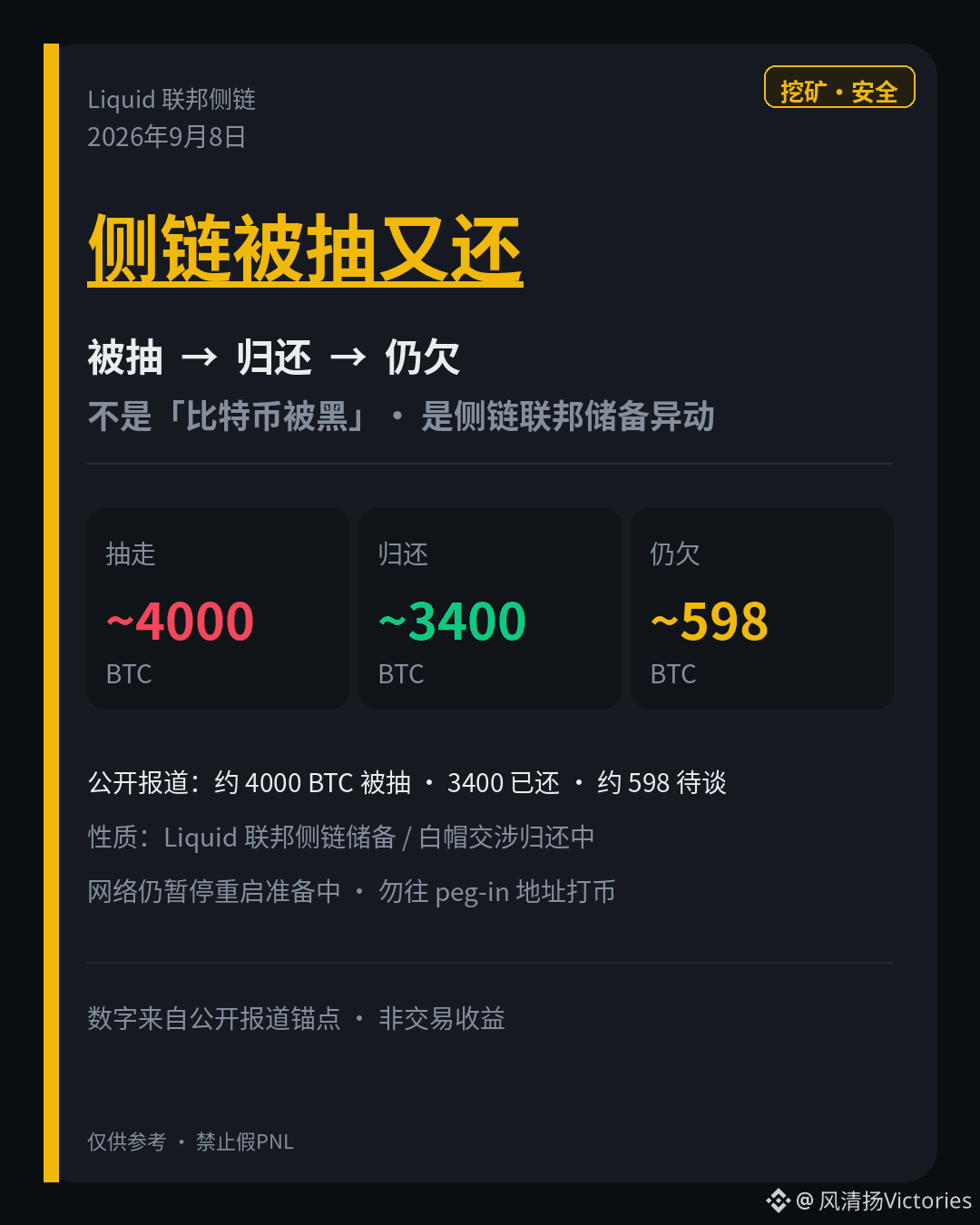
96

·
--
A key turning point has emerged in the Bitcoin sidechain Liquid Network fund incident. After about 4,000 units of $BTC reportedly flowed abnormally out of a federation wallet earlier, the self-claimed white-hat party has returned 3,400 $BTC to the Liquid Federation—about 85% of the amount involved. The main funds have already been returned to the federation address.
Only after Blockstream confirmed via an on-chain signed message that the bridge node had completed repairs did the other party complete this repayment. There are still about 598.5 units of $BTC left at the relevant address. Many external interpretations view this as a self-assigned “bounty,” but there is no publicly visible agreement between the two parties, and no official final position has been issued yet regarding how the remaining gap will be handled.
At present, Liquid bridge connectivity and L-BTC deposits/withdrawals remain paused, and the timeline for a full resumption has not been announced. Whether the sidechain reserves will be realigned, how the remaining funds will be handled, and when exchanges will reopen the relevant channels are the key points to watch over the coming days.
#比特币 #Liquid #区块链安全
This does not constitute investment advice
A key turning point has emerged in the Bitcoin sidechain Liquid Network fund incident. After about 4,000 units of $BTC reportedly flowed abnormally out of a federation wallet earlier, the self-claimed white-hat party has returned 3,400 $BTC to the Liquid Federation—about 85% of the amount involved. The main funds have already been returned to the federation address.
Only after Blockstream confirmed via an on-chain signed message that the bridge node had completed repairs did the other party complete this repayment. There are still about 598.5 units of $BTC left at the relevant address. Many external interpretations view this as a self-assigned “bounty,” but there is no publicly visible agreement between the two parties, and no official final position has been issued yet regarding how the remaining gap will be handled.
At present, Liquid bridge connectivity and L-BTC deposits/withdrawals remain paused, and the timeline for a full resumption has not been announced. Whether the sidechain reserves will be realigned, how the remaining funds will be handled, and when exchanges will reopen the relevant channels are the key points to watch over the coming days.
#比特币 #Liquid #区块链安全
This does not constitute investment advice
Only after Blockstream confirmed via an on-chain signed message that the bridge node had completed repairs did the other party complete this repayment. There are still about 598.5 units of $BTC left at the relevant address. Many external interpretations view this as a self-assigned “bounty,” but there is no publicly visible agreement between the two parties, and no official final position has been issued yet regarding how the remaining gap will be handled.
At present, Liquid bridge connectivity and L-BTC deposits/withdrawals remain paused, and the timeline for a full resumption has not been announced. Whether the sidechain reserves will be realigned, how the remaining funds will be handled, and when exchanges will reopen the relevant channels are the key points to watch over the coming days.
#比特币 #Liquid #区块链安全
This does not constitute investment advice

28

·
--
Liquid drained of 95% reserves; the hacker only agreed to return 85%
On September 6, the Liquid network disclosed an Elements consensus and asset verification vulnerability. The attacker minted about 4,000 L-BTC tokens with no real underlying assets, then went through SideSwap’s normal redemption process to swap these “air L-BTC” into 3,996.01834922 genuine BTC, taking them directly from the Liquid Federation. At the time, the value was about $320 million; the reserve balance dropped from roughly 4,207 BTC to around 197 BTC—draining 95%.
The Bitcoin mainnet itself was not compromised. Of the Federation’s 11/15 signing members, those who were supposed to sign did sign—so the signature mechanism was functioning normally. The issue was entirely in Liquid’s sidechain Elements validation logic. SideSwap also stated that its PAK system was not breached; it was only used as a normal redemption channel. Other assets such as USDT were unaffected because they are never backed by that peg wallet. However, the network’s pause mechanism still froze the entire transfer and liquidity.
As for what happened next: the attacker used an on-chain OP_RETURN message to claim they were a white-hat, demanding that the vulnerability be fixed before returning the funds. The two sides negotiated across the blockchain for several rounds. On September 7, the attacker returned 3,400 BTC, keeping 598.5 BTC—worth about $47 million at the time—as an effective “finder’s fee.” That ratio was no longer up for discussion; in the end, the attacker only returned a sad emoji.
This kind of “hack you, then voluntarily negotiate part of the return” is no longer new in DeFi and cross-chain over the past couple of years. But the larger the amounts involved each time, the weaker the deterrent effect of this “post-hack protection fee” approach on the whole industry becomes—if the cost of a vulnerability is always “return the bulk, keep a substantial split,” does that count as effectively encouraging more people to go looking for bugs?
#Liquid #Blockstream #BTC #侧链安全 #白帽黑客
Liquid drained of 95% reserves; the hacker only agreed to return 85%
On September 6, the Liquid network disclosed an Elements consensus and asset verification vulnerability. The attacker minted about 4,000 L-BTC tokens with no real underlying assets, then went through SideSwap’s normal redemption process to swap these “air L-BTC” into 3,996.01834922 genuine BTC, taking them directly from the Liquid Federation. At the time, the value was about $320 million; the reserve balance dropped from roughly 4,207 BTC to around 197 BTC—draining 95%.
The Bitcoin mainnet itself was not compromised. Of the Federation’s 11/15 signing members, those who were supposed to sign did sign—so the signature mechanism was functioning normally. The issue was entirely in Liquid’s sidechain Elements validation logic. SideSwap also stated that its PAK system was not breached; it was only used as a normal redemption channel. Other assets such as USDT were unaffected because they are never backed by that peg wallet. However, the network’s pause mechanism still froze the entire transfer and liquidity.
As for what happened next: the attacker used an on-chain OP_RETURN message to claim they were a white-hat, demanding that the vulnerability be fixed before returning the funds. The two sides negotiated across the blockchain for several rounds. On September 7, the attacker returned 3,400 BTC, keeping 598.5 BTC—worth about $47 million at the time—as an effective “finder’s fee.” That ratio was no longer up for discussion; in the end, the attacker only returned a sad emoji.
This kind of “hack you, then voluntarily negotiate part of the return” is no longer new in DeFi and cross-chain over the past couple of years. But the larger the amounts involved each time, the weaker the deterrent effect of this “post-hack protection fee” approach on the whole industry becomes—if the cost of a vulnerability is always “return the bulk, keep a substantial split,” does that count as effectively encouraging more people to go looking for bugs?
#Liquid #Blockstream #BTC #侧链安全 #白帽黑客
On September 6, the Liquid network disclosed an Elements consensus and asset verification vulnerability. The attacker minted about 4,000 L-BTC tokens with no real underlying assets, then went through SideSwap’s normal redemption process to swap these “air L-BTC” into 3,996.01834922 genuine BTC, taking them directly from the Liquid Federation. At the time, the value was about $320 million; the reserve balance dropped from roughly 4,207 BTC to around 197 BTC—draining 95%.
The Bitcoin mainnet itself was not compromised. Of the Federation’s 11/15 signing members, those who were supposed to sign did sign—so the signature mechanism was functioning normally. The issue was entirely in Liquid’s sidechain Elements validation logic. SideSwap also stated that its PAK system was not breached; it was only used as a normal redemption channel. Other assets such as USDT were unaffected because they are never backed by that peg wallet. However, the network’s pause mechanism still froze the entire transfer and liquidity.
As for what happened next: the attacker used an on-chain OP_RETURN message to claim they were a white-hat, demanding that the vulnerability be fixed before returning the funds. The two sides negotiated across the blockchain for several rounds. On September 7, the attacker returned 3,400 BTC, keeping 598.5 BTC—worth about $47 million at the time—as an effective “finder’s fee.” That ratio was no longer up for discussion; in the end, the attacker only returned a sad emoji.
This kind of “hack you, then voluntarily negotiate part of the return” is no longer new in DeFi and cross-chain over the past couple of years. But the larger the amounts involved each time, the weaker the deterrent effect of this “post-hack protection fee” approach on the whole industry becomes—if the cost of a vulnerability is always “return the bulk, keep a substantial split,” does that count as effectively encouraging more people to go looking for bugs?
#Liquid #Blockstream #BTC #侧链安全 #白帽黑客
142

·
--
🎯 A bombshell worth $320 million in chain exploits—institutions moved in and stepped on another landmine
📰 Liquid network shocks with a staggering new vulnerability report. Even though it’s supposedly tied to Bitcoin, it still got hacked—$320 million is simply gone. Just when institutions were about to nod in approval, they were hit with a bucket of cold water
💬 In the end, the heavier the on-chain footprint, the more it tests security. What we fear most is a “looks reliable” custodial loophole. Don’t overthink short-term market jitters into a systemic collapse; in the long run, stay clear-headed and watch risk controls
🏷️ #比特币安全 #Liquid #黑客 #托管风险 #institutional entry
🎯 A bombshell worth $320 million in chain exploits—institutions moved in and stepped on another landmine
📰 Liquid network shocks with a staggering new vulnerability report. Even though it’s supposedly tied to Bitcoin, it still got hacked—$320 million is simply gone. Just when institutions were about to nod in approval, they were hit with a bucket of cold water
💬 In the end, the heavier the on-chain footprint, the more it tests security. What we fear most is a “looks reliable” custodial loophole. Don’t overthink short-term market jitters into a systemic collapse; in the long run, stay clear-headed and watch risk controls
🏷️ #比特币安全 #Liquid #黑客 #托管风险 #institutional entry
📰 Liquid network shocks with a staggering new vulnerability report. Even though it’s supposedly tied to Bitcoin, it still got hacked—$320 million is simply gone. Just when institutions were about to nod in approval, they were hit with a bucket of cold water
💬 In the end, the heavier the on-chain footprint, the more it tests security. What we fear most is a “looks reliable” custodial loophole. Don’t overthink short-term market jitters into a systemic collapse; in the long run, stay clear-headed and watch risk controls
🏷️ #比特币安全 #Liquid #黑客 #托管风险 #institutional entry
58
·
--
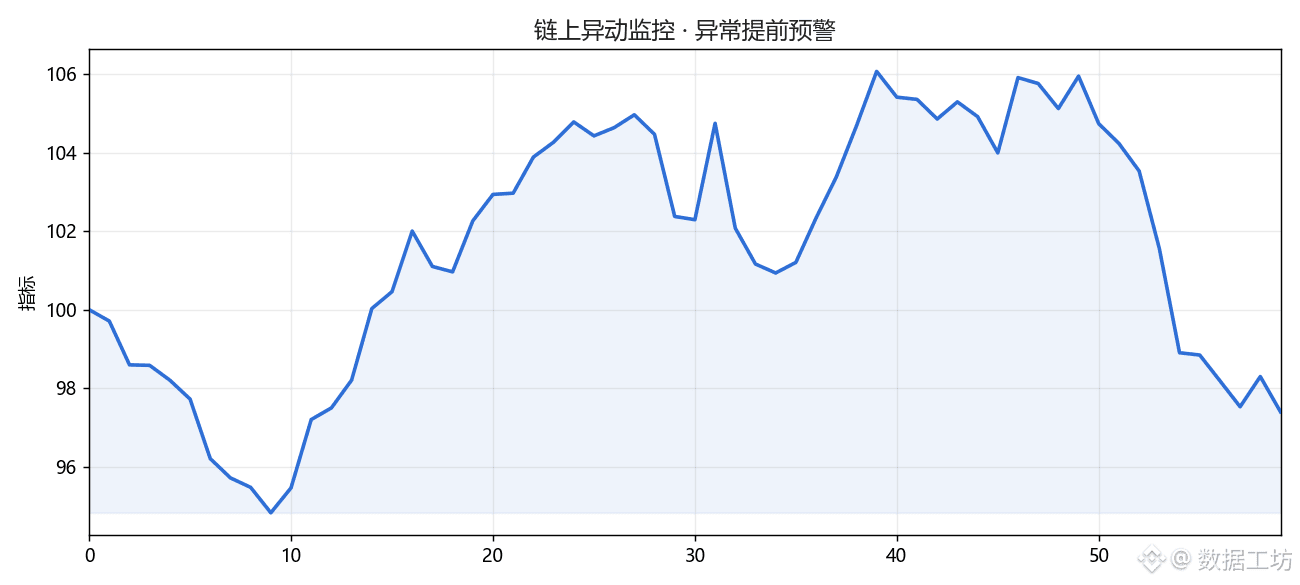
Liquid was attacked for $320 million—but on-chain anomalies often show early warning
In crypto, monitoring on-chain data exposes risk earlier than intuition—abnormal transactions and large on-chain movements often show signs before things go wrong.
I personally built monitoring and alerting into a system (automatic alerts/thresholds pushed to WeChat) so I don’t only find out after an incident.
(Featured image: data chart)
Do you usually watch for on-chain anomalies? Let’s chat in the comments.
#Liquid #链上数据 #监控 #量化 #data_control
Liquid was attacked for $320 million—but on-chain anomalies often show early warning
In crypto, monitoring on-chain data exposes risk earlier than intuition—abnormal transactions and large on-chain movements often show signs before things go wrong.
I personally built monitoring and alerting into a system (automatic alerts/thresholds pushed to WeChat) so I don’t only find out after an incident.
(Featured image: data chart)
Do you usually watch for on-chain anomalies? Let’s chat in the comments.
#Liquid #链上数据 #监控 #量化 #data_control
In crypto, monitoring on-chain data exposes risk earlier than intuition—abnormal transactions and large on-chain movements often show signs before things go wrong.
I personally built monitoring and alerting into a system (automatic alerts/thresholds pushed to WeChat) so I don’t only find out after an incident.
(Featured image: data chart)
Do you usually watch for on-chain anomalies? Let’s chat in the comments.
#Liquid #链上数据 #监控 #量化 #data_control
70

White hat returns 270 million USD worth of Bitcoin to Liquid before the network restarts
- The actors have returned 85% of the Bitcoin withdrawn from Liquid’s linked wallet following the security incident.
- The returned amount is equivalent to approximately 270 million USD.
- The Liquid network is preparing to restart after the incident.
- The RSS source has not yet provided further details on the specific timing or restart plan.
#BinanceSquare #CryptoNews #Bitcoin #Liquid #BTC
$btc
vlikevn Titanbot
Source: CoinTelegraph
White hat returns 270 million USD worth of Bitcoin to Liquid before the network restarts
- The actors have returned 85% of the Bitcoin withdrawn from Liquid’s linked wallet following the security incident.
- The returned amount is equivalent to approximately 270 million USD.
- The Liquid network is preparing to restart after the incident.
- The RSS source has not yet provided further details on the specific timing or restart plan.
#BinanceSquare #CryptoNews #Bitcoin #Liquid #BTC
$btc
vlikevn Titanbot
Source: CoinTelegraph
- The actors have returned 85% of the Bitcoin withdrawn from Liquid’s linked wallet following the security incident.
- The returned amount is equivalent to approximately 270 million USD.
- The Liquid network is preparing to restart after the incident.
- The RSS source has not yet provided further details on the specific timing or restart plan.
#BinanceSquare #CryptoNews #Bitcoin #Liquid #BTC
$btc
vlikevn Titanbot
Source: CoinTelegraph
74

·
--
Bullish
“Liquid Incident Reversal: 3,400 BTC Returned”
September 8, 2026 — Previously, about 4,000 BTC that had been withdrawn from the Liquid Network have now been returned, with 3,400 BTC returned so far, recouping roughly 85% of the funds.
This batch of funds was returned after Blockstream stated that the vulnerability in the relevant bridging node had been fixed.
However, the matter is not completely over.
The attacker still holds around 598.5 BTC, worth about $47 million. And as of now, there is no publicly available information confirming that this portion of the funds belongs to the “white-hat bounty” formally agreed upon by both sides.
So the biggest controversy now comes down to this:
Returning 85% and keeping 15%—does that count as a white-hat bounty, or is it essentially the attacker awarding themselves a bounty?
#BTC #Bitcoin #Liquid #Crypto $BTC
{future}(BTCUSDT)
“Liquid Incident Reversal: 3,400 BTC Returned”
September 8, 2026 — Previously, about 4,000 BTC that had been withdrawn from the Liquid Network have now been returned, with 3,400 BTC returned so far, recouping roughly 85% of the funds.
This batch of funds was returned after Blockstream stated that the vulnerability in the relevant bridging node had been fixed.
However, the matter is not completely over.
The attacker still holds around 598.5 BTC, worth about $47 million. And as of now, there is no publicly available information confirming that this portion of the funds belongs to the “white-hat bounty” formally agreed upon by both sides.
So the biggest controversy now comes down to this:
Returning 85% and keeping 15%—does that count as a white-hat bounty, or is it essentially the attacker awarding themselves a bounty?
#BTC #Bitcoin #Liquid #Crypto $BTC
September 8, 2026 — Previously, about 4,000 BTC that had been withdrawn from the Liquid Network have now been returned, with 3,400 BTC returned so far, recouping roughly 85% of the funds.
This batch of funds was returned after Blockstream stated that the vulnerability in the relevant bridging node had been fixed.
However, the matter is not completely over.
The attacker still holds around 598.5 BTC, worth about $47 million. And as of now, there is no publicly available information confirming that this portion of the funds belongs to the “white-hat bounty” formally agreed upon by both sides.
So the biggest controversy now comes down to this:
Returning 85% and keeping 15%—does that count as a white-hat bounty, or is it essentially the attacker awarding themselves a bounty?
#BTC #Bitcoin #Liquid #Crypto $BTC

105

·
--
3,400 BTC have been returned—can Liquid safely resume deposits?
The return of funds is a real step forward, but it isn’t enough to justify restoring deposit functionality. LBTC holders need to independently verify that the funds have been returned, the vulnerability has been fixed, and withdrawal services have been restored—not treat the first item as proof that all three have been completed.
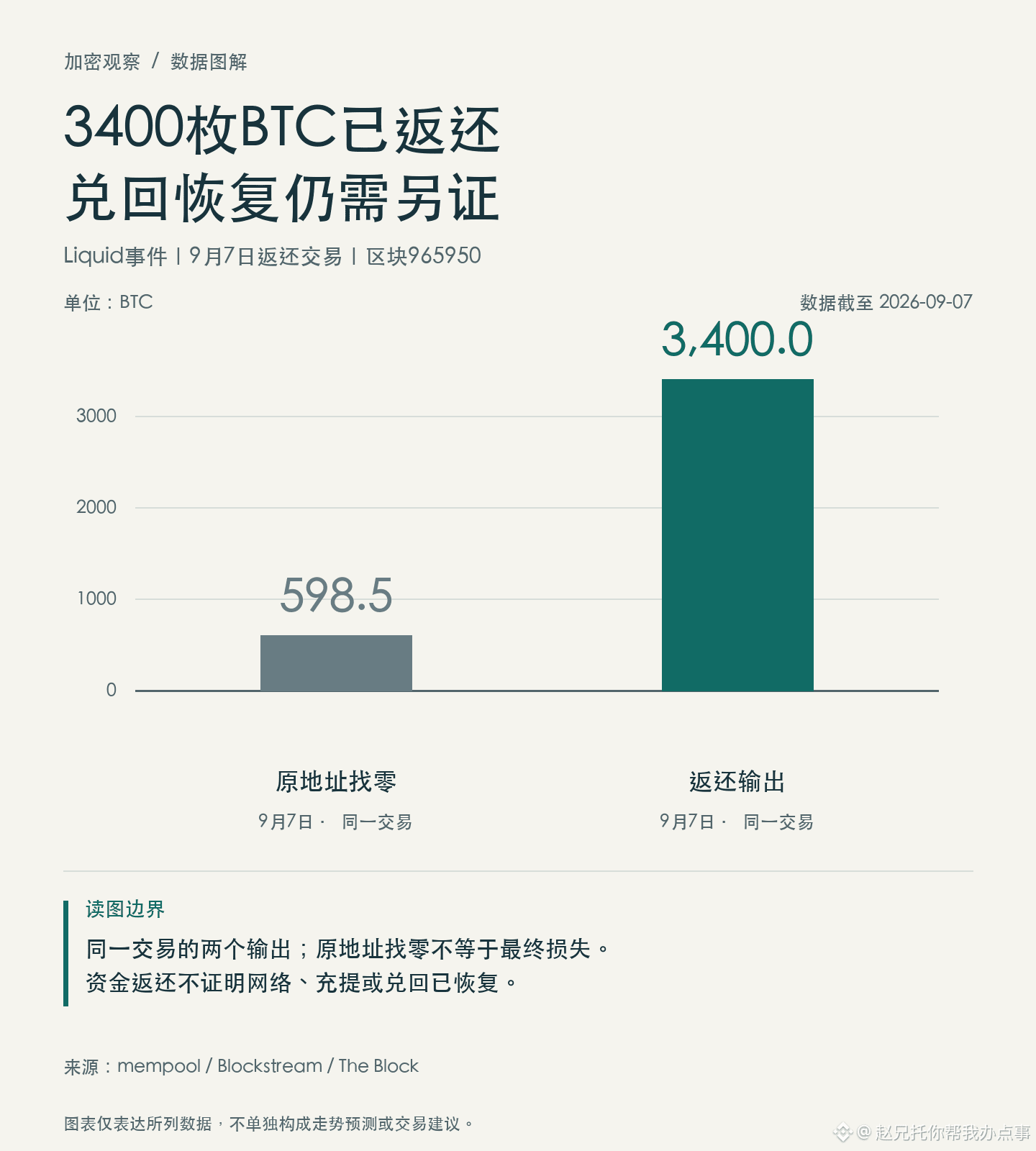
On September 6, Liquid announced that around 4,000 BTC had been taken and that the network would be paused. On September 7, The Block updated its report: Blockstream indicated via on-chain messages that the bridge node had been patched, after which 3,400 BTC were returned. This verification cross-checked mempool and the Blockstream browser against the same transaction in block 965950, confirming that 3,400 BTC were transferred out and about 598.5 BTC in change was sent back to the original address. The federal identity of the return recipient is based on media reports.
This provides real transfer evidence beyond a mere “promise to return,” but it still isn’t a complete reserve audit. About 598.5 BTC is change from the transaction; it doesn’t equal the final, confirmed loss. Moreover, these amounts don’t represent the full network reserves or the proportion of user compensation.
SideSwap previously clarified: during the network pause, exchange services are suspended—please do not add new deposits. As of this verification, there has been no announcement of a full service restoration. Funds returning to the receiving address does not automatically mean exchanges, deposits/withdrawals, and cross-chain swaps are restored at the same time.
Yesterday’s view was adjusted accordingly: “no return confirmation” was updated to “partial return confirmed,” but the judgment that “withdrawal usability should be confirmed first” remains. Affected users should check the restored status through the official entry points of the platforms they used. For orders not yet completed, keep the transaction ID, and do not provide a seed phrase to unfamiliar “recovery pages.”
Over the next 24 hours, key points to watch include the handling of remaining funds, explanations of reserve coverage, the post-incident fix review, and platform restoration announcements. Only after the fix and reserve coverage are verified, and actual withdrawals are restored, should risk be reduced. If there are any further abnormal outflows, or if withdrawals still can’t be completed after restoration, the alert level should be raised.
#比特币 #Liquid #资产安全
3,400 BTC have been returned—can Liquid safely resume deposits?
The return of funds is a real step forward, but it isn’t enough to justify restoring deposit functionality. LBTC holders need to independently verify that the funds have been returned, the vulnerability has been fixed, and withdrawal services have been restored—not treat the first item as proof that all three have been completed.
On September 6, Liquid announced that around 4,000 BTC had been taken and that the network would be paused. On September 7, The Block updated its report: Blockstream indicated via on-chain messages that the bridge node had been patched, after which 3,400 BTC were returned. This verification cross-checked mempool and the Blockstream browser against the same transaction in block 965950, confirming that 3,400 BTC were transferred out and about 598.5 BTC in change was sent back to the original address. The federal identity of the return recipient is based on media reports.
This provides real transfer evidence beyond a mere “promise to return,” but it still isn’t a complete reserve audit. About 598.5 BTC is change from the transaction; it doesn’t equal the final, confirmed loss. Moreover, these amounts don’t represent the full network reserves or the proportion of user compensation.
SideSwap previously clarified: during the network pause, exchange services are suspended—please do not add new deposits. As of this verification, there has been no announcement of a full service restoration. Funds returning to the receiving address does not automatically mean exchanges, deposits/withdrawals, and cross-chain swaps are restored at the same time.
Yesterday’s view was adjusted accordingly: “no return confirmation” was updated to “partial return confirmed,” but the judgment that “withdrawal usability should be confirmed first” remains. Affected users should check the restored status through the official entry points of the platforms they used. For orders not yet completed, keep the transaction ID, and do not provide a seed phrase to unfamiliar “recovery pages.”
Over the next 24 hours, key points to watch include the handling of remaining funds, explanations of reserve coverage, the post-incident fix review, and platform restoration announcements. Only after the fix and reserve coverage are verified, and actual withdrawals are restored, should risk be reduced. If there are any further abnormal outflows, or if withdrawals still can’t be completed after restoration, the alert level should be raised.
#比特币 #Liquid #资产安全
The return of funds is a real step forward, but it isn’t enough to justify restoring deposit functionality. LBTC holders need to independently verify that the funds have been returned, the vulnerability has been fixed, and withdrawal services have been restored—not treat the first item as proof that all three have been completed.
On September 6, Liquid announced that around 4,000 BTC had been taken and that the network would be paused. On September 7, The Block updated its report: Blockstream indicated via on-chain messages that the bridge node had been patched, after which 3,400 BTC were returned. This verification cross-checked mempool and the Blockstream browser against the same transaction in block 965950, confirming that 3,400 BTC were transferred out and about 598.5 BTC in change was sent back to the original address. The federal identity of the return recipient is based on media reports.
This provides real transfer evidence beyond a mere “promise to return,” but it still isn’t a complete reserve audit. About 598.5 BTC is change from the transaction; it doesn’t equal the final, confirmed loss. Moreover, these amounts don’t represent the full network reserves or the proportion of user compensation.
SideSwap previously clarified: during the network pause, exchange services are suspended—please do not add new deposits. As of this verification, there has been no announcement of a full service restoration. Funds returning to the receiving address does not automatically mean exchanges, deposits/withdrawals, and cross-chain swaps are restored at the same time.
Yesterday’s view was adjusted accordingly: “no return confirmation” was updated to “partial return confirmed,” but the judgment that “withdrawal usability should be confirmed first” remains. Affected users should check the restored status through the official entry points of the platforms they used. For orders not yet completed, keep the transaction ID, and do not provide a seed phrase to unfamiliar “recovery pages.”
Over the next 24 hours, key points to watch include the handling of remaining funds, explanations of reserve coverage, the post-incident fix review, and platform restoration announcements. Only after the fix and reserve coverage are verified, and actual withdrawals are restored, should risk be reduced. If there are any further abnormal outflows, or if withdrawals still can’t be completed after restoration, the alert level should be raised.
#比特币 #Liquid #资产安全
97
·
--
Good news! Liquid Network successfully recovered 3,400 BTC through on-chain negotiations. The white-hat hacker retained nearly 600 BTC (about $47 million). The bridge nodes have already been patched, and this security incident is now over. In the short term, the BTC market may rise as the resolution of the security issue provides a boost to market sentiment. However, those 600 BTC could be sold off at any time, so investors should watch for short-term volatility. Safety first—there’s still a long way to go for the blockchain industry. #Bitcoin #Liquid #Security
Good news! Liquid Network successfully recovered 3,400 BTC through on-chain negotiations. The white-hat hacker retained nearly 600 BTC (about $47 million). The bridge nodes have already been patched, and this security incident is now over. In the short term, the BTC market may rise as the resolution of the security issue provides a boost to market sentiment. However, those 600 BTC could be sold off at any time, so investors should watch for short-term volatility. Safety first—there’s still a long way to go for the blockchain industry. #Bitcoin #Liquid #Security
96


·
--
SideSwap suspends Liquid services! 4,000 BTC moved out, did $320 million funds go bad?
Today, a major bombshell suddenly appeared in the crypto market.
SideSwap announced:
All swap, peg-in, and peg-out services related to Liquid have been suspended.
The reason is a security incident on the Liquid network.
Around 4,000 BTC was transferred out from the Liquid Federation wallet, worth about $320 million, accounting for 95% of the roughly 4,200 BTC reserves previously held.
What’s even more strange is:
This withdrawal was completed via SideSwap’s Peg-out Authorization Key (PAK).
However, Liquid states:
❌ The PAK itself was not compromised
❌ No other Federation key leaks were found
❌ SideSwap also said its own systems were not breached
Current disclosed information points to:
An Elements software vulnerability → resulting in L-BTC without real BTC backing → exchanged into real BTC through the normal peg-out process.
That means the most concerning possibility isn’t necessarily “private keys were stolen.”
Instead, it’s this:
The system treated fake L-BTC as if it were real L-BTC.
That’s also why Liquid chose to pause the network directly.
The entity claiming to be “white hat” has already contacted Blockstream via on-chain messages, and says that after the vulnerability is fixed and all nodes complete the upgrade, they are willing to return most of the BTC.
So now there are three key questions:
1️⃣ Can the 4,000 BTC ultimately be recovered?
2️⃣ How exactly was the Elements vulnerability exploited?
3️⃣ When will Liquid resume normal operation?
The good news is:
The Bitcoin mainnet itself has not been affected.
But this incident once again reminds the market:
BTC itself is safe ≠ BTC’s Layer 2, cross-chain bridges, custody, and anchoring mechanisms are equally safe.
Especially assets like L-BTC that rely on federation mechanisms—once a problem occurs with the underlying peg, the risk can quickly amplify.
This time, what truly needs attention isn’t whether BTC will drop because of the news, but whether the $320 million worth of BTC can be returned safely in the end.
#BTC #liquid #sideswap暂停liquid服务
SideSwap suspends Liquid services! 4,000 BTC moved out, did $320 million funds go bad?
Today, a major bombshell suddenly appeared in the crypto market.
SideSwap announced:
All swap, peg-in, and peg-out services related to Liquid have been suspended.
The reason is a security incident on the Liquid network.
Around 4,000 BTC was transferred out from the Liquid Federation wallet, worth about $320 million, accounting for 95% of the roughly 4,200 BTC reserves previously held.
What’s even more strange is:
This withdrawal was completed via SideSwap’s Peg-out Authorization Key (PAK).
However, Liquid states:
❌ The PAK itself was not compromised
❌ No other Federation key leaks were found
❌ SideSwap also said its own systems were not breached
Current disclosed information points to:
An Elements software vulnerability → resulting in L-BTC without real BTC backing → exchanged into real BTC through the normal peg-out process.
That means the most concerning possibility isn’t necessarily “private keys were stolen.”
Instead, it’s this:
The system treated fake L-BTC as if it were real L-BTC.
That’s also why Liquid chose to pause the network directly.
The entity claiming to be “white hat” has already contacted Blockstream via on-chain messages, and says that after the vulnerability is fixed and all nodes complete the upgrade, they are willing to return most of the BTC.
So now there are three key questions:
1️⃣ Can the 4,000 BTC ultimately be recovered?
2️⃣ How exactly was the Elements vulnerability exploited?
3️⃣ When will Liquid resume normal operation?
The good news is:
The Bitcoin mainnet itself has not been affected.
But this incident once again reminds the market:
BTC itself is safe ≠ BTC’s Layer 2, cross-chain bridges, custody, and anchoring mechanisms are equally safe.
Especially assets like L-BTC that rely on federation mechanisms—once a problem occurs with the underlying peg, the risk can quickly amplify.
This time, what truly needs attention isn’t whether BTC will drop because of the news, but whether the $320 million worth of BTC can be returned safely in the end.
#BTC #liquid #sideswap暂停liquid服务
Today, a major bombshell suddenly appeared in the crypto market.
SideSwap announced:
All swap, peg-in, and peg-out services related to Liquid have been suspended.
The reason is a security incident on the Liquid network.
Around 4,000 BTC was transferred out from the Liquid Federation wallet, worth about $320 million, accounting for 95% of the roughly 4,200 BTC reserves previously held.
What’s even more strange is:
This withdrawal was completed via SideSwap’s Peg-out Authorization Key (PAK).
However, Liquid states:
❌ The PAK itself was not compromised
❌ No other Federation key leaks were found
❌ SideSwap also said its own systems were not breached
Current disclosed information points to:
An Elements software vulnerability → resulting in L-BTC without real BTC backing → exchanged into real BTC through the normal peg-out process.
That means the most concerning possibility isn’t necessarily “private keys were stolen.”
Instead, it’s this:
The system treated fake L-BTC as if it were real L-BTC.
That’s also why Liquid chose to pause the network directly.
The entity claiming to be “white hat” has already contacted Blockstream via on-chain messages, and says that after the vulnerability is fixed and all nodes complete the upgrade, they are willing to return most of the BTC.
So now there are three key questions:
1️⃣ Can the 4,000 BTC ultimately be recovered?
2️⃣ How exactly was the Elements vulnerability exploited?
3️⃣ When will Liquid resume normal operation?
The good news is:
The Bitcoin mainnet itself has not been affected.
But this incident once again reminds the market:
BTC itself is safe ≠ BTC’s Layer 2, cross-chain bridges, custody, and anchoring mechanisms are equally safe.
Especially assets like L-BTC that rely on federation mechanisms—once a problem occurs with the underlying peg, the risk can quickly amplify.
This time, what truly needs attention isn’t whether BTC will drop because of the news, but whether the $320 million worth of BTC can be returned safely in the end.
#BTC #liquid #sideswap暂停liquid服务
5
2.2k
·
--
The operator who claimed to be a “white hat” has reportedly sent back about 3,400 BTC to the Liquid Federation wallet, worth approximately $268 million at the time based on the market view. In addition, about 598.5 BTC (about $47 million, about 15% of the amount previously transferred out) remains in the other party’s address.
Cross-verification by Bitcoin.com, The Defiant, and Lookonchain / Odaily indicates that the rollback occurred after Blockstream announced via an on-chain PGP-signed message that “the bridging node has been patched and funds can be safely returned.” Previously, about 3,998.5 BTC had been abnormally minted due to a vulnerability in the Elements software, and were proposed through SideSwap’s legitimate peg-out pathway. The official says that the leak of any keys has not been confirmed. On the Liquid sidechain, operations are still paused; exchange access for LBTC is still suspended; and other assets such as USDT were previously said not to be affected. The Bitcoin mainnet itself has not been implicated.
Set the boundaries clearly: the rollback does not mean the network is fully restored, nor does it mean that 1:1 reserves have been completely replenished—about 600 BTC are still in the other party’s hands, and the official has not publicly characterized this portion as an agreed bounty. First confirm the on-chain numbers, the balance in the federation wallet, and the restart notices; then assess whether the L-BTC peg has returned to normal. Don’t translate “most has been returned” directly into “the event is concluded” or a trading signal.
Market reference (CoinGecko): $BTC about $79,000, and $BNB about $739. Re-check on-chain data and the official position before discussing sentiment.
$BTC $BNB
#Liquid #比特币 #white hat
Not investment advice
The operator who claimed to be a “white hat” has reportedly sent back about 3,400 BTC to the Liquid Federation wallet, worth approximately $268 million at the time based on the market view. In addition, about 598.5 BTC (about $47 million, about 15% of the amount previously transferred out) remains in the other party’s address.
Cross-verification by Bitcoin.com, The Defiant, and Lookonchain / Odaily indicates that the rollback occurred after Blockstream announced via an on-chain PGP-signed message that “the bridging node has been patched and funds can be safely returned.” Previously, about 3,998.5 BTC had been abnormally minted due to a vulnerability in the Elements software, and were proposed through SideSwap’s legitimate peg-out pathway. The official says that the leak of any keys has not been confirmed. On the Liquid sidechain, operations are still paused; exchange access for LBTC is still suspended; and other assets such as USDT were previously said not to be affected. The Bitcoin mainnet itself has not been implicated.
Set the boundaries clearly: the rollback does not mean the network is fully restored, nor does it mean that 1:1 reserves have been completely replenished—about 600 BTC are still in the other party’s hands, and the official has not publicly characterized this portion as an agreed bounty. First confirm the on-chain numbers, the balance in the federation wallet, and the restart notices; then assess whether the L-BTC peg has returned to normal. Don’t translate “most has been returned” directly into “the event is concluded” or a trading signal.
Market reference (CoinGecko): $BTC about $79,000, and $BNB about $739. Re-check on-chain data and the official position before discussing sentiment.
$BTC $BNB
#Liquid #比特币 #white hat
Not investment advice
Cross-verification by Bitcoin.com, The Defiant, and Lookonchain / Odaily indicates that the rollback occurred after Blockstream announced via an on-chain PGP-signed message that “the bridging node has been patched and funds can be safely returned.” Previously, about 3,998.5 BTC had been abnormally minted due to a vulnerability in the Elements software, and were proposed through SideSwap’s legitimate peg-out pathway. The official says that the leak of any keys has not been confirmed. On the Liquid sidechain, operations are still paused; exchange access for LBTC is still suspended; and other assets such as USDT were previously said not to be affected. The Bitcoin mainnet itself has not been implicated.
Set the boundaries clearly: the rollback does not mean the network is fully restored, nor does it mean that 1:1 reserves have been completely replenished—about 600 BTC are still in the other party’s hands, and the official has not publicly characterized this portion as an agreed bounty. First confirm the on-chain numbers, the balance in the federation wallet, and the restart notices; then assess whether the L-BTC peg has returned to normal. Don’t translate “most has been returned” directly into “the event is concluded” or a trading signal.
Market reference (CoinGecko): $BTC about $79,000, and $BNB about $739. Re-check on-chain data and the official position before discussing sentiment.
$BTC $BNB
#Liquid #比特币 #white hat
Not investment advice
Arcana0:
Elements漏洞和3400枚归还这种链上推演完全超纲,反正我这种笨脑子只配挂着代跑躺平,省心不少,闲下来可以看看 他的帖子
1
1
754
Log in to explore more content
Join global crypto users on Binance Square
⚡️ Get latest and useful information about crypto.
💬 Trusted by the world’s largest crypto exchange.
👍 Discover real insights from verified creators.
Email / Phone number
Trending Topics
1
#AppleDebutsFoldablePhone
34,043 views
728 Discussing
2
#TSMCAugustRevenueUp53.3%YoY
5,162 views
188 Discussing
3
#IranSaysReadyToEscalateWarWithUS
8,061 views
212 Discussing
4
#EUExtendsCentralContactPointToCASPs
10,331 views
280 Discussing
5
#US10YTreasuryYieldHitsHighestSinceNov2023
31,644 views
504 Discussing
6
#USTreasuryToBuyBackUpTo$6BLongDatedDebt
19,152 views
178 Discussing
7
#BitcoinSurpasses$79K
69,770 views
287 Discussing
8
#BrentCrudeTops$100
129,012 views
413 Discussing
9
#USADPWeeklyEmploymentRises12000
117,242 views
1,406 Discussing
10
#BankOfAmericaGroupPilotsUSBDCStablecoin
88,051 views
1,104 Discussing