
SamArt17
32 Posts

SamArt17
Report
Block User
10 Following
7 Followers
35 Liked
Posts
All
Quotes
·
--
#bstockscis @BinanceCIS
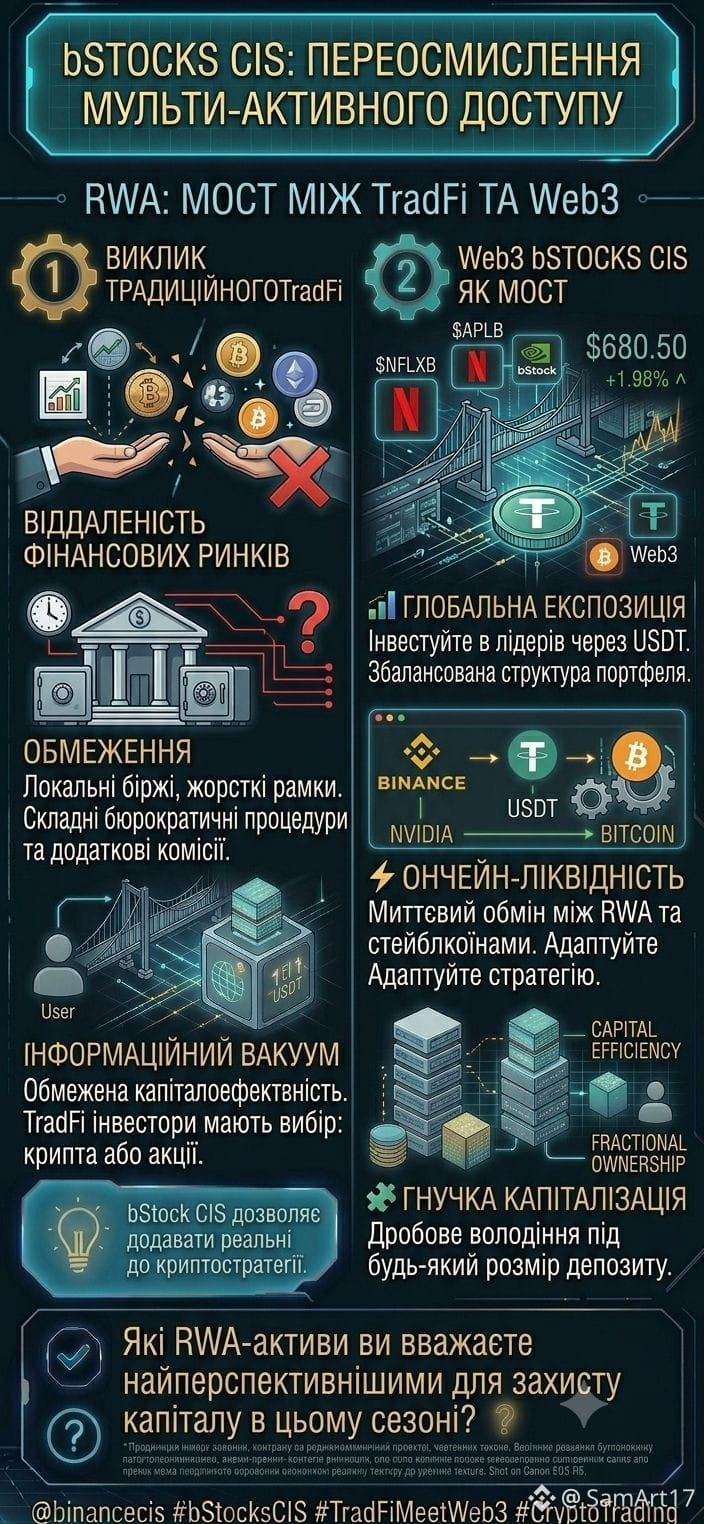
Deleveraging and effective risk management are the foundation of successful trading. However, most traditional investors are limited by rigid frameworks of local exchanges, where access to the global technology sector is often accompanied by complex bureaucratic procedures and additional fees.
Tokenized bStocks on the BNB Chain expand horizons for the Web3 community, offering direct access to the shares of global leaders:
📊 Global exposure: Invest in $NFLXB , $AAPLB , or $AMZNB directly through USDT, supporting a balanced portfolio structure.
⚡ On-chain liquidity: Instant swapping between RWA tokens and stablecoins lets you adapt your strategy to new market conditions within seconds.
🧩 Flexible capitalization: Fractional ownership makes it possible to precisely size a position for any deposit amount.
This is a new level of freedom for traders—combining the stability of the fundamental market with the speed and technology of decentralized finance.
Which RWA assets do you consider the most promising for protecting your capital this season?
#bstockscis @BinanceCIS
Deleveraging and effective risk management are the foundation of successful trading. However, most traditional investors are limited by rigid frameworks of local exchanges, where access to the global technology sector is often accompanied by complex bureaucratic procedures and additional fees.
Tokenized bStocks on the BNB Chain expand horizons for the Web3 community, offering direct access to the shares of global leaders:
📊 Global exposure: Invest in $NFLXB , $AAPLB , or $AMZNB directly through USDT, supporting a balanced portfolio structure.
⚡ On-chain liquidity: Instant swapping between RWA tokens and stablecoins lets you adapt your strategy to new market conditions within seconds.
🧩 Flexible capitalization: Fractional ownership makes it possible to precisely size a position for any deposit amount.
This is a new level of freedom for traders—combining the stability of the fundamental market with the speed and technology of decentralized finance.
Which RWA assets do you consider the most promising for protecting your capital this season?
Deleveraging and effective risk management are the foundation of successful trading. However, most traditional investors are limited by rigid frameworks of local exchanges, where access to the global technology sector is often accompanied by complex bureaucratic procedures and additional fees.
Tokenized bStocks on the BNB Chain expand horizons for the Web3 community, offering direct access to the shares of global leaders:
📊 Global exposure: Invest in $NFLXB , $AAPLB , or $AMZNB directly through USDT, supporting a balanced portfolio structure.
⚡ On-chain liquidity: Instant swapping between RWA tokens and stablecoins lets you adapt your strategy to new market conditions within seconds.
🧩 Flexible capitalization: Fractional ownership makes it possible to precisely size a position for any deposit amount.
This is a new level of freedom for traders—combining the stability of the fundamental market with the speed and technology of decentralized finance.
Which RWA assets do you consider the most promising for protecting your capital this season?
1
64
·
--
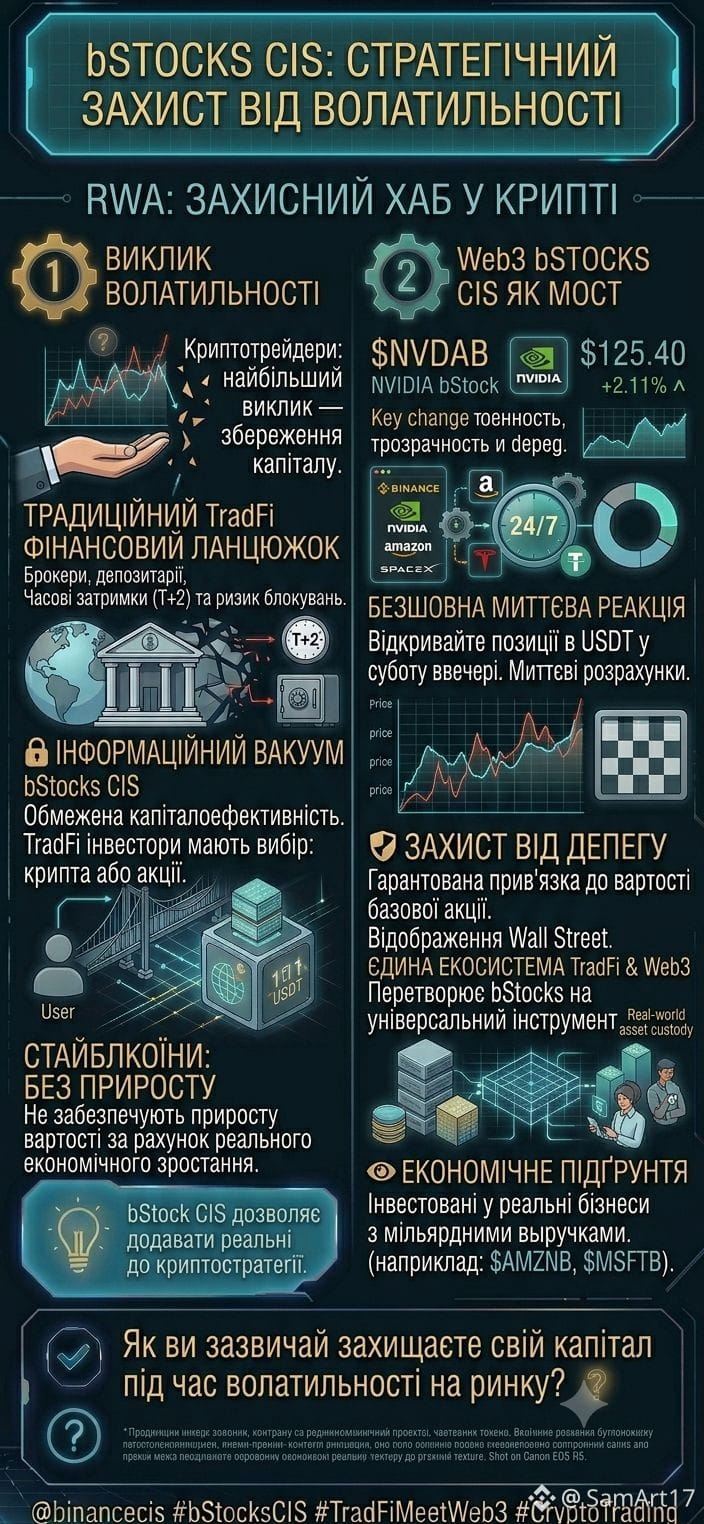
For many crypto traders, the biggest challenge during high volatility is preserving capital without exiting to fiat. Usually, the alternative is stablecoins, but they do not provide value growth through real economic growth.
This is where bStocks offers a new level of strategic protection through tokenized RWA stocks on BNB Chain:
🛡 A protective hub in crypto: Instead of holding idle stablecoins during altcoin drawdowns, you can redirect USDT into fundamental assets ($AMZNB , $MSFTB or $AAPLB ).
📈 Economic foundation: You gain protection from crypto market volatility while staying invested in real businesses with billion-dollar revenues.
⚡ Maneuverability: When the market recovers, you can instantly move back into crypto assets without waiting or paying traditional bank fees.
This turns bStocks into a universal tool for balancing between the aggressive growth of Web3 and the fundamental stability of the global stock market.
How do you usually protect your capital during market volatility?
For many crypto traders, the biggest challenge during high volatility is preserving capital without exiting to fiat. Usually, the alternative is stablecoins, but they do not provide value growth through real economic growth.
This is where bStocks offers a new level of strategic protection through tokenized RWA stocks on BNB Chain:
🛡 A protective hub in crypto: Instead of holding idle stablecoins during altcoin drawdowns, you can redirect USDT into fundamental assets ($AMZNB , $MSFTB or $AAPLB ).
📈 Economic foundation: You gain protection from crypto market volatility while staying invested in real businesses with billion-dollar revenues.
⚡ Maneuverability: When the market recovers, you can instantly move back into crypto assets without waiting or paying traditional bank fees.
This turns bStocks into a universal tool for balancing between the aggressive growth of Web3 and the fundamental stability of the global stock market.
How do you usually protect your capital during market volatility?
This is where bStocks offers a new level of strategic protection through tokenized RWA stocks on BNB Chain:
🛡 A protective hub in crypto: Instead of holding idle stablecoins during altcoin drawdowns, you can redirect USDT into fundamental assets ($AMZNB , $MSFTB or $AAPLB ).
📈 Economic foundation: You gain protection from crypto market volatility while staying invested in real businesses with billion-dollar revenues.
⚡ Maneuverability: When the market recovers, you can instantly move back into crypto assets without waiting or paying traditional bank fees.
This turns bStocks into a universal tool for balancing between the aggressive growth of Web3 and the fundamental stability of the global stock market.
How do you usually protect your capital during market volatility?
2
92
·
--
#bstockscis @BinanceCIS
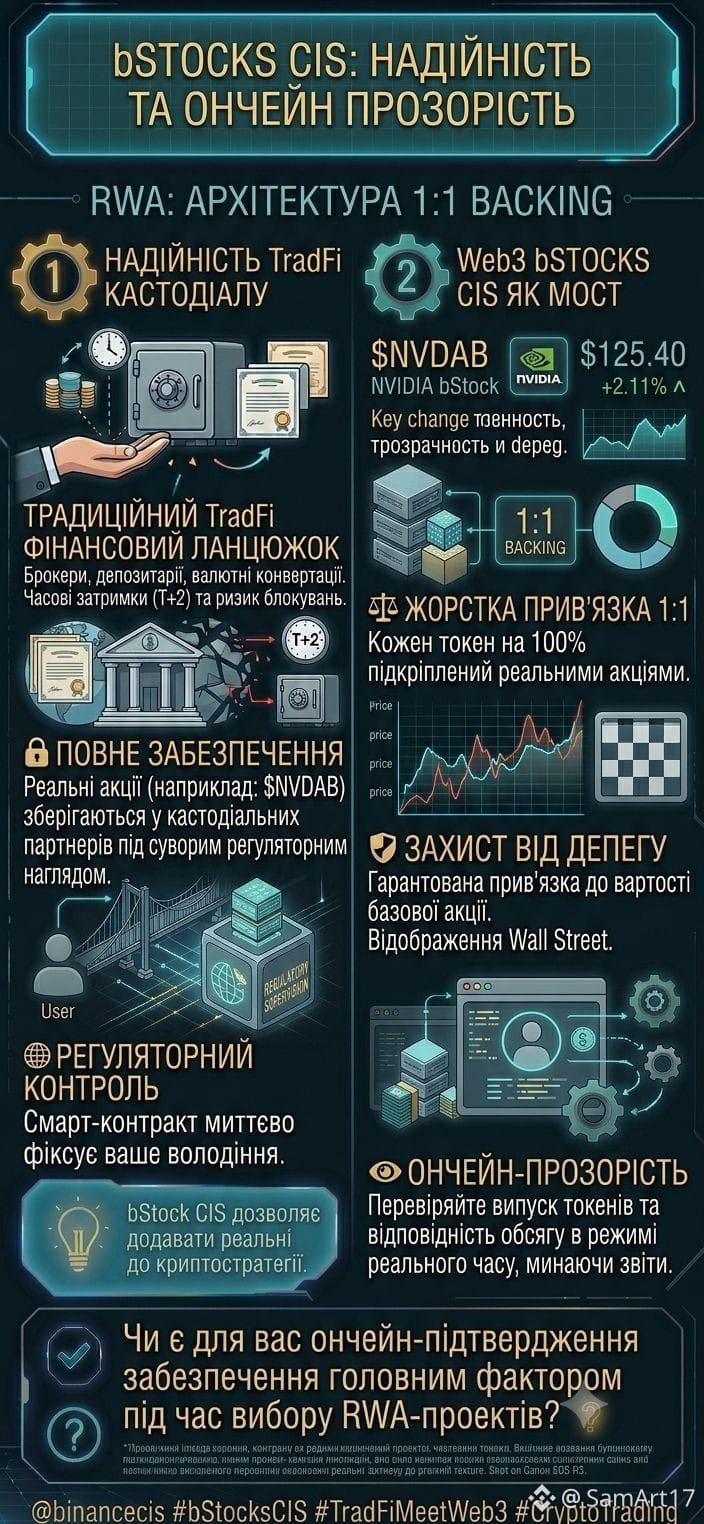
When choosing investment instruments, the key issue remains the transparency and security of assets. Many Web3 users are wary of tokenized securities, fearing the risks of “unbacked promises.”
The bStocks project addresses this problem through a clear 1:1 backing architecture on BNB Chain:
🔒 Full backing: Each token ($NVDAB , #AAPLB or $MSFTB ) is 100% backed by real shares held by custodial partners under strict regulatory oversight.
👁 On-chain transparency: Thanks to smart contracts, every user can verify token issuance and the corresponding asset volume in real time, bypassing the “black box” of brokerage reports.
🛡 Protection against depeg: A hard peg to the value of the underlying stock ensures that the token price accurately reflects the real market dynamics of Wall Street.
This combines the institutional reliability of the traditional stock market with the technological openness of blockchain.
Is on-chain proof of backing the main factor for you when choosing RWA projects?
#bstockscis @BinanceCIS
When choosing investment instruments, the key issue remains the transparency and security of assets. Many Web3 users are wary of tokenized securities, fearing the risks of “unbacked promises.”
The bStocks project addresses this problem through a clear 1:1 backing architecture on BNB Chain:
🔒 Full backing: Each token ($NVDAB , #AAPLB or $MSFTB ) is 100% backed by real shares held by custodial partners under strict regulatory oversight.
👁 On-chain transparency: Thanks to smart contracts, every user can verify token issuance and the corresponding asset volume in real time, bypassing the “black box” of brokerage reports.
🛡 Protection against depeg: A hard peg to the value of the underlying stock ensures that the token price accurately reflects the real market dynamics of Wall Street.
This combines the institutional reliability of the traditional stock market with the technological openness of blockchain.
Is on-chain proof of backing the main factor for you when choosing RWA projects?
When choosing investment instruments, the key issue remains the transparency and security of assets. Many Web3 users are wary of tokenized securities, fearing the risks of “unbacked promises.”
The bStocks project addresses this problem through a clear 1:1 backing architecture on BNB Chain:
🔒 Full backing: Each token ($NVDAB , #AAPLB or $MSFTB ) is 100% backed by real shares held by custodial partners under strict regulatory oversight.
👁 On-chain transparency: Thanks to smart contracts, every user can verify token issuance and the corresponding asset volume in real time, bypassing the “black box” of brokerage reports.
🛡 Protection against depeg: A hard peg to the value of the underlying stock ensures that the token price accurately reflects the real market dynamics of Wall Street.
This combines the institutional reliability of the traditional stock market with the technological openness of blockchain.
Is on-chain proof of backing the main factor for you when choosing RWA projects?
2
130
·
--
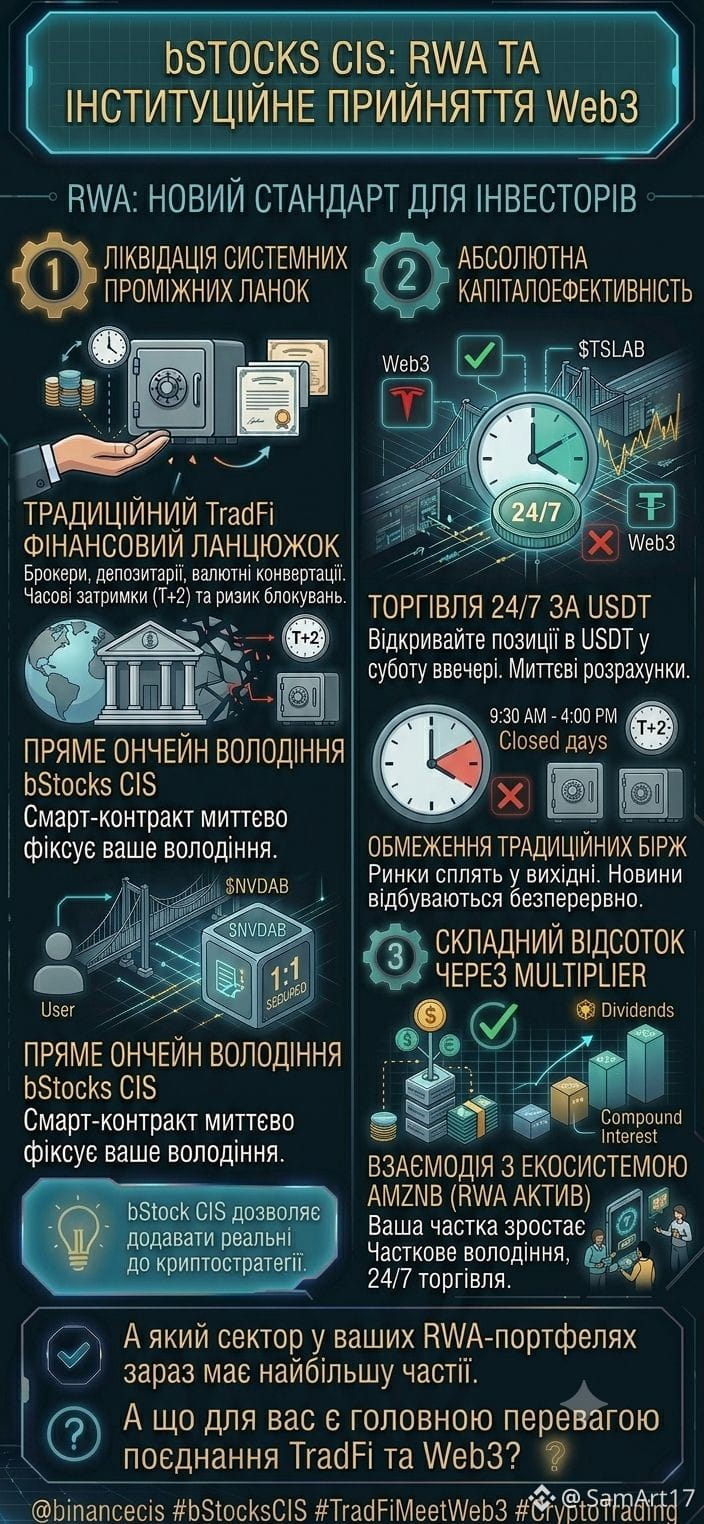
Most people see bStocks only as a convenient way to buy $NVDAB or $TSLAB for USDT. But the real shift lies at the intersection of two phenomena: RWA (Real World Assets) and institutional adoption of Web3.
Why are tokenized stocks on BNB Chain changing the standards for investors?
1️⃣ No intermediaries: In TradFi, brokers, custodians, and banking delays (T+2) stand between you and the stock. bStocks guarantees transparent 1:1 backing, where a smart contract instantly records ownership rights.
2️⃣ 24/7 capital efficiency: Traditional markets close on weekends, but important news happens nonstop. The ability to lock in profit in USDT on Saturday gives a real advantage over closed brokerage sessions.
3️⃣ Multiplier compounding: Automatic on-chain reinvestment of dividends into the underlying asset increases your share without extra actions or additional tax events.
This is not just trading, but a seamless bridge that turns traditional capital into a flexible Web3 instrument.
And which sector in your RWA portfolios currently makes up the largest share?
Most people see bStocks only as a convenient way to buy $NVDAB or $TSLAB for USDT. But the real shift lies at the intersection of two phenomena: RWA (Real World Assets) and institutional adoption of Web3.
Why are tokenized stocks on BNB Chain changing the standards for investors?
1️⃣ No intermediaries: In TradFi, brokers, custodians, and banking delays (T+2) stand between you and the stock. bStocks guarantees transparent 1:1 backing, where a smart contract instantly records ownership rights.
2️⃣ 24/7 capital efficiency: Traditional markets close on weekends, but important news happens nonstop. The ability to lock in profit in USDT on Saturday gives a real advantage over closed brokerage sessions.
3️⃣ Multiplier compounding: Automatic on-chain reinvestment of dividends into the underlying asset increases your share without extra actions or additional tax events.
This is not just trading, but a seamless bridge that turns traditional capital into a flexible Web3 instrument.
And which sector in your RWA portfolios currently makes up the largest share?
Why are tokenized stocks on BNB Chain changing the standards for investors?
1️⃣ No intermediaries: In TradFi, brokers, custodians, and banking delays (T+2) stand between you and the stock. bStocks guarantees transparent 1:1 backing, where a smart contract instantly records ownership rights.
2️⃣ 24/7 capital efficiency: Traditional markets close on weekends, but important news happens nonstop. The ability to lock in profit in USDT on Saturday gives a real advantage over closed brokerage sessions.
3️⃣ Multiplier compounding: Automatic on-chain reinvestment of dividends into the underlying asset increases your share without extra actions or additional tax events.
This is not just trading, but a seamless bridge that turns traditional capital into a flexible Web3 instrument.
And which sector in your RWA portfolios currently makes up the largest share?
2
107
·
--
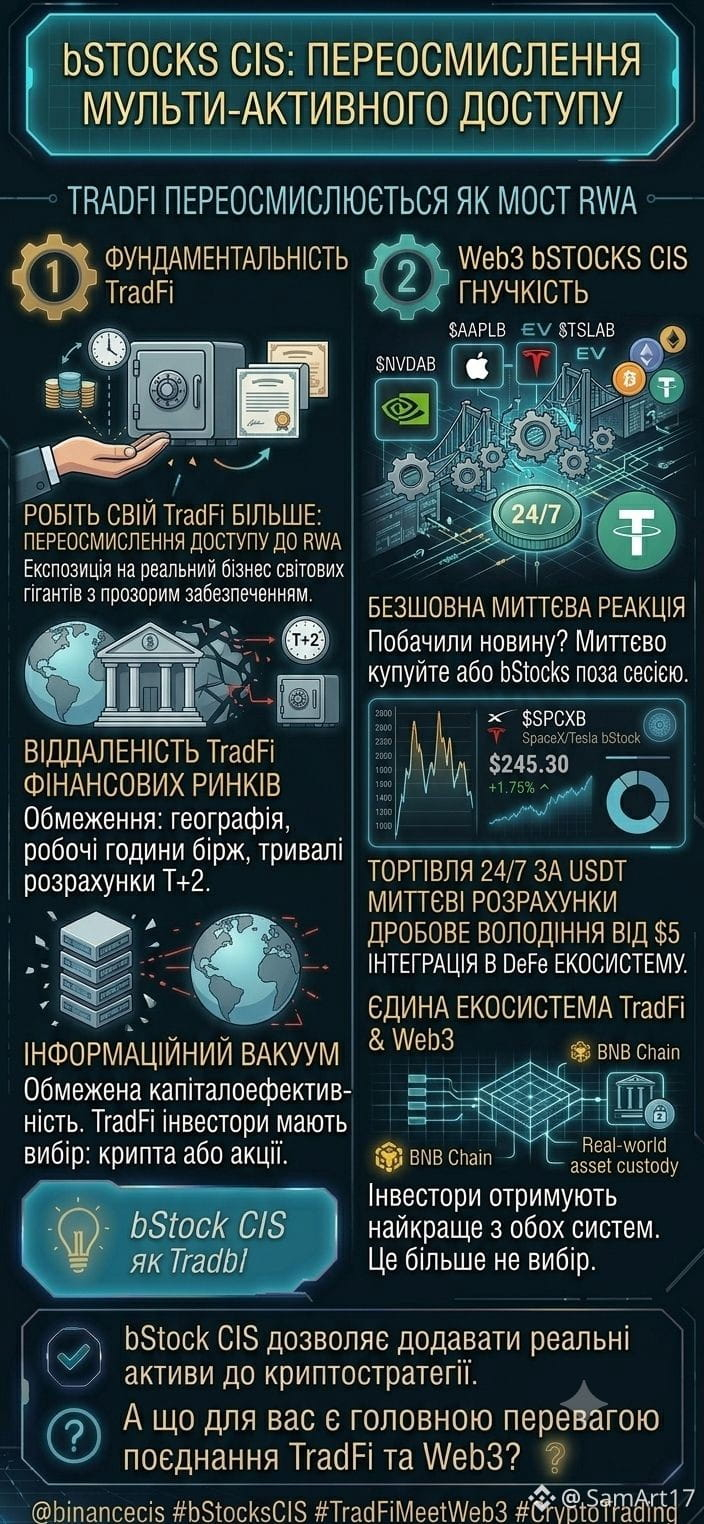
The development of TradFi (traditional finance) and Web3 for a long time has been moving along parallel paths. The traditional stock market offered reliability and instruments validated over decades, but it remained constrained by geographical limitations, exchange trading hours, and lengthy T+2 settlement times.
Today, we are witnessing a major shift: the tokenization of real-world assets (RWAs) is becoming the main bridge between these two worlds. With tools like bStocks on BNB Chain, the TradFi concept is being reimagined right before our eyes.
Investors get the best of both systems:
🏛 The solidity of TradFi: direct exposure to real business of global giants ($NVDAB , $TSLAB ,$SPCXB ) with transparent collateral.
⚡ The flexibility of Web3: 24/7 trading with USDT, instant settlement, fractional ownership starting from $5, and full integration into a decentralized ecosystem.
This is no longer a choice between “crypto” and “stocks”—it’s the evolution of TradFi into a more transparent, faster, and more accessible format for every trader.
What is the main advantage of combining TradFi and Web3 for you?
The development of TradFi (traditional finance) and Web3 for a long time has been moving along parallel paths. The traditional stock market offered reliability and instruments validated over decades, but it remained constrained by geographical limitations, exchange trading hours, and lengthy T+2 settlement times.
Today, we are witnessing a major shift: the tokenization of real-world assets (RWAs) is becoming the main bridge between these two worlds. With tools like bStocks on BNB Chain, the TradFi concept is being reimagined right before our eyes.
Investors get the best of both systems:
🏛 The solidity of TradFi: direct exposure to real business of global giants ($NVDAB , $TSLAB ,$SPCXB ) with transparent collateral.
⚡ The flexibility of Web3: 24/7 trading with USDT, instant settlement, fractional ownership starting from $5, and full integration into a decentralized ecosystem.
This is no longer a choice between “crypto” and “stocks”—it’s the evolution of TradFi into a more transparent, faster, and more accessible format for every trader.
What is the main advantage of combining TradFi and Web3 for you?
Today, we are witnessing a major shift: the tokenization of real-world assets (RWAs) is becoming the main bridge between these two worlds. With tools like bStocks on BNB Chain, the TradFi concept is being reimagined right before our eyes.
Investors get the best of both systems:
🏛 The solidity of TradFi: direct exposure to real business of global giants ($NVDAB , $TSLAB ,$SPCXB ) with transparent collateral.
⚡ The flexibility of Web3: 24/7 trading with USDT, instant settlement, fractional ownership starting from $5, and full integration into a decentralized ecosystem.
This is no longer a choice between “crypto” and “stocks”—it’s the evolution of TradFi into a more transparent, faster, and more accessible format for every trader.
What is the main advantage of combining TradFi and Web3 for you?
2
193
·
--
#bstockscis @BinanceCIS
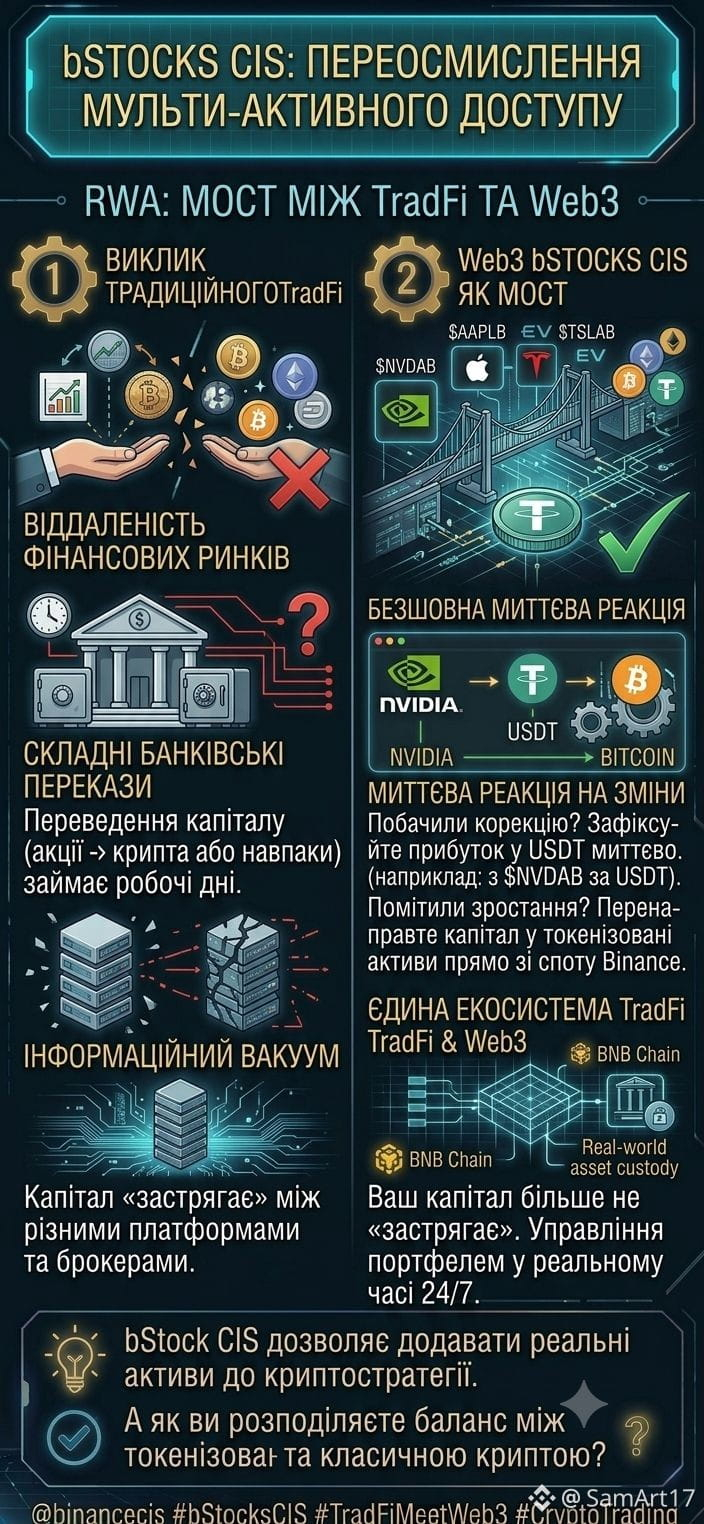
Most investors are used to the fact that there is a huge financial gap between stock exchanges and the cryptocurrency market. To move capital from traditional shares to crypto assets—or vice versa—usually requires going through bank transfers, fees, and withdrawal processing times that can take several business days.
With tokenized shares from bStocks on BNB Chain, this barrier is completely gone. Now you can respond to changes in market trends instantly.
Did you notice a pullback in the tech sector? With just a couple of clicks, you can lock in profits at $NVDAB or $AAPLB by transferring funds into USDT or stablecoins. Saw a new wave of market growth—and immediately redirected that capital into tokenized stock assets directly from your Binance spot wallet.
This isn’t just convenience—it’s maximum capital efficiency: your capital no longer gets “stuck” between different platforms and brokers. You get a single ecosystem for managing your TradFi and Web3 portfolio in real time, 24/7.
And how do you split your balance between tokenized shares and classic crypto?
#bstockscis @BinanceCIS
Most investors are used to the fact that there is a huge financial gap between stock exchanges and the cryptocurrency market. To move capital from traditional shares to crypto assets—or vice versa—usually requires going through bank transfers, fees, and withdrawal processing times that can take several business days.
With tokenized shares from bStocks on BNB Chain, this barrier is completely gone. Now you can respond to changes in market trends instantly.
Did you notice a pullback in the tech sector? With just a couple of clicks, you can lock in profits at $NVDAB or $AAPLB by transferring funds into USDT or stablecoins. Saw a new wave of market growth—and immediately redirected that capital into tokenized stock assets directly from your Binance spot wallet.
This isn’t just convenience—it’s maximum capital efficiency: your capital no longer gets “stuck” between different platforms and brokers. You get a single ecosystem for managing your TradFi and Web3 portfolio in real time, 24/7.
And how do you split your balance between tokenized shares and classic crypto?
Most investors are used to the fact that there is a huge financial gap between stock exchanges and the cryptocurrency market. To move capital from traditional shares to crypto assets—or vice versa—usually requires going through bank transfers, fees, and withdrawal processing times that can take several business days.
With tokenized shares from bStocks on BNB Chain, this barrier is completely gone. Now you can respond to changes in market trends instantly.
Did you notice a pullback in the tech sector? With just a couple of clicks, you can lock in profits at $NVDAB or $AAPLB by transferring funds into USDT or stablecoins. Saw a new wave of market growth—and immediately redirected that capital into tokenized stock assets directly from your Binance spot wallet.
This isn’t just convenience—it’s maximum capital efficiency: your capital no longer gets “stuck” between different platforms and brokers. You get a single ecosystem for managing your TradFi and Web3 portfolio in real time, 24/7.
And how do you split your balance between tokenized shares and classic crypto?
1
110
·
--
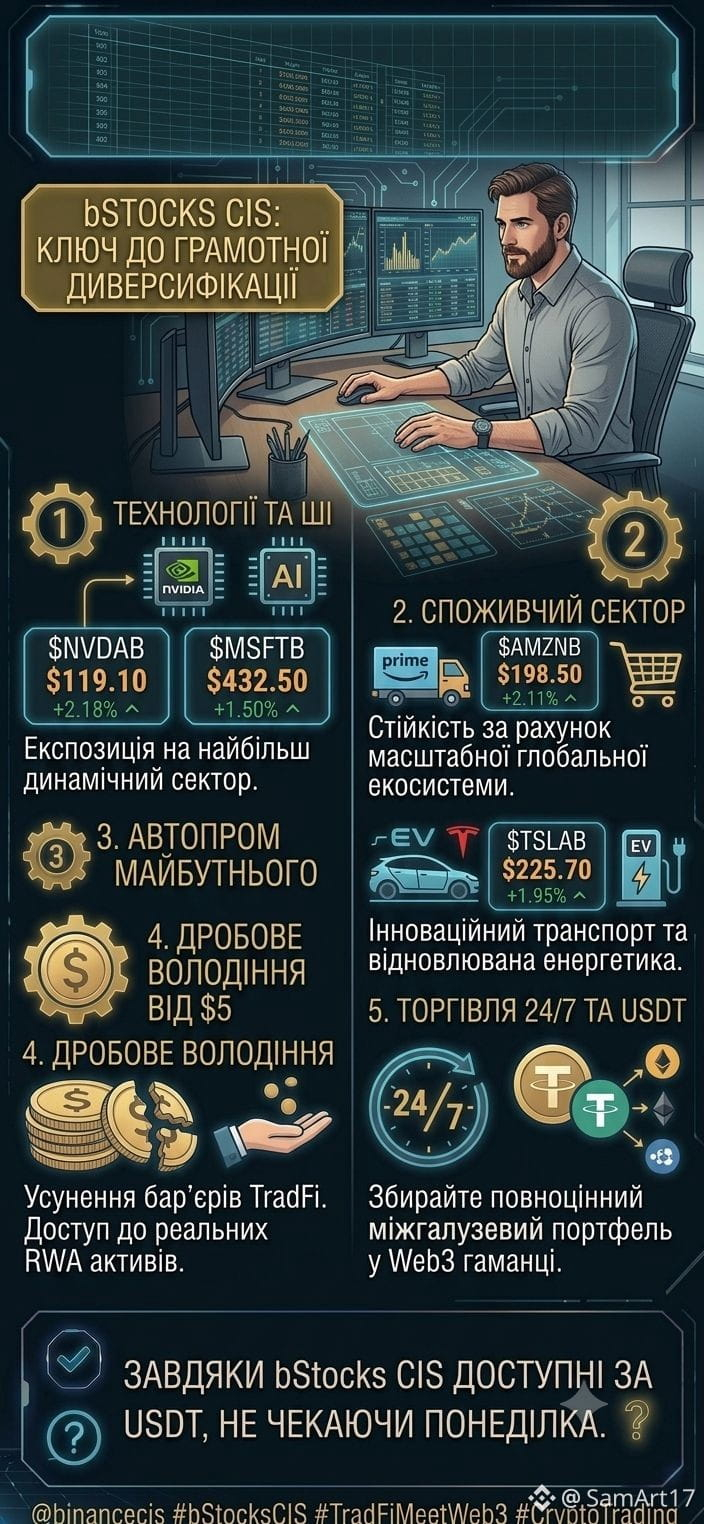
When building an investment portfolio, many people focus only on analyzing individual companies. However, the key factor for long-term success is sound diversification across different sectors of the economy.
The bStocks platform on BNB Chain makes it easy to combine tech giants and traditional markets directly in your Web3 wallet with USDT:
💻 Technologies and AI: $NVDAB and $MSFTB provide exposure to the most dynamic sector of digital transformation.
🛒 Consumer sector and e-commerce: $AMZNB offers stability thanks to a large global sales ecosystem and cloud services.
🚗 The automotive industry of the future: $TSLAB adds an element of innovative transport and renewable energy.
RWA tokenization removes the main barrier of the traditional stock market— the need to open accounts with multiple brokers or buy expensive individual shares. Fractional ownership from $5 makes a balanced portfolio accessible to everyone.
With bStocks, you can build a complete cross-industry portfolio 24/7 without unnecessary bureaucracy.
Which market sectors form the foundation of your investment strategy?
#bStocks
When building an investment portfolio, many people focus only on analyzing individual companies. However, the key factor for long-term success is sound diversification across different sectors of the economy.
The bStocks platform on BNB Chain makes it easy to combine tech giants and traditional markets directly in your Web3 wallet with USDT:
💻 Technologies and AI: $NVDAB and $MSFTB provide exposure to the most dynamic sector of digital transformation.
🛒 Consumer sector and e-commerce: $AMZNB offers stability thanks to a large global sales ecosystem and cloud services.
🚗 The automotive industry of the future: $TSLAB adds an element of innovative transport and renewable energy.
RWA tokenization removes the main barrier of the traditional stock market— the need to open accounts with multiple brokers or buy expensive individual shares. Fractional ownership from $5 makes a balanced portfolio accessible to everyone.
With bStocks, you can build a complete cross-industry portfolio 24/7 without unnecessary bureaucracy.
Which market sectors form the foundation of your investment strategy?
#bStocks
The bStocks platform on BNB Chain makes it easy to combine tech giants and traditional markets directly in your Web3 wallet with USDT:
💻 Technologies and AI: $NVDAB and $MSFTB provide exposure to the most dynamic sector of digital transformation.
🛒 Consumer sector and e-commerce: $AMZNB offers stability thanks to a large global sales ecosystem and cloud services.
🚗 The automotive industry of the future: $TSLAB adds an element of innovative transport and renewable energy.
RWA tokenization removes the main barrier of the traditional stock market— the need to open accounts with multiple brokers or buy expensive individual shares. Fractional ownership from $5 makes a balanced portfolio accessible to everyone.
With bStocks, you can build a complete cross-industry portfolio 24/7 without unnecessary bureaucracy.
Which market sectors form the foundation of your investment strategy?
#bStocks
2
109
·
--
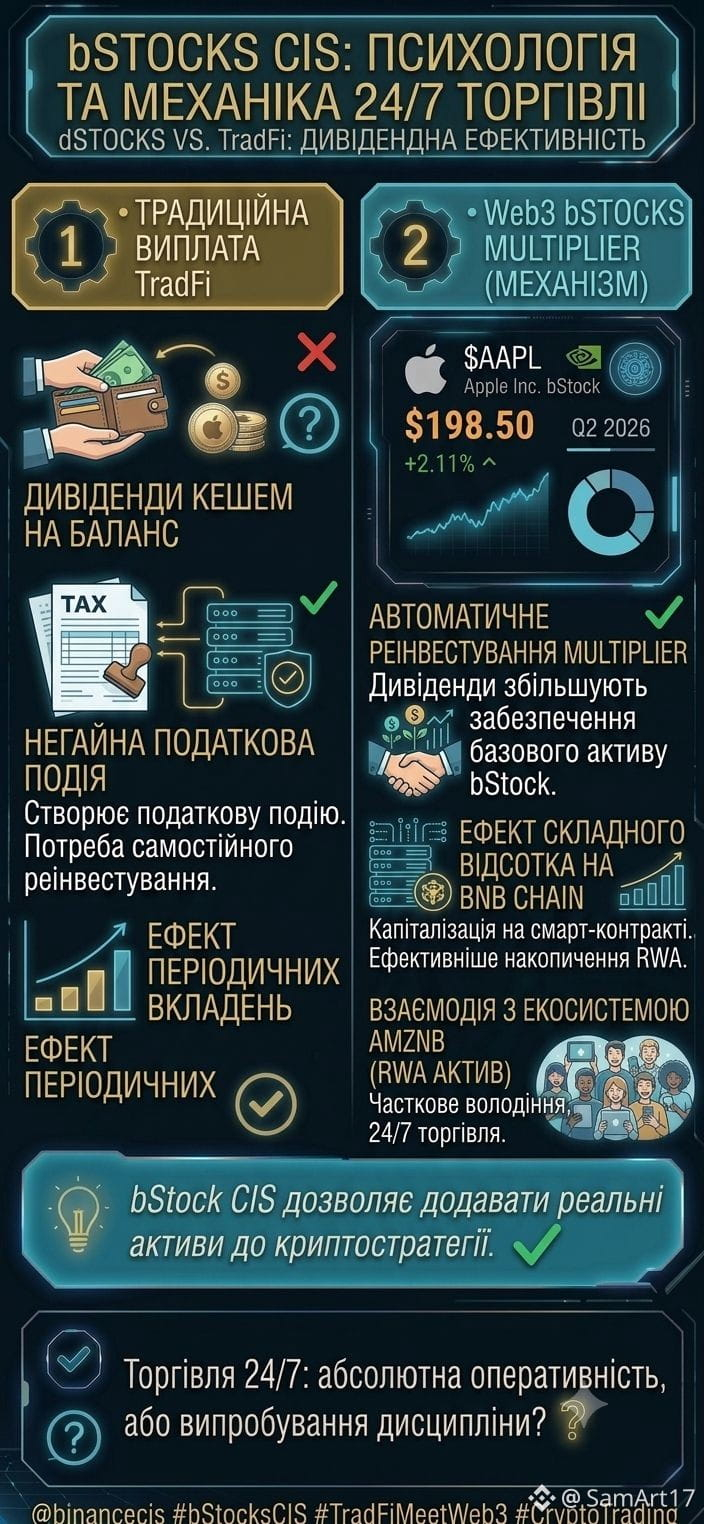
When trading tokenized stocks on bStocks, many people focus only on the convenience of buying $NVDAB or $TSLAB with USDT. However, there is an important difference between the traditional TradFi approach and the Web3 approach—one that is rarely considered: the mechanics of dividend payments and their tax efficiency.
In a traditional system, the broker pays dividends directly into your account in cash, which immediately creates a taxable event for the investor. By contrast, bStocks tokenized stocks use a Multiplier mechanism: dividends paid by the company are automatically reinvested into the underlying asset.
This means that the number of your stake—or its internal backing—increases without having to receive cash payouts every time and buy additional tokens yourself. This approach creates a compounding effect right on the BNB Chain smart contract.
You receive automatic capitalized position growth instead of small balance payouts. As a result, long-term accumulation of RWA assets in Web3 is significantly more effective than holding them through a traditional broker.
And what do you think: is it better to receive dividends in cash or to automatically reinvest them via the bStocks multiplier?
When trading tokenized stocks on bStocks, many people focus only on the convenience of buying $NVDAB or $TSLAB with USDT. However, there is an important difference between the traditional TradFi approach and the Web3 approach—one that is rarely considered: the mechanics of dividend payments and their tax efficiency.
In a traditional system, the broker pays dividends directly into your account in cash, which immediately creates a taxable event for the investor. By contrast, bStocks tokenized stocks use a Multiplier mechanism: dividends paid by the company are automatically reinvested into the underlying asset.
This means that the number of your stake—or its internal backing—increases without having to receive cash payouts every time and buy additional tokens yourself. This approach creates a compounding effect right on the BNB Chain smart contract.
You receive automatic capitalized position growth instead of small balance payouts. As a result, long-term accumulation of RWA assets in Web3 is significantly more effective than holding them through a traditional broker.
And what do you think: is it better to receive dividends in cash or to automatically reinvest them via the bStocks multiplier?
In a traditional system, the broker pays dividends directly into your account in cash, which immediately creates a taxable event for the investor. By contrast, bStocks tokenized stocks use a Multiplier mechanism: dividends paid by the company are automatically reinvested into the underlying asset.
This means that the number of your stake—or its internal backing—increases without having to receive cash payouts every time and buy additional tokens yourself. This approach creates a compounding effect right on the BNB Chain smart contract.
You receive automatic capitalized position growth instead of small balance payouts. As a result, long-term accumulation of RWA assets in Web3 is significantly more effective than holding them through a traditional broker.
And what do you think: is it better to receive dividends in cash or to automatically reinvest them via the bStocks multiplier?
2
129
·
--
DeFi Credit Risk: Why TermMax Structural Design Matters More Than APY
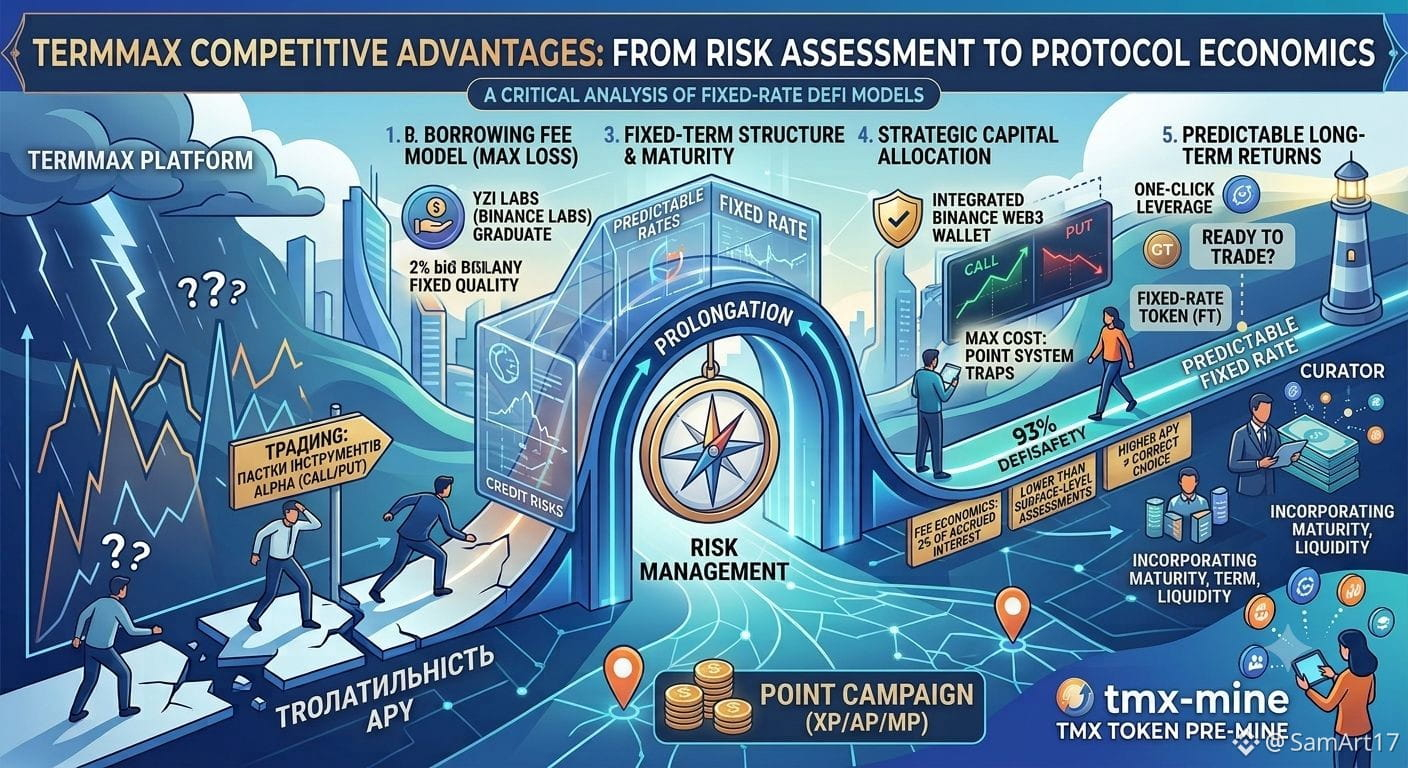
Evaluating DeFi lending protocols often turns into a superficial search for the highest APY, ignoring underlying structural risks. A closer look at #TermMax reveals a model designed around risk quantification rather than marketing promises.
First, consider protocol fees: TermMax’s 2% fee applies exclusively to generated interest rather than principal capital. For a 30-day position, real economic costs are a fraction of nominal figures, significantly reducing long-term friction for borrowers.
Second, the Curator architecture shifts risk management to dedicated protocol managers. While users enjoy passive yield, Curators must balance yield generation against maturity dates and liquidity fragmentation during volatile market cycles.
Finally, in products like TermMax Alpha, the upfront Max Cost mechanic caps exposure before entering a Call or Put trade, providing defined-risk parameters upfront.
In fixed-rate credit markets, transparent risk management and predictable capital efficiency always outweigh speculative short-term yield displays.
#TermMax @termmax
DeFi Credit Risk: Why TermMax Structural Design Matters More Than APY
Evaluating DeFi lending protocols often turns into a superficial search for the highest APY, ignoring underlying structural risks. A closer look at #TermMax reveals a model designed around risk quantification rather than marketing promises.
First, consider protocol fees: TermMax’s 2% fee applies exclusively to generated interest rather than principal capital. For a 30-day position, real economic costs are a fraction of nominal figures, significantly reducing long-term friction for borrowers.
Second, the Curator architecture shifts risk management to dedicated protocol managers. While users enjoy passive yield, Curators must balance yield generation against maturity dates and liquidity fragmentation during volatile market cycles.
Finally, in products like TermMax Alpha, the upfront Max Cost mechanic caps exposure before entering a Call or Put trade, providing defined-risk parameters upfront.
In fixed-rate credit markets, transparent risk management and predictable capital efficiency always outweigh speculative short-term yield displays.
#TermMax @TermMax
Evaluating DeFi lending protocols often turns into a superficial search for the highest APY, ignoring underlying structural risks. A closer look at #TermMax reveals a model designed around risk quantification rather than marketing promises.
First, consider protocol fees: TermMax’s 2% fee applies exclusively to generated interest rather than principal capital. For a 30-day position, real economic costs are a fraction of nominal figures, significantly reducing long-term friction for borrowers.
Second, the Curator architecture shifts risk management to dedicated protocol managers. While users enjoy passive yield, Curators must balance yield generation against maturity dates and liquidity fragmentation during volatile market cycles.
Finally, in products like TermMax Alpha, the upfront Max Cost mechanic caps exposure before entering a Call or Put trade, providing defined-risk parameters upfront.
In fixed-rate credit markets, transparent risk management and predictable capital efficiency always outweigh speculative short-term yield displays.
#TermMax @TermMax
1
76
·
--
Predictable Yields: How TermMax Supercharges Tokenized Asset Finance
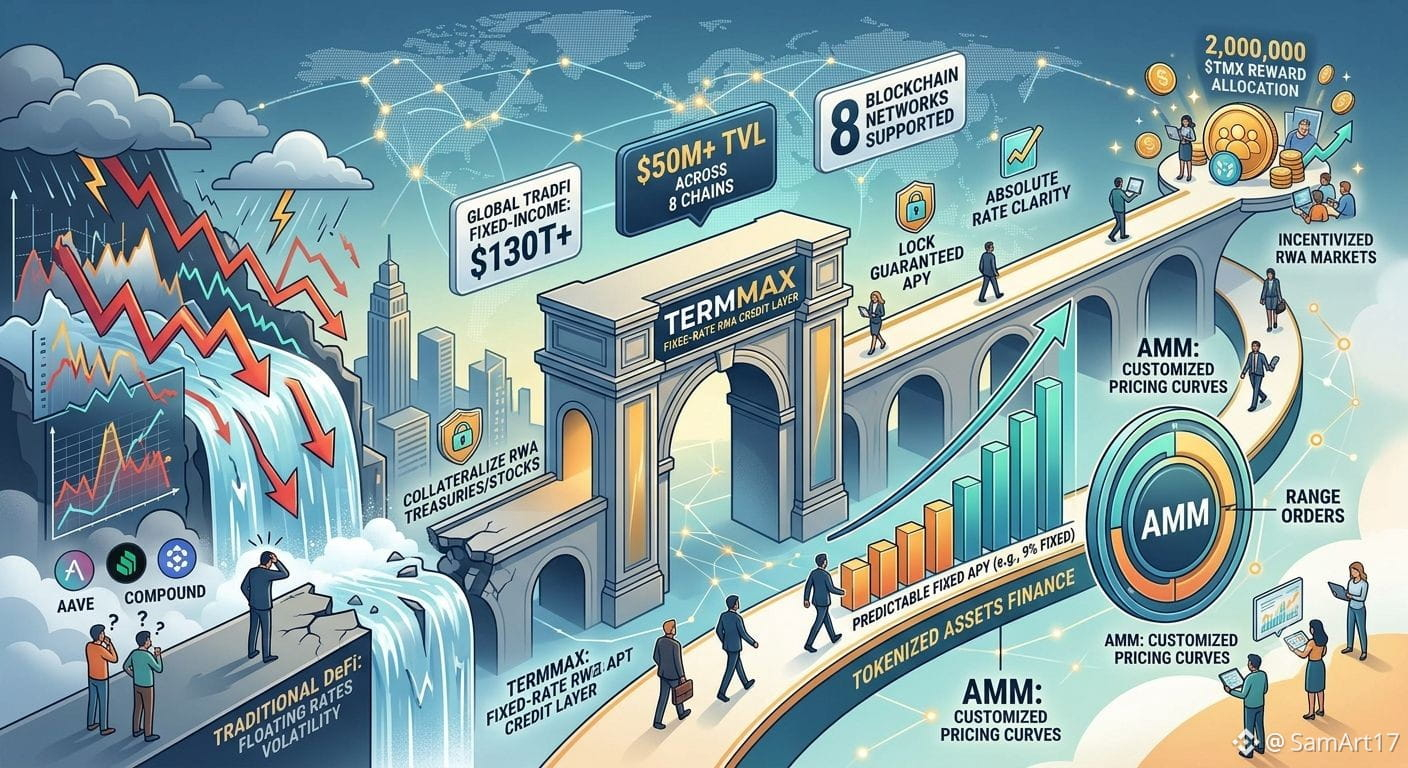
The integration of Real-World Assets (RWAs) into Web3 often struggles with the volatility of floating interest rates. #TermMax solves this bottleneck by providing a dedicated fixed-rate, fixed-term lending infrastructure for tokenized securities and yield-bearing assets.
Market data reveals that fixed-income products dominate traditional finance, making up over $130 trillion globally. By bringing this predictability on-chain, TermMax allows institutional investors to collateralize tokenized treasuries and stocks without exposing themselves to unpredictable borrowing spikes. Currently, over $50M in Total Value Locked across 8 major chains reflects growing adoption among capital allocators who prioritize stability.
Through liquidity-optimized AMM mechanics and structured accumulation vaults, users can lock in guaranteed APY or borrow against RWAs with absolute rate clarity. The ongoing 2,000,000 $TMX reward allocation further incentivizes users providing liquidity to these fixed-term RWA markets.
TermMax stands out as the fundamental credit layer for institutional DeFi, turning volatile crypto yields into reliable, long-term financial strategies.
#TermMax @termmax
Predictable Yields: How TermMax Supercharges Tokenized Asset Finance
The integration of Real-World Assets (RWAs) into Web3 often struggles with the volatility of floating interest rates. #TermMax solves this bottleneck by providing a dedicated fixed-rate, fixed-term lending infrastructure for tokenized securities and yield-bearing assets.
Market data reveals that fixed-income products dominate traditional finance, making up over $130 trillion globally. By bringing this predictability on-chain, TermMax allows institutional investors to collateralize tokenized treasuries and stocks without exposing themselves to unpredictable borrowing spikes. Currently, over $50M in Total Value Locked across 8 major chains reflects growing adoption among capital allocators who prioritize stability.
Through liquidity-optimized AMM mechanics and structured accumulation vaults, users can lock in guaranteed APY or borrow against RWAs with absolute rate clarity. The ongoing 2,000,000 $TMX reward allocation further incentivizes users providing liquidity to these fixed-term RWA markets.
TermMax stands out as the fundamental credit layer for institutional DeFi, turning volatile crypto yields into reliable, long-term financial strategies.
#TermMax @TermMax
The integration of Real-World Assets (RWAs) into Web3 often struggles with the volatility of floating interest rates. #TermMax solves this bottleneck by providing a dedicated fixed-rate, fixed-term lending infrastructure for tokenized securities and yield-bearing assets.
Market data reveals that fixed-income products dominate traditional finance, making up over $130 trillion globally. By bringing this predictability on-chain, TermMax allows institutional investors to collateralize tokenized treasuries and stocks without exposing themselves to unpredictable borrowing spikes. Currently, over $50M in Total Value Locked across 8 major chains reflects growing adoption among capital allocators who prioritize stability.
Through liquidity-optimized AMM mechanics and structured accumulation vaults, users can lock in guaranteed APY or borrow against RWAs with absolute rate clarity. The ongoing 2,000,000 $TMX reward allocation further incentivizes users providing liquidity to these fixed-term RWA markets.
TermMax stands out as the fundamental credit layer for institutional DeFi, turning volatile crypto yields into reliable, long-term financial strategies.
#TermMax @TermMax
2
71
·
--
Fixed-Rate Revolution: How TermMax is Transforming On-Chain Credit
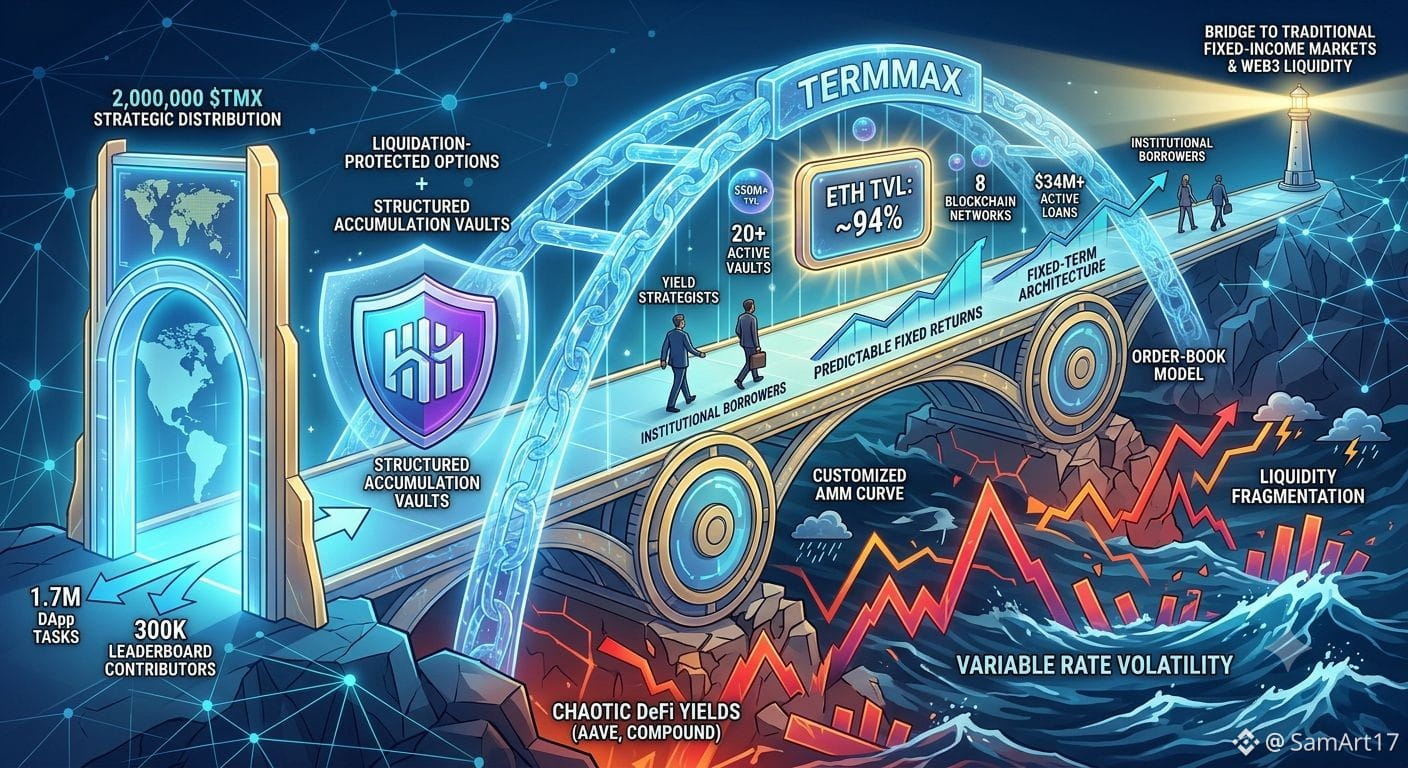
Variable lending rates in decentralized finance often create unpredictability for yield strategists and institutional borrowers. #TermMax addresses this liquidity fragmentation by establishing fixed-rate, fixed-term lending architecture powered by customized AMM curves and order-book models.
Recent data highlights strong early traction, with the protocol commanding over $50 million in Total Value Locked (TVL) across 20+ active vaults spanning 8 blockchain networks. In active debt markets, TermMax has generated nearly $34 million in active loans, with Ethereum holding roughly 94% of overall TVL.
To further boost participation, a 2,000,000 TMX strategic distribution campaign was deployed, allocating 1.7 million tokens toward protocol DApp tasks and 300,000TMX for leaderboard contributors.
By delivering predictable returns, liquidation-protected options, and structured accumulation vaults, TermMax provides the essential bridge between traditional fixed-income markets and Web3 liquidity.
#TermMax @termmax
Fixed-Rate Revolution: How TermMax is Transforming On-Chain Credit
Variable lending rates in decentralized finance often create unpredictability for yield strategists and institutional borrowers. #TermMax addresses this liquidity fragmentation by establishing fixed-rate, fixed-term lending architecture powered by customized AMM curves and order-book models.
Recent data highlights strong early traction, with the protocol commanding over $50 million in Total Value Locked (TVL) across 20+ active vaults spanning 8 blockchain networks. In active debt markets, TermMax has generated nearly $34 million in active loans, with Ethereum holding roughly 94% of overall TVL.
To further boost participation, a 2,000,000 TMX strategic distribution campaign was deployed, allocating 1.7 million tokens toward protocol DApp tasks and 300,000TMX for leaderboard contributors.
By delivering predictable returns, liquidation-protected options, and structured accumulation vaults, TermMax provides the essential bridge between traditional fixed-income markets and Web3 liquidity.
#TermMax @TermMax
Variable lending rates in decentralized finance often create unpredictability for yield strategists and institutional borrowers. #TermMax addresses this liquidity fragmentation by establishing fixed-rate, fixed-term lending architecture powered by customized AMM curves and order-book models.
Recent data highlights strong early traction, with the protocol commanding over $50 million in Total Value Locked (TVL) across 20+ active vaults spanning 8 blockchain networks. In active debt markets, TermMax has generated nearly $34 million in active loans, with Ethereum holding roughly 94% of overall TVL.
To further boost participation, a 2,000,000 TMX strategic distribution campaign was deployed, allocating 1.7 million tokens toward protocol DApp tasks and 300,000TMX for leaderboard contributors.
By delivering predictable returns, liquidation-protected options, and structured accumulation vaults, TermMax provides the essential bridge between traditional fixed-income markets and Web3 liquidity.
#TermMax @TermMax
2
78
·
--
#termmax Predictable income in DeFi: How TermMax changes the game
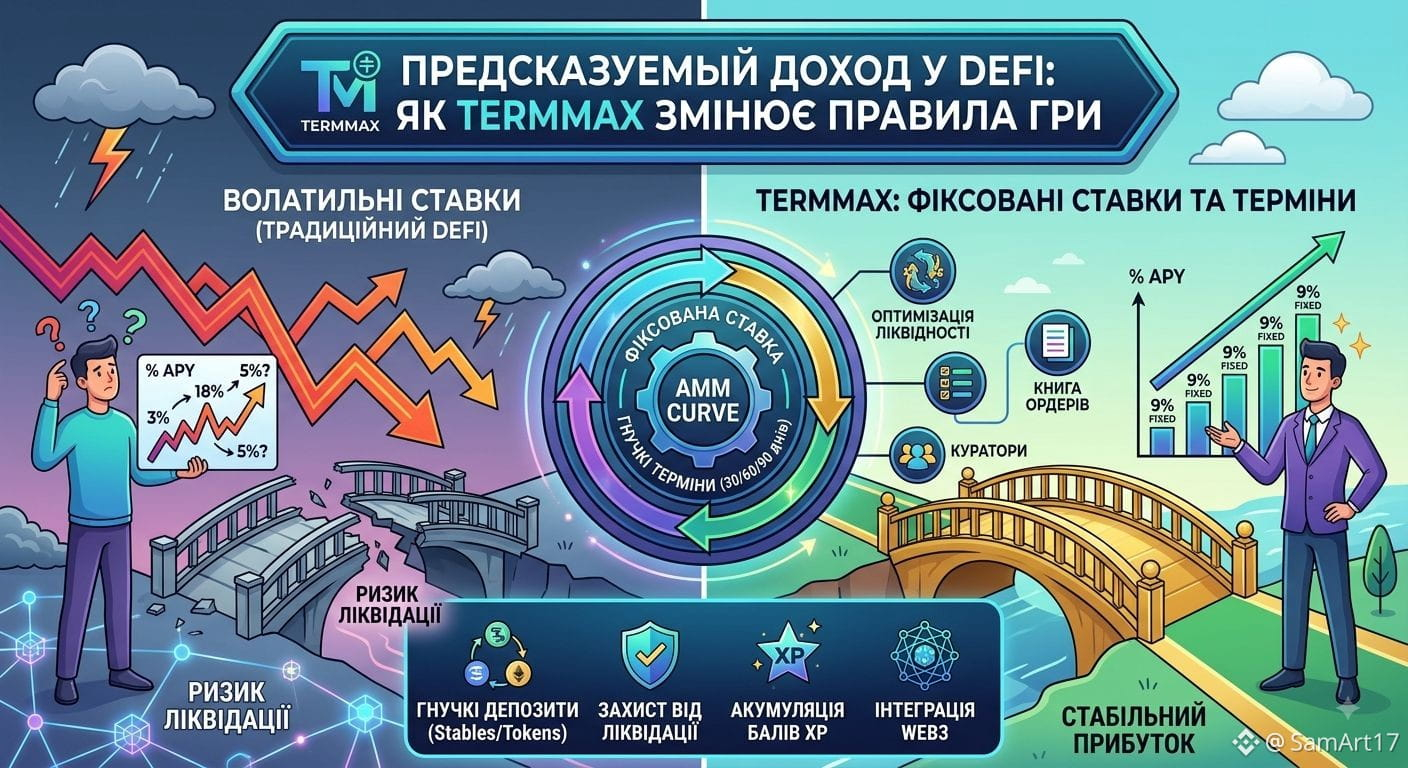
Decentralized finance has long suffered from instability caused by floating interest rates. The TermMax platform solves this problem by offering an innovative lending and borrowing protocol with a fixed term and fixed rate. This gives investors predictable returns, while borrowers have clearly defined costs without the risk of sudden market fluctuations.
TermMax’s main advantage is its use of custom AMM curves and an order-book model, enabling liquidity optimization and offering high yields. Users can deposit stablecoins or tokens, farm an attractive APY, and accumulate additional XP points as part of special campaigns. In addition, the protocol provides liquidation protection for certain option products and integrates tools curated under the guidance of institutional curators.
TermMax combines transparency, high capital efficiency, and flexibility—becoming an important bridge between traditional finance and the Web3 ecosystem. It’s a reliable choice for anyone seeking stability and passive income in the crypto world.
@termmax
#termmax Predictable income in DeFi: How TermMax changes the game
Decentralized finance has long suffered from instability caused by floating interest rates. The TermMax platform solves this problem by offering an innovative lending and borrowing protocol with a fixed term and fixed rate. This gives investors predictable returns, while borrowers have clearly defined costs without the risk of sudden market fluctuations.
TermMax’s main advantage is its use of custom AMM curves and an order-book model, enabling liquidity optimization and offering high yields. Users can deposit stablecoins or tokens, farm an attractive APY, and accumulate additional XP points as part of special campaigns. In addition, the protocol provides liquidation protection for certain option products and integrates tools curated under the guidance of institutional curators.
TermMax combines transparency, high capital efficiency, and flexibility—becoming an important bridge between traditional finance and the Web3 ecosystem. It’s a reliable choice for anyone seeking stability and passive income in the crypto world.
@TermMax
Decentralized finance has long suffered from instability caused by floating interest rates. The TermMax platform solves this problem by offering an innovative lending and borrowing protocol with a fixed term and fixed rate. This gives investors predictable returns, while borrowers have clearly defined costs without the risk of sudden market fluctuations.
TermMax’s main advantage is its use of custom AMM curves and an order-book model, enabling liquidity optimization and offering high yields. Users can deposit stablecoins or tokens, farm an attractive APY, and accumulate additional XP points as part of special campaigns. In addition, the protocol provides liquidation protection for certain option products and integrates tools curated under the guidance of institutional curators.
TermMax combines transparency, high capital efficiency, and flexibility—becoming an important bridge between traditional finance and the Web3 ecosystem. It’s a reliable choice for anyone seeking stability and passive income in the crypto world.
@TermMax
2
60
·
--
#bstockscis @BinanceCIS
Most people discuss tokenized shares as an alternative to a broker or a way to bypass the 24/7 trading schedule. But there’s an aspect that almost nobody talks about: using bStocks as quality collateral.
In traditional TradFi, your Apple or NVIDIA shares just sit in a custodian. To unlock liquidity from them, you need complex margin agreements. In contrast, tokenized bStocks certificates on BNB Chain remain fully functional BEP-20 tokens. This means they can be used in lending protocols (for example, Venus or Lista) without selling the underlying asset.
You keep exposure to the business’s growth and continue receiving reinvested dividends via the on-chain Multiplier mechanism. At the same time, you can borrow USDT against these tokens for short-term spot trades or hedging.
Of course, new risks also come into play: smart contract vulnerabilities and the risk of position liquidation if the stock market drops sharply. That requires a clear calculation of the Health Factor—not blind faith in the instrument.
But this changes the logic: bStocks are not just “a stock in your smartphone,” but a foundational building block for building more complex financial strategies within Web3.
#bstockscis @BinanceCIS
Most people discuss tokenized shares as an alternative to a broker or a way to bypass the 24/7 trading schedule. But there’s an aspect that almost nobody talks about: using bStocks as quality collateral.
In traditional TradFi, your Apple or NVIDIA shares just sit in a custodian. To unlock liquidity from them, you need complex margin agreements. In contrast, tokenized bStocks certificates on BNB Chain remain fully functional BEP-20 tokens. This means they can be used in lending protocols (for example, Venus or Lista) without selling the underlying asset.
You keep exposure to the business’s growth and continue receiving reinvested dividends via the on-chain Multiplier mechanism. At the same time, you can borrow USDT against these tokens for short-term spot trades or hedging.
Of course, new risks also come into play: smart contract vulnerabilities and the risk of position liquidation if the stock market drops sharply. That requires a clear calculation of the Health Factor—not blind faith in the instrument.
But this changes the logic: bStocks are not just “a stock in your smartphone,” but a foundational building block for building more complex financial strategies within Web3.
Most people discuss tokenized shares as an alternative to a broker or a way to bypass the 24/7 trading schedule. But there’s an aspect that almost nobody talks about: using bStocks as quality collateral.
In traditional TradFi, your Apple or NVIDIA shares just sit in a custodian. To unlock liquidity from them, you need complex margin agreements. In contrast, tokenized bStocks certificates on BNB Chain remain fully functional BEP-20 tokens. This means they can be used in lending protocols (for example, Venus or Lista) without selling the underlying asset.
You keep exposure to the business’s growth and continue receiving reinvested dividends via the on-chain Multiplier mechanism. At the same time, you can borrow USDT against these tokens for short-term spot trades or hedging.
Of course, new risks also come into play: smart contract vulnerabilities and the risk of position liquidation if the stock market drops sharply. That requires a clear calculation of the Health Factor—not blind faith in the instrument.
But this changes the logic: bStocks are not just “a stock in your smartphone,” but a foundational building block for building more complex financial strategies within Web3.
1
2
59
·
--
#bstockscis @BinanceCIS
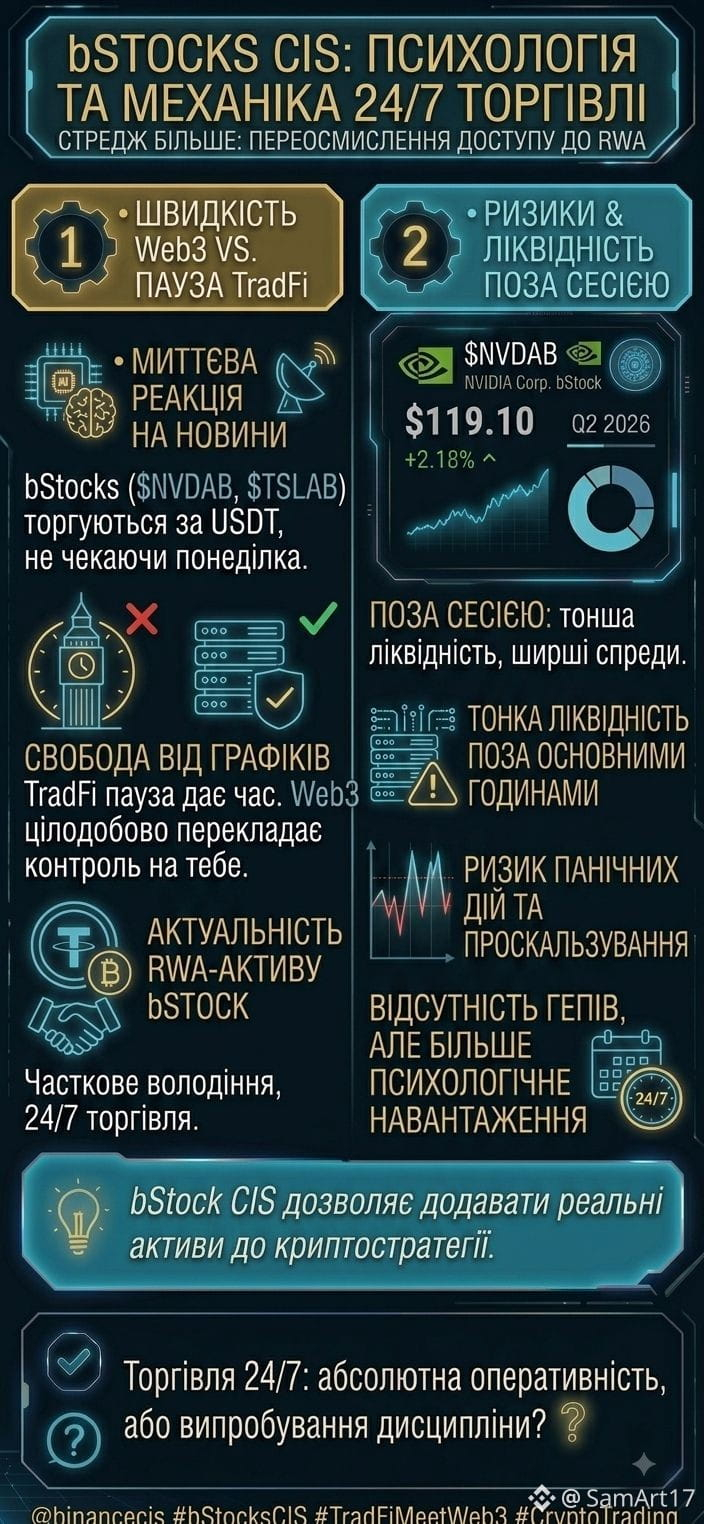
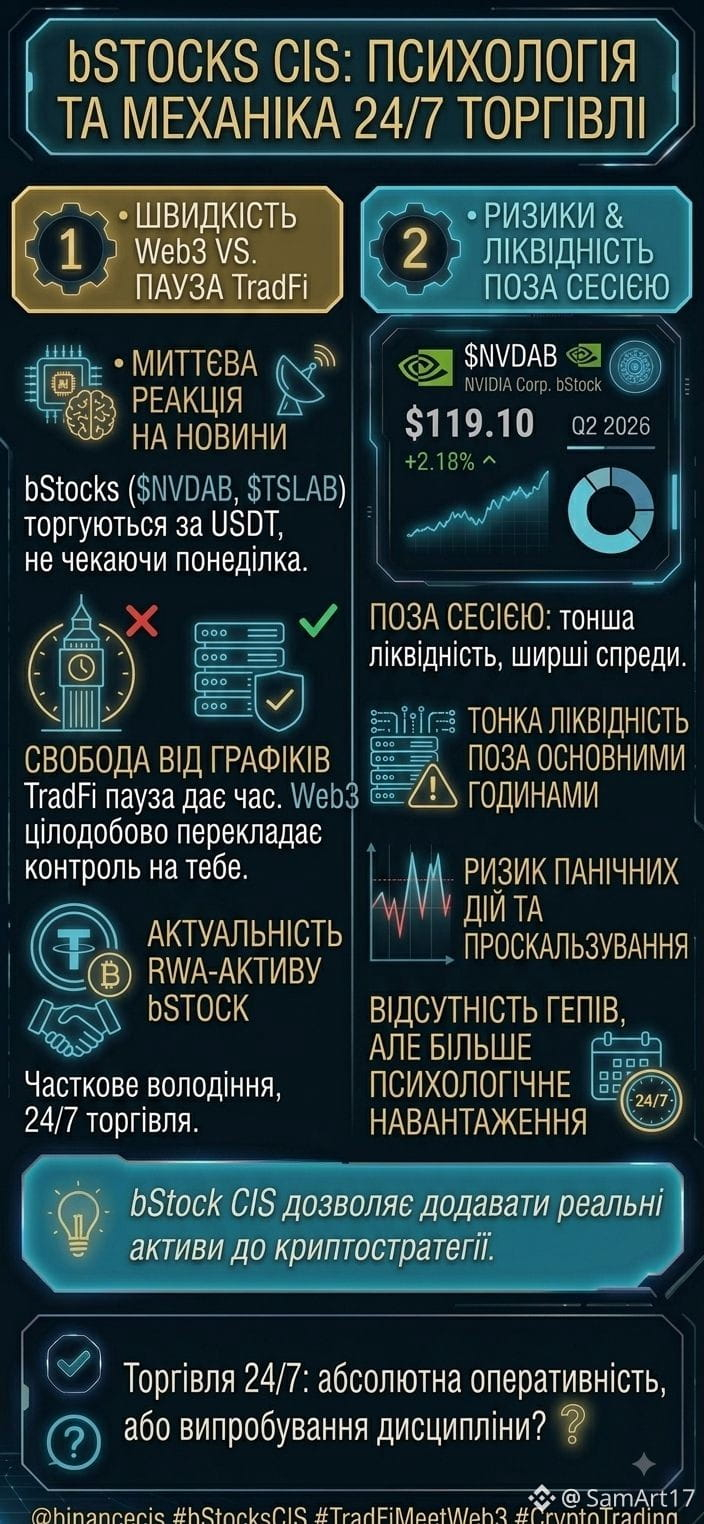
Watching the market over the weekend, I caught myself thinking that the most interesting thing about tokenized stocks isn’t just the lack of weekends—it’s how it changes our behavior as traders.
On Saturday evening, when TradFi is fully off, the spot order book $NVDAB continues to live its own life. For crypto-native users, this has already become the norm: saw an important AI-sector update—reacted within a couple of seconds in USDT, without waiting for the New York session to open or calling around to broker-dealer floors.
But behind this speed there’s an important nuance worth remembering. When the US spot market is closed, liquidity on-chain becomes thinner, and spreads can widen. We buy the ability for instant maneuvering and the flexibility of an RWA instrument—but we pay for it with lower order density outside core trading hours.
Tokenization on BNB Chain provides incredible freedom: fractional access, transparent 1:1 collateral, and no bureaucracy. But technological convenience doesn’t eliminate the basic discipline of risk management. This is a tool for fast reaction.
#bstockscis @BinanceCIS
Watching the market over the weekend, I caught myself thinking that the most interesting thing about tokenized stocks isn’t just the lack of weekends—it’s how it changes our behavior as traders.
On Saturday evening, when TradFi is fully off, the spot order book $NVDAB continues to live its own life. For crypto-native users, this has already become the norm: saw an important AI-sector update—reacted within a couple of seconds in USDT, without waiting for the New York session to open or calling around to broker-dealer floors.
But behind this speed there’s an important nuance worth remembering. When the US spot market is closed, liquidity on-chain becomes thinner, and spreads can widen. We buy the ability for instant maneuvering and the flexibility of an RWA instrument—but we pay for it with lower order density outside core trading hours.
Tokenization on BNB Chain provides incredible freedom: fractional access, transparent 1:1 collateral, and no bureaucracy. But technological convenience doesn’t eliminate the basic discipline of risk management. This is a tool for fast reaction.
Watching the market over the weekend, I caught myself thinking that the most interesting thing about tokenized stocks isn’t just the lack of weekends—it’s how it changes our behavior as traders.
On Saturday evening, when TradFi is fully off, the spot order book $NVDAB continues to live its own life. For crypto-native users, this has already become the norm: saw an important AI-sector update—reacted within a couple of seconds in USDT, without waiting for the New York session to open or calling around to broker-dealer floors.
But behind this speed there’s an important nuance worth remembering. When the US spot market is closed, liquidity on-chain becomes thinner, and spreads can widen. We buy the ability for instant maneuvering and the flexibility of an RWA instrument—but we pay for it with lower order density outside core trading hours.
Tokenization on BNB Chain provides incredible freedom: fractional access, transparent 1:1 collateral, and no bureaucracy. But technological convenience doesn’t eliminate the basic discipline of risk management. This is a tool for fast reaction.
1
74
·
--
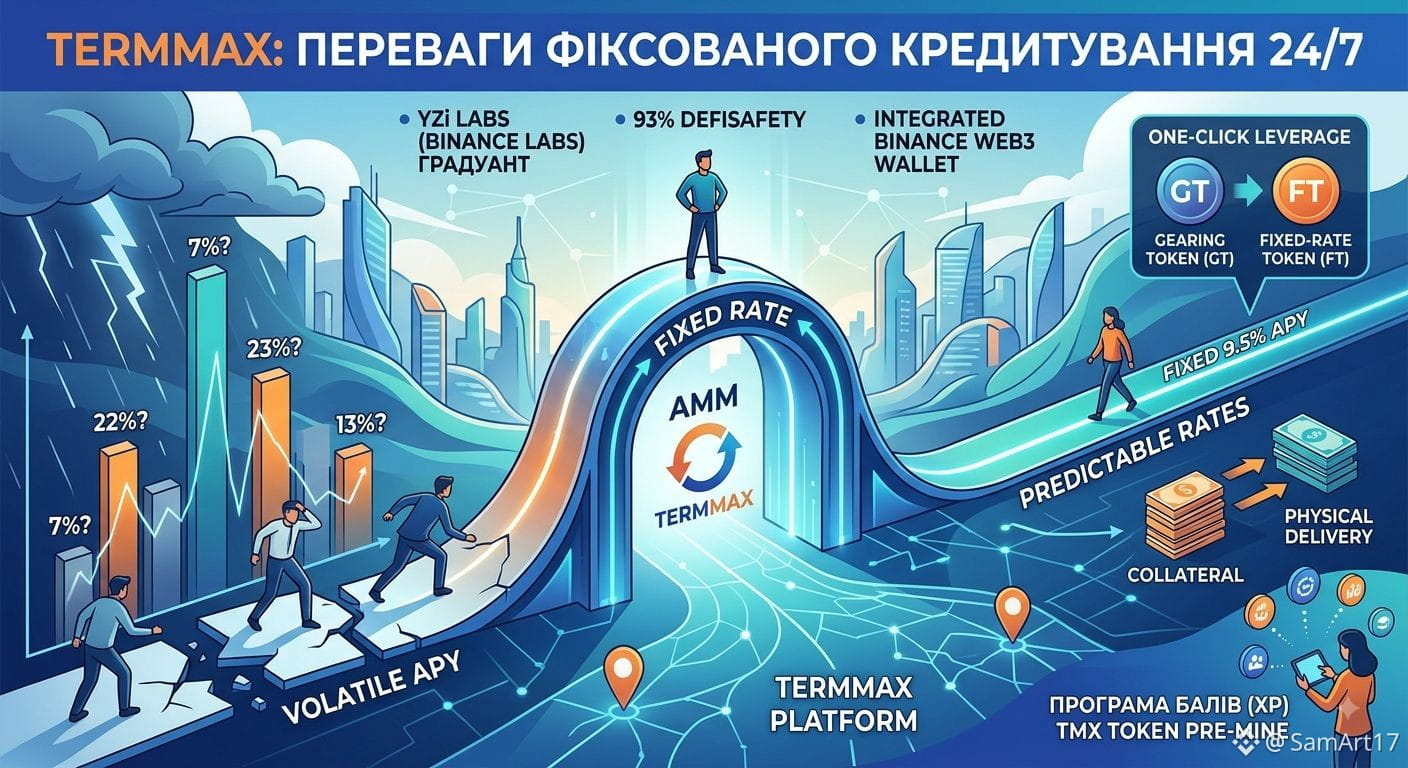
While most are expecting the opening of traditional sessions, DeFi is developing tools to work with capital 24/7. One of the most interesting solutions for fixed-rate lending is project @termmax , a graduate of YZi Labs (Binance Labs).
The main problem with classic DeFi protocols like Aave is volatile floating rates, which make long-term planning difficult. TermMax solves this with a modified AMM (based on Uniswap V3) and price-range orders (range orders).
Key features of the platform:
Fixed rates and terms: Transparent interest without unpleasant surprises until the maturity date.
One-click leverage: Gearing (GT) and Fixed-Rate (FT) tokens enable complex strategies (looping) without manual monitoring.
Physical collateral delivery: The Physical Delivery mechanism increases creditor protection during default and paves the way for RWA assets.
The project is integrated with the Binance Web3 Wallet and demonstrates a high level of security (93% DeFiSafety, audited by Spearbit). Currently, the platform runs point programs (XP) and preparation for the TMX token.
Are you ready to lock in rates instead of playing with floating APY?
#TermMax #DeFi #RWA #BinanceWeb3Wallet #FixedRate #TMX
While most are expecting the opening of traditional sessions, DeFi is developing tools to work with capital 24/7. One of the most interesting solutions for fixed-rate lending is project @TermMax , a graduate of YZi Labs (Binance Labs).
The main problem with classic DeFi protocols like Aave is volatile floating rates, which make long-term planning difficult. TermMax solves this with a modified AMM (based on Uniswap V3) and price-range orders (range orders).
Key features of the platform:
Fixed rates and terms: Transparent interest without unpleasant surprises until the maturity date.
One-click leverage: Gearing (GT) and Fixed-Rate (FT) tokens enable complex strategies (looping) without manual monitoring.
Physical collateral delivery: The Physical Delivery mechanism increases creditor protection during default and paves the way for RWA assets.
The project is integrated with the Binance Web3 Wallet and demonstrates a high level of security (93% DeFiSafety, audited by Spearbit). Currently, the platform runs point programs (XP) and preparation for the TMX token.
Are you ready to lock in rates instead of playing with floating APY?
#TermMax #DeFi #RWA #BinanceWeb3Wallet #FixedRate #TMX
The main problem with classic DeFi protocols like Aave is volatile floating rates, which make long-term planning difficult. TermMax solves this with a modified AMM (based on Uniswap V3) and price-range orders (range orders).
Key features of the platform:
Fixed rates and terms: Transparent interest without unpleasant surprises until the maturity date.
One-click leverage: Gearing (GT) and Fixed-Rate (FT) tokens enable complex strategies (looping) without manual monitoring.
Physical collateral delivery: The Physical Delivery mechanism increases creditor protection during default and paves the way for RWA assets.
The project is integrated with the Binance Web3 Wallet and demonstrates a high level of security (93% DeFiSafety, audited by Spearbit). Currently, the platform runs point programs (XP) and preparation for the TMX token.
Are you ready to lock in rates instead of playing with floating APY?
#TermMax #DeFi #RWA #BinanceWeb3Wallet #FixedRate #TMX
1
108
·
--
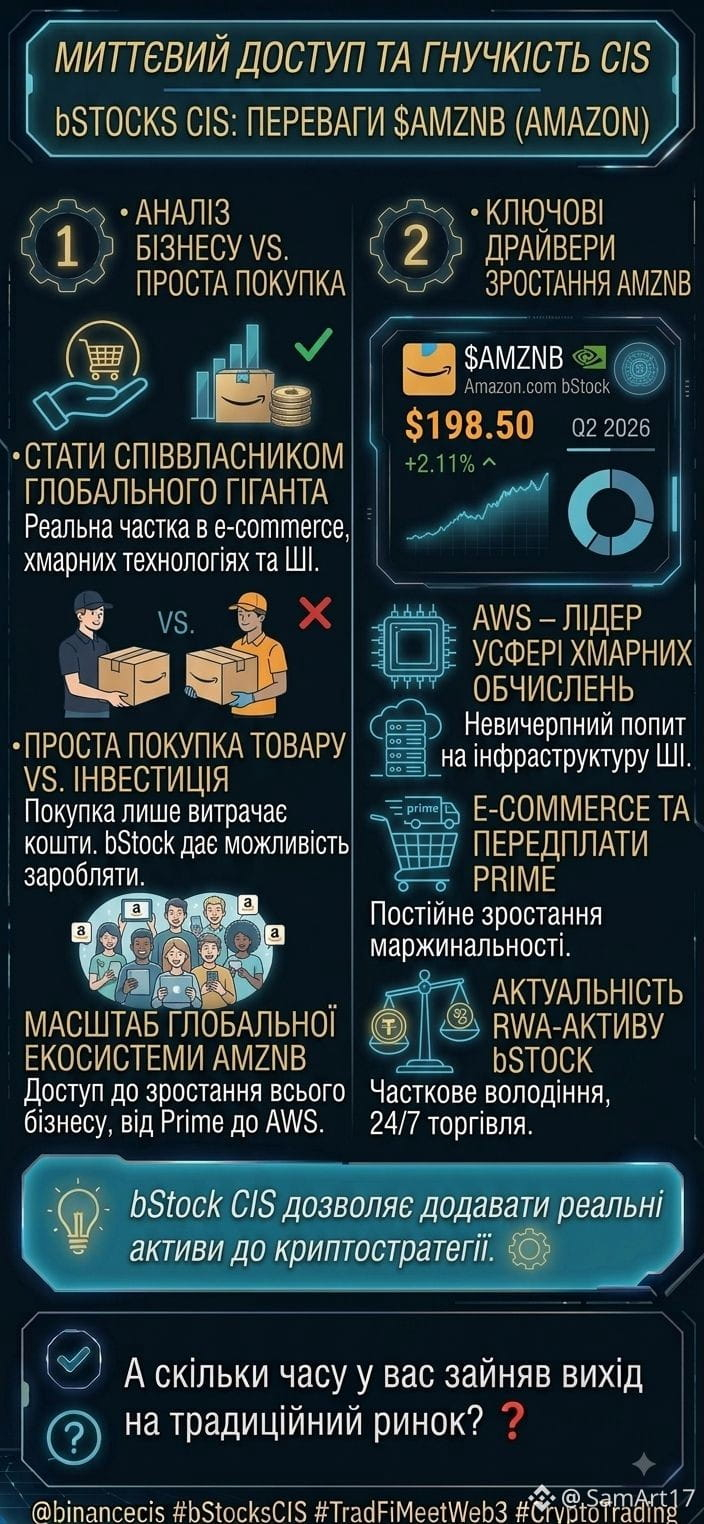
#bstockscis Every day I shop on Amazon, so when I saw $AMZNB among bStocks from @BinanceCIS , I asked myself a simple question: why just leave money in the marketplace if you can become a co-owner of a global giant?
I decided to assess the scale of their business from an investment perspective:
🛒 More than 300 million active buyers worldwide ☁️ AWS — an absolute leader in cloud computing and infrastructure for AI 💰 Ongoing margin growth driven by advertising and Prime subscriptions
And that’s when the asset started looking much more attractive.
We’re used to viewing stocks as something distant: $NVDAB are chips, $TSLAB is automotive, and Amazon is just a package delivered by a courier. But $AMZNB is a tokenized asset across the entire giant business. A regular product purchase only reduces your balance, while investing in a token lets you profit from the growth of e-commerce and cloud technologies.
With bStocks, you can buy $AMZNB directly for USDT from your spot wallet 24/7.
And what do you think about Amazon? @BinanceCIS
#bstockscis Every day I shop on Amazon, so when I saw $AMZNB among bStocks from @BinanceCIS , I asked myself a simple question: why just leave money in the marketplace if you can become a co-owner of a global giant?
I decided to assess the scale of their business from an investment perspective:
🛒 More than 300 million active buyers worldwide ☁️ AWS — an absolute leader in cloud computing and infrastructure for AI 💰 Ongoing margin growth driven by advertising and Prime subscriptions
And that’s when the asset started looking much more attractive.
We’re used to viewing stocks as something distant: $NVDAB are chips, $TSLAB is automotive, and Amazon is just a package delivered by a courier. But $AMZNB is a tokenized asset across the entire giant business. A regular product purchase only reduces your balance, while investing in a token lets you profit from the growth of e-commerce and cloud technologies.
With bStocks, you can buy $AMZNB directly for USDT from your spot wallet 24/7.
And what do you think about Amazon? @BinanceCIS
I decided to assess the scale of their business from an investment perspective:
🛒 More than 300 million active buyers worldwide ☁️ AWS — an absolute leader in cloud computing and infrastructure for AI 💰 Ongoing margin growth driven by advertising and Prime subscriptions
And that’s when the asset started looking much more attractive.
We’re used to viewing stocks as something distant: $NVDAB are chips, $TSLAB is automotive, and Amazon is just a package delivered by a courier. But $AMZNB is a tokenized asset across the entire giant business. A regular product purchase only reduces your balance, while investing in a token lets you profit from the growth of e-commerce and cloud technologies.
With bStocks, you can buy $AMZNB directly for USDT from your spot wallet 24/7.
And what do you think about Amazon? @BinanceCIS
1
79
·
--
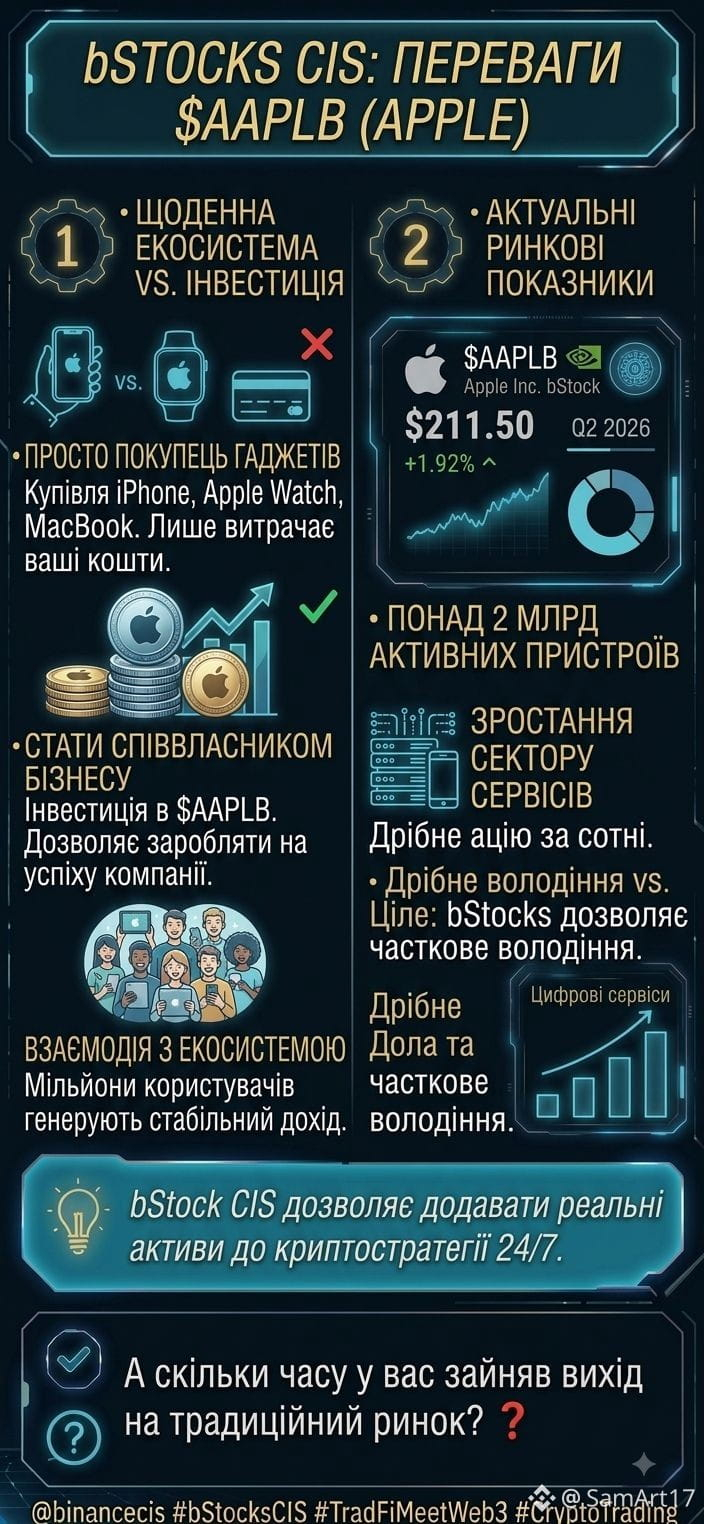
#bstockscis Every day I use smartphones and Apple services, so when I saw $AAPLB among bStocks from @BinanceCIS , I asked myself a logical question: why just be a buyer of their gadgets if you can become a co-owner of the business?
I decided to look at the scale of their ecosystem from a financial perspective:
📱 Over 2 billion active Apple devices worldwide 🔒 Record-level customer loyalty and high audience retention 💰 Continuous growth of the highly profitable digital services sector
And that’s where the asset started looking much more attractive.
We’re used to seeing stocks as something complex and distant: $NVDAB is artificial intelligence, $TSLAB is automotive, and Apple is just a new iPhone in your pocket. However, $AAPLB is a tokenized asset for the entire giant business. Buying a smartphone only spends your money, while investing in a token lets you profit from the company’s success.
With bStocks, you can invest in $AAPLB directly with USDT from your spot wallet 24/7.
@BinanceCIS
#bstockscis Every day I use smartphones and Apple services, so when I saw $AAPLB among bStocks from @BinanceCIS , I asked myself a logical question: why just be a buyer of their gadgets if you can become a co-owner of the business?
I decided to look at the scale of their ecosystem from a financial perspective:
📱 Over 2 billion active Apple devices worldwide 🔒 Record-level customer loyalty and high audience retention 💰 Continuous growth of the highly profitable digital services sector
And that’s where the asset started looking much more attractive.
We’re used to seeing stocks as something complex and distant: $NVDAB is artificial intelligence, $TSLAB is automotive, and Apple is just a new iPhone in your pocket. However, $AAPLB is a tokenized asset for the entire giant business. Buying a smartphone only spends your money, while investing in a token lets you profit from the company’s success.
With bStocks, you can invest in $AAPLB directly with USDT from your spot wallet 24/7.
@BinanceCIS
I decided to look at the scale of their ecosystem from a financial perspective:
📱 Over 2 billion active Apple devices worldwide 🔒 Record-level customer loyalty and high audience retention 💰 Continuous growth of the highly profitable digital services sector
And that’s where the asset started looking much more attractive.
We’re used to seeing stocks as something complex and distant: $NVDAB is artificial intelligence, $TSLAB is automotive, and Apple is just a new iPhone in your pocket. However, $AAPLB is a tokenized asset for the entire giant business. Buying a smartphone only spends your money, while investing in a token lets you profit from the company’s success.
With bStocks, you can invest in $AAPLB directly with USDT from your spot wallet 24/7.
@BinanceCIS
1
115
·
--
#bstockscis I constantly watch series on Netflix, so when I saw $NFLXB among bStocks from @BinanceCIS S, I asked myself a simple question: why buy shares in a company whose subscription I use every month anyway?
I decided to take a look at the scale of their business from a financial perspective:
🍿 Over 270 million active subscribers worldwide, influencing the global entertainment market 💰 Billions in subscription revenue and new advertising rates
And that’s when $NFLXB started to look much more interesting.
We’re used to thinking of stocks as something distant: $NVDAB is AI, $TSLAB is electric vehicles, and Netflix is just a Friday night service. But $NFLXB is a tokenized asset tied to the company itself. A regular subscription gives you access to movies, but it doesn’t give you a stake in the business.
For me, this is one of the most understandable options among bStocks, because it’s backed by a product millions of people use every day, generating a steady cash flow.
I would definitely keep it on my watchlist.
@BinanceCIS
#bstockscis I constantly watch series on Netflix, so when I saw $NFLXB among bStocks from @BinanceCIS S, I asked myself a simple question: why buy shares in a company whose subscription I use every month anyway?
I decided to take a look at the scale of their business from a financial perspective:
🍿 Over 270 million active subscribers worldwide, influencing the global entertainment market 💰 Billions in subscription revenue and new advertising rates
And that’s when $NFLXB started to look much more interesting.
We’re used to thinking of stocks as something distant: $NVDAB is AI, $TSLAB is electric vehicles, and Netflix is just a Friday night service. But $NFLXB is a tokenized asset tied to the company itself. A regular subscription gives you access to movies, but it doesn’t give you a stake in the business.
For me, this is one of the most understandable options among bStocks, because it’s backed by a product millions of people use every day, generating a steady cash flow.
I would definitely keep it on my watchlist.
@BinanceCIS
I decided to take a look at the scale of their business from a financial perspective:
🍿 Over 270 million active subscribers worldwide, influencing the global entertainment market 💰 Billions in subscription revenue and new advertising rates
And that’s when $NFLXB started to look much more interesting.
We’re used to thinking of stocks as something distant: $NVDAB is AI, $TSLAB is electric vehicles, and Netflix is just a Friday night service. But $NFLXB is a tokenized asset tied to the company itself. A regular subscription gives you access to movies, but it doesn’t give you a stake in the business.
For me, this is one of the most understandable options among bStocks, because it’s backed by a product millions of people use every day, generating a steady cash flow.
I would definitely keep it on my watchlist.
@BinanceCIS

1
85
·
--
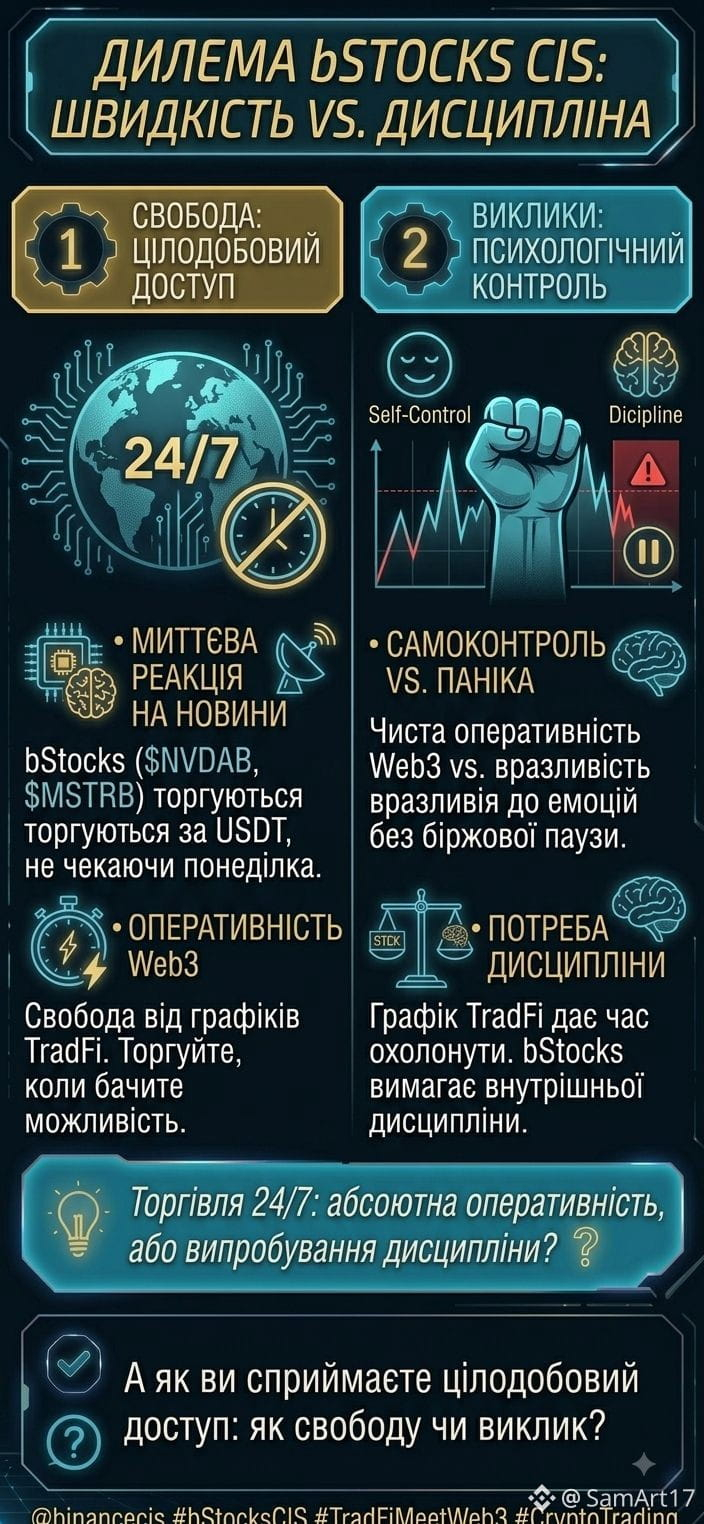
#bstockscis Recently, I caught myself having an interesting thought while trading bStocks over the weekend, when the traditional stock exchanges are completely closed.
At first, it seemed like an absolute advantage: you see important news from the world—and immediately act with your Binance wallet in USDT, without waiting for Monday and the start of the U.S. session.
But the longer I thought about it, the more interesting it became.
In classic TradFi, there’s a forced pause. The market closes for the night and weekends, giving investors time to cool off, reconsider their decisions, and avoid panicked moves.
In Web3, access to tokenized shares is available around the clock. This provides absolute responsiveness, but it also shifts the psychological burden entirely onto you. Your speed is no longer limited by the exchange schedule—it’s limited only by your own self-control.
And then there’s the dilemma: is 24/7 trading a pure benefit, or does it make us more vulnerable to our own emotions?
Honestly, I’m still looking for the answer.
And how do you see round-the-clock access to the stock market—as freedom or as challenges for discipline? @BinanceCIS $NVDAB
#bstockscis Recently, I caught myself having an interesting thought while trading bStocks over the weekend, when the traditional stock exchanges are completely closed.
At first, it seemed like an absolute advantage: you see important news from the world—and immediately act with your Binance wallet in USDT, without waiting for Monday and the start of the U.S. session.
But the longer I thought about it, the more interesting it became.
In classic TradFi, there’s a forced pause. The market closes for the night and weekends, giving investors time to cool off, reconsider their decisions, and avoid panicked moves.
In Web3, access to tokenized shares is available around the clock. This provides absolute responsiveness, but it also shifts the psychological burden entirely onto you. Your speed is no longer limited by the exchange schedule—it’s limited only by your own self-control.
And then there’s the dilemma: is 24/7 trading a pure benefit, or does it make us more vulnerable to our own emotions?
Honestly, I’m still looking for the answer.
And how do you see round-the-clock access to the stock market—as freedom or as challenges for discipline? @BinanceCIS $NVDAB
At first, it seemed like an absolute advantage: you see important news from the world—and immediately act with your Binance wallet in USDT, without waiting for Monday and the start of the U.S. session.
But the longer I thought about it, the more interesting it became.
In classic TradFi, there’s a forced pause. The market closes for the night and weekends, giving investors time to cool off, reconsider their decisions, and avoid panicked moves.
In Web3, access to tokenized shares is available around the clock. This provides absolute responsiveness, but it also shifts the psychological burden entirely onto you. Your speed is no longer limited by the exchange schedule—it’s limited only by your own self-control.
And then there’s the dilemma: is 24/7 trading a pure benefit, or does it make us more vulnerable to our own emotions?
Honestly, I’m still looking for the answer.
And how do you see round-the-clock access to the stock market—as freedom or as challenges for discipline? @BinanceCIS $NVDAB
1
82
·
--
#bstockscis Everyone knows about Tesla, but few people consider this: for electric vehicles to hit the roads at scale, you need more than just assembling cars. You need large-scale infrastructure—lithium extraction, high-speed charging networks, and satellite communications for autonomous control. At bStocks from @BinanceCIS IS, there are tickers of key players in this transport revolution that keep the entire industry running. Here’s what to study:
⚡ $TSLAB (Tesla) — an undisputed leader in the EV sector, building not only electric cars, but also its own global network of Supercharger stations and energy storage systems.
🛰️ $SPCXB (SpaceX) and ASTSB (AST SpaceMobile) — critical communications infrastructure. They provide global satellite internet for autonomous transport anywhere on the planet.
🔋 $BMNRB (BitMine) and new financial instruments—infrastructure solutions to support high energy efficiency.
You can invest in the future of transportation even more broadly by assembling the full infrastructure right in Web3 with USDT. Which EV ticker is your favorite?
💪 Which direction is more powerful?
#bstockscis Everyone knows about Tesla, but few people consider this: for electric vehicles to hit the roads at scale, you need more than just assembling cars. You need large-scale infrastructure—lithium extraction, high-speed charging networks, and satellite communications for autonomous control. At bStocks from @BinanceCIS IS, there are tickers of key players in this transport revolution that keep the entire industry running. Here’s what to study:
⚡ $TSLAB (Tesla) — an undisputed leader in the EV sector, building not only electric cars, but also its own global network of Supercharger stations and energy storage systems.
🛰️ $SPCXB (SpaceX) and ASTSB (AST SpaceMobile) — critical communications infrastructure. They provide global satellite internet for autonomous transport anywhere on the planet.
🔋 $BMNRB (BitMine) and new financial instruments—infrastructure solutions to support high energy efficiency.
You can invest in the future of transportation even more broadly by assembling the full infrastructure right in Web3 with USDT. Which EV ticker is your favorite?
💪 Which direction is more powerful?
⚡ $TSLAB (Tesla) — an undisputed leader in the EV sector, building not only electric cars, but also its own global network of Supercharger stations and energy storage systems.
🛰️ $SPCXB (SpaceX) and ASTSB (AST SpaceMobile) — critical communications infrastructure. They provide global satellite internet for autonomous transport anywhere on the planet.
🔋 $BMNRB (BitMine) and new financial instruments—infrastructure solutions to support high energy efficiency.
You can invest in the future of transportation even more broadly by assembling the full infrastructure right in Web3 with USDT. Which EV ticker is your favorite?
💪 Which direction is more powerful?
Tesla електрокари
100%
SpaceX інтернет і зв'язок
0%
BitMine енергоефективність
0%
1 votes • Voting closed
1
127
Log in to explore more content
Join global crypto users on Binance Square
⚡️ Get latest and useful information about crypto.
💬 Trusted by the world’s largest crypto exchange.
👍 Discover real insights from verified creators.
Email / Phone number
Trending Topics
HKCompletesFirstHKDStablecoinUseCase
282 views
52 Discussing
#HKCompletesFirstHKDStablecoinUseCase
Hong Kong’s stablecoin story is starting to move from regulation into real-world use.
A regulated HKD stablecoin, HKDAP, has now been used in a digital money market fund transaction, allowing investors to subscribe for and redeem fund units through a licensed digital-asset platform. ChinaAMC (HK), Standard Chartered and OSL were involved in the transaction.
What caught my attention is that this is more than just another stablecoin announcement. It shows a practical connection between regulated digital money and tokenised financial products.
Hong Kong has been building its stablecoin framework since the Stablecoins Ordinance came into effect, and the HKMA issued its first two stablecoin licences in April 2026.
For me, the interesting part now is seeing whether these early use cases can develop into broader everyday financial applications.
I’m not assuming stablecoins will change everything overnight. This is still an early stage, and adoption will depend on regulation, liquidity, infrastructure and actual user demand.
#HKDStablecoin #HKDAP #Stablecoin #HongKong #Crypto #DigitalAssets #BinanceSquare
Zakria_Ahmad-f7888
·1 Likes
·1 views
VietnamPlansFirstCryptoLicensesIn2026
179 views
32 Discussing
BTCBreaks80K
187,334 views
3,079 Discussing