

News Crypto IN
22 Posts
News Crypto IN
Report
Block User
Research potential projects, and get the latest news from me about cryptocurrency
BP-EAF9097F5A81
3 Following
49 Followers
25 Liked
Posts
All
Quotes
ETH is up 31% in 30 days. XRP is up 37%. $SOL is up roughly 40%, the best performer of the bunch. $BTC "only" gained 24% in the same window. Timeline's already calling this altseason.
It isn't. Not by the actual definition. The Altcoin Season Index needs 75% of the top 100 coins to outperform Bitcoin over a rolling 90-day window. Right now that index sits at 33-37 — solidly in Bitcoin Season territory, not close to the altseason threshold.
Here's the disconnect: three loud winners (ETH, XRP, SOL) create a "everything's pumping" narrative on your feed, while BTC dominance stays elevated and most of the other 97 coins in the top 100 quietly lag behind Bitcoin's 24%. A handful of large-cap alts beating BTC isn't the same claim as "capital broadly rotating out of Bitcoin into alts" — that second claim is what altseason actually means, and the data says it hasn't happened yet.
BNB, for reference, is up a comparatively boring 6% on the week, near $800 — not part of anyone's altseason hype thread, which is exactly the point. If altseason were real, BNB wouldn't be the quiet one.
Structurally, analysts watch ETH/BTC and SOL/BTC ratios turning up after BTC dominance peaks and rolls over — that sequence is in early stages, not completed. So this is "some alts had a good month," not "the market has rotated."
If your bags are ETH/XRP/SOL and you're up 30-40%, congrats, that's real. Just don't confuse three winners with a season.
#Altseason #DYOR
ETH is up 31% in 30 days. XRP is up 37%. $SOL is up roughly 40%, the best performer of the bunch. $BTC "only" gained 24% in the same window. Timeline's already calling this altseason.
It isn't. Not by the actual definition. The Altcoin Season Index needs 75% of the top 100 coins to outperform Bitcoin over a rolling 90-day window. Right now that index sits at 33-37 — solidly in Bitcoin Season territory, not close to the altseason threshold.
Here's the disconnect: three loud winners (ETH, XRP, SOL) create a "everything's pumping" narrative on your feed, while BTC dominance stays elevated and most of the other 97 coins in the top 100 quietly lag behind Bitcoin's 24%. A handful of large-cap alts beating BTC isn't the same claim as "capital broadly rotating out of Bitcoin into alts" — that second claim is what altseason actually means, and the data says it hasn't happened yet.
BNB, for reference, is up a comparatively boring 6% on the week, near $800 — not part of anyone's altseason hype thread, which is exactly the point. If altseason were real, BNB wouldn't be the quiet one.
Structurally, analysts watch ETH/BTC and SOL/BTC ratios turning up after BTC dominance peaks and rolls over — that sequence is in early stages, not completed. So this is "some alts had a good month," not "the market has rotated."
If your bags are ETH/XRP/SOL and you're up 30-40%, congrats, that's real. Just don't confuse three winners with a season.
#Altseason #DYOR
It isn't. Not by the actual definition. The Altcoin Season Index needs 75% of the top 100 coins to outperform Bitcoin over a rolling 90-day window. Right now that index sits at 33-37 — solidly in Bitcoin Season territory, not close to the altseason threshold.
Here's the disconnect: three loud winners (ETH, XRP, SOL) create a "everything's pumping" narrative on your feed, while BTC dominance stays elevated and most of the other 97 coins in the top 100 quietly lag behind Bitcoin's 24%. A handful of large-cap alts beating BTC isn't the same claim as "capital broadly rotating out of Bitcoin into alts" — that second claim is what altseason actually means, and the data says it hasn't happened yet.
BNB, for reference, is up a comparatively boring 6% on the week, near $800 — not part of anyone's altseason hype thread, which is exactly the point. If altseason were real, BNB wouldn't be the quiet one.
Structurally, analysts watch ETH/BTC and SOL/BTC ratios turning up after BTC dominance peaks and rolls over — that sequence is in early stages, not completed. So this is "some alts had a good month," not "the market has rotated."
If your bags are ETH/XRP/SOL and you're up 30-40%, congrats, that's real. Just don't confuse three winners with a season.
#Altseason #DYOR
91
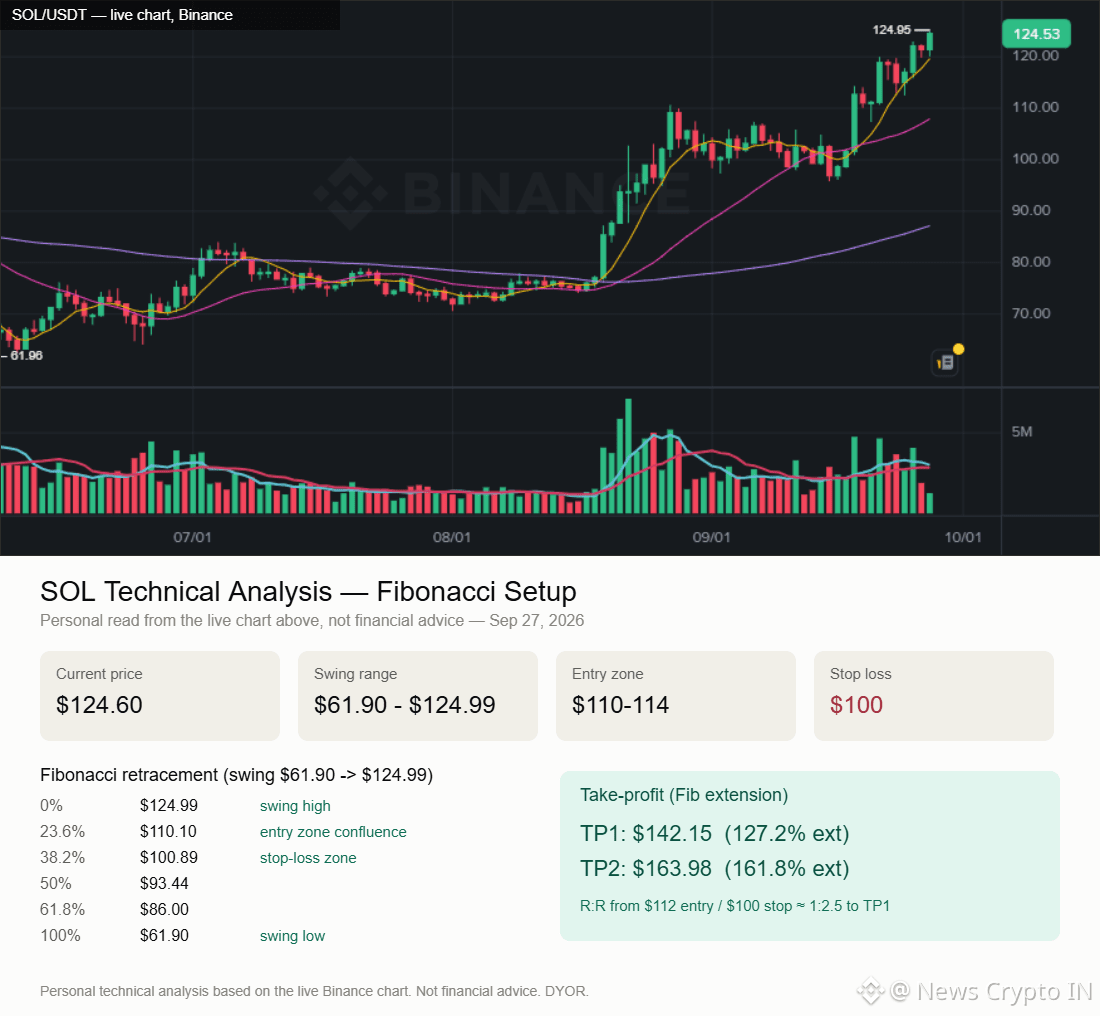
$SOL Technical Analysis — Fibonacci setup (personal read from live chart, NFA)
Swing range $61.90 -> $124.99. Watching $110-114 entry zone (23.6% fib confluence). Stop below $100 (38.2% fib). Targets: $142 / $164 (fib extensions). R:R ~ 1:2.5 to TP1.
My own technical opinion based on the live chart -- not a signal. DYOR.
#SOL #Solana #TechnicalAnalysis #Fibonacci #DYOR
$SOL Technical Analysis — Fibonacci setup (personal read from live chart, NFA)
Swing range $61.90 -> $124.99. Watching $110-114 entry zone (23.6% fib confluence). Stop below $100 (38.2% fib). Targets: $142 / $164 (fib extensions). R:R ~ 1:2.5 to TP1.
My own technical opinion based on the live chart -- not a signal. DYOR.
#SOL #Solana #TechnicalAnalysis #Fibonacci #DYOR
Swing range $61.90 -> $124.99. Watching $110-114 entry zone (23.6% fib confluence). Stop below $100 (38.2% fib). Targets: $142 / $164 (fib extensions). R:R ~ 1:2.5 to TP1.
My own technical opinion based on the live chart -- not a signal. DYOR.
#SOL #Solana #TechnicalAnalysis #Fibonacci #DYOR
1
229
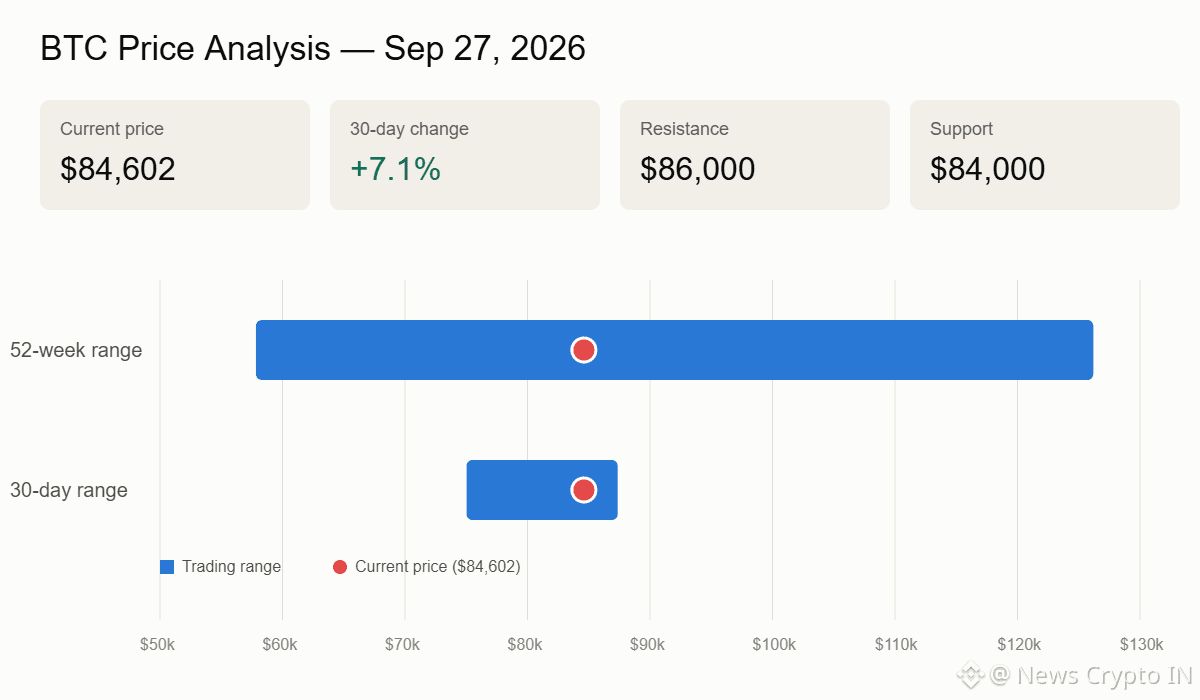
BTC is up 7.1% in 30 days, sitting at $84,602 — but that number hides more than it shows. It's still $41,500 below its own ATH from less than a year ago. "Recovery" and "new bull run" are not the same chart pattern, even when they produce the same green candle today.
$86K resistance has held twice this month. Until it breaks with volume, this is range-bound consolidation, not a breakout — no matter how the headlines frame the +7% number in isolation.
#BTC #Bitcoin #CryptoMarket
BTC is up 7.1% in 30 days, sitting at $84,602 — but that number hides more than it shows. It's still $41,500 below its own ATH from less than a year ago. "Recovery" and "new bull run" are not the same chart pattern, even when they produce the same green candle today.
$86K resistance has held twice this month. Until it breaks with volume, this is range-bound consolidation, not a breakout — no matter how the headlines frame the +7% number in isolation.
#BTC #Bitcoin #CryptoMarket
$86K resistance has held twice this month. Until it breaks with volume, this is range-bound consolidation, not a breakout — no matter how the headlines frame the +7% number in isolation.
#BTC #Bitcoin #CryptoMarket
1
42
82% of all crypto trading volume right now is derivatives — futures, leverage, perpetuals. Not spot. Not "I bought Bitcoin and held it." Leveraged bets on price direction.
Peer-reviewed research on day trading, across markets, consistently finds 70-97% of day traders lose money. Only about 1% stay profitable long-term. That's not a crypto-specific stat — it's just what leverage trading does to most humans, in any market, over any long enough timeframe.
Now overlay this: the global crypto gambling market hit $92.6B in gross gaming revenue this year — 27% of ALL online gambling revenue worldwide, up from a market with 1,200 platforms in 2020 to 3,800+ now. The line between "leverage trading platform" and "gambling platform" isn't blurry because users are confused. It's blurry because the products are functionally identical: variance-maximizing bets with a house that profits either way (funding rates, liquidation fees, spread).
Nobody markets it as gambling. It gets marketed as "trading," "hedging," "market participation." The UI has candlesticks instead of a roulette wheel, so it feels like skill instead of chance. But if 9 out of 10 participants lose money to the same handful of winners plus the platform taking a cut regardless — what exactly is the functional difference?
This isn't an argument to ban leverage or that spot holding is virtuous. It's a question about self-honesty: if you're opening 5x-20x positions on hourly timeframes, are you trading, or are you gambling with extra steps and worse odds than a casino gives you on paper?
#CryptoTrading #Leverage #DeFi #RiskManagement
82% of all crypto trading volume right now is derivatives — futures, leverage, perpetuals. Not spot. Not "I bought Bitcoin and held it." Leveraged bets on price direction.
Peer-reviewed research on day trading, across markets, consistently finds 70-97% of day traders lose money. Only about 1% stay profitable long-term. That's not a crypto-specific stat — it's just what leverage trading does to most humans, in any market, over any long enough timeframe.
Now overlay this: the global crypto gambling market hit $92.6B in gross gaming revenue this year — 27% of ALL online gambling revenue worldwide, up from a market with 1,200 platforms in 2020 to 3,800+ now. The line between "leverage trading platform" and "gambling platform" isn't blurry because users are confused. It's blurry because the products are functionally identical: variance-maximizing bets with a house that profits either way (funding rates, liquidation fees, spread).
Nobody markets it as gambling. It gets marketed as "trading," "hedging," "market participation." The UI has candlesticks instead of a roulette wheel, so it feels like skill instead of chance. But if 9 out of 10 participants lose money to the same handful of winners plus the platform taking a cut regardless — what exactly is the functional difference?
This isn't an argument to ban leverage or that spot holding is virtuous. It's a question about self-honesty: if you're opening 5x-20x positions on hourly timeframes, are you trading, or are you gambling with extra steps and worse odds than a casino gives you on paper?
#CryptoTrading #Leverage #DeFi #RiskManagement
Peer-reviewed research on day trading, across markets, consistently finds 70-97% of day traders lose money. Only about 1% stay profitable long-term. That's not a crypto-specific stat — it's just what leverage trading does to most humans, in any market, over any long enough timeframe.
Now overlay this: the global crypto gambling market hit $92.6B in gross gaming revenue this year — 27% of ALL online gambling revenue worldwide, up from a market with 1,200 platforms in 2020 to 3,800+ now. The line between "leverage trading platform" and "gambling platform" isn't blurry because users are confused. It's blurry because the products are functionally identical: variance-maximizing bets with a house that profits either way (funding rates, liquidation fees, spread).
Nobody markets it as gambling. It gets marketed as "trading," "hedging," "market participation." The UI has candlesticks instead of a roulette wheel, so it feels like skill instead of chance. But if 9 out of 10 participants lose money to the same handful of winners plus the platform taking a cut regardless — what exactly is the functional difference?
This isn't an argument to ban leverage or that spot holding is virtuous. It's a question about self-honesty: if you're opening 5x-20x positions on hourly timeframes, are you trading, or are you gambling with extra steps and worse odds than a casino gives you on paper?
#CryptoTrading #Leverage #DeFi #RiskManagement
1
7
Over $721 million was stolen from DeFi protocols in H1 2026 that had a completed security audit. Not "no audit." Not "sketchy anonymous team." Audited. The badge everyone tells you to check for before depositing.
A study covering 135 DeFi hacks this year found 67.6% happened outside the actual scope of what got audited. "Audited" almost never means "the whole protocol, forever." It means "this specific code, at this specific version, on this specific date." Add a feature next month, integrate a new bridge, tweak the liquidation logic — and you're now running unaudited code with an audited badge still on your website.
The Euler Finance case is the cleanest example: the exploit succeeded not because of a coding bug, but because of economic logic in the donation and liquidation mechanics. No line-by-line code review catches that. The code was correct. The design assumption was wrong.
Meanwhile $1.3B has been drained from DeFi in 2026 so far, and Chainalysis attributes roughly 76% of hack losses this year to state-backed groups, mostly Lazarus — not random script kiddies. These aren't people probing for typos in Solidity. They're well-funded teams studying validator infrastructure, RPC endpoints, and governance mechanisms, the stuff audits don't even look at.
"Audited" is a marketing word doing the job of a security guarantee it was never built for. Not saying skip protocols with audits. Saying: an audit tells you less than the badge implies, and knowing that is worth more than the badge itself.
Next time a project leads with "audited by [firm]" — do you know what that audit actually covered, or are you just trusting the checkmark?
#DeFi #Security #CryptoHacks #SmartContracts
Over $721 million was stolen from DeFi protocols in H1 2026 that had a completed security audit. Not "no audit." Not "sketchy anonymous team." Audited. The badge everyone tells you to check for before depositing.
A study covering 135 DeFi hacks this year found 67.6% happened outside the actual scope of what got audited. "Audited" almost never means "the whole protocol, forever." It means "this specific code, at this specific version, on this specific date." Add a feature next month, integrate a new bridge, tweak the liquidation logic — and you're now running unaudited code with an audited badge still on your website.
The Euler Finance case is the cleanest example: the exploit succeeded not because of a coding bug, but because of economic logic in the donation and liquidation mechanics. No line-by-line code review catches that. The code was correct. The design assumption was wrong.
Meanwhile $1.3B has been drained from DeFi in 2026 so far, and Chainalysis attributes roughly 76% of hack losses this year to state-backed groups, mostly Lazarus — not random script kiddies. These aren't people probing for typos in Solidity. They're well-funded teams studying validator infrastructure, RPC endpoints, and governance mechanisms, the stuff audits don't even look at.
"Audited" is a marketing word doing the job of a security guarantee it was never built for. Not saying skip protocols with audits. Saying: an audit tells you less than the badge implies, and knowing that is worth more than the badge itself.
Next time a project leads with "audited by [firm]" — do you know what that audit actually covered, or are you just trusting the checkmark?
#DeFi #Security #CryptoHacks #SmartContracts
A study covering 135 DeFi hacks this year found 67.6% happened outside the actual scope of what got audited. "Audited" almost never means "the whole protocol, forever." It means "this specific code, at this specific version, on this specific date." Add a feature next month, integrate a new bridge, tweak the liquidation logic — and you're now running unaudited code with an audited badge still on your website.
The Euler Finance case is the cleanest example: the exploit succeeded not because of a coding bug, but because of economic logic in the donation and liquidation mechanics. No line-by-line code review catches that. The code was correct. The design assumption was wrong.
Meanwhile $1.3B has been drained from DeFi in 2026 so far, and Chainalysis attributes roughly 76% of hack losses this year to state-backed groups, mostly Lazarus — not random script kiddies. These aren't people probing for typos in Solidity. They're well-funded teams studying validator infrastructure, RPC endpoints, and governance mechanisms, the stuff audits don't even look at.
"Audited" is a marketing word doing the job of a security guarantee it was never built for. Not saying skip protocols with audits. Saying: an audit tells you less than the badge implies, and knowing that is worth more than the badge itself.
Next time a project leads with "audited by [firm]" — do you know what that audit actually covered, or are you just trusting the checkmark?
#DeFi #Security #CryptoHacks #SmartContracts
1
45
There's a list floating around with 200+ crypto influencers and their price sheet for paid promotion. $50 to $60,000 per post, depending on reach. Of the 160+ who took the deal? Fewer than 5 disclosed it was an ad.
Read that again. Not "some didn't disclose." Fewer than five out of over a hundred and sixty.
This isn't a gray area. The FTC Endorsement Guides require disclosure. Jake Paul got fined $400K for exactly this with Justin Sun. Kim Kardashian got hit by the SEC for the same thing with EthereumMax. The law is clear, the precedent is clear, and somehow the entire influencer economy in this space still runs on "forgetting" to mention who's paying them.
Here's why this matters more than a gotcha thread: every time you see a "I've been researching this project for weeks and I'm really bullish" post from someone with 200K followers, you have no way of knowing if that's their genuine conviction or a $15,000 invoice. The rug pulls that follow — like the $143M CR7 collapse — don't happen because retail is dumb. They happen because the people retail trusts for signal are structurally incentivized to lie about why they're posting.
The uncomfortable part: this platform runs on creators too. The instinct to assume "at least the person I follow is being real with me" is exactly the assumption this leak just gutted, at scale, industry-wide.
Not naming names — the leak already did that. Just asking: next time someone's "personal take" conveniently aligns with a token launch, do you check who's paying, or do you just trust the vibes?
#CryptoInfluencers #Transparency #DYOR #CryptoNews
There's a list floating around with 200+ crypto influencers and their price sheet for paid promotion. $50 to $60,000 per post, depending on reach. Of the 160+ who took the deal? Fewer than 5 disclosed it was an ad.
Read that again. Not "some didn't disclose." Fewer than five out of over a hundred and sixty.
This isn't a gray area. The FTC Endorsement Guides require disclosure. Jake Paul got fined $400K for exactly this with Justin Sun. Kim Kardashian got hit by the SEC for the same thing with EthereumMax. The law is clear, the precedent is clear, and somehow the entire influencer economy in this space still runs on "forgetting" to mention who's paying them.
Here's why this matters more than a gotcha thread: every time you see a "I've been researching this project for weeks and I'm really bullish" post from someone with 200K followers, you have no way of knowing if that's their genuine conviction or a $15,000 invoice. The rug pulls that follow — like the $143M CR7 collapse — don't happen because retail is dumb. They happen because the people retail trusts for signal are structurally incentivized to lie about why they're posting.
The uncomfortable part: this platform runs on creators too. The instinct to assume "at least the person I follow is being real with me" is exactly the assumption this leak just gutted, at scale, industry-wide.
Not naming names — the leak already did that. Just asking: next time someone's "personal take" conveniently aligns with a token launch, do you check who's paying, or do you just trust the vibes?
#CryptoInfluencers #Transparency #DYOR #CryptoNews
Read that again. Not "some didn't disclose." Fewer than five out of over a hundred and sixty.
This isn't a gray area. The FTC Endorsement Guides require disclosure. Jake Paul got fined $400K for exactly this with Justin Sun. Kim Kardashian got hit by the SEC for the same thing with EthereumMax. The law is clear, the precedent is clear, and somehow the entire influencer economy in this space still runs on "forgetting" to mention who's paying them.
Here's why this matters more than a gotcha thread: every time you see a "I've been researching this project for weeks and I'm really bullish" post from someone with 200K followers, you have no way of knowing if that's their genuine conviction or a $15,000 invoice. The rug pulls that follow — like the $143M CR7 collapse — don't happen because retail is dumb. They happen because the people retail trusts for signal are structurally incentivized to lie about why they're posting.
The uncomfortable part: this platform runs on creators too. The instinct to assume "at least the person I follow is being real with me" is exactly the assumption this leak just gutted, at scale, industry-wide.
Not naming names — the leak already did that. Just asking: next time someone's "personal take" conveniently aligns with a token launch, do you check who's paying, or do you just trust the vibes?
#CryptoInfluencers #Transparency #DYOR #CryptoNews
1
56
Everyone's celebrating the GENIUS Act as "crypto finally got regulatory clarity." Nobody's asking who that clarity is actually built for.
Here's the math: a stablecoin issuer under $200M in circulation now faces roughly $15M/year in compliance costs — AML systems, audit functions, sanctions programs, on-chain enforcement. Their gross reserve income at current Treasury yields? About $7.5M/year. That's a business that loses money by design the moment it complies.
Compliance costs are fixed, not proportional. A $500M issuer and a $50B issuer pay roughly the same compliance bill. Circle and Coinbase absorb that easily. Everyone below them gets priced out or acquired.
This isn't accidental. This is what "regulatory clarity" produces every time it's written this way: not more competition, but consolidation into 2-3 well-capitalized incumbents who helped write the framework. Circle's USDC already added $2B in Q1 2026 on "institutional demand for regulated assets" while Tether's USDT contracted $3B — its first quarterly decline since 2022.
Nobody's forcing you to pick a side here. Just notice the pattern: every time an industry gets "protected" by compliance requirements this expensive, the companies celebrating loudest in the press release are the ones who can already afford the bill. The ones getting quietly acquired by Q3 aren't writing op-eds about it.
If you hold stablecoins: do you know which one of yours can actually survive this math, or are you just holding whichever one was liquid when you needed it?
#Stablecoin #GENIUSAct #CryptoRegulation #USDT #USDC
Everyone's celebrating the GENIUS Act as "crypto finally got regulatory clarity." Nobody's asking who that clarity is actually built for.
Here's the math: a stablecoin issuer under $200M in circulation now faces roughly $15M/year in compliance costs — AML systems, audit functions, sanctions programs, on-chain enforcement. Their gross reserve income at current Treasury yields? About $7.5M/year. That's a business that loses money by design the moment it complies.
Compliance costs are fixed, not proportional. A $500M issuer and a $50B issuer pay roughly the same compliance bill. Circle and Coinbase absorb that easily. Everyone below them gets priced out or acquired.
This isn't accidental. This is what "regulatory clarity" produces every time it's written this way: not more competition, but consolidation into 2-3 well-capitalized incumbents who helped write the framework. Circle's USDC already added $2B in Q1 2026 on "institutional demand for regulated assets" while Tether's USDT contracted $3B — its first quarterly decline since 2022.
Nobody's forcing you to pick a side here. Just notice the pattern: every time an industry gets "protected" by compliance requirements this expensive, the companies celebrating loudest in the press release are the ones who can already afford the bill. The ones getting quietly acquired by Q3 aren't writing op-eds about it.
If you hold stablecoins: do you know which one of yours can actually survive this math, or are you just holding whichever one was liquid when you needed it?
#Stablecoin #GENIUSAct #CryptoRegulation #USDT #USDC
Here's the math: a stablecoin issuer under $200M in circulation now faces roughly $15M/year in compliance costs — AML systems, audit functions, sanctions programs, on-chain enforcement. Their gross reserve income at current Treasury yields? About $7.5M/year. That's a business that loses money by design the moment it complies.
Compliance costs are fixed, not proportional. A $500M issuer and a $50B issuer pay roughly the same compliance bill. Circle and Coinbase absorb that easily. Everyone below them gets priced out or acquired.
This isn't accidental. This is what "regulatory clarity" produces every time it's written this way: not more competition, but consolidation into 2-3 well-capitalized incumbents who helped write the framework. Circle's USDC already added $2B in Q1 2026 on "institutional demand for regulated assets" while Tether's USDT contracted $3B — its first quarterly decline since 2022.
Nobody's forcing you to pick a side here. Just notice the pattern: every time an industry gets "protected" by compliance requirements this expensive, the companies celebrating loudest in the press release are the ones who can already afford the bill. The ones getting quietly acquired by Q3 aren't writing op-eds about it.
If you hold stablecoins: do you know which one of yours can actually survive this math, or are you just holding whichever one was liquid when you needed it?
#Stablecoin #GENIUSAct #CryptoRegulation #USDT #USDC
1
3
1.7k
Today's #1 gainer across the entire crypto market isn't Bitcoin, isn't an AI token, isn't some institutional tokenization play. It's Lil' Shrub (SHRUB), up 805.7% in 24 hours.
What is it? A memecoin themed after a hedgehog. Specifically, Elon Musk's pet hedgehog, after Shivon Zilis (Neuralink exec, mother of several of Musk's kids) posted a photo of it on X. Someone turned that photo into a token days later. 0% tax, "100% burned liquidity," zero utility, zero product.
This is the entire playbook, every time: a public figure posts something unrelated to crypto → someone launches a token off it within hours → early buyers pump it on a low-liquidity chain → it shows up on every "top gainers" list → new buyers see +805% and ape in at the top → volume dries up → chart round-trips to zero.
The token isn't "worth" 805% more. The float is thin enough that a few coordinated buys move the price 8x. That's not price discovery, that's illiquidity doing what illiquidity does.
Meanwhile it also trades under the ticker SHRUB on multiple different chains with different contract addresses — so half the people buying "the pump" may not even be buying the same token as the chart they're looking at.
This isn't a warning to never touch memecoins. It's a question: when a coin's entire thesis is "a celebrity's pet got photographed," what exactly do you think you own the day after the timeline moves on?
#Memecoin #SHRUB #CryptoMarket #DYOR
Today's #1 gainer across the entire crypto market isn't Bitcoin, isn't an AI token, isn't some institutional tokenization play. It's Lil' Shrub (SHRUB), up 805.7% in 24 hours.
What is it? A memecoin themed after a hedgehog. Specifically, Elon Musk's pet hedgehog, after Shivon Zilis (Neuralink exec, mother of several of Musk's kids) posted a photo of it on X. Someone turned that photo into a token days later. 0% tax, "100% burned liquidity," zero utility, zero product.
This is the entire playbook, every time: a public figure posts something unrelated to crypto → someone launches a token off it within hours → early buyers pump it on a low-liquidity chain → it shows up on every "top gainers" list → new buyers see +805% and ape in at the top → volume dries up → chart round-trips to zero.
The token isn't "worth" 805% more. The float is thin enough that a few coordinated buys move the price 8x. That's not price discovery, that's illiquidity doing what illiquidity does.
Meanwhile it also trades under the ticker SHRUB on multiple different chains with different contract addresses — so half the people buying "the pump" may not even be buying the same token as the chart they're looking at.
This isn't a warning to never touch memecoins. It's a question: when a coin's entire thesis is "a celebrity's pet got photographed," what exactly do you think you own the day after the timeline moves on?
#Memecoin #SHRUB #CryptoMarket #DYOR
What is it? A memecoin themed after a hedgehog. Specifically, Elon Musk's pet hedgehog, after Shivon Zilis (Neuralink exec, mother of several of Musk's kids) posted a photo of it on X. Someone turned that photo into a token days later. 0% tax, "100% burned liquidity," zero utility, zero product.
This is the entire playbook, every time: a public figure posts something unrelated to crypto → someone launches a token off it within hours → early buyers pump it on a low-liquidity chain → it shows up on every "top gainers" list → new buyers see +805% and ape in at the top → volume dries up → chart round-trips to zero.
The token isn't "worth" 805% more. The float is thin enough that a few coordinated buys move the price 8x. That's not price discovery, that's illiquidity doing what illiquidity does.
Meanwhile it also trades under the ticker SHRUB on multiple different chains with different contract addresses — so half the people buying "the pump" may not even be buying the same token as the chart they're looking at.
This isn't a warning to never touch memecoins. It's a question: when a coin's entire thesis is "a celebrity's pet got photographed," what exactly do you think you own the day after the timeline moves on?
#Memecoin #SHRUB #CryptoMarket #DYOR
1
24
AI is having its biggest infrastructure boom in history. Nvidia's revenue went from $27B to $215B in three years, projected to hit $410B next year. Real demand, real cash flow, real customers.
AI crypto tokens? Missing the entire rally. The whole sector — hundreds of "AI + blockchain" tokens combined — sits at roughly $25B market cap. That's 0.87% of the $2.86T total crypto market. And it's shrinking relative to the space, not growing.
Here's the gap nobody selling you an "AI coin" wants to explain: Nvidia's stock is backed by shipped GPUs, signed contracts, and quarterly revenue you can audit. Most AI crypto tokens are backed by a whitepaper claiming to "optimize tokenomics with AI" or "generate NFTs using AI" — a marketing tag bolted onto a token that would exist identically without it.
CoinMarketCap's own research head put it bluntly: the AI tag is free, but the market is starting to charge for actually proving it does something. That's not FUD. That's capital doing exactly what it's supposed to do — separating infrastructure with cash flow from vibes with a roadmap.
The next phase isn't "AI tokens go to zero." It's consolidation: a dozen or two projects that can show real usage survive, the rest quietly bleed into irrelevance while their Twitter accounts keep posting "AI is the future" charts.
If you're holding an "AI coin" right now: does the project generate revenue from AI, or does it just mention AI in the pitch deck?
#AI #CryptoAI #AIBubble #Altcoins
AI is having its biggest infrastructure boom in history. Nvidia's revenue went from $27B to $215B in three years, projected to hit $410B next year. Real demand, real cash flow, real customers.
AI crypto tokens? Missing the entire rally. The whole sector — hundreds of "AI + blockchain" tokens combined — sits at roughly $25B market cap. That's 0.87% of the $2.86T total crypto market. And it's shrinking relative to the space, not growing.
Here's the gap nobody selling you an "AI coin" wants to explain: Nvidia's stock is backed by shipped GPUs, signed contracts, and quarterly revenue you can audit. Most AI crypto tokens are backed by a whitepaper claiming to "optimize tokenomics with AI" or "generate NFTs using AI" — a marketing tag bolted onto a token that would exist identically without it.
CoinMarketCap's own research head put it bluntly: the AI tag is free, but the market is starting to charge for actually proving it does something. That's not FUD. That's capital doing exactly what it's supposed to do — separating infrastructure with cash flow from vibes with a roadmap.
The next phase isn't "AI tokens go to zero." It's consolidation: a dozen or two projects that can show real usage survive, the rest quietly bleed into irrelevance while their Twitter accounts keep posting "AI is the future" charts.
If you're holding an "AI coin" right now: does the project generate revenue from AI, or does it just mention AI in the pitch deck?
#AI #CryptoAI #AIBubble #Altcoins
AI crypto tokens? Missing the entire rally. The whole sector — hundreds of "AI + blockchain" tokens combined — sits at roughly $25B market cap. That's 0.87% of the $2.86T total crypto market. And it's shrinking relative to the space, not growing.
Here's the gap nobody selling you an "AI coin" wants to explain: Nvidia's stock is backed by shipped GPUs, signed contracts, and quarterly revenue you can audit. Most AI crypto tokens are backed by a whitepaper claiming to "optimize tokenomics with AI" or "generate NFTs using AI" — a marketing tag bolted onto a token that would exist identically without it.
CoinMarketCap's own research head put it bluntly: the AI tag is free, but the market is starting to charge for actually proving it does something. That's not FUD. That's capital doing exactly what it's supposed to do — separating infrastructure with cash flow from vibes with a roadmap.
The next phase isn't "AI tokens go to zero." It's consolidation: a dozen or two projects that can show real usage survive, the rest quietly bleed into irrelevance while their Twitter accounts keep posting "AI is the future" charts.
If you're holding an "AI coin" right now: does the project generate revenue from AI, or does it just mention AI in the pitch deck?
#AI #CryptoAI #AIBubble #Altcoins
1
33
Everyone's timeline looks like it's mooning today. QNT +72%, SOON +47%, THORChain and Wormhole both green. Feels like a bull run, right?
Total market cap moved from $2.87T to $2.89T. That's +0.45%. Bitcoin, the asset that drives 50%+ of that cap, is up 0.69%. VeChain is down -5.63%. Aerodrome is down -3.46%.
This is the trick every "crypto is pumping" headline pulls: cherry-pick the top 3-5 gainers out of 10,000+ tokens, ignore that the other 9,995 either did nothing or bled out, and call it a market move. Statistically, on ANY given day, something in a 10,000-token universe will be up 40-70%. That's not a signal. That's just how large sample sizes work.
QNT's pump has a real catalyst (The Clearing House picking it for a bank tokenization pilot). SOON's 47% move — most people posting about it couldn't tell you why it happened before typing "🚀🚀🚀."
Fear & Greed sits at 47, Neutral. Not euphoric, not panicked. The "market" isn't doing anything dramatic today. A handful of tokens are. Those are different facts, and conflating them is how retail ends up buying the top of someone else's pump because the CT feed made the whole market look alive.
Before you ape into whatever's green on your feed right now: is the asset moving because of the token, or because of the 3 accounts that keep posting it?
#CryptoMarket #BTC #AltcoinSeason #DYOR
Everyone's timeline looks like it's mooning today. QNT +72%, SOON +47%, THORChain and Wormhole both green. Feels like a bull run, right?
Total market cap moved from $2.87T to $2.89T. That's +0.45%. Bitcoin, the asset that drives 50%+ of that cap, is up 0.69%. VeChain is down -5.63%. Aerodrome is down -3.46%.
This is the trick every "crypto is pumping" headline pulls: cherry-pick the top 3-5 gainers out of 10,000+ tokens, ignore that the other 9,995 either did nothing or bled out, and call it a market move. Statistically, on ANY given day, something in a 10,000-token universe will be up 40-70%. That's not a signal. That's just how large sample sizes work.
QNT's pump has a real catalyst (The Clearing House picking it for a bank tokenization pilot). SOON's 47% move — most people posting about it couldn't tell you why it happened before typing "🚀🚀🚀."
Fear & Greed sits at 47, Neutral. Not euphoric, not panicked. The "market" isn't doing anything dramatic today. A handful of tokens are. Those are different facts, and conflating them is how retail ends up buying the top of someone else's pump because the CT feed made the whole market look alive.
Before you ape into whatever's green on your feed right now: is the asset moving because of the token, or because of the 3 accounts that keep posting it?
#CryptoMarket #BTC #AltcoinSeason #DYOR
Total market cap moved from $2.87T to $2.89T. That's +0.45%. Bitcoin, the asset that drives 50%+ of that cap, is up 0.69%. VeChain is down -5.63%. Aerodrome is down -3.46%.
This is the trick every "crypto is pumping" headline pulls: cherry-pick the top 3-5 gainers out of 10,000+ tokens, ignore that the other 9,995 either did nothing or bled out, and call it a market move. Statistically, on ANY given day, something in a 10,000-token universe will be up 40-70%. That's not a signal. That's just how large sample sizes work.
QNT's pump has a real catalyst (The Clearing House picking it for a bank tokenization pilot). SOON's 47% move — most people posting about it couldn't tell you why it happened before typing "🚀🚀🚀."
Fear & Greed sits at 47, Neutral. Not euphoric, not panicked. The "market" isn't doing anything dramatic today. A handful of tokens are. Those are different facts, and conflating them is how retail ends up buying the top of someone else's pump because the CT feed made the whole market look alive.
Before you ape into whatever's green on your feed right now: is the asset moving because of the token, or because of the 3 accounts that keep posting it?
#CryptoMarket #BTC #AltcoinSeason #DYOR
1
422
Exploring bPay on BNB Chain — an independent community onboarding project for on-chain users.
Contract address: 0xb13003bf44de426dd2a3aae3df9c3400de0a7777
Campaign code: BP-EAF9097F5A81
DYOR and never share your private key or seed phrase. bPay is not an official Binance product and is not affiliated with Binance.
#BSC #BNBChain #bPay
Exploring bPay on BNB Chain — an independent community onboarding project for on-chain users.
Contract address: 0xb13003bf44de426dd2a3aae3df9c3400de0a7777
Campaign code: BP-EAF9097F5A81
DYOR and never share your private key or seed phrase. bPay is not an official Binance product and is not affiliated with Binance.
#BSC #BNBChain #bPay
Contract address: 0xb13003bf44de426dd2a3aae3df9c3400de0a7777
Campaign code: BP-EAF9097F5A81
DYOR and never share your private key or seed phrase. bPay is not an official Binance product and is not affiliated with Binance.
#BSC #BNBChain #bPay
1
50
Verified
$QNT just ripped ~70% in a day. The banks are coming. But are they coming for the TOKEN?
Here's what actually happened: The Clearing House — the outfit behind RTP and CHIPS, moving $2T+ a day — picked Quant to power its On-Chain Money Initiative. 25 US banks, tokenized deposits, launch targeted H1 2027.
That's a real deal. Not a "partnership" with a Discord server. I'll give Quant that.
Now the uncomfortable part nobody on the timeline wants to say:
→ Banks license Overledger. They don't need to hold QNT to use it.
→ The token has no direct claim on Quant's enterprise revenue.
→ More TCH volume ≠ proven, measurable QNT demand. That link has never been clearly shown.
So what's being priced in right now? A platform win. What people are buying? A token.
Those are not the same asset.
Also worth noting:
• Go-live is 2027. You're paying today for flows that don't exist yet.
• Even after this pump, QNT sits far below its $427 ATH — this narrative has been "about to happen" for years.
• A breakout on a 124% volume spike during a quarter-end altcoin rotation is exactly where late buyers become exit liquidity.
I'm not saying the thesis is dead. Institutional tokenization is arguably the most legit use case crypto has. I'm saying "bank adopts company's software" and "token goes up forever" is a leap the market keeps making without checking the bridge.
If you're holding QNT: can you explain, in one sentence, how 25 banks settling deposits creates buy pressure on your token?
If you can't — what exactly are you holding?
#QNT #Quant #Tokenization #RWA #CryptoMarket
$QNT just ripped ~70% in a day. The banks are coming. But are they coming for the TOKEN?
Here's what actually happened: The Clearing House — the outfit behind RTP and CHIPS, moving $2T+ a day — picked Quant to power its On-Chain Money Initiative. 25 US banks, tokenized deposits, launch targeted H1 2027.
That's a real deal. Not a "partnership" with a Discord server. I'll give Quant that.
Now the uncomfortable part nobody on the timeline wants to say:
→ Banks license Overledger. They don't need to hold QNT to use it.
→ The token has no direct claim on Quant's enterprise revenue.
→ More TCH volume ≠ proven, measurable QNT demand. That link has never been clearly shown.
So what's being priced in right now? A platform win. What people are buying? A token.
Those are not the same asset.
Also worth noting:
• Go-live is 2027. You're paying today for flows that don't exist yet.
• Even after this pump, QNT sits far below its $427 ATH — this narrative has been "about to happen" for years.
• A breakout on a 124% volume spike during a quarter-end altcoin rotation is exactly where late buyers become exit liquidity.
I'm not saying the thesis is dead. Institutional tokenization is arguably the most legit use case crypto has. I'm saying "bank adopts company's software" and "token goes up forever" is a leap the market keeps making without checking the bridge.
If you're holding QNT: can you explain, in one sentence, how 25 banks settling deposits creates buy pressure on your token?
If you can't — what exactly are you holding?
#QNT #Quant #Tokenization #RWA #CryptoMarket
Here's what actually happened: The Clearing House — the outfit behind RTP and CHIPS, moving $2T+ a day — picked Quant to power its On-Chain Money Initiative. 25 US banks, tokenized deposits, launch targeted H1 2027.
That's a real deal. Not a "partnership" with a Discord server. I'll give Quant that.
Now the uncomfortable part nobody on the timeline wants to say:
→ Banks license Overledger. They don't need to hold QNT to use it.
→ The token has no direct claim on Quant's enterprise revenue.
→ More TCH volume ≠ proven, measurable QNT demand. That link has never been clearly shown.
So what's being priced in right now? A platform win. What people are buying? A token.
Those are not the same asset.
Also worth noting:
• Go-live is 2027. You're paying today for flows that don't exist yet.
• Even after this pump, QNT sits far below its $427 ATH — this narrative has been "about to happen" for years.
• A breakout on a 124% volume spike during a quarter-end altcoin rotation is exactly where late buyers become exit liquidity.
I'm not saying the thesis is dead. Institutional tokenization is arguably the most legit use case crypto has. I'm saying "bank adopts company's software" and "token goes up forever" is a leap the market keeps making without checking the bridge.
If you're holding QNT: can you explain, in one sentence, how 25 banks settling deposits creates buy pressure on your token?
If you can't — what exactly are you holding?
#QNT #Quant #Tokenization #RWA #CryptoMarket
2
1.5k
Binance suspended a Wallet team employee for insider trading a token launch — using inside knowledge from a prior BNB Chain role to buy before the TGE, then dump right after. Four whistleblowers split a $100K reward for reporting it. Binance handled that one well. But that's not the pattern people should be watching. 🔍
RAVE token surged 10,800% in days, then crashed 98%, wiping out $6B in value — while ~90% of supply sat in three team-linked wallets, according to on-chain researcher ZachXBT. Binance and Bitget both opened formal investigations, which almost never happens publicly. Investors read that as confirmation something was already broken, not reassurance.
Here's the uncomfortable question: why does the exchange keep discovering this *after* retail has already been liquidated? $44M in forced liquidations happened before anyone official said a word. The listing process is supposed to be the filter. Increasingly it looks like the filter catches problems only once the chart already collapsed.
Meanwhile Binance just delisted ICX, SCRT, and STORJ this month and tagged AVA, GNS, SCR, TOWNS for "Monitoring" — process working as intended, technically. But monitoring tags and post-crash investigations are reactive, not preventive. The incentive structure rewards fast listings with volume, and punishes slow listings with "you missed the pump." Retail eats the difference.
Not saying don't trade listed tokens. Just asking: when an exchange announces an investigation into a token IT ALREADY LISTED, who's actually protected — the users who got liquidated, or the exchange's own liability?
#Binance #BNB #CryptoRegulation #TokenListing
Binance suspended a Wallet team employee for insider trading a token launch — using inside knowledge from a prior BNB Chain role to buy before the TGE, then dump right after. Four whistleblowers split a $100K reward for reporting it. Binance handled that one well. But that's not the pattern people should be watching. 🔍
RAVE token surged 10,800% in days, then crashed 98%, wiping out $6B in value — while ~90% of supply sat in three team-linked wallets, according to on-chain researcher ZachXBT. Binance and Bitget both opened formal investigations, which almost never happens publicly. Investors read that as confirmation something was already broken, not reassurance.
Here's the uncomfortable question: why does the exchange keep discovering this *after* retail has already been liquidated? $44M in forced liquidations happened before anyone official said a word. The listing process is supposed to be the filter. Increasingly it looks like the filter catches problems only once the chart already collapsed.
Meanwhile Binance just delisted ICX, SCRT, and STORJ this month and tagged AVA, GNS, SCR, TOWNS for "Monitoring" — process working as intended, technically. But monitoring tags and post-crash investigations are reactive, not preventive. The incentive structure rewards fast listings with volume, and punishes slow listings with "you missed the pump." Retail eats the difference.
Not saying don't trade listed tokens. Just asking: when an exchange announces an investigation into a token IT ALREADY LISTED, who's actually protected — the users who got liquidated, or the exchange's own liability?
#Binance #BNB #CryptoRegulation #TokenListing
RAVE token surged 10,800% in days, then crashed 98%, wiping out $6B in value — while ~90% of supply sat in three team-linked wallets, according to on-chain researcher ZachXBT. Binance and Bitget both opened formal investigations, which almost never happens publicly. Investors read that as confirmation something was already broken, not reassurance.
Here's the uncomfortable question: why does the exchange keep discovering this *after* retail has already been liquidated? $44M in forced liquidations happened before anyone official said a word. The listing process is supposed to be the filter. Increasingly it looks like the filter catches problems only once the chart already collapsed.
Meanwhile Binance just delisted ICX, SCRT, and STORJ this month and tagged AVA, GNS, SCR, TOWNS for "Monitoring" — process working as intended, technically. But monitoring tags and post-crash investigations are reactive, not preventive. The incentive structure rewards fast listings with volume, and punishes slow listings with "you missed the pump." Retail eats the difference.
Not saying don't trade listed tokens. Just asking: when an exchange announces an investigation into a token IT ALREADY LISTED, who's actually protected — the users who got liquidated, or the exchange's own liability?
#Binance #BNB #CryptoRegulation #TokenListing
2
473
·
--
Bullish
Modular Blockchain: Real Solutions or New Narratives?
The narrative of modular blockchain is becoming more popular, rollups, DA layer, shared security, separate execution layer.
Technically, this approach makes sense: scalability without sacrificing decentralization. But for the average user, do they really care about the architecture behind the scenes?
Or is this just a shift in narrative to kick off the next hype cycle?
Web3 often gets caught up in high-level infrastructure discussions, while users just want: cheap, fast, and secure.
Is modularity really a revolution, or just neatly packaged complexity?
Modular Blockchain: Real Solutions or New Narratives?
The narrative of modular blockchain is becoming more popular, rollups, DA layer, shared security, separate execution layer.
Technically, this approach makes sense: scalability without sacrificing decentralization. But for the average user, do they really care about the architecture behind the scenes?
Or is this just a shift in narrative to kick off the next hype cycle?
Web3 often gets caught up in high-level infrastructure discussions, while users just want: cheap, fast, and secure.
Is modularity really a revolution, or just neatly packaged complexity?
The narrative of modular blockchain is becoming more popular, rollups, DA layer, shared security, separate execution layer.
Technically, this approach makes sense: scalability without sacrificing decentralization. But for the average user, do they really care about the architecture behind the scenes?
Or is this just a shift in narrative to kick off the next hype cycle?
Web3 often gets caught up in high-level infrastructure discussions, while users just want: cheap, fast, and secure.
Is modularity really a revolution, or just neatly packaged complexity?
1
173
·
--
Bullish
Airdrop Hunter: Ecosystem Contributor or Network Burden?
The phenomenon of airdrop hunters is becoming massive. Thousands of wallets are created, bridging to various chains, farming points for rewards.
On one hand, they increase on-chain activity and help bootstrap liquidity.
On the other hand, is it really "user adoption"?
If the majority of users come only for the incentives and leave after the token listing, is that healthy growth?
Some projects are starting to implement sybil detection and more selective retroactive rewards. But the question remains the same: is Web3 building a community, or just building reward hunters?
If you are a founder, would you prefer 10,000 incentivized users or 1,000 organic users?
Airdrop Hunter: Ecosystem Contributor or Network Burden?
The phenomenon of airdrop hunters is becoming massive. Thousands of wallets are created, bridging to various chains, farming points for rewards.
On one hand, they increase on-chain activity and help bootstrap liquidity.
On the other hand, is it really "user adoption"?
If the majority of users come only for the incentives and leave after the token listing, is that healthy growth?
Some projects are starting to implement sybil detection and more selective retroactive rewards. But the question remains the same: is Web3 building a community, or just building reward hunters?
If you are a founder, would you prefer 10,000 incentivized users or 1,000 organic users?
The phenomenon of airdrop hunters is becoming massive. Thousands of wallets are created, bridging to various chains, farming points for rewards.
On one hand, they increase on-chain activity and help bootstrap liquidity.
On the other hand, is it really "user adoption"?
If the majority of users come only for the incentives and leave after the token listing, is that healthy growth?
Some projects are starting to implement sybil detection and more selective retroactive rewards. But the question remains the same: is Web3 building a community, or just building reward hunters?
If you are a founder, would you prefer 10,000 incentivized users or 1,000 organic users?
2
119
·
--
Bullish
Web3 Has Been Too Focused on Tokens, Not Products?
Since 2020, we have seen an explosion of new tokens almost every week. But the question is: is Web3 building the products that are truly needed, or just creating token mechanisms that look attractive in whitepapers?
Many projects claim "utility tokens", but in practice, tokens function more as fundraising and speculation tools. Even some dApps with solid technology struggle to survive without price hype.
Ironically, Web2 startups can succeed without tokens, while Web3 often cannot survive without green charts.
Perhaps it’s time for Web3 to go back to basics: problem–solution fit, not token–market fit.
In your opinion, are tokens the foundation of Web3… or the biggest distraction?
#BTC #BNB #ETH #News #TrumpNewTariffs #TokenizedRealEstate
{spot}(BTCUSDT)
{spot}(BNBUSDT)
Web3 Has Been Too Focused on Tokens, Not Products?
Since 2020, we have seen an explosion of new tokens almost every week. But the question is: is Web3 building the products that are truly needed, or just creating token mechanisms that look attractive in whitepapers?
Many projects claim "utility tokens", but in practice, tokens function more as fundraising and speculation tools. Even some dApps with solid technology struggle to survive without price hype.
Ironically, Web2 startups can succeed without tokens, while Web3 often cannot survive without green charts.
Perhaps it’s time for Web3 to go back to basics: problem–solution fit, not token–market fit.
In your opinion, are tokens the foundation of Web3… or the biggest distraction?
#BTC #BNB #ETH #News #TrumpNewTariffs #TokenizedRealEstate
Since 2020, we have seen an explosion of new tokens almost every week. But the question is: is Web3 building the products that are truly needed, or just creating token mechanisms that look attractive in whitepapers?
Many projects claim "utility tokens", but in practice, tokens function more as fundraising and speculation tools. Even some dApps with solid technology struggle to survive without price hype.
Ironically, Web2 startups can succeed without tokens, while Web3 often cannot survive without green charts.
Perhaps it’s time for Web3 to go back to basics: problem–solution fit, not token–market fit.
In your opinion, are tokens the foundation of Web3… or the biggest distraction?
#BTC #BNB #ETH #News #TrumpNewTariffs #TokenizedRealEstate
1
123


·
--
Bullish
Web4: Real Evolution or Just a New Narrative?
Web1 = read.
Web2 = read & write.
Web3 = read, write & own.
Then a new term emerged: Web4.
There is no official definition yet, but many refer to Web4 as the integration of AI + blockchain + identity + autonomous agents in one seamless ecosystem. While Web3 focuses on ownership, Web4 is touted to focus on smart autonomy.
Imagine:
- Wallet with an AI agent managing automated DeFi strategies
- DAO with a governance assistant based on machine learning
- Smart contracts adaptive to market conditions
- Digital identity that is not just an address, but reputation & proof-of-skill
Here, UX becomes simpler. Users do not need to understand RPC, gas fees, or bridges. Everything is handled by the agent.
But this is where the debate begins.
If AI manages our wallets, is it still self-custody?
If the AI model is centralized, is Web4 really decentralized?
If agents can trade and vote on their own, who is responsible when failures occur?
Some say Web4 is just a rebranding of the AI trend combined with Web3. A natural evolution, not a revolution.
However, some believe this is a new phase of the internet: from the internet we control → to the internet that helps us make decisions.
The implications are significant:
- Developers must understand smart contracts + AI integration
- Investors are starting to see autonomous agents as economic actors
- Communities must redefine the meaning of “ownership”
The question is:
Is Web4 really the next chapter of the internet?
Or are we still busy looking for a new narrative before we have even completed Web3?
Web4 = evolution… or illusion?
What do you think? Please drop your thoughts about Web4. 👌
Web4: Real Evolution or Just a New Narrative?
Web1 = read.
Web2 = read & write.
Web3 = read, write & own.
Then a new term emerged: Web4.
There is no official definition yet, but many refer to Web4 as the integration of AI + blockchain + identity + autonomous agents in one seamless ecosystem. While Web3 focuses on ownership, Web4 is touted to focus on smart autonomy.
Imagine:
- Wallet with an AI agent managing automated DeFi strategies
- DAO with a governance assistant based on machine learning
- Smart contracts adaptive to market conditions
- Digital identity that is not just an address, but reputation & proof-of-skill
Here, UX becomes simpler. Users do not need to understand RPC, gas fees, or bridges. Everything is handled by the agent.
But this is where the debate begins.
If AI manages our wallets, is it still self-custody?
If the AI model is centralized, is Web4 really decentralized?
If agents can trade and vote on their own, who is responsible when failures occur?
Some say Web4 is just a rebranding of the AI trend combined with Web3. A natural evolution, not a revolution.
However, some believe this is a new phase of the internet: from the internet we control → to the internet that helps us make decisions.
The implications are significant:
- Developers must understand smart contracts + AI integration
- Investors are starting to see autonomous agents as economic actors
- Communities must redefine the meaning of “ownership”
The question is:
Is Web4 really the next chapter of the internet?
Or are we still busy looking for a new narrative before we have even completed Web3?
Web4 = evolution… or illusion?
What do you think? Please drop your thoughts about Web4. 👌
Web1 = read.
Web2 = read & write.
Web3 = read, write & own.
Then a new term emerged: Web4.
There is no official definition yet, but many refer to Web4 as the integration of AI + blockchain + identity + autonomous agents in one seamless ecosystem. While Web3 focuses on ownership, Web4 is touted to focus on smart autonomy.
Imagine:
- Wallet with an AI agent managing automated DeFi strategies
- DAO with a governance assistant based on machine learning
- Smart contracts adaptive to market conditions
- Digital identity that is not just an address, but reputation & proof-of-skill
Here, UX becomes simpler. Users do not need to understand RPC, gas fees, or bridges. Everything is handled by the agent.
But this is where the debate begins.
If AI manages our wallets, is it still self-custody?
If the AI model is centralized, is Web4 really decentralized?
If agents can trade and vote on their own, who is responsible when failures occur?
Some say Web4 is just a rebranding of the AI trend combined with Web3. A natural evolution, not a revolution.
However, some believe this is a new phase of the internet: from the internet we control → to the internet that helps us make decisions.
The implications are significant:
- Developers must understand smart contracts + AI integration
- Investors are starting to see autonomous agents as economic actors
- Communities must redefine the meaning of “ownership”
The question is:
Is Web4 really the next chapter of the internet?
Or are we still busy looking for a new narrative before we have even completed Web3?
Web4 = evolution… or illusion?
What do you think? Please drop your thoughts about Web4. 👌

2
137
Let's check it out guys about Kaemon.
Let's check it out guys about Kaemon.
News Crypto IN
·
--
KAEMON The Next Web3 Stream to Earn ?
1. Key Features Kaemon.xyz
Live Streaming Meets DeFi
In-stream DeFi: Creators and viewers can interact with decentralized finance tools (staking, tipping, token rewards) directly within live streams .Supports both broadcasting and tuning in, making monetization seamless.
AI-driven Interactivity
Utilizes intelligent AI enhancements to tailor live-stream experiences—creating personalized interactions and adapting content in real time.
Built on Polygon zkEVM
Ensures security, scalability, and low gas costs. Transactions on-stream are fast and affordable, essential for a smooth user experience kaemon.xyz.
2. User Experience & Onboarding
Wallet integration enables instant access and interaction with the platform.Simple onboarding: users can “Connect your wallet → Stream or Discover → Earn & Interact.”Emerging from beta—“Launching soon!” signals active development and growth.
3. Why Kaemon Stands Out
Kaemon isn’t just another Web3 app it’s a convergence of live streaming, DeFi, and AI on a powerful Layer-2 foundation. Here's what makes it different:
1. Unified Platform Experience
Kaemon merges live video streaming, AI-driven interaction, and on-chain DeFi tools into a single environment. This eliminates the need to juggle multiple platforms — everything happens in one place.
2. Real-Time Monetization
Viewers can tip creators, stake tokens, or participate in reward mechanisms during a livestream. Earnings are processed in real time, directly on-chain — creating a new level of instant financial engagement.
3. Personalized AI-Powered Content
Kaemon leverages AI to make the streaming experience more interactive and adaptive. It learns user preferences and adjusts interactions, helping creators connect better with their audience.
4. Powered by Polygon zkEVM
The platform runs on Polygon zkEVM, ensuring fast transactions with minimal gas fees. This scalability is critical for live environments where speed and cost-efficiency matter.
5. Designed for Web3 Native Users
Kaemon emphasizes wallet-based access, transparency, and decentralized participation, aligning fully with the ethos of Web3.
4. What’s Missing — and Coming Soon
Launch status: The site mentions “launching soon” but lacks specifics on timeline or public beta statatus.
Roadmap & Team: Details about developers, partnerships, or future milestones aren’t shown publicly yet—keeping things under wraps for now.
Kaemon is shaping up to be an innovative Web3 streaming ecosystem, integrating seamless DeFi interactions and AI engagement on a fast Layer-2 platform. Ideal for creators looking to deepen audience involvement, monetize in real-time, and harness the benefits of blockchain.
📝 Final Take: If you’re into Web3 streaming, follow Kaemon’s launch—this could be the next wave of decentralized creator platforms.
Live Streaming Meets DeFi
In-stream DeFi: Creators and viewers can interact with decentralized finance tools (staking, tipping, token rewards) directly within live streams .Supports both broadcasting and tuning in, making monetization seamless.
AI-driven Interactivity
Utilizes intelligent AI enhancements to tailor live-stream experiences—creating personalized interactions and adapting content in real time.
Built on Polygon zkEVM
Ensures security, scalability, and low gas costs. Transactions on-stream are fast and affordable, essential for a smooth user experience kaemon.xyz.
2. User Experience & Onboarding
Wallet integration enables instant access and interaction with the platform.Simple onboarding: users can “Connect your wallet → Stream or Discover → Earn & Interact.”Emerging from beta—“Launching soon!” signals active development and growth.
3. Why Kaemon Stands Out
Kaemon isn’t just another Web3 app it’s a convergence of live streaming, DeFi, and AI on a powerful Layer-2 foundation. Here's what makes it different:
1. Unified Platform Experience
Kaemon merges live video streaming, AI-driven interaction, and on-chain DeFi tools into a single environment. This eliminates the need to juggle multiple platforms — everything happens in one place.
2. Real-Time Monetization
Viewers can tip creators, stake tokens, or participate in reward mechanisms during a livestream. Earnings are processed in real time, directly on-chain — creating a new level of instant financial engagement.
3. Personalized AI-Powered Content
Kaemon leverages AI to make the streaming experience more interactive and adaptive. It learns user preferences and adjusts interactions, helping creators connect better with their audience.
4. Powered by Polygon zkEVM
The platform runs on Polygon zkEVM, ensuring fast transactions with minimal gas fees. This scalability is critical for live environments where speed and cost-efficiency matter.
5. Designed for Web3 Native Users
Kaemon emphasizes wallet-based access, transparency, and decentralized participation, aligning fully with the ethos of Web3.
4. What’s Missing — and Coming Soon
Launch status: The site mentions “launching soon” but lacks specifics on timeline or public beta statatus.
Roadmap & Team: Details about developers, partnerships, or future milestones aren’t shown publicly yet—keeping things under wraps for now.
Kaemon is shaping up to be an innovative Web3 streaming ecosystem, integrating seamless DeFi interactions and AI engagement on a fast Layer-2 platform. Ideal for creators looking to deepen audience involvement, monetize in real-time, and harness the benefits of blockchain.
📝 Final Take: If you’re into Web3 streaming, follow Kaemon’s launch—this could be the next wave of decentralized creator platforms.
1
1.7k
Article
KAEMON The Next Web3 Stream to Earn ?1. Key Features Kaemon.xyz
Live Streaming Meets DeFi
In-stream DeFi: Creators and viewers can interact with decentralized finance tools (staking, tipping, token rewards) directly within live streams .Supports both broadcasting and tuning in, making monetization seamless.
AI-driven Interactivity
Utilizes intelligent AI enhancements to tailor live-stream experiences—creating personalized interactions and adapting content in real time.
Built on Polygon zkEVM
Ensures security, scalability, and low gas costs. Transactions on-stream are fast and affordable, essential for a smooth user experience kaemon.xyz.
2. User Experience & Onboarding
Wallet integration enables instant access and interaction with the platform.Simple onboarding: users can “Connect your wallet → Stream or Discover → Earn & Interact.”Emerging from beta—“Launching soon!” signals active development and growth.
3. Why Kaemon Stands Out
Kaemon isn’t just another Web3 app it’s a convergence of live streaming, DeFi, and AI on a powerful Layer-2 foundation. Here's what makes it different:
1. Unified Platform Experience
Kaemon merges live video streaming, AI-driven interaction, and on-chain DeFi tools into a single environment. This eliminates the need to juggle multiple platforms — everything happens in one place.
2. Real-Time Monetization
Viewers can tip creators, stake tokens, or participate in reward mechanisms during a livestream. Earnings are processed in real time, directly on-chain — creating a new level of instant financial engagement.
3. Personalized AI-Powered Content
Kaemon leverages AI to make the streaming experience more interactive and adaptive. It learns user preferences and adjusts interactions, helping creators connect better with their audience.
4. Powered by Polygon zkEVM
The platform runs on Polygon zkEVM, ensuring fast transactions with minimal gas fees. This scalability is critical for live environments where speed and cost-efficiency matter.
5. Designed for Web3 Native Users
Kaemon emphasizes wallet-based access, transparency, and decentralized participation, aligning fully with the ethos of Web3.
4. What’s Missing — and Coming Soon
Launch status: The site mentions “launching soon” but lacks specifics on timeline or public beta statatus.
Roadmap & Team: Details about developers, partnerships, or future milestones aren’t shown publicly yet—keeping things under wraps for now.
Kaemon is shaping up to be an innovative Web3 streaming ecosystem, integrating seamless DeFi interactions and AI engagement on a fast Layer-2 platform. Ideal for creators looking to deepen audience involvement, monetize in real-time, and harness the benefits of blockchain.
📝 Final Take: If you’re into Web3 streaming, follow Kaemon’s launch—this could be the next wave of decentralized creator platforms.
KAEMON The Next Web3 Stream to Earn ?
1. Key Features Kaemon.xyz
Live Streaming Meets DeFi
In-stream DeFi: Creators and viewers can interact with decentralized finance tools (staking, tipping, token rewards) directly within live streams .Supports both broadcasting and tuning in, making monetization seamless.
AI-driven Interactivity
Utilizes intelligent AI enhancements to tailor live-stream experiences—creating personalized interactions and adapting content in real time.
Built on Polygon zkEVM
Ensures security, scalability, and low gas costs. Transactions on-stream are fast and affordable, essential for a smooth user experience kaemon.xyz.
2. User Experience & Onboarding
Wallet integration enables instant access and interaction with the platform.Simple onboarding: users can “Connect your wallet → Stream or Discover → Earn & Interact.”Emerging from beta—“Launching soon!” signals active development and growth.
3. Why Kaemon Stands Out
Kaemon isn’t just another Web3 app it’s a convergence of live streaming, DeFi, and AI on a powerful Layer-2 foundation. Here's what makes it different:
1. Unified Platform Experience
Kaemon merges live video streaming, AI-driven interaction, and on-chain DeFi tools into a single environment. This eliminates the need to juggle multiple platforms — everything happens in one place.
2. Real-Time Monetization
Viewers can tip creators, stake tokens, or participate in reward mechanisms during a livestream. Earnings are processed in real time, directly on-chain — creating a new level of instant financial engagement.
3. Personalized AI-Powered Content
Kaemon leverages AI to make the streaming experience more interactive and adaptive. It learns user preferences and adjusts interactions, helping creators connect better with their audience.
4. Powered by Polygon zkEVM
The platform runs on Polygon zkEVM, ensuring fast transactions with minimal gas fees. This scalability is critical for live environments where speed and cost-efficiency matter.
5. Designed for Web3 Native Users
Kaemon emphasizes wallet-based access, transparency, and decentralized participation, aligning fully with the ethos of Web3.
4. What’s Missing — and Coming Soon
Launch status: The site mentions “launching soon” but lacks specifics on timeline or public beta statatus.
Roadmap & Team: Details about developers, partnerships, or future milestones aren’t shown publicly yet—keeping things under wraps for now.
Kaemon is shaping up to be an innovative Web3 streaming ecosystem, integrating seamless DeFi interactions and AI engagement on a fast Layer-2 platform. Ideal for creators looking to deepen audience involvement, monetize in real-time, and harness the benefits of blockchain.
📝 Final Take: If you’re into Web3 streaming, follow Kaemon’s launch—this could be the next wave of decentralized creator platforms.
Live Streaming Meets DeFi
In-stream DeFi: Creators and viewers can interact with decentralized finance tools (staking, tipping, token rewards) directly within live streams .Supports both broadcasting and tuning in, making monetization seamless.
AI-driven Interactivity
Utilizes intelligent AI enhancements to tailor live-stream experiences—creating personalized interactions and adapting content in real time.
Built on Polygon zkEVM
Ensures security, scalability, and low gas costs. Transactions on-stream are fast and affordable, essential for a smooth user experience kaemon.xyz.
2. User Experience & Onboarding
Wallet integration enables instant access and interaction with the platform.Simple onboarding: users can “Connect your wallet → Stream or Discover → Earn & Interact.”Emerging from beta—“Launching soon!” signals active development and growth.
3. Why Kaemon Stands Out
Kaemon isn’t just another Web3 app it’s a convergence of live streaming, DeFi, and AI on a powerful Layer-2 foundation. Here's what makes it different:
1. Unified Platform Experience
Kaemon merges live video streaming, AI-driven interaction, and on-chain DeFi tools into a single environment. This eliminates the need to juggle multiple platforms — everything happens in one place.
2. Real-Time Monetization
Viewers can tip creators, stake tokens, or participate in reward mechanisms during a livestream. Earnings are processed in real time, directly on-chain — creating a new level of instant financial engagement.
3. Personalized AI-Powered Content
Kaemon leverages AI to make the streaming experience more interactive and adaptive. It learns user preferences and adjusts interactions, helping creators connect better with their audience.
4. Powered by Polygon zkEVM
The platform runs on Polygon zkEVM, ensuring fast transactions with minimal gas fees. This scalability is critical for live environments where speed and cost-efficiency matter.
5. Designed for Web3 Native Users
Kaemon emphasizes wallet-based access, transparency, and decentralized participation, aligning fully with the ethos of Web3.
4. What’s Missing — and Coming Soon
Launch status: The site mentions “launching soon” but lacks specifics on timeline or public beta statatus.
Roadmap & Team: Details about developers, partnerships, or future milestones aren’t shown publicly yet—keeping things under wraps for now.
Kaemon is shaping up to be an innovative Web3 streaming ecosystem, integrating seamless DeFi interactions and AI engagement on a fast Layer-2 platform. Ideal for creators looking to deepen audience involvement, monetize in real-time, and harness the benefits of blockchain.
📝 Final Take: If you’re into Web3 streaming, follow Kaemon’s launch—this could be the next wave of decentralized creator platforms.
1
1
823
Log in to explore more content
Join global crypto users on Binance Square
⚡️ Get latest and useful information about crypto.
💬 Trusted by the world’s largest crypto exchange.
👍 Discover real insights from verified creators.
Email / Phone number
Trending Topics
BitwiseFilesFinalNEARSpotETFProspectus
8,553 views
350 Discussing
#bitwisefilesfinalnearspotetfprospectus 🏛️ Institutional Crypto Expansion: Bitwise Files Final NEAR Spot ETF Prospectus
The push for regulated altcoin investment products is accelerating rapidly. A major traditional asset manager has just taken a definitive step toward bringing the NEAR Protocol to traditional finance.
📰 The Core News
Bitwise, a prominent crypto asset manager, has officially filed the final prospectus for its proposed spot NEAR ETF. This critical regulatory milestone indicates that the fund is moving through the final stages of the review process, awaiting the green light from regulators before it can be listed and traded.
📊 Market Impact & Analysis
• 🏦 Institutional Validation This filing demonstrates growing institutional confidence in Layer-1 networks beyond the market leaders, recognizing NEAR's technological infrastructure and long-term viability.
• 💧 Potential Liquidity If approved, a spot ETF creates a regulated bridge, potentially introducing substantial traditional capital and new liquidity into the NEAR ecosystem.
• 📈 The Altcoin ETF Trend This move underscores a broader market shift. Asset managers are actively diversifying their regulated crypto product suites, expanding their focus to prominent altcoins following the regulatory precedents set by Bitcoin and Ethereum.
💭 Discussion
Do you believe the rollout of spot altcoin ETFs will successfully decentralize institutional capital across various Layer-1 blockchains, or will the majority of traditional inflows remain heavily concentrated in Bitcoin and Ethereum? Share your analysis in the comments! 👇
#NEAR #Bitwise #CryptoETF #InstitutionalCrypto #Layer1
This is for educational purposes only. Not Financial Advice (NFA). Always Do Your Own Research (DYOR).
$QNT $GLMR $QI
珍妮丝 kgf
·5 Likes
·3.9k views
BitgetHackerMoves$83MStolenXRP
13,570 views
83 Discussing
SOLSpotETFWeeklyInflow$188M
5,546 views
66 Discussing