
EthanValeX
1.8k Posts

EthanValeX
Report
Block User
Sharing market insights, real-world DCA & futures strategies.
No hype. No FOMO. Just discipline.
Follow me.
88 Following
526 Followers
1.7K+ Liked
Posts
All
Quotes
Videos
·
--
$BTC
{spot}(BTCUSDT)
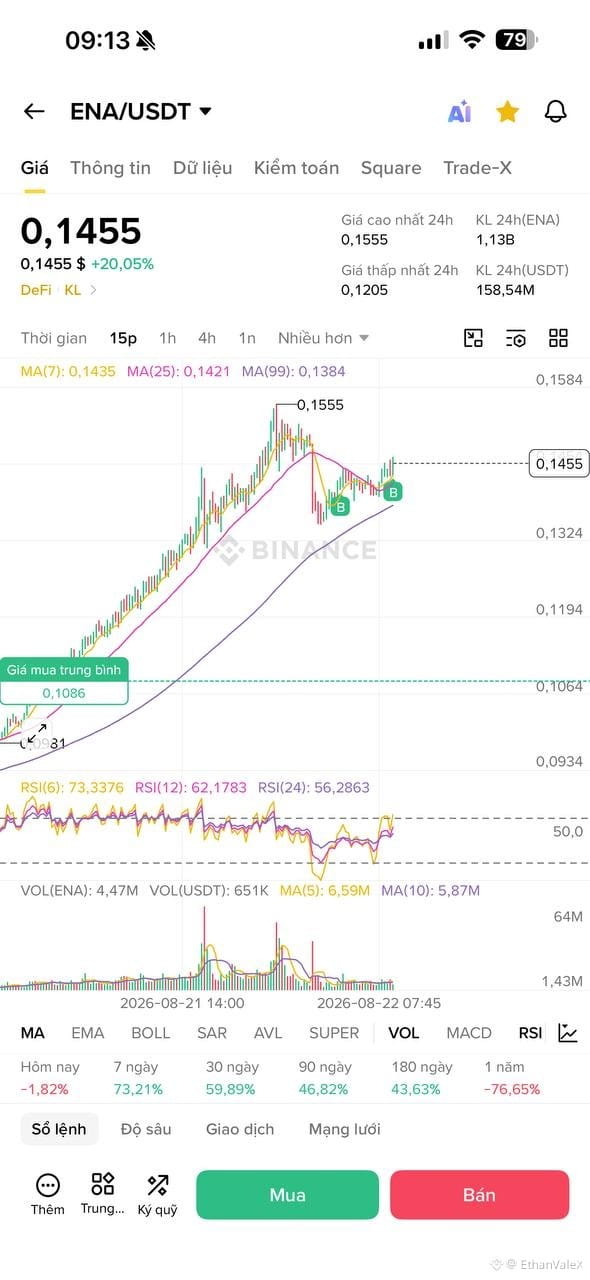
just lightly. alt season is coming soon.
$ENA $HYPE
{future}(HYPEUSDT)
{spot}(ENAUSDT)
$BTC
just lightly. alt season is coming soon.
$ENA $HYPE
just lightly. alt season is coming soon.
$ENA $HYPE
1.7k
·
--
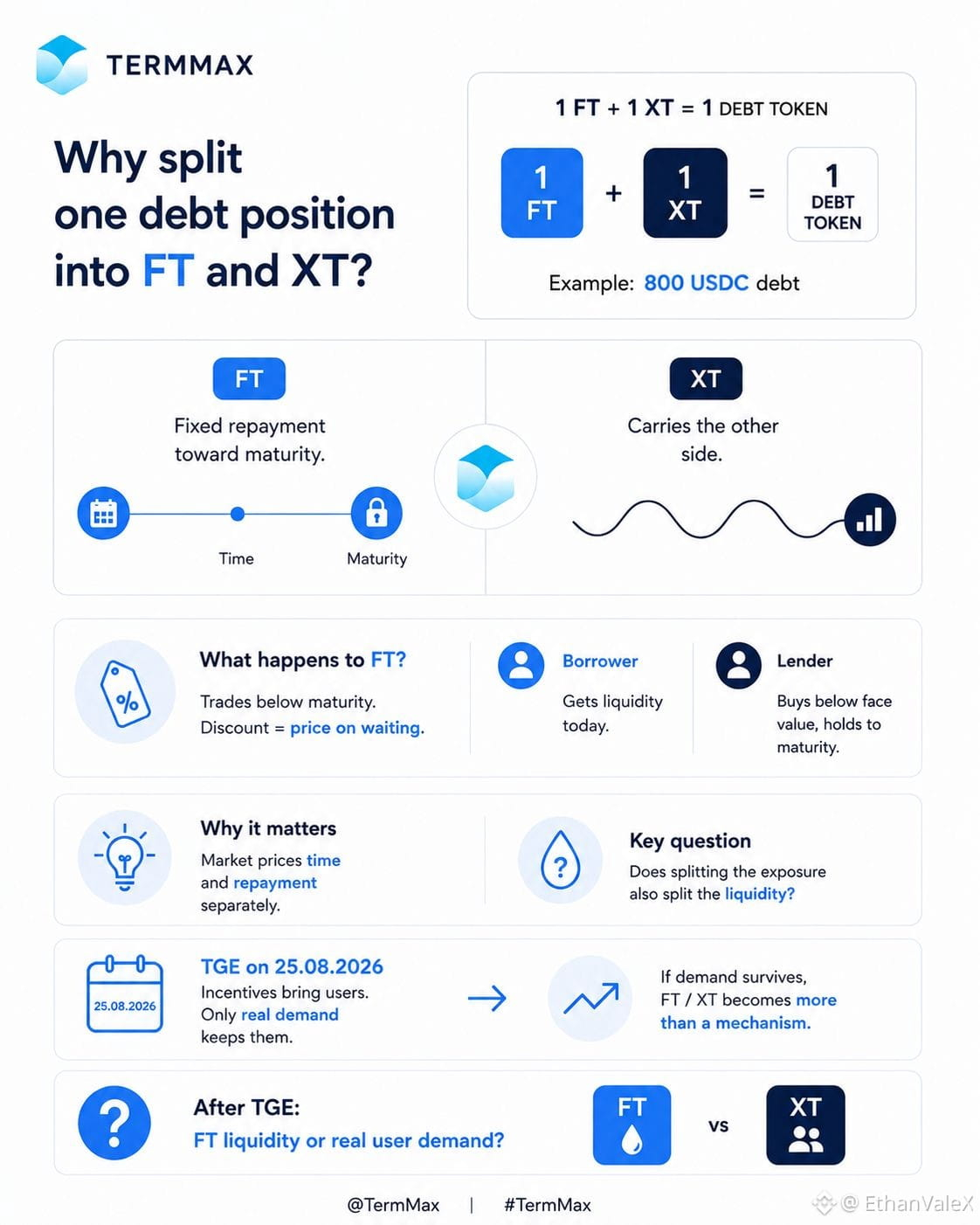
I kept coming back to one question while looking through @termmax : why split one debt position into FT and XT at all?
The relationship is simple: 1 FT + 1 XT = 1 debt token. If a borrower has 800 USDC of debt, FT represents the fixed repayment side toward maturity, while XT carries the other side of the position.
At first, that felt like adding another layer for no obvious reason. But then I looked at what happens to FT.
It can trade below its maturity value, which means the discount is effectively putting a price on waiting. The borrower gets liquidity today by selling that future claim, while the lender can buy it below face value and hold it toward maturity.
That’s the part I find interesting. TermMax isn't just fixing the APR on a loan; it is giving the market a way to treat time and repayment differently, instead of keeping the whole position bundled together.
But there’s another question I can’t ignore.
Does splitting the exposure also split the liquidity?
If the market gets too thin, the separation doesn't mean much in practice.
With TGE on 25.08.2026, the more interesting test begins. Incentives can bring people into a market, but they can't tell us whether users actually want the fixed-rate exposure itself.
If that demand survives when rewards matter less, then the FT / XT structure starts to look like more than a clever mechanism.
That’s the part I’ll be watching after TGE.
What matters more to you after TGE: FT liquidity or real user demand?
@termmax #TermMax
I kept coming back to one question while looking through @TermMax : why split one debt position into FT and XT at all?
The relationship is simple: 1 FT + 1 XT = 1 debt token. If a borrower has 800 USDC of debt, FT represents the fixed repayment side toward maturity, while XT carries the other side of the position.
At first, that felt like adding another layer for no obvious reason. But then I looked at what happens to FT.
It can trade below its maturity value, which means the discount is effectively putting a price on waiting. The borrower gets liquidity today by selling that future claim, while the lender can buy it below face value and hold it toward maturity.
That’s the part I find interesting. TermMax isn't just fixing the APR on a loan; it is giving the market a way to treat time and repayment differently, instead of keeping the whole position bundled together.
But there’s another question I can’t ignore.
Does splitting the exposure also split the liquidity?
If the market gets too thin, the separation doesn't mean much in practice.
With TGE on 25.08.2026, the more interesting test begins. Incentives can bring people into a market, but they can't tell us whether users actually want the fixed-rate exposure itself.
If that demand survives when rewards matter less, then the FT / XT structure starts to look like more than a clever mechanism.
That’s the part I’ll be watching after TGE.
What matters more to you after TGE: FT liquidity or real user demand?
@TermMax #TermMax
The relationship is simple: 1 FT + 1 XT = 1 debt token. If a borrower has 800 USDC of debt, FT represents the fixed repayment side toward maturity, while XT carries the other side of the position.
At first, that felt like adding another layer for no obvious reason. But then I looked at what happens to FT.
It can trade below its maturity value, which means the discount is effectively putting a price on waiting. The borrower gets liquidity today by selling that future claim, while the lender can buy it below face value and hold it toward maturity.
That’s the part I find interesting. TermMax isn't just fixing the APR on a loan; it is giving the market a way to treat time and repayment differently, instead of keeping the whole position bundled together.
But there’s another question I can’t ignore.
Does splitting the exposure also split the liquidity?
If the market gets too thin, the separation doesn't mean much in practice.
With TGE on 25.08.2026, the more interesting test begins. Incentives can bring people into a market, but they can't tell us whether users actually want the fixed-rate exposure itself.
If that demand survives when rewards matter less, then the FT / XT structure starts to look like more than a clever mechanism.
That’s the part I’ll be watching after TGE.
What matters more to you after TGE: FT liquidity or real user demand?
@TermMax #TermMax
350
·
--
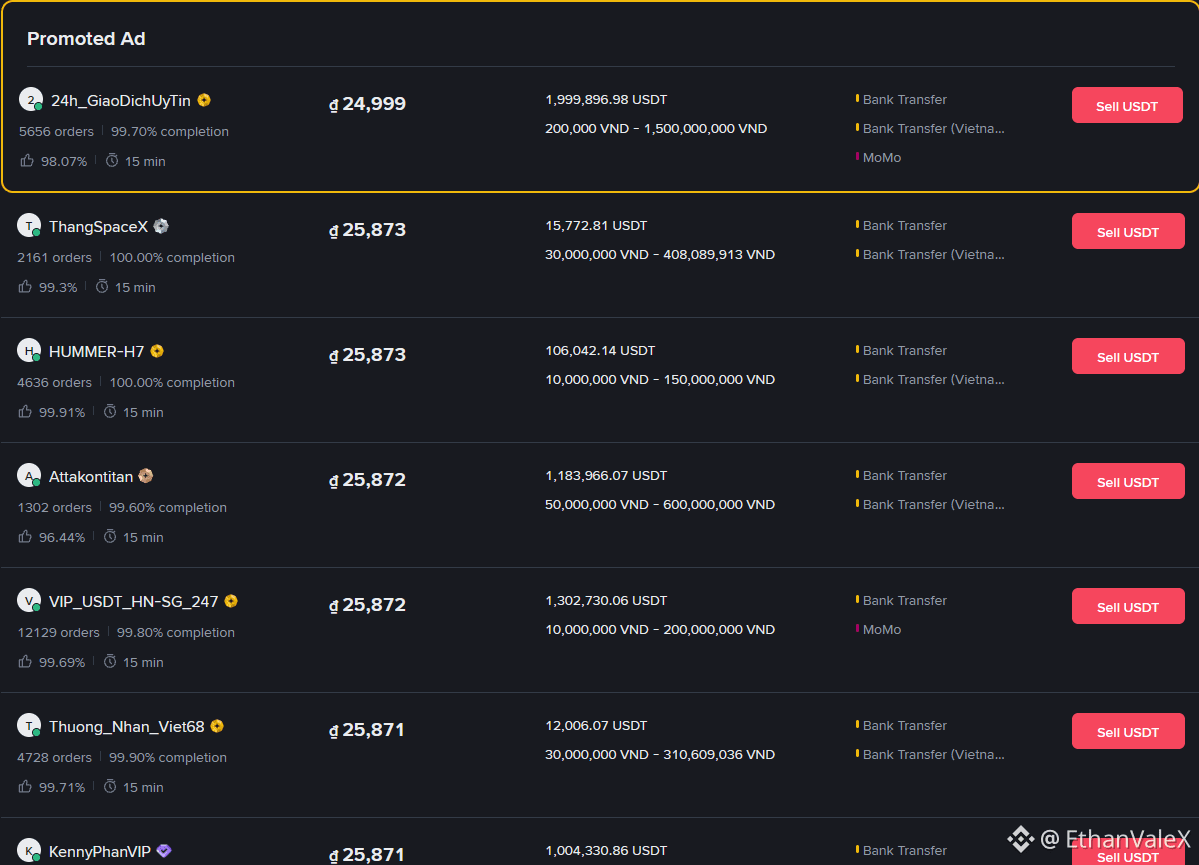
Brothers, buying P2P remember to check the bank details carefully. When transferring money, don’t see pre-filled info and just tap immediately.
Oh, after reading this case, I only realized that when doing P2P transfers, sometimes we see the information already shown and feel reassured, so we just click right away.
One person bought 145 USDT, about 3.65 million VND. During payment, the bank section shows SHBVN.
But when it’s time to make the transfer, the receiving account turns out to be Shinhan Bank.
If you’re in a hurry, you might easily think:
“Different bank only, so it should be fine.”
They also transferred immediately.
Only after transferring did they notice more carefully that the recipient name looked odd.
Checking further, the phone number turned out to be a rather strange Vietnammobile number.
When they went back to ask the seller, the other side also said they didn’t know who that receiving account belonged to.
At one discrepancy, I could still ask. But by the time the bank is different, the name is different, and the phone number is also weird, I’m sure I would stop before proceeding.
When I encounter instructions like this, I usually look back at 3 things:
🟢 Does the recipient’s name match the Order information?
🟢 Are the bank and account number correct?
🟢 Is there any other detail different from the original payment screen?
For me, if something is off, I’ll just ask again. The faster the other side tries to rush you, the more carefully I sit down to double-check.
Luckily, in the end, Binance still supported them to get the money back. This case was really a close call.
@Binance_Vietnam #BinanceP2PAnToan
Brothers, buying P2P remember to check the bank details carefully. When transferring money, don’t see pre-filled info and just tap immediately.
Oh, after reading this case, I only realized that when doing P2P transfers, sometimes we see the information already shown and feel reassured, so we just click right away.
One person bought 145 USDT, about 3.65 million VND. During payment, the bank section shows SHBVN.
But when it’s time to make the transfer, the receiving account turns out to be Shinhan Bank.
If you’re in a hurry, you might easily think:
“Different bank only, so it should be fine.”
They also transferred immediately.
Only after transferring did they notice more carefully that the recipient name looked odd.
Checking further, the phone number turned out to be a rather strange Vietnammobile number.
When they went back to ask the seller, the other side also said they didn’t know who that receiving account belonged to.
At one discrepancy, I could still ask. But by the time the bank is different, the name is different, and the phone number is also weird, I’m sure I would stop before proceeding.
When I encounter instructions like this, I usually look back at 3 things:
🟢 Does the recipient’s name match the Order information?
🟢 Are the bank and account number correct?
🟢 Is there any other detail different from the original payment screen?
For me, if something is off, I’ll just ask again. The faster the other side tries to rush you, the more carefully I sit down to double-check.
Luckily, in the end, Binance still supported them to get the money back. This case was really a close call.
@Binance Vietnam #BinanceP2PAnToan
Oh, after reading this case, I only realized that when doing P2P transfers, sometimes we see the information already shown and feel reassured, so we just click right away.
One person bought 145 USDT, about 3.65 million VND. During payment, the bank section shows SHBVN.
But when it’s time to make the transfer, the receiving account turns out to be Shinhan Bank.
If you’re in a hurry, you might easily think:
“Different bank only, so it should be fine.”
They also transferred immediately.
Only after transferring did they notice more carefully that the recipient name looked odd.
Checking further, the phone number turned out to be a rather strange Vietnammobile number.
When they went back to ask the seller, the other side also said they didn’t know who that receiving account belonged to.
At one discrepancy, I could still ask. But by the time the bank is different, the name is different, and the phone number is also weird, I’m sure I would stop before proceeding.
When I encounter instructions like this, I usually look back at 3 things:
🟢 Does the recipient’s name match the Order information?
🟢 Are the bank and account number correct?
🟢 Is there any other detail different from the original payment screen?
For me, if something is off, I’ll just ask again. The faster the other side tries to rush you, the more carefully I sit down to double-check.
Luckily, in the end, Binance still supported them to get the money back. This case was really a close call.
@Binance Vietnam #BinanceP2PAnToan
11
20.7k
·
--
I keep wondering whether “idle liquidity” is really idle when that capital is still earning somewhere else.
That’s what caught my attention with @termmax Idle Fund Deployment.
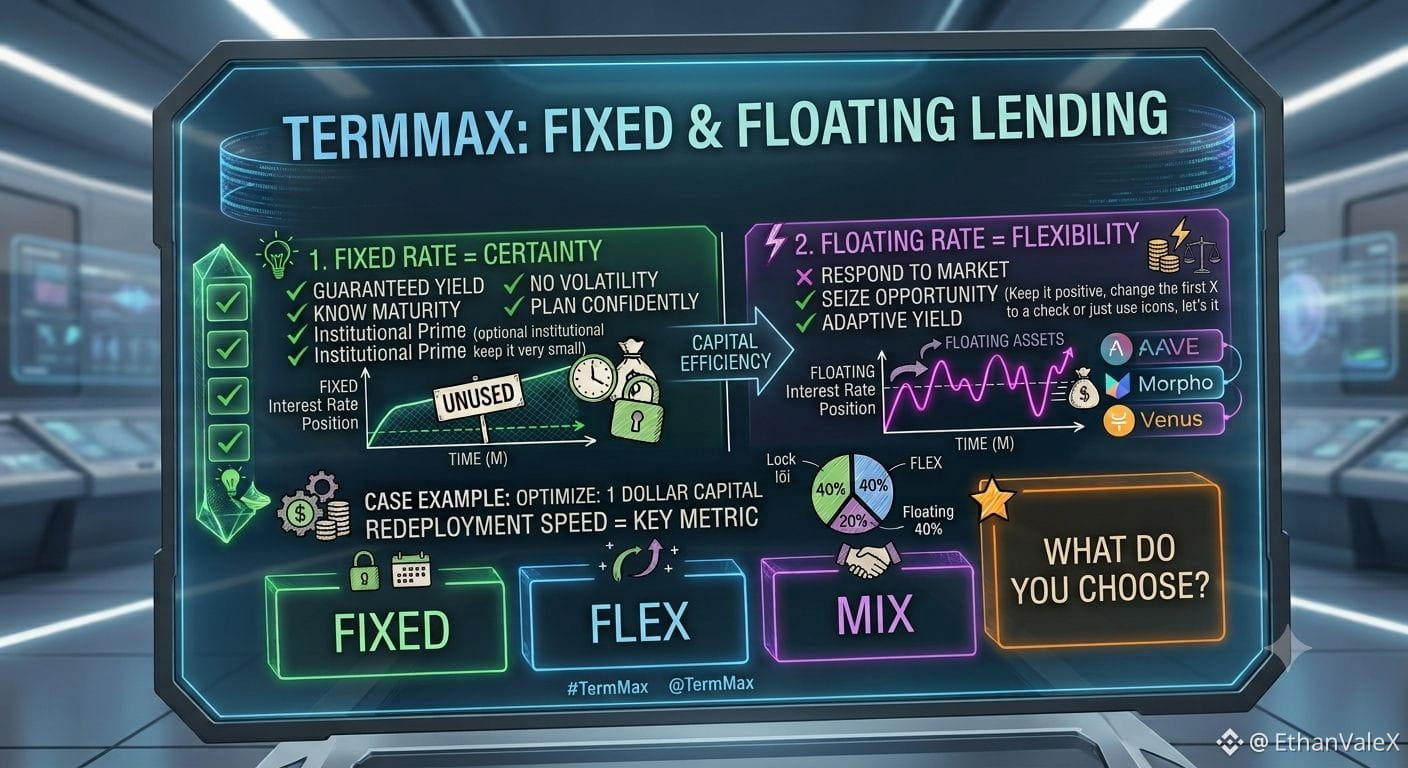
In a typical lending market, capital waits for a borrower. If demand isn't there, that liquidity can sit unused until the next opportunity comes along. The capital is available, but availability doesn't necessarily mean it's productive.
TermMax takes a different approach. Instead of letting unborrowed capital sit there, it can be deployed into floating-rate markets such as Aave, Morpho and Venus while waiting for fixed-rate borrowers.
So the capital gets another job while its first job hasn't arrived yet.
But I don't think earning yield somewhere else automatically proves capital efficiency.
The real test comes when fixed-rate demand arrives faster than that capital can be redeployed. If liquidity takes too long to come back, the market could have plenty of capital on paper while having less immediately usable depth when borrowers actually need it.
Maybe TermMax’s more interesting metric isn’t idle liquidity anymore.
It’s how quickly one dollar of capital can change jobs when fixed-rate demand appears.
That makes me more interested in redeployment speed than simply asking how much liquidity is sitting in the protocol.
Would you watch redeployment speed or credit activity per dollar of liquidity to measure that efficiency?
#TermMax @termmax
I keep wondering whether “idle liquidity” is really idle when that capital is still earning somewhere else.
That’s what caught my attention with @TermMax Idle Fund Deployment.
In a typical lending market, capital waits for a borrower. If demand isn't there, that liquidity can sit unused until the next opportunity comes along. The capital is available, but availability doesn't necessarily mean it's productive.
TermMax takes a different approach. Instead of letting unborrowed capital sit there, it can be deployed into floating-rate markets such as Aave, Morpho and Venus while waiting for fixed-rate borrowers.
So the capital gets another job while its first job hasn't arrived yet.
But I don't think earning yield somewhere else automatically proves capital efficiency.
The real test comes when fixed-rate demand arrives faster than that capital can be redeployed. If liquidity takes too long to come back, the market could have plenty of capital on paper while having less immediately usable depth when borrowers actually need it.
Maybe TermMax’s more interesting metric isn’t idle liquidity anymore.
It’s how quickly one dollar of capital can change jobs when fixed-rate demand appears.
That makes me more interested in redeployment speed than simply asking how much liquidity is sitting in the protocol.
Would you watch redeployment speed or credit activity per dollar of liquidity to measure that efficiency?
#TermMax @TermMax
That’s what caught my attention with @TermMax Idle Fund Deployment.
In a typical lending market, capital waits for a borrower. If demand isn't there, that liquidity can sit unused until the next opportunity comes along. The capital is available, but availability doesn't necessarily mean it's productive.
TermMax takes a different approach. Instead of letting unborrowed capital sit there, it can be deployed into floating-rate markets such as Aave, Morpho and Venus while waiting for fixed-rate borrowers.
So the capital gets another job while its first job hasn't arrived yet.
But I don't think earning yield somewhere else automatically proves capital efficiency.
The real test comes when fixed-rate demand arrives faster than that capital can be redeployed. If liquidity takes too long to come back, the market could have plenty of capital on paper while having less immediately usable depth when borrowers actually need it.
Maybe TermMax’s more interesting metric isn’t idle liquidity anymore.
It’s how quickly one dollar of capital can change jobs when fixed-rate demand appears.
That makes me more interested in redeployment speed than simply asking how much liquidity is sitting in the protocol.
Would you watch redeployment speed or credit activity per dollar of liquidity to measure that efficiency?
#TermMax @TermMax
1
506
·
--
Brother, sell P2P—if the money just came in but the sender’s name doesn’t match the buyer name on the Order, don’t Release yet, please 😭
I’ve noticed many of our guys often skip this.
The money comes in the right amount, and the bank notification also shows one thing—at a glance, nothing seems wrong. But take a closer look and you’ll see the sender’s name on the transferred funds isn’t the same as the person listed on the Order.
Before, I used to think it was simple too:
“Maybe a family member transferred it.”
Yeah, it could be.
But once the names don’t match, I’ll check a bit more to be sure. USDT is still there—nothing disappears—so there’s no need to rush.
I usually check quickly:
🟢 Does the sender’s name match the buyer information on the Order?
🟢 Is the amount exactly correct?
🟢 In the chat, does anyone mention changing accounts, asking someone else to transfer, or urging a Release?
Also, watch out for commands or orders where the price is way off from the general market. If they’re selling and the other side keeps pushing you to process fast, I’m even more reluctant to rush.
Especially if the real funds come from an account different from the buyer on the Order, I won’t Release just because I see the money has arrived. Keep the USDT, verify clearly, then proceed with the next steps according to the exchange’s rules.
P2P doesn’t run into scary stuff often. Sometimes it’s just a name on the notification that you might be too lazy to read closely.
@Binance_Vietnam #BinanceP2PAnToan
Brother, sell P2P—if the money just came in but the sender’s name doesn’t match the buyer name on the Order, don’t Release yet, please 😭
I’ve noticed many of our guys often skip this.
The money comes in the right amount, and the bank notification also shows one thing—at a glance, nothing seems wrong. But take a closer look and you’ll see the sender’s name on the transferred funds isn’t the same as the person listed on the Order.
Before, I used to think it was simple too:
“Maybe a family member transferred it.”
Yeah, it could be.
But once the names don’t match, I’ll check a bit more to be sure. USDT is still there—nothing disappears—so there’s no need to rush.
I usually check quickly:
🟢 Does the sender’s name match the buyer information on the Order?
🟢 Is the amount exactly correct?
🟢 In the chat, does anyone mention changing accounts, asking someone else to transfer, or urging a Release?
Also, watch out for commands or orders where the price is way off from the general market. If they’re selling and the other side keeps pushing you to process fast, I’m even more reluctant to rush.
Especially if the real funds come from an account different from the buyer on the Order, I won’t Release just because I see the money has arrived. Keep the USDT, verify clearly, then proceed with the next steps according to the exchange’s rules.
P2P doesn’t run into scary stuff often. Sometimes it’s just a name on the notification that you might be too lazy to read closely.
@Binance Vietnam #BinanceP2PAnToan
I’ve noticed many of our guys often skip this.
The money comes in the right amount, and the bank notification also shows one thing—at a glance, nothing seems wrong. But take a closer look and you’ll see the sender’s name on the transferred funds isn’t the same as the person listed on the Order.
Before, I used to think it was simple too:
“Maybe a family member transferred it.”
Yeah, it could be.
But once the names don’t match, I’ll check a bit more to be sure. USDT is still there—nothing disappears—so there’s no need to rush.
I usually check quickly:
🟢 Does the sender’s name match the buyer information on the Order?
🟢 Is the amount exactly correct?
🟢 In the chat, does anyone mention changing accounts, asking someone else to transfer, or urging a Release?
Also, watch out for commands or orders where the price is way off from the general market. If they’re selling and the other side keeps pushing you to process fast, I’m even more reluctant to rush.
Especially if the real funds come from an account different from the buyer on the Order, I won’t Release just because I see the money has arrived. Keep the USDT, verify clearly, then proceed with the next steps according to the exchange’s rules.
P2P doesn’t run into scary stuff often. Sometimes it’s just a name on the notification that you might be too lazy to read closely.
@Binance Vietnam #BinanceP2PAnToan
8.3k
·
--
#TermMax @termmax
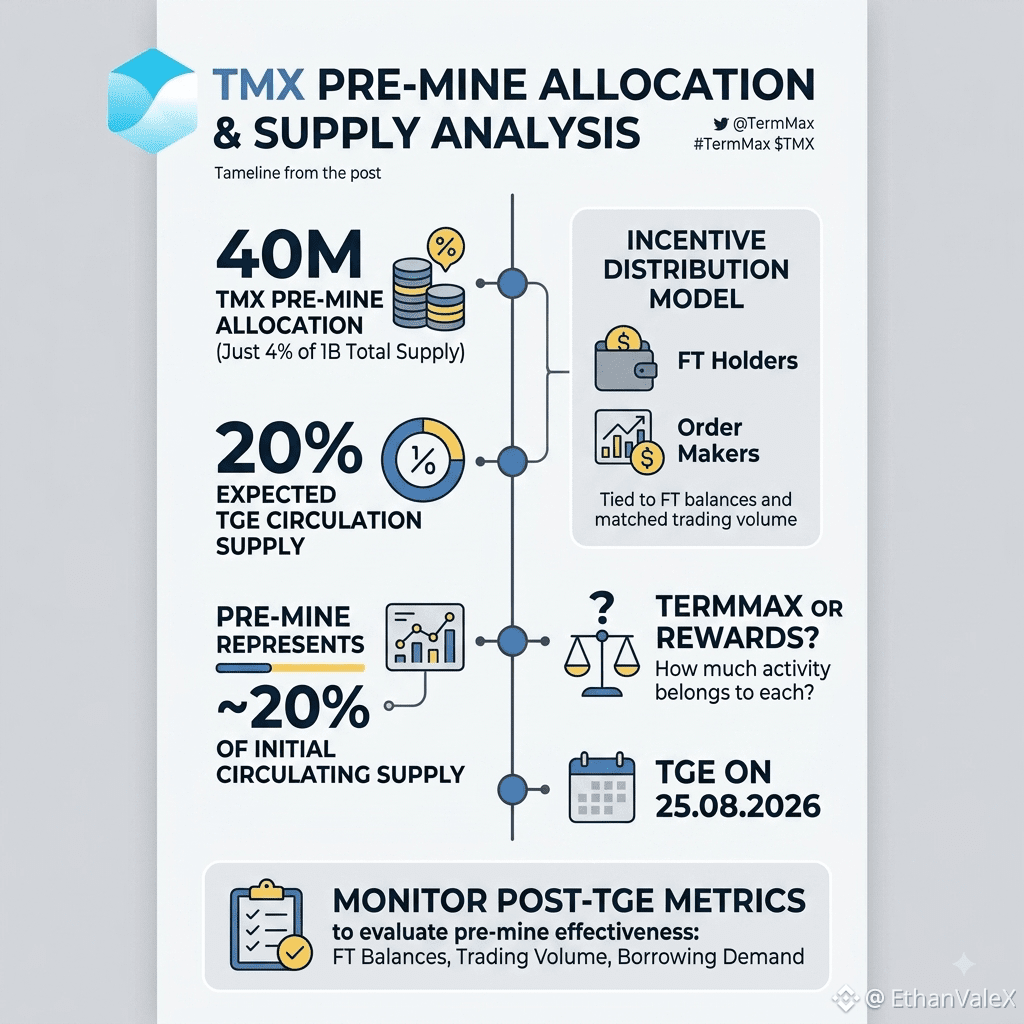
I was checking @termmax pre-mine numbers today and one figure made me stop.
40M TMX is allocated to the pre-mine, just 4% of the 1B total supply.
That sounds small until I put it next to another number: only 20% of TMX is expected to be in circulation at TGE. So the pre-mine alone represents roughly 20% of the initial circulating supply.
That's when I started looking at the incentive differently.
The rewards go to FT holders and Order Makers, tied to FT balances and matched trading volume rather than simply handing tokens to every wallet that shows up.
But here's the part I can't answer yet.
How much of that activity actually belongs to TermMax, and how much belongs to the rewards?
TGE on 25.08.2026 gives us a much better point to find out.
I don't really care how many TMX were earned before then. I want to see whether FT balances, trading volume and Borrowing Demand still have something behind them when TMX rewards aren't the obvious reason to participate.
If the activity holds, the pre-mine looks like it helped build a market.
If it fades quickly, I'd see the 40M TMX differently.
The headline is 40M TMX.
For me, the more important number comes after TGE.
Which metric would you watch first: FT balances, trading volume or Borrowing Demand?
#TermMax @TermMax
I was checking @TermMax pre-mine numbers today and one figure made me stop.
40M TMX is allocated to the pre-mine, just 4% of the 1B total supply.
That sounds small until I put it next to another number: only 20% of TMX is expected to be in circulation at TGE. So the pre-mine alone represents roughly 20% of the initial circulating supply.
That's when I started looking at the incentive differently.
The rewards go to FT holders and Order Makers, tied to FT balances and matched trading volume rather than simply handing tokens to every wallet that shows up.
But here's the part I can't answer yet.
How much of that activity actually belongs to TermMax, and how much belongs to the rewards?
TGE on 25.08.2026 gives us a much better point to find out.
I don't really care how many TMX were earned before then. I want to see whether FT balances, trading volume and Borrowing Demand still have something behind them when TMX rewards aren't the obvious reason to participate.
If the activity holds, the pre-mine looks like it helped build a market.
If it fades quickly, I'd see the 40M TMX differently.
The headline is 40M TMX.
For me, the more important number comes after TGE.
Which metric would you watch first: FT balances, trading volume or Borrowing Demand?
I was checking @TermMax pre-mine numbers today and one figure made me stop.
40M TMX is allocated to the pre-mine, just 4% of the 1B total supply.
That sounds small until I put it next to another number: only 20% of TMX is expected to be in circulation at TGE. So the pre-mine alone represents roughly 20% of the initial circulating supply.
That's when I started looking at the incentive differently.
The rewards go to FT holders and Order Makers, tied to FT balances and matched trading volume rather than simply handing tokens to every wallet that shows up.
But here's the part I can't answer yet.
How much of that activity actually belongs to TermMax, and how much belongs to the rewards?
TGE on 25.08.2026 gives us a much better point to find out.
I don't really care how many TMX were earned before then. I want to see whether FT balances, trading volume and Borrowing Demand still have something behind them when TMX rewards aren't the obvious reason to participate.
If the activity holds, the pre-mine looks like it helped build a market.
If it fades quickly, I'd see the 40M TMX differently.
The headline is 40M TMX.
For me, the more important number comes after TGE.
Which metric would you watch first: FT balances, trading volume or Borrowing Demand?
183
·
--
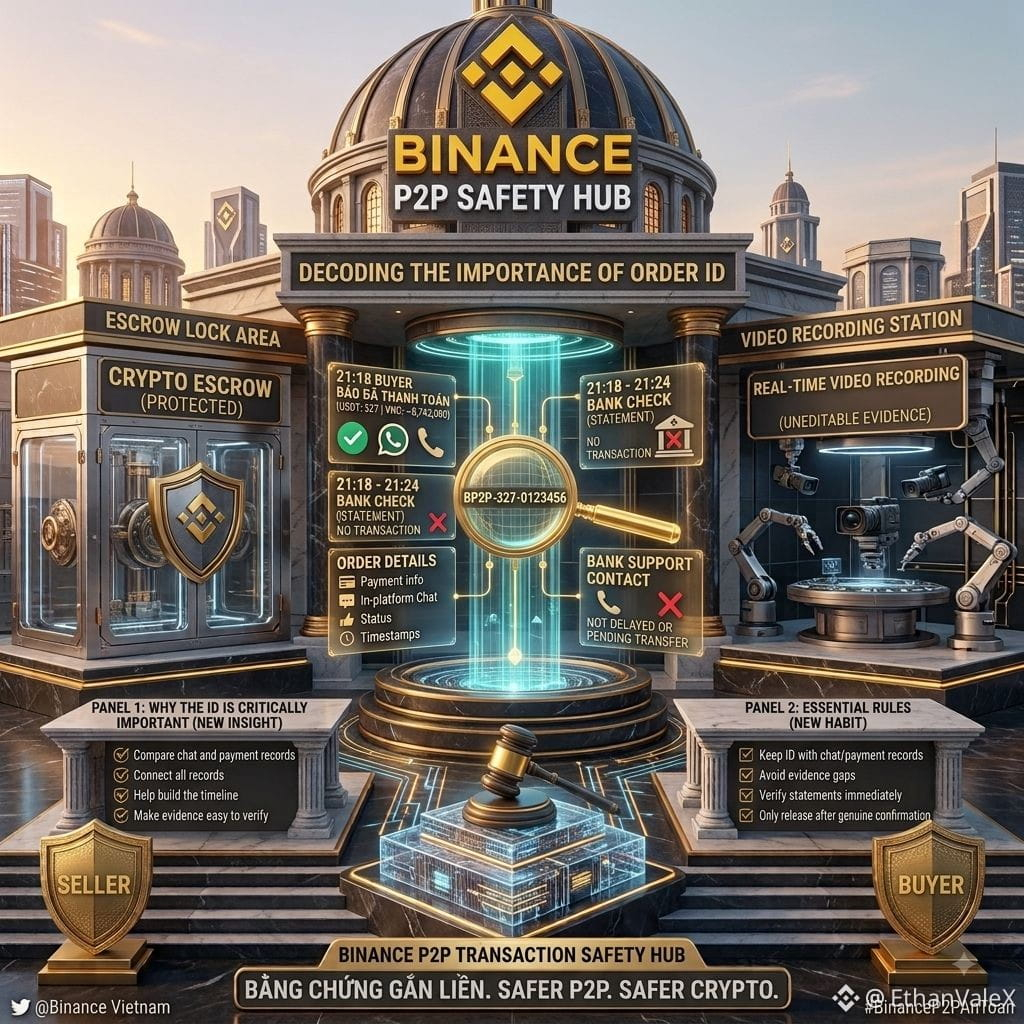
The Order ID Became More Important Than I Expected
I learned this after a Binance P2P order involving 327 USDT, worth around 8,742,000 VND. The buyer marked the payment as completed at 21:18, but I checked my bank balance and transaction history several times and found nothing. At 21:24, the order was still active.
I opened the Order details and started checking everything against the Order ID. The payment information, in-platform chat, order status and timestamps all pointed to the same transaction.
The buyer had claimed the payment was completed at 21:18. My bank records showed no corresponding incoming transaction. I contacted my bank to check whether it was delayed or sitting as a pending transfer.
It wasn't.
That was when the timeline became more important than the explanation. The Order ID gave me one reference point for the buyer's claim, the chat, the payment details and what my bank actually showed.
When the order was reviewed, I could provide those records as one connected case instead of sending separate screenshots and trying to explain what each one meant.
What surprised me was that the Order ID itself didn't prove anything. Its value was that it made the other evidence easier to verify against the same transaction.
Since then, I keep the Order ID, in-platform chat and relevant payment records together. Escrow protects the crypto while the order is active, but good records make the transaction much easier to reconstruct when something goes wrong.
I used to think good evidence meant having more screenshots. Now I think it means leaving fewer gaps between them.
@Binance_Vietnam #BinanceP2PAnToan
The Order ID Became More Important Than I Expected
I learned this after a Binance P2P order involving 327 USDT, worth around 8,742,000 VND. The buyer marked the payment as completed at 21:18, but I checked my bank balance and transaction history several times and found nothing. At 21:24, the order was still active.
I opened the Order details and started checking everything against the Order ID. The payment information, in-platform chat, order status and timestamps all pointed to the same transaction.
The buyer had claimed the payment was completed at 21:18. My bank records showed no corresponding incoming transaction. I contacted my bank to check whether it was delayed or sitting as a pending transfer.
It wasn't.
That was when the timeline became more important than the explanation. The Order ID gave me one reference point for the buyer's claim, the chat, the payment details and what my bank actually showed.
When the order was reviewed, I could provide those records as one connected case instead of sending separate screenshots and trying to explain what each one meant.
What surprised me was that the Order ID itself didn't prove anything. Its value was that it made the other evidence easier to verify against the same transaction.
Since then, I keep the Order ID, in-platform chat and relevant payment records together. Escrow protects the crypto while the order is active, but good records make the transaction much easier to reconstruct when something goes wrong.
I used to think good evidence meant having more screenshots. Now I think it means leaving fewer gaps between them.
@Binance Vietnam #BinanceP2PAnToan
I learned this after a Binance P2P order involving 327 USDT, worth around 8,742,000 VND. The buyer marked the payment as completed at 21:18, but I checked my bank balance and transaction history several times and found nothing. At 21:24, the order was still active.
I opened the Order details and started checking everything against the Order ID. The payment information, in-platform chat, order status and timestamps all pointed to the same transaction.
The buyer had claimed the payment was completed at 21:18. My bank records showed no corresponding incoming transaction. I contacted my bank to check whether it was delayed or sitting as a pending transfer.
It wasn't.
That was when the timeline became more important than the explanation. The Order ID gave me one reference point for the buyer's claim, the chat, the payment details and what my bank actually showed.
When the order was reviewed, I could provide those records as one connected case instead of sending separate screenshots and trying to explain what each one meant.
What surprised me was that the Order ID itself didn't prove anything. Its value was that it made the other evidence easier to verify against the same transaction.
Since then, I keep the Order ID, in-platform chat and relevant payment records together. Escrow protects the crypto while the order is active, but good records make the transaction much easier to reconstruct when something goes wrong.
I used to think good evidence meant having more screenshots. Now I think it means leaving fewer gaps between them.
@Binance Vietnam #BinanceP2PAnToan
1
103
·
--
#TermMax @termmax
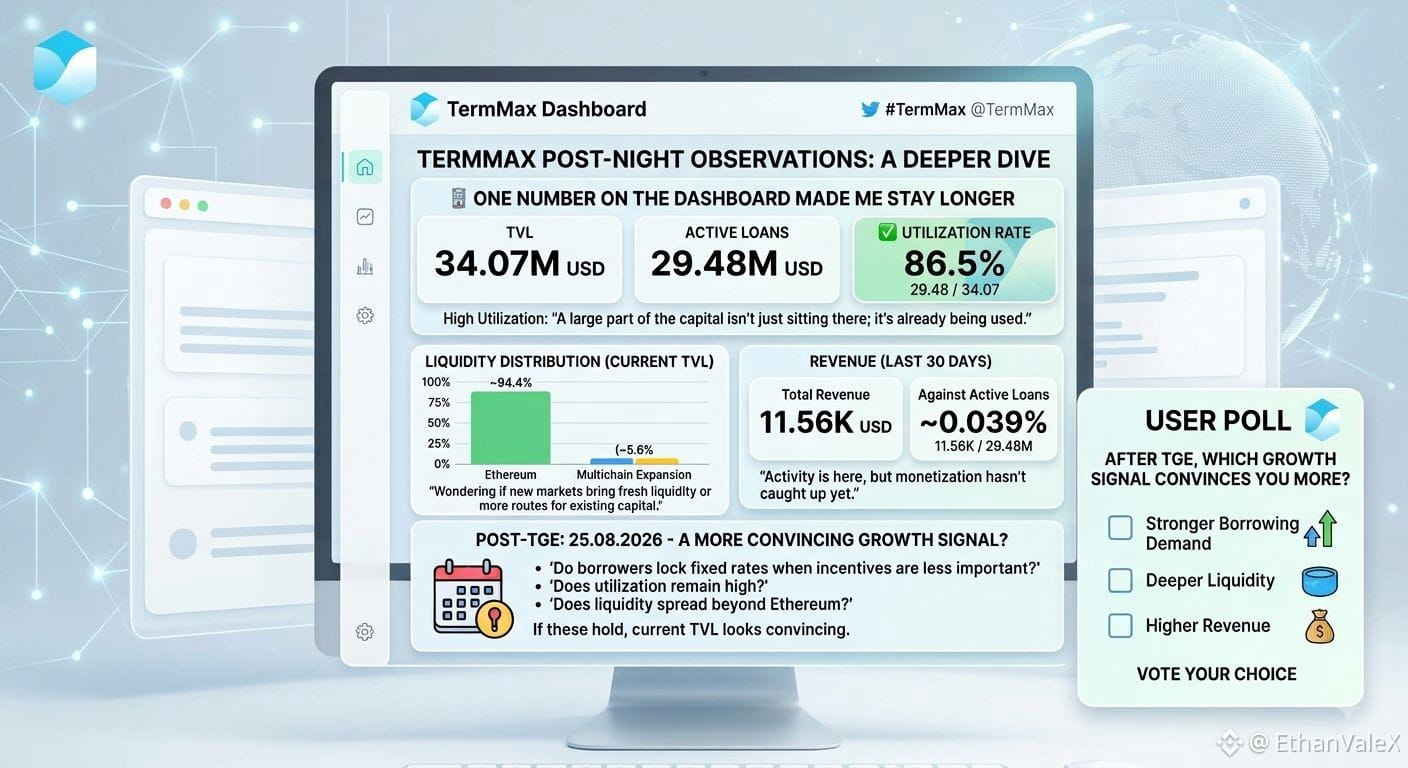
I was supposed to be done with @termmax for the night, but one number on the dashboard made me stay a little longer.
34.07M USD TVL. 29.48M USD Active Loans.
29.48 / 34.07 = around 86.5%.
For a fixed-rate lending market, that's the first number that caught my attention. A large part of the capital isn't just sitting there; it's already being used.
Then I checked where that capital is actually sitting.
Around 94.4% of TVL is still on Ethereum. TermMax has expanded across multiple chains, but the current distribution makes me wonder whether those new markets are bringing in fresh liquidity or simply giving existing capital more routes.
Revenue gives me another reason to stay cautious.
TermMax generated around 11.56K USD in the last 30 days. Against 29.48M USD of Active Loans, that's roughly 0.039%.
So there is activity, but monetization hasn't caught up yet.
That's why I'm more interested in what happens around TGE on 25.08.2026 than another TVL update.
If incentives become less important, I want to see whether borrowers still have a reason to lock in fixed rates, whether loan utilization remains high, and whether liquidity starts spreading beyond Ethereum.
If those numbers hold, the current TVL starts looking much more convincing to me.
After TGE, which would convince you more that TermMax is growing for real: stronger Borrowing Demand, deeper Liquidity, or higher Revenue?
#TermMax @TermMax
I was supposed to be done with @TermMax for the night, but one number on the dashboard made me stay a little longer.
34.07M USD TVL. 29.48M USD Active Loans.
29.48 / 34.07 = around 86.5%.
For a fixed-rate lending market, that's the first number that caught my attention. A large part of the capital isn't just sitting there; it's already being used.
Then I checked where that capital is actually sitting.
Around 94.4% of TVL is still on Ethereum. TermMax has expanded across multiple chains, but the current distribution makes me wonder whether those new markets are bringing in fresh liquidity or simply giving existing capital more routes.
Revenue gives me another reason to stay cautious.
TermMax generated around 11.56K USD in the last 30 days. Against 29.48M USD of Active Loans, that's roughly 0.039%.
So there is activity, but monetization hasn't caught up yet.
That's why I'm more interested in what happens around TGE on 25.08.2026 than another TVL update.
If incentives become less important, I want to see whether borrowers still have a reason to lock in fixed rates, whether loan utilization remains high, and whether liquidity starts spreading beyond Ethereum.
If those numbers hold, the current TVL starts looking much more convincing to me.
After TGE, which would convince you more that TermMax is growing for real: stronger Borrowing Demand, deeper Liquidity, or higher Revenue?
I was supposed to be done with @TermMax for the night, but one number on the dashboard made me stay a little longer.
34.07M USD TVL. 29.48M USD Active Loans.
29.48 / 34.07 = around 86.5%.
For a fixed-rate lending market, that's the first number that caught my attention. A large part of the capital isn't just sitting there; it's already being used.
Then I checked where that capital is actually sitting.
Around 94.4% of TVL is still on Ethereum. TermMax has expanded across multiple chains, but the current distribution makes me wonder whether those new markets are bringing in fresh liquidity or simply giving existing capital more routes.
Revenue gives me another reason to stay cautious.
TermMax generated around 11.56K USD in the last 30 days. Against 29.48M USD of Active Loans, that's roughly 0.039%.
So there is activity, but monetization hasn't caught up yet.
That's why I'm more interested in what happens around TGE on 25.08.2026 than another TVL update.
If incentives become less important, I want to see whether borrowers still have a reason to lock in fixed rates, whether loan utilization remains high, and whether liquidity starts spreading beyond Ethereum.
If those numbers hold, the current TVL starts looking much more convincing to me.
After TGE, which would convince you more that TermMax is growing for real: stronger Borrowing Demand, deeper Liquidity, or higher Revenue?
119
·
--
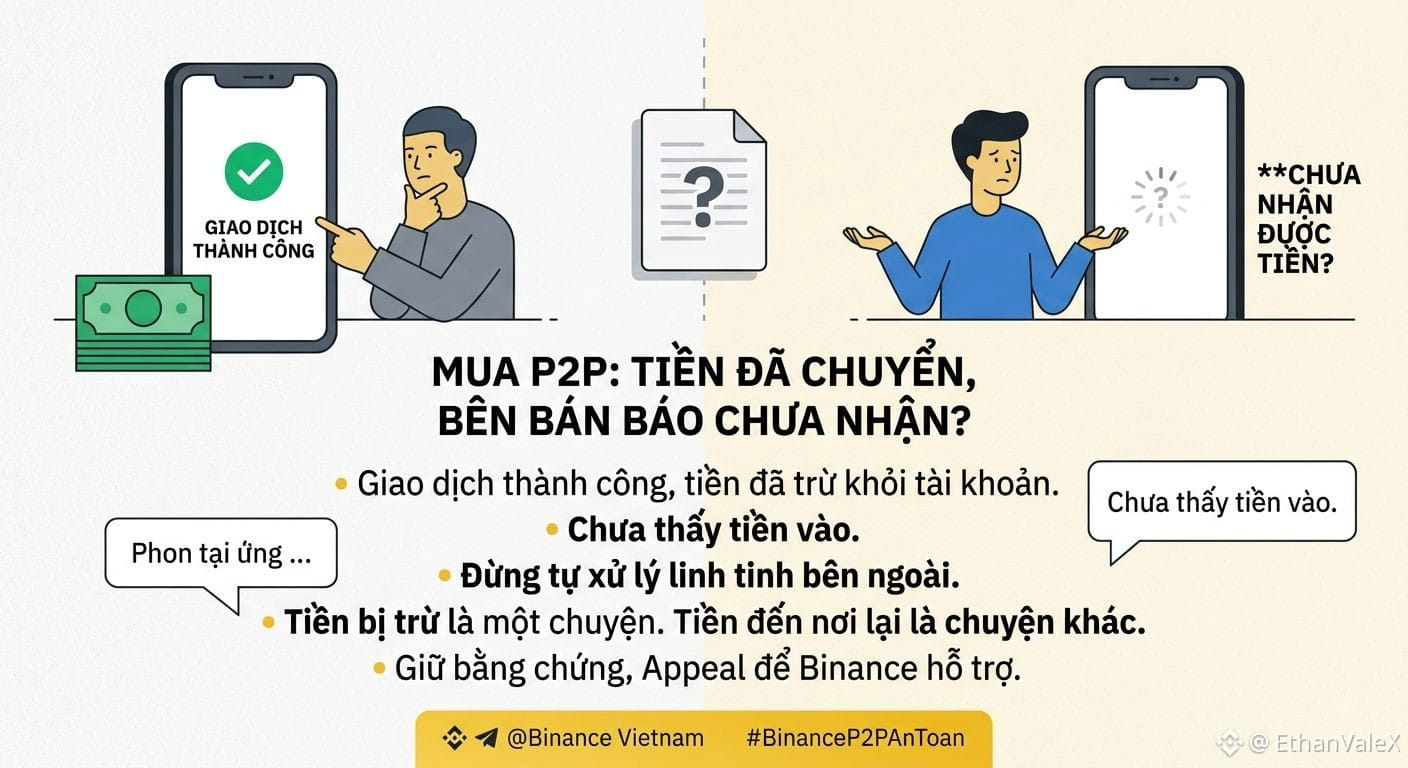
Buy P2P: I’ve transferred the money, but the seller says they haven’t received it?
I got a bit nervous at first too, bro :))
I had a P2P buy order. The seller sent their account details, and I transferred exactly the amount according to the Order.
The banking app showed the transaction as successful, and the money was also deducted from my account. I even have the bank transfer receipt.
But the seller keeps messaging that they haven’t seen the money come in.
That’s when things started to get tricky =))) One side says the bank transfer succeeded, and the other says they haven’t received it. If I transfer again, I definitely won’t dare—but if I just wait, I don’t know how long it’ll take.
I asked the seller again whether the account information is correct, then double-checked the amount and the transaction time. Luckily, I kept the original Order and the chat logs, so at least there’s something to cross-check.
At that point, I also thought: let’s not handle things randomly outside. If both sides still haven’t confirmed the transaction, just keep it in the Order. If needed, open an Appeal so Binance can help check.
Because there’s one memorable thing I realized:
Money being deducted from my account is one thing. The money actually reaching the seller’s correct account is another.
So in cases like this, I won’t transfer more money just because the other party says they haven’t received it, and I won’t Release on my own just to end it quickly. Keep the evidence and handle it through the Order—feels much safer.
Have any of you experienced a situation where the bank says the transfer was successful, but the recipient says they’ve never received the money? If you have, do you usually wait longer or go straight to Appeal?
@Binance_Vietnam #BinanceP2PAnToan
Buy P2P: I’ve transferred the money, but the seller says they haven’t received it?
I got a bit nervous at first too, bro :))
I had a P2P buy order. The seller sent their account details, and I transferred exactly the amount according to the Order.
The banking app showed the transaction as successful, and the money was also deducted from my account. I even have the bank transfer receipt.
But the seller keeps messaging that they haven’t seen the money come in.
That’s when things started to get tricky =))) One side says the bank transfer succeeded, and the other says they haven’t received it. If I transfer again, I definitely won’t dare—but if I just wait, I don’t know how long it’ll take.
I asked the seller again whether the account information is correct, then double-checked the amount and the transaction time. Luckily, I kept the original Order and the chat logs, so at least there’s something to cross-check.
At that point, I also thought: let’s not handle things randomly outside. If both sides still haven’t confirmed the transaction, just keep it in the Order. If needed, open an Appeal so Binance can help check.
Because there’s one memorable thing I realized:
Money being deducted from my account is one thing. The money actually reaching the seller’s correct account is another.
So in cases like this, I won’t transfer more money just because the other party says they haven’t received it, and I won’t Release on my own just to end it quickly. Keep the evidence and handle it through the Order—feels much safer.
Have any of you experienced a situation where the bank says the transfer was successful, but the recipient says they’ve never received the money? If you have, do you usually wait longer or go straight to Appeal?
@Binance Vietnam #BinanceP2PAnToan
I got a bit nervous at first too, bro :))
I had a P2P buy order. The seller sent their account details, and I transferred exactly the amount according to the Order.
The banking app showed the transaction as successful, and the money was also deducted from my account. I even have the bank transfer receipt.
But the seller keeps messaging that they haven’t seen the money come in.
That’s when things started to get tricky =))) One side says the bank transfer succeeded, and the other says they haven’t received it. If I transfer again, I definitely won’t dare—but if I just wait, I don’t know how long it’ll take.
I asked the seller again whether the account information is correct, then double-checked the amount and the transaction time. Luckily, I kept the original Order and the chat logs, so at least there’s something to cross-check.
At that point, I also thought: let’s not handle things randomly outside. If both sides still haven’t confirmed the transaction, just keep it in the Order. If needed, open an Appeal so Binance can help check.
Because there’s one memorable thing I realized:
Money being deducted from my account is one thing. The money actually reaching the seller’s correct account is another.
So in cases like this, I won’t transfer more money just because the other party says they haven’t received it, and I won’t Release on my own just to end it quickly. Keep the evidence and handle it through the Order—feels much safer.
Have any of you experienced a situation where the bank says the transfer was successful, but the recipient says they’ve never received the money? If you have, do you usually wait longer or go straight to Appeal?
@Binance Vietnam #BinanceP2PAnToan
1.1k
·
--
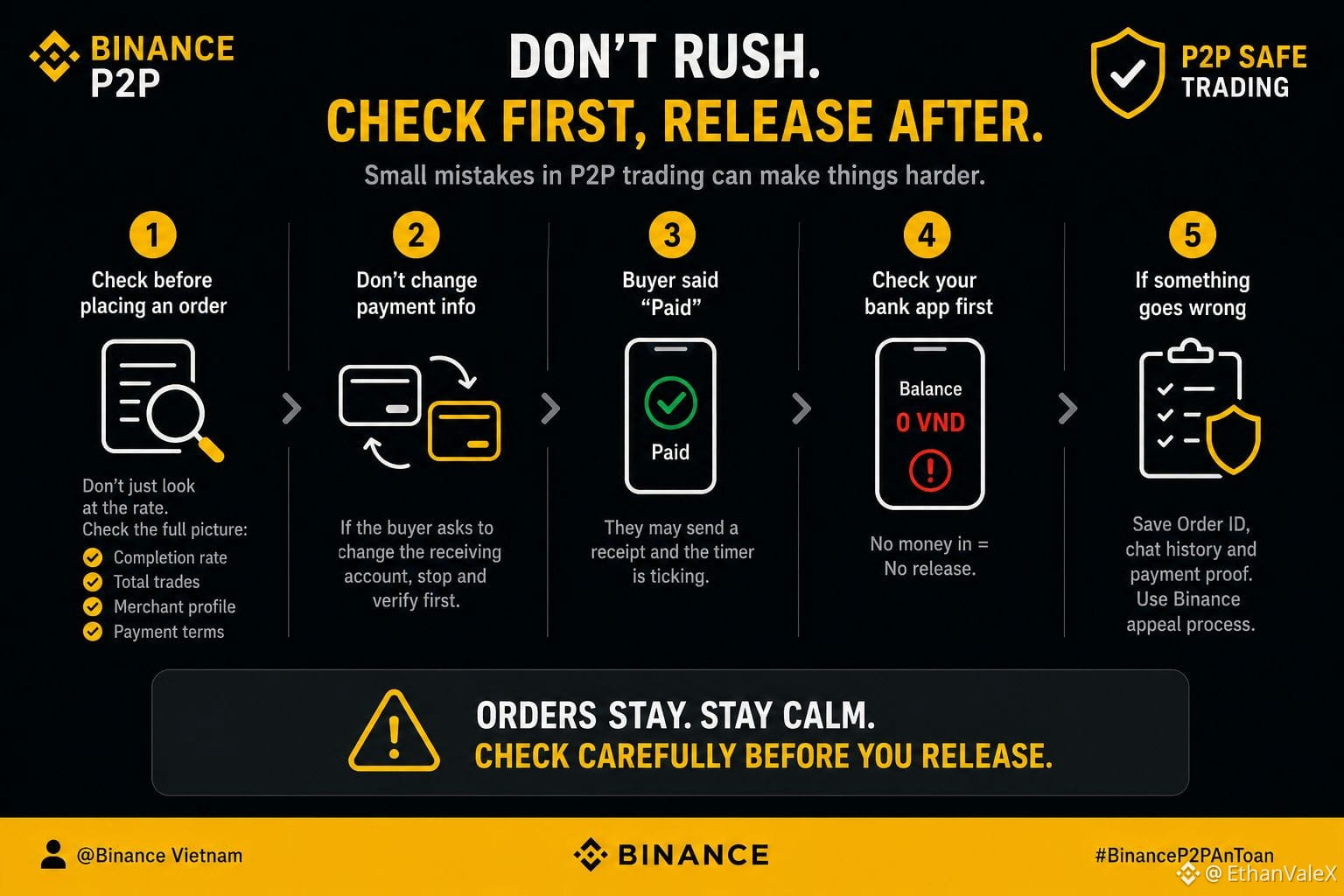
There are P2P Orders that look pretty normal from start to finish, but just one bit of rushing at a certain point—and then you end up making things difficult for yourself, guys!
For example, I come across an ad with a pretty good rate. If you only look at the number and place the order, it’s easy to miss the completion rate, the transaction volume, the Merchant’s profile, or the payment conditions. This is the moment I usually check everything carefully before clicking.
After you open the Order, everything stays fine until the counterparty wants to change the account that receives the money midway. In that case, I don’t push to complete the trade just to hurry. Since the payment info is different from the Order, it must be verified again first.
Then the other side says, “Paid.”
There’s a receipt photo, an Order status, even a countdown timer. But I still open my banking app to check the actual received funds. If the money hasn’t come into the account yet, I won’t release.
This is also when people are most vulnerable to psychology and anxiety. The longer the clock keeps running, the more the counterparty urges, the less I want to click based on impulse. Delaying a little to verify is better than releasing just because you’re afraid the Order will time out.
If something goes wrong with the transaction, I keep the Order ID, the chat history, and the receipt for Appeal or to ask Binance Support for help. Binance P2P has Escrow, chat, and a dispute process—but I still need to trade on the platform and follow the protective steps correctly.
In general, as long as the Order is still there, take your time to check. Don’t panic and smash the button just because you see the clock running, guys 😂
@Binance_Vietnam #BinanceP2PAnToan
There are P2P Orders that look pretty normal from start to finish, but just one bit of rushing at a certain point—and then you end up making things difficult for yourself, guys!
For example, I come across an ad with a pretty good rate. If you only look at the number and place the order, it’s easy to miss the completion rate, the transaction volume, the Merchant’s profile, or the payment conditions. This is the moment I usually check everything carefully before clicking.
After you open the Order, everything stays fine until the counterparty wants to change the account that receives the money midway. In that case, I don’t push to complete the trade just to hurry. Since the payment info is different from the Order, it must be verified again first.
Then the other side says, “Paid.”
There’s a receipt photo, an Order status, even a countdown timer. But I still open my banking app to check the actual received funds. If the money hasn’t come into the account yet, I won’t release.
This is also when people are most vulnerable to psychology and anxiety. The longer the clock keeps running, the more the counterparty urges, the less I want to click based on impulse. Delaying a little to verify is better than releasing just because you’re afraid the Order will time out.
If something goes wrong with the transaction, I keep the Order ID, the chat history, and the receipt for Appeal or to ask Binance Support for help. Binance P2P has Escrow, chat, and a dispute process—but I still need to trade on the platform and follow the protective steps correctly.
In general, as long as the Order is still there, take your time to check. Don’t panic and smash the button just because you see the clock running, guys 😂
@Binance Vietnam #BinanceP2PAnToan
For example, I come across an ad with a pretty good rate. If you only look at the number and place the order, it’s easy to miss the completion rate, the transaction volume, the Merchant’s profile, or the payment conditions. This is the moment I usually check everything carefully before clicking.
After you open the Order, everything stays fine until the counterparty wants to change the account that receives the money midway. In that case, I don’t push to complete the trade just to hurry. Since the payment info is different from the Order, it must be verified again first.
Then the other side says, “Paid.”
There’s a receipt photo, an Order status, even a countdown timer. But I still open my banking app to check the actual received funds. If the money hasn’t come into the account yet, I won’t release.
This is also when people are most vulnerable to psychology and anxiety. The longer the clock keeps running, the more the counterparty urges, the less I want to click based on impulse. Delaying a little to verify is better than releasing just because you’re afraid the Order will time out.
If something goes wrong with the transaction, I keep the Order ID, the chat history, and the receipt for Appeal or to ask Binance Support for help. Binance P2P has Escrow, chat, and a dispute process—but I still need to trade on the platform and follow the protective steps correctly.
In general, as long as the Order is still there, take your time to check. Don’t panic and smash the button just because you see the clock running, guys 😂
@Binance Vietnam #BinanceP2PAnToan
453
·
--
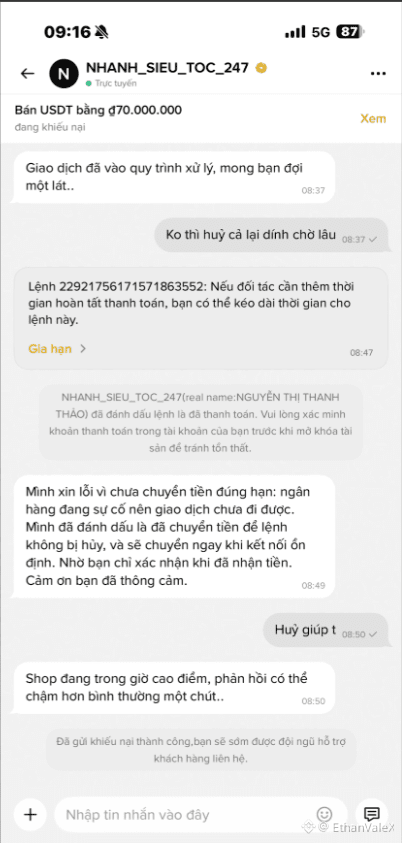
Has anyone ever run into a situation where the transfer has been made, but the USDT on Binance P2P never gets released?<br>So, I just sold 2,370 USDT to a trader called NHANH_SIEU_TOC_247. The buyer marked “Paid,” but I still hadn’t received the money in my account. On the other side, they explained that their bank was having issues, so the transaction was delayed, and they asked for more time.<br>At first, I kept waiting because there wasn’t anything conclusive that the other party was at fault. But after 30 minutes, the system still allowed them to extend the payment time, while I’d already been waiting quite a while, so I started getting annoyed. I messaged: “Cancel it for me,” then decided to file a dispute directly on Binance so the support team could review it.<br>I also wasn’t in a rush to conclude it was a scam, because the other side was still saying they were experiencing a bank error. When I opened the dispute, I kept all the information—Order details, order status, transaction time, and the entire chat content with the other party—so Support would have enough data to verify. At the same time, I kept all communications on Binance instead of moving to another channel.<br>About 4 hours later, Binance support helped me and the funds were released. That’s when I finally felt relieved.<br>Previously, I thought P2P was just about verifying the Merchant and paying according to the correct process. This 70-million VND case made me realize that once a trade starts to have problems, keeping all the full details and opening a dispute at the right time matters just as much.<br>Since then, I’ve developed a habit: if I encounter any abnormal order, I save all order information, transaction status, and the chat history right on Binance, then message Support so they can handle it according to procedure.<br>@Binance_Vietnam <br>#BinanceP2PAnToan
Has anyone ever run into a situation where the transfer has been made, but the USDT on Binance P2P never gets released?<br>So, I just sold 2,370 USDT to a trader called NHANH_SIEU_TOC_247. The buyer marked “Paid,” but I still hadn’t received the money in my account. On the other side, they explained that their bank was having issues, so the transaction was delayed, and they asked for more time.<br>At first, I kept waiting because there wasn’t anything conclusive that the other party was at fault. But after 30 minutes, the system still allowed them to extend the payment time, while I’d already been waiting quite a while, so I started getting annoyed. I messaged: “Cancel it for me,” then decided to file a dispute directly on Binance so the support team could review it.<br>I also wasn’t in a rush to conclude it was a scam, because the other side was still saying they were experiencing a bank error. When I opened the dispute, I kept all the information—Order details, order status, transaction time, and the entire chat content with the other party—so Support would have enough data to verify. At the same time, I kept all communications on Binance instead of moving to another channel.<br>About 4 hours later, Binance support helped me and the funds were released. That’s when I finally felt relieved.<br>Previously, I thought P2P was just about verifying the Merchant and paying according to the correct process. This 70-million VND case made me realize that once a trade starts to have problems, keeping all the full details and opening a dispute at the right time matters just as much.<br>Since then, I’ve developed a habit: if I encounter any abnormal order, I save all order information, transaction status, and the chat history right on Binance, then message Support so they can handle it according to procedure.<br>@Binance Vietnam <br>#BinanceP2PAnToan
1
523
·
--
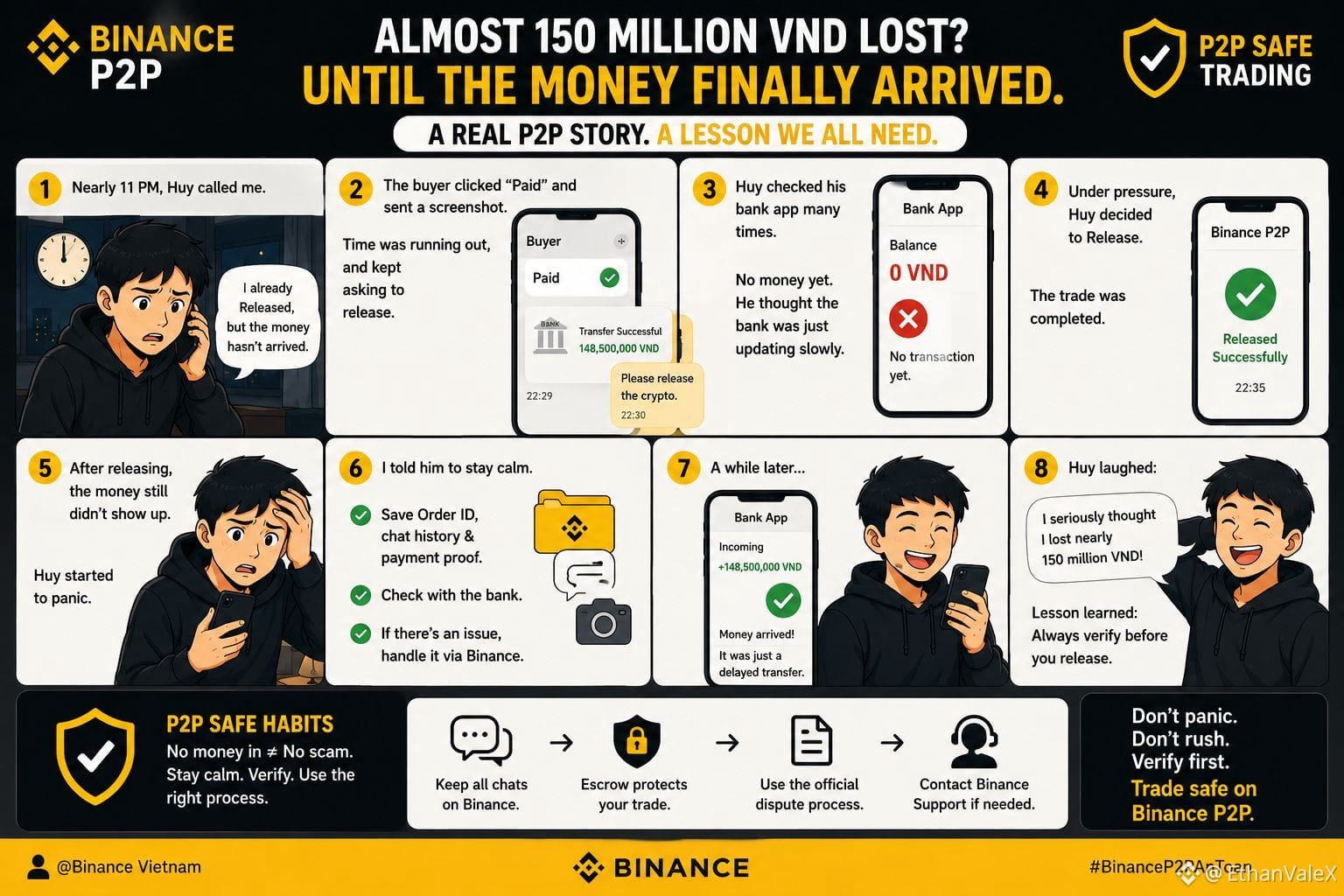
Around 11 p.m. the night before, Huy called me about a Binance P2P transaction worth nearly 150 million VND. His voice sounded pretty panicked: “I just released it, but the money still hasn’t arrived.”
Huy said the buyer had tapped “Marked as paid” and sent the transfer screenshot right away. But because the transaction time was almost up, the other person kept messaging, asking why Huy still hadn’t unlocked the crypto. He opened his banking app and checked a few times but didn’t see the funds. In the end, he thought the bank must be updating slowly, so he still pressed Release.
After everything was done, Huy came back to check his account, but the money still hadn’t appeared.
Only then did he start to worry for real—he thought he had just encountered the worst-case scenario when selling P2P: the crypto was already unlocked, but the money hadn’t come through.
I told him not to jump to conclusions. First, keep the Order ID, the chat history, and the transaction screenshots, then check whether the bank has any transactions currently being processed. I also reminded Huy that if there was a problem, he should handle it right away on Binance.
A little while later, he messaged me: “The money’s in now.”
It turned out that the bank handled the transfer slowly that day, so the funds arrived later than usual. In the end, there was no scam at all—he had just frightened himself for nothing.
He laughed and said: “Earlier I thought I’d basically lost nearly 150 million VND.”
All I could do was tell him that next time, if he doesn’t see the money, he should stay calm and check first. Binance P2P has an Escrow, a chat system, and a dispute process. So if anything goes wrong with a transaction, the best approach is to keep everything on the platform and let the official procedure handle it rather than making decisions on the spot when you’re flustered.
This is also what I wanted to share via #BinanceP2PAnToan so that everyone—especially newcomers—can build a safer habit when trading.
@Binance_Vietnam
Around 11 p.m. the night before, Huy called me about a Binance P2P transaction worth nearly 150 million VND. His voice sounded pretty panicked: “I just released it, but the money still hasn’t arrived.”
Huy said the buyer had tapped “Marked as paid” and sent the transfer screenshot right away. But because the transaction time was almost up, the other person kept messaging, asking why Huy still hadn’t unlocked the crypto. He opened his banking app and checked a few times but didn’t see the funds. In the end, he thought the bank must be updating slowly, so he still pressed Release.
After everything was done, Huy came back to check his account, but the money still hadn’t appeared.
Only then did he start to worry for real—he thought he had just encountered the worst-case scenario when selling P2P: the crypto was already unlocked, but the money hadn’t come through.
I told him not to jump to conclusions. First, keep the Order ID, the chat history, and the transaction screenshots, then check whether the bank has any transactions currently being processed. I also reminded Huy that if there was a problem, he should handle it right away on Binance.
A little while later, he messaged me: “The money’s in now.”
It turned out that the bank handled the transfer slowly that day, so the funds arrived later than usual. In the end, there was no scam at all—he had just frightened himself for nothing.
He laughed and said: “Earlier I thought I’d basically lost nearly 150 million VND.”
All I could do was tell him that next time, if he doesn’t see the money, he should stay calm and check first. Binance P2P has an Escrow, a chat system, and a dispute process. So if anything goes wrong with a transaction, the best approach is to keep everything on the platform and let the official procedure handle it rather than making decisions on the spot when you’re flustered.
This is also what I wanted to share via #BinanceP2PAnToan so that everyone—especially newcomers—can build a safer habit when trading.
@Binance Vietnam
Huy said the buyer had tapped “Marked as paid” and sent the transfer screenshot right away. But because the transaction time was almost up, the other person kept messaging, asking why Huy still hadn’t unlocked the crypto. He opened his banking app and checked a few times but didn’t see the funds. In the end, he thought the bank must be updating slowly, so he still pressed Release.
After everything was done, Huy came back to check his account, but the money still hadn’t appeared.
Only then did he start to worry for real—he thought he had just encountered the worst-case scenario when selling P2P: the crypto was already unlocked, but the money hadn’t come through.
I told him not to jump to conclusions. First, keep the Order ID, the chat history, and the transaction screenshots, then check whether the bank has any transactions currently being processed. I also reminded Huy that if there was a problem, he should handle it right away on Binance.
A little while later, he messaged me: “The money’s in now.”
It turned out that the bank handled the transfer slowly that day, so the funds arrived later than usual. In the end, there was no scam at all—he had just frightened himself for nothing.
He laughed and said: “Earlier I thought I’d basically lost nearly 150 million VND.”
All I could do was tell him that next time, if he doesn’t see the money, he should stay calm and check first. Binance P2P has an Escrow, a chat system, and a dispute process. So if anything goes wrong with a transaction, the best approach is to keep everything on the platform and let the official procedure handle it rather than making decisions on the spot when you’re flustered.
This is also what I wanted to share via #BinanceP2PAnToan so that everyone—especially newcomers—can build a safer habit when trading.
@Binance Vietnam
375
·
--
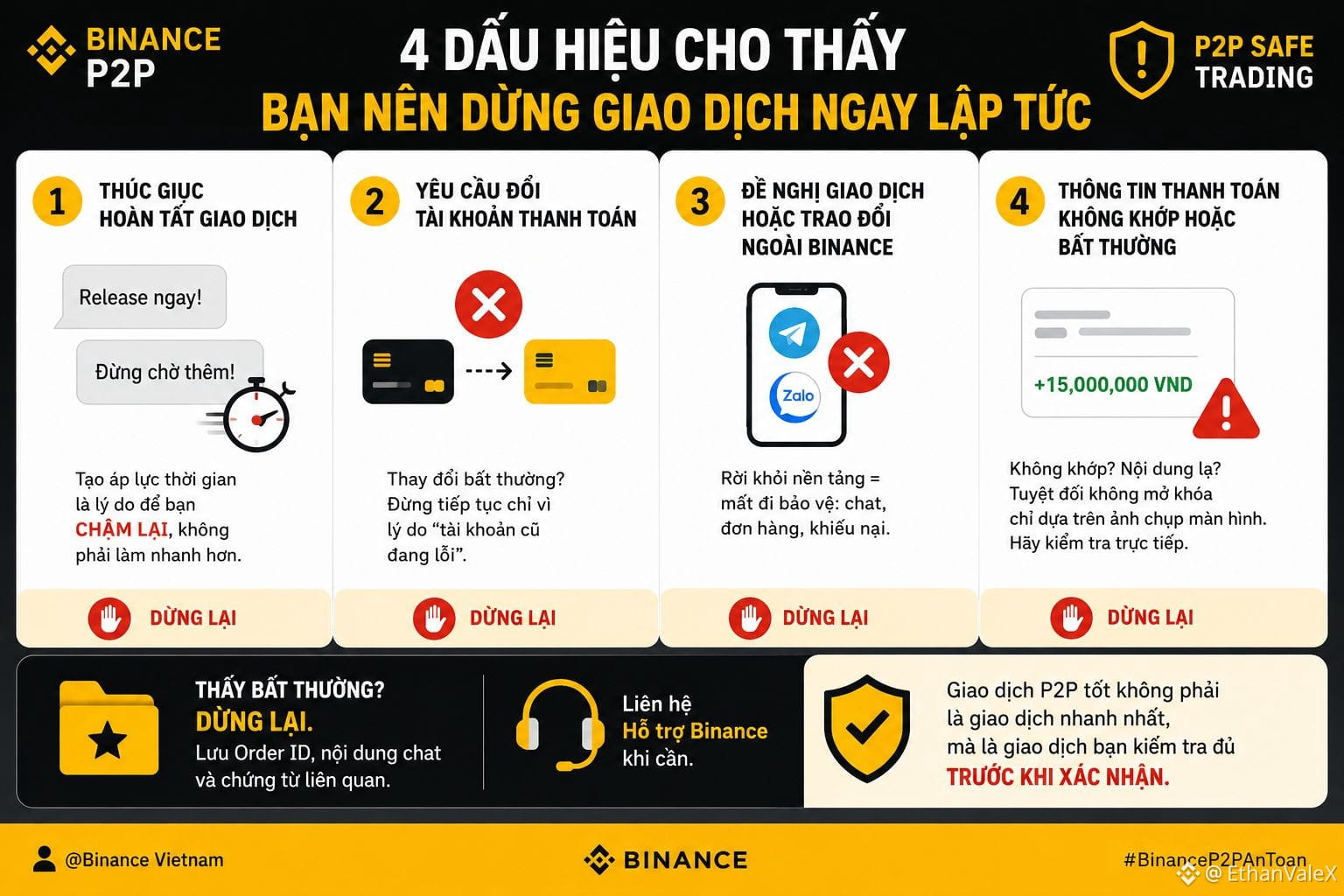
Everything is going smoothly on P2P—if you see these 4 signs, don’t try to continue the trade
A while back, I did a P2P trade. At first, everything was normal. As it got closer to finishing the order, the other side started messaging a lot more, then added a few pretty strange requests. At that point, I thought, “Okay, let’s slow down a bit just to be safe.”
First was the release. The other side kept saying, “Hey, please help me release,” “I’ve transferred already,” sending messages over and over. In cases like this, I don’t argue at all. I just open my banking app and check. If I don’t see the money come in, I don’t release—simple as that.
While trading, they then asked to switch to a different account to receive the money. I didn’t continue right away. I’d verify clearly which account, whose name, and whether the details match the order—then decide what to do next.
There are also cases where they invite you to move to Telegram or WhatsApp to “make it easier,” and then, as a bonus, suggest canceling the P2P order and doing an OTC trade directly, with an even better price. Sounds tempting, sure, but I’ll pass. If I’m trading on Binance, I stay on Binance. If anything goes wrong, there’s chat history, order details, and the support workflow to handle it.
And don’t trust only a screenshot of a transfer. No matter how good the image looks, it can’t compare to me opening my bank and actually seeing the money in my account. If it’s not there, then just wait.
When I encounter these kinds of issues during a trade, I stop immediately: being pushed to release, changing the account to receive money, getting pulled out to Telegram/OTC, or being sent a transfer screenshot and told to release.
If anything feels off, stay calm. Save the Order ID, receipts, and the chat logs. If needed, contact Binance Support.
Have you ever run into a P2P situation that forced you to stop the trade?
@Binance_Vietnam #BinanceP2PAnToan #USJulyCPI&PPIDueThisWeek $GENIUS $PENGU
Everything is going smoothly on P2P—if you see these 4 signs, don’t try to continue the trade
A while back, I did a P2P trade. At first, everything was normal. As it got closer to finishing the order, the other side started messaging a lot more, then added a few pretty strange requests. At that point, I thought, “Okay, let’s slow down a bit just to be safe.”
First was the release. The other side kept saying, “Hey, please help me release,” “I’ve transferred already,” sending messages over and over. In cases like this, I don’t argue at all. I just open my banking app and check. If I don’t see the money come in, I don’t release—simple as that.
While trading, they then asked to switch to a different account to receive the money. I didn’t continue right away. I’d verify clearly which account, whose name, and whether the details match the order—then decide what to do next.
There are also cases where they invite you to move to Telegram or WhatsApp to “make it easier,” and then, as a bonus, suggest canceling the P2P order and doing an OTC trade directly, with an even better price. Sounds tempting, sure, but I’ll pass. If I’m trading on Binance, I stay on Binance. If anything goes wrong, there’s chat history, order details, and the support workflow to handle it.
And don’t trust only a screenshot of a transfer. No matter how good the image looks, it can’t compare to me opening my bank and actually seeing the money in my account. If it’s not there, then just wait.
When I encounter these kinds of issues during a trade, I stop immediately: being pushed to release, changing the account to receive money, getting pulled out to Telegram/OTC, or being sent a transfer screenshot and told to release.
If anything feels off, stay calm. Save the Order ID, receipts, and the chat logs. If needed, contact Binance Support.
Have you ever run into a P2P situation that forced you to stop the trade?
@Binance Vietnam #BinanceP2PAnToan #USJulyCPI&PPIDueThisWeek $GENIUS $PENGU
A while back, I did a P2P trade. At first, everything was normal. As it got closer to finishing the order, the other side started messaging a lot more, then added a few pretty strange requests. At that point, I thought, “Okay, let’s slow down a bit just to be safe.”
First was the release. The other side kept saying, “Hey, please help me release,” “I’ve transferred already,” sending messages over and over. In cases like this, I don’t argue at all. I just open my banking app and check. If I don’t see the money come in, I don’t release—simple as that.
While trading, they then asked to switch to a different account to receive the money. I didn’t continue right away. I’d verify clearly which account, whose name, and whether the details match the order—then decide what to do next.
There are also cases where they invite you to move to Telegram or WhatsApp to “make it easier,” and then, as a bonus, suggest canceling the P2P order and doing an OTC trade directly, with an even better price. Sounds tempting, sure, but I’ll pass. If I’m trading on Binance, I stay on Binance. If anything goes wrong, there’s chat history, order details, and the support workflow to handle it.
And don’t trust only a screenshot of a transfer. No matter how good the image looks, it can’t compare to me opening my bank and actually seeing the money in my account. If it’s not there, then just wait.
When I encounter these kinds of issues during a trade, I stop immediately: being pushed to release, changing the account to receive money, getting pulled out to Telegram/OTC, or being sent a transfer screenshot and told to release.
If anything feels off, stay calm. Save the Order ID, receipts, and the chat logs. If needed, contact Binance Support.
Have you ever run into a P2P situation that forced you to stop the trade?
@Binance Vietnam #BinanceP2PAnToan #USJulyCPI&PPIDueThisWeek $GENIUS $PENGU
1
2
771
·
--
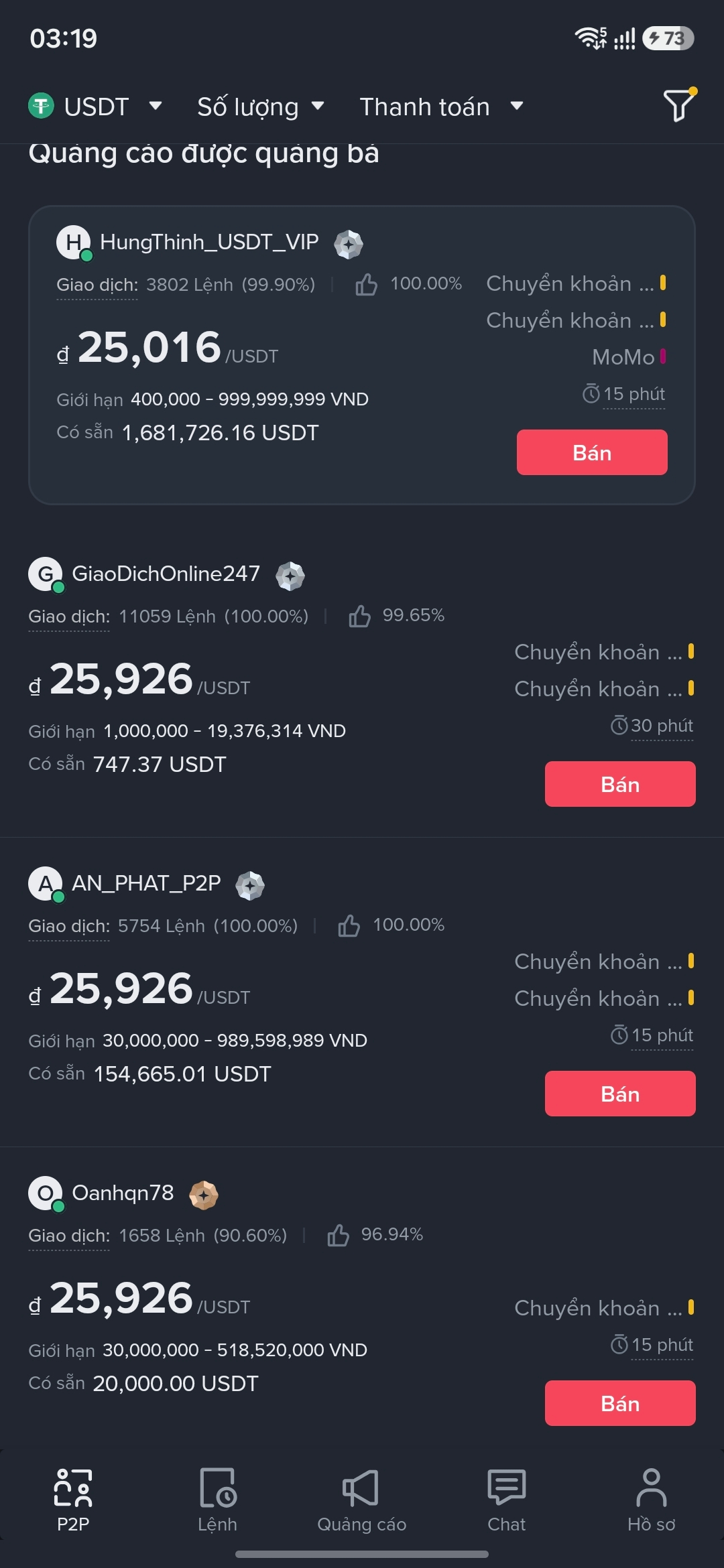
I almost unlocked early just because I thought: “This person trades a lot, so they must be fine.”
One time, I sold 600 USDT on Binance P2P. That merchant had an almost 100% completion rate and a history of a few hundred orders. I don’t remember the exact number, but at a glance it looked quite reassuring. The price at the time was also better than a few other options, so I basically chose right away.
The buyer said they’d paid, and then about 30 seconds later messaged me to check and unlock early because they needed to finish the transaction. To be honest, at that moment I also briefly thought: “With a profile this good, it’s probably fine.”
If an account with few transactions requests early unlock, I would refuse immediately. But with someone who has a history of a few hundred orders and an almost 100% completion rate, my reaction was different. I started trusting their reputation before I even checked the transaction.
I opened my banking app and didn’t see the money. I told them I would unlock once the funds were in the account, while the buyer kept messaging that they’d transferred and asked me to check again.
This time, I wasn’t in a rush. I went back to the Order, cross-checked the amount and payment information, and waited a bit longer. About 90 seconds later, the money finally really arrived in my account. I checked again one more time, and only then did I unlock—then the transaction completed completely normally.
Nothing happened that day, but I still remember for quite a while the feeling of almost skipping the process just because the other party’s history looked too perfect.
Since then, I still look at transaction history when choosing a counterparty, but I don’t let it decide when I unlock.
A good history helps me feel more at ease, but it’s only when the money actually hits the account that determines what happens next.
@Binance_Vietnam #BinanceP2PAnToan $BEAT $TUT $CYS
I almost unlocked early just because I thought: “This person trades a lot, so they must be fine.”
One time, I sold 600 USDT on Binance P2P. That merchant had an almost 100% completion rate and a history of a few hundred orders. I don’t remember the exact number, but at a glance it looked quite reassuring. The price at the time was also better than a few other options, so I basically chose right away.
The buyer said they’d paid, and then about 30 seconds later messaged me to check and unlock early because they needed to finish the transaction. To be honest, at that moment I also briefly thought: “With a profile this good, it’s probably fine.”
If an account with few transactions requests early unlock, I would refuse immediately. But with someone who has a history of a few hundred orders and an almost 100% completion rate, my reaction was different. I started trusting their reputation before I even checked the transaction.
I opened my banking app and didn’t see the money. I told them I would unlock once the funds were in the account, while the buyer kept messaging that they’d transferred and asked me to check again.
This time, I wasn’t in a rush. I went back to the Order, cross-checked the amount and payment information, and waited a bit longer. About 90 seconds later, the money finally really arrived in my account. I checked again one more time, and only then did I unlock—then the transaction completed completely normally.
Nothing happened that day, but I still remember for quite a while the feeling of almost skipping the process just because the other party’s history looked too perfect.
Since then, I still look at transaction history when choosing a counterparty, but I don’t let it decide when I unlock.
A good history helps me feel more at ease, but it’s only when the money actually hits the account that determines what happens next.
@Binance Vietnam #BinanceP2PAnToan $BEAT $TUT $CYS
One time, I sold 600 USDT on Binance P2P. That merchant had an almost 100% completion rate and a history of a few hundred orders. I don’t remember the exact number, but at a glance it looked quite reassuring. The price at the time was also better than a few other options, so I basically chose right away.
The buyer said they’d paid, and then about 30 seconds later messaged me to check and unlock early because they needed to finish the transaction. To be honest, at that moment I also briefly thought: “With a profile this good, it’s probably fine.”
If an account with few transactions requests early unlock, I would refuse immediately. But with someone who has a history of a few hundred orders and an almost 100% completion rate, my reaction was different. I started trusting their reputation before I even checked the transaction.
I opened my banking app and didn’t see the money. I told them I would unlock once the funds were in the account, while the buyer kept messaging that they’d transferred and asked me to check again.
This time, I wasn’t in a rush. I went back to the Order, cross-checked the amount and payment information, and waited a bit longer. About 90 seconds later, the money finally really arrived in my account. I checked again one more time, and only then did I unlock—then the transaction completed completely normally.
Nothing happened that day, but I still remember for quite a while the feeling of almost skipping the process just because the other party’s history looked too perfect.
Since then, I still look at transaction history when choosing a counterparty, but I don’t let it decide when I unlock.
A good history helps me feel more at ease, but it’s only when the money actually hits the account that determines what happens next.
@Binance Vietnam #BinanceP2PAnToan $BEAT $TUT $CYS
1
2
726
·
--
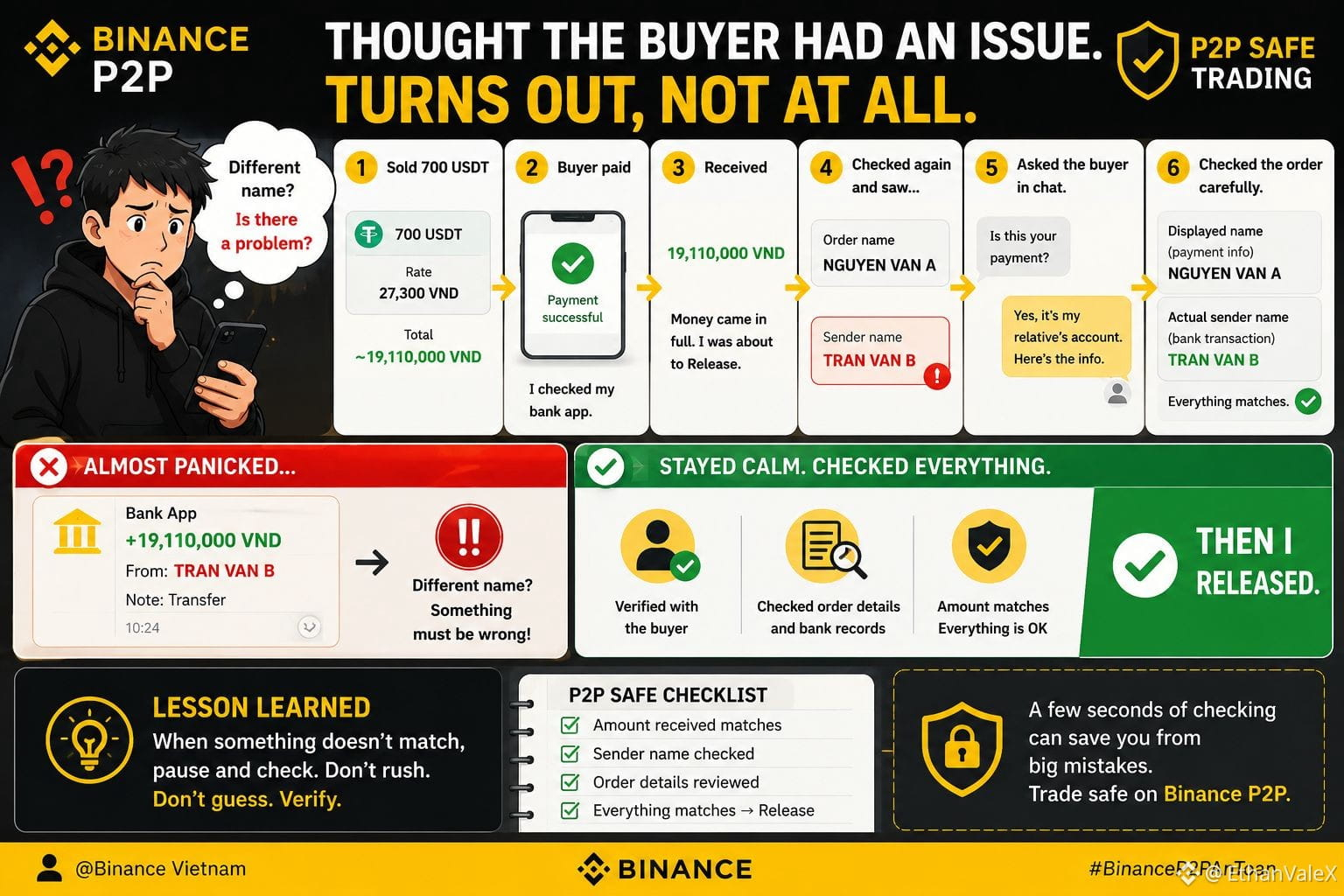
I thought the buyer might have a problem. Turns out that wasn’t the case.
That time, I needed some money, so I used Binance P2P to sell 700 USDT. The exchange rate was around 27,300 VND, totaling nearly 19.11 million VND.
I chose a Merchant with a fairly decent transaction history. After placing the order, I waited for the buyer to make the payment.
After a while, the buyer said they had transferred the money. I opened my banking app to check and saw that the exact 19.11 million VND had just been credited to my account.
The money was enough, so I was about to hit Release right away.
But before I clicked, I took another look at the payment information and noticed the sender’s name didn’t match the name on the Order.
At that moment, I got a little nervous. Nearly 20 million had already come into my account, but the sender’s name was different—I thought, “Something must be off.”
I messaged in the Binance P2P chat to ask the buyer. They explained it was a relative’s account and sent me additional information.
I still hadn’t released.
After sitting down and checking the Order again, I realized something: the name I was looking at is the display name shown in the payment details, but the actual sender’s name is shown in the bank transaction section. These two pieces of information aren’t always in the same place, so I hadn’t noticed the right one at first.
I double-checked all the information again, and the 19.11 million VND amount also matched.
Only then could I breathe a sigh of relief. Turns out I’d basically panicked myself just because I read the information too quickly.
Luckily, I hadn’t released yet, and I also hadn’t jumped to conclusions that the buyer was at fault.
From this experience, I learned a lesson: in P2P trading, if you spot any detail that doesn’t match, stop and verify first—don’t rush to assume.
Brothers trading P2P, just remember this one step: once the money is credited, you should still check the sender’s name and the Order before you hit Release.
@Binance_Vietnam #BinanceP2PAnToan $CYS
I thought the buyer might have a problem. Turns out that wasn’t the case.
That time, I needed some money, so I used Binance P2P to sell 700 USDT. The exchange rate was around 27,300 VND, totaling nearly 19.11 million VND.
I chose a Merchant with a fairly decent transaction history. After placing the order, I waited for the buyer to make the payment.
After a while, the buyer said they had transferred the money. I opened my banking app to check and saw that the exact 19.11 million VND had just been credited to my account.
The money was enough, so I was about to hit Release right away.
But before I clicked, I took another look at the payment information and noticed the sender’s name didn’t match the name on the Order.
At that moment, I got a little nervous. Nearly 20 million had already come into my account, but the sender’s name was different—I thought, “Something must be off.”
I messaged in the Binance P2P chat to ask the buyer. They explained it was a relative’s account and sent me additional information.
I still hadn’t released.
After sitting down and checking the Order again, I realized something: the name I was looking at is the display name shown in the payment details, but the actual sender’s name is shown in the bank transaction section. These two pieces of information aren’t always in the same place, so I hadn’t noticed the right one at first.
I double-checked all the information again, and the 19.11 million VND amount also matched.
Only then could I breathe a sigh of relief. Turns out I’d basically panicked myself just because I read the information too quickly.
Luckily, I hadn’t released yet, and I also hadn’t jumped to conclusions that the buyer was at fault.
From this experience, I learned a lesson: in P2P trading, if you spot any detail that doesn’t match, stop and verify first—don’t rush to assume.
Brothers trading P2P, just remember this one step: once the money is credited, you should still check the sender’s name and the Order before you hit Release.
@Binance Vietnam #BinanceP2PAnToan $CYS
That time, I needed some money, so I used Binance P2P to sell 700 USDT. The exchange rate was around 27,300 VND, totaling nearly 19.11 million VND.
I chose a Merchant with a fairly decent transaction history. After placing the order, I waited for the buyer to make the payment.
After a while, the buyer said they had transferred the money. I opened my banking app to check and saw that the exact 19.11 million VND had just been credited to my account.
The money was enough, so I was about to hit Release right away.
But before I clicked, I took another look at the payment information and noticed the sender’s name didn’t match the name on the Order.
At that moment, I got a little nervous. Nearly 20 million had already come into my account, but the sender’s name was different—I thought, “Something must be off.”
I messaged in the Binance P2P chat to ask the buyer. They explained it was a relative’s account and sent me additional information.
I still hadn’t released.
After sitting down and checking the Order again, I realized something: the name I was looking at is the display name shown in the payment details, but the actual sender’s name is shown in the bank transaction section. These two pieces of information aren’t always in the same place, so I hadn’t noticed the right one at first.
I double-checked all the information again, and the 19.11 million VND amount also matched.
Only then could I breathe a sigh of relief. Turns out I’d basically panicked myself just because I read the information too quickly.
Luckily, I hadn’t released yet, and I also hadn’t jumped to conclusions that the buyer was at fault.
From this experience, I learned a lesson: in P2P trading, if you spot any detail that doesn’t match, stop and verify first—don’t rush to assume.
Brothers trading P2P, just remember this one step: once the money is credited, you should still check the sender’s name and the Order before you hit Release.
@Binance Vietnam #BinanceP2PAnToan $CYS
1
1.3k
·
--
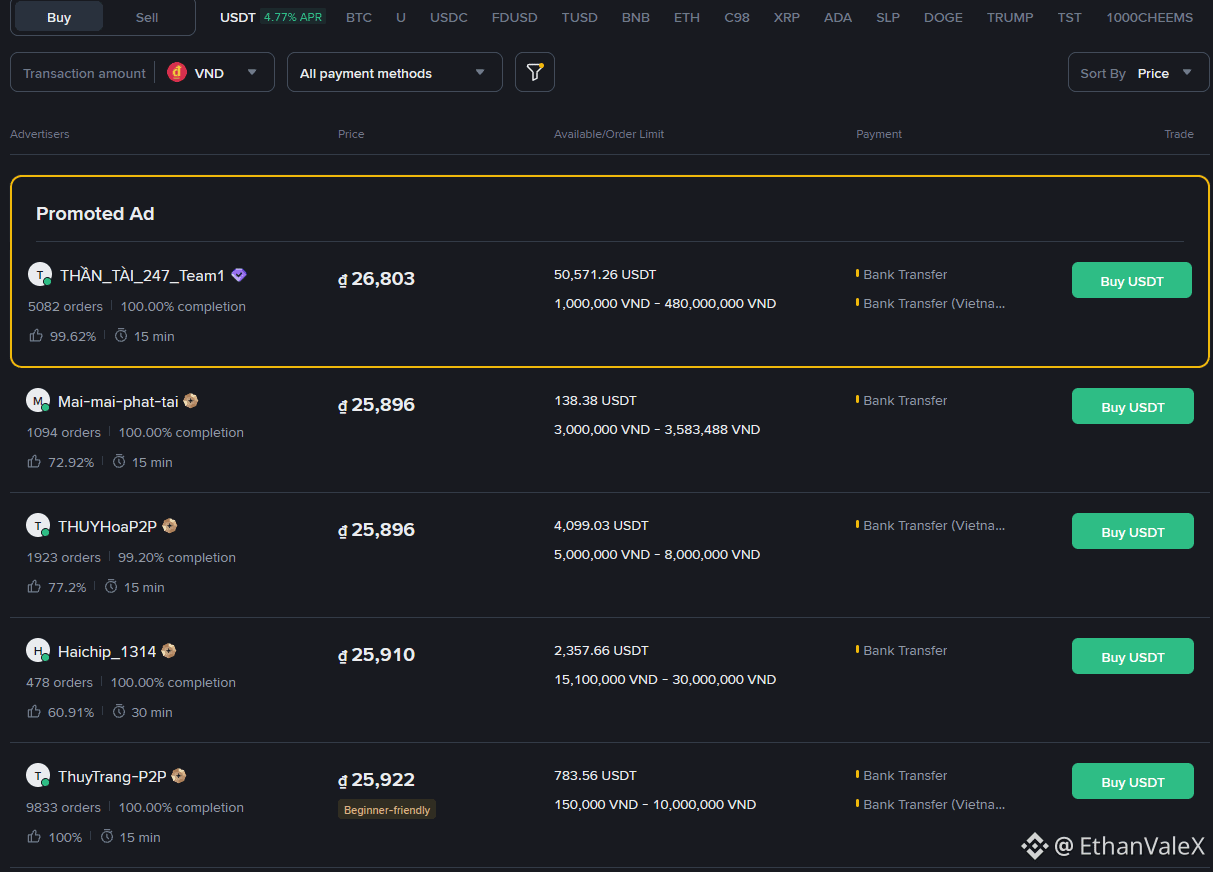
I almost chose the wrong merchant on Binance P2P because of a good price
I used to think choosing a merchant on Binance P2P was simple: if the price looks good, pick it. After a few transactions, I realized the price is only part of the decision.
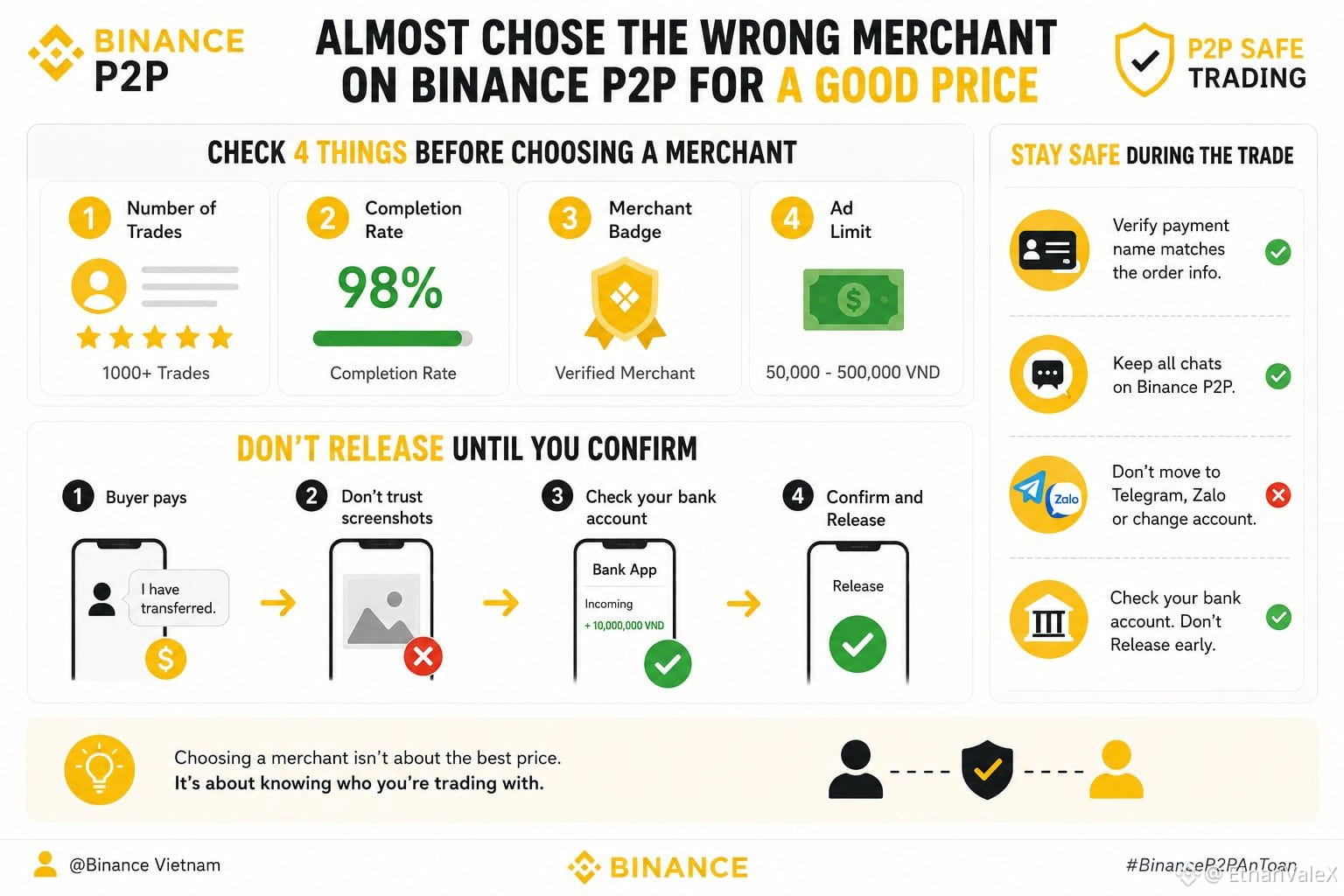
Now, before choosing a merchant, I usually check 4 things: transaction volume, Completion Rate, the Merchant Badge, and the ad limit.
Transaction volume gives me a bit more information about the merchant’s history. I don’t think a higher number of transactions automatically means absolute safety, but if the prices are close between two parties, I usually lean toward the one with a clearer track record.
Completion Rate is also a figure I pay attention to. If the conditions between two ads aren’t that different, I usually prioritize the merchant with the better completion rate. The Merchant Badge is similar. In the past, I often overlooked it; now I always review the profile before trading.
Ad limits are simpler. I just check whether the amount I need to buy or sell falls within what the merchant supports. If it doesn’t fit, I choose a different ad.
But choosing a merchant doesn’t mean I transact right away. I still verify that the payment account name matches the order information, and I keep all communication on Binance P2P. If the other party wants to move to Telegram, Zalo, or change the account midway, I stop.
When it comes to payment, I also don’t Release just because I receive a screenshot or a message saying “money has been transferred.” I check the account myself and only unlock the crypto after confirming the money has truly arrived.
For me, choosing a merchant isn’t about finding the absolute best price. What matters is knowing who I’m trading with before I click Confirm.
@Binance_Vietnam #BinanceP2PAnToan
$GRVT #CreatorpadVN
I almost chose the wrong merchant on Binance P2P because of a good price
I used to think choosing a merchant on Binance P2P was simple: if the price looks good, pick it. After a few transactions, I realized the price is only part of the decision.
Now, before choosing a merchant, I usually check 4 things: transaction volume, Completion Rate, the Merchant Badge, and the ad limit.
Transaction volume gives me a bit more information about the merchant’s history. I don’t think a higher number of transactions automatically means absolute safety, but if the prices are close between two parties, I usually lean toward the one with a clearer track record.
Completion Rate is also a figure I pay attention to. If the conditions between two ads aren’t that different, I usually prioritize the merchant with the better completion rate. The Merchant Badge is similar. In the past, I often overlooked it; now I always review the profile before trading.
Ad limits are simpler. I just check whether the amount I need to buy or sell falls within what the merchant supports. If it doesn’t fit, I choose a different ad.
But choosing a merchant doesn’t mean I transact right away. I still verify that the payment account name matches the order information, and I keep all communication on Binance P2P. If the other party wants to move to Telegram, Zalo, or change the account midway, I stop.
When it comes to payment, I also don’t Release just because I receive a screenshot or a message saying “money has been transferred.” I check the account myself and only unlock the crypto after confirming the money has truly arrived.
For me, choosing a merchant isn’t about finding the absolute best price. What matters is knowing who I’m trading with before I click Confirm.
@Binance Vietnam #BinanceP2PAnToan
$GRVT #CreatorpadVN
I used to think choosing a merchant on Binance P2P was simple: if the price looks good, pick it. After a few transactions, I realized the price is only part of the decision.
Now, before choosing a merchant, I usually check 4 things: transaction volume, Completion Rate, the Merchant Badge, and the ad limit.
Transaction volume gives me a bit more information about the merchant’s history. I don’t think a higher number of transactions automatically means absolute safety, but if the prices are close between two parties, I usually lean toward the one with a clearer track record.
Completion Rate is also a figure I pay attention to. If the conditions between two ads aren’t that different, I usually prioritize the merchant with the better completion rate. The Merchant Badge is similar. In the past, I often overlooked it; now I always review the profile before trading.
Ad limits are simpler. I just check whether the amount I need to buy or sell falls within what the merchant supports. If it doesn’t fit, I choose a different ad.
But choosing a merchant doesn’t mean I transact right away. I still verify that the payment account name matches the order information, and I keep all communication on Binance P2P. If the other party wants to move to Telegram, Zalo, or change the account midway, I stop.
When it comes to payment, I also don’t Release just because I receive a screenshot or a message saying “money has been transferred.” I check the account myself and only unlock the crypto after confirming the money has truly arrived.
For me, choosing a merchant isn’t about finding the absolute best price. What matters is knowing who I’m trading with before I click Confirm.
@Binance Vietnam #BinanceP2PAnToan
$GRVT #CreatorpadVN
2
738
·
--
Thought everything was done on Binance P2P—until I reopened the order!!!
The thing is, I sold 600 USDT on Binance P2P. At the time, the rate was about 27,000 VND, so I expected to receive around 16.2 million VND.
I chose a merchant with a trading history and a pretty solid completion rate. After the buyer paid, I opened my banking app to check, and saw that only 15.9 million had come into my account.
Right then I thought: "Huh, missing nearly 300K?"
I went back to the order to check. The buyer also sent the transaction details and said they had transferred the correct amount. I was going to ask again immediately, but I kept checking the order one more time.
Turns out 16.2 million was the amount I calculated myself using the initial rate, while 15.9 million was the actual total amount of the order after the information had been updated.
The merchant didn’t short anything. The buyer also didn’t do anything wrong. It was me who misread.
Luckily I hadn’t rushed to Release or move to another channel to handle it. I cross-checked the USDT amount, the rate, and the total in the order, and everything matched.
Since then, I’ve drawn a lesson from it: before confirming P2P, I always recheck the price, the quantity, and the final total amount. If anything differs from my initial calculation, I stop and double-check.
Fast traders probably have also had moments like me—seeing one thing and clicking another.
Check the order carefully before trading, especially when the money is up to tens of millions. My friends.
@Binance_Vietnam #BinanceP2PAnToan
Thought everything was done on Binance P2P—until I reopened the order!!!
The thing is, I sold 600 USDT on Binance P2P. At the time, the rate was about 27,000 VND, so I expected to receive around 16.2 million VND.
I chose a merchant with a trading history and a pretty solid completion rate. After the buyer paid, I opened my banking app to check, and saw that only 15.9 million had come into my account.
Right then I thought: "Huh, missing nearly 300K?"
I went back to the order to check. The buyer also sent the transaction details and said they had transferred the correct amount. I was going to ask again immediately, but I kept checking the order one more time.
Turns out 16.2 million was the amount I calculated myself using the initial rate, while 15.9 million was the actual total amount of the order after the information had been updated.
The merchant didn’t short anything. The buyer also didn’t do anything wrong. It was me who misread.
Luckily I hadn’t rushed to Release or move to another channel to handle it. I cross-checked the USDT amount, the rate, and the total in the order, and everything matched.
Since then, I’ve drawn a lesson from it: before confirming P2P, I always recheck the price, the quantity, and the final total amount. If anything differs from my initial calculation, I stop and double-check.
Fast traders probably have also had moments like me—seeing one thing and clicking another.
Check the order carefully before trading, especially when the money is up to tens of millions. My friends.
@Binance Vietnam #BinanceP2PAnToan
The thing is, I sold 600 USDT on Binance P2P. At the time, the rate was about 27,000 VND, so I expected to receive around 16.2 million VND.
I chose a merchant with a trading history and a pretty solid completion rate. After the buyer paid, I opened my banking app to check, and saw that only 15.9 million had come into my account.
Right then I thought: "Huh, missing nearly 300K?"
I went back to the order to check. The buyer also sent the transaction details and said they had transferred the correct amount. I was going to ask again immediately, but I kept checking the order one more time.
Turns out 16.2 million was the amount I calculated myself using the initial rate, while 15.9 million was the actual total amount of the order after the information had been updated.
The merchant didn’t short anything. The buyer also didn’t do anything wrong. It was me who misread.
Luckily I hadn’t rushed to Release or move to another channel to handle it. I cross-checked the USDT amount, the rate, and the total in the order, and everything matched.
Since then, I’ve drawn a lesson from it: before confirming P2P, I always recheck the price, the quantity, and the final total amount. If anything differs from my initial calculation, I stop and double-check.
Fast traders probably have also had moments like me—seeing one thing and clicking another.
Check the order carefully before trading, especially when the money is up to tens of millions. My friends.
@Binance Vietnam #BinanceP2PAnToan
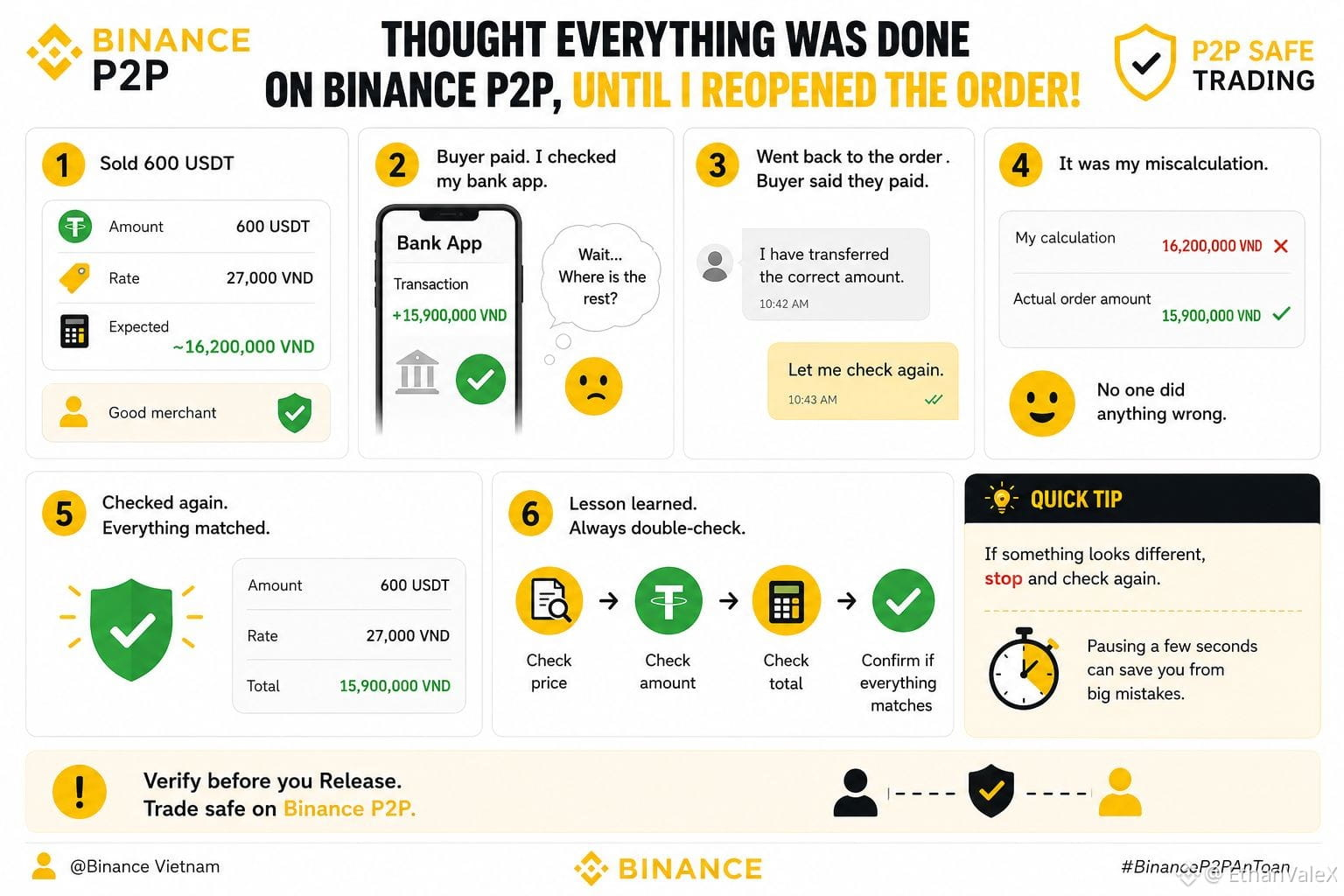
5
5.9k
·
--
New users often make these 7 mistakes on Binance P2P
I used to think trading on Binance P2P was pretty simple: find a good price, transfer money, and receive crypto. After a few trades, I realized the easiest part is actually just tapping Buy or Sell. Most mistakes happen in the few seconds before and after.
The first mistake is only looking at the price. A small difference sometimes makes me overlook more important things like completion rate, transaction history, or the Merchant Badge. Now I always check the counterparty’s profile before looking back at the price.
Another mistake is not matching the payment account name with the information in the order. I don’t see this as an extra step—if the details don’t match, I stop and check.
What I particularly avoid is releasing too early. Screenshots or a message like “I’ve transferred the money” isn’t proof that the funds have actually arrived in the account. I always open my banking app and verify the transaction before unlocking the crypto.
I also don’t move the conversation to Telegram or Zalo just because the counterparty says “for convenience.” Keeping everything on Binance P2P gives me Escrow, chat history, and a dispute process if something goes wrong.
Another sign I always watch out for is being rushed to process immediately, switching payment accounts mid-way, or seeing unusual transfer content. The more they push, the more carefully I check.
Lastly, I always keep the Order ID, receipt, and chat history. If anything goes wrong, I stop the trade and contact Binance Support instead of trying to handle it on my own.
Safe P2P doesn’t need to be overly complicated. For me, just dropping a few bad habits and checking the right things before I release makes a huge difference.
@Binance_Vietnam #BinanceP2PAnToan
New users often make these 7 mistakes on Binance P2P
I used to think trading on Binance P2P was pretty simple: find a good price, transfer money, and receive crypto. After a few trades, I realized the easiest part is actually just tapping Buy or Sell. Most mistakes happen in the few seconds before and after.
The first mistake is only looking at the price. A small difference sometimes makes me overlook more important things like completion rate, transaction history, or the Merchant Badge. Now I always check the counterparty’s profile before looking back at the price.
Another mistake is not matching the payment account name with the information in the order. I don’t see this as an extra step—if the details don’t match, I stop and check.
What I particularly avoid is releasing too early. Screenshots or a message like “I’ve transferred the money” isn’t proof that the funds have actually arrived in the account. I always open my banking app and verify the transaction before unlocking the crypto.
I also don’t move the conversation to Telegram or Zalo just because the counterparty says “for convenience.” Keeping everything on Binance P2P gives me Escrow, chat history, and a dispute process if something goes wrong.
Another sign I always watch out for is being rushed to process immediately, switching payment accounts mid-way, or seeing unusual transfer content. The more they push, the more carefully I check.
Lastly, I always keep the Order ID, receipt, and chat history. If anything goes wrong, I stop the trade and contact Binance Support instead of trying to handle it on my own.
Safe P2P doesn’t need to be overly complicated. For me, just dropping a few bad habits and checking the right things before I release makes a huge difference.
@Binance Vietnam #BinanceP2PAnToan
I used to think trading on Binance P2P was pretty simple: find a good price, transfer money, and receive crypto. After a few trades, I realized the easiest part is actually just tapping Buy or Sell. Most mistakes happen in the few seconds before and after.
The first mistake is only looking at the price. A small difference sometimes makes me overlook more important things like completion rate, transaction history, or the Merchant Badge. Now I always check the counterparty’s profile before looking back at the price.
Another mistake is not matching the payment account name with the information in the order. I don’t see this as an extra step—if the details don’t match, I stop and check.
What I particularly avoid is releasing too early. Screenshots or a message like “I’ve transferred the money” isn’t proof that the funds have actually arrived in the account. I always open my banking app and verify the transaction before unlocking the crypto.
I also don’t move the conversation to Telegram or Zalo just because the counterparty says “for convenience.” Keeping everything on Binance P2P gives me Escrow, chat history, and a dispute process if something goes wrong.
Another sign I always watch out for is being rushed to process immediately, switching payment accounts mid-way, or seeing unusual transfer content. The more they push, the more carefully I check.
Lastly, I always keep the Order ID, receipt, and chat history. If anything goes wrong, I stop the trade and contact Binance Support instead of trying to handle it on my own.
Safe P2P doesn’t need to be overly complicated. For me, just dropping a few bad habits and checking the right things before I release makes a huge difference.
@Binance Vietnam #BinanceP2PAnToan
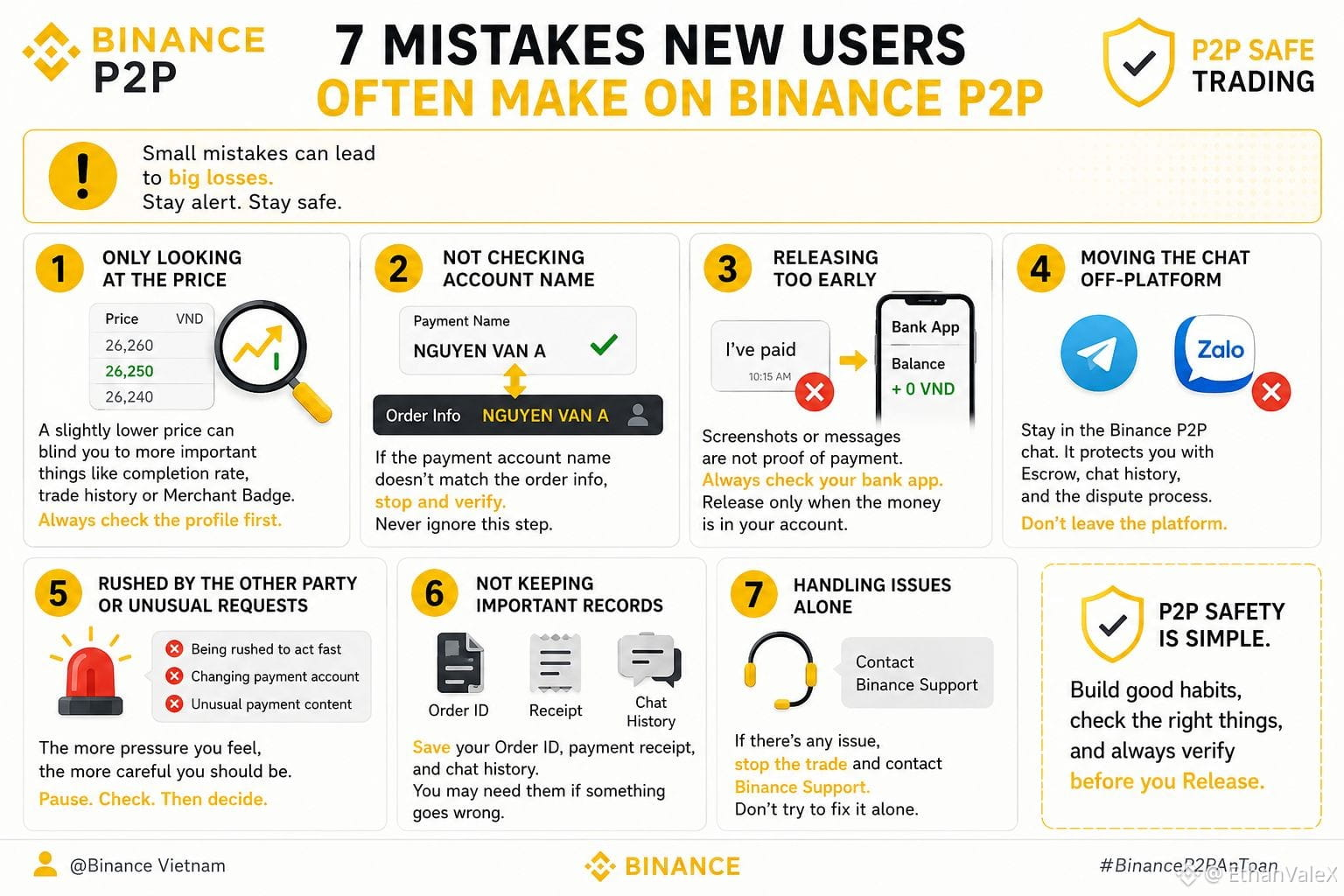
2
4
1.8k
·
--
@Binance_Vietnam #BinanceP2PAnToan
Red flags on Binance P2P aren’t always what they seem
After many transactions on Binance P2P, I realized that a red flag is rarely shown in the way people still think.
No one messages: "I’m about to scam you."
Instead, they might say: "Let’s switch to Telegram for convenience." Or: "Please unlock first for me—the money is already being processed." Or even just: "Can you switch to another account to receive the payment?"
At first glance, these requests seem completely normal. But I noticed they all have one thing in common: they push me to step out of the safe process that Binance P2P has set up.
So I follow a very simple rule. I only communicate within the Binance P2P chat window, where Escrow, chat history, and the dispute/complaint process can protect me if anything goes wrong. If the other party wants to move the conversation to another platform or change payment details mid-way, I’ll stop the transaction and verify again.
I also never click Release just because I see a screenshot or a message saying "it’s already transferred." What I trust is the actual balance in the banking app. I only complete the transaction once the money is in my account.
After that, I still keep the Order ID, receipt, and chat history. It might never be needed, but if I ever have to contact Binance Support, all the information will be ready.
Now I don’t try to guess who is good or bad. I just ask one question: Is this request causing me to move outside Binance P2P’s safe process? If the answer is "yes," I stop.
@Binance Vietnam #BinanceP2PAnToan
Red flags on Binance P2P aren’t always what they seem
After many transactions on Binance P2P, I realized that a red flag is rarely shown in the way people still think.
No one messages: "I’m about to scam you."
Instead, they might say: "Let’s switch to Telegram for convenience." Or: "Please unlock first for me—the money is already being processed." Or even just: "Can you switch to another account to receive the payment?"
At first glance, these requests seem completely normal. But I noticed they all have one thing in common: they push me to step out of the safe process that Binance P2P has set up.
So I follow a very simple rule. I only communicate within the Binance P2P chat window, where Escrow, chat history, and the dispute/complaint process can protect me if anything goes wrong. If the other party wants to move the conversation to another platform or change payment details mid-way, I’ll stop the transaction and verify again.
I also never click Release just because I see a screenshot or a message saying "it’s already transferred." What I trust is the actual balance in the banking app. I only complete the transaction once the money is in my account.
After that, I still keep the Order ID, receipt, and chat history. It might never be needed, but if I ever have to contact Binance Support, all the information will be ready.
Now I don’t try to guess who is good or bad. I just ask one question: Is this request causing me to move outside Binance P2P’s safe process? If the answer is "yes," I stop.
Red flags on Binance P2P aren’t always what they seem
After many transactions on Binance P2P, I realized that a red flag is rarely shown in the way people still think.
No one messages: "I’m about to scam you."
Instead, they might say: "Let’s switch to Telegram for convenience." Or: "Please unlock first for me—the money is already being processed." Or even just: "Can you switch to another account to receive the payment?"
At first glance, these requests seem completely normal. But I noticed they all have one thing in common: they push me to step out of the safe process that Binance P2P has set up.
So I follow a very simple rule. I only communicate within the Binance P2P chat window, where Escrow, chat history, and the dispute/complaint process can protect me if anything goes wrong. If the other party wants to move the conversation to another platform or change payment details mid-way, I’ll stop the transaction and verify again.
I also never click Release just because I see a screenshot or a message saying "it’s already transferred." What I trust is the actual balance in the banking app. I only complete the transaction once the money is in my account.
After that, I still keep the Order ID, receipt, and chat history. It might never be needed, but if I ever have to contact Binance Support, all the information will be ready.
Now I don’t try to guess who is good or bad. I just ask one question: Is this request causing me to move outside Binance P2P’s safe process? If the answer is "yes," I stop.
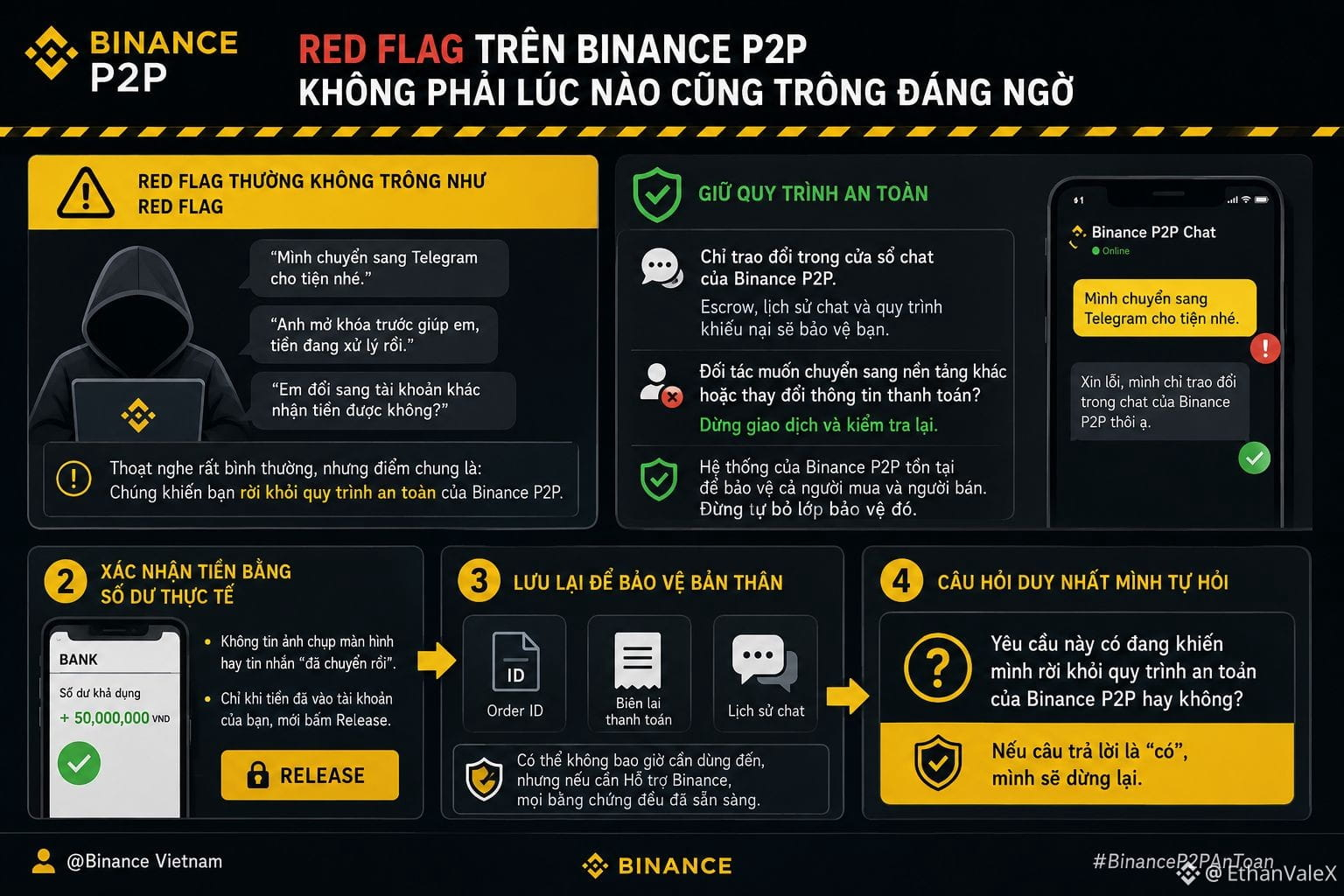
1
1
572
·
--
LONG $AKE
Entry 1
0.00422–0.00424 if price holds support and a bullish confirmation candle appears.
Entry 2
Wait for the 1H candle to close above 0.00434 (breaks above MA99), then watch for a retest to go Long.
Stop Loss
Below 0.00405.
Take Profit
TP1: 0.00450 TP2: 0.00480 TP3: 0.00520 if a strong breakout occurs.
$AKE
{future}(AKEUSDT)
LONG $AKE
Entry 1
0.00422–0.00424 if price holds support and a bullish confirmation candle appears.
Entry 2
Wait for the 1H candle to close above 0.00434 (breaks above MA99), then watch for a retest to go Long.
Stop Loss
Below 0.00405.
Take Profit
TP1: 0.00450 TP2: 0.00480 TP3: 0.00520 if a strong breakout occurs.
$AKE
Entry 1
0.00422–0.00424 if price holds support and a bullish confirmation candle appears.
Entry 2
Wait for the 1H candle to close above 0.00434 (breaks above MA99), then watch for a retest to go Long.
Stop Loss
Below 0.00405.
Take Profit
TP1: 0.00450 TP2: 0.00480 TP3: 0.00520 if a strong breakout occurs.
$AKE
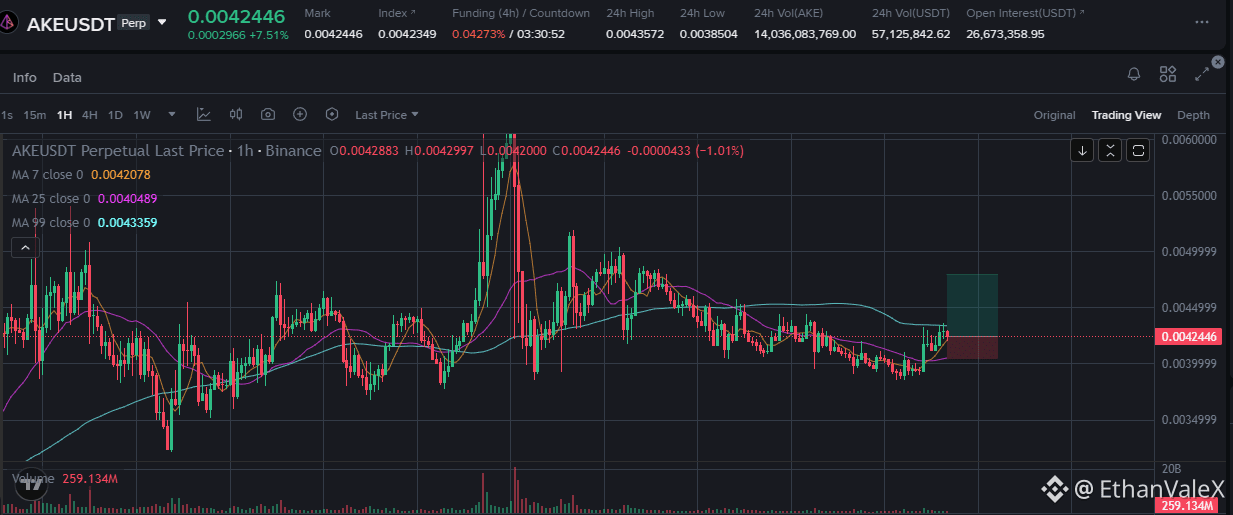
1
1.4k
Log in to explore more content
Join global crypto users on Binance Square
⚡️ Get latest and useful information about crypto.
💬 Trusted by the world’s largest crypto exchange.
👍 Discover real insights from verified creators.
Email / Phone number
Trending Topics
AIStocksWhatNext
793,961 views
6,119 Discussing
Share & Win Traffic Reward in our Trending Hashtag Campaign
✨Topic: What Other Investment Opportunities Remain as AI Stocks Keep Rising?
👉How to Join:
Publish a short post or article with hashtag #AIStocksWhatNext
Share whether you’re bullish or bearish, and post your AI stock holdings or trade — using the trade widget may improve your eligibility.
You can also strengthen your post by sharing data or charts, and avoiding AI-generated images.
✍️Create content based on the below angles:
- Nvidia says chip sales will double next year, and top AI companies keep hitting record revenue, the compute spend behind it is just as staggering. Is AI demand really taking off? And how long can it last? AI stocks are up across the board. Is this a real breakout, or just a short-term bounce?
- Industry leaders are calling to slow down AI development, while Trump plans to build an “AI Force”, claiming AI could account for 25% of U.S. GDP in the future. Whose side are you on? Will state-level backing be a long-term win for AI stocks?
- Are you buying AI stocks? Share your AI-related trade/holdings with our trade sharing widget.
⏰Campaign Period:
- 2026-09-22 7:00 - 2026-09-24 4:00 UTC
🎁Reward:
- Qualified posts that comply with the above guidelines and contain more than 100 words will be reviewed and may receive a random traffic boost of 500 to 3,000 views. You will receive a notification from your feed secretary if your post is selected.
- Get a chance to have your article featured on Binance Square Official
Need ideas for your post? Visit the topic page #AIStocksWhatNext or the Square Guide on How to Post for Better Reach.
Binance Square Official
·560 Likes
·1.6M views
BitcoinRejectedAt$87,300Twice
0 views
0 Discussing
BCHJumps28%OnCMEFuturesListing
2,861 views
302 Discussing