
Crypto眼镜
336 Posts

Crypto眼镜
 Square Verified
Report
Block User
推特账号@web3YJ,同名
Occasional Trader
2.4 Years
194 Following
16.0K+ Followers
4.7K+ Liked
Posts
All
Quotes
·
--
$1INCH Ran a trading volume of 80.90 billion USD, and somehow it still hasn't turned a profit
To be honest, the first time I saw it, I was still quite surprised
But if you think about it carefully, it actually suggests that #DeFi isn’t at a truly mature stage yet
There’s a lot of money, and the trading volume isn’t small either—but the real question is still how to turn this traffic into actual revenue
1inch is now working on Aqua. I think the core isn’t about telling some new story, but about solving a very real problem: a large amount of liquidity on-chain hasn’t been utilized properly
Dune data shows that in the first half of this year, about 85% of the concentrated liquidity across major DEXes has been in a low-utilization state
In plain terms, a lot of money is just sitting there, gathering dust
So 1inch isn’t in a hurry to make money right now—it’s instead positioning itself to secure the infrastructure
If traditional finance and more large capital really do enter DeFi later on, then whoever can get liquidity and trading efficiency working first may be the one that can take a bigger share of the cake
It doesn’t matter that the current 80.90 billion USD hasn’t made money yet—the key is whether they can turn all this traffic into real cash
{spot}(1INCHUSDT)
$1INCH Ran a trading volume of 80.90 billion USD, and somehow it still hasn't turned a profit
To be honest, the first time I saw it, I was still quite surprised
But if you think about it carefully, it actually suggests that #DeFi isn’t at a truly mature stage yet
There’s a lot of money, and the trading volume isn’t small either—but the real question is still how to turn this traffic into actual revenue
1inch is now working on Aqua. I think the core isn’t about telling some new story, but about solving a very real problem: a large amount of liquidity on-chain hasn’t been utilized properly
Dune data shows that in the first half of this year, about 85% of the concentrated liquidity across major DEXes has been in a low-utilization state
In plain terms, a lot of money is just sitting there, gathering dust
So 1inch isn’t in a hurry to make money right now—it’s instead positioning itself to secure the infrastructure
If traditional finance and more large capital really do enter DeFi later on, then whoever can get liquidity and trading efficiency working first may be the one that can take a bigger share of the cake
It doesn’t matter that the current 80.90 billion USD hasn’t made money yet—the key is whether they can turn all this traffic into real cash
To be honest, the first time I saw it, I was still quite surprised
But if you think about it carefully, it actually suggests that #DeFi isn’t at a truly mature stage yet
There’s a lot of money, and the trading volume isn’t small either—but the real question is still how to turn this traffic into actual revenue
1inch is now working on Aqua. I think the core isn’t about telling some new story, but about solving a very real problem: a large amount of liquidity on-chain hasn’t been utilized properly
Dune data shows that in the first half of this year, about 85% of the concentrated liquidity across major DEXes has been in a low-utilization state
In plain terms, a lot of money is just sitting there, gathering dust
So 1inch isn’t in a hurry to make money right now—it’s instead positioning itself to secure the infrastructure
If traditional finance and more large capital really do enter DeFi later on, then whoever can get liquidity and trading efficiency working first may be the one that can take a bigger share of the cake
It doesn’t matter that the current 80.90 billion USD hasn’t made money yet—the key is whether they can turn all this traffic into real cash
173
·
--
September 10 Morning News
1. BTC / ETH
BTC is still trading in a range around $80,000, with the market overall staying cautious. ETH, by contrast, is relatively stronger: over the prior 10 days it surged by about 37% to $2,564, and has now entered a consolidation phase. If the technical picture holds above $2,350–$2,360, there is still room to keep testing the $3,000 area.
BTC doesn’t lack a story right now—it lacks a clear direction from the macro environment. ETH is starting to move more on its own; if BTC doesn’t break down further, ETH’s strength is worth continuing to watch.
2. Macro: The biggest risk today is inflation
The U.S. August CPI will be one of the most important data releases this week.
Markets have already become noticeably more hawkish about the Federal Reserve’s September 15–16 meeting. Some pricing even starts to consider future rate hikes, instead of simply expecting rate cuts. A Reuters survey shows most economists still expect the Fed to keep rates unchanged in September, but concerns about subsequent rate hikes are rising.
More troubling, oil prices have climbed back above $100—Brent was around $101 at one point. The logic chain of oil up → inflation pressure up → the Fed finding it harder to cut rates is not very friendly for both BTC and U.S. stocks.
3. U.S. Stocks / AI
U.S. stocks continued to face pressure overnight:
S&P 500: -0.48%
Nasdaq: -0.64%
Dow Jones: -0.77%
The core pressure factors are: oil prices + U.S. Treasury yields + inflation expectations.
The AI space, however, shows signs of divergence. AMD surged: management expects the AI-enabled serviceable market could reach as high as $2 trillion by 2030. Nvidia announced partnerships with Australia’s cloud computing and data center companies, aiming to push maximum AI compute capacity up to 2GW.
So the AI theme hasn’t fizzled out for now; instead of just “trading GPUs,” it is gradually expanding into compute, storage, data centers, power, and network infrastructure.
4. Web3 / Opportunities
Today, the exchange activity is particularly worth noting. OKX’s DOS Flash Earn starts today. From September 10–15, assets such as BTC, OKB, or DOS can be used to participate, with a rewards pool of 650,000 DOS.
Also, on market data, BNB and DOGE are clearly weaker than BTC/ETH. This suggests that capital has not broadly rotated back into altcoins; it is more tilted toward mainstream assets.
5. The key variables to watch today
BTC: Can it hold steady around $80k?
ETH: Can $2,350–$2,360 hold?
CPI: Determines expectations for the next phase of rate cuts/hikes
U.S. Treasury 10Y: Whether high yields will continue to pressure risk assets
September 10 Morning News
1. BTC / ETH
BTC is still trading in a range around $80,000, with the market overall staying cautious. ETH, by contrast, is relatively stronger: over the prior 10 days it surged by about 37% to $2,564, and has now entered a consolidation phase. If the technical picture holds above $2,350–$2,360, there is still room to keep testing the $3,000 area.
BTC doesn’t lack a story right now—it lacks a clear direction from the macro environment. ETH is starting to move more on its own; if BTC doesn’t break down further, ETH’s strength is worth continuing to watch.
2. Macro: The biggest risk today is inflation
The U.S. August CPI will be one of the most important data releases this week.
Markets have already become noticeably more hawkish about the Federal Reserve’s September 15–16 meeting. Some pricing even starts to consider future rate hikes, instead of simply expecting rate cuts. A Reuters survey shows most economists still expect the Fed to keep rates unchanged in September, but concerns about subsequent rate hikes are rising.
More troubling, oil prices have climbed back above $100—Brent was around $101 at one point. The logic chain of oil up → inflation pressure up → the Fed finding it harder to cut rates is not very friendly for both BTC and U.S. stocks.
3. U.S. Stocks / AI
U.S. stocks continued to face pressure overnight:
S&P 500: -0.48%
Nasdaq: -0.64%
Dow Jones: -0.77%
The core pressure factors are: oil prices + U.S. Treasury yields + inflation expectations.
The AI space, however, shows signs of divergence. AMD surged: management expects the AI-enabled serviceable market could reach as high as $2 trillion by 2030. Nvidia announced partnerships with Australia’s cloud computing and data center companies, aiming to push maximum AI compute capacity up to 2GW.
So the AI theme hasn’t fizzled out for now; instead of just “trading GPUs,” it is gradually expanding into compute, storage, data centers, power, and network infrastructure.
4. Web3 / Opportunities
Today, the exchange activity is particularly worth noting. OKX’s DOS Flash Earn starts today. From September 10–15, assets such as BTC, OKB, or DOS can be used to participate, with a rewards pool of 650,000 DOS.
Also, on market data, BNB and DOGE are clearly weaker than BTC/ETH. This suggests that capital has not broadly rotated back into altcoins; it is more tilted toward mainstream assets.
5. The key variables to watch today
BTC: Can it hold steady around $80k?
ETH: Can $2,350–$2,360 hold?
CPI: Determines expectations for the next phase of rate cuts/hikes
U.S. Treasury 10Y: Whether high yields will continue to pressure risk assets
1. BTC / ETH
BTC is still trading in a range around $80,000, with the market overall staying cautious. ETH, by contrast, is relatively stronger: over the prior 10 days it surged by about 37% to $2,564, and has now entered a consolidation phase. If the technical picture holds above $2,350–$2,360, there is still room to keep testing the $3,000 area.
BTC doesn’t lack a story right now—it lacks a clear direction from the macro environment. ETH is starting to move more on its own; if BTC doesn’t break down further, ETH’s strength is worth continuing to watch.
2. Macro: The biggest risk today is inflation
The U.S. August CPI will be one of the most important data releases this week.
Markets have already become noticeably more hawkish about the Federal Reserve’s September 15–16 meeting. Some pricing even starts to consider future rate hikes, instead of simply expecting rate cuts. A Reuters survey shows most economists still expect the Fed to keep rates unchanged in September, but concerns about subsequent rate hikes are rising.
More troubling, oil prices have climbed back above $100—Brent was around $101 at one point. The logic chain of oil up → inflation pressure up → the Fed finding it harder to cut rates is not very friendly for both BTC and U.S. stocks.
3. U.S. Stocks / AI
U.S. stocks continued to face pressure overnight:
S&P 500: -0.48%
Nasdaq: -0.64%
Dow Jones: -0.77%
The core pressure factors are: oil prices + U.S. Treasury yields + inflation expectations.
The AI space, however, shows signs of divergence. AMD surged: management expects the AI-enabled serviceable market could reach as high as $2 trillion by 2030. Nvidia announced partnerships with Australia’s cloud computing and data center companies, aiming to push maximum AI compute capacity up to 2GW.
So the AI theme hasn’t fizzled out for now; instead of just “trading GPUs,” it is gradually expanding into compute, storage, data centers, power, and network infrastructure.
4. Web3 / Opportunities
Today, the exchange activity is particularly worth noting. OKX’s DOS Flash Earn starts today. From September 10–15, assets such as BTC, OKB, or DOS can be used to participate, with a rewards pool of 650,000 DOS.
Also, on market data, BNB and DOGE are clearly weaker than BTC/ETH. This suggests that capital has not broadly rotated back into altcoins; it is more tilted toward mainstream assets.
5. The key variables to watch today
BTC: Can it hold steady around $80k?
ETH: Can $2,350–$2,360 hold?
CPI: Determines expectations for the next phase of rate cuts/hikes
U.S. Treasury 10Y: Whether high yields will continue to pressure risk assets
71
·
--
September 9 Morning Market Briefing
BTC falls back below $80,000; US stocks pull back; oil prices inch toward $100. The short-term market has returned to a phase of “watching the macro mood,” with risk appetite remaining weak.
1)BTC breaks below $80,000
Key facts: BTC briefly traded below $80,000, and risk assets moved lower in tandem. Strong employment data, more hawkish interest-rate expectations, and rising oil prices weighed on market liquidity expectations.
Market impact: BTC may remain choppy in the short term; volatility in ETH and altcoins could be even higher.
Retail perspective: $80,000 isn’t a mindless dip-buy level—first, see whether price can regain and hold above it.
2)Oil prices approach $100
Key facts: Brent crude is near $99 per barrel, and US Treasury yields remain elevated. The market worries that oil prices will push inflation higher again, keeping high interest rates around longer.
Market impact: A headwind for high-valuation assets such as tech stocks and crypto.
Retail perspective: While you’re watching BTC lately, keep an eye on oil too. If oil keeps rising, it will be hard for risk assets to move comfortably higher.
3)US stocks pull back; AI enters the elimination round
Key facts: Major US stock indexes pulled back. Some software stocks fell as investors feared AI would disrupt traditional business models. The market is beginning to separate companies that truly make money from AI from those that only have “AI stories.”
Market impact: Chips and compute power may continue to outperform traditional software, but dispersion within tech stocks could increase.
Retail perspective: AI isn’t over—but the era of blindly buying tech stocks with your eyes closed has passed.
4)Qualcomm partners with Amazon on AI chips
Key facts: Qualcomm and Amazon are collaborating to develop custom AI data-center chips, as cloud providers reduce reliance on a single GPU supplier.
Market impact: AI opportunities keep expanding into custom chips, servers, optical modules, and data centers.
Retail perspective: Don’t focus only on the leaders. It’s often more worth watching the industry-chain companies that actually secure orders.
5)Harmony migration; Web3 opportunities come with risks
Key facts: Harmony plans to migrate ONE to Ethereum. Some assets and applications cannot be moved directly, so users need to pay attention to snapshots and exit rules.
Market impact: There could be short-term trading opportunities, but migration rules and liquidity risks shouldn’t be ignored.
Retail perspective: If you see an airdrop or migration announcement, don’t rush to authorize your wallet—confirm the official rules first.
What to watch closely today:
- Can BTC reclaim $80,000?
- Will oil break above $100?
- Will US Treasury yields keep trending higher?
- Can AI chips keep outperforming software stocks?
- Will the BTC ETF see new institutional capital inflows?
September 9 Morning Market Briefing
BTC falls back below $80,000; US stocks pull back; oil prices inch toward $100. The short-term market has returned to a phase of “watching the macro mood,” with risk appetite remaining weak.
1)BTC breaks below $80,000
Key facts: BTC briefly traded below $80,000, and risk assets moved lower in tandem. Strong employment data, more hawkish interest-rate expectations, and rising oil prices weighed on market liquidity expectations.
Market impact: BTC may remain choppy in the short term; volatility in ETH and altcoins could be even higher.
Retail perspective: $80,000 isn’t a mindless dip-buy level—first, see whether price can regain and hold above it.
2)Oil prices approach $100
Key facts: Brent crude is near $99 per barrel, and US Treasury yields remain elevated. The market worries that oil prices will push inflation higher again, keeping high interest rates around longer.
Market impact: A headwind for high-valuation assets such as tech stocks and crypto.
Retail perspective: While you’re watching BTC lately, keep an eye on oil too. If oil keeps rising, it will be hard for risk assets to move comfortably higher.
3)US stocks pull back; AI enters the elimination round
Key facts: Major US stock indexes pulled back. Some software stocks fell as investors feared AI would disrupt traditional business models. The market is beginning to separate companies that truly make money from AI from those that only have “AI stories.”
Market impact: Chips and compute power may continue to outperform traditional software, but dispersion within tech stocks could increase.
Retail perspective: AI isn’t over—but the era of blindly buying tech stocks with your eyes closed has passed.
4)Qualcomm partners with Amazon on AI chips
Key facts: Qualcomm and Amazon are collaborating to develop custom AI data-center chips, as cloud providers reduce reliance on a single GPU supplier.
Market impact: AI opportunities keep expanding into custom chips, servers, optical modules, and data centers.
Retail perspective: Don’t focus only on the leaders. It’s often more worth watching the industry-chain companies that actually secure orders.
5)Harmony migration; Web3 opportunities come with risks
Key facts: Harmony plans to migrate ONE to Ethereum. Some assets and applications cannot be moved directly, so users need to pay attention to snapshots and exit rules.
Market impact: There could be short-term trading opportunities, but migration rules and liquidity risks shouldn’t be ignored.
Retail perspective: If you see an airdrop or migration announcement, don’t rush to authorize your wallet—confirm the official rules first.
What to watch closely today:
- Can BTC reclaim $80,000?
- Will oil break above $100?
- Will US Treasury yields keep trending higher?
- Can AI chips keep outperforming software stocks?
- Will the BTC ETF see new institutional capital inflows?
BTC falls back below $80,000; US stocks pull back; oil prices inch toward $100. The short-term market has returned to a phase of “watching the macro mood,” with risk appetite remaining weak.
1)BTC breaks below $80,000
Key facts: BTC briefly traded below $80,000, and risk assets moved lower in tandem. Strong employment data, more hawkish interest-rate expectations, and rising oil prices weighed on market liquidity expectations.
Market impact: BTC may remain choppy in the short term; volatility in ETH and altcoins could be even higher.
Retail perspective: $80,000 isn’t a mindless dip-buy level—first, see whether price can regain and hold above it.
2)Oil prices approach $100
Key facts: Brent crude is near $99 per barrel, and US Treasury yields remain elevated. The market worries that oil prices will push inflation higher again, keeping high interest rates around longer.
Market impact: A headwind for high-valuation assets such as tech stocks and crypto.
Retail perspective: While you’re watching BTC lately, keep an eye on oil too. If oil keeps rising, it will be hard for risk assets to move comfortably higher.
3)US stocks pull back; AI enters the elimination round
Key facts: Major US stock indexes pulled back. Some software stocks fell as investors feared AI would disrupt traditional business models. The market is beginning to separate companies that truly make money from AI from those that only have “AI stories.”
Market impact: Chips and compute power may continue to outperform traditional software, but dispersion within tech stocks could increase.
Retail perspective: AI isn’t over—but the era of blindly buying tech stocks with your eyes closed has passed.
4)Qualcomm partners with Amazon on AI chips
Key facts: Qualcomm and Amazon are collaborating to develop custom AI data-center chips, as cloud providers reduce reliance on a single GPU supplier.
Market impact: AI opportunities keep expanding into custom chips, servers, optical modules, and data centers.
Retail perspective: Don’t focus only on the leaders. It’s often more worth watching the industry-chain companies that actually secure orders.
5)Harmony migration; Web3 opportunities come with risks
Key facts: Harmony plans to migrate ONE to Ethereum. Some assets and applications cannot be moved directly, so users need to pay attention to snapshots and exit rules.
Market impact: There could be short-term trading opportunities, but migration rules and liquidity risks shouldn’t be ignored.
Retail perspective: If you see an airdrop or migration announcement, don’t rush to authorize your wallet—confirm the official rules first.
What to watch closely today:
- Can BTC reclaim $80,000?
- Will oil break above $100?
- Will US Treasury yields keep trending higher?
- Can AI chips keep outperforming software stocks?
- Will the BTC ETF see new institutional capital inflows?
1
265
·
--
Tonight’s US stock market move is a bit interesting—money is once again surging hard into the optical communications direction.
LITE and COHR both jumped more than 11%, AAOI rose nearly 10%, and GLW and LYTE also saw strong rallies. Even MRVL and NOK moved up along with them.
In plain terms, on the AI theme, the market is no longer only focused on compute chips.
After GPUs are bought, how data centers connect with each other and how compute capacity is transmitted—optical modules and optical communications naturally become key targets for funds as well.
During the recent adjustment in the AI supply chain, optical communications didn’t escape the sell-off either. Now it’s suddenly rebounding collectively, which makes it feel like the market is starting to trade the AI infrastructure theme again.
Going forward, it may be worth watching closely to see whether this is merely a rebound from oversold conditions—or whether capital is preparing to return to the main AI optical communications storyline.
LITE and COHR led the charge directly today. The “feel” is definitely a bit different.
Tonight’s US stock market move is a bit interesting—money is once again surging hard into the optical communications direction.
LITE and COHR both jumped more than 11%, AAOI rose nearly 10%, and GLW and LYTE also saw strong rallies. Even MRVL and NOK moved up along with them.
In plain terms, on the AI theme, the market is no longer only focused on compute chips.
After GPUs are bought, how data centers connect with each other and how compute capacity is transmitted—optical modules and optical communications naturally become key targets for funds as well.
During the recent adjustment in the AI supply chain, optical communications didn’t escape the sell-off either. Now it’s suddenly rebounding collectively, which makes it feel like the market is starting to trade the AI infrastructure theme again.
Going forward, it may be worth watching closely to see whether this is merely a rebound from oversold conditions—or whether capital is preparing to return to the main AI optical communications storyline.
LITE and COHR led the charge directly today. The “feel” is definitely a bit different.
LITE and COHR both jumped more than 11%, AAOI rose nearly 10%, and GLW and LYTE also saw strong rallies. Even MRVL and NOK moved up along with them.
In plain terms, on the AI theme, the market is no longer only focused on compute chips.
After GPUs are bought, how data centers connect with each other and how compute capacity is transmitted—optical modules and optical communications naturally become key targets for funds as well.
During the recent adjustment in the AI supply chain, optical communications didn’t escape the sell-off either. Now it’s suddenly rebounding collectively, which makes it feel like the market is starting to trade the AI infrastructure theme again.
Going forward, it may be worth watching closely to see whether this is merely a rebound from oversold conditions—or whether capital is preparing to return to the main AI optical communications storyline.
LITE and COHR led the charge directly today. The “feel” is definitely a bit different.
242
·
--
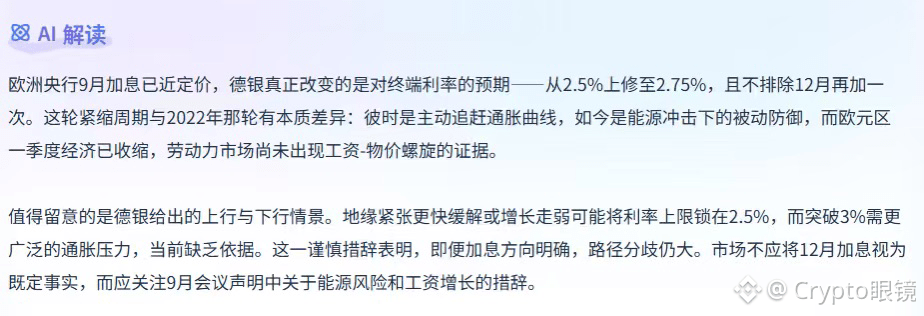
Every time the crypto market starts to believe again that rate cuts are coming and liquidity is on the way back, macro conditions come along and pour cold water on it.
The European Central Bank will most likely need to hike again in September, and Deutsche Bank even thinks there could be another one in December.
The market had been trading one main narrative all along:
The Fed will eventually pivot -> rate cuts -> more money -> risk assets keep rising.
But now Europe is basically telling you that energy and geopolitical risks may push inflation back up again.
If Europe keeps hiking and the Fed doesn’t turn dovish anytime soon, then for the big coin ( $BTC ), this rally may not be so smooth if it wants to keep going straight up.
The big coin’s price action already feels a bit like that.
It wants to rise, but there are sellers above. It wants to fall, but there are buyers below.
Everyone is waiting for a clearer direction.
To put it simply, the biggest disagreement in the market right now may not be about the big coin itself, but rather:
When will global money actually start to loosen up for real?
The big coin will keep wrestling with macro for now.
#Fed
Every time the crypto market starts to believe again that rate cuts are coming and liquidity is on the way back, macro conditions come along and pour cold water on it.
The European Central Bank will most likely need to hike again in September, and Deutsche Bank even thinks there could be another one in December.
The market had been trading one main narrative all along:
The Fed will eventually pivot -> rate cuts -> more money -> risk assets keep rising.
But now Europe is basically telling you that energy and geopolitical risks may push inflation back up again.
If Europe keeps hiking and the Fed doesn’t turn dovish anytime soon, then for the big coin ( $BTC ), this rally may not be so smooth if it wants to keep going straight up.
The big coin’s price action already feels a bit like that.
It wants to rise, but there are sellers above. It wants to fall, but there are buyers below.
Everyone is waiting for a clearer direction.
To put it simply, the biggest disagreement in the market right now may not be about the big coin itself, but rather:
When will global money actually start to loosen up for real?
The big coin will keep wrestling with macro for now.
#Fed
The European Central Bank will most likely need to hike again in September, and Deutsche Bank even thinks there could be another one in December.
The market had been trading one main narrative all along:
The Fed will eventually pivot -> rate cuts -> more money -> risk assets keep rising.
But now Europe is basically telling you that energy and geopolitical risks may push inflation back up again.
If Europe keeps hiking and the Fed doesn’t turn dovish anytime soon, then for the big coin ( $BTC ), this rally may not be so smooth if it wants to keep going straight up.
The big coin’s price action already feels a bit like that.
It wants to rise, but there are sellers above. It wants to fall, but there are buyers below.
Everyone is waiting for a clearer direction.
To put it simply, the biggest disagreement in the market right now may not be about the big coin itself, but rather:
When will global money actually start to loosen up for real?
The big coin will keep wrestling with macro for now.
#Fed
1
1.2k
·
--
If you made 70 million from cryptocurrency trading
who would you tell first?
Let's see how old your mental age is
1. Parents
2. Brothers and sisters
3. Tell no one
4. Lover
5. Lover
6. Relatives and friends
7. Post it on the square to show off
If you made 70 million from cryptocurrency trading
who would you tell first?
Let's see how old your mental age is
1. Parents
2. Brothers and sisters
3. Tell no one
4. Lover
5. Lover
6. Relatives and friends
7. Post it on the square to show off
who would you tell first?
Let's see how old your mental age is
1. Parents
2. Brothers and sisters
3. Tell no one
4. Lover
5. Lover
6. Relatives and friends
7. Post it on the square to show off
1
1
2
647
·
--
Verified
Next week’s market—data will be back in charge again.
Just ended at Jackson Hole, Powell’s stance was clearly more hawkish. Market expectations for a September rate hike have climbed from a little over 30% to nearly 60%. The dollar and U.S. Treasury yields moved first, while gold, the Nasdaq index, and BTC came under pressure instead. This signal is actually already very clear.
Now what’s really worth watching isn’t whether there will be a rate hike in September, but whether next Friday’s nonfarm payrolls can validate that expectation.
Currently, the market expects August nonfarm payrolls to rise by about 580,000 jobs, with the unemployment rate at 4.1%. On its own, this figure isn’t especially strong. If employment continues to weaken, the market may once again bet on “no rate hike.” But if both the nonfarm payrolls and wage data come in firmer than expected, then the odds of a September rate hike may keep moving higher.
Moreover, this nonfarm report is somewhat special: it’s the final nonfarm release before the September FOMC meeting—essentially the Fed’s last card.
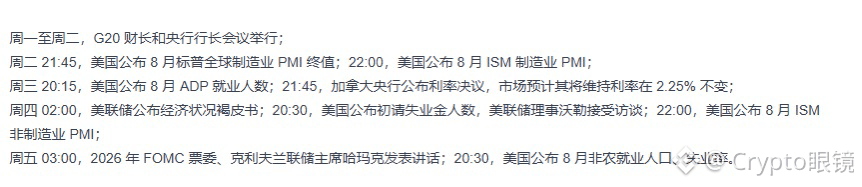
Besides the nonfarm data, next week also includes ISM manufacturing, ADP, initial jobless claims, ISM services, the Beige Book, and the G20 meetings between finance ministers and central bank governors. The macro information density is extremely high.
Another thread is AI.
Dell and Broadcom will release earnings after the close on Tuesday and Wednesday, respectively—especially Broadcom, where the market expects revenue to be close to $29.4 billion. The AI trade has already shifted from “telling stories” to validating real demand. Whether servers, custom chips, and AI networking equipment can continue to grow rapidly—these two earnings reports will provide some answers.
From the perspective of the crypto market, though, I actually think next week calls for extra caution.
If nonfarm payrolls come in weak → rate-hike expectations fall → liquidity expectations improve → BTC and risk assets could see a rebound.
If nonfarm payrolls beat expectations → the probability of a September hike keeps rising → Treasury yields and the dollar strengthen → BTC’s near-term pressure could be amplified further.
So over the next few days, don’t just stare at the K-line.
What may truly decide the direction of the September market could be that single set of numbers at 20:30 next Friday.
Next week’s macro headline in one line:
Jobs determine the Fed, AI determines risk appetite, and liquidity determines $BTC
#美联储何时降息?
Next week’s market—data will be back in charge again.
Just ended at Jackson Hole, Powell’s stance was clearly more hawkish. Market expectations for a September rate hike have climbed from a little over 30% to nearly 60%. The dollar and U.S. Treasury yields moved first, while gold, the Nasdaq index, and BTC came under pressure instead. This signal is actually already very clear.
Now what’s really worth watching isn’t whether there will be a rate hike in September, but whether next Friday’s nonfarm payrolls can validate that expectation.
Currently, the market expects August nonfarm payrolls to rise by about 580,000 jobs, with the unemployment rate at 4.1%. On its own, this figure isn’t especially strong. If employment continues to weaken, the market may once again bet on “no rate hike.” But if both the nonfarm payrolls and wage data come in firmer than expected, then the odds of a September rate hike may keep moving higher.
Moreover, this nonfarm report is somewhat special: it’s the final nonfarm release before the September FOMC meeting—essentially the Fed’s last card.
Besides the nonfarm data, next week also includes ISM manufacturing, ADP, initial jobless claims, ISM services, the Beige Book, and the G20 meetings between finance ministers and central bank governors. The macro information density is extremely high.
Another thread is AI.
Dell and Broadcom will release earnings after the close on Tuesday and Wednesday, respectively—especially Broadcom, where the market expects revenue to be close to $29.4 billion. The AI trade has already shifted from “telling stories” to validating real demand. Whether servers, custom chips, and AI networking equipment can continue to grow rapidly—these two earnings reports will provide some answers.
From the perspective of the crypto market, though, I actually think next week calls for extra caution.
If nonfarm payrolls come in weak → rate-hike expectations fall → liquidity expectations improve → BTC and risk assets could see a rebound.
If nonfarm payrolls beat expectations → the probability of a September hike keeps rising → Treasury yields and the dollar strengthen → BTC’s near-term pressure could be amplified further.
So over the next few days, don’t just stare at the K-line.
What may truly decide the direction of the September market could be that single set of numbers at 20:30 next Friday.
Next week’s macro headline in one line:
Jobs determine the Fed, AI determines risk appetite, and liquidity determines $BTC
#美联储何时降息?
Just ended at Jackson Hole, Powell’s stance was clearly more hawkish. Market expectations for a September rate hike have climbed from a little over 30% to nearly 60%. The dollar and U.S. Treasury yields moved first, while gold, the Nasdaq index, and BTC came under pressure instead. This signal is actually already very clear.
Now what’s really worth watching isn’t whether there will be a rate hike in September, but whether next Friday’s nonfarm payrolls can validate that expectation.
Currently, the market expects August nonfarm payrolls to rise by about 580,000 jobs, with the unemployment rate at 4.1%. On its own, this figure isn’t especially strong. If employment continues to weaken, the market may once again bet on “no rate hike.” But if both the nonfarm payrolls and wage data come in firmer than expected, then the odds of a September rate hike may keep moving higher.
Moreover, this nonfarm report is somewhat special: it’s the final nonfarm release before the September FOMC meeting—essentially the Fed’s last card.
Besides the nonfarm data, next week also includes ISM manufacturing, ADP, initial jobless claims, ISM services, the Beige Book, and the G20 meetings between finance ministers and central bank governors. The macro information density is extremely high.
Another thread is AI.
Dell and Broadcom will release earnings after the close on Tuesday and Wednesday, respectively—especially Broadcom, where the market expects revenue to be close to $29.4 billion. The AI trade has already shifted from “telling stories” to validating real demand. Whether servers, custom chips, and AI networking equipment can continue to grow rapidly—these two earnings reports will provide some answers.
From the perspective of the crypto market, though, I actually think next week calls for extra caution.
If nonfarm payrolls come in weak → rate-hike expectations fall → liquidity expectations improve → BTC and risk assets could see a rebound.
If nonfarm payrolls beat expectations → the probability of a September hike keeps rising → Treasury yields and the dollar strengthen → BTC’s near-term pressure could be amplified further.
So over the next few days, don’t just stare at the K-line.
What may truly decide the direction of the September market could be that single set of numbers at 20:30 next Friday.
Next week’s macro headline in one line:
Jobs determine the Fed, AI determines risk appetite, and liquidity determines $BTC
#美联储何时降息?
5
1.4k
·
--
Verified
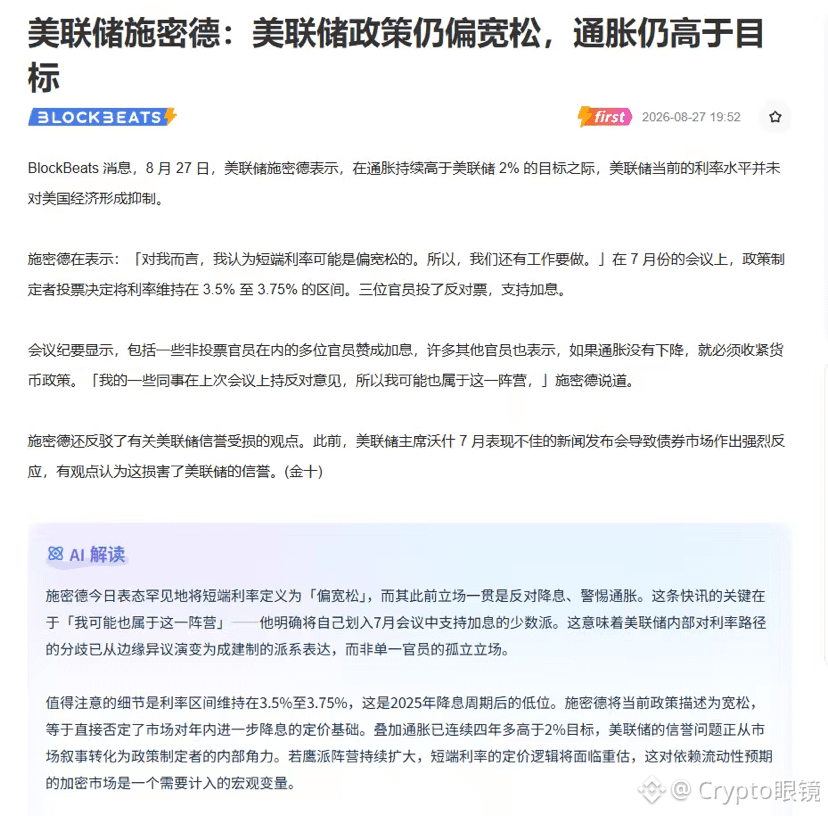
This Federal Reserve message is still worth taking seriously.
Schmidt’s point is actually very simple:
Rates may still not be high enough, and inflation hasn’t yet fallen to the 2% target—so don’t rush into thinking about rate cuts. They may even continue to tighten.
This is clearly different from what the market was expecting in terms of a September rate cut not long ago. And the July PCE data served as another reminder: inflation year-over-year is 3.7%, still well above the Fed’s 2% goal.
For retail investors, you don’t really need to dig too deep. The logic is one simple line:
The stronger the rate-cut expectations → the better the market liquidity outlook → risk assets like BTC and the stock market are more likely to rise.
Conversely:
If inflation won’t come down → rate-cut expectations cool → U.S. Treasury yields and the U.S. dollar strengthen → risk assets face more pressure.
So don’t get too excited just because $BTC has been up or down in the short term.
What really matters is whether the Fed has started—at some point—shifting back to the question of whether rate cuts are still necessary.
If that expectation truly changes, the market impact could be even bigger than a single surprise data release.
The mistake we’re most prone to make is this: when the market falls, we start to get scared; when the market rises, we start to fall into #FOMO.
In this kind of macro environment, what’s more important is not to deploy all your position size. Keep some ammunition. If the trend keeps rising, there may still be opportunities to chase.
But if rate-cut expectations continue to be undermined, at least you’ll still have chips in hand to respond.
Never treat rate cuts as something that’s guaranteed to happen.
#BTC #美联储 #宏观
This Federal Reserve message is still worth taking seriously.
Schmidt’s point is actually very simple:
Rates may still not be high enough, and inflation hasn’t yet fallen to the 2% target—so don’t rush into thinking about rate cuts. They may even continue to tighten.
This is clearly different from what the market was expecting in terms of a September rate cut not long ago. And the July PCE data served as another reminder: inflation year-over-year is 3.7%, still well above the Fed’s 2% goal.
For retail investors, you don’t really need to dig too deep. The logic is one simple line:
The stronger the rate-cut expectations → the better the market liquidity outlook → risk assets like BTC and the stock market are more likely to rise.
Conversely:
If inflation won’t come down → rate-cut expectations cool → U.S. Treasury yields and the U.S. dollar strengthen → risk assets face more pressure.
So don’t get too excited just because $BTC has been up or down in the short term.
What really matters is whether the Fed has started—at some point—shifting back to the question of whether rate cuts are still necessary.
If that expectation truly changes, the market impact could be even bigger than a single surprise data release.
The mistake we’re most prone to make is this: when the market falls, we start to get scared; when the market rises, we start to fall into #FOMO.
In this kind of macro environment, what’s more important is not to deploy all your position size. Keep some ammunition. If the trend keeps rising, there may still be opportunities to chase.
But if rate-cut expectations continue to be undermined, at least you’ll still have chips in hand to respond.
Never treat rate cuts as something that’s guaranteed to happen.
#BTC #美联储 #宏观
Schmidt’s point is actually very simple:
Rates may still not be high enough, and inflation hasn’t yet fallen to the 2% target—so don’t rush into thinking about rate cuts. They may even continue to tighten.
This is clearly different from what the market was expecting in terms of a September rate cut not long ago. And the July PCE data served as another reminder: inflation year-over-year is 3.7%, still well above the Fed’s 2% goal.
For retail investors, you don’t really need to dig too deep. The logic is one simple line:
The stronger the rate-cut expectations → the better the market liquidity outlook → risk assets like BTC and the stock market are more likely to rise.
Conversely:
If inflation won’t come down → rate-cut expectations cool → U.S. Treasury yields and the U.S. dollar strengthen → risk assets face more pressure.
So don’t get too excited just because $BTC has been up or down in the short term.
What really matters is whether the Fed has started—at some point—shifting back to the question of whether rate cuts are still necessary.
If that expectation truly changes, the market impact could be even bigger than a single surprise data release.
The mistake we’re most prone to make is this: when the market falls, we start to get scared; when the market rises, we start to fall into #FOMO.
In this kind of macro environment, what’s more important is not to deploy all your position size. Keep some ammunition. If the trend keeps rising, there may still be opportunities to chase.
But if rate-cut expectations continue to be undermined, at least you’ll still have chips in hand to respond.
Never treat rate cuts as something that’s guaranteed to happen.
#BTC #美联储 #宏观
2
1
16
13.4k
·
--
I originally thought that this year’s 9th anniversary event would once again require messing around with invite tasks, but today the official account directly added replacement tasks.
You don’t need to invite new users, and you can still finish the entire event—this is definitely a plus.
I also went ahead and completed the remaining two tasks.
100U $TRX spot, reward: 6 TRX.
On predict.fun, complete a 50U trade and you’ll be entered to win a 3U fee refund.
Now you can directly draw for the ultimate prize. As for whether you’ll win or not, it’s a matter of luck—just join in and enjoy the anniversary celebration atmosphere.
#BinanceTurns9
I originally thought that this year’s 9th anniversary event would once again require messing around with invite tasks, but today the official account directly added replacement tasks.
You don’t need to invite new users, and you can still finish the entire event—this is definitely a plus.
I also went ahead and completed the remaining two tasks.
100U $TRX spot, reward: 6 TRX.
On predict.fun, complete a 50U trade and you’ll be entered to win a 3U fee refund.
Now you can directly draw for the ultimate prize. As for whether you’ll win or not, it’s a matter of luck—just join in and enjoy the anniversary celebration atmosphere.
#BinanceTurns9
You don’t need to invite new users, and you can still finish the entire event—this is definitely a plus.
I also went ahead and completed the remaining two tasks.
100U $TRX spot, reward: 6 TRX.
On predict.fun, complete a 50U trade and you’ll be entered to win a 3U fee refund.
Now you can directly draw for the ultimate prize. As for whether you’ll win or not, it’s a matter of luck—just join in and enjoy the anniversary celebration atmosphere.
#BinanceTurns9

1
299

·
--
🟥
🟥
🟥Done
🟥
🟥
🟥
🟥
🟥Done 🟩The cow is here🥳
🟥 🟩
🟥
🟥
🟥
🟥Done
🟥
🟥
🟥
🟥
🟥Done 🟩The cow is here🥳
🟥 🟩
🟥
🟥
🟥Done
🟥
🟥
🟥
🟥
🟥Done 🟩The cow is here🥳
🟥 🟩
🟥

1
1
600
·
--
I'm ready to go short on BTC again after the recent price action.
On the surface, it looks like the price pulled back from around 63.2k to 64.2k, but if you dive into the derivatives data, you'll see that the funding sentiment isn't as optimistic as the price suggests.
The options Delta skew has clearly shifted towards bearish, with more and more funds positioning for downside protection; meanwhile, the open interest in perpetual contracts has dropped by nearly $5.9 million, indicating that some leveraged funds are exiting instead of adding to their positions in hopes of a rebound.
Both ATM and forward implied volatility are on the rise.
This suggests that the market generally anticipates significant volatility ahead, but considering the current bearish options structure, I think the downside risk might outweigh the upside potential.
Recently, BTC dropped from 64.3k to 63.2k and then quickly bounced back, which looks like a strong showing from the bulls, but it could just be a dead cat bounce in a choppy market.
At least for now, I haven't seen any particularly strong signals for new capital entering the market.
Prices are rising while funds are on the defensive. Volatility is increasing, yet the market is becoming more cautious.
This combination makes it hard for me to feel optimistic.
Of course, the market is always right, and I could be missing something.
But at this stage, if I have to pick a side, I would lean slightly bearish and wait to see if BTC can truly hold above 64k before making any moves. Time will tell, and it's important to befriend time.
I'm ready to go short on BTC again after the recent price action.
On the surface, it looks like the price pulled back from around 63.2k to 64.2k, but if you dive into the derivatives data, you'll see that the funding sentiment isn't as optimistic as the price suggests.
The options Delta skew has clearly shifted towards bearish, with more and more funds positioning for downside protection; meanwhile, the open interest in perpetual contracts has dropped by nearly $5.9 million, indicating that some leveraged funds are exiting instead of adding to their positions in hopes of a rebound.
Both ATM and forward implied volatility are on the rise.
This suggests that the market generally anticipates significant volatility ahead, but considering the current bearish options structure, I think the downside risk might outweigh the upside potential.
Recently, BTC dropped from 64.3k to 63.2k and then quickly bounced back, which looks like a strong showing from the bulls, but it could just be a dead cat bounce in a choppy market.
At least for now, I haven't seen any particularly strong signals for new capital entering the market.
Prices are rising while funds are on the defensive. Volatility is increasing, yet the market is becoming more cautious.
This combination makes it hard for me to feel optimistic.
Of course, the market is always right, and I could be missing something.
But at this stage, if I have to pick a side, I would lean slightly bearish and wait to see if BTC can truly hold above 64k before making any moves. Time will tell, and it's important to befriend time.
On the surface, it looks like the price pulled back from around 63.2k to 64.2k, but if you dive into the derivatives data, you'll see that the funding sentiment isn't as optimistic as the price suggests.
The options Delta skew has clearly shifted towards bearish, with more and more funds positioning for downside protection; meanwhile, the open interest in perpetual contracts has dropped by nearly $5.9 million, indicating that some leveraged funds are exiting instead of adding to their positions in hopes of a rebound.
Both ATM and forward implied volatility are on the rise.
This suggests that the market generally anticipates significant volatility ahead, but considering the current bearish options structure, I think the downside risk might outweigh the upside potential.
Recently, BTC dropped from 64.3k to 63.2k and then quickly bounced back, which looks like a strong showing from the bulls, but it could just be a dead cat bounce in a choppy market.
At least for now, I haven't seen any particularly strong signals for new capital entering the market.
Prices are rising while funds are on the defensive. Volatility is increasing, yet the market is becoming more cautious.
This combination makes it hard for me to feel optimistic.
Of course, the market is always right, and I could be missing something.
But at this stage, if I have to pick a side, I would lean slightly bearish and wait to see if BTC can truly hold above 64k before making any moves. Time will tell, and it's important to befriend time.
1
1.1k
·
--
BTC has reclaimed above $65,900, and the market is sending an interesting signal: bullish sentiment is back, but funds remain cautious.From the spot market perspective, Binance's trading volume has surged by $183 million, indicating that off-market funds are re-entering. Meanwhile, the funding rate for Deribit's perpetual contracts has shown a significant positive anomaly, with bulls willing to pay higher costs to hold positions, which is typically viewed as a short-term bullish signal.
In terms of price, $BTC has bounced back from around $64,400 to $65,900, showing a clear increase in market risk appetite.
Earlier this morning, there was a major news flash that pumped market sentiment — both the Prime Minister of Pakistan and Trump stated that the US and Iran have reached an agreement. Trump also mentioned that he will approve the restoration of free passage through the Strait of Hormuz and authorized lifting the US Navy's blockade on Iran.
BTC has reclaimed above $65,900, and the market is sending an interesting signal: bullish sentiment is back, but funds remain cautious.
From the spot market perspective, Binance's trading volume has surged by $183 million, indicating that off-market funds are re-entering. Meanwhile, the funding rate for Deribit's perpetual contracts has shown a significant positive anomaly, with bulls willing to pay higher costs to hold positions, which is typically viewed as a short-term bullish signal.
In terms of price, $BTC has bounced back from around $64,400 to $65,900, showing a clear increase in market risk appetite.
Earlier this morning, there was a major news flash that pumped market sentiment — both the Prime Minister of Pakistan and Trump stated that the US and Iran have reached an agreement. Trump also mentioned that he will approve the restoration of free passage through the Strait of Hormuz and authorized lifting the US Navy's blockade on Iran.
In terms of price, $BTC has bounced back from around $64,400 to $65,900, showing a clear increase in market risk appetite.
Earlier this morning, there was a major news flash that pumped market sentiment — both the Prime Minister of Pakistan and Trump stated that the US and Iran have reached an agreement. Trump also mentioned that he will approve the restoration of free passage through the Strait of Hormuz and authorized lifting the US Navy's blockade on Iran.
1
257
·
--
Bullish
HYPE is really pumping today, up over 10% in the last 24 hours.
Early holders are starting to take profits, but $HYPE is not phased by the pullback at all.
We've got addresses racking up over $810K that are showing no signs of a retracement trend.
0xC19c57eF09C38F9496AEF97a485604d5F6440302 sent 7.08K HYPE to Bybit.
0xA6aAF2d630fb16FDa535d1609587Fc85654483FE moved 1.8K HYPE to Kraken and also transferred 4.15K HYPE to Wintermute.
0x8E3d5e109837c11DDd373d97c9B3E4D716F1423A also sent 2.09K HYPE to Bybit.
Moreover, Wintermute is adjusting its positions as well, transferring 39.58K HYPE (around $2.55 million) into a hot wallet (are you looking to sell too?).
Normally, when early holders withdraw to exchanges, it hints at taking some profits, but the market isn't sweating it at all.
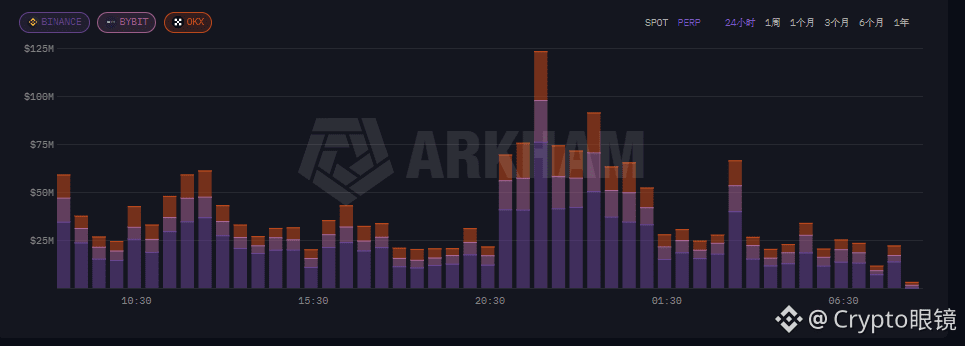
Bybit's volume is clearly spiking, and open interest is climbing, indicating that more capital is still entering the market.
Some are selling, but there are even more buyers. At least for now, the bulls are still in control.
HYPE is really pumping today, up over 10% in the last 24 hours.
Early holders are starting to take profits, but $HYPE is not phased by the pullback at all.
We've got addresses racking up over $810K that are showing no signs of a retracement trend.
0xC19c57eF09C38F9496AEF97a485604d5F6440302 sent 7.08K HYPE to Bybit.
0xA6aAF2d630fb16FDa535d1609587Fc85654483FE moved 1.8K HYPE to Kraken and also transferred 4.15K HYPE to Wintermute.
0x8E3d5e109837c11DDd373d97c9B3E4D716F1423A also sent 2.09K HYPE to Bybit.
Moreover, Wintermute is adjusting its positions as well, transferring 39.58K HYPE (around $2.55 million) into a hot wallet (are you looking to sell too?).
Normally, when early holders withdraw to exchanges, it hints at taking some profits, but the market isn't sweating it at all.
Bybit's volume is clearly spiking, and open interest is climbing, indicating that more capital is still entering the market.
Some are selling, but there are even more buyers. At least for now, the bulls are still in control.
Early holders are starting to take profits, but $HYPE is not phased by the pullback at all.
We've got addresses racking up over $810K that are showing no signs of a retracement trend.
0xC19c57eF09C38F9496AEF97a485604d5F6440302 sent 7.08K HYPE to Bybit.
0xA6aAF2d630fb16FDa535d1609587Fc85654483FE moved 1.8K HYPE to Kraken and also transferred 4.15K HYPE to Wintermute.
0x8E3d5e109837c11DDd373d97c9B3E4D716F1423A also sent 2.09K HYPE to Bybit.
Moreover, Wintermute is adjusting its positions as well, transferring 39.58K HYPE (around $2.55 million) into a hot wallet (are you looking to sell too?).
Normally, when early holders withdraw to exchanges, it hints at taking some profits, but the market isn't sweating it at all.
Bybit's volume is clearly spiking, and open interest is climbing, indicating that more capital is still entering the market.
Some are selling, but there are even more buyers. At least for now, the bulls are still in control.
2
948
·
--
Verified
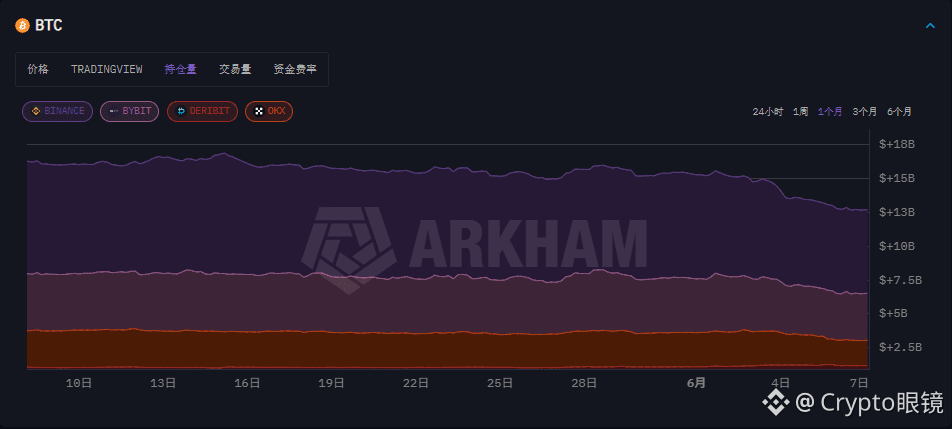
$BTC dropped from 73k to 60k, that's almost a 20% dip, and we’ve breached 60k twice now. Surprisingly, the derivatives market hasn’t reacted that strongly.
By normal logic, such a significant drop should make everyone uneasy, but the implied volatility on long-term options is actually decreasing, and the futures market isn't showing much strength either.
To put it simply:
It seems like the big players aren't anticipating a major move coming up, whether it's a pump or a dump; they seem to be sitting on the sidelines for now.
This feels a bit like what?
In the past, when the market dipped, everyone would shout "golden opportunity" or "time to hop on board," but now even the long-term investors are starting to go quiet.
Price drops aren't scary; what's truly concerning is when the sentiment starts to cool off. BTC has a history of defying market expectations, often pulling a surprise rally when everyone thinks it’s done for.
But at least from the current derivatives data, the long-term investors' outlook isn’t as optimistic as it was a while back.
The support around 60k isn’t looking too strong; I feel like it might not hold up, and the market could be looking for another bottom.
#Bitcoin
$BTC dropped from 73k to 60k, that's almost a 20% dip, and we’ve breached 60k twice now. Surprisingly, the derivatives market hasn’t reacted that strongly.
By normal logic, such a significant drop should make everyone uneasy, but the implied volatility on long-term options is actually decreasing, and the futures market isn't showing much strength either.
To put it simply:
It seems like the big players aren't anticipating a major move coming up, whether it's a pump or a dump; they seem to be sitting on the sidelines for now.
This feels a bit like what?
In the past, when the market dipped, everyone would shout "golden opportunity" or "time to hop on board," but now even the long-term investors are starting to go quiet.
Price drops aren't scary; what's truly concerning is when the sentiment starts to cool off. BTC has a history of defying market expectations, often pulling a surprise rally when everyone thinks it’s done for.
But at least from the current derivatives data, the long-term investors' outlook isn’t as optimistic as it was a while back.
The support around 60k isn’t looking too strong; I feel like it might not hold up, and the market could be looking for another bottom.
#Bitcoin
By normal logic, such a significant drop should make everyone uneasy, but the implied volatility on long-term options is actually decreasing, and the futures market isn't showing much strength either.
To put it simply:
It seems like the big players aren't anticipating a major move coming up, whether it's a pump or a dump; they seem to be sitting on the sidelines for now.
This feels a bit like what?
In the past, when the market dipped, everyone would shout "golden opportunity" or "time to hop on board," but now even the long-term investors are starting to go quiet.
Price drops aren't scary; what's truly concerning is when the sentiment starts to cool off. BTC has a history of defying market expectations, often pulling a surprise rally when everyone thinks it’s done for.
But at least from the current derivatives data, the long-term investors' outlook isn’t as optimistic as it was a while back.
The support around 60k isn’t looking too strong; I feel like it might not hold up, and the market could be looking for another bottom.
#Bitcoin
1
1
1k
·
--
Verified
Since Binance opened up trading for US stocks and ETFs, the wall between traditional finance and the crypto market has truly been broken down.
Previously, if you wanted to buy US stocks, you had to go through overseas brokers, currency exchange, and transfers—a whole process that was quite a hassle. Now, with Binance, you can manage both digital assets and US stock holdings in one account, making it a lot more convenient.
On Binance, I noticed that the Nasdaq-listed company, Hengfeng Technology Innovation Co., Ltd. (FOFO.US), has officially entered the Binance US stock trading zone.
Hengfeng Technology mainly focuses on cross-border fintech and digital services, and it's quite active in the Hong Kong market. For FOFO, the biggest significance of joining the Binance platform might not just be an additional trading channel, but rather the direct access to hundreds of millions of crypto users globally.
Currently, FOFO has become one of the most talked-about Nasdaq tech stocks in Binance's US stock segment. As more capital and users enter the multi-asset trading era, such assets that possess both tech attributes and capital market imagination may attract increasing attention.
Friends interested can check out the Binance US stock zone themselves; just search for FOFO to find it.
Since Binance opened up trading for US stocks and ETFs, the wall between traditional finance and the crypto market has truly been broken down.
Previously, if you wanted to buy US stocks, you had to go through overseas brokers, currency exchange, and transfers—a whole process that was quite a hassle. Now, with Binance, you can manage both digital assets and US stock holdings in one account, making it a lot more convenient.
On Binance, I noticed that the Nasdaq-listed company, Hengfeng Technology Innovation Co., Ltd. (FOFO.US), has officially entered the Binance US stock trading zone.
Hengfeng Technology mainly focuses on cross-border fintech and digital services, and it's quite active in the Hong Kong market. For FOFO, the biggest significance of joining the Binance platform might not just be an additional trading channel, but rather the direct access to hundreds of millions of crypto users globally.
Currently, FOFO has become one of the most talked-about Nasdaq tech stocks in Binance's US stock segment. As more capital and users enter the multi-asset trading era, such assets that possess both tech attributes and capital market imagination may attract increasing attention.
Friends interested can check out the Binance US stock zone themselves; just search for FOFO to find it.
Previously, if you wanted to buy US stocks, you had to go through overseas brokers, currency exchange, and transfers—a whole process that was quite a hassle. Now, with Binance, you can manage both digital assets and US stock holdings in one account, making it a lot more convenient.
On Binance, I noticed that the Nasdaq-listed company, Hengfeng Technology Innovation Co., Ltd. (FOFO.US), has officially entered the Binance US stock trading zone.
Hengfeng Technology mainly focuses on cross-border fintech and digital services, and it's quite active in the Hong Kong market. For FOFO, the biggest significance of joining the Binance platform might not just be an additional trading channel, but rather the direct access to hundreds of millions of crypto users globally.
Currently, FOFO has become one of the most talked-about Nasdaq tech stocks in Binance's US stock segment. As more capital and users enter the multi-asset trading era, such assets that possess both tech attributes and capital market imagination may attract increasing attention.
Friends interested can check out the Binance US stock zone themselves; just search for FOFO to find it.

1
2
849
·
--
Some folks lost half their positions in a single day, while others cashed out millions.
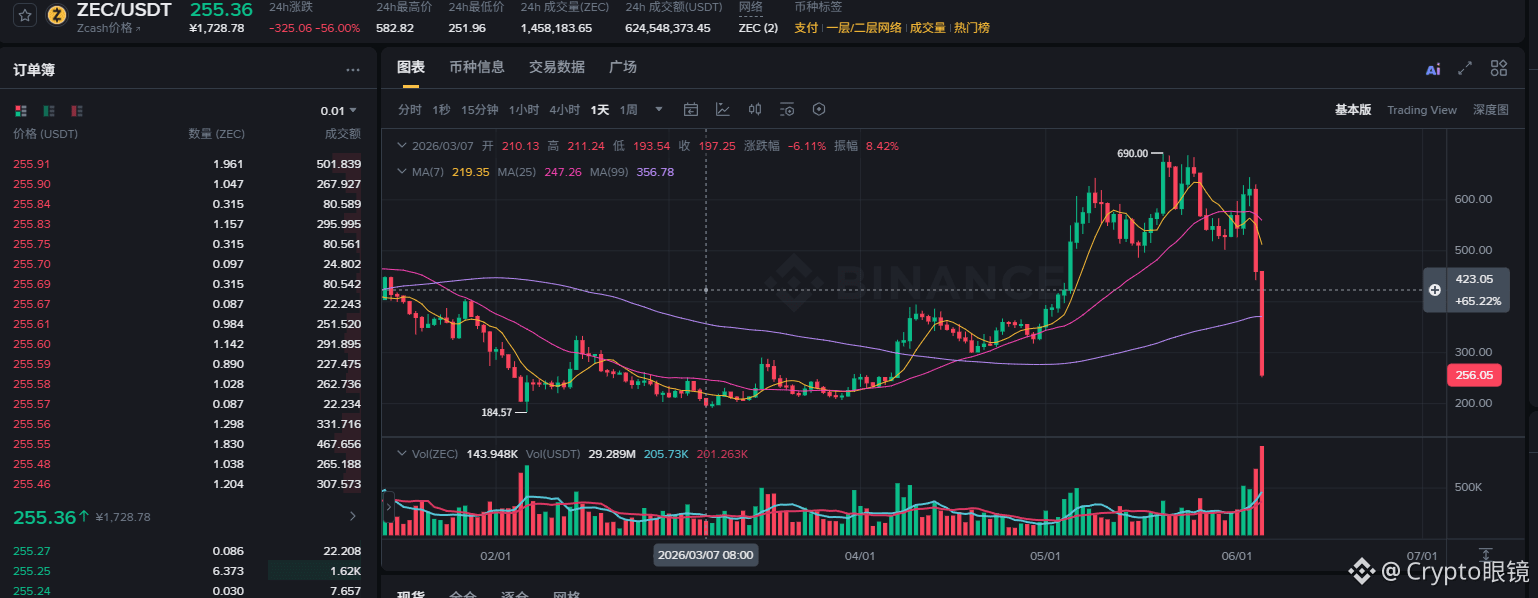
$ZEC ZEC plummeted from $627 to $301, a drop of over 50%, marking one of the most brutal corrections in the recent market.
(This line was added later; I was writing the copy while watching the crash. Can it hold the $200 support?)
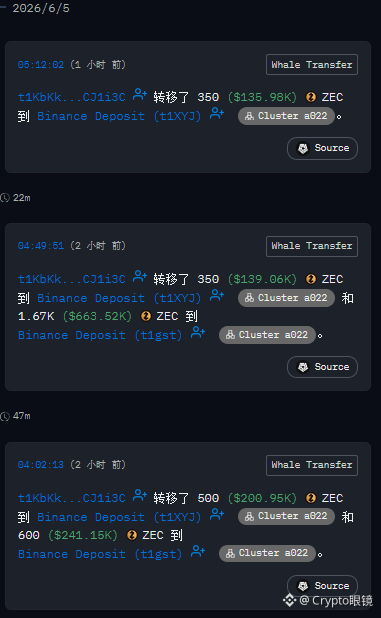
Behind the price crash, on-chain whales have already started to make moves.
Several big players have been transferring large amounts of ZEC to Coinbase Prime, Binance, and Kraken, with a total value exceeding $60 million.
Among them, addresses related to Coinbase Prime Custody withdrew 13,000 ZEC in batches, realizing profits of about $60.96 million (whale address: t1KbKkQ7WisJF52sSepMjYokQJbkJCJ1i3C); another whale liquidated 34,610 ZEC to take profits.
Meanwhile, the funding rate for Bybit perpetual contracts dropped to -0.76%, indicating extreme bearish sentiment.
The key point is that trading volume surged several times during the decline, showing that this isn't just retail panic, but a substantial transfer of chips is underway.
When whales continue to transfer coins to exchanges, funding rates turn negative, and prices get sliced in half simultaneously, the market often needs time to digest the sell pressure.
Next, keep an eye on:
Whether whales continue to transfer chips to exchanges
If the funding rates start to recover
Whether bottom-fishing capital genuinely enters the market
When whales start to harvest profits, news is just the outcome; on-chain data has already provided the answers.
#ZEC #Binance
Some folks lost half their positions in a single day, while others cashed out millions.
$ZEC ZEC plummeted from $627 to $301, a drop of over 50%, marking one of the most brutal corrections in the recent market.
(This line was added later; I was writing the copy while watching the crash. Can it hold the $200 support?)
Behind the price crash, on-chain whales have already started to make moves.
Several big players have been transferring large amounts of ZEC to Coinbase Prime, Binance, and Kraken, with a total value exceeding $60 million.
Among them, addresses related to Coinbase Prime Custody withdrew 13,000 ZEC in batches, realizing profits of about $60.96 million (whale address: t1KbKkQ7WisJF52sSepMjYokQJbkJCJ1i3C); another whale liquidated 34,610 ZEC to take profits.
Meanwhile, the funding rate for Bybit perpetual contracts dropped to -0.76%, indicating extreme bearish sentiment.
The key point is that trading volume surged several times during the decline, showing that this isn't just retail panic, but a substantial transfer of chips is underway.
When whales continue to transfer coins to exchanges, funding rates turn negative, and prices get sliced in half simultaneously, the market often needs time to digest the sell pressure.
Next, keep an eye on:
Whether whales continue to transfer chips to exchanges
If the funding rates start to recover
Whether bottom-fishing capital genuinely enters the market
When whales start to harvest profits, news is just the outcome; on-chain data has already provided the answers.
#ZEC #Binance
$ZEC ZEC plummeted from $627 to $301, a drop of over 50%, marking one of the most brutal corrections in the recent market.
(This line was added later; I was writing the copy while watching the crash. Can it hold the $200 support?)
Behind the price crash, on-chain whales have already started to make moves.
Several big players have been transferring large amounts of ZEC to Coinbase Prime, Binance, and Kraken, with a total value exceeding $60 million.
Among them, addresses related to Coinbase Prime Custody withdrew 13,000 ZEC in batches, realizing profits of about $60.96 million (whale address: t1KbKkQ7WisJF52sSepMjYokQJbkJCJ1i3C); another whale liquidated 34,610 ZEC to take profits.
Meanwhile, the funding rate for Bybit perpetual contracts dropped to -0.76%, indicating extreme bearish sentiment.
The key point is that trading volume surged several times during the decline, showing that this isn't just retail panic, but a substantial transfer of chips is underway.
When whales continue to transfer coins to exchanges, funding rates turn negative, and prices get sliced in half simultaneously, the market often needs time to digest the sell pressure.
Next, keep an eye on:
Whether whales continue to transfer chips to exchanges
If the funding rates start to recover
Whether bottom-fishing capital genuinely enters the market
When whales start to harvest profits, news is just the outcome; on-chain data has already provided the answers.
#ZEC #Binance
1
1.4k
·
--
Verified
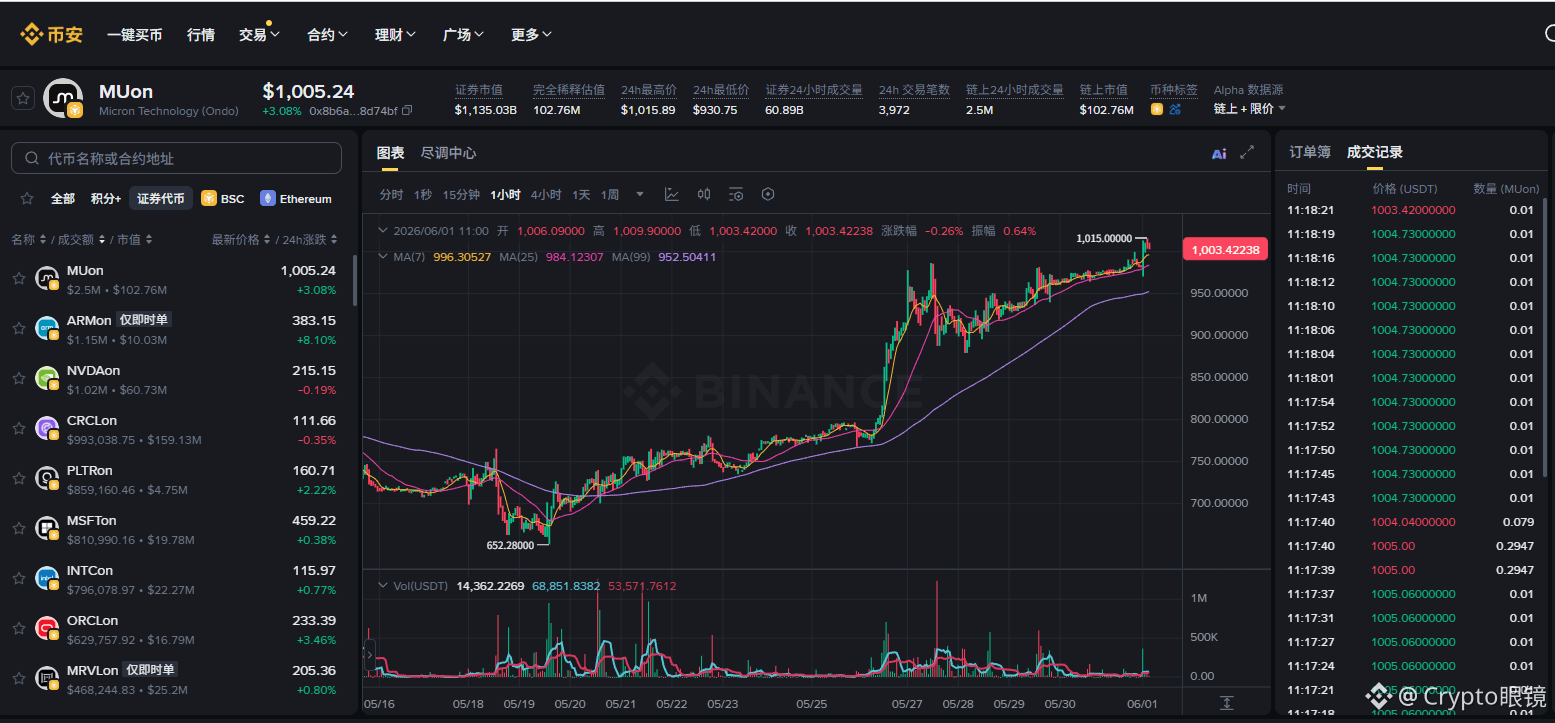
In this round of the AI market, the funds are no longer satisfied with just trading GPUs; it's now going full throttle towards selling shovels and water. Previously, everyone was focused on Nvidia $NVDA, but now more and more people are keeping an eye on Micron ($MU), SK Hynix, and Samsung, the leading players in AI memory. The logic is pretty straightforward: no matter how powerful the GPU, it still needs memory to feed the data.
Recently, MU and SK Hynix have been steadily climbing, even breaking the $1000 mark in pre-market trading. Essentially, funds are betting on the continued expansion of AI data centers. The supply of HBM, DRAM, and NAND is still tight, and Micron has even confirmed that its HBM capacity will be sold out by 2026, giving them significant pricing power.
From a capital flow perspective, this wave has formed a classic positive feedback loop: AI leaders rise → institutional funds increase their positions → Memory ETFs buy in passively → storage stocks continue to rise → more funds FOMO in. So, many stocks lately give you this feeling: they just can’t drop; a slight pullback sees buyers stepping in.
Right now, it feels more like a high-acceleration phase in a strong trend, with moving averages likely still in a standard bullish arrangement, with the 5-day and 10-day lines supporting prices. Although the RSI is somewhat high, in a strong trend, an overbought RSI never immediately indicates a top; the real danger is when prices hit new highs while momentum starts to weaken.
I’m currently more focused on volume. A healthy uptrend looks like: volume breakout → consolidation on lower volume → another breakout. The danger signals are: huge volume stagnation, gapping up and selling off, long upper wicks. Because often, tops don’t just crash suddenly; funds usually pull out quietly first.
In the short term, the AI supercycle story is still being told, and funds clearly haven’t exited yet, but the entry point is indeed not low. The trend is still on, but it has transitioned from (money everywhere to pick up) to (daring to chase the highs, daring to gamble).
In this round of the AI market, the funds are no longer satisfied with just trading GPUs; it's now going full throttle towards selling shovels and water. Previously, everyone was focused on Nvidia $NVDA, but now more and more people are keeping an eye on Micron ($MU), SK Hynix, and Samsung, the leading players in AI memory. The logic is pretty straightforward: no matter how powerful the GPU, it still needs memory to feed the data.
Recently, MU and SK Hynix have been steadily climbing, even breaking the $1000 mark in pre-market trading. Essentially, funds are betting on the continued expansion of AI data centers. The supply of HBM, DRAM, and NAND is still tight, and Micron has even confirmed that its HBM capacity will be sold out by 2026, giving them significant pricing power.
From a capital flow perspective, this wave has formed a classic positive feedback loop: AI leaders rise → institutional funds increase their positions → Memory ETFs buy in passively → storage stocks continue to rise → more funds FOMO in. So, many stocks lately give you this feeling: they just can’t drop; a slight pullback sees buyers stepping in.
Right now, it feels more like a high-acceleration phase in a strong trend, with moving averages likely still in a standard bullish arrangement, with the 5-day and 10-day lines supporting prices. Although the RSI is somewhat high, in a strong trend, an overbought RSI never immediately indicates a top; the real danger is when prices hit new highs while momentum starts to weaken.
I’m currently more focused on volume. A healthy uptrend looks like: volume breakout → consolidation on lower volume → another breakout. The danger signals are: huge volume stagnation, gapping up and selling off, long upper wicks. Because often, tops don’t just crash suddenly; funds usually pull out quietly first.
In the short term, the AI supercycle story is still being told, and funds clearly haven’t exited yet, but the entry point is indeed not low. The trend is still on, but it has transitioned from (money everywhere to pick up) to (daring to chase the highs, daring to gamble).
Recently, MU and SK Hynix have been steadily climbing, even breaking the $1000 mark in pre-market trading. Essentially, funds are betting on the continued expansion of AI data centers. The supply of HBM, DRAM, and NAND is still tight, and Micron has even confirmed that its HBM capacity will be sold out by 2026, giving them significant pricing power.
From a capital flow perspective, this wave has formed a classic positive feedback loop: AI leaders rise → institutional funds increase their positions → Memory ETFs buy in passively → storage stocks continue to rise → more funds FOMO in. So, many stocks lately give you this feeling: they just can’t drop; a slight pullback sees buyers stepping in.
Right now, it feels more like a high-acceleration phase in a strong trend, with moving averages likely still in a standard bullish arrangement, with the 5-day and 10-day lines supporting prices. Although the RSI is somewhat high, in a strong trend, an overbought RSI never immediately indicates a top; the real danger is when prices hit new highs while momentum starts to weaken.
I’m currently more focused on volume. A healthy uptrend looks like: volume breakout → consolidation on lower volume → another breakout. The danger signals are: huge volume stagnation, gapping up and selling off, long upper wicks. Because often, tops don’t just crash suddenly; funds usually pull out quietly first.
In the short term, the AI supercycle story is still being told, and funds clearly haven’t exited yet, but the entry point is indeed not low. The trend is still on, but it has transitioned from (money everywhere to pick up) to (daring to chase the highs, daring to gamble).
1
1.6k
·
--
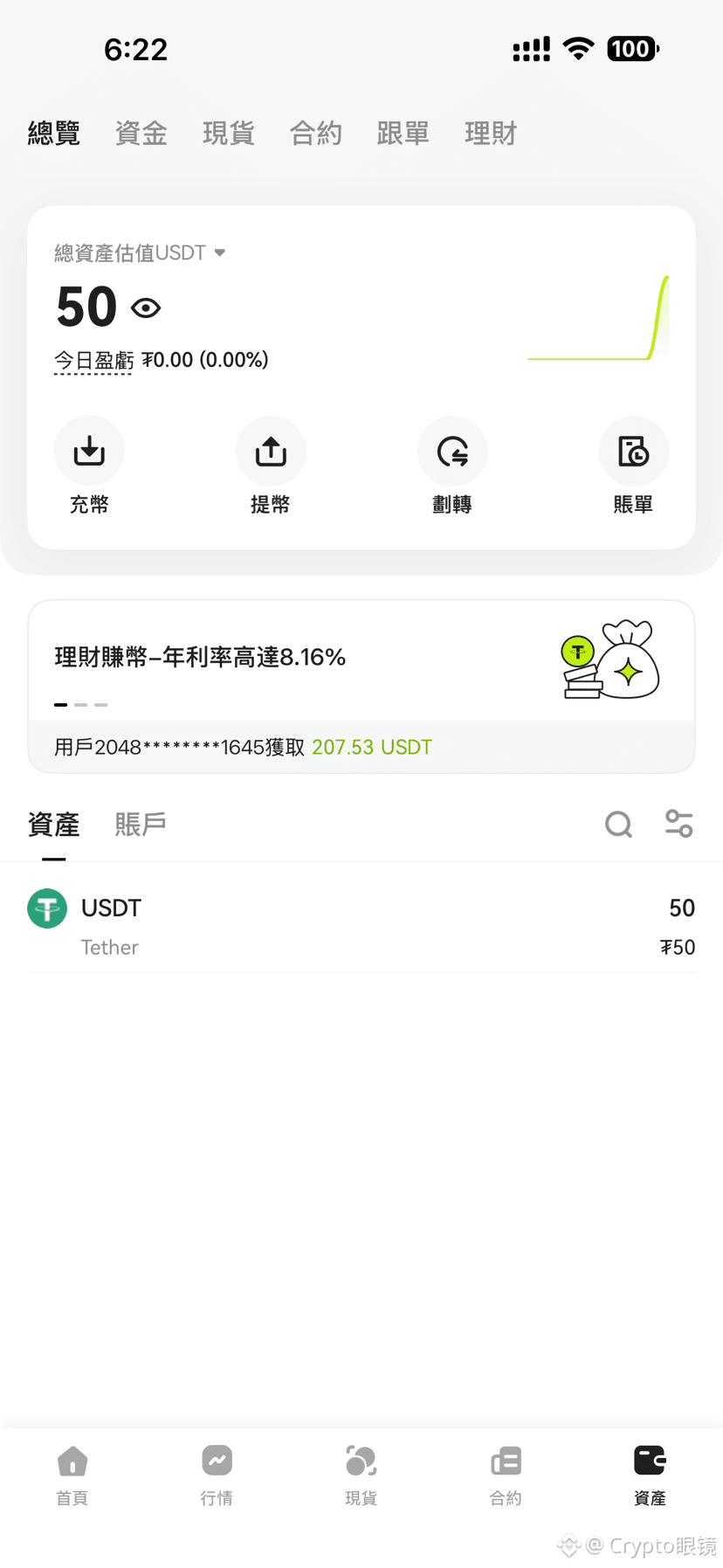
Event contracts are so exhilarating!
Playing every 5 minutes really gets the heart racing.
I’m looking to drop 50 bucks on hibt to see if I can snag some extra gains tonight.
You can play longer durations, like 10, 15, or 30 minutes, but I still prefer the 5-minute ones. It’s just more thrilling!
Event contracts are so exhilarating!
Playing every 5 minutes really gets the heart racing.
I’m looking to drop 50 bucks on hibt to see if I can snag some extra gains tonight.
You can play longer durations, like 10, 15, or 30 minutes, but I still prefer the 5-minute ones. It’s just more thrilling!
Playing every 5 minutes really gets the heart racing.
I’m looking to drop 50 bucks on hibt to see if I can snag some extra gains tonight.
You can play longer durations, like 10, 15, or 30 minutes, but I still prefer the 5-minute ones. It’s just more thrilling!
1
2
2k
Log in to explore more content
Join global crypto users on Binance Square
⚡️ Get latest and useful information about crypto.
💬 Trusted by the world’s largest crypto exchange.
👍 Discover real insights from verified creators.
Email / Phone number
Trending Topics
AppleDebutsFoldablePhone
47,115 views
941 Discussing
Apple just dropped the foldable iPhone — and the market is paying attention. This isn't just another product cycle; it's a new product category, a new CEO on stage, and a $1,999 price tag that pushes $AAPL further into ultra-premium territory. Foldables are the narrative, and Apple is now the headline.
#appledebutsfoldablephone #EUExtendsCentralContactPointToCASPs #US10YTreasuryYieldHitsHighestSinceNov2023 #BrentCrudeTops$100 #USTreasuryToBuyBackUpTo$6BLongDatedDebt
KimHotbae
·2 Likes
·2.9k views
TSMCAugustRevenueUp53.3%YoY
10,827 views
308 Discussing
IranSaysReadyToEscalateWarWithUS
13,625 views
327 Discussing