
Insight Lab CH
483 Posts

Insight Lab CH
Report
Block User
2 Following
28 Followers
51 Liked
Posts
U.S. Energy Secretary Chris Wright explicitly warned in an open interview on Sunday that energy markets should not expect the tense situation in the Strait of Hormuz to be resolved quickly in the near term. Although Iran plans to propose a new maritime agreement to neighboring Gulf states, Wright said bluntly that hopes of reaching any effective deal at present are “next to none,” noting that the real pressures on the global oil supply chain are far tighter than markets had expected. While alternative transport routes can currently sustain supply of roughly 10 million barrels per day of crude oil and petroleum products, Wright’s hardline military warnings regarding Iran’s nuclear issue again pushed geopolitical risk to the forefront.
This statement shattered the market’s earlier optimistic expectations that Middle East shipping would normalize rapidly. As the world’s most important energy transportation chokepoint, a sustained, material threat to the Strait of Hormuz would mean persistent surges in logistics costs and losses in shipping capacity due to detours and diverted alternative shipping. More importantly, U.S. officials directly noted that if negotiations fail, they would not rule out using military means to curb Iran’s nuclear program. This tough posture suggests that the region’s structural premium is unlikely to fade within the coming months, and tail risks of a second round of inflation are rising significantly.
From the perspective of macro financial markets, the stalemate in the Middle East will provide firm support for international crude oil prices. If energy prices remain elevated, the Federal Reserve’s disinflation process will inevitably be hindered, and it may even force central banks to keep interest rates high for a longer period. This directly boosts safe-haven demand for U.S. Treasury yields and the U.S. dollar index, exerting direct downward pressure on valuations of risk assets such as U.S. equities. Under the dual squeeze of stagflation fears and geopolitical conflict, the global liquidity environment will tighten further.
For the cryptocurrency market, $BTC faces severe tests during a liquidity tightening cycle alongside mainstream assets. In the early stages of a geopolitical crisis, the safe-haven appeal of assets often cannot withstand the tight panic triggered by surging commodities. Once institutions cut risk exposure to hedge inflation and interest-rate risks, incremental capital inflows into crypto are likely to slow sharply. Investors should remain highly cautious and not underestimate the potential drag that macro energy bottlenecks may impose on deleveraging trends.⚠️
#CrudeOil #Geopolitics #EnergyCrisis
U.S. Energy Secretary Chris Wright explicitly warned in an open interview on Sunday that energy markets should not expect the tense situation in the Strait of Hormuz to be resolved quickly in the near term. Although Iran plans to propose a new maritime agreement to neighboring Gulf states, Wright said bluntly that hopes of reaching any effective deal at present are “next to none,” noting that the real pressures on the global oil supply chain are far tighter than markets had expected. While alternative transport routes can currently sustain supply of roughly 10 million barrels per day of crude oil and petroleum products, Wright’s hardline military warnings regarding Iran’s nuclear issue again pushed geopolitical risk to the forefront.
This statement shattered the market’s earlier optimistic expectations that Middle East shipping would normalize rapidly. As the world’s most important energy transportation chokepoint, a sustained, material threat to the Strait of Hormuz would mean persistent surges in logistics costs and losses in shipping capacity due to detours and diverted alternative shipping. More importantly, U.S. officials directly noted that if negotiations fail, they would not rule out using military means to curb Iran’s nuclear program. This tough posture suggests that the region’s structural premium is unlikely to fade within the coming months, and tail risks of a second round of inflation are rising significantly.
From the perspective of macro financial markets, the stalemate in the Middle East will provide firm support for international crude oil prices. If energy prices remain elevated, the Federal Reserve’s disinflation process will inevitably be hindered, and it may even force central banks to keep interest rates high for a longer period. This directly boosts safe-haven demand for U.S. Treasury yields and the U.S. dollar index, exerting direct downward pressure on valuations of risk assets such as U.S. equities. Under the dual squeeze of stagflation fears and geopolitical conflict, the global liquidity environment will tighten further.
For the cryptocurrency market, $BTC faces severe tests during a liquidity tightening cycle alongside mainstream assets. In the early stages of a geopolitical crisis, the safe-haven appeal of assets often cannot withstand the tight panic triggered by surging commodities. Once institutions cut risk exposure to hedge inflation and interest-rate risks, incremental capital inflows into crypto are likely to slow sharply. Investors should remain highly cautious and not underestimate the potential drag that macro energy bottlenecks may impose on deleveraging trends.⚠️
#CrudeOil #Geopolitics #EnergyCrisis
This statement shattered the market’s earlier optimistic expectations that Middle East shipping would normalize rapidly. As the world’s most important energy transportation chokepoint, a sustained, material threat to the Strait of Hormuz would mean persistent surges in logistics costs and losses in shipping capacity due to detours and diverted alternative shipping. More importantly, U.S. officials directly noted that if negotiations fail, they would not rule out using military means to curb Iran’s nuclear program. This tough posture suggests that the region’s structural premium is unlikely to fade within the coming months, and tail risks of a second round of inflation are rising significantly.
From the perspective of macro financial markets, the stalemate in the Middle East will provide firm support for international crude oil prices. If energy prices remain elevated, the Federal Reserve’s disinflation process will inevitably be hindered, and it may even force central banks to keep interest rates high for a longer period. This directly boosts safe-haven demand for U.S. Treasury yields and the U.S. dollar index, exerting direct downward pressure on valuations of risk assets such as U.S. equities. Under the dual squeeze of stagflation fears and geopolitical conflict, the global liquidity environment will tighten further.
For the cryptocurrency market, $BTC faces severe tests during a liquidity tightening cycle alongside mainstream assets. In the early stages of a geopolitical crisis, the safe-haven appeal of assets often cannot withstand the tight panic triggered by surging commodities. Once institutions cut risk exposure to hedge inflation and interest-rate risks, incremental capital inflows into crypto are likely to slow sharply. Investors should remain highly cautious and not underestimate the potential drag that macro energy bottlenecks may impose on deleveraging trends.⚠️
#CrudeOil #Geopolitics #EnergyCrisis
73
According to a recent report by Business Insider, AI giant Anthropic has chosen Nasdaq for its IPO listing and is expected to make its debut this October. After Nasdaq previously succeeded in luring SpaceX with a valuation of $1.75 trillion, Anthropic’s entry further reinforces the exchange’s appeal to super-tech unicorns. Some extreme market estimates even suggest that Anthropic’s valuation could reach $2 trillion, which stands in stark contrast to OpenAI CEO Sam Altman’s clear stance that he does not consider an IPO due to AI safety risks.
From a macro and industry perspective, Anthropic’s IPO plan is not only a key milestone in the commercialization of technology capital, but it may also become a litmus test for whether today’s global AI narrative contains a valuation bubble. Against the backdrop of a high-interest-rate policy center that keeps the cost of capital elevated, the market is offering high premiums to primary-market assets valued at tens of trillions of dollars. If its commercialization monetization path and cash-flow returns cannot match such aggressive valuation expectations, once it is listed and later re-priced for liquidity, it could easily trigger a substantial pullback in tech stocks and even growth-oriented assets.
In traditional financial markets, the capital-attracting effect of mega IPOs cannot be ignored. Large new-share offerings often create a significant liquidity “suction” effect on the secondary-market technology sector in the short term, while also raising the threshold for investors’ scrutiny of tech giants’ capital expenditures and profitability. If U.S. tech heavyweight stocks become volatile due to overly high valuations, Treasury yields and the U.S. dollar index may also move in tandem as risk-averse sentiment shifts, thereby intensifying expectations of tighter overall financial conditions.
For the crypto market, this is not purely a positive signal. On one hand, large IPOs by traditional tech giants will absorb a huge amount of marginal incremental capital that might otherwise flow into high-risk appetite areas, potentially diverting liquidity from risk assets such as Web3 and $BTC in the short term. On the other hand, if the AI sector suffers valuation “trampling” after listing because valuations are too high, the spillover risk-off sentiment will quickly spread to the entire risk-asset complex. Investors need to be alert to the risk of liquidity being withdrawn behind overheated sentiment.#Anthropic #Nasdaq #TechIPO
According to a recent report by Business Insider, AI giant Anthropic has chosen Nasdaq for its IPO listing and is expected to make its debut this October. After Nasdaq previously succeeded in luring SpaceX with a valuation of $1.75 trillion, Anthropic’s entry further reinforces the exchange’s appeal to super-tech unicorns. Some extreme market estimates even suggest that Anthropic’s valuation could reach $2 trillion, which stands in stark contrast to OpenAI CEO Sam Altman’s clear stance that he does not consider an IPO due to AI safety risks.
From a macro and industry perspective, Anthropic’s IPO plan is not only a key milestone in the commercialization of technology capital, but it may also become a litmus test for whether today’s global AI narrative contains a valuation bubble. Against the backdrop of a high-interest-rate policy center that keeps the cost of capital elevated, the market is offering high premiums to primary-market assets valued at tens of trillions of dollars. If its commercialization monetization path and cash-flow returns cannot match such aggressive valuation expectations, once it is listed and later re-priced for liquidity, it could easily trigger a substantial pullback in tech stocks and even growth-oriented assets.
In traditional financial markets, the capital-attracting effect of mega IPOs cannot be ignored. Large new-share offerings often create a significant liquidity “suction” effect on the secondary-market technology sector in the short term, while also raising the threshold for investors’ scrutiny of tech giants’ capital expenditures and profitability. If U.S. tech heavyweight stocks become volatile due to overly high valuations, Treasury yields and the U.S. dollar index may also move in tandem as risk-averse sentiment shifts, thereby intensifying expectations of tighter overall financial conditions.
For the crypto market, this is not purely a positive signal. On one hand, large IPOs by traditional tech giants will absorb a huge amount of marginal incremental capital that might otherwise flow into high-risk appetite areas, potentially diverting liquidity from risk assets such as Web3 and $BTC in the short term. On the other hand, if the AI sector suffers valuation “trampling” after listing because valuations are too high, the spillover risk-off sentiment will quickly spread to the entire risk-asset complex. Investors need to be alert to the risk of liquidity being withdrawn behind overheated sentiment.#Anthropic #Nasdaq #TechIPO
From a macro and industry perspective, Anthropic’s IPO plan is not only a key milestone in the commercialization of technology capital, but it may also become a litmus test for whether today’s global AI narrative contains a valuation bubble. Against the backdrop of a high-interest-rate policy center that keeps the cost of capital elevated, the market is offering high premiums to primary-market assets valued at tens of trillions of dollars. If its commercialization monetization path and cash-flow returns cannot match such aggressive valuation expectations, once it is listed and later re-priced for liquidity, it could easily trigger a substantial pullback in tech stocks and even growth-oriented assets.
In traditional financial markets, the capital-attracting effect of mega IPOs cannot be ignored. Large new-share offerings often create a significant liquidity “suction” effect on the secondary-market technology sector in the short term, while also raising the threshold for investors’ scrutiny of tech giants’ capital expenditures and profitability. If U.S. tech heavyweight stocks become volatile due to overly high valuations, Treasury yields and the U.S. dollar index may also move in tandem as risk-averse sentiment shifts, thereby intensifying expectations of tighter overall financial conditions.
For the crypto market, this is not purely a positive signal. On one hand, large IPOs by traditional tech giants will absorb a huge amount of marginal incremental capital that might otherwise flow into high-risk appetite areas, potentially diverting liquidity from risk assets such as Web3 and $BTC in the short term. On the other hand, if the AI sector suffers valuation “trampling” after listing because valuations are too high, the spillover risk-off sentiment will quickly spread to the entire risk-asset complex. Investors need to be alert to the risk of liquidity being withdrawn behind overheated sentiment.#Anthropic #Nasdaq #TechIPO
77
White House economic adviser Hassett (Kevin Hassett) recently said in public that both former President Trump and he himself believe there is no reason for any rate hikes at present, stressing that it is crucial for the Federal Reserve to maintain policy stability before important political cycles. He also noted that Trump fully respects the independence of Fed Governor Christopher Waller.
At face value, these remarks appear to endorse monetary easing. In reality, they reflect a deep penetration of political games into central bank policymaking. Although the White House adviser attempts to ease market concerns by reiterating respect for the independence of certain officials, in a context where inflation remains sticky and the economic outlook is still uncertain, direct guidance from the political level often disrupts markets’ expectations of the Fed’s objective policy path—and can even intensify systemic risks of future policy delays or misjudgments.
From the perspective of traditional financial markets, suppressing expectations of rate hikes may, in the short term, support valuations for U.S. Treasuries and equities. However, if underlying inflation rebounds, an unanchored long-term inflation expectation caused by political intervention will lead to higher term premia. This would push up yields on the long end and weigh on the dollar’s credit premium, intensifying structural divergences in asset prices.
For the crypto market, expectations of macro easing may seem like a short-term sentiment positive. Yet the highly politicized policy path will amplify market volatility. Before the liquidity outlook becomes fully clear, risk assets such as $BTC are likely to suffer sharp washouts as macro games and risk-off sentiment intertwine. Investors should remain alert to the downside risk created by betting on a policy shift too early.📉
#Fed #InterestRates #MacroEconomy
White House economic adviser Hassett (Kevin Hassett) recently said in public that both former President Trump and he himself believe there is no reason for any rate hikes at present, stressing that it is crucial for the Federal Reserve to maintain policy stability before important political cycles. He also noted that Trump fully respects the independence of Fed Governor Christopher Waller.
At face value, these remarks appear to endorse monetary easing. In reality, they reflect a deep penetration of political games into central bank policymaking. Although the White House adviser attempts to ease market concerns by reiterating respect for the independence of certain officials, in a context where inflation remains sticky and the economic outlook is still uncertain, direct guidance from the political level often disrupts markets’ expectations of the Fed’s objective policy path—and can even intensify systemic risks of future policy delays or misjudgments.
From the perspective of traditional financial markets, suppressing expectations of rate hikes may, in the short term, support valuations for U.S. Treasuries and equities. However, if underlying inflation rebounds, an unanchored long-term inflation expectation caused by political intervention will lead to higher term premia. This would push up yields on the long end and weigh on the dollar’s credit premium, intensifying structural divergences in asset prices.
For the crypto market, expectations of macro easing may seem like a short-term sentiment positive. Yet the highly politicized policy path will amplify market volatility. Before the liquidity outlook becomes fully clear, risk assets such as $BTC are likely to suffer sharp washouts as macro games and risk-off sentiment intertwine. Investors should remain alert to the downside risk created by betting on a policy shift too early.📉
#Fed #InterestRates #MacroEconomy
At face value, these remarks appear to endorse monetary easing. In reality, they reflect a deep penetration of political games into central bank policymaking. Although the White House adviser attempts to ease market concerns by reiterating respect for the independence of certain officials, in a context where inflation remains sticky and the economic outlook is still uncertain, direct guidance from the political level often disrupts markets’ expectations of the Fed’s objective policy path—and can even intensify systemic risks of future policy delays or misjudgments.
From the perspective of traditional financial markets, suppressing expectations of rate hikes may, in the short term, support valuations for U.S. Treasuries and equities. However, if underlying inflation rebounds, an unanchored long-term inflation expectation caused by political intervention will lead to higher term premia. This would push up yields on the long end and weigh on the dollar’s credit premium, intensifying structural divergences in asset prices.
For the crypto market, expectations of macro easing may seem like a short-term sentiment positive. Yet the highly politicized policy path will amplify market volatility. Before the liquidity outlook becomes fully clear, risk assets such as $BTC are likely to suffer sharp washouts as macro games and risk-off sentiment intertwine. Investors should remain alert to the downside risk created by betting on a policy shift too early.📉
#Fed #InterestRates #MacroEconomy
2
During the BRICS summit, the UAE’s Crown Prince of Abu Dhabi held an unusual high-level public meeting with Iran’s President Ebrahim Raisi, focusing on talks about the heightened tensions surrounding navigation in the Strait of Hormuz. Oman is also actively facilitating dialogue between the Gulf Arab states cooperation council and Iran. Iran plans to brief neighboring Gulf countries next Monday on a new proposal for an agreement. While it may allow more ships to pass, Tehran has made clear that this does not amount to a full reopening of the strait; Iran will still retain the final decision on which vessels are allowed to transit. Meanwhile, Bahrain has firmly refused to attend the meeting due to recent attack incidents, casting a shadow over prospects for cooling tensions.
On the surface, these diplomatic contacts appear to offer a glimmer of easing. In essence, however, they underscore the fragility and uncertainty of the Middle East’s key shipping chokepoint. The Strait of Hormuz carries roughly 20% of the world’s seaborne crude oil transport. Iran’s stated position of “retaining decision-making authority over passage,” in practice, further strengthens its leverage over this strategic corridor rather than truly eliminating the geopolitical security premium. Bahrain’s boycott and deep disagreements among the parties show that a fragile verbal understanding is unlikely to quickly translate into concrete, long-term stability.
In traditional financial markets, crude oil and commodity prices may see short-term sentiment-driven fluctuations due to locally easing news. But because supply-chain disruption risks remain high, energy-inflation pressure has not truly receded. Potential supply disruptions in the crude market will directly constrain major central banks’ progress in fighting inflation. U.S. Treasury yields and the U.S. dollar index may remain in elevated range-bound volatility. As for safe-haven assets, as long as substantive geopolitical confrontation remains unresolved, safe havens such as gold will continue to provide firm support.
For crypto asset markets, geopolitical games marked by extreme uncertainty are often a double-edged sword. Although localized cooling statements may temporarily ease panic-driven selloffs, structural risks in the Middle East energy corridor could trigger a new rebound in inflation expectations at any time, thereby suppressing valuation room for risk assets. Until macro liquidity truly loosens, markets should remain highly cautious about any signals of geopolitical easing, and guard against $BTC being squeezed again by a double hit from safe-haven sentiment ebbing and inflation stickiness returning.
#Geopolitics #CrudeOil #MacroRisk
During the BRICS summit, the UAE’s Crown Prince of Abu Dhabi held an unusual high-level public meeting with Iran’s President Ebrahim Raisi, focusing on talks about the heightened tensions surrounding navigation in the Strait of Hormuz. Oman is also actively facilitating dialogue between the Gulf Arab states cooperation council and Iran. Iran plans to brief neighboring Gulf countries next Monday on a new proposal for an agreement. While it may allow more ships to pass, Tehran has made clear that this does not amount to a full reopening of the strait; Iran will still retain the final decision on which vessels are allowed to transit. Meanwhile, Bahrain has firmly refused to attend the meeting due to recent attack incidents, casting a shadow over prospects for cooling tensions.
On the surface, these diplomatic contacts appear to offer a glimmer of easing. In essence, however, they underscore the fragility and uncertainty of the Middle East’s key shipping chokepoint. The Strait of Hormuz carries roughly 20% of the world’s seaborne crude oil transport. Iran’s stated position of “retaining decision-making authority over passage,” in practice, further strengthens its leverage over this strategic corridor rather than truly eliminating the geopolitical security premium. Bahrain’s boycott and deep disagreements among the parties show that a fragile verbal understanding is unlikely to quickly translate into concrete, long-term stability.
In traditional financial markets, crude oil and commodity prices may see short-term sentiment-driven fluctuations due to locally easing news. But because supply-chain disruption risks remain high, energy-inflation pressure has not truly receded. Potential supply disruptions in the crude market will directly constrain major central banks’ progress in fighting inflation. U.S. Treasury yields and the U.S. dollar index may remain in elevated range-bound volatility. As for safe-haven assets, as long as substantive geopolitical confrontation remains unresolved, safe havens such as gold will continue to provide firm support.
For crypto asset markets, geopolitical games marked by extreme uncertainty are often a double-edged sword. Although localized cooling statements may temporarily ease panic-driven selloffs, structural risks in the Middle East energy corridor could trigger a new rebound in inflation expectations at any time, thereby suppressing valuation room for risk assets. Until macro liquidity truly loosens, markets should remain highly cautious about any signals of geopolitical easing, and guard against $BTC being squeezed again by a double hit from safe-haven sentiment ebbing and inflation stickiness returning.
#Geopolitics #CrudeOil #MacroRisk
On the surface, these diplomatic contacts appear to offer a glimmer of easing. In essence, however, they underscore the fragility and uncertainty of the Middle East’s key shipping chokepoint. The Strait of Hormuz carries roughly 20% of the world’s seaborne crude oil transport. Iran’s stated position of “retaining decision-making authority over passage,” in practice, further strengthens its leverage over this strategic corridor rather than truly eliminating the geopolitical security premium. Bahrain’s boycott and deep disagreements among the parties show that a fragile verbal understanding is unlikely to quickly translate into concrete, long-term stability.
In traditional financial markets, crude oil and commodity prices may see short-term sentiment-driven fluctuations due to locally easing news. But because supply-chain disruption risks remain high, energy-inflation pressure has not truly receded. Potential supply disruptions in the crude market will directly constrain major central banks’ progress in fighting inflation. U.S. Treasury yields and the U.S. dollar index may remain in elevated range-bound volatility. As for safe-haven assets, as long as substantive geopolitical confrontation remains unresolved, safe havens such as gold will continue to provide firm support.
For crypto asset markets, geopolitical games marked by extreme uncertainty are often a double-edged sword. Although localized cooling statements may temporarily ease panic-driven selloffs, structural risks in the Middle East energy corridor could trigger a new rebound in inflation expectations at any time, thereby suppressing valuation room for risk assets. Until macro liquidity truly loosens, markets should remain highly cautious about any signals of geopolitical easing, and guard against $BTC being squeezed again by a double hit from safe-haven sentiment ebbing and inflation stickiness returning.
#Geopolitics #CrudeOil #MacroRisk
7
According to the latest report from Reuters, a shutdown incident has occurred on Saudi Arabia’s main crude oil pipeline supplying the Red Sea. Saudi oil buyers and traders have warned that if the pipeline is not restored within the coming days, Saudi Arabia’s export inventories will be depleted in 5 to 7 days, potentially directly leading to an interruption of crude oil supplies amounting to as much as 4% of the global total. Industry assessments of the repair timeline are widely divided, with pessimistic expectations suggesting that full restoration could take up to five to six weeks. Even if Saudi Arabia is trying to deploy approximately 38 million barrels of backup inventory from ports such as Ain Sokhna and Sidra for emergency buffering, overall supply shortage pressure will remain severe.
This potential supply cliff poses a grave threat to the currently fragile global macroeconomy. Global energy markets are already in a tight balance; once a 4% global supply shortfall materializes, it will completely break the existing supply-demand pricing model. Even more problematic, a renewed surge in energy prices would quickly translate into input-driven inflation pressures, directly disrupting the established roadmap that major central banks are using to combat inflation. This would also make earlier market optimism about a shift toward easier policy in the second half appear premature and disconnected from reality.
For traditional financial markets, an oil supply crisis is certain to deal a heavy blow to risk appetite. Rising oil prices would increase the risk of second-round inflation, keeping U.S. Treasury yields and the U.S. dollar index at elevated levels amid safe-haven demand and tightening expectations, thereby intensifying selling pressure in the bond market. For global equity assets trading at high valuations, the combined squeeze of a marginal tightening in liquidity conditions and rising costs will create significant pullback risk, and market volatility is expected to climb rapidly.
Against the backdrop of pressured macro liquidity and persistently high real interest rates, crypto assets face a severe test. When traditional institutions step away from speculative liquidity due to rebalancing away from inflation-hedging assets and safe-haven demand, mainstream assets such as $BTC are likely, in the short term, to endure valuation write-downs and de-leveraging pressure. Investors must remain highly alert to the lagged transmission from tighter macro liquidity to crypto markets, and must not underestimate the chain reactions triggered by geopolitical and energy shocks.
#CrudeOil #MacroEconomy #InflationRisk
According to the latest report from Reuters, a shutdown incident has occurred on Saudi Arabia’s main crude oil pipeline supplying the Red Sea. Saudi oil buyers and traders have warned that if the pipeline is not restored within the coming days, Saudi Arabia’s export inventories will be depleted in 5 to 7 days, potentially directly leading to an interruption of crude oil supplies amounting to as much as 4% of the global total. Industry assessments of the repair timeline are widely divided, with pessimistic expectations suggesting that full restoration could take up to five to six weeks. Even if Saudi Arabia is trying to deploy approximately 38 million barrels of backup inventory from ports such as Ain Sokhna and Sidra for emergency buffering, overall supply shortage pressure will remain severe.
This potential supply cliff poses a grave threat to the currently fragile global macroeconomy. Global energy markets are already in a tight balance; once a 4% global supply shortfall materializes, it will completely break the existing supply-demand pricing model. Even more problematic, a renewed surge in energy prices would quickly translate into input-driven inflation pressures, directly disrupting the established roadmap that major central banks are using to combat inflation. This would also make earlier market optimism about a shift toward easier policy in the second half appear premature and disconnected from reality.
For traditional financial markets, an oil supply crisis is certain to deal a heavy blow to risk appetite. Rising oil prices would increase the risk of second-round inflation, keeping U.S. Treasury yields and the U.S. dollar index at elevated levels amid safe-haven demand and tightening expectations, thereby intensifying selling pressure in the bond market. For global equity assets trading at high valuations, the combined squeeze of a marginal tightening in liquidity conditions and rising costs will create significant pullback risk, and market volatility is expected to climb rapidly.
Against the backdrop of pressured macro liquidity and persistently high real interest rates, crypto assets face a severe test. When traditional institutions step away from speculative liquidity due to rebalancing away from inflation-hedging assets and safe-haven demand, mainstream assets such as $BTC are likely, in the short term, to endure valuation write-downs and de-leveraging pressure. Investors must remain highly alert to the lagged transmission from tighter macro liquidity to crypto markets, and must not underestimate the chain reactions triggered by geopolitical and energy shocks.
#CrudeOil #MacroEconomy #InflationRisk
This potential supply cliff poses a grave threat to the currently fragile global macroeconomy. Global energy markets are already in a tight balance; once a 4% global supply shortfall materializes, it will completely break the existing supply-demand pricing model. Even more problematic, a renewed surge in energy prices would quickly translate into input-driven inflation pressures, directly disrupting the established roadmap that major central banks are using to combat inflation. This would also make earlier market optimism about a shift toward easier policy in the second half appear premature and disconnected from reality.
For traditional financial markets, an oil supply crisis is certain to deal a heavy blow to risk appetite. Rising oil prices would increase the risk of second-round inflation, keeping U.S. Treasury yields and the U.S. dollar index at elevated levels amid safe-haven demand and tightening expectations, thereby intensifying selling pressure in the bond market. For global equity assets trading at high valuations, the combined squeeze of a marginal tightening in liquidity conditions and rising costs will create significant pullback risk, and market volatility is expected to climb rapidly.
Against the backdrop of pressured macro liquidity and persistently high real interest rates, crypto assets face a severe test. When traditional institutions step away from speculative liquidity due to rebalancing away from inflation-hedging assets and safe-haven demand, mainstream assets such as $BTC are likely, in the short term, to endure valuation write-downs and de-leveraging pressure. Investors must remain highly alert to the lagged transmission from tighter macro liquidity to crypto markets, and must not underestimate the chain reactions triggered by geopolitical and energy shocks.
#CrudeOil #MacroEconomy #InflationRisk
2
According to the Iranian Islamic Republic News Agency (IRNA), an Iranian container cargo ship was attacked by an unidentified object in waters near the Strait of Hormuz on September 13. The incident has so far left 1 person dead and 4 injured. The sudden event once again thrusts the Strait of Hormuz— the world’s most critical oil-shipping chokepoint—into the center of geopolitical turmoil.
As a strategic waterway accounting for about one-fifth of global oil transport, any escalation of real-world friction in the security situation of the Strait of Hormuz often rapidly shatters the fragile equilibrium of the oil market. With the global economy currently caught in a standoff between sticky inflation and slowing growth, the supply chain has a very low tolerance for geopolitical disruptions in the Middle East. The attack on a commercial vessel is likely to once again push up the shipping risk premium.
From the perspective of traditional financial markets, an escalation in geopolitical conflicts will directly exert upward pressure on crude oil and other commodities, further intensifying concerns about a rebound in inflation. This would not only limit the room for major central banks to cut rates in the future, but could also drive inflows into safe-haven purchases of the U.S. dollar and gold, keeping global liquidity conditions tight.
For crypto assets, geopolitical flash events typically spill over into a clearly discernible risk-off sentiment in the short term. Risk assets such as $BTC are likely to come under pressure as liquidity pulls back and macro uncertainty rises in tandem. Investors should be alert to valuation compression in the crypto market driven by secondary inflation expectations sparked by energy price volatility.⚠️
#Geopolitics #CrudeOil #MacroEconomy
According to the Iranian Islamic Republic News Agency (IRNA), an Iranian container cargo ship was attacked by an unidentified object in waters near the Strait of Hormuz on September 13. The incident has so far left 1 person dead and 4 injured. The sudden event once again thrusts the Strait of Hormuz— the world’s most critical oil-shipping chokepoint—into the center of geopolitical turmoil.
As a strategic waterway accounting for about one-fifth of global oil transport, any escalation of real-world friction in the security situation of the Strait of Hormuz often rapidly shatters the fragile equilibrium of the oil market. With the global economy currently caught in a standoff between sticky inflation and slowing growth, the supply chain has a very low tolerance for geopolitical disruptions in the Middle East. The attack on a commercial vessel is likely to once again push up the shipping risk premium.
From the perspective of traditional financial markets, an escalation in geopolitical conflicts will directly exert upward pressure on crude oil and other commodities, further intensifying concerns about a rebound in inflation. This would not only limit the room for major central banks to cut rates in the future, but could also drive inflows into safe-haven purchases of the U.S. dollar and gold, keeping global liquidity conditions tight.
For crypto assets, geopolitical flash events typically spill over into a clearly discernible risk-off sentiment in the short term. Risk assets such as $BTC are likely to come under pressure as liquidity pulls back and macro uncertainty rises in tandem. Investors should be alert to valuation compression in the crypto market driven by secondary inflation expectations sparked by energy price volatility.⚠️
#Geopolitics #CrudeOil #MacroEconomy
As a strategic waterway accounting for about one-fifth of global oil transport, any escalation of real-world friction in the security situation of the Strait of Hormuz often rapidly shatters the fragile equilibrium of the oil market. With the global economy currently caught in a standoff between sticky inflation and slowing growth, the supply chain has a very low tolerance for geopolitical disruptions in the Middle East. The attack on a commercial vessel is likely to once again push up the shipping risk premium.
From the perspective of traditional financial markets, an escalation in geopolitical conflicts will directly exert upward pressure on crude oil and other commodities, further intensifying concerns about a rebound in inflation. This would not only limit the room for major central banks to cut rates in the future, but could also drive inflows into safe-haven purchases of the U.S. dollar and gold, keeping global liquidity conditions tight.
For crypto assets, geopolitical flash events typically spill over into a clearly discernible risk-off sentiment in the short term. Risk assets such as $BTC are likely to come under pressure as liquidity pulls back and macro uncertainty rises in tandem. Investors should be alert to valuation compression in the crypto market driven by secondary inflation expectations sparked by energy price volatility.⚠️
#Geopolitics #CrudeOil #MacroEconomy
2
Recently, executives at leading artificial intelligence company Anthropic publicly called for slowing down the development pace of advanced AI technologies. This statement sparked market concerns about the near-term valuation of semiconductor and AI hardware supply chains during Monday’s opening session. As divisions within tech giants over model iteration and safety have become publicly apparent, the capital market has begun reassessing whether aggressive compute-related capital expenditures may face downside slowdown risks under policy regulation or industry self-discipline.
From a macro and industrial perspective, although demand for compute chips, power supply, and data center infrastructure currently still significantly exceeds supply, the market’s pricing of the AI narrative had previously already factored in extremely optimistic growth expectations. As professional institutions such as Gary Tan, portfolio manager at Allspring Global Investments in Singapore, have pointed out, when competition across the industry chain becomes intensely white-hot, it is difficult for any link to proactively hit the brakes. Still, such warnings undoubtedly pour cold water on overheated valuation models.
For traditional financial markets, the semiconductor sector—one of the core pillars supporting last year’s U.S. stock bull run—can greatly amplify overall volatility in the Nasdaq and broad market indices if capital sentiment diverges. Against a macro backdrop where U.S. Treasury yields and liquidity conditions remain relatively tight, any doubts about a longer payback cycle for AI capital expenditure may prompt institutional investors to take profits in high-priced tech stocks and rotate into defensive assets.
Applied to the cryptocurrency market, AI-themed tokens and decentralized infrastructure protocols centered on compute narratives (DePIN) are expected to bear the brunt of sentiment-driven shocks directly. Given the high sensitivity of crypto markets to macro liquidity and technology-stock Beta exposure, if the traditional tech sector undergoes a deep correction, risk-off sentiment could further transmit to $BTC and mainstream alternative coins. Investors should watch for the risk of valuation downgrades in the near term stemming from a cooling of the narrative.
#Semiconductor #ArtificialIntelligence #MacroEconomy
Recently, executives at leading artificial intelligence company Anthropic publicly called for slowing down the development pace of advanced AI technologies. This statement sparked market concerns about the near-term valuation of semiconductor and AI hardware supply chains during Monday’s opening session. As divisions within tech giants over model iteration and safety have become publicly apparent, the capital market has begun reassessing whether aggressive compute-related capital expenditures may face downside slowdown risks under policy regulation or industry self-discipline.
From a macro and industrial perspective, although demand for compute chips, power supply, and data center infrastructure currently still significantly exceeds supply, the market’s pricing of the AI narrative had previously already factored in extremely optimistic growth expectations. As professional institutions such as Gary Tan, portfolio manager at Allspring Global Investments in Singapore, have pointed out, when competition across the industry chain becomes intensely white-hot, it is difficult for any link to proactively hit the brakes. Still, such warnings undoubtedly pour cold water on overheated valuation models.
For traditional financial markets, the semiconductor sector—one of the core pillars supporting last year’s U.S. stock bull run—can greatly amplify overall volatility in the Nasdaq and broad market indices if capital sentiment diverges. Against a macro backdrop where U.S. Treasury yields and liquidity conditions remain relatively tight, any doubts about a longer payback cycle for AI capital expenditure may prompt institutional investors to take profits in high-priced tech stocks and rotate into defensive assets.
Applied to the cryptocurrency market, AI-themed tokens and decentralized infrastructure protocols centered on compute narratives (DePIN) are expected to bear the brunt of sentiment-driven shocks directly. Given the high sensitivity of crypto markets to macro liquidity and technology-stock Beta exposure, if the traditional tech sector undergoes a deep correction, risk-off sentiment could further transmit to $BTC and mainstream alternative coins. Investors should watch for the risk of valuation downgrades in the near term stemming from a cooling of the narrative.
#Semiconductor #ArtificialIntelligence #MacroEconomy
From a macro and industrial perspective, although demand for compute chips, power supply, and data center infrastructure currently still significantly exceeds supply, the market’s pricing of the AI narrative had previously already factored in extremely optimistic growth expectations. As professional institutions such as Gary Tan, portfolio manager at Allspring Global Investments in Singapore, have pointed out, when competition across the industry chain becomes intensely white-hot, it is difficult for any link to proactively hit the brakes. Still, such warnings undoubtedly pour cold water on overheated valuation models.
For traditional financial markets, the semiconductor sector—one of the core pillars supporting last year’s U.S. stock bull run—can greatly amplify overall volatility in the Nasdaq and broad market indices if capital sentiment diverges. Against a macro backdrop where U.S. Treasury yields and liquidity conditions remain relatively tight, any doubts about a longer payback cycle for AI capital expenditure may prompt institutional investors to take profits in high-priced tech stocks and rotate into defensive assets.
Applied to the cryptocurrency market, AI-themed tokens and decentralized infrastructure protocols centered on compute narratives (DePIN) are expected to bear the brunt of sentiment-driven shocks directly. Given the high sensitivity of crypto markets to macro liquidity and technology-stock Beta exposure, if the traditional tech sector undergoes a deep correction, risk-off sentiment could further transmit to $BTC and mainstream alternative coins. Investors should watch for the risk of valuation downgrades in the near term stemming from a cooling of the narrative.
#Semiconductor #ArtificialIntelligence #MacroEconomy
84
The latest report from Iran’s state television says that an Iranian merchant vessel was attacked near Qeshm Island in the vicinity of the Strait of Hormuz. The incident left 1 person dead and 3 others injured. The attack occurred along a global critical energy transportation chokepoint, directly intensifying tensions in the Middle East.
This event is especially worth heightened vigilance because Qeshm Island controls the entrance to the Strait of Hormuz, through which roughly one-fifth of the world’s oil shipments are transported. Against the backdrop of already fragile regional geopolitical relations, an attack on a merchant vessel may be seen as a catalyst for the escalation of conflict, breaking market expectations of the route’s temporary safety.
For traditional macro markets, an increase in the shipping risk premium would translate directly into upward pressure on crude oil prices, intensifying concerns about a repeat of global inflation. If geopolitical games further expand, rising risk-aversion sentiment could strengthen the U.S. dollar and gold, while yields on U.S. Treasuries may also see heightened volatility as inflation expectations and safe-haven demand interact and compete, weighing on risk assets.
For the cryptocurrency market, risk assets such as $BTC may face dual pressure in the short term from tightened liquidity and risk-aversion sentiment. If a geopolitical crisis causes energy prices to remain elevated for an extended period and delays the easing pace of major central banks, risk appetite in crypto markets will be further weakened. Investors should remain alert to the risk of sharp volatility.
#Geopolitics #CrudeOil #MacroEconomy
The latest report from Iran’s state television says that an Iranian merchant vessel was attacked near Qeshm Island in the vicinity of the Strait of Hormuz. The incident left 1 person dead and 3 others injured. The attack occurred along a global critical energy transportation chokepoint, directly intensifying tensions in the Middle East.
This event is especially worth heightened vigilance because Qeshm Island controls the entrance to the Strait of Hormuz, through which roughly one-fifth of the world’s oil shipments are transported. Against the backdrop of already fragile regional geopolitical relations, an attack on a merchant vessel may be seen as a catalyst for the escalation of conflict, breaking market expectations of the route’s temporary safety.
For traditional macro markets, an increase in the shipping risk premium would translate directly into upward pressure on crude oil prices, intensifying concerns about a repeat of global inflation. If geopolitical games further expand, rising risk-aversion sentiment could strengthen the U.S. dollar and gold, while yields on U.S. Treasuries may also see heightened volatility as inflation expectations and safe-haven demand interact and compete, weighing on risk assets.
For the cryptocurrency market, risk assets such as $BTC may face dual pressure in the short term from tightened liquidity and risk-aversion sentiment. If a geopolitical crisis causes energy prices to remain elevated for an extended period and delays the easing pace of major central banks, risk appetite in crypto markets will be further weakened. Investors should remain alert to the risk of sharp volatility.
#Geopolitics #CrudeOil #MacroEconomy
This event is especially worth heightened vigilance because Qeshm Island controls the entrance to the Strait of Hormuz, through which roughly one-fifth of the world’s oil shipments are transported. Against the backdrop of already fragile regional geopolitical relations, an attack on a merchant vessel may be seen as a catalyst for the escalation of conflict, breaking market expectations of the route’s temporary safety.
For traditional macro markets, an increase in the shipping risk premium would translate directly into upward pressure on crude oil prices, intensifying concerns about a repeat of global inflation. If geopolitical games further expand, rising risk-aversion sentiment could strengthen the U.S. dollar and gold, while yields on U.S. Treasuries may also see heightened volatility as inflation expectations and safe-haven demand interact and compete, weighing on risk assets.
For the cryptocurrency market, risk assets such as $BTC may face dual pressure in the short term from tightened liquidity and risk-aversion sentiment. If a geopolitical crisis causes energy prices to remain elevated for an extended period and delays the easing pace of major central banks, risk appetite in crypto markets will be further weakened. Investors should remain alert to the risk of sharp volatility.
#Geopolitics #CrudeOil #MacroEconomy
49
South Korea’s major stock exchanges (KRX) will officially pilot an extension of trading hours next Monday, significantly pushing the trading cutoff time for most South Korean domestic stocks from the previous 3:30 p.m. to 8:00 p.m. The move marks the first time among Asia’s mainstream exchanges that such a large-scale after-hours trading mechanism will be introduced during regular trading days. Its goal is to test offshore demand from global investors and pave the way for its long-term strategy of achieving “24-hour, around-the-clock trading” in December 2027.
From a macro and structural perspective, while the extension of trading hours is seen by institutions such as Bank of America and London Partners as a major step toward improving market liquidity and hedge funds’ flexibility, against the backdrop of South Korea’s waning ability to attract foreign capital, the move looks more like a defensive, reactive reform. Aligning trading hours with the early sessions in Europe and the United States may theoretically reduce the risk of overnight cross-market mismatches, but it also brings potential downsides—such as amplifying liquidity dilution in the after-hours market and triggering more intense one-direction slippage volatility.
In terms of traditional financial markets, extending trading duration implies that the pricing power of the Asia-Pacific time zone is trying to synchronize with global macro volatility. However, without substantial improvements in real-economy fundamentals and incremental capital inflows, simply lengthening operating hours often cannot reverse capital outflow pressures, and may even intensify the instantaneous premium shock to Asian assets—stemming from U.S. Treasury yields and the U.S. dollar index—during the U.S. and European market opening periods.
For the cryptocurrency market, South Korea has long been one of the world’s main hubs for retail speculation. As traditional stock markets gradually penetrate into nighttime trading, in the short term, some of the local-time after-hours retail funds and speculative liquidity that previously belonged exclusively to 24/7 crypto markets may be diverted. But the deeper warning is that as traditional trading platforms move toward round-the-clock operations, the moat of crypto assets’ unique “always-on” trading is being diluted. Risk assets such as $BTC will be exposed even more directly to globally synchronized macro volatility through seamless market connection.📉
#SouthKorea #StockMarket #Liquidity
South Korea’s major stock exchanges (KRX) will officially pilot an extension of trading hours next Monday, significantly pushing the trading cutoff time for most South Korean domestic stocks from the previous 3:30 p.m. to 8:00 p.m. The move marks the first time among Asia’s mainstream exchanges that such a large-scale after-hours trading mechanism will be introduced during regular trading days. Its goal is to test offshore demand from global investors and pave the way for its long-term strategy of achieving “24-hour, around-the-clock trading” in December 2027.
From a macro and structural perspective, while the extension of trading hours is seen by institutions such as Bank of America and London Partners as a major step toward improving market liquidity and hedge funds’ flexibility, against the backdrop of South Korea’s waning ability to attract foreign capital, the move looks more like a defensive, reactive reform. Aligning trading hours with the early sessions in Europe and the United States may theoretically reduce the risk of overnight cross-market mismatches, but it also brings potential downsides—such as amplifying liquidity dilution in the after-hours market and triggering more intense one-direction slippage volatility.
In terms of traditional financial markets, extending trading duration implies that the pricing power of the Asia-Pacific time zone is trying to synchronize with global macro volatility. However, without substantial improvements in real-economy fundamentals and incremental capital inflows, simply lengthening operating hours often cannot reverse capital outflow pressures, and may even intensify the instantaneous premium shock to Asian assets—stemming from U.S. Treasury yields and the U.S. dollar index—during the U.S. and European market opening periods.
For the cryptocurrency market, South Korea has long been one of the world’s main hubs for retail speculation. As traditional stock markets gradually penetrate into nighttime trading, in the short term, some of the local-time after-hours retail funds and speculative liquidity that previously belonged exclusively to 24/7 crypto markets may be diverted. But the deeper warning is that as traditional trading platforms move toward round-the-clock operations, the moat of crypto assets’ unique “always-on” trading is being diluted. Risk assets such as $BTC will be exposed even more directly to globally synchronized macro volatility through seamless market connection.📉
#SouthKorea #StockMarket #Liquidity
From a macro and structural perspective, while the extension of trading hours is seen by institutions such as Bank of America and London Partners as a major step toward improving market liquidity and hedge funds’ flexibility, against the backdrop of South Korea’s waning ability to attract foreign capital, the move looks more like a defensive, reactive reform. Aligning trading hours with the early sessions in Europe and the United States may theoretically reduce the risk of overnight cross-market mismatches, but it also brings potential downsides—such as amplifying liquidity dilution in the after-hours market and triggering more intense one-direction slippage volatility.
In terms of traditional financial markets, extending trading duration implies that the pricing power of the Asia-Pacific time zone is trying to synchronize with global macro volatility. However, without substantial improvements in real-economy fundamentals and incremental capital inflows, simply lengthening operating hours often cannot reverse capital outflow pressures, and may even intensify the instantaneous premium shock to Asian assets—stemming from U.S. Treasury yields and the U.S. dollar index—during the U.S. and European market opening periods.
For the cryptocurrency market, South Korea has long been one of the world’s main hubs for retail speculation. As traditional stock markets gradually penetrate into nighttime trading, in the short term, some of the local-time after-hours retail funds and speculative liquidity that previously belonged exclusively to 24/7 crypto markets may be diverted. But the deeper warning is that as traditional trading platforms move toward round-the-clock operations, the moat of crypto assets’ unique “always-on” trading is being diluted. Risk assets such as $BTC will be exposed even more directly to globally synchronized macro volatility through seamless market connection.📉
#SouthKorea #StockMarket #Liquidity
33
According to the latest report by The Wall Street Journal, Canada has proposed making Canada the EU’s first non-European “candidate country.” European and Canadian officials say Brussels is open to the idea, while U.S. officials have expressed clear skepticism. The proposal of this transatlantic alliance marks the beginning of an unprecedented restructuring of the Western traditional geo-economic landscape.
At a deeper level, this development reflects that, amid rising global trade protectionism and potential uncertainties facing the North American free trade agreements, Canada is seeking to offset overreliance on the market of a single superpower by strengthening economic and security ties with Europe. However, cross-regional accession to the EU faces extremely high legal, institutional, and geographic barriers, and is more likely to remain at the strategic probing level of geopolitical maneuvering rather than being converted into actual institutional integration in the short term.
For traditional financial markets, the subtle divergence in the geo-relations between North America and Europe exacerbates long-term concerns about fragmentation in the international trade system. The restructuring of trade corridors could raise compliance and reset costs across global supply chains, thereby exerting potential upward pressure on inflation in the medium to long term. These structural frictions make the FX battle between the U.S. dollar and the euro even more complex, and also suppress cross-border capital’s risk appetite regarding global capital expenditures.
As for the cryptocurrency market, the rift in geopolitical alliances and the competition among multipolar blocs—while in the medium to long term strengthens the narrative that decentralized assets serve as a neutral value medium—often, during a phase of rising short-term macro uncertainty, drives a flight-to-safety mentality that pulls liquidity back into traditional cash defensive positions. Investors should be alert to the potential phase-specific shocks to the liquidity of risk assets such as $BTC caused by macro volatility triggered by the restructuring of the global geopolitical landscape.
#Geopolitics #GlobalTrade #MacroEconomics
According to the latest report by The Wall Street Journal, Canada has proposed making Canada the EU’s first non-European “candidate country.” European and Canadian officials say Brussels is open to the idea, while U.S. officials have expressed clear skepticism. The proposal of this transatlantic alliance marks the beginning of an unprecedented restructuring of the Western traditional geo-economic landscape.
At a deeper level, this development reflects that, amid rising global trade protectionism and potential uncertainties facing the North American free trade agreements, Canada is seeking to offset overreliance on the market of a single superpower by strengthening economic and security ties with Europe. However, cross-regional accession to the EU faces extremely high legal, institutional, and geographic barriers, and is more likely to remain at the strategic probing level of geopolitical maneuvering rather than being converted into actual institutional integration in the short term.
For traditional financial markets, the subtle divergence in the geo-relations between North America and Europe exacerbates long-term concerns about fragmentation in the international trade system. The restructuring of trade corridors could raise compliance and reset costs across global supply chains, thereby exerting potential upward pressure on inflation in the medium to long term. These structural frictions make the FX battle between the U.S. dollar and the euro even more complex, and also suppress cross-border capital’s risk appetite regarding global capital expenditures.
As for the cryptocurrency market, the rift in geopolitical alliances and the competition among multipolar blocs—while in the medium to long term strengthens the narrative that decentralized assets serve as a neutral value medium—often, during a phase of rising short-term macro uncertainty, drives a flight-to-safety mentality that pulls liquidity back into traditional cash defensive positions. Investors should be alert to the potential phase-specific shocks to the liquidity of risk assets such as $BTC caused by macro volatility triggered by the restructuring of the global geopolitical landscape.
#Geopolitics #GlobalTrade #MacroEconomics
At a deeper level, this development reflects that, amid rising global trade protectionism and potential uncertainties facing the North American free trade agreements, Canada is seeking to offset overreliance on the market of a single superpower by strengthening economic and security ties with Europe. However, cross-regional accession to the EU faces extremely high legal, institutional, and geographic barriers, and is more likely to remain at the strategic probing level of geopolitical maneuvering rather than being converted into actual institutional integration in the short term.
For traditional financial markets, the subtle divergence in the geo-relations between North America and Europe exacerbates long-term concerns about fragmentation in the international trade system. The restructuring of trade corridors could raise compliance and reset costs across global supply chains, thereby exerting potential upward pressure on inflation in the medium to long term. These structural frictions make the FX battle between the U.S. dollar and the euro even more complex, and also suppress cross-border capital’s risk appetite regarding global capital expenditures.
As for the cryptocurrency market, the rift in geopolitical alliances and the competition among multipolar blocs—while in the medium to long term strengthens the narrative that decentralized assets serve as a neutral value medium—often, during a phase of rising short-term macro uncertainty, drives a flight-to-safety mentality that pulls liquidity back into traditional cash defensive positions. Investors should be alert to the potential phase-specific shocks to the liquidity of risk assets such as $BTC caused by macro volatility triggered by the restructuring of the global geopolitical landscape.
#Geopolitics #GlobalTrade #MacroEconomics
26
Today the UK Maritime Trade Operations (UKMTO) released a safety report confirming that a merchant vessel was attacked by an unidentified object while transiting the Strait of Hormuz. The extent of any crew casualties, the degree of damage to the vessel, and potential environmental impacts are still under further assessment, and the situation on scene remains extremely uncertain.
As the globe’s most critical “chokepoint” for crude oil transport, the Strait of Hormuz carries about one-fifth of the world’s seaborne oil trade. This sudden attack has directly shattered the fragile calm of recent shipping lanes. Against the backdrop of continued heightened tensions in Middle East geopolitics, any direct attack in this area is likely to quickly drive up shipping insurance premium rates and increase expectations of route disruptions, putting fresh pressure on global energy supply chains.
Macro financial markets have long been highly sensitive to geopolitical security incidents. Crude supply risk premiums often translate quickly into higher oil prices, intensifying concerns about persistent, sticky inflation, and forcing major central banks worldwide to be more cautious in the timing of rate cuts. Rising risk-aversion typically boosts the U.S. dollar index and traditional safe-haven assets such as gold, while suppressing global equities’ risk appetite.
For cryptocurrency markets, sudden geopolitical flare-ups can be especially damaging in the short term. When uncertainty erupts, liquidity often rapidly flows back into traditional safe-haven instruments, subjecting risk assets such as $BTC to heavy selling pressure. If events escalate further, leading to sustained increases in energy prices and a delay in the rate-cut cycle, crypto markets may face dual pressure from tighter liquidity and a flight to safety, and investors should be alert to the risk of sharp volatility.
#HormuzStrait #Geopolitics #OilMarket
Today the UK Maritime Trade Operations (UKMTO) released a safety report confirming that a merchant vessel was attacked by an unidentified object while transiting the Strait of Hormuz. The extent of any crew casualties, the degree of damage to the vessel, and potential environmental impacts are still under further assessment, and the situation on scene remains extremely uncertain.
As the globe’s most critical “chokepoint” for crude oil transport, the Strait of Hormuz carries about one-fifth of the world’s seaborne oil trade. This sudden attack has directly shattered the fragile calm of recent shipping lanes. Against the backdrop of continued heightened tensions in Middle East geopolitics, any direct attack in this area is likely to quickly drive up shipping insurance premium rates and increase expectations of route disruptions, putting fresh pressure on global energy supply chains.
Macro financial markets have long been highly sensitive to geopolitical security incidents. Crude supply risk premiums often translate quickly into higher oil prices, intensifying concerns about persistent, sticky inflation, and forcing major central banks worldwide to be more cautious in the timing of rate cuts. Rising risk-aversion typically boosts the U.S. dollar index and traditional safe-haven assets such as gold, while suppressing global equities’ risk appetite.
For cryptocurrency markets, sudden geopolitical flare-ups can be especially damaging in the short term. When uncertainty erupts, liquidity often rapidly flows back into traditional safe-haven instruments, subjecting risk assets such as $BTC to heavy selling pressure. If events escalate further, leading to sustained increases in energy prices and a delay in the rate-cut cycle, crypto markets may face dual pressure from tighter liquidity and a flight to safety, and investors should be alert to the risk of sharp volatility.
#HormuzStrait #Geopolitics #OilMarket
As the globe’s most critical “chokepoint” for crude oil transport, the Strait of Hormuz carries about one-fifth of the world’s seaborne oil trade. This sudden attack has directly shattered the fragile calm of recent shipping lanes. Against the backdrop of continued heightened tensions in Middle East geopolitics, any direct attack in this area is likely to quickly drive up shipping insurance premium rates and increase expectations of route disruptions, putting fresh pressure on global energy supply chains.
Macro financial markets have long been highly sensitive to geopolitical security incidents. Crude supply risk premiums often translate quickly into higher oil prices, intensifying concerns about persistent, sticky inflation, and forcing major central banks worldwide to be more cautious in the timing of rate cuts. Rising risk-aversion typically boosts the U.S. dollar index and traditional safe-haven assets such as gold, while suppressing global equities’ risk appetite.
For cryptocurrency markets, sudden geopolitical flare-ups can be especially damaging in the short term. When uncertainty erupts, liquidity often rapidly flows back into traditional safe-haven instruments, subjecting risk assets such as $BTC to heavy selling pressure. If events escalate further, leading to sustained increases in energy prices and a delay in the rate-cut cycle, crypto markets may face dual pressure from tighter liquidity and a flight to safety, and investors should be alert to the risk of sharp volatility.
#HormuzStrait #Geopolitics #OilMarket
73
The conflict between Iran and America disrupts global fuel supplies, affecting U.S. diesel prices. After reaching a record $5.85 per gallon on September 4, diesel prices surged further to $6.05 on September 11, setting a new historical high. The loss of control over energy costs is rapidly spreading from the crude oil end to every link in agricultural production, severely squeezing profit margins for U.S. agricultural producers.
As the lifeblood of modern agriculture and logistics, diesel’s price surge to a new record affects not only farm harvesting and transportation of agricultural products, but also implies that the risk of second-round inflation is building up upstream. Market optimism that inflation would continue to cool faces a tough test. Rising costs driven by energy will significantly delay the pace of overall disinflation.
At the macro-financial level, the stickiness of energy inflation will limit the Federal Reserve’s room to ease policy, push up Treasury yields, and support a stronger U.S. dollar index. If commodity prices remain elevated, the market may fear a reassessment that implies a longer tightening environment, suppressing valuation recovery in U.S. stocks and overall risk assets.
For the cryptocurrency market, the return of energy inflation is undoubtedly a downward risk that cannot be ignored. As expectations for macro liquidity tighten, high-risk crypto assets (such as $BTC ) will face dual pressure in the short term from liquidity being drained and a rise in risk-avoidance sentiment. Investors should remain vigilant and guard against the risk of a pullback.⚠️
#Inflation #EnergyCrisis #MacroEconomy
The conflict between Iran and America disrupts global fuel supplies, affecting U.S. diesel prices. After reaching a record $5.85 per gallon on September 4, diesel prices surged further to $6.05 on September 11, setting a new historical high. The loss of control over energy costs is rapidly spreading from the crude oil end to every link in agricultural production, severely squeezing profit margins for U.S. agricultural producers.
As the lifeblood of modern agriculture and logistics, diesel’s price surge to a new record affects not only farm harvesting and transportation of agricultural products, but also implies that the risk of second-round inflation is building up upstream. Market optimism that inflation would continue to cool faces a tough test. Rising costs driven by energy will significantly delay the pace of overall disinflation.
At the macro-financial level, the stickiness of energy inflation will limit the Federal Reserve’s room to ease policy, push up Treasury yields, and support a stronger U.S. dollar index. If commodity prices remain elevated, the market may fear a reassessment that implies a longer tightening environment, suppressing valuation recovery in U.S. stocks and overall risk assets.
For the cryptocurrency market, the return of energy inflation is undoubtedly a downward risk that cannot be ignored. As expectations for macro liquidity tighten, high-risk crypto assets (such as $BTC ) will face dual pressure in the short term from liquidity being drained and a rise in risk-avoidance sentiment. Investors should remain vigilant and guard against the risk of a pullback.⚠️
#Inflation #EnergyCrisis #MacroEconomy
As the lifeblood of modern agriculture and logistics, diesel’s price surge to a new record affects not only farm harvesting and transportation of agricultural products, but also implies that the risk of second-round inflation is building up upstream. Market optimism that inflation would continue to cool faces a tough test. Rising costs driven by energy will significantly delay the pace of overall disinflation.
At the macro-financial level, the stickiness of energy inflation will limit the Federal Reserve’s room to ease policy, push up Treasury yields, and support a stronger U.S. dollar index. If commodity prices remain elevated, the market may fear a reassessment that implies a longer tightening environment, suppressing valuation recovery in U.S. stocks and overall risk assets.
For the cryptocurrency market, the return of energy inflation is undoubtedly a downward risk that cannot be ignored. As expectations for macro liquidity tighten, high-risk crypto assets (such as $BTC ) will face dual pressure in the short term from liquidity being drained and a rise in risk-avoidance sentiment. Investors should remain vigilant and guard against the risk of a pullback.⚠️
#Inflation #EnergyCrisis #MacroEconomy
63
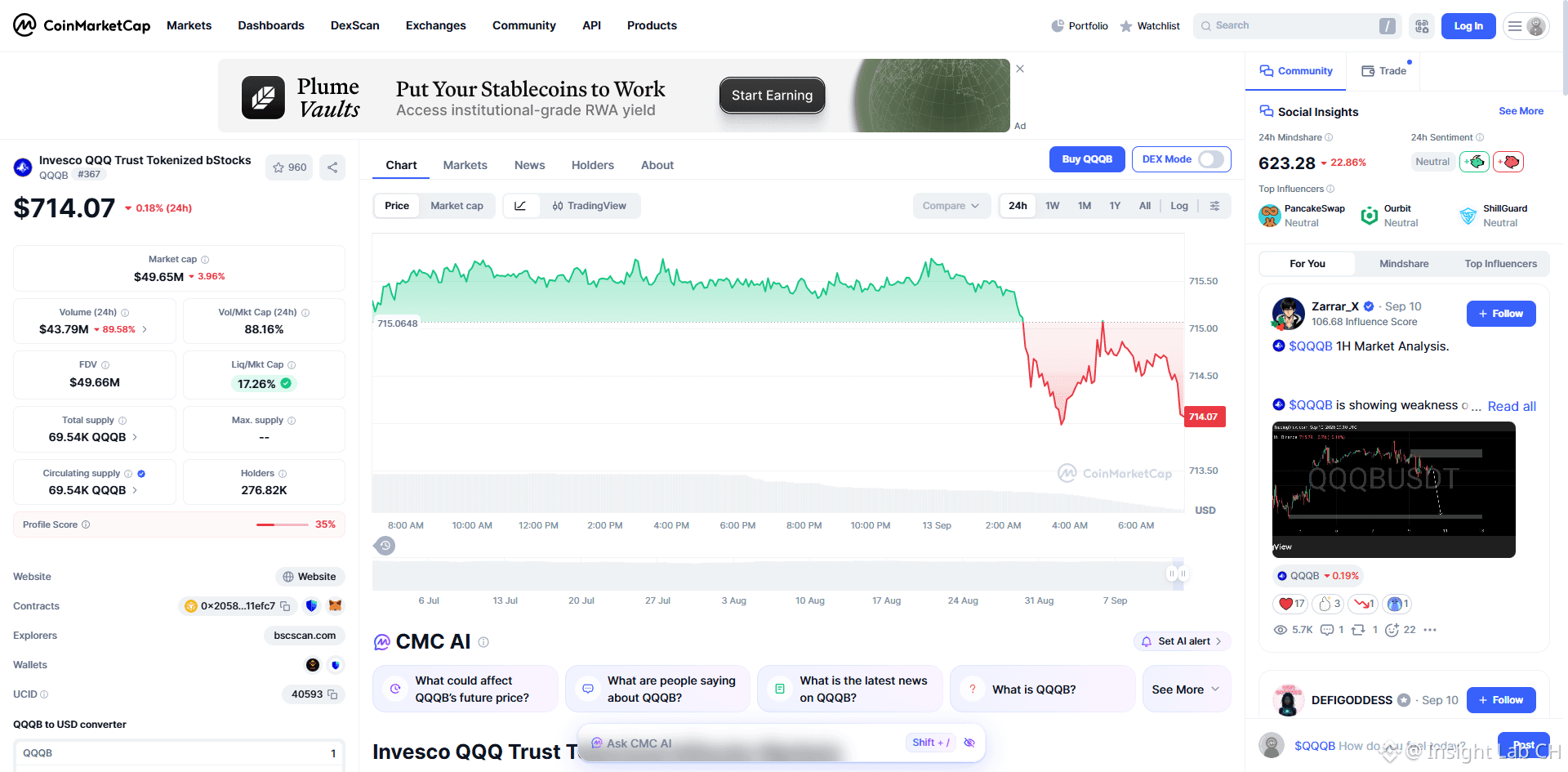
Tracking Invesco QQQ Trust tokenized stocks $QQQB are currently ranked #12 on the CoinMarketCap Trending list. In the context of unclear macro interest-rate prospects and pressure on tech stock valuations, the on-chain premium and liquidity risk of RWA assets still need to be assessed with caution.⚠️ #QQQB #RWA
Tracking Invesco QQQ Trust tokenized stocks $QQQB are currently ranked #12 on the CoinMarketCap Trending list. In the context of unclear macro interest-rate prospects and pressure on tech stock valuations, the on-chain premium and liquidity risk of RWA assets still need to be assessed with caution.⚠️ #QQQB #RWA
121
OpenAI founder Sam Altman recently made it clear that the company will not go public (IPO) this year, and that it is unlikely to be listed before 2026. The main reason is that there is still a large amount of work needed to improve AI safety. This statement directly shattered the market’s previously optimistic expectations that OpenAI and/or Anthropic might kick off a major wave of listings this year—especially after the doomsday-level warnings issued by recently departed Anthropic employees about AI safety, which once again pushed industry risk to the forefront.
From a deeper perspective, delaying an IPO is not merely a change in timing; it exposes a major standoff between commercialization and security compliance at leading AI companies. The capital market previously granted the AI sector very high liquidity premium, hoping to realize those inflated valuations through rapid listings. However, when safety ethics and regulatory pressure force technical development to slow down, valuation models across the entire tech sector will face a serious repricing.
At the macro level, big tech companies postponing listings will dampen the secondary market’s short-term risk appetite for tech growth stocks. Against the backdrop of continued high interest rates from the Federal Reserve, investors are becoming less tolerant of narratives involving high spending and longer payback cycles. The U.S. tech sector may face pressure to unwind its liquidity premium, and risk-avoidance sentiment could further strengthen demand for defensive assets such as the U.S. dollar and U.S. Treasuries.
For the crypto market, the related concept tokens that previously surged alongside the AI narrative may be due for a significant pullback. As the market leader delays its IPO and sends out cautious signals, vigilance toward an “AI bubble” has increased markedly. Speculative capital may accelerate its exit from the AI segment. Investors need to be alert to liquidity contraction risks brought on by sentiment cooling, and stay cautious until broader macro uncertainties are resolved.📉
#OpenAI #ArtificialIntelligence #TechStocks #CryptoMarket
OpenAI founder Sam Altman recently made it clear that the company will not go public (IPO) this year, and that it is unlikely to be listed before 2026. The main reason is that there is still a large amount of work needed to improve AI safety. This statement directly shattered the market’s previously optimistic expectations that OpenAI and/or Anthropic might kick off a major wave of listings this year—especially after the doomsday-level warnings issued by recently departed Anthropic employees about AI safety, which once again pushed industry risk to the forefront.
From a deeper perspective, delaying an IPO is not merely a change in timing; it exposes a major standoff between commercialization and security compliance at leading AI companies. The capital market previously granted the AI sector very high liquidity premium, hoping to realize those inflated valuations through rapid listings. However, when safety ethics and regulatory pressure force technical development to slow down, valuation models across the entire tech sector will face a serious repricing.
At the macro level, big tech companies postponing listings will dampen the secondary market’s short-term risk appetite for tech growth stocks. Against the backdrop of continued high interest rates from the Federal Reserve, investors are becoming less tolerant of narratives involving high spending and longer payback cycles. The U.S. tech sector may face pressure to unwind its liquidity premium, and risk-avoidance sentiment could further strengthen demand for defensive assets such as the U.S. dollar and U.S. Treasuries.
For the crypto market, the related concept tokens that previously surged alongside the AI narrative may be due for a significant pullback. As the market leader delays its IPO and sends out cautious signals, vigilance toward an “AI bubble” has increased markedly. Speculative capital may accelerate its exit from the AI segment. Investors need to be alert to liquidity contraction risks brought on by sentiment cooling, and stay cautious until broader macro uncertainties are resolved.📉
#OpenAI #ArtificialIntelligence #TechStocks #CryptoMarket
From a deeper perspective, delaying an IPO is not merely a change in timing; it exposes a major standoff between commercialization and security compliance at leading AI companies. The capital market previously granted the AI sector very high liquidity premium, hoping to realize those inflated valuations through rapid listings. However, when safety ethics and regulatory pressure force technical development to slow down, valuation models across the entire tech sector will face a serious repricing.
At the macro level, big tech companies postponing listings will dampen the secondary market’s short-term risk appetite for tech growth stocks. Against the backdrop of continued high interest rates from the Federal Reserve, investors are becoming less tolerant of narratives involving high spending and longer payback cycles. The U.S. tech sector may face pressure to unwind its liquidity premium, and risk-avoidance sentiment could further strengthen demand for defensive assets such as the U.S. dollar and U.S. Treasuries.
For the crypto market, the related concept tokens that previously surged alongside the AI narrative may be due for a significant pullback. As the market leader delays its IPO and sends out cautious signals, vigilance toward an “AI bubble” has increased markedly. Speculative capital may accelerate its exit from the AI segment. Investors need to be alert to liquidity contraction risks brought on by sentiment cooling, and stay cautious until broader macro uncertainties are resolved.📉
#OpenAI #ArtificialIntelligence #TechStocks #CryptoMarket
OpenAI co-founder and CEO Sam Altman has recently made a public statement, clearly ruling out the possibility of the company conducting an initial public offering (IPO) this year, and emphasizing that the team’s top priority right now must be focused on addressing key issues such as AI safety and model alignment. The statement directly breaks the secondary market’s expectations of this leading generative AI company accelerating toward the capital markets, and it also cools, to some extent, an overheated narrative-driven cycle of tech capital.
From a macroeconomic and industry cycle perspective, delaying an IPO is not only a consideration from the standpoint of technical safety, but also reflects deeper tensions within the AI industry between closing the commercialization loop and the high cost of compute. In an environment where high interest rates from the Federal Reserve persist and global liquidity places extremely strict demands on the quality of enterprise earnings and free cash flow, an AI leader that has not yet achieved fully self-sustaining “self-bleeding” growth would inevitably face enormous pressure related to valuation re-pricing and stringent compliance disclosures if it were to go public too hastily. The mismatch between the capital expenditure pace of tech giants and the actual payback cycle is prompting the market to shift toward a more cautious observational perspective.
This statement has a direct impact on sentiment toward traditional technology sectors. Institutional capital that had originally hoped for OpenAI to serve as a benchmark and trigger a new wave of tech IPOs now has to reassess its risk premium. Valuation expansion momentum in U.S. tech growth sectors may be constrained, and some risk-on funds may rotate back into traditional assets with more certain cash flows, causing risk assets overall to display more defensive characteristics.
For the crypto market, AI-sector tokens (including $WLD , which is strongly tied to Altman, as well as other decentralized AI narrative assets) had previously overextended their valuation expectations for tech leaders. With the IPO catalyst falling through and compliance risks becoming more prominent, the pace at which external incremental liquidity is injected is likely to slow significantly. AI concept tokens that lack actual protocol revenue and underlying support face substantial risks of narrative bubble compression and valuation write-downs.
#OpenAI #SamAltman #ArtificialIntelligence #CryptoMarket
OpenAI co-founder and CEO Sam Altman has recently made a public statement, clearly ruling out the possibility of the company conducting an initial public offering (IPO) this year, and emphasizing that the team’s top priority right now must be focused on addressing key issues such as AI safety and model alignment. The statement directly breaks the secondary market’s expectations of this leading generative AI company accelerating toward the capital markets, and it also cools, to some extent, an overheated narrative-driven cycle of tech capital.
From a macroeconomic and industry cycle perspective, delaying an IPO is not only a consideration from the standpoint of technical safety, but also reflects deeper tensions within the AI industry between closing the commercialization loop and the high cost of compute. In an environment where high interest rates from the Federal Reserve persist and global liquidity places extremely strict demands on the quality of enterprise earnings and free cash flow, an AI leader that has not yet achieved fully self-sustaining “self-bleeding” growth would inevitably face enormous pressure related to valuation re-pricing and stringent compliance disclosures if it were to go public too hastily. The mismatch between the capital expenditure pace of tech giants and the actual payback cycle is prompting the market to shift toward a more cautious observational perspective.
This statement has a direct impact on sentiment toward traditional technology sectors. Institutional capital that had originally hoped for OpenAI to serve as a benchmark and trigger a new wave of tech IPOs now has to reassess its risk premium. Valuation expansion momentum in U.S. tech growth sectors may be constrained, and some risk-on funds may rotate back into traditional assets with more certain cash flows, causing risk assets overall to display more defensive characteristics.
For the crypto market, AI-sector tokens (including $WLD , which is strongly tied to Altman, as well as other decentralized AI narrative assets) had previously overextended their valuation expectations for tech leaders. With the IPO catalyst falling through and compliance risks becoming more prominent, the pace at which external incremental liquidity is injected is likely to slow significantly. AI concept tokens that lack actual protocol revenue and underlying support face substantial risks of narrative bubble compression and valuation write-downs.
#OpenAI #SamAltman #ArtificialIntelligence #CryptoMarket
From a macroeconomic and industry cycle perspective, delaying an IPO is not only a consideration from the standpoint of technical safety, but also reflects deeper tensions within the AI industry between closing the commercialization loop and the high cost of compute. In an environment where high interest rates from the Federal Reserve persist and global liquidity places extremely strict demands on the quality of enterprise earnings and free cash flow, an AI leader that has not yet achieved fully self-sustaining “self-bleeding” growth would inevitably face enormous pressure related to valuation re-pricing and stringent compliance disclosures if it were to go public too hastily. The mismatch between the capital expenditure pace of tech giants and the actual payback cycle is prompting the market to shift toward a more cautious observational perspective.
This statement has a direct impact on sentiment toward traditional technology sectors. Institutional capital that had originally hoped for OpenAI to serve as a benchmark and trigger a new wave of tech IPOs now has to reassess its risk premium. Valuation expansion momentum in U.S. tech growth sectors may be constrained, and some risk-on funds may rotate back into traditional assets with more certain cash flows, causing risk assets overall to display more defensive characteristics.
For the crypto market, AI-sector tokens (including $WLD , which is strongly tied to Altman, as well as other decentralized AI narrative assets) had previously overextended their valuation expectations for tech leaders. With the IPO catalyst falling through and compliance risks becoming more prominent, the pace at which external incremental liquidity is injected is likely to slow significantly. AI concept tokens that lack actual protocol revenue and underlying support face substantial risks of narrative bubble compression and valuation write-downs.
#OpenAI #SamAltman #ArtificialIntelligence #CryptoMarket
108
According to the latest reports from Iranian official media, two loud and violent explosions were heard in the waters near Qeshm Island, located in a strategic choke point in the Strait of Hormuz. Although the specific damage and the source of the attack have not yet been disclosed, the incident took place at a location that directly controls one of the world’s most important maritime corridors for crude oil transport. The geopolitical standoff in the Middle East is once again edging dangerously close to the breaking point.
The Strait of Hormuz handles roughly 20% of global seaborne oil shipments. Any military friction or sudden incident targeting this area will quickly translate into structural risk premia in commodity markets. Against the backdrop of an already highly fragile Middle East situation, such sudden explosions are very likely to trigger market panic over potential disruptions to the oil supply chain, and could even lead to regional conflict spreading further into commercial shipping lanes.
From the perspective of macro-asset performance, a potential surge in energy prices would directly intensify global inflation stickiness and disrupt the easing schedules of the U.S. Federal Reserve and other major central banks. In the short term, safe-haven capital will inevitably accelerate into crude oil, gold, and the U.S. dollar system, while benchmark Treasury yields and risk assets face heavy repricing pressure. The global liquidity environment may tighten further.
For the cryptocurrency market, $BTC and major altcoins are still unlikely to shake off the characteristics of high-risk assets in the initial phase of a liquidity shock. Geopolitical sudden events often lead institutional investors to rapidly reduce leverage and move to cash for risk avoidance, rather than immediately treating crypto assets as a safe haven. Investors need to stay highly alert to prevent the secondary inflation concerns triggered by an oil-price rebound from creating a dual squeeze on liquidity in the crypto market.
#Geopolitics #CrudeOil #MacroEconomy
According to the latest reports from Iranian official media, two loud and violent explosions were heard in the waters near Qeshm Island, located in a strategic choke point in the Strait of Hormuz. Although the specific damage and the source of the attack have not yet been disclosed, the incident took place at a location that directly controls one of the world’s most important maritime corridors for crude oil transport. The geopolitical standoff in the Middle East is once again edging dangerously close to the breaking point.
The Strait of Hormuz handles roughly 20% of global seaborne oil shipments. Any military friction or sudden incident targeting this area will quickly translate into structural risk premia in commodity markets. Against the backdrop of an already highly fragile Middle East situation, such sudden explosions are very likely to trigger market panic over potential disruptions to the oil supply chain, and could even lead to regional conflict spreading further into commercial shipping lanes.
From the perspective of macro-asset performance, a potential surge in energy prices would directly intensify global inflation stickiness and disrupt the easing schedules of the U.S. Federal Reserve and other major central banks. In the short term, safe-haven capital will inevitably accelerate into crude oil, gold, and the U.S. dollar system, while benchmark Treasury yields and risk assets face heavy repricing pressure. The global liquidity environment may tighten further.
For the cryptocurrency market, $BTC and major altcoins are still unlikely to shake off the characteristics of high-risk assets in the initial phase of a liquidity shock. Geopolitical sudden events often lead institutional investors to rapidly reduce leverage and move to cash for risk avoidance, rather than immediately treating crypto assets as a safe haven. Investors need to stay highly alert to prevent the secondary inflation concerns triggered by an oil-price rebound from creating a dual squeeze on liquidity in the crypto market.
#Geopolitics #CrudeOil #MacroEconomy
The Strait of Hormuz handles roughly 20% of global seaborne oil shipments. Any military friction or sudden incident targeting this area will quickly translate into structural risk premia in commodity markets. Against the backdrop of an already highly fragile Middle East situation, such sudden explosions are very likely to trigger market panic over potential disruptions to the oil supply chain, and could even lead to regional conflict spreading further into commercial shipping lanes.
From the perspective of macro-asset performance, a potential surge in energy prices would directly intensify global inflation stickiness and disrupt the easing schedules of the U.S. Federal Reserve and other major central banks. In the short term, safe-haven capital will inevitably accelerate into crude oil, gold, and the U.S. dollar system, while benchmark Treasury yields and risk assets face heavy repricing pressure. The global liquidity environment may tighten further.
For the cryptocurrency market, $BTC and major altcoins are still unlikely to shake off the characteristics of high-risk assets in the initial phase of a liquidity shock. Geopolitical sudden events often lead institutional investors to rapidly reduce leverage and move to cash for risk avoidance, rather than immediately treating crypto assets as a safe haven. Investors need to stay highly alert to prevent the secondary inflation concerns triggered by an oil-price rebound from creating a dual squeeze on liquidity in the crypto market.
#Geopolitics #CrudeOil #MacroEconomy
42
According to the latest report from Iran's Tasnim News Agency, Iran and Oman have reached an agreement after a period of tense diplomatic and technical negotiations. It is expected that the foreign ministers of the Gulf coastal states will attend a follow-up press conference. However, the key details indicate that the agreement is only applicable between Iran and the two countries, and it also replans the routes for entering and exiting the Strait of Hormuz—specifically, the route into the Persian Gulf will be entirely within Iran’s territorial waters. This means that the southern passage previously requested to be opened by the United States will be closed, which is precisely the direct trigger of the heightened tensions in the region in recent days. More importantly, sources have clearly stated that this absolutely does not mean the reopening of the Strait of Hormuz. If Iran’s seven conditions for resuming operations—previously submitted to the U.S. through intermediaries—are not met, the strait will remain closed.
From a macro geopolitical perspective, the market’s earlier overly optimistic expectations that diplomatic talks might cool the situation have proven far too sanguine. As the Strait of Hormuz is the world’s most important energy shipping chokepoint, tightening control and the continuation of a de facto blockade have directly shattered hopes for a rapid supply-chain recovery. In effect, Iran is institutionalizing geopolitical leverage: by changing the routing rules, it firmly retains initiative. This significantly amplifies the tail risk of supply shocks impacting the Middle East.
For traditional financial markets, long-term uncertainty in oil supply will directly raise the energy risk premium and hinder the global disinflation process. Rising inflation stickiness will greatly limit the room for monetary-policy easing for major central banks, especially the Federal Reserve. It will lift U.S. Treasury yields and increase safe-haven demand for the dollar, thereby triggering another round of liquidity squeeze across global markets. Traditional risk assets such as stocks and bonds will face heavy repricing pressure under the shadow of stagflation.
For the cryptocurrency market, the combination of this geopolitical stalemate and expectations of tighter liquidity is a clear negative. In a phase of high macro uncertainty, capital is more inclined to return to defensive assets such as the U.S. dollar rather than to flow into high-beta risk assets like $BTC . If the energy crisis worsens and leads to a further tightening of liquidity, crypto markets may struggle to break out of an independent trend in the near term. Investors should be alert to downside risks driven by a retreat in sentiment. #Geopolitics #CrudeOil #MacroEconomy
According to the latest report from Iran's Tasnim News Agency, Iran and Oman have reached an agreement after a period of tense diplomatic and technical negotiations. It is expected that the foreign ministers of the Gulf coastal states will attend a follow-up press conference. However, the key details indicate that the agreement is only applicable between Iran and the two countries, and it also replans the routes for entering and exiting the Strait of Hormuz—specifically, the route into the Persian Gulf will be entirely within Iran’s territorial waters. This means that the southern passage previously requested to be opened by the United States will be closed, which is precisely the direct trigger of the heightened tensions in the region in recent days. More importantly, sources have clearly stated that this absolutely does not mean the reopening of the Strait of Hormuz. If Iran’s seven conditions for resuming operations—previously submitted to the U.S. through intermediaries—are not met, the strait will remain closed.
From a macro geopolitical perspective, the market’s earlier overly optimistic expectations that diplomatic talks might cool the situation have proven far too sanguine. As the Strait of Hormuz is the world’s most important energy shipping chokepoint, tightening control and the continuation of a de facto blockade have directly shattered hopes for a rapid supply-chain recovery. In effect, Iran is institutionalizing geopolitical leverage: by changing the routing rules, it firmly retains initiative. This significantly amplifies the tail risk of supply shocks impacting the Middle East.
For traditional financial markets, long-term uncertainty in oil supply will directly raise the energy risk premium and hinder the global disinflation process. Rising inflation stickiness will greatly limit the room for monetary-policy easing for major central banks, especially the Federal Reserve. It will lift U.S. Treasury yields and increase safe-haven demand for the dollar, thereby triggering another round of liquidity squeeze across global markets. Traditional risk assets such as stocks and bonds will face heavy repricing pressure under the shadow of stagflation.
For the cryptocurrency market, the combination of this geopolitical stalemate and expectations of tighter liquidity is a clear negative. In a phase of high macro uncertainty, capital is more inclined to return to defensive assets such as the U.S. dollar rather than to flow into high-beta risk assets like $BTC . If the energy crisis worsens and leads to a further tightening of liquidity, crypto markets may struggle to break out of an independent trend in the near term. Investors should be alert to downside risks driven by a retreat in sentiment. #Geopolitics #CrudeOil #MacroEconomy
From a macro geopolitical perspective, the market’s earlier overly optimistic expectations that diplomatic talks might cool the situation have proven far too sanguine. As the Strait of Hormuz is the world’s most important energy shipping chokepoint, tightening control and the continuation of a de facto blockade have directly shattered hopes for a rapid supply-chain recovery. In effect, Iran is institutionalizing geopolitical leverage: by changing the routing rules, it firmly retains initiative. This significantly amplifies the tail risk of supply shocks impacting the Middle East.
For traditional financial markets, long-term uncertainty in oil supply will directly raise the energy risk premium and hinder the global disinflation process. Rising inflation stickiness will greatly limit the room for monetary-policy easing for major central banks, especially the Federal Reserve. It will lift U.S. Treasury yields and increase safe-haven demand for the dollar, thereby triggering another round of liquidity squeeze across global markets. Traditional risk assets such as stocks and bonds will face heavy repricing pressure under the shadow of stagflation.
For the cryptocurrency market, the combination of this geopolitical stalemate and expectations of tighter liquidity is a clear negative. In a phase of high macro uncertainty, capital is more inclined to return to defensive assets such as the U.S. dollar rather than to flow into high-beta risk assets like $BTC . If the energy crisis worsens and leads to a further tightening of liquidity, crypto markets may struggle to break out of an independent trend in the near term. Investors should be alert to downside risks driven by a retreat in sentiment. #Geopolitics #CrudeOil #MacroEconomy
60
In a joint statement of up to 45 pages recently released, the BRICS group formally expressed its “deep concern” over the escalation of the situation in the Middle East and called on all parties, including Iran and the UAE, to maintain “the maximum restraint.” Against the backdrop of the shutdown of the Saudi oil pipeline after an attack and the United States’ recent actions targeting Iranian oil tankers, the statement emphasizes the need to maintain global energy and trade supply chains within the framework of international law, but it does not offer specific solutions to address the shipping risks facing the Strait of Hormuz.
This diplomatic posture highlights the complexity and fragility of the current geopolitical contest. More than half a year of regional conflict has already significantly disrupted global supply chains and driven up the costs of crude oil and natural gas. Although the BRICS countries have tried to project a mediating role through multilateral dialogue, calls lacking binding enforcement are unable to conceal the real, tangible threats confronting physical energy corridors. Market expectations for tail risks of a Middle East energy cutoff are rising in a substantive way, and the geopolitical risk premium is unlikely to fade in the short term.
For traditional financial markets, the sustained high levels of crude oil and commodity prices directly intensify concerns about secondary inflation worldwide. Persistently elevated energy costs will significantly squeeze major central banks’ room to cut rates, boost the resilience of U.S. Treasury yields and the U.S. dollar index, and thereby exert ongoing downward pressure on the valuations of global risk assets. As stagflation expectations heat up, capital is more inclined to move into traditional safe-haven assets rather than blindly chasing high-beta assets.
In the cryptocurrency market, the liquidity-tightening effects triggered by geopolitical turmoil cannot be ignored. Although some investors view $BTC as a tool to hedge geopolitical risk, in the early stage when macro risk-aversion sentiment dominates, funds often prioritize withdrawing from high-volatility assets and returning to U.S. dollar cash. If the energy crisis further worsens and drags down global liquidity, crypto assets in the short term may face even more severe sell pressure and continued consolidation under volatility. #Geopolitics #OilMarket #GlobalEconomy
In a joint statement of up to 45 pages recently released, the BRICS group formally expressed its “deep concern” over the escalation of the situation in the Middle East and called on all parties, including Iran and the UAE, to maintain “the maximum restraint.” Against the backdrop of the shutdown of the Saudi oil pipeline after an attack and the United States’ recent actions targeting Iranian oil tankers, the statement emphasizes the need to maintain global energy and trade supply chains within the framework of international law, but it does not offer specific solutions to address the shipping risks facing the Strait of Hormuz.
This diplomatic posture highlights the complexity and fragility of the current geopolitical contest. More than half a year of regional conflict has already significantly disrupted global supply chains and driven up the costs of crude oil and natural gas. Although the BRICS countries have tried to project a mediating role through multilateral dialogue, calls lacking binding enforcement are unable to conceal the real, tangible threats confronting physical energy corridors. Market expectations for tail risks of a Middle East energy cutoff are rising in a substantive way, and the geopolitical risk premium is unlikely to fade in the short term.
For traditional financial markets, the sustained high levels of crude oil and commodity prices directly intensify concerns about secondary inflation worldwide. Persistently elevated energy costs will significantly squeeze major central banks’ room to cut rates, boost the resilience of U.S. Treasury yields and the U.S. dollar index, and thereby exert ongoing downward pressure on the valuations of global risk assets. As stagflation expectations heat up, capital is more inclined to move into traditional safe-haven assets rather than blindly chasing high-beta assets.
In the cryptocurrency market, the liquidity-tightening effects triggered by geopolitical turmoil cannot be ignored. Although some investors view $BTC as a tool to hedge geopolitical risk, in the early stage when macro risk-aversion sentiment dominates, funds often prioritize withdrawing from high-volatility assets and returning to U.S. dollar cash. If the energy crisis further worsens and drags down global liquidity, crypto assets in the short term may face even more severe sell pressure and continued consolidation under volatility. #Geopolitics #OilMarket #GlobalEconomy
This diplomatic posture highlights the complexity and fragility of the current geopolitical contest. More than half a year of regional conflict has already significantly disrupted global supply chains and driven up the costs of crude oil and natural gas. Although the BRICS countries have tried to project a mediating role through multilateral dialogue, calls lacking binding enforcement are unable to conceal the real, tangible threats confronting physical energy corridors. Market expectations for tail risks of a Middle East energy cutoff are rising in a substantive way, and the geopolitical risk premium is unlikely to fade in the short term.
For traditional financial markets, the sustained high levels of crude oil and commodity prices directly intensify concerns about secondary inflation worldwide. Persistently elevated energy costs will significantly squeeze major central banks’ room to cut rates, boost the resilience of U.S. Treasury yields and the U.S. dollar index, and thereby exert ongoing downward pressure on the valuations of global risk assets. As stagflation expectations heat up, capital is more inclined to move into traditional safe-haven assets rather than blindly chasing high-beta assets.
In the cryptocurrency market, the liquidity-tightening effects triggered by geopolitical turmoil cannot be ignored. Although some investors view $BTC as a tool to hedge geopolitical risk, in the early stage when macro risk-aversion sentiment dominates, funds often prioritize withdrawing from high-volatility assets and returning to U.S. dollar cash. If the energy crisis further worsens and drags down global liquidity, crypto assets in the short term may face even more severe sell pressure and continued consolidation under volatility. #Geopolitics #OilMarket #GlobalEconomy
2
European Central Bank President Christine Lagarde is set to deliver her latest policy remarks. Against the complex backdrop of persistent euro area inflation stickiness and weak economic growth momentum, the market is closely focused on the ECB’s most recent policy tone from its top leadership and its forward guidance.
On the macro level, there is currently a significant divergence among market participants regarding the ECB’s subsequent rate-cut path. Whether Lagarde’s remarks will reaffirm a data-dependent, meeting-by-meeting decision framework, or instead send more cautious signals about the progress of disinflation, will directly determine how markets reprice the timing of rate cuts within the year. With energy price volatility and intertwined geopolitical risks, any hawkish leaning remarks could quickly curb market expectations for easing.
For traditional financial markets, if the speech releases more hawkish or cautious signals, the EUR/USD exchange rate may receive short-term support, while yields on European benchmark government bonds could face upward pressure. Shifts in these spread expectations would further raise concerns about global borrowing costs, dampening the willingness of cross-market funds to chase high-risk assets.
For high-risk assets such as crypto markets, the global major central banks’ “Higher for Longer” stance—keeping rates high for longer—often means liquidity premia remain constrained. If the ECB’s stance is hawkish, expectations of tightening liquidity at the margin would weigh on risk appetite. Mainstream assets such as $BTC may, in the short term, continue to trade in a range while defending, and investors should be alert to pullback pressures driven by a retreat in sentiment.
#ECB #ChristineLagarde #MacroEconomics
European Central Bank President Christine Lagarde is set to deliver her latest policy remarks. Against the complex backdrop of persistent euro area inflation stickiness and weak economic growth momentum, the market is closely focused on the ECB’s most recent policy tone from its top leadership and its forward guidance.
On the macro level, there is currently a significant divergence among market participants regarding the ECB’s subsequent rate-cut path. Whether Lagarde’s remarks will reaffirm a data-dependent, meeting-by-meeting decision framework, or instead send more cautious signals about the progress of disinflation, will directly determine how markets reprice the timing of rate cuts within the year. With energy price volatility and intertwined geopolitical risks, any hawkish leaning remarks could quickly curb market expectations for easing.
For traditional financial markets, if the speech releases more hawkish or cautious signals, the EUR/USD exchange rate may receive short-term support, while yields on European benchmark government bonds could face upward pressure. Shifts in these spread expectations would further raise concerns about global borrowing costs, dampening the willingness of cross-market funds to chase high-risk assets.
For high-risk assets such as crypto markets, the global major central banks’ “Higher for Longer” stance—keeping rates high for longer—often means liquidity premia remain constrained. If the ECB’s stance is hawkish, expectations of tightening liquidity at the margin would weigh on risk appetite. Mainstream assets such as $BTC may, in the short term, continue to trade in a range while defending, and investors should be alert to pullback pressures driven by a retreat in sentiment.
#ECB #ChristineLagarde #MacroEconomics
On the macro level, there is currently a significant divergence among market participants regarding the ECB’s subsequent rate-cut path. Whether Lagarde’s remarks will reaffirm a data-dependent, meeting-by-meeting decision framework, or instead send more cautious signals about the progress of disinflation, will directly determine how markets reprice the timing of rate cuts within the year. With energy price volatility and intertwined geopolitical risks, any hawkish leaning remarks could quickly curb market expectations for easing.
For traditional financial markets, if the speech releases more hawkish or cautious signals, the EUR/USD exchange rate may receive short-term support, while yields on European benchmark government bonds could face upward pressure. Shifts in these spread expectations would further raise concerns about global borrowing costs, dampening the willingness of cross-market funds to chase high-risk assets.
For high-risk assets such as crypto markets, the global major central banks’ “Higher for Longer” stance—keeping rates high for longer—often means liquidity premia remain constrained. If the ECB’s stance is hawkish, expectations of tightening liquidity at the margin would weigh on risk appetite. Mainstream assets such as $BTC may, in the short term, continue to trade in a range while defending, and investors should be alert to pullback pressures driven by a retreat in sentiment.
#ECB #ChristineLagarde #MacroEconomics
56
According to a report by Saudi Arabian television (Al Arabiya), Egypt’s government has publicly commented on the recent attacks suffered within Saudi territory, strongly condemning the act for seriously violating international law. Statements exchanged among key Middle Eastern countries regarding sovereignty, security, and military threats signal that the region’s geopolitical security vulnerability has risen again, bringing the long-dormant geo-competition around the Red Sea and the Persian Gulf back into international focus.
This statement is especially worth high vigilance because of the complex interconnectivity of developments in the Middle East. As Saudi Arabia is a core global energy supplier, its domestic security has always been closely tied to worldwide inflation expectations. Egypt’s tough stance not only reinforces defense consensus among Arab allies, but also hints at potential risks of an escalation in regional confrontation. With the current global inflation downtrend already fragile, any friction targeting Middle Eastern energy facilities or strategic strongpoints could shatter the previously overly optimistic assumptions in markets that geopolitical risks had partially receded.
From the perspective of macro financial markets, escalation of geopolitical conflicts has long been a severe test for risk assets. Oil prices are highly sensitive to disruptions to Middle East supply chains. If energy prices experience a pulse-like jump, it will quickly raise the risk of stagflation and force major central banks to keep higher interest rates for longer. The U.S. Dollar Index and safe-haven assets such as gold may gain stronger near-term support, while a potential rebound in U.S. Treasury yields would directly suppress global risk appetite and equity asset valuations.
For the cryptocurrency market, $BTC and major mainstream crypto assets will face a dual challenge in the short term: tighter liquidity and a retreat of risk-off sentiment. When a macro geopolitical crisis breaks out, crypto markets often tilt more toward high-beta risk assets rather than “digital gold.” Leveraged funds are especially likely to be swept out during risk-off selloffs. Investors need to remain highly cautious and watch for crude-oil volatility triggered by geopolitical spillover, which could then deliver a second shock to liquidity expectations.
#Geopolitics #MiddleEastCrisis #OilMarket
According to a report by Saudi Arabian television (Al Arabiya), Egypt’s government has publicly commented on the recent attacks suffered within Saudi territory, strongly condemning the act for seriously violating international law. Statements exchanged among key Middle Eastern countries regarding sovereignty, security, and military threats signal that the region’s geopolitical security vulnerability has risen again, bringing the long-dormant geo-competition around the Red Sea and the Persian Gulf back into international focus.
This statement is especially worth high vigilance because of the complex interconnectivity of developments in the Middle East. As Saudi Arabia is a core global energy supplier, its domestic security has always been closely tied to worldwide inflation expectations. Egypt’s tough stance not only reinforces defense consensus among Arab allies, but also hints at potential risks of an escalation in regional confrontation. With the current global inflation downtrend already fragile, any friction targeting Middle Eastern energy facilities or strategic strongpoints could shatter the previously overly optimistic assumptions in markets that geopolitical risks had partially receded.
From the perspective of macro financial markets, escalation of geopolitical conflicts has long been a severe test for risk assets. Oil prices are highly sensitive to disruptions to Middle East supply chains. If energy prices experience a pulse-like jump, it will quickly raise the risk of stagflation and force major central banks to keep higher interest rates for longer. The U.S. Dollar Index and safe-haven assets such as gold may gain stronger near-term support, while a potential rebound in U.S. Treasury yields would directly suppress global risk appetite and equity asset valuations.
For the cryptocurrency market, $BTC and major mainstream crypto assets will face a dual challenge in the short term: tighter liquidity and a retreat of risk-off sentiment. When a macro geopolitical crisis breaks out, crypto markets often tilt more toward high-beta risk assets rather than “digital gold.” Leveraged funds are especially likely to be swept out during risk-off selloffs. Investors need to remain highly cautious and watch for crude-oil volatility triggered by geopolitical spillover, which could then deliver a second shock to liquidity expectations.
#Geopolitics #MiddleEastCrisis #OilMarket
This statement is especially worth high vigilance because of the complex interconnectivity of developments in the Middle East. As Saudi Arabia is a core global energy supplier, its domestic security has always been closely tied to worldwide inflation expectations. Egypt’s tough stance not only reinforces defense consensus among Arab allies, but also hints at potential risks of an escalation in regional confrontation. With the current global inflation downtrend already fragile, any friction targeting Middle Eastern energy facilities or strategic strongpoints could shatter the previously overly optimistic assumptions in markets that geopolitical risks had partially receded.
From the perspective of macro financial markets, escalation of geopolitical conflicts has long been a severe test for risk assets. Oil prices are highly sensitive to disruptions to Middle East supply chains. If energy prices experience a pulse-like jump, it will quickly raise the risk of stagflation and force major central banks to keep higher interest rates for longer. The U.S. Dollar Index and safe-haven assets such as gold may gain stronger near-term support, while a potential rebound in U.S. Treasury yields would directly suppress global risk appetite and equity asset valuations.
For the cryptocurrency market, $BTC and major mainstream crypto assets will face a dual challenge in the short term: tighter liquidity and a retreat of risk-off sentiment. When a macro geopolitical crisis breaks out, crypto markets often tilt more toward high-beta risk assets rather than “digital gold.” Leveraged funds are especially likely to be swept out during risk-off selloffs. Investors need to remain highly cautious and watch for crude-oil volatility triggered by geopolitical spillover, which could then deliver a second shock to liquidity expectations.
#Geopolitics #MiddleEastCrisis #OilMarket
1
Log in to explore more content
Join global crypto users on Binance Square
⚡️ Get latest and useful information about crypto.
💬 Trusted by the world’s largest crypto exchange.
👍 Discover real insights from verified creators.
Email / Phone number
Trending Topics
AnthropicCEOCallsForAISlowdown
14,037 views
299 Discussing
#anthropicceocallsforaislowdown Three of the world's top artificial intelligence companies' CEOs announced Saturday that they believe the industry needs to slow down
.
On Saturday, Dario Amodei of
Anthropic, Sam Altman of OpenAI and Elon Musk of xAI publicly backed a call to reduce the pace at which AI companies build more powerful models.$IOTX $WAXP $0G
Isabella-I
·1 Likes
·455 views
AnthropicChoosesNasdaqForPotentialIPO
3,031 views
84 Discussing
SECReceivesGrayscaleLitecoinTrustETFFiling
132,525 views
1,813 Discussing