

The crisis and reflection of stablecoins
On February 13, Paxos, the issuer of Binance's stablecoin BUSD, was reported to be under investigation by the U.S. SEC and was unable to mint new coins. Subsequently, Binance announced that it would abandon BUSD as the main token for trading pairs, resulting in BUSD decoupling, BNB falling, and a series of events.
On March 9, the "cryptocurrency friendly bank" Silvergate declared bankruptcy, exacerbating investors' panic about Silicon Valley Bank's liquidity crisis. On March 11, with the fermentation of the news of Silicon Valley Bank's bankruptcy, the second largest stablecoin of cryptocurrency, USDCoin (also known as USDC), was further under pressure. USDC, which was originally the most stable, once fell below $0.9. The reason was that Circle, the issuer of USDC, previously stated that $3.3 billion of its approximately $40 billion reserves supporting stablecoins were still in Silicon Valley Bank. The huge exposure made investors deeply worried and they withdrew one after another.
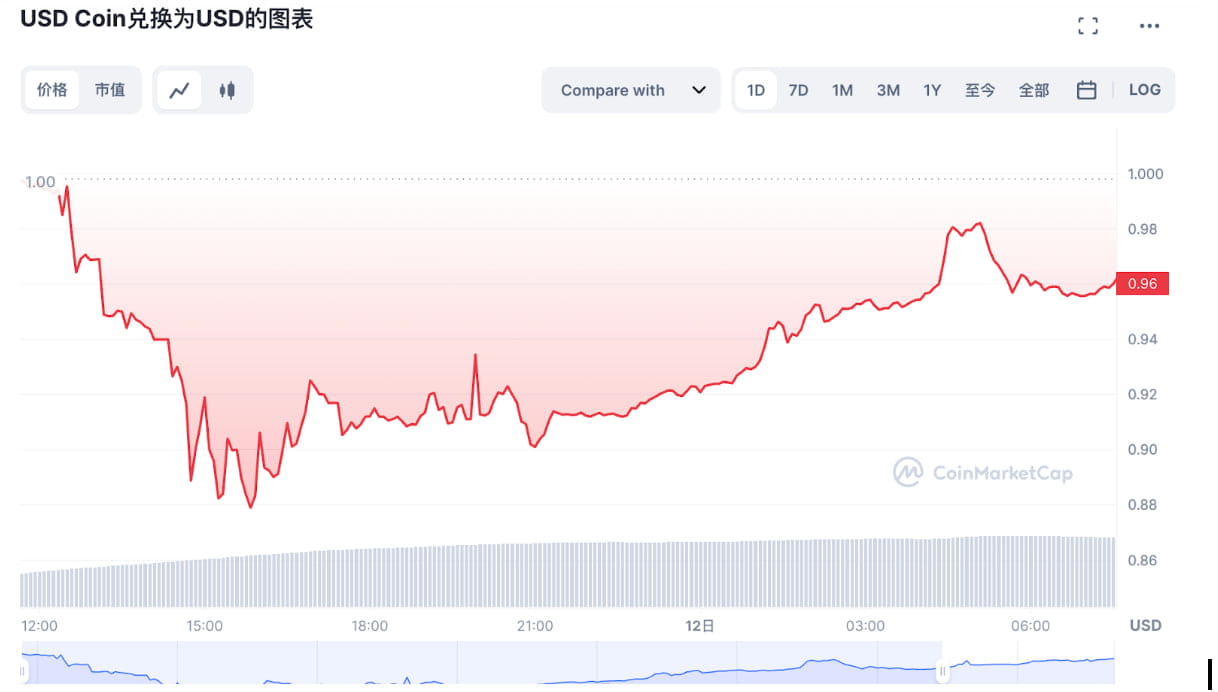
The "BUSD investigation" and "Silicon Valley Bank's collapse" have once again highlighted a major drawback of centralized stablecoins. The issuance and management of centralized stablecoins are in the hands of centralized institutions, which may be affected by a variety of factors such as policies, supervision, and operations, thereby threatening or weakening the value and reputation of stablecoins. In addition, centralized institutions may have security vulnerabilities, poor management, financial risks, and other problems when managing stablecoins, further exacerbating the uncertainty of stablecoins.
The Importance and Opportunities of Decentralized Stablecoins
Of course, there are opportunities in crises. The first is which stablecoin will Binance choose as the next supporter, or whether the BNB Chian public chain will generate a powerful decentralized stablecoin on its own. The decentralized blockchain world requires decentralized infrastructure, which of course includes decentralized stablecoins.
We need to recognize the risks and drawbacks of centralized stablecoins and advocate the development of decentralized stablecoins to make the issuance and management of stablecoins more transparent and open. Blockchain technology provides us with the possibility of decentralized stablecoins, allowing the entire community to participate in the issuance and management of stablecoins and safeguard the value and reputation of stablecoins. At the same time, it is also necessary to strengthen supervision and policy support to ensure the harmonious development of decentralized stablecoins and make them more stable and reliable digital currencies.
Among them, the more competitive ones are the rising star HAY and the veteran decentralized stablecoin DAI. Both DAI and HAY are decentralized over-collateralized tokens. The long existence of DAI in the market has verified the feasibility of the over-collateralization mechanism, which fundamentally lies in the rationality of the collateral assets.
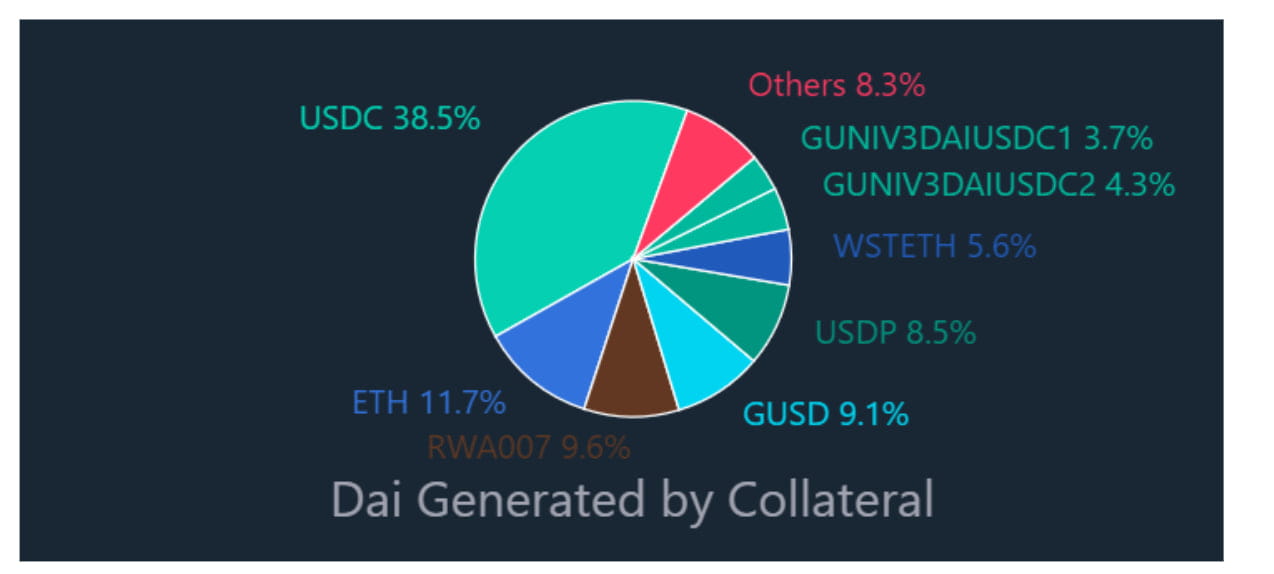
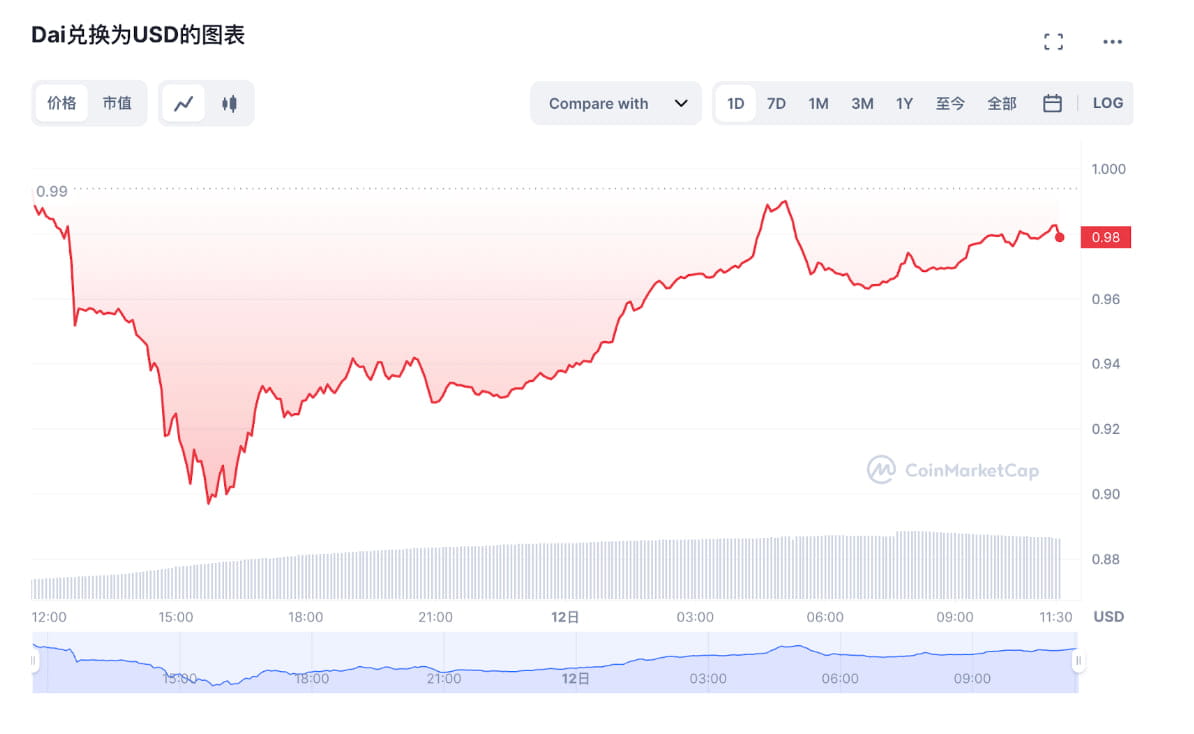
From the official statistics of DAI, it can be seen that the largest proportion of DAI's collateral is Circle's USDC stablecoin, accounting for 38.5% of the total. In the Silicon Valley Bank bankruptcy incident, DAI also fell below $0.9. On the other hand, HAY's collateral is the completely decentralized asset BNB, which achieves stability without being absolutely linked to legal currency. It does not take achieving absolute price parity with $1 as its main goal, nor does it rely on legal assets as collateral for support. In the last BUSD incident, HAY had almost no fluctuations. In view of this, in this article, we only discuss HAY.
HAY's advantages and mechanisms
The main advantage of HAY is that it is a decentralized, unbiased, over-collateralized, and soft-pegged decentralized distributed token. Unlike other stablecoins, HAY does not require centralized fiat currency support, but is backed by decentralized on-chain assets such as BNB. Therefore, it will not be subject to the drawbacks of other centralized stablecoins that are easily subject to regulatory policies.
1 HAY is always redeemable for 1 USD of cryptocurrency and is overcollateralized by BNB. Users can mint and borrow HAY by providing BNB or BUSD as collateral, which can then be used for collateral yield, liquidity mining, and as a means of transferring value. HAY is generated, backed, and stabilized by depositing CeVault as collateral assets in the Helio Collateral Vault.
Another advantage of HAY is that it solves the capital efficiency problem experienced by over-collateralized stablecoins, allowing users to leverage their funds with collateralized debt positions (CDPs). By combining the features of Liquid Staking, the MakerDAO model, and the additional liquidity of LPs on DEXs, Helio Protocol will avoid problems such as frozen funds (fiat-backed) or loss of holding value (algorithmic) due to price instability, which other similar DeFi stablecoin products on the BNB chain cannot provide. This means that users can get additional returns on their collateral without having to go through the process of unstaking, which can be time-consuming and may incur fees.
Additionally, HAY is an overcollateralized distributed token that has a 66% loan-to-value (LTV) ratio or a 152% collateralization ratio. For example, if a user were to deposit about $100 worth of BNB, he would only be able to borrow a maximum of about 66 HAYs. Essentially, the market value of HAY will never exceed the total amount of its collateral in the protocol (the market value of BNB). This ratio has been battle-tested by other DeFi projects such as MakerDAO, and helps ensure that there is always enough collateral to cover any potential bad debts while maintaining a peg to the dollar.
Another advantage of HAY as a decentralized stablecoin is that it is on a decentralized chain, the code is open source, and anyone can access and review the security. Helio Protocol has also been audited by leading auditing companies such as PeckShield, Certik, and Veridise, giving users greater peace of mind.
The future and conclusion of HAY
Most stablecoin projects to date, including MakerDAO, are built on the ETH chain, which can be said to be both inefficient and expensive. The BNB chain currently has a large user base and has been expanding rapidly, and has the potential to provide the same maturity and scale as ETH, but at a lower cost and higher efficiency. However, there is still a lack of a dominant decentralized stablecoin in the BNB ecosystem, so the emergence of the Helio Protocol program fills this gap.
Helio Protocol presents a compelling solution. With the scalable, decentralized and stable decentralized platform BNB Chain to create and manage stablecoins, Helio Protocol can provide a viable alternative for users seeking stablecoin options that are not subject to centralized policy risks. As the cryptocurrency market continues to mature, platforms like Helio Protocol will undoubtedly play an increasingly important role in developing innovative and new solutions to the challenges facing the industry.
#BTC #BUSD #usdc #crypto2023 #Binance