

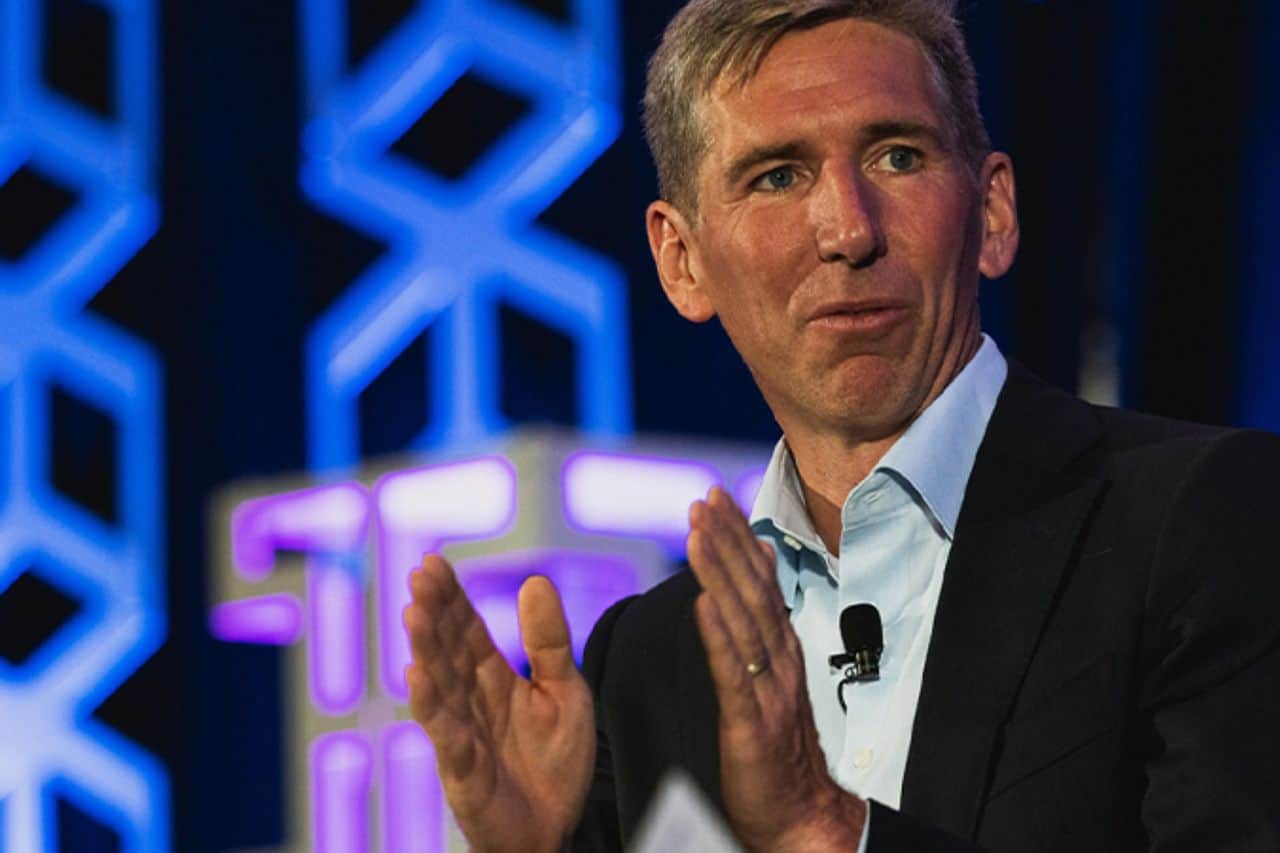
Bitwise Asset Management's Chief Investment Officer Matt Hougan predicts that Bitcoin will show a stable upward trend over the next decade, rather than explosive growth, emphasizing its stable returns.
"I believe we are in a phase of strong returns that steadily rise over a continuous 10-year period. While the returns are not astonishing, they are robust, with lower volatility, and there will be fluctuations along the way," Matt Hougan said on CNBC's program on Friday.
Hougan predicts that Bitcoin will undergo a paradigm shift. He expects this cryptocurrency to bid farewell to a four-year cycle of 'booms and busts' and transition to a '10-year grind' characterized by steady but no longer explosive returns. In a recent interview and the company's annual outlook, Hougan forecasts that despite digital assets performing flatly by the end of 2025, Bitcoin will reach a historical high in 2026 driven by institutional adoption and favorable regulatory winds.
Hougan still stands by his prediction that 2026 will be a positive year for Bitcoin.
Hougan's outlook comes against the backdrop of a challenging year for digital assets. Bitcoin has fallen about 7% this year and is currently trading around $87,000, having pulled back over 30% from an October peak of $126,000. He attributes this lackluster performance to residual expectations from retail investors regarding the traditional four-year halving cycle, which has historically led to sharp rallies followed by deep corrections.
The four-year cycle has effectively ended.
Speaking on a recent CNBC program, Hougan stated: "The four-year cycle has effectively ended." He emphasized that forces such as the halving effect, interest rate volatility, and leverage-driven speculation are weakening. Instead, he envisions the next decade as one of 'strong but not spectacular' growth, with Bitcoin achieving sustainable growth amid volatility, thanks to institutional capital inflows that mitigate fluctuations.
In Bitwise's early-month release, co-authored by Hougan and research director Ryan Rasmussen, titled (Top 10 Cryptocurrency Predictions for 2026), the company is particularly bullish on Bitcoin's near-term trajectory. The primary prediction is that driven by accelerating institutional demand, spot ETF allocations, and a crypto-friendly regulatory environment under the Trump administration, Bitcoin will 'break the four-year cycle and reach all-time highs.' Hougan emphasized the role of ETFs, predicting that as platforms like Citigroup, Morgan Stanley, Wells Fargo, and Merrill Lynch expand their channels, ETFs will absorb more than 100% of Bitcoin's new supply in 2026—approximately 166,000 Bitcoins, worth about $15.3 billion at current prices.
Volatility is another key theme. Hougan predicts that Bitcoin's volatility next year will be lower than that of Nvidia stocks, noting that throughout 2025, this cryptocurrency's volatility has already been lower than that of this chip manufacturer. This reduction in risk stems from a shift in the holder structure: institutions are now adopting mechanical portfolio rebalancing, offsetting the behavior of retail investors chasing momentum, thereby preventing deeper declines.
Hougan explains: "We're seeing a 'stair-step rise and elevator drop' (indicating milder corrections)," adding that thanks to continued buying pressure from endowments and funds, the recent correction has been reduced to 30% instead of the historical 60%. As an additional prediction, Bitwise expects the correlation between Bitcoin and the stock market to decline, further establishing its status as a diversified asset.
"Decade-long honing"
Hougan's 'decade-long honing' argument aligns with the views of other industry leaders like ReserveOne's Chief Investment Officer Sebastian Bea, who also believes Bitcoin's performance will remain strong but may temper due to maturing market dynamics.
The expansion of stablecoins (with a market capitalization now exceeding $300 billion) and the tokenization of real-world assets (RWA) (through plans by custodial trusts and settlement companies like DTCC potentially bringing trillions of dollars on-chain) are seen as long-term catalysts. However, Hougan warns that regulatory clarity, particularly the passage of the CLARITY Act, is crucial; without this act, the rally may be stalled, and once approved, it will signal a 'safe entry' for investors during pullbacks.
These predictions are not limited to Bitcoin. Bitwise anticipates that after Brown University and Harvard University, half of the Ivy League endowment funds will allocate to cryptocurrencies, potentially releasing billions from their $871 billion in assets. If the CLARITY Act passes, Ether and Solana are also expected to reach new highs, benefiting from the larger trend of stablecoins and tokenization.
Hougan remains optimistic about the overall market in 2026, reiterating in an interview that the market could close higher by year-end, though he did not provide specific price targets.
According to sentiment indicators, Bitcoin is currently in the 'extreme fear' zone, while Hougan's vision provides a rational counterpoint to the volatility in this space. As institutional participants increasingly dominate—evidenced by this year's record crypto derivatives trading volume of $85.7 trillion—2026 may mark the dawn of a maturing phase for cryptocurrencies, transforming them from speculative bets into staple assets within diversified portfolios. Nonetheless, skeptics point out that human psychology may allow cyclical effects to persist, potentially impacting price movements despite structural changes.
"Bitwise's Matt Hougan: Bitcoin is entering a decade of steady growth, with returns that are not spectacular but strong" was first published on (Blockcast).