

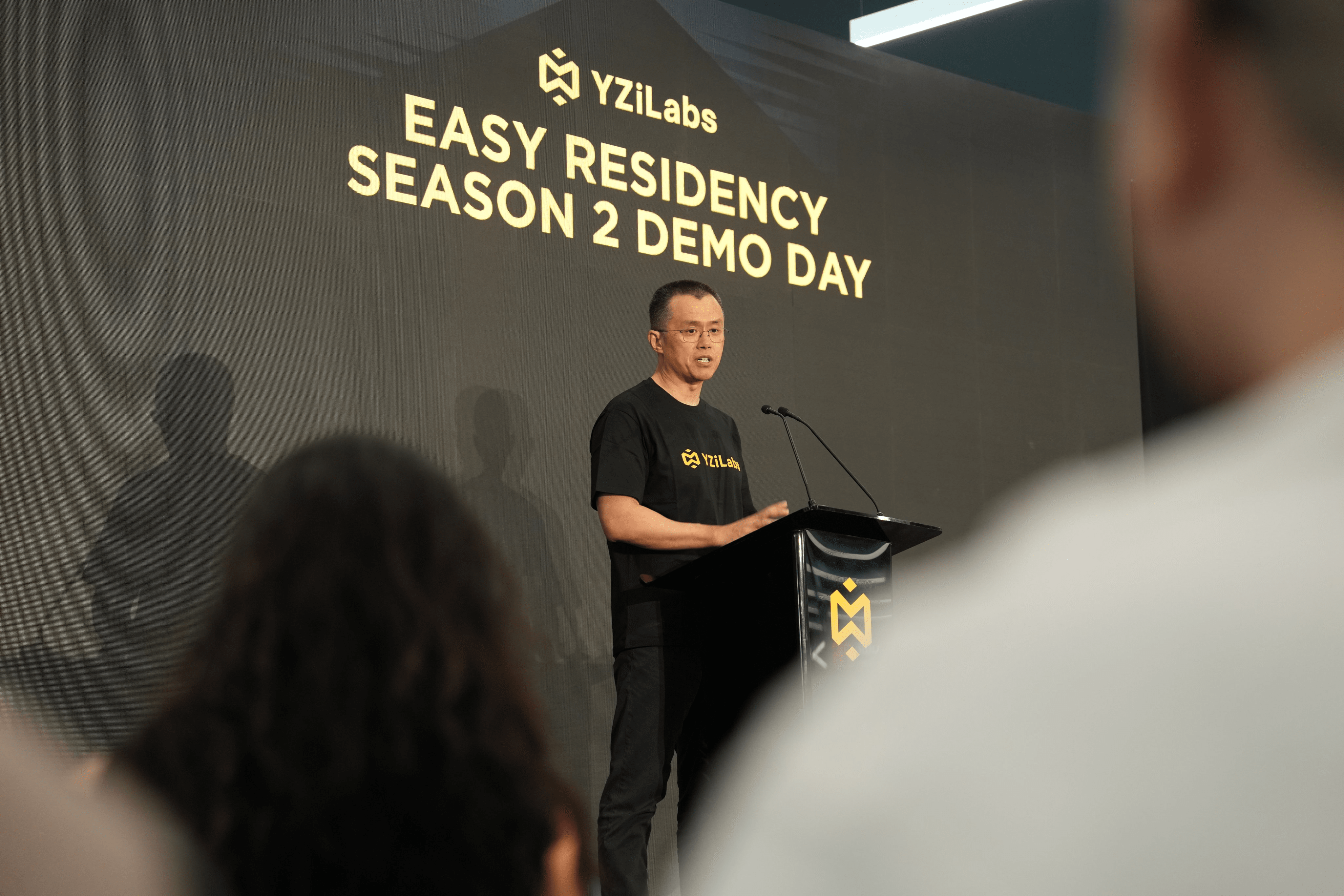
On the evening of December 4, at the Binance Blockchain Week event, Binance founder Zhao Changpeng (CZ) held a group interview and shared his views on the questions that everyone in the market is most concerned about regarding Binance.
This year has been unforgettable for CZ. A year after being convicted and imprisoned during Biden's administration and paying a fine of 4.3 billion USD, he received a pardon from U.S. President Trump. On the day he received the news, he was clearly in great spirits, posting several messages on social media to thank Trump.
The pardon not only means an upgrade in his physical freedom level, allowing him to go to Washington at any time, but it is also an epic benefit for Binance, as Binance's business in the United States had been almost reduced to nothing due to regulatory troubles in previous years. In an interview, he also mentioned that the U.S. is now an emerging market for Binance.
Rhythm BlockBeats organized the interview, simplifying the content without changing CZ's original meaning and tone. Here are CZ's latest thoughts and perspectives.
Question: What problems have not been solved for cryptocurrency to enter daily life in the next three to five years? How do we get there?
CZ: This is a good question. I think an obvious one is 'payments.' In Bitcoin's white paper, cryptocurrency was originally designed as electronic cash to be used for payments. Many people have indeed tried to create payment products, but what we see on-chain now is mostly various financial products with speculative attributes; truly 'usable payments' have not yet been fully realized.
There are many reasons for this, one typical problem is 'price volatility.' Now with stablecoins, theoretically everyone can use stablecoins for payments, but in reality, it still takes time to mature these technical solutions into truly popular products.
I personally believe a potentially viable path is to connect with traditional payment networks, such as the Binance card, which combines crypto assets with the Visa and Mastercard systems. Users swipe a card, merchants receive fiat settlement, and users get deducted from their crypto assets. This type of solution is actually quite good.
But unfortunately, due to regulations and some policies of the Biden administration, we have lost most of the Binance card business, so these cards have not yet fully returned. I hope that in the next few years, similar solutions can become popular again. In short, there are many different solutions for payments, but this is the one I consider the most important direction.
Question: How did you envision Binance's model and vision at the beginning? What has actually happened today? What did you initially 'get wrong'? What predictions turned out to be correct?
CZ: I think predicting the future is inherently difficult. When I first founded Binance, I set a goal for myself to be among the top ten trading platforms in the world within three years, and it turned out we became number one in just five months.
At first, we thought we should set up a physical headquarters somewhere, with offices, signage, and buildings, operating like a traditional company. But later we found that doing so actually has many problems. So we turned to create a completely decentralized organization without a headquarters or centralized office. Later, we found that this also poses regulatory issues; regulators need to know where your headquarters is and which jurisdiction governs it, so we adjusted our route again.
This journey has actually been a process of repeated trial and error and back and forth. Now, I feel that the landscape has become much clearer; centralized trading platforms will be companies that are 'licensed, regulated, and have a clear headquarters and physical office.' On the other hand, decentralized solutions on the chain are also becoming more and more popular, and completely decentralized protocols will continue to develop.
Question: What types of projects or founders do you think will stand out in the next cycle? Which will be eliminated?
CZ: This is a broad question, but I think the first point is to look at 'products' and 'founders who build products.' These founders are truly building products that can be used daily, focusing on users rather than hype. Teams driven by products and users will continue to stay.
The second point is that the cryptocurrency industry is very volatile. We are likely currently in a bull market, but there will definitely be bear markets again, followed by another bull market, and then another bear market. The regulation in different countries will also fluctuate between being strict and lenient, going back and forth in cycles. So the founders who can truly survive are those who are not afraid of volatility and can endure in the long term.
Question: What do you think of DAT companies? Is such a model sustainable?
CZ: I believe this DAT model will continue to exist; its underlying logic is valid. Its essence is to help those 'who cannot directly buy Bitcoin or crypto assets' traditional companies gain exposure to crypto assets.
Many companies' CFOs are allowed to allocate company funds into stocks, but there are no internal processes or permissions for them to directly buy cryptocurrency. The DAT structure just fills this gap.
Under the DAT structure, many different types can be distinguished. Because MicroStrategy has been particularly successful, everyone now wants to replicate it. Just like with the internet, one successful internet company does not mean all internet companies are well managed. The management fee structures of different DATs vary greatly, and I personally always believe that lower management fees are better. DAT companies should strive to be simple and transparent.
Some models are very straightforward; for example, MicroStrategy is continuously buying Bitcoin, and the BNB-related DAT is to buy BNB. If you use BNB correctly with tools like Launchpad, Launchpool, and airdrops, the overall annualized return can reach 10–15%, which is very attractive compared to traditional stock markets.
Some DATs want to be more 'active' and 'proactive,' for example, by allocating 10% of their funds for investments to buy a basket of different crypto assets. This essentially becomes another business model with a completely different risk structure, heavily reliant on the expertise of the management team.
Question: You have already received a pardon from President Trump. Will you start some new business in the U.S. in the future and collaborate more with the Trump family?
CZ: First of all, I currently have no cooperative relationship with the Trump family. I am certainly very grateful for the pardon given by President Trump, which allows me and our business to operate more freely around the world, including in the U.S.
I really hope to help the U.S. become the 'global center of cryptocurrency.' From a company perspective, the U.S. is actually an 'emerging market' for us, because in recent years during the Biden administration, our relationship with the U.S. has been very tense. During that time, we basically tried to distance ourselves from the U.S. as much as possible and reduce all associations with it.
We do have Binance US, but its scale is very small. On the day of the lawsuit with the SEC in 2023, it still had a 35% market share in the spot market, but now it is almost in single digits, and the banking channels are almost entirely cut off, with licenses in most states lost.
Now my understanding is that the situation has reopened. The U.S. is a very important market and is globally leading in many fields, such as technology talent and AI. However, in the blockchain sector, most of the largest companies are not based in the U.S.
I hope to bring many quality crypto businesses back to the U.S. and help American institutional investors gain the ability to allocate to BNB and the entire BNB ecosystem. Currently, many U.S. institutions neither have access to BNB nor understand the BNB ecosystem.
Therefore, from both an investment perspective and in terms of supporting entrepreneurs and helping quality projects grow, we will be more actively involved in the U.S. market to help establish a stronger crypto industry ecosystem locally.
Question: You have been very active on X and are often under public scrutiny or even attacks. How do you maintain mental health and stability in such situations?
CZ: For me, this is actually quite simple.
Online attacks can generally be divided into two categories: one is traditional mainstream media, which has long stood on an anti-crypto narrative, saying things like 'cryptocurrency is used by bad people' and 'Bitcoin is abused by criminals.' These narratives are essentially the traditional system's fear of new technology.
In the U.S., especially among the Democrats, there are particularly many attacks on crypto. I don’t engage in politics; I just state facts. And I believe that most ordinary Americans actually want to own cryptocurrency.
Another category is people who have lost money in trading. Many people think they have good insight when they make money from investing; but once they lose money, they start blaming the trading platform and others. I sympathize with their losses, but everyone must be responsible for their own actions.
I have experienced many challenges, including going to jail, but I am very clear that along the way, no one has been defrauded because of my actions, and users have not lost assets because of us, so I sleep well every night knowing that I am helping many people.
Now, I can automatically filter out negative voices, but I still actively seek constructive negative feedback, which can help improve the product and is beneficial for us. As for those who purely complain and vent their emotions, there is no need to take them to heart.
Question: What is your view on the next steps for mainstream adoption, and what role can Binance play in it?
CZ: I think this process will be relatively slow. The first step is for the regulatory framework to be clearer. I am personally an advisor to many governments. Currently, there are not many countries with a clear and forward-looking regulatory framework for crypto.
The U.S. is now starting to move forward, which is a good thing, but Trump was only in office for one year, the GENIUS Act has just passed, and the Clarity Act is still being pushed. I believe it will eventually be implemented, but the specific form of implementation and the imperfections in the first version of the rules still need time to be refined.
After the regulations come out, banks will also need time to adapt and adjust to protect their own businesses. The so-called crypto industry is actually a very new and young industry. To achieve mainstream adoption, the best way is to deeply integrate with the existing financial system rather than completely sever ties.
Next, there are still many specific questions that need to be resolved, such as whether companies can hold crypto assets. If so, how should they account for it? How should taxes be handled in different countries? How should financial statements be disclosed? How should audits be conducted? These matters seem tedious, but they are not insurmountable challenges; they just require time.
Additionally, from the overall scale of the industry, crypto is still very small. It is currently only around three to four trillion dollars in scale, and in the future, it should reach at least 30–40 trillion dollars. Large-scale applications, such as payments, must be truly implemented, and more financial scenarios need to migrate to the chain for us to say we are truly 'just getting started.'
Question: How do you think cryptocurrency can help developing countries develop, and what should we do to help these countries better understand and accept crypto?
CZ: I believe there are actually more opportunities for crypto in developing countries. I once received a letter from someone saying that he started using cryptocurrency in 2017. Before that, he had to walk three days to town every month to pay a bill. Later, he could complete the payment in just three minutes using crypto. This way, he saves three days every month, which he can use for other things.
He started from 50 dollars, saving bit by bit, until it rose to 300 dollars, and then to 1000 dollars. For a very poor country, that is a significant amount of money, enough to change lives.
In many developing countries, the local currency is often less stable than cryptocurrency, frequently experiencing hyperinflation. Bitcoin and stablecoins can provide them with great hedging tools.
Moreover, many developing countries have a very young population structure. Taking Pakistan as an example, I have recently been collaborating more with them. The average age there is about 25 years, and the population is very young and open to new technologies; they naturally like cryptocurrency.
Now the government is starting to realize this. Since young people like it, we should find ways to give them what they want. So, if the leadership of a country is open enough and forward-looking enough, I would strongly encourage them to seriously embrace cryptocurrency.
Question: How is Giggle Academy developing now?
CZ: Giggle Academy is not a 'business' at all, but a completely free educational platform.
This morning, I just had a meeting with the team. Currently, the platform has about 88,000 child users, with three to four thousand new users added each week, growing rapidly; about 300 courses and two to three thousand storybooks have been launched.
The content is primarily in English, and basic Arabic support has just been added. Storybooks have also been translated into thirty to forty languages through AI. The team is expanding the content while optimizing the product experience, such as improving the accuracy of voice recognition when children interact with AI.
The team now has more than 60 full-time members, plus several hundred content contributors. For the first 8 or 9 months, we basically funded this team out of our own pockets. Later, someone based on the project launched a meme coin, and the community donated about 11 million dollars. We are now primarily thinking about how to use this money effectively to expand the platform's influence and design better incentives for content contributors.
Overall, the project's progress is good, but it is completely non-profit and always free for children. If you have little ones aged 2–6, you can let them try it out; I believe the engagement will be strong, learning words, concepts, and expressions while 'playing.'
Next, we will continue to expand into more languages. Practice has proven that Chinese and Arabic cannot simply translate English courses directly, but must be redesigned according to their respective language habits.
Currently, the project has been implemented in some kindergartens in Abu Dhabi, and local leaders are very supportive and have even offered funding assistance, but what we need more now is landing scenarios rather than money. We also want to do a Korean version, but the team's capacity is limited, so we can only advance it bit by bit.
My ultimate goal is to make this toolkit strong enough so that anyone can create courses on the platform, turning it into a truly 'user-generated content' educational platform. Of course, creating content that is both interesting and high-quality, and that can capture children's attention, is not easy. We are also using AI extensively to lower the barriers to content creation.
Question: What social issues and specific projects are you most concerned about? Where do you plan to donate money in the future?
CZ: I have always believed that money is not meant to be stored away unused, but rather to be utilized; money is a tool.
Currently, the social issue I am most focused on is education. To be honest, up to now, I haven't spent that much out of my own pocket, probably around one to two million dollars, mainly used to support the more than sixty employees at Giggle Academy. Instead, the $11 million donated by the community is much larger; that money essentially does not belong to me. I am just responsible for using it on suitable educational projects.
As for personal wealth donation arrangements, I am still exploring. When I was at Binance, I could utilize many existing resources, such as charity teams and security teams, which was like having a natural leverage. Now that I have left, I no longer have my own charity setup, and I will need to build a small team again or directly integrate into a mature team. In fact, just one or two people can help me systematically filter and evaluate projects.
During this time, I have met many people involved in social projects. For instance, I just met a former venture capital partner named Bill yesterday, who also went to jail for some events and spent more than 90 days in solitary confinement. Now, he is working on a project related to soil microorganisms, hoping to restore soil destroyed by fertilizers and chemicals, making it nutrient-rich again. This project is being pursued on a non-profit basis but has a sustainable business model that can be self-sustaining.
I originally said I wouldn't put too much energy into climate issues, but later learned from him that restoring soil can absorb about 30% of atmospheric carbon emissions, which is actually highly related to the climate.
I have encountered quite a few people and projects like this recently. Besides education, I do not yet have a particularly clear long-term focus; often it relies more on experts in these fields to make judgments.
Additionally, I have also privately donated money to projects like prison education and orphan assistance through some charitable organizations; I have done this in Thailand and other countries. The overall scale is not large, but it is diverse, and it is still in the experimental stage.
My ideal state is that all donations can be completed on the blockchain, transferring using cryptocurrency, so that every step from the outflow of funds to the final beneficiaries is open, transparent, and traceable.
But the reality is that many final beneficiaries will not use crypto wallets. If I only donate using cryptocurrency, the funds will reach very few people. So now I am doing small-scale experiments with different charitable organizations to see which organizations are efficient and truly impactful. Once I find suitable partners, I will scale up.
Question: When you imagine a world where 'one billion people use Binance and Web3,' what picture comes to your mind?
CZ: I think the ultimate form should be that people no longer mention 'crypto' or 'Web3' at all. Just like we don't discuss the 'TCP/IP' protocol today, in the future, people won't say 'I want to use blockchain,' but will simply say 'I want to pay someone' or 'I want to buy something in an application.'
By then, the brand name may become a verb, as natural as we say 'Google it' today. The underlying technology should be completely abstracted away, with no need to discuss concepts like chains, gas fees, cross-chain, withdrawals, etc., and no need for complex addresses.
Ideally, you should just need to input the other person's name to complete the payment directly. Of course, with today's technology, we are still far from that state. Most products in the industry are still technology-oriented, aimed at developers or early players. We need a lot more user-friendly products that hide complexity in the backend.
This doesn’t necessarily have to be accomplished through Binance; it may be an ecosystem made up of many applications and platforms. But from the perspective of network effects, it is very likely that one or two super entry points will emerge, just like Google once did in the search engine field, even though it is now being partially replaced by AI.
So, the future I envision is one where everyone knows they are using a certain product or brand, but no longer discusses whether it’s a Web3 world behind it.
Question: What are your thoughts on the recent adjustments to the management structure, and what directions will you focus on more in Binance in the future?
CZ: For me, this adjustment feels very natural. He Yi, as a co-founder, has always been at the core of the company's strategy, extremely diligent, and close to the community and products. She is one of the most resilient people I have ever seen, and this title change is essentially a formal confirmation of the existing reality. The external feedback has also been uniformly positive, both in Asia and the West; everyone recognizes her highly.
She is nine years younger than me and is at the golden age when I took over as CEO. It is a natural progression for her to lead a larger team, and in fact, she has already been performing the duties of the top leader before the official announcement. Her abilities complement Richard's well: Richard is good at regulation and English; He Yi, while still improving her English, has a strong learning ability and dares to communicate, which is an excellent configuration for the company.
Talking about myself, on the night I stepped down as CEO of Binance, I was writing my farewell letter in Seattle at 4 a.m., shedding tears. But during my time in the U.S., I adjusted my mindset through skiing and surfing, discovering that the company continued to operate well without my deep involvement. Life is about moving forward; I don't need to return to that position.
Now I am focusing on the BNB Chain ecosystem, Yzi Labs, and Giggle Academy, and I am acting as an advisor to help the government formulate regulatory frameworks. Stepping back from daily management allows me to free up energy to promote ecosystem growth. The Binance team is already strong enough, and I believe that a high-frequency, healthy leadership rotation can create space for successors, which is good for the long-term development of the company.
Question: What daily habit do you think is most important to your success?
CZ: I think the habit of learning a little new thing every day is very important.
Most of what schools teach us is foundational skills and will not teach you things like entrepreneurship, negotiation, emotional intelligence, financial literacy, how to start a company, or how to be a boss. These truly important skills must be learned gradually by yourself in society. Even in college, these are rarely taught systematically.
If you are a highly specialized professional, like a doctor or lawyer, you will indeed use a lot of the knowledge learned in school in your daily work; but for most people, especially entrepreneurs, you must rely on continuous self-learning. Therefore, I believe it is important to learn a little bit every day; it forces you to maintain an open mindset, not to confine yourself within the original framework, and makes it easier for you to capture new opportunities.
Secondly, I think effort and maintaining health are equally important. Entrepreneurship is actually physically demanding, not just mental work; you need to have a body that can endure. You need to develop good habits, learn to stabilize yourself under pressure, sleep well, eat well, exercise regularly, and take good care of your body. On this premise, you also need to maintain high-intensity output, working efficiently for sixteen hours a day while being healthy.
So, to summarize, it’s about learning a little every day, keeping an open mind, and at the same time working hard and taking good care of your body, putting these matters at the forefront.
Question: You've gone through many ups and downs and built one of the most influential companies in history. If one day you stand before 'God' and can only say five things you hope to accomplish before you die, what would they be?
CZ: I would rather simplify this question; if there could be one 'wish,' that would be enough. To be honest, I don't have many wishes.
Life is interesting because it is unpredictable. If everything is a scripted play, and you know what will happen next every day, it would lose its fun. The reason you work hard and keep striving is that you are uncertain about the outcome.
It's like playing a game; if you know from the beginning that you will definitely win, the game becomes meaningless. It is those games that require continuous trial and effort, careful coordination with teammates, and constant strategy adjustments that are much more interesting.
I do have a wish: I hope everyone can stay healthy; I think that is one of the most important things. But health is something we cannot completely control; we can develop healthy habits, but there are still many uncertainties.
Apart from that, I think the world itself is already very interesting. Because we only have one life, humans tend to be more engaged in this life. If you had an infinite number of lives, time would become worthless, and many things would lose their meaning. If you know you only have limited opportunities to do something, you will cherish it even more.
So I won’t list a long list of wishes. I have been very lucky; if I really had the chance to say a word to God, I would probably just say, 'Please do not put me in too unfortunate situations; I am already very satisfied with my current state.'