

#walru
walru
15,250 views
1,202 Discussing
Hot
Latest


Article
Walrus: Revolutionizing Decentralized Storage for the Web3 EraAs blockchain technology continues to evolve, the demand for scalable, secure, and decentralized data storage is growing rapidly. One project gaining significant attention is Walrus, a decentralized storage protocol built within the Sui ecosystem.
What Is Walrus?
$OPEN Walrus is designed to provide efficient and cost-effective decentralized storage for large data files. Unlike traditional blockchains that are optimized for transaction processing, Walrus focuses on storing and retrieving massive amounts of data while maintaining decentralization and security.
The protocol enables developers to store images, videos, AI datasets, NFTs, gaming assets, and other digital content without relying on centralized cloud providers. This approach helps reduce censorship risks and improves data availability.
Why Walrus Matters
One of Walrus’s key innovations is its ability to handle large-scale storage with lower costs compared to many existing decentralized storage solutions. By leveraging advanced data distribution techniques, Walrus aims to improve scalability while preserving security.
Key benefits include:
✅ Decentralized and censorship-resistant storage
✅ Optimized for large files and datasets
✅ Lower storage costs
✅ Strong integration with the Sui ecosystem
✅ Support for AI, gaming, NFTs, and Web3 applications
Potential Impact on Web3
As AI, gaming, and decentralized social platforms continue to expand, demand for reliable storage infrastructure will likely increase. Walrus could become a critical layer for Web3 applications that require secure and permanent data storage.
Developers building on Sui may benefit from seamless integration, creating a stronger ecosystem where applications can scale without depending on centralized services.
Final Thoughts
Walrus represents an important step toward solving one of blockchain’s biggest challenges: decentralized data storage at scale. With growing adoption of Web3 technologies, projects like Walrus may play a major role in powering the next generation of decentralized applications.
What are your thoughts on Walrus and the future of decentralized storage? Share your views below!
#Walru
s #Sui #Web3 #StablecoinsMayExtendUSMonetaryInfluence Crypto #Blockchain #DePIN #Storage #BİNANCESQUAR
{spot}(OPENUSDT)
Walrus: Revolutionizing Decentralized Storage for the Web3 Era
As blockchain technology continues to evolve, the demand for scalable, secure, and decentralized data storage is growing rapidly. One project gaining significant attention is Walrus, a decentralized storage protocol built within the Sui ecosystem.
What Is Walrus?
$OPEN Walrus is designed to provide efficient and cost-effective decentralized storage for large data files. Unlike traditional blockchains that are optimized for transaction processing, Walrus focuses on storing and retrieving massive amounts of data while maintaining decentralization and security.
The protocol enables developers to store images, videos, AI datasets, NFTs, gaming assets, and other digital content without relying on centralized cloud providers. This approach helps reduce censorship risks and improves data availability.
Why Walrus Matters
One of Walrus’s key innovations is its ability to handle large-scale storage with lower costs compared to many existing decentralized storage solutions. By leveraging advanced data distribution techniques, Walrus aims to improve scalability while preserving security.
Key benefits include:
✅ Decentralized and censorship-resistant storage
✅ Optimized for large files and datasets
✅ Lower storage costs
✅ Strong integration with the Sui ecosystem
✅ Support for AI, gaming, NFTs, and Web3 applications
Potential Impact on Web3
As AI, gaming, and decentralized social platforms continue to expand, demand for reliable storage infrastructure will likely increase. Walrus could become a critical layer for Web3 applications that require secure and permanent data storage.
Developers building on Sui may benefit from seamless integration, creating a stronger ecosystem where applications can scale without depending on centralized services.
Final Thoughts
Walrus represents an important step toward solving one of blockchain’s biggest challenges: decentralized data storage at scale. With growing adoption of Web3 technologies, projects like Walrus may play a major role in powering the next generation of decentralized applications.
What are your thoughts on Walrus and the future of decentralized storage? Share your views below!
#Walru
s #Sui #Web3 #StablecoinsMayExtendUSMonetaryInfluence Crypto #Blockchain #DePIN #Storage #BİNANCESQUAR
167


·
--
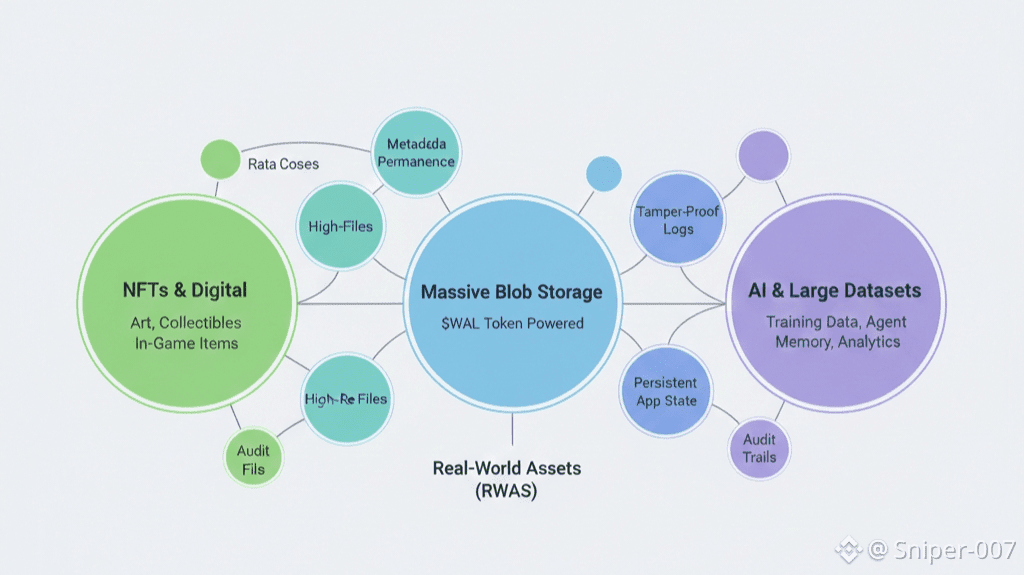
Article
Walrus and Its Real-World Punch in Decentralized StorageDecentralized storage is blowing up in Web3 because everyone wants to ditch big centralized cloud giants like AWS or Google for something more secure, private, and actually owned by users. Walrus is one of those projects that's turning heads right now—it's a full-on storage protocol tied super tight to the Sui blockchain, aiming to handle massive files (think videos, AI datasets, media blobs) in a way that's reliable, cheap, and programmable without the usual headaches of other decentralized options.
What Walrus Really Does
At its heart, Walrus is this decentralized data availability and storage layer built right on Sui. Instead of cramming huge files onto the blockchain (which would be insanely expensive and slow), it chops them up using something called Red Stuff—this clever two-dimensional erasure coding trick. Basically, your file gets turned into a bunch of small coded fragments spread across tons of independent storage nodes. Even if a bunch of those nodes flake out or go offline, you can still rebuild the whole thing from the surviving pieces.
The Sui chain itself only holds the lightweight metadata, proofs, and verifiability stuff—so everything stays cheap, decentralized, and verifiable. Smart contracts on Sui can point to or control these blobs without ever touching the raw data directly. It's like having a super-efficient off-chain hard drive that's still fully on-chain accountable.
The Magic Behind Red Stuff
Red Stuff is the star tech here. Traditional erasure coding already beats full replication (where you copy the whole file everywhere, wasting space), but Red Stuff takes it up a notch with 2D encoding—splitting data both horizontally and vertically into a matrix with overlapping parities. That means lower overhead (around 4-5x replication factor instead of way more), faster recovery, and it's "self-healing" in a Byzantine-tolerant setup. Nodes have to keep proving they still have their slivers periodically, and those proofs hit the Sui chain so anyone (or any contract) can check: yep, the data's still there and retrievable.
The WAL Token Keeping It All Running
WAL is the fuel. Users pay in WAL to store blobs, node operators stake WAL to join the network and handle storage/serving, and they earn rewards for staying reliable and online. Stakers get in on governance too—voting on pricing tweaks, penalties for bad actors, protocol upgrades, all that jazz.
Total supply is capped at 5 billion WAL. A big chunk (over 60%) goes to the community through airdrops, subsidies, reserves, and incentives to get devs and users hooked. There was an initial 4% airdrop via soulbound NFTs for early Sui/Walrus contributors, plus more reserved for ongoing drops and growth. By early 2026, over a billion WAL is staked, and usage burns fees to keep things deflationary as adoption ramps.
How You Actually Use It Day-to-Day
Pretty straightforward once you're set up:
- Upload your blob via CLI, SDKs, or integrated apps.
- Walrus encodes it with Red Stuff, scatters the pieces to nodes.
- Nodes commit, start proving availability on Sui.
- You (or your app) can request reconstruction anytime—pulls from multiple nodes to rebuild fast.
- Smart contracts reference it via on-chain certs, attach rules like expiry, access controls, or metadata.
The whole thing runs in epochs—set periods where node committees handle ops, proofs roll in, and rewards get dished out based on uptime and performance.
Real-World Stuff It's Powering (or Could)
It's not just dumping files—Walrus shines for:
- AI workloads: Storing huge training datasets, model checkpoints, or inference outputs in a verifiable, decentralized spot so no one can tamper or vanish the data.
- Archiving blockchain history or logs without relying on centralized servers.
- Fully decentralized websites/frontends—host static sites or dynamic content blobs right on Walrus.
- Layer 2 data needs, fraud proofs, audit trails—anywhere you want provable availability without central trust.
Mainnet went live March 27, 2025, after a big $140M raise (led by Standard Crypto, a16z crypto, etc.). Started with over 100 nodes, and by 2026 it's scaled with integrations across 170+ projects, Pudgy Penguins using it for media, and ties into Sui's privacy/compute stack (like Seal for encryption). Roadmap for 2026 includes cranking up throughput for AI/media, expanding access controls, and even multichain support beyond Sui/Solana to Ethereum/Cosmos via partners like Pipe Network.
Why Walrus Feels Different
- Programmable storage: Blobs aren't dumb files—they're resources smart contracts can interact with natively on Sui (Move language perks).
- Super-efficient encoding cuts costs while keeping recovery rock-solid.
- On-chain proofs mean no "trust me bro" for availability.
- Sui integration gives it low-latency, high-throughput edges over standalone storage plays.
- Community-heavy tokenomics with burns and incentives to drive real usage.
Sure, it competes with Filecoin, Arweave, IPFS-based stuff, but the tight Sui coupling, Move programmability, and Red Stuff's efficiency give it a legit technical moat. As AI explodes and Web3 apps need to handle bigger data without centralized chokepoints, something like Walrus could become the go-to backbone—making big data feel native to blockchain instead of bolted-on.
Bottom line: Walrus isn't hyping vaporware. It's live, growing, and solving a real pain point in a way that actually matters for the next wave of decentralized apps. If you're into Sui or just tired of centralized storage risks, this one's worth keeping an eye on.
#Walru @WalrusProtocol $WAL
Walrus and Its Real-World Punch in Decentralized Storage
Decentralized storage is blowing up in Web3 because everyone wants to ditch big centralized cloud giants like AWS or Google for something more secure, private, and actually owned by users. Walrus is one of those projects that's turning heads right now—it's a full-on storage protocol tied super tight to the Sui blockchain, aiming to handle massive files (think videos, AI datasets, media blobs) in a way that's reliable, cheap, and programmable without the usual headaches of other decentralized options.
What Walrus Really Does
At its heart, Walrus is this decentralized data availability and storage layer built right on Sui. Instead of cramming huge files onto the blockchain (which would be insanely expensive and slow), it chops them up using something called Red Stuff—this clever two-dimensional erasure coding trick. Basically, your file gets turned into a bunch of small coded fragments spread across tons of independent storage nodes. Even if a bunch of those nodes flake out or go offline, you can still rebuild the whole thing from the surviving pieces.
The Sui chain itself only holds the lightweight metadata, proofs, and verifiability stuff—so everything stays cheap, decentralized, and verifiable. Smart contracts on Sui can point to or control these blobs without ever touching the raw data directly. It's like having a super-efficient off-chain hard drive that's still fully on-chain accountable.
The Magic Behind Red Stuff
Red Stuff is the star tech here. Traditional erasure coding already beats full replication (where you copy the whole file everywhere, wasting space), but Red Stuff takes it up a notch with 2D encoding—splitting data both horizontally and vertically into a matrix with overlapping parities. That means lower overhead (around 4-5x replication factor instead of way more), faster recovery, and it's "self-healing" in a Byzantine-tolerant setup. Nodes have to keep proving they still have their slivers periodically, and those proofs hit the Sui chain so anyone (or any contract) can check: yep, the data's still there and retrievable.
The WAL Token Keeping It All Running
WAL is the fuel. Users pay in WAL to store blobs, node operators stake WAL to join the network and handle storage/serving, and they earn rewards for staying reliable and online. Stakers get in on governance too—voting on pricing tweaks, penalties for bad actors, protocol upgrades, all that jazz.
Total supply is capped at 5 billion WAL. A big chunk (over 60%) goes to the community through airdrops, subsidies, reserves, and incentives to get devs and users hooked. There was an initial 4% airdrop via soulbound NFTs for early Sui/Walrus contributors, plus more reserved for ongoing drops and growth. By early 2026, over a billion WAL is staked, and usage burns fees to keep things deflationary as adoption ramps.
How You Actually Use It Day-to-Day
Pretty straightforward once you're set up:
- Upload your blob via CLI, SDKs, or integrated apps.
- Walrus encodes it with Red Stuff, scatters the pieces to nodes.
- Nodes commit, start proving availability on Sui.
- You (or your app) can request reconstruction anytime—pulls from multiple nodes to rebuild fast.
- Smart contracts reference it via on-chain certs, attach rules like expiry, access controls, or metadata.
The whole thing runs in epochs—set periods where node committees handle ops, proofs roll in, and rewards get dished out based on uptime and performance.
Real-World Stuff It's Powering (or Could)
It's not just dumping files—Walrus shines for:
- AI workloads: Storing huge training datasets, model checkpoints, or inference outputs in a verifiable, decentralized spot so no one can tamper or vanish the data.
- Archiving blockchain history or logs without relying on centralized servers.
- Fully decentralized websites/frontends—host static sites or dynamic content blobs right on Walrus.
- Layer 2 data needs, fraud proofs, audit trails—anywhere you want provable availability without central trust.
Mainnet went live March 27, 2025, after a big $140M raise (led by Standard Crypto, a16z crypto, etc.). Started with over 100 nodes, and by 2026 it's scaled with integrations across 170+ projects, Pudgy Penguins using it for media, and ties into Sui's privacy/compute stack (like Seal for encryption). Roadmap for 2026 includes cranking up throughput for AI/media, expanding access controls, and even multichain support beyond Sui/Solana to Ethereum/Cosmos via partners like Pipe Network.
Why Walrus Feels Different
- Programmable storage: Blobs aren't dumb files—they're resources smart contracts can interact with natively on Sui (Move language perks).
- Super-efficient encoding cuts costs while keeping recovery rock-solid.
- On-chain proofs mean no "trust me bro" for availability.
- Sui integration gives it low-latency, high-throughput edges over standalone storage plays.
- Community-heavy tokenomics with burns and incentives to drive real usage.
Sure, it competes with Filecoin, Arweave, IPFS-based stuff, but the tight Sui coupling, Move programmability, and Red Stuff's efficiency give it a legit technical moat. As AI explodes and Web3 apps need to handle bigger data without centralized chokepoints, something like Walrus could become the go-to backbone—making big data feel native to blockchain instead of bolted-on.
Bottom line: Walrus isn't hyping vaporware. It's live, growing, and solving a real pain point in a way that actually matters for the next wave of decentralized apps. If you're into Sui or just tired of centralized storage risks, this one's worth keeping an eye on.
#Walru @Walrus 🦭/acc $WAL
2
242

#walrus $WAL In my previous post We described #walru potential. So now next question arises , Can Walrus compete with existing Storage services ?
My answer is "Yes" it can.
Walrus can compete with existing storage services, but not in the same way that Amazon S3, Google Cloud Storage, or Dropbox do today.
Its competition is structural, not superficial.
Let's have a clear, balanced breakdown.
1. Different Trust Model (Big Advantage)
In Traditional storage You trust a company but Data can be censored, frozen, deleted, or repriced.
Walrus:
Trust is minimized No single owner can block or erase data.
Also Storage persists as long as the network is incentivized
2. Built for Onchain & Web3 Use Cases
Walrus is optimized for:
A) NFTs & media permanence✅
B) DePIN and AI datasets✅
C) Rollups & blockchain data availability✅
D) Censorship-resistant publishing✅
Where Traditional storage was never designed for these.🚫
📌 Walrus is not replacing S3 — it’s replacing what S3 cannot do.
3. Economic Alignment via $WAL
Storage providers are economically incentivized
In Walrus Protocol Users pay the network ✅, not a corporation🚫
Long-term storage economics are transparent.
4. Composable & Programmable
Walrus integrates with:
A) Smart contracts✅
B) Onchain verification✅
C) Permissionless access✅
Traditional cloud storage is:
A) Closed🚫
B)API-gated🚫
C)Platform-dependent🚫
Now let's be fair and talk about Walrus limitations .
Where Walrus Cannot Compete (Yet)
1. User Experience:
Cloud storage has One-click setup and Enterprise dashboards along with Global SLAs
Where Walrus today is Developer-heavy and tooling still maturing. Also Requires Web3 understanding.
2. Enterprises won’t migrate overnight:
Latency & Performance is also a concern for Walrus. Where Centralized clouds excel at low latency.
3. Regulatory & Enterprise Adoption
Corporations need Compliance, Contracts and Legal accountability
But Walrus is Permissionless and there is No central entity to sue or negotiate with.
1
7

@WalrusProtocol $WAL #walru Exploring decentralized storage solutions and really impressed by the vision behind @walrusprotocol. Scalable data availability is key for Web3 growth, and projects like this can make a real impact. Keeping an eye on $WAL as the ecosystem evolves. #Walrus 🚀
@Walrus 🦭/acc $WAL #walru Exploring decentralized storage solutions and really impressed by the vision behind @walrusprotocol. Scalable data availability is key for Web3 growth, and projects like this can make a real impact. Keeping an eye on $WAL as the ecosystem evolves. #Walrus 🚀
11
16
Walrus Protocol: The Future of Decentralized Data Storage in Web3Ready to ride the next DeFi wave? @WalrusProtocol brings secure and rewarding experiences for $WAL holders. Embrace the #Walrus journey!Walrus is emerging as a powerful infrastructure protocol designed to solve one of the biggest challenges in Web3: decentralized data storage and availability. Unlike traditional systems that rely on centralized servers, Walrus introduces a scalable, secure, and cost-efficient way to store large amounts of data on-chain while keeping it accessible for decentralized applications.
What makes @WalrusProtocol $BNB unique is its focus on performance and reliability. By leveraging advanced data availability techniques, Walrus allows developers to build dApps, NFTs, games, and AI-powered blockchain solutions without worrying about storage bottlenecks or high costs. This is a major step forward for Web3 adoption.
The growing interest around $WAL AL shows that the community recognizes the long-term potential of decentralized storage. As more projects integrate Walrus, demand for efficient data solutions will continue to rise, positioning Walrus as a key backbone of future blockchain ecosystems.
In a world moving toward decentralization, Walrus is not just another protocol—it’s an essential layer for the next generation of Web3 innovation.
#Walru
Walrus Protocol: The Future of Decentralized Data Storage in Web3
Ready to ride the next DeFi wave? @Walrus 🦭/acc brings secure and rewarding experiences for $WAL holders. Embrace the #Walrus journey!Walrus is emerging as a powerful infrastructure protocol designed to solve one of the biggest challenges in Web3: decentralized data storage and availability. Unlike traditional systems that rely on centralized servers, Walrus introduces a scalable, secure, and cost-efficient way to store large amounts of data on-chain while keeping it accessible for decentralized applications.
What makes @Walrus 🦭/acc $BNB unique is its focus on performance and reliability. By leveraging advanced data availability techniques, Walrus allows developers to build dApps, NFTs, games, and AI-powered blockchain solutions without worrying about storage bottlenecks or high costs. This is a major step forward for Web3 adoption.
The growing interest around $WAL AL shows that the community recognizes the long-term potential of decentralized storage. As more projects integrate Walrus, demand for efficient data solutions will continue to rise, positioning Walrus as a key backbone of future blockchain ecosystems.
In a world moving toward decentralization, Walrus is not just another protocol—it’s an essential layer for the next generation of Web3 innovation.
#Walru
12
12

·
--
Walrus Protocol and the Storage Layer Web3 Still Needs to Go Mainstream@WalrusProtocol #walrus $WAL
Web3 is often explained through blockchains, smart contracts, tokens, and trading. That is the visible layer. But behind every useful digital product there is something just as important: data. Images, videos, documents, metadata, datasets, application files, user generated content, and archives are the real building blocks of the internet. If Web3 wants to move from niche adoption to mainstream usage, it cannot rely on centralized storage providers for the most critical parts of the user experience.
This is where Walrus Protocol becomes interesting. Walrus is designed to facilitate decentralized and privacy preserving data storage and transactions. It operates on the Sui blockchain and uses a combination of erasure coding and blob storage to distribute large files across a decentralized network. The infrastructure is designed to offer cost efficient, censorship resistant storage suitable for applications, enterprises, and individuals who want decentralized alternatives to traditional cloud solutions. The ecosystem also supports private transactions and provides tools for governance, staking, and dApp engagement, with the $WAL token acting as the native coordination asset.
In this article, we will explore why decentralized storage is a major missing piece for Web3, what makes storage hard, how Walrus approaches the problem, and what kinds of real world applications can benefit from a privacy preserving, censorship resistant storage network.
Section 1: Why data storage is the hidden bottleneck of decentralization
When people hear “decentralized application,” they often assume everything about the application is decentralized. In practice, most dApps are only partially decentralized. The onchain portion may be decentralized, but the content layer often lives on centralized servers.
This creates a mismatch. Imagine an NFT project where the token is on chain but the artwork is hosted on a centralized web server. If that server goes offline, or the project stops paying for hosting, or a platform removes the content, the NFT still exists but becomes meaningless. The token is essentially a broken pointer.
The same issue appears in Web3 gaming. Many games store assets, maps, textures, player progress, and media files offchain in centralized storage. If the centralized storage fails, the game experience breaks, even if the blockchain remains operational.
Even in DeFi, many tools rely on centralized dashboards, analytics, and interfaces. If the front end goes offline, many users cannot access the protocol even though the smart contracts still exist.
This is not a small inconvenience. It is a core weakness. Decentralization is only as strong as its weakest layer, and for many Web3 products the weakest layer is storage.
Section 2: Why decentralized storage is harder than it sounds
Storage is fundamentally different from transactions. Blockchains store small pieces of data and replicate them widely. That is expensive but manageable because transactions are small and structured. Large files are a different story. Images and videos can be huge. Game assets can be massive. Datasets can be gigabytes or more. Replicating full copies of these files across many nodes becomes expensive quickly.
A decentralized storage system must balance several competing demands:
Durability
Data should survive even if some nodes go offline or fail.
Availability
Users should be able to retrieve data reliably when they need it.
Cost efficiency
Storage must not become so expensive that it is unusable at scale.
Performance
Retrieval must be fast enough for real apps, not just for experiments.
Privacy
Many use cases require confidentiality and controlled access.
Integrity
Users should be able to verify that retrieved data matches what was stored.
Developer usability
Builders need simple integrations, tools, and predictable behavior.
These constraints make decentralized storage a serious engineering and incentive design challenge. Walrus explicitly highlights erasure coding and blob storage, which are techniques designed to address durability and cost efficiency for large files.
Section 3: Walrus on Sui and why the underlying chain matters
Walrus operates on the Sui blockchain. This matters because storage networks often require a coordination layer that tracks what is stored, manages commitments, and supports a consistent state for applications to reference. A blockchain provides that coordination and settlement layer.
The storage data itself does not need to live fully on chain. Instead, the chain can record the necessary metadata, proofs, and references that help applications interact with the storage network. This structure allows the system to stay efficient while still benefiting from onchain integrity and coordination.
For builders, operating in the same ecosystem can also simplify integration. If developers are already building on Sui, connecting to a storage protocol that operates within the same environment can reduce friction and improve user experience.
Section 4: Erasure coding and why it matters for cost and durability
Walrus uses erasure coding, which is a key technique for making decentralized storage economically viable. A simple replication model stores full copies of data across many nodes. That increases durability, but it multiplies storage cost.
Erasure coding works differently. In simplified terms, a file is broken into fragments and then encoded into additional fragments so that the original file can be reconstructed even if some fragments are missing. This creates redundancy without requiring full file replication.
The practical benefits are:
Better durability with less overhead
If some storage nodes go offline, enough fragments can still reconstruct the file.
Lower cost compared to full replication
Because fragments are stored rather than multiple complete copies.
More resilient distribution
Fragments can be spread across many nodes, reducing dependence on any single node.
This is important for real world use cases where files are large. Without cost efficient redundancy, decentralized storage can become too expensive for mainstream adoption.
Section 5: Blob storage and large file support
Walrus also references blob storage, which is designed for storing and delivering large binary objects. Many Web3 use cases require large files:
NFT media collections in high resolution
Gaming textures, models, and audio
Metaverse world assets
Enterprise archives
Research datasets
Community media libraries
A storage system that only handles small data well will struggle in these use cases. Blob storage implies an architecture optimized for large objects, where chunking and retrieval are designed for performance and scale.
By combining blob storage with erasure coding, Walrus aims to support large file storage that remains durable and cost efficient.
Section 6: Privacy preserving storage and why it is essential
Not all data should be public. In fact, most real world data is private. Enterprises store confidential documents. Communities store member only content. Individuals store personal backups. A storage protocol designed only for public content will not achieve mainstream adoption.
Walrus emphasizes privacy preserving storage and transactions. In practical terms, privacy preserving storage often means encryption and controlled access. The network can store data fragments without learning the contents, while the user controls the keys that grant access. This allows the system to provide durability and availability without sacrificing confidentiality.
Privacy preservation expands potential use cases significantly:
Private enterprise document storage
Encrypted personal backups
Member only community archives
Confidential datasets shared with limited partners
Private dApp content where users control access
For many institutions, privacy is the deciding factor. If privacy is not handled properly, they cannot adopt decentralized storage.
Section 7: Censorship resistance and long term availability
Traditional cloud services are efficient, but they are also centralized points of control. Content can be removed, restricted, or altered by policy decisions, account issues, or vendor changes. This creates risk for applications that need long term availability.
Walrus aims to provide censorship resistant storage by distributing data across a decentralized network. When data is fragmented and distributed, it becomes much harder for any single actor to remove or block access. This increases resilience and supports long term availability.
Censorship resistance is not only about controversial content. It is about reliability. Communities and applications need confidence that their archives, media, and assets will remain available over time. A decentralized network supports that confidence.
Section 8: Governance, staking, and the role of $WAL
Walrus includes governance and staking, and WAL is the native token used within the ecosystem. In decentralized infrastructure networks, tokens often coordinate incentives and long term sustainability.
Staking can align participants toward network reliability. Governance allows the community to guide protocol evolution, adjust parameters, and respond to network needs. In a storage network, incentives matter because nodes must be motivated to store data and serve it reliably over time.
The WAL token can play an important role in:
Supporting participation and network incentives
Enabling governance decisions
Aligning long term contributors with the health of the network
Potentially supporting access and resource allocation across the protocol
For users and builders, the key takeaway is that decentralized storage requires incentive alignment. The token is part of the mechanism that keeps the network reliable.
Section 9: Real world use cases for Walrus
The value of Walrus becomes clearer when you connect features to practical use cases.
Use case 1: NFT media permanence
NFTs often rely on images and metadata that can disappear if hosted centrally. Walrus can support durable storage so that NFT media remains accessible long term.
Use case 2: Web3 gaming assets
Games require large files and persistent access. Walrus can support storage of game assets and community content with better resilience than centralized servers.
Use case 3: Metaverse world resources
Virtual worlds need stable access to models, textures, and media. A decentralized storage layer makes these assets more durable.
Use case 4: Community and DAO archives
DAOs need long term storage of proposals, documents, meeting notes, and archives. Walrus can support censorship resistant archives that reduce dependence on centralized tools.
Use case 5: Enterprise data storage
Enterprises can store encrypted data with controlled access, reducing vendor lock in and improving resilience.
Use case 6: Personal backups
Individuals can store encrypted backups that remain available without trusting a single provider.
These use cases highlight why storage is not optional for Web3. It is a requirement for reliable products.
Section 10: Why Walrus matters as Web3 matures
The industry is shifting from experimentation to real products. Real products need real infrastructure. Storage is one of the most important infrastructure layers because it directly affects user experience and trust.
If Web3 wants to compete with Web2 products, it must deliver:
Reliable content delivery
Long term asset persistence
Private and controlled storage options
Affordable storage economics
Developer friendly integrations
Walrus positions itself as part of this infrastructure shift by focusing on decentralized, privacy preserving storage designed for large files and real world use.
Closing thoughts
Walrus Protocol addresses one of the most overlooked problems in Web3: the data layer. Decentralized applications cannot be fully decentralized if their content depends on centralized storage providers. Walrus operates on Sui and uses erasure coding and blob storage to distribute large files across a decentralized network, aiming for cost efficient, censorship resistant, privacy preserving storage suitable for applications, enterprises, and individuals.
As Web3 grows, infrastructure projects that solve real bottlenecks will become increasingly important. Storage is a bottleneck. Walrus is building a solution that aims to make decentralized storage practical, scalable, and usable for mainstream adoption.
This content is for informational purposes only and does not constitute financial advice.
@WalrusProtocol #Walru $WAL
{future}(WALUSDT)
Walrus Protocol and the Storage Layer Web3 Still Needs to Go Mainstream
@Walrus 🦭/acc #walrus $WAL
Web3 is often explained through blockchains, smart contracts, tokens, and trading. That is the visible layer. But behind every useful digital product there is something just as important: data. Images, videos, documents, metadata, datasets, application files, user generated content, and archives are the real building blocks of the internet. If Web3 wants to move from niche adoption to mainstream usage, it cannot rely on centralized storage providers for the most critical parts of the user experience.
This is where Walrus Protocol becomes interesting. Walrus is designed to facilitate decentralized and privacy preserving data storage and transactions. It operates on the Sui blockchain and uses a combination of erasure coding and blob storage to distribute large files across a decentralized network. The infrastructure is designed to offer cost efficient, censorship resistant storage suitable for applications, enterprises, and individuals who want decentralized alternatives to traditional cloud solutions. The ecosystem also supports private transactions and provides tools for governance, staking, and dApp engagement, with the $WAL token acting as the native coordination asset.
In this article, we will explore why decentralized storage is a major missing piece for Web3, what makes storage hard, how Walrus approaches the problem, and what kinds of real world applications can benefit from a privacy preserving, censorship resistant storage network.
Section 1: Why data storage is the hidden bottleneck of decentralization
When people hear “decentralized application,” they often assume everything about the application is decentralized. In practice, most dApps are only partially decentralized. The onchain portion may be decentralized, but the content layer often lives on centralized servers.
This creates a mismatch. Imagine an NFT project where the token is on chain but the artwork is hosted on a centralized web server. If that server goes offline, or the project stops paying for hosting, or a platform removes the content, the NFT still exists but becomes meaningless. The token is essentially a broken pointer.
The same issue appears in Web3 gaming. Many games store assets, maps, textures, player progress, and media files offchain in centralized storage. If the centralized storage fails, the game experience breaks, even if the blockchain remains operational.
Even in DeFi, many tools rely on centralized dashboards, analytics, and interfaces. If the front end goes offline, many users cannot access the protocol even though the smart contracts still exist.
This is not a small inconvenience. It is a core weakness. Decentralization is only as strong as its weakest layer, and for many Web3 products the weakest layer is storage.
Section 2: Why decentralized storage is harder than it sounds
Storage is fundamentally different from transactions. Blockchains store small pieces of data and replicate them widely. That is expensive but manageable because transactions are small and structured. Large files are a different story. Images and videos can be huge. Game assets can be massive. Datasets can be gigabytes or more. Replicating full copies of these files across many nodes becomes expensive quickly.
A decentralized storage system must balance several competing demands:
Durability
Data should survive even if some nodes go offline or fail.
Availability
Users should be able to retrieve data reliably when they need it.
Cost efficiency
Storage must not become so expensive that it is unusable at scale.
Performance
Retrieval must be fast enough for real apps, not just for experiments.
Privacy
Many use cases require confidentiality and controlled access.
Integrity
Users should be able to verify that retrieved data matches what was stored.
Developer usability
Builders need simple integrations, tools, and predictable behavior.
These constraints make decentralized storage a serious engineering and incentive design challenge. Walrus explicitly highlights erasure coding and blob storage, which are techniques designed to address durability and cost efficiency for large files.
Section 3: Walrus on Sui and why the underlying chain matters
Walrus operates on the Sui blockchain. This matters because storage networks often require a coordination layer that tracks what is stored, manages commitments, and supports a consistent state for applications to reference. A blockchain provides that coordination and settlement layer.
The storage data itself does not need to live fully on chain. Instead, the chain can record the necessary metadata, proofs, and references that help applications interact with the storage network. This structure allows the system to stay efficient while still benefiting from onchain integrity and coordination.
For builders, operating in the same ecosystem can also simplify integration. If developers are already building on Sui, connecting to a storage protocol that operates within the same environment can reduce friction and improve user experience.
Section 4: Erasure coding and why it matters for cost and durability
Walrus uses erasure coding, which is a key technique for making decentralized storage economically viable. A simple replication model stores full copies of data across many nodes. That increases durability, but it multiplies storage cost.
Erasure coding works differently. In simplified terms, a file is broken into fragments and then encoded into additional fragments so that the original file can be reconstructed even if some fragments are missing. This creates redundancy without requiring full file replication.
The practical benefits are:
Better durability with less overhead
If some storage nodes go offline, enough fragments can still reconstruct the file.
Lower cost compared to full replication
Because fragments are stored rather than multiple complete copies.
More resilient distribution
Fragments can be spread across many nodes, reducing dependence on any single node.
This is important for real world use cases where files are large. Without cost efficient redundancy, decentralized storage can become too expensive for mainstream adoption.
Section 5: Blob storage and large file support
Walrus also references blob storage, which is designed for storing and delivering large binary objects. Many Web3 use cases require large files:
NFT media collections in high resolution
Gaming textures, models, and audio
Metaverse world assets
Enterprise archives
Research datasets
Community media libraries
A storage system that only handles small data well will struggle in these use cases. Blob storage implies an architecture optimized for large objects, where chunking and retrieval are designed for performance and scale.
By combining blob storage with erasure coding, Walrus aims to support large file storage that remains durable and cost efficient.
Section 6: Privacy preserving storage and why it is essential
Not all data should be public. In fact, most real world data is private. Enterprises store confidential documents. Communities store member only content. Individuals store personal backups. A storage protocol designed only for public content will not achieve mainstream adoption.
Walrus emphasizes privacy preserving storage and transactions. In practical terms, privacy preserving storage often means encryption and controlled access. The network can store data fragments without learning the contents, while the user controls the keys that grant access. This allows the system to provide durability and availability without sacrificing confidentiality.
Privacy preservation expands potential use cases significantly:
Private enterprise document storage
Encrypted personal backups
Member only community archives
Confidential datasets shared with limited partners
Private dApp content where users control access
For many institutions, privacy is the deciding factor. If privacy is not handled properly, they cannot adopt decentralized storage.
Section 7: Censorship resistance and long term availability
Traditional cloud services are efficient, but they are also centralized points of control. Content can be removed, restricted, or altered by policy decisions, account issues, or vendor changes. This creates risk for applications that need long term availability.
Walrus aims to provide censorship resistant storage by distributing data across a decentralized network. When data is fragmented and distributed, it becomes much harder for any single actor to remove or block access. This increases resilience and supports long term availability.
Censorship resistance is not only about controversial content. It is about reliability. Communities and applications need confidence that their archives, media, and assets will remain available over time. A decentralized network supports that confidence.
Section 8: Governance, staking, and the role of $WAL
Walrus includes governance and staking, and WAL is the native token used within the ecosystem. In decentralized infrastructure networks, tokens often coordinate incentives and long term sustainability.
Staking can align participants toward network reliability. Governance allows the community to guide protocol evolution, adjust parameters, and respond to network needs. In a storage network, incentives matter because nodes must be motivated to store data and serve it reliably over time.
The WAL token can play an important role in:
Supporting participation and network incentives
Enabling governance decisions
Aligning long term contributors with the health of the network
Potentially supporting access and resource allocation across the protocol
For users and builders, the key takeaway is that decentralized storage requires incentive alignment. The token is part of the mechanism that keeps the network reliable.
Section 9: Real world use cases for Walrus
The value of Walrus becomes clearer when you connect features to practical use cases.
Use case 1: NFT media permanence
NFTs often rely on images and metadata that can disappear if hosted centrally. Walrus can support durable storage so that NFT media remains accessible long term.
Use case 2: Web3 gaming assets
Games require large files and persistent access. Walrus can support storage of game assets and community content with better resilience than centralized servers.
Use case 3: Metaverse world resources
Virtual worlds need stable access to models, textures, and media. A decentralized storage layer makes these assets more durable.
Use case 4: Community and DAO archives
DAOs need long term storage of proposals, documents, meeting notes, and archives. Walrus can support censorship resistant archives that reduce dependence on centralized tools.
Use case 5: Enterprise data storage
Enterprises can store encrypted data with controlled access, reducing vendor lock in and improving resilience.
Use case 6: Personal backups
Individuals can store encrypted backups that remain available without trusting a single provider.
These use cases highlight why storage is not optional for Web3. It is a requirement for reliable products.
Section 10: Why Walrus matters as Web3 matures
The industry is shifting from experimentation to real products. Real products need real infrastructure. Storage is one of the most important infrastructure layers because it directly affects user experience and trust.
If Web3 wants to compete with Web2 products, it must deliver:
Reliable content delivery
Long term asset persistence
Private and controlled storage options
Affordable storage economics
Developer friendly integrations
Walrus positions itself as part of this infrastructure shift by focusing on decentralized, privacy preserving storage designed for large files and real world use.
Closing thoughts
Walrus Protocol addresses one of the most overlooked problems in Web3: the data layer. Decentralized applications cannot be fully decentralized if their content depends on centralized storage providers. Walrus operates on Sui and uses erasure coding and blob storage to distribute large files across a decentralized network, aiming for cost efficient, censorship resistant, privacy preserving storage suitable for applications, enterprises, and individuals.
As Web3 grows, infrastructure projects that solve real bottlenecks will become increasingly important. Storage is a bottleneck. Walrus is building a solution that aims to make decentralized storage practical, scalable, and usable for mainstream adoption.
This content is for informational purposes only and does not constitute financial advice.
@Walrus 🦭/acc #Walru $WAL
1
22


Article
Redefining Community-Driven DeFi for the Future@WalrusProtocol walrusprotocol is carving out its place with a strong focus on scalability, user experience, and community governance. The #Walru ecosystem is designed to bring together decentralized financial tools like liquidity pools, yield farming, staking mechanisms, and intuitive swap platforms that empower both experienced traders and newcomers alike. Built with performance and security in mind, Walrus aims to deliver fast, low‑cost transactions that make everyday DeFi engagement smoother and more rewarding for users.$WAL
Redefining Community-Driven DeFi for the Future
@Walrus 🦭/acc walrusprotocol is carving out its place with a strong focus on scalability, user experience, and community governance. The #Walru ecosystem is designed to bring together decentralized financial tools like liquidity pools, yield farming, staking mechanisms, and intuitive swap platforms that empower both experienced traders and newcomers alike. Built with performance and security in mind, Walrus aims to deliver fast, low‑cost transactions that make everyday DeFi engagement smoother and more rewarding for users.$WAL
1
6

#walrus $WAL
🚀 Walrus… because the future isn't stored in centralized servers!
Have you ever thought where your data is stored?
Walrus offers you a revolutionary alternative: decentralized, censorship-resistant storage, built on the Sui blockchain, using advanced technologies to distribute files.
This is not just storage… it's true digital independence.
Join the Walrus campaign and be among the first to write the future of data!
#Walru #BinanceSquare $WAL @WalrusProtocol
#walrus $WAL
🚀 Walrus… because the future isn't stored in centralized servers!
Have you ever thought where your data is stored?
Walrus offers you a revolutionary alternative: decentralized, censorship-resistant storage, built on the Sui blockchain, using advanced technologies to distribute files.
This is not just storage… it's true digital independence.
Join the Walrus campaign and be among the first to write the future of data!
#Walru #BinanceSquare $WAL @Walrus 🦭/acc
1
51
Log in to explore more content
Join global crypto users on Binance Square
⚡️ Get latest and useful information about crypto.
💬 Trusted by the world’s largest crypto exchange.
👍 Discover real insights from verified creators.
Email / Phone number
Trending Topics
1
#BinanceProcesses$4.65BWithdrawals
23,597 views
117 Discussing
2
#WithdrawalsBack: 15 networks live
7,680 views
129 Discussing
3
#BinanceUpdatesProofofReservesAddresses
124,101 views
1,550 Discussing
4
#BinanceToResumePhaseOneOfWithdrawals
161,710 views
1,613 Discussing
5
#BinanceHadAlreadyCovered$6BofHackLoss
10,944 views
142 Discussing
6
#FBIConfirmsNorthKoreaIsResponsibleForBinanceCryptoHack
51,915 views
153 Discussing
7
#CZDismissesClaimsBinanceHackWasPredicted
82,727 views
774 Discussing
8
#B14gReportsUnauthorizedTransferOfAbout97MCORE
31,275 views
405 Discussing
9
#USSpotETHETFsPost23StraightDaysOfNetOutflows
33,520 views
397 Discussing
10
#IntelHasItsWorstDaySince1974
128,694 views
1,000 Discussing