

#quantitativetrading
quantitativetrading
7,519 views
103 Discussing
Hot
Latest

·
--
🦅 Horus — Systematic Quantitative Trading
—
📊 Confidence & Discipline Stats
—
┌—┐
│ 🎯 Executed trades: 174
│ ✅ Win rate: 28%
│ 📊 [██░░░░░░░░]
│
│ 💼 Portfolio balance ($10K): $9,429.61
│ 🛡️ Maximum drawdown (Max DD): 15.56%
│ 🏆 Best trade: ARK (+9.0%) (+0.0%)
│ 🚫 Rejected signals (protection): 0
└—┘
—
🦅 Discipline and risk management matter more than prediction
Horus relies on data and quantitative analysis
🔔 Follow for real-time algorithmic trades & disciplined market intelligence.
#BinanceSquare #CryptoTrading #QuantitativeTrading #Horus
🦅 Horus — Systematic Quantitative Trading
—
📊 Confidence & Discipline Stats
—
┌—┐
│ 🎯 Executed trades: 174
│ ✅ Win rate: 28%
│ 📊 [██░░░░░░░░]
│
│ 💼 Portfolio balance ($10K): $9,429.61
│ 🛡️ Maximum drawdown (Max DD): 15.56%
│ 🏆 Best trade: ARK (+9.0%) (+0.0%)
│ 🚫 Rejected signals (protection): 0
└—┘
—
🦅 Discipline and risk management matter more than prediction
Horus relies on data and quantitative analysis
🔔 Follow for real-time algorithmic trades & disciplined market intelligence.
#BinanceSquare #CryptoTrading #QuantitativeTrading #Horus
—
📊 Confidence & Discipline Stats
—
┌—┐
│ 🎯 Executed trades: 174
│ ✅ Win rate: 28%
│ 📊 [██░░░░░░░░]
│
│ 💼 Portfolio balance ($10K): $9,429.61
│ 🛡️ Maximum drawdown (Max DD): 15.56%
│ 🏆 Best trade: ARK (+9.0%) (+0.0%)
│ 🚫 Rejected signals (protection): 0
└—┘
—
🦅 Discipline and risk management matter more than prediction
Horus relies on data and quantitative analysis
🔔 Follow for real-time algorithmic trades & disciplined market intelligence.
#BinanceSquare #CryptoTrading #QuantitativeTrading #Horus
25
·
--
🦅 Horus — Systematic Quantitative Trading
—
🤝 Horus Partner Program 🤝
—
💎 What do you get?
┌—┐
│ 💰 30% lifetime commission
│ 📊 Personal dashboard
│ 🔗 Unique referral link
│ 💳 Instant withdrawals
└—┘
🚀 Every subscriber = passive income for you!
—
👇 Sign up now and start earning
🔔 Follow for real-time algorithmic trades & disciplined market intelligence.
#BinanceSquare #CryptoTrading #QuantitativeTrading #Horus
🦅 Horus — Systematic Quantitative Trading
—
🤝 Horus Partner Program 🤝
—
💎 What do you get?
┌—┐
│ 💰 30% lifetime commission
│ 📊 Personal dashboard
│ 🔗 Unique referral link
│ 💳 Instant withdrawals
└—┘
🚀 Every subscriber = passive income for you!
—
👇 Sign up now and start earning
🔔 Follow for real-time algorithmic trades & disciplined market intelligence.
#BinanceSquare #CryptoTrading #QuantitativeTrading #Horus
—
🤝 Horus Partner Program 🤝
—
💎 What do you get?
┌—┐
│ 💰 30% lifetime commission
│ 📊 Personal dashboard
│ 🔗 Unique referral link
│ 💳 Instant withdrawals
└—┘
🚀 Every subscriber = passive income for you!
—
👇 Sign up now and start earning
🔔 Follow for real-time algorithmic trades & disciplined market intelligence.
#BinanceSquare #CryptoTrading #QuantitativeTrading #Horus
4

·
--
$BTC Day in review: Saylor 642K, H Token 106K, US Iran 18K.
Three stories. Millions of eyeballs. All reacting to what already happened.
CoinRadar's system didn't react. It acted. 21 days ago.
$DN — Trend 14/15, Confirm 5/6.
System: Extreme trend. Executed.
Entry: $0.31. Now: $1.41. +352%.
$US — Trend 11/15, Confirm 4/6.
Entry: $0.0054. Now: $0.0165. +206%.
While the world watched headlines, the data was already moving.
Tomorrow the headlines change. The data won't.
$DN $US #Bitcoin #Saylor #CoinRadar #QuantitativeTrading
$BTC Day in review: Saylor 642K, H Token 106K, US Iran 18K.
Three stories. Millions of eyeballs. All reacting to what already happened.
CoinRadar's system didn't react. It acted. 21 days ago.
$DN — Trend 14/15, Confirm 5/6.
System: Extreme trend. Executed.
Entry: $0.31. Now: $1.41. +352%.
$US — Trend 11/15, Confirm 4/6.
Entry: $0.0054. Now: $0.0165. +206%.
While the world watched headlines, the data was already moving.
Tomorrow the headlines change. The data won't.
$DN $US #Bitcoin #Saylor #CoinRadar #QuantitativeTrading
Three stories. Millions of eyeballs. All reacting to what already happened.
CoinRadar's system didn't react. It acted. 21 days ago.
$DN — Trend 14/15, Confirm 5/6.
System: Extreme trend. Executed.
Entry: $0.31. Now: $1.41. +352%.
$US — Trend 11/15, Confirm 4/6.
Entry: $0.0054. Now: $0.0165. +206%.
While the world watched headlines, the data was already moving.
Tomorrow the headlines change. The data won't.
$DN $US #Bitcoin #Saylor #CoinRadar #QuantitativeTrading
311
·
--
As a quant trader, I've tested dozens of crypto tools over the years. Most are either too complex for practical use or just fancy dashboards with lagging indicators.
CoinRadar (https://coinradar.cv) is different. Here's what actually stood out:
1. AI Opportunity Scanning - scans spot & alpha markets 24/7, surfaces setups before they explode. Caught rapid 1h moves AND multi-day runners in real time.
2. Quantified Scoring - not just coin names. Live probability scores, relative strength rankings, and remaining upside estimates. Makes decision-making systematic, not emotional.
3. Reference Entries + Live Stop-Losses - entry points, SL levels, and TP prices served alongside each signal. Removes the guesswork from execution.
4. Auto-Trading + Compounding - convert your rules into live execution. Slot-based compounding lets completed trades fund the next one automatically. Set it and let it run.
5. Telegram + Web Alerts - get notified when strong setups appear, even away from screen.
Bottom line: it's an integrated system from discovery to execution, not another signal group. Perfect for traders who want systematic edge without spending 12 hours a day staring at charts.
Full disclosure: we built this. But we built it because we needed it ourselves.
Try the free trial: https://coinradar.cv
#Crypto #QuantitativeTrading #AITrading #CoinRadar #CryptoSignals
As a quant trader, I've tested dozens of crypto tools over the years. Most are either too complex for practical use or just fancy dashboards with lagging indicators.
CoinRadar (https://coinradar.cv) is different. Here's what actually stood out:
1. AI Opportunity Scanning - scans spot & alpha markets 24/7, surfaces setups before they explode. Caught rapid 1h moves AND multi-day runners in real time.
2. Quantified Scoring - not just coin names. Live probability scores, relative strength rankings, and remaining upside estimates. Makes decision-making systematic, not emotional.
3. Reference Entries + Live Stop-Losses - entry points, SL levels, and TP prices served alongside each signal. Removes the guesswork from execution.
4. Auto-Trading + Compounding - convert your rules into live execution. Slot-based compounding lets completed trades fund the next one automatically. Set it and let it run.
5. Telegram + Web Alerts - get notified when strong setups appear, even away from screen.
Bottom line: it's an integrated system from discovery to execution, not another signal group. Perfect for traders who want systematic edge without spending 12 hours a day staring at charts.
Full disclosure: we built this. But we built it because we needed it ourselves.
Try the free trial: https://coinradar.cv
#Crypto #QuantitativeTrading #AITrading #CoinRadar #CryptoSignals
CoinRadar (https://coinradar.cv) is different. Here's what actually stood out:
1. AI Opportunity Scanning - scans spot & alpha markets 24/7, surfaces setups before they explode. Caught rapid 1h moves AND multi-day runners in real time.
2. Quantified Scoring - not just coin names. Live probability scores, relative strength rankings, and remaining upside estimates. Makes decision-making systematic, not emotional.
3. Reference Entries + Live Stop-Losses - entry points, SL levels, and TP prices served alongside each signal. Removes the guesswork from execution.
4. Auto-Trading + Compounding - convert your rules into live execution. Slot-based compounding lets completed trades fund the next one automatically. Set it and let it run.
5. Telegram + Web Alerts - get notified when strong setups appear, even away from screen.
Bottom line: it's an integrated system from discovery to execution, not another signal group. Perfect for traders who want systematic edge without spending 12 hours a day staring at charts.
Full disclosure: we built this. But we built it because we needed it ourselves.
Try the free trial: https://coinradar.cv
#Crypto #QuantitativeTrading #AITrading #CoinRadar #CryptoSignals
110
·
--
$H A project gets hacked, tokens dumped, then the price jumps 210%.
Traders chase the pump. They get wrecked.
Meanwhile, CoinRadar's system doesn't care about drama. It only reads data.
Top scan result: $SKYAI — Trend 12/15, Confirm 4/6.
System signal: Strong uptrend, confirmed entry.
Entry: $0.19. Now: $0.37. 21 days, +94%.
No hack news. No exploit. No FOMO. Just trend + confirmation = execution.
While everyone's trying to catch a falling knife on H, the system already found the next real move.
Are you trading news or data?
$SKYAI $BTC #HToken #CoinRadar #QuantitativeTrading #Bitcoin
$H A project gets hacked, tokens dumped, then the price jumps 210%.
Traders chase the pump. They get wrecked.
Meanwhile, CoinRadar's system doesn't care about drama. It only reads data.
Top scan result: $SKYAI — Trend 12/15, Confirm 4/6.
System signal: Strong uptrend, confirmed entry.
Entry: $0.19. Now: $0.37. 21 days, +94%.
No hack news. No exploit. No FOMO. Just trend + confirmation = execution.
While everyone's trying to catch a falling knife on H, the system already found the next real move.
Are you trading news or data?
$SKYAI $BTC #HToken #CoinRadar #QuantitativeTrading #Bitcoin
Traders chase the pump. They get wrecked.
Meanwhile, CoinRadar's system doesn't care about drama. It only reads data.
Top scan result: $SKYAI — Trend 12/15, Confirm 4/6.
System signal: Strong uptrend, confirmed entry.
Entry: $0.19. Now: $0.37. 21 days, +94%.
No hack news. No exploit. No FOMO. Just trend + confirmation = execution.
While everyone's trying to catch a falling knife on H, the system already found the next real move.
Are you trading news or data?
$SKYAI $BTC #HToken #CoinRadar #QuantitativeTrading #Bitcoin
1
445

Why 90% of trading robots fail in the real market (even though their backtests are perfect)? 🧵
If you’ve ever tested an automated strategy on Binance, you’ve probably experienced this scenario:
1️⃣ In backtest: the profit curve is a straight line going up (+0.03% to +0.05% per trade).
2️⃣ In real life: your capital slowly but surely erodes.
Why the mismatch?
The answer fits in one word: FRICTIONS.
Many designers forget to include the cumulative impact of 3 deadly factors in high-frequency trading:
❌ Binance transaction fees (Taker / Maker)
❌ The market spread (the bid/ask gap)
❌ Execution slippage (the price deviation during volatility spikes)
Trying to predict the market direction in the very short term to skim micro-profits is a trap. In reality, market frictions consume the entire theoretical margin.
💡 THE INSTITUTIONAL SOLUTION: STOP GUESSING THE DIRECTION.
Instead of betting on the rise or fall of $BTC or $ETH, modern quantitative management focuses on MARKET NEUTRALITY (Market Neutral) and RISK MANAGEMENT:
• Basis Trading (Spot vs Futures arbitrage)
• Funding Rate Arbitrage (capturing funding rates)
• Adaptive Grid Trading (exploiting sideways volatility)
• Breaker Protocol (automatic exposure cut-off in case of an anomaly)
We no longer try to be "right" against the market. We try to build a mathematical architecture that survives all conditions.
---
💬 Question for traders: Do you use directional bots (Trend Following / RSI), or Delta-Neutral strategies on your accounts?
Let’s discuss it in the comments! 👇
#AxiomQuant #TradingBotSuccess #RiskManagementInTrading #Quantitativetrading $BTC $ETH $SOL
Why 90% of trading robots fail in the real market (even though their backtests are perfect)? 🧵
If you’ve ever tested an automated strategy on Binance, you’ve probably experienced this scenario:
1️⃣ In backtest: the profit curve is a straight line going up (+0.03% to +0.05% per trade).
2️⃣ In real life: your capital slowly but surely erodes.
Why the mismatch?
The answer fits in one word: FRICTIONS.
Many designers forget to include the cumulative impact of 3 deadly factors in high-frequency trading:
❌ Binance transaction fees (Taker / Maker)
❌ The market spread (the bid/ask gap)
❌ Execution slippage (the price deviation during volatility spikes)
Trying to predict the market direction in the very short term to skim micro-profits is a trap. In reality, market frictions consume the entire theoretical margin.
💡 THE INSTITUTIONAL SOLUTION: STOP GUESSING THE DIRECTION.
Instead of betting on the rise or fall of $BTC or $ETH, modern quantitative management focuses on MARKET NEUTRALITY (Market Neutral) and RISK MANAGEMENT:
• Basis Trading (Spot vs Futures arbitrage)
• Funding Rate Arbitrage (capturing funding rates)
• Adaptive Grid Trading (exploiting sideways volatility)
• Breaker Protocol (automatic exposure cut-off in case of an anomaly)
We no longer try to be "right" against the market. We try to build a mathematical architecture that survives all conditions.
---
💬 Question for traders: Do you use directional bots (Trend Following / RSI), or Delta-Neutral strategies on your accounts?
Let’s discuss it in the comments! 👇
#AxiomQuant #TradingBotSuccess #RiskManagementInTrading #Quantitativetrading $BTC $ETH $SOL
If you’ve ever tested an automated strategy on Binance, you’ve probably experienced this scenario:
1️⃣ In backtest: the profit curve is a straight line going up (+0.03% to +0.05% per trade).
2️⃣ In real life: your capital slowly but surely erodes.
Why the mismatch?
The answer fits in one word: FRICTIONS.
Many designers forget to include the cumulative impact of 3 deadly factors in high-frequency trading:
❌ Binance transaction fees (Taker / Maker)
❌ The market spread (the bid/ask gap)
❌ Execution slippage (the price deviation during volatility spikes)
Trying to predict the market direction in the very short term to skim micro-profits is a trap. In reality, market frictions consume the entire theoretical margin.
💡 THE INSTITUTIONAL SOLUTION: STOP GUESSING THE DIRECTION.
Instead of betting on the rise or fall of $BTC or $ETH, modern quantitative management focuses on MARKET NEUTRALITY (Market Neutral) and RISK MANAGEMENT:
• Basis Trading (Spot vs Futures arbitrage)
• Funding Rate Arbitrage (capturing funding rates)
• Adaptive Grid Trading (exploiting sideways volatility)
• Breaker Protocol (automatic exposure cut-off in case of an anomaly)
We no longer try to be "right" against the market. We try to build a mathematical architecture that survives all conditions.
---
💬 Question for traders: Do you use directional bots (Trend Following / RSI), or Delta-Neutral strategies on your accounts?
Let’s discuss it in the comments! 👇
#AxiomQuant #TradingBotSuccess #RiskManagementInTrading #Quantitativetrading $BTC $ETH $SOL
172
·
--
$H A token gets hacked, then rallies 210%. 25K people are talking about it.
That's not investing. That's gambling.
Real edge looks boring.
CoinRadar's system flagged $DN weeks ago. Trend 14/15. Confirm 5/6.
That's the highest score in the entire scan. System says: extreme trend, confirmed entry.
Entry: $0.31. Now: $1.41. 21 days, +352%.
No exploit news. No panic. No 210% pump-and-dump.
Just trend at 14/15, confirm at 5/6, and the system executed.
While 25K people chase a hacked token, the system already banked 352% on a clean signal.
Which side are you on?
$DN $H #HToken #CoinRadar #QuantitativeTrading #Bitcoin
$H A token gets hacked, then rallies 210%. 25K people are talking about it.
That's not investing. That's gambling.
Real edge looks boring.
CoinRadar's system flagged $DN weeks ago. Trend 14/15. Confirm 5/6.
That's the highest score in the entire scan. System says: extreme trend, confirmed entry.
Entry: $0.31. Now: $1.41. 21 days, +352%.
No exploit news. No panic. No 210% pump-and-dump.
Just trend at 14/15, confirm at 5/6, and the system executed.
While 25K people chase a hacked token, the system already banked 352% on a clean signal.
Which side are you on?
$DN $H #HToken #CoinRadar #QuantitativeTrading #Bitcoin
That's not investing. That's gambling.
Real edge looks boring.
CoinRadar's system flagged $DN weeks ago. Trend 14/15. Confirm 5/6.
That's the highest score in the entire scan. System says: extreme trend, confirmed entry.
Entry: $0.31. Now: $1.41. 21 days, +352%.
No exploit news. No panic. No 210% pump-and-dump.
Just trend at 14/15, confirm at 5/6, and the system executed.
While 25K people chase a hacked token, the system already banked 352% on a clean signal.
Which side are you on?
$DN $H #HToken #CoinRadar #QuantitativeTrading #Bitcoin
539

·
--
Trading just got smarter.
Top quantitative trading platforms for financial advisors and RIAs in 2026
Top quantitative trading platforms are revolutionizing investment technology for financial advisors and RIAs in 2026. These platforms offer advanced portfolio reporting and automated trade execution, enabling firms to manage complex client households and risk preferences. Advisors can now create repeatable and scalable investment strategies, enhancing client outcomes and firm growth. Next, watch for platforms that integrate AI and machine learning.
#Crypto #QuantitativeTrading #FinancialAdvisors #InvestmentTechnology #WealthManagement
Trading just got smarter.
Top quantitative trading platforms for financial advisors and RIAs in 2026
Top quantitative trading platforms are revolutionizing investment technology for financial advisors and RIAs in 2026. These platforms offer advanced portfolio reporting and automated trade execution, enabling firms to manage complex client households and risk preferences. Advisors can now create repeatable and scalable investment strategies, enhancing client outcomes and firm growth. Next, watch for platforms that integrate AI and machine learning.
#Crypto #QuantitativeTrading #FinancialAdvisors #InvestmentTechnology #WealthManagement
Top quantitative trading platforms for financial advisors and RIAs in 2026
Top quantitative trading platforms are revolutionizing investment technology for financial advisors and RIAs in 2026. These platforms offer advanced portfolio reporting and automated trade execution, enabling firms to manage complex client households and risk preferences. Advisors can now create repeatable and scalable investment strategies, enhancing client outcomes and firm growth. Next, watch for platforms that integrate AI and machine learning.
#Crypto #QuantitativeTrading #FinancialAdvisors #InvestmentTechnology #WealthManagement
40

#量化交易BTC defines
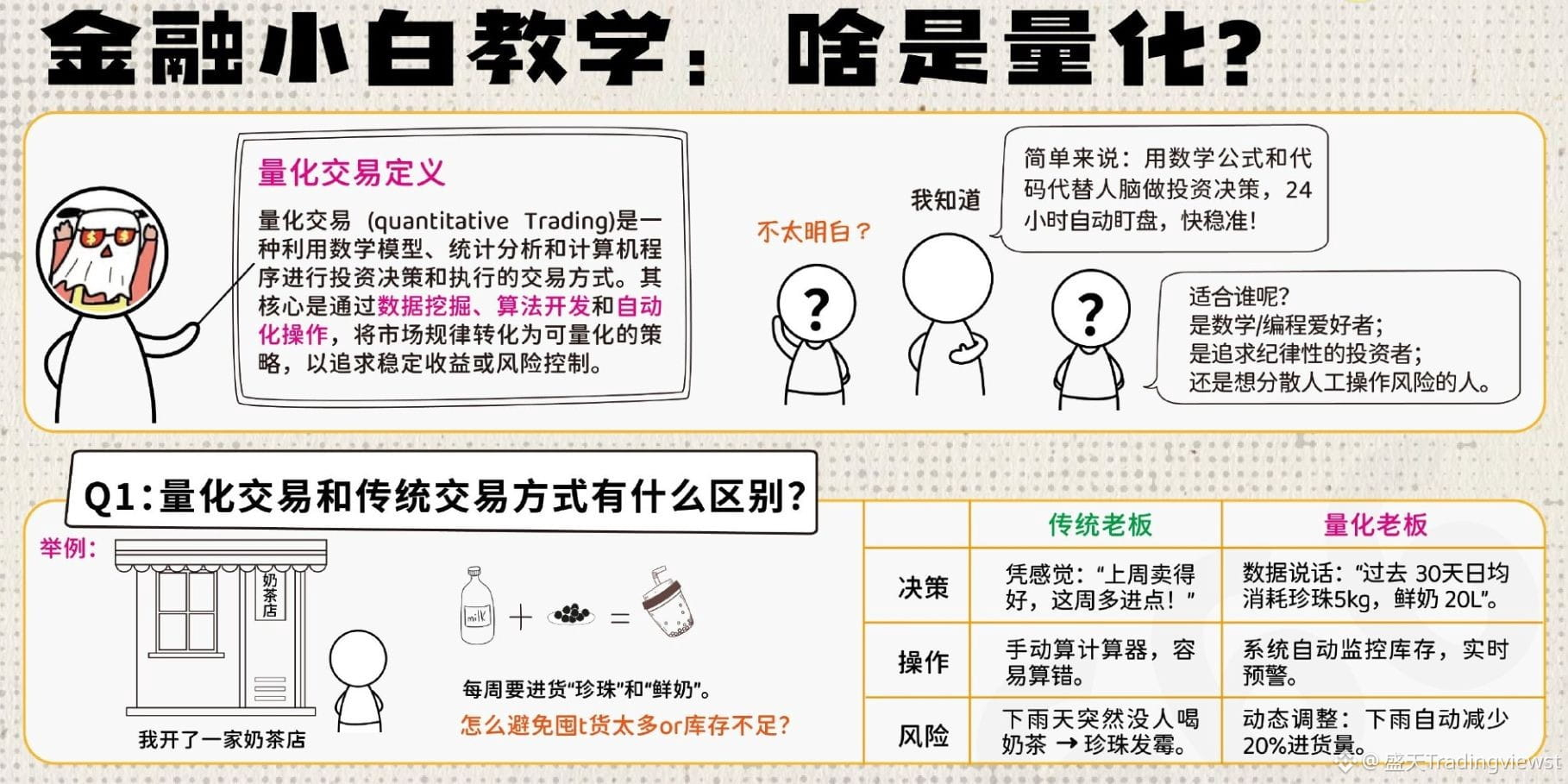
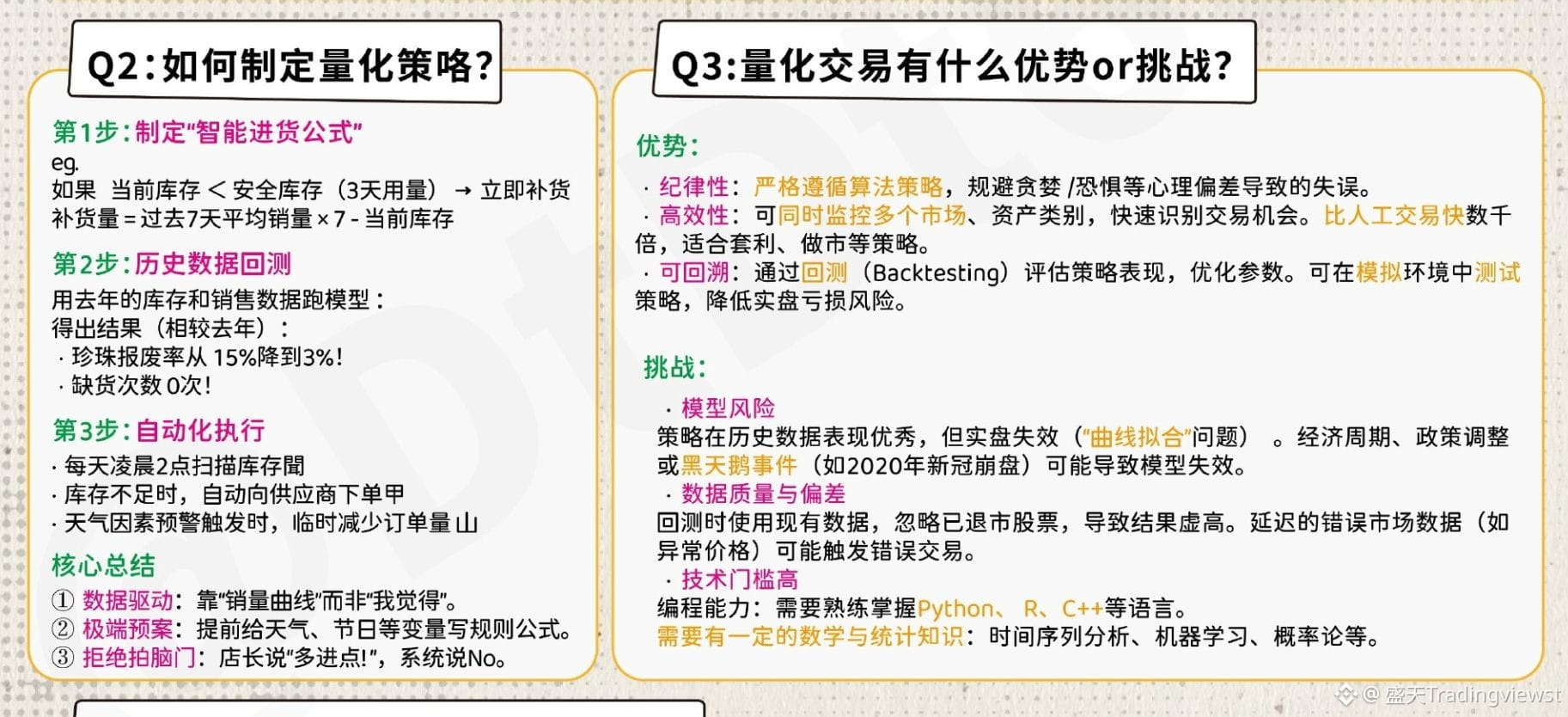
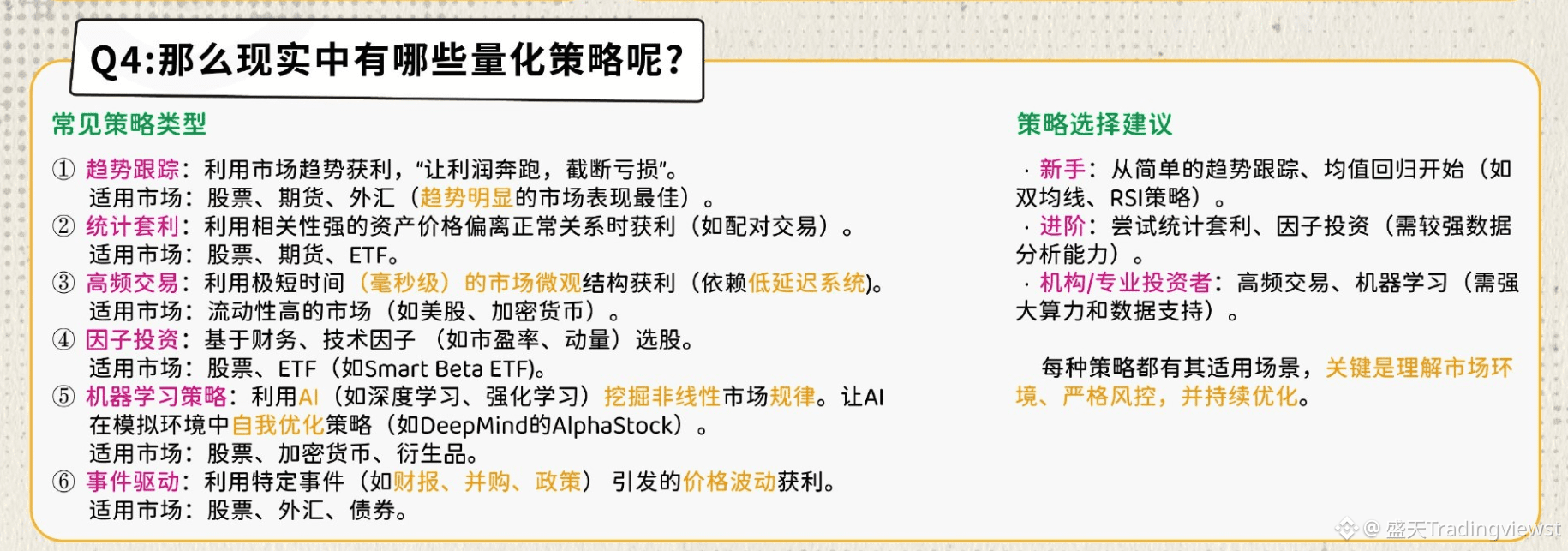
Quantitative trading (#Quantitativetrading ) is a trading method that uses mathematical models, statistical analysis, and computer programs to make investment decisions and execute trades. Its core is to transform market regularities into quantifiable strategies through data mining, algorithm development, and automated operations, aiming for stable returns or risk control.$BTC
{spot}(BTCUSDT)
#量化交易BTC defines
Quantitative trading (#Quantitativetrading ) is a trading method that uses mathematical models, statistical analysis, and computer programs to make investment decisions and execute trades. Its core is to transform market regularities into quantifiable strategies through data mining, algorithm development, and automated operations, aiming for stable returns or risk control.$BTC
Quantitative trading (#Quantitativetrading ) is a trading method that uses mathematical models, statistical analysis, and computer programs to make investment decisions and execute trades. Its core is to transform market regularities into quantifiable strategies through data mining, algorithm development, and automated operations, aiming for stable returns or risk control.$BTC
104

Greek Options: The Role of Delta
Title: Discover the "Greeks": Understanding Delta (\Delta) 📊🔍
Content:
The Greeks are statistical indicators that measure the sensitivity of an option’s price to different variables.
📌 Delta (\Delta):
It measures the estimated change in the option price for each $1$ move in the underlying asset price, $1 $ du prix de l'actif sous-jacent.
A Delta of 0.50 means that if the asset rises by $1$, the option premium increases by about $0.50$.
Delta also serves as a probabilistic estimate of whether the option will end up In the Money.
#Delta #Greeks #OptionsAnalytics #QuantitativeTrading #Binance @wodl-answers
Greek Options: The Role of Delta
Title: Discover the "Greeks": Understanding Delta (\Delta) 📊🔍
Content:
The Greeks are statistical indicators that measure the sensitivity of an option’s price to different variables.
📌 Delta (\Delta):
It measures the estimated change in the option price for each $1$ move in the underlying asset price, $1 $ du prix de l'actif sous-jacent.
A Delta of 0.50 means that if the asset rises by $1$, the option premium increases by about $0.50$.
Delta also serves as a probabilistic estimate of whether the option will end up In the Money.
#Delta #Greeks #OptionsAnalytics #QuantitativeTrading #Binance @WODL
Title: Discover the "Greeks": Understanding Delta (\Delta) 📊🔍
Content:
The Greeks are statistical indicators that measure the sensitivity of an option’s price to different variables.
📌 Delta (\Delta):
It measures the estimated change in the option price for each $1$ move in the underlying asset price, $1 $ du prix de l'actif sous-jacent.
A Delta of 0.50 means that if the asset rises by $1$, the option premium increases by about $0.50$.
Delta also serves as a probabilistic estimate of whether the option will end up In the Money.
#Delta #Greeks #OptionsAnalytics #QuantitativeTrading #Binance @WODL
37

·
--
Beyond Price Action: The Statistical Edge in Crypto MarketsMost traders focus on subjective patterns or news sentiment. While these have their place, they often lack the objective validation required for consistent risk management.
As an actuarial student and quantitative researcher, I approach the markets through the lens of probability and data distribution rather than mere speculation. My trading framework is built on three core pillars:
1. Liquidity Analysis: Identifying institutional order flow to map high-probability zones.
2. Quantitative Modeling: Using Python and R to backtest strategies against historical volatility data, ensuring the "edge" is statistically significant, not just an artifact of luck.
3. Risk-Adjusted Returns: Prioritizing the Sharpe and Sortino ratios over vanity metrics. In this environment, survival is the prerequisite for performance.
The crypto market is essentially a high-frequency, non-linear system. To navigate it, we must move away from "guessing" and towards modeling.
I will be sharing my technical insights, automated trading experiments, and data-driven market outlooks here. If you are interested in the intersection of quantitative finance and blockchain, let’s connect.
#Quantitativetrading #DataScience $BTC
{future}(BTCUSDT)
Beyond Price Action: The Statistical Edge in Crypto Markets
Most traders focus on subjective patterns or news sentiment. While these have their place, they often lack the objective validation required for consistent risk management.
As an actuarial student and quantitative researcher, I approach the markets through the lens of probability and data distribution rather than mere speculation. My trading framework is built on three core pillars:
1. Liquidity Analysis: Identifying institutional order flow to map high-probability zones.
2. Quantitative Modeling: Using Python and R to backtest strategies against historical volatility data, ensuring the "edge" is statistically significant, not just an artifact of luck.
3. Risk-Adjusted Returns: Prioritizing the Sharpe and Sortino ratios over vanity metrics. In this environment, survival is the prerequisite for performance.
The crypto market is essentially a high-frequency, non-linear system. To navigate it, we must move away from "guessing" and towards modeling.
I will be sharing my technical insights, automated trading experiments, and data-driven market outlooks here. If you are interested in the intersection of quantitative finance and blockchain, let’s connect.
#Quantitativetrading #DataScience $BTC
As an actuarial student and quantitative researcher, I approach the markets through the lens of probability and data distribution rather than mere speculation. My trading framework is built on three core pillars:
1. Liquidity Analysis: Identifying institutional order flow to map high-probability zones.
2. Quantitative Modeling: Using Python and R to backtest strategies against historical volatility data, ensuring the "edge" is statistically significant, not just an artifact of luck.
3. Risk-Adjusted Returns: Prioritizing the Sharpe and Sortino ratios over vanity metrics. In this environment, survival is the prerequisite for performance.
The crypto market is essentially a high-frequency, non-linear system. To navigate it, we must move away from "guessing" and towards modeling.
I will be sharing my technical insights, automated trading experiments, and data-driven market outlooks here. If you are interested in the intersection of quantitative finance and blockchain, let’s connect.
#Quantitativetrading #DataScience $BTC
1
122
Optimize every timeframe. 🛠️
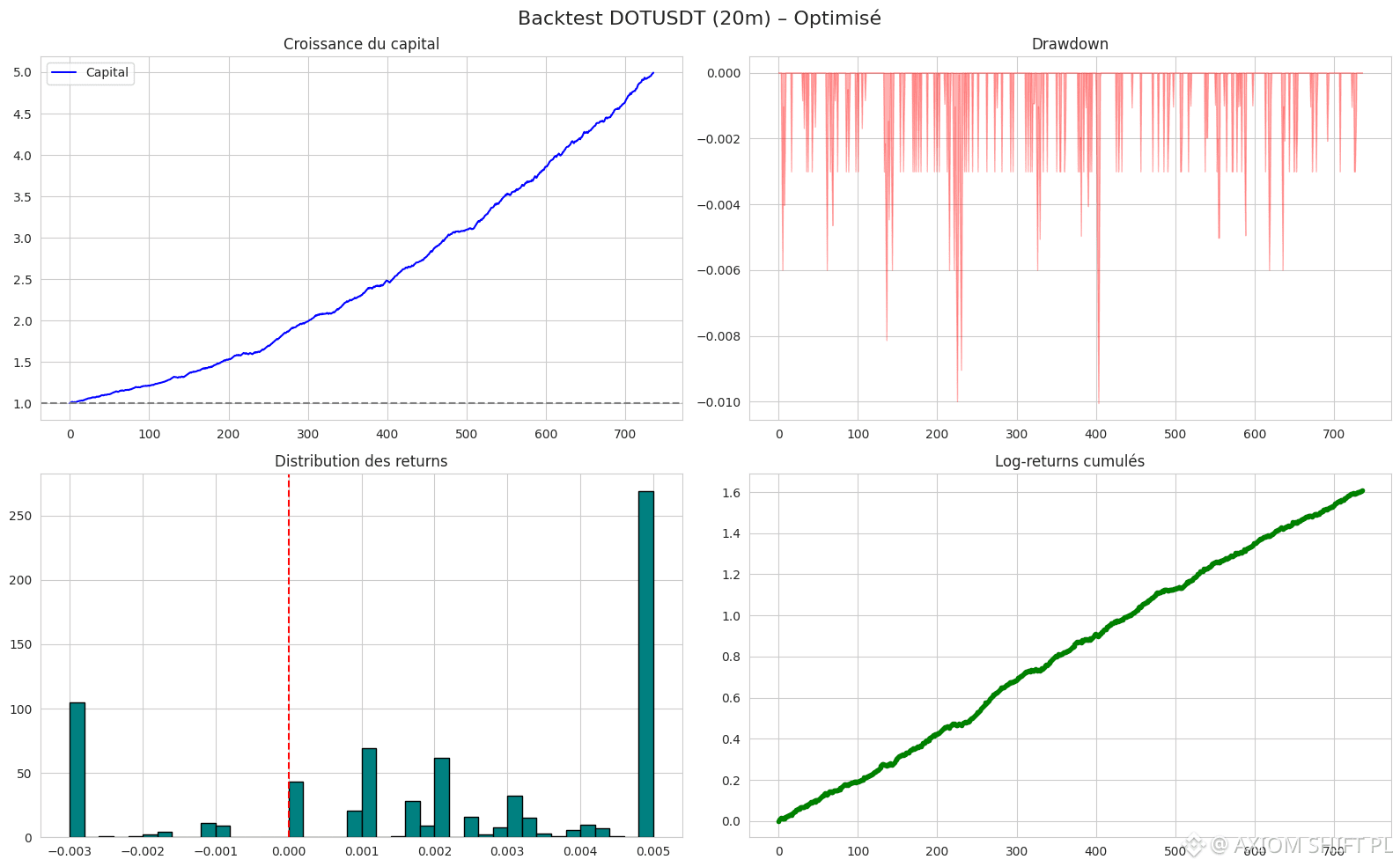
Zoom in on pair $DOT (20m) with Axiom Quant. When the math structure is solid, the results follow. No room for chance, just raw data. 🧠 #PolkadotNews #QuantitativeTrading
Optimize every timeframe. 🛠️
Zoom in on pair $DOT (20m) with Axiom Quant. When the math structure is solid, the results follow. No room for chance, just raw data. 🧠 #PolkadotNews #QuantitativeTrading
Zoom in on pair $DOT (20m) with Axiom Quant. When the math structure is solid, the results follow. No room for chance, just raw data. 🧠 #PolkadotNews #QuantitativeTrading
348

Article
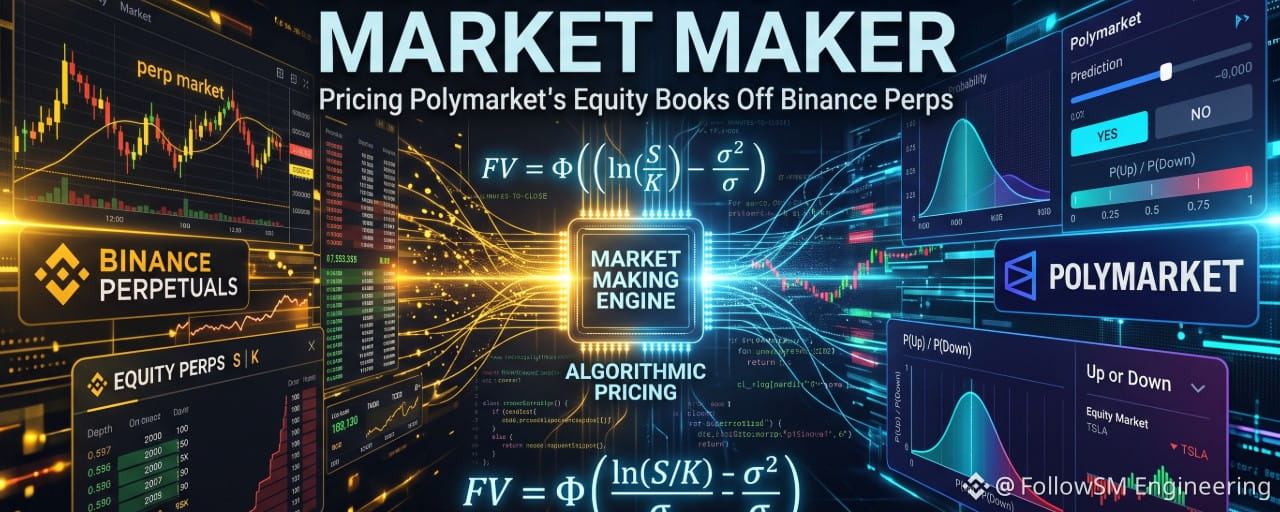
Pricing Polymarket Equity Books Off Binance Perps: A Cross-Venue Microstructure StudyBinance’s 24/7 equity perps price US market opening gaps long before the stock market bell rings. But can a cross-venue market maker use Binance equity perp fair value to quote Polymarket’s daily stock prediction books at a profit?
We analyzed 1,537 market-nights and ran a fill-by-fill backtest on 1,313 historical order books (Jan–Oct 2026) to test latency, risk shields, and strategy decay.
📊 Key Quantitative Findings
🎯 The Perp Leads Probability: When Binance perp-implied probability and Polymarket disagree by >5¢, the market resolves on Binance’s side 62.5% of the time during regular trading hours.⚡ Speed is Everything: Quote updates at 250 ms to 1 s generated positive in-sample returns (+$6.2k, Sharpe 1.7). Sinking to 60 s updates flipped P&L to -$19.3k due to adverse selection from faster takers.🛡️ Perp Hedges Cost Too Much: Delta-hedging a small prediction book on Binance perps cost $26k–$83k in fees and execution slippage, eating all maker edge.📉 Out-of-Sample Decay: The strategy edge faded rapidly after mid-June and flipped negative out-of-sample as institutional participants and faster bots closed the latency window.
📖 Read the full deep dive with open-source code, backtests, and placebo verification on Dev.to:
👉 https://dev.to/followsm/building-a-cross-venue-market-maker-pricing-polymarkets-equity-books-off-binance-perps-1316
#BinancePerps #Polymarket #MarketMaker #QuantitativeTrading #AlgorithmicTrading
Pricing Polymarket Equity Books Off Binance Perps: A Cross-Venue Microstructure Study
Binance’s 24/7 equity perps price US market opening gaps long before the stock market bell rings. But can a cross-venue market maker use Binance equity perp fair value to quote Polymarket’s daily stock prediction books at a profit?
We analyzed 1,537 market-nights and ran a fill-by-fill backtest on 1,313 historical order books (Jan–Oct 2026) to test latency, risk shields, and strategy decay.
📊 Key Quantitative Findings
🎯 The Perp Leads Probability: When Binance perp-implied probability and Polymarket disagree by >5¢, the market resolves on Binance’s side 62.5% of the time during regular trading hours.⚡ Speed is Everything: Quote updates at 250 ms to 1 s generated positive in-sample returns (+$6.2k, Sharpe 1.7). Sinking to 60 s updates flipped P&L to -$19.3k due to adverse selection from faster takers.🛡️ Perp Hedges Cost Too Much: Delta-hedging a small prediction book on Binance perps cost $26k–$83k in fees and execution slippage, eating all maker edge.📉 Out-of-Sample Decay: The strategy edge faded rapidly after mid-June and flipped negative out-of-sample as institutional participants and faster bots closed the latency window.
📖 Read the full deep dive with open-source code, backtests, and placebo verification on Dev.to:
👉 https://dev.to/followsm/building-a-cross-venue-market-maker-pricing-polymarkets-equity-books-off-binance-perps-1316
#BinancePerps #Polymarket #MarketMaker #QuantitativeTrading #AlgorithmicTrading
We analyzed 1,537 market-nights and ran a fill-by-fill backtest on 1,313 historical order books (Jan–Oct 2026) to test latency, risk shields, and strategy decay.
📊 Key Quantitative Findings
🎯 The Perp Leads Probability: When Binance perp-implied probability and Polymarket disagree by >5¢, the market resolves on Binance’s side 62.5% of the time during regular trading hours.⚡ Speed is Everything: Quote updates at 250 ms to 1 s generated positive in-sample returns (+$6.2k, Sharpe 1.7). Sinking to 60 s updates flipped P&L to -$19.3k due to adverse selection from faster takers.🛡️ Perp Hedges Cost Too Much: Delta-hedging a small prediction book on Binance perps cost $26k–$83k in fees and execution slippage, eating all maker edge.📉 Out-of-Sample Decay: The strategy edge faded rapidly after mid-June and flipped negative out-of-sample as institutional participants and faster bots closed the latency window.
📖 Read the full deep dive with open-source code, backtests, and placebo verification on Dev.to:
👉 https://dev.to/followsm/building-a-cross-venue-market-maker-pricing-polymarkets-equity-books-off-binance-perps-1316
#BinancePerps #Polymarket #MarketMaker #QuantitativeTrading #AlgorithmicTrading
75

🧠 EVERYONE HAS A STRATEGY. VERY FEW HAVE PROOF OF AN EDGE.
A chart setup that worked three times is not statistical evidence.
Serious traders test:
📈 Performance across different market regimes
📉 Maximum drawdown
🧮 Expectancy after fees
🔁 Out-of-sample results
⚙️ Sensitivity to entry and exit rules
A strategy that only works after endless adjustments may be overfitted.
If your edge disappears when conditions change slightly, how robust was it?
Less storytelling. More data.
What’s your minimum backtest sample before trusting a setup?
#Backtesting #Quantitativetrading #TradingSystems #CryptoMarkets #BinanceSquare
🧠 EVERYONE HAS A STRATEGY. VERY FEW HAVE PROOF OF AN EDGE.
A chart setup that worked three times is not statistical evidence.
Serious traders test:
📈 Performance across different market regimes
📉 Maximum drawdown
🧮 Expectancy after fees
🔁 Out-of-sample results
⚙️ Sensitivity to entry and exit rules
A strategy that only works after endless adjustments may be overfitted.
If your edge disappears when conditions change slightly, how robust was it?
Less storytelling. More data.
What’s your minimum backtest sample before trusting a setup?
#Backtesting #Quantitativetrading #TradingSystems #CryptoMarkets #BinanceSquare
A chart setup that worked three times is not statistical evidence.
Serious traders test:
📈 Performance across different market regimes
📉 Maximum drawdown
🧮 Expectancy after fees
🔁 Out-of-sample results
⚙️ Sensitivity to entry and exit rules
A strategy that only works after endless adjustments may be overfitted.
If your edge disappears when conditions change slightly, how robust was it?
Less storytelling. More data.
What’s your minimum backtest sample before trusting a setup?
#Backtesting #Quantitativetrading #TradingSystems #CryptoMarkets #BinanceSquare
2
·
--
🦅 🛡️ RISK MANAGEMENT DISCIPLINE: Break-Even Exit on $TRX
📊 Trade Execution Metrics:
• Asset: $TRX
• Realized PnL: +0.2%
• Entry: $0.3342
• Exit: $0.3349
• Mode: Algorithmic Momentum Capture
💡 Algorithmic Edge:
Institutional execution rule: When Horus algorithms detect slowing order-flow momentum or liquidity saturation, stop-loss is shifted to breakeven immediately to eliminate downside risk and protect capital 100%.
🛡️ Disciplined risk control and algorithmic exits form the backbone of sustainable crypto profitability.
💬 For Traders: How do you manage positions when volume stalls? Do you immediately move stops to breakeven or wait for target levels? Share your playbook below 👇
🔔 Follow for real-time algorithmic trades, macro updates, and risk-first quantitative execution.
#TRX #BinanceSquare #CryptoTrading #QuantitativeTrading #Horus
🦅 🛡️ RISK MANAGEMENT DISCIPLINE: Break-Even Exit on $TRX
📊 Trade Execution Metrics:
• Asset: $TRX
• Realized PnL: +0.2%
• Entry: $0.3342
• Exit: $0.3349
• Mode: Algorithmic Momentum Capture
💡 Algorithmic Edge:
Institutional execution rule: When Horus algorithms detect slowing order-flow momentum or liquidity saturation, stop-loss is shifted to breakeven immediately to eliminate downside risk and protect capital 100%.
🛡️ Disciplined risk control and algorithmic exits form the backbone of sustainable crypto profitability.
💬 For Traders: How do you manage positions when volume stalls? Do you immediately move stops to breakeven or wait for target levels? Share your playbook below 👇
🔔 Follow for real-time algorithmic trades, macro updates, and risk-first quantitative execution.
#TRX #BinanceSquare #CryptoTrading #QuantitativeTrading #Horus
📊 Trade Execution Metrics:
• Asset: $TRX
• Realized PnL: +0.2%
• Entry: $0.3342
• Exit: $0.3349
• Mode: Algorithmic Momentum Capture
💡 Algorithmic Edge:
Institutional execution rule: When Horus algorithms detect slowing order-flow momentum or liquidity saturation, stop-loss is shifted to breakeven immediately to eliminate downside risk and protect capital 100%.
🛡️ Disciplined risk control and algorithmic exits form the backbone of sustainable crypto profitability.
💬 For Traders: How do you manage positions when volume stalls? Do you immediately move stops to breakeven or wait for target levels? Share your playbook below 👇
🔔 Follow for real-time algorithmic trades, macro updates, and risk-first quantitative execution.
#TRX #BinanceSquare #CryptoTrading #QuantitativeTrading #Horus
2

·
--
Order failures due to exchange throttling or duplicate signals can derail an entire automated strategy in seconds. ⚠️
A truly robust trading system must account for these real-world failure points:
• Rate limits
• Ambiguous timeouts
• Duplicate signals
When building reliability, remember this sequence:
1. For timeouts, never blindly retry. The safe pattern requires recording the initial attempt and checking the exchange state to see if the order already appeared before retrying.
2. External sources can send webhooks twice, creating the risk of unintended double-firing of trades due to duplicate orders.
WolfBot handles this complexity for you internally. 🛡️
We automatically handle:
✅ Deduplication on incoming signals.
✅ Preventing re-submitting an order already successfully placed.
✅ Managing request queuing and spacing for rate limits, so you don't fail silently when throttled.
To validate your own setup's resilience, controlled testing is non-negotiable:
⚙️ Send the same webhook twice and confirm exactly one order is created.
⚙️ Simulate a timeout to confirm no second order is generated upon recovery.
For a deeper dive into these mechanisms, check out our documentation here: https://community.wolfbot.io/docs/rate-limits-retries-duplicate-orders
Understanding these failure modes is what separates a script from a professional-grade system. 🚀
#TradingAutomation #APIStrategy #QuantitativeTrading #ExecutionRisk #CryptoDev
Order failures due to exchange throttling or duplicate signals can derail an entire automated strategy in seconds. ⚠️
A truly robust trading system must account for these real-world failure points:
• Rate limits
• Ambiguous timeouts
• Duplicate signals
When building reliability, remember this sequence:
1. For timeouts, never blindly retry. The safe pattern requires recording the initial attempt and checking the exchange state to see if the order already appeared before retrying.
2. External sources can send webhooks twice, creating the risk of unintended double-firing of trades due to duplicate orders.
WolfBot handles this complexity for you internally. 🛡️
We automatically handle:
✅ Deduplication on incoming signals.
✅ Preventing re-submitting an order already successfully placed.
✅ Managing request queuing and spacing for rate limits, so you don't fail silently when throttled.
To validate your own setup's resilience, controlled testing is non-negotiable:
⚙️ Send the same webhook twice and confirm exactly one order is created.
⚙️ Simulate a timeout to confirm no second order is generated upon recovery.
For a deeper dive into these mechanisms, check out our documentation here: https://community.wolfbot.io/docs/rate-limits-retries-duplicate-orders
Understanding these failure modes is what separates a script from a professional-grade system. 🚀
#TradingAutomation #APIStrategy #QuantitativeTrading #ExecutionRisk #CryptoDev
A truly robust trading system must account for these real-world failure points:
• Rate limits
• Ambiguous timeouts
• Duplicate signals
When building reliability, remember this sequence:
1. For timeouts, never blindly retry. The safe pattern requires recording the initial attempt and checking the exchange state to see if the order already appeared before retrying.
2. External sources can send webhooks twice, creating the risk of unintended double-firing of trades due to duplicate orders.
WolfBot handles this complexity for you internally. 🛡️
We automatically handle:
✅ Deduplication on incoming signals.
✅ Preventing re-submitting an order already successfully placed.
✅ Managing request queuing and spacing for rate limits, so you don't fail silently when throttled.
To validate your own setup's resilience, controlled testing is non-negotiable:
⚙️ Send the same webhook twice and confirm exactly one order is created.
⚙️ Simulate a timeout to confirm no second order is generated upon recovery.
For a deeper dive into these mechanisms, check out our documentation here: https://community.wolfbot.io/docs/rate-limits-retries-duplicate-orders
Understanding these failure modes is what separates a script from a professional-grade system. 🚀
#TradingAutomation #APIStrategy #QuantitativeTrading #ExecutionRisk #CryptoDev

1
88
·
--
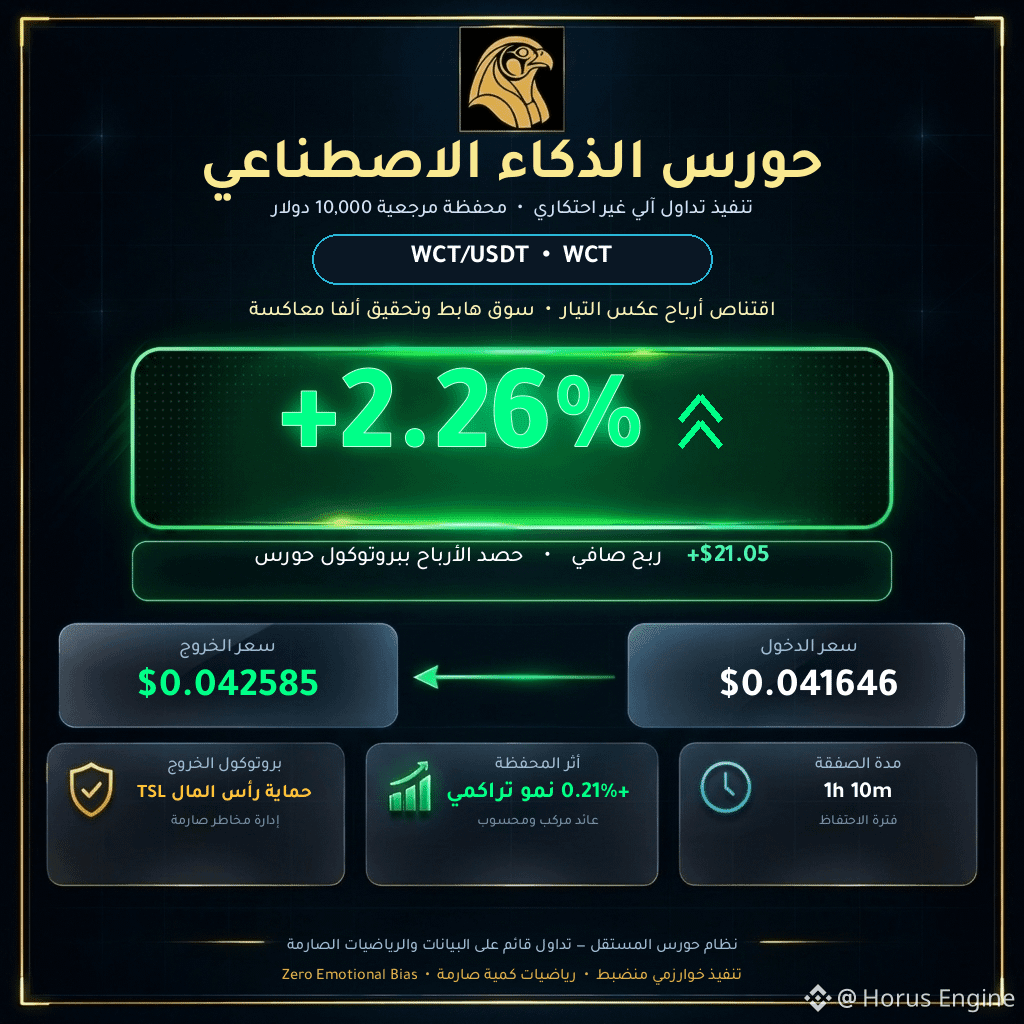
🦅 🎯 Counter-Trend Execution! Horus Captures +2.3% on $WCT
📊 Trade Execution Metrics:
• Asset: $WCT
• Realized PnL: +2.3%
• Entry: $0.0416
• Exit: $0.0426
• Mode: Algorithmic Momentum Capture
💡 Algorithmic Edge:
While broader sentiment leaned fearful, Horus quantitative engine executed disciplined liquidity sweeps to capture sharp counter-trend momentum with automated trailing protection.
🛡️ Disciplined risk control and algorithmic exits form the backbone of sustainable crypto profitability.
💬 Analysts & Traders: Do you expect $WCT to sustain bullish momentum into the next 4H candle, or are we due for a quick retest of support? Share your chart below 👇
🔔 Follow for real-time algorithmic trades, macro updates, and risk-first quantitative execution.
#WCT #BinanceSquare #CryptoTrading #QuantitativeTrading #Horus
🦅 🎯 Counter-Trend Execution! Horus Captures +2.3% on $WCT
📊 Trade Execution Metrics:
• Asset: $WCT
• Realized PnL: +2.3%
• Entry: $0.0416
• Exit: $0.0426
• Mode: Algorithmic Momentum Capture
💡 Algorithmic Edge:
While broader sentiment leaned fearful, Horus quantitative engine executed disciplined liquidity sweeps to capture sharp counter-trend momentum with automated trailing protection.
🛡️ Disciplined risk control and algorithmic exits form the backbone of sustainable crypto profitability.
💬 Analysts & Traders: Do you expect $WCT to sustain bullish momentum into the next 4H candle, or are we due for a quick retest of support? Share your chart below 👇
🔔 Follow for real-time algorithmic trades, macro updates, and risk-first quantitative execution.
#WCT #BinanceSquare #CryptoTrading #QuantitativeTrading #Horus
📊 Trade Execution Metrics:
• Asset: $WCT
• Realized PnL: +2.3%
• Entry: $0.0416
• Exit: $0.0426
• Mode: Algorithmic Momentum Capture
💡 Algorithmic Edge:
While broader sentiment leaned fearful, Horus quantitative engine executed disciplined liquidity sweeps to capture sharp counter-trend momentum with automated trailing protection.
🛡️ Disciplined risk control and algorithmic exits form the backbone of sustainable crypto profitability.
💬 Analysts & Traders: Do you expect $WCT to sustain bullish momentum into the next 4H candle, or are we due for a quick retest of support? Share your chart below 👇
🔔 Follow for real-time algorithmic trades, macro updates, and risk-first quantitative execution.
#WCT #BinanceSquare #CryptoTrading #QuantitativeTrading #Horus
267
·
--
🦅 🎯 Quantitative Win: Closed +1.2% on $SCR
📊 Trade Execution Metrics:
• Asset: $SCR
• Realized PnL: +1.2%
• Entry: $0.0239
• Exit: $0.0241
• Mode: Algorithmic Momentum Capture
💡 Algorithmic Edge:
Automated liquidity sweep and algorithmic target execution with zero emotional bias or execution delay.
🛡️ Disciplined risk control and algorithmic exits form the backbone of sustainable crypto profitability.
💬 Analysts & Traders: Do you expect $SCR to sustain bullish momentum into the next 4H candle, or are we due for a quick retest of support? Share your chart below 👇
🔔 Follow for real-time algorithmic trades, macro updates, and risk-first quantitative execution.
#SCR #BinanceSquare #CryptoTrading #QuantitativeTrading #Horus
🦅 🎯 Quantitative Win: Closed +1.2% on $SCR
📊 Trade Execution Metrics:
• Asset: $SCR
• Realized PnL: +1.2%
• Entry: $0.0239
• Exit: $0.0241
• Mode: Algorithmic Momentum Capture
💡 Algorithmic Edge:
Automated liquidity sweep and algorithmic target execution with zero emotional bias or execution delay.
🛡️ Disciplined risk control and algorithmic exits form the backbone of sustainable crypto profitability.
💬 Analysts & Traders: Do you expect $SCR to sustain bullish momentum into the next 4H candle, or are we due for a quick retest of support? Share your chart below 👇
🔔 Follow for real-time algorithmic trades, macro updates, and risk-first quantitative execution.
#SCR #BinanceSquare #CryptoTrading #QuantitativeTrading #Horus
📊 Trade Execution Metrics:
• Asset: $SCR
• Realized PnL: +1.2%
• Entry: $0.0239
• Exit: $0.0241
• Mode: Algorithmic Momentum Capture
💡 Algorithmic Edge:
Automated liquidity sweep and algorithmic target execution with zero emotional bias or execution delay.
🛡️ Disciplined risk control and algorithmic exits form the backbone of sustainable crypto profitability.
💬 Analysts & Traders: Do you expect $SCR to sustain bullish momentum into the next 4H candle, or are we due for a quick retest of support? Share your chart below 👇
🔔 Follow for real-time algorithmic trades, macro updates, and risk-first quantitative execution.
#SCR #BinanceSquare #CryptoTrading #QuantitativeTrading #Horus
324


Article
How Do I Use Engineering and AI to Read Bitcoin Price Action?🚀 Beyond the Chart: How Do I Use Engineering and AI to Read Bitcoin Price Action?
As an engineer and developer of AI and quantitative analysis systems, I don’t see financial markets as just rising and falling candlesticks. I see them as complex multi-dimensional data arrays governed by algorithms and liquidity cluster behavior.
How Do I Use Engineering and AI to Read Bitcoin Price Action?
🚀 Beyond the Chart: How Do I Use Engineering and AI to Read Bitcoin Price Action?
As an engineer and developer of AI and quantitative analysis systems, I don’t see financial markets as just rising and falling candlesticks. I see them as complex multi-dimensional data arrays governed by algorithms and liquidity cluster behavior.
As an engineer and developer of AI and quantitative analysis systems, I don’t see financial markets as just rising and falling candlesticks. I see them as complex multi-dimensional data arrays governed by algorithms and liquidity cluster behavior.
111
·
--
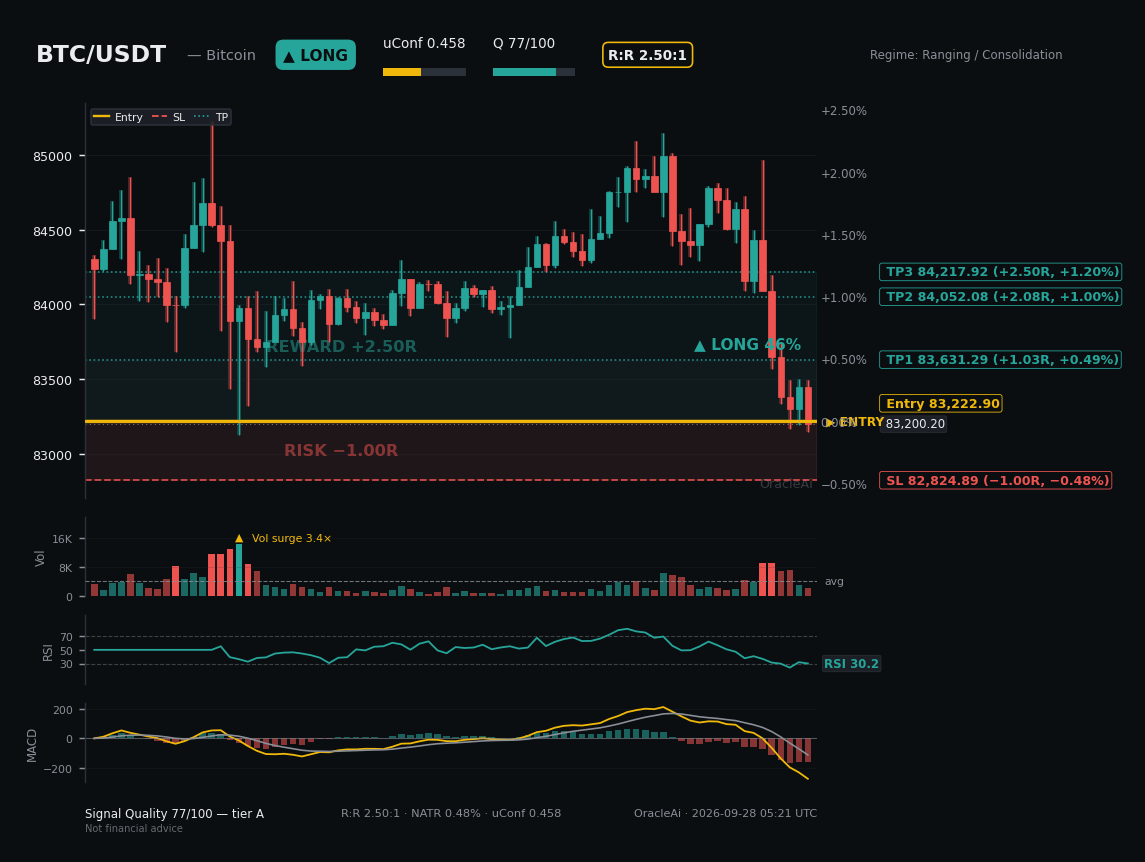
🎯 BTC Long Setup Update: Target Successfully Hit!
Yesterday’s technical map on BTC played out precisely as projected, respecting the structure and validating the model's directional bias.
Setup Type: Long
Entry: $83,222.90
Outcome: Successfully hit all targets up to TP3 ($84,217.92), capturing a clean upward move.
Model Quality: Tier A (77/100 score) with 72.2% upside odds.
The consolidation framework and range-trading context provided the exact staging required for this execution.
Does the current market structure keep you interested for the next leg? Let me know your thoughts below!
#BTC #Long #Quantitativetrading #CryptoAnalysis #bitcoin
🎯 BTC Long Setup Update: Target Successfully Hit!
Yesterday’s technical map on BTC played out precisely as projected, respecting the structure and validating the model's directional bias.
Setup Type: Long
Entry: $83,222.90
Outcome: Successfully hit all targets up to TP3 ($84,217.92), capturing a clean upward move.
Model Quality: Tier A (77/100 score) with 72.2% upside odds.
The consolidation framework and range-trading context provided the exact staging required for this execution.
Does the current market structure keep you interested for the next leg? Let me know your thoughts below!
#BTC #Long #Quantitativetrading #CryptoAnalysis #bitcoin
Yesterday’s technical map on BTC played out precisely as projected, respecting the structure and validating the model's directional bias.
Setup Type: Long
Entry: $83,222.90
Outcome: Successfully hit all targets up to TP3 ($84,217.92), capturing a clean upward move.
Model Quality: Tier A (77/100 score) with 72.2% upside odds.
The consolidation framework and range-trading context provided the exact staging required for this execution.
Does the current market structure keep you interested for the next leg? Let me know your thoughts below!
#BTC #Long #Quantitativetrading #CryptoAnalysis #bitcoin
ORACLEAI
·
--
The technical map on BTC keeps the bullish scenario in focus.
The ranging / consolidation context is part of the reason these levels matter. Call it a LONG setup, with the map pointing higher.
Levels: Entry $83,222.90, SL $82,824.89, TP1 $83,631.29, TP2 $84,052.08, TP3 $84,217.92.
The full move to TP3 is roughly 1.20%.
Quality check: 77/100, tier A.
The model puts upside odds at 72.2%.
Engine confidence sits at 0.46.
Reward-to-risk sits at 2.50:1.
Does the current structure on BTC keep you interested?
The setup is conditional on the levels holding.
#BTC #BTCUSDT #Long #RangeTrading #Altcoins
The ranging / consolidation context is part of the reason these levels matter. Call it a LONG setup, with the map pointing higher.
Levels: Entry $83,222.90, SL $82,824.89, TP1 $83,631.29, TP2 $84,052.08, TP3 $84,217.92.
The full move to TP3 is roughly 1.20%.
Quality check: 77/100, tier A.
The model puts upside odds at 72.2%.
Engine confidence sits at 0.46.
Reward-to-risk sits at 2.50:1.
Does the current structure on BTC keep you interested?
The setup is conditional on the levels holding.
#BTC #BTCUSDT #Long #RangeTrading #Altcoins
98
Log in to explore more content
Join global crypto users on Binance Square
⚡️ Get latest and useful information about crypto.
💬 Trusted by the world’s largest crypto exchange.
👍 Discover real insights from verified creators.
Email / Phone number
Trending Topics
1
#CanMicrosoftDeliverOnAI
185,098 views
1,487 Discussing
2
#CanGoogleDefindItsCore
93,090 views
1,070 Discussing
3
#FOMCWatch
9.2M views
28,757 Discussing
4
#HKPlacesTokenizedFundSecondaryTradingUnderETFLikeFramework
36 views
6 Discussing
5
#USGovSellsFTXLinkedAnthropicSharesFor$627M
289 views
18 Discussing
6
#MoodysAssignsRLUSDA2LongTermDepositRating
122 views
40 Discussing
7
#SKHynixUnveils$45BShareholderReturns
730 views
22 Discussing
8
#OSMOPlansToBurn100MTokensFromCommunityPool
8,241 views
255 Discussing
9
#EthereumDropsBelow$2300
13,002 views
174 Discussing
10
#BitcoinSlipsBelow$80KAgain
37,286 views
141 Discussing