
#npex
npex
7,722 views
42 Discussing
Hot
Latest

Every Dusk thread mentions NPEX. The licensed Dutch venue, the €200M+ confirmed issuance, the 20,000+ investor base, the flagship market-infrastructure workflow.
Almost none of them mention how that relationship started.
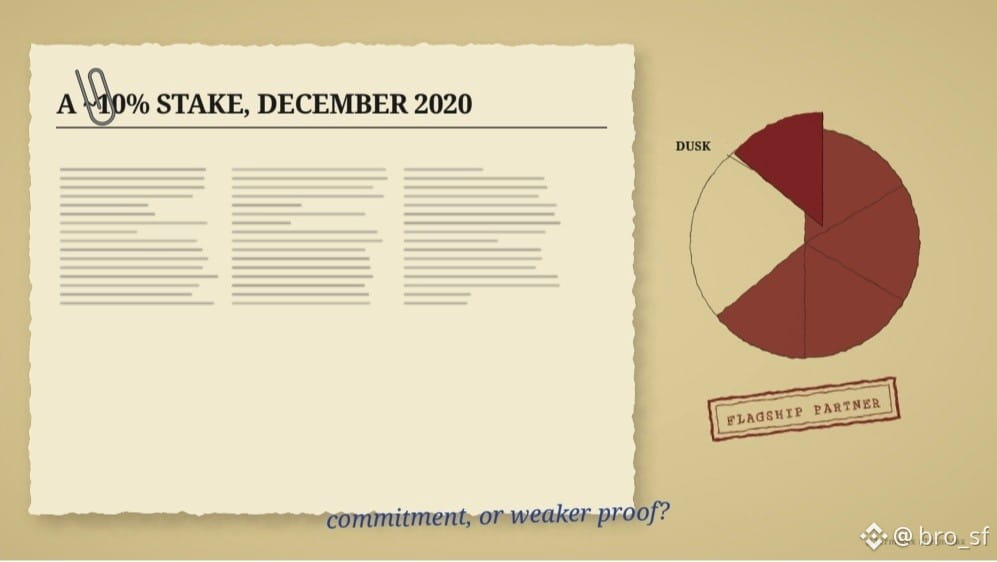
Follow the media links on Dusk's own homepage and one of them is a CoinDesk piece from December 2020 reporting that Dusk Network took a roughly 10% stake in the Dutch stock exchange it now partners with.
That changes how I read the partnership, in both directions.
The generous read: this is how infrastructure actually gets built in regulated markets. You cannot cold-call a licensed venue and ask it to rebuild its settlement stack on your unproven L1. Taking equity aligns incentives, gets you inside the compliance conversation, and buys years of institutional patience that no BD team can purchase. It also explains why Dusk's roadmap reads like a market-infrastructure plan rather than a DeFi plan — they've been sitting on that side of the table since 2020.
The cautious read: the flagship adoption proof point is not fully independent. When a chain's headline institutional validation comes from a venue it holds a stake in, "an institution chose us" and "we invested in an institution" start to blur.
Both readings can be true at once, and I'd rather hold both than pretend either is the whole story.
Fair caveat: that report is from 2020. I have not found a current figure, and stakes change. If someone has a more recent number, I'd genuinely like to see it.
When a protocol holds equity in its own biggest partner — does that read as commitment to you, or as a weaker form of adoption proof?
#dusk $DUSK @Dusk #NPEX
Almost none of them mention how that relationship started.
Follow the media links on Dusk's own homepage and one of them is a CoinDesk piece from December 2020 reporting that Dusk Network took a roughly 10% stake in the Dutch stock exchange it now partners with.
That changes how I read the partnership, in both directions.
The generous read: this is how infrastructure actually gets built in regulated markets. You cannot cold-call a licensed venue and ask it to rebuild its settlement stack on your unproven L1. Taking equity aligns incentives, gets you inside the compliance conversation, and buys years of institutional patience that no BD team can purchase. It also explains why Dusk's roadmap reads like a market-infrastructure plan rather than a DeFi plan — they've been sitting on that side of the table since 2020.
The cautious read: the flagship adoption proof point is not fully independent. When a chain's headline institutional validation comes from a venue it holds a stake in, "an institution chose us" and "we invested in an institution" start to blur.
Both readings can be true at once, and I'd rather hold both than pretend either is the whole story.
Fair caveat: that report is from 2020. I have not found a current figure, and stakes change. If someone has a more recent number, I'd genuinely like to see it.
When a protocol holds equity in its own biggest partner — does that read as commitment to you, or as a weaker form of adoption proof?
#dusk $DUSK @Dusk #NPEX

Verified
I've been sitting with @Dusk for a few weeks now, and the more I dig, the more I think most people are missing what's actually different here.
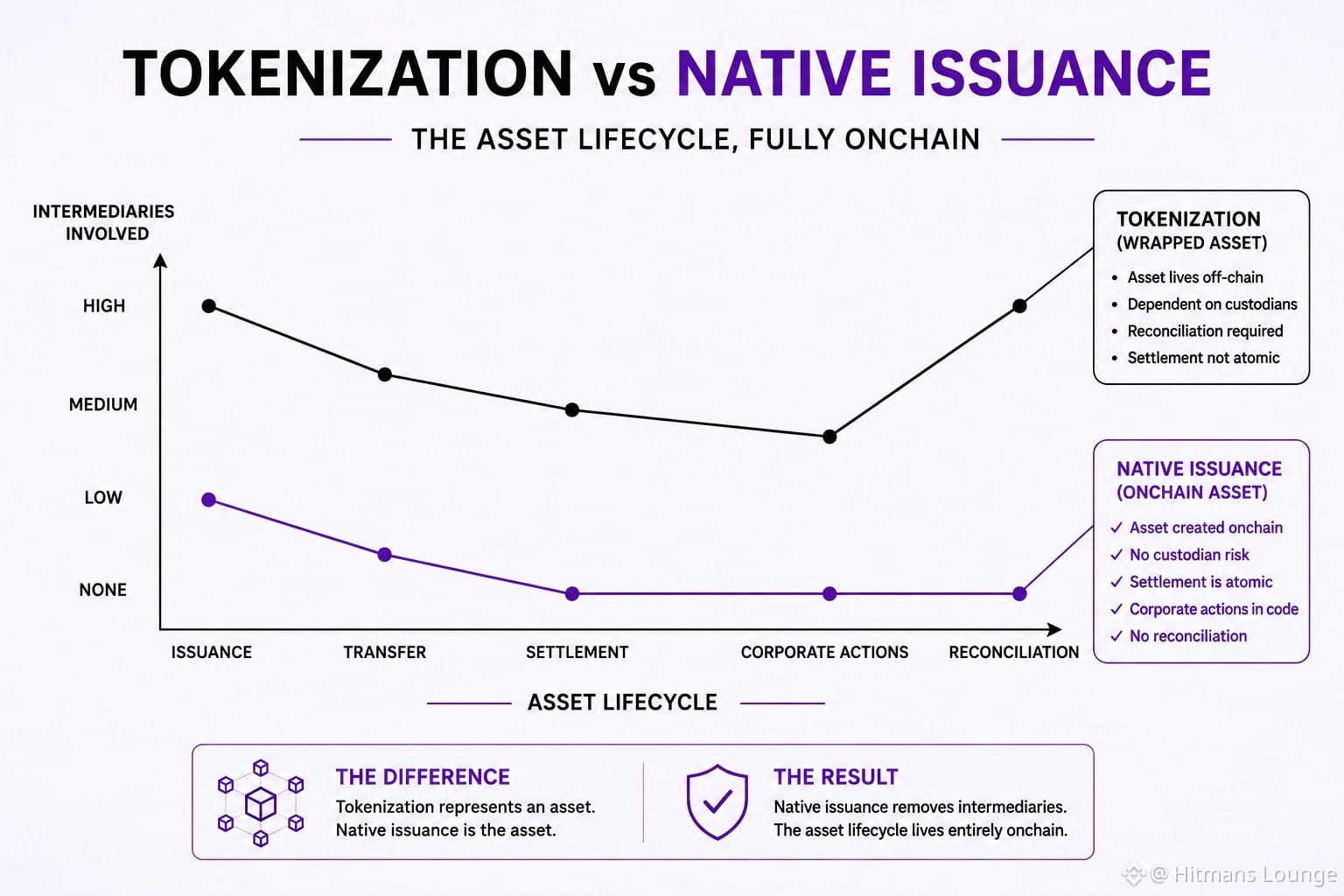
Everyone talks about RWAs like tokenization is the endgame. But there's a distinction I kept glossing over until recently — tokenization wraps an existing asset. The bond still lives with a custodian. The token is just a representation. If that custodian fails, your token is essentially a claim on a broken process. You still need reconciliation between what's onchain and what's actually held off-chain.
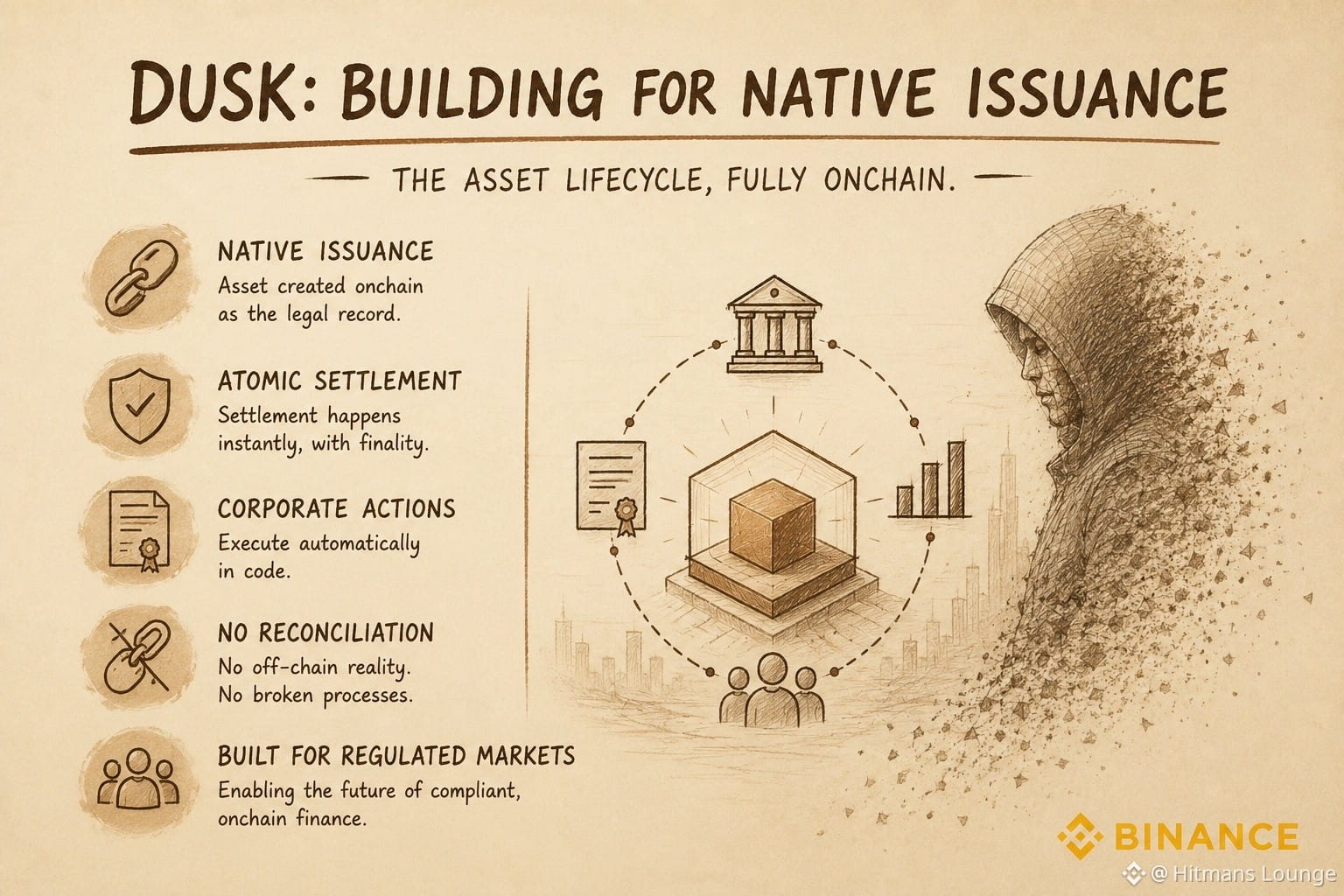
Native issuance is different. The asset is created onchain as the legal record. Settlement is atomic. Corporate actions execute in code. There's no off-chain reality to reconcile against — because there isn't one.
That's what $DUSK is actually building for.
What shifted my thinking was seeing NPEX — an AFM-regulated exchange in the Netherlands — pursuing the DLT-TSS license specifically to natively issue securities on Dusk. That's not a partnership announcement. That's a regulated venue building the legal scaffolding to make native issuance real.
I added a small position after that. Nothing aggressive.
My honest uncertainty? Regulatory timelines are unpredictable. A license pursuit doesn't guarantee approval, and institutional adoption moves slower than anyone expects.
But here's what I keep thinking about — if the asset lifecycle moves fully onchain, intermediaries don't get streamlined. They get removed entirely.
Is that actually something regulators will allow at scale? 🤔
#Dusk #RWA #Tokenization #NPEX
Everyone talks about RWAs like tokenization is the endgame. But there's a distinction I kept glossing over until recently — tokenization wraps an existing asset. The bond still lives with a custodian. The token is just a representation. If that custodian fails, your token is essentially a claim on a broken process. You still need reconciliation between what's onchain and what's actually held off-chain.
Native issuance is different. The asset is created onchain as the legal record. Settlement is atomic. Corporate actions execute in code. There's no off-chain reality to reconcile against — because there isn't one.
That's what $DUSK is actually building for.
What shifted my thinking was seeing NPEX — an AFM-regulated exchange in the Netherlands — pursuing the DLT-TSS license specifically to natively issue securities on Dusk. That's not a partnership announcement. That's a regulated venue building the legal scaffolding to make native issuance real.
I added a small position after that. Nothing aggressive.
My honest uncertainty? Regulatory timelines are unpredictable. A license pursuit doesn't guarantee approval, and institutional adoption moves slower than anyone expects.
But here's what I keep thinking about — if the asset lifecycle moves fully onchain, intermediaries don't get streamlined. They get removed entirely.
Is that actually something regulators will allow at scale? 🤔
#Dusk #RWA #Tokenization #NPEX
Verified
30D trade $DUSK 90.8 USDT
Something in the $DUSK setup has been sitting with me for a few weeks, and it took digging past the usual RWA narrative before I understood what actually makes it structurally different.
Most tokenization projects stop at the asset layer — they issue a token representing something, then settle custody and compliance through off-chain intermediaries. Dusk's stated goal is to bring the entire system onto the blockchain, not just a few tokenized products that are managed and issued off-chain.
What caught my attention is how the custody arrangement with NPEX and Cordial Systems actually reflects that intention. NPEX selected Cordial Treasury specifically because of its on-premises, self-hosted architecture, requiring full control over its technology stack without exposure to external SaaS custody providers. For a regulated MTF operator, that distinction isn't cosmetic — it's a compliance requirement.
Through its partnership with NPEX, @Dusk gains access to a full suite of financial licenses — MTF, Broker, ECSP, and the forthcoming DLT-TSS — embedding compliance at the protocol level rather than as an external wrapper.
Then in November 2025, the Chainlink layer was added. Chainlink CCIP will serve as the canonical interoperability layer for tokenized assets issued by NPEX on DuskEVM, allowing those assets to be accessed or settled in DeFi environments across chains — issued under European regulation but composable across ecosystems.
Regulatory licensing isn't sitting on top of the blockchain — it's woven into the issuance and settlement process itself.
My honest uncertainty is adoption velocity. Building this stack correctly takes time, and the gap between infrastructure readiness and actual institutional volume being processed on-chain remains real.
#Dusk #RWA #NPEX #Chainlink #DuskEVM
What single milestone would increase your conviction that Dusk can convert regulated infrastructure into institutional adoption?
Most tokenization projects stop at the asset layer — they issue a token representing something, then settle custody and compliance through off-chain intermediaries. Dusk's stated goal is to bring the entire system onto the blockchain, not just a few tokenized products that are managed and issued off-chain.
What caught my attention is how the custody arrangement with NPEX and Cordial Systems actually reflects that intention. NPEX selected Cordial Treasury specifically because of its on-premises, self-hosted architecture, requiring full control over its technology stack without exposure to external SaaS custody providers. For a regulated MTF operator, that distinction isn't cosmetic — it's a compliance requirement.
Through its partnership with NPEX, @Dusk gains access to a full suite of financial licenses — MTF, Broker, ECSP, and the forthcoming DLT-TSS — embedding compliance at the protocol level rather than as an external wrapper.
Then in November 2025, the Chainlink layer was added. Chainlink CCIP will serve as the canonical interoperability layer for tokenized assets issued by NPEX on DuskEVM, allowing those assets to be accessed or settled in DeFi environments across chains — issued under European regulation but composable across ecosystems.
Regulatory licensing isn't sitting on top of the blockchain — it's woven into the issuance and settlement process itself.
My honest uncertainty is adoption velocity. Building this stack correctly takes time, and the gap between infrastructure readiness and actual institutional volume being processed on-chain remains real.
#Dusk #RWA #NPEX #Chainlink #DuskEVM
What single milestone would increase your conviction that Dusk can convert regulated infrastructure into institutional adoption?
📈Meaningful volume for NPEX
66%
🇪🇺 DLT-TSS license granted
0%
🔗 Cross-chain RWA activity
17%
🏦 Institutional volume
17%
6 votes • Voting closed


Verified
@Dusk felt differently for last few months . I originally saw it mainly as a privacy-focused blockchain, but the NPEX partnership made me rethink the bigger picture.
I took a small $DUSK position and then paused. What caught my attention wasn't another tokenized-asset announcement; it was who Dusk is building with and where the infrastructure sits.
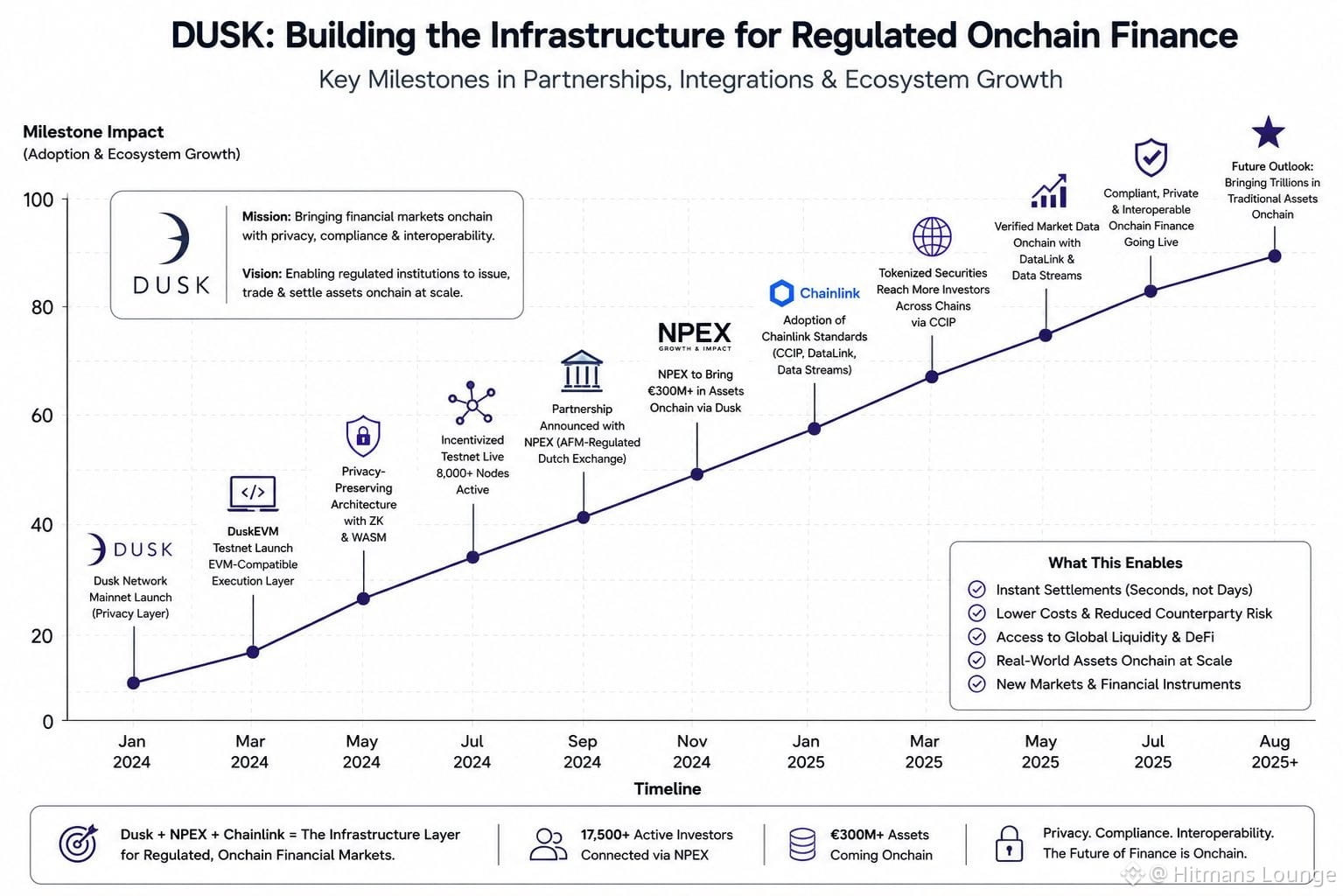
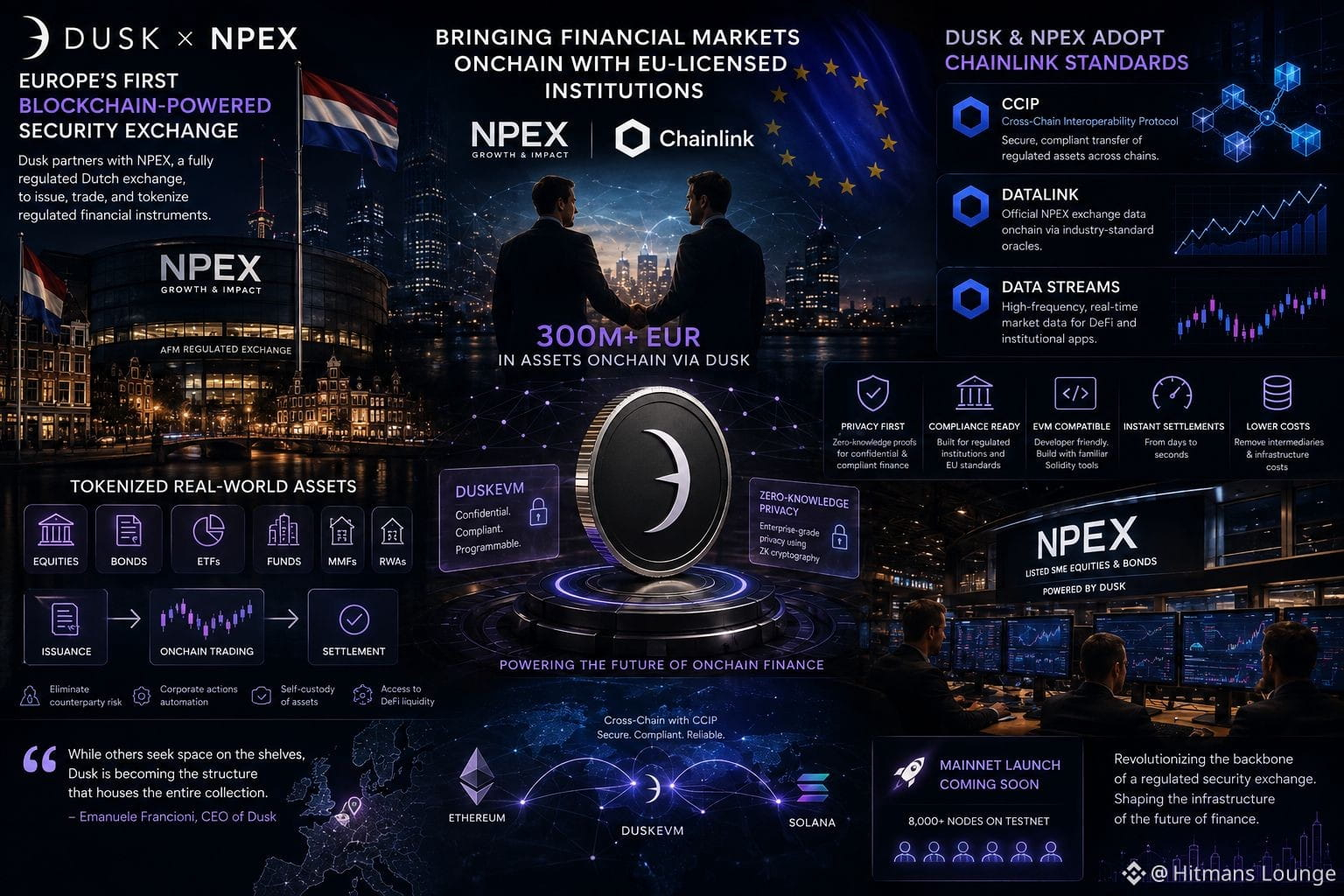
NPEX is an AFM-regulated Dutch exchange, and the partnership aims to bring €300M+ in assets on-chain.
Now Dusk and NPEX are also adopting Chainlink standards, including CCIP for cross-chain interoperability and DataLink/Data Streams for verified market data.
That detail matters to me.
I think the harder problem in RWA adoption isn't simply putting securities on a blockchain.
It's connecting issuance, official market data, compliance, trading and settlement without creating another fragmented system.
Dusk's EVM-compatible layer handles programmable financial applications, while its privacy design can keep sensitive activity confidential. CCIP then gives those assets a route across supported networks.
That's a different incentive structure than just launching another token.
I'm still cautious because partnerships don't automatically create liquidity or real investor demand. The technology can work and adoption can still be slow.
But I've changed my view: Dusk may be more interesting as financial-market infrastructure than as just another RWA chain. Is that where Dusk's real value eventually comes from?
$PORTAL $TUT #DUSK #Web3 #RWA #DuskEVM #NPEX
I took a small $DUSK position and then paused. What caught my attention wasn't another tokenized-asset announcement; it was who Dusk is building with and where the infrastructure sits.
NPEX is an AFM-regulated Dutch exchange, and the partnership aims to bring €300M+ in assets on-chain.
Now Dusk and NPEX are also adopting Chainlink standards, including CCIP for cross-chain interoperability and DataLink/Data Streams for verified market data.
That detail matters to me.
I think the harder problem in RWA adoption isn't simply putting securities on a blockchain.
It's connecting issuance, official market data, compliance, trading and settlement without creating another fragmented system.
Dusk's EVM-compatible layer handles programmable financial applications, while its privacy design can keep sensitive activity confidential. CCIP then gives those assets a route across supported networks.
That's a different incentive structure than just launching another token.
I'm still cautious because partnerships don't automatically create liquidity or real investor demand. The technology can work and adoption can still be slow.
But I've changed my view: Dusk may be more interesting as financial-market infrastructure than as just another RWA chain. Is that where Dusk's real value eventually comes from?
$PORTAL $TUT #DUSK #Web3 #RWA #DuskEVM #NPEX

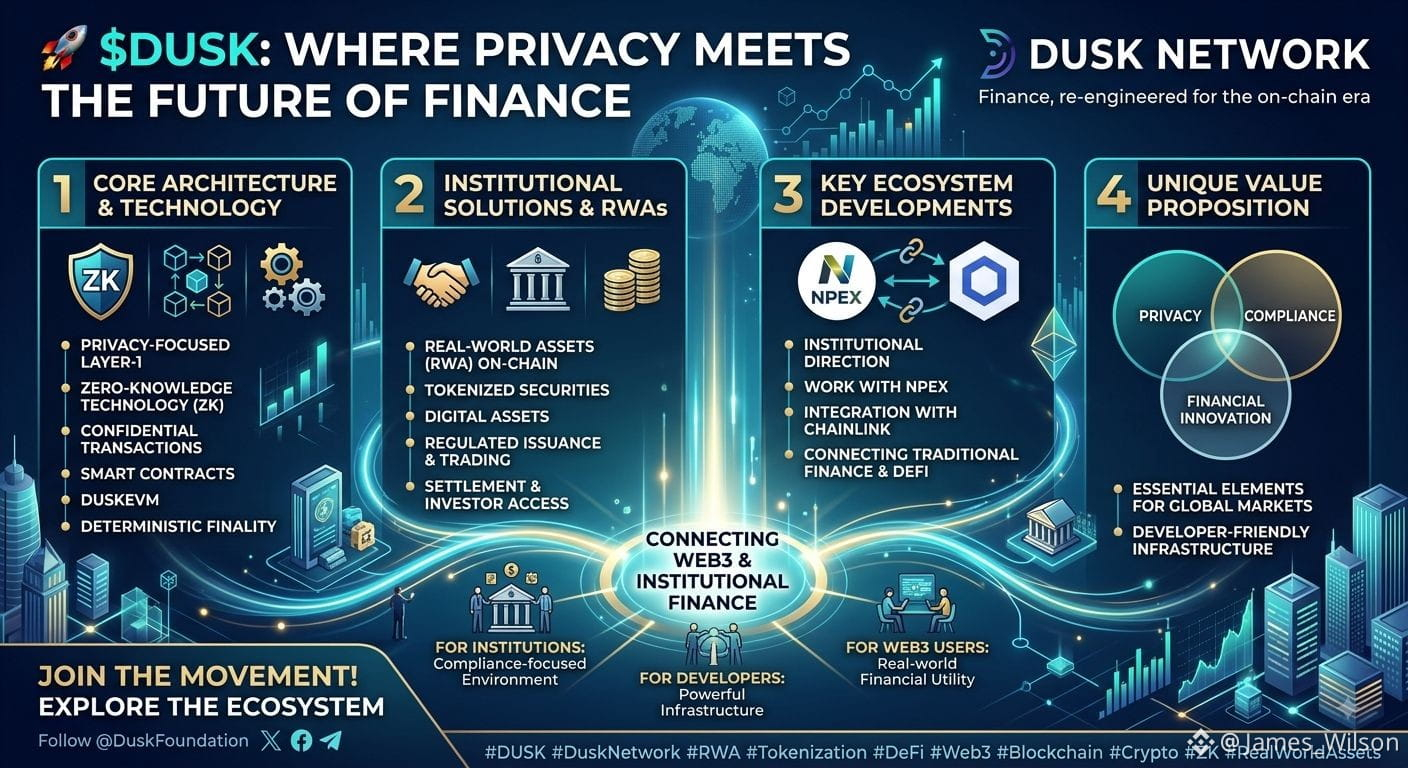
$DUSK : Where Privacy Meets the Future of Finance
Dusk Network is building more than another blockchain—it is creating next-generation infrastructure for regulated financial markets and real-world assets on-chain.
Powered by a privacy-focused Layer-1 architecture, Dusk combines zero-knowledge technology, confidential transactions, smart contracts, deterministic finality, and DuskEVM to address a critical challenge in Web3: bringing institutional finance on-chain without sacrificing privacy or regulatory compliance.
Its vision extends toward tokenized securities, digital assets, regulated issuance, trading, settlement, and investor access within a unified blockchain environment. Dusk’s institutional direction and ecosystem development, including its work with #NPEX and integration with Chainlink, strengthen its mission of connecting traditional finance with decentralized infrastructure.
What makes #duskfoundation stand out is the combination of privacy + compliance + financial innovation—three essential elements for the next evolution of global markets.
For developers, it offers powerful infrastructure. For institutions, a compliance-focused environment. For Web3 users, a vision centered on real-world financial utility.
🔥 The future of finance won’t just be decentralized—it will be private, compliant, programmable, and accessible.
Follow @DuskFoundation, explore the ecosystem, and become part of the movement.
Dusk Network — Finance, re-engineered for the on-chain era.
#DUSK.USDT #DuskNetwork
Dusk Network is building more than another blockchain—it is creating next-generation infrastructure for regulated financial markets and real-world assets on-chain.
Powered by a privacy-focused Layer-1 architecture, Dusk combines zero-knowledge technology, confidential transactions, smart contracts, deterministic finality, and DuskEVM to address a critical challenge in Web3: bringing institutional finance on-chain without sacrificing privacy or regulatory compliance.
Its vision extends toward tokenized securities, digital assets, regulated issuance, trading, settlement, and investor access within a unified blockchain environment. Dusk’s institutional direction and ecosystem development, including its work with #NPEX and integration with Chainlink, strengthen its mission of connecting traditional finance with decentralized infrastructure.
What makes #duskfoundation stand out is the combination of privacy + compliance + financial innovation—three essential elements for the next evolution of global markets.
For developers, it offers powerful infrastructure. For institutions, a compliance-focused environment. For Web3 users, a vision centered on real-world financial utility.
🔥 The future of finance won’t just be decentralized—it will be private, compliant, programmable, and accessible.
Follow @DuskFoundation, explore the ecosystem, and become part of the movement.
Dusk Network — Finance, re-engineered for the on-chain era.
#DUSK.USDT #DuskNetwork
Log in to explore more content