
#etherapproaches
etherapproaches
1,365 views
38 Discussing
Hot
Latest

·
--
The weird part about $ETH rallies: some of the biggest green candles start while the Fear & Greed Index is still sitting in Fear.
That’s where traders get trapped. You see $ETH moving, rotate out of $USDT too fast, then a single liquidity sweep wipes out the “obvious” breakout entry.
What I’m watching now isn’t just price. It’s whether spot demand is actually following the move, or if this is mainly leverage chasing #EtherApproaches headlines. If funding gets too hot while volume fades, that usually means late longs are becoming exit liquidity.
Also, ETH strength can look clean while the wider market is shaky. Macro headlines like #AIFearsSink10SP500StocksOver40 and #OilDropsAbout6 remind us that risk assets can flip mood fast. When traders are nervous, even good setups can get sold aggressively.
The safer lesson: don’t treat “approaching resistance” as the same thing as “breaking out.” For $ETH, I’d rather see a reclaim, a retest that holds, and $BTC not dragging the market lower before assuming the move has legs.
If #EtherApproaches a major level again, are you buying the breakout or waiting for the first nasty wick?
The weird part about $ETH rallies: some of the biggest green candles start while the Fear & Greed Index is still sitting in Fear.
That’s where traders get trapped. You see $ETH moving, rotate out of $USDT too fast, then a single liquidity sweep wipes out the “obvious” breakout entry.
What I’m watching now isn’t just price. It’s whether spot demand is actually following the move, or if this is mainly leverage chasing #EtherApproaches headlines. If funding gets too hot while volume fades, that usually means late longs are becoming exit liquidity.
Also, ETH strength can look clean while the wider market is shaky. Macro headlines like #AIFearsSink10SP500StocksOver40 and #OilDropsAbout6 remind us that risk assets can flip mood fast. When traders are nervous, even good setups can get sold aggressively.
The safer lesson: don’t treat “approaching resistance” as the same thing as “breaking out.” For $ETH , I’d rather see a reclaim, a retest that holds, and $BTC not dragging the market lower before assuming the move has legs.
If #EtherApproaches a major level again, are you buying the breakout or waiting for the first nasty wick?
That’s where traders get trapped. You see $ETH moving, rotate out of $USDT too fast, then a single liquidity sweep wipes out the “obvious” breakout entry.
What I’m watching now isn’t just price. It’s whether spot demand is actually following the move, or if this is mainly leverage chasing #EtherApproaches headlines. If funding gets too hot while volume fades, that usually means late longs are becoming exit liquidity.
Also, ETH strength can look clean while the wider market is shaky. Macro headlines like #AIFearsSink10SP500StocksOver40 and #OilDropsAbout6 remind us that risk assets can flip mood fast. When traders are nervous, even good setups can get sold aggressively.
The safer lesson: don’t treat “approaching resistance” as the same thing as “breaking out.” For $ETH , I’d rather see a reclaim, a retest that holds, and $BTC not dragging the market lower before assuming the move has legs.
If #EtherApproaches a major level again, are you buying the breakout or waiting for the first nasty wick?
22

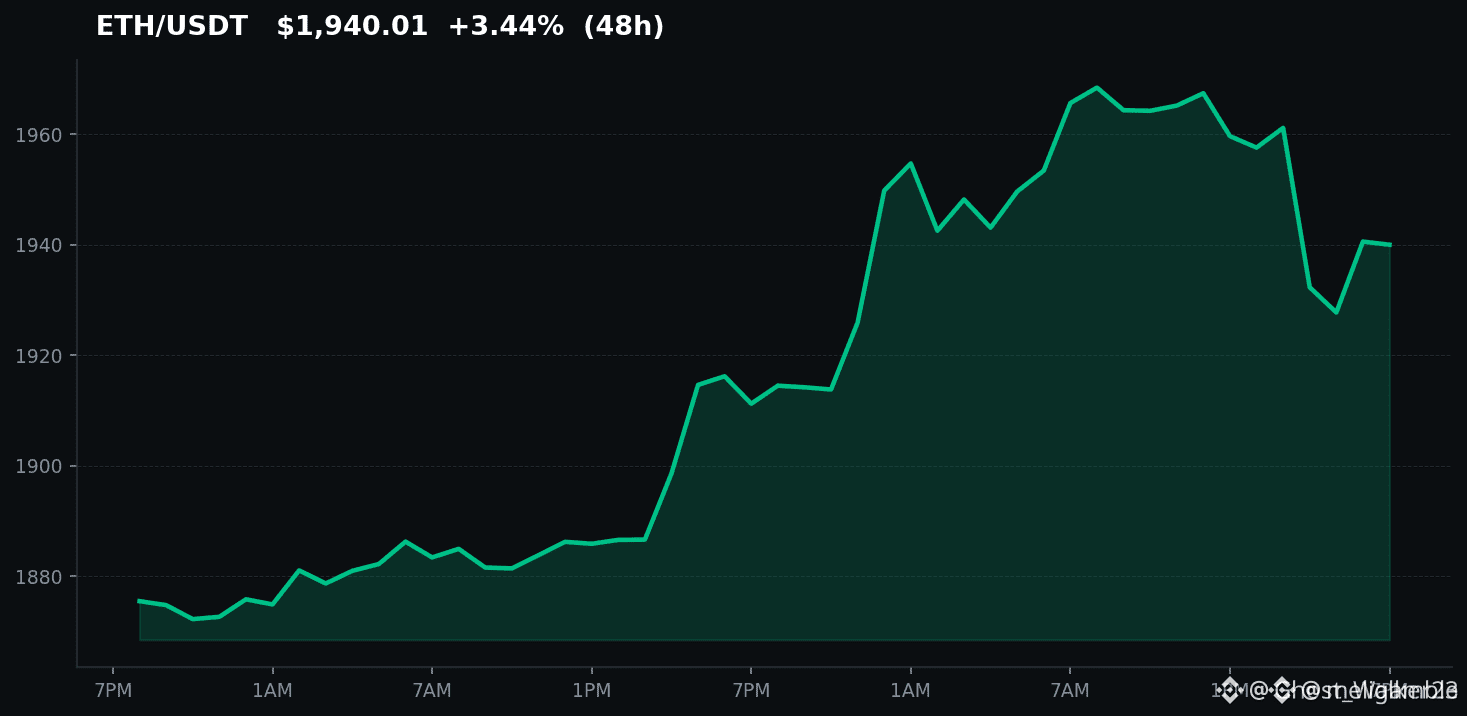
🔥 At 3am UTC, a 10-year dormant Ethereum whale address stirred, moving $23 million in ETH, sparking a frenzy in the crypto community, as #Ethereum prices hover near $1,923, with a bullish RSI of 62.9, and #BTC trading at $65,100, with a 24-hour volume of $459M, amidst a sea of bullish MACD crossovers, including #BNB, which surged 2.31% in the last 24 hours.
📊 The Ethereum whale's sudden move has significant implications, as it participated in the ETH ICO event with a mere $3,100, which has now grown to $23 million, a staggering return on investment, with smart money signals from NEEGY, RUBY, and cat, all buying into Solana, and the futures market showing a bullish sentiment, with an Open Interest of $4.41B, and a funding rate of +0.0070%, indicating a strong conviction among investors.
💡 The twist in this narrative is that this whale's move may be more than just a coincidence, as it comes amidst a growing trend of institutional investment in crypto, with #EtherApproaches$2000, and the potential for a significant price surge, as the supply gets tighter, and the demand continues to grow, with top traders net long, and a taker buy/sell ratio of 1.52x, indicating a strong buy pressure.
❓ Will this Ethereum whale's move be the catalyst for a major price breakout, or is it just a minor blip on the radar, as the crypto market continues to navigate the complex web of market sentiment, with fear levels at 30/100, and the potential for a significant wealth transfer in the making?
🔥 At 3am UTC, a 10-year dormant Ethereum whale address stirred, moving $23 million in ETH, sparking a frenzy in the crypto community, as #Ethereum prices hover near $1,923, with a bullish RSI of 62.9, and #BTC trading at $65,100, with a 24-hour volume of $459M, amidst a sea of bullish MACD crossovers, including #BNB, which surged 2.31% in the last 24 hours.
📊 The Ethereum whale's sudden move has significant implications, as it participated in the ETH ICO event with a mere $3,100, which has now grown to $23 million, a staggering return on investment, with smart money signals from NEEGY, RUBY, and cat, all buying into Solana, and the futures market showing a bullish sentiment, with an Open Interest of $4.41B, and a funding rate of +0.0070%, indicating a strong conviction among investors.
💡 The twist in this narrative is that this whale's move may be more than just a coincidence, as it comes amidst a growing trend of institutional investment in crypto, with #EtherApproaches$2000, and the potential for a significant price surge, as the supply gets tighter, and the demand continues to grow, with top traders net long, and a taker buy/sell ratio of 1.52x, indicating a strong buy pressure.
❓ Will this Ethereum whale's move be the catalyst for a major price breakout, or is it just a minor blip on the radar, as the crypto market continues to navigate the complex web of market sentiment, with fear levels at 30/100, and the potential for a significant wealth transfer in the making?
📊 The Ethereum whale's sudden move has significant implications, as it participated in the ETH ICO event with a mere $3,100, which has now grown to $23 million, a staggering return on investment, with smart money signals from NEEGY, RUBY, and cat, all buying into Solana, and the futures market showing a bullish sentiment, with an Open Interest of $4.41B, and a funding rate of +0.0070%, indicating a strong conviction among investors.
💡 The twist in this narrative is that this whale's move may be more than just a coincidence, as it comes amidst a growing trend of institutional investment in crypto, with #EtherApproaches$2000, and the potential for a significant price surge, as the supply gets tighter, and the demand continues to grow, with top traders net long, and a taker buy/sell ratio of 1.52x, indicating a strong buy pressure.
❓ Will this Ethereum whale's move be the catalyst for a major price breakout, or is it just a minor blip on the radar, as the crypto market continues to navigate the complex web of market sentiment, with fear levels at 30/100, and the potential for a significant wealth transfer in the making?
89

·
--
Everyone thinks $ETH approaching a key zone means “easy breakout,” but actually this is where many traders make their most expensive mistake.
The pain is familiar: you wait for days, finally buy the green candle, then watch price cool off right after your entry. With market sentiment still in Fear and $USDT searches high, a lot of people are sitting on the sidelines ready to react emotionally.
Here are 3 traps to watch. 1) Buying the headline instead of the level. “Ether approaches” sounds exciting, but price near resistance is like a car approaching a red light, it may pass through, or it may brake hard. 2) Ignoring volume. If $ETH rises but volume is weak, the move can be more like a thin bridge than a highway. It might hold, but you do not want to sprint across blindly.
3) Forgetting your exit before entering. Many traders plan the buy but not the sell, then panic when the candle turns. A simple plan matters: where is invalidation, where is profit-taking, and what would make you wait instead of chase. $BTC direction and broader risk mood still matter too, especially when fear is driving decisions.
Where do you think $ETH goes from here as traders circle this level? #EtherApproaches #AIFearsSink10SP500StocksOver40 #WTICrudeFuturesFall8
Everyone thinks $ETH approaching a key zone means “easy breakout,” but actually this is where many traders make their most expensive mistake.
The pain is familiar: you wait for days, finally buy the green candle, then watch price cool off right after your entry. With market sentiment still in Fear and $USDT searches high, a lot of people are sitting on the sidelines ready to react emotionally.
Here are 3 traps to watch. 1) Buying the headline instead of the level. “Ether approaches” sounds exciting, but price near resistance is like a car approaching a red light, it may pass through, or it may brake hard. 2) Ignoring volume. If $ETH rises but volume is weak, the move can be more like a thin bridge than a highway. It might hold, but you do not want to sprint across blindly.
3) Forgetting your exit before entering. Many traders plan the buy but not the sell, then panic when the candle turns. A simple plan matters: where is invalidation, where is profit-taking, and what would make you wait instead of chase. $BTC direction and broader risk mood still matter too, especially when fear is driving decisions.
Where do you think $ETH goes from here as traders circle this level? #EtherApproaches #AIFearsSink10SP500StocksOver40 #WTICrudeFuturesFall8
The pain is familiar: you wait for days, finally buy the green candle, then watch price cool off right after your entry. With market sentiment still in Fear and $USDT searches high, a lot of people are sitting on the sidelines ready to react emotionally.
Here are 3 traps to watch. 1) Buying the headline instead of the level. “Ether approaches” sounds exciting, but price near resistance is like a car approaching a red light, it may pass through, or it may brake hard. 2) Ignoring volume. If $ETH rises but volume is weak, the move can be more like a thin bridge than a highway. It might hold, but you do not want to sprint across blindly.
3) Forgetting your exit before entering. Many traders plan the buy but not the sell, then panic when the candle turns. A simple plan matters: where is invalidation, where is profit-taking, and what would make you wait instead of chase. $BTC direction and broader risk mood still matter too, especially when fear is driving decisions.
Where do you think $ETH goes from here as traders circle this level? #EtherApproaches #AIFearsSink10SP500StocksOver40 #WTICrudeFuturesFall8
27

·
--
Have you noticed how everyone suddenly gets bullish on $ETH only after the easy entry is gone?
That’s how traders get trapped: they wait for confirmation, buy the candle everyone is watching, then panic when the market sweeps liquidity. With the Fear & Greed Index still sitting in fear, chasing green candles is not a strategy.
My hot take: $ETH strength matters, but the smarter move is not blindly buying because “Ether approaches” a key zone. Watch how price reacts near resistance, not just whether it touches it. If volume fades into the move, that’s often late buyers providing exit liquidity.
A cleaner plan is simple: mark the breakout level, wait for a retest, and only consider entry if buyers defend it with conviction. Keep some $USDT ready instead of going all-in, because fear markets love fakeouts. If $BTC turns weak, $ETH usually does not get a free pass for long.
The crowd wants a moonshot narrative. I’d rather see structure, volume, and a real reclaim before calling it strength. What’s your plan if $ETH rejects here? #EtherApproaches #AIFearsSink10SP500StocksOver40 #WTICrudeFuturesFall8
Have you noticed how everyone suddenly gets bullish on $ETH only after the easy entry is gone?
That’s how traders get trapped: they wait for confirmation, buy the candle everyone is watching, then panic when the market sweeps liquidity. With the Fear & Greed Index still sitting in fear, chasing green candles is not a strategy.
My hot take: $ETH strength matters, but the smarter move is not blindly buying because “Ether approaches” a key zone. Watch how price reacts near resistance, not just whether it touches it. If volume fades into the move, that’s often late buyers providing exit liquidity.
A cleaner plan is simple: mark the breakout level, wait for a retest, and only consider entry if buyers defend it with conviction. Keep some $USDT ready instead of going all-in, because fear markets love fakeouts. If $BTC turns weak, $ETH usually does not get a free pass for long.
The crowd wants a moonshot narrative. I’d rather see structure, volume, and a real reclaim before calling it strength. What’s your plan if $ETH rejects here? #EtherApproaches #AIFearsSink10SP500StocksOver40 #WTICrudeFuturesFall8
That’s how traders get trapped: they wait for confirmation, buy the candle everyone is watching, then panic when the market sweeps liquidity. With the Fear & Greed Index still sitting in fear, chasing green candles is not a strategy.
My hot take: $ETH strength matters, but the smarter move is not blindly buying because “Ether approaches” a key zone. Watch how price reacts near resistance, not just whether it touches it. If volume fades into the move, that’s often late buyers providing exit liquidity.
A cleaner plan is simple: mark the breakout level, wait for a retest, and only consider entry if buyers defend it with conviction. Keep some $USDT ready instead of going all-in, because fear markets love fakeouts. If $BTC turns weak, $ETH usually does not get a free pass for long.
The crowd wants a moonshot narrative. I’d rather see structure, volume, and a real reclaim before calling it strength. What’s your plan if $ETH rejects here? #EtherApproaches #AIFearsSink10SP500StocksOver40 #WTICrudeFuturesFall8
20

Ethereum approaches $2000 as oil plunges -6% and systemic fear rattles global markets. What’s happening?
**WTI fell -8%**, **Brent -6%**, and crude briefly touched $90. Stocks tied to artificial intelligence lost ground: 10 S&P 500 shares dropped more than -40% on fears of overvaluation in AI. The **VIX (volatility index)** jumped +12%, a classic sign of panic on Wall Street.
Ethereum, trading at **$1950-2000**, is reflecting that fear. This isn’t an internal ETH problem: it’s **correlation with the macro environment**. When oil drops like this, markets read it as economic slowdown or demand destruction. And when tech stocks bleed, crypto—which historically moves with the Nasdaq—heads down the same path.
**Why does this matter for crypto?** Because this kind of macro move often precedes capitulation in risk assets. If Ethereum loses $1950, the next relevant support is much lower. But if oil stabilizes and the VIX falls, ETH could bounce quickly.
Meanwhile, **gold is rising**, the classic safe haven in times of uncertainty. Do you think Ethereum will hold $2000 or is it already too late to get out?
#EtherApproaches$2000
Ethereum approaches $2000 as oil plunges -6% and systemic fear rattles global markets. What’s happening?
**WTI fell -8%**, **Brent -6%**, and crude briefly touched $90. Stocks tied to artificial intelligence lost ground: 10 S&P 500 shares dropped more than -40% on fears of overvaluation in AI. The **VIX (volatility index)** jumped +12%, a classic sign of panic on Wall Street.
Ethereum, trading at **$1950-2000**, is reflecting that fear. This isn’t an internal ETH problem: it’s **correlation with the macro environment**. When oil drops like this, markets read it as economic slowdown or demand destruction. And when tech stocks bleed, crypto—which historically moves with the Nasdaq—heads down the same path.
**Why does this matter for crypto?** Because this kind of macro move often precedes capitulation in risk assets. If Ethereum loses $1950, the next relevant support is much lower. But if oil stabilizes and the VIX falls, ETH could bounce quickly.
Meanwhile, **gold is rising**, the classic safe haven in times of uncertainty. Do you think Ethereum will hold $2000 or is it already too late to get out?
#EtherApproaches$2000
**WTI fell -8%**, **Brent -6%**, and crude briefly touched $90. Stocks tied to artificial intelligence lost ground: 10 S&P 500 shares dropped more than -40% on fears of overvaluation in AI. The **VIX (volatility index)** jumped +12%, a classic sign of panic on Wall Street.
Ethereum, trading at **$1950-2000**, is reflecting that fear. This isn’t an internal ETH problem: it’s **correlation with the macro environment**. When oil drops like this, markets read it as economic slowdown or demand destruction. And when tech stocks bleed, crypto—which historically moves with the Nasdaq—heads down the same path.
**Why does this matter for crypto?** Because this kind of macro move often precedes capitulation in risk assets. If Ethereum loses $1950, the next relevant support is much lower. But if oil stabilizes and the VIX falls, ETH could bounce quickly.
Meanwhile, **gold is rising**, the classic safe haven in times of uncertainty. Do you think Ethereum will hold $2000 or is it already too late to get out?
#EtherApproaches$2000
255

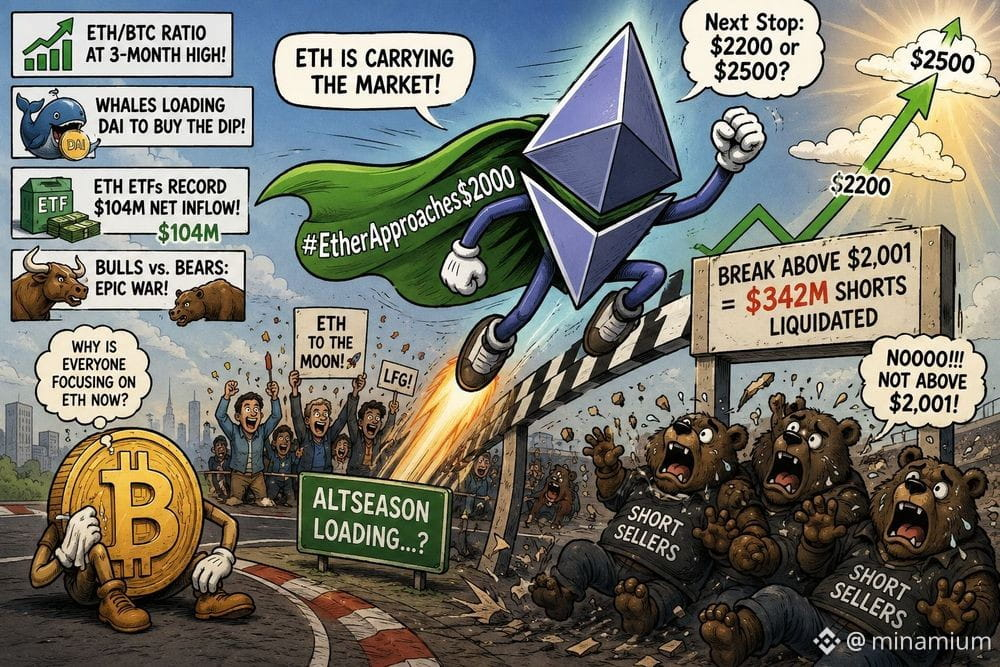
🚀 #EtherApproaches $2000
Ethereum is back in the spotlight! 🔥
📈 ETH/BTC has climbed to a 3-month high, showing renewed strength against Bitcoin.
🐋 Whales are accumulating DAI, signaling they're preparing to buy market dips.
💰 Spot ETH ETFs just recorded $104M in net inflows, adding fuel to bullish momentum.
⚔️ Bulls and bears are locked in an intense battle, and according to Coinglass, a move above $2,001 could trigger $342M worth of short liquidations.
👀 Is this the beginning of the long-awaited Altseason, or just another fakeout before the next move?
🎯 Key levels to watch:
✅ Break and hold above $2,001 → Momentum toward $2,200
🚀 Strong continuation → Eyes on $2,500
💬 What's your target for ETH?
👍 $2,200
❤️ $2,500
🔥 Even higher!
#Ethereum #ETH #Altseason
$ETH
$PARTI
{spot}(PARTIUSDT)
{spot}(ETHUSDT)
🚀 #EtherApproaches $2000
Ethereum is back in the spotlight! 🔥
📈 ETH/BTC has climbed to a 3-month high, showing renewed strength against Bitcoin.
🐋 Whales are accumulating DAI, signaling they're preparing to buy market dips.
💰 Spot ETH ETFs just recorded $104M in net inflows, adding fuel to bullish momentum.
⚔️ Bulls and bears are locked in an intense battle, and according to Coinglass, a move above $2,001 could trigger $342M worth of short liquidations.
👀 Is this the beginning of the long-awaited Altseason, or just another fakeout before the next move?
🎯 Key levels to watch:
✅ Break and hold above $2,001 → Momentum toward $2,200
🚀 Strong continuation → Eyes on $2,500
💬 What's your target for ETH?
👍 $2,200
❤️ $2,500
🔥 Even higher!
#Ethereum #ETH #Altseason
$ETH
$PARTI
Ethereum is back in the spotlight! 🔥
📈 ETH/BTC has climbed to a 3-month high, showing renewed strength against Bitcoin.
🐋 Whales are accumulating DAI, signaling they're preparing to buy market dips.
💰 Spot ETH ETFs just recorded $104M in net inflows, adding fuel to bullish momentum.
⚔️ Bulls and bears are locked in an intense battle, and according to Coinglass, a move above $2,001 could trigger $342M worth of short liquidations.
👀 Is this the beginning of the long-awaited Altseason, or just another fakeout before the next move?
🎯 Key levels to watch:
✅ Break and hold above $2,001 → Momentum toward $2,200
🚀 Strong continuation → Eyes on $2,500
💬 What's your target for ETH?
👍 $2,200
❤️ $2,500
🔥 Even higher!
#Ethereum #ETH #Altseason
$ETH
$PARTI

2
376

·
--
$ETH feels like a comfort trade right now - traders buy the dip because it calms FOMO, not because the structure changed. That subtle motive matters: it raises the odds of quick retraces. My single takeaway - if your entry is driven by a fear of missing out rather than a clear setup, tighten size and set a 1% invalidation. $ETH $BTC
What to watch - depth on the ask and funding spikes. A steady climb with rising funding warns of short-squeeze exhaustion. Statement: trade the setup, not the feeling. #EtherApproaches$2000 #AIFearsSink10SP500StocksOver40% #GoldRises
$ETH feels like a comfort trade right now - traders buy the dip because it calms FOMO, not because the structure changed. That subtle motive matters: it raises the odds of quick retraces. My single takeaway - if your entry is driven by a fear of missing out rather than a clear setup, tighten size and set a 1% invalidation. $ETH $BTC
What to watch - depth on the ask and funding spikes. A steady climb with rising funding warns of short-squeeze exhaustion. Statement: trade the setup, not the feeling. #EtherApproaches$2000 #AIFearsSink10SP500StocksOver40% #GoldRises
What to watch - depth on the ask and funding spikes. A steady climb with rising funding warns of short-squeeze exhaustion. Statement: trade the setup, not the feeling. #EtherApproaches$2000 #AIFearsSink10SP500StocksOver40% #GoldRises
88
·
--
Why is nobody talking about how US storage stocks extending losses is the real signal crypto traders should be watching right now?
Most of us have felt that sting of watching traditional markets tank and then watching our crypto bags bleed right after because we bought the hype without checking the broader risk-off mood. It leaves you stuck not knowing when to exit or if you should have sat in cash.
The mainstream narrative treats every oil and storage stock drop as pure doom for risk assets, but that ignores how these moves create clean entry windows when Fear sits at 38. Oil weakness and storage stocks bleeding out often free up capital that eventually rotates into crypto once the dust settles. Instead of freezing or FOMO chasing the next narrative, treat it as a guide: park idle funds in $USDT for dry powder, scale into $ETH on confirmed support holds rather than green candles, and only dip into names like $ONE after volume confirms the risk appetite is returning. Keep positions sized so one more oil flush does not force a bad exit. This approach turns the noise into a repeatable process instead of emotional reactions.
Where do you think this goes from here?
#USStorageStocksExtendLosses #OilDropsAbout6 #EtherApproaches
Why is nobody talking about how US storage stocks extending losses is the real signal crypto traders should be watching right now?
Most of us have felt that sting of watching traditional markets tank and then watching our crypto bags bleed right after because we bought the hype without checking the broader risk-off mood. It leaves you stuck not knowing when to exit or if you should have sat in cash.
The mainstream narrative treats every oil and storage stock drop as pure doom for risk assets, but that ignores how these moves create clean entry windows when Fear sits at 38. Oil weakness and storage stocks bleeding out often free up capital that eventually rotates into crypto once the dust settles. Instead of freezing or FOMO chasing the next narrative, treat it as a guide: park idle funds in $USDT for dry powder, scale into $ETH on confirmed support holds rather than green candles, and only dip into names like $ONE after volume confirms the risk appetite is returning. Keep positions sized so one more oil flush does not force a bad exit. This approach turns the noise into a repeatable process instead of emotional reactions.
Where do you think this goes from here?
#USStorageStocksExtendLosses #OilDropsAbout6 #EtherApproaches
Most of us have felt that sting of watching traditional markets tank and then watching our crypto bags bleed right after because we bought the hype without checking the broader risk-off mood. It leaves you stuck not knowing when to exit or if you should have sat in cash.
The mainstream narrative treats every oil and storage stock drop as pure doom for risk assets, but that ignores how these moves create clean entry windows when Fear sits at 38. Oil weakness and storage stocks bleeding out often free up capital that eventually rotates into crypto once the dust settles. Instead of freezing or FOMO chasing the next narrative, treat it as a guide: park idle funds in $USDT for dry powder, scale into $ETH on confirmed support holds rather than green candles, and only dip into names like $ONE after volume confirms the risk appetite is returning. Keep positions sized so one more oil flush does not force a bad exit. This approach turns the noise into a repeatable process instead of emotional reactions.
Where do you think this goes from here?
#USStorageStocksExtendLosses #OilDropsAbout6 #EtherApproaches

142
·
--
Everyone thinks falling crude is automatically bullish for crypto, but actually it can be a warning sign that traders are misreading the macro weather.
The common mistake is treating cheaper oil like “free fuel” for risk assets, then FOMO buying $ETH or small caps right before volatility expands. When fear is already in the market and people are hiding in $USDT, sudden commodity moves can shake positioning fast.
Here are 3 traps to watch: 1) assuming lower oil means instant rate-cut optimism, when it may also signal weaker demand; 2) buying the first green candle because “inflation is cooling,” like running into the road because one car stopped; 3) ignoring liquidity, especially on trending tokens where thin order books can turn a normal pullback into a nasty wick.
For crypto, the smarter read is not “oil down, buy everything.” It is “why is oil down, and are traders reducing risk?” If crude weakness comes with stocks under pressure, $ETH near key levels, and stablecoin searches rising, the market may be asking for patience, not bravery.
Where do you think $ETH goes from here if oil keeps sliding and fear stays in control? #CrudeBrieflyFallsBelow #OilDropsAbout6 #EtherApproaches
Everyone thinks falling crude is automatically bullish for crypto, but actually it can be a warning sign that traders are misreading the macro weather.
The common mistake is treating cheaper oil like “free fuel” for risk assets, then FOMO buying $ETH or small caps right before volatility expands. When fear is already in the market and people are hiding in $USDT, sudden commodity moves can shake positioning fast.
Here are 3 traps to watch: 1) assuming lower oil means instant rate-cut optimism, when it may also signal weaker demand; 2) buying the first green candle because “inflation is cooling,” like running into the road because one car stopped; 3) ignoring liquidity, especially on trending tokens where thin order books can turn a normal pullback into a nasty wick.
For crypto, the smarter read is not “oil down, buy everything.” It is “why is oil down, and are traders reducing risk?” If crude weakness comes with stocks under pressure, $ETH near key levels, and stablecoin searches rising, the market may be asking for patience, not bravery.
Where do you think $ETH goes from here if oil keeps sliding and fear stays in control? #CrudeBrieflyFallsBelow #OilDropsAbout6 #EtherApproaches
The common mistake is treating cheaper oil like “free fuel” for risk assets, then FOMO buying $ETH or small caps right before volatility expands. When fear is already in the market and people are hiding in $USDT, sudden commodity moves can shake positioning fast.
Here are 3 traps to watch: 1) assuming lower oil means instant rate-cut optimism, when it may also signal weaker demand; 2) buying the first green candle because “inflation is cooling,” like running into the road because one car stopped; 3) ignoring liquidity, especially on trending tokens where thin order books can turn a normal pullback into a nasty wick.
For crypto, the smarter read is not “oil down, buy everything.” It is “why is oil down, and are traders reducing risk?” If crude weakness comes with stocks under pressure, $ETH near key levels, and stablecoin searches rising, the market may be asking for patience, not bravery.
Where do you think $ETH goes from here if oil keeps sliding and fear stays in control? #CrudeBrieflyFallsBelow #OilDropsAbout6 #EtherApproaches

76
·
--
A 9% move in Intel can matter to your $ETH trade even if you never buy a single stock.
The trap is thinking “chip stocks are up, risk is back” and smashing longs too late. In crypto, that kind of macro headline can pull liquidity fast, then vanish even faster.
Here’s the thing: semiconductors are basically a risk appetite thermometer right now. If Intel rips while names like SK Hynix are getting hit, it may not be broad bullish momentum. It can be rotation, short covering, or traders repositioning around AI and hardware narratives.
For crypto, the danger is correlation blindness. $ETH can catch a bid when tech sentiment improves, but if the move is driven by one stock-specific catalyst, it doesn’t automatically mean alts like $VANRY or other high-beta plays are safe. With Fear & Greed sitting in Fear territory and $USDT among the most searched assets, a lot of people are still parked defensively.
Best lesson: don’t treat equity headlines as buy signals by themselves. Watch whether volume follows, whether BTC/ETH hold key levels after the first reaction, and whether stablecoin flows actually rotate back into risk. A stock pump can light the fuse, but crypto still needs its own confirmation.
Is this a real risk-on signal for crypto, or just another macro head fake? #IntelRises9 #SKHynixPlunges13 #EtherApproaches
A 9% move in Intel can matter to your $ETH trade even if you never buy a single stock.
The trap is thinking “chip stocks are up, risk is back” and smashing longs too late. In crypto, that kind of macro headline can pull liquidity fast, then vanish even faster.
Here’s the thing: semiconductors are basically a risk appetite thermometer right now. If Intel rips while names like SK Hynix are getting hit, it may not be broad bullish momentum. It can be rotation, short covering, or traders repositioning around AI and hardware narratives.
For crypto, the danger is correlation blindness. $ETH can catch a bid when tech sentiment improves, but if the move is driven by one stock-specific catalyst, it doesn’t automatically mean alts like $VANRY or other high-beta plays are safe. With Fear & Greed sitting in Fear territory and $USDT among the most searched assets, a lot of people are still parked defensively.
Best lesson: don’t treat equity headlines as buy signals by themselves. Watch whether volume follows, whether BTC/ETH hold key levels after the first reaction, and whether stablecoin flows actually rotate back into risk. A stock pump can light the fuse, but crypto still needs its own confirmation.
Is this a real risk-on signal for crypto, or just another macro head fake? #IntelRises9 #SKHynixPlunges13 #EtherApproaches
The trap is thinking “chip stocks are up, risk is back” and smashing longs too late. In crypto, that kind of macro headline can pull liquidity fast, then vanish even faster.
Here’s the thing: semiconductors are basically a risk appetite thermometer right now. If Intel rips while names like SK Hynix are getting hit, it may not be broad bullish momentum. It can be rotation, short covering, or traders repositioning around AI and hardware narratives.
For crypto, the danger is correlation blindness. $ETH can catch a bid when tech sentiment improves, but if the move is driven by one stock-specific catalyst, it doesn’t automatically mean alts like $VANRY or other high-beta plays are safe. With Fear & Greed sitting in Fear territory and $USDT among the most searched assets, a lot of people are still parked defensively.
Best lesson: don’t treat equity headlines as buy signals by themselves. Watch whether volume follows, whether BTC/ETH hold key levels after the first reaction, and whether stablecoin flows actually rotate back into risk. A stock pump can light the fuse, but crypto still needs its own confirmation.
Is this a real risk-on signal for crypto, or just another macro head fake? #IntelRises9 #SKHynixPlunges13 #EtherApproaches

115

🚀 As #EtherApproaches$2000, $ETH is showing some strength with a +1.70% increase today, currently priced at $1,931.59. Meanwhile, $BTC is slightly down at $64,667.77. Do you have a position in $ETH? Do you think it will break the $2000 barrier soon? Bull or Bear? 📈📉
🚀 As #EtherApproaches$2000, $ETH is showing some strength with a +1.70% increase today, currently priced at $1,931.59. Meanwhile, $BTC is slightly down at $64,667.77. Do you have a position in $ETH ? Do you think it will break the $2000 barrier soon? Bull or Bear? 📈📉
13
·
--
Have you noticed how every scary SpaceX headline suddenly becomes an excuse for traders to panic-sell crypto?
That’s how people lose money twice: first by buying the hype, then by selling the headline. With Fear & Greed sitting in fear territory, the market is already emotional, so one trending narrative can push weak hands into bad exits.
My take: #SpaceXErases is less about SpaceX and more about liquidity psychology. When traders feel uncertain, they run to $USDT, avoid risk, and start treating every external headline like a sell signal. That does not mean you ignore risk. It means you stop letting trending topics make your trading decisions.
The better move is simple: watch whether $ETH holds structure, check if $USDT dominance is rising, and avoid chasing green candles until the market confirms strength. If the headline fades but price holds, that’s information. If price breaks support while fear rises, protect capital first.
Are you using this fear to plan entries, or are you staying defensive until $ETH proves itself under #SpaceXErases and #EtherApproaches?
Have you noticed how every scary SpaceX headline suddenly becomes an excuse for traders to panic-sell crypto?
That’s how people lose money twice: first by buying the hype, then by selling the headline. With Fear & Greed sitting in fear territory, the market is already emotional, so one trending narrative can push weak hands into bad exits.
My take: #SpaceXErases is less about SpaceX and more about liquidity psychology. When traders feel uncertain, they run to $USDT, avoid risk, and start treating every external headline like a sell signal. That does not mean you ignore risk. It means you stop letting trending topics make your trading decisions.
The better move is simple: watch whether $ETH holds structure, check if $USDT dominance is rising, and avoid chasing green candles until the market confirms strength. If the headline fades but price holds, that’s information. If price breaks support while fear rises, protect capital first.
Are you using this fear to plan entries, or are you staying defensive until $ETH proves itself under #SpaceXErases and #EtherApproaches?
That’s how people lose money twice: first by buying the hype, then by selling the headline. With Fear & Greed sitting in fear territory, the market is already emotional, so one trending narrative can push weak hands into bad exits.
My take: #SpaceXErases is less about SpaceX and more about liquidity psychology. When traders feel uncertain, they run to $USDT, avoid risk, and start treating every external headline like a sell signal. That does not mean you ignore risk. It means you stop letting trending topics make your trading decisions.
The better move is simple: watch whether $ETH holds structure, check if $USDT dominance is rising, and avoid chasing green candles until the market confirms strength. If the headline fades but price holds, that’s information. If price breaks support while fear rises, protect capital first.
Are you using this fear to plan entries, or are you staying defensive until $ETH proves itself under #SpaceXErases and #EtherApproaches?

143
🚀 Exciting times ahead for Ethereum as #EtherApproaches$2000! With market momentum and a surge in interest, ETH could break that resistance soon. Are we witnessing the start of a bullish trend? What are your thoughts on ETH's next move? 📈 #ETH
🚀 Exciting times ahead for Ethereum as #EtherApproaches$2000! With market momentum and a surge in interest, ETH could break that resistance soon. Are we witnessing the start of a bullish trend? What are your thoughts on ETH's next move? 📈 #ETH

5
·
--
Why is nobody talking about how Intel’s bounce is a warning signal for crypto traders, not just a stock market headline?
Most traders see #IntelRises9 and immediately chase “AI narrative” coins, then wonder why they bought the top. In a Fear market, the real edge is not reacting first, it’s knowing which reaction is already priced in.
My hot take: chip headlines matter for crypto, but not in the lazy “AI coin pumps next” way. If Intel strength comes while SK Hynix is under pressure, the market is rotating, not blindly buying every tech story. That means you should separate quality momentum from headline noise before touching $ETH, $VANRY, or any AI-linked alt.
Here’s the guide: first, check whether $ETH is holding key liquidity zones while tech sentiment improves. Second, watch stablecoin behavior with $USDT because fear-driven traders often hide there before rotating back into risk. Third, don’t buy the first green candle on narrative coins. Wait for volume confirmation, then define your exit before entry.
The mainstream narrative says “semiconductors up means AI crypto up.” I think that’s too simple. The smarter move is tracking whether this tech rotation brings real risk appetite back into crypto or just creates another short-lived FOMO trap.
Are you treating Intel’s move as a crypto signal or just market noise? #IntelRises9 #SKHynixPlunges13 #EtherApproaches
Why is nobody talking about how Intel’s bounce is a warning signal for crypto traders, not just a stock market headline?
Most traders see #IntelRises9 and immediately chase “AI narrative” coins, then wonder why they bought the top. In a Fear market, the real edge is not reacting first, it’s knowing which reaction is already priced in.
My hot take: chip headlines matter for crypto, but not in the lazy “AI coin pumps next” way. If Intel strength comes while SK Hynix is under pressure, the market is rotating, not blindly buying every tech story. That means you should separate quality momentum from headline noise before touching $ETH , $VANRY, or any AI-linked alt.
Here’s the guide: first, check whether $ETH is holding key liquidity zones while tech sentiment improves. Second, watch stablecoin behavior with $USDT because fear-driven traders often hide there before rotating back into risk. Third, don’t buy the first green candle on narrative coins. Wait for volume confirmation, then define your exit before entry.
The mainstream narrative says “semiconductors up means AI crypto up.” I think that’s too simple. The smarter move is tracking whether this tech rotation brings real risk appetite back into crypto or just creates another short-lived FOMO trap.
Are you treating Intel’s move as a crypto signal or just market noise? #IntelRises9 #SKHynixPlunges13 #EtherApproaches
Most traders see #IntelRises9 and immediately chase “AI narrative” coins, then wonder why they bought the top. In a Fear market, the real edge is not reacting first, it’s knowing which reaction is already priced in.
My hot take: chip headlines matter for crypto, but not in the lazy “AI coin pumps next” way. If Intel strength comes while SK Hynix is under pressure, the market is rotating, not blindly buying every tech story. That means you should separate quality momentum from headline noise before touching $ETH , $VANRY, or any AI-linked alt.
Here’s the guide: first, check whether $ETH is holding key liquidity zones while tech sentiment improves. Second, watch stablecoin behavior with $USDT because fear-driven traders often hide there before rotating back into risk. Third, don’t buy the first green candle on narrative coins. Wait for volume confirmation, then define your exit before entry.
The mainstream narrative says “semiconductors up means AI crypto up.” I think that’s too simple. The smarter move is tracking whether this tech rotation brings real risk appetite back into crypto or just creates another short-lived FOMO trap.
Are you treating Intel’s move as a crypto signal or just market noise? #IntelRises9 #SKHynixPlunges13 #EtherApproaches

37
·
--
Here’s what happened when US storage stocks kept sliding while crypto traders were busy watching $ETH and stablecoin flows.
The risk is easy to miss: when traditional storage names sell off, it can quietly hit the narrative around data centers, AI infrastructure, and decentralized storage plays. Traders often buy the crypto “sympathy trade” too late, then wonder why the move fades before their entry clears.
The case study here is simple. Storage-linked equities are under pressure because the market is questioning growth, margins, and capex discipline. In a Fear market, investors stop paying premium prices for future demand and start asking who is actually profitable today. That same thinking can spill into crypto sectors tied to infrastructure, including DePIN, compute, and storage tokens.
What most people missed is that $USDT strength during these moments is not always bullish. Sometimes it means capital is hiding, not preparing to rotate. If $ETH starts approaching key levels while macro-sensitive equities keep bleeding, the setup becomes less about “which narrative is next” and more about liquidity survival.
The lesson: not every TradFi selloff creates a crypto opportunity. Sometimes it’s a warning that the market is repricing the entire story behind a sector before crypto catches up. Where do you think this goes from here? #USStorageStocksExtendLosses #EtherApproaches #AIFearsSink10SP500StocksOver40
Here’s what happened when US storage stocks kept sliding while crypto traders were busy watching $ETH and stablecoin flows.
The risk is easy to miss: when traditional storage names sell off, it can quietly hit the narrative around data centers, AI infrastructure, and decentralized storage plays. Traders often buy the crypto “sympathy trade” too late, then wonder why the move fades before their entry clears.
The case study here is simple. Storage-linked equities are under pressure because the market is questioning growth, margins, and capex discipline. In a Fear market, investors stop paying premium prices for future demand and start asking who is actually profitable today. That same thinking can spill into crypto sectors tied to infrastructure, including DePIN, compute, and storage tokens.
What most people missed is that $USDT strength during these moments is not always bullish. Sometimes it means capital is hiding, not preparing to rotate. If $ETH starts approaching key levels while macro-sensitive equities keep bleeding, the setup becomes less about “which narrative is next” and more about liquidity survival.
The lesson: not every TradFi selloff creates a crypto opportunity. Sometimes it’s a warning that the market is repricing the entire story behind a sector before crypto catches up. Where do you think this goes from here? #USStorageStocksExtendLosses #EtherApproaches #AIFearsSink10SP500StocksOver40
The risk is easy to miss: when traditional storage names sell off, it can quietly hit the narrative around data centers, AI infrastructure, and decentralized storage plays. Traders often buy the crypto “sympathy trade” too late, then wonder why the move fades before their entry clears.
The case study here is simple. Storage-linked equities are under pressure because the market is questioning growth, margins, and capex discipline. In a Fear market, investors stop paying premium prices for future demand and start asking who is actually profitable today. That same thinking can spill into crypto sectors tied to infrastructure, including DePIN, compute, and storage tokens.
What most people missed is that $USDT strength during these moments is not always bullish. Sometimes it means capital is hiding, not preparing to rotate. If $ETH starts approaching key levels while macro-sensitive equities keep bleeding, the setup becomes less about “which narrative is next” and more about liquidity survival.
The lesson: not every TradFi selloff creates a crypto opportunity. Sometimes it’s a warning that the market is repricing the entire story behind a sector before crypto catches up. Where do you think this goes from here? #USStorageStocksExtendLosses #EtherApproaches #AIFearsSink10SP500StocksOver40

96
·
--
Everyone thinks #IntelRises9 means the AI trade is “back,” but actually it can be a trap if you chase the headline without checking the ripple effect.
The common mistake is treating chip-stock moves like a green light for every crypto linked to AI, data, or infrastructure. That’s how people end up buying late, holding through volatility, then wondering why $ETH or smaller AI narratives didn’t follow the same script.
1. Stock-market strength is not the same as crypto liquidity. Intel rising can improve sentiment, but crypto still moves on flows, leverage, and fear. With the market sitting in Fear territory, many traders are hiding in $USDT first and asking questions later.
2. Watch the “connection gap.” A chip rally may help the broader AI story, but not every token benefits equally. Think of it like hearing that coffee prices rose and instantly buying every café in town. Some benefit, some don’t, and some were already overpriced.
3. Don’t confuse narrative with entry. If $ETH starts moving with tech sentiment, fine, but the safer question is: where is invalidation? A good story without a clear exit is just a nice-looking trap.
If chip headlines keep driving risk appetite, do you think crypto AI names follow next, or does capital stay cautious in $USDT? #IntelRises9 #SKHynixPlunges13 #EtherApproaches
Everyone thinks #IntelRises9 means the AI trade is “back,” but actually it can be a trap if you chase the headline without checking the ripple effect.
The common mistake is treating chip-stock moves like a green light for every crypto linked to AI, data, or infrastructure. That’s how people end up buying late, holding through volatility, then wondering why $ETH or smaller AI narratives didn’t follow the same script.
1. Stock-market strength is not the same as crypto liquidity. Intel rising can improve sentiment, but crypto still moves on flows, leverage, and fear. With the market sitting in Fear territory, many traders are hiding in $USDT first and asking questions later.
2. Watch the “connection gap.” A chip rally may help the broader AI story, but not every token benefits equally. Think of it like hearing that coffee prices rose and instantly buying every café in town. Some benefit, some don’t, and some were already overpriced.
3. Don’t confuse narrative with entry. If $ETH starts moving with tech sentiment, fine, but the safer question is: where is invalidation? A good story without a clear exit is just a nice-looking trap.
If chip headlines keep driving risk appetite, do you think crypto AI names follow next, or does capital stay cautious in $USDT? #IntelRises9 #SKHynixPlunges13 #EtherApproaches
The common mistake is treating chip-stock moves like a green light for every crypto linked to AI, data, or infrastructure. That’s how people end up buying late, holding through volatility, then wondering why $ETH or smaller AI narratives didn’t follow the same script.
1. Stock-market strength is not the same as crypto liquidity. Intel rising can improve sentiment, but crypto still moves on flows, leverage, and fear. With the market sitting in Fear territory, many traders are hiding in $USDT first and asking questions later.
2. Watch the “connection gap.” A chip rally may help the broader AI story, but not every token benefits equally. Think of it like hearing that coffee prices rose and instantly buying every café in town. Some benefit, some don’t, and some were already overpriced.
3. Don’t confuse narrative with entry. If $ETH starts moving with tech sentiment, fine, but the safer question is: where is invalidation? A good story without a clear exit is just a nice-looking trap.
If chip headlines keep driving risk appetite, do you think crypto AI names follow next, or does capital stay cautious in $USDT? #IntelRises9 #SKHynixPlunges13 #EtherApproaches

40
·
--
Here’s what happened when #SpaceXErases started trending: traders rushed to connect a private-market headline to every “space” narrative token before checking what actually moved.
That’s where people get hurt. In fearful markets, one vague macro story can turn into a FOMO entry, especially when liquidity is thin and exits disappear faster than entries.
The case study here isn’t really about SpaceX. It’s about narrative spillover. When a big name trends, crypto traders often scan for anything adjacent, space tech, AI infra, satellite themes, even unrelated small caps, then pile in before confirming volume, unlocks, or whether the move is just a short-lived attention spike. $VANRY and smaller narrative plays can move hard on attention, but they can also retrace before late buyers understand why they bought.
Meanwhile, capital usually hides in the obvious places during fear. $USDT demand rises, $ETH becomes the cleaner risk benchmark, and speculative rotations get shorter. That tells me the real warning is not “avoid every trend,” but don’t confuse search interest with sustainable demand.
Most people missed that the risk was the second trade, not the first headline. If the narrative fades and liquidity pulls back, the chart can erase the hype faster than the trend appeared.
What’s your read: is this just attention trading, or does the space narrative have real legs from here? #SpaceXErases #EtherApproaches #OilDropsAbout6
Here’s what happened when #SpaceXErases started trending: traders rushed to connect a private-market headline to every “space” narrative token before checking what actually moved.
That’s where people get hurt. In fearful markets, one vague macro story can turn into a FOMO entry, especially when liquidity is thin and exits disappear faster than entries.
The case study here isn’t really about SpaceX. It’s about narrative spillover. When a big name trends, crypto traders often scan for anything adjacent, space tech, AI infra, satellite themes, even unrelated small caps, then pile in before confirming volume, unlocks, or whether the move is just a short-lived attention spike. $VANRY and smaller narrative plays can move hard on attention, but they can also retrace before late buyers understand why they bought.
Meanwhile, capital usually hides in the obvious places during fear. $USDT demand rises, $ETH becomes the cleaner risk benchmark, and speculative rotations get shorter. That tells me the real warning is not “avoid every trend,” but don’t confuse search interest with sustainable demand.
Most people missed that the risk was the second trade, not the first headline. If the narrative fades and liquidity pulls back, the chart can erase the hype faster than the trend appeared.
What’s your read: is this just attention trading, or does the space narrative have real legs from here? #SpaceXErases #EtherApproaches #OilDropsAbout6
That’s where people get hurt. In fearful markets, one vague macro story can turn into a FOMO entry, especially when liquidity is thin and exits disappear faster than entries.
The case study here isn’t really about SpaceX. It’s about narrative spillover. When a big name trends, crypto traders often scan for anything adjacent, space tech, AI infra, satellite themes, even unrelated small caps, then pile in before confirming volume, unlocks, or whether the move is just a short-lived attention spike. $VANRY and smaller narrative plays can move hard on attention, but they can also retrace before late buyers understand why they bought.
Meanwhile, capital usually hides in the obvious places during fear. $USDT demand rises, $ETH becomes the cleaner risk benchmark, and speculative rotations get shorter. That tells me the real warning is not “avoid every trend,” but don’t confuse search interest with sustainable demand.
Most people missed that the risk was the second trade, not the first headline. If the narrative fades and liquidity pulls back, the chart can erase the hype faster than the trend appeared.
What’s your read: is this just attention trading, or does the space narrative have real legs from here? #SpaceXErases #EtherApproaches #OilDropsAbout6

51
·
--
The weird thing about a SpaceX-linked selloff is that it can still move your crypto bag even if you’ve never touched a space stock.
Traders often get wrecked because they treat crypto like it moves in its own bubble. Then one macro headline hits, liquidity gets pulled, and suddenly a clean $ETH setup turns into a liquidation candle.
Here’s the risk lesson: when big growth narratives start “erasing” value, markets usually shift from risk-on to risk-off. That means people stop chasing volatile assets and rotate into cash or stables like $USDT. You’ll often see $BTC hold up better at first, while alts get hit harder because they’re thinner and more reflexive.
Fear & Greed sitting in Fear territory also matters. In scared markets, good news gets faded and bad news gets amplified. So if you’re trading headlines like #SpaceXErases, don’t just ask “is this bullish or bearish?” Ask where leverage is stacked, whether funding is overheated, and if liquidity is actually there for your exit.
Are you reducing risk into these macro shocks, or still trading them like normal crypto noise? #SpaceXErases #EtherApproaches #OilDropsAbout6
The weird thing about a SpaceX-linked selloff is that it can still move your crypto bag even if you’ve never touched a space stock.
Traders often get wrecked because they treat crypto like it moves in its own bubble. Then one macro headline hits, liquidity gets pulled, and suddenly a clean $ETH setup turns into a liquidation candle.
Here’s the risk lesson: when big growth narratives start “erasing” value, markets usually shift from risk-on to risk-off. That means people stop chasing volatile assets and rotate into cash or stables like $USDT. You’ll often see $BTC hold up better at first, while alts get hit harder because they’re thinner and more reflexive.
Fear & Greed sitting in Fear territory also matters. In scared markets, good news gets faded and bad news gets amplified. So if you’re trading headlines like #SpaceXErases, don’t just ask “is this bullish or bearish?” Ask where leverage is stacked, whether funding is overheated, and if liquidity is actually there for your exit.
Are you reducing risk into these macro shocks, or still trading them like normal crypto noise? #SpaceXErases #EtherApproaches #OilDropsAbout6
Traders often get wrecked because they treat crypto like it moves in its own bubble. Then one macro headline hits, liquidity gets pulled, and suddenly a clean $ETH setup turns into a liquidation candle.
Here’s the risk lesson: when big growth narratives start “erasing” value, markets usually shift from risk-on to risk-off. That means people stop chasing volatile assets and rotate into cash or stables like $USDT. You’ll often see $BTC hold up better at first, while alts get hit harder because they’re thinner and more reflexive.
Fear & Greed sitting in Fear territory also matters. In scared markets, good news gets faded and bad news gets amplified. So if you’re trading headlines like #SpaceXErases, don’t just ask “is this bullish or bearish?” Ask where leverage is stacked, whether funding is overheated, and if liquidity is actually there for your exit.
Are you reducing risk into these macro shocks, or still trading them like normal crypto noise? #SpaceXErases #EtherApproaches #OilDropsAbout6

17
🔥 At 3am UTC, $996M in Bitcoin trading volume sparked a 1.69% price surge, catapulting BTC to $63,744, as the market sentiment teetered on extreme fear, with an RSI of 53.4 and a bullish MACD crossover.
📊 The story behind this price move is one of institutional conviction, with Open Interest reaching $6.94B and a funding rate of +0.0096%, indicating longs are paying shorts, and top traders are net long 60.2% #BTC #Bitcoin2027 #cryptomarket. Smart money is also accumulating, with TikTok and Chairman among the top buyers, pouring in millions into Solana and other altcoins.
💡 But here's the twist: despite the bullish indicators, the market is still haunted by the ghost of extreme fear, with a sentiment score of just 25/100, and a neutral RSI for Ethereum, which is approaching $2,000 #EtherApproaches$2000.
❓ Will the Bitcoin 2027 conference in Nashville be the catalyst that propels BTC to new heights, or will the market's fear sentiment prevail, leaving investors on the wrong side of the trade?
🔥 At 3am UTC, $996M in Bitcoin trading volume sparked a 1.69% price surge, catapulting BTC to $63,744, as the market sentiment teetered on extreme fear, with an RSI of 53.4 and a bullish MACD crossover.
📊 The story behind this price move is one of institutional conviction, with Open Interest reaching $6.94B and a funding rate of +0.0096%, indicating longs are paying shorts, and top traders are net long 60.2% #BTC #Bitcoin2027 #cryptomarket. Smart money is also accumulating, with TikTok and Chairman among the top buyers, pouring in millions into Solana and other altcoins.
💡 But here's the twist: despite the bullish indicators, the market is still haunted by the ghost of extreme fear, with a sentiment score of just 25/100, and a neutral RSI for Ethereum, which is approaching $2,000 #EtherApproaches$2000.
❓ Will the Bitcoin 2027 conference in Nashville be the catalyst that propels BTC to new heights, or will the market's fear sentiment prevail, leaving investors on the wrong side of the trade?
📊 The story behind this price move is one of institutional conviction, with Open Interest reaching $6.94B and a funding rate of +0.0096%, indicating longs are paying shorts, and top traders are net long 60.2% #BTC #Bitcoin2027 #cryptomarket. Smart money is also accumulating, with TikTok and Chairman among the top buyers, pouring in millions into Solana and other altcoins.
💡 But here's the twist: despite the bullish indicators, the market is still haunted by the ghost of extreme fear, with a sentiment score of just 25/100, and a neutral RSI for Ethereum, which is approaching $2,000 #EtherApproaches$2000.
❓ Will the Bitcoin 2027 conference in Nashville be the catalyst that propels BTC to new heights, or will the market's fear sentiment prevail, leaving investors on the wrong side of the trade?
82
·
--
If you're still treating the chip selloff as “just stocks,” stop now.
Crypto traders get hurt when they ignore macro shocks until the candles are already red. With fear already sitting over the market, chasing $ETH breakouts or hiding in $USDT without a plan can both become expensive fast.
SK Hynix plunging 13% matters because AI, chips, liquidity, and risk appetite have been trading like one giant narrative. The bullish side says this is a reset: overheated semiconductor names cool off, leverage flushes, and capital eventually rotates back into crypto once panic fades.
I get that argument, but I’m leaning cautious here. When a major Korea chip selloff is strong enough to shake broader markets, crypto usually doesn’t get to stay isolated for long. $BTC and $ETH may still hold structure, but I’d rather see buyers defend key levels than assume every dip is safe.
Is this chip selloff just a short-term scare, or the first warning that risk assets need a deeper reset? #SKHynixPlunges13 #KRXHaltsKOSPIAfterChipSelloff #EtherApproaches
If you're still treating the chip selloff as “just stocks,” stop now.
Crypto traders get hurt when they ignore macro shocks until the candles are already red. With fear already sitting over the market, chasing $ETH breakouts or hiding in $USDT without a plan can both become expensive fast.
SK Hynix plunging 13% matters because AI, chips, liquidity, and risk appetite have been trading like one giant narrative. The bullish side says this is a reset: overheated semiconductor names cool off, leverage flushes, and capital eventually rotates back into crypto once panic fades.
I get that argument, but I’m leaning cautious here. When a major Korea chip selloff is strong enough to shake broader markets, crypto usually doesn’t get to stay isolated for long. $BTC and $ETH may still hold structure, but I’d rather see buyers defend key levels than assume every dip is safe.
Is this chip selloff just a short-term scare, or the first warning that risk assets need a deeper reset? #SKHynixPlunges13 #KRXHaltsKOSPIAfterChipSelloff #EtherApproaches
Crypto traders get hurt when they ignore macro shocks until the candles are already red. With fear already sitting over the market, chasing $ETH breakouts or hiding in $USDT without a plan can both become expensive fast.
SK Hynix plunging 13% matters because AI, chips, liquidity, and risk appetite have been trading like one giant narrative. The bullish side says this is a reset: overheated semiconductor names cool off, leverage flushes, and capital eventually rotates back into crypto once panic fades.
I get that argument, but I’m leaning cautious here. When a major Korea chip selloff is strong enough to shake broader markets, crypto usually doesn’t get to stay isolated for long. $BTC and $ETH may still hold structure, but I’d rather see buyers defend key levels than assume every dip is safe.
Is this chip selloff just a short-term scare, or the first warning that risk assets need a deeper reset? #SKHynixPlunges13 #KRXHaltsKOSPIAfterChipSelloff #EtherApproaches

63
Log in to explore more content
Join global crypto users on Binance Square
⚡️ Get latest and useful information about crypto.
💬 Trusted by the world’s largest crypto exchange.
👍 Discover real insights from verified creators.
Email / Phone number
Trending Topics
1
#CPIWatch
86.5M views
501,644 Discussing
2
#BitcoinReboundsAbove$79KAfterCPI
61 views
28 Discussing
3
#BNBTops730USDT
1,552 views
244 Discussing
4
#BitcoinOpenInterestShareRisesTo42.1%
332 views
88 Discussing
5
#OpenAILaunchesAgentsAPIPublicBeta
177 views
49 Discussing
6
#SpotGoldRises0.87%SilverGains1.13%
382 views
57 Discussing
7
#USCoreCPIRises0.3%InAugustBeatingForecasts
2,840 views
182 Discussing
8
#BitcoinFallsTo$77KAfterGoldenCross
2,012 views
59 Discussing
9
#OracleJumpsOver6%OnEarningsBeat
14,225 views
327 Discussing
10
#CLARITYActRevisionToRuleNonDeFiControllers
19,477 views
432 Discussing